DAVID
RICARDO
I. Historical Background
II. Wages
III.Profit
IV.Rent
V. Comparative Advantage
HISTORICAL CONTEXT
• Biography
 Son of a Jewish immigrant stockbroker
 Born in London on April 18 or 19, 1772
 3rd of 17 children
 David Ricardo was one of those rare people who
achieved tremendous success and lasting fame. After
his family disinherited him for marrying outside his
Jewish faith, Ricardo made a fortune as a stockbroker
and a loan broker. When he died, his estate was worth
over $100 million in today's dollars.
 At age of 27, after reading The Wealth of Nations,
(Adam Smith) Ricardo got excited about economics.
He wrote his first economics article at age of 37 and
then spent fourteen years—his last ones—as a
professional economist.
 In 1814, at the age of 42, Ricardo retired from
business and took up residence at Gatcombe Park in
Gloucestershire, where he had extensive
landholdings.
 In 1819 he became MP for Portarlington.
 Illness forced Ricardo to retire from Parliament in
1823 and he died on 11 September at Gatcombe
Park at the age of 51.
Wages, Profit & Rent
• There are
– three factors of production
• land,
• labor, and
• capital goods (such as shovels)
– three classes of people:
• landlords,
• workers, and
• capitalists.
– Landlords earn rent,
– workers earn wages, and
– capitalists earn profits.
WAGES
• Ricardo believed that in the long run, prices
reflect the cost of production, and referred to this
long run price as a Natural price. The natural
price of labour (wages) was the cost of its
production, that cost of maintaining the labourer.
If wages correspond to the natural price of
labour, then wages would be at subsistence level.
However, due to an improving economy, wages
may remain indefinitely above subsistence level.
• Notwithstanding the tendency of wages to
conform to their natural rate, their market rate
may in an improving society, for an indefinite
period, be constantly above it; for no sooner may
the impulse, which an increased capital gives to a
new demand for labor, be obeyed, than another
increase of capital may produce the same effect;
and thus, if the increase of capital be gradual and
constant, the demand for labour may give a
continued stimulus to an increase of people....
• it has been calculated, that under favorable
circumstances population may be doubled in
twenty-five years; but under the same favorable
circumstances, the whole capital of a country
might possibly be doubled in a shorter period. In
that case, wages during the whole period would
have a tendency to rise, because the demand for
labor would increase still faster than the supply.
(On the Principles of Political Economy, Chapter 5,
"On Wages").
PROFIT
• In his Theory of Profit, Ricardo stated that
as real wages increase, real profits decrease
because the revenue from the sale of
manufactured goods is split between profits
and wages. He said in his Essay on Profits,
"Profits depend on high or low wages, wages
on the price of necessaries, and the price of
necessaries chiefly on the price of food."
Rent
Definition
“that portion of the produce of the earth which
is paid to the landlord for the use of the original
and indestructible powers of the soil.”
Its Postulation
1. There is perfect competition in the economy
2. The supply of land is limited
3. There is difference in the fertility of land
4. There is marginal or no rent land in the economy
5. Land has original and indestructible powers of soil
6. The demand for agricultural products increases with population growth
7. The Law of Diminishing Returns applies
8. Rent accrues from land above
9. Rent arise in the long run
10. Land and capital are single factors
11. Rent is price determined
12. Land is cultivated in historical sequence i.e. first the best land, then the
less fertile and in this order.
Comparative Advantage
Definition
A situation in which a country, individual,
company or region can produce a good at a
lower opportunity cost than a competitor.
The basis of comparative advantage is the
accepted fact that specialization and trade
increases efficiency and consequently living
standard.
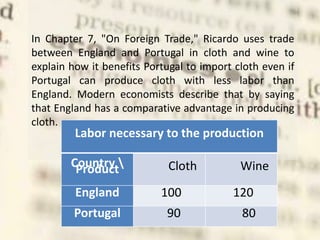
In Chapter 7, "On Foreign Trade," Ricardo uses trade
between England and Portugal in cloth and wine to
explain how it benefits Portugal to import cloth even if
Portugal can produce cloth with less labor than
England. Modern economists describe that by saying
that England has a comparative advantage in producing
cloth.
Labor necessary to the production
Country 
Product Cloth Wine
England 100 120
Portugal 90 80
• Ricardo's example reads, "To produce the wine in
Portugal, might require only the labour of 80 men for one
year, and to produce the cloth in the same country, might
require the labour of 90 men for the same time. It would
therefore be advantageous for her to export wine in
exchange for cloth. This exchange might even take place,
notwithstanding that the commodity imported by
Portugal could be produced there with less labour than in
England. Though she could make the cloth with the
labour of 90 men, she would import it from a country
where it required the labour of 100 men to produce it,
because it would be advantageous to her rather to
employ her capital in the production of wine, for which
she would obtain more cloth from England, than she
could produce by diverting a portion of her capital from
the cultivation of vines to the manufacture of cloth."
Presented by
Muli, Mark Joshua V.
Templonuevo, Neo T.
DAVID RICARDO.ppt

DAVID RICARDO.ppt

  • 1.
  • 2.
    I. Historical Background II.Wages III.Profit IV.Rent V. Comparative Advantage
  • 3.
    HISTORICAL CONTEXT • Biography Son of a Jewish immigrant stockbroker  Born in London on April 18 or 19, 1772  3rd of 17 children  David Ricardo was one of those rare people who achieved tremendous success and lasting fame. After his family disinherited him for marrying outside his Jewish faith, Ricardo made a fortune as a stockbroker and a loan broker. When he died, his estate was worth over $100 million in today's dollars.
  • 4.
     At ageof 27, after reading The Wealth of Nations, (Adam Smith) Ricardo got excited about economics. He wrote his first economics article at age of 37 and then spent fourteen years—his last ones—as a professional economist.  In 1814, at the age of 42, Ricardo retired from business and took up residence at Gatcombe Park in Gloucestershire, where he had extensive landholdings.  In 1819 he became MP for Portarlington.  Illness forced Ricardo to retire from Parliament in 1823 and he died on 11 September at Gatcombe Park at the age of 51.
  • 5.
    Wages, Profit &Rent • There are – three factors of production • land, • labor, and • capital goods (such as shovels) – three classes of people: • landlords, • workers, and • capitalists. – Landlords earn rent, – workers earn wages, and – capitalists earn profits.
  • 6.
    WAGES • Ricardo believedthat in the long run, prices reflect the cost of production, and referred to this long run price as a Natural price. The natural price of labour (wages) was the cost of its production, that cost of maintaining the labourer. If wages correspond to the natural price of labour, then wages would be at subsistence level. However, due to an improving economy, wages may remain indefinitely above subsistence level.
  • 7.
    • Notwithstanding thetendency of wages to conform to their natural rate, their market rate may in an improving society, for an indefinite period, be constantly above it; for no sooner may the impulse, which an increased capital gives to a new demand for labor, be obeyed, than another increase of capital may produce the same effect; and thus, if the increase of capital be gradual and constant, the demand for labour may give a continued stimulus to an increase of people....
  • 8.
    • it hasbeen calculated, that under favorable circumstances population may be doubled in twenty-five years; but under the same favorable circumstances, the whole capital of a country might possibly be doubled in a shorter period. In that case, wages during the whole period would have a tendency to rise, because the demand for labor would increase still faster than the supply. (On the Principles of Political Economy, Chapter 5, "On Wages").
  • 9.
    PROFIT • In hisTheory of Profit, Ricardo stated that as real wages increase, real profits decrease because the revenue from the sale of manufactured goods is split between profits and wages. He said in his Essay on Profits, "Profits depend on high or low wages, wages on the price of necessaries, and the price of necessaries chiefly on the price of food."
  • 10.
    Rent Definition “that portion ofthe produce of the earth which is paid to the landlord for the use of the original and indestructible powers of the soil.”
  • 11.
    Its Postulation 1. Thereis perfect competition in the economy 2. The supply of land is limited 3. There is difference in the fertility of land 4. There is marginal or no rent land in the economy 5. Land has original and indestructible powers of soil 6. The demand for agricultural products increases with population growth 7. The Law of Diminishing Returns applies 8. Rent accrues from land above 9. Rent arise in the long run 10. Land and capital are single factors 11. Rent is price determined 12. Land is cultivated in historical sequence i.e. first the best land, then the less fertile and in this order.
  • 12.
    Comparative Advantage Definition A situationin which a country, individual, company or region can produce a good at a lower opportunity cost than a competitor. The basis of comparative advantage is the accepted fact that specialization and trade increases efficiency and consequently living standard.
  • 13.
    In Chapter 7,"On Foreign Trade," Ricardo uses trade between England and Portugal in cloth and wine to explain how it benefits Portugal to import cloth even if Portugal can produce cloth with less labor than England. Modern economists describe that by saying that England has a comparative advantage in producing cloth. Labor necessary to the production Country Product Cloth Wine England 100 120 Portugal 90 80
  • 14.
    • Ricardo's examplereads, "To produce the wine in Portugal, might require only the labour of 80 men for one year, and to produce the cloth in the same country, might require the labour of 90 men for the same time. It would therefore be advantageous for her to export wine in exchange for cloth. This exchange might even take place, notwithstanding that the commodity imported by Portugal could be produced there with less labour than in England. Though she could make the cloth with the labour of 90 men, she would import it from a country where it required the labour of 100 men to produce it, because it would be advantageous to her rather to employ her capital in the production of wine, for which she would obtain more cloth from England, than she could produce by diverting a portion of her capital from the cultivation of vines to the manufacture of cloth."
  • 15.
    Presented by Muli, MarkJoshua V. Templonuevo, Neo T.