copyright 2003 David Maister
90 commonwealth avenue boston, ma, 02116 usa
tel: 1-617-262-5968 www.davidmaister.com david@davidmaister.com
DAVID MAISTER
presentation handouts > management
copyright 2003 David Maister
90 commonwealth avenue boston, ma, 02116 usa
tel: 1-617-262-5968 www.davidmaister.com david@davidmaister.com
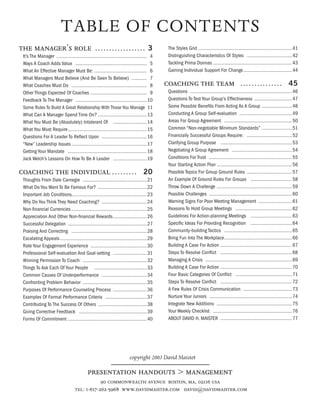
the manager’s role………………… 3
It’s The Manager… ……………………………………………………………… 4
Ways A Coach Adds Value… ………………………………………………… 5
What An Effective Manager Must Be:……………………………………… 6
What Managers Must Believe (And Be Seen To Believe)… ………… 7
What Coaches Must Do… …………………………………………………… 8
Other Things Expected Of Coaches………………………………………… 9
Feedback To The Manager… …………………………………………………10
Some Rules To Build A Great Relationship With Those You Manage 	11
What Can A Manager Spend Time On?……………………………………1�3
What You Must Be (Absolutely) Intolerant Of … ………………………1�4
What You Must Require…………………………………………………………15
Questions For A Leader To Reflect Upon …………………………………16
“New” Leadership Issues………………………………………………………17
Getting Your Mandate… ………………………………………………………18
Jack Welch’s Lessons On How To Be A Leader… ………………………19
coaching the individual………… 20
Thoughts From Dale Carnegie… ……………………………………………21
What Do You Want To Be Famous For?……………………………………22
Important Job Conditions……………………………………………………23
Why Do You Think They Need Coaching?… ………………………………24
Non-financial Currencies………………………………………………………25
Appreciation And Other Non-financial Rewards…………………………26
Successful Delegation…………………………………………………………27
Praising And Correcting… ……………………………………………………28
Escalating Appeals………………………………………………………………29
Rate Your Engagement Experience… ………………………………………30
Professional Self-evaluation And Goal-setting… ………………………31
Winning Permission To Coach:… ……………………………………………32
Things To Ask Each Of Your People … ……………………………………33
Common Causes Of Underperformance …………………………………34
Confronting Problem Behavior ………………………………………………35
Purposes Of Performance Counseling Process …………………………36
Examples Of Formal Performance Criteria ………………………………37
Contributing To The Success Of Others……………………………………38
Giving Corrective Feedback … ………………………………………………39
Forms Of Commitment ………………………………………………………40
TABLE OF CONTENTS
The Styles Grid……………………………………………………………………41
Distinguishing Characteristics Of Styles …………………………………42
Tackling Prima Donnas…………………………………………………………43
Gaining Individual Support For Change……………………………………44
coaching the team… …………… 45
Questions… ………………………………………………………………………46
Questions To Test Your Group’s Effectiveness……………………………47
Some Possible Benefits From Acting As A Group………………………48
Conducting A Group Self-evaluation ………………………………………49
Areas For Group Agreement… ………………………………………………50
Common “Non-negotiable Minimum Standards” ………………………51
Financially Successful Groups Require:… ………………………………52
Clarifying Group Purpose … …………………………………………………53
Negotiating A Group Agreement ……………………………………………54
Conditions For Trust ……………………………………………………………55
Your Starting Action Plan………………………………………………………56
Possible Topics For Group Ground Rules…………………………………57
An Example Of Ground Rules For Groups … ……………………………58
Throw Down A Challenge………………………………………………………59
Possible Challenges… …………………………………………………………60
Warning Signs For Poor Meeting Management …………………………61
Reasons To Hold Group Meetings… ………………………………………62
Guidelines For Action-planning Meetings … ……………………………63
Specific Ideas For Providing Recognition … ……………………………64
Community-building Tactics …………………………………………………65
Bring Fun Into The Workplace…………………………………………………66
Building A Case For Action ……………………………………………………67
Steps To Resolve Conflict … …………………………………………………68
Managing A Crisis ………………………………………………………………69
Building A Case For Action ……………………………………………………70
Four Basic Categories Of Conflict … ………………………………………71
Steps To Resolve Conflict … …………………………………………………72
A Few Rules Of Crisis Communication ……………………………………73
Nurture Your Juniors… …………………………………………………………74
Integrate New Additions… ……………………………………………………75
Your Weekly Checklist… ………………………………………………………76
ABOUT DAVID H. MAISTER… …………………………………………………77
presentation handouts > management
copyright 2003 David Maister
90 commonwealth avenue boston, ma, 02116 usa
tel: 1-617-262-5968 www.davidmaister.com david@davidmaister.com
THE MANAGER’S ROLE
presentation handouts  management
copyright 2003 David Maister
90 commonwealth avenue boston, ma, 02116 usa
tel: 1-617-262-5968 www.davidmaister.com david@davidmaister.com

It’s the Manager
It is the individual manager, not the firm, that makes the difference.
The best managers are able to care about both:
Clients AND Employees
Task Focus AND People Focus
Business development AND People development
Passion AND Compassion
Being Demanding AND Being Supportive
Having Good ideas AND Having the guts to stick with
them
Tough AND Tender
Deciding with the Head AND Deciding with the Heart
Making Money AND Having Fun
Work Hard AND Play Hard
Financial rewards AND Psychological rewards
Informing AND Listening
Taking care of today AND Building for the future
Autonomy AND Teamwork
Being a Manager AND Being a Human Being
Treating people as employees AND Treating people as
human beings
Rate yourself on each item in each pair. You will then have your own personal
improvement goals. (The goal is high scores on both, not just one in each
pair.)
Source: Maister, Practice What You Preach, Free Press, 2001
presentation handouts  management
copyright 2003 David Maister
90 commonwealth avenue boston, ma, 02116 usa
tel: 1-617-262-5968 www.davidmaister.com david@davidmaister.com

WAYS A COACH
ADDS VALUE
1.	 Create Energy and Excitement
2.	 Source of Creative Ideas
3.	 Forges Teamwork
4.	 Solves Problems/Breaks Down Barriers for Team
Members - Makes it easier for them to succeed.
5.	 Acts as a Sounding Board - Helps People Think
Through Their Issues
6.	 Enforces Standards (deals promptly with non-
compliance)
7.	Be a Conscience (“Gentle Pressure”)
8. Be a Source of Encouragement
How would you rate yourself at each of these?
How would those you lead rate you?
Source: McKenna and Maister, First Among Equals, Free Press, 2002
presentation handouts  management
copyright 2003 David Maister
90 commonwealth avenue boston, ma, 02116 usa
tel: 1-617-262-5968 www.davidmaister.com david@davidmaister.com

What an effective
manager must be:
1.	 Even keeled and even-tempered.
2.	 Genuine.
3.	 Good at reading people’s character and skill level.
4.	 Honorable.
5.	 Noble.
6.	 Sensitive to personal issues.
7.	 Smart, but human.
8.	 Someone of high integrity.
9.	 Apolitical.
10.	 Sincere.
11.	 A good communicator.
12.	 A good listener.
13.	 A role model.
14.	 A magnet for talent (the reason people want to stay.)
15.	 Accessible all the time.
16.	 Articulate about what he or she stands for.
17.	 Comfortable with allowing other people to get credit.
18.	 Disciplined about standards, although open to reasons
why they may not be met.
19.	 Enthusiastic.
20.	 Studied and precise in conversations.
21.	 Thoughtful.
22.	 Transparent, not opaque.
This list poses an interesting challenge. What can you do about the fact that what
you ARE as a person probably accounts for a significant portion of your business’s
success?
Source: Maister, Practice What You Preach, Free Press, 2001
presentation handouts  management
copyright 2003 David Maister
90 commonwealth avenue boston, ma, 02116 usa
tel: 1-617-262-5968 www.davidmaister.com david@davidmaister.com

what managers must believe
(and be seen to believe)
1.	 Chasing money is not what makes you money.
2.	 Development of people precedes and has a greater priority than profits.
3.	 First, you build your people and the rest will come.
4.	 Success is about character, respect, integrity, trust, honesty, empowerment, confidence,
loyalty and keeping promises.
5.	 Your agenda as a manager is to create a great place to work, rather than work at making
your own meteor rise.
6.	 People must not only trust management; they must also trust each other.
7.	 You must live up to your values everyday.
8.	 You must have a real concern for people as individuals, who they are and what they want.
9.	 Eighty percent of everything is choosing the right person.
10.	 The real issue is the willingness to bet on long-term, and not get stampeded by short-term
pressures.
11.	 You can sustain a culture if and only if you have developed managers who share your
values.
12.	 First give respect and you will get it.
13.	 Good people management leads to longevity, which leads to client trust, which leads to
more business.
14.	 It takes emotional courage to be a good and improving manager.
15.	 You must have a sense of humor about yourself and about work.
16.	 You must ensure that the workplace is a comfortable, friendly place to be.
17.	 It’s not just about the work; it’s about relationships, stupid!
18.	 It’s important how people treat each other; monitor it and manage it.
19.	 You must keep a good balance between focusing on people, clients and the finances.
20.	 You must ensure everyone has fun doing what they do.
21.	 Success is due to small size, empowerment, profitable projects, and interest in the
individual.
22.	 It is the combination of fun and discipline that gets the job done.
23.	 To manage well, one’s interest in people needs to be above average.
Source: Maister, Practice What You Preach, Free Press, 2001
presentation handouts  management
copyright 2003 David Maister
90 commonwealth avenue boston, ma, 02116 usa
tel: 1-617-262-5968 www.davidmaister.com david@davidmaister.com

what coaches must do
3.	 Like your people, and be nice to them.
4.	 Actively help people with their personal development.
5.	 Allow people to exercise their own judgment.
6.	 Allow people to learn from their mistakes without retribution.
7.	 Allow people to speak out no matter what their role is.
8.	 Allow your people to try different skills and experience different things.
9.	 Always do what you say you are going to do.
10.	 Respect the other person’s time.
11.	 Feedback mechanisms should be ingrained in the culture.
12.	 Believe in, and keep the faith with, what you are doing.
13.	 Do what is right, long term, for clients and for your people.
14.	 Do your own photocopying, when necessary. Wash your own cup.
15.	 Don’t be “separate and distinct” from your people.
16.	 Don’t expect your people to do anything you wouldn’t do yourself.
17.	 Don’t hesitate to jump in and help.
18.	 Never talk down to anyone.
19.	 Facilitate, don’t dictate.
20.	 Give credit where credit is due.
21.	 Have an open door policy at all levels for personal or work questions.
22.	 Lead by example; be what you want others to be.
23.	 Manage people in the way that works for each individual, not just how you like to manage. You
don’t have to be a chameleon, just adaptable.
24.	 Manage with an upbeat personal style, but keep a level emotional keel.
25.	 Delivers bad news in a non-threatening, non-upsetting way.
26.	 Never become detached.
27.	 Remember what people tell you.
28.	 Understand what drives individual people.
29.	 Respect confidences.
30.	 Show enthusiasm and drive; they are infectious and addictive.
31.	 Take work seriously, but don’t take yourself seriously.
32.	 Treat all roles are equally important.
33.	 Treat everyone’s opinion as vital.
34.	 Treat people who leave respectfully and with appreciation for what they have done for your firm.
35.	 Work the halls and know all the people.
36.	 Show levity and a good sense of humor.
37.	 Speak regularly about your vision and philosophy so people know where you stand.
38.	 Let people know you as a human being, not just as their coach.
Source: Maister, Practice What You Preach, Free Press, 2001
presentation handouts  management
copyright 2003 David Maister
90 commonwealth avenue boston, ma, 02116 usa
tel: 1-617-262-5968 www.davidmaister.com david@davidmaister.com

other things expected of coaches
1.	 Be demanding but make sure your demands are driven by the common good, not your personal
interests.
2.	 Be willing to take money from short-term profits to fund people’s workplace satisfaction.
3.	 Build your organization and its roles around the people you have and then fill in the gaps
around that.
4.	 Concentrate on the positive; don’t emphasize the negative.
5.	 Conduct all exit interviews personally.
6.	 Create a “casual, relaxed, collaborative” environment, but also a professional one.
7.	 Develop bench depth so you have greater slack in the business, and more freedom to avoid
short-term thinking.
8.	 Don’t allow senior people to “throw work on the desk and walk away.”
9.	 Don’t have hidden agendas.
10.	 Don’t make what you know is a wrong decision just to hit a short-term financial goal.
11.	 Don’t put good, cool people into a dull situation.
12.	 Earn trust by providing continual access to coaches.
13.	 Be an intermediary for your people to get cooperation for them from elsewhere in the
organization.
14.	 Ensure that coaches are in the trenches themselves.
15.	 Establish an ombudsman or a liaison, as a lifeline to what is going on.
16.	 Get people to trust you by really caring about them and their development.
17.	 Give no “brownie points” for exceeding workload and revenue targets if this risks “burnout.”
18.	 Make sure people view you as the kind they would like to have as neighbors.
19.	 Make sure upper management is not concerned with demonstrating their status.
20.	 Make sure your people know the firm will takes care of them.
21.	 Back your people up and not (automatically) the client.
22.	 Spend most time as an executive committee on HR issues.
23.	 Offer high recognition, psychic rewards and monetary rewards.
24.	 Send a strong signal to your people that the guys at the top were not afraid to make the difficult
decisions.
25.	 Be the reason people want to stay.
26.	 Show sensitivity to what people is going through.
27.	 Support and back up your people and their decisions.
28.	 Walk the halls, continuously talking not just about work but about “them.”
29.	 When you get angry (which should be rare), ensure people know why.
Source: Maister, Practice What You Preach, Free Press, 2001
presentation handouts  management
copyright 2003 David Maister
90 commonwealth avenue boston, ma, 02116 usa
tel: 1-617-262-5968 www.davidmaister.com david@davidmaister.com

feedback to the manager
Indicate your agreement or disagreement, using the following scale: 1 = Strongly
Disagree; 2 = Somewhat Disagree; 3 = Neither Agree nor Disagree; 4 = Somewhat
Agree; 5 = Strongly Agree
the manager.......
Causes me to stretch for performance goals
Is concerned about long-term issues, not just short-term profits
Provides constructive feedback that helps me improve my performance
Is a source of creative ideas about our business
Helps me to grow and develop.
Conducts team meetings in a manner that breeds involvement
Makes me feel that I am a member of a well-functioning team
Emphasizes cooperation as opposed to competitiveness between work groups
Is prompt in dealing with underperformance and underperformers
Helps me understand how my tasks fit into the overall objectives for the firm
Keeps me informed about the things I need to know to perform my role properly
Actively encourages me to volunteer new ideas and make suggestions for improvement
of the practice
Encourages me to initiate tasks or projects I think are important
Is good at keeping down the level of “politics and politicking”
Is more often encouraging than critical
Is accessible when I want to talk
Is fair in dealings with professionals
Is consultative in his/her decision-making
Acts more like a coach than a boss
Is publicly generous with credit
Is effective in communicating with professionals
Source: Maister, Managing the Professional Service Firm, Free Press, 1993
presentation handouts  management
copyright 2003 David Maister
90 commonwealth avenue boston, ma, 02116 usa
tel: 1-617-262-5968 www.davidmaister.com david@davidmaister.com

some rules to build
a great relationship with
those you manage
1.	 You need to be available as a sounding board to your romantic
partner. You don’t need to be critical. Listen before you react.
2.	 Work really hard at listening and understanding.
3.	 Do the unexpected occasionally; don’t take each other for granted.
4.	 Discuss your common values.
5.	 Communicate honestly, openly and frequently.
6.	 Spend time with each other, with no agenda.
7.	 Show your appreciation regularly, but not in a formulaic way.
8.	 Find ways to have fun together.
9.	 Don’t let problems fester. Catch them and discuss them early.
10.	Show Interest.
11.	Understand.
12.	Spend time off the issue.
13.	Give of yourself.
Source: McKenna and Maister, First Among Equals, Free Press, 2002
presentation handouts  management
copyright 2003 David Maister
90 commonwealth avenue boston, ma, 02116 usa
tel: 1-617-262-5968 www.davidmaister.com david@davidmaister.com

What a Manager
Could Spend Time On
1.	 Spend unscheduled, informal time with individual people (senior and/or junior), serving as
coach, to help them develop themselves and their practice.
2.	 Be knowledgeable about the development of junior people and be ready to suggest
reassignments between projects in order to build skills and advance their careers.
3.	 Be in touch with other group members’ clients to help them grow relationships, and
to monitor client satisfaction and act as a conscience for everyone to excel at client
satisfaction.
4.	 Help members of the team differentiate themselves from other competitors in a
meaningful way that clients recognize and value.
5.	 Help people to stay current with the trends affecting the client industries they serve, the
changes that will affect these clients, and their demand for the group’s services.
6.	 Monitor the profitability of assignments conducted by group members and discuss results
with them.
7.	 Devise methodologies to capture and share knowledge acquired while serving clients both
within the group and across the firm.
8.	 Help the group explore new and innovative ways of using technology to better deliver
services and reduce costs to clients.
9.	 Spend time recruiting, interviewing, and attracting potential recruits (junior and senior).
10.	 Spend time following up and actively helping members of the group execute their planned
activities.
11.	 Initiate and run regular meetings to collectively plan the group’s activities and initiatives
for the coming quarter.
12.	 Conduct formal performance appraisals of other (senior) people in the team for purposes of
compensation.
13.	 Conduct counseling sessions with people on the basis of these performance appraisals.
14.	 Celebrate individual and group achievements – the minor wins, not just the home runs;
the good tries, not just the successes.
Source: McKenna and Maister, First Among Equals, Free Press, 2002
presentation handouts  management
copyright 2003 David Maister
90 commonwealth avenue boston, ma, 02116 usa
tel: 1-617-262-5968 www.davidmaister.com david@davidmaister.com

WHAT CAN A MANAGER
SPEND TIME ON?
where is the added value?
Administration And Finance	
Personal Client Work
Personal Practice Development
Client Relations
Time With People
(Formal V. Informal)
(One-on-one V. Groups)
Other
Source: Maister, Managing the Professional Service Firm, Free Press, 1993
presentation handouts  management
copyright 2003 David Maister
90 commonwealth avenue boston, ma, 02116 usa
tel: 1-617-262-5968 www.davidmaister.com david@davidmaister.com

what you must be
(absolutely) intolerant of
1.	 Abuse of power or position.
2.	 Any disrespect shown by anyone to anyone else.
3.	 Anyone who is abusive.
4.	 Back stabbing.
5.	 Being late to meetings.
6.	 Betraying secrets.
7.	 Bullying.
8.	 People calling in sick when they’re not.
9.	 Cross-departmental rivalry.
10.	 Cruising.
11.	 Dealing in blame.
12.	 Derogatory statements.
13.	 Disrespect of any kind.
14.	 Freak clients, where there is the potential of failure from a relationship standpoint.
15.	 Clients that aren’t exciting.
16.	 Clients who abuse your people.
17.	 Clients who don’t treat your people well.
18.	 Gossiping, whining, complaining.
19.	 Hiding from accountability.
20.	 Lack of teamwork.
21.	 Management through intimidation.
22.	 Coaches who are not good coaches.
23.	 Non-compliance with standards.
24.	 Not treating people with respect.
25.	 People who are “snappish” with anyone else. If they are, insist they apologize.
26.	 People who try to make their own rules.
27.	 Screaming.
28.	 People who don’t hold up their end of the deal.
29.	 Shirking or dumping responsibility.
30.	 Those who are political.
Source: Maister, Practice What You Preach, Free Press, 2001
presentation handouts  management
copyright 2003 David Maister
90 commonwealth avenue boston, ma, 02116 usa
tel: 1-617-262-5968 www.davidmaister.com david@davidmaister.com

what you must require
1.	 An attitude of: “We don’t care how it happened, let’s just get it fixed.”
2.	 All people form relationships with client people at the equivalent level.
3.	 Continual career development for everyone.
4.	 Diplomacy; courtesy; professionalism; no superficiality.
5.	 Everyone must be a team player.
6.	 Everyone must be approachable.
7.	 Everyone must be self-motivated.
8.	 Everyone must develop leadership skills.
9.	 Everyone must learn new skills continuously.
10.	 Everyone must respect their colleagues and be cordial.
11.	 Everyone’s voice must be appreciated and heard.
12.	 If a performance review doesn’t get done on time, the coach’s “bonus” should be reduced
significantly.
13.	 If someone doesn’t manage their team well, put a hold on their salary, deny them additional
responsibility, and if that doesn’t work, fire them.
14.	 Insist everyone work together for the overall success of firm, not just themselves or their
group.
15.	 Make sure everyone knows they must be reliable. If you take something on, then you must
deliver.
16.	 People do what they say they are going to do.
17.	 The partnership is made up of “high integrity” people.
18.	 Everyone must show respect for other people, inside and outside.
19.	 Talent is no excuse for bad behavior.
20.	 Trust, respect, and integrity.
21.	 Try the soft approach to get someone to work to your standards, but if it doesn’t, be
prepared to be intolerant.
Source: Maister, Practice What You Preach, Free Press, 2001
presentation handouts  management
copyright 2003 David Maister
90 commonwealth avenue boston, ma, 02116 usa
tel: 1-617-262-5968 www.davidmaister.com david@davidmaister.com

questions for a leader to
reflect upon
1.	 Do you show a genuine interest in what each of your group members want to
achieve with their careers?
2.	 Do you show an interest in the things that mean the most to your people in
their personal lives?
3.	 Are you there for your people in their times of personal or professional crisis?
4.	 Do you informally “check-in” with each of your people every so often?
5.	 Do you offer to help when some member of your group clearly needs it?
6.	 How many of those that you have the responsibility to coach would consider
you their trusted advisor?
7.	 Do you actually like the people you are coaching – and do they know you like
them?
8.	 Do the people you are seeking to coach actually view you as being someone
who cares about others?
9.	 Can you help your people to visualize and articulate their dreams?
10.	Are you investing time toward building a strong relationship?
11.	Do people feel comfortable admitting their flaws to you?
12.	Do you always act and offer your advice in the best interests of your people?
Source: McKenna and Maister, First Among Equals, Free Press, 2002
presentation handouts  management
copyright 2003 David Maister
90 commonwealth avenue boston, ma, 02116 usa
tel: 1-617-262-5968 www.davidmaister.com david@davidmaister.com

“new” leadership issues
1.	 More personal time managing, less doing
2.	 More time managing people, less managing the numbers
3.	 More time promoting mutual respect across boundaries
4.	 More urgency in dealing with non-performers
5.	 Have to “bet” bigger in new practice areas
6.	 Increasingly, a leader of insecure people (change is frightening)
7.	 Rising internal politics, as economics of practice areas shift
8.	 Design and absorb more complex career paths
9.	 More attention has to be given to motivation issues
10.	 Increasingly, must manage what you don’t understand
11.	 More tendency to coordinated (centralized) decision-making
12.	 Need to design more sophisticated compensation systems
13.	 But, will have to manage “around” the compensation system
14.	 Retooling of some senior professionals
15.	 More managing by wandering around
16.	 Need to train, encourage and reward more managerial skills in others
17.	 More individual negotiation with seniors of individual roles
18.	 Have to encourage and incent more experimentation : “risk-free personal
growth”
19.	 Clearer articulation of values, strategy to reduce ambiguity
presentation handouts  management
copyright 2003 David Maister
90 commonwealth avenue boston, ma, 02116 usa
tel: 1-617-262-5968 www.davidmaister.com david@davidmaister.com

getting your mandate
1. 	 What is my minimum-maximum requirement for the amount of non-
reimbursed time that I should devote to group leadership activities?
2. 	 Can we agree what my rights are, as group leader, to interact with group
members (and their clients)? What’s acceptable, and what’s not?
3. 	 To what degree can I be assured that my compensation will be based, entirely
or in large part, on my effectiveness in helping the group succeed?
4. 	 Can we agree that I will be allowed to provide individual performance
appraisal input on each member of the team and that my input will be
accorded serious consideration irrespective of that individual’s personal
production?
5. 	 Can we agree that firm management will communicate internally that
activities conducted with non-reimbursed time are valued, monitored, and
considered an essential part of each person’s performance appraisal – and that
group leaders will be called upon to provide their input?
6. 	 Can I have the assurance of firm management that my efforts as group leader
will be supported by:
a) 	 a clear articulation of the importance of strong groups within the firm, and a clear 	
articulation of my mandate and powers as a group leader
b) 	 active encouragement provided to everyone to get them on board with the initiative
c) 	 the attendance of firm leaders at periodic meeting of the group
d)	 an ongoing and visible demonstration of acknowledgement to those groups making
progress
e) 	 the initiation of a group leaders’ council to facilitate communications and information
sharing
f) 	 the scheduling of periodic progress reviews
Source: McKenna and Maister, First Among Equals, Free Press, 2002
presentation handouts  management
copyright 2003 David Maister
90 commonwealth avenue boston, ma, 02116 usa
tel: 1-617-262-5968 www.davidmaister.com david@davidmaister.com

Jack Welch’s Lessons
on how to be a Leader
(Abstracted from WINNING in Newsweek, 4/4/05)
1.	 Leaders relentlessly upgrade their team, using every encounter as
an opportunity to evaluate, coach and build self-confidence.
2.	 Leaders make sure people not only see the vision, they live and
breathe it.
3.	 Leaders get into everyone’s skin, exuding positive energy and
optimism.
4.	 Leaders establish trust with candor, transparency and credit.
5.	 Leaders have the courage to make unpopular decisions and gut
calls.
6.	 Leaders probe and push with a curiosity that borders on skepticism,
making sure their questions are answered with action.
7.	 Leaders inspire risk taking and learning by setting the example.
8.	 Leaders celebrate.
presentation handouts  management
copyright 2003 David Maister
90 commonwealth avenue boston, ma, 02116 usa
tel: 1-617-262-5968 www.davidmaister.com david@davidmaister.com

COACHING THE INDIVIDUAL
presentation handouts  management
copyright 2003 David Maister
90 commonwealth avenue boston, ma, 02116 usa
tel: 1-617-262-5968 www.davidmaister.com david@davidmaister.com

Thoughts from
Dale Carnegie
1. 	 There is only one way to get anybody to do anything: Make the other person
want to do it.
2. 	 The only way on earth to influence people is to talk about what they want,
and show them how to get it.
3.	 Henry Ford: “If there is any one secret of success, it lies in the ability to get the
other person’s point of view and see things from that person’s angle as well as
your own”
4. 	 First arouse in the other person an eager want. The person who can do this has
the whole world The person who cannot walks a lonely way.
5. 	 The only way to get the best of an argument is to avoid it. You win nothing by
proving a person wrong (in fact, you lose a lot: furiously avoid doing it)
6. 	 No-one in the world likes to take orders: (take every opportunity to persuade
and request. Command if you have to, but only as a last resort, and recognize
it for what it is: a failure in being sufficiently skilled at the art of persuasion.)
7. 	 The Socratic approach to persuasion: Begin by emphasizing-and keep on
emphasizing- the things on which you agree. Get the other person saying “yes,
yes” at the outset. Keep (them), if possible, from saying “no” (until you have
built your case). (Persuasion fails when you try to rush and omit steps in the
logical progression of your argument.)
8. 	 (The secret to creating action and agreement) Let the other person feel the
idea was his or hers.
9. 	 Always empathize. Use the following phrase in every disagreement and
confrontation: “I don’t blame you one iota for feeling as you do. If I were
you I would undoubtedly feel just as you do.” (Then...”Let’s work on this
together)
Source: Dale Carnegie, How to Win Friends and Influence people, Simon  Schuster, 1937
presentation handouts  management
copyright 2003 David Maister
90 commonwealth avenue boston, ma, 02116 usa
tel: 1-617-262-5968 www.davidmaister.com david@davidmaister.com

WHAT DO YOU WANT TO
BE FAMOUS FOR?
(what’s going to make you distinctive?)
Intellectual Thought Leader in a particular service area
Industry Expert
Superior Client Counseling skills
Superior ability to Get Things Done through others
Special abilities in Practice Development
Special Ability to work with certain types of clients
		 (e.g. entrepreneurs, high net worth individuals)
Superior Ability to Transfer Skills to Others
.........??
.........??
presentation handouts  management
copyright 2003 David Maister
90 commonwealth avenue boston, ma, 02116 usa
tel: 1-617-262-5968 www.davidmaister.com david@davidmaister.com

IMPORTANT JOB
CONDITIONS
subordinate
rating
supervisor
rating
appreciation for good
work
1 8
feeling “in” on things 2 10
help with problems 3 9
job security 4 2
salary or wages 5 1
interesting work 6 5
promotion chances 7 3
loyalty to/from
coworkers
8 6
working conditions 9 4
tactful discipline 10 7
presentation handouts  management
copyright 2003 David Maister
90 commonwealth avenue boston, ma, 02116 usa
tel: 1-617-262-5968 www.davidmaister.com david@davidmaister.com

Why do you think they
need coaching?
Are they:
1.	 Unclear about his or her career path?
2.	 Asking for advice, assistance, feedback, or support?
3.	 Taking on a new task or responsibility?
4.	 Frustrated or confused?
5.	 Indecisive or stuck?
6.	 Inconsistent or systematically underperforming?
7.	 Expressing a desire to improve?
8.	 Performing well, but showing a negative attitude
that is impeding their work and the work of others
Source: McKenna and Maister, FIRST AMONG EQUALS, Free Press, 2002
presentation handouts  management
copyright 2003 David Maister
90 commonwealth avenue boston, ma, 02116 usa
tel: 1-617-262-5968 www.davidmaister.com david@davidmaister.com

Non-Financial
Currencies
1.	 Approval
2.	 Gratitude
3.	 Autonomy
4.	 Participation / Involvement
5.	 Personal Interest / Support
6.	 Recognition
7.	 Visibility (inside and outside the office)
8.	 Contacts
9.	 Access to Information (“Insider”)
10.	Access to additional resources
11.	Rapid response (Access to manager)
12.	Task support
13.	Titles (Official and “Unofficial”
14.	Special roles or assignments
15.	Challenge
16.	Meaning
presentation handouts  management
copyright 2003 David Maister
90 commonwealth avenue boston, ma, 02116 usa
tel: 1-617-262-5968 www.davidmaister.com david@davidmaister.com

appreciation and other
non-financial rewards
1.	 Consistently thank people for a job well done and give them a pat
on back at the time it happens.
2.	 Express appreciation on an informal, continuous basis.
3.	 Give “Thank you’s” every day.
4.	 Have a sabbatical leave program for everyone, when people can do
whatever they want.
5.	 If someone comes up with a good idea that gets used, give him or
her a gift certificate.
6.	 Reward people with more diversified work or work with different
opportunities giving them more stimulating things.
7.	 Show appreciation for even small accomplishments, as soon as the
accomplishment happens.
8.	 If a client has positive things to say, share it immediately with
everyone via emails, as soon as it comes in.
9.	 Ensure that compliments from clients get transmitted to everyone
in the firm, so everyone knows when a client has praised an
individual.
10.	Show appreciation, not just with money but in small ways like
sharing between teams and email “thank you’s.”
11.	Worry about outcomes, not process.
Source: Maister, Practice What You Preach, Free Press, 2001
presentation handouts  management
copyright 2003 David Maister
90 commonwealth avenue boston, ma, 02116 usa
tel: 1-617-262-5968 www.davidmaister.com david@davidmaister.com

SUCCESSFUL DELEGATION
1. Describe Context and Importance of Assignment
2. Describe the assignment
3. Set parameters
Deadline
Scope
Format
Time Budget
Relative Priority
Available Resources
4. Set success criteria
How task will be judged
5. Discuss Monitoring and Scheduled Check points
6. Check for Understanding
7. Solicit and DEAL WITH concerns
8. Repeat explanation of context and importance
(Source: Blanchard, One Minute Manager Video)
presentation handouts  management
copyright 2003 David Maister
90 commonwealth avenue boston, ma, 02116 usa
tel: 1-617-262-5968 www.davidmaister.com david@davidmaister.com

PRAISING AND
CORRECTING
PRAISING
1. Early and often
2. Approximately right
3. Specific accomplishment, not the person
4. Tell them why it was useful
5. Describe next challenge
CORRECTING
1. Do it immediately
2. Correct individually, in private
3. Go after the error, not the person
4. Be Specific: describe what’s wrong
5. Ask for an explanation -Listen first, talk later
6. Hide your emotions: don’t deflect focus on to you
Use as an opportunity to teach
(Source: Blanchard, One Minute Manager Video)
presentation handouts  management
copyright 2003 David Maister
90 commonwealth avenue boston, ma, 02116 usa
tel: 1-617-262-5968 www.davidmaister.com david@davidmaister.com

Escalating Appeals
What do you say to someone in your team who is not in
compliance with your standards? (i.e. doesn’t get involved in
marketing, doesn’t treat people with respect, doesn’t show up
to meetings on time.”) What “appeals” can you make to them
that might tempt them into cooperating/
1. 	 The Personal Request
		 “Do it as a favor to me: I’ll owe you one”
2. 	 The Ego Protection Ploy
		 “You’ll look bad in the eyes of others”
3. 	 The Team Play Appeal
		 “It’s important to the team”
4. 	 The Fun Promise
		 “It’s fun; you’ll enjoy it”
5. 	 The Isolation Gambit
			 “You don’t want to be the odd person out”
6. 	 The Guilt Plea
		 “You’re a better person than that”
7. 	 The Reorientation Retort
		 “It’s consistent with what you believe in”
8. 	 The Perspective Point
		 “It will pay off for you in the long run”
9. 	 The Have Mercy Message
		 “Other people will suffer if you don’t”
10. 	The Contractual Comeback
		 “You agreed to this when we discussed it”
11. 	The Principle Principle
		 “It’s the right thing to do”
12. 	The Context Framer
		 “When you do this, it has the following consequences for others”
presentation handouts  management
copyright 2003 David Maister
90 commonwealth avenue boston, ma, 02116 usa
tel: 1-617-262-5968 www.davidmaister.com david@davidmaister.com

rate your
engagement experience
Please rate your engagement experience on a scale of 1
(strongly disagree) to 5 (strongly agree) on the following :
1.	 When tasks and projects were assigned to me, I understood thoroughly what
was expected of me.
2.	 When they were assigned, I understood how my tasks fit into the overall
objectives for the engagement.
3.	 Help was available when I needed to have questions answered.
4.	 I received PROMPT feedback on my work, good or bad
5.	 When I was corrected me for something I did or failed to do, it was done in a
constructive way.
6.	 I received good coaching to help me improve my performance.
7.	 I was kept informed about the things I needed to know to do my job properly.
8.	 I had the freedom to make the necessary decisions to do my work properly.
9.	 I was actively encouraged to volunteer new ideas and make suggestions for
improvement.
10.	Team meetings were conducted in a way that built trust and mutual respect.
11.	In this engagement we set very high standards for performance.
12.	I felt that I was a member of a well-functioning team.
13.	My work made good use of my knowledge and ability.
14.	This engagement helped me learn and grow.
15.	My work was interesting and challenging.
Source: David H. Maister, Managing the Professional Service Firm, 1993
presentation handouts  management
copyright 2003 David Maister
90 commonwealth avenue boston, ma, 02116 usa
tel: 1-617-262-5968 www.davidmaister.com david@davidmaister.com

professional self-evaluation
and goal-setting
1. 	 What have you done in the last year that the rest of the firm has benefited from this year?
2. 	 What do you see as your major contribution to strengthening our balance sheet? (OR
“What have you done that makes us stronger for the future”?)
3. 	 In what way are you personally more valuable on the marketplace than last year? (i.e.
justified raising your personal billing rate?)
4. 	 What are your plans to make yourself more valuable on the marketplace than in the past?
(i.e. justify raising your personal billing rate?)
5. 	 What have you done to leverage yourself more than in the past?
6.	 How do you plan to leverage your skills more in the future?
7. 	 What specific new skills do you plan to acquire in the next three years?
8. 	 Listed below are various forms of contribution to the practice. Arrange them in order of
what you see as your need to work on your performance. Thus a “1” indicates the area
where you most need to give increased attention, and a “10 “ indicates where you least need
to improve. Rank all items, and no ties, please.
a) 	 Client Relations and Quality of Service
b) 	 Contributions to skill building in others
c) 	 Contributions to Marketing (lead generation)
d) 	 Contributions to Selling New Clients(pursuit of leads)
e) 	 Cross-Selling New Services to Existing Clients
f) 	 Industry Specific Knowledge
g) 	 Improving profitability on current work
h) 	 Coaching, Morale Building
i) 	 Contributions to Management of our Practice
j) 	 Development of Personal Skills
	 Use the same list as question 8, but now give different types of scores. Please rank yourself
relative to your colleagues and peers. A “1” means you judge yourself as significantly below
your colleagues in this area, a “2” somewhat below, a “3”” about the same, a “4” somewhat
better and a “5” significantly better.
presentation handouts  management
copyright 2003 David Maister
90 commonwealth avenue boston, ma, 02116 usa
tel: 1-617-262-5968 www.davidmaister.com david@davidmaister.com

Winning Permission
To Coach:
1. 	 Ask how things are going
2. 	 Confirm that the individual is ready for coaching
3. 	 Ask questions to clarify the situation, and offer your
support and help
4. 	Offer information as appropriate
5. 	 Listen actively
6. 	Help this person identify possible courses of action
7. 	 Agree on the next step
8. 	Offer your personal support and confidence
Source: McKenna and Maister, First Among Equals, Free Press, 2002
presentation handouts  management
copyright 2003 David Maister
90 commonwealth avenue boston, ma, 02116 usa
tel: 1-617-262-5968 www.davidmaister.com david@davidmaister.com

Things to Ask Each of
Your People
1.	 What it is that they want to do that would make them distinctive in their
competitive marketplace and even more valuable to their clients?
2.	 What kind of support would they need from the firm and from the group in
order to achieve their desired distinctiveness?
3.	 What specific form of professional and personal training and development do
they think that they might benefit from?
4.	 What do they feel has been their most significant professional (and personal)
accomplishment to this point?
5.	 What was their biggest dream when they first entered the profession and
what is their greatest source of pride now?
6.	 What are their outside interests, what is their family situation, their spouse’s
background and how supportive their spouses are with respect to their career
pursuits?
7.	 What are their personal views on the characteristics that make for an effective
coach?
8.	 Would they actually appreciate some coaching assistance, and if they would,
in what specific areas?
9.	 What is their personal and candid assessment of your personal strengths and
weaknesses?
10.	What is their personal and candid assessments of their colleagues within the
practice team?
11.	How well do they think the group currently performs, and what are their
recommendations for improvement?
Source: McKenna and Maister, First Among Equals, Free Press, 2002
presentation handouts  management
copyright 2003 David Maister
90 commonwealth avenue boston, ma, 02116 usa
tel: 1-617-262-5968 www.davidmaister.com david@davidmaister.com

Common Causes of
Underperformance
1.	 Trouble at home or other personal problems (divorce, alcoholism,
depression, etc.)
2.	 The individual is “burned out” and no longer finds the work
interesting or challenging
3.	 The individual is, in fact, no longer competent
4.	 Fear of failure in trying something new and reaching for career
progress
5.	 They are making a quality of life choice and do not wish to
contribute any more energy or time to the business
6.	 Externally driven reasons such as the loss of a recent client or
downturn in their sector
7.	 They haven’t kept up in their field and are less in demand
8.	 The individual is struggling because of poor time management or
other inefficiencies
9.	 They don’t know what they should be doing to succeed
10.	They are poorly managed
11.	They are insecure due to things like firm merger discussions, and
have withdrawn into their shell, pending resolution of firm issues
Source: McKenna and Maister, First Among Equals, Free Press, 2002
presentation handouts  management
copyright 2003 David Maister
90 commonwealth avenue boston, ma, 02116 usa
tel: 1-617-262-5968 www.davidmaister.com david@davidmaister.com

Confronting
Problem Behavior
1.	 Describe actual situations that demonstrate the
behavior you are concerned about.
2.	 Explain why it concerns you and express your desire
for change.
3.	 Actively seek out and listen to the individual’s
reasons for this behavior.
4.	 Inform the individual how improving their
behavior will improve their career.
5.	 Ask for the individual’s ideas and commitment to
solving the problem.
6.	Offer your encouragement and support.
7.	 Agree on an action plan and set date to discuss
progress.
Source: McKenna and Maister, First Among Equals, Free Press, 2002
presentation handouts  management
copyright 2003 David Maister
90 commonwealth avenue boston, ma, 02116 usa
tel: 1-617-262-5968 www.davidmaister.com david@davidmaister.com

Purposes of
Performance
Counseling Process
1.	 Reflect on and learn from the past year’s
accomplishments;
2.	 Receive constructive feedback, positive or negative;
3.	 Receive personalized advice on how best to advance
their career; and
4.	 Receive guidance in setting realistic but stretching
personal goals for “growing their asset” and making
a contribution to the firm.
Source: McKenna and Maister, First Among Equals, Free Press, 2002
presentation handouts  management
copyright 2003 David Maister
90 commonwealth avenue boston, ma, 02116 usa
tel: 1-617-262-5968 www.davidmaister.com david@davidmaister.com

Examples of Formal
Performance Criteria
1. Profitability of work supervised
2. Client satisfaction on work supervised
3. Coaching on work supervised
4. Contributions to practice development
5. Contributions to the success of others
6. Personal growth (career strategy)
Source: Maister, Managing the Professional Service Firm, Free Press, 1993
presentation handouts  management
copyright 2003 David Maister
90 commonwealth avenue boston, ma, 02116 usa
tel: 1-617-262-5968 www.davidmaister.com david@davidmaister.com

Contributing to the
Success of Others
1. Does this person inspire and engender enthusiasm in other members
of the team?
2. Does this person keep the other members of the team informed
about what they have learned while working with clients that may
be of value to the others?
3. Does this person give freely of his or her time to help others handle
unexpected client emergencies or tight deadlines?
4. Does this person make it a point to publicize the superb work done
by other team members?
5. Does this person work with others to set clear goals, make plans, and
establish objectives for those projects that he or she leads?
6. Does this person exhibit technical competence and provide counsel-
advice when others ask for assistance with technical questions?
7. Does this person provide direction to team members on new projects
and help them set priorities?
8. Does this person actively seek new ways to improve what we do in
the group?
9. Does this person treat the other members of the team with respect?
10. Does this person give recognition to team members for their
contributions and efforts?
11. Does this person follow through to see that (internal or client)
problems get solved?
Source: McKenna and Maister, First Among Equals, Free Press, 2002
presentation handouts  management
copyright 2003 David Maister
90 commonwealth avenue boston, ma, 02116 usa
tel: 1-617-262-5968 www.davidmaister.com david@davidmaister.com

Giving
Corrective Feedback
1.	 State the purpose of your feedback. Try to relate
your personal feedback to the desired group’s
results. This helps set the focus for the feedback and
also lets the person know what your intentions are.
2.	 Describe your observations and perceptions.
Be specific, brief, and clear about the behaviors,
incidents, facts, or perceptions upon which you base
your point of view.
3. 	 Jointly agree on the subsequent action to be taken.
Think of this as a plan of action. Your willingness to
help can make it more effective.
4	 Summarize your discussions and show your
appreciation. Receiving feedback is just as hard
as giving the feedback. Let the other person know
you appreciate their openness, their willingness
to discuss the issue, and their willingness to move
constructively forward.
Source: McKenna and Maister, First Among Equals, Free Press, 2002
presentation handouts  management
copyright 2003 David Maister
90 commonwealth avenue boston, ma, 02116 usa
tel: 1-617-262-5968 www.davidmaister.com david@davidmaister.com

Forms of Commitment
COMMITTED TO: LABEL:
The Group’s Strategy Vision
The Group Loyalty
You Gratitude
Peers Team Spirit
Subordinates Responsibility
Client Service
Work Itself Pride
Source: McKenna and Maister, First Among Equals, Free Press, 2002
presentation handouts  management
copyright 2003 David Maister
90 commonwealth avenue boston, ma, 02116 usa
tel: 1-617-262-5968 www.davidmaister.com david@davidmaister.com

THE STYLES GRID
CONTROLLED
ASK
Analytical
(get it right)
Driver
(get it done)
TELL
Amiable
(get along)
Expressive
(get noticed)
EMOTIVE
Source: McKenna and Maister, First Among Equals, Free Press, 2002
presentation handouts  management
copyright 2003 David Maister
90 commonwealth avenue boston, ma, 02116 usa
tel: 1-617-262-5968 www.davidmaister.com david@davidmaister.com

Distinguishing
Characteristics of
Styles
AMIABLE ANALYTICAL DRIVER EXPRESSIVE
SEEKS Acceptance Accuracy Control Recognition
STRENGTHS
Listening
Teamwork
Follow-through
Planning,
Systems,
Orchestrate
Admin.,
Leader,
Pioneer
Persuading,
Enthusiastic,
Entertain
GROWTH AREAS
(Weaknesses)
Oversensitive
Slow to Action
No big picture
Perfectionist,
Critical,
Unresponsive
Impatient,
Insensitive,
Poor Listener
Inattentive to detail,
Short attention span
Poor follow-through
IRRITATIONS
Insensitivity
Impatience
Disorganization,
Impropriety
Inefficiency,
Indecision	
Routines,
Complexity
UNDER STRESS
Submissive,
Indecisive
Withdrawn,
Headstrong
Dictatorial,
Critical
Sarcastic,
Superficial
DECISION
MAKING
Conferring Deliberate Decisive Spontaneous
FEARS Sudden Change
Criticism of personal
efforts
Being taken
advantage of
Loss of social
recognition
GAINS SECURITY
THROUGH
Friendship Preparation Control Playfulness
MEASURES
PERSONAL
WORTH BY
Compatibility,
Contribution
Precision,
Accuracy
Results,
Impact
Acknowledgement,
Compliments
INTERNAL
MOTIVE
Participation The Process The Win The Show
Source: McKenna and Maister, First Among Equals, Free Press, 2002
presentation handouts  management
copyright 2003 David Maister
90 commonwealth avenue boston, ma, 02116 usa
tel: 1-617-262-5968 www.davidmaister.com david@davidmaister.com

Tackling Prima Donnas
1.	 Describe specific situations that illustrate the
behavior you are concerned about.
2.	 Explain why it concerns you and express your desire
for change.
3.	 Seek out and listen to the individual’s reasons for
this behavior.
4.	Help the individual see how improved behavior will
improve his or her career.
5.	 Ask for ideas and commitment to solving the
problem.
6.	Offer your encouragement and support.
7.	 Agree on an action plan and set a date to discuss
progress.
Source: McKenna and Maister, First Among Equals, Free Press, 2002
presentation handouts  management
copyright 2003 David Maister
90 commonwealth avenue boston, ma, 02116 usa
tel: 1-617-262-5968 www.davidmaister.com david@davidmaister.com

Gaining Individual
Support for Change
1. 	 Describe the situation and how it affects both the
individual and the group
2.	 Discuss the stake you both have in addressing the
situation and ask the person what he or she thinks
you both (together) might do
3. 	Offer options you see, and ask for comments on the
relative merits of the options
4.	 Ask the person for assistance in addressing any
concerns that may arise
5.	 Ask for the specific support you need and explain
what you will do
6.	 Express your appreciation
Source: McKenna and Maister, FIRST AMONG EQUALS, Free Press, 2002
presentation handouts  management
copyright 2003 David Maister
90 commonwealth avenue boston, ma, 02116 usa
tel: 1-617-262-5968 www.davidmaister.com david@davidmaister.com

COACHING THE TEAM
presentation handouts  management
copyright 2003 David Maister
90 commonwealth avenue boston, ma, 02116 usa
tel: 1-617-262-5968 www.davidmaister.com david@davidmaister.com

QUESTIONS
1.	 In our firm, practice groups function effectively as well-coordinated teams.
2.	 “Partner-level” individuals in our firm feel that they receive effective coaching to help them
succeed.
3.	 Our groups have a clear, articulated strategy (not just a budget) for how they are going to
make themselves more successful over the next year.
4.	 Members of our groups (apart from the group leader) have a clear understanding of their
rights and obligations as group members and how they are expected to function together.
5.	 Members of our groups have a clear understanding of their group’s purpose and the
benefits their group is aiming to create.
6.	 Every group in our firm holds meetings on a regular basis, at least monthly.
7.	 In our groups, when members commit to a task, it is almost always done (people do what
they say they are going to do.)
8.	 Our group leaders were chosen primarily for their interpersonal skills in coaching,
influencing and motivating others (rather than things like business getting, technical
excellence, seniority, or financial skills).
9.	 Group leaders in our firm have a written outline of their authority, responsibilities and
specific objectives; a clear indication of what the firm leadership expects of them; and are
fully conversant in how they will be measured.
10.	 In evaluating and rewarding group leaders in our firm, their group’s results carries more
weight than their individual, personal performance.
11.	 We have provided training to our group leaders in how to be an effective coach, (or
manager or leader.)
12.	 The senior management in my firm has clearly articulated the importance of having strong
groups and actively encourage everyone to participate.
13.	 What percentage of the individuals in your group(s) are actively working on a personal
development plan to build their skills and help make themselves more valuable to clients?
14.	 What percentage of their total work week do group leaders in your firm devote to group
leadership activities (as opposed to their personal practice?)
15.	 Of the time that group leaders spend on group leadership activities, what percentage of
that do they spend one-on-one with individual group members, serving as coach, to help
them develop themselves and their practice?
presentation handouts  management
copyright 2003 David Maister
90 commonwealth avenue boston, ma, 02116 usa
tel: 1-617-262-5968 www.davidmaister.com david@davidmaister.com

questions to test your
group’s effectiveness
1. 	 Do members of the group share in knowing why this group exists, where it is going, what it’s
trying to accomplish, what its core priorities are?
			 Or are they non-committed, grudging participants, perhaps because they feel that membership in the 	
		 group is irrelevant to their individual performance and individual compensation?
2. 	 Do practitioners believe that they can really depend upon and count on each other, and do they
feel confident about each other’s capabilities and efforts?
			 Or do they feel that relying on each other’s goodwill and expertise is either naive or dangerous?
3. 	 Do people share their collective wins and losses with each other?
			 Or do they only claim personal victories while rationalizing negative outcomes with excuses and
finger-pointing?
4. 	 Do members of the group genuinely listen to each other’s ideas and opinions?
			 Or do they simply defend and promote their own positions?
5. 	 Do people publicly honor and recognize each other’s efforts and contributions?
			 Or are accomplishments taken for granted?
6. 	 Do members of the group value each other’s time?
	 		 Or do they behave in a way that suggests that other’s time doesn’t have much importance to them?
7. 	 Do group members hold agreements and promises made among themselves as sacred?
			 Or, are agreements and promises only made expediently, such as “maybe, if it’s convenient”?
8. 	 Do people help each other succeed and grow, and then share in the excitement of each other’s
accomplishments?
			 Or are such concerns deemed irrelevant?
9. 	 Do people hold each other to high standards of performance and provide each other with
straight feedback, coaching, and compassion?
			 Or do they fail to insist on high standards or to coach poor performance, and confuse caring for people 	
		 with indulging them.
10. 	 Do group members behave as if their own success will be enhanced by the success
of the group?
			 Or do these people act as if their own needs and those of the team are contradictory concepts?
11. 	 Do people in the group share client contacts, information, tools and other resources with each
other?
			 Or do they tend to hoard and protect turf?
12. 	 Are members of the group recognized for contributing to the team purpose?
			 Or do group members feel that they are better off pursuing their own personal agendas, even though 	
		 outwardly participating?
13. 	 Does the group get the authority, the resources and the support to do what it was
organized to do?
			 Or is a lot of time wasted playing political games to overcome internal bureaucracy?
Source: McKenna and Maister, First Among Equals, Free Press, 2002
presentation handouts  management
copyright 2003 David Maister
90 commonwealth avenue boston, ma, 02116 usa
tel: 1-617-262-5968 www.davidmaister.com david@davidmaister.com

some possible benefits from
acting as a group
1.	 Improving value to clients by delivering to them the collective wisdom and skills, and
accumulated knowledge, of the group.
2.	 Making business development efforts more effective through pooling and coordination of
individual efforts.
3.	 Better utilization and development of junior professionals through collective decisions on
staffing of client work, allocation of resources, and mentoring.
4.	 Collective development of tools, templates, databases, and other practice aids to benefit
everyone.
5.	 More rapid and effective dissemination of expertise and skills among the group.
6.	 Better client service through greater ability to put the right people on the right job.
7.	 Better market image through development of a collective reputation, not just the sum of
individual reputations.
8.	 The comfort of belonging to a small group rather than being lost as one of a very large
number of people (applies both to the successful retention of senior as well as junior
people).
9.	 Informal coaching on a one-to-one basis acting as a source of help for personal growth,
rather than relying on firm-wide annual, bureaucratic performance appraisals.
10.	 Improved profitability from focusing as a group on ways to enhance performance.
11.	 Creation of a critical mass of time and resources to develop innovative service offerings,
which no individual could afford to do alone.
Which of these benefits will be easiest to obtain? Hardest?
Which will be the quickest to obtain? The slowest?
Which disrupts your culture least? Most?
Which represents the biggest impact on your success? Smallest?
Which requires the most change in behavior? Least?
Which requires the most activist role for the leader? The least?
Source: McKenna and Maister, First Among Equals, Free Press, 2002
presentation handouts  management
copyright 2003 David Maister
90 commonwealth avenue boston, ma, 02116 usa
tel: 1-617-262-5968 www.davidmaister.com david@davidmaister.com

Conducting a Group
Self-Evaluation
Agree or Disagree?
1. 	 Members of our group are committed to accomplishing our objectives.
2. 	 Members of our group get a lot of encouragement for new ideas.
3. 	 Members of our group freely express their real views.
4. 	 Every member of our group has a clear idea of the group’s goals.
5. 	 Everyone is involved in the decisions we have to make.
6. 	 We tell each other how we are feeling.
7. 	 All group members display respect for each other.
8. 	 The feelings among group members tend to pull us together.
9. 	 Everyone’s opinion gets listened to.
10. 	There is very little bickering among group members.
11.	We have the right skills, personalities and sufficiently
motivated group members.
12. 	This group is challenging and fun to work with.
13. 	What needs to be done next is clear and correct.
14. 	I am satisfied with the progress of the group to date in moving toward its
objectives.
Source: McKenna and Maister, First Among Equals, Free Press, 2002
presentation handouts  management
copyright 2003 David Maister
90 commonwealth avenue boston, ma, 02116 usa
tel: 1-617-262-5968 www.davidmaister.com david@davidmaister.com

Areas for Group
Agreement
1. 	 mutual accountability. All group members must
hold one another accountable for individual and for
group performance.
2. 	 shared contribution. All group members must
have an opportunity and obligation to contribute.
3. 	 shared values. All group members must adhere
strictly to the values, principles and standards
established by the group.
Source: McKenna and Maister, First Among Equals, Free Press, 2002
presentation handouts  management
copyright 2003 David Maister
90 commonwealth avenue boston, ma, 02116 usa
tel: 1-617-262-5968 www.davidmaister.com david@davidmaister.com

Common
“Non-negotiable
Minimum Standards”
a. 	Only truly superior work will be accepted.
b. 	 There will be no room for mere competence in
client satisfaction. We will operate as our clients’
trusted advisors, not their technical experts.
c. 	 Every person must have, and be working on, a
personal development plan: no cruising is allowed.
d. 	 No one will work on things that could be delegated
to a more junior person. If it can be delegated, it
must be.
e. 	 Everyone must treat all others with respect at all
times.
f. 	 Anyone in charge of a client assignment will
be required to supervise all the work on that
assignment to a high level, since we owe a duty of
due care to our clients to manage the affairs that
they have entrusted to us.
Source: McKenna and Maister, First Among Equals, Free Press, 2002
presentation handouts  management
copyright 2003 David Maister
90 commonwealth avenue boston, ma, 02116 usa
tel: 1-617-262-5968 www.davidmaister.com david@davidmaister.com

financially successful
groups require:
1. 	 An attitude of “We don’t care how it happened, let’s
just get it fixed”
2. 	 Continual skill and career development for
everyone
3. 	 Diplomacy, courtesy, professionalism
4. 	 Team play from everyone
5. 	 Approachability
6. 	 Self-motivation
7. 	 Consultation (everyone’s voice must be heard and
valued)
8. 	 Working together for the overall success of the
group, not just themselves
9. 	 An acceptance that, if you take something on, then
you must deliver
10. 	Trust, respect and integrity at all times.
Source: McKenna and Maister, FIRST AMONG EQUALS, Free Press, 2002
presentation handouts  management
copyright 2003 David Maister
90 commonwealth avenue boston, ma, 02116 usa
tel: 1-617-262-5968 www.davidmaister.com david@davidmaister.com

Clarifying Group
Purpose
Why does our group exist?
(what specific benefits can your group expect to
obtain from acting as a coordinated team?);
How will working together as a group help us compete?
(what might the benefits be to each member and
to the firm from investing some amount of each
individual’s discretionary non-billable time in
pursuit of building a strong practice team?) and,
What’s in it for each of us?
(what might each individual member want to get out of
working as a group for their respective career satisfaction?)
Source: McKenna and Maister, First Among Equals, Free Press, 2002
presentation handouts  management
copyright 2003 David Maister
90 commonwealth avenue boston, ma, 02116 usa
tel: 1-617-262-5968 www.davidmaister.com david@davidmaister.com

negotiating a group agreement
1.	 Are we prepared to create a supportive environment
and what would it look like?
2.	 Are we prepared to work at getting the benefit of
joint intellectual exchange?
3.	 Are we prepared to cooperate in developing
common tools and methodologies that we might all
be able to share?
4.	 Are we prepared to invest in developing superior
support staff, internal systems and technologies to
provide for the effective conduct of our practice?
5.	 Are we prepared to effectively engage in joint
marketing activities?
6.	 Are we prepared to devote non-billable time to
helping each other when facing sensitive client
issues?
Source: McKenna and Maister, First Among Equals, Free Press, 2002
presentation handouts  management
copyright 2003 David Maister
90 commonwealth avenue boston, ma, 02116 usa
tel: 1-617-262-5968 www.davidmaister.com david@davidmaister.com

Conditions for Trust
“I can trust you when . . .
1.	 you freely share information that may have an impact on me personally, my
practice or my client relationships;
2.	 you share your views, you share your expertise, and you even admit your
shortcomings and your mistakes;
3.	 you make a commitment to do something either for me or for the group, and
then you follow through on that commitment;
4.	 you declare that for whatever reason it is not possible for you to do something
that I have asked;
5.	 you let me know in advance if you are going to miss a deadline that we
have agreed to, so that I can readjust my expectations; or we can work out
an alternative arrangement to get whatever needs to be done attended to by
someone else;
6.	 you ask for my input concerning a decision you are contemplating and
then you either follow my guidance or let me know why you are taking an
alternate course of action;
7.	 you don’t know the answer to a question and you declare that you don’t know;
rather than trying to bluff your way through;
8.	 you let me know that you don’t agree with something that is being said, but
you disagree with respect and offer your alternate view. In other words you
don’t just disagree without offering an alternate suggestion or solution;
9.	 you let me know to my face that something I have said or done is upsetting
you so that we can discuss it rationally, find ways to resolve the matter, and I
don’t have to hear about it later from someone else.
Source: McKenna and Maister, First Among Equals, Free Press, 2002
presentation handouts  management
copyright 2003 David Maister
90 commonwealth avenue boston, ma, 02116 usa
tel: 1-617-262-5968 www.davidmaister.com david@davidmaister.com

your starting action plan
Schedule time to meet with every member of
your practice team. Ask each of them:
1.	 What it is that they want to do that would make them distinctive in their
competitive marketplace and even more valuable to their clients.
2.	 What kind of support they would need from the firm and from the group in
order to achieve their desired distinctiveness.
3.	 What specific form of professional and personal training and development
they think that they might benefit from.
4.	 What they feel has been their most significant professional (and personal)
accomplishment to this point in time.
5.	 What their biggest dream was when they first entered the profession and
what their greatest source of pride is now.
6.	 What their outside interests are, what their family situation is, their spouses
background and how supportive their spouse is with respect to their career
pursuits.
7.	 What their personal views are on the characteristics that make for an effective
coach.
8.	 Whether they would actually appreciate some coaching assistance, and if
they would, in what specific areas.
9.	 Their personal and candid assessments of your personal strengths and
weaknesses.
10.	Their personal and candid assessments of their colleagues within the practice
team.
11.	Their sense of how well the group currently performs and their
recommendations for improvement.
Source: McKenna and Maister, First Among Equals, Free Press, 2002
presentation handouts  management
copyright 2003 David Maister
90 commonwealth avenue boston, ma, 02116 usa
tel: 1-617-262-5968 www.davidmaister.com david@davidmaister.com

Possible Topics for
Group Ground Rules
1.	 Mutual respect and cooperation
2.	 Interpersonal communications and expression of
ideas
3.	 Making of decisions and resolving of conflicts
4.	 Support for personal risk-taking
5.	 Frequency and format of group meetings
6.	 Meeting attendance and punctuality
7.	 Participation in group business development efforts
and sharing of clients
8.	 Completion of individual projects
9.	 Client service and handling of complaints
10.	Learning and sharing knowledge
11.	Supervision, training, delegating, and staffing of
engagements
12.	Constructive feedback and performance evaluations
Source: McKenna and Maister, First Among Equals, Free Press, 2002
presentation handouts  management
copyright 2003 David Maister
90 commonwealth avenue boston, ma, 02116 usa
tel: 1-617-262-5968 www.davidmaister.com david@davidmaister.com

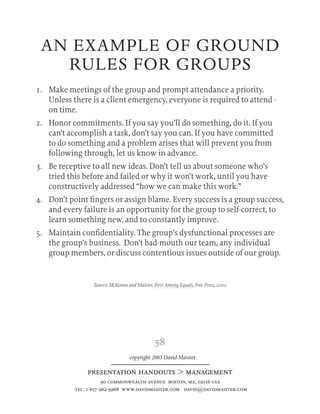
An Example of Ground
Rules for Groups
1.	 Make meetings of the group and prompt attendance a priority.
Unless there is a client emergency, everyone is required to attend -
on time.
2.	 Honor commitments. If you say you’ll do something, do it. If you
can’t accomplish a task, don’t say you can. If you have committed
to do something and a problem arises that will prevent you from
following through, let us know in advance.
3.	 Be receptive to all new ideas. Don’t tell us about someone who’s
tried this before and failed or why it won’t work, until you have
constructively addressed “how we can make this work.”
4.	 Don’t point fingers or assign blame. Every success is a group success,
and every failure is an opportunity for the group to self-correct, to
learn something new, and to constantly improve.
5.	 Maintain confidentiality. The group’s dysfunctional processes are
the group’s business. Don’t bad-mouth our team, any individual
group members, or discuss contentious issues outside of our group.
Source: McKenna and Maister, First Among Equals, Free Press, 2002
presentation handouts  management
copyright 2003 David Maister
90 commonwealth avenue boston, ma, 02116 usa
tel: 1-617-262-5968 www.davidmaister.com david@davidmaister.com

Throw Down A
Challenge
1.	 What breakthrough goal would we like to achieve?
2.	 What complex problem would we like to solve?
3.	 What would we like to create that never existed
before?
4.	 Which competitor would we like to vanquish?
5.	 Do we have a deep energy and passion to
accomplish something extraordinary?”
Source: McKenna and Maister, First Among Equals, Free Press, 2002
presentation handouts  management
copyright 2003 David Maister
90 commonwealth avenue boston, ma, 02116 usa
tel: 1-617-262-5968 www.davidmaister.com david@davidmaister.com

Possible Challenges
a.	 A specific high-profile “project” where the group is playing for
high stakes and perhaps even racing toward completing a task or
achieving a goal within a predetermined deadline (a high-stakes,
time-sensitive target)
b.	 A perceived cause or crusade where the group members are
committed to effect change (explore a positive course of action) or
arrest an economic condition (divert a negative course of action)
c.	 The perception (real or created) of an enemy to be vilified or a
competitor to be vanquished (to attain a position of superiority
over a rival)
d.	 A sense of viewing themselves as the “winning underdogs,” a
feisty collection of mavericks with fresh ideas, or a spunky little
group of upstarts determined to set new directions (rebellious
revolutionaries with something to prove)
e.	 A dream that members of the group share of creating something
new, exploring new precedents or solving some tough problems,
and achieving some sense of recognition (aiming to accomplish
something that redefines the very essence of their practice)
Source: McKenna and Maister, First Among Equals, Free Press, 2002
presentation handouts  management
copyright 2003 David Maister
90 commonwealth avenue boston, ma, 02116 usa
tel: 1-617-262-5968 www.davidmaister.com david@davidmaister.com

warning signs for poor
meeting management
1.	 Group meetings continually start and/or finish late;
2.	 Group members don’t come to meetings or arrive later and later
each time;
3.	 No agenda exists, or the agenda, materials and reports are not
distributed in advance;
4.	 The agenda lists more items than can reasonably be dealt with or
acted upon;
5.	 The group leader is not prepared;
6.	 Some people are allowed to monopolize discussions;
7.	 Only a few members speak; others withdraw non-verbally;
8.	 Members interrupt each other or “cross-talk,” (excluding others);
9.	 The meeting evidences long drawn out discussions, but conclusions
are rarely reached;
10.	At the end of the meeting, there is no clarity upon who has agreed
to accomplish what, by when;
11.	Specific projects are not completed on time; and
12.	There are no consequences for non-performance or challenging
behavior.
Source: McKenna and Maister, First Among Equals, Free Press, 2002
presentation handouts  management
copyright 2003 David Maister
90 commonwealth avenue boston, ma, 02116 usa
tel: 1-617-262-5968 www.davidmaister.com david@davidmaister.com

Reasons to Hold
Group Meetings
1. 	 We could learn a bit more about the client assignments that other
people in our group are working on and the specific issues they are
facing.
2. 	 Members of the group can take turns making a substantive
presentation to the group on some area in which they are
developing expertise, especially if they have recently attended
outside courses or seminars.
3. 	 The meeting can serve as a forum to orient our juniors, review work
assignments, give them feedback, instill some pride, and help them
feel like they are part of an important practice team.
4. 	 We could invite clients, the group leaders from other related
groups, or even outside experts to come and tell us about the issues
and projects they are working on.
5. 	 We could work together on some joint projects, especially if it helps
make our group more attractive to clients or helps each of us to be
more proficient at developing business.
Source: McKenna and Maister, First Among Equals, Free Press, 2002
presentation handouts  management
copyright 2003 David Maister
90 commonwealth avenue boston, ma, 02116 usa
tel: 1-617-262-5968 www.davidmaister.com david@davidmaister.com

Guidelines For Action-
Planning Meetings
1.	 Set a singular focus
2.	 “Brainstorm” ideas
3.	 Ensure ideas are actionable
4.	 Get “voluntary” commitments
5.	 Keep commitments small
6.	 Establish your “Contracts For Action”
7.	 Follow-up between meetings
8.	 Celebrate successes
Source: McKenna and Maister, First Among Equals, Free Press, 2002
presentation handouts  management
copyright 2003 David Maister
90 commonwealth avenue boston, ma, 02116 usa
tel: 1-617-262-5968 www.davidmaister.com david@davidmaister.com

Specific Ideas for
Providing Recognition
1.	 Visit a person in his or her office just to thank them for some specific contribution or post a
thank-you note on your colleague’s office door.
2.	 Send an e-mail message to everyone in the group advising of a person’s personal contribution
to your own accomplishment.
3.	 Organize a number of your group to take a specific staff member out for lunch on their
birthday or arrange to send a card home signed by everyone on the team.
4.	 Present a stuffed “Energizer bunny” to that group member who keeps going and going, or a
stuffed roadrunner to those who manage to complete a particular rush client project in record
time.
5.	 Arrange with firm management to rename one of your firm’s meeting rooms each year after
that person who has made the most notable contribution to the practice team during the
previous twelve months.
6.	 Present each new person joining the group with a specially printed T-shirt displaying their
name above the name of the group and the firm.
7.	 Initiate your own internal one-page monthly newsletter. Arrange a “Bravo” column to
salute personal and professional activities or a “Good Tries” column to recognize and offer
encouragement to those whose innovations did not achieve their full potential.
8.	 Allow new people and staff to rent, from the local art gallery, a work of art of their choice for
their office or work area.
9.	 Allow, encourage and support people in developing their own recognition programs.
10.	 Create a Hall Of Fame wall with photos of outstanding achievements, both professional and
personal.
11.	 Create an annual report, yearbook, or photo album containing memorabilia and photographs
of every group member along with their best achievements of the year.
12.	 Give an employee a day off with pay if he or she recommends a person who is hired and makes
it past the ninety-day probation period.
13.	 Buy a local billboard to celebrate a person’s professional, political or civic honor.
14.	 Host a surprise picnic for the entire practice team in the parking lot or parking garage.
15.	 Designate days when anyone who makes a negative comment forks over a dollar and use the
proceeds to fund a social event or external charity.
16.	 Give out “Odd Couple” (Felix and Oscar) awards to people with the neatest and messiest work
areas.
17.	 Send flowers to the spouse of any person or staff member who has to be away from home for an
extended period on client business, to show appreciation for the sacrifice.
Source: McKenna and Maister, First Among Equals, Free Press, 2002
presentation handouts  management
copyright 2003 David Maister
90 commonwealth avenue boston, ma, 02116 usa
tel: 1-617-262-5968 www.davidmaister.com david@davidmaister.com

Community-building
Tactics
1. 	 Create “task forces” for all projected changes in the group.
2. 	 Discuss all financials (except salaries) with everyone.
3. 	 Have a bulletin board where you list everything anyone wants to
celebrate - for themselves or for someone else.
4. 	 Ensure everyone knows why a decision is made.
5. 	 Every Friday afternoon, get everybody together and review the
week.
6. 	 Encourage people to eat lunch together (with no agenda).
7. 	 Give regular “State of the Union” addresses to the entire group.
8. 	 Have a very active program of cross-functional information sharing,
using briefs, e-mails, lunches, whatever.
9. 	 Make a lot of use of cross-boundary teams.
10. 	Take the time to interact socially, even if just in the hallway.
Source: McKenna and Maister, First Among Equals, Free Press, 2002
presentation handouts  management
copyright 2003 David Maister
90 commonwealth avenue boston, ma, 02116 usa
tel: 1-617-262-5968 www.davidmaister.com david@davidmaister.com

Bring Fun into
the Workplace
1. 	 Arrange a series of group days out of the office.
2. 	 Eat lunch together every day as a group.
3. 	Hold a Spring Break party.
4. 	Have a charity day where the firm pledges one day
per employee to a group of local charities.
5. 	Have ad hoc events like firmwide parties and open
days.
6. 	Offer free massages, shoeshines, book clubs,
exercise classes, language lessons, surprise ice cream
sundaes, pinball machines, Mothers day gifts, and so
on.
7. 	 Arrange group outings to film premieres, gigs, and
shows.
8. 	 Announce the top ten mistakes of the year.
9. 	Hold a parents’ day: let people bring their kids to
work.
10. Fund client entertainment liberally.
Source: McKenna and Maister, First Among Equals, Free Press, 2002
presentation handouts  management
copyright 2003 David Maister
90 commonwealth avenue boston, ma, 02116 usa
tel: 1-617-262-5968 www.davidmaister.com david@davidmaister.com

Building
a Case for Action
1. Ask each member of your group to articulate what’s
in it for them.
2. Give everyone the opportunity to stand up and
declare his or her personal commitment.
3. Focus first on what you can do now, with existing
resources.
4. Encourage experimentation.
5. Build for an early success to continue the
momentum.
6. Search continually for opportunities for people to
create or outdo themselves.
7. Set unreasonable expectations.
8. Focus on the excitement of the endeavor.
Source: McKenna and Maister, First Among Equals, Free Press, 2002
presentation handouts  management
copyright 2003 David Maister
90 commonwealth avenue boston, ma, 02116 usa
tel: 1-617-262-5968 www.davidmaister.com david@davidmaister.com

Steps to
Resolve Conflict
1. 	 Describe the conflict and the nonproductive
behavior you are observing.
2. 	 Ask each person to comment on the cause of the
disagreement.
3.	Have each person, in turn, summarize what he or
she heard the other person say (or understand the
other person’s position to be).
4. Ask each person, in turn, to identify points of
agreement and disagreement.
5. Invite your colleagues to suggest ways to proceed.
Source: McKenna and Maister, First Among Equals, Free Press, 2002
presentation handouts  management
copyright 2003 David Maister
90 commonwealth avenue boston, ma, 02116 usa
tel: 1-617-262-5968 www.davidmaister.com david@davidmaister.com

Managing a Crisis
1. 	 Calmly attempt to get at the facts
2. 	 Identify the real problem
3. 	 Decide who should handle the crisis
4. 	 Involve everyone where possible
5. 	 Remember that, in a crisis, everything (emotions,
results, etc.) is magnified.
Source: McKenna and Maister, First Among Equals, Free Press, 2002
presentation handouts  management
copyright 2003 David Maister
90 commonwealth avenue boston, ma, 02116 usa
tel: 1-617-262-5968 www.davidmaister.com david@davidmaister.com

Building
a Case for Action
1. 	 Ask each member of your group to articulate what’s
in it for them.
2. 	 Give everyone the opportunity to stand up and
declare his or her personal commitment.
3. 	 Focus first on what you can do now, with existing
resources.
4. 	 Encourage experimentation.
5. 	Build for an early success to continue the
momentum.
6. 	 Search continually for opportunities for people to
create or outdo themselves.
7. 	 Set unreasonable expectations.
8. 	 Focus on the excitement of the endeavor.
Source: McKenna and Maister, FIRST AMONG EQUALS, Free Press, 2002
presentation handouts  management
copyright 2003 David Maister
90 commonwealth avenue boston, ma, 02116 usa
tel: 1-617-262-5968 www.davidmaister.com david@davidmaister.com

Four basic categories
of conflict
1.	Over facts and data. A basic misunderstanding or
misinformation is the easiest type of conflict to
resolve;
2.	Over process or methods. Your people may have the
same goals but differ on how to achieve those goals,
a situation where compromise is often possible;
3.	Over purpose. Your people may have different goals
or agendas, which sometimes can be merged; and
4.	Over values. Your people may have differences in
basic beliefs or principles which create the most
difficult conflicts, and sometimes people must agree
to disagree.
Source: McKenna and Maister, FIRST AMONG EQUALS, Free Press, 2002
presentation handouts  management
copyright 2003 David Maister
90 commonwealth avenue boston, ma, 02116 usa
tel: 1-617-262-5968 www.davidmaister.com david@davidmaister.com

Steps to
Resolve Conflict
1. 	 Describe the conflict and the nonproductive
behavior you are observing.
2. 	 Ask each person to comment on the cause of the
disagreement.
3.	 Have each person, in turn, summarize what he or
she heard the other person say (or understand the
other person’s position to be).
4. 	 Ask each person, in turn, to identify points of
agreement and disagreement.
5. 	 Invite your colleagues to suggest ways to proceed.
Source: McKenna and Maister, FIRST AMONG EQUALS, Free Press, 2002
presentation handouts  management
copyright 2003 David Maister
90 commonwealth avenue boston, ma, 02116 usa
tel: 1-617-262-5968 www.davidmaister.com david@davidmaister.com

A Few Rules of
Crisis Communication
Handled badly, any crisis can harm the respect and loyalty you
enjoy with your group. Handled well, it can boost your team’s
enthusiasm.
Here are some basic guidelines for effectively handling your
communications with the group.
1. 	 Keep every member of your group fully informed
2. 	 Involve your group members in key decisions
3. 	Be accessible to your people
4. 	 Don’t lose your sense of humor
Source: McKenna and Maister, First Among Equals, Free Press, 2002
presentation handouts  management
copyright 2003 David Maister
90 commonwealth avenue boston, ma, 02116 usa
tel: 1-617-262-5968 www.davidmaister.com david@davidmaister.com

Nurture Your Juniors
The Work Assignment System
The Work Supervision System
Mentors
Hiring
Source: McKenna and Maister, First Among Equals, Free Press, 2002
presentation handouts  management
copyright 2003 David Maister
90 commonwealth avenue boston, ma, 02116 usa
tel: 1-617-262-5968 www.davidmaister.com david@davidmaister.com

Integrate
New Additions
1. Manage first impressions
2. Give them support - before they ask
3. Make them feel valued
4. Provide an immersion experience.
5. Communicate, communicate, communicate.
Source: McKenna and Maister, First Among Equals, Free Press, 2002
presentation handouts  management
copyright 2003 David Maister
90 commonwealth avenue boston, ma, 02116 usa
tel: 1-617-262-5968 www.davidmaister.com david@davidmaister.com

Your Weekly Checklist
1.	 Is anyone in noncompliance with our group
standards?
2.	 Is anyone struggling?
3.	 Who needs help, even if they’re not struggling?
4.	 Who needs energizing?
5.	 Who needs recognition or appreciation?
6.	 Is there anyone I haven’t had coffee or lunch with
(or otherwise paid personal attention to) in a while?
7.	 Is anyone doing things that are disrupting the
group?
8.	 Who do I have the least solid relationship with?
9.	 Are the juniors being looked after?
10.	Are there any conflicts going on between group
members?
Source: McKenna and Maister, First Among Equals, Free Press, 2002
presentation handouts  management
copyright 2003 David Maister
90 commonwealth avenue boston, ma, 02116 usa
tel: 1-617-262-5968 www.davidmaister.com david@davidmaister.com

ABOUT DAVID H. MAISTER
(pronounced MAY-ster)
David Maister is widely acknowledged as one of the world’s leading authorities on the
management of professional service firms. For two decades he has advised firms around the
world in a broad spectrum of professions, covering all strategic and managerial issues.
In 2002, he was named as one of the top 40 business thinkers in the world. (business minds,
Prentice Hall/Financial Times)
He is the author of the bestselling books:
Managing the Professional Service Firm (1993),
True Professionalism (1997),
The Trusted Advisor (2000),
Practice What You Preach (2001)�,
First Among Equals (2002).
His books have been translated into Arabic, Chinese, Danish, Dutch, Estonian, French,
Indonesian, Japanese, Korean, Polish, Russian, Serbo-Croatian, Spanish and Turkish.
AnativeofGreatBritain,DavidholdsdegreesfromtheUniversityofBirmingham,theLondon
SchoolofEconomicsandtheHarvardBusinessSchool,wherehewasaprofessorforsevenyears.

David maister management

  • 1.
    copyright 2003 DavidMaister 90 commonwealth avenue boston, ma, 02116 usa tel: 1-617-262-5968 www.davidmaister.com david@davidmaister.com DAVID MAISTER presentation handouts > management
  • 2.
    presentation handouts >management copyright 2003 David Maister 90 commonwealth avenue boston, ma, 02116 usa tel: 1-617-262-5968 www.davidmaister.com david@davidmaister.com the manager’s role………………… 3 It’s The Manager… ……………………………………………………………… 4 Ways A Coach Adds Value… ………………………………………………… 5 What An Effective Manager Must Be:……………………………………… 6 What Managers Must Believe (And Be Seen To Believe)… ………… 7 What Coaches Must Do… …………………………………………………… 8 Other Things Expected Of Coaches………………………………………… 9 Feedback To The Manager… …………………………………………………10 Some Rules To Build A Great Relationship With Those You Manage 11 What Can A Manager Spend Time On?……………………………………1�3 What You Must Be (Absolutely) Intolerant Of … ………………………1�4 What You Must Require…………………………………………………………15 Questions For A Leader To Reflect Upon …………………………………16 “New” Leadership Issues………………………………………………………17 Getting Your Mandate… ………………………………………………………18 Jack Welch’s Lessons On How To Be A Leader… ………………………19 coaching the individual………… 20 Thoughts From Dale Carnegie… ……………………………………………21 What Do You Want To Be Famous For?……………………………………22 Important Job Conditions……………………………………………………23 Why Do You Think They Need Coaching?… ………………………………24 Non-financial Currencies………………………………………………………25 Appreciation And Other Non-financial Rewards…………………………26 Successful Delegation…………………………………………………………27 Praising And Correcting… ……………………………………………………28 Escalating Appeals………………………………………………………………29 Rate Your Engagement Experience… ………………………………………30 Professional Self-evaluation And Goal-setting… ………………………31 Winning Permission To Coach:… ……………………………………………32 Things To Ask Each Of Your People … ……………………………………33 Common Causes Of Underperformance …………………………………34 Confronting Problem Behavior ………………………………………………35 Purposes Of Performance Counseling Process …………………………36 Examples Of Formal Performance Criteria ………………………………37 Contributing To The Success Of Others……………………………………38 Giving Corrective Feedback … ………………………………………………39 Forms Of Commitment ………………………………………………………40 TABLE OF CONTENTS The Styles Grid……………………………………………………………………41 Distinguishing Characteristics Of Styles …………………………………42 Tackling Prima Donnas…………………………………………………………43 Gaining Individual Support For Change……………………………………44 coaching the team… …………… 45 Questions… ………………………………………………………………………46 Questions To Test Your Group’s Effectiveness……………………………47 Some Possible Benefits From Acting As A Group………………………48 Conducting A Group Self-evaluation ………………………………………49 Areas For Group Agreement… ………………………………………………50 Common “Non-negotiable Minimum Standards” ………………………51 Financially Successful Groups Require:… ………………………………52 Clarifying Group Purpose … …………………………………………………53 Negotiating A Group Agreement ……………………………………………54 Conditions For Trust ……………………………………………………………55 Your Starting Action Plan………………………………………………………56 Possible Topics For Group Ground Rules…………………………………57 An Example Of Ground Rules For Groups … ……………………………58 Throw Down A Challenge………………………………………………………59 Possible Challenges… …………………………………………………………60 Warning Signs For Poor Meeting Management …………………………61 Reasons To Hold Group Meetings… ………………………………………62 Guidelines For Action-planning Meetings … ……………………………63 Specific Ideas For Providing Recognition … ……………………………64 Community-building Tactics …………………………………………………65 Bring Fun Into The Workplace…………………………………………………66 Building A Case For Action ……………………………………………………67 Steps To Resolve Conflict … …………………………………………………68 Managing A Crisis ………………………………………………………………69 Building A Case For Action ……………………………………………………70 Four Basic Categories Of Conflict … ………………………………………71 Steps To Resolve Conflict … …………………………………………………72 A Few Rules Of Crisis Communication ……………………………………73 Nurture Your Juniors… …………………………………………………………74 Integrate New Additions… ……………………………………………………75 Your Weekly Checklist… ………………………………………………………76 ABOUT DAVID H. MAISTER… …………………………………………………77
  • 3.
    presentation handouts >management copyright 2003 David Maister 90 commonwealth avenue boston, ma, 02116 usa tel: 1-617-262-5968 www.davidmaister.com david@davidmaister.com THE MANAGER’S ROLE
  • 4.
    presentation handouts management copyright 2003 David Maister 90 commonwealth avenue boston, ma, 02116 usa tel: 1-617-262-5968 www.davidmaister.com david@davidmaister.com It’s the Manager It is the individual manager, not the firm, that makes the difference. The best managers are able to care about both: Clients AND Employees Task Focus AND People Focus Business development AND People development Passion AND Compassion Being Demanding AND Being Supportive Having Good ideas AND Having the guts to stick with them Tough AND Tender Deciding with the Head AND Deciding with the Heart Making Money AND Having Fun Work Hard AND Play Hard Financial rewards AND Psychological rewards Informing AND Listening Taking care of today AND Building for the future Autonomy AND Teamwork Being a Manager AND Being a Human Being Treating people as employees AND Treating people as human beings Rate yourself on each item in each pair. You will then have your own personal improvement goals. (The goal is high scores on both, not just one in each pair.) Source: Maister, Practice What You Preach, Free Press, 2001
  • 5.
    presentation handouts management copyright 2003 David Maister 90 commonwealth avenue boston, ma, 02116 usa tel: 1-617-262-5968 www.davidmaister.com david@davidmaister.com WAYS A COACH ADDS VALUE 1. Create Energy and Excitement 2. Source of Creative Ideas 3. Forges Teamwork 4. Solves Problems/Breaks Down Barriers for Team Members - Makes it easier for them to succeed. 5. Acts as a Sounding Board - Helps People Think Through Their Issues 6. Enforces Standards (deals promptly with non- compliance) 7. Be a Conscience (“Gentle Pressure”) 8. Be a Source of Encouragement How would you rate yourself at each of these? How would those you lead rate you? Source: McKenna and Maister, First Among Equals, Free Press, 2002
  • 6.
    presentation handouts management copyright 2003 David Maister 90 commonwealth avenue boston, ma, 02116 usa tel: 1-617-262-5968 www.davidmaister.com david@davidmaister.com What an effective manager must be: 1. Even keeled and even-tempered. 2. Genuine. 3. Good at reading people’s character and skill level. 4. Honorable. 5. Noble. 6. Sensitive to personal issues. 7. Smart, but human. 8. Someone of high integrity. 9. Apolitical. 10. Sincere. 11. A good communicator. 12. A good listener. 13. A role model. 14. A magnet for talent (the reason people want to stay.) 15. Accessible all the time. 16. Articulate about what he or she stands for. 17. Comfortable with allowing other people to get credit. 18. Disciplined about standards, although open to reasons why they may not be met. 19. Enthusiastic. 20. Studied and precise in conversations. 21. Thoughtful. 22. Transparent, not opaque. This list poses an interesting challenge. What can you do about the fact that what you ARE as a person probably accounts for a significant portion of your business’s success? Source: Maister, Practice What You Preach, Free Press, 2001
  • 7.
    presentation handouts management copyright 2003 David Maister 90 commonwealth avenue boston, ma, 02116 usa tel: 1-617-262-5968 www.davidmaister.com david@davidmaister.com what managers must believe (and be seen to believe) 1. Chasing money is not what makes you money. 2. Development of people precedes and has a greater priority than profits. 3. First, you build your people and the rest will come. 4. Success is about character, respect, integrity, trust, honesty, empowerment, confidence, loyalty and keeping promises. 5. Your agenda as a manager is to create a great place to work, rather than work at making your own meteor rise. 6. People must not only trust management; they must also trust each other. 7. You must live up to your values everyday. 8. You must have a real concern for people as individuals, who they are and what they want. 9. Eighty percent of everything is choosing the right person. 10. The real issue is the willingness to bet on long-term, and not get stampeded by short-term pressures. 11. You can sustain a culture if and only if you have developed managers who share your values. 12. First give respect and you will get it. 13. Good people management leads to longevity, which leads to client trust, which leads to more business. 14. It takes emotional courage to be a good and improving manager. 15. You must have a sense of humor about yourself and about work. 16. You must ensure that the workplace is a comfortable, friendly place to be. 17. It’s not just about the work; it’s about relationships, stupid! 18. It’s important how people treat each other; monitor it and manage it. 19. You must keep a good balance between focusing on people, clients and the finances. 20. You must ensure everyone has fun doing what they do. 21. Success is due to small size, empowerment, profitable projects, and interest in the individual. 22. It is the combination of fun and discipline that gets the job done. 23. To manage well, one’s interest in people needs to be above average. Source: Maister, Practice What You Preach, Free Press, 2001
  • 8.
    presentation handouts management copyright 2003 David Maister 90 commonwealth avenue boston, ma, 02116 usa tel: 1-617-262-5968 www.davidmaister.com david@davidmaister.com what coaches must do 3. Like your people, and be nice to them. 4. Actively help people with their personal development. 5. Allow people to exercise their own judgment. 6. Allow people to learn from their mistakes without retribution. 7. Allow people to speak out no matter what their role is. 8. Allow your people to try different skills and experience different things. 9. Always do what you say you are going to do. 10. Respect the other person’s time. 11. Feedback mechanisms should be ingrained in the culture. 12. Believe in, and keep the faith with, what you are doing. 13. Do what is right, long term, for clients and for your people. 14. Do your own photocopying, when necessary. Wash your own cup. 15. Don’t be “separate and distinct” from your people. 16. Don’t expect your people to do anything you wouldn’t do yourself. 17. Don’t hesitate to jump in and help. 18. Never talk down to anyone. 19. Facilitate, don’t dictate. 20. Give credit where credit is due. 21. Have an open door policy at all levels for personal or work questions. 22. Lead by example; be what you want others to be. 23. Manage people in the way that works for each individual, not just how you like to manage. You don’t have to be a chameleon, just adaptable. 24. Manage with an upbeat personal style, but keep a level emotional keel. 25. Delivers bad news in a non-threatening, non-upsetting way. 26. Never become detached. 27. Remember what people tell you. 28. Understand what drives individual people. 29. Respect confidences. 30. Show enthusiasm and drive; they are infectious and addictive. 31. Take work seriously, but don’t take yourself seriously. 32. Treat all roles are equally important. 33. Treat everyone’s opinion as vital. 34. Treat people who leave respectfully and with appreciation for what they have done for your firm. 35. Work the halls and know all the people. 36. Show levity and a good sense of humor. 37. Speak regularly about your vision and philosophy so people know where you stand. 38. Let people know you as a human being, not just as their coach. Source: Maister, Practice What You Preach, Free Press, 2001
  • 9.
    presentation handouts management copyright 2003 David Maister 90 commonwealth avenue boston, ma, 02116 usa tel: 1-617-262-5968 www.davidmaister.com david@davidmaister.com other things expected of coaches 1. Be demanding but make sure your demands are driven by the common good, not your personal interests. 2. Be willing to take money from short-term profits to fund people’s workplace satisfaction. 3. Build your organization and its roles around the people you have and then fill in the gaps around that. 4. Concentrate on the positive; don’t emphasize the negative. 5. Conduct all exit interviews personally. 6. Create a “casual, relaxed, collaborative” environment, but also a professional one. 7. Develop bench depth so you have greater slack in the business, and more freedom to avoid short-term thinking. 8. Don’t allow senior people to “throw work on the desk and walk away.” 9. Don’t have hidden agendas. 10. Don’t make what you know is a wrong decision just to hit a short-term financial goal. 11. Don’t put good, cool people into a dull situation. 12. Earn trust by providing continual access to coaches. 13. Be an intermediary for your people to get cooperation for them from elsewhere in the organization. 14. Ensure that coaches are in the trenches themselves. 15. Establish an ombudsman or a liaison, as a lifeline to what is going on. 16. Get people to trust you by really caring about them and their development. 17. Give no “brownie points” for exceeding workload and revenue targets if this risks “burnout.” 18. Make sure people view you as the kind they would like to have as neighbors. 19. Make sure upper management is not concerned with demonstrating their status. 20. Make sure your people know the firm will takes care of them. 21. Back your people up and not (automatically) the client. 22. Spend most time as an executive committee on HR issues. 23. Offer high recognition, psychic rewards and monetary rewards. 24. Send a strong signal to your people that the guys at the top were not afraid to make the difficult decisions. 25. Be the reason people want to stay. 26. Show sensitivity to what people is going through. 27. Support and back up your people and their decisions. 28. Walk the halls, continuously talking not just about work but about “them.” 29. When you get angry (which should be rare), ensure people know why. Source: Maister, Practice What You Preach, Free Press, 2001
  • 10.
    presentation handouts management copyright 2003 David Maister 90 commonwealth avenue boston, ma, 02116 usa tel: 1-617-262-5968 www.davidmaister.com david@davidmaister.com  feedback to the manager Indicate your agreement or disagreement, using the following scale: 1 = Strongly Disagree; 2 = Somewhat Disagree; 3 = Neither Agree nor Disagree; 4 = Somewhat Agree; 5 = Strongly Agree the manager....... Causes me to stretch for performance goals Is concerned about long-term issues, not just short-term profits Provides constructive feedback that helps me improve my performance Is a source of creative ideas about our business Helps me to grow and develop. Conducts team meetings in a manner that breeds involvement Makes me feel that I am a member of a well-functioning team Emphasizes cooperation as opposed to competitiveness between work groups Is prompt in dealing with underperformance and underperformers Helps me understand how my tasks fit into the overall objectives for the firm Keeps me informed about the things I need to know to perform my role properly Actively encourages me to volunteer new ideas and make suggestions for improvement of the practice Encourages me to initiate tasks or projects I think are important Is good at keeping down the level of “politics and politicking” Is more often encouraging than critical Is accessible when I want to talk Is fair in dealings with professionals Is consultative in his/her decision-making Acts more like a coach than a boss Is publicly generous with credit Is effective in communicating with professionals Source: Maister, Managing the Professional Service Firm, Free Press, 1993
  • 11.
    presentation handouts management copyright 2003 David Maister 90 commonwealth avenue boston, ma, 02116 usa tel: 1-617-262-5968 www.davidmaister.com david@davidmaister.com  some rules to build a great relationship with those you manage 1. You need to be available as a sounding board to your romantic partner. You don’t need to be critical. Listen before you react. 2. Work really hard at listening and understanding. 3. Do the unexpected occasionally; don’t take each other for granted. 4. Discuss your common values. 5. Communicate honestly, openly and frequently. 6. Spend time with each other, with no agenda. 7. Show your appreciation regularly, but not in a formulaic way. 8. Find ways to have fun together. 9. Don’t let problems fester. Catch them and discuss them early. 10. Show Interest. 11. Understand. 12. Spend time off the issue. 13. Give of yourself. Source: McKenna and Maister, First Among Equals, Free Press, 2002
  • 12.
    presentation handouts management copyright 2003 David Maister 90 commonwealth avenue boston, ma, 02116 usa tel: 1-617-262-5968 www.davidmaister.com david@davidmaister.com  What a Manager Could Spend Time On 1. Spend unscheduled, informal time with individual people (senior and/or junior), serving as coach, to help them develop themselves and their practice. 2. Be knowledgeable about the development of junior people and be ready to suggest reassignments between projects in order to build skills and advance their careers. 3. Be in touch with other group members’ clients to help them grow relationships, and to monitor client satisfaction and act as a conscience for everyone to excel at client satisfaction. 4. Help members of the team differentiate themselves from other competitors in a meaningful way that clients recognize and value. 5. Help people to stay current with the trends affecting the client industries they serve, the changes that will affect these clients, and their demand for the group’s services. 6. Monitor the profitability of assignments conducted by group members and discuss results with them. 7. Devise methodologies to capture and share knowledge acquired while serving clients both within the group and across the firm. 8. Help the group explore new and innovative ways of using technology to better deliver services and reduce costs to clients. 9. Spend time recruiting, interviewing, and attracting potential recruits (junior and senior). 10. Spend time following up and actively helping members of the group execute their planned activities. 11. Initiate and run regular meetings to collectively plan the group’s activities and initiatives for the coming quarter. 12. Conduct formal performance appraisals of other (senior) people in the team for purposes of compensation. 13. Conduct counseling sessions with people on the basis of these performance appraisals. 14. Celebrate individual and group achievements – the minor wins, not just the home runs; the good tries, not just the successes. Source: McKenna and Maister, First Among Equals, Free Press, 2002
  • 13.
    presentation handouts management copyright 2003 David Maister 90 commonwealth avenue boston, ma, 02116 usa tel: 1-617-262-5968 www.davidmaister.com david@davidmaister.com  WHAT CAN A MANAGER SPEND TIME ON? where is the added value? Administration And Finance Personal Client Work Personal Practice Development Client Relations Time With People (Formal V. Informal) (One-on-one V. Groups) Other Source: Maister, Managing the Professional Service Firm, Free Press, 1993
  • 14.
    presentation handouts management copyright 2003 David Maister 90 commonwealth avenue boston, ma, 02116 usa tel: 1-617-262-5968 www.davidmaister.com david@davidmaister.com  what you must be (absolutely) intolerant of 1. Abuse of power or position. 2. Any disrespect shown by anyone to anyone else. 3. Anyone who is abusive. 4. Back stabbing. 5. Being late to meetings. 6. Betraying secrets. 7. Bullying. 8. People calling in sick when they’re not. 9. Cross-departmental rivalry. 10. Cruising. 11. Dealing in blame. 12. Derogatory statements. 13. Disrespect of any kind. 14. Freak clients, where there is the potential of failure from a relationship standpoint. 15. Clients that aren’t exciting. 16. Clients who abuse your people. 17. Clients who don’t treat your people well. 18. Gossiping, whining, complaining. 19. Hiding from accountability. 20. Lack of teamwork. 21. Management through intimidation. 22. Coaches who are not good coaches. 23. Non-compliance with standards. 24. Not treating people with respect. 25. People who are “snappish” with anyone else. If they are, insist they apologize. 26. People who try to make their own rules. 27. Screaming. 28. People who don’t hold up their end of the deal. 29. Shirking or dumping responsibility. 30. Those who are political. Source: Maister, Practice What You Preach, Free Press, 2001
  • 15.
    presentation handouts management copyright 2003 David Maister 90 commonwealth avenue boston, ma, 02116 usa tel: 1-617-262-5968 www.davidmaister.com david@davidmaister.com  what you must require 1. An attitude of: “We don’t care how it happened, let’s just get it fixed.” 2. All people form relationships with client people at the equivalent level. 3. Continual career development for everyone. 4. Diplomacy; courtesy; professionalism; no superficiality. 5. Everyone must be a team player. 6. Everyone must be approachable. 7. Everyone must be self-motivated. 8. Everyone must develop leadership skills. 9. Everyone must learn new skills continuously. 10. Everyone must respect their colleagues and be cordial. 11. Everyone’s voice must be appreciated and heard. 12. If a performance review doesn’t get done on time, the coach’s “bonus” should be reduced significantly. 13. If someone doesn’t manage their team well, put a hold on their salary, deny them additional responsibility, and if that doesn’t work, fire them. 14. Insist everyone work together for the overall success of firm, not just themselves or their group. 15. Make sure everyone knows they must be reliable. If you take something on, then you must deliver. 16. People do what they say they are going to do. 17. The partnership is made up of “high integrity” people. 18. Everyone must show respect for other people, inside and outside. 19. Talent is no excuse for bad behavior. 20. Trust, respect, and integrity. 21. Try the soft approach to get someone to work to your standards, but if it doesn’t, be prepared to be intolerant. Source: Maister, Practice What You Preach, Free Press, 2001
  • 16.
    presentation handouts management copyright 2003 David Maister 90 commonwealth avenue boston, ma, 02116 usa tel: 1-617-262-5968 www.davidmaister.com david@davidmaister.com  questions for a leader to reflect upon 1. Do you show a genuine interest in what each of your group members want to achieve with their careers? 2. Do you show an interest in the things that mean the most to your people in their personal lives? 3. Are you there for your people in their times of personal or professional crisis? 4. Do you informally “check-in” with each of your people every so often? 5. Do you offer to help when some member of your group clearly needs it? 6. How many of those that you have the responsibility to coach would consider you their trusted advisor? 7. Do you actually like the people you are coaching – and do they know you like them? 8. Do the people you are seeking to coach actually view you as being someone who cares about others? 9. Can you help your people to visualize and articulate their dreams? 10. Are you investing time toward building a strong relationship? 11. Do people feel comfortable admitting their flaws to you? 12. Do you always act and offer your advice in the best interests of your people? Source: McKenna and Maister, First Among Equals, Free Press, 2002
  • 17.
    presentation handouts management copyright 2003 David Maister 90 commonwealth avenue boston, ma, 02116 usa tel: 1-617-262-5968 www.davidmaister.com david@davidmaister.com  “new” leadership issues 1. More personal time managing, less doing 2. More time managing people, less managing the numbers 3. More time promoting mutual respect across boundaries 4. More urgency in dealing with non-performers 5. Have to “bet” bigger in new practice areas 6. Increasingly, a leader of insecure people (change is frightening) 7. Rising internal politics, as economics of practice areas shift 8. Design and absorb more complex career paths 9. More attention has to be given to motivation issues 10. Increasingly, must manage what you don’t understand 11. More tendency to coordinated (centralized) decision-making 12. Need to design more sophisticated compensation systems 13. But, will have to manage “around” the compensation system 14. Retooling of some senior professionals 15. More managing by wandering around 16. Need to train, encourage and reward more managerial skills in others 17. More individual negotiation with seniors of individual roles 18. Have to encourage and incent more experimentation : “risk-free personal growth” 19. Clearer articulation of values, strategy to reduce ambiguity
  • 18.
    presentation handouts management copyright 2003 David Maister 90 commonwealth avenue boston, ma, 02116 usa tel: 1-617-262-5968 www.davidmaister.com david@davidmaister.com  getting your mandate 1. What is my minimum-maximum requirement for the amount of non- reimbursed time that I should devote to group leadership activities? 2. Can we agree what my rights are, as group leader, to interact with group members (and their clients)? What’s acceptable, and what’s not? 3. To what degree can I be assured that my compensation will be based, entirely or in large part, on my effectiveness in helping the group succeed? 4. Can we agree that I will be allowed to provide individual performance appraisal input on each member of the team and that my input will be accorded serious consideration irrespective of that individual’s personal production? 5. Can we agree that firm management will communicate internally that activities conducted with non-reimbursed time are valued, monitored, and considered an essential part of each person’s performance appraisal – and that group leaders will be called upon to provide their input? 6. Can I have the assurance of firm management that my efforts as group leader will be supported by: a) a clear articulation of the importance of strong groups within the firm, and a clear articulation of my mandate and powers as a group leader b) active encouragement provided to everyone to get them on board with the initiative c) the attendance of firm leaders at periodic meeting of the group d) an ongoing and visible demonstration of acknowledgement to those groups making progress e) the initiation of a group leaders’ council to facilitate communications and information sharing f) the scheduling of periodic progress reviews Source: McKenna and Maister, First Among Equals, Free Press, 2002
  • 19.
    presentation handouts management copyright 2003 David Maister 90 commonwealth avenue boston, ma, 02116 usa tel: 1-617-262-5968 www.davidmaister.com david@davidmaister.com  Jack Welch’s Lessons on how to be a Leader (Abstracted from WINNING in Newsweek, 4/4/05) 1. Leaders relentlessly upgrade their team, using every encounter as an opportunity to evaluate, coach and build self-confidence. 2. Leaders make sure people not only see the vision, they live and breathe it. 3. Leaders get into everyone’s skin, exuding positive energy and optimism. 4. Leaders establish trust with candor, transparency and credit. 5. Leaders have the courage to make unpopular decisions and gut calls. 6. Leaders probe and push with a curiosity that borders on skepticism, making sure their questions are answered with action. 7. Leaders inspire risk taking and learning by setting the example. 8. Leaders celebrate.
  • 20.
    presentation handouts management copyright 2003 David Maister 90 commonwealth avenue boston, ma, 02116 usa tel: 1-617-262-5968 www.davidmaister.com david@davidmaister.com  COACHING THE INDIVIDUAL
  • 21.
    presentation handouts management copyright 2003 David Maister 90 commonwealth avenue boston, ma, 02116 usa tel: 1-617-262-5968 www.davidmaister.com david@davidmaister.com  Thoughts from Dale Carnegie 1. There is only one way to get anybody to do anything: Make the other person want to do it. 2. The only way on earth to influence people is to talk about what they want, and show them how to get it. 3. Henry Ford: “If there is any one secret of success, it lies in the ability to get the other person’s point of view and see things from that person’s angle as well as your own” 4. First arouse in the other person an eager want. The person who can do this has the whole world The person who cannot walks a lonely way. 5. The only way to get the best of an argument is to avoid it. You win nothing by proving a person wrong (in fact, you lose a lot: furiously avoid doing it) 6. No-one in the world likes to take orders: (take every opportunity to persuade and request. Command if you have to, but only as a last resort, and recognize it for what it is: a failure in being sufficiently skilled at the art of persuasion.) 7. The Socratic approach to persuasion: Begin by emphasizing-and keep on emphasizing- the things on which you agree. Get the other person saying “yes, yes” at the outset. Keep (them), if possible, from saying “no” (until you have built your case). (Persuasion fails when you try to rush and omit steps in the logical progression of your argument.) 8. (The secret to creating action and agreement) Let the other person feel the idea was his or hers. 9. Always empathize. Use the following phrase in every disagreement and confrontation: “I don’t blame you one iota for feeling as you do. If I were you I would undoubtedly feel just as you do.” (Then...”Let’s work on this together) Source: Dale Carnegie, How to Win Friends and Influence people, Simon Schuster, 1937
  • 22.
    presentation handouts management copyright 2003 David Maister 90 commonwealth avenue boston, ma, 02116 usa tel: 1-617-262-5968 www.davidmaister.com david@davidmaister.com  WHAT DO YOU WANT TO BE FAMOUS FOR? (what’s going to make you distinctive?) Intellectual Thought Leader in a particular service area Industry Expert Superior Client Counseling skills Superior ability to Get Things Done through others Special abilities in Practice Development Special Ability to work with certain types of clients (e.g. entrepreneurs, high net worth individuals) Superior Ability to Transfer Skills to Others .........?? .........??
  • 23.
    presentation handouts management copyright 2003 David Maister 90 commonwealth avenue boston, ma, 02116 usa tel: 1-617-262-5968 www.davidmaister.com david@davidmaister.com  IMPORTANT JOB CONDITIONS subordinate rating supervisor rating appreciation for good work 1 8 feeling “in” on things 2 10 help with problems 3 9 job security 4 2 salary or wages 5 1 interesting work 6 5 promotion chances 7 3 loyalty to/from coworkers 8 6 working conditions 9 4 tactful discipline 10 7
  • 24.
    presentation handouts management copyright 2003 David Maister 90 commonwealth avenue boston, ma, 02116 usa tel: 1-617-262-5968 www.davidmaister.com david@davidmaister.com  Why do you think they need coaching? Are they: 1. Unclear about his or her career path? 2. Asking for advice, assistance, feedback, or support? 3. Taking on a new task or responsibility? 4. Frustrated or confused? 5. Indecisive or stuck? 6. Inconsistent or systematically underperforming? 7. Expressing a desire to improve? 8. Performing well, but showing a negative attitude that is impeding their work and the work of others Source: McKenna and Maister, FIRST AMONG EQUALS, Free Press, 2002
  • 25.
    presentation handouts management copyright 2003 David Maister 90 commonwealth avenue boston, ma, 02116 usa tel: 1-617-262-5968 www.davidmaister.com david@davidmaister.com  Non-Financial Currencies 1. Approval 2. Gratitude 3. Autonomy 4. Participation / Involvement 5. Personal Interest / Support 6. Recognition 7. Visibility (inside and outside the office) 8. Contacts 9. Access to Information (“Insider”) 10. Access to additional resources 11. Rapid response (Access to manager) 12. Task support 13. Titles (Official and “Unofficial” 14. Special roles or assignments 15. Challenge 16. Meaning
  • 26.
    presentation handouts management copyright 2003 David Maister 90 commonwealth avenue boston, ma, 02116 usa tel: 1-617-262-5968 www.davidmaister.com david@davidmaister.com  appreciation and other non-financial rewards 1. Consistently thank people for a job well done and give them a pat on back at the time it happens. 2. Express appreciation on an informal, continuous basis. 3. Give “Thank you’s” every day. 4. Have a sabbatical leave program for everyone, when people can do whatever they want. 5. If someone comes up with a good idea that gets used, give him or her a gift certificate. 6. Reward people with more diversified work or work with different opportunities giving them more stimulating things. 7. Show appreciation for even small accomplishments, as soon as the accomplishment happens. 8. If a client has positive things to say, share it immediately with everyone via emails, as soon as it comes in. 9. Ensure that compliments from clients get transmitted to everyone in the firm, so everyone knows when a client has praised an individual. 10. Show appreciation, not just with money but in small ways like sharing between teams and email “thank you’s.” 11. Worry about outcomes, not process. Source: Maister, Practice What You Preach, Free Press, 2001
  • 27.
    presentation handouts management copyright 2003 David Maister 90 commonwealth avenue boston, ma, 02116 usa tel: 1-617-262-5968 www.davidmaister.com david@davidmaister.com  SUCCESSFUL DELEGATION 1. Describe Context and Importance of Assignment 2. Describe the assignment 3. Set parameters Deadline Scope Format Time Budget Relative Priority Available Resources 4. Set success criteria How task will be judged 5. Discuss Monitoring and Scheduled Check points 6. Check for Understanding 7. Solicit and DEAL WITH concerns 8. Repeat explanation of context and importance (Source: Blanchard, One Minute Manager Video)
  • 28.
    presentation handouts management copyright 2003 David Maister 90 commonwealth avenue boston, ma, 02116 usa tel: 1-617-262-5968 www.davidmaister.com david@davidmaister.com  PRAISING AND CORRECTING PRAISING 1. Early and often 2. Approximately right 3. Specific accomplishment, not the person 4. Tell them why it was useful 5. Describe next challenge CORRECTING 1. Do it immediately 2. Correct individually, in private 3. Go after the error, not the person 4. Be Specific: describe what’s wrong 5. Ask for an explanation -Listen first, talk later 6. Hide your emotions: don’t deflect focus on to you Use as an opportunity to teach (Source: Blanchard, One Minute Manager Video)
  • 29.
    presentation handouts management copyright 2003 David Maister 90 commonwealth avenue boston, ma, 02116 usa tel: 1-617-262-5968 www.davidmaister.com david@davidmaister.com  Escalating Appeals What do you say to someone in your team who is not in compliance with your standards? (i.e. doesn’t get involved in marketing, doesn’t treat people with respect, doesn’t show up to meetings on time.”) What “appeals” can you make to them that might tempt them into cooperating/ 1. The Personal Request “Do it as a favor to me: I’ll owe you one” 2. The Ego Protection Ploy “You’ll look bad in the eyes of others” 3. The Team Play Appeal “It’s important to the team” 4. The Fun Promise “It’s fun; you’ll enjoy it” 5. The Isolation Gambit “You don’t want to be the odd person out” 6. The Guilt Plea “You’re a better person than that” 7. The Reorientation Retort “It’s consistent with what you believe in” 8. The Perspective Point “It will pay off for you in the long run” 9. The Have Mercy Message “Other people will suffer if you don’t” 10. The Contractual Comeback “You agreed to this when we discussed it” 11. The Principle Principle “It’s the right thing to do” 12. The Context Framer “When you do this, it has the following consequences for others”
  • 30.
    presentation handouts management copyright 2003 David Maister 90 commonwealth avenue boston, ma, 02116 usa tel: 1-617-262-5968 www.davidmaister.com david@davidmaister.com  rate your engagement experience Please rate your engagement experience on a scale of 1 (strongly disagree) to 5 (strongly agree) on the following : 1. When tasks and projects were assigned to me, I understood thoroughly what was expected of me. 2. When they were assigned, I understood how my tasks fit into the overall objectives for the engagement. 3. Help was available when I needed to have questions answered. 4. I received PROMPT feedback on my work, good or bad 5. When I was corrected me for something I did or failed to do, it was done in a constructive way. 6. I received good coaching to help me improve my performance. 7. I was kept informed about the things I needed to know to do my job properly. 8. I had the freedom to make the necessary decisions to do my work properly. 9. I was actively encouraged to volunteer new ideas and make suggestions for improvement. 10. Team meetings were conducted in a way that built trust and mutual respect. 11. In this engagement we set very high standards for performance. 12. I felt that I was a member of a well-functioning team. 13. My work made good use of my knowledge and ability. 14. This engagement helped me learn and grow. 15. My work was interesting and challenging. Source: David H. Maister, Managing the Professional Service Firm, 1993
  • 31.
    presentation handouts management copyright 2003 David Maister 90 commonwealth avenue boston, ma, 02116 usa tel: 1-617-262-5968 www.davidmaister.com david@davidmaister.com  professional self-evaluation and goal-setting 1. What have you done in the last year that the rest of the firm has benefited from this year? 2. What do you see as your major contribution to strengthening our balance sheet? (OR “What have you done that makes us stronger for the future”?) 3. In what way are you personally more valuable on the marketplace than last year? (i.e. justified raising your personal billing rate?) 4. What are your plans to make yourself more valuable on the marketplace than in the past? (i.e. justify raising your personal billing rate?) 5. What have you done to leverage yourself more than in the past? 6. How do you plan to leverage your skills more in the future? 7. What specific new skills do you plan to acquire in the next three years? 8. Listed below are various forms of contribution to the practice. Arrange them in order of what you see as your need to work on your performance. Thus a “1” indicates the area where you most need to give increased attention, and a “10 “ indicates where you least need to improve. Rank all items, and no ties, please. a) Client Relations and Quality of Service b) Contributions to skill building in others c) Contributions to Marketing (lead generation) d) Contributions to Selling New Clients(pursuit of leads) e) Cross-Selling New Services to Existing Clients f) Industry Specific Knowledge g) Improving profitability on current work h) Coaching, Morale Building i) Contributions to Management of our Practice j) Development of Personal Skills Use the same list as question 8, but now give different types of scores. Please rank yourself relative to your colleagues and peers. A “1” means you judge yourself as significantly below your colleagues in this area, a “2” somewhat below, a “3”” about the same, a “4” somewhat better and a “5” significantly better.
  • 32.
    presentation handouts management copyright 2003 David Maister 90 commonwealth avenue boston, ma, 02116 usa tel: 1-617-262-5968 www.davidmaister.com david@davidmaister.com  Winning Permission To Coach: 1. Ask how things are going 2. Confirm that the individual is ready for coaching 3. Ask questions to clarify the situation, and offer your support and help 4. Offer information as appropriate 5. Listen actively 6. Help this person identify possible courses of action 7. Agree on the next step 8. Offer your personal support and confidence Source: McKenna and Maister, First Among Equals, Free Press, 2002
  • 33.
    presentation handouts management copyright 2003 David Maister 90 commonwealth avenue boston, ma, 02116 usa tel: 1-617-262-5968 www.davidmaister.com david@davidmaister.com  Things to Ask Each of Your People 1. What it is that they want to do that would make them distinctive in their competitive marketplace and even more valuable to their clients? 2. What kind of support would they need from the firm and from the group in order to achieve their desired distinctiveness? 3. What specific form of professional and personal training and development do they think that they might benefit from? 4. What do they feel has been their most significant professional (and personal) accomplishment to this point? 5. What was their biggest dream when they first entered the profession and what is their greatest source of pride now? 6. What are their outside interests, what is their family situation, their spouse’s background and how supportive their spouses are with respect to their career pursuits? 7. What are their personal views on the characteristics that make for an effective coach? 8. Would they actually appreciate some coaching assistance, and if they would, in what specific areas? 9. What is their personal and candid assessment of your personal strengths and weaknesses? 10. What is their personal and candid assessments of their colleagues within the practice team? 11. How well do they think the group currently performs, and what are their recommendations for improvement? Source: McKenna and Maister, First Among Equals, Free Press, 2002
  • 34.
    presentation handouts management copyright 2003 David Maister 90 commonwealth avenue boston, ma, 02116 usa tel: 1-617-262-5968 www.davidmaister.com david@davidmaister.com  Common Causes of Underperformance 1. Trouble at home or other personal problems (divorce, alcoholism, depression, etc.) 2. The individual is “burned out” and no longer finds the work interesting or challenging 3. The individual is, in fact, no longer competent 4. Fear of failure in trying something new and reaching for career progress 5. They are making a quality of life choice and do not wish to contribute any more energy or time to the business 6. Externally driven reasons such as the loss of a recent client or downturn in their sector 7. They haven’t kept up in their field and are less in demand 8. The individual is struggling because of poor time management or other inefficiencies 9. They don’t know what they should be doing to succeed 10. They are poorly managed 11. They are insecure due to things like firm merger discussions, and have withdrawn into their shell, pending resolution of firm issues Source: McKenna and Maister, First Among Equals, Free Press, 2002
  • 35.
    presentation handouts management copyright 2003 David Maister 90 commonwealth avenue boston, ma, 02116 usa tel: 1-617-262-5968 www.davidmaister.com david@davidmaister.com  Confronting Problem Behavior 1. Describe actual situations that demonstrate the behavior you are concerned about. 2. Explain why it concerns you and express your desire for change. 3. Actively seek out and listen to the individual’s reasons for this behavior. 4. Inform the individual how improving their behavior will improve their career. 5. Ask for the individual’s ideas and commitment to solving the problem. 6. Offer your encouragement and support. 7. Agree on an action plan and set date to discuss progress. Source: McKenna and Maister, First Among Equals, Free Press, 2002
  • 36.
    presentation handouts management copyright 2003 David Maister 90 commonwealth avenue boston, ma, 02116 usa tel: 1-617-262-5968 www.davidmaister.com david@davidmaister.com  Purposes of Performance Counseling Process 1. Reflect on and learn from the past year’s accomplishments; 2. Receive constructive feedback, positive or negative; 3. Receive personalized advice on how best to advance their career; and 4. Receive guidance in setting realistic but stretching personal goals for “growing their asset” and making a contribution to the firm. Source: McKenna and Maister, First Among Equals, Free Press, 2002
  • 37.
    presentation handouts management copyright 2003 David Maister 90 commonwealth avenue boston, ma, 02116 usa tel: 1-617-262-5968 www.davidmaister.com david@davidmaister.com  Examples of Formal Performance Criteria 1. Profitability of work supervised 2. Client satisfaction on work supervised 3. Coaching on work supervised 4. Contributions to practice development 5. Contributions to the success of others 6. Personal growth (career strategy) Source: Maister, Managing the Professional Service Firm, Free Press, 1993
  • 38.
    presentation handouts management copyright 2003 David Maister 90 commonwealth avenue boston, ma, 02116 usa tel: 1-617-262-5968 www.davidmaister.com david@davidmaister.com  Contributing to the Success of Others 1. Does this person inspire and engender enthusiasm in other members of the team? 2. Does this person keep the other members of the team informed about what they have learned while working with clients that may be of value to the others? 3. Does this person give freely of his or her time to help others handle unexpected client emergencies or tight deadlines? 4. Does this person make it a point to publicize the superb work done by other team members? 5. Does this person work with others to set clear goals, make plans, and establish objectives for those projects that he or she leads? 6. Does this person exhibit technical competence and provide counsel- advice when others ask for assistance with technical questions? 7. Does this person provide direction to team members on new projects and help them set priorities? 8. Does this person actively seek new ways to improve what we do in the group? 9. Does this person treat the other members of the team with respect? 10. Does this person give recognition to team members for their contributions and efforts? 11. Does this person follow through to see that (internal or client) problems get solved? Source: McKenna and Maister, First Among Equals, Free Press, 2002
  • 39.
    presentation handouts management copyright 2003 David Maister 90 commonwealth avenue boston, ma, 02116 usa tel: 1-617-262-5968 www.davidmaister.com david@davidmaister.com  Giving Corrective Feedback 1. State the purpose of your feedback. Try to relate your personal feedback to the desired group’s results. This helps set the focus for the feedback and also lets the person know what your intentions are. 2. Describe your observations and perceptions. Be specific, brief, and clear about the behaviors, incidents, facts, or perceptions upon which you base your point of view. 3. Jointly agree on the subsequent action to be taken. Think of this as a plan of action. Your willingness to help can make it more effective. 4 Summarize your discussions and show your appreciation. Receiving feedback is just as hard as giving the feedback. Let the other person know you appreciate their openness, their willingness to discuss the issue, and their willingness to move constructively forward. Source: McKenna and Maister, First Among Equals, Free Press, 2002
  • 40.
    presentation handouts management copyright 2003 David Maister 90 commonwealth avenue boston, ma, 02116 usa tel: 1-617-262-5968 www.davidmaister.com david@davidmaister.com  Forms of Commitment COMMITTED TO: LABEL: The Group’s Strategy Vision The Group Loyalty You Gratitude Peers Team Spirit Subordinates Responsibility Client Service Work Itself Pride Source: McKenna and Maister, First Among Equals, Free Press, 2002
  • 41.
    presentation handouts management copyright 2003 David Maister 90 commonwealth avenue boston, ma, 02116 usa tel: 1-617-262-5968 www.davidmaister.com david@davidmaister.com  THE STYLES GRID CONTROLLED ASK Analytical (get it right) Driver (get it done) TELL Amiable (get along) Expressive (get noticed) EMOTIVE Source: McKenna and Maister, First Among Equals, Free Press, 2002
  • 42.
    presentation handouts management copyright 2003 David Maister 90 commonwealth avenue boston, ma, 02116 usa tel: 1-617-262-5968 www.davidmaister.com david@davidmaister.com  Distinguishing Characteristics of Styles AMIABLE ANALYTICAL DRIVER EXPRESSIVE SEEKS Acceptance Accuracy Control Recognition STRENGTHS Listening Teamwork Follow-through Planning, Systems, Orchestrate Admin., Leader, Pioneer Persuading, Enthusiastic, Entertain GROWTH AREAS (Weaknesses) Oversensitive Slow to Action No big picture Perfectionist, Critical, Unresponsive Impatient, Insensitive, Poor Listener Inattentive to detail, Short attention span Poor follow-through IRRITATIONS Insensitivity Impatience Disorganization, Impropriety Inefficiency, Indecision Routines, Complexity UNDER STRESS Submissive, Indecisive Withdrawn, Headstrong Dictatorial, Critical Sarcastic, Superficial DECISION MAKING Conferring Deliberate Decisive Spontaneous FEARS Sudden Change Criticism of personal efforts Being taken advantage of Loss of social recognition GAINS SECURITY THROUGH Friendship Preparation Control Playfulness MEASURES PERSONAL WORTH BY Compatibility, Contribution Precision, Accuracy Results, Impact Acknowledgement, Compliments INTERNAL MOTIVE Participation The Process The Win The Show Source: McKenna and Maister, First Among Equals, Free Press, 2002
  • 43.
    presentation handouts management copyright 2003 David Maister 90 commonwealth avenue boston, ma, 02116 usa tel: 1-617-262-5968 www.davidmaister.com david@davidmaister.com  Tackling Prima Donnas 1. Describe specific situations that illustrate the behavior you are concerned about. 2. Explain why it concerns you and express your desire for change. 3. Seek out and listen to the individual’s reasons for this behavior. 4. Help the individual see how improved behavior will improve his or her career. 5. Ask for ideas and commitment to solving the problem. 6. Offer your encouragement and support. 7. Agree on an action plan and set a date to discuss progress. Source: McKenna and Maister, First Among Equals, Free Press, 2002
  • 44.
    presentation handouts management copyright 2003 David Maister 90 commonwealth avenue boston, ma, 02116 usa tel: 1-617-262-5968 www.davidmaister.com david@davidmaister.com  Gaining Individual Support for Change 1. Describe the situation and how it affects both the individual and the group 2. Discuss the stake you both have in addressing the situation and ask the person what he or she thinks you both (together) might do 3. Offer options you see, and ask for comments on the relative merits of the options 4. Ask the person for assistance in addressing any concerns that may arise 5. Ask for the specific support you need and explain what you will do 6. Express your appreciation Source: McKenna and Maister, FIRST AMONG EQUALS, Free Press, 2002
  • 45.
    presentation handouts management copyright 2003 David Maister 90 commonwealth avenue boston, ma, 02116 usa tel: 1-617-262-5968 www.davidmaister.com david@davidmaister.com  COACHING THE TEAM
  • 46.
    presentation handouts management copyright 2003 David Maister 90 commonwealth avenue boston, ma, 02116 usa tel: 1-617-262-5968 www.davidmaister.com david@davidmaister.com  QUESTIONS 1. In our firm, practice groups function effectively as well-coordinated teams. 2. “Partner-level” individuals in our firm feel that they receive effective coaching to help them succeed. 3. Our groups have a clear, articulated strategy (not just a budget) for how they are going to make themselves more successful over the next year. 4. Members of our groups (apart from the group leader) have a clear understanding of their rights and obligations as group members and how they are expected to function together. 5. Members of our groups have a clear understanding of their group’s purpose and the benefits their group is aiming to create. 6. Every group in our firm holds meetings on a regular basis, at least monthly. 7. In our groups, when members commit to a task, it is almost always done (people do what they say they are going to do.) 8. Our group leaders were chosen primarily for their interpersonal skills in coaching, influencing and motivating others (rather than things like business getting, technical excellence, seniority, or financial skills). 9. Group leaders in our firm have a written outline of their authority, responsibilities and specific objectives; a clear indication of what the firm leadership expects of them; and are fully conversant in how they will be measured. 10. In evaluating and rewarding group leaders in our firm, their group’s results carries more weight than their individual, personal performance. 11. We have provided training to our group leaders in how to be an effective coach, (or manager or leader.) 12. The senior management in my firm has clearly articulated the importance of having strong groups and actively encourage everyone to participate. 13. What percentage of the individuals in your group(s) are actively working on a personal development plan to build their skills and help make themselves more valuable to clients? 14. What percentage of their total work week do group leaders in your firm devote to group leadership activities (as opposed to their personal practice?) 15. Of the time that group leaders spend on group leadership activities, what percentage of that do they spend one-on-one with individual group members, serving as coach, to help them develop themselves and their practice?
  • 47.
    presentation handouts management copyright 2003 David Maister 90 commonwealth avenue boston, ma, 02116 usa tel: 1-617-262-5968 www.davidmaister.com david@davidmaister.com  questions to test your group’s effectiveness 1. Do members of the group share in knowing why this group exists, where it is going, what it’s trying to accomplish, what its core priorities are? Or are they non-committed, grudging participants, perhaps because they feel that membership in the group is irrelevant to their individual performance and individual compensation? 2. Do practitioners believe that they can really depend upon and count on each other, and do they feel confident about each other’s capabilities and efforts? Or do they feel that relying on each other’s goodwill and expertise is either naive or dangerous? 3. Do people share their collective wins and losses with each other? Or do they only claim personal victories while rationalizing negative outcomes with excuses and finger-pointing? 4. Do members of the group genuinely listen to each other’s ideas and opinions? Or do they simply defend and promote their own positions? 5. Do people publicly honor and recognize each other’s efforts and contributions? Or are accomplishments taken for granted? 6. Do members of the group value each other’s time? Or do they behave in a way that suggests that other’s time doesn’t have much importance to them? 7. Do group members hold agreements and promises made among themselves as sacred? Or, are agreements and promises only made expediently, such as “maybe, if it’s convenient”? 8. Do people help each other succeed and grow, and then share in the excitement of each other’s accomplishments? Or are such concerns deemed irrelevant? 9. Do people hold each other to high standards of performance and provide each other with straight feedback, coaching, and compassion? Or do they fail to insist on high standards or to coach poor performance, and confuse caring for people with indulging them. 10. Do group members behave as if their own success will be enhanced by the success of the group? Or do these people act as if their own needs and those of the team are contradictory concepts? 11. Do people in the group share client contacts, information, tools and other resources with each other? Or do they tend to hoard and protect turf? 12. Are members of the group recognized for contributing to the team purpose? Or do group members feel that they are better off pursuing their own personal agendas, even though outwardly participating? 13. Does the group get the authority, the resources and the support to do what it was organized to do? Or is a lot of time wasted playing political games to overcome internal bureaucracy? Source: McKenna and Maister, First Among Equals, Free Press, 2002
  • 48.
    presentation handouts management copyright 2003 David Maister 90 commonwealth avenue boston, ma, 02116 usa tel: 1-617-262-5968 www.davidmaister.com david@davidmaister.com  some possible benefits from acting as a group 1. Improving value to clients by delivering to them the collective wisdom and skills, and accumulated knowledge, of the group. 2. Making business development efforts more effective through pooling and coordination of individual efforts. 3. Better utilization and development of junior professionals through collective decisions on staffing of client work, allocation of resources, and mentoring. 4. Collective development of tools, templates, databases, and other practice aids to benefit everyone. 5. More rapid and effective dissemination of expertise and skills among the group. 6. Better client service through greater ability to put the right people on the right job. 7. Better market image through development of a collective reputation, not just the sum of individual reputations. 8. The comfort of belonging to a small group rather than being lost as one of a very large number of people (applies both to the successful retention of senior as well as junior people). 9. Informal coaching on a one-to-one basis acting as a source of help for personal growth, rather than relying on firm-wide annual, bureaucratic performance appraisals. 10. Improved profitability from focusing as a group on ways to enhance performance. 11. Creation of a critical mass of time and resources to develop innovative service offerings, which no individual could afford to do alone. Which of these benefits will be easiest to obtain? Hardest? Which will be the quickest to obtain? The slowest? Which disrupts your culture least? Most? Which represents the biggest impact on your success? Smallest? Which requires the most change in behavior? Least? Which requires the most activist role for the leader? The least? Source: McKenna and Maister, First Among Equals, Free Press, 2002
  • 49.
    presentation handouts management copyright 2003 David Maister 90 commonwealth avenue boston, ma, 02116 usa tel: 1-617-262-5968 www.davidmaister.com david@davidmaister.com  Conducting a Group Self-Evaluation Agree or Disagree? 1. Members of our group are committed to accomplishing our objectives. 2. Members of our group get a lot of encouragement for new ideas. 3. Members of our group freely express their real views. 4. Every member of our group has a clear idea of the group’s goals. 5. Everyone is involved in the decisions we have to make. 6. We tell each other how we are feeling. 7. All group members display respect for each other. 8. The feelings among group members tend to pull us together. 9. Everyone’s opinion gets listened to. 10. There is very little bickering among group members. 11. We have the right skills, personalities and sufficiently motivated group members. 12. This group is challenging and fun to work with. 13. What needs to be done next is clear and correct. 14. I am satisfied with the progress of the group to date in moving toward its objectives. Source: McKenna and Maister, First Among Equals, Free Press, 2002
  • 50.
    presentation handouts management copyright 2003 David Maister 90 commonwealth avenue boston, ma, 02116 usa tel: 1-617-262-5968 www.davidmaister.com david@davidmaister.com  Areas for Group Agreement 1. mutual accountability. All group members must hold one another accountable for individual and for group performance. 2. shared contribution. All group members must have an opportunity and obligation to contribute. 3. shared values. All group members must adhere strictly to the values, principles and standards established by the group. Source: McKenna and Maister, First Among Equals, Free Press, 2002
  • 51.
    presentation handouts management copyright 2003 David Maister 90 commonwealth avenue boston, ma, 02116 usa tel: 1-617-262-5968 www.davidmaister.com david@davidmaister.com  Common “Non-negotiable Minimum Standards” a. Only truly superior work will be accepted. b. There will be no room for mere competence in client satisfaction. We will operate as our clients’ trusted advisors, not their technical experts. c. Every person must have, and be working on, a personal development plan: no cruising is allowed. d. No one will work on things that could be delegated to a more junior person. If it can be delegated, it must be. e. Everyone must treat all others with respect at all times. f. Anyone in charge of a client assignment will be required to supervise all the work on that assignment to a high level, since we owe a duty of due care to our clients to manage the affairs that they have entrusted to us. Source: McKenna and Maister, First Among Equals, Free Press, 2002
  • 52.
    presentation handouts management copyright 2003 David Maister 90 commonwealth avenue boston, ma, 02116 usa tel: 1-617-262-5968 www.davidmaister.com david@davidmaister.com  financially successful groups require: 1. An attitude of “We don’t care how it happened, let’s just get it fixed” 2. Continual skill and career development for everyone 3. Diplomacy, courtesy, professionalism 4. Team play from everyone 5. Approachability 6. Self-motivation 7. Consultation (everyone’s voice must be heard and valued) 8. Working together for the overall success of the group, not just themselves 9. An acceptance that, if you take something on, then you must deliver 10. Trust, respect and integrity at all times. Source: McKenna and Maister, FIRST AMONG EQUALS, Free Press, 2002
  • 53.
    presentation handouts management copyright 2003 David Maister 90 commonwealth avenue boston, ma, 02116 usa tel: 1-617-262-5968 www.davidmaister.com david@davidmaister.com  Clarifying Group Purpose Why does our group exist? (what specific benefits can your group expect to obtain from acting as a coordinated team?); How will working together as a group help us compete? (what might the benefits be to each member and to the firm from investing some amount of each individual’s discretionary non-billable time in pursuit of building a strong practice team?) and, What’s in it for each of us? (what might each individual member want to get out of working as a group for their respective career satisfaction?) Source: McKenna and Maister, First Among Equals, Free Press, 2002
  • 54.
    presentation handouts management copyright 2003 David Maister 90 commonwealth avenue boston, ma, 02116 usa tel: 1-617-262-5968 www.davidmaister.com david@davidmaister.com  negotiating a group agreement 1. Are we prepared to create a supportive environment and what would it look like? 2. Are we prepared to work at getting the benefit of joint intellectual exchange? 3. Are we prepared to cooperate in developing common tools and methodologies that we might all be able to share? 4. Are we prepared to invest in developing superior support staff, internal systems and technologies to provide for the effective conduct of our practice? 5. Are we prepared to effectively engage in joint marketing activities? 6. Are we prepared to devote non-billable time to helping each other when facing sensitive client issues? Source: McKenna and Maister, First Among Equals, Free Press, 2002
  • 55.
    presentation handouts management copyright 2003 David Maister 90 commonwealth avenue boston, ma, 02116 usa tel: 1-617-262-5968 www.davidmaister.com david@davidmaister.com  Conditions for Trust “I can trust you when . . . 1. you freely share information that may have an impact on me personally, my practice or my client relationships; 2. you share your views, you share your expertise, and you even admit your shortcomings and your mistakes; 3. you make a commitment to do something either for me or for the group, and then you follow through on that commitment; 4. you declare that for whatever reason it is not possible for you to do something that I have asked; 5. you let me know in advance if you are going to miss a deadline that we have agreed to, so that I can readjust my expectations; or we can work out an alternative arrangement to get whatever needs to be done attended to by someone else; 6. you ask for my input concerning a decision you are contemplating and then you either follow my guidance or let me know why you are taking an alternate course of action; 7. you don’t know the answer to a question and you declare that you don’t know; rather than trying to bluff your way through; 8. you let me know that you don’t agree with something that is being said, but you disagree with respect and offer your alternate view. In other words you don’t just disagree without offering an alternate suggestion or solution; 9. you let me know to my face that something I have said or done is upsetting you so that we can discuss it rationally, find ways to resolve the matter, and I don’t have to hear about it later from someone else. Source: McKenna and Maister, First Among Equals, Free Press, 2002
  • 56.
    presentation handouts management copyright 2003 David Maister 90 commonwealth avenue boston, ma, 02116 usa tel: 1-617-262-5968 www.davidmaister.com david@davidmaister.com  your starting action plan Schedule time to meet with every member of your practice team. Ask each of them: 1. What it is that they want to do that would make them distinctive in their competitive marketplace and even more valuable to their clients. 2. What kind of support they would need from the firm and from the group in order to achieve their desired distinctiveness. 3. What specific form of professional and personal training and development they think that they might benefit from. 4. What they feel has been their most significant professional (and personal) accomplishment to this point in time. 5. What their biggest dream was when they first entered the profession and what their greatest source of pride is now. 6. What their outside interests are, what their family situation is, their spouses background and how supportive their spouse is with respect to their career pursuits. 7. What their personal views are on the characteristics that make for an effective coach. 8. Whether they would actually appreciate some coaching assistance, and if they would, in what specific areas. 9. Their personal and candid assessments of your personal strengths and weaknesses. 10. Their personal and candid assessments of their colleagues within the practice team. 11. Their sense of how well the group currently performs and their recommendations for improvement. Source: McKenna and Maister, First Among Equals, Free Press, 2002
  • 57.
    presentation handouts management copyright 2003 David Maister 90 commonwealth avenue boston, ma, 02116 usa tel: 1-617-262-5968 www.davidmaister.com david@davidmaister.com  Possible Topics for Group Ground Rules 1. Mutual respect and cooperation 2. Interpersonal communications and expression of ideas 3. Making of decisions and resolving of conflicts 4. Support for personal risk-taking 5. Frequency and format of group meetings 6. Meeting attendance and punctuality 7. Participation in group business development efforts and sharing of clients 8. Completion of individual projects 9. Client service and handling of complaints 10. Learning and sharing knowledge 11. Supervision, training, delegating, and staffing of engagements 12. Constructive feedback and performance evaluations Source: McKenna and Maister, First Among Equals, Free Press, 2002
  • 58.
    presentation handouts management copyright 2003 David Maister 90 commonwealth avenue boston, ma, 02116 usa tel: 1-617-262-5968 www.davidmaister.com david@davidmaister.com  An Example of Ground Rules for Groups 1. Make meetings of the group and prompt attendance a priority. Unless there is a client emergency, everyone is required to attend - on time. 2. Honor commitments. If you say you’ll do something, do it. If you can’t accomplish a task, don’t say you can. If you have committed to do something and a problem arises that will prevent you from following through, let us know in advance. 3. Be receptive to all new ideas. Don’t tell us about someone who’s tried this before and failed or why it won’t work, until you have constructively addressed “how we can make this work.” 4. Don’t point fingers or assign blame. Every success is a group success, and every failure is an opportunity for the group to self-correct, to learn something new, and to constantly improve. 5. Maintain confidentiality. The group’s dysfunctional processes are the group’s business. Don’t bad-mouth our team, any individual group members, or discuss contentious issues outside of our group. Source: McKenna and Maister, First Among Equals, Free Press, 2002
  • 59.
    presentation handouts management copyright 2003 David Maister 90 commonwealth avenue boston, ma, 02116 usa tel: 1-617-262-5968 www.davidmaister.com david@davidmaister.com  Throw Down A Challenge 1. What breakthrough goal would we like to achieve? 2. What complex problem would we like to solve? 3. What would we like to create that never existed before? 4. Which competitor would we like to vanquish? 5. Do we have a deep energy and passion to accomplish something extraordinary?” Source: McKenna and Maister, First Among Equals, Free Press, 2002
  • 60.
    presentation handouts management copyright 2003 David Maister 90 commonwealth avenue boston, ma, 02116 usa tel: 1-617-262-5968 www.davidmaister.com david@davidmaister.com  Possible Challenges a. A specific high-profile “project” where the group is playing for high stakes and perhaps even racing toward completing a task or achieving a goal within a predetermined deadline (a high-stakes, time-sensitive target) b. A perceived cause or crusade where the group members are committed to effect change (explore a positive course of action) or arrest an economic condition (divert a negative course of action) c. The perception (real or created) of an enemy to be vilified or a competitor to be vanquished (to attain a position of superiority over a rival) d. A sense of viewing themselves as the “winning underdogs,” a feisty collection of mavericks with fresh ideas, or a spunky little group of upstarts determined to set new directions (rebellious revolutionaries with something to prove) e. A dream that members of the group share of creating something new, exploring new precedents or solving some tough problems, and achieving some sense of recognition (aiming to accomplish something that redefines the very essence of their practice) Source: McKenna and Maister, First Among Equals, Free Press, 2002
  • 61.
    presentation handouts management copyright 2003 David Maister 90 commonwealth avenue boston, ma, 02116 usa tel: 1-617-262-5968 www.davidmaister.com david@davidmaister.com  warning signs for poor meeting management 1. Group meetings continually start and/or finish late; 2. Group members don’t come to meetings or arrive later and later each time; 3. No agenda exists, or the agenda, materials and reports are not distributed in advance; 4. The agenda lists more items than can reasonably be dealt with or acted upon; 5. The group leader is not prepared; 6. Some people are allowed to monopolize discussions; 7. Only a few members speak; others withdraw non-verbally; 8. Members interrupt each other or “cross-talk,” (excluding others); 9. The meeting evidences long drawn out discussions, but conclusions are rarely reached; 10. At the end of the meeting, there is no clarity upon who has agreed to accomplish what, by when; 11. Specific projects are not completed on time; and 12. There are no consequences for non-performance or challenging behavior. Source: McKenna and Maister, First Among Equals, Free Press, 2002
  • 62.
    presentation handouts management copyright 2003 David Maister 90 commonwealth avenue boston, ma, 02116 usa tel: 1-617-262-5968 www.davidmaister.com david@davidmaister.com  Reasons to Hold Group Meetings 1. We could learn a bit more about the client assignments that other people in our group are working on and the specific issues they are facing. 2. Members of the group can take turns making a substantive presentation to the group on some area in which they are developing expertise, especially if they have recently attended outside courses or seminars. 3. The meeting can serve as a forum to orient our juniors, review work assignments, give them feedback, instill some pride, and help them feel like they are part of an important practice team. 4. We could invite clients, the group leaders from other related groups, or even outside experts to come and tell us about the issues and projects they are working on. 5. We could work together on some joint projects, especially if it helps make our group more attractive to clients or helps each of us to be more proficient at developing business. Source: McKenna and Maister, First Among Equals, Free Press, 2002
  • 63.
    presentation handouts management copyright 2003 David Maister 90 commonwealth avenue boston, ma, 02116 usa tel: 1-617-262-5968 www.davidmaister.com david@davidmaister.com  Guidelines For Action- Planning Meetings 1. Set a singular focus 2. “Brainstorm” ideas 3. Ensure ideas are actionable 4. Get “voluntary” commitments 5. Keep commitments small 6. Establish your “Contracts For Action” 7. Follow-up between meetings 8. Celebrate successes Source: McKenna and Maister, First Among Equals, Free Press, 2002
  • 64.
    presentation handouts management copyright 2003 David Maister 90 commonwealth avenue boston, ma, 02116 usa tel: 1-617-262-5968 www.davidmaister.com david@davidmaister.com  Specific Ideas for Providing Recognition 1. Visit a person in his or her office just to thank them for some specific contribution or post a thank-you note on your colleague’s office door. 2. Send an e-mail message to everyone in the group advising of a person’s personal contribution to your own accomplishment. 3. Organize a number of your group to take a specific staff member out for lunch on their birthday or arrange to send a card home signed by everyone on the team. 4. Present a stuffed “Energizer bunny” to that group member who keeps going and going, or a stuffed roadrunner to those who manage to complete a particular rush client project in record time. 5. Arrange with firm management to rename one of your firm’s meeting rooms each year after that person who has made the most notable contribution to the practice team during the previous twelve months. 6. Present each new person joining the group with a specially printed T-shirt displaying their name above the name of the group and the firm. 7. Initiate your own internal one-page monthly newsletter. Arrange a “Bravo” column to salute personal and professional activities or a “Good Tries” column to recognize and offer encouragement to those whose innovations did not achieve their full potential. 8. Allow new people and staff to rent, from the local art gallery, a work of art of their choice for their office or work area. 9. Allow, encourage and support people in developing their own recognition programs. 10. Create a Hall Of Fame wall with photos of outstanding achievements, both professional and personal. 11. Create an annual report, yearbook, or photo album containing memorabilia and photographs of every group member along with their best achievements of the year. 12. Give an employee a day off with pay if he or she recommends a person who is hired and makes it past the ninety-day probation period. 13. Buy a local billboard to celebrate a person’s professional, political or civic honor. 14. Host a surprise picnic for the entire practice team in the parking lot or parking garage. 15. Designate days when anyone who makes a negative comment forks over a dollar and use the proceeds to fund a social event or external charity. 16. Give out “Odd Couple” (Felix and Oscar) awards to people with the neatest and messiest work areas. 17. Send flowers to the spouse of any person or staff member who has to be away from home for an extended period on client business, to show appreciation for the sacrifice. Source: McKenna and Maister, First Among Equals, Free Press, 2002
  • 65.
    presentation handouts management copyright 2003 David Maister 90 commonwealth avenue boston, ma, 02116 usa tel: 1-617-262-5968 www.davidmaister.com david@davidmaister.com  Community-building Tactics 1. Create “task forces” for all projected changes in the group. 2. Discuss all financials (except salaries) with everyone. 3. Have a bulletin board where you list everything anyone wants to celebrate - for themselves or for someone else. 4. Ensure everyone knows why a decision is made. 5. Every Friday afternoon, get everybody together and review the week. 6. Encourage people to eat lunch together (with no agenda). 7. Give regular “State of the Union” addresses to the entire group. 8. Have a very active program of cross-functional information sharing, using briefs, e-mails, lunches, whatever. 9. Make a lot of use of cross-boundary teams. 10. Take the time to interact socially, even if just in the hallway. Source: McKenna and Maister, First Among Equals, Free Press, 2002
  • 66.
    presentation handouts management copyright 2003 David Maister 90 commonwealth avenue boston, ma, 02116 usa tel: 1-617-262-5968 www.davidmaister.com david@davidmaister.com  Bring Fun into the Workplace 1. Arrange a series of group days out of the office. 2. Eat lunch together every day as a group. 3. Hold a Spring Break party. 4. Have a charity day where the firm pledges one day per employee to a group of local charities. 5. Have ad hoc events like firmwide parties and open days. 6. Offer free massages, shoeshines, book clubs, exercise classes, language lessons, surprise ice cream sundaes, pinball machines, Mothers day gifts, and so on. 7. Arrange group outings to film premieres, gigs, and shows. 8. Announce the top ten mistakes of the year. 9. Hold a parents’ day: let people bring their kids to work. 10. Fund client entertainment liberally. Source: McKenna and Maister, First Among Equals, Free Press, 2002
  • 67.
    presentation handouts management copyright 2003 David Maister 90 commonwealth avenue boston, ma, 02116 usa tel: 1-617-262-5968 www.davidmaister.com david@davidmaister.com  Building a Case for Action 1. Ask each member of your group to articulate what’s in it for them. 2. Give everyone the opportunity to stand up and declare his or her personal commitment. 3. Focus first on what you can do now, with existing resources. 4. Encourage experimentation. 5. Build for an early success to continue the momentum. 6. Search continually for opportunities for people to create or outdo themselves. 7. Set unreasonable expectations. 8. Focus on the excitement of the endeavor. Source: McKenna and Maister, First Among Equals, Free Press, 2002
  • 68.
    presentation handouts management copyright 2003 David Maister 90 commonwealth avenue boston, ma, 02116 usa tel: 1-617-262-5968 www.davidmaister.com david@davidmaister.com  Steps to Resolve Conflict 1. Describe the conflict and the nonproductive behavior you are observing. 2. Ask each person to comment on the cause of the disagreement. 3. Have each person, in turn, summarize what he or she heard the other person say (or understand the other person’s position to be). 4. Ask each person, in turn, to identify points of agreement and disagreement. 5. Invite your colleagues to suggest ways to proceed. Source: McKenna and Maister, First Among Equals, Free Press, 2002
  • 69.
    presentation handouts management copyright 2003 David Maister 90 commonwealth avenue boston, ma, 02116 usa tel: 1-617-262-5968 www.davidmaister.com david@davidmaister.com  Managing a Crisis 1. Calmly attempt to get at the facts 2. Identify the real problem 3. Decide who should handle the crisis 4. Involve everyone where possible 5. Remember that, in a crisis, everything (emotions, results, etc.) is magnified. Source: McKenna and Maister, First Among Equals, Free Press, 2002
  • 70.
    presentation handouts management copyright 2003 David Maister 90 commonwealth avenue boston, ma, 02116 usa tel: 1-617-262-5968 www.davidmaister.com david@davidmaister.com  Building a Case for Action 1. Ask each member of your group to articulate what’s in it for them. 2. Give everyone the opportunity to stand up and declare his or her personal commitment. 3. Focus first on what you can do now, with existing resources. 4. Encourage experimentation. 5. Build for an early success to continue the momentum. 6. Search continually for opportunities for people to create or outdo themselves. 7. Set unreasonable expectations. 8. Focus on the excitement of the endeavor. Source: McKenna and Maister, FIRST AMONG EQUALS, Free Press, 2002
  • 71.
    presentation handouts management copyright 2003 David Maister 90 commonwealth avenue boston, ma, 02116 usa tel: 1-617-262-5968 www.davidmaister.com david@davidmaister.com  Four basic categories of conflict 1. Over facts and data. A basic misunderstanding or misinformation is the easiest type of conflict to resolve; 2. Over process or methods. Your people may have the same goals but differ on how to achieve those goals, a situation where compromise is often possible; 3. Over purpose. Your people may have different goals or agendas, which sometimes can be merged; and 4. Over values. Your people may have differences in basic beliefs or principles which create the most difficult conflicts, and sometimes people must agree to disagree. Source: McKenna and Maister, FIRST AMONG EQUALS, Free Press, 2002
  • 72.
    presentation handouts management copyright 2003 David Maister 90 commonwealth avenue boston, ma, 02116 usa tel: 1-617-262-5968 www.davidmaister.com david@davidmaister.com  Steps to Resolve Conflict 1. Describe the conflict and the nonproductive behavior you are observing. 2. Ask each person to comment on the cause of the disagreement. 3. Have each person, in turn, summarize what he or she heard the other person say (or understand the other person’s position to be). 4. Ask each person, in turn, to identify points of agreement and disagreement. 5. Invite your colleagues to suggest ways to proceed. Source: McKenna and Maister, FIRST AMONG EQUALS, Free Press, 2002
  • 73.
    presentation handouts management copyright 2003 David Maister 90 commonwealth avenue boston, ma, 02116 usa tel: 1-617-262-5968 www.davidmaister.com david@davidmaister.com  A Few Rules of Crisis Communication Handled badly, any crisis can harm the respect and loyalty you enjoy with your group. Handled well, it can boost your team’s enthusiasm. Here are some basic guidelines for effectively handling your communications with the group. 1. Keep every member of your group fully informed 2. Involve your group members in key decisions 3. Be accessible to your people 4. Don’t lose your sense of humor Source: McKenna and Maister, First Among Equals, Free Press, 2002
  • 74.
    presentation handouts management copyright 2003 David Maister 90 commonwealth avenue boston, ma, 02116 usa tel: 1-617-262-5968 www.davidmaister.com david@davidmaister.com  Nurture Your Juniors The Work Assignment System The Work Supervision System Mentors Hiring Source: McKenna and Maister, First Among Equals, Free Press, 2002
  • 75.
    presentation handouts management copyright 2003 David Maister 90 commonwealth avenue boston, ma, 02116 usa tel: 1-617-262-5968 www.davidmaister.com david@davidmaister.com  Integrate New Additions 1. Manage first impressions 2. Give them support - before they ask 3. Make them feel valued 4. Provide an immersion experience. 5. Communicate, communicate, communicate. Source: McKenna and Maister, First Among Equals, Free Press, 2002
  • 76.
    presentation handouts management copyright 2003 David Maister 90 commonwealth avenue boston, ma, 02116 usa tel: 1-617-262-5968 www.davidmaister.com david@davidmaister.com  Your Weekly Checklist 1. Is anyone in noncompliance with our group standards? 2. Is anyone struggling? 3. Who needs help, even if they’re not struggling? 4. Who needs energizing? 5. Who needs recognition or appreciation? 6. Is there anyone I haven’t had coffee or lunch with (or otherwise paid personal attention to) in a while? 7. Is anyone doing things that are disrupting the group? 8. Who do I have the least solid relationship with? 9. Are the juniors being looked after? 10. Are there any conflicts going on between group members? Source: McKenna and Maister, First Among Equals, Free Press, 2002
  • 77.
    presentation handouts management copyright 2003 David Maister 90 commonwealth avenue boston, ma, 02116 usa tel: 1-617-262-5968 www.davidmaister.com david@davidmaister.com  ABOUT DAVID H. MAISTER (pronounced MAY-ster) David Maister is widely acknowledged as one of the world’s leading authorities on the management of professional service firms. For two decades he has advised firms around the world in a broad spectrum of professions, covering all strategic and managerial issues. In 2002, he was named as one of the top 40 business thinkers in the world. (business minds, Prentice Hall/Financial Times) He is the author of the bestselling books: Managing the Professional Service Firm (1993), True Professionalism (1997), The Trusted Advisor (2000), Practice What You Preach (2001)�, First Among Equals (2002). His books have been translated into Arabic, Chinese, Danish, Dutch, Estonian, French, Indonesian, Japanese, Korean, Polish, Russian, Serbo-Croatian, Spanish and Turkish. AnativeofGreatBritain,DavidholdsdegreesfromtheUniversityofBirmingham,theLondon SchoolofEconomicsandtheHarvardBusinessSchool,wherehewasaprofessorforsevenyears.