Final Keyword In Java
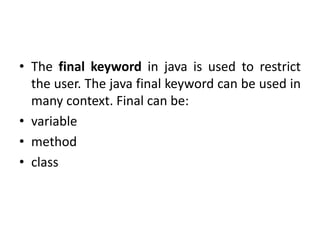
• The final keyword in java is used to restrict
the user. The java final keyword can be used in
many context. Final can be:
• variable
• method
• class
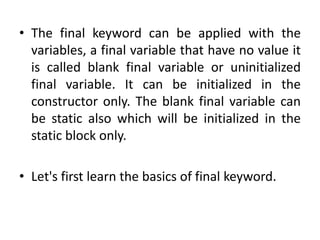
• The final keyword can be applied with the
variables, a final variable that have no value it
is called blank final variable or uninitialized
final variable. It can be initialized in the
constructor only. The blank final variable can
be static also which will be initialized in the
static block only.
• Let's first learn the basics of final keyword.
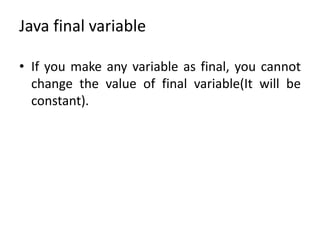
Java final variable
• If you make any variable as final, you cannot
change the value of final variable(It will be
constant).
Example of final variable
• There is a final variable speedlimit, we are
going to change the value of this variable, but
It can't be changed because final variable once
assigned a value can never be changed.
• class Bike9{
• final int speedlimit=90;//final variable
• void run(){
• speedlimit=400;
• }
• public static void main(String args[]){
• Bike9 obj=new Bike9();
• obj.run();
• }
• }//end of class
Java final method
• If you make any method as final, you cannot
override it.
class Bike{
final void run(){System.out.println("running");
} }
class Honda extends Bike{
void run(){System.out.println("running safely wi
th 100kmph");}
public static void main(String args[]){
Honda honda= new Honda();
honda.run();
} }
Java final class
• If you make any class as final, you cannot
extend it.
final class Bike{}
class Honda1 extends Bike
{
void run()
{System.out.println("running safely with 100kmph")
;
}
public static void main(String args[]){
Honda1 honda= new Honda();
honda.run();
}
}
Is final method inherited?
• Yes, final method is inherited but you cannot
override it.
• class Bike
• {
• final void run(){System.out.println("running..
.");}
• }
• class Honda2 extends Bike{
• public static void main(String args[]){
• new Honda2().run();
• }
• }
What is blank or uninitialized final
variable?
• A final variable that is not initialized at the
time of declaration is known as blank final
variable.
• If you want to create a variable that is
initialized at the time of creating object and
once initialized may not be changed, it is
useful. For example PAN CARD number of an
employee.
• It can be initialized only in constructor.
Can we initialize blank final variable?
• Yes, but only in constructor.
• class Bike10{
• final int speedlimit;//blank final variable
•
• Bike10(){
• speedlimit=70;
• System.out.println(speedlimit);
• }
•
• public static void main(String args[]){
• new Bike10();
• }
• }
static blank final variable
• A static final variable that is not initialized at
the time of declaration is known as static
blank final variable. It can be initialized only in
static block.
class A
{
static final int data;//static blank final variable
static
{
data=50;
}
public static void main(String args[]){
System.out.println(A.data);
}
}
What is final parameter?
• If you declare any parameter as final, you
cannot change the value of it.
• class Bike11{
• int cube(final int n)
• {
• n=n+2;//can't be changed as n is final
• n*n*n;
• }
• public static void main(String args[]){
• Bike11 b=new Bike11();
• b.cube(5);
• } }
Can we declare a constructor final?
• No, because constructor is never inherited.

finalkeywordinjava abstract,interface,implementation.-170702034453.ppt

  • 1.
  • 2.
    • The finalkeyword in java is used to restrict the user. The java final keyword can be used in many context. Final can be: • variable • method • class
  • 3.
    • The finalkeyword can be applied with the variables, a final variable that have no value it is called blank final variable or uninitialized final variable. It can be initialized in the constructor only. The blank final variable can be static also which will be initialized in the static block only. • Let's first learn the basics of final keyword.
  • 4.
    Java final variable •If you make any variable as final, you cannot change the value of final variable(It will be constant).
  • 5.
    Example of finalvariable • There is a final variable speedlimit, we are going to change the value of this variable, but It can't be changed because final variable once assigned a value can never be changed.
  • 6.
    • class Bike9{ •final int speedlimit=90;//final variable • void run(){ • speedlimit=400; • } • public static void main(String args[]){ • Bike9 obj=new Bike9(); • obj.run(); • } • }//end of class
  • 7.
    Java final method •If you make any method as final, you cannot override it.
  • 8.
    class Bike{ final voidrun(){System.out.println("running"); } } class Honda extends Bike{ void run(){System.out.println("running safely wi th 100kmph");} public static void main(String args[]){ Honda honda= new Honda(); honda.run(); } }
  • 9.
    Java final class •If you make any class as final, you cannot extend it.
  • 10.
    final class Bike{} classHonda1 extends Bike { void run() {System.out.println("running safely with 100kmph") ; } public static void main(String args[]){ Honda1 honda= new Honda(); honda.run(); } }
  • 11.
    Is final methodinherited? • Yes, final method is inherited but you cannot override it.
  • 12.
    • class Bike •{ • final void run(){System.out.println("running.. .");} • } • class Honda2 extends Bike{ • public static void main(String args[]){ • new Honda2().run(); • } • }
  • 13.
    What is blankor uninitialized final variable? • A final variable that is not initialized at the time of declaration is known as blank final variable. • If you want to create a variable that is initialized at the time of creating object and once initialized may not be changed, it is useful. For example PAN CARD number of an employee. • It can be initialized only in constructor.
  • 14.
    Can we initializeblank final variable? • Yes, but only in constructor.
  • 15.
    • class Bike10{ •final int speedlimit;//blank final variable • • Bike10(){ • speedlimit=70; • System.out.println(speedlimit); • } • • public static void main(String args[]){ • new Bike10(); • } • }
  • 16.
    static blank finalvariable • A static final variable that is not initialized at the time of declaration is known as static blank final variable. It can be initialized only in static block.
  • 17.
    class A { static finalint data;//static blank final variable static { data=50; } public static void main(String args[]){ System.out.println(A.data); } }
  • 18.
    What is finalparameter? • If you declare any parameter as final, you cannot change the value of it.
  • 19.
    • class Bike11{ •int cube(final int n) • { • n=n+2;//can't be changed as n is final • n*n*n; • } • public static void main(String args[]){ • Bike11 b=new Bike11(); • b.cube(5); • } }
  • 20.
    Can we declarea constructor final? • No, because constructor is never inherited.