Interface and Abstract Class
9-2
Interfaces
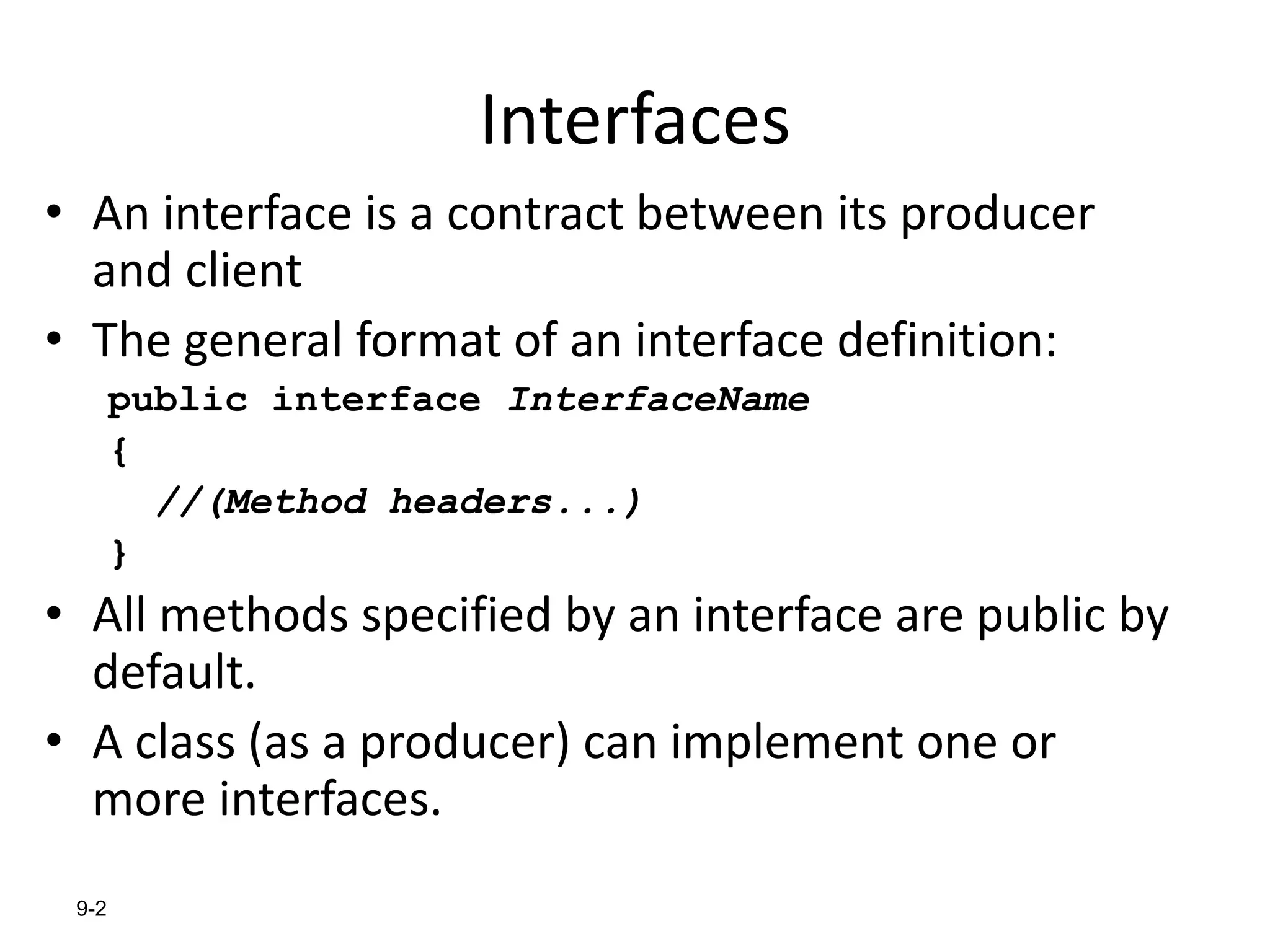
• An interface is a contract between its producer
and client
• The general format of an interface definition:
public interface InterfaceName
{
//(Method headers...)
}
• All methods specified by an interface are public by
default.
• A class (as a producer) can implement one or
more interfaces.
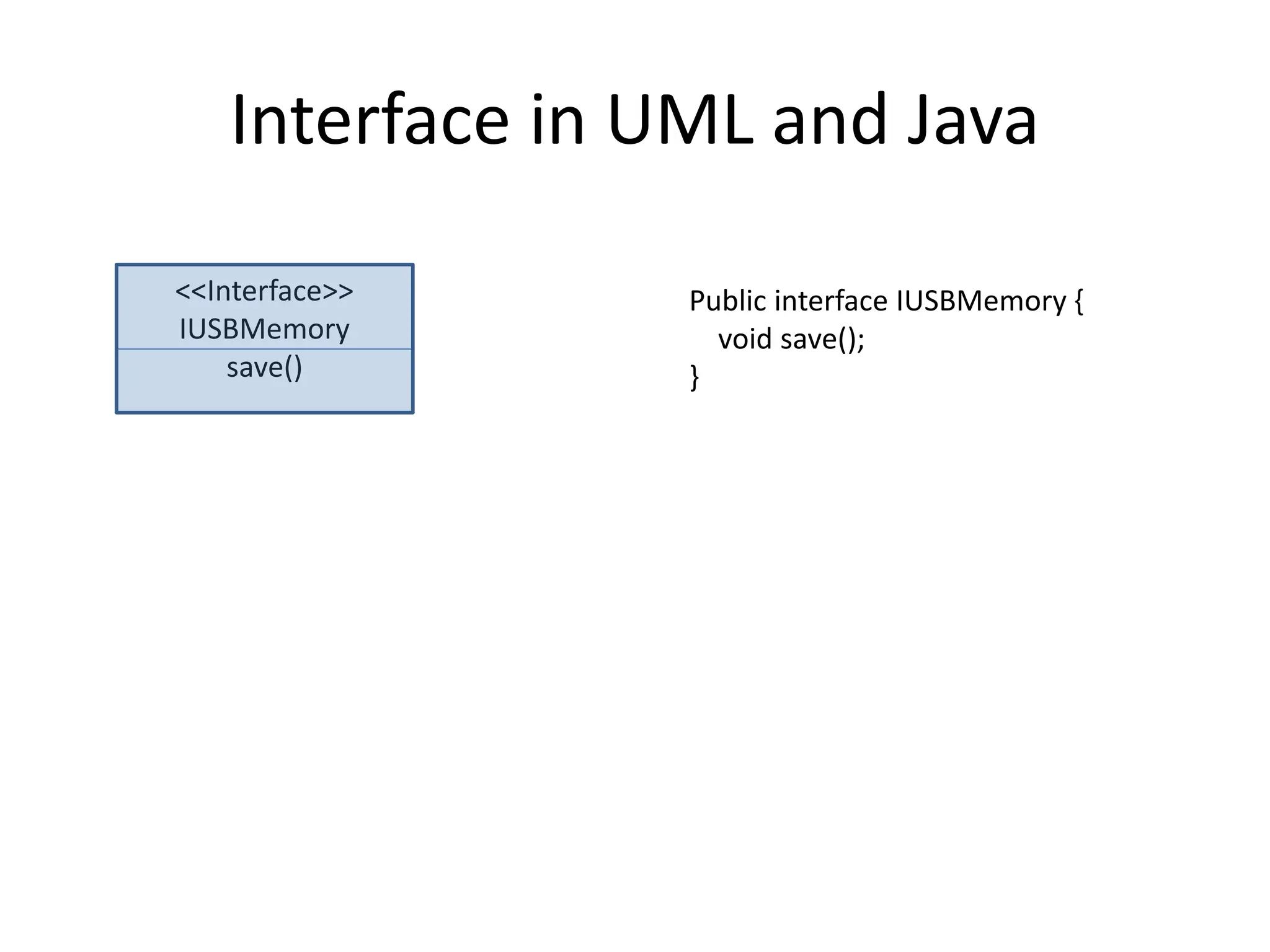
Interface in UML and Java
<<Interface>>
IUSBMemory
save()
Public interface IUSBMemory {
void save();
}
9-4
Producer of an Interface
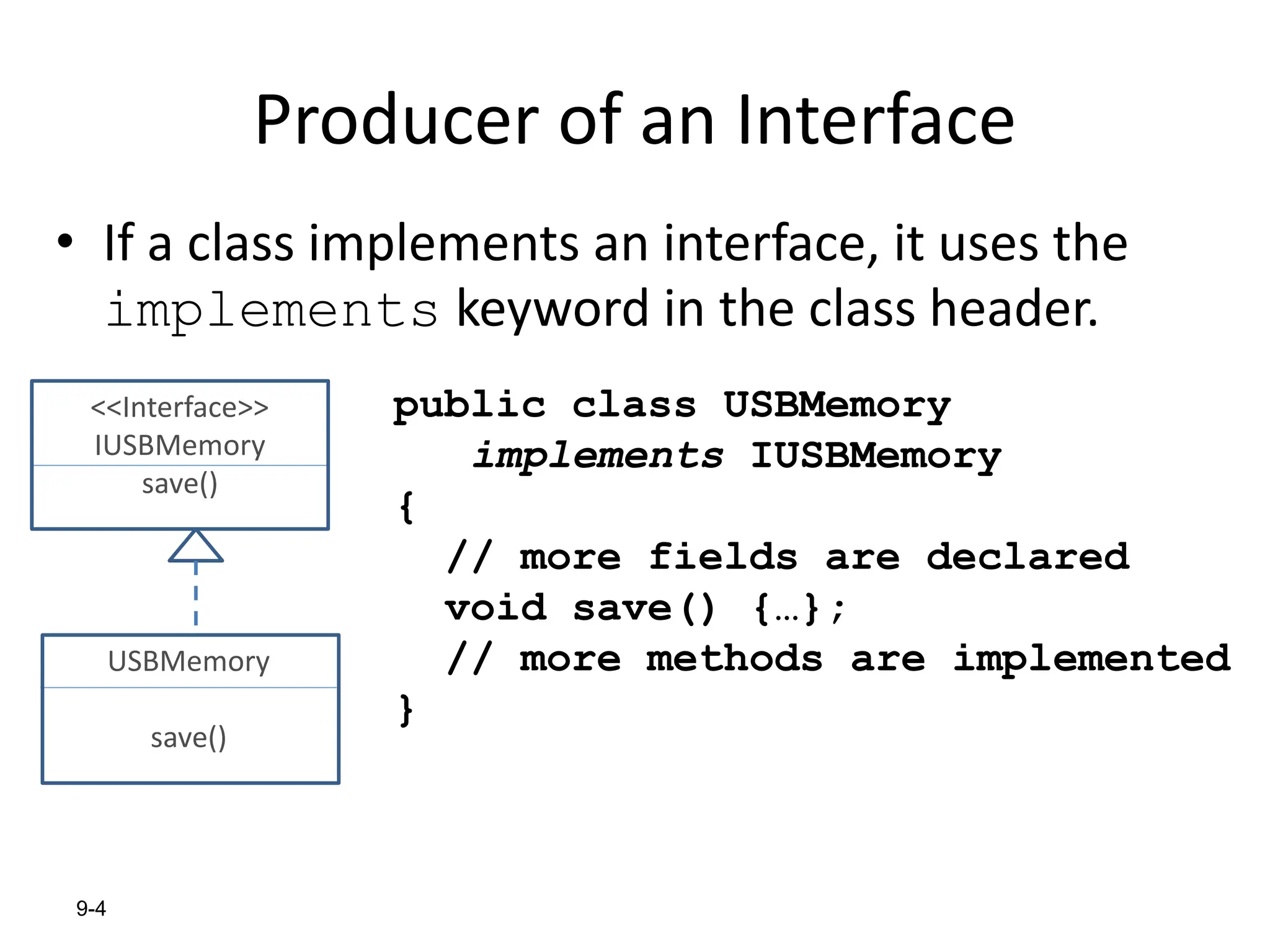
• If a class implements an interface, it uses the
implements keyword in the class header.
<<Interface>>
IUSBMemory
save()
USBMemory
save()
public class USBMemory
implements IUSBMemory
{
// more fields are declared
void save() {…};
// more methods are implemented
}
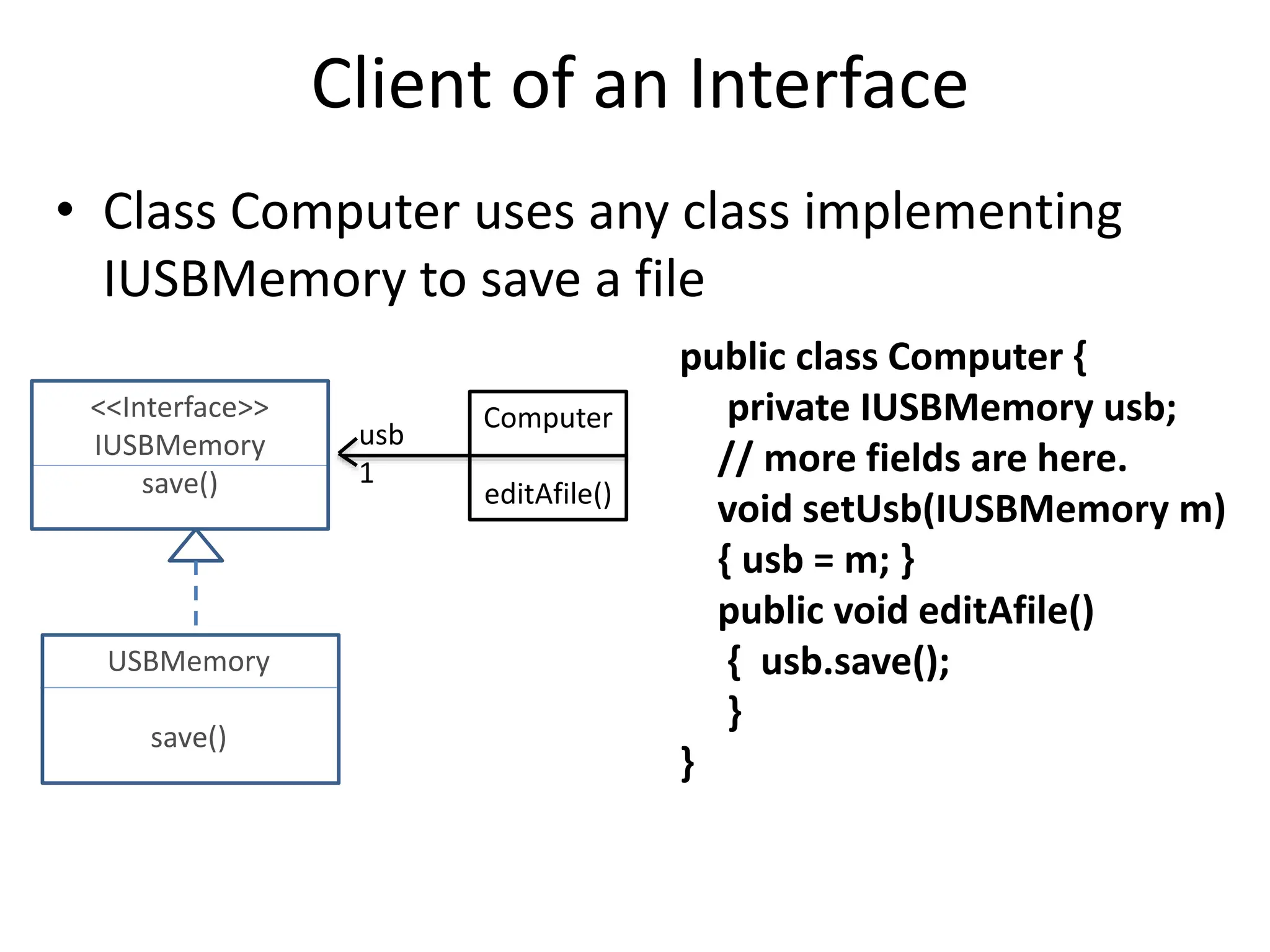
Client of an Interface
• Class Computer uses any class implementing
IUSBMemory to save a file
<<Interface>>
IUSBMemory
save()
USBMemory
save()
Computer
editAfile()
usb
1
public class Computer {
private IUSBMemory usb;
// more fields are here.
void setUsb(IUSBMemory m)
{ usb = m; }
public void editAfile()
{ usb.save();
}
}
Now run your program
• Remember a class is only a blue-print. To run it,
you need to “buy” computer and usb memory
objects.
public class Test {
public static void main(String[] args) {
Computer myComputer = new Computer();
IUSBMemory myusb1 = new USBMemory();
myComputer.setUsb(myusb1);
myComputer.editAfile();
}
}
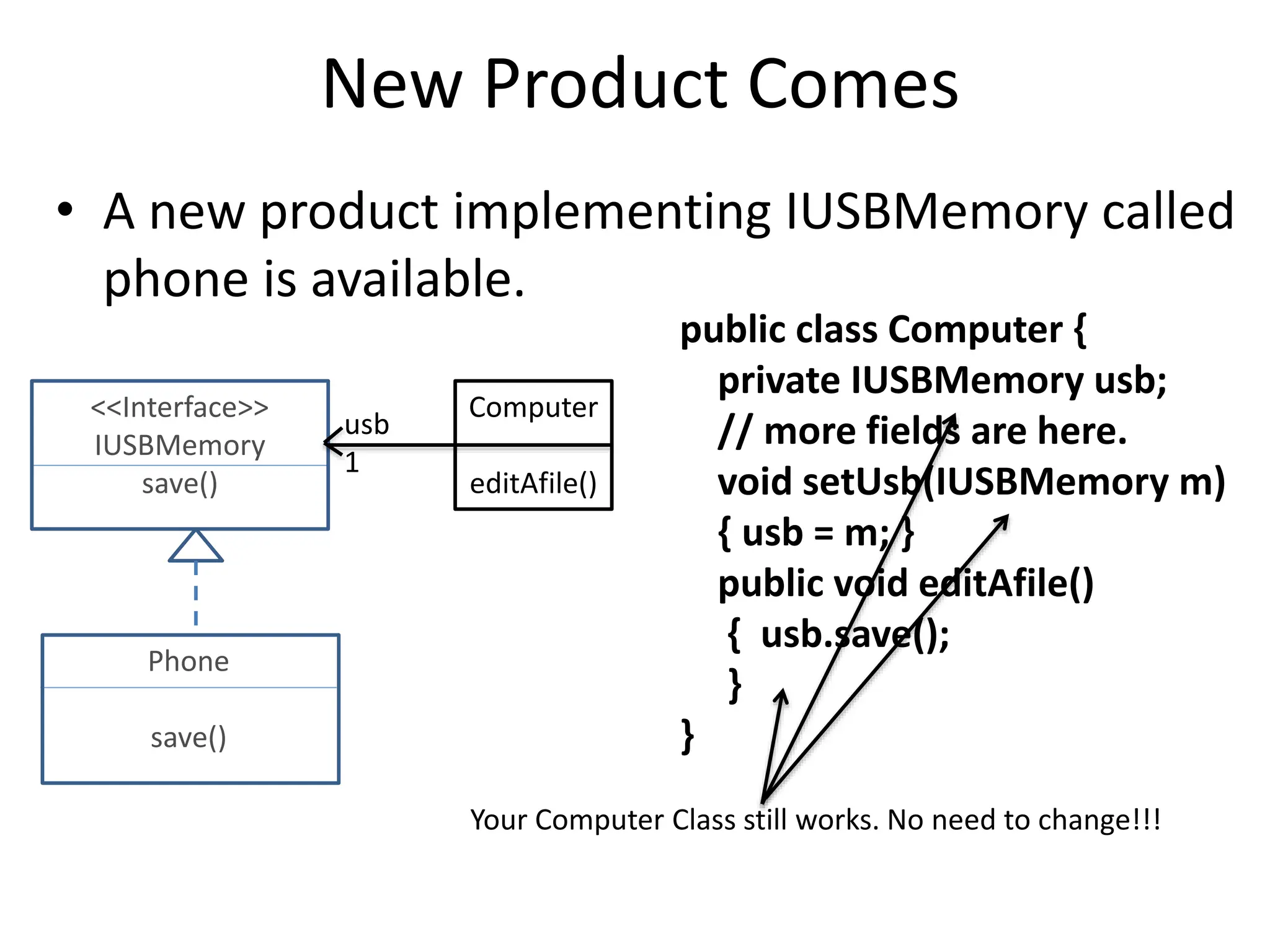
New Product Comes
• A new product implementing IUSBMemory called
phone is available.
<<Interface>>
IUSBMemory
save()
Phone
save()
Computer
editAfile()
usb
1
public class Computer {
private IUSBMemory usb;
// more fields are here.
void setUsb(IUSBMemory m)
{ usb = m; }
public void editAfile()
{ usb.save();
}
}
Your Computer Class still works. No need to change!!!
Don’t forget to buy a phone!!!
• Remember a class is a blue-print. Don’t forget
to buy a phone and connect to your computer.
public class Test {
public static void main(String[] args) {
Computer myComputer = new Computer();
IUSBMemory myusb1 = new USBMemory();
myComputer.setUsb(myusb1);
myComputer.editAfile();
Phone phone = new Phone();
myComputer.setUsb(phone);
myComputer.editAfile();
}
}
public class Computer {
private IUSBMemory usb;
…..
void setUsb(IUSBMemory m)
{ usb = m; }
………..
}
9-9
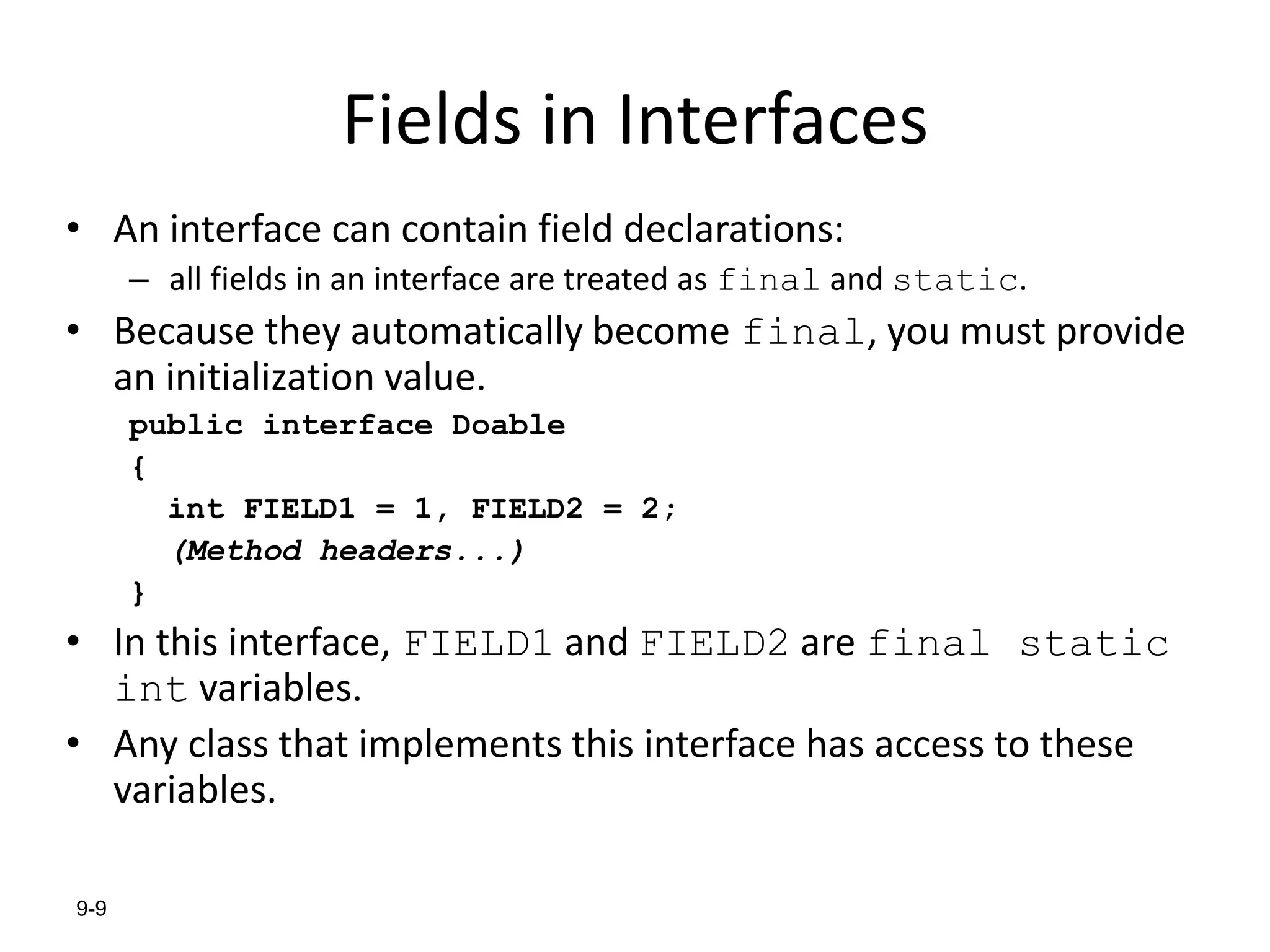
Fields in Interfaces
• An interface can contain field declarations:
– all fields in an interface are treated as final and static.
• Because they automatically become final, you must provide
an initialization value.
public interface Doable
{
int FIELD1 = 1, FIELD2 = 2;
(Method headers...)
}
• In this interface, FIELD1 and FIELD2 are final static
int variables.
• Any class that implements this interface has access to these
variables.
Problem of Interface
• IUSBMemory has many features other than
save a file, such as set brand, get brand, set
speed and get speed etc. When a producer
implements IUSBMemory, it should provide its
implementations. But if many producers
implement IUSBMemory but share same
implementation for some of methods such as
set brand and get brand etc. Only difference is
how to save, i.e. the implementation of save()?
Abstract Class
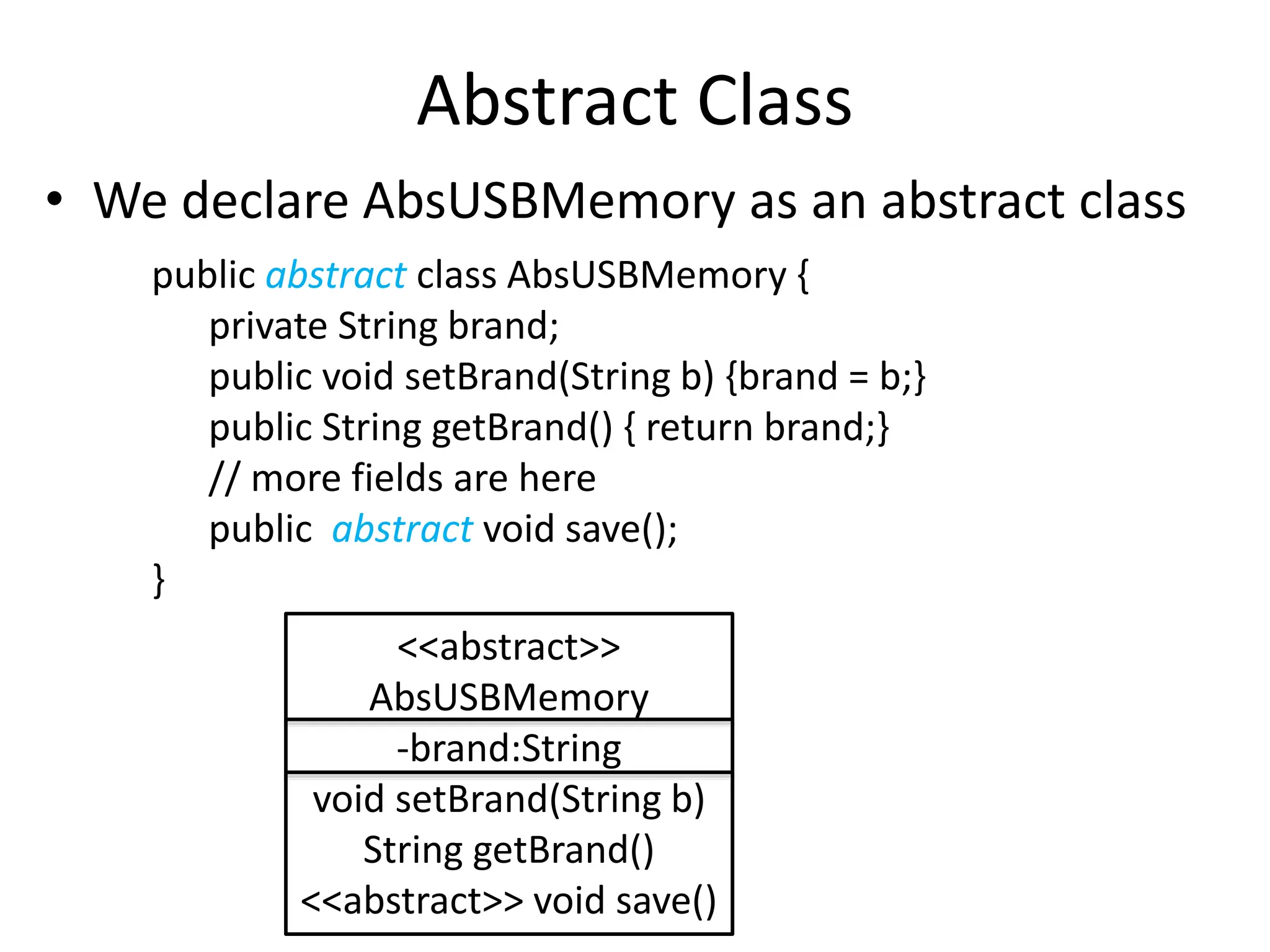
• We declare AbsUSBMemory as an abstract class
public abstract class AbsUSBMemory {
private String brand;
public void setBrand(String b) {brand = b;}
public String getBrand() { return brand;}
// more fields are here
public abstract void save();
}
<<abstract>>
AbsUSBMemory
-brand:String
void setBrand(String b)
String getBrand()
<<abstract>> void save()
Your Computer Class
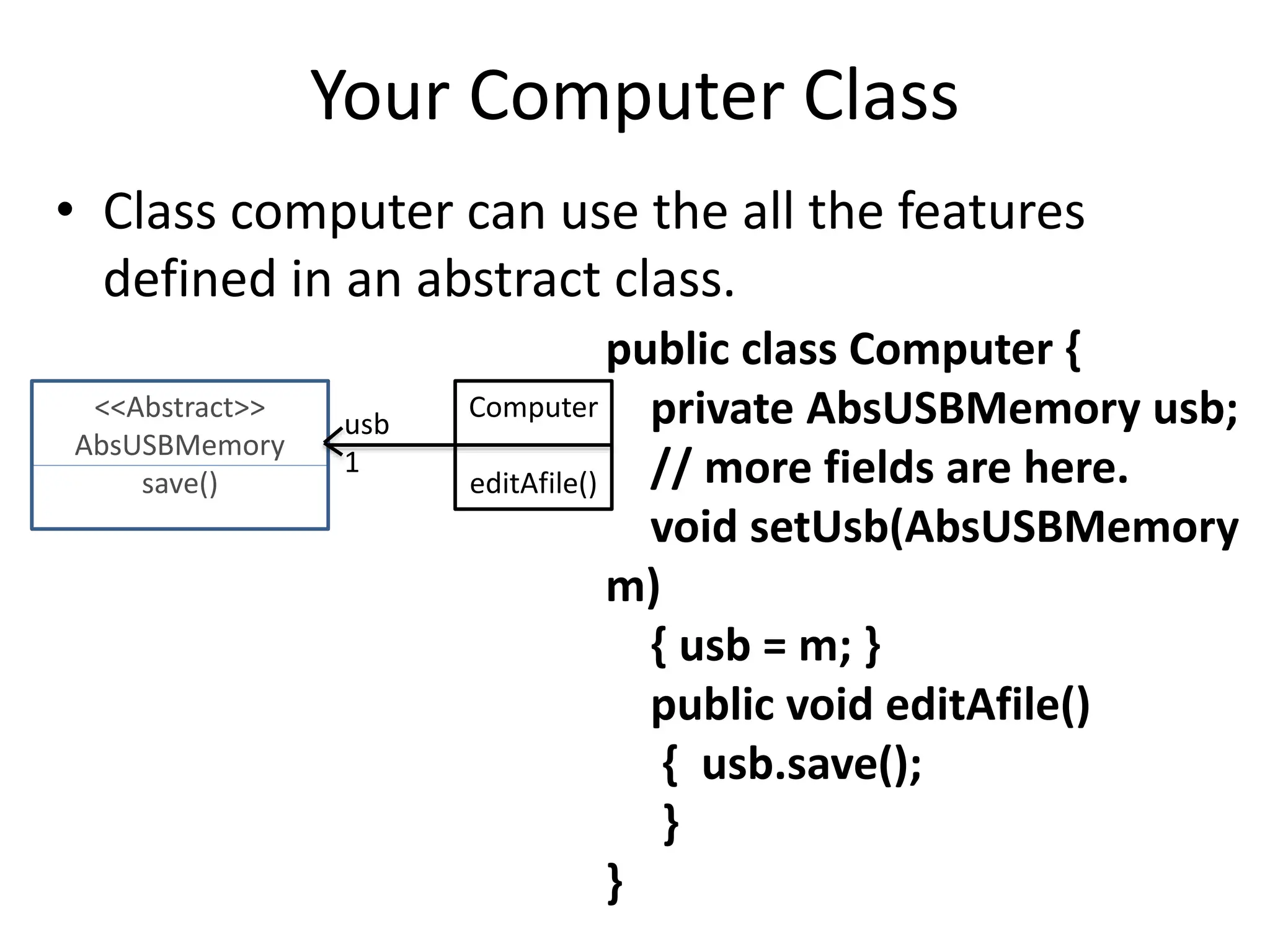
• Class computer can use the all the features
defined in an abstract class.
public class Computer {
private AbsUSBMemory usb;
// more fields are here.
void setUsb(AbsUSBMemory
m)
{ usb = m; }
public void editAfile()
{ usb.save();
}
}
<<Abstract>>
AbsUSBMemory
save()
Computer
editAfile()
usb
1
Still Need to wait..
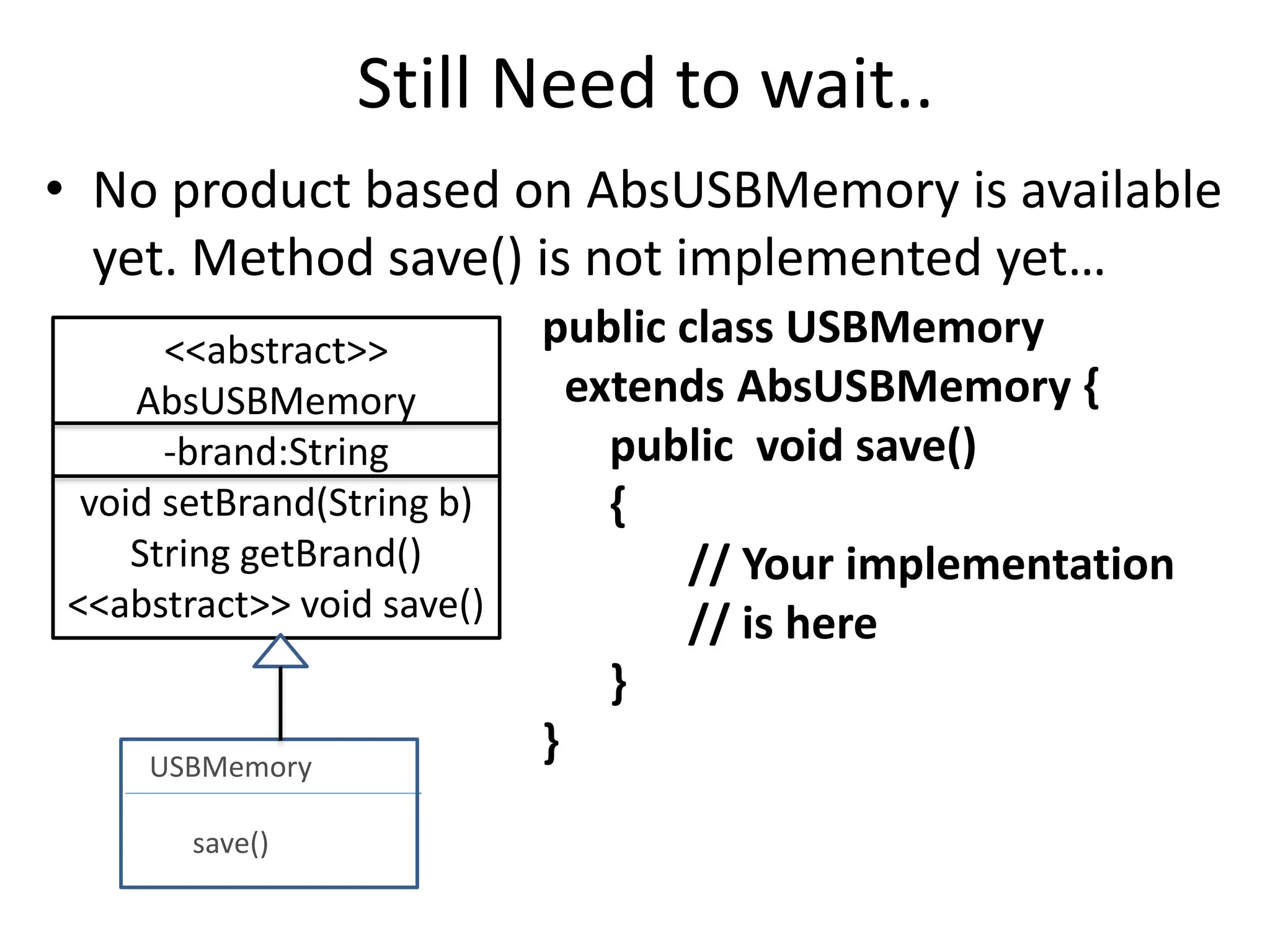
• No product based on AbsUSBMemory is available
yet. Method save() is not implemented yet…
public class USBMemory
extends AbsUSBMemory {
public void save()
{
// Your implementation
// is here
}
}
<<abstract>>
AbsUSBMemory
-brand:String
void setBrand(String b)
String getBrand()
<<abstract>> void save()
USBMemory
save()
Now you can buy your products
• You can buy your computer with a usb
memory based on the features provided by
AbsUSBMemory
public class Test {
public static void main(String[] args) {
Computer myComputer = new Computer();
AbsUSBMemory myusb1 = new USBMemory();
myComputer.setUsb(myusb1);
myComputer.editAfile();
}
}
Similarly, New Product Available
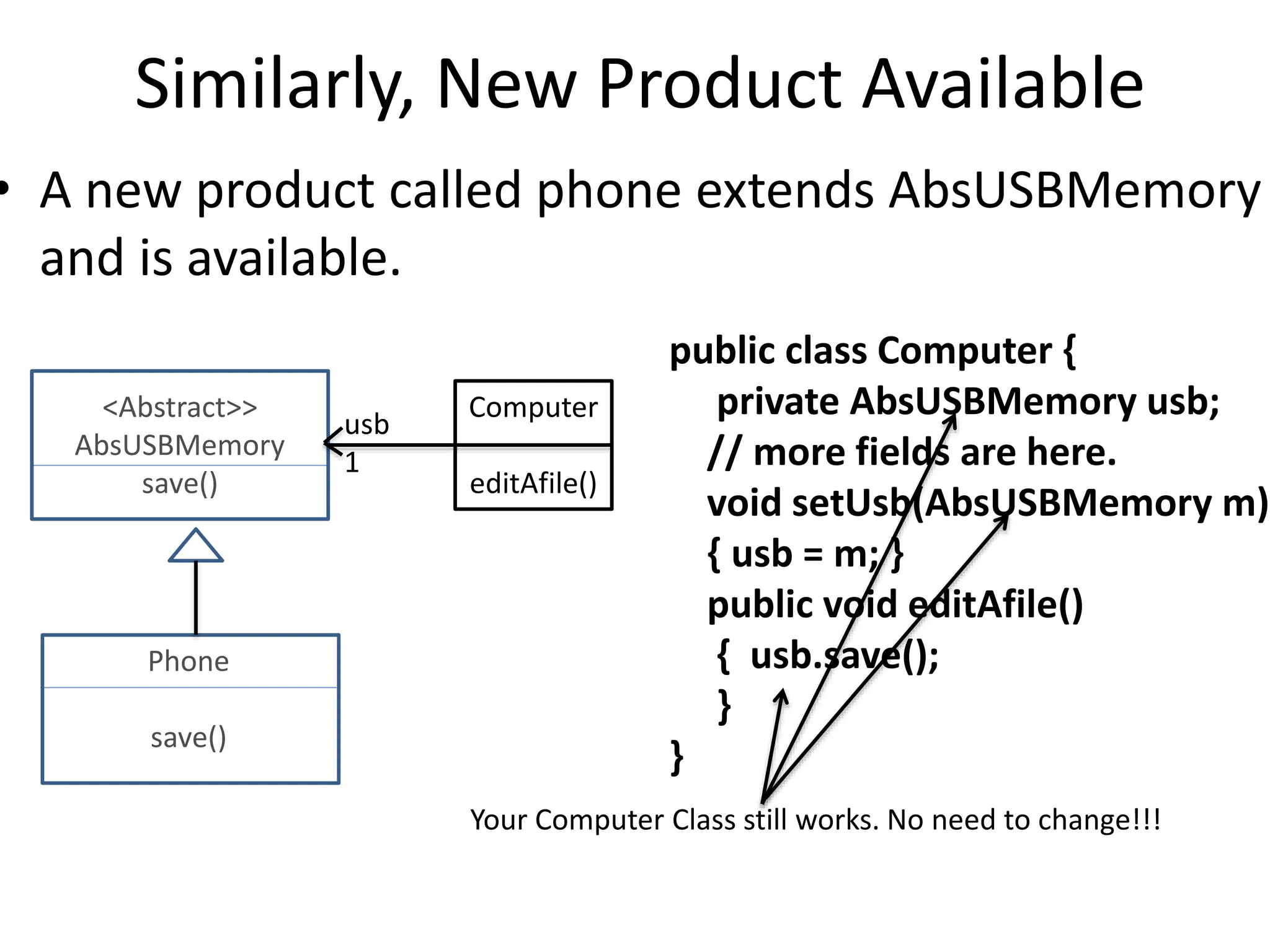
• A new product called phone extends AbsUSBMemory
and is available.
<Abstract>>
AbsUSBMemory
save()
Phone
save()
Computer
editAfile()
usb
1
public class Computer {
private AbsUSBMemory usb;
// more fields are here.
void setUsb(AbsUSBMemory m)
{ usb = m; }
public void editAfile()
{ usb.save();
}
}
Your Computer Class still works. No need to change!!!
Now you can buy your phone
• You can buy your computer with a usb
memory based on the features provided by
AbsUSBMemory
public class Test {
public static void main(String[] args) {
Computer myComputer = new Computer();
Phone myusb1 = new Phone();
myComputer.setUsb(myusb1);
myComputer.editAfile();
}
}
9-17
Abstract Classes
• An abstract class cannot be instantiated, but other
classes are derived from it.
• An Abstract class serves as a superclass for other
classes.
• The abstract class represents the generic or abstract
form of all the classes that are derived from it.
• A class becomes abstract when you place the abstract
key word in the class definition.
public abstract class ClassName
9-18
Abstract Methods
• An abstract method has no body and must be
overridden in a subclass.
• An abstract method is a method that appears in a
superclass, but expects to be overridden in a subclass.
• An abstract method has only a header and no body.
AccessSpecifier abstract ReturnType MethodName(ParameterList);
• Example:
– Student.java, CompSciStudent.java, CompSciStudentDemo.java
9-19
Abstract Methods
• Notice that the key word abstract appears in the
header, and that the header ends with a semicolon.
public abstract void setValue(int value);
• Any class that contains an abstract method is
automatically abstract.
• If a subclass fails to override an abstract method, a
compiler error will result.
• Abstract methods are used to ensure that a subclass
implements the method.

InterfaceAbstractClass,interfaces,final keyword,.pptx

  • 1.
  • 2.
    9-2 Interfaces • An interfaceis a contract between its producer and client • The general format of an interface definition: public interface InterfaceName { //(Method headers...) } • All methods specified by an interface are public by default. • A class (as a producer) can implement one or more interfaces.
  • 3.
    Interface in UMLand Java <<Interface>> IUSBMemory save() Public interface IUSBMemory { void save(); }
  • 4.
    9-4 Producer of anInterface • If a class implements an interface, it uses the implements keyword in the class header. <<Interface>> IUSBMemory save() USBMemory save() public class USBMemory implements IUSBMemory { // more fields are declared void save() {…}; // more methods are implemented }
  • 5.
    Client of anInterface • Class Computer uses any class implementing IUSBMemory to save a file <<Interface>> IUSBMemory save() USBMemory save() Computer editAfile() usb 1 public class Computer { private IUSBMemory usb; // more fields are here. void setUsb(IUSBMemory m) { usb = m; } public void editAfile() { usb.save(); } }
  • 6.
    Now run yourprogram • Remember a class is only a blue-print. To run it, you need to “buy” computer and usb memory objects. public class Test { public static void main(String[] args) { Computer myComputer = new Computer(); IUSBMemory myusb1 = new USBMemory(); myComputer.setUsb(myusb1); myComputer.editAfile(); } }
  • 7.
    New Product Comes •A new product implementing IUSBMemory called phone is available. <<Interface>> IUSBMemory save() Phone save() Computer editAfile() usb 1 public class Computer { private IUSBMemory usb; // more fields are here. void setUsb(IUSBMemory m) { usb = m; } public void editAfile() { usb.save(); } } Your Computer Class still works. No need to change!!!
  • 8.
    Don’t forget tobuy a phone!!! • Remember a class is a blue-print. Don’t forget to buy a phone and connect to your computer. public class Test { public static void main(String[] args) { Computer myComputer = new Computer(); IUSBMemory myusb1 = new USBMemory(); myComputer.setUsb(myusb1); myComputer.editAfile(); Phone phone = new Phone(); myComputer.setUsb(phone); myComputer.editAfile(); } } public class Computer { private IUSBMemory usb; ….. void setUsb(IUSBMemory m) { usb = m; } ……….. }
  • 9.
    9-9 Fields in Interfaces •An interface can contain field declarations: – all fields in an interface are treated as final and static. • Because they automatically become final, you must provide an initialization value. public interface Doable { int FIELD1 = 1, FIELD2 = 2; (Method headers...) } • In this interface, FIELD1 and FIELD2 are final static int variables. • Any class that implements this interface has access to these variables.
  • 10.
    Problem of Interface •IUSBMemory has many features other than save a file, such as set brand, get brand, set speed and get speed etc. When a producer implements IUSBMemory, it should provide its implementations. But if many producers implement IUSBMemory but share same implementation for some of methods such as set brand and get brand etc. Only difference is how to save, i.e. the implementation of save()?
  • 11.
    Abstract Class • Wedeclare AbsUSBMemory as an abstract class public abstract class AbsUSBMemory { private String brand; public void setBrand(String b) {brand = b;} public String getBrand() { return brand;} // more fields are here public abstract void save(); } <<abstract>> AbsUSBMemory -brand:String void setBrand(String b) String getBrand() <<abstract>> void save()
  • 12.
    Your Computer Class •Class computer can use the all the features defined in an abstract class. public class Computer { private AbsUSBMemory usb; // more fields are here. void setUsb(AbsUSBMemory m) { usb = m; } public void editAfile() { usb.save(); } } <<Abstract>> AbsUSBMemory save() Computer editAfile() usb 1
  • 13.
    Still Need towait.. • No product based on AbsUSBMemory is available yet. Method save() is not implemented yet… public class USBMemory extends AbsUSBMemory { public void save() { // Your implementation // is here } } <<abstract>> AbsUSBMemory -brand:String void setBrand(String b) String getBrand() <<abstract>> void save() USBMemory save()
  • 14.
    Now you canbuy your products • You can buy your computer with a usb memory based on the features provided by AbsUSBMemory public class Test { public static void main(String[] args) { Computer myComputer = new Computer(); AbsUSBMemory myusb1 = new USBMemory(); myComputer.setUsb(myusb1); myComputer.editAfile(); } }
  • 15.
    Similarly, New ProductAvailable • A new product called phone extends AbsUSBMemory and is available. <Abstract>> AbsUSBMemory save() Phone save() Computer editAfile() usb 1 public class Computer { private AbsUSBMemory usb; // more fields are here. void setUsb(AbsUSBMemory m) { usb = m; } public void editAfile() { usb.save(); } } Your Computer Class still works. No need to change!!!
  • 16.
    Now you canbuy your phone • You can buy your computer with a usb memory based on the features provided by AbsUSBMemory public class Test { public static void main(String[] args) { Computer myComputer = new Computer(); Phone myusb1 = new Phone(); myComputer.setUsb(myusb1); myComputer.editAfile(); } }
  • 17.
    9-17 Abstract Classes • Anabstract class cannot be instantiated, but other classes are derived from it. • An Abstract class serves as a superclass for other classes. • The abstract class represents the generic or abstract form of all the classes that are derived from it. • A class becomes abstract when you place the abstract key word in the class definition. public abstract class ClassName
  • 18.
    9-18 Abstract Methods • Anabstract method has no body and must be overridden in a subclass. • An abstract method is a method that appears in a superclass, but expects to be overridden in a subclass. • An abstract method has only a header and no body. AccessSpecifier abstract ReturnType MethodName(ParameterList); • Example: – Student.java, CompSciStudent.java, CompSciStudentDemo.java
  • 19.
    9-19 Abstract Methods • Noticethat the key word abstract appears in the header, and that the header ends with a semicolon. public abstract void setValue(int value); • Any class that contains an abstract method is automatically abstract. • If a subclass fails to override an abstract method, a compiler error will result. • Abstract methods are used to ensure that a subclass implements the method.