Data and Computer
Communications
EMDADUL’S EDITION
BY WILLIAM STALLINGS
DATA AND COMPUTER COMMUNICATIONS, NINTH EDITION
BY WILLIAM STALLINGS, (C) PEARSON EDUCATION -
PRENTICE HALL, 2011
Data Transmission
Data Transmission
What we've got here is failure to communicate.
Paul Newman in Cool Hand Luke
Data Transmission
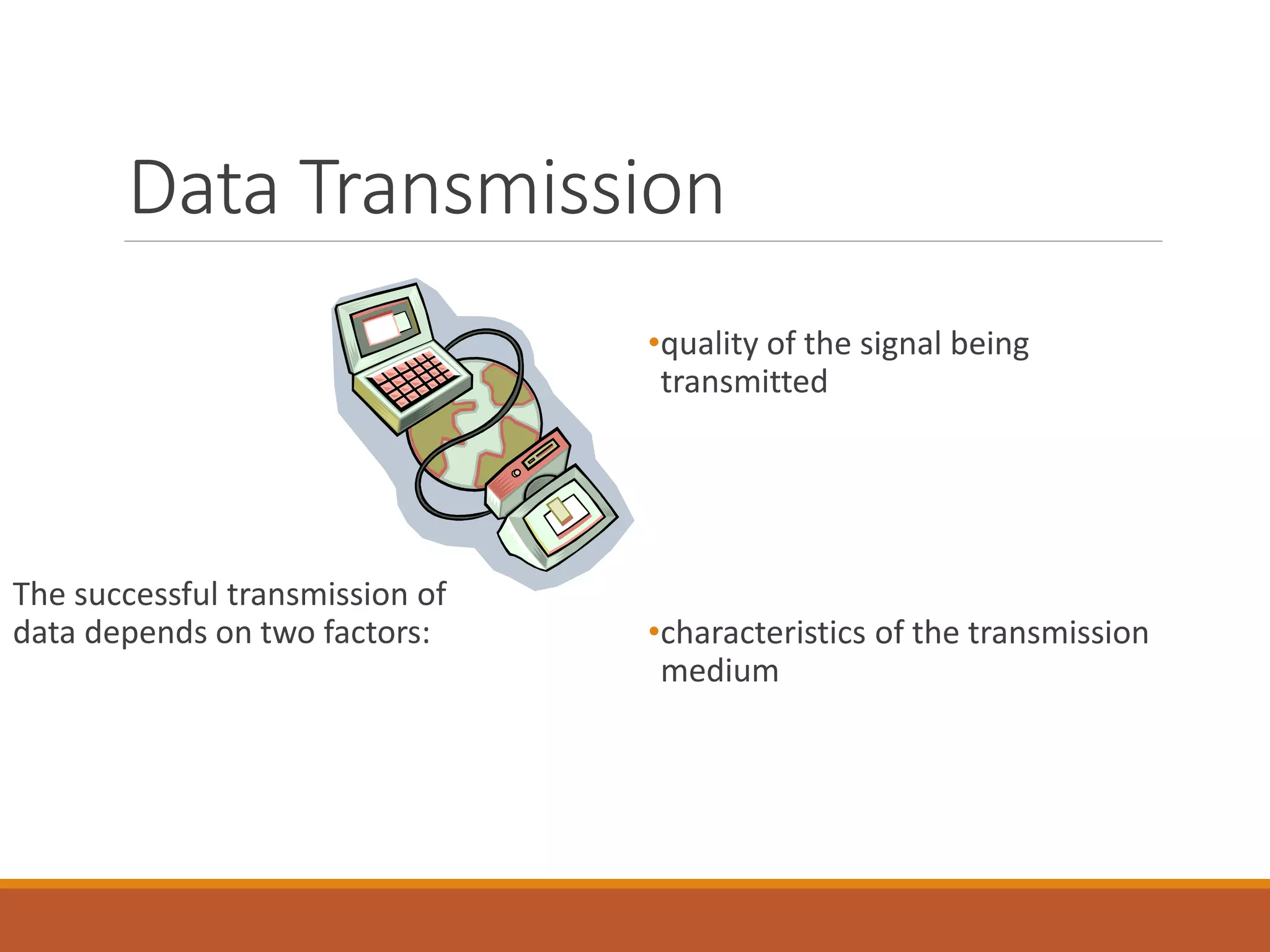
The successful transmission of
data depends on two factors:
•quality of the signal being
transmitted
•characteristics of the transmission
medium
Transmission Terminology
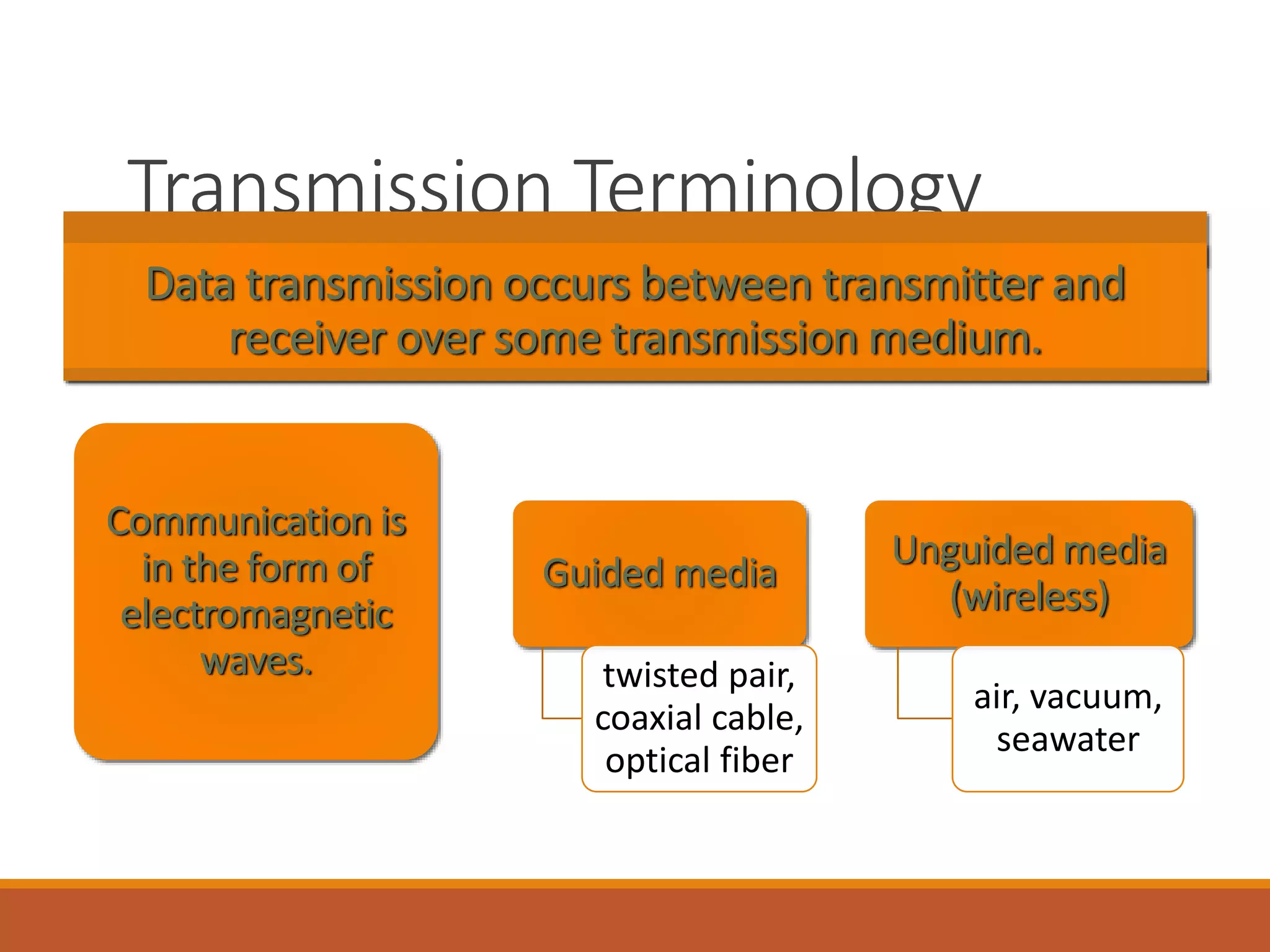
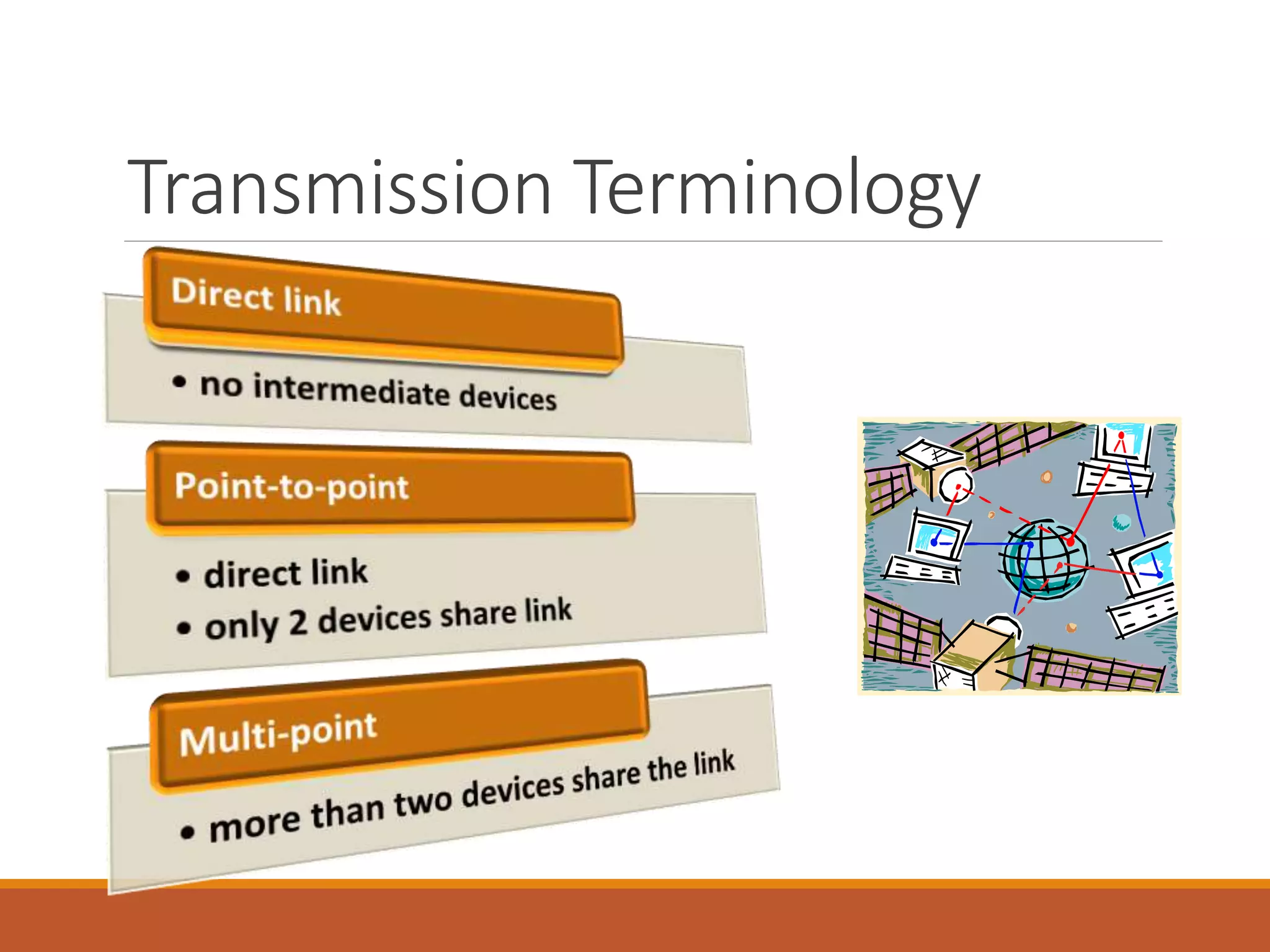
Data transmission occurs between transmitter and
receiver over some transmission medium.
Communication is
in the form of
electromagnetic
waves.
Guided media
twisted pair,
coaxial cable,
optical fiber
Unguided media
(wireless)
air, vacuum,
seawater
Transmission Terminology
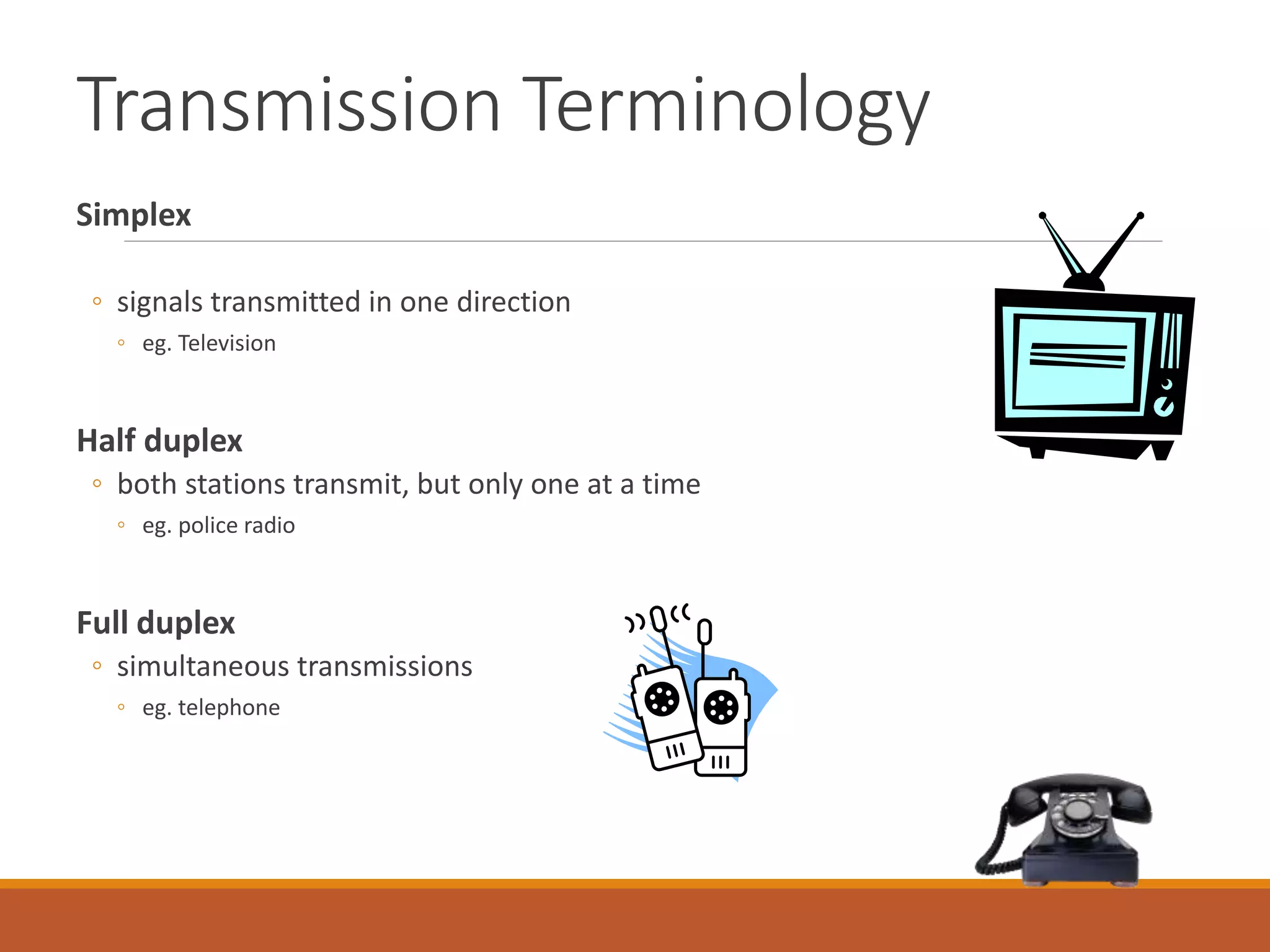
Simplex
◦ signals transmitted in one direction
◦ eg. Television
Half duplex
◦ both stations transmit, but only one at a time
◦ eg. police radio
Full duplex
◦ simultaneous transmissions
◦ eg. telephone
Frequency, Spectrum and
Bandwidth
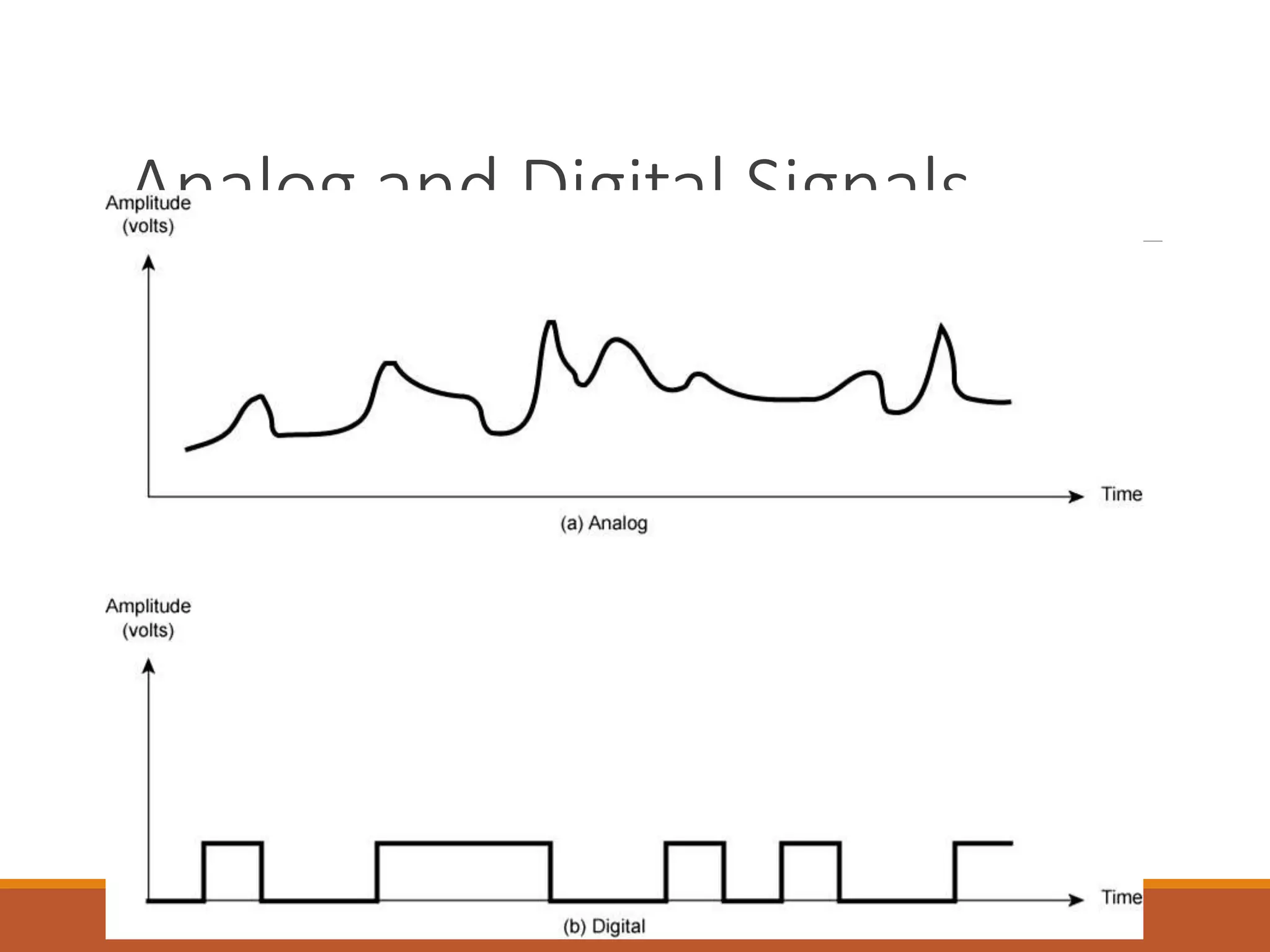
analog signal
• signal intensity varies smoothly with no breaks
digital signal
• signal intensity maintains a constant level and then
abruptly changes to another level
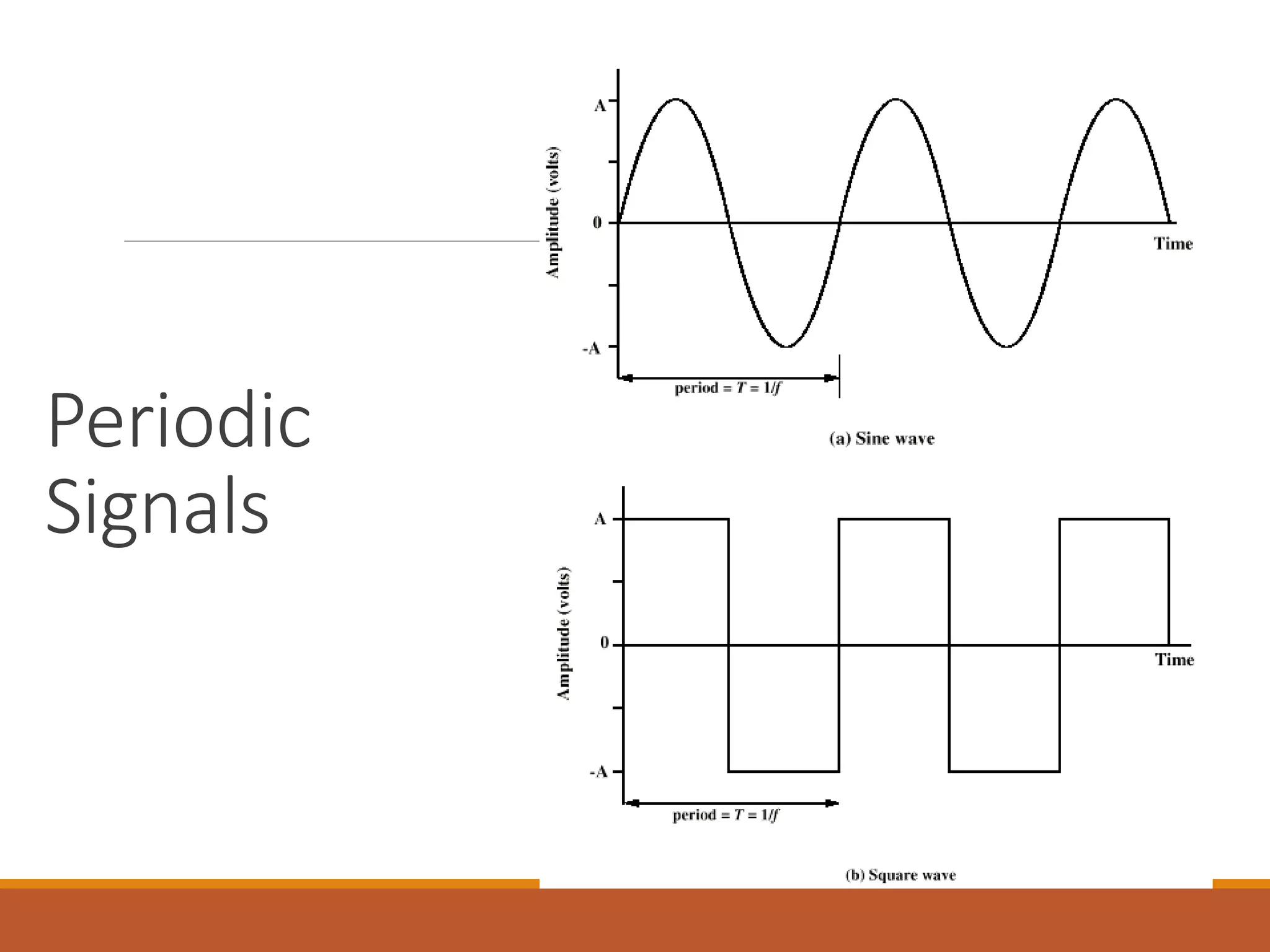
periodic signal
◦ signal pattern repeats over time
aperiodic signal
◦ pattern not repeated over time
TIME DOMAIN CONCEPTS
Analog and Digital Signals
Periodic
Signals
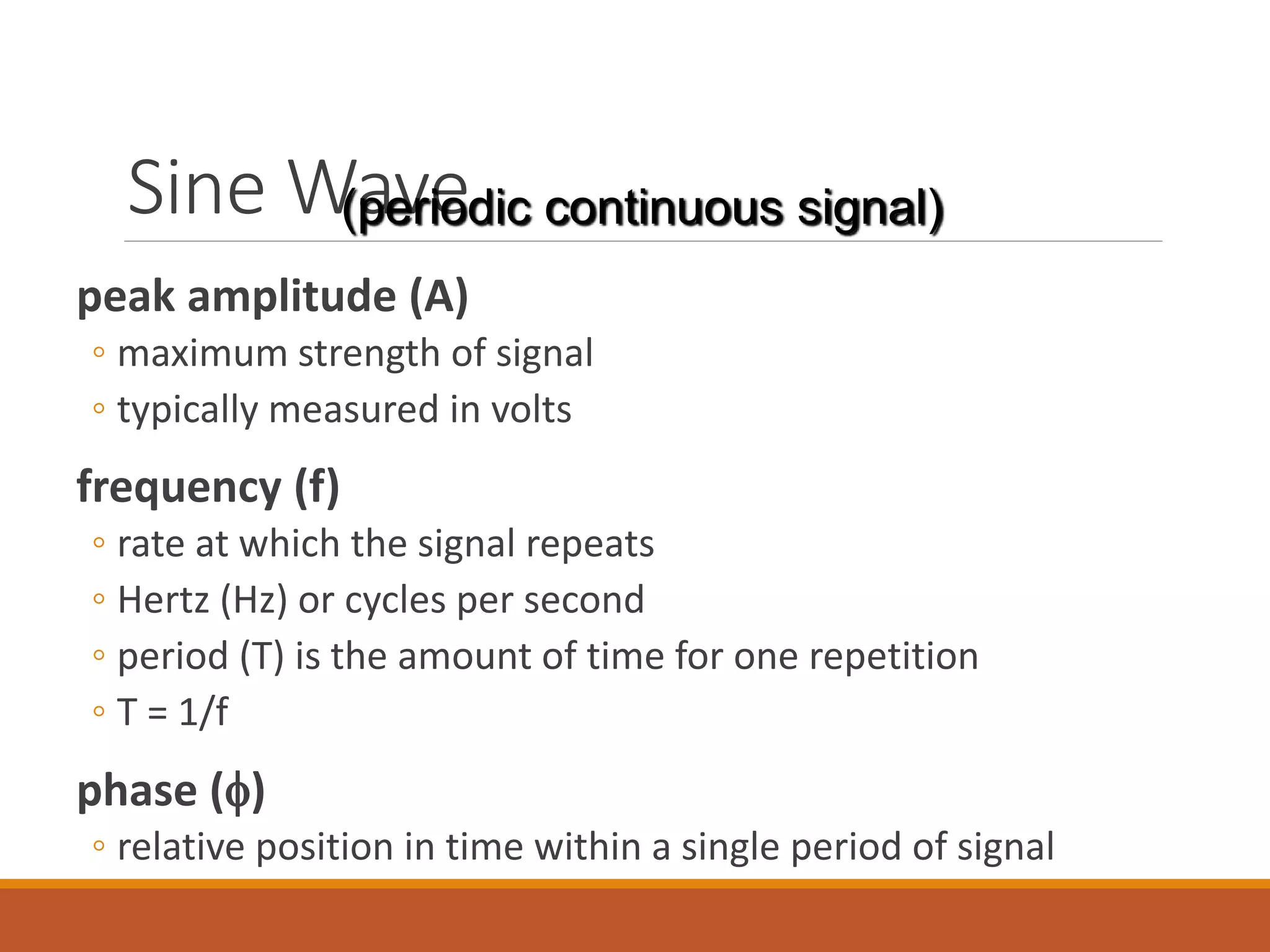
Sine Wave
peak amplitude (A)
◦ maximum strength of signal
◦ typically measured in volts
frequency (f)
◦ rate at which the signal repeats
◦ Hertz (Hz) or cycles per second
◦ period (T) is the amount of time for one repetition
◦ T = 1/f
phase ()
◦ relative position in time within a single period of signal
(periodic continuous signal)
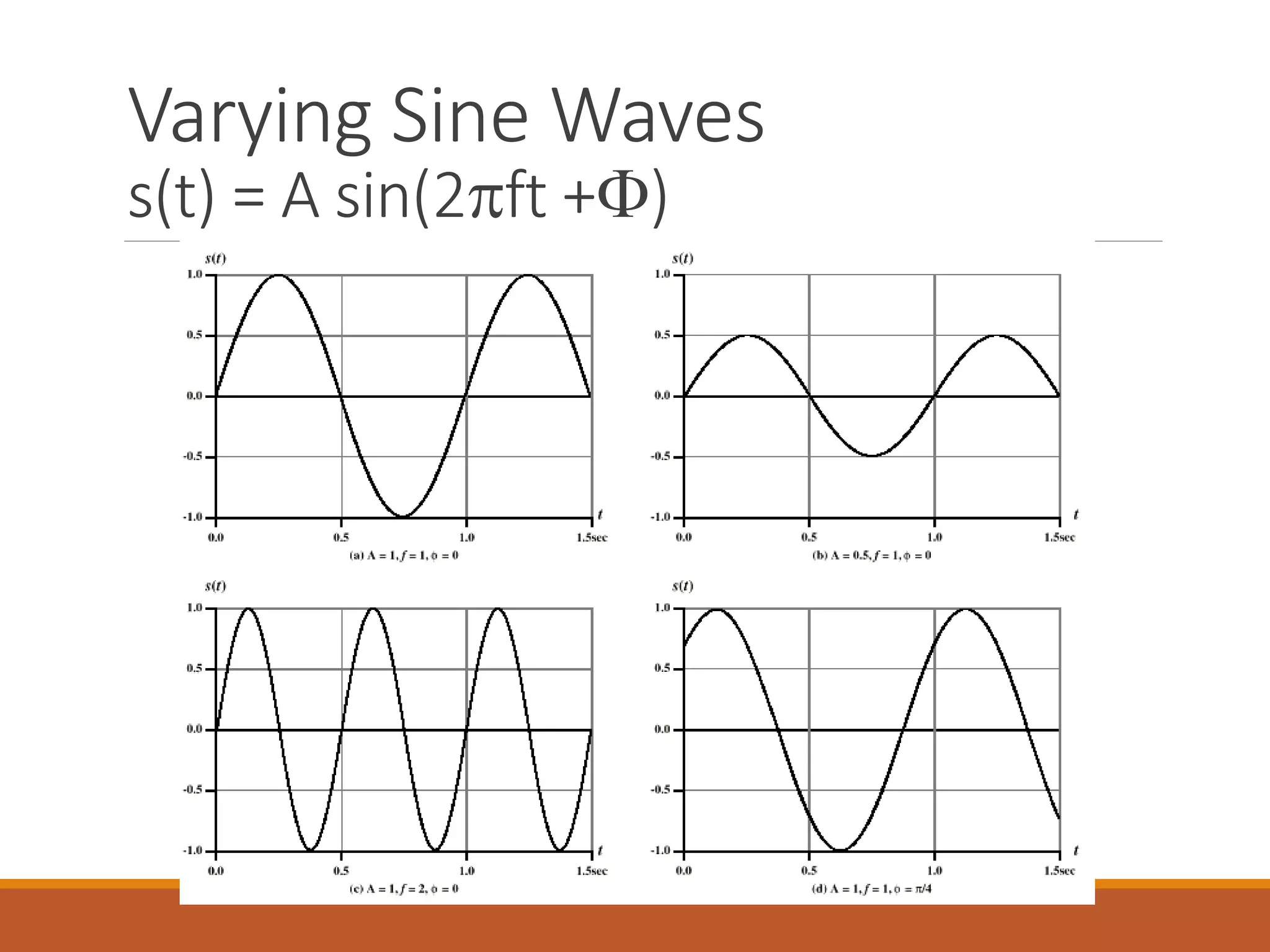
Varying Sine Waves
s(t) = A sin(2ft +)
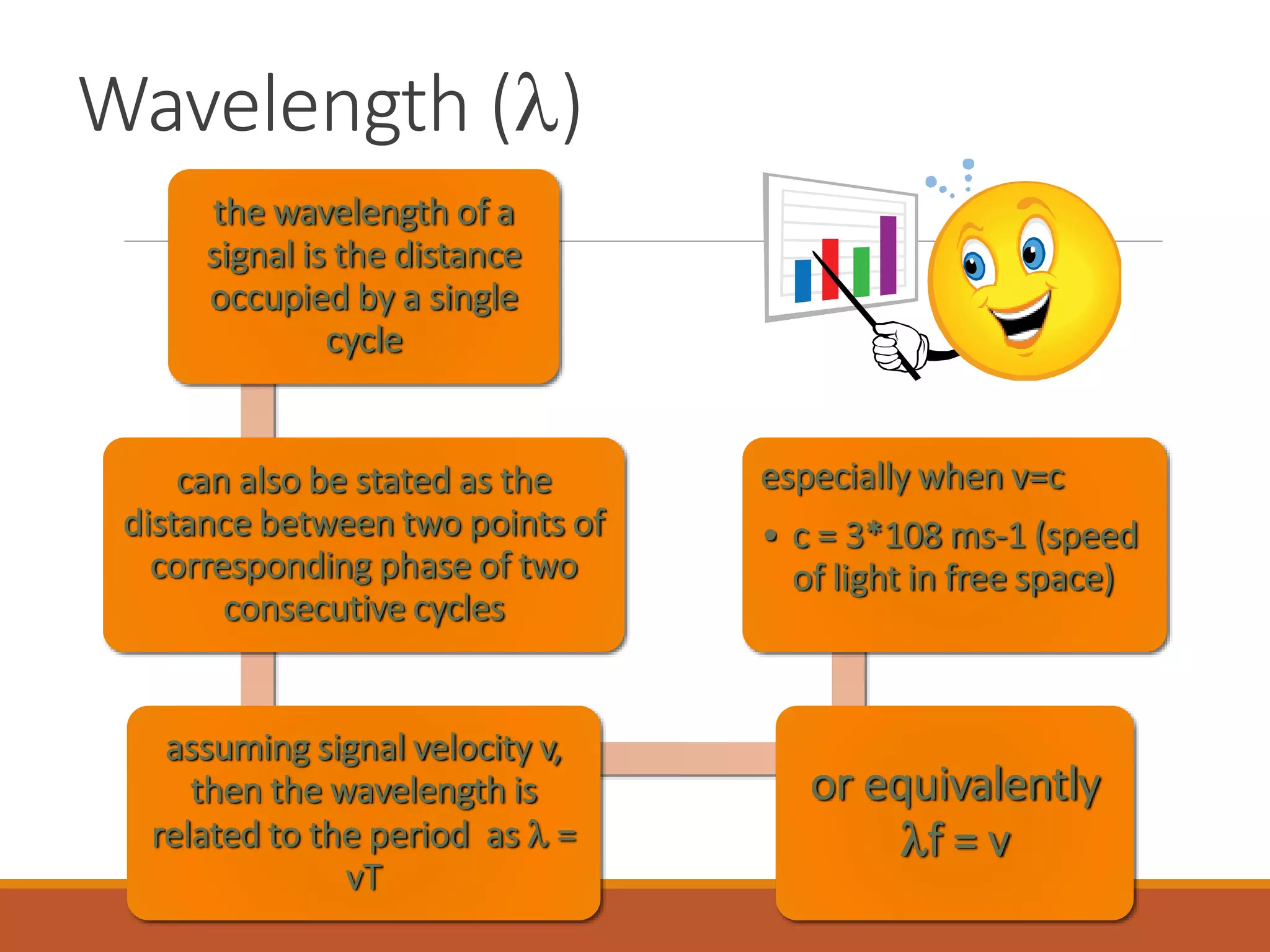
Wavelength ()
the wavelength of a
signal is the distance
occupied by a single
cycle
can also be stated as the
distance between two points of
corresponding phase of two
consecutive cycles
assuming signal velocity v,
then the wavelength is
related to the period as  =
vT
or equivalently
f = v
especially when v=c
• c = 3*108 ms-1 (speed
of light in free space)
Frequency Domain Concepts
signals are made up of many frequencies
components are sine waves
Fourier analysis can show that any signal is made up of components at
various frequencies, in which each component is a sinusoid
can plot frequency domain functions
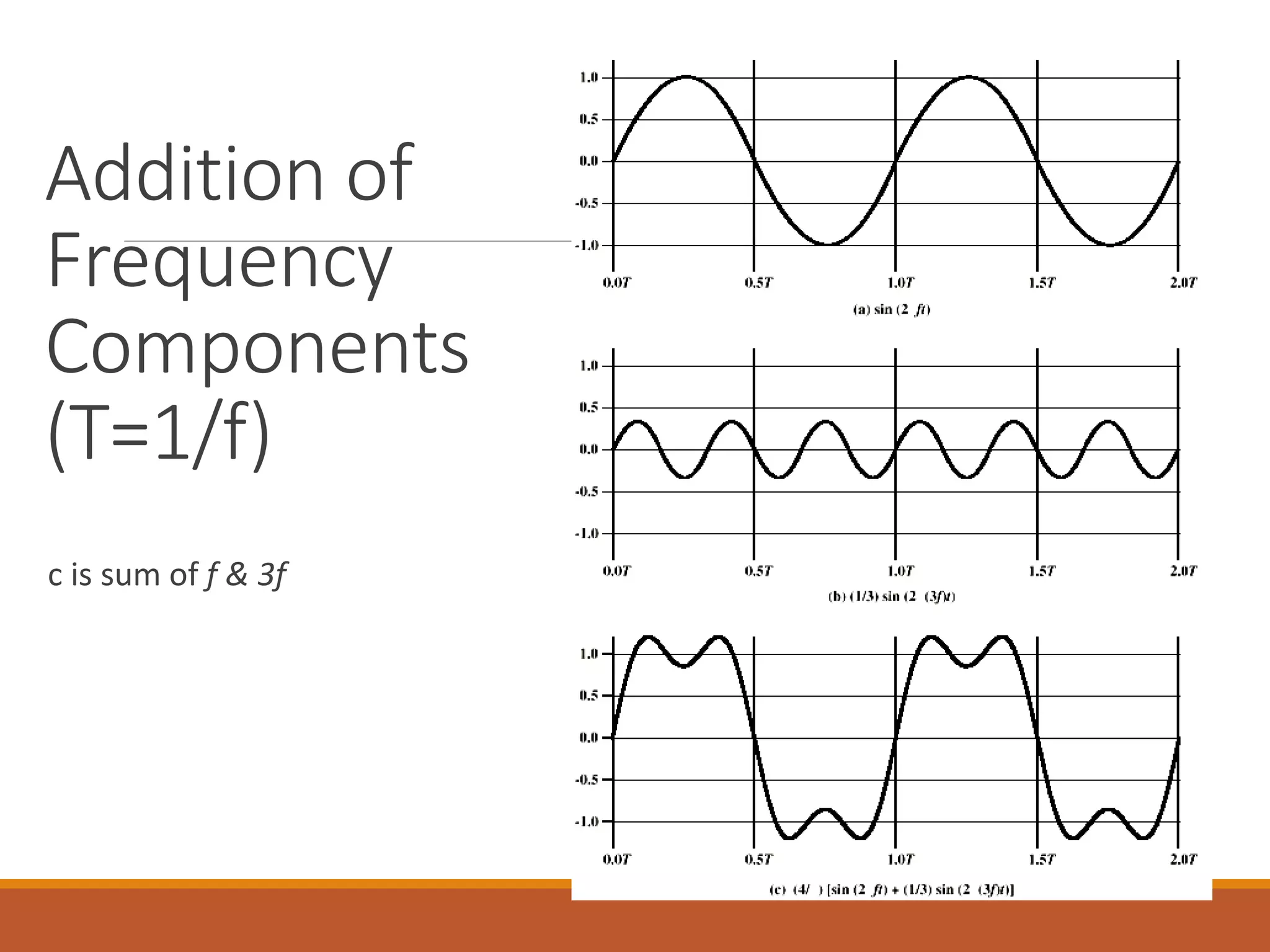
Addition of
Frequency
Components
(T=1/f)
c is sum of f & 3f
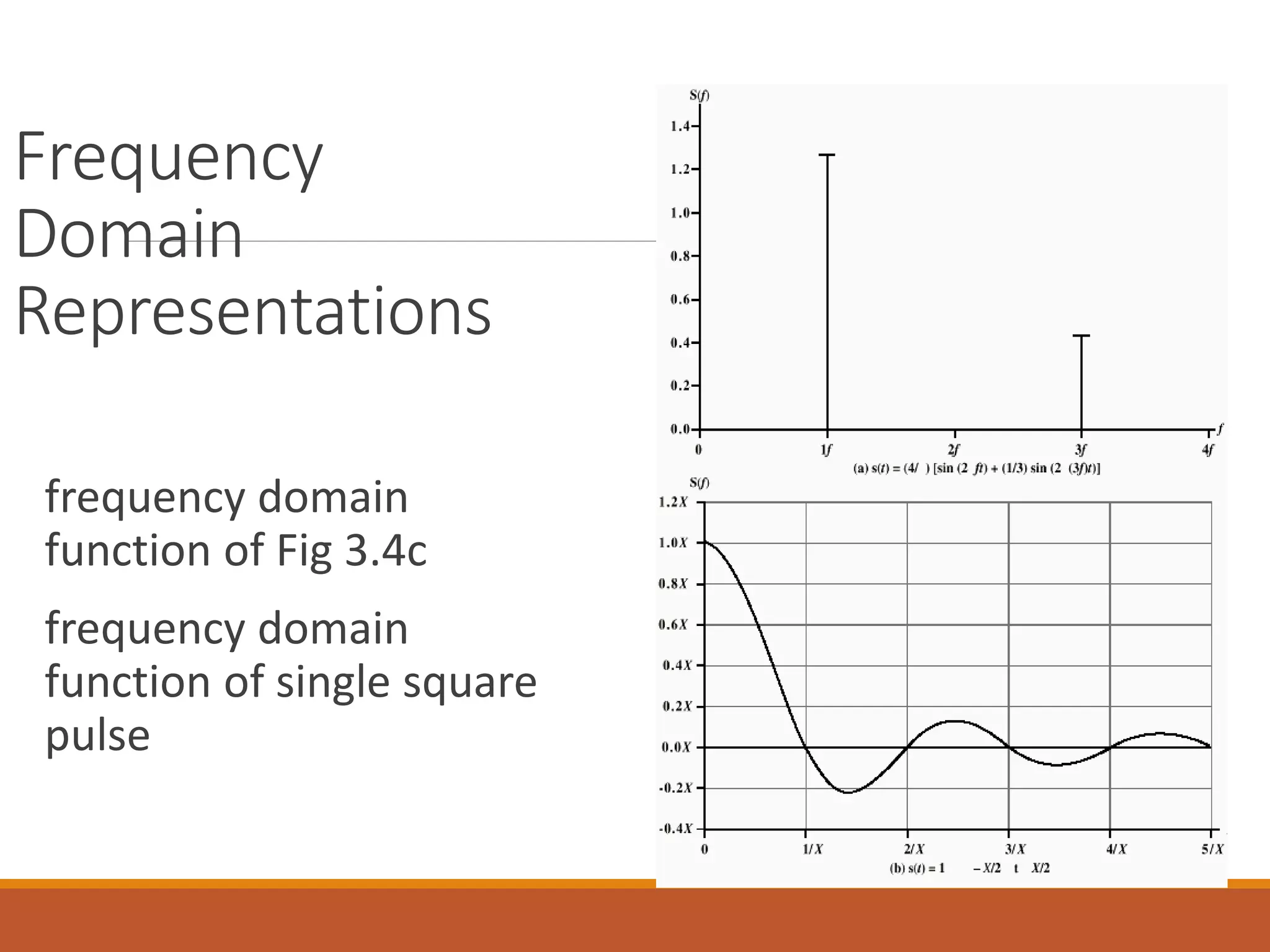
Frequency
Domain
Representations
frequency domain
function of Fig 3.4c
frequency domain
function of single square
pulse
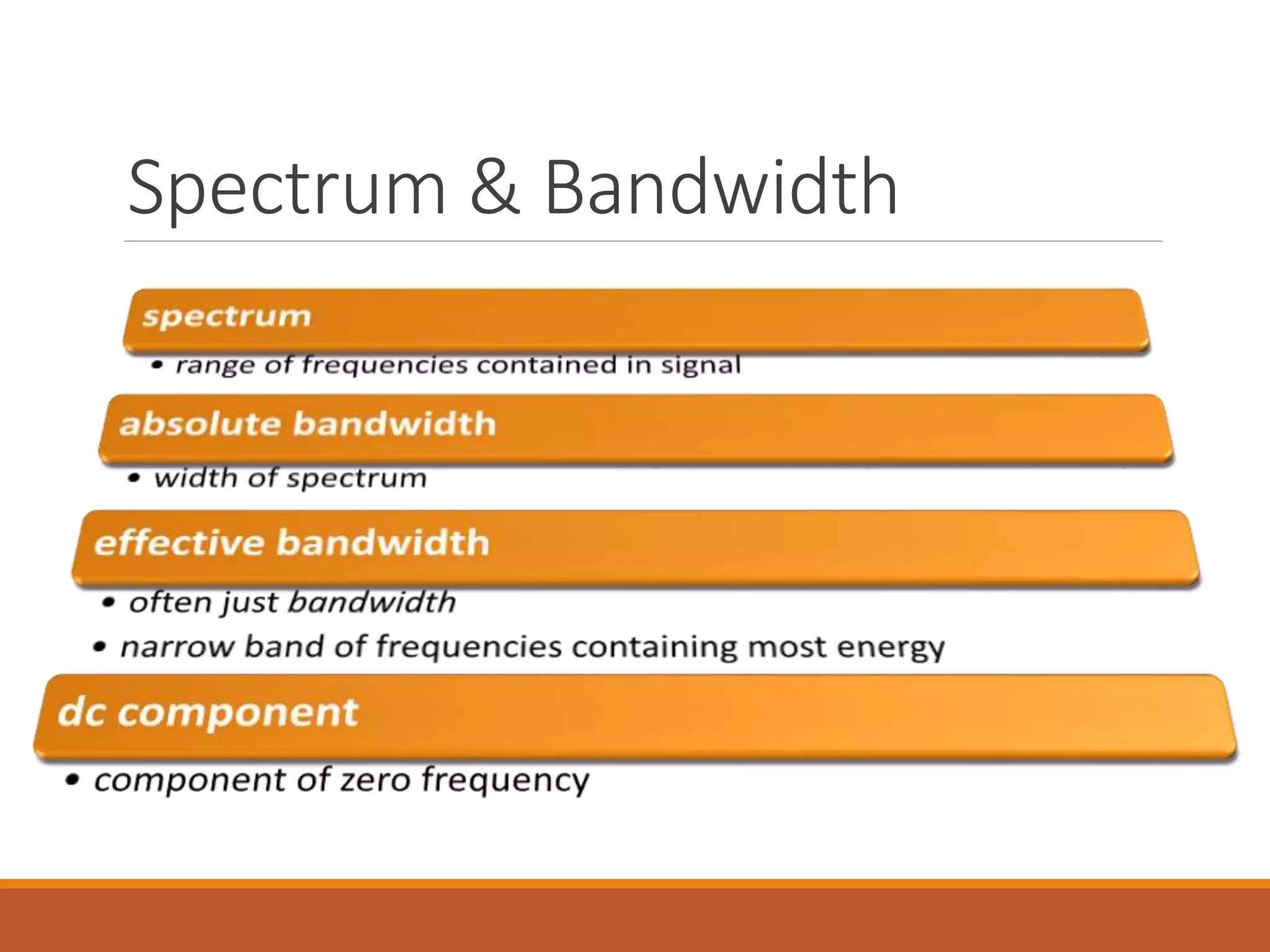
Spectrum & Bandwidth
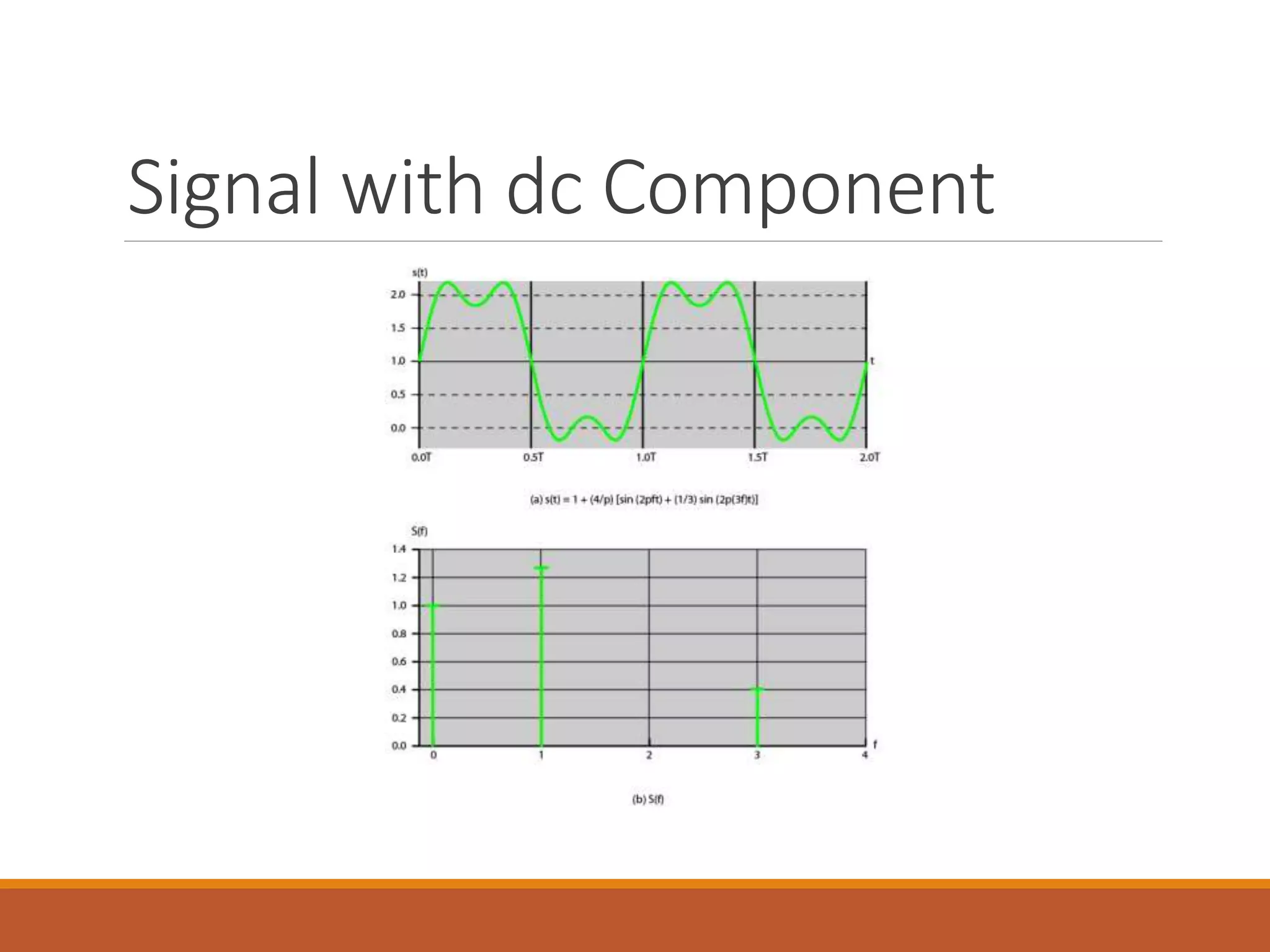
Signal with dc Component
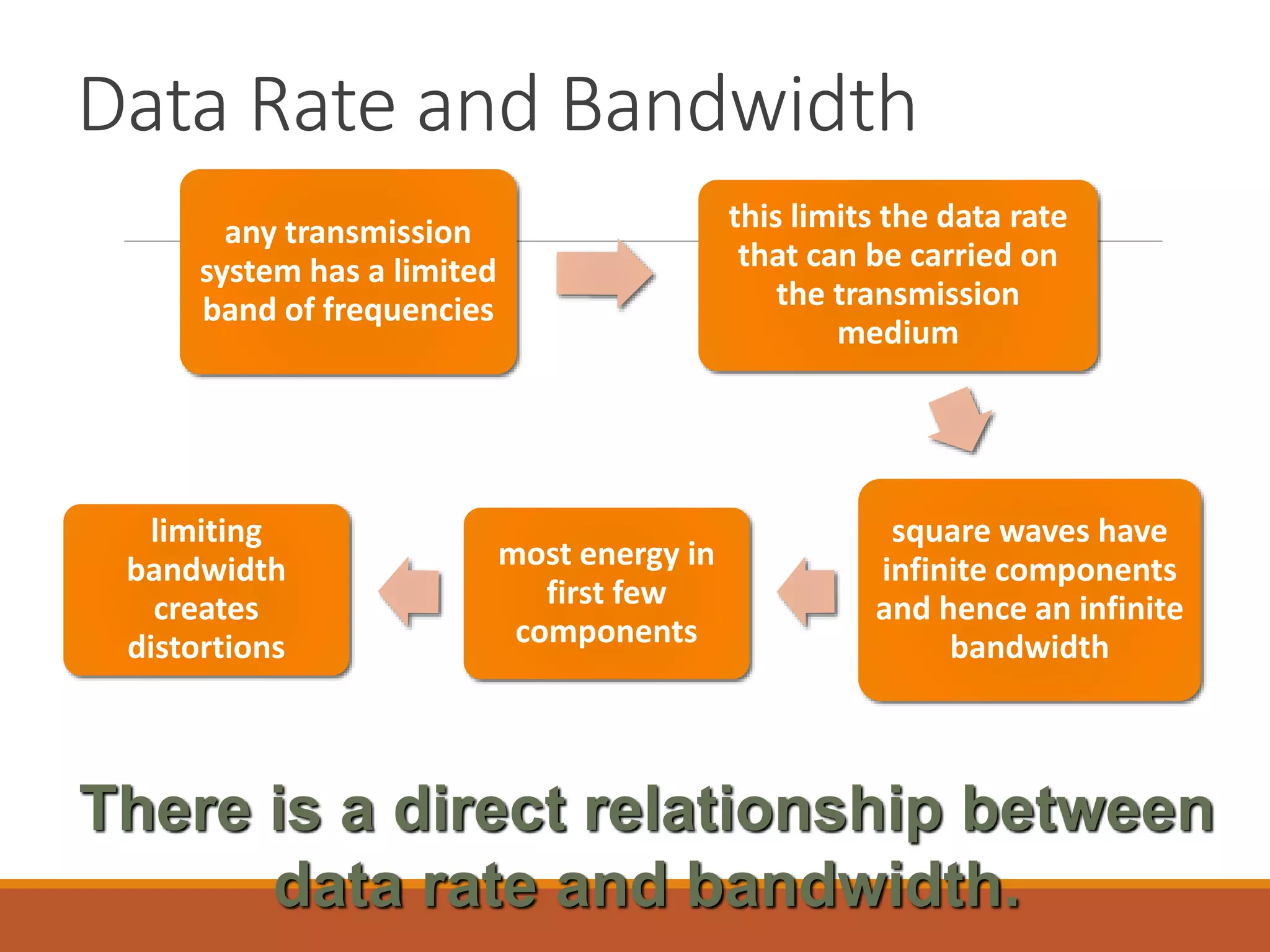
Data Rate and Bandwidth
any transmission
system has a limited
band of frequencies
this limits the data rate
that can be carried on
the transmission
medium
square waves have
infinite components
and hence an infinite
bandwidth
most energy in
first few
components
limiting
bandwidth
creates
distortions
There is a direct relationship between
data rate and bandwidth.
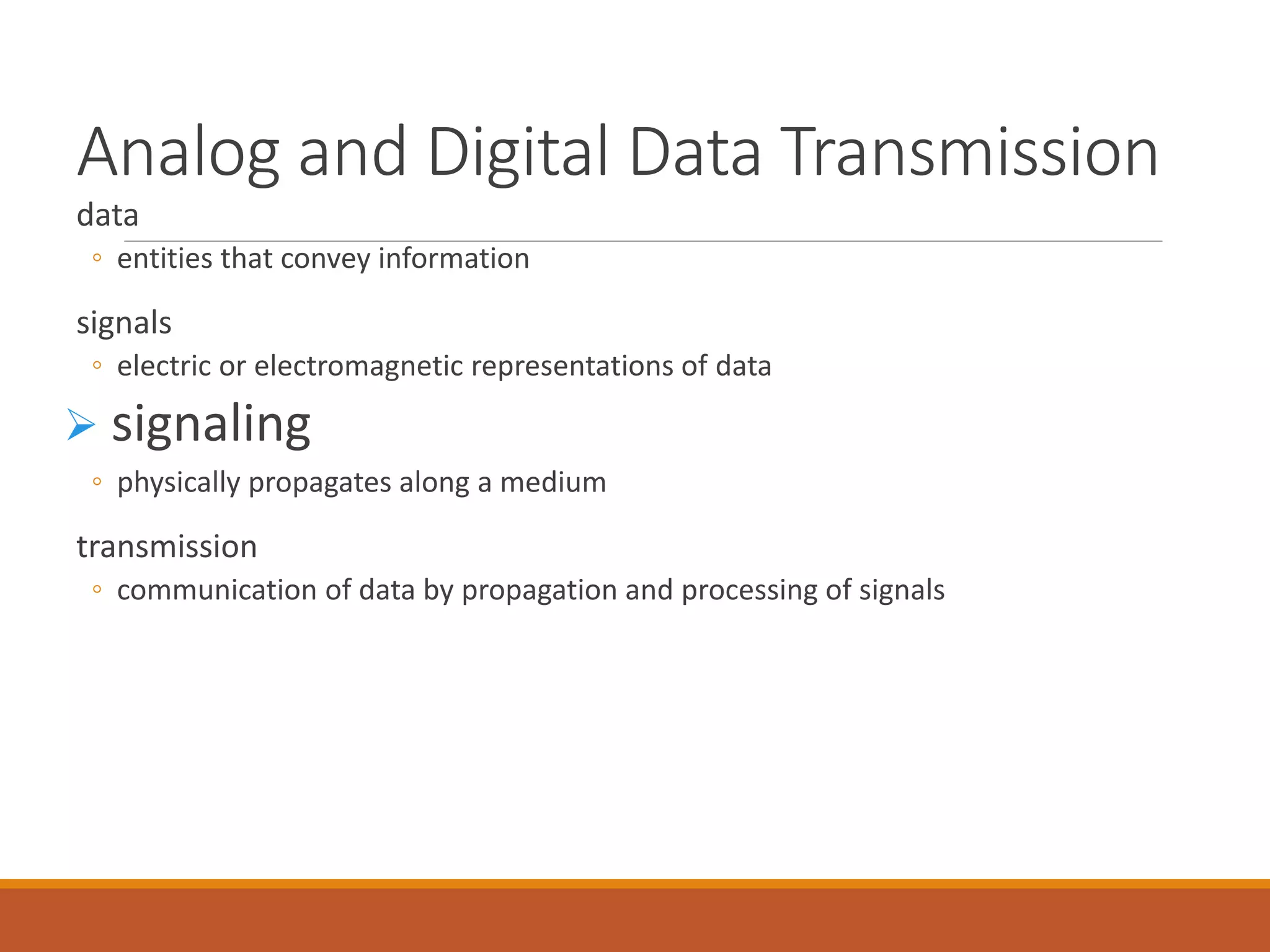
Analog and Digital Data Transmission
data
◦ entities that convey information
signals
◦ electric or electromagnetic representations of data
 signaling
◦ physically propagates along a medium
transmission
◦ communication of data by propagation and processing of signals
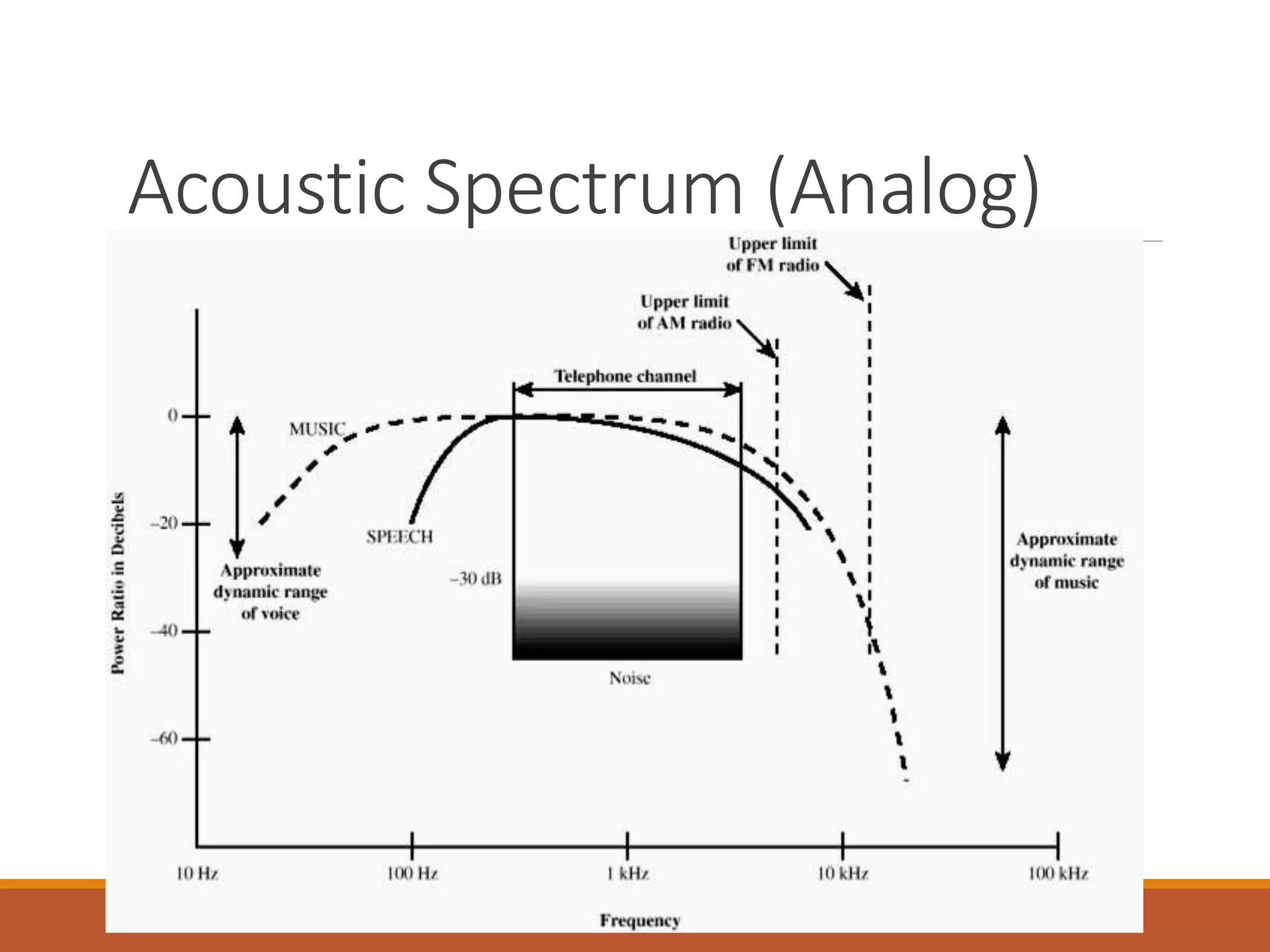
Acoustic Spectrum (Analog)
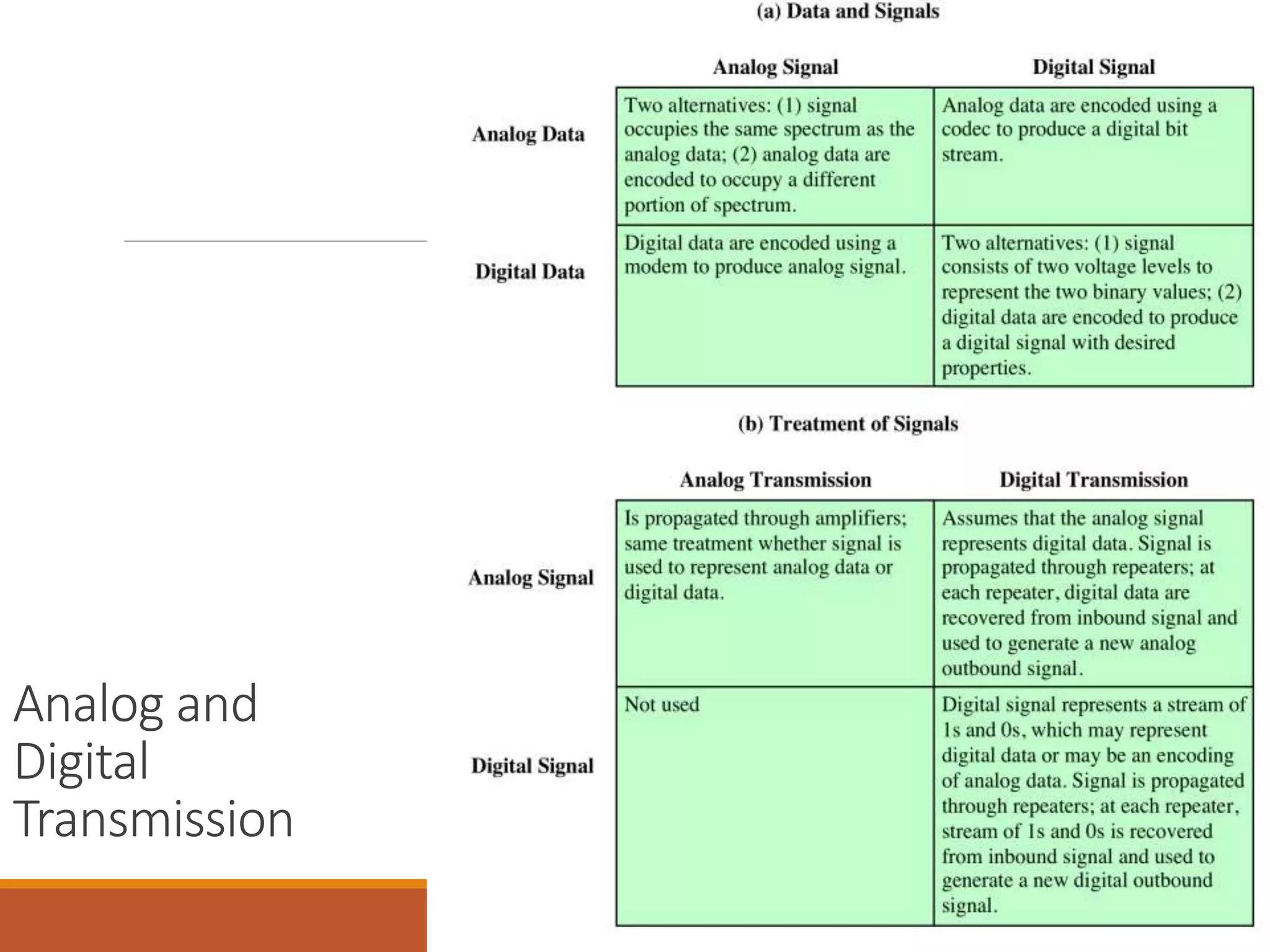
Analog and Digital
Transmission
Digital Data
Examples:
Text
Character
strings
IRA
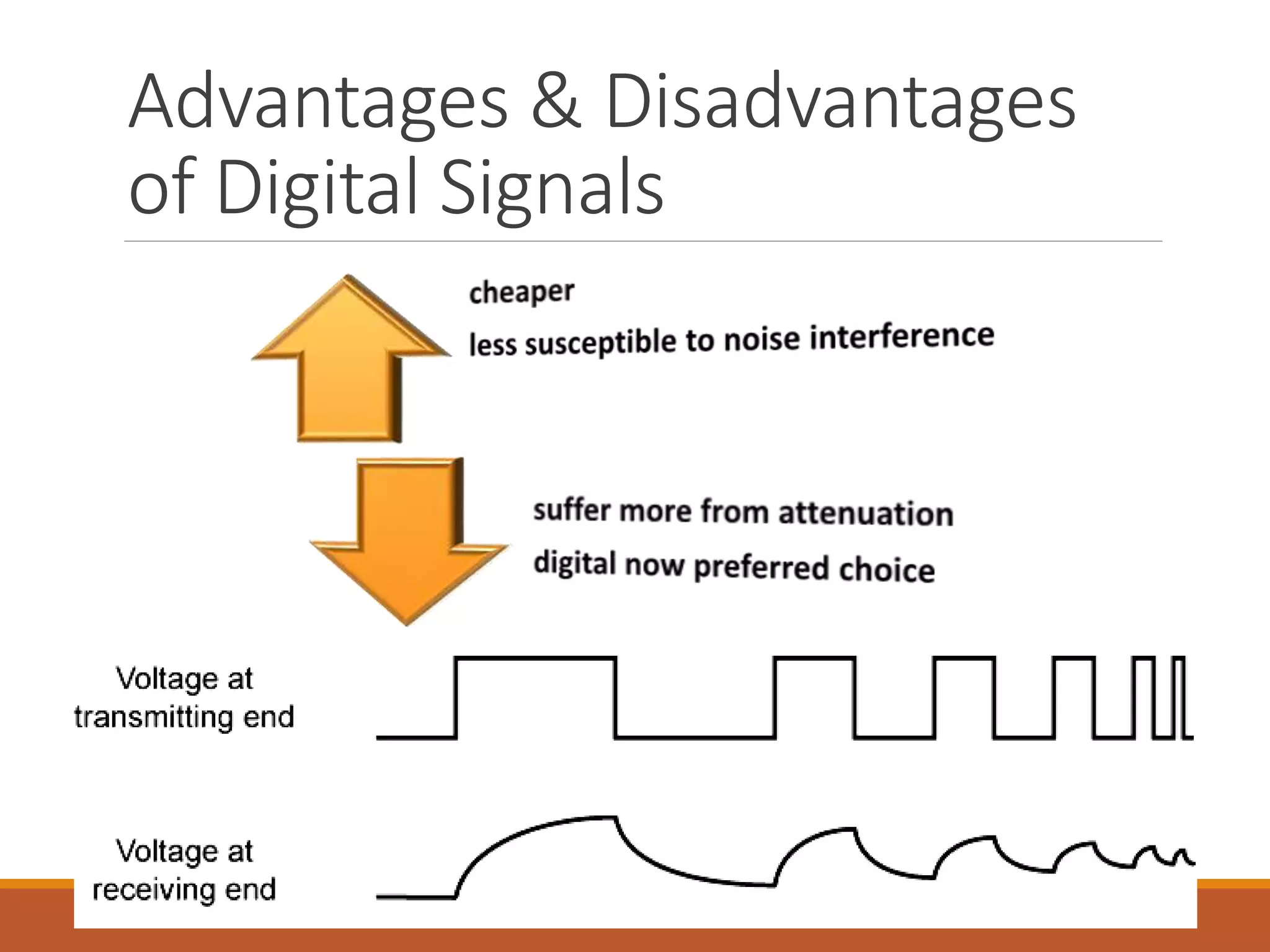
Advantages & Disadvantages
of Digital Signals
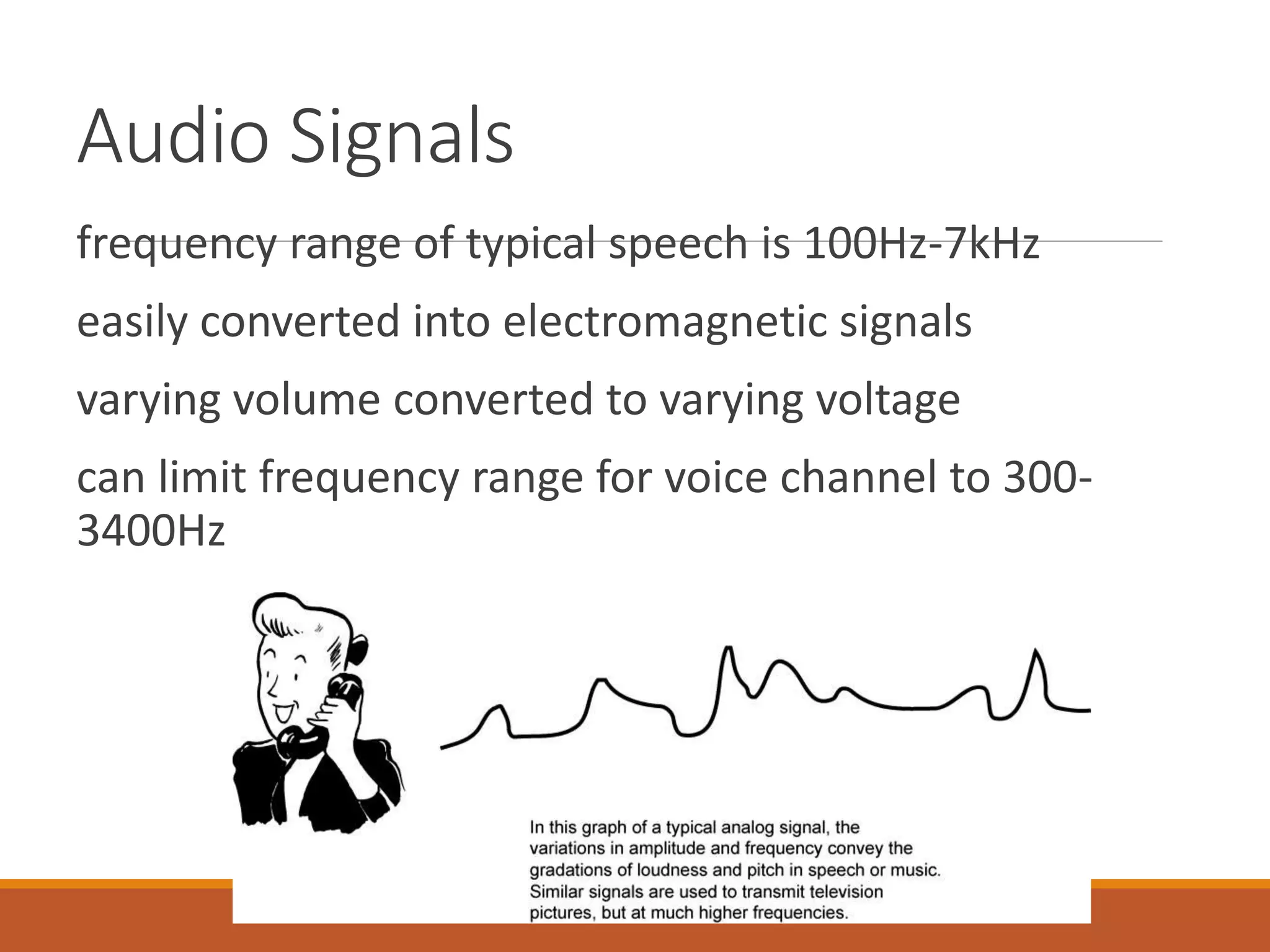
Audio Signals
frequency range of typical speech is 100Hz-7kHz
easily converted into electromagnetic signals
varying volume converted to varying voltage
can limit frequency range for voice channel to 300-
3400Hz
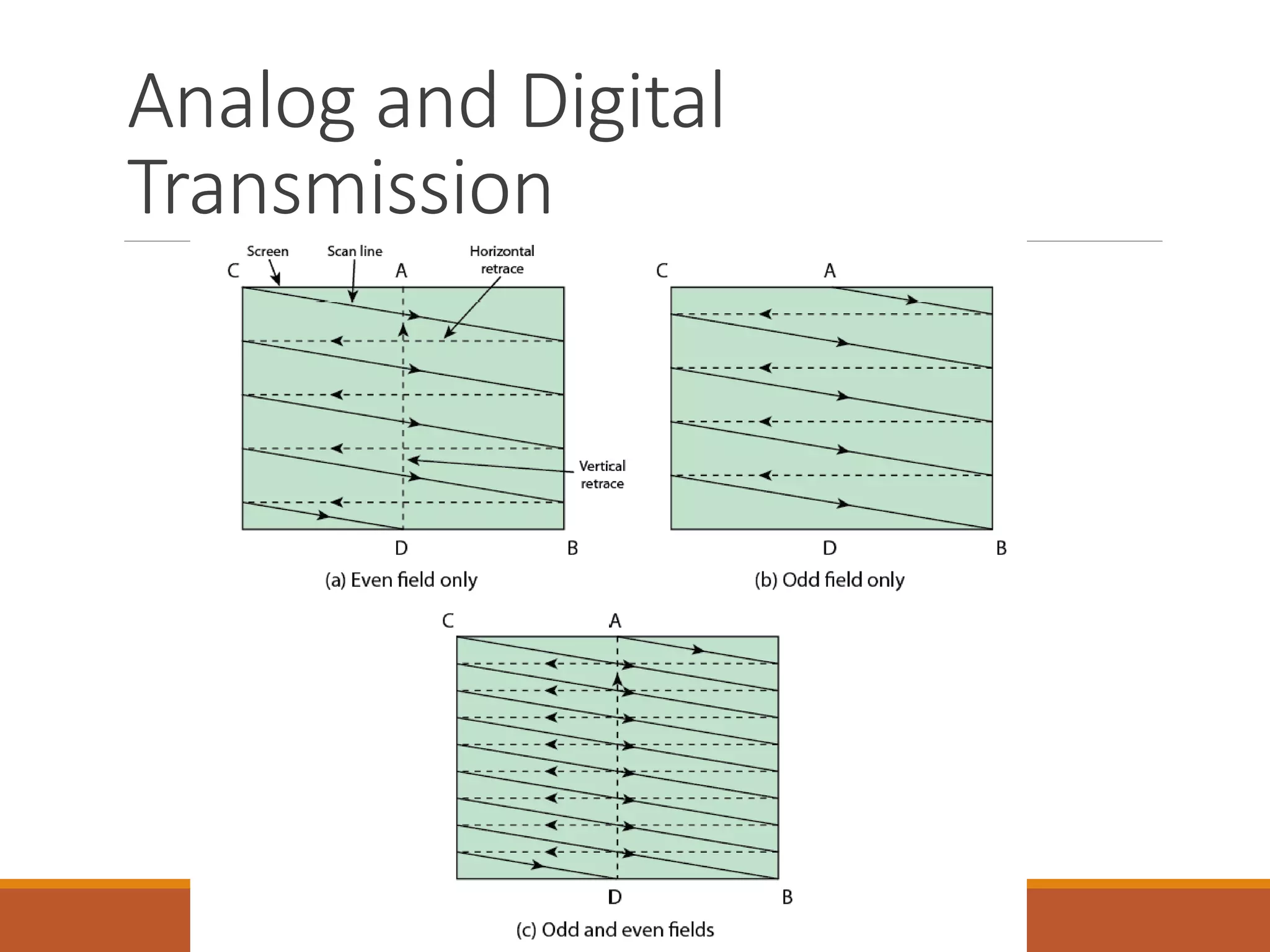
Video
Signals
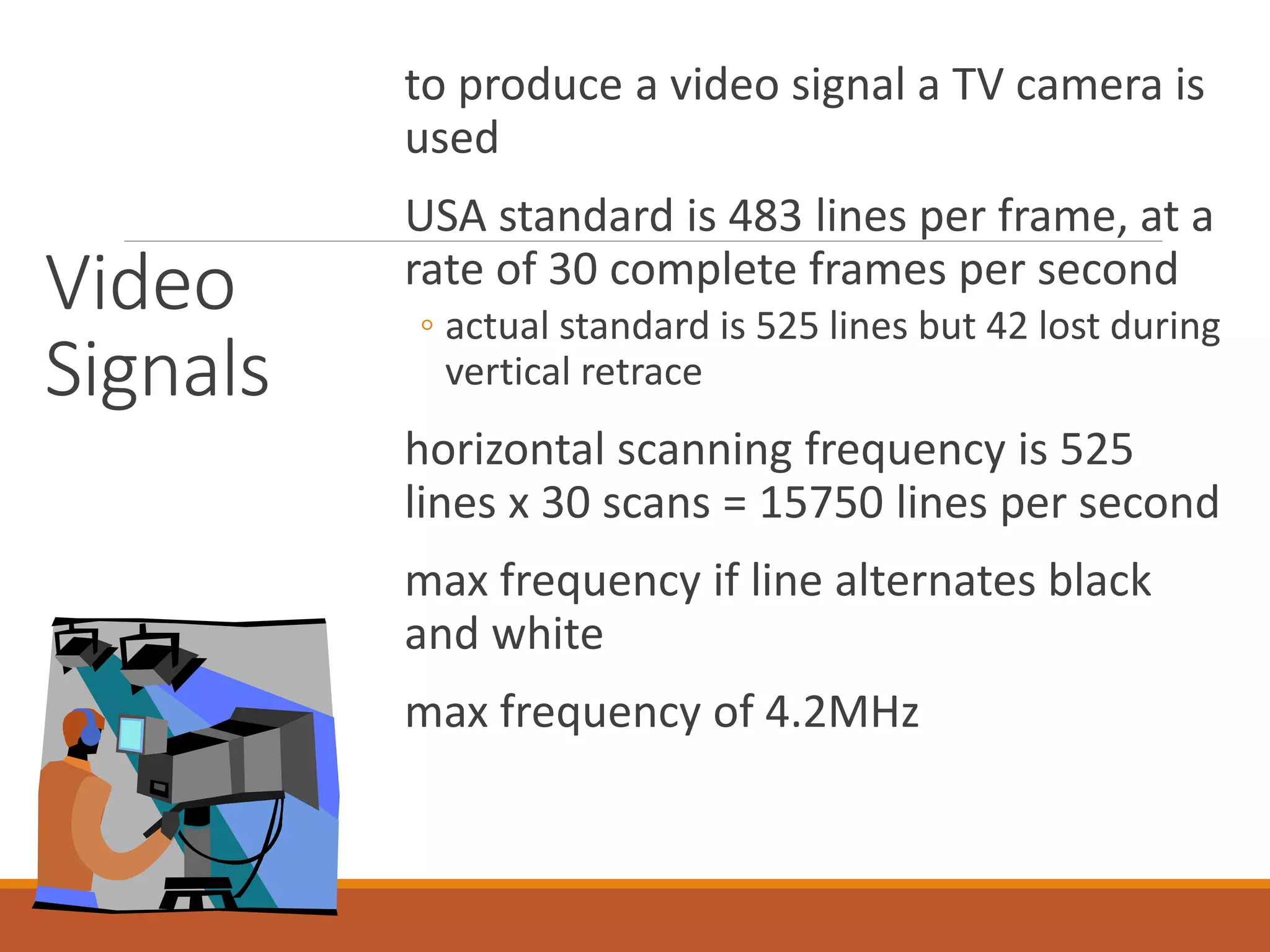
to produce a video signal a TV camera is
used
USA standard is 483 lines per frame, at a
rate of 30 complete frames per second
◦ actual standard is 525 lines but 42 lost during
vertical retrace
horizontal scanning frequency is 525
lines x 30 scans = 15750 lines per second
max frequency if line alternates black
and white
max frequency of 4.2MHz
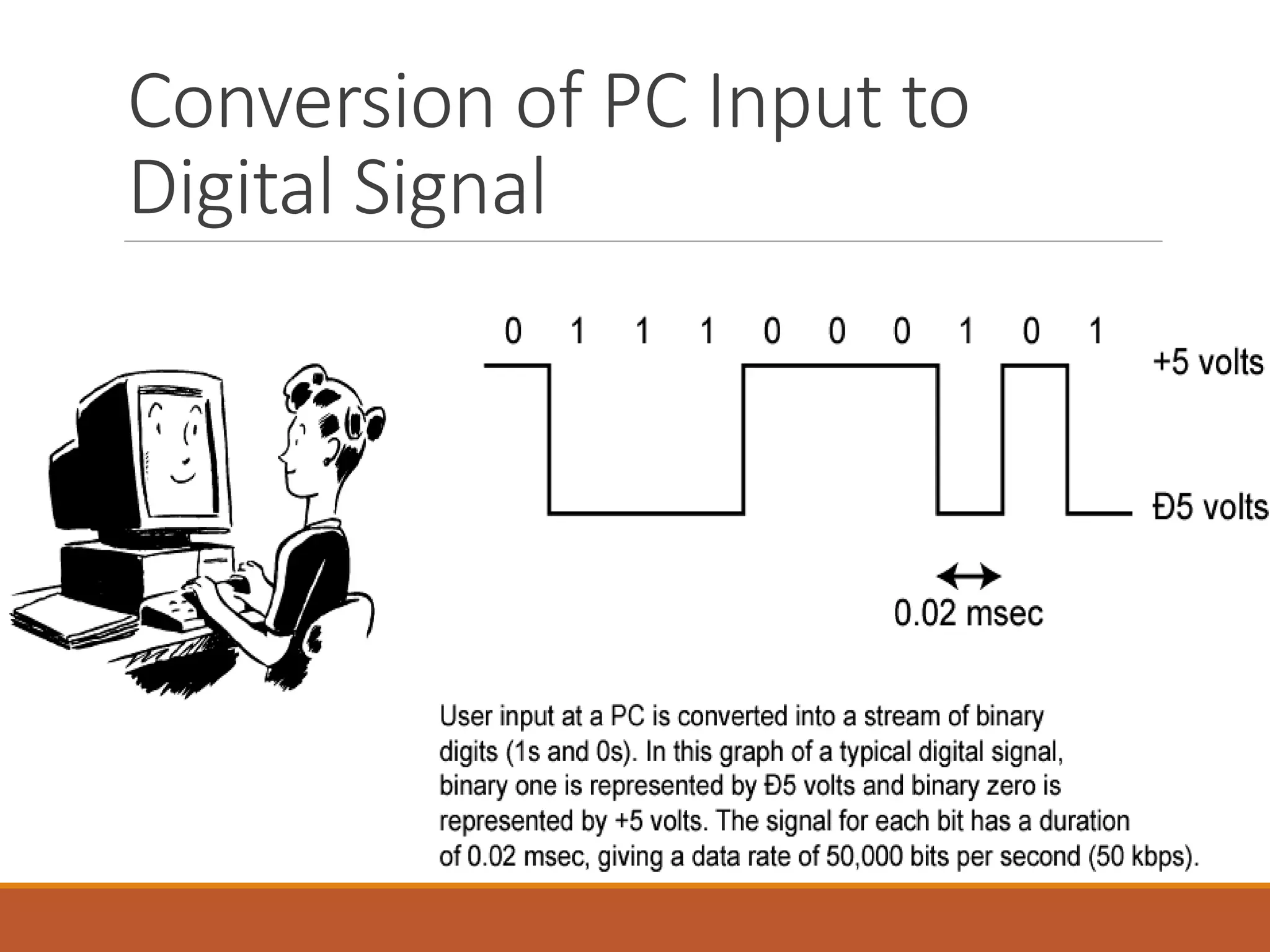
Conversion of PC Input to
Digital Signal
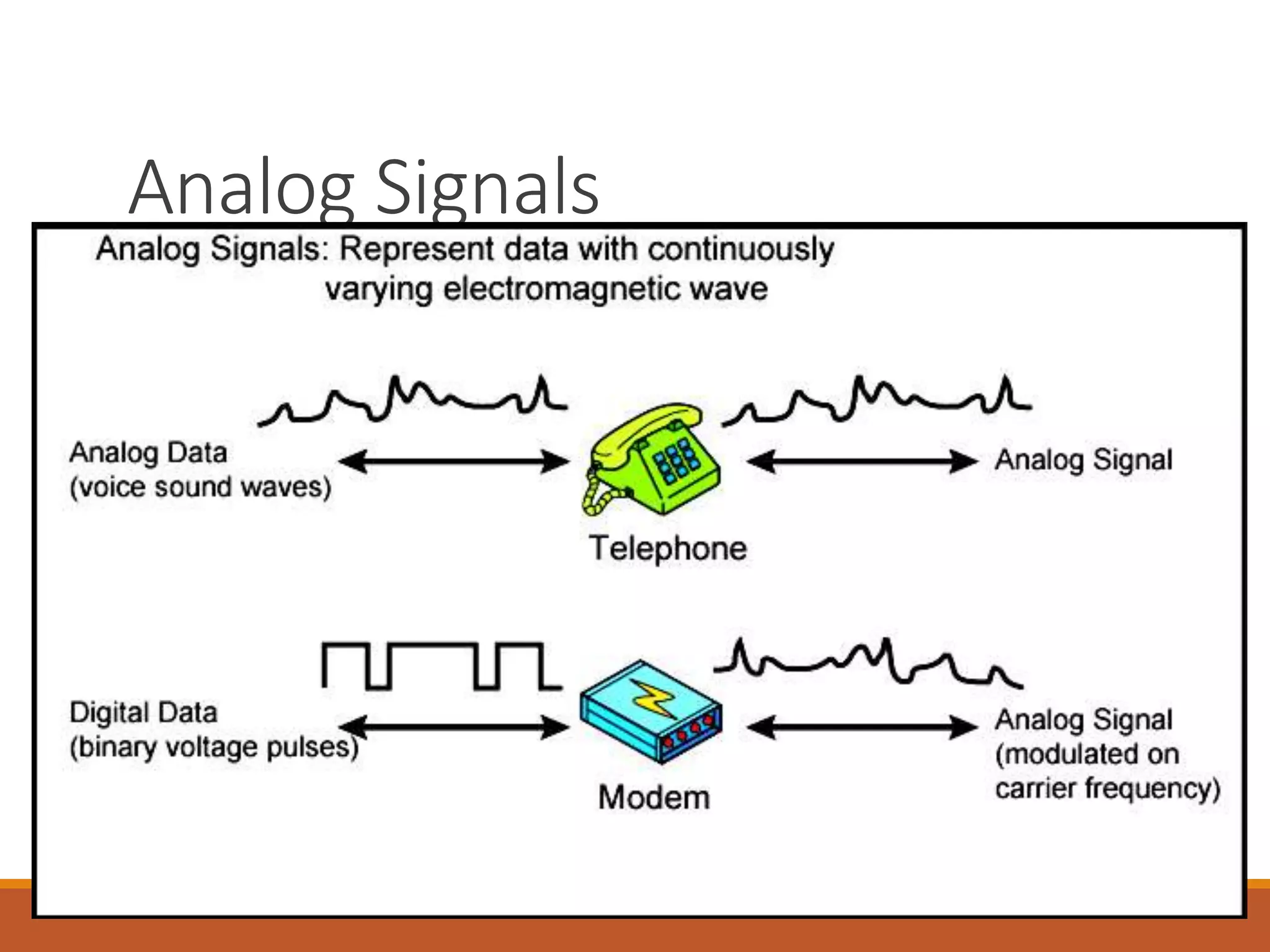
Analog Signals
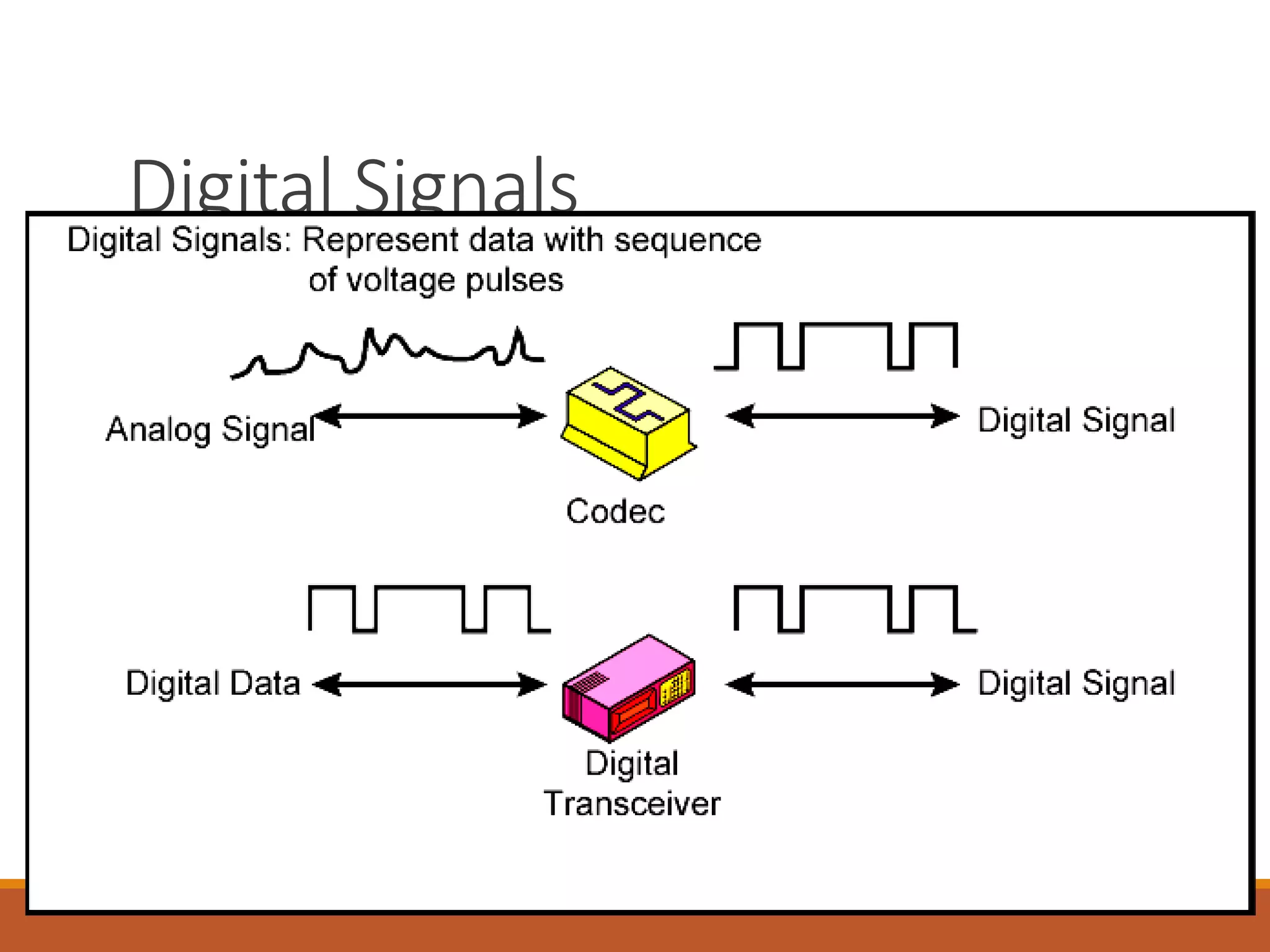
Digital Signals
Analog and
Digital
Transmission
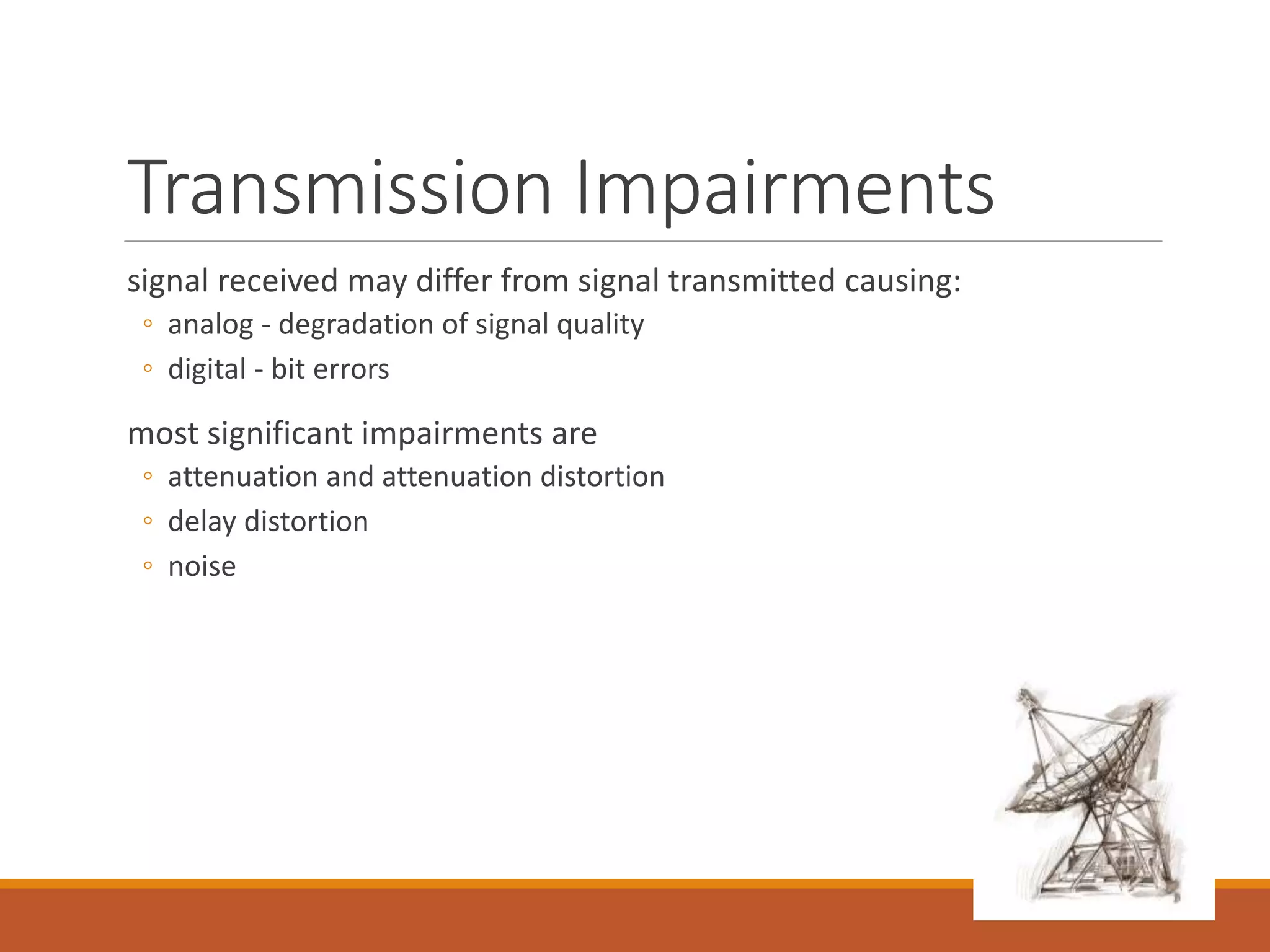
Transmission Impairments
signal received may differ from signal transmitted causing:
◦ analog - degradation of signal quality
◦ digital - bit errors
most significant impairments are
◦ attenuation and attenuation distortion
◦ delay distortion
◦ noise
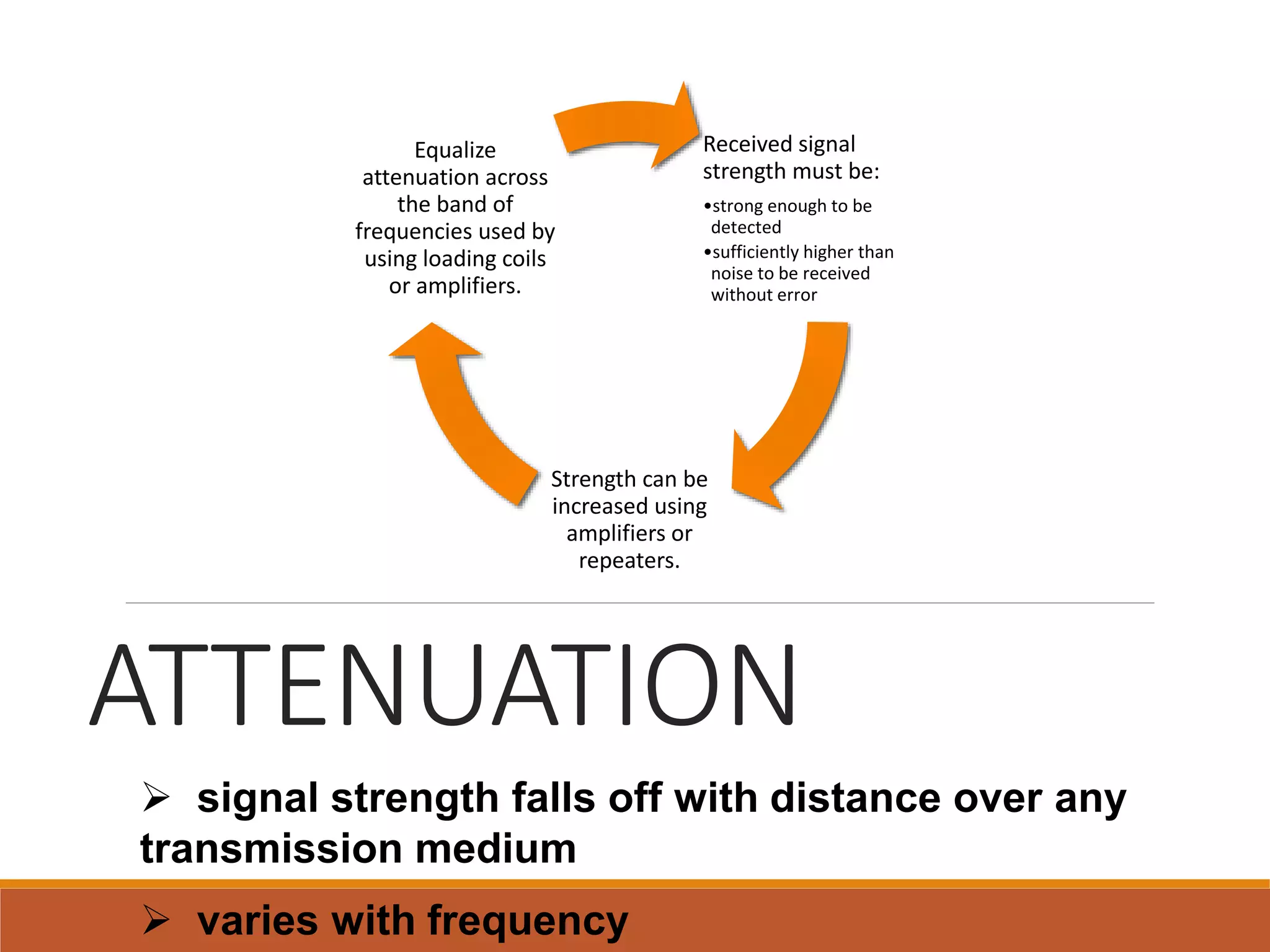
ATTENUATION
Received signal
strength must be:
•strong enough to be
detected
•sufficiently higher than
noise to be received
without error
Strength can be
increased using
amplifiers or
repeaters.
Equalize
attenuation across
the band of
frequencies used by
using loading coils
or amplifiers.
 signal strength falls off with distance over any
transmission medium
 varies with frequency
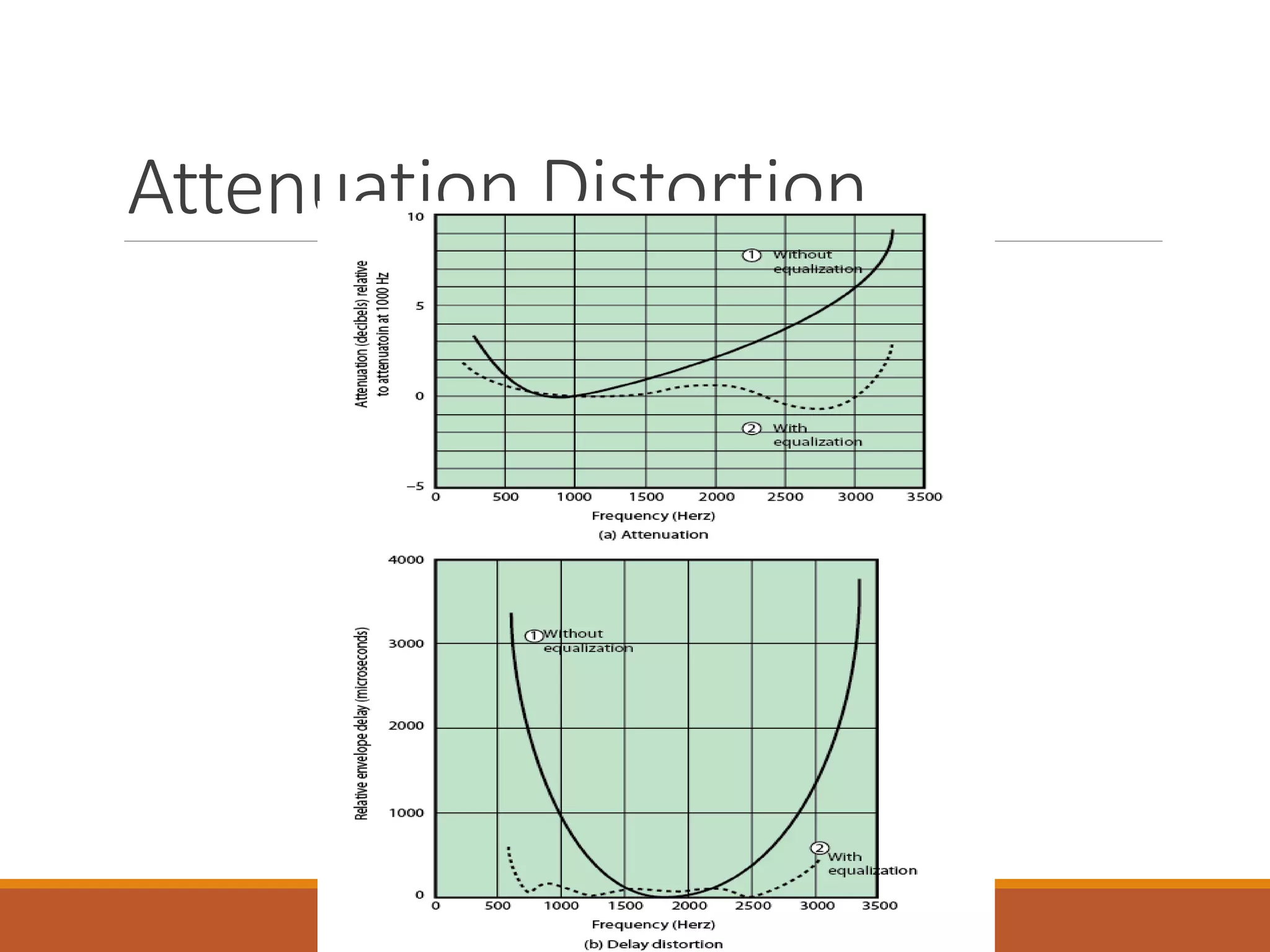
Attenuation Distortion
Delay Distortionoccurs because propagation velocity of a signal through a guided medium
varies with frequency
various frequency components arrive at different times resulting in phase
shifts between the frequencies
particularly critical for digital data since parts of one bit spill over into others
causing intersymbol interference
Noise
unwanted signals
inserted between
transmitter and
receiver
is the major limiting
factor in
communications
system performance
Categories of Noise
Intermodulation noise
• produced by nonlinearities in the
transmitter, receiver, and/or
intervening transmission medium
• effect is to produce signals at a
frequency that is the sum or
difference of the two original
frequencies
Categories of NoiseCrosstalk:
◦ a signal from one line is picked up by
another
◦ can occur by electrical coupling
between nearby twisted pairs or when
microwave antennas pick up unwanted
signals
Impulse Noise:
◦ caused by external electromagnetic
interferences
◦ noncontinuous, consisting of irregular pulses
or spikes
◦ short duration and high amplitude
◦ minor annoyance for analog signals but a
major source of error in digital data
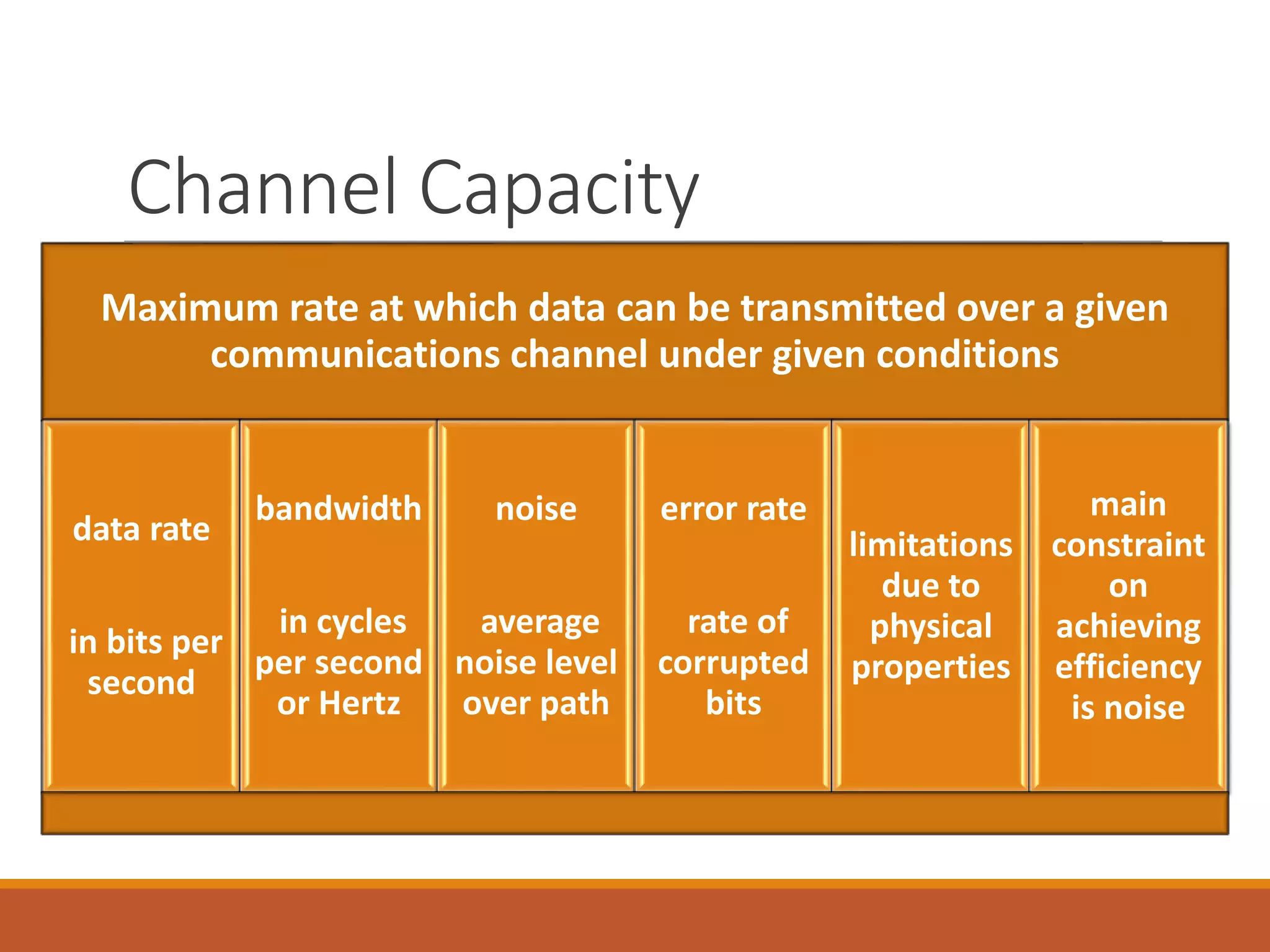
Channel Capacity
Maximum rate at which data can be transmitted over a given
communications channel under given conditions
data rate
in bits per
second
bandwidth
in cycles
per second
or Hertz
noise
average
noise level
over path
error rate
rate of
corrupted
bits
limitations
due to
physical
properties
main
constraint
on
achieving
efficiency
is noise
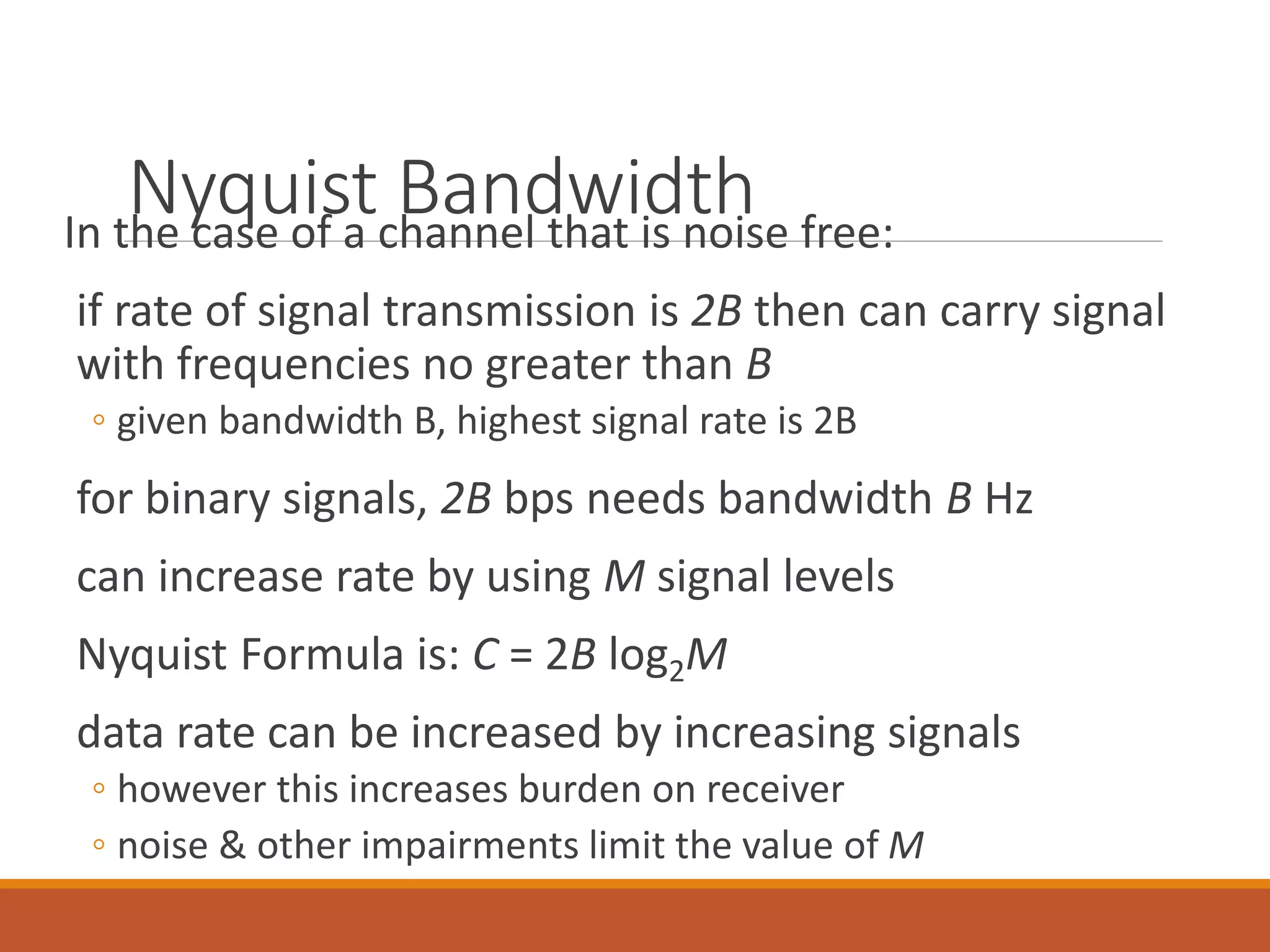
Nyquist BandwidthIn the case of a channel that is noise free:
if rate of signal transmission is 2B then can carry signal
with frequencies no greater than B
◦ given bandwidth B, highest signal rate is 2B
for binary signals, 2B bps needs bandwidth B Hz
can increase rate by using M signal levels
Nyquist Formula is: C = 2B log2M
data rate can be increased by increasing signals
◦ however this increases burden on receiver
◦ noise & other impairments limit the value of M
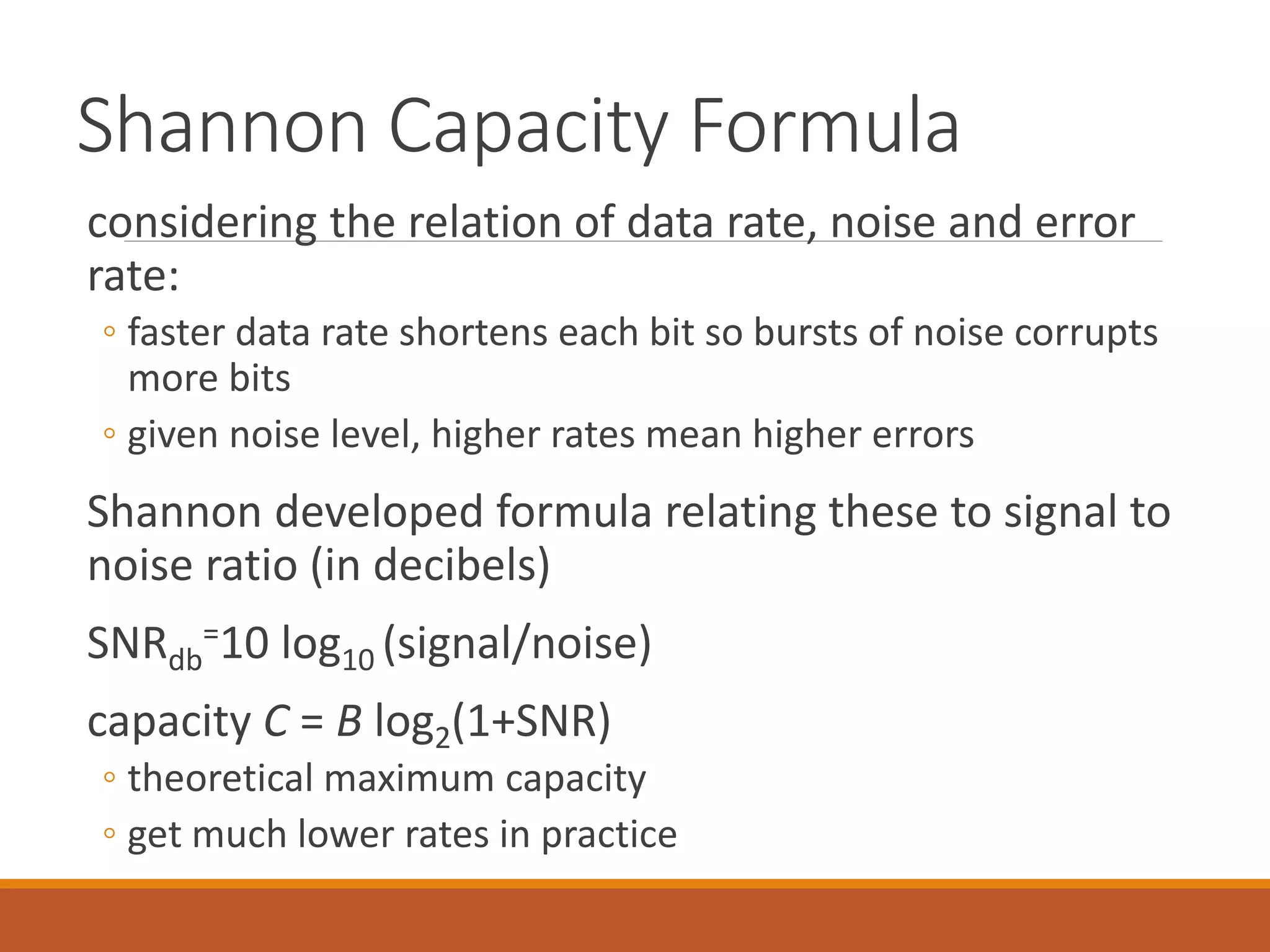
Shannon Capacity Formula
considering the relation of data rate, noise and error
rate:
◦ faster data rate shortens each bit so bursts of noise corrupts
more bits
◦ given noise level, higher rates mean higher errors
Shannon developed formula relating these to signal to
noise ratio (in decibels)
SNRdb
=10 log10 (signal/noise)
capacity C = B log2(1+SNR)
◦ theoretical maximum capacity
◦ get much lower rates in practice
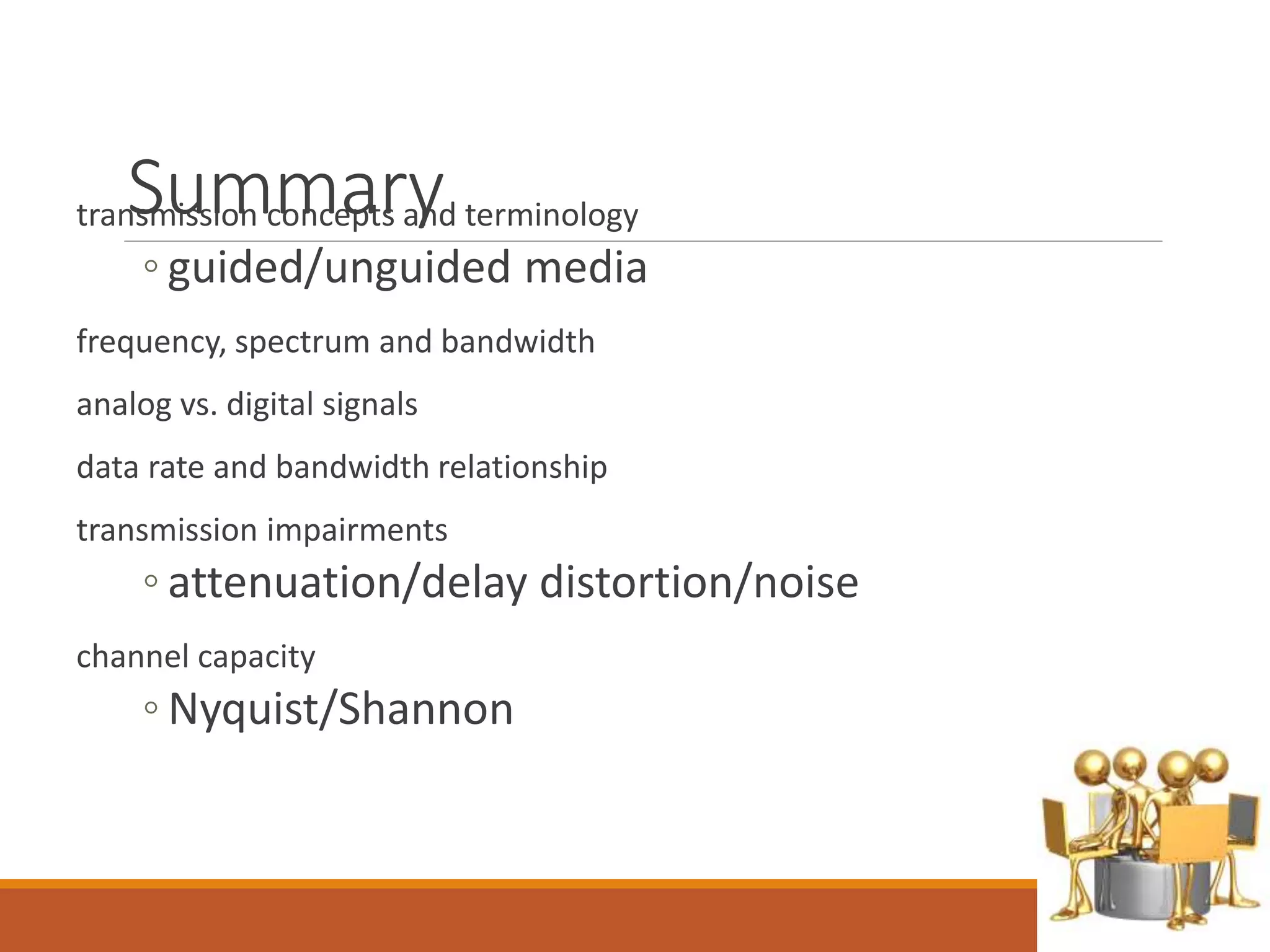
Summarytransmission concepts and terminology
◦ guided/unguided media
frequency, spectrum and bandwidth
analog vs. digital signals
data rate and bandwidth relationship
transmission impairments
◦ attenuation/delay distortion/noise
channel capacity
◦ Nyquist/Shannon

datatransmission digital and analoge

  • 1.
    Data and Computer Communications EMDADUL’SEDITION BY WILLIAM STALLINGS DATA AND COMPUTER COMMUNICATIONS, NINTH EDITION BY WILLIAM STALLINGS, (C) PEARSON EDUCATION - PRENTICE HALL, 2011 Data Transmission
  • 2.
    Data Transmission What we'vegot here is failure to communicate. Paul Newman in Cool Hand Luke
  • 3.
    Data Transmission The successfultransmission of data depends on two factors: •quality of the signal being transmitted •characteristics of the transmission medium
  • 4.
    Transmission Terminology Data transmissionoccurs between transmitter and receiver over some transmission medium. Communication is in the form of electromagnetic waves. Guided media twisted pair, coaxial cable, optical fiber Unguided media (wireless) air, vacuum, seawater
  • 5.
  • 6.
    Transmission Terminology Simplex ◦ signalstransmitted in one direction ◦ eg. Television Half duplex ◦ both stations transmit, but only one at a time ◦ eg. police radio Full duplex ◦ simultaneous transmissions ◦ eg. telephone
  • 7.
    Frequency, Spectrum and Bandwidth analogsignal • signal intensity varies smoothly with no breaks digital signal • signal intensity maintains a constant level and then abruptly changes to another level periodic signal ◦ signal pattern repeats over time aperiodic signal ◦ pattern not repeated over time TIME DOMAIN CONCEPTS
  • 8.
  • 9.
  • 10.
    Sine Wave peak amplitude(A) ◦ maximum strength of signal ◦ typically measured in volts frequency (f) ◦ rate at which the signal repeats ◦ Hertz (Hz) or cycles per second ◦ period (T) is the amount of time for one repetition ◦ T = 1/f phase () ◦ relative position in time within a single period of signal (periodic continuous signal)
  • 11.
    Varying Sine Waves s(t)= A sin(2ft +)
  • 12.
    Wavelength () the wavelengthof a signal is the distance occupied by a single cycle can also be stated as the distance between two points of corresponding phase of two consecutive cycles assuming signal velocity v, then the wavelength is related to the period as  = vT or equivalently f = v especially when v=c • c = 3*108 ms-1 (speed of light in free space)
  • 13.
    Frequency Domain Concepts signalsare made up of many frequencies components are sine waves Fourier analysis can show that any signal is made up of components at various frequencies, in which each component is a sinusoid can plot frequency domain functions
  • 14.
  • 15.
    Frequency Domain Representations frequency domain function ofFig 3.4c frequency domain function of single square pulse
  • 16.
  • 17.
    Signal with dcComponent
  • 18.
    Data Rate andBandwidth any transmission system has a limited band of frequencies this limits the data rate that can be carried on the transmission medium square waves have infinite components and hence an infinite bandwidth most energy in first few components limiting bandwidth creates distortions There is a direct relationship between data rate and bandwidth.
  • 19.
    Analog and DigitalData Transmission data ◦ entities that convey information signals ◦ electric or electromagnetic representations of data  signaling ◦ physically propagates along a medium transmission ◦ communication of data by propagation and processing of signals
  • 20.
  • 21.
  • 22.
  • 23.
  • 24.
    Audio Signals frequency rangeof typical speech is 100Hz-7kHz easily converted into electromagnetic signals varying volume converted to varying voltage can limit frequency range for voice channel to 300- 3400Hz
  • 25.
    Video Signals to produce avideo signal a TV camera is used USA standard is 483 lines per frame, at a rate of 30 complete frames per second ◦ actual standard is 525 lines but 42 lost during vertical retrace horizontal scanning frequency is 525 lines x 30 scans = 15750 lines per second max frequency if line alternates black and white max frequency of 4.2MHz
  • 26.
    Conversion of PCInput to Digital Signal
  • 27.
  • 28.
  • 29.
  • 30.
    Transmission Impairments signal receivedmay differ from signal transmitted causing: ◦ analog - degradation of signal quality ◦ digital - bit errors most significant impairments are ◦ attenuation and attenuation distortion ◦ delay distortion ◦ noise
  • 31.
    ATTENUATION Received signal strength mustbe: •strong enough to be detected •sufficiently higher than noise to be received without error Strength can be increased using amplifiers or repeaters. Equalize attenuation across the band of frequencies used by using loading coils or amplifiers.  signal strength falls off with distance over any transmission medium  varies with frequency
  • 32.
  • 33.
    Delay Distortionoccurs becausepropagation velocity of a signal through a guided medium varies with frequency various frequency components arrive at different times resulting in phase shifts between the frequencies particularly critical for digital data since parts of one bit spill over into others causing intersymbol interference
  • 34.
    Noise unwanted signals inserted between transmitterand receiver is the major limiting factor in communications system performance
  • 35.
    Categories of Noise Intermodulationnoise • produced by nonlinearities in the transmitter, receiver, and/or intervening transmission medium • effect is to produce signals at a frequency that is the sum or difference of the two original frequencies
  • 36.
    Categories of NoiseCrosstalk: ◦a signal from one line is picked up by another ◦ can occur by electrical coupling between nearby twisted pairs or when microwave antennas pick up unwanted signals Impulse Noise: ◦ caused by external electromagnetic interferences ◦ noncontinuous, consisting of irregular pulses or spikes ◦ short duration and high amplitude ◦ minor annoyance for analog signals but a major source of error in digital data
  • 37.
    Channel Capacity Maximum rateat which data can be transmitted over a given communications channel under given conditions data rate in bits per second bandwidth in cycles per second or Hertz noise average noise level over path error rate rate of corrupted bits limitations due to physical properties main constraint on achieving efficiency is noise
  • 38.
    Nyquist BandwidthIn thecase of a channel that is noise free: if rate of signal transmission is 2B then can carry signal with frequencies no greater than B ◦ given bandwidth B, highest signal rate is 2B for binary signals, 2B bps needs bandwidth B Hz can increase rate by using M signal levels Nyquist Formula is: C = 2B log2M data rate can be increased by increasing signals ◦ however this increases burden on receiver ◦ noise & other impairments limit the value of M
  • 39.
    Shannon Capacity Formula consideringthe relation of data rate, noise and error rate: ◦ faster data rate shortens each bit so bursts of noise corrupts more bits ◦ given noise level, higher rates mean higher errors Shannon developed formula relating these to signal to noise ratio (in decibels) SNRdb =10 log10 (signal/noise) capacity C = B log2(1+SNR) ◦ theoretical maximum capacity ◦ get much lower rates in practice
  • 40.
    Summarytransmission concepts andterminology ◦ guided/unguided media frequency, spectrum and bandwidth analog vs. digital signals data rate and bandwidth relationship transmission impairments ◦ attenuation/delay distortion/noise channel capacity ◦ Nyquist/Shannon