Presenter: Zubair Rahim
1
Outline 2
 Hacker vs Programmer
 What is database security?
 Data breach
 Database Attacks
3
Data breach
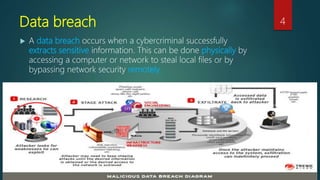
 A data breach occurs when a cybercriminal successfully
extracts sensitive information. This can be done physically by
accessing a computer or network to steal local files or by
bypassing network security remotely.
4
Data breach
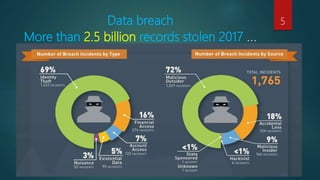
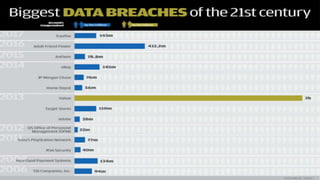
More than 2.5 billion records stolen 2017 ...
5
6
Database Attacks
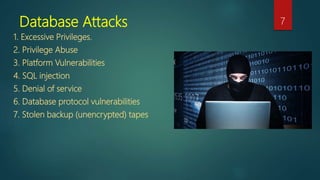
1. Excessive Privileges.
2. Privilege Abuse
3. Platform Vulnerabilities
4. SQL injection
5. Denial of service
6. Database protocol vulnerabilities
7. Stolen backup (unencrypted) tapes
7
1. Excessive privileges
 When users (or applications) are granted database privileges that exceed
the requirements of their job function, these privileges may be used to
gain access to confidential information.
 For example, a university administrator whose job requires read-only
access to student records may take advantage of excessive update
privileges to change grades.
 Solution
 Query-level access control restricts
privileges to minimum-required operations and data.
8
2. Privilege abuse
 Privilege is abused when a system user performs an action that is not in
accordance with corporate policy or law
 Users may abuse legitimate data access privileges for unauthorized purposes.
 For example, a user with privileges to view individual patient records via a
custom healthcare application client may abuse that privilege to retrieve all
patient records via a MS-Excel client.
 Solution
 The solution is access control policies that apply not only to what
data is accessible, but how data is accessed.
 By enforcing policies for time of day, location, and application
client and volume of data retrieved, it is possible to identify users
who are abusing access privileges.
9
3. Platform Vulnerabilities
 Vulnerabilities in underlying operating systems may lead to unauthorized
data access and corruption.
 For example, the Blaster worm took advantage of a Windows 2000
vulnerability to take down target servers.
 Solution
 IPS tools are a good way to identify and/or block
attacks designed to exploit known database
platform vulnerabilities.
10
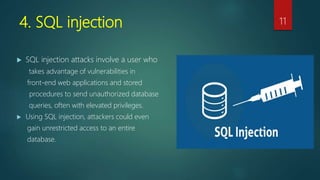
4. SQL injection 11
 SQL injection attacks involve a user who
takes advantage of vulnerabilities in
front-end web applications and stored
procedures to send unauthorized database
queries, often with elevated privileges.
 Using SQL injection, attackers could even
gain unrestricted access to an entire
database.
12
5. Denial of service
 Common DoS techniques include buffer overflows, data
corruption, network flooding, and resource consumption
6. Database protocol vulnerabilities
 Vulnerabilities in database protocols may allow
unauthorized data access, corruption, or availability
 Protocol attacks can be defeated by parsing and
SQL communications to make sure they are not
7. Stolen backup (unencrypted) tapes
 Some recent high profile attacks have involved theft
database backup tapes and hard disks
13

Database security

  • 1.
  • 2.
    Outline 2  Hackervs Programmer  What is database security?  Data breach  Database Attacks
  • 3.
  • 4.
    Data breach  Adata breach occurs when a cybercriminal successfully extracts sensitive information. This can be done physically by accessing a computer or network to steal local files or by bypassing network security remotely. 4
  • 5.
    Data breach More than2.5 billion records stolen 2017 ... 5
  • 6.
  • 7.
    Database Attacks 1. ExcessivePrivileges. 2. Privilege Abuse 3. Platform Vulnerabilities 4. SQL injection 5. Denial of service 6. Database protocol vulnerabilities 7. Stolen backup (unencrypted) tapes 7
  • 8.
    1. Excessive privileges When users (or applications) are granted database privileges that exceed the requirements of their job function, these privileges may be used to gain access to confidential information.  For example, a university administrator whose job requires read-only access to student records may take advantage of excessive update privileges to change grades.  Solution  Query-level access control restricts privileges to minimum-required operations and data. 8
  • 9.
    2. Privilege abuse Privilege is abused when a system user performs an action that is not in accordance with corporate policy or law  Users may abuse legitimate data access privileges for unauthorized purposes.  For example, a user with privileges to view individual patient records via a custom healthcare application client may abuse that privilege to retrieve all patient records via a MS-Excel client.  Solution  The solution is access control policies that apply not only to what data is accessible, but how data is accessed.  By enforcing policies for time of day, location, and application client and volume of data retrieved, it is possible to identify users who are abusing access privileges. 9
  • 10.
    3. Platform Vulnerabilities Vulnerabilities in underlying operating systems may lead to unauthorized data access and corruption.  For example, the Blaster worm took advantage of a Windows 2000 vulnerability to take down target servers.  Solution  IPS tools are a good way to identify and/or block attacks designed to exploit known database platform vulnerabilities. 10
  • 11.
    4. SQL injection11  SQL injection attacks involve a user who takes advantage of vulnerabilities in front-end web applications and stored procedures to send unauthorized database queries, often with elevated privileges.  Using SQL injection, attackers could even gain unrestricted access to an entire database.
  • 12.
  • 13.
    5. Denial ofservice  Common DoS techniques include buffer overflows, data corruption, network flooding, and resource consumption 6. Database protocol vulnerabilities  Vulnerabilities in database protocols may allow unauthorized data access, corruption, or availability  Protocol attacks can be defeated by parsing and SQL communications to make sure they are not 7. Stolen backup (unencrypted) tapes  Some recent high profile attacks have involved theft database backup tapes and hard disks 13