• Databases areessential for efficiently storing, managing,
and retrieving large volumes of data. They utilize
both software and hardware components. The software provides an
interface that enables users or applications to interact with the
database, while the hardware consists of servers and storage systems
responsible for physically storing and organizing the data, either in
memory or on physical devices like hard drives.
3.
• In thisarticle, we will explore the types of database languages used
in a Database Management System (DBMS). These languages are
crucial for performing operations such as data
creation, manipulation, retrieval, and management. They provide
the tools necessary to define, control, and manipulate the data
effectively.
4.
What is aDatabase?
• A database is a structured collection of data stored electronically. It
allows users to easily access, manage, and update data. For example, a
phone contact list on our smartphone is a small database. It keeps track of
names, phone numbers, and addresses, allowing us to search and access
this information quickly when needed. Databases are widely used in
businesses, websites, and applications to store and manage large volumes
of data efficiently.
5.
Types of DatabaseLanguages in DBMS
• Database languages are specialized languages used to interact with a database. They
allow users to perform different tasks such as defining, controlling,
and manipulating the data. There are several types of database languages in
DBMS, categorized into the different Category.
Each category serves a different purpose within the database management process.
Let's break down each one.
6.
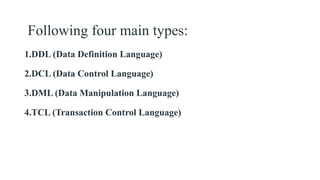
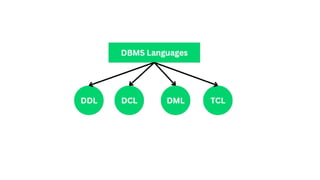
Following four maintypes:
1.DDL (Data Definition Language)
2.DCL (Data Control Language)
3.DML (Data Manipulation Language)
4.TCL (Transaction Control Language)
8.
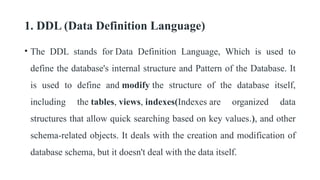
1. DDL (DataDefinition Language)
• The DDL stands for Data Definition Language, Which is used to
define the database's internal structure and Pattern of the Database. It
is used to define and modify the structure of the database itself,
including the tables, views, indexes(Indexes are organized data
structures that allow quick searching based on key values.), and other
schema-related objects. It deals with the creation and modification of
database schema, but it doesn't deal with the data itself.
9.
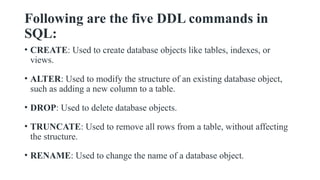
Following are thefive DDL commands in
SQL:
• CREATE: Used to create database objects like tables, indexes, or
views.
• ALTER: Used to modify the structure of an existing database object,
such as adding a new column to a table.
• DROP: Used to delete database objects.
• TRUNCATE: Used to remove all rows from a table, without affecting
the structure.
• RENAME: Used to change the name of a database object.
10.
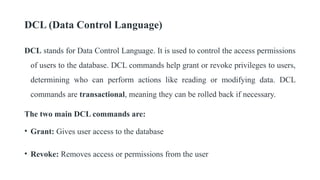
DCL (Data ControlLanguage)
DCL stands for Data Control Language. It is used to control the access permissions
of users to the database. DCL commands help grant or revoke privileges to users,
determining who can perform actions like reading or modifying data. DCL
commands are transactional, meaning they can be rolled back if necessary.
The two main DCL commands are:
• Grant: Gives user access to the database
• Revoke: Removes access or permissions from the user
11.
DML (Data ManipulationLanguage)
• The DML (Data Manipulation Language) is used to manage and
manipulate data within a database. With DML, you can perform
various operations such as inserting, updating, selecting, and deleting
data. These operations allow you to work with the actual content in
your database tables.
12.
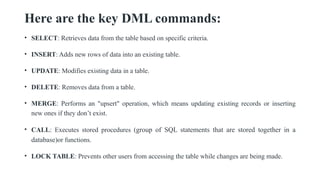
Here are thekey DML commands:
• SELECT: Retrieves data from the table based on specific criteria.
• INSERT: Adds new rows of data into an existing table.
• UPDATE: Modifies existing data in a table.
• DELETE: Removes data from a table.
• MERGE: Performs an "upsert" operation, which means updating existing records or inserting
new ones if they don’t exist.
• CALL: Executes stored procedures (group of SQL statements that are stored together in a
database)or functions.
• LOCK TABLE: Prevents other users from accessing the table while changes are being made.
13.
TCL ( TransactionControl Language )
The TCL full form is Transaction Control Language commands are used to manage and
control transactions in a database, grouping them into logical units. These commands help
ensure the integrity of data and consistency during complex operations. Here are the two
main commands in this category:
• Commit: Saves all the changes made during the current transaction to the database. These
are very useful in the banking sector.
• Rollback: used to restore the database to its original state from the last commit. This
command also plays an important role in Banking Sectors.
• Single-user systemsallow only one user access at a time,
• while multi-user systems allow concurrent access from multiple users.
• Teleprocessing, file-server, and client-server architectures are different ways
to organize these systems, with client-server being a common approach for
multi-user systems
16.
Single-User Systems:
• Definition:Allow only one user to access the system's resources at a
time.
• Typical Use: Personal computer applications, limited to a single user.
• Advantages: Simpler to implement and manage, lower overhead, and
no need for network infrastructure.
• Disadvantages: Limited scalability and resource sharing.
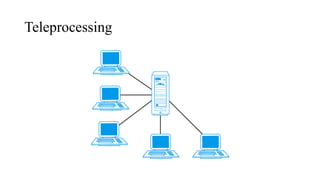
Teleprocessing:
• A traditionalmainframe-based architecture where multiple users
access a central mainframe via terminals. This can be considered a
form of multi-user access, but it is generally less scalable than other
architectures.
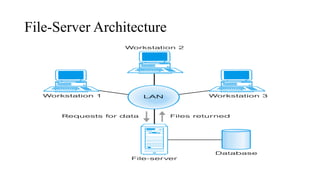
File-Server:
• A simplearchitecture where a central server hosts all files and resources. Clients
request access to these resources from the server. This architecture is not ideal for
complex multi-user systems due to its performance limitations.
• Disadvantages include:
• Significant network traffic
• Copy of DBMS on each workstation
• Concurrency, recovery and integrity control more complex because multiple
DBMSs accessing same files
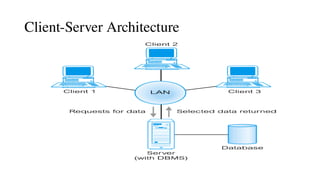
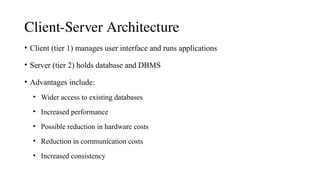
Client-Server Architecture
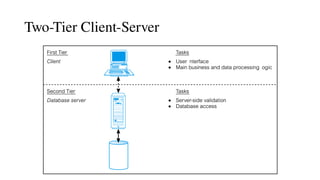
• Client(tier 1) manages user interface and runs applications
• Server (tier 2) holds database and DBMS
• Advantages include:
• Wider access to existing databases
• Increased performance
• Possible reduction in hardware costs
• Reduction in communication costs
• Increased consistency
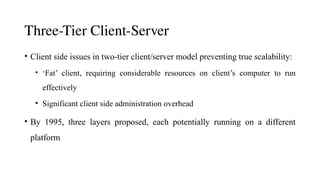
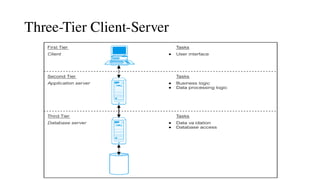
Three-Tier Client-Server
• Clientside issues in two-tier client/server model preventing true scalability:
• ‘Fat’ client, requiring considerable resources on client’s computer to run
effectively
• Significant client side administration overhead
• By 1995, three layers proposed, each potentially running on a different
platform
Three-Tier Client-Server:
• Amore advanced client-server architecture that separates the
application into three tiers: presentation (user interface), application
logic, and data storage. This modular approach improves performance,
scalability, and maintainability.


![[DSC Europe 25] Borko Kozomora - Optimizing business workflows with advances ...](https://cdn.slidesharecdn.com/ss_thumbnails/hbgekyb0txw0xpo4yfml-borko-kozomora-leading-ai-transformation-260122103838-cc29ee38-thumbnail.jpg?width=640&height=640&fit=bounds)


![[DSC Europe 25] Paula Garcia Esteban -Building the Future: The Role of Data S...](https://cdn.slidesharecdn.com/ss_thumbnails/9ld1r1bsqpwve8qfvphy-paula-garcia-esteban-building-the-future-260122103838-4171f5cb-thumbnail.jpg?width=640&height=640&fit=bounds)


![[DSC Europe 25] Josip Saban - Career building for data professionals.pptx](https://cdn.slidesharecdn.com/ss_thumbnails/zroflcttkm1vmli0txea-josip-saban-career-building-for-data-professionals-260123083019-587cdb8c-thumbnail.jpg?width=640&height=640&fit=bounds)
