Mrs.R.Shanthi Prabha M.Sc., M.Phil.,
Assistant Professor,
DEPARTMENT OF CS
Contents
 Database concepts
 Security requirements
 SQL security model
 Data sensitivity
 Security vs. Precision
 Inference & aggregation problem
 Multilevel databases
 Future direction
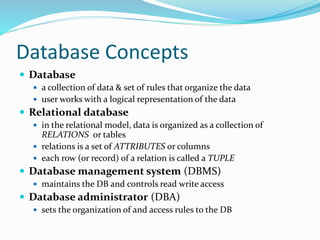
Database Concepts
 Database
 a collection of data & set of rules that organize the data
 user works with a logical representation of the data
 Relational database
 in the relational model, data is organized as a collection of
RELATIONS or tables
 relations is a set of ATTRIBUTES or columns
 each row (or record) of a relation is called a TUPLE
 Database management system (DBMS)
 maintains the DB and controls read write access
 Database administrator (DBA)
 sets the organization of and access rules to the DB
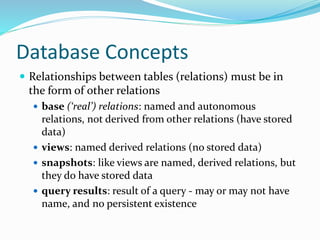
Database Concepts
 Relationships between tables (relations) must be in
the form of other relations
 base (‘real’) relations: named and autonomous
relations, not derived from other relations (have stored
data)
 views: named derived relations (no stored data)
 snapshots: like views are named, derived relations, but
they do have stored data
 query results: result of a query - may or may not have
name, and no persistent existence
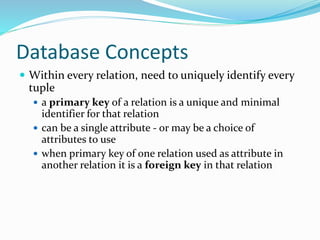
Database Concepts
 Within every relation, need to uniquely identify every
tuple
 a primary key of a relation is a unique and minimal
identifier for that relation
 can be a single attribute - or may be a choice of
attributes to use
 when primary key of one relation used as attribute in
another relation it is a foreign key in that relation
Database Concepts
 Structured Query Language (SQL)
 to manipulate relations and data in a relational database
 Types of SQL Commands
 Data Dictionary Language (DDL)
 define, maintain, drop schema objects
 Data Manipulation Language (DML)
 SELECT, INSERT, UPDATE
 Data Control Language (DCL):
 control security (GRANT,REVOKE) and concurrent access
(COMMIT , ROLLBACK)
Security Requirements
 Physical database integrity
 Logical database integrity
 Element integrity
 Auditability
 Access control
 User authentication
 Availability
Security Requirements
 Physical database integrity
 immunity to physical catastrophe, such as power
failures, media failure
 physical securing hardware, UPS
 regular backups
 Logical database integrity
 reconstruction Ability
 maintain a log of transactions
 replay log to restore the systems to a stable point
Security Requirements
 Element integrity
 integrity of specific database elements is their correctness or
accuracy
 field checks
– allow only acceptable values
 access controls
– allow only authorized users to update elements
 change log
– used to undo changes made in error
 referential Integrity (key integrity concerns)
 two phase locking process
 Auditability
 log read/write to database
Security Requirements
 Access Control (similar to OS)
 logical separation by user access privileges
 more complicated than OS due to complexity of DB
(granularity/inference/aggregation)
 User Authentication
 may be separate from OS
 can be rigorous
 Availability
 concurrent users
 granularity of locking
 reliability
SQL Security Model
 SQL security model implements DAC based on
 users: users of database - user identity checked during login
process;
 actions: including SELECT, UPDATE, DELETE and INSERT;
 objects: tables (base relations), views, and columns (attributes) of
tables and views
 Users can protect objects they own
 when object created, a user is designated as ‘owner’ of object
 owner may grant access to others
 users other than owner have to be granted privileges to access object
SQL Security Model
 Components of privilege are
 grantor, grantee, object, action, grantable
 privileges managed using GRANT and REVOKE operations
 the right to grant privileges can be granted
 Issues with privilege management
 each grant of privileges is to an individual or to “Public”
 makes security administration in large organizations difficult
 individual with multiple roles may have too many privileges for one
of the roles
 SQL3 is moving more to role based privileges
SQL Security Model
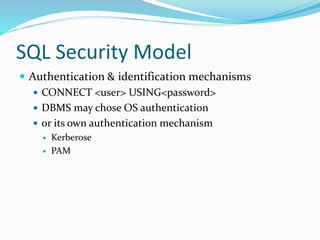
 Authentication & identification mechanisms
 CONNECT <user> USING<password>
 DBMS may chose OS authentication
 or its own authentication mechanism
 Kerberose
 PAM
SQL Security Model
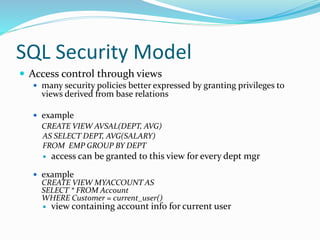
 Access control through views
 many security policies better expressed by granting privileges to
views derived from base relations
 example
CREATE VIEW AVSAL(DEPT, AVG)
AS SELECT DEPT, AVG(SALARY)
FROM EMP GROUP BY DEPT
 access can be granted to this view for every dept mgr
 example
CREATE VIEW MYACCOUNT AS
SELECT * FROM Account
WHERE Customer = current_user()
 view containing account info for current user
SQL Security Model
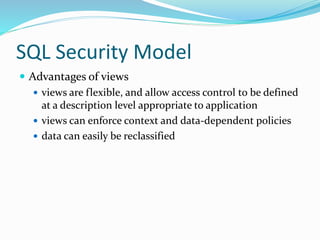
 Advantages of views
 views are flexible, and allow access control to be defined
at a description level appropriate to application
 views can enforce context and data-dependent policies
 data can easily be reclassified
SQL Security Model
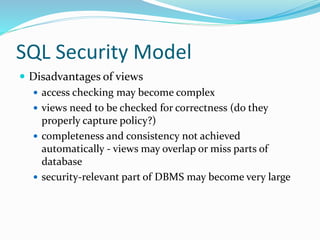
 Disadvantages of views
 access checking may become complex
 views need to be checked for correctness (do they
properly capture policy?)
 completeness and consistency not achieved
automatically - views may overlap or miss parts of
database
 security-relevant part of DBMS may become very large
SQL Security Model
 Inherent weakness of DAC
 DAC allows subject to be written to any other object
which can be written by that subject
 trojan horses to copy information from one object to
another
SQL Security Model
 Mandatory access controls (MAC)
 no read up, no write down
 traditional MAC implementations in RDBMS have
focused solely on MLS
 there have been three commercial MLS RDBMS
offerings
 trusted Oracle ,Informix OnLine/Secure, Sybase Secure SQL
Server

Database concepts

  • 1.
    Mrs.R.Shanthi Prabha M.Sc.,M.Phil., Assistant Professor, DEPARTMENT OF CS
  • 2.
    Contents  Database concepts Security requirements  SQL security model  Data sensitivity  Security vs. Precision  Inference & aggregation problem  Multilevel databases  Future direction
  • 3.
    Database Concepts  Database a collection of data & set of rules that organize the data  user works with a logical representation of the data  Relational database  in the relational model, data is organized as a collection of RELATIONS or tables  relations is a set of ATTRIBUTES or columns  each row (or record) of a relation is called a TUPLE  Database management system (DBMS)  maintains the DB and controls read write access  Database administrator (DBA)  sets the organization of and access rules to the DB
  • 4.
    Database Concepts  Relationshipsbetween tables (relations) must be in the form of other relations  base (‘real’) relations: named and autonomous relations, not derived from other relations (have stored data)  views: named derived relations (no stored data)  snapshots: like views are named, derived relations, but they do have stored data  query results: result of a query - may or may not have name, and no persistent existence
  • 5.
    Database Concepts  Withinevery relation, need to uniquely identify every tuple  a primary key of a relation is a unique and minimal identifier for that relation  can be a single attribute - or may be a choice of attributes to use  when primary key of one relation used as attribute in another relation it is a foreign key in that relation
  • 6.
    Database Concepts  StructuredQuery Language (SQL)  to manipulate relations and data in a relational database  Types of SQL Commands  Data Dictionary Language (DDL)  define, maintain, drop schema objects  Data Manipulation Language (DML)  SELECT, INSERT, UPDATE  Data Control Language (DCL):  control security (GRANT,REVOKE) and concurrent access (COMMIT , ROLLBACK)
  • 7.
    Security Requirements  Physicaldatabase integrity  Logical database integrity  Element integrity  Auditability  Access control  User authentication  Availability
  • 8.
    Security Requirements  Physicaldatabase integrity  immunity to physical catastrophe, such as power failures, media failure  physical securing hardware, UPS  regular backups  Logical database integrity  reconstruction Ability  maintain a log of transactions  replay log to restore the systems to a stable point
  • 9.
    Security Requirements  Elementintegrity  integrity of specific database elements is their correctness or accuracy  field checks – allow only acceptable values  access controls – allow only authorized users to update elements  change log – used to undo changes made in error  referential Integrity (key integrity concerns)  two phase locking process  Auditability  log read/write to database
  • 10.
    Security Requirements  AccessControl (similar to OS)  logical separation by user access privileges  more complicated than OS due to complexity of DB (granularity/inference/aggregation)  User Authentication  may be separate from OS  can be rigorous  Availability  concurrent users  granularity of locking  reliability
  • 11.
    SQL Security Model SQL security model implements DAC based on  users: users of database - user identity checked during login process;  actions: including SELECT, UPDATE, DELETE and INSERT;  objects: tables (base relations), views, and columns (attributes) of tables and views  Users can protect objects they own  when object created, a user is designated as ‘owner’ of object  owner may grant access to others  users other than owner have to be granted privileges to access object
  • 12.
    SQL Security Model Components of privilege are  grantor, grantee, object, action, grantable  privileges managed using GRANT and REVOKE operations  the right to grant privileges can be granted  Issues with privilege management  each grant of privileges is to an individual or to “Public”  makes security administration in large organizations difficult  individual with multiple roles may have too many privileges for one of the roles  SQL3 is moving more to role based privileges
  • 13.
    SQL Security Model Authentication & identification mechanisms  CONNECT <user> USING<password>  DBMS may chose OS authentication  or its own authentication mechanism  Kerberose  PAM
  • 14.
    SQL Security Model Access control through views  many security policies better expressed by granting privileges to views derived from base relations  example CREATE VIEW AVSAL(DEPT, AVG) AS SELECT DEPT, AVG(SALARY) FROM EMP GROUP BY DEPT  access can be granted to this view for every dept mgr  example CREATE VIEW MYACCOUNT AS SELECT * FROM Account WHERE Customer = current_user()  view containing account info for current user
  • 15.
    SQL Security Model Advantages of views  views are flexible, and allow access control to be defined at a description level appropriate to application  views can enforce context and data-dependent policies  data can easily be reclassified
  • 16.
    SQL Security Model Disadvantages of views  access checking may become complex  views need to be checked for correctness (do they properly capture policy?)  completeness and consistency not achieved automatically - views may overlap or miss parts of database  security-relevant part of DBMS may become very large
  • 17.
    SQL Security Model Inherent weakness of DAC  DAC allows subject to be written to any other object which can be written by that subject  trojan horses to copy information from one object to another
  • 18.
    SQL Security Model Mandatory access controls (MAC)  no read up, no write down  traditional MAC implementations in RDBMS have focused solely on MLS  there have been three commercial MLS RDBMS offerings  trusted Oracle ,Informix OnLine/Secure, Sybase Secure SQL Server