R.SHANTHI PRABHA M.SC., M.PHIL.,
ASSISTANT PROFESSOR
DEPARTMENT OF COMPUTER SCIENCE
SACWC, CUMBUM
 seen evolution of information systems
 now everyone want to be on the Internet
 and to interconnect networks
 has persistent security concerns
• can’t easily secure every system in org
 typically use a Firewall
 to provide perimeter defence
 as part of comprehensive security strategy
a choke point of control and monitoring
interconnects networks with differing trust
imposes restrictions on network services
• only authorized traffic is allowed
auditing and controlling access
• can implement alarms for abnormal behavior
provide NAT & usage monitoring
implement VPNs using IPSec
must be immune to penetration
cannot protect from attacks bypassing it
• eg sneaker net, utility modems, trusted
organisations, trusted services (eg SSL/SSH)
cannot protect against internal threats
• eg disgruntled or colluding employees
cannot protect against transfer of all virus
infected programs or files
• because of huge range of O/S & file types
simplest, fastest firewall component
foundation of any firewall system
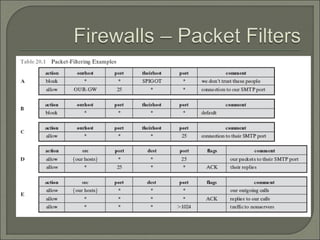
examine each IP packet (no context) and
permit or deny according to rules
hence restrict access to services (ports)
possible default policies
• that not expressly permitted is prohibited
• that not expressly prohibited is permitted
IP address spoofing
• fake source address to be trusted
• add filters on router to block
source routing attacks
• attacker sets a route other than default
• block source routed packets
tiny fragment attacks
• split header info over several tiny packets
• either discard or reassemble before check
traditional packet filters do not examine
higher layer context
• ie matching return packets with outgoing flow
stateful packet filters address this need
they examine each IP packet in context
• keep track of client-server sessions
• check each packet validly belongs to one
hence are better able to detect bogus
packets out of context
have application specific gateway / proxy
has full access to protocol
• user requests service from proxy
• proxy validates request as legal
• then actions request and returns result to user
• can log / audit traffic at application level
need separate proxies for each service
• some services naturally support proxying
• others are more problematic
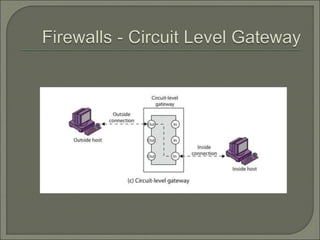
relays two TCP connections
imposes security by limiting which such
connections are allowed
once created usually relays traffic without
examining contents
typically used when trust internal users by
allowing general outbound connections
SOCKS is commonly used
 highly secure host system
 runs circuit / application level gateways
 or provides externally accessible services
 potentially exposed to "hostile" elements
 hence is secured to withstand this
• hardened O/S, essential services, extra auth
• proxies small, secure, independent, non-privileged
 may support 2 or more net connections
 may be trusted to enforce policy of trusted
separation between these net connections
given system has identified a user
determine what resources they can access
general model is that of access matrix with
• subject - active entity (user, process)
• object - passive entity (file or resource)
• access right – way object can be accessed
can decompose by
• columns as access control lists
• rows as capability tickets
 information security is increasingly important
 have varying degrees of sensitivity of information
• cf military info classifications: confidential, secret etc
 subjects (people or programs) have varying
rights of access to objects (information)
 known as multilevel security
• subjects have maximum & current security level
• objects have a fixed security level classification
 want to consider ways of increasing confidence
in systems to enforce these rights
 one of the most famous security models
 implemented as mandatory policies on system
 has two key policies:
 no read up (simple security property)
• a subject can only read/write an object if the current
security level of the subject dominates (>=) the
classification of the object
 no write down (*-property)
• a subject can only append/write to an object if the
current security level of the subject is dominated by
(<=) the classification of the object
governments can evaluate IT systems
against a range of standards:
• TCSEC, IPSEC and now Common Criteria
define a number of “levels” of evaluation
with increasingly stringent checking
have published lists of evaluated products
• though aimed at government/defense use
• can be useful in industry also
 international initiative specifying security
requirements & defining evaluation criteria
 incorporates earlier standards
• eg CSEC, ITSEC, CTCPEC (Canadian), Federal (US)
 specifies standards for
• evaluation criteria
• methodology for application of criteria
• administrative procedures for evaluation, certification
and accreditation schemes
defines set of security requirements
 have a Target Of Evaluation (TOE)
requirements fall in two categories
• functional
• assurance
both organised in classes of families &
components
Functional Requirements
• security audit, crypto support, communications,
user data protection, identification & authentication,
security management, privacy, protection of trusted
security functions, resource utilization, TOE
access, trusted path
Assurance Requirements
• configuration management, delivery & operation,
development, guidance documents, life cycle
support, tests, vulnerability assessment, assurance
maintenance
have considered:
• firewalls
• types of firewalls
• configurations
• access control
• trusted systems
• common criteria
C&NS_FIREWALLS.ppt

C&NS_FIREWALLS.ppt

  • 1.
    R.SHANTHI PRABHA M.SC.,M.PHIL., ASSISTANT PROFESSOR DEPARTMENT OF COMPUTER SCIENCE SACWC, CUMBUM
  • 2.
     seen evolutionof information systems  now everyone want to be on the Internet  and to interconnect networks  has persistent security concerns • can’t easily secure every system in org  typically use a Firewall  to provide perimeter defence  as part of comprehensive security strategy
  • 3.
    a choke pointof control and monitoring interconnects networks with differing trust imposes restrictions on network services • only authorized traffic is allowed auditing and controlling access • can implement alarms for abnormal behavior provide NAT & usage monitoring implement VPNs using IPSec must be immune to penetration
  • 4.
    cannot protect fromattacks bypassing it • eg sneaker net, utility modems, trusted organisations, trusted services (eg SSL/SSH) cannot protect against internal threats • eg disgruntled or colluding employees cannot protect against transfer of all virus infected programs or files • because of huge range of O/S & file types
  • 5.
    simplest, fastest firewallcomponent foundation of any firewall system examine each IP packet (no context) and permit or deny according to rules hence restrict access to services (ports) possible default policies • that not expressly permitted is prohibited • that not expressly prohibited is permitted
  • 8.
    IP address spoofing •fake source address to be trusted • add filters on router to block source routing attacks • attacker sets a route other than default • block source routed packets tiny fragment attacks • split header info over several tiny packets • either discard or reassemble before check
  • 9.
    traditional packet filtersdo not examine higher layer context • ie matching return packets with outgoing flow stateful packet filters address this need they examine each IP packet in context • keep track of client-server sessions • check each packet validly belongs to one hence are better able to detect bogus packets out of context
  • 10.
    have application specificgateway / proxy has full access to protocol • user requests service from proxy • proxy validates request as legal • then actions request and returns result to user • can log / audit traffic at application level need separate proxies for each service • some services naturally support proxying • others are more problematic
  • 12.
    relays two TCPconnections imposes security by limiting which such connections are allowed once created usually relays traffic without examining contents typically used when trust internal users by allowing general outbound connections SOCKS is commonly used
  • 14.
     highly securehost system  runs circuit / application level gateways  or provides externally accessible services  potentially exposed to "hostile" elements  hence is secured to withstand this • hardened O/S, essential services, extra auth • proxies small, secure, independent, non-privileged  may support 2 or more net connections  may be trusted to enforce policy of trusted separation between these net connections
  • 18.
    given system hasidentified a user determine what resources they can access general model is that of access matrix with • subject - active entity (user, process) • object - passive entity (file or resource) • access right – way object can be accessed can decompose by • columns as access control lists • rows as capability tickets
  • 20.
     information securityis increasingly important  have varying degrees of sensitivity of information • cf military info classifications: confidential, secret etc  subjects (people or programs) have varying rights of access to objects (information)  known as multilevel security • subjects have maximum & current security level • objects have a fixed security level classification  want to consider ways of increasing confidence in systems to enforce these rights
  • 21.
     one ofthe most famous security models  implemented as mandatory policies on system  has two key policies:  no read up (simple security property) • a subject can only read/write an object if the current security level of the subject dominates (>=) the classification of the object  no write down (*-property) • a subject can only append/write to an object if the current security level of the subject is dominated by (<=) the classification of the object
  • 23.
    governments can evaluateIT systems against a range of standards: • TCSEC, IPSEC and now Common Criteria define a number of “levels” of evaluation with increasingly stringent checking have published lists of evaluated products • though aimed at government/defense use • can be useful in industry also
  • 24.
     international initiativespecifying security requirements & defining evaluation criteria  incorporates earlier standards • eg CSEC, ITSEC, CTCPEC (Canadian), Federal (US)  specifies standards for • evaluation criteria • methodology for application of criteria • administrative procedures for evaluation, certification and accreditation schemes
  • 25.
    defines set ofsecurity requirements  have a Target Of Evaluation (TOE) requirements fall in two categories • functional • assurance both organised in classes of families & components
  • 26.
    Functional Requirements • securityaudit, crypto support, communications, user data protection, identification & authentication, security management, privacy, protection of trusted security functions, resource utilization, TOE access, trusted path Assurance Requirements • configuration management, delivery & operation, development, guidance documents, life cycle support, tests, vulnerability assessment, assurance maintenance
  • 29.
    have considered: • firewalls •types of firewalls • configurations • access control • trusted systems • common criteria