Slide 1-1
Database Security
Outline
 Introduction to Database Security Issues
 Discretionary Access Control
 Mandatory Access Control
 Data Encryption
Introduction
 Threats to databases
◦ Loss of integrity
◦ Loss of confidentiality
◦ Loss of availability
◦ Repudation
Introduction
Slide 1-4
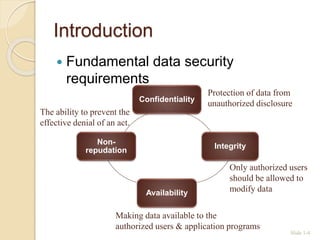
 Fundamental data security
requirements
Confidentiality
Integrity
Availability
Non-
repudation
Protection of data from
unauthorized disclosure
Only authorized users
should be allowed to
modify data.
Making data available to the
authorized users & application programs
The ability to prevent the
effective denial of an act.
Countermeasures
 To protect databases against these
types of threats four kinds of
countermeasures can be
implemented:
◦ Access control
◦ Inference control
◦ Flow control
◦ Encryption
 Access control
 The security mechanism of a DBMS for
restricting access to the database as a whole
◦ Handled by creating user accounts and
passwords to control login process by the DBMS.
 Two types of database security mechanisms:
◦ Discretionary security mechanisms (DAC)
◦ Mandatory security mechanisms (MAC)
 Inference control
 The security problem associated with databases is that
of controlling the access to a statistical database,
which is used to provide statistical information or
summaries of values based on various criteria.
 The countermeasures to statistical database security
problem is called inference control measures.
 Flow control
 Flow control prevents information from flowing in
such a way that it reaches unauthorized users.
 Channels that are pathways for information to
flow implicitly in ways that violate the security
policy of an organization are called covert
channels.
 Data encryption
 Data encryption is used to protect sensitive data
(such as credit card numbers) that is being
transmitted via some type communication
network.
 The data is encoded using some encoding
algorithm.
◦ An unauthorized user who access encoded data will
have difficulty deciphering it, but authorized users are
given decoding or decrypting algorithms (or keys) to
decipher data.
Database Security and the DBA
 The database administrator (DBA) is
the central authority for managing a
database system.
◦ The DBA’s responsibilities include
 granting privileges to users who need to use
the system
 classifying users and data in accordance with
the policy of the organization
 The DBA is responsible for the overall
security of the database system.
Slide 1-8
Database Security and the
DBA
 The DBA has a DBA account in the DBMS
◦ Sometimes these are called a system or
super user account
◦ These accounts provide powerful
capabilities such as:
 Account creation
 Privilege granting
 Privilege revocation
 Security level assignment
Discretionary Access Control
 The typical method of enforcing discretionary
access control in a database system is based
on the granting and revoking privileges.
 Types of Discretionary Privileges
 The account level:
◦ At this level, the DBA specifies the particular
privileges that each account holds
independently of the relations in the database.
 The relation level (or table level):
◦ At this level, the DBA can control the privilege
to access each individual relation or view in the
database.
Slide 1-10
 SQL standard supports DAC through the GRANT
and REVOKE commands:
◦ The GRANT command gives privileges to users
◦ The REVOKE command takes away privileges
Types of Discretionary
Privileges
Types of Discretionary
Privileges
 The privileges at the account level apply can
include
◦ the CREATE SCHEMA or CREATE TABLE
privilege, to create a schema or base relation;
◦ the CREATE VIEW privilege;
◦ the ALTER privilege, to apply schema changes
such adding or removing attributes from
relations;
◦ the DROP privilege, to delete relations or views;
◦ the MODIFY privilege, to insert, delete, or update
tuples;
◦ the SELECT privilege, to retrieve information
from the database by using a SELECT query.
Slid
e 1-
12
Types of Discretionary
Privileges
 The relation level of privileges applies to base
relations and virtual (view) relations.
 Notice that to create a view, the account must have
SELECT privilege on all relations involved in the
view definition.
Types of Discretionary
Privileges
 To control the granting and revoking of relation
privileges, for each relation R in a database:
◦ The owner of a relation is given all privileges on
that relation.
◦ The owner account holder can pass privileges on
any of the owned relation to other users by
granting privileges to their accounts.
◦ The owner account holder can also take back the
privileges by revoking privileges from their
accounts.
Types of Discretionary
Privileges
 In SQL the following types of privileges can be
granted on each individual relation R:
◦ SELECT (retrieval or read) privilege on R
◦ MODIFY privileges on R
 UPDATE, DELETE, and INSERT privileges
 INSERT and UPDATE privileges can specify that
only certain attributes can be updated by the
account.
◦ REFERENCES privilege on R
 This gives the account the capability to reference
relation R when specifying integrity constraints.
 The privilege can also be restricted to specific
attributes of R.
Specifying Privileges Using
Views
 The mechanism of views is an
important discretionary authorization
mechanism in its own right.
◦ Column level security
 Owner A (of R) can create a view V of R that includes
several attributes and then grant SELECT on V to B.
◦ Row level security
 Owner A (of R) can create a view V’ which selects
several tuples from R and then grant SELECT on V’ to
B.
Propagation of Privileges using the
GRANT OPTION
 Whenever the owner A of a relation R grants a
privilege on R to another account B, privilege can be
given to B with or without the GRANT OPTION.
 B can also grant that privilege on R to other
accounts.
 If B grants the privilege on R to C with GRANT
OPTION
 Privileges on R can propagate to other accounts
without the knowledge of the owner of R
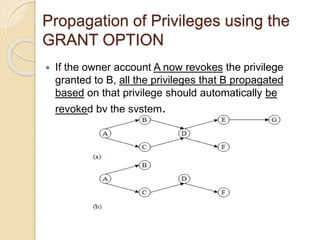
Propagation of Privileges using the
GRANT OPTION
 If the owner account A now revokes the privilege
granted to B, all the privileges that B propagated
based on that privilege should automatically be
revoked by the system.
An Example
 Suppose that the DBA creates four accounts
◦ A1, A2, A3, A4
 A1: Create table privilege
GRANT CREATE TABLE TO A1;
 Suppose that A1 creates the two base relations
EMPLOYEE and DEPARTMENT
 A1 is then owner of these two relations and
hence all the relation privileges on each of
them.
An Example
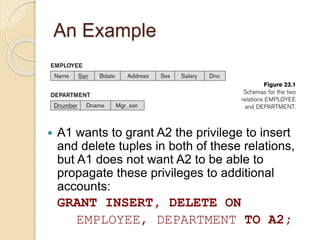
 A1 wants to grant A2 the privilege to insert
and delete tuples in both of these relations,
but A1 does not want A2 to be able to
propagate these privileges to additional
accounts:
GRANT INSERT, DELETE ON
EMPLOYEE, DEPARTMENT TO A2;
An Example
 A1 wants to allow A3 to retrieve information from either
of the two tables and also to be able to propagate the
SELECT privilege to other accounts.
GRANT SELECT ON EMPLOYEE, DEPARTMENT TO
A3
WITH GRANT OPTION;
 A3 can grant SELECT privilege to A4 to retrieve
information from the Employee relation
GRANT SELECT ON EMPLOYEE TO A4;
Notice that A4 can’t propagate the SELECT privilege
because GRANT OPTION was not given to A4
An Example
 A1 decides to revoke the SELECT privilege on
the EMPLOYEE relation from A3
REVOKE SELECT ON EMPLOYEE FROM A3;
 The DBMS must now automatically revoke the
SELECT privilege on EMPLOYEE from A4, too,
because A3 granted that privilege to A4 and A3
does not have the privilege any more.
An Example
 A1 wants to give back to A3 a limited capability to
SELECT from the EMPLOYEE relation and wants to
allow A3 to be able to propagate the privilege.
◦ The limitation is to retrieve only the NAME, BDATE,
and ADDRESS attributes and only for the tuples
with DNO=5.
 A1 then create the view:
CREATE VIEW A3EMPLOYEE AS
SELECT NAME, BDATE, ADDRESS
FROM EMPLOYEE
WHERE DNO = 5;
 And then,
GRANT SELECT ON A3EMPLOYEE TO A3
WITH GRANT OPTION;
An Example
 A1 wants to allow A4 to update only the SALARY
attribute of EMPLOYEE;
 A1 can issue:
GRANT UPDATE ON EMPLOYEE (SALARY) TO
A4;
Slid
e 1-
24
Mandatory Access Control
 Mandatory Access Control (MAC):
◦ MAC applies to large amounts of information
requiring strong protect in environments where
both the system data and users can be classified
clearly.
◦ MAC is a mechanism for enforcing multiple
level of security.
 The commonly used model for multilevel security,
known as the Bell-LaPadula model
Slid
e 1-
25
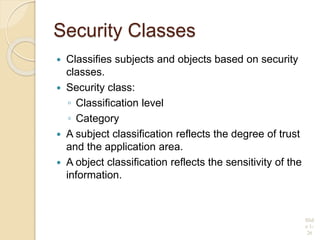
Security Classes
 Classifies subjects and objects based on security
classes.
 Security class:
◦ Classification level
◦ Category
 A subject classification reflects the degree of trust
and the application area.
 A object classification reflects the sensitivity of the
information.
Slid
e 1-
26
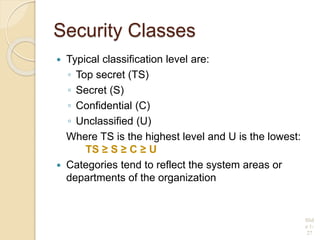
Security Classes
 Typical classification level are:
◦ Top secret (TS)
◦ Secret (S)
◦ Confidential (C)
◦ Unclassified (U)
Where TS is the highest level and U is the lowest:
TS ≥ S ≥ C ≥ U
 Categories tend to reflect the system areas or
departments of the organization
Slid
e 1-
27
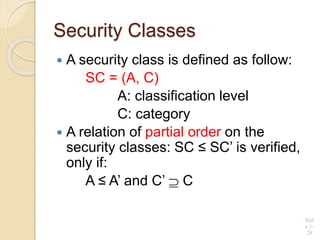
Security Classes
 A security class is defined as follow:
SC = (A, C)
A: classification level
C: category
 A relation of partial order on the
security classes: SC ≤ SC’ is verified,
only if:
A ≤ A’ and C’  C
Slid
e 1-
28
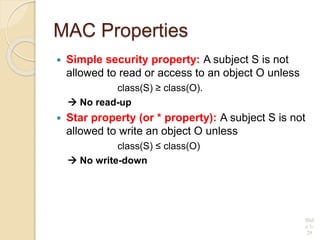
MAC Properties
 Simple security property: A subject S is not
allowed to read or access to an object O unless
class(S) ≥ class(O).
 No read-up
 Star property (or * property): A subject S is not
allowed to write an object O unless
class(S) ≤ class(O)
 No write-down
Slid
e 1-
29
Multilevel Relation
 Multilevel relation: MAC + relational database
model
 Data objects: attributes and tuples
 Each attribute A is associated with a
classification attribute C
 A tuple classification attribute TC is to
provide a classification for each tuple as a
whole, the highest of all attribute classification
values.
R(A1,C1,A2,C2, …, An,Cn,TC)
Slid
e 1-
30
Multilevel Relation
Slid
e 1-
31
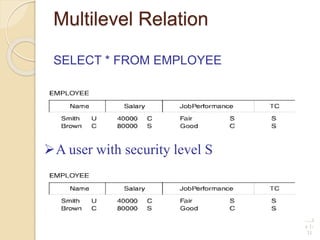
SELECT * FROM EMPLOYEE
A user with security level S
Slid
e 1-
32
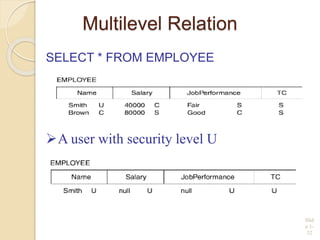
A user with security level U
SELECT * FROM EMPLOYEE
Multilevel Relation
Pros and Cons of MAC
 Pros:
◦ Provide a high degree of protection – in a way of
preventing any illegal flow of information.
◦ Suitable for military types of applications.
 Cons:
◦ Not easy to apply: require a strict classification of
subjects and objects into security levels.
◦ Applicable for very few environments.
Slid
e 1-
33
Data Encryption
 Encryption is a means of maintaining secure data
in an insecure environment.
 Encryption consists of applying an encryption
algorithm to data using some prespecified
encryption key.
 The resulting data has to be decrypted using a
decryption key to recover the original data.
Slid
e 1-
34
The Data and Advanced Encryption
Standards
 The Data Encryption Standard (DES) is a system
developed by the U.S. government for use by the
general public.
◦ It has been widely accepted as a cryptographic
standard both in the United States and abroad.
 DES can provide end-to-end encryption on the
channel between the sender A and receiver B.
Slid
e 1-
35
The Data and Advanced Encryption
Standards(2)
 DES algorithm is a careful and complex combination of
two of the fundamental building blocks of encryption:
◦ substitution and permutation (transposition).
 The DES algorithm derives its strength from repeated
application of these two techniques for a total of 16
cycles.
◦ Plaintext (the original form of the message) is
encrypted as blocks of 64 bits.
 After questioning the adequacy of DES, the National
Institute of Standards (NIST) introduced the Advanced
Encryption Standards (AES).
◦ This algorithm has a block size of 128 bits and thus
takes longer time to crack.
Slid
e 1-
36
Symmetric Key Algorithms
 A symmetric key is one key that is used for both
encryption and decryption.
 A message encrypted with a secret key can be
decrypted only with the same secret key.
 Algorithms used for symmetric key encryption are
called secret-key algorithms.
 The major liability associated with secret-key
algorithms is the need for sharing the secret key.
Slid
e 1-
37
Public Key Encryption
 In 1976 Diffie and Hellman proposed a new kind of
cryptosystem, which they called public key
encryption.
 Public key algorithms are based on
mathematical functions.
◦ They also involve the use of two separate keys
 in contrast to conventional encryption, which uses only
one key.
◦ The use of two keys can have profound
consequences in the areas of confidentiality, key
distribution, and authentication.
Slid
e 1-
38
Public Key Encryption(2)
 The two keys used for public key
encryption are referred to as the
public key and the private key.
◦ the private key is kept secret, but it is
referred to as private key rather than a
secret key.
Slid
e 1-
39
Public Key Encryption(3)
 A public key encryption scheme, or infrastructure,
has six ingredients:
◦ Plaintext: This is the data or readable message that
is fed into the algorithm as input.
◦ Encryption algorithm: The encryption algorithm
performs various transformations on the plaintext.
◦ Public and private keys: These are pair of keys that
have been selected so that if one is used for
encryption, the other is used for decryption.
 The exact transformations performed by the encryption
algorithm depend on the public or private key that is
provided as input.
Slid
e 1-
40
Public Key Encryption(4)
 A public key encryption scheme, or
infrastructure, has six ingredients
(contd.):
◦ Ciphertext:
 This is the scrambled message produced as
output. It depends on the plaintext and the
key.
 For a given message, two different keys will
produce two different ciphertexts.
◦ Decryption algorithm:
 This algorithm accepts the ciphertext and the
matching key and produces the original
Slid
e 1-
41
Public Key Encryption(5)
 Public key is made for public and private key is
known only by owner.
 A general-purpose public key cryptographic
algorithm relies on
◦ one key for encryption and
◦ a different but related key for decryption.
Slid
e 1-
42
Public Key Encryption(6)
 The essential steps are as follows:
◦ Each user generates a pair of keys to be used for
the encryption and decryption of messages.
◦ Each user places one of the two keys in a public
register or other accessible file. This is the public
key. The companion key is kept private (private key).
◦ If a sender wishes to send a private message to a
receiver, the sender encrypts the message using the
receiver’s public key.
◦ When the receiver receives the message, he or she
decrypts it using the receiver’s private key.
 No other recipient can decrypt the message because
only the receiver knows his or her private key.
Slid
e 1-
43

UNIT-1-Security.ppt

  • 1.
  • 2.
    Outline  Introduction toDatabase Security Issues  Discretionary Access Control  Mandatory Access Control  Data Encryption
  • 3.
    Introduction  Threats todatabases ◦ Loss of integrity ◦ Loss of confidentiality ◦ Loss of availability ◦ Repudation
  • 4.
    Introduction Slide 1-4  Fundamentaldata security requirements Confidentiality Integrity Availability Non- repudation Protection of data from unauthorized disclosure Only authorized users should be allowed to modify data. Making data available to the authorized users & application programs The ability to prevent the effective denial of an act.
  • 5.
    Countermeasures  To protectdatabases against these types of threats four kinds of countermeasures can be implemented: ◦ Access control ◦ Inference control ◦ Flow control ◦ Encryption
  • 6.
     Access control The security mechanism of a DBMS for restricting access to the database as a whole ◦ Handled by creating user accounts and passwords to control login process by the DBMS.  Two types of database security mechanisms: ◦ Discretionary security mechanisms (DAC) ◦ Mandatory security mechanisms (MAC)  Inference control  The security problem associated with databases is that of controlling the access to a statistical database, which is used to provide statistical information or summaries of values based on various criteria.  The countermeasures to statistical database security problem is called inference control measures.
  • 7.
     Flow control Flow control prevents information from flowing in such a way that it reaches unauthorized users.  Channels that are pathways for information to flow implicitly in ways that violate the security policy of an organization are called covert channels.  Data encryption  Data encryption is used to protect sensitive data (such as credit card numbers) that is being transmitted via some type communication network.  The data is encoded using some encoding algorithm. ◦ An unauthorized user who access encoded data will have difficulty deciphering it, but authorized users are given decoding or decrypting algorithms (or keys) to decipher data.
  • 8.
    Database Security andthe DBA  The database administrator (DBA) is the central authority for managing a database system. ◦ The DBA’s responsibilities include  granting privileges to users who need to use the system  classifying users and data in accordance with the policy of the organization  The DBA is responsible for the overall security of the database system. Slide 1-8
  • 9.
    Database Security andthe DBA  The DBA has a DBA account in the DBMS ◦ Sometimes these are called a system or super user account ◦ These accounts provide powerful capabilities such as:  Account creation  Privilege granting  Privilege revocation  Security level assignment
  • 10.
    Discretionary Access Control The typical method of enforcing discretionary access control in a database system is based on the granting and revoking privileges.  Types of Discretionary Privileges  The account level: ◦ At this level, the DBA specifies the particular privileges that each account holds independently of the relations in the database.  The relation level (or table level): ◦ At this level, the DBA can control the privilege to access each individual relation or view in the database. Slide 1-10
  • 11.
     SQL standardsupports DAC through the GRANT and REVOKE commands: ◦ The GRANT command gives privileges to users ◦ The REVOKE command takes away privileges Types of Discretionary Privileges
  • 12.
    Types of Discretionary Privileges The privileges at the account level apply can include ◦ the CREATE SCHEMA or CREATE TABLE privilege, to create a schema or base relation; ◦ the CREATE VIEW privilege; ◦ the ALTER privilege, to apply schema changes such adding or removing attributes from relations; ◦ the DROP privilege, to delete relations or views; ◦ the MODIFY privilege, to insert, delete, or update tuples; ◦ the SELECT privilege, to retrieve information from the database by using a SELECT query. Slid e 1- 12
  • 13.
    Types of Discretionary Privileges The relation level of privileges applies to base relations and virtual (view) relations.  Notice that to create a view, the account must have SELECT privilege on all relations involved in the view definition.
  • 14.
    Types of Discretionary Privileges To control the granting and revoking of relation privileges, for each relation R in a database: ◦ The owner of a relation is given all privileges on that relation. ◦ The owner account holder can pass privileges on any of the owned relation to other users by granting privileges to their accounts. ◦ The owner account holder can also take back the privileges by revoking privileges from their accounts.
  • 15.
    Types of Discretionary Privileges In SQL the following types of privileges can be granted on each individual relation R: ◦ SELECT (retrieval or read) privilege on R ◦ MODIFY privileges on R  UPDATE, DELETE, and INSERT privileges  INSERT and UPDATE privileges can specify that only certain attributes can be updated by the account. ◦ REFERENCES privilege on R  This gives the account the capability to reference relation R when specifying integrity constraints.  The privilege can also be restricted to specific attributes of R.
  • 16.
    Specifying Privileges Using Views The mechanism of views is an important discretionary authorization mechanism in its own right. ◦ Column level security  Owner A (of R) can create a view V of R that includes several attributes and then grant SELECT on V to B. ◦ Row level security  Owner A (of R) can create a view V’ which selects several tuples from R and then grant SELECT on V’ to B.
  • 17.
    Propagation of Privilegesusing the GRANT OPTION  Whenever the owner A of a relation R grants a privilege on R to another account B, privilege can be given to B with or without the GRANT OPTION.  B can also grant that privilege on R to other accounts.  If B grants the privilege on R to C with GRANT OPTION  Privileges on R can propagate to other accounts without the knowledge of the owner of R
  • 18.
    Propagation of Privilegesusing the GRANT OPTION  If the owner account A now revokes the privilege granted to B, all the privileges that B propagated based on that privilege should automatically be revoked by the system.
  • 19.
    An Example  Supposethat the DBA creates four accounts ◦ A1, A2, A3, A4  A1: Create table privilege GRANT CREATE TABLE TO A1;  Suppose that A1 creates the two base relations EMPLOYEE and DEPARTMENT  A1 is then owner of these two relations and hence all the relation privileges on each of them.
  • 20.
    An Example  A1wants to grant A2 the privilege to insert and delete tuples in both of these relations, but A1 does not want A2 to be able to propagate these privileges to additional accounts: GRANT INSERT, DELETE ON EMPLOYEE, DEPARTMENT TO A2;
  • 21.
    An Example  A1wants to allow A3 to retrieve information from either of the two tables and also to be able to propagate the SELECT privilege to other accounts. GRANT SELECT ON EMPLOYEE, DEPARTMENT TO A3 WITH GRANT OPTION;  A3 can grant SELECT privilege to A4 to retrieve information from the Employee relation GRANT SELECT ON EMPLOYEE TO A4; Notice that A4 can’t propagate the SELECT privilege because GRANT OPTION was not given to A4
  • 22.
    An Example  A1decides to revoke the SELECT privilege on the EMPLOYEE relation from A3 REVOKE SELECT ON EMPLOYEE FROM A3;  The DBMS must now automatically revoke the SELECT privilege on EMPLOYEE from A4, too, because A3 granted that privilege to A4 and A3 does not have the privilege any more.
  • 23.
    An Example  A1wants to give back to A3 a limited capability to SELECT from the EMPLOYEE relation and wants to allow A3 to be able to propagate the privilege. ◦ The limitation is to retrieve only the NAME, BDATE, and ADDRESS attributes and only for the tuples with DNO=5.  A1 then create the view: CREATE VIEW A3EMPLOYEE AS SELECT NAME, BDATE, ADDRESS FROM EMPLOYEE WHERE DNO = 5;  And then, GRANT SELECT ON A3EMPLOYEE TO A3 WITH GRANT OPTION;
  • 24.
    An Example  A1wants to allow A4 to update only the SALARY attribute of EMPLOYEE;  A1 can issue: GRANT UPDATE ON EMPLOYEE (SALARY) TO A4; Slid e 1- 24
  • 25.
    Mandatory Access Control Mandatory Access Control (MAC): ◦ MAC applies to large amounts of information requiring strong protect in environments where both the system data and users can be classified clearly. ◦ MAC is a mechanism for enforcing multiple level of security.  The commonly used model for multilevel security, known as the Bell-LaPadula model Slid e 1- 25
  • 26.
    Security Classes  Classifiessubjects and objects based on security classes.  Security class: ◦ Classification level ◦ Category  A subject classification reflects the degree of trust and the application area.  A object classification reflects the sensitivity of the information. Slid e 1- 26
  • 27.
    Security Classes  Typicalclassification level are: ◦ Top secret (TS) ◦ Secret (S) ◦ Confidential (C) ◦ Unclassified (U) Where TS is the highest level and U is the lowest: TS ≥ S ≥ C ≥ U  Categories tend to reflect the system areas or departments of the organization Slid e 1- 27
  • 28.
    Security Classes  Asecurity class is defined as follow: SC = (A, C) A: classification level C: category  A relation of partial order on the security classes: SC ≤ SC’ is verified, only if: A ≤ A’ and C’  C Slid e 1- 28
  • 29.
    MAC Properties  Simplesecurity property: A subject S is not allowed to read or access to an object O unless class(S) ≥ class(O).  No read-up  Star property (or * property): A subject S is not allowed to write an object O unless class(S) ≤ class(O)  No write-down Slid e 1- 29
  • 30.
    Multilevel Relation  Multilevelrelation: MAC + relational database model  Data objects: attributes and tuples  Each attribute A is associated with a classification attribute C  A tuple classification attribute TC is to provide a classification for each tuple as a whole, the highest of all attribute classification values. R(A1,C1,A2,C2, …, An,Cn,TC) Slid e 1- 30
  • 31.
    Multilevel Relation Slid e 1- 31 SELECT* FROM EMPLOYEE A user with security level S
  • 32.
    Slid e 1- 32 A userwith security level U SELECT * FROM EMPLOYEE Multilevel Relation
  • 33.
    Pros and Consof MAC  Pros: ◦ Provide a high degree of protection – in a way of preventing any illegal flow of information. ◦ Suitable for military types of applications.  Cons: ◦ Not easy to apply: require a strict classification of subjects and objects into security levels. ◦ Applicable for very few environments. Slid e 1- 33
  • 34.
    Data Encryption  Encryptionis a means of maintaining secure data in an insecure environment.  Encryption consists of applying an encryption algorithm to data using some prespecified encryption key.  The resulting data has to be decrypted using a decryption key to recover the original data. Slid e 1- 34
  • 35.
    The Data andAdvanced Encryption Standards  The Data Encryption Standard (DES) is a system developed by the U.S. government for use by the general public. ◦ It has been widely accepted as a cryptographic standard both in the United States and abroad.  DES can provide end-to-end encryption on the channel between the sender A and receiver B. Slid e 1- 35
  • 36.
    The Data andAdvanced Encryption Standards(2)  DES algorithm is a careful and complex combination of two of the fundamental building blocks of encryption: ◦ substitution and permutation (transposition).  The DES algorithm derives its strength from repeated application of these two techniques for a total of 16 cycles. ◦ Plaintext (the original form of the message) is encrypted as blocks of 64 bits.  After questioning the adequacy of DES, the National Institute of Standards (NIST) introduced the Advanced Encryption Standards (AES). ◦ This algorithm has a block size of 128 bits and thus takes longer time to crack. Slid e 1- 36
  • 37.
    Symmetric Key Algorithms A symmetric key is one key that is used for both encryption and decryption.  A message encrypted with a secret key can be decrypted only with the same secret key.  Algorithms used for symmetric key encryption are called secret-key algorithms.  The major liability associated with secret-key algorithms is the need for sharing the secret key. Slid e 1- 37
  • 38.
    Public Key Encryption In 1976 Diffie and Hellman proposed a new kind of cryptosystem, which they called public key encryption.  Public key algorithms are based on mathematical functions. ◦ They also involve the use of two separate keys  in contrast to conventional encryption, which uses only one key. ◦ The use of two keys can have profound consequences in the areas of confidentiality, key distribution, and authentication. Slid e 1- 38
  • 39.
    Public Key Encryption(2) The two keys used for public key encryption are referred to as the public key and the private key. ◦ the private key is kept secret, but it is referred to as private key rather than a secret key. Slid e 1- 39
  • 40.
    Public Key Encryption(3) A public key encryption scheme, or infrastructure, has six ingredients: ◦ Plaintext: This is the data or readable message that is fed into the algorithm as input. ◦ Encryption algorithm: The encryption algorithm performs various transformations on the plaintext. ◦ Public and private keys: These are pair of keys that have been selected so that if one is used for encryption, the other is used for decryption.  The exact transformations performed by the encryption algorithm depend on the public or private key that is provided as input. Slid e 1- 40
  • 41.
    Public Key Encryption(4) A public key encryption scheme, or infrastructure, has six ingredients (contd.): ◦ Ciphertext:  This is the scrambled message produced as output. It depends on the plaintext and the key.  For a given message, two different keys will produce two different ciphertexts. ◦ Decryption algorithm:  This algorithm accepts the ciphertext and the matching key and produces the original Slid e 1- 41
  • 42.
    Public Key Encryption(5) Public key is made for public and private key is known only by owner.  A general-purpose public key cryptographic algorithm relies on ◦ one key for encryption and ◦ a different but related key for decryption. Slid e 1- 42
  • 43.
    Public Key Encryption(6) The essential steps are as follows: ◦ Each user generates a pair of keys to be used for the encryption and decryption of messages. ◦ Each user places one of the two keys in a public register or other accessible file. This is the public key. The companion key is kept private (private key). ◦ If a sender wishes to send a private message to a receiver, the sender encrypts the message using the receiver’s public key. ◦ When the receiver receives the message, he or she decrypts it using the receiver’s private key.  No other recipient can decrypt the message because only the receiver knows his or her private key. Slid e 1- 43
Editor's Notes

  • #17 A DBMS is a very complex software system that consists of many components, or modules, including modules for implementing the catalog, query language processing, interface processing, accessing and buffering data, controlling concurrency, and handling data recovery and security.