WORKSHOP ON DESIGN OF INFORMATION SYSTEMS FOR BUSINESS ORGANIZATIONS by A. K. RAMANI   DIRECTOR, IIPS, DAVV, INDORE [email_address] WELCOME
$ 10 Billion Industry Shift of focus in research from Computation towards Information Management Broadening application areas, like weather, genetic, entertainment, CAE, data warehousing, data mining, and decision making. Advances in areas, like visualization, robotics, optical storage, high speed communications  MOTIVATION
Motivation Limited understanding of DB principles and techniques for advanced information management. Next generation DBs will need MM support, complex objects, real-time,  rule processing… Co-operation in Scientific, engineering, commercial problems will need large scale heterogeneous distributed DBs Requirements: Efficiency, Resilience, Access control, Persistence
DBMSs to organize, create, and maintain collections of information. Challenge is to apply DB technology in new and important areas in scientific databases, design databases, business, and utility databases and many more. CHALLENGE OF DB TECH.
An Instant Virtual Enterprise (IVE) is a group of companies, that do not routinely function as a unit, come together to respond to a proposal of CIM. The task involves CAD, production, QA, Product planning, resource management etc. In such an environment it is necessary for IVE companies to exchange and cooperatively manage the large amount of data. SCENARIO
A personnel information system provides information tailored to an individual, and delivered via a GPS of laptop, and access internet from any where any time, from waking up to bed time. Weather report, day special events, appointments, diet, best route, news headlines, sporting events, best investments, list of tasks, start of sale, best air ticket, best return route, preview of next  day, by querying remote DBs.  SCENARIO
The aim of this workshop is to help you developing an understanding of database development techniques in information management applications, and become an expert database developer.   AIM
To familiarize with the concept of database development. To present the various steps in the approach to database development. To see an example of a DBMS oriented approach. OBJECTIVES
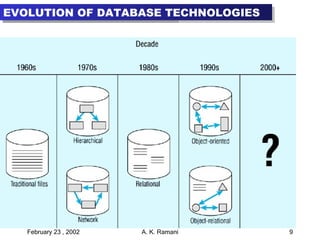
EVOLUTION OF DATABASE TECHNOLOGIES
Sequential Records Index for random Access Open, Close, Read, Write, Delete Redundancy, inconsistency, poor data sharing,low productivity etc. FILE SYSTEM
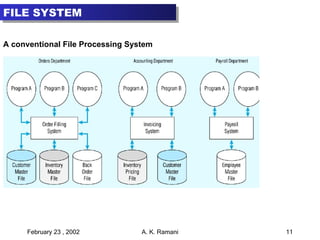
A conventional File Processing System FILE SYSTEM
_ In file processing,each dept has own IS For new system, new programs are needed  Disadvantages Program data dependence - All program to be changed for any change in file designs ( Record Formats) Duplication – Data inconsistency Poor Data Sharing – Incompatible files. Lengthy Development Times  Every new application start from scratch low productivity High maintenance cost  80% cost FILE SYSTEM
Hierarchical & Network Systems Complex record structures Difficult to change application programs DATABASE MODELS  Program Class STD DORM STAFF Course Faculty Employee
Relational DB Systems Data in Tables form Simple SQL Example DB2,ORACLE,INGRESS Difficult to handle Complex data & Relation ships RELATIONAL MODEL
Object Oriented Modeling DATABASE MODELS  Program Class STD DORM STAFF Course Faculty Employee
OBJECT MODEL Student Name,DOB,GPA take Course ------ ------ Faculty Name,Rank Salary Advice Research ------ Course Title,Credit Pre requisite Class Time Assign Lab is advised by Take Teach
Object oriented model For complex Relationships UML (Unified Modeling Language) Easy to maintain & Change Improved Productivity
Aim  Introduce different concepts of DBMS, in context of Information System development. Objectives Define database & related terms Understand DBMS components , role & DBMS architecture Limitations of Conventional File System Introduce DB approach , ER concept , Categories of DB applications & issue Advantage of DB approach Evolution of DBMS INTRODUCTION TO DBMS
Database is a data bank, where data can be stored manipulated and retrieved in a speedy manner, efficiently and error free. A  database  is a model of  structures  of reality The  use of a database  reflect  processes  of reality A  database system  is a  software system  which supports the  definition and use of a database DDL: Data Definition Language DML: Data Manipulation Language WHAT IS A DATABASE REALITY structures processes DATABASE SYSTEM DATABASE DML DDL
Database is a representation of a part of real world in terms of computable objects. E = {Object,Attributes,Data}, where  E is an Entity. D = {E 1 ,E 2 ,………E n }, where D is database How to implant changes in database  By using a set of software modules. DBMS = Database + S/W modules S/W DB Applications Tools Applications DB S/W Data Data Base Data base WHAT IS A DATABASE
Data is a known (valued) fact. is a value to an attribute can be recorded on computer media Example : This  house  has  four   rooms . Database =  Object  +  data  + attributes Data can comprise of facts,which may include numeric,text, images, sound & multimedia. Database is an organized collection of logically related data where data can be stored easily, manipulated,retrieved. Data becomes information when processed. Meta Data are data that describe the properties of data, include data definitions, data sizes, rules, constraints etc.
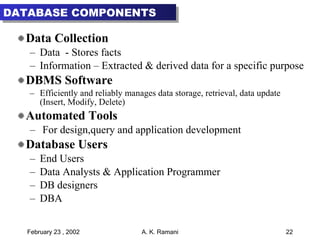
Data Collection Data  - Stores facts Information – Extracted & derived data for a specific purpose DBMS Software Efficiently and reliably manages data storage, retrieval, data update (Insert, Modify, Delete) Automated Tools For design,query and application development Database Users End Users Data Analysts & Application Programmer DB designers DBA DATABASE COMPONENTS
Field  It is a set of bytes to represent some values,lowest level of database ( or logical structure) Record Group of logically related fields,records accessed via S/W File A group of identical records,accessible via system software Database A set of related files , accessed via system software. DEFINITION
Insert Picture of slide 5
Use a DBMS when this is important persistent storage of data  centralized control of data control of redundancy control of consistency and integrity multiple user support sharing of data data documentation data independence control of access and security backup and recovery WHEN TO USE DBMS
Do not use a DBMS when the initial investment in hardware, software, and training is too high the generality a DBMS provides is not needed the overhead for security, concurrency control, and recovery is too high data and applications are simple and stable real-time requirements cannot be met by it multiple user access is not needed WHEN NOT TO USE DBMS
DBMS ARCHITECTURE Applications programs / Queries Software for queries / Programs Software to access data base Meta Data DB Transactions Database System Software Modules
The purpose of database design is to create a database which is a model of structures of reality supports queries and updates modeling processes of reality runs efficiently DB approach is total integration and sharing of data throughout the organization DATABASE DESIGN
Goal :  Business Strategies supported upon IT 3 Steps Identify strategic planning factors  Goals : Growth Rate…….. Success Factors : Quality,On-time….. Problem Areas : Competition…. Set priorities of needs of IS & DB 2. Identify Corporate Planning objects Organizational Units – Various depts Locations – business places Business Functions – business processes like product development  4. Entity Types : Categories of data about people,places &  things managed by company 5. Information System : Application S/W & supporting  procedures.  IS PLANNING
Develop list of Entities that support the business activities An entity is an object/concept that is important to business, e,g, CUSTOMER,PRODUCT,EMPLOYEE,ORDER etc Identification & definition of Entities. Develop Enterprise Data Model to show association among entities. Also called as E-R models. Customer Order Product Order Line Places is Placed by has is for Contains is contained in IS PLANNING
Entities Customer : People / Companies / potential customer Order : Purchase of 1 or more items Product : Items produced for selling Order Line : Details of each product (quantity price ) sold on a particular customer Apply Business Rules For Relation Ships Each Customer places >= 1 Order Each order is  placed by  one  Customer Each order contains >=1 L (ask slide 10) Each L is contained in One Customer Order (O) Each product has >=1 L Each order line is for one product IS PLANNING
ER Model Tells how organization functions and constraints Emphasizes on data & process by considering data, relationships & business rules. Relational Databases Data is viewed in form of tables Tables are based upon entities of ER model and contains attributes of an entity and its instances (value) Few attributes are common among tables e.g. ID nos., Employee number Historical and summarized information  (ask it)   data base is called Data Ware House  ( D-Mgt ask it)  to assist DSS. Data base application program can perform actions like Create, Read, Update, Delete etc.  IS PLANNING
Area of Application Perspective Work-Processes Guidelines for Work-Processes in the development of the application DATABASE DEVELOPMENT
Development of medium to large size data intensive applications Data intensive:  lots of data little processing insertions, deletions, updates, queries What is medium to large?  Small is: well-defined project short development time no long-term maintenance few people; little turnover no critical resources small risk of failure small cost of failure Why only medium to large? the methodology is an insurance policy cost of using methodology is high AREA OF APPLICATION
Business process is well-designed Documents are known Tasks are known System boundary is known One database schema unifying all views can be designed difficult: interests, goals, power, politics problems with the methodology? problems with the organization? or - gan - i - za - tion: “an entity created to pursue a shared set of goals” PERSPECTIVE
Business process (re-)design Analysis Specification Design Implementation Testing Operation Maintenance WORK PROCESSES Management
Purpose:  what we do? Input:  what we start with? Output:  what we end with? Tool:  what we use? Technique:  how we use it? Organization:  who does what? GUIDELINES FOR WORK-PROCESSESE
waterfall model; this is  not  prototyping iteration necessary work vs. time vs. people estimating resources is  very  difficult TIME AND MANAGEMENT work-process time analysis  specification  design  implementation  test
Type User Architecture   Size PC   1 Desktop  Megabytes WorkGroup  5-25 Client/Server (2 Tier)  M-G bytes Department  25-100 Client/Server (3 Tier)  G bytes Enterprise  > 100 Client/server (Distributed)  G-Terabytes CATEGORIES OF DB APPLICATION
Optimized Database Design Integrity of Database Performance Security Redundancy & Consistency Distributed Database Designs DATABASE ISSUE
Program-Data Independence Metadata & programmes are independent Minimal Redundancy Single logical structure Data Consistency Each value stored on one place Data Sharing To form report from more than 1 table Increased Productivity in Development Saves cost/time  Enforcement of Standards Feasible Improved Data Quality Enforce constraints Data Management approach Simplicity in Data Access Select * from product where Product_name  =“Computer” ; It is a SQL command Easy Maintenance Y2k Problem ADVANTAGES OF DB APPROACH
Expensive New H/W , Operating Cost Complex Development/Implement Recovery more difficult Vulnerability to failure Organizational Conflicts strong top management support must. DISADVANTAGES
Future Trends Object – Relational Databases Distributed Databases Distributed to multiple locations,transparent Content Addressable Interface other technologies like AI, TV, Natural Language Interface Summary Database & related terms DB approach,Advantages Categories,Evolution Future Trends FUTURE TREND AND SUMMARY

Database 1 Introduction

  • 1.
    WORKSHOP ON DESIGNOF INFORMATION SYSTEMS FOR BUSINESS ORGANIZATIONS by A. K. RAMANI DIRECTOR, IIPS, DAVV, INDORE [email_address] WELCOME
  • 2.
    $ 10 BillionIndustry Shift of focus in research from Computation towards Information Management Broadening application areas, like weather, genetic, entertainment, CAE, data warehousing, data mining, and decision making. Advances in areas, like visualization, robotics, optical storage, high speed communications MOTIVATION
  • 3.
    Motivation Limited understandingof DB principles and techniques for advanced information management. Next generation DBs will need MM support, complex objects, real-time, rule processing… Co-operation in Scientific, engineering, commercial problems will need large scale heterogeneous distributed DBs Requirements: Efficiency, Resilience, Access control, Persistence
  • 4.
    DBMSs to organize,create, and maintain collections of information. Challenge is to apply DB technology in new and important areas in scientific databases, design databases, business, and utility databases and many more. CHALLENGE OF DB TECH.
  • 5.
    An Instant VirtualEnterprise (IVE) is a group of companies, that do not routinely function as a unit, come together to respond to a proposal of CIM. The task involves CAD, production, QA, Product planning, resource management etc. In such an environment it is necessary for IVE companies to exchange and cooperatively manage the large amount of data. SCENARIO
  • 6.
    A personnel informationsystem provides information tailored to an individual, and delivered via a GPS of laptop, and access internet from any where any time, from waking up to bed time. Weather report, day special events, appointments, diet, best route, news headlines, sporting events, best investments, list of tasks, start of sale, best air ticket, best return route, preview of next day, by querying remote DBs. SCENARIO
  • 7.
    The aim ofthis workshop is to help you developing an understanding of database development techniques in information management applications, and become an expert database developer. AIM
  • 8.
    To familiarize withthe concept of database development. To present the various steps in the approach to database development. To see an example of a DBMS oriented approach. OBJECTIVES
  • 9.
  • 10.
    Sequential Records Indexfor random Access Open, Close, Read, Write, Delete Redundancy, inconsistency, poor data sharing,low productivity etc. FILE SYSTEM
  • 11.
    A conventional FileProcessing System FILE SYSTEM
  • 12.
    _ In fileprocessing,each dept has own IS For new system, new programs are needed Disadvantages Program data dependence - All program to be changed for any change in file designs ( Record Formats) Duplication – Data inconsistency Poor Data Sharing – Incompatible files. Lengthy Development Times Every new application start from scratch low productivity High maintenance cost 80% cost FILE SYSTEM
  • 13.
    Hierarchical & NetworkSystems Complex record structures Difficult to change application programs DATABASE MODELS Program Class STD DORM STAFF Course Faculty Employee
  • 14.
    Relational DB SystemsData in Tables form Simple SQL Example DB2,ORACLE,INGRESS Difficult to handle Complex data & Relation ships RELATIONAL MODEL
  • 15.
    Object Oriented ModelingDATABASE MODELS Program Class STD DORM STAFF Course Faculty Employee
  • 16.
    OBJECT MODEL StudentName,DOB,GPA take Course ------ ------ Faculty Name,Rank Salary Advice Research ------ Course Title,Credit Pre requisite Class Time Assign Lab is advised by Take Teach
  • 17.
    Object oriented modelFor complex Relationships UML (Unified Modeling Language) Easy to maintain & Change Improved Productivity
  • 18.
    Aim Introducedifferent concepts of DBMS, in context of Information System development. Objectives Define database & related terms Understand DBMS components , role & DBMS architecture Limitations of Conventional File System Introduce DB approach , ER concept , Categories of DB applications & issue Advantage of DB approach Evolution of DBMS INTRODUCTION TO DBMS
  • 19.
    Database is adata bank, where data can be stored manipulated and retrieved in a speedy manner, efficiently and error free. A database is a model of structures of reality The use of a database reflect processes of reality A database system is a software system which supports the definition and use of a database DDL: Data Definition Language DML: Data Manipulation Language WHAT IS A DATABASE REALITY structures processes DATABASE SYSTEM DATABASE DML DDL
  • 20.
    Database is arepresentation of a part of real world in terms of computable objects. E = {Object,Attributes,Data}, where E is an Entity. D = {E 1 ,E 2 ,………E n }, where D is database How to implant changes in database By using a set of software modules. DBMS = Database + S/W modules S/W DB Applications Tools Applications DB S/W Data Data Base Data base WHAT IS A DATABASE
  • 21.
    Data is aknown (valued) fact. is a value to an attribute can be recorded on computer media Example : This house has four rooms . Database = Object + data + attributes Data can comprise of facts,which may include numeric,text, images, sound & multimedia. Database is an organized collection of logically related data where data can be stored easily, manipulated,retrieved. Data becomes information when processed. Meta Data are data that describe the properties of data, include data definitions, data sizes, rules, constraints etc.
  • 22.
    Data Collection Data - Stores facts Information – Extracted & derived data for a specific purpose DBMS Software Efficiently and reliably manages data storage, retrieval, data update (Insert, Modify, Delete) Automated Tools For design,query and application development Database Users End Users Data Analysts & Application Programmer DB designers DBA DATABASE COMPONENTS
  • 23.
    Field Itis a set of bytes to represent some values,lowest level of database ( or logical structure) Record Group of logically related fields,records accessed via S/W File A group of identical records,accessible via system software Database A set of related files , accessed via system software. DEFINITION
  • 24.
  • 25.
    Use a DBMSwhen this is important persistent storage of data centralized control of data control of redundancy control of consistency and integrity multiple user support sharing of data data documentation data independence control of access and security backup and recovery WHEN TO USE DBMS
  • 26.
    Do not usea DBMS when the initial investment in hardware, software, and training is too high the generality a DBMS provides is not needed the overhead for security, concurrency control, and recovery is too high data and applications are simple and stable real-time requirements cannot be met by it multiple user access is not needed WHEN NOT TO USE DBMS
  • 27.
    DBMS ARCHITECTURE Applicationsprograms / Queries Software for queries / Programs Software to access data base Meta Data DB Transactions Database System Software Modules
  • 28.
    The purpose ofdatabase design is to create a database which is a model of structures of reality supports queries and updates modeling processes of reality runs efficiently DB approach is total integration and sharing of data throughout the organization DATABASE DESIGN
  • 29.
    Goal : Business Strategies supported upon IT 3 Steps Identify strategic planning factors Goals : Growth Rate…….. Success Factors : Quality,On-time….. Problem Areas : Competition…. Set priorities of needs of IS & DB 2. Identify Corporate Planning objects Organizational Units – Various depts Locations – business places Business Functions – business processes like product development 4. Entity Types : Categories of data about people,places & things managed by company 5. Information System : Application S/W & supporting procedures. IS PLANNING
  • 30.
    Develop list ofEntities that support the business activities An entity is an object/concept that is important to business, e,g, CUSTOMER,PRODUCT,EMPLOYEE,ORDER etc Identification & definition of Entities. Develop Enterprise Data Model to show association among entities. Also called as E-R models. Customer Order Product Order Line Places is Placed by has is for Contains is contained in IS PLANNING
  • 31.
    Entities Customer :People / Companies / potential customer Order : Purchase of 1 or more items Product : Items produced for selling Order Line : Details of each product (quantity price ) sold on a particular customer Apply Business Rules For Relation Ships Each Customer places >= 1 Order Each order is placed by one Customer Each order contains >=1 L (ask slide 10) Each L is contained in One Customer Order (O) Each product has >=1 L Each order line is for one product IS PLANNING
  • 32.
    ER Model Tellshow organization functions and constraints Emphasizes on data & process by considering data, relationships & business rules. Relational Databases Data is viewed in form of tables Tables are based upon entities of ER model and contains attributes of an entity and its instances (value) Few attributes are common among tables e.g. ID nos., Employee number Historical and summarized information (ask it) data base is called Data Ware House ( D-Mgt ask it) to assist DSS. Data base application program can perform actions like Create, Read, Update, Delete etc. IS PLANNING
  • 33.
    Area of ApplicationPerspective Work-Processes Guidelines for Work-Processes in the development of the application DATABASE DEVELOPMENT
  • 34.
    Development of mediumto large size data intensive applications Data intensive: lots of data little processing insertions, deletions, updates, queries What is medium to large? Small is: well-defined project short development time no long-term maintenance few people; little turnover no critical resources small risk of failure small cost of failure Why only medium to large? the methodology is an insurance policy cost of using methodology is high AREA OF APPLICATION
  • 35.
    Business process iswell-designed Documents are known Tasks are known System boundary is known One database schema unifying all views can be designed difficult: interests, goals, power, politics problems with the methodology? problems with the organization? or - gan - i - za - tion: “an entity created to pursue a shared set of goals” PERSPECTIVE
  • 36.
    Business process (re-)designAnalysis Specification Design Implementation Testing Operation Maintenance WORK PROCESSES Management
  • 37.
    Purpose: whatwe do? Input: what we start with? Output: what we end with? Tool: what we use? Technique: how we use it? Organization: who does what? GUIDELINES FOR WORK-PROCESSESE
  • 38.
    waterfall model; thisis not prototyping iteration necessary work vs. time vs. people estimating resources is very difficult TIME AND MANAGEMENT work-process time analysis specification design implementation test
  • 39.
    Type User Architecture Size PC 1 Desktop Megabytes WorkGroup 5-25 Client/Server (2 Tier) M-G bytes Department 25-100 Client/Server (3 Tier) G bytes Enterprise > 100 Client/server (Distributed) G-Terabytes CATEGORIES OF DB APPLICATION
  • 40.
    Optimized Database DesignIntegrity of Database Performance Security Redundancy & Consistency Distributed Database Designs DATABASE ISSUE
  • 41.
    Program-Data Independence Metadata& programmes are independent Minimal Redundancy Single logical structure Data Consistency Each value stored on one place Data Sharing To form report from more than 1 table Increased Productivity in Development Saves cost/time Enforcement of Standards Feasible Improved Data Quality Enforce constraints Data Management approach Simplicity in Data Access Select * from product where Product_name =“Computer” ; It is a SQL command Easy Maintenance Y2k Problem ADVANTAGES OF DB APPROACH
  • 42.
    Expensive New H/W, Operating Cost Complex Development/Implement Recovery more difficult Vulnerability to failure Organizational Conflicts strong top management support must. DISADVANTAGES
  • 43.
    Future Trends Object– Relational Databases Distributed Databases Distributed to multiple locations,transparent Content Addressable Interface other technologies like AI, TV, Natural Language Interface Summary Database & related terms DB approach,Advantages Categories,Evolution Future Trends FUTURE TREND AND SUMMARY