Masters Research Project
Muhammad Ans Jamil
Introduction
• Purpose of project
• Do a scoping review of emerging data storage technologies
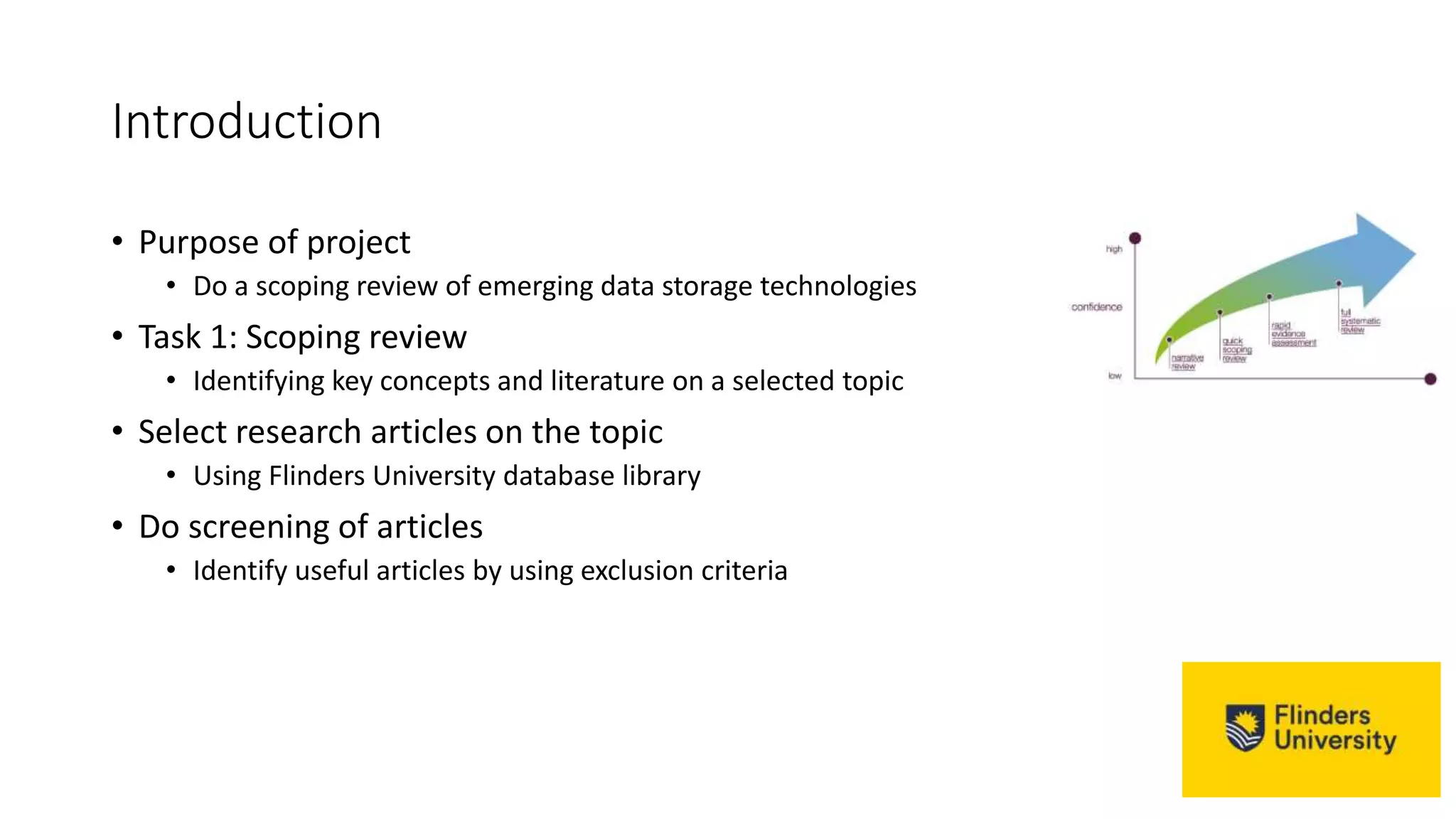
• Task 1: Scoping review
• Identifying key concepts and literature on a selected topic
• Select research articles on the topic
• Using Flinders University database library
• Do screening of articles
• Identify useful articles by using exclusion criteria
Introduction
• Task 2: Do a presentation
• In the 2nd task, it is required to do a 10 minute presentation
• Task 3: Write a publishable article
• Find related papers from online databases
• Do screening of papers
• Select appropriate articles for study
• Highlight facts and figures given in the papers
• Discuss methodology used
• What are data storage technologies of the future
• Draw a conclusion
Method
• Searching for Research Articles
• There are multiple methods to find scholarly articles on the internet
• Google is the most used platform for this purpose
• Task 1 is scoping review
• Need to find research papers related the topic
• Using Flinders Library
• From Flinders university library database
• Articles can be searched by using keyword in any platform
• Articles can be filtered according to the requirements
Method
• Science Direct
• A very useful database for high impact research articles
• From many popular databases, science direct was selected
• Using keyword “Emerging Data Storage Technologies”
• 190,741 papers were obtained
• Results were filtered for papers from the year 2022 only
• Further classification as research articles selected
• Finally, the open access articles were selected
• It ended up with 4,839 results of scholarly articles
• Of which a few were selected
Method
• Google Scholar
• Another online database
• In university website, it was selected for article search
• Using keyword, “Data storage technologies of the future”
• 5,480,000 articles obtained in results
• Refining the search to only 2022 papers and the latest published,
lead to 1,710 papers
• Similar to science direct, a few articles selected for study
Method
• Inclusion Criteria
• Paper titles obtained after filters were briefly studied
• Most appropriate articles were shortlisted
• Specifically, articles on comparison of technologies were opted
• Exclusion Criteria
• Based on some exclusion criteria, articles were removed from the list
• For example:
• Papers on a specific device
• Articles discussion history of a storage medium
• Papers on working principle of a specific device
Results
• Latest papers published in 2022 were opted
• After filtering the papers, 8 articles were selected
• Literature of each was studied briefly
• Useful information was put together in the article
• Search method and selection criteria was discussed
Results
• Emerging Data Storage Technologies
• NVMe/PCIe storage interface: This technology drives have more speed than SATA.
It uses bus technology and has greater bandwidth and channels to improve data transfer
It can handle 64,000 commands in one single message
• Hyper-converged Infrastructure: It is run on commercial off-the-shelf servers.
It is an enterprise storage solution for large organizations
New servers can be installed to the cluster.
• DNA Storage: A very reliable data storage medium is DNA
High storage density, lower cost of maintenance, easily synthesized and chemically modified
are the features of DNA storage technology.
Results
• Data storage technologies for future
• Helium Drives: Helium is used instead of air, which offers less friction and less power is
consumed to spin the disks.
Seagate and Western Digital has developed a prototype.
• Shingled Magnetic Recording (SMR): New technology for hard drives
High capacity than traditional drives
Tracks of data overlap each other, hence high storage density in small size
• 5D Optical Storage: Quartz glass is used to store data for long period
Data is stored in 5 dimensional layers and gets five degrees of freedom
Hundreds of terabytes can be stored in one disc with thermal stability of up to 1800
Fahrenheit temperature
Discussion
• Enterprise Data Storage
• Mostly used by large businesses to store data with shared access
• Multiple applications are stored and many employees have access to the data
• Appropriate storage technology is HCI (Hyper-converged Infrastructure)
• Cloud Storage
• Data is stored on servers online at remote locations
• Many companies offer cloud data storage to the users
• Service providers use large servers and many data centers where SSDs are installed
• Long-term archival storage
• Previously, Blu-ray discs and DVDs were used for long term data storage
• There can be loss of discs or other device due to floods or other disasters
• New solution is using cloud storage technology
Conclusion
• There are many emerging technologies in data storage
• Newly developed are DNA storage, HCI (Hyper-converged Infrastructure) and
NVMe storage interface
• Some of these technologies are already in market while some are under
testing phase
• Helium drives, shingles magnetic recording and 5D optical storage are future
technologies
• Having such devices would change the concept of data storage
Future of Data Storage
• As the time passes, need for more compact and fast data storage medium
will increase
• Having new technologies is essential
• Scientists are using innovative ways to solve this problem
• Cost effective and long-term storage devices are developed and more will come
in the future
• The future of data storage is going to be full of advanced devices that we can’t
even think at present

Data Storage

  • 1.
  • 2.
    Introduction • Purpose ofproject • Do a scoping review of emerging data storage technologies • Task 1: Scoping review • Identifying key concepts and literature on a selected topic • Select research articles on the topic • Using Flinders University database library • Do screening of articles • Identify useful articles by using exclusion criteria
  • 3.
    Introduction • Task 2:Do a presentation • In the 2nd task, it is required to do a 10 minute presentation • Task 3: Write a publishable article • Find related papers from online databases • Do screening of papers • Select appropriate articles for study • Highlight facts and figures given in the papers • Discuss methodology used • What are data storage technologies of the future • Draw a conclusion
  • 4.
    Method • Searching forResearch Articles • There are multiple methods to find scholarly articles on the internet • Google is the most used platform for this purpose • Task 1 is scoping review • Need to find research papers related the topic • Using Flinders Library • From Flinders university library database • Articles can be searched by using keyword in any platform • Articles can be filtered according to the requirements
  • 5.
    Method • Science Direct •A very useful database for high impact research articles • From many popular databases, science direct was selected • Using keyword “Emerging Data Storage Technologies” • 190,741 papers were obtained • Results were filtered for papers from the year 2022 only • Further classification as research articles selected • Finally, the open access articles were selected • It ended up with 4,839 results of scholarly articles • Of which a few were selected
  • 6.
    Method • Google Scholar •Another online database • In university website, it was selected for article search • Using keyword, “Data storage technologies of the future” • 5,480,000 articles obtained in results • Refining the search to only 2022 papers and the latest published, lead to 1,710 papers • Similar to science direct, a few articles selected for study
  • 7.
    Method • Inclusion Criteria •Paper titles obtained after filters were briefly studied • Most appropriate articles were shortlisted • Specifically, articles on comparison of technologies were opted • Exclusion Criteria • Based on some exclusion criteria, articles were removed from the list • For example: • Papers on a specific device • Articles discussion history of a storage medium • Papers on working principle of a specific device
  • 8.
    Results • Latest paperspublished in 2022 were opted • After filtering the papers, 8 articles were selected • Literature of each was studied briefly • Useful information was put together in the article • Search method and selection criteria was discussed
  • 9.
    Results • Emerging DataStorage Technologies • NVMe/PCIe storage interface: This technology drives have more speed than SATA. It uses bus technology and has greater bandwidth and channels to improve data transfer It can handle 64,000 commands in one single message • Hyper-converged Infrastructure: It is run on commercial off-the-shelf servers. It is an enterprise storage solution for large organizations New servers can be installed to the cluster. • DNA Storage: A very reliable data storage medium is DNA High storage density, lower cost of maintenance, easily synthesized and chemically modified are the features of DNA storage technology.
  • 10.
    Results • Data storagetechnologies for future • Helium Drives: Helium is used instead of air, which offers less friction and less power is consumed to spin the disks. Seagate and Western Digital has developed a prototype. • Shingled Magnetic Recording (SMR): New technology for hard drives High capacity than traditional drives Tracks of data overlap each other, hence high storage density in small size • 5D Optical Storage: Quartz glass is used to store data for long period Data is stored in 5 dimensional layers and gets five degrees of freedom Hundreds of terabytes can be stored in one disc with thermal stability of up to 1800 Fahrenheit temperature
  • 11.
    Discussion • Enterprise DataStorage • Mostly used by large businesses to store data with shared access • Multiple applications are stored and many employees have access to the data • Appropriate storage technology is HCI (Hyper-converged Infrastructure) • Cloud Storage • Data is stored on servers online at remote locations • Many companies offer cloud data storage to the users • Service providers use large servers and many data centers where SSDs are installed • Long-term archival storage • Previously, Blu-ray discs and DVDs were used for long term data storage • There can be loss of discs or other device due to floods or other disasters • New solution is using cloud storage technology
  • 12.
    Conclusion • There aremany emerging technologies in data storage • Newly developed are DNA storage, HCI (Hyper-converged Infrastructure) and NVMe storage interface • Some of these technologies are already in market while some are under testing phase • Helium drives, shingles magnetic recording and 5D optical storage are future technologies • Having such devices would change the concept of data storage
  • 13.
    Future of DataStorage • As the time passes, need for more compact and fast data storage medium will increase • Having new technologies is essential • Scientists are using innovative ways to solve this problem • Cost effective and long-term storage devices are developed and more will come in the future • The future of data storage is going to be full of advanced devices that we can’t even think at present