Cloud Computing Overview
•Definition and essential characteristics
• Types: Public, Private, Hybrid, Community
• Benefits and challenges
9.
Cloud Services andDeployment
Models
• SaaS (Software as a Service)
• PaaS (Platform as a Service)
• IaaS (Infrastructure as a Service)
• Comparison and applications
10.
Data Center Environment
•Components of a data center
• Compute systems and virtualization
• Software-defined data centers
11.
Building Blocks ofa Data Center
• Servers
• Storage devices
• Networking components
• Security infrastructure
Introduction to Storage
Technologies
•Storage technology plays a crucial role in
modern computing by enabling data
retention, retrieval, and management. With
the exponential growth of data, efficient
storage solutions have become indispensable
for both personal and business applications.
The evolution of storage technology has
progressed from traditional paper-based
record-keeping to highly sophisticated digital
storage systems. Today, storage solutions vary
27.
Digital Data andIts Types
• Digital data refers to information that is stored
in a binary format, which consists of ones and
zeros. It can be broadly categorized into
structured, unstructured, and semi-structured
data. Structured data is highly organized and
stored in databases, making it easy to process.
Unstructured data, on the other hand, lacks a
predefined format and includes files such as
images, videos, and social media posts. Semi-
structured data falls between these two
28.
Information Storage
• Informationstorage involves the methods and
technologies used to retain data over time. It
ensures that digital data is accessible, secure,
and organized for future use. Traditional
storage methods, such as paper records and
magnetic tapes, have been largely replaced by
modern digital storage solutions like solid-
state drives (SSDs) and cloud storage. With
increasing data generation, businesses and
individuals rely on advanced storage
29.
Key Characteristics ofData Centers
• A data center is a facility used to house
computing systems and associated
components such as storage systems and
networking equipment. The essential
characteristics of a data center include
availability, capacity, security, performance,
and manageability. High availability ensures
minimal downtime, while scalability allows
businesses to expand storage capacity as
needed. Security measures such as encryption
30.
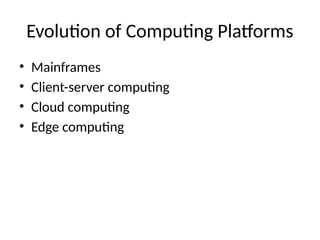
Evolution of ComputingPlatforms
• Computing platforms have evolved
significantly over the decades, starting with
mainframe computers that offered centralized
processing power. Client-server computing
introduced distributed computing, where
multiple clients connected to a central server.
The advent of cloud computing revolutionized
data access by enabling users to store and
retrieve data remotely. Emerging technologies
like edge computing further enhance storage
31.
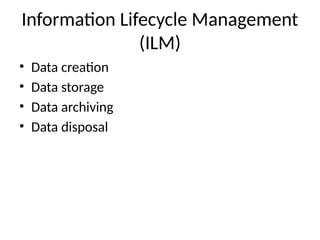
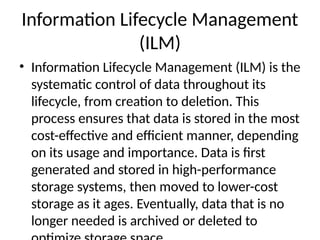
Information Lifecycle Management
(ILM)
•Information Lifecycle Management (ILM) is the
systematic control of data throughout its
lifecycle, from creation to deletion. This
process ensures that data is stored in the most
cost-effective and efficient manner, depending
on its usage and importance. Data is first
generated and stored in high-performance
storage systems, then moved to lower-cost
storage as it ages. Eventually, data that is no
longer needed is archived or deleted to
32.
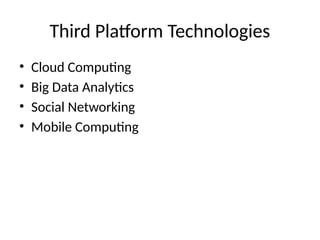
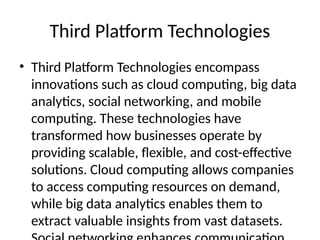
Third Platform Technologies
•Third Platform Technologies encompass
innovations such as cloud computing, big data
analytics, social networking, and mobile
computing. These technologies have
transformed how businesses operate by
providing scalable, flexible, and cost-effective
solutions. Cloud computing allows companies
to access computing resources on demand,
while big data analytics enables them to
extract valuable insights from vast datasets.
33.
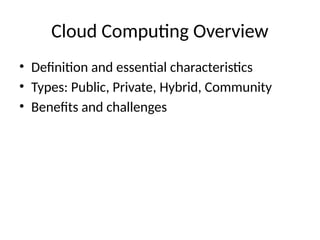
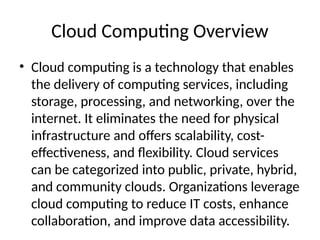
Cloud Computing Overview
•Cloud computing is a technology that enables
the delivery of computing services, including
storage, processing, and networking, over the
internet. It eliminates the need for physical
infrastructure and offers scalability, cost-
effectiveness, and flexibility. Cloud services
can be categorized into public, private, hybrid,
and community clouds. Organizations leverage
cloud computing to reduce IT costs, enhance
collaboration, and improve data accessibility.
34.
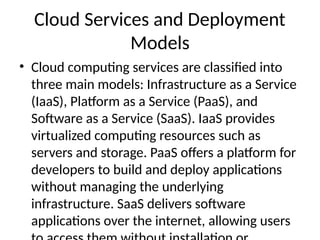
Cloud Services andDeployment
Models
• Cloud computing services are classified into
three main models: Infrastructure as a Service
(IaaS), Platform as a Service (PaaS), and
Software as a Service (SaaS). IaaS provides
virtualized computing resources such as
servers and storage. PaaS offers a platform for
developers to build and deploy applications
without managing the underlying
infrastructure. SaaS delivers software
applications over the internet, allowing users
35.
Data Center Environment
•A data center environment comprises the
physical and virtual infrastructure necessary
for data processing and storage. It includes
servers, storage systems, networking
components, power backups, and cooling
mechanisms. Data centers must ensure high
reliability, efficiency, and security to support
enterprise operations. With increasing data
demands, modern data centers adopt
virtualization and automation to optimize





![UNIT I -Introduction to CLOUD COMPUTING [Autosaved].pptx](https://cdn.slidesharecdn.com/ss_thumbnails/uniti-introductiontocloudcomputingautosaved-250128091123-f66abd14-thumbnail.jpg?width=640&height=640&fit=bounds)


