Data security in Online
       Commerce

PRESENTATION BY ANAND NAIR FOR DATA
     SECURITY MEET UP. 03/2008
Introduction

 About me:
   More than a decade experience as a researcher and
    developer of secure web services for online infrastructure
   Contributor to open source projects
   Speaker in various meet ups for technology and approach
    for highly scalable secure architecture.
   Recognized as technologist in gaming industry in
    research and development of online infrastructure.
 What’s in presentation
   Data security discussion
   Tools to test security risk
Data vulnerability

The most common web application security weakness is
the failure to properly validate input coming from the
client or environment before using it. This weakness
leads to almost all of the major vulnerabilities in web
applications, such as cross site scripting, SQL injection,
interpreter injection, locale/Unicode attacks, file system
attacks and buffer overflows.
Data Security : Watch the input data


 Data from an external entity or client should never
  be trusted, since it can be arbitrarily tampered with
  by an attacker.
 Unfortunately, complex applications like often have
  a large number of data input points, which makes it
  difficult for a developer to enforce this rule.
Data Security : Types of Attack

 A MitM attack can be performed in two different
 ways:
    The attacker is in control of a router along the normal point of
     traffic communication between the victim and the server the
     victim is communicating with.
    The attacker is located on the same broadcast domain (e.g.
     subnet) as the victim.
    The attacker is located on the same broadcast domain (e.g.
     subnet) as any of the routing devices used by the victim to
     route traffic.
Data Security: Transport Protocol

 Attacker has the ability to view and modify any TCP
  traffic sent to or from the victim machine.
 HTTP traffic is unencrypted and contains no
  authentication. Therefore, all HTTP traffic can be
  trivially monitored/modified by the attacker.
Data Security: Secure transport protocol


 Man in the middle enables the attacker to view most
  exchanged data, but does not enable the attacker to intercept
  data exchanged of protocols that implement their own
  authentication and encryption (e.g. SSH, SSL/TLS).
 The purpose of HTTPS is to create a secure communication
  over top of HTTP by the use of SSL or TLS. On its own
  SSL/TLS can be very effective and secure. However, there are
  significant problems
     The browsers handling of SSL/TLS can lead to issues when both HTTPS
      and HTTP sites are visited by the user.
     Man in middle would present a certificate warning message in the user’s
      browser and likely alert the user to the attack that most users would
      ignore the warning and continue – thus exposing all of their data.
     Alternatively, the attacker could try and use tools such as SSLstrip to
      leverage poor application design with regards to SSL/TLS.
Using Tools


 Toolkit:
   Platform to run the application

   Network switch to create a closed network environment

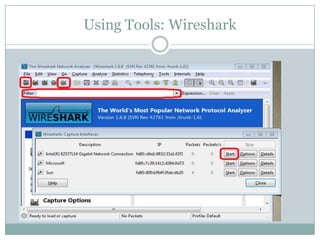
   Wireshark (www.wireshark.org)

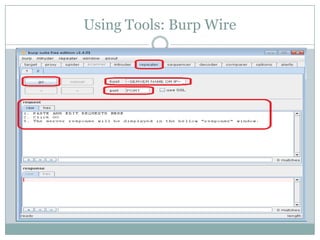
   Burp Suite (www.portswigger.net/burp/download.html)
Using Tools: Wireshark
Using Tools: Burp Wire

Data security in online commerce

  • 1.
    Data security inOnline Commerce PRESENTATION BY ANAND NAIR FOR DATA SECURITY MEET UP. 03/2008
  • 2.
    Introduction  About me:  More than a decade experience as a researcher and developer of secure web services for online infrastructure  Contributor to open source projects  Speaker in various meet ups for technology and approach for highly scalable secure architecture.  Recognized as technologist in gaming industry in research and development of online infrastructure.  What’s in presentation  Data security discussion  Tools to test security risk
  • 3.
    Data vulnerability The mostcommon web application security weakness is the failure to properly validate input coming from the client or environment before using it. This weakness leads to almost all of the major vulnerabilities in web applications, such as cross site scripting, SQL injection, interpreter injection, locale/Unicode attacks, file system attacks and buffer overflows.
  • 4.
    Data Security :Watch the input data  Data from an external entity or client should never be trusted, since it can be arbitrarily tampered with by an attacker.  Unfortunately, complex applications like often have a large number of data input points, which makes it difficult for a developer to enforce this rule.
  • 5.
    Data Security :Types of Attack  A MitM attack can be performed in two different ways:  The attacker is in control of a router along the normal point of traffic communication between the victim and the server the victim is communicating with.  The attacker is located on the same broadcast domain (e.g. subnet) as the victim.  The attacker is located on the same broadcast domain (e.g. subnet) as any of the routing devices used by the victim to route traffic.
  • 6.
    Data Security: TransportProtocol  Attacker has the ability to view and modify any TCP traffic sent to or from the victim machine.  HTTP traffic is unencrypted and contains no authentication. Therefore, all HTTP traffic can be trivially monitored/modified by the attacker.
  • 7.
    Data Security: Securetransport protocol  Man in the middle enables the attacker to view most exchanged data, but does not enable the attacker to intercept data exchanged of protocols that implement their own authentication and encryption (e.g. SSH, SSL/TLS).  The purpose of HTTPS is to create a secure communication over top of HTTP by the use of SSL or TLS. On its own SSL/TLS can be very effective and secure. However, there are significant problems  The browsers handling of SSL/TLS can lead to issues when both HTTPS and HTTP sites are visited by the user.  Man in middle would present a certificate warning message in the user’s browser and likely alert the user to the attack that most users would ignore the warning and continue – thus exposing all of their data.  Alternatively, the attacker could try and use tools such as SSLstrip to leverage poor application design with regards to SSL/TLS.
  • 8.
    Using Tools  Toolkit:  Platform to run the application  Network switch to create a closed network environment  Wireshark (www.wireshark.org)  Burp Suite (www.portswigger.net/burp/download.html)
  • 9.
  • 10.