Welcome
“Data Privacy and consent management in Clinical
Research”
Student’s Name :- K. Sailaja
Student’s Qualification :- Pharm. D
Student ID :- 022/022024
10/18/2022
www.clinosol.com | follow us on social media
@clinosolresearch
1
Overview
Data Privacy ( What and Why ).
• Regulatory Framework
• GDPR(principles ,Rights, Terminology),
• HIPAA(Rules, Types of safeguards)
• DPDPA-2023
• Difference between GDPR and DPDPA
• Informed Consent Process
• Consent Management Strategies.
• Emerging Trends in Data Privacy & Consent
Management
10/18/2022
www.clinosol.com | follow us on social media
@clinosolresearch
2
Data Privacy VS Data Security VS Data protection
What is Data Privacy?
“Data Privacy” is an area of data protection that concerns the proper handling, processing, storage
and usage of sensitive data including personal data, confidential data. The main aim is to meet the
regulatory requirements and data protection laws as well as protecting the confidentiality of the data.
What is Data Security ?
“Data Security ” is focused on protecting personal data from any unauthorized third-party access or
malicious attacks and exploitation of data. It is set up to protect personal data using different methods
and techniques like network security, access control, breach response, encryption and multi-factor
authentication.
What is Data Protection?
Roughly speaking data protection falls under three broad categories, namely traditional data protection
such as back up and restore copies, data security, and data privacy.
10/18/2022
www.clinosol.com | follow us on social media
@clinosolresearch
3
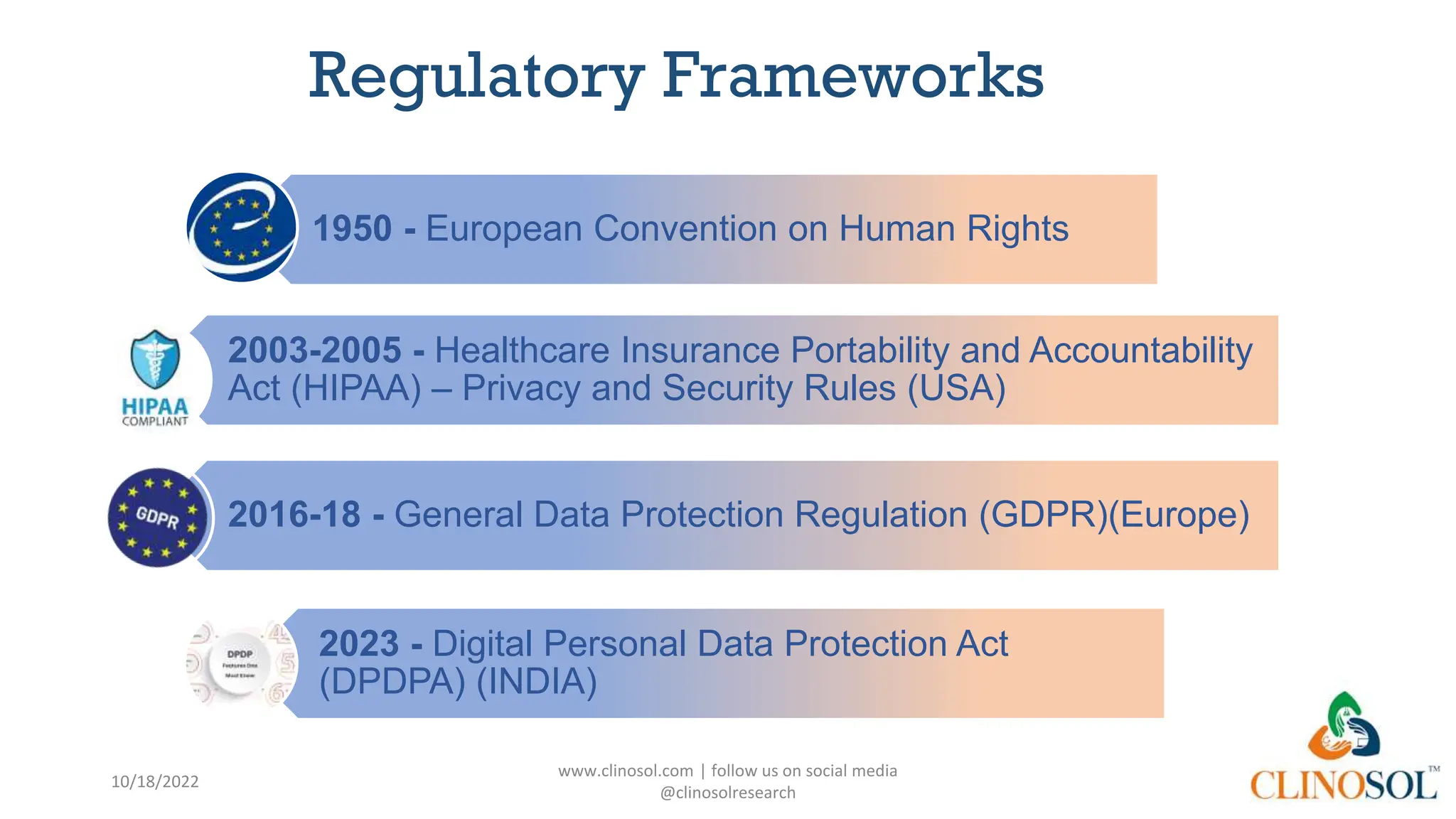
Regulatory Frameworks
1950 - European Convention on Human Rights
2003-2005 - Healthcare Insurance Portability and Accountability
Act (HIPAA) – Privacy and Security Rules (USA)
2016-18 - General Data Protection Regulation (GDPR)(Europe)
2023 - Digital Personal Data Protection Act
(DPDPA) (INDIA)
10/18/2022
www.clinosol.com | follow us on social media
@clinosolresearch
4
General Data Protection Regulation (GDPR) ACT- 2018:
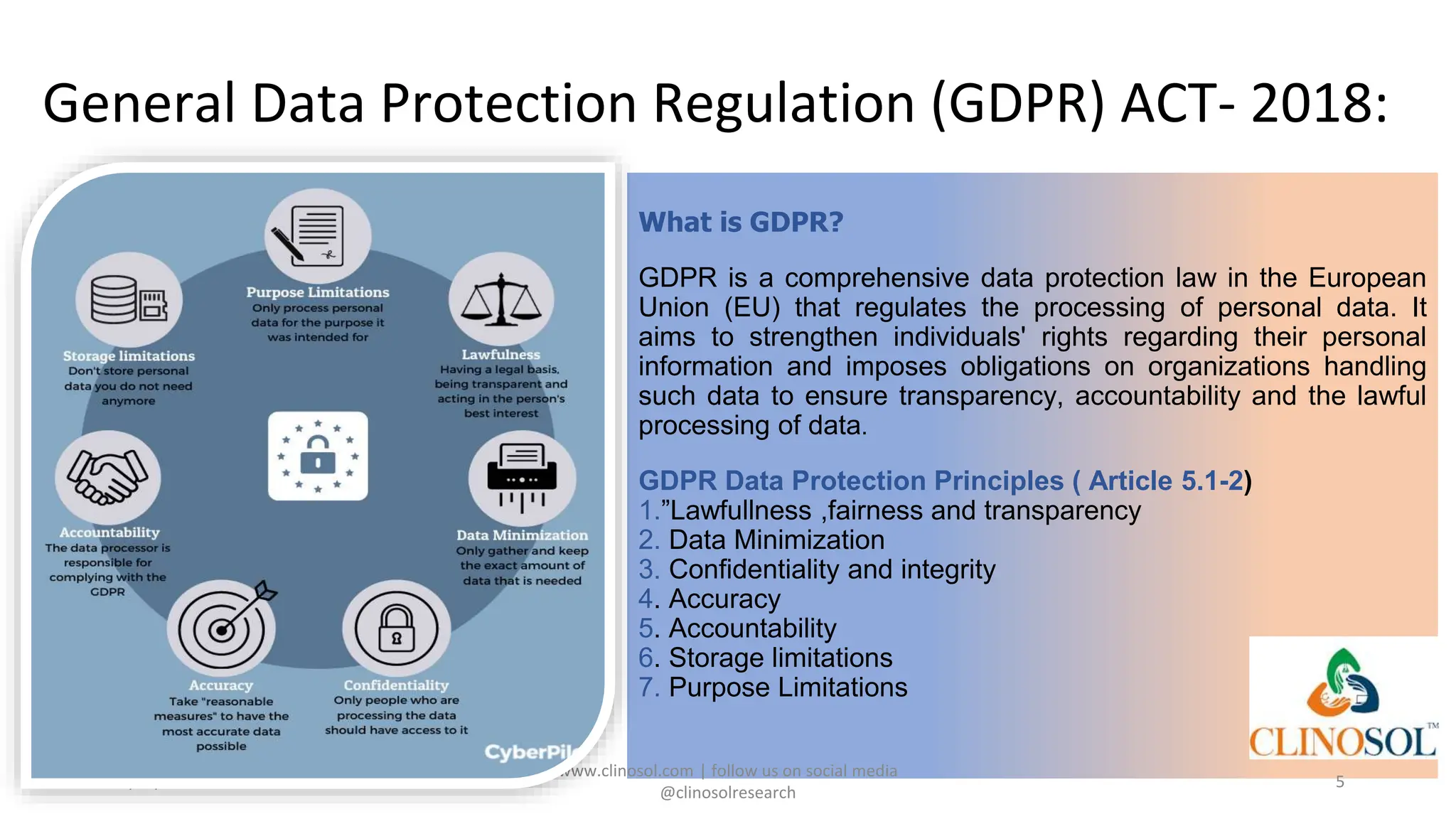
What is GDPR?
GDPR is a comprehensive data protection law in the European
Union (EU) that regulates the processing of personal data. It
aims to strengthen individuals' rights regarding their personal
information and imposes obligations on organizations handling
such data to ensure transparency, accountability and the lawful
processing of data.
GDPR Data Protection Principles ( Article 5.1-2)
1.”Lawfullness ,fairness and transparency
2. Data Minimization
3. Confidentiality and integrity
4. Accuracy
5. Accountability
6. Storage limitations
7. Purpose Limitations
10/18/2022
www.clinosol.com | follow us on social media
@clinosolresearch
5
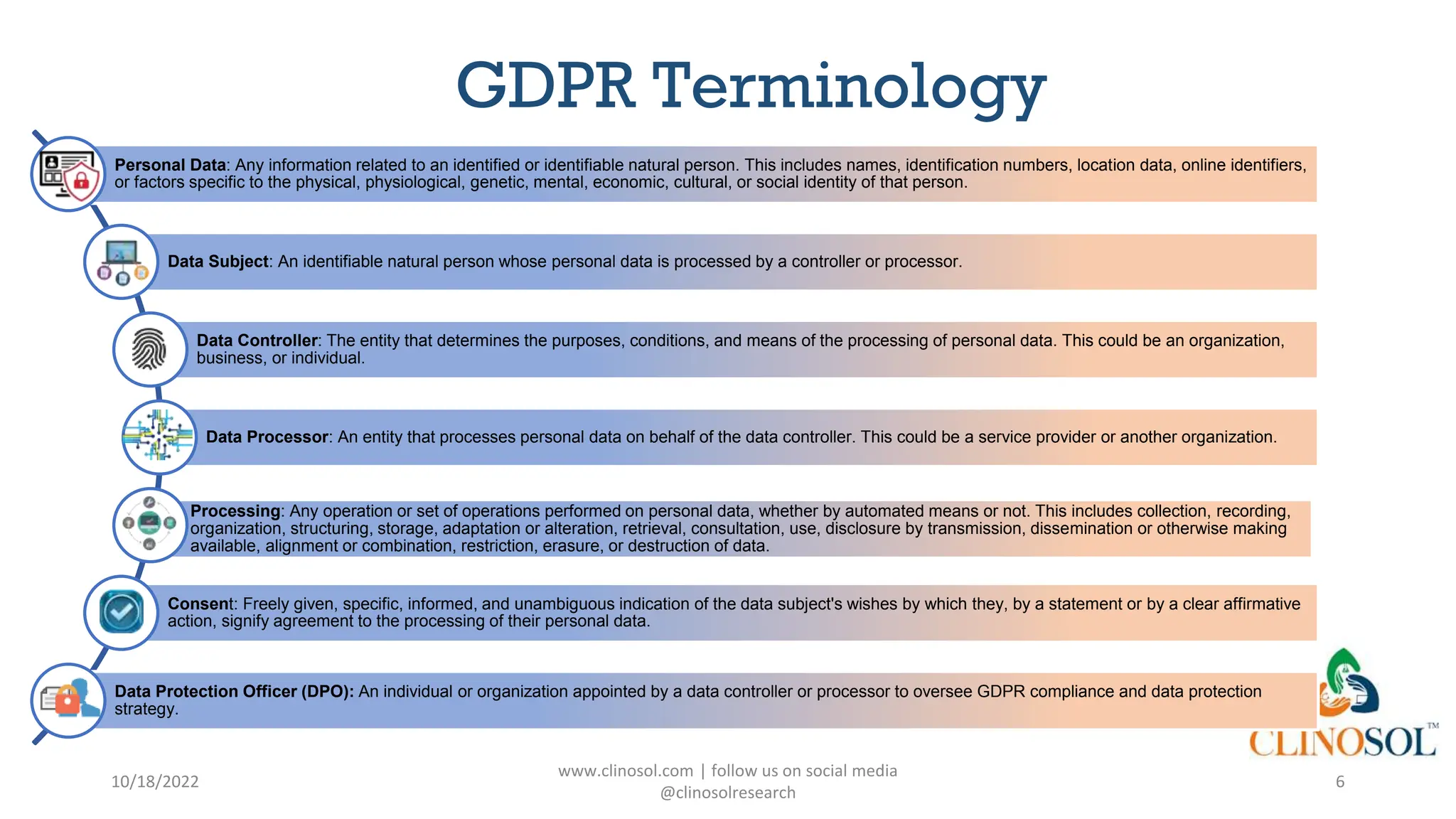
GDPR Terminology
Personal Data: Any information related to an identified or identifiable natural person. This includes names, identification numbers, location data, online identifiers,
or factors specific to the physical, physiological, genetic, mental, economic, cultural, or social identity of that person.
Data Subject: An identifiable natural person whose personal data is processed by a controller or processor.
Data Controller: The entity that determines the purposes, conditions, and means of the processing of personal data. This could be an organization,
business, or individual.
Data Processor: An entity that processes personal data on behalf of the data controller. This could be a service provider or another organization.
Processing: Any operation or set of operations performed on personal data, whether by automated means or not. This includes collection, recording,
organization, structuring, storage, adaptation or alteration, retrieval, consultation, use, disclosure by transmission, dissemination or otherwise making
available, alignment or combination, restriction, erasure, or destruction of data.
Consent: Freely given, specific, informed, and unambiguous indication of the data subject's wishes by which they, by a statement or by a clear affirmative
action, signify agreement to the processing of their personal data.
Data Protection Officer (DPO): An individual or organization appointed by a data controller or processor to oversee GDPR compliance and data protection
strategy.
10/18/2022
www.clinosol.com | follow us on social media
@clinosolresearch
6
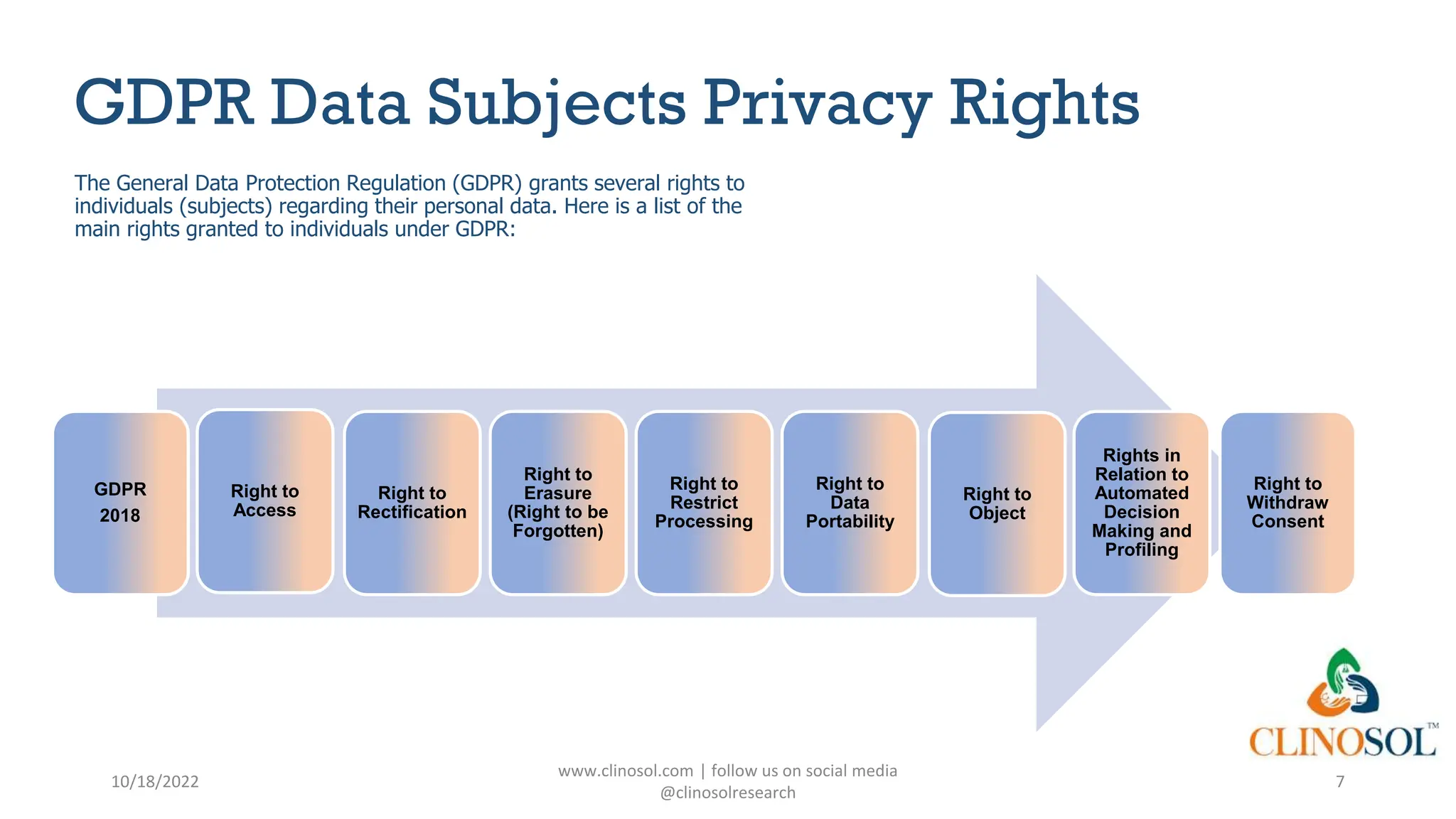
GDPR Data Subjects Privacy Rights
GDPR
2018
Right to
Access
Right to
Rectification
Right to
Erasure
(Right to be
Forgotten)
Right to
Restrict
Processing
Right to
Data
Portability
Right to
Object
Rights in
Relation to
Automated
Decision
Making and
Profiling
Right to
Withdraw
Consent
10/18/2022
www.clinosol.com | follow us on social media
@clinosolresearch
7
The General Data Protection Regulation (GDPR) grants several rights to
individuals (subjects) regarding their personal data. Here is a list of the
main rights granted to individuals under GDPR:
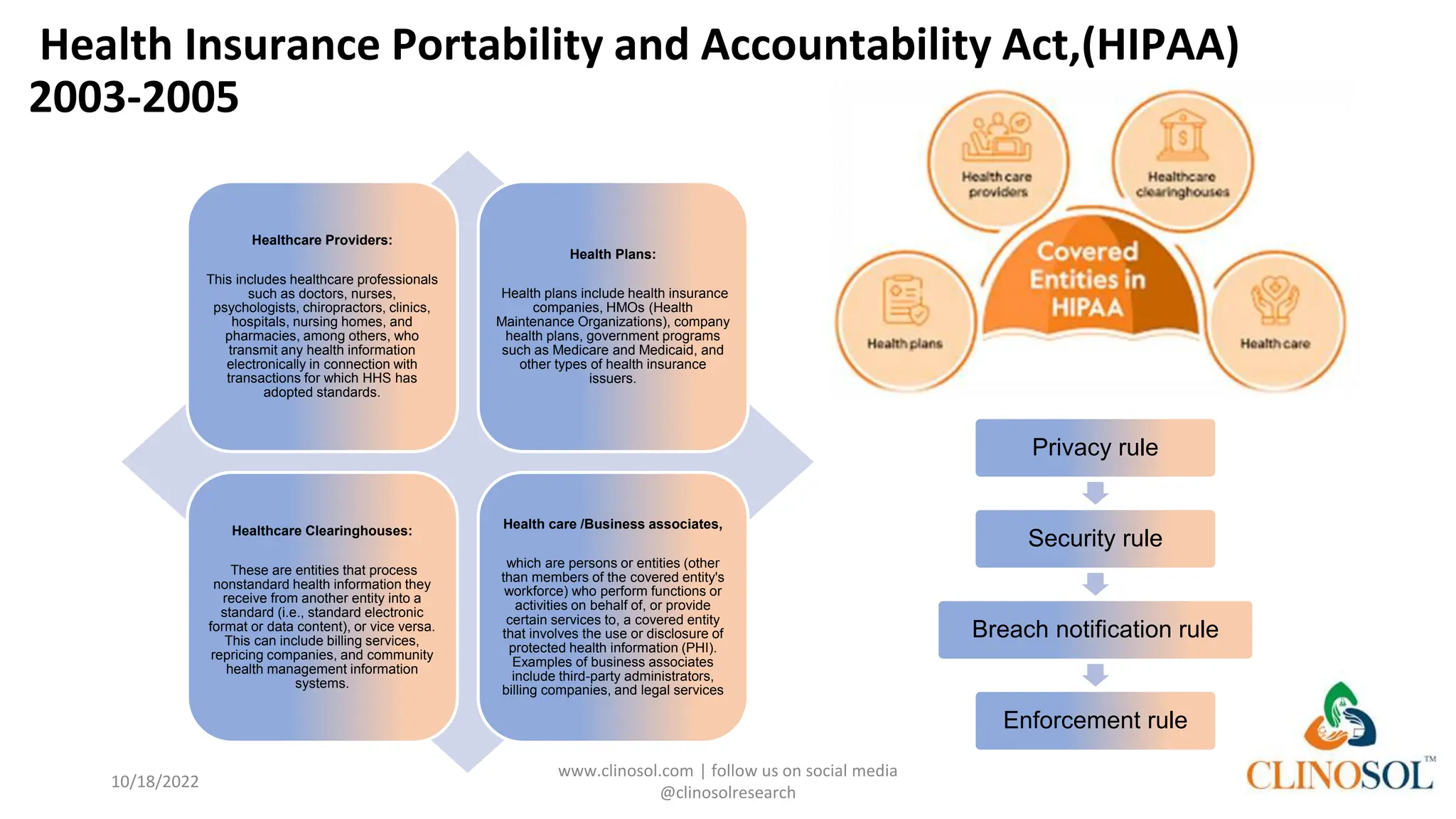
Health Insurance Portability and Accountability Act,(HIPAA)
2003-2005
10/18/2022
www.clinosol.com | follow us on social media
@clinosolresearch
Privacy rule
Security rule
Breach notification rule
Enforcement rule
Healthcare Providers:
This includes healthcare professionals
such as doctors, nurses,
psychologists, chiropractors, clinics,
hospitals, nursing homes, and
pharmacies, among others, who
transmit any health information
electronically in connection with
transactions for which HHS has
adopted standards.
Health Plans:
Health plans include health insurance
companies, HMOs (Health
Maintenance Organizations), company
health plans, government programs
such as Medicare and Medicaid, and
other types of health insurance
issuers.
Healthcare Clearinghouses:
These are entities that process
nonstandard health information they
receive from another entity into a
standard (i.e., standard electronic
format or data content), or vice versa.
This can include billing services,
repricing companies, and community
health management information
systems.
Health care /Business associates,
which are persons or entities (other
than members of the covered entity's
workforce) who perform functions or
activities on behalf of, or provide
certain services to, a covered entity
that involves the use or disclosure of
protected health information (PHI).
Examples of business associates
include third-party administrators,
billing companies, and legal services
Rules of HIPAA
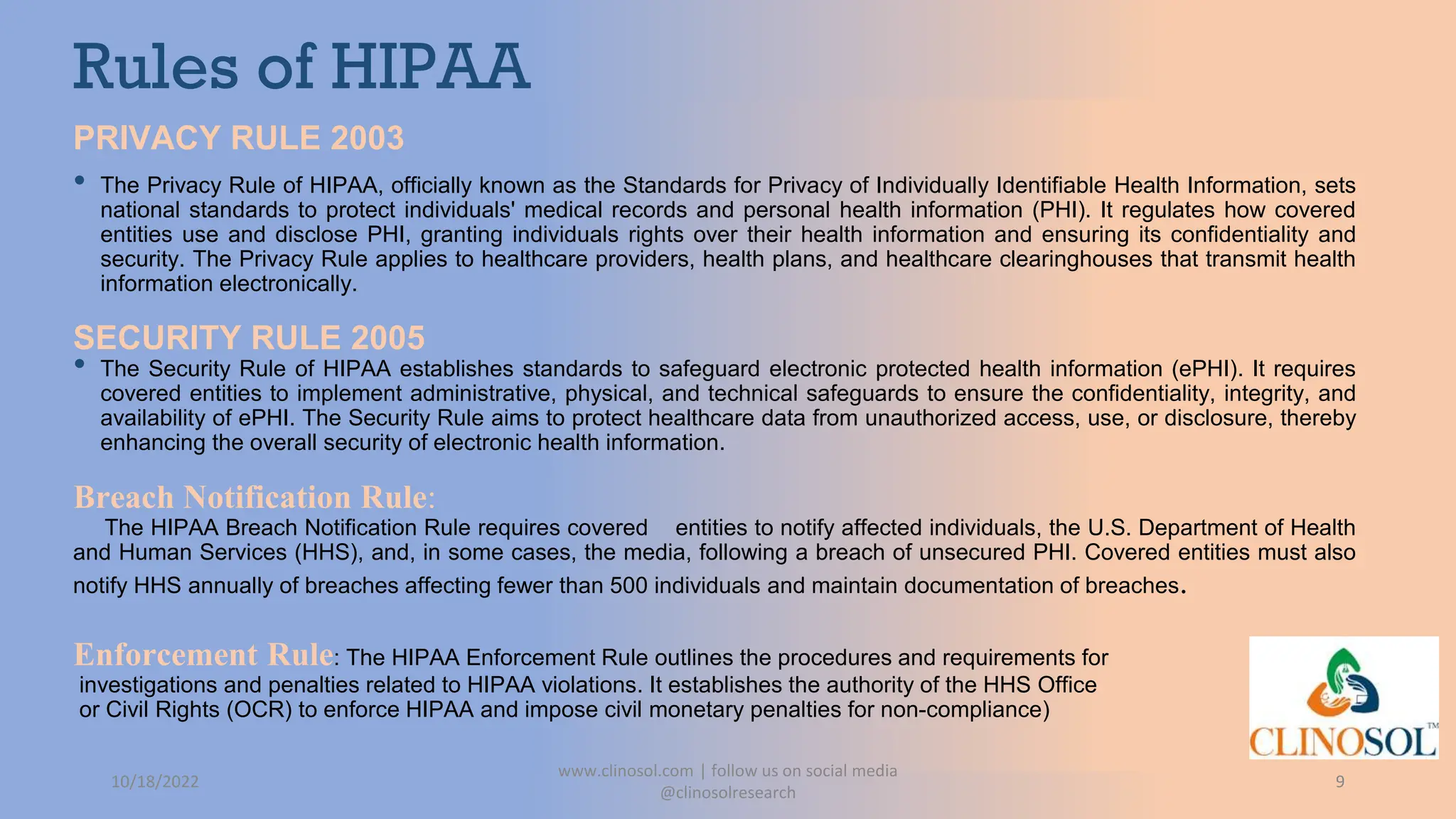
PRIVACY RULE 2003
• The Privacy Rule of HIPAA, officially known as the Standards for Privacy of Individually Identifiable Health Information, sets
national standards to protect individuals' medical records and personal health information (PHI). It regulates how covered
entities use and disclose PHI, granting individuals rights over their health information and ensuring its confidentiality and
security. The Privacy Rule applies to healthcare providers, health plans, and healthcare clearinghouses that transmit health
information electronically.
SECURITY RULE 2005
• The Security Rule of HIPAA establishes standards to safeguard electronic protected health information (ePHI). It requires
covered entities to implement administrative, physical, and technical safeguards to ensure the confidentiality, integrity, and
availability of ePHI. The Security Rule aims to protect healthcare data from unauthorized access, use, or disclosure, thereby
enhancing the overall security of electronic health information.
Breach Notification Rule:
The HIPAA Breach Notification Rule requires covered entities to notify affected individuals, the U.S. Department of Health
and Human Services (HHS), and, in some cases, the media, following a breach of unsecured PHI. Covered entities must also
notify HHS annually of breaches affecting fewer than 500 individuals and maintain documentation of breaches.
Enforcement Rule: The HIPAA Enforcement Rule outlines the procedures and requirements for
investigations and penalties related to HIPAA violations. It establishes the authority of the HHS Office
or Civil Rights (OCR) to enforce HIPAA and impose civil monetary penalties for non-compliance)
10/18/2022
www.clinosol.com | follow us on social media
@clinosolresearch
9
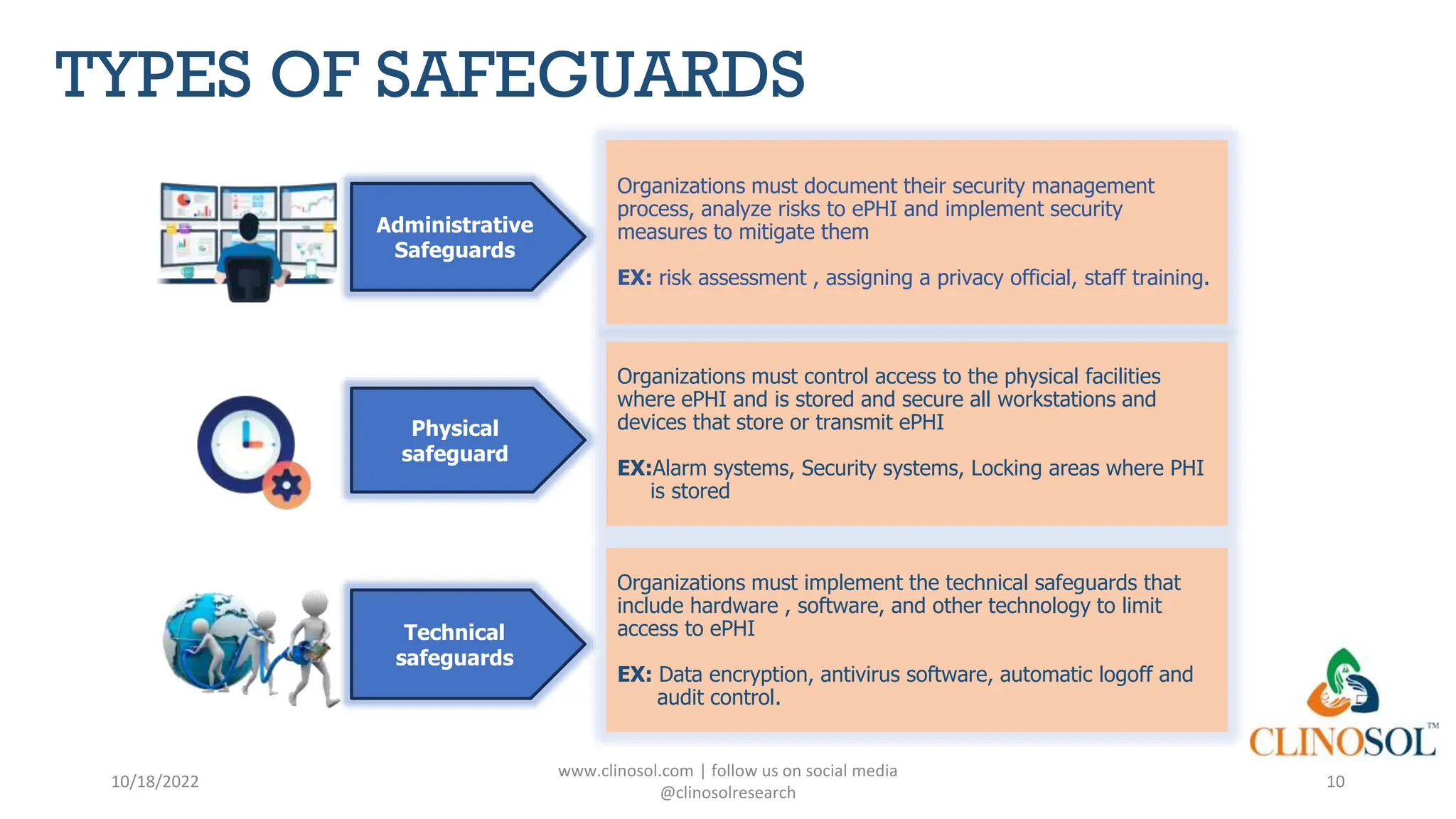
TYPES OF SAFEGUARDS
10/18/2022
www.clinosol.com | follow us on social media
@clinosolresearch
10
Organizations must document their security management
process, analyze risks to ePHI and implement security
measures to mitigate them
EX: risk assessment , assigning a privacy official, staff training.
Administrative
Safeguards
Organizations must control access to the physical facilities
where ePHI and is stored and secure all workstations and
devices that store or transmit ePHI
EX:Alarm systems, Security systems, Locking areas where PHI
is stored
Physical
safeguard
Organizations must implement the technical safeguards that
include hardware , software, and other technology to limit
access to ePHI
EX: Data encryption, antivirus software, automatic logoff and
audit control.
Technical
safeguards
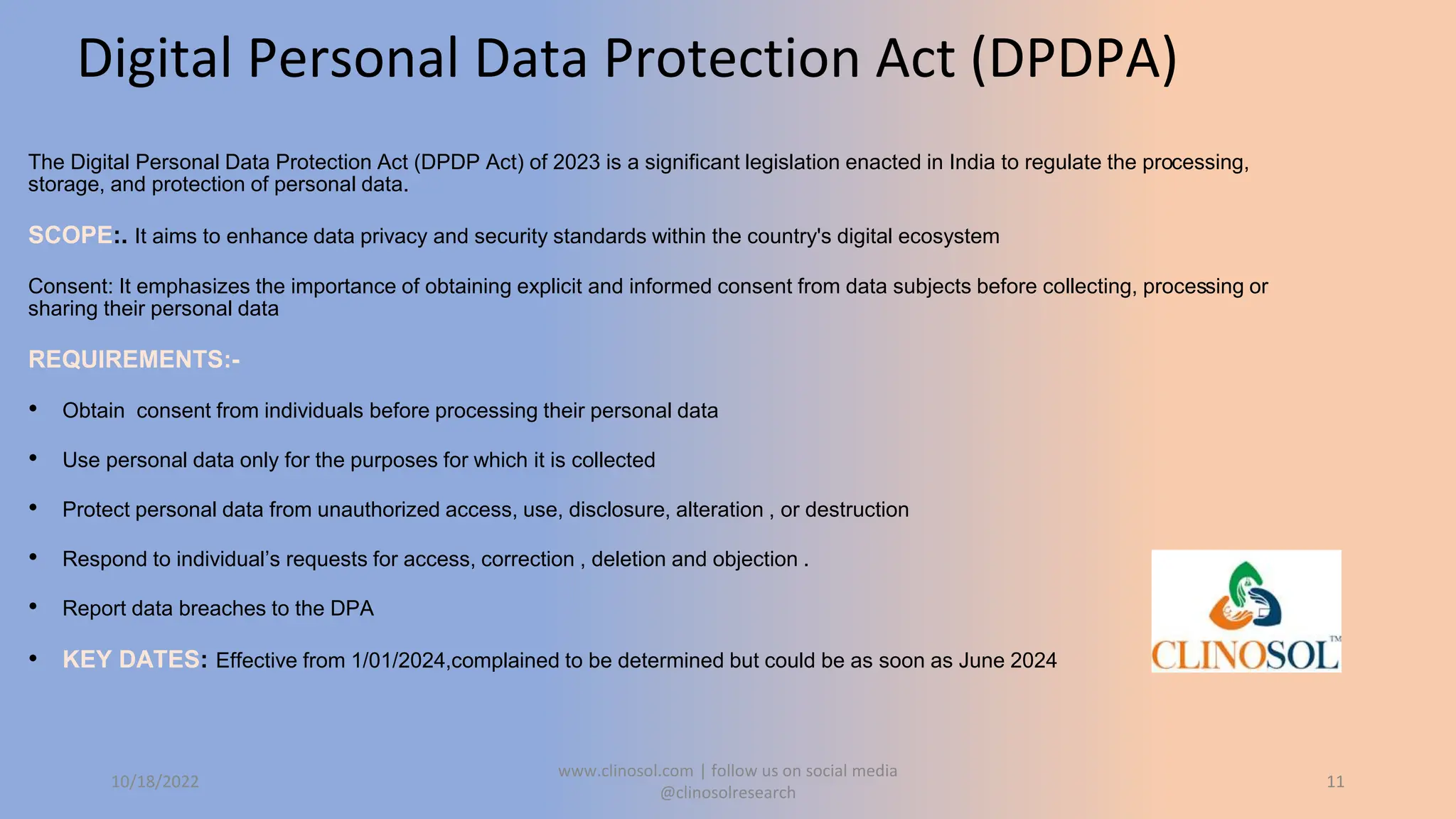
Digital Personal Data Protection Act (DPDPA)
The Digital Personal Data Protection Act (DPDP Act) of 2023 is a significant legislation enacted in India to regulate the processing,
storage, and protection of personal data.
SCOPE:. It aims to enhance data privacy and security standards within the country's digital ecosystem
Consent: It emphasizes the importance of obtaining explicit and informed consent from data subjects before collecting, processing or
sharing their personal data
REQUIREMENTS:-
• Obtain consent from individuals before processing their personal data
• Use personal data only for the purposes for which it is collected
• Protect personal data from unauthorized access, use, disclosure, alteration , or destruction
• Respond to individual’s requests for access, correction , deletion and objection .
• Report data breaches to the DPA
• KEY DATES: Effective from 1/01/2024,complained to be determined but could be as soon as June 2024
10/18/2022
www.clinosol.com | follow us on social media
@clinosolresearch
11
Differences between GDPR and DPDP
10/18/2022
www.clinosol.com | follow us on social media
@clinosolresearch
12
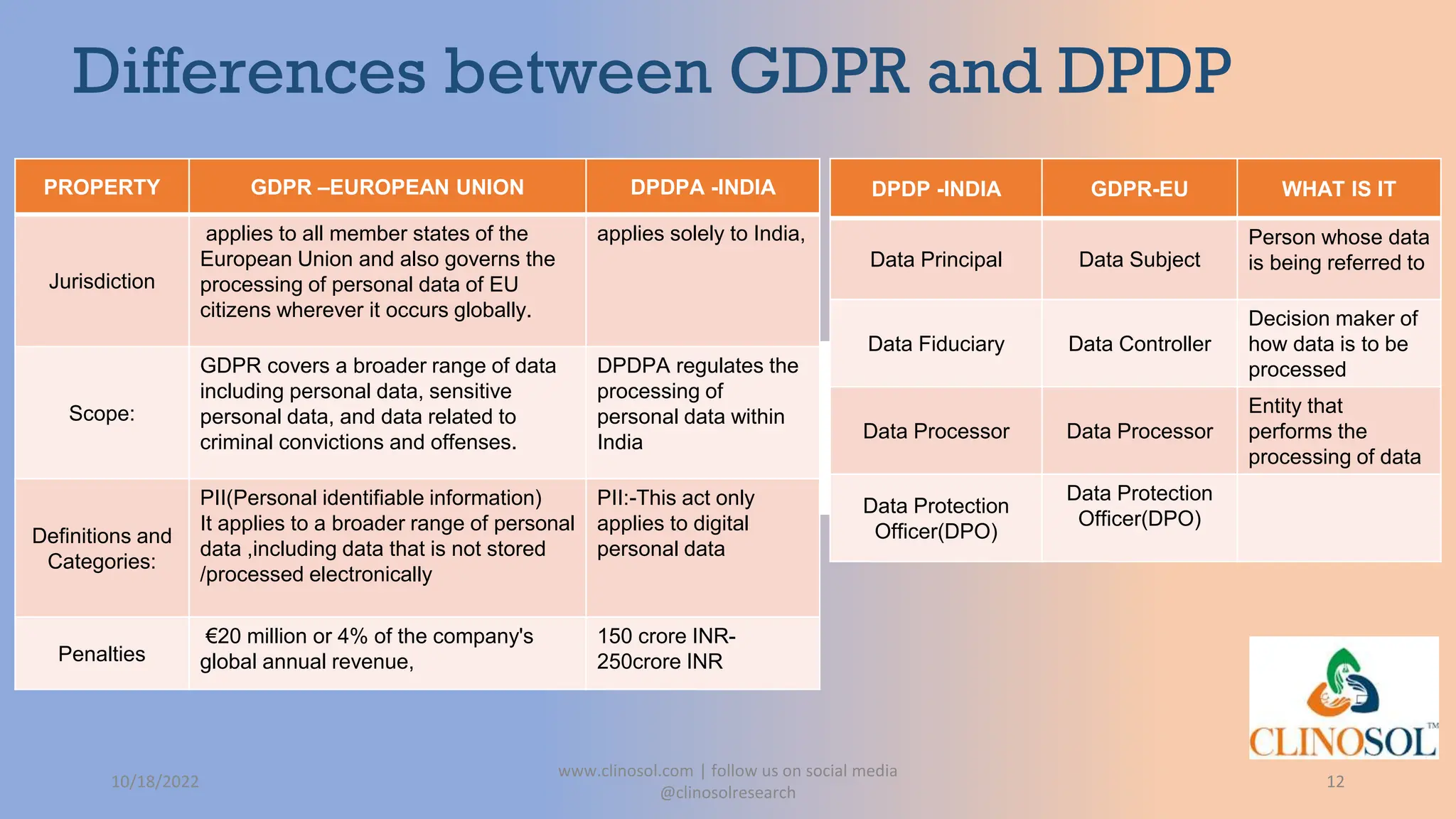
PROPERTY GDPR –EUROPEAN UNION DPDPA -INDIA
Jurisdiction
applies to all member states of the
European Union and also governs the
processing of personal data of EU
citizens wherever it occurs globally.
applies solely to India,
Scope:
GDPR covers a broader range of data
including personal data, sensitive
personal data, and data related to
criminal convictions and offenses.
DPDPA regulates the
processing of
personal data within
India
Definitions and
Categories:
PII(Personal identifiable information)
It applies to a broader range of personal
data ,including data that is not stored
/processed electronically
PII:-This act only
applies to digital
personal data
Penalties
€20 million or 4% of the company's
global annual revenue,
150 crore INR-
250crore INR
DPDP -INDIA GDPR-EU WHAT IS IT
Data Principal Data Subject
Person whose data
is being referred to
Data Fiduciary Data Controller
Decision maker of
how data is to be
processed
Data Processor Data Processor
Entity that
performs the
processing of data
Data Protection
Officer(DPO)
Data Protection
Officer(DPO)
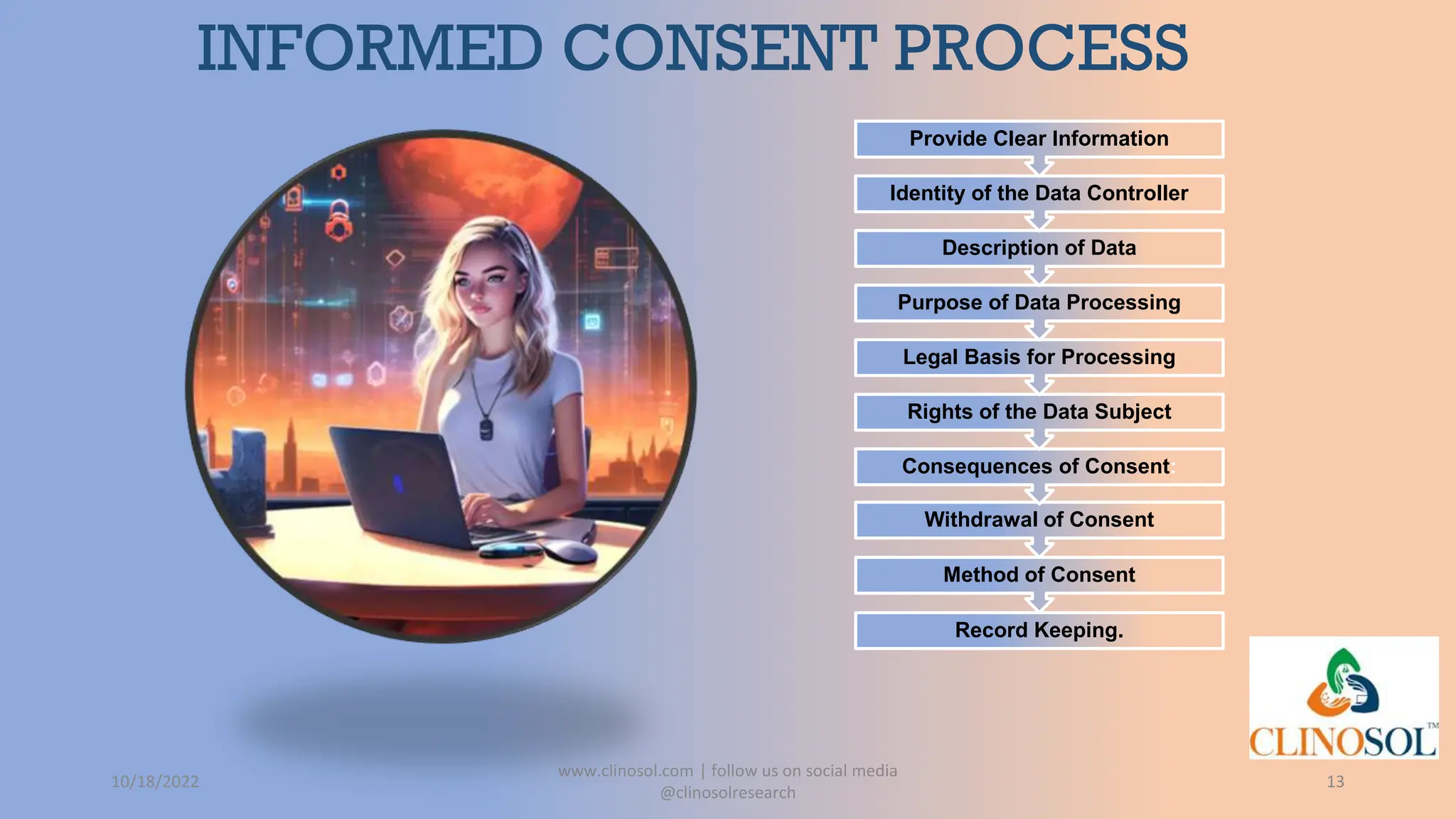
INFORMED CONSENT PROCESS
Record Keeping.
Method of Consent
Withdrawal of Consent
Consequences of Consent:
Rights of the Data Subject
Legal Basis for Processing
Purpose of Data Processing
Description of Data
Identity of the Data Controller
Provide Clear Information
10/18/2022
www.clinosol.com | follow us on social media
@clinosolresearch
13
CONSENT MANAGEMENT STRATEGIES
Clear Documentation:
Provide clear and comprehensive consent forms that outline the purpose of the research, procedures involved, potential risks and
benefits, confidentiality measures and participant rights. Use simple language understandable to the target population.
Informed Consent Process:
Conduct face-to-face meetings between researchers and participants to explain the research study thoroughly. Allow ample time for
participants to ask questions and make an informed decision. Ensure that participants understand the information provided before
obtaining their consent.
Consent Training for Researchers:
Train researchers and staff involved in obtaining consent to ensure they understand the importance of informed consent and how to
communicate effectively with participants. This training should include ethical considerations, communication skills, and protocols for
obtaining and documenting consent.
Respect for Autonomy:
Respect participants' autonomy by allowing them to make voluntary and informed decisions about participating in the research study.
Avoid coercion or undue influence and ensure participants have the freedom to withdraw from the study at any time without
consequences.
10/18/2022
www.clinosol.com | follow us on social media
@clinosolresearch
14
CONSENT MANAGEMENT STRATEGIES
Consent Reiteration:
Reinforce consent throughout the research process, reminding participants of their rights and the study's procedures.
Provide ongoing opportunities for participants to ask questions and seek clarification as needed.
Consent Tracking and Documentation:
Maintain accurate records of the consent process, including signed consent forms, documentation of discussions with
participants, and any amendments to the consent documents. Ensure confidentiality and secure storage of consent-
related information.
Adaptation to Participants' Needs:
Tailor the consent process to accommodate participants' cultural, linguistic, and cognitive needs. Use interpreters or
translated materials when necessary, and provide additional support for participants with limited literacy or
comprehension skills.
Regular Review and Updates:
Regularly review consent procedures to ensure they comply with current ethical guidelines and regulatory
requirements. Update consent forms and processes as needed based on feedback from participants, researchers,
and ethical review boards.
10/18/2022
www.clinosol.com | follow us on social media
@clinosolresearch
15
Emerging Trends in Data Privacy &Consent
management
• Block chain technology
• Decentralized identifiers
• Artificial Intelligence(AI) consent process
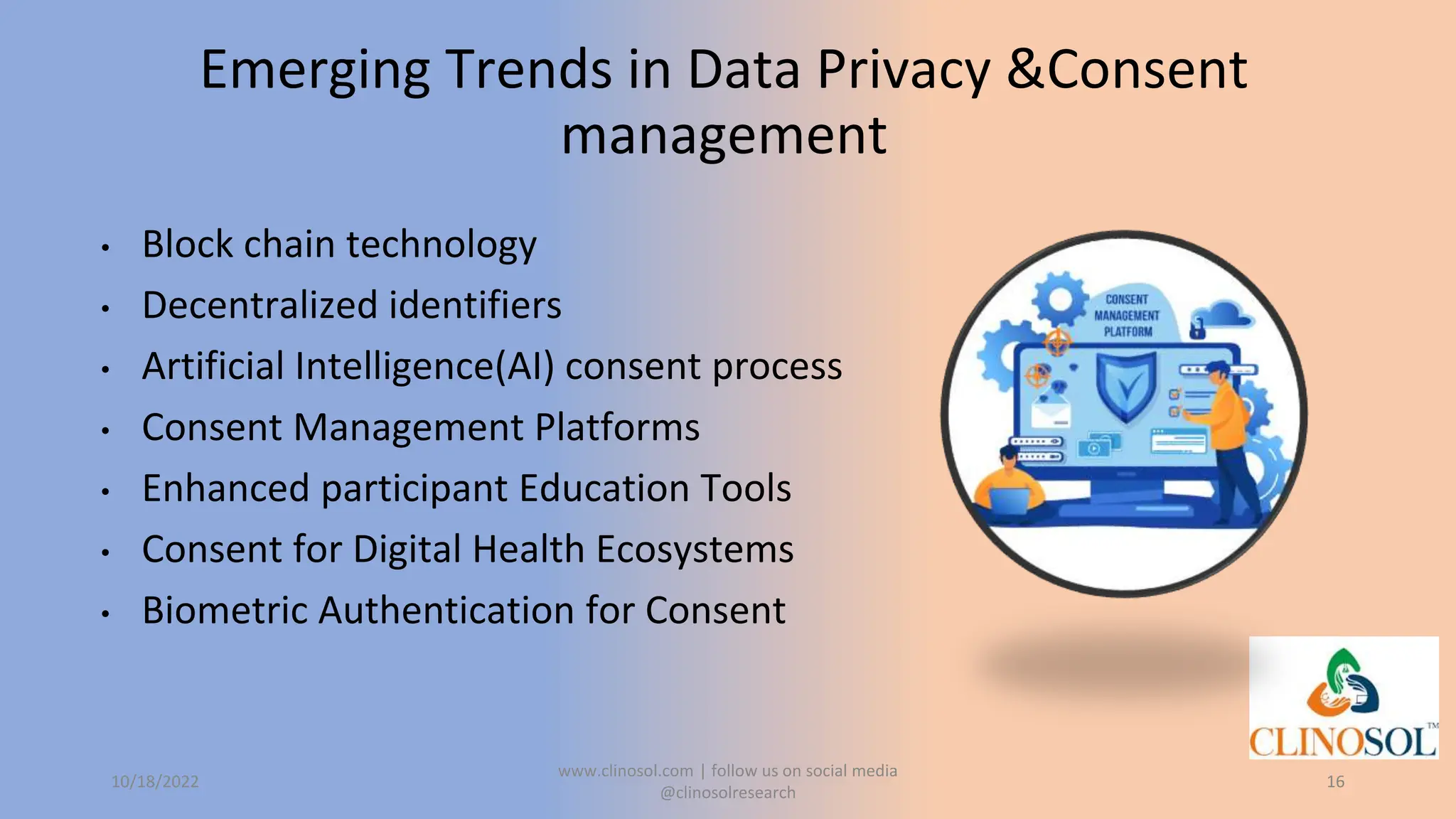
• Consent Management Platforms
• Enhanced participant Education Tools
• Consent for Digital Health Ecosystems
• Biometric Authentication for Consent
10/18/2022
www.clinosol.com | follow us on social media
@clinosolresearch
16
Thank You!
www.clinosol.com
(India | Canada)
9121151622/623/624
info@clinosol.com
10/18/2022
www.clinosol.com | follow us on social media
@clinosolresearch
17

Data Privacy and consent management .. .

  • 1.
    Welcome “Data Privacy andconsent management in Clinical Research” Student’s Name :- K. Sailaja Student’s Qualification :- Pharm. D Student ID :- 022/022024 10/18/2022 www.clinosol.com | follow us on social media @clinosolresearch 1
  • 2.
    Overview Data Privacy (What and Why ). • Regulatory Framework • GDPR(principles ,Rights, Terminology), • HIPAA(Rules, Types of safeguards) • DPDPA-2023 • Difference between GDPR and DPDPA • Informed Consent Process • Consent Management Strategies. • Emerging Trends in Data Privacy & Consent Management 10/18/2022 www.clinosol.com | follow us on social media @clinosolresearch 2
  • 3.
    Data Privacy VSData Security VS Data protection What is Data Privacy? “Data Privacy” is an area of data protection that concerns the proper handling, processing, storage and usage of sensitive data including personal data, confidential data. The main aim is to meet the regulatory requirements and data protection laws as well as protecting the confidentiality of the data. What is Data Security ? “Data Security ” is focused on protecting personal data from any unauthorized third-party access or malicious attacks and exploitation of data. It is set up to protect personal data using different methods and techniques like network security, access control, breach response, encryption and multi-factor authentication. What is Data Protection? Roughly speaking data protection falls under three broad categories, namely traditional data protection such as back up and restore copies, data security, and data privacy. 10/18/2022 www.clinosol.com | follow us on social media @clinosolresearch 3
  • 4.
    Regulatory Frameworks 1950 -European Convention on Human Rights 2003-2005 - Healthcare Insurance Portability and Accountability Act (HIPAA) – Privacy and Security Rules (USA) 2016-18 - General Data Protection Regulation (GDPR)(Europe) 2023 - Digital Personal Data Protection Act (DPDPA) (INDIA) 10/18/2022 www.clinosol.com | follow us on social media @clinosolresearch 4
  • 5.
    General Data ProtectionRegulation (GDPR) ACT- 2018: What is GDPR? GDPR is a comprehensive data protection law in the European Union (EU) that regulates the processing of personal data. It aims to strengthen individuals' rights regarding their personal information and imposes obligations on organizations handling such data to ensure transparency, accountability and the lawful processing of data. GDPR Data Protection Principles ( Article 5.1-2) 1.”Lawfullness ,fairness and transparency 2. Data Minimization 3. Confidentiality and integrity 4. Accuracy 5. Accountability 6. Storage limitations 7. Purpose Limitations 10/18/2022 www.clinosol.com | follow us on social media @clinosolresearch 5
  • 6.
    GDPR Terminology Personal Data:Any information related to an identified or identifiable natural person. This includes names, identification numbers, location data, online identifiers, or factors specific to the physical, physiological, genetic, mental, economic, cultural, or social identity of that person. Data Subject: An identifiable natural person whose personal data is processed by a controller or processor. Data Controller: The entity that determines the purposes, conditions, and means of the processing of personal data. This could be an organization, business, or individual. Data Processor: An entity that processes personal data on behalf of the data controller. This could be a service provider or another organization. Processing: Any operation or set of operations performed on personal data, whether by automated means or not. This includes collection, recording, organization, structuring, storage, adaptation or alteration, retrieval, consultation, use, disclosure by transmission, dissemination or otherwise making available, alignment or combination, restriction, erasure, or destruction of data. Consent: Freely given, specific, informed, and unambiguous indication of the data subject's wishes by which they, by a statement or by a clear affirmative action, signify agreement to the processing of their personal data. Data Protection Officer (DPO): An individual or organization appointed by a data controller or processor to oversee GDPR compliance and data protection strategy. 10/18/2022 www.clinosol.com | follow us on social media @clinosolresearch 6
  • 7.
    GDPR Data SubjectsPrivacy Rights GDPR 2018 Right to Access Right to Rectification Right to Erasure (Right to be Forgotten) Right to Restrict Processing Right to Data Portability Right to Object Rights in Relation to Automated Decision Making and Profiling Right to Withdraw Consent 10/18/2022 www.clinosol.com | follow us on social media @clinosolresearch 7 The General Data Protection Regulation (GDPR) grants several rights to individuals (subjects) regarding their personal data. Here is a list of the main rights granted to individuals under GDPR:
  • 8.
    Health Insurance Portabilityand Accountability Act,(HIPAA) 2003-2005 10/18/2022 www.clinosol.com | follow us on social media @clinosolresearch Privacy rule Security rule Breach notification rule Enforcement rule Healthcare Providers: This includes healthcare professionals such as doctors, nurses, psychologists, chiropractors, clinics, hospitals, nursing homes, and pharmacies, among others, who transmit any health information electronically in connection with transactions for which HHS has adopted standards. Health Plans: Health plans include health insurance companies, HMOs (Health Maintenance Organizations), company health plans, government programs such as Medicare and Medicaid, and other types of health insurance issuers. Healthcare Clearinghouses: These are entities that process nonstandard health information they receive from another entity into a standard (i.e., standard electronic format or data content), or vice versa. This can include billing services, repricing companies, and community health management information systems. Health care /Business associates, which are persons or entities (other than members of the covered entity's workforce) who perform functions or activities on behalf of, or provide certain services to, a covered entity that involves the use or disclosure of protected health information (PHI). Examples of business associates include third-party administrators, billing companies, and legal services
  • 9.
    Rules of HIPAA PRIVACYRULE 2003 • The Privacy Rule of HIPAA, officially known as the Standards for Privacy of Individually Identifiable Health Information, sets national standards to protect individuals' medical records and personal health information (PHI). It regulates how covered entities use and disclose PHI, granting individuals rights over their health information and ensuring its confidentiality and security. The Privacy Rule applies to healthcare providers, health plans, and healthcare clearinghouses that transmit health information electronically. SECURITY RULE 2005 • The Security Rule of HIPAA establishes standards to safeguard electronic protected health information (ePHI). It requires covered entities to implement administrative, physical, and technical safeguards to ensure the confidentiality, integrity, and availability of ePHI. The Security Rule aims to protect healthcare data from unauthorized access, use, or disclosure, thereby enhancing the overall security of electronic health information. Breach Notification Rule: The HIPAA Breach Notification Rule requires covered entities to notify affected individuals, the U.S. Department of Health and Human Services (HHS), and, in some cases, the media, following a breach of unsecured PHI. Covered entities must also notify HHS annually of breaches affecting fewer than 500 individuals and maintain documentation of breaches. Enforcement Rule: The HIPAA Enforcement Rule outlines the procedures and requirements for investigations and penalties related to HIPAA violations. It establishes the authority of the HHS Office or Civil Rights (OCR) to enforce HIPAA and impose civil monetary penalties for non-compliance) 10/18/2022 www.clinosol.com | follow us on social media @clinosolresearch 9
  • 10.
    TYPES OF SAFEGUARDS 10/18/2022 www.clinosol.com| follow us on social media @clinosolresearch 10 Organizations must document their security management process, analyze risks to ePHI and implement security measures to mitigate them EX: risk assessment , assigning a privacy official, staff training. Administrative Safeguards Organizations must control access to the physical facilities where ePHI and is stored and secure all workstations and devices that store or transmit ePHI EX:Alarm systems, Security systems, Locking areas where PHI is stored Physical safeguard Organizations must implement the technical safeguards that include hardware , software, and other technology to limit access to ePHI EX: Data encryption, antivirus software, automatic logoff and audit control. Technical safeguards
  • 11.
    Digital Personal DataProtection Act (DPDPA) The Digital Personal Data Protection Act (DPDP Act) of 2023 is a significant legislation enacted in India to regulate the processing, storage, and protection of personal data. SCOPE:. It aims to enhance data privacy and security standards within the country's digital ecosystem Consent: It emphasizes the importance of obtaining explicit and informed consent from data subjects before collecting, processing or sharing their personal data REQUIREMENTS:- • Obtain consent from individuals before processing their personal data • Use personal data only for the purposes for which it is collected • Protect personal data from unauthorized access, use, disclosure, alteration , or destruction • Respond to individual’s requests for access, correction , deletion and objection . • Report data breaches to the DPA • KEY DATES: Effective from 1/01/2024,complained to be determined but could be as soon as June 2024 10/18/2022 www.clinosol.com | follow us on social media @clinosolresearch 11
  • 12.
    Differences between GDPRand DPDP 10/18/2022 www.clinosol.com | follow us on social media @clinosolresearch 12 PROPERTY GDPR –EUROPEAN UNION DPDPA -INDIA Jurisdiction applies to all member states of the European Union and also governs the processing of personal data of EU citizens wherever it occurs globally. applies solely to India, Scope: GDPR covers a broader range of data including personal data, sensitive personal data, and data related to criminal convictions and offenses. DPDPA regulates the processing of personal data within India Definitions and Categories: PII(Personal identifiable information) It applies to a broader range of personal data ,including data that is not stored /processed electronically PII:-This act only applies to digital personal data Penalties €20 million or 4% of the company's global annual revenue, 150 crore INR- 250crore INR DPDP -INDIA GDPR-EU WHAT IS IT Data Principal Data Subject Person whose data is being referred to Data Fiduciary Data Controller Decision maker of how data is to be processed Data Processor Data Processor Entity that performs the processing of data Data Protection Officer(DPO) Data Protection Officer(DPO)
  • 13.
    INFORMED CONSENT PROCESS RecordKeeping. Method of Consent Withdrawal of Consent Consequences of Consent: Rights of the Data Subject Legal Basis for Processing Purpose of Data Processing Description of Data Identity of the Data Controller Provide Clear Information 10/18/2022 www.clinosol.com | follow us on social media @clinosolresearch 13
  • 14.
    CONSENT MANAGEMENT STRATEGIES ClearDocumentation: Provide clear and comprehensive consent forms that outline the purpose of the research, procedures involved, potential risks and benefits, confidentiality measures and participant rights. Use simple language understandable to the target population. Informed Consent Process: Conduct face-to-face meetings between researchers and participants to explain the research study thoroughly. Allow ample time for participants to ask questions and make an informed decision. Ensure that participants understand the information provided before obtaining their consent. Consent Training for Researchers: Train researchers and staff involved in obtaining consent to ensure they understand the importance of informed consent and how to communicate effectively with participants. This training should include ethical considerations, communication skills, and protocols for obtaining and documenting consent. Respect for Autonomy: Respect participants' autonomy by allowing them to make voluntary and informed decisions about participating in the research study. Avoid coercion or undue influence and ensure participants have the freedom to withdraw from the study at any time without consequences. 10/18/2022 www.clinosol.com | follow us on social media @clinosolresearch 14
  • 15.
    CONSENT MANAGEMENT STRATEGIES ConsentReiteration: Reinforce consent throughout the research process, reminding participants of their rights and the study's procedures. Provide ongoing opportunities for participants to ask questions and seek clarification as needed. Consent Tracking and Documentation: Maintain accurate records of the consent process, including signed consent forms, documentation of discussions with participants, and any amendments to the consent documents. Ensure confidentiality and secure storage of consent- related information. Adaptation to Participants' Needs: Tailor the consent process to accommodate participants' cultural, linguistic, and cognitive needs. Use interpreters or translated materials when necessary, and provide additional support for participants with limited literacy or comprehension skills. Regular Review and Updates: Regularly review consent procedures to ensure they comply with current ethical guidelines and regulatory requirements. Update consent forms and processes as needed based on feedback from participants, researchers, and ethical review boards. 10/18/2022 www.clinosol.com | follow us on social media @clinosolresearch 15
  • 16.
    Emerging Trends inData Privacy &Consent management • Block chain technology • Decentralized identifiers • Artificial Intelligence(AI) consent process • Consent Management Platforms • Enhanced participant Education Tools • Consent for Digital Health Ecosystems • Biometric Authentication for Consent 10/18/2022 www.clinosol.com | follow us on social media @clinosolresearch 16
  • 17.
    Thank You! www.clinosol.com (India |Canada) 9121151622/623/624 info@clinosol.com 10/18/2022 www.clinosol.com | follow us on social media @clinosolresearch 17