Webinar: Data Models,
Relationships and SOQL
April 8, 2014
Rob Woodward
Platform Solution Engineer
@robw116
Safe Harbor
Safe harbor statement under the Private Securities Litigation Reform Act of 1995:
This presentation may contain forward-looking statements that involve risks, uncertainties, and assumptions. If any such uncertainties
materialize or if any of the assumptions proves incorrect, the results of salesforce.com, inc. could differ materially from the results expressed or
implied by the forward-looking statements we make. All statements other than statements of historical fact could be deemed forward-looking,
including any projections of product or service availability, subscriber growth, earnings, revenues, or other financial items and any statements
regarding strategies or plans of management for future operations, statements of belief, any statements concerning new, planned, or upgraded
services or technology developments and customer contracts or use of our services.
The risks and uncertainties referred to above include – but are not limited to – risks associated with developing and delivering new functionality
for our service, new products and services, our new business model, our past operating losses, possible fluctuations in our operating results
and rate of growth, interruptions or delays in our Web hosting, breach of our security measures, the outcome of any litigation, risks associated
with completed and any possible mergers and acquisitions, the immature market in which we operate, our relatively limited operating history,
our ability to expand, retain, and motivate our employees and manage our growth, new releases of our service and successful customer
deployment, our limited history reselling non-salesforce.com products, and utilization and selling to larger enterprise customers. Further
information on potential factors that could affect the financial results of salesforce.com, inc. is included in our annual report on Form 10-K for
the most recent fiscal year and in our quarterly report on Form 10-Q for the most recent fiscal quarter. These documents and others containing
important disclosures are available on the SEC Filings section of the Investor Information section of our Web site.
Any unreleased services or features referenced in this or other presentations, press releases or public statements are not currently available
and may not be delivered on time or at all. Customers who purchase our services should make the purchase decisions
based upon features that are currently available. Salesforce.com, inc. assumes no obligation and does not intend to update these forward-
looking statements.
Agenda
Data Model & Relationships
Comparing Force.com with Relational DBMS
Relationship Types & the Predefined Join
Relationships & SOQL
SOQL vs SQL
Relationship Queries
Assumptions
 A basic understanding of the Force.com Platform
including:
– Creating Custom Objects
– Adding Custom Fields
– Navigating the UI
 Knowledge of relational database concepts
– Tables
– Primary/Foreign Keys
– Joins
Data Model and Relationships
Relationships and SOQL
Agenda
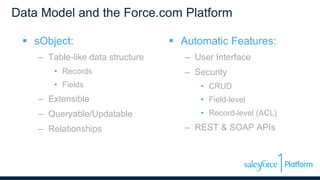
Data Model and the Force.com Platform
 sObject:
– Table-like data structure
• Records
• Fields
– Extensible
– Queryable/Updatable
– Relationships
 Automatic Features:
– User Interface
– Security
• CRUD
• Field-level
• Record-level (ACL)
– REST & SOAP APIs
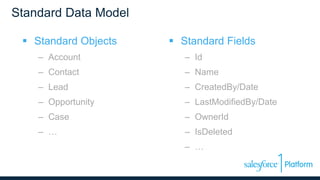
Standard Data Model
 Standard Objects
– Account
– Contact
– Lead
– Opportunity
– Case
– …
 Standard Fields
– Id
– Name
– CreatedBy/Date
– LastModifiedBy/Date
– OwnerId
– IsDeleted
– …
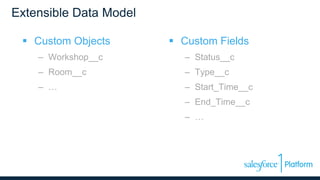
Extensible Data Model
 Custom Objects
– Workshop__c
– Room__c
– …
 Custom Fields
– Status__c
– Type__c
– Start_Time__c
– End_Time__c
– …
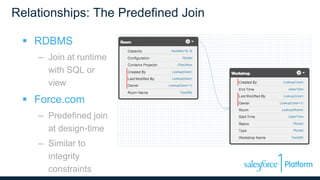
Relationships: The Predefined Join
 RDBMS
– Join at runtime
with SQL or
view
 Force.com
– Predefined join
at design-time
– Similar to
integrity
constraints
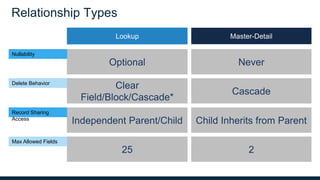
Master-DetailLookup
Relationship Types
NeverOptional
Cascade
Clear
Field/Block/Cascade*
Nullability
Delete Behavior
Child Inherits from ParentIndependent Parent/Child
225
Record Sharing
Access
Max Allowed Fields
Demo Use Case:
– Community Centre
– Workshops and Rooms
Data Model and Relationships
Relationships and SOQL
Agenda
SOQL
 Salesforce Object Query Language
 SQL-like syntax
 Queries the Force.com Object Layer
 Used in:
– Apex
– Developer Tools (Developer Console, Eclipse, Workbench, …)
– API (REST, SOAP, Bulk, …)
From SQL to SOQL
 At first may look familiar
 Important differences
 Learn the differences
 Use good data design practices
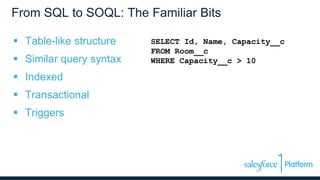
From SQL to SOQL: The Familiar Bits
 Table-like structure
 Similar query syntax
 Indexed
 Transactional
 Triggers
SELECT Id, Name, Capacity__c
FROM Room__c
WHERE Capacity__c > 10
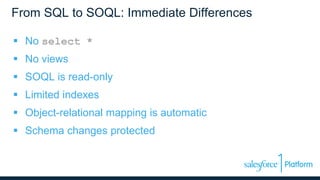
From SQL to SOQL: Immediate Differences
 No select *
 No views
 SOQL is read-only
 Limited indexes
 Object-relational mapping is automatic
 Schema changes protected
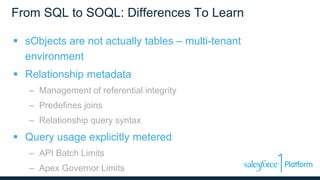
From SQL to SOQL: Differences To Learn
 sObjects are not actually tables – multi-tenant
environment
 Relationship metadata
– Management of referential integrity
– Predefines joins
– Relationship query syntax
 Query usage explicitly metered
– API Batch Limits
– Apex Governor Limits
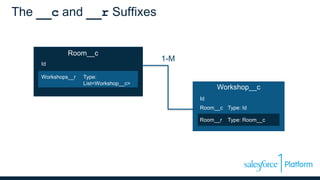
The __c and __r Suffixes
Room__c
Workshop__c
Id
Id
Room__c
Room__r
Workshops__r Type:
List<Workshop__c>
Type: Id
Type: Room__c
1-M
Relationship Query: Child to Parent
SELECT Id, Name, Room__c,
Room__r.Id,
Room__r.Capacity__c
FROM Workshop__c
WHERE Status__c = ’Open’
[
{
"Id": "a0145000000aBf4AAE",
"Name": "Yoga for Beginners",
"Room__c": "a00vn000000dU3dAAE",
"Room__r": {
"Id": "a00vn000000dU3dAAE",
"Capacity__c": 10
}
},
{
"Id": "a0145000000aBf4AAE",
"Name": "Yoga for Beginners",
"Room__c": "",
"Room__r": ""
}, ...
]
Relationship Query: Parent to Child
SELECT Id, Name,
(SELECT Id, Status__c
FROM Workshops__r)
FROM Room__c
WHERE Capacity__c > 10
[
{
"Id": "a00vn000000dU3dAAE",
"Name": "Salon 1 West",
"Workshops__r": [
{
"Id": "a0145000000aBf4AAE",
"Status__c": "Open"
},
{
"Id": "a0145000000aBd4AAE",
"Status__c": "Full"
}
]
}, ...
]
Querying for Intersection
Select Id, Name,
Room__r.Name,
Room__r.Capacity__c
FROM Workshop__c
WHERE
Room__r.Capacity__c > 8
[
{
"Id": "a0145000000aBf4AAE",
"Name": "Yoga for Beginners",
"Room__c": "a00vn000000dU3dAAE",
"Room__r": {
"Id": "a00vn000000dU3dAAE",
"Capacity__c": 10
}
},
{...},
...
]
Aggregate Queries
SELECT
COUNT(Id) rmCount,
MAX(Capacity__c) maxRmCap,
Configuration__c
FROM Room__c
GROUP BY Configuration__c
[
{
"rmCount": 4,
"maxRmCap": 6,
"Configuration__c": "Classroom"
},
{
"rmCount": 2,
"maxRmCap": 10,
"Configuration__c": "Theatre"
},
...
]
Demo Use Case:
– Find a tally of empty spaces
being held for workshops that
are not actively enrolling
delegates
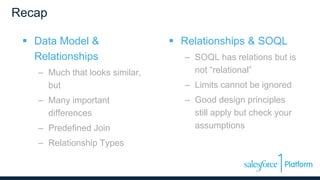
Recap
 Data Model &
Relationships
– Much that looks similar,
but
– Many important
differences
– Predefined Join
– Relationship Types
 Relationships & SOQL
– SOQL has relations but is
not “relational”
– Limits cannot be ignored
– Good design principles
still apply but check your
assumptions
Read More
 Article: From SQL to SOQL http://bit.ly/sql2soql
 SOQL-SOSL Guide http://bit.ly/soqlsosl
 Sharing http://bit.ly/sharingarch
 Limits http://bit.ly/apexgovlim
 Multi-Tenant Architecture http://bit.ly/sfmultiten
Next Webinar:
May 15: Intro to building Mobile Apps with
Salesforce1 Platform – No code required

Salesforce1 Platform: Data Model, Relationships and Queries Webinar

  • 1.
  • 2.
  • 3.
    Safe Harbor Safe harborstatement under the Private Securities Litigation Reform Act of 1995: This presentation may contain forward-looking statements that involve risks, uncertainties, and assumptions. If any such uncertainties materialize or if any of the assumptions proves incorrect, the results of salesforce.com, inc. could differ materially from the results expressed or implied by the forward-looking statements we make. All statements other than statements of historical fact could be deemed forward-looking, including any projections of product or service availability, subscriber growth, earnings, revenues, or other financial items and any statements regarding strategies or plans of management for future operations, statements of belief, any statements concerning new, planned, or upgraded services or technology developments and customer contracts or use of our services. The risks and uncertainties referred to above include – but are not limited to – risks associated with developing and delivering new functionality for our service, new products and services, our new business model, our past operating losses, possible fluctuations in our operating results and rate of growth, interruptions or delays in our Web hosting, breach of our security measures, the outcome of any litigation, risks associated with completed and any possible mergers and acquisitions, the immature market in which we operate, our relatively limited operating history, our ability to expand, retain, and motivate our employees and manage our growth, new releases of our service and successful customer deployment, our limited history reselling non-salesforce.com products, and utilization and selling to larger enterprise customers. Further information on potential factors that could affect the financial results of salesforce.com, inc. is included in our annual report on Form 10-K for the most recent fiscal year and in our quarterly report on Form 10-Q for the most recent fiscal quarter. These documents and others containing important disclosures are available on the SEC Filings section of the Investor Information section of our Web site. Any unreleased services or features referenced in this or other presentations, press releases or public statements are not currently available and may not be delivered on time or at all. Customers who purchase our services should make the purchase decisions based upon features that are currently available. Salesforce.com, inc. assumes no obligation and does not intend to update these forward- looking statements.
  • 4.
    Agenda Data Model &Relationships Comparing Force.com with Relational DBMS Relationship Types & the Predefined Join Relationships & SOQL SOQL vs SQL Relationship Queries
  • 5.
    Assumptions  A basicunderstanding of the Force.com Platform including: – Creating Custom Objects – Adding Custom Fields – Navigating the UI  Knowledge of relational database concepts – Tables – Primary/Foreign Keys – Joins
  • 6.
    Data Model andRelationships Relationships and SOQL Agenda
  • 7.
    Data Model andthe Force.com Platform  sObject: – Table-like data structure • Records • Fields – Extensible – Queryable/Updatable – Relationships  Automatic Features: – User Interface – Security • CRUD • Field-level • Record-level (ACL) – REST & SOAP APIs
  • 8.
    Standard Data Model Standard Objects – Account – Contact – Lead – Opportunity – Case – …  Standard Fields – Id – Name – CreatedBy/Date – LastModifiedBy/Date – OwnerId – IsDeleted – …
  • 9.
    Extensible Data Model Custom Objects – Workshop__c – Room__c – …  Custom Fields – Status__c – Type__c – Start_Time__c – End_Time__c – …
  • 10.
    Relationships: The PredefinedJoin  RDBMS – Join at runtime with SQL or view  Force.com – Predefined join at design-time – Similar to integrity constraints
  • 11.
    Master-DetailLookup Relationship Types NeverOptional Cascade Clear Field/Block/Cascade* Nullability Delete Behavior ChildInherits from ParentIndependent Parent/Child 225 Record Sharing Access Max Allowed Fields
  • 12.
    Demo Use Case: –Community Centre – Workshops and Rooms
  • 13.
    Data Model andRelationships Relationships and SOQL Agenda
  • 14.
    SOQL  Salesforce ObjectQuery Language  SQL-like syntax  Queries the Force.com Object Layer  Used in: – Apex – Developer Tools (Developer Console, Eclipse, Workbench, …) – API (REST, SOAP, Bulk, …)
  • 15.
    From SQL toSOQL  At first may look familiar  Important differences  Learn the differences  Use good data design practices
  • 16.
    From SQL toSOQL: The Familiar Bits  Table-like structure  Similar query syntax  Indexed  Transactional  Triggers SELECT Id, Name, Capacity__c FROM Room__c WHERE Capacity__c > 10
  • 17.
    From SQL toSOQL: Immediate Differences  No select *  No views  SOQL is read-only  Limited indexes  Object-relational mapping is automatic  Schema changes protected
  • 18.
    From SQL toSOQL: Differences To Learn  sObjects are not actually tables – multi-tenant environment  Relationship metadata – Management of referential integrity – Predefines joins – Relationship query syntax  Query usage explicitly metered – API Batch Limits – Apex Governor Limits
  • 19.
    The __c and__r Suffixes Room__c Workshop__c Id Id Room__c Room__r Workshops__r Type: List<Workshop__c> Type: Id Type: Room__c 1-M
  • 20.
    Relationship Query: Childto Parent SELECT Id, Name, Room__c, Room__r.Id, Room__r.Capacity__c FROM Workshop__c WHERE Status__c = ’Open’ [ { "Id": "a0145000000aBf4AAE", "Name": "Yoga for Beginners", "Room__c": "a00vn000000dU3dAAE", "Room__r": { "Id": "a00vn000000dU3dAAE", "Capacity__c": 10 } }, { "Id": "a0145000000aBf4AAE", "Name": "Yoga for Beginners", "Room__c": "", "Room__r": "" }, ... ]
  • 21.
    Relationship Query: Parentto Child SELECT Id, Name, (SELECT Id, Status__c FROM Workshops__r) FROM Room__c WHERE Capacity__c > 10 [ { "Id": "a00vn000000dU3dAAE", "Name": "Salon 1 West", "Workshops__r": [ { "Id": "a0145000000aBf4AAE", "Status__c": "Open" }, { "Id": "a0145000000aBd4AAE", "Status__c": "Full" } ] }, ... ]
  • 22.
    Querying for Intersection SelectId, Name, Room__r.Name, Room__r.Capacity__c FROM Workshop__c WHERE Room__r.Capacity__c > 8 [ { "Id": "a0145000000aBf4AAE", "Name": "Yoga for Beginners", "Room__c": "a00vn000000dU3dAAE", "Room__r": { "Id": "a00vn000000dU3dAAE", "Capacity__c": 10 } }, {...}, ... ]
  • 23.
    Aggregate Queries SELECT COUNT(Id) rmCount, MAX(Capacity__c)maxRmCap, Configuration__c FROM Room__c GROUP BY Configuration__c [ { "rmCount": 4, "maxRmCap": 6, "Configuration__c": "Classroom" }, { "rmCount": 2, "maxRmCap": 10, "Configuration__c": "Theatre" }, ... ]
  • 24.
    Demo Use Case: –Find a tally of empty spaces being held for workshops that are not actively enrolling delegates
  • 25.
    Recap  Data Model& Relationships – Much that looks similar, but – Many important differences – Predefined Join – Relationship Types  Relationships & SOQL – SOQL has relations but is not “relational” – Limits cannot be ignored – Good design principles still apply but check your assumptions
  • 26.
    Read More  Article:From SQL to SOQL http://bit.ly/sql2soql  SOQL-SOSL Guide http://bit.ly/soqlsosl  Sharing http://bit.ly/sharingarch  Limits http://bit.ly/apexgovlim  Multi-Tenant Architecture http://bit.ly/sfmultiten
  • 27.
    Next Webinar: May 15:Intro to building Mobile Apps with Salesforce1 Platform – No code required