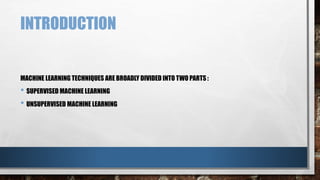
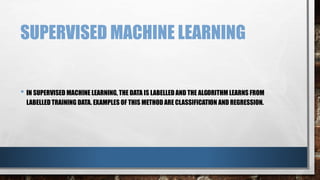
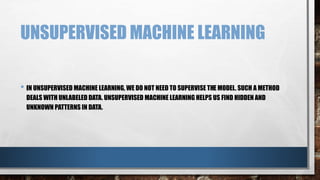
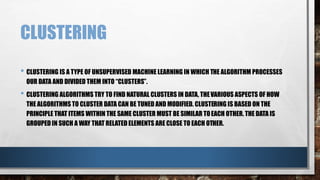
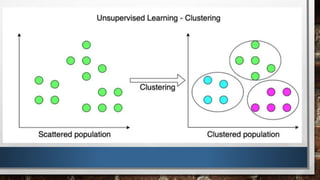
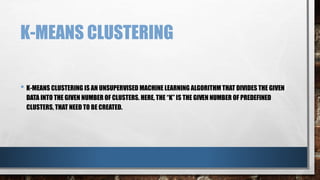
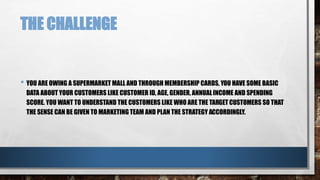
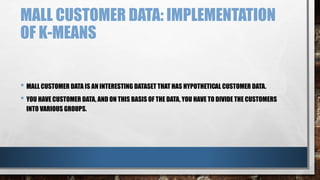
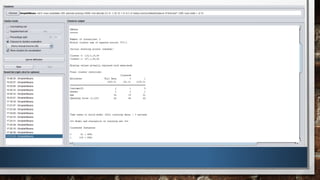
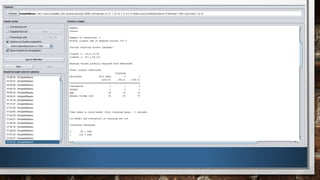
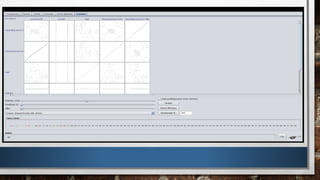
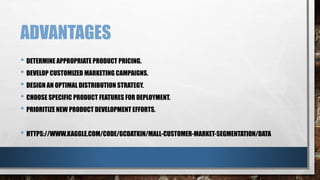
This document discusses supervised and unsupervised machine learning techniques. Supervised learning uses labeled training data to learn classifications and regressions, while unsupervised learning finds hidden patterns in unlabeled data through techniques like clustering. It provides k-means clustering as an example of unsupervised learning, where the algorithm divides data into a predefined number of clusters based on similarity. The document proposes using k-means clustering on customer data from a supermarket mall to segment customers into groups to help with marketing strategy.


![Chapter#04[Part#01]K-Means Clusterig.pdf](https://cdn.slidesharecdn.com/ss_thumbnails/chapter04part01k-meansclusterig-250525201708-2d369307-thumbnail.jpg?width=640&height=640&fit=bounds)


![Clustering[306] [Read-Only].pdf](https://cdn.slidesharecdn.com/ss_thumbnails/clustering306read-only-230112103535-3fb144db-thumbnail.jpg?width=640&height=640&fit=bounds)


![[DSC Europe 25] Ivan Lukovic & Marija Djukic - From Data to Value: Why Maturi...](https://cdn.slidesharecdn.com/ss_thumbnails/ahrfps8xr6knowwhacxh-1-ivan-marija-dsc-2025-ld-v1-presentation-260115093812-be21adfc-thumbnail.jpg?width=640&height=640&fit=bounds)


![[DSC Europe 25] Bojan Djuricic - Predictive Design Process.pdf](https://cdn.slidesharecdn.com/ss_thumbnails/5awdrbedqdek3gqu2ezy-4-the-predictive-design-bojan-djuricic-260120105856-6c399e9b-thumbnail.jpg?width=640&height=640&fit=bounds)
