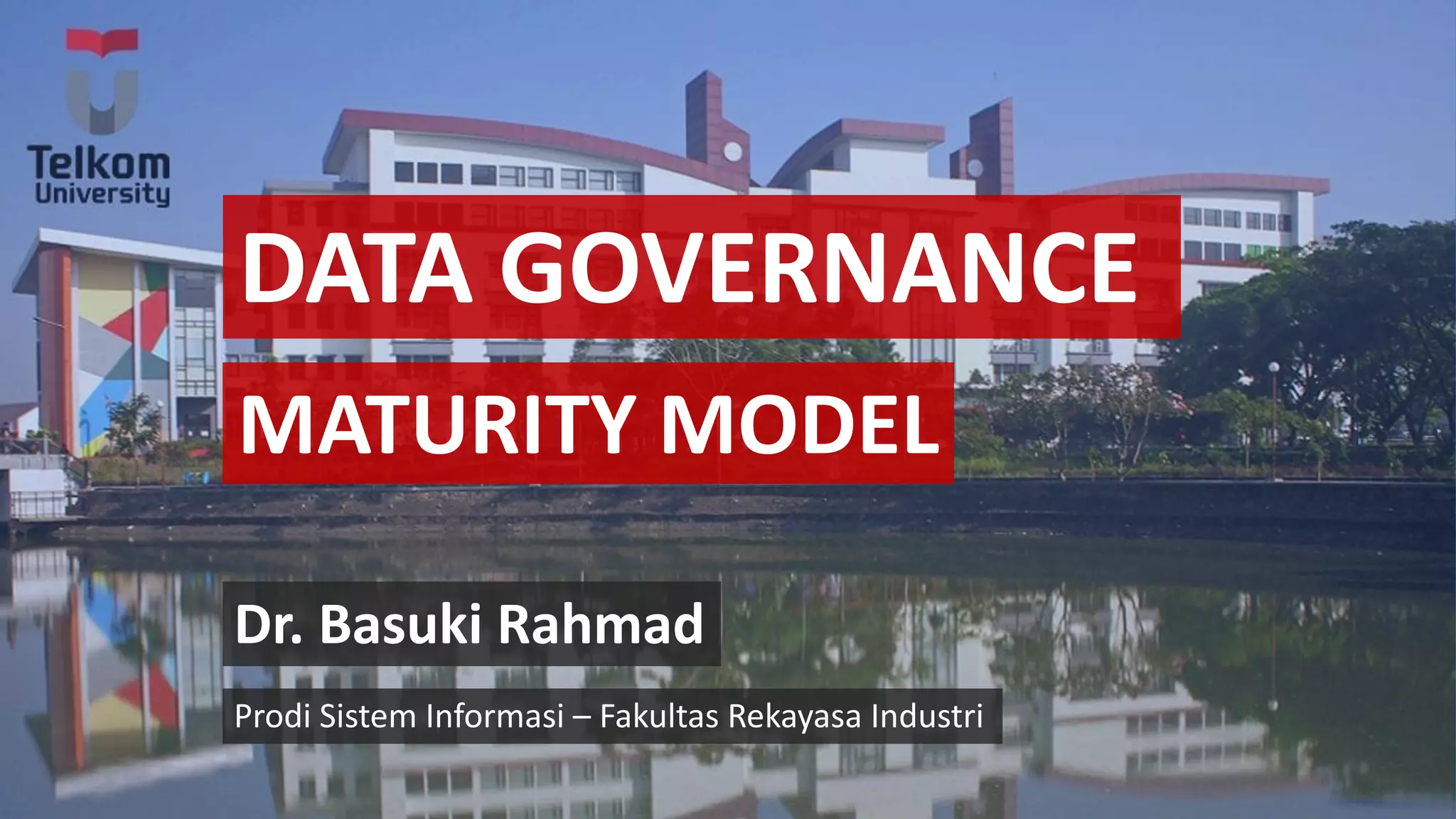
DATA GOVERNANCE
MATURITY MODEL
Dr. Basuki Rahmad
Prodi Sistem Informasi – Fakultas Rekayasa Industri
Profil Singkat
Basuki Rahmad - Data Governance Maturity Model 2
• Pendidikan
• S1 Teknik Elektro ITB (1995-2000)
• S2 Teknik & Sistem Komputer ITB (2001-2004)
• S3 Teknik Elektro ITB (2005-2010)
• Sertifikasi
• CISA (Certified Information System Auditor)
• CISM (Certified Information Security Manager)
• CRISC (Certified in Risk and Information System Control)
• COBIT 5 Implementor
• TOGAF Practitioner dari Open Group
• Big Data Analyst dari TUV Rheinland
• ITIL Foundation
• CSX Foundation
• CITA Foundation (Certified IT Architect IASA)
• Fokus riset/kegiatan profesional:
• Enterprise/IT Architecting
• IT Governance, Risk & Compliance
• IT Security
• Business/Computer Fraud
• Big Data Analytic
• Supply Chain Management
q Aktifitas akademik
– Dosen Profesional &peneliti di Telkom Univ. (2012 – sekarang)
– Dosen Pascasarjana di Unikom (2011-2013)
– Dosen Pascasarjana di UNPAD (2004)
– Peneliti di ITB (2004-2011)
q Pengalaman Profesional
– Tranforma Consulting – Direktur Utama
– PT. Rofasys Mitra Prima – Komisaris
– PT. Fimar Berdaya Sinergitama – Komisaris
– Advisor direksi dan manajemen senior sebagai professional
hire: PT. WIKA (2015 – sekarang), Perum Jamkrindo (2014-
2015), PT. Pelindo I (2012-2013), BPJS Ketenagakerjaan (2018-
2019)
– Worldbank Consultant – Transformasi TI di beberapa
Kementerian dan Lembaga Pemerintah (2017-2018)
q Asosiasi Profesional
– IEEE
– AIS (Association of Information System)
– ISACA (IS Audit & Control Association)
– ACFE (Assocation of Certified Fraud Examiner)
Outline
1. Data Governance Overview
a. What is Data Governance?
b. Data Governance vs IT Governance
c. Data Governance Components
2. Data Governance Maturity Model
a. Existing Models
b. CMM Data Governance Maturity Model
i. Lingkup
ii. Cara penggunaan
3. Peluang riset terkait
Basuki Rahmad - Data Governance Maturity Model 3
DATA GOVERNANCE OVERVIEW
Basuki Rahmad - Data Governance Maturity Model 4
Why Data Governance?
Basuki Rahmad - Data Governance Maturity Model 5
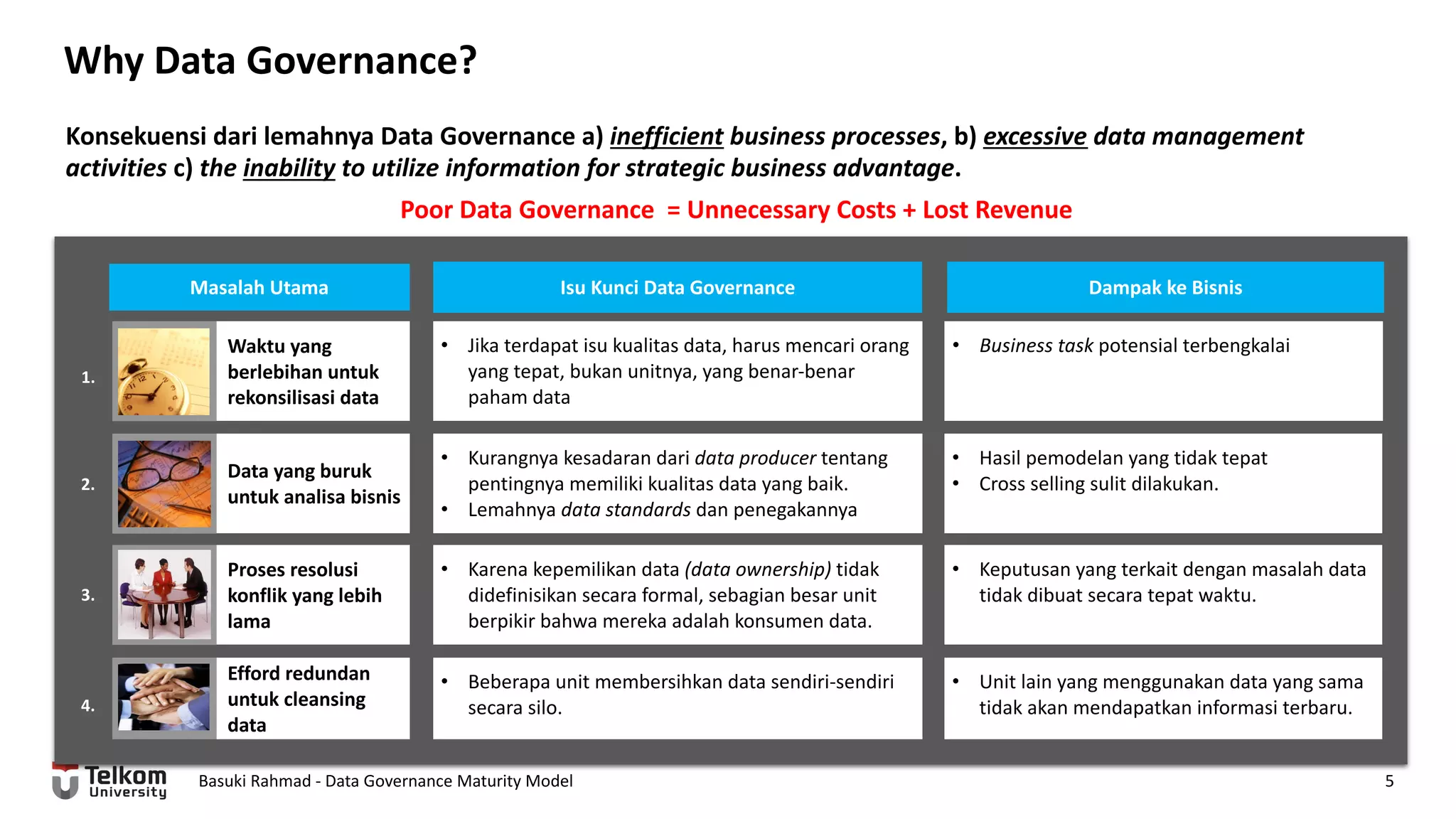
Konsekuensi dari lemahnya Data Governance a) inefficient business processes, b) excessive data management
activities c) the inability to utilize information for strategic business advantage.
Poor Data Governance = Unnecessary Costs + Lost Revenue
Waktu yang
berlebihan untuk
rekonsilisasi data
1.
Isu Kunci Data Governance Dampak ke Bisnis
• Jika terdapat isu kualitas data, harus mencari orang
yang tepat, bukan unitnya, yang benar-benar
paham data
• Business task potensial terbengkalai
2.
• Hasil pemodelan yang tidak tepat
• Cross selling sulit dilakukan.
3.
• Keputusan yang terkait dengan masalah data
tidak dibuat secara tepat waktu.
Masalah Utama
4.
• Unit lain yang menggunakan data yang sama
tidak akan mendapatkan informasi terbaru.
• Kurangnya kesadaran dari data producer tentang
pentingnya memiliki kualitas data yang baik.
• Lemahnya data standards dan penegakannya
• Karena kepemilikan data (data ownership) tidak
didefinisikan secara formal, sebagian besar unit
berpikir bahwa mereka adalah konsumen data.
• Beberapa unit membersihkan data sendiri-sendiri
secara silo.
Data yang buruk
untuk analisa bisnis
Proses resolusi
konflik yang lebih
lama
Efford redundan
untuk cleansing
data
IT Governance vs Data Governance
Basuki Rahmad - Data Governance Maturity Model 6
• IT
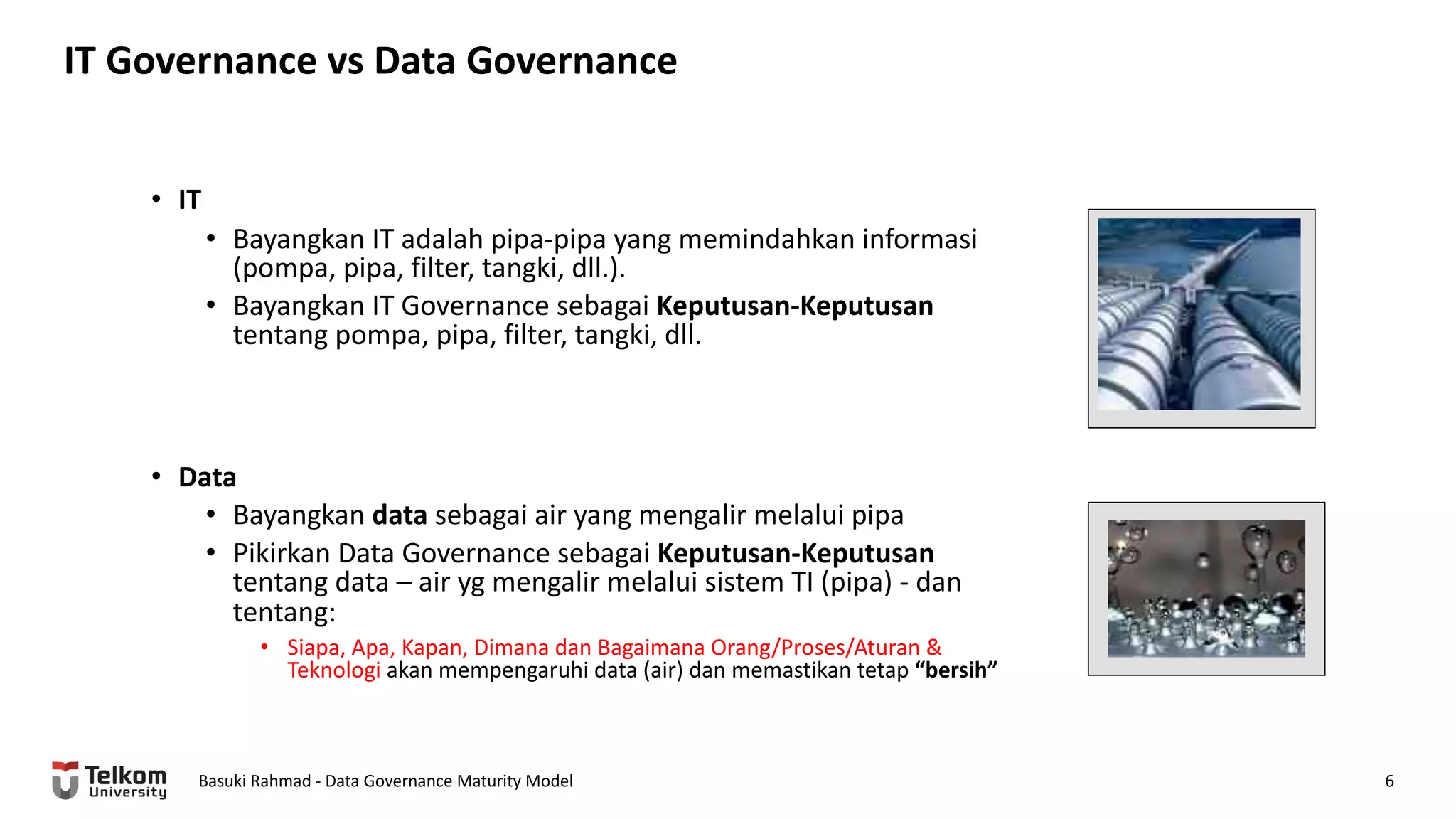
• Bayangkan IT adalah pipa-pipa yang memindahkan informasi
(pompa, pipa, filter, tangki, dll.).
• Bayangkan IT Governance sebagai Keputusan-Keputusan
tentang pompa, pipa, filter, tangki, dll.
• Data
• Bayangkan data sebagai air yang mengalir melalui pipa
• Pikirkan Data Governance sebagai Keputusan-Keputusan
tentang data – air yg mengalir melalui sistem TI (pipa) - dan
tentang:
• Siapa, Apa, Kapan, Dimana dan Bagaimana Orang/Proses/Aturan &
Teknologi akan mempengaruhi data (air) dan memastikan tetap “bersih”
What is Data Governance
Basuki Rahmad - Data Governance Maturity Model 7
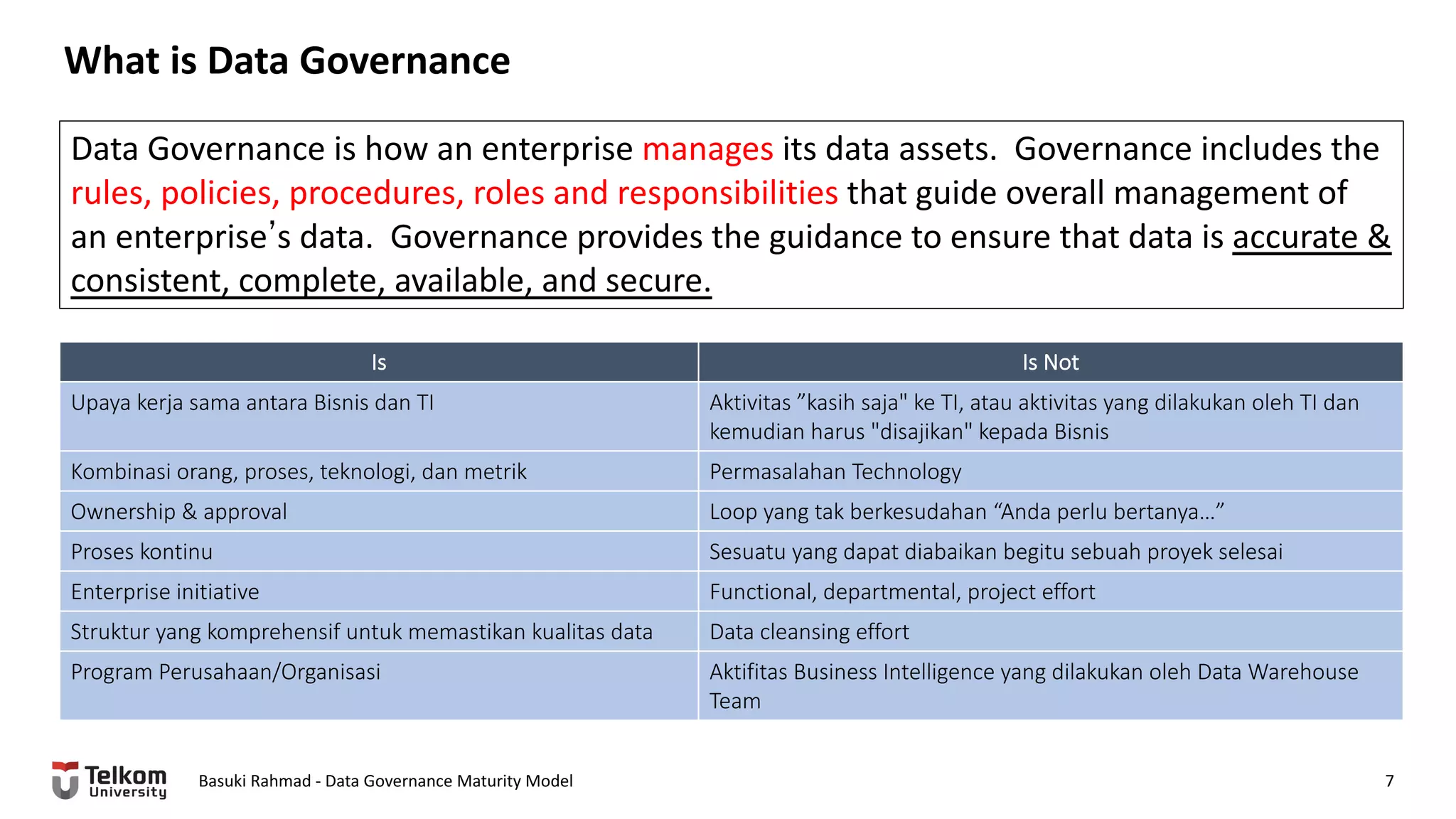
Data Governance is how an enterprise manages its data assets. Governance includes the
rules, policies, procedures, roles and responsibilities that guide overall management of
an enterpriseʼs data. Governance provides the guidance to ensure that data is accurate &
consistent, complete, available, and secure.
Is Is Not
Upaya kerja sama antara Bisnis dan TI Aktivitas ”kasih saja" ke TI, atau aktivitas yang dilakukan oleh TI dan
kemudian harus "disajikan" kepada Bisnis
Kombinasi orang, proses, teknologi, dan metrik Permasalahan Technology
Ownership & approval Loop yang tak berkesudahan “Anda perlu bertanya…”
Proses kontinu Sesuatu yang dapat diabaikan begitu sebuah proyek selesai
Enterprise initiative Functional, departmental, project effort
Struktur yang komprehensif untuk memastikan kualitas data Data cleansing effort
Program Perusahaan/Organisasi Aktifitas Business Intelligence yang dilakukan oleh Data Warehouse
Team
Kapabilitas Data Governance dalam Data Management
Basuki Rahmad - Data Governance Maturity Model 8
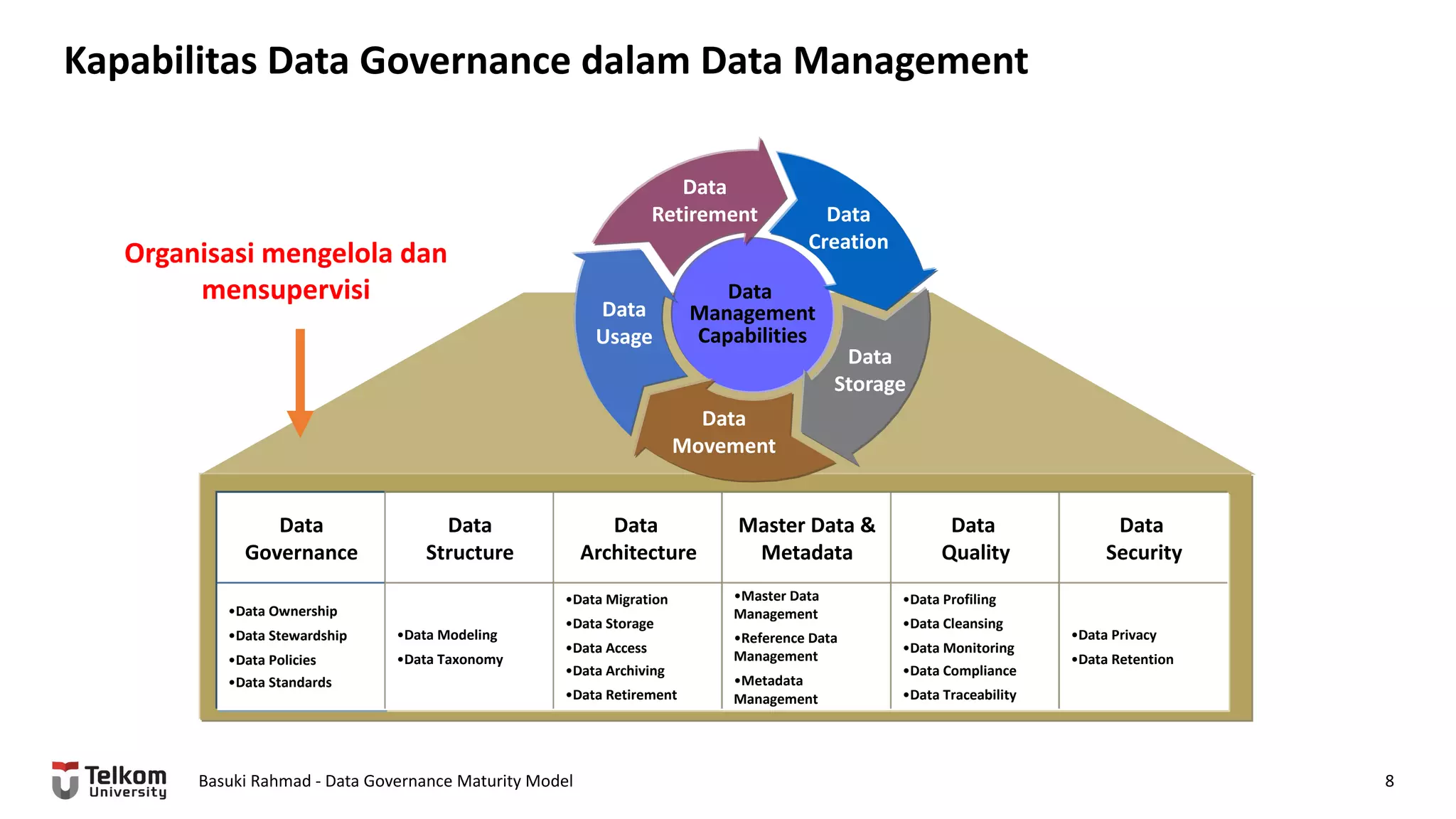
Data
Governance
Data
Structure
Data
Architecture
Master Data &
Metadata
Data
Quality
Data
Security
Data
Management
Capabilities
Data
Creation
Data
Storage
Data
Movement
Data
Usage
Data
Retirement
•Data Ownership
•Data Stewardship
•Data Policies
•Data Standards
•Data Modeling
•Data Taxonomy
•Data Migration
•Data Storage
•Data Access
•Data Archiving
•Data Retirement
•Master Data
Management
•Reference Data
Management
•Metadata
Management
•Data Profiling
•Data Cleansing
•Data Monitoring
•Data Compliance
•Data Traceability
•Data Privacy
•Data Retention
Organisasi mengelola dan
mensupervisi
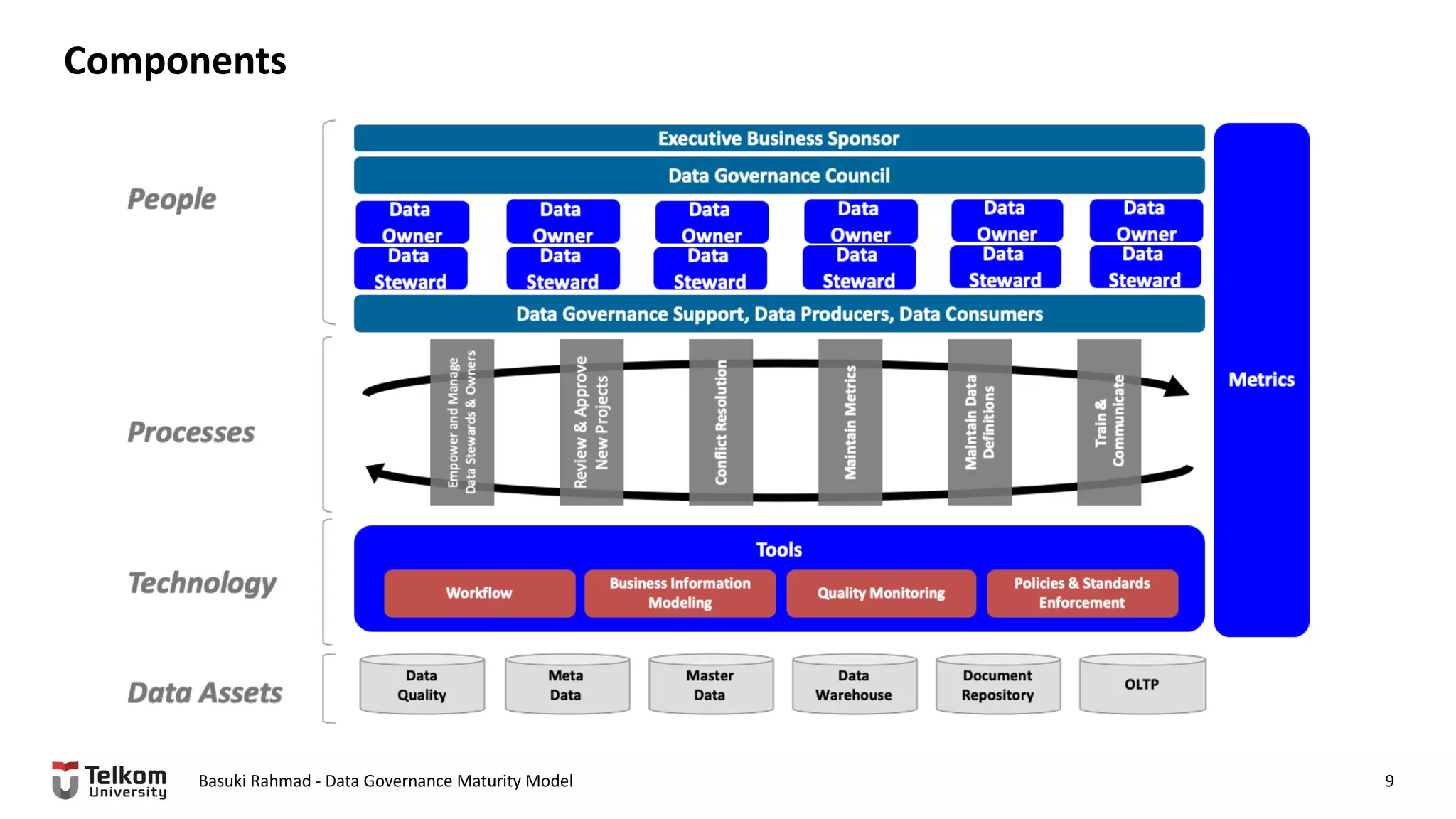
Components
Basuki Rahmad - Data Governance Maturity Model 9
DATA GOVERNANCE MATURITI MODEL
Basuki Rahmad - Data Governance Maturity Model 10
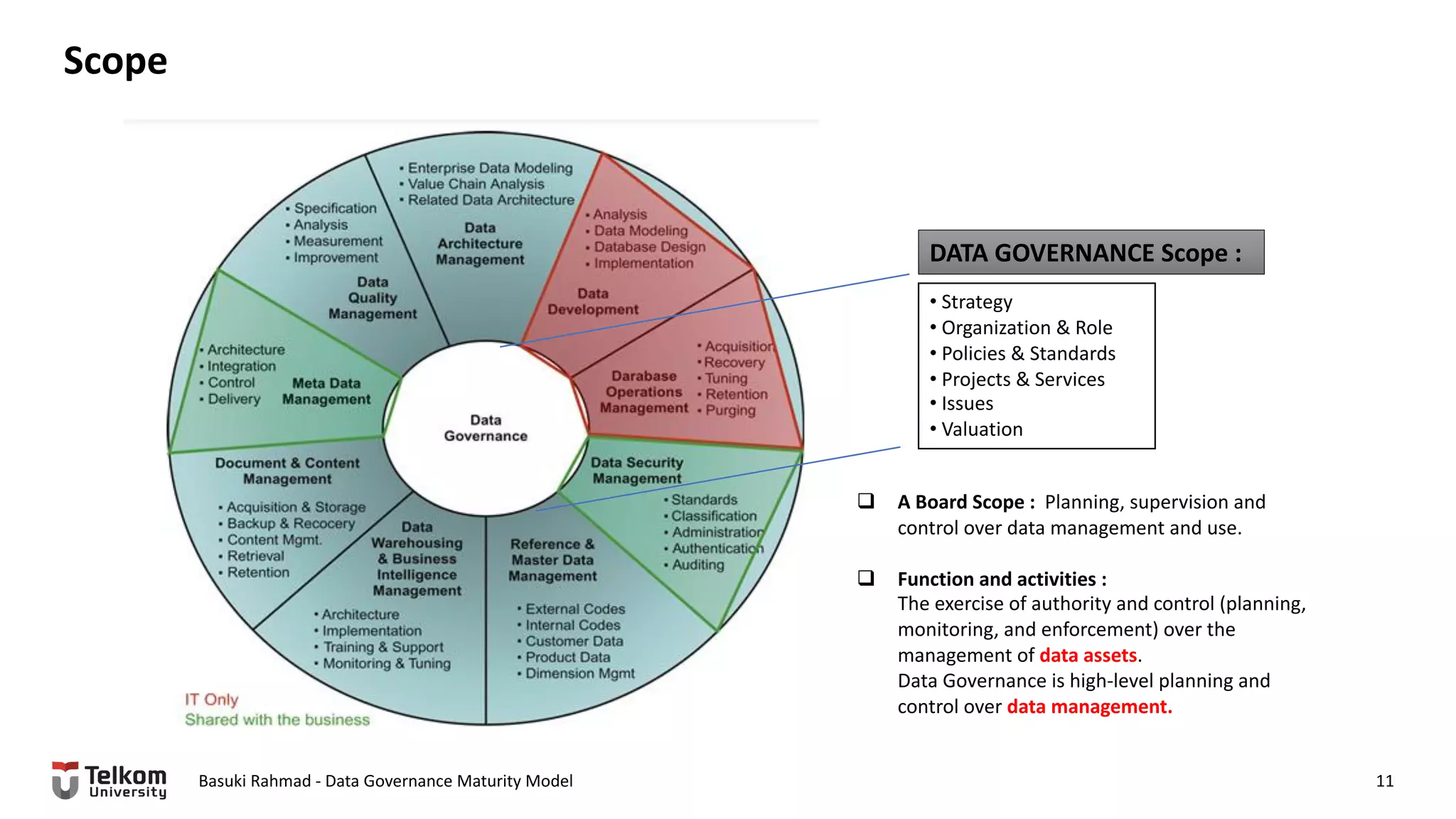
Scope
Basuki Rahmad - Data Governance Maturity Model 11
• Strategy
• Organization & Role
• Policies & Standards
• Projects & Services
• Issues
• Valuation
DATA GOVERNANCE Scope :
q A Board Scope : Planning, supervision and
control over data management and use.
q Function and activities :
The exercise of authority and control (planning,
monitoring, and enforcement) over the
management of data assets.
Data Governance is high-level planning and
control over data management.
Basuki Rahmad - Data Governance Maturity Model 12
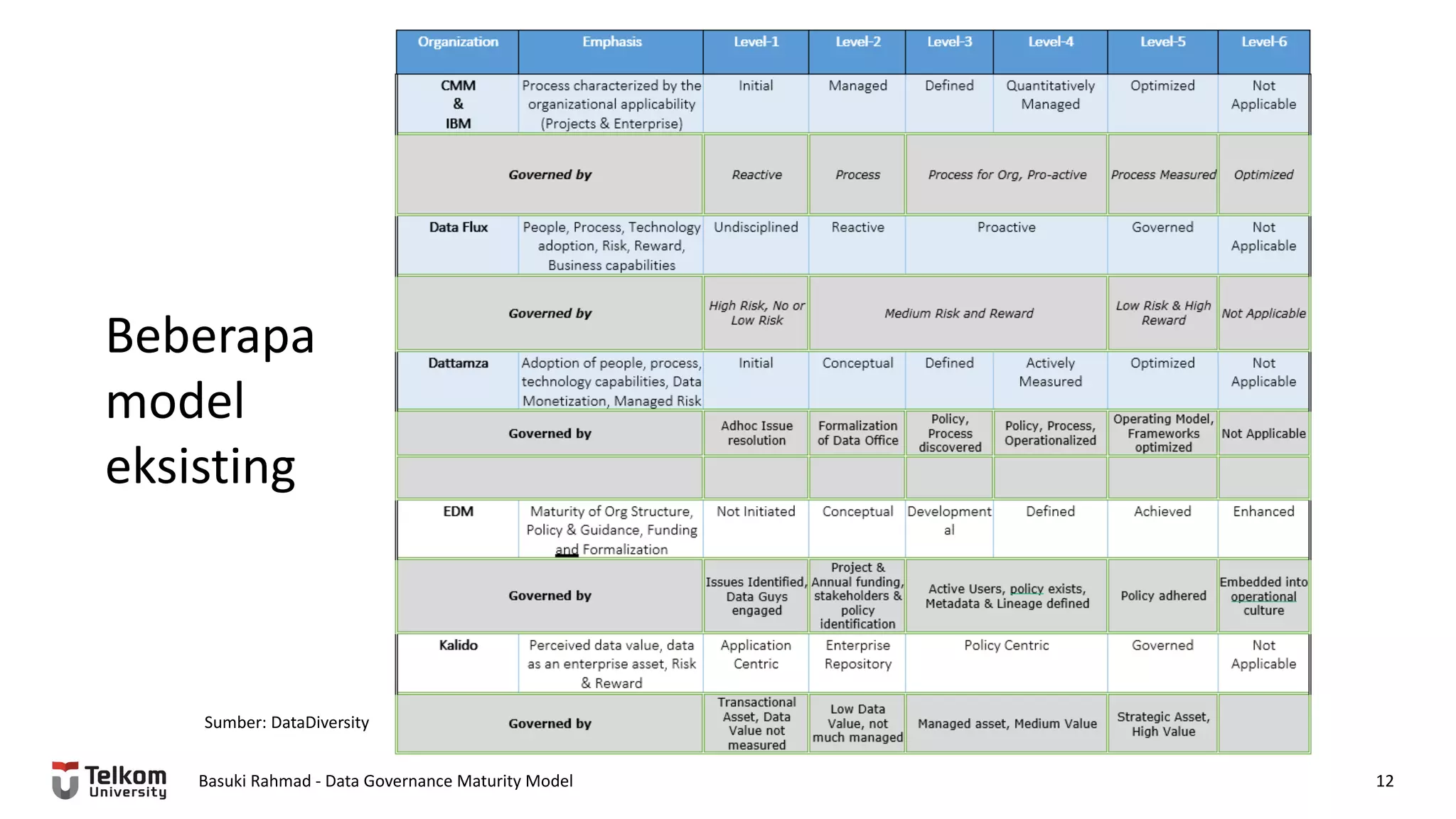
Beberapa
model
eksisting
Sumber: DataDiversity
Basuki Rahmad - Data Governance Maturity Model 13
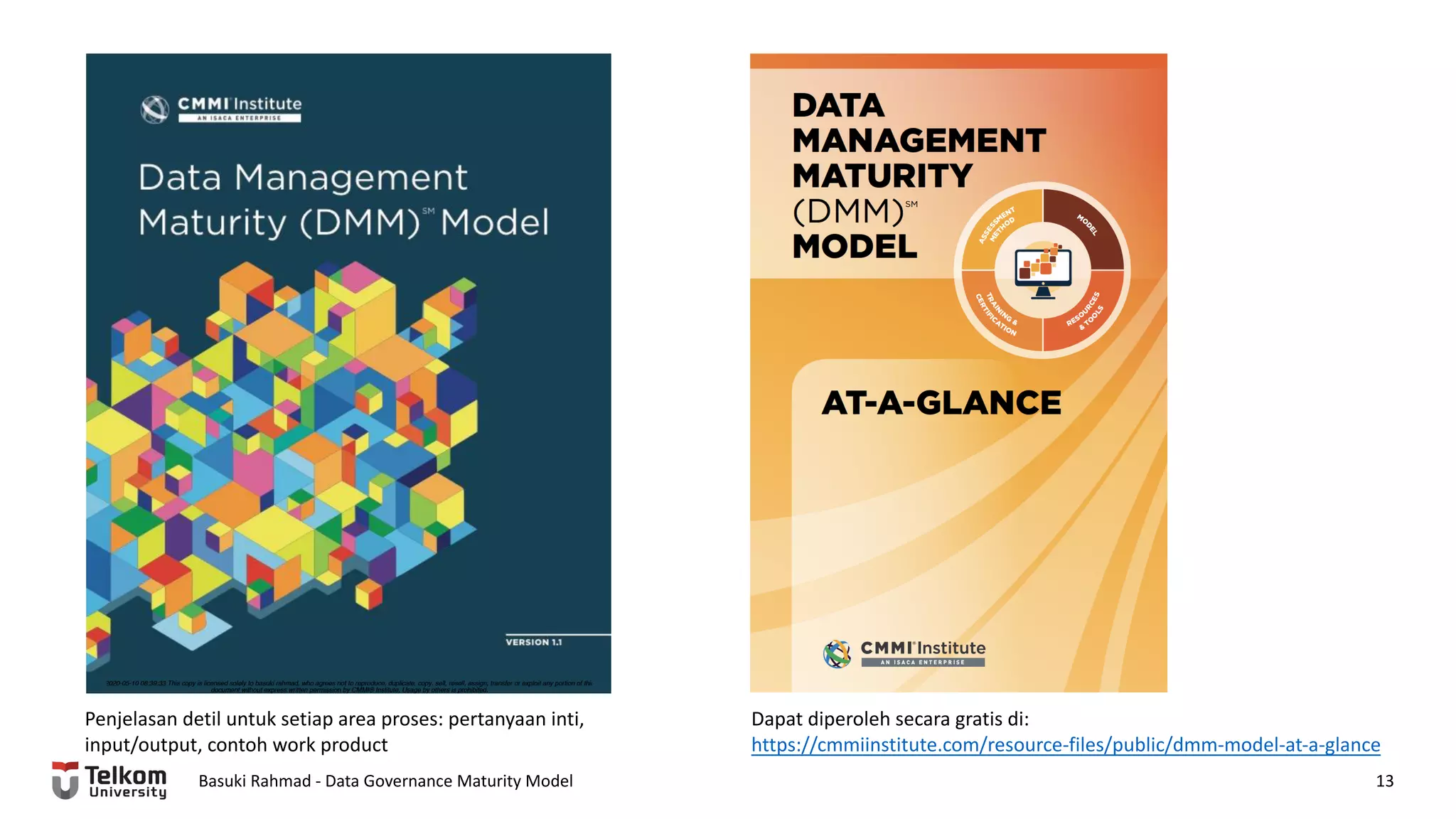
Dapat diperoleh secara gratis di:
https://cmmiinstitute.com/resource-files/public/dmm-model-at-a-glance
Penjelasan detil untuk setiap area proses: pertanyaan inti,
input/output, contoh work product
Basuki Rahmad - Data Governance Maturity Model 14
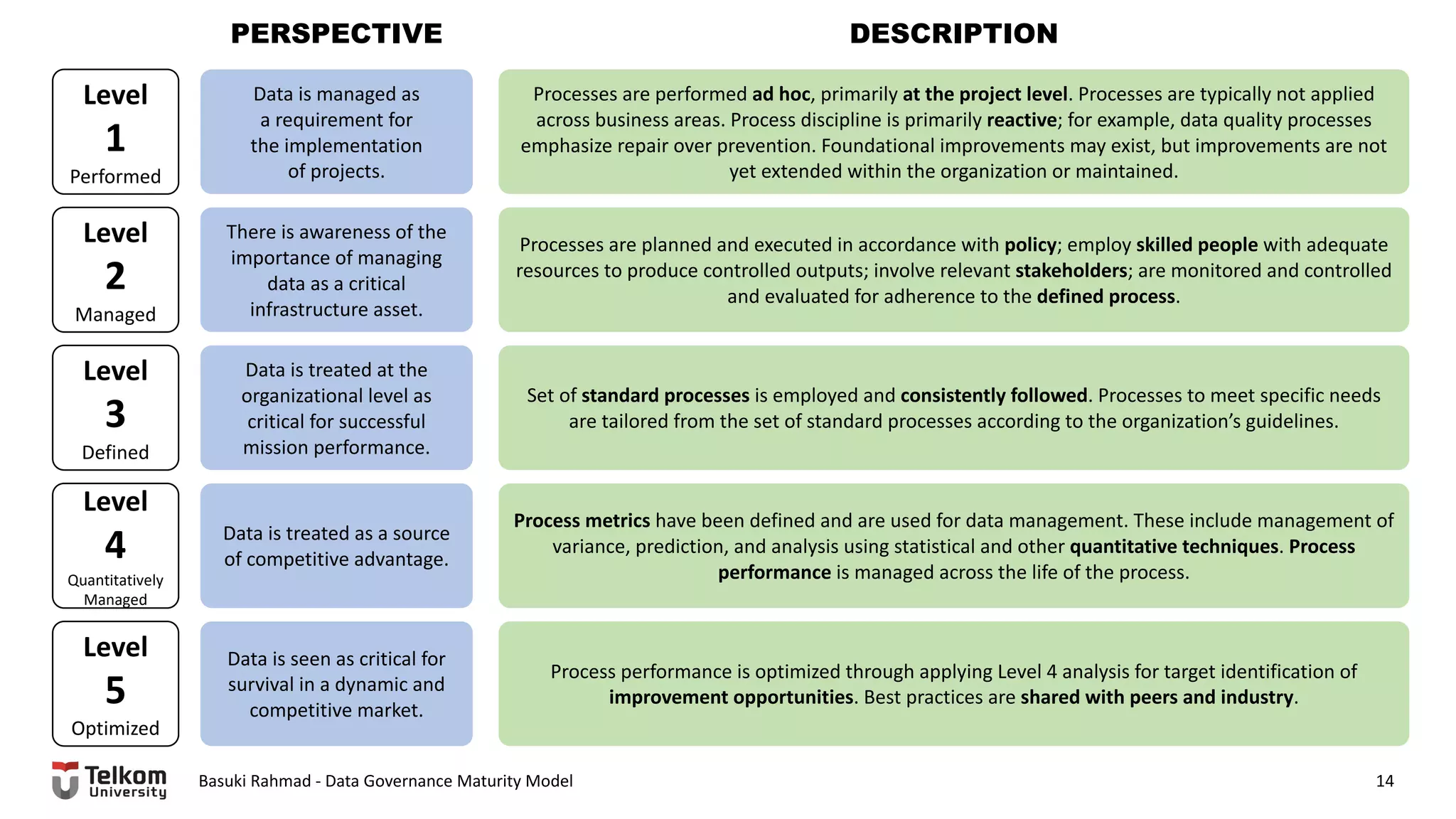
Data is managed as
a requirement for
the implementation
of projects.
Processes are performed ad hoc, primarily at the project level. Processes are typically not applied
across business areas. Process discipline is primarily reactive; for example, data quality processes
emphasize repair over prevention. Foundational improvements may exist, but improvements are not
yet extended within the organization or maintained.
Level
1
Performed
There is awareness of the
importance of managing
data as a critical
infrastructure asset.
Processes are planned and executed in accordance with policy; employ skilled people with adequate
resources to produce controlled outputs; involve relevant stakeholders; are monitored and controlled
and evaluated for adherence to the defined process.
Level
2
Managed
Data is treated at the
organizational level as
critical for successful
mission performance.
Set of standard processes is employed and consistently followed. Processes to meet specific needs
are tailored from the set of standard processes according to the organization’s guidelines.
Level
3
Defined
Data is treated as a source
of competitive advantage.
Process metrics have been defined and are used for data management. These include management of
variance, prediction, and analysis using statistical and other quantitative techniques. Process
performance is managed across the life of the process.
Level
4
Quantitatively
Managed
Data is seen as critical for
survival in a dynamic and
competitive market.
Process performance is optimized through applying Level 4 analysis for target identification of
improvement opportunities. Best practices are shared with peers and industry.
Level
5
Optimized
PERSPECTIVE DESCRIPTION
Basuki Rahmad - Data Governance Maturity Model 15
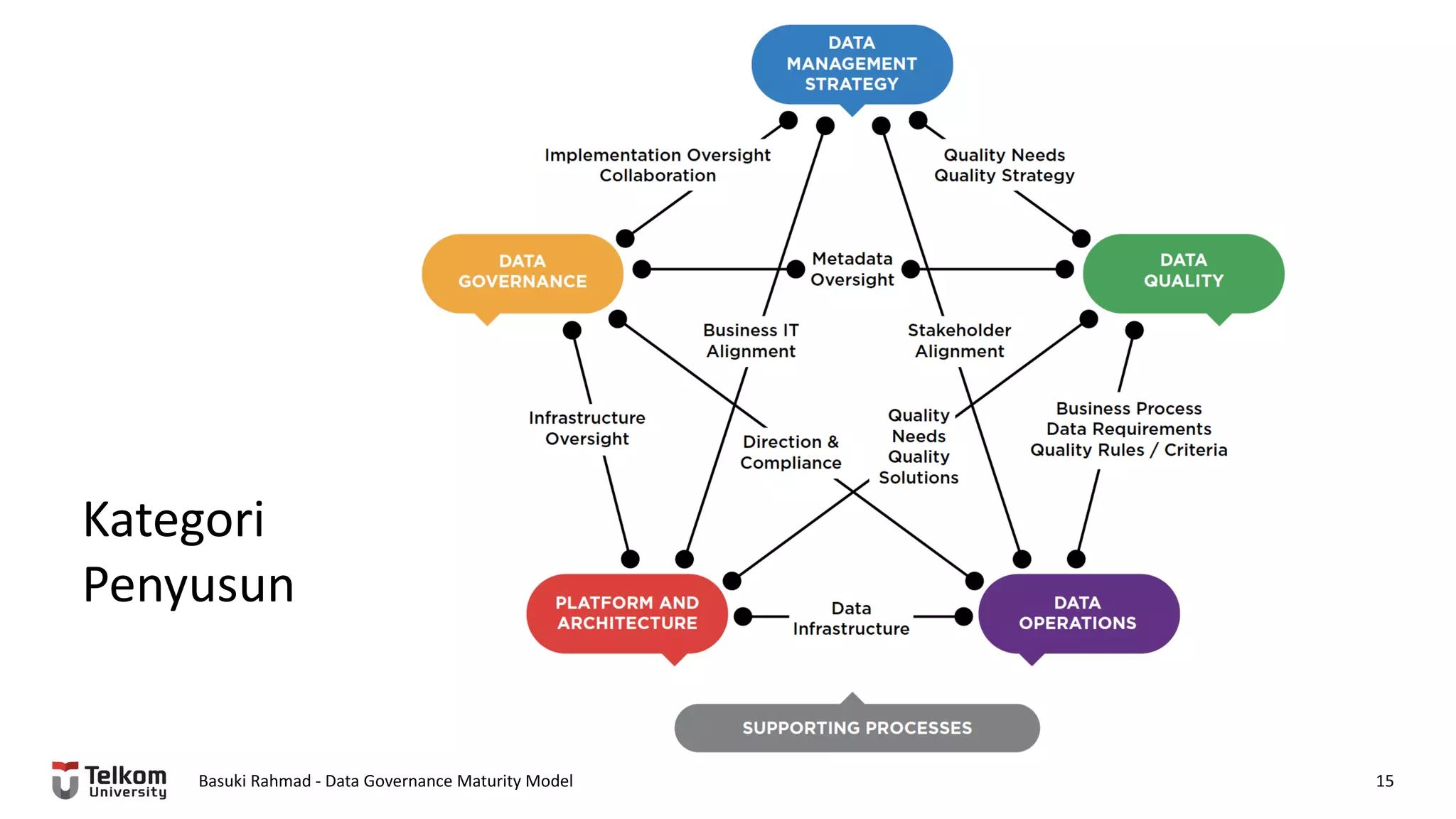
Kategori
Penyusun
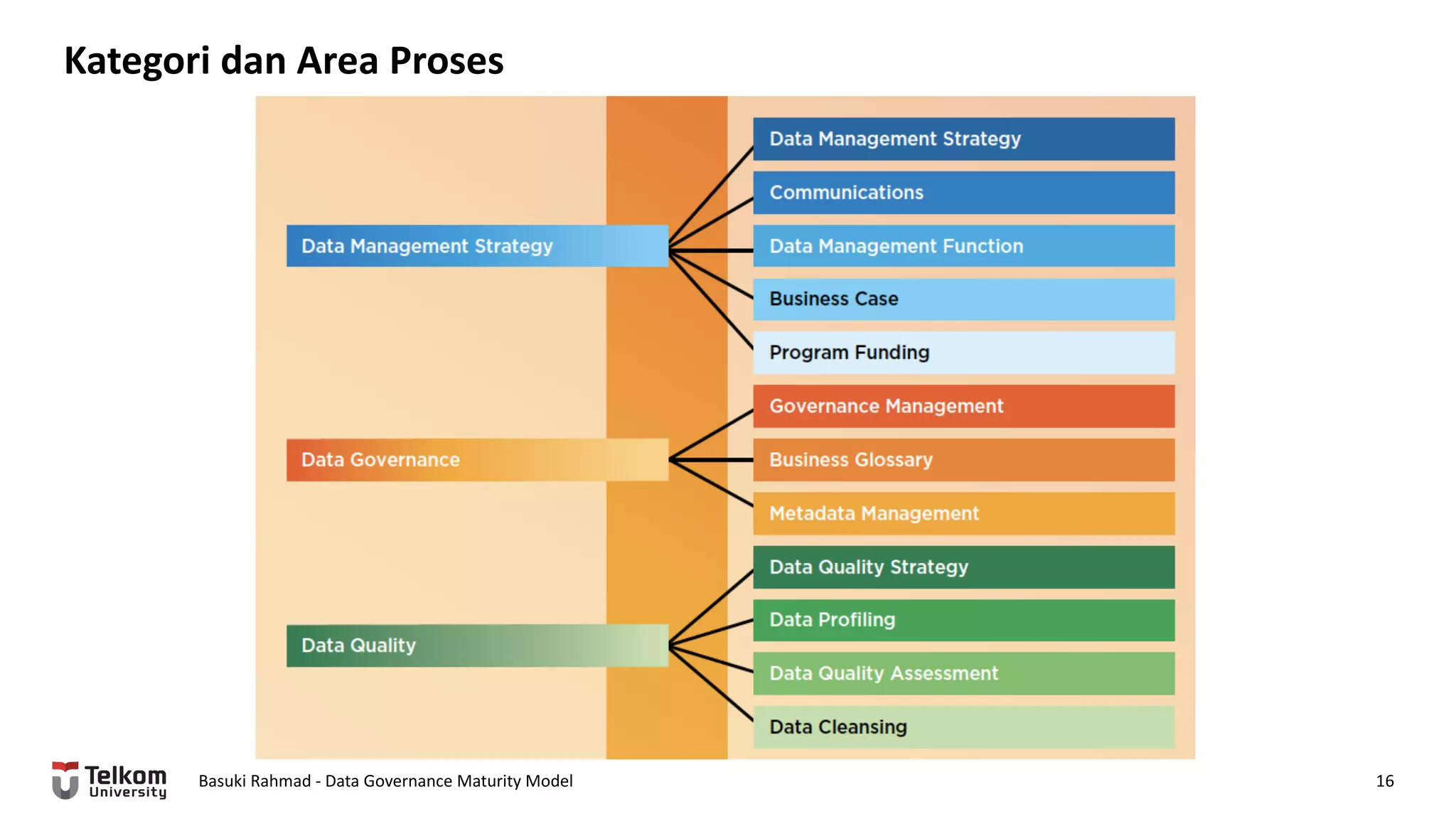
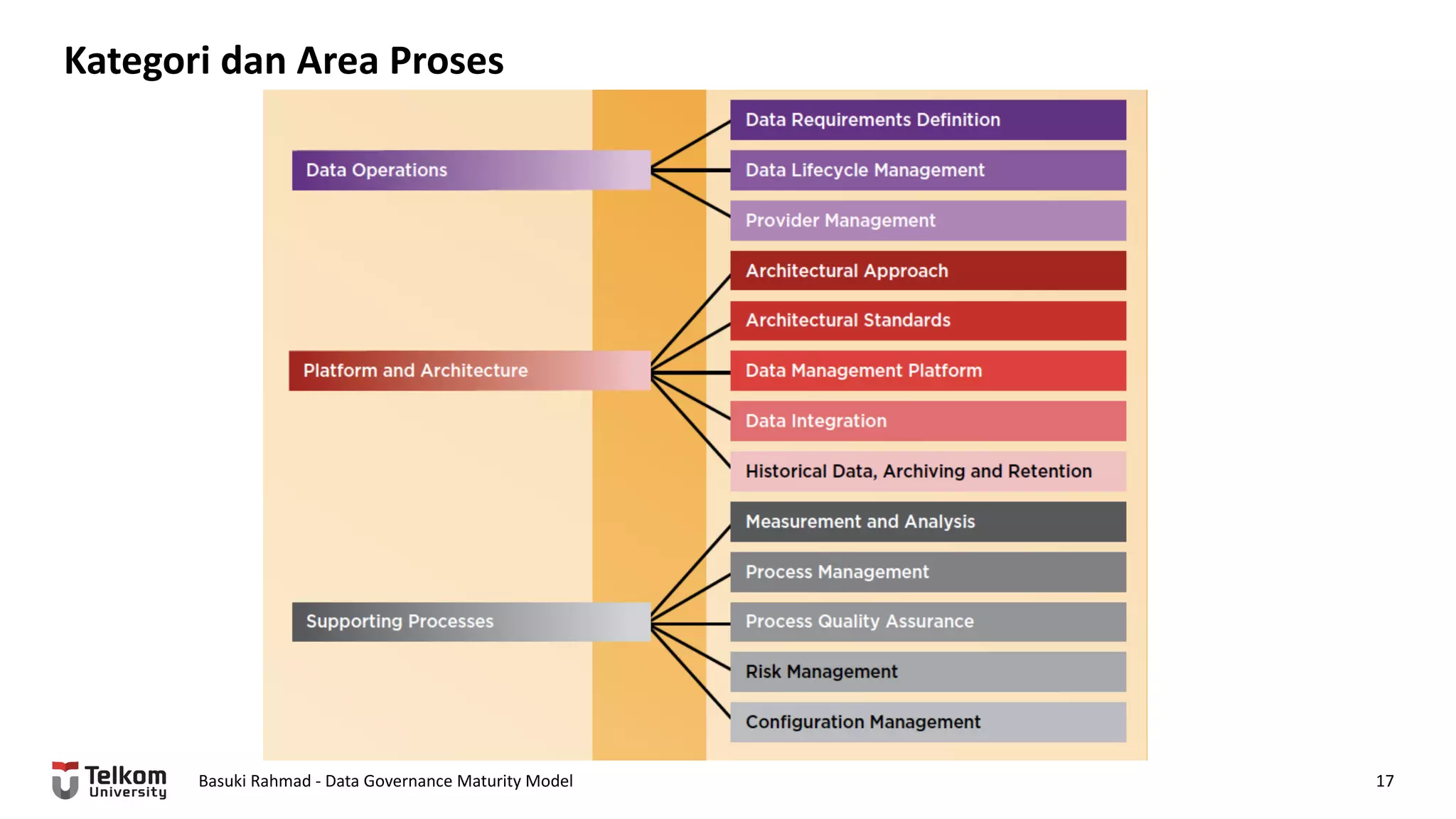
Kategori dan Area Proses
Basuki Rahmad - Data Governance Maturity Model 16
Kategori dan Area Proses
Basuki Rahmad - Data Governance Maturity Model 17
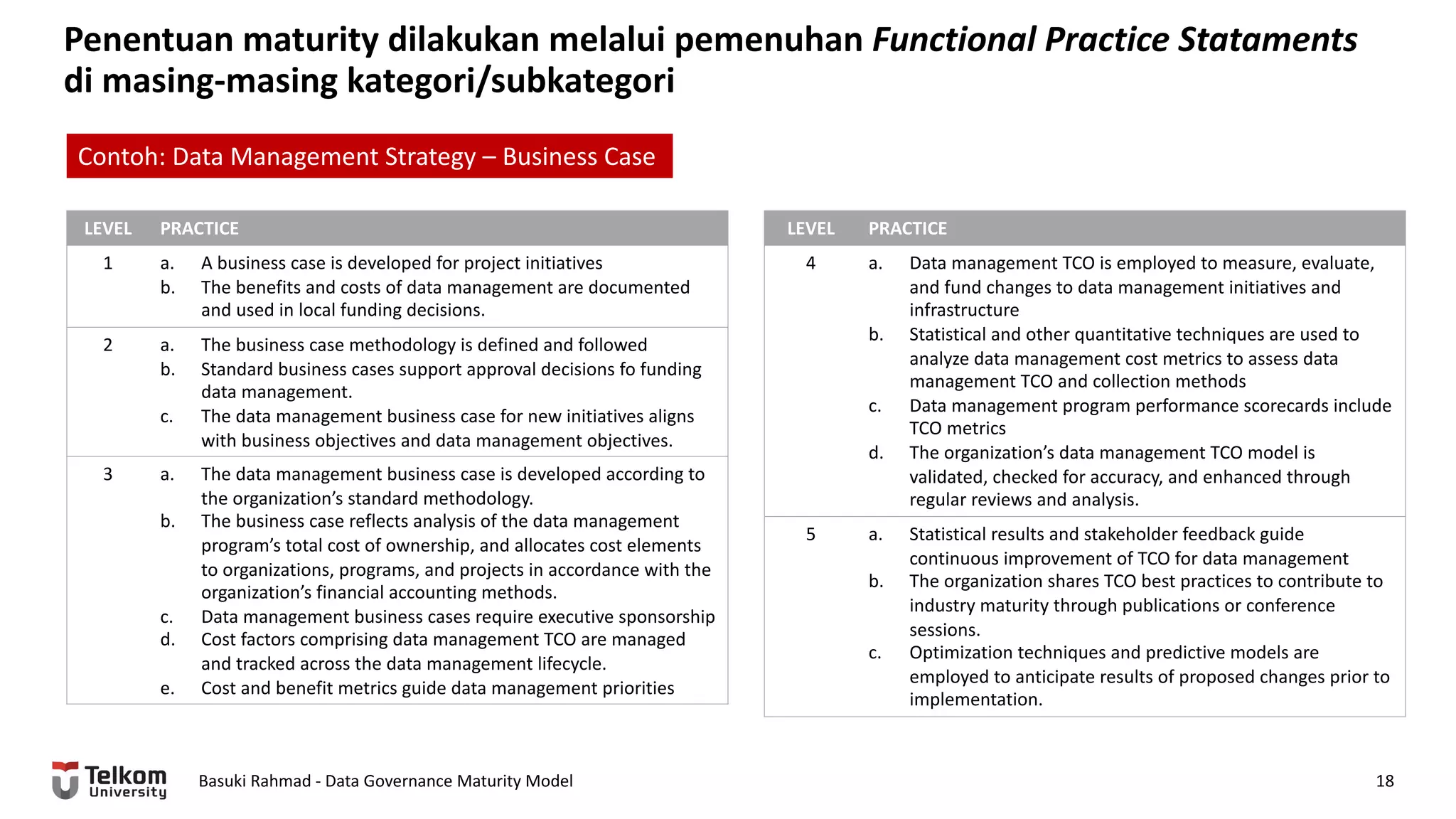
Penentuan maturity dilakukan melalui pemenuhan Functional Practice Stataments
di masing-masing kategori/subkategori
Basuki Rahmad - Data Governance Maturity Model 18
Contoh: Data Management Strategy – Business Case
LEVEL PRACTICE
1 a. A business case is developed for project initiatives
b. The benefits and costs of data management are documented
and used in local funding decisions.
2 a. The business case methodology is defined and followed
b. Standard business cases support approval decisions fo funding
data management.
c. The data management business case for new initiatives aligns
with business objectives and data management objectives.
3 a. The data management business case is developed according to
the organization’s standard methodology.
b. The business case reflects analysis of the data management
program’s total cost of ownership, and allocates cost elements
to organizations, programs, and projects in accordance with the
organization’s financial accounting methods.
c. Data management business cases require executive sponsorship
d. Cost factors comprising data management TCO are managed
and tracked across the data management lifecycle.
e. Cost and benefit metrics guide data management priorities
LEVEL PRACTICE
4 a. Data management TCO is employed to measure, evaluate,
and fund changes to data management initiatives and
infrastructure
b. Statistical and other quantitative techniques are used to
analyze data management cost metrics to assess data
management TCO and collection methods
c. Data management program performance scorecards include
TCO metrics
d. The organization’s data management TCO model is
validated, checked for accuracy, and enhanced through
regular reviews and analysis.
5 a. Statistical results and stakeholder feedback guide
continuous improvement of TCO for data management
b. The organization shares TCO best practices to contribute to
industry maturity through publications or conference
sessions.
c. Optimization techniques and predictive models are
employed to anticipate results of proposed changes prior to
implementation.
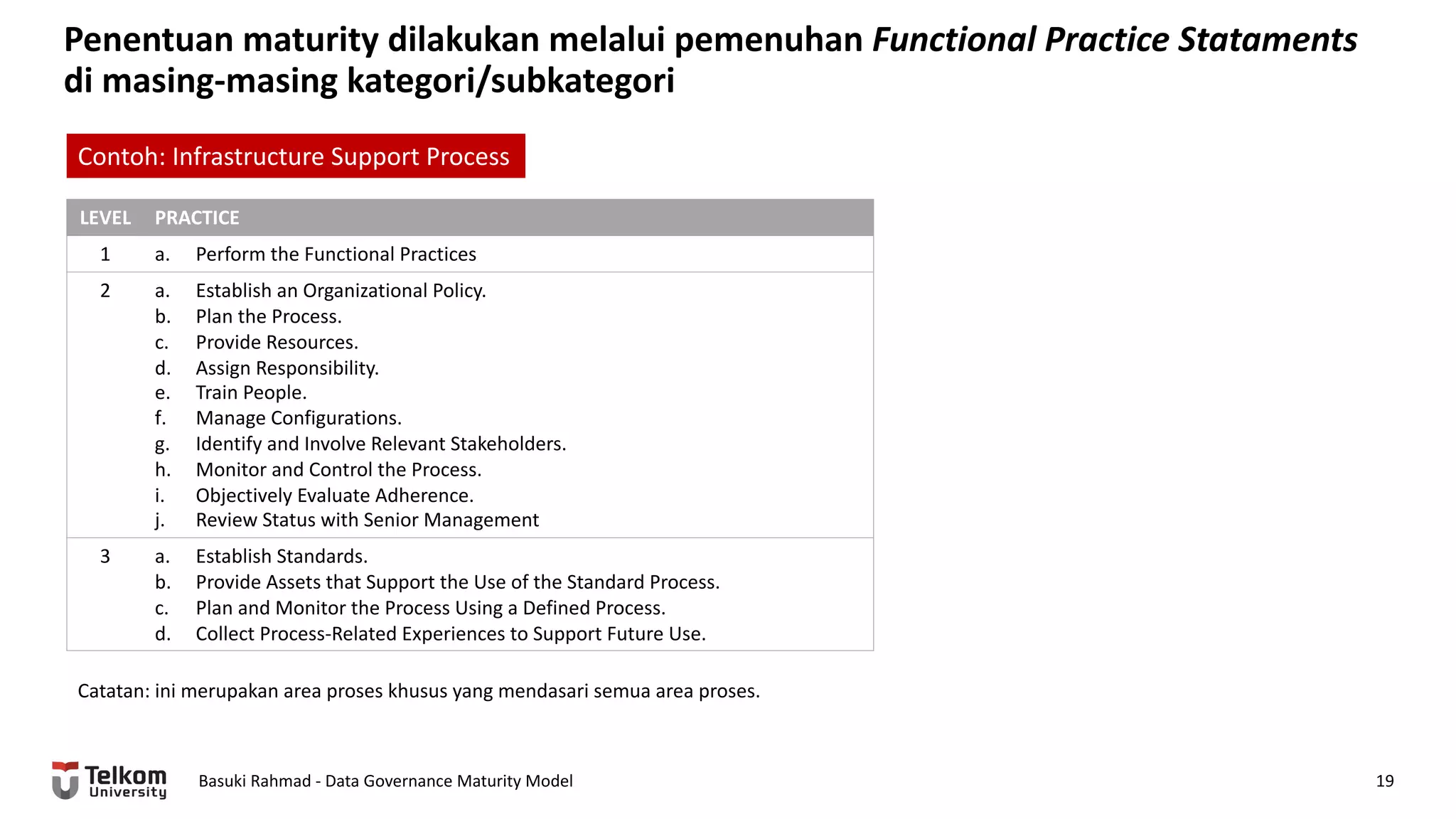
Penentuan maturity dilakukan melalui pemenuhan Functional Practice Stataments
di masing-masing kategori/subkategori
Basuki Rahmad - Data Governance Maturity Model 19
Contoh: Infrastructure Support Process
LEVEL PRACTICE
1 a. Perform the Functional Practices
2 a. Establish an Organizational Policy.
b. Plan the Process.
c. Provide Resources.
d. Assign Responsibility.
e. Train People.
f. Manage Configurations.
g. Identify and Involve Relevant Stakeholders.
h. Monitor and Control the Process.
i. Objectively Evaluate Adherence.
j. Review Status with Senior Management
3 a. Establish Standards.
b. Provide Assets that Support the Use of the Standard Process.
c. Plan and Monitor the Process Using a Defined Process.
d. Collect Process-Related Experiences to Support Future Use.
Catatan: ini merupakan area proses khusus yang mendasari semua area proses.
Cara penentuan maturity (1)
Basuki Rahmad - Data Governance Maturity Model 20
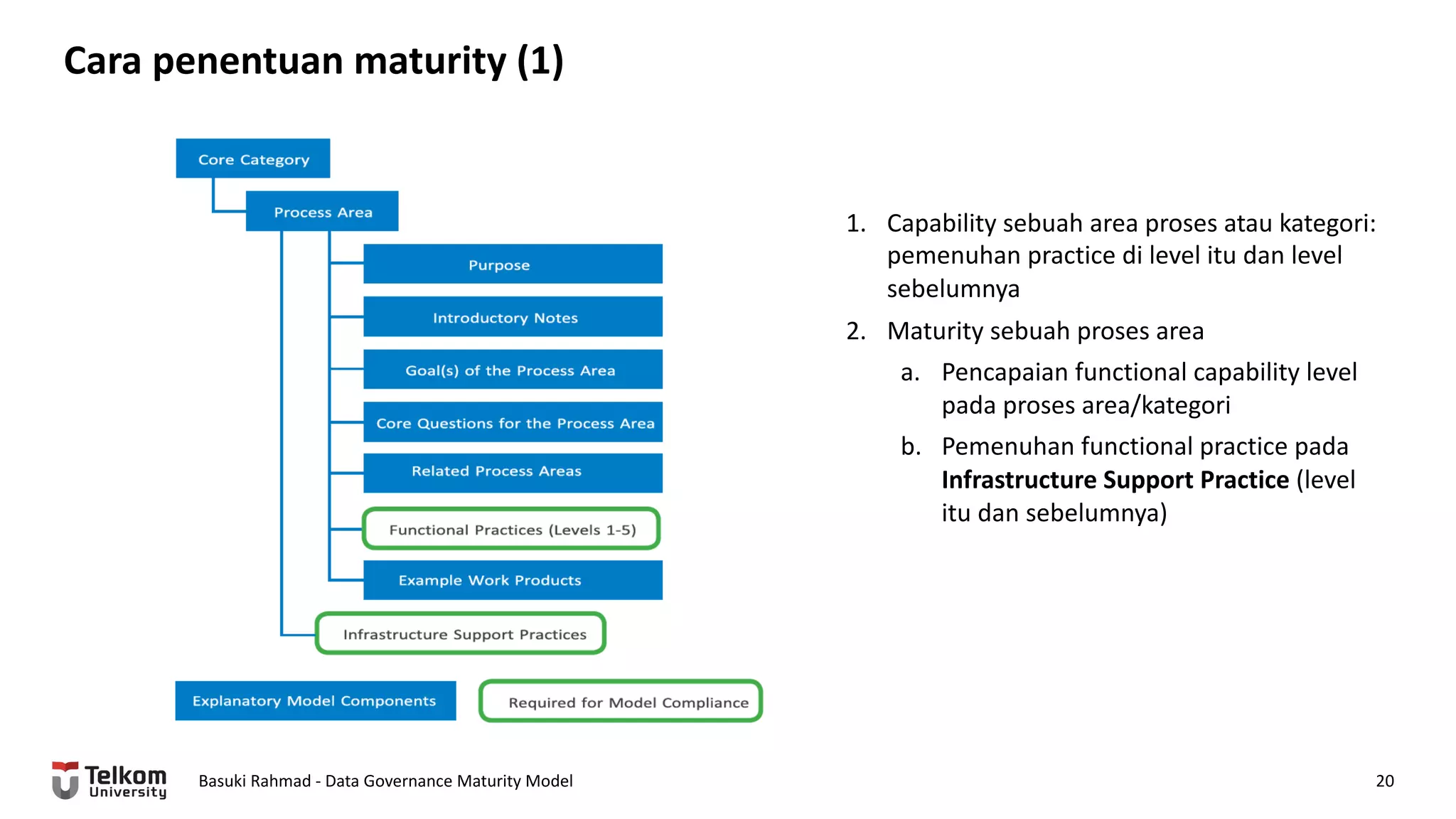
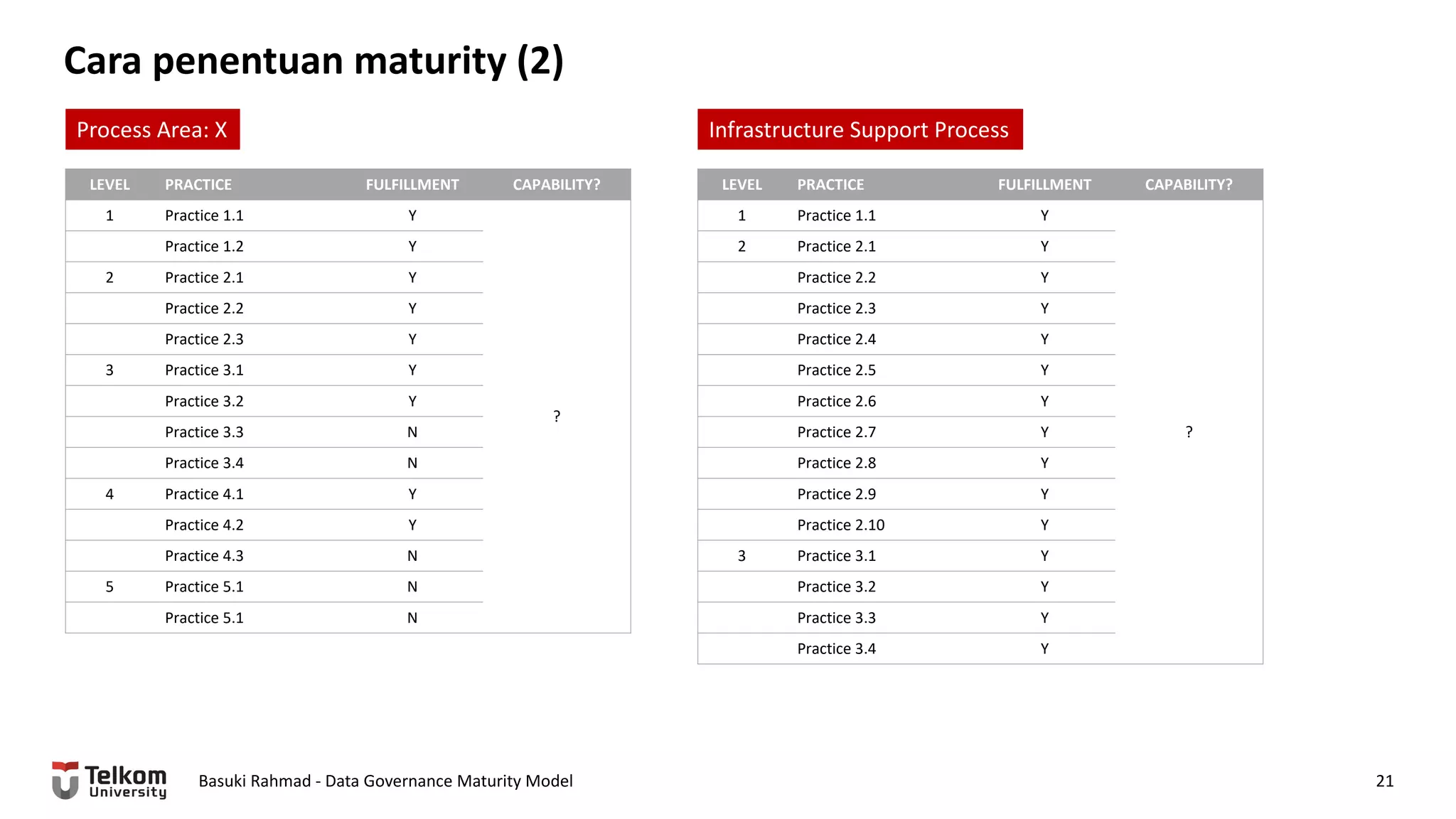
1. Capability sebuah area proses atau kategori:
pemenuhan practice di level itu dan level
sebelumnya
2. Maturity sebuah proses area
a. Pencapaian functional capability level
pada proses area/kategori
b. Pemenuhan functional practice pada
Infrastructure Support Practice (level
itu dan sebelumnya)
Cara penentuan maturity (2)
Basuki Rahmad - Data Governance Maturity Model 21
LEVEL PRACTICE FULFILLMENT CAPABILITY?
1 Practice 1.1 Y
?
Practice 1.2 Y
2 Practice 2.1 Y
Practice 2.2 Y
Practice 2.3 Y
3 Practice 3.1 Y
Practice 3.2 Y
Practice 3.3 N
Practice 3.4 N
4 Practice 4.1 Y
Practice 4.2 Y
Practice 4.3 N
5 Practice 5.1 N
Practice 5.1 N
Process Area: X
LEVEL PRACTICE FULFILLMENT CAPABILITY?
1 Practice 1.1 Y
?
2 Practice 2.1 Y
Practice 2.2 Y
Practice 2.3 Y
Practice 2.4 Y
Practice 2.5 Y
Practice 2.6 Y
Practice 2.7 Y
Practice 2.8 Y
Practice 2.9 Y
Practice 2.10 Y
3 Practice 3.1 Y
Practice 3.2 Y
Practice 3.3 Y
Practice 3.4 Y
Infrastructure Support Process
Cara penentuan maturity (2)
Basuki Rahmad - Data Governance Maturity Model 22
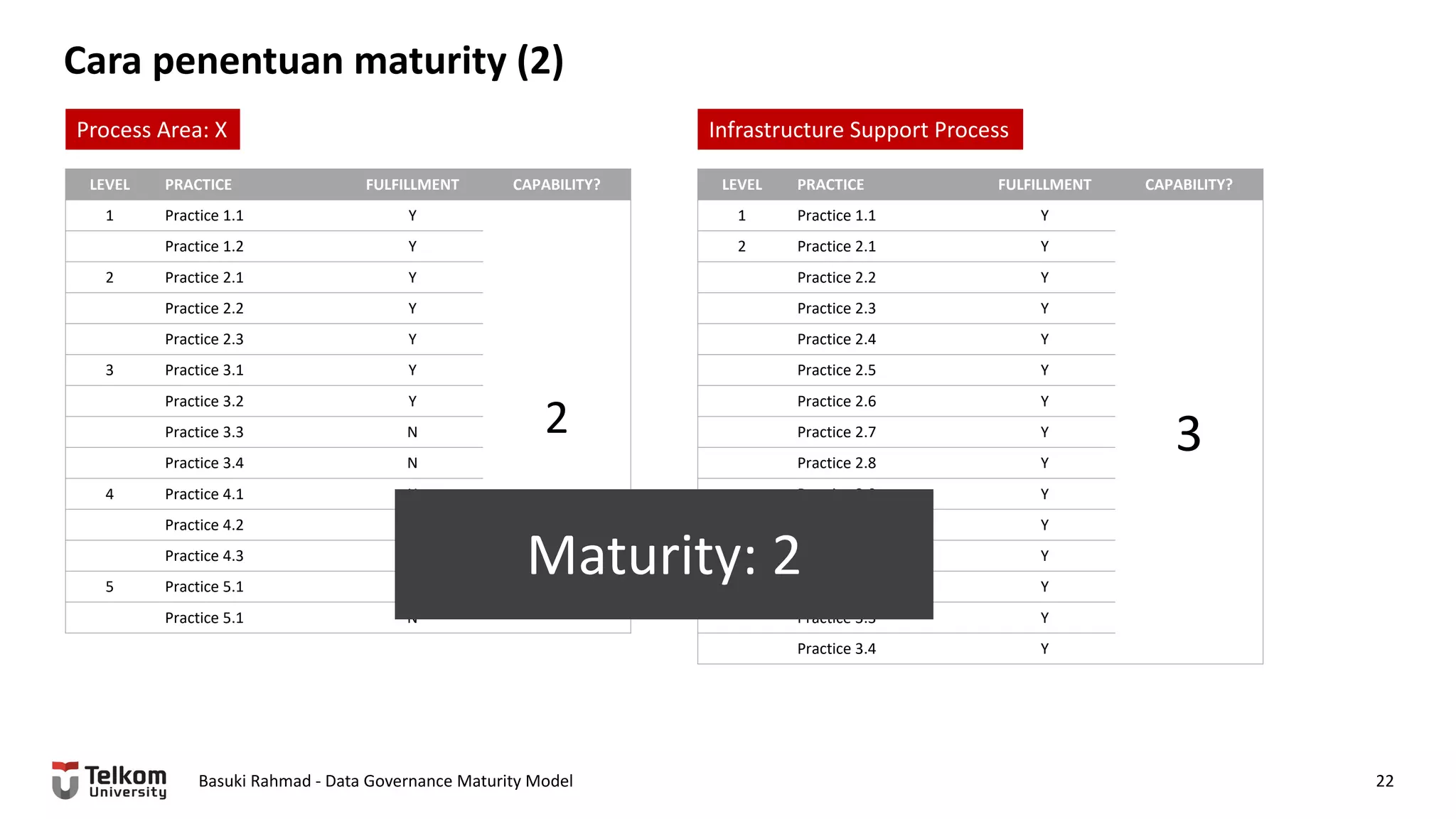
LEVEL PRACTICE FULFILLMENT CAPABILITY?
1 Practice 1.1 Y
2
Practice 1.2 Y
2 Practice 2.1 Y
Practice 2.2 Y
Practice 2.3 Y
3 Practice 3.1 Y
Practice 3.2 Y
Practice 3.3 N
Practice 3.4 N
4 Practice 4.1 Y
Practice 4.2 Y
Practice 4.3 N
5 Practice 5.1 N
Practice 5.1 N
Process Area: X
LEVEL PRACTICE FULFILLMENT CAPABILITY?
1 Practice 1.1 Y
3
2 Practice 2.1 Y
Practice 2.2 Y
Practice 2.3 Y
Practice 2.4 Y
Practice 2.5 Y
Practice 2.6 Y
Practice 2.7 Y
Practice 2.8 Y
Practice 2.9 Y
Practice 2.10 Y
3 Practice 3.1 Y
Practice 3.2 Y
Practice 3.3 Y
Practice 3.4 Y
Infrastructure Support Process
Maturity: 2
Tahapan Implementasi
Basuki Rahmad - Data Governance Maturity Model 23
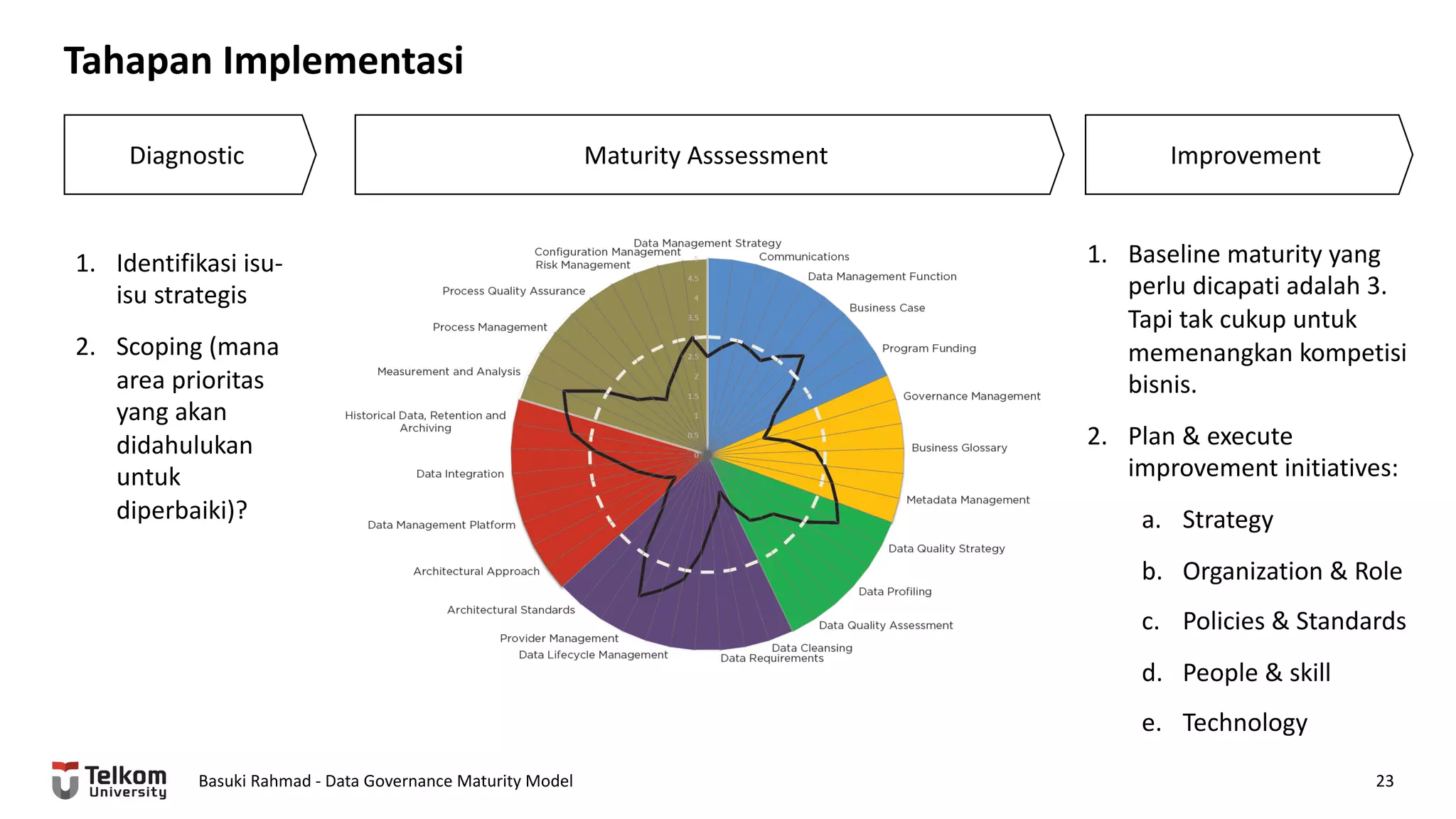
Maturity Asssessment ImprovementDiagnostic
1. Identifikasi isu-
isu strategis
2. Scoping (mana
area prioritas
yang akan
didahulukan
untuk
diperbaiki)?
1. Baseline maturity yang
perlu dicapati adalah 3.
Tapi tak cukup untuk
memenangkan kompetisi
bisnis.
2. Plan & execute
improvement initiatives:
a. Strategy
b. Organization & Role
c. Policies & Standards
d. People & skill
e. Technology
Contoh Peluang Riset terkait (1)
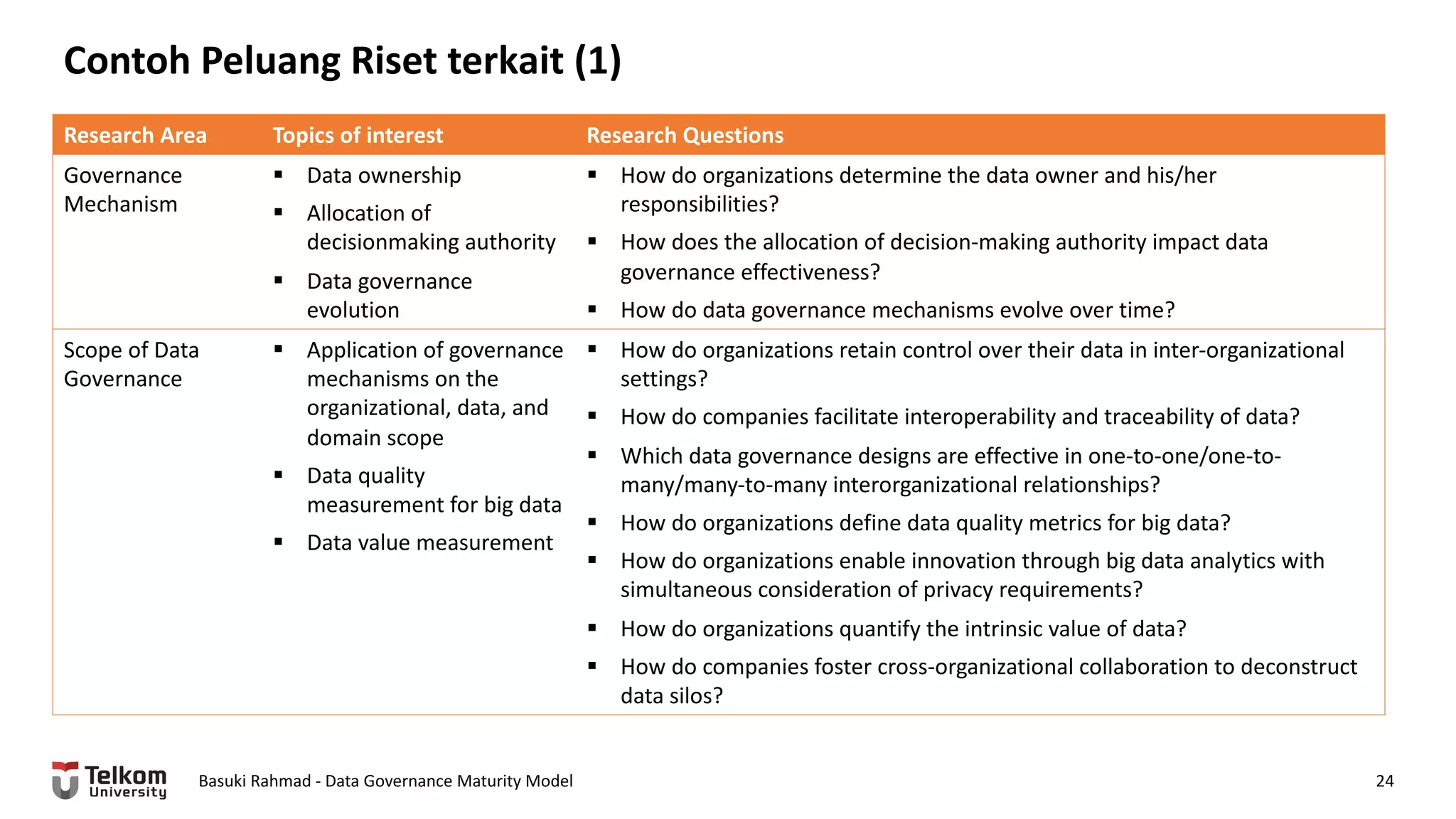
Research Area Topics of interest Research Questions
Governance
Mechanism
§ Data ownership
§ Allocation of
decisionmaking authority
§ Data governance
evolution
§ How do organizations determine the data owner and his/her
responsibilities?
§ How does the allocation of decision-making authority impact data
governance effectiveness?
§ How do data governance mechanisms evolve over time?
Scope of Data
Governance
§ Application of governance
mechanisms on the
organizational, data, and
domain scope
§ Data quality
measurement for big data
§ Data value measurement
§ How do organizations retain control over their data in inter-organizational
settings?
§ How do companies facilitate interoperability and traceability of data?
§ Which data governance designs are effective in one-to-one/one-to-
many/many-to-many interorganizational relationships?
§ How do organizations define data quality metrics for big data?
§ How do organizations enable innovation through big data analytics with
simultaneous consideration of privacy requirements?
§ How do organizations quantify the intrinsic value of data?
§ How do companies foster cross-organizational collaboration to deconstruct
data silos?
Basuki Rahmad - Data Governance Maturity Model 24
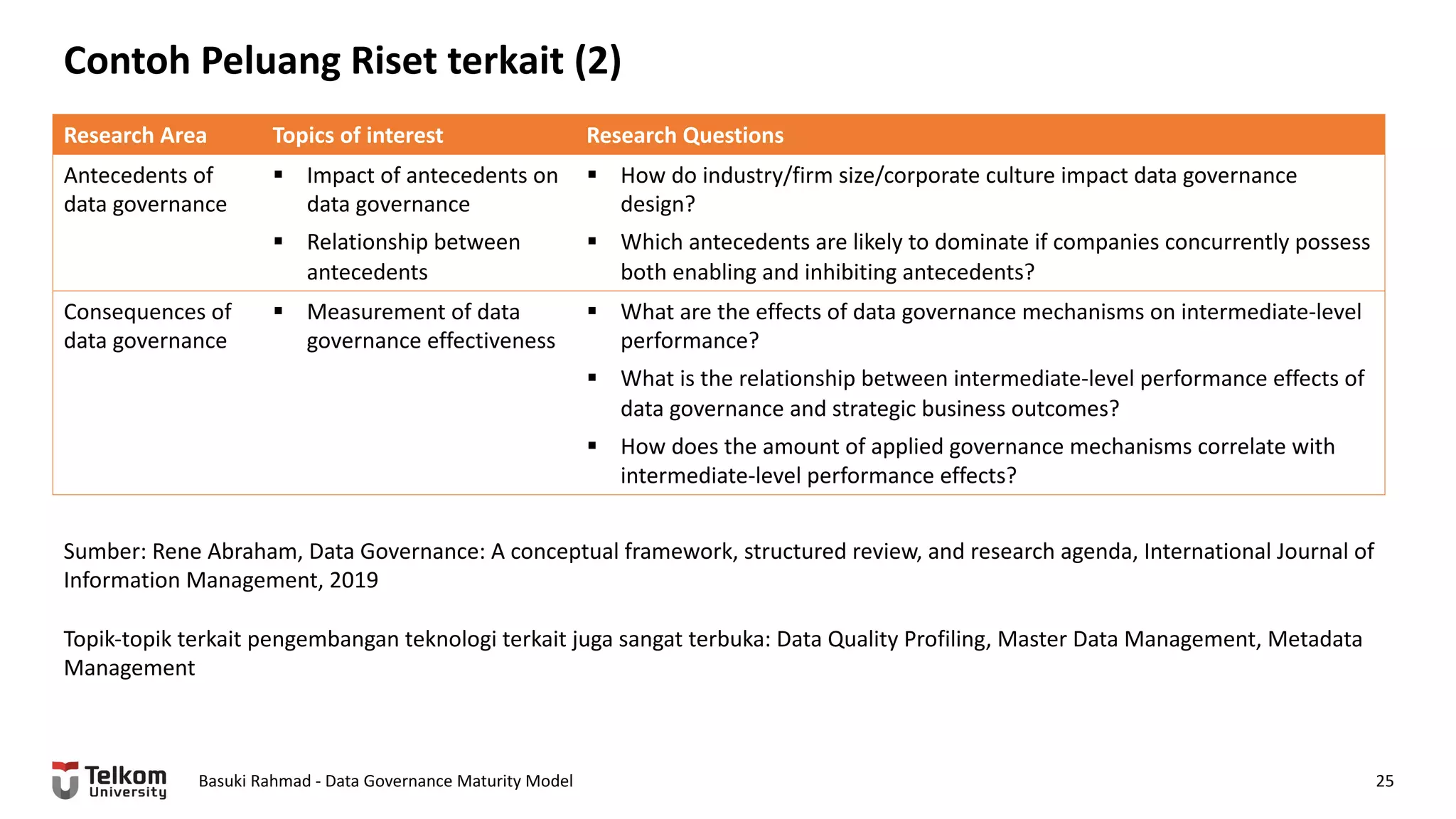
Contoh Peluang Riset terkait (2)
Research Area Topics of interest Research Questions
Antecedents of
data governance
§ Impact of antecedents on
data governance
§ Relationship between
antecedents
§ How do industry/firm size/corporate culture impact data governance
design?
§ Which antecedents are likely to dominate if companies concurrently possess
both enabling and inhibiting antecedents?
Consequences of
data governance
§ Measurement of data
governance effectiveness
§ What are the effects of data governance mechanisms on intermediate-level
performance?
§ What is the relationship between intermediate-level performance effects of
data governance and strategic business outcomes?
§ How does the amount of applied governance mechanisms correlate with
intermediate-level performance effects?
Basuki Rahmad - Data Governance Maturity Model 25
Sumber: Rene Abraham, Data Governance: A conceptual framework, structured review, and research agenda, International Journal of
Information Management, 2019
Topik-topik terkait pengembangan teknologi terkait juga sangat terbuka: Data Quality Profiling, Master Data Management, Metadata
Management
Terima Kasih
Basuki Rahmad - Data Governance Maturity Model 26
basukirahmad@telkomuniversity.ac.id

Data Governance Maturity Model

  • 1.
    DATA GOVERNANCE MATURITY MODEL Dr.Basuki Rahmad Prodi Sistem Informasi – Fakultas Rekayasa Industri
  • 2.
    Profil Singkat Basuki Rahmad- Data Governance Maturity Model 2 • Pendidikan • S1 Teknik Elektro ITB (1995-2000) • S2 Teknik & Sistem Komputer ITB (2001-2004) • S3 Teknik Elektro ITB (2005-2010) • Sertifikasi • CISA (Certified Information System Auditor) • CISM (Certified Information Security Manager) • CRISC (Certified in Risk and Information System Control) • COBIT 5 Implementor • TOGAF Practitioner dari Open Group • Big Data Analyst dari TUV Rheinland • ITIL Foundation • CSX Foundation • CITA Foundation (Certified IT Architect IASA) • Fokus riset/kegiatan profesional: • Enterprise/IT Architecting • IT Governance, Risk & Compliance • IT Security • Business/Computer Fraud • Big Data Analytic • Supply Chain Management q Aktifitas akademik – Dosen Profesional &peneliti di Telkom Univ. (2012 – sekarang) – Dosen Pascasarjana di Unikom (2011-2013) – Dosen Pascasarjana di UNPAD (2004) – Peneliti di ITB (2004-2011) q Pengalaman Profesional – Tranforma Consulting – Direktur Utama – PT. Rofasys Mitra Prima – Komisaris – PT. Fimar Berdaya Sinergitama – Komisaris – Advisor direksi dan manajemen senior sebagai professional hire: PT. WIKA (2015 – sekarang), Perum Jamkrindo (2014- 2015), PT. Pelindo I (2012-2013), BPJS Ketenagakerjaan (2018- 2019) – Worldbank Consultant – Transformasi TI di beberapa Kementerian dan Lembaga Pemerintah (2017-2018) q Asosiasi Profesional – IEEE – AIS (Association of Information System) – ISACA (IS Audit & Control Association) – ACFE (Assocation of Certified Fraud Examiner)
  • 3.
    Outline 1. Data GovernanceOverview a. What is Data Governance? b. Data Governance vs IT Governance c. Data Governance Components 2. Data Governance Maturity Model a. Existing Models b. CMM Data Governance Maturity Model i. Lingkup ii. Cara penggunaan 3. Peluang riset terkait Basuki Rahmad - Data Governance Maturity Model 3
  • 4.
    DATA GOVERNANCE OVERVIEW BasukiRahmad - Data Governance Maturity Model 4
  • 5.
    Why Data Governance? BasukiRahmad - Data Governance Maturity Model 5 Konsekuensi dari lemahnya Data Governance a) inefficient business processes, b) excessive data management activities c) the inability to utilize information for strategic business advantage. Poor Data Governance = Unnecessary Costs + Lost Revenue Waktu yang berlebihan untuk rekonsilisasi data 1. Isu Kunci Data Governance Dampak ke Bisnis • Jika terdapat isu kualitas data, harus mencari orang yang tepat, bukan unitnya, yang benar-benar paham data • Business task potensial terbengkalai 2. • Hasil pemodelan yang tidak tepat • Cross selling sulit dilakukan. 3. • Keputusan yang terkait dengan masalah data tidak dibuat secara tepat waktu. Masalah Utama 4. • Unit lain yang menggunakan data yang sama tidak akan mendapatkan informasi terbaru. • Kurangnya kesadaran dari data producer tentang pentingnya memiliki kualitas data yang baik. • Lemahnya data standards dan penegakannya • Karena kepemilikan data (data ownership) tidak didefinisikan secara formal, sebagian besar unit berpikir bahwa mereka adalah konsumen data. • Beberapa unit membersihkan data sendiri-sendiri secara silo. Data yang buruk untuk analisa bisnis Proses resolusi konflik yang lebih lama Efford redundan untuk cleansing data
  • 6.
    IT Governance vsData Governance Basuki Rahmad - Data Governance Maturity Model 6 • IT • Bayangkan IT adalah pipa-pipa yang memindahkan informasi (pompa, pipa, filter, tangki, dll.). • Bayangkan IT Governance sebagai Keputusan-Keputusan tentang pompa, pipa, filter, tangki, dll. • Data • Bayangkan data sebagai air yang mengalir melalui pipa • Pikirkan Data Governance sebagai Keputusan-Keputusan tentang data – air yg mengalir melalui sistem TI (pipa) - dan tentang: • Siapa, Apa, Kapan, Dimana dan Bagaimana Orang/Proses/Aturan & Teknologi akan mempengaruhi data (air) dan memastikan tetap “bersih”
  • 7.
    What is DataGovernance Basuki Rahmad - Data Governance Maturity Model 7 Data Governance is how an enterprise manages its data assets. Governance includes the rules, policies, procedures, roles and responsibilities that guide overall management of an enterpriseʼs data. Governance provides the guidance to ensure that data is accurate & consistent, complete, available, and secure. Is Is Not Upaya kerja sama antara Bisnis dan TI Aktivitas ”kasih saja" ke TI, atau aktivitas yang dilakukan oleh TI dan kemudian harus "disajikan" kepada Bisnis Kombinasi orang, proses, teknologi, dan metrik Permasalahan Technology Ownership & approval Loop yang tak berkesudahan “Anda perlu bertanya…” Proses kontinu Sesuatu yang dapat diabaikan begitu sebuah proyek selesai Enterprise initiative Functional, departmental, project effort Struktur yang komprehensif untuk memastikan kualitas data Data cleansing effort Program Perusahaan/Organisasi Aktifitas Business Intelligence yang dilakukan oleh Data Warehouse Team
  • 8.
    Kapabilitas Data Governancedalam Data Management Basuki Rahmad - Data Governance Maturity Model 8 Data Governance Data Structure Data Architecture Master Data & Metadata Data Quality Data Security Data Management Capabilities Data Creation Data Storage Data Movement Data Usage Data Retirement •Data Ownership •Data Stewardship •Data Policies •Data Standards •Data Modeling •Data Taxonomy •Data Migration •Data Storage •Data Access •Data Archiving •Data Retirement •Master Data Management •Reference Data Management •Metadata Management •Data Profiling •Data Cleansing •Data Monitoring •Data Compliance •Data Traceability •Data Privacy •Data Retention Organisasi mengelola dan mensupervisi
  • 9.
    Components Basuki Rahmad -Data Governance Maturity Model 9
  • 10.
    DATA GOVERNANCE MATURITIMODEL Basuki Rahmad - Data Governance Maturity Model 10
  • 11.
    Scope Basuki Rahmad -Data Governance Maturity Model 11 • Strategy • Organization & Role • Policies & Standards • Projects & Services • Issues • Valuation DATA GOVERNANCE Scope : q A Board Scope : Planning, supervision and control over data management and use. q Function and activities : The exercise of authority and control (planning, monitoring, and enforcement) over the management of data assets. Data Governance is high-level planning and control over data management.
  • 12.
    Basuki Rahmad -Data Governance Maturity Model 12 Beberapa model eksisting Sumber: DataDiversity
  • 13.
    Basuki Rahmad -Data Governance Maturity Model 13 Dapat diperoleh secara gratis di: https://cmmiinstitute.com/resource-files/public/dmm-model-at-a-glance Penjelasan detil untuk setiap area proses: pertanyaan inti, input/output, contoh work product
  • 14.
    Basuki Rahmad -Data Governance Maturity Model 14 Data is managed as a requirement for the implementation of projects. Processes are performed ad hoc, primarily at the project level. Processes are typically not applied across business areas. Process discipline is primarily reactive; for example, data quality processes emphasize repair over prevention. Foundational improvements may exist, but improvements are not yet extended within the organization or maintained. Level 1 Performed There is awareness of the importance of managing data as a critical infrastructure asset. Processes are planned and executed in accordance with policy; employ skilled people with adequate resources to produce controlled outputs; involve relevant stakeholders; are monitored and controlled and evaluated for adherence to the defined process. Level 2 Managed Data is treated at the organizational level as critical for successful mission performance. Set of standard processes is employed and consistently followed. Processes to meet specific needs are tailored from the set of standard processes according to the organization’s guidelines. Level 3 Defined Data is treated as a source of competitive advantage. Process metrics have been defined and are used for data management. These include management of variance, prediction, and analysis using statistical and other quantitative techniques. Process performance is managed across the life of the process. Level 4 Quantitatively Managed Data is seen as critical for survival in a dynamic and competitive market. Process performance is optimized through applying Level 4 analysis for target identification of improvement opportunities. Best practices are shared with peers and industry. Level 5 Optimized PERSPECTIVE DESCRIPTION
  • 15.
    Basuki Rahmad -Data Governance Maturity Model 15 Kategori Penyusun
  • 16.
    Kategori dan AreaProses Basuki Rahmad - Data Governance Maturity Model 16
  • 17.
    Kategori dan AreaProses Basuki Rahmad - Data Governance Maturity Model 17
  • 18.
    Penentuan maturity dilakukanmelalui pemenuhan Functional Practice Stataments di masing-masing kategori/subkategori Basuki Rahmad - Data Governance Maturity Model 18 Contoh: Data Management Strategy – Business Case LEVEL PRACTICE 1 a. A business case is developed for project initiatives b. The benefits and costs of data management are documented and used in local funding decisions. 2 a. The business case methodology is defined and followed b. Standard business cases support approval decisions fo funding data management. c. The data management business case for new initiatives aligns with business objectives and data management objectives. 3 a. The data management business case is developed according to the organization’s standard methodology. b. The business case reflects analysis of the data management program’s total cost of ownership, and allocates cost elements to organizations, programs, and projects in accordance with the organization’s financial accounting methods. c. Data management business cases require executive sponsorship d. Cost factors comprising data management TCO are managed and tracked across the data management lifecycle. e. Cost and benefit metrics guide data management priorities LEVEL PRACTICE 4 a. Data management TCO is employed to measure, evaluate, and fund changes to data management initiatives and infrastructure b. Statistical and other quantitative techniques are used to analyze data management cost metrics to assess data management TCO and collection methods c. Data management program performance scorecards include TCO metrics d. The organization’s data management TCO model is validated, checked for accuracy, and enhanced through regular reviews and analysis. 5 a. Statistical results and stakeholder feedback guide continuous improvement of TCO for data management b. The organization shares TCO best practices to contribute to industry maturity through publications or conference sessions. c. Optimization techniques and predictive models are employed to anticipate results of proposed changes prior to implementation.
  • 19.
    Penentuan maturity dilakukanmelalui pemenuhan Functional Practice Stataments di masing-masing kategori/subkategori Basuki Rahmad - Data Governance Maturity Model 19 Contoh: Infrastructure Support Process LEVEL PRACTICE 1 a. Perform the Functional Practices 2 a. Establish an Organizational Policy. b. Plan the Process. c. Provide Resources. d. Assign Responsibility. e. Train People. f. Manage Configurations. g. Identify and Involve Relevant Stakeholders. h. Monitor and Control the Process. i. Objectively Evaluate Adherence. j. Review Status with Senior Management 3 a. Establish Standards. b. Provide Assets that Support the Use of the Standard Process. c. Plan and Monitor the Process Using a Defined Process. d. Collect Process-Related Experiences to Support Future Use. Catatan: ini merupakan area proses khusus yang mendasari semua area proses.
  • 20.
    Cara penentuan maturity(1) Basuki Rahmad - Data Governance Maturity Model 20 1. Capability sebuah area proses atau kategori: pemenuhan practice di level itu dan level sebelumnya 2. Maturity sebuah proses area a. Pencapaian functional capability level pada proses area/kategori b. Pemenuhan functional practice pada Infrastructure Support Practice (level itu dan sebelumnya)
  • 21.
    Cara penentuan maturity(2) Basuki Rahmad - Data Governance Maturity Model 21 LEVEL PRACTICE FULFILLMENT CAPABILITY? 1 Practice 1.1 Y ? Practice 1.2 Y 2 Practice 2.1 Y Practice 2.2 Y Practice 2.3 Y 3 Practice 3.1 Y Practice 3.2 Y Practice 3.3 N Practice 3.4 N 4 Practice 4.1 Y Practice 4.2 Y Practice 4.3 N 5 Practice 5.1 N Practice 5.1 N Process Area: X LEVEL PRACTICE FULFILLMENT CAPABILITY? 1 Practice 1.1 Y ? 2 Practice 2.1 Y Practice 2.2 Y Practice 2.3 Y Practice 2.4 Y Practice 2.5 Y Practice 2.6 Y Practice 2.7 Y Practice 2.8 Y Practice 2.9 Y Practice 2.10 Y 3 Practice 3.1 Y Practice 3.2 Y Practice 3.3 Y Practice 3.4 Y Infrastructure Support Process
  • 22.
    Cara penentuan maturity(2) Basuki Rahmad - Data Governance Maturity Model 22 LEVEL PRACTICE FULFILLMENT CAPABILITY? 1 Practice 1.1 Y 2 Practice 1.2 Y 2 Practice 2.1 Y Practice 2.2 Y Practice 2.3 Y 3 Practice 3.1 Y Practice 3.2 Y Practice 3.3 N Practice 3.4 N 4 Practice 4.1 Y Practice 4.2 Y Practice 4.3 N 5 Practice 5.1 N Practice 5.1 N Process Area: X LEVEL PRACTICE FULFILLMENT CAPABILITY? 1 Practice 1.1 Y 3 2 Practice 2.1 Y Practice 2.2 Y Practice 2.3 Y Practice 2.4 Y Practice 2.5 Y Practice 2.6 Y Practice 2.7 Y Practice 2.8 Y Practice 2.9 Y Practice 2.10 Y 3 Practice 3.1 Y Practice 3.2 Y Practice 3.3 Y Practice 3.4 Y Infrastructure Support Process Maturity: 2
  • 23.
    Tahapan Implementasi Basuki Rahmad- Data Governance Maturity Model 23 Maturity Asssessment ImprovementDiagnostic 1. Identifikasi isu- isu strategis 2. Scoping (mana area prioritas yang akan didahulukan untuk diperbaiki)? 1. Baseline maturity yang perlu dicapati adalah 3. Tapi tak cukup untuk memenangkan kompetisi bisnis. 2. Plan & execute improvement initiatives: a. Strategy b. Organization & Role c. Policies & Standards d. People & skill e. Technology
  • 24.
    Contoh Peluang Risetterkait (1) Research Area Topics of interest Research Questions Governance Mechanism § Data ownership § Allocation of decisionmaking authority § Data governance evolution § How do organizations determine the data owner and his/her responsibilities? § How does the allocation of decision-making authority impact data governance effectiveness? § How do data governance mechanisms evolve over time? Scope of Data Governance § Application of governance mechanisms on the organizational, data, and domain scope § Data quality measurement for big data § Data value measurement § How do organizations retain control over their data in inter-organizational settings? § How do companies facilitate interoperability and traceability of data? § Which data governance designs are effective in one-to-one/one-to- many/many-to-many interorganizational relationships? § How do organizations define data quality metrics for big data? § How do organizations enable innovation through big data analytics with simultaneous consideration of privacy requirements? § How do organizations quantify the intrinsic value of data? § How do companies foster cross-organizational collaboration to deconstruct data silos? Basuki Rahmad - Data Governance Maturity Model 24
  • 25.
    Contoh Peluang Risetterkait (2) Research Area Topics of interest Research Questions Antecedents of data governance § Impact of antecedents on data governance § Relationship between antecedents § How do industry/firm size/corporate culture impact data governance design? § Which antecedents are likely to dominate if companies concurrently possess both enabling and inhibiting antecedents? Consequences of data governance § Measurement of data governance effectiveness § What are the effects of data governance mechanisms on intermediate-level performance? § What is the relationship between intermediate-level performance effects of data governance and strategic business outcomes? § How does the amount of applied governance mechanisms correlate with intermediate-level performance effects? Basuki Rahmad - Data Governance Maturity Model 25 Sumber: Rene Abraham, Data Governance: A conceptual framework, structured review, and research agenda, International Journal of Information Management, 2019 Topik-topik terkait pengembangan teknologi terkait juga sangat terbuka: Data Quality Profiling, Master Data Management, Metadata Management
  • 26.
    Terima Kasih Basuki Rahmad- Data Governance Maturity Model 26 basukirahmad@telkomuniversity.ac.id