MARKETERS FLUNK THE
BIG DATA TEST
SHAUN KOLLANNUR
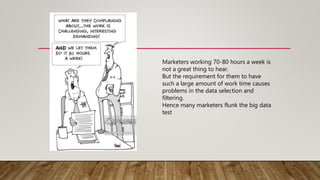
Marketers working 70-80 hours a week is
not a great thing to hear.
But the requirement for them to have
such a large amount of work time causes
problems in the data selection and
filtering.
Hence many marketers flunk the big data
test
INTRODUCTION
• The big-data explosion is driving a shift away from gut-based decision making.
Marketing in particular is feeling the pressure to embrace new data-driven
customer intelligence capabilities.
• A recent CEB study of nearly 800 marketers at Fortune 1000 companies found the
vast majority of marketers still rely too much on intuition; While the few who do
use data aggressively for the most part do it badly.
PROBLEMS FACED
• A majority struggle with statistics
• When marketers’ statistical aptitude was tested with five questions ranging from basic
to intermediate, almost half (44%) got four or more questions wrong and a mere 6%
got all five right. So it didn’t surprise us that just 5% of marketers own a statistics text
book.
• Most rely too much on gut
• On average, marketers depend on data for just 11% of all customer-related decisions.
• When asked marketers to think about the information they used to make a recent
decision, they would said that more than half of the information came from their
previous experience or their intuition about customers.
PROBLEMS FACED (CONT.)
• Some are dangerously distracted by data
• Although most marketers underuse data, a small fraction (11% in this study) just can’t
get enough.
• These data hounds consult dashboards daily, and base most decisions on data. They
have a “plugged in” personality type and thrive on external stimulation — so they love
data and all forms of feedback including data on marketing effectiveness, input from
managers or peers, and frequent interaction with others.
• We call these marketers “Connectors” and they’re exactly what most CMOs are looking
for. But these types of marketers are actually severe underperformers (they receive
much lower performance ratings from their managers than average marketers do).
RELEVANCE OF DATA FOR DECISION MAKING
• Every second, 3.5 billion internet users send 7,500 tweets and exchange 42
terabytes of data. The constantly increasing volume of online data expands
possibilities and applications that have a massive impact on business and the
world.
• A recent Accenture survey shows that 90% of business leaders expect big data to
dramatically change how they do business, putting it on the same level of
disruption as the development of the Internet itself.
• To realize the possibilities of this available data, organizations need to leverage
and harness it in a way that validates the data is trustworthy and that the analysis
is applicable to the task or end goal.
RELEVANCE OF DATA FOR DECISION MAKING
(CONT.)
• Data-driven decision-making is the means by which organizations can do this. It is
a strategy based on the idea of finding, accessing, analyzing and coming to
decisions based on that analysis, then repeating the pattern as more data is
collected.
• Collecting lots of data and making it available is only the beginning. Successful
data driven development also aggregates the information in meaningful ways.
DATA COLLECTION
• Data collection is the process of gathering and measuring information on
targeted variables in an established systematic fashion, which then enables one to
answer relevant questions and evaluate outcomes.
• A mixed-methods approach that combines qualitative and quantitative methods
gives you a better picture of both the frequency or “how much” and the
reasoning or “why” behind the numbers better than an approach that’s only
qualitative or only quantitative.
DATA COLLECTION(CONT.)
• While there are dozens of methods and techniques we describe and use at
MeasuringU, many of the methods are just variations and combinations of
broader methods that cross the behavioral sciences.
• The most common of these broader methods are surveys, experiments,
observations, interviews, and focus groups.
DATA ANALYSIS TECHNIQUES
• There are two methods that a researcher can pursue:
• Qualitative
• Quantitative.
• Qualitative research revolves around describing characteristics. It does not use
numbers. A good way to remember qualitative research is to think of quality.
• Quantitative research is the opposite of qualitative research because its prime focus
is numbers. Quantitative research is all about quantity.
USE OF DATA IN TRADITIONAL INDIAN BUSINESS
• There is an increased requirement for the business analytic as it is a mix of current
tools, analytic, programming, administration, IT to make an association develop in the
focused markets. Business analytic helps us to increase future bits of knowledge by
watching the past data to serve the client better and in a productive way.
• A few parts of India which make use of business analytic are keeping money, media
communications, outsourcing companies, internet business companies. Banks uses
data mining methods to seek through the populated data and break down the
accessible data using a few devices to identify the potential hazard sections and helps
them to conquer the risk issues. Mastercard companies use business analytic in
preventing the fake action from the clients.
IDENTIFICATION OF USEFUL AND REDUNDANT
DATA
• The first task of normalisation is to perform data analysis,
to identify any redundant data and remove any inconsistencies.
• It seems likely that the elimination of redundancy will lead to a simpler
conceptual model which more accurately reflects the real world.
• Developing thecapability for the tool to import data from,or exportdata to, other
software packages or databases to promote more efficient data analysisand
reduce redundant data
IDENTIFICATION OF USEFUL AND REDUNDANT
DATA(CONT.)
• Start with strategy
• It’s easy to get overwhelmed by the possibilities that a big data world provides, and it’s
easy to get lost in the noise and hype surrounding data.
• Identify your unanswered business questions
• By working out exactly what you need to know, you can focus on the data that you
really need. Your data requirements, cost and stress levels are massively reduced when
you move from ‘collect everything just in case’ to ‘collect and measure x and y to
answer question z’.
USE OF DATA AND DECISION MAKING
• To drive effective data use, the best marketing leaders reiterate critical business
goals constantly (to keep them front-of-mind despite distractions), teach
marketers to put data front and center in their decision making, and sensitize
marketers to common data interpretation mistakes.
• This enables even the most distractible data lovers to overachieve.
ADVANTAGES OF INFORMED DECISION MAKING
• Data Curation Should Become a Habit
• Entrepreneurs should focus on building robust data-collection processes within their
organisations from the get-go. If they don’t do this from the start, they won’t amass
enough data, and if they don’t have sufficient data to analyse they won’t be able to extract
useful insights; they will be left feeling like their company has no use for data.
• Tying Business Decisions to Analytics Insights
• A lot of the time, young organisations spend a lot of time mining data, but end up with no
useful insights. That’s because they don’t have a fixed end goal in mind prior to starting
data collection and analysis.
ADOPTION OF MODERN DATA ANALYTICS IN
INDIAN CONTEXT
• An increasingly broad diversity of service-level expectations — including data quality,
data governance, diverse processing languages and demands for more flexible queries
— all combine to reduce the effectiveness of traditional EDWs, making them rigid and
costly to implement and maintain, and forcing organizations to look at alternate
logical data warehouse (LDW) architectures.
• This modern data management architecture allows organizations to use their existing
investments in EDWs to expand their scope of performing analytics on traditional data
types to also incorporating modern data types and data sources, such as big data, and
Internet of Things (IoT) data, with agility and flexibility.
ADOPTION OF MODERN DATA ANALYTICS IN
INDIAN CONTEXT(CONT.)
• We see the insatiable demand to access data in real-time from a myriad of data
sources, such as cloud, mobile, IoT sources, big data stores (for example, Hadoop,
and NoSQL) and a host of newer data types such as JSON, XML, Avro, and Parquet .
With this proliferation of data types and data sources, organizations simply cannot
rely on a repository centrioc, slow and non-real-time strategy of EDWs. They need the
flexibility and agility of LDW architectures to cater to this data diversity dynamic or
risk being rendered irrelevant from a competitive differentiation standpoint.
• Overall, the data and analytics leaders in India are standing up and take notice of the
alternate data management architectures (like the LDW) which are here to augment
the traditional EDW strategy to offer the much needed flexibility for faster and more
complete analytics.
OVERVIEW
• As marketers get better access to raw numbers and big data keeps growing, the
importance of this filtering ability will only intensify.
• The bad news for marketing leaders is that ability to filter out noise is rare (only
about 10% of marketers excel here) and hard to teach. The good news is that a
well-guided team environment can protect noise chasers from themselves — by
providing blinkers that keep “bright shiny objects” out of view.
BIBLEOGRAPHY
• https://www.gartner.com/newsroom/id/3689217
• https://hbr.org/2012/08/marketers-flunk-the-big-data-test
• https://www.entrepreneur.com/article/280923
• https://www.forbes.com/sites/bernardmarr/2016/06/14/data-driven-decision-
making-10-simple-steps-for-any-business/#4396c6885e1e

Marketers Flunk The Big Data Text

  • 1.
    MARKETERS FLUNK THE BIGDATA TEST SHAUN KOLLANNUR
  • 2.
    Marketers working 70-80hours a week is not a great thing to hear. But the requirement for them to have such a large amount of work time causes problems in the data selection and filtering. Hence many marketers flunk the big data test
  • 3.
    INTRODUCTION • The big-dataexplosion is driving a shift away from gut-based decision making. Marketing in particular is feeling the pressure to embrace new data-driven customer intelligence capabilities. • A recent CEB study of nearly 800 marketers at Fortune 1000 companies found the vast majority of marketers still rely too much on intuition; While the few who do use data aggressively for the most part do it badly.
  • 4.
    PROBLEMS FACED • Amajority struggle with statistics • When marketers’ statistical aptitude was tested with five questions ranging from basic to intermediate, almost half (44%) got four or more questions wrong and a mere 6% got all five right. So it didn’t surprise us that just 5% of marketers own a statistics text book. • Most rely too much on gut • On average, marketers depend on data for just 11% of all customer-related decisions. • When asked marketers to think about the information they used to make a recent decision, they would said that more than half of the information came from their previous experience or their intuition about customers.
  • 5.
    PROBLEMS FACED (CONT.) •Some are dangerously distracted by data • Although most marketers underuse data, a small fraction (11% in this study) just can’t get enough. • These data hounds consult dashboards daily, and base most decisions on data. They have a “plugged in” personality type and thrive on external stimulation — so they love data and all forms of feedback including data on marketing effectiveness, input from managers or peers, and frequent interaction with others. • We call these marketers “Connectors” and they’re exactly what most CMOs are looking for. But these types of marketers are actually severe underperformers (they receive much lower performance ratings from their managers than average marketers do).
  • 6.
    RELEVANCE OF DATAFOR DECISION MAKING • Every second, 3.5 billion internet users send 7,500 tweets and exchange 42 terabytes of data. The constantly increasing volume of online data expands possibilities and applications that have a massive impact on business and the world. • A recent Accenture survey shows that 90% of business leaders expect big data to dramatically change how they do business, putting it on the same level of disruption as the development of the Internet itself. • To realize the possibilities of this available data, organizations need to leverage and harness it in a way that validates the data is trustworthy and that the analysis is applicable to the task or end goal.
  • 7.
    RELEVANCE OF DATAFOR DECISION MAKING (CONT.) • Data-driven decision-making is the means by which organizations can do this. It is a strategy based on the idea of finding, accessing, analyzing and coming to decisions based on that analysis, then repeating the pattern as more data is collected. • Collecting lots of data and making it available is only the beginning. Successful data driven development also aggregates the information in meaningful ways.
  • 8.
    DATA COLLECTION • Datacollection is the process of gathering and measuring information on targeted variables in an established systematic fashion, which then enables one to answer relevant questions and evaluate outcomes. • A mixed-methods approach that combines qualitative and quantitative methods gives you a better picture of both the frequency or “how much” and the reasoning or “why” behind the numbers better than an approach that’s only qualitative or only quantitative.
  • 9.
    DATA COLLECTION(CONT.) • Whilethere are dozens of methods and techniques we describe and use at MeasuringU, many of the methods are just variations and combinations of broader methods that cross the behavioral sciences. • The most common of these broader methods are surveys, experiments, observations, interviews, and focus groups.
  • 10.
    DATA ANALYSIS TECHNIQUES •There are two methods that a researcher can pursue: • Qualitative • Quantitative. • Qualitative research revolves around describing characteristics. It does not use numbers. A good way to remember qualitative research is to think of quality. • Quantitative research is the opposite of qualitative research because its prime focus is numbers. Quantitative research is all about quantity.
  • 11.
    USE OF DATAIN TRADITIONAL INDIAN BUSINESS • There is an increased requirement for the business analytic as it is a mix of current tools, analytic, programming, administration, IT to make an association develop in the focused markets. Business analytic helps us to increase future bits of knowledge by watching the past data to serve the client better and in a productive way. • A few parts of India which make use of business analytic are keeping money, media communications, outsourcing companies, internet business companies. Banks uses data mining methods to seek through the populated data and break down the accessible data using a few devices to identify the potential hazard sections and helps them to conquer the risk issues. Mastercard companies use business analytic in preventing the fake action from the clients.
  • 12.
    IDENTIFICATION OF USEFULAND REDUNDANT DATA • The first task of normalisation is to perform data analysis, to identify any redundant data and remove any inconsistencies. • It seems likely that the elimination of redundancy will lead to a simpler conceptual model which more accurately reflects the real world. • Developing thecapability for the tool to import data from,or exportdata to, other software packages or databases to promote more efficient data analysisand reduce redundant data
  • 13.
    IDENTIFICATION OF USEFULAND REDUNDANT DATA(CONT.) • Start with strategy • It’s easy to get overwhelmed by the possibilities that a big data world provides, and it’s easy to get lost in the noise and hype surrounding data. • Identify your unanswered business questions • By working out exactly what you need to know, you can focus on the data that you really need. Your data requirements, cost and stress levels are massively reduced when you move from ‘collect everything just in case’ to ‘collect and measure x and y to answer question z’.
  • 14.
    USE OF DATAAND DECISION MAKING • To drive effective data use, the best marketing leaders reiterate critical business goals constantly (to keep them front-of-mind despite distractions), teach marketers to put data front and center in their decision making, and sensitize marketers to common data interpretation mistakes. • This enables even the most distractible data lovers to overachieve.
  • 15.
    ADVANTAGES OF INFORMEDDECISION MAKING • Data Curation Should Become a Habit • Entrepreneurs should focus on building robust data-collection processes within their organisations from the get-go. If they don’t do this from the start, they won’t amass enough data, and if they don’t have sufficient data to analyse they won’t be able to extract useful insights; they will be left feeling like their company has no use for data. • Tying Business Decisions to Analytics Insights • A lot of the time, young organisations spend a lot of time mining data, but end up with no useful insights. That’s because they don’t have a fixed end goal in mind prior to starting data collection and analysis.
  • 16.
    ADOPTION OF MODERNDATA ANALYTICS IN INDIAN CONTEXT • An increasingly broad diversity of service-level expectations — including data quality, data governance, diverse processing languages and demands for more flexible queries — all combine to reduce the effectiveness of traditional EDWs, making them rigid and costly to implement and maintain, and forcing organizations to look at alternate logical data warehouse (LDW) architectures. • This modern data management architecture allows organizations to use their existing investments in EDWs to expand their scope of performing analytics on traditional data types to also incorporating modern data types and data sources, such as big data, and Internet of Things (IoT) data, with agility and flexibility.
  • 17.
    ADOPTION OF MODERNDATA ANALYTICS IN INDIAN CONTEXT(CONT.) • We see the insatiable demand to access data in real-time from a myriad of data sources, such as cloud, mobile, IoT sources, big data stores (for example, Hadoop, and NoSQL) and a host of newer data types such as JSON, XML, Avro, and Parquet . With this proliferation of data types and data sources, organizations simply cannot rely on a repository centrioc, slow and non-real-time strategy of EDWs. They need the flexibility and agility of LDW architectures to cater to this data diversity dynamic or risk being rendered irrelevant from a competitive differentiation standpoint. • Overall, the data and analytics leaders in India are standing up and take notice of the alternate data management architectures (like the LDW) which are here to augment the traditional EDW strategy to offer the much needed flexibility for faster and more complete analytics.
  • 18.
    OVERVIEW • As marketersget better access to raw numbers and big data keeps growing, the importance of this filtering ability will only intensify. • The bad news for marketing leaders is that ability to filter out noise is rare (only about 10% of marketers excel here) and hard to teach. The good news is that a well-guided team environment can protect noise chasers from themselves — by providing blinkers that keep “bright shiny objects” out of view.
  • 19.
    BIBLEOGRAPHY • https://www.gartner.com/newsroom/id/3689217 • https://hbr.org/2012/08/marketers-flunk-the-big-data-test •https://www.entrepreneur.com/article/280923 • https://www.forbes.com/sites/bernardmarr/2016/06/14/data-driven-decision- making-10-simple-steps-for-any-business/#4396c6885e1e