Structured Query Language
Path from Unorganized to Organized….
Arun Kumar T
What is a Database…
A database is an organized collection of data. The database management
system(DBMS) is the system which acts as medium to carry data from database
and user.
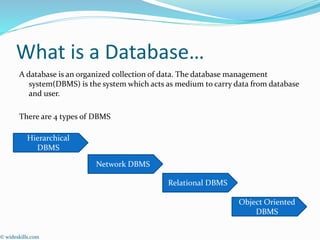
There are 4 types of DBMS
© wideskills.com
Hierarchical
DBMS
Network DBMS
Relational DBMS
Object Oriented
DBMS
What is SQL…
SQL is the standard used to manage data in relational tables. Structured Query
Language normally referred as SQL and pronounced as SEE QU EL..
SQL allows users to create databases, add data, modify and maintain data. It is
governed by standards maintained by ISO(International Standards
Organization).
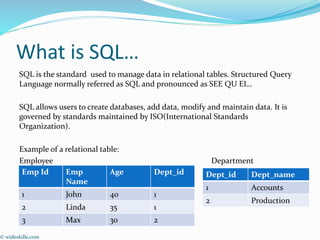
Example of a relational table:
Employee Department
© wideskills.com
Emp Id Emp
Name
Age Dept_id
1 John 40 1
2 Linda 35 1
3 Max 30 2
Dept_id Dept_name
1 Accounts
2 Production
SQL syntax and query
SQL is case in-sensitive, that is keyword SELECT and select is same for SQL. Every
SQL command should end with a semi-colon (;).
If the syntax is not proper, then executing the command would result in syntax
error.
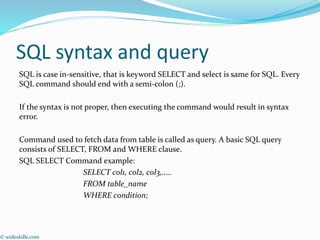
Command used to fetch data from table is called as query. A basic SQL query
consists of SELECT, FROM and WHERE clause.
SQL SELECT Command example:
SELECT col1, col2, col3,…..
FROM table_name
WHERE condition;
© wideskills.com
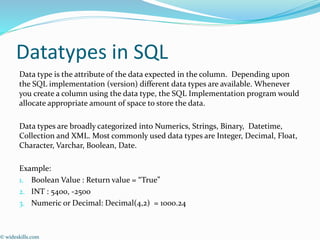
Datatypes in SQL
Data type is the attribute of the data expected in the column. Depending upon
the SQL implementation (version) different data types are available. Whenever
you create a column using the data type, the SQL Implementation program would
allocate appropriate amount of space to store the data.
Data types are broadly categorized into Numerics, Strings, Binary, Datetime,
Collection and XML. Most commonly used data types are Integer, Decimal, Float,
Character, Varchar, Boolean, Date.
Example:
1. Boolean Value : Return value = “True”
2. INT : 5400, -2500
3. Numeric or Decimal: Decimal(4,2) = 1000.24
© wideskills.com
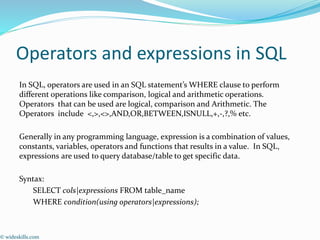
Operators and expressions in SQL
In SQL, operators are used in an SQL statement’s WHERE clause to perform
different operations like comparison, logical and arithmetic operations.
Operators that can be used are logical, comparison and Arithmetic. The
Operators include <,>,<>,AND,OR,BETWEEN,ISNULL,+,-,?,% etc.
Generally in any programming language, expression is a combination of values,
constants, variables, operators and functions that results in a value. In SQL,
expressions are used to query database/table to get specific data.
Syntax:
SELECT cols|expressions FROM table_name
WHERE condition(using operators|expressions);
© wideskills.com
DDL
CREATE
ALTER
DROP
CREATE INDEX
DROP INDEX
DML
SELECT
INSERT INTO
UPDATE
DELETE
DCL
GRANT
REVOKE
SQL commands can be used to create databases, edit data in tables, delete data and
maintain data in tables.
SQL commands are classified into 3 groups: DDL(Data definition Language),
DML(Data Manipulation Language) and DCL(Data Control Language).
Let us start with CREATE…
© wideskills.com
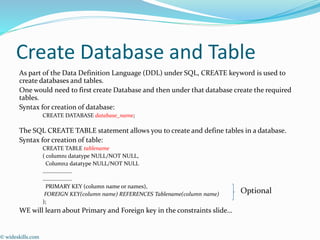
Create Database and Table
As part of the Data Definition Language (DDL) under SQL, CREATE keyword is used to
create databases and tables.
One would need to first create Database and then under that database create the required
tables.
Syntax for creation of database:
CREATE DATABASE database_name;
The SQL CREATE TABLE statement allows you to create and define tables in a database.
Syntax for creation of table:
CREATE TABLE tablename
( column1 datatype NULL/NOT NULL,
Column2 datatype NULL/NOT NULL
…………………
…………………
PRIMARY KEY (column name or names),
FOREIGN KEY(column name) REFERENCES Tablename(column name)
);
WE will learn about Primary and Foreign key in the constraints slide…
Optional
© wideskills.com
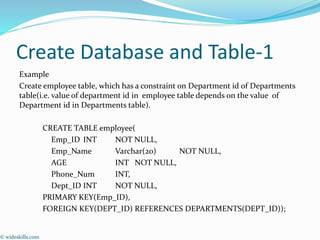
Create Database and Table-1
Example
Create employee table, which has a constraint on Department id of Departments
table(i.e. value of department id in employee table depends on the value of
Department id in Departments table).
CREATE TABLE employee(
Emp_ID INT NOT NULL,
Emp_Name Varchar(20) NOT NULL,
AGE INT NOT NULL,
Phone_Num INT,
Dept_ID INT NOT NULL,
PRIMARY KEY(Emp_ID),
FOREIGN KEY(DEPT_ID) REFERENCES DEPARTMENTS(DEPT_ID));
© wideskills.com
Interesting, right?
Arun T

sql ppt.pptx

  • 1.
    Structured Query Language Pathfrom Unorganized to Organized…. Arun Kumar T
  • 2.
    What is aDatabase… A database is an organized collection of data. The database management system(DBMS) is the system which acts as medium to carry data from database and user. There are 4 types of DBMS © wideskills.com Hierarchical DBMS Network DBMS Relational DBMS Object Oriented DBMS
  • 3.
    What is SQL… SQLis the standard used to manage data in relational tables. Structured Query Language normally referred as SQL and pronounced as SEE QU EL.. SQL allows users to create databases, add data, modify and maintain data. It is governed by standards maintained by ISO(International Standards Organization). Example of a relational table: Employee Department © wideskills.com Emp Id Emp Name Age Dept_id 1 John 40 1 2 Linda 35 1 3 Max 30 2 Dept_id Dept_name 1 Accounts 2 Production
  • 4.
    SQL syntax andquery SQL is case in-sensitive, that is keyword SELECT and select is same for SQL. Every SQL command should end with a semi-colon (;). If the syntax is not proper, then executing the command would result in syntax error. Command used to fetch data from table is called as query. A basic SQL query consists of SELECT, FROM and WHERE clause. SQL SELECT Command example: SELECT col1, col2, col3,….. FROM table_name WHERE condition; © wideskills.com
  • 5.
    Datatypes in SQL Datatype is the attribute of the data expected in the column. Depending upon the SQL implementation (version) different data types are available. Whenever you create a column using the data type, the SQL Implementation program would allocate appropriate amount of space to store the data. Data types are broadly categorized into Numerics, Strings, Binary, Datetime, Collection and XML. Most commonly used data types are Integer, Decimal, Float, Character, Varchar, Boolean, Date. Example: 1. Boolean Value : Return value = “True” 2. INT : 5400, -2500 3. Numeric or Decimal: Decimal(4,2) = 1000.24 © wideskills.com
  • 6.
    Operators and expressionsin SQL In SQL, operators are used in an SQL statement’s WHERE clause to perform different operations like comparison, logical and arithmetic operations. Operators that can be used are logical, comparison and Arithmetic. The Operators include <,>,<>,AND,OR,BETWEEN,ISNULL,+,-,?,% etc. Generally in any programming language, expression is a combination of values, constants, variables, operators and functions that results in a value. In SQL, expressions are used to query database/table to get specific data. Syntax: SELECT cols|expressions FROM table_name WHERE condition(using operators|expressions); © wideskills.com
  • 7.
    DDL CREATE ALTER DROP CREATE INDEX DROP INDEX DML SELECT INSERTINTO UPDATE DELETE DCL GRANT REVOKE SQL commands can be used to create databases, edit data in tables, delete data and maintain data in tables. SQL commands are classified into 3 groups: DDL(Data definition Language), DML(Data Manipulation Language) and DCL(Data Control Language). Let us start with CREATE… © wideskills.com
  • 8.
    Create Database andTable As part of the Data Definition Language (DDL) under SQL, CREATE keyword is used to create databases and tables. One would need to first create Database and then under that database create the required tables. Syntax for creation of database: CREATE DATABASE database_name; The SQL CREATE TABLE statement allows you to create and define tables in a database. Syntax for creation of table: CREATE TABLE tablename ( column1 datatype NULL/NOT NULL, Column2 datatype NULL/NOT NULL ………………… ………………… PRIMARY KEY (column name or names), FOREIGN KEY(column name) REFERENCES Tablename(column name) ); WE will learn about Primary and Foreign key in the constraints slide… Optional © wideskills.com
  • 9.
    Create Database andTable-1 Example Create employee table, which has a constraint on Department id of Departments table(i.e. value of department id in employee table depends on the value of Department id in Departments table). CREATE TABLE employee( Emp_ID INT NOT NULL, Emp_Name Varchar(20) NOT NULL, AGE INT NOT NULL, Phone_Num INT, Dept_ID INT NOT NULL, PRIMARY KEY(Emp_ID), FOREIGN KEY(DEPT_ID) REFERENCES DEPARTMENTS(DEPT_ID)); © wideskills.com
  • 10.