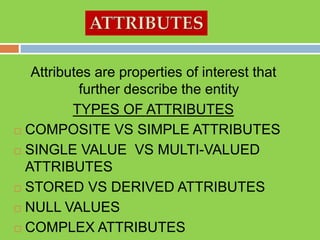
Attributes are properties of interest that
further describe the entity
TYPES OF ATTRIBUTES
 COMPOSITE VS SIMPLE ATTRIBUTES
 SINGLE VALUE VS MULTI-VALUED
ATTRIBUTES
 STORED VS DERIVED ATTRIBUTES
 NULL VALUES
 COMPLEX ATTRIBUTES
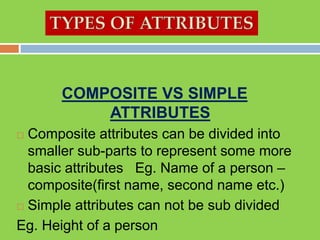
COMPOSITE VS SIMPLE
ATTRIBUTES
 Composite attributes can be divided into
smaller sub-parts to represent some more
basic attributes Eg. Name of a person –
composite(first name, second name etc.)
 Simple attributes can not be sub divided
Eg. Height of a person
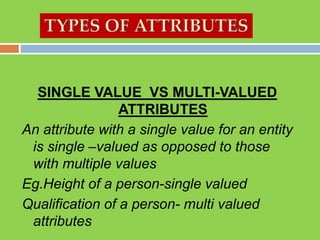
SINGLE VALUE VS MULTI-VALUED
ATTRIBUTES
An attribute with a single value for an entity
is single –valued as opposed to those
with multiple values
Eg.Height of a person-single valued
Qualification of a person- multi valued
attributes
Null values
Absence of a data item is represented
by a special value called null value
Complex attributes
The composite and multi–valued
attributes may be grouped to
constitute complex attributes
Any attribute which contains unique
values for identifying the entity
instance is known as identifier
Eg.roll no of a student
It refers to a set of techniques
that are used to design a data
base. These techniques use
certain concepts which are crucial
to the creation of structure and
development of the design
The relational data model represents the
database as collection of relations ,which
resembles a table of values
row – tuple( an ordered set of values)
column header- attribute
table –relation
data type describing the types of values-
domain
domain is a set of indivisible values
ACCOUNTING SYSTEM USING
DATABASE MANAGEMENT
SYSTEM
Query- a request for information from a
data base
SQL-Structured Query Language
SQL is used to communicate with a
data base
Simple query
A query which does not involve use
of any query function to produce a
summary of data
TYPES OF QUERIES
Parametre query
A parameter query prompts the user
to enter parameters, or criteria
through an input box for selecting a
set of records
TYPES OF QUERIES
Summary query
A summary query is used to
extract aggregate of data items
for a group of records rather than
a detailed set of records
TYPES OF QUERIES
Data base

Data base

  • 1.
    Attributes are propertiesof interest that further describe the entity TYPES OF ATTRIBUTES  COMPOSITE VS SIMPLE ATTRIBUTES  SINGLE VALUE VS MULTI-VALUED ATTRIBUTES  STORED VS DERIVED ATTRIBUTES  NULL VALUES  COMPLEX ATTRIBUTES
  • 2.
    COMPOSITE VS SIMPLE ATTRIBUTES Composite attributes can be divided into smaller sub-parts to represent some more basic attributes Eg. Name of a person – composite(first name, second name etc.)  Simple attributes can not be sub divided Eg. Height of a person
  • 3.
    SINGLE VALUE VSMULTI-VALUED ATTRIBUTES An attribute with a single value for an entity is single –valued as opposed to those with multiple values Eg.Height of a person-single valued Qualification of a person- multi valued attributes
  • 4.
    Null values Absence ofa data item is represented by a special value called null value
  • 5.
    Complex attributes The compositeand multi–valued attributes may be grouped to constitute complex attributes
  • 6.
    Any attribute whichcontains unique values for identifying the entity instance is known as identifier Eg.roll no of a student
  • 7.
    It refers toa set of techniques that are used to design a data base. These techniques use certain concepts which are crucial to the creation of structure and development of the design
  • 8.
    The relational datamodel represents the database as collection of relations ,which resembles a table of values row – tuple( an ordered set of values) column header- attribute table –relation data type describing the types of values- domain domain is a set of indivisible values
  • 9.
    ACCOUNTING SYSTEM USING DATABASEMANAGEMENT SYSTEM Query- a request for information from a data base SQL-Structured Query Language SQL is used to communicate with a data base
  • 10.
    Simple query A querywhich does not involve use of any query function to produce a summary of data TYPES OF QUERIES
  • 11.
    Parametre query A parameterquery prompts the user to enter parameters, or criteria through an input box for selecting a set of records TYPES OF QUERIES
  • 12.
    Summary query A summaryquery is used to extract aggregate of data items for a group of records rather than a detailed set of records TYPES OF QUERIES