Introduction to Big Data
& Basic Data Analysis
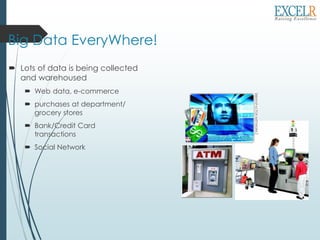
Big Data EveryWhere!
 Lots of data is being collected
and warehoused
 Web data, e-commerce
 purchases at department/
grocery stores
 Bank/Credit Card
transactions
 Social Network
How much data?
Google processes 20 PB a day (2008)
Wayback Machine has 3 PB + 100 TB/month
(3/2009)
Facebook has 2.5 PB of user data + 15 TB/day
(4/2009)
eBay has 6.5 PB of user data + 50 TB/day
(5/2009)
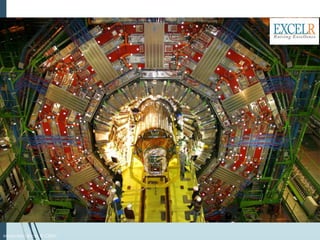
CERN’s Large Hydron Collider (LHC) generates
15 PB a year
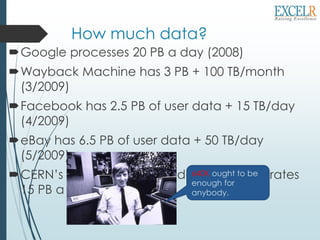
640K ought to be
enough for
anybody.
Maximilien Brice, © CERN
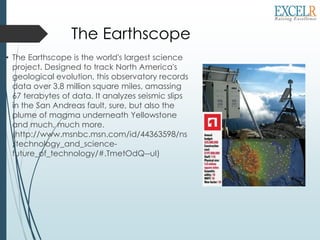
The Earthscope
• The Earthscope is the world's largest science
project. Designed to track North America's
geological evolution, this observatory records
data over 3.8 million square miles, amassing
67 terabytes of data. It analyzes seismic slips
in the San Andreas fault, sure, but also the
plume of magma underneath Yellowstone
and much, much more.
(http://www.msnbc.msn.com/id/44363598/ns
/technology_and_science-
future_of_technology/#.TmetOdQ--uI)
Type of Data
 Relational Data (Tables/Transaction/Legacy Data)
 Text Data (Web)
 Semi-structured Data (XML)
 Graph Data
 Social Network, Semantic Web (RDF), …
 Streaming Data
 You can only scan the data once
What to do with these data?
 Aggregation and Statistics
 Data warehouse and OLAP
 Indexing, Searching, and Querying
 Keyword based search
 Pattern matching (XML/RDF)
 Knowledge discovery
 Data Mining
 Statistical Modeling
What is Data Mining?
 Discovery of useful, possibly unexpected, patterns in data
 Non-trivial extraction of implicit, previously unknown and potentially
useful information from data
 Exploration & analysis, by automatic or
semi-automatic means, of large quantities of data in order to discover
meaningful patterns
Data Mining Tasks
 Classification [Predictive]
 Clustering [Descriptive]
 Association Rule Discovery [Descriptive]
 Sequential Pattern Discovery [Descriptive]
 Regression [Predictive]
 Deviation Detection [Predictive]
 Collaborative Filter [Predictive]
Classification: Definition
 Given a collection of records (training set )
 Each record contains a set of attributes, one of the attributes is the
class.
 Find a model for class attribute as a function of the values of
other attributes.
 Goal: previously unseen records should be assigned a class as
accurately as possible.
 A test set is used to determine the accuracy of the model. Usually, the
given data set is divided into training and test sets, with training set
used to build the model and test set used to validate it.
Other Types of Mining
Text mining: application of data
mining to textual documents
cluster Web pages to find related pages
cluster pages a user has visited to
organize their visit history
classify Web pages automatically into a
Web directory
Graph Mining:
Deal with graph data
11
Data Streams
 What are Data Streams?
 Continuous streams
 Huge, Fast, and Changing
 Why Data Streams?
 The arriving speed of streams and the huge amount of
data are beyond our capability to store them.
 “Real-time” processing
 Window Models
 Landscape window (Entire Data Stream)
 Sliding Window
 Damped Window
 Mining Data Stream
12
Streaming Sample Problem
 Scan the dataset once
 Sample K records
 Each one has equally probability to be sampled
 Total N record: K/N

Data analytics courses

  • 1.
    Introduction to BigData & Basic Data Analysis
  • 2.
    Big Data EveryWhere! Lots of data is being collected and warehoused  Web data, e-commerce  purchases at department/ grocery stores  Bank/Credit Card transactions  Social Network
  • 3.
    How much data? Googleprocesses 20 PB a day (2008) Wayback Machine has 3 PB + 100 TB/month (3/2009) Facebook has 2.5 PB of user data + 15 TB/day (4/2009) eBay has 6.5 PB of user data + 50 TB/day (5/2009) CERN’s Large Hydron Collider (LHC) generates 15 PB a year 640K ought to be enough for anybody.
  • 4.
  • 5.
    The Earthscope • TheEarthscope is the world's largest science project. Designed to track North America's geological evolution, this observatory records data over 3.8 million square miles, amassing 67 terabytes of data. It analyzes seismic slips in the San Andreas fault, sure, but also the plume of magma underneath Yellowstone and much, much more. (http://www.msnbc.msn.com/id/44363598/ns /technology_and_science- future_of_technology/#.TmetOdQ--uI)
  • 6.
    Type of Data Relational Data (Tables/Transaction/Legacy Data)  Text Data (Web)  Semi-structured Data (XML)  Graph Data  Social Network, Semantic Web (RDF), …  Streaming Data  You can only scan the data once
  • 7.
    What to dowith these data?  Aggregation and Statistics  Data warehouse and OLAP  Indexing, Searching, and Querying  Keyword based search  Pattern matching (XML/RDF)  Knowledge discovery  Data Mining  Statistical Modeling
  • 8.
    What is DataMining?  Discovery of useful, possibly unexpected, patterns in data  Non-trivial extraction of implicit, previously unknown and potentially useful information from data  Exploration & analysis, by automatic or semi-automatic means, of large quantities of data in order to discover meaningful patterns
  • 9.
    Data Mining Tasks Classification [Predictive]  Clustering [Descriptive]  Association Rule Discovery [Descriptive]  Sequential Pattern Discovery [Descriptive]  Regression [Predictive]  Deviation Detection [Predictive]  Collaborative Filter [Predictive]
  • 10.
    Classification: Definition  Givena collection of records (training set )  Each record contains a set of attributes, one of the attributes is the class.  Find a model for class attribute as a function of the values of other attributes.  Goal: previously unseen records should be assigned a class as accurately as possible.  A test set is used to determine the accuracy of the model. Usually, the given data set is divided into training and test sets, with training set used to build the model and test set used to validate it.
  • 11.
    Other Types ofMining Text mining: application of data mining to textual documents cluster Web pages to find related pages cluster pages a user has visited to organize their visit history classify Web pages automatically into a Web directory Graph Mining: Deal with graph data 11
  • 12.
    Data Streams  Whatare Data Streams?  Continuous streams  Huge, Fast, and Changing  Why Data Streams?  The arriving speed of streams and the huge amount of data are beyond our capability to store them.  “Real-time” processing  Window Models  Landscape window (Entire Data Stream)  Sliding Window  Damped Window  Mining Data Stream 12
  • 13.
    Streaming Sample Problem Scan the dataset once  Sample K records  Each one has equally probability to be sampled  Total N record: K/N