WHAT IS A RING?
 A set of elements
 Closed under addition and multiplication
 Commutative group under addition
 Multiplication and Addition is associative
 Left and Right Distributive Laws hold
 Contains an identity element 0
 Contains additive inverses
ALTERNATIVE DEFINITION OF A
RING
A ring 𝑅 is a set defined by two operations (addition and
multiplication) and the following conditions hold:
1. 𝑅 forms an abelian group with respect to addition
2. 𝑅 is closed with respect to an associative multiplication
3. Two distributive laws hold in 𝑅
SIMPLE EXAMPLES OF RINGS
1. The set of ℤ of all integers
2. The set ℚ of all rational numbers
3. The set ℝ of all real numbers
4. The set ℂ of all complex numbers
EXAMPLE 2:
VERIFYTHATTHE SET 𝐸 OF ALL EVEN INTEGERS IS A RING
WITH RESPECTTO USUAL ADDITION AND MULTIPLICATION
IN ℤ.
Solution:
Properties Proof/Explanation
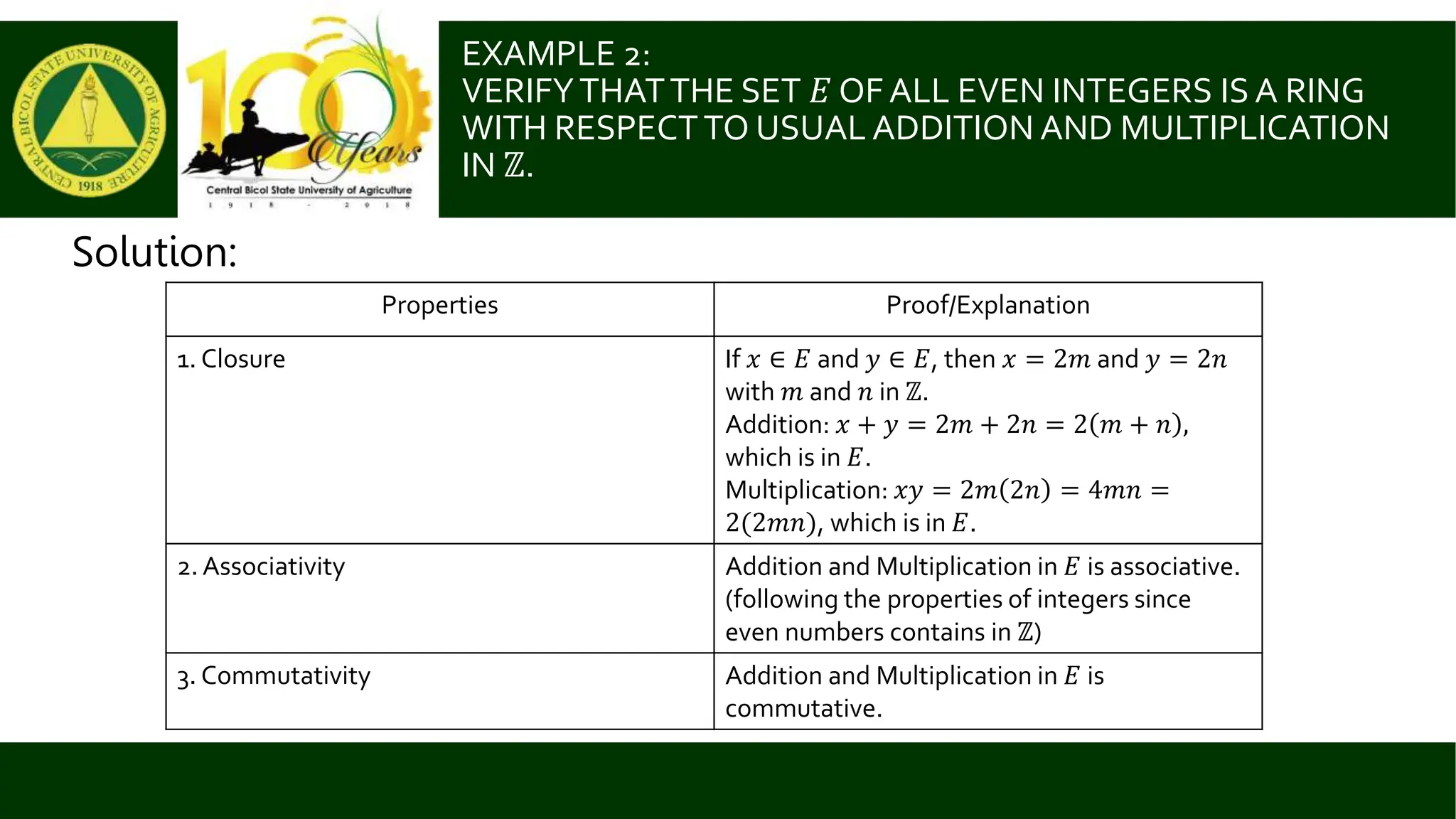
1. Closure If 𝑥 ∈ 𝐸 and 𝑦 ∈ 𝐸, then 𝑥 = 2𝑚 and 𝑦 = 2𝑛
with 𝑚 and 𝑛 in ℤ.
Addition: 𝑥 + 𝑦 = 2𝑚 + 2𝑛 = 2 𝑚 + 𝑛 ,
which is in 𝐸.
Multiplication: 𝑥𝑦 = 2𝑚 2𝑛 = 4𝑚𝑛 =
2(2𝑚𝑛), which is in 𝐸.
2. Associativity Addition and Multiplication in 𝐸 is associative.
(following the properties of integers since
even numbers contains in ℤ)
3. Commutativity Addition and Multiplication in 𝐸 is
commutative.
EXAMPLE 2:
VERIFYTHATTHE SET 𝐸 OF ALL EVEN INTEGERS IS A RING
WITH RESPECTTO USUAL ADDITION AND MULTIPLICATION
IN ℤ.
Solution:
Properties Proof/Explanation
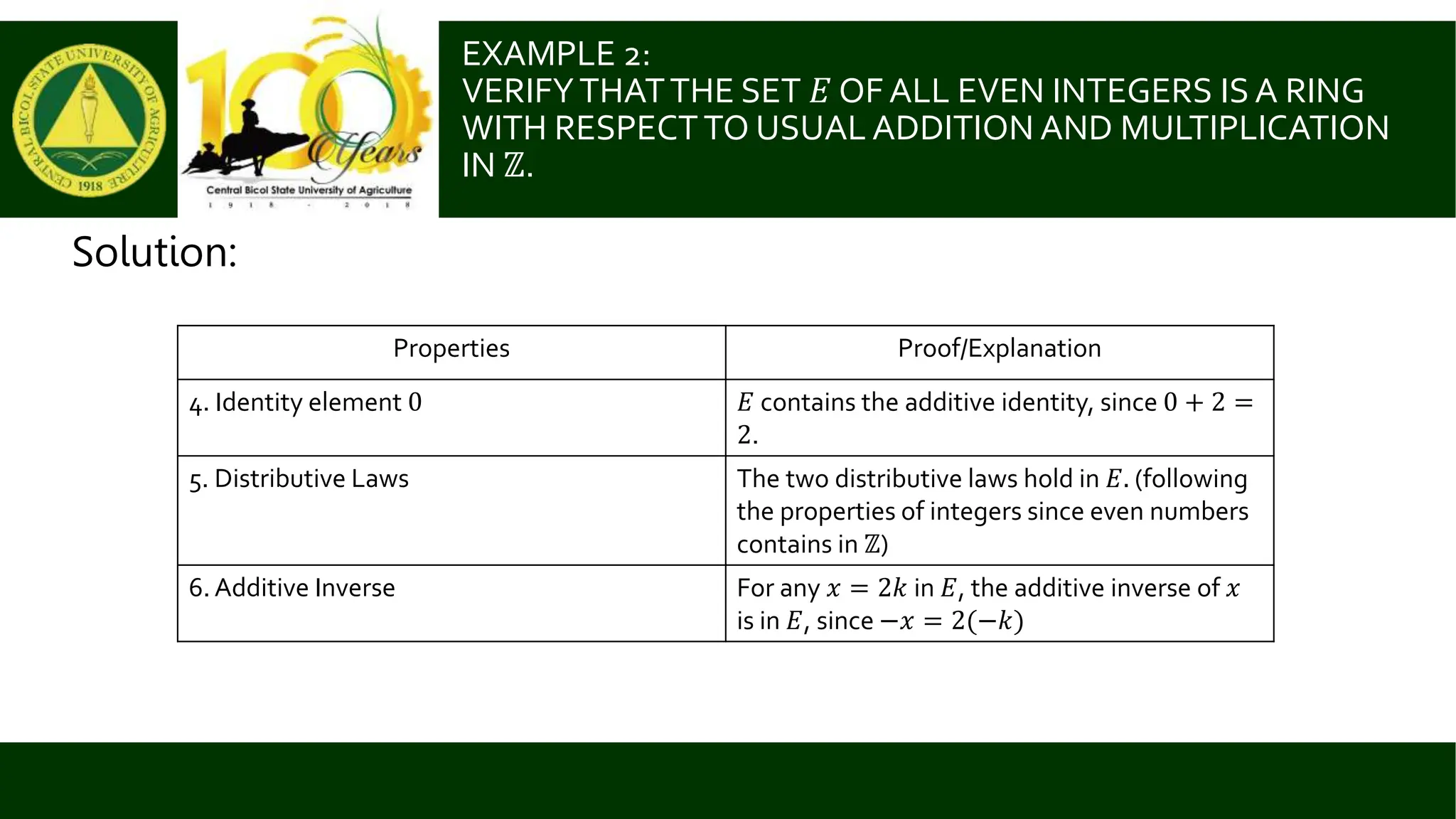
4. Identity element 0 𝐸 contains the additive identity, since 0 + 2 =
2.
5. Distributive Laws The two distributive laws hold in 𝐸. (following
the properties of integers since even numbers
contains in ℤ)
6. Additive Inverse For any 𝑥 = 2𝑘 in 𝐸, the additive inverse of 𝑥
is in 𝐸, since −𝑥 = 2(−𝑘)
ANOTHER EXAMPLE OF A RING
The set 𝑆 = 𝑎, 𝑏 with addition and multiplication defined by the
tables:
+ 𝑎 𝑏
𝑎 𝑎 𝑏
𝑏 𝑏 𝑎
∗ 𝑎 𝑏
𝑎 𝑎 𝑎
𝑏 𝑎 𝑏
ANOTHER EXAMPLE OF A RING
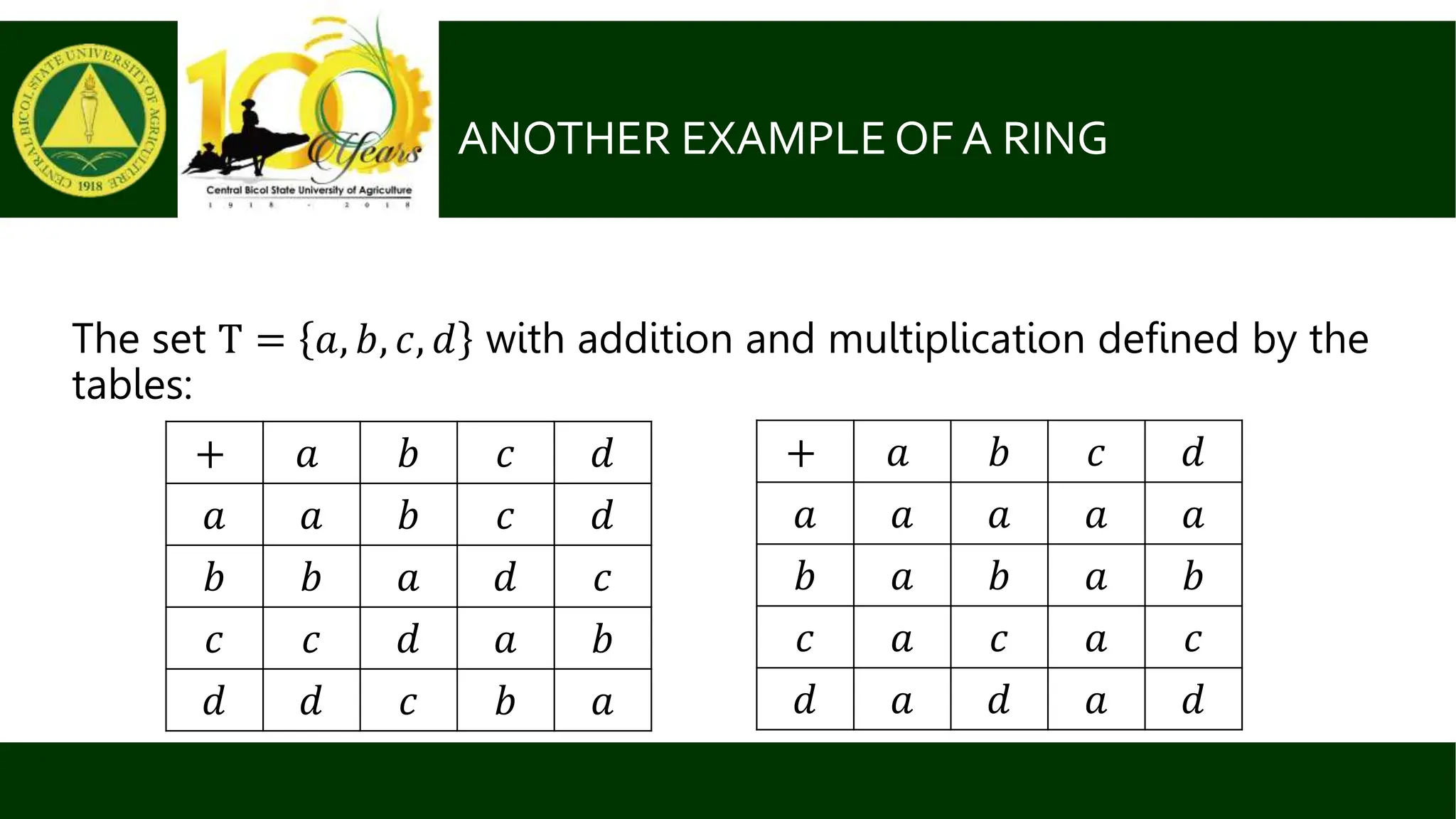
The set T = 𝑎, 𝑏, 𝑐, 𝑑 with addition and multiplication defined by the
tables:
+ 𝑎 𝑏 𝑐 𝑑
𝑎 𝑎 𝑏 𝑐 𝑑
𝑏 𝑏 𝑎 𝑑 𝑐
𝑐 𝑐 𝑑 𝑎 𝑏
𝑑 𝑑 𝑐 𝑏 𝑎
+ 𝑎 𝑏 𝑐 𝑑
𝑎 𝑎 𝑎 𝑎 𝑎
𝑏 𝑎 𝑏 𝑎 𝑏
𝑐 𝑎 𝑐 𝑎 𝑐
𝑑 𝑎 𝑑 𝑎 𝑑
PROPERTIES OF RINGS
Every ring is an abelian additive group.
There exists a unique additive identity element 𝑧, (the zero of the ring)
Each element has a unique additive inverse, (the negative of the element)
The Cancellation Law for addition holds
− −𝑎 = 𝑎 & − 𝑎 + 𝑏 = −𝑎 + (−𝑏) for all 𝑎, 𝑏 of the ring
𝑎 ∙ 𝑧 = 𝑧 ∙ 𝑎 = 𝑧
𝑎 −𝑏 = − 𝑎𝑏 = (−𝑎)(𝑏)
TYPES OF RINGS
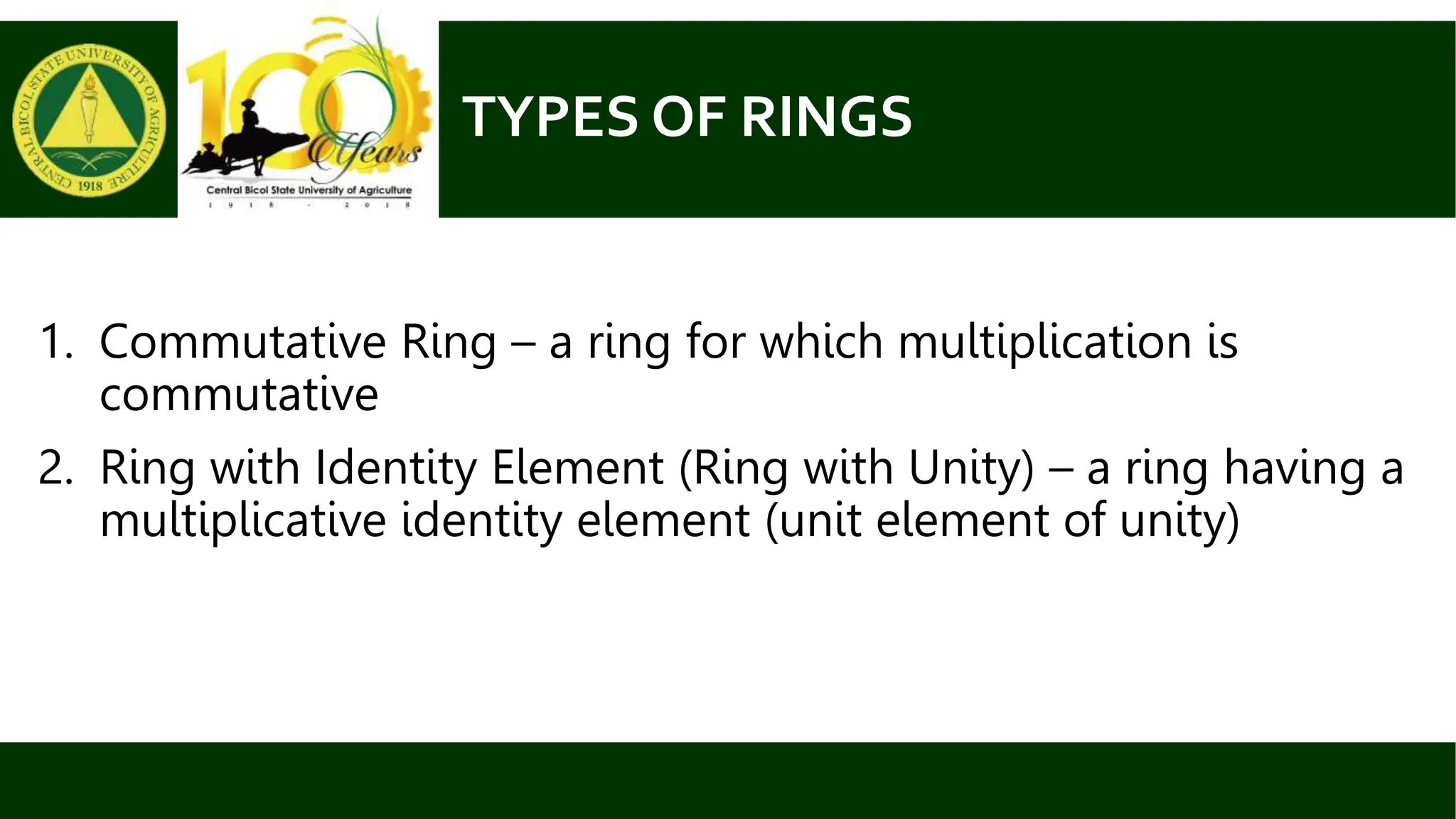
1. Commutative Ring – a ring for which multiplication is
commutative
2. Ring with Identity Element (Ring with Unity) – a ring having a
multiplicative identity element (unit element of unity)
EXAMPLES
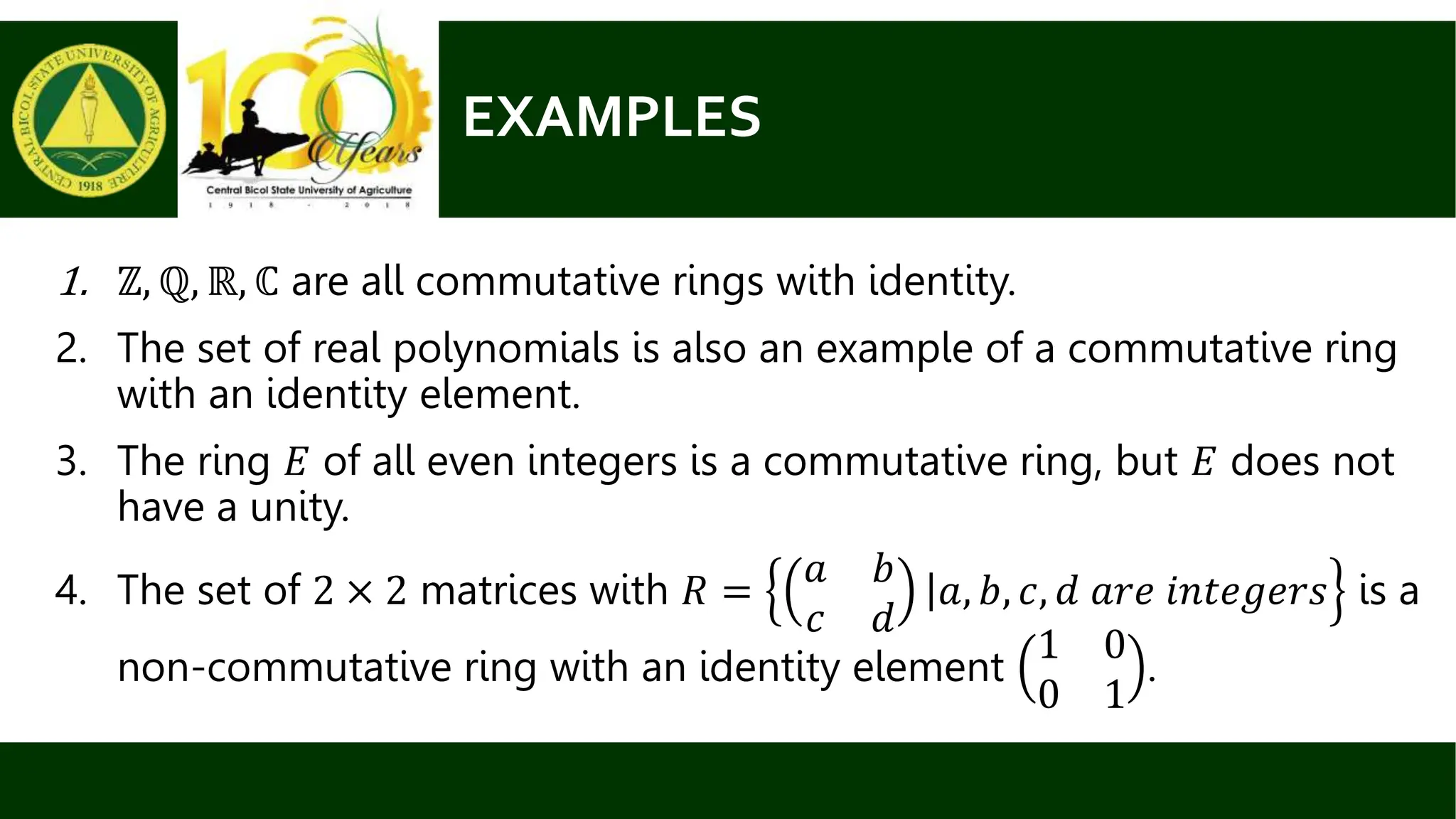
1. ℤ, ℚ, ℝ, ℂ are all commutative rings with identity.
2. The set of real polynomials is also an example of a commutative ring
with an identity element.
3. The ring 𝐸 of all even integers is a commutative ring, but 𝐸 does not
have a unity.
4. The set of 2 × 2 matrices with 𝑅 =
𝑎 𝑏
𝑐 𝑑
𝑎, 𝑏, 𝑐, 𝑑 𝑎𝑟𝑒 𝑖𝑛𝑡𝑒𝑔𝑒𝑟𝑠 is a
non-commutative ring with an identity element
1 0
0 1
.

Alternative definition of a ring in math.pptx

  • 1.
    WHAT IS ARING?  A set of elements  Closed under addition and multiplication  Commutative group under addition  Multiplication and Addition is associative  Left and Right Distributive Laws hold  Contains an identity element 0  Contains additive inverses
  • 2.
    ALTERNATIVE DEFINITION OFA RING A ring 𝑅 is a set defined by two operations (addition and multiplication) and the following conditions hold: 1. 𝑅 forms an abelian group with respect to addition 2. 𝑅 is closed with respect to an associative multiplication 3. Two distributive laws hold in 𝑅
  • 3.
    SIMPLE EXAMPLES OFRINGS 1. The set of ℤ of all integers 2. The set ℚ of all rational numbers 3. The set ℝ of all real numbers 4. The set ℂ of all complex numbers
  • 4.
    EXAMPLE 2: VERIFYTHATTHE SET𝐸 OF ALL EVEN INTEGERS IS A RING WITH RESPECTTO USUAL ADDITION AND MULTIPLICATION IN ℤ. Solution: Properties Proof/Explanation 1. Closure If 𝑥 ∈ 𝐸 and 𝑦 ∈ 𝐸, then 𝑥 = 2𝑚 and 𝑦 = 2𝑛 with 𝑚 and 𝑛 in ℤ. Addition: 𝑥 + 𝑦 = 2𝑚 + 2𝑛 = 2 𝑚 + 𝑛 , which is in 𝐸. Multiplication: 𝑥𝑦 = 2𝑚 2𝑛 = 4𝑚𝑛 = 2(2𝑚𝑛), which is in 𝐸. 2. Associativity Addition and Multiplication in 𝐸 is associative. (following the properties of integers since even numbers contains in ℤ) 3. Commutativity Addition and Multiplication in 𝐸 is commutative.
  • 5.
    EXAMPLE 2: VERIFYTHATTHE SET𝐸 OF ALL EVEN INTEGERS IS A RING WITH RESPECTTO USUAL ADDITION AND MULTIPLICATION IN ℤ. Solution: Properties Proof/Explanation 4. Identity element 0 𝐸 contains the additive identity, since 0 + 2 = 2. 5. Distributive Laws The two distributive laws hold in 𝐸. (following the properties of integers since even numbers contains in ℤ) 6. Additive Inverse For any 𝑥 = 2𝑘 in 𝐸, the additive inverse of 𝑥 is in 𝐸, since −𝑥 = 2(−𝑘)
  • 6.
    ANOTHER EXAMPLE OFA RING The set 𝑆 = 𝑎, 𝑏 with addition and multiplication defined by the tables: + 𝑎 𝑏 𝑎 𝑎 𝑏 𝑏 𝑏 𝑎 ∗ 𝑎 𝑏 𝑎 𝑎 𝑎 𝑏 𝑎 𝑏
  • 7.
    ANOTHER EXAMPLE OFA RING The set T = 𝑎, 𝑏, 𝑐, 𝑑 with addition and multiplication defined by the tables: + 𝑎 𝑏 𝑐 𝑑 𝑎 𝑎 𝑏 𝑐 𝑑 𝑏 𝑏 𝑎 𝑑 𝑐 𝑐 𝑐 𝑑 𝑎 𝑏 𝑑 𝑑 𝑐 𝑏 𝑎 + 𝑎 𝑏 𝑐 𝑑 𝑎 𝑎 𝑎 𝑎 𝑎 𝑏 𝑎 𝑏 𝑎 𝑏 𝑐 𝑎 𝑐 𝑎 𝑐 𝑑 𝑎 𝑑 𝑎 𝑑
  • 8.
    PROPERTIES OF RINGS Everyring is an abelian additive group. There exists a unique additive identity element 𝑧, (the zero of the ring) Each element has a unique additive inverse, (the negative of the element) The Cancellation Law for addition holds − −𝑎 = 𝑎 & − 𝑎 + 𝑏 = −𝑎 + (−𝑏) for all 𝑎, 𝑏 of the ring 𝑎 ∙ 𝑧 = 𝑧 ∙ 𝑎 = 𝑧 𝑎 −𝑏 = − 𝑎𝑏 = (−𝑎)(𝑏)
  • 9.
    TYPES OF RINGS 1.Commutative Ring – a ring for which multiplication is commutative 2. Ring with Identity Element (Ring with Unity) – a ring having a multiplicative identity element (unit element of unity)
  • 10.
    EXAMPLES 1. ℤ, ℚ,ℝ, ℂ are all commutative rings with identity. 2. The set of real polynomials is also an example of a commutative ring with an identity element. 3. The ring 𝐸 of all even integers is a commutative ring, but 𝐸 does not have a unity. 4. The set of 2 × 2 matrices with 𝑅 = 𝑎 𝑏 𝑐 𝑑 𝑎, 𝑏, 𝑐, 𝑑 𝑎𝑟𝑒 𝑖𝑛𝑡𝑒𝑔𝑒𝑟𝑠 is a non-commutative ring with an identity element 1 0 0 1 .