HONGLI YE
AS MEDIA STUDIES
Analysis of Dark Knight opening
sequence
Camera shots, movement and framing
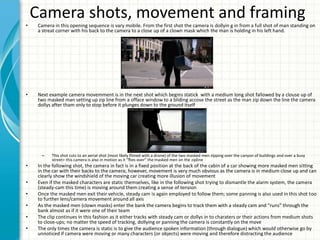
• Camera in this opening sequence is vary mobile. From the first shot the camera is dollyin g in from a full shot of man standing on
a streat corner with his back to the camera to a close up of a clown mask which the man is holding in his left hand.
• Next example camera movemment is in the next shot which begins statick with a medium long shot fallowed by a clouse up of
two masked man setting up zip line from a offace window to a bliding accose the street as the man zip down the line the camera
dollys after tham only to stop before it plunges down to the ground itself
– This shot cuts to an aerial shot (most likely filmed with a drone) of the two masked men zipping over the canyon of buildings and over a busy
street> this camera is also in motion as it “flies over” the masked men on the zipline
• In the following shot, the camera in fact is in a fixed position at the back of the cabin of a car showing more masked men sitting
in the car with their backs to the camera; however, movement is very much obvious as the camera is in medium close up and can
clearly show the windshield of the moving car creating more illusion of movement
• Even if the masked characters are static themselves, like in the following shot trying to dismantle the alarm system, the camera
(steady-cam this time) is moving around them creating a sense of tension
• Once the masked men exit their vehicle, steady cam is again employed to follow them; some panning is also used in this shot too
to further lens/camera movement around all axis
• As the masked men (clown masks) enter the bank the camera begins to track them with a steady cam and “runs” through the
bank almost as if it were one of their team
• The clip continues in this fashion as it either tracks with steady cam or dollys in to charaters or their actions from medium shots
to close-ups; no matter the speed of tracking, dollying or panning the camera is constantly on the move
• The only times the camera is static is to give the audience spoken information (through dialogue) which would otherwise go by
unnoticed if camera were moving or many characters (or objects) were moving and therefore distracting the audience
Editing
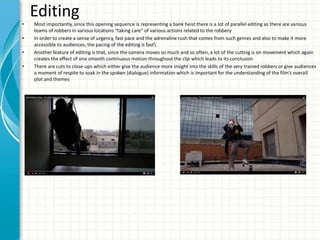
• Most importantly, since this opening sequence is representing a bank heist there is a lot of parallel editing as there are various
teams of robbers in various locations “taking care” of various actions related to the robbery
• In order to create a sense of urgency, fast pace and the adrenaline rush that comes from such genres and also to make it more
accessible to audiences, the pacing of the editing is fast
• Another feature of editing is that, since the camera moves so much and so often, a lot of the cutting is on movement which again
creates the effect of one smooth continuous motion throughout the clip which leads to its conclusion
• There are cuts to close-ups which either give the audience more insight into the skills of the very trained robbers or give audiences
a moment of respite to soak in the spoken (dialogue) information which is important for the understanding of the film’s overall
plot and themes
Sound
• The non-diegetic sound starts from the opening of the clip and runs to the end > it is fast paced with a quick beat giving the
whole bank heist a good background which is in tempo with the action on screen
• The only time it changes is at the end, as it builds up to a musical climax when one of the robbers takes of
their mask to reveal that it has been the Joker underneath the whole time
• Diegetic sound consists of various foley sounds of a bank robbery: guns firing, zipline sounds, safe cracking
sounds, gas bombs etc.
• Another interesting feature of the diegetic sound is that since the robbers’ faces are covered by clown
masks, their voices sound a bit muffled but are still quite clear.
Mise-en-Scene
• The opening sequence was shot in what was to appear to the audience as a generic North-American city with a lot of
high rises and office buildings
• The bank robbers are all wearing dark colours and their suit styles vary some are more casual than others (some
wearing suits even) but the most prominent mise-en-scene feature is of course each robbers’ clown face mask
• These clown masks are more of a grotesque nature to give the robbers and the whole heist a very eerie (scary)
feeling
• The interior of the bank is very spacious but also denotes power and success and because of the repetitive patterns
of the floor or the ceiling or the decorative pillars the banks represents order and regularity as espoused by capitalist
society
• The colours of the environments are predominantly gray and even have a blue hue in the safe room, except for the
interior of the bank which is of a yellowish hue. The director could have been trying to make an ironic comment
about capitalist society where only on the inside of a bank can you have a warmer colour scheme as opposed to the
other parts of that world which appear quite cool in colour tone
• The lighting in the bank is high key again keeping in tune with the warmer colour tone, while in other parts of the clip
the lighting is low key and colder in hue
• The bank tellers are all dressed professionally
• The final bank robber standing finally takes of his clown mask to reveal his true face: it is another clown face, this
time with some deep scarring
– This has been done to show the audience that underneath the “creepy” clown mask there is an even uglier clown face which is the theme of the movie and
shows the audience that underneath evil there is an even deeper evil; this also shows that the Joker is the same on the surface as well as on the inside
– Also, this could be the Joker’s sense of humour which is very odd and that is an excellent introduction to his perverse sense of entertainment

Dark knight film opening sequence

  • 1.
    HONGLI YE AS MEDIASTUDIES Analysis of Dark Knight opening sequence
  • 2.
    Camera shots, movementand framing • Camera in this opening sequence is vary mobile. From the first shot the camera is dollyin g in from a full shot of man standing on a streat corner with his back to the camera to a close up of a clown mask which the man is holding in his left hand. • Next example camera movemment is in the next shot which begins statick with a medium long shot fallowed by a clouse up of two masked man setting up zip line from a offace window to a bliding accose the street as the man zip down the line the camera dollys after tham only to stop before it plunges down to the ground itself – This shot cuts to an aerial shot (most likely filmed with a drone) of the two masked men zipping over the canyon of buildings and over a busy street> this camera is also in motion as it “flies over” the masked men on the zipline • In the following shot, the camera in fact is in a fixed position at the back of the cabin of a car showing more masked men sitting in the car with their backs to the camera; however, movement is very much obvious as the camera is in medium close up and can clearly show the windshield of the moving car creating more illusion of movement • Even if the masked characters are static themselves, like in the following shot trying to dismantle the alarm system, the camera (steady-cam this time) is moving around them creating a sense of tension • Once the masked men exit their vehicle, steady cam is again employed to follow them; some panning is also used in this shot too to further lens/camera movement around all axis • As the masked men (clown masks) enter the bank the camera begins to track them with a steady cam and “runs” through the bank almost as if it were one of their team • The clip continues in this fashion as it either tracks with steady cam or dollys in to charaters or their actions from medium shots to close-ups; no matter the speed of tracking, dollying or panning the camera is constantly on the move • The only times the camera is static is to give the audience spoken information (through dialogue) which would otherwise go by unnoticed if camera were moving or many characters (or objects) were moving and therefore distracting the audience
  • 3.
    Editing • Most importantly,since this opening sequence is representing a bank heist there is a lot of parallel editing as there are various teams of robbers in various locations “taking care” of various actions related to the robbery • In order to create a sense of urgency, fast pace and the adrenaline rush that comes from such genres and also to make it more accessible to audiences, the pacing of the editing is fast • Another feature of editing is that, since the camera moves so much and so often, a lot of the cutting is on movement which again creates the effect of one smooth continuous motion throughout the clip which leads to its conclusion • There are cuts to close-ups which either give the audience more insight into the skills of the very trained robbers or give audiences a moment of respite to soak in the spoken (dialogue) information which is important for the understanding of the film’s overall plot and themes
  • 4.
    Sound • The non-diegeticsound starts from the opening of the clip and runs to the end > it is fast paced with a quick beat giving the whole bank heist a good background which is in tempo with the action on screen • The only time it changes is at the end, as it builds up to a musical climax when one of the robbers takes of their mask to reveal that it has been the Joker underneath the whole time • Diegetic sound consists of various foley sounds of a bank robbery: guns firing, zipline sounds, safe cracking sounds, gas bombs etc. • Another interesting feature of the diegetic sound is that since the robbers’ faces are covered by clown masks, their voices sound a bit muffled but are still quite clear.
  • 5.
    Mise-en-Scene • The openingsequence was shot in what was to appear to the audience as a generic North-American city with a lot of high rises and office buildings • The bank robbers are all wearing dark colours and their suit styles vary some are more casual than others (some wearing suits even) but the most prominent mise-en-scene feature is of course each robbers’ clown face mask • These clown masks are more of a grotesque nature to give the robbers and the whole heist a very eerie (scary) feeling • The interior of the bank is very spacious but also denotes power and success and because of the repetitive patterns of the floor or the ceiling or the decorative pillars the banks represents order and regularity as espoused by capitalist society • The colours of the environments are predominantly gray and even have a blue hue in the safe room, except for the interior of the bank which is of a yellowish hue. The director could have been trying to make an ironic comment about capitalist society where only on the inside of a bank can you have a warmer colour scheme as opposed to the other parts of that world which appear quite cool in colour tone • The lighting in the bank is high key again keeping in tune with the warmer colour tone, while in other parts of the clip the lighting is low key and colder in hue • The bank tellers are all dressed professionally • The final bank robber standing finally takes of his clown mask to reveal his true face: it is another clown face, this time with some deep scarring – This has been done to show the audience that underneath the “creepy” clown mask there is an even uglier clown face which is the theme of the movie and shows the audience that underneath evil there is an even deeper evil; this also shows that the Joker is the same on the surface as well as on the inside – Also, this could be the Joker’s sense of humour which is very odd and that is an excellent introduction to his perverse sense of entertainment

Editor's Notes

  • #2 This template can be used as a starter file for presenting training materials in a group setting. Sections Right-click on a slide to add sections. Sections can help to organize your slides or facilitate collaboration between multiple authors. Notes Use the Notes section for delivery notes or to provide additional details for the audience. View these notes in Presentation View during your presentation. Keep in mind the font size (important for accessibility, visibility, videotaping, and online production) Coordinated colors Pay particular attention to the graphs, charts, and text boxes. Consider that attendees will print in black and white or grayscale. Run a test print to make sure your colors work when printed in pure black and white and grayscale. Graphics, tables, and graphs Keep it simple: If possible, use consistent, non-distracting styles and colors. Label all graphs and tables.
  • #3 Give a brief overview of the presentation. Describe the major focus of the presentation and why it is important. Introduce each of the major topics. To provide a road map for the audience, you can repeat this Overview slide throughout the presentation, highlighting the particular topic you will discuss next.