Core Subject Description
Thiscourse on dance includes
rhythmical patterns, the promotion
and appreciation of Philippine folk
dance, indigenous and traditional
dances as well as other dance forms. It
consists of an offerings which learners
can choose from.
3.
Content Standard
The learners
demonstratesunderstanding of dance
in optimizing one‘s health; as a
requisite for physical assessment
performance, and as a career
opportunity
4.
Performance Standard
The learnersleads dance events
with i
n
proficiency and confidence
resulting independent pursuit
and in
influencin
g
others
positively
What is Dance?
•Dance is one of the most beautiful forms of art that
has grown in leaps and bounds.
• Dance is no longer just a hobby; it is also one of the
most lucrative professions as well.
• Besides, dance therapy is very much in vogue these
days simply because the experience of dancing helps
a person to heal from within.
• Dance is a form of expression that helps a person
bring forth who they are, and what they're
passionate about.
7.
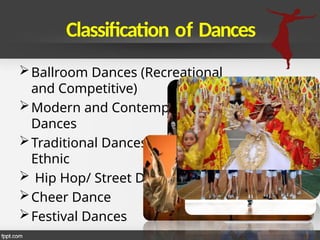
Classification of Dances
BallroomDances (Recreational
and Competitive)
Modern and Contemporary
Dances
Traditional Dances/ Folk and
Ethnic
Hip Hop/ Street Dance
Cheer Dance
Festival Dances
8.
Discussion Point
A..Pick onedance that you know
and describe it.
B.. Pick a dance you are interested to
learn and explain why you are
interested in it.
9.
ACTIVITY
Groupings
• Each memberof the group will write at least
one type of dance that you know on the meta
cards.
• Give your meta cards to your leader and put
them on the manila paper.
• One representative in the group will go in
front of the class to share their works.
10.
BALLROOM DANCES
(Recreational andCompetitive)
• is a formal social dancing for couples, where
one person leads and the other follows the
steps.
• It is popular both as a recreational
and a competitive activity
• The word ―ball‖ is from the Latin word
ballare, which means dance.
• There are two main types of ballroom
dance. The Smooth/American style and
the Latin/Rhythm style of dance.
11.
International Style
• grewout of English or modern style
ballroom dancing and is the style
used in international dance
competitions.
• It is divided into two groups, the
Standard and Latin group
12.
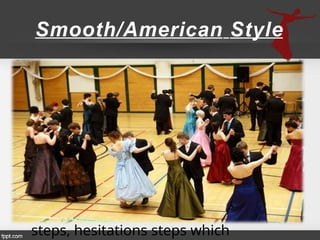
Smooth/American Style
• Itwas an attempt to make
ballroom dancing less formal and
more social.
• It requires a fairly large dance
floor.
• It provides the dancer patterns
which are useful for dancing on small
dance floors.
• Samples of dance are Waltz box
steps, hesitations steps which
13.
Latin Dances
Latinballroom are dances that almost stay
in one place on the dance floor. They are
energetic dances that reflect the accented
rhythm of music being played. The five
dances of latin are Cha Cha, Samba,
Rumba, Paso Doble and Jive.
14.
Latin Dances
Latin dancesin the International
Dancesport competitions
consists of:
cha-cha-cha,
rumba,
samba,
paso doble, and also the
jive of United States origin.
Social Latin dances (Street Latin)
include:
salsa,
mambo,
merengue,
rumba and the
Argentine tango.
15.
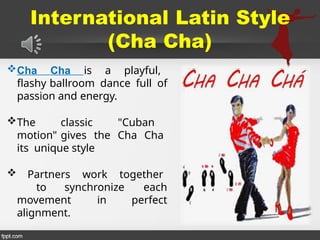
International Latin Style
(ChaCha)
Cha Cha is a playful,
flashy ballroom dance full of
passion and energy.
The classic "Cuban
motion" gives the Cha Cha
its unique style
Partners work together
to synchronize each
movement in perfect
alignment.
16.
International Latin Style
(Samba)
Samba is considered
the dance of celebration and
joy at Carnival celebrations in
Brazil.
Lively and rhythmical,
ballroom Samba is made
up of many different
South American dances
mixed into one.
17.
International Latin Style
(Rumba)
Rumba is considered by
many to be the most
romantic and sensual of all
Latin ballroom dances.
It is often referred to as
the "Grandfather of the
Latin dances.
18.
International Latin Style
(PasoDoble)
Paso Doble is modeled
after the sound, drama,
and movement of the
Spanish bullfight.
It is one of the
liveliest ballroom dances,
originating in southern
France.
19.
International Latin Style
(Jive)
Jive is a lively form of
Swing dance and a
variation of the Jitterbug.
It‘s a ballroom dance style
that originated in the United
States from African-
Americans.
It is a lively form of
Swing dance and a
variation of the Jitterbug
International Standard
Style (Waltz)
Waltz is one of the
smoothest
ballroom dances.
Also, it is the most
popular
ballroom dance of all time.
Considered by some as
the "mother of present
day dances" and the
"backbone dance" of the
ballroom dancing arena,
the Waltz is the basis for
22.
International Standard
Style (Tango)
oneof the
most of
all
ballroo
m
Tango
is
fascinatin
g dances.
in Buenos
Aires,
Originate
d
Argentina
,
ballroom
performe
d
this
dance
is by
a
man
sensua
l
usuall
y and
a
woman, expressing an
element of romance
in their synchronized
movements.
23.
International Standard
Style (VienesseWaltz)
Viennese Waltz is a
quick rotating ballroom
dance with a subtle rise and
fall.
The simple
and
rotation
al
elegant
movemen
t
characterize by the
Viennese Waltz is
considered to be the most
difficult dance to learn.
International Standard
Style (Foxtrot)
Foxtrot is an excellent
dance for beginers.
It is a smooth dance in
which dancers make long,
flowing movements across
the floor.
26.
International Standard
Style (QuickStep)
Quickstep is a quick
version of Foxtrot.
It is a ballroom
dance
comprised of extremely quick
syncopated feet
and runs of
quick
stepping
,
rhythms
, steps.
27.
Classical Dance
Ballet –is considered as the backbone
for many other genres of dance
• It is a type of dance compelled
with
rigorous code of technical guidelines
• Considering the five
fundamental positions of the arms
and feet, one can say that the
language of ballet is objective,
specific and fixed
• Elevation, alignment, pointing of the
foot, port de bras, flexibility, lightness
ae the other foundations for a ballet
dancer.
• They have the capability to
convey stories that bring an audience
28.
Modern Dance
Moderndance is a free,
expressive style of dancing started
in the early 20th century as a
reaction to classical ballet.
In recent years it has
included elements not usually
associated with dance.
29.
Contemporary Dance
Contemporary dance
•is a style of expressive dance
that
dance
jazz,
elements
genres
lyrical
and
o
f
includin
g
classical
combine
s several
modern,
ballet
• Contemporary dancers strives
to connect the mind and the body
through fluid dance movements
30.
Nature of Contemporary
Dance
Around 1980s, the world "contemporary dance" referred
to the movement of new dancers who did not want to
follow strict classical ballet and lyrical dance forms, but
instead wanted to explore the area of revolutionary
unconventional movements that were gathered from
all dance styles of the world.
Contemporary dances therefore do not use fixed
moves and instead try to develop totally new forms and
dynamics, such as quick oppositional moves, shifting
alignments, expressions of raw emotions, systematic
breathing, dancing moves preformed in non-standing
positions (for example lying on the floor), and in general
31.
kartha 3raham
(T834 –T33T)
• She is the Dancer who
introduced and greatly
popularized the
contemporary dance to
the worldwide audience.
• Durin
g
career,
her seven decade
long her
modern
dance and
choreographies gathered the
fame that is today compared to
the life works of legendary art
geniuses such as Picasso,
Stravinski and Frank Lloyd
Wright.
32.
Fundamentals of kodernDance
kovements
1. Lateral – the dancer stands with the head and
the spine in alignment and the supporting foot
turned out.
2. Spiral - is a torso twist that begins in the
pelvis. Each movement is part of a smooth
progression with the spine at its center
3. Stag Leap - a very high jump in a split, but
although both legs are parallel to the floor, the
front leg is bent from the knee inward.
4. Flat Back – a series of moves but the
basic
movement make a ‗tabletop‘ of the body.
5. Contraction – the action begins in the
pelvis, and
33.
Cheer Dance
Cheerdance- sometimes
referred to as cheerleading, is a
team physical activity using
organized routines for the
purpose of motivating a sports
team, entertaining an audience,
or competition.
The origins of cheerdance
are definitely to be found in
American cheerleading, which
goes back to the 19th century
and was originally all-male, until
women were allowed to come in
starting in the 1920s.
34.
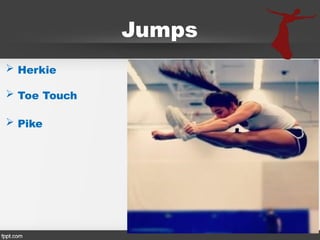
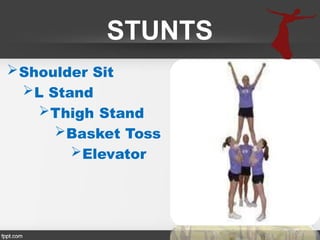
4 Ways ToDo Basic
Cheerleading
Motions
Jump
Stunt
Tumbling
Hip-Hop/Street Dance
Hip-hopdance
refers to street dance
styles
primarily performed to hip-
hop music or that have
evolved as part of hip-hop
culture.
It includes a wide range of
styles
primarily breaking which
was created in the 1970s
and made popular by dance
crews in the United States.
40.
Hip-Hop/Street Dance
Eachcharacter specializes in
one dance style.
Consequently, a wide range
of styles are displayed
including: krumping, tutting,
breaking, locking, boogaloo, and
popping.
The majority of the dancing
shown in the series is hip-
hop; however, other styles
have also been performed
including jazz, tap, and ballet.
• it isoften "freestyle" (improvisational) in nature and
hip- hop dance crews often engage in freestyle
dance competitions—colloquially referred to as
"battles".
• Crews, freestyling, and battles are identifiers of this
style.
• Hip-hop dance can be a form of entertainment
or a hobby.
• It can also be a way to stay active in competitive
dance and a way to make a living by dancing
What distinguishes hip-hop
from other forms of dance?
Festival Dances
Festivaldances are cultural dances performed to
the strong beats of percussion instruments by a
community of people sharing the same culture usually
done in honor of a Patron Saint or in thanksgiving of
bountiful harvest.
Festival dance may be religious or secular in nature,
but the best thing about festivals is that they add to
the merry- making the festivities where they are
celebrated the reason why they are called festival
dances after all.
45.
E
x
A
M
P
L
E
S OF F
E
S
T
I
V
A
LD
A
N
C
E
S I
N T
H
E P
HILIPP
INE
S
Sinulog Festival in Cebu
Dinagyang in ILOILO
Ati-atihan in Kalibo Aklan
Masskara in Bacolod
Kadayawan in Davao
and of course here in Pampanga we have Sinukwan
Festival
Pinukpok Festival in FloridaBlanca
Binulo festival in Porac
Sampaguita festival in Lubao
Ibon Ebun festival in Mexico
Makatapak Festival in Bacolor
and Kuraldal Festival in Sasmuan
46.
TRADITIONAL DANCE
Folk andEthnic
Traditional dances are dances of indigenous communities that
show cultural traits of peoples from a specific time and place.
Customs and traditions ( through dance steps and costumes)
are preserved in traditional dance. Handed down from
generation to generation, with fixed sets or patterns, these
dances can either be ethnic or folk.
According to some literature , ethnic dances in the Philippines
are classified into two categories. One is that of the dances of
the non- Christians ,referring to the pre-hispanic and the Muslim
dances . The other category is that of the Christians. Performed
mostly by the lowland Filipinos. Dances under this category have
strong influence from the Western culture, particularly from Spain.
47.
Learning The Basics
(FolkDance)
• Cross
Step
• Change
Step
• Touch
Step
• Waltz Step• Polka
(Heel and
Toe)
• Brush
Step
• Hop
Step
• Minci
ng
Step
• Gallop
• Redova
• Contragan
za