SCF’s 2018 mission
© Small Cell Forum Ltd 2018
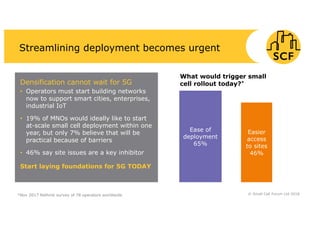
Streamlining deployment becomes urgent
Densification cannot wait for 5G
• Operators must start building networks
now to support smart cities, enterprises,
industrial IoT
• 19% of MNOs would ideally like to start
at-scale small cell deployment within one
year, but only 7% believe that will be
practical because of barriers
• 46% say site issues are a key inhibitor
Start laying foundations for 5G TODAY
Ease of
deployment
65%
Easier
access
to sites
46%
What would trigger small
cell rollout today?*
*Nov 2017 Rethink survey of 78 operators worldwide © Small Cell Forum Ltd 2018
LATAM – Operator requirements
New mobile networks will require new commercial models, and far
closer cooperation between industries, cities and Internet companies.
• MNOs need to reduce their costs radically, perhaps by sharing
investment and rewards with other stakeholders.
• They need fiber ‘through every wall’.
• They need stronger working relationships with city authorities,
since smart cities are seen as the most effective way of transforming
Latin American society through connectivity.
• And, most of all, they want processes and technologies which will
enable them to deploy new networks far more quickly than ever
before.
© Small Cell Forum Ltd 2018
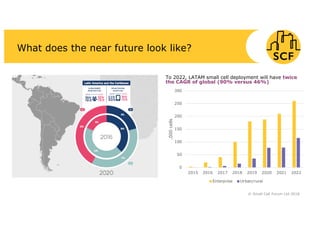
To 2022, LATAM small cell deployment will have twice
the CAGR of global (90% versus 46%)
What does the near future look like?
0
50
100
150
200
250
300
2015 2016 2017 2018 2019 2020 2021 2022,000cells
Enterprise Urban/rural
© Small Cell Forum Ltd 2018
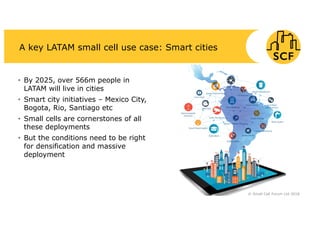
• By 2025, over 566m people in
LATAM will live in cities
• Smart city initiatives – Mexico City,
Bogota, Rio, Santiago etc
• Small cells are cornerstones of all
these deployments
• But the conditions need to be right
for densification and massive
deployment
A key LATAM small cell use case: Smart cities
© Small Cell Forum Ltd 2018
How will this happen?
Cities
• Streamlined permitting for sites
and equipment
• Simplified access to city
infrastructure assets
• Updated tax and fee structures
Telco industry
• New operating models better suited to cities
• Open platforms which reduce cost and
encourage automation
• Open APIs to facilitate a broad developer
base focused on cities
• Efforts to understand needs of cities and
engage with them
Progress
• Government and city initiatives
to simplify rules – e.g. USA,
France, Japan, Brazil
• IEC common classifications for
small cell equipment
Progress
• City engagement in 5G projects – e.g.
EU 5G PPP, MoNArch
• SCF HetNet architecture and APIs
• Neutral host models evolving
© Small Cell Forum Ltd 2018
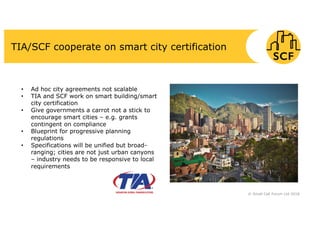
TIA/SCF cooperate on smart city certification
• Ad hoc city agreements not scalable
• TIA and SCF work on smart building/smart
city certification
• Give governments a carrot not a stick to
encourage smart cities – e.g. grants
contingent on compliance
• Blueprint for progressive planning
regulations
• Specifications will be unified but broad-
ranging; cities are not just urban canyons
– industry needs to be responsive to local
requirements
© Small Cell Forum Ltd 2018
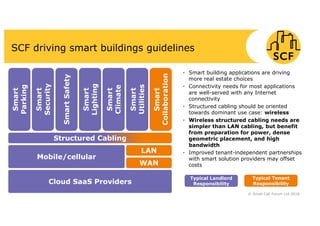
SCF driving smart buildings guidelines
• Smart building applications are driving
more real estate choices
• Connectivity needs for most applications
are well-served with any Internet
connectivity
• Structured cabling should be oriented
towards dominant use case: wireless
• Wireless structured cabling needs are
simpler than LAN cabling, but benefit
from preparation for power, dense
geometric placement, and high
bandwidth
• Improved tenant-independent partnerships
with smart solution providers may offset
costs
Smart
Lighting
Smart
Climate
Smart
Parking
Smart
Security
SmartSafety
Smart
Utilities
Smart
Collaboration
Structured Cabling
LAN
Mobile/cellular
WAN
Cloud SaaS Providers
Typical Tenant
Responsibility
Typical Landlord
Responsibility
© Small Cell Forum Ltd 2018
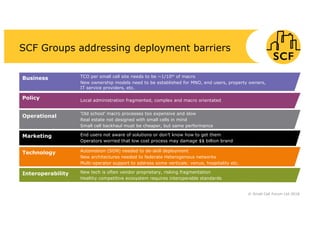
SCF Groups addressing deployment barriers
Business TCO per small cell site needs to be ~1/10th of macro
New ownership models need to be established for MNO, end users, property owners,
IT service providers, etc.
Operational
‘Old school’ macro processes too expensive and slow
Real estate not designed with small cells in mind
Small cell backhaul must be cheaper, but same performance
Marketing End users not aware of solutions or don’t know how to get them
Operators worried that low cost process may damage $$ billion brand
Technology Automation (SON) needed to de-skill deployment
New architectures needed to federate Heterogenous networks
Multi-operator support to address some verticals: venue, hospitality etc.
Interoperability New tech is often vendor proprietary, risking fragmentation
Healthy competitive ecosystem requires interoperable standards
Policy Local administration fragmented, complex and macro orientated
© Small Cell Forum Ltd 2018
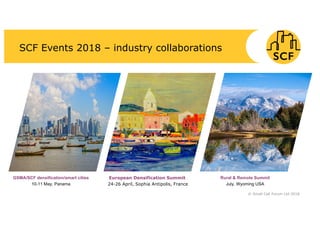
SCF Events 2018 – industry collaborations
European Densification Summit
24-26 April, Sophia Antipolis, France
Rural&&&Remote&Summit
July,&Wyoming&USA
GSMA/SCF&densification/smart&cities
10211&May,&Panama
© Small Cell Forum Ltd 2018

SCF - Accelerating Densification Worldwide

  • 1.
    SCF’s 2018 mission ©Small Cell Forum Ltd 2018
  • 2.
    Streamlining deployment becomesurgent Densification cannot wait for 5G • Operators must start building networks now to support smart cities, enterprises, industrial IoT • 19% of MNOs would ideally like to start at-scale small cell deployment within one year, but only 7% believe that will be practical because of barriers • 46% say site issues are a key inhibitor Start laying foundations for 5G TODAY Ease of deployment 65% Easier access to sites 46% What would trigger small cell rollout today?* *Nov 2017 Rethink survey of 78 operators worldwide © Small Cell Forum Ltd 2018
  • 3.
    LATAM – Operatorrequirements New mobile networks will require new commercial models, and far closer cooperation between industries, cities and Internet companies. • MNOs need to reduce their costs radically, perhaps by sharing investment and rewards with other stakeholders. • They need fiber ‘through every wall’. • They need stronger working relationships with city authorities, since smart cities are seen as the most effective way of transforming Latin American society through connectivity. • And, most of all, they want processes and technologies which will enable them to deploy new networks far more quickly than ever before. © Small Cell Forum Ltd 2018
  • 4.
    To 2022, LATAMsmall cell deployment will have twice the CAGR of global (90% versus 46%) What does the near future look like? 0 50 100 150 200 250 300 2015 2016 2017 2018 2019 2020 2021 2022,000cells Enterprise Urban/rural © Small Cell Forum Ltd 2018
  • 5.
    • By 2025,over 566m people in LATAM will live in cities • Smart city initiatives – Mexico City, Bogota, Rio, Santiago etc • Small cells are cornerstones of all these deployments • But the conditions need to be right for densification and massive deployment A key LATAM small cell use case: Smart cities © Small Cell Forum Ltd 2018
  • 6.
    How will thishappen? Cities • Streamlined permitting for sites and equipment • Simplified access to city infrastructure assets • Updated tax and fee structures Telco industry • New operating models better suited to cities • Open platforms which reduce cost and encourage automation • Open APIs to facilitate a broad developer base focused on cities • Efforts to understand needs of cities and engage with them Progress • Government and city initiatives to simplify rules – e.g. USA, France, Japan, Brazil • IEC common classifications for small cell equipment Progress • City engagement in 5G projects – e.g. EU 5G PPP, MoNArch • SCF HetNet architecture and APIs • Neutral host models evolving © Small Cell Forum Ltd 2018
  • 7.
    TIA/SCF cooperate onsmart city certification • Ad hoc city agreements not scalable • TIA and SCF work on smart building/smart city certification • Give governments a carrot not a stick to encourage smart cities – e.g. grants contingent on compliance • Blueprint for progressive planning regulations • Specifications will be unified but broad- ranging; cities are not just urban canyons – industry needs to be responsive to local requirements © Small Cell Forum Ltd 2018
  • 8.
    SCF driving smartbuildings guidelines • Smart building applications are driving more real estate choices • Connectivity needs for most applications are well-served with any Internet connectivity • Structured cabling should be oriented towards dominant use case: wireless • Wireless structured cabling needs are simpler than LAN cabling, but benefit from preparation for power, dense geometric placement, and high bandwidth • Improved tenant-independent partnerships with smart solution providers may offset costs Smart Lighting Smart Climate Smart Parking Smart Security SmartSafety Smart Utilities Smart Collaboration Structured Cabling LAN Mobile/cellular WAN Cloud SaaS Providers Typical Tenant Responsibility Typical Landlord Responsibility © Small Cell Forum Ltd 2018
  • 9.
    SCF Groups addressingdeployment barriers Business TCO per small cell site needs to be ~1/10th of macro New ownership models need to be established for MNO, end users, property owners, IT service providers, etc. Operational ‘Old school’ macro processes too expensive and slow Real estate not designed with small cells in mind Small cell backhaul must be cheaper, but same performance Marketing End users not aware of solutions or don’t know how to get them Operators worried that low cost process may damage $$ billion brand Technology Automation (SON) needed to de-skill deployment New architectures needed to federate Heterogenous networks Multi-operator support to address some verticals: venue, hospitality etc. Interoperability New tech is often vendor proprietary, risking fragmentation Healthy competitive ecosystem requires interoperable standards Policy Local administration fragmented, complex and macro orientated © Small Cell Forum Ltd 2018
  • 10.
    SCF Events 2018– industry collaborations European Densification Summit 24-26 April, Sophia Antipolis, France Rural&&&Remote&Summit July,&Wyoming&USA GSMA/SCF&densification/smart&cities 10211&May,&Panama © Small Cell Forum Ltd 2018