




Integrating Listening and Spoken
  Language into Daily Routines
Включение слушания и говорения в повседневную рутину

     Christine Schmidt Evans, M.S., CCC-SLP
     Кристина Шмидт Эванс, сертифицированный логопед


        March 3, 2013 – 3 марта 2013 г.
About the Speaker – О докладчике
• Christine Evans, M.S.,CCC-SLP
  Кристина Эванс, сертифицированный логопед
  – Speech-Language Pathologist
    Работает логопедом-дефектологом
  – Adjunct Faculty and Clinical Supervisor
    Адъюнкт-лектор и клинический супервайзер
      • Texas Christian University (TCU), Fort Worth, Texas
       В Техасском христианском университете в Форт Ворт, Техас
  – Formerly in private practice
    Ранее занималась приватной практикой
Today’s Goals – Цели этой презентации
• Explain why home practice is important
Объяснить важность практики в домашних условиях

• Identify tools and techniques to measure
  parent skills and promote parent participation
Определить инструменты и приемы, с помощью которых измеряются
  навыки родителей и поощряется их активное участие в реабилитации

• Identify steps for integrating listening and
  spoken language into daily routines
Определить шаги, необходимые для интеграции слушания и устной речи в
  повседневную рутину
Why is Home Practice
     Important?
В чем важность практики в домашних условиях?
Parents are a child’s first and best teacher –
  Родители – первые и лучшие учителя ребенка


Theory suggests unique bond between parent
  and child allows for more meaningful
  experience with target skill ; has potential to
  make them a better facilitator of a new skill
  (Russo & Owens, 1982).
Теории указывают на уникальность связи между родителем и
  ребенком, что позволяет получать более насыщенный опыт
  освоения целевого навыка; создает для родителей возможность
  более эффективно помогать ребенку в освоении нового умения
  (Руссо и Оуэнс, 1982)
Parents are Experts – Родители = эксперты

• The parent spends the most time with the
  child and has the opportunity to elicit a
  behavior in a natural context (Sweet &
  Applebaum, 2004).
•   Родитель проводит больше всего времени с ребенком и имеет
    возможность стимулировать определенное поведение в
    естественных условиях (Свит и Эппльбаум, 2004).
Parents can make a difference –
 Неоценимое влияние родителей
• Mahoney & Bella indicated changing parental
  behavior can produce better outcomes in
  children across a variety of disabilities (1998).
У Мэхоуни и Беллы указано, что модуляция поведения родителей
   может улучшить результаты терапии для детей с различными
   нарушениями (1998).

• Nearly all early intervention programs
  acknowledge the parent as a key player in the
  therapy process. (Matthews & Hudson, 2001).
Почти все программы раннего вмешательства признают за
  родителем ключевую роль в лечебном процессе (Мэттьюс и
  Хадсон, 2001).
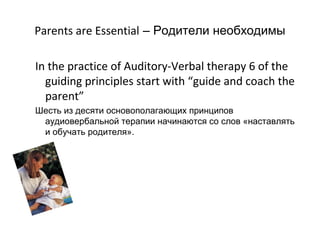
Parents are Essential – Родители необходимы

In the practice of Auditory-Verbal therapy 6 of the
  guiding principles start with “guide and coach the
  parent”
Шесть из десяти основополагающих принципов
 аудиовербальной терапии начинаются со слов «наставлять
 и обучать родителя».
Why Daily Routines? – Почему
          ежедневная рутина?
• There are more opportunities in the home
  Дома существует больше возможностей и контекстов
• Hours in therapy vs. hours at home
  Часы, проведенные в лечебном кабинете, по сравнению со
  временем дома
Why Daily Routines? – Почему
          ежедневная рутина?
• Overhearing language from daily routines is
  the way hearing children learn language
  Пассивное слушание во время осуществления обычных
  действий – именно так слышащие дети учатся языку
GETTING STARTED –
С ЧЕГО НАЧАТЬ
Where to start?
              С чего начать?
• Always start with the child
  Всегда начинайте с ребенка
    • Regular visits to the audiologist for hearing tests, and
      device programming
    Регулярные посещения аудиолога с целью проверки слуха
     и программирования устройства
    • Child must wear cochlear implant all waking hours
    Ребенок должен носить КИ все время, пока он бодрствует
    • Therapist should conduct thorough evaluation of
      speech, language, listening, and cognition
    Терапевт (врач) должен тщательно оценивать речевые
      навыки, словарный запас, навыки слушания и
      понимания.
Where to Start? – С чего начать?
Don’t forget the Parent
Не забывайте о родителе
•Parents need to learn skills for integrating listening
and spoken language into daily routines
Родителям тоже нужно понять, как интегрировать слушание и
устную речь в ежедневную рутину
•A baseline of parent skills will help direct the therapist
to skills that the parent may need to learn
Базовые критерии оценки навыков родителей помогут терапевту
определить те навыки, которые следует освоить родителям
Parent Skills Assessments – Оценка умений родителей
• Consider using – Можно использовать:
   – Parent Skills Check Lists
     Списки родительских умений и навыков по
      • Karen Rossi “ Learn to Talk around the Clock”
        Карен Росси «Учимся говорить в любое время»
   – Parent-Child Interaction samples
     Типовые образцы общения родителей с ребенком
   – Parent Knowledge Assessments
     Материалы для оценки знания родителей
      • Sunshine Cottage “Comfort Levels for Auditory Verbal
        Families”
        «Уровни комфортности для семей с устным модусом общения»
   – Adult Learning Style Inventories
     Инвентари стиля обучения взрослых
Active Participation – Активное участие
– Parents must be active participants in therapy
 Родители должны принимать самое живое участие в терапии
   • Therapist plays the role of a coach
    Терапевт исполняет роль коуча
   • Therapist gives parents feedback on skills to use at home
    Терапевт советует родителям, какие навыки использовать дома
   • Parent actively engages in all parts of the therapy session
    Родитель активно участвует во всех частях встречи
   • Parent can model the skill to the child
    Родитель может смоделировать навык для ребенка
   • Parent and therapist work together to plan activities and
     skills to be addressed in home practice
    Родитель и терапевт вместе разрабатывают план действий и навыки,
    которые будут освоены на практике дома
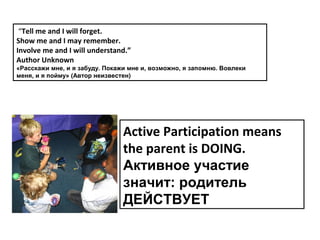
“Tell me and I will forget.
Show me and I may remember.
Involve me and I will understand.”
Author Unknown
«Расскажи мне, и я забуду. Покажи мне и, возможно, я запомню. Вовлеки
меня, и я пойму» (Автор неизвестен)


                                Active Participation means
                                the parent is DOING.
                                Активное участие
                                значит: родитель
                                ДЕЙСТВУЕТ
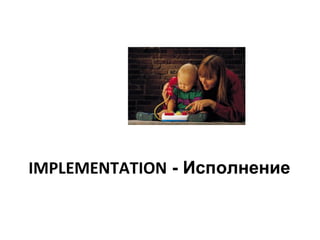
IMPLEMENTATION - Исполнение
Implementation - Исполнение
• Start with the daily routine
  Начните с повседневных рутинных действий
  – Parents won’t have to add to what they are
    already doing
    Родителям не придется брать на себя дополнительные виды
    деятельности
  – Parents will already be familiar with the activity
    allowing for them to focus on the strategies and
    techniques
    Действие уже будет знакомо родителям, что позволит им
    сосредоточиться на стратегиях и тактиках
Parts of a Daily Routine – Части
          повседневной рутины
•   Mealtime – Приемы пищи
•   Getting Dressed – Одевание
•   Playtime – Время для игр
•   Bath time – Купание
•   Getting in car – Поездка в машине
•   Gardening/outside – В саду (на улице)
•   Anything unique to the family’s daily life – Что-
    то особенное из ежедневной жизни вашей семьи
Putting it all together – Составляем все
                        вместе
•   Parent and therapist identify skills/vocabulary to be targeted
    Родители и терапевт определяют целевой навык или
    словарный запас для освоения
•   Parent & Therapist pick a part of the daily routine to focus on
    Родители и терапевт выбирают, на какой части ежедневной
    рутины сосредоточиться сейчас
•   Parent learns strategies/techniques for incorporating the vocabulary
    during the routine
    Родитель осваивает стратегии и тактики для включения новых
    слов в рутину
•   Parent and therapist practice strategies during therapy time
    Родитель и терапевт оттачивают стратегию во время занятий
•   Parent comes back to the next session with comments and feedback
    about how things worked
    На следующую встречу родитель приходит с впечатлениями о
    том, как все получилось
Moving through the Routine –
    Прохождение рутинных действий
•   How long you focus on a particular routine will depend on the family and
    child
    Время сосредоточенности на конкретном действии зависит от
    особенностей семьи и ребенка
•    Some parent skills and child skills can be addressed in multiple routines
    Некоторые навыки родителя и ребенка могут отрабатываться
    при разных рутинных действиях
•    You can teach the same skill across multiple settings
    Одно и то же умение можно тренировать в разных условиях
•    You can teach different skills in the same routine
    Можно обучать разным навыкам в той же самой рутине
Example Routine: Mealtime – Пример
         рутинного действия: прием пищи
•   Targets: Vocalization with intent/meaning
    Цель: обучение вокализациям с выражением намерения
•   Parent Skill: Pause time
    Родительское умение: выдерживание паузы
•   Activity: Parent sits with child at highchair. Before the parent feeds the
    child their next bite they pause and wait for some kind of vocalization
    with intent
    Действие: Родитель сидит напротив ребенка, который усажен
    на детский стул. Перед тем, как поднести ребенку следующий
    кусочек, родитель делает паузу и ждет какой-нибудь
    вокализации для выражения намерения
•   When the child vocalizes the parent rewards the child and they take the
    bite of food
    Когда ребенок вокализирует, родитель хвалит его и дает
    требуемый кусочек
Questions – Есть ли у вас вопросы?
• ???
Christine.evans@tcu.edu

Integrating Listening and Spoken Language into Daily Routine - Christine Evans: ENG+RU

  • 1.
    Integrating Listening andSpoken Language into Daily Routines Включение слушания и говорения в повседневную рутину Christine Schmidt Evans, M.S., CCC-SLP Кристина Шмидт Эванс, сертифицированный логопед March 3, 2013 – 3 марта 2013 г.
  • 2.
    About the Speaker– О докладчике • Christine Evans, M.S.,CCC-SLP Кристина Эванс, сертифицированный логопед – Speech-Language Pathologist Работает логопедом-дефектологом – Adjunct Faculty and Clinical Supervisor Адъюнкт-лектор и клинический супервайзер • Texas Christian University (TCU), Fort Worth, Texas В Техасском христианском университете в Форт Ворт, Техас – Formerly in private practice Ранее занималась приватной практикой
  • 3.
    Today’s Goals –Цели этой презентации • Explain why home practice is important Объяснить важность практики в домашних условиях • Identify tools and techniques to measure parent skills and promote parent participation Определить инструменты и приемы, с помощью которых измеряются навыки родителей и поощряется их активное участие в реабилитации • Identify steps for integrating listening and spoken language into daily routines Определить шаги, необходимые для интеграции слушания и устной речи в повседневную рутину
  • 4.
    Why is HomePractice Important? В чем важность практики в домашних условиях?
  • 5.
    Parents are achild’s first and best teacher – Родители – первые и лучшие учителя ребенка Theory suggests unique bond between parent and child allows for more meaningful experience with target skill ; has potential to make them a better facilitator of a new skill (Russo & Owens, 1982). Теории указывают на уникальность связи между родителем и ребенком, что позволяет получать более насыщенный опыт освоения целевого навыка; создает для родителей возможность более эффективно помогать ребенку в освоении нового умения (Руссо и Оуэнс, 1982)
  • 6.
    Parents are Experts– Родители = эксперты • The parent spends the most time with the child and has the opportunity to elicit a behavior in a natural context (Sweet & Applebaum, 2004). • Родитель проводит больше всего времени с ребенком и имеет возможность стимулировать определенное поведение в естественных условиях (Свит и Эппльбаум, 2004).
  • 7.
    Parents can makea difference – Неоценимое влияние родителей • Mahoney & Bella indicated changing parental behavior can produce better outcomes in children across a variety of disabilities (1998). У Мэхоуни и Беллы указано, что модуляция поведения родителей может улучшить результаты терапии для детей с различными нарушениями (1998). • Nearly all early intervention programs acknowledge the parent as a key player in the therapy process. (Matthews & Hudson, 2001). Почти все программы раннего вмешательства признают за родителем ключевую роль в лечебном процессе (Мэттьюс и Хадсон, 2001).
  • 8.
    Parents are Essential– Родители необходимы In the practice of Auditory-Verbal therapy 6 of the guiding principles start with “guide and coach the parent” Шесть из десяти основополагающих принципов аудиовербальной терапии начинаются со слов «наставлять и обучать родителя».
  • 9.
    Why Daily Routines?– Почему ежедневная рутина? • There are more opportunities in the home Дома существует больше возможностей и контекстов • Hours in therapy vs. hours at home Часы, проведенные в лечебном кабинете, по сравнению со временем дома
  • 10.
    Why Daily Routines?– Почему ежедневная рутина? • Overhearing language from daily routines is the way hearing children learn language Пассивное слушание во время осуществления обычных действий – именно так слышащие дети учатся языку
  • 11.
    GETTING STARTED – СЧЕГО НАЧАТЬ
  • 12.
    Where to start? С чего начать? • Always start with the child Всегда начинайте с ребенка • Regular visits to the audiologist for hearing tests, and device programming Регулярные посещения аудиолога с целью проверки слуха и программирования устройства • Child must wear cochlear implant all waking hours Ребенок должен носить КИ все время, пока он бодрствует • Therapist should conduct thorough evaluation of speech, language, listening, and cognition Терапевт (врач) должен тщательно оценивать речевые навыки, словарный запас, навыки слушания и понимания.
  • 13.
    Where to Start?– С чего начать? Don’t forget the Parent Не забывайте о родителе •Parents need to learn skills for integrating listening and spoken language into daily routines Родителям тоже нужно понять, как интегрировать слушание и устную речь в ежедневную рутину •A baseline of parent skills will help direct the therapist to skills that the parent may need to learn Базовые критерии оценки навыков родителей помогут терапевту определить те навыки, которые следует освоить родителям
  • 14.
    Parent Skills Assessments– Оценка умений родителей • Consider using – Можно использовать: – Parent Skills Check Lists Списки родительских умений и навыков по • Karen Rossi “ Learn to Talk around the Clock” Карен Росси «Учимся говорить в любое время» – Parent-Child Interaction samples Типовые образцы общения родителей с ребенком – Parent Knowledge Assessments Материалы для оценки знания родителей • Sunshine Cottage “Comfort Levels for Auditory Verbal Families” «Уровни комфортности для семей с устным модусом общения» – Adult Learning Style Inventories Инвентари стиля обучения взрослых
  • 15.
    Active Participation –Активное участие – Parents must be active participants in therapy Родители должны принимать самое живое участие в терапии • Therapist plays the role of a coach Терапевт исполняет роль коуча • Therapist gives parents feedback on skills to use at home Терапевт советует родителям, какие навыки использовать дома • Parent actively engages in all parts of the therapy session Родитель активно участвует во всех частях встречи • Parent can model the skill to the child Родитель может смоделировать навык для ребенка • Parent and therapist work together to plan activities and skills to be addressed in home practice Родитель и терапевт вместе разрабатывают план действий и навыки, которые будут освоены на практике дома
  • 16.
    “Tell me andI will forget. Show me and I may remember. Involve me and I will understand.” Author Unknown «Расскажи мне, и я забуду. Покажи мне и, возможно, я запомню. Вовлеки меня, и я пойму» (Автор неизвестен) Active Participation means the parent is DOING. Активное участие значит: родитель ДЕЙСТВУЕТ
  • 17.
  • 18.
    Implementation - Исполнение •Start with the daily routine Начните с повседневных рутинных действий – Parents won’t have to add to what they are already doing Родителям не придется брать на себя дополнительные виды деятельности – Parents will already be familiar with the activity allowing for them to focus on the strategies and techniques Действие уже будет знакомо родителям, что позволит им сосредоточиться на стратегиях и тактиках
  • 19.
    Parts of aDaily Routine – Части повседневной рутины • Mealtime – Приемы пищи • Getting Dressed – Одевание • Playtime – Время для игр • Bath time – Купание • Getting in car – Поездка в машине • Gardening/outside – В саду (на улице) • Anything unique to the family’s daily life – Что- то особенное из ежедневной жизни вашей семьи
  • 20.
    Putting it alltogether – Составляем все вместе • Parent and therapist identify skills/vocabulary to be targeted Родители и терапевт определяют целевой навык или словарный запас для освоения • Parent & Therapist pick a part of the daily routine to focus on Родители и терапевт выбирают, на какой части ежедневной рутины сосредоточиться сейчас • Parent learns strategies/techniques for incorporating the vocabulary during the routine Родитель осваивает стратегии и тактики для включения новых слов в рутину • Parent and therapist practice strategies during therapy time Родитель и терапевт оттачивают стратегию во время занятий • Parent comes back to the next session with comments and feedback about how things worked На следующую встречу родитель приходит с впечатлениями о том, как все получилось
  • 21.
    Moving through theRoutine – Прохождение рутинных действий • How long you focus on a particular routine will depend on the family and child Время сосредоточенности на конкретном действии зависит от особенностей семьи и ребенка • Some parent skills and child skills can be addressed in multiple routines Некоторые навыки родителя и ребенка могут отрабатываться при разных рутинных действиях • You can teach the same skill across multiple settings Одно и то же умение можно тренировать в разных условиях • You can teach different skills in the same routine Можно обучать разным навыкам в той же самой рутине
  • 22.
    Example Routine: Mealtime– Пример рутинного действия: прием пищи • Targets: Vocalization with intent/meaning Цель: обучение вокализациям с выражением намерения • Parent Skill: Pause time Родительское умение: выдерживание паузы • Activity: Parent sits with child at highchair. Before the parent feeds the child their next bite they pause and wait for some kind of vocalization with intent Действие: Родитель сидит напротив ребенка, который усажен на детский стул. Перед тем, как поднести ребенку следующий кусочек, родитель делает паузу и ждет какой-нибудь вокализации для выражения намерения • When the child vocalizes the parent rewards the child and they take the bite of food Когда ребенок вокализирует, родитель хвалит его и дает требуемый кусочек
  • 23.
    Questions – Естьли у вас вопросы? • ??? Christine.evans@tcu.edu

Editor's Notes

  • #2 Hello everyone and welcome to Integrating Listening and Spoken Language into Daily Routines. My name is Christine Evans, and I am a Speech-Language Pathologist from Dallas, Texas. Today we are going to talk about using the daily routine as a way to teach listening and spoken language
  • #3 I thought I would start by sharing experiences and background in working with children with hearing loss. I went earned an undergraduate degree at TCU in speech pathology, and then went on for some post graduate training and audiology. Following that, I went back to TCU where I earned a masters degree in speech pathology. I placed an emphasis in my studies on teaching children with hearing loss to listen and talk. My master’s thesis aimed to develop a system for measuring parent behaviors in auditory-verbal therapy. After finishing graduate school I worked at a school for children with hearing loss, and the worked in private practice for 5 years serving families of children with hearing loss. Last year I returned to TCU where I am now teaching coursework regarding listening and spoken language, and also supervising our clinic of children with cochlear implants. I am working towards my PhD and my certification as an Auditory Verbal Therapist
  • #4 So let’s now talk about our goals for today First we will explain why home practice is important Next we will identify tools and techniques to measure parent skills and promote parent participation Finally we will identify steps for integrating listening and spoken language in home routines
  • #5 When we talk about working in the home setting, it is important to recognize that we are moving from a more professionally mediated form of therapy to a more family centered. The family, and their daily routines become the focus of the therapy
  • #6 On that note, home practice becomes important because we know that parents are a child’s first and best teacher. Theory suggests unique bond between parent and child allows for more meaningful experience with target skill ; has potential to make them a better facilitator of a new skill . In short, if we can get a parent working in the home on a strategy, the child will find the target more meaningful
  • #7 Another reason why home practice is important is because the parent is an expert in their child. They have the opportunity and the knowledge base to really interact with their child naturally
  • #8 Additionally, parents make a difference. Mahoney & Bella indicated changing parental behavior can produce better outcomes in children across a variety of disabilities . Nearly all early intervention programs acknowledge the parent as a key player in the therapy process. Training parents will lead to better outcomes
  • #9 By now you can probably see that parents are an essential component to the therapy program. For children in an Auditory-Verbal program, 6 of the 10 guiding principles start with “guide and coach the parent”
  • #10 We have established that parent training is valuable, and that the home environment presents a favorable setting to teaching language. The next question is, Why Daily Routines? The reality is that there are simply more hours available for learning in the home environment, than there are in the weekly therapy setting. Additionally there are more opportunities to use language in a meaningful way in the home.
  • #11 We also know that children who have normal hearing learn language by overhearing it in their daily routines. Working in a daily routine allows the practitioner to have the child with hearing loss learn language the way their hearing peers would. Studies estimate that 80% of the vocabulary we know, we learned not from didactic teaching but from overhearing
  • #12 Now we will talk about how to get started, and assess the skills needed for implementation of strategies into home routines
  • #13 Of course as with any skill taught, you will want to start with the child. Make sure the child has appropriately fit amplification, and has visited the audiologist regularly. Additionally ensure that the child is wearing the cochlear implant all waking hours. If they are not wearing the cochlear implant all waking hours, then the child wont be able to access the parent’s teaching and modeling in the daily routine Next the therapist should conduct a thorough evaluation of speech, language listening and cognition
  • #14 Since the goals of home therapy include teaching the parent, we will need to baseline parent skills to help direct the therapist as to where to start teaching, and which techniques the parent may need to learn
  • #15 These are some of the ways that I assess parent skills. At least as for as published tools here in the states, I don’t have a lot of options, and all are non standardized measures, or criterion referenced One type of assessment I use a parent skills checklist available from AG Bell through a program called “Learn to talk around the Clock” In this tool there is a parent skills assessment therapy ideas for the entire daily routine Sometimes I will simply collect a parent-child interaction sample. When I do this, I simply allow the parent and child to play together, and take an inventory of the skills the parent uses in the sample There are some parent knowledge assessments available. In these assessments the parent fills out a questionnaire and lists their comfort level with certain skills. The one I use most often is from the Sunshine Cottage in San Antonio Texas. It is called “Comfort Levels for Auditory –Verbal Families I will also do some assessment regarding the parent’s learning style. There are a variety of tools available for this and if anyone is interested, they are welcome to email me for references
  • #16 Once you assess the parent and the child, you need to establish active parent participation in the session so that the parent is ready to learn skills for the daily routine. This means Therapist plays the role of a coach Therapist gives parents feedback on skills to use at home Parent actively engages in all parts of the therapy session Parent can model the skill to the child Parent and therapist work together to plan activities and skills to be addressed in home practice
  • #17 A famous proverb reads Tell me and I will forget. Show me and I may remember. Involve me and I will understand In shot active participation means the parent is doing
  • #18 Now that we know where to start, and how to structure parent participation, let’s focus more about the act of using daily routines, and how to implement the techniques
  • #19 When I go to see a family for the first time, I like to get a sense for what their typical day looks like. I ask the parents who the child spends the most time with, I ask them about activities the family likes to do together, and then I start with those routines. Starting with the daily routine allows the family to not have to add to what they are already doing, and then can focus just on the strategies, and not on the activity.
  • #20 Here are some common parts of the day that I have found useful in teaching listening and spoken language. Any of these would be fine areas of the day to target first.
  • #21 When I get started in therapy this is how I usually get working on the daily routine. Parent and therapist identify skills/vocabulary to be targeted Parent & Therapist pick a part of the daily routine to focus on Parent learns strategies/techniques for incorporating the vocabulary during the routine Parent and therapist practice strategies during therapy time Parent comes back to the next session with comments and feedback about how things worked
  • #22 As you move through a routine, How long you focus on a particular routine will depend on the family and child Some parent skills and child skills can be addressed in multiple routines You can teach the same skill across multiple settings You can teach different skills in the same routine
  • #23 Here is an example of a skill that could be taught at mealtime Targets: Vocalization with intent/meaning Parent Skill: Pause time Activity: Parent sits with child at highchair. Before the parent feeds the child their next bite they pause and wait for some kind of vocalization with intent When the child vocalizes the parent rewards the child and they take the bite of food I might have the parent work on this skill for a week or so, and then depending on how they are doing with pause time, and how the child is progressing with vocalizations, I might move to a different part of the daily routine, perhaps during playtime, and have the parent use pause time for the same goal.
  • #24 We have gone through a lot of information here. I will pause now for some questions.