DAILY LESSON LOG
Direction: Look at the 2 imagesonpage 11 and
answerthe followingquestions.
Direction: Please lookatthe imagesonpage 12 of your
module andanswerthe followingquestions.
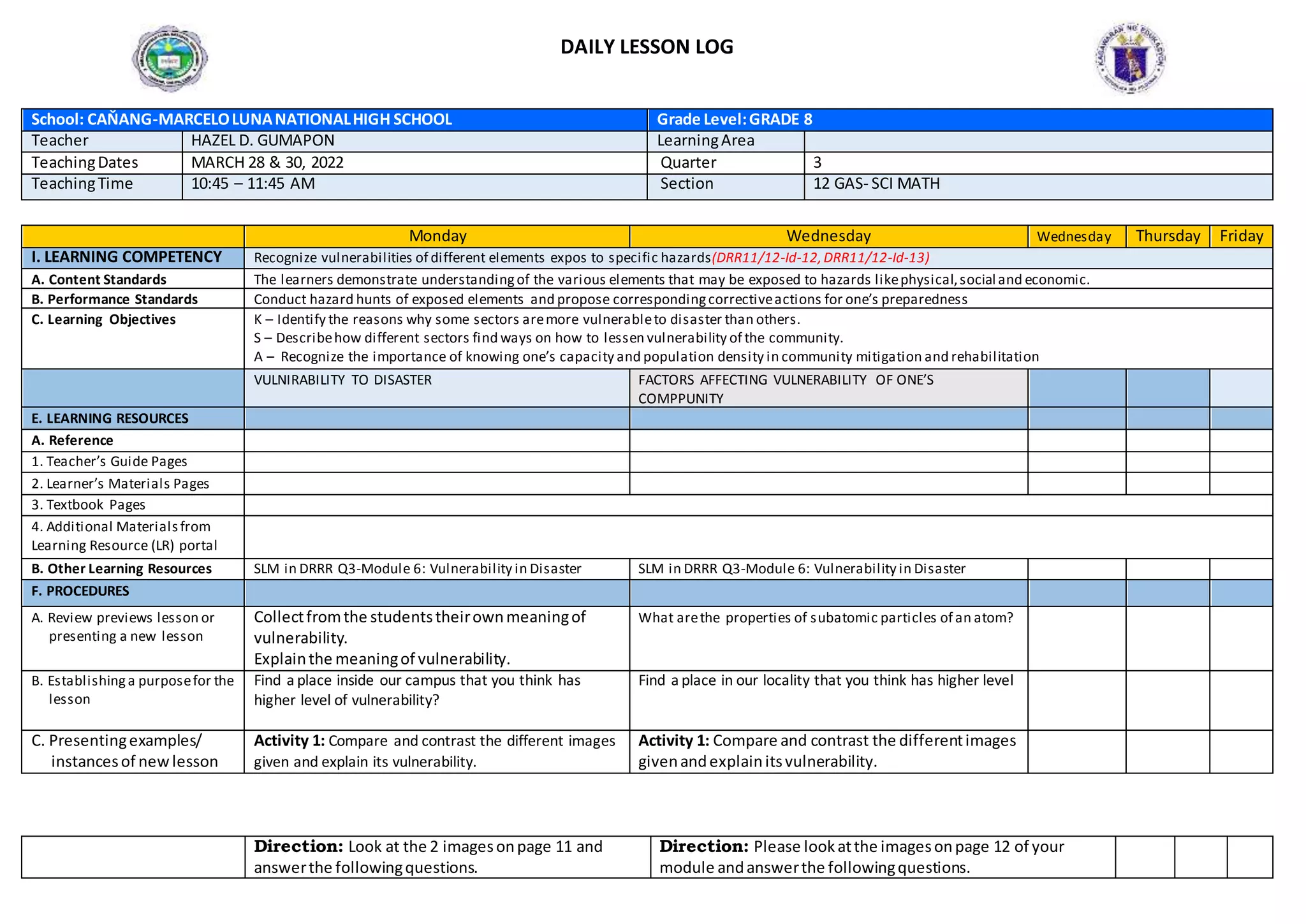
School: CAŇANG-MARCELOLUNANATIONALHIGH SCHOOL Grade Level:GRADE 8
Teacher HAZEL D. GUMAPON LearningArea
TeachingDates MARCH 28 & 30, 2022 Quarter 3
TeachingTime 10:45 – 11:45 AM Section 12 GAS- SCI MATH
Monday Wednesday Wednesday Thursday Friday
I. LEARNING COMPETENCY Recognize vulnerabilities of different elements expos to specific hazards(DRR11/12-Id-12,DRR11/12-Id-13)
A. Content Standards The learners demonstrate understandingof the various elements that may be exposed to hazards likephysical,social and economic.
B. Performance Standards Conduct hazard hunts of exposed elements and propose correspondingcorrectiveactions for one’s preparedness
C. Learning Objectives K – Identify the reasons why some sectors aremore vulnerableto disaster than others.
S – Describehow different sectors find ways on how to lessen vulnerability of the community.
A – Recognize the importance of knowing one’s capacity and population density in community mitigation and rehabilitation
VULNIRABILITY TO DISASTER FACTORS AFFECTING VULNERABILITY OF ONE’S
COMPPUNITY
E. LEARNING RESOURCES
A. Reference
1. Teacher’s Guide Pages
2. Learner’s Materials Pages
3. Textbook Pages
4. Additional Materialsfrom
Learning Resource (LR) portal
B. Other Learning Resources SLM in DRRR Q3-Module 6: Vulnerability in Disaster SLM in DRRR Q3-Module 6: Vulnerability in Disaster
F. PROCEDURES
A. Review previews lesson or
presenting a new lesson
Collectfromthe studentstheirownmeaningof
vulnerability.
Explainthe meaningof vulnerability.
What arethe properties of subatomic particles of an atom?
B. Establishinga purposefor the
lesson
Find a place inside our campus that you think has
higher level of vulnerability?
Find a place in our locality that you think has higher level
C. Presentingexamples/
instancesof newlesson
Activity 1: Compare and contrast the different images
given and explain its vulnerability.
Activity 1: Compare and contrast the differentimages
givenandexplainitsvulnerability.
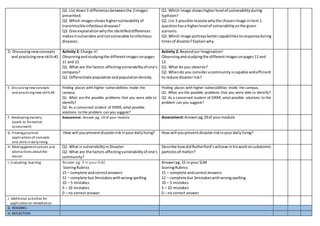
Q1. List down3 differencesbetweenthe 2images
presented.
Q2. Which imagesshowshighervulnerabilityof
transmissibleinfectiousdiseases?
Q3. Give explanationwhythe identifieddifferences
makesitvulnerable andnotvulnerable toinfectious
diseases.
Q1. Which image showshigherlevel of vulnerabilityduring
typhoon?
Q2. List 3 possible reasonswhythe chosenimage initem1
questionhasa higherlevelof vulnerabilityonthe given
scenario.
Q3. Which image portraysbettercapabilitiestoresponseduring
timesof disaster?Explainwhy.
D. Discussingnewconcepts
and practicingnewskills#1
Activity 2: Charge it!
Observingandstudyingthe differentimages onpages
11 and 12.
Q1. What are the factors affectingvulnerabilityof one’s
company?
Q2. Differentiate populationandpopulationdensity.
Activity 2: Beyondour Imagination!
Observingandstudyingthe differentimagesonpages11 and
12.
Q1. What do you observe?
Q2. Whendo you consideracommunity iscapable andefficient
to reduce disasterrisk?
E. Discussingnewconcepts
and practicingnew skills #2
Finding places with higher vulnerabilities inside the
campus,
Q1. What arethe possible problems that you were able to
identify?
Q2: As a concerned student of DRRR, what possible
solutions to the problem can you suggest?
Finding places with higher vulnerabilities inside the campus,
Q1. What arethe possible problems that you were able to identify?
Q2: As a concerned student of DRRR, what possible solutions to the
problem can you suggest?
F. Developingmastery
(Leads to formative
assessment)
Assessment: Answer pg. 19 of your module. Assessment:Answerpg.19of yourmodule
G. Findingpractical
applicationsof concepts
and skillsin daily living
How will youpreventdisasterriskinyourdailyliving? How will youpreventdisasterriskinyourdailyliving?
H. Makinggeneralizations and
abstractions aboutthe
lesson
Q1. What is vulnerabilityinDisaster
Q2. What are the factors affectingvulnerabilityof one’s
community?
Describe howdidRutherford’sachieve inhisworkonsubatomic
particlesof matter?
I. Evaluating learning Answer pg. 9 in yourSLM.
ScoringRubrics
15 – complete andcorrectanswers
12 – complete but3mistakeswithwrongspelling
10 – 5 mistakes
5 – 10 mistakes
0 – no correct answer
Answerpg.15 inyour SLM
ScoringRubrics
15 – complete andcorrectanswers
12 – complete but3mistakeswithwrongspelling
10 – 5 mistakes
5 – 10 mistakes
0 – no correct answer
J. Additional activities for
application or remediation
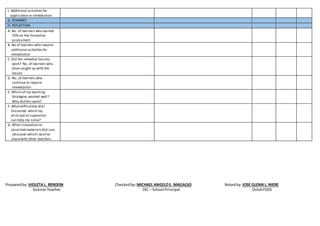
G. REMARKS
H. REFLECTION
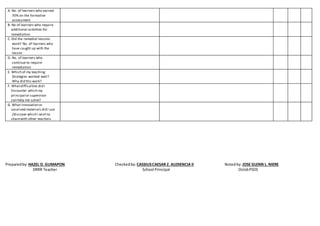
A. No. of learners who earned
70% on the formative
assessment
B. No of learners who require
additional activities for
remediation
C. Did the remedial lessons
work? No. of learners who
have caught up with the
lesson
D. No. of learners who
continue to require
remediation
E. Which of my teaching
Strategies worked well?
Why did this work?
F. Whatdifficulties did I
Encounter which my
principal or supervisor
can help me solve?
G. What innovation or
Localized materials did I use
/discover which I wish to
sharewith other teachers.
Preparedby:HAZEL D. GUMAPON Checkedby:CASSIUSCAESAR Z. AUDIENCIA II Notedby:JOSE GLENN L. NIERE
DRRR Teacher School Principal OslobPSDS
DAILY LESSON LOG
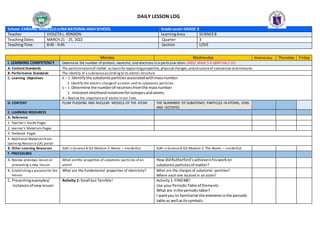
School: CAŇANG-MARCELOLUNANATIONALHIGH SCHOOL Grade Level:GRADE 8
Teacher VIOLETA L. RENDON LearningArea SCIENCE8
TeachingDates MARCH 21 - 25, 2022 Quarter 3
TeachingTime 8:45 - 9:45 Section LOVE
Monday Wednesday Wednesday Thursday Friday
I. LEARNING COMPETENCY Determine the number of protons, neutrons, and electrons in a particular atom. (MELC Week 5-6 S8MT-IIIe-f-10)
A. Content Standards The particlenatureof matter as basisfor explainingproperties,physical changes,and structureof substances and mixtures.
B. Performance Standards The identity of a substanceaccordingto its atomic structure
C. Learning Objectives K – 1. Identifythe subatomicparticlesassociatedwithmassnumber.
2. Identify the electric chargeof an atom and its subatomic particles.
S – 1. Determine the numberof neutronsfromthe massnumber.
2. Interpretshorthandnotationsforisotopesandatoms.
A – Realize the importanceof atoms in our lives.
D. CONTENT PLUM PUDDING AND NUCLEAR MODELS OF THE ATOM THE NUMMBER OF SUBATOMIC PARTICLES IN ATOMS, IONS
AND ISOTOPES
E. LEARNING RESOURCES
A. Reference
1. Teacher’s Guide Pages
2. Learner’s Materials Pages
3. Textbook Pages
4. Additional Materialsfrom
Learning Resource (LR) portal
B. Other Learning Resources SLM in Science 8 Q3-Module 3: Atoms – InsideOut SLM in Science 8 Q3-Module 3: The Atoms – InsideOut
F. PROCEDURES
A. Review previews lesson or
presenting a new lesson
What arethe properties of subatomic particles of an
atom?
How didRutherford’sachieveinhisworkon
subatomicparticlesof matter?
B. Establishinga purposefor the
lesson
What are the fundamental properties of electricity? What are the charges of subatomic particles?
Where each one located in an atom?
C. Presentingexamples/
instancesof newlesson
Activity 1: Small but Terrible! Activity1: FINDME!
Use yourPeriodicTable of Elements
What are inthe periodictable?
I wantyou to familiarize the elementsinthe periodic
table as well asitssymbols.
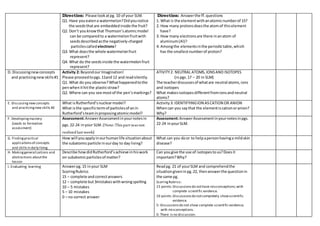
Direction: Please lookatpg. 10 of your SLM.
Q1. Have youeatena watermelon?Didyounotice
the seedsthatare embeddedinside the fruit?
Q2. Don’t youknowthat Thomson’satomicmodel
can be comparedto a watermelonfruitwith
seedsdescribedasthe negatively-charged
particlescalled electrons?
Q3. What doesthe whole watermelonfruit
represent?
Q4. What do the seedsinside the watermelonfruit
represent?
Direction: Answerthe ff.questions
1. What is the elementwithanatomicnumberof 15?
2. How many protonsdoesthe atomof thiselement
have?
3. How many electronsare there inanatom of
aluminum(Al)?
4. Amongthe elementsinthe periodictable,which
has the smallestnumberof proton?
D. Discussingnewconcepts
and practicingnewskills#1
Activity 2: Beyondour Imagination!
Please proceedtopgs.11and 12 and readsilently.
Q1. What do you observe?Whathappenedtothe
penwhenithitthe plasticstraw?
Q2. Where can you see mostof the pen’smarkings?
ATIVITY2: NEUTRAL ATOMS,IONSAND ISOTOPES
(inpgs.17 – 20 in SLM)
The teacherdiscussesof whatare neutral atoms,ions
and isotopes
What makesisotopesdifferentfromionsandneutral
atoms?
E. Discussingnewconcepts
and practicingnew skills #2
What isRutherford’snuclearmodel?
What isthe specifictermof particlesof anin
Rutherford’steaminproposingatomicmodel?
Activity3: IDENTIFYINGION ASCATION OR ANION
Whencan you say that the elementiscationoranion?
Why?
F. Developingmastery
(Leads to formative
assessment)
Assessment:AnswerAssessmentinyournotesin
pgs.22-24 inyour SLM. (Note:Thispartwasnot
realizedlastweek)
Assessment:AnswerAssessmentinyournotesinpgs.
22-24 inyourSLM.
G. Findingpractical
applicationsof concepts
and skillsin daily living
How will youapplyinourhumanlife situationabout
the subatomicparticle inourday to day living?
What can you door to helpapersonhavinga mildskin
disease?
H. Makinggeneralizations and
abstractions aboutthe
lesson
Describe howdidRutherford’sachieve inhiswork
on subatomicparticlesof matter?
Can yougive the use of isotopestous?Doesit
important?Why?
I. Evaluating learning Answerpg.15 inyour SLM
ScoringRubrics
15 – complete andcorrectanswers
12 – complete but3mistakeswithwrongspelling
10 – 5 mistakes
5 – 10 mistakes
0 – no correct answer
Readpg. 21 of yourSLM and comprehendthe
situationgiveninpg.22, thenanswerthe questionin
the same pg.
ScoringRubrics:
15 points:Discussionsdo nothave misconceptions;with
complete scientific evidence.
10 points:Discussionsdo notcompletely showscientific
evidence.
5: Discussionsdo not show complete scientific evidence;
with misconceptions.
0: There is no discussion.
J. Additional activities for
application or remediation
G. REMARKS
H. REFLECTION
A. No. of learners who earned
70% on the formative
assessment
B. No of learners who require
additional activities for
remediation
C. Did the remedial lessons
work? No. of learners who
have caught up with the
lesson
D. No. of learners who
continue to require
remediation
E. Which of my teaching
Strategies worked well?
Why did this work?
F. Whatdifficulties did I
Encounter which my
principal or supervisor
can help me solve?
G. What innovation or
Localized materials did I use
/discover which I wish to
sharewith other teachers.
Preparedby:VIOLETA L. RENDON Checkedby:MICHAEL ANGELOS. MAGALSO Notedby:JOSE GLENN L. NIERE
Science Teacher OIC – School Principal OslobPSDS
DAILY-LESSON-LOG-in-Bus.docx

DAILY-LESSON-LOG-in-Bus.docx

  • 1.
    DAILY LESSON LOG Direction:Look at the 2 imagesonpage 11 and answerthe followingquestions. Direction: Please lookatthe imagesonpage 12 of your module andanswerthe followingquestions. School: CAŇANG-MARCELOLUNANATIONALHIGH SCHOOL Grade Level:GRADE 8 Teacher HAZEL D. GUMAPON LearningArea TeachingDates MARCH 28 & 30, 2022 Quarter 3 TeachingTime 10:45 – 11:45 AM Section 12 GAS- SCI MATH Monday Wednesday Wednesday Thursday Friday I. LEARNING COMPETENCY Recognize vulnerabilities of different elements expos to specific hazards(DRR11/12-Id-12,DRR11/12-Id-13) A. Content Standards The learners demonstrate understandingof the various elements that may be exposed to hazards likephysical,social and economic. B. Performance Standards Conduct hazard hunts of exposed elements and propose correspondingcorrectiveactions for one’s preparedness C. Learning Objectives K – Identify the reasons why some sectors aremore vulnerableto disaster than others. S – Describehow different sectors find ways on how to lessen vulnerability of the community. A – Recognize the importance of knowing one’s capacity and population density in community mitigation and rehabilitation VULNIRABILITY TO DISASTER FACTORS AFFECTING VULNERABILITY OF ONE’S COMPPUNITY E. LEARNING RESOURCES A. Reference 1. Teacher’s Guide Pages 2. Learner’s Materials Pages 3. Textbook Pages 4. Additional Materialsfrom Learning Resource (LR) portal B. Other Learning Resources SLM in DRRR Q3-Module 6: Vulnerability in Disaster SLM in DRRR Q3-Module 6: Vulnerability in Disaster F. PROCEDURES A. Review previews lesson or presenting a new lesson Collectfromthe studentstheirownmeaningof vulnerability. Explainthe meaningof vulnerability. What arethe properties of subatomic particles of an atom? B. Establishinga purposefor the lesson Find a place inside our campus that you think has higher level of vulnerability? Find a place in our locality that you think has higher level C. Presentingexamples/ instancesof newlesson Activity 1: Compare and contrast the different images given and explain its vulnerability. Activity 1: Compare and contrast the differentimages givenandexplainitsvulnerability.
  • 2.
    Q1. List down3differencesbetweenthe 2images presented. Q2. Which imagesshowshighervulnerabilityof transmissibleinfectiousdiseases? Q3. Give explanationwhythe identifieddifferences makesitvulnerable andnotvulnerable toinfectious diseases. Q1. Which image showshigherlevel of vulnerabilityduring typhoon? Q2. List 3 possible reasonswhythe chosenimage initem1 questionhasa higherlevelof vulnerabilityonthe given scenario. Q3. Which image portraysbettercapabilitiestoresponseduring timesof disaster?Explainwhy. D. Discussingnewconcepts and practicingnewskills#1 Activity 2: Charge it! Observingandstudyingthe differentimages onpages 11 and 12. Q1. What are the factors affectingvulnerabilityof one’s company? Q2. Differentiate populationandpopulationdensity. Activity 2: Beyondour Imagination! Observingandstudyingthe differentimagesonpages11 and 12. Q1. What do you observe? Q2. Whendo you consideracommunity iscapable andefficient to reduce disasterrisk? E. Discussingnewconcepts and practicingnew skills #2 Finding places with higher vulnerabilities inside the campus, Q1. What arethe possible problems that you were able to identify? Q2: As a concerned student of DRRR, what possible solutions to the problem can you suggest? Finding places with higher vulnerabilities inside the campus, Q1. What arethe possible problems that you were able to identify? Q2: As a concerned student of DRRR, what possible solutions to the problem can you suggest? F. Developingmastery (Leads to formative assessment) Assessment: Answer pg. 19 of your module. Assessment:Answerpg.19of yourmodule G. Findingpractical applicationsof concepts and skillsin daily living How will youpreventdisasterriskinyourdailyliving? How will youpreventdisasterriskinyourdailyliving? H. Makinggeneralizations and abstractions aboutthe lesson Q1. What is vulnerabilityinDisaster Q2. What are the factors affectingvulnerabilityof one’s community? Describe howdidRutherford’sachieve inhisworkonsubatomic particlesof matter? I. Evaluating learning Answer pg. 9 in yourSLM. ScoringRubrics 15 – complete andcorrectanswers 12 – complete but3mistakeswithwrongspelling 10 – 5 mistakes 5 – 10 mistakes 0 – no correct answer Answerpg.15 inyour SLM ScoringRubrics 15 – complete andcorrectanswers 12 – complete but3mistakeswithwrongspelling 10 – 5 mistakes 5 – 10 mistakes 0 – no correct answer J. Additional activities for application or remediation G. REMARKS H. REFLECTION
  • 3.
    A. No. oflearners who earned 70% on the formative assessment B. No of learners who require additional activities for remediation C. Did the remedial lessons work? No. of learners who have caught up with the lesson D. No. of learners who continue to require remediation E. Which of my teaching Strategies worked well? Why did this work? F. Whatdifficulties did I Encounter which my principal or supervisor can help me solve? G. What innovation or Localized materials did I use /discover which I wish to sharewith other teachers. Preparedby:HAZEL D. GUMAPON Checkedby:CASSIUSCAESAR Z. AUDIENCIA II Notedby:JOSE GLENN L. NIERE DRRR Teacher School Principal OslobPSDS
  • 4.
    DAILY LESSON LOG School:CAŇANG-MARCELOLUNANATIONALHIGH SCHOOL Grade Level:GRADE 8 Teacher VIOLETA L. RENDON LearningArea SCIENCE8 TeachingDates MARCH 21 - 25, 2022 Quarter 3 TeachingTime 8:45 - 9:45 Section LOVE Monday Wednesday Wednesday Thursday Friday I. LEARNING COMPETENCY Determine the number of protons, neutrons, and electrons in a particular atom. (MELC Week 5-6 S8MT-IIIe-f-10) A. Content Standards The particlenatureof matter as basisfor explainingproperties,physical changes,and structureof substances and mixtures. B. Performance Standards The identity of a substanceaccordingto its atomic structure C. Learning Objectives K – 1. Identifythe subatomicparticlesassociatedwithmassnumber. 2. Identify the electric chargeof an atom and its subatomic particles. S – 1. Determine the numberof neutronsfromthe massnumber. 2. Interpretshorthandnotationsforisotopesandatoms. A – Realize the importanceof atoms in our lives. D. CONTENT PLUM PUDDING AND NUCLEAR MODELS OF THE ATOM THE NUMMBER OF SUBATOMIC PARTICLES IN ATOMS, IONS AND ISOTOPES E. LEARNING RESOURCES A. Reference 1. Teacher’s Guide Pages 2. Learner’s Materials Pages 3. Textbook Pages 4. Additional Materialsfrom Learning Resource (LR) portal B. Other Learning Resources SLM in Science 8 Q3-Module 3: Atoms – InsideOut SLM in Science 8 Q3-Module 3: The Atoms – InsideOut F. PROCEDURES A. Review previews lesson or presenting a new lesson What arethe properties of subatomic particles of an atom? How didRutherford’sachieveinhisworkon subatomicparticlesof matter? B. Establishinga purposefor the lesson What are the fundamental properties of electricity? What are the charges of subatomic particles? Where each one located in an atom? C. Presentingexamples/ instancesof newlesson Activity 1: Small but Terrible! Activity1: FINDME! Use yourPeriodicTable of Elements What are inthe periodictable? I wantyou to familiarize the elementsinthe periodic table as well asitssymbols.
  • 5.
    Direction: Please lookatpg.10 of your SLM. Q1. Have youeatena watermelon?Didyounotice the seedsthatare embeddedinside the fruit? Q2. Don’t youknowthat Thomson’satomicmodel can be comparedto a watermelonfruitwith seedsdescribedasthe negatively-charged particlescalled electrons? Q3. What doesthe whole watermelonfruit represent? Q4. What do the seedsinside the watermelonfruit represent? Direction: Answerthe ff.questions 1. What is the elementwithanatomicnumberof 15? 2. How many protonsdoesthe atomof thiselement have? 3. How many electronsare there inanatom of aluminum(Al)? 4. Amongthe elementsinthe periodictable,which has the smallestnumberof proton? D. Discussingnewconcepts and practicingnewskills#1 Activity 2: Beyondour Imagination! Please proceedtopgs.11and 12 and readsilently. Q1. What do you observe?Whathappenedtothe penwhenithitthe plasticstraw? Q2. Where can you see mostof the pen’smarkings? ATIVITY2: NEUTRAL ATOMS,IONSAND ISOTOPES (inpgs.17 – 20 in SLM) The teacherdiscussesof whatare neutral atoms,ions and isotopes What makesisotopesdifferentfromionsandneutral atoms? E. Discussingnewconcepts and practicingnew skills #2 What isRutherford’snuclearmodel? What isthe specifictermof particlesof anin Rutherford’steaminproposingatomicmodel? Activity3: IDENTIFYINGION ASCATION OR ANION Whencan you say that the elementiscationoranion? Why? F. Developingmastery (Leads to formative assessment) Assessment:AnswerAssessmentinyournotesin pgs.22-24 inyour SLM. (Note:Thispartwasnot realizedlastweek) Assessment:AnswerAssessmentinyournotesinpgs. 22-24 inyourSLM. G. Findingpractical applicationsof concepts and skillsin daily living How will youapplyinourhumanlife situationabout the subatomicparticle inourday to day living? What can you door to helpapersonhavinga mildskin disease? H. Makinggeneralizations and abstractions aboutthe lesson Describe howdidRutherford’sachieve inhiswork on subatomicparticlesof matter? Can yougive the use of isotopestous?Doesit important?Why? I. Evaluating learning Answerpg.15 inyour SLM ScoringRubrics 15 – complete andcorrectanswers 12 – complete but3mistakeswithwrongspelling 10 – 5 mistakes 5 – 10 mistakes 0 – no correct answer Readpg. 21 of yourSLM and comprehendthe situationgiveninpg.22, thenanswerthe questionin the same pg. ScoringRubrics: 15 points:Discussionsdo nothave misconceptions;with complete scientific evidence. 10 points:Discussionsdo notcompletely showscientific evidence. 5: Discussionsdo not show complete scientific evidence; with misconceptions. 0: There is no discussion.
  • 6.
    J. Additional activitiesfor application or remediation G. REMARKS H. REFLECTION A. No. of learners who earned 70% on the formative assessment B. No of learners who require additional activities for remediation C. Did the remedial lessons work? No. of learners who have caught up with the lesson D. No. of learners who continue to require remediation E. Which of my teaching Strategies worked well? Why did this work? F. Whatdifficulties did I Encounter which my principal or supervisor can help me solve? G. What innovation or Localized materials did I use /discover which I wish to sharewith other teachers. Preparedby:VIOLETA L. RENDON Checkedby:MICHAEL ANGELOS. MAGALSO Notedby:JOSE GLENN L. NIERE Science Teacher OIC – School Principal OslobPSDS