LEARNING ACTIVITY SHEET
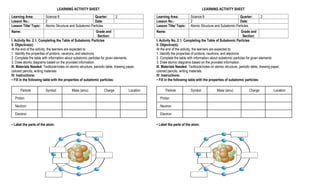
I.Activity No. 2.1: Completing the Table of Subatomic Particles
II. Objective(s):
At the end of the activity, the learners are expected to:
1. Identify the properties of protons, neutrons, and electrons
2. Complete the table with information about subatomic particles for given elements.
3. Draw atomic diagrams based on the provided information.
III. Materials Needed: Textbook/notes on atomic structure, periodic table, drawing paper,
colored pencils, writing materials
IV. Instructions:
▪ Fill in the following table with the properties of subatomic particles:
Particle Symbol Mass (amu) Charge Location
Proton
Neutron
Electron
▪ Label the parts of the atom:
LEARNING ACTIVITY SHEET
I. Activity No. 2.1: Completing the Table of Subatomic Particles
II. Objective(s):
At the end of the activity, the learners are expected to:
1. Identify the properties of protons, neutrons, and electrons
2. Complete the table with information about subatomic particles for given elements.
3. Draw atomic diagrams based on the provided information.
III. Materials Needed: Textbook/notes on atomic structure, periodic table, drawing paper,
colored pencils, writing materials
IV. Instructions:
▪ Fill in the following table with the properties of subatomic particles:
Particle Symbol Mass (amu) Charge Location
Proton
Neutron
Electron
▪ Label the parts of the atom:
Learning Area: Science 8 Quarter: 2
Lesson No.: 2 Date:
Lesson Title/ Topic: Atomic Structure and Subatomic Particles
Name: Grade and
Section:
Learning Area: Science 8 Quarter: 2
Lesson No.: 2 Date:
Lesson Title/ Topic: Atomic Structure and Subatomic Particles
Name: Grade and
Section:
2.
LEARNING ACTIVITY SHEET
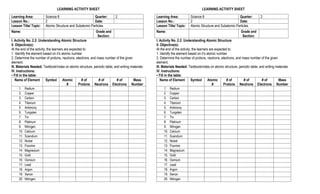
I.Activity No. 2.2: Understanding Atomic Structure
II. Objective(s):
At the end of the activity, the learners are expected to:
1. Identify the element based on it’s atomic number
2. Determine the number of protons, neutrons, electrons, and mass number of the given
element.
III. Materials Needed: Textbook/notes on atomic structure, periodic table, and writing materials
IV. Instructions:
▪ Fill in the table:
Name of Element Symbol Atomic
#
# of
Protons
# of
Neutrons
# of
Electrons
Mass
Number
1. Radium
2. Copper
3. Carbon
4. Titanium
5. Antimony
6. Tungsten
7. Tin
8. Platinum
9. Nitrogen
10. Calcium
11. Scandium
12. Nickel
13. Fluorine
14. Magnesium
15. Gold
16. Osmium
17. Lead
18. Argon
19. Xenon
20. Nitrogen
LEARNING ACTIVITY SHEET
I. Activity No. 2.2: Understanding Atomic Structure
II. Objective(s):
At the end of the activity, the learners are expected to:
1. Identify the element based on it’s atomic number
2. Determine the number of protons, neutrons, electrons, and mass number of the given
element.
III. Materials Needed: Textbook/notes on atomic structure, periodic table, and writing materials
IV. Instructions:
▪ Fill in the table:
Name of Element Symbol Atomic
#
# of
Protons
# of
Neutrons
# of
Electrons
Mass
Number
1. Radium
2. Copper
3. Carbon
4. Titanium
5. Antimony
6. Tungsten
7. Tin
8. Platinum
9. Nitrogen
10. Calcium
11. Scandium
12. Nickel
13. Fluorine
14. Magnesium
15. Gold
16. Osmium
17. Lead
18. Argon
19. Xenon
20. Nitrogen
Learning Area: Science 8 Quarter: 2
Lesson No.: 2 Date:
Lesson Title/ Topic: Atomic Structure and Subatomic Particles
Name: Grade and
Section:
Learning Area: Science 8 Quarter: 2
Lesson No.: 2 Date:
Lesson Title/ Topic: Atomic Structure and Subatomic Particles
Name: Grade and
Section:
3.
LEARNING ACTIVITY SHEET
I.Activity No. 2.3: Role of Subatomic Particles and Atomic Stability
II. Objective(s):
At the end of the activity, the learners are expected to:
1. explain the significance of the arrangement of subatomic particles in an atom.
2. Understand how the arrangement of subatomic particles affects atomic stability.
III. Materials Needed: worksheet, writing materials
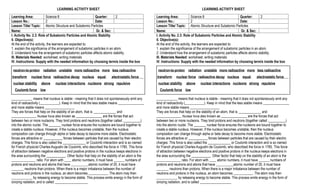
IV. Instructions: Supply with the needed information by choosing term/s inside the box
neutron-to-proton radiation unstable more radioactive more less radioactive
transform nuclear force radioactive decay nucleus equal electrostatic force
nuclear stability above nuclear interactions nucleons strong repulsive
Coulomb force low
____________ means that nucleus is stable - meaning that it does not spontaneously emit any
kind of radioactivity (___________). Keep in mind that the less stable means _______________
and more stable means _________________
They are forces that help on the stability of an atom, that is _____________ and
______________. Nuclear force also known as _______________ are the forces that act
between two or more nucleons. They bind protons and neutrons (together called __________)
into the atomic nuclei. The _______ nuclear force ensures the nucleons are bound together to
create a stable nucleus. However, if the nucleus becomes unstable, then the nucleus
composition can change through alpha or beta decay to become more stable. Electrostatic
forces are attractive or ___________ forces between particles that are caused by their electric
charges. This force is also called the _____________ or Coulomb interaction and is so named
for French physicist Charles-Augustin de Coulomb, who described the force in 1785. This force
of attraction between negative electrons and positive protons in the nucleus keeps electrons in
the area surrounding the ___________. Other factor that help on the stability of an atom is the
______________ ratio. For atom with ____ atomic numbers, it must have ______ numbers of
protons and neutrons and atoms that have __________atomic number of 20, it must have
_______ neutrons than protons. When there is a major imbalance between the number of
neutrons and protons in the nucleus, an atom becomes ___________. The atom may then
____________ by releasing energy to become stable. This process emits energy in the form of
ionizing radiation, and is called ___________________
LEARNING ACTIVITY SHEET
I. Activity No. 2.3: Role of Subatomic Particles and Atomic Stability
II. Objective(s):
At the end of the activity, the learners are expected to:
1. explain the significance of the arrangement of subatomic particles in an atom.
2. Understand how the arrangement of subatomic particles affects atomic stability.
III. Materials Needed: worksheet, writing materials
IV. Instructions: Supply with the needed information by choosing term/s inside the box
neutron-to-proton radiation unstable more radioactive more less radioactive
transform nuclear force radioactive decay nucleus equal electrostatic force
nuclear stability above nuclear interactions nucleons strong repulsive
Coulomb force low
____________ means that nucleus is stable - meaning that it does not spontaneously emit any
kind of radioactivity (___________). Keep in mind that the less stable means _______________
and more stable means _________________
They are forces that help on the stability of an atom, that is _____________ and
______________. Nuclear force also known as _______________ are the forces that act
between two or more nucleons. They bind protons and neutrons (together called __________)
into the atomic nuclei. The _______ nuclear force ensures the nucleons are bound together to
create a stable nucleus. However, if the nucleus becomes unstable, then the nucleus
composition can change through alpha or beta decay to become more stable. Electrostatic
forces are attractive or ___________ forces between particles that are caused by their electric
charges. This force is also called the _____________ or Coulomb interaction and is so named
for French physicist Charles-Augustin de Coulomb, who described the force in 1785. This force
of attraction between negative electrons and positive protons in the nucleus keeps electrons in
the area surrounding the ___________. Other factor that help on the stability of an atom is the
______________ ratio. For atom with ____ atomic numbers, it must have ______ numbers of
protons and neutrons and atoms that have __________atomic number of 20, it must have
_______ neutrons than protons. When there is a major imbalance between the number of
neutrons and protons in the nucleus, an atom becomes ___________. The atom may then
____________ by releasing energy to become stable. This process emits energy in the form of
ionizing radiation, and is called __________________
Learning Area: Science 8 Quarter: 2
Lesson No.: 2 Date:
Lesson Title/ Topic: Atomic Structure and Subatomic Particles
Name: Gr. & Sec:
Learning Area: Science 8 Quarter: 2
Lesson No.: 2 Date:
Lesson Title/ Topic: Atomic Structure and Subatomic Particles
Name: Gr. & Sec: