Lesson Plan in ARTS 10
October 23, 2018
Teacher : Charym C. Labarda
A. Content Standard
 New technologies that allow new expressions in arts using art elements and
processes.
B. Performance Standard
 Create a tech-based artwork (video clips and printed media such as
posters,menus,brochures etc.) relating to a selected topic from the different
learning areas using available technologies, e.g., food and fashion.
C. Learning Competencies
 Create artworks that can be locally assembled with local materials, guided by
21st-century techniques.( A10PR-Iic-e-1)
I - SUBJECT MATTER
a. Objectives : 1. Creating art using image manipulation programs on mobile or android phones.
2. Creating art using image capture and manipulation programs on
computers,laptops,and tablets.
b. TOPIC : MOBILE PHONE ART / COMPUTER-GENERATED ART
c. Materials
 Sample Images created using mobile phones and/or computers,laptops,or tablet
 Any available android phones,laptops,or tablets
d. References : HORIZONS GRADE 10 Learner's Material Pages 243-248
HORIZONS GRADE 10 Teacher's Guide Pages 129-133
II - PRE-ASSESSMENT
 Indicator #1. Applies knowledge of content within and across curriculum teaching areas.
 Conduct a survey by asking the following question in HORIZON TG pg. 129 to
assess what the students know or have experienced concerning mobile phone art
and computer-generated images.
Survey questions :
1. Do you own a personal mobile phone?If so,does it have a camera for
capturing images?
2. Have you experienced taking photos with your mobile phone? If so,
what types of photos do you usually take?
3. Have you tried to modify those images in some way? What program(s)
did you use?
4.Have you created original artworks from scratch on a computer,laptop,or
tablet? If so,what kind of artworks are these?
5. What program(s) did you use to create them?
III – PROCEDURES
A. ACTIVITY
 Indicator #1. Applies knowledge of content within and across curriculum teaching areas.
 Indicator #7. Plans,manages and implements developmentally sequenced teaching and
learning process to meet curriculum requirements and varied teaching contexts.
 Indicator #4. Manages classroom structure to engage learners, individually or in groups,in
meaningful exploration,discovery and hands-on activities within a range of physical learning
environments.
 Indicator #2. Uses range of teaching strategies that enhance learner achievement in literacy
and numerical skills.
Motivation : NUMBERED HEADS AND MODIFIED SNAKE & LADDER GAME
1.Divide the class into 4 groups. Each group will create their own token name
2.Each member will have a number.
3.Call a number in every question and let the student answer the question.
4. After answering,let the student roll the dice and let them move there token.
SPOT THE DIFFERENCES
1. Present five examples of Mobile Phone Art and Computer-Generated Art and let
the students spot the differences.
C.ANALYSIS
 Indicator #9. Designs,selects,organizes, and uses diagnostic, formative and summative assessment
strategies consistent with curriculum requirements.
 Indicator #5. Manages learner behavior constructively by applying positive and non-violent discipline to
ensure learning-focused environments.
Process Questions : (Call a number to answer the question and let the student roll the dice)
1. What did you observe with the picture?
2. Did you have a hard time identifying the differences ? Why?
3. What other image modifications and effects,aside from those shown,
you have done by yourself?
D.ABSTRACTION
 Indicator #3. Applies a range of teaching strategies to develop critical and creative thinking as well as
higher –order thinking skills.
 Indicator #1. Applies knowledge of content within and across curriculum teaching areas.
 Indicator #9. Designs,selects,organizes, and uses diagnostic, formative and summative assessment
strategies consistent with curriculum requirements.
GROUP ACTIVITY
 Let the group read the information of Mobile Phone Art /Computer-Generated Art
in their HORIZONS LM pages 243-248.Instruct each group to brainstorm among
themselves.
 Discussion and presentation of Mobile Phone Art and Computer-Generated Art
Process Questions : ( Call a number to answer the question and let the student roll the dice)
1. What is mobile phone art?
2. What technology has made this possible?
3. What is the raw material or starting point for creating an artwork on a mobile
phone?
4. How is this initial material then transformed into an original piece of art?
5. Name some programs and/or applications that can be used to create an art on a
mobile phone?
6. Besides using mobile phone software, what is the other means of creating art
from scratch using computer technology?
7. What is the raw material or starting point for creating an artwork on a
computer?
8. How is this initial material then transformed into an original piece of art using
a computer?
9. Name some computer programs that are designed for this purpose.
E.APPLICATION
 Indicator #4. Manages classroom structure to engage learners, individually or in groups,in
meaningful exploration,discovery and hands-on activities within a range of physical learning
environments.
 Indicator #8. Selects,develops,organizes,and uses appropriate teaching and learning
resources, including ICT,to address learning goals.
 Indicator #5. Manages learner behavior constructively by applying positive and non-violent
discipline to ensure learning-focused environments.
 Indicator #6. Uses differentiated,developmentally appropriate learning experiences to address
learner’s gender,needs,strength,interest and experiences.
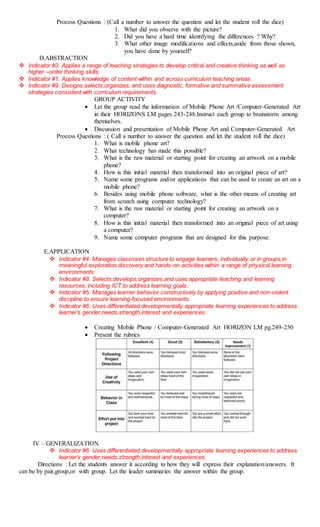
 Creating Mobile Phone / Computer-Generated Art HORIZON LM pg.249-250
 Present the rubrics
IV – GENERALIZATION
 Indicator #6. Uses differentiated,developmentally appropriate learning experiences to address
learner’s gender,needs,strength,interest and experiences.
Directions : Let the students answer it according to how they will express their explanation/answers. It
can be by pair,group,or with group. Let the leader summaries the answer within the group.
1. Mobile phone art is a technology-based art form. Support this statement
with your own brief explanation.
2. Did you feel like an artist while capturing and modifying your mobile
phone image? Describe the experience.
3.Describe your experience, if you used this technique to create a computer-
generated artwork.
4.Do you consider mobile phone art and computer-generated images as true
art? Why or why not?
V- EVALUATION
 Indicator #9. Designs,selects,organizes, and uses diagnostic, formative and summative assessment
strategies consistent with curriculum requirements.
5 – item paper pencil test
VI. ASSIGNMENT
 Assign the class to read ahead on the next topic "Digital Photography" on pages
250-252 of the Learner's Material
VII . REFLECTION
 # of learners in mastery level =
 # of learners need remediation =
Name :_________________________________
Direction : Write the letter of the correct answer in the space provided before the number.
___1. Which of the following programs that is designed to run on desktop computers and laptop?
a. adobe photoshop express
b. picsart
c. snapseed
d. Pic Monkey
___2. What communication tool that can be a creative device that allows you to generate original works of arts to
manipulate effects?
a. Mobile phone
b. Desktop
c. DSLR
d. Video Camera
___3. These are created from scratch using drawing or illustrations software on desktop computers, laptops, and
tablets these can then be modified and manipulated as well, using image editing programs for these devices.
a. mobile phone art
b. digital painting
c. computer-generated images
d. video games
___4. What is the raw material or starting point for creating an artwork on a cellphone?
a. Specialized programs
b. Desktop computer
c. Applications
d. Corel draw
___5. How is this initial material or raw material then transformed into an original piece of art?
a. By capturing images
b. By developing the images
c. By experiencing the gadget to edit
d. By modifying and manipulating
Lesson Plan in PHYSICAL EDUCATION 7
November 21, 2018
Teacher : Charym C. Labarda
A.CONTENT STANDARD
 Demonstrates understanding of guidelines and principles in exercise program design to achieve
personal fitness.
B.PERFORMANCE STANDARD
 Modifies the individualized exercise program to achieve personal fitness.
C.LEARNING COMPETENCIES
 Executes the skills involved in the dance
 Undertakes physical activity and physical fitness assessments.
I- SUBJECT MATTER
a.Objectives : 1.Discuss the nature and background of folk dances.
2.Executes the fundamental arms and feet positions and the fundamental dance
steps in folkdancing.
b.Topic : FOLK DANCE
Sub-topic: Fundamental arms and feet positions and the fundamental dance steps in folkdancing
c.Materials : Computer/Laptop, Led TV,Speaker,Textbooks, and Chalkboard
d.References : PHYSICAL EDUCATION AND HEALTH 7 Learner’s Material pages 126-137
PHYSICAL EDUCATION AND HEALTH 7 Teacher’s Guide pages 154-167
II- REVIEW
 Have a review of the Daily Routine
1. Demonstrate the warm-up exercise : 8 measures of each dance step
and let them execute the dance steps with ¾ time signature music.
III- PROCEDURES
A. ACTIVITY
Motivation :
*Behavioral Chart
*Incentive Chart
1. Divide the class into 4 groups according to their skills.
2. Group 1 – Vivacious Group
Group 2 – Vocalize Group
Group 3 – Musician Group
Group 4 – Painter Group
3.Award every accomplishment of the group.
DANCES OF THE ISLANDS
Task of every group:
Group 1.Let the group,identify the folk dance as shown in the picture and let them perform some
basic steps in folkdancing.
Group 2 Let the group choose an example of folk dance and let them sing.
Group 3 Let the group perform an example rhythm of folk dance using the available materials as
there instruments.
Group 4 A Philippine Map is shown.let the group color the map and identify the folk dance that
originates in the marked places.Below is a list of folk dances for the group to choose from.
B. ANALYSIS
Process Questions : ( Call a volunteer to answer the question and reward their group)
1.How many dances have you identified?
2.Are you familiar with the basic steps of these dances?
3.How do you describe this dances?
4.Name other folk dances and their place of origin.
5.Did you find our activity easy or difficult?Share your experience in this activity.
C. ABSTRACTION
FOLK DANCE 101
1.Present a video clip of Philippine Folk Dances and let them observe how the dancers perform
the dance.
2.Let the students read TIME TO READ pp.132-134 P.E and HEALTH LM
3.Ask processing questions : ( call a volunteer member of the group to answer)
1.From the videos shown,what are the movements performed by the dancers in
the different folk dances?
2. How are these dances performed?
3. What do you think are the benefits that can be gained from these dances?
4.From the videos shown and readings,define what folk dances are?
5.What are the similarities and differences of folk dance with other dances genres
like ballet and ballroom dances?
6.Would you consider participating in a folk dance presentation/competition?
Why?
D. APPLICATION
BACK TO BASIC!
1.Execute to the students the fundamental positions of feet and arms,without music by following
the instructions in LM pp.135-138 and let them follow.
2.This time, execute the following steps with music in ¾ time signature.
Process Questions : (call a volunteer to answer and reward their participation)
1.What did you feel about the activity?
2.Were you able to perform the fundamental positions properly?
IV- GENERALIZATION
Let the students answer the following questions:
1.If you engage yourself in folkdancing,how will you prepare your body for you to dance
properly?
2.What if during the dance,a member of your group suffered from a dance-related injury like
cramps,sprain or heat exhaustion? What will you do?
V – EVALUATION
5-item paper pencil test
VI –ASSIGNMENT
VII – REFLECTION
Lesson Plan in PHYSICAL EDUCATION 10
November 21, 2018
Teacher : Charym C. Labarda
A.CONTENT STANDARD
 Demonstrates understanding of lifestyle and weight management to promote societal fitness.
B.PERFORMANCE STANDARD
 Maintains an active lifestyle to influence the community an society to participate in physical
activities.
 Practices healthy eating habits that support an active lifestyle.
C.LEARNING COMPETENCIES
 Assess your physical activities,exercise,and eating habits; PE10PF-IIIa-h-39
 Determine risk factors related to lifestyle diseases (obesity,diabetes,heart diseases);PE10PF-III-a-40
 Engage in moderate to vigorous physical activities for at least 60 minutes a day,
in and out of school. PE10PF-IIIc-h-45
I- SUBJECT MATTER
a.Objectives : 1.Determine the risk factors related to lifestyle diseases ;
2.Describe street dance and hiphop dance and their style ;
3.Perform a dance routine applying a common style in street dance.
b.Topic : ACTIVE RECREATION
Sub-topic: Street Dance and Hiphop Dance
c.Materials : Computer/Laptop, Led TV,Speaker,Textbooks,Chalkboard,Coloring Materials, Manila
Paper,and Android Phones.
d.References : PHYSICAL EDUCATION AND HEALTH 10 Learner’s Material pages 105-116
PHYSICAL EDUCATION AND HEALTH 10 Teacher’s Guide pages 115-130
II- PRE-ASSESSMENT
 Indicator #1. Applies knowledge of content within and across curriculum teaching areas.
 Conduct pre-assessment and results shall be recorded for the purpose of tracking the
student’s progress.
III- PROCEDURES
B. ACTIVITY
 Indicator #2. Uses range of teaching strategies that enhance learner achievement in literacy
and numerical skills.
 Indicator #4. Manages classroom structure to engage learners, individually or in groups,in
meaningful exploration,discovery and hands-on activities within a range of physical learning
environments.
 Indicator #5. Manages learner behavior constructively by applying positive and non-violent
discipline to ensure learning-focused environments.
 Indicator #1. Applies knowledge of content within and across curriculum teaching areas.
Motivation :
*Present Classroom Rules
*Incentive Chart
*Numbered Heads
1. Divide the class into 4 groups
2.Let them name their own group name.
3.There will be corresponding boxes for each group.
4.Give award every accomplishment of the group in every boxes.
ACT. 1 : BE OR BE  (Math Integration) Individual Actitvity
1.Dictate various physical activities one by one or flash images of the following activities :
playing computer games jogging hip-hop dancing
reading books folk dancing
movie marathon street dancing
watching television surfing on the internet
jumping jacks playing basketball
running scrubbing the floor
playing badminton fetching a pail of water
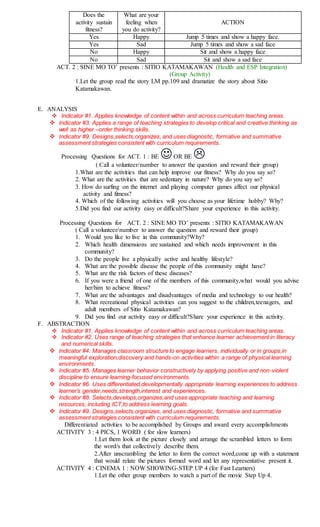
2.At the teacher’s signal after each physical activity,let the students do the corresponding
action based on its ability to sustain fitness and your feelings when performing the activity.
Does the
activity sustain
fitness?
What are your
feeling when
you do activity?
ACTION
Yes Happy Jump 5 times and show a happy face.
Yes Sad Jump 5 times and show a sad face
No Happy Sit and show a happy face
No Sad Sit and show a sad face
ACT. 2 : SINE MO TO’ presents : SITIO KATAMAKAWAN (Health and ESP Integration)
(Group Activity)
1.Let the group read the story LM pp.109 and dramatize the story about Sitio
Katamakawan.
E. ANALYSIS
 Indicator #1. Applies knowledge of content within and across curriculum teaching areas.
 Indicator #3. Applies a range of teaching strategies to develop critical and creative thinking as
well as higher –order thinking skills.
 Indicator #9. Designs,selects,organizes, and uses diagnostic, formative and summative
assessment strategies consistent with curriculum requirements.
Processing Questions for ACT. 1 : BE OR BE 
( Call a volunteer/number to answer the question and reward their group)
1.What are the activities that can help improve our fitness? Why do you say so?
2. What are the activities that are sedentary in nature? Why do you say so?
3. How do surfing on the internet and playing computer games affect our physical
activity and fitness?
4. Which of the following activities will you choose as your lifetime hobby? Why?
5.Did you find our activity easy or difficult?Share your experience in this activity.
Processing Questions for ACT. 2 : SINE MO TO’ presents : SITIO KATAMAKAWAN
( Call a volunteer/number to answer the question and reward their group)
1. Would you like to live in this community?Why?
2. Which health dimensions are sustained and which needs improvement in this
community?
3. Do the people live a physically active and healthy lifestyle?
4. What are the possible disease the people of this community might have?
5. What are the risk factors of these diseases?
6. If you were a friend of one of the members of this community,what would you advise
her/him to achieve fitness?
7. What are the advantages and disadvantages of media and technology to our health?
8. What recreational physical activities can you suggest to the children,teenagers, and
adult members of Sitio Katamakawan?
9. Did you find our activity easy or difficult?Share your experience in this activity.
F. ABSTRACTION
 Indicator #1. Applies knowledge of content within and across curriculum teaching areas.
 Indicator #2. Uses range of teaching strategies that enhance learner achievement in literacy
and numerical skills.
 Indicator #4. Manages classroom structure to engage learners, individually or in groups,in
meaningful exploration,discovery and hands-on activities within a range of physical learning
environments.
 Indicator #5. Manages learner behavior constructively by applying positive and non-violent
discipline to ensure learning-focused environments.
 Indicator #6. Uses differentiated,developmentally appropriate learning experiences to address
learner’s gender,needs,strength,interest and experiences.
 Indicator #8. Selects,develops,organizes,and uses appropriate teaching and learning
resources, including ICT,to address learning goals.
 Indicator #9. Designs,selects,organizes, and uses diagnostic, formative and summative
assessment strategies consistent with curriculum requirements.
Differentiated activities to be accomplished by Groups and award every accomplishments
ACTIVITY 3 : 4 PICS, 1 WORD ( for slow learners)
1.Let them look at the picture closely and arrange the scrambled letters to form
the word/s that collectively describe them.
2.After unscrambling the letter to form the correct word,come up with a statement
that would relate the pictures formed word and let any representative present it.
ACTIVITY 4 : CINEMA 1 : NOW SHOWING-STEP UP 4 (for Fast Learners)
1.Let the other group members to watch a part of the movie Step Up 4.
2.Let them read about street and hiphop dance styles LM pp.114-115
3.Answer the following questions in the writing materials provided.
 What dance form is shown in the movie?
 What is street dance?
 What is hiphop dance?
 What particular movements/steps strike you?
 Can street dance and hiphop dance improve fitness?How?
 Can we use street dance and hiphop dance as our recreation activity?
Why and How?
*As they present their answers facilitates discussion.
*Play a video clips of common styles in street dance.
G. APPLICATION
 Indicator #8. Selects,develops,organizes,and uses appropriate teaching and learning
resources, including ICT,to address learning goals.
 Indicator #9. Designs,selects,organizes, and uses diagnostic, formative and summative
assessment strategies consistent with curriculum requirements.
ACT. 5 :HIPHOP 101 (Math Integration)
1.Let the group create a simple dance routine applying common styles in street dance like
b-boying,popping,and locking. They may choose their own music.
2.Let them present in the class.
IV- GENERALIZATION
 Indicator #1. Applies knowledge of content within and across curriculum teaching areas.
 Indicator #4. Manages classroom structure to engage learners, individually or in groups,in
meaningful exploration,discovery and hands-on activities within a range of physical learning
environments.
 Indicator #5. Manages learner behavior constructively by applying positive and non-violent
discipline to ensure learning-focused environments.
 Indicator #6. Uses differentiated,developmentally appropriate learning experiences to address
learner’s gender,needs,strength,interest and experiences.
ACT.6 : DANCE,ACT,SING,&DRAW (Music,Arts,and P.E Integration)
1. Divide the class into 4 groups according to their skills by giving picture of the
following skills they have.
2.Let them name their group name according to their skills
Group 1 – Vivacious Picture ( Task : create a hiphop dance)
Group 2 – Dramatic Picture (Task :dramatize a scenario of a person how dancing
affects his/her the lifestyle.)
Group 3 – Musician Picture (Task : Create a song/a yell about the benefits of
dancing.)
Group 4 – Painter Picture (Task : Draw the effects dancing in your lifestyle )
V – EVALUATION
 Indicator #1. Applies knowledge of content within and across curriculum teaching areas.
 Indicator #9. Designs,selects,organizes, and uses diagnostic, formative and summative
assessment strategies consistent with curriculum requirements.
5-item paper pencil test
Name :_________________________________
Direction : Write the letter of the correct answer in the space provided before the number.
_________1. What dance style,formally known as vernacular dances,refer to dances that evolved outside the dance
studios?
a.popping b.punk dance c.street dance d.hiphop dance
_________2. What form of street dance is performed impromptu in large crowds?
a.shuffling b.punk dance c.street dance d.hiphop dance
_________3. What culture is created by DJing,rapping,breakdancing, and graffiti art?
a.hiphop culture b.street dance culture c.punk dance d.all of the above
________4. What dance style is primarily performed to hiphop music and have evolved as a part of hiphop culture?
a.popping b.locking c.hiphop dance d.punk dance
________5. What hiphop style is based on the technique of quickly contracting and relaxing muscles to cause a jerk in a
dancer’s body?
a.popping b.locking c.b-boying d.tutting
VI. ASSIGNMENT
 Assign the class to read ahead on the next topic "THE FILIPINO PYRAMID
ACTIVITY GUIDE" on pages 119-121 of the P.E AND HEALTH Learner's
Material
VII . REFLECTION
 # of learners in mastery level =
 # of learners need remediation =
Prepared by:
CHARYM C. LABARDA
MAPEH Teacher
Lesson Plan in
HEALTH OPTIMIZING PHYSICAL EDUCATION II
February 20,2019
Teacher : Charym C. Labarda
A.CONTENT STANDARD
 The learner demonstrates understanding of sports optimizing one’s health as a habit ; as requisite for
PHYSICAL ACTIVITY performance, and as a career opportunity.
B.PERFORMANCE STANDARD
 The learner leads sports events with proficiency and confidence resulting in independent pursuit and
influencing others positivity.
C.LEARNING COMPETENCIES
 Display initiative,responsibility, and leadership in sports activities;
 Organize a sports event for a target health issue or concern;
 Explain the value of optimizing one’s health through participation in physical activities.
I- SUBJECT MATTER
a.Objectives : 1.Describe management and understand the functions of management;
2.Value the importance of management in sports;
3.Create a manage team in a sports event.
b.Topic : ORGANIZATION AND MANAGEMENT OF SPORTS EVENTS
Sub-topic: *Importance of Management
*Importance of Management in sports events
*Functions of Management
*Qualities of a Good Leader
c.Materials : Computer/Laptop, Led TV,Speaker,Textbooks,Chalkboard,Coloring Materials, Manila
Paper,and Cartolina.
d.References :
PHYSICAL EDUCATION AND HEALTH Volume I by Callo & Dajime pages 105-106
FITNESS FOR LIFE by Ryan Gialogo and Richardson Gialogo pages 77-78
K to 12 Basic Education Curriculum SHS Curriculum Guide
II- PRE-ASSESSMENT 6 minutes
 Indicator #1. Applies knowledge of content within and across curriculum teaching areas.
 Conduct pre-assessment and results shall be recorded for the purpose of tracking the
student’s progress.
ACTIVITY I – KWL Chart
What I know ? What I want to Learn? What I learned?
III- PROCEDURES
ACTIVITY 10 minutes
 Indicator #2. Uses range of teaching strategies that enhance learner achievement in literacy
and numerical skills.
 Indicator #4. Manages classroom structure to engage learners, individually or in groups,in
meaningful exploration,discovery and hands-on activities within a range of physical learning
environments.
 Indicator #5. Manages learner behavior constructively by applying positive and non-violent
discipline to ensure learning-focused environments.
 Indicator #1. Applies knowledge of content within and across curriculum teaching areas.
MOTIVATION
*Incentive Chart
1. Divide the class into 4 groups.
2. Group 1
Group 2
Group 3
Group 4
3.Let them create yells to their group.
4.In every question that they can answer they will have the chance to roll
the dice and shoot.
4.Two points will be given in every shoot but if there’s none 1 pt. in every
accomplishment of the group.
5. Point system will be in smiley emoticons
ACTIVITY 1 : BASKETBALL GAME
1. The class will form a circle.
2. Each group will choose a team captain,each TC will meet at the middle of the circle to
have jump ball.
3.Whoever will catch the ball,he/she will pass the ball to his/her groupmates. If anyone
of the member will catch the ball he/she will go the circle dribbling the ball and then shoot
the ball to the net while the other member can cover up the one who is holding the ball to
avoid it from opponent team.
4. Members from the other group can get the ball if they can.
5.Each team/group can receive points if they can shoot the ball.
ANALYSIS 5 minutes
 Indicator #1. Applies knowledge of content within and across curriculum teaching areas.
 Indicator #3. Applies a range of teaching strategies to develop critical and creative thinking as
well as higher –order thinking skills.
Processing Questions : Roll the Dice
1. How did you feel about our activity?
2. What are the skills you performed in our activity?
3. What sport events have you participated?
4. What are needed to make a sport events successful?
5. Who are the people involved to make it successful?
6. If you will create a sports event, how do you organize and manage special events?
ABSTRACTION 15 minutes
 Indicator #1. Applies knowledge of content within and across curriculum teaching areas.
 Indicator #2. Uses range of teaching strategies that enhance learner achievement in literacy
and numerical skills.
 Indicator #4. Manages classroom structure to engage learners, individually or in groups,in
meaningful exploration,discovery and hands-on activities within a range of physical learning
environments.
 Indicator #5. Manages learner behavior constructively by applying positive and non-violent
discipline to ensure learning-focused environments.
 Indicator #9. Designs,selects,organizes, and uses diagnostic, formative and summative
assessment strategies consistent with curriculum requirements.
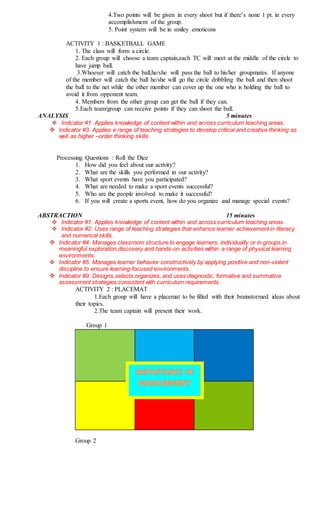
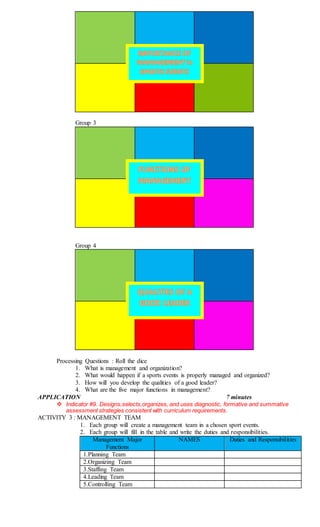
ACTIVITY 2 : PLACEMAT
1.Each group will have a placemat to be filled with their brainstormed ideas about
their topics.
2.The team captain will present their work.
Group 1
Group 2
Group 3
Group 4
Processing Questions : Roll the dice
1. What is management and organization?
2. What would happen if a sports events is properly managed and organized?
3. How will you develop the qualities of a good leader?
4. What are the five major functions in management?
APPLICATION 7 minutes
 Indicator #9. Designs,selects,organizes, and uses diagnostic, formative and summative
assessment strategies consistent with curriculum requirements.
ACTIVITY 3 : MANAGEMENT TEAM
1. Each group will create a management team in a chosen sport events.
2. Each group will fill in the table and write the duties and responsibilities.
Management Major
Functions
NAMES Duties and Responsibilities
1.Planning Team
2.Organizing Team
3.Staffing Team
4.Leading Team
5.Controlling Team
3. Call a volunteer from the group to present their output.
IV- GENERALIZATION 10 minutes
 Indicator #1. Applies knowledge of content within and across curriculum teaching areas.
 Indicator #4. Manages classroom structure to engage learners, individually or in groups,in
meaningful exploration,discovery and hands-on activities within a range of physical learning
environments.
 Indicator #5. Manages learner behavior constructively by applying positive and non-violent
discipline to ensure learning-focused environments.
 Indicator #6. Uses differentiated,developmentally appropriate learning experiences to address
learner’s gender,needs,strength,interest and experiences.
ACTIVITY 4 : DIFFERENTIATED ACTIVITY
1.Each group will perform different activity.
2. GROUP 1 – Role Playing
*Role play about the cause and effects of a good management that leads to a
successful sports events.
GROUP 2 – Radio/TV Broadcasting
*Broadcast about a sports events that is happening to your
school/barangay/province. Include advertisements.
GROUP 3 – Poster making
*Create a poster for intramurals that will promote camaraderie and good
relationship with peers.
GROUP 4 – Yells and cheers
*Create a yell/ song about having a qualities of a good leader.
V – EVALUATION 5 minutes
 Indicator #1. Applies knowledge of content within and across curriculum teaching areas.
 Indicator #9. Designs,selects,organizes, and uses diagnostic, formative and summative
assessment strategies consistent with curriculum requirements.
10-item Paper Scanning Test
Instruction : Blacken the circle of the correct answer.
_______1. Which of the following is not a major function in management?
a.planning b.leading c.controlling d.officiating
_______2. How would you identify a good leader?
a.he/she is unawareness of his/her work c.being unhealthy and fit
b.having administrative mind d. Always not ready to take responsibility
_______3. What is management?
a.It is a key factor to success in any physical and sports education program.
b.it deals with tasks and accountabilities to accomplish the objectives through cooperation.
c.it involves collaboration of administering body.
d.all of the above
_______4. Why management is important?
a.to unable to meet the objectives or goals.
b.because it provides guidelines in the collaborative strengths of people
c.it does not defines the group’s development
d. because it does not help foster good human relationship.
_______5. What is/are responsibilities of controlling in management?
a.monitoring b. assessment c.evaluation and feedback d.all of the above
_______6. Which qualities should a good leader possesses?
a.integrity b.intellectual capacity c.healthy and fit d.all of the above
_______7. Which qualities of a good leader that know-how on specific field organization?
a.awareness of work b.good human relationship c.integrity d.administrative mind
_______8. Which management function aids in developing a group structure with definite scope of work for
every member.
a.organizing b.leading c.controlling d.planning
_______9. It is a good venue to develop camaraderie and good relationships among peers?
a.sports b. management c.teamwork d.officials
_______10. Why management is important in sports events?
a.it gives a grasp and value to the essential ideas of the field’s discipline
b.because it is vital to collaborative effort.
c. because management skills help foster good human relations.
d.all of the above
VI. ASSIGNMENT 2 minutes
*create by group a powerpoint presentation about the
Roles and responsibilities of Tournament Officials
G1 – Types of Officiating
G2 – Kinds of Officials
G3 – Bases of Good Sports
G4 – Qualities of an Official
*To be presented next week.
PHYSICAL EDUCATION AND HEALTH II Volume I pgs. 106-108
VII . REFLECTION
 # of learners in mastery level =
 # of learners need remediation =
Prepared by:
CHARYM C. LABARDA
MAPEH Teacher
Lesson Plan in
PHYSICAL EDUCATION 10
February 20,2019
Teacher : Charym C. Labarda
A.CONTENT STANDARD
 The learner demonstrates understanding of lifestyle and weight management to promote societal
fitness.
B.PERFORMANCE STANDARD
 The learner maintains an active lifestyle to influence the physical activity participation of the
community and the society.
 The learner practices healthy eating habits that support an active lifestyle.
C.LEARNING COMPETENCIES
 Engages in moderate sto vigorous physical activities for at least 60 minutes a day in and out of
school;PE10PF-Iva-40
 Expresses a sense of purpose and belongingness by participating in physical activity related
community services and programs;PE10PF-IVc-h48
 Recognizes the health needs of others in real life and meaningful ways.PE10PF-IIIc-h-49
I- SUBJECT MATTER
a.Objectives : 1.Demonstrates knowledge and skills learned from the previuos activities through
simulated dance class differentiated ;
2.Performed assigned task with mastery,confidence,relevance to the lesson, and
adequacy of required knowledge; and
3.realize the value of weight management,active recreation,and first aid in
maintaining or improving a healthy and active lifestyle.
b.Topic : ACTIVE RECREATION,IT’S RISKS, AND FIRST AID TECHNIQUES
Sub-topic: *Physical Activity and Active Recreation
*Common Injuries Involved in Recreation
*First Aid Techniques to injuries During Recreatoion
c.Materials : Computer/Laptop, Led TV,Speaker,Textbooks,Chalkboard,Manila Paper,and Cartolina.
d.References :
PHYSICAL EDUCATION AND HEALTH 10 Learner’s Material pgs.149-156
PHYSICAL EDUCATION AND HEALTH 10 Teacher’s Guide pgs.170-176
II- PRE-ASSESSMENT 6 minutes
 Indicator #1. Applies knowledge of content within and across curriculum teaching areas.
 Conduct pre-assessment and results shall be recorded for the purpose of tracking the
student’s progress.
Assessing Participation in Recreational Activity
Recreational
Activity
Always Seldom Never Potential
Danger/Injury
First Aid
Techniques
Needed
1.Basketball
2.Cheerdancing
3.Playing
Board Games
/Card Games
4.Trekking
5.Camping
Processing Questions:
1.What does the survey reveal about your participation in recreational activities?
2.Does the result of the survey tell that you have knowledge and skills in first aid?
3.Why do you think knowledge and skills in first aid are necessary in your participation in
recreational activities?
III- PROCEDURES
ACTIVITY Math and Values Integration 10 minutes
 Indicator #2. Uses range of teaching strategies that enhance learner achievement in literacy
and numerical skills.
 Indicator #5. Manages learner behavior constructively by applying positive and non-violent
discipline to ensure learning-focused environments.
 Indicator #1. Applies knowledge of content within and across curriculum teaching areas.
ACTIVITY 1: SYLLABISED WARM-UP EXERCISE
1.Let the class perform the syllabized warm-up exercise.
ANALYSIS (English and Health Integration) 5 minutes
 Indicator #1. Applies knowledge of content within and across curriculum teaching areas.
 Indicator #3. Applies a range of teaching strategies to develop critical and creative thinking as
well as higher –order thinking skills.
Processing Questions :
1. How did you feel about the warm up drills exercise?
2. What benefits you can gain when doing warm-up before the performance of a more
strenuous physical exercise?
3. Why is there a need to warm-up before cheerdancing?
4. What other warm-up exercise can you suggest other than those you have already
performed?
ABSTRACTION (Math,Health,Music,English Integration) 15 minutes
 Indicator #1. Applies knowledge of content within and across curriculum teaching areas.
 Indicator #2. Uses range of teaching strategies that enhance learner achievement in literacy
and numerical skills.
 Indicator #4. Manages classroom structure to engage learners, individually or in groups,in
meaningful exploration,discovery and hands-on activities within a range of physical learning
environments.
 Indicator #5. Manages learner behavior constructively by applying positive and non-violent
discipline to ensure learning-focused environments.
 Indicator #9. Designs,selects,organizes, and uses diagnostic, formative and summative
assessment strategies consistent with curriculum requirements.
 Indicator #6. Uses differentiated,developmentally appropriate learning experiences to address
learner’s gender,needs,strength,interest and experiences.
ACTIVITY 2 : DIFFERENTIATED ACTIVITY
1.Divide the class into three groups.
2.Each group will be assigned an activity to perform :
Group 1 : Fitness lecture with focus on weight management.
Group 2 : Dance group with emphasis on recreational activities chosen
Group 3 : First Aid group focusing on dislocations,sprains and lacerations.
Criteria : Relevance of the activities presented 40%
Adequacy of the knowledge demonstrated relative to the given topic 40%
Teamwork 20%
Total 100 %
3.Give incentives rewards and behavioral rewards to each presentation of the
group.
Processing questions :
1. If you have a high potential risk of developing health problems as determined by your waist
circumference, what should you do to prevent this?
2. What are the common injuries involved in recreation?
3. What acronyms shall be remembered when applying first aid to injuries during the conduct
of recreational activities?
4. In the first few days of an injury, what acronym you should avoid?
APPLICATION 9 minutes
 Indicator #9. Designs,selects,organizes, and uses diagnostic, formative and summative
assessment strategies consistent with curriculum requirements.
ACTIVITY 3 :
1. Let the group copy the template.
2. Identify five of your favorite recreational activities.
3. Indicate the corresponding injuries that can possibly happen while doing the activity.
4. Provide the first aid techniques in the possible injuries.
Favorite Recreational
Activities
Accompanying Risks
(Possible Injuries)
First Aid Technique
IV- GENERALIZATION 10 minutes
 Indicator #1. Applies knowledge of content within and across curriculum teaching areas.
 Indicator #5. Manages learner behavior constructively by applying positive and non-violent
discipline to ensure learning-focused environments.
ACTIVITY 4 : SEARCH FOR MS. & MR. Q & A 2019
*Choose 2 representatives in your group to answer the Q & A 2019.
QUESTIONS :
1. If you were to choose among sedentary, moderately active or active lifestyle,which would
you prefer?Why?
2. Which do you think is better, passive or active recreation?why?
3. What suggestions can you give to minimize the potential risks in such physical activity?
4. Why is it important to have a balanced lifestyle?
5. Do you need to learn first aid techniques?Why?
6. What is the first aid technique for sprains and strains?
V – EVALUATION 5 minutes
 Indicator #9. Designs,selects,organizes, and uses diagnostic, formative and summative
assessment strategies consistent with curriculum requirements.
Directions: Write the letter of the correct answer.
1. If you have a high potential risk of developing health problems as determined by your waist
circumference, what should you do to prevent this?
a.perform physical activity
b.have an imbalanced lifestyle
c.having a sedentary lifestyle
d.all of the above
2. What are the common injuries involved in recreation?
a.sprains b.strains c.knee injuries d.all of the above
3. What acronyms shall be remembered when applying first aid to injuries during the conduct
of recreational activities?
a.PRICED b.PRICE c.ICED d. RICED
4. In the first few days of an injury, what acronym you should avoid?
a.HARM b.ARM c.HEAT d. ICE
5. Who will conduct diagnosis for acute injuries?
a.healthcare professionals c.Medical Technologists
b.teachers d.all of the above
VI. ASSIGNMENT 2 minutes
*create by group a dance presentation of hand movements and positions in cheerdance
PHYSICAL EDUCATION AND HEALTH 10 pgs. 186-187
VII . REFLECTION
 # of learners in mastery level =
 # of learners need remediation =
Prepared by:
CHARYM C. LABARDA
MAPEH Teacher
Lesson Plan in
HEALTH OPTIMIZING PHYSICAL EDUCATION IV
March 7,2019
Teacher : Charym C. Labarda
A.CONTENT STANDARD
 The learner demonstrates understanding of recreation in optimizing one’s health as a habit; as
requisite for physical activity assessment performance,and as a career opportunity.
B.PERFORMANCE STANDARD
 The learner leads recreational events with proficiency and confidence resulting in independent pursuit
and in influencing others positively.
C.LEARNING COMPETENCIES
 Discusses the nature of different recreational activities PEH12FH-IIa-20;
 Explains relationship of health behaviors to health risks factors and physical activity assessment
performance PEH12FH-IIb-c-2;
 Displays initiative,responsibility and leadership in recreational activities PEH12FH-IIk-o-13.
I- SUBJECT MATTER
a.Objectives : 1. Identify mountaineering activities;
2.Appreciate the health related benefits of hiking and trekking;
3.Prepare and decide the essential things for a hike or trek.
b.Topic : MOUNTAINEERING
Sub-topic: *HIKING and TREKKING
c.Materials : Computer/Laptop, Led TV,Speaker,Textbooks,Chalkboard,Coloring Materials, Manila
Paper,and Cartolina.
d.References :
PHYSICAL EDUCATION AND HEALTH Volume II by Callo & Dajime pages 145-149
FITNESS FOR LIFE by Ryan Gialogo and Richardson Gialogo pages 104-105
K to 12 Basic Education Curriculum SHS Curriculum Guide
III- PROCEDURES
ACTIVITY Math and Values Integration 10 minutes
 Indicator #2. Uses range of teaching strategies that enhance learner achievement in literacy
and numerical skills.
 Indicator #5. Manages learner behavior constructively by applying positive and non-violent
discipline to ensure learning-focused environments.
 Indicator #1. Applies knowledge of content within and across curriculum teaching areas.
Review past lessons.
QUESTIONS :
1. What was our previous lesson?
2. What are THE LEAVE NO TRACE SEVEN PRINCIPLES?
3. What are the benefits of Outdoor Recreational Activities?
MOTIVATION : EMOTICON POINTS,DICE,NUMBERED HEADS
ACTIVITY 1: FILM VIEWING
1.Divide the group into 3 groups and assigned a number to each members.
2.Every questions to be asked,roll the dice and whatever number comes out he/she
will answer the question with corresponding points.
3.Let the class watch a video of mountaineering activities.
ANALYSIS (English,Health,History Integration) 5 minutes
 Indicator #1. Applies knowledge of content within and across curriculum teaching areas.
 Indicator #3. Applies a range of teaching strategies to develop critical and creative thinking as
well as higher –order thinking skills.
Processing Questions :
1.What is the video all about?
2. Who is the first Filipino to climb the Seven Summits of the World?
3. Cite one example of mountaineering activities?
ABSTRACTION 15 minutes
 Indicator #1. Applies knowledge of content within and across curriculum teaching areas.
 Indicator #2. Uses range of teaching strategies that enhance learner achievement in literacy
and numerical skills.
 Indicator #4. Manages classroom structure to engage learners, individually or in groups,in
meaningful exploration,discovery and hands-on activities within a range of physical learning
environments.
 Indicator #5. Manages learner behavior constructively by applying positive and non-violent
discipline to ensure learning-focused environments.
 Indicator #9. Designs,selects,organizes, and uses diagnostic, formative and summative
assessment strategies consistent with curriculum requirements.
 Discussion of the following topics :
1. How to prepare for a hike or trek.
2. Hiking essentials
3. Essential things to bring in your backpack.
Processing questions :
1. How do you prepare for hiking and trekking? (Physical Conditioning and Trip planning)
2. What are the hiking essentials?
3. What are the essential things that you need to bring?
4. What are the health-related benefits of hiking?
APPLICATION (English Integration) 9 minutes
 Indicator #9. Designs,selects,organizes, and uses diagnostic, formative and summative
assessment strategies consistent with curriculum requirements.
ACTIVITY 2 : ANSWER & MAIL IT!
1. Send the letter to each group.
2. Let the group read their task.
3. Give the group 3 minutes to accomplish the task.
4. The Group 1 will send their letter to Group 2,G2 to G3,and G3 to G1.
5. Check their output.
Criteria
Cooperation 15 pts.
Time management 15 pts.
Following Instructions 20 %
Correctness of answer 50 pts
Total 100 pts.
III- GENERALIZATION 10 minutes
 Indicator #1. Applies knowledge of content within and across curriculum teaching areas.
Give some safety reminders in hiking and trekking and indicate the health benefits of recreational
activity.
IV – EVALUATION 5 minutes
 Indicator #9. Designs,selects,organizes, and uses diagnostic, formative and summative
assessment strategies consistent with curriculum requirements.
Directions: Write the letter of the correct answer.
_______1. What is the basic activity in preparing for a hike or trek?
a.trip planning b.physical conditioning c.mountaineering d.walking
_______2.Which of the following are the sources of calories?
a.carbohydrates b.fats c.proteins d.all of the above
_______3. One of the hiking essentials which aids for those who has knee problems.
a.footwear b.trekking poles c.tent pole d.hiking boots
_______4. It is a sport attaining or attempting to attain high points in mountainous regions,mainly pleasure for
climb.
a.mountaineering b.trekking c.hiking d.snorkling
_______5. Who is the first Filipino to climb the Seven Summits of the World?
a.Romeo Roberto “Romi” Garduce
b.Romeo Bert Garduce
c.Romi Garduse
d.Roberto Garduze
V. ASSIGNMENT 2 minutes
*create a poem expressing your thoughts and feelings about recreational activity.
PHYSICAL EDUCATION AND HEALTH VOLUME II
VI. REFLECTION
 # of learners in mastery level =
 # of learners need remediation =
Prepared by:
CHARYM C. LABARDA
MAPEH Teacher

Daily lesson log for demo teaching

  • 1.
    Lesson Plan inARTS 10 October 23, 2018 Teacher : Charym C. Labarda A. Content Standard  New technologies that allow new expressions in arts using art elements and processes. B. Performance Standard  Create a tech-based artwork (video clips and printed media such as posters,menus,brochures etc.) relating to a selected topic from the different learning areas using available technologies, e.g., food and fashion. C. Learning Competencies  Create artworks that can be locally assembled with local materials, guided by 21st-century techniques.( A10PR-Iic-e-1) I - SUBJECT MATTER a. Objectives : 1. Creating art using image manipulation programs on mobile or android phones. 2. Creating art using image capture and manipulation programs on computers,laptops,and tablets. b. TOPIC : MOBILE PHONE ART / COMPUTER-GENERATED ART c. Materials  Sample Images created using mobile phones and/or computers,laptops,or tablet  Any available android phones,laptops,or tablets d. References : HORIZONS GRADE 10 Learner's Material Pages 243-248 HORIZONS GRADE 10 Teacher's Guide Pages 129-133 II - PRE-ASSESSMENT  Indicator #1. Applies knowledge of content within and across curriculum teaching areas.  Conduct a survey by asking the following question in HORIZON TG pg. 129 to assess what the students know or have experienced concerning mobile phone art and computer-generated images. Survey questions : 1. Do you own a personal mobile phone?If so,does it have a camera for capturing images? 2. Have you experienced taking photos with your mobile phone? If so, what types of photos do you usually take? 3. Have you tried to modify those images in some way? What program(s) did you use? 4.Have you created original artworks from scratch on a computer,laptop,or tablet? If so,what kind of artworks are these? 5. What program(s) did you use to create them? III – PROCEDURES A. ACTIVITY  Indicator #1. Applies knowledge of content within and across curriculum teaching areas.  Indicator #7. Plans,manages and implements developmentally sequenced teaching and learning process to meet curriculum requirements and varied teaching contexts.  Indicator #4. Manages classroom structure to engage learners, individually or in groups,in meaningful exploration,discovery and hands-on activities within a range of physical learning environments.  Indicator #2. Uses range of teaching strategies that enhance learner achievement in literacy and numerical skills. Motivation : NUMBERED HEADS AND MODIFIED SNAKE & LADDER GAME 1.Divide the class into 4 groups. Each group will create their own token name 2.Each member will have a number. 3.Call a number in every question and let the student answer the question. 4. After answering,let the student roll the dice and let them move there token. SPOT THE DIFFERENCES 1. Present five examples of Mobile Phone Art and Computer-Generated Art and let the students spot the differences. C.ANALYSIS  Indicator #9. Designs,selects,organizes, and uses diagnostic, formative and summative assessment strategies consistent with curriculum requirements.  Indicator #5. Manages learner behavior constructively by applying positive and non-violent discipline to ensure learning-focused environments.
  • 2.
    Process Questions :(Call a number to answer the question and let the student roll the dice) 1. What did you observe with the picture? 2. Did you have a hard time identifying the differences ? Why? 3. What other image modifications and effects,aside from those shown, you have done by yourself? D.ABSTRACTION  Indicator #3. Applies a range of teaching strategies to develop critical and creative thinking as well as higher –order thinking skills.  Indicator #1. Applies knowledge of content within and across curriculum teaching areas.  Indicator #9. Designs,selects,organizes, and uses diagnostic, formative and summative assessment strategies consistent with curriculum requirements. GROUP ACTIVITY  Let the group read the information of Mobile Phone Art /Computer-Generated Art in their HORIZONS LM pages 243-248.Instruct each group to brainstorm among themselves.  Discussion and presentation of Mobile Phone Art and Computer-Generated Art Process Questions : ( Call a number to answer the question and let the student roll the dice) 1. What is mobile phone art? 2. What technology has made this possible? 3. What is the raw material or starting point for creating an artwork on a mobile phone? 4. How is this initial material then transformed into an original piece of art? 5. Name some programs and/or applications that can be used to create an art on a mobile phone? 6. Besides using mobile phone software, what is the other means of creating art from scratch using computer technology? 7. What is the raw material or starting point for creating an artwork on a computer? 8. How is this initial material then transformed into an original piece of art using a computer? 9. Name some computer programs that are designed for this purpose. E.APPLICATION  Indicator #4. Manages classroom structure to engage learners, individually or in groups,in meaningful exploration,discovery and hands-on activities within a range of physical learning environments.  Indicator #8. Selects,develops,organizes,and uses appropriate teaching and learning resources, including ICT,to address learning goals.  Indicator #5. Manages learner behavior constructively by applying positive and non-violent discipline to ensure learning-focused environments.  Indicator #6. Uses differentiated,developmentally appropriate learning experiences to address learner’s gender,needs,strength,interest and experiences.  Creating Mobile Phone / Computer-Generated Art HORIZON LM pg.249-250  Present the rubrics IV – GENERALIZATION  Indicator #6. Uses differentiated,developmentally appropriate learning experiences to address learner’s gender,needs,strength,interest and experiences. Directions : Let the students answer it according to how they will express their explanation/answers. It can be by pair,group,or with group. Let the leader summaries the answer within the group.
  • 3.
    1. Mobile phoneart is a technology-based art form. Support this statement with your own brief explanation. 2. Did you feel like an artist while capturing and modifying your mobile phone image? Describe the experience. 3.Describe your experience, if you used this technique to create a computer- generated artwork. 4.Do you consider mobile phone art and computer-generated images as true art? Why or why not? V- EVALUATION  Indicator #9. Designs,selects,organizes, and uses diagnostic, formative and summative assessment strategies consistent with curriculum requirements. 5 – item paper pencil test VI. ASSIGNMENT  Assign the class to read ahead on the next topic "Digital Photography" on pages 250-252 of the Learner's Material VII . REFLECTION  # of learners in mastery level =  # of learners need remediation = Name :_________________________________ Direction : Write the letter of the correct answer in the space provided before the number. ___1. Which of the following programs that is designed to run on desktop computers and laptop? a. adobe photoshop express b. picsart c. snapseed d. Pic Monkey ___2. What communication tool that can be a creative device that allows you to generate original works of arts to manipulate effects? a. Mobile phone b. Desktop c. DSLR d. Video Camera ___3. These are created from scratch using drawing or illustrations software on desktop computers, laptops, and tablets these can then be modified and manipulated as well, using image editing programs for these devices. a. mobile phone art b. digital painting c. computer-generated images d. video games ___4. What is the raw material or starting point for creating an artwork on a cellphone? a. Specialized programs b. Desktop computer c. Applications d. Corel draw ___5. How is this initial material or raw material then transformed into an original piece of art? a. By capturing images b. By developing the images c. By experiencing the gadget to edit d. By modifying and manipulating
  • 4.
    Lesson Plan inPHYSICAL EDUCATION 7 November 21, 2018 Teacher : Charym C. Labarda A.CONTENT STANDARD  Demonstrates understanding of guidelines and principles in exercise program design to achieve personal fitness. B.PERFORMANCE STANDARD  Modifies the individualized exercise program to achieve personal fitness. C.LEARNING COMPETENCIES  Executes the skills involved in the dance  Undertakes physical activity and physical fitness assessments. I- SUBJECT MATTER a.Objectives : 1.Discuss the nature and background of folk dances. 2.Executes the fundamental arms and feet positions and the fundamental dance steps in folkdancing. b.Topic : FOLK DANCE Sub-topic: Fundamental arms and feet positions and the fundamental dance steps in folkdancing c.Materials : Computer/Laptop, Led TV,Speaker,Textbooks, and Chalkboard d.References : PHYSICAL EDUCATION AND HEALTH 7 Learner’s Material pages 126-137 PHYSICAL EDUCATION AND HEALTH 7 Teacher’s Guide pages 154-167 II- REVIEW  Have a review of the Daily Routine 1. Demonstrate the warm-up exercise : 8 measures of each dance step and let them execute the dance steps with ¾ time signature music. III- PROCEDURES A. ACTIVITY Motivation : *Behavioral Chart *Incentive Chart 1. Divide the class into 4 groups according to their skills. 2. Group 1 – Vivacious Group Group 2 – Vocalize Group Group 3 – Musician Group Group 4 – Painter Group 3.Award every accomplishment of the group. DANCES OF THE ISLANDS Task of every group: Group 1.Let the group,identify the folk dance as shown in the picture and let them perform some basic steps in folkdancing. Group 2 Let the group choose an example of folk dance and let them sing. Group 3 Let the group perform an example rhythm of folk dance using the available materials as there instruments. Group 4 A Philippine Map is shown.let the group color the map and identify the folk dance that originates in the marked places.Below is a list of folk dances for the group to choose from. B. ANALYSIS Process Questions : ( Call a volunteer to answer the question and reward their group) 1.How many dances have you identified? 2.Are you familiar with the basic steps of these dances? 3.How do you describe this dances? 4.Name other folk dances and their place of origin. 5.Did you find our activity easy or difficult?Share your experience in this activity. C. ABSTRACTION FOLK DANCE 101 1.Present a video clip of Philippine Folk Dances and let them observe how the dancers perform the dance. 2.Let the students read TIME TO READ pp.132-134 P.E and HEALTH LM
  • 5.
    3.Ask processing questions: ( call a volunteer member of the group to answer) 1.From the videos shown,what are the movements performed by the dancers in the different folk dances? 2. How are these dances performed? 3. What do you think are the benefits that can be gained from these dances? 4.From the videos shown and readings,define what folk dances are? 5.What are the similarities and differences of folk dance with other dances genres like ballet and ballroom dances? 6.Would you consider participating in a folk dance presentation/competition? Why? D. APPLICATION BACK TO BASIC! 1.Execute to the students the fundamental positions of feet and arms,without music by following the instructions in LM pp.135-138 and let them follow. 2.This time, execute the following steps with music in ¾ time signature. Process Questions : (call a volunteer to answer and reward their participation) 1.What did you feel about the activity? 2.Were you able to perform the fundamental positions properly? IV- GENERALIZATION Let the students answer the following questions: 1.If you engage yourself in folkdancing,how will you prepare your body for you to dance properly? 2.What if during the dance,a member of your group suffered from a dance-related injury like cramps,sprain or heat exhaustion? What will you do? V – EVALUATION 5-item paper pencil test VI –ASSIGNMENT VII – REFLECTION
  • 6.
    Lesson Plan inPHYSICAL EDUCATION 10 November 21, 2018 Teacher : Charym C. Labarda A.CONTENT STANDARD  Demonstrates understanding of lifestyle and weight management to promote societal fitness. B.PERFORMANCE STANDARD  Maintains an active lifestyle to influence the community an society to participate in physical activities.  Practices healthy eating habits that support an active lifestyle. C.LEARNING COMPETENCIES  Assess your physical activities,exercise,and eating habits; PE10PF-IIIa-h-39  Determine risk factors related to lifestyle diseases (obesity,diabetes,heart diseases);PE10PF-III-a-40  Engage in moderate to vigorous physical activities for at least 60 minutes a day, in and out of school. PE10PF-IIIc-h-45 I- SUBJECT MATTER a.Objectives : 1.Determine the risk factors related to lifestyle diseases ; 2.Describe street dance and hiphop dance and their style ; 3.Perform a dance routine applying a common style in street dance. b.Topic : ACTIVE RECREATION Sub-topic: Street Dance and Hiphop Dance c.Materials : Computer/Laptop, Led TV,Speaker,Textbooks,Chalkboard,Coloring Materials, Manila Paper,and Android Phones. d.References : PHYSICAL EDUCATION AND HEALTH 10 Learner’s Material pages 105-116 PHYSICAL EDUCATION AND HEALTH 10 Teacher’s Guide pages 115-130 II- PRE-ASSESSMENT  Indicator #1. Applies knowledge of content within and across curriculum teaching areas.  Conduct pre-assessment and results shall be recorded for the purpose of tracking the student’s progress. III- PROCEDURES B. ACTIVITY  Indicator #2. Uses range of teaching strategies that enhance learner achievement in literacy and numerical skills.  Indicator #4. Manages classroom structure to engage learners, individually or in groups,in meaningful exploration,discovery and hands-on activities within a range of physical learning environments.  Indicator #5. Manages learner behavior constructively by applying positive and non-violent discipline to ensure learning-focused environments.  Indicator #1. Applies knowledge of content within and across curriculum teaching areas. Motivation : *Present Classroom Rules *Incentive Chart *Numbered Heads 1. Divide the class into 4 groups 2.Let them name their own group name. 3.There will be corresponding boxes for each group. 4.Give award every accomplishment of the group in every boxes. ACT. 1 : BE OR BE  (Math Integration) Individual Actitvity 1.Dictate various physical activities one by one or flash images of the following activities : playing computer games jogging hip-hop dancing reading books folk dancing movie marathon street dancing watching television surfing on the internet jumping jacks playing basketball running scrubbing the floor playing badminton fetching a pail of water 2.At the teacher’s signal after each physical activity,let the students do the corresponding action based on its ability to sustain fitness and your feelings when performing the activity.
  • 7.
    Does the activity sustain fitness? Whatare your feeling when you do activity? ACTION Yes Happy Jump 5 times and show a happy face. Yes Sad Jump 5 times and show a sad face No Happy Sit and show a happy face No Sad Sit and show a sad face ACT. 2 : SINE MO TO’ presents : SITIO KATAMAKAWAN (Health and ESP Integration) (Group Activity) 1.Let the group read the story LM pp.109 and dramatize the story about Sitio Katamakawan. E. ANALYSIS  Indicator #1. Applies knowledge of content within and across curriculum teaching areas.  Indicator #3. Applies a range of teaching strategies to develop critical and creative thinking as well as higher –order thinking skills.  Indicator #9. Designs,selects,organizes, and uses diagnostic, formative and summative assessment strategies consistent with curriculum requirements. Processing Questions for ACT. 1 : BE OR BE  ( Call a volunteer/number to answer the question and reward their group) 1.What are the activities that can help improve our fitness? Why do you say so? 2. What are the activities that are sedentary in nature? Why do you say so? 3. How do surfing on the internet and playing computer games affect our physical activity and fitness? 4. Which of the following activities will you choose as your lifetime hobby? Why? 5.Did you find our activity easy or difficult?Share your experience in this activity. Processing Questions for ACT. 2 : SINE MO TO’ presents : SITIO KATAMAKAWAN ( Call a volunteer/number to answer the question and reward their group) 1. Would you like to live in this community?Why? 2. Which health dimensions are sustained and which needs improvement in this community? 3. Do the people live a physically active and healthy lifestyle? 4. What are the possible disease the people of this community might have? 5. What are the risk factors of these diseases? 6. If you were a friend of one of the members of this community,what would you advise her/him to achieve fitness? 7. What are the advantages and disadvantages of media and technology to our health? 8. What recreational physical activities can you suggest to the children,teenagers, and adult members of Sitio Katamakawan? 9. Did you find our activity easy or difficult?Share your experience in this activity. F. ABSTRACTION  Indicator #1. Applies knowledge of content within and across curriculum teaching areas.  Indicator #2. Uses range of teaching strategies that enhance learner achievement in literacy and numerical skills.  Indicator #4. Manages classroom structure to engage learners, individually or in groups,in meaningful exploration,discovery and hands-on activities within a range of physical learning environments.  Indicator #5. Manages learner behavior constructively by applying positive and non-violent discipline to ensure learning-focused environments.  Indicator #6. Uses differentiated,developmentally appropriate learning experiences to address learner’s gender,needs,strength,interest and experiences.  Indicator #8. Selects,develops,organizes,and uses appropriate teaching and learning resources, including ICT,to address learning goals.  Indicator #9. Designs,selects,organizes, and uses diagnostic, formative and summative assessment strategies consistent with curriculum requirements. Differentiated activities to be accomplished by Groups and award every accomplishments ACTIVITY 3 : 4 PICS, 1 WORD ( for slow learners) 1.Let them look at the picture closely and arrange the scrambled letters to form the word/s that collectively describe them. 2.After unscrambling the letter to form the correct word,come up with a statement that would relate the pictures formed word and let any representative present it. ACTIVITY 4 : CINEMA 1 : NOW SHOWING-STEP UP 4 (for Fast Learners) 1.Let the other group members to watch a part of the movie Step Up 4.
  • 8.
    2.Let them readabout street and hiphop dance styles LM pp.114-115 3.Answer the following questions in the writing materials provided.  What dance form is shown in the movie?  What is street dance?  What is hiphop dance?  What particular movements/steps strike you?  Can street dance and hiphop dance improve fitness?How?  Can we use street dance and hiphop dance as our recreation activity? Why and How? *As they present their answers facilitates discussion. *Play a video clips of common styles in street dance. G. APPLICATION  Indicator #8. Selects,develops,organizes,and uses appropriate teaching and learning resources, including ICT,to address learning goals.  Indicator #9. Designs,selects,organizes, and uses diagnostic, formative and summative assessment strategies consistent with curriculum requirements. ACT. 5 :HIPHOP 101 (Math Integration) 1.Let the group create a simple dance routine applying common styles in street dance like b-boying,popping,and locking. They may choose their own music. 2.Let them present in the class. IV- GENERALIZATION  Indicator #1. Applies knowledge of content within and across curriculum teaching areas.  Indicator #4. Manages classroom structure to engage learners, individually or in groups,in meaningful exploration,discovery and hands-on activities within a range of physical learning environments.  Indicator #5. Manages learner behavior constructively by applying positive and non-violent discipline to ensure learning-focused environments.  Indicator #6. Uses differentiated,developmentally appropriate learning experiences to address learner’s gender,needs,strength,interest and experiences. ACT.6 : DANCE,ACT,SING,&DRAW (Music,Arts,and P.E Integration) 1. Divide the class into 4 groups according to their skills by giving picture of the following skills they have. 2.Let them name their group name according to their skills Group 1 – Vivacious Picture ( Task : create a hiphop dance) Group 2 – Dramatic Picture (Task :dramatize a scenario of a person how dancing affects his/her the lifestyle.) Group 3 – Musician Picture (Task : Create a song/a yell about the benefits of dancing.) Group 4 – Painter Picture (Task : Draw the effects dancing in your lifestyle ) V – EVALUATION  Indicator #1. Applies knowledge of content within and across curriculum teaching areas.  Indicator #9. Designs,selects,organizes, and uses diagnostic, formative and summative assessment strategies consistent with curriculum requirements. 5-item paper pencil test Name :_________________________________ Direction : Write the letter of the correct answer in the space provided before the number. _________1. What dance style,formally known as vernacular dances,refer to dances that evolved outside the dance studios? a.popping b.punk dance c.street dance d.hiphop dance _________2. What form of street dance is performed impromptu in large crowds? a.shuffling b.punk dance c.street dance d.hiphop dance _________3. What culture is created by DJing,rapping,breakdancing, and graffiti art? a.hiphop culture b.street dance culture c.punk dance d.all of the above ________4. What dance style is primarily performed to hiphop music and have evolved as a part of hiphop culture? a.popping b.locking c.hiphop dance d.punk dance ________5. What hiphop style is based on the technique of quickly contracting and relaxing muscles to cause a jerk in a dancer’s body? a.popping b.locking c.b-boying d.tutting VI. ASSIGNMENT
  • 9.
     Assign theclass to read ahead on the next topic "THE FILIPINO PYRAMID ACTIVITY GUIDE" on pages 119-121 of the P.E AND HEALTH Learner's Material VII . REFLECTION  # of learners in mastery level =  # of learners need remediation = Prepared by: CHARYM C. LABARDA MAPEH Teacher
  • 10.
    Lesson Plan in HEALTHOPTIMIZING PHYSICAL EDUCATION II February 20,2019 Teacher : Charym C. Labarda A.CONTENT STANDARD  The learner demonstrates understanding of sports optimizing one’s health as a habit ; as requisite for PHYSICAL ACTIVITY performance, and as a career opportunity. B.PERFORMANCE STANDARD  The learner leads sports events with proficiency and confidence resulting in independent pursuit and influencing others positivity. C.LEARNING COMPETENCIES  Display initiative,responsibility, and leadership in sports activities;  Organize a sports event for a target health issue or concern;  Explain the value of optimizing one’s health through participation in physical activities. I- SUBJECT MATTER a.Objectives : 1.Describe management and understand the functions of management; 2.Value the importance of management in sports; 3.Create a manage team in a sports event. b.Topic : ORGANIZATION AND MANAGEMENT OF SPORTS EVENTS Sub-topic: *Importance of Management *Importance of Management in sports events *Functions of Management *Qualities of a Good Leader c.Materials : Computer/Laptop, Led TV,Speaker,Textbooks,Chalkboard,Coloring Materials, Manila Paper,and Cartolina. d.References : PHYSICAL EDUCATION AND HEALTH Volume I by Callo & Dajime pages 105-106 FITNESS FOR LIFE by Ryan Gialogo and Richardson Gialogo pages 77-78 K to 12 Basic Education Curriculum SHS Curriculum Guide II- PRE-ASSESSMENT 6 minutes  Indicator #1. Applies knowledge of content within and across curriculum teaching areas.  Conduct pre-assessment and results shall be recorded for the purpose of tracking the student’s progress. ACTIVITY I – KWL Chart What I know ? What I want to Learn? What I learned? III- PROCEDURES ACTIVITY 10 minutes  Indicator #2. Uses range of teaching strategies that enhance learner achievement in literacy and numerical skills.  Indicator #4. Manages classroom structure to engage learners, individually or in groups,in meaningful exploration,discovery and hands-on activities within a range of physical learning environments.  Indicator #5. Manages learner behavior constructively by applying positive and non-violent discipline to ensure learning-focused environments.  Indicator #1. Applies knowledge of content within and across curriculum teaching areas. MOTIVATION *Incentive Chart 1. Divide the class into 4 groups. 2. Group 1 Group 2 Group 3 Group 4 3.Let them create yells to their group. 4.In every question that they can answer they will have the chance to roll the dice and shoot.
  • 11.
    4.Two points willbe given in every shoot but if there’s none 1 pt. in every accomplishment of the group. 5. Point system will be in smiley emoticons ACTIVITY 1 : BASKETBALL GAME 1. The class will form a circle. 2. Each group will choose a team captain,each TC will meet at the middle of the circle to have jump ball. 3.Whoever will catch the ball,he/she will pass the ball to his/her groupmates. If anyone of the member will catch the ball he/she will go the circle dribbling the ball and then shoot the ball to the net while the other member can cover up the one who is holding the ball to avoid it from opponent team. 4. Members from the other group can get the ball if they can. 5.Each team/group can receive points if they can shoot the ball. ANALYSIS 5 minutes  Indicator #1. Applies knowledge of content within and across curriculum teaching areas.  Indicator #3. Applies a range of teaching strategies to develop critical and creative thinking as well as higher –order thinking skills. Processing Questions : Roll the Dice 1. How did you feel about our activity? 2. What are the skills you performed in our activity? 3. What sport events have you participated? 4. What are needed to make a sport events successful? 5. Who are the people involved to make it successful? 6. If you will create a sports event, how do you organize and manage special events? ABSTRACTION 15 minutes  Indicator #1. Applies knowledge of content within and across curriculum teaching areas.  Indicator #2. Uses range of teaching strategies that enhance learner achievement in literacy and numerical skills.  Indicator #4. Manages classroom structure to engage learners, individually or in groups,in meaningful exploration,discovery and hands-on activities within a range of physical learning environments.  Indicator #5. Manages learner behavior constructively by applying positive and non-violent discipline to ensure learning-focused environments.  Indicator #9. Designs,selects,organizes, and uses diagnostic, formative and summative assessment strategies consistent with curriculum requirements. ACTIVITY 2 : PLACEMAT 1.Each group will have a placemat to be filled with their brainstormed ideas about their topics. 2.The team captain will present their work. Group 1 Group 2
  • 12.
    Group 3 Group 4 ProcessingQuestions : Roll the dice 1. What is management and organization? 2. What would happen if a sports events is properly managed and organized? 3. How will you develop the qualities of a good leader? 4. What are the five major functions in management? APPLICATION 7 minutes  Indicator #9. Designs,selects,organizes, and uses diagnostic, formative and summative assessment strategies consistent with curriculum requirements. ACTIVITY 3 : MANAGEMENT TEAM 1. Each group will create a management team in a chosen sport events. 2. Each group will fill in the table and write the duties and responsibilities. Management Major Functions NAMES Duties and Responsibilities 1.Planning Team 2.Organizing Team 3.Staffing Team 4.Leading Team 5.Controlling Team
  • 13.
    3. Call avolunteer from the group to present their output. IV- GENERALIZATION 10 minutes  Indicator #1. Applies knowledge of content within and across curriculum teaching areas.  Indicator #4. Manages classroom structure to engage learners, individually or in groups,in meaningful exploration,discovery and hands-on activities within a range of physical learning environments.  Indicator #5. Manages learner behavior constructively by applying positive and non-violent discipline to ensure learning-focused environments.  Indicator #6. Uses differentiated,developmentally appropriate learning experiences to address learner’s gender,needs,strength,interest and experiences. ACTIVITY 4 : DIFFERENTIATED ACTIVITY 1.Each group will perform different activity. 2. GROUP 1 – Role Playing *Role play about the cause and effects of a good management that leads to a successful sports events. GROUP 2 – Radio/TV Broadcasting *Broadcast about a sports events that is happening to your school/barangay/province. Include advertisements. GROUP 3 – Poster making *Create a poster for intramurals that will promote camaraderie and good relationship with peers. GROUP 4 – Yells and cheers *Create a yell/ song about having a qualities of a good leader. V – EVALUATION 5 minutes  Indicator #1. Applies knowledge of content within and across curriculum teaching areas.  Indicator #9. Designs,selects,organizes, and uses diagnostic, formative and summative assessment strategies consistent with curriculum requirements. 10-item Paper Scanning Test Instruction : Blacken the circle of the correct answer. _______1. Which of the following is not a major function in management? a.planning b.leading c.controlling d.officiating _______2. How would you identify a good leader? a.he/she is unawareness of his/her work c.being unhealthy and fit b.having administrative mind d. Always not ready to take responsibility _______3. What is management? a.It is a key factor to success in any physical and sports education program. b.it deals with tasks and accountabilities to accomplish the objectives through cooperation. c.it involves collaboration of administering body. d.all of the above _______4. Why management is important? a.to unable to meet the objectives or goals. b.because it provides guidelines in the collaborative strengths of people c.it does not defines the group’s development d. because it does not help foster good human relationship. _______5. What is/are responsibilities of controlling in management? a.monitoring b. assessment c.evaluation and feedback d.all of the above _______6. Which qualities should a good leader possesses? a.integrity b.intellectual capacity c.healthy and fit d.all of the above _______7. Which qualities of a good leader that know-how on specific field organization? a.awareness of work b.good human relationship c.integrity d.administrative mind _______8. Which management function aids in developing a group structure with definite scope of work for every member. a.organizing b.leading c.controlling d.planning _______9. It is a good venue to develop camaraderie and good relationships among peers? a.sports b. management c.teamwork d.officials _______10. Why management is important in sports events? a.it gives a grasp and value to the essential ideas of the field’s discipline b.because it is vital to collaborative effort. c. because management skills help foster good human relations. d.all of the above
  • 14.
    VI. ASSIGNMENT 2minutes *create by group a powerpoint presentation about the Roles and responsibilities of Tournament Officials G1 – Types of Officiating G2 – Kinds of Officials G3 – Bases of Good Sports G4 – Qualities of an Official *To be presented next week. PHYSICAL EDUCATION AND HEALTH II Volume I pgs. 106-108 VII . REFLECTION  # of learners in mastery level =  # of learners need remediation = Prepared by: CHARYM C. LABARDA MAPEH Teacher
  • 15.
    Lesson Plan in PHYSICALEDUCATION 10 February 20,2019 Teacher : Charym C. Labarda A.CONTENT STANDARD  The learner demonstrates understanding of lifestyle and weight management to promote societal fitness. B.PERFORMANCE STANDARD  The learner maintains an active lifestyle to influence the physical activity participation of the community and the society.  The learner practices healthy eating habits that support an active lifestyle. C.LEARNING COMPETENCIES  Engages in moderate sto vigorous physical activities for at least 60 minutes a day in and out of school;PE10PF-Iva-40  Expresses a sense of purpose and belongingness by participating in physical activity related community services and programs;PE10PF-IVc-h48  Recognizes the health needs of others in real life and meaningful ways.PE10PF-IIIc-h-49 I- SUBJECT MATTER a.Objectives : 1.Demonstrates knowledge and skills learned from the previuos activities through simulated dance class differentiated ; 2.Performed assigned task with mastery,confidence,relevance to the lesson, and adequacy of required knowledge; and 3.realize the value of weight management,active recreation,and first aid in maintaining or improving a healthy and active lifestyle. b.Topic : ACTIVE RECREATION,IT’S RISKS, AND FIRST AID TECHNIQUES Sub-topic: *Physical Activity and Active Recreation *Common Injuries Involved in Recreation *First Aid Techniques to injuries During Recreatoion c.Materials : Computer/Laptop, Led TV,Speaker,Textbooks,Chalkboard,Manila Paper,and Cartolina. d.References : PHYSICAL EDUCATION AND HEALTH 10 Learner’s Material pgs.149-156 PHYSICAL EDUCATION AND HEALTH 10 Teacher’s Guide pgs.170-176 II- PRE-ASSESSMENT 6 minutes  Indicator #1. Applies knowledge of content within and across curriculum teaching areas.  Conduct pre-assessment and results shall be recorded for the purpose of tracking the student’s progress. Assessing Participation in Recreational Activity Recreational Activity Always Seldom Never Potential Danger/Injury First Aid Techniques Needed 1.Basketball 2.Cheerdancing 3.Playing Board Games /Card Games 4.Trekking 5.Camping Processing Questions: 1.What does the survey reveal about your participation in recreational activities? 2.Does the result of the survey tell that you have knowledge and skills in first aid? 3.Why do you think knowledge and skills in first aid are necessary in your participation in recreational activities? III- PROCEDURES ACTIVITY Math and Values Integration 10 minutes  Indicator #2. Uses range of teaching strategies that enhance learner achievement in literacy and numerical skills.  Indicator #5. Manages learner behavior constructively by applying positive and non-violent discipline to ensure learning-focused environments.
  • 16.
     Indicator #1.Applies knowledge of content within and across curriculum teaching areas. ACTIVITY 1: SYLLABISED WARM-UP EXERCISE 1.Let the class perform the syllabized warm-up exercise. ANALYSIS (English and Health Integration) 5 minutes  Indicator #1. Applies knowledge of content within and across curriculum teaching areas.  Indicator #3. Applies a range of teaching strategies to develop critical and creative thinking as well as higher –order thinking skills. Processing Questions : 1. How did you feel about the warm up drills exercise? 2. What benefits you can gain when doing warm-up before the performance of a more strenuous physical exercise? 3. Why is there a need to warm-up before cheerdancing? 4. What other warm-up exercise can you suggest other than those you have already performed? ABSTRACTION (Math,Health,Music,English Integration) 15 minutes  Indicator #1. Applies knowledge of content within and across curriculum teaching areas.  Indicator #2. Uses range of teaching strategies that enhance learner achievement in literacy and numerical skills.  Indicator #4. Manages classroom structure to engage learners, individually or in groups,in meaningful exploration,discovery and hands-on activities within a range of physical learning environments.  Indicator #5. Manages learner behavior constructively by applying positive and non-violent discipline to ensure learning-focused environments.  Indicator #9. Designs,selects,organizes, and uses diagnostic, formative and summative assessment strategies consistent with curriculum requirements.  Indicator #6. Uses differentiated,developmentally appropriate learning experiences to address learner’s gender,needs,strength,interest and experiences. ACTIVITY 2 : DIFFERENTIATED ACTIVITY 1.Divide the class into three groups. 2.Each group will be assigned an activity to perform : Group 1 : Fitness lecture with focus on weight management. Group 2 : Dance group with emphasis on recreational activities chosen Group 3 : First Aid group focusing on dislocations,sprains and lacerations. Criteria : Relevance of the activities presented 40% Adequacy of the knowledge demonstrated relative to the given topic 40% Teamwork 20% Total 100 % 3.Give incentives rewards and behavioral rewards to each presentation of the group. Processing questions : 1. If you have a high potential risk of developing health problems as determined by your waist circumference, what should you do to prevent this? 2. What are the common injuries involved in recreation? 3. What acronyms shall be remembered when applying first aid to injuries during the conduct of recreational activities? 4. In the first few days of an injury, what acronym you should avoid? APPLICATION 9 minutes  Indicator #9. Designs,selects,organizes, and uses diagnostic, formative and summative assessment strategies consistent with curriculum requirements. ACTIVITY 3 : 1. Let the group copy the template. 2. Identify five of your favorite recreational activities. 3. Indicate the corresponding injuries that can possibly happen while doing the activity. 4. Provide the first aid techniques in the possible injuries. Favorite Recreational Activities Accompanying Risks (Possible Injuries) First Aid Technique
  • 17.
    IV- GENERALIZATION 10minutes  Indicator #1. Applies knowledge of content within and across curriculum teaching areas.  Indicator #5. Manages learner behavior constructively by applying positive and non-violent discipline to ensure learning-focused environments. ACTIVITY 4 : SEARCH FOR MS. & MR. Q & A 2019 *Choose 2 representatives in your group to answer the Q & A 2019. QUESTIONS : 1. If you were to choose among sedentary, moderately active or active lifestyle,which would you prefer?Why? 2. Which do you think is better, passive or active recreation?why? 3. What suggestions can you give to minimize the potential risks in such physical activity? 4. Why is it important to have a balanced lifestyle? 5. Do you need to learn first aid techniques?Why? 6. What is the first aid technique for sprains and strains? V – EVALUATION 5 minutes  Indicator #9. Designs,selects,organizes, and uses diagnostic, formative and summative assessment strategies consistent with curriculum requirements. Directions: Write the letter of the correct answer. 1. If you have a high potential risk of developing health problems as determined by your waist circumference, what should you do to prevent this? a.perform physical activity b.have an imbalanced lifestyle c.having a sedentary lifestyle d.all of the above 2. What are the common injuries involved in recreation? a.sprains b.strains c.knee injuries d.all of the above 3. What acronyms shall be remembered when applying first aid to injuries during the conduct of recreational activities? a.PRICED b.PRICE c.ICED d. RICED 4. In the first few days of an injury, what acronym you should avoid? a.HARM b.ARM c.HEAT d. ICE 5. Who will conduct diagnosis for acute injuries? a.healthcare professionals c.Medical Technologists b.teachers d.all of the above VI. ASSIGNMENT 2 minutes *create by group a dance presentation of hand movements and positions in cheerdance PHYSICAL EDUCATION AND HEALTH 10 pgs. 186-187 VII . REFLECTION  # of learners in mastery level =  # of learners need remediation = Prepared by: CHARYM C. LABARDA MAPEH Teacher
  • 18.
    Lesson Plan in HEALTHOPTIMIZING PHYSICAL EDUCATION IV March 7,2019 Teacher : Charym C. Labarda A.CONTENT STANDARD  The learner demonstrates understanding of recreation in optimizing one’s health as a habit; as requisite for physical activity assessment performance,and as a career opportunity. B.PERFORMANCE STANDARD  The learner leads recreational events with proficiency and confidence resulting in independent pursuit and in influencing others positively. C.LEARNING COMPETENCIES  Discusses the nature of different recreational activities PEH12FH-IIa-20;  Explains relationship of health behaviors to health risks factors and physical activity assessment performance PEH12FH-IIb-c-2;  Displays initiative,responsibility and leadership in recreational activities PEH12FH-IIk-o-13. I- SUBJECT MATTER a.Objectives : 1. Identify mountaineering activities; 2.Appreciate the health related benefits of hiking and trekking; 3.Prepare and decide the essential things for a hike or trek. b.Topic : MOUNTAINEERING Sub-topic: *HIKING and TREKKING c.Materials : Computer/Laptop, Led TV,Speaker,Textbooks,Chalkboard,Coloring Materials, Manila Paper,and Cartolina. d.References : PHYSICAL EDUCATION AND HEALTH Volume II by Callo & Dajime pages 145-149 FITNESS FOR LIFE by Ryan Gialogo and Richardson Gialogo pages 104-105 K to 12 Basic Education Curriculum SHS Curriculum Guide III- PROCEDURES ACTIVITY Math and Values Integration 10 minutes  Indicator #2. Uses range of teaching strategies that enhance learner achievement in literacy and numerical skills.  Indicator #5. Manages learner behavior constructively by applying positive and non-violent discipline to ensure learning-focused environments.  Indicator #1. Applies knowledge of content within and across curriculum teaching areas. Review past lessons. QUESTIONS : 1. What was our previous lesson? 2. What are THE LEAVE NO TRACE SEVEN PRINCIPLES? 3. What are the benefits of Outdoor Recreational Activities? MOTIVATION : EMOTICON POINTS,DICE,NUMBERED HEADS ACTIVITY 1: FILM VIEWING 1.Divide the group into 3 groups and assigned a number to each members. 2.Every questions to be asked,roll the dice and whatever number comes out he/she will answer the question with corresponding points. 3.Let the class watch a video of mountaineering activities. ANALYSIS (English,Health,History Integration) 5 minutes  Indicator #1. Applies knowledge of content within and across curriculum teaching areas.  Indicator #3. Applies a range of teaching strategies to develop critical and creative thinking as well as higher –order thinking skills. Processing Questions : 1.What is the video all about? 2. Who is the first Filipino to climb the Seven Summits of the World? 3. Cite one example of mountaineering activities?
  • 19.
    ABSTRACTION 15 minutes Indicator #1. Applies knowledge of content within and across curriculum teaching areas.  Indicator #2. Uses range of teaching strategies that enhance learner achievement in literacy and numerical skills.  Indicator #4. Manages classroom structure to engage learners, individually or in groups,in meaningful exploration,discovery and hands-on activities within a range of physical learning environments.  Indicator #5. Manages learner behavior constructively by applying positive and non-violent discipline to ensure learning-focused environments.  Indicator #9. Designs,selects,organizes, and uses diagnostic, formative and summative assessment strategies consistent with curriculum requirements.  Discussion of the following topics : 1. How to prepare for a hike or trek. 2. Hiking essentials 3. Essential things to bring in your backpack. Processing questions : 1. How do you prepare for hiking and trekking? (Physical Conditioning and Trip planning) 2. What are the hiking essentials? 3. What are the essential things that you need to bring? 4. What are the health-related benefits of hiking? APPLICATION (English Integration) 9 minutes  Indicator #9. Designs,selects,organizes, and uses diagnostic, formative and summative assessment strategies consistent with curriculum requirements. ACTIVITY 2 : ANSWER & MAIL IT! 1. Send the letter to each group. 2. Let the group read their task. 3. Give the group 3 minutes to accomplish the task. 4. The Group 1 will send their letter to Group 2,G2 to G3,and G3 to G1. 5. Check their output. Criteria Cooperation 15 pts. Time management 15 pts. Following Instructions 20 % Correctness of answer 50 pts Total 100 pts. III- GENERALIZATION 10 minutes  Indicator #1. Applies knowledge of content within and across curriculum teaching areas. Give some safety reminders in hiking and trekking and indicate the health benefits of recreational activity. IV – EVALUATION 5 minutes  Indicator #9. Designs,selects,organizes, and uses diagnostic, formative and summative assessment strategies consistent with curriculum requirements. Directions: Write the letter of the correct answer. _______1. What is the basic activity in preparing for a hike or trek? a.trip planning b.physical conditioning c.mountaineering d.walking _______2.Which of the following are the sources of calories? a.carbohydrates b.fats c.proteins d.all of the above _______3. One of the hiking essentials which aids for those who has knee problems. a.footwear b.trekking poles c.tent pole d.hiking boots _______4. It is a sport attaining or attempting to attain high points in mountainous regions,mainly pleasure for climb. a.mountaineering b.trekking c.hiking d.snorkling _______5. Who is the first Filipino to climb the Seven Summits of the World? a.Romeo Roberto “Romi” Garduce b.Romeo Bert Garduce c.Romi Garduse d.Roberto Garduze V. ASSIGNMENT 2 minutes *create a poem expressing your thoughts and feelings about recreational activity. PHYSICAL EDUCATION AND HEALTH VOLUME II VI. REFLECTION
  • 20.
     # oflearners in mastery level =  # of learners need remediation = Prepared by: CHARYM C. LABARDA MAPEH Teacher