ICT for meaningful learning ART – Perspective Drawing Yee Huiming, Justina Tan Zhi Ying Serlin Tan Yu Shi Er Kia Hui
Subject:  Art Topic:  Perspective Drawing Students’ ability :  Mixed Students’ profile:  Secondary 2 Express Students’ pre-requisite knowledge:  Elements of art and design, colour pencil shading skills, use of compact digital camera Lessons Duration:  2 periods (for 5 sessions) Introduction
Lessons Objectives Apply the knowledge of 1 point and 2 point perspective Demonstrate the skill and understanding of how lights affect the colours of objects Synthesize the elements in art Use ICT to assemble the drawing and photos At the end of all the lessons, students should be able to:
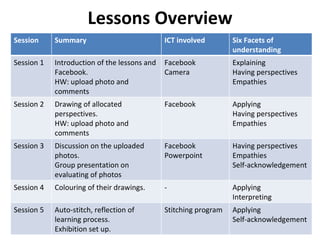
Lessons Overview Session Summary  ICT involved Six Facets of understanding  Session 1 Introduction of the lessons and Facebook. HW: upload photo and comments Facebook Camera Explaining Having perspectives Empathies Session 2 Drawing of allocated perspectives.  HW: upload photo and comments Facebook Applying Having perspectives Empathies Session 3 Discussion on the uploaded photos. Group presentation on evaluating of photos Facebook Powerpoint Having perspectives Empathies Self-acknowledgement Session 4 Colouring of their drawings. - Applying Interpreting Session 5 Auto-stitch, reflection of learning process. Exhibition set up. Stitching program Applying Self-acknowledgement
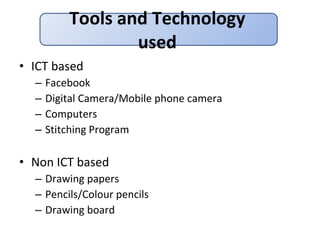
Tools and Technology used ICT based  Facebook Digital Camera/Mobile phone camera Computers Stitching Program Non ICT based Drawing papers Pencils/Colour pencils Drawing board
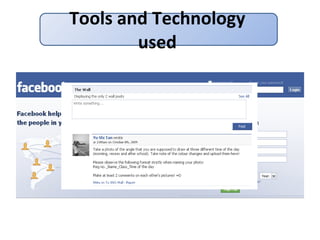
Tools and Technology used
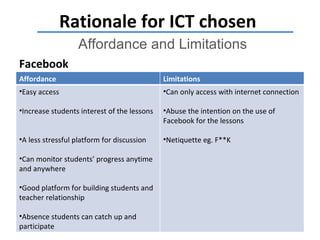
Rationale for ICT chosen  Facebook Affordance and Limitations Affordance  Limitations Easy access  Increase students interest of the lessons A less stressful platform for discussion Can monitor students’ progress anytime and anywhere Good platform for building students and teacher relationship Absence students can catch up and participate  Can only access with internet connection Abuse the intention on the use of Facebook for the lessons Netiquette eg. F**K
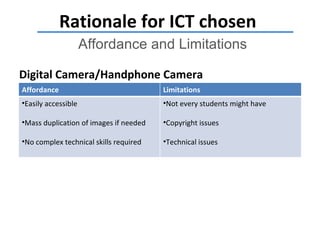
Rationale for ICT chosen  Digital Camera/Handphone Camera  Affordance and Limitations Affordance Limitations Easily accessible  Mass duplication of images if needed No complex technical skills required Not every students might have Copyright issues Technical issues
Demonstration  of AutoStitch
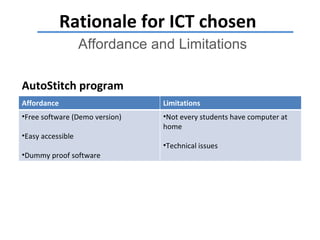
Rationale for ICT chosen  AutoStitch program Affordance and Limitations Affordance Limitations Free software (Demo version) Easy accessible Dummy proof software Not every students have computer at home Technical issues
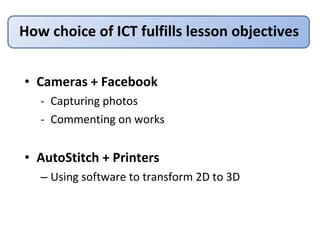
How choice of ICT fulfills lesson objectives Cameras + Facebook Capturing photos Commenting on works AutoStitch + Printers Using software to transform 2D to 3D
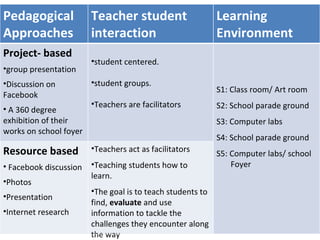
Pedagogical Approaches Teacher student interaction Learning Environment  Project- based group presentation Discussion on Facebook A 360 degree exhibition of their works on school foyer student centered. student groups. Teachers are facilitators S1: Class room/ Art room S2: School parade ground S3: Computer labs S4: School parade ground S5: Computer labs/ school Foyer Resource based  Facebook discussion Photos Presentation Internet research Teachers act as facilitators  Teaching students how to learn.  The goal is to teach students to find,  evaluate  and use information to tackle the challenges they encounter along the way
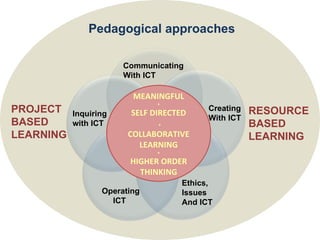
Creating With ICT Communicating With ICT Pedagogical approaches Ethics,  Issues  And ICT Inquiring  with ICT Operating ICT MEANINGFUL + SELF DIRECTED + COLLABORATIVE LEARNING + HIGHER ORDER THINKING PROJECT BASED LEARNING RESOURCE BASED LEARNING
Inquiring with  ICT
Communicating With ICT
Creating With ICT
Ethics, Issues  & ICT
Operating ICT
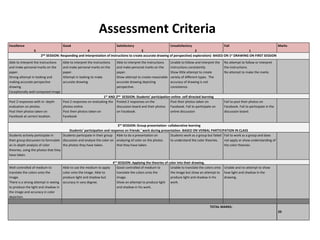
Assessment Criteria Excellence 5 Good 4 Satisfactory 3 Unsatisfactory 2  Fail 1 Marks 2 ND  SESSION: Responding and interpretation of instructions to create accurate drawing of perspective( exploration)- BASED ON 1 st  DRAWING ON FIRST SESSION Able to interpret the instructions and make personal marks on the paper. Strong attempt in looking and making accurate perspective drawing. Exceptionally well composed image Able to interpret the instructions and make personal marks on the paper. Attempt in looking to make accurate drawing. Able to interpret the instructions and make personal marks on the paper. Show attempt to create reasonable accurate drawing depicting perspective. Unable to follow and interpret the instructions consistently Show little attempt to create variety of different types.  The accuracy of drawing is not consistence. No attempt to follow or interpret the instructions. No attempt to make the marks 1 ST  AND 2 ND   SESSION: Students’ participation online- self directed learning Post 2 responses with in- depth evaluation on photos. Post their photos taken on Facebook at correct location. Post 2 responses on evaluating the photos online.  Post their photos taken on Facebook Posted 2 responses on the discussion board and their photos on Facebook. Post their photos taken on Facebook. Fail to participate on online discussion Fail to post their photos on Facebook. Fail to participate in the discussion board. 3 TH  SESSION: Group presentation- collaborative learning Students’ participation and response on friends ‘ work during presentation- BASED ON VERBAL PARTICIPATION IN CLASS Students actively participate in their group discussion to formulate an in-depth analysis of color theories, using the photos that they have taken. Students participate in their group discussion and analyze the color on the photos they have taken. Able to do a presentation on analyzing of color on the photos that they have taken. Students work as a group but failed to understand the color theories. Fail to work as a group and does not apply or show understanding of the color theories. 4 TH  SESSION: Applying the theories of color into their drawing. Well controlled of medium to translate the colors onto the image.  There is a strong attempt in seeing to produce the light and shadow in the image and accuracy in color depiction. Able to use the medium to apply color onto the image. Able to produce light and shadow but accuracy in vary degree. Good controlled of medium to translate the colors onto the image.  Show an attempt to produce light and shadow in his work. Unable to translate the colors onto the image but show an attempt to produce light and shadow in his work. Unable and no attempt to show how light and shadow in the drawing. TOTAL MARKS: 20
Assessment Criteria Students’ participation online Excellence Post 2 responses with in-depth evaluation on the photos. Post their photos taken on Facebook at correct location.
Assessment Criteria Students’ participation online Fail Failed to post their photos on Facebook. Failed to participate in the discussion forum.
Assessment Criteria Group Presentation Excellence Students actively participate in their group discussion to formulate an in-depth analysis of color theories, using the photos that they have taken. Fail Fail to work as a group and does not apply or show understanding of the color theories. Students’ participation and response on friends ‘ work during presentation - BASED ON VERBAL PARTICIPATION IN CLASS
Assessment: 3-2-1Reflection Sample of Reflection form
Conclusion How ICT aids the learning? Students be able to do and access their homework anytime and anywhere. Students involved in evaluating each other works by using Facebook. Students broaden their perspective on the use of ICT as part of their lives.
Chai, Ching Sing (2010)  ICT for self-directed and collaborative learning.  New Jersey: Pearson/Prentice Hall Statements of learning for Information and Communication Technologies (ICT). Retrieved October 19, 2009, from  http://www.mceetya.edu.au/verve/_resources/SOL_ICT_Copyright_update2008.pdf   Six Facets of Understanding. Retrieved October 20, 2009, from  http://pixel.fhda.edu/hybrid/six_facets.html References
Thank You!

Using ICT to teach Perspective Drawing

  • 1.
    ICT for meaningfullearning ART – Perspective Drawing Yee Huiming, Justina Tan Zhi Ying Serlin Tan Yu Shi Er Kia Hui
  • 2.
    Subject: ArtTopic: Perspective Drawing Students’ ability : Mixed Students’ profile: Secondary 2 Express Students’ pre-requisite knowledge: Elements of art and design, colour pencil shading skills, use of compact digital camera Lessons Duration: 2 periods (for 5 sessions) Introduction
  • 3.
    Lessons Objectives Applythe knowledge of 1 point and 2 point perspective Demonstrate the skill and understanding of how lights affect the colours of objects Synthesize the elements in art Use ICT to assemble the drawing and photos At the end of all the lessons, students should be able to:
  • 4.
    Lessons Overview SessionSummary ICT involved Six Facets of understanding Session 1 Introduction of the lessons and Facebook. HW: upload photo and comments Facebook Camera Explaining Having perspectives Empathies Session 2 Drawing of allocated perspectives. HW: upload photo and comments Facebook Applying Having perspectives Empathies Session 3 Discussion on the uploaded photos. Group presentation on evaluating of photos Facebook Powerpoint Having perspectives Empathies Self-acknowledgement Session 4 Colouring of their drawings. - Applying Interpreting Session 5 Auto-stitch, reflection of learning process. Exhibition set up. Stitching program Applying Self-acknowledgement
  • 5.
    Tools and Technologyused ICT based Facebook Digital Camera/Mobile phone camera Computers Stitching Program Non ICT based Drawing papers Pencils/Colour pencils Drawing board
  • 6.
  • 7.
    Rationale for ICTchosen Facebook Affordance and Limitations Affordance Limitations Easy access Increase students interest of the lessons A less stressful platform for discussion Can monitor students’ progress anytime and anywhere Good platform for building students and teacher relationship Absence students can catch up and participate Can only access with internet connection Abuse the intention on the use of Facebook for the lessons Netiquette eg. F**K
  • 8.
    Rationale for ICTchosen Digital Camera/Handphone Camera Affordance and Limitations Affordance Limitations Easily accessible Mass duplication of images if needed No complex technical skills required Not every students might have Copyright issues Technical issues
  • 9.
    Demonstration ofAutoStitch
  • 10.
    Rationale for ICTchosen AutoStitch program Affordance and Limitations Affordance Limitations Free software (Demo version) Easy accessible Dummy proof software Not every students have computer at home Technical issues
  • 11.
    How choice ofICT fulfills lesson objectives Cameras + Facebook Capturing photos Commenting on works AutoStitch + Printers Using software to transform 2D to 3D
  • 12.
    Pedagogical Approaches Teacherstudent interaction Learning Environment Project- based group presentation Discussion on Facebook A 360 degree exhibition of their works on school foyer student centered. student groups. Teachers are facilitators S1: Class room/ Art room S2: School parade ground S3: Computer labs S4: School parade ground S5: Computer labs/ school Foyer Resource based Facebook discussion Photos Presentation Internet research Teachers act as facilitators Teaching students how to learn. The goal is to teach students to find, evaluate and use information to tackle the challenges they encounter along the way
  • 13.
    Creating With ICTCommunicating With ICT Pedagogical approaches Ethics, Issues And ICT Inquiring with ICT Operating ICT MEANINGFUL + SELF DIRECTED + COLLABORATIVE LEARNING + HIGHER ORDER THINKING PROJECT BASED LEARNING RESOURCE BASED LEARNING
  • 14.
  • 15.
  • 16.
  • 17.
  • 18.
  • 19.
    Assessment Criteria Excellence5 Good 4 Satisfactory 3 Unsatisfactory 2 Fail 1 Marks 2 ND SESSION: Responding and interpretation of instructions to create accurate drawing of perspective( exploration)- BASED ON 1 st DRAWING ON FIRST SESSION Able to interpret the instructions and make personal marks on the paper. Strong attempt in looking and making accurate perspective drawing. Exceptionally well composed image Able to interpret the instructions and make personal marks on the paper. Attempt in looking to make accurate drawing. Able to interpret the instructions and make personal marks on the paper. Show attempt to create reasonable accurate drawing depicting perspective. Unable to follow and interpret the instructions consistently Show little attempt to create variety of different types. The accuracy of drawing is not consistence. No attempt to follow or interpret the instructions. No attempt to make the marks 1 ST AND 2 ND SESSION: Students’ participation online- self directed learning Post 2 responses with in- depth evaluation on photos. Post their photos taken on Facebook at correct location. Post 2 responses on evaluating the photos online. Post their photos taken on Facebook Posted 2 responses on the discussion board and their photos on Facebook. Post their photos taken on Facebook. Fail to participate on online discussion Fail to post their photos on Facebook. Fail to participate in the discussion board. 3 TH SESSION: Group presentation- collaborative learning Students’ participation and response on friends ‘ work during presentation- BASED ON VERBAL PARTICIPATION IN CLASS Students actively participate in their group discussion to formulate an in-depth analysis of color theories, using the photos that they have taken. Students participate in their group discussion and analyze the color on the photos they have taken. Able to do a presentation on analyzing of color on the photos that they have taken. Students work as a group but failed to understand the color theories. Fail to work as a group and does not apply or show understanding of the color theories. 4 TH SESSION: Applying the theories of color into their drawing. Well controlled of medium to translate the colors onto the image. There is a strong attempt in seeing to produce the light and shadow in the image and accuracy in color depiction. Able to use the medium to apply color onto the image. Able to produce light and shadow but accuracy in vary degree. Good controlled of medium to translate the colors onto the image. Show an attempt to produce light and shadow in his work. Unable to translate the colors onto the image but show an attempt to produce light and shadow in his work. Unable and no attempt to show how light and shadow in the drawing. TOTAL MARKS: 20
  • 20.
    Assessment Criteria Students’participation online Excellence Post 2 responses with in-depth evaluation on the photos. Post their photos taken on Facebook at correct location.
  • 21.
    Assessment Criteria Students’participation online Fail Failed to post their photos on Facebook. Failed to participate in the discussion forum.
  • 22.
    Assessment Criteria GroupPresentation Excellence Students actively participate in their group discussion to formulate an in-depth analysis of color theories, using the photos that they have taken. Fail Fail to work as a group and does not apply or show understanding of the color theories. Students’ participation and response on friends ‘ work during presentation - BASED ON VERBAL PARTICIPATION IN CLASS
  • 23.
  • 24.
    Conclusion How ICTaids the learning? Students be able to do and access their homework anytime and anywhere. Students involved in evaluating each other works by using Facebook. Students broaden their perspective on the use of ICT as part of their lives.
  • 25.
    Chai, Ching Sing(2010) ICT for self-directed and collaborative learning. New Jersey: Pearson/Prentice Hall Statements of learning for Information and Communication Technologies (ICT). Retrieved October 19, 2009, from http://www.mceetya.edu.au/verve/_resources/SOL_ICT_Copyright_update2008.pdf Six Facets of Understanding. Retrieved October 20, 2009, from http://pixel.fhda.edu/hybrid/six_facets.html References
  • 26.

Editor's Notes

  • #5 explain: Provide thorough and justifiable accounts of phenomena, facts, and data. interpret: Tell meaningful stories, offer apt translations, provide a revealing historical or personal dimension to ideas and events; make subjects personal or accessible through images, anecdotes, analogies, and models. apply: Effectively use and adapt what they know in diverse contexts. have perspective: See and hear points of view through critical eyes and ears; see the big picture. empathize: Find value in what others might find odd, alien, or implausible; perceive sensitively on the basis of prior indirect experience. have self-knowledge: Perceive the personal style, prejudices, projections, and habits of mind that both shape and impede our own understanding; they are aware of what they do not understand and why understanding is so hard.
  • #7 Facebook is set up by the teacher Students will enter by invitation Affords student/teacher communication Affords discussion Affords immediate if not prompt feedback and response
  • #12 Cameras + Facebook Students apply what they know about 1 point and 2 point perspective by taking photos and commenting them on facebook At the end of all the lessons, students should be able to: Apply the knowledge of 1 point and 2 point perspective Demonstrate the skill and understanding of how lights affect the colours of objects Synthesize the elements in art Use ICT to synthesize the drawings
  • #14 Inquiring with ICT Students use ICT in processes of inquiry and research. They identify information and data needs and plan actions to locate, access and retrieve information and data. Students organise, manipulate, structure and refine information to improve their interpretations and construct new understandings. They acknowledge and use information and data from a variety of sources and critically assess their quality. Creating with ICT Students create a range of ICT learning solutions developing their understanding, demonstrating their creativity, learning and supporting their thinking processes across or within curriculum areas. They analyse problems, needs and opportunities, exploring ideas, developing concepts and evaluating ICT learning solutions. They use processes to select appropriate ICT, generate ideas and plans, express themselves and monitor and reflect on their learning. Communicating with ICT Students use ICT to enhance communication. They share, interact, develop relationships and apply ICT to present information and data, engage with audiences and collaborate in meaningful ways. They use ICT to communicate face-to-face and remotely with individuals and with local and global communities. Students experience alternative views, construct new understandings and empathise with others. Ethics, issues and ICT Students understand the increasingly prominent role of ICT in society and its impact on self, work and others. They have an appreciation of the roles and responsibilities of people working with ICT and are discriminating, ethical, legal, responsible and safe users of ICT. Students use safe practices to protect information and develop strategies for handling unwanted communication. They reflect on ICT issues in the past and are able to apply future thinking when exploring the impact of ICT developments. Introduction Figure 1: The relationship between the conceptual organisers of ICT Statements of Learning for Information and Communication Technologies (ICT) Operating ICT Students efficiently operate a range of ICT functions and applications for creating, communicating, inquiring and for the management, storage and retrieval of information and data. They competently perform operational sequences with a range of ICT and use features of the ICT to achieve curriculum outcomes. Students consistently apply standards and conventions when using ICT. They apply preventative strategies for maintaining ICT and solve basic ICT-related problems as end-users.