The Autism Show Manchester 2017
Phil Heslop and Steve Felgate
 I am a dad of Simon, who is autistic
 Parenting has been great and tough – isn’t it for
everyone
 I am also a grandad – but that’s another story
 Workwise - I am a social worker, lecturer, trainer and
researcher
 I have helped support fathers like me
 I focus on men as carers
Support
 Support groups – NAS, Daisy chain, GAG and Pass it
on Parents
 Research, I am involved in looking at the experiences
of autistic parents and grandparents.
 Training – students, foster carers, parents and
professionals
Some positives about dads
 Just like mams, many dads are involved in their
children’s lives.
 We care for children.
 Dads aren’t only biological fathers, but include many
other men caring for children (young and old)
 We are very interested in our children – in their care,
education, interests, safety and future.
 Fathers are positively involved in the education of
children with ASC (Potter, 2016)
Typical dad issues
 What’s my role now that I am a dad? – common phenomenon
 How do I feel – Do men talk (what do you think)?
 What’s the future going to look like? What’s my child going to be
like as an adult.
 Where does my relationship with my child’s mum go from here?
 People don’t always listen to me when I talk about my child?
 Diverse experiences; separated dads, gay dads, disabled dads,
new dads, single dads etc
Are these different to women?
Dads of children with autism
 Feelings about child before diagnosis and after diagnosis
 Denial, self-blame and blamed by others
 Extended family support – relationships with friends – how
do these networks evolve
 Involvement with professionals, school, health, social
services etc.
 Concerns about the future of their child
 In general studies highlight the positive benefit of fathers /
men to children (Knight 2004; O'Brien 2005; Towers 2009;
Potter, 2016))
 Mothers report more positive experiences than fathers
(Kayfitz et al., 2010)
More specific issues for dads
 Coming to terms dads
 Being “supported” by professionals – negotiation and
advocacy with services, such as education, health and
social services
 Employed dads and effect on work – legal rights and
limitations
 Fathers changing attitudes and their personal
development through experience(Towers, 2009; Potter,
2016)
 Who supports men – particularly when men can be
viewed as risky, argumentative and aggressive.
Autistic dads
Same as all the others but our small indicates include:
 Societal attitudes to autism, disability and parenting
(e.g. Collentine, 2005)
 Raised concerns about need for support and even
safeguarding (Swain and Cameron, 2003)
 Approximately 400,000 adults (Brugha et al., 2012)
with ASC – how many are fathers? Little information
or help for autistic dads
 Relationships with family and social networks –
informal ties and possible strains
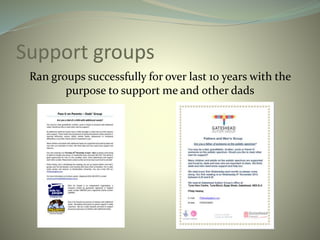
Support groups
Ran groups successfully for over last 10 years with the
purpose to support me and other dads
Benefits of support groups
 Meet new men and fathers
 Help with identity and fathering roles
 Share stories, experiences and ideas
 Recognise challenges and rewards of fathering a child with
ASD
 Network, advise and assist each other
 Place to talk, someone to listen
 Place to focus – time to unwind
 Knowing and sharing audience
 Help each other - mentoring
 Informal and informal training
 Have a laugh and be optimistic
Some reflections
“Its great to talk” “We all love our kids – that’s why we’re here”
“He’s been there, its good to see he’s alright” “I think I’m a
fraud – my problems aren't that bad” “How do normal
families manage when they go out” “My neighbour said – I
don’t care if he’s artistic” “Have you tried coconuts” “We take
the inside handles off our car door” “She tells me to come to
the group when I’m stressed” “can we record these stories, so
I’ll remember them” “I’m being diagnosed” “He’s gonna have
a great life with us” “Do you also drive your child around a
lot” “If you see me sitting at the end of the road – wave”
“Don’t send him to that school” “She has only one friend, but
she seems happy”
many, many other stories.
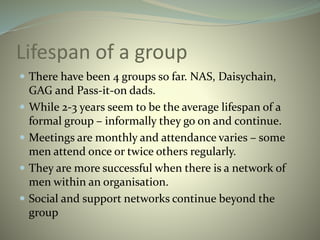
Lifespan of a group
 There have been 4 groups so far. NAS, Daisychain,
GAG and Pass-it-on dads.
 While 2-3 years seem to be the average lifespan of a
formal group – informally they go on and continue.
 Meetings are monthly and attendance varies – some
men attend once or twice others regularly.
 They are more successful when there is a network of
men within an organisation.
 Social and support networks continue beyond the
group
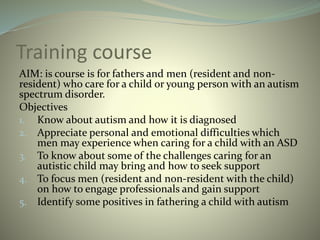
Training course
AIM: is course is for fathers and men (resident and non-
resident) who care for a child or young person with an autism
spectrum disorder.
Objectives
1. Know about autism and how it is diagnosed
2. Appreciate personal and emotional difficulties which
men may experience when caring for a child with an ASD
3. To know about some of the challenges caring for an
autistic child may bring and how to seek support
4. To focus men (resident and non-resident with the child)
on how to engage professionals and gain support
5. Identify some positives in fathering a child with autism
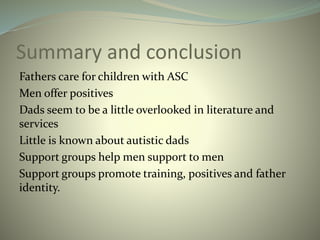
Summary and conclusion
Fathers care for children with ASC
Men offer positives
Dads seem to be a little overlooked in literature and
services
Little is known about autistic dads
Support groups help men support to men
Support groups promote training, positives and father
identity.
Contact
 If you’d like more information or a chat then contact
me on either
 Philheslop@aol.com or
philip.heslop@northumbria.ac.uk
References
 Brugha, T., S. Cooper, S. McManus, S. Purdon, J. Smith, F. Scott, N. Spiers and F. Tyrer
(2012). Estimating the Prevalence of Autism Spectrum Conditions in Adults: Data quality
and methodology document NHS Information Centre for health and social care.
 Kayfitz, A., M. Gragg and R. Orr (2010). "Positive Experiences of Mothers and Fathers of
Children with Autism." Journal of Applied Research in Intellectual Disabilities 23: 337-
343.
 Knight, B. (2004). Fathers Plus - A Question of Balance: Including Fathers in Services.
Newcastle Upon Tyne, Children North East: 34.
 O'Brien, M. (2005). Shared caring: bringing fathers into the frame Equal Opportunities
Commission Working Paper No 18. Norwich, University of East Anglia.
 Potter, C. (2016). "‘I accept my son for who he is – he has incredible character and
personality’: fathers’ positive experiences of parenting children with autism." Disability &
Society 31(7): 948-965.
 Potter, C. (2016). "‘It’s the most important thing – I mean, the schooling’: father
involvement in the education of children with autism." European Journal of Special
Needs Education 31(4): 489-505.
 Swain, P. and N. Cameron (2003). "‘Good Enough Parenting’: parental disability and child
protection." Disability & Society 18(2): 165-177.
 Towers, C. (2009). Recognising Father: A national survey of fathers who have children
with learning disabilities. London, Foundation for People with Learning Disabilities: 69.

Dads and autism

  • 1.
    The Autism ShowManchester 2017 Phil Heslop and Steve Felgate
  • 2.
     I ama dad of Simon, who is autistic  Parenting has been great and tough – isn’t it for everyone  I am also a grandad – but that’s another story  Workwise - I am a social worker, lecturer, trainer and researcher  I have helped support fathers like me  I focus on men as carers
  • 3.
    Support  Support groups– NAS, Daisy chain, GAG and Pass it on Parents  Research, I am involved in looking at the experiences of autistic parents and grandparents.  Training – students, foster carers, parents and professionals
  • 4.
    Some positives aboutdads  Just like mams, many dads are involved in their children’s lives.  We care for children.  Dads aren’t only biological fathers, but include many other men caring for children (young and old)  We are very interested in our children – in their care, education, interests, safety and future.  Fathers are positively involved in the education of children with ASC (Potter, 2016)
  • 5.
    Typical dad issues What’s my role now that I am a dad? – common phenomenon  How do I feel – Do men talk (what do you think)?  What’s the future going to look like? What’s my child going to be like as an adult.  Where does my relationship with my child’s mum go from here?  People don’t always listen to me when I talk about my child?  Diverse experiences; separated dads, gay dads, disabled dads, new dads, single dads etc Are these different to women?
  • 6.
    Dads of childrenwith autism  Feelings about child before diagnosis and after diagnosis  Denial, self-blame and blamed by others  Extended family support – relationships with friends – how do these networks evolve  Involvement with professionals, school, health, social services etc.  Concerns about the future of their child  In general studies highlight the positive benefit of fathers / men to children (Knight 2004; O'Brien 2005; Towers 2009; Potter, 2016))  Mothers report more positive experiences than fathers (Kayfitz et al., 2010)
  • 7.
    More specific issuesfor dads  Coming to terms dads  Being “supported” by professionals – negotiation and advocacy with services, such as education, health and social services  Employed dads and effect on work – legal rights and limitations  Fathers changing attitudes and their personal development through experience(Towers, 2009; Potter, 2016)  Who supports men – particularly when men can be viewed as risky, argumentative and aggressive.
  • 8.
    Autistic dads Same asall the others but our small indicates include:  Societal attitudes to autism, disability and parenting (e.g. Collentine, 2005)  Raised concerns about need for support and even safeguarding (Swain and Cameron, 2003)  Approximately 400,000 adults (Brugha et al., 2012) with ASC – how many are fathers? Little information or help for autistic dads  Relationships with family and social networks – informal ties and possible strains
  • 9.
    Support groups Ran groupssuccessfully for over last 10 years with the purpose to support me and other dads
  • 10.
    Benefits of supportgroups  Meet new men and fathers  Help with identity and fathering roles  Share stories, experiences and ideas  Recognise challenges and rewards of fathering a child with ASD  Network, advise and assist each other  Place to talk, someone to listen  Place to focus – time to unwind  Knowing and sharing audience  Help each other - mentoring  Informal and informal training  Have a laugh and be optimistic
  • 11.
    Some reflections “Its greatto talk” “We all love our kids – that’s why we’re here” “He’s been there, its good to see he’s alright” “I think I’m a fraud – my problems aren't that bad” “How do normal families manage when they go out” “My neighbour said – I don’t care if he’s artistic” “Have you tried coconuts” “We take the inside handles off our car door” “She tells me to come to the group when I’m stressed” “can we record these stories, so I’ll remember them” “I’m being diagnosed” “He’s gonna have a great life with us” “Do you also drive your child around a lot” “If you see me sitting at the end of the road – wave” “Don’t send him to that school” “She has only one friend, but she seems happy” many, many other stories.
  • 12.
    Lifespan of agroup  There have been 4 groups so far. NAS, Daisychain, GAG and Pass-it-on dads.  While 2-3 years seem to be the average lifespan of a formal group – informally they go on and continue.  Meetings are monthly and attendance varies – some men attend once or twice others regularly.  They are more successful when there is a network of men within an organisation.  Social and support networks continue beyond the group
  • 13.
    Training course AIM: iscourse is for fathers and men (resident and non- resident) who care for a child or young person with an autism spectrum disorder. Objectives 1. Know about autism and how it is diagnosed 2. Appreciate personal and emotional difficulties which men may experience when caring for a child with an ASD 3. To know about some of the challenges caring for an autistic child may bring and how to seek support 4. To focus men (resident and non-resident with the child) on how to engage professionals and gain support 5. Identify some positives in fathering a child with autism
  • 15.
    Summary and conclusion Fatherscare for children with ASC Men offer positives Dads seem to be a little overlooked in literature and services Little is known about autistic dads Support groups help men support to men Support groups promote training, positives and father identity.
  • 16.
    Contact  If you’dlike more information or a chat then contact me on either  Philheslop@aol.com or philip.heslop@northumbria.ac.uk
  • 17.
    References  Brugha, T.,S. Cooper, S. McManus, S. Purdon, J. Smith, F. Scott, N. Spiers and F. Tyrer (2012). Estimating the Prevalence of Autism Spectrum Conditions in Adults: Data quality and methodology document NHS Information Centre for health and social care.  Kayfitz, A., M. Gragg and R. Orr (2010). "Positive Experiences of Mothers and Fathers of Children with Autism." Journal of Applied Research in Intellectual Disabilities 23: 337- 343.  Knight, B. (2004). Fathers Plus - A Question of Balance: Including Fathers in Services. Newcastle Upon Tyne, Children North East: 34.  O'Brien, M. (2005). Shared caring: bringing fathers into the frame Equal Opportunities Commission Working Paper No 18. Norwich, University of East Anglia.  Potter, C. (2016). "‘I accept my son for who he is – he has incredible character and personality’: fathers’ positive experiences of parenting children with autism." Disability & Society 31(7): 948-965.  Potter, C. (2016). "‘It’s the most important thing – I mean, the schooling’: father involvement in the education of children with autism." European Journal of Special Needs Education 31(4): 489-505.  Swain, P. and N. Cameron (2003). "‘Good Enough Parenting’: parental disability and child protection." Disability & Society 18(2): 165-177.  Towers, C. (2009). Recognising Father: A national survey of fathers who have children with learning disabilities. London, Foundation for People with Learning Disabilities: 69.