Children with Autism
Spectrum Disorders

{

Presented by: Caitlin McGowan
January 2014






Autism is a lifelong developmental disability
that is best described as a collection of
behavioral symptoms.
The extent and severity of those symptoms
provide a range of diagnoses referred to as
autism spectrum disorders.
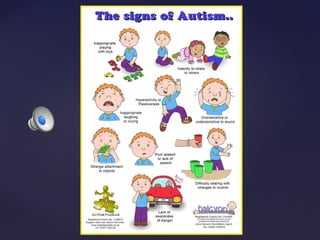
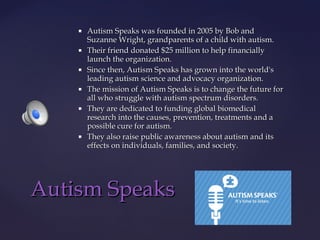
Autism was identified as a special education
category in 1990.

Defining Autism







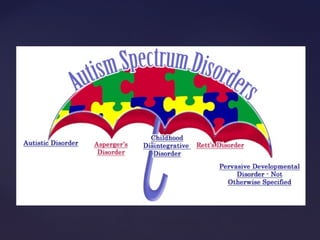
“Classic” or Kanner’s Autism
Asperger’s syndrome
PDD-NOS (Pervasive Developmental DisorderNot Otherwise Specified)
Rett’s disorder
Childhood disintegrative disorder

Autism Spectrum
Disorders


Defined as: children who exhibit severely
disordered verbal and nonverbal language and
unusual behavior patterns.

“Classic” or Kanner’s
Autism








This is one of the most common autism
spectrum disorders.
Approximately 1 in 500 school-age children are
diagnosed with Asperger’s.
Individuals with Asperger’s may have many of
the social and behavioral characteristics of
autism but, importantly, without any marked
delays in language and cognitive development.
They experience difficulties in social
functioning and relationships, but not in
intelligence or language skills.

Asperger’s syndrome






Pervasive Developmental Disorder-Not
Otherwise Specified
Also called “high functioning autism” or
“atypical autism”
Defined as: children who experience nonverbal
language difficulties but do not meet the
criteria for other PDDs such as autism,
Asperger’s syndrome, or Rett’s disorder.

PDD-NOS


A rare genetic neurodegenerative disorder that
primarily affects girls, resulting in the loss of
social skills, language, and motor development,
accompanied by distorted hand movements.

Rett’s disorder


After a few years of normal development,
children regress progressively in all areas,
including language, social development, and
motor development.

Childhood disintegrative
disorder
“What
Is Autism Spectrum Disorder
?”






Autism statistics from the U.S. Centers for
Disease Control and Prevention identify
around 1 in 88 American children as on the
autism spectrum.
An estimated 1 out of 54 boys and 1 in 252 girls
are diagnosed with autism in the United States.
ASD affects over 2 million individuals in the
U.S. and tens of millions worldwide.

How common is Autism?












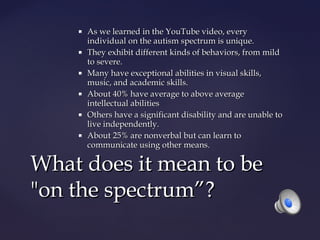
As we learned in the YouTube video, every
individual on the autism spectrum is unique.
They exhibit different kinds of behaviors, from mild
to severe.
Many have exceptional abilities in visual skills,
music, and academic skills.
About 40% have average to above average
intellectual abilities
Others have a significant disability and are unable to
live independently.
About 25% are nonverbal but can learn to
communicate using other means.

What does it mean to be
"on the spectrum”?


The next few slides will cover websites that can
be used as resources for gathering information
and providing services within the community.

Useful Resources












Autism Speaks was founded in 2005 by Bob and
Suzanne Wright, grandparents of a child with autism.
Their friend donated $25 million to help financially
launch the organization.
Since then, Autism Speaks has grown into the world's
leading autism science and advocacy organization.
The mission of Autism Speaks is to change the future for
all who struggle with autism spectrum disorders.
They are dedicated to funding global biomedical
research into the causes, prevention, treatments and a
possible cure for autism.
They also raise public awareness about autism and its
effects on individuals, families, and society.

Autism Speaks






The Autism Society of America is a national
organization for parents, professionals, and
individuals with autism.
Their mission is to improve the lives of all who
are affected by autism.
The Autism Society is a great resource that
includes education, services, research, and
support.

Autism Society of America






This is a blog about a day in the life of a single
mom raising a teenager and a child with
autism.
Her goal is to give away all that she has
learned and experienced in hopes that it will
help families raising a child with autism.
Throughout the blog, she opens up her world
and share her joys, knowledge, lessons,
disappointments, challenges, frustrations, fears
and successes - one day at a time.

Autism - Day by Day
“I Want to Say”


The next few slides touch on various devices in
assistive technology that can help an individual
with autism manage successfully within the
community.

Assistive Technology










TapToTalk is an app that displays a page of pictures
on the screen.
When you tap a picture, TapToTalk plays a word or
sentence and displays another page of pictures.
Each of those pictures can lead to another page, and
so on.
For example, a picture representing Food can lead to
a page with pictures of Fruit, Vegetables,
Sandwiches, Snacks and other foods.
Overall, this app can be used to give nonverbal
individuals with autism a voice.

TapToTalk




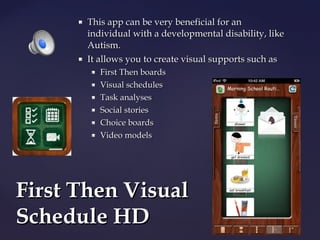
This app can be very beneficial for an
individual with a developmental disability, like
Autism.
It allows you to create visual supports such as







First Then boards
Visual schedules
Task analyses
Social stories
Choice boards
Video models

First Then Visual
Schedule HD








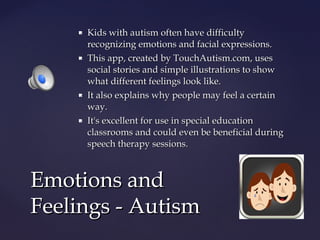
Kids with autism often have difficulty
recognizing emotions and facial expressions.
This app, created by TouchAutism.com, uses
social stories and simple illustrations to show
what different feelings look like.
It also explains why people may feel a certain
way.
It's excellent for use in special education
classrooms and could even be beneficial during
speech therapy sessions.

Emotions and
Feelings - Autism
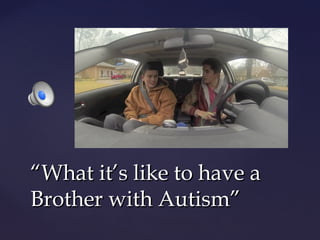
“What it’s like to have a
Brother with Autism”











Not all siblings will experience these stressful
issues, but here are some to be aware of:
Embarrassment around peers
Jealousy regarding amount of time parents spend
with their brother/sister
Frustration over not being able to engage or get a
response from their brother/sister
Being the target of aggressive behaviors
Concern regarding their parents' stress and grief
Concern over their role in future caregiving

Siblings


The recommended focus of curriculum and
instruction for individuals with autism varies
greatly depending on each child’s abilities and
needs.

Teaching Strategies and
Accommodations
"Effective use of Teacher
Supports"








Autism Spectrum Disorder is a lifelong
developmental disability that is best described
as a collection of behavioral symptoms.
It greatly affects the areas of communication,
cognition, and social behavior.
Early intervention is a key factor for improving
the prognosis of children with autism.
Technology plays an increasingly important
role in the interventions used to teach social,
vocational, and independent living skills to
individuals with autism.

Overview








“Exceptional Children” and Youth by Nancy
Hunt and Kathleen Marshall
http://www.autismspeaks.org/
http://www.autism-society.org
http://www.feat.org
http://researchautism.net
http://autism.healingthresholds.com

References
Thank you 

Disability Project - ASD

  • 1.
    Children with Autism SpectrumDisorders { Presented by: Caitlin McGowan January 2014
  • 2.
       Autism is alifelong developmental disability that is best described as a collection of behavioral symptoms. The extent and severity of those symptoms provide a range of diagnoses referred to as autism spectrum disorders. Autism was identified as a special education category in 1990. Defining Autism
  • 3.
         “Classic” or Kanner’sAutism Asperger’s syndrome PDD-NOS (Pervasive Developmental DisorderNot Otherwise Specified) Rett’s disorder Childhood disintegrative disorder Autism Spectrum Disorders
  • 5.
     Defined as: childrenwho exhibit severely disordered verbal and nonverbal language and unusual behavior patterns. “Classic” or Kanner’s Autism
  • 6.
        This is oneof the most common autism spectrum disorders. Approximately 1 in 500 school-age children are diagnosed with Asperger’s. Individuals with Asperger’s may have many of the social and behavioral characteristics of autism but, importantly, without any marked delays in language and cognitive development. They experience difficulties in social functioning and relationships, but not in intelligence or language skills. Asperger’s syndrome
  • 7.
       Pervasive Developmental Disorder-Not OtherwiseSpecified Also called “high functioning autism” or “atypical autism” Defined as: children who experience nonverbal language difficulties but do not meet the criteria for other PDDs such as autism, Asperger’s syndrome, or Rett’s disorder. PDD-NOS
  • 8.
     A rare geneticneurodegenerative disorder that primarily affects girls, resulting in the loss of social skills, language, and motor development, accompanied by distorted hand movements. Rett’s disorder
  • 9.
     After a fewyears of normal development, children regress progressively in all areas, including language, social development, and motor development. Childhood disintegrative disorder
  • 10.
  • 11.
       Autism statistics fromthe U.S. Centers for Disease Control and Prevention identify around 1 in 88 American children as on the autism spectrum. An estimated 1 out of 54 boys and 1 in 252 girls are diagnosed with autism in the United States. ASD affects over 2 million individuals in the U.S. and tens of millions worldwide. How common is Autism?
  • 12.
          As we learnedin the YouTube video, every individual on the autism spectrum is unique. They exhibit different kinds of behaviors, from mild to severe. Many have exceptional abilities in visual skills, music, and academic skills. About 40% have average to above average intellectual abilities Others have a significant disability and are unable to live independently. About 25% are nonverbal but can learn to communicate using other means. What does it mean to be "on the spectrum”?
  • 14.
     The next fewslides will cover websites that can be used as resources for gathering information and providing services within the community. Useful Resources
  • 15.
          Autism Speaks wasfounded in 2005 by Bob and Suzanne Wright, grandparents of a child with autism. Their friend donated $25 million to help financially launch the organization. Since then, Autism Speaks has grown into the world's leading autism science and advocacy organization. The mission of Autism Speaks is to change the future for all who struggle with autism spectrum disorders. They are dedicated to funding global biomedical research into the causes, prevention, treatments and a possible cure for autism. They also raise public awareness about autism and its effects on individuals, families, and society. Autism Speaks
  • 16.
       The Autism Societyof America is a national organization for parents, professionals, and individuals with autism. Their mission is to improve the lives of all who are affected by autism. The Autism Society is a great resource that includes education, services, research, and support. Autism Society of America
  • 17.
       This is ablog about a day in the life of a single mom raising a teenager and a child with autism. Her goal is to give away all that she has learned and experienced in hopes that it will help families raising a child with autism. Throughout the blog, she opens up her world and share her joys, knowledge, lessons, disappointments, challenges, frustrations, fears and successes - one day at a time. Autism - Day by Day
  • 18.
  • 19.
     The next fewslides touch on various devices in assistive technology that can help an individual with autism manage successfully within the community. Assistive Technology
  • 20.
         TapToTalk is anapp that displays a page of pictures on the screen. When you tap a picture, TapToTalk plays a word or sentence and displays another page of pictures. Each of those pictures can lead to another page, and so on. For example, a picture representing Food can lead to a page with pictures of Fruit, Vegetables, Sandwiches, Snacks and other foods. Overall, this app can be used to give nonverbal individuals with autism a voice. TapToTalk
  • 21.
      This app canbe very beneficial for an individual with a developmental disability, like Autism. It allows you to create visual supports such as       First Then boards Visual schedules Task analyses Social stories Choice boards Video models First Then Visual Schedule HD
  • 22.
        Kids with autismoften have difficulty recognizing emotions and facial expressions. This app, created by TouchAutism.com, uses social stories and simple illustrations to show what different feelings look like. It also explains why people may feel a certain way. It's excellent for use in special education classrooms and could even be beneficial during speech therapy sessions. Emotions and Feelings - Autism
  • 23.
    “What it’s liketo have a Brother with Autism”
  • 24.
           Not all siblingswill experience these stressful issues, but here are some to be aware of: Embarrassment around peers Jealousy regarding amount of time parents spend with their brother/sister Frustration over not being able to engage or get a response from their brother/sister Being the target of aggressive behaviors Concern regarding their parents' stress and grief Concern over their role in future caregiving Siblings
  • 25.
     The recommended focusof curriculum and instruction for individuals with autism varies greatly depending on each child’s abilities and needs. Teaching Strategies and Accommodations
  • 26.
    "Effective use ofTeacher Supports"
  • 27.
        Autism Spectrum Disorderis a lifelong developmental disability that is best described as a collection of behavioral symptoms. It greatly affects the areas of communication, cognition, and social behavior. Early intervention is a key factor for improving the prognosis of children with autism. Technology plays an increasingly important role in the interventions used to teach social, vocational, and independent living skills to individuals with autism. Overview
  • 28.
          “Exceptional Children” andYouth by Nancy Hunt and Kathleen Marshall http://www.autismspeaks.org/ http://www.autism-society.org http://www.feat.org http://researchautism.net http://autism.healingthresholds.com References
  • 29.

Editor's Notes

  • #11 https://www.youtube.com/watch?v=0Pp8jcQ97pY
  • #19 https://www.youtube.com/watch?v=Iu3c8fqBQcA
  • #24 https://www.youtube.com/watch?v=QHC0FzywHGY
  • #27 https://www.youtube.com/watch?v=X4GdaD2Izxc