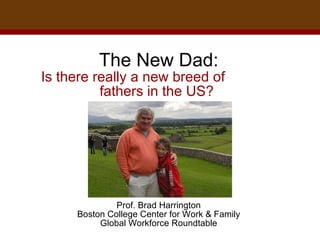
The New Dad: Is there really a new breed of  fathers in the US?    Prof. Brad Harrington Boston College Center for Work & Family Global Workforce Roundtable
Outline of the Session Introduction  Those changing demographics  Changing roles and challenges for men Our research  The Protean career model Discussion and summary
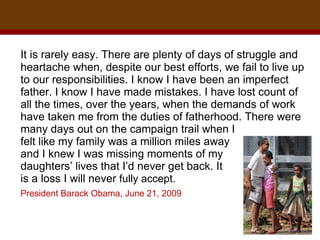
It is rarely easy. There are plenty of days of struggle and heartache when, despite our best efforts, we fail to live up to our responsibilities. I know I have been an imperfect father. I know I have made mistakes. I have lost count of all the times, over the years, when the demands of work have taken me from the duties of fatherhood. There were many days out on the campaign trail when I  felt like my family was a million miles away  and I knew I was missing moments of my  daughters’ lives that I’d never get back. It  is a loss I will never  fully accept.  President Barack Obama, June 21, 2009
  The other gender... Women now 50% of US workforce  In the United States, women earn: 62% of associates degrees 57% of bachelor’s degrees 60% of master’s degrees ~50% of professional degrees and PhD’s In 1970 women earned <10% of professional degrees & PhD’s  Of 15 jobs with greatest growth rate in next decade, 12 are dominated by women  So gender roles are changing in the workplace…
Changes in working families…  75% married couples with children <15 are dual-career couples (US Census, 2008)  25% of women in dual-career couples  earn more than their spouse Today, 29% of families are headed by a  single parent (US Census, 2008) Women primary breadwinners in  38% US households (BLS, 2007) Men experienced more than  70% of job losses in recession  (6 of 8 million US jobs)
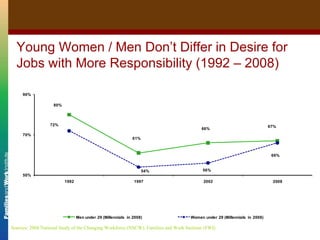
Young Women / Men Don’t Differ in Desire for Jobs with More Responsibility (1992 – 2008)  Sources: 2008 National Study of the Changing Workforce (NSCW), Families and Work Institute (FWI)
“ Regardless of their own family experiences, today’s young women and men have grown up in revolutionary times. For better or worse, they have inherited new options and questions about women’s and men’s proper places. Now making the transition to adulthood, they have no well-worn paths to follow… Most women no longer  assume they can or will want to stay at  home with young children, but there is  no clear model for how children should  be raised.”
“ Most men no longer assume they can or will  want to support a family on their own, but there is no clear path to manhood. Work & family shifts  have created an ambiguous mix of new options  and new insecurities with growing conflicts  between work and parenting. Amid these conflicts and contradictions young women and  men must search for new answers and  develop innovative responses.”  Prof. Kathleen Gerson (2009)  The Unfinished Revolution: How a New Generation  is Reshaping Family, Work, and Gender in America
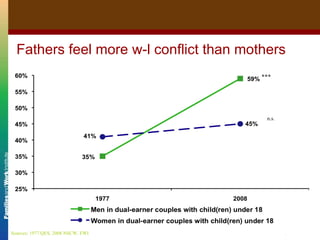
Fathers feel more w-l conflict than mothers Sources: 1977 QES, 2008 NSCW, FWI n.s. ***
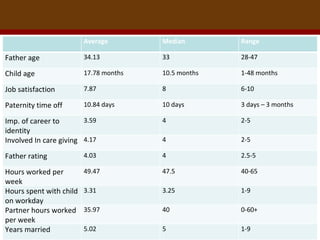
Background of our study 2009: Center for Work & Family conducted a qualitative study of 30+ father Recent fathers, children average age: 17 months All have men 5+ years professional experience All college grads, nearly half have masters degrees, a few have doctoral degrees Focused on career & paternal identity  as well as organizational responses  and support (both formal and informal)
Average Median Range Father age 34.13 33 28-47 Child age 17.78 months 10.5 months 1-48 months Job satisfaction 7.87 8 6-10 Paternity time off 10.84 days 10 days 3 days – 3 months Imp. of career to identity 3.59 4 2-5 Involved In care giving 4.17 4 2-5 Father rating 4.03 4 2.5-5 Hours worked per week 49.47 47.5 40-65 Hours spent with child on workday 3.31 3.25 1-9 Partner hours worked per week 35.97 40 0-60+ Years married 5.02 5 1-9
Questions we’ll discuss today  Did you consider being a stay-at home father?  Did becoming a father change the way others viewed you in the workplace?  Is your boss supportive of work-family issues?  How do you and your partner share care? What does it mean to be a good father? How has being a father changed you? Has being a father impacted your  career / your career aspirations?
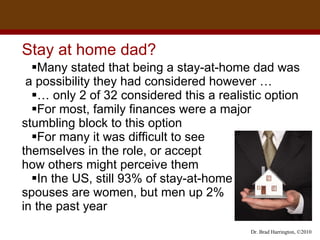
Stay at home dad?  Many stated that being a stay-at-home dad was  a possibility they had considered however … …  only 2 of 32 considered this a realistic option For most, family finances were a major stumbling block to this option For many it was difficult to see  themselves in the role, or accept  how others might perceive them In the US, still 93% of stay-at-home  spouses are women, but men up 2%  in the past year
Considered staying at home?  “ I never considered that no. Would I like to? Sure. It just wasn’t financially feasible. There  was no way.  “ A s appealing as it sounds, spending a lot of time with the children, there’s a certain point, I’d say of embarrassment or stigma, if I were to become a stay-at-home father just because that’s not the norm. Part of me could see myself doing this, but the other part would be like, what will friends say, what will the family say?”
Change how others viewed you?  Most fathers felt that becoming a father had impacted how others saw them in the workplace About half said the difference was very minor and half felt it was more significant  Typically the differences reported were about:  Seen as whole person, more approachable Maturity, more responsible Member of the club  There were no real negatives  (professionally but…)
Change  how  others viewed you?  “ I think it does have a little impact. You put a picture on your desk and it encourages people who probably would never have stopped by to say, oh, tell me about your son. It’s a social  thing, it’s only a positive.” “ It definitely feels like people would be more apt to give me more responsibility.” I think it lends, in general among your peers and co-workers, it lent credibility, a sort of maturity.”
Is your boss supportive of work-family?  A surprising number of the fathers spoke of how supportive their manager was on work-family issues, only a handful did not feel supported.  That said, it seemed that in many cases the use of flexibility was informal rather than formal  Due to the large number of managers dealing with their own work-family challenges,  may be seeing a generational shift  where lower-middle level managers  all can empathize with the issues.
Is your boss supportive of work-family?  “ My boss is extremely understanding, has had no problems with me taking time to do all the stuff I needed to do. We have both men and women in  my area who work 3-day work weeks or work from home on Mondays.” “ Absolutely. He’s got three kids and he understands the balance necessary. He’s had an epiphany, handling a lot with the company shrinking, feeling a little overwhelmed. He bought a house on the Cape that he uses as a refuge. I think he and his family have re-discovered themselves basically.”
How do you and partner share care?  Found these results surprising and encouraging Most fathers were aiming to achieve a 50/50 split in terms of responsibilities for care giving Where they fell short of this, they stated that they were striving to address this Average ratings and numbers:  Care-giving: 4.17 out of 5 Hours per workday: 3.31 Caution: We didn’t get spouse’s view.
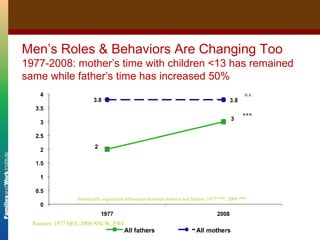
Men’s Roles & Behaviors Are Changing Too  1977-2008: mother’s time with children <13 has remained  same while father’s time has increased 50% Sources: 1977 QES, 2008 NSCW, FWI Statistically significant differences between mothers and fathers: 1977 ***; 2008 *** n.s. ***
How do you and partner share care?  “ We try to be close to 50 / 50 in terms of responsibilities. We generally alternate pretty evenly on all of that stuff.” “ It’s a lot of give and take. I wake my daughter up, get her dressed and I get her out the door. [My wife] picks her up, she takes care of her while she’s cooking, and when I get home we feed her together, sit down as a family for dinner as much as possible. She takes care of her while I do the dishes and we play for a while. I put her to bed.”
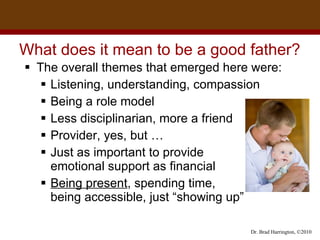
What does it mean to be a good father? The overall themes that emerged here were: Listening, understanding, compassion Being a role model Less disciplinarian, more a friend Provider, yes, but … Just as important to provide  emotional support as financial  Being present , spending time,  being accessible, just “showing up”
What does it mean to be a good father? “ Being a good provider is important. Knowing he has what he needs. Just enjoying life is a generic way of saying it. ‘You want to go outside? Let’s go outside. I don’t care if it’s raining or snowing out, let’s go outside. You want to hang out with the dogs? Let’s hang out with the dogs.” it’s not on my terms, this is our time together.” “ It means a lot of things. It means love, demonstrating your love for someone and a commitment to them at all costs. So supporting them, nurturing them, being there, and not only as a father, but as a friend, as a guide, as a mentor.”
How Has Being a Father Changed You?  For most, a growing, maturing experience that  left them with higher level of patience & empathy “ I think I’ve always been a patient person but I’m more patient, more understanding with people in general.”   Some found increase in focus, clarity of priorities “ I’m more focused on those two priorities,  work and family.” Fatherhood increased the meaning  in their lives, their sense of purpose
Anticipate / impact on career?  Most fathers assumed that having a child would impact their career ranging from moderately to dramatically Most stated they underestimated the degree of impact it would have on their work and lives While most hadn’t dramatically lowered  their career aspirations, most were  clear that becoming a father had  profoundly changed their views on  what constituted success.
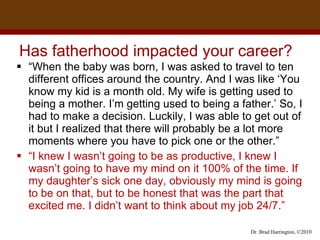
Has fatherhood impacted your career?  “ When the baby was born, I was asked to travel to ten different offices around the country. And I was like ‘You know my kid is a month old. My wife is getting used to being a mother. I’m getting used to being a father.’ So, I had to make a decision. Luckily, I was able to get out of it but I realized that there will probably be a lot more moments where you have to pick one or the other.” “ I knew I wasn’t going to be as productive, I knew I wasn’t going to have my mind on it 100% of the time. If my daughter’s sick one day, obviously my mind is going to be on that, but to be honest that was the part that excited me. I didn’t want to think about my job 24/7.”
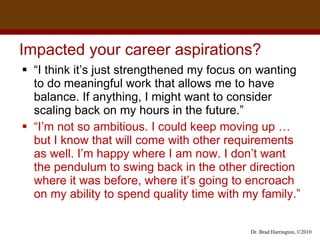
Impacted your career aspirations? “ I think it’s just strengthened my focus on wanting to do meaningful work that allows me to have balance. If anything, I might want to consider scaling back on my hours in the future.” “ I’m not so ambitious. I could keep moving up … but I know that will come with other requirements as well. I’m happy where I am now. I don’t want the pendulum to swing back in the other direction where it was before, where it’s going to encroach on my ability to spend quality time with my family.”
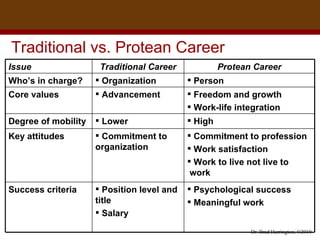
Traditional vs. Protean Career Issue Traditional Career Protean Career Who’s in charge? Organization Person Core values Advancement Freedom and growth  Work-life integration Degree of mobility Lower High Key attitudes Commitment to organization  Commitment to profession Work satisfaction Work to live not live to  work Success criteria Position level and title Salary Psychological success Meaningful work
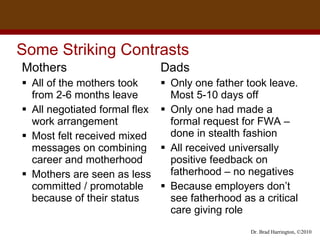
Some Striking Contrasts  Mothers All of the mothers took  from 2-6 months leave All negotiated formal flex work arrangement Most felt received mixed messages on combining career and motherhood Mothers are seen as less committed / promotable because of their status Dads Only one father took leave. Most 5-10 days off Only one had made a formal request for FWA – done in stealth fashion All received universally positive feedback on fatherhood – no negatives Because employers don’t see fatherhood as a critical care giving role
Summary  Women’s tremendous educational and  economic progress are leading to: Greater gender equality at work and… Greater gender equality at home Young fathers we spoke with are embracing this new norm both out of economic need and the positive psychological benefits of fatherhood Still sense an unreceptive workplace climate They are searching for new definitions of what it  means to be a good father and a good man
Implications The field needs further research on  the work-life experiences of men Fatherhood is a role we need to better  understand and appreciate, especially in terms  of how it impacts children and men’s careers Men need more outlets to discuss their experiences, struggles and joys as fathers We need to let go of stereotypes and negative paradigm of men as parents and caregivers

Brad Harrington Fatherhood Presentation

  • 1.
    The New Dad:Is there really a new breed of fathers in the US? Prof. Brad Harrington Boston College Center for Work & Family Global Workforce Roundtable
  • 2.
    Outline of theSession Introduction Those changing demographics Changing roles and challenges for men Our research The Protean career model Discussion and summary
  • 3.
    It is rarelyeasy. There are plenty of days of struggle and heartache when, despite our best efforts, we fail to live up to our responsibilities. I know I have been an imperfect father. I know I have made mistakes. I have lost count of all the times, over the years, when the demands of work have taken me from the duties of fatherhood. There were many days out on the campaign trail when I felt like my family was a million miles away and I knew I was missing moments of my daughters’ lives that I’d never get back. It is a loss I will never fully accept.  President Barack Obama, June 21, 2009
  • 4.
    Theother gender... Women now 50% of US workforce In the United States, women earn: 62% of associates degrees 57% of bachelor’s degrees 60% of master’s degrees ~50% of professional degrees and PhD’s In 1970 women earned <10% of professional degrees & PhD’s Of 15 jobs with greatest growth rate in next decade, 12 are dominated by women So gender roles are changing in the workplace…
  • 5.
    Changes in workingfamilies… 75% married couples with children <15 are dual-career couples (US Census, 2008) 25% of women in dual-career couples earn more than their spouse Today, 29% of families are headed by a single parent (US Census, 2008) Women primary breadwinners in 38% US households (BLS, 2007) Men experienced more than 70% of job losses in recession (6 of 8 million US jobs)
  • 6.
    Young Women /Men Don’t Differ in Desire for Jobs with More Responsibility (1992 – 2008) Sources: 2008 National Study of the Changing Workforce (NSCW), Families and Work Institute (FWI)
  • 7.
    “ Regardless oftheir own family experiences, today’s young women and men have grown up in revolutionary times. For better or worse, they have inherited new options and questions about women’s and men’s proper places. Now making the transition to adulthood, they have no well-worn paths to follow… Most women no longer assume they can or will want to stay at home with young children, but there is no clear model for how children should be raised.”
  • 8.
    “ Most menno longer assume they can or will want to support a family on their own, but there is no clear path to manhood. Work & family shifts have created an ambiguous mix of new options and new insecurities with growing conflicts between work and parenting. Amid these conflicts and contradictions young women and men must search for new answers and develop innovative responses.” Prof. Kathleen Gerson (2009) The Unfinished Revolution: How a New Generation is Reshaping Family, Work, and Gender in America
  • 9.
    Fathers feel morew-l conflict than mothers Sources: 1977 QES, 2008 NSCW, FWI n.s. ***
  • 10.
    Background of ourstudy 2009: Center for Work & Family conducted a qualitative study of 30+ father Recent fathers, children average age: 17 months All have men 5+ years professional experience All college grads, nearly half have masters degrees, a few have doctoral degrees Focused on career & paternal identity as well as organizational responses and support (both formal and informal)
  • 11.
    Average Median RangeFather age 34.13 33 28-47 Child age 17.78 months 10.5 months 1-48 months Job satisfaction 7.87 8 6-10 Paternity time off 10.84 days 10 days 3 days – 3 months Imp. of career to identity 3.59 4 2-5 Involved In care giving 4.17 4 2-5 Father rating 4.03 4 2.5-5 Hours worked per week 49.47 47.5 40-65 Hours spent with child on workday 3.31 3.25 1-9 Partner hours worked per week 35.97 40 0-60+ Years married 5.02 5 1-9
  • 12.
    Questions we’ll discusstoday Did you consider being a stay-at home father? Did becoming a father change the way others viewed you in the workplace? Is your boss supportive of work-family issues? How do you and your partner share care? What does it mean to be a good father? How has being a father changed you? Has being a father impacted your career / your career aspirations?
  • 13.
    Stay at homedad? Many stated that being a stay-at-home dad was a possibility they had considered however … … only 2 of 32 considered this a realistic option For most, family finances were a major stumbling block to this option For many it was difficult to see themselves in the role, or accept how others might perceive them In the US, still 93% of stay-at-home spouses are women, but men up 2% in the past year
  • 14.
    Considered staying athome? “ I never considered that no. Would I like to? Sure. It just wasn’t financially feasible. There was no way. “ A s appealing as it sounds, spending a lot of time with the children, there’s a certain point, I’d say of embarrassment or stigma, if I were to become a stay-at-home father just because that’s not the norm. Part of me could see myself doing this, but the other part would be like, what will friends say, what will the family say?”
  • 15.
    Change how othersviewed you? Most fathers felt that becoming a father had impacted how others saw them in the workplace About half said the difference was very minor and half felt it was more significant Typically the differences reported were about: Seen as whole person, more approachable Maturity, more responsible Member of the club There were no real negatives (professionally but…)
  • 16.
    Change how others viewed you? “ I think it does have a little impact. You put a picture on your desk and it encourages people who probably would never have stopped by to say, oh, tell me about your son. It’s a social thing, it’s only a positive.” “ It definitely feels like people would be more apt to give me more responsibility.” I think it lends, in general among your peers and co-workers, it lent credibility, a sort of maturity.”
  • 17.
    Is your bosssupportive of work-family? A surprising number of the fathers spoke of how supportive their manager was on work-family issues, only a handful did not feel supported. That said, it seemed that in many cases the use of flexibility was informal rather than formal Due to the large number of managers dealing with their own work-family challenges, may be seeing a generational shift where lower-middle level managers all can empathize with the issues.
  • 18.
    Is your bosssupportive of work-family? “ My boss is extremely understanding, has had no problems with me taking time to do all the stuff I needed to do. We have both men and women in my area who work 3-day work weeks or work from home on Mondays.” “ Absolutely. He’s got three kids and he understands the balance necessary. He’s had an epiphany, handling a lot with the company shrinking, feeling a little overwhelmed. He bought a house on the Cape that he uses as a refuge. I think he and his family have re-discovered themselves basically.”
  • 19.
    How do youand partner share care? Found these results surprising and encouraging Most fathers were aiming to achieve a 50/50 split in terms of responsibilities for care giving Where they fell short of this, they stated that they were striving to address this Average ratings and numbers: Care-giving: 4.17 out of 5 Hours per workday: 3.31 Caution: We didn’t get spouse’s view.
  • 20.
    Men’s Roles &Behaviors Are Changing Too 1977-2008: mother’s time with children <13 has remained same while father’s time has increased 50% Sources: 1977 QES, 2008 NSCW, FWI Statistically significant differences between mothers and fathers: 1977 ***; 2008 *** n.s. ***
  • 21.
    How do youand partner share care? “ We try to be close to 50 / 50 in terms of responsibilities. We generally alternate pretty evenly on all of that stuff.” “ It’s a lot of give and take. I wake my daughter up, get her dressed and I get her out the door. [My wife] picks her up, she takes care of her while she’s cooking, and when I get home we feed her together, sit down as a family for dinner as much as possible. She takes care of her while I do the dishes and we play for a while. I put her to bed.”
  • 22.
    What does itmean to be a good father? The overall themes that emerged here were: Listening, understanding, compassion Being a role model Less disciplinarian, more a friend Provider, yes, but … Just as important to provide emotional support as financial Being present , spending time, being accessible, just “showing up”
  • 23.
    What does itmean to be a good father? “ Being a good provider is important. Knowing he has what he needs. Just enjoying life is a generic way of saying it. ‘You want to go outside? Let’s go outside. I don’t care if it’s raining or snowing out, let’s go outside. You want to hang out with the dogs? Let’s hang out with the dogs.” it’s not on my terms, this is our time together.” “ It means a lot of things. It means love, demonstrating your love for someone and a commitment to them at all costs. So supporting them, nurturing them, being there, and not only as a father, but as a friend, as a guide, as a mentor.”
  • 24.
    How Has Beinga Father Changed You? For most, a growing, maturing experience that left them with higher level of patience & empathy “ I think I’ve always been a patient person but I’m more patient, more understanding with people in general.” Some found increase in focus, clarity of priorities “ I’m more focused on those two priorities, work and family.” Fatherhood increased the meaning in their lives, their sense of purpose
  • 25.
    Anticipate / impacton career? Most fathers assumed that having a child would impact their career ranging from moderately to dramatically Most stated they underestimated the degree of impact it would have on their work and lives While most hadn’t dramatically lowered their career aspirations, most were clear that becoming a father had profoundly changed their views on what constituted success.
  • 26.
    Has fatherhood impactedyour career? “ When the baby was born, I was asked to travel to ten different offices around the country. And I was like ‘You know my kid is a month old. My wife is getting used to being a mother. I’m getting used to being a father.’ So, I had to make a decision. Luckily, I was able to get out of it but I realized that there will probably be a lot more moments where you have to pick one or the other.” “ I knew I wasn’t going to be as productive, I knew I wasn’t going to have my mind on it 100% of the time. If my daughter’s sick one day, obviously my mind is going to be on that, but to be honest that was the part that excited me. I didn’t want to think about my job 24/7.”
  • 27.
    Impacted your careeraspirations? “ I think it’s just strengthened my focus on wanting to do meaningful work that allows me to have balance. If anything, I might want to consider scaling back on my hours in the future.” “ I’m not so ambitious. I could keep moving up … but I know that will come with other requirements as well. I’m happy where I am now. I don’t want the pendulum to swing back in the other direction where it was before, where it’s going to encroach on my ability to spend quality time with my family.”
  • 28.
    Traditional vs. ProteanCareer Issue Traditional Career Protean Career Who’s in charge? Organization Person Core values Advancement Freedom and growth Work-life integration Degree of mobility Lower High Key attitudes Commitment to organization Commitment to profession Work satisfaction Work to live not live to work Success criteria Position level and title Salary Psychological success Meaningful work
  • 29.
    Some Striking Contrasts Mothers All of the mothers took from 2-6 months leave All negotiated formal flex work arrangement Most felt received mixed messages on combining career and motherhood Mothers are seen as less committed / promotable because of their status Dads Only one father took leave. Most 5-10 days off Only one had made a formal request for FWA – done in stealth fashion All received universally positive feedback on fatherhood – no negatives Because employers don’t see fatherhood as a critical care giving role
  • 30.
    Summary Women’stremendous educational and economic progress are leading to: Greater gender equality at work and… Greater gender equality at home Young fathers we spoke with are embracing this new norm both out of economic need and the positive psychological benefits of fatherhood Still sense an unreceptive workplace climate They are searching for new definitions of what it means to be a good father and a good man
  • 31.
    Implications The fieldneeds further research on the work-life experiences of men Fatherhood is a role we need to better understand and appreciate, especially in terms of how it impacts children and men’s careers Men need more outlets to discuss their experiences, struggles and joys as fathers We need to let go of stereotypes and negative paradigm of men as parents and caregivers