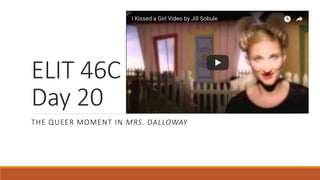
ELIT 46C
Day 20
THE QUEER MOMENT IN MRS. DALLOWAY
Business/Participation
Paper grades will start to appear this weekend.
Final exam: we’ll talk briefly about it in class
next week, but it will be a lot like the midterm.
(Description posted already on Canvas.)
Try to read all of Wide Sargasso Sea for
Tuesday.
◦ There may be a quiz Tuesday. It will be right at
10:30 sharp.
Participation for today: two individual points
for saying things in our full discussion.
Poetry readings in the second half today!
Psychological Services and Resources
FREE Resources at De Anza Crisis Resources
The event of Mrs. Dalloway
“An offering for the sake of offering, perhaps. Anyhow, it was her gift” (2224)
The Politics of Mrs. Dalloway
Is this an escapist novel?
Is it unconcerned with politics?
Suggest that the narrative aims for a dual
consciousness in the reader:
◦ a consciousness of the beauty and goodness of
Clarissa and her plans.
◦ a consciousness of the horrible things that
Clarissa’s life and plans occur in the midst of.
Horrible things—like what?
The Politics of Mrs. Dalloway
Is this an escapist novel?
Is it unconcerned with politics?
Suggest that the narrative aims for a dual
consciousness in the reader:
◦ a consciousness of the beauty and goodness of
Clarissa and her plans.
◦ a consciousness of the horrible things that
Clarissa’s life and plans occur in the midst of.
Horrible things—like what?
Empire.
The War.
Class inequality.
Gender inequality.
How do we see these impinge on the story?
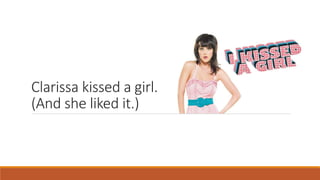
Clarissa kissed a girl.
(And she liked it.)
“She and Sally fell a little behind. Then came the most exquisite moment of her whole
life passing a stone urn with flowers in it. Sally stopped; picked a flower; kissed her on
the lips. The whole world might have turned upside down! The others disappeared;
there she was alone with Sally. And she felt that she had been given a present,
wrapped up, and told just to keep it, not to look at it — a diamond, something
infinitely precious, wrapped up, which, as they walked (up and down, up and down),
she uncovered, or the radiance burnt through, the revelation, the religious feeling!”
(2175)
What is this passage saying?
More generally, how are we supposed
to read Clarissa’s relationship with Sally?
How to read Clarissa’s relationship with Sally?
Surprisingly enough, most critics have avoided
reading this moment in terms of actual queer
sexuality.
◦ many of them chalk it up to silly adolescent over-
enthusiasm.
◦ Elaine Showalter: “girlhood fascination”
Elizabeth Abel reads this moment as a step in
Clarissa’s development from an adolescent into a
heterosexual adult.
--reads Clarissa’s affection for Sally as love for a
surrogate mother figure (because Clarissa lost
her own mother).
--an affection that Clarissa must grow out of in
order to become an adult.
--In this sense, Abel echoes Richard Dalloway
when he tries to explain Elizabeth’s affection for
Miss Kilman:
◦ “But it might be only a phase, as Richard said, such
as all girls go through.” (2161)
--And sure enough, Abel argues, Clarissa does
indeed move on. She finds a man, marries him,
and lives the mature heterosexual life.
But why not read this as a queer moment?
How does Clarissa feel about women?
“she could not resist sometimes yielding to the charm of a woman
[…], she did undoubtedly feel what men felt. Only for a moment, but
it was enough. It was a sudden revelation, a tinge like the blush which
one tried to check and then, as it spread, one yielded to its
expansion, and rushed to the farthest verge and there quivered and
felt the world come closer, swollen with some astonishing
significance, some pressure of rapture, which split its thin skin and
gushed and poured with an extraordinary alleviation over the cracks
and sores! Then, for that moment, she had seen an illumination; a
match burning in a crocus; an inner meaning almost expressed. But
the close withdrew; the hard softened. It was over — the moment.
Against such moments (with women too) there contrasted (as she
laid her hat down) the bed and Baron Marbot and the candle half-
burnt.” (2173)
How does she feel about Sally?
“But this question of love (she thought, putting her coat
away), this falling in love with women. Take Sally Seton;
her relation in the old days with Sally Seton. Had not
that, after all, been love?” (2173)
“But the charm was overpowering, to her at least, so
that she could remember standing in her bedroom at
the top of the house holding the hot-water can in her
hands and saying aloud, ‘She is beneath this roof. . . .
She is beneath this roof!’” (2174)
But isn’t this just a phase?
“The past is never dead. It’s not even past.”
William Faulkner, Requiem for a Nun (1951)
“No, the words meant absolutely nothing to her now. She
could not even get an echo of her old emotion. But she could
remember going cold with excitement, and doing her hair in a
kind of ecstasy (now the old feeling began to come back to
her, as she took out her hairpins, laid them on the dressing-
table, began to do her hair), with the rooks flaunting up and
down in the pink evening light, and dressing, and going
downstairs, and feeling as she crossed the hall “if it were now
to die ’twere now to be most happy.” That was her feeling —
Othello’s feeling, and she felt it, she was convinced, as
strongly as Shakespeare meant Othello to feel it, all because
she was coming down to dinner in a white frock to meet Sally
Seton!”
(2174-75)
The Queer Moment
The scene with Sally functions as a “queer
moment”—as conceptualized by Eve Kosofsky
Sedgwick.
◦ a “moment” that recurs.
◦ that returns, again and again, in its power and
lives alongside the “now.”
◦ refuses to be relegated to the past or to take its
place in a chronological narrative.
In this way, Mrs. Dalloway is not a novel of
development.
◦ The adolescent Clarissa hasn’t become the adult
Clarissa.
◦ Rather, the adolescent Clarissa—the Clarissa that
was in love with Sally—coexists with the
narrative of Clarissa’s adult life and marriage to
Richard.
◦ The “present” that Sally gave her is still
present—even after all those years.
What this means is that Clarissa is not a
unified subjectivity that exists coherently in
the present as an endpoint of a developmental
process.
“She would not say of any one in the world now that they were
this or were that. She felt very young; at the same time
unspeakably aged.” (2159)
“She pursed her lips when she looked in the glass. It was to give
her face point. That was her self — pointed; dartlike; definite.
That was her self when some effort, some call on her to be her
self, drew the parts together, she alone knew how different,
how incompatible and composed so for the world only into one
centre, one diamond, one woman who sat in her drawing-room
and made a meeting-point” (2176)
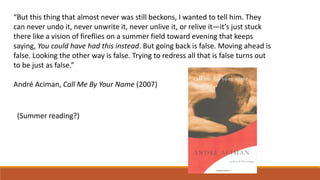
“But this thing that almost never was still beckons, I wanted to tell him. They
can never undo it, never unwrite it, never unlive it, or relive it—it’s just stuck
there like a vision of fireflies on a summer field toward evening that keeps
saying, You could have had this instead. But going back is false. Moving ahead is
false. Looking the other way is false. Trying to redress all that is false turns out
to be just as false.”
André Aciman, Call Me By Your Name (2007)
(Summer reading?)
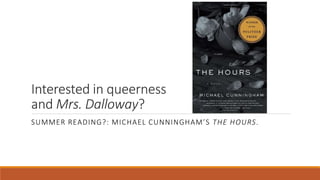
Interested in queerness
and Mrs. Dalloway?
SUMMER READING?: MICHAEL CUNNINGHAM’S THE HOURS.
Poetry Performances!
HW for next week
Paper grades will start to appear this weekend.
Final exam: we’ll talk briefly about it in class
next week, but it will be a lot like the midterm.
(Description posted already on Canvas.)
Try to read all of Wide Sargasso Sea for
Tuesday.
◦ There may be a quiz Tuesday. It will be right at
10:30 sharp.
Participation for today: two individual points
for saying things in our full discussion.

D20-ELIT 46C-S18

  • 1.
    ELIT 46C Day 20 THEQUEER MOMENT IN MRS. DALLOWAY
  • 2.
    Business/Participation Paper grades willstart to appear this weekend. Final exam: we’ll talk briefly about it in class next week, but it will be a lot like the midterm. (Description posted already on Canvas.) Try to read all of Wide Sargasso Sea for Tuesday. ◦ There may be a quiz Tuesday. It will be right at 10:30 sharp. Participation for today: two individual points for saying things in our full discussion. Poetry readings in the second half today!
  • 3.
    Psychological Services andResources FREE Resources at De Anza Crisis Resources
  • 4.
    The event ofMrs. Dalloway “An offering for the sake of offering, perhaps. Anyhow, it was her gift” (2224)
  • 5.
    The Politics ofMrs. Dalloway Is this an escapist novel? Is it unconcerned with politics? Suggest that the narrative aims for a dual consciousness in the reader: ◦ a consciousness of the beauty and goodness of Clarissa and her plans. ◦ a consciousness of the horrible things that Clarissa’s life and plans occur in the midst of. Horrible things—like what?
  • 6.
    The Politics ofMrs. Dalloway Is this an escapist novel? Is it unconcerned with politics? Suggest that the narrative aims for a dual consciousness in the reader: ◦ a consciousness of the beauty and goodness of Clarissa and her plans. ◦ a consciousness of the horrible things that Clarissa’s life and plans occur in the midst of. Horrible things—like what? Empire. The War. Class inequality. Gender inequality. How do we see these impinge on the story?
  • 7.
    Clarissa kissed agirl. (And she liked it.)
  • 8.
    “She and Sallyfell a little behind. Then came the most exquisite moment of her whole life passing a stone urn with flowers in it. Sally stopped; picked a flower; kissed her on the lips. The whole world might have turned upside down! The others disappeared; there she was alone with Sally. And she felt that she had been given a present, wrapped up, and told just to keep it, not to look at it — a diamond, something infinitely precious, wrapped up, which, as they walked (up and down, up and down), she uncovered, or the radiance burnt through, the revelation, the religious feeling!” (2175) What is this passage saying? More generally, how are we supposed to read Clarissa’s relationship with Sally?
  • 9.
    How to readClarissa’s relationship with Sally? Surprisingly enough, most critics have avoided reading this moment in terms of actual queer sexuality. ◦ many of them chalk it up to silly adolescent over- enthusiasm. ◦ Elaine Showalter: “girlhood fascination” Elizabeth Abel reads this moment as a step in Clarissa’s development from an adolescent into a heterosexual adult. --reads Clarissa’s affection for Sally as love for a surrogate mother figure (because Clarissa lost her own mother). --an affection that Clarissa must grow out of in order to become an adult. --In this sense, Abel echoes Richard Dalloway when he tries to explain Elizabeth’s affection for Miss Kilman: ◦ “But it might be only a phase, as Richard said, such as all girls go through.” (2161) --And sure enough, Abel argues, Clarissa does indeed move on. She finds a man, marries him, and lives the mature heterosexual life.
  • 10.
    But why notread this as a queer moment?
  • 11.
    How does Clarissafeel about women? “she could not resist sometimes yielding to the charm of a woman […], she did undoubtedly feel what men felt. Only for a moment, but it was enough. It was a sudden revelation, a tinge like the blush which one tried to check and then, as it spread, one yielded to its expansion, and rushed to the farthest verge and there quivered and felt the world come closer, swollen with some astonishing significance, some pressure of rapture, which split its thin skin and gushed and poured with an extraordinary alleviation over the cracks and sores! Then, for that moment, she had seen an illumination; a match burning in a crocus; an inner meaning almost expressed. But the close withdrew; the hard softened. It was over — the moment. Against such moments (with women too) there contrasted (as she laid her hat down) the bed and Baron Marbot and the candle half- burnt.” (2173)
  • 12.
    How does shefeel about Sally? “But this question of love (she thought, putting her coat away), this falling in love with women. Take Sally Seton; her relation in the old days with Sally Seton. Had not that, after all, been love?” (2173) “But the charm was overpowering, to her at least, so that she could remember standing in her bedroom at the top of the house holding the hot-water can in her hands and saying aloud, ‘She is beneath this roof. . . . She is beneath this roof!’” (2174) But isn’t this just a phase?
  • 13.
    “The past isnever dead. It’s not even past.” William Faulkner, Requiem for a Nun (1951)
  • 14.
    “No, the wordsmeant absolutely nothing to her now. She could not even get an echo of her old emotion. But she could remember going cold with excitement, and doing her hair in a kind of ecstasy (now the old feeling began to come back to her, as she took out her hairpins, laid them on the dressing- table, began to do her hair), with the rooks flaunting up and down in the pink evening light, and dressing, and going downstairs, and feeling as she crossed the hall “if it were now to die ’twere now to be most happy.” That was her feeling — Othello’s feeling, and she felt it, she was convinced, as strongly as Shakespeare meant Othello to feel it, all because she was coming down to dinner in a white frock to meet Sally Seton!” (2174-75)
  • 15.
    The Queer Moment Thescene with Sally functions as a “queer moment”—as conceptualized by Eve Kosofsky Sedgwick. ◦ a “moment” that recurs. ◦ that returns, again and again, in its power and lives alongside the “now.” ◦ refuses to be relegated to the past or to take its place in a chronological narrative. In this way, Mrs. Dalloway is not a novel of development. ◦ The adolescent Clarissa hasn’t become the adult Clarissa. ◦ Rather, the adolescent Clarissa—the Clarissa that was in love with Sally—coexists with the narrative of Clarissa’s adult life and marriage to Richard. ◦ The “present” that Sally gave her is still present—even after all those years. What this means is that Clarissa is not a unified subjectivity that exists coherently in the present as an endpoint of a developmental process.
  • 16.
    “She would notsay of any one in the world now that they were this or were that. She felt very young; at the same time unspeakably aged.” (2159) “She pursed her lips when she looked in the glass. It was to give her face point. That was her self — pointed; dartlike; definite. That was her self when some effort, some call on her to be her self, drew the parts together, she alone knew how different, how incompatible and composed so for the world only into one centre, one diamond, one woman who sat in her drawing-room and made a meeting-point” (2176)
  • 17.
    “But this thingthat almost never was still beckons, I wanted to tell him. They can never undo it, never unwrite it, never unlive it, or relive it—it’s just stuck there like a vision of fireflies on a summer field toward evening that keeps saying, You could have had this instead. But going back is false. Moving ahead is false. Looking the other way is false. Trying to redress all that is false turns out to be just as false.” André Aciman, Call Me By Your Name (2007) (Summer reading?)
  • 18.
    Interested in queerness andMrs. Dalloway? SUMMER READING?: MICHAEL CUNNINGHAM’S THE HOURS.
  • 19.
  • 20.
    HW for nextweek Paper grades will start to appear this weekend. Final exam: we’ll talk briefly about it in class next week, but it will be a lot like the midterm. (Description posted already on Canvas.) Try to read all of Wide Sargasso Sea for Tuesday. ◦ There may be a quiz Tuesday. It will be right at 10:30 sharp. Participation for today: two individual points for saying things in our full discussion.