A G A V E M A G A Z I N E
L I T E R A T U R E : A R T : P H O T O G R A P H Y
Vo l . 2 , I s s u e 4 { S p r i n g 2 0 1 5 }
AGAVE MAGAZINE, VOL. 2, ISSUE 4SPRING 2015
It has been an unpredictable spring here in the United States. In
California, we continue to face unprecedented drought, as water, our
greatest natural resource, dwindles towards depletion. The anomaly of
water, strong enough to buttress ships but imperceptible enough to slip
through one’s fingers, is an extraordinary concept. In fact, if someone had
to describe its properties, it most certainly sounds more chimerical than
it does real.
Yet here we are, mostly liquid ourselves, able to access different modes
of creation, states of being, and cultivate sensibility through words and
images. More often than not, we can be transported without having to
leave the confines of our homes, subway seats or café arm chairs. This is
the marvel of the literary and artistic worlds, two spheres which compel
us to be readers, viewers and explorers alike.
In approaching this issue, I thought about the age-old proverb from
Thomas Fuller’s compendium: “In like a lion, out like a lamb.” We can
observe this seasonal change, entering forecefully as a winter storm and
departing on a summer breeze. There is a duality to the spring, as there
is with all seasons, but none quite as remarkable as snow giving way to
burgeoning flowers, trees brimming with green leaves, and the promise of
new life. Spring is hope, and “hope springs eternal” (to quote Alexander
Pope, another fine writer).
In this issue, our contributors push boundaries to explore and to
document universal themes of the human condition. Theirs is a quirky
world, often of darkness, where life plays out in the in-between, those
moments of consciousness that occur in the day-to-day when all bets are
off and no one is watching. It is an interesting perspective to navigate, to
say the least, and one worthy of further investigation.
Over the next few months we will be welcoming several new additions
to our editorial staff to help meet the demands of our expansion. As
Agave Press launches its Limited Edition Series in 2016, we will be
opening up a reading period for manuscripts and portfolios this fall.
More specifics are available on pg. 65 of this issue. All in all, we wish
to create more opportunities for expression through literature, art and
photography and to continue to welcome new readership worldwide.
To our outstanding contributors: I wish to thank-you for bringing a mix
of style and emotional savvy. It has been our absolute pleasure to select
your work and to get to know each of you as creatives through this issue.
To my editorial team: Anna, Deb, Grant and Issraa—thank you for your
continued support and dedication to our publication. It means the world.
Without further ado, I present to you, our treasured readers, Agave
Magazine {Spring 2015}.
{EDITOR’S NOTE}
Dear Readers,
Ariana Lyriotakis
Founder/Editor-in-Chief
Yours truly,
AGAVE MAGAZINE, VOL. 2, ISSUE 4SPRING 2015
HONEY
Tomas Narmontas
7
DARK BLUE
—Charles Thielman
8
OCEAN AT NORTHERN CALIFORNIA - CARMEL
—Melvin Lockett
9
CALIFORNIA
Skaidrite Stelzer
10
THE ECLIPSE
Norah Vawter
11
MY LOVE’S LOVE
Charlie Weber
15
UNSEEN BEAUTY IN A NEIGHBOURS’ EYE
Stephanie Daly
15
WINDOWS #1
Myrta Köhler
16
5 “HAIKUS”
Glenn Halak
16
HOW HE’LL GET ALONG WITHOUT HER
Richard Cecil
17
LIFE AFTER DEATH
Laurie Martin
18
CARRY YOUR SISTER
Tyler Oshiro
19
HARSH MAGENTAS: ESTHER #3
Ryan Kim
25
CHELSEA NIGHTS
William Doreski
26
MORE P.S.’S THAN PUBLIC SCHOOLS
Arturo H. Magaña
27
THE PHILOSOPHER’S HAND
Howard Winn
28
CRACKED CRACKERS
Edward Ferri, Jr.
28
BOB
Daniel Adams
29
{Contents}
AGAVE MAGAZINE, VOL. 2, ISSUE 4SPRING 2015
VEGETABLES
Kirie Pedersen
31
ELK RIVER
Daniel Lassell
36
THE CHARM
Liv Lansdale
36
THIS SHIP
Ethan Cunningham
36
TRADE WINDS
Paul Weidknecht
37
SUCCULENT
Ethan Cunningham
40
MYANMAR TRAVEL EXPEDITION #49
Pradeep Raja
41
ALONE IN THE TROPICS
John Grey
42
TARANTULAS IN PARADISE
Kelly Weber
42
CONFIDANTS
Natasha Natale
44
AFTER THE FIREBIRD
Ekaterina Vasilyeva
45
YOU COULD PLAY THE GAME
Bennett Durkan
47
RUMMAGE
Ethan Cunningham
50
ODE TO PROMISE
William Aarnes
50
THE MONTHLY BILL IS WHAT?
Robert A. Bak
52
MAN EDGE
Richard Vyse
53
CIVIL DISOBEDIENCE
Chad Lutz
54
AGAVE MAGAZINE, VOL. 2, ISSUE 4SPRING 2015
DESERT WALL
Brad Garber
55
THE CLEARING
Katherine Holmes
56
REMEMBER
Pavel Petr, Trans. by Sylva Ficová
57
TRIFOCALS
Leonard Orr
57
BAMBOO TRAIN
Maria Picone
58
SMOKE AND FOG
Anne Whitehouse
59
OUT AT SEA
Adam Lau
60
UNEASE
Brian Tatum
60
AND IN THE END YOU’LL HEAR ME CALLING
Terry Barca
61
SOUL ROSE
Kareem Berjaoui
66
THE ELEMENTS
Michelle Matheny
66
THE COLOR SERIES
Jyoti Omi Chowdhury
67
FIDES
Merridawn Duckler
69
MY FATHER’S BARN
Michael McManus
69
FORMATION
Christopher Mulrooney
71
TO UNCARING
Tatjana Debeljacki
71
CHARDONNAY
Michal Onofrey
72
AFTER GRACE
Connor McNulty
77
NUMBER 8
Sherley Wijawa
77
DREAMS #7
Alexandra Vacaroiu
80
AGAVE MAGAZINE, VOL. 2, ISSUE 4SPRING 2015
The story behind this photographic series
of images stems from facial or bodily flaws
that afflict us all, but which some women
try so desperately to hide. The objective was
to produce editorial photographs which
impart an easy, effortless beauty, the kind
of physical impression some women strive
to achieve. Dried flowers were used both to
indicate and to highlight the vulnerable
areas. The images were then created in
studio with daylight from a window on the
righthand side, along with the employment
of a reflector to diffuse greater amounts of
light overall.
{ON THE COVER}
—Nicole Lim, “Leave Her Wild”
Credits:
Model: Arina Z
Hair & makeup: Chris Toh
AGAVE MAGAZINE, VOL. 2, ISSUE 4SPRING 2015
EDITORIAL STAFF
Ariana Lyriotakis
Editor-in-Chief
Anna Mattiuzzo
Editor-at-Large
Issraa El-Kogali
Contributing Art Editor
Deb Ain
Blog Manager
Grant Macdonald
Business Manager
A G A V E M A G A Z I N E
L I T E R A T U R E : A R T : P H O T O G R A P H Y
CONTRIBUTORS
William Aarnes
Daniel Adams
Robert Bak
Terry Barca
Kareem Berjaoui
Richard Cecil
Jyoti Omi Chowdhury
Ethan Cunningham
Stephanie Daly
Tatjana Debeljacki
William Doreski
Merridawn Duckler
Bennett Durkan
Edward Ferri, Jr.
Sylva Ficová*
Brad Garber
John Grey
Glenn Halak
Katherine Holmes
Ryan Kim
Myrta Köhler
Liv Lansdale
Daniel Lassell*
Adam Lau
Nicole Lim
Melvin Lockett
Chad Lutz
Arturo H. Magaña
Laurie Martin
Michelle Matheny*
Michael McManus
Connor McNulty
Christopher Mulrooney
Tomas Narmontas
Michael Onofrey
Leonard Orr
Tyler Oshiro
Natasha Natale
Kirie Pedersen
Pavel Petr*
Maria Picone
Pradeep Raja
Skaidrite Stelzer
Brian Tatum
Charles Thielman
Alexandra Vacaroiu
Ekaterina Vasilyeva
Norah Vawter
Agave Magazine is a quarterly publication showcasing exceptional writing, art and photography from around the globe.
Open call for submissions: all are encouraged to submit original, previously unpublished works for consideration.
http://www.agavemag.com
Agave Magazine Vol.2, Issue 4 (Spring 2015)
ISSN 2375-978X (print)
ISSN 2329-5848 (online)
*Indicates winner of Agave Magazine’s National Poetry Month contest
Copyright © 2015 Agave Magazine and respective authors, artists and photographers. All rights reserved.
No part of this publication may be reproduced without the express written permission of Agave Magazine.
Richard Vyse
Charlie Weber
Kelly Weber
Paul Weidknecht
Anne Whitehouse
Sherley Wijaya
Howard Winn
—7— AGAVE MAGAZINE, VOL. 2, ISSUE 4SPRING 2015
HONEY
Perhaps
	 you could send me
	 some more.
	 I used only a drop
	 to soothe my throat.
But now
	 I sweeten my tea too.
—Tomas Narmontas
—8— AGAVE MAGAZINE, VOL. 2, ISSUE 4SPRING 2015
DARK BLUE
First adagio threading stems,
I wake
to write before dawn,
dark window to blank wall.
Spirit bound by cedar incense strands,
and long tendons of wind-blown fog,
illusions ladled into my eyes
below another jet-contrailed sky.
Perhaps, spring wrapped yellow
on the eastern horizon will thread
soul glow through agate then pearl.
Votive flame through glass.
Dew beads on a crow’s wings
as time washes chalk lines off asphalt.
I peer inside receding dark blue,
raven feathers on antlered skull
one dream stride from road gravel.
My life
on a flatbed truck gathering starlight.
—Charles Thielman
—9— AGAVE MAGAZINE, VOL. 2, ISSUE 4SPRING 2015
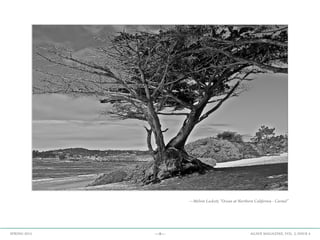
—Melvin Lockett, “Ocean at Northern California - Carmel”
—10— AGAVE MAGAZINE, VOL. 2, ISSUE 4SPRING 2015
CALIFORNIA
The place beside an ocean where I could sit on a crag
watching waves expand,
now seems shrunken, overtaken.
The Sufi swirl in Peoples’ Park,
nakedness wishing to reveal more than freedom;
how did the fabric stretch then,
which now is knit so tightly?
Delusions and diluted soup
snap back suddenly into this new world
of computers that seem to promise
something else behind the screen,
behind the gray space,
or blue.
The place the words come from,
responding to the tap of dead fingers.
The world grows smaller.
The ocean turns the eye back,
not allowing infinity.
But today Kelly brings me an eggplant.
Unexpected,
on my desk it glows
like a waxed black heart.
—Skaidrite Stelzer
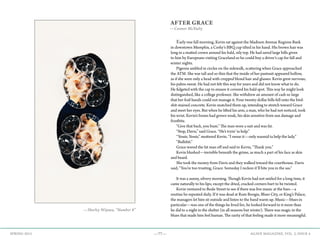
—11— AGAVE MAGAZINE, VOL. 2, ISSUE 4SPRING 2015
THE ECLIPSE
—Norah Vawter
	 In the months before my 12th birthday, I started overhearing whispers among
the adults about my father Max’s health. By February, I could detect a faint bluish
tinge to his lips. I always knew Max had a heart condition. He’d had surgery when
I was a baby. Nobody talked it about much, and he never seemed sick. But in April,
shortly after I turned 12, he told me that he would have to undergo another open-
heart surgery.
	 That April morning, a Sunday, we were sitting on a picnic blanket on the beach,
the particular stretch of the Atlantic that Max and I had decided belonged to us. We
both had bundled up in thick sweaters. Beside us Max had dug a fire pit and was
using it to grill steaks for the two of us.
	 He lit a cigarette on the flames as he explained what a quadruple bypass was. 		
	 “You don’t remember my first surgery. You were only one year old.”
	 “Rose remembers it.”
	 “Don’t call your mother by her first name.”
	 “She’s been telling you to quit smoking for years. Why are you still smoking?
Even now?”
	 Max ran his free hand through his graying hair. He looked very, very tired. He
had been working so much lately, getting in at midnight from conventions in Boston
and New York, sleeping until noon or later, and wearing his old red bathrobe around
the house. “Every man has his poison.”
	 “You could at least try to quit.”
	 “I am.”
	 That was when I asked him if he was going to die.
	 And he laughed, but not with his eyes. “No, honey. Of course I’m not going to die.
This surgery is really quite routine.”
	“Promise?”
	 “I promise.”
	 The night my father died there was a lunar eclipse. A full lunar eclipse. In order
for the entire moon to be in shadow, it must align with the earth and sun precisely,
carefully, and perfectly. The calculations are tedious and beautiful at the same time,
and I spent the day of Max’s death working out the geometry, the angles of earth,
moon, and sun. I sat in my bedroom‚ the room that had once been Aunt Beth’s. I
sat underneath the glow-in-the-dark stars I’d arranged into the constellations on my
ceiling, and I did not cry. I was alone in the house most of the day. Everyone else was
at the hospital.
	 When they got home from Boston Memorial, my mother had been unable to
speak for almost an hour. I already knew. I knew as soon as I heard the front door
open and the group of them thumping and rolling into the house. I left my room for
a minute to peek down the stairs and see my mother, my aunts, my grandfather, and
Mina, all sitting or standing or walking around very quietly. If they spoke it was soft
and sad. I could not hear what they said. But I knew.
	 I wondered if Max had had a dream about this.
	 I had had a dream about this. Perhaps that’s why I went back to my four-poster
bed, underneath my fake stars, and worked on the math until my mother came in at
last.
	 Mina pushed Rose’s wheelchair over the hump of the doorway before smiling
sadly at me and leaving, closing the door behind her. My mother had been confined
to a wheelchair since I was four years old, when an accident had severed her spine
and paralyzed her from the neck down.
	 In my dream I had been very still. In my dream I had worn the same black t-shirt,
the same red lipstick, the same worn-out jeans. In my dream Max’s voice had been
singing, “Take me out to the ball game,” coming from some place beyond the fake
stars.
	 In real life, there was no singing. My mother seemed to have lost her speech. In
the silence, I imagined his smooth, deep voice.
	
	 Take me out to the ball game,
	 Take me out to the park,
	 Buy me a hot dog and cracker jacks,
	 I don’t care if we never get back,
	 Cause it’s root, root, root for the home team,
	 If they don’t win it, it’s a shame,
	 Cause it’s one, two, three strikes you’re out,
	 In the old ball game.
—12— AGAVE MAGAZINE, VOL. 2, ISSUE 4SPRING 2015
	 “Love,” she said finally. “I need to tell you something. Something I never wanted
to have to tell you.” I could see her keeping back tears. I could see how brave she was
trying to be for me. I didn’t know what to say.
	 “He couldn’t make it, love,” she told me, one tear running down her cheek. “It’s
just...”
	 And for my mother’s sake, I pretended to be surprised. “What do you mean?” I
said, the fear in my voice half real, half fake. “He didn’t...”
	 “He died, Anna. He just couldn’t make it.” I cried real tears. I got up off the bed
because I knew she needed me to be as shocked as I was supposed to be. I wrapped
my arms around my mother and we cried for a very long time, and we didn’t speak
much at all, and I don’t know who was comforting who.
	 Max had never broken a promise to me before.
	 Max died at 6:03 Eastern Standard Time. The date was August 1, 1992. He died
at Boston Memorial, in a narrow white bed I never saw. He wouldn’t let me visit. He
didn’t want me to see him that way. My family has told me, in the years since his
death, how lucky I am not to have seen him gray and weak and hooked up to all those
wires and tubes. They have repeated this maxim over and over and over again.
	 Lucky girl, to have your father strong and wise in your mind, not a broken bird of a
man.
	 Lucky girl, to say goodbye in your own way.
	 Lucky girl, to stay a girl for a while longer, to be shielded from death.
	 Lucky girl.
	 And I sat beneath my fake stars, and I erased my lines if they went jagged, and
thoughtofthedozensoftimesthatIhadbeendraggedtothehospitaltosaygoodbye
to my mother. In a way, I suppose I said goodbye to her every morning when I woke
up and every night right before I went to sleep. Regardless of whether she was
particularly ill. With Rose, there was always a chance that in a moment, she would
be gone.
	 My room looked a hurricane had hit it. Clothes were strewn along the floor,
books piled haphazardly around the room, and I had hung all my posters at strange
angles. Earlier in the summer, I had painted lines from books and songs I liked onto
my mahogany furniture. The paint on the expensive furniture was black finger nail
polish, the kind with just a touch of sparkle flowing through it.
	
	 At 10:35 pm on August 1, my mother rolled into my bedroom again. I had
pretended to go to sleep. When I heard her coming, I had just enough time to stash
my math and my flashlight underneath my pillow. She said nothing, simply rolled
in close to my bed, and sat there for some time before engaging her power chair
and driving straight backward. There was no room for her to turn around. As she
maneuvered out of my doorway, I opened my eyes for just a fraction of a second and
saw the tears streaming down my mother’s face. I remember thinking how strange it
was that she was able to cry so silently. Usually she was terribly loud when she wept.
	 Theeclipsewouldbeginatmidnight,accordingtoourlocalmeteorologist.Iliked
the clarity of that beginning, as if the moon was only going into shadow on the first
day of my father’s death. At 11:15, precisely, I got out of bed, put on my sneakers,
and climbed out of the window and carefully down the drainpipe. The moon was
still full, and it was a clear, cloudless night. As I walked toward town, I pulled on a
faded blue sweatshirt I had stolen from my father’s wardrobe. It said, “The City That
Care Forgot” in graying black letters.
	 Willie Plum sat on the dune that he and I had claimed as our own, some 100 feet
from Max’s stretch of beach. He sat on an old blanket, his shoes off, his feet dug into
the sand. Beside him sat a brown paper bag. He was reading a book of short stories
by Nathaniel Hawthorne with the aid of a blowtorch.
	 “Really Will?” I asked as I sat down beside him, tossing my geometry into his lap.
“That same book again?”
	 “I like it. It’s comforting. Wow, Anna. This looks solid,” he said, looking at my
geometry.
	 “It ought to be. I‚‘ve been working on it all day.”
	 “I’m so sorry, Anna. How’re you holding up?”
	 I looked out at the black water, at the way the moonlight ran across the waves and
the sea foam.
	 I shrugged. Willie pulled out a bottle of bourbon he had stolen from his father’s
liquor cabinet, and two ice-cold cans of Coke. Neither of us had ever had a drink
before, and I knew Max would be furious, but something inside me longed for the
sharp, bitter taste of liquor. I had asked my mother once why people in movies made
faces when they drank, and she had told me about this taste. So I sipped at the Coke
as Willie told me to, creating a space at the top, and nodded as he poured a dash of
bourbon into it.
	 “I don’t know how strong this is going to be. So go slow, Anna Rose,” he said with
a sad smile.
	 The waves beat against the shore, reminding me with each small crash that the
world was still here.
	 I felt like I was in good hands. Willie’s mother had died when he was five after
all, the year before I met him. He didn’t talk about it much, but I knew that he
—13— AGAVE MAGAZINE, VOL. 2, ISSUE 4SPRING 2015
remembered her.
	 I smiled back my own sad smile, and sipped the bourbon and Coke from the can.
It tasted worse than I expected, and I felt my eyes popping at the taste of metal and
sin. Willie was making a terrible face.
	 “Goddamn,” he said.
	 “Yeah. Give me some more.”
	“More?”
	 I nodded, and watched as Willie poured another dash of bourbon into my Coke
can. This was the first time all day that I could feel any kind of sensation, even if the
first shock of the liquor was now making me fuzzy, almost numb. Suddenly, without
any warning, I felt tears running down my cheeks. I leaned into Willie’s arm and put
my head on his shoulder. “Did I tell you I think Max was an alcoholic?”
	 “I never saw him drink, Anna Rose.” Willie was staring at the water now.
	“Exactly.”
	 “There’s plenty of people who just don’t drink,” Willie said as he stroked my hair
with his free hand. “Don’t think bad things about your father just because he broke a
promise he never could have kept in the first place.”
	 “It’s not a bad thing if he was an alcoholic and he stopped.”
	 Willie looked at his watch and told me that we had 15 minutes before the eclipse
would start. He began to read his book to me. I listened only for the rhythm of his
voice. I already knew the stories. He held the blowtorch a good distance from my
face and hair, but I could feel the heat from the flame on my left cheek.
	 Finally the shadow arrived. Willie put out the blowtorch and lay down his book.
Neither of us said anything. We just watched as it slowly crept across the gleaming
moon, stealing one glimmer of light after another, until the moon was a half moon,
then a fat crescent, and then a very tiny crescent. As the light went, the night got
blacker and the water got blacker.
	 “Five minutes until totality,” Willie told me, stroking my hair once again.
	 “Goodbye, Max,” I said as the shadow took another sliver of moon. “We had a
grand old time.”
	 “Goodbye, Mr. Watson,” Willie said, his voice choking a little. I sat up to see my
friend wiping tears from his eyes with the back of his hand. “Say hello to my mother.”
	 “Do you ever stop missing her?” I asked him.
	 He shook his head. “No,” he said. And then, “Your dad was really solid, Anna
Rose.”
	 “He was a superhero.”
	 “Maybe he was.”
	 “I wonder if he dreamed about this.”
	 Willie glanced at me with narrowed eyes. “What?” he said.
	 “Nothing. Silly thought,” I told him with a small, sad laugh. I drank another gulp
of bourbon and Coke. “Do you feel drunk?”
	 “I don’t know what drunk is supposed to feel like. I feel kind of dizzy though.”
	 SodidI.Ilookedbackatthemoonjustintimetoseethelastsliverofmoonlighteaten
byshadow.Igaspedasthatlightdiedouttoleaveonlyadarkimprintwherethemoon
had been. Willie wrapped his arm around my shoulder and pulled me closer to him.
	 “He’s gone, Willie,” I said, my voice not quite steady. “He’s actually gone.”
	 “I know.”
	 “We can’t go to sleep tonight. We have to stay up all night.”
	 “A vigil?”
	 “Something like that.”
	 “There’s only five minutes of totality, Anna.”
	 “We should say something about him,” I told Willie as I sat up and ran my fingers
through the sand. “What will you remember about Max Watson?”
	 Willie sat very still for a moment, looking at the dark moon. He gulped his
bourbon and Coke and narrowed his eyes at the sky. “I’ll remember that book he
stole from the Boston Public Library for my dad. And his fried chicken. And the way
he always looked you in the eye when he talked, even if you were a little kid.”
	 I smiled at Willie.
	 “What about you, Anna? Three minutes of totality left.”
	 “A lot of things. The way he made me hold my breath as we crossed over the state
line. The way he made things special when they weren’t really. The half-birthday
party he threw for me when my mother got paralyzed. The southern accent that
crept into his voice when he was tired. His hand on my waist, teaching me to dance.
His wingtip shoes. The way the wind felt when he was around. The way the world
felt when he was around. Like it could fit together. Like we could make a truce with
God.”
	 “Do you believe in God?” Willie wanted to know.
	 “I don’t know. God seems to have it out for me, if he exists, so maybe it’s better if
he doesn’t. Do you?”
	 “No.” He sighed and looked back at the place that the moon should have been.
	 And though I didn’t say it out loud, I thought to myself then that I did believe in
numbers. In arithmetic and algebra and geometry, in the calculus I hadn’t learned
yet but I had heard was the mathematics of time. I believed in counting to infinity.
I believed in the number of feet in a mile, in the number of inches it would take
to circle the earth. I believed that a second was based on a heartbeat, and that all I
needed to live my life was a good watch, a good ruler, and a TI-82 calculator.
	 I didn’t learn about entropy until later.
	 Entropy tried to nibble the numbers away from me whether I knew its name or
—14— AGAVE MAGAZINE, VOL. 2, ISSUE 4SPRING 2015
not. And that night, I felt the concept of entropy creeping into my life even more
so than it had done before. Because Max had been a keeper of order and light. Max
had been the one that would save us all no matter that the world had every reason to
swallow us up and spit us out. No matter that we should all be pulp.
	 I should have been a heroin addict, but I had heroes in my life.
	 So that night as I wept silently and held Willie’s hand, I looked at my watch to
count down the seconds. “30 seconds,” I told my friend. And then I tried to make my
body as still and quiet as I could, so that I could count 30 heartbeats. I listened to the
waves beating on the shore and the wind blowing off the waves. At 31 heartbeats, I
saw a tiny bit of crescent moon re-emerge.
“That’s it,” I said, not sure if I was talking to Willie or the ocean or the air or to myself.
“That’s it.”
	 We sat in silence for a long time, watching the new moonlight dance on the waves,
watching it change from a sliver to a real crescent to a half moon, and finally, at 1:17
it became whole again.
	 “Do you want to go swimming?” Willie asked when the moon had been whole
for 10 minutes.
	 My Coke can was empty and the world looked indistinct. “We’ve been drinking.”
	 He laughed a hollow laugh. “That we have.”
	 “Drunk people are always going swimming and drowning. I’d rather not drown.”
	 He contemplated this idea for a minute, and nodded seriously at me. “You want
to go wading then?”
	 I shrugged and began to roll up my blue jeans. He did the same, and then stood
up and pulled me up with him a second later. “It will be cold,” he said, swaying a little
on his feet. “I just wanted to remind you of that.”
	 I did a fake curtsy and almost fell over. “Thank you, kind sir,‚ I said, and one tiny
giggle escaped from my lips.
	 We half stumbled, half ran to the waves, and when we got there, I felt like a baby
just learning to walk. I stuck my foot in the ocean and shrieked at the water’s frigid
temperature for the first time in years.
	 “What kind of New England girl are you now?” Willie asked.
	 “The kind that didn’t see snow until she was six.”
	 “It doesn’t snow in New Orleans?”
	 “You’re not that stupid, Will.”
	 “You’re not that southern, Anna Rose.” He grabbed my waist with his right hand,
my right hand with his left. We waltzed in that ocean, as Willie counted the beat, his
breath on my ear. “One, two, three. One, two, three. One, two, three.”
	 “I love three’s,” I said with perhaps too much enthusiasm.
	 He laughed. “I know. I don’t get it, but I know.”
	 “It’s a dreadfully important number, Will.”
	 He laughed again. “Of course it is. And this is the only dance step I know.”
	 “Max taught me the jitterbug, but I’ll never get it right at this point.”
	 “We’ll stick to the waltz.” And for some reason, Willie found this extraordinarily
funny. He laughed like a hyena. After a long while, I laughed too.
	 At 4:30 the sun came up. We had spent the last couple hours reading Hawthorne
aloud and pinching each other whenever we were about to go to sleep. At 5:00, I told
Willie that I thought we could sleep now. So we lay down next to each other on the
old, scratchy blanket, my head on his shoulder, his hand holding mine.
	
	 I woke up as Willie shook my shoulder roughly. “We should get home, Anna,
before we get in trouble,” he said.
	 I blinked in the full morning light, feeling the throbbing of a headache. We both
crawled to our feet. Willie grabbed up the blanket, his book, the blowtorch, and
stuffed the liquor bottle and the empty cans back into his brown paper bag. I glanced
at my watch. It was 6:03 am, Eastern Standard Time.
	 Max had been dead for exactly one half of one day. A day is measured by the time
it takes for the earth to rotate once, from light to shadow and back to light again.
So Max had been dead for half a rotation, for twelve hours, for 720 minutes, for 43,
200 seconds, for about that many heartbeats. I wished that I had been counting the
breaths that I had taken, the steps that I had stepped, the number of times I had
thought of him, the number of angry thoughts I had had every minute since he died.
	 Willie and I walked together until he turned left on Oak Street and I turned right.
As I crept into my house, I thought for just a second that Max would be there. I
imagined him running down the stairs, furious at me, telling me that he wasn’t going
to let me outside for a month, and forget about parties and bonfires and boys , telling
me I wasn’t going to prom, let alone anywhere near Willie again in the near future.
But nobody came running down the stairs.
	 As I climbed up the stairs, I glanced back down at the parlor. Honey lay on the
couch, looking up at me, but she looked too sad to be angry. She just shook her
head and shut her eyes again. “You can’t sleep either?” I whispered. She shook her
head, then nodded towards my Aunt Izzie, who was snoring on the other couch. I
understood that Izzie would not be as forgiving.
	 Lying down in bed, I didn’t bother to brush the sand off my clothes or out of my
hair. Something about sleeping in a gritty, uncomfortable bed appealed to me. As I
fell asleep, I could smell the salt in my hair. I tried to remember what Max smelled
like, but I couldn’t place a single smell with my father. So I imagined that he smelled
—15— AGAVE MAGAZINE, VOL. 2, ISSUE 4SPRING 2015
like the ocean, because he had been a force of nature, and because he had left me
alone in the Greek Revival, left me like an ocean wave that is sucked back into the
deep playland of the sea. My glow in the dark stars were dull and yellow now, weak
imitations of the actual stars that had also left me. I was alone with the sunlight. I
burrowed my head under the pillow, looking for a tiny bit of darkness. I found it as I
drifted off to sleep.
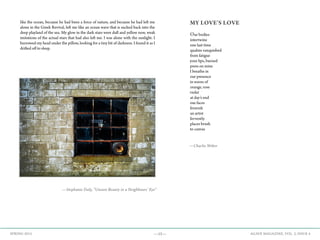
—Stephanie Daly, “Unseen Beauty in a Neighbours’ Eye”
MY LOVE’S LOVE
Our bodies
intertwine
one last time
qualms vanquished
from fatigue
your lips, burned
press on mine
I breathe in
our presence
in waves of
orange, rose
violet
at day’s end
our faces
feverish
an artist
fervently
places brush
to canvas
—Charlie Weber
—16— AGAVE MAGAZINE, VOL. 2, ISSUE 4SPRING 2015
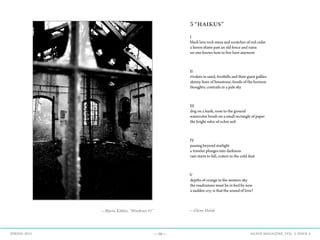
—Myrta Köhler, “Windows #1”
5 “HAIKUS”
I
black lava rock mesa and scratches of red cedar
a heron skims past an old fence and ruins
no one knows how to live here anymore
II
rivulets in sand; foothills and their giant gullies
skinny lines of limestone; fossils of the horizon
thoughts; contrails in a pale sky
III
dog on a leash, nose to the ground
watercolor brush on a small rectangle of paper
the bright odor of ochre soil
IV
passing beyond starlight
a traveler plunges into darkness
rain starts to fall, craters in the cold dust
V
depths of orange in the western sky
the roadrunner must be in bed by now
a sudden cry; is that the sound of love?
—Glenn Halak
—17— AGAVE MAGAZINE, VOL. 2, ISSUE 4SPRING 2015
HOW HE’LL GET ALONG WITHOUT HER
Tofu dogs and tater tots for supper.
Betty Crocker biscuits and jam for breakfast.
Visits from Hooper, the next door neighbor’s cat.
(Yes, you can come in, Hoops, she’s away.)
A cellar full of wine to inventory,
but not to drink. Les Miserables in bed
every night until his eyelids droop
and the big book slips his grasp and thumps his chest.
Long evening walks. Afternoon free concerts.
Library DVDs of trashy movies,
his chance to take in Men In Black at last!
Unmade bed, uncleaned toilet, so what?
The kitchen will become the chemistry set
his mother wouldn’t let him have for Christmas,
and when his loaves bake into leaden bricks
he’ll eat, not throw away, his bread mistakes
(hmm‚ not bad with moldy cheese and mustard.)
When he wakes pre-dawn to no one sleeping beside him,
Morning Edition’s host will talk to him,
and when he trudges home from work at six,
All Things Considered’s hosts will fill him in
on terrible things that happened, but not to him:
not drowned, not starved, not under investigation
for money laundering. He’ll never launder a thing,
28 days on a pair of Levis jeans
and a gray flannel shirt that will not show its stains
and will not stink because he’ll shower daily.
In the midst of dirt and disorder, he’ll keep clean,
and he won’t go wild‚ except at night in dreams.
—Richard Cecil
—18— AGAVE MAGAZINE, VOL. 2, ISSUE 4SPRING 2015
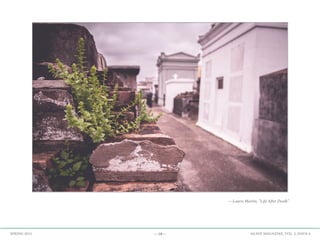
—Laurie Martin, “Life After Death”
—19— AGAVE MAGAZINE, VOL. 2, ISSUE 4SPRING 2015
CARRY YOUR SISTER
—Tyler Oshiro
	 Two weeks before my 17th birthday, the Nobuko girl went missing. The news
washed over Kohola, our small Big Island town, like the slow rush of the dark blue
sea. Back then, I told my six-year-old sister that we lived on the top of a humpbacked
whale.Ourworldrockedwitheveryshiftingtide.Intimeslikethose,whenthewhole
town sunk into uneasiness, it was impossible to ignore. The trade winds carried
gossip like rippling heat across the pale blue sky and even the black and yellow myna
birds, chattering in the grassy shade of our plumeria tree, seemed to be discussing
the fate of Sarah Nobuko.
	 When the news reached me, I was bent over a leaf-shaped plank of wood and
foam nine feet long, grating steel mesh against its uneven edges. In 1983, when your
surfboard broke, you made a new one yourself.
	 My mother stepped into the doorway of our makeshift garage, a rusty metal roof
propped up on mismatched two-by-fours. She crossed her arms to hide her missing
breast.
	 “the Nobuko girl is missing,” she said.
	 It stopped me for a second before I could continue the back and forth of steel
mesh against grainy wood. I didn’t have time to worry about her. I had to finish the
board in time for my 17th birthday and it still needed smoothing and casting in resin.
“Yoshio, did you hear me? I said Sarah Nobuko is missing.”
	 I stopped and looked up at my Mom, what the cancer left of her. Red kerchief
tied around her bald head, drawn in eyebrows. Narrow eyes that I didn’t inherit, thin
lips and smooth skin that I did. She was beautiful even in her sickness, like a fading
flower. I turned away.
	 “Yeah, I heard,” I said.
	 “Okay, then. Let’s go. The whole town is going to look for her.”
	 I dropped the mesh onto the board, which sat lifeless on its wooden horses, the
way it had for weeks.
	 “For what? She just hiding. She going come back like last time,” I answered back
in pidgin, even though Mom liked to use proper English since she learned it in
college.
	 The Nobuko girl had wandered off before, but they found her at the park on
the seesaw within hours. If they were smart, it would have been the first place they
looked. But everyone was always so worried about the other dangers of our town,
the feral pigs that roamed forest at our backs, the unpredictable lava that blazed
down the southern coast. That, combined with the general paranoia of economic
collapse and the threat of mushroom clouds; adults tended to fear the worst.
	 “Kenneth Yoshio, you will come with us to look for her. What if your sister was
missing?”
	 I picked up the steel mesh again, ground it in my hand, stretched my tired arms.
“Then I go look myself. For what make the whole town go look? They don’t know her,
how they going know where she would go?”
	 “That doesn’t matter. We need to go and support the Nobuko family,” she said,
narrowing her eye. We’re leaving in five minutes.”
	 Mom turned on her heel and marched back into the house, slamming the screen
door behind her with a loud thwack. She still moved with the grace of a dancer,
refusing to let the chemo slow her down. Mom always said Dad was the strong one,
so brave, him, fighting in the war. He’s a lieutenant, you know. But I didn’t know. The
most we got from him was a letter at Christmas, return address “Private Training
Facility, Tempe AZ” and a small check every month from the U.S. Army.
	 He came back once, for my 10th birthday. He was all smiles, tall and blonde, a
pure white longboard tucked under his big arm: my birthday gift. He never learned
how to surf, he told me, that’s why he couldn’t fit in. But maybe if I learned, the
people of Kohola would accept me. Back then, I couldn’t tell him that they just hated
the color of his skin, but we both knew. He wasn’t from here, and he couldn’t stay. He
didn’t even last a week that time but it was long enough for him to father a second
child. He’d only seen Sachiko in pictures and my Mom didn’t even tell him about her
cancer. She never shared her problems with anybody. Sometimes not even me.
	 I’d spent almost seven years giving up on my father ever coming back, but in
those same seven years, I’d taken that white longboard to the waves every weekend.
I shared the Nobuko girl’s need to escape from it all, to duck-dive under the waves
and paddle out through the whitewash or wander off to a secret place where no
one could find you. But each victory was hollow. At the end of every day, the waves
pushed me back to shore, where my responsibilities waited. At the end of every
search, the townspeople led Sarah home, careful to keep her from ever slipping off
the smooth back of the whale into unforgiving waters.
	 I passed through the house, avocado-green carpeted floors creaking underneath
my feet. When I turned into the hallway, my thigh bumped my sister’s face.
	 “Ow.” She rubbed her little nose. “Ma said hurry up. We gotta find Sarah.”
	 “I’m coming. See?” I said.
	 “You stink.”
—20— AGAVE MAGAZINE, VOL. 2, ISSUE 4SPRING 2015
	“Oh.”
	 I dipped into my room to put on some deodorant and change my shirt. By the
time I walked to the front yard, my six-year-old sister and my mother were waiting
together impatiently. Mom watched me, eyes narrowed in the harsh glare of light off
the bright green grass, her lips pursed tight. She’d give me the cold shoulder after our
argument, let me feel guilty. That was her style.
	 “Yo-yo,” Sachi asked, tugging on my tank top. “Try pick me up?”
	 Sachi called me Yo-yo since she learned how to speak. She had trouble with the
sh- sound, and Mom feared something was wrong with her brain, like the Nobuko
girl. Even though Sachi’s face wasn’t characteristic of Down’s like Sarah’s, Mom had
heard stories. Sachi learned over time, though, and got smarter than I was at her age.
But even after she could pronounce my name, Yoshio, she never stopped calling me
Yo-yo.
	 “For what? I thought we gotta go,” I asked Mom. She ignored me.
	 “To pick one flower for my hair. Sarah likes um. Maybe she going see um and
come out from hiding.”
	 I rolled my eyes. “No be stupid.” Sachi stuck out her lower lip and made a habut
face.
	 “Yoshio, carry your sister,” Mom said. Every Japanese mom, kindergarten teacher
or not, must have practiced their scolding voice with the other Japanese moms. They
all used that same “I-know-better-than-you” attitude. And normally she stared at me
until I obeyed, but this time she looked away instead, clutching her bad arm. She
always took Sachi’s side. Maybe she felt she had to. Mom hadn’t been able to carry
Sachi herself since the surgery.
	 The old plumeria tree framed our house in its knobby gray branches and long
green leaves. I gave in and lifted Sachi up to meet its bright pink petals. My arms
were strong from lifting sacks of mac nut husks at work, but they burned from the
daily strain. I ached with fatigue, with the wear of time and repeated labor. Even little
Sachiko felt heavy.
	 She picked a flower from the tree then closed her eyes.
	 “Okay, put me down.”
	 I put her down.
	 “Get sap?” she asked. She held it out at arm’s length, the way she held sparklers
on New Year’s Eve. I took the flower from her hand and rubbed the milky bottom
against a branch. I blew on the stem and held it out to her.
	“There.”
	 Her hazel eyes lit up as she grabbed the plumeria with her tiny fingers. The pink
blossom shone bright against her little brown pigtails. Her bangs cut straight across
her forehead, the chawan-bowl haircut that looked like Mom had put an actual
bowl over her head and cut around the edges. Sarah’s mom cut her hair in the same
Japanese style.
	 Even though we were only half-Japanese, since Dad was haole, Mom was intent
on us looking the part of full-blooded like her. She taught us how to use chopsticks,
to take food when visiting our friends, to honor our responsibilities. I didn’t let her
touch my hair anymore, though. It grew long and parted in the middle‚ the style of
the time.
	 Sachi tugged on the little floral print dress Mom had sewn with fabric from
Shintaku General store. “Okay, let’s go,” she said and marched across our small lawn
and into the street. Every two steps she looked around carefully, as if the Nobuko girl
might appear at any second.
	 I hesitated. “Ma, you sure you going?” I turned to her, trying to make up for the
argument earlier, “I can just take Sachi and go look.”
	 “Of course I’m going, Yoshio. I’m not helpless,” she said harshly. We both knew
that wasn’t the case. I couldn’t forget the sound of vomit hitting the porcelain edge
of the toilet bowl, the sight of her smooth black hair thrown into the rubbish can, the
feel of my hands on her thin frame like handling broken glass as I tucked her into bed
on those nights when her eyelids closed against her will. After two years of fighting
her cancer, I woke up every day hoping to find her in the kitchen, not sure what I’d
do the day I found it empty.
	 She turned her shoulder on me and followed my sister out. Sachi waited for us
at the corner where our driveway met the red dirt road. Our town was too small for
sidewalks so we stuck to the edge of the road, just in case, as we followed the path
down to the run-down Sugar Mill. I tried not to look at the horizon, where the ocean
met the sky and the pull of the tide awaited my return.
	 The afternoon sun burned hot on our backs and shoulders. It bounced off of
everything. I squinted my eyes to make out the rusty metal sign of the general store,
the empty seesaw on the park playground, the pale yellow goalposts of the Kohola
High football field.
	 Sachi reached up to grab Mom’s right hand, then drew back quickly. It was the
bad side, the one that had swelled up after the surgery. Mom didn’t notice, but I
watched Sachi switch to her left side and grab her hand tight. Mom had refused to
tell her about the cancer. After we visited her in the hospital, after the surgery, I spent
the entire car ride home convincing her that Mom was just sick, like when she had
a cold, only it was a really bad cold, and she needed really strong medicine to cure it.
Sachi listened quietly in the passenger seat as the car rocked over the hills of Saddle
Road.
	 Mom had just taught me how to drive the month before, before she got sick. For
weeks I fumbled with the clutch, working the pedal with my goofy foot as the car
—21— AGAVE MAGAZINE, VOL. 2, ISSUE 4SPRING 2015
bucked and she laughed at her own bad advice, passenger seat rocking, clutching her
chest. I learned that I did not have her grace and that I hated stop signs.
	 I only passed the driving test because old man Fukumoto knew about her surgery
in Hilo. Everybody in our town knew. That’s why they gave us those looks of pity as
weapproachedtheSugarMill,wherethetowngathered.Thefamiliesthatstayed,the
ones that hadn’t lost their jobs or moved away when B&D Corporation announced
the sugar mill closures, the remnants of our town watched us walk down the street:
Chinese, Japanese, Filipinos, Hawaiians, and even Haoles, race didn’t matter. This
community had gathered together to search for the Nobuko girl, perhaps because
we were losing everything and we knew that soon all we’d have left was each other.
Their glances softened as they saw my mother and her sunken cheeks, Sachi holding
her thin arm. Their eyes fell on me, too, the man of the family, and a felt a flush creep
up my sun-browned cheeks. Sometimes I thought if I paddled out far enough on
my board, I’d reach Atlantis, or Arizona, and leave everything behind. Someone else
could get cancer instead. Then I wouldn’t have to suffer because of it.
	 I stepped away from the shame of my family once we got close to the crowd. My
best friend Jimmy was already there, toeing the dirt with his slipper, so I went to
him quickly, bowing my head so I matched his height. His real name was Hajime.
I recognized him by the rat tail running down his back, which only made his face
look more rat-like. His beady eyes shifted left to right. I didn’t blame him for being
nervous.SarahNobukowashisgirlfriend’ssister.Hesmiledwhenhesawmecoming,
scrunching his eyes into crescents.
	 “We thought you guys no going come,” he nodded his head towards my Mom.
	 “Whynot?Notlikewenogetlegs,”Isaiddefensively.Ididn’twanttodealwithhis
pity again; I got enough of his hand-me-downs and handouts. Jimmy’s dad foresaw
the end of the sugar cane industry and threw his money into Hawaii’s new crop:
macadamia nuts. He gave me my job when we started getting the bills for Mom’s
treatments, said he was happy to help.
	 “Yeah, yeah. Sheesh. No need get all habut.” He jabbed me in the ribs, covering
up his worry with his typical humor.
	 “Ow. So what, then? We going make one perimeter or something?”
	 “Ho, Yosh. Been watching too much Hawaii 5-0 reruns, ah? Go tell Officer
Asuncion, go home‚ cuz you get um, Danno,” he wagged his eyebrows.
	 “Aw shaddup, Jimmy.” He laughed, but his smile faded when he saw the Nobuko
family talking to Officer Asuncion, the town’s chief of police. Julie Nobuko’s father
held her close, his arm around her shoulder, her eyes rimmed with red.
	 “You talked to her today or what?” I asked quietly.
	 “She never come school,” he answered, eyes fixed on his sort-of girlfriend. They
were going steady, but she told him to keep it secret at the time. Even Jimmy knew
he embarrassed her. No one took him seriously.
	 “You went call her house?” He shook his head, nervous. Julie was secretary of
our student government, even though she was only a sophomore like us. She sat
with Sarah every day at lunch. We all grew up on the same street, we knew Sarah had
Down’s, but we liked her anyway. She did great impressions of The Three Stooges and
knew all the words to the Cheers theme song. She sang it at least once a week.
	 Near the dying mill, people started to quiet down. Iron-rich Kohola dirt charred
the once-white metal walls of the building, walls waiting to crumble into metallic
dust and gears. In the air, the smell of burnt sugar hung thick as the molasses it came
from. Sunbeams blazed through the haze of cane waste and dust, setting the red dirt
alight. Officer Asuncion began assigning families to groups and locations around
town.
	 “Brah, no make sense, this,” I whispered.
	 Jimmy nodded. “You telling me. Not like she never did this before.”
	 “She no like people find her, she stay hiding. She going come out when she ready,
watch.” I understood her need to escape all too well.
	 “Yeah.Butwhatifshenoturnup?Imean,shegetDown’s,Yosh.Whatifsomething
went happen to her?” His eyes flickered to the peak of Kilauea, the source of the
orange-red lava and down to the thick green forest, trees and vines tangled tightly in
a dense wall.
	 “Then somebody gotta find her and bring her back, ah?” I said.
	 When we were kids, Jimmy and I read too much Hardy Boys. We thought we
could solve any problem— my Dad leaving for the military, his brother leaving for
the university, by searching for clues in the hidden places. The answers were just
hiding from us and we could find them if we tried hard enough.
	 He looked over to where Julie smoothed out the pleats in her pale blue skirt
with shaky hands. “We go tonight, then. The bamboo grove. That’s the only place
Asuncion don’t know about.”
	 Even at that young age, Jimmy and I learned that the world didn’t offer up its
secrets willingly. But in our search for clues, we did find secret spaces, places we
weren’t supposed to know about. We kept them secret. It made us special, that
knowledge. It gave us power. Maybe we couldn’t answer our problems, but we
learned how to hide from them when we needed to.
	 I knew Jimmy wanted to find Sarah himself, impress Julie and try to keep their
relationship alive. But I had my own priorities. Like finishing my board.
	 “Tonight? No can.”
	 “Why not? You gotta babysit again? Boy I tell you.”
	 “Shaddup, Jimmy. I stay trying for work on my board.”
	 He frowned. “How come taking you so long?”
—22— AGAVE MAGAZINE, VOL. 2, ISSUE 4SPRING 2015
	 “Maybe cuz I gotta work for money, not just get from my dad, yeah? Life not that
easy for all us, k?” The words came out harsh. I had meant them to sound funny.
	 “Jeez, Yosh, no need the lecture. I get um. You going choose your surfboard over
one missing girl with Down’s. Some guy, you.”
	 “No make it, Jimmy. You know I no more time.”
	 “But you know they not going find her now,” he said, “We gotta be the heroes,
Yosh. We know where for look.”
	 It was true. Maybe we should have just gone then and there, but in those days,
we thought things would last forever, that we ruled time, not the other way around.
We thought somehow Sarah would stay alive until we found her, even if we made her
wait until late at night. Jimmy always dreamed big, liked to think of himself as the
hero. In his head, Julie would thank him for finding her sister alive and love him for
good. He wanted that more than anything. At that point, though, I just wanted to go
home and work on my board. I had my own problems.
	 “I still gotta be here, ah? Still gotta waste my time when I could be at home.”
	 “Eh you know what fine then. You think you so much better than all us cuz your
life so hard well fine then. I no need you.” He stuck his bottom lip out.
	“Fine.”
	 “I just going go by myself, in the dark, with the pigs, by myself.”
	 “Fine.” Officer Asuncion called the families together. I started towards my sister.
	 “Maybe the obake going come get me, who knows? And my best friend stay at
home working on his board cuz he no care.”
	 I threw a shaka over my shoulder. I made up my mind to go long before that, but
it was fun to watch him suffer. Sometimes Jimmy and I were all each other had, and
if no one found the Nobuko girl by nightfall, we were her only hope. I found my
mom in the crowd by her red kerchief. My sister shifted from foot-to-foot at her side,
pigtails bobbing.
	 “Where you was?” she asked. She made her face into a miniature half-Japanese
version of Mom’s— eyebrows furrowed, lips tight.
	 “Talking to Jimmy,” I said.
	 “We gotta go down to the beach. With the Kaluas and the Galindas.”
	 We met up with the Kaluas, the Hawaiian family that lived near the school, and
the Galindas, the Filipino family that owned the town’s bakery. I waited in silence
as the adults talked story, the Kaluas and the Galindas asking, How you, Asami?
and Mom saying, Oh fine, I’m fine, because she was Japanese and tha’s how she was
supposed to answer. I heard Grandma lecture Mom for 11 years about that. After
Grandpa died in World War II, she had no one else to scold. Then Mom got pregnant
again by her stupid haole husband‚ and Grandma gave up. It was easier to pretend
we weren’t related. When Mom gave birth, she named her daughter Sachiko, happy
child. I think she hoped that my sister would grow up happy, live the life she always
wanted for herself. But when the cancer came, she realized she wouldn’t be around
to see it.
	 A couple of months earlier, I caught her in the kitchen on her hands and knees,
days after a chemo treatment. She held a scrub brush in her good hand, thin muscles
and brittle bones showing through her skin as she washed the floors, dipping into a
bleached blue bucket of soapy water. She was bald and weak and she wouldn’t admit
it, but I knew the chemo hurt her like poison.
	 I asked, “What chu doing?” angrily as if asking What chu thinking? and dropped
tothefloortotakethebucketawayfromher.Sheclutchedthebrushharder.Sudsran
down her arms. Me: Give it, Mom. Her: No, I can. And then me, in tears, insistent,
Give me the brush. And her in tears, no, I can, I can, sounding stubborn like Sachiko
and then the two of us stopping, both clutching the brush and covered in soapy
water and then laughing and crying at the same time. My mom, she didn’t listen to
anybody, not even me.
	 She insisted on walking along with us as we searched for the Nobuko girl. So after
an hour of yelling and watching the sun sink into the blue horizon, I got worried. But
she was fine. It had been a couple of weeks since her last treatment. She still yelled
with everyone else, “Sarah! Sarah Nobuko!”
	 Meanwhile, the teenagers‚ Äîme, Danny Kalua, and Lisa Galinda, hung at the
back of the group, looking for the Nobuko girl, but trying to act cool at the same
time. We couldn’t try too hard, even if we did want to find her. The sunlit clouds
faded to deep orange and pink as the trade winds picked up along the shoreline.
The waves folded over themselves in glassy curls, and I had to resist the urge to run
straight into them, had to settle for the coolness of the damp sand between my toes.
I strained my eyes against the setting sun, eager for any clue that would make this
search end faster, but still I saw nothing. No footprints, or sandals, or any signs she
was ever there. Maybe our only chance to find her would be at night with Jimmy.
	 I got so caught up in my own thoughts, I almost didn’t notice when Sachiko
nearly fell over in front of me, tired from all the walking. She stumbled in the sand,
rubbing her eyes. Her pigtails drooped. But she wouldn’t admit she was tired.
	 “We go home,” I told Mom. She opened her mouth to protest, then saw Sachi.
We looked around one last time, but the beach lay flat and empty. Mom nodded,
looking at Sachi, who held onto her hand.
	 “Carry your sister,” she said. Too tired to argue, I picked her up. The sand trailed
from her feet. Her chubby cheek fell softly onto my shoulder and she dozed off,
thumb in mouth. My bicep ached under her weight, but I tried not to complain.
	 We said our goodbyes to the Galindas and the Kaluas. We told them we hoped
someone found the Nobuko girl soon. They said the same.
—23— AGAVE MAGAZINE, VOL. 2, ISSUE 4SPRING 2015
	 As the sky darkened from pink to deep purple, we walked along the side of the
dirt road back home. My muscles burned, so I kept adjusting Sachi, trying different
positions. But I was scared to wake her. The pink plumeria wilted from the heat and
wear. It draped itself over her ear.
	 We got home around 7:00 and Mom started dinner. I set Sachi onto the couch,
since she was dirty and couldn’t go in her bed. I was headed into the garage to get
back to my board when the phone rang. It would have to wait. Again.
	 “Hello,Asamispeaking,”Momsaid,“Uh-huh...noweneverfindher,didanyone?...
still missing. I see. Please call if you hear anything. Thank you. Goodbye.”
	 “Nobody went find her?” I asked. She shook her head.
	 “That was Hajime’s Mom.” She grabbed a knife from the block and sliced an
onion.
	 “What happens if we no find her soon?” I asked.	Mom paused. She looked up. ‚
	 “Thenshe’llprobablydie,Yoshio.GrabtheotherboardandcuttheSPAM,please.”
She waved the knife as she said this. I was less nonchalant.
	 “What you mean, she going die? She’s only 12, she cannot die,” I said as I rustled
out the other cutting board.
	 “Says who, Yoshio? Who says bad things don’t happen to good people? Nobody
gets to pick and choose when they’re going to die, that’s not how it works. You better
learn that soon.”
	 “Soon? Why soon?” I clanged pots together, pretending to struggle to find the
cutting board, but really trying to drown out her words.
	 “You know why soon,” she shouted as she grabbed the cutting board herself and
dropped it in front of me. “The doctor said.”
	 “I know what the doctor said. But how he know? We get time, Ma.” The words
sputtered out as I pounded the SPAM from the can onto the counter.
	 “Yoshio, don’t play dumb. Someone has to be responsible for this family.” She
grabbed my arm in her hand firmly. Her bones felt hollow, like a bird’s. I shook her
hand off and stormed over to the door.
	 “Where are you going?” she called as I jammed my feet into my slippers and
swung the screen door open. “You better not be leaving.”
	 “I going find the Nobuko girl. We get time.”
	 “Yoshio, don’t you dare walk away from this family.” She pointed the knife at me
from across the kitchen and narrowed her eyes into a harsh glare.
	 I slammed the screen door behind me and sprinted all the way to Jimmy’s house
under the dark blue light of evening. I arrived at his window, panting, to collect him
for the search. We dragged our feet along the street to the park as the blue faded to
inky black. The yellow glow of the single streetlight and the pale white light of the
rising half moon barely lit the dark night. The park looked frozen in the shadows, as
if suddenly forgotten. The seesaw balanced halfway up, waiting for a push. An empty
swing hung patiently. Far at the edge of the park, at the edges of grass overgrown
with weeds, the back opened into a secret grove of bamboo, one of many hidden
places Jimmy and I had found. We sat down heavily on the swings, putting off the
search a little longer.
	 “I thought you no was going come,” Jimmy said, kicking up sand with his toe as
he pushed himself a few inches back and forth.
	 “How come?” I came for Jimmy, but sometimes I was sure the only thing we still
had in common was a love of pakalolo and a dream of getting off the rock. But then
again, we all wanted that.
	 “Well that surfboard so damn important to you.” He forced a smile. “I get
one surprise. Cuz kinda spooky out here, yeah? Going help with the nerves.” He
pulled out a baggie from his pocket. His fingers trembled as he rolled up the white
parchment of the joint.
	 “So what? It’s up to us, ah?” I asked.
	 Jimmy lit the joint with a shaking orange flame. He french-inhaled, sucking the
milky white smoke up into his nostrils, then exhaled heavily. It clouded in the air, fell
apart, and drifted up to meet the blinking stars.
	 “You got it, Yosh. Just like old times.”
	 “You really think she stay over here?” I asked him. It was our favorite spot, a
bamboo grove whose thin stalks grew thick with leaves, covering a clearing. The
clearing itself was nearly five square feet, closed off by a metal fence on one side. In
this space, we had shared our first joint, our first jug of sweet Sangria. We knew that
beyond the fence, Kohola’s back sloped down into its unforgiving forest.
	 “Well she never get taken out to sea, ah?”
	 “I no think so, we went look all over the beach and no sign of her.”
	 “And if she went to one other town, we would have heard. So she could only be
over there.” He jerked his head towards the cross-linked fence that blocked our town
from danger. Maybe Jimmy was right this time. He knew how to escape, too.
	 By the time we reached the fence, we finished the joint. I stamped it out with the
sole of my rubber slipper. Through our bloodshot eyes, the fuzzy world flickered at
its edges. Cricket chirps cut through the still air.
	 “Okay. But how come she go come over here?” I asked one last time. Officer
Asuncion had assigned a group to check the forest, but I knew they would only
search along the wide, marked entrance a mile uphill. No one else knew how to get
in this way.
	 “Maybe she thought she go hide here,” he said. “She could have found um when
she was wandering around, you know.”
	 I shook my head in disbelief before I realized what lay beneath my feet beside the
—24— AGAVE MAGAZINE, VOL. 2, ISSUE 4SPRING 2015
white end of our joint. Under my slipper, crushed pink petals bent and spread, five
from each flower. Before I stepped on them, they were perfect pink plumerias, like
the one Sachi begged me to help her pick that morning. She said Sarah liked them. I
looked up. Even in the near darkness, the flowers shone in the moonlight, a soft and
inviting shade. The arms of the tree reached over the fence to us, dropping blossoms
and leaves in the bamboo clearing, where they glowed softly. The hairs on my neck
prickled.
	 “Shit.”The only sounds were my Converse sneakers and Jimmy’s Air Force
Ones rattling against the tall fence as I sprinted up it and he followed. At the top, a
panoramic view showed us the way the land sloped down on the other side, dipping
into the forest valley. Only the tops of trees caught the moonlight, which scattered
through the leaves.
	 I climbed down. Jimmy followed carefully. He opened his mouth to ask what
was going on, but shut it, silenced by the emptiness of the dark forest. Our almost
useless eyes could just barely tell a fern from a bush, and the silence rang hollow in
our ears. But there, to the right of me, the soft ground gave way to a footprint. Next
to it, more flattened leaves lay crushed underfoot. I followed the trail with my eyes,
tracing shapes in the scattered moonlight. I felt Jimmy tense up quick next to me. He
gripped my shoulder hard.
	 There, eyes glassy in the moonlight, downward brow bloody, lay the Nobuko girl.
Her pale skin was covered in bruises, and in her hand, I could barely make out the
outline of soft pink petals clutched in a lifeless grasp.
	 “Yosh‚“ Jimmy said. “That’s her.” He was right, but the empty darkness sucked the
warm breath straight from my lungs.
	 I gasped for air to speak, but found none. The forest was empty. All I could do
was nod. She was dead.
	 “Yosh‚ you think she went make?”
	 “Yeah, Jimmy.” Her neck stuck out at a strange angle. Her empty eyes stared
out into the trees. She must have fallen trying to pick a flower from the tree. I tried
looking away, but I couldn’t stop staring. The chills spread from my neck and ran
down my spine, hard like a tattoo needle. When it reached my fingers, they tingled
so much it hurt. She had found the ultimate escape.
	 “What we going do? She went make. We found one dead girl.” His voice was
barely audible in the silence. His grip tightened so hard on my shoulder it I thought
it was going to separate.
	 “Nothing. Let the police come find her tomorrow. What difference going make if
they find her tonight?” I said through gritted teeth. Every muscle in my body coiled,
ready to run away, to put as much distance as I could between that corpse and me
and forget it all.
	 “But that’s Julie’s sister, Yosh. They gotta know. We gotta tell them.” His eyes
pleaded with me for some sanity, some explanation, but I had none. We had no
excuses. I shook his hand off. I turned my back on the Nobuko girl and climbed the
fence again.
	 “Tell them what, Jimmy? That we was out smoking weed in the middle of the
night and just so happen we went find their daughter dead in the forest? You know
how stupid that sounds or what?” I had found my voice again. It used too much air,
escaping in short bursts.
	 “I don’t know, Yosh, but we gotta tell them something. It’s our fault, brah.”
	 He stood staring at Sarah’s lifeless arms, flat against the forest floor. His shoulders
fell limp, hopeless. I knew what that felt like. It’s the way I sank into myself when they
told me about Mom’s cancer. It’s staring death straight in the eyes and knowing you
are powerless to stop it. It’s fear and guilt that pulls you under until you’re suffocating
because you know it’s your fault but there’s nothing you can do.
	 We were too late. We couldn’t give up our childhood spaces, and like idiots we
thoughtthatbyignoringtheproblem,itwouldgoaway.Butitdidn’t.Weknewwhere
she was, and we thought we had enough time. We always thought there was more
time.
	 Maybe Jimmy was right, and it was time to own up.
	 “Call when you get home, then. Make anonymous or something. Eh, but Jimmy.
We was never here, ah?”
	 He nodded slowly and followed me back over the fence, into the town, where life
went on. We didn’t even say goodbye. We walked in silence, one foot in front of the
other. All we could do was go back home.
	 The handful of families still left in our town came out for the funeral. They held
it that Sunday, an afternoon as hot as the day we searched for her. They held the
service in the church down the road, and people like Julie read touching speeches
and people cried. We all sang a Christian hymn. Then a Buddhist hymn, too, just in
case. Then we followed the procession outside, where a hole waited in the lifeless
earth,surroundedbyrowsandrowsofflatgravestones,thespacesabovethemempty.
A single tree threw scattered shadows over the graves around Sarah’s plot. Its leaves
shuddered in the wind.
	 In some ways it was a fitting end to a rough week.
	 “Why would you run off? You want to end up like the Nobuko girl?” Mom had
accused when I got back, dishrag in hand. The countertops and floors in the kitchen
glared at me, inhumanly clean.
	 I had a million good comebacks but I didn’t have a good answer to her question.
—25— AGAVE MAGAZINE, VOL. 2, ISSUE 4SPRING 2015
	 “You want to leave that bad? Answer me!”
	 “I no like,” I said, struggling for the right words.
	 “You no like what?”
	 “I no like have to carry this family. How come gotta be me?”
	 “Because.” She paused. And my mother, the strongest woman I know, angry even
in her sickness, graceful even in her defeat, said, “I cannot.”
	 I wanted to tell her she couldn’t give up like that. I wanted to tell her it wasn’t that
I didn’t want to take care of Sachi, but that I didn’t think I could. I wanted to tell her
that I had no idea how we could go on without her. But I also knew that if I said it out
loud, then it would be real, and the doctors would be right. So we never said those
things. Maybe we should have, but we never did.
	 “Fine,” I said. I got up and walked away, refusing to look into her eyes, knowing
they held only defeat. I would have to find the strength somewhere else.
	 I ate dinners at Jimmy’s house that week and we tried to lift each other’s spirits. I
couldn’t face my mom. We spent most of our time helping the Nobuko’s set up for
the funeral, trying to figure out what I should do. The whole week I gave up on my
board, too. It could wait.
	 At the funeral my Mom wore a black dress and a black hat over her bald head.
She left Sachi’s hair down. I went over to join them. Mom had to pretend her broken
family was doing fine, and I thought if we pretended hard enough, maybe it could be.
I stood next to them but said nothing. I didn’t need to. We watched them lower the
Nobuko girl into the welcoming earth. Together, we attended the reception and gave
our last condolences to the family, half-bowing in apology as the shifting clouds lit
up golden in the sunset. As we headed back to the house, Sachi struggled again, tired
from the sun, the food and the tears.
	 “Carry your sister,” she said.
	 I picked her up and we walked back on the side of the road. The pain in my
muscles dulled as the dark night swept across the sky. When we got home, I plucked
a flower from Sachi’s tree to tuck into her hair and laid her on the couch. I didn’t
know how I was going to take care of her alone, but I had to figure it out soon. It
couldn’t wait.
	 Mom watched me from the hall. In the evening light, her cheekbones appeared
thin and sharp, an uneven edge I could never smooth. Even the bright red of her
kerchief looked faded, like a portrait of the past. She nodded and shut off the light,
and as the darkness washed over the room, she disappeared under its wave with a
trusting nod.
	
	 A week later, I made it out to the waves for my 17th birthday. Jimmy helped
me finish the board. It sparkled white in the blue rush of the ocean, catching the
warm sunlight. The clear water curled up like textured glass, then crashed overhead.
In those moments I held my breath, completely surrounded by blue, fighting the
urge to panic. I always resurfaced, though, breaking the plane of the glass waves and
climbing back on to my waiting surfboard to do it again. The Nobuko girl had found
herfinalescape,butasfarasIcouldtell,mytemporaryoneswereenough.Attheend
of the day, when the waves returned me to my place on the whale’s back, I welcomed
the hot black sand and the promise that someone waited for me there.
—Ryan Kim, “Harsh Magentas: Esther #3”
—26— AGAVE MAGAZINE, VOL. 2, ISSUE 4SPRING 2015
CHELSEA NIGHTS
Toting snacks in a plastic sack
from Gristedes, the avenue
fiery in the rain. Bagged trash hogs
most of the sidewalk, but people
squeezing past each other lack
time or patience to complain.
The first thunder of the spring
perfects the dark. Up brownstone steps
to unlock the ornate front door,
then up a flight to a borrowed
apartment with steam heat ticking
and tap dancing in painted pipes.
Bill Evans, Portrait in Jazz,
on the tiny hi-fi system,
the undulation of his chords
impossible to fix in the mind
but impossible to forget,
since he’s probably still playing them
a quarter century after death.
I settle for a glass of whiskey,
a cup of peach yogurt, an apple,
and, Bill Evans being exhausted,
a little Thelonius Monk.
At last I lie as flat as I can
on the strange bed and try to forget
the drawer full of condoms beside me.
Something happens on Chelsea nights—
Friday, Saturday, Sunday nights—
but I don’t want it happening
to me, the honk of horns defiant
and illegal, but nothing out there
except the roar of fire engines
adult enough to tempt me.
—William Doreski
—27— AGAVE MAGAZINE, VOL. 2, ISSUE 4SPRING 2015
MORE P.S.’S THAN PUBLIC SCHOOLS
—Arturo H. Magaña
Dear,
The door of the bookstore was nailed shut three days ago. I forgot about
it yesterday, like how I’m trying to forget you and me through the
chapters of this life. Today the door thrust out to the street. It’s a feeble
building with red-brick walls and dirty shelves and a cool cat circling
casually; as you know, I’m allergic to cats, but I threaded through the
dust and dander, the cook-book section, the romantic memory of your
dark complexion.
I stole a book for you. The cover is frayed, and the title hard to make out,
but the ink is bold. I found a library within that book‚ seashores, triple-
masted galleons in the shallows, and men of long ago, shipwrecked in the
struggle of finding meaning through philosophy.
You said once, “Imagine all the stories that have been lost to time and war.
Are they like us?” Maybe they are read in heaven, and they are archived
there, ‘neath corbelled ceilings and causeways. And maybe the old stories
hide within new stories, different dates and names and places, but the
same themes and hopes.
Please, babe, sing me a song like you once promised.
I’ve said enough and too little,
The Writer.
P.S. : I’ve attached a picture. As you can see, I’ve grown a beard. I know
you don’t like men with beards, but even John Lennon had a beard.
P.P.S. : You’ll pour and I’ll drink till drunk and dumb.
P.P.P.S. : I don’t have anything else only to say that my favorite number is
three.
—28— AGAVE MAGAZINE, VOL. 2, ISSUE 4SPRING 2015
THE PHILOSOPHER’S HAND
Having spent seven thousand dollars for the Sears Estate Mower,
he rides in lonely grandeur atop the machine between his legs
over his long lawn and around his splendid house in the woods,
a Thoreau of the Twenty-First Century.
He believes in absolutes because he must have certainty,
but confronting confusing nature without his tools
leaves him feeling defenseless against entropy.
Physics’ Uncertainly Principle unhinges his understanding,
and the mower jams with grass cuttings and too-tall weeds.
Reaching under the idling machine, he grasps clumps
and the whirring, conscienceless blade slices his leather glove.
His hand, not completely protected, receives a cutter edge
slice that admonishes his mortality with skin nipped and bruised.
Warm blood is shed, but it is only a lesson about the power
of this heartless machine that should be at his command.
Emergency room doctors and nurses stitch his hide a bit,
and he returns home to his natural woods and unnatural lawn.
He retreats into his philosophy where he is comforted.
He will, however, remember the practical lesson
concerning the power of the efficient machine
that does not know the difference between flesh and flora.
—Howard Winn
CRACKED CRACKERS
Late night snack
Fresh box of crackers
Extra sharp cheddar cheese
Great expectations
As crackers blossom forth
From round paper wrap
Immediately I see
Every cracker is cracked
Every last one
Cracked in the middle
I silently groan
I begin to quibble
Where does one register
A complaint, late at night
About the cracked crackers
That have come into your life?
—Edward Ferri, Jr.
—29— AGAVE MAGAZINE, VOL. 2, ISSUE 4SPRING 2015
—30— AGAVE MAGAZINE, VOL. 2, ISSUE 4SPRING 2015
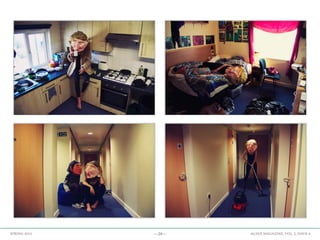
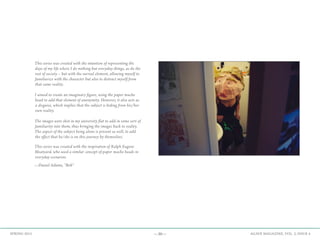
This series was created with the intention of representing the
days of my life where I do nothing but everyday things, as do the
rest of society – but with the surreal element, allowing myself to
familiarize with the character but also to distract myself from
that same reality.
I aimed to create an imaginary figure, using the paper mache
head to add that element of anonymity. However, it also acts as
a disguise, which implies that the subject is hiding from his/her
own reality.
The images were shot in my university flat to add in some sort of
familiarity into them, thus bringing the images back to reality.
The aspect of the subject being alone is present as well, to add
the effect that he/she is on this journey by themselves.
This series was created with the inspiration of Ralph Eugene
Meatyard, who used a similar concept of paper mache heads in
everyday scenarios.
—Daniel Adams, “Bob”
—31— AGAVE MAGAZINE, VOL. 2, ISSUE 4SPRING 2015
VEGETABLES
—Kirie Pedersen
	 “Have you ever known anyone who went mad?”
	 I am driving a famous poet to the place she’ll be staying while she visits the
campus where I’m teaching; her question seems odd for such casual acquaintance.
	 “Never,” I say. In my calm, careful, studious life, of course not. As if she has not
heard, she repeats her question. Now I would turn the question back on her. Now
I would know she had her reasons for asking, and I would want to know what they
were. Then, young and full of myself, certain the world wanted only to hear about me,
I paused.
	 “My God,” I say. “Yes. I did. I did know someone who went mad.” The famous
poet looks at me strangely. “Vietnam,” I say. “The war drove him mad.” As I drive
along the wet dark roadway, I clutch the steering wheel. The rain falls harder, and
within minutes, half the lane is covered, and I steer the car uphill through a dark
torrent of water that surges down towards me.
	 “Careful your brakes don’t fail,” she says then, utterly calm. “That sometimes
happens in the rain.”
	 My nickname then was Rat. You might think this means I’m a shifty person or
a shitty person, and of course you’re entirely right. But really, the name came from
the Vegetable Crate, Paul’s car. My nickname was Carrot because Paul (Cabbage)
insisted for a time that everyone who rode in his car take vegetable names, and I just
went along. Jen, the pretty one, was Cucumber. I barely remember the others who
rode in that car, and they’re not much a part of this anyway, although Julie (Radish?)
went on from those early outings in the Vegetable Crate to become a world famous
yoga teacher.
	 Whereas almost everyone else merely went insane.
	 Toward the end, I lay on the floor of the blood-stained hotel room in Mazatlán,
hoping to die. I was eighteen years old. At the end of the third day, I knew Paul would
never return. I got dressed, paid my bill with my last coins, swallowed a handful of
speed, walked out onto the highway and stuck out my thumb.
	
	 Paul was one of the most truly beautiful men I have known. He was tall and slim
with light brown, very curly hair. He wore it long before it was the fashion for men
to have long hair. His locker was next to mine in high school, and he dated my pretty
sister, Jen. I didn’t know him very well then, just as I didn’t really know my sister well;
only that the two seemed perfectly suited to each other.
	 I got to know Paul better in the summer while I was waiting for college to start
in the fall. I was walking near the waterfront when he drove past me one Saturday
in his 1952 Chevy Styleline with most of the paint chipped off, the powerglide
transmission groaning. The car’s rear end arched like the rump of an old and elegant
woman, holding a luminous bumper sticker that instructed me to ‘Boycott Grapes.’
	 “Ride?” Paul asked, pulling to the side of the road. Once in the passenger seat, I
politely inquired about the Farmworker’s Strike, and soon ended up in a line of men
and women of all ages and backgrounds standing on the pavement outside a Safeway
with more ‘Boycott Grapes’ signs clutched to our chests. I admired how Paul stood
up to hostile shoppers and buyers of grapes with courage and love, but I also found
I was afraid for him, that one of them might hit him in the face.
	 When our small group of picketers left that evening, piled into Paul’s Vegetable
Crate, the box boys just off duty climbed into their cars and followed us, shouting
obscenities from their windows and trying to run us off the road. Paul didn’t even
seem to notice, and after awhile, they spun down a side street and disappeared.
	 Jen and I were what is called Irish twins, born just a year and five months apart.
She always had things better than I did. From the start, everyone raved over her.
How pretty she was, how funny. I was plain-looking. “Doesn’t take a good pic,” my
mother wrote in my baby book. Although I eventually learned how to use make-up
and choose flattering clothes, Jen never needed any of that. When we went to the
city, men stopped her on the street and asked her to model, thrust business cards
into her hand. I just stood in the background smiling, and then told her she was
stupid to even talk to those bastards.
	 I feared for her, always, afraid she would go crazy or get hurt. If she stayed out late,
I was the one who lay awake for hours and cried at the thought she might die.
	 The night of the picket line, I rode home with Paul to the house where he lived
with his mother, Lena. Lena was divorced from Paul’s father, and she offered us wine
and marijuana, implying I could sleep in Paul’s room. Paul placed his large hand
over my mouth and gently pushed me into a chair beside the piano. He removed my
shoes and socks, filled a basin with warm water, and gently placed each of my feet
into the basin.
	 DespiteJen’sbeautyandwit,sheseemedtomefragile.Shewasincapableofdoing
anything for herself; people did things for her. When we were growing up, I was one
of those people. I found her a job. She was fired from that job for day-dreaming.
Later, after I left for college and she tried to follow me there, I found her a live-in
—32— AGAVE MAGAZINE, VOL. 2, ISSUE 4SPRING 2015
housekeeping job, and the lady she worked for fell in love with her too, wouldn’t you
know it, pulled her diamond ring from beneath her mattress and gave it to Jen. Did
I get any thanks? No. She said I had always tried to manage her life, that she was sick
of being my trained seal.
	 “It’s a two-way street,” I said, but she wouldn’t listen. She would go into insane
screaming furies and say whatever came into her mind, as if later it could be erased.
As if anything could be erased and should be.
	 Like Jen, Paul had always seemed different. Strange. That’s why he and my sister
made sense, she with that distance of hers, a kind of fog that seemed to envelop her,
though for brief moments she broke out of her fantasies and talked like a real human
being. Paul, with his angelic voice, his guitar, and his songs about fairies and elves
was the perfect match for Jen. They seemed to protect each other.
	 During the Vietnam War, when boys turned eighteen, they had to register for
the draft. Then there was a lottery, and if they drew a high number, they had to go to
Vietnam. Basically that was it: how it worked.
	 Paul drew a high number. That meant that he had to show up for a physical and
make a decision about what to do. First, he became active in the Unitarian Church,
its services held in a funny old church on Capitol Hill called First Church of Christ
Esoteric. Professors from the University of Washington led groups, and a yoga
instructor from the Free School taught tantric yoga. Once, when I went with Jen and
Paul to the yoga class, Jen glanced up to see the teacher staring at her, thrusting his
pelvis back and forth in rhythm with hers.
	 After the services or classes, everyone leapt up to hug someone. I tensed up while
I waited for some bearded stranger to throw his arms around me and hold me too
closely, too intimately, but also felt out of place because Jen and Paul were wrapped
in each other’s arms and then because nobody reached out for me at all.
	 At the services, Paul played his guitar, inventing long and complicated ballads
as he went along. Later, if asked to sing the song again, he remembered every word
as if the singing of his thoughts committed them to memory. His voice was perfect,
of professional quality, yet it was also a little strange, mournful; when he finished
a song I could see my own tears mirrored in the eyes of others, and then someone
would quickly call for the wine or the joint. Then, if the night was warm and clear, we
all ran outside to dance, each alone, beneath the stars.
	
	 That summer, I was taking care of my parents’ city house while they went, as
always, to the beach cabin. At the last moment, for reasons she explained to no one,
Jen went with them. For the first time in my life, I had a house to myself. Every night,
friendscameoverfordinner,andsomehow,Paulbegantojoinus.Heusuallybrought
an armload of fresh carrots, leaf lettuce, and sweet yellow onions from Lena’s garden,
and I made bread from scratch using squash or apples and whole wheat flour.
	 Sometimes Paul played the piano or guitar or sang, and sometimes everyone
just talked. That summer, we were writing plays, protesting this and that, which we
produced in a local theater. Sometimes I grew irritated with Paul, wanting to be with
my other friends who were more mature, more solid, but then Paul would invent a
little dance and I would find myself laughing along with him. Even in the midst of
our group, he remained slightly separate, and he seemed a sort of fey balance to my
seriousness, as Jen might have been if we had liked each other. But his difference
couldalsobetiringoratleastpredictable.Whateverwasexpectedinasocialsituation,
he could be counted on to do or say the opposite. If everyone was taking some kind
of drug or passing around a joint, Paul could be counted on to reach out his large
hand, seize the entire stash, and swallow it before anyone could stop him.
	 “You could die,” I once said. “You’re mixing wine with pills.”
	 “What’s the difference?” Paul asked.
	 One evening a group of us were writing a play about the Farmworkers. Paul was
supposed to be doing the music. Instead, he danced around the room and sang an
odd off-key song. Finally, one of the other men told him to leave. Paul did leave,
face blank, but for the rest of the evening, I felt uneasy and separate from my other
friends.
	
	 As the summer progressed, Paul became increasingly tense about whether to
enlist and ‘protest from inside,’ as one of our group did, to flee to Canada, or to
apply for status as a ‘conscientious objector.’ I knew he was meeting regularly with
a minister to explore his options. One time that summer, our group attended a war
resistance conference at the University of Washington. As we left the final seminar,
Paul talked about his fear of jail.
	 “It’s simple,” I said. “Don’t go.”
	 “Fuck you,” Paul said.
	 I felt as though he had slapped me. And Paul was right; it was easy for me to say
how simple it was.
	 We finished our production about the mistreatment of migrant laborers in
the grape fields. Our production was successful, and showed to sold-out houses.
Neighbors I never would have expected to see joined us on the picket lines. Paul’s
music was a huge part of the success.
	 Then, near the end of summer, just a few weeks before I was to leave for college in
a distant city, Paul stopped showing up. I called his house. “He left last night,” Lena
said. Her voice sounded odd. “He’s catching the mail boat up the Snake River in
Idaho.” The boat stopped in every village along the river and picked up passengers.
	 “Did Jen go with him?”
—33— AGAVE MAGAZINE, VOL. 2, ISSUE 4SPRING 2015
	 Lena hesitated. “I’m not sure,” she said.
	 “I hope he’s going to relax,” I said. “I hope he returns full of new songs.”
	 A few days later, I was sitting alone in the living room of my parents’ house at
dusk. Although it was summer, the evening was cold, and I had a fire in the fireplace.
I thought I heard something outside, and I went to the window. Paul was standing
on the front porch, silent as he stared through the window at me, his face strange and
hard.Onhisbaby-face,anewlysproutedbeardseemedincongruous,evengrotesque.
He had a huge coat slung over his shoulders, reaching to his ankles so that he looked
like a mummy. I wondered how long he had been standing there watching me.
	 I threw open the door to greet him. The woods around my parents’ house were
thick, almost blue in the twilight. “Where’s the Crate?” I asked him. “I didn’t hear
you drive up.” He lifted me off the floor in a bear hug.
	 “You’re looking good,” he said. Something in his voice made me stand back. “I
wrecked her,” he said then. He was trembling. “I wrecked the Vegetable Crate.”
He stepped over to the fire and held out his hands. “Can I stay here tonight?”
	 “I guess so,” I said. “You don’t want to go home?”
	 “I can’t. She hates me.”
	 “Lena hates you? Paul, what happened?”
	 “I’ve been sick,” he said. “Real sick.”
	 It struck me, as odd thoughts do in moments of crisis or danger, that Paul’s bones
had somehow become chilled. Or was the Snake River trip itself another of Paul’s
fantasies? “Did you have fun on the river?” I asked.
	 “Pile of shit,” he said. Paul still stood stiffly by the fire. His body seemed rigid,
and I touched him on the arm. Then he grabbed me around the waist and flipped me
around so I faced him. “Hold me,” he said. I hugged him for a moment, and he pulled
away so quickly I almost fell. I pushed logs into the fire until the flames rose up and
pushed Paul into a chair.
	 “I’ll make some hot tea.”
	 “Cup of tea. Sure.”
	 When I returned from the kitchen with a tray holding steaming cups of Assam
tea, honey, and a plate of fresh bread, Paul had disappeared. By then the house was
dark, and so was the night outside, although streaks of orange and red remained
for another hour. I set the tea tray on the edge of the fireplace and began to search.
I called his name loudly to drive away my vague sense of danger, and when I heard
the trembling in my voice, I felt foolish and vulnerable. A few minutes later, I found
Paul in my parents’ bedroom, where we had sometimes gathered to write our plays,
everyone snuggled on the bed while one person wrote at the desk that stretched
from one end of the window to the other.
	 He was seated on the floor with my mother’s wicker garden basket in which she
stored flower bulbs, a small trowel and rake, and her gloves. These were dumped in a
heap on the bed. Paul had filled the basket instead with objects he appeared to have
gathered from around the house. He had removed the kickstand from my bicycle.
He had one of a pair of beaded moccasins I had found, almost flawless, in a second-
hand store. He had removed the cash from my wallet and a serrated fishing knife
from my father’s tackle box. As if in prayer, he sat on the floor, the basket in front of
him. When I stepped towards him, he leapt to his feet, seizing the knife as if to ward
off a blow.
	 “Paul,” said. “What are you doing? It’s me. I’m not going to hurt you.”
	 “Helpme.You’vegottohelpme.”Hetookasteptowardsme,theknifestillupheld
in his hand, and I remained frozen in the doorway. “This is my vessel, the suitcase
for a world traveler,” he said. Then, as if he forgot me, he began to cavort around the
room, singing in that odd off-key voice so unlike his own real voice.
	 “Damn you,” I said. “Just stop acting like this.” He looked at me as an animal
might. Then, for an instant, I thought I recognized him, the real Paul. “Hey, Paul.”
I laughed, waiting for him to join me, to tell me it was all a joke, one of his odd
games, and he would be all right now. He muttered something and padded back to
the fireplace, and as I followed him warily, he began to sob, like a small and helpless
child.
	 “Isn’t this pretty?” He stopped and leaned over a begonia sempervirens in a pot.
“Can I have this?”
	 “You can have a start. I’ll break one off for you.” But Paul pulled the plant from
the pot and shoved it, the roots dangling in the air, down the front of his coat. Then
a frightening thought emerged.
	 “Paul, where’s my sister?”
	 “I told you. We went on a cruise up the Snake River for 40 days and 40 nights.”
Paul started to sing a hymn. Forty days and forty nights. Thou wast fasting in the wild.
“Jen left me,” he said. She disappeared.” Paul giggled.
	 “What do you mean?” I was a little panicked by then, although I couldn’t imagine
that Paul would ever hurt anyone. And yet another awful part of me hoped that my
dream, since birth, was at last true, and Jen had vanished forever, as if she never
existed.
	 “There was this haze all around her,” Paul said. “And she disappeared in a cloud
of smoke.”
	 I left Paul to his collecting, stepped out onto the porch in the shivering night air,
and called Jen. Her phone rang on and on, and I was about to give up, when at last
she picked up. She was furious.
	 “I was asleep,” she said. “Don’t ever call me this late.” She slammed down the
phone.
—34— AGAVE MAGAZINE, VOL. 2, ISSUE 4SPRING 2015
	 “Do you think you can sleep?” I asked Paul. I honestly believed that if I could
tuck him into bed, warm him back to life, I could heal him.
	 “Help me. Please help me. You’ve got to help me,” he said. I tucked him into my
parents’ bed, wrapping him in the blankets that comforted me when I was a child.
He tensed and then relaxed, and fell instantly asleep.
	 Sometime in the night, towards three, I was dragged from my own sleep by
strange banging or thumping noises from somewhere in the house. I thought of the
large black rabbit Jen owned as a child. One day she decided to allow the rabbit
to run free, and the rabbit, stunned by freedom, moved further and further from
the house until she vanished into the woods. Later, I found her body, darker and
damp with blood with two bullet wounds through the head. She had stolen fresh leaf
lettuce from the neighbor’s garden, and so the neighbor shot her.
	 Then, still half asleep, I thought Jen had relented of her anger at my calling her the
previous evening. Now she was at the door, and she would soothe Paul. I wandered
towards the sound.
	 In the living room, I found Paul. He had removed his pants and was dressed only
in a tiny coat that belonged to my youngest brother. The coat was made of some
kind of ugly fleece, grey and torn off in patches. The front came to Paul’s belly, and
the sleeves barely reached his elbows, so his arms were held out awkwardly in the
air. Over one of these stiff helpless arms was my mother’s wicker basket, and as if
appointed by some deity that this was to be his life’s work, Paul was completing his
earlier task of collecting small objects. Periodically, he stomped one bare foot against
the floor as though to warm it, or as though it irritated him; this was the pounding I
had heard. Then I saw he had cut himself, perhaps with my father’s fishing knife, and
he was marking the boards of the floor with his blood.
	 It was at that moment I deserted Paul. I hadn’t signed on for this. Some part of
me, perhaps simply a need for my own survival, closed or hardened. I left Paul to his
collecting, returned to my bed, and slept deeply until morning.
	 When I awoke, Paul was gone. I was relieved. I swept the dirt from my ruined
begonia off my parents’ white bedspread, and then swept the floor. I even cleaned
the ashes from the fireplace. Just as I finished, Lena called. That morning, as part of
Paul’s decision to apply for status as a conscientious objector, she and Paul had an
appointment with the Unitarian minister. As they began to talk, Paul pulled out a
knife, backed the minister against the wall, and threatened to kill him.
	 “Will you go with me to see Paul?” she asked. “You’re the only person he seems
to trust.”
	 Lena and I drove through a wind and rain storm that seemed as if it would blow
us off the highway. Paul was on the seventh floor of a huge orange-painted building
that stood on top of the hill as though it guarded the city’s destiny. We shouted our
names through a small barred window. The entry door slid back and closed again
behind us, and we were faced by a second wall, this one made of bars. A grim-faced
man slid this door open and then closed it behind us. After we passed these barriers,
we were left alone, and we entered a hall with a series of doors that opened into small
rooms, each framing a silent white-robed man.
	 In the last room, half the size of the others and stuck near a stairwell so it seemed
even smaller than it was, we found Paul. And then I wanted to open the door I had
shut against him that morning, the same door Lena must have shut that afternoon,
or even before. Paul looked as if a giant hand had flung him onto the bed.
	 “Please make them stop,” Paul said when we came in. “The shots. Killing me.” He
wassoweakhecouldnotlifthisarmsorlegs.Theinjections,presumablyintendedfor
this very purpose, were like a living embalmment. Lena and I helped him straighten
his legs, and then we sat on the edge of the bed. Paul’s body seemed too large for
the narrow cot. When he tried to talk, saliva slid from his mouth. His pillow was
soaked. But a few moments later, when Lena conferred with someone in the hall,
Paul managed a smile for me. “I loaned your kickstand to an old woman down the
street from your parents’ house,” he said. Speaking seemed to cause him pain. “She
needed it to grow sweet peas. Of course I’ll return it in the fall when her flowers die.”
	 We were not encouraged to stay long, and at first, as Lena drove south along the
interstate, slicing through grey mist and rain, neither of us spoke, as if we too were
worn out by injections of huge quantities of sedating drugs. Then, out of nowhere,
Lena asked if I thought Paul was interested in girls, women.
	 “Ofcourseheis,”Isaid.“Heandmysisterhavebeendatingforyears.”Sheglanced
over at me, then down at the steering wheel. She said the day before Paul left for the
Snake River, the next door neighbor complained that Paul had bothered her 12-year
old son, whom Paul was tutoring. She threatened to call the police, but Lena talked
her out of it, and then confronted Paul.
	 “Do you believe her?” Lena asked. She started to cry, and I reached out to touch
her but let my hand fall to the seat of the car instead. To Lena, it seemed to me then,
the chance Paul might be gay was worse than pulling a knife. If he had pulled a knife.
Was Paul locked up and shot full of drugs now because, somehow, of this call from
the neighbor?
	 “What does bothered mean?” I asked. “Did he do something, or was he just
acting strange?”
	 “I don’t believe her,” Lena said. “I think she made it up.”
	 And then I felt angry at Lena again because if Paul had molested a child in his
trust, then he was no better than my father’s friends who so freely abused me when I
was growing up, and Lena no better than my own parents for failing to protect me.
	 Shortly afterward, I left for college. From time to time, I received calls from Lena
—35— AGAVE MAGAZINE, VOL. 2, ISSUE 4SPRING 2015
with news of Paul’s progress at the state mental institution. “Paul is happy,” she told
me. He worked in the greenhouse. He planned to make kites to earn his own way
through college.
	 That wasn’t what happened, though. When Paul was released from Western State,
he was again tapped for the draft, and he fled the country at last. He was living on a
pig farm on Vancouver Island, he said, a commune. “We grow all kinds of vegetables,”
he told me. Joni Mitchell owned a nearby farm, and he might visit her someday, see
if she’d teach him a few tunes. I mentioned I planned to go to Mexico over the winter
break. Although my parents had always been happy enough for me to date their
friends, they were furious now that I was finally dating someone my own age. I had
no desire to ever return to their home.
	 Two days later, Paul appeared in my dorm. He was 30 pounds heavier, but
otherwise looked the same. The visit was ill-timed. My boyfriend was there, and
Paul ended up sleeping on the floor while my friend and I slept on the narrow bed.
Paul left early the following morning, but as he left, he invited me to ride to Mexico
with him. We could share expenses and then each go our own way, he said.
	 The day we left, it had just started to snow, wispy pale flakes. As I waited for Paul
in the student lounge, my boyfriend took a series of photographs. My long hair was
pulled back like a child’s, as indeed I was a child, though I didn’t know it then, and
my hand raised as though to ward off some kind of demon or blow in the fading light.
Paul finally arrived in a battered car, a Buick. Tossing my knapsack into the back, I
slid into the front seat. Paul slammed his foot on the gas pedal, rested a hand loosely
on my thigh, and I waved to my friend as the car screamed down the street.
	 Over the four days that followed, Paul rarely drove at less than 80 miles per hour,
though once we were swallowed by a blizzard white-out on a mountain pass and I
could not see five feet ahead. Once I tried to drive. The ancient Buick had no springs
toabsorbtheshocksthateverybumpandcracksentshudderingthroughme.Almost
immediately, the tires slipped and the car left the road. We plunged through a field
before coming to a stop beside a concrete watering trough lightly frozen over with
ice. Paul took over and tore back across the field at 60 miles per hour, and a few
moments later we were stopped by police for the fourth time on that journey. Paul
waited for the officer to leave and then sent yellow shreds flying out like kites over
the field of snow.
	 In Los Angeles, we stayed in a motel. The room smelled, and my eyes watered
all night. Because there seemed to be no choice and because for a moment I was
aroused by Paul’s halting fingers stroking my side, we finally made love. Maybe you
could call it that. It seemed almost like rape because he refused to give me time
to grab foam for the double protection, insisting a condom was more than enough.
Paul didn’t know how to use a condom, it seemed, though he claimed he did, and
the condom slipped off inside me. I’m not even sure he knew who I was except he
kept telling me how much he hated me. That Jen hated me too. Even if I could have,
I would not have wanted to repeat that experience, and I wished I could erase it. But
on that wild careening ride south, we never stopped again.
	 The next day we crossed the border. We passed the burned-out bodies and buses.
Two days later, we arrived in Mazatlán. “I’ll meet you in a week right there,” he said.
“In seven days.” He pointed at a hotel across the street from where we happened to be
stopped: Los Almas. I think we both knew he would not meet me, but I turned and
walked away quickly up the street.
	 The night before we were due to meet, I returned to Los Almas and with my last
pesos, I checked into the hotel. On the second day, I crawled beneath the blankets
and then onto the floor, staring at the blood-stained walls, wanting to die. On the
third day I pulled on my clothes and checked out.
	 “Mi amigo no viene,” I told the young man behind the desk in the lobby. He was
about Paul’s age, and he stared at me curiously. I walked through a warm light rain to
the highway, swallowed a handful of speed, stuck out my thumb, and waited.
	
	 Jen was by then living in Marin County, another caregiving job for another dying
old lady who adored her. By the time I reached her house, I’d been awake for almost
three days, and I could feel the brain cells shorting out in my brain. Of course I had
to confess, immediately, that I made love with Paul.
	 “I slept with Cabbage,” was how I put it. It seemed a long time since high school.
I didn’t think she’d care.
	 “I hate you,” she said. “I’ve always hated you. Get out.” I cried as hard as I ever had
when I was afraid she would die, only now it seemed I would. She turned away, her
beautiful face hard and cold, emptied against me.
	 In the years that followed, I talked endlessly of madness. I became obsessed with
Sylvia Plath, Virginia Woolf, and Anne Sexton, and was furious with each because
she didn’t stay around to show me how to live through anything. Among certain
arty types, inspired by bell jars and through a glass, darkly, it was the fashion to have
brief spells of madness and even to become momentarily violent, beating out one’s
anger against some lover’s chest. Yet somehow, always, I knew I would never enter
that abyss. I saw madness or the idea of madness as a chasm one somehow chose to
enter, or at least one selected the steps leading to the fall.
	 Then, not yet out of my teens, it was easy enough to abandon and judge. Others
could fall, but I never planned on doing it myself. I would survive as some jagged
beacon, desperate to show a path to those who might be wandering behind, terrified,
blind and severed of roots as I had been, tumbling around the back seat of Paul’s old
wagon, on our way to mysteries beyond imagination.
—36— AGAVE MAGAZINE, VOL. 2, ISSUE 4SPRING 2015
THE CHARM
—Liv Lansdale
	When the woman began dating her ex-husband’s younger brother, she told
herself symmetry was good. “It’s about balance,” she’d say, as if recommending an
all-kale diet or shoeless exercise regime. But soon bad news began arriving in pairs.
Where one robocall would interrupt her dinner, there were now two. Where her
kitchen ceiling once had a continuous crack, a parallel fissure had appeared. Where
a single sparrow would crash into the window of her art studio, she found herself
witnessingagruesomedoublesuicide.Inbedtheyearbefore,herhusbandhadfound
a problem mole on one ankle. Now, in the same bed, the brother was pointing out
a twin dot on the other one. Her spots were special, he said; she was like a butterfly,
effortlesslywardingoffenemies.She’drousedherselfenoughtokickhimandmissed.
Twice.
Driving to the dermatologist the next day, she tossed a wormy apple and reached
for a second one, then turned on the radio: her country had invaded a country
bordering one they’d invaded only two years before. She spit out the second apple.
At home she turned on the tv but all the channels were airing spin-offs of already
lousy shows. “Need to get away?” a toothy man asked at the commercial break. She
did. The first two cabs smelled like months-old pizza and were driven by months-
underage immigrants, respectively, and so she missed her first flight to Florida.
The second plane, the one she caught in spite of having waited at two incorrect
terminals, crashed into Lake Pontchartrain, which as she later discovered, was not
even a lake but an estuary, and thus was both freezing and mislabeled. Later, on the
lifeboat, she would make no note of how her rescuer possessed an eerily familiar
nose, nor of how she could have sworn she glimpsed on his name tag the last name
of her last two loves. Still, as the plane spiraled down, she’d reached automatically for
the third farthest oxygen mask, thanking her third best idea of who God might be for
seating her in an empty row.
ELK RIVER
Water polluted.
Don’t drink from faucets, they say.
I’ll drink booze instead.
—Daniel Lassell
—Ethan Cunningham, “This Ship”
—37— AGAVE MAGAZINE, VOL. 2, ISSUE 4SPRING 2015
TRADE WINDS
—Paul Weidknecht
				
	 A constant breeze, warm and dry, blew across the conical peak of Haystack
Mountain, filling Timothy’s shirt like a sail. He shaded his eyes and scanned the
vista; it looked like something he could paint, a scene much different than home.
Hundreds of feet below, dirt roads snaked through the scrub of cacti and divi-divi,
and clusters of boxy white houses with red roofs dotted the landscape. Near the
coast lay the airport, and beyond it, the turquoise sea and distant blue-gray trace of
Venezuela. From here everything appeared small, even insignificant, and Timothy
tried to imagine himself far from his problems, that they were down there on the
desert floor, just as small, just as insignificant.
	 To his right, Darin crouched like a catcher, tossing barbeque corn chips to a feral
goat that had taken up in one of the abandoned concrete shacks near the summit’s
giant radio antennas. The goat, progeny of those left by Spanish conquistadores over
500 years before, was not eating.
	 “The goat doesn’t want the chips, Darin.”
	 “Goats are supposed to eat anything,” Darin said, without looking back.
	 Timothy turned toward the view again. With two more days left, including the
day trip to Caracas the next morning, the vacation was nearly over and he had not
yet figured it out.
	 At school, Darin and he hadn’t been friends, not even roommates, and other
than Timothy’s tutoring help through an economics class once, the two were just
people who lived in the same hall, a nod here and there while passing each other on
the way to the bathroom. Timothy remembered how Darin’s invitation to go on a
post-graduation trip had startled him. It sounded strange, but also intriguing, and
as friends were never easy to come by, Timothy decided a week in Aruba was better
than spending the summer at home waiting for September and his new job.
	 Come fall he’d put that accounting degree to use, plunge headlong into a world
of credits and debits, a place where his talent for numbers would be realized. He’d
be making real money, not beholden to anyone financially for the first time in his
21 years. He already knew his boss, and knew his boss had given lots of money to
his father’s campaigns over the years. Timothy realized most people would’ve been
happy.
	 Darin stood and let out a breath, shaking the remaining chips from the bag onto
the ground in a vague sowing motion.
	 “Come on, let’s get out of here. I need a drink,” he said.
	 Timothy mumbled in agreement and they began their hike back down the
mountain.
	 Reaching the bottom, Timothy looked gratefully at their dust-covered car, the
one they should’ve never been allowed to rent. Darin had secured the car for them,
getting the rental agent to misread the insufficient birth years on their licenses with
extra cash and a promise to take the rental company’s insurance waiver. Timothy
knewhewould’veneverbeenabletopullthatoff.Hewouldhavestoodatthecounter,
shrugged in defeat at the agent’s refusal, and started thinking about scooters.
	 They were different that way, and Timothy recognized it. A week was never long
enough to know someone, but it was long enough to know some things. At the
blackjack table, while everyone else was grumbling over their hands and hoping for
an ace or a face, Darin was laughing with the dealer, his head thrown back, blowing
a stream of cigarette smoke into the air. Timothy would return from the men’s room
at a club to find Darin talking to the bouncer about lifting routines and maxes or on
the dancefloor between two women, waving him on to join the party.
	 But they weren’t that different—neither was eager for the future as it now
appeared.
	 “Thesepeoplealwayscomeinsmilingwithsomefishthey’resoproudof,wanting
it weighed,” Darin said, as he drove. “And I’m thinking, ‘Chief, I’ve worked in this
shop since I was twelve, what you’ve got there is bait. The only thing more ridiculous
than the fish is that you’re smiling about it.’”
	 During the past week, Timothy learned that Darin and his family loved the ocean,
fishing in particular, and that his father had turned that love into a string of bait and
tackle shops that ran from New Jersey to North Carolina, places Darin spent each
of the last nine summers, and most likely, would spend the next 40 years. As Darin
made it sound like a prison sentence, it occurred to Timothy the best way to turn a
joy into a chore was by attaching a paycheck to it.
	 “But, you know, that’s not going to be the extent of my life,” Darin added.
“Weighing fish, selling bunker and clam to those clowns during a striper run. The
sea can get to you after a while. My dad knew this guy, Lolligan. Ran a charter out
of Montauk. One morning he took his boat out alone, stepped off the stern into the
Sound with nothing but a pair of deck boots on his feet and a jigging rod in his hand.
I’ve got other plans. What about you? You’re going back to that place you interned,
right?”
	 “Yeah. Past two summers.”
	 “Sounds like a job with potential.”
—38— AGAVE MAGAZINE, VOL. 2, ISSUE 4SPRING 2015
	 “Potential for boredom.”
	 Darin glanced over at Timothy. “That’s what you’re supposed to say about 20
years from now.”
	 “I’m good at accounting, but I don’t like it. I’m not going to lie, it pays well, but I
don’t see myself springing from bed each morning to do it.”
	 “A case of golden handcuffs,” Darin said, nodding to his own assessment.
	 Classic case, Timothy thought. The job was uninspiring and, without one speck
of creativity to be found, it reeked of impending sameness. He had to smile when he
realized that when someone used creativity in accounting, it always seemed to lead
to investigation, audit, and incarceration. Painting—landscapes mainly—had been
his real passion, but his parents had a hard time thinking of ‘drawing pictures’ as a
career. He knew they viewed artists as men who wore gray ponytails and women
who wore nothing but black, selling profoundly overpriced works depicting red
barns in golden wheatfields year after year at the county fair. So they allowed him to
minor in art as an armistice.
	 As true as the golden handcuffs statement was, Timothy knew Darin understood
their situations were nearly identical. Like most family businesses, Darin’s salary
would never keep him in Ferraris, with any extra money being plowed back into
growth, but he’d limp along well enough until the old man turned the feedbag over
to him. When that time came, Timothy had no doubt that Darin would trade in the
whole franchise, Cape May to Cape Hatteras, for a check with a lot of zeros. Then
he’d buy the Ferrari.
	 “And you have to know,” Darin added, “that your job security is bullet-proof.
Who wants to be the one to pink-slip a senator’s son? Dude would find himself
under investigation from the IRS, FBI, DEA, and any other three-lettered monster
they could turn loose on him.”
	 In truth, a state senator from a sparsely-populated, agrarian, Midwestern state
hardly had that kind of juice. Timothy discovered a long time ago that most people
didn’t seem to know, or really care, that there was a difference between what his
father did and what went on in Washington. Even as a child, Timothy remembered
how people’s spines would straighten when they’d meet his father, a slight bow upon
shaking hands. But to Timothy, he was still the guy who asked if anyone had seen his
reading glasses as they sat on his head.
	 “You said you had a plan. What is it?” Timothy asked, not caring how pointed the
question sounded.
	 “A person needs a place to begin, a starting point. That point is money. To pursue
a dream—a business, a vocation, anything—a person has to have seed money to
survive on until the dream becomes self-sustaining. I have some ideas, some savings
too.”
	 “Savings are fine,” Timothy said, “but what is your dream, that thing the money
funds? I always thought the starting point was doing something you loved.”
	 “Are we talking idealism or realism, bro? I don’t know my dream. Not yet anyway.
I haven’t gotten that far. I majored in Business because my father thought it would be
a good fit with his baitshops. Didn’t see anything in college that looked worth doing
the rest of my life. Right now I’m exploring, you know, like tomorrow in Caracas.”
	 Timothyturnedtowardthecoast.ApairofhazyoiltankersladenwithVenezuelan
crude sat heavily out to sea. Big city, he thought. More people than lived in his entire
state. In casual conversation with Arubans during the past week, Darin had brought
up their intentions of visiting Caracas for a day trip, a jaunt to see another country,
to say they had been in South America. Most Arubans’ reactions were the same:
wonderment as to why anyone would possibly want to leave their happy island, even
for a day, to go to a place of crime, poverty, and political strife. To Timothy, the
Arubans seemed cautious, even uncomfortable, when discussing this different world
they preferred to see from their mountaintops.
	 The two drove in silence for the next several minutes. They sped past more
divi-divi trees, with trunks twisted and gnarled, their leafy windswept tops blown
parallel to the ground, always pointing southwest. Timothy wondered if that wasn’t
the reason for the lack of road signs in Aruba: there were compasses everywhere. 	
	 “Keep on the lookout for a place to drink,” Darin said.
	 In the distance, the cream-colored walls of KIA rose from a plateau of dark rock.
Timothy knew the Arubans ran the island, but the Dutch still owned it, so they got
to name the prison: Korrektie Inrichting Aruba. It seemed far too large for a 19 mile-
long piece of Caribbean volcanic rock.
	 Ahead on the right, they spotted a small whitewashed building. A battered tin
sign with flaked blue lettering suggested it was a restaurant with a bar. As they got
closer, they realized it was a bar with a restaurant.
	 “Let’s stop here. Grab something and go,” Timothy said.
	 Darin pulled the car into the dirt parking area and stopped, as the dust behind
them billowed in from the road.
	 When they entered, the transition between the sunlight and darkness made
Timothy pause a moment in the doorway to regain his vision. Inside was cool, and
as his eyes adjusted, the shape of a couch and several slumped figures became visible
to his left. On siesta, three local men sat in a row, in various states of sobriety and
wakefulness. Timothy saw no beer company banners, and there was no neon dry
erase board announcing the day’s specials. A trophy wahoo and a threadbare nylon
Aruban flag with its grommets torn out hung on the wall behind the bartender.
Next to Darin, a yellowed map of the island, thumb-tacked on three corners and
curled, was pinned to a corkboard, no doubt posted to head-off tourists’ requests
—39— AGAVE MAGAZINE, VOL. 2, ISSUE 4SPRING 2015
for directions. Two men standing at the bar glanced over their shoulders, then back
to their drinks—Polar Beer from Venezuela—while an older man talked to the
bartender. The old guy looked toward the door.
	 “Bartender, hurry, these two need beer,” he said, laughing. “They look to be
thirsty, maybe even lost.” He turned to Timothy and Darin. “I’m Victor. I imagine
you are from out-of-town.”
						
	 The plane angled against the night sky, allowing Timothy a view of Caracas
thousands of feet below. Beyond his oval window, the bustle of the city was
imperceptible. Brilliant downtown skyscrapers swung from sight, as a rolling
blanket of light speckled the black rises and valleys of the Cordillera de la Costa. The
mountainside ranchos of red-brown brick, cinderblock, and corrugated tin they had
seen that morning on the way in from the airport were gone, anonymous under tiny
white dots. Timothy looked back inside the cabin. The passengers had spread out
across the three-quarters empty plane. Darin sat across the aisle in the far seat, his
chin in his chest, already asleep. The flight attendant, a pretty brunette in copious
makeup, sat belted into her jumpseat facing the back of the airliner, appearing either
bored or aloof; Timothy could not tell.
	 That morning, once in El Centro, the two had gone their separate ways, as they’d
done several times in Aruba. Timothy watched a chess game in the park, grabbed a
cheap lunch just off the Plaza, wandered through a cathedral, and walked outside the
gates of the Capitolio Nacional, where soldiers gripped assault rifles and adjusted
their body armor, alert for the next coup. He imagined Darin bargaining for copies
of street music, sampling food from sidewalk vendors, setting himself on a barstool,
trying to blend with the Caraqueños, the whole while complimenting and insulting
people in equal parts with the little Spanish he knew.
	 They’d met in the evening, with Darin rushing up, out of breath, just in time
to catch a ride back to the airport. Accelerating and braking into the tail lights of
everything on the road, the taxi driver whisked them through traffic, as pedestrians
steppingintothestreetyankedthemselvesbacktothecurb,aghastathismischievous
grin. Timothy looked around the taxi for the softest place to aim his head when it
cametimefortheaccident,andDarinlaughedwitheveryshortstopandlanechange,
living a ‘70s movie car chase scene, declaring that everyone had to experience a
Caracas cab ride.
	 Tomorrow would be different. They’d return the rental, catch their flight back to
America, then separate from there. The summer would end and Timothy would go
to work. For the past two summers his escape had been mechanical and clean, the
return to school a timely refuge. But now he’d prepare for a job that would occupy
the next several decades of his life.
	 He shrugged, silently admitting to himself he was more accountant than painter.
Four years of study had left him average at best when compared to fellow artists in
his class, his eyes seeing the same things theirs had, but their talents better able to
translate that perception into art. He was superior to someone off the street with no
training, but still only mediocre, certainly no one to call professional. For a moment
he felt sorry for himself, then immediately embarrassed, as he shook off the thought.
	 He let his mind wander. He could stick it out until the time was right to leave.
It would only be several years, five tops. He could do that. He’d get an apartment,
something cheap, a walk-up over a massage parlor or community food bank, his only
window above a buzzing neon sign, live on peanut butter and jelly sandwiches and
Ramennoodles(fromthefoodbank,ofcourse),letthemthinkhewasatruebeliever
by studying for the CPA exam, smuggle the Wall Street Journal home from work
each day, study that too, take a chunk of his paycheck and invest well, get up some
savings—seed money like Darin was planning—and then one day just walk, and
keep walking, leaving his beancounter colleagues shaking their heads and muttering,
“Got to give it to him, the guy had a plan.” He had a vision.
	 Moments later Timothy reached up and, with a satisfied smile, slid the window
cover down on the tropical night.
						
	 The airport which had been so busy that morning was now nearly empty;
Oranjestad was sleeping. A custodian ran a buffing machine over the shiny terminal
floor, reaching behind him and snapping the cord now and then to give himself
more slack. Timothy looked over at his reflection in the dark glass as he and the
other travelers walked tiredly, almost in single file, toward the Customs checkpoint,
Arubans splitting off to one window, everyone else to the other. Several minutes later
Darin reached the counter.
	 “Are you two together?” the Customs agent asked, pointing behind Darin to
Timothy.
	 “Yes,” Darin answered.
	 “Then I will take both passports.”
	 Darin placed his passport on the counter, Timothy squeezed his arm past and
did the same.
	 A balding man with a black neatly-trimmed mustache, the agent wore a crisp
white short-sleeved shirt with dark epaulettes on each shoulder. Pinned to the shirt
was a small gold badge that for a brief moment Timothy thought looked comical
and without authority. The man opened Darin’s passport to the photograph on the
inside cover, glanced up at him, and back to the picture. On the opposite page, the
agent checked the exit stamp from the morning. He smirked.
	 “Venezuela for the day,” the man said, as much to himself as to the two. “Do
—40— AGAVE MAGAZINE, VOL. 2, ISSUE 4SPRING 2015
either of you have anything to declare?”
	 “No,” they said simultaneously.
	 Without looking at Timothy’s photograph, he stamped each passport, closed
them, and slid both back across the counter, fingers splayed across the covers.
	 “Thank you,” Timothy said.
	 Darin slung his oversize gym bag from his right shoulder to his left as the two
continued through the terminal, their little rental visible just past the sliding glass
doors, in the front row of the lot under a light, no other cars near it. Timothy thought
they might need to wash it before turning it in tomorrow.
	“Sirs.”
	 The voice came from behind them, slightly high-pitched with a twang. Darin
kept walking, Timothy’s step buckled.
	“Sirs.”
	 Timothy turned to see a Customs officer—someone different—approaching
them, looking at Darin. When the agent reached them, the man stepped to the side,
gesturing with his arm extended in a subtle corralling motion. “If you could please
follow me, this will only take a moment.”
	 “Sure.Istheresomethingwrong?Thatofficerjustclearedus,”Darinsaid,pointing
to the agent at the counter.
	 “Nothing wrong, but please follow me.”
	 Timothy and Darin walked behind the agent, past the counter and the balding
officer. He was looking down, stamping another traveler’s passport. Moments later,
they stepped through an open doorway into a side room where another officer stood
waiting. A long table sat pushed against the wall.
	 “If you would open your bags right there,” the agent said, motioning toward the
table. “I will check them quickly so you may be on your way.”
	 Timothy lifted his knapsack onto the table and threw open the top flap. Darin
slipped his bag from his shoulder, and in three shaky pulls, drew back the long zipper
that ran its length. The officer standing against the wall said something to the other
agent in what sounded like Papiamento. Both shot looks at Darin.
	 The Arubans wouldn’t find anything in Darin’s bag except the varnished souvenir
piranhas and postcards he bought in the airport gift shop in Venezuela—he was
smarter than that—but Timothy realized that when they saw Darin’s hands tremble
they would take it all the way. They weren’t going to stop.
	 Timothy understood all of it, the vacation, the day trip to Caracas, everything.
Victor, the old guy from the bar, had all but foretold his future and he hadn’t even
known it. When the two had mentioned their travels that afternoon—the hike up
Haystack, the drive across the desert, of passing the prison that seemed too big—
Victor explained that KIA was nearly half-filled with foreigners who had tried to
hopscotch into the United States and beyond, with South American drugs by way
of Aruba. He said U.S. Customs or any other customs will not scrutinize a traveler
comingfromArubaasmuchasonearrivingfromColombia,Peru,oreven,Venezuela.
‘Naturally,’ Timothy recalled Victor saying with a chuckle, ‘our Customs knows this
too. And now these people are 2,000 miles from home, with no drugs, no money
and no view of the beach.’
	 Darin was right, Timothy thought, he did have a plan. He was going to raise that
seed money regardless of who told what story, or how many times it had been told.
Darin needed someone who wouldn’t catch on, and someone needy for a friend. Of
course, one whose father was a senator certainly wouldn’t hurt, either as a cover or
in case the unthinkable happened and someone had to call the Aruban government
for a favor. But Timothy knew better, that some favors ask too much.
	 And as Timothy thought of being home, springing from bed each day for work
and happily studying for the CPA exam, he saw the agents push Darin’s bag aside to
search his knapsack, he closed his eyes and tried to recall if Darin had ever been near
it.
—Ethan Cunningham, “Succulent”
—41— AGAVE MAGAZINE, VOL. 2, ISSUE 4SPRING 2015
—Pradeep Raja, “Myanmar Travel Expedition #49”
—42— AGAVE MAGAZINE, VOL. 2, ISSUE 4SPRING 2015
ALONE IN THE TROPICS
Tedium of days without you
all these strangers
still stare quizzically in my direction
as if they were expecting two.
I pause at a fruit stand,
boxes overfilled with papaya,
pineapple and mangoes.
Nothing oozes distance
like the tropics' yellow flesh.
Outside my hotel window,
couples stroll by.
I thank their slow hand-in-hand walk
for ripping out my insides
An email weighs in
from a different time zone.
You must be sleeping now.
That's the news I want to hear
something as up to date
as your head on the pillow.
your body shaping sheets and blankets.
But your story’s set in the past.
And it's mostly the doings of other people.
I struggle to reply but words don't do pain justice.
Meanwhile, the beach, the sun send their regards.
—John Grey
TARANTULAS IN PARADISE
I
He once lived with migrations of tarantulas
making M’s across God’s own country,
bunched by men’s boots
and under porches in Texas,
white-hot with desert
like a tea light under America’s ass.
Once he slapped his hand on one
when he fumbled for the remote.
It bit so hard
a red pea rose in the center of his palm
and stayed for seven days,
an ode to the gray primordial light
of a television screen gone off-station
and filled with snow
that will never fall on south Texas
and never kill warm nests of spiders
marching into sunny paradise,
leaving little footprints
and making little spiders
gathered like a furry alphabet
at everyone’s doors.
In the mornings when he had his coffee
he swept them aside
and settled down in his chair
—43— AGAVE MAGAZINE, VOL. 2, ISSUE 4SPRING 2015
to watch the sun climb
from under a blue band.
He always wondered
how far it traveled—
touching the sea on its way
to all the quiet spiders
hunched like people,
the desert beneath the sunrise
full of pink, purple, red
like a clamshell
or the inside of a human heart.
II
She was married to a Mexican for nine months.
Long before she ever taught Spanish
she rolled the syllables in her mouth
with the flavor of fossil fuels
from his blue gas station uniform,
touching her nails into the sky of his belly.
Once he came home
grinning one shiny gold incisor
and said he found a present for her
on the highway, baby,
he held it up:
a tarantula crouched in the bottom
of a mason jar. She screamed
and allowed it no farther than the driveway.
But like a dream, or a fairytale,
little by little, each day
she let it come closer.
First the porch.
Then the living room.
Then the bedroom, dark with blue
from the great horned bedspread.
Eventually she gave it a little water dish
and black crickets—
it moved like grammar
brought to life by electric bolts.
She named it Rosy.
One day she walked in
and thought there were two—
till she realized
what she thought was a second body
was just a shed skin, a template
next to the fresh and new and naked one
lying still till it firmed up enough
to move again.
When she left the man
she kept the spider.
It lives with her son now,
sleeping in the corner, a soft black W
like the beginning of woman,
a puff of air between the lips,
the language of marriage,
divorce, a life moved on,
desert and road.
III
Never squeeze a tarantula too hard.
Don’t drop it.
It will die instantly.
A tarantula doesn’t wear
its heart on its sleeve—
it wears its bones.
As if to say, this is all I’ve got.
—Kelly Weber
—44— AGAVE MAGAZINE, VOL. 2, ISSUE 4SPRING 2015
—Natasha Natale, “Confidants”
—45— AGAVE MAGAZINE, VOL. 2, ISSUE 4SPRING 2015
—46— AGAVE MAGAZINE, VOL. 2, ISSUE 4SPRING 2015
—Ekaterina Vasilyeva, “After the Firebird”
Russian villages are rapidly sinking into oblivion. The sad statistics show that in Russia, over the last two decades, almost 25,000 rural settlements have
disappeared. Moreover, according to the sociologists, about the same number of them is now on the verge of extinction.
My story begins a long time ago when my grandmother and grandfather, both from the Pskov region (Russia), met in Leningrad (current-day St. Petersburg),
got married and stayed there for the rest of their lives. But, it could have turned out very different. I, now a modern city dweller, could have been born among
those flowering fields and hard-working people.
In his village, my grandfather used to be called a ‘gypsy’ because he could predict the approaching of someone's death. As for himself, he always knew that he
would survive two wars and wouldn't be injured. And so it happened. Concerning my grandmother, he said that she would outlive him by exactly 10 years.
This prediction also came true.
Over the last five years that I have been documenting people from the small Andrushino village in the Pskov region, I have been subconsciously looking for
overt or covert manifestations of people's magic. I think that it is as much a part of our being, as history and geography. Faced with a fabulous world of folk-
lore, you soon realize that it is rooted in totally real ground; that all the beliefs and superstitions, charms and rituals, tales and fables are not just a
warehouse of archetypes of the collective unconscious, but an immediate response of the collective soul to the mysterious currents of the natural elements.
—47— AGAVE MAGAZINE, VOL. 2, ISSUE 4SPRING 2015
YOU COULD PLAY THE GAME
—Bennett Durkan
	The orange lights of the bar replaced the outside world of St. Maarten at night
as Mathias stepped through the door. The establishment, The One Parrot, was filled
with men in red and orange shirts, and women wearing wraps in place of skirts. He
blinked a few times, and the scene remained the same. The pixels and polygons he
had been staring at all day behind were replaced with flesh and blood. Table legs,
where sandaled feet bounced or played footsie, were designed to resemble the
trunks of palm trees. Glasses, which contained an assortment of colorful drinks
sipped through red straws, had umbrellas balanced on the rims. Even the lights were
dimmed and shaded like miniature suns either rising from or falling into the ocean.
The distinct notes of steel drums peeked out of the music.
	 Dodging a mixed group of six vacationers who headed for the door, Mathias
walked to the bar. One of them, a lady wearing three bracelets made out of seashell
shards on her left arm, bumped into him. She laughed and slurred that she was sorry.
Two other members of the group, another girl wearing seashells, but this time as a
necklace, and a man with short spiked hair helped to steady their friend. Mathias
watched them, five walking and one being carried, open the door and fit through the
threshold. When the door opened, a rush of salt water scented air entered. It didn’t
push or pull anything, but just filled in the cracks. Mathias caught one last sight of
the Caribbean beach and the black sand and water. His throat was dry.
	 The bartender was rubbing the interior of a glass with a dish rag. Behind him
were bottles of Captain Morgan, Jack Daniels, Kahlua, and other liqueurs Mathias
didn’t recognize. He found a seat close to the bartender. A cartoon parrot, with
green feathers and a smirk was in mid-flight in the middle of the seat. Cracks and
tears were starting to appear among the bird’s feathers. Mathias hefted his weight on
to the barstool. With both hands on the bar, he edged himself forward until his belly
depressed by a centimeter. He kept his hands where they were, but the fingers on his
right hand tapped in almost random patterns.
	 “What can I get you?” The bartender removed the dish rag from the glass. He
placed the glass upside down in a nearby sink and tossed the rag across his left
shoulder. His smile was bright, favoring one side of his face.
	 “Give me something festive,” Mathias leaned forward. His gut strained against
the bar. “Something tropical. What’s the official drink of the Caribbean?”
	 “I can make all kinds of drinks. There’s the “Screaming Pirate.” That one tastes
like coconuts. “Walking the Plank” tastes more fruity. It’s got some strawberry in it.
Oh, and I can make a “Peg Leg.” It’s kind of like a margarita but tastes like coconut
ice cream.”
	 Mathias’ jaw hung slack, letting out a sustained note.
	 The bartender raised an eyebrow. He sighed and dropped his head. “Listen,” he
said, “How about a Mai Tai?” The bartender opened his arms, and held his hands
up. 	
	 The smile was gone.
	 “Is it tropical?”
	 “Sounds tropical enough.” The bartender picked up the same glass and began
rubbingtheoutsideofitwiththesamedishrag.Mathiasnoddedandpausedtapping
his fingers. The bartender turned his back to Mathias to mix the drink. He paused
after pouring the rum, scanning the rows of bottles before the large mirror. “You part
of the tournament?”
	 Mathias focused on his right hand, curled on the bar. The fingers were splayed.
The tips pressed against the surface and the joints bent in obtuse angles. Holding his
fingers like this, his hand began to cramp. Roots of pain spread out through his wrist.
Mathias began to raise and lower his pointer finger, and the pain subsided a little.
When he stopped, the pain returned. He tested his middle finger, then the rest. The
results were the same.
	 A tall glass appeared in front of him. The bottom was decorated with semi-
transparent green fronds. Sticking out of the top, a plastic sword impaled a fresh
cherry. Mathias grabbed the glass as he would a joystick. His palm hovered over
the ice, and he tilted the drink in the cardinal directions. The drink sloshed, and,
when he tilted it too far, a few drops rolled down the side, moistening his thumb. His
elbow was fine, and this wrist didn’t bother him. He licked his thumb, but the skin
still stuck to the glass. The Mai Tai was sweet.
	 He removed the plastic sword, and placed it on the cocktail napkin. He raised
the drink to his lips. The ice cubes touched the tip of his nose. Before he was able to
take that first sip, another body pulled out the stool beside him and sat down. In the
corner of his vision, Mathias saw the new man drop a half-full tumbler onto the bar.
He turned to see his competition.
	 “Matty Boy!” Conner said. His eyes looked as though they had a screen of
lamination, and Mathias could taste the unflavored alcohol on his breath.
	 “Hello, Conner.” Mathias knew his competition. He was familiar with all of the
—48— AGAVE MAGAZINE, VOL. 2, ISSUE 4SPRING 2015
competitors and their handles, but Conner was different. While he wasn’t playing,
Mathias would watch Conner hunched over his gamepad used for arcade fighters,
biting the side of his lower lip, and with his face lit up by the smaller, personal screen.
Both of them had climbed through the brackets.
	 “Please, call me Con.” He lifted the tumbler and took a swig at the amber liquid.
Ice clicked against the glass, and clicked against each other when he put it back down.
He smiled and leaned his weight on his elbow.
	 “What a competition it’s been. You and me in the finals. Can you believe it?” He
played with the tumbler, tilting it in the same manner Mathias had done. “For a little
bit there, I wasn’t sure I’d make it past the semi-finals. That second round was a close
one.”
	 “Itsurewas.”Mathiasstaredatthecylinderbodyofhiscocktail.Thecondensation
rolled down and soaked into the napkin. He remembered how fast Conner’s fingers
hadmoved,pushingthebuttonsinsequencewiththejoystick.Down,down-forward,
forward with heavy; back, down-back, down with a light— plus a hundred more.
He had those sequences memorized. Mathias also had them memorized. All of the
defeated competition had. Next to his drink, Mathias pressed his finger into the wet
napkin. The pain shot through his wrist faster than he could lift the finger.
	 Conner threw his head back and released a laugh. His shoulders and chest
trembled. When he was done, he dropped his head and shook it in long, slow swipes.
He finished the rest of his drink in a quick swig, and continued to shake his head.
The laminate quality to his eyes vanished and he leaned toward Mathias.
	 “Listen,” Conner’s eyes narrowed and his voice dropped a register, “This last
match is going to be hard. I’ve got a deal, a little bit of compromise, for you.” He
leaned closer and but his arm around Mathias’ shoulders. There was just a small
container filled with thin stir straws between them. “This secret has to stay our secret.
Are you familiar with collusion?”
	 “Uh, yeah. Hold up, what do you mean?”
	 “Life is unpredictable. We’re good. We’re both good. I’ve watched you play and
I know you’ve watched me. Who’s to say who’s better—the winner?” The smile was
gone. His eyes were out of the orange lights. He bit the corner of his bottom lip
between sentences. “That could be the luck of the draw, a roll of the dice, a fickle
RNG.”
	 Mathias let out a single scratched syllable. He moved his hands to his lap and
rubbed his wrists. The sting blossomed in those small bones. On the bar, his drink
sweated. The ice cubes were smaller than when the Mai Tai had been delivered.
	 “Let’s do the math for a second. First prize is 6,000.” Conner was close enough
to whisper into Mathias’ ear, but chose not to do it. “Second: two. You’ll get one and
I’ll get the other. But if we work together, and split the earnings, well, then second
place’ll get four-thousand. That’s, what, a 100% increase.”
	 Mathiasreachedforhisdrink.Hedrankamouthful,chokedabit,andputitdown.
He coughed into his hand, the one that was not hurting. Conner leaned back enough
so that a third head could join the conversation if one were inclined. His eyes were
narrow and clear, and a vertical line deepened between his flexed eyebrows. Having
the drink provided Mathias with an excuse not to look Conner in the eyes.
	 The entire room was quiet. The conversations, the over-gesticulations
accompanied by laughs, and the island music out of the speakers were muted. The
high pitched notes of the steel drum were the one part of the music which broke
the muffled sound. Against the wall, two bespectacled competitors, who had been
eliminated in the first round, sat on either side of the one female competitor who
made it to the quarter-finals. Her arms were stiff, the same as when a counter took
her out. Down on the other end of the bar, the bartender grabbed a few dollar bills
from a departing customer. He opened the register, sorted the cash, and then closed
the drawer. Another man wearing a bright blue shirt under a wide brim straw hat
balanced three shot glasses in a small pyramid. The door, at too far of an angle to see
a good picture outside, opened and closed.
	 All of that practice, the hours spent in the glow of the television screen choosing
to disregard real life for the love of the game, was threatened by that drunken aroma.
Plane tickets do cost money and, even though the entry fee covered the hotel,
luxuries were expensive. And, he could pay back his parents for purchasing these
games as Christmas presents.
	 “Let me think about it,” Mathias said as he sipped at his Mai Tai. He could hear
Conner’s breathing and the sound of him swallowing the melted ice water at the
bottom of the tumbler.
	 “E-sports,”Connerletoutanotherdeeplaugh.“Ibetyourparentswould’venever
guessed you could make money playing Marvel vs. Capcom. Mine always said I was
wasting my time.” Scraping the stool back with his thighs, he stood up from the bar.
He gestured to the bartender. He pointed at the empty glass, raised one finger, and
jerked with his thumb to a booth on the far wall. “E-sports,” he said, more to himself,
before he left.
	 Mathiastookanotherdrink,lettingitrestonhistonguelonger.Whenhelowered
the glass, he saw his reflection mimic the motion in the mirror behind the bar. He
saw the reflections of his dark skin and his head balanced above the thin necks of
bottles. Behind the reflection, the room was an airbrushed painting— alive. Blurred
colorsmixedwithblurredlights.Heclosedhiseyesanddranktherestofthecocktail.
The bottom of the glass hit the bar with more force than intended. Mathias clenched,
but relaxed when cracks failed to appear. The bartender approached. He picked up
theglassandcockedhisheadtooneside.Mathiasshookhishandandreachedforhis
—49— AGAVE MAGAZINE, VOL. 2, ISSUE 4SPRING 2015
back pocket. The bartender nodded and took the glass to the sink. Mathias removed
his canvas wallet from its pocket. Yoshi on a white and green background smiled up
at him. He undid the Velcro, and opened the main pocket. There were a few wrinkled
bills of small denominations. A five was between two ones. Mathias removed the
five, with its corner bent over. When he unfolded the corner, a thin green-white
crease remained. He placed the bill on the bar. The bartender came back, holding a
small receipt. The bartender grabbed the cash, and held the receipt out for Mathias.
Mathias shook his head. After the bartender returned with the change, a single and
flimsy dollar, Mathias rose from his stool.
	 Hedidn’tstarttowobble,oratleastnoticedthathewobbled,untilhewasoutside.
He didn’t have much practice drinking. He stood at the crosswalk down the street
from the neon sign for The One Parrot. A tubular bird, perched above the door,
opened and closed its beak. Mathias looked over his shoulder, saw the bird, and
smiled. When he untwisted his torso, he lost his balance. The base of the crosswalk
signal provided support. He hunched, and the cracked and segmented pavement
under his feet spun. When the signal changed, he crossed the street, to where water
lapped against sand.
	 The sand was softer than the pavement, less solid. It gave way under foot, and let
sore feet find some cushion. Mathias, stepping from the sidewalk on to the beach,
stumbled.Hisfootsankintothesanduntilitcoveredthetoesofhisshoe.Hestepped
forward with his other foot, and the process was repeated. Lifting a foot above the
beach, sand fell in and around his socks. The uncountable grains found crevices
where they could hide out for hours.
	 Mathias sat down a few feet from the water. Here, the air was warmer and carried
the taste of uncooked fish. He untied his shoes and held them upside down. Some
sand poured out when he struck the shoe’s heel. He stuffed his socks into the shoes,
and lounged back. Watching the water induced motion sickness, like an active
computer screen, moving from monster closet to monster closet, against a flat wall.
His wallet was a reminder in his back pocket. The Velcro latch and the inside zipper
were the thickest parts. He closed his eyes and pictured the shape of the zipper
pressing against the canvas material of the wallet and his cotton shorts. The slight
breeze off the ocean washed his arms and face.
	 His hands curled into their gaming position. Sand dug under his nails. Having
them behind his back tested the muscle memory. With one hand, he mimicked the
button presses while the other hand covered the stick movements. Each imagined
press caused an imagined action which Mathias knew from sleepless hours spent
memorizing the combo lists were accurate to the game. He saw each frame of
animation in Phoenix’s low kick and Frank West’s straight punch. The wallet pressed
into his buttocks, and the pain in his wrist returned with spring time colors.
Cheers, followed by the unmistakable sound of vomiting, disturbed Mathias. He
turned and saw a shadow of a person, with hands on bent knees, several yards down
the beach. The figure dry heaved a couple of times before taking a few more steps.
Something fell out of his hand, and he fell forward. Mathias winced as he saw the
person’s face collide with the beach.
	 “Are you okay?” Mathias called to the person, who emitted a few different sounds,
none of which sounded positive. Mathias stood, brushing the sand from his shorts.
He had to wince when his right wrist bent at a sharp angle. It may have been the
combination of the dark and the distance, but the person wasn’t moving. He kicked
aside his shoes and began to walk along the water’s edge.
	 The lights from the street were weak this close to the ocean. The person remained
in shadows as Mathias approached. He called out but received no answer. When he
was close enough for human features to be seen through the dark, Mathias’ foot
hit the dropped object. He bent down, picked it up, and held it above his head so
that some light shone upon it. It was a glass tumbler. Sand stuck to the rim and the
streaks of moisture that had run down the sides. Mathias’ jaw fell at the same time as
the tumbler. He crouched on one knee, placing his face a few inches from the person.
It was Conner.
	 Strong breath, much stronger than in The One Parrot and with more ingredients,
escaped Conner’s slack jaw. Mathias looked to the sea, and sucked in air. Conner’s
eyes began to move behind closed eyelids, and he was snoring. Mathias shook his
competition by the shoulder. The snoring was interrupted, but continued once
Mathias removed his hand. He could see a smile in the corner of Conner’s lips. Drool
dribbled on to the beach.
	 Mathias took a step away from Conner. He regressed until his heel sunk into
the wet sand. A line of warm water wrapped around his ankles and threatened to
lure him out to the deeper parts of the sea. In the darkness, Conner didn’t look like
a person. The long shadows over the body took away some of that recognition. He
could have been a cell-shaded character while the game was paused. Just press start
and you could play the game. Mathias blinked a few times, but the image before him
remained the same.
	 He walked around to where Conner’s right hand lay on the beach. The fingers
were long and thin between the more rounded joints. When Mathias took the hand
in his own, Conner mumbled something. Mathias froze. The heart he couldn’t
control pounded against his chest. He thought that it could be heard over the
rustling of the waves and the low bustle of traffic. Conner’s mumbles faded, and
the snoring returned. With a sigh, Mathias wrapped his right hand around Conner’s
middle finger, the longest of the bunch. Between the six buttons on the gamepad,
the first three fingers covered two each. Mathias tightened his grip, the pain in his
—50— AGAVE MAGAZINE, VOL. 2, ISSUE 4SPRING 2015
wrist reaching beyond its former confines. He pulled that middle finger backwards
until he heard a snap.
	 He dropped the finger, which was starting to show discoloration in comparison
to the rest of the hand. Conner began to wake, mumbling. Mathias took off running.
Traction was hard to find so he needed to move on all fours for the first few steps.
When he looked over his shoulder, Conner examined his out of place finger. He
fell forward and screamed into the sand. He thrashed about, kicking up sand and
digging hand-size trenches. The second time Mathias looked over his shoulder, far
enough away to watch longer, he saw Conner, just a body in the shadows again, curl
into a ball. Between the sobs and the screams, Conner repeated swears.
	 Still in his stride, Mathias snatched his shoes. He placed one in the crook of his
armpit and removed the sock from the other. Hopping, and trying to slip his raised
foot behind the shoe’s tongue, Mathias turned to Conner. He was doubled over and
pounded a fist on the ground next to his forehead. Mathias fitted his foot in the shoe
and began with the other. The screams were no louder than the waves or the traffic.
The pain that had been growing through Mathias’ arm subsided.
ODE TO PROMISE
Promise,
you seem possible
at 35,000 feet.
How easily the woman
in the middle
and the man in the window seat
have fallen
into a conversation
that leaves me out
though I can’t help
half-listening
while pretending I’m absorbed
in a mystery.
I gather the man works
as a convention facilitator
but dreams
of finding someone
who can draw
and execute the design
he’s developing
in his head
of some gadget
that promises
to make him
his millions.
Now, Promise,
I have to doubt
what I’m hearing
—Ethan Cunningham, “Rummage”
—51— AGAVE MAGAZINE, VOL. 2, ISSUE 4SPRING 2015
but the woman,
a grade-school principal,
seems to have once known
the very person
the man needs—
her former husband,
who couldn’t keep a job
as a draughtsman
but, when sober,
could realize any idea
into a contraption
more efficient
and more elegant
than imagined.
The problem is
she hasn’t seen or heard
from him in years,
doesn’t know
how to reach him
or even
if he’s still alive.
But, maybe,
her daughter, Leslie,
could be the ticket.
The girl stopped tinkering
with the hearing aids
she’d somehow collected
right after
her father disappeared
but now
she’s a rising senior
bored with majoring in Econ,
the best of doodlers,
with all her father’s promise
in her genes.
Now, Promise, I’m thinking
that these two must be
Putting each other on
but they’re exchanging numbers
and the man’s agreeing
that, yes,
he’ll try calling Leslie
as soon
as he’s off the plane.
Indeed,
what’s farfetched
seems so promising
to them
that I apologize 					
for overhearing
and ask them to back up
and tell me his idea,
which I’m sorry
I missed.
But, Promise,
they just glare,
indignant,
their forming partnership
clearly no business
of mine,
the woman turning back
to assuring the man
her Leslie’s the one.
—William Aarnes
—52— AGAVE MAGAZINE, VOL. 2, ISSUE 4SPRING 2015
THE MONTHLY BILL IS WHAT?
—Robert A. Bak
	 It has been a long, hot and humid summer of record-breaking temperatures,
with little relief and no end in sight. Jane and Jerome have had the air conditioning
and all of the ceiling fans running 24 hours per day. Every four hours they check
the dehumidifier in their basement, before it threatens to overflow onto the floor.
Window drapes have been closed for weeks, in an attempt to keep the heat out.
	 One afternoon Jane goes out to get the mail, takes a look at one of the envelopes
and her hands start to tremble. It is the monthly bill from the electric company. She
walks into the house and tells her husband Jerome that the bill is here.
	 “How many zeros do you think the bill has?” Jerome asks. By this time Jane is
sitting down; the stress is too much, she just sits and her hand shakes. “Are you going
to open the envelope or not? You are going to give me a heart attack.” She gently asks
if he would like to open the bill.
	 “You know I have a weak heart, no you open it up.”
	 Jane, feeling brave, opens the envelope and looks at the bill; she puts the paper
down, picks it back up and looks at it again. All the while, Jerome is being driven
crazy.
	 “OK, how bad it is?” Jane, by this time has composed herself a bit, and answers
him back.
	 “It’s $24.12,” she states. Jerome starts to laugh a strange laugh, as if Jane is toying
with him.
	 “How could that be?”
	 They both stare at each other, not knowing what to say or do.
	 “Let me look at last month’s bill, and see what that amount was,” Jane replies. She
goes into their small room, which is like an office, and gets out last month’s electric
bill. She returns back into the living room, sits down, and opens the envelope. Then,
a look of total surprise comes over her face— she cannot believe what she is seeing.
Of course her silence is causing Jerome to get more and more upset.
	 “Enough already, what was last month’s bill?”
	 Jane, cannot believe what she is about to say. “It was $24.12.” They both look
at each other quizzically: How the hell could both bills be the same amount?
Especially given the amount of electricity they have been using, just trying to stay
comfortable. 	
	 “What if we go outside and see what the electric meter says,” Jerome suggests.
They both go out the back door, down the stairs and to the electric meter on the side
of the house. They look at the meter and there are five dials with numbers on them,
showing how much electricity they have been using. Jane checks the numbers on
the bill with the numbers on the meter, and guess what? They are the same numbers.
	 Jeromethenlooksatthecentersectionofthemeterwheretheblackroundwheel
goes around as the amount of usage occurs. To his surprise, the wheel is at a dead
stop— no movement, nothing is happening.
	 Jane and Jerome both go back into the house and Jane sees a telephone number
to call for customer service. She dials the number, and of course gets an automatic
answering selection from which to choose. All she wants is to speak to a person
about their problem. She carefully selects number five and gets the type of music
you get when you are on hold. Finally, after a couple of minutes, a voice comes on
the phone and asks, ‘What is the problem?’ and ’How can they help?’
	 Jane then tries to explain what the problem is to the customer service agent. The
agent has to put Jane on hold; of course, the agent is not sure what to do. After a
minute of more music, the customer service agent is back on the phone.
	 “How do you know the unit is not working?”
	 “Because the black wheel is not turning around and around, and that is causing
the five small white wheels not to turn either. They read 23111,” Jane explains.
	 “The black wheel is not turning around,” the agent repeats. Jane is now getting
frustrated with these questions. Have they not heard about this before? She then
explains that last month’s bill also read 23111. Moreover, of course, Jane is back
on hold again. Jane wonders what could be so difficult about the problem with the
meter not working.
	 After another minute, and more music, the agent is back on the phone, thanking
her for waiting. “We hardly ever get customers who are telling us our meters are not
working. Our customers just keep paying their monthly bill, and hope we do not
find out about the broken meter. At least you where honest to tells us. We will be
sending out a repair person in a couple of days to replace your broken meter. Since
it was our equipment that broke, I don’t think we can really know how much power
you were using.”
	 Jane is very surprised by this. “Doesn’t your meter tell you when it is not
working?” 	
	 “Our older meters could not do that, but our new electronic ones, which you
are going to receive, as a built-in alarm system. The company will call you when the
repair person will be coming by. Again, we thank you for being so honest about our
problem.”
—53— AGAVE MAGAZINE, VOL. 2, ISSUE 4SPRING 2015
	 Jane gets off the phone and tells Jerome about the conversation and that they will
be seeing the electric company technician in a day or so. A couple of days later, while
Jane was out of the house, a technician did come by, and spoke with Jerome. He
installed a brand new electronic electric meter. No more black wheel going round
and round on end. No, this was a state-of-the-art piece of equipment.
	
	 A few weeks later, the monthly bill arrived in the mail. Jane was not sure she
should open the envelope, so she gave it to Jerome. Busy playing games on his tablet,
he finally took it and opened it. There was a smile on his face as the bill was more
in line with what it should have been, given powering all of the air conditioning
and fans. Their new bill was for $200.50. Relieved, Jane and Jerome felt confidant
they had made the right decision contacting the electric company about the broken
meter. Soon, fall would be approaching. They could fling open their windows, and
breathe in the fresh, cool air.
—Richard Vyse, “Man Edge”
My passion is to create art that celebrates an imagined, idealized
contemporary man or woman. I prefer using Indian Ink and
watercolours for a sensitive contour line and spontaneous brush
strokes for tones. I work quickly as if the pose and subject will
leave soon. I hope the viewer feels the joy and beauty in my line,
shapes, colours and composition. My art is a seemingly simple
statement that comes from a layered and complicated process.
—54— AGAVE MAGAZINE, VOL. 2, ISSUE 4SPRING 2015
Looking back, I'd like to think,
This was just a needed drink.
A sip from an accustomed cup
To steer our courses back to luck.
Those days when we would never shower
And spend whole evenings blaming powers.
Hoola-hooping till we dropped.
Drank until we couldn't stop.
The Earth: our mattress.
The stars: our shows.
We lived from cars
And cited prose.
We walked to feel the dirt and mud.
We kissed to feel our bodies flood.
We'd tell each other, "Just one more."
But the end was not what we hoped for.
The weekend was our soul salvation.
The backdrop for our sun libations
Found in camp among the trees,
Care was put to every breeze.
Despite the early setting sun,
Or grey skies overhead today,
Thoughts of our spring love eternal,
Still spread warmth and light my way.
CIVIL DISOBEDIENCE
Sometimes when I am lost in darkness,
I think back on summers bright and blue.
The wind, the wisp, the way it smelled,
And that is when I think on you.
Turn back to times when the sun still shined.
Never mind the frost brigade.
Cold upsets the mind, if nothing else
The winter causes shade.
We used to joke the light eternal.
Make jokes about the drawing shade.
Our spirits and ours souls were vernal.
Our hearts were rhythms swank and swaying.
We'd dance around horrific fires;
Pyres that cut the night like blades.
It wasn't just about desires.
No, love was what our union made.
But that was in another time, yes,
That was in another place.
We swore it was to pass the time;
Love was not the measured pace.
We had our chances, years ago,
To see, like summer, how things grow.
How things set when light shines in,
And coats the mind and warms the skin.
—Chad Lutz
—55— AGAVE MAGAZINE, VOL. 2, ISSUE 4SPRING 2015
—Brad Garber, “Desert Wall”
—56— AGAVE MAGAZINE, VOL. 2, ISSUE 4SPRING 2015
THE CLEARING
downtown before-you-were-born doors
locked reminiscence outside
Dozing early air
after another miasma of moon and exhaust
it sponges windows to the silver time of dimes
all that could be
living became a launch on the splay of sunset
and night's swarthiness
sedentary old tiles surround signs modern
as cereal boxes
starting over sidewalks are gray scrubbed slates
Punctual the herringbones
appear like potted trees and in pension hindsight
the clerical perm stays classic
a narrow shaft of coffee rescinds the night
Along terrycloth brick
heelclips pique the toddler eardrum
streetcombers in the adolescent afternoon
stampede despite
the musty two-timers of today that emerge
They grope for a key to
their wrong car
tomorrow will be yesteryear until
that's stale
Still no one talks
of evening's astronomic edge
—Katherine Holmes
—57— AGAVE MAGAZINE, VOL. 2, ISSUE 4SPRING 2015
REMEMBER
Remember.
If I were to lose you.
As if he was leaving.
A striking woodcut.
A light watercolour.
Like twins.
To feel everything together.
Towboats.
A single star.
Aldebaran.
—Pavel Petr
Translated by Sylva Ficová
TRIFOCALS
While most people see once I see
everything in threes. When we meet
I see you minutely and fully, taking you
through my eyes and we are so close
glasses are an impediment, they must
be folded and placed out of the way.
I take you in not once as you think,
during the actual meeting, but for
all the hours I am awake before we meet,
I see you sleeping, I see you rushing,
I see you washing and brushing,
I see you holding up clothes and deciding,
I see you wearing only a towel on your wet hair,
and you are perfect, you fill me with awe.
I see you when I am waking and rushing,
picturing you through every slow moment.
After we meet, I see you for hours and hours,
a bright aftereffect, an image that stays in
my trifocalizing eyes. Perhaps I should look at you
through a pinhole cut into a piece of black paper
and see your image on smoked glass, like
other people must view a solar eclipse.
—Leonard Orr
—58— AGAVE MAGAZINE, VOL. 2, ISSUE 4SPRING 2015
I took these photographs in the fall during a volunteer trip to Cambodia. The bamboo train is an easily assembled and
disassembled method of transportation that is used for locals to gain easier access to goods and locations, and for tourists as
a fun experience in Cambodia. This shadow economy sprung up when Cambodia's rail system became defunct; the bamboo
train is now the only operating railway transportation in the country. However, there is now talk of restoring the rail lines,
which would mean the demise of this impromptu system. I wanted to capture this sense of unexpected opportunity, sadness,
and wistfulness by taking photographs of the neglected tracks and the rural landscape.
—Maria Picone, “Bamboo Train” | Battamburg, Cambodia
October 4, 2014
—59— AGAVE MAGAZINE, VOL. 2, ISSUE 4SPRING 2015
SMOKE AND FOG
On one side of the road
was ice and fog,
on the other, smoke and fire.
We were driving by the river
while the fire burned above us
a quarter-mile away.
Cool on the driver’s side,
and on the passenger’s,
the closed window glass
was hot to the touch.
Suffocating smoke
billowed into the air,
suffusing the atmosphere
like waterless blood.
The river was clogged
with floes of ice
melting in a sudden thaw.
Drawn out of the snowmelt,
a hazy fog hung low
over the water.
Above our heads,
above the roof of the car,
the smoke from the fire
met the fog off the ice.
The road took us
straight up the middle,
as if that were a choice
we were free to make.
—Anne Whitehouse
—60— AGAVE MAGAZINE, VOL. 2, ISSUE 4SPRING 2015
OUT AT SEA
Iwish I was on a ship
cruising through the great Pacific
or Atlantic
but all I have
(and all i am)
is this small craft of wood.
My hands pulling the oars wearily,
the waves lapping violently.
I see the music,
I hear the dancing
of the giant RMS Titanic
but all I have
(and all i am)
is this small craft of wood
pulled by the winds,
dragged by the storms.
I hope at least
I were a warship
but I doubt they will hear when I sink
for all I have
(and all i am)
is this small craft of wood
drifting
towards the sky.
—Adam Lau
UNEASE
Reaper of corn and sorgrum so soon hasten to sleep
In the wake of the mounting daylong toil:
If so: how does he account for such allowance of unease.
Not so much a place as toward a vanquished feeling,
But not until the evening and return of morning sun;
 
Thus implanted does the seedling foretell its own growth
Whether or not like weeds push through above ground,
Greater times than the people have known:
How did they allow across countyline giving spoil themselves,
Fending for a living at the behest of Washingtonian strangers;
 
Ingathering of harvest touts the well being of home
Thereabout the work of men in might of their own weak hands,
Porous land and darken skies; magpies sweep into the mount of trees:
Song birds tweet & sing, beckoning sweet afternoon music seranade,
Gossamer  hope without loss; subsides autumn windy river undertow;
 
As a child—father brought us home from Kensington Park
Billie Farmer, his sister Kas—on return across dustback road,
Then did finches and bluejays flitter  thereabout  backyard at noonday,
But today brings us hope and embracing care for a brand new day,
That which was and should be; will never revisit our way again—.
—Brian Tatum
—61— AGAVE MAGAZINE, VOL. 2, ISSUE 4SPRING 2015
AND IN THE END YOU’LL HEAR ME CALLING
—Terry Barca
Explain It To Me.
	Michael was doing his best to explain, but I’m a bit thick, so it took a while. It
had something to do with a comet passing very close to Earth. The science world
had been looking forward to the event for 76 years, which is a long time to look
forward to something. But you know scientists, they like stuff to be exact and that
is the amount of time this comet takes to do a big circle—no, I shouldn’t say that,
Michael wouldn’t like it, it’s not a circle it’s a whatsameacallit? An egg shaped thing-
a-me? An ellipse, that’s it, not a circle, but you knew what I meant.
	 Anyway, it does this big egg shaped circle and it comes back, and the seventy six
years is almost up. Now, I kinda get all that; well not really, but I can see how stuff
might come back, a bit like a boomerang, and I’ve seen a few of those. It’s really cool
how they fly in a big circle. It drives dogs crazy, ‘cause they think that they can chase
it but it keeps turning and if they had just stayed where they were it would have come
straight back to them.
	 So, why was I telling you that?
	 That’s right: the comet.
	 Everyone’s all excited and Michael is doing his best to explain something to me
which is kinda cool ‘cause he knows how hard it is for me to understand stuff but he
keeps on trying. He never treats me like I’m dumb, even though I am. He’s my friend.
Always has been my friend.
	 When his ‘smart’ friends would call me names at school he would tell them off
and if that didn’t work he would punch them in the ear. He couldn’t hardly hit good
but he knew that if they didn’t quit it I was was gonna pound ‘em, and I could hit real
good!
	 I didn’t like people pokin’ fun at me. I got into a lot of fights and Michael was
doing his best to stop me getting kicked out of school. It was a posh school and they
tended to kick out anyone who did not fit in; that pretty much described me.
	 My foster parents sent me to this school because they thought it might help me
to not be so dumb. You know how people are, they figure that if you throw enough
money at a problem it will go away. Of course it doesn’t always work.
	 The headmaster of the school told me that if I got into one more fight I was out,
even though my foster parents offered to build a new science wing. I was tryin’ real
hard but stuff didn’t stick. Michael called me ‘Teflon’ and I didn’t mind ‘cause I knew
he was just being a mate, but it was an accurate nickname—nothin’ stuck, except
when Michael showed me how.
	 So, this comet is on it’s way and everyone is excited but Michael is excited and
worried all at the same time and it’s the worried bit that he is desperately trying to
explain to me.
	 “If it does what I think it is going to do, it is going to pull the Earth off its axis.”
	 “So, what’s this ‘axis’ thing again?”	
	 “You know how the Earth wobbles from side to side as it spins and the wobble
causes the seasons?”
	 “Yep, you told me about that years ago.”
	 “Ok, so imagine if something made the Earth tip over a lot more. The pole would
be exposed to the direct rays of the sun and all the ice, not just some of it, would melt.
This would make the oceans rise and many low lying areas would go slowly under
water. There’s a pretty good chance that it would all sort itself out over the course
of a year but it is going to cause a lot of damage and a lot of panic as well as a lot of
homeless people.”
	 “That doesn’t sound good. You should tell someone. Who do you tell about
something like that?”
	 “I’ve tried telling them mate, but they don’t want to listen, and I can see their
point. I’m a young science graduate with zero experience and all the heavy-weight
scientists in the world say that everything is going to be fine.”
	
	 Michael was making sense; he always did, even if it did take a while for me to
understand it. If Michael was right, the Earth was going to look very different when
—62— AGAVE MAGAZINE, VOL. 2, ISSUE 4SPRING 2015
this was all over.
	 The north and south pole would be in different places, especially if the Earth did
not tilt back into its old position. The ice would eventually reform and the oceans
would eventually recede; if the ice formed over land instead of over the water as it
did now, the ocean level would drop and seaside towns would be a long way from the
sea, which was the opposite of what everyone was expecting from global warming.
	 This sounded pretty cool to me. I would be able to see all the exposed shipwrecks
alongtheshorelines.Iloveshipwrecks.Michaelboughtmeabookaboutshipwrecks
and it’s still my favourite book.
	 Michael’s got about a year to convince these half-wits that this is all gonna
happen. He said that there is lots of stuff that is gonna have to be done to prepare for
it. I asked him if we were gonna need to build an ark. He just laughed and said that
wasn’t going to be necessary but we were going to have to feed a lot of people over
many months until the Earth tilted back.
	 Michael was particularly worried about the children. Kids are always the ones
who cop it the worst in wars and disasters.
Turn Left.
	 The small white van dropped her off with the following instructions. “Make sure
that the children turn left and head for the top of the hill.”
	 This was Sarah’s assignment. The one for which she had been training. If the
emergency arose, all the children were to be taken to safety, taken to higher ground.
Volunteers had been called up.
	 Do you want to help your community? Sarah did, so she came forward.
	 When the van left she was the only adult for miles. Sarah had not been an adult
for very long. She felt the weight of her assignment.
	 The children must make it to safety. The corner she was on stood at a reasonable
altitude but the children needed to be higher. By the time the van had dropped her
off there were children all over the place. It was a bit of a mess.
	 All day long she said the same words over and over. “Turn here and head to the
top of the hill. Good people will be waiting for you.”
	 The same words again and again.
	 From her elevated aspect she could see the rising water off in the distance, and
every child who went past her and made the correct turn was one more saved. This
went on all day. A continuous stream of diminutive humanity. Many were holding
hands, but not a lot were singing.
	 Each child was carrying a small box wrapped in brown paper and tied up, rather
expertly, with string. If her job had not been so important and if she had not been
concentrating so hard it would have reminded Sarah of the line from that song in
The Sound of Music. Just as she was remembering the line, when the dog bites, the
little white van stopped and out jumped a dog. It was an Australian Shepherd, if she
wasn’t mistaken, and she wasn’t. She wasn’t frightened of dogs either.
	 The van sped off.
	 No instructions this time.
	 Sarah thought that they had probably sent her the dog to help her with her task.
She explained to the dog what she had to do and she used the sentence, ‘herd the
children up the hill,’ because she deduced that the dog would know what ‘herd’
meant and probably had a good idea what a hill was as well.
	 Dog took to the task with gusto. She loved herding and in the city there were very
few things that needed herding. She had tried herding people but mostly they didn’t
like it, and there was a bit of yelling and throwing of things. She tried bringing back
the stuff that they threw but that seemed to make things worse. Next she tried cars,
but they just ignored her and it got a bit dicey a few times so she packed that in.
	 But here, she was actually being asked to do the thing she was born to do.
	 She was gentle but firm and on more than one occasion she had to use her nose
to make some small human keep moving. Small humans smelt good, all ‘pockets full
of sweets’ and sticky hands, and they didn’t mind if you licked some of it off. She
enjoyed that part but she tried to be professional.
	 It was starting to get dark and eventually the line of children dwindled down to
nothing. Sarah was exhausted but Dog could have gone on a bit longer. There was a
small park on the corner which had running water from a rainwater tank and a toilet.
Sarah didn’t fancy going behind a tree but Dog did not mind, although sometimes
even a dog wanted a bit of privacy.
	 They slept together on the soft grass, but not before they ate the food that the
little white van had provided.They never saw the little white van again but next
morning, at first light, the children started coming up the hill again. Dog kept things
going while Sarah washed up and used the facilities. “Turn here and head to the top
of the hill. Good people will be waiting for you.”
	 Days turned into a week. Sarah and Dog survived on tank water and the contents
of those little boxes wrapped in brown paper and tied up with string. Children being
children,wouldoccasionallydropaboxandforgettopickitup.Theboxescontained
—63— AGAVE MAGAZINE, VOL. 2, ISSUE 4SPRING 2015
a type of army field ration. Not very appetising but it was food, about enough to
keep a child alive, but only just.
	 If you have ever had a job requiring a repetitive action you will know that after
a while your body carries this out without you having to think about it and your
mind can concentrate on other things. Sarah’s mind was thinking about those little
boxes tied up with string. They didn’t look like they had been prepared by a machine
so Sarah was imagining a long table with ladies loading those tasteless food bars
into those little boxes, wrapping then in brown paper and then expertly tying string
around them and leaving that clever little bow that acted as a carry handle.
	 “Who taught them how to tie that bow?” Sarah thought. Sarah also wondered
why the little white van did not have any markings on it and why she wasn’t given
one of those cool orange ‘fluro’ vests. Maybe they had run out by the time they got
to her. Maybe her task was not important enough. They could at least have given the
dog a vest.
	 Maybe they would give her a t-shirt when this was all over.
	 One week turned into two and Sarah could see that the water was still rising but
not as fast. She was tired all the time and her clothes were very dirty. She tried to
wash them, especially her ‘smalls’, as her mum used to call them, but without soap
nothing really got clean. Sarah was not at all sure that she smelt good either, but it
was hard to tell with no other adults around and she didn’t want to ask one of the
never-ending line of children. Children always thought adults smelt bad, it was part
of their thing.
	 Dog didn’t care how she smelt. All humans had their own distinctive odour, it
made them easier to find in a crowd. Dog noticed that Sarah’s odour was changing.
She was very weak and not very well. Dog worried about her as she was the leader of
her pack now and she wanted her to be strong and decisive.
	 Sarah got weaker and the children kept coming. There did not seem to be as
many of them but they still kept on coming. Sarah lay down next to Dog. She needed
her warmth; she was very cold.
	 Sarah did not wake up the next morning. Dog nudged her a few times, the way
she always did but she knew it was no use. Her leader was gone.
	 Dog got up, stretched, went behind her favourite tree and headed off to work.
That night Dog lay down next to Sarah and guarded her body. It was the least she
could do for such a brave pack leader.
And In The End, You’ll Hear Me Calling.
The men covered her body with their coats. Dog thought about frightening them
away; it was his responsibility to guard the body of his pack leader. It had taken
several months for the water to recede enough for people to begin returning to their
homes, or what was left of them. Most would have to be demolished and rebuilt, but
unlike most disasters they had had time to prepare.
	 Michael saw to that.
	 For a while the press treated him badly. They said he was a crank and doomsday
naysayer, but eventually a few scientists started to listen to his theory and perform
a few simulations. They worked out that it would all come down to the finest of
margins. If the comet passed by and was a few kilometres closer than the scientists
had predicted, then Michael’s prediction would come to pass.
	 We just had to wait. Accurate measurements could not be taken until the comet
was at least six months out. Obviously the comet had struck something during it’s
76- year round trip and this collision has altered its course, ever so slightly.
	 Six months was not a lot of time but some things could be worked out in advance.
Humans were at their best when they had their backs against the wall. When it
became obvious that the young scientist was right, the call for volunteers went out.
This was similar to war time and everyone was encouraged to do their bit.
	 Sarah saw the posters. Do You Want To Help Your Community? She was one of
the first in her area to sign up. She had heard stories about her great aunts becoming
ambulance drivers and working for the land army during the war. She knew that she
had to do her bit, just the way that her female ancestors had done.
	 The training was strenuous and she slept very well at night. She enjoyed the
company of the other young people and a sense of adventure was thick in the air. She
was told that wherever she was sent, she would probably be working alone, so she
needed to be self-reliant. There was to be a whole network of support to help these
volunteers do their appointed tasks, but when it all kicked off, the support network
fell apart and the volunteers were very much on their own.
	
	 Dogs were to be an important part of the disaster relief effort. A call went out for
people to bring in their dogs so that they could be trained for relief work. Time was
short but dogs were quick learners.
	 DogbelongedtotheSmithfamily.Theylivedinthesuburbsandlikemosthumans,
they did not know that their cute little puppy would grow up to be a working dog
who needed a lot of exercise and mental stimulation.
	 Dog was driving the Smith family crazy. They thought that a large back yard was
—64— AGAVE MAGAZINE, VOL. 2, ISSUE 4SPRING 2015
enough for a big dog, but Dog needed to work. She needed to round up stuff. Sheep,
people, cars, she didn’t care what it was she just needed to round them up and make
them move in a certain direction. She didn’t know why, she just knew that she HAD
to do it, and it was making her very anxious because, apart from the times that she
managed to escape from the prison that was her backyard, she couldn’t find anything
to herd.
	 Dog loved rounding up the Smith children and the kids cried when they took
Dog off for disaster training, but the adults were relieved to see her go. Dog loved
training. All day, every day she got to learn new things. Food and water was always
provided and there were treats for those dogs who learned the fastest. Naturally Dog
got a lot of treats.
	 Thedaycameforhertogointoaction.Theyloadedherintoawhitevananddrove
her part way up the hill. The van stopped and the driver opened the door so that Dog
could get out. The van drove off and Dog could only see one adult human and a lot
of little humans. She ran over to the young woman and waited for her instructions.
	 “Herd the children up the hill.” Said the young woman.
	 Dog didn’t like being stuck in that van but it was worth it because now she got to
herd small people up a hill. This was going to be fun.
	 By the time the sun went down and the small people stopped coming, Dog was
getting hungry and little bit tired. She and the young woman ate some biscuits and
curled up on the long grass and went to sleep. Dog was happy to have a job, and even
happier to have a pack leader.
	 Many, many days had gone by and Dog was hungry and tired. She loved her job
but it had been a long time since the children stopped coming up the hill and she had
been working alone since her pack leader had gotten so tired that her body stopped
working. Dog had done her best to keep doing her job while keeping one eye on her
dead pack leader.
	 Everynowandthenshewouldhavetoleaveherjobandbarkalotsoastofrighten
away the scavengers. It made Dog’s job very stressful but she was loyal and true and
she was not going to let anything happen to the young human’s body.
When the other humans arrived Dog was too weak to frighten them away, but she
relaxedwhenshesawthattheyonlywantedtoputtheircoatsovertheyounghuman’s
body to give it some protection. They offered Dog food and she was grateful.
Sarah’s parents kept her medal in a wooden box on a table in their sitting room.
A vase of flowers stood next to the small wooden box. They gave Dog a medal too,
and a new home. She wasn’t going back to the Smith family and even though she
would miss herding the Smith children she was glad that she did not have to live in
that backyard. Her new home included humans who understood her and a lot of
sheep that needed constant herding, which for her, was absolute bliss. Even at her
new, happy home she never forgot the young human they called Sarah.
	 They pinned a medal on Michael as well, which was fair enough. It was his insight
and bravery that gave the world time to prepare. They could not save everyone and it
would take many years to repair the damage but at least they had time to make some
preparations and that was all down to Michael. Michael insisted that his friend Ian
had to be with him on the dais. He told the media that it was Ian who gave him the
strength and courage to keep fighting. Without Ian, the world may not have had the
time to prepare.
	 Ian knew that his friend was just being kind, but it was a lot of fun being made a
fuss of and receiving extra attention. He told everyone that Michael was the smart
one,andthathewasjustalongfortheride.Afterall,everysuperheroneedsasidekick,
and Ian was proud to be by Michael’s side.
SHOP AGAVE MAGAZINE ONLINE
Current and archived copies of this publication, including annual subscriptions
and more, are available in our online shop: http://AgaveMag.bigcartel.com
—65— AGAVE MAGAZINE, VOL. 2, ISSUE 4SPRING 2015
AGAVE PRESS LIMITED EDITION SERIES
Our newest extension, Agave Press, is looking for manuscripts, artistic portfolios and mixed genre work to bring to print in 2016.
Reading periods will be open from September 15 to December 15, 2015.
We are looking for writers of short fiction/non-fiction, poetry, as well as artists and photographers with an established body of high-quality
work who are able to engage a modern readership. Mixed genre manuscripts incorporating any of the aforementioned categories will also be
accepted.
In preparation for submission, please ensure that:
-This is an original, previously unpublished work, that has not been published in its entirety elsewhere, including the web
-Minimum length: 15 pages; Maximum length: 40 pages
-All documents are submitted in a pdf format in an easily read font such as Times, Helvetica, etc.
-You have a valid e-mail and mailing address at which you can be contacted for all queries related to the project
-Inclusion of a brief synopsis of 1-2 paragraphs introducing your work
-Author bio, specifying past publications, where appropriate
SIMULTANEOUS SUBMISSIONS WILL NOT BE ACCEPTED.
For more information, please visit our website: http://www.agavemag.com
We wish you the very best of luck and look forward to reviewing your work.
—The Editorial Staff
—66— AGAVE MAGAZINE, VOL. 2, ISSUE 4SPRING 2015
THE ELEMENTS
She steals fire from the gods. This potent flame
forges mountains, worlds, stars—burning brand
of creation. Other elements tame
this blaze—still air, cool waters, rich black land.
She tills the earth, expands her homeland wide—
she spies distant countries, unexplored lands.
From rock she builds a bridge so she can stride
over mighty seas and blistering sands.
She wrestles with the wind, forces savage
icy gales to moderate, so silent			
zephyrs guide instead. This stormy passage
is brief, for she makes the wind compliant.
	
But seas change; blue calm stills fires, lands, and breeze
compels elemental furies to cease.
—Michelle Matheny
Over the summer, I had decided to experiment with the use of roses as a
central theme for portraits of women from different ethnic backgrounds,
and the visual qualities they can bring to them. The main set of photos I
had created was titled Rose Queens. I had then decided to create a set
of spin-off photos with the same models to explore different concepts such
as music and 50s fashion, whilst still using roses as a primary subject and
as a cohesive bond, giving each queen their own identity in the process.
—Kareem Berjaoui, “Soul Rose”
Model: Rhiannon Ishmael
—67— AGAVE MAGAZINE, VOL. 2, ISSUE 4SPRING 2015
—68— AGAVE MAGAZINE, VOL. 2, ISSUE 4SPRING 2015
The Color Series is a product of fusion between photography and unfinished paintings and drawings. What started off as a dissection of color within the realms of
photography, ended up being a year-long project that incorporated world class musicians like Tallia and Tahsan, ballerinas like Samantha, and academics like Naira
into the fold. Initially, The Color Series was just that: a study of color in photography. But as the concept took hold, the process became much more of an experimenta-
tion in black and white photography with layers of paint on canvas and in Photoshop. The inverted, upside down perspectives only added more layers to the process that
was already evolving into a project worth pursuing. As the first segment of The Color Series comes to a close, the process remains as vibrant and as binary as ever.
—Jyoti Omi Chowdhury
Models: Naira Khan, Tahsan Khan, Tallia Storm (pg. 67); Samantha Adams (pg.68)
—69— AGAVE MAGAZINE, VOL. 2, ISSUE 4SPRING 2015
FIDES
It’s a good life. Remember?
The smells, the stairs? Remember the boys,
their scent, their sound? Under their clamor,
joy scrambles. In silence, there is the cool floor;
shadow across the black, black iris. When it rained, the wet leaves shook their coats too,
remember? Scent of the quaking mole below, in bright heaven the
chattering squirrel. Each season, the one coming, the one going,
all good, very good. The man’s voice, the woman’s voice;
the forbidden places to sleep deep sleep
shaken by vivid dreams and the lovey stretch.
The bad things to chew, so delicious, such tasty
transgression; the perfumed garbage, the fierceness
upon danger, the whole body patrolling, remember? Triumph, then hands up
and down the spine, so delicious.
The idle fingers on the head, the secret rub under the
coffee table. The coffee! Smells everywhere. The wind,
was good. Go again. Flying over the sparked lawn,
no new day, no old day, but this one, everlasting.
—Merridawn Duckler
MY FATHER’S BARN
After forty years as a forgotten masterpiece,
it appears unchanged where it waits
on its island of time,
the distance between here and there
a disused field,
the rain-blackened soil a stage
over which a misty scrim rises in remembrance
of a play whose actors are dead.
The wind sweeps across the hard land
and everywhere the endless rows of yellowed cornstalks rustle
like a priest who has come to hear my last confession.
He will never know how much I enjoy my perditions,
and the thirty seconds spent inside his shriving pew
is just appeasement. When it’s time for absolution,
I tell him sins are barn swallows
that refuse to fly at dusk
and pardon comes with any summer storm.
Does any place deserve a pardon if we cannot save it?
My temporal and spiritual guilt sometimes overwhelmed me
because I didn’t do enough to preserve my Americana—
think Norman Rockwell standing here,
waiting on the sunrise,
anxious for everything to come into focus
for his still life, each color soon swirling
into a biased fiftyish sentiment
in which parents fuck only to procreate.
—70— AGAVE MAGAZINE, VOL. 2, ISSUE 4SPRING 2015
I see his field stone foundation stacked without a crack,
pine log walls notched and caulked at the seams,
a pile of split wood beside the house,
sweet alyssum in bloom, a hummingbird flitting between lilacs,
and the honeybee’s occupation of spaces
in the V-shaped roof where they disappear
into a hole beneath the ridge beam,
weathercock watching until wind sends it spinning.
He will never see the spring-fed pond out back,
the water clear all the way down to its muddy bottom,
the cold, welcome shock of it in summer.
Buckler ferns circle its shoreline
where children bound like wild things,
until my father calls them inside.
They sleep as the Alleghenies watch over their dreams.
I dream back to that likeness my past makes
in the mirror of memory. Step away
and the moment collapses—
The ghosts
of our world go on living inside those ruins,
where the daily light ushers in neglect.
One day a fire will come and burn all our paintings.
that we left behind.
And the ash that remains
will settle into silence like Buddha mind.
Inside the barn October light pours through holes in the roof,
reaching the floor where it fades to gray.
The cold could be a color too—
like the jacket of ice the pond is wearing.
I sit on the ancient tractor,
a red and rusting machine
that used to lurch out of the morning shadows,
scattering deer from orchards
whose trees are now unrecognizable old men
that grapple with privet and brambles.
Sickle-sharp gusts slice through open chinks
A rusty chain rattles where it hangs from a dusty yoke.
Not everything is dead here, unless it’s the afterlife
I hear in the rafters—wings fluttering like the tiny hearts
that hide there.
Here change arranges time the way it must.
Will this moldy hay ever turn to dust?
I could use the stable doors again by burning them
in a hearth. And love? Well, I still love
those things that are missing from this earth—
things that winter long and hard.
—Michael McManus
—71— AGAVE MAGAZINE, VOL. 2, ISSUE 4SPRING 2015
FORMATION
the gift of a minute an hour maybe
gift of an outright guffaw at my lot strained through my fingers
like cold jelly
aspic
on the fine dining-room table served with white gloves
paterfamilias gives it my blessings
the guests dig in
—Christopher Mulrooney
TO UNCARING
Lost in the grey loneliness.
Cognition intruder— rustling from the mind.
Unclear threads, passion, cruelty are awakened.
The fruit is not conspiracy.
The lunatic, genius of silence!
Get closer to the unspoken.
The analysis of reason— slavery!
During walking, visible shame!
Exciting autonomy,
Opened door, the windows,
Draft!
In the mist, the stairways
Leading off to heaven.
Paralyzed conscience,
Portable mirror.
In the plural against fluency,
Conducting, behaviour,
And admit the guilt.
The line connecting,
The road to the spacecraft.
We walk on by in dishonor.
Bronze woman,
Brass man!
—Tatjana Debeljacki
—72— AGAVE MAGAZINE, VOL. 2, ISSUE 4SPRING 2015
CHARDONNAY
—Michal Onofrey
	He decided to walk to the Third Street Promenade because walking would help
to ease his hangover. It wasn’t a vicious hangover, more like a cerebral burr rising
from the nape of his neck. He had no car, by choice. He owned a bicycle and it was
a major part of his life because everything he needed to get to was within bicycling
distance from his small apartment atop a detached double garage that faced a quiet
alley. His was a simplified, downsized lifestyle that he had arrived at via divorce
and a whole lot of self-introspection. The self-introspection had taken place at his
mother’s house in the San Fernando Valley, a refuge in the wake of his not-so-good
marriage and its painful demise.
	 HehadbrieflyconsideredusinghisbicycletogotothePromenade,butinaddition
to a hangover he had time on his hands, lots of time. Walking would consume more
time than pedaling. Another alternative was the bus, but what for? The Promenade
wasn’t far away, 15 minutes on foot. He rarely used the bus to go anywhere.
	 An overcast Saturday morning, 11 a.m., haze forecasted to burn off in the early
afternoon,hightemperatureof75degreespredicted,atypicalsummer’sdayinSanta
Monica, California.
	 His apparel consisted of a short-sleeved plaid shirt, a pair of khakis, and a pair of
sport shoes. He was rangy and walked with a forward tilt. The cloth handles, or grips,
of an olive-green canvas bag were nestled in the palm of his hand. At the Promenade,
he would get a cup of espresso coffee. Beyond that, he would look around. These
were his thoughts.
	 TheThirdStreetPromenadeisapedestrian-onlystreetwithamall-likeatmosphere
that is subject to the elements, but weather is rarely problem, for Santa Monica is
blessed a favorable climate: ocean lapping at sandy beaches, temperatures moderate,
smog swept inland courtesy of a sea breeze that comes to life most every afternoon.
The Third Street Promenade, in addition to being weather-comfortable, is a safe,
upscale place, maybe even chic. It is a popular place and just about everybody finds
their way to the Promenade—families with children, young people of the teenage
variety, other young people in their twenties, middle-aged people with viable careers,
as well as the retired and the elderly, some of whom make use of canes, walkers, and
wheelchairs. The Promenade is an “up” place, an optimistic place, a place to meet
friends, a place to shop, a place to eat, a place to see a movie, a place to have a drink,
a place to hangout. It is a perfect place.
	 Arriving at the Promenade, he found it busy with people, but it wasn’t an
overwhelming, pushy crowd. It was a leisurely crowd. The espresso café he entered
hadaline,butthatwastobeexpected.Whenhisturncameattheregisterheordered
a double espresso and a plain croissant. After this he had to wait for the espresso to
be brewed, and when it came up he walked over to a counter that faced a plate glass
window that gave out onto a view of the Promenade. A table was out of the question.
He didn’t mind standing at the counter, though, because it gave him something to do,
which was to look at people strolling along the Promenade.
	 It was shortly after he had begun people-watching that his eyes latched onto
a sign in the window of the bookstore across the way. Calendars Half-Price. How
fortuitous because the only thing in the world he needed, and wanted, was a wall
calendar. But since it was already August he had figured that he’d have to wait until
Decemberbeforefindingcalendarsonsale.Ofcoursehissmartphonehadacalendar,
as well as everything else in the universe, but it just wasn’t the same thing as a wall
calendar. As he discovered, even though his smartphone was extremely functional
and handyhe sometimes found himself a bit disoriented in his apartment because
he’d go to glance at a calendar on the wall in his mini-kitchen and there wouldn’t be
one. Getting out his smartphone and bringing up a calendar just wasn’t the same
thing.
	 In addition to potentially yielding a calendar, the advertisement in the window
of the bookstore also supplied him with something to do and somewhere to go.
After finishing his double espresso and croissant he walked over to the bookstore
and entered its quiet confines. The bookstore wasn’t nearly as busy as the café. There
were people, though, people browsing. Of the three cash registers, one was staffed.
	 The calendars, as he had assumed, were the current year’s calendar, and they
were on a big table at the front of the store, a special table that was probably used for
promotions of one sort or another because it was not only a super large table but was
also a table with a four-inch-high wooden lip around its perimeter, which kept items
from slipping off the table.
	 At the table there were four people: a man and three women. One of the women
was elderly, another middle-aged, and the third was young, perhaps a high school
student. As for the man, he was middle-aged, too, like the one woman. At each of the
table’s four sides one person stood. He added his body to the side where the elderly
lady stood.
	 The calendars had no arrangement or order. They were simply flung out over
the table, five or six deep. Since they were all sealed in clear plastic their appearance
was that of brand new, but of course since it was August “brand new” came with a
footnote.
	 HespottedaVanGoghcalendarandpickeditup,thecalendar’sfront-sidepicture
—73— AGAVE MAGAZINE, VOL. 2, ISSUE 4SPRING 2015
a portion of Wheatfield with Cypresses that he recognized because he had been
interested in Van Gogh at one time, having read The Letters of Vincent Van Gogh, and
then having had a Van Gogh calendar on his kitchen wall in a previous apartment,
which, as he now recalled, was the apartment he had shared with his not-so-good
wife, Cindy. Those were crazy times. He set the Van Gogh calendar down.
	 A Klimt calendar caught his eye. “The Kiss,” as was usual for a Klimt calendar,
was on the cover. He turned the calendar over to see what it had to offer, by way of
its monthly miniatures, and found a good selection. The previous year he had hung a
Klimt calendar on the wall of his current apartment, a calendar that he had brought
with him from his mother’s house, more precisely his bedroom in his mother’s
house because Klimt was a little too risqué to hang in her kitchen. Upon moving into
his current apartment, he had hung the Klimt up in his mini-kitchen where it had
outlasted the year, for it wasn’t until the beginning of February that he finally took
it down. Of the Klimt reproductions, though, he hadn’t tired. Like all good art, the
more he looked at a Klimt painting, or print, the more he saw and the more it grew
on him. Klimt, he decided, was a strong possibility. He draped his canvas bag over
the wooden lip of the table and leaned the Klimt calendar against the bag.
	 The lady to his right, the elderly lady, said, “Isn’t this clever?” He looked over, but
he wasn’t really sure if she was addressing him or not. When his eyes found the lady’s
face, she smiled while holding a calendar up for him to see, which seemed to confirm
that she had spoken to him. In any event, they were engaged now.
	 Thewoman’shairwassilver,butthereweretracesoflavender,hairstylesomething
like a pageboy, very neat and very professionally done. Her glasses were large, frames
perfectly round. When the woman blinked her eyes the image of an owl came to his
mind. The calendar she was holding up for him to inspect featured bulldog puppies.
	 “Oh,yes,”hesaid.“Veryclever.” Theotherthreepeopleatthetablehadn’tlooked
up, and he had the feeling that maybe this wasn’t accidental.
	 The lady with the bulldog puppy calendar said, “Here you go. You can have it. It’s
a lot better than that.” She gestured with her chin toward the Klimt he had set aside
and held out the bulldog puppy calendar at arm’s length for him to take. Pink lipstick
was on her lips, no smudging. He caught a whiff of perfume, something formal,
Chanel No. 5 perhaps.
	 “Oh, no thank you,” he said. “I’m not interested in dogs.” He grinned in what he
thought was a friendly manner.
	 “Well,” the lady said, “I’m not interested in dogs, either. I’m a cat person.” She
dropped the calendar abruptly, her view going to the table, owl-like eyes blinking
like shutters. Her hands started rifling through calendars like she was searching for
something valuable, a ring perhaps that might have slipped off her finger. Her purse
was on the table to her right. He couldn’t help but to watch her, but this didn’t last
long because she suddenly snatched up her purse and walked away from the table.
She circled around the table instead of going in back of him, which allowed his eyes
to follow her as she went to the doors of the store and exited.
	 He moistened his lips with his tongue and noticed that the middle-aged man
at the table was grinning, yet there was no eye contact between him and the man
because the man’s eyes remained downward. The man was looking at a large Ansel
Adams calendar, black-and-white reproductions.
	 His view went further to the right where the middle-aged woman stood at the
end of the table. Her mouth was closed, but there was movement in her cheeks,
perhaps a piece of gum or a piece of hard candy, or maybe a suppressed smirk or
giggle. Her face was without makeup and her brown hair was in a loose ponytail that
ran long and lazily down her back. She was wearing a denim work shirt, long sleeves
turned up to mid-forearm, and was looking at an Ansel Adams calendar too. He
was tempted to ask if she and the other man were a unit of some sort, because the
workings of people and coincidence had always fascinated him. He smiled to himself
while imagining such a scenario and looked back down at the table of calendars.
Stepping over to where the lady had dropped the bulldog puppy calendar, he fished
out a Vermeer that was half-buried, and stepped back to where he had been, so as to
keep his canvas bag at his elbow.
	 HelikedwhattheVermeercalendarhadtooffer.Itwasagoodselectionasalmost
any selection of Vermeer’s 36 existing paintings would be. He heard the tinkle of
metal and looked to his left and saw the teenage girl with a ring of keys in her hand.
Isolating one key, she used it to nick the plastic of the calendar she was holding. Her
forearms and her face were plump, skin white, no traces of a tan. With the plastic
nicked, she shoved the knot of keys into a pocket of her jeans, hips of the jeans wide.
She wasted no time in peeling the plastic off the calendar, embarrassment absent.
Her small eyes, which appeared to be light brown, were involved with the calendar
in her one hand, while her other hand wedged the crinkly plastic under a nearby
calendar to bury it and be rid of it.
	 Glancing at the middle-aged man and the middle-aged woman, he found them
deeply involved with the reverse sides of their respective Ansel Adams calendars.
The teenage girl, a few pink blemishes on her blanched complexion, was turning the
pagesofthecalendaronemonthatatime.Thecalendar’sthemewasheavilytattooed
people. She had set the calendar down on top of other calendars. The pictures were
vivid and colorful. The girl’s face was expressionless. Her black T-shirt had fractured
silver paint across its front, broken words and broken people with microphones.
	 He was thinking that one of the salespeople would have noticed the girl leafing
through the calendar, which would have indicated that the plastic had been removed,
but no salesperson came over, maybe because there was only one salesperson in
—74— AGAVE MAGAZINE, VOL. 2, ISSUE 4SPRING 2015
sight and she was at the one and only open cash register. But she wasn’t busy because
there were no customers at her register. She was looking at a computer monitor that
was part of the cash register. The possibility that she might have been purposely
ignoring the situation at the calendar table occurred to him.
	 Next,securitycamerascametomind,forhebelievedthatallretailestablishments
were under electronic surveillance and that someone, somewhere, was looking at
those images with the idea of detecting irregularities so that floor staff could be
notified. Thus far, though, this sequence of events hadn’t matured. The girl was now
well into the calendar, October on display. His view rose. The girl was staring at him.
	 The teenage girl had abandoned the table and was on her way to store’s automatic
doors that she breezed through without remark. He looked at the calendar with the
tattooed people that the girl had left lying open, and then he looked at the middle-
aged man directly across the table, and then he looked at the middle-aged woman
at the end of the table to his right. Both the man and the woman had set their Ansel
Adams calendars down, and, of all things, they each had picked up a calendar that
featured the American Southwest, mesas and buttes.
	 His mild headache was shifting. He felt it advancing from the nape of his neck up
through his head and he knew it wouldn’t remain mild for very long. He attributed
this change to the disruption of his mental stability, for his thoughts and thinking
were in disarray because everything that had occurred since arriving at the table of
calendars was in variance to what he had assumed and expected. He looked down at
the Hopper calendar that was in his hand in an attempt to anchor himself. Clutching
his bag in one hand, Hopper calendar in the other, he headed for the cash register,
taking the receipt and the calendar from the cashier, dropping them into his olive-
green canvas bag and leaving the store.
	 Outside,theskyhadclearedandthesunwasissuingwarmrays.Hestood,looking
for direction, a river of people swirling around him like so many upbeat eddies. He
wished he could join them, but he didn’t know how.
	 Of course the growing issue of his hangover and its headache was coming to
bear, but hangovers and headaches were a familiar issue. It was at this juncture that
the middle-aged woman in the denim work shirt emerged from the doors of the
bookstore. She was alone and in her hand she had a plastic bag with the name of the
bookstore on the side of the bag. Perhaps she had purchased a calendar. If so, which
one? The woman looked one way and then the other along the Promenade while
standing a few feet to the side of the bookstore’s doors. When her eyes found him,
her gaze lingered. Suddenly he felt self-conscious. A strange thought went through
his pulsing skull: Had she been looking for him?
	 About 20 feet separated the two of them. He walked over to her without volition,
legs moving on their own, people passing him by in a blur. He had no idea what
he would say to her. He had no idea what he was doing. He had no ideas at all. His
forehead felt swollen, his headache having found residence above his eyebrows.
	 She looked him in the eyes as he drew up and stopped. Her eyes were hazel and
her lips were moving. He heard, as if it were an echo: “That girl at the end of the table
was something, wasn’t she?” There was no smile on the woman’s lean face. Her lips
were thin and slightly chapped. He said, “Yes,” in the spirit of a response.
	 “I just couldn’t stand it,” she said, “that calendar lying there like that. I had to
buy it just to put an end to it.” While attempting to deal with this revelation, there
was a mental note that this woman didn’t blink her eyes. Her eyes were open and
constant. 	
	 Finally he managed, “You mean you bought the calendar with the tattooed
people?”
	“Yes.”
	 He attempted a smile but found that he wasn’t really sure if he was smiling,
physically smiling. It wasn’t a forced smile. It was just a regular smile, yet he
questioned whether the expression was on his face. What he needed was a mirror.
Fortunately the woman smiled, which he interpreted as ‘smiling back,’ and so he
knew that he must be smiling.
	 “Why don’t you buy me a glass of wine?” she said.
	 His lips were dry. He moistened them with his tongue. He hadn’t experienced
such forwardness since his marriage. Actually, he hadn’t experienced any sort of
womanliness,forwardorotherwise,sincebecomingadivorcé.Hesaid,“Thatsounds
like a good idea.”
	 “That place at the end of the block here.” She gestured toward her right. He
looked, but couldn’t determine which place she was talking about. “They have a real
good Chardonnay there.”
	 He nodded as if all this were so normal—two middle-aged people, late thirties,
early forties, about to head down the Promenade for a glass of Chardonnay on a
Saturday afternoon. He didn’t drink wine, though. He drank beer, he drank vodka,
he drank rum, but he didn’t see this as a hindrance.
	 He had been to the Promenade a zillion times, but had never done any drinking
at any of its places. He did his drinking away from the Promenade at places with
away-from-the-Promenade prices. He also drank in his cozy apartment, which was
even cheaper.
	 They started walking all so naturally. A mental note glancing through his mind
drewattentiontoacoincidenceofphrasing:“Whydon’tyoubuymeaglassofwine?”
His not-so-good wife used to begin all sorts of requests and suggestions with: “Why
don’t you buy me...?” But sometimes there was variation: “Why don’t we buy...?”
	 The denim-shirted woman was slim and she was tall, but not as tall as he was. Her
legs were in Lee jeans and her feet were in huaraches. On her little finger there was a
silver ring with a spot of turquoise. Her fingernails were unpainted.
—75— AGAVE MAGAZINE, VOL. 2, ISSUE 4SPRING 2015
	 “I’m Mara. What’s your name?”
	“Randle.”
	 “What do you do for a living, Randle?”
	 “I work at an auto parts warehouse.”
	 “An auto parts warehouse? Really?”
	 “Yes. And you, what’s your line of work, if I may ask?”
	 “I teach art at a community college in the Valley.”
	 “That seems pretty good.”
	“Sometimes.”
	 He looked at her and she smiled, but not a great big smile. He smiled back. Over
her upper cheeks there was a spray of light brown freckles.
	 “Am I right in assuming that you’re not married or anything like that, Randle?”
	 “Yes—not married or anything like that.”
	 “Me too,” she said, as if all this were so nonchalant. They were nearing the end
of the block where the Chardonnay place was purported to be, and, in addition to
having become part of the crowd, or at least seemingly part of the crowd, Randle was
becoming more and more aware of getting closer to a pint of beer.
	 Entering the wine bar, they stopped and stood, and he was glad he had
remembered to bring his credit card.
	 “How about that table over there next to the window?” Mara said, and gestured.
A waitress, or perhaps hostess, was approaching.
	“Sure.”
	 Mara told the hostess that they wanted the window table. The hostess nodded
as if in approval. The table was in an in-between area—not outdoors, yet with only
plate glass separating the table from the outdoor table area; and not in the bar area,
but near the bar area; and not in the restaurant area, but near the deli cases, beyond
which the restaurant area resided.
	 Mara had an eye for location, for when they sat down Randle realized that they
were kind of alone and kind of aloof from any particular clique. When the waitress
offered menus, Mara said, “I think we know what we want. I’ll have a glass of your
California Chardonnay,” Mara said, a genuine smile coming to her thin lips, the rest
of her face responding with lines, which, given the light from the window, suggested
more age than Randle had previously seen. Mara was looking up at the waitress, who
had jotted something on her order pad and who was now looking at Randle.
	 “A pint of draft beer.”
	 “Domestic or imported?”
	“Domestic.”
	 “Will that be all?”
	 Mara’s languid eyes shifted to Randle. “Maybe a cheese platter, Randle?”
	 “Oh, sure,” Randle responded and looked up at the waitress, who smiled and
made a notation.
	 “I’ll be right back with your order,” the waitress said and walked away, a young
type of walk, energy in her step—black shoes, black skirt to the knees, white blouse,
black hair pulled back into a ponytail that swayed when she walked. She seemed very
used to people looking at her when she walked. A graduate student at UCLA was
what Randle thought, someone on her way up, or, more specifically, on her way to
someplace else. Randle glanced around, waitresses and waiters, everyone crisp and
efficient and on their way to a future.
	 The waitress returned quickly with their drinks, Mara having had only enough
time to drape the strap of her tooled-leather shoulder bag over the back of her chair
on the window side, the safe side regarding theft, with Randle doing the same with
his canvas bag, the back of his chair, like all the chairs, with two convenient knobs
that stuck up on either side along the top. Mara’s plastic bag with the calendar was
also hooked over the knob from which her shoulder bag hung.
	 There it all was—a stemmed glass of Chardonnay, a pint of draft beer, a cream-
colored plate with a couple of kinds of cheese and a variety of crackers and a wedge
of sculptured cantaloupe, along with a little knife and tan napkins made of thick
paper.
	 Randle and Mara both smiled. Randle picked up his pint of beer. Mara picked up
herglassofChardonnayandofferedatoast:“Tocalendars.”Theytouchedglassesand
brought their respective drinks to their lips. Lowering their glasses, Mara remarked,
“Isn’t it wonderful?” She reached and broke off a piece of cheese with her fingers. She
placed it in her mouth and looked at Randle, smiling anew with what seemed to be
mischief.
	 Dusting her fingers on a paper napkin, Mara said, “I think it was the trembling
fingers and the dry, flaky lips, and the slight indentation in your cheeks. The eye
movement, too, had something to do with my thinking that perhaps you’d like to
have a drink.” And there it was again, a mischievous smile.
	 “Was it that obvious?”
	 “No, not obvious,” Mara said. “It’s just that I wear the same symptoms. Didn’t
you notice?”
Randle had to think about this, before replying, “I noticed in a way. I noticed those...
attributes, but I didn’t equate them with a glass of Chardonnay.”
	 Mara lifted her glass slowly and sipped as if inviting Randle to watch, which he
did, and, having been informed that her situation was similar to his, he saw what she
was talking about. She set her glass down and reached behind her head with two
hands and undid the hairclip, which released her hair from its ponytail. She shook
her head to slacken her hair, and with the hand that wasn’t holding the hairclip she
ran her fingers through her hair. Mara rubbed her thumb on the wood and brought
the hairclip to her nose and sniffed. She then held the hairclip out for Randle to sniff.
—76— AGAVE MAGAZINE, VOL. 2, ISSUE 4SPRING 2015
Leaning forward, he took a whiff. Mara said, “It’s red cedar.”
	 Indeeditsmelledsweetlyresinous,butitalsosmelledlikehair.Randlewondered
if Mara was offering him her scent to sample.
	 Mara added, “People call it ‘red cedar,’ but it’s really juniper.” She put the hairclip
down. Randle picked up a piece of cheese and put it in his mouth, sharp cheddar.
Mara sipped her wine.
	 “Your selection of calendars is what snagged my interest,” Mara said.
	 “Really? I wasn’t aware you were looking.”
	 “Do you paint?” Mara asked.
	“No.”
	 She looked at him, a frank expression on her face.
	 “I sometimes get interested in a painter,” Randle said, “and I do a little research to
find out about him, or her—library, Internet, now and then a book, a biography for
example. I’m not sure why I do this, why I get interested. Maybe it’s because artists
are different, different from humdrum. Definitely different from my life, which is
humdrum, and of late, highly organized. I’m in the middle of a downsizing project,
an austerity program.”
	 “Are you?”
	 “Yes. But back to your question about artists, I sometimes buy a wall calendar of
an artist I’ve done some reading about. This lets me look at his or her work for a year.”
Mara picked up a wheat cracker. Randle sipped his beer, headache diminishing.
	 “Why’d you settle on an Edward Hopper calendar? And why in August? What’s
on your wall now?” The wheat cracker was still between her fingers.
	 “Nothing’s on my wall now; that’s why I bought the calendar. It slipped by me
last holiday season.”
	 The cracker went into Mara’s mouth. Outside on the Promenade there was a
person dressed up like a clown and he or she was juggling lime-colored balls. Kids
were gathering.
	 “Edward Hopper,” Randle said, while turning away from looking at the clown to
look back at Mara. “Very American. He was in Europe, three trips between 1906 and
1910, yet he seems to have left Europe in Europe. He liked Degas, he liked Manet,
but I don’t see Degas or Manet in his work. He was often in Paris, but he claims not
to have known of Picasso.”
	 On Mara’s face there was a half smile.
	 “Straight lines, simplicity, solitude—Hopper’s trademarks,” Randle related. “He
dealt with shadows, yet his colors leave nothing to be guessed at. He was introverted.
His wife did the talking. She promoted his work.”
	 “Do you see something of this in yourself?” Mara asked.
	 Randle was about to speak but discovered that he had no adequate reply. He
lifted his half-full glass of beer and drank. Mara did the same with her Chardonnay.
	 “You mean the ‘introverted’ part?” Randle inquired.
	 “Yes. That, and ‘simplicity, solitude.’”
	 Randle took a moment to consider this.
	 “I picked up the Hopper calendar because...there’s a lonely feeling in Hopper’s
pictures, loneliness born of pragmatism. He emphasizes pragmatism, utility without
embellishment,whichleaveshissubjectswiththebasicsandwithhintsofemptiness.
It’s as if the question were: ‘What next?’ Houses built, jobs secured, roads paved,
trains running, schedules established, wives and husbands in their places, yet
everyone seems to be dwelling in solitude. Hopper offers no comment about this.
He simply presents it.”
	 Mara seemed to be listening. Randle raised his glass and sipped his beer.
	 “I want to go to the desert,” Mara said. “There appears to be nothing out there,
whereas here there seems to be everything.” She gestured with a wave of her hand,
a thin hand. “I was out there earlier in the summer, driving around the Southwest,
staying in motels here and there. I was alone—so alone. I purposely stopped
drinking. It was wretched at first. I was bored and I was antsy for something to do.
But then, after about four or five days...” She trailed off. “I began to see the light,”
Mara picked up, “as it angled down from the sky. Colors, weather, landscape—vivid
for its isolation. “Of course the light and colors were all there before. After all, who
could overlook the colors of the Southwest? But what I mean is, I started to see the
little things. I started to feel them, and with this the picture opened up for me.”
	 Mara took a sip of wine.
	 “Why’d you come back? Or rather—why don’t you move out there?” Randle
asked.
	 “My job, my apartment.” Randle nodded.
	 “You picked up a Van Gogh, you picked up a Vermeer, you picked up a Klimt,
and finally the Hopper. I wanted to be like that. Teaching was to tide me over, but
now...” Again she trailed off.
	 “Yes, but you’re thinking of the Southwest,” Randle said. “Georgia O’Keeffe
worked wonders in New Mexico.”
	 Mara looked at him and said, “If it were that simple, I’d leave tomorrow.”
	 This lingered, which was cause to raise their glasses and sip.
	 “What about you?” Mara asked.
	“Me?”
	“Yes.”
	 “I’m here,” said Randle, “because I’m trying to imitate this.”
	
	 Thewaitresscametotheirtabletocheckiftheyneededanything.Theyreplenished
their glasses with more beer and more Chardonnay.
—77— AGAVE MAGAZINE, VOL. 2, ISSUE 4SPRING 2015
AFTER GRACE
—Connor McNulty
	Early one fall morning, Kevin sat against the Madison Avenue Regions Bank
in downtown Memphis, a Corky’s BBQ cup tilted in his hand. His brown hair was
long in a matted crown around his bald, oily top. He had saved large bills given
to him by Europeans visiting Graceland so he could buy a driver’s cap for fall and
winter nights.
	 Pigeons ambled in circles on the sidewalk, scattering when Grace approached
the ATM. She was tall and so thin that the inside of her pantsuit appeared hollow,
as if she were only a head with cropped blond hair and glasses. Kevin grew nervous;
his palms sweat. He had not felt this way for years and did not know what to do.
He fidgeted with the cap to ensure it covered his bald spot. This way he might look
distinguished, like a college professor. She withdrew an amount of cash so large
that her frail hands could not manage it. Four twenty-dollar bills fell onto the bird-
shit-stained concrete. Kevin snatched them up, intending to stretch toward Grace
and meet her eyes. But when he lifted his arm, a man, who he had not noticed, took
his wrist. Kevin’s bones had grown weak, his skin sensitive from sun damage and
frostbite.
	 “Give that back, you bum.” The man wore a suit and was fat.
	 “Stop, Davis,” said Grace. “He’s tryin’ ta help.”
	 “Yessir, Yessir,” muttered Kevin. “I swear it—only wannid ta help the lady.”
	“Bullshit.”
	 Grace waved the fat man off and said to Kevin, “Thank you.”
	 Kevin blushed—invisible beneath the grime, as much a part of his face as skin
and beard.
	 She took the money from Davis and they walked toward the courthouse. Davis
said, “You’re too trusting, Grace. Someday I reckon it’ll bite you in the ass.”
	
	 It was a sunny, silvery morning. Though Kevin had not smiled for a long time, it
came naturally to his lips; except the dried, cracked corners hurt to be twisted.
	 Kevin ventured to Beale Street to see if there was live music at the bars—a
routine he repeated daily. If it was dead at Rum Boogie, Blues City, or King’s Palace,
the managers let him sit outside and listen to the band warm up. Music—blues in
particular—was one of the things he lived for; he looked forward to it more than
he did to a night in the shelter (in all seasons but winter). There was magic in the
blues that made him feel human. The rarity of that feeling made it more meaningful.
—Sherley Wijawa, “Number 8”
—78— AGAVE MAGAZINE, VOL. 2, ISSUE 4SPRING 2015
Otherwise, he felt like the beer cups and trash that custodians swept up each
morning. Tourists expecting Beale to be more like Bourbon hurried through on
their way to the Gibson factory and discussed returning when it might be livelier.
	 Finding no music, Kevin ventured to the courthouse on Poplar and 3rd, where
he collected change from lawyers who walked up the steps that he had all those
times. He thought about Grace, filling in all the blanks of her life. It was a hot
day for the fall. But there was a breeze that came from Arkansas and smelled like
fertilizer.
	 He figured Grace lived alone in a downtown loft apartment, one of those red
brick buildings converted from a cotton mill, overlooking the river. Like he had
been, she was a trial lawyer. Also like him, she was a Tiger. Her ex cheated on her
and she divorced him. She was a strong, independent woman who experimented
with crockpot recipes and exotic varietals after 10-hour workdays. Even though
she did not like to clean, oftentimes she took Friday evenings to tidy her apartment,
using a bottle of wine to get her through. On weekends she jogged, read legal
thrillers along the river at Mud Island, and hosted the occasional dinner party. She
had no children, but wanted four—two boys, two girls—and had a Yorkie named
Wetzel. She walked him along the river each night where she watched Rhodes
students toss the Frisbee at sunset while the tide was low and a father and son
wearing jeans cast lures from stones slanting toward murky water where a tree
danced by. Before Kevin knew it, the sun had fallen and he felt hungry.
	 He ate a burger beside the Wendy’s parking lot dumpster. If he ate inside the
restaurant, he would not have enjoyed his food because of the apprehension that
he’d be thrown out. Not to mention the looks—people covering their noses in
gestures to encourage his exit.
	 So far, there had been two stages of homelessness. The first was disbelief.
The second was obliviousness, primarily to his stench, because he had grown
accustomed to it, but also to his appearance, morality, customs, news, culture,
and change over time. Until then, he could fit in, if not awkwardly, or fool himself
into thinking he could. But afterwards, he became subhuman, which he fought
as if it were a disease. What gnawed at him most was that a part of him had gone
missing—the part that noticed lavender, his wife’s favorite scent, in the kitchen
before he left for work. That mortified him. He did not know what stages of the
infection awaited, but was sure it would get worse, which filled him with a fear that
was total and unfathomable. The perceived depth made him lonely, and he hated
himself. Voices began to argue and slur in his head. These destructive habits could
only be mitigated now by his feelings for Grace.
	 It had been two years since he had loved a living person, and found it more
intoxicating than he remembered. Just as the rarity of feeling human made him
desperate to listen to the blues or sleep in a warm bed, the oddity of loving a living
person not only reminded him that he was still alive, but also made him frantic for
this love.
	 Flies buzzed around the dumpster. Memories of what he had made up
of Grace’s life led Kevin to masturbate. He focused on her image, in her loft
apartment, taking off her pantsuit for him. Lying on the bed, he removed her
glasses, gripped her shoulder blade, and pulled her on top. It was easy for him
to picture these things because he spent so much time in his head. The sound of
laughter and carhorns snapped him out of his ecstasy. Drive through customers
held smartphones out their car windows, taking photographs and video of Kevin.
Laughter sliced the chilled air streaked with purple clouds. A Wendy’s employee,
clutching a broom, crept toward Kevin, who turned his back and waddled out of
the parking lot, ducking behind a Laundromat.
	 He sobbed and cursed his misfortune. He was a good man. Why had he, of all
people, lost everything? Why? Why him? Why had his wife fallen ill? He did not
blame her. He made sure never to do that. Though sometimes it was hard. Often
he blamed himself more severely instead. Why did her healthcare have to be so
expensive? Did it have to bankrupt him? And for what? Was there a purpose? He
hoped the doctors had not lied and that it did comfort her. Or else what was the
point? And his sweet boy. His sweet, beautiful Nicholas.
	 When Kevin lost his job on account of the drinking after his wife died, he could
no longer, according to the state, be his son’s guardian. There was no lower point in
a man’s life than watching his child taken from him. What had become of his boy?
Where was he and did he have people who loved him? How frightened he would
be at the sight of his father now. How shameful that would be for them both. What
purpose was there to debase a good man like this? To take everything away? 	
	
	 Some days, when he felt sharp from reading stolen Goodwill books, he
marveled at his spirit. Each morning, no matter the circumstances, he opened his
eyes, stood up, and took a breath. Often, this was hard, and he wondered what the
point was. But no matter how much he pitied himself, and despite those mornings
that he felt dull and lazy and worthless, he survived. Inside him there existed
something triumphant—the energy to invent, the will to wake up, the urge to eat
and drink, and the capacity to feel; as long as it lived, so would he.
	 The next day the sun shone bright through a thin layer of wispy clouds, golden
as Grace’s hair. Kevin challenged himself to never 1) defile himself in public again
and 2) pity himself the way he did last night. It made him weak, and if he knew
anything about Grace, it was that an independent woman could not respect a weak
man. He must be strong for her.
—79— AGAVE MAGAZINE, VOL. 2, ISSUE 4SPRING 2015
	 He worried that one of those videos from the night before had posted to
YouTube and she had seen it. YouTube had only just emerged when he fell apart.
Nicholas used to tease his father about how poorly he understood it. So, Kevin
decided to avoid Grace until it blew over.
	 But, he was not so lucky. Lying on a bench in Court Square, where he had slept,
and surrounded by other homeless who babbled to themselves beside the fountain,
Grace passed with a cup of coffee. He had been thinking about her—tucked in
her cool sheets, his showered body beside her, and the smell of lavender, which he
tried to recall. He sat up to stretch.
	 She turned her head on his frightened blue eyes and nodded. He blushed. His
ears felt warm and the top of his head sweat. The sweat felt cold. He touched it. His
cap was gone. Her thin legs marched along on the sidewalk. She fixed the glasses
atop her rosy nose. If he was not mistaken, she had smiled at him. Was his mind
playing tricks? He had been destined for this occasion. She had seen the video of
Kevin debasing himself; yet she still loved him. All the misery was for this, and it
was worth it.
	 “I love you,” he cried after her.
	 She sipped her coffee. He could still see the point of her nose.
	 He sprang to his feet and ran, which he had not done since before his wife’s
death two years ago. He did not slow down, despite the ache in his legs and chest,
until he stood in front of her.
	 He shouted, “I love you, Grace.”
	 She shrieked, her ankle nearly buckling when she jumped back. The purse flung
off her arm. Kevin scurried to pick it up.
	 “I love you,” he repeated, thinking he had caught her deep in thought, and in
her confusion she had not heard him. Brushing a tube of chapstick into her purse,
he felt a scalding sensation at the top of his spine. Brown liquid dripped off him;
the concrete filled with steam, making his eyes sore.
	 “Get away,” she screeched. “Pervert!”
	 “But,” he muttered. “No. But—”
	 She scooped up her purse, leaving the chapstick and a pack of tissues on the
ground, and hit him on the back of his head. “Oh—it’s disgusting.” She scrambled
away, legs bending like twigs. Kevin’s tears blurred her figure until she vanished.
	 The next morning he waited for her on the courthouse steps. Cool air nibbled
at his head. He huddled against the stone Justice statue and thought about how
hard last night had been. He returned to his thoughts about Grace that he had
gone over and over, becoming more certain that he could swiftly resolve their
misunderstanding if given the chance. Once, he had been a reasonable and
persuasive man. He had been a respected public defender, and could twist the facts
of any case to influence a jury. Inside him, this skill survived. Grace would see.
	 She approached the bottom of the steps, looked up, and stopped. There was
something primal in her eyes. He recognized that she had a response to him as he
did to awful things he saw late at night. But he would not back down now. He could
still manipulate the circumstances to change her mind, like he used to at trial. Her
fingers closed around the purse’s handles and she charged up the steps.
	 “Stay away. I’m warning you.”
	 “But it’s me, Grace. It’s me.” He was unable to say any more.
	 “I’ll call the police.”
	 When she slammed the big wooden door, Kevin froze. He wanted to run after
her, but could not move. In his stomach it hurt to think of what would happen if
he did. Early morning light threw shadows on the steps and made him shiver. His
butt hurt when it smacked the stone, knees up against his chin, eyes over his shoes.
Surviving had never seemed so hard, or, rather, pointless.
	 When the sun rose above the buildings in front of him, sending light over
the Mississippi, the memory from that morning vanished, just as the memory of
his wife and son’s faces had. When he forgot what they looked like—a gradual
phenomenon—he was terrified upon finding that he could not recall their eyes,
and had never felt lonelier. But he got used to what little he could remember, which
was faint and fleeting, and over time the pain from their losses was dulled. What
remained of Grace was the smell of coffee. What remained of his wife was the smell
of shampoo from her nightly showers and of his son the smoothness of Nicholas’
skin against Kevin’s cheek. This emptiness allowed him to go on, protected.
	 Two guards stepped into the stark light, lifting sunglasses over their eyes. One
nudged Kevin with a bobby stick. It took three prods before Kevin responded.
	 “Gotta get on, ya hear.”
	 “I’m waitin’ on my wife. My wife—she’ll be ‘ere soon. Don’t you worry.”
	 “Can’t sit heeya no moa. Gotta get. There’ve been cuhm-plains.”
	 Kevin stood, startling himself. The guards took a defensive stance—bobby
sticks poised and ready. “I used ta work here! Best damn attorney this side of the
Miss’ssippi. Dontcha know who I am? Dontcha!”
	 “Yeah,” said one of the guards, chuckling, “and I’m Elvis fuckin’ Presley. Ain’t
that right, Larry?” He elbowed the other guard, who laughed. “Gotta get on, and
dontcha botha comin’ back, ya heeya.”
	 On Front Street, Kevin stumbled toward a guitarist strumming a blues song,
leaning against the entrance to a parking garage. Chords and plucks bounded
off derelict stone and brick buildings, the haunting echo dispersing over the
Mississippi where a barge chugged along. A few businessmen walked, laughing, out
of the garage. The music made Kevin lucid, and he remembered things in the way
—80— AGAVE MAGAZINE, VOL. 2, ISSUE 4SPRING 2015
that a song from long ago brought back the past.
	 He now entered a new stage of homelessness—a new stage of life. It would
be the hardest yet, and he felt scared that he was defenseless against it. He
manipulated truth and logic as skillfully as he had done with facts and words at
trial. Delusions had become reality. There was no harder admission for Kevin, or
any greater fear. Grace had not loved him, but also, more importantly, he had not
truly loved Grace. It was his wife. It had always been her, and always would be.
	 Reasoning, the faculty he had relied on to make a living, the faculty that
separated him from the wet dog he resembled, was his prized possession, the thing
that he had not lost with his job, family, and home. But now he felt it stealing away
into the fall breeze. Hoping these would not be his final sane thoughts, a feverish
chill tunneled through his gut, up to his chest, to his throat, and then, when the
musician played a new song, Kevin pictured his wife and son clearer than ever
before, as if the two were beside him, and they debated what to have for dinner.
Nicholas wanted pancakes. So that’s what they had, and Kevin thought that if this
were all he possessed for the rest of his life, he would be fine.
	
	
—Alexandra Vacaroiu, “Dreams #7”
AGAVE MAGAZINE, VOL. 2, ISSUE 4SPRING 2015
NEXT ISSUE: VOL.3, ISSUE 1
{SUMMER 2015}

Agave Magazine

  • 1.
    A G AV E M A G A Z I N E L I T E R A T U R E : A R T : P H O T O G R A P H Y Vo l . 2 , I s s u e 4 { S p r i n g 2 0 1 5 }
  • 2.
    AGAVE MAGAZINE, VOL.2, ISSUE 4SPRING 2015 It has been an unpredictable spring here in the United States. In California, we continue to face unprecedented drought, as water, our greatest natural resource, dwindles towards depletion. The anomaly of water, strong enough to buttress ships but imperceptible enough to slip through one’s fingers, is an extraordinary concept. In fact, if someone had to describe its properties, it most certainly sounds more chimerical than it does real. Yet here we are, mostly liquid ourselves, able to access different modes of creation, states of being, and cultivate sensibility through words and images. More often than not, we can be transported without having to leave the confines of our homes, subway seats or café arm chairs. This is the marvel of the literary and artistic worlds, two spheres which compel us to be readers, viewers and explorers alike. In approaching this issue, I thought about the age-old proverb from Thomas Fuller’s compendium: “In like a lion, out like a lamb.” We can observe this seasonal change, entering forecefully as a winter storm and departing on a summer breeze. There is a duality to the spring, as there is with all seasons, but none quite as remarkable as snow giving way to burgeoning flowers, trees brimming with green leaves, and the promise of new life. Spring is hope, and “hope springs eternal” (to quote Alexander Pope, another fine writer). In this issue, our contributors push boundaries to explore and to document universal themes of the human condition. Theirs is a quirky world, often of darkness, where life plays out in the in-between, those moments of consciousness that occur in the day-to-day when all bets are off and no one is watching. It is an interesting perspective to navigate, to say the least, and one worthy of further investigation. Over the next few months we will be welcoming several new additions to our editorial staff to help meet the demands of our expansion. As Agave Press launches its Limited Edition Series in 2016, we will be opening up a reading period for manuscripts and portfolios this fall. More specifics are available on pg. 65 of this issue. All in all, we wish to create more opportunities for expression through literature, art and photography and to continue to welcome new readership worldwide. To our outstanding contributors: I wish to thank-you for bringing a mix of style and emotional savvy. It has been our absolute pleasure to select your work and to get to know each of you as creatives through this issue. To my editorial team: Anna, Deb, Grant and Issraa—thank you for your continued support and dedication to our publication. It means the world. Without further ado, I present to you, our treasured readers, Agave Magazine {Spring 2015}. {EDITOR’S NOTE} Dear Readers, Ariana Lyriotakis Founder/Editor-in-Chief Yours truly,
  • 3.
    AGAVE MAGAZINE, VOL.2, ISSUE 4SPRING 2015 HONEY Tomas Narmontas 7 DARK BLUE —Charles Thielman 8 OCEAN AT NORTHERN CALIFORNIA - CARMEL —Melvin Lockett 9 CALIFORNIA Skaidrite Stelzer 10 THE ECLIPSE Norah Vawter 11 MY LOVE’S LOVE Charlie Weber 15 UNSEEN BEAUTY IN A NEIGHBOURS’ EYE Stephanie Daly 15 WINDOWS #1 Myrta Köhler 16 5 “HAIKUS” Glenn Halak 16 HOW HE’LL GET ALONG WITHOUT HER Richard Cecil 17 LIFE AFTER DEATH Laurie Martin 18 CARRY YOUR SISTER Tyler Oshiro 19 HARSH MAGENTAS: ESTHER #3 Ryan Kim 25 CHELSEA NIGHTS William Doreski 26 MORE P.S.’S THAN PUBLIC SCHOOLS Arturo H. Magaña 27 THE PHILOSOPHER’S HAND Howard Winn 28 CRACKED CRACKERS Edward Ferri, Jr. 28 BOB Daniel Adams 29 {Contents}
  • 4.
    AGAVE MAGAZINE, VOL.2, ISSUE 4SPRING 2015 VEGETABLES Kirie Pedersen 31 ELK RIVER Daniel Lassell 36 THE CHARM Liv Lansdale 36 THIS SHIP Ethan Cunningham 36 TRADE WINDS Paul Weidknecht 37 SUCCULENT Ethan Cunningham 40 MYANMAR TRAVEL EXPEDITION #49 Pradeep Raja 41 ALONE IN THE TROPICS John Grey 42 TARANTULAS IN PARADISE Kelly Weber 42 CONFIDANTS Natasha Natale 44 AFTER THE FIREBIRD Ekaterina Vasilyeva 45 YOU COULD PLAY THE GAME Bennett Durkan 47 RUMMAGE Ethan Cunningham 50 ODE TO PROMISE William Aarnes 50 THE MONTHLY BILL IS WHAT? Robert A. Bak 52 MAN EDGE Richard Vyse 53 CIVIL DISOBEDIENCE Chad Lutz 54
  • 5.
    AGAVE MAGAZINE, VOL.2, ISSUE 4SPRING 2015 DESERT WALL Brad Garber 55 THE CLEARING Katherine Holmes 56 REMEMBER Pavel Petr, Trans. by Sylva Ficová 57 TRIFOCALS Leonard Orr 57 BAMBOO TRAIN Maria Picone 58 SMOKE AND FOG Anne Whitehouse 59 OUT AT SEA Adam Lau 60 UNEASE Brian Tatum 60 AND IN THE END YOU’LL HEAR ME CALLING Terry Barca 61 SOUL ROSE Kareem Berjaoui 66 THE ELEMENTS Michelle Matheny 66 THE COLOR SERIES Jyoti Omi Chowdhury 67 FIDES Merridawn Duckler 69 MY FATHER’S BARN Michael McManus 69 FORMATION Christopher Mulrooney 71 TO UNCARING Tatjana Debeljacki 71 CHARDONNAY Michal Onofrey 72 AFTER GRACE Connor McNulty 77 NUMBER 8 Sherley Wijawa 77 DREAMS #7 Alexandra Vacaroiu 80
  • 6.
    AGAVE MAGAZINE, VOL.2, ISSUE 4SPRING 2015 The story behind this photographic series of images stems from facial or bodily flaws that afflict us all, but which some women try so desperately to hide. The objective was to produce editorial photographs which impart an easy, effortless beauty, the kind of physical impression some women strive to achieve. Dried flowers were used both to indicate and to highlight the vulnerable areas. The images were then created in studio with daylight from a window on the righthand side, along with the employment of a reflector to diffuse greater amounts of light overall. {ON THE COVER} —Nicole Lim, “Leave Her Wild” Credits: Model: Arina Z Hair & makeup: Chris Toh
  • 7.
    AGAVE MAGAZINE, VOL.2, ISSUE 4SPRING 2015 EDITORIAL STAFF Ariana Lyriotakis Editor-in-Chief Anna Mattiuzzo Editor-at-Large Issraa El-Kogali Contributing Art Editor Deb Ain Blog Manager Grant Macdonald Business Manager A G A V E M A G A Z I N E L I T E R A T U R E : A R T : P H O T O G R A P H Y CONTRIBUTORS William Aarnes Daniel Adams Robert Bak Terry Barca Kareem Berjaoui Richard Cecil Jyoti Omi Chowdhury Ethan Cunningham Stephanie Daly Tatjana Debeljacki William Doreski Merridawn Duckler Bennett Durkan Edward Ferri, Jr. Sylva Ficová* Brad Garber John Grey Glenn Halak Katherine Holmes Ryan Kim Myrta Köhler Liv Lansdale Daniel Lassell* Adam Lau Nicole Lim Melvin Lockett Chad Lutz Arturo H. Magaña Laurie Martin Michelle Matheny* Michael McManus Connor McNulty Christopher Mulrooney Tomas Narmontas Michael Onofrey Leonard Orr Tyler Oshiro Natasha Natale Kirie Pedersen Pavel Petr* Maria Picone Pradeep Raja Skaidrite Stelzer Brian Tatum Charles Thielman Alexandra Vacaroiu Ekaterina Vasilyeva Norah Vawter Agave Magazine is a quarterly publication showcasing exceptional writing, art and photography from around the globe. Open call for submissions: all are encouraged to submit original, previously unpublished works for consideration. http://www.agavemag.com Agave Magazine Vol.2, Issue 4 (Spring 2015) ISSN 2375-978X (print) ISSN 2329-5848 (online) *Indicates winner of Agave Magazine’s National Poetry Month contest Copyright © 2015 Agave Magazine and respective authors, artists and photographers. All rights reserved. No part of this publication may be reproduced without the express written permission of Agave Magazine. Richard Vyse Charlie Weber Kelly Weber Paul Weidknecht Anne Whitehouse Sherley Wijaya Howard Winn
  • 8.
    —7— AGAVE MAGAZINE,VOL. 2, ISSUE 4SPRING 2015 HONEY Perhaps you could send me some more. I used only a drop to soothe my throat. But now I sweeten my tea too. —Tomas Narmontas
  • 9.
    —8— AGAVE MAGAZINE,VOL. 2, ISSUE 4SPRING 2015 DARK BLUE First adagio threading stems, I wake to write before dawn, dark window to blank wall. Spirit bound by cedar incense strands, and long tendons of wind-blown fog, illusions ladled into my eyes below another jet-contrailed sky. Perhaps, spring wrapped yellow on the eastern horizon will thread soul glow through agate then pearl. Votive flame through glass. Dew beads on a crow’s wings as time washes chalk lines off asphalt. I peer inside receding dark blue, raven feathers on antlered skull one dream stride from road gravel. My life on a flatbed truck gathering starlight. —Charles Thielman
  • 10.
    —9— AGAVE MAGAZINE,VOL. 2, ISSUE 4SPRING 2015 —Melvin Lockett, “Ocean at Northern California - Carmel”
  • 11.
    —10— AGAVE MAGAZINE,VOL. 2, ISSUE 4SPRING 2015 CALIFORNIA The place beside an ocean where I could sit on a crag watching waves expand, now seems shrunken, overtaken. The Sufi swirl in Peoples’ Park, nakedness wishing to reveal more than freedom; how did the fabric stretch then, which now is knit so tightly? Delusions and diluted soup snap back suddenly into this new world of computers that seem to promise something else behind the screen, behind the gray space, or blue. The place the words come from, responding to the tap of dead fingers. The world grows smaller. The ocean turns the eye back, not allowing infinity. But today Kelly brings me an eggplant. Unexpected, on my desk it glows like a waxed black heart. —Skaidrite Stelzer
  • 12.
    —11— AGAVE MAGAZINE,VOL. 2, ISSUE 4SPRING 2015 THE ECLIPSE —Norah Vawter In the months before my 12th birthday, I started overhearing whispers among the adults about my father Max’s health. By February, I could detect a faint bluish tinge to his lips. I always knew Max had a heart condition. He’d had surgery when I was a baby. Nobody talked it about much, and he never seemed sick. But in April, shortly after I turned 12, he told me that he would have to undergo another open- heart surgery. That April morning, a Sunday, we were sitting on a picnic blanket on the beach, the particular stretch of the Atlantic that Max and I had decided belonged to us. We both had bundled up in thick sweaters. Beside us Max had dug a fire pit and was using it to grill steaks for the two of us. He lit a cigarette on the flames as he explained what a quadruple bypass was. “You don’t remember my first surgery. You were only one year old.” “Rose remembers it.” “Don’t call your mother by her first name.” “She’s been telling you to quit smoking for years. Why are you still smoking? Even now?” Max ran his free hand through his graying hair. He looked very, very tired. He had been working so much lately, getting in at midnight from conventions in Boston and New York, sleeping until noon or later, and wearing his old red bathrobe around the house. “Every man has his poison.” “You could at least try to quit.” “I am.” That was when I asked him if he was going to die. And he laughed, but not with his eyes. “No, honey. Of course I’m not going to die. This surgery is really quite routine.” “Promise?” “I promise.” The night my father died there was a lunar eclipse. A full lunar eclipse. In order for the entire moon to be in shadow, it must align with the earth and sun precisely, carefully, and perfectly. The calculations are tedious and beautiful at the same time, and I spent the day of Max’s death working out the geometry, the angles of earth, moon, and sun. I sat in my bedroom‚ the room that had once been Aunt Beth’s. I sat underneath the glow-in-the-dark stars I’d arranged into the constellations on my ceiling, and I did not cry. I was alone in the house most of the day. Everyone else was at the hospital. When they got home from Boston Memorial, my mother had been unable to speak for almost an hour. I already knew. I knew as soon as I heard the front door open and the group of them thumping and rolling into the house. I left my room for a minute to peek down the stairs and see my mother, my aunts, my grandfather, and Mina, all sitting or standing or walking around very quietly. If they spoke it was soft and sad. I could not hear what they said. But I knew. I wondered if Max had had a dream about this. I had had a dream about this. Perhaps that’s why I went back to my four-poster bed, underneath my fake stars, and worked on the math until my mother came in at last. Mina pushed Rose’s wheelchair over the hump of the doorway before smiling sadly at me and leaving, closing the door behind her. My mother had been confined to a wheelchair since I was four years old, when an accident had severed her spine and paralyzed her from the neck down. In my dream I had been very still. In my dream I had worn the same black t-shirt, the same red lipstick, the same worn-out jeans. In my dream Max’s voice had been singing, “Take me out to the ball game,” coming from some place beyond the fake stars. In real life, there was no singing. My mother seemed to have lost her speech. In the silence, I imagined his smooth, deep voice. Take me out to the ball game, Take me out to the park, Buy me a hot dog and cracker jacks, I don’t care if we never get back, Cause it’s root, root, root for the home team, If they don’t win it, it’s a shame, Cause it’s one, two, three strikes you’re out, In the old ball game.
  • 13.
    —12— AGAVE MAGAZINE,VOL. 2, ISSUE 4SPRING 2015 “Love,” she said finally. “I need to tell you something. Something I never wanted to have to tell you.” I could see her keeping back tears. I could see how brave she was trying to be for me. I didn’t know what to say. “He couldn’t make it, love,” she told me, one tear running down her cheek. “It’s just...” And for my mother’s sake, I pretended to be surprised. “What do you mean?” I said, the fear in my voice half real, half fake. “He didn’t...” “He died, Anna. He just couldn’t make it.” I cried real tears. I got up off the bed because I knew she needed me to be as shocked as I was supposed to be. I wrapped my arms around my mother and we cried for a very long time, and we didn’t speak much at all, and I don’t know who was comforting who. Max had never broken a promise to me before. Max died at 6:03 Eastern Standard Time. The date was August 1, 1992. He died at Boston Memorial, in a narrow white bed I never saw. He wouldn’t let me visit. He didn’t want me to see him that way. My family has told me, in the years since his death, how lucky I am not to have seen him gray and weak and hooked up to all those wires and tubes. They have repeated this maxim over and over and over again. Lucky girl, to have your father strong and wise in your mind, not a broken bird of a man. Lucky girl, to say goodbye in your own way. Lucky girl, to stay a girl for a while longer, to be shielded from death. Lucky girl. And I sat beneath my fake stars, and I erased my lines if they went jagged, and thoughtofthedozensoftimesthatIhadbeendraggedtothehospitaltosaygoodbye to my mother. In a way, I suppose I said goodbye to her every morning when I woke up and every night right before I went to sleep. Regardless of whether she was particularly ill. With Rose, there was always a chance that in a moment, she would be gone. My room looked a hurricane had hit it. Clothes were strewn along the floor, books piled haphazardly around the room, and I had hung all my posters at strange angles. Earlier in the summer, I had painted lines from books and songs I liked onto my mahogany furniture. The paint on the expensive furniture was black finger nail polish, the kind with just a touch of sparkle flowing through it. At 10:35 pm on August 1, my mother rolled into my bedroom again. I had pretended to go to sleep. When I heard her coming, I had just enough time to stash my math and my flashlight underneath my pillow. She said nothing, simply rolled in close to my bed, and sat there for some time before engaging her power chair and driving straight backward. There was no room for her to turn around. As she maneuvered out of my doorway, I opened my eyes for just a fraction of a second and saw the tears streaming down my mother’s face. I remember thinking how strange it was that she was able to cry so silently. Usually she was terribly loud when she wept. Theeclipsewouldbeginatmidnight,accordingtoourlocalmeteorologist.Iliked the clarity of that beginning, as if the moon was only going into shadow on the first day of my father’s death. At 11:15, precisely, I got out of bed, put on my sneakers, and climbed out of the window and carefully down the drainpipe. The moon was still full, and it was a clear, cloudless night. As I walked toward town, I pulled on a faded blue sweatshirt I had stolen from my father’s wardrobe. It said, “The City That Care Forgot” in graying black letters. Willie Plum sat on the dune that he and I had claimed as our own, some 100 feet from Max’s stretch of beach. He sat on an old blanket, his shoes off, his feet dug into the sand. Beside him sat a brown paper bag. He was reading a book of short stories by Nathaniel Hawthorne with the aid of a blowtorch. “Really Will?” I asked as I sat down beside him, tossing my geometry into his lap. “That same book again?” “I like it. It’s comforting. Wow, Anna. This looks solid,” he said, looking at my geometry. “It ought to be. I‚‘ve been working on it all day.” “I’m so sorry, Anna. How’re you holding up?” I looked out at the black water, at the way the moonlight ran across the waves and the sea foam. I shrugged. Willie pulled out a bottle of bourbon he had stolen from his father’s liquor cabinet, and two ice-cold cans of Coke. Neither of us had ever had a drink before, and I knew Max would be furious, but something inside me longed for the sharp, bitter taste of liquor. I had asked my mother once why people in movies made faces when they drank, and she had told me about this taste. So I sipped at the Coke as Willie told me to, creating a space at the top, and nodded as he poured a dash of bourbon into it. “I don’t know how strong this is going to be. So go slow, Anna Rose,” he said with a sad smile. The waves beat against the shore, reminding me with each small crash that the world was still here. I felt like I was in good hands. Willie’s mother had died when he was five after all, the year before I met him. He didn’t talk about it much, but I knew that he
  • 14.
    —13— AGAVE MAGAZINE,VOL. 2, ISSUE 4SPRING 2015 remembered her. I smiled back my own sad smile, and sipped the bourbon and Coke from the can. It tasted worse than I expected, and I felt my eyes popping at the taste of metal and sin. Willie was making a terrible face. “Goddamn,” he said. “Yeah. Give me some more.” “More?” I nodded, and watched as Willie poured another dash of bourbon into my Coke can. This was the first time all day that I could feel any kind of sensation, even if the first shock of the liquor was now making me fuzzy, almost numb. Suddenly, without any warning, I felt tears running down my cheeks. I leaned into Willie’s arm and put my head on his shoulder. “Did I tell you I think Max was an alcoholic?” “I never saw him drink, Anna Rose.” Willie was staring at the water now. “Exactly.” “There’s plenty of people who just don’t drink,” Willie said as he stroked my hair with his free hand. “Don’t think bad things about your father just because he broke a promise he never could have kept in the first place.” “It’s not a bad thing if he was an alcoholic and he stopped.” Willie looked at his watch and told me that we had 15 minutes before the eclipse would start. He began to read his book to me. I listened only for the rhythm of his voice. I already knew the stories. He held the blowtorch a good distance from my face and hair, but I could feel the heat from the flame on my left cheek. Finally the shadow arrived. Willie put out the blowtorch and lay down his book. Neither of us said anything. We just watched as it slowly crept across the gleaming moon, stealing one glimmer of light after another, until the moon was a half moon, then a fat crescent, and then a very tiny crescent. As the light went, the night got blacker and the water got blacker. “Five minutes until totality,” Willie told me, stroking my hair once again. “Goodbye, Max,” I said as the shadow took another sliver of moon. “We had a grand old time.” “Goodbye, Mr. Watson,” Willie said, his voice choking a little. I sat up to see my friend wiping tears from his eyes with the back of his hand. “Say hello to my mother.” “Do you ever stop missing her?” I asked him. He shook his head. “No,” he said. And then, “Your dad was really solid, Anna Rose.” “He was a superhero.” “Maybe he was.” “I wonder if he dreamed about this.” Willie glanced at me with narrowed eyes. “What?” he said. “Nothing. Silly thought,” I told him with a small, sad laugh. I drank another gulp of bourbon and Coke. “Do you feel drunk?” “I don’t know what drunk is supposed to feel like. I feel kind of dizzy though.” SodidI.Ilookedbackatthemoonjustintimetoseethelastsliverofmoonlighteaten byshadow.Igaspedasthatlightdiedouttoleaveonlyadarkimprintwherethemoon had been. Willie wrapped his arm around my shoulder and pulled me closer to him. “He’s gone, Willie,” I said, my voice not quite steady. “He’s actually gone.” “I know.” “We can’t go to sleep tonight. We have to stay up all night.” “A vigil?” “Something like that.” “There’s only five minutes of totality, Anna.” “We should say something about him,” I told Willie as I sat up and ran my fingers through the sand. “What will you remember about Max Watson?” Willie sat very still for a moment, looking at the dark moon. He gulped his bourbon and Coke and narrowed his eyes at the sky. “I’ll remember that book he stole from the Boston Public Library for my dad. And his fried chicken. And the way he always looked you in the eye when he talked, even if you were a little kid.” I smiled at Willie. “What about you, Anna? Three minutes of totality left.” “A lot of things. The way he made me hold my breath as we crossed over the state line. The way he made things special when they weren’t really. The half-birthday party he threw for me when my mother got paralyzed. The southern accent that crept into his voice when he was tired. His hand on my waist, teaching me to dance. His wingtip shoes. The way the wind felt when he was around. The way the world felt when he was around. Like it could fit together. Like we could make a truce with God.” “Do you believe in God?” Willie wanted to know. “I don’t know. God seems to have it out for me, if he exists, so maybe it’s better if he doesn’t. Do you?” “No.” He sighed and looked back at the place that the moon should have been. And though I didn’t say it out loud, I thought to myself then that I did believe in numbers. In arithmetic and algebra and geometry, in the calculus I hadn’t learned yet but I had heard was the mathematics of time. I believed in counting to infinity. I believed in the number of feet in a mile, in the number of inches it would take to circle the earth. I believed that a second was based on a heartbeat, and that all I needed to live my life was a good watch, a good ruler, and a TI-82 calculator. I didn’t learn about entropy until later. Entropy tried to nibble the numbers away from me whether I knew its name or
  • 15.
    —14— AGAVE MAGAZINE,VOL. 2, ISSUE 4SPRING 2015 not. And that night, I felt the concept of entropy creeping into my life even more so than it had done before. Because Max had been a keeper of order and light. Max had been the one that would save us all no matter that the world had every reason to swallow us up and spit us out. No matter that we should all be pulp. I should have been a heroin addict, but I had heroes in my life. So that night as I wept silently and held Willie’s hand, I looked at my watch to count down the seconds. “30 seconds,” I told my friend. And then I tried to make my body as still and quiet as I could, so that I could count 30 heartbeats. I listened to the waves beating on the shore and the wind blowing off the waves. At 31 heartbeats, I saw a tiny bit of crescent moon re-emerge. “That’s it,” I said, not sure if I was talking to Willie or the ocean or the air or to myself. “That’s it.” We sat in silence for a long time, watching the new moonlight dance on the waves, watching it change from a sliver to a real crescent to a half moon, and finally, at 1:17 it became whole again. “Do you want to go swimming?” Willie asked when the moon had been whole for 10 minutes. My Coke can was empty and the world looked indistinct. “We’ve been drinking.” He laughed a hollow laugh. “That we have.” “Drunk people are always going swimming and drowning. I’d rather not drown.” He contemplated this idea for a minute, and nodded seriously at me. “You want to go wading then?” I shrugged and began to roll up my blue jeans. He did the same, and then stood up and pulled me up with him a second later. “It will be cold,” he said, swaying a little on his feet. “I just wanted to remind you of that.” I did a fake curtsy and almost fell over. “Thank you, kind sir,‚ I said, and one tiny giggle escaped from my lips. We half stumbled, half ran to the waves, and when we got there, I felt like a baby just learning to walk. I stuck my foot in the ocean and shrieked at the water’s frigid temperature for the first time in years. “What kind of New England girl are you now?” Willie asked. “The kind that didn’t see snow until she was six.” “It doesn’t snow in New Orleans?” “You’re not that stupid, Will.” “You’re not that southern, Anna Rose.” He grabbed my waist with his right hand, my right hand with his left. We waltzed in that ocean, as Willie counted the beat, his breath on my ear. “One, two, three. One, two, three. One, two, three.” “I love three’s,” I said with perhaps too much enthusiasm. He laughed. “I know. I don’t get it, but I know.” “It’s a dreadfully important number, Will.” He laughed again. “Of course it is. And this is the only dance step I know.” “Max taught me the jitterbug, but I’ll never get it right at this point.” “We’ll stick to the waltz.” And for some reason, Willie found this extraordinarily funny. He laughed like a hyena. After a long while, I laughed too. At 4:30 the sun came up. We had spent the last couple hours reading Hawthorne aloud and pinching each other whenever we were about to go to sleep. At 5:00, I told Willie that I thought we could sleep now. So we lay down next to each other on the old, scratchy blanket, my head on his shoulder, his hand holding mine. I woke up as Willie shook my shoulder roughly. “We should get home, Anna, before we get in trouble,” he said. I blinked in the full morning light, feeling the throbbing of a headache. We both crawled to our feet. Willie grabbed up the blanket, his book, the blowtorch, and stuffed the liquor bottle and the empty cans back into his brown paper bag. I glanced at my watch. It was 6:03 am, Eastern Standard Time. Max had been dead for exactly one half of one day. A day is measured by the time it takes for the earth to rotate once, from light to shadow and back to light again. So Max had been dead for half a rotation, for twelve hours, for 720 minutes, for 43, 200 seconds, for about that many heartbeats. I wished that I had been counting the breaths that I had taken, the steps that I had stepped, the number of times I had thought of him, the number of angry thoughts I had had every minute since he died. Willie and I walked together until he turned left on Oak Street and I turned right. As I crept into my house, I thought for just a second that Max would be there. I imagined him running down the stairs, furious at me, telling me that he wasn’t going to let me outside for a month, and forget about parties and bonfires and boys , telling me I wasn’t going to prom, let alone anywhere near Willie again in the near future. But nobody came running down the stairs. As I climbed up the stairs, I glanced back down at the parlor. Honey lay on the couch, looking up at me, but she looked too sad to be angry. She just shook her head and shut her eyes again. “You can’t sleep either?” I whispered. She shook her head, then nodded towards my Aunt Izzie, who was snoring on the other couch. I understood that Izzie would not be as forgiving. Lying down in bed, I didn’t bother to brush the sand off my clothes or out of my hair. Something about sleeping in a gritty, uncomfortable bed appealed to me. As I fell asleep, I could smell the salt in my hair. I tried to remember what Max smelled like, but I couldn’t place a single smell with my father. So I imagined that he smelled
  • 16.
    —15— AGAVE MAGAZINE,VOL. 2, ISSUE 4SPRING 2015 like the ocean, because he had been a force of nature, and because he had left me alone in the Greek Revival, left me like an ocean wave that is sucked back into the deep playland of the sea. My glow in the dark stars were dull and yellow now, weak imitations of the actual stars that had also left me. I was alone with the sunlight. I burrowed my head under the pillow, looking for a tiny bit of darkness. I found it as I drifted off to sleep. —Stephanie Daly, “Unseen Beauty in a Neighbours’ Eye” MY LOVE’S LOVE Our bodies intertwine one last time qualms vanquished from fatigue your lips, burned press on mine I breathe in our presence in waves of orange, rose violet at day’s end our faces feverish an artist fervently places brush to canvas —Charlie Weber
  • 17.
    —16— AGAVE MAGAZINE,VOL. 2, ISSUE 4SPRING 2015 —Myrta Köhler, “Windows #1” 5 “HAIKUS” I black lava rock mesa and scratches of red cedar a heron skims past an old fence and ruins no one knows how to live here anymore II rivulets in sand; foothills and their giant gullies skinny lines of limestone; fossils of the horizon thoughts; contrails in a pale sky III dog on a leash, nose to the ground watercolor brush on a small rectangle of paper the bright odor of ochre soil IV passing beyond starlight a traveler plunges into darkness rain starts to fall, craters in the cold dust V depths of orange in the western sky the roadrunner must be in bed by now a sudden cry; is that the sound of love? —Glenn Halak
  • 18.
    —17— AGAVE MAGAZINE,VOL. 2, ISSUE 4SPRING 2015 HOW HE’LL GET ALONG WITHOUT HER Tofu dogs and tater tots for supper. Betty Crocker biscuits and jam for breakfast. Visits from Hooper, the next door neighbor’s cat. (Yes, you can come in, Hoops, she’s away.) A cellar full of wine to inventory, but not to drink. Les Miserables in bed every night until his eyelids droop and the big book slips his grasp and thumps his chest. Long evening walks. Afternoon free concerts. Library DVDs of trashy movies, his chance to take in Men In Black at last! Unmade bed, uncleaned toilet, so what? The kitchen will become the chemistry set his mother wouldn’t let him have for Christmas, and when his loaves bake into leaden bricks he’ll eat, not throw away, his bread mistakes (hmm‚ not bad with moldy cheese and mustard.) When he wakes pre-dawn to no one sleeping beside him, Morning Edition’s host will talk to him, and when he trudges home from work at six, All Things Considered’s hosts will fill him in on terrible things that happened, but not to him: not drowned, not starved, not under investigation for money laundering. He’ll never launder a thing, 28 days on a pair of Levis jeans and a gray flannel shirt that will not show its stains and will not stink because he’ll shower daily. In the midst of dirt and disorder, he’ll keep clean, and he won’t go wild‚ except at night in dreams. —Richard Cecil
  • 19.
    —18— AGAVE MAGAZINE,VOL. 2, ISSUE 4SPRING 2015 —Laurie Martin, “Life After Death”
  • 20.
    —19— AGAVE MAGAZINE,VOL. 2, ISSUE 4SPRING 2015 CARRY YOUR SISTER —Tyler Oshiro Two weeks before my 17th birthday, the Nobuko girl went missing. The news washed over Kohola, our small Big Island town, like the slow rush of the dark blue sea. Back then, I told my six-year-old sister that we lived on the top of a humpbacked whale.Ourworldrockedwitheveryshiftingtide.Intimeslikethose,whenthewhole town sunk into uneasiness, it was impossible to ignore. The trade winds carried gossip like rippling heat across the pale blue sky and even the black and yellow myna birds, chattering in the grassy shade of our plumeria tree, seemed to be discussing the fate of Sarah Nobuko. When the news reached me, I was bent over a leaf-shaped plank of wood and foam nine feet long, grating steel mesh against its uneven edges. In 1983, when your surfboard broke, you made a new one yourself. My mother stepped into the doorway of our makeshift garage, a rusty metal roof propped up on mismatched two-by-fours. She crossed her arms to hide her missing breast. “the Nobuko girl is missing,” she said. It stopped me for a second before I could continue the back and forth of steel mesh against grainy wood. I didn’t have time to worry about her. I had to finish the board in time for my 17th birthday and it still needed smoothing and casting in resin. “Yoshio, did you hear me? I said Sarah Nobuko is missing.” I stopped and looked up at my Mom, what the cancer left of her. Red kerchief tied around her bald head, drawn in eyebrows. Narrow eyes that I didn’t inherit, thin lips and smooth skin that I did. She was beautiful even in her sickness, like a fading flower. I turned away. “Yeah, I heard,” I said. “Okay, then. Let’s go. The whole town is going to look for her.” I dropped the mesh onto the board, which sat lifeless on its wooden horses, the way it had for weeks. “For what? She just hiding. She going come back like last time,” I answered back in pidgin, even though Mom liked to use proper English since she learned it in college. The Nobuko girl had wandered off before, but they found her at the park on the seesaw within hours. If they were smart, it would have been the first place they looked. But everyone was always so worried about the other dangers of our town, the feral pigs that roamed forest at our backs, the unpredictable lava that blazed down the southern coast. That, combined with the general paranoia of economic collapse and the threat of mushroom clouds; adults tended to fear the worst. “Kenneth Yoshio, you will come with us to look for her. What if your sister was missing?” I picked up the steel mesh again, ground it in my hand, stretched my tired arms. “Then I go look myself. For what make the whole town go look? They don’t know her, how they going know where she would go?” “That doesn’t matter. We need to go and support the Nobuko family,” she said, narrowing her eye. We’re leaving in five minutes.” Mom turned on her heel and marched back into the house, slamming the screen door behind her with a loud thwack. She still moved with the grace of a dancer, refusing to let the chemo slow her down. Mom always said Dad was the strong one, so brave, him, fighting in the war. He’s a lieutenant, you know. But I didn’t know. The most we got from him was a letter at Christmas, return address “Private Training Facility, Tempe AZ” and a small check every month from the U.S. Army. He came back once, for my 10th birthday. He was all smiles, tall and blonde, a pure white longboard tucked under his big arm: my birthday gift. He never learned how to surf, he told me, that’s why he couldn’t fit in. But maybe if I learned, the people of Kohola would accept me. Back then, I couldn’t tell him that they just hated the color of his skin, but we both knew. He wasn’t from here, and he couldn’t stay. He didn’t even last a week that time but it was long enough for him to father a second child. He’d only seen Sachiko in pictures and my Mom didn’t even tell him about her cancer. She never shared her problems with anybody. Sometimes not even me. I’d spent almost seven years giving up on my father ever coming back, but in those same seven years, I’d taken that white longboard to the waves every weekend. I shared the Nobuko girl’s need to escape from it all, to duck-dive under the waves and paddle out through the whitewash or wander off to a secret place where no one could find you. But each victory was hollow. At the end of every day, the waves pushed me back to shore, where my responsibilities waited. At the end of every search, the townspeople led Sarah home, careful to keep her from ever slipping off the smooth back of the whale into unforgiving waters. I passed through the house, avocado-green carpeted floors creaking underneath my feet. When I turned into the hallway, my thigh bumped my sister’s face. “Ow.” She rubbed her little nose. “Ma said hurry up. We gotta find Sarah.” “I’m coming. See?” I said. “You stink.”
  • 21.
    —20— AGAVE MAGAZINE,VOL. 2, ISSUE 4SPRING 2015 “Oh.” I dipped into my room to put on some deodorant and change my shirt. By the time I walked to the front yard, my six-year-old sister and my mother were waiting together impatiently. Mom watched me, eyes narrowed in the harsh glare of light off the bright green grass, her lips pursed tight. She’d give me the cold shoulder after our argument, let me feel guilty. That was her style. “Yo-yo,” Sachi asked, tugging on my tank top. “Try pick me up?” Sachi called me Yo-yo since she learned how to speak. She had trouble with the sh- sound, and Mom feared something was wrong with her brain, like the Nobuko girl. Even though Sachi’s face wasn’t characteristic of Down’s like Sarah’s, Mom had heard stories. Sachi learned over time, though, and got smarter than I was at her age. But even after she could pronounce my name, Yoshio, she never stopped calling me Yo-yo. “For what? I thought we gotta go,” I asked Mom. She ignored me. “To pick one flower for my hair. Sarah likes um. Maybe she going see um and come out from hiding.” I rolled my eyes. “No be stupid.” Sachi stuck out her lower lip and made a habut face. “Yoshio, carry your sister,” Mom said. Every Japanese mom, kindergarten teacher or not, must have practiced their scolding voice with the other Japanese moms. They all used that same “I-know-better-than-you” attitude. And normally she stared at me until I obeyed, but this time she looked away instead, clutching her bad arm. She always took Sachi’s side. Maybe she felt she had to. Mom hadn’t been able to carry Sachi herself since the surgery. The old plumeria tree framed our house in its knobby gray branches and long green leaves. I gave in and lifted Sachi up to meet its bright pink petals. My arms were strong from lifting sacks of mac nut husks at work, but they burned from the daily strain. I ached with fatigue, with the wear of time and repeated labor. Even little Sachiko felt heavy. She picked a flower from the tree then closed her eyes. “Okay, put me down.” I put her down. “Get sap?” she asked. She held it out at arm’s length, the way she held sparklers on New Year’s Eve. I took the flower from her hand and rubbed the milky bottom against a branch. I blew on the stem and held it out to her. “There.” Her hazel eyes lit up as she grabbed the plumeria with her tiny fingers. The pink blossom shone bright against her little brown pigtails. Her bangs cut straight across her forehead, the chawan-bowl haircut that looked like Mom had put an actual bowl over her head and cut around the edges. Sarah’s mom cut her hair in the same Japanese style. Even though we were only half-Japanese, since Dad was haole, Mom was intent on us looking the part of full-blooded like her. She taught us how to use chopsticks, to take food when visiting our friends, to honor our responsibilities. I didn’t let her touch my hair anymore, though. It grew long and parted in the middle‚ the style of the time. Sachi tugged on the little floral print dress Mom had sewn with fabric from Shintaku General store. “Okay, let’s go,” she said and marched across our small lawn and into the street. Every two steps she looked around carefully, as if the Nobuko girl might appear at any second. I hesitated. “Ma, you sure you going?” I turned to her, trying to make up for the argument earlier, “I can just take Sachi and go look.” “Of course I’m going, Yoshio. I’m not helpless,” she said harshly. We both knew that wasn’t the case. I couldn’t forget the sound of vomit hitting the porcelain edge of the toilet bowl, the sight of her smooth black hair thrown into the rubbish can, the feel of my hands on her thin frame like handling broken glass as I tucked her into bed on those nights when her eyelids closed against her will. After two years of fighting her cancer, I woke up every day hoping to find her in the kitchen, not sure what I’d do the day I found it empty. She turned her shoulder on me and followed my sister out. Sachi waited for us at the corner where our driveway met the red dirt road. Our town was too small for sidewalks so we stuck to the edge of the road, just in case, as we followed the path down to the run-down Sugar Mill. I tried not to look at the horizon, where the ocean met the sky and the pull of the tide awaited my return. The afternoon sun burned hot on our backs and shoulders. It bounced off of everything. I squinted my eyes to make out the rusty metal sign of the general store, the empty seesaw on the park playground, the pale yellow goalposts of the Kohola High football field. Sachi reached up to grab Mom’s right hand, then drew back quickly. It was the bad side, the one that had swelled up after the surgery. Mom didn’t notice, but I watched Sachi switch to her left side and grab her hand tight. Mom had refused to tell her about the cancer. After we visited her in the hospital, after the surgery, I spent the entire car ride home convincing her that Mom was just sick, like when she had a cold, only it was a really bad cold, and she needed really strong medicine to cure it. Sachi listened quietly in the passenger seat as the car rocked over the hills of Saddle Road. Mom had just taught me how to drive the month before, before she got sick. For weeks I fumbled with the clutch, working the pedal with my goofy foot as the car
  • 22.
    —21— AGAVE MAGAZINE,VOL. 2, ISSUE 4SPRING 2015 bucked and she laughed at her own bad advice, passenger seat rocking, clutching her chest. I learned that I did not have her grace and that I hated stop signs. I only passed the driving test because old man Fukumoto knew about her surgery in Hilo. Everybody in our town knew. That’s why they gave us those looks of pity as weapproachedtheSugarMill,wherethetowngathered.Thefamiliesthatstayed,the ones that hadn’t lost their jobs or moved away when B&D Corporation announced the sugar mill closures, the remnants of our town watched us walk down the street: Chinese, Japanese, Filipinos, Hawaiians, and even Haoles, race didn’t matter. This community had gathered together to search for the Nobuko girl, perhaps because we were losing everything and we knew that soon all we’d have left was each other. Their glances softened as they saw my mother and her sunken cheeks, Sachi holding her thin arm. Their eyes fell on me, too, the man of the family, and a felt a flush creep up my sun-browned cheeks. Sometimes I thought if I paddled out far enough on my board, I’d reach Atlantis, or Arizona, and leave everything behind. Someone else could get cancer instead. Then I wouldn’t have to suffer because of it. I stepped away from the shame of my family once we got close to the crowd. My best friend Jimmy was already there, toeing the dirt with his slipper, so I went to him quickly, bowing my head so I matched his height. His real name was Hajime. I recognized him by the rat tail running down his back, which only made his face look more rat-like. His beady eyes shifted left to right. I didn’t blame him for being nervous.SarahNobukowashisgirlfriend’ssister.Hesmiledwhenhesawmecoming, scrunching his eyes into crescents. “We thought you guys no going come,” he nodded his head towards my Mom. “Whynot?Notlikewenogetlegs,”Isaiddefensively.Ididn’twanttodealwithhis pity again; I got enough of his hand-me-downs and handouts. Jimmy’s dad foresaw the end of the sugar cane industry and threw his money into Hawaii’s new crop: macadamia nuts. He gave me my job when we started getting the bills for Mom’s treatments, said he was happy to help. “Yeah, yeah. Sheesh. No need get all habut.” He jabbed me in the ribs, covering up his worry with his typical humor. “Ow. So what, then? We going make one perimeter or something?” “Ho, Yosh. Been watching too much Hawaii 5-0 reruns, ah? Go tell Officer Asuncion, go home‚ cuz you get um, Danno,” he wagged his eyebrows. “Aw shaddup, Jimmy.” He laughed, but his smile faded when he saw the Nobuko family talking to Officer Asuncion, the town’s chief of police. Julie Nobuko’s father held her close, his arm around her shoulder, her eyes rimmed with red. “You talked to her today or what?” I asked quietly. “She never come school,” he answered, eyes fixed on his sort-of girlfriend. They were going steady, but she told him to keep it secret at the time. Even Jimmy knew he embarrassed her. No one took him seriously. “You went call her house?” He shook his head, nervous. Julie was secretary of our student government, even though she was only a sophomore like us. She sat with Sarah every day at lunch. We all grew up on the same street, we knew Sarah had Down’s, but we liked her anyway. She did great impressions of The Three Stooges and knew all the words to the Cheers theme song. She sang it at least once a week. Near the dying mill, people started to quiet down. Iron-rich Kohola dirt charred the once-white metal walls of the building, walls waiting to crumble into metallic dust and gears. In the air, the smell of burnt sugar hung thick as the molasses it came from. Sunbeams blazed through the haze of cane waste and dust, setting the red dirt alight. Officer Asuncion began assigning families to groups and locations around town. “Brah, no make sense, this,” I whispered. Jimmy nodded. “You telling me. Not like she never did this before.” “She no like people find her, she stay hiding. She going come out when she ready, watch.” I understood her need to escape all too well. “Yeah.Butwhatifshenoturnup?Imean,shegetDown’s,Yosh.Whatifsomething went happen to her?” His eyes flickered to the peak of Kilauea, the source of the orange-red lava and down to the thick green forest, trees and vines tangled tightly in a dense wall. “Then somebody gotta find her and bring her back, ah?” I said. When we were kids, Jimmy and I read too much Hardy Boys. We thought we could solve any problem— my Dad leaving for the military, his brother leaving for the university, by searching for clues in the hidden places. The answers were just hiding from us and we could find them if we tried hard enough. He looked over to where Julie smoothed out the pleats in her pale blue skirt with shaky hands. “We go tonight, then. The bamboo grove. That’s the only place Asuncion don’t know about.” Even at that young age, Jimmy and I learned that the world didn’t offer up its secrets willingly. But in our search for clues, we did find secret spaces, places we weren’t supposed to know about. We kept them secret. It made us special, that knowledge. It gave us power. Maybe we couldn’t answer our problems, but we learned how to hide from them when we needed to. I knew Jimmy wanted to find Sarah himself, impress Julie and try to keep their relationship alive. But I had my own priorities. Like finishing my board. “Tonight? No can.” “Why not? You gotta babysit again? Boy I tell you.” “Shaddup, Jimmy. I stay trying for work on my board.” He frowned. “How come taking you so long?”
  • 23.
    —22— AGAVE MAGAZINE,VOL. 2, ISSUE 4SPRING 2015 “Maybe cuz I gotta work for money, not just get from my dad, yeah? Life not that easy for all us, k?” The words came out harsh. I had meant them to sound funny. “Jeez, Yosh, no need the lecture. I get um. You going choose your surfboard over one missing girl with Down’s. Some guy, you.” “No make it, Jimmy. You know I no more time.” “But you know they not going find her now,” he said, “We gotta be the heroes, Yosh. We know where for look.” It was true. Maybe we should have just gone then and there, but in those days, we thought things would last forever, that we ruled time, not the other way around. We thought somehow Sarah would stay alive until we found her, even if we made her wait until late at night. Jimmy always dreamed big, liked to think of himself as the hero. In his head, Julie would thank him for finding her sister alive and love him for good. He wanted that more than anything. At that point, though, I just wanted to go home and work on my board. I had my own problems. “I still gotta be here, ah? Still gotta waste my time when I could be at home.” “Eh you know what fine then. You think you so much better than all us cuz your life so hard well fine then. I no need you.” He stuck his bottom lip out. “Fine.” “I just going go by myself, in the dark, with the pigs, by myself.” “Fine.” Officer Asuncion called the families together. I started towards my sister. “Maybe the obake going come get me, who knows? And my best friend stay at home working on his board cuz he no care.” I threw a shaka over my shoulder. I made up my mind to go long before that, but it was fun to watch him suffer. Sometimes Jimmy and I were all each other had, and if no one found the Nobuko girl by nightfall, we were her only hope. I found my mom in the crowd by her red kerchief. My sister shifted from foot-to-foot at her side, pigtails bobbing. “Where you was?” she asked. She made her face into a miniature half-Japanese version of Mom’s— eyebrows furrowed, lips tight. “Talking to Jimmy,” I said. “We gotta go down to the beach. With the Kaluas and the Galindas.” We met up with the Kaluas, the Hawaiian family that lived near the school, and the Galindas, the Filipino family that owned the town’s bakery. I waited in silence as the adults talked story, the Kaluas and the Galindas asking, How you, Asami? and Mom saying, Oh fine, I’m fine, because she was Japanese and tha’s how she was supposed to answer. I heard Grandma lecture Mom for 11 years about that. After Grandpa died in World War II, she had no one else to scold. Then Mom got pregnant again by her stupid haole husband‚ and Grandma gave up. It was easier to pretend we weren’t related. When Mom gave birth, she named her daughter Sachiko, happy child. I think she hoped that my sister would grow up happy, live the life she always wanted for herself. But when the cancer came, she realized she wouldn’t be around to see it. A couple of months earlier, I caught her in the kitchen on her hands and knees, days after a chemo treatment. She held a scrub brush in her good hand, thin muscles and brittle bones showing through her skin as she washed the floors, dipping into a bleached blue bucket of soapy water. She was bald and weak and she wouldn’t admit it, but I knew the chemo hurt her like poison. I asked, “What chu doing?” angrily as if asking What chu thinking? and dropped tothefloortotakethebucketawayfromher.Sheclutchedthebrushharder.Sudsran down her arms. Me: Give it, Mom. Her: No, I can. And then me, in tears, insistent, Give me the brush. And her in tears, no, I can, I can, sounding stubborn like Sachiko and then the two of us stopping, both clutching the brush and covered in soapy water and then laughing and crying at the same time. My mom, she didn’t listen to anybody, not even me. She insisted on walking along with us as we searched for the Nobuko girl. So after an hour of yelling and watching the sun sink into the blue horizon, I got worried. But she was fine. It had been a couple of weeks since her last treatment. She still yelled with everyone else, “Sarah! Sarah Nobuko!” Meanwhile, the teenagers‚ Äîme, Danny Kalua, and Lisa Galinda, hung at the back of the group, looking for the Nobuko girl, but trying to act cool at the same time. We couldn’t try too hard, even if we did want to find her. The sunlit clouds faded to deep orange and pink as the trade winds picked up along the shoreline. The waves folded over themselves in glassy curls, and I had to resist the urge to run straight into them, had to settle for the coolness of the damp sand between my toes. I strained my eyes against the setting sun, eager for any clue that would make this search end faster, but still I saw nothing. No footprints, or sandals, or any signs she was ever there. Maybe our only chance to find her would be at night with Jimmy. I got so caught up in my own thoughts, I almost didn’t notice when Sachiko nearly fell over in front of me, tired from all the walking. She stumbled in the sand, rubbing her eyes. Her pigtails drooped. But she wouldn’t admit she was tired. “We go home,” I told Mom. She opened her mouth to protest, then saw Sachi. We looked around one last time, but the beach lay flat and empty. Mom nodded, looking at Sachi, who held onto her hand. “Carry your sister,” she said. Too tired to argue, I picked her up. The sand trailed from her feet. Her chubby cheek fell softly onto my shoulder and she dozed off, thumb in mouth. My bicep ached under her weight, but I tried not to complain. We said our goodbyes to the Galindas and the Kaluas. We told them we hoped someone found the Nobuko girl soon. They said the same.
  • 24.
    —23— AGAVE MAGAZINE,VOL. 2, ISSUE 4SPRING 2015 As the sky darkened from pink to deep purple, we walked along the side of the dirt road back home. My muscles burned, so I kept adjusting Sachi, trying different positions. But I was scared to wake her. The pink plumeria wilted from the heat and wear. It draped itself over her ear. We got home around 7:00 and Mom started dinner. I set Sachi onto the couch, since she was dirty and couldn’t go in her bed. I was headed into the garage to get back to my board when the phone rang. It would have to wait. Again. “Hello,Asamispeaking,”Momsaid,“Uh-huh...noweneverfindher,didanyone?... still missing. I see. Please call if you hear anything. Thank you. Goodbye.” “Nobody went find her?” I asked. She shook her head. “That was Hajime’s Mom.” She grabbed a knife from the block and sliced an onion. “What happens if we no find her soon?” I asked. Mom paused. She looked up. ‚ “Thenshe’llprobablydie,Yoshio.GrabtheotherboardandcuttheSPAM,please.” She waved the knife as she said this. I was less nonchalant. “What you mean, she going die? She’s only 12, she cannot die,” I said as I rustled out the other cutting board. “Says who, Yoshio? Who says bad things don’t happen to good people? Nobody gets to pick and choose when they’re going to die, that’s not how it works. You better learn that soon.” “Soon? Why soon?” I clanged pots together, pretending to struggle to find the cutting board, but really trying to drown out her words. “You know why soon,” she shouted as she grabbed the cutting board herself and dropped it in front of me. “The doctor said.” “I know what the doctor said. But how he know? We get time, Ma.” The words sputtered out as I pounded the SPAM from the can onto the counter. “Yoshio, don’t play dumb. Someone has to be responsible for this family.” She grabbed my arm in her hand firmly. Her bones felt hollow, like a bird’s. I shook her hand off and stormed over to the door. “Where are you going?” she called as I jammed my feet into my slippers and swung the screen door open. “You better not be leaving.” “I going find the Nobuko girl. We get time.” “Yoshio, don’t you dare walk away from this family.” She pointed the knife at me from across the kitchen and narrowed her eyes into a harsh glare. I slammed the screen door behind me and sprinted all the way to Jimmy’s house under the dark blue light of evening. I arrived at his window, panting, to collect him for the search. We dragged our feet along the street to the park as the blue faded to inky black. The yellow glow of the single streetlight and the pale white light of the rising half moon barely lit the dark night. The park looked frozen in the shadows, as if suddenly forgotten. The seesaw balanced halfway up, waiting for a push. An empty swing hung patiently. Far at the edge of the park, at the edges of grass overgrown with weeds, the back opened into a secret grove of bamboo, one of many hidden places Jimmy and I had found. We sat down heavily on the swings, putting off the search a little longer. “I thought you no was going come,” Jimmy said, kicking up sand with his toe as he pushed himself a few inches back and forth. “How come?” I came for Jimmy, but sometimes I was sure the only thing we still had in common was a love of pakalolo and a dream of getting off the rock. But then again, we all wanted that. “Well that surfboard so damn important to you.” He forced a smile. “I get one surprise. Cuz kinda spooky out here, yeah? Going help with the nerves.” He pulled out a baggie from his pocket. His fingers trembled as he rolled up the white parchment of the joint. “So what? It’s up to us, ah?” I asked. Jimmy lit the joint with a shaking orange flame. He french-inhaled, sucking the milky white smoke up into his nostrils, then exhaled heavily. It clouded in the air, fell apart, and drifted up to meet the blinking stars. “You got it, Yosh. Just like old times.” “You really think she stay over here?” I asked him. It was our favorite spot, a bamboo grove whose thin stalks grew thick with leaves, covering a clearing. The clearing itself was nearly five square feet, closed off by a metal fence on one side. In this space, we had shared our first joint, our first jug of sweet Sangria. We knew that beyond the fence, Kohola’s back sloped down into its unforgiving forest. “Well she never get taken out to sea, ah?” “I no think so, we went look all over the beach and no sign of her.” “And if she went to one other town, we would have heard. So she could only be over there.” He jerked his head towards the cross-linked fence that blocked our town from danger. Maybe Jimmy was right this time. He knew how to escape, too. By the time we reached the fence, we finished the joint. I stamped it out with the sole of my rubber slipper. Through our bloodshot eyes, the fuzzy world flickered at its edges. Cricket chirps cut through the still air. “Okay. But how come she go come over here?” I asked one last time. Officer Asuncion had assigned a group to check the forest, but I knew they would only search along the wide, marked entrance a mile uphill. No one else knew how to get in this way. “Maybe she thought she go hide here,” he said. “She could have found um when she was wandering around, you know.” I shook my head in disbelief before I realized what lay beneath my feet beside the
  • 25.
    —24— AGAVE MAGAZINE,VOL. 2, ISSUE 4SPRING 2015 white end of our joint. Under my slipper, crushed pink petals bent and spread, five from each flower. Before I stepped on them, they were perfect pink plumerias, like the one Sachi begged me to help her pick that morning. She said Sarah liked them. I looked up. Even in the near darkness, the flowers shone in the moonlight, a soft and inviting shade. The arms of the tree reached over the fence to us, dropping blossoms and leaves in the bamboo clearing, where they glowed softly. The hairs on my neck prickled. “Shit.”The only sounds were my Converse sneakers and Jimmy’s Air Force Ones rattling against the tall fence as I sprinted up it and he followed. At the top, a panoramic view showed us the way the land sloped down on the other side, dipping into the forest valley. Only the tops of trees caught the moonlight, which scattered through the leaves. I climbed down. Jimmy followed carefully. He opened his mouth to ask what was going on, but shut it, silenced by the emptiness of the dark forest. Our almost useless eyes could just barely tell a fern from a bush, and the silence rang hollow in our ears. But there, to the right of me, the soft ground gave way to a footprint. Next to it, more flattened leaves lay crushed underfoot. I followed the trail with my eyes, tracing shapes in the scattered moonlight. I felt Jimmy tense up quick next to me. He gripped my shoulder hard. There, eyes glassy in the moonlight, downward brow bloody, lay the Nobuko girl. Her pale skin was covered in bruises, and in her hand, I could barely make out the outline of soft pink petals clutched in a lifeless grasp. “Yosh‚“ Jimmy said. “That’s her.” He was right, but the empty darkness sucked the warm breath straight from my lungs. I gasped for air to speak, but found none. The forest was empty. All I could do was nod. She was dead. “Yosh‚ you think she went make?” “Yeah, Jimmy.” Her neck stuck out at a strange angle. Her empty eyes stared out into the trees. She must have fallen trying to pick a flower from the tree. I tried looking away, but I couldn’t stop staring. The chills spread from my neck and ran down my spine, hard like a tattoo needle. When it reached my fingers, they tingled so much it hurt. She had found the ultimate escape. “What we going do? She went make. We found one dead girl.” His voice was barely audible in the silence. His grip tightened so hard on my shoulder it I thought it was going to separate. “Nothing. Let the police come find her tomorrow. What difference going make if they find her tonight?” I said through gritted teeth. Every muscle in my body coiled, ready to run away, to put as much distance as I could between that corpse and me and forget it all. “But that’s Julie’s sister, Yosh. They gotta know. We gotta tell them.” His eyes pleaded with me for some sanity, some explanation, but I had none. We had no excuses. I shook his hand off. I turned my back on the Nobuko girl and climbed the fence again. “Tell them what, Jimmy? That we was out smoking weed in the middle of the night and just so happen we went find their daughter dead in the forest? You know how stupid that sounds or what?” I had found my voice again. It used too much air, escaping in short bursts. “I don’t know, Yosh, but we gotta tell them something. It’s our fault, brah.” He stood staring at Sarah’s lifeless arms, flat against the forest floor. His shoulders fell limp, hopeless. I knew what that felt like. It’s the way I sank into myself when they told me about Mom’s cancer. It’s staring death straight in the eyes and knowing you are powerless to stop it. It’s fear and guilt that pulls you under until you’re suffocating because you know it’s your fault but there’s nothing you can do. We were too late. We couldn’t give up our childhood spaces, and like idiots we thoughtthatbyignoringtheproblem,itwouldgoaway.Butitdidn’t.Weknewwhere she was, and we thought we had enough time. We always thought there was more time. Maybe Jimmy was right, and it was time to own up. “Call when you get home, then. Make anonymous or something. Eh, but Jimmy. We was never here, ah?” He nodded slowly and followed me back over the fence, into the town, where life went on. We didn’t even say goodbye. We walked in silence, one foot in front of the other. All we could do was go back home. The handful of families still left in our town came out for the funeral. They held it that Sunday, an afternoon as hot as the day we searched for her. They held the service in the church down the road, and people like Julie read touching speeches and people cried. We all sang a Christian hymn. Then a Buddhist hymn, too, just in case. Then we followed the procession outside, where a hole waited in the lifeless earth,surroundedbyrowsandrowsofflatgravestones,thespacesabovethemempty. A single tree threw scattered shadows over the graves around Sarah’s plot. Its leaves shuddered in the wind. In some ways it was a fitting end to a rough week. “Why would you run off? You want to end up like the Nobuko girl?” Mom had accused when I got back, dishrag in hand. The countertops and floors in the kitchen glared at me, inhumanly clean. I had a million good comebacks but I didn’t have a good answer to her question.
  • 26.
    —25— AGAVE MAGAZINE,VOL. 2, ISSUE 4SPRING 2015 “You want to leave that bad? Answer me!” “I no like,” I said, struggling for the right words. “You no like what?” “I no like have to carry this family. How come gotta be me?” “Because.” She paused. And my mother, the strongest woman I know, angry even in her sickness, graceful even in her defeat, said, “I cannot.” I wanted to tell her she couldn’t give up like that. I wanted to tell her it wasn’t that I didn’t want to take care of Sachi, but that I didn’t think I could. I wanted to tell her that I had no idea how we could go on without her. But I also knew that if I said it out loud, then it would be real, and the doctors would be right. So we never said those things. Maybe we should have, but we never did. “Fine,” I said. I got up and walked away, refusing to look into her eyes, knowing they held only defeat. I would have to find the strength somewhere else. I ate dinners at Jimmy’s house that week and we tried to lift each other’s spirits. I couldn’t face my mom. We spent most of our time helping the Nobuko’s set up for the funeral, trying to figure out what I should do. The whole week I gave up on my board, too. It could wait. At the funeral my Mom wore a black dress and a black hat over her bald head. She left Sachi’s hair down. I went over to join them. Mom had to pretend her broken family was doing fine, and I thought if we pretended hard enough, maybe it could be. I stood next to them but said nothing. I didn’t need to. We watched them lower the Nobuko girl into the welcoming earth. Together, we attended the reception and gave our last condolences to the family, half-bowing in apology as the shifting clouds lit up golden in the sunset. As we headed back to the house, Sachi struggled again, tired from the sun, the food and the tears. “Carry your sister,” she said. I picked her up and we walked back on the side of the road. The pain in my muscles dulled as the dark night swept across the sky. When we got home, I plucked a flower from Sachi’s tree to tuck into her hair and laid her on the couch. I didn’t know how I was going to take care of her alone, but I had to figure it out soon. It couldn’t wait. Mom watched me from the hall. In the evening light, her cheekbones appeared thin and sharp, an uneven edge I could never smooth. Even the bright red of her kerchief looked faded, like a portrait of the past. She nodded and shut off the light, and as the darkness washed over the room, she disappeared under its wave with a trusting nod. A week later, I made it out to the waves for my 17th birthday. Jimmy helped me finish the board. It sparkled white in the blue rush of the ocean, catching the warm sunlight. The clear water curled up like textured glass, then crashed overhead. In those moments I held my breath, completely surrounded by blue, fighting the urge to panic. I always resurfaced, though, breaking the plane of the glass waves and climbing back on to my waiting surfboard to do it again. The Nobuko girl had found herfinalescape,butasfarasIcouldtell,mytemporaryoneswereenough.Attheend of the day, when the waves returned me to my place on the whale’s back, I welcomed the hot black sand and the promise that someone waited for me there. —Ryan Kim, “Harsh Magentas: Esther #3”
  • 27.
    —26— AGAVE MAGAZINE,VOL. 2, ISSUE 4SPRING 2015 CHELSEA NIGHTS Toting snacks in a plastic sack from Gristedes, the avenue fiery in the rain. Bagged trash hogs most of the sidewalk, but people squeezing past each other lack time or patience to complain. The first thunder of the spring perfects the dark. Up brownstone steps to unlock the ornate front door, then up a flight to a borrowed apartment with steam heat ticking and tap dancing in painted pipes. Bill Evans, Portrait in Jazz, on the tiny hi-fi system, the undulation of his chords impossible to fix in the mind but impossible to forget, since he’s probably still playing them a quarter century after death. I settle for a glass of whiskey, a cup of peach yogurt, an apple, and, Bill Evans being exhausted, a little Thelonius Monk. At last I lie as flat as I can on the strange bed and try to forget the drawer full of condoms beside me. Something happens on Chelsea nights— Friday, Saturday, Sunday nights— but I don’t want it happening to me, the honk of horns defiant and illegal, but nothing out there except the roar of fire engines adult enough to tempt me. —William Doreski
  • 28.
    —27— AGAVE MAGAZINE,VOL. 2, ISSUE 4SPRING 2015 MORE P.S.’S THAN PUBLIC SCHOOLS —Arturo H. Magaña Dear, The door of the bookstore was nailed shut three days ago. I forgot about it yesterday, like how I’m trying to forget you and me through the chapters of this life. Today the door thrust out to the street. It’s a feeble building with red-brick walls and dirty shelves and a cool cat circling casually; as you know, I’m allergic to cats, but I threaded through the dust and dander, the cook-book section, the romantic memory of your dark complexion. I stole a book for you. The cover is frayed, and the title hard to make out, but the ink is bold. I found a library within that book‚ seashores, triple- masted galleons in the shallows, and men of long ago, shipwrecked in the struggle of finding meaning through philosophy. You said once, “Imagine all the stories that have been lost to time and war. Are they like us?” Maybe they are read in heaven, and they are archived there, ‘neath corbelled ceilings and causeways. And maybe the old stories hide within new stories, different dates and names and places, but the same themes and hopes. Please, babe, sing me a song like you once promised. I’ve said enough and too little, The Writer. P.S. : I’ve attached a picture. As you can see, I’ve grown a beard. I know you don’t like men with beards, but even John Lennon had a beard. P.P.S. : You’ll pour and I’ll drink till drunk and dumb. P.P.P.S. : I don’t have anything else only to say that my favorite number is three.
  • 29.
    —28— AGAVE MAGAZINE,VOL. 2, ISSUE 4SPRING 2015 THE PHILOSOPHER’S HAND Having spent seven thousand dollars for the Sears Estate Mower, he rides in lonely grandeur atop the machine between his legs over his long lawn and around his splendid house in the woods, a Thoreau of the Twenty-First Century. He believes in absolutes because he must have certainty, but confronting confusing nature without his tools leaves him feeling defenseless against entropy. Physics’ Uncertainly Principle unhinges his understanding, and the mower jams with grass cuttings and too-tall weeds. Reaching under the idling machine, he grasps clumps and the whirring, conscienceless blade slices his leather glove. His hand, not completely protected, receives a cutter edge slice that admonishes his mortality with skin nipped and bruised. Warm blood is shed, but it is only a lesson about the power of this heartless machine that should be at his command. Emergency room doctors and nurses stitch his hide a bit, and he returns home to his natural woods and unnatural lawn. He retreats into his philosophy where he is comforted. He will, however, remember the practical lesson concerning the power of the efficient machine that does not know the difference between flesh and flora. —Howard Winn CRACKED CRACKERS Late night snack Fresh box of crackers Extra sharp cheddar cheese Great expectations As crackers blossom forth From round paper wrap Immediately I see Every cracker is cracked Every last one Cracked in the middle I silently groan I begin to quibble Where does one register A complaint, late at night About the cracked crackers That have come into your life? —Edward Ferri, Jr.
  • 30.
    —29— AGAVE MAGAZINE,VOL. 2, ISSUE 4SPRING 2015
  • 31.
    —30— AGAVE MAGAZINE,VOL. 2, ISSUE 4SPRING 2015 This series was created with the intention of representing the days of my life where I do nothing but everyday things, as do the rest of society – but with the surreal element, allowing myself to familiarize with the character but also to distract myself from that same reality. I aimed to create an imaginary figure, using the paper mache head to add that element of anonymity. However, it also acts as a disguise, which implies that the subject is hiding from his/her own reality. The images were shot in my university flat to add in some sort of familiarity into them, thus bringing the images back to reality. The aspect of the subject being alone is present as well, to add the effect that he/she is on this journey by themselves. This series was created with the inspiration of Ralph Eugene Meatyard, who used a similar concept of paper mache heads in everyday scenarios. —Daniel Adams, “Bob”
  • 32.
    —31— AGAVE MAGAZINE,VOL. 2, ISSUE 4SPRING 2015 VEGETABLES —Kirie Pedersen “Have you ever known anyone who went mad?” I am driving a famous poet to the place she’ll be staying while she visits the campus where I’m teaching; her question seems odd for such casual acquaintance. “Never,” I say. In my calm, careful, studious life, of course not. As if she has not heard, she repeats her question. Now I would turn the question back on her. Now I would know she had her reasons for asking, and I would want to know what they were. Then, young and full of myself, certain the world wanted only to hear about me, I paused. “My God,” I say. “Yes. I did. I did know someone who went mad.” The famous poet looks at me strangely. “Vietnam,” I say. “The war drove him mad.” As I drive along the wet dark roadway, I clutch the steering wheel. The rain falls harder, and within minutes, half the lane is covered, and I steer the car uphill through a dark torrent of water that surges down towards me. “Careful your brakes don’t fail,” she says then, utterly calm. “That sometimes happens in the rain.” My nickname then was Rat. You might think this means I’m a shifty person or a shitty person, and of course you’re entirely right. But really, the name came from the Vegetable Crate, Paul’s car. My nickname was Carrot because Paul (Cabbage) insisted for a time that everyone who rode in his car take vegetable names, and I just went along. Jen, the pretty one, was Cucumber. I barely remember the others who rode in that car, and they’re not much a part of this anyway, although Julie (Radish?) went on from those early outings in the Vegetable Crate to become a world famous yoga teacher. Whereas almost everyone else merely went insane. Toward the end, I lay on the floor of the blood-stained hotel room in Mazatlán, hoping to die. I was eighteen years old. At the end of the third day, I knew Paul would never return. I got dressed, paid my bill with my last coins, swallowed a handful of speed, walked out onto the highway and stuck out my thumb. Paul was one of the most truly beautiful men I have known. He was tall and slim with light brown, very curly hair. He wore it long before it was the fashion for men to have long hair. His locker was next to mine in high school, and he dated my pretty sister, Jen. I didn’t know him very well then, just as I didn’t really know my sister well; only that the two seemed perfectly suited to each other. I got to know Paul better in the summer while I was waiting for college to start in the fall. I was walking near the waterfront when he drove past me one Saturday in his 1952 Chevy Styleline with most of the paint chipped off, the powerglide transmission groaning. The car’s rear end arched like the rump of an old and elegant woman, holding a luminous bumper sticker that instructed me to ‘Boycott Grapes.’ “Ride?” Paul asked, pulling to the side of the road. Once in the passenger seat, I politely inquired about the Farmworker’s Strike, and soon ended up in a line of men and women of all ages and backgrounds standing on the pavement outside a Safeway with more ‘Boycott Grapes’ signs clutched to our chests. I admired how Paul stood up to hostile shoppers and buyers of grapes with courage and love, but I also found I was afraid for him, that one of them might hit him in the face. When our small group of picketers left that evening, piled into Paul’s Vegetable Crate, the box boys just off duty climbed into their cars and followed us, shouting obscenities from their windows and trying to run us off the road. Paul didn’t even seem to notice, and after awhile, they spun down a side street and disappeared. Jen and I were what is called Irish twins, born just a year and five months apart. She always had things better than I did. From the start, everyone raved over her. How pretty she was, how funny. I was plain-looking. “Doesn’t take a good pic,” my mother wrote in my baby book. Although I eventually learned how to use make-up and choose flattering clothes, Jen never needed any of that. When we went to the city, men stopped her on the street and asked her to model, thrust business cards into her hand. I just stood in the background smiling, and then told her she was stupid to even talk to those bastards. I feared for her, always, afraid she would go crazy or get hurt. If she stayed out late, I was the one who lay awake for hours and cried at the thought she might die. The night of the picket line, I rode home with Paul to the house where he lived with his mother, Lena. Lena was divorced from Paul’s father, and she offered us wine and marijuana, implying I could sleep in Paul’s room. Paul placed his large hand over my mouth and gently pushed me into a chair beside the piano. He removed my shoes and socks, filled a basin with warm water, and gently placed each of my feet into the basin. DespiteJen’sbeautyandwit,sheseemedtomefragile.Shewasincapableofdoing anything for herself; people did things for her. When we were growing up, I was one of those people. I found her a job. She was fired from that job for day-dreaming. Later, after I left for college and she tried to follow me there, I found her a live-in
  • 33.
    —32— AGAVE MAGAZINE,VOL. 2, ISSUE 4SPRING 2015 housekeeping job, and the lady she worked for fell in love with her too, wouldn’t you know it, pulled her diamond ring from beneath her mattress and gave it to Jen. Did I get any thanks? No. She said I had always tried to manage her life, that she was sick of being my trained seal. “It’s a two-way street,” I said, but she wouldn’t listen. She would go into insane screaming furies and say whatever came into her mind, as if later it could be erased. As if anything could be erased and should be. Like Jen, Paul had always seemed different. Strange. That’s why he and my sister made sense, she with that distance of hers, a kind of fog that seemed to envelop her, though for brief moments she broke out of her fantasies and talked like a real human being. Paul, with his angelic voice, his guitar, and his songs about fairies and elves was the perfect match for Jen. They seemed to protect each other. During the Vietnam War, when boys turned eighteen, they had to register for the draft. Then there was a lottery, and if they drew a high number, they had to go to Vietnam. Basically that was it: how it worked. Paul drew a high number. That meant that he had to show up for a physical and make a decision about what to do. First, he became active in the Unitarian Church, its services held in a funny old church on Capitol Hill called First Church of Christ Esoteric. Professors from the University of Washington led groups, and a yoga instructor from the Free School taught tantric yoga. Once, when I went with Jen and Paul to the yoga class, Jen glanced up to see the teacher staring at her, thrusting his pelvis back and forth in rhythm with hers. After the services or classes, everyone leapt up to hug someone. I tensed up while I waited for some bearded stranger to throw his arms around me and hold me too closely, too intimately, but also felt out of place because Jen and Paul were wrapped in each other’s arms and then because nobody reached out for me at all. At the services, Paul played his guitar, inventing long and complicated ballads as he went along. Later, if asked to sing the song again, he remembered every word as if the singing of his thoughts committed them to memory. His voice was perfect, of professional quality, yet it was also a little strange, mournful; when he finished a song I could see my own tears mirrored in the eyes of others, and then someone would quickly call for the wine or the joint. Then, if the night was warm and clear, we all ran outside to dance, each alone, beneath the stars. That summer, I was taking care of my parents’ city house while they went, as always, to the beach cabin. At the last moment, for reasons she explained to no one, Jen went with them. For the first time in my life, I had a house to myself. Every night, friendscameoverfordinner,andsomehow,Paulbegantojoinus.Heusuallybrought an armload of fresh carrots, leaf lettuce, and sweet yellow onions from Lena’s garden, and I made bread from scratch using squash or apples and whole wheat flour. Sometimes Paul played the piano or guitar or sang, and sometimes everyone just talked. That summer, we were writing plays, protesting this and that, which we produced in a local theater. Sometimes I grew irritated with Paul, wanting to be with my other friends who were more mature, more solid, but then Paul would invent a little dance and I would find myself laughing along with him. Even in the midst of our group, he remained slightly separate, and he seemed a sort of fey balance to my seriousness, as Jen might have been if we had liked each other. But his difference couldalsobetiringoratleastpredictable.Whateverwasexpectedinasocialsituation, he could be counted on to do or say the opposite. If everyone was taking some kind of drug or passing around a joint, Paul could be counted on to reach out his large hand, seize the entire stash, and swallow it before anyone could stop him. “You could die,” I once said. “You’re mixing wine with pills.” “What’s the difference?” Paul asked. One evening a group of us were writing a play about the Farmworkers. Paul was supposed to be doing the music. Instead, he danced around the room and sang an odd off-key song. Finally, one of the other men told him to leave. Paul did leave, face blank, but for the rest of the evening, I felt uneasy and separate from my other friends. As the summer progressed, Paul became increasingly tense about whether to enlist and ‘protest from inside,’ as one of our group did, to flee to Canada, or to apply for status as a ‘conscientious objector.’ I knew he was meeting regularly with a minister to explore his options. One time that summer, our group attended a war resistance conference at the University of Washington. As we left the final seminar, Paul talked about his fear of jail. “It’s simple,” I said. “Don’t go.” “Fuck you,” Paul said. I felt as though he had slapped me. And Paul was right; it was easy for me to say how simple it was. We finished our production about the mistreatment of migrant laborers in the grape fields. Our production was successful, and showed to sold-out houses. Neighbors I never would have expected to see joined us on the picket lines. Paul’s music was a huge part of the success. Then, near the end of summer, just a few weeks before I was to leave for college in a distant city, Paul stopped showing up. I called his house. “He left last night,” Lena said. Her voice sounded odd. “He’s catching the mail boat up the Snake River in Idaho.” The boat stopped in every village along the river and picked up passengers. “Did Jen go with him?”
  • 34.
    —33— AGAVE MAGAZINE,VOL. 2, ISSUE 4SPRING 2015 Lena hesitated. “I’m not sure,” she said. “I hope he’s going to relax,” I said. “I hope he returns full of new songs.” A few days later, I was sitting alone in the living room of my parents’ house at dusk. Although it was summer, the evening was cold, and I had a fire in the fireplace. I thought I heard something outside, and I went to the window. Paul was standing on the front porch, silent as he stared through the window at me, his face strange and hard.Onhisbaby-face,anewlysproutedbeardseemedincongruous,evengrotesque. He had a huge coat slung over his shoulders, reaching to his ankles so that he looked like a mummy. I wondered how long he had been standing there watching me. I threw open the door to greet him. The woods around my parents’ house were thick, almost blue in the twilight. “Where’s the Crate?” I asked him. “I didn’t hear you drive up.” He lifted me off the floor in a bear hug. “You’re looking good,” he said. Something in his voice made me stand back. “I wrecked her,” he said then. He was trembling. “I wrecked the Vegetable Crate.” He stepped over to the fire and held out his hands. “Can I stay here tonight?” “I guess so,” I said. “You don’t want to go home?” “I can’t. She hates me.” “Lena hates you? Paul, what happened?” “I’ve been sick,” he said. “Real sick.” It struck me, as odd thoughts do in moments of crisis or danger, that Paul’s bones had somehow become chilled. Or was the Snake River trip itself another of Paul’s fantasies? “Did you have fun on the river?” I asked. “Pile of shit,” he said. Paul still stood stiffly by the fire. His body seemed rigid, and I touched him on the arm. Then he grabbed me around the waist and flipped me around so I faced him. “Hold me,” he said. I hugged him for a moment, and he pulled away so quickly I almost fell. I pushed logs into the fire until the flames rose up and pushed Paul into a chair. “I’ll make some hot tea.” “Cup of tea. Sure.” When I returned from the kitchen with a tray holding steaming cups of Assam tea, honey, and a plate of fresh bread, Paul had disappeared. By then the house was dark, and so was the night outside, although streaks of orange and red remained for another hour. I set the tea tray on the edge of the fireplace and began to search. I called his name loudly to drive away my vague sense of danger, and when I heard the trembling in my voice, I felt foolish and vulnerable. A few minutes later, I found Paul in my parents’ bedroom, where we had sometimes gathered to write our plays, everyone snuggled on the bed while one person wrote at the desk that stretched from one end of the window to the other. He was seated on the floor with my mother’s wicker garden basket in which she stored flower bulbs, a small trowel and rake, and her gloves. These were dumped in a heap on the bed. Paul had filled the basket instead with objects he appeared to have gathered from around the house. He had removed the kickstand from my bicycle. He had one of a pair of beaded moccasins I had found, almost flawless, in a second- hand store. He had removed the cash from my wallet and a serrated fishing knife from my father’s tackle box. As if in prayer, he sat on the floor, the basket in front of him. When I stepped towards him, he leapt to his feet, seizing the knife as if to ward off a blow. “Paul,” said. “What are you doing? It’s me. I’m not going to hurt you.” “Helpme.You’vegottohelpme.”Hetookasteptowardsme,theknifestillupheld in his hand, and I remained frozen in the doorway. “This is my vessel, the suitcase for a world traveler,” he said. Then, as if he forgot me, he began to cavort around the room, singing in that odd off-key voice so unlike his own real voice. “Damn you,” I said. “Just stop acting like this.” He looked at me as an animal might. Then, for an instant, I thought I recognized him, the real Paul. “Hey, Paul.” I laughed, waiting for him to join me, to tell me it was all a joke, one of his odd games, and he would be all right now. He muttered something and padded back to the fireplace, and as I followed him warily, he began to sob, like a small and helpless child. “Isn’t this pretty?” He stopped and leaned over a begonia sempervirens in a pot. “Can I have this?” “You can have a start. I’ll break one off for you.” But Paul pulled the plant from the pot and shoved it, the roots dangling in the air, down the front of his coat. Then a frightening thought emerged. “Paul, where’s my sister?” “I told you. We went on a cruise up the Snake River for 40 days and 40 nights.” Paul started to sing a hymn. Forty days and forty nights. Thou wast fasting in the wild. “Jen left me,” he said. She disappeared.” Paul giggled. “What do you mean?” I was a little panicked by then, although I couldn’t imagine that Paul would ever hurt anyone. And yet another awful part of me hoped that my dream, since birth, was at last true, and Jen had vanished forever, as if she never existed. “There was this haze all around her,” Paul said. “And she disappeared in a cloud of smoke.” I left Paul to his collecting, stepped out onto the porch in the shivering night air, and called Jen. Her phone rang on and on, and I was about to give up, when at last she picked up. She was furious. “I was asleep,” she said. “Don’t ever call me this late.” She slammed down the phone.
  • 35.
    —34— AGAVE MAGAZINE,VOL. 2, ISSUE 4SPRING 2015 “Do you think you can sleep?” I asked Paul. I honestly believed that if I could tuck him into bed, warm him back to life, I could heal him. “Help me. Please help me. You’ve got to help me,” he said. I tucked him into my parents’ bed, wrapping him in the blankets that comforted me when I was a child. He tensed and then relaxed, and fell instantly asleep. Sometime in the night, towards three, I was dragged from my own sleep by strange banging or thumping noises from somewhere in the house. I thought of the large black rabbit Jen owned as a child. One day she decided to allow the rabbit to run free, and the rabbit, stunned by freedom, moved further and further from the house until she vanished into the woods. Later, I found her body, darker and damp with blood with two bullet wounds through the head. She had stolen fresh leaf lettuce from the neighbor’s garden, and so the neighbor shot her. Then, still half asleep, I thought Jen had relented of her anger at my calling her the previous evening. Now she was at the door, and she would soothe Paul. I wandered towards the sound. In the living room, I found Paul. He had removed his pants and was dressed only in a tiny coat that belonged to my youngest brother. The coat was made of some kind of ugly fleece, grey and torn off in patches. The front came to Paul’s belly, and the sleeves barely reached his elbows, so his arms were held out awkwardly in the air. Over one of these stiff helpless arms was my mother’s wicker basket, and as if appointed by some deity that this was to be his life’s work, Paul was completing his earlier task of collecting small objects. Periodically, he stomped one bare foot against the floor as though to warm it, or as though it irritated him; this was the pounding I had heard. Then I saw he had cut himself, perhaps with my father’s fishing knife, and he was marking the boards of the floor with his blood. It was at that moment I deserted Paul. I hadn’t signed on for this. Some part of me, perhaps simply a need for my own survival, closed or hardened. I left Paul to his collecting, returned to my bed, and slept deeply until morning. When I awoke, Paul was gone. I was relieved. I swept the dirt from my ruined begonia off my parents’ white bedspread, and then swept the floor. I even cleaned the ashes from the fireplace. Just as I finished, Lena called. That morning, as part of Paul’s decision to apply for status as a conscientious objector, she and Paul had an appointment with the Unitarian minister. As they began to talk, Paul pulled out a knife, backed the minister against the wall, and threatened to kill him. “Will you go with me to see Paul?” she asked. “You’re the only person he seems to trust.” Lena and I drove through a wind and rain storm that seemed as if it would blow us off the highway. Paul was on the seventh floor of a huge orange-painted building that stood on top of the hill as though it guarded the city’s destiny. We shouted our names through a small barred window. The entry door slid back and closed again behind us, and we were faced by a second wall, this one made of bars. A grim-faced man slid this door open and then closed it behind us. After we passed these barriers, we were left alone, and we entered a hall with a series of doors that opened into small rooms, each framing a silent white-robed man. In the last room, half the size of the others and stuck near a stairwell so it seemed even smaller than it was, we found Paul. And then I wanted to open the door I had shut against him that morning, the same door Lena must have shut that afternoon, or even before. Paul looked as if a giant hand had flung him onto the bed. “Please make them stop,” Paul said when we came in. “The shots. Killing me.” He wassoweakhecouldnotlifthisarmsorlegs.Theinjections,presumablyintendedfor this very purpose, were like a living embalmment. Lena and I helped him straighten his legs, and then we sat on the edge of the bed. Paul’s body seemed too large for the narrow cot. When he tried to talk, saliva slid from his mouth. His pillow was soaked. But a few moments later, when Lena conferred with someone in the hall, Paul managed a smile for me. “I loaned your kickstand to an old woman down the street from your parents’ house,” he said. Speaking seemed to cause him pain. “She needed it to grow sweet peas. Of course I’ll return it in the fall when her flowers die.” We were not encouraged to stay long, and at first, as Lena drove south along the interstate, slicing through grey mist and rain, neither of us spoke, as if we too were worn out by injections of huge quantities of sedating drugs. Then, out of nowhere, Lena asked if I thought Paul was interested in girls, women. “Ofcourseheis,”Isaid.“Heandmysisterhavebeendatingforyears.”Sheglanced over at me, then down at the steering wheel. She said the day before Paul left for the Snake River, the next door neighbor complained that Paul had bothered her 12-year old son, whom Paul was tutoring. She threatened to call the police, but Lena talked her out of it, and then confronted Paul. “Do you believe her?” Lena asked. She started to cry, and I reached out to touch her but let my hand fall to the seat of the car instead. To Lena, it seemed to me then, the chance Paul might be gay was worse than pulling a knife. If he had pulled a knife. Was Paul locked up and shot full of drugs now because, somehow, of this call from the neighbor? “What does bothered mean?” I asked. “Did he do something, or was he just acting strange?” “I don’t believe her,” Lena said. “I think she made it up.” And then I felt angry at Lena again because if Paul had molested a child in his trust, then he was no better than my father’s friends who so freely abused me when I was growing up, and Lena no better than my own parents for failing to protect me. Shortly afterward, I left for college. From time to time, I received calls from Lena
  • 36.
    —35— AGAVE MAGAZINE,VOL. 2, ISSUE 4SPRING 2015 with news of Paul’s progress at the state mental institution. “Paul is happy,” she told me. He worked in the greenhouse. He planned to make kites to earn his own way through college. That wasn’t what happened, though. When Paul was released from Western State, he was again tapped for the draft, and he fled the country at last. He was living on a pig farm on Vancouver Island, he said, a commune. “We grow all kinds of vegetables,” he told me. Joni Mitchell owned a nearby farm, and he might visit her someday, see if she’d teach him a few tunes. I mentioned I planned to go to Mexico over the winter break. Although my parents had always been happy enough for me to date their friends, they were furious now that I was finally dating someone my own age. I had no desire to ever return to their home. Two days later, Paul appeared in my dorm. He was 30 pounds heavier, but otherwise looked the same. The visit was ill-timed. My boyfriend was there, and Paul ended up sleeping on the floor while my friend and I slept on the narrow bed. Paul left early the following morning, but as he left, he invited me to ride to Mexico with him. We could share expenses and then each go our own way, he said. The day we left, it had just started to snow, wispy pale flakes. As I waited for Paul in the student lounge, my boyfriend took a series of photographs. My long hair was pulled back like a child’s, as indeed I was a child, though I didn’t know it then, and my hand raised as though to ward off some kind of demon or blow in the fading light. Paul finally arrived in a battered car, a Buick. Tossing my knapsack into the back, I slid into the front seat. Paul slammed his foot on the gas pedal, rested a hand loosely on my thigh, and I waved to my friend as the car screamed down the street. Over the four days that followed, Paul rarely drove at less than 80 miles per hour, though once we were swallowed by a blizzard white-out on a mountain pass and I could not see five feet ahead. Once I tried to drive. The ancient Buick had no springs toabsorbtheshocksthateverybumpandcracksentshudderingthroughme.Almost immediately, the tires slipped and the car left the road. We plunged through a field before coming to a stop beside a concrete watering trough lightly frozen over with ice. Paul took over and tore back across the field at 60 miles per hour, and a few moments later we were stopped by police for the fourth time on that journey. Paul waited for the officer to leave and then sent yellow shreds flying out like kites over the field of snow. In Los Angeles, we stayed in a motel. The room smelled, and my eyes watered all night. Because there seemed to be no choice and because for a moment I was aroused by Paul’s halting fingers stroking my side, we finally made love. Maybe you could call it that. It seemed almost like rape because he refused to give me time to grab foam for the double protection, insisting a condom was more than enough. Paul didn’t know how to use a condom, it seemed, though he claimed he did, and the condom slipped off inside me. I’m not even sure he knew who I was except he kept telling me how much he hated me. That Jen hated me too. Even if I could have, I would not have wanted to repeat that experience, and I wished I could erase it. But on that wild careening ride south, we never stopped again. The next day we crossed the border. We passed the burned-out bodies and buses. Two days later, we arrived in Mazatlán. “I’ll meet you in a week right there,” he said. “In seven days.” He pointed at a hotel across the street from where we happened to be stopped: Los Almas. I think we both knew he would not meet me, but I turned and walked away quickly up the street. The night before we were due to meet, I returned to Los Almas and with my last pesos, I checked into the hotel. On the second day, I crawled beneath the blankets and then onto the floor, staring at the blood-stained walls, wanting to die. On the third day I pulled on my clothes and checked out. “Mi amigo no viene,” I told the young man behind the desk in the lobby. He was about Paul’s age, and he stared at me curiously. I walked through a warm light rain to the highway, swallowed a handful of speed, stuck out my thumb, and waited. Jen was by then living in Marin County, another caregiving job for another dying old lady who adored her. By the time I reached her house, I’d been awake for almost three days, and I could feel the brain cells shorting out in my brain. Of course I had to confess, immediately, that I made love with Paul. “I slept with Cabbage,” was how I put it. It seemed a long time since high school. I didn’t think she’d care. “I hate you,” she said. “I’ve always hated you. Get out.” I cried as hard as I ever had when I was afraid she would die, only now it seemed I would. She turned away, her beautiful face hard and cold, emptied against me. In the years that followed, I talked endlessly of madness. I became obsessed with Sylvia Plath, Virginia Woolf, and Anne Sexton, and was furious with each because she didn’t stay around to show me how to live through anything. Among certain arty types, inspired by bell jars and through a glass, darkly, it was the fashion to have brief spells of madness and even to become momentarily violent, beating out one’s anger against some lover’s chest. Yet somehow, always, I knew I would never enter that abyss. I saw madness or the idea of madness as a chasm one somehow chose to enter, or at least one selected the steps leading to the fall. Then, not yet out of my teens, it was easy enough to abandon and judge. Others could fall, but I never planned on doing it myself. I would survive as some jagged beacon, desperate to show a path to those who might be wandering behind, terrified, blind and severed of roots as I had been, tumbling around the back seat of Paul’s old wagon, on our way to mysteries beyond imagination.
  • 37.
    —36— AGAVE MAGAZINE,VOL. 2, ISSUE 4SPRING 2015 THE CHARM —Liv Lansdale When the woman began dating her ex-husband’s younger brother, she told herself symmetry was good. “It’s about balance,” she’d say, as if recommending an all-kale diet or shoeless exercise regime. But soon bad news began arriving in pairs. Where one robocall would interrupt her dinner, there were now two. Where her kitchen ceiling once had a continuous crack, a parallel fissure had appeared. Where a single sparrow would crash into the window of her art studio, she found herself witnessingagruesomedoublesuicide.Inbedtheyearbefore,herhusbandhadfound a problem mole on one ankle. Now, in the same bed, the brother was pointing out a twin dot on the other one. Her spots were special, he said; she was like a butterfly, effortlesslywardingoffenemies.She’drousedherselfenoughtokickhimandmissed. Twice. Driving to the dermatologist the next day, she tossed a wormy apple and reached for a second one, then turned on the radio: her country had invaded a country bordering one they’d invaded only two years before. She spit out the second apple. At home she turned on the tv but all the channels were airing spin-offs of already lousy shows. “Need to get away?” a toothy man asked at the commercial break. She did. The first two cabs smelled like months-old pizza and were driven by months- underage immigrants, respectively, and so she missed her first flight to Florida. The second plane, the one she caught in spite of having waited at two incorrect terminals, crashed into Lake Pontchartrain, which as she later discovered, was not even a lake but an estuary, and thus was both freezing and mislabeled. Later, on the lifeboat, she would make no note of how her rescuer possessed an eerily familiar nose, nor of how she could have sworn she glimpsed on his name tag the last name of her last two loves. Still, as the plane spiraled down, she’d reached automatically for the third farthest oxygen mask, thanking her third best idea of who God might be for seating her in an empty row. ELK RIVER Water polluted. Don’t drink from faucets, they say. I’ll drink booze instead. —Daniel Lassell —Ethan Cunningham, “This Ship”
  • 38.
    —37— AGAVE MAGAZINE,VOL. 2, ISSUE 4SPRING 2015 TRADE WINDS —Paul Weidknecht A constant breeze, warm and dry, blew across the conical peak of Haystack Mountain, filling Timothy’s shirt like a sail. He shaded his eyes and scanned the vista; it looked like something he could paint, a scene much different than home. Hundreds of feet below, dirt roads snaked through the scrub of cacti and divi-divi, and clusters of boxy white houses with red roofs dotted the landscape. Near the coast lay the airport, and beyond it, the turquoise sea and distant blue-gray trace of Venezuela. From here everything appeared small, even insignificant, and Timothy tried to imagine himself far from his problems, that they were down there on the desert floor, just as small, just as insignificant. To his right, Darin crouched like a catcher, tossing barbeque corn chips to a feral goat that had taken up in one of the abandoned concrete shacks near the summit’s giant radio antennas. The goat, progeny of those left by Spanish conquistadores over 500 years before, was not eating. “The goat doesn’t want the chips, Darin.” “Goats are supposed to eat anything,” Darin said, without looking back. Timothy turned toward the view again. With two more days left, including the day trip to Caracas the next morning, the vacation was nearly over and he had not yet figured it out. At school, Darin and he hadn’t been friends, not even roommates, and other than Timothy’s tutoring help through an economics class once, the two were just people who lived in the same hall, a nod here and there while passing each other on the way to the bathroom. Timothy remembered how Darin’s invitation to go on a post-graduation trip had startled him. It sounded strange, but also intriguing, and as friends were never easy to come by, Timothy decided a week in Aruba was better than spending the summer at home waiting for September and his new job. Come fall he’d put that accounting degree to use, plunge headlong into a world of credits and debits, a place where his talent for numbers would be realized. He’d be making real money, not beholden to anyone financially for the first time in his 21 years. He already knew his boss, and knew his boss had given lots of money to his father’s campaigns over the years. Timothy realized most people would’ve been happy. Darin stood and let out a breath, shaking the remaining chips from the bag onto the ground in a vague sowing motion. “Come on, let’s get out of here. I need a drink,” he said. Timothy mumbled in agreement and they began their hike back down the mountain. Reaching the bottom, Timothy looked gratefully at their dust-covered car, the one they should’ve never been allowed to rent. Darin had secured the car for them, getting the rental agent to misread the insufficient birth years on their licenses with extra cash and a promise to take the rental company’s insurance waiver. Timothy knewhewould’veneverbeenabletopullthatoff.Hewouldhavestoodatthecounter, shrugged in defeat at the agent’s refusal, and started thinking about scooters. They were different that way, and Timothy recognized it. A week was never long enough to know someone, but it was long enough to know some things. At the blackjack table, while everyone else was grumbling over their hands and hoping for an ace or a face, Darin was laughing with the dealer, his head thrown back, blowing a stream of cigarette smoke into the air. Timothy would return from the men’s room at a club to find Darin talking to the bouncer about lifting routines and maxes or on the dancefloor between two women, waving him on to join the party. But they weren’t that different—neither was eager for the future as it now appeared. “Thesepeoplealwayscomeinsmilingwithsomefishthey’resoproudof,wanting it weighed,” Darin said, as he drove. “And I’m thinking, ‘Chief, I’ve worked in this shop since I was twelve, what you’ve got there is bait. The only thing more ridiculous than the fish is that you’re smiling about it.’” During the past week, Timothy learned that Darin and his family loved the ocean, fishing in particular, and that his father had turned that love into a string of bait and tackle shops that ran from New Jersey to North Carolina, places Darin spent each of the last nine summers, and most likely, would spend the next 40 years. As Darin made it sound like a prison sentence, it occurred to Timothy the best way to turn a joy into a chore was by attaching a paycheck to it. “But, you know, that’s not going to be the extent of my life,” Darin added. “Weighing fish, selling bunker and clam to those clowns during a striper run. The sea can get to you after a while. My dad knew this guy, Lolligan. Ran a charter out of Montauk. One morning he took his boat out alone, stepped off the stern into the Sound with nothing but a pair of deck boots on his feet and a jigging rod in his hand. I’ve got other plans. What about you? You’re going back to that place you interned, right?” “Yeah. Past two summers.” “Sounds like a job with potential.”
  • 39.
    —38— AGAVE MAGAZINE,VOL. 2, ISSUE 4SPRING 2015 “Potential for boredom.” Darin glanced over at Timothy. “That’s what you’re supposed to say about 20 years from now.” “I’m good at accounting, but I don’t like it. I’m not going to lie, it pays well, but I don’t see myself springing from bed each morning to do it.” “A case of golden handcuffs,” Darin said, nodding to his own assessment. Classic case, Timothy thought. The job was uninspiring and, without one speck of creativity to be found, it reeked of impending sameness. He had to smile when he realized that when someone used creativity in accounting, it always seemed to lead to investigation, audit, and incarceration. Painting—landscapes mainly—had been his real passion, but his parents had a hard time thinking of ‘drawing pictures’ as a career. He knew they viewed artists as men who wore gray ponytails and women who wore nothing but black, selling profoundly overpriced works depicting red barns in golden wheatfields year after year at the county fair. So they allowed him to minor in art as an armistice. As true as the golden handcuffs statement was, Timothy knew Darin understood their situations were nearly identical. Like most family businesses, Darin’s salary would never keep him in Ferraris, with any extra money being plowed back into growth, but he’d limp along well enough until the old man turned the feedbag over to him. When that time came, Timothy had no doubt that Darin would trade in the whole franchise, Cape May to Cape Hatteras, for a check with a lot of zeros. Then he’d buy the Ferrari. “And you have to know,” Darin added, “that your job security is bullet-proof. Who wants to be the one to pink-slip a senator’s son? Dude would find himself under investigation from the IRS, FBI, DEA, and any other three-lettered monster they could turn loose on him.” In truth, a state senator from a sparsely-populated, agrarian, Midwestern state hardly had that kind of juice. Timothy discovered a long time ago that most people didn’t seem to know, or really care, that there was a difference between what his father did and what went on in Washington. Even as a child, Timothy remembered how people’s spines would straighten when they’d meet his father, a slight bow upon shaking hands. But to Timothy, he was still the guy who asked if anyone had seen his reading glasses as they sat on his head. “You said you had a plan. What is it?” Timothy asked, not caring how pointed the question sounded. “A person needs a place to begin, a starting point. That point is money. To pursue a dream—a business, a vocation, anything—a person has to have seed money to survive on until the dream becomes self-sustaining. I have some ideas, some savings too.” “Savings are fine,” Timothy said, “but what is your dream, that thing the money funds? I always thought the starting point was doing something you loved.” “Are we talking idealism or realism, bro? I don’t know my dream. Not yet anyway. I haven’t gotten that far. I majored in Business because my father thought it would be a good fit with his baitshops. Didn’t see anything in college that looked worth doing the rest of my life. Right now I’m exploring, you know, like tomorrow in Caracas.” Timothyturnedtowardthecoast.ApairofhazyoiltankersladenwithVenezuelan crude sat heavily out to sea. Big city, he thought. More people than lived in his entire state. In casual conversation with Arubans during the past week, Darin had brought up their intentions of visiting Caracas for a day trip, a jaunt to see another country, to say they had been in South America. Most Arubans’ reactions were the same: wonderment as to why anyone would possibly want to leave their happy island, even for a day, to go to a place of crime, poverty, and political strife. To Timothy, the Arubans seemed cautious, even uncomfortable, when discussing this different world they preferred to see from their mountaintops. The two drove in silence for the next several minutes. They sped past more divi-divi trees, with trunks twisted and gnarled, their leafy windswept tops blown parallel to the ground, always pointing southwest. Timothy wondered if that wasn’t the reason for the lack of road signs in Aruba: there were compasses everywhere. “Keep on the lookout for a place to drink,” Darin said. In the distance, the cream-colored walls of KIA rose from a plateau of dark rock. Timothy knew the Arubans ran the island, but the Dutch still owned it, so they got to name the prison: Korrektie Inrichting Aruba. It seemed far too large for a 19 mile- long piece of Caribbean volcanic rock. Ahead on the right, they spotted a small whitewashed building. A battered tin sign with flaked blue lettering suggested it was a restaurant with a bar. As they got closer, they realized it was a bar with a restaurant. “Let’s stop here. Grab something and go,” Timothy said. Darin pulled the car into the dirt parking area and stopped, as the dust behind them billowed in from the road. When they entered, the transition between the sunlight and darkness made Timothy pause a moment in the doorway to regain his vision. Inside was cool, and as his eyes adjusted, the shape of a couch and several slumped figures became visible to his left. On siesta, three local men sat in a row, in various states of sobriety and wakefulness. Timothy saw no beer company banners, and there was no neon dry erase board announcing the day’s specials. A trophy wahoo and a threadbare nylon Aruban flag with its grommets torn out hung on the wall behind the bartender. Next to Darin, a yellowed map of the island, thumb-tacked on three corners and curled, was pinned to a corkboard, no doubt posted to head-off tourists’ requests
  • 40.
    —39— AGAVE MAGAZINE,VOL. 2, ISSUE 4SPRING 2015 for directions. Two men standing at the bar glanced over their shoulders, then back to their drinks—Polar Beer from Venezuela—while an older man talked to the bartender. The old guy looked toward the door. “Bartender, hurry, these two need beer,” he said, laughing. “They look to be thirsty, maybe even lost.” He turned to Timothy and Darin. “I’m Victor. I imagine you are from out-of-town.” The plane angled against the night sky, allowing Timothy a view of Caracas thousands of feet below. Beyond his oval window, the bustle of the city was imperceptible. Brilliant downtown skyscrapers swung from sight, as a rolling blanket of light speckled the black rises and valleys of the Cordillera de la Costa. The mountainside ranchos of red-brown brick, cinderblock, and corrugated tin they had seen that morning on the way in from the airport were gone, anonymous under tiny white dots. Timothy looked back inside the cabin. The passengers had spread out across the three-quarters empty plane. Darin sat across the aisle in the far seat, his chin in his chest, already asleep. The flight attendant, a pretty brunette in copious makeup, sat belted into her jumpseat facing the back of the airliner, appearing either bored or aloof; Timothy could not tell. That morning, once in El Centro, the two had gone their separate ways, as they’d done several times in Aruba. Timothy watched a chess game in the park, grabbed a cheap lunch just off the Plaza, wandered through a cathedral, and walked outside the gates of the Capitolio Nacional, where soldiers gripped assault rifles and adjusted their body armor, alert for the next coup. He imagined Darin bargaining for copies of street music, sampling food from sidewalk vendors, setting himself on a barstool, trying to blend with the Caraqueños, the whole while complimenting and insulting people in equal parts with the little Spanish he knew. They’d met in the evening, with Darin rushing up, out of breath, just in time to catch a ride back to the airport. Accelerating and braking into the tail lights of everything on the road, the taxi driver whisked them through traffic, as pedestrians steppingintothestreetyankedthemselvesbacktothecurb,aghastathismischievous grin. Timothy looked around the taxi for the softest place to aim his head when it cametimefortheaccident,andDarinlaughedwitheveryshortstopandlanechange, living a ‘70s movie car chase scene, declaring that everyone had to experience a Caracas cab ride. Tomorrow would be different. They’d return the rental, catch their flight back to America, then separate from there. The summer would end and Timothy would go to work. For the past two summers his escape had been mechanical and clean, the return to school a timely refuge. But now he’d prepare for a job that would occupy the next several decades of his life. He shrugged, silently admitting to himself he was more accountant than painter. Four years of study had left him average at best when compared to fellow artists in his class, his eyes seeing the same things theirs had, but their talents better able to translate that perception into art. He was superior to someone off the street with no training, but still only mediocre, certainly no one to call professional. For a moment he felt sorry for himself, then immediately embarrassed, as he shook off the thought. He let his mind wander. He could stick it out until the time was right to leave. It would only be several years, five tops. He could do that. He’d get an apartment, something cheap, a walk-up over a massage parlor or community food bank, his only window above a buzzing neon sign, live on peanut butter and jelly sandwiches and Ramennoodles(fromthefoodbank,ofcourse),letthemthinkhewasatruebeliever by studying for the CPA exam, smuggle the Wall Street Journal home from work each day, study that too, take a chunk of his paycheck and invest well, get up some savings—seed money like Darin was planning—and then one day just walk, and keep walking, leaving his beancounter colleagues shaking their heads and muttering, “Got to give it to him, the guy had a plan.” He had a vision. Moments later Timothy reached up and, with a satisfied smile, slid the window cover down on the tropical night. The airport which had been so busy that morning was now nearly empty; Oranjestad was sleeping. A custodian ran a buffing machine over the shiny terminal floor, reaching behind him and snapping the cord now and then to give himself more slack. Timothy looked over at his reflection in the dark glass as he and the other travelers walked tiredly, almost in single file, toward the Customs checkpoint, Arubans splitting off to one window, everyone else to the other. Several minutes later Darin reached the counter. “Are you two together?” the Customs agent asked, pointing behind Darin to Timothy. “Yes,” Darin answered. “Then I will take both passports.” Darin placed his passport on the counter, Timothy squeezed his arm past and did the same. A balding man with a black neatly-trimmed mustache, the agent wore a crisp white short-sleeved shirt with dark epaulettes on each shoulder. Pinned to the shirt was a small gold badge that for a brief moment Timothy thought looked comical and without authority. The man opened Darin’s passport to the photograph on the inside cover, glanced up at him, and back to the picture. On the opposite page, the agent checked the exit stamp from the morning. He smirked. “Venezuela for the day,” the man said, as much to himself as to the two. “Do
  • 41.
    —40— AGAVE MAGAZINE,VOL. 2, ISSUE 4SPRING 2015 either of you have anything to declare?” “No,” they said simultaneously. Without looking at Timothy’s photograph, he stamped each passport, closed them, and slid both back across the counter, fingers splayed across the covers. “Thank you,” Timothy said. Darin slung his oversize gym bag from his right shoulder to his left as the two continued through the terminal, their little rental visible just past the sliding glass doors, in the front row of the lot under a light, no other cars near it. Timothy thought they might need to wash it before turning it in tomorrow. “Sirs.” The voice came from behind them, slightly high-pitched with a twang. Darin kept walking, Timothy’s step buckled. “Sirs.” Timothy turned to see a Customs officer—someone different—approaching them, looking at Darin. When the agent reached them, the man stepped to the side, gesturing with his arm extended in a subtle corralling motion. “If you could please follow me, this will only take a moment.” “Sure.Istheresomethingwrong?Thatofficerjustclearedus,”Darinsaid,pointing to the agent at the counter. “Nothing wrong, but please follow me.” Timothy and Darin walked behind the agent, past the counter and the balding officer. He was looking down, stamping another traveler’s passport. Moments later, they stepped through an open doorway into a side room where another officer stood waiting. A long table sat pushed against the wall. “If you would open your bags right there,” the agent said, motioning toward the table. “I will check them quickly so you may be on your way.” Timothy lifted his knapsack onto the table and threw open the top flap. Darin slipped his bag from his shoulder, and in three shaky pulls, drew back the long zipper that ran its length. The officer standing against the wall said something to the other agent in what sounded like Papiamento. Both shot looks at Darin. The Arubans wouldn’t find anything in Darin’s bag except the varnished souvenir piranhas and postcards he bought in the airport gift shop in Venezuela—he was smarter than that—but Timothy realized that when they saw Darin’s hands tremble they would take it all the way. They weren’t going to stop. Timothy understood all of it, the vacation, the day trip to Caracas, everything. Victor, the old guy from the bar, had all but foretold his future and he hadn’t even known it. When the two had mentioned their travels that afternoon—the hike up Haystack, the drive across the desert, of passing the prison that seemed too big— Victor explained that KIA was nearly half-filled with foreigners who had tried to hopscotch into the United States and beyond, with South American drugs by way of Aruba. He said U.S. Customs or any other customs will not scrutinize a traveler comingfromArubaasmuchasonearrivingfromColombia,Peru,oreven,Venezuela. ‘Naturally,’ Timothy recalled Victor saying with a chuckle, ‘our Customs knows this too. And now these people are 2,000 miles from home, with no drugs, no money and no view of the beach.’ Darin was right, Timothy thought, he did have a plan. He was going to raise that seed money regardless of who told what story, or how many times it had been told. Darin needed someone who wouldn’t catch on, and someone needy for a friend. Of course, one whose father was a senator certainly wouldn’t hurt, either as a cover or in case the unthinkable happened and someone had to call the Aruban government for a favor. But Timothy knew better, that some favors ask too much. And as Timothy thought of being home, springing from bed each day for work and happily studying for the CPA exam, he saw the agents push Darin’s bag aside to search his knapsack, he closed his eyes and tried to recall if Darin had ever been near it. —Ethan Cunningham, “Succulent”
  • 42.
    —41— AGAVE MAGAZINE,VOL. 2, ISSUE 4SPRING 2015 —Pradeep Raja, “Myanmar Travel Expedition #49”
  • 43.
    —42— AGAVE MAGAZINE,VOL. 2, ISSUE 4SPRING 2015 ALONE IN THE TROPICS Tedium of days without you all these strangers still stare quizzically in my direction as if they were expecting two. I pause at a fruit stand, boxes overfilled with papaya, pineapple and mangoes. Nothing oozes distance like the tropics' yellow flesh. Outside my hotel window, couples stroll by. I thank their slow hand-in-hand walk for ripping out my insides An email weighs in from a different time zone. You must be sleeping now. That's the news I want to hear something as up to date as your head on the pillow. your body shaping sheets and blankets. But your story’s set in the past. And it's mostly the doings of other people. I struggle to reply but words don't do pain justice. Meanwhile, the beach, the sun send their regards. —John Grey TARANTULAS IN PARADISE I He once lived with migrations of tarantulas making M’s across God’s own country, bunched by men’s boots and under porches in Texas, white-hot with desert like a tea light under America’s ass. Once he slapped his hand on one when he fumbled for the remote. It bit so hard a red pea rose in the center of his palm and stayed for seven days, an ode to the gray primordial light of a television screen gone off-station and filled with snow that will never fall on south Texas and never kill warm nests of spiders marching into sunny paradise, leaving little footprints and making little spiders gathered like a furry alphabet at everyone’s doors. In the mornings when he had his coffee he swept them aside and settled down in his chair
  • 44.
    —43— AGAVE MAGAZINE,VOL. 2, ISSUE 4SPRING 2015 to watch the sun climb from under a blue band. He always wondered how far it traveled— touching the sea on its way to all the quiet spiders hunched like people, the desert beneath the sunrise full of pink, purple, red like a clamshell or the inside of a human heart. II She was married to a Mexican for nine months. Long before she ever taught Spanish she rolled the syllables in her mouth with the flavor of fossil fuels from his blue gas station uniform, touching her nails into the sky of his belly. Once he came home grinning one shiny gold incisor and said he found a present for her on the highway, baby, he held it up: a tarantula crouched in the bottom of a mason jar. She screamed and allowed it no farther than the driveway. But like a dream, or a fairytale, little by little, each day she let it come closer. First the porch. Then the living room. Then the bedroom, dark with blue from the great horned bedspread. Eventually she gave it a little water dish and black crickets— it moved like grammar brought to life by electric bolts. She named it Rosy. One day she walked in and thought there were two— till she realized what she thought was a second body was just a shed skin, a template next to the fresh and new and naked one lying still till it firmed up enough to move again. When she left the man she kept the spider. It lives with her son now, sleeping in the corner, a soft black W like the beginning of woman, a puff of air between the lips, the language of marriage, divorce, a life moved on, desert and road. III Never squeeze a tarantula too hard. Don’t drop it. It will die instantly. A tarantula doesn’t wear its heart on its sleeve— it wears its bones. As if to say, this is all I’ve got. —Kelly Weber
  • 45.
    —44— AGAVE MAGAZINE,VOL. 2, ISSUE 4SPRING 2015 —Natasha Natale, “Confidants”
  • 46.
    —45— AGAVE MAGAZINE,VOL. 2, ISSUE 4SPRING 2015
  • 47.
    —46— AGAVE MAGAZINE,VOL. 2, ISSUE 4SPRING 2015 —Ekaterina Vasilyeva, “After the Firebird” Russian villages are rapidly sinking into oblivion. The sad statistics show that in Russia, over the last two decades, almost 25,000 rural settlements have disappeared. Moreover, according to the sociologists, about the same number of them is now on the verge of extinction. My story begins a long time ago when my grandmother and grandfather, both from the Pskov region (Russia), met in Leningrad (current-day St. Petersburg), got married and stayed there for the rest of their lives. But, it could have turned out very different. I, now a modern city dweller, could have been born among those flowering fields and hard-working people. In his village, my grandfather used to be called a ‘gypsy’ because he could predict the approaching of someone's death. As for himself, he always knew that he would survive two wars and wouldn't be injured. And so it happened. Concerning my grandmother, he said that she would outlive him by exactly 10 years. This prediction also came true. Over the last five years that I have been documenting people from the small Andrushino village in the Pskov region, I have been subconsciously looking for overt or covert manifestations of people's magic. I think that it is as much a part of our being, as history and geography. Faced with a fabulous world of folk- lore, you soon realize that it is rooted in totally real ground; that all the beliefs and superstitions, charms and rituals, tales and fables are not just a warehouse of archetypes of the collective unconscious, but an immediate response of the collective soul to the mysterious currents of the natural elements.
  • 48.
    —47— AGAVE MAGAZINE,VOL. 2, ISSUE 4SPRING 2015 YOU COULD PLAY THE GAME —Bennett Durkan The orange lights of the bar replaced the outside world of St. Maarten at night as Mathias stepped through the door. The establishment, The One Parrot, was filled with men in red and orange shirts, and women wearing wraps in place of skirts. He blinked a few times, and the scene remained the same. The pixels and polygons he had been staring at all day behind were replaced with flesh and blood. Table legs, where sandaled feet bounced or played footsie, were designed to resemble the trunks of palm trees. Glasses, which contained an assortment of colorful drinks sipped through red straws, had umbrellas balanced on the rims. Even the lights were dimmed and shaded like miniature suns either rising from or falling into the ocean. The distinct notes of steel drums peeked out of the music. Dodging a mixed group of six vacationers who headed for the door, Mathias walked to the bar. One of them, a lady wearing three bracelets made out of seashell shards on her left arm, bumped into him. She laughed and slurred that she was sorry. Two other members of the group, another girl wearing seashells, but this time as a necklace, and a man with short spiked hair helped to steady their friend. Mathias watched them, five walking and one being carried, open the door and fit through the threshold. When the door opened, a rush of salt water scented air entered. It didn’t push or pull anything, but just filled in the cracks. Mathias caught one last sight of the Caribbean beach and the black sand and water. His throat was dry. The bartender was rubbing the interior of a glass with a dish rag. Behind him were bottles of Captain Morgan, Jack Daniels, Kahlua, and other liqueurs Mathias didn’t recognize. He found a seat close to the bartender. A cartoon parrot, with green feathers and a smirk was in mid-flight in the middle of the seat. Cracks and tears were starting to appear among the bird’s feathers. Mathias hefted his weight on to the barstool. With both hands on the bar, he edged himself forward until his belly depressed by a centimeter. He kept his hands where they were, but the fingers on his right hand tapped in almost random patterns. “What can I get you?” The bartender removed the dish rag from the glass. He placed the glass upside down in a nearby sink and tossed the rag across his left shoulder. His smile was bright, favoring one side of his face. “Give me something festive,” Mathias leaned forward. His gut strained against the bar. “Something tropical. What’s the official drink of the Caribbean?” “I can make all kinds of drinks. There’s the “Screaming Pirate.” That one tastes like coconuts. “Walking the Plank” tastes more fruity. It’s got some strawberry in it. Oh, and I can make a “Peg Leg.” It’s kind of like a margarita but tastes like coconut ice cream.” Mathias’ jaw hung slack, letting out a sustained note. The bartender raised an eyebrow. He sighed and dropped his head. “Listen,” he said, “How about a Mai Tai?” The bartender opened his arms, and held his hands up. The smile was gone. “Is it tropical?” “Sounds tropical enough.” The bartender picked up the same glass and began rubbingtheoutsideofitwiththesamedishrag.Mathiasnoddedandpausedtapping his fingers. The bartender turned his back to Mathias to mix the drink. He paused after pouring the rum, scanning the rows of bottles before the large mirror. “You part of the tournament?” Mathias focused on his right hand, curled on the bar. The fingers were splayed. The tips pressed against the surface and the joints bent in obtuse angles. Holding his fingers like this, his hand began to cramp. Roots of pain spread out through his wrist. Mathias began to raise and lower his pointer finger, and the pain subsided a little. When he stopped, the pain returned. He tested his middle finger, then the rest. The results were the same. A tall glass appeared in front of him. The bottom was decorated with semi- transparent green fronds. Sticking out of the top, a plastic sword impaled a fresh cherry. Mathias grabbed the glass as he would a joystick. His palm hovered over the ice, and he tilted the drink in the cardinal directions. The drink sloshed, and, when he tilted it too far, a few drops rolled down the side, moistening his thumb. His elbow was fine, and this wrist didn’t bother him. He licked his thumb, but the skin still stuck to the glass. The Mai Tai was sweet. He removed the plastic sword, and placed it on the cocktail napkin. He raised the drink to his lips. The ice cubes touched the tip of his nose. Before he was able to take that first sip, another body pulled out the stool beside him and sat down. In the corner of his vision, Mathias saw the new man drop a half-full tumbler onto the bar. He turned to see his competition. “Matty Boy!” Conner said. His eyes looked as though they had a screen of lamination, and Mathias could taste the unflavored alcohol on his breath. “Hello, Conner.” Mathias knew his competition. He was familiar with all of the
  • 49.
    —48— AGAVE MAGAZINE,VOL. 2, ISSUE 4SPRING 2015 competitors and their handles, but Conner was different. While he wasn’t playing, Mathias would watch Conner hunched over his gamepad used for arcade fighters, biting the side of his lower lip, and with his face lit up by the smaller, personal screen. Both of them had climbed through the brackets. “Please, call me Con.” He lifted the tumbler and took a swig at the amber liquid. Ice clicked against the glass, and clicked against each other when he put it back down. He smiled and leaned his weight on his elbow. “What a competition it’s been. You and me in the finals. Can you believe it?” He played with the tumbler, tilting it in the same manner Mathias had done. “For a little bit there, I wasn’t sure I’d make it past the semi-finals. That second round was a close one.” “Itsurewas.”Mathiasstaredatthecylinderbodyofhiscocktail.Thecondensation rolled down and soaked into the napkin. He remembered how fast Conner’s fingers hadmoved,pushingthebuttonsinsequencewiththejoystick.Down,down-forward, forward with heavy; back, down-back, down with a light— plus a hundred more. He had those sequences memorized. Mathias also had them memorized. All of the defeated competition had. Next to his drink, Mathias pressed his finger into the wet napkin. The pain shot through his wrist faster than he could lift the finger. Conner threw his head back and released a laugh. His shoulders and chest trembled. When he was done, he dropped his head and shook it in long, slow swipes. He finished the rest of his drink in a quick swig, and continued to shake his head. The laminate quality to his eyes vanished and he leaned toward Mathias. “Listen,” Conner’s eyes narrowed and his voice dropped a register, “This last match is going to be hard. I’ve got a deal, a little bit of compromise, for you.” He leaned closer and but his arm around Mathias’ shoulders. There was just a small container filled with thin stir straws between them. “This secret has to stay our secret. Are you familiar with collusion?” “Uh, yeah. Hold up, what do you mean?” “Life is unpredictable. We’re good. We’re both good. I’ve watched you play and I know you’ve watched me. Who’s to say who’s better—the winner?” The smile was gone. His eyes were out of the orange lights. He bit the corner of his bottom lip between sentences. “That could be the luck of the draw, a roll of the dice, a fickle RNG.” Mathias let out a single scratched syllable. He moved his hands to his lap and rubbed his wrists. The sting blossomed in those small bones. On the bar, his drink sweated. The ice cubes were smaller than when the Mai Tai had been delivered. “Let’s do the math for a second. First prize is 6,000.” Conner was close enough to whisper into Mathias’ ear, but chose not to do it. “Second: two. You’ll get one and I’ll get the other. But if we work together, and split the earnings, well, then second place’ll get four-thousand. That’s, what, a 100% increase.” Mathiasreachedforhisdrink.Hedrankamouthful,chokedabit,andputitdown. He coughed into his hand, the one that was not hurting. Conner leaned back enough so that a third head could join the conversation if one were inclined. His eyes were narrow and clear, and a vertical line deepened between his flexed eyebrows. Having the drink provided Mathias with an excuse not to look Conner in the eyes. The entire room was quiet. The conversations, the over-gesticulations accompanied by laughs, and the island music out of the speakers were muted. The high pitched notes of the steel drum were the one part of the music which broke the muffled sound. Against the wall, two bespectacled competitors, who had been eliminated in the first round, sat on either side of the one female competitor who made it to the quarter-finals. Her arms were stiff, the same as when a counter took her out. Down on the other end of the bar, the bartender grabbed a few dollar bills from a departing customer. He opened the register, sorted the cash, and then closed the drawer. Another man wearing a bright blue shirt under a wide brim straw hat balanced three shot glasses in a small pyramid. The door, at too far of an angle to see a good picture outside, opened and closed. All of that practice, the hours spent in the glow of the television screen choosing to disregard real life for the love of the game, was threatened by that drunken aroma. Plane tickets do cost money and, even though the entry fee covered the hotel, luxuries were expensive. And, he could pay back his parents for purchasing these games as Christmas presents. “Let me think about it,” Mathias said as he sipped at his Mai Tai. He could hear Conner’s breathing and the sound of him swallowing the melted ice water at the bottom of the tumbler. “E-sports,”Connerletoutanotherdeeplaugh.“Ibetyourparentswould’venever guessed you could make money playing Marvel vs. Capcom. Mine always said I was wasting my time.” Scraping the stool back with his thighs, he stood up from the bar. He gestured to the bartender. He pointed at the empty glass, raised one finger, and jerked with his thumb to a booth on the far wall. “E-sports,” he said, more to himself, before he left. Mathiastookanotherdrink,lettingitrestonhistonguelonger.Whenhelowered the glass, he saw his reflection mimic the motion in the mirror behind the bar. He saw the reflections of his dark skin and his head balanced above the thin necks of bottles. Behind the reflection, the room was an airbrushed painting— alive. Blurred colorsmixedwithblurredlights.Heclosedhiseyesanddranktherestofthecocktail. The bottom of the glass hit the bar with more force than intended. Mathias clenched, but relaxed when cracks failed to appear. The bartender approached. He picked up theglassandcockedhisheadtooneside.Mathiasshookhishandandreachedforhis
  • 50.
    —49— AGAVE MAGAZINE,VOL. 2, ISSUE 4SPRING 2015 back pocket. The bartender nodded and took the glass to the sink. Mathias removed his canvas wallet from its pocket. Yoshi on a white and green background smiled up at him. He undid the Velcro, and opened the main pocket. There were a few wrinkled bills of small denominations. A five was between two ones. Mathias removed the five, with its corner bent over. When he unfolded the corner, a thin green-white crease remained. He placed the bill on the bar. The bartender came back, holding a small receipt. The bartender grabbed the cash, and held the receipt out for Mathias. Mathias shook his head. After the bartender returned with the change, a single and flimsy dollar, Mathias rose from his stool. Hedidn’tstarttowobble,oratleastnoticedthathewobbled,untilhewasoutside. He didn’t have much practice drinking. He stood at the crosswalk down the street from the neon sign for The One Parrot. A tubular bird, perched above the door, opened and closed its beak. Mathias looked over his shoulder, saw the bird, and smiled. When he untwisted his torso, he lost his balance. The base of the crosswalk signal provided support. He hunched, and the cracked and segmented pavement under his feet spun. When the signal changed, he crossed the street, to where water lapped against sand. The sand was softer than the pavement, less solid. It gave way under foot, and let sore feet find some cushion. Mathias, stepping from the sidewalk on to the beach, stumbled.Hisfootsankintothesanduntilitcoveredthetoesofhisshoe.Hestepped forward with his other foot, and the process was repeated. Lifting a foot above the beach, sand fell in and around his socks. The uncountable grains found crevices where they could hide out for hours. Mathias sat down a few feet from the water. Here, the air was warmer and carried the taste of uncooked fish. He untied his shoes and held them upside down. Some sand poured out when he struck the shoe’s heel. He stuffed his socks into the shoes, and lounged back. Watching the water induced motion sickness, like an active computer screen, moving from monster closet to monster closet, against a flat wall. His wallet was a reminder in his back pocket. The Velcro latch and the inside zipper were the thickest parts. He closed his eyes and pictured the shape of the zipper pressing against the canvas material of the wallet and his cotton shorts. The slight breeze off the ocean washed his arms and face. His hands curled into their gaming position. Sand dug under his nails. Having them behind his back tested the muscle memory. With one hand, he mimicked the button presses while the other hand covered the stick movements. Each imagined press caused an imagined action which Mathias knew from sleepless hours spent memorizing the combo lists were accurate to the game. He saw each frame of animation in Phoenix’s low kick and Frank West’s straight punch. The wallet pressed into his buttocks, and the pain in his wrist returned with spring time colors. Cheers, followed by the unmistakable sound of vomiting, disturbed Mathias. He turned and saw a shadow of a person, with hands on bent knees, several yards down the beach. The figure dry heaved a couple of times before taking a few more steps. Something fell out of his hand, and he fell forward. Mathias winced as he saw the person’s face collide with the beach. “Are you okay?” Mathias called to the person, who emitted a few different sounds, none of which sounded positive. Mathias stood, brushing the sand from his shorts. He had to wince when his right wrist bent at a sharp angle. It may have been the combination of the dark and the distance, but the person wasn’t moving. He kicked aside his shoes and began to walk along the water’s edge. The lights from the street were weak this close to the ocean. The person remained in shadows as Mathias approached. He called out but received no answer. When he was close enough for human features to be seen through the dark, Mathias’ foot hit the dropped object. He bent down, picked it up, and held it above his head so that some light shone upon it. It was a glass tumbler. Sand stuck to the rim and the streaks of moisture that had run down the sides. Mathias’ jaw fell at the same time as the tumbler. He crouched on one knee, placing his face a few inches from the person. It was Conner. Strong breath, much stronger than in The One Parrot and with more ingredients, escaped Conner’s slack jaw. Mathias looked to the sea, and sucked in air. Conner’s eyes began to move behind closed eyelids, and he was snoring. Mathias shook his competition by the shoulder. The snoring was interrupted, but continued once Mathias removed his hand. He could see a smile in the corner of Conner’s lips. Drool dribbled on to the beach. Mathias took a step away from Conner. He regressed until his heel sunk into the wet sand. A line of warm water wrapped around his ankles and threatened to lure him out to the deeper parts of the sea. In the darkness, Conner didn’t look like a person. The long shadows over the body took away some of that recognition. He could have been a cell-shaded character while the game was paused. Just press start and you could play the game. Mathias blinked a few times, but the image before him remained the same. He walked around to where Conner’s right hand lay on the beach. The fingers were long and thin between the more rounded joints. When Mathias took the hand in his own, Conner mumbled something. Mathias froze. The heart he couldn’t control pounded against his chest. He thought that it could be heard over the rustling of the waves and the low bustle of traffic. Conner’s mumbles faded, and the snoring returned. With a sigh, Mathias wrapped his right hand around Conner’s middle finger, the longest of the bunch. Between the six buttons on the gamepad, the first three fingers covered two each. Mathias tightened his grip, the pain in his
  • 51.
    —50— AGAVE MAGAZINE,VOL. 2, ISSUE 4SPRING 2015 wrist reaching beyond its former confines. He pulled that middle finger backwards until he heard a snap. He dropped the finger, which was starting to show discoloration in comparison to the rest of the hand. Conner began to wake, mumbling. Mathias took off running. Traction was hard to find so he needed to move on all fours for the first few steps. When he looked over his shoulder, Conner examined his out of place finger. He fell forward and screamed into the sand. He thrashed about, kicking up sand and digging hand-size trenches. The second time Mathias looked over his shoulder, far enough away to watch longer, he saw Conner, just a body in the shadows again, curl into a ball. Between the sobs and the screams, Conner repeated swears. Still in his stride, Mathias snatched his shoes. He placed one in the crook of his armpit and removed the sock from the other. Hopping, and trying to slip his raised foot behind the shoe’s tongue, Mathias turned to Conner. He was doubled over and pounded a fist on the ground next to his forehead. Mathias fitted his foot in the shoe and began with the other. The screams were no louder than the waves or the traffic. The pain that had been growing through Mathias’ arm subsided. ODE TO PROMISE Promise, you seem possible at 35,000 feet. How easily the woman in the middle and the man in the window seat have fallen into a conversation that leaves me out though I can’t help half-listening while pretending I’m absorbed in a mystery. I gather the man works as a convention facilitator but dreams of finding someone who can draw and execute the design he’s developing in his head of some gadget that promises to make him his millions. Now, Promise, I have to doubt what I’m hearing —Ethan Cunningham, “Rummage”
  • 52.
    —51— AGAVE MAGAZINE,VOL. 2, ISSUE 4SPRING 2015 but the woman, a grade-school principal, seems to have once known the very person the man needs— her former husband, who couldn’t keep a job as a draughtsman but, when sober, could realize any idea into a contraption more efficient and more elegant than imagined. The problem is she hasn’t seen or heard from him in years, doesn’t know how to reach him or even if he’s still alive. But, maybe, her daughter, Leslie, could be the ticket. The girl stopped tinkering with the hearing aids she’d somehow collected right after her father disappeared but now she’s a rising senior bored with majoring in Econ, the best of doodlers, with all her father’s promise in her genes. Now, Promise, I’m thinking that these two must be Putting each other on but they’re exchanging numbers and the man’s agreeing that, yes, he’ll try calling Leslie as soon as he’s off the plane. Indeed, what’s farfetched seems so promising to them that I apologize for overhearing and ask them to back up and tell me his idea, which I’m sorry I missed. But, Promise, they just glare, indignant, their forming partnership clearly no business of mine, the woman turning back to assuring the man her Leslie’s the one. —William Aarnes
  • 53.
    —52— AGAVE MAGAZINE,VOL. 2, ISSUE 4SPRING 2015 THE MONTHLY BILL IS WHAT? —Robert A. Bak It has been a long, hot and humid summer of record-breaking temperatures, with little relief and no end in sight. Jane and Jerome have had the air conditioning and all of the ceiling fans running 24 hours per day. Every four hours they check the dehumidifier in their basement, before it threatens to overflow onto the floor. Window drapes have been closed for weeks, in an attempt to keep the heat out. One afternoon Jane goes out to get the mail, takes a look at one of the envelopes and her hands start to tremble. It is the monthly bill from the electric company. She walks into the house and tells her husband Jerome that the bill is here. “How many zeros do you think the bill has?” Jerome asks. By this time Jane is sitting down; the stress is too much, she just sits and her hand shakes. “Are you going to open the envelope or not? You are going to give me a heart attack.” She gently asks if he would like to open the bill. “You know I have a weak heart, no you open it up.” Jane, feeling brave, opens the envelope and looks at the bill; she puts the paper down, picks it back up and looks at it again. All the while, Jerome is being driven crazy. “OK, how bad it is?” Jane, by this time has composed herself a bit, and answers him back. “It’s $24.12,” she states. Jerome starts to laugh a strange laugh, as if Jane is toying with him. “How could that be?” They both stare at each other, not knowing what to say or do. “Let me look at last month’s bill, and see what that amount was,” Jane replies. She goes into their small room, which is like an office, and gets out last month’s electric bill. She returns back into the living room, sits down, and opens the envelope. Then, a look of total surprise comes over her face— she cannot believe what she is seeing. Of course her silence is causing Jerome to get more and more upset. “Enough already, what was last month’s bill?” Jane, cannot believe what she is about to say. “It was $24.12.” They both look at each other quizzically: How the hell could both bills be the same amount? Especially given the amount of electricity they have been using, just trying to stay comfortable. “What if we go outside and see what the electric meter says,” Jerome suggests. They both go out the back door, down the stairs and to the electric meter on the side of the house. They look at the meter and there are five dials with numbers on them, showing how much electricity they have been using. Jane checks the numbers on the bill with the numbers on the meter, and guess what? They are the same numbers. Jeromethenlooksatthecentersectionofthemeterwheretheblackroundwheel goes around as the amount of usage occurs. To his surprise, the wheel is at a dead stop— no movement, nothing is happening. Jane and Jerome both go back into the house and Jane sees a telephone number to call for customer service. She dials the number, and of course gets an automatic answering selection from which to choose. All she wants is to speak to a person about their problem. She carefully selects number five and gets the type of music you get when you are on hold. Finally, after a couple of minutes, a voice comes on the phone and asks, ‘What is the problem?’ and ’How can they help?’ Jane then tries to explain what the problem is to the customer service agent. The agent has to put Jane on hold; of course, the agent is not sure what to do. After a minute of more music, the customer service agent is back on the phone. “How do you know the unit is not working?” “Because the black wheel is not turning around and around, and that is causing the five small white wheels not to turn either. They read 23111,” Jane explains. “The black wheel is not turning around,” the agent repeats. Jane is now getting frustrated with these questions. Have they not heard about this before? She then explains that last month’s bill also read 23111. Moreover, of course, Jane is back on hold again. Jane wonders what could be so difficult about the problem with the meter not working. After another minute, and more music, the agent is back on the phone, thanking her for waiting. “We hardly ever get customers who are telling us our meters are not working. Our customers just keep paying their monthly bill, and hope we do not find out about the broken meter. At least you where honest to tells us. We will be sending out a repair person in a couple of days to replace your broken meter. Since it was our equipment that broke, I don’t think we can really know how much power you were using.” Jane is very surprised by this. “Doesn’t your meter tell you when it is not working?” “Our older meters could not do that, but our new electronic ones, which you are going to receive, as a built-in alarm system. The company will call you when the repair person will be coming by. Again, we thank you for being so honest about our problem.”
  • 54.
    —53— AGAVE MAGAZINE,VOL. 2, ISSUE 4SPRING 2015 Jane gets off the phone and tells Jerome about the conversation and that they will be seeing the electric company technician in a day or so. A couple of days later, while Jane was out of the house, a technician did come by, and spoke with Jerome. He installed a brand new electronic electric meter. No more black wheel going round and round on end. No, this was a state-of-the-art piece of equipment. A few weeks later, the monthly bill arrived in the mail. Jane was not sure she should open the envelope, so she gave it to Jerome. Busy playing games on his tablet, he finally took it and opened it. There was a smile on his face as the bill was more in line with what it should have been, given powering all of the air conditioning and fans. Their new bill was for $200.50. Relieved, Jane and Jerome felt confidant they had made the right decision contacting the electric company about the broken meter. Soon, fall would be approaching. They could fling open their windows, and breathe in the fresh, cool air. —Richard Vyse, “Man Edge” My passion is to create art that celebrates an imagined, idealized contemporary man or woman. I prefer using Indian Ink and watercolours for a sensitive contour line and spontaneous brush strokes for tones. I work quickly as if the pose and subject will leave soon. I hope the viewer feels the joy and beauty in my line, shapes, colours and composition. My art is a seemingly simple statement that comes from a layered and complicated process.
  • 55.
    —54— AGAVE MAGAZINE,VOL. 2, ISSUE 4SPRING 2015 Looking back, I'd like to think, This was just a needed drink. A sip from an accustomed cup To steer our courses back to luck. Those days when we would never shower And spend whole evenings blaming powers. Hoola-hooping till we dropped. Drank until we couldn't stop. The Earth: our mattress. The stars: our shows. We lived from cars And cited prose. We walked to feel the dirt and mud. We kissed to feel our bodies flood. We'd tell each other, "Just one more." But the end was not what we hoped for. The weekend was our soul salvation. The backdrop for our sun libations Found in camp among the trees, Care was put to every breeze. Despite the early setting sun, Or grey skies overhead today, Thoughts of our spring love eternal, Still spread warmth and light my way. CIVIL DISOBEDIENCE Sometimes when I am lost in darkness, I think back on summers bright and blue. The wind, the wisp, the way it smelled, And that is when I think on you. Turn back to times when the sun still shined. Never mind the frost brigade. Cold upsets the mind, if nothing else The winter causes shade. We used to joke the light eternal. Make jokes about the drawing shade. Our spirits and ours souls were vernal. Our hearts were rhythms swank and swaying. We'd dance around horrific fires; Pyres that cut the night like blades. It wasn't just about desires. No, love was what our union made. But that was in another time, yes, That was in another place. We swore it was to pass the time; Love was not the measured pace. We had our chances, years ago, To see, like summer, how things grow. How things set when light shines in, And coats the mind and warms the skin. —Chad Lutz
  • 56.
    —55— AGAVE MAGAZINE,VOL. 2, ISSUE 4SPRING 2015 —Brad Garber, “Desert Wall”
  • 57.
    —56— AGAVE MAGAZINE,VOL. 2, ISSUE 4SPRING 2015 THE CLEARING downtown before-you-were-born doors locked reminiscence outside Dozing early air after another miasma of moon and exhaust it sponges windows to the silver time of dimes all that could be living became a launch on the splay of sunset and night's swarthiness sedentary old tiles surround signs modern as cereal boxes starting over sidewalks are gray scrubbed slates Punctual the herringbones appear like potted trees and in pension hindsight the clerical perm stays classic a narrow shaft of coffee rescinds the night Along terrycloth brick heelclips pique the toddler eardrum streetcombers in the adolescent afternoon stampede despite the musty two-timers of today that emerge They grope for a key to their wrong car tomorrow will be yesteryear until that's stale Still no one talks of evening's astronomic edge —Katherine Holmes
  • 58.
    —57— AGAVE MAGAZINE,VOL. 2, ISSUE 4SPRING 2015 REMEMBER Remember. If I were to lose you. As if he was leaving. A striking woodcut. A light watercolour. Like twins. To feel everything together. Towboats. A single star. Aldebaran. —Pavel Petr Translated by Sylva Ficová TRIFOCALS While most people see once I see everything in threes. When we meet I see you minutely and fully, taking you through my eyes and we are so close glasses are an impediment, they must be folded and placed out of the way. I take you in not once as you think, during the actual meeting, but for all the hours I am awake before we meet, I see you sleeping, I see you rushing, I see you washing and brushing, I see you holding up clothes and deciding, I see you wearing only a towel on your wet hair, and you are perfect, you fill me with awe. I see you when I am waking and rushing, picturing you through every slow moment. After we meet, I see you for hours and hours, a bright aftereffect, an image that stays in my trifocalizing eyes. Perhaps I should look at you through a pinhole cut into a piece of black paper and see your image on smoked glass, like other people must view a solar eclipse. —Leonard Orr
  • 59.
    —58— AGAVE MAGAZINE,VOL. 2, ISSUE 4SPRING 2015 I took these photographs in the fall during a volunteer trip to Cambodia. The bamboo train is an easily assembled and disassembled method of transportation that is used for locals to gain easier access to goods and locations, and for tourists as a fun experience in Cambodia. This shadow economy sprung up when Cambodia's rail system became defunct; the bamboo train is now the only operating railway transportation in the country. However, there is now talk of restoring the rail lines, which would mean the demise of this impromptu system. I wanted to capture this sense of unexpected opportunity, sadness, and wistfulness by taking photographs of the neglected tracks and the rural landscape. —Maria Picone, “Bamboo Train” | Battamburg, Cambodia October 4, 2014
  • 60.
    —59— AGAVE MAGAZINE,VOL. 2, ISSUE 4SPRING 2015 SMOKE AND FOG On one side of the road was ice and fog, on the other, smoke and fire. We were driving by the river while the fire burned above us a quarter-mile away. Cool on the driver’s side, and on the passenger’s, the closed window glass was hot to the touch. Suffocating smoke billowed into the air, suffusing the atmosphere like waterless blood. The river was clogged with floes of ice melting in a sudden thaw. Drawn out of the snowmelt, a hazy fog hung low over the water. Above our heads, above the roof of the car, the smoke from the fire met the fog off the ice. The road took us straight up the middle, as if that were a choice we were free to make. —Anne Whitehouse
  • 61.
    —60— AGAVE MAGAZINE,VOL. 2, ISSUE 4SPRING 2015 OUT AT SEA Iwish I was on a ship cruising through the great Pacific or Atlantic but all I have (and all i am) is this small craft of wood. My hands pulling the oars wearily, the waves lapping violently. I see the music, I hear the dancing of the giant RMS Titanic but all I have (and all i am) is this small craft of wood pulled by the winds, dragged by the storms. I hope at least I were a warship but I doubt they will hear when I sink for all I have (and all i am) is this small craft of wood drifting towards the sky. —Adam Lau UNEASE Reaper of corn and sorgrum so soon hasten to sleep In the wake of the mounting daylong toil: If so: how does he account for such allowance of unease. Not so much a place as toward a vanquished feeling, But not until the evening and return of morning sun;   Thus implanted does the seedling foretell its own growth Whether or not like weeds push through above ground, Greater times than the people have known: How did they allow across countyline giving spoil themselves, Fending for a living at the behest of Washingtonian strangers;   Ingathering of harvest touts the well being of home Thereabout the work of men in might of their own weak hands, Porous land and darken skies; magpies sweep into the mount of trees: Song birds tweet & sing, beckoning sweet afternoon music seranade, Gossamer  hope without loss; subsides autumn windy river undertow;   As a child—father brought us home from Kensington Park Billie Farmer, his sister Kas—on return across dustback road, Then did finches and bluejays flitter  thereabout  backyard at noonday, But today brings us hope and embracing care for a brand new day, That which was and should be; will never revisit our way again—. —Brian Tatum
  • 62.
    —61— AGAVE MAGAZINE,VOL. 2, ISSUE 4SPRING 2015 AND IN THE END YOU’LL HEAR ME CALLING —Terry Barca Explain It To Me. Michael was doing his best to explain, but I’m a bit thick, so it took a while. It had something to do with a comet passing very close to Earth. The science world had been looking forward to the event for 76 years, which is a long time to look forward to something. But you know scientists, they like stuff to be exact and that is the amount of time this comet takes to do a big circle—no, I shouldn’t say that, Michael wouldn’t like it, it’s not a circle it’s a whatsameacallit? An egg shaped thing- a-me? An ellipse, that’s it, not a circle, but you knew what I meant. Anyway, it does this big egg shaped circle and it comes back, and the seventy six years is almost up. Now, I kinda get all that; well not really, but I can see how stuff might come back, a bit like a boomerang, and I’ve seen a few of those. It’s really cool how they fly in a big circle. It drives dogs crazy, ‘cause they think that they can chase it but it keeps turning and if they had just stayed where they were it would have come straight back to them. So, why was I telling you that? That’s right: the comet. Everyone’s all excited and Michael is doing his best to explain something to me which is kinda cool ‘cause he knows how hard it is for me to understand stuff but he keeps on trying. He never treats me like I’m dumb, even though I am. He’s my friend. Always has been my friend. When his ‘smart’ friends would call me names at school he would tell them off and if that didn’t work he would punch them in the ear. He couldn’t hardly hit good but he knew that if they didn’t quit it I was was gonna pound ‘em, and I could hit real good! I didn’t like people pokin’ fun at me. I got into a lot of fights and Michael was doing his best to stop me getting kicked out of school. It was a posh school and they tended to kick out anyone who did not fit in; that pretty much described me. My foster parents sent me to this school because they thought it might help me to not be so dumb. You know how people are, they figure that if you throw enough money at a problem it will go away. Of course it doesn’t always work. The headmaster of the school told me that if I got into one more fight I was out, even though my foster parents offered to build a new science wing. I was tryin’ real hard but stuff didn’t stick. Michael called me ‘Teflon’ and I didn’t mind ‘cause I knew he was just being a mate, but it was an accurate nickname—nothin’ stuck, except when Michael showed me how. So, this comet is on it’s way and everyone is excited but Michael is excited and worried all at the same time and it’s the worried bit that he is desperately trying to explain to me. “If it does what I think it is going to do, it is going to pull the Earth off its axis.” “So, what’s this ‘axis’ thing again?” “You know how the Earth wobbles from side to side as it spins and the wobble causes the seasons?” “Yep, you told me about that years ago.” “Ok, so imagine if something made the Earth tip over a lot more. The pole would be exposed to the direct rays of the sun and all the ice, not just some of it, would melt. This would make the oceans rise and many low lying areas would go slowly under water. There’s a pretty good chance that it would all sort itself out over the course of a year but it is going to cause a lot of damage and a lot of panic as well as a lot of homeless people.” “That doesn’t sound good. You should tell someone. Who do you tell about something like that?” “I’ve tried telling them mate, but they don’t want to listen, and I can see their point. I’m a young science graduate with zero experience and all the heavy-weight scientists in the world say that everything is going to be fine.” Michael was making sense; he always did, even if it did take a while for me to understand it. If Michael was right, the Earth was going to look very different when
  • 63.
    —62— AGAVE MAGAZINE,VOL. 2, ISSUE 4SPRING 2015 this was all over. The north and south pole would be in different places, especially if the Earth did not tilt back into its old position. The ice would eventually reform and the oceans would eventually recede; if the ice formed over land instead of over the water as it did now, the ocean level would drop and seaside towns would be a long way from the sea, which was the opposite of what everyone was expecting from global warming. This sounded pretty cool to me. I would be able to see all the exposed shipwrecks alongtheshorelines.Iloveshipwrecks.Michaelboughtmeabookaboutshipwrecks and it’s still my favourite book. Michael’s got about a year to convince these half-wits that this is all gonna happen. He said that there is lots of stuff that is gonna have to be done to prepare for it. I asked him if we were gonna need to build an ark. He just laughed and said that wasn’t going to be necessary but we were going to have to feed a lot of people over many months until the Earth tilted back. Michael was particularly worried about the children. Kids are always the ones who cop it the worst in wars and disasters. Turn Left. The small white van dropped her off with the following instructions. “Make sure that the children turn left and head for the top of the hill.” This was Sarah’s assignment. The one for which she had been training. If the emergency arose, all the children were to be taken to safety, taken to higher ground. Volunteers had been called up. Do you want to help your community? Sarah did, so she came forward. When the van left she was the only adult for miles. Sarah had not been an adult for very long. She felt the weight of her assignment. The children must make it to safety. The corner she was on stood at a reasonable altitude but the children needed to be higher. By the time the van had dropped her off there were children all over the place. It was a bit of a mess. All day long she said the same words over and over. “Turn here and head to the top of the hill. Good people will be waiting for you.” The same words again and again. From her elevated aspect she could see the rising water off in the distance, and every child who went past her and made the correct turn was one more saved. This went on all day. A continuous stream of diminutive humanity. Many were holding hands, but not a lot were singing. Each child was carrying a small box wrapped in brown paper and tied up, rather expertly, with string. If her job had not been so important and if she had not been concentrating so hard it would have reminded Sarah of the line from that song in The Sound of Music. Just as she was remembering the line, when the dog bites, the little white van stopped and out jumped a dog. It was an Australian Shepherd, if she wasn’t mistaken, and she wasn’t. She wasn’t frightened of dogs either. The van sped off. No instructions this time. Sarah thought that they had probably sent her the dog to help her with her task. She explained to the dog what she had to do and she used the sentence, ‘herd the children up the hill,’ because she deduced that the dog would know what ‘herd’ meant and probably had a good idea what a hill was as well. Dog took to the task with gusto. She loved herding and in the city there were very few things that needed herding. She had tried herding people but mostly they didn’t like it, and there was a bit of yelling and throwing of things. She tried bringing back the stuff that they threw but that seemed to make things worse. Next she tried cars, but they just ignored her and it got a bit dicey a few times so she packed that in. But here, she was actually being asked to do the thing she was born to do. She was gentle but firm and on more than one occasion she had to use her nose to make some small human keep moving. Small humans smelt good, all ‘pockets full of sweets’ and sticky hands, and they didn’t mind if you licked some of it off. She enjoyed that part but she tried to be professional. It was starting to get dark and eventually the line of children dwindled down to nothing. Sarah was exhausted but Dog could have gone on a bit longer. There was a small park on the corner which had running water from a rainwater tank and a toilet. Sarah didn’t fancy going behind a tree but Dog did not mind, although sometimes even a dog wanted a bit of privacy. They slept together on the soft grass, but not before they ate the food that the little white van had provided.They never saw the little white van again but next morning, at first light, the children started coming up the hill again. Dog kept things going while Sarah washed up and used the facilities. “Turn here and head to the top of the hill. Good people will be waiting for you.” Days turned into a week. Sarah and Dog survived on tank water and the contents of those little boxes wrapped in brown paper and tied up with string. Children being children,wouldoccasionallydropaboxandforgettopickitup.Theboxescontained
  • 64.
    —63— AGAVE MAGAZINE,VOL. 2, ISSUE 4SPRING 2015 a type of army field ration. Not very appetising but it was food, about enough to keep a child alive, but only just. If you have ever had a job requiring a repetitive action you will know that after a while your body carries this out without you having to think about it and your mind can concentrate on other things. Sarah’s mind was thinking about those little boxes tied up with string. They didn’t look like they had been prepared by a machine so Sarah was imagining a long table with ladies loading those tasteless food bars into those little boxes, wrapping then in brown paper and then expertly tying string around them and leaving that clever little bow that acted as a carry handle. “Who taught them how to tie that bow?” Sarah thought. Sarah also wondered why the little white van did not have any markings on it and why she wasn’t given one of those cool orange ‘fluro’ vests. Maybe they had run out by the time they got to her. Maybe her task was not important enough. They could at least have given the dog a vest. Maybe they would give her a t-shirt when this was all over. One week turned into two and Sarah could see that the water was still rising but not as fast. She was tired all the time and her clothes were very dirty. She tried to wash them, especially her ‘smalls’, as her mum used to call them, but without soap nothing really got clean. Sarah was not at all sure that she smelt good either, but it was hard to tell with no other adults around and she didn’t want to ask one of the never-ending line of children. Children always thought adults smelt bad, it was part of their thing. Dog didn’t care how she smelt. All humans had their own distinctive odour, it made them easier to find in a crowd. Dog noticed that Sarah’s odour was changing. She was very weak and not very well. Dog worried about her as she was the leader of her pack now and she wanted her to be strong and decisive. Sarah got weaker and the children kept coming. There did not seem to be as many of them but they still kept on coming. Sarah lay down next to Dog. She needed her warmth; she was very cold. Sarah did not wake up the next morning. Dog nudged her a few times, the way she always did but she knew it was no use. Her leader was gone. Dog got up, stretched, went behind her favourite tree and headed off to work. That night Dog lay down next to Sarah and guarded her body. It was the least she could do for such a brave pack leader. And In The End, You’ll Hear Me Calling. The men covered her body with their coats. Dog thought about frightening them away; it was his responsibility to guard the body of his pack leader. It had taken several months for the water to recede enough for people to begin returning to their homes, or what was left of them. Most would have to be demolished and rebuilt, but unlike most disasters they had had time to prepare. Michael saw to that. For a while the press treated him badly. They said he was a crank and doomsday naysayer, but eventually a few scientists started to listen to his theory and perform a few simulations. They worked out that it would all come down to the finest of margins. If the comet passed by and was a few kilometres closer than the scientists had predicted, then Michael’s prediction would come to pass. We just had to wait. Accurate measurements could not be taken until the comet was at least six months out. Obviously the comet had struck something during it’s 76- year round trip and this collision has altered its course, ever so slightly. Six months was not a lot of time but some things could be worked out in advance. Humans were at their best when they had their backs against the wall. When it became obvious that the young scientist was right, the call for volunteers went out. This was similar to war time and everyone was encouraged to do their bit. Sarah saw the posters. Do You Want To Help Your Community? She was one of the first in her area to sign up. She had heard stories about her great aunts becoming ambulance drivers and working for the land army during the war. She knew that she had to do her bit, just the way that her female ancestors had done. The training was strenuous and she slept very well at night. She enjoyed the company of the other young people and a sense of adventure was thick in the air. She was told that wherever she was sent, she would probably be working alone, so she needed to be self-reliant. There was to be a whole network of support to help these volunteers do their appointed tasks, but when it all kicked off, the support network fell apart and the volunteers were very much on their own. Dogs were to be an important part of the disaster relief effort. A call went out for people to bring in their dogs so that they could be trained for relief work. Time was short but dogs were quick learners. DogbelongedtotheSmithfamily.Theylivedinthesuburbsandlikemosthumans, they did not know that their cute little puppy would grow up to be a working dog who needed a lot of exercise and mental stimulation. Dog was driving the Smith family crazy. They thought that a large back yard was
  • 65.
    —64— AGAVE MAGAZINE,VOL. 2, ISSUE 4SPRING 2015 enough for a big dog, but Dog needed to work. She needed to round up stuff. Sheep, people, cars, she didn’t care what it was she just needed to round them up and make them move in a certain direction. She didn’t know why, she just knew that she HAD to do it, and it was making her very anxious because, apart from the times that she managed to escape from the prison that was her backyard, she couldn’t find anything to herd. Dog loved rounding up the Smith children and the kids cried when they took Dog off for disaster training, but the adults were relieved to see her go. Dog loved training. All day, every day she got to learn new things. Food and water was always provided and there were treats for those dogs who learned the fastest. Naturally Dog got a lot of treats. Thedaycameforhertogointoaction.Theyloadedherintoawhitevananddrove her part way up the hill. The van stopped and the driver opened the door so that Dog could get out. The van drove off and Dog could only see one adult human and a lot of little humans. She ran over to the young woman and waited for her instructions. “Herd the children up the hill.” Said the young woman. Dog didn’t like being stuck in that van but it was worth it because now she got to herd small people up a hill. This was going to be fun. By the time the sun went down and the small people stopped coming, Dog was getting hungry and little bit tired. She and the young woman ate some biscuits and curled up on the long grass and went to sleep. Dog was happy to have a job, and even happier to have a pack leader. Many, many days had gone by and Dog was hungry and tired. She loved her job but it had been a long time since the children stopped coming up the hill and she had been working alone since her pack leader had gotten so tired that her body stopped working. Dog had done her best to keep doing her job while keeping one eye on her dead pack leader. Everynowandthenshewouldhavetoleaveherjobandbarkalotsoastofrighten away the scavengers. It made Dog’s job very stressful but she was loyal and true and she was not going to let anything happen to the young human’s body. When the other humans arrived Dog was too weak to frighten them away, but she relaxedwhenshesawthattheyonlywantedtoputtheircoatsovertheyounghuman’s body to give it some protection. They offered Dog food and she was grateful. Sarah’s parents kept her medal in a wooden box on a table in their sitting room. A vase of flowers stood next to the small wooden box. They gave Dog a medal too, and a new home. She wasn’t going back to the Smith family and even though she would miss herding the Smith children she was glad that she did not have to live in that backyard. Her new home included humans who understood her and a lot of sheep that needed constant herding, which for her, was absolute bliss. Even at her new, happy home she never forgot the young human they called Sarah. They pinned a medal on Michael as well, which was fair enough. It was his insight and bravery that gave the world time to prepare. They could not save everyone and it would take many years to repair the damage but at least they had time to make some preparations and that was all down to Michael. Michael insisted that his friend Ian had to be with him on the dais. He told the media that it was Ian who gave him the strength and courage to keep fighting. Without Ian, the world may not have had the time to prepare. Ian knew that his friend was just being kind, but it was a lot of fun being made a fuss of and receiving extra attention. He told everyone that Michael was the smart one,andthathewasjustalongfortheride.Afterall,everysuperheroneedsasidekick, and Ian was proud to be by Michael’s side. SHOP AGAVE MAGAZINE ONLINE Current and archived copies of this publication, including annual subscriptions and more, are available in our online shop: http://AgaveMag.bigcartel.com
  • 66.
    —65— AGAVE MAGAZINE,VOL. 2, ISSUE 4SPRING 2015 AGAVE PRESS LIMITED EDITION SERIES Our newest extension, Agave Press, is looking for manuscripts, artistic portfolios and mixed genre work to bring to print in 2016. Reading periods will be open from September 15 to December 15, 2015. We are looking for writers of short fiction/non-fiction, poetry, as well as artists and photographers with an established body of high-quality work who are able to engage a modern readership. Mixed genre manuscripts incorporating any of the aforementioned categories will also be accepted. In preparation for submission, please ensure that: -This is an original, previously unpublished work, that has not been published in its entirety elsewhere, including the web -Minimum length: 15 pages; Maximum length: 40 pages -All documents are submitted in a pdf format in an easily read font such as Times, Helvetica, etc. -You have a valid e-mail and mailing address at which you can be contacted for all queries related to the project -Inclusion of a brief synopsis of 1-2 paragraphs introducing your work -Author bio, specifying past publications, where appropriate SIMULTANEOUS SUBMISSIONS WILL NOT BE ACCEPTED. For more information, please visit our website: http://www.agavemag.com We wish you the very best of luck and look forward to reviewing your work. —The Editorial Staff
  • 67.
    —66— AGAVE MAGAZINE,VOL. 2, ISSUE 4SPRING 2015 THE ELEMENTS She steals fire from the gods. This potent flame forges mountains, worlds, stars—burning brand of creation. Other elements tame this blaze—still air, cool waters, rich black land. She tills the earth, expands her homeland wide— she spies distant countries, unexplored lands. From rock she builds a bridge so she can stride over mighty seas and blistering sands. She wrestles with the wind, forces savage icy gales to moderate, so silent zephyrs guide instead. This stormy passage is brief, for she makes the wind compliant. But seas change; blue calm stills fires, lands, and breeze compels elemental furies to cease. —Michelle Matheny Over the summer, I had decided to experiment with the use of roses as a central theme for portraits of women from different ethnic backgrounds, and the visual qualities they can bring to them. The main set of photos I had created was titled Rose Queens. I had then decided to create a set of spin-off photos with the same models to explore different concepts such as music and 50s fashion, whilst still using roses as a primary subject and as a cohesive bond, giving each queen their own identity in the process. —Kareem Berjaoui, “Soul Rose” Model: Rhiannon Ishmael
  • 68.
    —67— AGAVE MAGAZINE,VOL. 2, ISSUE 4SPRING 2015
  • 69.
    —68— AGAVE MAGAZINE,VOL. 2, ISSUE 4SPRING 2015 The Color Series is a product of fusion between photography and unfinished paintings and drawings. What started off as a dissection of color within the realms of photography, ended up being a year-long project that incorporated world class musicians like Tallia and Tahsan, ballerinas like Samantha, and academics like Naira into the fold. Initially, The Color Series was just that: a study of color in photography. But as the concept took hold, the process became much more of an experimenta- tion in black and white photography with layers of paint on canvas and in Photoshop. The inverted, upside down perspectives only added more layers to the process that was already evolving into a project worth pursuing. As the first segment of The Color Series comes to a close, the process remains as vibrant and as binary as ever. —Jyoti Omi Chowdhury Models: Naira Khan, Tahsan Khan, Tallia Storm (pg. 67); Samantha Adams (pg.68)
  • 70.
    —69— AGAVE MAGAZINE,VOL. 2, ISSUE 4SPRING 2015 FIDES It’s a good life. Remember? The smells, the stairs? Remember the boys, their scent, their sound? Under their clamor, joy scrambles. In silence, there is the cool floor; shadow across the black, black iris. When it rained, the wet leaves shook their coats too, remember? Scent of the quaking mole below, in bright heaven the chattering squirrel. Each season, the one coming, the one going, all good, very good. The man’s voice, the woman’s voice; the forbidden places to sleep deep sleep shaken by vivid dreams and the lovey stretch. The bad things to chew, so delicious, such tasty transgression; the perfumed garbage, the fierceness upon danger, the whole body patrolling, remember? Triumph, then hands up and down the spine, so delicious. The idle fingers on the head, the secret rub under the coffee table. The coffee! Smells everywhere. The wind, was good. Go again. Flying over the sparked lawn, no new day, no old day, but this one, everlasting. —Merridawn Duckler MY FATHER’S BARN After forty years as a forgotten masterpiece, it appears unchanged where it waits on its island of time, the distance between here and there a disused field, the rain-blackened soil a stage over which a misty scrim rises in remembrance of a play whose actors are dead. The wind sweeps across the hard land and everywhere the endless rows of yellowed cornstalks rustle like a priest who has come to hear my last confession. He will never know how much I enjoy my perditions, and the thirty seconds spent inside his shriving pew is just appeasement. When it’s time for absolution, I tell him sins are barn swallows that refuse to fly at dusk and pardon comes with any summer storm. Does any place deserve a pardon if we cannot save it? My temporal and spiritual guilt sometimes overwhelmed me because I didn’t do enough to preserve my Americana— think Norman Rockwell standing here, waiting on the sunrise, anxious for everything to come into focus for his still life, each color soon swirling into a biased fiftyish sentiment in which parents fuck only to procreate.
  • 71.
    —70— AGAVE MAGAZINE,VOL. 2, ISSUE 4SPRING 2015 I see his field stone foundation stacked without a crack, pine log walls notched and caulked at the seams, a pile of split wood beside the house, sweet alyssum in bloom, a hummingbird flitting between lilacs, and the honeybee’s occupation of spaces in the V-shaped roof where they disappear into a hole beneath the ridge beam, weathercock watching until wind sends it spinning. He will never see the spring-fed pond out back, the water clear all the way down to its muddy bottom, the cold, welcome shock of it in summer. Buckler ferns circle its shoreline where children bound like wild things, until my father calls them inside. They sleep as the Alleghenies watch over their dreams. I dream back to that likeness my past makes in the mirror of memory. Step away and the moment collapses— The ghosts of our world go on living inside those ruins, where the daily light ushers in neglect. One day a fire will come and burn all our paintings. that we left behind. And the ash that remains will settle into silence like Buddha mind. Inside the barn October light pours through holes in the roof, reaching the floor where it fades to gray. The cold could be a color too— like the jacket of ice the pond is wearing. I sit on the ancient tractor, a red and rusting machine that used to lurch out of the morning shadows, scattering deer from orchards whose trees are now unrecognizable old men that grapple with privet and brambles. Sickle-sharp gusts slice through open chinks A rusty chain rattles where it hangs from a dusty yoke. Not everything is dead here, unless it’s the afterlife I hear in the rafters—wings fluttering like the tiny hearts that hide there. Here change arranges time the way it must. Will this moldy hay ever turn to dust? I could use the stable doors again by burning them in a hearth. And love? Well, I still love those things that are missing from this earth— things that winter long and hard. —Michael McManus
  • 72.
    —71— AGAVE MAGAZINE,VOL. 2, ISSUE 4SPRING 2015 FORMATION the gift of a minute an hour maybe gift of an outright guffaw at my lot strained through my fingers like cold jelly aspic on the fine dining-room table served with white gloves paterfamilias gives it my blessings the guests dig in —Christopher Mulrooney TO UNCARING Lost in the grey loneliness. Cognition intruder— rustling from the mind. Unclear threads, passion, cruelty are awakened. The fruit is not conspiracy. The lunatic, genius of silence! Get closer to the unspoken. The analysis of reason— slavery! During walking, visible shame! Exciting autonomy, Opened door, the windows, Draft! In the mist, the stairways Leading off to heaven. Paralyzed conscience, Portable mirror. In the plural against fluency, Conducting, behaviour, And admit the guilt. The line connecting, The road to the spacecraft. We walk on by in dishonor. Bronze woman, Brass man! —Tatjana Debeljacki
  • 73.
    —72— AGAVE MAGAZINE,VOL. 2, ISSUE 4SPRING 2015 CHARDONNAY —Michal Onofrey He decided to walk to the Third Street Promenade because walking would help to ease his hangover. It wasn’t a vicious hangover, more like a cerebral burr rising from the nape of his neck. He had no car, by choice. He owned a bicycle and it was a major part of his life because everything he needed to get to was within bicycling distance from his small apartment atop a detached double garage that faced a quiet alley. His was a simplified, downsized lifestyle that he had arrived at via divorce and a whole lot of self-introspection. The self-introspection had taken place at his mother’s house in the San Fernando Valley, a refuge in the wake of his not-so-good marriage and its painful demise. HehadbrieflyconsideredusinghisbicycletogotothePromenade,butinaddition to a hangover he had time on his hands, lots of time. Walking would consume more time than pedaling. Another alternative was the bus, but what for? The Promenade wasn’t far away, 15 minutes on foot. He rarely used the bus to go anywhere. An overcast Saturday morning, 11 a.m., haze forecasted to burn off in the early afternoon,hightemperatureof75degreespredicted,atypicalsummer’sdayinSanta Monica, California. His apparel consisted of a short-sleeved plaid shirt, a pair of khakis, and a pair of sport shoes. He was rangy and walked with a forward tilt. The cloth handles, or grips, of an olive-green canvas bag were nestled in the palm of his hand. At the Promenade, he would get a cup of espresso coffee. Beyond that, he would look around. These were his thoughts. TheThirdStreetPromenadeisapedestrian-onlystreetwithamall-likeatmosphere that is subject to the elements, but weather is rarely problem, for Santa Monica is blessed a favorable climate: ocean lapping at sandy beaches, temperatures moderate, smog swept inland courtesy of a sea breeze that comes to life most every afternoon. The Third Street Promenade, in addition to being weather-comfortable, is a safe, upscale place, maybe even chic. It is a popular place and just about everybody finds their way to the Promenade—families with children, young people of the teenage variety, other young people in their twenties, middle-aged people with viable careers, as well as the retired and the elderly, some of whom make use of canes, walkers, and wheelchairs. The Promenade is an “up” place, an optimistic place, a place to meet friends, a place to shop, a place to eat, a place to see a movie, a place to have a drink, a place to hangout. It is a perfect place. Arriving at the Promenade, he found it busy with people, but it wasn’t an overwhelming, pushy crowd. It was a leisurely crowd. The espresso café he entered hadaline,butthatwastobeexpected.Whenhisturncameattheregisterheordered a double espresso and a plain croissant. After this he had to wait for the espresso to be brewed, and when it came up he walked over to a counter that faced a plate glass window that gave out onto a view of the Promenade. A table was out of the question. He didn’t mind standing at the counter, though, because it gave him something to do, which was to look at people strolling along the Promenade. It was shortly after he had begun people-watching that his eyes latched onto a sign in the window of the bookstore across the way. Calendars Half-Price. How fortuitous because the only thing in the world he needed, and wanted, was a wall calendar. But since it was already August he had figured that he’d have to wait until Decemberbeforefindingcalendarsonsale.Ofcoursehissmartphonehadacalendar, as well as everything else in the universe, but it just wasn’t the same thing as a wall calendar. As he discovered, even though his smartphone was extremely functional and handyhe sometimes found himself a bit disoriented in his apartment because he’d go to glance at a calendar on the wall in his mini-kitchen and there wouldn’t be one. Getting out his smartphone and bringing up a calendar just wasn’t the same thing. In addition to potentially yielding a calendar, the advertisement in the window of the bookstore also supplied him with something to do and somewhere to go. After finishing his double espresso and croissant he walked over to the bookstore and entered its quiet confines. The bookstore wasn’t nearly as busy as the café. There were people, though, people browsing. Of the three cash registers, one was staffed. The calendars, as he had assumed, were the current year’s calendar, and they were on a big table at the front of the store, a special table that was probably used for promotions of one sort or another because it was not only a super large table but was also a table with a four-inch-high wooden lip around its perimeter, which kept items from slipping off the table. At the table there were four people: a man and three women. One of the women was elderly, another middle-aged, and the third was young, perhaps a high school student. As for the man, he was middle-aged, too, like the one woman. At each of the table’s four sides one person stood. He added his body to the side where the elderly lady stood. The calendars had no arrangement or order. They were simply flung out over the table, five or six deep. Since they were all sealed in clear plastic their appearance was that of brand new, but of course since it was August “brand new” came with a footnote. HespottedaVanGoghcalendarandpickeditup,thecalendar’sfront-sidepicture
  • 74.
    —73— AGAVE MAGAZINE,VOL. 2, ISSUE 4SPRING 2015 a portion of Wheatfield with Cypresses that he recognized because he had been interested in Van Gogh at one time, having read The Letters of Vincent Van Gogh, and then having had a Van Gogh calendar on his kitchen wall in a previous apartment, which, as he now recalled, was the apartment he had shared with his not-so-good wife, Cindy. Those were crazy times. He set the Van Gogh calendar down. A Klimt calendar caught his eye. “The Kiss,” as was usual for a Klimt calendar, was on the cover. He turned the calendar over to see what it had to offer, by way of its monthly miniatures, and found a good selection. The previous year he had hung a Klimt calendar on the wall of his current apartment, a calendar that he had brought with him from his mother’s house, more precisely his bedroom in his mother’s house because Klimt was a little too risqué to hang in her kitchen. Upon moving into his current apartment, he had hung the Klimt up in his mini-kitchen where it had outlasted the year, for it wasn’t until the beginning of February that he finally took it down. Of the Klimt reproductions, though, he hadn’t tired. Like all good art, the more he looked at a Klimt painting, or print, the more he saw and the more it grew on him. Klimt, he decided, was a strong possibility. He draped his canvas bag over the wooden lip of the table and leaned the Klimt calendar against the bag. The lady to his right, the elderly lady, said, “Isn’t this clever?” He looked over, but he wasn’t really sure if she was addressing him or not. When his eyes found the lady’s face, she smiled while holding a calendar up for him to see, which seemed to confirm that she had spoken to him. In any event, they were engaged now. Thewoman’shairwassilver,butthereweretracesoflavender,hairstylesomething like a pageboy, very neat and very professionally done. Her glasses were large, frames perfectly round. When the woman blinked her eyes the image of an owl came to his mind. The calendar she was holding up for him to inspect featured bulldog puppies. “Oh,yes,”hesaid.“Veryclever.” Theotherthreepeopleatthetablehadn’tlooked up, and he had the feeling that maybe this wasn’t accidental. The lady with the bulldog puppy calendar said, “Here you go. You can have it. It’s a lot better than that.” She gestured with her chin toward the Klimt he had set aside and held out the bulldog puppy calendar at arm’s length for him to take. Pink lipstick was on her lips, no smudging. He caught a whiff of perfume, something formal, Chanel No. 5 perhaps. “Oh, no thank you,” he said. “I’m not interested in dogs.” He grinned in what he thought was a friendly manner. “Well,” the lady said, “I’m not interested in dogs, either. I’m a cat person.” She dropped the calendar abruptly, her view going to the table, owl-like eyes blinking like shutters. Her hands started rifling through calendars like she was searching for something valuable, a ring perhaps that might have slipped off her finger. Her purse was on the table to her right. He couldn’t help but to watch her, but this didn’t last long because she suddenly snatched up her purse and walked away from the table. She circled around the table instead of going in back of him, which allowed his eyes to follow her as she went to the doors of the store and exited. He moistened his lips with his tongue and noticed that the middle-aged man at the table was grinning, yet there was no eye contact between him and the man because the man’s eyes remained downward. The man was looking at a large Ansel Adams calendar, black-and-white reproductions. His view went further to the right where the middle-aged woman stood at the end of the table. Her mouth was closed, but there was movement in her cheeks, perhaps a piece of gum or a piece of hard candy, or maybe a suppressed smirk or giggle. Her face was without makeup and her brown hair was in a loose ponytail that ran long and lazily down her back. She was wearing a denim work shirt, long sleeves turned up to mid-forearm, and was looking at an Ansel Adams calendar too. He was tempted to ask if she and the other man were a unit of some sort, because the workings of people and coincidence had always fascinated him. He smiled to himself while imagining such a scenario and looked back down at the table of calendars. Stepping over to where the lady had dropped the bulldog puppy calendar, he fished out a Vermeer that was half-buried, and stepped back to where he had been, so as to keep his canvas bag at his elbow. HelikedwhattheVermeercalendarhadtooffer.Itwasagoodselectionasalmost any selection of Vermeer’s 36 existing paintings would be. He heard the tinkle of metal and looked to his left and saw the teenage girl with a ring of keys in her hand. Isolating one key, she used it to nick the plastic of the calendar she was holding. Her forearms and her face were plump, skin white, no traces of a tan. With the plastic nicked, she shoved the knot of keys into a pocket of her jeans, hips of the jeans wide. She wasted no time in peeling the plastic off the calendar, embarrassment absent. Her small eyes, which appeared to be light brown, were involved with the calendar in her one hand, while her other hand wedged the crinkly plastic under a nearby calendar to bury it and be rid of it. Glancing at the middle-aged man and the middle-aged woman, he found them deeply involved with the reverse sides of their respective Ansel Adams calendars. The teenage girl, a few pink blemishes on her blanched complexion, was turning the pagesofthecalendaronemonthatatime.Thecalendar’sthemewasheavilytattooed people. She had set the calendar down on top of other calendars. The pictures were vivid and colorful. The girl’s face was expressionless. Her black T-shirt had fractured silver paint across its front, broken words and broken people with microphones. He was thinking that one of the salespeople would have noticed the girl leafing through the calendar, which would have indicated that the plastic had been removed, but no salesperson came over, maybe because there was only one salesperson in
  • 75.
    —74— AGAVE MAGAZINE,VOL. 2, ISSUE 4SPRING 2015 sight and she was at the one and only open cash register. But she wasn’t busy because there were no customers at her register. She was looking at a computer monitor that was part of the cash register. The possibility that she might have been purposely ignoring the situation at the calendar table occurred to him. Next,securitycamerascametomind,forhebelievedthatallretailestablishments were under electronic surveillance and that someone, somewhere, was looking at those images with the idea of detecting irregularities so that floor staff could be notified. Thus far, though, this sequence of events hadn’t matured. The girl was now well into the calendar, October on display. His view rose. The girl was staring at him. The teenage girl had abandoned the table and was on her way to store’s automatic doors that she breezed through without remark. He looked at the calendar with the tattooed people that the girl had left lying open, and then he looked at the middle- aged man directly across the table, and then he looked at the middle-aged woman at the end of the table to his right. Both the man and the woman had set their Ansel Adams calendars down, and, of all things, they each had picked up a calendar that featured the American Southwest, mesas and buttes. His mild headache was shifting. He felt it advancing from the nape of his neck up through his head and he knew it wouldn’t remain mild for very long. He attributed this change to the disruption of his mental stability, for his thoughts and thinking were in disarray because everything that had occurred since arriving at the table of calendars was in variance to what he had assumed and expected. He looked down at the Hopper calendar that was in his hand in an attempt to anchor himself. Clutching his bag in one hand, Hopper calendar in the other, he headed for the cash register, taking the receipt and the calendar from the cashier, dropping them into his olive- green canvas bag and leaving the store. Outside,theskyhadclearedandthesunwasissuingwarmrays.Hestood,looking for direction, a river of people swirling around him like so many upbeat eddies. He wished he could join them, but he didn’t know how. Of course the growing issue of his hangover and its headache was coming to bear, but hangovers and headaches were a familiar issue. It was at this juncture that the middle-aged woman in the denim work shirt emerged from the doors of the bookstore. She was alone and in her hand she had a plastic bag with the name of the bookstore on the side of the bag. Perhaps she had purchased a calendar. If so, which one? The woman looked one way and then the other along the Promenade while standing a few feet to the side of the bookstore’s doors. When her eyes found him, her gaze lingered. Suddenly he felt self-conscious. A strange thought went through his pulsing skull: Had she been looking for him? About 20 feet separated the two of them. He walked over to her without volition, legs moving on their own, people passing him by in a blur. He had no idea what he would say to her. He had no idea what he was doing. He had no ideas at all. His forehead felt swollen, his headache having found residence above his eyebrows. She looked him in the eyes as he drew up and stopped. Her eyes were hazel and her lips were moving. He heard, as if it were an echo: “That girl at the end of the table was something, wasn’t she?” There was no smile on the woman’s lean face. Her lips were thin and slightly chapped. He said, “Yes,” in the spirit of a response. “I just couldn’t stand it,” she said, “that calendar lying there like that. I had to buy it just to put an end to it.” While attempting to deal with this revelation, there was a mental note that this woman didn’t blink her eyes. Her eyes were open and constant. Finally he managed, “You mean you bought the calendar with the tattooed people?” “Yes.” He attempted a smile but found that he wasn’t really sure if he was smiling, physically smiling. It wasn’t a forced smile. It was just a regular smile, yet he questioned whether the expression was on his face. What he needed was a mirror. Fortunately the woman smiled, which he interpreted as ‘smiling back,’ and so he knew that he must be smiling. “Why don’t you buy me a glass of wine?” she said. His lips were dry. He moistened them with his tongue. He hadn’t experienced such forwardness since his marriage. Actually, he hadn’t experienced any sort of womanliness,forwardorotherwise,sincebecomingadivorcé.Hesaid,“Thatsounds like a good idea.” “That place at the end of the block here.” She gestured toward her right. He looked, but couldn’t determine which place she was talking about. “They have a real good Chardonnay there.” He nodded as if all this were so normal—two middle-aged people, late thirties, early forties, about to head down the Promenade for a glass of Chardonnay on a Saturday afternoon. He didn’t drink wine, though. He drank beer, he drank vodka, he drank rum, but he didn’t see this as a hindrance. He had been to the Promenade a zillion times, but had never done any drinking at any of its places. He did his drinking away from the Promenade at places with away-from-the-Promenade prices. He also drank in his cozy apartment, which was even cheaper. They started walking all so naturally. A mental note glancing through his mind drewattentiontoacoincidenceofphrasing:“Whydon’tyoubuymeaglassofwine?” His not-so-good wife used to begin all sorts of requests and suggestions with: “Why don’t you buy me...?” But sometimes there was variation: “Why don’t we buy...?” The denim-shirted woman was slim and she was tall, but not as tall as he was. Her legs were in Lee jeans and her feet were in huaraches. On her little finger there was a silver ring with a spot of turquoise. Her fingernails were unpainted.
  • 76.
    —75— AGAVE MAGAZINE,VOL. 2, ISSUE 4SPRING 2015 “I’m Mara. What’s your name?” “Randle.” “What do you do for a living, Randle?” “I work at an auto parts warehouse.” “An auto parts warehouse? Really?” “Yes. And you, what’s your line of work, if I may ask?” “I teach art at a community college in the Valley.” “That seems pretty good.” “Sometimes.” He looked at her and she smiled, but not a great big smile. He smiled back. Over her upper cheeks there was a spray of light brown freckles. “Am I right in assuming that you’re not married or anything like that, Randle?” “Yes—not married or anything like that.” “Me too,” she said, as if all this were so nonchalant. They were nearing the end of the block where the Chardonnay place was purported to be, and, in addition to having become part of the crowd, or at least seemingly part of the crowd, Randle was becoming more and more aware of getting closer to a pint of beer. Entering the wine bar, they stopped and stood, and he was glad he had remembered to bring his credit card. “How about that table over there next to the window?” Mara said, and gestured. A waitress, or perhaps hostess, was approaching. “Sure.” Mara told the hostess that they wanted the window table. The hostess nodded as if in approval. The table was in an in-between area—not outdoors, yet with only plate glass separating the table from the outdoor table area; and not in the bar area, but near the bar area; and not in the restaurant area, but near the deli cases, beyond which the restaurant area resided. Mara had an eye for location, for when they sat down Randle realized that they were kind of alone and kind of aloof from any particular clique. When the waitress offered menus, Mara said, “I think we know what we want. I’ll have a glass of your California Chardonnay,” Mara said, a genuine smile coming to her thin lips, the rest of her face responding with lines, which, given the light from the window, suggested more age than Randle had previously seen. Mara was looking up at the waitress, who had jotted something on her order pad and who was now looking at Randle. “A pint of draft beer.” “Domestic or imported?” “Domestic.” “Will that be all?” Mara’s languid eyes shifted to Randle. “Maybe a cheese platter, Randle?” “Oh, sure,” Randle responded and looked up at the waitress, who smiled and made a notation. “I’ll be right back with your order,” the waitress said and walked away, a young type of walk, energy in her step—black shoes, black skirt to the knees, white blouse, black hair pulled back into a ponytail that swayed when she walked. She seemed very used to people looking at her when she walked. A graduate student at UCLA was what Randle thought, someone on her way up, or, more specifically, on her way to someplace else. Randle glanced around, waitresses and waiters, everyone crisp and efficient and on their way to a future. The waitress returned quickly with their drinks, Mara having had only enough time to drape the strap of her tooled-leather shoulder bag over the back of her chair on the window side, the safe side regarding theft, with Randle doing the same with his canvas bag, the back of his chair, like all the chairs, with two convenient knobs that stuck up on either side along the top. Mara’s plastic bag with the calendar was also hooked over the knob from which her shoulder bag hung. There it all was—a stemmed glass of Chardonnay, a pint of draft beer, a cream- colored plate with a couple of kinds of cheese and a variety of crackers and a wedge of sculptured cantaloupe, along with a little knife and tan napkins made of thick paper. Randle and Mara both smiled. Randle picked up his pint of beer. Mara picked up herglassofChardonnayandofferedatoast:“Tocalendars.”Theytouchedglassesand brought their respective drinks to their lips. Lowering their glasses, Mara remarked, “Isn’t it wonderful?” She reached and broke off a piece of cheese with her fingers. She placed it in her mouth and looked at Randle, smiling anew with what seemed to be mischief. Dusting her fingers on a paper napkin, Mara said, “I think it was the trembling fingers and the dry, flaky lips, and the slight indentation in your cheeks. The eye movement, too, had something to do with my thinking that perhaps you’d like to have a drink.” And there it was again, a mischievous smile. “Was it that obvious?” “No, not obvious,” Mara said. “It’s just that I wear the same symptoms. Didn’t you notice?” Randle had to think about this, before replying, “I noticed in a way. I noticed those... attributes, but I didn’t equate them with a glass of Chardonnay.” Mara lifted her glass slowly and sipped as if inviting Randle to watch, which he did, and, having been informed that her situation was similar to his, he saw what she was talking about. She set her glass down and reached behind her head with two hands and undid the hairclip, which released her hair from its ponytail. She shook her head to slacken her hair, and with the hand that wasn’t holding the hairclip she ran her fingers through her hair. Mara rubbed her thumb on the wood and brought the hairclip to her nose and sniffed. She then held the hairclip out for Randle to sniff.
  • 77.
    —76— AGAVE MAGAZINE,VOL. 2, ISSUE 4SPRING 2015 Leaning forward, he took a whiff. Mara said, “It’s red cedar.” Indeeditsmelledsweetlyresinous,butitalsosmelledlikehair.Randlewondered if Mara was offering him her scent to sample. Mara added, “People call it ‘red cedar,’ but it’s really juniper.” She put the hairclip down. Randle picked up a piece of cheese and put it in his mouth, sharp cheddar. Mara sipped her wine. “Your selection of calendars is what snagged my interest,” Mara said. “Really? I wasn’t aware you were looking.” “Do you paint?” Mara asked. “No.” She looked at him, a frank expression on her face. “I sometimes get interested in a painter,” Randle said, “and I do a little research to find out about him, or her—library, Internet, now and then a book, a biography for example. I’m not sure why I do this, why I get interested. Maybe it’s because artists are different, different from humdrum. Definitely different from my life, which is humdrum, and of late, highly organized. I’m in the middle of a downsizing project, an austerity program.” “Are you?” “Yes. But back to your question about artists, I sometimes buy a wall calendar of an artist I’ve done some reading about. This lets me look at his or her work for a year.” Mara picked up a wheat cracker. Randle sipped his beer, headache diminishing. “Why’d you settle on an Edward Hopper calendar? And why in August? What’s on your wall now?” The wheat cracker was still between her fingers. “Nothing’s on my wall now; that’s why I bought the calendar. It slipped by me last holiday season.” The cracker went into Mara’s mouth. Outside on the Promenade there was a person dressed up like a clown and he or she was juggling lime-colored balls. Kids were gathering. “Edward Hopper,” Randle said, while turning away from looking at the clown to look back at Mara. “Very American. He was in Europe, three trips between 1906 and 1910, yet he seems to have left Europe in Europe. He liked Degas, he liked Manet, but I don’t see Degas or Manet in his work. He was often in Paris, but he claims not to have known of Picasso.” On Mara’s face there was a half smile. “Straight lines, simplicity, solitude—Hopper’s trademarks,” Randle related. “He dealt with shadows, yet his colors leave nothing to be guessed at. He was introverted. His wife did the talking. She promoted his work.” “Do you see something of this in yourself?” Mara asked. Randle was about to speak but discovered that he had no adequate reply. He lifted his half-full glass of beer and drank. Mara did the same with her Chardonnay. “You mean the ‘introverted’ part?” Randle inquired. “Yes. That, and ‘simplicity, solitude.’” Randle took a moment to consider this. “I picked up the Hopper calendar because...there’s a lonely feeling in Hopper’s pictures, loneliness born of pragmatism. He emphasizes pragmatism, utility without embellishment,whichleaveshissubjectswiththebasicsandwithhintsofemptiness. It’s as if the question were: ‘What next?’ Houses built, jobs secured, roads paved, trains running, schedules established, wives and husbands in their places, yet everyone seems to be dwelling in solitude. Hopper offers no comment about this. He simply presents it.” Mara seemed to be listening. Randle raised his glass and sipped his beer. “I want to go to the desert,” Mara said. “There appears to be nothing out there, whereas here there seems to be everything.” She gestured with a wave of her hand, a thin hand. “I was out there earlier in the summer, driving around the Southwest, staying in motels here and there. I was alone—so alone. I purposely stopped drinking. It was wretched at first. I was bored and I was antsy for something to do. But then, after about four or five days...” She trailed off. “I began to see the light,” Mara picked up, “as it angled down from the sky. Colors, weather, landscape—vivid for its isolation. “Of course the light and colors were all there before. After all, who could overlook the colors of the Southwest? But what I mean is, I started to see the little things. I started to feel them, and with this the picture opened up for me.” Mara took a sip of wine. “Why’d you come back? Or rather—why don’t you move out there?” Randle asked. “My job, my apartment.” Randle nodded. “You picked up a Van Gogh, you picked up a Vermeer, you picked up a Klimt, and finally the Hopper. I wanted to be like that. Teaching was to tide me over, but now...” Again she trailed off. “Yes, but you’re thinking of the Southwest,” Randle said. “Georgia O’Keeffe worked wonders in New Mexico.” Mara looked at him and said, “If it were that simple, I’d leave tomorrow.” This lingered, which was cause to raise their glasses and sip. “What about you?” Mara asked. “Me?” “Yes.” “I’m here,” said Randle, “because I’m trying to imitate this.” Thewaitresscametotheirtabletocheckiftheyneededanything.Theyreplenished their glasses with more beer and more Chardonnay.
  • 78.
    —77— AGAVE MAGAZINE,VOL. 2, ISSUE 4SPRING 2015 AFTER GRACE —Connor McNulty Early one fall morning, Kevin sat against the Madison Avenue Regions Bank in downtown Memphis, a Corky’s BBQ cup tilted in his hand. His brown hair was long in a matted crown around his bald, oily top. He had saved large bills given to him by Europeans visiting Graceland so he could buy a driver’s cap for fall and winter nights. Pigeons ambled in circles on the sidewalk, scattering when Grace approached the ATM. She was tall and so thin that the inside of her pantsuit appeared hollow, as if she were only a head with cropped blond hair and glasses. Kevin grew nervous; his palms sweat. He had not felt this way for years and did not know what to do. He fidgeted with the cap to ensure it covered his bald spot. This way he might look distinguished, like a college professor. She withdrew an amount of cash so large that her frail hands could not manage it. Four twenty-dollar bills fell onto the bird- shit-stained concrete. Kevin snatched them up, intending to stretch toward Grace and meet her eyes. But when he lifted his arm, a man, who he had not noticed, took his wrist. Kevin’s bones had grown weak, his skin sensitive from sun damage and frostbite. “Give that back, you bum.” The man wore a suit and was fat. “Stop, Davis,” said Grace. “He’s tryin’ ta help.” “Yessir, Yessir,” muttered Kevin. “I swear it—only wannid ta help the lady.” “Bullshit.” Grace waved the fat man off and said to Kevin, “Thank you.” Kevin blushed—invisible beneath the grime, as much a part of his face as skin and beard. She took the money from Davis and they walked toward the courthouse. Davis said, “You’re too trusting, Grace. Someday I reckon it’ll bite you in the ass.” It was a sunny, silvery morning. Though Kevin had not smiled for a long time, it came naturally to his lips; except the dried, cracked corners hurt to be twisted. Kevin ventured to Beale Street to see if there was live music at the bars—a routine he repeated daily. If it was dead at Rum Boogie, Blues City, or King’s Palace, the managers let him sit outside and listen to the band warm up. Music—blues in particular—was one of the things he lived for; he looked forward to it more than he did to a night in the shelter (in all seasons but winter). There was magic in the blues that made him feel human. The rarity of that feeling made it more meaningful. —Sherley Wijawa, “Number 8”
  • 79.
    —78— AGAVE MAGAZINE,VOL. 2, ISSUE 4SPRING 2015 Otherwise, he felt like the beer cups and trash that custodians swept up each morning. Tourists expecting Beale to be more like Bourbon hurried through on their way to the Gibson factory and discussed returning when it might be livelier. Finding no music, Kevin ventured to the courthouse on Poplar and 3rd, where he collected change from lawyers who walked up the steps that he had all those times. He thought about Grace, filling in all the blanks of her life. It was a hot day for the fall. But there was a breeze that came from Arkansas and smelled like fertilizer. He figured Grace lived alone in a downtown loft apartment, one of those red brick buildings converted from a cotton mill, overlooking the river. Like he had been, she was a trial lawyer. Also like him, she was a Tiger. Her ex cheated on her and she divorced him. She was a strong, independent woman who experimented with crockpot recipes and exotic varietals after 10-hour workdays. Even though she did not like to clean, oftentimes she took Friday evenings to tidy her apartment, using a bottle of wine to get her through. On weekends she jogged, read legal thrillers along the river at Mud Island, and hosted the occasional dinner party. She had no children, but wanted four—two boys, two girls—and had a Yorkie named Wetzel. She walked him along the river each night where she watched Rhodes students toss the Frisbee at sunset while the tide was low and a father and son wearing jeans cast lures from stones slanting toward murky water where a tree danced by. Before Kevin knew it, the sun had fallen and he felt hungry. He ate a burger beside the Wendy’s parking lot dumpster. If he ate inside the restaurant, he would not have enjoyed his food because of the apprehension that he’d be thrown out. Not to mention the looks—people covering their noses in gestures to encourage his exit. So far, there had been two stages of homelessness. The first was disbelief. The second was obliviousness, primarily to his stench, because he had grown accustomed to it, but also to his appearance, morality, customs, news, culture, and change over time. Until then, he could fit in, if not awkwardly, or fool himself into thinking he could. But afterwards, he became subhuman, which he fought as if it were a disease. What gnawed at him most was that a part of him had gone missing—the part that noticed lavender, his wife’s favorite scent, in the kitchen before he left for work. That mortified him. He did not know what stages of the infection awaited, but was sure it would get worse, which filled him with a fear that was total and unfathomable. The perceived depth made him lonely, and he hated himself. Voices began to argue and slur in his head. These destructive habits could only be mitigated now by his feelings for Grace. It had been two years since he had loved a living person, and found it more intoxicating than he remembered. Just as the rarity of feeling human made him desperate to listen to the blues or sleep in a warm bed, the oddity of loving a living person not only reminded him that he was still alive, but also made him frantic for this love. Flies buzzed around the dumpster. Memories of what he had made up of Grace’s life led Kevin to masturbate. He focused on her image, in her loft apartment, taking off her pantsuit for him. Lying on the bed, he removed her glasses, gripped her shoulder blade, and pulled her on top. It was easy for him to picture these things because he spent so much time in his head. The sound of laughter and carhorns snapped him out of his ecstasy. Drive through customers held smartphones out their car windows, taking photographs and video of Kevin. Laughter sliced the chilled air streaked with purple clouds. A Wendy’s employee, clutching a broom, crept toward Kevin, who turned his back and waddled out of the parking lot, ducking behind a Laundromat. He sobbed and cursed his misfortune. He was a good man. Why had he, of all people, lost everything? Why? Why him? Why had his wife fallen ill? He did not blame her. He made sure never to do that. Though sometimes it was hard. Often he blamed himself more severely instead. Why did her healthcare have to be so expensive? Did it have to bankrupt him? And for what? Was there a purpose? He hoped the doctors had not lied and that it did comfort her. Or else what was the point? And his sweet boy. His sweet, beautiful Nicholas. When Kevin lost his job on account of the drinking after his wife died, he could no longer, according to the state, be his son’s guardian. There was no lower point in a man’s life than watching his child taken from him. What had become of his boy? Where was he and did he have people who loved him? How frightened he would be at the sight of his father now. How shameful that would be for them both. What purpose was there to debase a good man like this? To take everything away? Some days, when he felt sharp from reading stolen Goodwill books, he marveled at his spirit. Each morning, no matter the circumstances, he opened his eyes, stood up, and took a breath. Often, this was hard, and he wondered what the point was. But no matter how much he pitied himself, and despite those mornings that he felt dull and lazy and worthless, he survived. Inside him there existed something triumphant—the energy to invent, the will to wake up, the urge to eat and drink, and the capacity to feel; as long as it lived, so would he. The next day the sun shone bright through a thin layer of wispy clouds, golden as Grace’s hair. Kevin challenged himself to never 1) defile himself in public again and 2) pity himself the way he did last night. It made him weak, and if he knew anything about Grace, it was that an independent woman could not respect a weak man. He must be strong for her.
  • 80.
    —79— AGAVE MAGAZINE,VOL. 2, ISSUE 4SPRING 2015 He worried that one of those videos from the night before had posted to YouTube and she had seen it. YouTube had only just emerged when he fell apart. Nicholas used to tease his father about how poorly he understood it. So, Kevin decided to avoid Grace until it blew over. But, he was not so lucky. Lying on a bench in Court Square, where he had slept, and surrounded by other homeless who babbled to themselves beside the fountain, Grace passed with a cup of coffee. He had been thinking about her—tucked in her cool sheets, his showered body beside her, and the smell of lavender, which he tried to recall. He sat up to stretch. She turned her head on his frightened blue eyes and nodded. He blushed. His ears felt warm and the top of his head sweat. The sweat felt cold. He touched it. His cap was gone. Her thin legs marched along on the sidewalk. She fixed the glasses atop her rosy nose. If he was not mistaken, she had smiled at him. Was his mind playing tricks? He had been destined for this occasion. She had seen the video of Kevin debasing himself; yet she still loved him. All the misery was for this, and it was worth it. “I love you,” he cried after her. She sipped her coffee. He could still see the point of her nose. He sprang to his feet and ran, which he had not done since before his wife’s death two years ago. He did not slow down, despite the ache in his legs and chest, until he stood in front of her. He shouted, “I love you, Grace.” She shrieked, her ankle nearly buckling when she jumped back. The purse flung off her arm. Kevin scurried to pick it up. “I love you,” he repeated, thinking he had caught her deep in thought, and in her confusion she had not heard him. Brushing a tube of chapstick into her purse, he felt a scalding sensation at the top of his spine. Brown liquid dripped off him; the concrete filled with steam, making his eyes sore. “Get away,” she screeched. “Pervert!” “But,” he muttered. “No. But—” She scooped up her purse, leaving the chapstick and a pack of tissues on the ground, and hit him on the back of his head. “Oh—it’s disgusting.” She scrambled away, legs bending like twigs. Kevin’s tears blurred her figure until she vanished. The next morning he waited for her on the courthouse steps. Cool air nibbled at his head. He huddled against the stone Justice statue and thought about how hard last night had been. He returned to his thoughts about Grace that he had gone over and over, becoming more certain that he could swiftly resolve their misunderstanding if given the chance. Once, he had been a reasonable and persuasive man. He had been a respected public defender, and could twist the facts of any case to influence a jury. Inside him, this skill survived. Grace would see. She approached the bottom of the steps, looked up, and stopped. There was something primal in her eyes. He recognized that she had a response to him as he did to awful things he saw late at night. But he would not back down now. He could still manipulate the circumstances to change her mind, like he used to at trial. Her fingers closed around the purse’s handles and she charged up the steps. “Stay away. I’m warning you.” “But it’s me, Grace. It’s me.” He was unable to say any more. “I’ll call the police.” When she slammed the big wooden door, Kevin froze. He wanted to run after her, but could not move. In his stomach it hurt to think of what would happen if he did. Early morning light threw shadows on the steps and made him shiver. His butt hurt when it smacked the stone, knees up against his chin, eyes over his shoes. Surviving had never seemed so hard, or, rather, pointless. When the sun rose above the buildings in front of him, sending light over the Mississippi, the memory from that morning vanished, just as the memory of his wife and son’s faces had. When he forgot what they looked like—a gradual phenomenon—he was terrified upon finding that he could not recall their eyes, and had never felt lonelier. But he got used to what little he could remember, which was faint and fleeting, and over time the pain from their losses was dulled. What remained of Grace was the smell of coffee. What remained of his wife was the smell of shampoo from her nightly showers and of his son the smoothness of Nicholas’ skin against Kevin’s cheek. This emptiness allowed him to go on, protected. Two guards stepped into the stark light, lifting sunglasses over their eyes. One nudged Kevin with a bobby stick. It took three prods before Kevin responded. “Gotta get on, ya hear.” “I’m waitin’ on my wife. My wife—she’ll be ‘ere soon. Don’t you worry.” “Can’t sit heeya no moa. Gotta get. There’ve been cuhm-plains.” Kevin stood, startling himself. The guards took a defensive stance—bobby sticks poised and ready. “I used ta work here! Best damn attorney this side of the Miss’ssippi. Dontcha know who I am? Dontcha!” “Yeah,” said one of the guards, chuckling, “and I’m Elvis fuckin’ Presley. Ain’t that right, Larry?” He elbowed the other guard, who laughed. “Gotta get on, and dontcha botha comin’ back, ya heeya.” On Front Street, Kevin stumbled toward a guitarist strumming a blues song, leaning against the entrance to a parking garage. Chords and plucks bounded off derelict stone and brick buildings, the haunting echo dispersing over the Mississippi where a barge chugged along. A few businessmen walked, laughing, out of the garage. The music made Kevin lucid, and he remembered things in the way
  • 81.
    —80— AGAVE MAGAZINE,VOL. 2, ISSUE 4SPRING 2015 that a song from long ago brought back the past. He now entered a new stage of homelessness—a new stage of life. It would be the hardest yet, and he felt scared that he was defenseless against it. He manipulated truth and logic as skillfully as he had done with facts and words at trial. Delusions had become reality. There was no harder admission for Kevin, or any greater fear. Grace had not loved him, but also, more importantly, he had not truly loved Grace. It was his wife. It had always been her, and always would be. Reasoning, the faculty he had relied on to make a living, the faculty that separated him from the wet dog he resembled, was his prized possession, the thing that he had not lost with his job, family, and home. But now he felt it stealing away into the fall breeze. Hoping these would not be his final sane thoughts, a feverish chill tunneled through his gut, up to his chest, to his throat, and then, when the musician played a new song, Kevin pictured his wife and son clearer than ever before, as if the two were beside him, and they debated what to have for dinner. Nicholas wanted pancakes. So that’s what they had, and Kevin thought that if this were all he possessed for the rest of his life, he would be fine. —Alexandra Vacaroiu, “Dreams #7”
  • 82.
    AGAVE MAGAZINE, VOL.2, ISSUE 4SPRING 2015 NEXT ISSUE: VOL.3, ISSUE 1 {SUMMER 2015}