Winter 2015 $8.99
The Path
A Literary Magazine
©Elaine Westphal
The Path
A Literary Magazine
Winter 2015
“A can of worms”
The Path is taken by all writers. The Path to Publication can be long
and arduous. This publication is dedicated to straightening and
shortening that path. Please enjoy the work of authors who have
chosen to take the path to publication.
Editor-in-Chief:
Mary J. Nickum
Managing Editor:
Dian Butler
Founding Editor
R. J. Buckley
Assistant Editor:
Caitlin Demo
Copyeditor:
Pattie Angelucci
Book Reviewer:
John G. Nickum
Contributing Authors:
Dian Butler
Douglas G. Campbell
Richard Lloyd Cederberg
Tatjana Debeljački
Bruce Louis Dodson
Steven G. Farrell
Claire T. Feild
Raymond Greiner
Thomas M. McDade
Budd Nelson
Hal O’Leary
Richard King Perkins II
Tom Sheehan
Elaine Westphal
Eva Willis
Tim Wilkinson
Advisory Board:
Pattie Angelucci
Dr. John G. Nickum
Catherine Becker Reynolds
The Path is published by Path to
Publication Group, Inc. with the purpose
of providing quality works to the reading
public. It is our wish also to provide a
venue not only for established authors, but
to open another door for new writers to
make their entrance into the literary world.
Submission guidelines can be found at the
end of the book after the contributor bio
information.
Correspondence should be directed to the
Editor-in-Chief, Mary J. Nickum,
mjnickum@thepathmagazine.com
Published semi-annually. Single copies,
$8.99 Arizona residents add sales tax.
Ezine, - $3.99.
For libraries - $10 per issue.
Subscriptions: $16 per year
website: www.thepathmagazine.com
ISBN: 978-1522821502
ISSN: 2165-9540 print
ISSN: 2167-1737 online
Copyright 2015
The Path to Publication Group, Inc.
All rights reserved.
All purchases are tax-deductible
TABLE OF CONTENTS
Volume 5, Number 2 Winter 2015
Poetry Poetry
Douglas G. Campbell
Richard Lloyd Cederberg
Tatjana Debeljački
Bruce Lois Dodson
Claire T. Feild
Richard King Perkins II
Tom Sheehan
Elaine Westphal
Eva Willis
10
12
14
24
25
29
30
33
34
3 Poems
More than just reflections
Kuća od stakla
Opus
6 Poems
Dichotomy of Nimbus
Hill of the Blue Goose
Just My Sister and Me
What Cost Compassion?
Poetic Essays
Richard L. Cederberg
Elaine Westphal
Dian Butler
37
41
43
Poetic Essays
The Man Who Had Dwelt in the Cabin
Recollections of Mom
A Time to Hurry
Short Stories
Claire T. Feild
Steven G. Farrell
Thomas M. McDade
Budd Nelson
Tom Sheehan
Tim Wilkinson
Essays
Steven G. Farrell
Hal O’Leary
46
47
49
50
51
53
61
78
84
90
98
100
123
142
152
Short Stories
Mumie
Aunt Juanita
Front Yard Games
Goose Egg Park
Mary’s World
The Count and the Captain
Antimacassar
Liar’s Reward
An Awed Submersion
Comet with A Nasty Tale
Dear Lady of My Night’s Rush
One Oh for Tillie
He Ain’t Heavy
Essays
Mr. James T. Farrell and Mr. Steven G.
Farrell;(Goofing off on the corner of 58th
and Calumet with James T. Farrell, Studs
Lonigan and the Gang)
My Son, Sean
“For [a] born writer, nothing is so healing as the
realization that he has come upon the right word.”
—Catherine Drinker Bowen
Novella
Raymond Grenier
Book Review
John G. Nickum
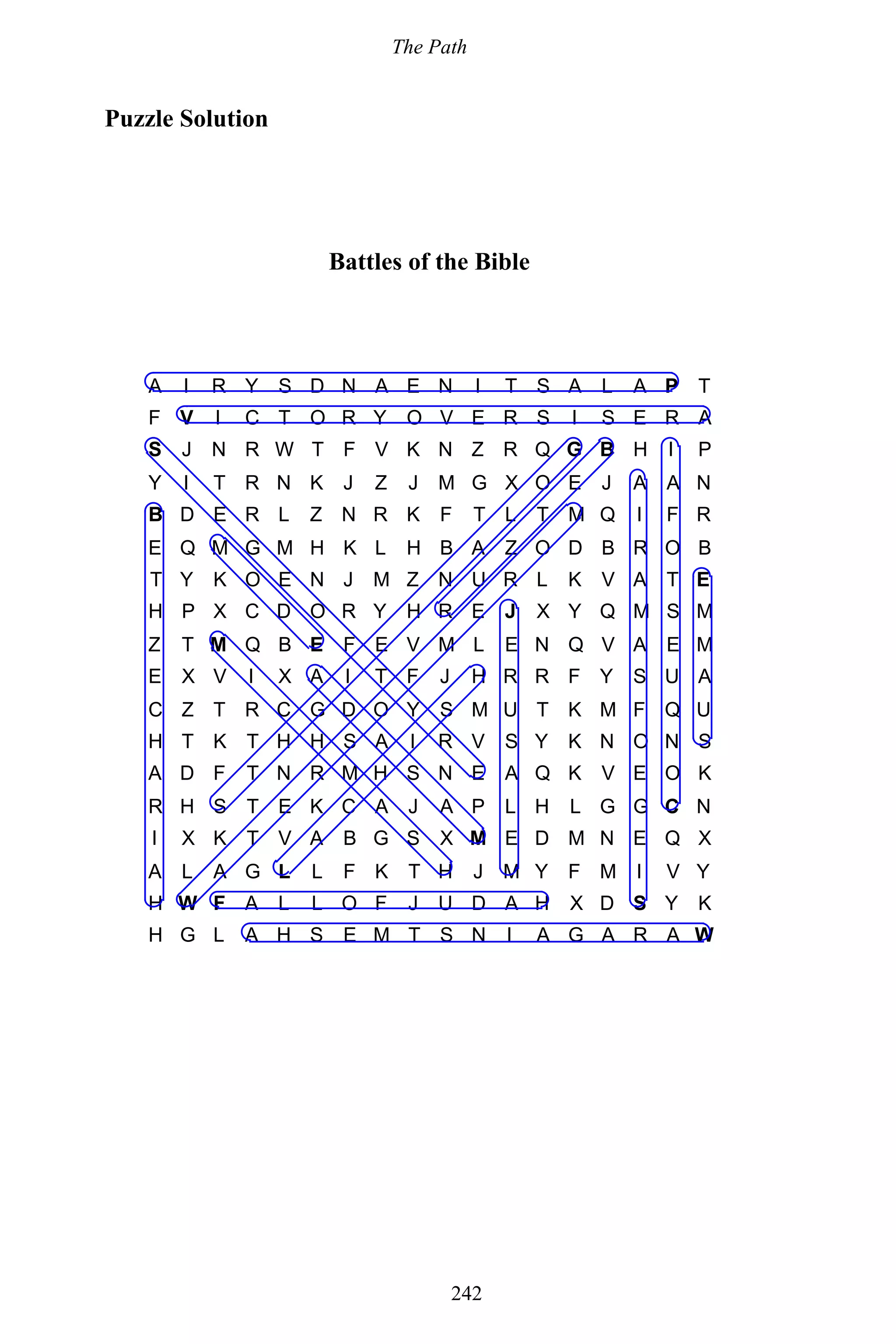
Puzzle Solution
163
238
242
Novella
Millie and Ami
Book Review
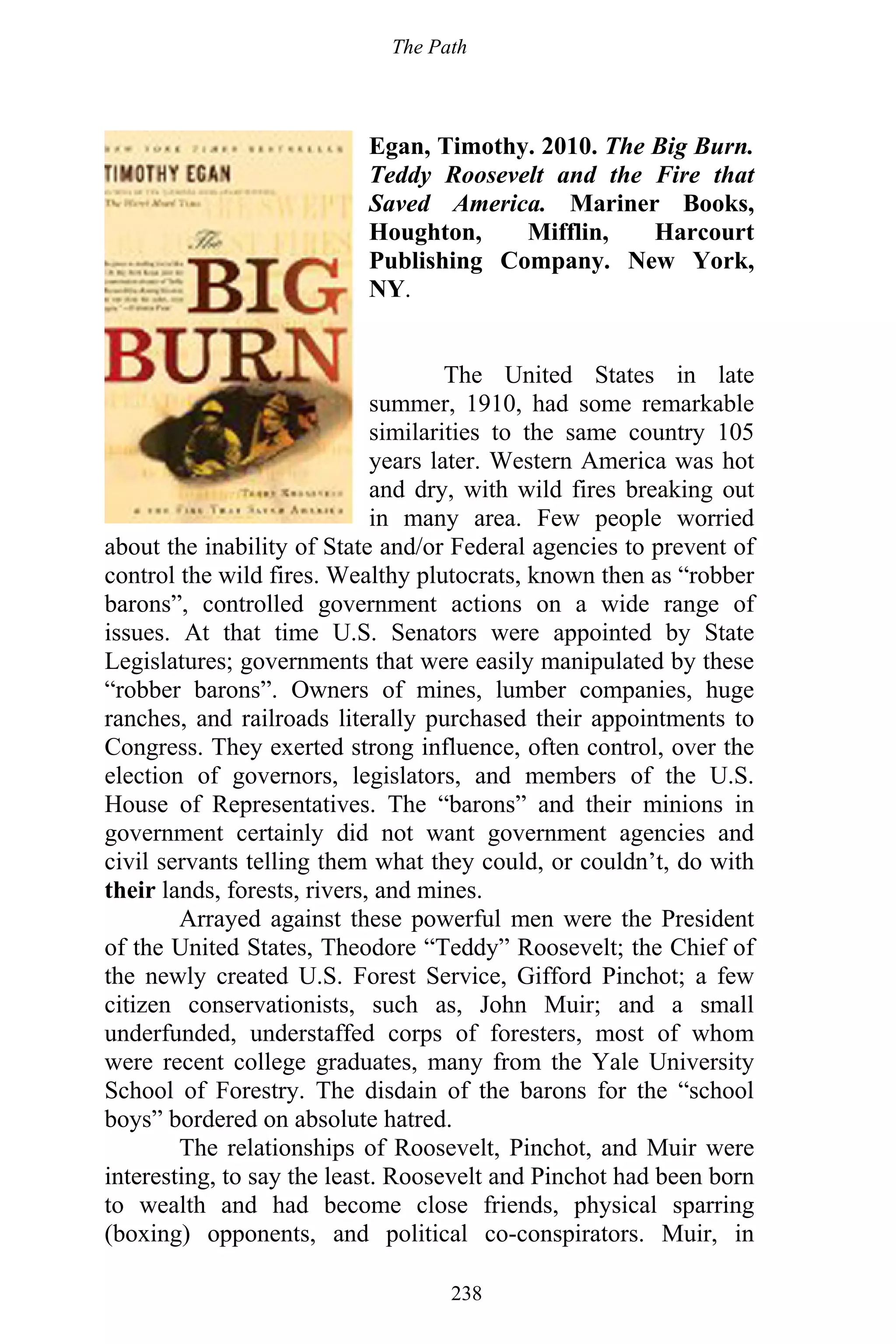
The Big Burn. Teddy Roosevelt and
the Fire that Saved America.
Puzzle Solution
Biographies of Contributors 243
Submission Guidelines 249
Advertisements
Poetry
17th-century English poet John Milton
The Path
10
Douglas G. Campbell
Earthsleep
Hibernation gently folds
winter’s gray hills
beneath frost and snow.
Below soil and stone
deep down among roots
gathered and harvested,
down where the pulse of the earth
is radiant and strong
where the sap is swaddled
but surging within slumber,
waiting to awaken
and flow back to the light—
there dwells summer’s heart.
Catalpa
October has arrived
and the Catalpa tree
is dropping its twisted
seed pods. Those bland
light green oversized
leaves are yellowing
in readiness to return to
earth. Soon rain will pound
and winds will tug and
battered leaves will drop
from exhaustion. A cold
rest, a long dark
silent sleep awaits.
The Path
11
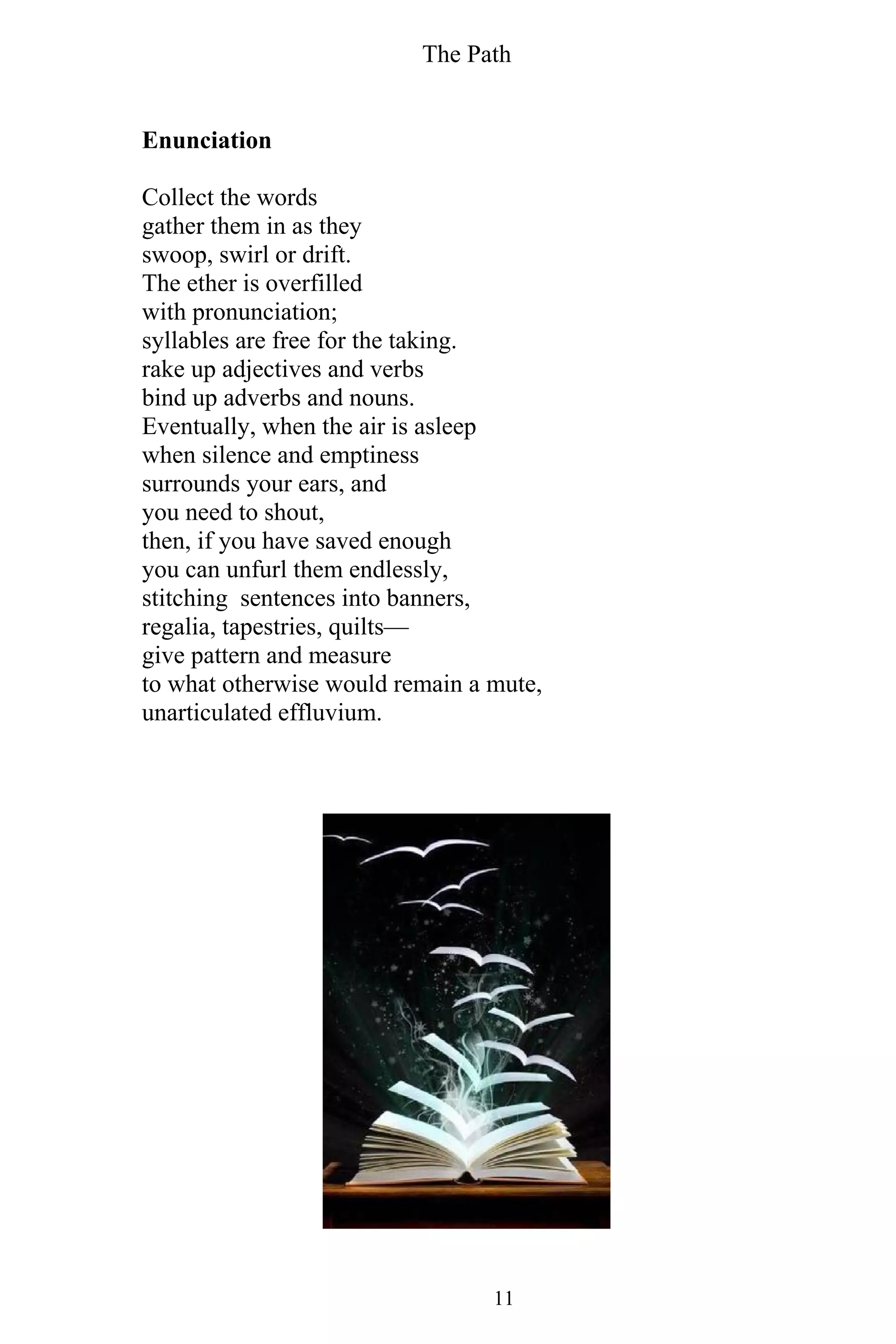
Enunciation
Collect the words
gather them in as they
swoop, swirl or drift.
The ether is overfilled
with pronunciation;
syllables are free for the taking.
rake up adjectives and verbs
bind up adverbs and nouns.
Eventually, when the air is asleep
when silence and emptiness
surrounds your ears, and
you need to shout,
then, if you have saved enough
you can unfurl them endlessly,
stitching sentences into banners,
regalia, tapestries, quilts—
give pattern and measure
to what otherwise would remain a mute,
unarticulated effluvium.
The Path
12
Richard Lloyd Cederberg
More than just reflections
You were the
Refractory soul,
Willing to be touched,
In a peculiar kind of faith
Reaching out, - round-eyed -
Not knowing whether a monster
Would eat you, or if you would be
Wrapped cozily in the honey of
An unexampled apotheosis
In an arcane way,
It made more sense when
You were ingenuous; when you
Were eager to be known; when you
Journeyed beyond those most dreaded
Limitations; when you danced to the tunes
Of sage echoes; when you cast out your
Throbbing heart upon the waters of
Chance and foresaw harvesting
And your verve stained me,
And your mysteries lingered,
AND
When I felt you, and a
Flame of curiosity enkindled,
I knew there was more at work
Than our self-centered imaginings;
Something was happening that would
Absolve the dark places (in YOU) to illume
A languishing heart eager for more than
The drivel of poetic clambering
The Path
13
And you were more than anyone
Could hope for – a vision – an arrant
Provoking ghost, an anthem to the bliss
Of sempiternal hypothesis, and you deftly
Worked the magic of shadows and teased;
And when it was understood that you were
Revered, you controlled those in your web
With the shrewdest of BRILLIANCE
Even embracing the chesty
Quasimodo TYPES with affected
Impressions of humility; and stomaching
Backwards reviews and keyboard hieroglyphs
As if these threadbare distortions were inroads
To some fresh new level of creative nirvana
It was then that you became more
Human than goddess, but I held you
Dear even more …
And now as the river winds further
Into the distance, and the once leaping
Flames of vision settle into smoldering embers,
I call back those cherished rare moments when
The ripples of stirring between two souls - willing
To go beyond limits – adopted together a warming
Light and became, for a season, more than just reflections

The Path
14
Tatjana Debeljački
KUĆA OD STAKLA ガラスの家 A
HOUSE MADE OF GLASS
New book Tatjana Debeljački タチアナ
デベリャスキー
Serbian Japanese and English
KUĆA OD STAKLA
Kuća od stakla.
U njoj poslednja predstava,
poslednje rolanje,
uloga koja nema cenu.
ljubavnici, na rastanku
letite, letite.
Dugo, dugo suzbijajte svoja ćutanja.
U mrkoj noći, jedna zvezda je bar tvoja.
ガラスの家
ガラスでできた家
そこで与えられる最後の演技
最後の役割
掛け値のない役割
恋人たちよ、愛撫しつつ
The Path
15
飛んでゆけ、飛んで
長く、長くあなたたちの沈黙に耐えよ
夜の闇で、少なくとも一つの星はあなたがたのもの
。
A HOUSE MADE OF GLASS
A house made of glass.
The last performance is given there,
Last role,
A role without a price.
Lovers, on your parting
Fly away, fly.
For long, for long restrain your silence.
In the dark of night, at least one star belongs to you.
Critic/ 講評
AGAINST CONVENTIONALITY
(Tatjana Debeljacki – THE HOUSE MADE OF GLASS)
Although a title was not always about the nature or the real
identity of the collection gathered between the front and the back
book covers, it has always, or almost always, emphasized a path
to follow in order to figure out writer’s intention or mission. The
poems in Tatjana Debeljacki’s collection – The House Made of
Glass, along with poet’s sincerity in the conventional statement
and ethic-aesthetic obligation, construct the “house of view and
reflection”. One can look through glass, but can see the own
The Path
16
reflection as well. Like a mirror that doubles the space in front of
one self and other eself at the same time. So this “house of
glass” creates a special view, a telescope to perceive the inner
world, but also a “greenhouse” where people, things, emotions,
time and eternity, life and death… exist simultaneously, like in
the poem “Real People”
People die only
In dusk or dawn,
There are no eternal graves.
I smell on sweet basil
Pleasantly and divine,
And I love up to freedom.
In the considerable number of poems, almost on a level of
the poetic emblem and rule, the thought and experience of a
man’s alienation is suggested; that habits, preconceptions and
rigid institutional ways of explaining and accepting the world
collide with conscientiousness and the most basic needs and
primordial urges. At the same time, as for good romanticists, for
Tatjana Debeljacki, the
beauty is a way of resistance to death, but it doesn’t exist in this
poetry as an aesthetic category, but as a hope and feeling. Only
that
that is built in special circumstances can outlive its
moment, only that that is close to a “tragic sense of life” can
come closer to the truth. In the poem “Bare Face”, bareness of
feelings, as a prerequisite and result of faith and love, love
transforms to the dead end of meaning.
I’ve been sick since the very start,
I don’t care up to the very end of the game.
They lost it.
What about the other man?
In the twentieth chapter in the eight line
He was betrayed by the bare face.
In the twenty-third chapter,
It was goodbye.
The same face under the hat,
Bare face.
The Path
17
In the same poem, we recognize essential non-
determinability (it seems that the poetess insists on that) of
mutual transitions from pictorial grade to conceptual, from
abstract to realistic grade - of the poems in whole, and also of
the single poem images - in dynamic change and connecting of
various cognitive perspectives, through which the world
manifests itself. In the scope of that relation, sublime and
generalized, sacral and profane, work as borders of conceptual
limits; illusory antagonisms (I’m looking in lacking/ but I have it
in looking for it) , clarifying more deeply the basic poetic
principle of the poem in whole, forming a broad thought horizon
which often exceeds the subject, depraving its fixed limits
because of revealing the unusual and the original placed behind
it. Beyond conventionality and fixed stereotypes, beyond
expected causes and consequences. So, there is only one front
side and a lot of back sides that Tatjana Debeljacki is searching
for, persistently and for a long time, and she is finding them in
most successful poems and single verses. Her self-reflexivity
isn’t just a need to perceive more deeply the causes and its
projections on a spiritual map, but she wants to perceive all
conditions between the visible and the invisible, and social rules
and its images in the proximity and the spirit of experience (the
worst is when you die from the inside).
Diverse rhythm does not muffle the thought and the
associativity, managing to focus the attention to the image
diversity and suggestiveness. Poetess wants to find and paint the
mysticism of the relation between outer - and inner drama, and
to find the right measure for her lyrical reflection in their
overlapping. It can be absolutely stated that she manages to do
that in significant number of poems, and all of that has to do
with poet’s idea striving to have a clear thought and content
outline of each poem, and for each poem to be an image of a
special psychological state and lyrical sense of the world.
Tatjana Debeljacki is a poet of atmosphere, and not only
visually shaped one. Life experience anticipation and
meditativeness of these poems carry a need to create complex
lyrical image, but also to verify meaning and drama of the
crossed path. That feeling, that we could claim to be the
dominant characteristic of this book, closes the poetess and the
The Path
18
reader to the other end of poetically multi-valent personality; to
the special connection of skeptical and vital sense of the world.
To the poetic fluid made of image and emotion, which precede
every intellectual synthesis.
The verse and the poem in whole is for Tatjana Debeljacki
a part of intention to create a poetic world (substitute for hostile
and deceiving reality) which would have some constants, and
where the restless and short human life, exhausted with the crisis
of meaning, would find ways of making sense; if not in some
new sense, then at least in realizing the present nonsense.
Petar V. Arbutina
KUĆA OD STAKLA ガラスの家
When I translated the book "A House Made of Glass" by
the Serbian poet Tatiana Debeljački, I got the idea to write this
poem of mine. We do not have to accept the things only through
love poetry that is tragic. Although the characteristics of glass
itself is that it breaks easily, the love that must have been
developed in such a house tells us that it was a place for love.
Probably, there was always a notion of love existing in that
house. The love would have always existed unless the power of
external factors did not influence the bright light of it.
Consequently, the durability of love that overcomes the
brittleness of glass must be provided. This poet informs, through
her lyrics, all the people she loved, that both strength and
tension in the poetry grow. This is how one part of the long
poetry, "A House Made of Glass", was born. Even if a house
with such sad love shatters down, there must still be love poetry,
that would not break the enchantment of its reader.
Mariko Sumikura
Tatjana Debeljački, born on 23.04.1967 in Užice. Writes
poetry, short stories, stories and haiku. Member of Association
of Writers of Serbia -UKS since 2004 and Haiku Society of
Serbia - HDS Serbia, HUSCG – Montenegro and HDPR,
Croatia. A member of Writers’ Association Poeta, Belgrade
since 2008, member of Croatian Writers' Association- HKD
Croatia since 2009 and a member of Poetry Society 'Antun
The Path
19
Ivanošić' Osijek since 2011, and a member of "World Haiku
Association“ – 2011, Japan.
Union of Yugoslav Writers in Homeland and
Immigration – Belgrade, Literary Club Yesenin – Belgrade.
Member of Writers' Club “Miroslav – Mika Antić” – Inđija
2013, Writers’ Association "Branko Miljković“ – Niš 2014,
and a member of Japan Universal Poets Association (JUNPA).
2013. "Poetic Bridge: AMA-HASHI (天橋)
Up to now, she has published four collections of poetry: “A
HOUSE MADE OF GLASS “, published by ART – Užice in
1996; collection of poems “YOURS“, published by Narodna
knjiga Belgrade in 2003; collection of haiku poetry
“VOLCANO”, published by Lotos from Valjevo in 2004. A CD
book “A HOUSE MADE OF GLASS” published by ART in
2005, bilingual SR-EN with music, AH-EH-IH-OH-UH,
published by Poeta, Belgrade in 2008."HIŠA IZ STEKLA" was
translated into Slovenian and published by Banatski kulturni centar – Malo
Miloševo, in 2013 and also into English, "A House Made of
Glass" published by »Hammer & Anvil Books» – American,
in2013.
Her poetry and haiku have been translated into several
languages.
translation Danijela Milosavljević
The Path
20
Ilustracije / Artwork / イラスト
Dragoljub Djuričić
Critic/ 講評
因習に抗う
(テベリャスキー ガラスの家)
題名は表表紙と裏表紙の間に所収されたありの
ままの姿や真の同一体と関係しているとは限らない
が、常に、あるいはほとんど常に作家の意図や使命を
顕在する小径を強調する。ターニャ・テベリャスキー
の詩集「ガラスの家」の詩は、因習的な主旋律のなか
の詩人の誠実さと倫理-美学的義務での真実とともに
「視界と反射の家」を構築している。
人はガラスを通して見ることができる、でも
同様に自分自身の反射を見ることができる。自分の前
および他人の前の空間を同時に二倍にする鏡のよう
に。このように「ガラスの家」は特別な視界を呈す
る。この詩の「実在の人々」のように、精神界を知覚
する望遠鏡、また人々や物、感情や時や永遠、生や死
が同時進行であるところの「温室」なのだ。
詩の相当な数のなかで、詩の紋章や支配のレ
ベル上、人間疎外の思想や経験、その習慣、先入観や
厳しい制度上の方法が良心をもっての世界の受容、最
The Path
21
多の基本的欲求、原初の衝動と衝突することが示唆さ
れる。同時に、よきロマン主義者のごとく、ターニ
ャ・テベリャスキーについては、美は死にたいする抵
抗の方法なのだ。
しかし、それは審美的なカテゴリーとしての
この詩にではなく希望と感情として存在する。特殊な
事情に構築されるそれだけがその瞬間より長く続くこ
とが可能だ。
「命の悲劇の感覚」に切迫していることだけ
が、真実に肉薄できる。詩「素顔」の中で、素顔の感
情として、一つの、必須の、そして信頼と愛の結果、
愛は意味の行き止まりに変容する。同じ詩では、我々
は、絵印の等級から相互の推移の本質的な非決意可能
性(女流詩人たちはそれを主張するようだが)を認め
る。概念、抽象および様々な認識の展望〔世界はそれ
によって現れる)からダイナミックな変化での現実的
な等級へ、そしてまた単一の詩の表象へ、までその関
係の範囲で荘厳、聖礼、冒瀆的で一般化された概念の
範囲の境界で働く。錯覚の反対(私はかけることのな
かを見ている/しかし、それを探すときに持ってい
る)、より深く明確にすること、全体中の詩の基礎的
な詩の原理、広い思考、地平線の形成、異常なもの、
およびその後ろに置かれたオリジナルを明らかにする
ためにその固定範囲を貶めて主題をしばしば超えてし
まう。因習、および予期された因果の果てに固定した
ステレオタイプを越えて。
したがって、一つの正面側だけがあるのだ。
そしてターニャ・デベルジャスキーが探索する多くの
背後側、固執するほどの長い時間で、また彼女はもっ
とも成功した詩集、詩に見出している。彼女の内省
The Path
22
は、精神の地図上の原因およびその射出をより深く知
覚する必要だけでなく彼女自身なのだ。ものと目に見
えない、ならびに社会規則のあわいの条件を
すべて知覚したい、また接近および経験(最悪
の事態は、内部でいつ消えるか)の精神中のそのイメ
ージ。種々のリズムはイメージ多様性および示唆性へ
の注意をどうにか集中して、思考との連合性を内包し
ない。女流詩人は、関係の神秘主義をあわいに見つけ
て描きたい、外部ー内部のドラマ、またそれらがオー
バーラップすることに映る彼女の感傷的な影に適当な
量を見つけること、それは絶対にある場合、彼女は詩
の重要な数のなか、そのすべてで何とかしようと述べ
た。各詩の明瞭な考えおよび内容やアウトラインをも
ち、かつ各々詩が世界の特別の精神状態および感傷的
な感覚のイメージであるため努力する詩人の思考で行
っている。ターニャ・テベリャスキーは大気の詩人で
、単に視覚的なひとつの形態を作らなかった。これら
の詩の人生経験や予想、瞑想は、複雑な感傷的なイメ
ージを作成する必要をもたらす。また十字の小径の意
味、ドラマを確認するために、この本の支配的な特性
であることを私たちが主張することができたという感
覚は、もう一方の端に女流詩人と読者を閉じる。詩的
に、多重な個性、世界の懐疑的で重大な感覚の特別な
接続によりイメージで作られていた詩の流体および感
情(それはすべての知的合成に先行する)に。
ターニャ・テベリャスキーにとって全体中の
韻文や詩は、いくつかの定数を持つ詩的世界〔対立的
で偽る現実の代わり)をつくり、かつ意味の危機で疲
弊し落ち着かない短い人命が、方法が意味を持つ方法
を見つけるだろうという創造的意図の一部なのだ。少
The Path
23
なくとも現在の無意味を実現する際にある新しい感覚
の中でなければ。
Petar V. Arbutina
ガラスの家
書評
「ガラスの家」を日本語に訳しながら思ったこと
がある。これを単なる愛の悲劇詩と取るべきではない
。壊れやすいガラスという材質ではあるものの、愛の
居場所である家で、愛を育てるはずであり、明るい光
を受けたならば、またなんの外部よりの力が加わらな
ければ、いつまでも存在はしただろう。そこでは、ガ
ラスの脆弱性を凌駕する愛の強靭性が担保されねばな
らなかった。この詩人は愛する人に、それを知らせ、
互いの力を高めようと訴える。そして一編の長大な詩
「ガラスの家」が書かれた。美しくも哀しい愛と、家
が壊れても愛は壊れぬ詩の強靭さが読者を魅了する。
すみくらまりこMariko Sumikura
タチアナ デベリャスキー、1967年4月23日
ウジツェに生まれる。詩、短編小説、小説、俳句を書
いている。セルビア作家協会(UKS)会員。200
4年よりセルビア俳句協会(HDS)、モンテネグロ
(HUSCF),クロアチア(HDPR)俳句協会に
所属。2008年よりベオグラード詩人協会かいい
ん、2009年よりクロアチア作家協会(HKD)、
The Path
24
2011年よりアントン・イワノジッチ詩人協会に所
属、2011年より日本の国際俳句協会の会員とな
る。母国・移住地ユーゴスラビア連合、ベオグラード
文学クラブ、2013年インドミラソフ作家クラブ、
2014年よりブランコ ミルコビッチ作家協会、2
014年日本国際詩人協会「詩の架け橋:天橋」会員
となる。
現在まで四冊の詩集を出版「ガラスの家」1996
年ウジツェ、「ユアーズ」2003年ベオグラード、
俳句集「VOLCANO」2004年、CD本「ガラ
スの家」、2008年セルビア語―英語「AH-EH-IH-
OH-UH」を出版。
HIŠA IZ STEKLA はスロベニア語に訳されMalo
Misevoで出版、英語にも訳される。「A House
Made of Glass」が2013、アメリカ Hammer &
Anvil Booksより出版。彼女の詩や俳句は8・9カ国の
言語に訳されている。

Bruce Louis Dodson
Opus
I’ll tell you this about the Gods, my son,
though there is more that you will have to know,
they change the scenery to match the passing years,
and no one ever sees the entire show.
The Path
25
Claire T. Feild
Sphinx
This woman, a riddle to many, stays in her
place, a house in the shape of a lion.
During dusk, she waters the peonies and
other plants that straddle the steps
of her front porch, the plants spikes
that call the worms to attention.
Since she has no heat in her home, at night
she carts the blankets she keeps
in her mildewed attic to her bed
full of feisty rose petal stems as
they bite her with their steamy
arrow stems.
All she wants is a layer of mosses in her
bed at night, their softness hiding
her ill-formed body.
Privileged
She is the favored child of three girls,
her eyes deep ocean blue, her
tresses making coal look white,
her skin porcelain white.
The witch-girl on the other side of town
has dirty brown eyes, hair
a thicket of mouse-brown, and
The Path
26
skin grey from the lack of a
favored cleansing.
When the two meet, the ugly one snarls
at the frail one, calling upon Lot
to turn the innocent one into a
pillar of salt.
Since the wicked one has lovers in the
underworld, her wish is granted,
and her smile is pristine, in stark
contrast to the rest of her fleshy
hovel full of worms.
Dead End
We design our dead ends, a disappointment
causing us to believe we cannot
march forward.
Being cheated on by someone I love
makes my brain sizzle, and then
I feel those clenching sensations
in my brain since there is nowhere
to go to change reality. So I cry,
moan, and then call the place
where I sit my home full of worms.
Our grandchild is a stillborn. I hit my fist
against the wall because I cannot
bring him back from heaven for
my children to love and facilitate
his growing process. So, life, once
again, is a boat stuck in the sand.
We can be happy in all things if we view
our misfortunes as opportunities
to learn what beams beyond the
impasse, a flight from the cul-de-sac
a quick jolt and then data
The Path
27
galore to share with others to
find answers to life’s most
daunting questions as if they
are squirming around in quicksand.
Estrangement
Her withdrawal from his essence came
in the form of concentric circles:
She was at the edge of a dinner
plate in her feelings for him.
But she rested inside an estrangement
to keep the money flowing from
him.
He was still in love with her, his wits
shivering and his heart a royal
red.
When would he take a giant step from
his illusion? It happened when
he could not find her.
He can be seen nestling against a new
woman who feasts on financials
and a an full of worms.
The Alterations Woman
The alterations woman, her teeth a vise for pins,
readies me for her operation on my
skirt by telling me how pretty I am.
She uses a tape measure to see where her
pins will play “Ring-around-the-
rosy,” the pins left in her hands
The Path
28
and mouth dropping to the floor
when she has finished her method
of care.
I trod to another bedroom to remove
my new skirt, my mother a
a handmaiden as she hands
me my other skirt to put on.
A couple of needles prick my skin as
if to say “good-bye” in an ugly
way from the woman who keeps
her pins in an empty can of worms.
Slight
Her form so thin, she is an unlit
match, the match’s red tip never
having been struck by a handsome
man.
She finds a lagoon where she can wet
the red tip so that she will never
be touched by a man.
She moves like a worm, except she does
not arch her back, a crack too
forthcoming.
She accidentally falls all the way into
the lagoon, her drowning a
secret, for she did not
know anyone else except the
match maker machine and the
one who held her for a short
time before placing her on
a shelf.
The Path
29
Richard King Perkins II
Dichotomy of Nimbus
The sun strains to linger
in the first call of darkness
flaring toward an ephemeral lakebed.
Marigolds slowly die in their window box
asking why it’s so difficult to be loved
and more than that—
can a dead thing be loved
and give love in return?
With great gradual ponderousness,
separating shadow from skin and petal
the sun will never find balance
between two worlds
the dichotomy of nimbus—
when I turn the table lamp off
I’m surprised at all the things that cannot be.

The Path
30
Tom Sheehan
Hill of the Blue Goose
The hill
steals lightning,
sees Boston stand up
after catching a haymaker.
This morning caught geese
like runaway shoes, tongue screech,
traffic cop calls and winter
ticket stub lost in a pocket;
has mirrors of yesterday’s thighs
the moon of the seventh of July
of our lord of “Forty-five
touched with its butter,
shows her inclined to me
and tilt of the hill.
Her thighs still count the thrust.
The cops
broke up a card game
on the left shoulder, toward the river
and West Lynn, in ‘Thirty-nine;
the pot’s never surfaced.
Now a specter in tight pants
sells angel dust, gives
green stamps.
Has new options on street war:
use hammers, screwdrivers, no sunlight.
Night kisses the hill with lonely.
Do not be lured there.
The Path
31
No pig in a poke.
Has anyone seen
Frank Parkinson lately,
meant to die outside Tobruk
in the mutilating horrors of the sands,
but didn’t? Hangs on the hill
like cloud root, spills images,
has literate left hand, flies
with the awesome geese.
Oh, Frankie!
Throws hill shadow
ominous as dice toss;
a family’s left a photograph
in a friend’s scrapbook
in a trunk in a cellar
in the thrown shadow.
Nothing else. No dandruff.
No acne. No evidence of being.
Gone off the waterfall of Time.
Nobody remembers they were here
halfway up the hill once.
Lone blue goose,
tandemless, no fore
and aft, plunges over,
cries high noon of search,
drags feathers, drops
the quick flutter
of a shadow.
Poem stops.
Starts.
Hill has transport.
Pieces left in Hwachon Valley
in the Iron Triangle. In Verdun.
On the Ho Chi Min Trail. Waters
near the Marshall Islands. Sitka.
The Path
32
In flecks of blood in Walpole cell.
On the wall of a cave in the Tetons.
An unmarked grave in a dead town in Iowa.
Almost, near Tobruk. Parkie’s too tough
for Krauts, shrapnel’s conversion to flesh,
booze, cancer, rolled over cars giving off
ribald laughter, snowstorms going like
wild pinball games, bad dreams
with real smells a listener
can touch; all of them,
almost.
The blue goose
throws down a quick shadow.
I hear the high noon call
at night.
The terrors near Tobruk
are as hard to shake as nicknames.
Beaver. 39 Stone. Maude’s Jake.
Sinagna. Dropkick. Snakeeyes.
Automatic Brown. The Indian,
who fell near Tobruk, arose,
moved the stone, gave his
voice to the blue goose.
High noon call at night.
He gave up his pain forever;
how he lives so long
the hill sings.
Steals lightning. Spies on
Boston, Hancock’s glass face.
Sees the ocean die close in-shore.
Gives up the moon. Throws trees down
to hungry flame. Wears the shadow
of the blue goose.
Watches my poem stop.
The Path
33
Elaine Westphal
Just My Sister and Me
A little trunk of memories
Lies deep within my heart.
It’s filled with old time pictures
And childhood plays the part.
They tell a little story
Of our young and carefree days
And of the world of use-to-be
Shared by my sister and me.
Some pictures bring a little laughter
Some bring a little pain,
And some you’d like to jump right in
And live all over again,
Like the one that shows the homemade swing
Under the old pine tree
That brought happy playtime hours
For just my sister and me.
A couple of my favorites
That I always hold so dear
Are paper dolls played for hours
And our cuddly teddy bears.
They all were a part of that magical land
Of childhood make-believe
Where no one else could enter
But just my sister and me.
After I close the trunk again
And lock it with a key.
I tuck it back within my heart
The Path
34
And I can plainly see
These childhood memories play a part
Of what would come to be
A special life-long, loving bond
Just between my sister and me.

Eva Willis
What Cost Compassion?
Anger, that gut-wrenching, breath-shortening
explosion of pique, is based in fear. Fear -
usually the concern of an occurrence that COULD
happen and how it would affect us, change our lives.
I fear that my country is changing and
not in a good way. I fear it is being taken over
by people with different values, languages, and
aims, rendering it and us less safe and economically
stable. I fear less control over my health care, less
choice in my daily affairs, and wondering where all the
surveillance and economic decisions are taking us. I fear
the tension over racial issues and epidemics.
I understand compassion for people struggling
to find a better life in the United States and
their trials in getting here and staying here.
I understand too the practicalities of a
sovereign nation, asking for responsible
immigrants to follow our laws and assimilate.
I understand there are large numbers
The Path
35
struggling to feed their families and survive,
whether in this country or others.
I also understand that more and more
handouts from an already bankrupt nation
is not the answer.
There is a humanitarian crisis in the world
with migrants looking for new lives and homes.
How do we care for all these people and what
do we do with the ones who commit crimes?
Syria is not in a civil war, it is in a power struggle
but nothing will be left for the powers-that-be.
How insane is that, I ask you?
I have little control over these matters.
I vote, write my senators and congressmen,
donate to worthy charities, and
do what I can to protect myself.
I try to heal things one-on-one
where the opportunity exists and, mostly,
I pray!
The Path
10
Poetic
Essay
Khalil Gibran (1883-1931)
Cederberg
37
Richard L. Cederberg
The Man Who Had Dwelt in the Cabin*
Like war-drums their hearts pounded. The switchback
was grueling and dangerous, and in various places great granite
boulders, all crosshatched with mossy streaks of moisture,
appeared as if they may break free and fall at any moment. With
careful reverence, the two hikers made their way over rills and
runnels, across a swinging footbridge spanning a gorge, around a
waterfall, and through an old graveyard of silver-mining
equipment, where the droppings of Elk were clumped-up like
pyramids, and where, as they paused to snack, wild turkeys
scrambled past them noisily.
For a time they pressed on. When the path had finally
ended and the high-ridge had been crested, both took in the
panorama around them, with argus-eyed interest. The Mountain
Lake below glistened as a brooding dark jewel. Scattered
throughout the lower ridges, stands of Pinyon Pines were
hovering like primeval warriors. Across the valley, spring was
The Path
38
bursting up through the last of winters-white in colorful
cornucopias. In their view, Nootka Rose, Paintbrush, Sego
Lilies, Arrow-leaf Balsamroot, Manzanita, and Rubber Rabbit-
brush, were dappled together in posies of delicate beauty…
“Marvelous,” the woman exclaimed. “Who would have
known?”
A sudden blusterous wind had shifted her focus. The
growth behind them was moving in such a way that allowed a
fleeting glimpse of something hidden back in a small clearing
near a stand of Bristlecone Pines.
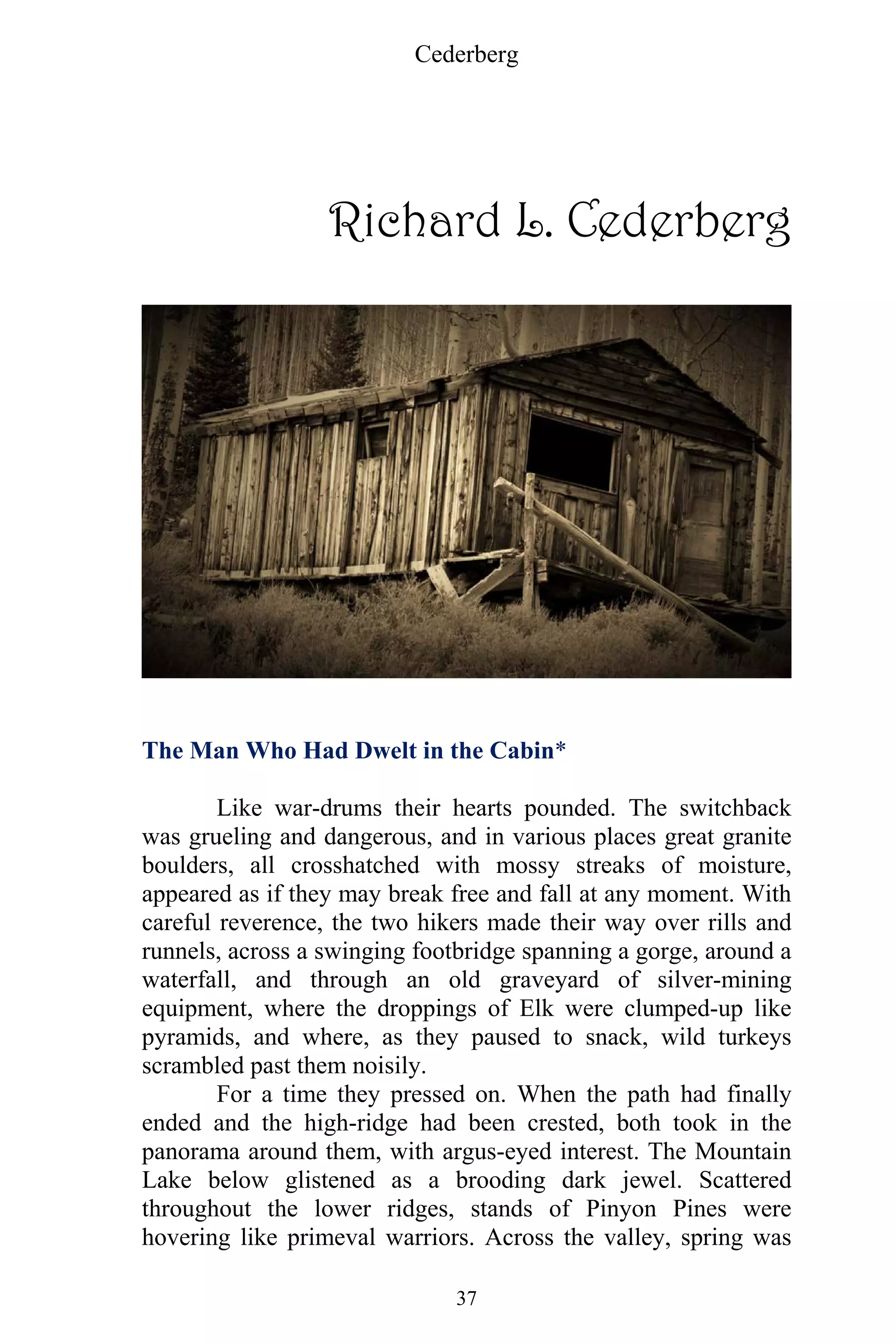
“A hunter’s cabin, maybe,” the man proposed, when they
were nearer the structure.
“Could have been someone’s home, too,” she countered.
For a while, the unexpected fixed their eyes in pure
wonderment. Still clinging doggedly to the granite; the cabin had
long since fallen into disrepair, the roof was warped and
blanketed in a fleece of dry emerald moss, and each of the
windows was broken and scattered in shards.
“See how the rivulet was diverted into this cistern for
storage,” The man pointed as they walked around its perimeter,
“and how there in the tree-line a garden was once cared for;
someone did live up here.”
“And they had a friend, too.” The woman paused to look
at a grave marker with the name ‘Tinny’ carved into it.
“Indeed,” the man agreed. “This was someone’s
hideaway.”
“Let’s take a look inside,” the woman suggested.
For a while, both stood unsure. The wooden door had
been banging, in an eerie cadence, against the jamb, and it was
unnerving for them imagining what may be lurking inside. After
a while, given their tireless natures, both shrugged it off and
crossed over the threshold. Inside the air was dank but,
thankfully, there was no visible danger, which allowed each to
move about in focused contemplation.
The cabin was sparsely furnished. On the walls, an
assortment of daguerreotypes stared out blankly in two-
dimensional silence. Empty brown bottles strewed the
floorboards. In one corner, a rusting metal bedstead was leaning
against the wall. In another, a potbelly stove sat cold and sooty.
On the rear wall, a shoddily made bookcase was listing under the
weight of several dozen volumes. There was a table and chairs
Cederberg
39
beneath a gaping hole in the roof. Sitting on the table, open to
the weather, an old Underwood typewriter sat rusted beyond
repair. The man noticed, under the table, an open leather valise,
and clearly visible inside an unbound ream of papers. With
measured curiosity, he removed them and began carefully
thumbing through each page.
“It’s a collection of poems and stories.” He declared after
a time. “Some of the words are too faded to read but some are
still legible. Listen to this will you: ‘And in desperation his heart
cried-out to her …
Forgive my folly,
For it is my undoing,
This thing that grips me
In talons of fruitlessness
And all dark insanities,
Oh to find you here
In the sweet swirling shadows
Of pine trees rustling,
Reaching out to embrace me,
Willing to offer your hand,
Willing to absolve
All I afflicted you with,
(In the name of love)
Adopting the best of me
Instead of what was lessened’”
Mystified, the man continued reading… After a while, it
became clear that what was written had been born of folly and
dire misfortune. It was clearly obvious, too, that the writer of
these words had caused irreversible harm to another, and that the
miseries he’d inherited from his sins had permanently altered the
course of his life. Two souls had suffered deeply. And the man
who had once dwelt in this cabin never again found his place in
society. An irrepressible madness had slowly destroyed him
because of the vile behavior he’d displayed towards the only
woman who would ever (in his life) love him.
“STOP,” the woman demanded, suddenly, as he read.
Fidgeting nervously now, she had finally reached her limit of
listening. “No more my darling.” She declared. “We must depart
The Path
40
this awful place at once. There is a terrible madness lingering in
these words and we cannot be partakers of it another second.”
In perfect agreement the man put the writings back
[exactly] where he’d found them. Without a word, they made
their way back to the trailhead and began their descent. As they
walked, a profound melancholy fell upon both and the woman
was soon sobbing. How could a day that had started so
magnificently end in such a way as this? With deep compassion
he took her hands and urgent petitions were offered up to heaven
for relief and understanding. When tears had ceased they trudged
on in silence until a commotion in the eastern skies caught their
ears. Dozens of noisy Ravens were suddenly circling above
them. Eight landed a few yards from where they stood and began
cavorting like rambunctious children. Was this God’s response
to their prayer? Soon the woman was laughing—then the man.
The spectacle was charming them and the colorful cawing
brought unbridled joy. After a time, clear-headed and happy, the
woman continued her descent. The man paused, however, and
turned one last time to look up and mull the mystery, and horror,
of what they’d discovered above them on the ridge.
Having long relinquished its newness to desiccating
winds; time had long taken a toll on the old cabin. Though it
slumbered now in a certain measure of disorder and had been
stripped of all warmth and welcome, it still bore a lingering
impression of the willpower it had once taken to build; and
forever, now, to both of them, a reminder of how one man’s
misbegotten choices had utterly destroyed two lives.
*This is a fictional work derived from personal experience, and actual
discoveries, in a recent investigation of abandoned cabins in Bodie, California, and
Panguitch Lake, Utah.

Westphal
41
Elaine Westphal
Recollections of Mom
Remember the old saying: “a man works from sun to sun
but a woman’s work is never done”? So it was in our home.
Long after the meals were cooked, children’s homework was
finished and the cows were milked, Mom was busy knitting
socks, crocheting a doily, or embroidering a dresser scarf to
make our house into a real home.
Rainy days on our farm were especially welcomed by
Mom because those days you could always hear the sound of the
old treadle sewing machine as she was busily sewing school
dresses for her two girls, patching overhauls for Dad’s work in
the woods, and every so often, making a new apron for herself
after finding a pretty patterned feed sack brought home from a
trip to the feed store.
In summer, Mom was always busy with her big garden.
Mom canned “everything”. Center stage in our farmhouse
kitchen was a big, black, wood-burning cook stove that was used
continuously through the cooler seasons, but to keep the house a
few degrees cooler in summer, she mostly used the gas stove
over in the corner. It had four small burners, but big enough to
heat the big pressure cooker full of jars of fresh vegetables. With
all this activity in the kitchen, we were assigned to the screened
in porch and sat on the swing to snap beans for the next load of
jars for the canner.
Summer, too, was for County Fairs and Mom loved the
competition of entering her homemade goods in the proper
competitive category. While winning many blue ribbons, she
especially took pride in her homemade bread. When her bread
came out of that old cook stove oven, we were entranced with
that fresh bread smell and couldn’t wait for a treat of warm,
fresh baked bread with butter and homemade chokecherry jam.
That was the best treat this side of heaven!
The Path
42
Fall came and Mom always had our newly sewn school
dresses ready. With the crisp air coming on, Mom helped Dad
with the last chores around the farm including making and
stacking wood to get us through another sub-zero winter. As fall
turned to winter, Mom was relieved to think that winter months
would give her time to sew a quilt badly needed for the bed, knit
mittens to fit into Dad’s “choppin’ mitts” for making wood and
to braid a rug to place next to our bed to keep our feet warm
when we’d get up on cool mornings.
Winter Sundays were Mom’s special time for herself.
This was her time for writing letters to family and friends and to
her beloved pen pals. Most of all, she mused herself in writing
poetry. Her poetry subjects ranged from comments on the news
to reflections of her childhood to the beauty of nature.
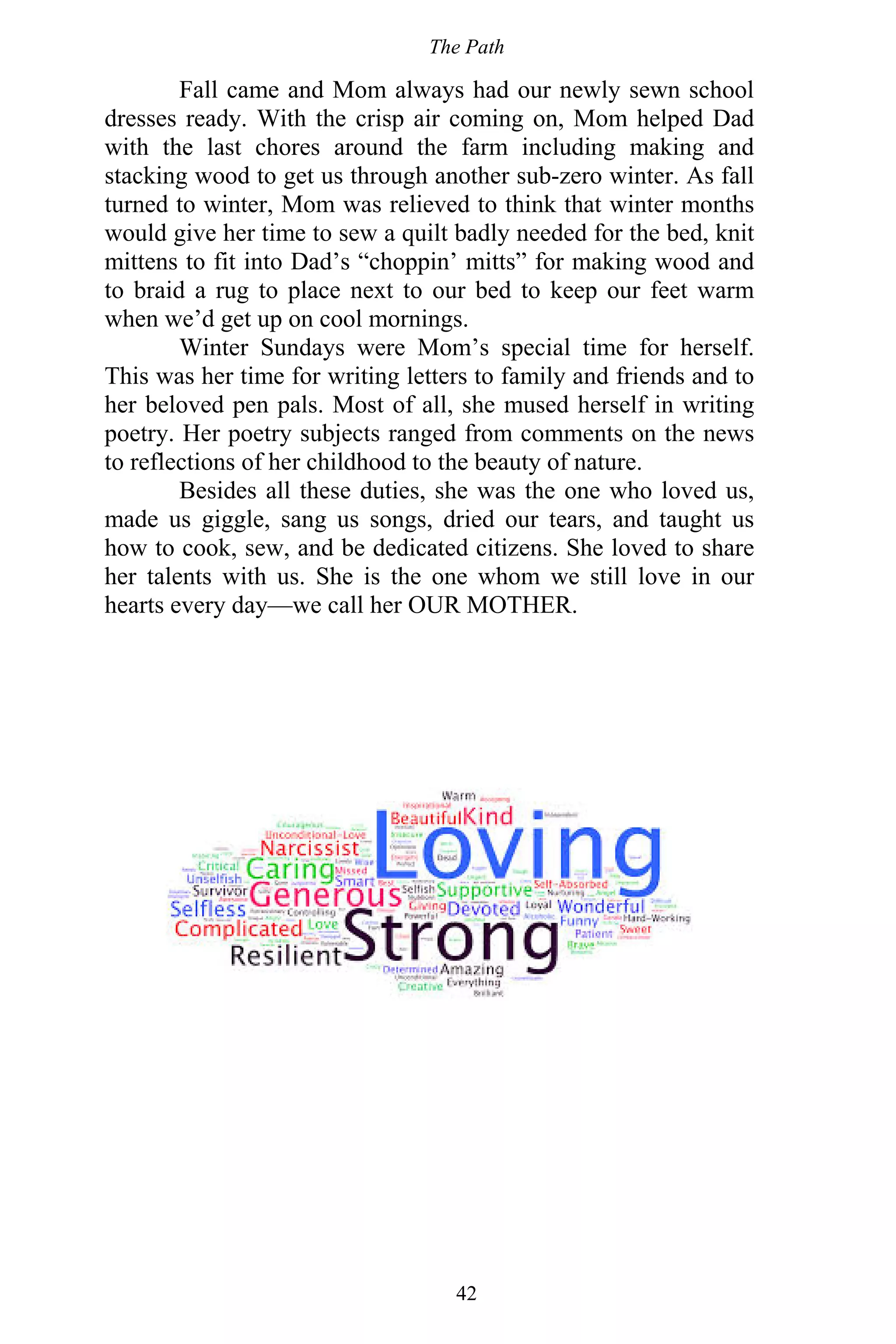
Besides all these duties, she was the one who loved us,
made us giggle, sang us songs, dried our tears, and taught us
how to cook, sew, and be dedicated citizens. She loved to share
her talents with us. She is the one whom we still love in our
hearts every day—we call her OUR MOTHER.
Butler
43
Dian Butler
A Time to Hurry
Time is going fast for us and a never ending, watch and
listen, time for us, a time without limits, a schedule here and a
pay check there, we never wanted to hurry through life, we only
wanted to be a part of life and content with what we had in life.
A hurry up generation, that is what we were.
Oh children of this 21st
time do not grab the next ticket
that takes you to a party for a job, imagine your own plan
without all your precious time given to a job, a place, a
corporation and someone else’s ideas. You are part of a time
when you make your own ideas guide you and allow your
dreams to come true ; you fantasize the next future for your
children. A large amount of hurry, up to nowhere, a cloudy
scheme that is now all yours, with some objects hidden in the
cloud.
A hurry-up generation is not what you want to say you
were.
Have your day thoughts put to paper, your knowledge
come alive with others, lead and not be left behind, guide and
never hide, worry only about the when you will begin, we are
cared for as the wind blows the leaves away, we are given water
to drink and air to breathe, no need ever to hurry and follow
those whose notions were really yours, once upon a time, and are
thought about by those above, they will never force you, a
choice is always yours.
Go now and do not hurry.
For your life means something and your actions mean something
because all the ripples in the stream help to make the water
The Path
44
move, just as your thoughts bring life to earth, so do your
actions.
Allow yourself to be that pebble which glides the water
over it on its journey to others. Then slowly begin again your
movements that kept your life and others alive. Believe in
yourself and what you can and will do, leave your time slowly
because hurry is for those who do not frame the earth for others,
as you now do. Not to do as we once did and did in a hurry. Die
slowly now, before your name appears in the Book of the Dead,
who never did a thing to help the humans you are a part of as
you live and breathe and speak.
Stop, listen, create and never, ever, hurry.
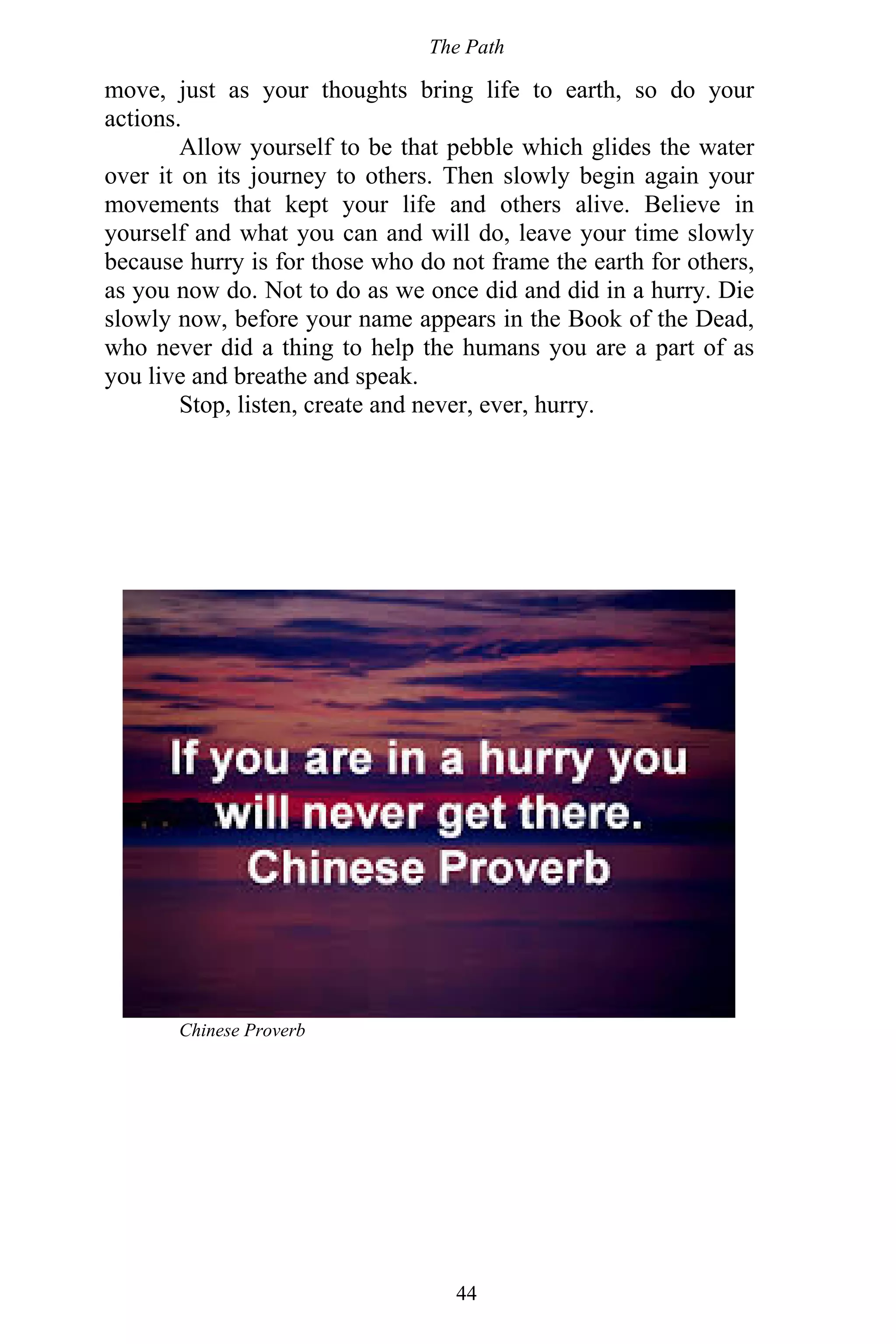
Chinese Proverb
Short
Stories
John (Jack) Griffith London (1876-1916)
The Path
46
Claire T. Feild
Mumie
Short Story
Mumie, my maternal grandmother, made the word
“unique” mourn: She was like a closet full of various shades of
black, blue, and purple feathers. For example, she wore her
stockings in a peculiar way. She would roll them almost to her
knees and then let her stockings dramatically stop moving.
When she sat in a chair, one could see these rolls, but after she
stood up, her long dress took over the process of sheltering her
hose aberration.
She placed a net over her long black (probably dyed) hair
after she had pulled her hair up into two fairly long twisted
clumps. Her eyelids took batting practice as they bumped each
other as fast as possible, just like a baseball bumps its bat in
batting practice.
I don’t recall her wearing anything but black shoes.
Being fancy would have dusted off her practical disposition.
Cooking was her trade. Anything that looked like an
ingredient soon became a mincemeat pie, a lemon pie, or a
chocolate pie; thus, flour did not perturb her disposition.
The two stillborn boys she had pinned devastation to her
heart. However, she had two male grandchildren, Steve and
Benson, whom she adored. They lived with her most of their
lives because their mother (Juanita) was an alcoholic. She also
birthed another girl (Gwen) whose middle name was named after
a horse (Cubie) revered by Mumie’s immediate family members.
She and her husband Walter must have resided in every
town in the deep Mississippi Delta. We visited them in
Hollandale, Glen Allan, Clarksdale—you get the idea.
Because Mississippi was the only state in the Union that
had people with sense and class, it was harder for her to move to
Feild
47
New Orleans than it is to pluck a concrete pole from the ground.
But she did what she had to do.
Because her husband was deceased, she had to live with
Juanita and Juanita’s second husband, a cab driver in New
Orleans.
After my daddy died, Mumie took Mother to see one of
Mother’s old flames—who was married. Mumie just wanted to
make sure that Mother’s former boyfriend knew Gwen was
available if his wife died.
When I was sitting in front of the mirror looking at
myself more admirably than the Ground Hog looks at himself,
and she said, “Claire, you don’t think too much of yourself, do
you?” The comment hurt me; I did not know what to say. I was
just getting ready to go to Bourbon Street with my cousin Steve.
Eventually, it was time for us to leave Mumie to return to
Jackson, Mississippi, via The City of New Orleans. I hated
seeing her bat her tears away as she looked through the screen
door of her shotgun home. I felt guilty that we were leaving her
in such a precarious situation. Juanita was still drinking, and her
second husband had left.
Mother arranged for Mumie to live at a nursing home in
Quitman, Mississippi, near Benson’s home. Therefore, Mumie
was in Mississippi again, but she did not realize it.
I asked Mother how Mumie died, and she said she died
of “the infirmities of old age.”
Therefore, I never knew how Mumie died, and when my
husband and I drove near Quitman on our way to Jackson to see
my parents, we never stopped to see her. How cruel newly
married couples can be.
Aunt Juanita
Short Story
Aunt Juanita, my New Orleans aunt, had a mouth that
materialized into the size of Jaws’ mouth and missing teeth that
looked like mini-caves. Of course, she did not live to intimidate
anyone: She was too interested in a good joke. Since her hair
was dyed red, she was before her time. She had no desire to quit
eating Mumie’s mincemeat pie, lemon pie, and chocolate pie—a
The Path
48
ramification of her eating sweets galore. She was as obese as a
diesel truck and wished to be the size of an electric car.
She was either in her housedress shaking the floors in the
shotgun house or asleep in bed after a night of boom-boxing on
Bourbon Street. Mumie and my mother (Gwen) thought I had no
clue Aunt Juanita was an alcoholic, but I heard them talking
about her situation in another bedroom one room over from me.
The fan blowing on me was supposed to flatten out any words
they spoke, but their mistake in thinking never blew up in their
faces because I was as quiet as a quilt about my knowledge.
Aunt Juanita’s small toe on her left foot had gone to
sleep forever on the top of the toe next to her pinkie toe. She
often wore Mother’s shoes without asking permission to do so.
She just sneaked around like a marshmallow on the end of a
skewer on the fire. When Mother saw her rummaged shoe, she
threw a tantrum babies can’t execute.
Aunt Juanita would remind my mother that she (my
mother) was no saint. For example, Aunt Juanita noted that
Mother stupidly jumped into hay and could not breathe. Aunt
Juanita reminded Gwen that she saved Gwen from deletion on
many occasions.
Aunt Juanita worked part-time at the prestigious makeup
counter at Maison Blanche. On the days she had to work, she did
not go to Bourbon Street the night before.
One Christmas, I received a baby doll as a gift from Aunt
Juanita. When I opened her gift, I noticed the cutest doll bathing
in sweetness. However, when I looked at one of her legs, I
realized it was detached from the doll’s body. I did not know
why she sent me a doll that was deformed. I still loved the doll,
her disability an imperfection that I gradually began to accept. I
learned by meeting Aunt Juanita’s doll that everyone has a
disability of some type such as, heart disease or a missing tooth.
She was married twice, two sons a result of her first
marriage. However, she had a hard time rearing them because
she was an alcoholic. Therefore, they lived with Mumie, their
grandmother who became their “mother.” They worshiped the
grass she scuffed on.
When Aunt Juanita died, Mother gave me no reason for
her death, but my stepfather did. He said the inside of her brain
bubbled up as a volcano and exploded. I did not know that part
of the terrain of one’s brain was a volcano about to blow, the
Feild
49
brain’s tornado parallel to an earth’s volcano. I felt unhappy that
Aunt Juanita had died, her jokes gone with her to Heaven.
Front Yard Games
Short Story
Before dusk started rolling in like a huge shoulder, we
played front yard games. The game we liked the most was hide-
and-seek. I recall hiding behind a big bush with wasps.
My screams were like death, caught in my throat. When I
found mother, she placed cigarette weed on the stings, and I
went on out to play devil-in-the-ditch. One child was chosen to
stand in the middle of the driveway. This child was the devil.
The other children were standing on each side of the driveway,
ready to run across the driveway. The first child touched by the
sweaty devil became the devil. After three devils were chosen,
the game was sent to Hell.
My daddy told me that when it rained and the sun was
out, the devil was beating his wife. I used my spade to dig about
a foot down in dirt, hoping to see the devil. I then realized I
would have to dig to the center of the world to find this uncouth
reprobate.
Then it was time to play jump rope. This game lasted
until someone got hurt.
Swinging the rope over the heads and under the feet of
each child had its clean-cut challenges. Sometimes we would
jump first across the rope on the driveway and scoot out fast
after the rope travelled over our heads.
When we wore our hula-hoops, we looked liked a front
yard of lovely flowers, the hula hoops each a different color.
Blindman’s Buff (Bluff) was a dangerous game we
played because sometimes those blinded would walk out into the
street. I stood straight as a Popsicle stick, hoping that I would
not be touched and have to wear the tight-red handkerchief.
When we played this game, the cars moved as slowly as they do
in a funeral procession.
After supper, we looked for lightning bugs, placing them
in jars with holes on their caps. After I would occasionally see
someone kill one of the miniatures, my teacher spirit opened full
The Path
50
blast. Let’s put it this way: The person who heard my words
never went to prison for killing anything.
Goose Egg Park
Short Story
Goose Egg Park took center stage in Yazoo City,
Mississippi, as it was in the shape of a goose egg in the center of
town. It was where they held the annual Easter egg hunt for
Annie Ellis Elementary School students.
Mother was often in charge of this event. To make sure
that all the children received the same number of eggs, she had
the children place all of the eggs they had found on the ground.
Next she would count the number of children present to make
sure every child received the same number of eggs.
The children enjoyed gathering the pennies from the coin
fountain to play a number game. The child who could retrieve
the most pennies in the allotted time won the game. When the
children were told to return the pennies to the water fountain, the
smiles on their faces took a cursory tour to unhappiness.
In that this depression did not last long, they scurried to
find four-leaf clovers. A four-leaf often was stretched out as a
child had sat on it. The ones who found four-leaf clovers were
awarded the extra eggs—if there were any.
Often the children’s maids took their charges to Goose
Egg Park to play. The gathering of maids was like the grouping
of boisterous sound waves. Because they laughed so long and
hard in their group, they had more fun on these outings than we
did. We got bored running around the park for no particular
reason. Its shape restricted where we could run: We felt like
Ginny dolls within glass cabinets in Miss Steinreid’s doll and
clothing store downtown.
At church, we learned that our lives were meant to have
specific purposes. Therefore, we felt guilty since we were
wasting our time. But God was looking at us, turning us into
rose petals in His mind: We were getting exercise, and that was
enough to fulfill one of His most important ventures for
humankind.
Feild
51
Mary’s World
Short Story
Mary, Mother Taylor’s maid, was busy ironing clothes
while the sawmill churned its guttural sound at 5:00 p.m.
promptly from Monday to Friday, respectively. Paw Paw
worked at the sawmill, and Mother Taylor, his wife, had supper
waiting for her husband who thought weighing oneself a waste
of one’s time. He expected biscuits with a purple jam jar, grits,
bacon, ham, scrambled eggs, and sweet tea to be smoking on the
back porch table when he arrived home. He spoke to no one as
he headed to the food, a homeless man’s dream.
While he ate, Mary continued to iron clothes and dream
about the places she could go if she were not black and living in
the Mississippi Delta. Her ideas twisted in her mind as if they
were one sequenced DNA structure.
She was already singing in the black Baptist church, her
melodious voice admired by those who could not carry a tune to
an appropriate destination. She would love to sing with Taylor
Swift in Las Vegas, the background singers for Taylor soft and
secure in their renditions.
She would like to rap with Jay-Z on The Tonight Show
and belt out songs with as many rockers as she could find on The
Voice. Her most important duo she would like to create would be
with John Legend.
As Mary continued ironing, she realized her dream was
cut in half by a falsehood.
Comet would still be her best friend when it was time to
tell the grime good-bye. A feather duster would help the
furniture lose its dust.
Occasionally, when the residents were gone (she needed
her privacy), she would open the cedar chest and look at the
jewelry and other accidental finery. The open cedar chest
became the place where she performed her songs.
Mother Taylor’s relatives and friends visited her quite
often, all asking Mary to sing her most recent song.
Therefore, she sang an original song while she was
ironing on the back porch. Since she sang her original songs
while she was ironing, she was doing the best she could do “to
get her songs out there” for whites in the Mississippi Delta, a
The Path
52
place where most blacks accepted their place. Some blacks were
like Mary, finding an ingenious substitute for an impossible
dream.
Cedar Chest
Farrell
53
Steven G. Farrell
The Count and the Captain
Short Story
The count, a man of regal but pale bearing, could clearly
hear the clamorous knock upon the great oaken door of his castle
but he was not yet able to lift himself from his coffin to welcome
his supper. The sun was still shining brightly enough for its rays
to be too strong for his sensitive eyes and skin. If only his visitor
had the patience to stay put until the sun descended upon the
Wallachia valley.
The captain, an Englishman and an officer in the
Hungarian royal army, was a burly man who didn’t wait on any
man even if that man was of high birth. The battle-harden
veteran of battles across the continents of Europe, Africa and
Asia was a fearless warrior who considered Dracula just another
backwoods bumpkin, an overlord to whom he had to be civil to
complete his duties as a cartographer for the House of Hapsburg.
“We’re too early,” said Gerardus, the companion of the
captain on the open road. “The sun is still up.”
“Where are the bloody servants?” Captain John Smith
spate out, as his spun from the door to look abstractly at the sun
as it made its descent into the west.
“You may not approve of his servants, Captain Smith”
“Are you on that again, Irishman?” snorted Smith but
not unkindly.
In spite of the constant warfare between the two men’s
nationalities, they were now fast friends after many weeks of
surveying and wandering the wilds of Transylvania. The military
man had been impressed with the stocky Celt’s mountain-
climbing abilities, as they scaled the southern Carpathians
together. Father Gerardus was also a fair-to-middling astronomer
who was held in high regard by the Emperor Rudolph and Tycho
Brahe, the Danish scholar and court geographer in Prague.
Farrell
54
Keeping a safe distance from the two men was the third
member of the party: Isabella Cortese, a beautiful young Italian
woman who was along to do the cooking and the secretarial
work. No, actually the Emperor had insisted that she be part of
the team as she was known everywhere for her arcane
knowledge and her experience in the occult. Her lovely shape
also was a comfort to the eyes of the soldier. Even the old priest
seemed to bask in her company and he appeared to enjoy
speaking to her in church Latin. In spite of her humble birth, she
was fluent in several languages and was a good hand at drawing,
especially of rivers and lakes. They even tolerated the old chest
she had them lug around She stepped backwards to get a better
look at the ruins, which once had been a great fortress.
Smith walked over to the cliff to observe the view: a nice
high spot to make his observations so as to jot down his
notations to be incorporated into the series of maps that Michael
the Brave was drawing up of his recently won lands from the
Ottoman Turks. The Romanian prince also wanted to set up his
border with the Hungarian king, who was also a vassal of the
Austrian royal house.
“You deal with the latitude and longitude of this realm
and I’ll deal with the undead,” said Gerardus, crossing himself
as he clutched his Celtic cross. Almost as an afterthought, he
tucked his crucifix beneath his great coat. It was his secret
weapon to be used at the right time. The light of the day was
soon gone and the night air became chilly. A gust of wind began
to pick up from the lonely valley below. A distant village soon
became invisible in the darkness. It struck the captain as odd that
no lights shone from the windows below.
“These Romanian folk go to bed with the chickens.”
“They board up their homes and retreat to the safety of
their bed.”
“If these vampires are so powerful, why can’t they
penetrate the feeble doors of a peasant’s cabin?”
“Even vampires are bound by certain rules,” he
responded. “Snezana, put up your hood…it’s getting colder.”
Snezana and Janic were the servants of the priest.
“Hello, what’s this, then?” asked Captain Smith, nodding
towards the entrance of the castle. Gerardus and Isabella peered
into the darkness to make out the tall figure, who was now
looming there in full view. The sinister outline of a man
Farrell
55
beckoned for them to approach. The three slowly approached,
with the two servants staying close to the horse, cart and
baggage.
Smith regretted he had left his musket on the back of one
of the horses. A torch suddenly sparked to light revealing the
face of the owner of the castle. The priest bowed with dignity as
the other two astronomers waited for the man to speak.
“Travelers are always welcomed to my home. I’m
Dracula.”
“We are honored to be in your presence, Count Dracula,”
responded Gerardus, digging into one of the pockets of his great
coat and producing an official document bearing the Emperor’s
royal seal. “We’re not mere wanderers upon the roads of your
domain, but we’re here on official business.”
“Rudolph the Second’s official business,” added Smith.
If the captain was hoping to impress the count with
name-dropping, it didn’t appear to work; for the nobleman
appeared to be unaware of the Hapsburg’s existence. However,
he did reach out a hand to accept the parchment. He also stepped
aside to allow the three to enter the great hall of the castle: it was
as dreary and cold as the dusk outdoors. The captain silently
wondered when was the last time a fire had been permitted to
blaze away freely inside of the household. The count made no
apologies for the disrepair of his estate. He silently led the trio
through a series of chambers and hallways to a great room off to
the one side of the entrance. The lighting of several candles
revealed a large room that had been arranged as a library years
before. A feeble fire was generated in the room’s great fire place
to reveal furnishings, desks and other household products that
appeared to be dusted and well-maintained.
“Those doors over there,” said the count, nodding, “shall
be your sleeping quarters.”
A serving woman appeared, as if silently created out of
thin air by the count. The captain was pleased she was young
and attractive. The priest thought she could be bait to lure them
to their doom.
“This is more like it,” said Smith, warming his hands and
unbuttoning his coat.
“You may uncover your head, children,” Gerardus
beckoned to Isabella, Snezana and Janic,
Farrell
56
The count, who had not paid any particular attention to
any one of the wanderer, was suddenly shook out of his
sleepiness by the charms of the Italian woman. He paid rapt
attention as Isabella uncovered her face and peeled off her outer
garment. His mixture of delight and surprise spread across his
hawk-like face. What was this lovely damsel doing with the likes
of these two uncouth mountaineers? He eagerly read the letter of
introduction to find out any important details that had escaped
his notice.
“Milijana, you shall attend to the wants of these
gentlemen. They are Captain Smith, Father Gerardus Lady
Isabella, Janic and Snezana. You shall see that their equipment
and luggage is brought to these chambers for their comfortable
lodgings. They are the guest of the Castle because they are on a
mission from the rule of the Holy Roman Emperor himself.”
Milijana curtsied before going about her ordained duties
as chambermaid. Smith smiled at her before handing her his
coat. The priest patted the woman gently upon the shoulder.
“Your name is Serbian?” he asked in Greek.
Flustered, the woman nodded her head before rushing off.
“Milijana, prepare a room for her ladyship and maiden in
one of the guest room.”
Panic showed in the eyes of Smith as Isabella was being
ushered away. Gerardus put a restraining hand upon Smith’s
wrist and gave him a reassuring smile.
None of the tiny party slept all that well their first night
in Castle Dracula. Snezana in particular looked pale and waned.
There was no sight of the count the entire day as the team
unloaded their gear and set-up their equipment. They soon forget
their concerns as they all became caught up in their royal duties.
Their meals were served in silence by the pretty but aloof
Milijana. Captain Smith noticed how the young maid frequently
shot long looks at Snezana. The captain couldn’t determine if her
glances were those of a jealous lover or a concerned sister.
Dracula made his first entrance of the day as the sun slipped
below the horizon.
“So it has begun? he intoned.
“Yes, it has begun,” replied the captain.
“The view from these towers and battlements are
excellent for our task,” put in Geradus.
Farrell
57
“We eat now,” the count said slowly, waving his hand
towards the inner sanctum of his home. The team reluctantly
followed his tall and dark figure through the hallways. Their
hearts cheered somewhat when their journey ended in the great
dining hall that was bright, with a blazing fire. The evening’s
meal was stacked high and on top of expensive plates. Red wine
filled silver cups to the brim. Dracula sat at the head of the table,
as was his prerogative as master of the domain. Smith astutely
observed that the count turned his head away from the others and
stared into the fire as Gerardus said the prayer over the meal.
Everybody seated at the table appeared to notice that the count
didn’t take part in with the meal, although he appeared to take a
sip or two from his own golden goblet.
The captain wasn’t able to get a conversation started until
the supper was over and the others had retired for the evening.
The count cut-off the captain’s retreat and offered him a
nightcap. Smith was shocked that the nobleman appeared to
have an interest in him and his career as a soldier.
“Tell me your tales of combat with the Turks,” ordered
the count.
Captain Smith concluded his personal saga with the
comment of, “The Turk is violent in warfare but he’s absolutely
vicious if you ever end-up in his hands as a prisoner or slave.”
“I was their…prisoner…for years. I have been confined
by Turks, Germans and Hungarians…but I can no longer
be…confined by any of them. Did they abuse you, Captain
Smith?”
It was Captain Smith’s turn to flush and to sputter a
verbalized response: “It was terrible.”
“I was indiscreet to ask such a dreadful question. I
withdraw it, sir. Please know that I understand.”
They were two old soldiers who understood one another
without words. The captain felt that somehow he had gained
some sort of respect in the eyes of Dracula. A cock was crowing
nearby when Dracula quickly broke-off the conversation in mid-
sentence and hurried off into the shadows of the pillars. The
captain followed him with his eyes, noting the direction.
One week later, Snezana was found dead in her bed.
Farrell
58
“She’s been drained of her essence,” noted Contessa,
making the sign of the cross. Her Catholicism was mixed with
strange signs only known to her craft.
“We must destroy the body,” said Gerardus, ‘or she’ll
become a creature of the night.”
“How do we destroy the undead?” asked Smith.
The priest pointed to the soldier’s sword and the response
was a sharp blade cutting across the punctured neck of a corpse.
It was gruesome but the trio had anticipated the horror of the
peaceful execution. The remains were shoveled into the fireplace
as well as the sheets and pillows of her deathbed. The smoke
summoned Milijana to the room. Her eyes widened in disbelief
as she rushed to the burning body.
“Stand back, child, warned the priest and the soldier
grabbed her by the arms.
“What goes on here behind the master’s back?”
“She died of the plague and it can only be purged by the
fire,” said Gerardus.
In spite of Miljana’s alarm, the Count handled the news
in an indifferent manner. He nodded in agreement when the
situation was explained to him after darkness. His expressions
and manners were the same when Janic died and was destroyed
within a week of Snezana’s cremation. Through it all the trio
worked at their chores of measurement and mapping. Then
Isabella began to turn pale and lose her appetite. The priest
dosed her with tonics and she added her own brews. Between the
two of them, they contained all of the knowledge of medicine,
alchemy and science of Hermes inside of their learned heads.
Captain Smith could only stand aside helpless as the Irishman
and the Italian talked in their cryptic and coded language.
“There should be enough of the chemicals inside of you
to put him in a coma for two months,” stated Gerardus, smiling
at his partner. “It shall give us just enough time to transport this
monster to Prague.”
“It is merely magic?” questioned Smith.
“Magic, mathematics and mystery,” said Contessa,
without fear. “The emperor is the only ruler in all of Europe
who’ll pay for such things to benefit his Holy Roman Empire.”
“I wonder if the people of Prague shall benefit from the
presence of this vampire in their city just for the amusement of
their over curious monarch?’ questioned Gerardus.
Farrell
59
“Orders are orders,” barked Smith, who was ever the
dutiful man-of-arms.
The Italian sorceress still felt no fear when Count
Dracula again approached her bed as the beams of the full moon
filled the chambers. His teeth pieced her soft neck and he began
to lap up the pouring blood with greedy hunger. His repast was
nearly finished when he became aware of a powerful flavor in
his mouth, which was so sharp it overwhelmed the taste of warm
blood. A few seconds after his discovery, the count began to feel
dizzy for the first time in centuries. He began to spin around the
room to in a desperate attempt to reclaim his bearings.
“Now,” shouted Gerardus, as Captain Smith leaped out
of a curtained alcove with a specially designed club. The soldier
felt his strength was in no need of any enchantment as he swung
the weapon around so quickly that the fiend never saw the blow
coming. Count Dracula let out a groan as he tumbled backwards.
He wildly sought the support of a wall but the captain clubbed
him again. Then he was hit a third time. The monster crashed to
the floor like so many of his victims had done in the past.
Captain Smith shackled iron chains around Dracula as the priest
bolted for the bed to stem the bleeding from Isabella’s neck. The
priest splashed on one of her own mixtures that removed the
marks from her neck and immediately restored her strength.
“Prepare the box,” she shouted. “We have won out over
Dracula.”
The two men emptied out the clothing from the
enchantress’s great chest, revealing a thick layer of Romanian
dirt. The soldier scooped up a handful of the soil and felt it
slipped away through his sturdy fingers.
“This soil, from his native land, shall keep him intact
until we’ve reached the capital.”
The count was stowed away in the chest for safekeeping
by the two men while the woman left the room to destroy
Milijana with the sword of John Smith. The men ignored the
anguished scream of the dying slave of the vampire as they
focused upon their journey back to Prague. The return home
would not be an easy one as the count was still able to deploy his
powers beneath the sealed lid, conjuring up thunderstorms and
attacks by bands of gypsies. Later, they would agree the most
harrowing of Dracula’s weapons was an invasion of their nightly
camp by a horde of massive timber wolves. Even the toll keepers
Farrell
60
at the border gates seemed to be in the employment of the count,
doing their administrative utmost to slow down the trio’s
progress.
However, the faith of Father Gerardus, the magic of
Contessa and the strength of Captain John Smith never wavered
and the Emperor Rudolph of the Holy Roman Empire soon
received the greatest prize to add to his vast collection of
masterpieces, treasures, manuscripts and oddities. He was now
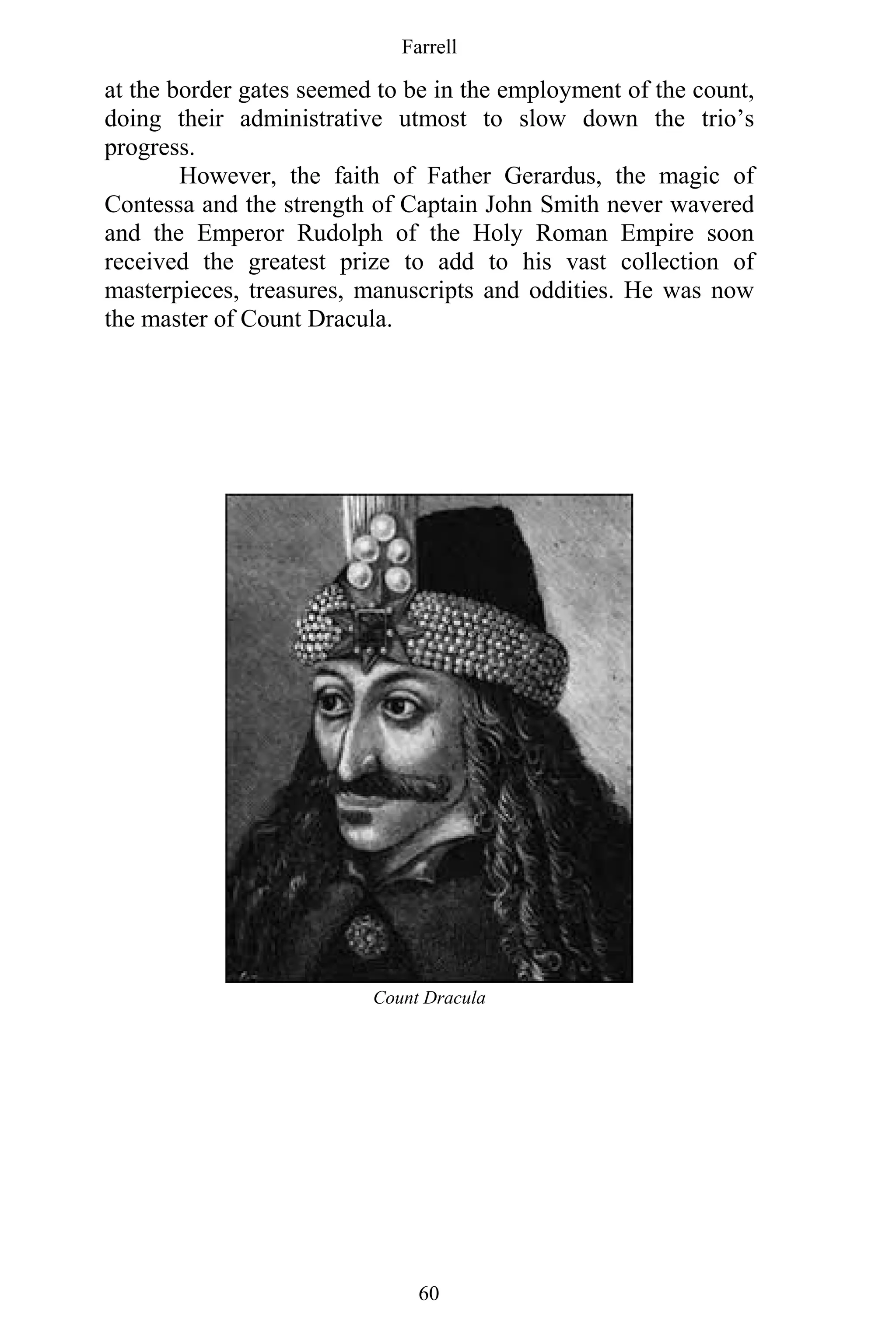
the master of Count Dracula.
Count Dracula
McDade
61
Thomas M. McDade
Antimacassar
Short Story
I took a short, hot shower. The water went tepid like it
often did aboard ship. I shaved leisurely. Just as I got the fluffy
towel wrapped around me, Roger Lester’s little brother, Doug
walked in, without knocking. Punk was pushing fourteen but
acted like an adult who’d been around the world twice. He was
tall for his age I thought, square-faced, one front tooth crossed
over the other. I flipped a hand towel over my left shoulder and
let it drape my upper arm to hide my tattoo. I didn’t want to hear
any of his shit.
“Must be a chore taking a leak with all those buttons,
huh,” he said, pointing to my bell bottoms on the radiator on top
of my dress jumper.”
“Nah, secret method perfected in boot camp.”
“Must be a lot of yellow training stains,” said Doug,
snickering.
Placing his transistor radio on the toilet tank, he sat on
the hamper. “You really want to go to Val’s dance, Sailor Tom?”
he asked, over a used car commercial that reminded him he had
to steal another car soon to keep in practice.
“Yeah sure,” I said to myself. Now that the booze had
worn off, I wished I hadn’t agreed to the damned dance.
“Yup,” I answered.” “Unchained Melody” was blaring.”
“It won’t be like the slummy Silken Hoof where you got
your load on. I sure wish Lana didn’t live over that dump.”
“No load on. How about lowering the radio some?”
The Path
62
“It ain’t bothering me. My head ain’t lost in throb town.
You turn it down.” I did, instead of telling him to shove it.
“What’s the matter, Man?” he continued, “You don’t like the
Righteous Brothers?”
“Love them,” I said, “but it was too loud for
conversation. How would you know anything about the Silken
Hoof?”
“I’ve been there with Chad and Lana, a couple of visits
with Chad’s second cousin Clayton too. It used to be the
Paddock. He calls it the Padlock because he’s picked its lock.
Not a whole lot going on with him but he’s talented that way. He
did one too many crib dives as a baby, broke his shoulder once
but mostly it was his head suffered. Val’s been there too. We
sneaked out my bedroom window one night. Lana had a key
made on the sly.” Clayton nailed a photo of The Three Stooges
on the wall, lot of head scratching over that. “Who’s your
favorite?”
“Larry,” I said, although I liked them all equally.
“You kind of look like him, nyuk, nyuk. I’m a Shemp fan
myself; bet you didn’t know he was once a boxer.” I pleaded
guilty. Doug placed his elbows on his knees and propped his
face on his palms. I shaved carefully around my lips.
“What else about the Silken Hoof?” I asked.
“Not much, the jukebox got too much shit-kicking music.
You’d think this was Nashville. Besides that’s a dumb name,
Silken Hoof. I might spray paint ‘Silly Goof’ out front someday,
just might.”
“I like that name change. I was surprised at the country
stuff myself but there were other choices.” I remembered “Lana”
being a selection I almost played but came to my senses. “Oh
beautiful Lana, you know that I wanna.”
“Race trackers from down south brought the twang along
with their white lightning,” he explained.
“Country tunes ain’t all bad.”
“Chad liked to say you had to drink your way into liking
them and then you’d dig anything but he was always playing
Hank Williams songs. His favorite was ‘On the Banks of the
Pontchartrain’. He was starting to like the Beatles though,” said
Doug, voice breaking off.
“Haven’t started drinking yet, have you?” I asked,
joking.
McDade
63
“Clayton gave me some shine once that drilled me a new
asshole. I don’t even want to think about it.” I liked the way he
put it but didn’t want to swell his head.
“Jacked you up to take some powerful notice, huh?”
“I ordered the man down for a-hundred pushups. He can
sure take his punishment.” Clayton should give the punk a
backhand, I thought. “Let’s talk about something else. You’ve
seen them both, do you think Lana’s prettier than Val?” he
asked, jumping up to change the radio from news to Tommy
Edwards singing “It’s all in the Game.” I splashed on English
Leather and ignored the question. It was the after-shave I used
on Saturdays.
“You’ll never catch me using that shit,” said Doug.
“Why not choose Old Spice? You’re supposed to be a sailor
aren’t you?” I couldn’t recall being such a wiseass at his age.
“Old Spice is for old men, English Leather is for
horseplayers.”
“Losers, my old man would say. “That’s the opinion of
many, not necessarily correct. Take me, for example.”
“You won? How much did you win? Or is it the loser
code, breaking even counts as winning. I love the track and the
horses but don’t plan to go poorhouse over them.”
“You’ll hear dollars and cents soon enough.” When
Roger stranded me at the Silken Hoof after a phone call from an
old girlfriend in Central Falls, Lana asked me to her table. She
patted her belly and I joined in her toast to the beautiful baby she
had in the oven. She was the first woman I’d ever seen with a
gold framed tooth, the one next to the left front. The rest of them
were perfect and she didn’t need the precious metal to make her
smile a winner. Offbeat attractive, her face was narrow, nose
sharp and eyes deep blue. Questioning eyes? I’d heard that on
TV, might have applied to her. Her skin looked so flawless and
soft my fingers ached to touch it for proof. Hair ash blonde, it
was long enough to swing over her shoulder to cover her
substantial left breast. Johnny Burnette was “Dreamin’ on the
jukebox when she asked for my Racing Form. She gave me $20
to put on a horse named Dream Mesa, placed my hand on her
belly for luck. Dream Mesa paid $29 for a $2 bet. I had $10 on it
myself. I planned to give Lana’s dough to Val to deliver before I
caught a bus back to the Newport in the morning. I wasn’t
The Path
64
expecting much sleep on a cot in the same room with motor
mouth Doug.
“So, is Lana prettier than Val?” he asked again, standing
to switch off the radio before sitting on the edge of the tub.
“Dead heat,” I said.
“I knew you’d say that,” he said, slapping his knee.
“Lana beats her by miles in the figure department.”
I’d have to wait until the baby came into the world to
learn that and I didn’t intend to see these parts again, six months
down the road or ever. I shortened my sideburns. Doug fired up
his transistor again and joined the Beach Boys singing “Help Me
Rhonda,” applauding after the song ended.
“Are you really going to that dance?”
“Yes Sir.”
“All they got is Pepsi and you’ll get sick as I did on
shine,” he said, pleased with the comparison. Then running into
the bedroom, he returned wearing my white hat.
“Looking good,” I said, “maybe you’ll join the Navy.”
“All sailors do is get drunk. I told you I’m never going to
drink again.”
“There are Born Again Christians on the ship. They’d
rather be keel hauled than drink alcohol.”
You ain’t the first sailor that’s visited you know. My
cousin Liz picked one up at the Johnny Shadows Lounge and
took him home. They found me watching the big color TV. I’d
climbed in a window. My aunt and uncle were in Atlantic City
celebrating a wedding anniversary. She was 16 at the time. He
was a jerk, used big words. One I remember is “antimacassar”.
We were sitting on the couch. He had his paw around the jailbait
and suddenly he picks up the doily behind her head. “Do you
know what this is?” he asked me.
“It’s a doily unless you got a cold then it might be called
a snot-rag. That shut him up for a couple of seconds. Then he
raised his voice, said it was to keep hair grease off upholstery.”
Liz gave me a fiver to scram, probably lifted from his wallet.”
“Maybe “Antimacassar” would be a good name for the
Paddock/ Padlock / Silken Hoof / Silly Goof—doily coasters for
resting mugs,” I suggested.
“That would just be asking for arson. Anyway, this guy
from California, Ronald was his name, a Guided Missile Tech,
McDade
65
knocked up Liz. He didn’t get arrested but her daddy got money
coming in from the Navy; allotment I think they call it.
“Yup, that’s the term.”
Liz married a jockey but he didn’t’ adopt the kid named
Dolly not doily. Ha. The monthly keeps rolling in. Speaking of
jailbait, Val qualifies. Tell it to the judge. Here come-da-judge,
Sailor Boy. ‘A lot’ more government mail landing in the Lincoln
P.O. Ha.”
I thanked the punk for the parable of the antimacassar
man but not aloud.
“I saw you looking at her at dinner, your eyeballs trying
to melt buttons off her blouse.”
He made a grab to pull my towel off my arm. I moved so
quickly to dodge, I exposed the damned tattoo myself. Just then,
I spotted Val standing against the doorjamb like a hooker against
a telephone pole, a maroon, corduroy jacket slung over her
shoulder. They laughed like hyenas. She wore red lipstick, olive
oil over tomato bright. I‘d be flat ass lying if I didn’t find that
mouth tempting. Her jeans and purple turtleneck were tight.
High-topped sneakers, maybe PF Flyers finished her. No bra
haltered her little tits. Her black hair was in two braids and long
enough to rein her in. Her eyes were big, dark and a combination
of curious and ain’t-I-mysterious.
“Stand still,” she said, then slapped her palm against my
crossed anchors. Examining the palm, she said, “No ink; could
be real.” Doug belched, long and loud. “Doug can burp at will,
Tom, some talent, huh?”
“I reckon.”
“Make him turn around, Val. I think he’s got a boner.”
Val used her palm again, nearly knocked him into the tub.
Leading him out by the ear, she slammed the door. I finished
shaving, dressed; tied a snug knot in my neckerchief.
When I exited the bathroom, shadowboxing Doug
greeted me in a jean jacket that was too big for him. “After my
Sunday punch, we’re out of here the cat burglar way.” He swung
hard enough to extinguish a roaring fireplace. “You owe me. I
talked Val out of dragging you to the stupid dance.”
Grabbing my pea coat from the door hook and my hat off
his head, I followed him out the window onto the flat porch roof.
We reached the ground courtesy of a small fir tree and drain
pipe. I remembered times I wanted to run away from home.
The Path
66
Once I got five or so miles away before my old man’s jalopy
Chevy rattled and smoked up behind me.
The famous Clayton was waiting below. He saluted and I
saluted back. I could make out disheveled salt and pepper hair
and fleshy lips. He was lanky, probably a little over six feet,
wore a long black coat. He looked normal to me. I checked out
the sky while they lit cigarettes. I thought about all the lookout
watches I’d stood under skies clear, cloudy and angry. When my
eyes returned to earth, Doug and Clayton were gone. The hell
with them, I’d sneak back into Doug’s bedroom and call it a
night.
As I started for the porch, I heard a noise in the brush.
When I turned, my knees buckled, tackled like an indecisive
quarterback. “Goddamned you, Doug,” I said in hushed voice. I
scrambled to my knees and found myself in a chokehold. The
grip was too strong for Doug’s build. It was either Clayton or
Roger. This stunt had Roger Lester written all over it. “Better
fuck off,” I said, swinging my elbow into ribs then reaching back
for a hank of hair, suddenly thinking it might be old man Lester.
“If you want a lock of hair, just ask,” said Val, voice
weak and cracking as if I’d knocked her wind out.
“Jesus, Val, I’m sorry. Why didn’t you say something?
You OK?”
“No sweat,” she said coughing violently. I hugged her.
“Excuse my French,” I said.
“Oui, oui.” She bent down to pick up my white hat, set it
on my head, cocked.
We walked together about a half a mile. She held onto
my arm. All my attempts at conversation were awkward and
humdrum. Many times she repeated, “Adventure on tap tonight.”
We turned onto a path leading into the woods. The sky allowed
enough of the half-moonlight to guide us along a line of birches.
The stars were dim buds. As we reached a narrow field,
headlights flashed an S.O.S. It was a dark blue Chevy Impala,
Doug at the wheel, Clayton in the passenger seat sitting up proud
and tall. “Nice one, Doug,” said Val as we jumped in the back
seat.
“No funny business back there,” said Doug as he slowly
pulled out. The little shit wasn’t lying about car theft. Christ, if
we got caught I’d be in big Uncle Sam trouble.
“Next stop, F.E.I. Club,” announced Clayton.
McDade
67
“Now hear this, out-of-town Tom, that stands For Every
Imbecile,” said Doug, leaving rubber at the second red light we
hit. “Damn,” he said, “I had these lights down to a science the
night of the GTO.”
“That was one beautiful car,” said Val moving closer to
me, “red with leather seats, super speakers.”
The parking lot was full. Doug swung out, parked on the
main drag, left the keys in the ignition. “I’m going to trade up
when we split,” said Doug. “I detected a spark plug with a slight
misfire, correct Clayton?”
“Son of a bitch, misbehaving all right,” agreed Clayton
wiping down the steering wheel and door handles with a red
bandana. We walked to the side of the building.
“Lana was an exotic dancer at the F.E.I. before she got in
a family way. All the other girls are amateurs compared to her,”
explained Doug. “Mona the Magnificent Milk Maid is a freak.
That’s why the parking lot’s full. She could use a wheelbarrow
to transport her chest. It would take a hundred pairs of Val’s to
match her set.” Val dropped back and kicked him in
the ass.
“Through the uprights,” confirmed Clayton.
“Truth hurts,” said Doug.
“You’re going to hurt a plenty, pecker-head.”
“Lana has jugs made in stripper heaven,” said Doug.
“She’ll never come back to this sewer. She’s better than
that,” hissed Val.
“Quiet,” said Clayton, kneeling down before a window.
He lifted his arm. Doug grabbed it, stepped up on his shoulders.
Clayton easily stood up. I wondered if he’d see Roger in there,
loved strip joints overseas.
“She’s plopped them on a couple’s table,” reported
Doug. Val said she couldn’t look, might become violently ill. I
was going to beg off but Clayton and Doug would have never let
me forget. Would Val hold it against me? I used the same
elevator, strong guy, pushups I figured. That was a very sizeable
chest on that Maid but in my mind not a pleasure to look at.
Doug told us to wait there until he came back.
“I’m sorry I looked at that sideshow,” I confessed to Val.
“I know you didn’t have your heart in it,” she answered. I
was relieved.
The Path
68
“Don’t you ever worry about the cops catching you in a
stolen car?”
“No, I haven’t been scared since Chad’s stock-car caught
fire at Seekonk Speedway. His death numbed me to fear. I know
that doesn’t make sense and maybe it’s not true but that’s what
I’m claiming now, how about you?”
“You bet I am, don’t want to get booted out of the
Navy.”
“Not to worry, Clayton’ll take the heat if we get caught.
We’ve rehearsed in the cellar under a bare light bulb. He’ll save
us.”
“Good to hear,” I said, leery. In ten minutes or so, Doug
returned. We followed him to a big black Chrysler.
“A guy and his gal just had a quickie and she wasn’t
happy,” said Doug. ‘The Anti-Climax Kid’ is what she called
him. No shit, he slapped her a few good ones before dragging
her back into the ‘diary bar’. Chump left his keys. Ha.”
“That’s the kind of people who go to strip joints,” judged
Val.
“I saw the mayor once,” challenged Doug.
“Made my case,” said Val.
Clayton turned the radio on to the Bobby Vee warning,
“The Night has a Thousand Eyes.” Doug cut the volume too low
for ears. We passed around the bottle Clayton claimed was
moonshine. I’d had it once before and this wasn’t it. More like
the watered down booze in sailor bilking nightclubs in Naples.
My body hair did not feel on the verge of de-rooting.
“You two sit on your hands back there,” said Doug,
deepening his voice.
Val ignored him. “Smooth ride or what, Tom?”
“Smooth is too feeble a word.” She kissed my cheek.
Doug announced Lincoln Downs Racetrack would be the
final stop on the grand tour he was launching. The first attraction
was the Diamond Hill parking lot. Chad had won a couple of
skiing medals three winters ago. It didn’t look like much of a
challenge but all I knew about skiing was what I’d seen on TV.
“My dad took me to a concert by that pond last summer,”
said Val. “We saw a famous drummer named Krupa I’d never
heard of but dad talked a blue streak about the guy’s fame. I
loved his solos.” No one claimed Chad was a genius on even one
McDade
69
musical instrument. Clayton drummed on the dashboard with his
index fingers.
Next, we headed for Pawtucket. I mispronounced it.
“Paw” instead of “Puh,” they laughed at me. “Damned
foreigner,” ribbed Doug. Crossing a downtown bridge I could
see falls, barely flowing. Val explained they’d powered the Old
Slater Mill, the oldest textile mill in America. Clayton, expert at
entry antique and new, had picked its lock twice just for what
was at least the Rhode Island record we all agreed.
“Slater was a slave driver and they named a park after
him,” offered Clayton, stuttering. “They worked their asses off!
Sam Patch didn’t take his shit, became a famous daredevil,
conquered Niagara Falls by leaping the hell in.” That was the
longest narration I’d heard from Clayton so far. He was
passionate.
“Damn right,” agreed Doug.
We cruised past a cop car on the way to Narragansett
Park. I closed my eyes and crossed my fingers. They had no
connections to get us onto that track where Mr. Lester had seen
Seabiscuit win his first race. We lingered in the vast parking lot.
Lana’s dad sold his tip sheet in front of the clubhouse. He had a
portable printing press in his station wagon. “Chad made some
big hits here, he did,” said Clayton. “He parlayed seven races for
some big buckaroos a couple of times. He would have gotten all
nine eventually.”
“Clayton bets favorites to show,” said Doug prompting
Clayton to stretch his arm, flipped two fingers up behind Doug’s
head. “You’re just building up your pushup IOUs,” warned
Doug, spotting the move in the rear view mirror.
Val got behind the wheel and had us dizzy using the
lampposts for a slalom run. Doug tried to convince us to join
him in jumping the fence and but Val reminded him it was alien
territory and needed some daytime casing. Doug hit the gas,
fishtailed the Chrysler on its way.
Prospect Heights Federal Housing, where Clayton grew
up was down the street. We parked in view of his two-story birth
block after weaving through narrow streets. Clayton got on the
podium again. He served up the history of the place along with
names of people he’d known: a champion boxer and Major
League pitcher among them before documenting himself. “I
scaled those bricks a thousand times or more.” “I’d walk the tar
The Path
70
and gravel roof and pretend it was an aircraft carrier flight deck.
How do you like that Tommy?”
“I’m very impressed sir.” He snapped off an exaggerated
salute.
“You sure are lucky you’re in the Navy. Do you ever see
bird farms?”
“Yup, USS Randolph, I see her too damned regularly.
“Here’s my carrier,” said Clayton, whipping out his
wallet. Doug switched on the overhead light for him. He showed
around a laminated well-creased WWII trading card featuring
the USS Lexington.
We swung into the Boro Drive-in. Clayton “finessed” the
padlock securing the chain. Doug pointed out the corner of the
screen. He’d climbed to the top a couple of times using the
support frames, pissed off it. “Clayton ain’t the only climber.”
“You’re the only pig,” said Val. She’d seen The
Unsinkable Molly Brown here with Chad and Lana. Doug inched
us as close as possible to the screen, switched on high beams.
Clayton ran to it, did some pretty nifty hand puppet work.
Cruising tyrant Slater’s Park, Doug told of giving
cigarettes to monkeys to smoke. He knew a kid who’d stolen an
Appaloosa and freed a timber wolf. I was wishing the night over.
Doug claimed he’d once helped Chad steal a peacock for Lana’s
birthday, returned it just before dawn. “Someday I’ll ride Fanny
the elephant,” he vowed.
“This is nothing but an animal concentration camp.” No
one challenged or heckled her.
By the time we reached Lincoln Downs, the night had
freed about a half million stars.
Doug held up the bottom of a ten-foot chain link fence
topped with sagging barbed wire and announced it was the
entrance for the blind, crippled and crazy. Clayton slid his
knapsack of shine under. We scaled that fence like death row
prisoners making a break. I landed flat-footed and hurt my heel.
I kept the pain to myself. Val just about flew over, like an
Olympic medalist and I told her so. It was casket quiet and it
struck me countless gambling dreams lie underfoot, hoof-
pounded into the earth without the courtesy of a gravedigger,
coffin or floral arrangement. A plane passing over broke the
silence. I recalled being jolted out of nightmares when I was a
McDade
71
kid and finding comfort in a plane’s engines as if aircraft in a
lonely, night sky made a God more possible.
Val clenched my arm like a tot locked around its father’s
leg. Doug had a light grip on my pea coat hem. I thought about
ribbing him but decided to save it; sure was eerie. Clayton
walked ahead making whinnying noises between moonshine
sips. After stopping to let us catch up, he offered me the bottle. I
held off calling it Kool-Aid. “Let me wet my tongue,” said Val.
“Your old man would love to hear you were out drinking
rocket fuel with me,” I said.
“Clayton would take the blame. Wouldn’t you Clay
Man?”
“Ginger ale,” said Clayton, “I thought it was ginger ale,
by God.” Val hugged him, swigged and cart wheeled.
After we climbed over a small wall to get to the
clubhouse, a spotlight covered us. We were on stage. Clayton
did a soft-shoe. Doug and Val blew kisses. “Go give Harry some
hooch, Clayton,” said Doug. “Tell him there are crucial stakes
races to be run!” We rushed to the Grossman Building Supply
box seats. Doug pointed out he’d chosen them because his dad
worked there. Harry flashed the lights around the oval at minute
intervals. Doug calculated the end of the world would start with
the racetrack lights signaling such warnings.
“You been nipping moonshine?” asked Val.
“Just being near that junk gives me wild ideas,” said
Doug. He called an imaginary race which featured horses with
Beatles inspired names. Liverpool Lads won by a five lengths.
“I wish there were more stars,” Val said to me.
“Land stars are nothing next to sea stars,” I boasted.
“I’ve seen the sky almost one big star. Sea stars are flowers that
love the ocean air so much they bloom out of control and
overlap.”
“Talk, about wild ideas,” said Doug, making circles with
a finger near his temple.
“Wild and wonderful,” said Val, kissing my cheek; and
romantic.”
“Nah, it’s lonely out there.”
“From now on, think of me.”
“Think of me,” mimicked Doug, pitching his voice high.
“He’ll think of you with a broken nose if you don’t clam
up,” warned Val.
The Path
72
“Any minute of the day or night, sis Valerie.” He sang
“Oh, Oh, Valerie” far off key while throwing out lefts and rights,
brushing his thumbs off his nose.
Clayton returned from the Harry mission and passed the
bottle while snorting like a Clydesdale. The octane had sure
skyrocketed. I wondered where the still was located. Was it
Clayton’s operation? Something in the Chad annals, I’d never
hear? “Holy shit,” shouted Val after a bigger slug than her first,
“Where did the smooth go? My lips disappeared, can’t feel my
lips!”
I kissed her, asking, “How ‘bout now?”
“You’re a hero, sailor,” she said. “Now tell me, how’s
the sea sky for shooting stars?”
“A showcase,” I said. “Star petals all the time diving. I
slipped my arms around her and she snuggled up to me. “I’ve
been studying up about the stars,” I continued. “After the next
cruise I’m going to be an expert. There’s a guy on the ship called
Rabbit. He’s had some college. He’s taking a correspondence
course in astronomy. I learn lots from him.”
“Rabbit?” asked Val.
“A guy in the personnel office spread it around that he
was born on Easter,” I lied. Rab made the mistake of telling a
bigmouth he was a virgin even after cruises to South America
and the North Atlantic.
“Rudolph, if it had been Christmas. Right Tommy?”
piped Doug.
“You still here?” asked Val. He gave her a Bronx cheer.
We drank more and I could see myself carrying a passed out Val
home, old man Lester raging.
“Why don’t you go to college, study astronomy on the GI
Bill?” Val asked.
Clayton murmured he was a Scorpio.
“If I could go where you go.” I remembered all the
college prep courses I hadn’t taken.
Doug whistled Beatles tunes while Clayton blew along
over the top of a bottle. “I’d love that,” said Val. Do you read
much?”
“No,” I said, feeling the strikes adding up.
“Well, you’ve got to start if you want to stay on my good
side. Two are very important to me.”
“Shoot,” I said, softly touching her face.
McDade
73
“From Here to Eternity and Soldier in the
Rain…Promise to read them?” Odd choices for a high school kid
I thought, especially a girl. Maybe she planned on escaping
Lincoln by joining the military, like I’d fled Ohio.
“I do solemnly swear, during General Quarters, in the
mount 54 magazine there’s time galore to kill.” I imagined
writing her long letters about the books, about everything. I
moved my finger to her ear. She took my hand. “You’re giving
me the chills, Tom,” she said. I kissed her.
“Oh my Gawd,” teased Doug, making loud kissing
noises. Clayton joined him as a couple of birds or bats bounced
off the glass winterizing the clubhouse.
“What the heck was that:” cried Val.
“They’re shooting,” shouted Doug, dropping to the floor.
“Cut it out, Doug,” she scolded.
“Loosen up,” he said, “some night bird kamikazes.”
“They should put up decals,” she said.
“Big Sylvester Cat stickers,” said Doug.
“This will help,” slurred Clayton, passing Val the bottle.
“Let’s have a race calling contest,” suggested Doug. “I’m
bored. Clayton will be the judge
I tried to do the Dream Mesa race, but recall only two
other horses in the race, Brown Bulldog and Footprint. I
substituted Man O’ War, Native Dancer, Whirlaway, Seabiscuit
and War Admiral. Dream Mesa won by twelve widening
lengths. Doug’s named his horses after states and capitals this
time. Juneau won by a neck. He explained that Chad believed
that no matter how solid your feet were planted, you were
nowhere if you didn’t know the geography of your situation. I
said stars fit into that picture. “Space Cadet,” muttered Doug.
“You leave Tom alone,” warned Val.
“I’ll tell you one thing,” said Doug, “if I had a string of a
hundred horses I’d name them like what you just heard me
deliver.”
“Don’t forget D.C.,” said Val.
“I’d like to see a horse called Buckeye Sky win the Ohio
Derby,” I said, while imagining horses named after the stars. I
automatically bet on any horse with a name involving the
heavens whatever the odds, Pleiades won for me at Aqueduct
when the ship spent a week at Pier 40.
“Who called the best race, Clayton?” demanded Doug.
The Path
74
“Tie, natural tie” said Clayton, sheepishly.
“Pushup time,” said Doug.
“Let’s pray for Chad,” said Clayton, quickly falling to his
knees.
“Congratulations Clayton, slick way to weasel out of
pushups, but deeper horizontal debt for you my friend.” Doug
kneeled and began to hum.
“Stop that, you little heathen,” said Val.
“Hums reach Jesus quicker than words,” explained Doug.
“Tom will think we’re some kind of Holy Rollers.”
“Shit, he worships the stars,” shot back Doug.
“Sing a hymn for Chad, Val,” urged Clayton.
“I only sing at his grave, you know that.”
“Let’s go down to the track,” I urged.
After we walked ten or fifteen feet, we heard Harry’s
“Call to Post” recording. “Great timing, Harry,” Val shouted.
“I’m going to get a bugle and teach myself that,” said
Doug.
It was the first time I’d ever set foot on racetrack dirt. I
felt what WW II vets must feel when they go back to their old
battlefields. We stopped in front of the tote board at the lights
that display the numbers of the first four horses throughout a
race. Suddenly, I lost the feeling that the roar of yesterday’s
crowd was suspended over us like a muffled cloud ready to
break at any moment. A look back at the clubhouse and
grandstand convinced me a racetrack is the loneliest place on
earth. I couldn’t imagine the seats ever filling again. I recalled
times I’d told Roger I wanted burial in the infield at
Thistledown, a depressing thought now. “Would a racetrack ever
feel the same?”
“I think we’re the only folks left on earth, Val,” I
whispered.
“Could be,” she agreed, tightly holding my arm.
Clayton killed what was left of his bottle and got a new
one from his bag. I christened it, same mild potency as the initial
spirits. I guessed he had a moderation system. Val drank last, she
sang, “In the Garden.” Was this a rehearsal for a visit to the
graveyard where Chad resided? Who knew what would come
next. My mother loved that hymn. “Those Protestants come up
with some pretty fair tunes,” she always said after listening to
McDade
75
Tennessee Ernie Ford’s version. Val sang as well as Roger often
bragged. I expected Jesus to ride up on Dream Mesa.
“Magnificent,” I said, embracing her.
“It was Chad’s favorite,” she said.
“Is he buried far from here?” I asked.
“Right under you, Tom; he was cremated and we decided
his ashes should be close to where he was most peaceful when
he was alive. It was Lana’s idea.”
Doug and Clayton fell to their knees. With Chad the
Great in racetrack ground, I figured I’d have to be installed
twelve-feet under the Thistledown earth to compete. Would I
ever have a crew as devoted as this one? Doug rolled onto his
back and bringing his feet over his head, flipped upright.
“Chad and Lana would never go six furlongs with me,”
said Doug. “You game, Tommy?”
“I’m more a quarter horse,” I said.
“They wouldn’t go that distance either. I did get them to
go an eighth once.”
I liked the idea of doing what Chad hadn’t done and was
amazed anything remained. Imagine, being jealous of a dead
man. Doug wasn’t talking your everyday footrace. Chad raced
him with Lana on his shoulders. Clayton had carried Doug. I
agreed to go the quarter toting Val, despite my tender heel.
Val spread her legs and I ducked under. I was wobbly at
first but soon found balance. I remembered sitting on my father’s
shoulders watching parades as a kid. The track was sandy as a
beach. I imagined a Riviera stony shore that had shocked me but
it didn’t keep the topless women away. Yes, Val skinny-dipping
with me. I thought of the table Roger said Chad and Lana used
for sex at the Silken Hoof.
“They’re off,” shouted Clayton.
“Hi Ho Silver, Away,” yelled Doug. Val was light for a
few minutes but gradually felt like she had someone on her
shoulders and the tower kept growing. At the sixteenth pole, she
leaned to kiss my forehead and we nearly fell. I found a burst of
speed near the wire and nosed out Clayton and Doug. Doug
demanded a rematch while Clayton drank long from his bottle. I
lowered Val and got a victory kiss. I was breathing so hard it
was like giving her mouth-to-mouth resuscitation. For the first
time, I tasted more than the tip of her tongue. Just as Doug
shouted, “Clean break, clean break,” my stomach became a
The Path
76
pinwheel in a tornado. I ran to the rail and puked my guts out.
Doug and Clayton’s laughter was nightmarish.
“The swabby’s traveling to Eurrrrrrrrrrrrrrrrope,” teased
Doug. “Wyatt Earrrrrrrrrrrrrrrrp, Wyatt Earrrrrrrrrrrrrp, brave,
courageous and bold,” sang Clayton.
I leaned on the rail like a beaten fighter on the ropes and
sucked in the crisp air. I felt there was a slight chance I’d live. I
imagined Chad’s ashes having a good laugh too, gathering
snakelike to twirl and spin. Nothing could kill Chad. I pictured
his soul slithering its way into the tote board bulbs, screwing
around with the odds and results, short-circuiting it into a million
winking eyes.
“You OK?” asked Val, offering a roll of Life Savers.
“Physically,” I said, barely smiling. ”I’m just
embarrassed as hell. Damn, I just met death halfway,” trying to
laugh. I picked up my hat I’d stepped on that would need a
gallon of bleach after this night.
“The reaper put a mysterious finger on you,” she said,
wiggling a couple close to my eyes.
“I must look like an unlucky fellow in a soup kitchen
line.”
“Looking courageously good to me,” she said, slapping
my back then gently, squeezing the back of my neck like an old
pal. She kissed my peppermint lips. I tried to return the Life
Savers. “Your souvenir,” she said.
Grossman’s Hardware parking lot was the last stop for
the Chrysler. Right in old man Lester’s occupational lap, I told
myself. Clayton again diligently cleared fingerprints like
someone employed by the mob. Doug confided that Clayton
worked for an office- cleaning outfit. We trudged back to the
Lester residence, only had to dive into the brush twice to hide
from passing cop cars. Clayton finished the last swig of shine
and asked if I’d noticed anything about the stuff. I told him
about weak and strong. “You don’t know strong,” Clayton
assured me. They all had a good laugh before letting the Chad
still works out of the bag. Clayton had taken over, he, and only
he, knew the Chad recipes won in a poker game with a West
Virginia trainer named Kelly recently deceased. The shine
operation was near the Ten Mile River.
We got up on the porch roof same way we got down. Val
went to the window then bolted to the roof edge and puked.
McDade
77
Doug and Clayton took a glance, snickered in harmony, “Roger
getting it on and on, reported Doug. They pulled me to the
panes. Roger Lester humping the Milk Maid, tits piled off to
each side like water wings. I ran to Val and offered the souvenir
Life Savers. Roger riding the Milk Maid sure hit her hard. I
remembered her “violently ill” comment at the F.E.I. Man, what
if it had been Lana under him?
“It’s just the shine and the race catching up with me, not
because of that disgusting porn.” She popped a couple of
peppermints in her mouth, drew my head down and kissed me.
Her tongue parked one of them in my mouth. My tongue moved
over the raised logo letters. I thought of the all the words in
those books she assigned. I knew one novel was thick. I was
pretty sure Hollywood had gotten hold of them but I wouldn’t
cheat and hold out for a mess deck or side of gun mount movie
on the ship.
“Can’t blame you for heaving,” said Doug, oddly without
a smartass remark.
We wondered how Roger intended to get the Milk Maid
out of the house. More than that, how he got her in. “I could sell
tickets to watch her climb like us,” said Clayton, “We’ll spend
the night here, just like sleeping on a carrier deck, right Tom?”
“Aye, aye, Sir.” Suddenly, I couldn’t wait until morning
to brag. I made a show of handing over Lana’s money to Val,
shocking Doug. They were amazed at the Dream Mesa / Johnny
Burnette connection. Of course, credit given where it was not
due, Chad’s ghost.
“Hey Captain Clayton: how about some shuteye?” I said.
He hummed “Taps” low and sorrowful. Doug wished us good
night, smack in the center of a bullfrog belch then flopped down
in a snow angel pose. I took off my pea coat, told Val it would
be our blanket. I eased down. After she arranged her head on my
bicep, I covered us. She removed my white hat, held it to her
chest, a kid with a favorite stuffed toy.
Why do you have all those buttons instead of a zipper?”
she asked.
“Tradition, a precious tradition, a sailor gets used to
them.” With my free arm, I pulled my dress jumper flap up
under my head. The antimacassar warning flashed across my
mind. Clayton snored with authority. Doug was sound asleep or
pretending.
The Path
78
Budd Nelson
Liar’s Reward
Short Story
Sitting here crouched back against the cold stone inner
wall of this long abandoned hovel, I wonder at the peasant who
built it. In this oppressing dark, that only the Cornish copper
miners know from years of labor deep in catacomb labyrinths
where no light penetrates. I can hear the buzzes of the fly near
me, flittering from spot to spot searching for some rotting
remnant to feast on and leaving his sickness where ever he lights
for the moment. I can hear him in the depth of the silence of this
room amidst the clamor of heavy torrential rain drops beating
against the outer layers of old thatched roof above. In between
are the blasting of close thunder, mere moments before the only
penetrating light here when blinding lightening seeps between
the age old cracks in the rotted wooden door and window clap
boards.
In those brief intrusions of brightness my eyes have no
time to adjust to clear vision of my dank and years of dust
encrusted surroundings. But my memory of these past few days
of haven here, need not the brilliance to know them well in this
ominous ebony shroud of middle night. The fly flits again and
again unceasingly like a harbinger of another sleepless night
hiding in exile from my just reward outside these most humble
quarters, if I am found.
A rustle in the corner alerts me to my other companion
here, that long grey rat I have been unable to kill with his whip
like pointed tail and nasty whiskers. Could I but murder him, I
would have my first meat to eat in several days. I would rather
feast of him, than him chew on some appendage of mine due to
my lack of skill in thwarting him. This is what I have become, an
eater of rats and found woodland fodder, hiding in years gone by
Nelson
79
dilapidated and abandoned places as far off any well trekked
places of humankind as I can stumble upon.
Here, what I hope is far enough to the north, to be
nearing those ancient remains of wall that marks the extent
where those age old tales of Roman conquerors once held sway,
I pray is far enough to be out of any pursuit by the undersheriff
of Shrewsbury. For there I am named worse than rat eater and
his personal enemy.
Another clap of ear deafening thunder almost
immediately followed by the eye searing blast of temporary
light, gives a momentary reflection of small intent yellow eyes
peering directly in my seated direction. Instantaneously, by pure
instinct, I jolt backwards in aversion, cracking my skull cap
against the stone wall I am leaning against. The sound of my
head thudding against the wall coupled with my short gasp of
air, startles the rodent just long enough for my lung back
forward to send the vermin scurrying back into the far darkness.
A bite now averted, but also a chance at meat that I could cook
on an actual fire this night, when there would be less chance of
anyone about noticing possible habitation in this long thought
uninhabited shelter, is gone as well.
Peering into the oppressive dark I can barely make out
the patterns of the grass stuffed, once straw mattress I had found
here, or the creaking legged rustic table (I had done my best with
torn remnant rags to tie back into use), much less any small
rodent sneaking about the floor in stealth. However glad it is I
am that it is only the fall of the year and not the dead of winter,
because dead it is I might be, even here with some shelter from
the elements by now.
Would that I could turn back the flow of sands leaking
through the midpoint of the hour glass and I would change all
that I had done which brought me to this place in time and
imminent future fate. Alas, I am no mage of old, so I can but
forge forward in an attempt to at least stall off capture and restart
a life again elsewhere far from where any knows of my past
cowardice.
I place my gnarled hands at the age’s worn smooth
stones at my back and slowly press, aiding me in achingly rising
on shaky legs, as I have crouched in the deep shadows far too
long. Stretching my back muscles to awake and flexing my other
muscles back into usefulness, I step forward one foot at a time
The Path
80
until I can put my hand on the dilapidated wooden table in the
middle of the room. Here I use the table as my guide, walking
around it and toward the door of the hovel. Once at the door I
remove the dirk, tucked between my belt and britches, so that I
can slide it between the edge of the many-cracked door and its
frame and slide it upward lifting the latch on the outside. This is
how I have kept the door closed when I am inside, so it would
appear to anyone chancing upon this abandoned cottage that it
was indeed still uninhabited.
Swinging the door ajar into the night I can peer only a
couple of paces into the deluge of the storm, the torrential heavy
hard rain drops are bearing down almost sideways and within
moments I am soaked to the skin on my front side, thus I close
the door and latch it again as it was before. Inside is dry; the
Thatcher’s work had been done well for there to be no leaks
after so many years. None will be about this night, so I move
toward the mattress in the corner. Kneeling down and turning to
first sit on the dank grass and straw stuffed bag, I lean back and
stretch out to attempt at find some solace in sleep on this night
when all I have to be aware of is my rodent companion and not
others searching for me.
Sleep does come eventually, fitfully and broken with
dreams of dread, but sleep nonetheless.
With a dismal grey almost dawn, I awake not fully
rested. After opening the door, I see that the storm had belayed
down to a dense cold drizzle, still constant and thick as fog on a
winters morn on the Cotswold’s. Watching the rain continue to
soak the entire glade, my mind drifts back to Shrewsbury. I can
still see the stalls starting to rise for the festival and open faire, a
feeling of merriment in all those of this tiny shire, amid many
colored banners flying in the soft breeze. I was one of those
allowed to have a booth at the fair and was looking forward to
the additional possibilities of sales or trade with the merchants
from outside our area. All of this would be for naught in just two
days’ time.
It was by happenstance that one of these merchants
attending that faire was from much farther south, hailing from
close to where the ancient Druid stones stand in circles. At
catching a glance of me as I put finishing touches to my small
booth, he spoke to some others there that he thought I looked
incredibly like a man from a shire nears his, who had been
Nelson
81
thought to be dead these five years past. His suspicion, he said
increased by the fact that this dead man was of the same trade as
mine, a potter of some small note locally in that region.
These rumors found their way into the undersheriff’s ear,
which would have been damning enough on their own. But
considering the fact that the undersheriff’s sister was a maid of
my acquaintance, his interest became doubly piqued. Late that
selfsame evening the undersheriff found me in the Boar and
Thistle having a porridge and ale for my supper. His questions
had been both pointed and heavily laced with veiled threat; his
hand having slammed to the table two different times and his
jowls, growing deep red as he spoke. Were he to find that I was
a man being sought for some illegal past, or of any sort to sully
his sisters good name with the people of the shire, his vengeance
would be swift and excruciatingly painful. He ended his
harangue with strict instructions that I was not to leave his
jurisdiction before his enquiries were completed.
I left Shrewsbury that very night with great stealth,
leaving all I had acquired in the last five years, so the same I
parted without goodbye to his sister. To make matters more
complicated while I was sneaking away in the night I stumbled
upon a corpse not too far from the faire itself. Druid’s Bones, it
was the merchant who had first named me possibly afoul; he
looked to have been murdered in some haste by some footpad
bent on thievery. No one would believe this now however, so my
stealth became an outright run for my life. Here at this hovel, in
this storm, not far from the northern region was as far as I had
gotten. No coins to my name, no friends to aide me, no plan to
guide me out of harm’s way and close to starving if I did not
find real food soon.
With these thoughts careening through my brain, I grab a
tattered and dirty rag heaped in the corner and drape it across my
disheveled long unclean hair, wrapping it about my unshaven
neck to venture out in search of something of sustenance.
After wandering between the maze of thoroughly soaked
forest trees and soggy undergrowth for what seemed like hours,
now completely drenched to my bones from dripping high leafy
wet canopy, muddy booted beyond my ankles finally I spot a
scrawny lost hen nearly drowned as well from the storm.
Praising whatever powers have let me find this much needed
prize. Grabbing her in her dazed state, I am able to wring the
The Path
82
final stages of life from her, and carry her lifeless back to the
hovel.
Once inside and shed of all the wet coverings I can, I use
all the dry wooden pieces I can find to start a fire in the
fireplace, risking whatever discovery might happen for some
meat to fill my shrinking stomach. As I strip all the feathers from
this fowl and use my dirk to gut her for cooking, a secondary gift
is my body drying out in front of the building fire, to which I
keep adding material. Finally, I am able to spit the bird into the
arch of heat and can hear the beginning sizzle of cooking flesh.
Just as the meat is nearing ready to devour, I see blaring
light coupled with excruciating pain at the back of my skull and
fall over onto the hearth cracking my forehead on the stone. As
all fades to shrouds of black, I think I hear laughter in the
background of the shadowy room.
My mind drifts through foggy sights and sounds of
people and moments from my past, some from that same past I
have tried to leave behind me, farther south in land. None of
these happenings seem real as people and places are mixed in
unfamiliar patterns without the context of how I remember them
occurring.
Suddenly, I am jarred into conscience awareness with
sharp thudding pain. One, two, three times, before I can attempt
to jolt upright into a seated position. But as I do I see the fist
jarring into my jaw as I feel the bone break and see blood
splatter across my eyes. Then I hear that laughter in the
background once again, as a deeper, more menacing voice blasts
right in front of me.
“Stay down fool or I will wallop you again. Druid’s
curses, I’ll smash you again anyway. But I will give you one
boon though, you cook good stolen chicken.” The voice booms
before fading into violent laughter.
Behind him I hear the other voice saying, “Go ahead and
finish him off, we need to be clear of here long before we’re
found.”
In the midst of the deep laughter I wince and jerk
uncontrollably as I feel the deep gutting stabs to my middle
torso, five times one after the other before my conscience fades
into oblivion once again.
What seems like an eternity later, I drift in and out of
awareness? I am still lying in front of the hearth but now in a
Nelson
83
crusting puddle of my own blood. As hot liquid gurgles in my
throat while I try to gasp for small gusts of air, I feel sharp pains
at one of my one of my wounds. It is that companion of mine,
the rat gnawing at the stab wound from the now long gone
attacker. That deep oppressive dark envelops me as
consciousness wanes for the last time.
A fortnight later two men are standing in the dank
abandoned cottage. Their gaze is somber, staring down at a
partially devoured rotting corpse.
“Is this the man you were sent north to find?” the sheriff
of Preston asked the sergeant from Shrewsbury.
“This is him sir. I had seen the potter several times.” The
Sergeant answered.
“So let me get this right, Sergeant? Your Undersheriff
sent you to Dursley, to check out the background of this potter.
To which you found that no one was looking for him, they
assumed him drowned by some trickery he did when he left
there, but he is not sought or wanted for any crime?” the sheriff
asked.
“Yes Sir and none there gave a reason as to why he
would feign a drowning. I think probably, he ran from
something that none there wishes to admit.” The sergeant added
“And while you were gone your Undersheriff found the
footpads who killed the man who spotted him during your faire,
so he was not involved in that crime either?” he asked further.
“Again, yes sir. However, the undersheriff’s sister
wanted him found. So I was sent to locate him. I believe she had
her sights set on him, knowing him not a criminal,” he answered.
“Well you have him found for what good it may be, I
think she is better off for it this way though. I am reaffirmed in
this one thing sergeant. Lying has a high cost for sure and it
should be thus, but cowardice has no recompense ever,” the
sheriff of Preston stated flatly.
“I so agree sheriff, thank you for your assistance in this,”
the sergeant answered just as benignly.
The Path
84
Tom Sheehan
An Awed Submersion
Short Story
The moon, maybe the night, perhaps the damned river
itself, had begun to suck some of the beauty out of her. He could
see it happening, the edges beginning new exposures, showing
new lines. She was different, emergent, from or to. Something
had moved away from her, a departure subtle at first but now
gathering an identity. He thought how strange it sounded, his
declaration.
Carmella couldn’t stutter if she tried but the words came
out as if she had, “I don’t understand why you’re like this,”
while her hands were shaking, drama at full exhibit. Maybe she
had practiced for this performance, an actress doing her lines for
the director, her becoming something else right there in front of
him. They were under stars, on the bridge, and eye to eye but
only for short intervals.
They had been arguing on the bridge for more than an
hour, where the river begins its snaking, its slow uncoiling,
slipping off to sea like it was out of breath all the way down past
the First Iron Works in America, the docile marshes, the lobster
boat fleet at rest and the huge General Electric plant hovering
downstream like a ghost on the far side. The whole magnificent
route was lined with growth that fed on saline tastes, upland
deposits, whose cast-offs became another man’s treasure.
“Oh, not that,” Eric said, “not that again. It’s just because
you can’t hear where the river ends up. It disappears and
becomes something else. There’s more than mystery here.” He
wondered if she could understand another approach to the matter
at hand, doubting it at once.
Meantime, the water flowed beneath them, past too many
bends ever to be heard from this point, even at midnight when
Sheehan
85
the air became as thin as the old lace curtains in her mother’s
parlor.
He was deep in thought, the words threatening to be
vocal, but held in place. “Oh, yes,” he was thinking, “the one
place where our hungers truly met, blossomed in a burst, in your
mother’s parlor, on the Persian rug. Wild and beautiful. I swear
your legs at times like a referee’s touchdown signal. You were
ignited and lovely that one time, a rose before cruel July kicks
the hell out of it.
“You’re too slippery on things, Carmella.”
It was said. It was out. Then he added, as though a piece
of him was talking other than his heart, “Just too damned
slippery.”
There were parts of her he’d already forgotten, out of
reach; a curve of whiteness so sinful it could choke him, a curve
near a hip taunting from first appearance behind the sheerest silk
and darkness, her Mound of Venus, complete with gesture of
wish, of command, like a finger drawing him, a road marker.
One of her breasts, he realized, was more perfect than the
other. Just then he could not remember which of those stars lit
him up. Once, during a night at the beach, hidden by dunes and
sea shrubs and high grass, everything dizzy in proportions, a
seed seemingly broke loose from that nipple, which he savored
for hours. Did she miss it? he wondered. Did she even know?
That time she waited almost two weeks before she said,
“Why didn’t you do something at the beach that night?” It was
the only way she could say anything like that, sliding at him
later, coming at an angle, never saying what was foremost in her
mind. It was another piece of her mystery.
One late evening, during a walk beneath occasional
streetlights, in the midst of solitude, she suddenly blurted out,
“What in God’s name,” spun on her heels and hurried home,
leaving him in silence. She had plenty of similar moments, so
many they faded into indifference, lost in the current.
Carmella was not at all like some women he had known,
remembered without restraint, so direct they were beautiful,
saying, “Do you know what I’d like to do right now, Eric? I’d
like to suck that.” Or another loveliness saying, after her same
bit, “Oh, Eric, you’re fuckin’ suckin’ beautiful,” even as the gin
vapors rose in the night air and she from her haunches, silk
talking a language he thought he’d understand all his life. And
The Path
86
her repeating her words, saying them three or four times, making
sure she’d be one of the women he’d remember, her words alive
forever.
A smile crossed his face, a tremor of a smile, saying it
worked either way; he knew her now, and often.
As a result of the rush of memories, the one night of true
mystery with Carmella came back in pieces but it was all
attached to her aroma, her taste, with a rush quicker than the
river. Electric it came, her straddling his mouth in trepidation at
first, her eyes locked down on his armor, one hand eventually
holding him and stroking him in disbelief, then shifting, moving,
meeting, assenting, moving again, and again, dropping slowly in
acknowledgment of the deed.
At the moment, both of them were cresting, he saw the
door open just a slit, at first, from the hallway. Her mother, a
matching beauty of 40, a widow, eyes deep and dark as sin itself,
stood in the midst of her own awe, hands to her face, studying
them, her frame twisting subtly into a wholly and sudden
emptiness, yet a wanton release, almost a cry he could hear, until
her eyes locked onto his, staring back at her.
With sudden desperation and loss, taking her by the
hand, she slowly closed the door on them, with her eyes still
locked on his, drawing something from him up off the Persian
rug.
But who knew what, for her?
Remembering every detail with a sudden helplessness,
right there on the bridge, water trickling over rocks, whispering
an evening song in his ears, he admitted he didn’t know which
one of the women he loved the most, Carmella the daughter or
Carla the mother.
There were arguments.
The fading of Carmella’s parts was dramatic, the way she
came out of spells, the way he came out of daydreams of her,
near trances where the flesh stayed master longer than he might
let it. Some of the parts, he agreed wholly, were gone. Had they
gone behind that door when it closed, gone with her mother?
Had her mother owned them from the beginning? Would their
ownership be proven?
The here-all? Lie? Lay? Lain?
The words jumped all around him.
Sheehan
87
Caught he was between the matter and the form, between
the harshness of beauty and the spirit of beauty. The look on her
mother’s face hadn’t left him; it came as acceptance, as desire,
as a promise of what could be. It didn’t end up in a small niche,
that feeling, but made a continuous assault on him, kept touching
back at him from wherever.
From then on, in every instance of thought, Carla,
perhaps in her mother’s destiny, seemed more desirable, more
mature, more woman who would sacrifice her own passions for
those she loved, not those she wanted or needed, or had made an
overture to.
The punch of it all came at him again, as he looked down
at the water flowing under the bridge, going wherever it was led
by an accustomed route, shaped, pulled, pushed. And Carmella
looked down too, most likely seeing something other than what
he saw, another image, and another idea so new it might have
frightened her at first.
Eric realized he had brought Carmella to the bridge
because of deep curiosity and a need for comfort. It was a place
that caught him in general ease. A hundred times, he’d been
here, fishing, dreaming, and seeking resolutions. It was his
place. Here he’d been caught up in the romance of the plants and
flowers that had drawn him to many illustrated books about such
growth. The litany began to spill from him as if a torrent had
broken loose, like the river in April, the rush from inland: the
landscape in a thousand parts coming with it, torn loose by
awesome strength, ripped out by brute force, or eased away by
the same unknown power of green growth that separated
concrete walks, parted asphalt with its green knife. He knew
crowfoot, toad-flax, snap dragon. Columbine, dog’s tooth violet,
Arethusa bulbosa, horned sedge, sea pink, Plymouth gentian,
oyster leaf, riverbank wild rye, marsh marigold, sweet aster,
bloodroot, poke weed, squaw root, papoose root, lizard’s tail,
wool grass and cord grass for miles and miles. For miles and
miles. The water below him, in its run, nurtured such growth,
provided cover in the growth and feed for animals of all kinds,
and had filled his mind for delicious hours of study and
contemplation.
“Here's a list of plants to choose from,” he had once said
aloud to nobody but himself, not abetting his memory but
enjoying a near-movie of filmy images: thyme, rosemary, rock
The Path
88
rose, lavandula, rugosa rose, seaside daisy or fleabane (Erigeron
strigosus), catmint, coastal golden wattle, bougainvillea, valerian
(Centranthus ruber), Vinca minor, cape plumbago. Never once
did his tongue trip over a name, even those in Latin or another
language applied for classification.
He was lost in his own comfort zone when she said,
looking at him and then back at the river’s flow, as if an answer
had come to her, eyes sunken, cheeks gone dead flat, without an
ounce of charge in them, no eye lights or highlights. “You just
don’t care about me anymore. You wander. Well, I’m pregnant,
that’s what I’ve been meaning to tell you, trying to find a way to
say it the way you’d want me to.”
With that delivered, her hands and arms in cheerleader
flings, before he could move, before his mind came back to him
from her mother staring into his eyes, or from a litany of flora
and fauna, she jumped over the rail and into the river …
Taking her unborn child with her.
He did not hear the splash.
He did not jump after her.
Not immediately.
It was more of her thinly clad dramatics, he thought,
because she was an excellent swimmer. The river was not
dangerous, though it had sudden twists in its course, hidden
obstructions, debris of the ages one might guess. He couldn’t
remember how many times his fishing lines were hooked onto
some hidden clutch while he stood at this very spot, the only
solution being to cut the line with a knife, try again, never
knowing what clutched at him, grasped at parts of him.
She didn’t surface.
The river ran its way, past the arrows of reeds, the cord
grass and glasswort, on bank after bank at every turn where
flowers fought for a grip, where upland debris and dosage piled
atop itself, for good, for now, for the tidal change to creep and
seep its way back home.
He looked for her bobbing head, the one he had seen so
many times come up in the water of the lake, her hair as if it had
been combed back severely on her head, her mouth wide open at
last and drawing air. All he saw was the unbroken flow of the
stream; no bubbles, no foreign objects in the float, no sharply-
combed head of hair. Nothing.
Sheehan
89
Nothing.
Panic, in its moment, swiftly obliterated her mother’s
wanton gaze, and swung through him pushed by its own
bellows.
Off came his shoes, wallet out of his pocket and dropped
on the bridge for a signal to someone coming onto the foot
bridge, anyone, or for preservation of contents.
On the bridge were his shoes, his wallet, his last thought
in the air as he jumped over the railing, hit the water, found
himself deep, screwed himself back to the surface, looked again
for a bobbing head, saw none.
He’d been in here before, in these same waters for a
youngster fallen from the bridge on a prank, the boy’s pals on
the bridge all stunned, all screaming their fright. The boy’s wild
commotion in the water made it easy for him to be found, Eric’s
hand clutching him by the belt of his pants, drawing him up for
air, onto the banking, his pals still screaming, but now in joy, in
release.
He remembered how the boy tried to clutch at him in the
water, and how he’d held him apart, not harming his own
success at rescue. He’d get Carmella the same way. Heard
himself telling Carla how it was: I found her in the grasp of
lower water, near the bottom, near dangerous roots, debris, the
awful stuff the river brings with it to the sea; it was not going to
take you away from me.
He actually said that, afraid of being a failure here, at this
attempt.
He rose again, arms pumping, his head up, eyes scanning
the river ahead of him.
Nothing.
He dove again. Still nothing.
Rose again, dove again, searching underwater for a
commotion set off by Carmella.
Only the water provided motion, slight debris with it in
the seaward march.
He did not see the old fender of a car, or the jagged edge
of metal strip ripped from place by an accident so far in the past
it might have pre-dated his birth.
The Path
90
But he felt the slim edge, sheer, knife-like, as it sliced
down along his stomach under his shirt, felt the initial pain, felt
its grasp settle directly under his belt buckle, like a lure by a
striper that once had come this far upstream for his hook, almost
to the foot of the bridge.
How could he tell Carla he had failed? Would she hate
him? Would her eyes still hold his eyes like that one time? Or
his eyes hold hers?
He tried to rise again. The clutch would not let go, and
then he could no longer see ahead of him in the water as it
become too cloudy. The last word from him was “Blood” as the
red swirl moved with the flow.
He said, “Blood,” loudly, open-mouthed. He couldn’t
find a name he wanted to say.
Downstream, the excellent swimmer, nearly around a
bend in the river, rose once more, took a deep breath, made for
the cluster of saw grass and reeds on the nearest bank, and saw,
in a flash of red and black, a red-winged blackbird rise free from
its hidden nest in the high grass, in the reeds standing like spears
in a quiver.
Comet with a Nasty Tale
Short Story
“This,” Professor Clifton Agnuus said, pointing to the
rock on his desk, “ this is my survival mark, my stone out of the
centuries, my own piece of history, perhaps right from the Big
Bang itself.” He smacked his fist on the desk. Half the class
jumped in their seats.
“It was miraculous,” he said, throwing his head back,
managing a shudder fully controlled and sent across his chest,
across his shoulders, evincing itself on his face. My eyes, he
thought, are like the twin bores of a shotgun. Full bore, he
thought, give it to them. Smile, say cheese to her. Her was Miss
Opportunity knocking at the door herself, the voluptuous dark
beauty in the front row with the white cleft below her blue skirt
fading into its own antiquity of upside down cleavage, but
signaling, ever signaling, like a semaphore on the subtle swing.
Sheehan
91
Of course, he was lying about the rock. He’d always
been a liar. I know where and what I’m at, he thought, looking
out at his first class of the year. What the hell, you can only get
caught, and what do they do then? The class was looking at him
as a specimen, every eye on him. What the hell. He collected
himself, momentarily.
“I should have been dead,” he said. “On the spot, dead.
In my lonely bed, dead.” He closed both eyes and the frightening
aspect once more passed across his face. The whole class drew a
singular intake of breath and he had made his bachelor
declaration to boot, a forty-two year old bachelor. I look as if I’m
still in my early thirties, crew-cut hair in the military way I like
it, how it stretches my face, widens my forehead, takes away
from the few crow’s feet starting their run, slim but wide-
shouldered, dancer, canoeist, jai alai specialist, saddle tramp
truth be known. He tittered at the continuing litany, liar,
swordsman of note.
Off and running, he said to himself, the year now
underway.
The morning, at the outset, had no promise of being
ecstatic, though Professor Clifton Agnuus put the rock into his
briefcase. Every time out it was about eight pounds of drama for
him, at least at the start of every term, and here he was off on a
new year. A storyteller he should have been, he argued, a
spinner of yarns, the kind of a writer that Prof. Albie Short, over
in A&S, his one good buddy, drooled over, and had been doing
so for almost twenty years. Albie was apt to open a conversation
by saying something like, “The thousand injuries of Fortunato I
had borne as I best could, but when he ventured upon insult I
vowed revenge.” There was a time Albie would likely answer a
telephone call the same way, or with Bartlesby, the Scrivener’s
opening remark, “I AM a rather elderly man.” All that had
sloughed off when he was burned by some wise-ass responses.
For reasons best known by them, he and Albie liked each other.
If anything, Agnuus might say Albie was the other side of the
coin.
Earlier that morning Agnuus had introduced a scowl to
his face, as much a part of his morning as getting out of bed,
sliding his feet into slippers and having coffee. On this day he
also thought of the rock first, and then coffee. So if he did live in
The Path
92
another world? So if it was his choice to do so, so what? How
long would it take for the newest classes to discover the rock?
“Who gives a crap,” he said aloud. He’d bullshit them as long as
he could, see one wide-eyed coed smiling with the deepest
mystery right back at his own eyes the way one of them always
did, weather out another storm, find a few smart asses in the new
classes, watch them move on. But he’d get tenure, and now and
then a few late visitations, in the office, perhaps at home. It was
in the cards; inevitably, dependably. Almost ten years and not a
spot of trouble. What the hell, they’re old enough.
Flick had yapped from under the bed and Agnuus put his
hand down for the morning’s first pat. Flick licked his hand and
soon stood waiting for the morning bowl. He patted the Boston
Terrier and said, “Oh, good buddy, good morning to you.” Flick
licked his hand again. “Birds of a feather we are,” and chuckled
at his own strange expression of endearment. The one true thing
in life was Flick, even though Flick was his eighth dog.
Later, after a short drive directly into the sunrise, the
scowl still on his face, traffic abysmal as usual for the start of
another day, another year, he slipped into a parking space at the
college, available only because he’d arrived early. Tenure,
among other things, will get me a permanent spot of my own. It
will be worth it. And the rock, eight pounds of darkness and
mystery, is trade-off for a bit of drama.
In his first class he propped the rock on his desk, on top
of the textbook for the course. History and government were as
dry as alkali bones; they had always been that way for him. The
trail of life was full of bleached bones. Little else could he cotton
to. Literature really had not drawn him in, or poetry in any form,
or music, feeling he was tone deaf, or art for that matter. There
were nights he’d argue with Albie. “Forgive my crap, Albie, but
they are all so terminable, so fruitless. You keep referring to my
story writing talents by using the meteorite bit, my piece of a
comet perhaps, but that’s the only story I know, or the only
memoir I have ever drawn together in one piece. It’s the miracle
of it that must have blessed me, to be able to tell it, to get to this
point in time, to still be alive. Goddamn, man, it was something
else!”
From the second floor window of his classroom Agnuus
watched the new buds coming up the walk, the glitter of the litter
of them bouncing a few books on their hips, bouncing their
Sheehan
93
young bodies in loose array, and their skirts almost an inch
shorter than the year before. Too, their jeans were tighter, their
crotches bulging ominously like a jock’s cup coming up to bat,
mounded, headlining. The frosh males, all eyes, avid, most of
them not yet sure of themselves, nodded involuntarily at near-
scandalous buttocks. But one of them approached a coed in a
blue skirt and a white blouse; her hair was black as sin, her body
excised from Nirvana. They walked into Carson Hall together;
moments later, still paired, they were sitting in the front row of
his class. The bell rang, his new year was started, and he took
the rock from his briefcase and placed it on his desk,
immediately on top of the course textbook. It was, he felt, like
bringing the horse into Troy’s inner flanks. Pardon the
interruption, boys and girls, but I am here to stay.
In the front row, the girl he had seen out the window was
stunning and adorned with the frosh male sitting beside her
hanging on her every breath much as an earring, now mischief
afoot in his eyes. Her eyes were sea green but for a moment, and
went elsewhere when she turned her head, as if the tide had
changed. On the first day of the new term of the new year, in the
first minute, in the first row, Agnuus was drawn to another
world. The underworld, he thought. Subtly he ran an inspection
from the corner of his eye, took in a whole framework, and made
immediate judgments. She did not chew on the end of a pencil,
did not flick her fingers at imaginary surfaces or exhibit any
loose energy, did not cross her feet; her legs are elegant, her
calves touch neatly, oh my, they do go on. She stared at the black
rock sitting on the textbook. Back came her eyes caught in the
tide of an ancient sea, stories afloat, pronouncements at work.
He had to speak over her head, to a point at the back of
the room where a puffy, bland-faced girl sat. “I am Professor
Clifton Agnuus.” He pronounced it like goose. “We will meet
here three times a week as posted on the schedule. Our target is
not a difficult one. At term’s end you will be highly intimate
with the first 180 pages of the text. And I mean intimate.” In his
voice he found a sense of joy, an edge of the risqué, a point
hopefully of new departure for some of them. And he found it
most difficult not to look where he could further discern that
small cleft of white below her armrest, parting the blue of her
skirt. If he allowed himself, he could have choked on the
attributes. He heard himself say beatitudes; it seemed, without
The Path
94
question, to fit appropriately. The announcement in his eyes was
more than subtle.
Her voice had a bit of smoke in it, a late night residue, a
channel marker, when she said, “Please tell us about the rock,
professor. It sounds, oh oh, so fascinating.” The oh oh was
telegraphic. He was sure she could move without moving.
There’s more of attributes.
He’d tell it the way he told Albie each and every time.
Albie liked all the details, every damn one of them; the
temperature of the air, the degree of darkness, the accompanying
sounds, the falling away sounds, the eventual silence and the
solitary beat of his heart. The dog Jump, the very original dog,
dead under the bed, crushed by the infinities of life.
“It’s like this eight-pound hunk of eternity picked me
out, came charging at me from out there. Way out there!” He
made arm movements, signals. “Whisssh, Whoooshh.” He
nodded over his shoulder, a universal nod. “I was asleep,
dreaming, floating in some joyous liquid world. I was warm, in
the lap of personal comfort, though I was extremely tired. I had
just come back from a trip to Mexico, through torturous
mountains, through strange small villages might not have seen a
tourist in a decade or so.” Pause… pause… pause.
“For four days I had driven, the sand in my eyes it
seemed, the strain of sun and chromed glare dancing behind my
eyeballs. You know the feeling. You’ve undoubtedly had the
same feeling, how it grabs you and won’t let go. I’ll have no idea
ever of what made me move on the bed, turn on my side. It was
hot, no bed covers on me, a bare breath of a breeze coming over
the windowsill.” Pause… pause… pause.
The bland girl at the back of the room was mesmerized,
mouth agape, staring at him. He caught a smile at the corners of
a young man’s mouth that quickly disappeared. Silence sat in the
room like a sentry.
“I had no thoughts of eternity, of survival, of anything
but a sense of comfort, of liquid warmth. It was like I was
shoved over on my side. I had rolled over, a breeze was touching
me. Whoosh! Wham! It came down through the roof, through
the ceiling, right past my head. Plaster falling in chunks, in dust
like a cloud, a thunderous cloud. Hunks of laths smashed loose. I
could almost see the camel hair in the old plaster mix. Whoosh!
Wham! It went clean through the mattress. Why am I still here?
Sheehan
95
Wham! It went right on through. My dog Jump slept under the
bed. He was a Golden Lab Retriever, a most honest dog, a most
faithful pal. Oh, if I could only have another Jump.” Pause…
pause… pause. Oh, shit, he thought, I almost lost it there. The
smile tickled his face.
But the real old-time mist was in his eyes again, the true
mist; a piece of cake. “Jump was the best pal I ever had, I swear
to you. The universe took him. This piece of the universe,”
pause.. pause.. his hand now on the rock… pause some more…
wait… speak directly to her… now… “came crashing down,
missing me by inches, by a fraction of a second, and killed my
dog. Why am I still here?” His shoulders sloped, his face caught
up with question and fright, he thought he could have been the
guy in The Oxbow Incident waiting for the rope to snap or the
true posse to arrive. In the air he dangled himself, waiting.
She wasn’t faking her reaction, he was sure of that. He
remembered the first time he’d propped the rock, wore it in
excitement almost through the whole first semester any time he
wanted it to grab attention, move an argument, find a method of
displacement. The kid beside her leaned over and whispered in
her ear. She shushed him aside. He said something again. She
elbowed him. Her eyes were wide and receptive. Agnuus
thought she looked like a convert. One a year had been sufficient
for him. Maybe this year would be a two-bagger. Perhaps he was
ahead of the game already.
The bell rang. The class gone, she was standing beside
his desk, looking at the rock, looking into his eyes. “That’s the
most fascinating thing I have ever heard. I wish you were
teaching my English classes. I’ll bet they won’t be as exciting as
this. This is the real thing.” Her hand was on the rock. She was
looking in his eyes. A hundred years old she could have been, or
ten. “My friend, the one that was sitting beside me, doesn’t think
it’s a meteorite. But he’s awfully pessimistic about things. I went
to high school with him. He’s kind of a jock, if you know what I
mean.”
“Jocks hardly know what a meteorite is.” He stopped. He
didn’t even know her name. It was on the list. He couldn’t look
down, could not look away from those angel eyes. He thought of
the white tunnel as an energy traveled his body. It could have
been alertness or expectation.
The Path
96
She was receptive, alert, as if she could read his mind.
“My name is Shioban Furlong. My friends call me Shovey. My
old classmate’s name is Diold Mackey. We’re both going to be
here for four more years.”
Later that evening, in his house off campus, on a sofa,
the shades drawn low, she sat across his lap and took him into
another world.
“My god, where did you learn this. I never felt so good in
my whole life.”
“In the front seat of an old Fairlane, my knees against the
back of the seat. I always want to be on top. Always.”
Shovey could have any reason she wanted, he assented
later. Life was sweet. The first day, the first night, made it
miraculous. His rock was magical and dynamic, was far from
ephemeral, brought out the best in everyone, including himself.
Tenure would not be far away. This is going to be one grand
semester, perhaps one grand year. He slept and Flick’s tail
slapped at the bottom the bed. Flick’s tail slapped at the bottom
of the bed three more times in the next two weeks. A torturously
distant comet, tail afire, came into his dreams.
Diold Mackey started the conversation near the end of
class. It was in the third week of the semester. Shovey’s clothing
had become slightly daring, joining some of the others seeking
attention, making statements. He thought all of it was strictly for
him.
“What do historians say when one of their
contemporaries misrepresents the past, professor? Perhaps,”
Mackey continued, his words deliberate and measured, “it
conjures up events to match his own interpretation of things.
Like secret meetings we know nothing about. Or secret alliances
that never fully come to light? What does the establishment have
to say about that, professor?”
Goddamn baboon. Why doesn’t that smart ass kid own
up to what he knows about rocks, if anything? Is he hiding
something? “That’s a whole mouthful, Mr. Mackey. Did you
memorize it? Is it spontaneous? What are you really reaching
for?” Get him off this kick right now. There’s always one like
him, every year, some smart ass! Treat ‘em as they come, a
perfect can of worms, as I see it. Kick ‘em in the ass as they
leave.
Sheehan
97
Diold Mackey said, “What I’m asking about, professor,
is your star rock.” Beside his chair, standing somewhat at
attention, one arm really seemed longer than the other, perhaps
an imperfection Agnuus had barely noted before. His voice was
deep, a sense of awe in it, distilled but carried awe.
How did he mean the words that he stressed? Those
words? Star rock? “We’ll have to leave this for another time,
Mr. Mackey. That piece of rock, that swift meteor, that piece of
a comet, has played a dear hand in my lifetime.” What distance
lies between a Fairlane and a comet?
“Simply put,” Mackey countered, “I think your star rock
is a piece of blast furnace slag, either from the Saugus Iron
Works or further up there in Maine, at the Katahdin Iron Works.
Fake pieces of meteorites are found all over the place. Like
basalt stuff. I read that, on the Internet. Maybe some huge
catapult threw it.”
Malevolent little son of a bitch. “You have a lot of nerve,
Mr. Mackey, putting yourself up as an expert geologist.”
Shovey was looking at the floor, not her high school
classmate. He wondered, Did Mackey own a Fairlane?
Oh, God, he hoped not.
“I didn’t start this, professor. You did. That chill and kill
story you spun off the first day, that’s distorting history, or
inventing it. That’s more like it. An invention.”
“And what do you really know, mister?”
“Common meteorites, the stony ones, are easily confused
with basalt. Like I said, I read it. A boulder of basalt worn down
by water can look like a meteorite. Travel or water surge can
treat it like it was in a kind of tumbling machine. My father had
one in his shop. Basalt is a very common rock found all over the
world. There is a huge basalt intrusion down there in Medford
and by the overpass near Kelly's Roast Beef in Saugus. You can
see it right from the seat of the car as you go by, heading north
on Route 95. Some hills, I’ve read, are made up of lava flows
that were pumped out of ground during the time of the
dinosaurs. Water-worn, rounded fragments of this basalt might
look like meteorite to some eyes. Some of that same kind of
basalt is found in the Bay of Fundy, and in New Jersey at the
Watchung Mountains, and all along our East Coast from the
Maritimes to the Carolinas. It’s all over the place, professor.
Basalt, as they say, is one of the most common rocks, even a
The Path
98
first year student would know, and it’s commonly mistaken for
meteorites by the lay person.”
Agnuus thought, the kid isn’t letting go. He hasn’t done
enough. There has to be a Fairlane back there. Maybe his old
man never taught him how to drive.
“Now, I don't know a helluva lot about these meteorites,
professor, but I’m going to do a paper on them. There are some
great sites that pop up if you type meteorite into Internet search
engines. They explain there are two types of meteorites, stony
meteorites and iron-nickel meteorites. The iron-nickel meteorites
are much heavier than the stony type but are less common. The
stony types are from pieces of rock spinning in the universe,
pieces of very old stuff when the solar system was forming,
about as old as the earth, and large ones strike our planet every
million years or so. You know what those odds say, professor,
about a rock being a meteorite or plain old basalt.”
The little son of a bitch is in the sandbox playing with
me.
“The other cool thing about meteorites is that some come
from the moon and some come from Mars, but they are also
quite rare. They come from meteorite strikes on the Moon or
Mars and collisions generate enough escape velocity for the
pieces of rock to get out of that atmosphere.”
All alone now, Jump gone forever, Albie hearing the
story again, Shovey staring down at the floor, measuring some
idea he had no credentials for, Clifton Agnuus could hear the
guy in the TV commercial saying, “Wouldn’t you rather be some
place else?” He couldn’t remember if he had seen an old
Fairlane sitting out there in the parking lot.
Dear Lady of My Night’s Rush
Short Story
Ah sweet marrow ganglia matter of mind what inviolable
pleasures bring me to keyboard at this time of night in moonspill
mooncream that draws me this way and that from my outer to
my inner; am I all questions in this mushrooming quiet and dark
of night, this sound of dead foxes hanging thinly with leaves the
Sheehan
99
den not returned to mother hunted while hunting and dogged
down? This deep of night, this dread of sleeping while my mind
can still move its way over the wave of things can extrapolate,
conjure, figment, articulate, touch, smell, know once again the
musk I could die for, right now; this instant of eternity for my
nares have memory of fingers and that dry pulp beneath my nails
is your love’s residue. I cannot manicure away ashes of our fire.
I see the drip of syllables phonetics of some word rock
buried in you as deeply as mine, sunless and miles deep past the
six hundred miles an hour that our impulses travel from mind to
extremities of selves to fingers of satisfaction to fingers
knowledge to lips say to eyes move to pits of breast set into teeth
like caraway seeds (oh I love the working memory as my tongue
worries a pit like a cavity beginning –I form words for you at the
touch) what tangible ghost of nights past is near me touching like
grass or a spider web not quite there who the spirit travels its
hands and lips and words against my ears my self my all as if
Chapman’s Homer has its speech and touches to me I, I am alone
atop Darien this abominable night though I have shares and am
shared oh shared by madness oh stung by stars and simple grass.
Oh, listen believe me daughter of words, holder of the
precious word rock I am moonmaster - starriser – suncatcher -
burster of cometing, yea, a farmer plugging word songs but a
listener of your night watches walker of your dreams the evil-
doer doing done that far thin voice of a star moving on you oh
dream death at morning light Ah it is lonely the fox is dead I
hear the dogs cry above the clash of leaves the horn empties its
wail on wind the den not returned to the young wait cold and
hungry the burrow walls close in in cool pneumatics the ferret
comes slowly at first teasing his mouth waters saliva runs oozing
like sperm his back arches he tingles Oh love I’d love to come to
your mouth to have your lips holding me is volcanic thought
furnacing the blade of your tongue is ever merciless why are you
so unkind to me why cut memory’s cut do my veins intrigue you
my capillaries crawl like others crawl except when you lose your
tongue You are mad! mad! but I bid you I bid you come at me
once all mouth all imagination all energy I would know no other
night nor own one. I am doomed pusher of thought darer of
deeds worder of words I am doomed who such lip when such
thigh take the angle of my eye lest I lose that nearing breast
The Path
100
bring your mouth where you’ve caressed use your tongue as
gallant blade my private parts to invade.
I moonmaster, master of words roper of stars brander of
herds of Pegasus flock beg your tongue talk let it be known
beneath your bone I love your curves and wanting nerves Sleep
comes now sifting through me pushing its delights into the barest
ends of me the torture of a sugar remembered thighs intersect
triangle of nerves coming away slowly as a rusty sled downhill
excruciatingly lovely from the pitch of parting
Once I shot at a doe and oh, I missed. Damn, I missed.
One Oh for Tillie
Short Story
It didn’t announce itself, the difference in the room, but it was
there, of that he was positive. It wasn’t the soft caress of the new
blanket, or the deep-sensed mattress he’d never slept on before,
or the grass-laden field-laden air entirely new to him pushing
through the open window and tumbling like puppies on his face.
If he opened his eyes he’d know, but he had kept them shut—
enjoying the self-created anxiety, the deliciousness of minute
fright that he’d conjured up. There was apprehension and a
plethora of mental groping going on that had taken hold of him.
Being alone was also new to him, but being aware of a presence
did make a difference, if he could only believe what he was
telling himself. At thirteen he knew you sometimes had
difficulty believing yourself.
But the fact of presence suddenly hit him its full force,
though it had an argument attached to it. He didn’t want to leap
wildly out of bed (there was a chance he could be embarrassed),
so he pretended again, this time emergence, slow and oh so
deliberate emergence—from his woolen cocoon, from a dark and
mysterious Caribbean cave close upon the jungle, from under the
lashed canvas aboard the ship of an evil one-eyed captain of
pirates, from behind the dark curtains of a magician or castle
wall. What he could not do was look out of the back of his head,
though he tried, trying to move the slits of his eyes, now finding
morning by its faintness, so that he could see behind him.
Sheehan
101
Cautiously he moved, as if by his innate stealth he could
fool anyone into thinking he was motionless or asleep or
unconscious. His right ear found the pillow, telling him he had
moved far enough. He opened his eyes and the girl Tillie was
sitting there at the small desk, or the woman Tillie, or whatever
you’d call her Tillie. She had not said a word the night before
when he met her rocking away on the porch, staring straight
ahead, not acknowledging him, not once looking up at him, just
rocking her slow rock. Twenty or thirty she could have been, but
he wasn’t sure of how to make that measurement, what elements
to compute with. Where she had been in a blue dress and yellow
sweater on the porch, she was now in the most simple of night
dresses or nightgowns through which in a widening swath
morning’s faint light moved and made soft mounds, pleasant
roundness of her flesh. Her breasts lifted themselves right there
under the slight cover and his eyes had found them immediately,
the nipples dark the way they had been the night before. Still she
did not look at him, still she said no word, made no sound, and
kept one hand secreted on herself.
At once, he knew she was not a danger, not a fearsome
threat to him, though he could not tell how he knew. High on her
forehead was a scar showing its whiteness, a very human and
vulnerable scar that said that she herself had been hurt, had
suffered pain at some time. On her left shoulder, faint but red,
rose a birthmark. It looked to be wings open to the wind, it said
she was susceptible and not ghostly. The speechless mouth was
formed with pretty lips puckered on themselves, full. Hair was a
soft blonde, though it tumbled about her head but in a not ugly
fashion. Even in the pale kiss of dawn her cheeks had much
color in them, at least heightened from that of her face. Her eyes
as yet showed no color, but were not malevolent or fearful
though they carried the same sense of distance in them others
had shown, a long reach into something he could not begin to
understand. A coarse achiness crossed through his chest and he
wanted to swallow. His mouth was dry. For the very first time
she turned slowly to look at him and dawn caught itself in the
eyes looking at him. Something unknown had softened her
mouth, made it elegant and wet and shiny; a word had not done
it, or a smile or any movement on his part, but it was rolled like
a smooth petal and had a lovely pout to it. He fought to
remember everything that had brought him here, to the Cape, to
The Path
102
this room, in front of this girl who had not yet uttered a sound.
As she stood dreamily, slowly in the light of the false dawn
throwing itself upon her, particles of morning faintness falling
with some kind of fever all over her ample body, and as she
looked naked in that soft reach with the darkness at her
midsection and at her breasts, yesterday all came back in its
crowding way. He was surprised at what he remembered so
quickly even as she began to move from her place. A
phenomenal silence hung about them in this house that had
promised so much of sound.
It had been a slow, easy, green morning at that,
yesterday, and had been since the very earliest part of daylight
when his father had gentled him up with a push at the shoulder.
“Don’t run." he had said,” but walk to the nearest exit." The
constant smile came with the voice, and over that broad
shoulder, it seemed, he could hear the birds of Saxon in their
small riot of gaiety, a sure sign of the day, its goodness, its
promise, the sun having already laid bare most of the secrets his
room had but a few hours earlier when he pitched awake in the
darkness. His newsprint ball players on the walls, as if they had
sprinted into position, long-legged and gangly and floppy-
panted, were now the icons they were meant to be, Williams and
DiMaggio and Slats Marion full-figured in a splash of sunlight,
suddenly each one three-dimensional across the chest, shadows
behind them, life-emerging; for a moment he thought Billy Cox
would loose the ball in his hand all the way across the room to
first base. He heard the birds again, as if scattered in flight from
their roosts, raucous and noisy as fans at a game, the way he
pictured the Sooners breaking away from the line to become
propertied. Sleepily he locked on to the second sun of his
father’s smile, tried to remember what they had been saying in
the other room as he had dozed off and on the night before.
It had been Mel’s voice, deep and rugged, carrying the
whole diaphragm with it, the words coming square and
piecemeal as if each one was an entity, which had first
penetrated his move into sleep. “Mike’ll love it down there,
Bill.” He paused, let the weight of each one have its way. "He’ll
have the whole farm to run around on. Charlie and Mav will
keep him busy with the cows and the chickens and the gardens.
Nothing heavy, for sure, no barn building or rock walls to set up,
but enough for him to break out. Hell, he’s starting to grow like
Sheehan
103
a weed and Mav’s cooking will put admirable meat on his bones.
And there’s always new life coming around the corner." From
the last he got the implication that Mel thought he was much
younger than he really was. Most older folks had that way about
them, he agreed to himself.
Quietly and sort of pleased, he knew they were talking
about his summer and him, him thirteen, lanky, a stick of bones
just finding a hair or two in his crotch, the wonder of a host of
things either pressing down on him with almighty force or trying
to come through his very skin, other messages scratching for
light. Mel he could see as clear as ever; blond, muscled, the blue
Corps uniform rippling across his chest and upper arms like a
sail under attack of the wind. Once, according to his father, Mel
had been a desperate youngster, fully at rebellion, always
rambunctious, in the darkness of home beaten by his father for
much of his young life, until the man had had a heart attack with
a strap still in his hand. “Mel was looking for a payback for the
longest time,” he’d said, as if to cover a lot of ground with a few
words, as if Mel was due as much room for whatever
transgressions had been yet accounted for.
“He can stay the whole month of August if he
wants...and if he likes it,” Mel had continued. “All summer for
that matter. It’d be one less mouth to feed and he’ll come back
bigger and stronger, maybe so you wouldn’t recognize him come
the end of August.” That square and stubborn chin of his usually
moved slowly when he talked, and he would have bet few cries
ever leaped from his mouth, even when his old and mean father
was beating on him. No sir, not one to cry that Mel, all blond
and good looking and packed full of muscle, who walked like a
bomb might go off if he got triggered wrong. It sounded great to
be going down to his farm with him, even if Liv was going along
and her a teacher, at that. “There’s something about the earth or
the elements or whatever you want to call it that gets deep into
you down there in Middleboro. It’s high green all summer, wild
growing making up for winter coming down the road, vegetables
leaping up out of the ground like they’ve been shot, cream as
thick as molasses and Mav’s ice cream every night of your life
makes it all so perfect you can’t believe it even when it’s
happening. It’s a dream much as anything that I know of, an
aura, a feeling. I don’t know if it’s the food or the air or if it’s in
the damn water, but it’s something that’ll pop his backside as
The Path
104
good as a ramrod. Hell, I bet he sprouts an inch or two just this
summer. You got a ball player coming on your hands, Bill, and
you’ve got to give him room.”
He’d known that Mel had been left a large piece of
property down the Cape way from his butcher of a father
because Mel was all that was left of the Grasbys (a brother
drowned in a small pond when he was only six, a sister killed in
a car crash at only sixteen when she had been drinking and
another sister not seen around these parts for more than fifteen
years), that an old couple, Charlie and Mavis Trellbottom,
worked it for him while he was still working on his enlistment,
that Mel was on his long leave of the year, that Liv Pillard his
girlfriend was going down to the farm with him for just about all
of his leave.
The aura and taste of a farm suddenly flooded him, his
head being jammed with smells of hay and new cut grass and
barns wet with whatever steamed up barns and made them dank
and memorable other than horse or mule sweat or a cow’s
splatting wildly across a dense plank floor. All the sounds came
back, the clacking and strapping sounds and the noisy wetness
you get conditioned to, and the aging by which wood speaks so
eloquently and so disparately as if the popping stretch of boards
and the checking of beams is each one unique unto itself, each
one a message of age and sorrow, a cry. “Barns bend but never
break,” he’d heard his father say once after such a visit, and such
came fully at him. He’d been but once, to Billerica that time
with a cousin for a long and adventurous weekend, and parts of
the quick visit had stayed with him; rafts of bees or hornets at
their endless commotion and business, spiders dancing on silver
rails so high in the peaks it made him think of circus trapeze
swingers, hay dust so thick in his nose at times he thought he
might not be able to breathe, another near secret odor that had to
be leather almost making its way back to life, the moan of a
solitary cow, a stool being kicked over and milk sloshing its
whiteness on heavy planks, in one corner of the barn the close-
to-silent scurry of a mouse with a cat arched in mid-flight as if
its bones were broken.
Suddenly, not knowing why, the way things had been
happening lately, Liv Pillard eased herself into his mind; tall,
bosomy, hipped, standing in the door of a classroom watching
her students return from recess, skirt full against her thigh,
Sheehan
105
pushed by her rear, her mouth the reddest mouth he’d ever
imagined, the long auburn curls in a slow dance about her neck
whenever she moved a fraction of an inch. The graceful lines of
her calves, at her hips, had more meaning in them than he could
fathom. A hundred times she had smiled at him, he figured,
because his father and Mel were long-time friends, because their
roads high and low and often had drifted through Parris Island
and Quantico and Nicaragua and Philadelphia and the Boston
Navy Yard, because they played cards from cribbage through
every realm of poker with the same dead-earnest intensity no
hand or prize could shake and could drink beer for whole
weekends at a time without seeming to move; had the same set
of the chin they did, jutting and chippy, asking for it one might
have said, proud, bearing absolute silence at times, whole
unadulterated reams of it that could threaten a body as much as
could a fist. Their competition was in place of a war, it being a
time between wars.
Shopping, picking up supplies in special stores, getting
the oil checked a couple of times because of gauge trouble, the
ride to the farm was a long and convoluted trip. Liv and Mel sat
up front in the long roomy roadster, him in the back, the sun and
the wind pouring down over them, Liv’s hair caught up in them
like a pennant, every which way flying and catching gold and
throwing it away as if she were philanthropic. Now and then he
closed his eyes with his head on the seat, her perfume not less
than gentle in his nose but new and mysterious, new grass smell
edging it out, the perfume coming back, more new grass and
occasionally lilacs loose about the road, once in a while her head
out of site, and he wondered if she slept fitfully as he did. A
trucker honked at them as they passed, then honked again and
pointed at the car to his striker craning his neck to see the car as
it pulled away, Mel throwing his hand in the air as a nonchalant
goodbye. He himself had no idea of what was so special about
the long-hooded Packard, except that it was long and black and
speeding to a grand farm in Middleboro with animals and
strange crops and all the ice cream he’d ever want, and him
leggy and sprawled across the back seat, and Liv’s perfume
coming relentlessly at him.
Mel slowed the car at the crest of a small hill, and then
stopped. “There it is, kid,” he said, his jaw pointing, his sharply
hewn nose pointing, a readable smile on his face.
The Path
106
Land spread itself everywhere, whole patches of it cut up
and divided by more greens and yellows and rock walls and
punctuating tree lines than he could imagine. It spread from
horizon to horizon and coming from his own private library of
the National Geographic were unrolling pictures of the pampas
and the savanna and a sense of space at once so vast and so
intimate it walloped him, like a hand aside the head. He heard
his grandfather’s voice, some letters of words, some syllables,
bent in half by the tongue and others stretched for all they were
worth, lifting themselves out of a forgotten cave, a grotto or
cairn he had put aside for too long, a place where stone took on
new dimensions and new spirits, the slight figure of the small
man in a forgotten doorway, the booming voice so often
attributed to the upstart young poet Yeats now knocking heads
asunder. Cluttering on top of Liv’s resurgent perfume came the
sweet odor of more new cut grass, somewhere a whole crop of it,
and then a vaguely refined field smell came rolling in, dutifully
at recall, coming from the green sea of a field on a crest of
combers; clover from that other visit he realized, where the barn
had been memorialized, ripe as the Atlantic itself, rich as brine.
In the middle of all, laid out before his view was a long
sparkling white house, the main part of two floors and sundry
additions plunked like excess punctuation, also white, easy and
casual afterthoughts at a glance, which had been appended at
random he surmised, or had been required by different men and
different needs.
From the chimney of one of these, squat and like a hen
coop, the one farthest from the main house, smoke rose slowly,
its column meandering ever so slightly, uninterrupted for all
intents, lazy as the beginning of this very day had been. A wide
porch spread out on the two sides of the house he could see, and
promised more at each of its further ends. A horse and wagon,
piled high with perhaps hay, a shade of yellow not yet seen in
the fields, crawled across the front yard; its facing side was gray
and neutral and had no contour top or bottom, but belonged,
picture-perfect.
A shed off to the side had the same color, weathered,
beaten and angled, wearing a thousand storms for sure. It leaned
into its own existence. Time was trying to mark this place and
this event for him, time and what else was working along with it;
the indelibles, indeed, were afoot. Yet he could not bring them
Sheehan
107
all the way home, could not decipher them the way they should
be: a painting inching itself into reality, another clutch in his gut
as if something were being pulled out of him, a tendon, a
muscle, a useless organ through the eye of a pore. An emptiness
carved its hollow way through his stomach. He felt cheated
somehow, but could not lay identity on it. A woman on the
porch shook a mat or a small rug over the railing. Her motion
was quick and lively, and seemed to be the only thing moving.
Liv’s perfume came again, more than lilac, more than any petals
known, more than recall could demand. And with it the
realization that taste had been introduced. In such a short time,
taste had been introduced; it caught itself at the tip of his tongue,
lingered, left. It was not a sweetness, he knew. He tried to recall
it. It came to him that a variety of borders had been built around
him in his short life and were being broken down, but he could
not determine the extent of them or the extent of the
breakdowns. At the edges of his senses, likewise at the point of
division, identity of a number of things for a new moment were
unknown.
Then, the way ideas are crystallized, from a small world
controlled by an inner energy, the great merger came, the
meshing of sights and scents and somehow reachable mysteries.
It pushed together the picture-perfect wagon and the woman at
dusting and the sudden ebullient clover and the inviting spread
of the house and the wide issue of fields going off to where stars
waiting night were hanging out and the mix of planets. Liv’s
perfume crawled down the back of his neck and Liv looked up at
him from the front seat and he looked down at her and saw one
absolutely splendid nipple of her twisting standing alone in the
cup of her gaping bra like the knob on the gate lock in the back
yard at home. The rush was upon him.
Her teeth were as white as the house. His stomach hurt.
Wind whirled in his ears.
Holding her hand to visor over her eyes, the two o’clock
sun slashing down on the side of the house and across her stance,
the woman on the porch had seen them coming down the slight
ramp of road. Brown hair was piled on top of her head and
pulled into a bun. Near sixty at least, she had a wide forehead,
comfortable eyes, which traveled easily over the three occupants
of the car, a mouth that was as soft as prayer, and arms bare right
The Path
108
to the shoulders. An elaborate pinkness flowed on her skin, a
rosy pinkness, gifted more than earned it appeared, and it
softened everything else about her—eyes, mouth, the angles of
her joints. Almost as a salute, one shoulder dipped subtly as if a
sign of recognition, or acceptance. Pale blue, front-buttoned, her
dress wore remnant perspiration in dark patches, at both arm
pits, at the belt line, at one breast, perhaps something wet had
been held close to her body, perhaps something wet and dear.
The boy could see that she moved very deliberately, bringing her
arm casually and gracefully down from her face. That same hand
waved at them but he could tell mostly at Mel, for a smile came
with it. He thought of the ice cream promised, for this must be
Mavis Trellbottom. Into a dark recess, the wagon had most
likely gone, for it was out of sight and there were doors of all
sizes in the barns, and the yard was quiet and serenely peaceful.
She yelled, “Mel,” full of surprise and endearment, and
then in a cry two octaves higher, “Charlie, Charlie,” and not
they’re here but “Mel’s here.” The voice was as sincere as her
face. The boy felt she would have yelled “Mel” even if the
president were with them.
Even before Charlie came into view, Mel was out of the
car and had picked the rug-shaking woman named Mav right off
the deck of the porch. Slippered feet showed, much of her legs, a
flash of underclothing, and her hair sort of brown might in
another minute might have come loose from the top of her head.
A featherweight the boy thought as Mel swirled her about, more
than warmth written all over the pair of them. A small stick of
jealousy stabbed at him, a jab a lightweight might have tossed,
but jealousy none the less. She enjoyed the roughhouse greeting
it was evident.
“Hi ya, Duchess,” Mel had yelled, then hugged her
tightly to his frame. On his face, as innocent and as real as
morning sunlight on a green leaf, was expressed the most honest
emotion the boy had ever witnessed. Even at thirteen, short of
experience in the world, he realized that look would not be seen
by him very often in this or any lifetime. Another message in the
air, another barrier broken, another lesson to be learned plain as
dealt cards. Suddenly he was aware that much of the classroom
was at hand. This very summer, this very farm, these people now
caught up in his very breathing, would grant him a whole new
range of knowledge. He would in no way be able to hold off
Sheehan
109
what was surely coming at him. He looked at the people around
him. Liv was still locked to her seat in the car, her face catching
the sun at such a generous angle it played games with his eyes.
Mav was still caught up in the arms of the young Marine dressed
in chinos and a blue polo shirt that seemed to measure his
biceps.
An older man, unhurried, deliberate in walk, gray haired
but moving with an obvious strength, denim straps wide over his
shoulders, wearing army boots with the issue buckles still in
place, probably rock-solid and not arguable and, more than
likely at one time or another, the undisputed King of the Hill
among his acquaintances, was striding across the yard. Charlie
Trellbottom was a strider, all the way a strider. Energy lifted off
him as easy as steam off the swamp back home, and would have
been solid-looking to the most casual observer; white hair as
thick as goodly pelt, face weathered, wood-burned marked like
one of the barns standing behind him in the sunlight, shoulders
almost as wide as Mel’s. No way was this strider like his own
grandfather who was probably about the same age but did evince
the lurking and casting energy. A band saw smile cut itself
across his face as he said, his voice a flawless timbre that made
the young visitor think of old tools they didn’t make any longer,
"The Marines have landed, Tripoli is saved." The two hugged
and slapped each other like old teammates after a long
separation, and the boy could measure the immediate sense of
warmth rushing through him. They shook hands all around. He
was welcome. The air could have hailed him: Welcome,
Michael, and said, This is another home for you. He pretended
he heard that from some corner of the yard, the guinea hens
roosting in the trees and now squawking like ladies in a knitting
circle, a rooster strutting his 5th Avenue stuff, a lift of steam
almost audible off a hundred surfaces.
The slight creak he heard in a pause of the welcomes and
a moment of other truce brought his eyes to a pair of toes
moving up and down, back and forth, at the far left corner of the
porch. Patten leather shiny as gills, yellow socks dandelions
could have painted. That’s all he could see of a third person, one
which incidentally had not been mentioned either at home by
Mel or in the car on the drive down. The creaking sound said
rocker to him, and Mavis, noting the tilt of his head, the eyed
interest, said, “That’ll be our daughter Tillie, but she doesn’t say
The Path
110
a whole lot.” He thought it most apologetic and it didn’t sound
like her; already his mind made up she didn’t make excuses,
didn’t beat around the bush, said what was on her mind no
matter the audience or how the cut of it went.
Mel introduced him to Mavis and Charlie and without the
slightest hesitation she hustled him off to his room, pushing the
tote bag into his arms. On the way off Charlie said he’d take him
for an initiation ride on the wagon after supper. There was an
actual chuckle in his voice. Liv had slipped her arm around
Mel’s waist and the sun glanced a halo off them. As he turned to
go with Mavis ahead of him, as Charlie turned away for some
obvious chore, he saw Liv slip a hand into Mel’s pocket. The
feeling he had had in the back seat of the car came back to him.
It’s none of my business, he tried to say to himself, but he
couldn’t manage it. He also wanted to say that there were so
many things he didn’t know about, but wouldn’t shoot himself
down so quickly, not that he even wanted to. He wasn’t all the
way stupid! Time would see to that.
Mavis Trellbottom, in her blue dress splotched darker in
spots by perspiration, took the stairs easily. The oak steps and
risers talked incorrigibly under her feet, not a whimpering
underweight but a composite of a little anger and a lot of
tiredness, the tiredness of holding on, nails and pegs clutching at
centuries, a statement against over-use or abuse, a statement of
time. The noises were distinct, individual, as if they were on
slow-played piano keys or singular strum of a string, and he cold
easily pick out the separate notes. On a bet, he could identify the
source of each one of them, even with his eyes closed. A hazy
picture leaped up in his mind of black-haired, wild-eyed, tart and
acidic Jamie Stevenson in the back of the Cliftondale School
classroom at home shooting his mouth off, crying abuse too,
although only when it suited his purposes. Sometimes Jamie,
when tromped on, would not utter a sound, and this house might
sometime also do the same. But proof had been initially offered
that this rambling house would be one of sounds, that it would
never be truly quiet, even at sleep. If it were suddenly, without
wind or cause, to shift sideways, he thought, there’d be beams
creaking, lintels stretching their whole selves with
accompaniment, joists threatening his ears, all with their unique
notes.
Sheehan
111
A delicious odor of richness, like piccalilli let loose of
jars, followed them up the stairs. With it, or because of it, he
knew beans and brown bread from Abie’s red brick oven and hot
dogs and the same piccalilli. His senses kept stretching
themselves all over the place just waiting to be tested. The walls
were papered with a small flower pattern with a pink
background. Two pictures of revolutionary soldiers hung on the
stair walls. A mirror in a gold frame filled the wall at the head of
the stairs, and five doors gave promise to the next life, choices
set out for his undertaking.
“I’ve put you down the end so you can hear the farm as it
wakes up in the morning. It’s new for you, as Mel tells me,
being up there just outside Boston. Must be tough for a boy to
grow up there when there’s so much of this. You’ll like it here
because it was Mel’s room when he was a boy and he always
loved it. Now don’t be bashful...anything you want just give me
a yell...food, more blankets, anything. The bathroom is over
there. Charlie and I are at the other end on the first floor and
Tillie has the room above us. You’ll be all by yourself. If you
like sounds, night sounds or morning sounds, cows, roosters,
chickens, guinea hens, this is the place for them. Mel used to
make up stories all the time when he visited. Made his own joys
he did when he was down here.” She was right on the money, he
thought, as if she had read his mind. There’d be other special
things from her. Her last statement brought him all the way
around to Mel’s father and what he had heard of him. To be
away from Saxon and his father must have been a real treat for
the young Mel, and this kind woman showing him the ropes
must have known all of what went on back there. She’d never
spill that knowledge though, of that he was sure as dawn. If his
father had beaten him what would his life be like right now, what
would he have become. That vision left him hurriedly, but the
awful taste lingered as he measured up the room.
His room had a nice enough bed with a pile of blankets, a
chest of drawers beside one window, a small desk and chair, a
small table with a big white bowl on it and a white pitcher,
which he swore he had seen pictures of. A rack at the side held
two towels and a face cloth. A big stuffed chair loomed out of
another wall as if it had just appeared out of nowhere, it was so
big and so out of place in the room. The walls had a green tinted
paper that was very comfortable on his eyes, though he could
The Path
112
discern no apparent design. There were three doors to the room.
Mavis drifted out of one of them saying, “Find your way back
when you’re ready and we’ll have something to eat. Mel’s
always hungry.”
He had settled himself into the room, put his things
away, explored doors, gone down a hallway quietly, came back,
went another way. He saw the room where the girl must sleep,
pale green walls, white curtains, no pictures. He heard Mel and
Liv behind the door of another room at their honest noise, which
must have carried on from the car as quick as you could think,
crept back quietly so as not to disturb them (or be heard being
more like it), went down the stairs, saw the girl Tillie close up
for the first time really.
In a short while, he heard all about her, as if all of them
were apologizing to him for springing the surprise of her on him.
They took turns in telling him about her at the table where Mavis
had presented her broiled chicken dinner. Tillie, in a yellow
dress, her hair tied up atop her head, her skin as white as Mavis’
was pink, but in that same gentle fashion, moved, ate, reached,
but said nothing. Her eyes did indeed have much of distance in
them, or depth, like a bottomless well came one image through
his mind, and never once came across his eyes paired up, or
acknowledging him. That’s when he first noticed her breasts,
center-darkened against the dress’s pale yellow material, the way
a nipple would announce itself, broad and darker as a picture
might show, at times at play behind that so thin retreat. Her
hands were delicately shaped, the nails neat as a made bed.
Mel had said, “Tillie had a very bad accident a few years
ago, when she was just twenty-one. She was engaged to a great
kid, whom I’d known a long while. He was in the Corps and he
called and said he was on his way home on a quick leave and
was driving up to see her. She rushed off in her car to meet him
and hit him head on at Bailey’s Crossing just south of town. He
never came out of the car alive. They had to cut him out and she
didn’t know until almost two months later when she came out of
a coma.”
“Hasn’t spoken a word since,” said Mavis. “She hears us,
knows us, loves us, but just can’t talk—won’t talk. It may be that
what we’re saying right now doesn’t even register with her, at
least not fully. We don’t know. Even the doctors don’t know,
haven’t helped a whole lot except hold out for the promise of
Sheehan
113
something good to happen.” The slackness in Mavis’ jaw at that
moment was an infrequent lapse, he thought.
Charlie nodded at him. “We don’t know what will bring
her out of this, but we’re positive something will happen before
we pass on. She’s a wonderful girl. She’s filled our lives for us,
even now when we have to do so much for her.”
He liked Mavis and Charlie immensely. Charlie’s eyes
were like some exorbitantly costly gem, and with the light of the
sun still playing in the room took on more warmth and life.
They absolutely shone when he looked at his daughter,
when he spoke of her. Tillie still made no move that
acknowledged any presence in the room. She continued to eat,
robotic he thought, just the way she rocked for hours on the
porch—rocking, nodding, touching her toes, pressing on them,
lifting back her head bare fractions of an inch, as if practice was
the art of perfection. Her listlessness seemed overpowering to
him. He wondered how he’d ever become as accustomed to it as
were the others, even Liv, more beautiful than ever, her face
shining with a hidden light of some kind, whose perfume
crawled down the back of his mind in a slowly tantalizing
swallow. “Hope is as beautiful as she is, Mike. It’s one of the
loveliest of contemplations in life, I’m sure you’ll find that out,
if you don’t know it at this moment. I think Mav and Charlie
would say right now that it’s the best thing in their lives, that it’s
just as beautiful as Tillie is.”
Nothing it seemed could be more beautiful than Liv, and
he had heard her behind the door in that long secretive hallway,
the music of her wordless voice, the mystery of what posture she
had been in, what stance, what exposure. Pictures spilled all over
his insides and he wondered if he had given anything away.
Every sound he had heard he could remember. Did his face show
it? He looked at Tillie, his mouth open, hoping for refuge, for
escape. She did not move, though the darkness at her breasts was
deeper than it had been minutes ago.
Mavis put more chicken on his plate. He looked into her
eyes and saw the faraway there too, the long, long tunnel out
into space or down into earth. A smile flickered across her
mouth, as if she had shared a secret with him right in front of the
others. He could not find it. If it was there in front of him he
The Path
114
could not find it, but the slightest curve of that hidden smile was
given him again. God, she was as warm as his mother was. Like
his mother, could leave messages right out in front of other
people’s noses. It wasn’t always that he could read them, at least
not right off the bat, but something would come of every
communication. His father was direct in his messages. There’d
be nothing here at this table from his father. It would be unsaid.
A girl had been hurt. A boy had died. Things had changed. It
was like war. After a while the sounds of battle pass.
Now this girl, this speechless girl, this silent Tillie of the
accident, came slowly toward him. In the narrowness of dawn, in
the narrowness of the small bedroom, she came towards him.
Liv, that other girl, that other magical figure, had drifted in and
out of his mind, with her whatever stance or position trying to
break free from behind that door of yesterday, with her music of
sounds shifting its notes in his mind in absolute total recall,
every living breath of it. Liv, that other girl, had come at him
and gone away. This girl, Tillie, moved so effortlessly, as if she
needed no energy, oiled, lubricated at every joint, almost a spirit
of movement, everything that the barest of dreams had dared
came sliding towards him. Again, in the false dawn, she looked
at him, as she had not looked at him on the night before. He saw
distance closing itself down in her eyes, saw the telescope of
time working its long way in, collapsing hours, years, the
screech of tires, the impact of metals and rubber and blood, how
sound must have suddenly stopped for her that night. He saw
space there moving irretrievably away; none of it would ever
come back, none of it could ever come back.
He understood, for the first time in his life, silence of the
unborn, the unknown, the calamity of graceless death. He knew
at length what wailing and keening were that he had heard so
much about, heard the longing one should never hear, heard it all
coming from silence as she slid in beside him. With the whitest
of arms, the very fairest of arms, oh so deliberately lovely, she
lifted the thin blanket of his cover and lay down beside him.
Warmth, as good as coals, flooded him, all the length of his
body. Patches of flesh were suddenly hot, burning their way onto
him. He didn’t know where they were, but someplace against
him. An entirely brand new odor he’d never known and would
never forget for as long as he lived came rolling over him. With
the same ease of her advancing motions, hardly movement at all,
Sheehan
115
grace be it for a name, she placed one of her darkly auburn
blazing-reddened nipples against his mouth, adjusted it oh so
casually, caress of longing someplace behind it. She spoke.
Tillie spoke. She said the sound, “Gently”, as if it had come out
of some mysterious and solemn rite, old as all the centuries
themselves, as if it had been said the same way before, and at the
same time as if it might be a most serious order or command.
His mouth opened. His lips were dry. Her hand reached to hold
him softly by the head, cupped him to nursing at that wetting
place.
He did not know how long he lay still, the horrific heat
against him, or if he slept, if she moved, if he moved. There was
newness now and hands everywhere and a mouth not his and a
gentleness and a fire he’d never known and sounds beyond them.
Sounds were in the air and the wash of the morning whispering
at them, and hands again, instructive hands, hands at his hands,
movement of hands, knowledge, moisture, life exploding a
whole arsenal of secrets. The back of his head filled with aromas
bent on attacking him but were so startling and so smooth they
might not have even been there in the first place, only dared to
be. Finally, a small and barely audible “oh,” a lovely “oh,” a
remarkably beautiful “oh,” an “oh” worthy of all speech and all
language, leveled across the room as though it might barely
reach over the thin shroud on the bed or might go on into all of
time itself, the first “oh” that Tillie Trellbottom had given up in
seven long years.
He didn’t remember her leaving or his falling asleep
again or waking up more than two hours later and the house
silent again down into its dampest roots, down into its deepest
part of being a house. Then a rooster called out bright as a bugle,
a surly cow answered, a horse, in the high trees the guinea hens
began a noisy clamor. Other sounds came that he could not
identify. His father’s face loomed in a shadow and he suddenly
knew what his father had meant about waking up in the morning
under a tepee. A languid tiredness rolled through his body but he
was sharply awake and extraordinarily hungry. It made him
move quickly to the wash basin.
Only Mavis was in the kitchen and, as if she had timed
his schedule, placed a plate of ham and eggs and home fries at
the table for him. “You’ll not be this late again because Charlie
won’t let you. He’s been gone for over an hour with the wagon,
The Path
116
Mel and Liv have gone for a walk. Tillie will probably stay in
her room for much of the morning.”
Mavis continued to move even as he explained that he
had been tired and had fallen back to sleep. She wore flat shoes,
white ankle socks and had on a neat gray dress not yet adorned
with dark stains. But that promise was there even if the fluid
motion she did things with was no surprise to him, as if that
grace of hers was part of her own private language. There was so
much to language that was not said, that was left unsaid but
known. Ideas came cramming into his head, it seemed volumes
of them; where they came from, what they sprang out of, he had
no idea, at least not a direct idea. It might be too that he’d
explode, so much moved on him and in him. He breathed on his
plate to ease the canister of his chest and the threat that was
building itself there. He wanted Tillie to come into the room,
wanted that desperately and could feel the want riding on his
face. He wanted to see her eyes again, wanted to see how she
was dressed, wanted to see what he could remember. He kept his
face to the meal, low over the table whenever Mavis might turn
towards him. Redness must surely sit on it for there was heat still
resident on his skin.
The morning sun, still angled, still in a wake-up attitude,
spilled all over the table and the countertop and lit up much of
the room. A vase of purple flowers had taken over what the sun
hadn’t grabbed, lilacs he said to himself, knowing he would not
have noticed them on another day, but the perfume of them
carried its vital message. All this whatever, he deep-voiced to
himself , had opened all his pores, all his nerves. Things so
shortly occurred, so shortly known, came slowly out of some
private place he had put them, perhaps they could no longer be
managed. Tillie had said only “Gently” and “Oh,” nothing else,
of that he was positive. It said a mountain had been moved, a
roadblock torn down and done away with. It said miracle in a
very small and private way as far back in his mind as he could
put it. Another aroma, he realized, was in the room; it did not
say purple flowers but said her. To leave the room at that
moment was important to him, but he could not manage it. It
would be escaping from Mavis. It wasn’t right. If only Tillie
would walk into the room or call down and say she was going to
stay in her room forever, then he could move. How would her
voice sound in the morning air? How would Mavis turn around
Sheehan
117
and look at him if Tillie spoke? What would Mavis say? Would
she scream at him? Would he run? Would Charlie or Mel come
after him? Would Liv wag her finger at him, even after he had
seen her nipple stand like the gate knob? He remembered sweet
skin against his mouth; that was talking in another way. He
remembered air being in short supply. Suffocation had been a
possibility. He began to shake and finally realized he was
frightened. Down here there would be no way to turn, nobody to
turn to. There was no assumption of help. A violation had taken
place and punishment was in order. His father would be furious.
His mother would cry.
Mavis gave him seconds. She must have eyes in the back
of her head, he thought.
“Charlie will be back in a short while. He’ll take you to
the high field on the wagon. You’ll have your license by noon.”
A deep chuckle came with the promise, and then she moved
about the room, sunlight falling on her, sunlight following her.
She was warm, she was a magnet, she was another aura in his
young life. He couldn’t begin to mark all that had come at him in
such a short time. Was there no end to it? Was this a confidante
in motion, this woman in front of him? Her gray dress had the
neatest edges, her skin was still of a blessed pinkness, and they
cut across each other the way designs cut, the way
advertisements move within themselves. “A horse is a horse is a
horse, as they say.” She spoke with her hands full and didn’t use
them to make added expression, to accentuate. “Be good to
Blackie and he’ll be good to you. He wears the wagon. The
wagon doesn’t wear him. Don’t tell Charlie I told you, but he
still has trouble cutting left, so mind your fence posts and the
corner of the barn if you head off to the low fields. Keep the
reins honest in your hands. The answer is in your hands. That’s
all I’m telling you. Now here he comes.”
She wasn’t even mad at him. That was amazing. She
must know every breath taken on the farm, the source of every
sound. His mother would. She’d know everything there was to
know; who sneezed or coughed in the night, who cursed in the
back yard or took the Name in vain, who suddenly got too big
for his hat or his britches. Nor was Charlie angry, still wearing a
smile bright as a new saw. Charlie made off with him as if he
were abducting him. Before he knew it, he was away from the
house, away from Mavis and the kitchen, and Tillie had not
The Path
118
called out to him, had not said another word. Perhaps he could
breath now, now that nobody was angry at him. Swinging
around he saw the high field spread out before them, not really
high but it was on a risen slope of land and kept a firm contour, a
place to itself, and Tillie barely hung on at the back of his head.
The clover was rich, the sun was warm, his high and
commanding seat gave him a great survey. In his hands, the reins
had meaning, he soon found out. Blackie was a gallant giant of a
horse, black as despair, black as hopelessness, he thought, with
ears that flicked like broad knives at the flies, like a pair of
hands waving. Electricity from him came in surges down the
leather of the straps, a great amount of electricity, and a great
amount of power. The wagon seat made him think he was on top
of the world. Life was somehow ennobling, for all he had come
through, spreading it and himself in great patches of experience.
Blackie now and then pranced and danced as if to speak
unsaid words. He seemed to say, “You have the reins but I have
the power.” It was not like that with Tillie. She had coaxed and
coached and guided him, but also had the power of every move.
Pieces came back at him, then chunks of her and chunks of heat
and great masses of moisture and an ache, an emptiness in his
chest as if he had cut all ties with the human race. It was all so
unfair to feel this way. After all, she had spoken, the miracle of
miracles; she had used language, she had told him how it was
supposed to be, how she wanted it to be. Suddenly he wanted to
lash out at Blackie, to drive very hard, to leap past all of the
fields, to be home, to be away from all of this. Is she thinking of
me back there in her room came a live and ringing thought in his
head, as if he was talking to himself. It was so confusing, so
much of all of it so unnecessary. But a restless edge kept cutting
into him, making unknown demands.
Finally, relenting, he took himself back to his room even
as Charlie loomed beside him bigger than much of life. He
brought back what he had seen of her, and how he had closed his
eyes at first, and then filled them endlessly even in the faintest
light. He remembered how it fell across her whiteness, how
shadows get rounded and curved, how light falls into darkness
and answers fall away with the light. There’d been mounds of
whiteness and expanses and crevices and openings, and her
hands had argued at first, and then pleased. His had argued and
argued, until, light making more of her whiteness, they had
Sheehan
119
begun a new life of their own, had traveled and touched and
been instructed. How empty now his head felt, how dry his
mouth, and Charlie was pointing to a pile of logs across the
field.
They loaded the logs on the wagon as Blackie kicked at
dust and knocked at flies and swung his tail in the air. Sweat ran
down his chest; he could feel the little balls of it flowing on his
skin. He smelled different. Charlie would know it in a second,
how it leaped from under his arms and made itself known,
telling tales, telling everything sweet and unsweetened,
everything calm and hysterical, ratting on him. His perspiration
felt like little balls of steel cruising on his chest. Oh Christ,
would this ever end, he asked.
As they unloaded the logs in the yard, Mavis and Tillie
sitting on the porch, bees working the air, buzzing, the sun
working, sizzling on hard surfaces, heat beginning to touch
everything, the guinea hens raucous in the trees, his muscles
found other meanings. He dared to throw some of the logs a bit
farther than he ought. Mavis watched, Tillie didn’t, rocking her
chair back and forth as part metronome, sporting yellow socks
he thought were disgusting to look at; she had such lovely lines
to her legs. He threw another log beyond the pile as he recalled
how the lines of her legs met, how they rolled into and out of
darkness. Mavis smiled at him, waved them on to lunch, turned
on the porch like a judge who had made a quick decision. He
thought of his mother preparing a small speech on
transgressions.
Lunch, though, was quick and quiet, and Tillie said
nothing and he said nothing and Charlie said they’d get another
load of wood. They worked at the next load for over three hours,
took a swim in a small pool in a stream on the way back,
unloaded the wood just before the supper call was made. After
supper he sat on the porch steps near Tillie with a huge bowl of
ice cream. Once in a while he looked up at her as she rocked and
slowly ate her ice cream. The whole yard seemed to fall into a
temporary silence, as if it had somehow been earned.
It was announcement when he said, “That was a lot of
work today, Charlie. I know I’ll be in bed early tonight.” Charlie
laughed a small laugh and nodded at him.
“You’ll be surprised how much you grow in one summer
down here,” Mavis said, Tillie rocked her chair. He was going
The Path
120
across that void again, he knew, across the darkness to that other
light. There was no other way.
For hours, he lay way over on one side of the bed,
waiting, making camp, the tepee up and the tepee down. The
center pole seemed bigger. He’d never have a laugh with his
father about this, but he’d try to share it with him somehow.
Maybe years down the road. Maybe masked like a story. He’d
not brag, though. You don’t brag about miracles. You have
nothing to do with miracles except letting them happen and
knowing what they are when they do happen. He thought of
dress blues and manly chevrons and quick and immediate leaves,
and Mel and Liv in their room and how they had all but
disappeared from the earth in such a short time. This was like a
hotel for them and Liv’s hands were live hands that he had seen.
Was everybody like that? If Mavis and Charlie went to bed
together at the same time, who would start things off, who would
reach if they were to reach? Charlie was tired too. The gray of
Mavis’ dress had gathered dark blue of perspiration into it. Did it
run on her like little steel balls? It made sense to have odors
because they were so distinctive, said so much, gave so much
away. Liv’s nipple was not like Tillie’s, he was sure. Tillie’s
stuck out like a bullet. It had been so real and now it wasn’t.
Was it possible that she had never been there in the first place?
The air told him different. She was in the bedclothes, the smell
of her. That was real. Who made up his bed? Was it Mavis? The
tent came down.
Moments later, just after midnight, he pitched camp
again. He caught her on the smallest bit of breeze coming down
the corridor. Silence was still her marker. There was not the
slightest creak of the floorboards, and the door he’d left wide
open. She moved as she had before, and soon said, “Gently”
again, and later “Oh” again, and he obeyed every gesture and
made some of his own with the breath caught up in his chest like
a ball of fire. He did not think of Mavis or Charlie or Mel or Liv
or his mother or his father, but he did think of the young marine
rushing home to this lovely whiteness. It made tears, too like
little balls of steel on his skin, and in the faint streak of dawn, as
she took her mouth away with her, she said, “Today we’ll have a
picnic.”
She was not in the kitchen for breakfast, and he ate
hungrily along with Charlie. He was ravenous. Food odors
Sheehan
121
leaped at him in quick announcements and there was nothing he
did not like or could not identify in an instant, so sharp were his
senses, so deep his sudden concern for aromas and the things
that walked on the air, which pulled at him. Other revelations
had mounted their stands (only two days old and it promised to
be one hell of a summer); his shoulders felt wider, his upper
arms thicker, his wrists stronger. Time no longer had any
urgency to it. You could say handling the logs had done it, but
he wouldn’t hold just for that. He had paid his way, it was true,
had made his contribution. It was like the artifice of mental
reservation, you could talk about two things at the same time,
and both of them would fall into place. His father would be
pleased at the general nature of things, though the crux of it
unknown; nothing would be said directly for the first time, but
eventually notice would be in the air. It’d be like shaving or jock
itch or sudden stains on his shorts that would demand no
explanation. Of this, he was certain; it would be unsaid, as so
many important things were, unsaid but accepted.
Charlie said they would spend one more morning on
firewood, and would be back for lunch. At lunch, the sun living
amongst them, splashing on every surface, she sat stiffly at the
table and he was certain only he was aware that the great
distance in her eyes had closed down on itself. It was that
different. Suddenly he knew how difficult it was to speak
sometimes. Profoundly he knew he was moving into one of the
great events of his life. As long as he lived some parts of these
moments now building about him, now filled with stark and rich
aromas, now filled with color, now waiting on sound like a
dream trying to be recalled, would have a special place with him.
He knew that the two nights here on this farm, and their
implausible emergence, would somehow fade away, and that
others, if they were to come, would fade away also, but these
moments would stand.
It was gray-blue Mavis, who began the moment when
she looked at him and asked, “What are you men up to this
afternoon?” The word men was firm as an oath as she said it. It
was not a negligible word. It was not an easy word. It was not
thrown out to be cute or to question. It carried more than mere
conviction; it carried absolute knowledge, it carried every sound
of the night, every shadow, every bit of memorable whiteness, it
The Path
122
carried all the resurrection she had waited on for such a long
time. It was almost a salute, yet her mouth gaped in awed
wonder and her eyes shone with an ancient thanksgiving and her
heart leaped in her chest, as Tillie said, “Mike and I are having a
picnic.”
Charlie nodded, the long wait over.
Picnic Table
Wilkinson
123
Tim Wilkinson
He Ain’t Heavy
Short Story
Then the Lord said to Cain, “Where is Abel your
brother?”
Abel said, “I do not know. Am I my brother’s keeper?”
(Genesis 4:9)
Tim Roads entered the darkened space at the back of the
large and poorly furnished hotel room, the unlit recesses of his
mind swimming in the lingering shadow and glum dejection of
one with little hope, having decided that Davie had to die.
Flicking on a small lamp set atop the gray slate surface of
the simple writing desk, he reached across, pressing one finger
lightly against a silvery, eye shaped button booting his laptop to
life. Reaching right, wrapping his thick fingers around a tanned,
tall necked bottle strategically placed, he thoughtlessly poured.
His eyes glazed, his mood trancelike and cold he sighed as the
frosty ice in the small crystal glass crackled and snapped as the
auburn toned scotch spilled across its rigid, brittle surface.
Taking a stiff, gulping draught and settling back against the
plush black folds of his chair. His bent frame motionless and his
mood reflective, he reluctantly committed his mind to the task
before him. Eyeing the blank space of the newly opened
document now goading him from within the glowing white
screen, he felt the usual confusing mix of emotions filter through
his mind, adoration and animosity foremost among them.
The flashing, arrow shaped cursor centered amid a border
of deep sea blue, drew a slight derisive chuckle from deep within
his throat as it awaited his command. “Like a young man making
The Path
124
love to a woman,” he thought, knowing well that what was
expected of him could be done, but that it could never move
him. Taking one last gulp of the bitter yet well accustomed
scotch he set the glass back in its place, placing his hands
tenderly atop the dark skinned keyboard as if beneath them
rested the delicate keys of an enchanted piano and began to
write. Watching the words appear, as if magically guided by
some inner force all of their own, neither asking nor requiring of
him anything but silence and total submission. Surrendering to
the familiar wave of wonder and awe that seemed to ever course
through his mind as he wrote and remembered, he stared in
muted disbelief as the words filled the empty screen before him.
“The Phone call came early…”
The phone call came early, in the lean, cool hours of
predawn, long before the sun peeked curiously over the horizon
casting its shy and tentative tendrils throughout the all but empty
room. Wayne did not recognize the voice at the far end, the
speech monotone and lifeless, but listened without interruption
as the news spread throughout his frame like a cold winters wind
through oversized pants, chilling his skin and contracting the
rounded flesh of his groin. The caller spoke curtly,
accomplishing the chore without flourish or emotion. Then
awaiting no response and with no added comments or flavored
goodbyes, finished, ending the call with only a distinct and final
click.
Letting the handset fall with his hand, settling within his
lap, Wayne sat back in his chair, letting the guilt and grief grow
slowly, and thinking of times long past and of his younger
brother Davie.
It was 1976, early on a Saturday morning.
Wayne stirred, vaguely aware of something wet
and cold dripping from his brow and off the tip of his
nose as he lay sleeping, face forward at the edge of the
bed. Irritated by the chilling wetness and the
disruption of his coma like sleep, he moved without
grace, his mood grumpy and irritable. Reaching out with
one hand, seeking the edge of the bedside window he
Wilkinson
125
forced it down, wincing at the harsh thud as it slammed
solidly against the sill. Rolling onto his back, confused
by the growing awareness of a soft, spritzing sound
emanating from one side of the mattress and the spray
of fine wetness that continued falling across his face,
he growled with contempt. Peering cautiously through
the widening slit of one eye, he squinted as the caustic,
invading light of early morn filled his newly hung-over
brain with its harsh, blinding intensity. Closing his eye
once more, groaning with antipathy and rolling to his
right away from the source of the disruption, he
muttered, “no…is it that time already? I just got to
sleep. Don’t you know it’s Saturday?”
Davie, Wayne’s eight-year-old brother giggled,
repeatedly squeezing the trigger of the plastic spray
bottle, spritzing new streams of cool tap water across
Wayne’s fully exposed face. Smiling broadly, enjoying
his moment of torment perhaps a little too much, he
answered. “Yep sleepy head, time.”
“Oh Lord…Go away.”
“Squirt…squirt,” went the bottle.
“Hey, what’s with the shower? Nuf already.”
“You told me to,” replied Davie coyly.
Opening his other eye, Wayne rolled back
towards Davie standing boldly beside the bed, spritzer
in hand, looking impatiently down into the bloodshot
white of one squinting eye.
“Did I …really?” asked Wayne, pulling the sheet
protectively over his head, shielding himself from the
light and the chill of the incoming spray, his voice
suspicious and full of unintended hostility.
“Yes, you did.”
Tugging the sheet back down no further than the
bridge of his nose, Wayne dared open both eyes. Yet
The Path
126
when casting them doubtfully towards Davie he had to
smile, seeing his youthful, tow-headed crown and
boyish, sunny countenance tottering just above the
height of the tall, wooden framed bed. Davie’s near
white blond hair, sticking out in several odd places from
the top and sides of his scalp, looked as if he’d just
rubbed several large, static charged balloons across his
head. His slight, deeply set azure eyes, sparkling
cheerfully in the harsh morning glare of the swiftly
rising dawn, never faltered, yet gazed downward,
trusting and expectant.
“I what,” asked Wayne, turning his head back
into the pillow, face down, to avoid the drenching mist.
“Please tell me I didn’t.” Then, “Oh…yes,” as he recalled
his fatal commitment of the night before, while
mumbling something incoherent into the yawning,
delicious folds of the pillow.
“Oh the tangled webs we weave…”
“Hugh?” questioned Davie.
“Oh nothing,” added Wayne. “Are you sure Diggs?
Is it really morning…already?”
“Duh. Gonna get up or not? Remember?”
“Do I have ‘ta,” he answered, replaying the now
regretful conversation of the day before, just after
presenting Davie with his birthday gift of a new 22
caliber, bolt-action rifle.
“Yes Wayne—you promised. Don’t you
remember?”
With the promised certainty of another day,
rising early and short of sleep, he added, “Yeah, Diggs—
I remember.” Replaying the scene from the night
before across the screen of his mind.
Wilkinson
127
“Let’s go shooting in the morning, Davie, if you
want. But we’ll have to get up early, before it gets too
hot.”
“Really? Cool—but, you never get up.”
“I will this time, Diggs. I promise.”
“Promise? You’ll get mad at me, I know you will.
You always get mad at me if I try to wake you up. And
then you never get up anyway.”
“No, really…I promise. I tell you what, Diggs; if I
don’t hear you and I don’t get up, just…just spray me in
the face with a little water, that’ll get me. I said spray
me, not drown me. Get it?”
“Yeah sure…K…but don’t get mad.”
“God,” grumbled Wayne. “What was I thinking?”
“Squirt…Squirt.”
“OK…OK. I’m getting…I’m getting.”
Laughing happily, Davie surrendered his use of
the spray bottle, setting it atop Wayne’s small writing
desk, in case he needed it further.
“Then...Come on,” Davie urged. “I’ll make some
toast if you want. Hurry down. Want some milk or
something?”
“Sure squirt...Sure. Be down in flash. Get ready.
Wear your grubbies, might be muddy at the pond.”
“Yep, sure, but come on. Hurry will ya,” Davie
added, his excitement evident as he skipped towards
the stairs, plunging downward. A few steps down he
paused, listening, his mood thoughtful, then turning
back around he called back up, saying, “Five
minutes…then I squirt some more.”
“Yes…yes,” answered Wayne, adding with staged
animosity in his voice. “Little Hitler.”
“I heard that.”
The Path
128
Struggling up from within the warm folds of the
sheets, Wayne sat on the edge of the bed lighting a
smoke, his mouth dry and pasty. Looking out the window
of his second story bedroom, he saw the day, bright,
airy and blue. The full, blooming roundness of the
redbud tree standing alone in the center of the front
yard seemed to shudder as the cooling breeze worked
its way up and around. The deep, ruddy violet of its
newly opened blossoms filling his eyes with painted lilac
wonder.
The breeze, lightly ruffling the branches before
rushing eagerly through window as he pushed the
wooden sash back up, filled the room with the sweet,
fresh scent of honey locust and rose. Leaning his face
before the opening Wayne closed his eyes, letting the
fine breeze caress his warm cheeks and course through
the fine, dark weave of his curly hair like the
undulating waves of a gently rolling sea lapping softly
upon a sea cooled shore.
Now resigned to his commitment, approaching
the edge of consciousness and greatly heartened by
the sweetly scented air and the prospect of a beautiful
day ahead, Wayne chuckled quietly to himself, wiping
his face dry with the top of the pillow, feeling glad to
be alive.
Downstairs he and Davie shared burnt, blackened
toast with blackberry jam and bowls of cereal from
colorful, cardboard boxes adorned with brightly
colored, cartoon characters. Black striped tigers of
orange, floppy eared white rabbits and lucky
leprechauns among the host. Yet most favorite of all,
the brightly hued green frog (from which Davie had
earned his nickname), Digger or Diggs for short),
Wilkinson
129
watched silently from his position of honor on the face
of the box directly in front of Davie.
Wayne ate in silence, sleepily sipping a cup of
highly sweetened, cream filled instant coffee, listening
from across the table as Davie repeated his favorite
slogan between crunching mouthfuls. “Dig-um, dig-um,”
he chanted.
Saving the file to the thumb drive, he wore on a leather
strand around his neck, Tim stood up from the desk where he
worked. Unable to write anything further, his heart swelling with
sadness, he grabbed his set of keys hanging on a hook beside the
front door, stepped briskly down the three steps to the drive
without locking the door behind him, and sped off through the
neighborhood. Making it narrowly through the five stoplights
between him and the highway, he hit the entrance ramp heading
north redlining the tachometer of his BMW, shifting into fourth
gear and sliding left into the fast lane within a hundred yards. He
wasn’t sure why he needed to go there, but he knew exactly
where he was going.
Ten miles north he found the exit he sought, ran through
an aging yellow signal, went a half dozen blocks east then pulled
over and stopped the car. Looking out through the car window at
the newly built, expansive shopping mall that stretched out
before him, Tim closed his eyes, trying to picture where the
pond had once been. Just under the JC Penney’s store, he
guessed, or perhaps a bit to the west, where the large open area
of the Sears loading dock now stood? It was hard to remember,
so much time had passed since he’d sought solace and a measure
of peace among the solitude and silence of his special place. Of
course all of that was gone now, had been for many years now.
Yes, all was gone, only him he remained. He wondered if
anyone else remembered, if anyone else could see or knew what
once had been, what was now forever lost.
Closing the tattered notepad containing his notes and
placing the black inked pen back into the front pocket of his
shirt, he dismissed the thought as meaningless. He started up the
car and. making a U-turn across the four lanes of traffic feeding
the mall, he headed back across the new, six lane highway that
The Path
130
led away and back into the soulless realm of the lifeless city
from whence he’d just come. He was certain now of one thing, a
thing he already knew yet somehow had needed to confirm;
there was nothing left to return to. It had all been a silly and
futile gesture, thoughtless, without purpose or benefit. But
someone should be told, they all should. Inasmuch as he had
nothing but his writing with which to show them, he knew what
he had to do and wondered why he ever doubted it.
After returning to the hotel, he poured himself one more
drink, locked the doors and closed the shades. Then he turned off
his phone, sat down at his desk and remembered once more, one
last and final time.
Davie and Wayne arrived at the small farm pond
just as the cool of the morning began to wane, replaced
by the growing warmth of a late spring day. Wayne had
packed quickly before heading out to the one place
where he knew they could hang and shoot, alone and
unmolested. Wayne carried the new 22-caliber rifle as
they exited the long, metallic brown Mercury Park lane,
while Davie hauled the brownbag lunch of cheese,
crackers, Vienna sausages and two tins of mandarin
oranges for desert.
The waters of the pond stood still and calm,
covered in light sheets of smoky white mist that
danced and floated with the slight breeze. Only a soft,
soothing wind from the south caressed the ponds placid
face, sweeping the surface clean of litter and clutter.
Looking downhill towards the water, Wayne could see
the small ripples form and fade as the sunfish flitted
to the surface, seeking the tasty tidbits of flies and
stranded moths that fluttered in frightened distress
across the smooth and mirrored surface.
As they walked down from the red dirt road,
then rose up again topping the peak of the small
earthen dam, tiny, black beaked heads plopped noisily
Wilkinson
131
from the surface of the pond, ducking back beneath
the water as the turtles and water snakes dove for
cover, leery at the two boys approach.
Above them in the high blue skies soared a lone
falcon, riding the rising columns of warming air, seeking
its prey of seed fattened rodents and newly hatched
grass snakes hiding below in the dry, yet greening
pastures that surrounded the lone and treeless oasis.
Wayne watched the falcon glide, pointing him out to
Davie as he floated easily in and out of the cottony,
stark white clouds that adorned the wide, expansive
spaces above the two boy’s heads.
“Think he can see us, Wayne?” asked Davie
curiously.
“Oh yes, raptures have excellent eye sight.”
“Raptures?”
“Yes, raptures…Birds of prey.”
“What’s a bird of prey?”
“Well it’s a bird that eats other animals, instead
of seeds and berries.”
“You mean like the robins in our back yard that
eat worms and icky stuff?”
“No, not exactly, a robin is not a bird of prey. A
bird of prey eats snakes, frogs, mice and even other
birds. They have long claws and sharp beaks to catch
and eat them.”
“Oh, then he’s a bad bird?”
“Oh no, not bad at all. If we didn’t have them,
the world would be full of snakes, rats and lots of
other things we don’t want around.”
“So he’s a good bird?”
“Yes Davie, he’s a good bird.”
“Wayne?”
“Yeah, Diggs.”
The Path
132
“Do they really eat frogs?”
“Well I’m not really sure. They probably would if
they were hungry enough, I suppose.”
“Will he hurt us?”
“Oh no, he won’t hurt us. They are very smart. He
knows we have a gun. He can see it as the crows do.
They always see who has a gun and they won’t come
near, until we leave.”
“Wayne?”
“Yeah?”
“Why do some animals have to eat other animals?
Why can’t they just eat vegetables and grass, like
bunnies do?”
“I don’t know Davie. That’s just the way the
world is. It’s…well, it’s complicated.”
“Complicated?”
“Yeah, Diggs…Complicated.”
Along the one, thin line of utility poles that
streamed back towards the city, Wayne could see the
small darkish spots where pairs of mated scissortails
sat perched. He watched reflectively, as each, in turn
launched itself off the taunt wires to catch a passing
insect, then, after feeding it to its mate, sat waiting
while the other did the same, in simple, loving
reciprocation.
As they descended from the dam, heading down
toward the water, a small covey of quail launched
themselves upwards and forward from a lone stand of
white berried sumacs, whose soft, downy crowns would
not develop into the rich and furry, velvety reds of fall
for several more months. Wayne made a mental note to
return then and harvest the heads for the delicious,
pink lemonade like tea he could brew from them.
Wilkinson
133
At the edge of the water, red winged black birds
hung at odd angles, clutching tightly to the tall, vertical
stands of scattered reeds, rushes and firm headed,
cattails. Splashed with a streak of bright, bold crimson
on each wing as if inadvertently struck from the tip of
nature’s own paintbrush, they chattered noisily, vainly
and correctly convinced of their own outward beauty.
In the soft, damp soil at his feet Wayne noted
the double, tear dropped shape of white tailed deer
hooves mingled with the spidery, reptilian, three toed
trails of heron and stork.
As they walked across the loose and varied
collection of gravel and shells lining the ponds edge, the
shells, still wet with dew and clinging bits of brownish
flesh, crunched loudly beneath their feet. Wayne
explained the tiny white shards of broken, Lilliput and
Deer Toed mollusks that lay in disordered piles, mixed
with the deep reds and oranges of crawfish hulls and
the odd assortment of circular, exotic snail shells, all
left from the morning scavenging’s of raccoon and
muskrat. Shafts of multicolored light reflected
upwards from the gleaming, polished mother of pearl
lining the insides of the freshest shards, added a
rainbow of colors to the collage of life and the sparse
remnants of the beautiful and natural world about
them.
Looking out behind the pond Wayne noted the
frolicking doves playing tag in the tall stands of yellow
blooming sunflowers and the thick bunches of
Jerusalem artichoke stalks that marked the end of the
ponds influence and the beginning of the arid, tall-
grassed plains beyond. Bird song filled the air. Locusts
buzzed in sad and forlorn chorus of rhythmic seduction
accompanied by the rapid clicking of large winged
The Path
134
grasshoppers taking flight as they fluttered from reed
to reed or fled in frightened urgency from unseen
predators and hidden foes secreted within the high,
chest deep grass.
Wayne inhaled deeply, filling his chest with the
rich, florid and earthen scents about him and he smiled.
“It’s a good day Diggs,” he said, seating himself
upon a high mound of grassy earth, his long lean legs
stretching outward to just before the gently lapping
waters. “Hand me that box of shells, Will-ya?”
“Yeah Wayne, it is. Can I shoot it today Wayne,
can I?”
“Like you say…duh. Of course, you can. That’s
why we’re here. Bet we can scare up some good frogs if
we want.”
“Frogs? Who wants to scare frogs?”
“No I mean get some, to eat.”
“What? You mean people eat frogs?”
“Of course, you never had frog legs before?”
“Oooh no, I ain’t’ eaten no frogs, you?”
“Heck yeah, Grandpa, JD and Uncle Tom go
gigging a lot.”
“Gigging? What’s that?”
“Well, gigging is when you have—well like a spear
with a sharp tip or a fork like thing, and you hunt for
frogs in the shallows. But Gramps and JD, they usually
use 22s to shoot-em and the gigs just to spear and pick
them up. “
“That’s gross. Poor frogs”
“Yeah, kinda.”
“How do you see them in the water, in the dark I
mean?”
“Well they go gigging at night, with bright
flashlights and shine them on the edge of the water, in
Wilkinson
135
the moss and stuff, and it’s easy to see the frog’s eyes.
They kind of glow or reflect the light, and the light of
the flashlights somehow seems to paralyze them. Blinds
them I guess. I mean it makes them sit still, or it fools
them or something, ‘cause it’s easy to just spear or
shoot them as they just sit there.”
“Wow. They don’t jump away?”
“Sometimes they do, but mostly not. I seen
Gramps and Tommy get sacks of ‘em before, in one
night.”
“Really?”
“Yup. Then we clean them, I mean take off the
legs and skin, roll them in flour or corn meal and just
fry-em up. Pretty good, if you can forget that it’s just
nasty ole frogs you’re eatin’.”
“Not me…I ain’t eatin’ no slimy frogs.”
“Really? Why not? You eat fish don’tcha? They’re
pretty slimy and icky too. Don’t ya think?”
“I guess so, but that’s different.”
“Really…Well we’ll see.”
“Now, take a breath and hold it, when he’s in
your sights just squeeze the trigger, slowly,” whispered
Wayne, standing to the right and just behind Davie.
“K,” came the soft, nervous response.
The long barreled rifle spit, a tiny gust of flame
and gray mist spewing from its end as the copper
tipped, long rifle round slapped hard and wetly against
its intended target, splashing loudly in the watery muck
beneath.
“Got ‘em Davie. Good shot. Come on…let’s go get
him.”
They both rushed closer to the muddy shore
where the clear, greenish tinted waters lapped atop the
The Path
136
reddish, earthy edge. Reaching down, Wayne lifted the
dead, limp frog by one long leg from atop the floating,
bubbled bed of pea green moss and tiny fronds of
floating duckweed. Holding it high so Davie could see,
he said. “He’s a big-un Diggs, dead as stone. See… Ya
got him right in the top of the head. Good shot! Here,
look,” he added, plopping the dead animal at Davie’s
feet for inspection.
The wound atop the mottled green of the
animal’s wide head was small, yet open, displaying the
pinkish, torn and bloody flesh within. Davie pushed it
softly with one foot, as if testing its reaction, then
bent down and asked.
“Is it dead Wayne? Did I…kill it?”
“Yup Digger, you sure did. Good job.”
Davie stood up, handing the rifle back to Wayne.
“Here I don’t want this,” he said.
Taking the rifle from Davie’s hand without
looking, it took Wayne a moment to comprehend what
Davie meant, yet when he did, looking down at his
younger brother, he met two red eyes, wet with
moisture and a few tears spilling downward across his
cheeks.
“What’s the…”
“Gosh, I don’t like this. Look at it Wayne. It’s so
small and weak and…I killed it,” said Davie as he began
to sob lightly.
“Diggs…What’s up bud…” Wayne asked, confused,
touched and saddened by the sudden turn of events.
Reaching out he placed one arm around Davie’s
shoulder, drawing him near. “You OK partner? It’s OK…”
Jerking away forcefully, Davie retorted, his
speech angry, broken and forlorn. “No…, no it isn’t. It
isn’t OK. I killed him. I killed him.”
Wilkinson
137
“Davie, Davie…calm down. What did you think we
were doing bud?”
“I don’t know…I don’t care… Why did you do
this?”
“What…Why… me?”
Davie sat down in the sand, staring blankly at the
dead frog before him, pulling his knees up under his
chin, sobbing quietly. Turning away from his big
brother, yet without seeing, he began to chant, “Dig
‘um, dig ‘um.”
Wayne stood above him, dumbfounded, feeling
alone and awkward, filled with a deepening mood of
sadness and an enveloping, brooding sense of darkness
and guilt. Seeing Davie cry tugged at his heart, his
pitiful tears filling him with a guilt-ridden sense of
remorse, compassion and growing confusion. He looked
on in muted wonder as Davie rocked back and forth in
the sand, silent and seemingly lost. Yet it took only
moments before the light returned to his eyes and he
spoke again.
“I’m sorry, Wayne…I mean…I didn’t mean to…I
mean, will ‘ya take me home Wayne? Will ‘ya, please?”
he pleaded.
“Sure, Diggs, sure. Come on, let’s go.”
Wayne placed the telephone receiver back into
the cradle.
He did not cry, not this time. He’d cried too
often for too many things. He had no tears left.
Davie was dead. It seemed ironic, stupid and
somehow unjust he would have, could have died in
battle. Davie with a gun seemed inconceivable, as a
soldier, fighting a war, dying in some unknown desert,
battling some unknown foe in an unknown land,
The Path
138
impossible; Davie the pacifist; Davie the fair-haired
youth; Davie the boy who’d cried for the spent, stolen
life of a frog.
“No,” Wayne spat….”No.”
Tim turned off his pc and sat motionless, bent over in his
chair, the first draft of the manuscript finished thinking of his
own little brother David.
As he sat, running the story back through his mind, over
and over, questioning whether he should change the story, he
always returned to the same question. Was it necessary for the
story that Wayne’s little brother, Davie, had to die in combat, or
to die at all? Yet each time he formulated the question, he
instantly dismissed it. “No it was a good story,” he told himself,
just as it stood, the ending fitting, the message clear. Yet he did
wonder, was Wayne the right character to tell this story?
He often used that name, Wayne, Wayne Wilkes as his
pen name, as a pseudonym, yet also as the main character in
many of his stories. Wayne Wilkes, a metaphor for himself and
his own life somehow made it possible for him to say things, to
remember, to spin and tell tales that his own persona and
personality would find too difficult, or too painful to relate.
He thought back to a time before, when he and David
spent long hours at the dining room table or scrunched together
at the small, built in desk in David’s bedroom drawing and
enacting their own complex, paper wars. Paper wars, each taking
turns drawing jets thrusting through the air, tanks lumbering
along crudely sketched terrain, with soldiers, rocket launchers
and the rest, all in support of the main force. When finished, and
the scrounged sheets of white typing paper lay filled with the
mechanized implements of modern warfare, they would began
the battle. Each would have his turn, drawing lines of fire from
one tank or one jet to the other, etching out the stricken machine,
plane or soldier with penciled in explosions and the like, until all
were defeated, save one. The one left with a single unit,
undestroyed, proclaimed the victor, until next time. David loved
that game.
But that was before, before Wayne escaped. After he left,
David turned nine then twelve then eighteen in a flash. Yet
David’s words of lonely supplication still rang clear in Tim’s
Wilkinson
139
head. “Wayne, when you gonna come over and see me? I wish
you would. We can have paper wars, just as we used to. You
never come over anymore, why?”
“Sure Diggs, I’ll come over soon, and we’ll do that.”
But he never did, caught up in the selfishness of youth,
beer, harlots, whores and faithless wives.
Soon after, David moved away to live with his father as
their mother once again embarked on some new journey of self-
discovery, free sex and selfish independence. Although Wayne
did see him a time or two after, it was too late. David had grown
up, away and distant, and of course, things were never the same.
As he sat, his memories winding backward, he recalled
with painful vividness drenching the tiny, rubbery mouthpiece
attached to David’s football helmet with Tabasco sauce and
laughing, laughing as David cried in shock and pain, laughing
until his stepfather knocked him to the ground. It had been a
stupid, childish prank and one that he had sorely regretted, yet
David never forgot it, nor forgave.
No, David was as dead to him as Davie was to the
Wayne in the story. He would never see nor hear of him again;
of this, he was sure. For like himself, Davie had fled his sallow
existence in Oklahoma, girl in hand, bound for the East and
freedom, escaping from their loveless family and burdensome
mother—and he would not return. No, the story would stand and
so would its conclusion, regardless of others opinion, just as he
too must stand and face the persistent price of his own regretful
past.
After clicking the send button, streaming his first draft of
the story off through the cloud to his editor and publisher for
review, he switched off the lamp. Exiting the shadowy space
containing the desk, he passed through a set of louvered, double
doors to the bedroom. Yet he couldn’t shake thoughts and
images of Davie and Wayne, wondering, questioning.
Sitting on the edge of the spacious, empty bed, he bowed
his head, mumbling softly. A lone tear slid from one eye as he
wiped it clean.
“No,” he spat….” No.”
Tim did not cry, not this time. He’d cried too often, for
too many things. He had no tears left.
The Path
140
Reaching for the bedside phone he thought of calling
David, yet instantly realized the futility of such thoughts. He was
not even sure what state David lived in, much less his phone
number. “He wouldn’t want to talk with me anyway,” he thought
to himself.
“I could call Mother, “he mused, “She may know how to
reach him.” It was possible, however unlikely he concluded,
then retracted the idea as she’d had nothing to do with him for
twenty…thirty years or more. No, she too would be unlikely to
receive him well. Besides, he also knew nothing of her location
or phone number. There was of course David’s father, his own
stepfather, yet again he knew that would be pointless and the
result would be no different.
Replacing the phone back atop the bedside table, Tim lay
down upon the bed, letting the guilt and grief grow slowly,
thinking of times long past. Turning off the lamp beside him,
thus extinguishing the one, sickly yellow bulb that illuminated
the lifeless, soundless space, Tim stared upwards, sightless, fully
clothed and bathed in darkness.
“No, it’s a good story.”
“Good night, Diggs,” he whispered.
“He ain’t heavy,
he’s my brother”
Essays
Stephen Jay Gould 1941-2012
The Path
142
Steven G. Farrell
Mr. James T. Farrell and Mr. Steven G. Farrell;(Goofing off
on the corner of 58th
and Calumet with James T. Farrell,
Studs Lonigan and the Gang)
Essay
In my forty years as a writer, I have communicated with
numerous writers of all rankings and ratings but the only one I
can claim as a classic American writer would be James T. Farrell
(another writer I conversed with an Irish Pub was James Liddy, a
professor at the University of Wisconsin-Milwaukee. However,
Liddy was Irish so I’ll save that for later) Farrell, the author of
over fifty books, is largely forgotten by the American literati
here in the 21st
century. The artistic impact of this Chicago
novelist probably ended with the deaths of Norman Mailer and
Gore Vidal. It’s odd to think of this but I may be the last
American writer to have been influenced by this man who
reached the zenith of his career in the Thirties with his Studs
Lonigan Trilogy (StudsLonigan, The Young Manhood of Studs
Lonigan, and Judgment Day).
When I was a budding young writer at the University of
Wisconsin-Parkside I dug up the address of Mr. Farrell and sent
him a letter. My correspondence, full of misspellings and errors
of grammar, was hammered out on my old manual typewriter.
Within days I received a response from Farrell, full of
misspellings and errors of grammar, hammered out on his even
older manual typewriter. Thus began the exchange of roughly a
half a dozen poorly written letters by two writers by the name of
Farrell. I have been a restless wanderer for much of my adult, so
the letters have long disappeared. Much of what we wrote back
and forth now escapes my memory. I do remember with both
started off each letter with Dear Mr. Farrell.
O’Leary
143
One of the first things we discussed was our mutual Irish
lineage and our shared name.. His Farrell’s people came from
Tipperary while my crowd hailed from Waterford. He mother
was a Daly and my grandmother was a McNamara. We had
numerous siblings and loved baseball: the Chicago White Sox
for him, the Chicago Cubs for me. We shared a common
Catholic upbringing and families that were grounded in the
union movements of the early twentieth century. He attended
three years at the University of Chicago while pumping gasoline
and I made it through to a degree at the University of Wisconsin-
Parkside on the G.I Bill of Rights. He went to New York City to
work in a cigar store while he cut his teeth as a rookie novelist. I
visited New York City a few times before I attained work as an
accounting clerk in Boston. Jim’s early works were published
and made him famous as I buried my early manuscripts in a rice
paddy in Japan and carved out a career in academia.
James T. Farrell lost his faith during his freshman year of
college when he accessed to the atheist, agnostic, deistic and
existentialist writers of Europe. He was immensely impressed
with the great writers of imperial Russia while I had a taste for
the writers of Ireland and the United Kingdom. I jumped into
many of these same writings and realized that I was happier
being a cafeteria Catholic than an angry rejecter of God and the
rest of it. Farrell’s depictions of his characters, based on the cast
in his life were relentlessly harsh and unforgiving. I never could
stay mad at anybody for very long, including my enemies. My
Days of Anger is one of titles from his Danny O’Neill series.
Farrell, like Beethoven in his compositions, was forever shaking
his fists at A World I Never Made, a title of another one his
harder hitting works.
James T. Farrell was born in Chicago in 1904 and spent
his first twenty-five years on the south side of that city. His
father was a tough Irish-Catholic teamster who drank hard and
brawled even harder. Young Jim was actually raised in the
household run by his grandmother, uncle and aunt. Money was
more plentiful and the living more comfortable with the middle-
class Daly family than it was with the large working-class
Farrell family. The neighborhood he lived in wasn’t an Irish
shantytown or slummy hellhole. Jim Farrell’s upbringing had
very little to do with the New York’s Hell Kitchen of Owen
Madden, the South Boston of Whitey Bulger opr the Kerry Patch
The Path
144
of St. Louis’ Egan’s Rats. The children attended disciplined
Catholic schools, the fathers worked for city hall or at trades,
and the mothers took care of the households and kept watchful
eyes over the men and children.
Farrell’s world ran from 51st
Street to 61st
Street (north to
south) and from State Street to Cottage Grove Avenue (west to
east). It wasn’t an Irish enclave but the Irish comprised roughly a
quarter of the population. Americans from Yankee, Swedish,
German, Polish and Jewish backgrounds swelled the ranks as
much as the Irish. The most dreaded outsides were the Blacks
who had migrated from the south to find work during the
industrial boom triggered by the First World War. The infusion
of unwanted darker skinned neighbors led to the 1919 race on
the south side and, later, to the white flight movement of the
Twenties. By the time of the Great Depression the neighborhood
of James T. Farrell and Studs Lonigan had transformed forever.
It was a time and place that Farrell wanted to wash away from
his memories with his books while Studs Lonigan would march
to his early grave with his memories of his golden youth and the
glories of his feats in with his old gang ringing in his ears.
I was a senior at Tremper High School in Kenosha,
Wisconsin when I came across the studs Lonigan Trilogy at a
downtown bookstore in the spring of 1973. I had read current
best sellers like Mario Puzo’s The Godfather, Kurt Vonnegut’s
Slaughterhouse Five and Anthony Burgess’ A Clockwork
Orange. All three were novels that had been made into
blockbuster movies in the early seventies. I only chanced upon
the works because I began to look for my surname when I was in
the area where the authors last names started with the letter F’ in
the section for modern American novels. I was delighted to find
a Farrell there and with the first name of ‘James’ like one of my
older brothers. I counted three of his book and I randomly
selected the one in the middle The Young Manhood of Studs
Lonigan which also happen to be the middle book of the trilogy.
All ardent readers have had the magical spirit of immediately
connecting with a book that has the power to draw you into the
action like you’re one of the characters in the book. The Young
Manhood of Studs Loniganwas one of those books that reached
out and grabbed me.
William Lonigan was the son of Paddy Lonigan, a
successful owner of a house painting business and the owner of
O’Leary
145
the apartment building that the family lived on Indiana. The
Great War is about to suck the United States in after several
years of avoidance by President Woodrow Wilson. I was quickly
struck by how the book seemed to be a cross between The Dead
End Kids, Mark Twain’s Tom Sawyer and the Pentrodstories of
Booth Tarrington but with a harder and, at times, a meaner edge
to it. Studs was a rougher, cruder and lustier teenage than had
ever been present in American literature or film. In one scene he
found himself sexually attracted to his own sister. Studs gang
included the likes of Kenny Kilarney, Tommy Doyle, Red Kelly,
Paulie Haggerty, and a host of second generation Irish-Catholic
who are as equally violent and sex-driven as Studs. The worst of
the lot is Weary Reilly, a boy Studs licks in a battle that would
be the highlight of his life. Weary would go on to become a
vicious adult sentenced to a long prison for a violent rapes that
leaves his victim handicapped for life.
The tough urban Irish in Farrell’s novel seemed to be a
thing of the long past, by the time I was 18. Mostly, they were
college-educated men and women who lived in the outskirts of
the big city, now starting to vote Republican after generations as
Democrats. This was the world of my father and grandfather: a
time when the Irish ruled the streets like James Cagney in Public
Enemy, Angels with Dirty Faces and The Roaring Twenties. At
the time, I was unaware of the enclaves of South Boston and
Charlestown in Boston, the Hell’s Kitchen section on the West
Side of New York or the neighborhoods of Greenwood, Beverly
and Bridgeport in Chicago where the Irish still held sway as
politicians, police officers, gangsters and a wide variety of
working-class positions.
I did find it a bit sickening how the Irish in Studs’ world
were so bigoted, especially towards Jews and Blacks. One scene
made me upset where the gang ganged up on two boys passing
through the neighborhood minding their own business. One of
the Jewish lads was slapped around and another was urinated
upon. I didn’t mind the Iri9sh fighting for their turf like the Jets
in West Side Story. I didn’t find it amusing when the boys were
overly hateful or vulgar. Where these kids that brutal or was
James T. Farrell kicking sand into the face of the very same
people who kicked sand in his face and bullied him as a boy.
Was this a depiction of harsh reality or was it a payback? The
residents of the old Farrell’s neighborhood were horrified by the
The Path
146
book, protesting that it wasn’t the truth. The Cunningham family
who served as the model for the Loniganclanm never forgave
Farrell for his roughshod treatment of their beloved William.
Farrell once stated that it was his goal to write a book
about Chicago that would rival the book that James Joyce had
written about the Dublin of his youth. Like Joyce. Ulysses was a
recreation of Dublin at the turn of the century while the trilogy
would recreate Chicago's south side from the period stretching
from the start of Prohibition to the dawning of the Great
Depression. Farrell leaves in the smell of manure on the streets,
the sweating of the men, the slyness of the women and the
swearing of the children. It all recorded: to be smelt, felt and
heard. The book had a power that swept over me like no book
had ever done before or since.
Studs Lonigan, for all of swagger and hatred, was still
essentially a decent human. Perhaps it is more correct to write
that he was a complete human being with muti-dimensional
aspects to his character and behavior. Like Archie Bunker Studs
was more good than bad. He had his tender moments and he was
never a bad egg like Weary Reilly or a barroom bum like barney
Keefe. He had the Celtic capacity to dream big. He would defeat
the Huns, single-handily, for the rape of nuns in Belgium. It
would be easy for him to beat heavyweight champians Jesse
Willard and, later, Jack Demsey without breaking a sweat. After
showing some promise in a football game aganst another
Chicago neighborhood called the Monitors, Studs dreamed of
getting offered a contract by the NFL Chicago Cardinals. He
daydreamed about being a lone wolf gun man, prospecting for
gold in Alaska, spying in Europe and hitting big in the stock
market. However, Studs Lonigan’s destiny lead straight to an
early grave after his body his weaken beyond repair by Spike
O'Donnell's rot gut bootleg alcohol. He can only die broke and
leaving behind a pregnant woman and his grieving parents.
Studs finest moments are when his imagination takes
flight over his love and administration for Lucy Scanlon, a
classmate at nearby St. Patrick's Catholic School and a very near
neighbor. She brings out the noblest and tender aspects of the
roughneck street mick. His finest day of Studs Lonigan’s life
O’Leary
147
would be the one where he licked Weary Reilly in a street fight
and kissed Luck on a tree branch inside of Washington. Life
would never be as sweet and as grand as that one summer day
and Studs would spend the rest of his life remembering each
minute of that day up until his death. When Lucy and her mother
move away Studs walks by her old house and still hopes they'll
reunite. He even thinks of Lucy years later when he hears that
she has married an accountant and was the mother of three.
James T. Farrell’s presented himself as Danny O'Neill, a
younger boy growing up in the same neighborhood as Studs and
attending the same Catholic school. Farrell would go on later in
the Thirties to produce five heavy volumes devoted to the
intellectual and physical odyssey of Danny O'Neal, tracing his
footsteps from 57th & Indiana to his start as an author . Farrell's
path took him to New York and Paris, France, where he
hammered out his novels and stories to help him and his wife to
survive the lean years right before the outbreak of the Second
World War Two. Unbeknown to Farrell, the zenith of his writing
career would be the thirties & forties with his Studs Lonigan and
Danny O'Neill books. The quality of his books dipped drastically
by the time Farrell reached middle age and they became
increasingly more depressing and hopeless.
Farrell’s Danny O'Neill could fight, drink and swear with
the best of them in the hood, but he also had other interests in the
gang. There was a life-long love affair with the Chicago White
Sox. His favorite player was Eddie Collins, an Irish-American
second baseman who had well over 3,000 career hits and stayed
white during the notorious Black Sox scandal during the 1919
World Series. 8 of the White Sox were thrown out of baseball
for life for throwing the Series to the Cincinnati Reds by the lure
of a big payout by Sport Sullivan, Arnold Rothstein and an
assortment of gamblers and petty crook.
Whereas Studs Lonigan went to work for his father,
Danny saved his coins and bills to start up a course of study at
the University of Chicago. Danny, like Farrell, would never
graduate as he knew his calling was to be a writer. Studs, like
most of the gang, never wavered in his loyalty to the Unites
States' capitalistic system and the Roman Catholic Church's
traditions, ceremonies and dogma. Farrell, hand in hand with
Danny O'Neill, would have a long journey to go before he
eventually rejected socialism, communism and Catholicism. He
The Path
148
was too individualist and independent to accept the rules of any
man-made structure.
Hollywood produced two movie version of Studs
Lonigan with Farrell disliking the first while approving of the
second. Christopher Knight played the leading character in the
1961 black and white film. He was a handsome young man who
brought a certain James Dean-like quality to the part of Studs.
The screenplay took many liberties with the novel, including a
romance with an older woman who had been his teacher in high
school and saxophone lessons (!!!). The biggest sin according to
Farrell was the salvation of Studs’ soul and life by Father
Gilhooey who was rather a windbag in the book. It was
interesting to see the priest played by Jay C. Flippen, who
normally played tough guys on shows like Gunsmoke and Route
66. Dick Foran, another long-time character actor, was a very
good Patrick Lonigan. Stanley Adams, who was normally cast as
a gangster, had a very small part as a gangster in Studs Lonigan.
The highlight of the film, however, has to be the kickoff
of the film career of Jack Nicholson and Frank Gorshin in the
respective roles of Weary Reilly and Kenny Killarney. Jack’s
Weary Reilly is a more likeable one than Farrell’s and he is also
a close friend of Studs’. Frank Gorshim’s Kenny actually leaves
the 58th
street gang to become a low budget and unfunny standup
comic. Of course, Frank would go on to become the Riddleron
Batman.
I spent years looking the 1961 Studs Loniganand I finally
saw it on a PBS station out of Houston in 1988. I was expecting
the movie to be a dud but I thought it was surprisingly decent.
The grainy black and white images gave the movie a grim and
grubby feeling that reminded me of episodes of The
Untouchables and The Naked City. However, a scene where
Studs, Kenny, Weary and Paulie Haggerty harassed and
degraded a tired old drunken whore in a seedy speakeasy made
me feel harassed and degraded. I watched the movie a second
time on a VHS tape in 2008 when I researching films on Irish-
American in film for another paper. Once again it held up well.
I did see the 1979 Studs Loniganwhen it ran as a
miniseries on a network channel in the spring of 1979. Color
film, a bigger budget and a upscale cast made it a very
worthwhile event. A young Harry Hamlin was a great Studs
Lonigan. It actually made Studs Lonigan a more tolerant and
O’Leary
149
appealing young man. Charles Durning stood-out as Patrick
Lonigan. David Wilson’s Weary Reilly was a nasty piece of
work and Brad Dourif’s Danny O’Neill was a voice of reason in
Studs’ ears. I saw the episodes when they first aired about thirty-
five years ago but I haven’t caught any sight of it since.
The second version of Studs Lonigan put James T.
Farrell back in the literary limelight for the first time in many
years. Sadly, he died suddenly within a few months of the
viewing of the miniseries.
In one of his letters, he wrote to me he stated that the
University of Wisconsin had treated him like he had died in
1945. His lack of critical success bothered him less than his lack
of commercial success. The mass production of cheap paperback
books in the Sixties and Seventies led to a resurfacing of
Farrell’s books on the shelves of bookstores of the country. The
influx of new revenues kept Farrell afloat as his last books
generally flopped and failed on all counts. The only full scale
autobiography of James T. Farrell that I’m aware of was Robert
K. Landers An Honest Writer: The Life and Times of James T.
Farrell, published in 2004 by encounter Books of San Francisco.
Landers did an excellent literary job and a superior research with
the work. The reader discovers that Farrell was a friend of such
heavyweight authors as H.L. Mencken and Ernst Hemingway in
the Thirties but by the Sixties he was being mocked by the likes
of Nelson Algren and avoided by just about everybody else. We
have the image of a man down on his luck wearing suits long out
of fashion and getting thin at the elbows. We envision an aging
lion living in a tiny den in a decaying New York apartment
building. We can visualize a writer long tapped out tapping away
at his worn-out manual typewriter, grinding out page after page
of torrid prose that very few will meet. Once a literary superstar,
this man is ignored at conventions and conferences. However, to
the very end James T. Farrell is proudly Irish: independent and
individualistic. He didn’t give a damn what others though or said
about him; his destiny was to write his story over and over again
until he dropped dead.
I had informed Mr. Farrell I was majoring in
Communication at the University of Wisconsin-Parkside and he
responded that the discipline of Communication was just so
much ‘fakery’ and that the last time he gave a lecture at a college
The Path
150
in Wisconsin the faculty and student body gave him a pass so
they could stay home and watch Green Acres on their television
sets. When I visited New York City in 1977 with my college
friends Terry Sexton and Mike Morey I had asked Mr. Farrell if
he wanted to meet me in Central Park. He never replied to my
invitation and I moved on to Jack Kerouac and the literary
output of the beat Generation.
Since the spring of 1973, when I first came across the
Studs Lonigan trilogy, I have read all three books again at least a
dozen times. I imagine I have read the second book of the series,
The Young Manhood of Studs Lonigan, twice as many times as
the other two books as it is by far the best of the lot. Young
Lonigan is a decent short novel that I can recommend to
anybody. Judgment Day is hell itself and is a painful read. I
suppose it must be hellish on account of the fact Studs Lonigan
himself enters the gates of hell at least a year or two before his
death at the age of 27.It was what Farrell had intended as the
final fate of Studs as it had been for his neighborhood crony
William Cunningham.
I have long thrown in the towel of any re-emerging of
James T. Farrell’s as a major American novelist, but I personally
resubmit his name to American writers and readers for serious
consideration as the author of one of the true classics in
American literature. To me the tale of Studs and his old
neighborhood drips with as much Americana as Huck Finn and
Jim’s raft voyage on the Mississippi, Jay Gatsby’s wooing of
Daisy, and any number of other vivid imagery in American
literature.
I will never forget the impact that Studs Lonigan had
upon my youthful imagination and I shall always regret the loss
of the I had received from the great James T. Farrell.
Sources:
Branch, Edgar Marquess.A Paris Year: Dorothy and James T.
Farrell. Athens, Ohio: OhioUniversity Press, 1998.
Branch, Edgar M. Stud Lonigan’s Neighborhood and the
makings of James T. Farrell. Newton, MA: Arts Ends Book,
1996.
Farrell, James T. My Baseball Diary.Carbondale, IL: Southern
University Press, 1998.
O’Leary
151
Farrell, James T. Farrell. The Studs Lonigan Trilogy: Studs
Lonigan, The Young Manhood ofStuds Lonigan and Judgment
Day. New York, N.Y, 1932, 1934, 1935.
Landers, Robert K. Landers.An Honest Writer: The Life and
Times of James T. Farrell.
San Francisco, CA: Encounters Books, 2004.
Map of Ireland
The Path
152
Hal O’Leary
My Son, Sean
Essay
While there is no end to the advice one might find for
fathering. Having plied through much of it after the birth of my
son Sean, I was not only confused, but fearful. The material I
perused, some of it conflicting, left me confronted with what can
only be described as a can of worms. Needless to say, being a
father is a daunting task. What to do? What not to do?
Fortunately, it was my son himself who was to shed some very
important light on just how I should proceed.
I would like to relate three striking incidents in my early
exchanges with my son that taught me separate lessons that all
fathers should heed. As a secular humanist, I viewed him, along
with my grandson Joshua and my great-grandson Patrick, as
both extensions of and perhaps my only purpose in life.
Therefore, I make no apology for the last of my three incidents
with its less than reverent tone. The attention and importance I
attach to Sean with his accomplishments represent a grateful
source of pride in my otherwise rather mundane and mediocre
life.
Let me give you a little background before relating the
first incident.
On cleaning out a large walk-in closet in what was once
the nursery the other day, I came across Charlie, a large stuffed
pony and a picture of my son Sean with Charlie and Spot their
faithful beagle mascot. Charlie was Sean’s favorite toy. Ragged
though he was now, with his stuffing protruding, I can remember
when he was once the sleek steed carrying his master into the
O’Leary
153
fray with Spot the wonder dog trotting along through all the
wondrous adventures his furtive mind could conjure.
I have often felt that there are but two sources of
happiness, anticipation and recollection. The first is anticipation,
anticipation of whatever event we look forward to with joy. In
fact, it might be said that these anticipations become a raison
d’etre, a reason for being, and they have been said to outshine
the realization. The second source of happiness is recollection.
Throughout most of our lives, we will have accumulated a trove
of treasured memories and mementoes that will serve us in later
years as a renewed source of happiness. These will gradually
replace the fewer periods of anticipation that accompany old age.
In place of a reason for being, they become our reason for
having been.
My son Sean moved on years ago, but his room remains
pretty much as he left it, and in his closet we have saved all the
things that had served to drive his constant curiosity and
anticipation, especially Charlie, and for a very special reason.
When Sean was just starting to read and write, I used to read for
him a poem by Robert Frost called “The Runaway,” It’s about a
young colt that is frightened by his first snow fall. He is trying to
run away from the swirling flakes as the poem ends with this
plea:
“Whoever it is who leaves him out so late,
When other creatures have gone to stall and bin,
Ought to be told to come and take him in.”
I recall on one occasion, I asked Sean what he would like
to have read that night. He wanted to hear “The Runaway”
again, but he asked if I could just, “skip that last part.” The
reason was obvious. This became his favorite poem, and because
of it, Charlie, became his favorite toy, as evidenced by his first
writing attempt at age six. I still keep his hand scrawled poems
here in this book of Frost’s poetry. He wrote:
“I see a pony in the snow.
He looks so pretty with his little bow.
And so I get a bow and I go with him
And I say he’s a nice little fellow.”
The Path
154
“It is raining outside.
A horse is naying outside,
And I am laying inside.
Now, to the incident. Having displayed an interest in
literature at such an early age, I prematurely introduced him to a
youngster’s version of King Arthur’s Court, and of course Sir
Lancelot became a hero. This coupled with an obvious interest in
and empathy for animals I decided that he should have a pet.
Although I had been raised with two Boston bull terriers, I had
always had a fondness for beagles. Spotting an ad in our local
paper for beagle pups, I immediately purchased one for Sean. It
would be difficult to overstate his reaction when I removed the
pup from the crate and placed him on the floor in front of this
wide-eyed lad. There was an audible gasp and amazingly, unlike
what one might expect, instead of immediately attempting to
reach for this frightened pup, Sean raised his hands shoulder
high as if afraid the little bundle of fur might disappear and
simply gazed in absolute awe. Then, of course, came the time
and need to name this new member of our family. Since it was to
be Sean’s dog...Well, I’ve written a poem about what transpired.
All fathers love their sons a lot.
I’m no exception, No I’m not.
And when he was a little tot,
My good son Sean, or so I thought,
Would be, of ties, a real ascot.
I beamed with all the joy he brought,
For he was everything I’d sought
To be the genius I was not.
Although in math he wasn’t hot,
He showed that language was his slot.
At six he’d read of Camelot
And of his hero Lancelot.
So, as reward for this I bought
A beagle pup for his mascot.
And he should name him, should he not?
I told him just to take a shot.
I knew it as I watched him squat,
O’Leary
155
And knowing that his mind was fraught
With names like Good Sir Lancelot,
For the exotic he would opt.
I waited wondering just what.
But then I trembled quite distraught,
When looking up, the little snot
Said, “Dad, I know, I’ll call him . . . SPOT.
So Spot it was and what it brought,
Was one good lesson I’d been taught,
At first, I thought, what hath God wrought?
It wasn’t quite what I had sought.
But Sean was six and I was not.
I was the one that had been caught
In what I learned was not but rot,
For when I’d had a second thought,
I came to see insane plot
To make of him what I was not.
Through thirteen years the two would trot,
And watching him, from just a tot,
Grow to a man, the man I sought,
I realized from all we got,
How much of it we owed to . . . SPOT
Needless to say, on that occasion, my estimate of his
genius had taken quite a blow, but the lesson that it taught
remains to this very day. In any foolish attempt to make of your
son something he is not meant to be just to satisfy a selfish
desire of your own, is to harm rather than to help. To try to
make an adult of an innocent child is no less than criminal.
For the second incident and the lesson that followed, we
go back once more to a night more than half a century ago. It
was a night, following a most frustrating day for me of making
the calls but not making the sales. This poor excuse for a
salesman, as I was, had undertaken a most frustrating task. As an
even poorer excuse for an electrician, I was attempting
something I was ill-equipped to do.
The scene was our kitchen. To be more precise, it was a
space on the kitchen floor where I was engaged with the most
The Path
156
perplexing task of attempting to rewire an offending wall socket
that had caused a short circuit throwing several rooms into
darkness. Having replaced the fuse and restored the light, I
found myself in need of at least one more hand than I came
equipped. Under this handicap (no pun intended), plus the fact
that the pair of pliers I needed was somewhat out of reach, and
not being able to release the wires for fear of another blackout or
worse, electrocution of my son, I was forced to ask son Sean to
fetch, for me, the desired pliers from the tool box across the
room. He was playing there beside me on the floor,
courageously astride Charlie, his sturdy steed, with the ever
vigilant Spot asleep at their side. They were on a mission that I
might imagine had to do with a dragon and a damsel in distress.
My request was simple enough.
I said, “Sean, fetch me the pliers from the tool box,” to
which he replied with an equally simple, “I can’t.”
Calmly but painfully, I repeated my command, but
receiving no response at all, I raised my voice, only to hear a
more explicit, “I can’t.”
With growing frustration, I cried, “What do you mean
you can’t?”
“I’m busy.” he somewhat curtly replied.
.“You’re what?” I questioned.
“I’m busy.”
“Don’t tell me you’re busy?”
“But Dad. . . “
“But Dad nothing. You’re busy doing what?”
At this point, there came the lesson of my life as a parent.
It was nothing short of an epiphany, for in a flash, I realized a
truth that should have been oh so obvious.
He simply said, “But Dad . . . I’ve got so much playing
to do.”
I smiled quietly, .tucked the wires out of danger . . .
sheepishly rose . . . crossed the room to retrieve the pliers then, I
quietly set about my task once more with humility.
I had learned a much needed lesson about the necessity
of play for children. There suddenly washed over me a new or
revived revelation that, curiosity and imagination are the
precursors to meaningful learning, and this is what play is all
about.
O’Leary
157
It was with this revelation that I began to examine my
own life. I came to the realization that most of my life was being
spent at work, listening to the dictates of my head and doing that
from which I derived no joy. This, contrasted with the joy my
son displayed at play in listening to his heart. This brought about
a dramatic shift in my life style that took me from the dismal
work of selling to the delightful play of the theatre.
As an aside, when Sean entered college, he chose, with
my eager approval, to major in Philosophy. I was asked
repeatedly what in the world he could do with a degree in
philosophy. My answer was always that with philosophy he
would learn to think and that if he learned to think, he could do
anything he might choose to do. Was I prophetic? Yes. He has
gone on to become an entrepreneur with his own marketing firm,
Omni-Prose. He has become a political pundit with many
columns and a published book to his credit. All this he has
accomplished while at the same time fulfilling his father’s most
fervent dream of becoming a successful playwright, with five of
his six plays to date having been professionally produced. But
then again, I must profess that he was prophetically named for
that great Irish playwright, Sean O’Casey.
I trust that my letter to him on his graduation from
college may have had at least something to do with his success
in life as the lessons he taught me led to my own modest
success.
Dear Sean,
Congratulations. You now possess a BA degree in
philosophy. I’ve been asked, on occasion, just what you
intend to do with a degree in philosophy. My response
has been that with it, you have learned to think, and
with the ability to think, you will be able to do whatever
you choose.
Yes, I am content in the belief that you are now
well-equipped to do anything you may wish. Your body is
fit, your mind has been liberated and your soul is
beautiful. There is little doubt that you will most often
The Path
158
not only do the right thing, but more importantly, it will
be done for the right reason.
While I apologize for those times when I may
have been less attentive than some fathers do, you can
take great pride in having gotten where you are pretty
much on your own. I’ve made no great sacrifice for you,
nor do I think you would have wished me to. I’ve been
pretty occupied in the leading of my own life, a life I
wish for you, a life with a high degree of freedom
which I believe to be the basis of all genuine happiness.
The freedom I speak of is that freedom which
allows us to act on our own freely formulated precepts
and concepts, but ever mindful that perceptions are not
necessarily truths. They are nothing more than
stepping-stones to whatever truths we may discover in
this journey of life, for, as the old proverb tells us, life
is indeed a journey, not a destination. This freedom
cannot be granted, nor can it be taken away. It is won
by the courage of one’s convictions, with the
recognition that they can at times be faulty. It is only
with the willingness to accept the blame for our
failures that we can take pride in and credit for the
successes.
In this fashion, I have tried to live my life. Like
all men, I am body, mind and soul, but in saying that, I
lay claim to uniqueness. I am that for which there is no
metaphor. From time to time, however, I must
surrender a portion of that uniqueness for the privilege
of co-existence.
The capitalists bid for my body with the promise
of the “good life.” The politicians bid for my mind with
the promise of the secure life. The priests bid for my
soul with the promise of eternal life. I must say that I
find the capitalists tempting at times, for it is often
O’Leary
159
that their need for product coincides with my need to
produce, and we can strike a handsome bargain in which
I am rewarded twofold. I also flirt frequently with a
variety of politicians and priests whose occasional idea
or philosophy might catch my fancy. From these, I have
profited physically, intellectually and ethically. BUT,
when the capitalists become cynics, the politicians
become fanatics and the priests become zealots,
demanding complete surrender of body, mind and soul
under the threat of deprivation, ostracism and eternal
damnation, I rebel. My rebellion comes in the form of a
very simple but highly effective, “No.” It’s effective
because it takes them so by surprise. You see, the
politicians have counted heavily on my fear of accepting
responsibility for making decisions—in short, my fear
of living; the priests have counted on my fear of the
vast unknown—in short, my fear of dying; and the
capitalists, of course, have counted on both. However,
so long as I can rejoice in life, a life of my own making,
a life that, of course, has no meaning at all without the
acceptance of--yea, even the promise of—death, they
have no power because I have no fear. Their currency
is counterfeit, nothing more than promissory notes to
be circulated among cowards.
For now, this is about all I have to give you, an
example of a life I have found for myself. It costs me
nothing. Thus it carries with it no obligation. May you
find, as I have, discipline without obedience, love
without obligation, and happiness without fear.
Love,
Dad
The Path
160
But I digress. All that being said, let us turn to the third
incident. At about the same age at which he displayed the acuity
of which I speak Sean proved his social acumen in quite a
different situation. He performed what I consider an amazing
feat in a rather unique method of escape from what might have
been a troubling situation both for him and his cousin Scott.
They were close in age, with Scott being about a year older, but
they differed in their upbringings in terms of belief and
nonbelief. Scott’s father was a devout Catholic, and as such had
schooled his son in the necessity for evening prayers. Sean, on
the other hand, had no such schooling. As far as I was aware,
neither Scott, Sean, nor their parents ever ventured into a
discussion of religion. Each respected the others’ choices to
believe or not to believe; thus, the topic never surfaced.
Whether or not it was the slight difference in their ages,
Sean seemed to have had a greater respect for Scott than Scott
for Sean. I don’t mean that they didn’t get along. It was just that
Sean was more likely to defer to the wishes of Scott than the
other way round. There is the possibility that both of them
perceived Scott as being the better athlete, although in later years
the opposite proved true. As I think back, Sean’s perceptions
may have been the result of my reluctance, or should I say my
refusal, to involve myself in “Little Leagues” of any kind,
whereas Scott’s father seemed to view his participation as a
sacred obligation of fatherhood. I’m with whoever it was who
said that the only appropriate way for an adult to participate in
children’s play was to throw a bat and a ball into an empty lot
and then get the hell out of their way.
On one particular evening, however, the belief or non-
belief difference surfaced in a most unusual manner. Overnight
visits by our two families were not common, but this occasion
found Sean and Scott sharing a bedroom. Bedtime for the boys
came early, and as I walked past the partially open bedroom
door, I noticed that Scott had knelt beside the bed with hands
folded and head bowed in preparation for his evening prayers. I
paused at the door to see what my son, who was standing beside
his kneeling cousin, might do. Unaccustomed as Sean was to this
ritual, he seemed for the moment a bit confused. Then to my
surprise, with what I surmised was deference in a desire to
emulate his elder cousin, he also knelt and folded his hands, but
with head raised instead of lowered, as if in search of something,
O’Leary
161
I heard him, with a solemnity that would equal the most devout,
begin:
“I pledge allegiance to the flag...”
I couldn’t wait to hear him out. I had to quickly step
away to stifle a glorious laugh. You may ask, what lesson this
incident could possibly teach. Formally, my atheistic leanings
left little respect for those who believe. What lesson my son’s
solution to his own particular can of worms taught me was one
of tolerance, but with a necessity for retention of the dignity and
pride that goes with maintaining your own identity.
“Bonus section”
novella
Franz Kafka (1883–1924)
Grenier
163
Raymond Grenier
Millie and Ami
Novella
Chapter One: Lost and Found
Millie Carson was born in 1950 in the town of Mountain
View, New Mexico in the shadow of the Southern Rocky
Mountains near the Sangre de Cristo Mountains, a sub range of
the Rockies. At sunrise, these mountains displayed a reddish
shade in a spectacle of natural splendor.
Millie was nearing her tenth birthday and her life was
plagued with obstacles. Her left leg was underdeveloped and
shorter than the right leg. Her right hand had only a thumb and
forefinger. Her parents Ralph and Bernice were abused alcohol;
Ralph worked sporadically. Millie’s mother was incapable of
working, suffering from severe psychological anxiety worsened
by alcohol. Millie’s home environment lacked warmth and
loving support. The family’s nutritional choices could not be
worse consisting of snacks, frozen dinners and fast food, causing
obesity and generalized poor health. No physical abuse but
Millie’s father ranted about insufficient income and tried to
encourage his wife to find a job. Her mental state disallowed this
but her husband was in denial regarding the severity of his
wife’s condition. Even without kindred harmony, Millie
managed to enjoy each day. She had an old bicycle her neighbor,
Joseph, gave her and he installed new tires, chain and brakes
along with a spacer block on the left pedal to compensate for
Millie’s underdeveloped leg. This gift allowed Millie mobility.
Joseph was elderly and the bicycle had been in storage since his
son entered the army years ago. Millie loved her bicycle and
kept it in her small room.
The Path
164
Schoolmates shunned Millie, and a few intimidated her
because of her disabilities and obesity. Nothing is more painful
for a young girl than lack of peer acceptance. Uncaring parents,
combined with social rejection caused Millie confusion and
despair, resulting in her isolation. Mountain View was a small
town, surrounded by low rolling hills and Millie began venturing
beyond the town limits to explore nearby roads. It was summer,
school was out and the cool mountain air invigorated Millie. As
she pedaled up a slight grade toward a wooded section near the
top of a hill, a small cemetery came into view. An older man was
pulling weeds from around the tombstones. An old bicycle was
leaning against one of the tombstones, with a wooden box
attached behind the seat. A small dog with only one front leg
barked a greeting and came running toward Millie with its tail
wagging and the man called out, “Hello, that’s Brandy, she loves
people. I’m Frank, good morning. Did you ride up from town?”
“Good morning. Yes, I’m taking a ride. I enjoy these
winding roads. Are you the caretaker of this cemetery?” Millie
responded.
“Yes, a volunteer position, my parents and grandparents
are interred here and several from my younger years. It’s a
spiritual place, quiet with beautiful surroundings. Do you go to
school in Mountain View?”
“Yes, I will be in the fifth grade next fall. My fourth
grade teacher was Mrs. McCarthy; she’s the best teacher I ever
had.”
Frank paused and then said, “I’m Frank McCarthy, and
your teacher is my wife, Evelyn. Isn’t that a coincidence?”
Millie eyes sparkled, “I never enjoyed learning so much,
it’s fun each day. I wish she taught fifth grade too. I will have a
new teacher in the fall and I’ll really miss Mrs. McCarthy.
“How did Brandy lose her leg?”
“I found her in the woods near here, heard her whining.
When I located her, she had her left front leg caught in a trap and
had nearly chewed it off, attempting to escape. She was near
death from dehydration and lack of food. She’s a brave and
tough little girl. I took her home cared for her and she recovered.
I was an army medic in WWII and Korea and amputated what
remained of her leg. She healed well and she can run almost as
fast as if she had four legs, she has learned to balance herself
Grenier
165
placing her remaining foot near the point of center. I am very
attached to her. She’s with me every second of the day.”
Millie said, “She’s so cute and such a personality. She’s
good company for you. I love dogs, cats and all animals. I hope
to have my own dog, someday.”
“I’m sure you will. You are invited to visit us anytime.
We live near the edge town in the two story brown house just
beyond the water tower and Evelyn would be delighted to have
you visit. She’s busy all summer tending her vegetable garden
and flowers. Please visit when you can,” Frank said.
Millie patted Brandy on her head and told Frank she
would stop by then headed down the winding road toward town.
When Frank returned home Evelyn was hoeing weeds
and he told her of his encounter with Millie.
“Oh my yes, she’s pure delight. The smartest student in
my class, such a quick mind and she loves to read. Although, I
know her home life is horrid, both parents are alcoholics and the
father works intermittently. Her mother has mental issues. I only
met them once. They seldom come to parent teacher discussions.
I worry about Millie,” Evelyn said.
“I recognized her quickness as we talked. She sure
enjoyed Brandy,” Frank said.
The next afternoon, Millie visited Frank and Evelyn.
They were sitting on their porch, greeting her as she arrived.
“Hello Millie, so glad you came by. Frank told me you met at
the cemetery yesterday and how much you enjoyed Brandy.
She’s the best dog we ever had, a treasure,” Evelyn said.
“So nice to see you, Mrs. McCarthy. I had fun talking
with Frank and Brandy, thought about it all night.”
“Are you enjoying your summer?” Evelyn said.
“My home life is bad. My parents get drunk every day
and sometimes we run out of food because they spend their
money on alcohol. It scares me, but where can I go? It’s the only
place I have,” Millie said, matter-of-factly.
“Millie you are welcome to share meals with us when
you are low on food. I’m a vegetarian cook and we only eat
fruits and vegetables, of which we have in abundance. We would
enjoy sharing meals with you anytime. We were unable to have
our own children,” Evelyn said.
“I would enjoy that. I need help. My parents don’t care
for me very well. I don’t think they love me,” Millie said.
The Path
166
Millie stayed and talked with Frank and Evelyn for a
while. She began to feel a sense of bonding, a recognized
contrast to her parents.
Several days passed and Millie did not return to visit,
causing Frank and Evelyn to worry. They were sitting in the
living room when the phone rang. Evelyn answered, “Hello.”
“Mrs. McCarthy, this is Sergeant Grant at the Mountain
View police station. I am calling for Millie Carson. Millie’s
father was killed when his car went off the road and over the
hillside. She is in custody of the child welfare agency. A State
Police officer went to Millie’s home to inform her mother of her
husband’s death and upon receiving this news, she had a nervous
breakdown and has been hospitalized. Millie is presently here at
the police station until the child welfare agency decides on a
proper course of action regarding her well-being. This is a
terrible situation and Millie is very distraught. She told us you
were her teacher and friend and asked us to call you. I am
wondering if you could come to help comfort her.
“Yes, of course, my husband Frank and I love Millie. I
appreciate your calling. We will be there in a few minutes,”
Evelyn responded.
As Frank and Evelyn entered the police station, sergeant
Grant led them to his office where Millie was seated. She began
to cry and Evelyn hugged her, comforting her.
Through tears Millie said, “My dad is dead and my
mother is in the hospital. What is going to happen to me?”
“Millie, we will help any way we can. We need to talk
with the child welfare agent and see if it’s possible for you to
stay with us until decisions can be made regarding your future,”
Evelyn said.
Sergeant Grant called the child welfare caseworker and
said she would arrive shortly to discuss options. Soon a woman
entered, introducing herself as Ms. Meyers, from the child
welfare agency.
“Ms. Meyers, I am Evelyn McCarthy, Millie’s fourth
grade teacher and also her friend. This is my husband Frank. We
are familiar with Millie’s struggles and circumstances regarding
her mother’s alcohol addiction and how it has distressed her life.
I am unaware of your guidelines relating to these circumstances
but I am wondering if it would be permissible for Millie to stay
Grenier
167
with us until further evaluation determines what’s best for her,”
Evelyn said.
“It is possible, considering this crisis circumstance but I
must file a report based upon inspection of your home and a few
interview questions to be included in the report. We have
latitude in emergencies, such as Millie’s, to allow time for
processing Millie’s case. We need to know the seriousness of her
mother’s condition and several pertinent issues must be
addressed and considered. It is favorable that you are Millie’s
teacher and know her well and I will follow you and your
husband to your home, and bringing Millie so we can proceed
from this point,” Ms. Meyers said.
As they entered the house, Frank invited Ms. Meyers to
sit in the living room and Evelyn made tea. Millie was quiet but
seemed less shaken than at the police station.
“You have a beautiful home. Do you have children of
your own?” Ms. Meyers said.
Frank responded, “No, Evelyn is unable to have children.
She has taught at the Mountain View Elementary School for
twenty-five years and I am a retired army Master Sergeant and
served in WWII and Korea as a combat field medic. We have a
comfortable life and have been married thirty years.”
“Ms. Meyers, Mrs. McCarthy is the best teacher I ever
had and the students enjoy her classes the most,” Millie said.
“Mountain View does not have a facility to house
homeless children and the nearest facility is at Santa Fe. I can
authorize Millie to remain at your home until our board’s
investigation evaluates the severity of Millie’s mother’s
condition. This evaluation’s will determine what’s best for all
concerned, especially Millie. In the interim, your friendship with
Millie and the comfort and safety your home offers is the best
option. I will submit my report to the board and recommend
Millie remain in your home until assessment is finalized. I will
visit weekly to discuss developments,” Ms. Meyers said.
Frank, Evelyn and Millie thanked Ms. Meyers with a
sense of relief. Millie felt secure with Frank and Evelyn but
anguish from her father’s death and her mother’s breakdown
lingered and she was consumed with grief and sadness.
Frank and Evelyn showed Millie her large and
beautifully furnished room. The next day they went to Millie’s
old home and retrieved her personal belonging including her
The Path
168
bicycle. It felt good to Millie to live in a new and more
comfortable place. She kept her bicycle in her new room. She
was attached to her bicycle.
Millie helped Frank and Evelyn with daily chores. She
enjoyed working in the vegetable garden and rode her bicycle to
the cemetery to assist Frank with maintenance work. Evelyn
taught Millie healthy food preparation in opposition to her
previous home life conditions. Millie’s new life was a blessing
and she enjoyed each day looking forward to the next.
Ms. Meyers called and said she planned to visit and
discuss Millie’s status and news regarding Millie’s mother.
The next afternoon Ms. Meyers arrived and with a long
report describing results of the welfare board’s findings and
suggestions.
“Millie’s mother is incapable of caring for and
supporting Millie based upon physiological tests and interviews.
Her mental and physical health has deteriorated and the state
will institutionalize her in a mental treatment facility. The house
they lived in was rented and Mr. Carson was the sole financial
contributor. It was my recommendation to the welfare board that
Millie remains at your home and assign you as foster parents.
You will be financially subsidized by the state welfare agency,”
Ms. Meyers said.
“Frank and I have discussed our intensions if Millie’s
mother became incapacitated. We decided to file for Millie’s
adoption and will serve as her adopted parents. We prefer this to
the foster parent option. We are financially capable. My teaching
and Frank’s military retirement pension provides adequate
income to assume this responsibility and we truly love Millie
and look forward to sharing our life with her,” Evelyn said.
“I am delighted with this news and will relay your
conclusion to board members. Your next step is to contact an
adoption attorney and begin the process, which is not
complicated. I will call you next week to discuss a timetable for
official adoption. In the meantime, Millie will remain here. I feel
this is the best situation for Millie,” Ms. Meyers responded.
Millie asked, “Ms. Meyers, can I visit my mother?”
“Of course, but she is incoherent at times and keeps
requesting alcohol. She is medicated to overcome her addiction
Grenier
169
and will be cared for by a professional staff at the state mental
hospital. You can visit anytime,” said Ms. Meyers.
Millie began to cry, sobbing heavily with her hands over
her face. She tried to speak but couldn’t. Evelyn hugged her and
Frank said, “Millie you can help your mother best by proceeding
with your own life and we can assist you every way we are able.
It is very sad about your mother’s life, some people struggle
with life’s challenges. I’ve observed this many times during my
lifetime. You must be strong and realize you have great potential
as a bright young girl with Evelyn as your teacher and guide.
This is a golden opportunity for you to venture forward. We love
you very much and love primes the well of life. You are gifted
with an agile mind, it’s your blessing. Living here and, as a
family, we’ll form a solid base for your future.”
Millie composed herself and said, “I know it too. I feel so
happy here. I love my room and my bicycle and riding the
beautiful countryside. I just feel sad about my mom. My parents
were alcoholics but they never treated me badly and I feel they
did the best they could when I consider the burden they carried.
It is so sad, my dad is dead and my mom lives in a horrible state
of decline. I feel fortunate for the opportunity to live here and
will do my best.”
Ms. Meyers spoke, “Millie, this is the right path. Frank
and Evelyn are quality people and this is your good fortune. I am
happy for you.”
The adoption was finalized and Millie’s life transformed.
Evelyn accompanied her to visit her mother. It was difficult to
see her mom in such despair but she smiled when she saw Millie
and the visit proved a positive experience. This visit validated
the decision offering comfort, security and direction to Millie’s
new life.
The remainder of the summer, Millie spent most of her
time with Evelyn. They worked side by side each day either
gardening or preparing food for the three of them. Frank also
helped with the garden and cooking. His cemetery work was
three days a week, and he enjoyed being on the hillside with
Brandy. Frank planted clover inside the cemetery and deer
grazed at night, serving as living mowing machines. Millie
followed Evelyn and Frank’s dietary plan. The food was
delicious and healthy. Millie began to lose her excess weight and
Evelyn encouraged her to let her hair grow long. Millie became
The Path
170
a beautiful, slender young girl. The previous year in fourth grade
one girl was particularly malicious toward Millie. Her name was
Ida Mae Johnson and she constantly ridiculed Millie making
crass statements about Millie’s birth defects. One day she said,
“Millie, with your deformities you will never be asked to a
school dance or your senior prom. How does that make you
feel?”
Millie ignored Ida Mae. She was jealous because Millie
was a straight “A” student and Ida Mae struggled to achieve
passing grades.
Frank and Evelyn were readers, accumulating a library of
interesting books. Millie was drawn to books and read each
evening. Most families during this era were engrossed in the
onset of television; Frank and Evelyn did not own a television.
This new life offered Millie comfort. She enjoyed her new life
and loved Frank and Evelyn; they were like angels rescuing her.
Millie returned to school, entering the fifth grade. Her
teacher was Doris Fletcher, a pleasant and bright young woman
in her third year as a teacher and Millie quickly recognized her
new teacher was one of quality.
Fall routine set in, as Evelyn and Frank harvested their
garden and canned vegetables. Millie was absorbed with her
studies and also assisted with harvest and canning. Frank
purchased and stacked firewood and they heated the house with
a wonderful cast iron wood burning stove. This was a special
treat for Millie; during previous winters, their house was cold
from lack of money to purchase fuel oil for the furnace. The
wood stove emanated a tranquil feel as warmth, displacing
winter’s chill.
Thanksgiving arrived and they teamed up to prepare
Thanksgiving dinner under Evelyn’s guidance. Evelyn made a
meatless meat loaf with tofu, whole grain breadcrumbs and
spices, using eggs as a binder then combining selected spices to
create a unique flavor. They also made eggnog, pumpkin pie,
homemade bread rolls, green beans and mashed potatoes with
brown gravy. Millie had never imagined such a meal.
December brought colder temperatures and Millie sat
near the wood stove doing homework and had discussions with
Frank and Evelyn.
Millie said, “My new teacher, Ms. Fletcher, is so nice
and a really good teacher.”
Grenier
171
Evelyn said, “She sure is, she’s also a writer and has had
two novels published. She studied creative writing in college and
began writing during college years.”
Millie said, “I would like to be a writer someday. I love
stories and have thought of a few I may attempt to write.”
Frank said, “Evelyn has written short fiction and has had
a few stories published in literary magazines. She can help you
with your writing. I think it’s a good idea.”
Chapter Two: Ami
As Christmas approached, Frank and Evelyn told Millie
they enjoyed the holidays and looked forward to it each year.
They bought a Christmas tree and decorated it as the holiday
mood escalated. The break from school was welcome and Millie
shared Frank and Evelyn’s enthusiasm attached to this annual
tradition. In her previous years, living with her parents, holidays
were not celebrated.
They stayed up late Christmas Eve and Evelyn served
ginger tea and blueberry muffins as they shared this special
evening and discussed their lives and future.
Millie slept late and was awaked by a stir in the living
room. As she walked in greeting Frank and Evelyn, she was
struck by an emotion she had never experienced. Evelyn was
holding a magnificent puppy; she smiled and said, “Frank and I
bought you this puppy as a Christmas gift. He’s a Great
Pyrenees.”
Tears of joy flowed from Millie’s eyes. She had never
seen anything like this little boy, he radiated love Millie was
unfamiliar with and it penetrated her instantly. Brandy came
over to Millie wagging her tail, as if to say Merry Christmas and
the joy of the moment was indescribable.
“I’ve never felt so happy in my entire life,” said Millie.
Evelyn handed the puppy to Millie and tears continued as
she hugged this charmer.
“The Great Pyrenees are a special breed, dating back to
the 15th
century in France and became popular among French
royalty. They are gentle by nature but also protective as they
were bred originally as guardian dogs to protect herding animals.
This little boy will get really big, probably exceed one hundred
pounds when fully matured,” Frank said.
The Path
172
“You two are the best parents I could ever have. I am so
appreciative of this precious gift and it verifies my good fortune.
I have dreamed of having my own dog for years and now my
dream has come true. I have never seen such a beautiful dog,”
said Millie.
This shared moment touched their hearts. Millie’s life
lacked the power of love until Frank and Evelyn adopted her and
now this sweet dog added love’s presence of which only dogs
are capable. Dogs bond without condition; no hidden agendas or
self-serving ambitions instinctually expressing joy for life
forming a zone of their own emotional creation. Millie kept
staring at her new companion; her beautiful and loving new
friend mesmerized her.
“I must think of a good name, he’s so beautiful,” said
Millie.
This enchanting, furry, white bundle of energy enthralled
them all. They shared Christmas dinner and discussed how this
joyful day evolved from Millie’s chance encounter with Frank
and Brandy and the sad, tragic death of Millie’s father and her
mother’s mental decline. It was haunting yet serendipitous, as
tears of sadness led to this special day, producing untold
happiness revealing this exceptional moment.
“Millie I have an idea for our new family member’s
name. Since his breed’s origin is France and he obviously is
your new best friend, I suggest naming him ‘meilleur ami’,
French for ‘best friend.’ Call him ‘Ami’, it’s short and simple,”
said Evelyn.
Millie smiled and responded, “It’s perfect, he is my best
friend and he knows it. He’s my Ami and I love him, I could not
be happier. Compared to my previous life, it’s like darkness
becoming light. I was unaware such happiness existed.”
Ami followed Millie everywhere, tagging along behind
her bicycle. Millie found a ball and played fetch with Ami. He
couldn’t get enough. He also played with Brandy. Ami slept in
Millie’s room at the foot of her bed.
School was back in session and Millie enjoyed school,
motivated by her favorite teacher, Ms. Fletcher.
Ida Mae Johnson was still unkind to Millie and
commented on her weight loss. “Your weight loss won’t conceal
your physical deformities, you will still be shunned. You think
you are above the rest of us with your straight ‘A’ report card.”
Grenier
173
Millie said, “Ida Mae, why do you intimidate and
criticize me about my birth defects? I feel no anger toward you
and your words are a waste of time. Are you trying hurt me for
some reason?” Ida Mae gave a look of disgust and walked away.
Ida Mae stopped intimidating Millie but showed no sign
of wanting her friendship.
The next summer passed and fall arrived. Ami was now a
big boy but continued to act like a puppy.
One late fall day, Millie and Ami were on a bike hike to
her favorite place, a mountain meadow near the cemetery. An
old car was parked just off the roadway. She heard a slight
moaning and crying. Millie and Ami walked slowly and quietly
toward the sound. It was Ida Mae and she was bound to a small
tree. Standing nearby was hideous and sinister looking man,
dressed in dirty clothes. This man spoke to Ida Mae, “Now we
will just see about a few things”, as he ripped the front of her
dress and Ida Mae began sobbing again in fear. Her face was
swollen and red and her nose was bleeding. Millie could not
believe her eyes. Ami sensed things weren’t right but didn’t bark
and Millie instructed him to lie down.
Millie approached the man and said, “What the hell do
you think you’re doing?”
The man was startled to see Millie and said, “This is
none of your business you little bitch, get out of here now.”
Millie picked up a sapling log and stood in defiance to
this deranged fool.
The man then walked toward Millie laughing and said,
“Do you think I am afraid of you with that club?” He had a long
knife in a sheath on his belt and moved toward Millie. Like a
flash, Ami was all over this crazy person. Millie was astonished
at Ami’s speed and viciousness. He hit the man with full force,
knocking him to the ground. He clamped his powerful jaws on
the attacker’s wrist, making a cracking sound as the man tried to
grasp his knife. The man cried out, “Get him off”, as Ami stood
over him, snarling.
“I will call him off if you go to your car and drive away
immediately,” Millie said.
The man got to his feet and ran, stumbling. Ami stood
next to Millie, continuing to growl viciously, as the man drove
away. Millie memorized his license plate number.
The Path
174
Millie then untied Ida Mae as she continued to weep and
shook, staring at Millie but unable to speak, then said, “Millie
you saved my life, I am certain of it.”
Millie hugged Ida Mae and said, “We must get to town
and tend to your injuries and I will call the police and describe
this evil man and his actions. You can ride on my handlebars,
it’s downhill and we will get home quickly. Ida Mae hugged
Ami and said, “Millie, your dog is our savior, he’s so beautiful.”
Ida Mae was sore from her trauma but managed to sit on
Millie’s handlebars and they coasted back to town, arriving at
Frank and Evelyn’s house.
They were working in the garden as Millie and Ida Mae
arrived. Both were shocked and questioned what happened.
“Ida Mae was kidnapped by a horrible man and he
threatened me with a knife. Ami attacked him viciously and I
told this ogre to go to his car or Ami would attack him again. I
think Ami broke the evil man’s arm; I heard a snap as he
clamped down on his wrist causing him to scream in agony, as
he was pulling his big knife from its sheath.
“Ida Mae gave Ami credit for saving our lives. I must
call the police, explain what happened and give them the man’s
license plate number. I memorized it as he drove away,” Millie
said.
“Millie, take Ida Mae inside and have her lie down on the
couch and I will make her something to eat,” Evelyn said,
Frank said, “I’ll call the police and Millie can explain her
story to them.”
Frank called Millie to the phone to describe her
encounter. She gave a precise detailed description of the event
and the police dispatcher notified all officers on duty describing
the man, his car and giving his license plate number.
Millie delivered the tray of soup and hot tea Evelyn had
prepared. She placed the tray on the coffee table and handed Ida
Mae the steaming cup of tea, and said, “Are you feeling better,
Ida Mae?” Ida Mae shook her head, yes.
Ida Mae’s face was badly bruised and swollen and the
front of her dress was blood stained from her bloodied nose. Her
hands trembled as she raised the teacup to her mouth, sipping
quietly. Her eyes were red from crying as she sat silently staring
at Millie.
Grenier
175
“I think you will feel much better in a day or two. Evelyn
called your parents and they will be here soon to take you home.
What a horrid man and I am so thankful for Ami. I was shocked
at his response becoming so vicious instantly recognizing this
was a dire situation. He’s so amazing and I love him so much,”
Millie said.
Ami was sitting next to Ida Mae. As she patted his head,
his tail thumped the floor in appreciation. Ida Mae said, “He
saved our lives and I love him too.” She looked at Millie and
again began to sob uncontrollably. Millie went to the bathroom
and returned with a damp, warm washcloth handing it to Ida
Mae.
A police car arrived and an officer entered to take a
report from Millie and Ida Mae to record officially the crime. Ida
Mae’s parents arrived and took her home. Ida Mae finally
relaxed. As she departed, she hugged Millie and said, “Millie,
can you come to my house later? Please come.”
“Of course, I’ll come over later this evening,” Millie
responded.
Millie walked up the steps of Ida Mae’s house and
knocked on the door. Ida Mae’s mother Judy, a tall attractive
woman, greeted her and invited her in. Ida Mae entered the
living room and hugged Millie again, “Thanks for coming
Millie, let’s sit on the porch.”
The two girls sat on the front porch with a cool autumn
breeze. Ida Mae’s mother brought hot tea and then went inside.
Ida Mae spoke, “Millie, I feel so bad about treating you
horrible, criticizing your birth defects attempting to humiliate
you. I was envious because you made straight A’s and I
struggled to make passing grades. Then you lost weight and let
your hair grow that transformed you into a stunning young girl,
adding to my jealousy. Now I feel intense guilt because you and
Ami saved my life and I can’t stop thinking about the wretched
scene with that psychopath who would have surely killed me. I
want us to be best friends and I will do all in my power to prove
how appreciative I am to know you and how much I admire you.
Please forgive me.”
Ida Mae began to cry again and Millie hugged her
without saying word as two friends shared the moment in silence
as the dynamic of love unshackled doubt and they moved
forward in the grasp of newfound friendship.
The Path
176
“Ida Mae, I think about things probably more than most
people. My life, living with my parents before Evelyn and Frank
adopted me, was a dark and dismal place. I accepted this because
I had no choice. I don’t blame my parents; they were possessed
by demons caused from the pressure of trying to participate
within a competitive society. This combined with personal
weakness seeking alcohol as a means of escape and victimizing
me too. I had a tiny room of my own and this was my retreat. I
used reading and my school studies as a balancing mechanism
and Evelyn was such a wonderful teacher encouraging me, a
shining light of hope that I desperately needed. When my dad
was killed and my mother institutionalized, I felt as if my entire
world collapsed and I fell further into a pit of despair.
“Evelyn and Frank were miracles from God. Maybe Ami
and I are your miracle. It could be, this horrid event was our
shared miracle, bringing us together in a friendship neither of us
thought possible. I readily see you are more than a bully. I can
assist you to improve your academic skills, it’s not as difficult as
you may imagine. You are avoiding the required dedication and
once you commit to reading and learning it becomes less of a
strain to accept, mostly it’s about discipline and becoming
attached to the learning process. I can show you this pathway,
discovering the rewards knowledge offer. We can share this
opportunity.
“When I think of our experience, as fearful as it was, I
find myself mentally replaying how that ameba brained idiot
showed intense fear in his eyes as he ran stumbling to his car
displaying the coward he is. It makes me laugh,” Millie said.
The two friends looked at each other and began to laugh.
It was a strange scene, the bully Ida Mae and the rescuer Millie
laughed loud and long as they shared the image of the evil fool
running from two young girls and a big white dog. Comic relief
displaced anguish, opening a new dimension in both girls’ lives.
Ida Mae’s mother heard the laughing and came to the
porch. “What are you two laughing at?”
“I know it sounds odd but we were laughing at how
funny that fool who assaulted me looked running to his car. His
expression was one of extreme terror,” Ida Mae responded.
Ida Mae’s mother smiled and said, “It does sound
comical as you describe it. I hope the police find that low life
Grenier
177
and send him to prison. Makes me wonder how many like him
are out there.”
The next day, the police department called saying they
apprehended a suspect believed to be the perpetrator identified
from the license plate number Millie reported. He had a criminal
record and served prison time for previous assaults on young
women. They requested Ida Mae and Millie to come to the
station to verify identity.
As Millie and Ida Mae entered the police station they
were escorted to a room with a one a way window to view a
lineup of suspects. The men filed in and both girls immediately
made identity. He was beastly looking, with a sinister glint in his
eyes, as the two girls relived their frightening encounter with this
low life being. Millie wondered how anyone could develop in
such a manner.
As the two girls began to depart, a young, well-dressed
man introduced himself as the county prosecutor and explained
his intention. Addressing both girls he said, “This man needs to
be removed from society and I will seek to prosecute to the
law’s maximum. I’m confident with your eyewitness account we
can put this criminal away for a very long time. I will be in touch
regarding the trial date and you will both be required to testify. I
will assist you in any way I can. Thank you for coming to make
positive identity.”
Frank, Evelyn and Ida Mae’s parents accompanied them
and they returned home. It was an unpleasant experience for
everyone and a sense of relief.
The next summer Millie and Ida Mae were inseparable as
they rode their bicycles and Ami followed close behind. This
bond in friendship was solid, strengthened from rising above Ida
Mae’s jealousy stimulated from sharing and surviving extreme
danger contending with an evil abductor. They worked together
assisting Evelyn prepare food and Ida Mae shared meals with
Millie, Evelyn and Frank. Millie loaned Ida Mae books to read
and they discussed stories and would read inspiring passages
aloud. Ida Mae enjoyed sharing Millie’s books and Millie said,
“Reading is the foundation of learning and will serve as a
doorway toward your higher academic achievement.
“Ida Mae, with my assistance your grades will improve,
it’s a matter of building desire. We can work together and it will
be fun to share assignments.”
The Path
178
“Do you really think I can?” Ida Mae responded.
“I know you can, you never developed enough interest to
stimulate the necessary effort. Working as a team the aspiration
will come naturally. You will see that I am right,” Millie said.
The prosecutor successfully obtained a conviction and
the criminal was sentenced to thirty years in prison.
Fall arrived and Millie and Ida Mae entered sixth grade.
Both girls were developing and attention from young boys
escalated.
Seasons cycled and Millie and Ida Mae continued their
friendship. As Millie predicted, Ida Mae’s grades were now
nearly equal to hers. Both were outstanding students and, as they
advanced through the next grades, this continued.
Millie turned sixteen and Frank taught her to drive and
bought her a used car. This changed Millie’s life dramatically
and she drove Ida Mae and Ami all over.
She read in the newspaper about a volunteer dog training
organization in Santa Fe that sponsored a school to train dogs
and their owners for search and rescue work. Classes are held on
weekends with participants as young as sixteen allowed with
parental permission. Millie was excited about this and Frank and
Evelyn agreed to allow Millie to participate. Millie took Ami to
be introduced to this school and was counseled by one of the
instructors and given papers for her parents to sign.
Millie and Ami were accepted and training sessions were
every Saturday. Progression was gauged in accordance with each
dog’s performance. Ami enjoyed socializing with other dogs and
Mille was swept up in anticipation of working directly with Ami
toward a challenging and rewarding goal. Several of the
instructors were also part of rescue teams and traveled to far
away locations sponsored by the Red Cross and other
benefactors. Earthquakes and mine collapse incidents; hurricanes
and floods were commonly in need of rescue teams to locate
those trapped in debris. Millie was impressed with the entire
training operation and especially the staff, who were all either
active or retired from rescue work. Ami was in heaven, with all
the attention from everyone including the many different dog
breeds. Smaller breeds, especially Border Collies, were popular
because they could access difficult places easier than larger dogs
like Ami, but German Shepherds were also common. The main
Grenier
179
tool for these K9’s is their amazing sense of smell. Millie was
the youngest in the class; most were in the mid-twenties or
thirties and employed in a variety of careers.
Instructors were assigned to each team and early stages
of training were simple. A human scented canvas tube was the
primary training device. The dogs were encouraged to smell the
scented bag then it was placed about fifty feet away and the dog
instructed to retrieve it. This was done repetitively and then
instructors started hiding the scent bag, increasing the challenge
to locate it. Every phase of this training was directed at
repetition, allowing dogs to learn to react instinctually. Ami
responded without hesitation acting like it was a game, wagging
his tail and an occasional bark as an expression of delight.
Millie looked forward to each Saturday and enjoyed the
association with fellow trainees and their K9 companions. Ida
Mae accompanied Millie and Ami on occasion. She enjoyed
watching Millie and Ami perform training exercises. Millie was
issued a safety helmet and a special bright red tunic with the
words “Rescue Team” embroidered on the back in large letters.
Ami was given as similar tunic and he sensed this was
important. Millie was given special padded gloves, two high
intensity flashlights and a folding shovel, saw and hatchet to be
attached to a pack that included various first aid supplies.
Kneepads and lightweight hiking boots were also included. The
training challenges increased in degree of difficulty as instructor
made a greater effort to conceal the scented bag. Ami responded
and the instructors were impressed. Millie was also given
advanced first aid training relating to common injuries
associated with victims and how to treat them.
During meals with Frank and Evelyn, discussions often
centered on Millie and Ami’s rescue training. “I feel Ami and I
are part of something important, contributing to possibly saving
lives. I enjoy my association with fellow students and
instructors,” Millie said.
Instructors were impressed with Ami’s natural search
instincts. This combined with Millie’s bond formed an ideal
team. The training advanced to its final stages and upon
completion teams will reduce time at the facility to once a month
for familiarization routines while they await assignments. Photos
were taken of each team for identification purposes and given as
gifts of appreciation to team members. Frank, Evelyn and Ida
The Path
180
Mae attended Millie and Ami’s final examination and were
delighted to watch them perform. They proudly displayed Millie
and Ami’s photo on the wall of their living room. Millie felt a
sense of accomplishment and purpose and her bond with Ami
was even greater than before training.
School routine continued and Ida Mae’s friendship with
Millie deepened. They were among the most beautiful girls in
their class. Ida Mae was tall and thin with flowing blond hair and
attracted popular males. Millie had male friends too but her
handicaps reduced interest in males compared to Ida Mae’s
interest level. Millie had already decided she would refuse offers
to attend school dances because she could not dance gracefully
as a result of her shorter leg. She put all her energy into studies
and spending time with Ida Mae and Ami; they represented the
center of her life.
Summer returned and one evening Ida Mae, Millie and
Ami drove to the hilltop cemetery, something they occasionally
did and would sit nearby and shine flashlights to watch deer
grazing among the tombstones. They enjoyed this and discussed
things. This offered therapy and opened thoughts about the
future.
“Millie, do you think we will ever get married and have a
family? Do you ever wonder what will happen to us?” Ida Mae
said.
“I suppose we will. It seems so distant, far away and
difficult to imagine how it could ever be. My handicaps isolate
me and my general demeanor is not naturally social,” Millie
responded.
The two friends sat quietly watching the many deer. Ida
Mae spoke, “Millie, I think you are beautiful and this will
overcome the complexity of social categorizing. Love can open
its power among the most challenging circumstances.”
Chapter Three: Working With Ami
William Hart, the head instructor of the K9 rescue team
called Millie.
“Millie, this is Bill Hart from the rescue school and we
have a crisis in Los Angeles. They were hit with an 5.0 quake
last night and several older buildings collapsed. I need ten teams
Grenier
181
to travel with me to the quake site and search for survivors or
bodies among the rubble. Can you and Ami accompany us? You
are fully trained and this opportunity can serve for advancement,
on-site experience. The Red Cross will pay our expenses.
“I need to discuss this with my parents. I’ll call you back
shortly,” Millie said.
Millie looked at Ami, as he knew something important
was happening. Millie felt a rush of excitement and found
Evelyn and Frank working their garden.
She approached them, “Bill Hart, the head instructor at
the rescue school called and informed me an 8.0 quake has
struck Los Angeles and asked me to accompany him and nine
other team members to help locate survivors and bodies in
collapsed buildings. I told him I would call back after I
discussed this with my parents.”
Frank and Evelyn looked at each other. “I feel you must
go, without question, it’s what you have been working toward,”
Frank said.
Evelyn agreed and said, “You will be among trained and
experienced rescue teams and of course risk is a factor. I will
worry about you, but you must do this.”
“Bill, this is Millie. I have permission to make the trip,”
Millie called.
“Good, come as soon as you can. Bring your safety
equipment. The Red Cross will feed us and provide food for our
dogs. A chartered bus will take us to the airport and the Red
Cross will have a plane waiting when we arrive. We will leave
as soon as teams arrive at the training facility. In the quake zone,
we will work around the clock with minimal sleep usually
among rubble. It’s a tough job and our mission,” Bill said.
“OK Bill, I’m leaving for the facility in less than a half
hour. We will be there.”
Millie was apprehensive but excited knowing she and
Ami would face the challenge they had trained for. As Millie
and Ami drove to the training facility Millie’s mind was in a
spin thinking of all that has happened to her and Ami. Thoughts
drifted to that moment when she entered the living room on
Christmas day and Evelyn was holding her beautiful companion
and the time Ami saved Ida Mae from what may have been her
death. She thought of the hours spent training and her fellowship
during rescue training with Ami. She was mentally and
The Path
182
physically prepared. Ami was always in a state of readiness, no
hesitation; his instincts were powerful and served to guide him.
Humans need hours of mental preparation; dogs need none they
respond to the moment, in the moment.
Upon arrival, she greeted Bill and fellow rescue teams
and after a brief statement by Bill explaining what he knew of
the situation, they boarded the bus and arrived at the waiting
airplane. The dogs also greeted each other as if a group of old
friends were traveling together with much tail wagging, barking
and nose-to-nose activity. Ami had a special attraction to Bill’s
female Border Collie Swifty; they enjoyed each other’s
company. Swifty was a veteran of many rescue missions over
the years, she was among the best and had found many victims.
The plane landed at Los Angeles International Airport, which
had received no significant damage from the quake, the damage
being centered nearer the inner city. A Red Cross bus was
waiting when the team disembarked the plane.
As the bus approached the inner city spotty damage
could be seen and increased as they approached the quake’s
epicenter. This was an impoverished section of the city with
many substandard apartment buildings and government housing
projects. From this initial observation, it could be speculated that
loss of life and injury was widespread. Police cars, ambulances
and fire trucks were all over and police search dogs were busy
searching among rubble with officers using electronic listening
devices to help locate victims. Darkness was descending and fire
trucks shined large spotlights to assist the search and rescue
effort. The scene was overwhelming. Medical teams were
treating victims and a large tent served as a treatment center.
Bill gathered teams together and instructed them to use
their own judgment and to spread throughout the damaged
zones. He also distributed hand held radios to each team
supplied by the Red Cross. The teams used a separate channel
not to interfere with police and fire rescue teams. All radios were
connected so each team knew exactly what was happening and
where.
Several front-end loaders and backhoes were removing
rubble from areas near buildings and platoons of National Guard
troops arrived in trucks and were assigned locations requiring
hands on debris removal and worked as stretcher-bearers.
Grenier
183
Millie and Ami were now on their own to search for
victims. It was perplexing to know where to begin. A sixteen-
year-old girl and her big white dog went to work.
Ami didn’t hesitate, putting his nose in action as Ami and
Millie scoured areas around fallen buildings. One badly
damaged apartment building revealed a doorway that had
remained intact. Darkness was the largest hindrance but Millie’s
helmet lamp and ultra-bright flashlight gave reasonable
visibility. The team moved inside stepping over piles of debris
and loose boards with broken water pipes spewing water
everywhere but they managed to gain access. They came to
stairway, only a partly intact, and Millie and Ami slowly moved
upward. They would stop and listen but no sound was detected.
Suddenly, Ami began to whine, pulliny at his leash
toward a hallway with most of its flooring missing. Millie knew
this was a dangerous condition and calculated a plan to go where
Ami indicated. Ami looked at her and she told him to sit. She
then found a few loose boards to arrange over what remained of
the floor to allow them to walk safely in the direction Ami
indicated.
It worked fairly well as they proceeded with caution.
They came to a shorter hallway with the floor undamaged and
Ami was tugging at his leash toward this hallway’s direction.
Ami then stopped and barked. Millie suspected a victim was
somewhere close. Ami moved toward the remnant of a doorway
but it was heavily blocked with broken cross-timbers blocking
access.
Millie felt convinced either a body or a survivor was in
that room. In her pack was a saw and hatchet, part of her tool kit
and she cut the boards blocking access and crawled in. Ami
followed and immediately located the body of an adult woman.
Millie felt the body and it was cold and stiff and detected no
pulse. Ami’s whining grew louder and he moved toward another
room also filled with broken boards and fallen ceiling material.
Millie found a crib with an unconscious infant but the
body felt warm and it had a strong pulse. Millie picked up the
infant and poured a small amount of water from her canteen on
its lips. The infant stirred and opened its eyes and began to cry.
Millie forced more water into the infant’s mouth. She knew it
was important to hydrate this child and to get it out of this mess.
The Path
184
She carried the infant and Ami followed; they slowly
made it back to the street. Millie called Bill on her radio
describing the incident and told him she was heading back to the
medical tent. She also kept putting small amounts of water into
the infant’s mouth.
The darkness, sirens and high-powered spotlights
flashing on rubble and collapsed buildings created an
apocalyptic image. National Guard troops carrying dead bodies
and injured on stretchers and ambulances carrying victims to
hospitals that were still operational. Millie picked her way
through all this and arrived at the medical tent.
The infant had stopped crying. Millie, by carrying it,
offered comfort. As she entered the treatment tent, a nurse put
the child on a small bed and installed an IV for hydration. She
said to Millie, “This is one lucky baby and is alive because of
you and your dog’s effort. It’s a little girl and, from what I
observe at this point, she will make it just fine. Thank you for
rescuing this baby. Please give me your name and address I will
attach it to the child’s medical chart and, if she is claimed by
relatives, they can thank you personally for saving this precious
child.”
Millie wrote down her name and address and included a
note explaining how her dog Ami found her. The nurse clipped
this to the child’s chart and Millie and Ami went back to work to
search for victims.
She called Bill on the radio and told him her location. He
answered, “OK Millie, stay put for a few minutes I am nearby
and will meet you.” Millie and Ami sat on a wooden crate just
away from the medical tent activity. Bill appeared carrying
Swifty.
Bill said. “Swifty has a broken leg. I think the bone is
cracked and she can’t walk too well. Her searching job is over
for this mission. She found two bodies and one survivor. This
dog has discovered over fifty victims during her career. She’s
the best I have ever seen; her smaller size gives her an
advantage.
“How is the baby doing?”
Bill put Swifty down and Ami licked her face.
“She’s fine, they have her on an IV for hydration, no
temperature or any signs of other injuries. Ami found her, and
we had some difficulty getting to her, broken boards and ceiling
Grenier
185
material covered her. I am so proud of Ami, he’s the best boy
ever,” Millie responded. Ami looked at Millie and wagged his
tail.
The two teams sat together for a short time and then
Millie said, “Bill, we must return to the building where we found
the baby I’m certain more survivors are trapped. I’ll call you
later on the radio.”
“OK, Millie, since Swifty is out of commission I will
serve as a coordinator using the radio. You can team up with a
few National Guard troops, they will accompany you and help
move debris and carry out victims.”
Millie said, “A dead woman is near where I found the
baby. They can carry her out.”
As Millie departed, she turned toward the medical tent
and the nurse smiled and waved. As she walked toward the
collapsed building, she contacted a National Guard Sergeant and
explained her situation. The Sergeant called three troops and
assigned them to Millie. They brought a stretcher and followed
her; also, they carried two fire axes for cutting through
obstructions.
Millie felt a sense of purpose knowing she and Ami were
important and recognized for their effort. Fatigue was setting in
and Millie patted Ami on his head. They would sleep later,
Millie’s drive to save lives overcame her fatigue and they
pressed on.
Millie and her soldier assistants entered the same
entrance as she had earlier. They ascended the stairway and
Millie directed the stretcher-bearers to the woman’s body. Two
soldiers carried the corpse back down the stairway While one
soldier remained with Millie. The soldier and Millie discovered
the stairway continued upward and appeared to be intact. As
they climbed, Ami began to whine and then barked pulling at his
leash.
Then a weak voice called out “Help us, please help us.”
The stairway was blocked with timbers and debris; the soldier
and Millie began to clear a path toward the voice. They found
them. An elderly couple pinned under debris and both in terrible
shape with cuts and bruises. The two began removing boards and
fragments of rubble to free the trapped victims. They gave them
water from their canteens. The injured man spoke, “Thank God
you two found us. I was certain we would die. My wife has a
The Path
186
broken leg. I am cut up badly and in pain but don’t think I have
any broken bones. We couldn’t move with the junk piled on us.”
Millie told her helper to go back and get three more
soldiers with two stretchers and she would remain and tend to
their wounds until he returns. The soldier departed and Millie
began cleansing the couples wounds and applying antibacterial
ointment and bandages. She continued to give them water and
found them a more comfortable place.
Ami lay quietly nearby and the woman spoke. “You have
a beautiful dog.”
Millie answered, “He’s the one that found you, he is
trained in search and rescue and is so amazing. You can thank
him, without his detective nose we would have never located
you.”
“What’s his name?” the woman said.
“His name is Ami, which is French for friend. He’s my
best friend,” Millie said.
The woman patted Ami and said, “Thank you Ami, you
are our best friend too. You saved our lives.” Ami responded
with his signature tail wagging.
The National Guard soldiers carried the couple out of the
building and then to the medical area for evacuation. Millie
called Bill on her radio.
“Bill, this is Millie, my National Guard helpers
evacuated the dead woman’s body and Ami discovered two
survivors, a trapped elderly couple and they were injured. The
National Guard soldiers carried them out and they will be
evacuated to a hospital for further treatment. I tended their cuts
and gave them all my water. I’m heading back to the medical
compound to fill my canteens. Ami and I need a bit of sleep and
we will find a spot someplace near the medical area, sleep for a
while then continue searching.”
“OK, Millie, here’s an update. The nurse at the medical
tent helped me improve Swifty’s splint, bandaged her leg
securely and gave her pain medication. She can walk fairly well
on three legs and we are searching open areas among rubble
where Swifty is able to access. The Red Cross has set up
portable toilets, showers and a tent with cots. The Red Cross
relief area is near the medical tent you can find it easily. Go
there and get food, a shower and sleep to regain energy. I will
probably run into you. I need sleep also, and so does Swifty. I
Grenier
187
anticipate we will be searching for victims the remainder of the
week.”
“It sounds good to me. We won’t be effective if we keep
going without sleep. Thanks Bill, see you soon,” Millie said.
Millie and Ami located Red Cross recuperation area and
they were so fatigued they filled their canteens, skipped the
shower, had a plate of food then went directly to the tent with
cots. Millie and Ami greeted a few other search teams and all
were exhausted. Millie lay down on the cot, while Ami lay under
it and they both fell into a deep sleep.
Millie slept for five hours, woke up and sauntered to the
shower tent. She felt refreshed. She saw Bill sitting at a table in
the food tent and joined him. Ami and Swifty exchanged their
usual greeting.
“Did you and Swifty get enough sleep?” Millie asked.
“I think so, I feel energized and the food tastes good,”
Bill responded.
“Do you have any suggestions about where Ami and I
can begin searching again?” Millie asked.
“The National Guard Sergeant told me of a government
housing development three blocks East that they have yet to
search. I think we both should go there. Swifty can help to some
degree. We must do all we can.”
For their remaining time in the quake zone Millie, Bill,
their dogs and six National Guard troops were busy in this
housing complex. They found twenty bodies and ten survivors. It
was a total mess and the National Guard teams did most of the
work clearing debris so the dogs could gain access.
Three days later the California governor ceased the
rescue operation and only heavy equipment remained to clear
rubble. The search teams were sent home. Millie had
experienced the worst conditions possible and she and her
amazing dog Ami proved worthy. Upon returning to Mountain
View, she felt joyful to be home and Evelyn and Frank prepared
a celebration dinner and invited Ida Mae. During dinner
conversation, Millie described her and Ami’s experiences. The
next day a reporter from the Mountain View newspaper came to
the house and took a photo of Millie and Ami and this was the
lead story the next day with Millie and Ami’s photo on the front
page.
The Path
188
Ida Mae and Millie sat on the porch drinking tea and
shared thoughts.
Ida Mae spoke, “We will be seniors this year, our last
year of high school. Millie, what are your plans after
graduation?”
“I have thought about this and discussed it with Evelyn
and Frank. They feel I can get a scholarship to the University of
New Mexico based upon my academic achievements. Ida Mae, I
think your grades may open this opportunity for you also. It
would be so wonderful if we could be together through college.
It’s worth a try.”
“Have you thought about what field you would study?”
Ida Mae responded.
“I want to be a veterinarian. I enjoy animals, caring for
them and helping them would offer me the most reward. It’s the
right choice for me,” Millie said.
“Me too, I would love that, and I feel the same as you
toward animals. I want a dog like Ami,” Ida Mae said.
“I also want to be writer, and I can do this in addition to
being a veterinarian. Writing is an outlet. I’ve had one short
fiction piece published in a literary journal and it was such a
thrill for me. I am excited about advancing my writing skills and
intend to take creative writing classes while attending college,”
Millie said.
So, the two friends formulated their plan and their
combined goals.
Senior prom time arrived and Ida Mae had several
popular males ask to accompany her to the prom. Ida Mae was
among the most beautiful in her graduating class. Two
classmates asked Millie but she declined, apologized and
explained her handicap restricted her ability to dance with grace.
It made Millie feel good to be asked and wished she didn’t have
her leg issue. Prom time passed and Millie’s disappointment
passed, also.
Ami was getting older and Millie’s love for him
intensified, he was still active and playful but she questioned his
continuation of search and rescue work. It was a decision she
would need to make.
Millie and Ida Mae were accepted at the University of
New Mexico and both awarded scholarships in pursuit of
degrees in veterinary medicine.
Grenier
189
Discussions with Frank and Evelyn were Millie’s guiding
light and her deep sense of appreciation. Her love for these two
very special people never wavered. She couldn’t imagine her life
without them. She visited her mother regularly. Her mother
progressed for the better and functioned well within the confines
of the mental facility, needing less assistance than most patients
did. She took her mother on rides in the countryside, when they
talked about their lives. She told Millie she was happy about her
living with Frank and Evelyn and it comforts her to know she
has a good home and will soon attend college.
Life for Millie was redirected and thoughts wander
causing uncertainty and apprehension. As a defense against
melancholy Millie leans on her strengths. Frank and Evelyn, Ida
Mae, her academic abilities, scholarship to college and her
beloved companion Ami. She remembered the emotion when
Ami sensed survivors buried in earthquake debris. She thought
of Bill Hart her search and rescue leader and his amazing dog
Swifty. Her life has ventured beyond what may have been
predicted considering her early years. She thought about her
father wondering what his life would have been like if alcohol
had not controlled him. Millie is now eighteen and bedeviled
with dubious thoughts concerning her future.
Millie and Ida Mae were dorm mates and adjusted to
college routines. It was a different feeling than high school;
professors projected less personal presence although campus life
felt good. It was fun to meet new friends and socialize in a more
adult atmosphere. Millie missed Ami terribly and called Frank
and Evelyn often to check on him. Evelyn told her whenever
Ami comes inside he goes directly to Millie’s room to check to
see if she is there, then lies down at the foot of her bed.
Obviously, he misses Millie too.
Summer arrived and Millie and Ida Mae achieved 4.0
grade averages. They looked forward to advancing to their goal
of attaining veterinary medical degrees. When Millie arrived
home, Ami went crazy with delight, would not leave Millie’s
side, and whined and licked her hands. Brandy barked her
greeting and stood on her hind legs and waved her one paw and
Millie laughed and picked up the little girl and then hugged
Frank, Evelyn, and Ami; it was a wonderful day as they
celebrated this moment in a reunion of love and appreciation for
each other.
The Path
190
The next day Millie rode her bike to the cemetery and
Ami followed. They sat together viewing the splendor
surrounding them. Millie reminisced the day when she first
encountered Frank and Brandy. She felt a sense of
accomplishment completing her first year of college and this
energized her to confront her future.
Chapter Four: Mine Collapse Rescue
The next morning the phone rang and Millie answered.
“Hello.”
“Millie, this is Bill Hart, I’m glad you are home. The
State Police called to report a mine collapsed on the west side of
the Sangre de Cristo Mountains. It’s a uranium mine and four
miners are missing. They need help to locate the miners. Swifty
is pregnant and should have her puppies soon so we can’t
participate. Can you get up there right away?”
“Yes, I can go. Where is it exactly?” Millie said.
“On route 14 near the small town of Flat Rock, you can
find it easily there will be police cars, ambulances and rescue
workers all over the place,” Bill responded.
“OK Bill, Ami and I will leave as soon as I can get my
gear together. I’ll try to call to give you info if I can find a
phone. It’s a remote place.”
Millie and Ami arrived at Flat Rock around noon and
Bill was right the place was crawling with emergency vehicles
and police cars. A policeman directed Millie to the captain in
charge of the rescue effort.
The captain said to Millie, “Glad you made it, this one is
a real nightmare the main shaft is heavily blocked with rocks and
timbers. Ten men are working feverishly to gain access but it
looks bad at this point. There is an airshaft on a steep section of
the mountain and a young, local man who is a skilled rock
climber should be here shortly and will lower himself into this
shaft in an attempt to gain access to the main shaft. At this point
it seems our only hope.”
A few minutes later, an athletic looking young man
peddled his bicycle up to where Millie and the police captain
were standing. He was wearing a climber’s helmet, backpack
and a climbing rope attached to the pack. He introduced himself
as Klaus Schwartz and was a climbing instructor for the Flat
Grenier
191
Rock Mountain Climbing School. He also had an obvious
German accent.
“Sure glad to meet you Klaus we are in a mess. This is
Millie from Mountain View, she and her dog are trained to
locate victims trapped in rubble and debris. What I propose is
that you and Millie attempt to gain access to the mine’s main
shaft through an air vent on the mountainside. It’s big enough
for one person at a time to drop in. According to the mine’s
supervisor the air vent enters the mine about midway of the
mineshaft. At this point, we don’t know where the four missing
miners are located or if they are alive, injured or dead. The climb
to the air vent is relatively easy, but steep,” the captain said.
“Millie, have you ever been on a climbing rope?” Klaus
asked.
“No, never, but willing to try,” Millie responded.
“What’s your dog’s name?”
“Ami, he’s a Great Pyrenees and he weighs one hundred
pounds.”
Klaus speaking to Millie and the Captain, “It’s difficult
to plan details until I can calculate the vent’s size and depth, but
anticipate repelling into the mine shaft myself first, see what we
are up against and evaluate the situation to see if we have clear
access to the main shaft. I can use rope clamps to climb back out
myself. Then I will discuss what I discovered with Millie and
plan accordingly. If it looks favorable at the bottom I can drop
Millie down, followed by Ami. I notice he has a sturdy harness
but I will also use a rope sling as an additional safety precaution.
I will then repel down and we will work together to locate the
miners. Time is important but this mission cannot be rushed and
each step must be approached cautiously, with good planning.”
“I’ll give you a radio to carry and you can keep me
informed on how things go,” the captain said.
“Ami has an uncanny sense to find victims, he performed
magnificently at the Los Angeles earthquake two years ago.
He’s getting a bit older now, but I don’t detect any weaknesses
in his abilities thus far. He is an amazing dog,” Millie said.
“Well, Millie, we are counting on him, and he’s the main
instrument for finding the trapped miners. He can hear and smell
over one hundred times better than we can. I had a dog growing
up in Germany and studied them. I had many wonderful
experiences with my dog. I’m a dog lover too,” Klaus said.
The Path
192
“I think you three will make a good team. Call me if you
can with updates as things unfold although the radio may not
work deep inside the mine,” the captain said,
The captain had a topographical map and the vent’s
location was marked. Klaus said he could find it without
difficulty. So, the three-member mountain rescue team started
climbing toward the mark on the map.
After a strenuous climb, they arrived at the air vent.
Klaus peered into the hole using his flashlight estimating the
degree of difficulty confronting them. He uncoiled his climbing
rope and attached a repelling sling device then tied the loose end
to a sturdy nearby tree.
“Millie, you and Ami wait here you can shine your big
light into the vent hole to help me see where I am going. I’ll use
my headlamp and also have a small flashlight,” Klaus said.
Millie and Ami watched as Klaus descended into the
vent. It was big enough to allow easy entry and he slowly
repelled into the darkness. Klaus showed great confidence and
was obviously trained and skilled at mountaineering. Millie
shined her light into the vent hole to give Klaus maximum
visibility.
In a few minutes, the rope slackened and Klaus called out
that the main shaft is clear and he was coming back up. He used
a rope-clamping device with a handhold and used his feet on the
sides of the vent shaft. In a short time, he appeared, pulling
himself out of the vent shaft. Millie was astonished at his upper
body strength.
“It looks good, in our favor, and the main shaft is intact,”
Klaus said.
He showed Millie how to wear the seat sling and then he
wrapped the rope twice around the tree to create a lowering
winch arrangement. Millie slowly entered the air vent and Klaus
maintained the rope keeping it taut while he lowered Millie into
the vent shaft and she descended. The rope slackened and Millie
called out she was at the bottom and released herself from the
rope. Klaus pulled the rope to the top and hooked up Ami and
tied an additional rope sling around him as a precaution. Ami
seemed to grasp what was going on and Klaus began to lower
Ami to Millie. Soon Millie called out that Ami made it and
Klaus again repelled into the shaft to rendezvous with his
teammates.
Grenier
193
“I think we should move in the direction of the mine’s
entrance. We can check for survivors as we go and must move
slowly and listen for signs of additional collapses and also
survivors,” Klaus said.
“Ami will respond to the slightest sound or smell, he will
detect these indicators long before we do and will react
accordingly,” Millie said.
The team proceeded slowly in the direction of the mine
entrance. As they neared the entrance, they could see a wall of
rock ahead, broken timbers and debris. Ami began to whine, as
they approached the barricade blocking further advance. Ami put
his front feet on one of the large rocks and began barking.
“Ami senses something,” Millie said.
Then they heard a faint voice, “Help me.” Klaus and
Millie began moving rocks and debris trying to gain access to
the trapped miner. They created a small hole that allowed the
man to be seen. Klaus could reach his hand into the opening but
the rocks were too heavy to enlarge hole enough in which to
crawl. Klaus reached in as far as he could and handed the man a
canteen of water and his small flashlight.
Klaus asked the man, “Are there other survivors?”
“Not that I know of. The three others were nearer the
shaft opening and the cave in was more devastating than where I
was. I’m lucky to be alive. I’m cut and bruised but no broken
bones; just need water and food,” the man responded,
“What’s your name?” Millie asked.
“My name is Fred Harper,” the man said.
“OK, Fred, I’m Millie, my rescue dog Ami found you
and Klaus is a trained mountain climber. He used his skills to get
us down the air vent shaft. We will give you water and crackers.
Klaus and I will try to remove enough material to allow us to get
you out of there.”
Millie and Klaus began removing rocks and timbers but
some were too large and impossible to move.
Klaus said, “The largest boulder creates the most
restriction. If we can remove the debris from around the base of
the boulder this may allow it to roll on its own enough to open a
space to get Fred out.”
Using Millie’s folding shovel, Klaus began digging a
space under the boulder to allow it to roll forward. He kept
digging and reaching under the boulder pulling out rocks with
The Path
194
his hands to make a space to allow gravity to help dislodge the
boulder.
Suddenly, in an instant, the boulder shifted and rolled
forward trapping Klaus’s right hand and lower arm. Klaus cried
out in agony and couldn’t budge his arm. Millie was shocked it
happened so fast. The boulder had moved only about ten inches
not enough to allow Fred to escape and Klaus was in a real
predicament.
“Millie, the two-way radio won’t work underground you
must climb out on the rope yourself. I can explain how you can
accomplish this. The climbing clamp is attached to the lower end
of the rope. You can use both hands on the clamp, and wrap your
good leg around the rope to assist you to move the rope clamp
upward and then repeat this and move up the rope. When you
reach the surface call the captain on the radio and explain our
situation. Tell the captain to call the climbing school and contact
Greta or Mike they are my climbing partners. We need them
both to come. Also tell the captain we need a portable hydraulic
jack to move this boulder off my arm,” Klaus said,
“OK Klaus, I’ll give it a try. I’ve never attempted
anything like this before but I see no alternative.”
“You can make it, just take your time, step by step. By
the time you get to the top, you’ll have a good feel for it.”
Millie felt apprehensive but knew she had to try. She told
Ami to stay with Klaus and returned to the airshaft and rope. It
looked foreboding, a single rope running up a long dark and
narrow shaft, it was all on her shoulders; the trapped man Fred
and Klaus were depending on her. Even with only two fingers on
one hand, Millie learned over the years how to maximize its use.
Her good arm was stronger than typical, burdened as the
dominant arm. She pulled herself up using both hands on the
climbing clamp then wrapped her good leg around the dangling
rope behind her, placing her other foot against the wall’s sides
for additional leverage then moved upward. This stabilized her
and she then moved the clamp upward as far as she could reach
and pulled herself up moving her attached leg for leverage as she
progressed. She felt pleased that she could perform this skill.
Millie cleared the shaft and pulled herself onto solid
ground. She took the radio out of her pack and called the
captain, “Hello captain, this is Millie. Klaus and I found one
survivor trapped behind a large pile of rocks and debris. We
Grenier
195
cleared enough rubble to create a hand size passage and gave
him a canteen of water and crackers. He is bruised and scratched
but in good shape overall, his name is Fred Harper. Klaus felt if
he dug underneath a large boulder allowing space we could roll
it a few feet and create an opening large enough to rescue Fred.
Klaus dug out a sizable section under the boulder and the
boulder broke loose and pinned Klaus’s arm under the boulder
and we could not budge it to free him, he’s trapped. The radio
would not work underground so I climbed the rope out to call
you. Klaus said to tell you to call Greta and Mike his climbing
partners at the climbing school and they will come to assist.
They will need a hydraulic jack to move the boulder.”
“OK Millie, I’ll call them right away and locate a
portable jack. I will call you after I contact them,” the captain
responded.
In a short time, the captain called back, “Millie, they are
on their way, Stay put until they arrive. They are skilled
mountaineers.”
“OK, I’m glad you reached them. I’ll wait here,” Millie
said.
Less than an hour passed and Millie saw two climbers
with packs ascending toward the airshaft. They approached
Millie and introduced themselves. Greta spoke with a German
accent, “Millie, how badly is Klaus caught?”
“It’s difficult to know for certain, but his hand and a few
inches of his lower arm are pinned. I think the hydraulic jack can
move the boulder just enough for him to escape,” Millie
responded.
“OK Millie, I’m going down first then you can use the
climbing clamp to descend. Mike will lower the jack and then
repel himself down and we can work together to free Klaus.”
Greta put on her climbing harness and was on the rope in
an instant, looped the rope on the snap shackle and disappeared
into the dark hole. Greta was stunningly beautiful and athletic,
with short blond hair and deep blue eyes and her immediate
response to the situation astonished Millie, as she moved with
such confidence and grace.
Millie made it down, using the clamp but it was much
slower than repelling. Mike lowered the jack then repelled down
and they all gathered at the bottom and began moving toward
Klaus. Millie led the way.
The Path
196
They shined their lights on Klaus, he smiled saying,
“Sure glad to see you three. I’ve been talking with Ami and he is
a good listener. I’ve never seen a dog like him.”
“Well, Klaus, you did it this time in grand fashion. It
reminds me of when I got my foot stuck in the Austrian Alps
when we were kids. You came to my rescue and wiggled my
foot free, now it’s my turn,” Greta said.
Mike unloaded the hydraulic jack, looking closely at the
boulder’s attitude said, “It appears the best procedure is to center
the jack under the boulder near Klaus’s arm to relieve the weight
so he can pull free. This should work. After we get Klaus free,
we can remove debris from the side of the boulder on the
opposite side of the space to Fred then use the jack to push the
boulder laterally widening access to allow Fred’s escape. I
brought my rock pick and I can break away the smaller stones
opposite of the boulder creating space for the boulder to move
and expand Fred’s escape opening.”
“Sounds good to me. Let’s try it,” Klaus said.
Mike cleared a level spot to place the jack and began
pumping the handle to raise the jack against the boulder. The
jack applied pressure to the boulder and Mike slowly increased
the pressure. The boulder moved slightly. He continued and
Klaus pulled his arm free.
Klaus looked at his arm and hand and said, “I think three
fingers are broken but the wrist seems OK. The fingers will heal
in time. I feel fortunate.”
Greta hugged Klaus and said, “Me too, I can’t lose my
climbing partner.”
Mike then repositioned the jack horizontally in the access
crack to Fred and then went to the opposite side of the boulder
and began moving smaller rocks, chipping with his rock pick to
create a space to allow the boulder room to move away from
where Fred was located. Millie and Greta helped move debris
and rocks as Mike chipped them loose. Soon they’d created a
sizeable opening and Mike began to jack the boulder sideways in
the direction of the opening. The boulder slipped easily
increasing the space to Fred. However, it was too small for
Fred’s escape. On the opposite side of the opening to Fred, the
team worked to loosen smaller rocks to expand access to Fred.
Eventually they created enough space for Fred to crawl out. He
Grenier
197
was joyful and appreciative, saying, “You four have saved my
life and I am indebted to you.”
“Well Fred we are also joyful and especially Ami, as you
can see him wagging his tail in delight,” Millie said.
Fred patted Ami on his head and said, “Ami, you are the
real hero here, you are the one who found me.”
Fred could not walk well but limped with the team back
to the airshaft. Greta was on the rope first and climbed it like a
monkey hand over hand using no device. Mike was next using
the same technique as Greta. Millie said, “Those two are more
monkey than human.”
Klaus smiled and said, “They are among the best
mountaineers on the planet.”
Klaus and Millie hooked Fred in the climbing harness
and Greta and Mike worked together to winch him up—next
Klaus, then Ami and the last, Millie.
Greta pulled up the rope, coiled it, and put it over her
shoulder and they all sat for a few minutes to gather themselves
and discuss the decent. Millie called the captain and told him
they were safe and Fred had escaped his entrapment.
Mike said, “Fred, Greta and I will assist you down the
hill. I think you can make it alright.” Fred agreed and the group
began the descent.
As the group neared the captain’s location, a woman
moved quickly toward them with tears in her eyes as she hugged
Fred, it was Fred’s wife Mildred. Fred then introduced the
rescue team to Mildred, his wife of twenty-five years.
Mildred spoke to the team, “You have saved my
husband’s life and I am forever grateful. My life would be over
without Fred. Please come to our house this evening I will
prepare a wonderful dinner and we can celebrate this miraculous
event.”
“We won’t be able to make it tonight because we must
get Klaus to the hospital to X-ray his hand and arm. We can
make it tomorrow night. Give us directions to your house and a
time and we will meet at that time,” Greta said.
“Of course, that’s fine, I do hope Klaus can make it
tomorrow too,” Mildred said.
“Mildred, I will be there, I’m sure I’ll be able to make it
but will probably have a cast on my hand. Millie, can you come
too?” Klaus asked.
The Path
198
Millie responded, “I can’t miss this opportunity to get to
know everyone better, we have experienced quite an event
together.”
Mildred wrote down directions to their home and handed
it to Greta. Greta suggested to Millie that she comes early to the
Flat Rock Climbing School and they will all ride to Mildred and
Fred’s house. She also can visit the school where they stay
during summer climbing months. Bunks are available inside the
school and she and Ami can spend the night and drive home the
next morning.
Fred told the captain the mine collapse was immense and
he felt survivors were unlikely and he survived only because he
was further into the mineshaft. The captain said the rescue effort
must continue in order to find the bodies of the lost miners.
Millie and Ami returned home and planned to return the
next day. Millie was curious about those three mountaineers and
their lives, anticipating visiting with them.
Millie greeted Brandy, Evelyn and Frank and detailed her
experience. She also called Ida Mae. It felt good returning home
with Ami. Her room is her sanctuary. She thought about how
frightened Fred must have felt trapped in total darkness, not
knowing if he would survive. She wondered why they mined
uranium. Was it used to manufacture atomic weapons? Men risk
their lives working in a dark, dangerous and miserable place
only to earn money.
As Millie matured, questions arose regarding why
humanity must confront so many complexities and why life
often seems overwhelming and unstable. She observes Frank and
Evelyn living simplistically placing personal values in a manner
to return the beauty of basic functions as they embrace each day
forming a mosaic in synchrony with their surroundings. Why
were her birth parents so disoriented and controlled by alcohol
and unable to find happiness or purposeful direction in their
lives? How does one become evil like the man who assaulted Ida
Mae? What does such a person think of each day causing them
to lack compassion and fail to recognize a better, more
meaningful life’s path? When she and Ami were searching for
survivors from the California earthquake she thought
continuously about how difficult life must be for those living in
such despairing conditions, in small government provided
apartments surrounded by stench and pollution. They are
Grenier
199
inundated by their environment, consumed with dysfunction of
every description, as crime is rampant and education substandard
or nonexistent. These people live without hope or opportunity.
Chapter Five: New Direction
The next morning Millie and Ami were on the road to
Flat Rock early to visit their new friends.
As Millie entered Flat Rock, she saw an old brick
schoolhouse with a sign stating Flat Rock Climbing School and
Campground. Next to the schoolhouse was a shelter with picnic
tables and parked adjacent to this shelter were two camper
trailers with pickup trucks parked to the side of each trailer. As
Millie drove up Greta and Klaus emerged from of one trailer and
Mike appeared from the adjacent trailer. They greeted Millie and
Ami with enthusiasm. Klaus was wearing a cast on his hand and
lower arm.
“Glad you made it Millie, we’ll show you around and
explain things,” Greta said.
“Glad I came. What an interesting place,” Millie said.
“The school is vacant now, the next session begins next
week and students will begin arriving soon. We have three
course levels, fundamental, intermediate and advanced. Students
come from all over including New Mexico. Most students’ camp
and we also have a four-bunk dorm, that’s where you and Ami
will sleep tonight. In the concrete block buildings are restrooms
and showers,” Mike said.
In front of the old schoolhouse was a functioning hand
water pump and above the entrance was embossed in concrete
“Flat Rock School 1885.” The building appeared in good
condition. Inside were the original lift top desks and this was the
classroom for climbing students. A separate room was a dorm
with four bunks and a central table with four chairs. The
building had no plumbing or electricity with a few oil lamps.
The combined scene emitted a historic, nostalgic feel.
“We are expected at Fred and Mildred’s house at 6
o’clock, so we have time to socialize and I’ll prepare lunch,”
Greta said.
Millie and Ami felt enlivened in this place with these
new friends. They were gracious and fascinating.
The Path
200
The group gathered under the shelter at one of the picnic
tables and Greta prepared soup, salad and salmon filet
sandwiches using Alaskan wild salmon on whole grain bread. It
was a delicious treat. Millie’d never had a salmon filet sandwich
before.
“Greta and I have known each other since fourth grade in
Germany. Her parents were mountaineers and taught us rock
climbing at an early age. We lived just inside the German border
near the Austrian Alps and spent most weekends with Greta’s
parents climbing. In our mid-teens, they took us on a higher
altitude ice climb and we became proficient at rock and ice
climbing.
“We were married right out of high school. We came to
the United States on student visas and attended Stanford. We are
now American citizens with dual citizenship. We decided to
become devoted rock climbers, founded this school and quit
college to pursue this vocation. The campground was already
established and the old school was vacant. We made a down
payment to the owners and now are buying this land and school
on contract. With careful money management, we’re able to
make it work,” Klaus said.
“I’m a hired hand but they treat me like a brother. I love
this place, surrounded with climbing challenges,” Mike said.
“We met Mike in the mountains. He was doing a free
climb on one of the most difficult walls in this area. He’s given
up free climbing and reverted to team rope climbing techniques,
which is much safer. Mike is the best climber among us and he’s
also a wonderful instructor and the students enjoy climbing with
him,” Greta said.
“Mike, how did you become interested to climbing?”
Millie asked.
Mike’s response, “I was raised in Northern California
near the Sierra Nevada range and boyhood friends influenced
me. We wandered around in nearby mountains and learned to
climb on local cliffs. Later on when I was in my first year of
college I did a team rope climb ascending El Capitan in
Yosemite Park. This experience stimulated ambition to advance
my skills.
“I had been a gymnast since high school and also on the
college gymnastics’ team. I was invited to the US Olympic
Trials but failed to make the team. I was selected as an alternate
Grenier
201
and allowed to participate in development camps with the team.
The best gymnasts are small in stature, as rock climbers are
usually. I’m five ten, which is a bit tall for a gymnast but my
gymnastic training allowed me to develop my upper body
strength and balance.
“I earned a degree in biology from Oregon State and took
summer jobs for the National Park Service so I could be near
places to climb during off times and this is when I became
interested in free climbing using no ropes. I saved my money
during summer work periods and bought my camper and spent
winters in Arizona and took any odd job I could find until
summer then returned to National Park Service work. Greta and
Klaus met me after I had just completed a wall climb here in the
Sangre de Cristo range and they asked me to assist them to
develop their climbing school. It’s been great fun for me.”
Greta served tea and asked Millie how she and Ami
became a search and rescue team and Millie explained her life
and how she arrived at this point in time. Millie was impressed
with her new friends and most fascinated with Mike. He was an
exceptionally good-looking young man and a quick mind. Millie
had never felt this degree of physical chemistry.
All four were comfortable with each other. The mood at
the table was one of joy and good feelings a true sense of
companionship. Sharing Fred’s rescue added substance to this
bonding and it felt as if they had known each other for years.
“Finding Mike was a miracle. He fell into our laps. We
had so many students the first summer it was impossible to teach
the many skills of mountaineering at an effective level. Then, we
happened upon this guy free climbing a really tough wall, he
crested the wall with ease and then jogged down the path leading
back to the bottom. Greta and I looked at each other and thought
the identical thought. ‘We need this guy.’ So here we are having
tea with our mine rescue team and Ami seems to be enjoying
this event as much as we all are. Millie, your dog Ami is such a
beauty and has a noticeably mild temperament,” Klaus said.
Millie responded, “He does have a mild temperament a
common trait for Great Pyrenees, they are naturally non
aggressive but they have a hair trigger that can turn the tables on
the mild temperament notion in an instant. They are not herding
dogs. However, they are the best friends to a herd of sheep
protecting them from predators. They have been bred to guard
The Path
202
herding animals, and are large, strong dogs without fear. They
naturally sense danger; it’s an inbred trait.
“In school, my classmate, Ida Mae Johnson, was jealous
of my academic achievement and taunted me about my birth
defects and made me feel like an outcast. Ami and I enjoy bike
trips to the surrounding hills and woods and Ami follows me on
my bike. One day, as we came around a bend near the top of a
hill there was an old beat up car parked just inside the woods and
we heard a young woman’s voice crying.
“We slowly walked into the woods and there was Ida
Mae bound to a tree with the front of her dress torn and blood
stained from her bleeding nose caused from physical assault by
the scumbag, evil man standing in front of her. I told Ami to lie
down then picked up branch from the ground and confronted the
beast. He laughed, asking me if I thought he was afraid because
of that branch, and he started walking toward me. Ami never
made a sound but moved like a lightning bolt and was on this
idiot before the fool could react. He tried to remove a knife from
a sheath on his belt, Ami clamped down on the creep’s hand like
a steel-trap, and I heard a snap. He screamed in agony for me to
call off Ami. I told him I would call him off if he went to his car
and drove away immediately. Then he managed to get to his feet
and began running as fast as he could toward his car. Ami stood
next to me growling viciously. The crazy fool got to his car and
drove away. I memorized the license plate and called the police
from my parent’s house.
“In a few minutes, a policeman came by to take a report
from Ida Mae and me. They arrested him a few days later and
Ida Mae and I identified him in a lineup. He had a record of
kidnapping and raping young girls and he is now serving a long
prison term. Ami saved Ida Mae and me from God knows what
horror. Ida Mae now is my best friend and we are college dorm
mates both working toward becoming veterinarians.”
“Ami, what a grand dog he is. He’s so sweet it’s difficult
to imagine his reaction, but he knew what to do. Dogs are so
much smarter than most people realize, they observe and
calculate a situation and react instinctually. He’s a good boy and
we are thankful for him being part of the rescue, yours Ida Mae’s
and Fred’s. He found Fred and we dug him out. Ami is the hero
of this group,” Greta said.
Grenier
203
“We also worked together after the recent California
earthquake, where Ami found several victims trapped in the
rubble, including an infant whose mother died in the quake. It
was our first rescue mission,” Millie said.
“Millie, do you have specific plans after you attain your
degree in veterinary medicine?” Mike asked.
Millie responded, “No, not specific. My ambition
evolved from my fascination with animals and how they live,
adapting to life’s circumstances. It’s a natural inclination for me.
It’s difficult to know exactly how I will pursue my future.”
Klaus drove the group to Fred and Mildred’s home. It
was a modest house a few miles outside of Flat Rock.
Fred and Mildred greeted them and dinner discussion
centered on the rescue and Fred’s grief over losing his work
mates, who were close friends.
“I must find work other than the mine. I cannot return to
that place, it’s a miserable job, dirty and dangerous,” Fred said.
“I felt certain Fred perished in the mine collapse. We
have two children a boy and girl. They are adults now and
working in Albuquerque and both doing well. Fred and I are
extremely close and it’s time in our lives to make changes. We
can live on much less money than Fred earned working in the
mine and it’s important to our future that we adjust our life
accordingly,” Mildred said.
“I know about redirection, my parents adopted me,
altering my life for the better. I was displaced because of tragedy
when my father was killed in a car accident. Then my mother
had a nervous breakdown and was hospitalized. Our ability to
change is essential, gaining solid footing toward our future.
Animals are more adaptable when confronting life’s myriad
challenges,” Millie said.
“It’s the reason Klaus and I love mountaineering—it
models life. My parents were instrumental, teaching us at an
early age and we never looked back,” Greta said.
“Absolutely true, climbing a mountain reflects life,
beginning with route choice to achieve the summit. Trail
selection is critical to the ascent’s success, which is true with
pursuits in life. Although, the mountaineer has advantage being
positioned at the base of the mountain given opportunity to
visualize route options. Comparing this to our formative years
The Path
204
we are disallowed this opportunity hindered by youth’s inability
to recognize life’s barriers and pitfalls.
“In rock climbing once the route is selected each step is
equal in importance toward the overall goal. Millie mentioned
solid footing. In mountaineering, solid footing represents the
entire spectrum from base to the summit. Is this not true among
all life’s endeavors?” Mike said.
This gathering at Fred and Mildred’s house established a
bond among those present, creating a mood of joy and good
fortune to share this evening and delicious meal. Mildred was
delightful and expressed desire to repeat this evening on
occasion. Millie, Klaus, Greta and Mike formed a unique social
attraction and Fred’s life having been saved, bonded Mildred
and Fred to this group, sealing their friendship.
Upon return to the school, the four stayed up late talking
under the glow of a kerosene lantern on the picnic table.
“Gauging from the number of pre-registered students I
speculate we will have a profitable summer. I suggest we hire
Fred for the summer to help us with this place. There is so much
to do maintaining things and we struggle each summer to keep
up with it all. Klaus, what do think about this?” Greta said.
“I agree, maintenance work interferes with our teaching
and student interaction. We’ll all gain from this, including Fred,”
Klaus said.
Greta and Klaus retired to their trailer and Millie and
Mike remained.
“Millie you mentioned earlier you enjoyed riding your
bike in the countryside. I have a good bicycle and I suggest you
and I take a bike ride before students arrive. I can pick up you
and Ami up at your parent’s house in Mountain View also giving
me opportunity to meet them. I know a few isolated roads in the
Sangre de Cristo Mountains with spectacular vistas. Ami can
follow along since there is practically no traffic on these roads.
What do you think?” Millie responded without hesitation, “I
would enjoy that. Pick me up whenever it is convenient for you.
It’s an exciting idea,” Mike said.
“That’s great. How about day after tomorrow?”
“Good, I will give you directions and my phone number
in case you need to call. Anytime is good, we should probably
leave early to gain the most from the day,” Millie said.
Grenier
205
Millie wrote down directions to her house and 9 o’clock
in the morning was the agreed time. Frank and Evelyn were
early risers.
When Mike drove up Millie was sitting on the porch with
Frank and Evelyn. Millie introduced Frank, Evelyn and little
Brandy.
“So nice to meet everyone; Brandy is such a cute little
girl.”
Frank explained Brandy’s story and how he and Evelyn
were dedicated to this sweet dog. Millie said, “Evelyn wants to
cook us breakfast before we leave. Come in and see this lovely
place I live. I cannot possibly explain to you how my life
changed after Frank and Evelyn adopted me, saving my life. My
room is my sanctuary,” Millie said.
Mike has been a reader his entire life and immediately
noticed the filled bookshelves and the notable absence of
television. A wood-burning stove was in the center of the living
room and with the open adjacent kitchen. Millie showed Mike
her and Ami’s room. She was proud to show her room to Mike.
Evelyn made sourdough pancakes with maple syrup,
coffee and orange juice. She explained to Mike that she and
Frank were vegetarians and raised an organic garden each year
and preserved foods for winter months.
Frank said, “Millie described the mountain climbing
school and explained your interest in rock climbing and that you
have a degree in biology from Oregon State. Also, she told us of
your previous work with the National Park Service before you
became an instructor at Flat Rock School. It’s all quite
impressive.”
Mike responded, “Life forms different shapes as we age
and I have no regrets at this point. I’ve been bouncing around
since college. I got the job with the park service because of my
biology degree. I was assigned to lead walking tours and
describe flora and fauna to park visitors. Now I instruct those
interested in learning various skills of mountaineering. I really
enjoy this work.
“Millie explained your military career and Evelyn’s
teaching and how harmoniously you both function, ringing a
pleasant tone and, as I observe this first hand, this tone offer
clarity.
The Path
206
“Mountaineering, living in a camper, working for the
park service and teaching at Greta and Klaus’s school, offers
satisfaction but the question does arise as to the longevity of
such a life. Rock climbing is for young people and, as we all
know, youth is a short-term status. I will be twenty-five soon
and, although my body and mind remain capable and desire has
not diminished, my timeline is a reality that refuses to be
ignored.”
“When you return this evening I will prepare a special
dinner and we can discuss things more thoroughly. I have
several thoughts that may apply,” Evelyn said.
“That sounds good to me. We will be ready for food after
our ride in the mountains,” Mike said.
Mike loaded Millie’s bicycle in his truck. Ami jumped in
the truck’s cab and they were off for their day of adventure. It
was a perfect early summer day and Millie and Mike shared a
sense of enthusiasm. Breaking routine and the warmth of the
moment entranced them in a cascade of euphoric emotion. These
two felt comfortable together.
After they drove away, Frank and Evelyn sat on the
porch in silence. Then Frank said, “Well, Evelyn what do you
think about Mike?”
“Is he ever something special. Millie can recognize
quality when she sees it. The entire incident has overwhelmed
me. I keep thinking of that wayward child crying at the police
station when we went to comfort her. I also thought of that
magical Christmas morning we shared when Ami entered our
lives and how Millie beamed with such immense joy and love
for her new puppy. The sparkle in her eyes we witnessed that
special morning has returned and it is vivid and real and I am
overjoyed but also feel Millie slipping away and this saddens
me. What do think Frank?” Evelyn asked.
Frank paused, and said, “I detect no discernible flaws and
he’s incredibly handsome, athletic and intelligent, the real deal
in my view. I’m thinking this will be great fun for us all.”
Millie and Mike savored this opportunity to be together.
The Sangre de Cristo range displayed a picture in their
windshield, beckoning, forming a beacon and guiding them as a
symbol of their future.
Millie asked Mike, “What do you think of Frank and
Evelyn and the manner they live their lives?”
Grenier
207
“They epitomize simplicity and this opens ability to
embrace the fruits of living more intimately. During teen years
as my mind matured and I awakened to societal function it
appeared chaotic. Studying biological science clarified that
human development has wandered off course. As our species
evolved, social composition and values altered, distancing from
established natural functions and values, which are found within
a direct connection to Earth’s innate spiritual elements. Modern
culture has drifted beyond nature’s outstretched arms. Those
living in crowded urban zones are isolated from natural
phenomena, unaware of Earth’s inborn lessons forming self-
imposed confinement. The collective modern culture has
developed toward a perceptive design toward physical comfort
and convenience viewing natural surroundings as foreboding.
Cities are vapid and entrap people offering false security.
“Millie, as we gaze at those mountains we are seeing
majestic temples fashioned by Earth’s evolutionary cycles and
they are teeming with life of every description and precious
water flows naturally year round. We can ride our road today
among these treasures and be fulfilled and immersed in their
spectacle,” Mike said.
Millie listened to Mike’s descriptions, entranced by his
introspective expression. She had never known anyone like
Mike. Her inner emotions intensified and she felt captivated in
his presence.
“Mike I am so happy you suggested this ride. I really
enjoy being here with you. Thank you for inviting me,” Millie
said.
After a moment, Mike said, “I feel grateful you are here
too. During our first meeting at the mine, it was clear to me you
were special, coming to the mine to search for survivors. You
looked business like in your helmet and pack. We will have a
great time today. I feel it.”
As they neared the mountains, Mike and Millie shared
the glow of the moment and sat in silence absorbing the
experience. Ami sat between them staring at the mountains
anticipating the joy as his nose will go wild with new and
adventurous smells.
Mike turned onto a narrow dirt road with a slight incline
as they moved further into the mountains. Tall spruce and pine
The Path
208
trees dominated the landscape. The smell of mountain air was
invigorating adding delight to the scene.
Mike pulled into a cut out section of the road and said,
“We’ll park here and ride upward. The trees open in about a mile
and the vistas are amazing. It’s a bit of a climb. You go ahead
and I will follow. No rush, let’s make it a slow ride and we can
coast back to the truck. Millie’s bike was the one her neighbor
Joseph gave her when she lived with her birth parents. Mike’s
bike was a sophisticated mountain bike with twelve speeds and
rugged tires designed for rough roads and trails. Ami followed
close behind Millie. It felt good for the three of them and
especially Ami, with his nose moving from place to place, as he
trotted along.
As Mike described, vistas appeared. It was quite a sight
and they stopped along the road to absorb it. In all directions, as
far as they could see, were vast forests and rock outcroppings
with no buildings to be seen.
“Millie, what we are viewing is exactly the same view
ancient native tribes experienced. I always think about this when
I come here. It’s as if they remain and may show up at any time
but never do,” Mike said.
Millie said, “Do you come here often?”
“As often as I can.” Mike said.
“Mike, you are an attractive and interesting man have
you had many girlfriends?” Millie asked.
Mike responded, “I had a few in college and two at
different intervals during work periods at the park service. I
think they got tired of me. I’m not drawn to archetypal social
models. I became obsessed with solo free climbing and the two
park service girls thought I was mentally a brick or two short of
a full load. They were more comfortable with a less obsessed
person and enjoyed mingling, among more typical societal
interaction. My climbing ambitions seemed to embarrass them.”
Mike took a small stove from his bike pack with two
cups, a pot and a box of tea bags and made tea. As they sipped
hot tea, the vista seemed even more spectacular.
“Millie, I think you are beautiful,” Mike said.
Millie was shaken by Mike’s statement and her mind
stalled, seeking a response. An awkward silence overcame her
then she said, “I have never felt beautiful. When I lived with my
biological parents, it was a horrible time of my life. They were
Grenier
209
alcoholics and my mother was mentally incapacitated and unable
to work. My father worked sporadically and money was scarce.
Most of it spent on alcohol. I was in despair and anxiety. My
retired neighbor, Joseph, gave me my bicycle and it became my
salvation. He put a spacer block on the left pedal, which remains
today, and I gained a sense of freedom. My bicycle was my
treasure and I kept it in my tiny room. Our food choices were
horrible, living on fast food and snack foods. I cut my hair short
and was obese. Combining this with my birth defects added to a
lack of any semblance of beauty. Frank and Evelyn rescued me
and my life moved to a higher standard. I lost my excess weight,
as a result of Frank and Evelyn’s healthy lifestyle. Evelyn
encouraged me to let my hair grow long. How can you see me as
beautiful, with my short leg and deformed hand?”
Mike responded, “Beauty is an interesting subject.
Society, as it is structured, is like a jury in deliberation, mulling
over the question regarding what is perceived as beautiful. Most
often males of our species seek trophy mates, as a means of
gaining attention and recognition in an attempt to inflate
personal egos inducing a vicariously swank statement, ‘Look
what I have.’ This escalated as modern culture manifested to a
see and be seen living theme. Trophy imagery is attached to
most modern day functions. Vogue and fashion became
dominant, wealth represented the summit of the mountain and
everyone was scrambling to get there by any means possible.
“Social hardware identifies class distinction. The type of
car you drive, clothing choices or how lavish your home was and
beauty was established from this outline, graded and scrutinized
under a collective magnifying glass, accepting or rejecting. As
society progressed, it slipped away from its embrace of
simplistic natural designs and created superficial separation as
materialism attached more profoundly, becoming dominant and
overpowering, placing importance on commercial consumption
contributing to formation of modern social value structure.
“Millie, you have the face of an angel. I don’t align with
those who may ostracize you because of your physical
impairments. The axiom, ‘beauty is in the eye of the beholder’ is
vividly apparent as we observe these magnificent vistas. Many
living within modern fabricated urban zones are incapable of
recognizing the intense beauty of these vistas. When I
encountered you at the mine with your dirty face from crawling
The Path
210
around with Klaus, attempting to find survivors, it was a
powerfully emotional moment. Of the women I have known
during my life, not one, with the exception of Greta, would even
consider such a task. This moment exposed who you are and,
seeing you from my position, you are very beautiful.”
“I’ve never had a romantic relationship. Do you want to
kiss me?” Millie said,
Mike’s answer came in the form of a kiss and two young
hearts opened to each other. Love’s seed was planted and their
lives changed forever.
The two cyclists continued upward on the hilly road with
Ami following. They reached the highpoint and rested at the top
continuing to absorb this grand spectacle. They coasted back to
Mike’s truck and drove to Millie’s home.
During the drive home, Mike began to laugh. Millie said,
“What are you laughing about?”
“I don’t really know. I am so happy to be with you it just
came out,” Mike said.
Millie looked at Mike then they both laughed together.
“Me too. I have never enjoyed being with someone so
much; you are the best person I have ever met. I’m wondering
where this will lead us. I’m in love with you,” Millie said.
Mike smiled and said, “I love you too, Millie. You are an
extraordinary and beautiful young woman. I feel as if God has
brought us together.”
As they drove, Millie sat close to Mike.
Frank and Evelyn greeted the two cyclists. Evelyn said,
“I know you two are hungry. Frank and I prepped things and it
won’t take long to have a fine dinner. You can tell us about your
adventure.”
“It’s a spectacular road and the vistas are breathtaking.
We had such a good time. Mike and I plan to have more
adventures. We really enjoy each other’s company,” Millie said.
“It sounds good to me. When you have someone to share
an experience it amplifies the event,” Frank said.
They sat at the table and Evelyn served her gourmet
meal. The main dish was meatless stroganoff made with mashed
beans, crushed walnuts and breadcrumbs, with a blend of spices
bound with eggs into balls and sautéed in olive oil. Mike was
impressed and complimented Evelyn.
Grenier
211
“Evelyn, this meal is so delicious a perfect ending to an
exceptional and memorable day for Millie and me. Thank you
for your effort.”
“You are very welcome. I enjoy growing and preparing
food and to know it is appreciated is the highest form of
compliment,” Evelyn responded.
The conversation continued as Mike and Millie talked
about the special day the three of them experienced on their
mountain bike ride. Frank and Evelyn listened and were pleased
these two found each other and discovered such compatibility.
“Mike you are welcome anytime, it’s a pleasure having
you with us,” Frank said.
“The pleasure is mine. I admire you and Evelyn for
helping Millie find direction after a difficult start in life. You
gave her Ami, which is the greatest gift you could have ever
chosen. You knew how much she loved animals, especially
dogs, and your choice could not have been more appropriate. I
love that boy too.
“I must get back to the school before it gets too late. I
hope to spend more time with Millie and you will be seeing me
often,” Mike said.
“Mike, you have noticed in Millie traits I have known
since she was my fourth grade student and Frank also
recognized. Her bright mind and energy are boundless features
of her persona and not to love her is impossible,” Evelyn said.
Millie walked Mike to his truck and they kissed
passionately, as each knew this was a love seldom discovered
and they were prepared to travel together to wherever this magic
led.
It was late when Mike returned to the school. Klaus and
Greta’s light was on in their trailer. Greta opened the door and
said, “Come in, Mike. We want to hear about your adventure
with Millie and Ami.”
Greta served tea and the three mountaineers discussed
Mike’s newfound love. These were close friends and Mike was
beaming as he detailed this special day.
“I’m unsure if I can describe it. The magnificence of the
day in a special place combined, bringing both of us to a new
dimension in our lives. Millie is like us all, we have our outer
self and our inner self and to know someone well, we must know
both. It takes time and circumstance to put the pieces in place
The Path
212
and that’s what happened today day with Millie. Her inner soul
moved to the front and this shook me, as I have never known. It
was quite amazing and beautiful. However, it began before this
day. When Greta and I arrived at the airshaft entry to the mine
where Klaus was trapped, seeing Millie standing there with her
helmet and bright tunic stating ‘Rescue Team’ with her dirty
face from crawling around with Klaus to find survivors this
scene hit me like a bolt of lightning.
“Today, I fell deeply in love with Millie, she is truly an
amazing and beautiful person,” Mike said.
“That image of Millie stuck with me too, and she is
bright with a quick mind. I can relate to how you must feel,”
Greta said.
“When my hand was trapped under that boulder I knew I
was in trouble. Millie has a deformed hand and leg and she was
my only link to contact help. The radio had no connection.
Millie had no experience climbing a rope and I gave her a quick,
verbal lesson on how to accomplish this task. Without hesitation
she climbed that rope and summoned you two to rescue me. I
learned about Millie from that time forward. Mike, you are
fortunate,” Klaus said.
Millie, Frank and Evelyn continued their conversation
about Mike.
“I have never met anyone who affected me to the degree
Mike has. Evelyn, you mentioned to Mike that I was impossible
not to love. If you had been with us on the mountain as we
discussed our lives and listened to Mike as he opened his
thoughts, you would have said the same thing about him. I have
never felt love like this before and am unfamiliar with these
emotions,” Millie said.
“Love is indefinable and intangible. It’s a spectral event
like a phantom descending but most welcome and has an
element similar to discovering a long hidden treasure that we did
not know existed. You have had this feeling before, on that
special Christmas morning when Ami entered our lives.
Although both incidents are certainly love emotions and equal in
power, the human-to-human love bond is more complex and far
more difficult to discover. When it happens, you just know it,
without doubt or question. Frank and I experienced the same
emotions you and Mike are now feeling and we still hold that
bond and will until the end,” Evelyn said.
Grenier
213
“I judge Mike as honest and forthright and these
elements trigger Millie’s attraction to him. Millie sees these
traits and combining his pleasant personality and good looks
raises the level of love several notches. Life’s experiences
allows me to recognize when such traits are fabricated or
dramatized and I sense nothing synthetic in Mike’s demeanor,”
Frank said.
“I’m confused at this point not knowing exactly what to
do. I can’t get Mike off my mind. He loves me and he loves
Ami, and this is really all I have to offer and feel a need to
express my feelings to a higher level,” Millie said.
“There is no outline to follow it’s an abstract condition.
The critical and most important issue is to spend quantities of
time together, participate in each other’s lives. If you do this, the
natural flow of things will fall in place,” Evelyn said.
The next morning at nine o’clock, the phone rang and
Millie answered. “Hello.”
“Millie this is Mike, I had great difficulty sleeping last
night thinking about what a great time we had together.”
Millie responded, “Me too, I kept thinking of you.”
Mike said, “Millie can you visit us today? Greta has an
idea we want to talk with you about.”
“Sure, I’ll leave in a few minutes.”
“Good, see you soon.”
As Millie arrived at the school, tents and campers were
all over the place. Students had arrived and classes begin
tomorrow. Millie parked next to Mike’s camper and Mike
greeted her.
“Greta and Klaus want to talk with us about an idea they
have,” Mike said.
They went to Klaus and Greta’s trailer and sat at the
table. Greta served coffee. Then said, “Klaus and I have been
discussing things. Mike is very close to us and our friendship is
deep and meaningful. Mike has been a large contributor to our
success with the mountaineering school. We all were impressed
at your climbing that rope up the airshaft and calling for help for
Klaus. We want to offer you our elementary climbing course that
we all feel you can participate in and truly enjoy. We will not
accept payment for this course and offer this to you as gratitude
for your effort to rescue Klaus and Fred. It was a monumental
achievement. We are aware that your impairments will cause
The Path
214
hindrance but Mike has a suggestion that can help overcome this
challenge. What do you think about this, Millie?”
“I would love to accept your gracious offer but my right
hand only has a thumb and forefinger and I don’t think I could
be successful because I can’t grip well enough to climb a rock
face,” Millie said.
Millie looked at Mike. He smiled and said, “Millie, I
think you can do this. The course we teach is rock climbing with
the assistance of ropes and even though you are not climbing a
rope as you did in the airshaft, you will be climbing rock faces
and the rope is a backup aid. I have an idea how to fabricate a
single hook device that will protrude out from your impaired
hand’s palm and held firmly in place with a strong wrist strap
attached to the stainless steel hook and the hook will be coated
with rubber molded over the hook, like a very strong middle
finger capable of gripping rock surfaces. Combine this with your
thumb and forefinger you will become a three-fingered climber
instead of a two-fingered climber. Also, you can slide a rope
clamp up the rope as you move upward and, if you are unable to
find a suitable grip for your hook, you can hook onto the rope
clamp instead and pull up using the rope slide clamping
mechanism.
“Good footing choices will be most important to relieve
reliance on your hands as much as possible. Your two good feet
and one good hand and arm take away partly what your impaired
hand is incapable of doing. My feeling is, when you use this
system repetitively, you will gain proficiency. Your feet, left
hand and arm are your main strengths and you can use weight
training to develop higher strength applied to your left arm and
hand. One highly developed strong arm can pull your entire
body weight; a top-level rock climber often uses only one arm to
pull himself upward. I drew a plan for your hook.” Mike handed
Millie a detailed drawing of his idea.
“Millie, the best part is you will have Mike as your
leader, moving ahead and he will choose the proper route; you
can follow his route choices each step up the rock face. He will
climb a distance, then belay himself solidly before you as the
second climber moves upward. If you slip, you will be held in
place by the rope and Mike’s belay. Either Greta or I will follow
closely and, if you get in a bind, one of us we will be only a few
feet behind you and immediately help you over the difficulty.
Grenier
215
It’s far safer than most realize. The course offers many hours of
practice on safe and less challenging sections at lower levels
with close instructions. What do you think? Klaus said.”
“It sounds exciting. Mike’s idea is a good one and
because of his effort and the three of you supporting me, I must
give it a try. If I can accomplish this, even on a low scale, it
would be gratifying. When do I begin class?” Millie said.
“Tomorrow morning. The first group is beginners too.
We teach the elementary class first each year. You and Ami can
stay at the dorm; it’s not being used. The students all have tents
or campers. Fred begins tomorrow and will be doing
maintenance work. Klaus and I decided to hire Mildred also,
during our school schedule and she’ll cook for the six of us
during this busy time. Fred and Mildred qualify for social
security in December. They have their house paid for so they
need very little income and can retire and be able to help us
during summer months. It will be a good summer for us all,”
Greta said.
Millie called Frank and Evelyn and explained her new
direction. They told her she had their full support in anything she
decided and asked her to update them on her progress.
“I contacted a metal fabricating company in Albuquerque
and mailed them a copy of my drawing. They said they can
make the hook with a slot for the strap. I will make up the strap
myself then call them, giving them the go-ahead. It will probably
take a week to fabricate the hook so you will be limited until it
arrives. I can teach you how to repel; you won’t need the hook
for going down the rope. You also can learn some techniques
from observation. I am excited to teach you mountaineering, it
will be fun,” Mike said.
Greta, Klaus and Mike approached each student at their
individual campsites, introduced themselves and gave them a
printed schedule of classes and field trips. The classroom
discussions will last two days only during morning hours
demonstrating rope handling and safety. On-site climbing
instructions will be in the afternoons and, on the third day, the
entire course will shift to only hands on climbing on level one
and two cliffs, considered elementary challenges. It’s a one-
week course and then a new group is scheduled and this will
continue all summer. The next group will also be elementary
students and Millie will repeat another week of this course.
The Path
216
Millie called Ida Mae and explained all that had
happened to her. Ida Mae said it sounded exciting and Millie
gave her directions and asked her if she could visit. “I would
love to, meet your friends and see what this new venture is all
about,” Ida Mae said.
“I’ll be busy this week, participating in the climbing
course but the week end would be perfect so we can share meals
and socialize with Mike, Greta and Klaus. You will love these
three,” Millie said.
Monday morning the class gathered in the classroom of
the old school. Mike, Klaus and Greta each gave presentations
on various subjects and students participated in rope handling
and knot tying. A photo slide show presented actual climbs
demonstrated by expert mountaineers giving clear depictions of
goals of the course. The class was comprised of students under
thirty with most in early or mid-twenties. Millie will turn
nineteen on 10 September. She must return to college in mid-
August and has three years remaining to obtain a degree in
veterinary medicine.
As the mountaineering course progressed, Millie’s level
of excitement increased and she began to relate to her three
friend’s attraction to climbing. It’s an activity, which attaches
itself intimately with our planet. Mike taught the repelling class
and Millie was able to participate without difficulty. She learned
fast and Mike was impressed. Millie now was able to go down
any slope and she felt confident and accomplished.
Ami was nearing his ninth birthday and Millie decided to
retire Ami from rescue work and make his life as comfortable as
possible in coming years. He still loved to follow her bicycle and
he remained agile and alert to everything. She had great
emotional difficulty imagining life without her beloved friend.
He enjoyed the student’s attention and they all made over him,
to his delight.
On Sunday, Ida Mae arrived as planned. She hugged
Millie and Ami and was elated to see her two friends. Millie
made introductions and all expressed their gracious welcome.
Mildred and Fred teamed up to prepare a special dinner for Ida
Mae. Everyone felt they knew her from Millie’s stories about her
and Ida Mae; how their bond grew over the years. They gathered
at a picnic table under the shelter near the camper trailers and
Greta served wine. It was an interesting collection of friends,
Grenier
217
created by a series of unique circumstances. Fred explained to
Ida Mae how Millie, Klaus and Ami found him trapped in the
mine collapse and how the rescue team moved a large boulder to
allow him to escape, saving his life.
The first group departed, the new class arrived and the
previous week’s routine was repeated. Ida Mae remained to
observe the course and stayed with Millie and Ami at the
school’s dorm.
Millie’s climbing hook arrived and Mike fashioned and
attached a wrist strap to the hook. Mike then strapped the hook
to his hand for a trial on a rock face surface. He was impressed
at its efficiency and, in some circumstances; it was more
efficient than his hand. He shared this discovery with Millie and
adjusted the strap to fit her wrist. On a low-level practice rock
face, Millie gave it a try, with Mike above in a belay position as
a safety back up. She followed Mike’s steps, and as Mike
advised foot placement is equally important as handholds. She
moved up the rock face easily. Millie felt good about this first
rock climb, giving connection to its magnetism. Her hook was a
miracle. This device gave her impaired hand new life. Mike was
correct in his assessment it could jam into small crevices and
grip tighter than the human hand; giving Millie added
confidence. After Millie crested the top of the section, Mike
hugged her and said, “You are a rock climber now.”
That evening, as Millie and Ida Mae retired to their dorm
the two friends discussed things.
“Ida Mae, Mike and I are in love and we are unable to
formulate our path forward at this point. We took a bike ride into
the mountains with Ami and we had the best time you could ever
imagine. I have never enjoyed being with someone so much. It’s
beyond my ability to describe, feelings like I have never
experienced in my life. This love bond goes beyond physical
attraction; it’s an indefinable emotion. Although, when I first
met Mike at the mine during our rescue effort his physical
appeal struck me. What do you think about this?” Millie said.
“What you and Mike share is rare and beautiful. Advice
has no place. Your bond is fortuitous and yields to its natural
flow. How your love advances rests on the shoulders of you and
Mike and the ingredient of time is key to its progression;
The Path
218
meaningful goals will appear during the osmosis of the bond
itself.
“I have longed for such love and it has eluded me. Good
looking, fancy-free guys tend to be shallow minded but Mike
displays a certain calmness and does not try to impress others,
bragging about himself as I have observed in many handsome
men. He’s soft spoken and, when he speaks, self-centeredness is
not detected, which is so commonplace in today’s culture,” Ida
Mae said.
“If he asked me to marry him, I would do so without
hesitation. He may be thinking about the future in a worrisome
manner. He’s attached to climbing but he mentioned a desire to
change direction, sometime in the future. He has a degree in
biology and he’s an excellent teacher, as he demonstrates during
the climbing school classes. He could eventually consider
teaching as a profession. It’s a thought,” Millie said.
Millie began climbing every day and Mike worked with
her on technique development. As she gained confidence, they
moved to more difficult rock faces, requiring higher degrees of
skill.
After students finished each day’s lesson, they returned
to their campsites. Millie and Ida Mae joined Klaus, Greta,
Mike, Fred and Mildred for evening meals under the shelter.
This was the best part of the day. This time formed an
atmosphere of cohesiveness, comfort and togetherness. Fred and
Mildred were especially grateful to Klaus and Greta for giving
them summer employment and they performed splendidly.
“How many years can an expert rock climber continue
climbing?” Ida Mae asked.
“It varies and only a handful is professional, like us
running this school. Most climbers do it for the challenge. Some
work as guides for climbing teams during ascents of popular
summits. Some expeditions are longer and physical endurance
contributes to the success or failure of attaining the summit.
High altitude climbing is different from rock climbing. Klaus
and I have some experience on high ice field climbing but Mike
has accomplished several higher peaks, participating as a team
member. He prefers rock climbing but ice offers rewards in a
different form. Rock climbing is a more personal experience and
usually one day or two at the most. The skills are different but
share risk. Ice is unpredictable and ice climbers can be swept off
Grenier
219
the slope if the ice gives away suddenly. The overall risk is less
on rope assisted rock climbs,” Greta responded.
“Climbing can be addictive for a variety of reasons. Its
distinct affect is subtly individualistic. Some seek an escalation
of ego in an attempt to gain personal attention using climbing as
a demonstration of fortitude. For others, it has nothing to do with
the spotlight—it’s a spiritual drive energy, bringing the climber
in direct connection with Earth’s reverence. My biological
studies added meaning to my climbing ambitions. Gaining
knowledge of the Earth and its cosmic range pulls profoundly
toward a deeper sense of connection. Climbing, to me, is strictly
a personal, inward expression and has nothing to do with ego.
When I do a solo climb, seldom others are involved. It’s intimate
and makes me feel as if I am hugging Mother Earth. I have given
up solo climbing and may eventually give up rock climbing
altogether. I crave new direction but nothing specific emerges.
However, as I age, I feel a new path may offer greater gravity to
my life, if I can locate this path,” Mike said.
Millie glanced at Ida Mae who was smiling affably,
signaling pleasure at Mike’s obvious character intensity. The
two friends shared thoughts telepathically.
The next day was Sunday and Ida Mae returned home.
She expressed her gratitude to everyone at breakfast. She
explained how she and Millie were dedicated to gaining degrees
in veterinary medicine and how they rely on each other for
support. After Ida Mae departed, Mike asked Millie to take a
bike ride with Ami.
It was a gorgeous day as the two wandered nearby roads
with Ami following. This entire experience has changed Millie’s
outlook causing her to sense life on a higher plane of
appreciation and her magnetism toward Mike is the main
contributor. She thought of him every minute.
They stopped at an overlook and made tea. Millie
becomes sublime during these special shared times surrounded
by splendor, contemplating how being with Mike exposed an
aspect of life oblivious during earlier years. Every move he
makes, every word he speaks her heart responds in a haunting
and magical manner defying description.
“Millie, I want to marry you and spend every moment of
our lives together. I love you so much. What do you think about
that?” Mike said.
The Path
220
For the first time in her life, Millie could find no words.
Her entire body tingled and her face became flush. She sat
silently holding her teacup, struggling to find a word, any word
of response, but nothing appeared. It was awkward and
unsettling. She looked at Mike and it was as if someone pushed a
button and tears flowed from Millie’s eyes. She still said nothing
but hugged Mike with all her strength.
“Does this mean yes?” Mike asked.
As she hugged Mike, she shook her head yes and then
through her tears of joy came a quiet verbal response, “Yes.”
This loving bond was transfixed in this moment and
absolute ecstasy consumed them. Millie’s body quivered as they
remained locked in each other’s arms.
When they returned to the school’s compound, they went
to Klaus and Greta’s trailer to present the news. Greta smiled
and hugged them both and Klaus said, “This is exciting and
wonderful news. Your love for each other is obvious and you
have accepted this and can move forward.”
Greta opened a bottle of wine and they all sat at the table
in Klaus and Greta’s trailer, savoring this event. Ami seemed a
little confused but reacted in his way of expression, with tail
wagging staying near Millie. The four rock climbers said
nothing about climbing, only immersed themselves in feelings of
joy, projecting appreciation to share this grand moment.
That night, Millie and Ami slept in Mike’s trailer and
their lives made a sharp turn as a powerful consciousness
hovered in a cloud of extreme happiness.
The next day, they drove to Millie’s home to break the
good news to Frank and Evelyn. As they entered the house,
Frank and Evelyn were at the kitchen table drinking coffee.
Evelyn poured cups for Millie and Mike. Brandy was excited to
see Ami and they had their usual dog greeting ritual.
“So glad to see you two, did you take any bike rides
lately?” Frank said.
“Yes, the best one I have ever taken. I asked Millie to
marry me and she accepted,” Mike said.
Evelyn nearly spilled her coffee and responded, “That’s
good news to us, we love Millie too and I feel mixed emotions
of joy and sadness. Having Millie in our lives has been the best
thing that ever happened to us. We support you two in your
Grenier
221
decision. Marriage is a challenge but rewards come in simplistic
and wonderful ways.”
“When I am with Mike, my body and soul become fused
to his and I become energized in a manner that defies
description. His mind reaches further and deeper than anyone I
have ever known. When Greta and Klaus offered me the
elementary rock-climbing course, my immediate reaction was
such an idea is impossible considering my deformed hand. Mike
looked at me and smiled then said, ‘Millie you can do this.’ His
sudden response to my lack of confidence was like turning on a
light and I knew I must try to learn this skill.
“Mike designed a special hook and had it fabricated,
incorporating a wrist strap. Using this device allowed me to rock
climb. This hook is a miracle, serving to compensate for my
impairment. It’s so exhilarating and has enhanced our bond,”
Millie said.
“We will have the wedding right here where Evelyn and
I watched Millie develop from a very dark and difficult life to
what we observe today. Mike recognized this and helped make
what we saw materialize. How very special this is,” Frank said.
“I intend to reduce my interest in rock climbing, revert to
hobby status. The plan is for me to seek a manner to utilize my
biology degree, possibly as a teacher. In the interim, Millie and I
can find an apartment near the university while she finishes her
veterinary medical studies. I can find some kind of work nearby
until she attains her degree. I have saved my money over the
years and am able to support our desire to discover the future
together. I have never felt happier in my entire life,” Mike said.
“Your plans are ideal and, as a retired teacher, I can attest
that your proposed endeavor will offer you more than you can
possibly imagine. Frank and I will always be here to assist you
and Millie in any manner we possibly can. Life takes many
twists and turns some for better some for worse, but this one is
definitely one for the better,” Evelyn said.
Millie and Ida Mae were scheduled to register the next
day at the university and needed to organize their dorm. Mike
had another week of classes and the wedding would take place
after the climbing school closes down for winter. The plan was
formulated and Millie and Mike would soon be a permanent
couple together, moving forward.
The Path
222
The next morning, Klaus and Greta discovered a note
attached to the door of their trailer. Mike’s truck was also gone.
The note said,
“Friends: I am so happy about Millie and me
getting married. I will give up free climbing after our
wedding but continue rock climbing as a hobby. Millie
and I will take an apartment near her school and I will
get a job nearby until she finishes her degree. Then I’ll
use my biology degree to find a teaching job. This is our
plan.
“I had great difficulty sleeping last night as I
thought of my past free climbing experiences and was
overpowered to do one more free climb before the
wedding. Today I will climb ‘The Wall of Destiny’, which
I have climbed several times. I will return in the
afternoon. Thanks for understanding. Mike”
Chapter 6: Loss
Greta and Klaus were stunned as they read this note and
were unsure what to think of it. Their first thought was to go to
the wall to check on Mike but they had classes and decided to
remain. As afternoon moved closer to evening, Greta and Klaus
began to worry and decided to drive to the wall and check on
Mike.
They found Mike’s pick up but he was no place in sight.
Then they found Mike’s body at the base of the wall. He was
dead, and his fellow mountaineers broke down in a flood of
tears. It was a horrible scene and Greta and Klaus felt despair
that neither had ever experienced. They struggled to compose
themselves then Klaus said, “Greta you stay with Mike’s body I
will go back and call the State Police to report his death.”
They hugged for a long time and Greta said, “How can
we ever tell Millie?” Klaus left to call the police.
The state police arrived and wrote a report. Mike’s body
was taken to the county morgue until arrangements could be
made for his funeral. Greta found Mike’s parents’ phone number
Grenier
223
in his address book and called them with the horrible news. They
said they would come and arrange for Mike’s funeral. He will be
cremated. They knew Mike better than anyone because they’d
raised and educated him. It was an extremely difficult
conversation.
Back at their trailer, Greta and Klaus were emotionally
broken and now faced the task of informing Millie of the death
of the love of her life. They were devastated, shaken and
confused.
Klaus said, “We are responsible and must go to Millie.
No choice on this one. We will cancel this week’s course, refund
the students their tuition and invite them back next summer.
They will understand.
“I have never known a person equal to Mike in overall
quality of character. He was among the greatest climbers ever
and his passion for climbing was indomitable. This loss will
linger and become a permanent fixture in our memory.”
Millie and Ida Mae were at their dorm preparing for the
upcoming semester. Klaus and Greta found the dorm and Klaus
knocked on the door. Ida Mae opened the door and was startled
to see Greta and Klaus.
“Ida Mae, we must speak with Millie,” Greta said.
Ida Mae invited them in and Millie appeared. Greta
broke down completely and hugged Millie.
“Millie, Mike left a note telling us he was making his last
free climb on ‘The Wall of Destiny’. He fell and was killed in
the fall,” Klaus said.
Millie’s face turned white as she collapsed in a chair. Ida
Mae was in total shock and began crying uncontrollably. Millie
was speechless. She was wrenched in grief and shock. Greta
hugged her, attempting to comfort her. No comfort was possible.
Millie was consumed with emotional pain. Nothing could be
more painful. In an instant, Millie went from the happiest time in
her life to the saddest possible moment. The intense happiness
she shared with Mike was gone. Future plans they’d discussed
were void as was the depth of their love and its magnitude. As a
wayward child, Millie lost her way and Frank and Evelyn saved
her. There was no savior from this grief; it was far too
penetrating and personal; it owned Millie’s soul. The pain
branded a permanent scar on her heart that would never go
away. Millie’s mind was in a fog, spinning, and her head felt
The Path
224
heavy. She tried to stand but fell back into the chair, attempting
to suppress tears without success. She stared at the floor and
would not look up. Klaus and Greta were unsure what to do or
how to approach Millie.
Then she raised her head, looked at Greta and said,
“Please take me home. I want to be near Ami.” Klaus and Greta
helped Millie to their truck and drove her home. Millie was
silent the entire time staring out the window with glassy eyes
and an occasional whimper of quiet weeping. Ida Mae stayed at
the dorm and told Greta and Klaus she would go home tomorrow
then stop by to talk with Millie, Frank and Evelyn.
As Millie entered the house, Frank and Evelyn were
startled and asked why she returned with Klaus and Greta. Millie
said, speaking through tears, “Mike is dead.” Then she walked
into her room to greet her beloved Ami and shut the door,
weeping. Frank and Evelyn began to cry and Greta and Klaus
explained what happened. This scene overpowered them and the
four sat in the living room lost in a dark cloud of grief. Brandy
went to Millie’s bedroom door and whined scratching on the
door.
Mille opened the door and picked up sweet Brandy and
hugged her and Ami whined. Millie came into the living room
carrying Brandy and Ami followed. She sat on a chair and said,
“I feel like I have died also. This little Brandy girl is such a
comfort and my good boy Ami gives me strength. They only
know love and cope with emotional grief much better than
humans. I had all these wonderful plans in place to share with
Mike. They are now gone in a flash and the pain is
indescribable. I don’t know what to do. I have lost interest in
school and will not return this semester or maybe ever. I want to
honor Mike’s life in all ways possible. This desire dominates my
thoughts. I want to go to the place Mike died and sit quietly and
contemplate his life.”
“I don’t think you should return to school until you
regain interest,” Frank said. “You will know when time is right
and, for now, you must listen to your heart. Evelyn and I love
you as much as we all loved Mike. Your pain is shared equally
with all of us. Healing will come slowly, your love for Mike was
far too powerful to shrug off to, as in the common statement,
‘move on’. Mike will be with you in spirit for your entire life.”
Grenier
225
“I called Mike’s parents and they are flying in to
Albuquerque tomorrow. They plan to have Mike’s body
cremated. They will contact Mike’s climbing friends then we’ll
work together to plan a memorial service for Mike at the school.
Millie, I suggest you return with us today. You and Ami can stay
at Mike’s trailer while we organize the memorial service. Mike’s
parents will sleep at the school’s dorm when they arrive. I would
like Frank and Evelyn to join us for Mike’s farewell. Mildred
will prepare a meal in celebration of our dear friend’s life. We
must cling together during this time of mourning. It is imperative
to assist our emotional healing.
“Tomorrow morning, before Mike’s parents arrive, we
will drive you to where Mike perished so you will know this
place and can return any time you desire,” Greta said.
Everyone agreed this was the best plan and Frank and
Evelyn said they would come to meet Mike’s parents and join
everyone for Mildred’s special dinner.
Klaus, Greta and Millie drove to “The Wall of Destiny”
the next day and Klaus showed Millie where Mike had fallen.
Millie didn’t cry and they all sat together on large rocks. It was
cool and Klaus built a small campfire, while they talked about
Mike.
“As I think about Mike and our time together, one mental
vision keeps coming to the forefront of my thoughts. It would
seem logical that prominent memories of Mike would be of our
times when love’s power overcame us both so profoundly.
Those thoughts also linger but that moment after we rescued
Fred and returned to the airshaft this experience somehow
dominates and I keep seeing in my mind Greta and Mike
scrambling up that rope like monkeys and it’s odd this vision
keeps appearing. I feel this is the moment I knew I loved Mike
and I don’t have an explanation for it. This experience has no
typical romantic design. Love struck like an electric shock and
directed my thoughts toward Mike and sharing time with him.
Isn’t that something?” Millie said.
“It is fascinating how things happen illogically relating to
an emotional stimulation. Mike was without a doubt one of the
greatest rock climbers in the world. However, you never heard a
hint of self-praise from him. When he was twenty, he was
invited to join an expedition to climb K2 in Pakistan. The climb
The Path
226
failed to reach the summit, as several storms moved in on the
team and they had to retreat.
“K2 is nearly as high as Everest and more difficult to
climb, with more severe storms than Everest and has a higher
fatality rate for climbers. Mike talked about how amazing this
team was, made up of diverse international members lead by the
highly respected Chinese climber, Tao Ming plus a German,
Swiss and four Nepalese Sherpa mountain guides. Mike
preferred rock climbing but respected ice climbers. The dangers
of ice climbing seldom manifest from climber error it most often
is from severe weather or an unpredictable ice collapse, which
can come out of the blue,” Greta said.
“Only fellow climbers can recognize Mike’s ability. The
intricacies separate a good climber from a great climber. I’ve
never seen any climber move so quickly to set a belay when
circumstances required quick action.
“I didn’t mention this to Greta when we found Mike’s
body because we were both so overcome with grief, but the day
of Mike’s wall climb was unseasonably cool. Even though it was
afternoon when we discovered Mike’s body, I noticed high on
the wall a light frost that likely was the cause for Mike’s fall.
This frost was probably heavier during the morning hours when
Mike attempted his climb. I conjecture that Mike’s hands slipped
at one point, possibly on the upper section. I have thought of this
often since Mike’s death,” Klaus said.
The three fell silent in a meditative state and Klaus put a
few more sticks on the campfire. The warmth was welcome as
flames danced toward the sky emanating a sense of camaraderie,
which compounded the mood. They remained for a while then
drove back the school.
Millie sat with Greta and Klaus in their trailer, each
drinking a glass of wine. The discussion centered on Millie’s
healing and how important it was to regain traction forward.
Greta said, “It’s exactly what Mike would want.”
“I know he would and I will try. One would think
coming here and staying at Mike’s trailer would intensify grief
but it’s the opposite. I feel closer to Mike among his friends and
staying at his little home. I feel his presence. We all must get
through this period and it will never be the typical ‘moving on’
feeling. This time is about carrying forth memories, regaining
Grenier
227
momentum and cherishing the precious moments. My pain will
remain and I must learn to embrace my time with Mike and
discover a new direction,” Millie said.
Millie and Ami retired to Mike’s trailer.
The next day Mike’s parents called from the airport.
They rented a car and would arrive in a few hours. Mildred and
Fred would prepare dinner for everyone and discussion would
center on Mike’s memorial service to be held at the school’s
classroom.
William and Mary Anderson, Mike’s parents, arrived and
met Klaus, Greta, Millie, Fred and Mildred at the shelter. They
were a pleasant couple and brought an album and a series of
slide photos showing the years of Mike’s youth to be presented
at Mike’s memorial service. William said he called Mike’s
climbing friends who he had numbers for informing them of
Mike’s fall and a few committed to come for the service. Greta
contacted a local minister to lead the service and Klaus, Greta
and Millie will give eulogies. Greta also called a few of Mike’s
advanced students who lived in New Mexico and they will
attend. The service will be small but the hearts of those attending
will be pure and loving and Mike will be honored to the best of
their ability.
Greta and Klaus eulogized Mike and described how he
was not only a great rock climber he was a loving, kind and
compassionate person. They explained how students reacted to
him and enjoyed each moment of his instruction. Millie’s turn
came and she was prepared and composed.
“Greta and Klaus spoke truth about Mike’s personality
and all who knew and loved Mike recognized his qualities. I met
Mike, Greta and Klaus through my work as a rescue worker
during the uranium mine collapse when my trained rescue dog
Ami located a trapped miner Fred Harper, who is with us today
to celebrate Mike’s life.
“As time progressed I learned more about Mike. I was
born with physical impairments and this caused social
development complexities and in early years I suffered shunning
and humiliation because of my limitations and this experience
caused lack of trust toward people. As I began to know Mike I
realized this is a person who judges me beyond my disabilities.
Mike was a source of inspiration convincing me I can perform to
The Path
228
a level beyond what I perceived as limitations because of my
impairments. He related how barriers in life mirror a
mountaineer’s evaluation of a proposed mountain passage. He
spoke of how success relies heavily on route selection telling me
impediments can be conquered through alternative path
discoveries leading to accomplishment of personal goals,
emulated vicariously as the summit of a mountain. I mentioned I
wished I could learn rock climbing.
“Mike made a dimensional drawing of a specialized
climbing hook with a wrist strap and commissioned a metal
fabricating company to manufacture this device. He fashioned
the wrist strap to connect with this hook that protruded from the
palm of my impaired hand. He tried this device first himself and
was astonished that in some situations the hook was superior to
the human hand. Using this hook in combination with my good
hand and also a sliding rope clamp as a safety back up I was able
to accomplish elementary rock climbing feats with Mike moving
ahead to belay as a support in case I experienced difficulty. It
was such a thrill for me to climb a rock face as efficiently as if I
had two perfect hands.
“Mike and I began spending quantities of time together
taking long bike rides with my dog Ami following us. We would
stop to prepare tea and savor this special time gazing at the
surrounding, scenic mountain beauty. We fell in love deeper
than I ever imagined possible and I have never been happier in
my entire life. Mike asked me marry him and I accepted and we
began planning our life together. Mike’s passion was solo free
climbing on challenging rock walls. He told me he planned to
stop free climbing after we were married. This decision was
emotionally difficult for him but he also was aware that this was
a risky endeavor. He left a note on Greta and Klaus’s trailer door
explaining he felt a strong desire to do one more solo free climb
before we were married and he had previously climbed ‘The
Wall of Destiny’ several times.
“When Klaus and Greta visited my college dorm to tell
me of Mike’s death emotional pain struck with a level of grief I
never imagined existed and this pain pierced my soul. I loved
Mike so very much and our plans and future now would never
come, he was everything to me, and now he was gone and I felt
as if I were gone also—like being dead but still breathing.”
Grenier
229
Millie paused as she nearly lost composure then
recovered and said; “I am surrounded by support. Mike’s parents
are with us today and my parents with my dearest friend Ida
Mae. Fred and Mildred, Klaus, Greta, and my beloved Ami will
join to guide me to my future. My gratitude for this loving
support humbles me and, as I move forward, my love for Mike
will never diminish.”
As Millie took her seat next to Ida Mae, quiet sobbing
was heard throughout the room. Soft music played as projected
photos of Mike’s youth flashed on the wall behind the lectern,
including a photo of Mike as a twenty year old roped to team
members during the K2 expedition. The minister said a lovely
prayer then the mourners filed out and gathered under the shelter
where Mildred had a buffet prepared. Millie remained seated
until all departed and then put her hand on the urn containing
Mike’s ashes. She and Ami sat together and she hugged her
beautiful boy saying, “Ami, it’s you and me again, as it was
before we met Mike. We must do our best.” Ami signaled
understanding with his eyes and wagging tail and they then
joined the group at the shelter.
Chapter 7: Recovery
Mike’s parents told Millie they were giving her Mike’s
possession and she may gain use from his truck and trailer. She
accepted this gesture, and planned to use these gifts as a form of
continuation of her love for Mike. Millie did not return to
college but remained the winter with Frank and Evelyn. She
decided to write a novel based upon Mike’s life and the love
they discovered.
Klaus and Greta asked her to join them in summer
months and she could teach the elementary climbing students,
which would allow them to concentrate on the expanding
number of advanced students.
Ami was showing signs of aging but he still moved quite
well. She loved this dog more than anything did in her life and
this love deepened as her good boy aged. Christmas arrived and
Frank and Evelyn repeated their ritual celebration of this
holiday. Christmas morning was especially joyful. Frank and
Evelyn presented Millie with a Great Pyrenees puppy, a female.
Evelyn said, “We felt you and Ami would enjoy an extension to
The Path
230
your family.” Tears flowed from Millie’s eyes while Ami and
Brandy went crazy barking and licking their new K9 friend. She
responded in kind. It was a magnificent moment for everyone.
Happiness regained its position in Millie’s heart. Millie asked
Frank and Evelyn to help her select a name for her new beautiful
little girl.
Evelyn retired from teaching and she missed her
students. Frank, Evelyn, Millie and three dogs enjoyed the
winter together. Millie read passages from her novel and Evelyn
and Frank added input to her writing project.
Frank was stiffening a bit from arthritis. Evelyn planned
to help this spring with cemetery maintenance and they would
team up tending their garden. Though they remained healthy,
Evelyn was seventy-two and Frank eighty. Love and fellowship
escalated during this winter season. Combined with the warmth
of the woodstove and loving environment, it invigorated unity as
Millie became engrossed in her writing. Millie’s intense love for
Mike distracted her and this winter offered renewal of her
gratitude for these two extraordinary people who saved her life
and guided her from despair to bliss.
Evelyn was an accomplished writer. She helped Millie
polish her manuscript. They studied dog names trying to arrive
at an appropriate name for their puppy. They mutually agreed
this new girl should have a feminine French name and this
narrowed the possibilities. They worked together to prepare
delicious, healthy meals from the preserved garden harvest.
They had tea by the woodstove and discussed Millie’s novel.
Millie said, “This has been the best winter, allowing a
level of love and appreciation few ever experience. Losing Mike
caused pain and suffering that I could never have imagined but
this suffering elevates recognition of life’s values to a higher
scale and we are blessed to share this time with our loving dog
companions. How can it ever be better than this?”
Evelyn and Frank smiled in silence. Then Frank said,
“Millie what do you think about the name ‘Monique’ for our
little girl?”
“I like that name,” Evelyn said.
“Me too, it’s perfect. She’s Monique, and she is
beautiful,” Millie said,.
The winter sky cleared, temperatures warmed and, on
this bright sunny day, Millie and her two angels went for a bike
Grenier
231
ride. She now had Mike’s mountain bike and it was such a
contrast to her old bike. She removed the pedal spacer block
from her old bike and installed it on Mike’s bike and her
memory flashed to that day when her kind and loving neighbor
gave her this gift and how happy she was on that day. Her eyes
watered as she reminisced that eventful moment as a misguided
ten year old. She stored her old bike in the shed and thought,
“No matter how long I live I will cherish my bike and this bike
will always be Mike’s.”
The trio arrived at the old cemetery. Millie stopped and
Ami and Monique put their noses to work investigating
tombstones. Millie’s memory formed an image of Frank waving
and saying hello with Brandy running toward her barking and
wagging her tail in a friendly greeting. This encounter was a
pivotal moment in Millie’s life.
Spring arrived and Millie received a call from Greta.
They’d spent the winter months in Texas camping on the
Guadalupe River and were preparing to return to organize their
school and get ready for the climbing season. Millie agreed to
meet them and assist organizing the school. Millie, Ami and
Monique will stay a Mike’s trailer during climbing season.
Millie felt a surge of excitement.
Evelyn had finished her final edit on Millie’s novel titled
Messages Found on The Wall of Destiny. Evelyn found a
publisher for Millie’s novel and told Millie she would assist in
promoting her book. As warmer temperatures arrived, Millie and
her dogs departed to meet with Greta and Klaus. Frank and
Evelyn began their annual spring routine.
Greta and Klaus had returned and greeted Millie, Ami
and Monique. “She is so magnificent and I know Ami loves his
new companion. Dogs show love to humans but they prefer
other dogs. The students will love this little angel as they do
Ami. These two add something to our school,” Greta said.
Fred and Mildred would return to their tasks and things
fell in place as the school geared up for a new season. Millie did
a wonderful job interacting with elementary students and they
marveled at her ability to climb with the hook to assist her.
Millie purchased a picnic table and put it at the base of
“The Wall of Destiny” and Millie, Greta and Klaus would
occasionally have campfires and cook, savoring time together as
The Path
232
a break from school routines. In early spring, Millie sowed
thousands of wildflower seeds at the base of the wall and, as
spring progressed, this entire area was covered in a blanket of
brilliant color. Mike’s parents left his ashes with Millie,
requesting her to scatter them in an appropriate place. She
scattered Mike’s ashes at the base of the wall among the many
wildflowers.
One day Millie asked Greta and Klaus, after the school
closed for the season, if they would help her climb the wall as a
memorial to Mike.
“We would love to. Klaus can lead and I will follow right
behind you and it won’t be difficult. From a team rope climbing
perspective, this is not a difficult climb. We can all three honor
Mike’s memory with this ascent,” Greta said.
Klaus concurred to Millie’s delight. She had become
skilled as an intermediate climber and, over the summer, she
would continue to develop her skills and would be ready
physically and mentally for this challenge.
Climbing school’s curriculum ended and the team
prepared for the wall’s challenge. Klaus took the lead and Greta
was only a few feet behind Millie in case she had difficulty. The
three moved upward and Klaus was highly proficient at route
recognition and took his time contemplating each foot and hand
placement selection. Millie emulated Klaus’s movements
precisely. Millie concentrated like never before in her life as the
team ascended. It was a perfect climb and as they crested the
summit of the wall, Millie felt a unique exhilaration.
As the climbers rested at the summit, Klaus and Greta
smiled at Millie and Greta asked, “How do you feel Millie?”
Millie answered, “It is so wonderful and amazing. We
just did something very meaningful. I felt as if Mike was with
us.”
“Millie, you did so well. I am proud to have shared this
event with you. I’m sure Greta feels the same,” Klaus said.
“I sure do. I watched your every step and it was pure
perfection. You didn’t use the rope clamp even one time. Mike’s
hook design proved itself, he knew exactly what he was doing,”
Greta said.
The three climbers basked in their achievement and
discussed times with Mike, the school and that fateful day at the
Grenier
233
uranium mine when they rescued Fred. It was a blissful moment.
Klaus arranged two ropes to allow for the rope’s retrieval at the
base after they repelled. Greta went first, then Millie and Klaus
was last. In only a few minutes, they gathered at the base and
Klaus built a campfire near the picnic table. Millie said, “This is
such a nice feeling being here with you both. Evelyn called
yesterday. She commissioned a literary agent to market my
novel. It is selling better than I or anyone expected. Mike’s
legacy lives on in the pages of my book and it makes me feel
good.”
Millie stayed another week to help close down the school
for the season and Mildred cooked bountiful food for everyone
and they rejoiced in their lives along with Ami and Monique. It
was a wonderful week and the emotions were intense as they
departed.
Epilogue
Years passed and Millie continued as a mountaineering
instructor for another five years. Ami died in his sleep at the age
of fourteen. Ami’s death broke Millie’s heart and she stayed in
her room for three days only coming out for light meals. Millie
buried Ami at the base of “The Wall of Destiny”. She also
purchased two headstones one for Mike and a smaller one for
Ami. She had two bronze plaques made explaining her
connection to Mike and Ami. She buried her climbing hook next
to Mike’s marker and each year placed roses in front of each
marker. Millie continued writing and dedicated herself to caring
for Frank and Evelyn, as advanced age descended on them.
Brandy developed a cancerous tumor in her stomach and
Frank and Evelyn had sweet little Brandy euthanized. She was
suffering terribly. Frank died of a stroke at age 87 and Evelyn
died the following year from an aneurysm. These losses tore at
Millie’s heart as she grieved their loss because Frank, Evelyn
and Ami formed the root of her life and her happiness. Millie
was a mature woman now and her little angel Monique was her
salvation, her light and joy each day.
Millie inherited Frank and Evelyn’s home and one
hundred thousand dollars they had saved over the years. Millie’s
book became a global best seller and this added to Millie’s
The Path
234
appreciation for Frank and Evelyn, who’d guided her from
despair to ecstasy and truly were everything to her.
Ida Mae met and married a fellow vet student and they
opened a veterinary clinic together in Santa Fe a year after
graduation. Millie visited Ida Mae and her husband James often.
They also jointly formed an animal rescue organization and
Millie had a large kennel constructed on her property with
doghouses to care for foster dogs and cats and worked diligently
to find them suitable homes. Ida Mae provided free veterinary
service.
Klaus and Greta sold their climbing school to a national
outdoors leadership and training company and retired, spending
most of their time in Texas and traveling. They also visited
Millie and Monique from time to time. Millie’s mother remained
institutionalized and Millie took her on an outing each week.
Fred died of pneumonia a few years ago and Mildred
lived in a care center; Klaus and Greta visited her when they
were in the area. Bill Hart and his wife retired and moved to
Arizona. Swifty died at age 12 and her offspring all became
rescue dogs with their new owners. Millie and Bill
communicated by letter and phone several times each year.
One day, Millie received a letter from Los Angeles. It
was from the child she saved in the earthquake rubble years ago.
Her name was Wanda and she explained how she often thought
about her although no memory exists, as she was an infant. She
detailed her life to Millie and hoped someday to visit her. Millie
was so happy to hear from Wanda and wrote her a long letter
inviting her to visit anytime.
Millie and Monique would often take Mike’s truck and
camper to the base of the “Wall of Destiny” and camp overnight;
have a campfire, creating a sense of Mike’s presence. Millie’s
solitary life could be viewed as one of loneliness; however, her
love filled life possessed memories few ever achieve and these
memories were her pillar, offering gratification and appreciation
for being alive that few ever attain, returning meaning and
fulfillment.
From Millie’s journal, “The presence of love is the
foundation for a wonderful life. I cannot imagine life
without love. If you don’t find love, or it doesn’t find
you, life becomes a shallow place without direction and
Grenier
235
you will become lost within yourself and unable to
recognize you are lost.
“My first ten years of life love was present;
however, my birth parents were unable to display it
properly blocked by alcohol addiction. Tragedy put me
in a horrible state and I could not have been more
confused and fearful unable to see any clear path
forward and my life filled with anguish and despair.
Frank and Evelyn rescued me and used the power of
love to erase my hopelessness penetrating my emotional
barrier with the capacity love offers.
“When Ami entered my life he taught me a new
and higher dimension of love. Humans can match dog’s
love but it’s less natural and needs customized
circumstances with unique interactivity in order to
match the love dogs generate naturally. Mike and I
discovered this high-level love and it overwhelmed us.
The fear and danger of such love is that it can be lost,
and if lost pierces the heart beyond any other
emotional pain and lingers to be carried as a lifelong
presence. My loss of Mike developed beyond pain
because I think of him; as if he were here with me,
sharing memories of our time together. These
memories are fixtures in my mind, body and soul. He’s
with me now and forever.
“At this stage of life the vistas have a different
hue but beauty remains and continues giving forth
ability to overcome sadness and grief. If I feel a tinge
of despair, I go to the mountains with my good girl,
Monique. We ride the back roads and have tea at places
Mike and I enjoyed. Or, I visit where I scattered
Mike’s ashes among the magnificent wildflowers and my
precious Ami is laid to rest and sit with Monique and
remember my times with these two I loved so very
The Path
236
much. This makes me feel alive and joyful and my soul is
attached to this feeling and the wonder of my life.
“The voice of destiny sings in varied rhythmic
tones often off key and out of tempo like a catbird
singing in a thorn bush. Then the sky opens and
darkness becomes light as clouds of doubt vanish.”
Millie Carson McCarthy
Mountains for climbing
237
Book
review
The Path
238
Egan, Timothy. 2010. The Big Burn.
Teddy Roosevelt and the Fire that
Saved America. Mariner Books,
Houghton, Mifflin, Harcourt
Publishing Company. New York,
NY.
The United States in late
summer, 1910, had some remarkable
similarities to the same country 105
years later. Western America was hot
and dry, with wild fires breaking out
in many area. Few people worried
about the inability of State and/or Federal agencies to prevent of
control the wild fires. Wealthy plutocrats, known then as “robber
barons”, controlled government actions on a wide range of
issues. At that time U.S. Senators were appointed by State
Legislatures; governments that were easily manipulated by these
“robber barons”. Owners of mines, lumber companies, huge
ranches, and railroads literally purchased their appointments to
Congress. They exerted strong influence, often control, over the
election of governors, legislators, and members of the U.S.
House of Representatives. The “barons” and their minions in
government certainly did not want government agencies and
civil servants telling them what they could, or couldn’t, do with
their lands, forests, rivers, and mines.
Arrayed against these powerful men were the President
of the United States, Theodore “Teddy” Roosevelt; the Chief of
the newly created U.S. Forest Service, Gifford Pinchot; a few
citizen conservationists, such as, John Muir; and a small
underfunded, understaffed corps of foresters, most of whom
were recent college graduates, many from the Yale University
School of Forestry. The disdain of the barons for the “school
boys” bordered on absolute hatred.
The relationships of Roosevelt, Pinchot, and Muir were
interesting, to say the least. Roosevelt and Pinchot had been born
to wealth and had become close friends, physical sparring
(boxing) opponents, and political co-conspirators. Muir, in
Nickum
239
contrast, was nearly an ascetic, finding spiritual release and
fundamental truths in experiencing nature in its rawest forms.
Never-the-less, they found common ground in the joys of hiking,
camping, climbing, and learning first-hand the skills of surviving
in the back country with minimal equipment. They also shared a
philosophy that the National Forests and National Parks
belonged to the people of the United States, not the wealthy
“robber barons.”
The U.S. Forest Service was established in 1905, largely
due to astute political maneuvering by President Roosevelt to
overcome the heated opposition of Senator William Clark, the
“Copper King” from Montana, and his allies in Congress.
Having been out-maneuvered, these Senators were not about to
provide adequate staff, equipment, and funding for the new
agency. They fought at every turn, legislation to establish
meaningful authorities under which the Forest Service could
function. Given this background, the Forest Service was ill-
equipped to take meaningful action to prevent, or control, the
wildfires breaking out across the northern Rocky Mountains in
the summer of 1910.
“On the afternoon of August 20, 1910, a battering ram of
wind moved through the drought-stricken national forests of
Washington, Idaho, and Montana, whipping hundreds of small
blazes burning across the forest floor into a roaring inferno.
Forest rangers had assembled nearly ten thousand men – college
boys, day workers, immigrants from mining camps – to fight the
fire. But no living person had seen anything like those flames,
and neither the rangers nor anyone else knew how to subdue
them.” The author’s words set the stage for a spellbinding tale of
men at their best, others at their worst, and an epic storm of
nature that left hundreds of thousands acres of forest as
wasteland and a gigantic funeral pyre for hundreds of humans.
The stories of phenomenal courage, unbelievable cowardice, and
impossibly stupid decisions provide the reader with an emotional
trip through a savage event.
Chapter 12, The Last Night, of Egan’s epic account is
especially vivid, and downright gut-wrenching. The fire had
reached its full fury by the time of this “last night”. Somehow,
telegram lines were still working; so Forest Service headquarters
in Missoula, MT were still receiving reports from the frontlines;
reports sent on immediately to Army high command and
The Path
240
President William Taft. The fire was beyond their
comprehension, almost to the point of disbelief. Three million
acres had been burned; entire towns had been consumed;
countless numbers of humans were missing; and hundreds of
thousands of animals, both domestic and wild had been burned
alive. One ranger described it when he took a breath, “it seemed
as if the very air was aflame”.
More than five hundred firefighters were missing and
presumed dead. A supervisor sent a telegram stating “all crews
hopelessly lost”. In the days following the fire, stories of
miraculous survivals started to emerge, but other stories of
horror were discovered as bodies were found in basements,
tunnels, caves, and pits where men, and their horses, had made
last, futile attempts to survive. Surviving firefighters struggling
down toward remaining towns were barely moving, the soles of
their boots melted off. Some showed fingernails melted into the
flesh of their fingers.
As they reunited with families and expressed thanks for
being alive, they did not realize that an unbelievable insult
awaited them. Congress, almost literally owned by the “Robber
Barons”, refused to provide funds for the firefighter’s medical
expenses, or compensation to the families of those whose lives
had been given in service to the Nation. Survivors who were
unable to return to their jobs, received no retirement pensions,
nor any workman’s compensation.
In the aftermath of this unprecedented tragedy, sad
stories emerge about human survivors physically and
emotionally damaged beyond their will to survive. But, there
were also remarkable changes that grew from the ashes of “the
big burn”. The fledgling Forest Service saw its budget more than
doubled and innovative tools still in use today were developed.
Perhaps most important was the development of Pinchot’s
dream, a dream he shared with his President, that the American
public would view public lands, the parks, the forests, the vast
grasslands, as national treasures, owned by, managed for, and
preserved for every citizen.
The “big burn” was a pivotal few days in history of
American conservation, as well as, American politics.
Remarkable progress resulted from an enormous tragedy. We
can only hope that readers will see the lessons of the “big burn”
and recognize history repeating itself in the western forests…and
Nickum
241
the halls of Congress. Our national treasures are once again
ablaze and a Congress under the influence of modern robber
barons seems unable, unwilling to take action to manage and
preserve the public treasures in the interests of all citizens…we
the people.
Forest Fire
The Path
242
Puzzle Solution
Battles of the Bible
A I R Y S D N A E N I T S A L A P T
F V I C T O R Y O V E R S I S E R A
S J N R W T F V K N Z R Q G B H I P
Y I T R N K J Z J M G X O E J A A N
B D E R L Z N R K F T L T M Q I F R
E Q M G M H K L H B A Z O D B R O B
T Y K O E N J M Z N U R L K V A T E
H P X C D O R Y H R E J X Y Q M S M
Z T M Q B E F E V M L E N Q V A E M
E X V I X A I T F J H R R F Y S U A
C Z T R C G D O Y S M U T K M F Q U
H T K T H H S A I R V S Y K N O N S
A D F T N R M H S N E A Q K V E O K
R H S T E K C A J A P L H L G G C N
I X K T V A B G S X M E D M N E Q X
A L A G L L F K T H J M Y F M I V Y
H W F A L L O F J U D A H X D S Y K
H G L A H S E M T S N I A G A R A W
The Path
243
Biographies of Contributors
In the order of contribution
Douglas G. Campbell’s poems have been published in
RiverSedge, The Dakotah, Windhover, Into the Teeth of the
Wind, to name a few. His paintings, prints and mixed media
artworks have been included in over 165 solo and group
exhibits. He is a professor of art at George Fox University.
Richard L. Cederberg began creating in his teens, first as a
classical trumpet player, then as a guitarist and lyricist, and then
as a writer of poetry and short stories. He is presently an
internationally published poet and has authored four books. As a
novelist, his primary motivations integrate Jules Verne, Edgar
Rice Burroughs, Robert Lewis Stevenson, C.S. Lewis and a host
of other gifted writers into a uniquely crafted compelling blend
of adventure, mystery, historical fiction, and spirituality.
Tatjana Debeljacki writes poetry, short stories, stories and
haiku. She is a Member of Association of Writers of Serbia -
UKS since 2004. She is Haiku Society of Serbia- Deputy editor
of Diogen. She also is the editor of the magazine Poeta. She has
four books of poetry published.
Bruce Louis Dodson lives in Borlänge, Sweden, where he
continues to practice photography and write fiction and poetry.
Some of his most recent work has appeared in: Breadline Press
West Coast Poetry Anthology, Foreign & Far Away – Writers
Abroad Anthology, Sleeping Cat Books – Trip of a Lifetime
Anthology, The Crucible, Blue Collar Review, Barely South
Review, 3rd Wednesday, and Northern Liberties Review.
http://brucelouisdodson.wordpress.com
Claire T. Feild is an English composition instructor. She has
had 329 poems accepted for print publication in 107 journals and
anthologies such as, The Tulane Review; Folio; Coup d’Etat;
The Path
244
Spillway; Poeming Pigeons; Contemporary Poetry: Volume 2;
The Carolina Quarterly; and The Best of Vine Leaves Literary
Journal. Her first poetry book is Mississippi Delta Women in
Prism. Her second creative nonfiction book is titled A Delta
Vigil: Yazoo City, Mississippi, the 1950s. Her third book, The
Mississippi Delta: Nonfiction Stories, is forthcoming.
Richard King Perkins II is a state-sponsored advocate for
residents in long-term care facilities. He has a wife, Vickie, and a
daughter, Sage. His work has appeared in hundreds of
publications including Prime Mincer, Sheepshead Review, Sierra
Nevada Review, Fox Cry, Two Thirds North and The Red Cedar
Review. He has work forthcoming in Bluestem, Poetry Salzburg
Review and The William and Mary Review.
roguesatellite@yahoo.com
Elaine Westphal holds a BA degree in English Education, is
retired from a career in supervisory management and is currently
an active community volunteer. She enjoys quilting, singing,
classic movies and relaxing to classical music. Nature walks are
the inspiration for her creative writing. She has written several
articles on local history and nature subjects printed in a
Wisconsin library newsletter, “Among Friends”. Reach her at
relainewest@hotmail.com
Eva Marie Willis (B.A. From ASU) is retired and lives in
Ahwatukee (Phoenix), Arizona. Since retiring, she finds
personal expression in her numerous poems, in dancing, and in
her oil paintings. She is the author of With All My Heart which
includes two short stories and selected poems about
relationships. It is available on Lulu.com. She is interested in
politics, spirituality, dancing and living life to the fullest. You
can follow her on Twitter under EvaTwits or contact her via e-
mail at jwillis42@cox.net.
D.E.Z. Butler (B.L.S., M.P.A.) decided to write about all she
has experienced. Her life has had many paths and she hopes to
"grow" her following for her many stories, poems, articles, and
books. Look for more books and writings at authorsden.com
about this writer. She recently moved to Pennsylvania and is
The Path
245
continuing the art of mastering her chosen craft. Reach her
at: telepathyb@juno.com.
Steven G. Farrell is originally from Kenosha, Wisconsin and
currently resides in Greenville, South Carolina. He is a college
professor, as well as the author of ten books. FARRELL’S
IRISH PAPERS and BOWERY RIPPER ON THE LOOSE were
both published by World Audience Publishers of New York,
New York. Many of his articles, short stories and reviews have
appeared on-line, including Mickey Machine Gun is Back!
(Crime), Galloping Gallagher Deserves the Gallows (Talking
Pictures), and Black and Green Smash Mouth! (The Irish-
American Post). His play, Boston Knuckles, has appeared in
World Audience Magazine. Steven. G. Farrell’s other novels
include Zen Babe (2008) and Liverpool Roared 2009
Thomas Michael McDade (not related to Thomas M. McDade
who captured Machine Gun Kelly) is a former computer
programmer who wrote and maintained software for plumbing
supply concerns. He resides in Monroe, CT with his wife, no
kids or pets. He graduated from Fairfield University and served
two hitches in the U.S. Navy. He writes poetry as well as fiction.
Budd Nelson is a construction inspector for the U.S. Army
Corps of Engineers and the author of DUSTY a western set in
1878 Texas, Oklahoma and Kansas. He is also the author of 6
short stories and 115 poems. Reach him a
grizinvabudd@yahoo.com, his website is
www.buddnelson.com . He lives with his wife Carol in
Warrenton, VA.
Tom Sheehan served in 31st
Infantry, Korea, 1951. Books are
Epic Cures; Brief Cases, Short Spans; A Collection of Friends;
From the Quickening; This Rare Earth & Other Flights. Has 20
Pushcart nominations. Recent eBooks include Korean Echoes
and The Westering, nominees for Distinguished Military and
National Book Awards . EBooks from Danse Macabre-Murder
at the Forum, Death of a Lottery Foe. Two mysteries due for
2013 publication plus In the Garden of Long Shadows,
collection.
The Path
246
Tim Wilkinson, husband and father of two, has been writing
since the age of twelve. After spending thirty years working in
the telecommunications industry, traveling and writing in
between the often conflicting commitments of family, work,
home and life in general, Mr. Wilkinson now focuses more time
and effort on his most enduring dream, writing. Collections of
his earlier works are available online, through
www.Amazon.com.
Hal O’Leary is an eighty-eight-year-old WWII veteran who has
since come to believe that all wars are fought by an unfortunate
many for the enrichment of a privileged few. Since his
retirement from a sixty year career in the theatre, he has turned
to writing, having, to date, been published in fifteen different
countries. Hal is the ironic recipient of an Honorary Doctor of
Humane Letters degree from West Liberty University, an
institution from which he dropped out sixty years earlier.
Raymond Greiner graduated from Utica Free Academy, Utica,
NY and studied at the University of Maryland and Wayne State
University in Detroit, MI. A retired businessman, he owned and
operated a restaurant for 40 years, also did consulting work. A
lifelong reader of classic authors, he developed a great love for
literature. He did not write creatively until retirement. He now
lives in a remote rural area of southern Indiana in a small cabin
with two dogs.
John G. Nickum (B.S., M.S., Ph. D.) is a retired biologist who
has more than 40 years of experience in teaching, research,
policy development, and agency management. His teaching and
research career included faculty positions at South Dakota State
University, Cornell University, and Iowa State University. Dr.
Nickum served as the National-International Fish Health
Coordinator and the National Aquaculture Coordinator for the
U.S. Fish and Wildlife Service. He represented the Department
of the Interior on the Federal Joint Subcommittee for
Aquaculture and served on several American delegations during
negotiations with foreign governments. Retirement has afforded
him the opportunity to develop another career as a writer,
specializing in aquatic resource issues, environmental
The Path
247
management, and science for the public. Reach him at
jgnickum@hotmail.com.
The Path
248
Rhonda Ayliffe www.rhondaayliffe.com
Photographer
The Path
249
Submission Guidelines*
The Path
The Path to Publication Group is sponsoring and
introducing a new literary publication–The Path. You are invited
to submit short stories, essays and poems for inclusion in the
semi-annual issues.
The theme for the short stories and essays and the
subtitle of each issue will change. The theme will be given when
the call for submissions is published on the website:
www.thepathtopublication.net. Past contributors will receive a
call for submissions by e-mail automatically. The words of the
theme must be used somewhere in your text. Your content must
be theme-oriented in some way, either full on or indirectly.
However, do not use the exact words of the theme in the title of
your work. No theme is required for poetry.
1) Short stories and essays - 2500 to 7000 words
2) Poetry – 2 pages
Please polish your manuscripts to the best of your ability
and, of course, have someone else edit your work before sending
to Path to Publication. Do not format your work: no page
numbers, no headers or footers, no paragraph indentations skip
a line for paragraph spacing. Manuscripts must be submitted in
Microsoft Word or RTF form. Font: Times New Roman - size
12. All submissions must be submitted electronically, as e-mail
attachments to: mjnickum@thepathmagazine.com.
All rights are retained by the author, and there will be no
compensation for accepted work at this time.
*Because we are staffed by volunteers, we can only compensate our
writers in exposure to our audience. Our authors enjoy great publicity for
their own blogs, books, websites and projects. Many find great reward in
doing something good for the world of literature and literacy
Advertisements
Mom’s Story,
A Child Learns About
MS
Second Edition
Non-fiction/General Trade
Paperback
Publisher: Saguaro Books,
LLC
Publication Date: March 2013
Price: $9.95 bulk rates
available
Size: 5 x 8
Author: Mary Jo Nickum
ISBN: 978-1478358190
Available at:
www.amazon.com,
www.barnesandnoble.com and www.marynickum.com
Advertisements
Saguaro books, llc
Saguaro Books seeks middle grade
and young adult fiction written by first
time authors. Only work by first time
authors will be considered for
publication.
Contact us at:
16201 E. Keymar Dr.,
Fountain Hills, AZ 85268
602-309-7670; Fax 480-284-4855
mjnickum@saguarobooks.com
Arkwatch Holdings LLC is an intellectual property
holding company founded in 2003 by Erik Daniel Shein. The
company's objective is to be one of the world's leading producers
and providers of entertainment and information.
Mission: Arkwatch Holdings believes that the intellectual
properties we create, distribute, license, and put out into the
marketplace have an environmental message that will make the
world a safer and better place.
Arkwatch Holdings LLC, 4766 east Eden Drive Cave
Creek AZ 85331 1-800-682-4650 www.arkwatch.com
Advertisements
www.allthingeditorial.com
mjnickum@allthingseditorial.com 602-309-7670
I have over 35 years experience editing
manuscripts, magazines, peer reviewed journals and
books.
The Path to Publication Group, Inc. Book Division
Publisher of quality adult fiction and non-fiction
No pornography, please.
www.pathtopublication.net
bookdivision@pathtopublication.net
www.ptpbookdivision.com
Advertisements
List Price: $14.95
6" x 9" 15.24 x 22.86 cm
PTP Book Division
Black & White on White paper
328 pages
ISBN-13: 978-1494376550
ISBN-10: 1494376555
BISAC: Fiction / Fantasy / General
List Price: $11.95
6" x 9" (15.24 x 22.86 cm)
Black & White on White paper
284 pages
ISBN-13: 978-1514254653 (CreateSpace-
Assigned)
ISBN-10: 1514254654
BISAC: Literary Collections / General
List Price: $9.95
5" x 8" (12.7 x 20.32 cm)
Black & White on White paper
96 pages
ISBN-13: 978-1516901623 (CreateSpace-
Assigned)
ISBN-10: 1516901622
BISAC: Fiction / Literary
Advertisements
List Price: $14.95
5" x 8" (12.7 x 20.32 cm)
Black & White on White paper
320 pages
ISBN-13: 978-1515388852 (CreateSpace-
Assigned)
ISBN-10: 1515388859
BISAC: Fiction / Action & Adventure
List Price: $9.95
5" x 8" (12.7 x 20.32 cm)
Black & White on White paper
84 pages
ISBN-13: 978-1514241820 (CreateSpace-
Assigned)
ISBN-10: 151424182X
BISAC: Literary Collections / American /
African American
All books are available at:
CreateSpace eStore: https://www.createspace.com/4556498
www.amazon.com
https://www.nookpress.com
http://www.pathtopublication.net/book-store.php
http://www.ptpbookdivision.com
Advertisements
Contact mjnickum@thepathmagazine.com to
place your ad here.
Advertisements

The path #10 layout

  • 3.
    Winter 2015 $8.99 ThePath A Literary Magazine ©Elaine Westphal
  • 5.
    The Path A LiteraryMagazine Winter 2015 “A can of worms” The Path is taken by all writers. The Path to Publication can be long and arduous. This publication is dedicated to straightening and shortening that path. Please enjoy the work of authors who have chosen to take the path to publication.
  • 6.
    Editor-in-Chief: Mary J. Nickum ManagingEditor: Dian Butler Founding Editor R. J. Buckley Assistant Editor: Caitlin Demo Copyeditor: Pattie Angelucci Book Reviewer: John G. Nickum Contributing Authors: Dian Butler Douglas G. Campbell Richard Lloyd Cederberg Tatjana Debeljački Bruce Louis Dodson Steven G. Farrell Claire T. Feild Raymond Greiner Thomas M. McDade Budd Nelson Hal O’Leary Richard King Perkins II Tom Sheehan Elaine Westphal Eva Willis Tim Wilkinson Advisory Board: Pattie Angelucci Dr. John G. Nickum Catherine Becker Reynolds The Path is published by Path to Publication Group, Inc. with the purpose of providing quality works to the reading public. It is our wish also to provide a venue not only for established authors, but to open another door for new writers to make their entrance into the literary world. Submission guidelines can be found at the end of the book after the contributor bio information. Correspondence should be directed to the Editor-in-Chief, Mary J. Nickum, mjnickum@thepathmagazine.com Published semi-annually. Single copies, $8.99 Arizona residents add sales tax. Ezine, - $3.99. For libraries - $10 per issue. Subscriptions: $16 per year website: www.thepathmagazine.com ISBN: 978-1522821502 ISSN: 2165-9540 print ISSN: 2167-1737 online Copyright 2015 The Path to Publication Group, Inc. All rights reserved. All purchases are tax-deductible
  • 7.
    TABLE OF CONTENTS Volume5, Number 2 Winter 2015 Poetry Poetry Douglas G. Campbell Richard Lloyd Cederberg Tatjana Debeljački Bruce Lois Dodson Claire T. Feild Richard King Perkins II Tom Sheehan Elaine Westphal Eva Willis 10 12 14 24 25 29 30 33 34 3 Poems More than just reflections Kuća od stakla Opus 6 Poems Dichotomy of Nimbus Hill of the Blue Goose Just My Sister and Me What Cost Compassion? Poetic Essays Richard L. Cederberg Elaine Westphal Dian Butler 37 41 43 Poetic Essays The Man Who Had Dwelt in the Cabin Recollections of Mom A Time to Hurry Short Stories Claire T. Feild Steven G. Farrell Thomas M. McDade Budd Nelson Tom Sheehan Tim Wilkinson Essays Steven G. Farrell Hal O’Leary 46 47 49 50 51 53 61 78 84 90 98 100 123 142 152 Short Stories Mumie Aunt Juanita Front Yard Games Goose Egg Park Mary’s World The Count and the Captain Antimacassar Liar’s Reward An Awed Submersion Comet with A Nasty Tale Dear Lady of My Night’s Rush One Oh for Tillie He Ain’t Heavy Essays Mr. James T. Farrell and Mr. Steven G. Farrell;(Goofing off on the corner of 58th and Calumet with James T. Farrell, Studs Lonigan and the Gang) My Son, Sean
  • 8.
    “For [a] bornwriter, nothing is so healing as the realization that he has come upon the right word.” —Catherine Drinker Bowen Novella Raymond Grenier Book Review John G. Nickum Puzzle Solution 163 238 242 Novella Millie and Ami Book Review The Big Burn. Teddy Roosevelt and the Fire that Saved America. Puzzle Solution Biographies of Contributors 243 Submission Guidelines 249 Advertisements
  • 9.
  • 10.
    The Path 10 Douglas G.Campbell Earthsleep Hibernation gently folds winter’s gray hills beneath frost and snow. Below soil and stone deep down among roots gathered and harvested, down where the pulse of the earth is radiant and strong where the sap is swaddled but surging within slumber, waiting to awaken and flow back to the light— there dwells summer’s heart. Catalpa October has arrived and the Catalpa tree is dropping its twisted seed pods. Those bland light green oversized leaves are yellowing in readiness to return to earth. Soon rain will pound and winds will tug and battered leaves will drop from exhaustion. A cold rest, a long dark silent sleep awaits.
  • 11.
    The Path 11 Enunciation Collect thewords gather them in as they swoop, swirl or drift. The ether is overfilled with pronunciation; syllables are free for the taking. rake up adjectives and verbs bind up adverbs and nouns. Eventually, when the air is asleep when silence and emptiness surrounds your ears, and you need to shout, then, if you have saved enough you can unfurl them endlessly, stitching sentences into banners, regalia, tapestries, quilts— give pattern and measure to what otherwise would remain a mute, unarticulated effluvium.
  • 12.
    The Path 12 Richard LloydCederberg More than just reflections You were the Refractory soul, Willing to be touched, In a peculiar kind of faith Reaching out, - round-eyed - Not knowing whether a monster Would eat you, or if you would be Wrapped cozily in the honey of An unexampled apotheosis In an arcane way, It made more sense when You were ingenuous; when you Were eager to be known; when you Journeyed beyond those most dreaded Limitations; when you danced to the tunes Of sage echoes; when you cast out your Throbbing heart upon the waters of Chance and foresaw harvesting And your verve stained me, And your mysteries lingered, AND When I felt you, and a Flame of curiosity enkindled, I knew there was more at work Than our self-centered imaginings; Something was happening that would Absolve the dark places (in YOU) to illume A languishing heart eager for more than The drivel of poetic clambering
  • 13.
    The Path 13 And youwere more than anyone Could hope for – a vision – an arrant Provoking ghost, an anthem to the bliss Of sempiternal hypothesis, and you deftly Worked the magic of shadows and teased; And when it was understood that you were Revered, you controlled those in your web With the shrewdest of BRILLIANCE Even embracing the chesty Quasimodo TYPES with affected Impressions of humility; and stomaching Backwards reviews and keyboard hieroglyphs As if these threadbare distortions were inroads To some fresh new level of creative nirvana It was then that you became more Human than goddess, but I held you Dear even more … And now as the river winds further Into the distance, and the once leaping Flames of vision settle into smoldering embers, I call back those cherished rare moments when The ripples of stirring between two souls - willing To go beyond limits – adopted together a warming Light and became, for a season, more than just reflections 
  • 14.
    The Path 14 Tatjana Debeljački KUĆAOD STAKLA ガラスの家 A HOUSE MADE OF GLASS New book Tatjana Debeljački タチアナ デベリャスキー Serbian Japanese and English KUĆA OD STAKLA Kuća od stakla. U njoj poslednja predstava, poslednje rolanje, uloga koja nema cenu. ljubavnici, na rastanku letite, letite. Dugo, dugo suzbijajte svoja ćutanja. U mrkoj noći, jedna zvezda je bar tvoja. ガラスの家 ガラスでできた家 そこで与えられる最後の演技 最後の役割 掛け値のない役割 恋人たちよ、愛撫しつつ
  • 15.
    The Path 15 飛んでゆけ、飛んで 長く、長くあなたたちの沈黙に耐えよ 夜の闇で、少なくとも一つの星はあなたがたのもの 。 A HOUSEMADE OF GLASS A house made of glass. The last performance is given there, Last role, A role without a price. Lovers, on your parting Fly away, fly. For long, for long restrain your silence. In the dark of night, at least one star belongs to you. Critic/ 講評 AGAINST CONVENTIONALITY (Tatjana Debeljacki – THE HOUSE MADE OF GLASS) Although a title was not always about the nature or the real identity of the collection gathered between the front and the back book covers, it has always, or almost always, emphasized a path to follow in order to figure out writer’s intention or mission. The poems in Tatjana Debeljacki’s collection – The House Made of Glass, along with poet’s sincerity in the conventional statement and ethic-aesthetic obligation, construct the “house of view and reflection”. One can look through glass, but can see the own
  • 16.
    The Path 16 reflection aswell. Like a mirror that doubles the space in front of one self and other eself at the same time. So this “house of glass” creates a special view, a telescope to perceive the inner world, but also a “greenhouse” where people, things, emotions, time and eternity, life and death… exist simultaneously, like in the poem “Real People” People die only In dusk or dawn, There are no eternal graves. I smell on sweet basil Pleasantly and divine, And I love up to freedom. In the considerable number of poems, almost on a level of the poetic emblem and rule, the thought and experience of a man’s alienation is suggested; that habits, preconceptions and rigid institutional ways of explaining and accepting the world collide with conscientiousness and the most basic needs and primordial urges. At the same time, as for good romanticists, for Tatjana Debeljacki, the beauty is a way of resistance to death, but it doesn’t exist in this poetry as an aesthetic category, but as a hope and feeling. Only that that is built in special circumstances can outlive its moment, only that that is close to a “tragic sense of life” can come closer to the truth. In the poem “Bare Face”, bareness of feelings, as a prerequisite and result of faith and love, love transforms to the dead end of meaning. I’ve been sick since the very start, I don’t care up to the very end of the game. They lost it. What about the other man? In the twentieth chapter in the eight line He was betrayed by the bare face. In the twenty-third chapter, It was goodbye. The same face under the hat, Bare face.
  • 17.
    The Path 17 In thesame poem, we recognize essential non- determinability (it seems that the poetess insists on that) of mutual transitions from pictorial grade to conceptual, from abstract to realistic grade - of the poems in whole, and also of the single poem images - in dynamic change and connecting of various cognitive perspectives, through which the world manifests itself. In the scope of that relation, sublime and generalized, sacral and profane, work as borders of conceptual limits; illusory antagonisms (I’m looking in lacking/ but I have it in looking for it) , clarifying more deeply the basic poetic principle of the poem in whole, forming a broad thought horizon which often exceeds the subject, depraving its fixed limits because of revealing the unusual and the original placed behind it. Beyond conventionality and fixed stereotypes, beyond expected causes and consequences. So, there is only one front side and a lot of back sides that Tatjana Debeljacki is searching for, persistently and for a long time, and she is finding them in most successful poems and single verses. Her self-reflexivity isn’t just a need to perceive more deeply the causes and its projections on a spiritual map, but she wants to perceive all conditions between the visible and the invisible, and social rules and its images in the proximity and the spirit of experience (the worst is when you die from the inside). Diverse rhythm does not muffle the thought and the associativity, managing to focus the attention to the image diversity and suggestiveness. Poetess wants to find and paint the mysticism of the relation between outer - and inner drama, and to find the right measure for her lyrical reflection in their overlapping. It can be absolutely stated that she manages to do that in significant number of poems, and all of that has to do with poet’s idea striving to have a clear thought and content outline of each poem, and for each poem to be an image of a special psychological state and lyrical sense of the world. Tatjana Debeljacki is a poet of atmosphere, and not only visually shaped one. Life experience anticipation and meditativeness of these poems carry a need to create complex lyrical image, but also to verify meaning and drama of the crossed path. That feeling, that we could claim to be the dominant characteristic of this book, closes the poetess and the
  • 18.
    The Path 18 reader tothe other end of poetically multi-valent personality; to the special connection of skeptical and vital sense of the world. To the poetic fluid made of image and emotion, which precede every intellectual synthesis. The verse and the poem in whole is for Tatjana Debeljacki a part of intention to create a poetic world (substitute for hostile and deceiving reality) which would have some constants, and where the restless and short human life, exhausted with the crisis of meaning, would find ways of making sense; if not in some new sense, then at least in realizing the present nonsense. Petar V. Arbutina KUĆA OD STAKLA ガラスの家 When I translated the book "A House Made of Glass" by the Serbian poet Tatiana Debeljački, I got the idea to write this poem of mine. We do not have to accept the things only through love poetry that is tragic. Although the characteristics of glass itself is that it breaks easily, the love that must have been developed in such a house tells us that it was a place for love. Probably, there was always a notion of love existing in that house. The love would have always existed unless the power of external factors did not influence the bright light of it. Consequently, the durability of love that overcomes the brittleness of glass must be provided. This poet informs, through her lyrics, all the people she loved, that both strength and tension in the poetry grow. This is how one part of the long poetry, "A House Made of Glass", was born. Even if a house with such sad love shatters down, there must still be love poetry, that would not break the enchantment of its reader. Mariko Sumikura Tatjana Debeljački, born on 23.04.1967 in Užice. Writes poetry, short stories, stories and haiku. Member of Association of Writers of Serbia -UKS since 2004 and Haiku Society of Serbia - HDS Serbia, HUSCG – Montenegro and HDPR, Croatia. A member of Writers’ Association Poeta, Belgrade since 2008, member of Croatian Writers' Association- HKD Croatia since 2009 and a member of Poetry Society 'Antun
  • 19.
    The Path 19 Ivanošić' Osijeksince 2011, and a member of "World Haiku Association“ – 2011, Japan. Union of Yugoslav Writers in Homeland and Immigration – Belgrade, Literary Club Yesenin – Belgrade. Member of Writers' Club “Miroslav – Mika Antić” – Inđija 2013, Writers’ Association "Branko Miljković“ – Niš 2014, and a member of Japan Universal Poets Association (JUNPA). 2013. "Poetic Bridge: AMA-HASHI (天橋) Up to now, she has published four collections of poetry: “A HOUSE MADE OF GLASS “, published by ART – Užice in 1996; collection of poems “YOURS“, published by Narodna knjiga Belgrade in 2003; collection of haiku poetry “VOLCANO”, published by Lotos from Valjevo in 2004. A CD book “A HOUSE MADE OF GLASS” published by ART in 2005, bilingual SR-EN with music, AH-EH-IH-OH-UH, published by Poeta, Belgrade in 2008."HIŠA IZ STEKLA" was translated into Slovenian and published by Banatski kulturni centar – Malo Miloševo, in 2013 and also into English, "A House Made of Glass" published by »Hammer & Anvil Books» – American, in2013. Her poetry and haiku have been translated into several languages. translation Danijela Milosavljević
  • 20.
    The Path 20 Ilustracije /Artwork / イラスト Dragoljub Djuričić Critic/ 講評 因習に抗う (テベリャスキー ガラスの家) 題名は表表紙と裏表紙の間に所収されたありの ままの姿や真の同一体と関係しているとは限らない が、常に、あるいはほとんど常に作家の意図や使命を 顕在する小径を強調する。ターニャ・テベリャスキー の詩集「ガラスの家」の詩は、因習的な主旋律のなか の詩人の誠実さと倫理-美学的義務での真実とともに 「視界と反射の家」を構築している。 人はガラスを通して見ることができる、でも 同様に自分自身の反射を見ることができる。自分の前 および他人の前の空間を同時に二倍にする鏡のよう に。このように「ガラスの家」は特別な視界を呈す る。この詩の「実在の人々」のように、精神界を知覚 する望遠鏡、また人々や物、感情や時や永遠、生や死 が同時進行であるところの「温室」なのだ。 詩の相当な数のなかで、詩の紋章や支配のレ ベル上、人間疎外の思想や経験、その習慣、先入観や 厳しい制度上の方法が良心をもっての世界の受容、最
  • 21.
    The Path 21 多の基本的欲求、原初の衝動と衝突することが示唆さ れる。同時に、よきロマン主義者のごとく、ターニ ャ・テベリャスキーについては、美は死にたいする抵 抗の方法なのだ。 しかし、それは審美的なカテゴリーとしての この詩にではなく希望と感情として存在する。特殊な 事情に構築されるそれだけがその瞬間より長く続くこ とが可能だ。 「命の悲劇の感覚」に切迫していることだけ が、真実に肉薄できる。詩「素顔」の中で、素顔の感 情として、一つの、必須の、そして信頼と愛の結果、 愛は意味の行き止まりに変容する。同じ詩では、我々 は、絵印の等級から相互の推移の本質的な非決意可能 性(女流詩人たちはそれを主張するようだが)を認め る。概念、抽象および様々な認識の展望〔世界はそれ によって現れる)からダイナミックな変化での現実的 な等級へ、そしてまた単一の詩の表象へ、までその関 係の範囲で荘厳、聖礼、冒瀆的で一般化された概念の 範囲の境界で働く。錯覚の反対(私はかけることのな かを見ている/しかし、それを探すときに持ってい る)、より深く明確にすること、全体中の詩の基礎的 な詩の原理、広い思考、地平線の形成、異常なもの、 およびその後ろに置かれたオリジナルを明らかにする ためにその固定範囲を貶めて主題をしばしば超えてし まう。因習、および予期された因果の果てに固定した ステレオタイプを越えて。 したがって、一つの正面側だけがあるのだ。 そしてターニャ・デベルジャスキーが探索する多くの 背後側、固執するほどの長い時間で、また彼女はもっ とも成功した詩集、詩に見出している。彼女の内省
  • 22.
    The Path 22 は、精神の地図上の原因およびその射出をより深く知 覚する必要だけでなく彼女自身なのだ。ものと目に見 えない、ならびに社会規則のあわいの条件を すべて知覚したい、また接近および経験(最悪 の事態は、内部でいつ消えるか)の精神中のそのイメ ージ。種々のリズムはイメージ多様性および示唆性へ の注意をどうにか集中して、思考との連合性を内包し ない。女流詩人は、関係の神秘主義をあわいに見つけ て描きたい、外部ー内部のドラマ、またそれらがオー バーラップすることに映る彼女の感傷的な影に適当な 量を見つけること、それは絶対にある場合、彼女は詩 の重要な数のなか、そのすべてで何とかしようと述べ た。各詩の明瞭な考えおよび内容やアウトラインをも ち、かつ各々詩が世界の特別の精神状態および感傷的 な感覚のイメージであるため努力する詩人の思考で行 っている。ターニャ・テベリャスキーは大気の詩人で 、単に視覚的なひとつの形態を作らなかった。これら の詩の人生経験や予想、瞑想は、複雑な感傷的なイメ ージを作成する必要をもたらす。また十字の小径の意 味、ドラマを確認するために、この本の支配的な特性 であることを私たちが主張することができたという感 覚は、もう一方の端に女流詩人と読者を閉じる。詩的 に、多重な個性、世界の懐疑的で重大な感覚の特別な 接続によりイメージで作られていた詩の流体および感 情(それはすべての知的合成に先行する)に。 ターニャ・テベリャスキーにとって全体中の 韻文や詩は、いくつかの定数を持つ詩的世界〔対立的 で偽る現実の代わり)をつくり、かつ意味の危機で疲 弊し落ち着かない短い人命が、方法が意味を持つ方法 を見つけるだろうという創造的意図の一部なのだ。少
  • 23.
    The Path 23 なくとも現在の無意味を実現する際にある新しい感覚 の中でなければ。 Petar V.Arbutina ガラスの家 書評 「ガラスの家」を日本語に訳しながら思ったこと がある。これを単なる愛の悲劇詩と取るべきではない 。壊れやすいガラスという材質ではあるものの、愛の 居場所である家で、愛を育てるはずであり、明るい光 を受けたならば、またなんの外部よりの力が加わらな ければ、いつまでも存在はしただろう。そこでは、ガ ラスの脆弱性を凌駕する愛の強靭性が担保されねばな らなかった。この詩人は愛する人に、それを知らせ、 互いの力を高めようと訴える。そして一編の長大な詩 「ガラスの家」が書かれた。美しくも哀しい愛と、家 が壊れても愛は壊れぬ詩の強靭さが読者を魅了する。 すみくらまりこMariko Sumikura タチアナ デベリャスキー、1967年4月23日 ウジツェに生まれる。詩、短編小説、小説、俳句を書 いている。セルビア作家協会(UKS)会員。200 4年よりセルビア俳句協会(HDS)、モンテネグロ (HUSCF),クロアチア(HDPR)俳句協会に 所属。2008年よりベオグラード詩人協会かいい ん、2009年よりクロアチア作家協会(HKD)、
  • 24.
    The Path 24 2011年よりアントン・イワノジッチ詩人協会に所 属、2011年より日本の国際俳句協会の会員とな る。母国・移住地ユーゴスラビア連合、ベオグラード 文学クラブ、2013年インドミラソフ作家クラブ、 2014年よりブランコ ミルコビッチ作家協会、2 014年日本国際詩人協会「詩の架け橋:天橋」会員 となる。 現在まで四冊の詩集を出版「ガラスの家」1996 年ウジツェ、「ユアーズ」2003年ベオグラード、 俳句集「VOLCANO」2004年、CD本「ガラ スの家」、2008年セルビア語―英語「AH-EH-IH- OH-UH」を出版。 HIŠAIZ STEKLA はスロベニア語に訳されMalo Misevoで出版、英語にも訳される。「A House Made of Glass」が2013、アメリカ Hammer & Anvil Booksより出版。彼女の詩や俳句は8・9カ国の 言語に訳されている。  Bruce Louis Dodson Opus I’ll tell you this about the Gods, my son, though there is more that you will have to know, they change the scenery to match the passing years, and no one ever sees the entire show.
  • 25.
    The Path 25 Claire T.Feild Sphinx This woman, a riddle to many, stays in her place, a house in the shape of a lion. During dusk, she waters the peonies and other plants that straddle the steps of her front porch, the plants spikes that call the worms to attention. Since she has no heat in her home, at night she carts the blankets she keeps in her mildewed attic to her bed full of feisty rose petal stems as they bite her with their steamy arrow stems. All she wants is a layer of mosses in her bed at night, their softness hiding her ill-formed body. Privileged She is the favored child of three girls, her eyes deep ocean blue, her tresses making coal look white, her skin porcelain white. The witch-girl on the other side of town has dirty brown eyes, hair a thicket of mouse-brown, and
  • 26.
    The Path 26 skin greyfrom the lack of a favored cleansing. When the two meet, the ugly one snarls at the frail one, calling upon Lot to turn the innocent one into a pillar of salt. Since the wicked one has lovers in the underworld, her wish is granted, and her smile is pristine, in stark contrast to the rest of her fleshy hovel full of worms. Dead End We design our dead ends, a disappointment causing us to believe we cannot march forward. Being cheated on by someone I love makes my brain sizzle, and then I feel those clenching sensations in my brain since there is nowhere to go to change reality. So I cry, moan, and then call the place where I sit my home full of worms. Our grandchild is a stillborn. I hit my fist against the wall because I cannot bring him back from heaven for my children to love and facilitate his growing process. So, life, once again, is a boat stuck in the sand. We can be happy in all things if we view our misfortunes as opportunities to learn what beams beyond the impasse, a flight from the cul-de-sac a quick jolt and then data
  • 27.
    The Path 27 galore toshare with others to find answers to life’s most daunting questions as if they are squirming around in quicksand. Estrangement Her withdrawal from his essence came in the form of concentric circles: She was at the edge of a dinner plate in her feelings for him. But she rested inside an estrangement to keep the money flowing from him. He was still in love with her, his wits shivering and his heart a royal red. When would he take a giant step from his illusion? It happened when he could not find her. He can be seen nestling against a new woman who feasts on financials and a an full of worms. The Alterations Woman The alterations woman, her teeth a vise for pins, readies me for her operation on my skirt by telling me how pretty I am. She uses a tape measure to see where her pins will play “Ring-around-the- rosy,” the pins left in her hands
  • 28.
    The Path 28 and mouthdropping to the floor when she has finished her method of care. I trod to another bedroom to remove my new skirt, my mother a a handmaiden as she hands me my other skirt to put on. A couple of needles prick my skin as if to say “good-bye” in an ugly way from the woman who keeps her pins in an empty can of worms. Slight Her form so thin, she is an unlit match, the match’s red tip never having been struck by a handsome man. She finds a lagoon where she can wet the red tip so that she will never be touched by a man. She moves like a worm, except she does not arch her back, a crack too forthcoming. She accidentally falls all the way into the lagoon, her drowning a secret, for she did not know anyone else except the match maker machine and the one who held her for a short time before placing her on a shelf.
  • 29.
    The Path 29 Richard KingPerkins II Dichotomy of Nimbus The sun strains to linger in the first call of darkness flaring toward an ephemeral lakebed. Marigolds slowly die in their window box asking why it’s so difficult to be loved and more than that— can a dead thing be loved and give love in return? With great gradual ponderousness, separating shadow from skin and petal the sun will never find balance between two worlds the dichotomy of nimbus— when I turn the table lamp off I’m surprised at all the things that cannot be. 
  • 30.
    The Path 30 Tom Sheehan Hillof the Blue Goose The hill steals lightning, sees Boston stand up after catching a haymaker. This morning caught geese like runaway shoes, tongue screech, traffic cop calls and winter ticket stub lost in a pocket; has mirrors of yesterday’s thighs the moon of the seventh of July of our lord of “Forty-five touched with its butter, shows her inclined to me and tilt of the hill. Her thighs still count the thrust. The cops broke up a card game on the left shoulder, toward the river and West Lynn, in ‘Thirty-nine; the pot’s never surfaced. Now a specter in tight pants sells angel dust, gives green stamps. Has new options on street war: use hammers, screwdrivers, no sunlight. Night kisses the hill with lonely. Do not be lured there.
  • 31.
    The Path 31 No pigin a poke. Has anyone seen Frank Parkinson lately, meant to die outside Tobruk in the mutilating horrors of the sands, but didn’t? Hangs on the hill like cloud root, spills images, has literate left hand, flies with the awesome geese. Oh, Frankie! Throws hill shadow ominous as dice toss; a family’s left a photograph in a friend’s scrapbook in a trunk in a cellar in the thrown shadow. Nothing else. No dandruff. No acne. No evidence of being. Gone off the waterfall of Time. Nobody remembers they were here halfway up the hill once. Lone blue goose, tandemless, no fore and aft, plunges over, cries high noon of search, drags feathers, drops the quick flutter of a shadow. Poem stops. Starts. Hill has transport. Pieces left in Hwachon Valley in the Iron Triangle. In Verdun. On the Ho Chi Min Trail. Waters near the Marshall Islands. Sitka.
  • 32.
    The Path 32 In flecksof blood in Walpole cell. On the wall of a cave in the Tetons. An unmarked grave in a dead town in Iowa. Almost, near Tobruk. Parkie’s too tough for Krauts, shrapnel’s conversion to flesh, booze, cancer, rolled over cars giving off ribald laughter, snowstorms going like wild pinball games, bad dreams with real smells a listener can touch; all of them, almost. The blue goose throws down a quick shadow. I hear the high noon call at night. The terrors near Tobruk are as hard to shake as nicknames. Beaver. 39 Stone. Maude’s Jake. Sinagna. Dropkick. Snakeeyes. Automatic Brown. The Indian, who fell near Tobruk, arose, moved the stone, gave his voice to the blue goose. High noon call at night. He gave up his pain forever; how he lives so long the hill sings. Steals lightning. Spies on Boston, Hancock’s glass face. Sees the ocean die close in-shore. Gives up the moon. Throws trees down to hungry flame. Wears the shadow of the blue goose. Watches my poem stop.
  • 33.
    The Path 33 Elaine Westphal JustMy Sister and Me A little trunk of memories Lies deep within my heart. It’s filled with old time pictures And childhood plays the part. They tell a little story Of our young and carefree days And of the world of use-to-be Shared by my sister and me. Some pictures bring a little laughter Some bring a little pain, And some you’d like to jump right in And live all over again, Like the one that shows the homemade swing Under the old pine tree That brought happy playtime hours For just my sister and me. A couple of my favorites That I always hold so dear Are paper dolls played for hours And our cuddly teddy bears. They all were a part of that magical land Of childhood make-believe Where no one else could enter But just my sister and me. After I close the trunk again And lock it with a key. I tuck it back within my heart
  • 34.
    The Path 34 And Ican plainly see These childhood memories play a part Of what would come to be A special life-long, loving bond Just between my sister and me.  Eva Willis What Cost Compassion? Anger, that gut-wrenching, breath-shortening explosion of pique, is based in fear. Fear - usually the concern of an occurrence that COULD happen and how it would affect us, change our lives. I fear that my country is changing and not in a good way. I fear it is being taken over by people with different values, languages, and aims, rendering it and us less safe and economically stable. I fear less control over my health care, less choice in my daily affairs, and wondering where all the surveillance and economic decisions are taking us. I fear the tension over racial issues and epidemics. I understand compassion for people struggling to find a better life in the United States and their trials in getting here and staying here. I understand too the practicalities of a sovereign nation, asking for responsible immigrants to follow our laws and assimilate. I understand there are large numbers
  • 35.
    The Path 35 struggling tofeed their families and survive, whether in this country or others. I also understand that more and more handouts from an already bankrupt nation is not the answer. There is a humanitarian crisis in the world with migrants looking for new lives and homes. How do we care for all these people and what do we do with the ones who commit crimes? Syria is not in a civil war, it is in a power struggle but nothing will be left for the powers-that-be. How insane is that, I ask you? I have little control over these matters. I vote, write my senators and congressmen, donate to worthy charities, and do what I can to protect myself. I try to heal things one-on-one where the opportunity exists and, mostly, I pray!
  • 36.
  • 37.
    Cederberg 37 Richard L. Cederberg TheMan Who Had Dwelt in the Cabin* Like war-drums their hearts pounded. The switchback was grueling and dangerous, and in various places great granite boulders, all crosshatched with mossy streaks of moisture, appeared as if they may break free and fall at any moment. With careful reverence, the two hikers made their way over rills and runnels, across a swinging footbridge spanning a gorge, around a waterfall, and through an old graveyard of silver-mining equipment, where the droppings of Elk were clumped-up like pyramids, and where, as they paused to snack, wild turkeys scrambled past them noisily. For a time they pressed on. When the path had finally ended and the high-ridge had been crested, both took in the panorama around them, with argus-eyed interest. The Mountain Lake below glistened as a brooding dark jewel. Scattered throughout the lower ridges, stands of Pinyon Pines were hovering like primeval warriors. Across the valley, spring was
  • 38.
    The Path 38 bursting upthrough the last of winters-white in colorful cornucopias. In their view, Nootka Rose, Paintbrush, Sego Lilies, Arrow-leaf Balsamroot, Manzanita, and Rubber Rabbit- brush, were dappled together in posies of delicate beauty… “Marvelous,” the woman exclaimed. “Who would have known?” A sudden blusterous wind had shifted her focus. The growth behind them was moving in such a way that allowed a fleeting glimpse of something hidden back in a small clearing near a stand of Bristlecone Pines. “A hunter’s cabin, maybe,” the man proposed, when they were nearer the structure. “Could have been someone’s home, too,” she countered. For a while, the unexpected fixed their eyes in pure wonderment. Still clinging doggedly to the granite; the cabin had long since fallen into disrepair, the roof was warped and blanketed in a fleece of dry emerald moss, and each of the windows was broken and scattered in shards. “See how the rivulet was diverted into this cistern for storage,” The man pointed as they walked around its perimeter, “and how there in the tree-line a garden was once cared for; someone did live up here.” “And they had a friend, too.” The woman paused to look at a grave marker with the name ‘Tinny’ carved into it. “Indeed,” the man agreed. “This was someone’s hideaway.” “Let’s take a look inside,” the woman suggested. For a while, both stood unsure. The wooden door had been banging, in an eerie cadence, against the jamb, and it was unnerving for them imagining what may be lurking inside. After a while, given their tireless natures, both shrugged it off and crossed over the threshold. Inside the air was dank but, thankfully, there was no visible danger, which allowed each to move about in focused contemplation. The cabin was sparsely furnished. On the walls, an assortment of daguerreotypes stared out blankly in two- dimensional silence. Empty brown bottles strewed the floorboards. In one corner, a rusting metal bedstead was leaning against the wall. In another, a potbelly stove sat cold and sooty. On the rear wall, a shoddily made bookcase was listing under the weight of several dozen volumes. There was a table and chairs
  • 39.
    Cederberg 39 beneath a gapinghole in the roof. Sitting on the table, open to the weather, an old Underwood typewriter sat rusted beyond repair. The man noticed, under the table, an open leather valise, and clearly visible inside an unbound ream of papers. With measured curiosity, he removed them and began carefully thumbing through each page. “It’s a collection of poems and stories.” He declared after a time. “Some of the words are too faded to read but some are still legible. Listen to this will you: ‘And in desperation his heart cried-out to her … Forgive my folly, For it is my undoing, This thing that grips me In talons of fruitlessness And all dark insanities, Oh to find you here In the sweet swirling shadows Of pine trees rustling, Reaching out to embrace me, Willing to offer your hand, Willing to absolve All I afflicted you with, (In the name of love) Adopting the best of me Instead of what was lessened’” Mystified, the man continued reading… After a while, it became clear that what was written had been born of folly and dire misfortune. It was clearly obvious, too, that the writer of these words had caused irreversible harm to another, and that the miseries he’d inherited from his sins had permanently altered the course of his life. Two souls had suffered deeply. And the man who had once dwelt in this cabin never again found his place in society. An irrepressible madness had slowly destroyed him because of the vile behavior he’d displayed towards the only woman who would ever (in his life) love him. “STOP,” the woman demanded, suddenly, as he read. Fidgeting nervously now, she had finally reached her limit of listening. “No more my darling.” She declared. “We must depart
  • 40.
    The Path 40 this awfulplace at once. There is a terrible madness lingering in these words and we cannot be partakers of it another second.” In perfect agreement the man put the writings back [exactly] where he’d found them. Without a word, they made their way back to the trailhead and began their descent. As they walked, a profound melancholy fell upon both and the woman was soon sobbing. How could a day that had started so magnificently end in such a way as this? With deep compassion he took her hands and urgent petitions were offered up to heaven for relief and understanding. When tears had ceased they trudged on in silence until a commotion in the eastern skies caught their ears. Dozens of noisy Ravens were suddenly circling above them. Eight landed a few yards from where they stood and began cavorting like rambunctious children. Was this God’s response to their prayer? Soon the woman was laughing—then the man. The spectacle was charming them and the colorful cawing brought unbridled joy. After a time, clear-headed and happy, the woman continued her descent. The man paused, however, and turned one last time to look up and mull the mystery, and horror, of what they’d discovered above them on the ridge. Having long relinquished its newness to desiccating winds; time had long taken a toll on the old cabin. Though it slumbered now in a certain measure of disorder and had been stripped of all warmth and welcome, it still bore a lingering impression of the willpower it had once taken to build; and forever, now, to both of them, a reminder of how one man’s misbegotten choices had utterly destroyed two lives. *This is a fictional work derived from personal experience, and actual discoveries, in a recent investigation of abandoned cabins in Bodie, California, and Panguitch Lake, Utah. 
  • 41.
    Westphal 41 Elaine Westphal Recollections ofMom Remember the old saying: “a man works from sun to sun but a woman’s work is never done”? So it was in our home. Long after the meals were cooked, children’s homework was finished and the cows were milked, Mom was busy knitting socks, crocheting a doily, or embroidering a dresser scarf to make our house into a real home. Rainy days on our farm were especially welcomed by Mom because those days you could always hear the sound of the old treadle sewing machine as she was busily sewing school dresses for her two girls, patching overhauls for Dad’s work in the woods, and every so often, making a new apron for herself after finding a pretty patterned feed sack brought home from a trip to the feed store. In summer, Mom was always busy with her big garden. Mom canned “everything”. Center stage in our farmhouse kitchen was a big, black, wood-burning cook stove that was used continuously through the cooler seasons, but to keep the house a few degrees cooler in summer, she mostly used the gas stove over in the corner. It had four small burners, but big enough to heat the big pressure cooker full of jars of fresh vegetables. With all this activity in the kitchen, we were assigned to the screened in porch and sat on the swing to snap beans for the next load of jars for the canner. Summer, too, was for County Fairs and Mom loved the competition of entering her homemade goods in the proper competitive category. While winning many blue ribbons, she especially took pride in her homemade bread. When her bread came out of that old cook stove oven, we were entranced with that fresh bread smell and couldn’t wait for a treat of warm, fresh baked bread with butter and homemade chokecherry jam. That was the best treat this side of heaven!
  • 42.
    The Path 42 Fall cameand Mom always had our newly sewn school dresses ready. With the crisp air coming on, Mom helped Dad with the last chores around the farm including making and stacking wood to get us through another sub-zero winter. As fall turned to winter, Mom was relieved to think that winter months would give her time to sew a quilt badly needed for the bed, knit mittens to fit into Dad’s “choppin’ mitts” for making wood and to braid a rug to place next to our bed to keep our feet warm when we’d get up on cool mornings. Winter Sundays were Mom’s special time for herself. This was her time for writing letters to family and friends and to her beloved pen pals. Most of all, she mused herself in writing poetry. Her poetry subjects ranged from comments on the news to reflections of her childhood to the beauty of nature. Besides all these duties, she was the one who loved us, made us giggle, sang us songs, dried our tears, and taught us how to cook, sew, and be dedicated citizens. She loved to share her talents with us. She is the one whom we still love in our hearts every day—we call her OUR MOTHER.
  • 43.
    Butler 43 Dian Butler A Timeto Hurry Time is going fast for us and a never ending, watch and listen, time for us, a time without limits, a schedule here and a pay check there, we never wanted to hurry through life, we only wanted to be a part of life and content with what we had in life. A hurry up generation, that is what we were. Oh children of this 21st time do not grab the next ticket that takes you to a party for a job, imagine your own plan without all your precious time given to a job, a place, a corporation and someone else’s ideas. You are part of a time when you make your own ideas guide you and allow your dreams to come true ; you fantasize the next future for your children. A large amount of hurry, up to nowhere, a cloudy scheme that is now all yours, with some objects hidden in the cloud. A hurry-up generation is not what you want to say you were. Have your day thoughts put to paper, your knowledge come alive with others, lead and not be left behind, guide and never hide, worry only about the when you will begin, we are cared for as the wind blows the leaves away, we are given water to drink and air to breathe, no need ever to hurry and follow those whose notions were really yours, once upon a time, and are thought about by those above, they will never force you, a choice is always yours. Go now and do not hurry. For your life means something and your actions mean something because all the ripples in the stream help to make the water
  • 44.
    The Path 44 move, justas your thoughts bring life to earth, so do your actions. Allow yourself to be that pebble which glides the water over it on its journey to others. Then slowly begin again your movements that kept your life and others alive. Believe in yourself and what you can and will do, leave your time slowly because hurry is for those who do not frame the earth for others, as you now do. Not to do as we once did and did in a hurry. Die slowly now, before your name appears in the Book of the Dead, who never did a thing to help the humans you are a part of as you live and breathe and speak. Stop, listen, create and never, ever, hurry. Chinese Proverb
  • 45.
  • 46.
    The Path 46 Claire T.Feild Mumie Short Story Mumie, my maternal grandmother, made the word “unique” mourn: She was like a closet full of various shades of black, blue, and purple feathers. For example, she wore her stockings in a peculiar way. She would roll them almost to her knees and then let her stockings dramatically stop moving. When she sat in a chair, one could see these rolls, but after she stood up, her long dress took over the process of sheltering her hose aberration. She placed a net over her long black (probably dyed) hair after she had pulled her hair up into two fairly long twisted clumps. Her eyelids took batting practice as they bumped each other as fast as possible, just like a baseball bumps its bat in batting practice. I don’t recall her wearing anything but black shoes. Being fancy would have dusted off her practical disposition. Cooking was her trade. Anything that looked like an ingredient soon became a mincemeat pie, a lemon pie, or a chocolate pie; thus, flour did not perturb her disposition. The two stillborn boys she had pinned devastation to her heart. However, she had two male grandchildren, Steve and Benson, whom she adored. They lived with her most of their lives because their mother (Juanita) was an alcoholic. She also birthed another girl (Gwen) whose middle name was named after a horse (Cubie) revered by Mumie’s immediate family members. She and her husband Walter must have resided in every town in the deep Mississippi Delta. We visited them in Hollandale, Glen Allan, Clarksdale—you get the idea. Because Mississippi was the only state in the Union that had people with sense and class, it was harder for her to move to
  • 47.
    Feild 47 New Orleans thanit is to pluck a concrete pole from the ground. But she did what she had to do. Because her husband was deceased, she had to live with Juanita and Juanita’s second husband, a cab driver in New Orleans. After my daddy died, Mumie took Mother to see one of Mother’s old flames—who was married. Mumie just wanted to make sure that Mother’s former boyfriend knew Gwen was available if his wife died. When I was sitting in front of the mirror looking at myself more admirably than the Ground Hog looks at himself, and she said, “Claire, you don’t think too much of yourself, do you?” The comment hurt me; I did not know what to say. I was just getting ready to go to Bourbon Street with my cousin Steve. Eventually, it was time for us to leave Mumie to return to Jackson, Mississippi, via The City of New Orleans. I hated seeing her bat her tears away as she looked through the screen door of her shotgun home. I felt guilty that we were leaving her in such a precarious situation. Juanita was still drinking, and her second husband had left. Mother arranged for Mumie to live at a nursing home in Quitman, Mississippi, near Benson’s home. Therefore, Mumie was in Mississippi again, but she did not realize it. I asked Mother how Mumie died, and she said she died of “the infirmities of old age.” Therefore, I never knew how Mumie died, and when my husband and I drove near Quitman on our way to Jackson to see my parents, we never stopped to see her. How cruel newly married couples can be. Aunt Juanita Short Story Aunt Juanita, my New Orleans aunt, had a mouth that materialized into the size of Jaws’ mouth and missing teeth that looked like mini-caves. Of course, she did not live to intimidate anyone: She was too interested in a good joke. Since her hair was dyed red, she was before her time. She had no desire to quit eating Mumie’s mincemeat pie, lemon pie, and chocolate pie—a
  • 48.
    The Path 48 ramification ofher eating sweets galore. She was as obese as a diesel truck and wished to be the size of an electric car. She was either in her housedress shaking the floors in the shotgun house or asleep in bed after a night of boom-boxing on Bourbon Street. Mumie and my mother (Gwen) thought I had no clue Aunt Juanita was an alcoholic, but I heard them talking about her situation in another bedroom one room over from me. The fan blowing on me was supposed to flatten out any words they spoke, but their mistake in thinking never blew up in their faces because I was as quiet as a quilt about my knowledge. Aunt Juanita’s small toe on her left foot had gone to sleep forever on the top of the toe next to her pinkie toe. She often wore Mother’s shoes without asking permission to do so. She just sneaked around like a marshmallow on the end of a skewer on the fire. When Mother saw her rummaged shoe, she threw a tantrum babies can’t execute. Aunt Juanita would remind my mother that she (my mother) was no saint. For example, Aunt Juanita noted that Mother stupidly jumped into hay and could not breathe. Aunt Juanita reminded Gwen that she saved Gwen from deletion on many occasions. Aunt Juanita worked part-time at the prestigious makeup counter at Maison Blanche. On the days she had to work, she did not go to Bourbon Street the night before. One Christmas, I received a baby doll as a gift from Aunt Juanita. When I opened her gift, I noticed the cutest doll bathing in sweetness. However, when I looked at one of her legs, I realized it was detached from the doll’s body. I did not know why she sent me a doll that was deformed. I still loved the doll, her disability an imperfection that I gradually began to accept. I learned by meeting Aunt Juanita’s doll that everyone has a disability of some type such as, heart disease or a missing tooth. She was married twice, two sons a result of her first marriage. However, she had a hard time rearing them because she was an alcoholic. Therefore, they lived with Mumie, their grandmother who became their “mother.” They worshiped the grass she scuffed on. When Aunt Juanita died, Mother gave me no reason for her death, but my stepfather did. He said the inside of her brain bubbled up as a volcano and exploded. I did not know that part of the terrain of one’s brain was a volcano about to blow, the
  • 49.
    Feild 49 brain’s tornado parallelto an earth’s volcano. I felt unhappy that Aunt Juanita had died, her jokes gone with her to Heaven. Front Yard Games Short Story Before dusk started rolling in like a huge shoulder, we played front yard games. The game we liked the most was hide- and-seek. I recall hiding behind a big bush with wasps. My screams were like death, caught in my throat. When I found mother, she placed cigarette weed on the stings, and I went on out to play devil-in-the-ditch. One child was chosen to stand in the middle of the driveway. This child was the devil. The other children were standing on each side of the driveway, ready to run across the driveway. The first child touched by the sweaty devil became the devil. After three devils were chosen, the game was sent to Hell. My daddy told me that when it rained and the sun was out, the devil was beating his wife. I used my spade to dig about a foot down in dirt, hoping to see the devil. I then realized I would have to dig to the center of the world to find this uncouth reprobate. Then it was time to play jump rope. This game lasted until someone got hurt. Swinging the rope over the heads and under the feet of each child had its clean-cut challenges. Sometimes we would jump first across the rope on the driveway and scoot out fast after the rope travelled over our heads. When we wore our hula-hoops, we looked liked a front yard of lovely flowers, the hula hoops each a different color. Blindman’s Buff (Bluff) was a dangerous game we played because sometimes those blinded would walk out into the street. I stood straight as a Popsicle stick, hoping that I would not be touched and have to wear the tight-red handkerchief. When we played this game, the cars moved as slowly as they do in a funeral procession. After supper, we looked for lightning bugs, placing them in jars with holes on their caps. After I would occasionally see someone kill one of the miniatures, my teacher spirit opened full
  • 50.
    The Path 50 blast. Let’sput it this way: The person who heard my words never went to prison for killing anything. Goose Egg Park Short Story Goose Egg Park took center stage in Yazoo City, Mississippi, as it was in the shape of a goose egg in the center of town. It was where they held the annual Easter egg hunt for Annie Ellis Elementary School students. Mother was often in charge of this event. To make sure that all the children received the same number of eggs, she had the children place all of the eggs they had found on the ground. Next she would count the number of children present to make sure every child received the same number of eggs. The children enjoyed gathering the pennies from the coin fountain to play a number game. The child who could retrieve the most pennies in the allotted time won the game. When the children were told to return the pennies to the water fountain, the smiles on their faces took a cursory tour to unhappiness. In that this depression did not last long, they scurried to find four-leaf clovers. A four-leaf often was stretched out as a child had sat on it. The ones who found four-leaf clovers were awarded the extra eggs—if there were any. Often the children’s maids took their charges to Goose Egg Park to play. The gathering of maids was like the grouping of boisterous sound waves. Because they laughed so long and hard in their group, they had more fun on these outings than we did. We got bored running around the park for no particular reason. Its shape restricted where we could run: We felt like Ginny dolls within glass cabinets in Miss Steinreid’s doll and clothing store downtown. At church, we learned that our lives were meant to have specific purposes. Therefore, we felt guilty since we were wasting our time. But God was looking at us, turning us into rose petals in His mind: We were getting exercise, and that was enough to fulfill one of His most important ventures for humankind.
  • 51.
    Feild 51 Mary’s World Short Story Mary,Mother Taylor’s maid, was busy ironing clothes while the sawmill churned its guttural sound at 5:00 p.m. promptly from Monday to Friday, respectively. Paw Paw worked at the sawmill, and Mother Taylor, his wife, had supper waiting for her husband who thought weighing oneself a waste of one’s time. He expected biscuits with a purple jam jar, grits, bacon, ham, scrambled eggs, and sweet tea to be smoking on the back porch table when he arrived home. He spoke to no one as he headed to the food, a homeless man’s dream. While he ate, Mary continued to iron clothes and dream about the places she could go if she were not black and living in the Mississippi Delta. Her ideas twisted in her mind as if they were one sequenced DNA structure. She was already singing in the black Baptist church, her melodious voice admired by those who could not carry a tune to an appropriate destination. She would love to sing with Taylor Swift in Las Vegas, the background singers for Taylor soft and secure in their renditions. She would like to rap with Jay-Z on The Tonight Show and belt out songs with as many rockers as she could find on The Voice. Her most important duo she would like to create would be with John Legend. As Mary continued ironing, she realized her dream was cut in half by a falsehood. Comet would still be her best friend when it was time to tell the grime good-bye. A feather duster would help the furniture lose its dust. Occasionally, when the residents were gone (she needed her privacy), she would open the cedar chest and look at the jewelry and other accidental finery. The open cedar chest became the place where she performed her songs. Mother Taylor’s relatives and friends visited her quite often, all asking Mary to sing her most recent song. Therefore, she sang an original song while she was ironing on the back porch. Since she sang her original songs while she was ironing, she was doing the best she could do “to get her songs out there” for whites in the Mississippi Delta, a
  • 52.
    The Path 52 place wheremost blacks accepted their place. Some blacks were like Mary, finding an ingenious substitute for an impossible dream. Cedar Chest
  • 53.
    Farrell 53 Steven G. Farrell TheCount and the Captain Short Story The count, a man of regal but pale bearing, could clearly hear the clamorous knock upon the great oaken door of his castle but he was not yet able to lift himself from his coffin to welcome his supper. The sun was still shining brightly enough for its rays to be too strong for his sensitive eyes and skin. If only his visitor had the patience to stay put until the sun descended upon the Wallachia valley. The captain, an Englishman and an officer in the Hungarian royal army, was a burly man who didn’t wait on any man even if that man was of high birth. The battle-harden veteran of battles across the continents of Europe, Africa and Asia was a fearless warrior who considered Dracula just another backwoods bumpkin, an overlord to whom he had to be civil to complete his duties as a cartographer for the House of Hapsburg. “We’re too early,” said Gerardus, the companion of the captain on the open road. “The sun is still up.” “Where are the bloody servants?” Captain John Smith spate out, as his spun from the door to look abstractly at the sun as it made its descent into the west. “You may not approve of his servants, Captain Smith” “Are you on that again, Irishman?” snorted Smith but not unkindly. In spite of the constant warfare between the two men’s nationalities, they were now fast friends after many weeks of surveying and wandering the wilds of Transylvania. The military man had been impressed with the stocky Celt’s mountain- climbing abilities, as they scaled the southern Carpathians together. Father Gerardus was also a fair-to-middling astronomer who was held in high regard by the Emperor Rudolph and Tycho Brahe, the Danish scholar and court geographer in Prague.
  • 54.
    Farrell 54 Keeping a safedistance from the two men was the third member of the party: Isabella Cortese, a beautiful young Italian woman who was along to do the cooking and the secretarial work. No, actually the Emperor had insisted that she be part of the team as she was known everywhere for her arcane knowledge and her experience in the occult. Her lovely shape also was a comfort to the eyes of the soldier. Even the old priest seemed to bask in her company and he appeared to enjoy speaking to her in church Latin. In spite of her humble birth, she was fluent in several languages and was a good hand at drawing, especially of rivers and lakes. They even tolerated the old chest she had them lug around She stepped backwards to get a better look at the ruins, which once had been a great fortress. Smith walked over to the cliff to observe the view: a nice high spot to make his observations so as to jot down his notations to be incorporated into the series of maps that Michael the Brave was drawing up of his recently won lands from the Ottoman Turks. The Romanian prince also wanted to set up his border with the Hungarian king, who was also a vassal of the Austrian royal house. “You deal with the latitude and longitude of this realm and I’ll deal with the undead,” said Gerardus, crossing himself as he clutched his Celtic cross. Almost as an afterthought, he tucked his crucifix beneath his great coat. It was his secret weapon to be used at the right time. The light of the day was soon gone and the night air became chilly. A gust of wind began to pick up from the lonely valley below. A distant village soon became invisible in the darkness. It struck the captain as odd that no lights shone from the windows below. “These Romanian folk go to bed with the chickens.” “They board up their homes and retreat to the safety of their bed.” “If these vampires are so powerful, why can’t they penetrate the feeble doors of a peasant’s cabin?” “Even vampires are bound by certain rules,” he responded. “Snezana, put up your hood…it’s getting colder.” Snezana and Janic were the servants of the priest. “Hello, what’s this, then?” asked Captain Smith, nodding towards the entrance of the castle. Gerardus and Isabella peered into the darkness to make out the tall figure, who was now looming there in full view. The sinister outline of a man
  • 55.
    Farrell 55 beckoned for themto approach. The three slowly approached, with the two servants staying close to the horse, cart and baggage. Smith regretted he had left his musket on the back of one of the horses. A torch suddenly sparked to light revealing the face of the owner of the castle. The priest bowed with dignity as the other two astronomers waited for the man to speak. “Travelers are always welcomed to my home. I’m Dracula.” “We are honored to be in your presence, Count Dracula,” responded Gerardus, digging into one of the pockets of his great coat and producing an official document bearing the Emperor’s royal seal. “We’re not mere wanderers upon the roads of your domain, but we’re here on official business.” “Rudolph the Second’s official business,” added Smith. If the captain was hoping to impress the count with name-dropping, it didn’t appear to work; for the nobleman appeared to be unaware of the Hapsburg’s existence. However, he did reach out a hand to accept the parchment. He also stepped aside to allow the three to enter the great hall of the castle: it was as dreary and cold as the dusk outdoors. The captain silently wondered when was the last time a fire had been permitted to blaze away freely inside of the household. The count made no apologies for the disrepair of his estate. He silently led the trio through a series of chambers and hallways to a great room off to the one side of the entrance. The lighting of several candles revealed a large room that had been arranged as a library years before. A feeble fire was generated in the room’s great fire place to reveal furnishings, desks and other household products that appeared to be dusted and well-maintained. “Those doors over there,” said the count, nodding, “shall be your sleeping quarters.” A serving woman appeared, as if silently created out of thin air by the count. The captain was pleased she was young and attractive. The priest thought she could be bait to lure them to their doom. “This is more like it,” said Smith, warming his hands and unbuttoning his coat. “You may uncover your head, children,” Gerardus beckoned to Isabella, Snezana and Janic,
  • 56.
    Farrell 56 The count, whohad not paid any particular attention to any one of the wanderer, was suddenly shook out of his sleepiness by the charms of the Italian woman. He paid rapt attention as Isabella uncovered her face and peeled off her outer garment. His mixture of delight and surprise spread across his hawk-like face. What was this lovely damsel doing with the likes of these two uncouth mountaineers? He eagerly read the letter of introduction to find out any important details that had escaped his notice. “Milijana, you shall attend to the wants of these gentlemen. They are Captain Smith, Father Gerardus Lady Isabella, Janic and Snezana. You shall see that their equipment and luggage is brought to these chambers for their comfortable lodgings. They are the guest of the Castle because they are on a mission from the rule of the Holy Roman Emperor himself.” Milijana curtsied before going about her ordained duties as chambermaid. Smith smiled at her before handing her his coat. The priest patted the woman gently upon the shoulder. “Your name is Serbian?” he asked in Greek. Flustered, the woman nodded her head before rushing off. “Milijana, prepare a room for her ladyship and maiden in one of the guest room.” Panic showed in the eyes of Smith as Isabella was being ushered away. Gerardus put a restraining hand upon Smith’s wrist and gave him a reassuring smile. None of the tiny party slept all that well their first night in Castle Dracula. Snezana in particular looked pale and waned. There was no sight of the count the entire day as the team unloaded their gear and set-up their equipment. They soon forget their concerns as they all became caught up in their royal duties. Their meals were served in silence by the pretty but aloof Milijana. Captain Smith noticed how the young maid frequently shot long looks at Snezana. The captain couldn’t determine if her glances were those of a jealous lover or a concerned sister. Dracula made his first entrance of the day as the sun slipped below the horizon. “So it has begun? he intoned. “Yes, it has begun,” replied the captain. “The view from these towers and battlements are excellent for our task,” put in Geradus.
  • 57.
    Farrell 57 “We eat now,”the count said slowly, waving his hand towards the inner sanctum of his home. The team reluctantly followed his tall and dark figure through the hallways. Their hearts cheered somewhat when their journey ended in the great dining hall that was bright, with a blazing fire. The evening’s meal was stacked high and on top of expensive plates. Red wine filled silver cups to the brim. Dracula sat at the head of the table, as was his prerogative as master of the domain. Smith astutely observed that the count turned his head away from the others and stared into the fire as Gerardus said the prayer over the meal. Everybody seated at the table appeared to notice that the count didn’t take part in with the meal, although he appeared to take a sip or two from his own golden goblet. The captain wasn’t able to get a conversation started until the supper was over and the others had retired for the evening. The count cut-off the captain’s retreat and offered him a nightcap. Smith was shocked that the nobleman appeared to have an interest in him and his career as a soldier. “Tell me your tales of combat with the Turks,” ordered the count. Captain Smith concluded his personal saga with the comment of, “The Turk is violent in warfare but he’s absolutely vicious if you ever end-up in his hands as a prisoner or slave.” “I was their…prisoner…for years. I have been confined by Turks, Germans and Hungarians…but I can no longer be…confined by any of them. Did they abuse you, Captain Smith?” It was Captain Smith’s turn to flush and to sputter a verbalized response: “It was terrible.” “I was indiscreet to ask such a dreadful question. I withdraw it, sir. Please know that I understand.” They were two old soldiers who understood one another without words. The captain felt that somehow he had gained some sort of respect in the eyes of Dracula. A cock was crowing nearby when Dracula quickly broke-off the conversation in mid- sentence and hurried off into the shadows of the pillars. The captain followed him with his eyes, noting the direction. One week later, Snezana was found dead in her bed.
  • 58.
    Farrell 58 “She’s been drainedof her essence,” noted Contessa, making the sign of the cross. Her Catholicism was mixed with strange signs only known to her craft. “We must destroy the body,” said Gerardus, ‘or she’ll become a creature of the night.” “How do we destroy the undead?” asked Smith. The priest pointed to the soldier’s sword and the response was a sharp blade cutting across the punctured neck of a corpse. It was gruesome but the trio had anticipated the horror of the peaceful execution. The remains were shoveled into the fireplace as well as the sheets and pillows of her deathbed. The smoke summoned Milijana to the room. Her eyes widened in disbelief as she rushed to the burning body. “Stand back, child, warned the priest and the soldier grabbed her by the arms. “What goes on here behind the master’s back?” “She died of the plague and it can only be purged by the fire,” said Gerardus. In spite of Miljana’s alarm, the Count handled the news in an indifferent manner. He nodded in agreement when the situation was explained to him after darkness. His expressions and manners were the same when Janic died and was destroyed within a week of Snezana’s cremation. Through it all the trio worked at their chores of measurement and mapping. Then Isabella began to turn pale and lose her appetite. The priest dosed her with tonics and she added her own brews. Between the two of them, they contained all of the knowledge of medicine, alchemy and science of Hermes inside of their learned heads. Captain Smith could only stand aside helpless as the Irishman and the Italian talked in their cryptic and coded language. “There should be enough of the chemicals inside of you to put him in a coma for two months,” stated Gerardus, smiling at his partner. “It shall give us just enough time to transport this monster to Prague.” “It is merely magic?” questioned Smith. “Magic, mathematics and mystery,” said Contessa, without fear. “The emperor is the only ruler in all of Europe who’ll pay for such things to benefit his Holy Roman Empire.” “I wonder if the people of Prague shall benefit from the presence of this vampire in their city just for the amusement of their over curious monarch?’ questioned Gerardus.
  • 59.
    Farrell 59 “Orders are orders,”barked Smith, who was ever the dutiful man-of-arms. The Italian sorceress still felt no fear when Count Dracula again approached her bed as the beams of the full moon filled the chambers. His teeth pieced her soft neck and he began to lap up the pouring blood with greedy hunger. His repast was nearly finished when he became aware of a powerful flavor in his mouth, which was so sharp it overwhelmed the taste of warm blood. A few seconds after his discovery, the count began to feel dizzy for the first time in centuries. He began to spin around the room to in a desperate attempt to reclaim his bearings. “Now,” shouted Gerardus, as Captain Smith leaped out of a curtained alcove with a specially designed club. The soldier felt his strength was in no need of any enchantment as he swung the weapon around so quickly that the fiend never saw the blow coming. Count Dracula let out a groan as he tumbled backwards. He wildly sought the support of a wall but the captain clubbed him again. Then he was hit a third time. The monster crashed to the floor like so many of his victims had done in the past. Captain Smith shackled iron chains around Dracula as the priest bolted for the bed to stem the bleeding from Isabella’s neck. The priest splashed on one of her own mixtures that removed the marks from her neck and immediately restored her strength. “Prepare the box,” she shouted. “We have won out over Dracula.” The two men emptied out the clothing from the enchantress’s great chest, revealing a thick layer of Romanian dirt. The soldier scooped up a handful of the soil and felt it slipped away through his sturdy fingers. “This soil, from his native land, shall keep him intact until we’ve reached the capital.” The count was stowed away in the chest for safekeeping by the two men while the woman left the room to destroy Milijana with the sword of John Smith. The men ignored the anguished scream of the dying slave of the vampire as they focused upon their journey back to Prague. The return home would not be an easy one as the count was still able to deploy his powers beneath the sealed lid, conjuring up thunderstorms and attacks by bands of gypsies. Later, they would agree the most harrowing of Dracula’s weapons was an invasion of their nightly camp by a horde of massive timber wolves. Even the toll keepers
  • 60.
    Farrell 60 at the bordergates seemed to be in the employment of the count, doing their administrative utmost to slow down the trio’s progress. However, the faith of Father Gerardus, the magic of Contessa and the strength of Captain John Smith never wavered and the Emperor Rudolph of the Holy Roman Empire soon received the greatest prize to add to his vast collection of masterpieces, treasures, manuscripts and oddities. He was now the master of Count Dracula. Count Dracula
  • 61.
    McDade 61 Thomas M. McDade Antimacassar ShortStory I took a short, hot shower. The water went tepid like it often did aboard ship. I shaved leisurely. Just as I got the fluffy towel wrapped around me, Roger Lester’s little brother, Doug walked in, without knocking. Punk was pushing fourteen but acted like an adult who’d been around the world twice. He was tall for his age I thought, square-faced, one front tooth crossed over the other. I flipped a hand towel over my left shoulder and let it drape my upper arm to hide my tattoo. I didn’t want to hear any of his shit. “Must be a chore taking a leak with all those buttons, huh,” he said, pointing to my bell bottoms on the radiator on top of my dress jumper.” “Nah, secret method perfected in boot camp.” “Must be a lot of yellow training stains,” said Doug, snickering. Placing his transistor radio on the toilet tank, he sat on the hamper. “You really want to go to Val’s dance, Sailor Tom?” he asked, over a used car commercial that reminded him he had to steal another car soon to keep in practice. “Yeah sure,” I said to myself. Now that the booze had worn off, I wished I hadn’t agreed to the damned dance. “Yup,” I answered.” “Unchained Melody” was blaring.” “It won’t be like the slummy Silken Hoof where you got your load on. I sure wish Lana didn’t live over that dump.” “No load on. How about lowering the radio some?”
  • 62.
    The Path 62 “It ain’tbothering me. My head ain’t lost in throb town. You turn it down.” I did, instead of telling him to shove it. “What’s the matter, Man?” he continued, “You don’t like the Righteous Brothers?” “Love them,” I said, “but it was too loud for conversation. How would you know anything about the Silken Hoof?” “I’ve been there with Chad and Lana, a couple of visits with Chad’s second cousin Clayton too. It used to be the Paddock. He calls it the Padlock because he’s picked its lock. Not a whole lot going on with him but he’s talented that way. He did one too many crib dives as a baby, broke his shoulder once but mostly it was his head suffered. Val’s been there too. We sneaked out my bedroom window one night. Lana had a key made on the sly.” Clayton nailed a photo of The Three Stooges on the wall, lot of head scratching over that. “Who’s your favorite?” “Larry,” I said, although I liked them all equally. “You kind of look like him, nyuk, nyuk. I’m a Shemp fan myself; bet you didn’t know he was once a boxer.” I pleaded guilty. Doug placed his elbows on his knees and propped his face on his palms. I shaved carefully around my lips. “What else about the Silken Hoof?” I asked. “Not much, the jukebox got too much shit-kicking music. You’d think this was Nashville. Besides that’s a dumb name, Silken Hoof. I might spray paint ‘Silly Goof’ out front someday, just might.” “I like that name change. I was surprised at the country stuff myself but there were other choices.” I remembered “Lana” being a selection I almost played but came to my senses. “Oh beautiful Lana, you know that I wanna.” “Race trackers from down south brought the twang along with their white lightning,” he explained. “Country tunes ain’t all bad.” “Chad liked to say you had to drink your way into liking them and then you’d dig anything but he was always playing Hank Williams songs. His favorite was ‘On the Banks of the Pontchartrain’. He was starting to like the Beatles though,” said Doug, voice breaking off. “Haven’t started drinking yet, have you?” I asked, joking.
  • 63.
    McDade 63 “Clayton gave mesome shine once that drilled me a new asshole. I don’t even want to think about it.” I liked the way he put it but didn’t want to swell his head. “Jacked you up to take some powerful notice, huh?” “I ordered the man down for a-hundred pushups. He can sure take his punishment.” Clayton should give the punk a backhand, I thought. “Let’s talk about something else. You’ve seen them both, do you think Lana’s prettier than Val?” he asked, jumping up to change the radio from news to Tommy Edwards singing “It’s all in the Game.” I splashed on English Leather and ignored the question. It was the after-shave I used on Saturdays. “You’ll never catch me using that shit,” said Doug. “Why not choose Old Spice? You’re supposed to be a sailor aren’t you?” I couldn’t recall being such a wiseass at his age. “Old Spice is for old men, English Leather is for horseplayers.” “Losers, my old man would say. “That’s the opinion of many, not necessarily correct. Take me, for example.” “You won? How much did you win? Or is it the loser code, breaking even counts as winning. I love the track and the horses but don’t plan to go poorhouse over them.” “You’ll hear dollars and cents soon enough.” When Roger stranded me at the Silken Hoof after a phone call from an old girlfriend in Central Falls, Lana asked me to her table. She patted her belly and I joined in her toast to the beautiful baby she had in the oven. She was the first woman I’d ever seen with a gold framed tooth, the one next to the left front. The rest of them were perfect and she didn’t need the precious metal to make her smile a winner. Offbeat attractive, her face was narrow, nose sharp and eyes deep blue. Questioning eyes? I’d heard that on TV, might have applied to her. Her skin looked so flawless and soft my fingers ached to touch it for proof. Hair ash blonde, it was long enough to swing over her shoulder to cover her substantial left breast. Johnny Burnette was “Dreamin’ on the jukebox when she asked for my Racing Form. She gave me $20 to put on a horse named Dream Mesa, placed my hand on her belly for luck. Dream Mesa paid $29 for a $2 bet. I had $10 on it myself. I planned to give Lana’s dough to Val to deliver before I caught a bus back to the Newport in the morning. I wasn’t
  • 64.
    The Path 64 expecting muchsleep on a cot in the same room with motor mouth Doug. “So, is Lana prettier than Val?” he asked again, standing to switch off the radio before sitting on the edge of the tub. “Dead heat,” I said. “I knew you’d say that,” he said, slapping his knee. “Lana beats her by miles in the figure department.” I’d have to wait until the baby came into the world to learn that and I didn’t intend to see these parts again, six months down the road or ever. I shortened my sideburns. Doug fired up his transistor again and joined the Beach Boys singing “Help Me Rhonda,” applauding after the song ended. “Are you really going to that dance?” “Yes Sir.” “All they got is Pepsi and you’ll get sick as I did on shine,” he said, pleased with the comparison. Then running into the bedroom, he returned wearing my white hat. “Looking good,” I said, “maybe you’ll join the Navy.” “All sailors do is get drunk. I told you I’m never going to drink again.” “There are Born Again Christians on the ship. They’d rather be keel hauled than drink alcohol.” You ain’t the first sailor that’s visited you know. My cousin Liz picked one up at the Johnny Shadows Lounge and took him home. They found me watching the big color TV. I’d climbed in a window. My aunt and uncle were in Atlantic City celebrating a wedding anniversary. She was 16 at the time. He was a jerk, used big words. One I remember is “antimacassar”. We were sitting on the couch. He had his paw around the jailbait and suddenly he picks up the doily behind her head. “Do you know what this is?” he asked me. “It’s a doily unless you got a cold then it might be called a snot-rag. That shut him up for a couple of seconds. Then he raised his voice, said it was to keep hair grease off upholstery.” Liz gave me a fiver to scram, probably lifted from his wallet.” “Maybe “Antimacassar” would be a good name for the Paddock/ Padlock / Silken Hoof / Silly Goof—doily coasters for resting mugs,” I suggested. “That would just be asking for arson. Anyway, this guy from California, Ronald was his name, a Guided Missile Tech,
  • 65.
    McDade 65 knocked up Liz.He didn’t get arrested but her daddy got money coming in from the Navy; allotment I think they call it. “Yup, that’s the term.” Liz married a jockey but he didn’t’ adopt the kid named Dolly not doily. Ha. The monthly keeps rolling in. Speaking of jailbait, Val qualifies. Tell it to the judge. Here come-da-judge, Sailor Boy. ‘A lot’ more government mail landing in the Lincoln P.O. Ha.” I thanked the punk for the parable of the antimacassar man but not aloud. “I saw you looking at her at dinner, your eyeballs trying to melt buttons off her blouse.” He made a grab to pull my towel off my arm. I moved so quickly to dodge, I exposed the damned tattoo myself. Just then, I spotted Val standing against the doorjamb like a hooker against a telephone pole, a maroon, corduroy jacket slung over her shoulder. They laughed like hyenas. She wore red lipstick, olive oil over tomato bright. I‘d be flat ass lying if I didn’t find that mouth tempting. Her jeans and purple turtleneck were tight. High-topped sneakers, maybe PF Flyers finished her. No bra haltered her little tits. Her black hair was in two braids and long enough to rein her in. Her eyes were big, dark and a combination of curious and ain’t-I-mysterious. “Stand still,” she said, then slapped her palm against my crossed anchors. Examining the palm, she said, “No ink; could be real.” Doug belched, long and loud. “Doug can burp at will, Tom, some talent, huh?” “I reckon.” “Make him turn around, Val. I think he’s got a boner.” Val used her palm again, nearly knocked him into the tub. Leading him out by the ear, she slammed the door. I finished shaving, dressed; tied a snug knot in my neckerchief. When I exited the bathroom, shadowboxing Doug greeted me in a jean jacket that was too big for him. “After my Sunday punch, we’re out of here the cat burglar way.” He swung hard enough to extinguish a roaring fireplace. “You owe me. I talked Val out of dragging you to the stupid dance.” Grabbing my pea coat from the door hook and my hat off his head, I followed him out the window onto the flat porch roof. We reached the ground courtesy of a small fir tree and drain pipe. I remembered times I wanted to run away from home.
  • 66.
    The Path 66 Once Igot five or so miles away before my old man’s jalopy Chevy rattled and smoked up behind me. The famous Clayton was waiting below. He saluted and I saluted back. I could make out disheveled salt and pepper hair and fleshy lips. He was lanky, probably a little over six feet, wore a long black coat. He looked normal to me. I checked out the sky while they lit cigarettes. I thought about all the lookout watches I’d stood under skies clear, cloudy and angry. When my eyes returned to earth, Doug and Clayton were gone. The hell with them, I’d sneak back into Doug’s bedroom and call it a night. As I started for the porch, I heard a noise in the brush. When I turned, my knees buckled, tackled like an indecisive quarterback. “Goddamned you, Doug,” I said in hushed voice. I scrambled to my knees and found myself in a chokehold. The grip was too strong for Doug’s build. It was either Clayton or Roger. This stunt had Roger Lester written all over it. “Better fuck off,” I said, swinging my elbow into ribs then reaching back for a hank of hair, suddenly thinking it might be old man Lester. “If you want a lock of hair, just ask,” said Val, voice weak and cracking as if I’d knocked her wind out. “Jesus, Val, I’m sorry. Why didn’t you say something? You OK?” “No sweat,” she said coughing violently. I hugged her. “Excuse my French,” I said. “Oui, oui.” She bent down to pick up my white hat, set it on my head, cocked. We walked together about a half a mile. She held onto my arm. All my attempts at conversation were awkward and humdrum. Many times she repeated, “Adventure on tap tonight.” We turned onto a path leading into the woods. The sky allowed enough of the half-moonlight to guide us along a line of birches. The stars were dim buds. As we reached a narrow field, headlights flashed an S.O.S. It was a dark blue Chevy Impala, Doug at the wheel, Clayton in the passenger seat sitting up proud and tall. “Nice one, Doug,” said Val as we jumped in the back seat. “No funny business back there,” said Doug as he slowly pulled out. The little shit wasn’t lying about car theft. Christ, if we got caught I’d be in big Uncle Sam trouble. “Next stop, F.E.I. Club,” announced Clayton.
  • 67.
    McDade 67 “Now hear this,out-of-town Tom, that stands For Every Imbecile,” said Doug, leaving rubber at the second red light we hit. “Damn,” he said, “I had these lights down to a science the night of the GTO.” “That was one beautiful car,” said Val moving closer to me, “red with leather seats, super speakers.” The parking lot was full. Doug swung out, parked on the main drag, left the keys in the ignition. “I’m going to trade up when we split,” said Doug. “I detected a spark plug with a slight misfire, correct Clayton?” “Son of a bitch, misbehaving all right,” agreed Clayton wiping down the steering wheel and door handles with a red bandana. We walked to the side of the building. “Lana was an exotic dancer at the F.E.I. before she got in a family way. All the other girls are amateurs compared to her,” explained Doug. “Mona the Magnificent Milk Maid is a freak. That’s why the parking lot’s full. She could use a wheelbarrow to transport her chest. It would take a hundred pairs of Val’s to match her set.” Val dropped back and kicked him in the ass. “Through the uprights,” confirmed Clayton. “Truth hurts,” said Doug. “You’re going to hurt a plenty, pecker-head.” “Lana has jugs made in stripper heaven,” said Doug. “She’ll never come back to this sewer. She’s better than that,” hissed Val. “Quiet,” said Clayton, kneeling down before a window. He lifted his arm. Doug grabbed it, stepped up on his shoulders. Clayton easily stood up. I wondered if he’d see Roger in there, loved strip joints overseas. “She’s plopped them on a couple’s table,” reported Doug. Val said she couldn’t look, might become violently ill. I was going to beg off but Clayton and Doug would have never let me forget. Would Val hold it against me? I used the same elevator, strong guy, pushups I figured. That was a very sizeable chest on that Maid but in my mind not a pleasure to look at. Doug told us to wait there until he came back. “I’m sorry I looked at that sideshow,” I confessed to Val. “I know you didn’t have your heart in it,” she answered. I was relieved.
  • 68.
    The Path 68 “Don’t youever worry about the cops catching you in a stolen car?” “No, I haven’t been scared since Chad’s stock-car caught fire at Seekonk Speedway. His death numbed me to fear. I know that doesn’t make sense and maybe it’s not true but that’s what I’m claiming now, how about you?” “You bet I am, don’t want to get booted out of the Navy.” “Not to worry, Clayton’ll take the heat if we get caught. We’ve rehearsed in the cellar under a bare light bulb. He’ll save us.” “Good to hear,” I said, leery. In ten minutes or so, Doug returned. We followed him to a big black Chrysler. “A guy and his gal just had a quickie and she wasn’t happy,” said Doug. ‘The Anti-Climax Kid’ is what she called him. No shit, he slapped her a few good ones before dragging her back into the ‘diary bar’. Chump left his keys. Ha.” “That’s the kind of people who go to strip joints,” judged Val. “I saw the mayor once,” challenged Doug. “Made my case,” said Val. Clayton turned the radio on to the Bobby Vee warning, “The Night has a Thousand Eyes.” Doug cut the volume too low for ears. We passed around the bottle Clayton claimed was moonshine. I’d had it once before and this wasn’t it. More like the watered down booze in sailor bilking nightclubs in Naples. My body hair did not feel on the verge of de-rooting. “You two sit on your hands back there,” said Doug, deepening his voice. Val ignored him. “Smooth ride or what, Tom?” “Smooth is too feeble a word.” She kissed my cheek. Doug announced Lincoln Downs Racetrack would be the final stop on the grand tour he was launching. The first attraction was the Diamond Hill parking lot. Chad had won a couple of skiing medals three winters ago. It didn’t look like much of a challenge but all I knew about skiing was what I’d seen on TV. “My dad took me to a concert by that pond last summer,” said Val. “We saw a famous drummer named Krupa I’d never heard of but dad talked a blue streak about the guy’s fame. I loved his solos.” No one claimed Chad was a genius on even one
  • 69.
    McDade 69 musical instrument. Claytondrummed on the dashboard with his index fingers. Next, we headed for Pawtucket. I mispronounced it. “Paw” instead of “Puh,” they laughed at me. “Damned foreigner,” ribbed Doug. Crossing a downtown bridge I could see falls, barely flowing. Val explained they’d powered the Old Slater Mill, the oldest textile mill in America. Clayton, expert at entry antique and new, had picked its lock twice just for what was at least the Rhode Island record we all agreed. “Slater was a slave driver and they named a park after him,” offered Clayton, stuttering. “They worked their asses off! Sam Patch didn’t take his shit, became a famous daredevil, conquered Niagara Falls by leaping the hell in.” That was the longest narration I’d heard from Clayton so far. He was passionate. “Damn right,” agreed Doug. We cruised past a cop car on the way to Narragansett Park. I closed my eyes and crossed my fingers. They had no connections to get us onto that track where Mr. Lester had seen Seabiscuit win his first race. We lingered in the vast parking lot. Lana’s dad sold his tip sheet in front of the clubhouse. He had a portable printing press in his station wagon. “Chad made some big hits here, he did,” said Clayton. “He parlayed seven races for some big buckaroos a couple of times. He would have gotten all nine eventually.” “Clayton bets favorites to show,” said Doug prompting Clayton to stretch his arm, flipped two fingers up behind Doug’s head. “You’re just building up your pushup IOUs,” warned Doug, spotting the move in the rear view mirror. Val got behind the wheel and had us dizzy using the lampposts for a slalom run. Doug tried to convince us to join him in jumping the fence and but Val reminded him it was alien territory and needed some daytime casing. Doug hit the gas, fishtailed the Chrysler on its way. Prospect Heights Federal Housing, where Clayton grew up was down the street. We parked in view of his two-story birth block after weaving through narrow streets. Clayton got on the podium again. He served up the history of the place along with names of people he’d known: a champion boxer and Major League pitcher among them before documenting himself. “I scaled those bricks a thousand times or more.” “I’d walk the tar
  • 70.
    The Path 70 and gravelroof and pretend it was an aircraft carrier flight deck. How do you like that Tommy?” “I’m very impressed sir.” He snapped off an exaggerated salute. “You sure are lucky you’re in the Navy. Do you ever see bird farms?” “Yup, USS Randolph, I see her too damned regularly. “Here’s my carrier,” said Clayton, whipping out his wallet. Doug switched on the overhead light for him. He showed around a laminated well-creased WWII trading card featuring the USS Lexington. We swung into the Boro Drive-in. Clayton “finessed” the padlock securing the chain. Doug pointed out the corner of the screen. He’d climbed to the top a couple of times using the support frames, pissed off it. “Clayton ain’t the only climber.” “You’re the only pig,” said Val. She’d seen The Unsinkable Molly Brown here with Chad and Lana. Doug inched us as close as possible to the screen, switched on high beams. Clayton ran to it, did some pretty nifty hand puppet work. Cruising tyrant Slater’s Park, Doug told of giving cigarettes to monkeys to smoke. He knew a kid who’d stolen an Appaloosa and freed a timber wolf. I was wishing the night over. Doug claimed he’d once helped Chad steal a peacock for Lana’s birthday, returned it just before dawn. “Someday I’ll ride Fanny the elephant,” he vowed. “This is nothing but an animal concentration camp.” No one challenged or heckled her. By the time we reached Lincoln Downs, the night had freed about a half million stars. Doug held up the bottom of a ten-foot chain link fence topped with sagging barbed wire and announced it was the entrance for the blind, crippled and crazy. Clayton slid his knapsack of shine under. We scaled that fence like death row prisoners making a break. I landed flat-footed and hurt my heel. I kept the pain to myself. Val just about flew over, like an Olympic medalist and I told her so. It was casket quiet and it struck me countless gambling dreams lie underfoot, hoof- pounded into the earth without the courtesy of a gravedigger, coffin or floral arrangement. A plane passing over broke the silence. I recalled being jolted out of nightmares when I was a
  • 71.
    McDade 71 kid and findingcomfort in a plane’s engines as if aircraft in a lonely, night sky made a God more possible. Val clenched my arm like a tot locked around its father’s leg. Doug had a light grip on my pea coat hem. I thought about ribbing him but decided to save it; sure was eerie. Clayton walked ahead making whinnying noises between moonshine sips. After stopping to let us catch up, he offered me the bottle. I held off calling it Kool-Aid. “Let me wet my tongue,” said Val. “Your old man would love to hear you were out drinking rocket fuel with me,” I said. “Clayton would take the blame. Wouldn’t you Clay Man?” “Ginger ale,” said Clayton, “I thought it was ginger ale, by God.” Val hugged him, swigged and cart wheeled. After we climbed over a small wall to get to the clubhouse, a spotlight covered us. We were on stage. Clayton did a soft-shoe. Doug and Val blew kisses. “Go give Harry some hooch, Clayton,” said Doug. “Tell him there are crucial stakes races to be run!” We rushed to the Grossman Building Supply box seats. Doug pointed out he’d chosen them because his dad worked there. Harry flashed the lights around the oval at minute intervals. Doug calculated the end of the world would start with the racetrack lights signaling such warnings. “You been nipping moonshine?” asked Val. “Just being near that junk gives me wild ideas,” said Doug. He called an imaginary race which featured horses with Beatles inspired names. Liverpool Lads won by a five lengths. “I wish there were more stars,” Val said to me. “Land stars are nothing next to sea stars,” I boasted. “I’ve seen the sky almost one big star. Sea stars are flowers that love the ocean air so much they bloom out of control and overlap.” “Talk, about wild ideas,” said Doug, making circles with a finger near his temple. “Wild and wonderful,” said Val, kissing my cheek; and romantic.” “Nah, it’s lonely out there.” “From now on, think of me.” “Think of me,” mimicked Doug, pitching his voice high. “He’ll think of you with a broken nose if you don’t clam up,” warned Val.
  • 72.
    The Path 72 “Any minuteof the day or night, sis Valerie.” He sang “Oh, Oh, Valerie” far off key while throwing out lefts and rights, brushing his thumbs off his nose. Clayton returned from the Harry mission and passed the bottle while snorting like a Clydesdale. The octane had sure skyrocketed. I wondered where the still was located. Was it Clayton’s operation? Something in the Chad annals, I’d never hear? “Holy shit,” shouted Val after a bigger slug than her first, “Where did the smooth go? My lips disappeared, can’t feel my lips!” I kissed her, asking, “How ‘bout now?” “You’re a hero, sailor,” she said. “Now tell me, how’s the sea sky for shooting stars?” “A showcase,” I said. “Star petals all the time diving. I slipped my arms around her and she snuggled up to me. “I’ve been studying up about the stars,” I continued. “After the next cruise I’m going to be an expert. There’s a guy on the ship called Rabbit. He’s had some college. He’s taking a correspondence course in astronomy. I learn lots from him.” “Rabbit?” asked Val. “A guy in the personnel office spread it around that he was born on Easter,” I lied. Rab made the mistake of telling a bigmouth he was a virgin even after cruises to South America and the North Atlantic. “Rudolph, if it had been Christmas. Right Tommy?” piped Doug. “You still here?” asked Val. He gave her a Bronx cheer. We drank more and I could see myself carrying a passed out Val home, old man Lester raging. “Why don’t you go to college, study astronomy on the GI Bill?” Val asked. Clayton murmured he was a Scorpio. “If I could go where you go.” I remembered all the college prep courses I hadn’t taken. Doug whistled Beatles tunes while Clayton blew along over the top of a bottle. “I’d love that,” said Val. Do you read much?” “No,” I said, feeling the strikes adding up. “Well, you’ve got to start if you want to stay on my good side. Two are very important to me.” “Shoot,” I said, softly touching her face.
  • 73.
    McDade 73 “From Here toEternity and Soldier in the Rain…Promise to read them?” Odd choices for a high school kid I thought, especially a girl. Maybe she planned on escaping Lincoln by joining the military, like I’d fled Ohio. “I do solemnly swear, during General Quarters, in the mount 54 magazine there’s time galore to kill.” I imagined writing her long letters about the books, about everything. I moved my finger to her ear. She took my hand. “You’re giving me the chills, Tom,” she said. I kissed her. “Oh my Gawd,” teased Doug, making loud kissing noises. Clayton joined him as a couple of birds or bats bounced off the glass winterizing the clubhouse. “What the heck was that:” cried Val. “They’re shooting,” shouted Doug, dropping to the floor. “Cut it out, Doug,” she scolded. “Loosen up,” he said, “some night bird kamikazes.” “They should put up decals,” she said. “Big Sylvester Cat stickers,” said Doug. “This will help,” slurred Clayton, passing Val the bottle. “Let’s have a race calling contest,” suggested Doug. “I’m bored. Clayton will be the judge I tried to do the Dream Mesa race, but recall only two other horses in the race, Brown Bulldog and Footprint. I substituted Man O’ War, Native Dancer, Whirlaway, Seabiscuit and War Admiral. Dream Mesa won by twelve widening lengths. Doug’s named his horses after states and capitals this time. Juneau won by a neck. He explained that Chad believed that no matter how solid your feet were planted, you were nowhere if you didn’t know the geography of your situation. I said stars fit into that picture. “Space Cadet,” muttered Doug. “You leave Tom alone,” warned Val. “I’ll tell you one thing,” said Doug, “if I had a string of a hundred horses I’d name them like what you just heard me deliver.” “Don’t forget D.C.,” said Val. “I’d like to see a horse called Buckeye Sky win the Ohio Derby,” I said, while imagining horses named after the stars. I automatically bet on any horse with a name involving the heavens whatever the odds, Pleiades won for me at Aqueduct when the ship spent a week at Pier 40. “Who called the best race, Clayton?” demanded Doug.
  • 74.
    The Path 74 “Tie, naturaltie” said Clayton, sheepishly. “Pushup time,” said Doug. “Let’s pray for Chad,” said Clayton, quickly falling to his knees. “Congratulations Clayton, slick way to weasel out of pushups, but deeper horizontal debt for you my friend.” Doug kneeled and began to hum. “Stop that, you little heathen,” said Val. “Hums reach Jesus quicker than words,” explained Doug. “Tom will think we’re some kind of Holy Rollers.” “Shit, he worships the stars,” shot back Doug. “Sing a hymn for Chad, Val,” urged Clayton. “I only sing at his grave, you know that.” “Let’s go down to the track,” I urged. After we walked ten or fifteen feet, we heard Harry’s “Call to Post” recording. “Great timing, Harry,” Val shouted. “I’m going to get a bugle and teach myself that,” said Doug. It was the first time I’d ever set foot on racetrack dirt. I felt what WW II vets must feel when they go back to their old battlefields. We stopped in front of the tote board at the lights that display the numbers of the first four horses throughout a race. Suddenly, I lost the feeling that the roar of yesterday’s crowd was suspended over us like a muffled cloud ready to break at any moment. A look back at the clubhouse and grandstand convinced me a racetrack is the loneliest place on earth. I couldn’t imagine the seats ever filling again. I recalled times I’d told Roger I wanted burial in the infield at Thistledown, a depressing thought now. “Would a racetrack ever feel the same?” “I think we’re the only folks left on earth, Val,” I whispered. “Could be,” she agreed, tightly holding my arm. Clayton killed what was left of his bottle and got a new one from his bag. I christened it, same mild potency as the initial spirits. I guessed he had a moderation system. Val drank last, she sang, “In the Garden.” Was this a rehearsal for a visit to the graveyard where Chad resided? Who knew what would come next. My mother loved that hymn. “Those Protestants come up with some pretty fair tunes,” she always said after listening to
  • 75.
    McDade 75 Tennessee Ernie Ford’sversion. Val sang as well as Roger often bragged. I expected Jesus to ride up on Dream Mesa. “Magnificent,” I said, embracing her. “It was Chad’s favorite,” she said. “Is he buried far from here?” I asked. “Right under you, Tom; he was cremated and we decided his ashes should be close to where he was most peaceful when he was alive. It was Lana’s idea.” Doug and Clayton fell to their knees. With Chad the Great in racetrack ground, I figured I’d have to be installed twelve-feet under the Thistledown earth to compete. Would I ever have a crew as devoted as this one? Doug rolled onto his back and bringing his feet over his head, flipped upright. “Chad and Lana would never go six furlongs with me,” said Doug. “You game, Tommy?” “I’m more a quarter horse,” I said. “They wouldn’t go that distance either. I did get them to go an eighth once.” I liked the idea of doing what Chad hadn’t done and was amazed anything remained. Imagine, being jealous of a dead man. Doug wasn’t talking your everyday footrace. Chad raced him with Lana on his shoulders. Clayton had carried Doug. I agreed to go the quarter toting Val, despite my tender heel. Val spread her legs and I ducked under. I was wobbly at first but soon found balance. I remembered sitting on my father’s shoulders watching parades as a kid. The track was sandy as a beach. I imagined a Riviera stony shore that had shocked me but it didn’t keep the topless women away. Yes, Val skinny-dipping with me. I thought of the table Roger said Chad and Lana used for sex at the Silken Hoof. “They’re off,” shouted Clayton. “Hi Ho Silver, Away,” yelled Doug. Val was light for a few minutes but gradually felt like she had someone on her shoulders and the tower kept growing. At the sixteenth pole, she leaned to kiss my forehead and we nearly fell. I found a burst of speed near the wire and nosed out Clayton and Doug. Doug demanded a rematch while Clayton drank long from his bottle. I lowered Val and got a victory kiss. I was breathing so hard it was like giving her mouth-to-mouth resuscitation. For the first time, I tasted more than the tip of her tongue. Just as Doug shouted, “Clean break, clean break,” my stomach became a
  • 76.
    The Path 76 pinwheel ina tornado. I ran to the rail and puked my guts out. Doug and Clayton’s laughter was nightmarish. “The swabby’s traveling to Eurrrrrrrrrrrrrrrrope,” teased Doug. “Wyatt Earrrrrrrrrrrrrrrrp, Wyatt Earrrrrrrrrrrrrp, brave, courageous and bold,” sang Clayton. I leaned on the rail like a beaten fighter on the ropes and sucked in the crisp air. I felt there was a slight chance I’d live. I imagined Chad’s ashes having a good laugh too, gathering snakelike to twirl and spin. Nothing could kill Chad. I pictured his soul slithering its way into the tote board bulbs, screwing around with the odds and results, short-circuiting it into a million winking eyes. “You OK?” asked Val, offering a roll of Life Savers. “Physically,” I said, barely smiling. ”I’m just embarrassed as hell. Damn, I just met death halfway,” trying to laugh. I picked up my hat I’d stepped on that would need a gallon of bleach after this night. “The reaper put a mysterious finger on you,” she said, wiggling a couple close to my eyes. “I must look like an unlucky fellow in a soup kitchen line.” “Looking courageously good to me,” she said, slapping my back then gently, squeezing the back of my neck like an old pal. She kissed my peppermint lips. I tried to return the Life Savers. “Your souvenir,” she said. Grossman’s Hardware parking lot was the last stop for the Chrysler. Right in old man Lester’s occupational lap, I told myself. Clayton again diligently cleared fingerprints like someone employed by the mob. Doug confided that Clayton worked for an office- cleaning outfit. We trudged back to the Lester residence, only had to dive into the brush twice to hide from passing cop cars. Clayton finished the last swig of shine and asked if I’d noticed anything about the stuff. I told him about weak and strong. “You don’t know strong,” Clayton assured me. They all had a good laugh before letting the Chad still works out of the bag. Clayton had taken over, he, and only he, knew the Chad recipes won in a poker game with a West Virginia trainer named Kelly recently deceased. The shine operation was near the Ten Mile River. We got up on the porch roof same way we got down. Val went to the window then bolted to the roof edge and puked.
  • 77.
    McDade 77 Doug and Claytontook a glance, snickered in harmony, “Roger getting it on and on, reported Doug. They pulled me to the panes. Roger Lester humping the Milk Maid, tits piled off to each side like water wings. I ran to Val and offered the souvenir Life Savers. Roger riding the Milk Maid sure hit her hard. I remembered her “violently ill” comment at the F.E.I. Man, what if it had been Lana under him? “It’s just the shine and the race catching up with me, not because of that disgusting porn.” She popped a couple of peppermints in her mouth, drew my head down and kissed me. Her tongue parked one of them in my mouth. My tongue moved over the raised logo letters. I thought of the all the words in those books she assigned. I knew one novel was thick. I was pretty sure Hollywood had gotten hold of them but I wouldn’t cheat and hold out for a mess deck or side of gun mount movie on the ship. “Can’t blame you for heaving,” said Doug, oddly without a smartass remark. We wondered how Roger intended to get the Milk Maid out of the house. More than that, how he got her in. “I could sell tickets to watch her climb like us,” said Clayton, “We’ll spend the night here, just like sleeping on a carrier deck, right Tom?” “Aye, aye, Sir.” Suddenly, I couldn’t wait until morning to brag. I made a show of handing over Lana’s money to Val, shocking Doug. They were amazed at the Dream Mesa / Johnny Burnette connection. Of course, credit given where it was not due, Chad’s ghost. “Hey Captain Clayton: how about some shuteye?” I said. He hummed “Taps” low and sorrowful. Doug wished us good night, smack in the center of a bullfrog belch then flopped down in a snow angel pose. I took off my pea coat, told Val it would be our blanket. I eased down. After she arranged her head on my bicep, I covered us. She removed my white hat, held it to her chest, a kid with a favorite stuffed toy. Why do you have all those buttons instead of a zipper?” she asked. “Tradition, a precious tradition, a sailor gets used to them.” With my free arm, I pulled my dress jumper flap up under my head. The antimacassar warning flashed across my mind. Clayton snored with authority. Doug was sound asleep or pretending.
  • 78.
    The Path 78 Budd Nelson Liar’sReward Short Story Sitting here crouched back against the cold stone inner wall of this long abandoned hovel, I wonder at the peasant who built it. In this oppressing dark, that only the Cornish copper miners know from years of labor deep in catacomb labyrinths where no light penetrates. I can hear the buzzes of the fly near me, flittering from spot to spot searching for some rotting remnant to feast on and leaving his sickness where ever he lights for the moment. I can hear him in the depth of the silence of this room amidst the clamor of heavy torrential rain drops beating against the outer layers of old thatched roof above. In between are the blasting of close thunder, mere moments before the only penetrating light here when blinding lightening seeps between the age old cracks in the rotted wooden door and window clap boards. In those brief intrusions of brightness my eyes have no time to adjust to clear vision of my dank and years of dust encrusted surroundings. But my memory of these past few days of haven here, need not the brilliance to know them well in this ominous ebony shroud of middle night. The fly flits again and again unceasingly like a harbinger of another sleepless night hiding in exile from my just reward outside these most humble quarters, if I am found. A rustle in the corner alerts me to my other companion here, that long grey rat I have been unable to kill with his whip like pointed tail and nasty whiskers. Could I but murder him, I would have my first meat to eat in several days. I would rather feast of him, than him chew on some appendage of mine due to my lack of skill in thwarting him. This is what I have become, an eater of rats and found woodland fodder, hiding in years gone by
  • 79.
    Nelson 79 dilapidated and abandonedplaces as far off any well trekked places of humankind as I can stumble upon. Here, what I hope is far enough to the north, to be nearing those ancient remains of wall that marks the extent where those age old tales of Roman conquerors once held sway, I pray is far enough to be out of any pursuit by the undersheriff of Shrewsbury. For there I am named worse than rat eater and his personal enemy. Another clap of ear deafening thunder almost immediately followed by the eye searing blast of temporary light, gives a momentary reflection of small intent yellow eyes peering directly in my seated direction. Instantaneously, by pure instinct, I jolt backwards in aversion, cracking my skull cap against the stone wall I am leaning against. The sound of my head thudding against the wall coupled with my short gasp of air, startles the rodent just long enough for my lung back forward to send the vermin scurrying back into the far darkness. A bite now averted, but also a chance at meat that I could cook on an actual fire this night, when there would be less chance of anyone about noticing possible habitation in this long thought uninhabited shelter, is gone as well. Peering into the oppressive dark I can barely make out the patterns of the grass stuffed, once straw mattress I had found here, or the creaking legged rustic table (I had done my best with torn remnant rags to tie back into use), much less any small rodent sneaking about the floor in stealth. However glad it is I am that it is only the fall of the year and not the dead of winter, because dead it is I might be, even here with some shelter from the elements by now. Would that I could turn back the flow of sands leaking through the midpoint of the hour glass and I would change all that I had done which brought me to this place in time and imminent future fate. Alas, I am no mage of old, so I can but forge forward in an attempt to at least stall off capture and restart a life again elsewhere far from where any knows of my past cowardice. I place my gnarled hands at the age’s worn smooth stones at my back and slowly press, aiding me in achingly rising on shaky legs, as I have crouched in the deep shadows far too long. Stretching my back muscles to awake and flexing my other muscles back into usefulness, I step forward one foot at a time
  • 80.
    The Path 80 until Ican put my hand on the dilapidated wooden table in the middle of the room. Here I use the table as my guide, walking around it and toward the door of the hovel. Once at the door I remove the dirk, tucked between my belt and britches, so that I can slide it between the edge of the many-cracked door and its frame and slide it upward lifting the latch on the outside. This is how I have kept the door closed when I am inside, so it would appear to anyone chancing upon this abandoned cottage that it was indeed still uninhabited. Swinging the door ajar into the night I can peer only a couple of paces into the deluge of the storm, the torrential heavy hard rain drops are bearing down almost sideways and within moments I am soaked to the skin on my front side, thus I close the door and latch it again as it was before. Inside is dry; the Thatcher’s work had been done well for there to be no leaks after so many years. None will be about this night, so I move toward the mattress in the corner. Kneeling down and turning to first sit on the dank grass and straw stuffed bag, I lean back and stretch out to attempt at find some solace in sleep on this night when all I have to be aware of is my rodent companion and not others searching for me. Sleep does come eventually, fitfully and broken with dreams of dread, but sleep nonetheless. With a dismal grey almost dawn, I awake not fully rested. After opening the door, I see that the storm had belayed down to a dense cold drizzle, still constant and thick as fog on a winters morn on the Cotswold’s. Watching the rain continue to soak the entire glade, my mind drifts back to Shrewsbury. I can still see the stalls starting to rise for the festival and open faire, a feeling of merriment in all those of this tiny shire, amid many colored banners flying in the soft breeze. I was one of those allowed to have a booth at the fair and was looking forward to the additional possibilities of sales or trade with the merchants from outside our area. All of this would be for naught in just two days’ time. It was by happenstance that one of these merchants attending that faire was from much farther south, hailing from close to where the ancient Druid stones stand in circles. At catching a glance of me as I put finishing touches to my small booth, he spoke to some others there that he thought I looked incredibly like a man from a shire nears his, who had been
  • 81.
    Nelson 81 thought to bedead these five years past. His suspicion, he said increased by the fact that this dead man was of the same trade as mine, a potter of some small note locally in that region. These rumors found their way into the undersheriff’s ear, which would have been damning enough on their own. But considering the fact that the undersheriff’s sister was a maid of my acquaintance, his interest became doubly piqued. Late that selfsame evening the undersheriff found me in the Boar and Thistle having a porridge and ale for my supper. His questions had been both pointed and heavily laced with veiled threat; his hand having slammed to the table two different times and his jowls, growing deep red as he spoke. Were he to find that I was a man being sought for some illegal past, or of any sort to sully his sisters good name with the people of the shire, his vengeance would be swift and excruciatingly painful. He ended his harangue with strict instructions that I was not to leave his jurisdiction before his enquiries were completed. I left Shrewsbury that very night with great stealth, leaving all I had acquired in the last five years, so the same I parted without goodbye to his sister. To make matters more complicated while I was sneaking away in the night I stumbled upon a corpse not too far from the faire itself. Druid’s Bones, it was the merchant who had first named me possibly afoul; he looked to have been murdered in some haste by some footpad bent on thievery. No one would believe this now however, so my stealth became an outright run for my life. Here at this hovel, in this storm, not far from the northern region was as far as I had gotten. No coins to my name, no friends to aide me, no plan to guide me out of harm’s way and close to starving if I did not find real food soon. With these thoughts careening through my brain, I grab a tattered and dirty rag heaped in the corner and drape it across my disheveled long unclean hair, wrapping it about my unshaven neck to venture out in search of something of sustenance. After wandering between the maze of thoroughly soaked forest trees and soggy undergrowth for what seemed like hours, now completely drenched to my bones from dripping high leafy wet canopy, muddy booted beyond my ankles finally I spot a scrawny lost hen nearly drowned as well from the storm. Praising whatever powers have let me find this much needed prize. Grabbing her in her dazed state, I am able to wring the
  • 82.
    The Path 82 final stagesof life from her, and carry her lifeless back to the hovel. Once inside and shed of all the wet coverings I can, I use all the dry wooden pieces I can find to start a fire in the fireplace, risking whatever discovery might happen for some meat to fill my shrinking stomach. As I strip all the feathers from this fowl and use my dirk to gut her for cooking, a secondary gift is my body drying out in front of the building fire, to which I keep adding material. Finally, I am able to spit the bird into the arch of heat and can hear the beginning sizzle of cooking flesh. Just as the meat is nearing ready to devour, I see blaring light coupled with excruciating pain at the back of my skull and fall over onto the hearth cracking my forehead on the stone. As all fades to shrouds of black, I think I hear laughter in the background of the shadowy room. My mind drifts through foggy sights and sounds of people and moments from my past, some from that same past I have tried to leave behind me, farther south in land. None of these happenings seem real as people and places are mixed in unfamiliar patterns without the context of how I remember them occurring. Suddenly, I am jarred into conscience awareness with sharp thudding pain. One, two, three times, before I can attempt to jolt upright into a seated position. But as I do I see the fist jarring into my jaw as I feel the bone break and see blood splatter across my eyes. Then I hear that laughter in the background once again, as a deeper, more menacing voice blasts right in front of me. “Stay down fool or I will wallop you again. Druid’s curses, I’ll smash you again anyway. But I will give you one boon though, you cook good stolen chicken.” The voice booms before fading into violent laughter. Behind him I hear the other voice saying, “Go ahead and finish him off, we need to be clear of here long before we’re found.” In the midst of the deep laughter I wince and jerk uncontrollably as I feel the deep gutting stabs to my middle torso, five times one after the other before my conscience fades into oblivion once again. What seems like an eternity later, I drift in and out of awareness? I am still lying in front of the hearth but now in a
  • 83.
    Nelson 83 crusting puddle ofmy own blood. As hot liquid gurgles in my throat while I try to gasp for small gusts of air, I feel sharp pains at one of my one of my wounds. It is that companion of mine, the rat gnawing at the stab wound from the now long gone attacker. That deep oppressive dark envelops me as consciousness wanes for the last time. A fortnight later two men are standing in the dank abandoned cottage. Their gaze is somber, staring down at a partially devoured rotting corpse. “Is this the man you were sent north to find?” the sheriff of Preston asked the sergeant from Shrewsbury. “This is him sir. I had seen the potter several times.” The Sergeant answered. “So let me get this right, Sergeant? Your Undersheriff sent you to Dursley, to check out the background of this potter. To which you found that no one was looking for him, they assumed him drowned by some trickery he did when he left there, but he is not sought or wanted for any crime?” the sheriff asked. “Yes Sir and none there gave a reason as to why he would feign a drowning. I think probably, he ran from something that none there wishes to admit.” The sergeant added “And while you were gone your Undersheriff found the footpads who killed the man who spotted him during your faire, so he was not involved in that crime either?” he asked further. “Again, yes sir. However, the undersheriff’s sister wanted him found. So I was sent to locate him. I believe she had her sights set on him, knowing him not a criminal,” he answered. “Well you have him found for what good it may be, I think she is better off for it this way though. I am reaffirmed in this one thing sergeant. Lying has a high cost for sure and it should be thus, but cowardice has no recompense ever,” the sheriff of Preston stated flatly. “I so agree sheriff, thank you for your assistance in this,” the sergeant answered just as benignly.
  • 84.
    The Path 84 Tom Sheehan AnAwed Submersion Short Story The moon, maybe the night, perhaps the damned river itself, had begun to suck some of the beauty out of her. He could see it happening, the edges beginning new exposures, showing new lines. She was different, emergent, from or to. Something had moved away from her, a departure subtle at first but now gathering an identity. He thought how strange it sounded, his declaration. Carmella couldn’t stutter if she tried but the words came out as if she had, “I don’t understand why you’re like this,” while her hands were shaking, drama at full exhibit. Maybe she had practiced for this performance, an actress doing her lines for the director, her becoming something else right there in front of him. They were under stars, on the bridge, and eye to eye but only for short intervals. They had been arguing on the bridge for more than an hour, where the river begins its snaking, its slow uncoiling, slipping off to sea like it was out of breath all the way down past the First Iron Works in America, the docile marshes, the lobster boat fleet at rest and the huge General Electric plant hovering downstream like a ghost on the far side. The whole magnificent route was lined with growth that fed on saline tastes, upland deposits, whose cast-offs became another man’s treasure. “Oh, not that,” Eric said, “not that again. It’s just because you can’t hear where the river ends up. It disappears and becomes something else. There’s more than mystery here.” He wondered if she could understand another approach to the matter at hand, doubting it at once. Meantime, the water flowed beneath them, past too many bends ever to be heard from this point, even at midnight when
  • 85.
    Sheehan 85 the air becameas thin as the old lace curtains in her mother’s parlor. He was deep in thought, the words threatening to be vocal, but held in place. “Oh, yes,” he was thinking, “the one place where our hungers truly met, blossomed in a burst, in your mother’s parlor, on the Persian rug. Wild and beautiful. I swear your legs at times like a referee’s touchdown signal. You were ignited and lovely that one time, a rose before cruel July kicks the hell out of it. “You’re too slippery on things, Carmella.” It was said. It was out. Then he added, as though a piece of him was talking other than his heart, “Just too damned slippery.” There were parts of her he’d already forgotten, out of reach; a curve of whiteness so sinful it could choke him, a curve near a hip taunting from first appearance behind the sheerest silk and darkness, her Mound of Venus, complete with gesture of wish, of command, like a finger drawing him, a road marker. One of her breasts, he realized, was more perfect than the other. Just then he could not remember which of those stars lit him up. Once, during a night at the beach, hidden by dunes and sea shrubs and high grass, everything dizzy in proportions, a seed seemingly broke loose from that nipple, which he savored for hours. Did she miss it? he wondered. Did she even know? That time she waited almost two weeks before she said, “Why didn’t you do something at the beach that night?” It was the only way she could say anything like that, sliding at him later, coming at an angle, never saying what was foremost in her mind. It was another piece of her mystery. One late evening, during a walk beneath occasional streetlights, in the midst of solitude, she suddenly blurted out, “What in God’s name,” spun on her heels and hurried home, leaving him in silence. She had plenty of similar moments, so many they faded into indifference, lost in the current. Carmella was not at all like some women he had known, remembered without restraint, so direct they were beautiful, saying, “Do you know what I’d like to do right now, Eric? I’d like to suck that.” Or another loveliness saying, after her same bit, “Oh, Eric, you’re fuckin’ suckin’ beautiful,” even as the gin vapors rose in the night air and she from her haunches, silk talking a language he thought he’d understand all his life. And
  • 86.
    The Path 86 her repeatingher words, saying them three or four times, making sure she’d be one of the women he’d remember, her words alive forever. A smile crossed his face, a tremor of a smile, saying it worked either way; he knew her now, and often. As a result of the rush of memories, the one night of true mystery with Carmella came back in pieces but it was all attached to her aroma, her taste, with a rush quicker than the river. Electric it came, her straddling his mouth in trepidation at first, her eyes locked down on his armor, one hand eventually holding him and stroking him in disbelief, then shifting, moving, meeting, assenting, moving again, and again, dropping slowly in acknowledgment of the deed. At the moment, both of them were cresting, he saw the door open just a slit, at first, from the hallway. Her mother, a matching beauty of 40, a widow, eyes deep and dark as sin itself, stood in the midst of her own awe, hands to her face, studying them, her frame twisting subtly into a wholly and sudden emptiness, yet a wanton release, almost a cry he could hear, until her eyes locked onto his, staring back at her. With sudden desperation and loss, taking her by the hand, she slowly closed the door on them, with her eyes still locked on his, drawing something from him up off the Persian rug. But who knew what, for her? Remembering every detail with a sudden helplessness, right there on the bridge, water trickling over rocks, whispering an evening song in his ears, he admitted he didn’t know which one of the women he loved the most, Carmella the daughter or Carla the mother. There were arguments. The fading of Carmella’s parts was dramatic, the way she came out of spells, the way he came out of daydreams of her, near trances where the flesh stayed master longer than he might let it. Some of the parts, he agreed wholly, were gone. Had they gone behind that door when it closed, gone with her mother? Had her mother owned them from the beginning? Would their ownership be proven? The here-all? Lie? Lay? Lain? The words jumped all around him.
  • 87.
    Sheehan 87 Caught he wasbetween the matter and the form, between the harshness of beauty and the spirit of beauty. The look on her mother’s face hadn’t left him; it came as acceptance, as desire, as a promise of what could be. It didn’t end up in a small niche, that feeling, but made a continuous assault on him, kept touching back at him from wherever. From then on, in every instance of thought, Carla, perhaps in her mother’s destiny, seemed more desirable, more mature, more woman who would sacrifice her own passions for those she loved, not those she wanted or needed, or had made an overture to. The punch of it all came at him again, as he looked down at the water flowing under the bridge, going wherever it was led by an accustomed route, shaped, pulled, pushed. And Carmella looked down too, most likely seeing something other than what he saw, another image, and another idea so new it might have frightened her at first. Eric realized he had brought Carmella to the bridge because of deep curiosity and a need for comfort. It was a place that caught him in general ease. A hundred times, he’d been here, fishing, dreaming, and seeking resolutions. It was his place. Here he’d been caught up in the romance of the plants and flowers that had drawn him to many illustrated books about such growth. The litany began to spill from him as if a torrent had broken loose, like the river in April, the rush from inland: the landscape in a thousand parts coming with it, torn loose by awesome strength, ripped out by brute force, or eased away by the same unknown power of green growth that separated concrete walks, parted asphalt with its green knife. He knew crowfoot, toad-flax, snap dragon. Columbine, dog’s tooth violet, Arethusa bulbosa, horned sedge, sea pink, Plymouth gentian, oyster leaf, riverbank wild rye, marsh marigold, sweet aster, bloodroot, poke weed, squaw root, papoose root, lizard’s tail, wool grass and cord grass for miles and miles. For miles and miles. The water below him, in its run, nurtured such growth, provided cover in the growth and feed for animals of all kinds, and had filled his mind for delicious hours of study and contemplation. “Here's a list of plants to choose from,” he had once said aloud to nobody but himself, not abetting his memory but enjoying a near-movie of filmy images: thyme, rosemary, rock
  • 88.
    The Path 88 rose, lavandula,rugosa rose, seaside daisy or fleabane (Erigeron strigosus), catmint, coastal golden wattle, bougainvillea, valerian (Centranthus ruber), Vinca minor, cape plumbago. Never once did his tongue trip over a name, even those in Latin or another language applied for classification. He was lost in his own comfort zone when she said, looking at him and then back at the river’s flow, as if an answer had come to her, eyes sunken, cheeks gone dead flat, without an ounce of charge in them, no eye lights or highlights. “You just don’t care about me anymore. You wander. Well, I’m pregnant, that’s what I’ve been meaning to tell you, trying to find a way to say it the way you’d want me to.” With that delivered, her hands and arms in cheerleader flings, before he could move, before his mind came back to him from her mother staring into his eyes, or from a litany of flora and fauna, she jumped over the rail and into the river … Taking her unborn child with her. He did not hear the splash. He did not jump after her. Not immediately. It was more of her thinly clad dramatics, he thought, because she was an excellent swimmer. The river was not dangerous, though it had sudden twists in its course, hidden obstructions, debris of the ages one might guess. He couldn’t remember how many times his fishing lines were hooked onto some hidden clutch while he stood at this very spot, the only solution being to cut the line with a knife, try again, never knowing what clutched at him, grasped at parts of him. She didn’t surface. The river ran its way, past the arrows of reeds, the cord grass and glasswort, on bank after bank at every turn where flowers fought for a grip, where upland debris and dosage piled atop itself, for good, for now, for the tidal change to creep and seep its way back home. He looked for her bobbing head, the one he had seen so many times come up in the water of the lake, her hair as if it had been combed back severely on her head, her mouth wide open at last and drawing air. All he saw was the unbroken flow of the stream; no bubbles, no foreign objects in the float, no sharply- combed head of hair. Nothing.
  • 89.
    Sheehan 89 Nothing. Panic, in itsmoment, swiftly obliterated her mother’s wanton gaze, and swung through him pushed by its own bellows. Off came his shoes, wallet out of his pocket and dropped on the bridge for a signal to someone coming onto the foot bridge, anyone, or for preservation of contents. On the bridge were his shoes, his wallet, his last thought in the air as he jumped over the railing, hit the water, found himself deep, screwed himself back to the surface, looked again for a bobbing head, saw none. He’d been in here before, in these same waters for a youngster fallen from the bridge on a prank, the boy’s pals on the bridge all stunned, all screaming their fright. The boy’s wild commotion in the water made it easy for him to be found, Eric’s hand clutching him by the belt of his pants, drawing him up for air, onto the banking, his pals still screaming, but now in joy, in release. He remembered how the boy tried to clutch at him in the water, and how he’d held him apart, not harming his own success at rescue. He’d get Carmella the same way. Heard himself telling Carla how it was: I found her in the grasp of lower water, near the bottom, near dangerous roots, debris, the awful stuff the river brings with it to the sea; it was not going to take you away from me. He actually said that, afraid of being a failure here, at this attempt. He rose again, arms pumping, his head up, eyes scanning the river ahead of him. Nothing. He dove again. Still nothing. Rose again, dove again, searching underwater for a commotion set off by Carmella. Only the water provided motion, slight debris with it in the seaward march. He did not see the old fender of a car, or the jagged edge of metal strip ripped from place by an accident so far in the past it might have pre-dated his birth.
  • 90.
    The Path 90 But hefelt the slim edge, sheer, knife-like, as it sliced down along his stomach under his shirt, felt the initial pain, felt its grasp settle directly under his belt buckle, like a lure by a striper that once had come this far upstream for his hook, almost to the foot of the bridge. How could he tell Carla he had failed? Would she hate him? Would her eyes still hold his eyes like that one time? Or his eyes hold hers? He tried to rise again. The clutch would not let go, and then he could no longer see ahead of him in the water as it become too cloudy. The last word from him was “Blood” as the red swirl moved with the flow. He said, “Blood,” loudly, open-mouthed. He couldn’t find a name he wanted to say. Downstream, the excellent swimmer, nearly around a bend in the river, rose once more, took a deep breath, made for the cluster of saw grass and reeds on the nearest bank, and saw, in a flash of red and black, a red-winged blackbird rise free from its hidden nest in the high grass, in the reeds standing like spears in a quiver. Comet with a Nasty Tale Short Story “This,” Professor Clifton Agnuus said, pointing to the rock on his desk, “ this is my survival mark, my stone out of the centuries, my own piece of history, perhaps right from the Big Bang itself.” He smacked his fist on the desk. Half the class jumped in their seats. “It was miraculous,” he said, throwing his head back, managing a shudder fully controlled and sent across his chest, across his shoulders, evincing itself on his face. My eyes, he thought, are like the twin bores of a shotgun. Full bore, he thought, give it to them. Smile, say cheese to her. Her was Miss Opportunity knocking at the door herself, the voluptuous dark beauty in the front row with the white cleft below her blue skirt fading into its own antiquity of upside down cleavage, but signaling, ever signaling, like a semaphore on the subtle swing.
  • 91.
    Sheehan 91 Of course, hewas lying about the rock. He’d always been a liar. I know where and what I’m at, he thought, looking out at his first class of the year. What the hell, you can only get caught, and what do they do then? The class was looking at him as a specimen, every eye on him. What the hell. He collected himself, momentarily. “I should have been dead,” he said. “On the spot, dead. In my lonely bed, dead.” He closed both eyes and the frightening aspect once more passed across his face. The whole class drew a singular intake of breath and he had made his bachelor declaration to boot, a forty-two year old bachelor. I look as if I’m still in my early thirties, crew-cut hair in the military way I like it, how it stretches my face, widens my forehead, takes away from the few crow’s feet starting their run, slim but wide- shouldered, dancer, canoeist, jai alai specialist, saddle tramp truth be known. He tittered at the continuing litany, liar, swordsman of note. Off and running, he said to himself, the year now underway. The morning, at the outset, had no promise of being ecstatic, though Professor Clifton Agnuus put the rock into his briefcase. Every time out it was about eight pounds of drama for him, at least at the start of every term, and here he was off on a new year. A storyteller he should have been, he argued, a spinner of yarns, the kind of a writer that Prof. Albie Short, over in A&S, his one good buddy, drooled over, and had been doing so for almost twenty years. Albie was apt to open a conversation by saying something like, “The thousand injuries of Fortunato I had borne as I best could, but when he ventured upon insult I vowed revenge.” There was a time Albie would likely answer a telephone call the same way, or with Bartlesby, the Scrivener’s opening remark, “I AM a rather elderly man.” All that had sloughed off when he was burned by some wise-ass responses. For reasons best known by them, he and Albie liked each other. If anything, Agnuus might say Albie was the other side of the coin. Earlier that morning Agnuus had introduced a scowl to his face, as much a part of his morning as getting out of bed, sliding his feet into slippers and having coffee. On this day he also thought of the rock first, and then coffee. So if he did live in
  • 92.
    The Path 92 another world?So if it was his choice to do so, so what? How long would it take for the newest classes to discover the rock? “Who gives a crap,” he said aloud. He’d bullshit them as long as he could, see one wide-eyed coed smiling with the deepest mystery right back at his own eyes the way one of them always did, weather out another storm, find a few smart asses in the new classes, watch them move on. But he’d get tenure, and now and then a few late visitations, in the office, perhaps at home. It was in the cards; inevitably, dependably. Almost ten years and not a spot of trouble. What the hell, they’re old enough. Flick had yapped from under the bed and Agnuus put his hand down for the morning’s first pat. Flick licked his hand and soon stood waiting for the morning bowl. He patted the Boston Terrier and said, “Oh, good buddy, good morning to you.” Flick licked his hand again. “Birds of a feather we are,” and chuckled at his own strange expression of endearment. The one true thing in life was Flick, even though Flick was his eighth dog. Later, after a short drive directly into the sunrise, the scowl still on his face, traffic abysmal as usual for the start of another day, another year, he slipped into a parking space at the college, available only because he’d arrived early. Tenure, among other things, will get me a permanent spot of my own. It will be worth it. And the rock, eight pounds of darkness and mystery, is trade-off for a bit of drama. In his first class he propped the rock on his desk, on top of the textbook for the course. History and government were as dry as alkali bones; they had always been that way for him. The trail of life was full of bleached bones. Little else could he cotton to. Literature really had not drawn him in, or poetry in any form, or music, feeling he was tone deaf, or art for that matter. There were nights he’d argue with Albie. “Forgive my crap, Albie, but they are all so terminable, so fruitless. You keep referring to my story writing talents by using the meteorite bit, my piece of a comet perhaps, but that’s the only story I know, or the only memoir I have ever drawn together in one piece. It’s the miracle of it that must have blessed me, to be able to tell it, to get to this point in time, to still be alive. Goddamn, man, it was something else!” From the second floor window of his classroom Agnuus watched the new buds coming up the walk, the glitter of the litter of them bouncing a few books on their hips, bouncing their
  • 93.
    Sheehan 93 young bodies inloose array, and their skirts almost an inch shorter than the year before. Too, their jeans were tighter, their crotches bulging ominously like a jock’s cup coming up to bat, mounded, headlining. The frosh males, all eyes, avid, most of them not yet sure of themselves, nodded involuntarily at near- scandalous buttocks. But one of them approached a coed in a blue skirt and a white blouse; her hair was black as sin, her body excised from Nirvana. They walked into Carson Hall together; moments later, still paired, they were sitting in the front row of his class. The bell rang, his new year was started, and he took the rock from his briefcase and placed it on his desk, immediately on top of the course textbook. It was, he felt, like bringing the horse into Troy’s inner flanks. Pardon the interruption, boys and girls, but I am here to stay. In the front row, the girl he had seen out the window was stunning and adorned with the frosh male sitting beside her hanging on her every breath much as an earring, now mischief afoot in his eyes. Her eyes were sea green but for a moment, and went elsewhere when she turned her head, as if the tide had changed. On the first day of the new term of the new year, in the first minute, in the first row, Agnuus was drawn to another world. The underworld, he thought. Subtly he ran an inspection from the corner of his eye, took in a whole framework, and made immediate judgments. She did not chew on the end of a pencil, did not flick her fingers at imaginary surfaces or exhibit any loose energy, did not cross her feet; her legs are elegant, her calves touch neatly, oh my, they do go on. She stared at the black rock sitting on the textbook. Back came her eyes caught in the tide of an ancient sea, stories afloat, pronouncements at work. He had to speak over her head, to a point at the back of the room where a puffy, bland-faced girl sat. “I am Professor Clifton Agnuus.” He pronounced it like goose. “We will meet here three times a week as posted on the schedule. Our target is not a difficult one. At term’s end you will be highly intimate with the first 180 pages of the text. And I mean intimate.” In his voice he found a sense of joy, an edge of the risqué, a point hopefully of new departure for some of them. And he found it most difficult not to look where he could further discern that small cleft of white below her armrest, parting the blue of her skirt. If he allowed himself, he could have choked on the attributes. He heard himself say beatitudes; it seemed, without
  • 94.
    The Path 94 question, tofit appropriately. The announcement in his eyes was more than subtle. Her voice had a bit of smoke in it, a late night residue, a channel marker, when she said, “Please tell us about the rock, professor. It sounds, oh oh, so fascinating.” The oh oh was telegraphic. He was sure she could move without moving. There’s more of attributes. He’d tell it the way he told Albie each and every time. Albie liked all the details, every damn one of them; the temperature of the air, the degree of darkness, the accompanying sounds, the falling away sounds, the eventual silence and the solitary beat of his heart. The dog Jump, the very original dog, dead under the bed, crushed by the infinities of life. “It’s like this eight-pound hunk of eternity picked me out, came charging at me from out there. Way out there!” He made arm movements, signals. “Whisssh, Whoooshh.” He nodded over his shoulder, a universal nod. “I was asleep, dreaming, floating in some joyous liquid world. I was warm, in the lap of personal comfort, though I was extremely tired. I had just come back from a trip to Mexico, through torturous mountains, through strange small villages might not have seen a tourist in a decade or so.” Pause… pause… pause. “For four days I had driven, the sand in my eyes it seemed, the strain of sun and chromed glare dancing behind my eyeballs. You know the feeling. You’ve undoubtedly had the same feeling, how it grabs you and won’t let go. I’ll have no idea ever of what made me move on the bed, turn on my side. It was hot, no bed covers on me, a bare breath of a breeze coming over the windowsill.” Pause… pause… pause. The bland girl at the back of the room was mesmerized, mouth agape, staring at him. He caught a smile at the corners of a young man’s mouth that quickly disappeared. Silence sat in the room like a sentry. “I had no thoughts of eternity, of survival, of anything but a sense of comfort, of liquid warmth. It was like I was shoved over on my side. I had rolled over, a breeze was touching me. Whoosh! Wham! It came down through the roof, through the ceiling, right past my head. Plaster falling in chunks, in dust like a cloud, a thunderous cloud. Hunks of laths smashed loose. I could almost see the camel hair in the old plaster mix. Whoosh! Wham! It went clean through the mattress. Why am I still here?
  • 95.
    Sheehan 95 Wham! It wentright on through. My dog Jump slept under the bed. He was a Golden Lab Retriever, a most honest dog, a most faithful pal. Oh, if I could only have another Jump.” Pause… pause… pause. Oh, shit, he thought, I almost lost it there. The smile tickled his face. But the real old-time mist was in his eyes again, the true mist; a piece of cake. “Jump was the best pal I ever had, I swear to you. The universe took him. This piece of the universe,” pause.. pause.. his hand now on the rock… pause some more… wait… speak directly to her… now… “came crashing down, missing me by inches, by a fraction of a second, and killed my dog. Why am I still here?” His shoulders sloped, his face caught up with question and fright, he thought he could have been the guy in The Oxbow Incident waiting for the rope to snap or the true posse to arrive. In the air he dangled himself, waiting. She wasn’t faking her reaction, he was sure of that. He remembered the first time he’d propped the rock, wore it in excitement almost through the whole first semester any time he wanted it to grab attention, move an argument, find a method of displacement. The kid beside her leaned over and whispered in her ear. She shushed him aside. He said something again. She elbowed him. Her eyes were wide and receptive. Agnuus thought she looked like a convert. One a year had been sufficient for him. Maybe this year would be a two-bagger. Perhaps he was ahead of the game already. The bell rang. The class gone, she was standing beside his desk, looking at the rock, looking into his eyes. “That’s the most fascinating thing I have ever heard. I wish you were teaching my English classes. I’ll bet they won’t be as exciting as this. This is the real thing.” Her hand was on the rock. She was looking in his eyes. A hundred years old she could have been, or ten. “My friend, the one that was sitting beside me, doesn’t think it’s a meteorite. But he’s awfully pessimistic about things. I went to high school with him. He’s kind of a jock, if you know what I mean.” “Jocks hardly know what a meteorite is.” He stopped. He didn’t even know her name. It was on the list. He couldn’t look down, could not look away from those angel eyes. He thought of the white tunnel as an energy traveled his body. It could have been alertness or expectation.
  • 96.
    The Path 96 She wasreceptive, alert, as if she could read his mind. “My name is Shioban Furlong. My friends call me Shovey. My old classmate’s name is Diold Mackey. We’re both going to be here for four more years.” Later that evening, in his house off campus, on a sofa, the shades drawn low, she sat across his lap and took him into another world. “My god, where did you learn this. I never felt so good in my whole life.” “In the front seat of an old Fairlane, my knees against the back of the seat. I always want to be on top. Always.” Shovey could have any reason she wanted, he assented later. Life was sweet. The first day, the first night, made it miraculous. His rock was magical and dynamic, was far from ephemeral, brought out the best in everyone, including himself. Tenure would not be far away. This is going to be one grand semester, perhaps one grand year. He slept and Flick’s tail slapped at the bottom the bed. Flick’s tail slapped at the bottom of the bed three more times in the next two weeks. A torturously distant comet, tail afire, came into his dreams. Diold Mackey started the conversation near the end of class. It was in the third week of the semester. Shovey’s clothing had become slightly daring, joining some of the others seeking attention, making statements. He thought all of it was strictly for him. “What do historians say when one of their contemporaries misrepresents the past, professor? Perhaps,” Mackey continued, his words deliberate and measured, “it conjures up events to match his own interpretation of things. Like secret meetings we know nothing about. Or secret alliances that never fully come to light? What does the establishment have to say about that, professor?” Goddamn baboon. Why doesn’t that smart ass kid own up to what he knows about rocks, if anything? Is he hiding something? “That’s a whole mouthful, Mr. Mackey. Did you memorize it? Is it spontaneous? What are you really reaching for?” Get him off this kick right now. There’s always one like him, every year, some smart ass! Treat ‘em as they come, a perfect can of worms, as I see it. Kick ‘em in the ass as they leave.
  • 97.
    Sheehan 97 Diold Mackey said,“What I’m asking about, professor, is your star rock.” Beside his chair, standing somewhat at attention, one arm really seemed longer than the other, perhaps an imperfection Agnuus had barely noted before. His voice was deep, a sense of awe in it, distilled but carried awe. How did he mean the words that he stressed? Those words? Star rock? “We’ll have to leave this for another time, Mr. Mackey. That piece of rock, that swift meteor, that piece of a comet, has played a dear hand in my lifetime.” What distance lies between a Fairlane and a comet? “Simply put,” Mackey countered, “I think your star rock is a piece of blast furnace slag, either from the Saugus Iron Works or further up there in Maine, at the Katahdin Iron Works. Fake pieces of meteorites are found all over the place. Like basalt stuff. I read that, on the Internet. Maybe some huge catapult threw it.” Malevolent little son of a bitch. “You have a lot of nerve, Mr. Mackey, putting yourself up as an expert geologist.” Shovey was looking at the floor, not her high school classmate. He wondered, Did Mackey own a Fairlane? Oh, God, he hoped not. “I didn’t start this, professor. You did. That chill and kill story you spun off the first day, that’s distorting history, or inventing it. That’s more like it. An invention.” “And what do you really know, mister?” “Common meteorites, the stony ones, are easily confused with basalt. Like I said, I read it. A boulder of basalt worn down by water can look like a meteorite. Travel or water surge can treat it like it was in a kind of tumbling machine. My father had one in his shop. Basalt is a very common rock found all over the world. There is a huge basalt intrusion down there in Medford and by the overpass near Kelly's Roast Beef in Saugus. You can see it right from the seat of the car as you go by, heading north on Route 95. Some hills, I’ve read, are made up of lava flows that were pumped out of ground during the time of the dinosaurs. Water-worn, rounded fragments of this basalt might look like meteorite to some eyes. Some of that same kind of basalt is found in the Bay of Fundy, and in New Jersey at the Watchung Mountains, and all along our East Coast from the Maritimes to the Carolinas. It’s all over the place, professor. Basalt, as they say, is one of the most common rocks, even a
  • 98.
    The Path 98 first yearstudent would know, and it’s commonly mistaken for meteorites by the lay person.” Agnuus thought, the kid isn’t letting go. He hasn’t done enough. There has to be a Fairlane back there. Maybe his old man never taught him how to drive. “Now, I don't know a helluva lot about these meteorites, professor, but I’m going to do a paper on them. There are some great sites that pop up if you type meteorite into Internet search engines. They explain there are two types of meteorites, stony meteorites and iron-nickel meteorites. The iron-nickel meteorites are much heavier than the stony type but are less common. The stony types are from pieces of rock spinning in the universe, pieces of very old stuff when the solar system was forming, about as old as the earth, and large ones strike our planet every million years or so. You know what those odds say, professor, about a rock being a meteorite or plain old basalt.” The little son of a bitch is in the sandbox playing with me. “The other cool thing about meteorites is that some come from the moon and some come from Mars, but they are also quite rare. They come from meteorite strikes on the Moon or Mars and collisions generate enough escape velocity for the pieces of rock to get out of that atmosphere.” All alone now, Jump gone forever, Albie hearing the story again, Shovey staring down at the floor, measuring some idea he had no credentials for, Clifton Agnuus could hear the guy in the TV commercial saying, “Wouldn’t you rather be some place else?” He couldn’t remember if he had seen an old Fairlane sitting out there in the parking lot. Dear Lady of My Night’s Rush Short Story Ah sweet marrow ganglia matter of mind what inviolable pleasures bring me to keyboard at this time of night in moonspill mooncream that draws me this way and that from my outer to my inner; am I all questions in this mushrooming quiet and dark of night, this sound of dead foxes hanging thinly with leaves the
  • 99.
    Sheehan 99 den not returnedto mother hunted while hunting and dogged down? This deep of night, this dread of sleeping while my mind can still move its way over the wave of things can extrapolate, conjure, figment, articulate, touch, smell, know once again the musk I could die for, right now; this instant of eternity for my nares have memory of fingers and that dry pulp beneath my nails is your love’s residue. I cannot manicure away ashes of our fire. I see the drip of syllables phonetics of some word rock buried in you as deeply as mine, sunless and miles deep past the six hundred miles an hour that our impulses travel from mind to extremities of selves to fingers of satisfaction to fingers knowledge to lips say to eyes move to pits of breast set into teeth like caraway seeds (oh I love the working memory as my tongue worries a pit like a cavity beginning –I form words for you at the touch) what tangible ghost of nights past is near me touching like grass or a spider web not quite there who the spirit travels its hands and lips and words against my ears my self my all as if Chapman’s Homer has its speech and touches to me I, I am alone atop Darien this abominable night though I have shares and am shared oh shared by madness oh stung by stars and simple grass. Oh, listen believe me daughter of words, holder of the precious word rock I am moonmaster - starriser – suncatcher - burster of cometing, yea, a farmer plugging word songs but a listener of your night watches walker of your dreams the evil- doer doing done that far thin voice of a star moving on you oh dream death at morning light Ah it is lonely the fox is dead I hear the dogs cry above the clash of leaves the horn empties its wail on wind the den not returned to the young wait cold and hungry the burrow walls close in in cool pneumatics the ferret comes slowly at first teasing his mouth waters saliva runs oozing like sperm his back arches he tingles Oh love I’d love to come to your mouth to have your lips holding me is volcanic thought furnacing the blade of your tongue is ever merciless why are you so unkind to me why cut memory’s cut do my veins intrigue you my capillaries crawl like others crawl except when you lose your tongue You are mad! mad! but I bid you I bid you come at me once all mouth all imagination all energy I would know no other night nor own one. I am doomed pusher of thought darer of deeds worder of words I am doomed who such lip when such thigh take the angle of my eye lest I lose that nearing breast
  • 100.
    The Path 100 bring yourmouth where you’ve caressed use your tongue as gallant blade my private parts to invade. I moonmaster, master of words roper of stars brander of herds of Pegasus flock beg your tongue talk let it be known beneath your bone I love your curves and wanting nerves Sleep comes now sifting through me pushing its delights into the barest ends of me the torture of a sugar remembered thighs intersect triangle of nerves coming away slowly as a rusty sled downhill excruciatingly lovely from the pitch of parting Once I shot at a doe and oh, I missed. Damn, I missed. One Oh for Tillie Short Story It didn’t announce itself, the difference in the room, but it was there, of that he was positive. It wasn’t the soft caress of the new blanket, or the deep-sensed mattress he’d never slept on before, or the grass-laden field-laden air entirely new to him pushing through the open window and tumbling like puppies on his face. If he opened his eyes he’d know, but he had kept them shut— enjoying the self-created anxiety, the deliciousness of minute fright that he’d conjured up. There was apprehension and a plethora of mental groping going on that had taken hold of him. Being alone was also new to him, but being aware of a presence did make a difference, if he could only believe what he was telling himself. At thirteen he knew you sometimes had difficulty believing yourself. But the fact of presence suddenly hit him its full force, though it had an argument attached to it. He didn’t want to leap wildly out of bed (there was a chance he could be embarrassed), so he pretended again, this time emergence, slow and oh so deliberate emergence—from his woolen cocoon, from a dark and mysterious Caribbean cave close upon the jungle, from under the lashed canvas aboard the ship of an evil one-eyed captain of pirates, from behind the dark curtains of a magician or castle wall. What he could not do was look out of the back of his head, though he tried, trying to move the slits of his eyes, now finding morning by its faintness, so that he could see behind him.
  • 101.
    Sheehan 101 Cautiously he moved,as if by his innate stealth he could fool anyone into thinking he was motionless or asleep or unconscious. His right ear found the pillow, telling him he had moved far enough. He opened his eyes and the girl Tillie was sitting there at the small desk, or the woman Tillie, or whatever you’d call her Tillie. She had not said a word the night before when he met her rocking away on the porch, staring straight ahead, not acknowledging him, not once looking up at him, just rocking her slow rock. Twenty or thirty she could have been, but he wasn’t sure of how to make that measurement, what elements to compute with. Where she had been in a blue dress and yellow sweater on the porch, she was now in the most simple of night dresses or nightgowns through which in a widening swath morning’s faint light moved and made soft mounds, pleasant roundness of her flesh. Her breasts lifted themselves right there under the slight cover and his eyes had found them immediately, the nipples dark the way they had been the night before. Still she did not look at him, still she said no word, made no sound, and kept one hand secreted on herself. At once, he knew she was not a danger, not a fearsome threat to him, though he could not tell how he knew. High on her forehead was a scar showing its whiteness, a very human and vulnerable scar that said that she herself had been hurt, had suffered pain at some time. On her left shoulder, faint but red, rose a birthmark. It looked to be wings open to the wind, it said she was susceptible and not ghostly. The speechless mouth was formed with pretty lips puckered on themselves, full. Hair was a soft blonde, though it tumbled about her head but in a not ugly fashion. Even in the pale kiss of dawn her cheeks had much color in them, at least heightened from that of her face. Her eyes as yet showed no color, but were not malevolent or fearful though they carried the same sense of distance in them others had shown, a long reach into something he could not begin to understand. A coarse achiness crossed through his chest and he wanted to swallow. His mouth was dry. For the very first time she turned slowly to look at him and dawn caught itself in the eyes looking at him. Something unknown had softened her mouth, made it elegant and wet and shiny; a word had not done it, or a smile or any movement on his part, but it was rolled like a smooth petal and had a lovely pout to it. He fought to remember everything that had brought him here, to the Cape, to
  • 102.
    The Path 102 this room,in front of this girl who had not yet uttered a sound. As she stood dreamily, slowly in the light of the false dawn throwing itself upon her, particles of morning faintness falling with some kind of fever all over her ample body, and as she looked naked in that soft reach with the darkness at her midsection and at her breasts, yesterday all came back in its crowding way. He was surprised at what he remembered so quickly even as she began to move from her place. A phenomenal silence hung about them in this house that had promised so much of sound. It had been a slow, easy, green morning at that, yesterday, and had been since the very earliest part of daylight when his father had gentled him up with a push at the shoulder. “Don’t run." he had said,” but walk to the nearest exit." The constant smile came with the voice, and over that broad shoulder, it seemed, he could hear the birds of Saxon in their small riot of gaiety, a sure sign of the day, its goodness, its promise, the sun having already laid bare most of the secrets his room had but a few hours earlier when he pitched awake in the darkness. His newsprint ball players on the walls, as if they had sprinted into position, long-legged and gangly and floppy- panted, were now the icons they were meant to be, Williams and DiMaggio and Slats Marion full-figured in a splash of sunlight, suddenly each one three-dimensional across the chest, shadows behind them, life-emerging; for a moment he thought Billy Cox would loose the ball in his hand all the way across the room to first base. He heard the birds again, as if scattered in flight from their roosts, raucous and noisy as fans at a game, the way he pictured the Sooners breaking away from the line to become propertied. Sleepily he locked on to the second sun of his father’s smile, tried to remember what they had been saying in the other room as he had dozed off and on the night before. It had been Mel’s voice, deep and rugged, carrying the whole diaphragm with it, the words coming square and piecemeal as if each one was an entity, which had first penetrated his move into sleep. “Mike’ll love it down there, Bill.” He paused, let the weight of each one have its way. "He’ll have the whole farm to run around on. Charlie and Mav will keep him busy with the cows and the chickens and the gardens. Nothing heavy, for sure, no barn building or rock walls to set up, but enough for him to break out. Hell, he’s starting to grow like
  • 103.
    Sheehan 103 a weed andMav’s cooking will put admirable meat on his bones. And there’s always new life coming around the corner." From the last he got the implication that Mel thought he was much younger than he really was. Most older folks had that way about them, he agreed to himself. Quietly and sort of pleased, he knew they were talking about his summer and him, him thirteen, lanky, a stick of bones just finding a hair or two in his crotch, the wonder of a host of things either pressing down on him with almighty force or trying to come through his very skin, other messages scratching for light. Mel he could see as clear as ever; blond, muscled, the blue Corps uniform rippling across his chest and upper arms like a sail under attack of the wind. Once, according to his father, Mel had been a desperate youngster, fully at rebellion, always rambunctious, in the darkness of home beaten by his father for much of his young life, until the man had had a heart attack with a strap still in his hand. “Mel was looking for a payback for the longest time,” he’d said, as if to cover a lot of ground with a few words, as if Mel was due as much room for whatever transgressions had been yet accounted for. “He can stay the whole month of August if he wants...and if he likes it,” Mel had continued. “All summer for that matter. It’d be one less mouth to feed and he’ll come back bigger and stronger, maybe so you wouldn’t recognize him come the end of August.” That square and stubborn chin of his usually moved slowly when he talked, and he would have bet few cries ever leaped from his mouth, even when his old and mean father was beating on him. No sir, not one to cry that Mel, all blond and good looking and packed full of muscle, who walked like a bomb might go off if he got triggered wrong. It sounded great to be going down to his farm with him, even if Liv was going along and her a teacher, at that. “There’s something about the earth or the elements or whatever you want to call it that gets deep into you down there in Middleboro. It’s high green all summer, wild growing making up for winter coming down the road, vegetables leaping up out of the ground like they’ve been shot, cream as thick as molasses and Mav’s ice cream every night of your life makes it all so perfect you can’t believe it even when it’s happening. It’s a dream much as anything that I know of, an aura, a feeling. I don’t know if it’s the food or the air or if it’s in the damn water, but it’s something that’ll pop his backside as
  • 104.
    The Path 104 good asa ramrod. Hell, I bet he sprouts an inch or two just this summer. You got a ball player coming on your hands, Bill, and you’ve got to give him room.” He’d known that Mel had been left a large piece of property down the Cape way from his butcher of a father because Mel was all that was left of the Grasbys (a brother drowned in a small pond when he was only six, a sister killed in a car crash at only sixteen when she had been drinking and another sister not seen around these parts for more than fifteen years), that an old couple, Charlie and Mavis Trellbottom, worked it for him while he was still working on his enlistment, that Mel was on his long leave of the year, that Liv Pillard his girlfriend was going down to the farm with him for just about all of his leave. The aura and taste of a farm suddenly flooded him, his head being jammed with smells of hay and new cut grass and barns wet with whatever steamed up barns and made them dank and memorable other than horse or mule sweat or a cow’s splatting wildly across a dense plank floor. All the sounds came back, the clacking and strapping sounds and the noisy wetness you get conditioned to, and the aging by which wood speaks so eloquently and so disparately as if the popping stretch of boards and the checking of beams is each one unique unto itself, each one a message of age and sorrow, a cry. “Barns bend but never break,” he’d heard his father say once after such a visit, and such came fully at him. He’d been but once, to Billerica that time with a cousin for a long and adventurous weekend, and parts of the quick visit had stayed with him; rafts of bees or hornets at their endless commotion and business, spiders dancing on silver rails so high in the peaks it made him think of circus trapeze swingers, hay dust so thick in his nose at times he thought he might not be able to breathe, another near secret odor that had to be leather almost making its way back to life, the moan of a solitary cow, a stool being kicked over and milk sloshing its whiteness on heavy planks, in one corner of the barn the close- to-silent scurry of a mouse with a cat arched in mid-flight as if its bones were broken. Suddenly, not knowing why, the way things had been happening lately, Liv Pillard eased herself into his mind; tall, bosomy, hipped, standing in the door of a classroom watching her students return from recess, skirt full against her thigh,
  • 105.
    Sheehan 105 pushed by herrear, her mouth the reddest mouth he’d ever imagined, the long auburn curls in a slow dance about her neck whenever she moved a fraction of an inch. The graceful lines of her calves, at her hips, had more meaning in them than he could fathom. A hundred times she had smiled at him, he figured, because his father and Mel were long-time friends, because their roads high and low and often had drifted through Parris Island and Quantico and Nicaragua and Philadelphia and the Boston Navy Yard, because they played cards from cribbage through every realm of poker with the same dead-earnest intensity no hand or prize could shake and could drink beer for whole weekends at a time without seeming to move; had the same set of the chin they did, jutting and chippy, asking for it one might have said, proud, bearing absolute silence at times, whole unadulterated reams of it that could threaten a body as much as could a fist. Their competition was in place of a war, it being a time between wars. Shopping, picking up supplies in special stores, getting the oil checked a couple of times because of gauge trouble, the ride to the farm was a long and convoluted trip. Liv and Mel sat up front in the long roomy roadster, him in the back, the sun and the wind pouring down over them, Liv’s hair caught up in them like a pennant, every which way flying and catching gold and throwing it away as if she were philanthropic. Now and then he closed his eyes with his head on the seat, her perfume not less than gentle in his nose but new and mysterious, new grass smell edging it out, the perfume coming back, more new grass and occasionally lilacs loose about the road, once in a while her head out of site, and he wondered if she slept fitfully as he did. A trucker honked at them as they passed, then honked again and pointed at the car to his striker craning his neck to see the car as it pulled away, Mel throwing his hand in the air as a nonchalant goodbye. He himself had no idea of what was so special about the long-hooded Packard, except that it was long and black and speeding to a grand farm in Middleboro with animals and strange crops and all the ice cream he’d ever want, and him leggy and sprawled across the back seat, and Liv’s perfume coming relentlessly at him. Mel slowed the car at the crest of a small hill, and then stopped. “There it is, kid,” he said, his jaw pointing, his sharply hewn nose pointing, a readable smile on his face.
  • 106.
    The Path 106 Land spreaditself everywhere, whole patches of it cut up and divided by more greens and yellows and rock walls and punctuating tree lines than he could imagine. It spread from horizon to horizon and coming from his own private library of the National Geographic were unrolling pictures of the pampas and the savanna and a sense of space at once so vast and so intimate it walloped him, like a hand aside the head. He heard his grandfather’s voice, some letters of words, some syllables, bent in half by the tongue and others stretched for all they were worth, lifting themselves out of a forgotten cave, a grotto or cairn he had put aside for too long, a place where stone took on new dimensions and new spirits, the slight figure of the small man in a forgotten doorway, the booming voice so often attributed to the upstart young poet Yeats now knocking heads asunder. Cluttering on top of Liv’s resurgent perfume came the sweet odor of more new cut grass, somewhere a whole crop of it, and then a vaguely refined field smell came rolling in, dutifully at recall, coming from the green sea of a field on a crest of combers; clover from that other visit he realized, where the barn had been memorialized, ripe as the Atlantic itself, rich as brine. In the middle of all, laid out before his view was a long sparkling white house, the main part of two floors and sundry additions plunked like excess punctuation, also white, easy and casual afterthoughts at a glance, which had been appended at random he surmised, or had been required by different men and different needs. From the chimney of one of these, squat and like a hen coop, the one farthest from the main house, smoke rose slowly, its column meandering ever so slightly, uninterrupted for all intents, lazy as the beginning of this very day had been. A wide porch spread out on the two sides of the house he could see, and promised more at each of its further ends. A horse and wagon, piled high with perhaps hay, a shade of yellow not yet seen in the fields, crawled across the front yard; its facing side was gray and neutral and had no contour top or bottom, but belonged, picture-perfect. A shed off to the side had the same color, weathered, beaten and angled, wearing a thousand storms for sure. It leaned into its own existence. Time was trying to mark this place and this event for him, time and what else was working along with it; the indelibles, indeed, were afoot. Yet he could not bring them
  • 107.
    Sheehan 107 all the wayhome, could not decipher them the way they should be: a painting inching itself into reality, another clutch in his gut as if something were being pulled out of him, a tendon, a muscle, a useless organ through the eye of a pore. An emptiness carved its hollow way through his stomach. He felt cheated somehow, but could not lay identity on it. A woman on the porch shook a mat or a small rug over the railing. Her motion was quick and lively, and seemed to be the only thing moving. Liv’s perfume came again, more than lilac, more than any petals known, more than recall could demand. And with it the realization that taste had been introduced. In such a short time, taste had been introduced; it caught itself at the tip of his tongue, lingered, left. It was not a sweetness, he knew. He tried to recall it. It came to him that a variety of borders had been built around him in his short life and were being broken down, but he could not determine the extent of them or the extent of the breakdowns. At the edges of his senses, likewise at the point of division, identity of a number of things for a new moment were unknown. Then, the way ideas are crystallized, from a small world controlled by an inner energy, the great merger came, the meshing of sights and scents and somehow reachable mysteries. It pushed together the picture-perfect wagon and the woman at dusting and the sudden ebullient clover and the inviting spread of the house and the wide issue of fields going off to where stars waiting night were hanging out and the mix of planets. Liv’s perfume crawled down the back of his neck and Liv looked up at him from the front seat and he looked down at her and saw one absolutely splendid nipple of her twisting standing alone in the cup of her gaping bra like the knob on the gate lock in the back yard at home. The rush was upon him. Her teeth were as white as the house. His stomach hurt. Wind whirled in his ears. Holding her hand to visor over her eyes, the two o’clock sun slashing down on the side of the house and across her stance, the woman on the porch had seen them coming down the slight ramp of road. Brown hair was piled on top of her head and pulled into a bun. Near sixty at least, she had a wide forehead, comfortable eyes, which traveled easily over the three occupants of the car, a mouth that was as soft as prayer, and arms bare right
  • 108.
    The Path 108 to theshoulders. An elaborate pinkness flowed on her skin, a rosy pinkness, gifted more than earned it appeared, and it softened everything else about her—eyes, mouth, the angles of her joints. Almost as a salute, one shoulder dipped subtly as if a sign of recognition, or acceptance. Pale blue, front-buttoned, her dress wore remnant perspiration in dark patches, at both arm pits, at the belt line, at one breast, perhaps something wet had been held close to her body, perhaps something wet and dear. The boy could see that she moved very deliberately, bringing her arm casually and gracefully down from her face. That same hand waved at them but he could tell mostly at Mel, for a smile came with it. He thought of the ice cream promised, for this must be Mavis Trellbottom. Into a dark recess, the wagon had most likely gone, for it was out of sight and there were doors of all sizes in the barns, and the yard was quiet and serenely peaceful. She yelled, “Mel,” full of surprise and endearment, and then in a cry two octaves higher, “Charlie, Charlie,” and not they’re here but “Mel’s here.” The voice was as sincere as her face. The boy felt she would have yelled “Mel” even if the president were with them. Even before Charlie came into view, Mel was out of the car and had picked the rug-shaking woman named Mav right off the deck of the porch. Slippered feet showed, much of her legs, a flash of underclothing, and her hair sort of brown might in another minute might have come loose from the top of her head. A featherweight the boy thought as Mel swirled her about, more than warmth written all over the pair of them. A small stick of jealousy stabbed at him, a jab a lightweight might have tossed, but jealousy none the less. She enjoyed the roughhouse greeting it was evident. “Hi ya, Duchess,” Mel had yelled, then hugged her tightly to his frame. On his face, as innocent and as real as morning sunlight on a green leaf, was expressed the most honest emotion the boy had ever witnessed. Even at thirteen, short of experience in the world, he realized that look would not be seen by him very often in this or any lifetime. Another message in the air, another barrier broken, another lesson to be learned plain as dealt cards. Suddenly he was aware that much of the classroom was at hand. This very summer, this very farm, these people now caught up in his very breathing, would grant him a whole new range of knowledge. He would in no way be able to hold off
  • 109.
    Sheehan 109 what was surelycoming at him. He looked at the people around him. Liv was still locked to her seat in the car, her face catching the sun at such a generous angle it played games with his eyes. Mav was still caught up in the arms of the young Marine dressed in chinos and a blue polo shirt that seemed to measure his biceps. An older man, unhurried, deliberate in walk, gray haired but moving with an obvious strength, denim straps wide over his shoulders, wearing army boots with the issue buckles still in place, probably rock-solid and not arguable and, more than likely at one time or another, the undisputed King of the Hill among his acquaintances, was striding across the yard. Charlie Trellbottom was a strider, all the way a strider. Energy lifted off him as easy as steam off the swamp back home, and would have been solid-looking to the most casual observer; white hair as thick as goodly pelt, face weathered, wood-burned marked like one of the barns standing behind him in the sunlight, shoulders almost as wide as Mel’s. No way was this strider like his own grandfather who was probably about the same age but did evince the lurking and casting energy. A band saw smile cut itself across his face as he said, his voice a flawless timbre that made the young visitor think of old tools they didn’t make any longer, "The Marines have landed, Tripoli is saved." The two hugged and slapped each other like old teammates after a long separation, and the boy could measure the immediate sense of warmth rushing through him. They shook hands all around. He was welcome. The air could have hailed him: Welcome, Michael, and said, This is another home for you. He pretended he heard that from some corner of the yard, the guinea hens roosting in the trees and now squawking like ladies in a knitting circle, a rooster strutting his 5th Avenue stuff, a lift of steam almost audible off a hundred surfaces. The slight creak he heard in a pause of the welcomes and a moment of other truce brought his eyes to a pair of toes moving up and down, back and forth, at the far left corner of the porch. Patten leather shiny as gills, yellow socks dandelions could have painted. That’s all he could see of a third person, one which incidentally had not been mentioned either at home by Mel or in the car on the drive down. The creaking sound said rocker to him, and Mavis, noting the tilt of his head, the eyed interest, said, “That’ll be our daughter Tillie, but she doesn’t say
  • 110.
    The Path 110 a wholelot.” He thought it most apologetic and it didn’t sound like her; already his mind made up she didn’t make excuses, didn’t beat around the bush, said what was on her mind no matter the audience or how the cut of it went. Mel introduced him to Mavis and Charlie and without the slightest hesitation she hustled him off to his room, pushing the tote bag into his arms. On the way off Charlie said he’d take him for an initiation ride on the wagon after supper. There was an actual chuckle in his voice. Liv had slipped her arm around Mel’s waist and the sun glanced a halo off them. As he turned to go with Mavis ahead of him, as Charlie turned away for some obvious chore, he saw Liv slip a hand into Mel’s pocket. The feeling he had had in the back seat of the car came back to him. It’s none of my business, he tried to say to himself, but he couldn’t manage it. He also wanted to say that there were so many things he didn’t know about, but wouldn’t shoot himself down so quickly, not that he even wanted to. He wasn’t all the way stupid! Time would see to that. Mavis Trellbottom, in her blue dress splotched darker in spots by perspiration, took the stairs easily. The oak steps and risers talked incorrigibly under her feet, not a whimpering underweight but a composite of a little anger and a lot of tiredness, the tiredness of holding on, nails and pegs clutching at centuries, a statement against over-use or abuse, a statement of time. The noises were distinct, individual, as if they were on slow-played piano keys or singular strum of a string, and he cold easily pick out the separate notes. On a bet, he could identify the source of each one of them, even with his eyes closed. A hazy picture leaped up in his mind of black-haired, wild-eyed, tart and acidic Jamie Stevenson in the back of the Cliftondale School classroom at home shooting his mouth off, crying abuse too, although only when it suited his purposes. Sometimes Jamie, when tromped on, would not utter a sound, and this house might sometime also do the same. But proof had been initially offered that this rambling house would be one of sounds, that it would never be truly quiet, even at sleep. If it were suddenly, without wind or cause, to shift sideways, he thought, there’d be beams creaking, lintels stretching their whole selves with accompaniment, joists threatening his ears, all with their unique notes.
  • 111.
    Sheehan 111 A delicious odorof richness, like piccalilli let loose of jars, followed them up the stairs. With it, or because of it, he knew beans and brown bread from Abie’s red brick oven and hot dogs and the same piccalilli. His senses kept stretching themselves all over the place just waiting to be tested. The walls were papered with a small flower pattern with a pink background. Two pictures of revolutionary soldiers hung on the stair walls. A mirror in a gold frame filled the wall at the head of the stairs, and five doors gave promise to the next life, choices set out for his undertaking. “I’ve put you down the end so you can hear the farm as it wakes up in the morning. It’s new for you, as Mel tells me, being up there just outside Boston. Must be tough for a boy to grow up there when there’s so much of this. You’ll like it here because it was Mel’s room when he was a boy and he always loved it. Now don’t be bashful...anything you want just give me a yell...food, more blankets, anything. The bathroom is over there. Charlie and I are at the other end on the first floor and Tillie has the room above us. You’ll be all by yourself. If you like sounds, night sounds or morning sounds, cows, roosters, chickens, guinea hens, this is the place for them. Mel used to make up stories all the time when he visited. Made his own joys he did when he was down here.” She was right on the money, he thought, as if she had read his mind. There’d be other special things from her. Her last statement brought him all the way around to Mel’s father and what he had heard of him. To be away from Saxon and his father must have been a real treat for the young Mel, and this kind woman showing him the ropes must have known all of what went on back there. She’d never spill that knowledge though, of that he was sure as dawn. If his father had beaten him what would his life be like right now, what would he have become. That vision left him hurriedly, but the awful taste lingered as he measured up the room. His room had a nice enough bed with a pile of blankets, a chest of drawers beside one window, a small desk and chair, a small table with a big white bowl on it and a white pitcher, which he swore he had seen pictures of. A rack at the side held two towels and a face cloth. A big stuffed chair loomed out of another wall as if it had just appeared out of nowhere, it was so big and so out of place in the room. The walls had a green tinted paper that was very comfortable on his eyes, though he could
  • 112.
    The Path 112 discern noapparent design. There were three doors to the room. Mavis drifted out of one of them saying, “Find your way back when you’re ready and we’ll have something to eat. Mel’s always hungry.” He had settled himself into the room, put his things away, explored doors, gone down a hallway quietly, came back, went another way. He saw the room where the girl must sleep, pale green walls, white curtains, no pictures. He heard Mel and Liv behind the door of another room at their honest noise, which must have carried on from the car as quick as you could think, crept back quietly so as not to disturb them (or be heard being more like it), went down the stairs, saw the girl Tillie close up for the first time really. In a short while, he heard all about her, as if all of them were apologizing to him for springing the surprise of her on him. They took turns in telling him about her at the table where Mavis had presented her broiled chicken dinner. Tillie, in a yellow dress, her hair tied up atop her head, her skin as white as Mavis’ was pink, but in that same gentle fashion, moved, ate, reached, but said nothing. Her eyes did indeed have much of distance in them, or depth, like a bottomless well came one image through his mind, and never once came across his eyes paired up, or acknowledging him. That’s when he first noticed her breasts, center-darkened against the dress’s pale yellow material, the way a nipple would announce itself, broad and darker as a picture might show, at times at play behind that so thin retreat. Her hands were delicately shaped, the nails neat as a made bed. Mel had said, “Tillie had a very bad accident a few years ago, when she was just twenty-one. She was engaged to a great kid, whom I’d known a long while. He was in the Corps and he called and said he was on his way home on a quick leave and was driving up to see her. She rushed off in her car to meet him and hit him head on at Bailey’s Crossing just south of town. He never came out of the car alive. They had to cut him out and she didn’t know until almost two months later when she came out of a coma.” “Hasn’t spoken a word since,” said Mavis. “She hears us, knows us, loves us, but just can’t talk—won’t talk. It may be that what we’re saying right now doesn’t even register with her, at least not fully. We don’t know. Even the doctors don’t know, haven’t helped a whole lot except hold out for the promise of
  • 113.
    Sheehan 113 something good tohappen.” The slackness in Mavis’ jaw at that moment was an infrequent lapse, he thought. Charlie nodded at him. “We don’t know what will bring her out of this, but we’re positive something will happen before we pass on. She’s a wonderful girl. She’s filled our lives for us, even now when we have to do so much for her.” He liked Mavis and Charlie immensely. Charlie’s eyes were like some exorbitantly costly gem, and with the light of the sun still playing in the room took on more warmth and life. They absolutely shone when he looked at his daughter, when he spoke of her. Tillie still made no move that acknowledged any presence in the room. She continued to eat, robotic he thought, just the way she rocked for hours on the porch—rocking, nodding, touching her toes, pressing on them, lifting back her head bare fractions of an inch, as if practice was the art of perfection. Her listlessness seemed overpowering to him. He wondered how he’d ever become as accustomed to it as were the others, even Liv, more beautiful than ever, her face shining with a hidden light of some kind, whose perfume crawled down the back of his mind in a slowly tantalizing swallow. “Hope is as beautiful as she is, Mike. It’s one of the loveliest of contemplations in life, I’m sure you’ll find that out, if you don’t know it at this moment. I think Mav and Charlie would say right now that it’s the best thing in their lives, that it’s just as beautiful as Tillie is.” Nothing it seemed could be more beautiful than Liv, and he had heard her behind the door in that long secretive hallway, the music of her wordless voice, the mystery of what posture she had been in, what stance, what exposure. Pictures spilled all over his insides and he wondered if he had given anything away. Every sound he had heard he could remember. Did his face show it? He looked at Tillie, his mouth open, hoping for refuge, for escape. She did not move, though the darkness at her breasts was deeper than it had been minutes ago. Mavis put more chicken on his plate. He looked into her eyes and saw the faraway there too, the long, long tunnel out into space or down into earth. A smile flickered across her mouth, as if she had shared a secret with him right in front of the others. He could not find it. If it was there in front of him he
  • 114.
    The Path 114 could notfind it, but the slightest curve of that hidden smile was given him again. God, she was as warm as his mother was. Like his mother, could leave messages right out in front of other people’s noses. It wasn’t always that he could read them, at least not right off the bat, but something would come of every communication. His father was direct in his messages. There’d be nothing here at this table from his father. It would be unsaid. A girl had been hurt. A boy had died. Things had changed. It was like war. After a while the sounds of battle pass. Now this girl, this speechless girl, this silent Tillie of the accident, came slowly toward him. In the narrowness of dawn, in the narrowness of the small bedroom, she came towards him. Liv, that other girl, that other magical figure, had drifted in and out of his mind, with her whatever stance or position trying to break free from behind that door of yesterday, with her music of sounds shifting its notes in his mind in absolute total recall, every living breath of it. Liv, that other girl, had come at him and gone away. This girl, Tillie, moved so effortlessly, as if she needed no energy, oiled, lubricated at every joint, almost a spirit of movement, everything that the barest of dreams had dared came sliding towards him. Again, in the false dawn, she looked at him, as she had not looked at him on the night before. He saw distance closing itself down in her eyes, saw the telescope of time working its long way in, collapsing hours, years, the screech of tires, the impact of metals and rubber and blood, how sound must have suddenly stopped for her that night. He saw space there moving irretrievably away; none of it would ever come back, none of it could ever come back. He understood, for the first time in his life, silence of the unborn, the unknown, the calamity of graceless death. He knew at length what wailing and keening were that he had heard so much about, heard the longing one should never hear, heard it all coming from silence as she slid in beside him. With the whitest of arms, the very fairest of arms, oh so deliberately lovely, she lifted the thin blanket of his cover and lay down beside him. Warmth, as good as coals, flooded him, all the length of his body. Patches of flesh were suddenly hot, burning their way onto him. He didn’t know where they were, but someplace against him. An entirely brand new odor he’d never known and would never forget for as long as he lived came rolling over him. With the same ease of her advancing motions, hardly movement at all,
  • 115.
    Sheehan 115 grace be itfor a name, she placed one of her darkly auburn blazing-reddened nipples against his mouth, adjusted it oh so casually, caress of longing someplace behind it. She spoke. Tillie spoke. She said the sound, “Gently”, as if it had come out of some mysterious and solemn rite, old as all the centuries themselves, as if it had been said the same way before, and at the same time as if it might be a most serious order or command. His mouth opened. His lips were dry. Her hand reached to hold him softly by the head, cupped him to nursing at that wetting place. He did not know how long he lay still, the horrific heat against him, or if he slept, if she moved, if he moved. There was newness now and hands everywhere and a mouth not his and a gentleness and a fire he’d never known and sounds beyond them. Sounds were in the air and the wash of the morning whispering at them, and hands again, instructive hands, hands at his hands, movement of hands, knowledge, moisture, life exploding a whole arsenal of secrets. The back of his head filled with aromas bent on attacking him but were so startling and so smooth they might not have even been there in the first place, only dared to be. Finally, a small and barely audible “oh,” a lovely “oh,” a remarkably beautiful “oh,” an “oh” worthy of all speech and all language, leveled across the room as though it might barely reach over the thin shroud on the bed or might go on into all of time itself, the first “oh” that Tillie Trellbottom had given up in seven long years. He didn’t remember her leaving or his falling asleep again or waking up more than two hours later and the house silent again down into its dampest roots, down into its deepest part of being a house. Then a rooster called out bright as a bugle, a surly cow answered, a horse, in the high trees the guinea hens began a noisy clamor. Other sounds came that he could not identify. His father’s face loomed in a shadow and he suddenly knew what his father had meant about waking up in the morning under a tepee. A languid tiredness rolled through his body but he was sharply awake and extraordinarily hungry. It made him move quickly to the wash basin. Only Mavis was in the kitchen and, as if she had timed his schedule, placed a plate of ham and eggs and home fries at the table for him. “You’ll not be this late again because Charlie won’t let you. He’s been gone for over an hour with the wagon,
  • 116.
    The Path 116 Mel andLiv have gone for a walk. Tillie will probably stay in her room for much of the morning.” Mavis continued to move even as he explained that he had been tired and had fallen back to sleep. She wore flat shoes, white ankle socks and had on a neat gray dress not yet adorned with dark stains. But that promise was there even if the fluid motion she did things with was no surprise to him, as if that grace of hers was part of her own private language. There was so much to language that was not said, that was left unsaid but known. Ideas came cramming into his head, it seemed volumes of them; where they came from, what they sprang out of, he had no idea, at least not a direct idea. It might be too that he’d explode, so much moved on him and in him. He breathed on his plate to ease the canister of his chest and the threat that was building itself there. He wanted Tillie to come into the room, wanted that desperately and could feel the want riding on his face. He wanted to see her eyes again, wanted to see how she was dressed, wanted to see what he could remember. He kept his face to the meal, low over the table whenever Mavis might turn towards him. Redness must surely sit on it for there was heat still resident on his skin. The morning sun, still angled, still in a wake-up attitude, spilled all over the table and the countertop and lit up much of the room. A vase of purple flowers had taken over what the sun hadn’t grabbed, lilacs he said to himself, knowing he would not have noticed them on another day, but the perfume of them carried its vital message. All this whatever, he deep-voiced to himself , had opened all his pores, all his nerves. Things so shortly occurred, so shortly known, came slowly out of some private place he had put them, perhaps they could no longer be managed. Tillie had said only “Gently” and “Oh,” nothing else, of that he was positive. It said a mountain had been moved, a roadblock torn down and done away with. It said miracle in a very small and private way as far back in his mind as he could put it. Another aroma, he realized, was in the room; it did not say purple flowers but said her. To leave the room at that moment was important to him, but he could not manage it. It would be escaping from Mavis. It wasn’t right. If only Tillie would walk into the room or call down and say she was going to stay in her room forever, then he could move. How would her voice sound in the morning air? How would Mavis turn around
  • 117.
    Sheehan 117 and look athim if Tillie spoke? What would Mavis say? Would she scream at him? Would he run? Would Charlie or Mel come after him? Would Liv wag her finger at him, even after he had seen her nipple stand like the gate knob? He remembered sweet skin against his mouth; that was talking in another way. He remembered air being in short supply. Suffocation had been a possibility. He began to shake and finally realized he was frightened. Down here there would be no way to turn, nobody to turn to. There was no assumption of help. A violation had taken place and punishment was in order. His father would be furious. His mother would cry. Mavis gave him seconds. She must have eyes in the back of her head, he thought. “Charlie will be back in a short while. He’ll take you to the high field on the wagon. You’ll have your license by noon.” A deep chuckle came with the promise, and then she moved about the room, sunlight falling on her, sunlight following her. She was warm, she was a magnet, she was another aura in his young life. He couldn’t begin to mark all that had come at him in such a short time. Was there no end to it? Was this a confidante in motion, this woman in front of him? Her gray dress had the neatest edges, her skin was still of a blessed pinkness, and they cut across each other the way designs cut, the way advertisements move within themselves. “A horse is a horse is a horse, as they say.” She spoke with her hands full and didn’t use them to make added expression, to accentuate. “Be good to Blackie and he’ll be good to you. He wears the wagon. The wagon doesn’t wear him. Don’t tell Charlie I told you, but he still has trouble cutting left, so mind your fence posts and the corner of the barn if you head off to the low fields. Keep the reins honest in your hands. The answer is in your hands. That’s all I’m telling you. Now here he comes.” She wasn’t even mad at him. That was amazing. She must know every breath taken on the farm, the source of every sound. His mother would. She’d know everything there was to know; who sneezed or coughed in the night, who cursed in the back yard or took the Name in vain, who suddenly got too big for his hat or his britches. Nor was Charlie angry, still wearing a smile bright as a new saw. Charlie made off with him as if he were abducting him. Before he knew it, he was away from the house, away from Mavis and the kitchen, and Tillie had not
  • 118.
    The Path 118 called outto him, had not said another word. Perhaps he could breath now, now that nobody was angry at him. Swinging around he saw the high field spread out before them, not really high but it was on a risen slope of land and kept a firm contour, a place to itself, and Tillie barely hung on at the back of his head. The clover was rich, the sun was warm, his high and commanding seat gave him a great survey. In his hands, the reins had meaning, he soon found out. Blackie was a gallant giant of a horse, black as despair, black as hopelessness, he thought, with ears that flicked like broad knives at the flies, like a pair of hands waving. Electricity from him came in surges down the leather of the straps, a great amount of electricity, and a great amount of power. The wagon seat made him think he was on top of the world. Life was somehow ennobling, for all he had come through, spreading it and himself in great patches of experience. Blackie now and then pranced and danced as if to speak unsaid words. He seemed to say, “You have the reins but I have the power.” It was not like that with Tillie. She had coaxed and coached and guided him, but also had the power of every move. Pieces came back at him, then chunks of her and chunks of heat and great masses of moisture and an ache, an emptiness in his chest as if he had cut all ties with the human race. It was all so unfair to feel this way. After all, she had spoken, the miracle of miracles; she had used language, she had told him how it was supposed to be, how she wanted it to be. Suddenly he wanted to lash out at Blackie, to drive very hard, to leap past all of the fields, to be home, to be away from all of this. Is she thinking of me back there in her room came a live and ringing thought in his head, as if he was talking to himself. It was so confusing, so much of all of it so unnecessary. But a restless edge kept cutting into him, making unknown demands. Finally, relenting, he took himself back to his room even as Charlie loomed beside him bigger than much of life. He brought back what he had seen of her, and how he had closed his eyes at first, and then filled them endlessly even in the faintest light. He remembered how it fell across her whiteness, how shadows get rounded and curved, how light falls into darkness and answers fall away with the light. There’d been mounds of whiteness and expanses and crevices and openings, and her hands had argued at first, and then pleased. His had argued and argued, until, light making more of her whiteness, they had
  • 119.
    Sheehan 119 begun a newlife of their own, had traveled and touched and been instructed. How empty now his head felt, how dry his mouth, and Charlie was pointing to a pile of logs across the field. They loaded the logs on the wagon as Blackie kicked at dust and knocked at flies and swung his tail in the air. Sweat ran down his chest; he could feel the little balls of it flowing on his skin. He smelled different. Charlie would know it in a second, how it leaped from under his arms and made itself known, telling tales, telling everything sweet and unsweetened, everything calm and hysterical, ratting on him. His perspiration felt like little balls of steel cruising on his chest. Oh Christ, would this ever end, he asked. As they unloaded the logs in the yard, Mavis and Tillie sitting on the porch, bees working the air, buzzing, the sun working, sizzling on hard surfaces, heat beginning to touch everything, the guinea hens raucous in the trees, his muscles found other meanings. He dared to throw some of the logs a bit farther than he ought. Mavis watched, Tillie didn’t, rocking her chair back and forth as part metronome, sporting yellow socks he thought were disgusting to look at; she had such lovely lines to her legs. He threw another log beyond the pile as he recalled how the lines of her legs met, how they rolled into and out of darkness. Mavis smiled at him, waved them on to lunch, turned on the porch like a judge who had made a quick decision. He thought of his mother preparing a small speech on transgressions. Lunch, though, was quick and quiet, and Tillie said nothing and he said nothing and Charlie said they’d get another load of wood. They worked at the next load for over three hours, took a swim in a small pool in a stream on the way back, unloaded the wood just before the supper call was made. After supper he sat on the porch steps near Tillie with a huge bowl of ice cream. Once in a while he looked up at her as she rocked and slowly ate her ice cream. The whole yard seemed to fall into a temporary silence, as if it had somehow been earned. It was announcement when he said, “That was a lot of work today, Charlie. I know I’ll be in bed early tonight.” Charlie laughed a small laugh and nodded at him. “You’ll be surprised how much you grow in one summer down here,” Mavis said, Tillie rocked her chair. He was going
  • 120.
    The Path 120 across thatvoid again, he knew, across the darkness to that other light. There was no other way. For hours, he lay way over on one side of the bed, waiting, making camp, the tepee up and the tepee down. The center pole seemed bigger. He’d never have a laugh with his father about this, but he’d try to share it with him somehow. Maybe years down the road. Maybe masked like a story. He’d not brag, though. You don’t brag about miracles. You have nothing to do with miracles except letting them happen and knowing what they are when they do happen. He thought of dress blues and manly chevrons and quick and immediate leaves, and Mel and Liv in their room and how they had all but disappeared from the earth in such a short time. This was like a hotel for them and Liv’s hands were live hands that he had seen. Was everybody like that? If Mavis and Charlie went to bed together at the same time, who would start things off, who would reach if they were to reach? Charlie was tired too. The gray of Mavis’ dress had gathered dark blue of perspiration into it. Did it run on her like little steel balls? It made sense to have odors because they were so distinctive, said so much, gave so much away. Liv’s nipple was not like Tillie’s, he was sure. Tillie’s stuck out like a bullet. It had been so real and now it wasn’t. Was it possible that she had never been there in the first place? The air told him different. She was in the bedclothes, the smell of her. That was real. Who made up his bed? Was it Mavis? The tent came down. Moments later, just after midnight, he pitched camp again. He caught her on the smallest bit of breeze coming down the corridor. Silence was still her marker. There was not the slightest creak of the floorboards, and the door he’d left wide open. She moved as she had before, and soon said, “Gently” again, and later “Oh” again, and he obeyed every gesture and made some of his own with the breath caught up in his chest like a ball of fire. He did not think of Mavis or Charlie or Mel or Liv or his mother or his father, but he did think of the young marine rushing home to this lovely whiteness. It made tears, too like little balls of steel on his skin, and in the faint streak of dawn, as she took her mouth away with her, she said, “Today we’ll have a picnic.” She was not in the kitchen for breakfast, and he ate hungrily along with Charlie. He was ravenous. Food odors
  • 121.
    Sheehan 121 leaped at himin quick announcements and there was nothing he did not like or could not identify in an instant, so sharp were his senses, so deep his sudden concern for aromas and the things that walked on the air, which pulled at him. Other revelations had mounted their stands (only two days old and it promised to be one hell of a summer); his shoulders felt wider, his upper arms thicker, his wrists stronger. Time no longer had any urgency to it. You could say handling the logs had done it, but he wouldn’t hold just for that. He had paid his way, it was true, had made his contribution. It was like the artifice of mental reservation, you could talk about two things at the same time, and both of them would fall into place. His father would be pleased at the general nature of things, though the crux of it unknown; nothing would be said directly for the first time, but eventually notice would be in the air. It’d be like shaving or jock itch or sudden stains on his shorts that would demand no explanation. Of this, he was certain; it would be unsaid, as so many important things were, unsaid but accepted. Charlie said they would spend one more morning on firewood, and would be back for lunch. At lunch, the sun living amongst them, splashing on every surface, she sat stiffly at the table and he was certain only he was aware that the great distance in her eyes had closed down on itself. It was that different. Suddenly he knew how difficult it was to speak sometimes. Profoundly he knew he was moving into one of the great events of his life. As long as he lived some parts of these moments now building about him, now filled with stark and rich aromas, now filled with color, now waiting on sound like a dream trying to be recalled, would have a special place with him. He knew that the two nights here on this farm, and their implausible emergence, would somehow fade away, and that others, if they were to come, would fade away also, but these moments would stand. It was gray-blue Mavis, who began the moment when she looked at him and asked, “What are you men up to this afternoon?” The word men was firm as an oath as she said it. It was not a negligible word. It was not an easy word. It was not thrown out to be cute or to question. It carried more than mere conviction; it carried absolute knowledge, it carried every sound of the night, every shadow, every bit of memorable whiteness, it
  • 122.
    The Path 122 carried allthe resurrection she had waited on for such a long time. It was almost a salute, yet her mouth gaped in awed wonder and her eyes shone with an ancient thanksgiving and her heart leaped in her chest, as Tillie said, “Mike and I are having a picnic.” Charlie nodded, the long wait over. Picnic Table
  • 123.
    Wilkinson 123 Tim Wilkinson He Ain’tHeavy Short Story Then the Lord said to Cain, “Where is Abel your brother?” Abel said, “I do not know. Am I my brother’s keeper?” (Genesis 4:9) Tim Roads entered the darkened space at the back of the large and poorly furnished hotel room, the unlit recesses of his mind swimming in the lingering shadow and glum dejection of one with little hope, having decided that Davie had to die. Flicking on a small lamp set atop the gray slate surface of the simple writing desk, he reached across, pressing one finger lightly against a silvery, eye shaped button booting his laptop to life. Reaching right, wrapping his thick fingers around a tanned, tall necked bottle strategically placed, he thoughtlessly poured. His eyes glazed, his mood trancelike and cold he sighed as the frosty ice in the small crystal glass crackled and snapped as the auburn toned scotch spilled across its rigid, brittle surface. Taking a stiff, gulping draught and settling back against the plush black folds of his chair. His bent frame motionless and his mood reflective, he reluctantly committed his mind to the task before him. Eyeing the blank space of the newly opened document now goading him from within the glowing white screen, he felt the usual confusing mix of emotions filter through his mind, adoration and animosity foremost among them. The flashing, arrow shaped cursor centered amid a border of deep sea blue, drew a slight derisive chuckle from deep within his throat as it awaited his command. “Like a young man making
  • 124.
    The Path 124 love toa woman,” he thought, knowing well that what was expected of him could be done, but that it could never move him. Taking one last gulp of the bitter yet well accustomed scotch he set the glass back in its place, placing his hands tenderly atop the dark skinned keyboard as if beneath them rested the delicate keys of an enchanted piano and began to write. Watching the words appear, as if magically guided by some inner force all of their own, neither asking nor requiring of him anything but silence and total submission. Surrendering to the familiar wave of wonder and awe that seemed to ever course through his mind as he wrote and remembered, he stared in muted disbelief as the words filled the empty screen before him. “The Phone call came early…” The phone call came early, in the lean, cool hours of predawn, long before the sun peeked curiously over the horizon casting its shy and tentative tendrils throughout the all but empty room. Wayne did not recognize the voice at the far end, the speech monotone and lifeless, but listened without interruption as the news spread throughout his frame like a cold winters wind through oversized pants, chilling his skin and contracting the rounded flesh of his groin. The caller spoke curtly, accomplishing the chore without flourish or emotion. Then awaiting no response and with no added comments or flavored goodbyes, finished, ending the call with only a distinct and final click. Letting the handset fall with his hand, settling within his lap, Wayne sat back in his chair, letting the guilt and grief grow slowly, and thinking of times long past and of his younger brother Davie. It was 1976, early on a Saturday morning. Wayne stirred, vaguely aware of something wet and cold dripping from his brow and off the tip of his nose as he lay sleeping, face forward at the edge of the bed. Irritated by the chilling wetness and the disruption of his coma like sleep, he moved without grace, his mood grumpy and irritable. Reaching out with one hand, seeking the edge of the bedside window he
  • 125.
    Wilkinson 125 forced it down,wincing at the harsh thud as it slammed solidly against the sill. Rolling onto his back, confused by the growing awareness of a soft, spritzing sound emanating from one side of the mattress and the spray of fine wetness that continued falling across his face, he growled with contempt. Peering cautiously through the widening slit of one eye, he squinted as the caustic, invading light of early morn filled his newly hung-over brain with its harsh, blinding intensity. Closing his eye once more, groaning with antipathy and rolling to his right away from the source of the disruption, he muttered, “no…is it that time already? I just got to sleep. Don’t you know it’s Saturday?” Davie, Wayne’s eight-year-old brother giggled, repeatedly squeezing the trigger of the plastic spray bottle, spritzing new streams of cool tap water across Wayne’s fully exposed face. Smiling broadly, enjoying his moment of torment perhaps a little too much, he answered. “Yep sleepy head, time.” “Oh Lord…Go away.” “Squirt…squirt,” went the bottle. “Hey, what’s with the shower? Nuf already.” “You told me to,” replied Davie coyly. Opening his other eye, Wayne rolled back towards Davie standing boldly beside the bed, spritzer in hand, looking impatiently down into the bloodshot white of one squinting eye. “Did I …really?” asked Wayne, pulling the sheet protectively over his head, shielding himself from the light and the chill of the incoming spray, his voice suspicious and full of unintended hostility. “Yes, you did.” Tugging the sheet back down no further than the bridge of his nose, Wayne dared open both eyes. Yet
  • 126.
    The Path 126 when castingthem doubtfully towards Davie he had to smile, seeing his youthful, tow-headed crown and boyish, sunny countenance tottering just above the height of the tall, wooden framed bed. Davie’s near white blond hair, sticking out in several odd places from the top and sides of his scalp, looked as if he’d just rubbed several large, static charged balloons across his head. His slight, deeply set azure eyes, sparkling cheerfully in the harsh morning glare of the swiftly rising dawn, never faltered, yet gazed downward, trusting and expectant. “I what,” asked Wayne, turning his head back into the pillow, face down, to avoid the drenching mist. “Please tell me I didn’t.” Then, “Oh…yes,” as he recalled his fatal commitment of the night before, while mumbling something incoherent into the yawning, delicious folds of the pillow. “Oh the tangled webs we weave…” “Hugh?” questioned Davie. “Oh nothing,” added Wayne. “Are you sure Diggs? Is it really morning…already?” “Duh. Gonna get up or not? Remember?” “Do I have ‘ta,” he answered, replaying the now regretful conversation of the day before, just after presenting Davie with his birthday gift of a new 22 caliber, bolt-action rifle. “Yes Wayne—you promised. Don’t you remember?” With the promised certainty of another day, rising early and short of sleep, he added, “Yeah, Diggs— I remember.” Replaying the scene from the night before across the screen of his mind.
  • 127.
    Wilkinson 127 “Let’s go shootingin the morning, Davie, if you want. But we’ll have to get up early, before it gets too hot.” “Really? Cool—but, you never get up.” “I will this time, Diggs. I promise.” “Promise? You’ll get mad at me, I know you will. You always get mad at me if I try to wake you up. And then you never get up anyway.” “No, really…I promise. I tell you what, Diggs; if I don’t hear you and I don’t get up, just…just spray me in the face with a little water, that’ll get me. I said spray me, not drown me. Get it?” “Yeah sure…K…but don’t get mad.” “God,” grumbled Wayne. “What was I thinking?” “Squirt…Squirt.” “OK…OK. I’m getting…I’m getting.” Laughing happily, Davie surrendered his use of the spray bottle, setting it atop Wayne’s small writing desk, in case he needed it further. “Then...Come on,” Davie urged. “I’ll make some toast if you want. Hurry down. Want some milk or something?” “Sure squirt...Sure. Be down in flash. Get ready. Wear your grubbies, might be muddy at the pond.” “Yep, sure, but come on. Hurry will ya,” Davie added, his excitement evident as he skipped towards the stairs, plunging downward. A few steps down he paused, listening, his mood thoughtful, then turning back around he called back up, saying, “Five minutes…then I squirt some more.” “Yes…yes,” answered Wayne, adding with staged animosity in his voice. “Little Hitler.” “I heard that.”
  • 128.
    The Path 128 Struggling upfrom within the warm folds of the sheets, Wayne sat on the edge of the bed lighting a smoke, his mouth dry and pasty. Looking out the window of his second story bedroom, he saw the day, bright, airy and blue. The full, blooming roundness of the redbud tree standing alone in the center of the front yard seemed to shudder as the cooling breeze worked its way up and around. The deep, ruddy violet of its newly opened blossoms filling his eyes with painted lilac wonder. The breeze, lightly ruffling the branches before rushing eagerly through window as he pushed the wooden sash back up, filled the room with the sweet, fresh scent of honey locust and rose. Leaning his face before the opening Wayne closed his eyes, letting the fine breeze caress his warm cheeks and course through the fine, dark weave of his curly hair like the undulating waves of a gently rolling sea lapping softly upon a sea cooled shore. Now resigned to his commitment, approaching the edge of consciousness and greatly heartened by the sweetly scented air and the prospect of a beautiful day ahead, Wayne chuckled quietly to himself, wiping his face dry with the top of the pillow, feeling glad to be alive. Downstairs he and Davie shared burnt, blackened toast with blackberry jam and bowls of cereal from colorful, cardboard boxes adorned with brightly colored, cartoon characters. Black striped tigers of orange, floppy eared white rabbits and lucky leprechauns among the host. Yet most favorite of all, the brightly hued green frog (from which Davie had earned his nickname), Digger or Diggs for short),
  • 129.
    Wilkinson 129 watched silently fromhis position of honor on the face of the box directly in front of Davie. Wayne ate in silence, sleepily sipping a cup of highly sweetened, cream filled instant coffee, listening from across the table as Davie repeated his favorite slogan between crunching mouthfuls. “Dig-um, dig-um,” he chanted. Saving the file to the thumb drive, he wore on a leather strand around his neck, Tim stood up from the desk where he worked. Unable to write anything further, his heart swelling with sadness, he grabbed his set of keys hanging on a hook beside the front door, stepped briskly down the three steps to the drive without locking the door behind him, and sped off through the neighborhood. Making it narrowly through the five stoplights between him and the highway, he hit the entrance ramp heading north redlining the tachometer of his BMW, shifting into fourth gear and sliding left into the fast lane within a hundred yards. He wasn’t sure why he needed to go there, but he knew exactly where he was going. Ten miles north he found the exit he sought, ran through an aging yellow signal, went a half dozen blocks east then pulled over and stopped the car. Looking out through the car window at the newly built, expansive shopping mall that stretched out before him, Tim closed his eyes, trying to picture where the pond had once been. Just under the JC Penney’s store, he guessed, or perhaps a bit to the west, where the large open area of the Sears loading dock now stood? It was hard to remember, so much time had passed since he’d sought solace and a measure of peace among the solitude and silence of his special place. Of course all of that was gone now, had been for many years now. Yes, all was gone, only him he remained. He wondered if anyone else remembered, if anyone else could see or knew what once had been, what was now forever lost. Closing the tattered notepad containing his notes and placing the black inked pen back into the front pocket of his shirt, he dismissed the thought as meaningless. He started up the car and. making a U-turn across the four lanes of traffic feeding the mall, he headed back across the new, six lane highway that
  • 130.
    The Path 130 led awayand back into the soulless realm of the lifeless city from whence he’d just come. He was certain now of one thing, a thing he already knew yet somehow had needed to confirm; there was nothing left to return to. It had all been a silly and futile gesture, thoughtless, without purpose or benefit. But someone should be told, they all should. Inasmuch as he had nothing but his writing with which to show them, he knew what he had to do and wondered why he ever doubted it. After returning to the hotel, he poured himself one more drink, locked the doors and closed the shades. Then he turned off his phone, sat down at his desk and remembered once more, one last and final time. Davie and Wayne arrived at the small farm pond just as the cool of the morning began to wane, replaced by the growing warmth of a late spring day. Wayne had packed quickly before heading out to the one place where he knew they could hang and shoot, alone and unmolested. Wayne carried the new 22-caliber rifle as they exited the long, metallic brown Mercury Park lane, while Davie hauled the brownbag lunch of cheese, crackers, Vienna sausages and two tins of mandarin oranges for desert. The waters of the pond stood still and calm, covered in light sheets of smoky white mist that danced and floated with the slight breeze. Only a soft, soothing wind from the south caressed the ponds placid face, sweeping the surface clean of litter and clutter. Looking downhill towards the water, Wayne could see the small ripples form and fade as the sunfish flitted to the surface, seeking the tasty tidbits of flies and stranded moths that fluttered in frightened distress across the smooth and mirrored surface. As they walked down from the red dirt road, then rose up again topping the peak of the small earthen dam, tiny, black beaked heads plopped noisily
  • 131.
    Wilkinson 131 from the surfaceof the pond, ducking back beneath the water as the turtles and water snakes dove for cover, leery at the two boys approach. Above them in the high blue skies soared a lone falcon, riding the rising columns of warming air, seeking its prey of seed fattened rodents and newly hatched grass snakes hiding below in the dry, yet greening pastures that surrounded the lone and treeless oasis. Wayne watched the falcon glide, pointing him out to Davie as he floated easily in and out of the cottony, stark white clouds that adorned the wide, expansive spaces above the two boy’s heads. “Think he can see us, Wayne?” asked Davie curiously. “Oh yes, raptures have excellent eye sight.” “Raptures?” “Yes, raptures…Birds of prey.” “What’s a bird of prey?” “Well it’s a bird that eats other animals, instead of seeds and berries.” “You mean like the robins in our back yard that eat worms and icky stuff?” “No, not exactly, a robin is not a bird of prey. A bird of prey eats snakes, frogs, mice and even other birds. They have long claws and sharp beaks to catch and eat them.” “Oh, then he’s a bad bird?” “Oh no, not bad at all. If we didn’t have them, the world would be full of snakes, rats and lots of other things we don’t want around.” “So he’s a good bird?” “Yes Davie, he’s a good bird.” “Wayne?” “Yeah, Diggs.”
  • 132.
    The Path 132 “Do theyreally eat frogs?” “Well I’m not really sure. They probably would if they were hungry enough, I suppose.” “Will he hurt us?” “Oh no, he won’t hurt us. They are very smart. He knows we have a gun. He can see it as the crows do. They always see who has a gun and they won’t come near, until we leave.” “Wayne?” “Yeah?” “Why do some animals have to eat other animals? Why can’t they just eat vegetables and grass, like bunnies do?” “I don’t know Davie. That’s just the way the world is. It’s…well, it’s complicated.” “Complicated?” “Yeah, Diggs…Complicated.” Along the one, thin line of utility poles that streamed back towards the city, Wayne could see the small darkish spots where pairs of mated scissortails sat perched. He watched reflectively, as each, in turn launched itself off the taunt wires to catch a passing insect, then, after feeding it to its mate, sat waiting while the other did the same, in simple, loving reciprocation. As they descended from the dam, heading down toward the water, a small covey of quail launched themselves upwards and forward from a lone stand of white berried sumacs, whose soft, downy crowns would not develop into the rich and furry, velvety reds of fall for several more months. Wayne made a mental note to return then and harvest the heads for the delicious, pink lemonade like tea he could brew from them.
  • 133.
    Wilkinson 133 At the edgeof the water, red winged black birds hung at odd angles, clutching tightly to the tall, vertical stands of scattered reeds, rushes and firm headed, cattails. Splashed with a streak of bright, bold crimson on each wing as if inadvertently struck from the tip of nature’s own paintbrush, they chattered noisily, vainly and correctly convinced of their own outward beauty. In the soft, damp soil at his feet Wayne noted the double, tear dropped shape of white tailed deer hooves mingled with the spidery, reptilian, three toed trails of heron and stork. As they walked across the loose and varied collection of gravel and shells lining the ponds edge, the shells, still wet with dew and clinging bits of brownish flesh, crunched loudly beneath their feet. Wayne explained the tiny white shards of broken, Lilliput and Deer Toed mollusks that lay in disordered piles, mixed with the deep reds and oranges of crawfish hulls and the odd assortment of circular, exotic snail shells, all left from the morning scavenging’s of raccoon and muskrat. Shafts of multicolored light reflected upwards from the gleaming, polished mother of pearl lining the insides of the freshest shards, added a rainbow of colors to the collage of life and the sparse remnants of the beautiful and natural world about them. Looking out behind the pond Wayne noted the frolicking doves playing tag in the tall stands of yellow blooming sunflowers and the thick bunches of Jerusalem artichoke stalks that marked the end of the ponds influence and the beginning of the arid, tall- grassed plains beyond. Bird song filled the air. Locusts buzzed in sad and forlorn chorus of rhythmic seduction accompanied by the rapid clicking of large winged
  • 134.
    The Path 134 grasshoppers takingflight as they fluttered from reed to reed or fled in frightened urgency from unseen predators and hidden foes secreted within the high, chest deep grass. Wayne inhaled deeply, filling his chest with the rich, florid and earthen scents about him and he smiled. “It’s a good day Diggs,” he said, seating himself upon a high mound of grassy earth, his long lean legs stretching outward to just before the gently lapping waters. “Hand me that box of shells, Will-ya?” “Yeah Wayne, it is. Can I shoot it today Wayne, can I?” “Like you say…duh. Of course, you can. That’s why we’re here. Bet we can scare up some good frogs if we want.” “Frogs? Who wants to scare frogs?” “No I mean get some, to eat.” “What? You mean people eat frogs?” “Of course, you never had frog legs before?” “Oooh no, I ain’t’ eaten no frogs, you?” “Heck yeah, Grandpa, JD and Uncle Tom go gigging a lot.” “Gigging? What’s that?” “Well, gigging is when you have—well like a spear with a sharp tip or a fork like thing, and you hunt for frogs in the shallows. But Gramps and JD, they usually use 22s to shoot-em and the gigs just to spear and pick them up. “ “That’s gross. Poor frogs” “Yeah, kinda.” “How do you see them in the water, in the dark I mean?” “Well they go gigging at night, with bright flashlights and shine them on the edge of the water, in
  • 135.
    Wilkinson 135 the moss andstuff, and it’s easy to see the frog’s eyes. They kind of glow or reflect the light, and the light of the flashlights somehow seems to paralyze them. Blinds them I guess. I mean it makes them sit still, or it fools them or something, ‘cause it’s easy to just spear or shoot them as they just sit there.” “Wow. They don’t jump away?” “Sometimes they do, but mostly not. I seen Gramps and Tommy get sacks of ‘em before, in one night.” “Really?” “Yup. Then we clean them, I mean take off the legs and skin, roll them in flour or corn meal and just fry-em up. Pretty good, if you can forget that it’s just nasty ole frogs you’re eatin’.” “Not me…I ain’t eatin’ no slimy frogs.” “Really? Why not? You eat fish don’tcha? They’re pretty slimy and icky too. Don’t ya think?” “I guess so, but that’s different.” “Really…Well we’ll see.” “Now, take a breath and hold it, when he’s in your sights just squeeze the trigger, slowly,” whispered Wayne, standing to the right and just behind Davie. “K,” came the soft, nervous response. The long barreled rifle spit, a tiny gust of flame and gray mist spewing from its end as the copper tipped, long rifle round slapped hard and wetly against its intended target, splashing loudly in the watery muck beneath. “Got ‘em Davie. Good shot. Come on…let’s go get him.” They both rushed closer to the muddy shore where the clear, greenish tinted waters lapped atop the
  • 136.
    The Path 136 reddish, earthyedge. Reaching down, Wayne lifted the dead, limp frog by one long leg from atop the floating, bubbled bed of pea green moss and tiny fronds of floating duckweed. Holding it high so Davie could see, he said. “He’s a big-un Diggs, dead as stone. See… Ya got him right in the top of the head. Good shot! Here, look,” he added, plopping the dead animal at Davie’s feet for inspection. The wound atop the mottled green of the animal’s wide head was small, yet open, displaying the pinkish, torn and bloody flesh within. Davie pushed it softly with one foot, as if testing its reaction, then bent down and asked. “Is it dead Wayne? Did I…kill it?” “Yup Digger, you sure did. Good job.” Davie stood up, handing the rifle back to Wayne. “Here I don’t want this,” he said. Taking the rifle from Davie’s hand without looking, it took Wayne a moment to comprehend what Davie meant, yet when he did, looking down at his younger brother, he met two red eyes, wet with moisture and a few tears spilling downward across his cheeks. “What’s the…” “Gosh, I don’t like this. Look at it Wayne. It’s so small and weak and…I killed it,” said Davie as he began to sob lightly. “Diggs…What’s up bud…” Wayne asked, confused, touched and saddened by the sudden turn of events. Reaching out he placed one arm around Davie’s shoulder, drawing him near. “You OK partner? It’s OK…” Jerking away forcefully, Davie retorted, his speech angry, broken and forlorn. “No…, no it isn’t. It isn’t OK. I killed him. I killed him.”
  • 137.
    Wilkinson 137 “Davie, Davie…calm down.What did you think we were doing bud?” “I don’t know…I don’t care… Why did you do this?” “What…Why… me?” Davie sat down in the sand, staring blankly at the dead frog before him, pulling his knees up under his chin, sobbing quietly. Turning away from his big brother, yet without seeing, he began to chant, “Dig ‘um, dig ‘um.” Wayne stood above him, dumbfounded, feeling alone and awkward, filled with a deepening mood of sadness and an enveloping, brooding sense of darkness and guilt. Seeing Davie cry tugged at his heart, his pitiful tears filling him with a guilt-ridden sense of remorse, compassion and growing confusion. He looked on in muted wonder as Davie rocked back and forth in the sand, silent and seemingly lost. Yet it took only moments before the light returned to his eyes and he spoke again. “I’m sorry, Wayne…I mean…I didn’t mean to…I mean, will ‘ya take me home Wayne? Will ‘ya, please?” he pleaded. “Sure, Diggs, sure. Come on, let’s go.” Wayne placed the telephone receiver back into the cradle. He did not cry, not this time. He’d cried too often for too many things. He had no tears left. Davie was dead. It seemed ironic, stupid and somehow unjust he would have, could have died in battle. Davie with a gun seemed inconceivable, as a soldier, fighting a war, dying in some unknown desert, battling some unknown foe in an unknown land,
  • 138.
    The Path 138 impossible; Daviethe pacifist; Davie the fair-haired youth; Davie the boy who’d cried for the spent, stolen life of a frog. “No,” Wayne spat….”No.” Tim turned off his pc and sat motionless, bent over in his chair, the first draft of the manuscript finished thinking of his own little brother David. As he sat, running the story back through his mind, over and over, questioning whether he should change the story, he always returned to the same question. Was it necessary for the story that Wayne’s little brother, Davie, had to die in combat, or to die at all? Yet each time he formulated the question, he instantly dismissed it. “No it was a good story,” he told himself, just as it stood, the ending fitting, the message clear. Yet he did wonder, was Wayne the right character to tell this story? He often used that name, Wayne, Wayne Wilkes as his pen name, as a pseudonym, yet also as the main character in many of his stories. Wayne Wilkes, a metaphor for himself and his own life somehow made it possible for him to say things, to remember, to spin and tell tales that his own persona and personality would find too difficult, or too painful to relate. He thought back to a time before, when he and David spent long hours at the dining room table or scrunched together at the small, built in desk in David’s bedroom drawing and enacting their own complex, paper wars. Paper wars, each taking turns drawing jets thrusting through the air, tanks lumbering along crudely sketched terrain, with soldiers, rocket launchers and the rest, all in support of the main force. When finished, and the scrounged sheets of white typing paper lay filled with the mechanized implements of modern warfare, they would began the battle. Each would have his turn, drawing lines of fire from one tank or one jet to the other, etching out the stricken machine, plane or soldier with penciled in explosions and the like, until all were defeated, save one. The one left with a single unit, undestroyed, proclaimed the victor, until next time. David loved that game. But that was before, before Wayne escaped. After he left, David turned nine then twelve then eighteen in a flash. Yet David’s words of lonely supplication still rang clear in Tim’s
  • 139.
    Wilkinson 139 head. “Wayne, whenyou gonna come over and see me? I wish you would. We can have paper wars, just as we used to. You never come over anymore, why?” “Sure Diggs, I’ll come over soon, and we’ll do that.” But he never did, caught up in the selfishness of youth, beer, harlots, whores and faithless wives. Soon after, David moved away to live with his father as their mother once again embarked on some new journey of self- discovery, free sex and selfish independence. Although Wayne did see him a time or two after, it was too late. David had grown up, away and distant, and of course, things were never the same. As he sat, his memories winding backward, he recalled with painful vividness drenching the tiny, rubbery mouthpiece attached to David’s football helmet with Tabasco sauce and laughing, laughing as David cried in shock and pain, laughing until his stepfather knocked him to the ground. It had been a stupid, childish prank and one that he had sorely regretted, yet David never forgot it, nor forgave. No, David was as dead to him as Davie was to the Wayne in the story. He would never see nor hear of him again; of this, he was sure. For like himself, Davie had fled his sallow existence in Oklahoma, girl in hand, bound for the East and freedom, escaping from their loveless family and burdensome mother—and he would not return. No, the story would stand and so would its conclusion, regardless of others opinion, just as he too must stand and face the persistent price of his own regretful past. After clicking the send button, streaming his first draft of the story off through the cloud to his editor and publisher for review, he switched off the lamp. Exiting the shadowy space containing the desk, he passed through a set of louvered, double doors to the bedroom. Yet he couldn’t shake thoughts and images of Davie and Wayne, wondering, questioning. Sitting on the edge of the spacious, empty bed, he bowed his head, mumbling softly. A lone tear slid from one eye as he wiped it clean. “No,” he spat….” No.” Tim did not cry, not this time. He’d cried too often, for too many things. He had no tears left.
  • 140.
    The Path 140 Reaching forthe bedside phone he thought of calling David, yet instantly realized the futility of such thoughts. He was not even sure what state David lived in, much less his phone number. “He wouldn’t want to talk with me anyway,” he thought to himself. “I could call Mother, “he mused, “She may know how to reach him.” It was possible, however unlikely he concluded, then retracted the idea as she’d had nothing to do with him for twenty…thirty years or more. No, she too would be unlikely to receive him well. Besides, he also knew nothing of her location or phone number. There was of course David’s father, his own stepfather, yet again he knew that would be pointless and the result would be no different. Replacing the phone back atop the bedside table, Tim lay down upon the bed, letting the guilt and grief grow slowly, thinking of times long past. Turning off the lamp beside him, thus extinguishing the one, sickly yellow bulb that illuminated the lifeless, soundless space, Tim stared upwards, sightless, fully clothed and bathed in darkness. “No, it’s a good story.” “Good night, Diggs,” he whispered. “He ain’t heavy, he’s my brother”
  • 141.
  • 142.
    The Path 142 Steven G.Farrell Mr. James T. Farrell and Mr. Steven G. Farrell;(Goofing off on the corner of 58th and Calumet with James T. Farrell, Studs Lonigan and the Gang) Essay In my forty years as a writer, I have communicated with numerous writers of all rankings and ratings but the only one I can claim as a classic American writer would be James T. Farrell (another writer I conversed with an Irish Pub was James Liddy, a professor at the University of Wisconsin-Milwaukee. However, Liddy was Irish so I’ll save that for later) Farrell, the author of over fifty books, is largely forgotten by the American literati here in the 21st century. The artistic impact of this Chicago novelist probably ended with the deaths of Norman Mailer and Gore Vidal. It’s odd to think of this but I may be the last American writer to have been influenced by this man who reached the zenith of his career in the Thirties with his Studs Lonigan Trilogy (StudsLonigan, The Young Manhood of Studs Lonigan, and Judgment Day). When I was a budding young writer at the University of Wisconsin-Parkside I dug up the address of Mr. Farrell and sent him a letter. My correspondence, full of misspellings and errors of grammar, was hammered out on my old manual typewriter. Within days I received a response from Farrell, full of misspellings and errors of grammar, hammered out on his even older manual typewriter. Thus began the exchange of roughly a half a dozen poorly written letters by two writers by the name of Farrell. I have been a restless wanderer for much of my adult, so the letters have long disappeared. Much of what we wrote back and forth now escapes my memory. I do remember with both started off each letter with Dear Mr. Farrell.
  • 143.
    O’Leary 143 One of thefirst things we discussed was our mutual Irish lineage and our shared name.. His Farrell’s people came from Tipperary while my crowd hailed from Waterford. He mother was a Daly and my grandmother was a McNamara. We had numerous siblings and loved baseball: the Chicago White Sox for him, the Chicago Cubs for me. We shared a common Catholic upbringing and families that were grounded in the union movements of the early twentieth century. He attended three years at the University of Chicago while pumping gasoline and I made it through to a degree at the University of Wisconsin- Parkside on the G.I Bill of Rights. He went to New York City to work in a cigar store while he cut his teeth as a rookie novelist. I visited New York City a few times before I attained work as an accounting clerk in Boston. Jim’s early works were published and made him famous as I buried my early manuscripts in a rice paddy in Japan and carved out a career in academia. James T. Farrell lost his faith during his freshman year of college when he accessed to the atheist, agnostic, deistic and existentialist writers of Europe. He was immensely impressed with the great writers of imperial Russia while I had a taste for the writers of Ireland and the United Kingdom. I jumped into many of these same writings and realized that I was happier being a cafeteria Catholic than an angry rejecter of God and the rest of it. Farrell’s depictions of his characters, based on the cast in his life were relentlessly harsh and unforgiving. I never could stay mad at anybody for very long, including my enemies. My Days of Anger is one of titles from his Danny O’Neill series. Farrell, like Beethoven in his compositions, was forever shaking his fists at A World I Never Made, a title of another one his harder hitting works. James T. Farrell was born in Chicago in 1904 and spent his first twenty-five years on the south side of that city. His father was a tough Irish-Catholic teamster who drank hard and brawled even harder. Young Jim was actually raised in the household run by his grandmother, uncle and aunt. Money was more plentiful and the living more comfortable with the middle- class Daly family than it was with the large working-class Farrell family. The neighborhood he lived in wasn’t an Irish shantytown or slummy hellhole. Jim Farrell’s upbringing had very little to do with the New York’s Hell Kitchen of Owen Madden, the South Boston of Whitey Bulger opr the Kerry Patch
  • 144.
    The Path 144 of St.Louis’ Egan’s Rats. The children attended disciplined Catholic schools, the fathers worked for city hall or at trades, and the mothers took care of the households and kept watchful eyes over the men and children. Farrell’s world ran from 51st Street to 61st Street (north to south) and from State Street to Cottage Grove Avenue (west to east). It wasn’t an Irish enclave but the Irish comprised roughly a quarter of the population. Americans from Yankee, Swedish, German, Polish and Jewish backgrounds swelled the ranks as much as the Irish. The most dreaded outsides were the Blacks who had migrated from the south to find work during the industrial boom triggered by the First World War. The infusion of unwanted darker skinned neighbors led to the 1919 race on the south side and, later, to the white flight movement of the Twenties. By the time of the Great Depression the neighborhood of James T. Farrell and Studs Lonigan had transformed forever. It was a time and place that Farrell wanted to wash away from his memories with his books while Studs Lonigan would march to his early grave with his memories of his golden youth and the glories of his feats in with his old gang ringing in his ears. I was a senior at Tremper High School in Kenosha, Wisconsin when I came across the studs Lonigan Trilogy at a downtown bookstore in the spring of 1973. I had read current best sellers like Mario Puzo’s The Godfather, Kurt Vonnegut’s Slaughterhouse Five and Anthony Burgess’ A Clockwork Orange. All three were novels that had been made into blockbuster movies in the early seventies. I only chanced upon the works because I began to look for my surname when I was in the area where the authors last names started with the letter F’ in the section for modern American novels. I was delighted to find a Farrell there and with the first name of ‘James’ like one of my older brothers. I counted three of his book and I randomly selected the one in the middle The Young Manhood of Studs Lonigan which also happen to be the middle book of the trilogy. All ardent readers have had the magical spirit of immediately connecting with a book that has the power to draw you into the action like you’re one of the characters in the book. The Young Manhood of Studs Loniganwas one of those books that reached out and grabbed me. William Lonigan was the son of Paddy Lonigan, a successful owner of a house painting business and the owner of
  • 145.
    O’Leary 145 the apartment buildingthat the family lived on Indiana. The Great War is about to suck the United States in after several years of avoidance by President Woodrow Wilson. I was quickly struck by how the book seemed to be a cross between The Dead End Kids, Mark Twain’s Tom Sawyer and the Pentrodstories of Booth Tarrington but with a harder and, at times, a meaner edge to it. Studs was a rougher, cruder and lustier teenage than had ever been present in American literature or film. In one scene he found himself sexually attracted to his own sister. Studs gang included the likes of Kenny Kilarney, Tommy Doyle, Red Kelly, Paulie Haggerty, and a host of second generation Irish-Catholic who are as equally violent and sex-driven as Studs. The worst of the lot is Weary Reilly, a boy Studs licks in a battle that would be the highlight of his life. Weary would go on to become a vicious adult sentenced to a long prison for a violent rapes that leaves his victim handicapped for life. The tough urban Irish in Farrell’s novel seemed to be a thing of the long past, by the time I was 18. Mostly, they were college-educated men and women who lived in the outskirts of the big city, now starting to vote Republican after generations as Democrats. This was the world of my father and grandfather: a time when the Irish ruled the streets like James Cagney in Public Enemy, Angels with Dirty Faces and The Roaring Twenties. At the time, I was unaware of the enclaves of South Boston and Charlestown in Boston, the Hell’s Kitchen section on the West Side of New York or the neighborhoods of Greenwood, Beverly and Bridgeport in Chicago where the Irish still held sway as politicians, police officers, gangsters and a wide variety of working-class positions. I did find it a bit sickening how the Irish in Studs’ world were so bigoted, especially towards Jews and Blacks. One scene made me upset where the gang ganged up on two boys passing through the neighborhood minding their own business. One of the Jewish lads was slapped around and another was urinated upon. I didn’t mind the Iri9sh fighting for their turf like the Jets in West Side Story. I didn’t find it amusing when the boys were overly hateful or vulgar. Where these kids that brutal or was James T. Farrell kicking sand into the face of the very same people who kicked sand in his face and bullied him as a boy. Was this a depiction of harsh reality or was it a payback? The residents of the old Farrell’s neighborhood were horrified by the
  • 146.
    The Path 146 book, protestingthat it wasn’t the truth. The Cunningham family who served as the model for the Loniganclanm never forgave Farrell for his roughshod treatment of their beloved William. Farrell once stated that it was his goal to write a book about Chicago that would rival the book that James Joyce had written about the Dublin of his youth. Like Joyce. Ulysses was a recreation of Dublin at the turn of the century while the trilogy would recreate Chicago's south side from the period stretching from the start of Prohibition to the dawning of the Great Depression. Farrell leaves in the smell of manure on the streets, the sweating of the men, the slyness of the women and the swearing of the children. It all recorded: to be smelt, felt and heard. The book had a power that swept over me like no book had ever done before or since. Studs Lonigan, for all of swagger and hatred, was still essentially a decent human. Perhaps it is more correct to write that he was a complete human being with muti-dimensional aspects to his character and behavior. Like Archie Bunker Studs was more good than bad. He had his tender moments and he was never a bad egg like Weary Reilly or a barroom bum like barney Keefe. He had the Celtic capacity to dream big. He would defeat the Huns, single-handily, for the rape of nuns in Belgium. It would be easy for him to beat heavyweight champians Jesse Willard and, later, Jack Demsey without breaking a sweat. After showing some promise in a football game aganst another Chicago neighborhood called the Monitors, Studs dreamed of getting offered a contract by the NFL Chicago Cardinals. He daydreamed about being a lone wolf gun man, prospecting for gold in Alaska, spying in Europe and hitting big in the stock market. However, Studs Lonigan’s destiny lead straight to an early grave after his body his weaken beyond repair by Spike O'Donnell's rot gut bootleg alcohol. He can only die broke and leaving behind a pregnant woman and his grieving parents. Studs finest moments are when his imagination takes flight over his love and administration for Lucy Scanlon, a classmate at nearby St. Patrick's Catholic School and a very near neighbor. She brings out the noblest and tender aspects of the roughneck street mick. His finest day of Studs Lonigan’s life
  • 147.
    O’Leary 147 would be theone where he licked Weary Reilly in a street fight and kissed Luck on a tree branch inside of Washington. Life would never be as sweet and as grand as that one summer day and Studs would spend the rest of his life remembering each minute of that day up until his death. When Lucy and her mother move away Studs walks by her old house and still hopes they'll reunite. He even thinks of Lucy years later when he hears that she has married an accountant and was the mother of three. James T. Farrell’s presented himself as Danny O'Neill, a younger boy growing up in the same neighborhood as Studs and attending the same Catholic school. Farrell would go on later in the Thirties to produce five heavy volumes devoted to the intellectual and physical odyssey of Danny O'Neal, tracing his footsteps from 57th & Indiana to his start as an author . Farrell's path took him to New York and Paris, France, where he hammered out his novels and stories to help him and his wife to survive the lean years right before the outbreak of the Second World War Two. Unbeknown to Farrell, the zenith of his writing career would be the thirties & forties with his Studs Lonigan and Danny O'Neill books. The quality of his books dipped drastically by the time Farrell reached middle age and they became increasingly more depressing and hopeless. Farrell’s Danny O'Neill could fight, drink and swear with the best of them in the hood, but he also had other interests in the gang. There was a life-long love affair with the Chicago White Sox. His favorite player was Eddie Collins, an Irish-American second baseman who had well over 3,000 career hits and stayed white during the notorious Black Sox scandal during the 1919 World Series. 8 of the White Sox were thrown out of baseball for life for throwing the Series to the Cincinnati Reds by the lure of a big payout by Sport Sullivan, Arnold Rothstein and an assortment of gamblers and petty crook. Whereas Studs Lonigan went to work for his father, Danny saved his coins and bills to start up a course of study at the University of Chicago. Danny, like Farrell, would never graduate as he knew his calling was to be a writer. Studs, like most of the gang, never wavered in his loyalty to the Unites States' capitalistic system and the Roman Catholic Church's traditions, ceremonies and dogma. Farrell, hand in hand with Danny O'Neill, would have a long journey to go before he eventually rejected socialism, communism and Catholicism. He
  • 148.
    The Path 148 was tooindividualist and independent to accept the rules of any man-made structure. Hollywood produced two movie version of Studs Lonigan with Farrell disliking the first while approving of the second. Christopher Knight played the leading character in the 1961 black and white film. He was a handsome young man who brought a certain James Dean-like quality to the part of Studs. The screenplay took many liberties with the novel, including a romance with an older woman who had been his teacher in high school and saxophone lessons (!!!). The biggest sin according to Farrell was the salvation of Studs’ soul and life by Father Gilhooey who was rather a windbag in the book. It was interesting to see the priest played by Jay C. Flippen, who normally played tough guys on shows like Gunsmoke and Route 66. Dick Foran, another long-time character actor, was a very good Patrick Lonigan. Stanley Adams, who was normally cast as a gangster, had a very small part as a gangster in Studs Lonigan. The highlight of the film, however, has to be the kickoff of the film career of Jack Nicholson and Frank Gorshin in the respective roles of Weary Reilly and Kenny Killarney. Jack’s Weary Reilly is a more likeable one than Farrell’s and he is also a close friend of Studs’. Frank Gorshim’s Kenny actually leaves the 58th street gang to become a low budget and unfunny standup comic. Of course, Frank would go on to become the Riddleron Batman. I spent years looking the 1961 Studs Loniganand I finally saw it on a PBS station out of Houston in 1988. I was expecting the movie to be a dud but I thought it was surprisingly decent. The grainy black and white images gave the movie a grim and grubby feeling that reminded me of episodes of The Untouchables and The Naked City. However, a scene where Studs, Kenny, Weary and Paulie Haggerty harassed and degraded a tired old drunken whore in a seedy speakeasy made me feel harassed and degraded. I watched the movie a second time on a VHS tape in 2008 when I researching films on Irish- American in film for another paper. Once again it held up well. I did see the 1979 Studs Loniganwhen it ran as a miniseries on a network channel in the spring of 1979. Color film, a bigger budget and a upscale cast made it a very worthwhile event. A young Harry Hamlin was a great Studs Lonigan. It actually made Studs Lonigan a more tolerant and
  • 149.
    O’Leary 149 appealing young man.Charles Durning stood-out as Patrick Lonigan. David Wilson’s Weary Reilly was a nasty piece of work and Brad Dourif’s Danny O’Neill was a voice of reason in Studs’ ears. I saw the episodes when they first aired about thirty- five years ago but I haven’t caught any sight of it since. The second version of Studs Lonigan put James T. Farrell back in the literary limelight for the first time in many years. Sadly, he died suddenly within a few months of the viewing of the miniseries. In one of his letters, he wrote to me he stated that the University of Wisconsin had treated him like he had died in 1945. His lack of critical success bothered him less than his lack of commercial success. The mass production of cheap paperback books in the Sixties and Seventies led to a resurfacing of Farrell’s books on the shelves of bookstores of the country. The influx of new revenues kept Farrell afloat as his last books generally flopped and failed on all counts. The only full scale autobiography of James T. Farrell that I’m aware of was Robert K. Landers An Honest Writer: The Life and Times of James T. Farrell, published in 2004 by encounter Books of San Francisco. Landers did an excellent literary job and a superior research with the work. The reader discovers that Farrell was a friend of such heavyweight authors as H.L. Mencken and Ernst Hemingway in the Thirties but by the Sixties he was being mocked by the likes of Nelson Algren and avoided by just about everybody else. We have the image of a man down on his luck wearing suits long out of fashion and getting thin at the elbows. We envision an aging lion living in a tiny den in a decaying New York apartment building. We can visualize a writer long tapped out tapping away at his worn-out manual typewriter, grinding out page after page of torrid prose that very few will meet. Once a literary superstar, this man is ignored at conventions and conferences. However, to the very end James T. Farrell is proudly Irish: independent and individualistic. He didn’t give a damn what others though or said about him; his destiny was to write his story over and over again until he dropped dead. I had informed Mr. Farrell I was majoring in Communication at the University of Wisconsin-Parkside and he responded that the discipline of Communication was just so much ‘fakery’ and that the last time he gave a lecture at a college
  • 150.
    The Path 150 in Wisconsinthe faculty and student body gave him a pass so they could stay home and watch Green Acres on their television sets. When I visited New York City in 1977 with my college friends Terry Sexton and Mike Morey I had asked Mr. Farrell if he wanted to meet me in Central Park. He never replied to my invitation and I moved on to Jack Kerouac and the literary output of the beat Generation. Since the spring of 1973, when I first came across the Studs Lonigan trilogy, I have read all three books again at least a dozen times. I imagine I have read the second book of the series, The Young Manhood of Studs Lonigan, twice as many times as the other two books as it is by far the best of the lot. Young Lonigan is a decent short novel that I can recommend to anybody. Judgment Day is hell itself and is a painful read. I suppose it must be hellish on account of the fact Studs Lonigan himself enters the gates of hell at least a year or two before his death at the age of 27.It was what Farrell had intended as the final fate of Studs as it had been for his neighborhood crony William Cunningham. I have long thrown in the towel of any re-emerging of James T. Farrell’s as a major American novelist, but I personally resubmit his name to American writers and readers for serious consideration as the author of one of the true classics in American literature. To me the tale of Studs and his old neighborhood drips with as much Americana as Huck Finn and Jim’s raft voyage on the Mississippi, Jay Gatsby’s wooing of Daisy, and any number of other vivid imagery in American literature. I will never forget the impact that Studs Lonigan had upon my youthful imagination and I shall always regret the loss of the I had received from the great James T. Farrell. Sources: Branch, Edgar Marquess.A Paris Year: Dorothy and James T. Farrell. Athens, Ohio: OhioUniversity Press, 1998. Branch, Edgar M. Stud Lonigan’s Neighborhood and the makings of James T. Farrell. Newton, MA: Arts Ends Book, 1996. Farrell, James T. My Baseball Diary.Carbondale, IL: Southern University Press, 1998.
  • 151.
    O’Leary 151 Farrell, James T.Farrell. The Studs Lonigan Trilogy: Studs Lonigan, The Young Manhood ofStuds Lonigan and Judgment Day. New York, N.Y, 1932, 1934, 1935. Landers, Robert K. Landers.An Honest Writer: The Life and Times of James T. Farrell. San Francisco, CA: Encounters Books, 2004. Map of Ireland
  • 152.
    The Path 152 Hal O’Leary MySon, Sean Essay While there is no end to the advice one might find for fathering. Having plied through much of it after the birth of my son Sean, I was not only confused, but fearful. The material I perused, some of it conflicting, left me confronted with what can only be described as a can of worms. Needless to say, being a father is a daunting task. What to do? What not to do? Fortunately, it was my son himself who was to shed some very important light on just how I should proceed. I would like to relate three striking incidents in my early exchanges with my son that taught me separate lessons that all fathers should heed. As a secular humanist, I viewed him, along with my grandson Joshua and my great-grandson Patrick, as both extensions of and perhaps my only purpose in life. Therefore, I make no apology for the last of my three incidents with its less than reverent tone. The attention and importance I attach to Sean with his accomplishments represent a grateful source of pride in my otherwise rather mundane and mediocre life. Let me give you a little background before relating the first incident. On cleaning out a large walk-in closet in what was once the nursery the other day, I came across Charlie, a large stuffed pony and a picture of my son Sean with Charlie and Spot their faithful beagle mascot. Charlie was Sean’s favorite toy. Ragged though he was now, with his stuffing protruding, I can remember when he was once the sleek steed carrying his master into the
  • 153.
    O’Leary 153 fray with Spotthe wonder dog trotting along through all the wondrous adventures his furtive mind could conjure. I have often felt that there are but two sources of happiness, anticipation and recollection. The first is anticipation, anticipation of whatever event we look forward to with joy. In fact, it might be said that these anticipations become a raison d’etre, a reason for being, and they have been said to outshine the realization. The second source of happiness is recollection. Throughout most of our lives, we will have accumulated a trove of treasured memories and mementoes that will serve us in later years as a renewed source of happiness. These will gradually replace the fewer periods of anticipation that accompany old age. In place of a reason for being, they become our reason for having been. My son Sean moved on years ago, but his room remains pretty much as he left it, and in his closet we have saved all the things that had served to drive his constant curiosity and anticipation, especially Charlie, and for a very special reason. When Sean was just starting to read and write, I used to read for him a poem by Robert Frost called “The Runaway,” It’s about a young colt that is frightened by his first snow fall. He is trying to run away from the swirling flakes as the poem ends with this plea: “Whoever it is who leaves him out so late, When other creatures have gone to stall and bin, Ought to be told to come and take him in.” I recall on one occasion, I asked Sean what he would like to have read that night. He wanted to hear “The Runaway” again, but he asked if I could just, “skip that last part.” The reason was obvious. This became his favorite poem, and because of it, Charlie, became his favorite toy, as evidenced by his first writing attempt at age six. I still keep his hand scrawled poems here in this book of Frost’s poetry. He wrote: “I see a pony in the snow. He looks so pretty with his little bow. And so I get a bow and I go with him And I say he’s a nice little fellow.”
  • 154.
    The Path 154 “It israining outside. A horse is naying outside, And I am laying inside. Now, to the incident. Having displayed an interest in literature at such an early age, I prematurely introduced him to a youngster’s version of King Arthur’s Court, and of course Sir Lancelot became a hero. This coupled with an obvious interest in and empathy for animals I decided that he should have a pet. Although I had been raised with two Boston bull terriers, I had always had a fondness for beagles. Spotting an ad in our local paper for beagle pups, I immediately purchased one for Sean. It would be difficult to overstate his reaction when I removed the pup from the crate and placed him on the floor in front of this wide-eyed lad. There was an audible gasp and amazingly, unlike what one might expect, instead of immediately attempting to reach for this frightened pup, Sean raised his hands shoulder high as if afraid the little bundle of fur might disappear and simply gazed in absolute awe. Then, of course, came the time and need to name this new member of our family. Since it was to be Sean’s dog...Well, I’ve written a poem about what transpired. All fathers love their sons a lot. I’m no exception, No I’m not. And when he was a little tot, My good son Sean, or so I thought, Would be, of ties, a real ascot. I beamed with all the joy he brought, For he was everything I’d sought To be the genius I was not. Although in math he wasn’t hot, He showed that language was his slot. At six he’d read of Camelot And of his hero Lancelot. So, as reward for this I bought A beagle pup for his mascot. And he should name him, should he not? I told him just to take a shot. I knew it as I watched him squat,
  • 155.
    O’Leary 155 And knowing thathis mind was fraught With names like Good Sir Lancelot, For the exotic he would opt. I waited wondering just what. But then I trembled quite distraught, When looking up, the little snot Said, “Dad, I know, I’ll call him . . . SPOT. So Spot it was and what it brought, Was one good lesson I’d been taught, At first, I thought, what hath God wrought? It wasn’t quite what I had sought. But Sean was six and I was not. I was the one that had been caught In what I learned was not but rot, For when I’d had a second thought, I came to see insane plot To make of him what I was not. Through thirteen years the two would trot, And watching him, from just a tot, Grow to a man, the man I sought, I realized from all we got, How much of it we owed to . . . SPOT Needless to say, on that occasion, my estimate of his genius had taken quite a blow, but the lesson that it taught remains to this very day. In any foolish attempt to make of your son something he is not meant to be just to satisfy a selfish desire of your own, is to harm rather than to help. To try to make an adult of an innocent child is no less than criminal. For the second incident and the lesson that followed, we go back once more to a night more than half a century ago. It was a night, following a most frustrating day for me of making the calls but not making the sales. This poor excuse for a salesman, as I was, had undertaken a most frustrating task. As an even poorer excuse for an electrician, I was attempting something I was ill-equipped to do. The scene was our kitchen. To be more precise, it was a space on the kitchen floor where I was engaged with the most
  • 156.
    The Path 156 perplexing taskof attempting to rewire an offending wall socket that had caused a short circuit throwing several rooms into darkness. Having replaced the fuse and restored the light, I found myself in need of at least one more hand than I came equipped. Under this handicap (no pun intended), plus the fact that the pair of pliers I needed was somewhat out of reach, and not being able to release the wires for fear of another blackout or worse, electrocution of my son, I was forced to ask son Sean to fetch, for me, the desired pliers from the tool box across the room. He was playing there beside me on the floor, courageously astride Charlie, his sturdy steed, with the ever vigilant Spot asleep at their side. They were on a mission that I might imagine had to do with a dragon and a damsel in distress. My request was simple enough. I said, “Sean, fetch me the pliers from the tool box,” to which he replied with an equally simple, “I can’t.” Calmly but painfully, I repeated my command, but receiving no response at all, I raised my voice, only to hear a more explicit, “I can’t.” With growing frustration, I cried, “What do you mean you can’t?” “I’m busy.” he somewhat curtly replied. .“You’re what?” I questioned. “I’m busy.” “Don’t tell me you’re busy?” “But Dad. . . “ “But Dad nothing. You’re busy doing what?” At this point, there came the lesson of my life as a parent. It was nothing short of an epiphany, for in a flash, I realized a truth that should have been oh so obvious. He simply said, “But Dad . . . I’ve got so much playing to do.” I smiled quietly, .tucked the wires out of danger . . . sheepishly rose . . . crossed the room to retrieve the pliers then, I quietly set about my task once more with humility. I had learned a much needed lesson about the necessity of play for children. There suddenly washed over me a new or revived revelation that, curiosity and imagination are the precursors to meaningful learning, and this is what play is all about.
  • 157.
    O’Leary 157 It was withthis revelation that I began to examine my own life. I came to the realization that most of my life was being spent at work, listening to the dictates of my head and doing that from which I derived no joy. This, contrasted with the joy my son displayed at play in listening to his heart. This brought about a dramatic shift in my life style that took me from the dismal work of selling to the delightful play of the theatre. As an aside, when Sean entered college, he chose, with my eager approval, to major in Philosophy. I was asked repeatedly what in the world he could do with a degree in philosophy. My answer was always that with philosophy he would learn to think and that if he learned to think, he could do anything he might choose to do. Was I prophetic? Yes. He has gone on to become an entrepreneur with his own marketing firm, Omni-Prose. He has become a political pundit with many columns and a published book to his credit. All this he has accomplished while at the same time fulfilling his father’s most fervent dream of becoming a successful playwright, with five of his six plays to date having been professionally produced. But then again, I must profess that he was prophetically named for that great Irish playwright, Sean O’Casey. I trust that my letter to him on his graduation from college may have had at least something to do with his success in life as the lessons he taught me led to my own modest success. Dear Sean, Congratulations. You now possess a BA degree in philosophy. I’ve been asked, on occasion, just what you intend to do with a degree in philosophy. My response has been that with it, you have learned to think, and with the ability to think, you will be able to do whatever you choose. Yes, I am content in the belief that you are now well-equipped to do anything you may wish. Your body is fit, your mind has been liberated and your soul is beautiful. There is little doubt that you will most often
  • 158.
    The Path 158 not onlydo the right thing, but more importantly, it will be done for the right reason. While I apologize for those times when I may have been less attentive than some fathers do, you can take great pride in having gotten where you are pretty much on your own. I’ve made no great sacrifice for you, nor do I think you would have wished me to. I’ve been pretty occupied in the leading of my own life, a life I wish for you, a life with a high degree of freedom which I believe to be the basis of all genuine happiness. The freedom I speak of is that freedom which allows us to act on our own freely formulated precepts and concepts, but ever mindful that perceptions are not necessarily truths. They are nothing more than stepping-stones to whatever truths we may discover in this journey of life, for, as the old proverb tells us, life is indeed a journey, not a destination. This freedom cannot be granted, nor can it be taken away. It is won by the courage of one’s convictions, with the recognition that they can at times be faulty. It is only with the willingness to accept the blame for our failures that we can take pride in and credit for the successes. In this fashion, I have tried to live my life. Like all men, I am body, mind and soul, but in saying that, I lay claim to uniqueness. I am that for which there is no metaphor. From time to time, however, I must surrender a portion of that uniqueness for the privilege of co-existence. The capitalists bid for my body with the promise of the “good life.” The politicians bid for my mind with the promise of the secure life. The priests bid for my soul with the promise of eternal life. I must say that I find the capitalists tempting at times, for it is often
  • 159.
    O’Leary 159 that their needfor product coincides with my need to produce, and we can strike a handsome bargain in which I am rewarded twofold. I also flirt frequently with a variety of politicians and priests whose occasional idea or philosophy might catch my fancy. From these, I have profited physically, intellectually and ethically. BUT, when the capitalists become cynics, the politicians become fanatics and the priests become zealots, demanding complete surrender of body, mind and soul under the threat of deprivation, ostracism and eternal damnation, I rebel. My rebellion comes in the form of a very simple but highly effective, “No.” It’s effective because it takes them so by surprise. You see, the politicians have counted heavily on my fear of accepting responsibility for making decisions—in short, my fear of living; the priests have counted on my fear of the vast unknown—in short, my fear of dying; and the capitalists, of course, have counted on both. However, so long as I can rejoice in life, a life of my own making, a life that, of course, has no meaning at all without the acceptance of--yea, even the promise of—death, they have no power because I have no fear. Their currency is counterfeit, nothing more than promissory notes to be circulated among cowards. For now, this is about all I have to give you, an example of a life I have found for myself. It costs me nothing. Thus it carries with it no obligation. May you find, as I have, discipline without obedience, love without obligation, and happiness without fear. Love, Dad
  • 160.
    The Path 160 But Idigress. All that being said, let us turn to the third incident. At about the same age at which he displayed the acuity of which I speak Sean proved his social acumen in quite a different situation. He performed what I consider an amazing feat in a rather unique method of escape from what might have been a troubling situation both for him and his cousin Scott. They were close in age, with Scott being about a year older, but they differed in their upbringings in terms of belief and nonbelief. Scott’s father was a devout Catholic, and as such had schooled his son in the necessity for evening prayers. Sean, on the other hand, had no such schooling. As far as I was aware, neither Scott, Sean, nor their parents ever ventured into a discussion of religion. Each respected the others’ choices to believe or not to believe; thus, the topic never surfaced. Whether or not it was the slight difference in their ages, Sean seemed to have had a greater respect for Scott than Scott for Sean. I don’t mean that they didn’t get along. It was just that Sean was more likely to defer to the wishes of Scott than the other way round. There is the possibility that both of them perceived Scott as being the better athlete, although in later years the opposite proved true. As I think back, Sean’s perceptions may have been the result of my reluctance, or should I say my refusal, to involve myself in “Little Leagues” of any kind, whereas Scott’s father seemed to view his participation as a sacred obligation of fatherhood. I’m with whoever it was who said that the only appropriate way for an adult to participate in children’s play was to throw a bat and a ball into an empty lot and then get the hell out of their way. On one particular evening, however, the belief or non- belief difference surfaced in a most unusual manner. Overnight visits by our two families were not common, but this occasion found Sean and Scott sharing a bedroom. Bedtime for the boys came early, and as I walked past the partially open bedroom door, I noticed that Scott had knelt beside the bed with hands folded and head bowed in preparation for his evening prayers. I paused at the door to see what my son, who was standing beside his kneeling cousin, might do. Unaccustomed as Sean was to this ritual, he seemed for the moment a bit confused. Then to my surprise, with what I surmised was deference in a desire to emulate his elder cousin, he also knelt and folded his hands, but with head raised instead of lowered, as if in search of something,
  • 161.
    O’Leary 161 I heard him,with a solemnity that would equal the most devout, begin: “I pledge allegiance to the flag...” I couldn’t wait to hear him out. I had to quickly step away to stifle a glorious laugh. You may ask, what lesson this incident could possibly teach. Formally, my atheistic leanings left little respect for those who believe. What lesson my son’s solution to his own particular can of worms taught me was one of tolerance, but with a necessity for retention of the dignity and pride that goes with maintaining your own identity.
  • 162.
  • 163.
    Grenier 163 Raymond Grenier Millie andAmi Novella Chapter One: Lost and Found Millie Carson was born in 1950 in the town of Mountain View, New Mexico in the shadow of the Southern Rocky Mountains near the Sangre de Cristo Mountains, a sub range of the Rockies. At sunrise, these mountains displayed a reddish shade in a spectacle of natural splendor. Millie was nearing her tenth birthday and her life was plagued with obstacles. Her left leg was underdeveloped and shorter than the right leg. Her right hand had only a thumb and forefinger. Her parents Ralph and Bernice were abused alcohol; Ralph worked sporadically. Millie’s mother was incapable of working, suffering from severe psychological anxiety worsened by alcohol. Millie’s home environment lacked warmth and loving support. The family’s nutritional choices could not be worse consisting of snacks, frozen dinners and fast food, causing obesity and generalized poor health. No physical abuse but Millie’s father ranted about insufficient income and tried to encourage his wife to find a job. Her mental state disallowed this but her husband was in denial regarding the severity of his wife’s condition. Even without kindred harmony, Millie managed to enjoy each day. She had an old bicycle her neighbor, Joseph, gave her and he installed new tires, chain and brakes along with a spacer block on the left pedal to compensate for Millie’s underdeveloped leg. This gift allowed Millie mobility. Joseph was elderly and the bicycle had been in storage since his son entered the army years ago. Millie loved her bicycle and kept it in her small room.
  • 164.
    The Path 164 Schoolmates shunnedMillie, and a few intimidated her because of her disabilities and obesity. Nothing is more painful for a young girl than lack of peer acceptance. Uncaring parents, combined with social rejection caused Millie confusion and despair, resulting in her isolation. Mountain View was a small town, surrounded by low rolling hills and Millie began venturing beyond the town limits to explore nearby roads. It was summer, school was out and the cool mountain air invigorated Millie. As she pedaled up a slight grade toward a wooded section near the top of a hill, a small cemetery came into view. An older man was pulling weeds from around the tombstones. An old bicycle was leaning against one of the tombstones, with a wooden box attached behind the seat. A small dog with only one front leg barked a greeting and came running toward Millie with its tail wagging and the man called out, “Hello, that’s Brandy, she loves people. I’m Frank, good morning. Did you ride up from town?” “Good morning. Yes, I’m taking a ride. I enjoy these winding roads. Are you the caretaker of this cemetery?” Millie responded. “Yes, a volunteer position, my parents and grandparents are interred here and several from my younger years. It’s a spiritual place, quiet with beautiful surroundings. Do you go to school in Mountain View?” “Yes, I will be in the fifth grade next fall. My fourth grade teacher was Mrs. McCarthy; she’s the best teacher I ever had.” Frank paused and then said, “I’m Frank McCarthy, and your teacher is my wife, Evelyn. Isn’t that a coincidence?” Millie eyes sparkled, “I never enjoyed learning so much, it’s fun each day. I wish she taught fifth grade too. I will have a new teacher in the fall and I’ll really miss Mrs. McCarthy. “How did Brandy lose her leg?” “I found her in the woods near here, heard her whining. When I located her, she had her left front leg caught in a trap and had nearly chewed it off, attempting to escape. She was near death from dehydration and lack of food. She’s a brave and tough little girl. I took her home cared for her and she recovered. I was an army medic in WWII and Korea and amputated what remained of her leg. She healed well and she can run almost as fast as if she had four legs, she has learned to balance herself
  • 165.
    Grenier 165 placing her remainingfoot near the point of center. I am very attached to her. She’s with me every second of the day.” Millie said, “She’s so cute and such a personality. She’s good company for you. I love dogs, cats and all animals. I hope to have my own dog, someday.” “I’m sure you will. You are invited to visit us anytime. We live near the edge town in the two story brown house just beyond the water tower and Evelyn would be delighted to have you visit. She’s busy all summer tending her vegetable garden and flowers. Please visit when you can,” Frank said. Millie patted Brandy on her head and told Frank she would stop by then headed down the winding road toward town. When Frank returned home Evelyn was hoeing weeds and he told her of his encounter with Millie. “Oh my yes, she’s pure delight. The smartest student in my class, such a quick mind and she loves to read. Although, I know her home life is horrid, both parents are alcoholics and the father works intermittently. Her mother has mental issues. I only met them once. They seldom come to parent teacher discussions. I worry about Millie,” Evelyn said. “I recognized her quickness as we talked. She sure enjoyed Brandy,” Frank said. The next afternoon, Millie visited Frank and Evelyn. They were sitting on their porch, greeting her as she arrived. “Hello Millie, so glad you came by. Frank told me you met at the cemetery yesterday and how much you enjoyed Brandy. She’s the best dog we ever had, a treasure,” Evelyn said. “So nice to see you, Mrs. McCarthy. I had fun talking with Frank and Brandy, thought about it all night.” “Are you enjoying your summer?” Evelyn said. “My home life is bad. My parents get drunk every day and sometimes we run out of food because they spend their money on alcohol. It scares me, but where can I go? It’s the only place I have,” Millie said, matter-of-factly. “Millie you are welcome to share meals with us when you are low on food. I’m a vegetarian cook and we only eat fruits and vegetables, of which we have in abundance. We would enjoy sharing meals with you anytime. We were unable to have our own children,” Evelyn said. “I would enjoy that. I need help. My parents don’t care for me very well. I don’t think they love me,” Millie said.
  • 166.
    The Path 166 Millie stayedand talked with Frank and Evelyn for a while. She began to feel a sense of bonding, a recognized contrast to her parents. Several days passed and Millie did not return to visit, causing Frank and Evelyn to worry. They were sitting in the living room when the phone rang. Evelyn answered, “Hello.” “Mrs. McCarthy, this is Sergeant Grant at the Mountain View police station. I am calling for Millie Carson. Millie’s father was killed when his car went off the road and over the hillside. She is in custody of the child welfare agency. A State Police officer went to Millie’s home to inform her mother of her husband’s death and upon receiving this news, she had a nervous breakdown and has been hospitalized. Millie is presently here at the police station until the child welfare agency decides on a proper course of action regarding her well-being. This is a terrible situation and Millie is very distraught. She told us you were her teacher and friend and asked us to call you. I am wondering if you could come to help comfort her. “Yes, of course, my husband Frank and I love Millie. I appreciate your calling. We will be there in a few minutes,” Evelyn responded. As Frank and Evelyn entered the police station, sergeant Grant led them to his office where Millie was seated. She began to cry and Evelyn hugged her, comforting her. Through tears Millie said, “My dad is dead and my mother is in the hospital. What is going to happen to me?” “Millie, we will help any way we can. We need to talk with the child welfare agent and see if it’s possible for you to stay with us until decisions can be made regarding your future,” Evelyn said. Sergeant Grant called the child welfare caseworker and said she would arrive shortly to discuss options. Soon a woman entered, introducing herself as Ms. Meyers, from the child welfare agency. “Ms. Meyers, I am Evelyn McCarthy, Millie’s fourth grade teacher and also her friend. This is my husband Frank. We are familiar with Millie’s struggles and circumstances regarding her mother’s alcohol addiction and how it has distressed her life. I am unaware of your guidelines relating to these circumstances but I am wondering if it would be permissible for Millie to stay
  • 167.
    Grenier 167 with us untilfurther evaluation determines what’s best for her,” Evelyn said. “It is possible, considering this crisis circumstance but I must file a report based upon inspection of your home and a few interview questions to be included in the report. We have latitude in emergencies, such as Millie’s, to allow time for processing Millie’s case. We need to know the seriousness of her mother’s condition and several pertinent issues must be addressed and considered. It is favorable that you are Millie’s teacher and know her well and I will follow you and your husband to your home, and bringing Millie so we can proceed from this point,” Ms. Meyers said. As they entered the house, Frank invited Ms. Meyers to sit in the living room and Evelyn made tea. Millie was quiet but seemed less shaken than at the police station. “You have a beautiful home. Do you have children of your own?” Ms. Meyers said. Frank responded, “No, Evelyn is unable to have children. She has taught at the Mountain View Elementary School for twenty-five years and I am a retired army Master Sergeant and served in WWII and Korea as a combat field medic. We have a comfortable life and have been married thirty years.” “Ms. Meyers, Mrs. McCarthy is the best teacher I ever had and the students enjoy her classes the most,” Millie said. “Mountain View does not have a facility to house homeless children and the nearest facility is at Santa Fe. I can authorize Millie to remain at your home until our board’s investigation evaluates the severity of Millie’s mother’s condition. This evaluation’s will determine what’s best for all concerned, especially Millie. In the interim, your friendship with Millie and the comfort and safety your home offers is the best option. I will submit my report to the board and recommend Millie remain in your home until assessment is finalized. I will visit weekly to discuss developments,” Ms. Meyers said. Frank, Evelyn and Millie thanked Ms. Meyers with a sense of relief. Millie felt secure with Frank and Evelyn but anguish from her father’s death and her mother’s breakdown lingered and she was consumed with grief and sadness. Frank and Evelyn showed Millie her large and beautifully furnished room. The next day they went to Millie’s old home and retrieved her personal belonging including her
  • 168.
    The Path 168 bicycle. Itfelt good to Millie to live in a new and more comfortable place. She kept her bicycle in her new room. She was attached to her bicycle. Millie helped Frank and Evelyn with daily chores. She enjoyed working in the vegetable garden and rode her bicycle to the cemetery to assist Frank with maintenance work. Evelyn taught Millie healthy food preparation in opposition to her previous home life conditions. Millie’s new life was a blessing and she enjoyed each day looking forward to the next. Ms. Meyers called and said she planned to visit and discuss Millie’s status and news regarding Millie’s mother. The next afternoon Ms. Meyers arrived and with a long report describing results of the welfare board’s findings and suggestions. “Millie’s mother is incapable of caring for and supporting Millie based upon physiological tests and interviews. Her mental and physical health has deteriorated and the state will institutionalize her in a mental treatment facility. The house they lived in was rented and Mr. Carson was the sole financial contributor. It was my recommendation to the welfare board that Millie remains at your home and assign you as foster parents. You will be financially subsidized by the state welfare agency,” Ms. Meyers said. “Frank and I have discussed our intensions if Millie’s mother became incapacitated. We decided to file for Millie’s adoption and will serve as her adopted parents. We prefer this to the foster parent option. We are financially capable. My teaching and Frank’s military retirement pension provides adequate income to assume this responsibility and we truly love Millie and look forward to sharing our life with her,” Evelyn said. “I am delighted with this news and will relay your conclusion to board members. Your next step is to contact an adoption attorney and begin the process, which is not complicated. I will call you next week to discuss a timetable for official adoption. In the meantime, Millie will remain here. I feel this is the best situation for Millie,” Ms. Meyers responded. Millie asked, “Ms. Meyers, can I visit my mother?” “Of course, but she is incoherent at times and keeps requesting alcohol. She is medicated to overcome her addiction
  • 169.
    Grenier 169 and will becared for by a professional staff at the state mental hospital. You can visit anytime,” said Ms. Meyers. Millie began to cry, sobbing heavily with her hands over her face. She tried to speak but couldn’t. Evelyn hugged her and Frank said, “Millie you can help your mother best by proceeding with your own life and we can assist you every way we are able. It is very sad about your mother’s life, some people struggle with life’s challenges. I’ve observed this many times during my lifetime. You must be strong and realize you have great potential as a bright young girl with Evelyn as your teacher and guide. This is a golden opportunity for you to venture forward. We love you very much and love primes the well of life. You are gifted with an agile mind, it’s your blessing. Living here and, as a family, we’ll form a solid base for your future.” Millie composed herself and said, “I know it too. I feel so happy here. I love my room and my bicycle and riding the beautiful countryside. I just feel sad about my mom. My parents were alcoholics but they never treated me badly and I feel they did the best they could when I consider the burden they carried. It is so sad, my dad is dead and my mom lives in a horrible state of decline. I feel fortunate for the opportunity to live here and will do my best.” Ms. Meyers spoke, “Millie, this is the right path. Frank and Evelyn are quality people and this is your good fortune. I am happy for you.” The adoption was finalized and Millie’s life transformed. Evelyn accompanied her to visit her mother. It was difficult to see her mom in such despair but she smiled when she saw Millie and the visit proved a positive experience. This visit validated the decision offering comfort, security and direction to Millie’s new life. The remainder of the summer, Millie spent most of her time with Evelyn. They worked side by side each day either gardening or preparing food for the three of them. Frank also helped with the garden and cooking. His cemetery work was three days a week, and he enjoyed being on the hillside with Brandy. Frank planted clover inside the cemetery and deer grazed at night, serving as living mowing machines. Millie followed Evelyn and Frank’s dietary plan. The food was delicious and healthy. Millie began to lose her excess weight and Evelyn encouraged her to let her hair grow long. Millie became
  • 170.
    The Path 170 a beautiful,slender young girl. The previous year in fourth grade one girl was particularly malicious toward Millie. Her name was Ida Mae Johnson and she constantly ridiculed Millie making crass statements about Millie’s birth defects. One day she said, “Millie, with your deformities you will never be asked to a school dance or your senior prom. How does that make you feel?” Millie ignored Ida Mae. She was jealous because Millie was a straight “A” student and Ida Mae struggled to achieve passing grades. Frank and Evelyn were readers, accumulating a library of interesting books. Millie was drawn to books and read each evening. Most families during this era were engrossed in the onset of television; Frank and Evelyn did not own a television. This new life offered Millie comfort. She enjoyed her new life and loved Frank and Evelyn; they were like angels rescuing her. Millie returned to school, entering the fifth grade. Her teacher was Doris Fletcher, a pleasant and bright young woman in her third year as a teacher and Millie quickly recognized her new teacher was one of quality. Fall routine set in, as Evelyn and Frank harvested their garden and canned vegetables. Millie was absorbed with her studies and also assisted with harvest and canning. Frank purchased and stacked firewood and they heated the house with a wonderful cast iron wood burning stove. This was a special treat for Millie; during previous winters, their house was cold from lack of money to purchase fuel oil for the furnace. The wood stove emanated a tranquil feel as warmth, displacing winter’s chill. Thanksgiving arrived and they teamed up to prepare Thanksgiving dinner under Evelyn’s guidance. Evelyn made a meatless meat loaf with tofu, whole grain breadcrumbs and spices, using eggs as a binder then combining selected spices to create a unique flavor. They also made eggnog, pumpkin pie, homemade bread rolls, green beans and mashed potatoes with brown gravy. Millie had never imagined such a meal. December brought colder temperatures and Millie sat near the wood stove doing homework and had discussions with Frank and Evelyn. Millie said, “My new teacher, Ms. Fletcher, is so nice and a really good teacher.”
  • 171.
    Grenier 171 Evelyn said, “Shesure is, she’s also a writer and has had two novels published. She studied creative writing in college and began writing during college years.” Millie said, “I would like to be a writer someday. I love stories and have thought of a few I may attempt to write.” Frank said, “Evelyn has written short fiction and has had a few stories published in literary magazines. She can help you with your writing. I think it’s a good idea.” Chapter Two: Ami As Christmas approached, Frank and Evelyn told Millie they enjoyed the holidays and looked forward to it each year. They bought a Christmas tree and decorated it as the holiday mood escalated. The break from school was welcome and Millie shared Frank and Evelyn’s enthusiasm attached to this annual tradition. In her previous years, living with her parents, holidays were not celebrated. They stayed up late Christmas Eve and Evelyn served ginger tea and blueberry muffins as they shared this special evening and discussed their lives and future. Millie slept late and was awaked by a stir in the living room. As she walked in greeting Frank and Evelyn, she was struck by an emotion she had never experienced. Evelyn was holding a magnificent puppy; she smiled and said, “Frank and I bought you this puppy as a Christmas gift. He’s a Great Pyrenees.” Tears of joy flowed from Millie’s eyes. She had never seen anything like this little boy, he radiated love Millie was unfamiliar with and it penetrated her instantly. Brandy came over to Millie wagging her tail, as if to say Merry Christmas and the joy of the moment was indescribable. “I’ve never felt so happy in my entire life,” said Millie. Evelyn handed the puppy to Millie and tears continued as she hugged this charmer. “The Great Pyrenees are a special breed, dating back to the 15th century in France and became popular among French royalty. They are gentle by nature but also protective as they were bred originally as guardian dogs to protect herding animals. This little boy will get really big, probably exceed one hundred pounds when fully matured,” Frank said.
  • 172.
    The Path 172 “You twoare the best parents I could ever have. I am so appreciative of this precious gift and it verifies my good fortune. I have dreamed of having my own dog for years and now my dream has come true. I have never seen such a beautiful dog,” said Millie. This shared moment touched their hearts. Millie’s life lacked the power of love until Frank and Evelyn adopted her and now this sweet dog added love’s presence of which only dogs are capable. Dogs bond without condition; no hidden agendas or self-serving ambitions instinctually expressing joy for life forming a zone of their own emotional creation. Millie kept staring at her new companion; her beautiful and loving new friend mesmerized her. “I must think of a good name, he’s so beautiful,” said Millie. This enchanting, furry, white bundle of energy enthralled them all. They shared Christmas dinner and discussed how this joyful day evolved from Millie’s chance encounter with Frank and Brandy and the sad, tragic death of Millie’s father and her mother’s mental decline. It was haunting yet serendipitous, as tears of sadness led to this special day, producing untold happiness revealing this exceptional moment. “Millie I have an idea for our new family member’s name. Since his breed’s origin is France and he obviously is your new best friend, I suggest naming him ‘meilleur ami’, French for ‘best friend.’ Call him ‘Ami’, it’s short and simple,” said Evelyn. Millie smiled and responded, “It’s perfect, he is my best friend and he knows it. He’s my Ami and I love him, I could not be happier. Compared to my previous life, it’s like darkness becoming light. I was unaware such happiness existed.” Ami followed Millie everywhere, tagging along behind her bicycle. Millie found a ball and played fetch with Ami. He couldn’t get enough. He also played with Brandy. Ami slept in Millie’s room at the foot of her bed. School was back in session and Millie enjoyed school, motivated by her favorite teacher, Ms. Fletcher. Ida Mae Johnson was still unkind to Millie and commented on her weight loss. “Your weight loss won’t conceal your physical deformities, you will still be shunned. You think you are above the rest of us with your straight ‘A’ report card.”
  • 173.
    Grenier 173 Millie said, “IdaMae, why do you intimidate and criticize me about my birth defects? I feel no anger toward you and your words are a waste of time. Are you trying hurt me for some reason?” Ida Mae gave a look of disgust and walked away. Ida Mae stopped intimidating Millie but showed no sign of wanting her friendship. The next summer passed and fall arrived. Ami was now a big boy but continued to act like a puppy. One late fall day, Millie and Ami were on a bike hike to her favorite place, a mountain meadow near the cemetery. An old car was parked just off the roadway. She heard a slight moaning and crying. Millie and Ami walked slowly and quietly toward the sound. It was Ida Mae and she was bound to a small tree. Standing nearby was hideous and sinister looking man, dressed in dirty clothes. This man spoke to Ida Mae, “Now we will just see about a few things”, as he ripped the front of her dress and Ida Mae began sobbing again in fear. Her face was swollen and red and her nose was bleeding. Millie could not believe her eyes. Ami sensed things weren’t right but didn’t bark and Millie instructed him to lie down. Millie approached the man and said, “What the hell do you think you’re doing?” The man was startled to see Millie and said, “This is none of your business you little bitch, get out of here now.” Millie picked up a sapling log and stood in defiance to this deranged fool. The man then walked toward Millie laughing and said, “Do you think I am afraid of you with that club?” He had a long knife in a sheath on his belt and moved toward Millie. Like a flash, Ami was all over this crazy person. Millie was astonished at Ami’s speed and viciousness. He hit the man with full force, knocking him to the ground. He clamped his powerful jaws on the attacker’s wrist, making a cracking sound as the man tried to grasp his knife. The man cried out, “Get him off”, as Ami stood over him, snarling. “I will call him off if you go to your car and drive away immediately,” Millie said. The man got to his feet and ran, stumbling. Ami stood next to Millie, continuing to growl viciously, as the man drove away. Millie memorized his license plate number.
  • 174.
    The Path 174 Millie thenuntied Ida Mae as she continued to weep and shook, staring at Millie but unable to speak, then said, “Millie you saved my life, I am certain of it.” Millie hugged Ida Mae and said, “We must get to town and tend to your injuries and I will call the police and describe this evil man and his actions. You can ride on my handlebars, it’s downhill and we will get home quickly. Ida Mae hugged Ami and said, “Millie, your dog is our savior, he’s so beautiful.” Ida Mae was sore from her trauma but managed to sit on Millie’s handlebars and they coasted back to town, arriving at Frank and Evelyn’s house. They were working in the garden as Millie and Ida Mae arrived. Both were shocked and questioned what happened. “Ida Mae was kidnapped by a horrible man and he threatened me with a knife. Ami attacked him viciously and I told this ogre to go to his car or Ami would attack him again. I think Ami broke the evil man’s arm; I heard a snap as he clamped down on his wrist causing him to scream in agony, as he was pulling his big knife from its sheath. “Ida Mae gave Ami credit for saving our lives. I must call the police, explain what happened and give them the man’s license plate number. I memorized it as he drove away,” Millie said. “Millie, take Ida Mae inside and have her lie down on the couch and I will make her something to eat,” Evelyn said, Frank said, “I’ll call the police and Millie can explain her story to them.” Frank called Millie to the phone to describe her encounter. She gave a precise detailed description of the event and the police dispatcher notified all officers on duty describing the man, his car and giving his license plate number. Millie delivered the tray of soup and hot tea Evelyn had prepared. She placed the tray on the coffee table and handed Ida Mae the steaming cup of tea, and said, “Are you feeling better, Ida Mae?” Ida Mae shook her head, yes. Ida Mae’s face was badly bruised and swollen and the front of her dress was blood stained from her bloodied nose. Her hands trembled as she raised the teacup to her mouth, sipping quietly. Her eyes were red from crying as she sat silently staring at Millie.
  • 175.
    Grenier 175 “I think youwill feel much better in a day or two. Evelyn called your parents and they will be here soon to take you home. What a horrid man and I am so thankful for Ami. I was shocked at his response becoming so vicious instantly recognizing this was a dire situation. He’s so amazing and I love him so much,” Millie said. Ami was sitting next to Ida Mae. As she patted his head, his tail thumped the floor in appreciation. Ida Mae said, “He saved our lives and I love him too.” She looked at Millie and again began to sob uncontrollably. Millie went to the bathroom and returned with a damp, warm washcloth handing it to Ida Mae. A police car arrived and an officer entered to take a report from Millie and Ida Mae to record officially the crime. Ida Mae’s parents arrived and took her home. Ida Mae finally relaxed. As she departed, she hugged Millie and said, “Millie, can you come to my house later? Please come.” “Of course, I’ll come over later this evening,” Millie responded. Millie walked up the steps of Ida Mae’s house and knocked on the door. Ida Mae’s mother Judy, a tall attractive woman, greeted her and invited her in. Ida Mae entered the living room and hugged Millie again, “Thanks for coming Millie, let’s sit on the porch.” The two girls sat on the front porch with a cool autumn breeze. Ida Mae’s mother brought hot tea and then went inside. Ida Mae spoke, “Millie, I feel so bad about treating you horrible, criticizing your birth defects attempting to humiliate you. I was envious because you made straight A’s and I struggled to make passing grades. Then you lost weight and let your hair grow that transformed you into a stunning young girl, adding to my jealousy. Now I feel intense guilt because you and Ami saved my life and I can’t stop thinking about the wretched scene with that psychopath who would have surely killed me. I want us to be best friends and I will do all in my power to prove how appreciative I am to know you and how much I admire you. Please forgive me.” Ida Mae began to cry again and Millie hugged her without saying word as two friends shared the moment in silence as the dynamic of love unshackled doubt and they moved forward in the grasp of newfound friendship.
  • 176.
    The Path 176 “Ida Mae,I think about things probably more than most people. My life, living with my parents before Evelyn and Frank adopted me, was a dark and dismal place. I accepted this because I had no choice. I don’t blame my parents; they were possessed by demons caused from the pressure of trying to participate within a competitive society. This combined with personal weakness seeking alcohol as a means of escape and victimizing me too. I had a tiny room of my own and this was my retreat. I used reading and my school studies as a balancing mechanism and Evelyn was such a wonderful teacher encouraging me, a shining light of hope that I desperately needed. When my dad was killed and my mother institutionalized, I felt as if my entire world collapsed and I fell further into a pit of despair. “Evelyn and Frank were miracles from God. Maybe Ami and I are your miracle. It could be, this horrid event was our shared miracle, bringing us together in a friendship neither of us thought possible. I readily see you are more than a bully. I can assist you to improve your academic skills, it’s not as difficult as you may imagine. You are avoiding the required dedication and once you commit to reading and learning it becomes less of a strain to accept, mostly it’s about discipline and becoming attached to the learning process. I can show you this pathway, discovering the rewards knowledge offer. We can share this opportunity. “When I think of our experience, as fearful as it was, I find myself mentally replaying how that ameba brained idiot showed intense fear in his eyes as he ran stumbling to his car displaying the coward he is. It makes me laugh,” Millie said. The two friends looked at each other and began to laugh. It was a strange scene, the bully Ida Mae and the rescuer Millie laughed loud and long as they shared the image of the evil fool running from two young girls and a big white dog. Comic relief displaced anguish, opening a new dimension in both girls’ lives. Ida Mae’s mother heard the laughing and came to the porch. “What are you two laughing at?” “I know it sounds odd but we were laughing at how funny that fool who assaulted me looked running to his car. His expression was one of extreme terror,” Ida Mae responded. Ida Mae’s mother smiled and said, “It does sound comical as you describe it. I hope the police find that low life
  • 177.
    Grenier 177 and send himto prison. Makes me wonder how many like him are out there.” The next day, the police department called saying they apprehended a suspect believed to be the perpetrator identified from the license plate number Millie reported. He had a criminal record and served prison time for previous assaults on young women. They requested Ida Mae and Millie to come to the station to verify identity. As Millie and Ida Mae entered the police station they were escorted to a room with a one a way window to view a lineup of suspects. The men filed in and both girls immediately made identity. He was beastly looking, with a sinister glint in his eyes, as the two girls relived their frightening encounter with this low life being. Millie wondered how anyone could develop in such a manner. As the two girls began to depart, a young, well-dressed man introduced himself as the county prosecutor and explained his intention. Addressing both girls he said, “This man needs to be removed from society and I will seek to prosecute to the law’s maximum. I’m confident with your eyewitness account we can put this criminal away for a very long time. I will be in touch regarding the trial date and you will both be required to testify. I will assist you in any way I can. Thank you for coming to make positive identity.” Frank, Evelyn and Ida Mae’s parents accompanied them and they returned home. It was an unpleasant experience for everyone and a sense of relief. The next summer Millie and Ida Mae were inseparable as they rode their bicycles and Ami followed close behind. This bond in friendship was solid, strengthened from rising above Ida Mae’s jealousy stimulated from sharing and surviving extreme danger contending with an evil abductor. They worked together assisting Evelyn prepare food and Ida Mae shared meals with Millie, Evelyn and Frank. Millie loaned Ida Mae books to read and they discussed stories and would read inspiring passages aloud. Ida Mae enjoyed sharing Millie’s books and Millie said, “Reading is the foundation of learning and will serve as a doorway toward your higher academic achievement. “Ida Mae, with my assistance your grades will improve, it’s a matter of building desire. We can work together and it will be fun to share assignments.”
  • 178.
    The Path 178 “Do youreally think I can?” Ida Mae responded. “I know you can, you never developed enough interest to stimulate the necessary effort. Working as a team the aspiration will come naturally. You will see that I am right,” Millie said. The prosecutor successfully obtained a conviction and the criminal was sentenced to thirty years in prison. Fall arrived and Millie and Ida Mae entered sixth grade. Both girls were developing and attention from young boys escalated. Seasons cycled and Millie and Ida Mae continued their friendship. As Millie predicted, Ida Mae’s grades were now nearly equal to hers. Both were outstanding students and, as they advanced through the next grades, this continued. Millie turned sixteen and Frank taught her to drive and bought her a used car. This changed Millie’s life dramatically and she drove Ida Mae and Ami all over. She read in the newspaper about a volunteer dog training organization in Santa Fe that sponsored a school to train dogs and their owners for search and rescue work. Classes are held on weekends with participants as young as sixteen allowed with parental permission. Millie was excited about this and Frank and Evelyn agreed to allow Millie to participate. Millie took Ami to be introduced to this school and was counseled by one of the instructors and given papers for her parents to sign. Millie and Ami were accepted and training sessions were every Saturday. Progression was gauged in accordance with each dog’s performance. Ami enjoyed socializing with other dogs and Mille was swept up in anticipation of working directly with Ami toward a challenging and rewarding goal. Several of the instructors were also part of rescue teams and traveled to far away locations sponsored by the Red Cross and other benefactors. Earthquakes and mine collapse incidents; hurricanes and floods were commonly in need of rescue teams to locate those trapped in debris. Millie was impressed with the entire training operation and especially the staff, who were all either active or retired from rescue work. Ami was in heaven, with all the attention from everyone including the many different dog breeds. Smaller breeds, especially Border Collies, were popular because they could access difficult places easier than larger dogs like Ami, but German Shepherds were also common. The main
  • 179.
    Grenier 179 tool for theseK9’s is their amazing sense of smell. Millie was the youngest in the class; most were in the mid-twenties or thirties and employed in a variety of careers. Instructors were assigned to each team and early stages of training were simple. A human scented canvas tube was the primary training device. The dogs were encouraged to smell the scented bag then it was placed about fifty feet away and the dog instructed to retrieve it. This was done repetitively and then instructors started hiding the scent bag, increasing the challenge to locate it. Every phase of this training was directed at repetition, allowing dogs to learn to react instinctually. Ami responded without hesitation acting like it was a game, wagging his tail and an occasional bark as an expression of delight. Millie looked forward to each Saturday and enjoyed the association with fellow trainees and their K9 companions. Ida Mae accompanied Millie and Ami on occasion. She enjoyed watching Millie and Ami perform training exercises. Millie was issued a safety helmet and a special bright red tunic with the words “Rescue Team” embroidered on the back in large letters. Ami was given as similar tunic and he sensed this was important. Millie was given special padded gloves, two high intensity flashlights and a folding shovel, saw and hatchet to be attached to a pack that included various first aid supplies. Kneepads and lightweight hiking boots were also included. The training challenges increased in degree of difficulty as instructor made a greater effort to conceal the scented bag. Ami responded and the instructors were impressed. Millie was also given advanced first aid training relating to common injuries associated with victims and how to treat them. During meals with Frank and Evelyn, discussions often centered on Millie and Ami’s rescue training. “I feel Ami and I are part of something important, contributing to possibly saving lives. I enjoy my association with fellow students and instructors,” Millie said. Instructors were impressed with Ami’s natural search instincts. This combined with Millie’s bond formed an ideal team. The training advanced to its final stages and upon completion teams will reduce time at the facility to once a month for familiarization routines while they await assignments. Photos were taken of each team for identification purposes and given as gifts of appreciation to team members. Frank, Evelyn and Ida
  • 180.
    The Path 180 Mae attendedMillie and Ami’s final examination and were delighted to watch them perform. They proudly displayed Millie and Ami’s photo on the wall of their living room. Millie felt a sense of accomplishment and purpose and her bond with Ami was even greater than before training. School routine continued and Ida Mae’s friendship with Millie deepened. They were among the most beautiful girls in their class. Ida Mae was tall and thin with flowing blond hair and attracted popular males. Millie had male friends too but her handicaps reduced interest in males compared to Ida Mae’s interest level. Millie had already decided she would refuse offers to attend school dances because she could not dance gracefully as a result of her shorter leg. She put all her energy into studies and spending time with Ida Mae and Ami; they represented the center of her life. Summer returned and one evening Ida Mae, Millie and Ami drove to the hilltop cemetery, something they occasionally did and would sit nearby and shine flashlights to watch deer grazing among the tombstones. They enjoyed this and discussed things. This offered therapy and opened thoughts about the future. “Millie, do you think we will ever get married and have a family? Do you ever wonder what will happen to us?” Ida Mae said. “I suppose we will. It seems so distant, far away and difficult to imagine how it could ever be. My handicaps isolate me and my general demeanor is not naturally social,” Millie responded. The two friends sat quietly watching the many deer. Ida Mae spoke, “Millie, I think you are beautiful and this will overcome the complexity of social categorizing. Love can open its power among the most challenging circumstances.” Chapter Three: Working With Ami William Hart, the head instructor of the K9 rescue team called Millie. “Millie, this is Bill Hart from the rescue school and we have a crisis in Los Angeles. They were hit with an 5.0 quake last night and several older buildings collapsed. I need ten teams
  • 181.
    Grenier 181 to travel withme to the quake site and search for survivors or bodies among the rubble. Can you and Ami accompany us? You are fully trained and this opportunity can serve for advancement, on-site experience. The Red Cross will pay our expenses. “I need to discuss this with my parents. I’ll call you back shortly,” Millie said. Millie looked at Ami, as he knew something important was happening. Millie felt a rush of excitement and found Evelyn and Frank working their garden. She approached them, “Bill Hart, the head instructor at the rescue school called and informed me an 8.0 quake has struck Los Angeles and asked me to accompany him and nine other team members to help locate survivors and bodies in collapsed buildings. I told him I would call back after I discussed this with my parents.” Frank and Evelyn looked at each other. “I feel you must go, without question, it’s what you have been working toward,” Frank said. Evelyn agreed and said, “You will be among trained and experienced rescue teams and of course risk is a factor. I will worry about you, but you must do this.” “Bill, this is Millie. I have permission to make the trip,” Millie called. “Good, come as soon as you can. Bring your safety equipment. The Red Cross will feed us and provide food for our dogs. A chartered bus will take us to the airport and the Red Cross will have a plane waiting when we arrive. We will leave as soon as teams arrive at the training facility. In the quake zone, we will work around the clock with minimal sleep usually among rubble. It’s a tough job and our mission,” Bill said. “OK Bill, I’m leaving for the facility in less than a half hour. We will be there.” Millie was apprehensive but excited knowing she and Ami would face the challenge they had trained for. As Millie and Ami drove to the training facility Millie’s mind was in a spin thinking of all that has happened to her and Ami. Thoughts drifted to that moment when she entered the living room on Christmas day and Evelyn was holding her beautiful companion and the time Ami saved Ida Mae from what may have been her death. She thought of the hours spent training and her fellowship during rescue training with Ami. She was mentally and
  • 182.
    The Path 182 physically prepared.Ami was always in a state of readiness, no hesitation; his instincts were powerful and served to guide him. Humans need hours of mental preparation; dogs need none they respond to the moment, in the moment. Upon arrival, she greeted Bill and fellow rescue teams and after a brief statement by Bill explaining what he knew of the situation, they boarded the bus and arrived at the waiting airplane. The dogs also greeted each other as if a group of old friends were traveling together with much tail wagging, barking and nose-to-nose activity. Ami had a special attraction to Bill’s female Border Collie Swifty; they enjoyed each other’s company. Swifty was a veteran of many rescue missions over the years, she was among the best and had found many victims. The plane landed at Los Angeles International Airport, which had received no significant damage from the quake, the damage being centered nearer the inner city. A Red Cross bus was waiting when the team disembarked the plane. As the bus approached the inner city spotty damage could be seen and increased as they approached the quake’s epicenter. This was an impoverished section of the city with many substandard apartment buildings and government housing projects. From this initial observation, it could be speculated that loss of life and injury was widespread. Police cars, ambulances and fire trucks were all over and police search dogs were busy searching among rubble with officers using electronic listening devices to help locate victims. Darkness was descending and fire trucks shined large spotlights to assist the search and rescue effort. The scene was overwhelming. Medical teams were treating victims and a large tent served as a treatment center. Bill gathered teams together and instructed them to use their own judgment and to spread throughout the damaged zones. He also distributed hand held radios to each team supplied by the Red Cross. The teams used a separate channel not to interfere with police and fire rescue teams. All radios were connected so each team knew exactly what was happening and where. Several front-end loaders and backhoes were removing rubble from areas near buildings and platoons of National Guard troops arrived in trucks and were assigned locations requiring hands on debris removal and worked as stretcher-bearers.
  • 183.
    Grenier 183 Millie and Amiwere now on their own to search for victims. It was perplexing to know where to begin. A sixteen- year-old girl and her big white dog went to work. Ami didn’t hesitate, putting his nose in action as Ami and Millie scoured areas around fallen buildings. One badly damaged apartment building revealed a doorway that had remained intact. Darkness was the largest hindrance but Millie’s helmet lamp and ultra-bright flashlight gave reasonable visibility. The team moved inside stepping over piles of debris and loose boards with broken water pipes spewing water everywhere but they managed to gain access. They came to stairway, only a partly intact, and Millie and Ami slowly moved upward. They would stop and listen but no sound was detected. Suddenly, Ami began to whine, pulliny at his leash toward a hallway with most of its flooring missing. Millie knew this was a dangerous condition and calculated a plan to go where Ami indicated. Ami looked at her and she told him to sit. She then found a few loose boards to arrange over what remained of the floor to allow them to walk safely in the direction Ami indicated. It worked fairly well as they proceeded with caution. They came to a shorter hallway with the floor undamaged and Ami was tugging at his leash toward this hallway’s direction. Ami then stopped and barked. Millie suspected a victim was somewhere close. Ami moved toward the remnant of a doorway but it was heavily blocked with broken cross-timbers blocking access. Millie felt convinced either a body or a survivor was in that room. In her pack was a saw and hatchet, part of her tool kit and she cut the boards blocking access and crawled in. Ami followed and immediately located the body of an adult woman. Millie felt the body and it was cold and stiff and detected no pulse. Ami’s whining grew louder and he moved toward another room also filled with broken boards and fallen ceiling material. Millie found a crib with an unconscious infant but the body felt warm and it had a strong pulse. Millie picked up the infant and poured a small amount of water from her canteen on its lips. The infant stirred and opened its eyes and began to cry. Millie forced more water into the infant’s mouth. She knew it was important to hydrate this child and to get it out of this mess.
  • 184.
    The Path 184 She carriedthe infant and Ami followed; they slowly made it back to the street. Millie called Bill on her radio describing the incident and told him she was heading back to the medical tent. She also kept putting small amounts of water into the infant’s mouth. The darkness, sirens and high-powered spotlights flashing on rubble and collapsed buildings created an apocalyptic image. National Guard troops carrying dead bodies and injured on stretchers and ambulances carrying victims to hospitals that were still operational. Millie picked her way through all this and arrived at the medical tent. The infant had stopped crying. Millie, by carrying it, offered comfort. As she entered the treatment tent, a nurse put the child on a small bed and installed an IV for hydration. She said to Millie, “This is one lucky baby and is alive because of you and your dog’s effort. It’s a little girl and, from what I observe at this point, she will make it just fine. Thank you for rescuing this baby. Please give me your name and address I will attach it to the child’s medical chart and, if she is claimed by relatives, they can thank you personally for saving this precious child.” Millie wrote down her name and address and included a note explaining how her dog Ami found her. The nurse clipped this to the child’s chart and Millie and Ami went back to work to search for victims. She called Bill on the radio and told him her location. He answered, “OK Millie, stay put for a few minutes I am nearby and will meet you.” Millie and Ami sat on a wooden crate just away from the medical tent activity. Bill appeared carrying Swifty. Bill said. “Swifty has a broken leg. I think the bone is cracked and she can’t walk too well. Her searching job is over for this mission. She found two bodies and one survivor. This dog has discovered over fifty victims during her career. She’s the best I have ever seen; her smaller size gives her an advantage. “How is the baby doing?” Bill put Swifty down and Ami licked her face. “She’s fine, they have her on an IV for hydration, no temperature or any signs of other injuries. Ami found her, and we had some difficulty getting to her, broken boards and ceiling
  • 185.
    Grenier 185 material covered her.I am so proud of Ami, he’s the best boy ever,” Millie responded. Ami looked at Millie and wagged his tail. The two teams sat together for a short time and then Millie said, “Bill, we must return to the building where we found the baby I’m certain more survivors are trapped. I’ll call you later on the radio.” “OK, Millie, since Swifty is out of commission I will serve as a coordinator using the radio. You can team up with a few National Guard troops, they will accompany you and help move debris and carry out victims.” Millie said, “A dead woman is near where I found the baby. They can carry her out.” As Millie departed, she turned toward the medical tent and the nurse smiled and waved. As she walked toward the collapsed building, she contacted a National Guard Sergeant and explained her situation. The Sergeant called three troops and assigned them to Millie. They brought a stretcher and followed her; also, they carried two fire axes for cutting through obstructions. Millie felt a sense of purpose knowing she and Ami were important and recognized for their effort. Fatigue was setting in and Millie patted Ami on his head. They would sleep later, Millie’s drive to save lives overcame her fatigue and they pressed on. Millie and her soldier assistants entered the same entrance as she had earlier. They ascended the stairway and Millie directed the stretcher-bearers to the woman’s body. Two soldiers carried the corpse back down the stairway While one soldier remained with Millie. The soldier and Millie discovered the stairway continued upward and appeared to be intact. As they climbed, Ami began to whine and then barked pulling at his leash. Then a weak voice called out “Help us, please help us.” The stairway was blocked with timbers and debris; the soldier and Millie began to clear a path toward the voice. They found them. An elderly couple pinned under debris and both in terrible shape with cuts and bruises. The two began removing boards and fragments of rubble to free the trapped victims. They gave them water from their canteens. The injured man spoke, “Thank God you two found us. I was certain we would die. My wife has a
  • 186.
    The Path 186 broken leg.I am cut up badly and in pain but don’t think I have any broken bones. We couldn’t move with the junk piled on us.” Millie told her helper to go back and get three more soldiers with two stretchers and she would remain and tend to their wounds until he returns. The soldier departed and Millie began cleansing the couples wounds and applying antibacterial ointment and bandages. She continued to give them water and found them a more comfortable place. Ami lay quietly nearby and the woman spoke. “You have a beautiful dog.” Millie answered, “He’s the one that found you, he is trained in search and rescue and is so amazing. You can thank him, without his detective nose we would have never located you.” “What’s his name?” the woman said. “His name is Ami, which is French for friend. He’s my best friend,” Millie said. The woman patted Ami and said, “Thank you Ami, you are our best friend too. You saved our lives.” Ami responded with his signature tail wagging. The National Guard soldiers carried the couple out of the building and then to the medical area for evacuation. Millie called Bill on her radio. “Bill, this is Millie, my National Guard helpers evacuated the dead woman’s body and Ami discovered two survivors, a trapped elderly couple and they were injured. The National Guard soldiers carried them out and they will be evacuated to a hospital for further treatment. I tended their cuts and gave them all my water. I’m heading back to the medical compound to fill my canteens. Ami and I need a bit of sleep and we will find a spot someplace near the medical area, sleep for a while then continue searching.” “OK, Millie, here’s an update. The nurse at the medical tent helped me improve Swifty’s splint, bandaged her leg securely and gave her pain medication. She can walk fairly well on three legs and we are searching open areas among rubble where Swifty is able to access. The Red Cross has set up portable toilets, showers and a tent with cots. The Red Cross relief area is near the medical tent you can find it easily. Go there and get food, a shower and sleep to regain energy. I will probably run into you. I need sleep also, and so does Swifty. I
  • 187.
    Grenier 187 anticipate we willbe searching for victims the remainder of the week.” “It sounds good to me. We won’t be effective if we keep going without sleep. Thanks Bill, see you soon,” Millie said. Millie and Ami located Red Cross recuperation area and they were so fatigued they filled their canteens, skipped the shower, had a plate of food then went directly to the tent with cots. Millie and Ami greeted a few other search teams and all were exhausted. Millie lay down on the cot, while Ami lay under it and they both fell into a deep sleep. Millie slept for five hours, woke up and sauntered to the shower tent. She felt refreshed. She saw Bill sitting at a table in the food tent and joined him. Ami and Swifty exchanged their usual greeting. “Did you and Swifty get enough sleep?” Millie asked. “I think so, I feel energized and the food tastes good,” Bill responded. “Do you have any suggestions about where Ami and I can begin searching again?” Millie asked. “The National Guard Sergeant told me of a government housing development three blocks East that they have yet to search. I think we both should go there. Swifty can help to some degree. We must do all we can.” For their remaining time in the quake zone Millie, Bill, their dogs and six National Guard troops were busy in this housing complex. They found twenty bodies and ten survivors. It was a total mess and the National Guard teams did most of the work clearing debris so the dogs could gain access. Three days later the California governor ceased the rescue operation and only heavy equipment remained to clear rubble. The search teams were sent home. Millie had experienced the worst conditions possible and she and her amazing dog Ami proved worthy. Upon returning to Mountain View, she felt joyful to be home and Evelyn and Frank prepared a celebration dinner and invited Ida Mae. During dinner conversation, Millie described her and Ami’s experiences. The next day a reporter from the Mountain View newspaper came to the house and took a photo of Millie and Ami and this was the lead story the next day with Millie and Ami’s photo on the front page.
  • 188.
    The Path 188 Ida Maeand Millie sat on the porch drinking tea and shared thoughts. Ida Mae spoke, “We will be seniors this year, our last year of high school. Millie, what are your plans after graduation?” “I have thought about this and discussed it with Evelyn and Frank. They feel I can get a scholarship to the University of New Mexico based upon my academic achievements. Ida Mae, I think your grades may open this opportunity for you also. It would be so wonderful if we could be together through college. It’s worth a try.” “Have you thought about what field you would study?” Ida Mae responded. “I want to be a veterinarian. I enjoy animals, caring for them and helping them would offer me the most reward. It’s the right choice for me,” Millie said. “Me too, I would love that, and I feel the same as you toward animals. I want a dog like Ami,” Ida Mae said. “I also want to be writer, and I can do this in addition to being a veterinarian. Writing is an outlet. I’ve had one short fiction piece published in a literary journal and it was such a thrill for me. I am excited about advancing my writing skills and intend to take creative writing classes while attending college,” Millie said. So, the two friends formulated their plan and their combined goals. Senior prom time arrived and Ida Mae had several popular males ask to accompany her to the prom. Ida Mae was among the most beautiful in her graduating class. Two classmates asked Millie but she declined, apologized and explained her handicap restricted her ability to dance with grace. It made Millie feel good to be asked and wished she didn’t have her leg issue. Prom time passed and Millie’s disappointment passed, also. Ami was getting older and Millie’s love for him intensified, he was still active and playful but she questioned his continuation of search and rescue work. It was a decision she would need to make. Millie and Ida Mae were accepted at the University of New Mexico and both awarded scholarships in pursuit of degrees in veterinary medicine.
  • 189.
    Grenier 189 Discussions with Frankand Evelyn were Millie’s guiding light and her deep sense of appreciation. Her love for these two very special people never wavered. She couldn’t imagine her life without them. She visited her mother regularly. Her mother progressed for the better and functioned well within the confines of the mental facility, needing less assistance than most patients did. She took her mother on rides in the countryside, when they talked about their lives. She told Millie she was happy about her living with Frank and Evelyn and it comforts her to know she has a good home and will soon attend college. Life for Millie was redirected and thoughts wander causing uncertainty and apprehension. As a defense against melancholy Millie leans on her strengths. Frank and Evelyn, Ida Mae, her academic abilities, scholarship to college and her beloved companion Ami. She remembered the emotion when Ami sensed survivors buried in earthquake debris. She thought of Bill Hart her search and rescue leader and his amazing dog Swifty. Her life has ventured beyond what may have been predicted considering her early years. She thought about her father wondering what his life would have been like if alcohol had not controlled him. Millie is now eighteen and bedeviled with dubious thoughts concerning her future. Millie and Ida Mae were dorm mates and adjusted to college routines. It was a different feeling than high school; professors projected less personal presence although campus life felt good. It was fun to meet new friends and socialize in a more adult atmosphere. Millie missed Ami terribly and called Frank and Evelyn often to check on him. Evelyn told her whenever Ami comes inside he goes directly to Millie’s room to check to see if she is there, then lies down at the foot of her bed. Obviously, he misses Millie too. Summer arrived and Millie and Ida Mae achieved 4.0 grade averages. They looked forward to advancing to their goal of attaining veterinary medical degrees. When Millie arrived home, Ami went crazy with delight, would not leave Millie’s side, and whined and licked her hands. Brandy barked her greeting and stood on her hind legs and waved her one paw and Millie laughed and picked up the little girl and then hugged Frank, Evelyn, and Ami; it was a wonderful day as they celebrated this moment in a reunion of love and appreciation for each other.
  • 190.
    The Path 190 The nextday Millie rode her bike to the cemetery and Ami followed. They sat together viewing the splendor surrounding them. Millie reminisced the day when she first encountered Frank and Brandy. She felt a sense of accomplishment completing her first year of college and this energized her to confront her future. Chapter Four: Mine Collapse Rescue The next morning the phone rang and Millie answered. “Hello.” “Millie, this is Bill Hart, I’m glad you are home. The State Police called to report a mine collapsed on the west side of the Sangre de Cristo Mountains. It’s a uranium mine and four miners are missing. They need help to locate the miners. Swifty is pregnant and should have her puppies soon so we can’t participate. Can you get up there right away?” “Yes, I can go. Where is it exactly?” Millie said. “On route 14 near the small town of Flat Rock, you can find it easily there will be police cars, ambulances and rescue workers all over the place,” Bill responded. “OK Bill, Ami and I will leave as soon as I can get my gear together. I’ll try to call to give you info if I can find a phone. It’s a remote place.” Millie and Ami arrived at Flat Rock around noon and Bill was right the place was crawling with emergency vehicles and police cars. A policeman directed Millie to the captain in charge of the rescue effort. The captain said to Millie, “Glad you made it, this one is a real nightmare the main shaft is heavily blocked with rocks and timbers. Ten men are working feverishly to gain access but it looks bad at this point. There is an airshaft on a steep section of the mountain and a young, local man who is a skilled rock climber should be here shortly and will lower himself into this shaft in an attempt to gain access to the main shaft. At this point it seems our only hope.” A few minutes later, an athletic looking young man peddled his bicycle up to where Millie and the police captain were standing. He was wearing a climber’s helmet, backpack and a climbing rope attached to the pack. He introduced himself as Klaus Schwartz and was a climbing instructor for the Flat
  • 191.
    Grenier 191 Rock Mountain ClimbingSchool. He also had an obvious German accent. “Sure glad to meet you Klaus we are in a mess. This is Millie from Mountain View, she and her dog are trained to locate victims trapped in rubble and debris. What I propose is that you and Millie attempt to gain access to the mine’s main shaft through an air vent on the mountainside. It’s big enough for one person at a time to drop in. According to the mine’s supervisor the air vent enters the mine about midway of the mineshaft. At this point, we don’t know where the four missing miners are located or if they are alive, injured or dead. The climb to the air vent is relatively easy, but steep,” the captain said. “Millie, have you ever been on a climbing rope?” Klaus asked. “No, never, but willing to try,” Millie responded. “What’s your dog’s name?” “Ami, he’s a Great Pyrenees and he weighs one hundred pounds.” Klaus speaking to Millie and the Captain, “It’s difficult to plan details until I can calculate the vent’s size and depth, but anticipate repelling into the mine shaft myself first, see what we are up against and evaluate the situation to see if we have clear access to the main shaft. I can use rope clamps to climb back out myself. Then I will discuss what I discovered with Millie and plan accordingly. If it looks favorable at the bottom I can drop Millie down, followed by Ami. I notice he has a sturdy harness but I will also use a rope sling as an additional safety precaution. I will then repel down and we will work together to locate the miners. Time is important but this mission cannot be rushed and each step must be approached cautiously, with good planning.” “I’ll give you a radio to carry and you can keep me informed on how things go,” the captain said. “Ami has an uncanny sense to find victims, he performed magnificently at the Los Angeles earthquake two years ago. He’s getting a bit older now, but I don’t detect any weaknesses in his abilities thus far. He is an amazing dog,” Millie said. “Well, Millie, we are counting on him, and he’s the main instrument for finding the trapped miners. He can hear and smell over one hundred times better than we can. I had a dog growing up in Germany and studied them. I had many wonderful experiences with my dog. I’m a dog lover too,” Klaus said.
  • 192.
    The Path 192 “I thinkyou three will make a good team. Call me if you can with updates as things unfold although the radio may not work deep inside the mine,” the captain said, The captain had a topographical map and the vent’s location was marked. Klaus said he could find it without difficulty. So, the three-member mountain rescue team started climbing toward the mark on the map. After a strenuous climb, they arrived at the air vent. Klaus peered into the hole using his flashlight estimating the degree of difficulty confronting them. He uncoiled his climbing rope and attached a repelling sling device then tied the loose end to a sturdy nearby tree. “Millie, you and Ami wait here you can shine your big light into the vent hole to help me see where I am going. I’ll use my headlamp and also have a small flashlight,” Klaus said. Millie and Ami watched as Klaus descended into the vent. It was big enough to allow easy entry and he slowly repelled into the darkness. Klaus showed great confidence and was obviously trained and skilled at mountaineering. Millie shined her light into the vent hole to give Klaus maximum visibility. In a few minutes, the rope slackened and Klaus called out that the main shaft is clear and he was coming back up. He used a rope-clamping device with a handhold and used his feet on the sides of the vent shaft. In a short time, he appeared, pulling himself out of the vent shaft. Millie was astonished at his upper body strength. “It looks good, in our favor, and the main shaft is intact,” Klaus said. He showed Millie how to wear the seat sling and then he wrapped the rope twice around the tree to create a lowering winch arrangement. Millie slowly entered the air vent and Klaus maintained the rope keeping it taut while he lowered Millie into the vent shaft and she descended. The rope slackened and Millie called out she was at the bottom and released herself from the rope. Klaus pulled the rope to the top and hooked up Ami and tied an additional rope sling around him as a precaution. Ami seemed to grasp what was going on and Klaus began to lower Ami to Millie. Soon Millie called out that Ami made it and Klaus again repelled into the shaft to rendezvous with his teammates.
  • 193.
    Grenier 193 “I think weshould move in the direction of the mine’s entrance. We can check for survivors as we go and must move slowly and listen for signs of additional collapses and also survivors,” Klaus said. “Ami will respond to the slightest sound or smell, he will detect these indicators long before we do and will react accordingly,” Millie said. The team proceeded slowly in the direction of the mine entrance. As they neared the entrance, they could see a wall of rock ahead, broken timbers and debris. Ami began to whine, as they approached the barricade blocking further advance. Ami put his front feet on one of the large rocks and began barking. “Ami senses something,” Millie said. Then they heard a faint voice, “Help me.” Klaus and Millie began moving rocks and debris trying to gain access to the trapped miner. They created a small hole that allowed the man to be seen. Klaus could reach his hand into the opening but the rocks were too heavy to enlarge hole enough in which to crawl. Klaus reached in as far as he could and handed the man a canteen of water and his small flashlight. Klaus asked the man, “Are there other survivors?” “Not that I know of. The three others were nearer the shaft opening and the cave in was more devastating than where I was. I’m lucky to be alive. I’m cut and bruised but no broken bones; just need water and food,” the man responded, “What’s your name?” Millie asked. “My name is Fred Harper,” the man said. “OK, Fred, I’m Millie, my rescue dog Ami found you and Klaus is a trained mountain climber. He used his skills to get us down the air vent shaft. We will give you water and crackers. Klaus and I will try to remove enough material to allow us to get you out of there.” Millie and Klaus began removing rocks and timbers but some were too large and impossible to move. Klaus said, “The largest boulder creates the most restriction. If we can remove the debris from around the base of the boulder this may allow it to roll on its own enough to open a space to get Fred out.” Using Millie’s folding shovel, Klaus began digging a space under the boulder to allow it to roll forward. He kept digging and reaching under the boulder pulling out rocks with
  • 194.
    The Path 194 his handsto make a space to allow gravity to help dislodge the boulder. Suddenly, in an instant, the boulder shifted and rolled forward trapping Klaus’s right hand and lower arm. Klaus cried out in agony and couldn’t budge his arm. Millie was shocked it happened so fast. The boulder had moved only about ten inches not enough to allow Fred to escape and Klaus was in a real predicament. “Millie, the two-way radio won’t work underground you must climb out on the rope yourself. I can explain how you can accomplish this. The climbing clamp is attached to the lower end of the rope. You can use both hands on the clamp, and wrap your good leg around the rope to assist you to move the rope clamp upward and then repeat this and move up the rope. When you reach the surface call the captain on the radio and explain our situation. Tell the captain to call the climbing school and contact Greta or Mike they are my climbing partners. We need them both to come. Also tell the captain we need a portable hydraulic jack to move this boulder off my arm,” Klaus said, “OK Klaus, I’ll give it a try. I’ve never attempted anything like this before but I see no alternative.” “You can make it, just take your time, step by step. By the time you get to the top, you’ll have a good feel for it.” Millie felt apprehensive but knew she had to try. She told Ami to stay with Klaus and returned to the airshaft and rope. It looked foreboding, a single rope running up a long dark and narrow shaft, it was all on her shoulders; the trapped man Fred and Klaus were depending on her. Even with only two fingers on one hand, Millie learned over the years how to maximize its use. Her good arm was stronger than typical, burdened as the dominant arm. She pulled herself up using both hands on the climbing clamp then wrapped her good leg around the dangling rope behind her, placing her other foot against the wall’s sides for additional leverage then moved upward. This stabilized her and she then moved the clamp upward as far as she could reach and pulled herself up moving her attached leg for leverage as she progressed. She felt pleased that she could perform this skill. Millie cleared the shaft and pulled herself onto solid ground. She took the radio out of her pack and called the captain, “Hello captain, this is Millie. Klaus and I found one survivor trapped behind a large pile of rocks and debris. We
  • 195.
    Grenier 195 cleared enough rubbleto create a hand size passage and gave him a canteen of water and crackers. He is bruised and scratched but in good shape overall, his name is Fred Harper. Klaus felt if he dug underneath a large boulder allowing space we could roll it a few feet and create an opening large enough to rescue Fred. Klaus dug out a sizable section under the boulder and the boulder broke loose and pinned Klaus’s arm under the boulder and we could not budge it to free him, he’s trapped. The radio would not work underground so I climbed the rope out to call you. Klaus said to tell you to call Greta and Mike his climbing partners at the climbing school and they will come to assist. They will need a hydraulic jack to move the boulder.” “OK Millie, I’ll call them right away and locate a portable jack. I will call you after I contact them,” the captain responded. In a short time, the captain called back, “Millie, they are on their way, Stay put until they arrive. They are skilled mountaineers.” “OK, I’m glad you reached them. I’ll wait here,” Millie said. Less than an hour passed and Millie saw two climbers with packs ascending toward the airshaft. They approached Millie and introduced themselves. Greta spoke with a German accent, “Millie, how badly is Klaus caught?” “It’s difficult to know for certain, but his hand and a few inches of his lower arm are pinned. I think the hydraulic jack can move the boulder just enough for him to escape,” Millie responded. “OK Millie, I’m going down first then you can use the climbing clamp to descend. Mike will lower the jack and then repel himself down and we can work together to free Klaus.” Greta put on her climbing harness and was on the rope in an instant, looped the rope on the snap shackle and disappeared into the dark hole. Greta was stunningly beautiful and athletic, with short blond hair and deep blue eyes and her immediate response to the situation astonished Millie, as she moved with such confidence and grace. Millie made it down, using the clamp but it was much slower than repelling. Mike lowered the jack then repelled down and they all gathered at the bottom and began moving toward Klaus. Millie led the way.
  • 196.
    The Path 196 They shinedtheir lights on Klaus, he smiled saying, “Sure glad to see you three. I’ve been talking with Ami and he is a good listener. I’ve never seen a dog like him.” “Well, Klaus, you did it this time in grand fashion. It reminds me of when I got my foot stuck in the Austrian Alps when we were kids. You came to my rescue and wiggled my foot free, now it’s my turn,” Greta said. Mike unloaded the hydraulic jack, looking closely at the boulder’s attitude said, “It appears the best procedure is to center the jack under the boulder near Klaus’s arm to relieve the weight so he can pull free. This should work. After we get Klaus free, we can remove debris from the side of the boulder on the opposite side of the space to Fred then use the jack to push the boulder laterally widening access to allow Fred’s escape. I brought my rock pick and I can break away the smaller stones opposite of the boulder creating space for the boulder to move and expand Fred’s escape opening.” “Sounds good to me. Let’s try it,” Klaus said. Mike cleared a level spot to place the jack and began pumping the handle to raise the jack against the boulder. The jack applied pressure to the boulder and Mike slowly increased the pressure. The boulder moved slightly. He continued and Klaus pulled his arm free. Klaus looked at his arm and hand and said, “I think three fingers are broken but the wrist seems OK. The fingers will heal in time. I feel fortunate.” Greta hugged Klaus and said, “Me too, I can’t lose my climbing partner.” Mike then repositioned the jack horizontally in the access crack to Fred and then went to the opposite side of the boulder and began moving smaller rocks, chipping with his rock pick to create a space to allow the boulder room to move away from where Fred was located. Millie and Greta helped move debris and rocks as Mike chipped them loose. Soon they’d created a sizeable opening and Mike began to jack the boulder sideways in the direction of the opening. The boulder slipped easily increasing the space to Fred. However, it was too small for Fred’s escape. On the opposite side of the opening to Fred, the team worked to loosen smaller rocks to expand access to Fred. Eventually they created enough space for Fred to crawl out. He
  • 197.
    Grenier 197 was joyful andappreciative, saying, “You four have saved my life and I am indebted to you.” “Well Fred we are also joyful and especially Ami, as you can see him wagging his tail in delight,” Millie said. Fred patted Ami on his head and said, “Ami, you are the real hero here, you are the one who found me.” Fred could not walk well but limped with the team back to the airshaft. Greta was on the rope first and climbed it like a monkey hand over hand using no device. Mike was next using the same technique as Greta. Millie said, “Those two are more monkey than human.” Klaus smiled and said, “They are among the best mountaineers on the planet.” Klaus and Millie hooked Fred in the climbing harness and Greta and Mike worked together to winch him up—next Klaus, then Ami and the last, Millie. Greta pulled up the rope, coiled it, and put it over her shoulder and they all sat for a few minutes to gather themselves and discuss the decent. Millie called the captain and told him they were safe and Fred had escaped his entrapment. Mike said, “Fred, Greta and I will assist you down the hill. I think you can make it alright.” Fred agreed and the group began the descent. As the group neared the captain’s location, a woman moved quickly toward them with tears in her eyes as she hugged Fred, it was Fred’s wife Mildred. Fred then introduced the rescue team to Mildred, his wife of twenty-five years. Mildred spoke to the team, “You have saved my husband’s life and I am forever grateful. My life would be over without Fred. Please come to our house this evening I will prepare a wonderful dinner and we can celebrate this miraculous event.” “We won’t be able to make it tonight because we must get Klaus to the hospital to X-ray his hand and arm. We can make it tomorrow night. Give us directions to your house and a time and we will meet at that time,” Greta said. “Of course, that’s fine, I do hope Klaus can make it tomorrow too,” Mildred said. “Mildred, I will be there, I’m sure I’ll be able to make it but will probably have a cast on my hand. Millie, can you come too?” Klaus asked.
  • 198.
    The Path 198 Millie responded,“I can’t miss this opportunity to get to know everyone better, we have experienced quite an event together.” Mildred wrote down directions to their home and handed it to Greta. Greta suggested to Millie that she comes early to the Flat Rock Climbing School and they will all ride to Mildred and Fred’s house. She also can visit the school where they stay during summer climbing months. Bunks are available inside the school and she and Ami can spend the night and drive home the next morning. Fred told the captain the mine collapse was immense and he felt survivors were unlikely and he survived only because he was further into the mineshaft. The captain said the rescue effort must continue in order to find the bodies of the lost miners. Millie and Ami returned home and planned to return the next day. Millie was curious about those three mountaineers and their lives, anticipating visiting with them. Millie greeted Brandy, Evelyn and Frank and detailed her experience. She also called Ida Mae. It felt good returning home with Ami. Her room is her sanctuary. She thought about how frightened Fred must have felt trapped in total darkness, not knowing if he would survive. She wondered why they mined uranium. Was it used to manufacture atomic weapons? Men risk their lives working in a dark, dangerous and miserable place only to earn money. As Millie matured, questions arose regarding why humanity must confront so many complexities and why life often seems overwhelming and unstable. She observes Frank and Evelyn living simplistically placing personal values in a manner to return the beauty of basic functions as they embrace each day forming a mosaic in synchrony with their surroundings. Why were her birth parents so disoriented and controlled by alcohol and unable to find happiness or purposeful direction in their lives? How does one become evil like the man who assaulted Ida Mae? What does such a person think of each day causing them to lack compassion and fail to recognize a better, more meaningful life’s path? When she and Ami were searching for survivors from the California earthquake she thought continuously about how difficult life must be for those living in such despairing conditions, in small government provided apartments surrounded by stench and pollution. They are
  • 199.
    Grenier 199 inundated by theirenvironment, consumed with dysfunction of every description, as crime is rampant and education substandard or nonexistent. These people live without hope or opportunity. Chapter Five: New Direction The next morning Millie and Ami were on the road to Flat Rock early to visit their new friends. As Millie entered Flat Rock, she saw an old brick schoolhouse with a sign stating Flat Rock Climbing School and Campground. Next to the schoolhouse was a shelter with picnic tables and parked adjacent to this shelter were two camper trailers with pickup trucks parked to the side of each trailer. As Millie drove up Greta and Klaus emerged from of one trailer and Mike appeared from the adjacent trailer. They greeted Millie and Ami with enthusiasm. Klaus was wearing a cast on his hand and lower arm. “Glad you made it Millie, we’ll show you around and explain things,” Greta said. “Glad I came. What an interesting place,” Millie said. “The school is vacant now, the next session begins next week and students will begin arriving soon. We have three course levels, fundamental, intermediate and advanced. Students come from all over including New Mexico. Most students’ camp and we also have a four-bunk dorm, that’s where you and Ami will sleep tonight. In the concrete block buildings are restrooms and showers,” Mike said. In front of the old schoolhouse was a functioning hand water pump and above the entrance was embossed in concrete “Flat Rock School 1885.” The building appeared in good condition. Inside were the original lift top desks and this was the classroom for climbing students. A separate room was a dorm with four bunks and a central table with four chairs. The building had no plumbing or electricity with a few oil lamps. The combined scene emitted a historic, nostalgic feel. “We are expected at Fred and Mildred’s house at 6 o’clock, so we have time to socialize and I’ll prepare lunch,” Greta said. Millie and Ami felt enlivened in this place with these new friends. They were gracious and fascinating.
  • 200.
    The Path 200 The groupgathered under the shelter at one of the picnic tables and Greta prepared soup, salad and salmon filet sandwiches using Alaskan wild salmon on whole grain bread. It was a delicious treat. Millie’d never had a salmon filet sandwich before. “Greta and I have known each other since fourth grade in Germany. Her parents were mountaineers and taught us rock climbing at an early age. We lived just inside the German border near the Austrian Alps and spent most weekends with Greta’s parents climbing. In our mid-teens, they took us on a higher altitude ice climb and we became proficient at rock and ice climbing. “We were married right out of high school. We came to the United States on student visas and attended Stanford. We are now American citizens with dual citizenship. We decided to become devoted rock climbers, founded this school and quit college to pursue this vocation. The campground was already established and the old school was vacant. We made a down payment to the owners and now are buying this land and school on contract. With careful money management, we’re able to make it work,” Klaus said. “I’m a hired hand but they treat me like a brother. I love this place, surrounded with climbing challenges,” Mike said. “We met Mike in the mountains. He was doing a free climb on one of the most difficult walls in this area. He’s given up free climbing and reverted to team rope climbing techniques, which is much safer. Mike is the best climber among us and he’s also a wonderful instructor and the students enjoy climbing with him,” Greta said. “Mike, how did you become interested to climbing?” Millie asked. Mike’s response, “I was raised in Northern California near the Sierra Nevada range and boyhood friends influenced me. We wandered around in nearby mountains and learned to climb on local cliffs. Later on when I was in my first year of college I did a team rope climb ascending El Capitan in Yosemite Park. This experience stimulated ambition to advance my skills. “I had been a gymnast since high school and also on the college gymnastics’ team. I was invited to the US Olympic Trials but failed to make the team. I was selected as an alternate
  • 201.
    Grenier 201 and allowed toparticipate in development camps with the team. The best gymnasts are small in stature, as rock climbers are usually. I’m five ten, which is a bit tall for a gymnast but my gymnastic training allowed me to develop my upper body strength and balance. “I earned a degree in biology from Oregon State and took summer jobs for the National Park Service so I could be near places to climb during off times and this is when I became interested in free climbing using no ropes. I saved my money during summer work periods and bought my camper and spent winters in Arizona and took any odd job I could find until summer then returned to National Park Service work. Greta and Klaus met me after I had just completed a wall climb here in the Sangre de Cristo range and they asked me to assist them to develop their climbing school. It’s been great fun for me.” Greta served tea and asked Millie how she and Ami became a search and rescue team and Millie explained her life and how she arrived at this point in time. Millie was impressed with her new friends and most fascinated with Mike. He was an exceptionally good-looking young man and a quick mind. Millie had never felt this degree of physical chemistry. All four were comfortable with each other. The mood at the table was one of joy and good feelings a true sense of companionship. Sharing Fred’s rescue added substance to this bonding and it felt as if they had known each other for years. “Finding Mike was a miracle. He fell into our laps. We had so many students the first summer it was impossible to teach the many skills of mountaineering at an effective level. Then, we happened upon this guy free climbing a really tough wall, he crested the wall with ease and then jogged down the path leading back to the bottom. Greta and I looked at each other and thought the identical thought. ‘We need this guy.’ So here we are having tea with our mine rescue team and Ami seems to be enjoying this event as much as we all are. Millie, your dog Ami is such a beauty and has a noticeably mild temperament,” Klaus said. Millie responded, “He does have a mild temperament a common trait for Great Pyrenees, they are naturally non aggressive but they have a hair trigger that can turn the tables on the mild temperament notion in an instant. They are not herding dogs. However, they are the best friends to a herd of sheep protecting them from predators. They have been bred to guard
  • 202.
    The Path 202 herding animals,and are large, strong dogs without fear. They naturally sense danger; it’s an inbred trait. “In school, my classmate, Ida Mae Johnson, was jealous of my academic achievement and taunted me about my birth defects and made me feel like an outcast. Ami and I enjoy bike trips to the surrounding hills and woods and Ami follows me on my bike. One day, as we came around a bend near the top of a hill there was an old beat up car parked just inside the woods and we heard a young woman’s voice crying. “We slowly walked into the woods and there was Ida Mae bound to a tree with the front of her dress torn and blood stained from her bleeding nose caused from physical assault by the scumbag, evil man standing in front of her. I told Ami to lie down then picked up branch from the ground and confronted the beast. He laughed, asking me if I thought he was afraid because of that branch, and he started walking toward me. Ami never made a sound but moved like a lightning bolt and was on this idiot before the fool could react. He tried to remove a knife from a sheath on his belt, Ami clamped down on the creep’s hand like a steel-trap, and I heard a snap. He screamed in agony for me to call off Ami. I told him I would call him off if he went to his car and drove away immediately. Then he managed to get to his feet and began running as fast as he could toward his car. Ami stood next to me growling viciously. The crazy fool got to his car and drove away. I memorized the license plate and called the police from my parent’s house. “In a few minutes, a policeman came by to take a report from Ida Mae and me. They arrested him a few days later and Ida Mae and I identified him in a lineup. He had a record of kidnapping and raping young girls and he is now serving a long prison term. Ami saved Ida Mae and me from God knows what horror. Ida Mae now is my best friend and we are college dorm mates both working toward becoming veterinarians.” “Ami, what a grand dog he is. He’s so sweet it’s difficult to imagine his reaction, but he knew what to do. Dogs are so much smarter than most people realize, they observe and calculate a situation and react instinctually. He’s a good boy and we are thankful for him being part of the rescue, yours Ida Mae’s and Fred’s. He found Fred and we dug him out. Ami is the hero of this group,” Greta said.
  • 203.
    Grenier 203 “We also workedtogether after the recent California earthquake, where Ami found several victims trapped in the rubble, including an infant whose mother died in the quake. It was our first rescue mission,” Millie said. “Millie, do you have specific plans after you attain your degree in veterinary medicine?” Mike asked. Millie responded, “No, not specific. My ambition evolved from my fascination with animals and how they live, adapting to life’s circumstances. It’s a natural inclination for me. It’s difficult to know exactly how I will pursue my future.” Klaus drove the group to Fred and Mildred’s home. It was a modest house a few miles outside of Flat Rock. Fred and Mildred greeted them and dinner discussion centered on the rescue and Fred’s grief over losing his work mates, who were close friends. “I must find work other than the mine. I cannot return to that place, it’s a miserable job, dirty and dangerous,” Fred said. “I felt certain Fred perished in the mine collapse. We have two children a boy and girl. They are adults now and working in Albuquerque and both doing well. Fred and I are extremely close and it’s time in our lives to make changes. We can live on much less money than Fred earned working in the mine and it’s important to our future that we adjust our life accordingly,” Mildred said. “I know about redirection, my parents adopted me, altering my life for the better. I was displaced because of tragedy when my father was killed in a car accident. Then my mother had a nervous breakdown and was hospitalized. Our ability to change is essential, gaining solid footing toward our future. Animals are more adaptable when confronting life’s myriad challenges,” Millie said. “It’s the reason Klaus and I love mountaineering—it models life. My parents were instrumental, teaching us at an early age and we never looked back,” Greta said. “Absolutely true, climbing a mountain reflects life, beginning with route choice to achieve the summit. Trail selection is critical to the ascent’s success, which is true with pursuits in life. Although, the mountaineer has advantage being positioned at the base of the mountain given opportunity to visualize route options. Comparing this to our formative years
  • 204.
    The Path 204 we aredisallowed this opportunity hindered by youth’s inability to recognize life’s barriers and pitfalls. “In rock climbing once the route is selected each step is equal in importance toward the overall goal. Millie mentioned solid footing. In mountaineering, solid footing represents the entire spectrum from base to the summit. Is this not true among all life’s endeavors?” Mike said. This gathering at Fred and Mildred’s house established a bond among those present, creating a mood of joy and good fortune to share this evening and delicious meal. Mildred was delightful and expressed desire to repeat this evening on occasion. Millie, Klaus, Greta and Mike formed a unique social attraction and Fred’s life having been saved, bonded Mildred and Fred to this group, sealing their friendship. Upon return to the school, the four stayed up late talking under the glow of a kerosene lantern on the picnic table. “Gauging from the number of pre-registered students I speculate we will have a profitable summer. I suggest we hire Fred for the summer to help us with this place. There is so much to do maintaining things and we struggle each summer to keep up with it all. Klaus, what do think about this?” Greta said. “I agree, maintenance work interferes with our teaching and student interaction. We’ll all gain from this, including Fred,” Klaus said. Greta and Klaus retired to their trailer and Millie and Mike remained. “Millie you mentioned earlier you enjoyed riding your bike in the countryside. I have a good bicycle and I suggest you and I take a bike ride before students arrive. I can pick up you and Ami up at your parent’s house in Mountain View also giving me opportunity to meet them. I know a few isolated roads in the Sangre de Cristo Mountains with spectacular vistas. Ami can follow along since there is practically no traffic on these roads. What do you think?” Millie responded without hesitation, “I would enjoy that. Pick me up whenever it is convenient for you. It’s an exciting idea,” Mike said. “That’s great. How about day after tomorrow?” “Good, I will give you directions and my phone number in case you need to call. Anytime is good, we should probably leave early to gain the most from the day,” Millie said.
  • 205.
    Grenier 205 Millie wrote downdirections to her house and 9 o’clock in the morning was the agreed time. Frank and Evelyn were early risers. When Mike drove up Millie was sitting on the porch with Frank and Evelyn. Millie introduced Frank, Evelyn and little Brandy. “So nice to meet everyone; Brandy is such a cute little girl.” Frank explained Brandy’s story and how he and Evelyn were dedicated to this sweet dog. Millie said, “Evelyn wants to cook us breakfast before we leave. Come in and see this lovely place I live. I cannot possibly explain to you how my life changed after Frank and Evelyn adopted me, saving my life. My room is my sanctuary,” Millie said. Mike has been a reader his entire life and immediately noticed the filled bookshelves and the notable absence of television. A wood-burning stove was in the center of the living room and with the open adjacent kitchen. Millie showed Mike her and Ami’s room. She was proud to show her room to Mike. Evelyn made sourdough pancakes with maple syrup, coffee and orange juice. She explained to Mike that she and Frank were vegetarians and raised an organic garden each year and preserved foods for winter months. Frank said, “Millie described the mountain climbing school and explained your interest in rock climbing and that you have a degree in biology from Oregon State. Also, she told us of your previous work with the National Park Service before you became an instructor at Flat Rock School. It’s all quite impressive.” Mike responded, “Life forms different shapes as we age and I have no regrets at this point. I’ve been bouncing around since college. I got the job with the park service because of my biology degree. I was assigned to lead walking tours and describe flora and fauna to park visitors. Now I instruct those interested in learning various skills of mountaineering. I really enjoy this work. “Millie explained your military career and Evelyn’s teaching and how harmoniously you both function, ringing a pleasant tone and, as I observe this first hand, this tone offer clarity.
  • 206.
    The Path 206 “Mountaineering, livingin a camper, working for the park service and teaching at Greta and Klaus’s school, offers satisfaction but the question does arise as to the longevity of such a life. Rock climbing is for young people and, as we all know, youth is a short-term status. I will be twenty-five soon and, although my body and mind remain capable and desire has not diminished, my timeline is a reality that refuses to be ignored.” “When you return this evening I will prepare a special dinner and we can discuss things more thoroughly. I have several thoughts that may apply,” Evelyn said. “That sounds good to me. We will be ready for food after our ride in the mountains,” Mike said. Mike loaded Millie’s bicycle in his truck. Ami jumped in the truck’s cab and they were off for their day of adventure. It was a perfect early summer day and Millie and Mike shared a sense of enthusiasm. Breaking routine and the warmth of the moment entranced them in a cascade of euphoric emotion. These two felt comfortable together. After they drove away, Frank and Evelyn sat on the porch in silence. Then Frank said, “Well, Evelyn what do you think about Mike?” “Is he ever something special. Millie can recognize quality when she sees it. The entire incident has overwhelmed me. I keep thinking of that wayward child crying at the police station when we went to comfort her. I also thought of that magical Christmas morning we shared when Ami entered our lives and how Millie beamed with such immense joy and love for her new puppy. The sparkle in her eyes we witnessed that special morning has returned and it is vivid and real and I am overjoyed but also feel Millie slipping away and this saddens me. What do think Frank?” Evelyn asked. Frank paused, and said, “I detect no discernible flaws and he’s incredibly handsome, athletic and intelligent, the real deal in my view. I’m thinking this will be great fun for us all.” Millie and Mike savored this opportunity to be together. The Sangre de Cristo range displayed a picture in their windshield, beckoning, forming a beacon and guiding them as a symbol of their future. Millie asked Mike, “What do you think of Frank and Evelyn and the manner they live their lives?”
  • 207.
    Grenier 207 “They epitomize simplicityand this opens ability to embrace the fruits of living more intimately. During teen years as my mind matured and I awakened to societal function it appeared chaotic. Studying biological science clarified that human development has wandered off course. As our species evolved, social composition and values altered, distancing from established natural functions and values, which are found within a direct connection to Earth’s innate spiritual elements. Modern culture has drifted beyond nature’s outstretched arms. Those living in crowded urban zones are isolated from natural phenomena, unaware of Earth’s inborn lessons forming self- imposed confinement. The collective modern culture has developed toward a perceptive design toward physical comfort and convenience viewing natural surroundings as foreboding. Cities are vapid and entrap people offering false security. “Millie, as we gaze at those mountains we are seeing majestic temples fashioned by Earth’s evolutionary cycles and they are teeming with life of every description and precious water flows naturally year round. We can ride our road today among these treasures and be fulfilled and immersed in their spectacle,” Mike said. Millie listened to Mike’s descriptions, entranced by his introspective expression. She had never known anyone like Mike. Her inner emotions intensified and she felt captivated in his presence. “Mike I am so happy you suggested this ride. I really enjoy being here with you. Thank you for inviting me,” Millie said. After a moment, Mike said, “I feel grateful you are here too. During our first meeting at the mine, it was clear to me you were special, coming to the mine to search for survivors. You looked business like in your helmet and pack. We will have a great time today. I feel it.” As they neared the mountains, Mike and Millie shared the glow of the moment and sat in silence absorbing the experience. Ami sat between them staring at the mountains anticipating the joy as his nose will go wild with new and adventurous smells. Mike turned onto a narrow dirt road with a slight incline as they moved further into the mountains. Tall spruce and pine
  • 208.
    The Path 208 trees dominatedthe landscape. The smell of mountain air was invigorating adding delight to the scene. Mike pulled into a cut out section of the road and said, “We’ll park here and ride upward. The trees open in about a mile and the vistas are amazing. It’s a bit of a climb. You go ahead and I will follow. No rush, let’s make it a slow ride and we can coast back to the truck. Millie’s bike was the one her neighbor Joseph gave her when she lived with her birth parents. Mike’s bike was a sophisticated mountain bike with twelve speeds and rugged tires designed for rough roads and trails. Ami followed close behind Millie. It felt good for the three of them and especially Ami, with his nose moving from place to place, as he trotted along. As Mike described, vistas appeared. It was quite a sight and they stopped along the road to absorb it. In all directions, as far as they could see, were vast forests and rock outcroppings with no buildings to be seen. “Millie, what we are viewing is exactly the same view ancient native tribes experienced. I always think about this when I come here. It’s as if they remain and may show up at any time but never do,” Mike said. Millie said, “Do you come here often?” “As often as I can.” Mike said. “Mike, you are an attractive and interesting man have you had many girlfriends?” Millie asked. Mike responded, “I had a few in college and two at different intervals during work periods at the park service. I think they got tired of me. I’m not drawn to archetypal social models. I became obsessed with solo free climbing and the two park service girls thought I was mentally a brick or two short of a full load. They were more comfortable with a less obsessed person and enjoyed mingling, among more typical societal interaction. My climbing ambitions seemed to embarrass them.” Mike took a small stove from his bike pack with two cups, a pot and a box of tea bags and made tea. As they sipped hot tea, the vista seemed even more spectacular. “Millie, I think you are beautiful,” Mike said. Millie was shaken by Mike’s statement and her mind stalled, seeking a response. An awkward silence overcame her then she said, “I have never felt beautiful. When I lived with my biological parents, it was a horrible time of my life. They were
  • 209.
    Grenier 209 alcoholics and mymother was mentally incapacitated and unable to work. My father worked sporadically and money was scarce. Most of it spent on alcohol. I was in despair and anxiety. My retired neighbor, Joseph, gave me my bicycle and it became my salvation. He put a spacer block on the left pedal, which remains today, and I gained a sense of freedom. My bicycle was my treasure and I kept it in my tiny room. Our food choices were horrible, living on fast food and snack foods. I cut my hair short and was obese. Combining this with my birth defects added to a lack of any semblance of beauty. Frank and Evelyn rescued me and my life moved to a higher standard. I lost my excess weight, as a result of Frank and Evelyn’s healthy lifestyle. Evelyn encouraged me to let my hair grow long. How can you see me as beautiful, with my short leg and deformed hand?” Mike responded, “Beauty is an interesting subject. Society, as it is structured, is like a jury in deliberation, mulling over the question regarding what is perceived as beautiful. Most often males of our species seek trophy mates, as a means of gaining attention and recognition in an attempt to inflate personal egos inducing a vicariously swank statement, ‘Look what I have.’ This escalated as modern culture manifested to a see and be seen living theme. Trophy imagery is attached to most modern day functions. Vogue and fashion became dominant, wealth represented the summit of the mountain and everyone was scrambling to get there by any means possible. “Social hardware identifies class distinction. The type of car you drive, clothing choices or how lavish your home was and beauty was established from this outline, graded and scrutinized under a collective magnifying glass, accepting or rejecting. As society progressed, it slipped away from its embrace of simplistic natural designs and created superficial separation as materialism attached more profoundly, becoming dominant and overpowering, placing importance on commercial consumption contributing to formation of modern social value structure. “Millie, you have the face of an angel. I don’t align with those who may ostracize you because of your physical impairments. The axiom, ‘beauty is in the eye of the beholder’ is vividly apparent as we observe these magnificent vistas. Many living within modern fabricated urban zones are incapable of recognizing the intense beauty of these vistas. When I encountered you at the mine with your dirty face from crawling
  • 210.
    The Path 210 around withKlaus, attempting to find survivors, it was a powerfully emotional moment. Of the women I have known during my life, not one, with the exception of Greta, would even consider such a task. This moment exposed who you are and, seeing you from my position, you are very beautiful.” “I’ve never had a romantic relationship. Do you want to kiss me?” Millie said, Mike’s answer came in the form of a kiss and two young hearts opened to each other. Love’s seed was planted and their lives changed forever. The two cyclists continued upward on the hilly road with Ami following. They reached the highpoint and rested at the top continuing to absorb this grand spectacle. They coasted back to Mike’s truck and drove to Millie’s home. During the drive home, Mike began to laugh. Millie said, “What are you laughing about?” “I don’t really know. I am so happy to be with you it just came out,” Mike said. Millie looked at Mike then they both laughed together. “Me too. I have never enjoyed being with someone so much; you are the best person I have ever met. I’m wondering where this will lead us. I’m in love with you,” Millie said. Mike smiled and said, “I love you too, Millie. You are an extraordinary and beautiful young woman. I feel as if God has brought us together.” As they drove, Millie sat close to Mike. Frank and Evelyn greeted the two cyclists. Evelyn said, “I know you two are hungry. Frank and I prepped things and it won’t take long to have a fine dinner. You can tell us about your adventure.” “It’s a spectacular road and the vistas are breathtaking. We had such a good time. Mike and I plan to have more adventures. We really enjoy each other’s company,” Millie said. “It sounds good to me. When you have someone to share an experience it amplifies the event,” Frank said. They sat at the table and Evelyn served her gourmet meal. The main dish was meatless stroganoff made with mashed beans, crushed walnuts and breadcrumbs, with a blend of spices bound with eggs into balls and sautéed in olive oil. Mike was impressed and complimented Evelyn.
  • 211.
    Grenier 211 “Evelyn, this mealis so delicious a perfect ending to an exceptional and memorable day for Millie and me. Thank you for your effort.” “You are very welcome. I enjoy growing and preparing food and to know it is appreciated is the highest form of compliment,” Evelyn responded. The conversation continued as Mike and Millie talked about the special day the three of them experienced on their mountain bike ride. Frank and Evelyn listened and were pleased these two found each other and discovered such compatibility. “Mike you are welcome anytime, it’s a pleasure having you with us,” Frank said. “The pleasure is mine. I admire you and Evelyn for helping Millie find direction after a difficult start in life. You gave her Ami, which is the greatest gift you could have ever chosen. You knew how much she loved animals, especially dogs, and your choice could not have been more appropriate. I love that boy too. “I must get back to the school before it gets too late. I hope to spend more time with Millie and you will be seeing me often,” Mike said. “Mike, you have noticed in Millie traits I have known since she was my fourth grade student and Frank also recognized. Her bright mind and energy are boundless features of her persona and not to love her is impossible,” Evelyn said. Millie walked Mike to his truck and they kissed passionately, as each knew this was a love seldom discovered and they were prepared to travel together to wherever this magic led. It was late when Mike returned to the school. Klaus and Greta’s light was on in their trailer. Greta opened the door and said, “Come in, Mike. We want to hear about your adventure with Millie and Ami.” Greta served tea and the three mountaineers discussed Mike’s newfound love. These were close friends and Mike was beaming as he detailed this special day. “I’m unsure if I can describe it. The magnificence of the day in a special place combined, bringing both of us to a new dimension in our lives. Millie is like us all, we have our outer self and our inner self and to know someone well, we must know both. It takes time and circumstance to put the pieces in place
  • 212.
    The Path 212 and that’swhat happened today day with Millie. Her inner soul moved to the front and this shook me, as I have never known. It was quite amazing and beautiful. However, it began before this day. When Greta and I arrived at the airshaft entry to the mine where Klaus was trapped, seeing Millie standing there with her helmet and bright tunic stating ‘Rescue Team’ with her dirty face from crawling around with Klaus to find survivors this scene hit me like a bolt of lightning. “Today, I fell deeply in love with Millie, she is truly an amazing and beautiful person,” Mike said. “That image of Millie stuck with me too, and she is bright with a quick mind. I can relate to how you must feel,” Greta said. “When my hand was trapped under that boulder I knew I was in trouble. Millie has a deformed hand and leg and she was my only link to contact help. The radio had no connection. Millie had no experience climbing a rope and I gave her a quick, verbal lesson on how to accomplish this task. Without hesitation she climbed that rope and summoned you two to rescue me. I learned about Millie from that time forward. Mike, you are fortunate,” Klaus said. Millie, Frank and Evelyn continued their conversation about Mike. “I have never met anyone who affected me to the degree Mike has. Evelyn, you mentioned to Mike that I was impossible not to love. If you had been with us on the mountain as we discussed our lives and listened to Mike as he opened his thoughts, you would have said the same thing about him. I have never felt love like this before and am unfamiliar with these emotions,” Millie said. “Love is indefinable and intangible. It’s a spectral event like a phantom descending but most welcome and has an element similar to discovering a long hidden treasure that we did not know existed. You have had this feeling before, on that special Christmas morning when Ami entered our lives. Although both incidents are certainly love emotions and equal in power, the human-to-human love bond is more complex and far more difficult to discover. When it happens, you just know it, without doubt or question. Frank and I experienced the same emotions you and Mike are now feeling and we still hold that bond and will until the end,” Evelyn said.
  • 213.
    Grenier 213 “I judge Mikeas honest and forthright and these elements trigger Millie’s attraction to him. Millie sees these traits and combining his pleasant personality and good looks raises the level of love several notches. Life’s experiences allows me to recognize when such traits are fabricated or dramatized and I sense nothing synthetic in Mike’s demeanor,” Frank said. “I’m confused at this point not knowing exactly what to do. I can’t get Mike off my mind. He loves me and he loves Ami, and this is really all I have to offer and feel a need to express my feelings to a higher level,” Millie said. “There is no outline to follow it’s an abstract condition. The critical and most important issue is to spend quantities of time together, participate in each other’s lives. If you do this, the natural flow of things will fall in place,” Evelyn said. The next morning at nine o’clock, the phone rang and Millie answered. “Hello.” “Millie this is Mike, I had great difficulty sleeping last night thinking about what a great time we had together.” Millie responded, “Me too, I kept thinking of you.” Mike said, “Millie can you visit us today? Greta has an idea we want to talk with you about.” “Sure, I’ll leave in a few minutes.” “Good, see you soon.” As Millie arrived at the school, tents and campers were all over the place. Students had arrived and classes begin tomorrow. Millie parked next to Mike’s camper and Mike greeted her. “Greta and Klaus want to talk with us about an idea they have,” Mike said. They went to Klaus and Greta’s trailer and sat at the table. Greta served coffee. Then said, “Klaus and I have been discussing things. Mike is very close to us and our friendship is deep and meaningful. Mike has been a large contributor to our success with the mountaineering school. We all were impressed at your climbing that rope up the airshaft and calling for help for Klaus. We want to offer you our elementary climbing course that we all feel you can participate in and truly enjoy. We will not accept payment for this course and offer this to you as gratitude for your effort to rescue Klaus and Fred. It was a monumental achievement. We are aware that your impairments will cause
  • 214.
    The Path 214 hindrance butMike has a suggestion that can help overcome this challenge. What do you think about this, Millie?” “I would love to accept your gracious offer but my right hand only has a thumb and forefinger and I don’t think I could be successful because I can’t grip well enough to climb a rock face,” Millie said. Millie looked at Mike. He smiled and said, “Millie, I think you can do this. The course we teach is rock climbing with the assistance of ropes and even though you are not climbing a rope as you did in the airshaft, you will be climbing rock faces and the rope is a backup aid. I have an idea how to fabricate a single hook device that will protrude out from your impaired hand’s palm and held firmly in place with a strong wrist strap attached to the stainless steel hook and the hook will be coated with rubber molded over the hook, like a very strong middle finger capable of gripping rock surfaces. Combine this with your thumb and forefinger you will become a three-fingered climber instead of a two-fingered climber. Also, you can slide a rope clamp up the rope as you move upward and, if you are unable to find a suitable grip for your hook, you can hook onto the rope clamp instead and pull up using the rope slide clamping mechanism. “Good footing choices will be most important to relieve reliance on your hands as much as possible. Your two good feet and one good hand and arm take away partly what your impaired hand is incapable of doing. My feeling is, when you use this system repetitively, you will gain proficiency. Your feet, left hand and arm are your main strengths and you can use weight training to develop higher strength applied to your left arm and hand. One highly developed strong arm can pull your entire body weight; a top-level rock climber often uses only one arm to pull himself upward. I drew a plan for your hook.” Mike handed Millie a detailed drawing of his idea. “Millie, the best part is you will have Mike as your leader, moving ahead and he will choose the proper route; you can follow his route choices each step up the rock face. He will climb a distance, then belay himself solidly before you as the second climber moves upward. If you slip, you will be held in place by the rope and Mike’s belay. Either Greta or I will follow closely and, if you get in a bind, one of us we will be only a few feet behind you and immediately help you over the difficulty.
  • 215.
    Grenier 215 It’s far saferthan most realize. The course offers many hours of practice on safe and less challenging sections at lower levels with close instructions. What do you think? Klaus said.” “It sounds exciting. Mike’s idea is a good one and because of his effort and the three of you supporting me, I must give it a try. If I can accomplish this, even on a low scale, it would be gratifying. When do I begin class?” Millie said. “Tomorrow morning. The first group is beginners too. We teach the elementary class first each year. You and Ami can stay at the dorm; it’s not being used. The students all have tents or campers. Fred begins tomorrow and will be doing maintenance work. Klaus and I decided to hire Mildred also, during our school schedule and she’ll cook for the six of us during this busy time. Fred and Mildred qualify for social security in December. They have their house paid for so they need very little income and can retire and be able to help us during summer months. It will be a good summer for us all,” Greta said. Millie called Frank and Evelyn and explained her new direction. They told her she had their full support in anything she decided and asked her to update them on her progress. “I contacted a metal fabricating company in Albuquerque and mailed them a copy of my drawing. They said they can make the hook with a slot for the strap. I will make up the strap myself then call them, giving them the go-ahead. It will probably take a week to fabricate the hook so you will be limited until it arrives. I can teach you how to repel; you won’t need the hook for going down the rope. You also can learn some techniques from observation. I am excited to teach you mountaineering, it will be fun,” Mike said. Greta, Klaus and Mike approached each student at their individual campsites, introduced themselves and gave them a printed schedule of classes and field trips. The classroom discussions will last two days only during morning hours demonstrating rope handling and safety. On-site climbing instructions will be in the afternoons and, on the third day, the entire course will shift to only hands on climbing on level one and two cliffs, considered elementary challenges. It’s a one- week course and then a new group is scheduled and this will continue all summer. The next group will also be elementary students and Millie will repeat another week of this course.
  • 216.
    The Path 216 Millie calledIda Mae and explained all that had happened to her. Ida Mae said it sounded exciting and Millie gave her directions and asked her if she could visit. “I would love to, meet your friends and see what this new venture is all about,” Ida Mae said. “I’ll be busy this week, participating in the climbing course but the week end would be perfect so we can share meals and socialize with Mike, Greta and Klaus. You will love these three,” Millie said. Monday morning the class gathered in the classroom of the old school. Mike, Klaus and Greta each gave presentations on various subjects and students participated in rope handling and knot tying. A photo slide show presented actual climbs demonstrated by expert mountaineers giving clear depictions of goals of the course. The class was comprised of students under thirty with most in early or mid-twenties. Millie will turn nineteen on 10 September. She must return to college in mid- August and has three years remaining to obtain a degree in veterinary medicine. As the mountaineering course progressed, Millie’s level of excitement increased and she began to relate to her three friend’s attraction to climbing. It’s an activity, which attaches itself intimately with our planet. Mike taught the repelling class and Millie was able to participate without difficulty. She learned fast and Mike was impressed. Millie now was able to go down any slope and she felt confident and accomplished. Ami was nearing his ninth birthday and Millie decided to retire Ami from rescue work and make his life as comfortable as possible in coming years. He still loved to follow her bicycle and he remained agile and alert to everything. She had great emotional difficulty imagining life without her beloved friend. He enjoyed the student’s attention and they all made over him, to his delight. On Sunday, Ida Mae arrived as planned. She hugged Millie and Ami and was elated to see her two friends. Millie made introductions and all expressed their gracious welcome. Mildred and Fred teamed up to prepare a special dinner for Ida Mae. Everyone felt they knew her from Millie’s stories about her and Ida Mae; how their bond grew over the years. They gathered at a picnic table under the shelter near the camper trailers and Greta served wine. It was an interesting collection of friends,
  • 217.
    Grenier 217 created by aseries of unique circumstances. Fred explained to Ida Mae how Millie, Klaus and Ami found him trapped in the mine collapse and how the rescue team moved a large boulder to allow him to escape, saving his life. The first group departed, the new class arrived and the previous week’s routine was repeated. Ida Mae remained to observe the course and stayed with Millie and Ami at the school’s dorm. Millie’s climbing hook arrived and Mike fashioned and attached a wrist strap to the hook. Mike then strapped the hook to his hand for a trial on a rock face surface. He was impressed at its efficiency and, in some circumstances; it was more efficient than his hand. He shared this discovery with Millie and adjusted the strap to fit her wrist. On a low-level practice rock face, Millie gave it a try, with Mike above in a belay position as a safety back up. She followed Mike’s steps, and as Mike advised foot placement is equally important as handholds. She moved up the rock face easily. Millie felt good about this first rock climb, giving connection to its magnetism. Her hook was a miracle. This device gave her impaired hand new life. Mike was correct in his assessment it could jam into small crevices and grip tighter than the human hand; giving Millie added confidence. After Millie crested the top of the section, Mike hugged her and said, “You are a rock climber now.” That evening, as Millie and Ida Mae retired to their dorm the two friends discussed things. “Ida Mae, Mike and I are in love and we are unable to formulate our path forward at this point. We took a bike ride into the mountains with Ami and we had the best time you could ever imagine. I have never enjoyed being with someone so much. It’s beyond my ability to describe, feelings like I have never experienced in my life. This love bond goes beyond physical attraction; it’s an indefinable emotion. Although, when I first met Mike at the mine during our rescue effort his physical appeal struck me. What do you think about this?” Millie said. “What you and Mike share is rare and beautiful. Advice has no place. Your bond is fortuitous and yields to its natural flow. How your love advances rests on the shoulders of you and Mike and the ingredient of time is key to its progression;
  • 218.
    The Path 218 meaningful goalswill appear during the osmosis of the bond itself. “I have longed for such love and it has eluded me. Good looking, fancy-free guys tend to be shallow minded but Mike displays a certain calmness and does not try to impress others, bragging about himself as I have observed in many handsome men. He’s soft spoken and, when he speaks, self-centeredness is not detected, which is so commonplace in today’s culture,” Ida Mae said. “If he asked me to marry him, I would do so without hesitation. He may be thinking about the future in a worrisome manner. He’s attached to climbing but he mentioned a desire to change direction, sometime in the future. He has a degree in biology and he’s an excellent teacher, as he demonstrates during the climbing school classes. He could eventually consider teaching as a profession. It’s a thought,” Millie said. Millie began climbing every day and Mike worked with her on technique development. As she gained confidence, they moved to more difficult rock faces, requiring higher degrees of skill. After students finished each day’s lesson, they returned to their campsites. Millie and Ida Mae joined Klaus, Greta, Mike, Fred and Mildred for evening meals under the shelter. This was the best part of the day. This time formed an atmosphere of cohesiveness, comfort and togetherness. Fred and Mildred were especially grateful to Klaus and Greta for giving them summer employment and they performed splendidly. “How many years can an expert rock climber continue climbing?” Ida Mae asked. “It varies and only a handful is professional, like us running this school. Most climbers do it for the challenge. Some work as guides for climbing teams during ascents of popular summits. Some expeditions are longer and physical endurance contributes to the success or failure of attaining the summit. High altitude climbing is different from rock climbing. Klaus and I have some experience on high ice field climbing but Mike has accomplished several higher peaks, participating as a team member. He prefers rock climbing but ice offers rewards in a different form. Rock climbing is a more personal experience and usually one day or two at the most. The skills are different but share risk. Ice is unpredictable and ice climbers can be swept off
  • 219.
    Grenier 219 the slope ifthe ice gives away suddenly. The overall risk is less on rope assisted rock climbs,” Greta responded. “Climbing can be addictive for a variety of reasons. Its distinct affect is subtly individualistic. Some seek an escalation of ego in an attempt to gain personal attention using climbing as a demonstration of fortitude. For others, it has nothing to do with the spotlight—it’s a spiritual drive energy, bringing the climber in direct connection with Earth’s reverence. My biological studies added meaning to my climbing ambitions. Gaining knowledge of the Earth and its cosmic range pulls profoundly toward a deeper sense of connection. Climbing, to me, is strictly a personal, inward expression and has nothing to do with ego. When I do a solo climb, seldom others are involved. It’s intimate and makes me feel as if I am hugging Mother Earth. I have given up solo climbing and may eventually give up rock climbing altogether. I crave new direction but nothing specific emerges. However, as I age, I feel a new path may offer greater gravity to my life, if I can locate this path,” Mike said. Millie glanced at Ida Mae who was smiling affably, signaling pleasure at Mike’s obvious character intensity. The two friends shared thoughts telepathically. The next day was Sunday and Ida Mae returned home. She expressed her gratitude to everyone at breakfast. She explained how she and Millie were dedicated to gaining degrees in veterinary medicine and how they rely on each other for support. After Ida Mae departed, Mike asked Millie to take a bike ride with Ami. It was a gorgeous day as the two wandered nearby roads with Ami following. This entire experience has changed Millie’s outlook causing her to sense life on a higher plane of appreciation and her magnetism toward Mike is the main contributor. She thought of him every minute. They stopped at an overlook and made tea. Millie becomes sublime during these special shared times surrounded by splendor, contemplating how being with Mike exposed an aspect of life oblivious during earlier years. Every move he makes, every word he speaks her heart responds in a haunting and magical manner defying description. “Millie, I want to marry you and spend every moment of our lives together. I love you so much. What do you think about that?” Mike said.
  • 220.
    The Path 220 For thefirst time in her life, Millie could find no words. Her entire body tingled and her face became flush. She sat silently holding her teacup, struggling to find a word, any word of response, but nothing appeared. It was awkward and unsettling. She looked at Mike and it was as if someone pushed a button and tears flowed from Millie’s eyes. She still said nothing but hugged Mike with all her strength. “Does this mean yes?” Mike asked. As she hugged Mike, she shook her head yes and then through her tears of joy came a quiet verbal response, “Yes.” This loving bond was transfixed in this moment and absolute ecstasy consumed them. Millie’s body quivered as they remained locked in each other’s arms. When they returned to the school’s compound, they went to Klaus and Greta’s trailer to present the news. Greta smiled and hugged them both and Klaus said, “This is exciting and wonderful news. Your love for each other is obvious and you have accepted this and can move forward.” Greta opened a bottle of wine and they all sat at the table in Klaus and Greta’s trailer, savoring this event. Ami seemed a little confused but reacted in his way of expression, with tail wagging staying near Millie. The four rock climbers said nothing about climbing, only immersed themselves in feelings of joy, projecting appreciation to share this grand moment. That night, Millie and Ami slept in Mike’s trailer and their lives made a sharp turn as a powerful consciousness hovered in a cloud of extreme happiness. The next day, they drove to Millie’s home to break the good news to Frank and Evelyn. As they entered the house, Frank and Evelyn were at the kitchen table drinking coffee. Evelyn poured cups for Millie and Mike. Brandy was excited to see Ami and they had their usual dog greeting ritual. “So glad to see you two, did you take any bike rides lately?” Frank said. “Yes, the best one I have ever taken. I asked Millie to marry me and she accepted,” Mike said. Evelyn nearly spilled her coffee and responded, “That’s good news to us, we love Millie too and I feel mixed emotions of joy and sadness. Having Millie in our lives has been the best thing that ever happened to us. We support you two in your
  • 221.
    Grenier 221 decision. Marriage isa challenge but rewards come in simplistic and wonderful ways.” “When I am with Mike, my body and soul become fused to his and I become energized in a manner that defies description. His mind reaches further and deeper than anyone I have ever known. When Greta and Klaus offered me the elementary rock-climbing course, my immediate reaction was such an idea is impossible considering my deformed hand. Mike looked at me and smiled then said, ‘Millie you can do this.’ His sudden response to my lack of confidence was like turning on a light and I knew I must try to learn this skill. “Mike designed a special hook and had it fabricated, incorporating a wrist strap. Using this device allowed me to rock climb. This hook is a miracle, serving to compensate for my impairment. It’s so exhilarating and has enhanced our bond,” Millie said. “We will have the wedding right here where Evelyn and I watched Millie develop from a very dark and difficult life to what we observe today. Mike recognized this and helped make what we saw materialize. How very special this is,” Frank said. “I intend to reduce my interest in rock climbing, revert to hobby status. The plan is for me to seek a manner to utilize my biology degree, possibly as a teacher. In the interim, Millie and I can find an apartment near the university while she finishes her veterinary medical studies. I can find some kind of work nearby until she attains her degree. I have saved my money over the years and am able to support our desire to discover the future together. I have never felt happier in my entire life,” Mike said. “Your plans are ideal and, as a retired teacher, I can attest that your proposed endeavor will offer you more than you can possibly imagine. Frank and I will always be here to assist you and Millie in any manner we possibly can. Life takes many twists and turns some for better some for worse, but this one is definitely one for the better,” Evelyn said. Millie and Ida Mae were scheduled to register the next day at the university and needed to organize their dorm. Mike had another week of classes and the wedding would take place after the climbing school closes down for winter. The plan was formulated and Millie and Mike would soon be a permanent couple together, moving forward.
  • 222.
    The Path 222 The nextmorning, Klaus and Greta discovered a note attached to the door of their trailer. Mike’s truck was also gone. The note said, “Friends: I am so happy about Millie and me getting married. I will give up free climbing after our wedding but continue rock climbing as a hobby. Millie and I will take an apartment near her school and I will get a job nearby until she finishes her degree. Then I’ll use my biology degree to find a teaching job. This is our plan. “I had great difficulty sleeping last night as I thought of my past free climbing experiences and was overpowered to do one more free climb before the wedding. Today I will climb ‘The Wall of Destiny’, which I have climbed several times. I will return in the afternoon. Thanks for understanding. Mike” Chapter 6: Loss Greta and Klaus were stunned as they read this note and were unsure what to think of it. Their first thought was to go to the wall to check on Mike but they had classes and decided to remain. As afternoon moved closer to evening, Greta and Klaus began to worry and decided to drive to the wall and check on Mike. They found Mike’s pick up but he was no place in sight. Then they found Mike’s body at the base of the wall. He was dead, and his fellow mountaineers broke down in a flood of tears. It was a horrible scene and Greta and Klaus felt despair that neither had ever experienced. They struggled to compose themselves then Klaus said, “Greta you stay with Mike’s body I will go back and call the State Police to report his death.” They hugged for a long time and Greta said, “How can we ever tell Millie?” Klaus left to call the police. The state police arrived and wrote a report. Mike’s body was taken to the county morgue until arrangements could be made for his funeral. Greta found Mike’s parents’ phone number
  • 223.
    Grenier 223 in his addressbook and called them with the horrible news. They said they would come and arrange for Mike’s funeral. He will be cremated. They knew Mike better than anyone because they’d raised and educated him. It was an extremely difficult conversation. Back at their trailer, Greta and Klaus were emotionally broken and now faced the task of informing Millie of the death of the love of her life. They were devastated, shaken and confused. Klaus said, “We are responsible and must go to Millie. No choice on this one. We will cancel this week’s course, refund the students their tuition and invite them back next summer. They will understand. “I have never known a person equal to Mike in overall quality of character. He was among the greatest climbers ever and his passion for climbing was indomitable. This loss will linger and become a permanent fixture in our memory.” Millie and Ida Mae were at their dorm preparing for the upcoming semester. Klaus and Greta found the dorm and Klaus knocked on the door. Ida Mae opened the door and was startled to see Greta and Klaus. “Ida Mae, we must speak with Millie,” Greta said. Ida Mae invited them in and Millie appeared. Greta broke down completely and hugged Millie. “Millie, Mike left a note telling us he was making his last free climb on ‘The Wall of Destiny’. He fell and was killed in the fall,” Klaus said. Millie’s face turned white as she collapsed in a chair. Ida Mae was in total shock and began crying uncontrollably. Millie was speechless. She was wrenched in grief and shock. Greta hugged her, attempting to comfort her. No comfort was possible. Millie was consumed with emotional pain. Nothing could be more painful. In an instant, Millie went from the happiest time in her life to the saddest possible moment. The intense happiness she shared with Mike was gone. Future plans they’d discussed were void as was the depth of their love and its magnitude. As a wayward child, Millie lost her way and Frank and Evelyn saved her. There was no savior from this grief; it was far too penetrating and personal; it owned Millie’s soul. The pain branded a permanent scar on her heart that would never go away. Millie’s mind was in a fog, spinning, and her head felt
  • 224.
    The Path 224 heavy. Shetried to stand but fell back into the chair, attempting to suppress tears without success. She stared at the floor and would not look up. Klaus and Greta were unsure what to do or how to approach Millie. Then she raised her head, looked at Greta and said, “Please take me home. I want to be near Ami.” Klaus and Greta helped Millie to their truck and drove her home. Millie was silent the entire time staring out the window with glassy eyes and an occasional whimper of quiet weeping. Ida Mae stayed at the dorm and told Greta and Klaus she would go home tomorrow then stop by to talk with Millie, Frank and Evelyn. As Millie entered the house, Frank and Evelyn were startled and asked why she returned with Klaus and Greta. Millie said, speaking through tears, “Mike is dead.” Then she walked into her room to greet her beloved Ami and shut the door, weeping. Frank and Evelyn began to cry and Greta and Klaus explained what happened. This scene overpowered them and the four sat in the living room lost in a dark cloud of grief. Brandy went to Millie’s bedroom door and whined scratching on the door. Mille opened the door and picked up sweet Brandy and hugged her and Ami whined. Millie came into the living room carrying Brandy and Ami followed. She sat on a chair and said, “I feel like I have died also. This little Brandy girl is such a comfort and my good boy Ami gives me strength. They only know love and cope with emotional grief much better than humans. I had all these wonderful plans in place to share with Mike. They are now gone in a flash and the pain is indescribable. I don’t know what to do. I have lost interest in school and will not return this semester or maybe ever. I want to honor Mike’s life in all ways possible. This desire dominates my thoughts. I want to go to the place Mike died and sit quietly and contemplate his life.” “I don’t think you should return to school until you regain interest,” Frank said. “You will know when time is right and, for now, you must listen to your heart. Evelyn and I love you as much as we all loved Mike. Your pain is shared equally with all of us. Healing will come slowly, your love for Mike was far too powerful to shrug off to, as in the common statement, ‘move on’. Mike will be with you in spirit for your entire life.”
  • 225.
    Grenier 225 “I called Mike’sparents and they are flying in to Albuquerque tomorrow. They plan to have Mike’s body cremated. They will contact Mike’s climbing friends then we’ll work together to plan a memorial service for Mike at the school. Millie, I suggest you return with us today. You and Ami can stay at Mike’s trailer while we organize the memorial service. Mike’s parents will sleep at the school’s dorm when they arrive. I would like Frank and Evelyn to join us for Mike’s farewell. Mildred will prepare a meal in celebration of our dear friend’s life. We must cling together during this time of mourning. It is imperative to assist our emotional healing. “Tomorrow morning, before Mike’s parents arrive, we will drive you to where Mike perished so you will know this place and can return any time you desire,” Greta said. Everyone agreed this was the best plan and Frank and Evelyn said they would come to meet Mike’s parents and join everyone for Mildred’s special dinner. Klaus, Greta and Millie drove to “The Wall of Destiny” the next day and Klaus showed Millie where Mike had fallen. Millie didn’t cry and they all sat together on large rocks. It was cool and Klaus built a small campfire, while they talked about Mike. “As I think about Mike and our time together, one mental vision keeps coming to the forefront of my thoughts. It would seem logical that prominent memories of Mike would be of our times when love’s power overcame us both so profoundly. Those thoughts also linger but that moment after we rescued Fred and returned to the airshaft this experience somehow dominates and I keep seeing in my mind Greta and Mike scrambling up that rope like monkeys and it’s odd this vision keeps appearing. I feel this is the moment I knew I loved Mike and I don’t have an explanation for it. This experience has no typical romantic design. Love struck like an electric shock and directed my thoughts toward Mike and sharing time with him. Isn’t that something?” Millie said. “It is fascinating how things happen illogically relating to an emotional stimulation. Mike was without a doubt one of the greatest rock climbers in the world. However, you never heard a hint of self-praise from him. When he was twenty, he was invited to join an expedition to climb K2 in Pakistan. The climb
  • 226.
    The Path 226 failed toreach the summit, as several storms moved in on the team and they had to retreat. “K2 is nearly as high as Everest and more difficult to climb, with more severe storms than Everest and has a higher fatality rate for climbers. Mike talked about how amazing this team was, made up of diverse international members lead by the highly respected Chinese climber, Tao Ming plus a German, Swiss and four Nepalese Sherpa mountain guides. Mike preferred rock climbing but respected ice climbers. The dangers of ice climbing seldom manifest from climber error it most often is from severe weather or an unpredictable ice collapse, which can come out of the blue,” Greta said. “Only fellow climbers can recognize Mike’s ability. The intricacies separate a good climber from a great climber. I’ve never seen any climber move so quickly to set a belay when circumstances required quick action. “I didn’t mention this to Greta when we found Mike’s body because we were both so overcome with grief, but the day of Mike’s wall climb was unseasonably cool. Even though it was afternoon when we discovered Mike’s body, I noticed high on the wall a light frost that likely was the cause for Mike’s fall. This frost was probably heavier during the morning hours when Mike attempted his climb. I conjecture that Mike’s hands slipped at one point, possibly on the upper section. I have thought of this often since Mike’s death,” Klaus said. The three fell silent in a meditative state and Klaus put a few more sticks on the campfire. The warmth was welcome as flames danced toward the sky emanating a sense of camaraderie, which compounded the mood. They remained for a while then drove back the school. Millie sat with Greta and Klaus in their trailer, each drinking a glass of wine. The discussion centered on Millie’s healing and how important it was to regain traction forward. Greta said, “It’s exactly what Mike would want.” “I know he would and I will try. One would think coming here and staying at Mike’s trailer would intensify grief but it’s the opposite. I feel closer to Mike among his friends and staying at his little home. I feel his presence. We all must get through this period and it will never be the typical ‘moving on’ feeling. This time is about carrying forth memories, regaining
  • 227.
    Grenier 227 momentum and cherishingthe precious moments. My pain will remain and I must learn to embrace my time with Mike and discover a new direction,” Millie said. Millie and Ami retired to Mike’s trailer. The next day Mike’s parents called from the airport. They rented a car and would arrive in a few hours. Mildred and Fred would prepare dinner for everyone and discussion would center on Mike’s memorial service to be held at the school’s classroom. William and Mary Anderson, Mike’s parents, arrived and met Klaus, Greta, Millie, Fred and Mildred at the shelter. They were a pleasant couple and brought an album and a series of slide photos showing the years of Mike’s youth to be presented at Mike’s memorial service. William said he called Mike’s climbing friends who he had numbers for informing them of Mike’s fall and a few committed to come for the service. Greta contacted a local minister to lead the service and Klaus, Greta and Millie will give eulogies. Greta also called a few of Mike’s advanced students who lived in New Mexico and they will attend. The service will be small but the hearts of those attending will be pure and loving and Mike will be honored to the best of their ability. Greta and Klaus eulogized Mike and described how he was not only a great rock climber he was a loving, kind and compassionate person. They explained how students reacted to him and enjoyed each moment of his instruction. Millie’s turn came and she was prepared and composed. “Greta and Klaus spoke truth about Mike’s personality and all who knew and loved Mike recognized his qualities. I met Mike, Greta and Klaus through my work as a rescue worker during the uranium mine collapse when my trained rescue dog Ami located a trapped miner Fred Harper, who is with us today to celebrate Mike’s life. “As time progressed I learned more about Mike. I was born with physical impairments and this caused social development complexities and in early years I suffered shunning and humiliation because of my limitations and this experience caused lack of trust toward people. As I began to know Mike I realized this is a person who judges me beyond my disabilities. Mike was a source of inspiration convincing me I can perform to
  • 228.
    The Path 228 a levelbeyond what I perceived as limitations because of my impairments. He related how barriers in life mirror a mountaineer’s evaluation of a proposed mountain passage. He spoke of how success relies heavily on route selection telling me impediments can be conquered through alternative path discoveries leading to accomplishment of personal goals, emulated vicariously as the summit of a mountain. I mentioned I wished I could learn rock climbing. “Mike made a dimensional drawing of a specialized climbing hook with a wrist strap and commissioned a metal fabricating company to manufacture this device. He fashioned the wrist strap to connect with this hook that protruded from the palm of my impaired hand. He tried this device first himself and was astonished that in some situations the hook was superior to the human hand. Using this hook in combination with my good hand and also a sliding rope clamp as a safety back up I was able to accomplish elementary rock climbing feats with Mike moving ahead to belay as a support in case I experienced difficulty. It was such a thrill for me to climb a rock face as efficiently as if I had two perfect hands. “Mike and I began spending quantities of time together taking long bike rides with my dog Ami following us. We would stop to prepare tea and savor this special time gazing at the surrounding, scenic mountain beauty. We fell in love deeper than I ever imagined possible and I have never been happier in my entire life. Mike asked me marry him and I accepted and we began planning our life together. Mike’s passion was solo free climbing on challenging rock walls. He told me he planned to stop free climbing after we were married. This decision was emotionally difficult for him but he also was aware that this was a risky endeavor. He left a note on Greta and Klaus’s trailer door explaining he felt a strong desire to do one more solo free climb before we were married and he had previously climbed ‘The Wall of Destiny’ several times. “When Klaus and Greta visited my college dorm to tell me of Mike’s death emotional pain struck with a level of grief I never imagined existed and this pain pierced my soul. I loved Mike so very much and our plans and future now would never come, he was everything to me, and now he was gone and I felt as if I were gone also—like being dead but still breathing.”
  • 229.
    Grenier 229 Millie paused asshe nearly lost composure then recovered and said; “I am surrounded by support. Mike’s parents are with us today and my parents with my dearest friend Ida Mae. Fred and Mildred, Klaus, Greta, and my beloved Ami will join to guide me to my future. My gratitude for this loving support humbles me and, as I move forward, my love for Mike will never diminish.” As Millie took her seat next to Ida Mae, quiet sobbing was heard throughout the room. Soft music played as projected photos of Mike’s youth flashed on the wall behind the lectern, including a photo of Mike as a twenty year old roped to team members during the K2 expedition. The minister said a lovely prayer then the mourners filed out and gathered under the shelter where Mildred had a buffet prepared. Millie remained seated until all departed and then put her hand on the urn containing Mike’s ashes. She and Ami sat together and she hugged her beautiful boy saying, “Ami, it’s you and me again, as it was before we met Mike. We must do our best.” Ami signaled understanding with his eyes and wagging tail and they then joined the group at the shelter. Chapter 7: Recovery Mike’s parents told Millie they were giving her Mike’s possession and she may gain use from his truck and trailer. She accepted this gesture, and planned to use these gifts as a form of continuation of her love for Mike. Millie did not return to college but remained the winter with Frank and Evelyn. She decided to write a novel based upon Mike’s life and the love they discovered. Klaus and Greta asked her to join them in summer months and she could teach the elementary climbing students, which would allow them to concentrate on the expanding number of advanced students. Ami was showing signs of aging but he still moved quite well. She loved this dog more than anything did in her life and this love deepened as her good boy aged. Christmas arrived and Frank and Evelyn repeated their ritual celebration of this holiday. Christmas morning was especially joyful. Frank and Evelyn presented Millie with a Great Pyrenees puppy, a female. Evelyn said, “We felt you and Ami would enjoy an extension to
  • 230.
    The Path 230 your family.”Tears flowed from Millie’s eyes while Ami and Brandy went crazy barking and licking their new K9 friend. She responded in kind. It was a magnificent moment for everyone. Happiness regained its position in Millie’s heart. Millie asked Frank and Evelyn to help her select a name for her new beautiful little girl. Evelyn retired from teaching and she missed her students. Frank, Evelyn, Millie and three dogs enjoyed the winter together. Millie read passages from her novel and Evelyn and Frank added input to her writing project. Frank was stiffening a bit from arthritis. Evelyn planned to help this spring with cemetery maintenance and they would team up tending their garden. Though they remained healthy, Evelyn was seventy-two and Frank eighty. Love and fellowship escalated during this winter season. Combined with the warmth of the woodstove and loving environment, it invigorated unity as Millie became engrossed in her writing. Millie’s intense love for Mike distracted her and this winter offered renewal of her gratitude for these two extraordinary people who saved her life and guided her from despair to bliss. Evelyn was an accomplished writer. She helped Millie polish her manuscript. They studied dog names trying to arrive at an appropriate name for their puppy. They mutually agreed this new girl should have a feminine French name and this narrowed the possibilities. They worked together to prepare delicious, healthy meals from the preserved garden harvest. They had tea by the woodstove and discussed Millie’s novel. Millie said, “This has been the best winter, allowing a level of love and appreciation few ever experience. Losing Mike caused pain and suffering that I could never have imagined but this suffering elevates recognition of life’s values to a higher scale and we are blessed to share this time with our loving dog companions. How can it ever be better than this?” Evelyn and Frank smiled in silence. Then Frank said, “Millie what do you think about the name ‘Monique’ for our little girl?” “I like that name,” Evelyn said. “Me too, it’s perfect. She’s Monique, and she is beautiful,” Millie said,. The winter sky cleared, temperatures warmed and, on this bright sunny day, Millie and her two angels went for a bike
  • 231.
    Grenier 231 ride. She nowhad Mike’s mountain bike and it was such a contrast to her old bike. She removed the pedal spacer block from her old bike and installed it on Mike’s bike and her memory flashed to that day when her kind and loving neighbor gave her this gift and how happy she was on that day. Her eyes watered as she reminisced that eventful moment as a misguided ten year old. She stored her old bike in the shed and thought, “No matter how long I live I will cherish my bike and this bike will always be Mike’s.” The trio arrived at the old cemetery. Millie stopped and Ami and Monique put their noses to work investigating tombstones. Millie’s memory formed an image of Frank waving and saying hello with Brandy running toward her barking and wagging her tail in a friendly greeting. This encounter was a pivotal moment in Millie’s life. Spring arrived and Millie received a call from Greta. They’d spent the winter months in Texas camping on the Guadalupe River and were preparing to return to organize their school and get ready for the climbing season. Millie agreed to meet them and assist organizing the school. Millie, Ami and Monique will stay a Mike’s trailer during climbing season. Millie felt a surge of excitement. Evelyn had finished her final edit on Millie’s novel titled Messages Found on The Wall of Destiny. Evelyn found a publisher for Millie’s novel and told Millie she would assist in promoting her book. As warmer temperatures arrived, Millie and her dogs departed to meet with Greta and Klaus. Frank and Evelyn began their annual spring routine. Greta and Klaus had returned and greeted Millie, Ami and Monique. “She is so magnificent and I know Ami loves his new companion. Dogs show love to humans but they prefer other dogs. The students will love this little angel as they do Ami. These two add something to our school,” Greta said. Fred and Mildred would return to their tasks and things fell in place as the school geared up for a new season. Millie did a wonderful job interacting with elementary students and they marveled at her ability to climb with the hook to assist her. Millie purchased a picnic table and put it at the base of “The Wall of Destiny” and Millie, Greta and Klaus would occasionally have campfires and cook, savoring time together as
  • 232.
    The Path 232 a breakfrom school routines. In early spring, Millie sowed thousands of wildflower seeds at the base of the wall and, as spring progressed, this entire area was covered in a blanket of brilliant color. Mike’s parents left his ashes with Millie, requesting her to scatter them in an appropriate place. She scattered Mike’s ashes at the base of the wall among the many wildflowers. One day Millie asked Greta and Klaus, after the school closed for the season, if they would help her climb the wall as a memorial to Mike. “We would love to. Klaus can lead and I will follow right behind you and it won’t be difficult. From a team rope climbing perspective, this is not a difficult climb. We can all three honor Mike’s memory with this ascent,” Greta said. Klaus concurred to Millie’s delight. She had become skilled as an intermediate climber and, over the summer, she would continue to develop her skills and would be ready physically and mentally for this challenge. Climbing school’s curriculum ended and the team prepared for the wall’s challenge. Klaus took the lead and Greta was only a few feet behind Millie in case she had difficulty. The three moved upward and Klaus was highly proficient at route recognition and took his time contemplating each foot and hand placement selection. Millie emulated Klaus’s movements precisely. Millie concentrated like never before in her life as the team ascended. It was a perfect climb and as they crested the summit of the wall, Millie felt a unique exhilaration. As the climbers rested at the summit, Klaus and Greta smiled at Millie and Greta asked, “How do you feel Millie?” Millie answered, “It is so wonderful and amazing. We just did something very meaningful. I felt as if Mike was with us.” “Millie, you did so well. I am proud to have shared this event with you. I’m sure Greta feels the same,” Klaus said. “I sure do. I watched your every step and it was pure perfection. You didn’t use the rope clamp even one time. Mike’s hook design proved itself, he knew exactly what he was doing,” Greta said. The three climbers basked in their achievement and discussed times with Mike, the school and that fateful day at the
  • 233.
    Grenier 233 uranium mine whenthey rescued Fred. It was a blissful moment. Klaus arranged two ropes to allow for the rope’s retrieval at the base after they repelled. Greta went first, then Millie and Klaus was last. In only a few minutes, they gathered at the base and Klaus built a campfire near the picnic table. Millie said, “This is such a nice feeling being here with you both. Evelyn called yesterday. She commissioned a literary agent to market my novel. It is selling better than I or anyone expected. Mike’s legacy lives on in the pages of my book and it makes me feel good.” Millie stayed another week to help close down the school for the season and Mildred cooked bountiful food for everyone and they rejoiced in their lives along with Ami and Monique. It was a wonderful week and the emotions were intense as they departed. Epilogue Years passed and Millie continued as a mountaineering instructor for another five years. Ami died in his sleep at the age of fourteen. Ami’s death broke Millie’s heart and she stayed in her room for three days only coming out for light meals. Millie buried Ami at the base of “The Wall of Destiny”. She also purchased two headstones one for Mike and a smaller one for Ami. She had two bronze plaques made explaining her connection to Mike and Ami. She buried her climbing hook next to Mike’s marker and each year placed roses in front of each marker. Millie continued writing and dedicated herself to caring for Frank and Evelyn, as advanced age descended on them. Brandy developed a cancerous tumor in her stomach and Frank and Evelyn had sweet little Brandy euthanized. She was suffering terribly. Frank died of a stroke at age 87 and Evelyn died the following year from an aneurysm. These losses tore at Millie’s heart as she grieved their loss because Frank, Evelyn and Ami formed the root of her life and her happiness. Millie was a mature woman now and her little angel Monique was her salvation, her light and joy each day. Millie inherited Frank and Evelyn’s home and one hundred thousand dollars they had saved over the years. Millie’s book became a global best seller and this added to Millie’s
  • 234.
    The Path 234 appreciation forFrank and Evelyn, who’d guided her from despair to ecstasy and truly were everything to her. Ida Mae met and married a fellow vet student and they opened a veterinary clinic together in Santa Fe a year after graduation. Millie visited Ida Mae and her husband James often. They also jointly formed an animal rescue organization and Millie had a large kennel constructed on her property with doghouses to care for foster dogs and cats and worked diligently to find them suitable homes. Ida Mae provided free veterinary service. Klaus and Greta sold their climbing school to a national outdoors leadership and training company and retired, spending most of their time in Texas and traveling. They also visited Millie and Monique from time to time. Millie’s mother remained institutionalized and Millie took her on an outing each week. Fred died of pneumonia a few years ago and Mildred lived in a care center; Klaus and Greta visited her when they were in the area. Bill Hart and his wife retired and moved to Arizona. Swifty died at age 12 and her offspring all became rescue dogs with their new owners. Millie and Bill communicated by letter and phone several times each year. One day, Millie received a letter from Los Angeles. It was from the child she saved in the earthquake rubble years ago. Her name was Wanda and she explained how she often thought about her although no memory exists, as she was an infant. She detailed her life to Millie and hoped someday to visit her. Millie was so happy to hear from Wanda and wrote her a long letter inviting her to visit anytime. Millie and Monique would often take Mike’s truck and camper to the base of the “Wall of Destiny” and camp overnight; have a campfire, creating a sense of Mike’s presence. Millie’s solitary life could be viewed as one of loneliness; however, her love filled life possessed memories few ever achieve and these memories were her pillar, offering gratification and appreciation for being alive that few ever attain, returning meaning and fulfillment. From Millie’s journal, “The presence of love is the foundation for a wonderful life. I cannot imagine life without love. If you don’t find love, or it doesn’t find you, life becomes a shallow place without direction and
  • 235.
    Grenier 235 you will becomelost within yourself and unable to recognize you are lost. “My first ten years of life love was present; however, my birth parents were unable to display it properly blocked by alcohol addiction. Tragedy put me in a horrible state and I could not have been more confused and fearful unable to see any clear path forward and my life filled with anguish and despair. Frank and Evelyn rescued me and used the power of love to erase my hopelessness penetrating my emotional barrier with the capacity love offers. “When Ami entered my life he taught me a new and higher dimension of love. Humans can match dog’s love but it’s less natural and needs customized circumstances with unique interactivity in order to match the love dogs generate naturally. Mike and I discovered this high-level love and it overwhelmed us. The fear and danger of such love is that it can be lost, and if lost pierces the heart beyond any other emotional pain and lingers to be carried as a lifelong presence. My loss of Mike developed beyond pain because I think of him; as if he were here with me, sharing memories of our time together. These memories are fixtures in my mind, body and soul. He’s with me now and forever. “At this stage of life the vistas have a different hue but beauty remains and continues giving forth ability to overcome sadness and grief. If I feel a tinge of despair, I go to the mountains with my good girl, Monique. We ride the back roads and have tea at places Mike and I enjoyed. Or, I visit where I scattered Mike’s ashes among the magnificent wildflowers and my precious Ami is laid to rest and sit with Monique and remember my times with these two I loved so very
  • 236.
    The Path 236 much. Thismakes me feel alive and joyful and my soul is attached to this feeling and the wonder of my life. “The voice of destiny sings in varied rhythmic tones often off key and out of tempo like a catbird singing in a thorn bush. Then the sky opens and darkness becomes light as clouds of doubt vanish.” Millie Carson McCarthy Mountains for climbing
  • 237.
  • 238.
    The Path 238 Egan, Timothy.2010. The Big Burn. Teddy Roosevelt and the Fire that Saved America. Mariner Books, Houghton, Mifflin, Harcourt Publishing Company. New York, NY. The United States in late summer, 1910, had some remarkable similarities to the same country 105 years later. Western America was hot and dry, with wild fires breaking out in many area. Few people worried about the inability of State and/or Federal agencies to prevent of control the wild fires. Wealthy plutocrats, known then as “robber barons”, controlled government actions on a wide range of issues. At that time U.S. Senators were appointed by State Legislatures; governments that were easily manipulated by these “robber barons”. Owners of mines, lumber companies, huge ranches, and railroads literally purchased their appointments to Congress. They exerted strong influence, often control, over the election of governors, legislators, and members of the U.S. House of Representatives. The “barons” and their minions in government certainly did not want government agencies and civil servants telling them what they could, or couldn’t, do with their lands, forests, rivers, and mines. Arrayed against these powerful men were the President of the United States, Theodore “Teddy” Roosevelt; the Chief of the newly created U.S. Forest Service, Gifford Pinchot; a few citizen conservationists, such as, John Muir; and a small underfunded, understaffed corps of foresters, most of whom were recent college graduates, many from the Yale University School of Forestry. The disdain of the barons for the “school boys” bordered on absolute hatred. The relationships of Roosevelt, Pinchot, and Muir were interesting, to say the least. Roosevelt and Pinchot had been born to wealth and had become close friends, physical sparring (boxing) opponents, and political co-conspirators. Muir, in
  • 239.
    Nickum 239 contrast, was nearlyan ascetic, finding spiritual release and fundamental truths in experiencing nature in its rawest forms. Never-the-less, they found common ground in the joys of hiking, camping, climbing, and learning first-hand the skills of surviving in the back country with minimal equipment. They also shared a philosophy that the National Forests and National Parks belonged to the people of the United States, not the wealthy “robber barons.” The U.S. Forest Service was established in 1905, largely due to astute political maneuvering by President Roosevelt to overcome the heated opposition of Senator William Clark, the “Copper King” from Montana, and his allies in Congress. Having been out-maneuvered, these Senators were not about to provide adequate staff, equipment, and funding for the new agency. They fought at every turn, legislation to establish meaningful authorities under which the Forest Service could function. Given this background, the Forest Service was ill- equipped to take meaningful action to prevent, or control, the wildfires breaking out across the northern Rocky Mountains in the summer of 1910. “On the afternoon of August 20, 1910, a battering ram of wind moved through the drought-stricken national forests of Washington, Idaho, and Montana, whipping hundreds of small blazes burning across the forest floor into a roaring inferno. Forest rangers had assembled nearly ten thousand men – college boys, day workers, immigrants from mining camps – to fight the fire. But no living person had seen anything like those flames, and neither the rangers nor anyone else knew how to subdue them.” The author’s words set the stage for a spellbinding tale of men at their best, others at their worst, and an epic storm of nature that left hundreds of thousands acres of forest as wasteland and a gigantic funeral pyre for hundreds of humans. The stories of phenomenal courage, unbelievable cowardice, and impossibly stupid decisions provide the reader with an emotional trip through a savage event. Chapter 12, The Last Night, of Egan’s epic account is especially vivid, and downright gut-wrenching. The fire had reached its full fury by the time of this “last night”. Somehow, telegram lines were still working; so Forest Service headquarters in Missoula, MT were still receiving reports from the frontlines; reports sent on immediately to Army high command and
  • 240.
    The Path 240 President WilliamTaft. The fire was beyond their comprehension, almost to the point of disbelief. Three million acres had been burned; entire towns had been consumed; countless numbers of humans were missing; and hundreds of thousands of animals, both domestic and wild had been burned alive. One ranger described it when he took a breath, “it seemed as if the very air was aflame”. More than five hundred firefighters were missing and presumed dead. A supervisor sent a telegram stating “all crews hopelessly lost”. In the days following the fire, stories of miraculous survivals started to emerge, but other stories of horror were discovered as bodies were found in basements, tunnels, caves, and pits where men, and their horses, had made last, futile attempts to survive. Surviving firefighters struggling down toward remaining towns were barely moving, the soles of their boots melted off. Some showed fingernails melted into the flesh of their fingers. As they reunited with families and expressed thanks for being alive, they did not realize that an unbelievable insult awaited them. Congress, almost literally owned by the “Robber Barons”, refused to provide funds for the firefighter’s medical expenses, or compensation to the families of those whose lives had been given in service to the Nation. Survivors who were unable to return to their jobs, received no retirement pensions, nor any workman’s compensation. In the aftermath of this unprecedented tragedy, sad stories emerge about human survivors physically and emotionally damaged beyond their will to survive. But, there were also remarkable changes that grew from the ashes of “the big burn”. The fledgling Forest Service saw its budget more than doubled and innovative tools still in use today were developed. Perhaps most important was the development of Pinchot’s dream, a dream he shared with his President, that the American public would view public lands, the parks, the forests, the vast grasslands, as national treasures, owned by, managed for, and preserved for every citizen. The “big burn” was a pivotal few days in history of American conservation, as well as, American politics. Remarkable progress resulted from an enormous tragedy. We can only hope that readers will see the lessons of the “big burn” and recognize history repeating itself in the western forests…and
  • 241.
    Nickum 241 the halls ofCongress. Our national treasures are once again ablaze and a Congress under the influence of modern robber barons seems unable, unwilling to take action to manage and preserve the public treasures in the interests of all citizens…we the people. Forest Fire
  • 242.
    The Path 242 Puzzle Solution Battlesof the Bible A I R Y S D N A E N I T S A L A P T F V I C T O R Y O V E R S I S E R A S J N R W T F V K N Z R Q G B H I P Y I T R N K J Z J M G X O E J A A N B D E R L Z N R K F T L T M Q I F R E Q M G M H K L H B A Z O D B R O B T Y K O E N J M Z N U R L K V A T E H P X C D O R Y H R E J X Y Q M S M Z T M Q B E F E V M L E N Q V A E M E X V I X A I T F J H R R F Y S U A C Z T R C G D O Y S M U T K M F Q U H T K T H H S A I R V S Y K N O N S A D F T N R M H S N E A Q K V E O K R H S T E K C A J A P L H L G G C N I X K T V A B G S X M E D M N E Q X A L A G L L F K T H J M Y F M I V Y H W F A L L O F J U D A H X D S Y K H G L A H S E M T S N I A G A R A W
  • 243.
    The Path 243 Biographies ofContributors In the order of contribution Douglas G. Campbell’s poems have been published in RiverSedge, The Dakotah, Windhover, Into the Teeth of the Wind, to name a few. His paintings, prints and mixed media artworks have been included in over 165 solo and group exhibits. He is a professor of art at George Fox University. Richard L. Cederberg began creating in his teens, first as a classical trumpet player, then as a guitarist and lyricist, and then as a writer of poetry and short stories. He is presently an internationally published poet and has authored four books. As a novelist, his primary motivations integrate Jules Verne, Edgar Rice Burroughs, Robert Lewis Stevenson, C.S. Lewis and a host of other gifted writers into a uniquely crafted compelling blend of adventure, mystery, historical fiction, and spirituality. Tatjana Debeljacki writes poetry, short stories, stories and haiku. She is a Member of Association of Writers of Serbia - UKS since 2004. She is Haiku Society of Serbia- Deputy editor of Diogen. She also is the editor of the magazine Poeta. She has four books of poetry published. Bruce Louis Dodson lives in Borlänge, Sweden, where he continues to practice photography and write fiction and poetry. Some of his most recent work has appeared in: Breadline Press West Coast Poetry Anthology, Foreign & Far Away – Writers Abroad Anthology, Sleeping Cat Books – Trip of a Lifetime Anthology, The Crucible, Blue Collar Review, Barely South Review, 3rd Wednesday, and Northern Liberties Review. http://brucelouisdodson.wordpress.com Claire T. Feild is an English composition instructor. She has had 329 poems accepted for print publication in 107 journals and anthologies such as, The Tulane Review; Folio; Coup d’Etat;
  • 244.
    The Path 244 Spillway; PoemingPigeons; Contemporary Poetry: Volume 2; The Carolina Quarterly; and The Best of Vine Leaves Literary Journal. Her first poetry book is Mississippi Delta Women in Prism. Her second creative nonfiction book is titled A Delta Vigil: Yazoo City, Mississippi, the 1950s. Her third book, The Mississippi Delta: Nonfiction Stories, is forthcoming. Richard King Perkins II is a state-sponsored advocate for residents in long-term care facilities. He has a wife, Vickie, and a daughter, Sage. His work has appeared in hundreds of publications including Prime Mincer, Sheepshead Review, Sierra Nevada Review, Fox Cry, Two Thirds North and The Red Cedar Review. He has work forthcoming in Bluestem, Poetry Salzburg Review and The William and Mary Review. roguesatellite@yahoo.com Elaine Westphal holds a BA degree in English Education, is retired from a career in supervisory management and is currently an active community volunteer. She enjoys quilting, singing, classic movies and relaxing to classical music. Nature walks are the inspiration for her creative writing. She has written several articles on local history and nature subjects printed in a Wisconsin library newsletter, “Among Friends”. Reach her at relainewest@hotmail.com Eva Marie Willis (B.A. From ASU) is retired and lives in Ahwatukee (Phoenix), Arizona. Since retiring, she finds personal expression in her numerous poems, in dancing, and in her oil paintings. She is the author of With All My Heart which includes two short stories and selected poems about relationships. It is available on Lulu.com. She is interested in politics, spirituality, dancing and living life to the fullest. You can follow her on Twitter under EvaTwits or contact her via e- mail at jwillis42@cox.net. D.E.Z. Butler (B.L.S., M.P.A.) decided to write about all she has experienced. Her life has had many paths and she hopes to "grow" her following for her many stories, poems, articles, and books. Look for more books and writings at authorsden.com about this writer. She recently moved to Pennsylvania and is
  • 245.
    The Path 245 continuing theart of mastering her chosen craft. Reach her at: telepathyb@juno.com. Steven G. Farrell is originally from Kenosha, Wisconsin and currently resides in Greenville, South Carolina. He is a college professor, as well as the author of ten books. FARRELL’S IRISH PAPERS and BOWERY RIPPER ON THE LOOSE were both published by World Audience Publishers of New York, New York. Many of his articles, short stories and reviews have appeared on-line, including Mickey Machine Gun is Back! (Crime), Galloping Gallagher Deserves the Gallows (Talking Pictures), and Black and Green Smash Mouth! (The Irish- American Post). His play, Boston Knuckles, has appeared in World Audience Magazine. Steven. G. Farrell’s other novels include Zen Babe (2008) and Liverpool Roared 2009 Thomas Michael McDade (not related to Thomas M. McDade who captured Machine Gun Kelly) is a former computer programmer who wrote and maintained software for plumbing supply concerns. He resides in Monroe, CT with his wife, no kids or pets. He graduated from Fairfield University and served two hitches in the U.S. Navy. He writes poetry as well as fiction. Budd Nelson is a construction inspector for the U.S. Army Corps of Engineers and the author of DUSTY a western set in 1878 Texas, Oklahoma and Kansas. He is also the author of 6 short stories and 115 poems. Reach him a grizinvabudd@yahoo.com, his website is www.buddnelson.com . He lives with his wife Carol in Warrenton, VA. Tom Sheehan served in 31st Infantry, Korea, 1951. Books are Epic Cures; Brief Cases, Short Spans; A Collection of Friends; From the Quickening; This Rare Earth & Other Flights. Has 20 Pushcart nominations. Recent eBooks include Korean Echoes and The Westering, nominees for Distinguished Military and National Book Awards . EBooks from Danse Macabre-Murder at the Forum, Death of a Lottery Foe. Two mysteries due for 2013 publication plus In the Garden of Long Shadows, collection.
  • 246.
    The Path 246 Tim Wilkinson,husband and father of two, has been writing since the age of twelve. After spending thirty years working in the telecommunications industry, traveling and writing in between the often conflicting commitments of family, work, home and life in general, Mr. Wilkinson now focuses more time and effort on his most enduring dream, writing. Collections of his earlier works are available online, through www.Amazon.com. Hal O’Leary is an eighty-eight-year-old WWII veteran who has since come to believe that all wars are fought by an unfortunate many for the enrichment of a privileged few. Since his retirement from a sixty year career in the theatre, he has turned to writing, having, to date, been published in fifteen different countries. Hal is the ironic recipient of an Honorary Doctor of Humane Letters degree from West Liberty University, an institution from which he dropped out sixty years earlier. Raymond Greiner graduated from Utica Free Academy, Utica, NY and studied at the University of Maryland and Wayne State University in Detroit, MI. A retired businessman, he owned and operated a restaurant for 40 years, also did consulting work. A lifelong reader of classic authors, he developed a great love for literature. He did not write creatively until retirement. He now lives in a remote rural area of southern Indiana in a small cabin with two dogs. John G. Nickum (B.S., M.S., Ph. D.) is a retired biologist who has more than 40 years of experience in teaching, research, policy development, and agency management. His teaching and research career included faculty positions at South Dakota State University, Cornell University, and Iowa State University. Dr. Nickum served as the National-International Fish Health Coordinator and the National Aquaculture Coordinator for the U.S. Fish and Wildlife Service. He represented the Department of the Interior on the Federal Joint Subcommittee for Aquaculture and served on several American delegations during negotiations with foreign governments. Retirement has afforded him the opportunity to develop another career as a writer, specializing in aquatic resource issues, environmental
  • 247.
    The Path 247 management, andscience for the public. Reach him at jgnickum@hotmail.com.
  • 248.
    The Path 248 Rhonda Ayliffewww.rhondaayliffe.com Photographer
  • 249.
    The Path 249 Submission Guidelines* ThePath The Path to Publication Group is sponsoring and introducing a new literary publication–The Path. You are invited to submit short stories, essays and poems for inclusion in the semi-annual issues. The theme for the short stories and essays and the subtitle of each issue will change. The theme will be given when the call for submissions is published on the website: www.thepathtopublication.net. Past contributors will receive a call for submissions by e-mail automatically. The words of the theme must be used somewhere in your text. Your content must be theme-oriented in some way, either full on or indirectly. However, do not use the exact words of the theme in the title of your work. No theme is required for poetry. 1) Short stories and essays - 2500 to 7000 words 2) Poetry – 2 pages Please polish your manuscripts to the best of your ability and, of course, have someone else edit your work before sending to Path to Publication. Do not format your work: no page numbers, no headers or footers, no paragraph indentations skip a line for paragraph spacing. Manuscripts must be submitted in Microsoft Word or RTF form. Font: Times New Roman - size 12. All submissions must be submitted electronically, as e-mail attachments to: mjnickum@thepathmagazine.com. All rights are retained by the author, and there will be no compensation for accepted work at this time. *Because we are staffed by volunteers, we can only compensate our writers in exposure to our audience. Our authors enjoy great publicity for their own blogs, books, websites and projects. Many find great reward in doing something good for the world of literature and literacy
  • 250.
    Advertisements Mom’s Story, A ChildLearns About MS Second Edition Non-fiction/General Trade Paperback Publisher: Saguaro Books, LLC Publication Date: March 2013 Price: $9.95 bulk rates available Size: 5 x 8 Author: Mary Jo Nickum ISBN: 978-1478358190 Available at: www.amazon.com, www.barnesandnoble.com and www.marynickum.com
  • 251.
    Advertisements Saguaro books, llc SaguaroBooks seeks middle grade and young adult fiction written by first time authors. Only work by first time authors will be considered for publication. Contact us at: 16201 E. Keymar Dr., Fountain Hills, AZ 85268 602-309-7670; Fax 480-284-4855 mjnickum@saguarobooks.com Arkwatch Holdings LLC is an intellectual property holding company founded in 2003 by Erik Daniel Shein. The company's objective is to be one of the world's leading producers and providers of entertainment and information. Mission: Arkwatch Holdings believes that the intellectual properties we create, distribute, license, and put out into the marketplace have an environmental message that will make the world a safer and better place. Arkwatch Holdings LLC, 4766 east Eden Drive Cave Creek AZ 85331 1-800-682-4650 www.arkwatch.com
  • 252.
    Advertisements www.allthingeditorial.com mjnickum@allthingseditorial.com 602-309-7670 I haveover 35 years experience editing manuscripts, magazines, peer reviewed journals and books. The Path to Publication Group, Inc. Book Division Publisher of quality adult fiction and non-fiction No pornography, please. www.pathtopublication.net bookdivision@pathtopublication.net www.ptpbookdivision.com
  • 253.
    Advertisements List Price: $14.95 6"x 9" 15.24 x 22.86 cm PTP Book Division Black & White on White paper 328 pages ISBN-13: 978-1494376550 ISBN-10: 1494376555 BISAC: Fiction / Fantasy / General List Price: $11.95 6" x 9" (15.24 x 22.86 cm) Black & White on White paper 284 pages ISBN-13: 978-1514254653 (CreateSpace- Assigned) ISBN-10: 1514254654 BISAC: Literary Collections / General List Price: $9.95 5" x 8" (12.7 x 20.32 cm) Black & White on White paper 96 pages ISBN-13: 978-1516901623 (CreateSpace- Assigned) ISBN-10: 1516901622 BISAC: Fiction / Literary
  • 254.
    Advertisements List Price: $14.95 5"x 8" (12.7 x 20.32 cm) Black & White on White paper 320 pages ISBN-13: 978-1515388852 (CreateSpace- Assigned) ISBN-10: 1515388859 BISAC: Fiction / Action & Adventure List Price: $9.95 5" x 8" (12.7 x 20.32 cm) Black & White on White paper 84 pages ISBN-13: 978-1514241820 (CreateSpace- Assigned) ISBN-10: 151424182X BISAC: Literary Collections / American / African American All books are available at: CreateSpace eStore: https://www.createspace.com/4556498 www.amazon.com https://www.nookpress.com http://www.pathtopublication.net/book-store.php http://www.ptpbookdivision.com
  • 255.
  • 256.