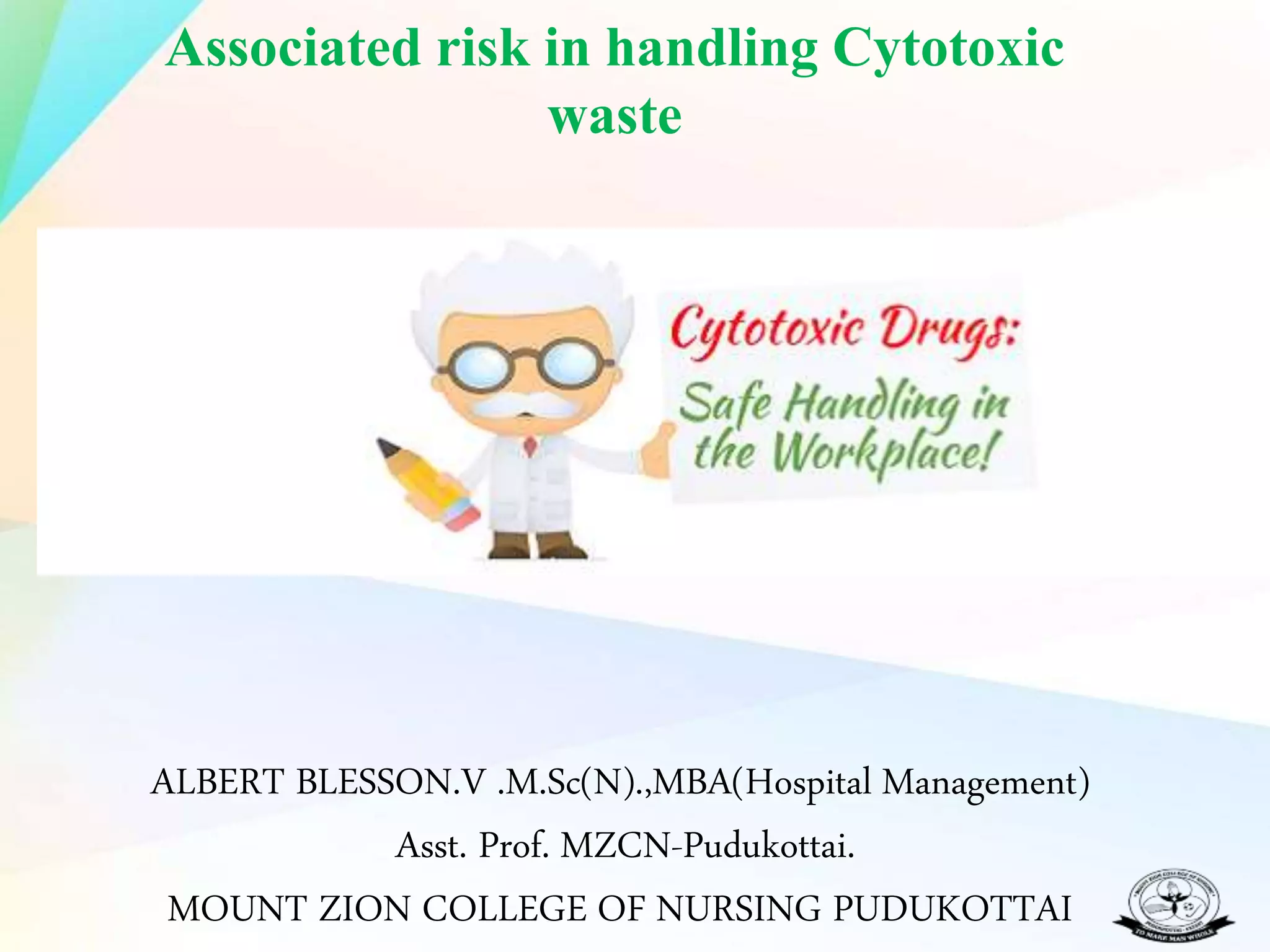
Associated risk in handling Cytotoxic
waste
ALBERT BLESSON.V .M.Sc(N).,MBA(Hospital Management)
Asst. Prof. MZCN-Pudukottai.
MOUNT ZION COLLEGE OF NURSING PUDUKOTTAI
CYTOTOXIC WASTE
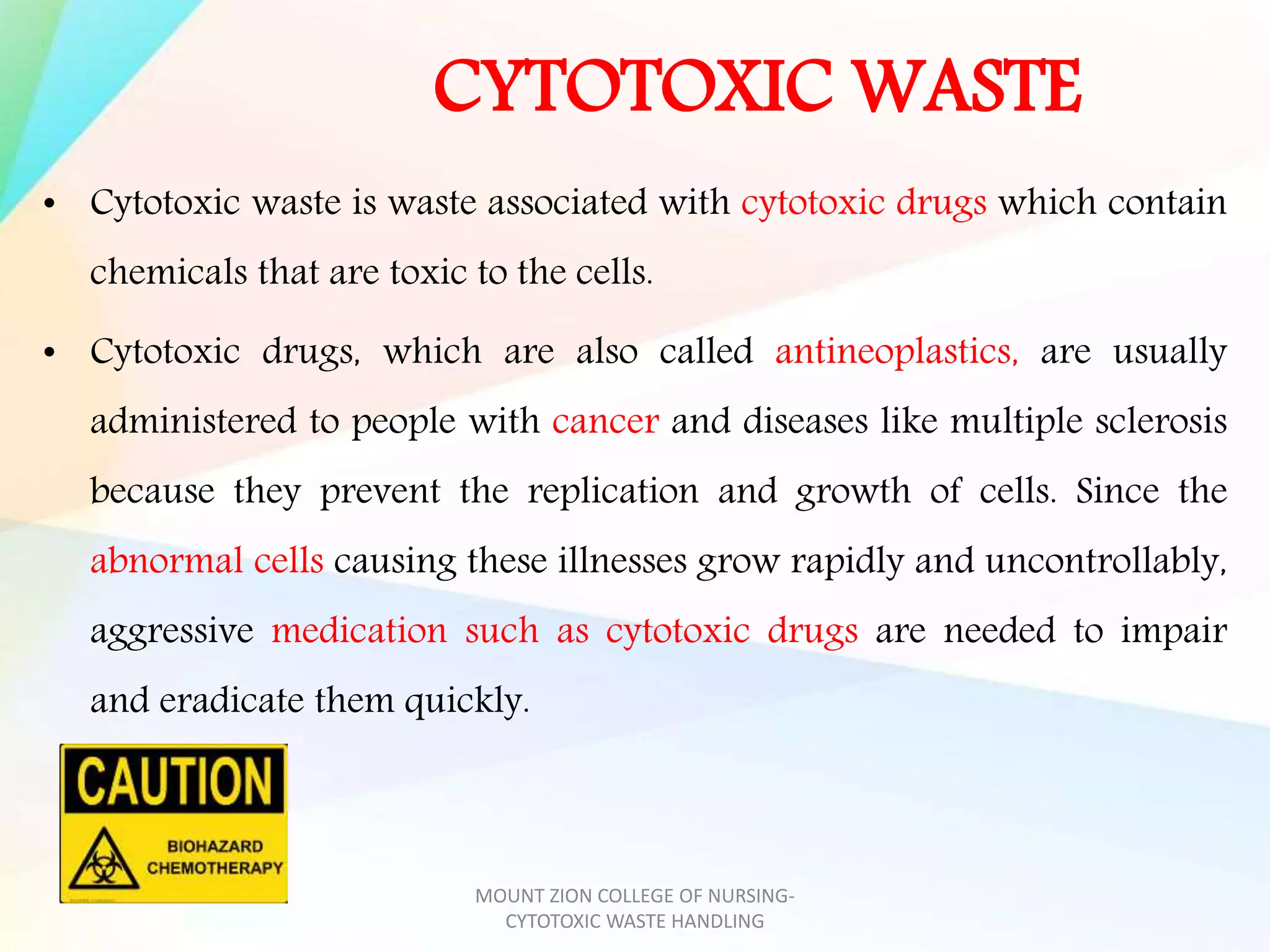
• Cytotoxic waste is waste associated with cytotoxic drugs which contain
chemicals that are toxic to the cells.
• Cytotoxic drugs, which are also called antineoplastics, are usually
administered to people with cancer and diseases like multiple sclerosis
because they prevent the replication and growth of cells. Since the
abnormal cells causing these illnesses grow rapidly and uncontrollably,
aggressive medication such as cytotoxic drugs are needed to impair
and eradicate them quickly.
MOUNT ZION COLLEGE OF NURSING-
CYTOTOXIC WASTE HANDLING
STUDY
• Dermal exposure has been suggested to be the main
route of exposure, measured among oncology nurses.
• oncology nurses appeared to be exposed via the skin
to cyclophosphamide during performance of their
daily duties
MOUNT ZION COLLEGE OF NURSING-
CYTOTOXIC WASTE HANDLING
RISKS INVOLVED IN BEING EXPOSED TO
CYTOTOXIC WASTE
• People who work in healthcare settings are at risk of being exposed to
cytotoxic waste.
• Cytotoxic waste may be inhaled, ingested, absorbed by the skin or through
percutaneous injury.
• Patients who take cytotoxic drugs excrete bodily fluids that are contaminated
with cytotoxic waste. They must be considered contaminated for up to seven
days, and must take the highest precautions. Relatives, nurses, and caregivers
must be properly protected when handling excreta and must dispose of it
properly.
• Although they have the capacity to cure, cytotoxic drugs affect the body in
ways that cannot be controlled. They have as much capacity to destroy healthy
cells as the unhealthy ones. Because of their inability to target specific cells,
they produce a lot of side effects.
MOUNT ZION COLLEGE OF NURSING-
CYTOTOXIC WASTE HANDLING
FACTORS AFFECTING ONCOLOGY NURSES’ SAFE
HANDLING PRACTICES OF CYTOTOXIC DRUGS
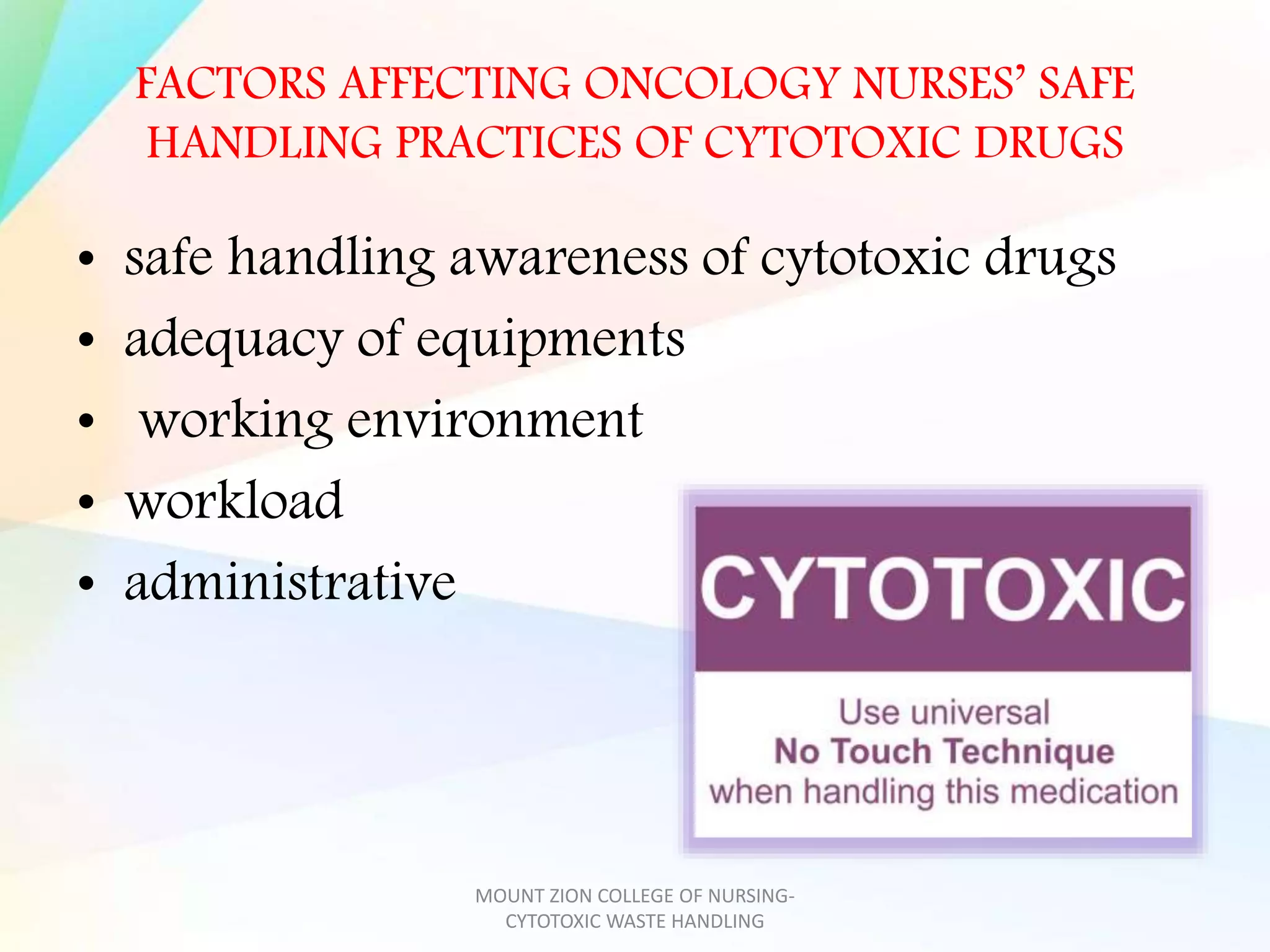
• safe handling awareness of cytotoxic drugs
• adequacy of equipments
• working environment
• workload
• administrative
MOUNT ZION COLLEGE OF NURSING-
CYTOTOXIC WASTE HANDLING
CYTOTOXIC WASTE INCLUDE IN
Here are some examples of materials that come into contact with cytotoxic drugs
and are considered as cytotoxic waste:
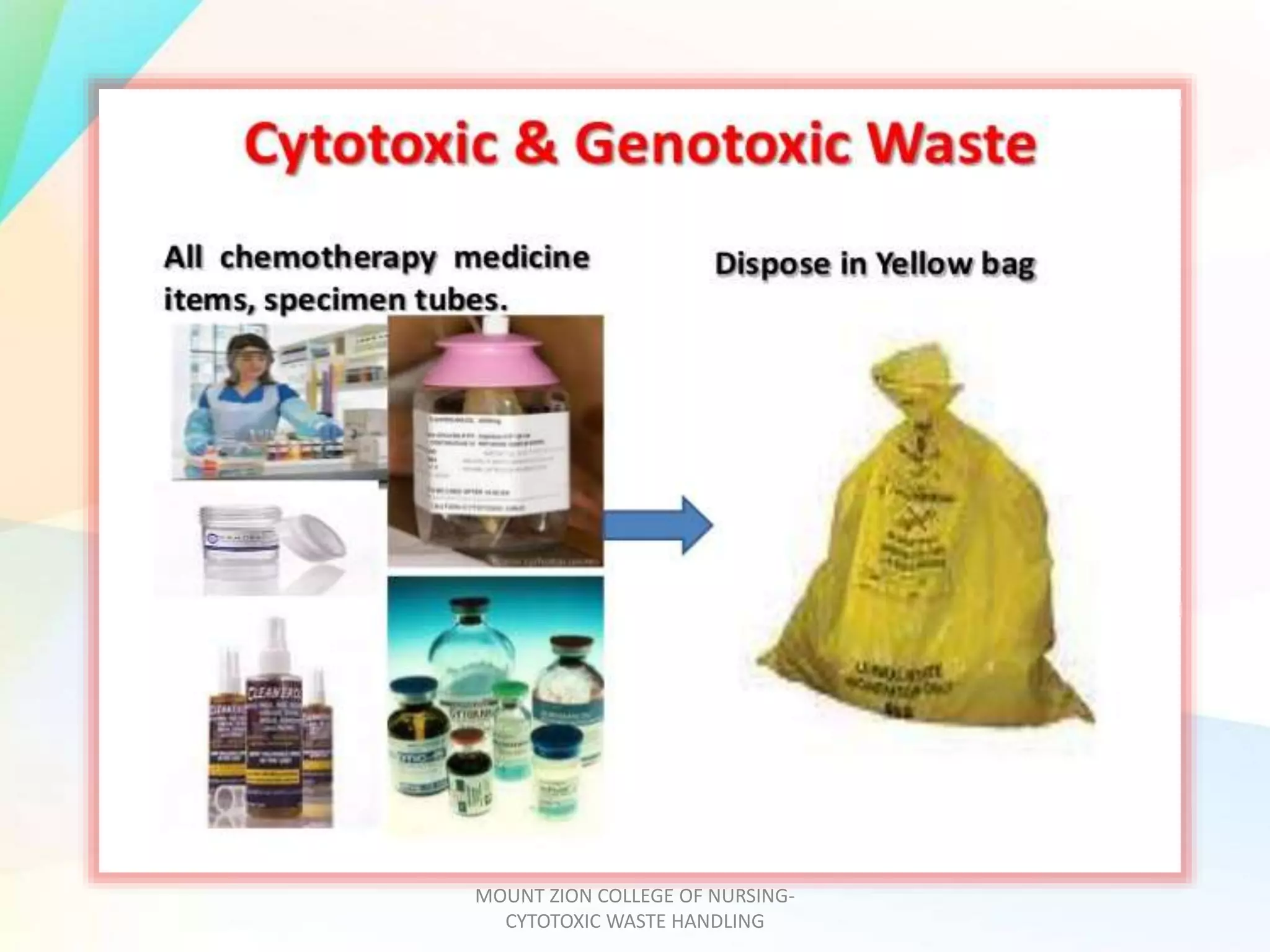
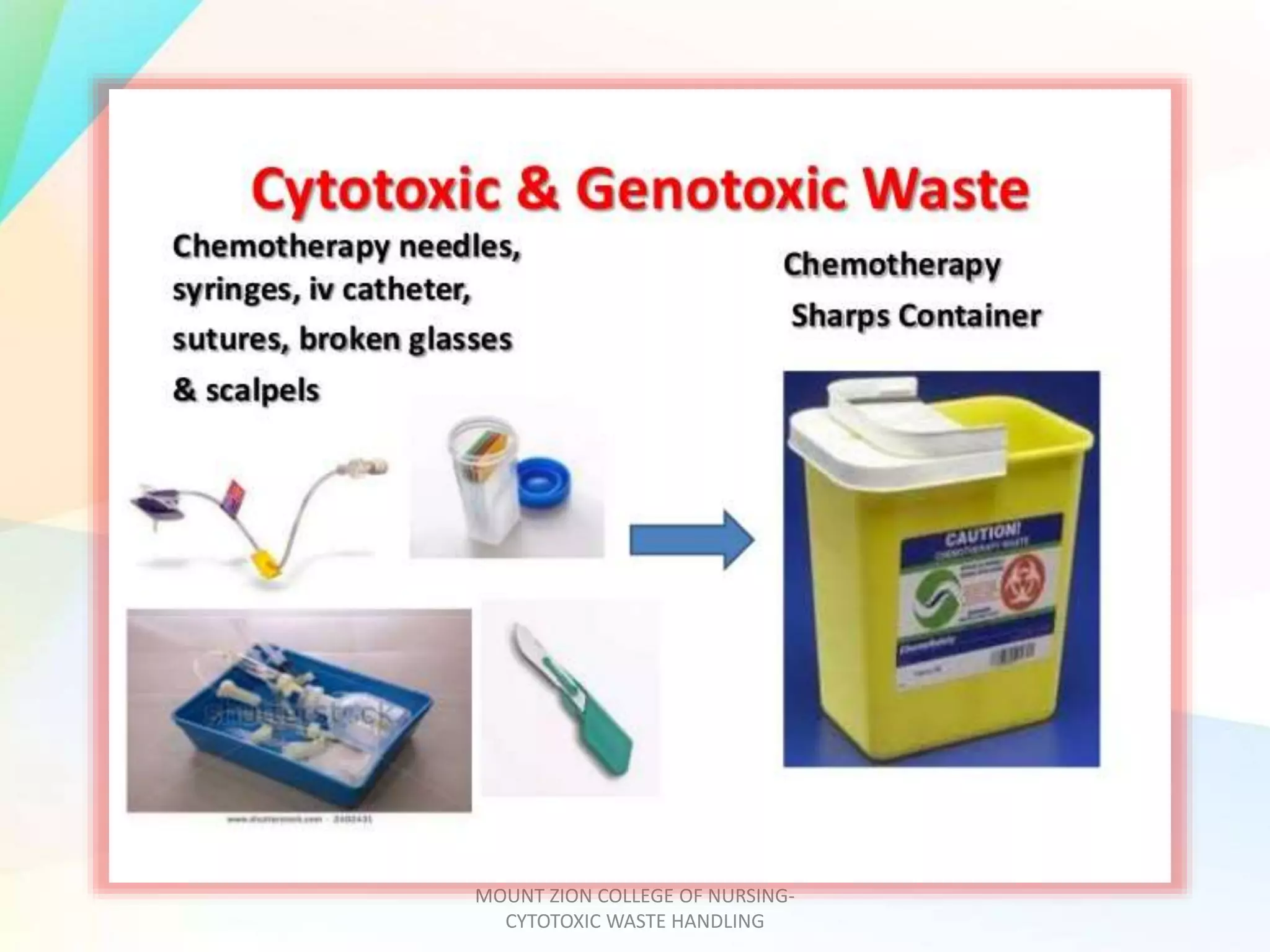
• Syringes, vials, gloves, needles, respirator masks, personal clothing and
equipment, air filters
• The handling of cytotoxic drugs poses a lot of danger – from to preparation of
the drug, to the administration to the patient, to its disposal. Because of its
toxicity, cytotoxic waste must be segregated and disposed properly.
• Mixing cytotoxic waste with other wastes will render them hazardous. As such,
they must then be disposed of properly. The most acceptable and safest way to
dispose cytotoxic waste is through incineration
MOUNT ZION COLLEGE OF NURSING-
CYTOTOXIC WASTE HANDLING
HOW TO HANDLE CYTOTOXIC WASTE
• The preparation of cytotoxic drugs must only be administered by trained
personnel.
• All personnel who work with cytotoxic drugs and waste must use the
proper protective clothing and gear. They should wear protective gown,
mask, head wear, gloves, shoes, and goggles.
• Clothing that is contaminated with cytotoxic waste must be placed
separately in labelled laundry bags. Those who are tasked to wash
contaminated clothing must also wear protective clothing and gear.
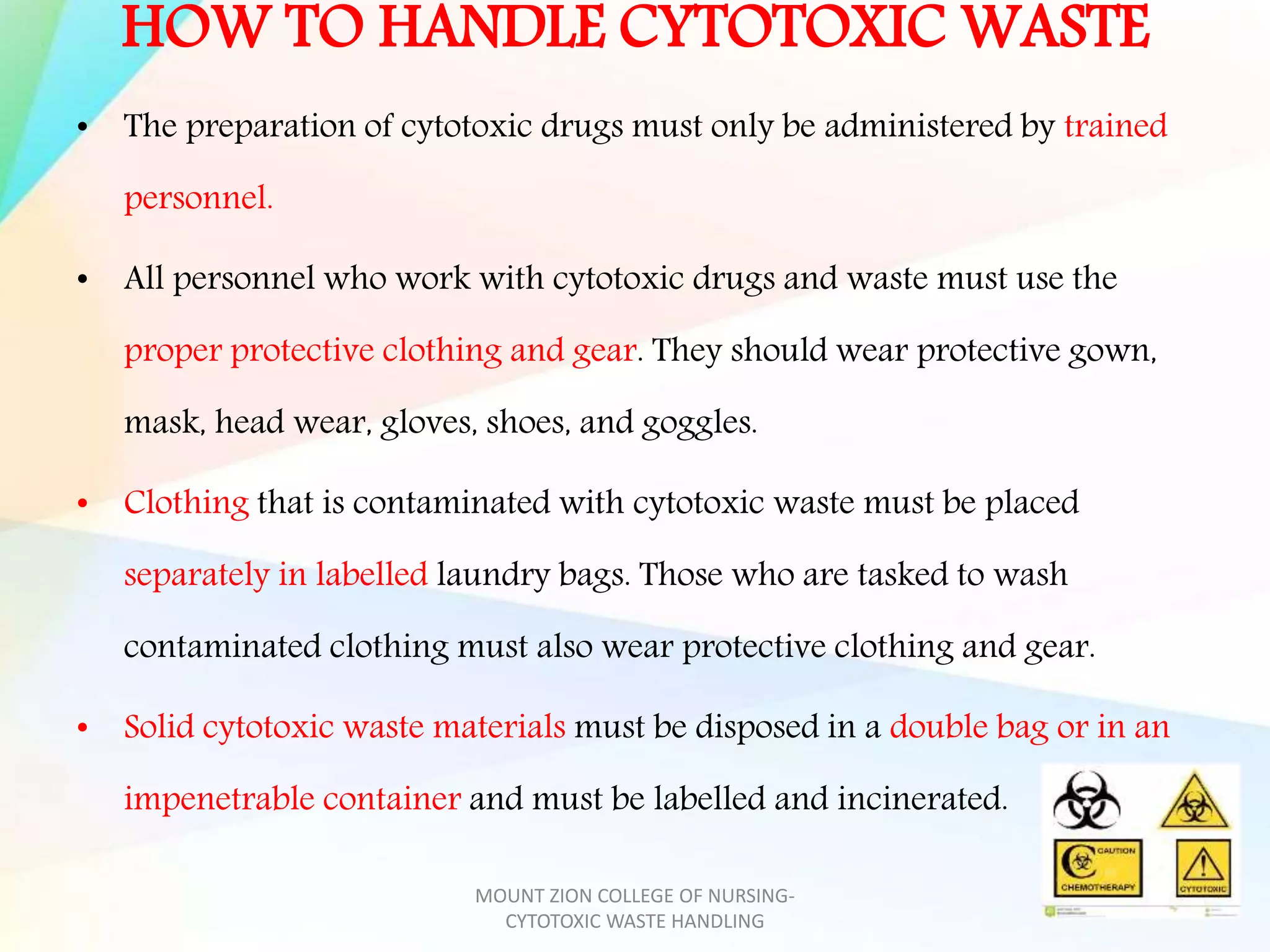
• Solid cytotoxic waste materials must be disposed in a double bag or in an
impenetrable container and must be labelled and incinerated.
MOUNT ZION COLLEGE OF NURSING-
CYTOTOXIC WASTE HANDLING
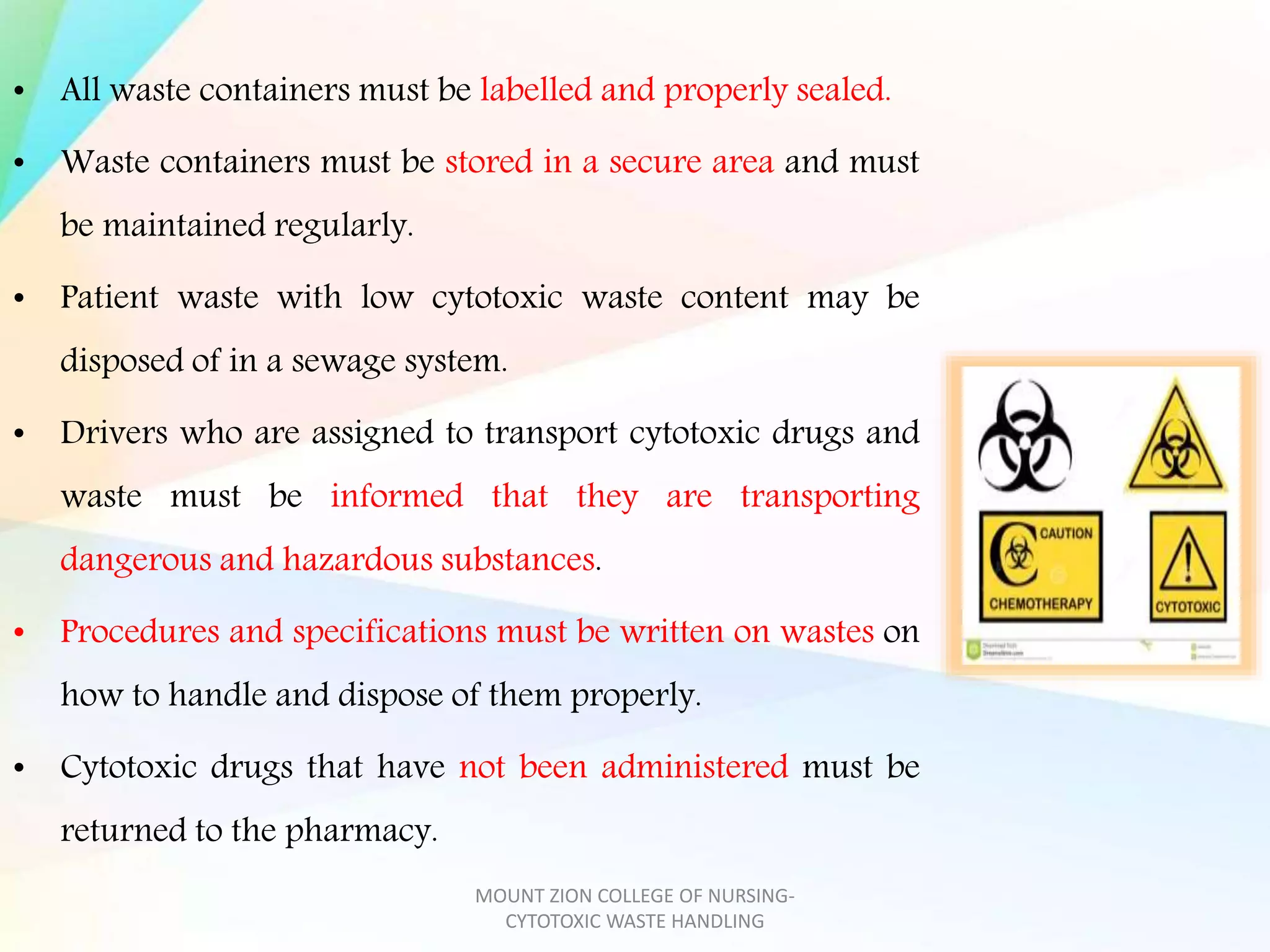
• All waste containers must be labelled and properly sealed.
• Waste containers must be stored in a secure area and must
be maintained regularly.
• Patient waste with low cytotoxic waste content may be
disposed of in a sewage system.
• Drivers who are assigned to transport cytotoxic drugs and
waste must be informed that they are transporting
dangerous and hazardous substances.
• Procedures and specifications must be written on wastes on
how to handle and dispose of them properly.
• Cytotoxic drugs that have not been administered must be
returned to the pharmacy.
MOUNT ZION COLLEGE OF NURSING-
CYTOTOXIC WASTE HANDLING
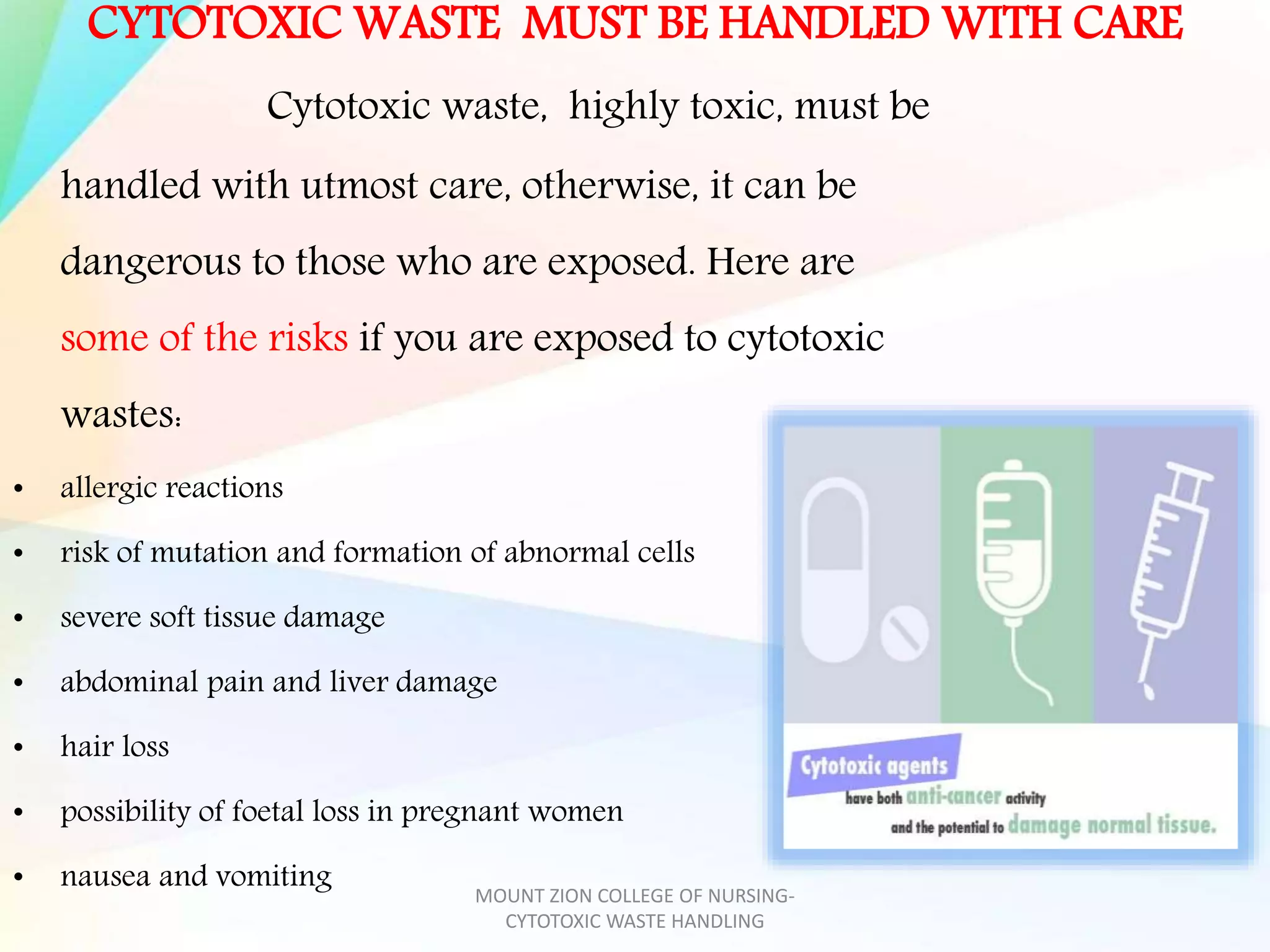
CYTOTOXIC WASTE MUST BE HANDLED WITH CARE
Cytotoxic waste, highly toxic, must be
handled with utmost care, otherwise, it can be
dangerous to those who are exposed. Here are
some of the risks if you are exposed to cytotoxic
wastes:
• allergic reactions
• risk of mutation and formation of abnormal cells
• severe soft tissue damage
• abdominal pain and liver damage
• hair loss
• possibility of foetal loss in pregnant women
• nausea and vomiting MOUNT ZION COLLEGE OF NURSING-
CYTOTOXIC WASTE HANDLING
PERCENTAGE DISTRIBUTION OF NURSES’ COMPLAINTS
REGARDING EXPOSURE TO CYTOTOXIC DRUGS (N=65)
• Redness or flushed face
• Headache
• Hair loss
• High temperature
• Nausea
• Vomiting
• Diarrhea
• Loss of weight
• Abortion
• Early birth & congenital
fetus anomalies
• Irregular menstruation
• Skin rash & Dermatitis
• Eye injury
• Sore throat
• Cough and bronchospasm.
• Difficulty breathing
• Bleeding or nasal discharge
• Frequent influenza
MOUNT ZION COLLEGE OF NURSING-
CYTOTOXIC WASTE HANDLING
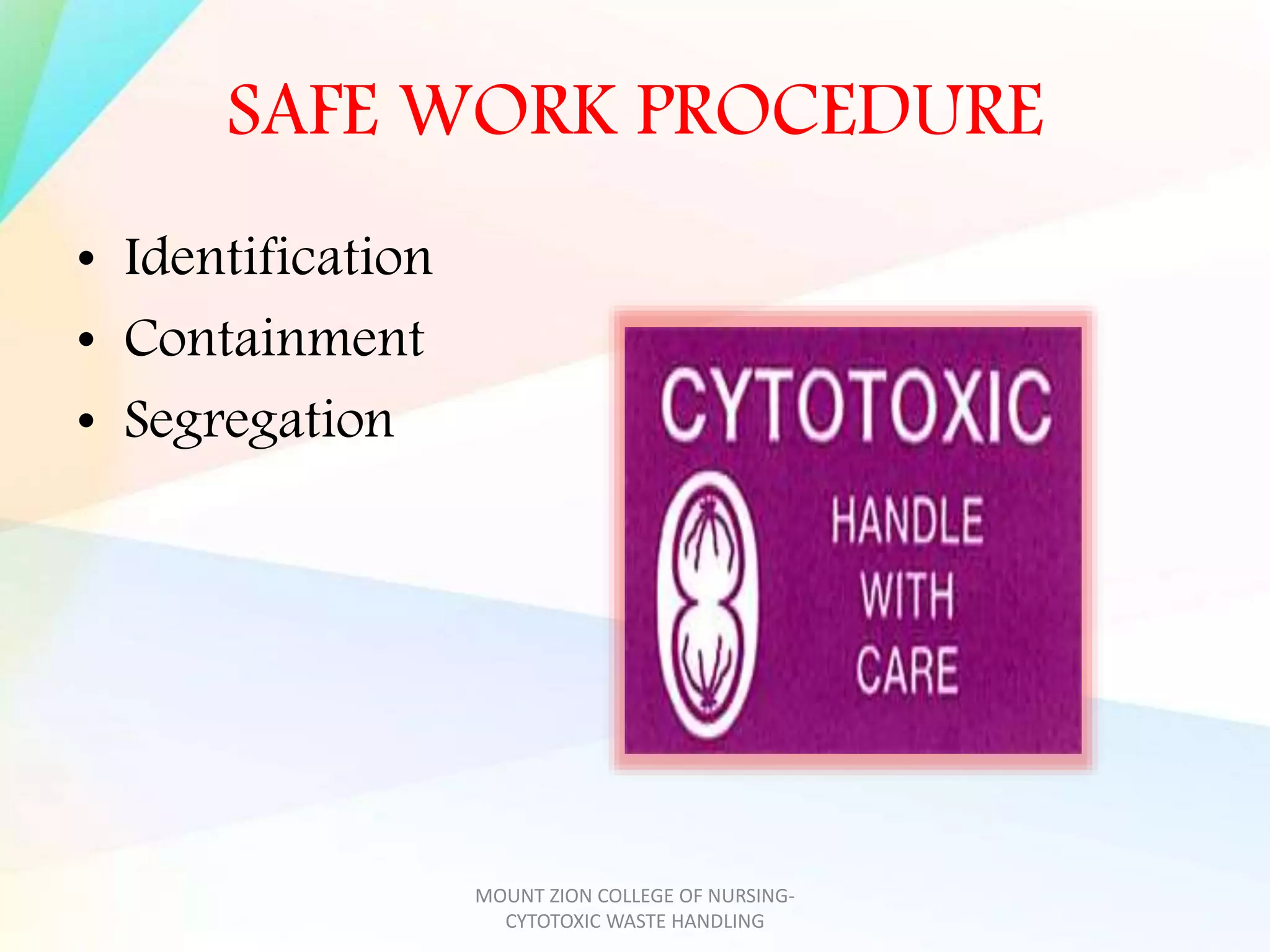
SAFE WORK PROCEDURE
• Identification
• Containment
• Segregation
MOUNT ZION COLLEGE OF NURSING-
CYTOTOXIC WASTE HANDLING
IDENTIFICATION
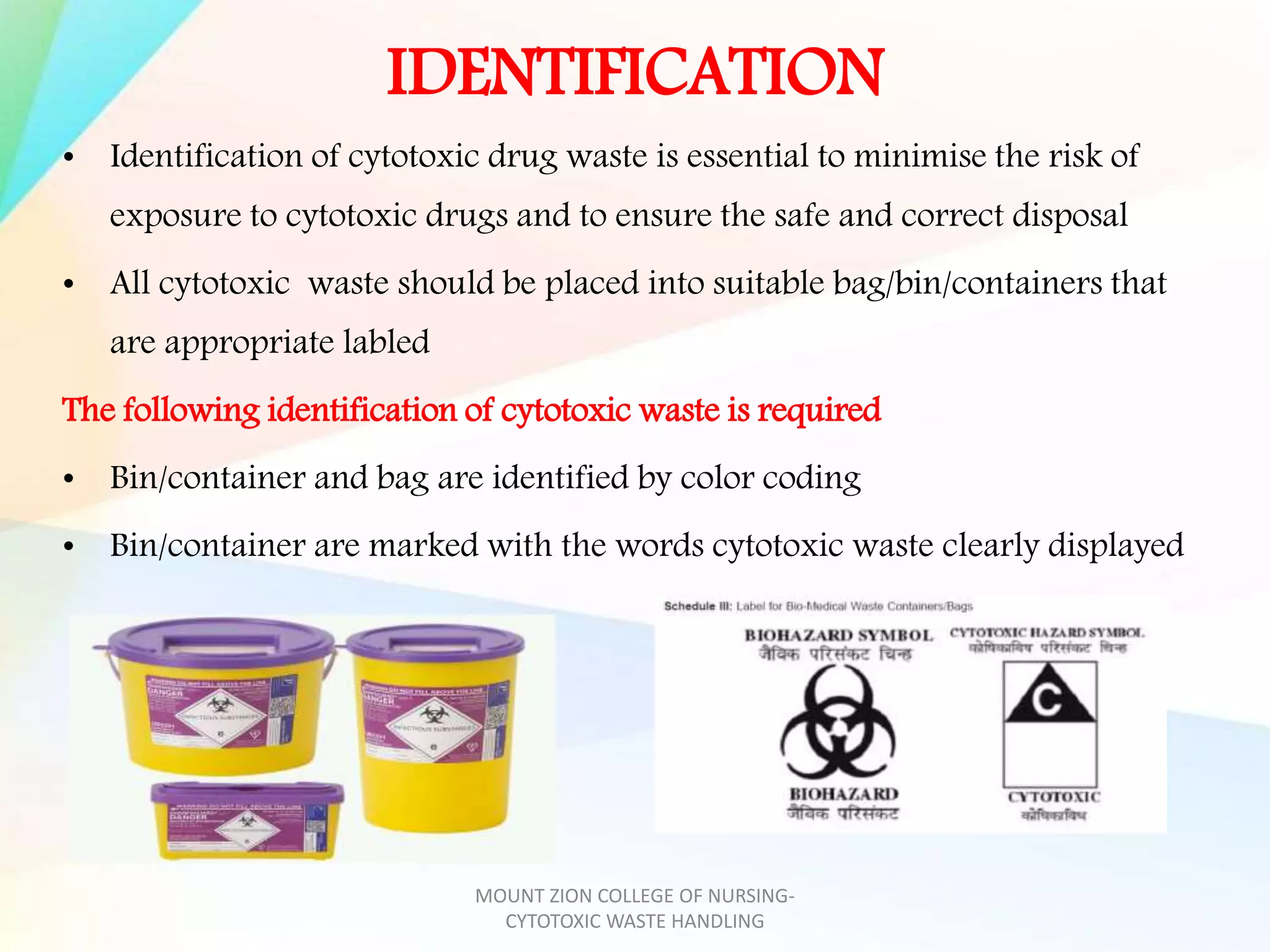
• Identification of cytotoxic drug waste is essential to minimise the risk of
exposure to cytotoxic drugs and to ensure the safe and correct disposal
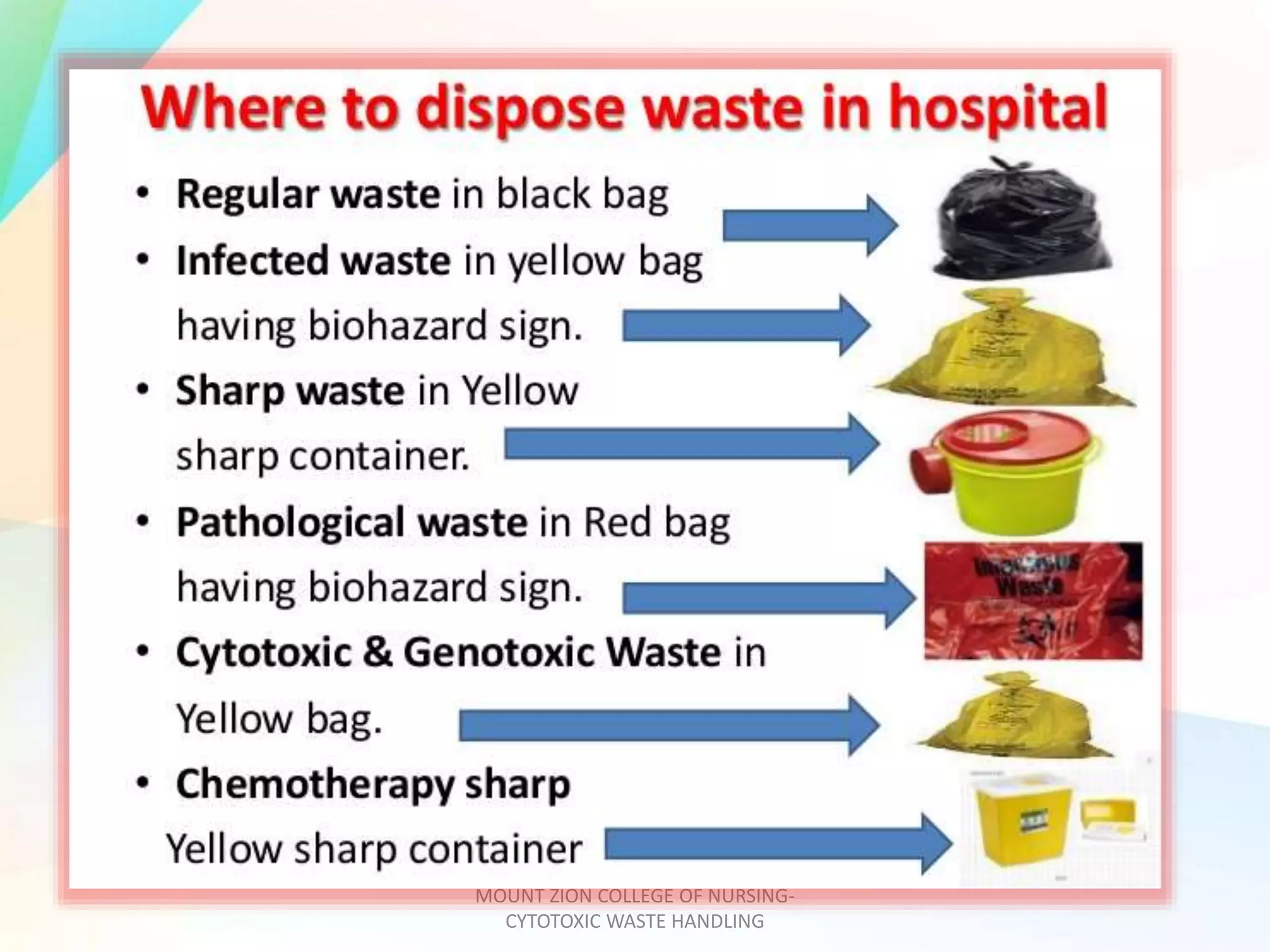
• All cytotoxic waste should be placed into suitable bag/bin/containers that
are appropriate labled
The following identification of cytotoxic waste is required
• Bin/container and bag are identified by color coding
• Bin/container are marked with the words cytotoxic waste clearly displayed
MOUNT ZION COLLEGE OF NURSING-
CYTOTOXIC WASTE HANDLING
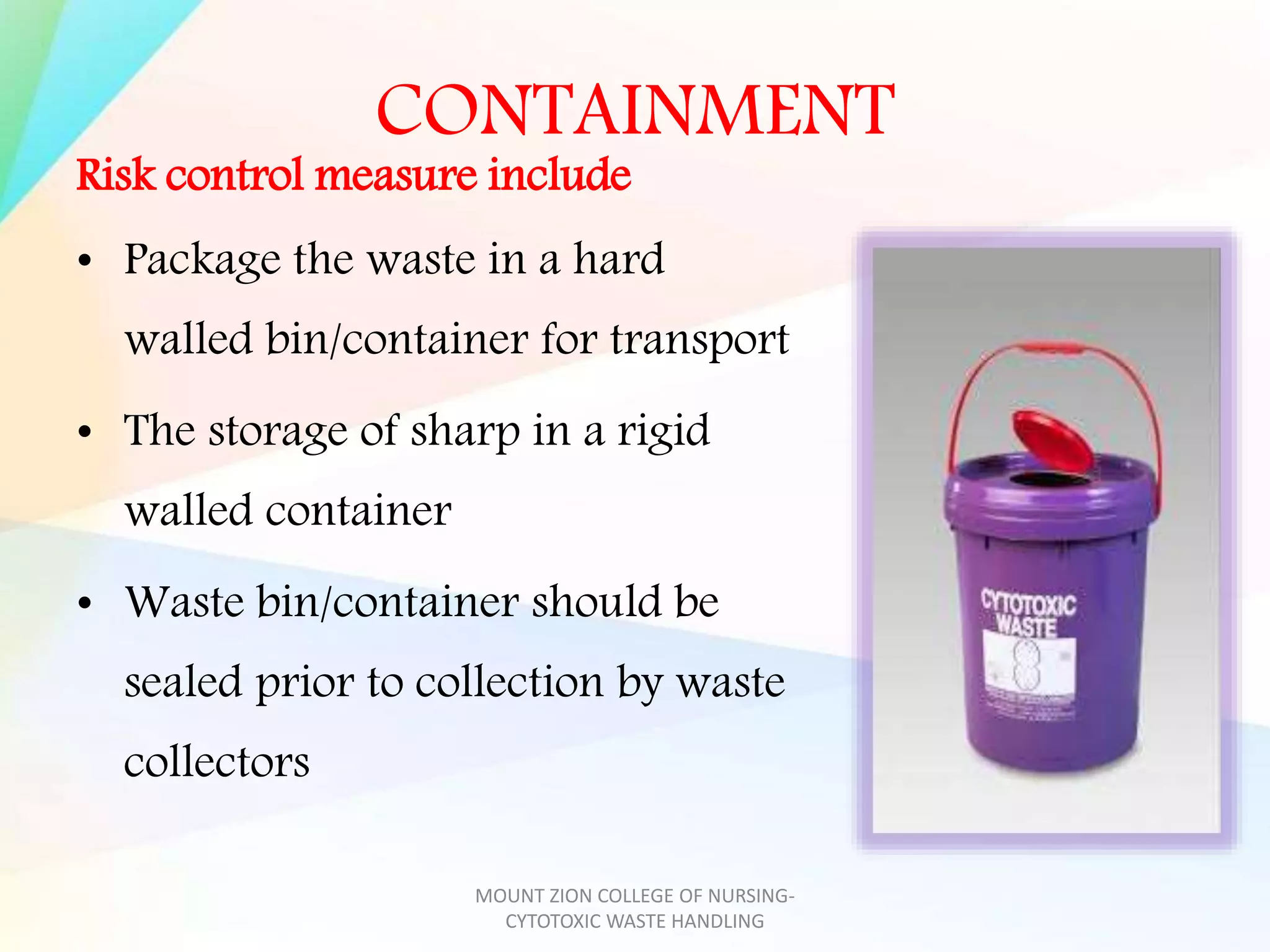
CONTAINMENT
Risk control measure include
• Package the waste in a hard
walled bin/container for transport
• The storage of sharp in a rigid
walled container
• Waste bin/container should be
sealed prior to collection by waste
collectors
MOUNT ZION COLLEGE OF NURSING-
CYTOTOXIC WASTE HANDLING
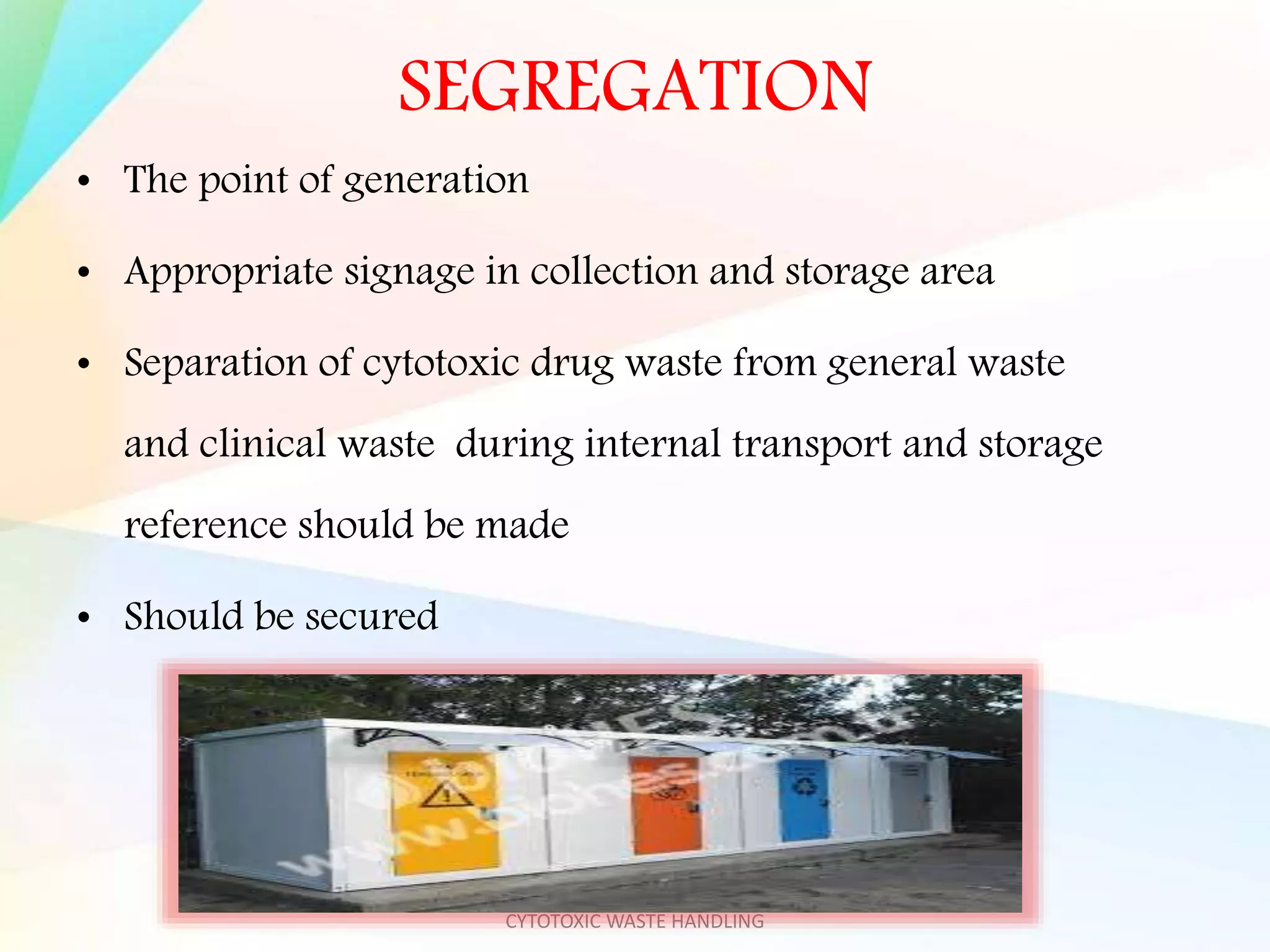
SEGREGATION
• The point of generation
• Appropriate signage in collection and storage area
• Separation of cytotoxic drug waste from general waste
and clinical waste during internal transport and storage
reference should be made
• Should be secured
MOUNT ZION COLLEGE OF NURSING-
CYTOTOXIC WASTE HANDLING
MOUNT ZION COLLEGE OF NURSING-
CYTOTOXIC WASTE HANDLING
MOUNT ZION COLLEGE OF NURSING-
CYTOTOXIC WASTE HANDLING
MOUNT ZION COLLEGE OF NURSING-
CYTOTOXIC WASTE HANDLING
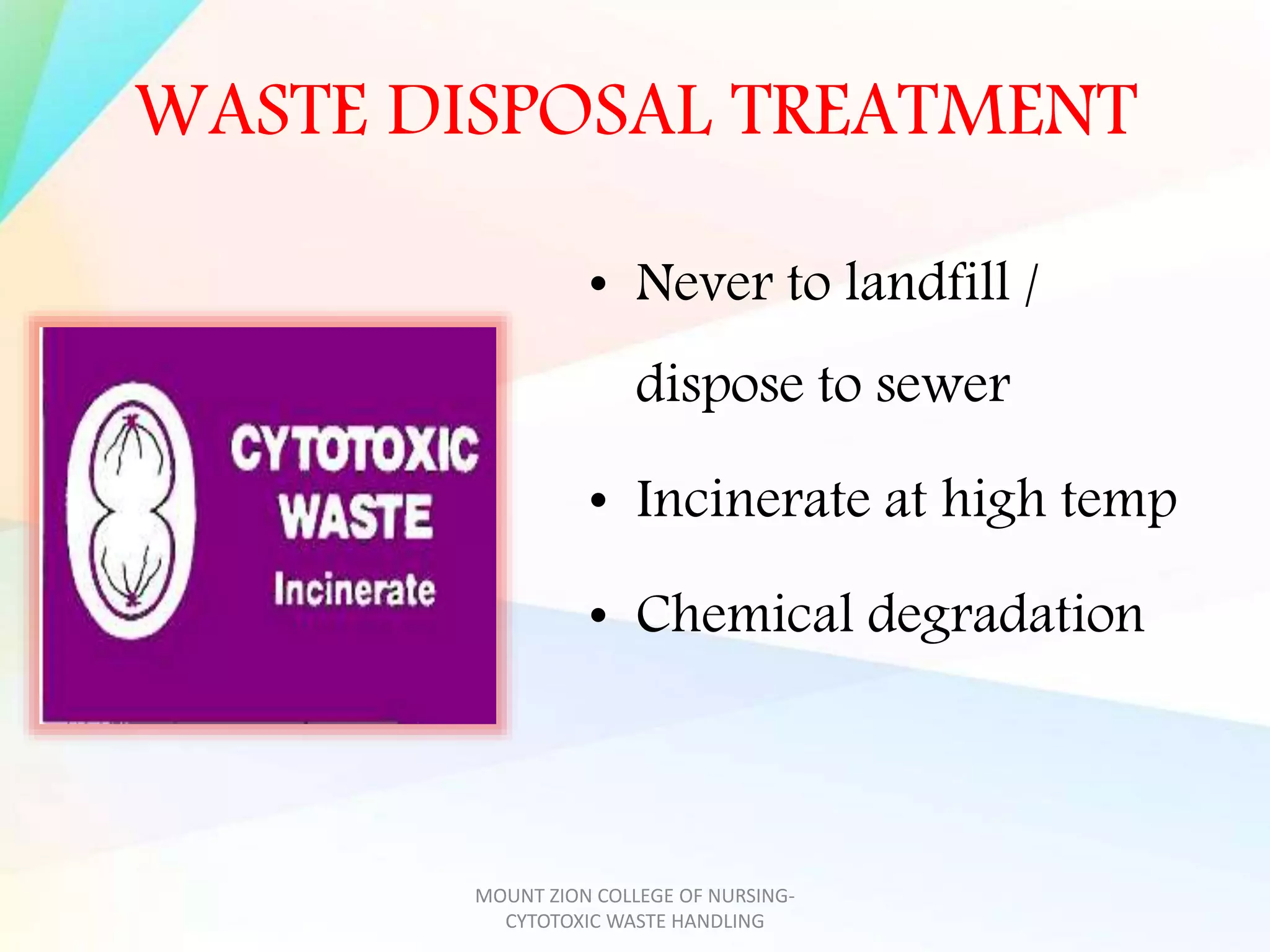
WASTE DISPOSAL TREATMENT
• Never to landfill /
dispose to sewer
• Incinerate at high temp
• Chemical degradation
MOUNT ZION COLLEGE OF NURSING-
CYTOTOXIC WASTE HANDLING
PATIENT QUESTION
1. What are cytotoxic precautions?
2. How long I will be in precaution?
3. How does hazardous waste affect me and family?
4. What about my landuary?
5. What about sex?
6. Pregnancy and breastfeeding
7. How to store medication?
8. How does medication leave my body?
9. How to handle my waste?
10. How to handle the spill?
MOUNT ZION COLLEGE OF NURSING-
CYTOTOXIC WASTE HANDLING
CONCLUSION
Nurses working in Oncology and the Haematology
clinical setting are exposed to hazardous cytotoxic drugs during
administering and disposing of cytotoxic contaminated used
instruments, and handling human cytotoxic waste of clients
receiving chemotherapy. The appropriate use of personal
protective equipment gear may reduce the occupational risk.
MOUNT ZION COLLEGE OF NURSING-
CYTOTOXIC WASTE HANDLING
• TAKE-HOME MESSAGE
● The frequency of side effects reported by nurses working in
chemotherapy facilities is noticeably high.
● Headache and skin reaction were the most frequent adverse
effects reported by the nurses we studied.
● Gloves and mask were the most common protective
equipment used by our nurses.
● Air conditioner ventilation systems were widely used in all
chemotherapy facilities but they did not comply with the
standards.
● Lack of adequate training in nurses was noticeable.
● Establishment of safety regulations, health care workers
safety surveillance systems as well as continuous training
for nurses are of paramount importance.MOUNT ZION COLLEGE OF NURSING-
CYTOTOXIC WASTE HANDLING

Cytotoxic WASTE RISK AND HANDLING

  • 1.
    Associated risk inhandling Cytotoxic waste ALBERT BLESSON.V .M.Sc(N).,MBA(Hospital Management) Asst. Prof. MZCN-Pudukottai. MOUNT ZION COLLEGE OF NURSING PUDUKOTTAI
  • 2.
    CYTOTOXIC WASTE • Cytotoxicwaste is waste associated with cytotoxic drugs which contain chemicals that are toxic to the cells. • Cytotoxic drugs, which are also called antineoplastics, are usually administered to people with cancer and diseases like multiple sclerosis because they prevent the replication and growth of cells. Since the abnormal cells causing these illnesses grow rapidly and uncontrollably, aggressive medication such as cytotoxic drugs are needed to impair and eradicate them quickly. MOUNT ZION COLLEGE OF NURSING- CYTOTOXIC WASTE HANDLING
  • 3.
    STUDY • Dermal exposurehas been suggested to be the main route of exposure, measured among oncology nurses. • oncology nurses appeared to be exposed via the skin to cyclophosphamide during performance of their daily duties MOUNT ZION COLLEGE OF NURSING- CYTOTOXIC WASTE HANDLING
  • 4.
    RISKS INVOLVED INBEING EXPOSED TO CYTOTOXIC WASTE • People who work in healthcare settings are at risk of being exposed to cytotoxic waste. • Cytotoxic waste may be inhaled, ingested, absorbed by the skin or through percutaneous injury. • Patients who take cytotoxic drugs excrete bodily fluids that are contaminated with cytotoxic waste. They must be considered contaminated for up to seven days, and must take the highest precautions. Relatives, nurses, and caregivers must be properly protected when handling excreta and must dispose of it properly. • Although they have the capacity to cure, cytotoxic drugs affect the body in ways that cannot be controlled. They have as much capacity to destroy healthy cells as the unhealthy ones. Because of their inability to target specific cells, they produce a lot of side effects. MOUNT ZION COLLEGE OF NURSING- CYTOTOXIC WASTE HANDLING
  • 5.
    FACTORS AFFECTING ONCOLOGYNURSES’ SAFE HANDLING PRACTICES OF CYTOTOXIC DRUGS • safe handling awareness of cytotoxic drugs • adequacy of equipments • working environment • workload • administrative MOUNT ZION COLLEGE OF NURSING- CYTOTOXIC WASTE HANDLING
  • 6.
    CYTOTOXIC WASTE INCLUDEIN Here are some examples of materials that come into contact with cytotoxic drugs and are considered as cytotoxic waste: • Syringes, vials, gloves, needles, respirator masks, personal clothing and equipment, air filters • The handling of cytotoxic drugs poses a lot of danger – from to preparation of the drug, to the administration to the patient, to its disposal. Because of its toxicity, cytotoxic waste must be segregated and disposed properly. • Mixing cytotoxic waste with other wastes will render them hazardous. As such, they must then be disposed of properly. The most acceptable and safest way to dispose cytotoxic waste is through incineration MOUNT ZION COLLEGE OF NURSING- CYTOTOXIC WASTE HANDLING
  • 7.
    HOW TO HANDLECYTOTOXIC WASTE • The preparation of cytotoxic drugs must only be administered by trained personnel. • All personnel who work with cytotoxic drugs and waste must use the proper protective clothing and gear. They should wear protective gown, mask, head wear, gloves, shoes, and goggles. • Clothing that is contaminated with cytotoxic waste must be placed separately in labelled laundry bags. Those who are tasked to wash contaminated clothing must also wear protective clothing and gear. • Solid cytotoxic waste materials must be disposed in a double bag or in an impenetrable container and must be labelled and incinerated. MOUNT ZION COLLEGE OF NURSING- CYTOTOXIC WASTE HANDLING
  • 8.
    • All wastecontainers must be labelled and properly sealed. • Waste containers must be stored in a secure area and must be maintained regularly. • Patient waste with low cytotoxic waste content may be disposed of in a sewage system. • Drivers who are assigned to transport cytotoxic drugs and waste must be informed that they are transporting dangerous and hazardous substances. • Procedures and specifications must be written on wastes on how to handle and dispose of them properly. • Cytotoxic drugs that have not been administered must be returned to the pharmacy. MOUNT ZION COLLEGE OF NURSING- CYTOTOXIC WASTE HANDLING
  • 9.
    CYTOTOXIC WASTE MUSTBE HANDLED WITH CARE Cytotoxic waste, highly toxic, must be handled with utmost care, otherwise, it can be dangerous to those who are exposed. Here are some of the risks if you are exposed to cytotoxic wastes: • allergic reactions • risk of mutation and formation of abnormal cells • severe soft tissue damage • abdominal pain and liver damage • hair loss • possibility of foetal loss in pregnant women • nausea and vomiting MOUNT ZION COLLEGE OF NURSING- CYTOTOXIC WASTE HANDLING
  • 10.
    PERCENTAGE DISTRIBUTION OFNURSES’ COMPLAINTS REGARDING EXPOSURE TO CYTOTOXIC DRUGS (N=65) • Redness or flushed face • Headache • Hair loss • High temperature • Nausea • Vomiting • Diarrhea • Loss of weight • Abortion • Early birth & congenital fetus anomalies • Irregular menstruation • Skin rash & Dermatitis • Eye injury • Sore throat • Cough and bronchospasm. • Difficulty breathing • Bleeding or nasal discharge • Frequent influenza MOUNT ZION COLLEGE OF NURSING- CYTOTOXIC WASTE HANDLING
  • 11.
    SAFE WORK PROCEDURE •Identification • Containment • Segregation MOUNT ZION COLLEGE OF NURSING- CYTOTOXIC WASTE HANDLING
  • 12.
    IDENTIFICATION • Identification ofcytotoxic drug waste is essential to minimise the risk of exposure to cytotoxic drugs and to ensure the safe and correct disposal • All cytotoxic waste should be placed into suitable bag/bin/containers that are appropriate labled The following identification of cytotoxic waste is required • Bin/container and bag are identified by color coding • Bin/container are marked with the words cytotoxic waste clearly displayed MOUNT ZION COLLEGE OF NURSING- CYTOTOXIC WASTE HANDLING
  • 13.
    CONTAINMENT Risk control measureinclude • Package the waste in a hard walled bin/container for transport • The storage of sharp in a rigid walled container • Waste bin/container should be sealed prior to collection by waste collectors MOUNT ZION COLLEGE OF NURSING- CYTOTOXIC WASTE HANDLING
  • 14.
    SEGREGATION • The pointof generation • Appropriate signage in collection and storage area • Separation of cytotoxic drug waste from general waste and clinical waste during internal transport and storage reference should be made • Should be secured MOUNT ZION COLLEGE OF NURSING- CYTOTOXIC WASTE HANDLING
  • 15.
    MOUNT ZION COLLEGEOF NURSING- CYTOTOXIC WASTE HANDLING
  • 16.
    MOUNT ZION COLLEGEOF NURSING- CYTOTOXIC WASTE HANDLING
  • 17.
    MOUNT ZION COLLEGEOF NURSING- CYTOTOXIC WASTE HANDLING
  • 18.
    WASTE DISPOSAL TREATMENT •Never to landfill / dispose to sewer • Incinerate at high temp • Chemical degradation MOUNT ZION COLLEGE OF NURSING- CYTOTOXIC WASTE HANDLING
  • 19.
    PATIENT QUESTION 1. Whatare cytotoxic precautions? 2. How long I will be in precaution? 3. How does hazardous waste affect me and family? 4. What about my landuary? 5. What about sex? 6. Pregnancy and breastfeeding 7. How to store medication? 8. How does medication leave my body? 9. How to handle my waste? 10. How to handle the spill? MOUNT ZION COLLEGE OF NURSING- CYTOTOXIC WASTE HANDLING
  • 20.
    CONCLUSION Nurses working inOncology and the Haematology clinical setting are exposed to hazardous cytotoxic drugs during administering and disposing of cytotoxic contaminated used instruments, and handling human cytotoxic waste of clients receiving chemotherapy. The appropriate use of personal protective equipment gear may reduce the occupational risk. MOUNT ZION COLLEGE OF NURSING- CYTOTOXIC WASTE HANDLING
  • 21.
    • TAKE-HOME MESSAGE ●The frequency of side effects reported by nurses working in chemotherapy facilities is noticeably high. ● Headache and skin reaction were the most frequent adverse effects reported by the nurses we studied. ● Gloves and mask were the most common protective equipment used by our nurses. ● Air conditioner ventilation systems were widely used in all chemotherapy facilities but they did not comply with the standards. ● Lack of adequate training in nurses was noticeable. ● Establishment of safety regulations, health care workers safety surveillance systems as well as continuous training for nurses are of paramount importance.MOUNT ZION COLLEGE OF NURSING- CYTOTOXIC WASTE HANDLING