HEMOPHILIA
BY -ALBERT BLESSON
HEMOPHILIA
TIP: Think safety, bleeding from any injury may lead to a serious problem. An example might be a cerebral bleed
from a head injury.
A hereditary bleeding disorder, hemophilia results from deficiency of specific clotting factors.
Hemophilia A (classic hemophilia), which affects more than 80% of all hemophiliacs, results from deficiency of
factor VIII; hemophilia B (Christmas disease), which affects 15% of hemophiliacs, results from deficiency of
factor IX. The inheritance pattern is sex-linked (X-linked) and the severity is consistent within a family. The
disorder affects the male. It can also occur as a spontaneous mutation. Other evidence suggests that hemophilia
may result from nonfunctioning factors VIII and IX, rather than from deficiency of these factors.
Hemophilia produces abnormal bleeding, which may be mild, moderate, or severe, depending on
the degree of factor deficiency. After a hemophiliac forms a platelet plug at a bleeding site, the lack of clotting
factors impairs formation of a stable fibrin clot. Immediate hemorrhage is not prevalent, but delayed bleeding is
common.
Signs and Symptoms
• Pain and swelling in a weight-bearing joint, such as the hip, knee, and ankle. Bleeding into the
joint is called hemarthroses
• Bleeding after circumcision (usually the first sign)
• Spontaneous bleeding or severe bleeding after minor trauma that may produce large
subcutaneous and deep intramuscular hematomas
• Abdominal, chest, or flank pain, indicating internal bleeding
• Hematuria or hematemesis
• Tarry stools
• Hematomas on the extremities, the torso, or both
• Limited joint range of motion
• Head injury can lead to a cerebral bleed
Treatment
• Careful management by a hematologist (for patients undergoing surgery)
• Replacement of the deficient factor before and after surgery (even for minor surgery such as dental
extraction)
• Aminocaproic acid (Amicar) (for oral bleeding, to inhibit the active fibrinolytic system in oral mucosa)
Hemophilia A
• Cryoprecipitated antihemophilic factor (AHF), lyophilized AHF, or both in doses large enough to
raise clotting factor levels above 25% of normal to permit normal hemostasis
• AHF before surgery to raise clotting factors to hemostatic levels until wound heals; FFP
administration (has some drawbacks)
• Inhibitors to factor VIII develop after multiple transfusions in 10% to 20% of patients with
severe hemophilia, rendering the patient resistant to factor VIII infusions
• Desmopressin (DDAVP), to stimulate the release of stored factor VIII. This raises the level of
factor VIII in the blood with the mild to moderate form of hemophilia.
Hemophilia B
• Administration of factor IX concentrate during bleeding episodes to increase factor IX levels.
Nursing Considerations
• Provide emotional support, and listen to the patient/parent’s fears and concerns. This will be dependent on
the age of the patient.
• Watch for signs and symptoms of decreased tissue perfusion.
• Monitor the patient’s blood pressure, pulse, and respiratory rates. Observe frequently for bleeding from
the skin, mucous membranes, and wounds.
During Bleeding Episodes
• If the patient has surface cuts or epistaxis, apply pressure—usually the only treatment needed.
• With deeper cuts, pressure may stop the bleeding temporarily. Cuts deep enough to require suturing may
also require factor infusions to prevent further bleeding.
• Give the deficient clotting factor or plasma as ordered.
• Apply cold compresses or ice bags, and elevate the injured part.
• To prevent recurrence of bleeding, restrict activity for 48 hours after bleeding is under control.
Control pain with an analgesic, such as acetaminophen, propoxyphene, codeine, or morphine as ordered. Avoid
IM injections. NSAIDs, aspirin and aspirin-containing medications are contraindicated.
• If the patient cannot tolerate activities because of blood loss, provide rest periods between activities
Bleeding into a Joint
• Immediately elevate the joint.
• To restore joint mobility, if ordered, begin range-of-motion exercises at least 48 hours after the
bleeding is controlled. It is important to have the patient avoid weight bearing until bleeding stops
and swelling subsides. If pain continues to occur on movement then the patient should stop.
• Administer an analgesic for pain. Also, apply ice packs and elastic bandages to alleviate the pain.
• Remember the acronym RICE (Rest, Ice, Compression and Elevation).
After Bleeding Episodes and Surgery
• Watch closely for signs and symptoms of further bleeding, such as increased pain and swelling, fever,
and symptoms of shock.
• Closely monitor PTT.
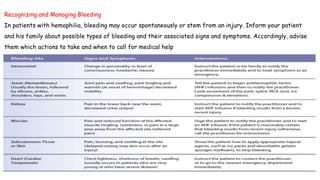
Recognizing and Managing Bleeding
In patients with hemophilia, bleeding may occur spontaneously or stem from an injury. Inform your patient
and his family about possible types of bleeding and their associated signs and symptoms. Accordingly, advise
them which actions to take and when to call for medical help
• Teach the patient the benefits of regular exercise. Explain that isometric exercises can also help to prevent muscle
weakness and recurrent joint bleeding. Refer him for physical therapy as indicated. Muscles surround and cushion blood
vessels.
• Advise parents to protect their child from injury while avoiding unnecessary restrictions that impair his normal
development. An older child must not participate in contact sports, such as football, but he can be encouraged to swim or
play golf.
• Tell the patient to avoid such activities as lifting heavy items and using power tools because they increase the risk of
injury that can result in serious bleeding problems.
• If an injury occurs, direct the parents to apply cold compresses or ice bags and elevate the injured part or to apply light
pressure to the bleeding. To prevent recurrence of bleeding after treatment, instruct the parents to restrict the child’s
activity for 48 hours after bleeding is under control.
• Advise the parents to notify the physician immediately after even a minor injury, especially to the head, neck, or abdomen.
• Instruct parents to watch for signs of internal bleeding, such as severe pain and swelling in joints or muscles, stiffness,
decreased joint movement, severe abdominal pain, blood in urine, tarry stools, and severe headache.
• Explain to the patient and, if appropriate, his parents the importance of avoiding aspirin, combination medications that
contain aspirin, and over-the-counter anti-inflammatory agents such as ibuprofen compounds (NSAIDs). Tell them to use
acetaminophen instead.
• Stress the importance of good dental care, including regular, careful tooth brushing, to prevent the
need for dental surgery. Have the child use a soft toothbrush to avoid gum injury. Emphasize that
poor dental hygiene can lead to bleeding from inflamed gums.
• Added home safety measures will be necessary through preschool years.
• Instruct the patient to use an electric razor for shaving.
• Instruct the parents to check with the physician before allowing dental extractions or other surgery.
• Advise them to get the names of other physicians they can contact in case their regular physician is
not available.Teach the patient the importance of protecting his veins for lifelong therapy.As
necessary, encourage the patient to remain independent and be self-sufficient. Refer him for
counseling as necessary.Maintain weight appropriate for height.Instruct the parents to make sure
that the child wears a medical identification bracelet at all times.Instruct parents to notify the
school nurse that their child has hemophilia.
• Refer new patients to a hemophilia treatment center for evaluation.
For patients receiving blood components:
• Train the parents to administer blood factor components at home to avoid frequent hospitalization.
Teach them proper venipuncture and infusion techniques, and urge them not to delay treatment during
bleeding episodes. Tell parents to keep blood factor concentrate and infusion equipment available at
all times, even on vacation.
• Review possible adverse reactions, such as blood-borne infection and factor inhibitor development
which can result from replacement factor procedures.
• If the patient develops flushing, headache, or tingling from replacement factor, explain to the patient
and/or parents that these reactions are most common with freeze-dried concentrate. Slowing the
infusion rate may cause signs and symptoms to abate.
• If fever and chills occur, indicating an allergy to WBC antigens, instruct the patient or his parents
that this reaction occurs most commonly with plasma infusions. Acetaminophen may relieve the
patient’s discomfort.
• Tell the patient that urticaria is the most common reaction to cryoprecipitate or plasma
REFERENCE
LippincottVISUAL
NURSING
A Guide to Diseases,
Skills, and Treatments
Third Edition

Hemophilia

  • 1.
  • 2.
    HEMOPHILIA TIP: Think safety,bleeding from any injury may lead to a serious problem. An example might be a cerebral bleed from a head injury. A hereditary bleeding disorder, hemophilia results from deficiency of specific clotting factors. Hemophilia A (classic hemophilia), which affects more than 80% of all hemophiliacs, results from deficiency of factor VIII; hemophilia B (Christmas disease), which affects 15% of hemophiliacs, results from deficiency of factor IX. The inheritance pattern is sex-linked (X-linked) and the severity is consistent within a family. The disorder affects the male. It can also occur as a spontaneous mutation. Other evidence suggests that hemophilia may result from nonfunctioning factors VIII and IX, rather than from deficiency of these factors. Hemophilia produces abnormal bleeding, which may be mild, moderate, or severe, depending on the degree of factor deficiency. After a hemophiliac forms a platelet plug at a bleeding site, the lack of clotting factors impairs formation of a stable fibrin clot. Immediate hemorrhage is not prevalent, but delayed bleeding is common.
  • 3.
    Signs and Symptoms •Pain and swelling in a weight-bearing joint, such as the hip, knee, and ankle. Bleeding into the joint is called hemarthroses • Bleeding after circumcision (usually the first sign) • Spontaneous bleeding or severe bleeding after minor trauma that may produce large subcutaneous and deep intramuscular hematomas • Abdominal, chest, or flank pain, indicating internal bleeding • Hematuria or hematemesis • Tarry stools • Hematomas on the extremities, the torso, or both • Limited joint range of motion • Head injury can lead to a cerebral bleed
  • 4.
    Treatment • Careful managementby a hematologist (for patients undergoing surgery) • Replacement of the deficient factor before and after surgery (even for minor surgery such as dental extraction) • Aminocaproic acid (Amicar) (for oral bleeding, to inhibit the active fibrinolytic system in oral mucosa)
  • 5.
    Hemophilia A • Cryoprecipitatedantihemophilic factor (AHF), lyophilized AHF, or both in doses large enough to raise clotting factor levels above 25% of normal to permit normal hemostasis • AHF before surgery to raise clotting factors to hemostatic levels until wound heals; FFP administration (has some drawbacks) • Inhibitors to factor VIII develop after multiple transfusions in 10% to 20% of patients with severe hemophilia, rendering the patient resistant to factor VIII infusions • Desmopressin (DDAVP), to stimulate the release of stored factor VIII. This raises the level of factor VIII in the blood with the mild to moderate form of hemophilia. Hemophilia B • Administration of factor IX concentrate during bleeding episodes to increase factor IX levels.
  • 6.
    Nursing Considerations • Provideemotional support, and listen to the patient/parent’s fears and concerns. This will be dependent on the age of the patient. • Watch for signs and symptoms of decreased tissue perfusion. • Monitor the patient’s blood pressure, pulse, and respiratory rates. Observe frequently for bleeding from the skin, mucous membranes, and wounds. During Bleeding Episodes • If the patient has surface cuts or epistaxis, apply pressure—usually the only treatment needed. • With deeper cuts, pressure may stop the bleeding temporarily. Cuts deep enough to require suturing may also require factor infusions to prevent further bleeding. • Give the deficient clotting factor or plasma as ordered. • Apply cold compresses or ice bags, and elevate the injured part. • To prevent recurrence of bleeding, restrict activity for 48 hours after bleeding is under control. Control pain with an analgesic, such as acetaminophen, propoxyphene, codeine, or morphine as ordered. Avoid IM injections. NSAIDs, aspirin and aspirin-containing medications are contraindicated. • If the patient cannot tolerate activities because of blood loss, provide rest periods between activities
  • 7.
    Bleeding into aJoint • Immediately elevate the joint. • To restore joint mobility, if ordered, begin range-of-motion exercises at least 48 hours after the bleeding is controlled. It is important to have the patient avoid weight bearing until bleeding stops and swelling subsides. If pain continues to occur on movement then the patient should stop. • Administer an analgesic for pain. Also, apply ice packs and elastic bandages to alleviate the pain. • Remember the acronym RICE (Rest, Ice, Compression and Elevation). After Bleeding Episodes and Surgery • Watch closely for signs and symptoms of further bleeding, such as increased pain and swelling, fever, and symptoms of shock. • Closely monitor PTT.
  • 8.
    Recognizing and ManagingBleeding In patients with hemophilia, bleeding may occur spontaneously or stem from an injury. Inform your patient and his family about possible types of bleeding and their associated signs and symptoms. Accordingly, advise them which actions to take and when to call for medical help
  • 9.
    • Teach thepatient the benefits of regular exercise. Explain that isometric exercises can also help to prevent muscle weakness and recurrent joint bleeding. Refer him for physical therapy as indicated. Muscles surround and cushion blood vessels. • Advise parents to protect their child from injury while avoiding unnecessary restrictions that impair his normal development. An older child must not participate in contact sports, such as football, but he can be encouraged to swim or play golf. • Tell the patient to avoid such activities as lifting heavy items and using power tools because they increase the risk of injury that can result in serious bleeding problems. • If an injury occurs, direct the parents to apply cold compresses or ice bags and elevate the injured part or to apply light pressure to the bleeding. To prevent recurrence of bleeding after treatment, instruct the parents to restrict the child’s activity for 48 hours after bleeding is under control. • Advise the parents to notify the physician immediately after even a minor injury, especially to the head, neck, or abdomen. • Instruct parents to watch for signs of internal bleeding, such as severe pain and swelling in joints or muscles, stiffness, decreased joint movement, severe abdominal pain, blood in urine, tarry stools, and severe headache. • Explain to the patient and, if appropriate, his parents the importance of avoiding aspirin, combination medications that contain aspirin, and over-the-counter anti-inflammatory agents such as ibuprofen compounds (NSAIDs). Tell them to use acetaminophen instead.
  • 10.
    • Stress theimportance of good dental care, including regular, careful tooth brushing, to prevent the need for dental surgery. Have the child use a soft toothbrush to avoid gum injury. Emphasize that poor dental hygiene can lead to bleeding from inflamed gums. • Added home safety measures will be necessary through preschool years. • Instruct the patient to use an electric razor for shaving. • Instruct the parents to check with the physician before allowing dental extractions or other surgery. • Advise them to get the names of other physicians they can contact in case their regular physician is not available.Teach the patient the importance of protecting his veins for lifelong therapy.As necessary, encourage the patient to remain independent and be self-sufficient. Refer him for counseling as necessary.Maintain weight appropriate for height.Instruct the parents to make sure that the child wears a medical identification bracelet at all times.Instruct parents to notify the school nurse that their child has hemophilia. • Refer new patients to a hemophilia treatment center for evaluation.
  • 11.
    For patients receivingblood components: • Train the parents to administer blood factor components at home to avoid frequent hospitalization. Teach them proper venipuncture and infusion techniques, and urge them not to delay treatment during bleeding episodes. Tell parents to keep blood factor concentrate and infusion equipment available at all times, even on vacation. • Review possible adverse reactions, such as blood-borne infection and factor inhibitor development which can result from replacement factor procedures. • If the patient develops flushing, headache, or tingling from replacement factor, explain to the patient and/or parents that these reactions are most common with freeze-dried concentrate. Slowing the infusion rate may cause signs and symptoms to abate. • If fever and chills occur, indicating an allergy to WBC antigens, instruct the patient or his parents that this reaction occurs most commonly with plasma infusions. Acetaminophen may relieve the patient’s discomfort. • Tell the patient that urticaria is the most common reaction to cryoprecipitate or plasma
  • 12.
    REFERENCE LippincottVISUAL NURSING A Guide toDiseases, Skills, and Treatments Third Edition