CYTOREDUCTIVE NEPHRECTOMY
Dr. Ankit Agarwal
INTRODUCTION
• RCC - 6th most common cancer in western world
• 15% of kidney cancers are metastatic at diagnosis
• 5-year survival drops from 93% to 12% when there is metastatic
cancer
CYTOREDUCTIVE NEPHRECTOMY
• Refers to removal of the kidney with primary tumor in patients
with synchronous metastatic RCC
• For several decades, CN was the cornerstone in newly diagnosed
metastatic RCC treatment
• Following advancements in systemic therapy, the role of CN has
become limited.
BENEFITS OF CN
• Symptoms caused by the local tumor are alleviated
• Pain
• Hematuria
• Distant paraneoplastic symptoms, including hypertension,
hypercalcemia, and hematopoietic disturbances
• Reduces Disease burden and potential for development of
aggressive biological clones capable of further metastases
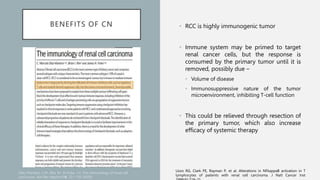
BENEFITS OF CN • RCC is highly immunogenic tumor
• Immune system may be primed to target
renal cancer cells, but the response is
consumed by the primary tumor until it is
removed, possibly due –
• Volume of disease
• Immunosuppressive nature of the tumor
microenvironment, inhibiting T-cell function
• This could be relieved through resection of
the primary tumor, which also increase
efficacy of systemic therapy
Uzzo RG, Clark PE, Rayman P, et al. Alterations in NFkappaB activation in T
lymphocytes of patients with renal cell carcinoma. J Natl Cancer Inst
DISADVANTAGES OF CN
• Added Morbidity
• Upfront CN leads to delay in initiation of systemic treatment
• Not all patients who undergo CN may be able to receive systemic
therapy
• Upfront systemic therapy may identify patients with inherent resistant to
systemic therapy, who are then spared from CN (litmus test)
ROLE OF CN
• Cytokine based immunotherapy era - 2001
• VEGF-TKI targeted therapy era - 2010
• Immuno-oncology era
RISK STRATIFICATION
Two most widely adopted and validated risk stratification criteria utilized in
clinical trials.
• The Memorial Sloan Kettering Cancer Center (MSKCC) model/ Motzer
criteria - Immunotherapy era
• International Metastatic Renal Cell Carcinoma Database Consortium
(IMDC), or Heng criteria - Targeted therapy era
RISK STRATIFICATION
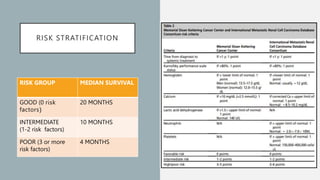
RISK GROUP MEDIAN SURVIVAL
GOOD (0 risk
factors)
20 MONTHS
INTERMEDIATE
(1-2 risk factors)
10 MONTHS
POOR (3 or more
risk factors)
4 MONTHS
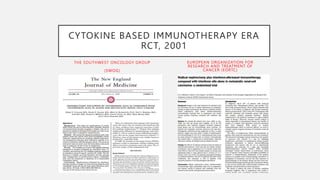
THE SOUTHWEST ONCOLOGY GROUP
(SWOG)
EUROPEAN ORGANIZATION FOR
RESEARCH AND TREATMENT OF
CANCER (EORTC)
CYTOKINE BASED IMMUNOTHERAPY ERA
RCT, 2001
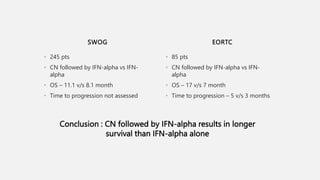
SWOG
• 245 pts
• CN followed by IFN-alpha vs IFN-
alpha
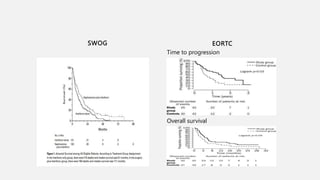
• OS – 11.1 v/s 8.1 month
• Time to progression not assessed
• 85 pts
• CN followed by IFN-alpha vs IFN-
alpha
• OS – 17 v/s 7 month
• Time to progression – 5 v/s 3 months
EORTC
Conclusion : CN followed by IFN-alpha results in longer
survival than IFN-alpha alone
SWOG EORTC
Time to progression
Overall survival
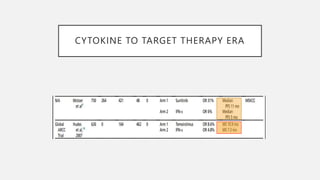
CYTOKINE TO TARGET THERAPY ERA
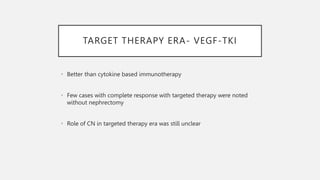
TARGET THERAPY ERA- VEGF-TKI
• Better than cytokine based immunotherapy
• Few cases with complete response with targeted therapy were noted
without nephrectomy
• Role of CN in targeted therapy era was still unclear
VEGF-TKI
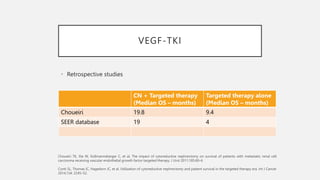
• Retrospective studies
CN + Targeted therapy
(Median OS – months)
Targeted therapy alone
(Median OS – months)
Choueiri 19.8 9.4
SEER database 19 4
VEGF-TKI
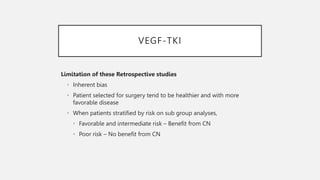
Limitation of these Retrospective studies
• Inherent bias
• Patient selected for surgery tend to be healthier and with more
favorable disease
• When patients stratified by risk on sub group analyses,
• Favorable and intermediate risk – Benefit from CN
• Poor risk – No benefit from CN
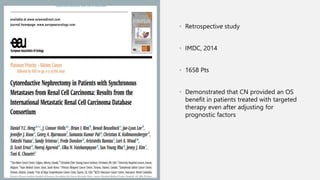
• Retrospective study
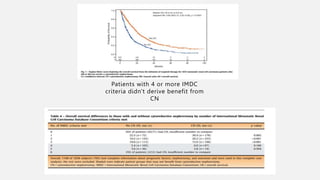
• IMDC, 2014
• 1658 Pts
• Demonstrated that CN provided an OS
benefit in patients treated with targeted
therapy even after adjusting for
prognostic factors
Patients with 4 or more IMDC
criteria didn't derive benefit from
CN
TARGETED THERAPY
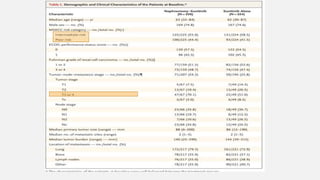
RCT, 2010
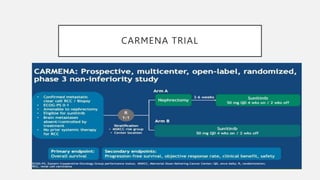
• CARMENA TRIAL (Clinical Trial to Assess the Importance of
Nephrectomy)
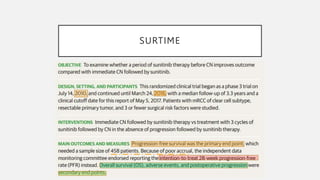
• SURTIME TRIAL (Surgery Time)
CARMENA TRIAL
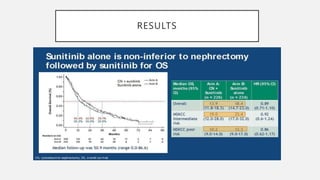
RESULTS
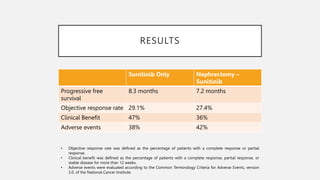
RESULTS
Sunitinib Only Nephrectomy –
Sunitinib
Progressive free
survival
8.3 months 7.2 months
Objective response rate 29.1% 27.4%
Clinical Benefit 47% 36%
Adverse events 38% 42%
• Objective response rate was defined as the percentage of patients with a complete response or partial
response.
• Clinical benefit was defined as the percentage of patients with a complete response, partial response, or
stable disease for more than 12 weeks.
• Adverse events were evaluated according to the Common Terminology Criteria for Adverse Events, version
3.0, of the National Cancer Institute
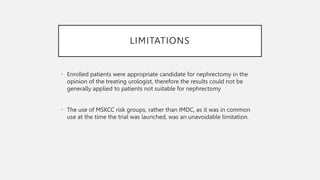
LIMITATIONS
• Enrolled patients were appropriate candidate for nephrectomy in the
opinion of the treating urologist, therefore the results could not be
generally applied to patients not suitable for nephrectomy
• The use of MSKCC risk groups, rather than IMDC, as it was in common
use at the time the trial was launched, was an unavoidable limitation.
LIMITATIONS
• Because this was a non inferiority trial , the results may underestimate
the benefits of nephrectomy.
• Another imitation of this trial is the recruitment of fewer patients than
planned (450 patients rather than 576), which reduced the statistical
power.
• However, the trend in longer overall survival and progression free
survival among patients who did not undergo nephrectomy suggests
that their conclusion is correct.
CONCLUSION
• Sunitinib alone was not inferior to nephrectomy followed by sunitinib in
patients with mRCC who were in the MSKCC intermediate or poor risk
group.
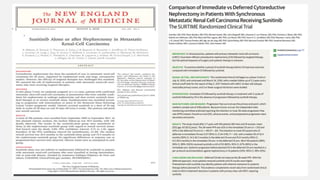
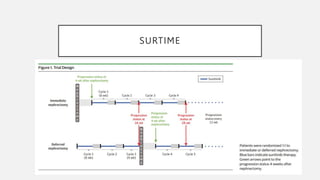
SURTIME
SURTIME
RESULTS
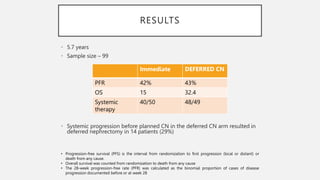
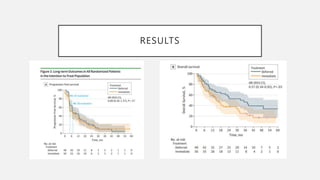
• 5.7 years
• Sample size – 99
• Systemic progression before planned CN in the deferred CN arm resulted in
deferred nephrectomy in 14 patients (29%)
Immediate DEFERRED CN
PFR 42% 43%
OS 15 32.4
Systemic
therapy
40/50 48/49
• Progression-free survival (PFS) is the interval from randomization to first progression (local or distant) or
death from any cause.
• Overall survival was counted from randomization to death from any cause
• The 28-week progression-free rate (PFR) was calculated as the binomial proportion of cases of disease
progression documented before or at week 28
RESULTS
LIMITATIONS
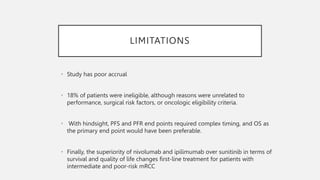
• Study has poor accrual
• 18% of patients were ineligible, although reasons were unrelated to
performance, surgical risk factors, or oncologic eligibility criteria.
• With hindsight, PFS and PFR end points required complex timing, and OS as
the primary end point would have been preferable.
• Finally, the superiority of nivolumab and ipilimumab over sunitinib in terms of
survival and quality of life changes first-line treatment for patients with
intermediate and poor-risk mRCC
CONCLUSION
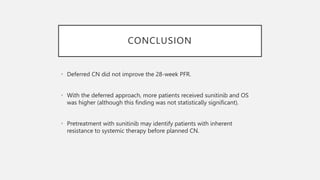
• Deferred CN did not improve the 28-week PFR.
• With the deferred approach, more patients received sunitinib and OS
was higher (although this finding was not statistically significant).
• Pretreatment with sunitinib may identify patients with inherent
resistance to systemic therapy before planned CN.
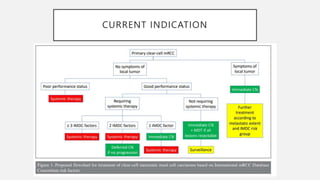
CURRENT INDICATION
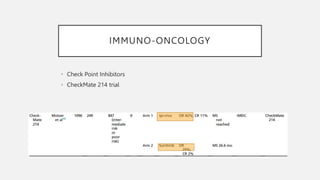
IMMUNO-ONCOLOGY
• Check Point Inhibitors
• CheckMate 214 trial
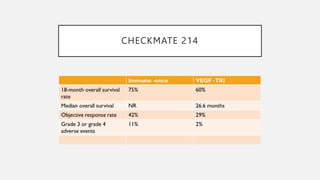
CHECKMATE 214
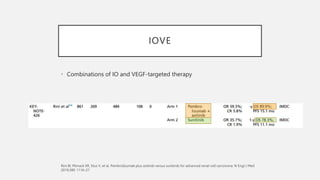
IOVE
• Combinations of IO and VEGF-targeted therapy
In comparing IOVE to ipi-nivo, a recent retrospective review found
• No significant differences in first-line outcomes, such as time to
treatment failure,
• But suggested a greater response to second-line VEGF based therapy
when ipi-nivo was used as the first-line treatment
Further trials are needed to re-evaluate the role of CN with these more
potent therapies.
CN ROLE IN METASTATIC NON –CLEAR
RCC
• Majority studies excluded Non clear RCC
• Some retrospective studies have been done
• All have shown median overall survival advantage in CN group
• Rigorous RCT still not done
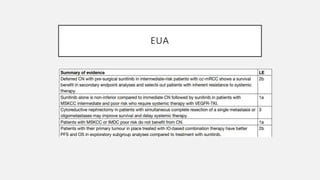
EUA
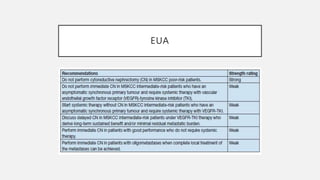
EUA
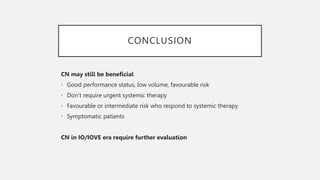
CONCLUSION
CN may still be beneficial
• Good performance status, low volume, favourable risk
• Don’t require urgent systemic therapy
• Favourable or intermediate risk who respond to systemic therapy
• Symptomatic patients
CN in IO/IOVE era require further evaluation
THANKS

Cytoreductive Nephrectomy.pptx, Indications and Contraindications

  • 1.
  • 2.
    INTRODUCTION • RCC -6th most common cancer in western world • 15% of kidney cancers are metastatic at diagnosis • 5-year survival drops from 93% to 12% when there is metastatic cancer
  • 3.
    CYTOREDUCTIVE NEPHRECTOMY • Refersto removal of the kidney with primary tumor in patients with synchronous metastatic RCC • For several decades, CN was the cornerstone in newly diagnosed metastatic RCC treatment • Following advancements in systemic therapy, the role of CN has become limited.
  • 4.
    BENEFITS OF CN •Symptoms caused by the local tumor are alleviated • Pain • Hematuria • Distant paraneoplastic symptoms, including hypertension, hypercalcemia, and hematopoietic disturbances • Reduces Disease burden and potential for development of aggressive biological clones capable of further metastases
  • 5.
    BENEFITS OF CN• RCC is highly immunogenic tumor • Immune system may be primed to target renal cancer cells, but the response is consumed by the primary tumor until it is removed, possibly due – • Volume of disease • Immunosuppressive nature of the tumor microenvironment, inhibiting T-cell function • This could be relieved through resection of the primary tumor, which also increase efficacy of systemic therapy Uzzo RG, Clark PE, Rayman P, et al. Alterations in NFkappaB activation in T lymphocytes of patients with renal cell carcinoma. J Natl Cancer Inst
  • 6.
    DISADVANTAGES OF CN •Added Morbidity • Upfront CN leads to delay in initiation of systemic treatment • Not all patients who undergo CN may be able to receive systemic therapy • Upfront systemic therapy may identify patients with inherent resistant to systemic therapy, who are then spared from CN (litmus test)
  • 7.
    ROLE OF CN •Cytokine based immunotherapy era - 2001 • VEGF-TKI targeted therapy era - 2010 • Immuno-oncology era
  • 8.
    RISK STRATIFICATION Two mostwidely adopted and validated risk stratification criteria utilized in clinical trials. • The Memorial Sloan Kettering Cancer Center (MSKCC) model/ Motzer criteria - Immunotherapy era • International Metastatic Renal Cell Carcinoma Database Consortium (IMDC), or Heng criteria - Targeted therapy era
  • 9.
    RISK STRATIFICATION RISK GROUPMEDIAN SURVIVAL GOOD (0 risk factors) 20 MONTHS INTERMEDIATE (1-2 risk factors) 10 MONTHS POOR (3 or more risk factors) 4 MONTHS
  • 10.
    THE SOUTHWEST ONCOLOGYGROUP (SWOG) EUROPEAN ORGANIZATION FOR RESEARCH AND TREATMENT OF CANCER (EORTC) CYTOKINE BASED IMMUNOTHERAPY ERA RCT, 2001
  • 11.
    SWOG • 245 pts •CN followed by IFN-alpha vs IFN- alpha • OS – 11.1 v/s 8.1 month • Time to progression not assessed • 85 pts • CN followed by IFN-alpha vs IFN- alpha • OS – 17 v/s 7 month • Time to progression – 5 v/s 3 months EORTC Conclusion : CN followed by IFN-alpha results in longer survival than IFN-alpha alone
  • 12.
    SWOG EORTC Time toprogression Overall survival
  • 13.
    CYTOKINE TO TARGETTHERAPY ERA
  • 14.
    TARGET THERAPY ERA-VEGF-TKI • Better than cytokine based immunotherapy • Few cases with complete response with targeted therapy were noted without nephrectomy • Role of CN in targeted therapy era was still unclear
  • 15.
    VEGF-TKI • Retrospective studies CN+ Targeted therapy (Median OS – months) Targeted therapy alone (Median OS – months) Choueiri 19.8 9.4 SEER database 19 4
  • 16.
    VEGF-TKI Limitation of theseRetrospective studies • Inherent bias • Patient selected for surgery tend to be healthier and with more favorable disease • When patients stratified by risk on sub group analyses, • Favorable and intermediate risk – Benefit from CN • Poor risk – No benefit from CN
  • 17.
    • Retrospective study •IMDC, 2014 • 1658 Pts • Demonstrated that CN provided an OS benefit in patients treated with targeted therapy even after adjusting for prognostic factors
  • 18.
    Patients with 4or more IMDC criteria didn't derive benefit from CN
  • 19.
    TARGETED THERAPY RCT, 2010 •CARMENA TRIAL (Clinical Trial to Assess the Importance of Nephrectomy) • SURTIME TRIAL (Surgery Time)
  • 21.
  • 23.
  • 24.
    RESULTS Sunitinib Only Nephrectomy– Sunitinib Progressive free survival 8.3 months 7.2 months Objective response rate 29.1% 27.4% Clinical Benefit 47% 36% Adverse events 38% 42% • Objective response rate was defined as the percentage of patients with a complete response or partial response. • Clinical benefit was defined as the percentage of patients with a complete response, partial response, or stable disease for more than 12 weeks. • Adverse events were evaluated according to the Common Terminology Criteria for Adverse Events, version 3.0, of the National Cancer Institute
  • 25.
    LIMITATIONS • Enrolled patientswere appropriate candidate for nephrectomy in the opinion of the treating urologist, therefore the results could not be generally applied to patients not suitable for nephrectomy • The use of MSKCC risk groups, rather than IMDC, as it was in common use at the time the trial was launched, was an unavoidable limitation.
  • 26.
    LIMITATIONS • Because thiswas a non inferiority trial , the results may underestimate the benefits of nephrectomy. • Another imitation of this trial is the recruitment of fewer patients than planned (450 patients rather than 576), which reduced the statistical power. • However, the trend in longer overall survival and progression free survival among patients who did not undergo nephrectomy suggests that their conclusion is correct.
  • 27.
    CONCLUSION • Sunitinib alonewas not inferior to nephrectomy followed by sunitinib in patients with mRCC who were in the MSKCC intermediate or poor risk group.
  • 28.
  • 29.
  • 30.
    RESULTS • 5.7 years •Sample size – 99 • Systemic progression before planned CN in the deferred CN arm resulted in deferred nephrectomy in 14 patients (29%) Immediate DEFERRED CN PFR 42% 43% OS 15 32.4 Systemic therapy 40/50 48/49 • Progression-free survival (PFS) is the interval from randomization to first progression (local or distant) or death from any cause. • Overall survival was counted from randomization to death from any cause • The 28-week progression-free rate (PFR) was calculated as the binomial proportion of cases of disease progression documented before or at week 28
  • 31.
  • 32.
    LIMITATIONS • Study haspoor accrual • 18% of patients were ineligible, although reasons were unrelated to performance, surgical risk factors, or oncologic eligibility criteria. • With hindsight, PFS and PFR end points required complex timing, and OS as the primary end point would have been preferable. • Finally, the superiority of nivolumab and ipilimumab over sunitinib in terms of survival and quality of life changes first-line treatment for patients with intermediate and poor-risk mRCC
  • 33.
    CONCLUSION • Deferred CNdid not improve the 28-week PFR. • With the deferred approach, more patients received sunitinib and OS was higher (although this finding was not statistically significant). • Pretreatment with sunitinib may identify patients with inherent resistance to systemic therapy before planned CN.
  • 34.
  • 35.
    IMMUNO-ONCOLOGY • Check PointInhibitors • CheckMate 214 trial
  • 36.
  • 37.
    IOVE • Combinations ofIO and VEGF-targeted therapy
  • 38.
    In comparing IOVEto ipi-nivo, a recent retrospective review found • No significant differences in first-line outcomes, such as time to treatment failure, • But suggested a greater response to second-line VEGF based therapy when ipi-nivo was used as the first-line treatment Further trials are needed to re-evaluate the role of CN with these more potent therapies.
  • 39.
    CN ROLE INMETASTATIC NON –CLEAR RCC • Majority studies excluded Non clear RCC • Some retrospective studies have been done • All have shown median overall survival advantage in CN group • Rigorous RCT still not done
  • 40.
  • 41.
  • 42.
    CONCLUSION CN may stillbe beneficial • Good performance status, low volume, favourable risk • Don’t require urgent systemic therapy • Favourable or intermediate risk who respond to systemic therapy • Symptomatic patients CN in IO/IOVE era require further evaluation
  • 43.