CYBERSECURITY AND CYBERWAR
WHAT EVERYONE NEEDS TO KNOW ®
oxfordhb-9780199918096.indd ioxfordhb-9780199918096.indd
i 21-10-2013 22:38:1221-10-2013 22:38:12
“In our digital age, the issues of cybersecurity are no longer just
for the technology
crowd; they matter to us all. Whether you work in business or
politics, the military or the
media—or are simply an ordinary citizen—this is an essential
read.”
—Eric Schmidt, Executive Chairman, Google
“This is the most approachable and readable book ever written
on the cyber world. The
authors have distilled the key facts and policy, provided
sensible recommendations, and
opened the debate generally to any informed citizen: a singular
achievement. A must read
for practitioners and scholars alike.”
—Admiral James Stavridis, US Navy (Ret), former NATO
Supreme Allied Commander
“In confronting the cybersecurity problem, it’s important for all
of us to become knowl-
edgeable and involved. This book makes that possible—and also
fascinating. It’s every-
thing you need to know about cybersecurity, wonderfully
presented in a clear and smart
way.”
—Walter Isaacson, author of Steve Jobs
“If you read only one book about ‘all this cyberstuff,’ make it
this one. Singer and
Friedman know how to make even the most complicated
material accessible and even
entertaining, while at the same time making a powerful case for
why all of us need to
know more and think harder about the (cyber)world we know
live in.“
—Anne-Marie Slaughter, President, the New America
Foundation
“Singer and Friedman blend a wonderfully easy to follow FAQ
format with engaging
prose, weaving explanations of the elements of cybersecurity
with revealing anecdotes.
From the fundamentals of Internet architecture to the topical
intrigue of recent security
leaks, this book provides an accessible and enjoyable analysis
of the current cybersecurity
landscape and what it could look like in the future.”
—Jonathan Zittrain, Professor of Law and Professor of
Computer
Science at Harvard University, and author of The Future of the
Internet—And How to Stop It
“Singer and Friedman do a highly credible job of documenting
the present and likely
future risky state of cyber-affairs. This is a clarion call.”
—Vint Cerf, “Father of the Internet,” Presidential Medal of
Freedom winner
“I loved this book. Wow. Until I read this astonishing and
important book, I didn’t know
how much I didn’t know about the hidden world of
cybersecurity and cyberwar. Singer
and Friedman make comprehensible an impossibly complex
subject, and expose the
frightening truth of just how vulnerable we are. Understanding
these often-invisible
threats to our personal and national security is a necessary fi rst
step toward defending
ourselves against them. This is an essential read.”
—Howard Gordon, Executive Producer of 24 and co-creator of
Homeland
oxfordhb-9780199918096.indd iioxfordhb-
9780199918096.indd ii 21-10-2013 22:38:1321-10-2013
22:38:13
1
CYBERSECURITY AND
CYBERWAR
WHAT EVERYONE NEEDS TO KNOW ®
P. W. SINGER AND
ALLAN FRIEDMAN
oxfordhb-9780199918096.indd iiioxfordhb-
9780199918096.indd iii 21-10-2013 22:38:1321-10-2013
22:38:13
3
Oxford University Press is a department of the University
of Oxford.
It furthers the University’s objective of excellence in research,
scholarship,
and education by publishing worldwide.
Oxford New York
Auckland Cape Town Dar es Salaam Hong Kong Karachi
Kuala Lumpur Madrid Melbourne Mexico City Nairobi
New Delhi Shanghai Taipei Toronto
With offi ces in
Argentina Austria Brazil Chile Czech Republic France Greece
Guatemala Hungary Italy Japan Poland Portugal Singapore
South Korea Switzerland Thailand Turkey Ukraine Vietnam
Oxford is a registered trademark of Oxford University Press
in the UK and certain other countries.
“What Everyone Needs to Know” is a registered trademark of
Oxford
University Press.
Published in the United States of America by Oxford
University Press
198 Madison Avenue, New York, NY 10016
© P. W. Singer and Allan Friedman 2014
All rights reserved. No part of this publication may be
reproduced, stored in a
retrieval system, or transmitted, in any form or by any means,
without the prior
permission in writing of Oxford University Press, or as
expressly permitted by law,
by license, or under terms agreed with the appropriate
reproduction rights
organization. Inquiries concerning reproduction outside the
scope of the above
should be sent to the Rights Department, Oxford University
Press, at the
address above.
You must not circulate this work in any other form
and you must impose this same condition on any acquirer.
Library of Congress Cataloging-in-Publication Data
Singer, P. W. (Peter Warren)
Cybersecurity and cyberwar : what everyone needs to know /
Peter W. Singer,
Allan Friedman.
ISBN 978–0–19–991809–6 (hardback)—ISBN 978–0–19–
991811–9 (paperback)
1. Computer security—United States 2. Computer networks—
Security
measures—United States. 3. Cyberspace—Security measures—
United States.
4. Cyberterrorism—United States—Prevention. 5. Information
warfare—United
States—Prevention. I. Title.
QA76.9.A25S562 2014
005.8—dc23
2013028127
1 3 5 7 9 8 6 4 2
Printed in the United States of America
on acid-free paper
oxfordhb-9780199918096.indd ivoxfordhb-
9780199918096.indd iv 21-10-2013 22:38:1321-10-2013
22:38:13
CONTENTS
INTRODUCTION 1
Why Write a Book about Cybersecurity and Cyberwar? 1
Why Is There a Cybersecurity Knowledge Gap, and Why
Does It Matter? 4
How Did You Write the Book and What Do You Hope
to Accomplish? 8
PART I HOW IT ALL WORKS 12
The World Wide What? Defi ning Cyberspace 12
Where Did This “Cyber Stuff” Come from Anyway? A Short
History
of the Internet 16
How Does the Internet Actually Work? 21
Who Runs It? Understanding Internet Governance 26
On the Internet, How Do They Know Whether You Are a
Dog?
Identity and Authentication 31
What Do We Mean by “Security” Anyway? 34
What Are the Threats? 36
One Phish, Two Phish, Red Phish, Cyber Phish: What Are
Vulnerabilities? 39
How Do We Trust in Cyberspace? 45
Focus: What Happened in WikiLeaks? 51
oxfordhb-9780199918096.indd voxfordhb-
9780199918096.indd v 21-10-2013 22:38:1321-10-2013
22:38:13
vi Contents
What Is an Advanced Persistent Threat (APT)? 55
How Do We Keep the Bad Guys Out? The Basics of
Computer Defense 60
Who Is the Weakest Link? Human Factors 64
PART II WHY IT MATTERS 67
What Is the Meaning of Cyberattack? The Importance of
Terms
and Frameworks 67
Whodunit? The Problem of Attribution 72
What Is Hactivism? 77
Focus: Who Is Anonymous? 80
The Crimes of Tomorrow, Today: What Is Cybercrime? 85
Shady RATs and Cyberspies: What Is Cyber Espionage?
91
How Afraid Should We Be of Cyberterrorism? 96
So How Do Terrorists Actually Use the Web? 99
What about Cyber Counterterrorism? 103
Security Risk or Human Right? Foreign Policy and the
Internet 106
Focus: What Is Tor and Why Does Peeling Back the Onion
Matter? 108
Who Are Patriotic Hackers? 110
Focus: What Was Stuxnet? 114
What Is the Hidden Lesson of Stuxnet? The Ethics of
Cyberweapons 118
“Cyberwar, Ugh, What Are Zeros and Ones Good For?”:
Defi ning Cyberwar 120
A War by Any Other Name? The Legal Side of Cyber Confl
ict 122
What Might a “Cyberwar” Actually Look Like? Computer
Network
Operations 126
Focus: What Is the US Military Approach to Cyberwar?
133
Focus: What Is the Chinese Approach to Cyberwar? 138
What about Deterrence in an Era of Cyberwar? 144
Why Is Threat Assessment So Hard in Cyberspace? 148
Does the Cybersecurity World Favor the Weak or the Strong?
150
Who Has the Advantage, the Offense or the Defense? 153
oxfordhb-9780199918096.indd vioxfordhb-
9780199918096.indd vi 21-10-2013 22:38:1321-10-2013
22:38:13
Contents vii
A New Kind of Arms Race: What Are the Dangers of
Cyber Proliferation? 156
Are There Lessons from Past Arms Races? 160
Behind the Scenes: Is There a Cyber-Industrial Complex?
162
PART III WHAT CAN WE DO? 166
Don’t Get Fooled: Why Can’t We Just Build a New, More
Secure Internet? 166
Rethink Security: What Is Resilience, and Why Is It
Important? 169
Reframe the Problem (and the
Solution
): What Can We Learn
from Public Health? 173
Learn from History: What Can (Real) Pirates Teach Us about
Cybersecurity? 177
Protect World Wide Governance for the World Wide
Web: What Is
the Role of International Institutions? 180
“Graft” the Rule of Law: Do We Need a Cyberspace Treaty?
185
Understand the Limits of the State in Cyberspace: Why Can’t
the Government Handle It? 193
Rethink Government’s Role: How Can We Better Organize
for
Cybersecurity? 197
Approach It as a Public-Private Problem: How Do We Better
Coordinate Defense? 205
Exercise Is Good for You: How Can We Better Prepare for
Cyber Incidents? 211
Build Cybersecurity Incentives: Why Should I Do What You
Want? 216
Learn to Share: How Can We Better Collaborate on
Information? 222
Demand Disclosure: What Is the Role of Transparency?
228
Get “Vigorous” about Responsibility: How Can We Create
Accountability for Security? 231
Find the IT Crowd: How Do We Solve the Cyber People
Problem? 235
Do Your Part: How Can I Protect Myself (and the Internet)?
241
oxfordhb-9780199918096.indd viioxfordhb-
9780199918096.indd vii 21-10-2013 22:38:1321-10-2013
22:38:13
viii Contents
CONCLUSIONS 247
Where Is Cybersecurity Headed Next? 247
What Do I Really Need to Know in the End? 255
ACKNOWLEDGMENTS 257
NOTES 259
GLOSSARY 293
INDEX 301
oxfordhb-9780199918096.indd viiioxfordhb-
9780199918096.indd viii 21-10-2013 22:38:1321-10-2013
22:38:13
INTRODUCTION
Why Write a Book about Cybersecurity and Cyberwar?
“All this cyber stuff.”
The setting was a Washington, DC, conference room. The
speaker was a senior leader of the US Department of Defense.
The topic was why he thought cybersecurity and cyberwar was
so important. And yet, when he could only describe the problem
as “all this cyber stuff,” he unintentionally convinced us to
write
this book.
Both of us are in our thirties and yet still remember the fi rst
computers we used. For a fi ve-year-old Allan, it was an early
Apple Macintosh in his home in Pittsburgh. Its disk space was
so
limited that it could not even fi t this book into its memory. For
a
seven-year-old Peter, it was a Commodore on display at a
science
museum in North Carolina. He took a class on how to
“program,”
learning an entire new language for the sole purpose of making
one
of the most important inventions in the history of mankind print
out
a smiley face. It spun out of a spool printer, replete with the
perfo-
rated paper strips on the side.
Three decades later, the centrality of computers to our lives is
almost impossible to comprehend. Indeed, we are so surrounded
by computers that we don’t even think of them as “computers”
any-
more. We are woken by computerized clocks, take showers in
water
heated by a computer, drink coffee brewed in a computer, eat
oat-
meal heated up in a computer, then drive to work in a car
controlled
by hundreds of computers, while sneaking peeks at the last
night’s
sport scores on a computer. And then at work, we spend most of
our
day pushing buttons on a computer, an experience so futuristic
in
oxfordhb-9780199918096.indd 1oxfordhb-
9780199918096.indd 1 21-10-2013 22:38:1321-10-2013
22:38:13
2 INTRODUCTION
our parents’ day that it was the stuff of The Jetsons (George
Jetson’s
job was a “digital index operator”). Yet perhaps the best way to
gain
even a hint of computers’ modern ubiquity is at the end of the
day.
Lie in bed, turn off the lights, and count the number of little red
lights staring back at you.
These machines are not just omnipresent, they are connected.
The
computers we used as little kids stood alone, linked to nothing
more
than the wall electricity socket and maybe that spool printer.
Just a
generation ago, the Internet was little more than a link between
a few
university researchers. The fi rst “electronic mail” was sent in
1971.
The children of those scientists now live in a world where
almost 40
trillion e-mails are sent a year. The fi rst “website” was made in
1991.
By 2013, there were over 30 trillion individual web pages.
Moreover, the Internet is no longer just about sending mail or
compiling information: it now also handles everything from
linking
electrical plants to tracking purchases of Barbie dolls. Indeed,
Cisco,
a company that helps run much of the back end of the Internet,
esti-
mated that 8.7 billion devices were connected to the Internet by
the
end of 2012, a fi gure it believes will rise to 40 billion by 2020
as cars,
fridges, medical devices, and gadgets not yet imagined or
invented all
link in. In short, domains that range from commerce to
communica-
tion to the critical infrastructure that powers our modern-day
civiliza-
tion all operate on what has become a globalized network of
networks.
But with the rise of “all this cyber stuff,” this immensely
impor-
tant but incredibly short history of computers and the Internet
has
reached a defi ning point. Just as the upside of the cyber domain
is
rippling out into the physical domain, with rapid and often
unex-
pected consequences, so too is the downside.
As we will explore, the astounding numbers behind “all this
cyber
stuff” drive home the scale and range of the threats: 97 percent
of
Fortune 500 companies have been hacked (and 3 percent likely
have
been too and just don’t know it), and more than one hundred
gov-
ernments are gearing up to fi ght battles in the online domain.
Alternatively, the problems can be conceptualized through the
tough
political issues that this “stuff” has already produced: scandals
like
WikiLeaks and NSA monitoring, new cyberweapons like
Stuxnet, and
the role that social networking plays in everything from the
Arab Spring
revolutions to your own concerns over personal privacy. Indeed,
President Barack Obama declared that “cybersecurity risks pose
some
oxfordhb-9780199918096.indd 2oxfordhb-
9780199918096.indd 2 21-10-2013 22:38:1321-10-2013
22:38:13
Introduction 3
of the most serious economic and national security challenges
of the
21st century,” a position that has been repeated by leaders in
coun-
tries from Britain to China.
For all the hope and promise of the information age, ours is
also
a time of “cyber anxiety.” In a survey of where the world was
head-
ing in the future, Foreign Policy magazine described the cyber
area as
the “single greatest emerging threat,” while the Boston Globe
claimed
that future is already here: a “cyber world war” in progress that
will
culminate in “bloody, digital trench warfare.”
These fears have coalesced into the massive booming business
of cybersecurity, one of the fastest growing industries in the
world.
It has led to the creation of various new governmental offi ces
and bureaucracies (the US Department of Homeland Security’s
National Cyber Security Division has doubled or tripled in size
every year since its inception). The same is true for armed
forces
around the globe like the US Cyber Command and the Chinese
“Information Security Base” ( xinxi baozhang jidi ), new
military
units whose very mission is to fi ght and win wars in
cyberspace.
As we later consider, these aspects of “cyber stuff” raise very
real
risks, but how we perceive and respond to these risks may be
even
more crucial to the future, and not just of the Internet. As Joe
Nye,
the former Dean of the Harvard Kennedy School of
Government,
notes, if users begin to lose confi dence in the safety and
security of
the Internet, they will retreat from cyberspace, trading “welfare
in
search of security.”
Fears over cybersecurity increasingly compromise our notions
of privacy and have allowed surveillance and Internet fi ltering
to
become more common and accepted at work, at home, and at the
governmental level. Entire nations, too, are pulling back, which
will undermine the economic and human rights benefi ts we’ve
seen
from global connectivity. China is already developing its own
net-
work of companies behind a “Great Firewall” to allow it to
screen
incoming messages and disconnect from the worldwide Internet
if
needed. As a Yale Law School article put it, all of these trends
are
“converging into a perfect storm that threatens traditional
Internet
values of openness, collaboration, innovation, limited
governance
and free exchange of ideas.”
These issues will have consequences well beyond the Internet.
There is a growing sense of vulnerability in the physical world
from
oxfordhb-9780199918096.indd 3oxfordhb-
9780199918096.indd 3 21-10-2013 22:38:1321-10-2013
22:38:13
4 INTRODUCTION
new vectors of cyberattack via the virtual world. As a report
entitled
“The New Cyber Arms Race” describes, “In the future, wars
will not
just be fought by soldiers with guns or with planes that drop
bombs.
They will also be fought with the click of a mouse a half a
world
away that unleashes carefully weaponized computer programs
that
disrupt or destroy critical industries like utilities,
transportation,
communications, and energy. Such attacks could also disable
mili-
tary networks that control the movement of troops, the path of
jet
fi ghters, the command and control of warships.”
Such a vision of costless war or instant defeat either scares or
comforts, wholly dependent on which side of the cyberattack
you’re on. The reality, as we explore later in the book, is much
more
complex. Such visions don’t just stoke fears and drive budgets.
They also are potentially leading to the militarization of cyber-
space itself. These visions threaten a domain that has delivered
massive amounts of information, innovation, and prosperity to
the
wider planet, fuel tensions between nations, and, as the title of
the
aforementioned report reveals, maybe even have set in motion a
new global arms race.
In short, no issue has emerged so rapidly in importance as
cyber-
security. And yet there is no issue so poorly understood as this
“cyber stuff.”
Why Is There a Cybersecurity Knowledge Gap,
and Why Does It Matter?
“Rarely has something been so important and so talked about
with
less and less clarity and less apparent understanding. . . . I have
sat in
very small group meetings in Washington . . . unable (along
with my
colleagues) to decide on a course of action because we lacked a
clear
picture of the long term legal and policy implications of any
decision
we might make.”
This is how General Michael Hayden, former Director of the
CIA, described the cybersecurity knowledge gap and the
dangers it
presents. A major part of this disconnect is the consequence of
those
early experiences with computers, or rather the lack of them
among
too many leaders. Today’s youth are “digital natives,” having
grown
up in a world where computers have always existed and seem a
nat-
ural feature. But the world is still mostly led by“digital
immigrants,”
oxfordhb-9780199918096.indd 4oxfordhb-
9780199918096.indd 4 21-10-2013 22:38:1321-10-2013
22:38:13
Introduction 5
older generations for whom computers and all the issues the
Internet
age presents remain unnatural and often confusing.
To put it another way, few older than fi fty will have gone
through
their university training even using a computer. Even the few
who
did likely used one that stood alone, not connected to the world.
Our
most senior leaders, now in their sixties and seventies, likely
did not
even become familiar with computers until well into their
careers,
and many still today have only the most limited experience with
them. As late as 2001, the Director of the FBI did not have a
com-
puter in his offi ce, while the US Secretary of Defense would
have
his assistant print out e-mails to him, write his response in pen,
and
then have the assistant type them back in. This sounds
outlandish,
except that a full decade later the Secretary of Homeland
Security, in
charge of protecting the nation from cyberthreats, told us at a
2012
conference, “Don’t laugh, but I just don’t use e-mail at all.” It
wasn’t
a fear of security, but that she just didn’t believe e-mail useful.
And
in 2013, Justice Elena Kagan revealed the same was true of
eight out
of nine of the United States Supreme Court justices, the very
people
who would ultimately decide what was legal or not in
this space.
It is not solely an issue of age. If it was, we could just wait
until
the old farts died off and all would be solved. Just because
some-
one is young doesn’t mean the person automatically has an
under-
standing of the key issues. Cybersecurity is one of those areas
that
has been left to only the most technically inclined to worry their
uncombed heads over. Anything related to the digital world of
zeros
and ones was an issue just for computer scientists and the IT
help
desk. Whenever they spoke, most of us would just keep quiet,
nod
our heads, and put on what author Mark Bowden calls “the
glaze.”
This is the “unmistakable look of profound confusion and
disinter-
est that takes hold whenever conversation turns to workings of a
computer.” The glaze is the face you put on when you can only
call
something “stuff.” Similarly, those who are technically inclined
too
often roll their eyes at the foreign logic of the policy and
business
worlds, scoffi ng at the “old way” of doing business, without
under-
standing the interactions between technology and people.
The result is that cybersecurity falls into a no man’s land. The
fi eld is becoming crucial to areas as intimate as your privacy
and
as weighty as the future of world politics. But it is a domain
only
well known by “the IT Crowd.” It touches every major area of
oxfordhb-9780199918096.indd 5oxfordhb-
9780199918096.indd 5 21-10-2013 22:38:1321-10-2013
22:38:13
6 INTRODUCTION
public- and private-sector concern, but only the young and the
com-
puter savvy are well engaged with it. In turn, the technical com-
munity that understands the workings too often sees the world
only
through a specifi c lens and can fail to appreciate the broader
picture
or nontechnical aspects. Critical issues are thus left
misunderstood
and often undebated.
The dangers are diverse and drove us in the writing of the
book.
Each of us, in whatever role we play in life, must make
decisions
about cybersecurity that will shape the future well beyond the
world
of computers. But often we do so without the proper tools.
Basic
terms and essential concepts that defi ne what is possible and
proper
are being missed, or even worse, distorted. Past myth and future
hype often weave together, obscuring what actually happened
and
where we really are now. Some threats are overblown and
overre-
acted to, while others are ignored.
This gap has wide implications. One US general described to us
how “understanding cyber is now a command responsibility,” as
it
affects almost every part of modern war. And yet, as another
gen-
eral put it pointedly, “There is a real dearth of doctrine and
policy in
the world of cyberspace.” His concern, as we explore later, was
not
just the military side needed to do a better job at “cyber
calculus,”
but that the civilian side was not providing any coordination or
guidance. Some liken today to the time before World War I,
when
the militaries of Europe planned to utilize new technologies like
railroads. The problem was that they, and the civilian leaders
and
publics behind them didn’t understand the technologies or their
implications and so made uninformed decisions that
inadvertently
drove their nations into war. Others draw parallels to the early
years of the Cold War. Nuclear weapons and the political
dynamics
they drove weren’t well understood and, even worse, were
largely
left to specialists. The result was that notions we now laugh off
as
Dr. Strangelovian were actually taken seriously, nearly leaving
the
planet a radioactive hulk.
International relations are already becoming poisoned by this
dis-
connect between what is understood and what is known. While
we
are both Americans, and thus many of the examples and lessons
in
this book refl ect that background, the “cyber stuff” problem is
not
just an American concern. We were told the same by offi cials
and
experts from places ranging from China and Abu Dhabi to
Britain
oxfordhb-9780199918096.indd 6oxfordhb-
9780199918096.indd 6 21-10-2013 22:38:1321-10-2013
22:38:13
Introduction 7
and France. In just one illustration of the global gap, the offi
cial
assigned to be the “czar” for cybersecurity in Australia had
never
even heard of Tor, a critical technology to the fi eld and its
future
(don’t worry, you—and hopefully she—will learn what
everyone
needs to know about Tor in Part II).
This is worrisome not just because of the “naiveté” of such
pub-
lic offi cials, but because it is actually beginning to have a
danger-
ous impact on global order. For instance, there is perhaps no
other
relationship as important to the future of global stability as that
between the two great powers of the United States and China.
Yet,
as senior policymakers and general publics on both sides
struggle
to understand the cyber realm’s basic dynamics and
implications,
the issue of cybersecurity is looming ever larger in US-China
rela-
tions. Indeed, the Chinese Academy of Military Sciences
released
a report whose tone effectively captured how suspicion, hype,
ignorance, and tension have all begun to mix together into a
dan-
gerous brew. “Of late, an Internet tornado has swept across the
world . . . massively impacting and shocking the globe. . . .
Faced
with this warm-up for an Internet war, every nation and mili-
tary can’t be passive but is making preparations to fi ght the
Internet war.”
This kind of language—which is mirrored in the US—doesn’t
illustrate the brewing global cyber anxiety. It also reveals how
confusion and misinformation about the basics of the issue help
drive that fear. While both sides, as we explore later on, are
active
in both cyber offense and defense, it is the very newness of the
issue that is proving so diffi cult. Top American and Chinese
gov-
ernmental leaders talked with us about how they found
cybersecu-
rity to be far more challenging than the more traditional
concerns
between their nations. While they may not agree on issues like
trade, human rights, and regional territorial disputes, they at
least
understand them. Not so for cyber, where they remain woefully
ill-equipped even to talk about what their own nation is doing,
let alone the other side. For example, a top US offi cial
involved in
talks with China on cyber issues asked us what an “ISP” was
(here
again, don’t fret if you don’t yet know, we’ll cover this soon!).
If
this had been back in the Cold War, that question would be akin
to
not knowing what an ICBM was in the midst of negotiating with
the Soviets on nuclear issues.
oxfordhb-9780199918096.indd 7oxfordhb-
9780199918096.indd 7 21-10-2013 22:38:1321-10-2013
22:38:13
8 INTRODUCTION
Such matters are not just issues for generals or diplomats but
also
for all citizens. The general lack of understanding on this topic
is
becoming a democracy problem as well. As we write, there are
some
fi fty cybersecurity bills under consideration in the US
Congress, yet
the issue is perceived as too complex to matter in the end to
vot-
ers, and as a result, the elected representatives who will decide
the
issues on their behalf. This is one of the reasons that despite all
these
bills no substantive cybersecurity legislation was passed
between
2002 and the writing of this book over a decade later.
Again, the technology has evolved so quickly that it is no sur-
prise that most voters and their elected leaders are little
engaged on
cybersecurity concerns. But they should be. This fi eld connects
areas
that range from the security of your bank accounts and online
iden-
tity to broader issues of who in which governments can access
your
personal secrets and even when and where your nation goes to
war.
We are all users of this realm and are all shaped by it, yet we
are not
having any kind of decent public dialogue on it. “We’re not
having
a really good, informed debate,” as one professor at the US
National
Defense University put it. “Instead, we either punt the problem
down the road for others to fi gure out, or to the small number
of
people who make important policy in the smoky backrooms.”
And
even that is insuffi cient, given that most people in today’s
smoky
backrooms have never been in an Internet chatroom.
How Did You Write the Book and What Do You Hope to
Accomplish?
With all of these issues at play, the timing and value of a book
that
tried to tackle the basic issues that everyone should know about
cybersecurity and cyberwar seemed ideal. And the format of this
Oxford series, where all the books are in a “question and
answer”
style, seemed to hit that sweet spot.
As we set out to research and write the book, this question-
and-answer style then structured our methodology. To put it
another
way, if you are locked into a Q and A format, you better fi rst
decide
the right set of Qs.
We tried to gather all the key questions that people had about
this
fi eld, not only those asked by people working in politics or
technol-
ogy, but also from our interactions and interviews well beyond.
This
set of questions was backed by what would have previously
been
called a “literature survey.” In the old (pre-Internet) days, this
meant
oxfordhb-9780199918096.indd 8oxfordhb-
9780199918096.indd 8 21-10-2013 22:38:1321-10-2013
22:38:13
Introduction 9
going to the library and pulling off the shelf all the books in
that sec-
tion of the Dewey decimal system. Today, on this topic
especially,
the sources range from books to online journals to microblogs.
We
were also greatly aided by a series of workshops and seminars
at
Brookings, the think tank in Washington we work at. These
gathered
key public- and private-sector experts to explore questions
ranging
from the effi cacy of cyber deterrence to what can be done
about bot-
nets (all questions later dealt with in the book). We also held a
series
of meetings and interviews with key American offi cials and
experts.
They ranged from top folks like the Chairman of the Joint
Chiefs, the
highest-ranking US military offi cer, and the Director of the
National
Security Agency down to low-ranking systems administrators,
from
civilian governors, cabinet secretaries, and CEOs to small
business
owners and teenaged hackers. Our scope was global, and so the
meetings also included leaders and experts from China (the
foreign
minister and generals from the PLA among them), as well as the
UK,
Canada, Germany, France, Australia, Estonia, United Arab
Emirates,
and Singapore. Finally, while it is a virtual world, we also
visited
key facilities and various cybersecurity hubs in locales that
ranged
from the DC Beltway and Silicon Valley to Paris and
Abu Dhabi.
Over the course of this journey, we noticed a pattern. The ques-
tions (and the issues that came from them) generally fell under
three categories. The fi rst were questions of the essential
contours
and dynamics of cyberspace and cybersecurity, the “How does
it all work?” questions. Think of these as the “driver ’s ed” part,
which gives the basic building blocks to the online world. The
sec-
ond were questions on the broader implications of cybersecurity
beyond cyberspace, the “Why does it matter?” questions. And
then
there were questions on the potential responses, the “What we
can
do?” questions. The following sections follow this basic
structure.
And with the questions laid out, then came the task of answer-
ing them. This book is the result. While the questions are
diverse,
you’ll notice that over the course of answering them, a few
themes
emerged to run through the book:
• Knowledge matters: It is vital we demystify this realm if
we ever
want to get anything effective done in securing it.
• People matter: Cybersecurity is one of those “wicked”
problem
areas that’s rife with complexities and trade-offs. This is in
oxfordhb-9780199918096.indd 9oxfordhb-
9780199918096.indd 9 21-10-2013 22:38:1321-10-2013
22:38:13
10 INTRODUCTION
large part not because of the technical side, but because of the
people part. The people behind the machines are inherently
inside any problem or needed solution.
• Incentives matter: If you want to understand why
something
is or isn’t happening in cyberspace, look to the motivations,
the costs, and the tensions at play behind the issue. Indeed,
anyone claiming a simple “silver bullet” solution in the cyber
realm is either ignorant or up to no good.
• The crowd matters: This is not a realm where
governments can
or should have all the answers. Cybersecurity depends on
all of us.
• States matter: That said, governments’ roles are crucial,
espe-
cially the United States and China. The reason is not just that
these two nations remain powerful and infl uential, but that the
interplay of their often differing visions of cybersecurity are
critical to the future of both the Internet and world politics.
• Cats matter: In the end, the Internet is what we make of
it. And
that means while serious “stuff” is at play in it, cyberspace
is also a fun, often whimsical realm, with memes like danc-
ing babies and keyboard-playing cats. So any treatment of it
should be sure to capture that whimsy.
To put it another way, our goal was to wrestle directly with the
“cyber stuff” problem that set us on the journey. This is a book
writ-
ten by two researchers, following rigorous academic guidelines,
and
published by an esteemed university press. But our intent was
not
a book only for academics. The best research in the world is
worth-
less if it does not fi nd its way into the hands of those who need
it.
Indeed, the number of academic papers related to cybersecurity
has
increased at a compound annual growth rate of 20 percent for
well
over a decade. Yet no one would say that the broader world is
all the
more informed.
Instead, we embraced this series’ core idea of “what everyone
needs to know.” Everyone does not need to know the software
pro-
gramming secrets of Stuxnet or the legal dynamics of ISP
insurance
schemes. But as we all become more engaged in and dependent
on
cybersecurity, there are certain building blocks of
understanding that
we all need to have. Ignorance is not bliss when it comes to
cyber-
security. Cyber issues affect literally everyone: politicians
wrestling
oxfordhb-9780199918096.indd 10oxfordhb-
9780199918096.indd 10 21-10-2013 22:38:1321-10-2013
22:38:13
Introduction 11
with everything from cybercrime to online freedom; generals
pro-
tecting the nation from new forms of attack, while planning new
cyberwars; business executives defending fi rms from once
unimagi-
nable threats, and looking to make money off of them; lawyers
and
ethicists building new frameworks for right and wrong. Most of
all,
cybersecurity issues affect us as individuals. We face new
questions
in everything from our rights and responsibilities as citizens of
both
the online and real world to how to protect ourselves and our
fami-
lies from a new type of danger.
So this is not a book only for experts, but rather a book
intended
to unlock the fi eld, to raise the general level of expertise, and
then
push the discussion forward.
We hope that you fi nd the journey useful, and ideally even
enjoy-
able, just like the world of “cyber stuff” itself.
Peter Warren Singer and Allan A. Friedman,
August 2013, Washington, DC
oxfordhb-9780199918096.indd 11oxfordhb-
9780199918096.indd 11 21-10-2013 22:38:1321-10-2013
22:38:13
Part I
HOW IT ALL WORKS
The World Wide What? Defi ning Cyberspace
“It’s not a truck. It’s a series of tubes.”
This is how the late Alaska senator Ted Stevens famously
explained
cyberspace during a congressional hearing in 2006. As late-
night
humorist Jon Stewart noted, that someone who doesn’t “seem to
know jack BLEEP about computers or the Internet . . . is just
the guy in
charge of regulating it” is a near-perfect illustration of how
discon-
nected Washington policymakers can be from technological
realty.
While it’s easy to mock the elderly senator’s notion of
electronic
letters shooting through tubes, the reality is that defi ning ideas
and
terms in cyber issues can be diffi cult. Stevens’s “tubes” is
actually a
mangling of the idea of “pipes,” an analogy that is used by
experts
in the fi eld to describe data connections.
If he wanted to be perfectly accurate, Stevens could have used
science-fi ction writer William Gibson’s original conception of
cyber-
space. Gibson fi rst used the word, an amalgam of “cybernetics”
and “space,” in a 1982 short story. He defi ned it two years later
in
his genre-revolutionizing novel Neuromancer as “A consensual
hal-
lucination experienced daily by billions of legitimate operators,
in
every nation. . . . A graphic representation of data abstracted
from the
banks of every computer in the human system. Unthinkable
com-
plexity. Lines of light ranged in the nonspace of the mind,
clusters
and constellations of data.” Of course, if the senator had
described
cyberspace that way, most people would have thought him
stoned
rather than simply disconnected.
oxfordhb-9780199918096.indd 12oxfordhb-
9780199918096.indd 12 21-10-2013 22:38:1321-10-2013
22:38:13
How It All Works 13
Part of why cyberspace is so diffi cult to defi ne lies not only
in
its expansive, global nature, but also in the fact that the
cyberspace
of today is almost unrecognizable compared to its humble
begin-
nings. The US Department of Defense can be considered the
god-
father of cyberspace, dating back to its funding of early
computing
and original networks like ARPANET (more on this soon). Yet
even
the Pentagon has struggled to keep pace as its baby has grown
up.
Over the years, it has issued at least twelve different defi
nitions of
what it thinks of as cyberspace. These range from the “notional
envi-
ronment in which digitized information is communicated over
com-
puter networks,” which was rejected because it implied
cyberspace
was only for communication and largely imaginary, to a
“domain
characterized by the use of electronics and the electromagnetic
spec-
trum,” which was also rejected as it encompassed everything
from
computers and missiles to the light from the sun.
In its latest attempt in 2008, the Pentagon assembled a team of
experts who took over a year to agree on yet another defi nition
of
cyberspace. This time they termed it “the global domain within
the information environment consisting of the interdependent
network of information technology infrastructures, including
the internet, telecommunications networks, computer systems,
and embedded processors and controllers.” It is certainly a more
detailed defi nition but so dense that one almost wishes we
could
go back to just the “tubes.”
For the purposes of this book, we think it’s best to keep it
simple.
At its essence, cyberspace is the realm of computer networks
(and
the users behind them) in which information is stored, shared,
and
communicated online. But rather than trying to fi nd the exact
per-
fectly worded defi nition of cyberspace, it is more useful to
unpack
what these defi nitions are trying to get at. What are the
essential
features that not only compose cyberspace, but also make it
unique?
Cyberspace is fi rst and foremost an information environment.
It
is made up of digitized data that is created, stored, and, most
impor-
tantly, shared. This means that it is not merely a physical place
and
thus defi es measurement in any kind of physical dimension.
But cyberspace isn’t purely virtual. It comprises the computers
that store data plus the systems and infrastructure that allow it
to
fl ow. This includes the Internet of networked computers, closed
oxfordhb-9780199918096.indd 13oxfordhb-
9780199918096.indd 13 21-10-2013 22:38:1321-10-2013
22:38:13
14 CYBERSECURITY AND CYBERWAR
intranets, cellular technologies, fi ber-optic cables, and space-
based
communications.
While we often use “Internet” as shorthand for the digital
world,
cyberspace has also come to encompass the people behind those
computers and how their connectivity has altered their society.
One
of the key features, then, of cyberspace is that its systems and
tech-
nologies are man-made. As such, cyberspace is defi ned as much
by
the cognitive realm as by the physical or digital. Perceptions
matter,
and they inform cyberspace’s internal structures in everything
from
how the names within cyberspace are assigned to who owns
which
parts of the infrastructure that powers and uses it.
This leads to an important point often misunderstood.
Cyberspace
may be global, but it is not “stateless” or a “global commons,”
both terms frequently used in government and media. Just as we
humans have artifi cially divided our globe into territories that
we
call “nations” and, in turn, our human species into various
groups
like “nationalities,” the same can be done with cyberspace. It
relies
on physical infrastructure and human users who are tied to
geogra-
phy, and thus is also subject to our human notions like
sovereignty,
nationality, and property. Or, to put it another way,
cyberspace’s
divisions are as real as the meaningful, but also imaginary, lines
that
divide the United States from Canada or North from South
Carolina.
But cyberspace, like life, is constantly evolving. The hybrid
com-
bination of technology and the humans that use it is always
chang-
ing, inexorably altering everything from cyberspace’s size and
scale
to the technical and political rules that seek to guide it. As one
expert
put it, “The geography of cyberspace is much more mutable
than
other environments. Mountains and oceans are hard to move,
but
portions of cyberspace can be turned on and off with the click
of a
switch.” The essential features remain the same, but the
topography
is in constant fl ux. The cyberspace of today is both the same as
but
also utterly different from the cyberspace of 1982.
The hardware and software that make up cyberspace, for
instance,
were originally designed for computers operating from fi xed
wires
and telephone lines. Mobile devices were fi rst the stuff of Star
Trek
and then only for the drug dealers on Miami Vice who could
afford
to have something as exotic as a “car phone.” Today, a growing
per-
centage of computing is moving onto mobile devices, so much
so
oxfordhb-9780199918096.indd 14oxfordhb-
9780199918096.indd 14 21-10-2013 22:38:1321-10-2013
22:38:13
How It All Works 15
that we’ve seen toddlers punch the screens of desktop
computers as
if they were broken iPads.
Along with the technology of cyberspace, our expectations of it
are likewise evolving. This generates new norms of behavior,
from
how kids “play” to the even more powerful concept that we
should
all have access to cyberspace and be able to express our
personal
opinions within it, on everything from a Hollywood star’s new
hairdo to what we think of an authoritarian leader.
So what constitutes the Internet itself is evolving before us in
an
even more fundamental way. It is simultaneously becoming
mas-
sively bigger (each day some 2,500,000,000,000,000,000 bytes
are
added to the global supply of digital information) and far more
per-
sonalized. Rather than passively receiving this onslaught of
online
information, the individual users are creating and tailoring sites
to their personal use, ultimately revealing more about
themselves
online. These sites range from social networks like Facebook in
the
United States and RenRen in China to microblogs like Twitter
and
the Chinese equivalents Tencent and Sina. Indeed, microblogs
in
China (called Weibo) have taken off to the extent that 550
million
were registered in 2012.
Thus, while cyberspace was once just a realm of
communication
and then e-commerce (reaching over $10 trillion a year in
sales), it
has expanded to include what we call “critical infrastructure.”
These
are the underlying sectors that run our modern-day civilization,
ranging from agriculture and food distribution to banking,
health-
care, transportation, water, and power. Each of these once stood
apart but are now all bound together and linked into cyberspace
via
information technology, often through what are known as
“super-
visory control and data acquisition” or SCADA systems. These
are
the computer systems that monitor, adjust switching, and
control
other processes of critical infrastructure. Notably, the private
sec-
tor controls roughly 90 percent of US critical infrastructure, and
the
fi rms behind it use cyberspace to, among other things, balance
the
levels of chlorination in your city’s water, control the fl ow of
gas that
heats your home, and execute the fi nancial transactions that
keep
currency prices stable.
Cyberspace is thus evolving from “the nervous system—the
con-
trol system of our economy,” as President George W. Bush once
said,
into something more. As Wired magazine editor Ben
Hammersley
oxfordhb-9780199918096.indd 15oxfordhb-
9780199918096.indd 15 21-10-2013 22:38:1321-10-2013
22:38:13
16 CYBERSECURITY AND CYBERWAR
describes, cyberspace is becoming “the dominant platform for
life
in the 21st century.”
We can bitch about it, but Facebook, Twitter, Google and all
the
rest are, in many ways the very defi nition of modern life in the
democratic west. For many, a functioning Internet with free-
dom of speech, and a good connection to the social networks
of our choice is a sign not just of modernity, but of civilization
itself. This is not because people are “addicted to the video
screen,” or have some other patronizing psychological diagno-
sis. But because the Internet is where we live. It’s where we do
business, where we meet, where we fall in love. It is the cen-
tral platform for business, culture, and personal relationships.
There’s not much else left. To misunderstand the centrality
of these services to today’s society is to make a fundamental
error. The Internet isn’t a luxury addition to life; for most peo-
ple, knowingly or not, it is life.
But just as in life, not everyone plays nice. The Internet that
we’ve
all grown to love and now need is increasingly becoming a
place of
risk and danger.
Where Did This “Cyber Stuff” Come from Anyway?
A Short History of the Internet
“Lo.”
This was the very fi rst real word transmitted over the
computer
network that would evolve into the Internet. But rather than the
beginning of some profound proclamation like “Lo and behold,”
“Lo” was instead the product of a system failure. In 1969,
research-
ers at UCLA were trying to log into a computer at the Stanford
Research Institute. But before they could type the “g” in the
word
“log,” the computer at the Stanford end of the network crashed.
However, the ARPANET project, so named as it was funded by
the
Advanced Research Projects Agency (ARPA), would eventually
transform how computers shared data and, with that, everything
else.
oxfordhb-9780199918096.indd 16oxfordhb-
9780199918096.indd 16 21-10-2013 22:38:1321-10-2013
22:38:13
How It All Works 17
Electronic communication networks have been shaping how we
share information since the invention of the telegraph, the
device
that some now look back on and call the “Victorian Internet.”
The
hype around that old technology were similarly high; contempo-
raries declared that, with the telegraph, “It is impossible that
old
prejudices and hostilities should longer exist.”
What makes the Internet distinct from prior communication
networks like the old telegraphs and then telephone networks,
however, is that it is packet-switched instead of circuit-
switched.
Packets are small digital envelopes of data. At the beginning
of each packet, essentially the “outside” of the envelope, is the
header, which contains details about the network source, desti-
nation, and some basic information about the packet contents.
By breaking up flows of data into smaller components, each can
be delivered in an independent and decentralized fashion, then
reassembled at the endpoint. The network routes each packet as
it arrives, a dynamic architecture that creates both flexibility
and
resiliency.
Packet-switching was not developed to allow the United States
to maintain communications even in the event of a nuclear
attack,
a common myth. It was really just developed to better enable
more reliable, more efficient connections between computers.
Prior to its rise in the 1970s, communication between two com-
puters required a dedicated circuit, or preassigned bandwidth.
This direct link meant those resources could not be used by any-
one else, even when no data was being transmitted. By break-
ing these conversations into smaller parts, packets from
multiple
distinct conversations could share the same network links. It
also
meant that if one of the network links between two machines
went down mid-communication, a transmission could be auto-
matically rerouted with no apparent loss of connection (since
there was never a connection to begin with).
ARPA (now DARPA, with a D for “Defense” added) was an
orga-
nization developed by the Pentagon to avoid technological
surprise
by leaping ahead in research. Computers were proliferating in
the
late 1960s, but even more researchers wanted to use them than
was
available. To ARPA, that meant fi nding ways to allow people
at
different institutions to take advantage of unused computer time
around the country.
oxfordhb-9780199918096.indd 17oxfordhb-
9780199918096.indd 17 21-10-2013 22:38:1321-10-2013
22:38:13
18 CYBERSECURITY AND CYBERWAR
Rather than have dedicated—and expensive—connections
between universities, the vision was a network of shared data
links, sharing computational resources. Individual machines
would each be connected with an Interface Message Processor
that handled the actual network connection. This network was
ARPANET, home of the first “Lo” and start of the modern cyber
era. That first 1969 link from UCLA to Stanford grew to link
forty nodes in 1972. Soon more universities and research
centers
around the world joined this first network, or alternatively cre-
ated their own networks.
For the purposes of the modern Internet, a series of packets
sent
between machines on a single network does not count as an
“inter-
net.” Internet implies connecting many different networks, in
this
case these various other computer networks beyond ARPANET
that
soon emerged but remained unlinked.
The challenge was that different networks used very different
underlying technology. The technical problem boiled down to
abstracting these differences and allowing effi cient
communica-
tion. In 1973, the solution was found. Vint Cerf, then a
professor
at Stanford, and Robert Khan of ARPA refi ned the idea of a
com-
mon transmission protocol. This “protocol” established the
expec-
tations that each end of the communication link should make of
the other. It began with the computer equivalent of a three-way
handshake to establish a connection, continuing through how
each
party should break apart the messages to be reassembled, and
how
to control transmission speeds to automatically detect
bandwidth
availability.
The brilliance of the model is how it breaks the communication
into “layers” and allows each layer to function independently.
These
packets, in turn, can be sent over any type of network, from
sound
waves to radio waves to light pulses on a glass fi ber. Such
Transport
Control Protocols, or TCPs, could be used over all sorts of
packet
protocols, but we now use a type called the Internet Protocol, or
IP,
almost exclusively in the modern Internet.
This protocol enabled the creation of a network of networks.
But,
of course, the Internet didn’t stop there. The new links excelled
at
connecting machines, but humans excel at making technology
con-
form to their whims. As people shared machines for research,
they
started leaving messages for each other, simple fi les that could
be
oxfordhb-9780199918096.indd 18oxfordhb-
9780199918096.indd 18 21-10-2013 22:38:1321-10-2013
22:38:13
How It All Works 19
edited to form a conversation. This became clunky, and in 1972
Ray
Tomlinson at the technical consulting fi rm BBN wrote a basic
pro-
gram to read, compose, and send messages. This was e-mail: the
fi rst
Internet “killer app.” Within a year, a majority of traffi c across
the
network originally created for research was e-mail. Now
networked
communication was about people.
The last step in creating the modern Internet was eliminating
bar-
riers to entry. Early use was limited to those who had access to
the
networked computers at research and defense institutions. These
organizations communicated via dedicated data lines. As the
evi-
dent value of networked communication grew and the price of
com-
puters dropped, more organizations sought to join. Modems,
which
convert data to sound waves and back, allowed basic phone
lines to
serve as links to other computers.
Soon, researchers outside computer science wanted access, not
just to take advantage of the shared computing resources, but
also
to study the new networking technology itself. The US National
Science Foundation then connected the existing
supercomputering
centers around the country into the NSFnet, which grew so rap-
idly that the expansion required commercial management. Each
upgrade brought greater demand, the need for more capacity,
and
independently organized infrastructure. The architecture of a
“back-
bone” that managed traffi c between the different regional
networks
emerged as the effi cient solution.
This period also saw the introduction of the profi t motive in
Internet expansion. For instance, by this point Vint Cerf had
joined
the telecommunications fi rm MCI. In 1983, he led efforts to
start MCI
mail, the fi rst commercial e-mail service on the Internet. By the
late
1980s, it became obvious that managing the nascent Internet
was not
the business of the research community. Commercial actors
could
provide the necessary network services supporting the Internet
and become avid consumers as well. So the White House Offi ce
of
Science and Technology developed a plan to expand and
commer-
cialize the backbone services, seeing it as the only way that the
new
Internet could truly take off.
The planners envisioned a decade-long process, though, with
the
fi nal stages of commercial handover not completed until the
late
1990s. Fortunately, a young senator from Tennessee became
con-
vinced it should speed up. In 1989, Al Gore authored a bill
calling
oxfordhb-9780199918096.indd 19oxfordhb-
9780199918096.indd 19 21-10-2013 22:38:1321-10-2013
22:38:13
20 CYBERSECURITY AND CYBERWAR
for quicker privatization of the network. While he would later
make a slight overstatement that he “took the initiative in
creating
the Internet,” this move by Congress to accelerate things was
cru-
cially important to the Internet’s expansion. By the time Gore
was
Vice President in 1994, the NSF was turning over offi cial
control of
regional backbone connections to private interests.
This privatization coincided with various new inventions
and improvements that then democratized and popularized the
Internet. In 1990, a researcher at the European research center
CERN in Switzerland took a relatively obscure form of present-
ing information in a set of linked computer documents and built
a new networking interface for it. With this HyperText Transfer
Protocol (HTTP), and an accompanying system to identify the
linked documents (URLs), Tim Berners-Lee “invented” the
World
Wide Web as we now look at it. Amusingly, when Berners-Lee
tried to present it at an academic conference, his breakthrough
wasn’t considered worthy enough even to make a formal panel.
Instead, he was relegated to showing a poster on it in a hall-
way. A few years later, researchers at the University of Illinois
introduced the Mosaic web browser, which simplified both web
design and introduced the new practice of “web surfing” for the
general public.
And whether we like to admit it or not, this is the period when
the pornography industry proved integral to the Internet’s
history.
A darker domain that some estimate makes up 25 percent of all
Internet searches, the smut industry drove both new online users
and new online uses like instant messaging, chatrooms, online
purchasing, streaming video, trading fi les, and webcams (and
the
growing demands each of these placed on bandwidth, driving
more
underlying business). “Of course pornography has played a key
role
in the Web,” says Paul Saffo, an analyst with the Institute for
the
Future, a Silicon Valley think tank. “Porn is to new media
formats
what acne is to teenagers,” he said. “It’s just part of the process
of
growing up.”
And soon the mainstream media started to wake up to the fact
that something big was happening online. As the New York
Times
reported in 1994 (in a printed newspaper, of course!),
“Increasing
commercialization of the Internet will accelerate its transforma-
tion away from an esoteric communications system for
American
oxfordhb-9780199918096.indd 20oxfordhb-
9780199918096.indd 20 21-10-2013 22:38:1321-10-2013
22:38:13
How It All Works 21
computer scientists and into an international system for the fl
ow of
data, text, graphics, sound and video among businesses, their
cus-
tomers and their suppliers.”
Lo and behold indeed.
How Does the Internet Actually Work?
For a few hours in February 2008, Pakistan held hostage all
the
world’s cute cat videos.
The situation came about when the Pakistani government, in an
attempt to prevent its own citizens from accessing what it
decided
was offensive content, ordered Pakistan Telecom to block
access
to the video-sharing website YouTube. To do so, Pakistan
Telecom
falsely informed its customers’ computers that the most direct
route to YouTube was through Pakistan Telecom and then pre-
vented Pakistani users from reaching the genuine YouTube site.
Unfortunately, the company’s network shared this false claim of
identity beyond its own network, and the false news of the most
direct way to YouTube spread across the Internet’s underlying
mechanisms. Soon over two-thirds of all the world’s Internet
users
were being misdirected to the fake YouTube location, which, in
turn,
overwhelmed Pakistan Telecom’s own network.
The effects were temporary, but the incident underscores the
importance of knowing how the Internet works. The best way to
gain this understanding is to walk through how information gets
from one place to another in the virtual world. It’s a bit
complex, but
we’ll do our best to make it easy.
Suppose you wanted to visit the informative and—dare we
say—entertaining website of the Brookings Institution, the think
tank where we work. In essence, you have asked your device to
talk
to a computer controlled by Brookings in Washington, DC.
Your
machine must learn where that computer is and establish a
connec-
tion to enable communication.
The fi rst thing your computer needs to know is how to fi nd
the
servers that host the Brookings web page. To do that, it will use
the
Internet Protocol (IP) number that serves as the address for end-
points on the Internet. Your machine was most likely automati-
cally assigned an IP address by your Internet service provider or
oxfordhb-9780199918096.indd 21oxfordhb-
9780199918096.indd 21 21-10-2013 22:38:1321-10-2013
22:38:13
22 CYBERSECURITY AND CYBERWAR
whatever network you are using. It also knows the address of its
router, or the path to the broader Internet. Finally, your
computer
knows the address of a Domain Name System server.
The Domain Name System, or DNS, is the protocol and infra-
structure through which computers connect domain names
(human
memorable names like Brookings.edu) to their corresponding IP
addresses (machine data like 192.245.194.172). The DNS is
global and
decentralized. Its architecture can be thought of as a tree. The
“root”
of the tree serves as the orientation point for the Domain Name
System. Above that are the top-level domains. These are the
country
codes such as .uk, as well as other domains like .com and .net.
Each
of these top-level domains is then subdivided. Many countries
have
specifi c second-level domains, such as co.uk and ac.uk, to
denote
business and academic institutions, respectively.
Entry into the club of top-level domains is controlled interna-
tionally through the Internet Corporation for Assigned Names
and Numbers (ICANN), a private, nonprofi t organization
created
in 1998 to run the various Internet administration and
operations
tasks that had previously been performed by US government
organizations.
Each top-level domain is run by a registry that sets its own
inter-
nal policies about domains. Organizations, such as Brookings or
Apple or the US Department of State, acquire their domains
through
intermediaries called registrars. These registrars coordinate with
each other to ensure the domain names in each top-level domain
remain unique. In turn, each domain manages its own
subdomains,
such as mail.yahoo.com.
To reach the Brookings domain, your computer will query the
DNS system through a series of resolvers. The basic idea is to
go
up the levels of the tree. Starting with the root, it will be
pointed
to the record for .edu, which is managed by Educause. Educause
is
the organization of some 2,000 educational institutions that
main-
tains the list of every domain registered in .edu. From this list,
your
computer will then learn the specifi c IP address of Brookings’s
inter-
nal name server. This will allow it to address specifi c queries
about
content or applications from inside the Brookings domain. Then,
the Brookings name server will direct your computer to the
specifi c
content it is looking for, by returning the IP address of the
machine
that hosts it.
oxfordhb-9780199918096.indd 22oxfordhb-
9780199918096.indd 22 21-10-2013 22:38:1321-10-2013
22:38:13
How It All Works 23
In reality, this process is a little more complex. For example,
servers often store data locally in caches for future use, so that
every query does not have to go to the root, and the protocol
includes specific error conditions to handle errors predictably.
The
rough outline above, however, gives a sense of how it all works.
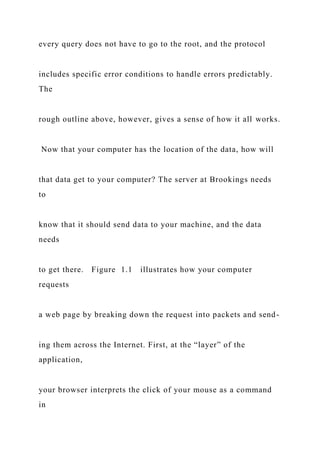
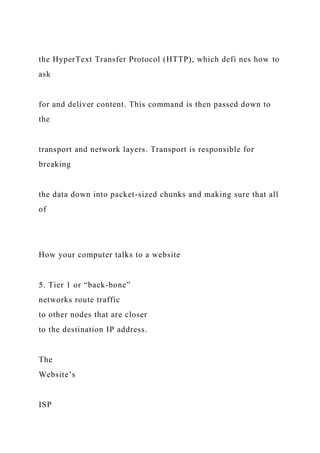
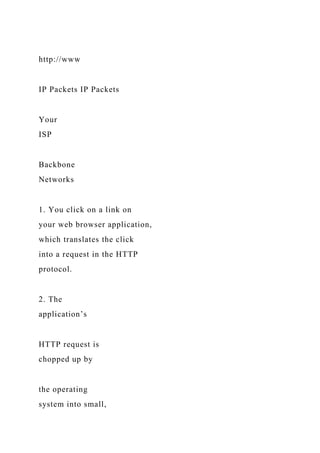
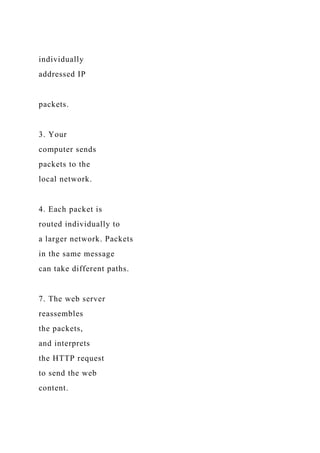
Now that your computer has the location of the data, how will
that data get to your computer? The server at Brookings needs
to
know that it should send data to your machine, and the data
needs
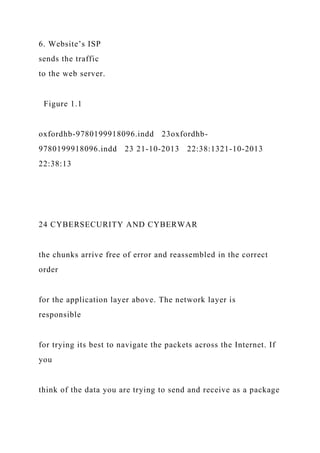
to get there. Figure 1.1 illustrates how your computer
requests
a web page by breaking down the request into packets and send-
ing them across the Internet. First, at the “layer” of the
application,
your browser interprets the click of your mouse as a command
in
the HyperText Transfer Protocol (HTTP), which defi nes how to
ask
for and deliver content. This command is then passed down to
the
transport and network layers. Transport is responsible for
breaking
the data down into packet-sized chunks and making sure that all
of
How your computer talks to a website
5. Tier 1 or “back-bone”
networks route traffic
to other nodes that are closer
to the destination IP address.
The
Website’s
ISP
http://www
IP Packets IP Packets
Your
ISP
Backbone
Networks
1. You click on a link on
your web browser application,
which translates the click
into a request in the HTTP
protocol.
2. The
application’s
HTTP request is
chopped up by
the operating
system into small,
individually
addressed IP
packets.
3. Your
computer sends
packets to the
local network.
4. Each packet is
routed individually to
a larger network. Packets
in the same message
can take different paths.
7. The web server
reassembles
the packets,
and interprets
the HTTP request
to send the web
content.
6. Website’s ISP
sends the traffic
to the web server.
Figure 1.1
oxfordhb-9780199918096.indd 23oxfordhb-
9780199918096.indd 23 21-10-2013 22:38:1321-10-2013
22:38:13
24 CYBERSECURITY AND CYBERWAR
the chunks arrive free of error and reassembled in the correct
order
for the application layer above. The network layer is
responsible
for trying its best to navigate the packets across the Internet. If
you
think of the data you are trying to send and receive as a package
of information, the transport layer is responsible for packing
and
receiving the packages, while the network is responsible for
mov-
ing them from source to destination. Once at the destination, the
packets are reassembled, checked, and then passed back up to
the
application—in this case, a web server sending you the web
content
you requested.
But how do the packets know how to get across the Internet to
their destination? Like the DNS that helped your computer fi nd
the
website it was looking for, the organization of Internet networks
can
be thought of as a hierarchy. Each computer is part of a
network, like
the network connecting all the customers of an Internet service
pro-
vider (ISP). ISPs are essentially the organizations that provide
access
to the Internet, as well as other related services like e-mail or
hosting
websites. Most ISPs are private, for-profi t companies,
including a
number of the traditional telephone and cable TV fi rms that
began
offering Internet access when the fi eld took off, while others
are gov-
ernment or community owned.
Those networks, in turn, form nodes called Autonomous
Systems
(AS) in the global Internet. Autonomous Systems defi ne the
archi-
tecture of Internet connections. Traffi c is routed locally
through the
AS and controlled by the policies of that organization. Each AS
has
a set of contiguous blocks of IP addresses and forms the “home”
for these destinations. All have at least one connection to
another
AS, while large ISPs might have many. So routing to a
particular IP
address is simply a matter of fi nding its AS.
There’s a problem, though: The Internet is big. There are over
40,000 AS nodes on the Internet today, and their
interconnections are
changing and shifting over time. Given this scale, a global
approach
to routing everything the same way is impossible.
Instead, the Internet uses a dynamic, distributed system that
does
not maintain a permanent vision of what the network looks like
at
any given time. The principle of routing is fairly simple: at
each
point in the network, a router looks at the address of an
incoming
packet. If the destination is inside the network, it keeps the
packet
oxfordhb-9780199918096.indd 24oxfordhb-
9780199918096.indd 24 21-10-2013 22:38:1321-10-2013
22:38:13
How It All Works 25
and sends it to the relevant computer. Otherwise, it consults a
rout-
ing table to determine the best next step to send the packet
closer to
its destination.
The devil is in the details of this routing table’s construction.
Since there is no global address book, the nodes in the network
have
to share key information with other routers, like which IP
addresses
they are responsible for and what other networks they can talk
to.
This process happens separately from the Internet routing
process
on what is known as the “control plane.” Routers also pass
along
information to their neighbors, sharing up-to-date news about
the
state of the network and who can talk to whom. Each router then
constructs its own internal, temporary model of how best to
route
the traffi c coming through. This new model, in turn, is shared
so that
a router’s neighbors now know how it will pass along new traffi
c.
If this sounds complex, it’s because it is! In just a few pages,
we’ve summed up what it took decades of computer science
research to create. The takeaway for cybersecurity is that the
entire
system is based on trust. It is a system that works effi ciently,
but
it can be broken, either by accident or by maliciously feeding
the
system bad data.
The Pakistan example shows what happens when that trust is
abused. The government censors “broke the Internet” by falsely
claiming to have direct access to the IP address that serves
YouTube.
This was a narrow, local, politically motivated announcement.
But
because of how the Internet works, soon every ISP in Asia was
try-
ing to route all their YouTube traffi c to Pakistan, solely
because they
believed it was closer than the real intended destination. The
models
they were building were based on false information. As more
net-
works did this, their neighbors also came to believe that
YouTube
was the Pakistani IP address. The whole mess wasn’t resolved
until
Google engineers advertised the correct routes aggressively
across
the network.
In sum, understanding the Internet’s basic decentralized
architec-
ture provides two insights for cybersecurity. It offers an
appreciation
of how the Internet functions without top-down coordination.
But it
also shows the importance of the Internet’s users and
gatekeepers
behaving properly, and how certain built-in choke points can
create
great vulnerabilities if they don’t.
oxfordhb-9780199918096.indd 25oxfordhb-
9780199918096.indd 25 21-10-2013 22:38:1321-10-2013
22:38:13
26 CYBERSECURITY AND CYBERWAR
Who Runs It? Understanding Internet Governance
In 1998, a computer researcher and a respected leader in the
net-
working community named Jon Postel sent an innocuous
sounding
e-mail to eight people. He asked them to reconfi gure their
servers
so that they would direct their Internet traffi c using his
computer
at the University of Southern California rather than a computer
in
Herndon, Virginia. They did so without question, as Postel (who
had been part of the team that set up the original ARPANET)
was
an icon in the fi eld, who served as a primary administrator for
the
network’s naming system.
With that one e-mail, Postel committed the fi rst coup d’état of
the Internet. The people he had e-mailed ran eight of the twelve
organizations that controlled all the name servers—the comput-
ers ultimately responsible for translating a domain name such as
“Brookings.edu” into a computer-addressable IP address. And
the
computer in Virginia that he had steered two-thirds of the
Internet’s
root servers away from was controlled by the US government.
While
Postel would later say he had only seized control of a majority
of
the Internet’s root servers as a “test,” others think that he did so
in protest, showing the US government “that it couldn’t wrest
con-
trol of the Internet from the widespread community of
researchers
who had built and maintained the network over the previous
three
decades.”
Postel’s “coup” illustrates the crucial role of governance issues
even for a technical space. As the Internet has grown from a
small
research network to the global underpinning of our digital
society,
questions of who runs it have become more and more important.
Or, as Eric Schmidt (who went on to become the CEO of a little
fi rm
known as Google) told a 1997 programmers conference in San
Francisco, “The Internet is the fi rst thing that humanity has
built
that humanity doesn’t understand, the largest experiment in
anar-
chy that we have ever had.”
Since digital resources are not “scarce” like traditional
resources, its
governance questions are a bit different. That is, the main
questions of
Internet governance are of interoperability and communication
rather
than the classic issue of distribution, which has consumed
political
thinkers from Socrates to Marx. However, even in a digital
world of
seemingly endless resources, traditional issues of governance
also
arise in cyberspace, including representation, power, and
legitimacy.
oxfordhb-9780199918096.indd 26oxfordhb-
9780199918096.indd 26 21-10-2013 22:38:1321-10-2013
22:38:13
How It All Works 27
Key decision chokepoints revolve around the technical
standards for
interoperability, the distribution of IP numbers that gives
computers
an address allowing them to send and receive packets, and the
man-
agement of the Internet’s naming system. Interestingly enough,
it is
this fi nal category, the intersection of the technical and
nontechnical
aspect of naming, that has produced the most confl ict.
The operations of the Internet require independent actors to
fol-
low basic rules that guarantee interoperability, known as
standards.
This standards-based approach goes back to the beginning of the
Internet, when the engineers building the initial systems
published
Requests For Comments (RFCs) to seek feedback on proposed
stan-
dards. Over time, this group of network engineers and
researchers
grew into an international, voluntary standards organization
called
the Internet Engineering Task Force (IETF). The IETF develops
new Internet standards and protocols and modifi es existing
ones
for better performance. Everything developed by the IETF falls
under specifi c working groups that concentrate on areas like
rout-
ing, applications, and infrastructure. These groups are open
forums
that work mostly through mailing lists, and anyone is welcome
to
participate. Many of the individuals in them are from large
technol-
ogy fi rms, but no one actor or small party can steamroll the
process,
which relies on consensus.
Openness, and even a sense of whimsy, is critical to the culture
of the IETF. In some working group meetings, the members
decide
on an issue by humming for or against a proposal. The proposal
with the loudest hum advantage wins. While it sounds a bit
silly, it
is seen as a way of maintaining the original Internet creators’
ethic
of fostering consensus and reaching decisions relatively
quickly.
The volume of the humming also helps maintain a level of ano-
nymity, unless you abuse the system: That is, you can hum or
not
without opening your mouth, but it’s hard to hum louder to
domi-
nate a vote without being too obvious about it, which would
cause
backlash.
Despite the sense of fun that can drive working groups
members,
security is a principle concern in the system. In addition to
work-
ing groups focused on particular security issues, every proposed
standard must have an explicit “Security Considerations”
section.
Additionally, a security directorate reviews all proposed
standards
passed from the working groups to the Steering Group.
oxfordhb-9780199918096.indd 27oxfordhb-
9780199918096.indd 27 21-10-2013 22:38:1321-10-2013
22:38:13
28 CYBERSECURITY AND CYBERWAR
While the IETF has no offi cial board or formal leadership, the
Internet Engineering Steering Group (IESG) offers oversight
and
guidance for both the standards process and the standards them-
selves. In turn, the Internet Architecture Board (IAB), which
evolved
from the technical advisory board of the original ARPANET
man-
agement in the early 1970s, offers further oversight of
the IESG.
Both of these organizations fall under the auspices of the
Internet
Society, or ISOC, an international group formed in 1992 that
over-
sees most of the technical standards process. The ISOC came
about
when Internet governance moved beyond just matters of techni-
cal coordination. As the web went global and companies began
to
depend on Internet business, more and more participants had a
fi nancial or political stake in the system’s evolution in one
direc-
tion or another. Organizations began to disagree on process, and
the US government’s central involvement worried many. The
ISOC
was established as an independent, international organization to
offer a formal, legal means to safeguard the independent and
open
standards processes. ISOC’s power derives from its
membership;
it’s open to any individual and, for a fee, any organization.
These
members then elect trustees who, in turn, appoint leadership to
the
IAB, which oversees the governance process for the IESG and
the
working groups’ process they guide.
Imagine this alphabet soup all as a mix of informal,
semiformal,
and formal groups all nested together. This structure promotes a
high degree of independence while still allowing for
accountability
to the Internet community. While there are political and fi
nancially
motivated disagreements, when it comes to standards
development,
the process has thus far fostered globally shared interest in
main-
taining a functioning Internet.
This ethic of shared interest, however, becomes more diffi cult
in dealing with property rights and other scarce resources on the
Internet. The Internet may be seemingly infi nite in size, but it
still
has zero-sum games. Identifi ers such as IP addresses and
domains
have to be unique—the Internet wouldn’t work if multiple
parties
attempted to use the same IP address or wanted to resolve a
domain
name to a competing address. One of the earliest oversight roles
was apportioning these numbers and names. What emerged was
the Internet Assigned Numbers Authority, a collaborative effort
of
the US government and the early researchers who had developed
oxfordhb-9780199918096.indd 28oxfordhb-
9780199918096.indd 28 21-10-2013 22:38:1421-10-2013
22:38:14
How It All Works 29
the original technology. Yet as the Internet grew, control of this
pro-
cess grew more important. Assigning names and numbers meant
control over who could access the Internet and how. Jon
Postel’s
“coup” illustrated the need for a more transparent and
accessible
governance structure.
The growing pressure for a commercial Internet, and the
emerg-
ing realization that Americans could not expect to control the
net-
work forever, meant that this new structure could not be run by
the
US government. In 1998, after a survey period that sought input
from the public and key Internet leaders and organizations,
respon-
sibility shifted to an independent corporation with a governance
structure that “refl ects the geographical and functional
diversity of
the Internet.” The Internet Corporation for Assigned Names and
Numbers, or ICANN, was born.
While chartered in California as a nonprofi t, ICANN set in
motion
a structured way to distribute IP addresses that more
appropriately
refl ected the Internet’s global nature. Regional authorities in
North
America, Europe, and Asia, followed later by Latin America and
fi nally Africa in 2004, took over this task and continue to
perform
this role today.
Not everything with ICANN is easy. Domains defi ne identity
on
the Internet, which brings strong commercial and political inter-
ests into confl ict. Decisions about who gets what Internet iden-
tity inherently create winners and losers; adding new top-level
domains such as .tech enables new business models but requires
more expense for trademark protection to fend off “squatters.”
Trademarks themselves can pose risks. For example, a process
was
needed to decide which of the many businesses with “Apple” in
their name would get apple.com. At the same time, that process
could not be corrupted to deny free speech opportunities, such
as
<insert whatever trademark name you dislike>sucks.com. This
process has even touched on hot issues of national identity.
When
nations achieve independence or dissolve into civil war, who
con-
trols their country’s top-level domain? In Western Sahara, both
sides of a forty-year-old confl ict claim the rights to the top-
level
domain .eh.
The process and governance of ICANN have drawn even more
controversy. Policy scholars use the term “multi-stakeholder
pro-
cess” to describe its organic, open, yet non-representative
approach.
oxfordhb-9780199918096.indd 29oxfordhb-
9780199918096.indd 29 21-10-2013 22:38:1421-10-2013
22:38:14
30 CYBERSECURITY AND CYBERWAR
Decisions are supposed to be made by consensus, while a host
of advisory committees help represent key constituencies in the
Internet’s smooth operations, such as Internet service providers
and
the intellectual property community. National interests from
around
the world are represented through a Governmental Advisory
Committee. Yet this multi-stakeholder model strikes some as
dis-
posed to favor the powerful. Governments and large commercial
interests can afford to pay staff to participate in these forums,
while
nonprofi t civil society groups may lack the resources to sit at
the
table at all. Many argue that special interests are too heavily
repre-
sented among the decision-makers. Others want it to be more
like
traditional international organizations, which tend to follow the
United Nations model of “one state, one vote.”
And despite efforts to globalize Internet governance, many still
see ICANN as captive to US interests. The control of assigning
names and numbers still ostensibly belongs to the US
Department
of Commerce, which it delegates to ICANN by renewable
contract.
That is, the United States retains overall control, while the
manage-
ment function is held by an industry-led organization. Both
have a
vested interest in maintaining the status quo.
The challenge, of course, is that no other institution or process
could easily replace ICANN. While it is easy to criticize
ICANN,
there is no practical model for an alternative organization that
must
represent and balance such a broad range of interests from
around
the world and across all sides of complex policy issues.
The key takeaway of these governance issues for cybersecurity
is not just the important role that trust and open-mindedness
have
played in the Internet’s growth (aspects that are challenged by
growing security concerns) but that the Internet has always been
recognized as a space that defi es traditional governance
models. In
1992, Internet pioneer David Clark of MIT set out his bold
dictum
for the community:
We reject: kings, presidents and voting.
We believe in: rough consensus and running code.
This quote has been widely circulated. Less well known is what
Clark wrote on his very next slide: “What are we bad at?
Growing
our process to match our size.”
oxfordhb-9780199918096.indd 30oxfordhb-
9780199918096.indd 30 21-10-2013 22:38:1421-10-2013
22:38:14
How It All Works 31
On the Internet, How Do They Know Whether You Are
a Dog? Identity and Authentication
Carnegie Mellon University professor Alessandor Acquisti
has a fun
but scary party trick: show him a picture of your face that is
online
and he will then guess your Social Security number.
Understanding how Acquisti does this is useful even for
non-Americans (who lack these supposedly secret Social
Security
numbers) because it illustrates the story of identity and
authenti-
cation and how it can go awry. Acquisti fi rst uses image-
matching
technology to fi nd your face on a social networking website. If
your
birthdate and birth city are listed online, as they are for most
people,
then he can use the patterns that link time and location to the fi
rst
fi ve of the nine numbers in your Social Security number. Then
it is
just a numbers guessing game for the remaining digits. If you
come
from a small state like Delaware, the Social Security number
can be
determined in less than 10 tries.
In theory, no one should care, since Social Security numbers
were
never meant to be secret. Before 1972, Social Security cards
even said
“not for identifi cation” on them. But as we began to use
computers
to track people, it became critical for computers to differentiate
indi-
viduals. Using someone’s name alone wasn’t enough: there are
too
many John Smiths in the world. Across every database, each
record
needed to be accessed with some identifi er unique to that
person.
And since every American had a unique Social Security number,
it
was convenient to use that.
So far, so good. The number was just a means to look someone
up in
a computer. But this number also became the way for two
systems to
know they were talking about the same person. Soon the Social
Security
number began to be used to track bank accounts, tax details, and
all
other sorts of personal information. Along the way,
organizations
assumed that, since Social Security numbers weren’t published,
they
weren’t public, and if they weren’t public, they must be
secret. Wrong.
In the computer world, “identifi cation” is the act of mapping
an
entity to some information about that entity. This can be as
mun-
dane as a fantasy football website accepting the association
between
a person and the name the person claims, or as critical as
matching
a medical record to an unconscious patient.
It is important to separate identifi cation from “authentication,”
which is the proof of the identifi cation. This proof has
traditionally
oxfordhb-9780199918096.indd 31oxfordhb-
9780199918096.indd 31 21-10-2013 22:38:1421-10-2013
22:38:14
32 CYBERSECURITY AND CYBERWAR
been defi ned as “something you know, something you have, or
something you are.” What you “know” is the basic password
model.
It is a secret that is known, presumably only by the right person.
Something you “have” refers to a physical component with lim-
ited access, so that only the right person might have it. With
bank
ATMs, it is a card, while more recently the mobile phone has
become
a de facto authenticator for receiving text messages containing a
one-time code. By entering this one-time code, people taking
action
on the Web show that they have control of the verifi ed mobile
phone
that is receiving the messages. Finally, you can prove who you
“are”
through something recognizable. Since this often refers to one’s
person, we call this a “biometric.” Biometrics can be as simple
as
another human recognizing your face or as sophisticated as a
sensor
that recognizes your eye’s retina.
There are weaknesses with these proofs. Passwords can be
guessed or broken and require a cognitive load (you have to
memo-
rize them). If they are reused across different contexts, then
breaking
one system allows an attacker into others. Things that you
“have”
can be stolen or forged. And even biometrics can be
compromised.
For instance, access readers that require supposedly unique fi
nger-
prints have been fooled by forged fi ngerprints pressed into
Gummy
Bear candy, or, much more gruesomely, pressing down an
ampu-
tated fi nger onto the machine (Russian mobsters ironically
don’t
seem to like cute, bear-shaped candy).
There are various mechanisms to bolster these measures. One is
to contact trusted friends to confi rm that individuals are who
they
say they are. The idea is drawn from the old line “It’s all about
who
you know,” since a mutually trusted friend can verify that the
indi-
vidual in question conforms to the claimed identity. Other
systems
factor in the cost of fooling the controls. Anyone can create a
website
claiming a specifi c identity, but it requires time and effort to
main-
tain an active and lengthy presence on an associated social
media
platform like Twitter or Facebook. Here again, these can be
hacked
or faked, but at a much greater cost to the attacker to pull off.
After authentication is authorization. Now that a system knows
who you are, what can you do? In classic computer security,
autho-
rization was about giving access to network fi les, but in our
increas-
ingly connected world, gaining authorization can open the doors
to practically everything. Authorization is the part that links
these
oxfordhb-9780199918096.indd 32oxfordhb-
9780199918096.indd 32 21-10-2013 22:38:1421-10-2013
22:38:14
How It All Works 33
technical issues to policy, business, political and moral
questions. Is
the individual authorized to buy something, like an account on
an
online gambling site? And even if so, is the individual old
enough to
participate? Or, at a slightly larger world stage, just because
some-
one has access to a military’s classifi ed networks, should the
person
be authorized to read and copy every fi le in them (a practice
that
would haunt the US military in the Bradley Manning and
Edward
Snowden leaks)?
The entire problem was perhaps best illustrated by one of the
most
cited cartoons in history. In 1993, New Yorker magazine
published a
drawing by Peter Steiner of two dogs sitting near a computer.
One
dog tells the other, “On the Internet, nobody knows you’re
a dog.”
Yet this isn’t to say that people can’t fi nd out private details
about
you if they want. Every activity on the Internet is data being
routed
from an Internet Protocol (IP) address. As we saw in the prior
section,
an IP address is a numerical label that is assigned to an
addressable
connection in the Internet. For most consumers, the IP address
is not
permanently assigned to their device. Instead, the IP address
will be
dynamic. The consumer’s Internet service provider will assign
an
IP address for a period of time, but it might be reassigned to
some-
one else after the consumer disconnects. However, if an Internet
ser-
vice provider retains the relevant data, it is able to correlate the
IP
address at a specifi c date and time to a particular service
subscriber.
An IP address is not in and of itself information about an
identifi -
able individual. But it can provide some information about the
geo-
graphic location and the means by which that individual
accesses the
Internet. It is the potential for how the IP address can be
combined
with other information (or could be reasonably combined with
other
information) that has privacy advocates concerned. If you can
com-
bine enough of this online and offl ine information, you might
have
enough data to make a high-probability guess about who was
doing
what and where. For instance, in the 2012 scandal that
enveloped
CIA director General David Petraeus, the FBI was able to
backtrack
the anonymous sender of a series of threatening e-mails to the
busi-
ness center of a hotel that his mistress turned out to be
staying at.
The information gathered about identity is not the same as
proof
of identity. Relying on the IP address would be like relying on
license
plates to identify drivers. A sophisticated user can easily hide
or dis-
guise her IP address by routing her activities through another
point
oxfordhb-9780199918096.indd 33oxfordhb-
9780199918096.indd 33 21-10-2013 22:38:1421-10-2013
22:38:14
34 CYBERSECURITY AND CYBERWAR
on the Internet, making it appear that that node was responsible
for
the original traffi c. There are, however, many other types of
data
that can be collected that are harder to hide. Even the patterns
of
how individual users browse and click through a website can be
used to identify them.
This question of how can we identify and authenticate online
activities is a different question from how should we. You may
not have wanted your Social Security number to be revealed at
a party. Or that dog might have preferred its identity remain
secret, at least until the two of you had gone out on a few more
online dates.
For the purposes of cybersecurity, the bottom line is that
digital
identity is a balance between protecting and sharing
information.
Limiting acquired information is not only good for privacy, it
can
prevent others from gaining information for more sophisticated
authentication fraud. At the same time, each system has
incentives
to maximize the amount of data it collects, as well as use that
data
for its own goals.
What Do We Mean by “Security” Anyway?
There’s an old joke in the security industry about how to secure
any
computer: Just unplug it.
The problem is not only that the joke is becoming outdated in
an era of wireless and rechargeable devices, but once a machine
is
plugged in, there are practically an infi nite number of ways its
use
might deviate from its intended purpose. This deviation is a
mal-
function. When the difference between the expected behavior
and
actual behavior is caused by an adversary (as opposed to simple
error or accident), then the malfunction is a “security” problem.
Security isn’t just the notion of being free from danger, as it is
commonly conceived, but is associated with the presence of an
adversary. In that way, it’s a lot like war or sex; you need at
least
two sides to make it real. Things may break and mistakes may
be
made, but a cyber problem only becomes a cybersecurity issue
if
an adversary seeks to gain something from the activity, whether
to
obtain private information, undermine the system, or prevent its
legitimate use.
oxfordhb-9780199918096.indd 34oxfordhb-
9780199918096.indd 34 21-10-2013 22:38:1421-10-2013
22:38:14
How It All Works 35
To illustrate, in 2011 the Federal Aviation Administration
ordered
nearly half of US airspace shut down and more than 600 planes
grounded. It seemed like a repeat of how American airspace was
shut down after the 9/11 attacks. But this incident wasn’t a
secu-
rity issue, as there was no one behind it. The cause was a
software
glitch in a single computer at the Atlanta headquarters building.
Take the same situation and change the glitch to a hack: that’s
a
security issue.
The canonical goals of security in an information environment
result from this notion of a threat. Traditionally, there are three
goals: Confi dentiality, Integrity, Availability, sometimes
called the
“CIA triad.”
Confi dentiality refers to keeping data private. Privacy is not
just
some social or political goal. In a digital world, information has
value. Protecting that information is thus of paramount
importance.
Not only must internal secrets and sensitive personal data be
safe-
guarded, but transactional data can reveal important details
about
the relationships of fi rms or individuals. Confi dentiality is
sup-
ported by technical tools such as encryption and access control
as
well as legal protections.
Integrity is the most subtle but maybe the most important part
of the classic information security triumvirate. Integrity means
that the system and the data in it have not been improperly
altered
or changed without authorization. It is not just a matter of trust.
There must be confi dence that the system will be both available
and
behave as expected.
Integrity’s subtlety is what makes it a frequent target for the
most
sophisticated attackers. They will often fi rst subvert the
mechanisms
that try to detect attacks, in the same way that complex diseases
like
HIV-AIDS go after the human body’s natural defenses. For
instance,
the Stuxnet attack (which we explore later in Part II) was so jar-
ring because the compromised computers were telling their
Iranian
operators that they were functioning normally, even as the
Stuxnet
virus was sabotaging them. How can we know whether a system
is
functioning normally if we depend on that system to tell us
about
its current function?
Availability means being able to use the system as anticipated.
Here again, it’s not merely the system going down that makes
availability a security concern; software errors and “blue
screens of
oxfordhb-9780199918096.indd 35oxfordhb-
9780199918096.indd 35 21-10-2013 22:38:1421-10-2013
22:38:14
36 CYBERSECURITY AND CYBERWAR
death” happen to our computers all the time. It becomes a
security
issue when and if someone tries to exploit the lack of
availability
in some way. An attacker could do this either by depriving users
of
a system that they depend on (such as how the loss of GPS
would
hamper military units in a confl ict) or by merely threatening
the
loss of a system, known as a “ransomware” attack. Examples of
such ransoms range from small-scale hacks on individual bank
accounts all the way to global blackmail attempts against gam-
bling websites before major sporting events like the World Cup
and Super Bowl.
Beyond this classic CIA triangle of security, we believe it is
impor-
tant to add another property: resilience. Resilience is what
allows a
system to endure security threats instead of critically failing.
A key
to resilience is accepting the inevitability of threats and even
limited
failures in your defenses. It is about remaining operational with
the
understanding that attacks and incidents happen on a continuous
basis. Here again, there is a parallel to the human body. Your
body
still fi gures out a way to continue functioning even if your
external
layer of defense—your skin—is penetrated by a cut or even
bypassed
by an attack like a viral infection. Just as in the body, in the
event of
a cyber incident, the objective should be to prioritize resources
and
operations, protect key assets and systems from attacks, and
ulti-
mately restore normal operations.
All of these aspects of security are not just technical
issues: they
are organizational, legal, economic, and social as well. But most
importantly, when we think of security we need to recognize its
limits. Any gain in security always involves some sort of trade-
off.
Security costs money, but it also costs time, convenience,
capabili-
ties, liberties, and so on. Similarly, as we explore later on, the
dif-
ferent threats to confi dentiality, availability, integrity, and
resiliency
each require different responses. Short of pulling the plug,
there’s no
such thing as absolute security.
What Are the Threats?
It sounds odd that reporters took a passenger jet to Idaho just
to
watch a cyberattack, but that’s exactly what happened in 2011.
Worried that the public did not understand the magnitude
of growing cyberthreats, the Department of Homeland Security
oxfordhb-9780199918096.indd 36oxfordhb-
9780199918096.indd 36 21-10-2013 22:38:1421-10-2013
22:38:14
How It All Works 37
fl ew journalists from around the country to the Idaho National
Laboratory. Only four years earlier, the INL, an incredibly
secure
and secretive facility that houses a Department of Energy’s
nuclear
research facility, had conducted a top-secret test to destroy a
large
generator via cyberattack. In 2011, in an effort to raise
awareness
about cyberthreats, government experts not only declassifi ed a
video of the 2007 test, but held a public exercise for journalists
to
“watch” a faked cyberattack on a mock chemical plant. The
govern-
ment wanted to show that even their own experts couldn’t
prevent a
team of hired hackers (known as a “red team”) from
overwhelming
the defenses of a critical facility.
This episode is a good illustration of how those who
profession-
ally think and talk about cybersecurity worry that their
discussions
of threats are ignored or downplayed. Frustrated, the result is
that
they resort to turning the volume up to the proverbial 11 à la
Spinal
Tap , conducting outlandish exercises and only talking about the
mat-
ter in the most extreme ways that then echo out into the media
and
public. Indeed, following a series of warnings by US
government
offi cials, by 2013 there were over half a million online
references in
the media to “cyber Pearl Harbor” and another quarter million
to a
feared “cyber 9/11.”
The complacency these experts worry about stems in part from
our political system’s reluctance to address diffi cult, complex
prob-
lems in general, and cybersecurity in particular. But this kind of
tenor also feeds into a misunderstanding of the threats. For
example,
three US senators sponsored a large cybersecurity bill in the
summer
of 2011, and so wrote an op-ed in the Washington Post urging
sup-
port for their legislation. They cited a series of recent, high-
profi le
attacks, including those against the Citigroup and RSA
companies
and the Stuxnet worm’s attack on Iranian nuclear research. The
problem is that these three cases refl ected wildly different
threats.
The Citigroup attack was about fi nancial fraud. The RSA attack
was
industrial theft, and Stuxnet was a new form of warfare. They
had
little in common other than they involved computers.
When discussing cyber incidents or fears of potential incidents,
it is important to separate the idea of vulnerability from threat.
An
unlocked door is a vulnerability but not a threat if no one wants
to
enter. Conversely, one vulnerability can lead to many threats:
that
unlocked door could lead to terrorists sneaking in a bomb,
oxfordhb-9780199918096.indd 37oxfordhb-
9780199918096.indd 37 21-10-2013 22:38:1421-10-2013
22:38:14
38 CYBERSECURITY AND CYBERWAR
competitors walking out with trade secrets, thieves purloining
valu-
able goods, local hooligans vandalizing property, or even cats
wan-
dering in and distracting your staff by playing on the keyboards.
The defi ning aspects of threats are the actor and the
consequence.
The acknowledgment of an actor forces us to think strategically
about threats. The adversary can pick and choose which
vulnerabil-
ity to exploit for any given goal. This implies that we must not
only
address a range of vulnerabilities with respect to any given
threat,
but also understand that the threat may evolve in response to
our
defensive actions.
There are many kinds of bad actors, but it is too easy to get
lulled
into using media clichés like “hackers” to lump them all
together.
An actor’s objective is a good place to start when parceling
them out.
In the variety of attacks cited by the senators above, the
Citigroup
attackers wanted account details about bank customers with an
ultimate goal of fi nancial theft. In the attack on RSA, the
attackers
wanted key business secrets in order to spy on other companies.
For
Stuxnet (a case we’ll explore further in Part II), the attackers
wanted
to disrupt industrial control processes involved in uranium
enrich-
ment, so as to sabotage the Iranian nuclear program.
Finally, it is useful to acknowledge when the danger comes
from
one of your own. As cases like Bradley Manning and WikiLeaks
or Edward Snowden and the NSA scandal illustrate, the “insider
threat” is particularly tough because the actor can search for
vulner-
abilities from within systems designed only to be used by
trusted
actors. Insiders can have much better perspectives on what is
valu-
able and how best to leverage that value, whether they are
trying to
steal secrets or sabotage an operation.
It is also important to consider whether the threat actor wants
to attack you , or just wants to attack. Some attacks target
specifi c
actors for particular reasons, while other adversaries go after a
cer-
tain objective regardless of who may control it. Untargeted
mali-
cious code could, for example, infect a machine via e-mail,
search
for stored credit card details of anyone, and relay those details
back
to its master without any human involvement. The key
difference
in these automated attacks is one of cost, both from the
attacker’s
and the defender’s perspective. For the attacker, automation
hugely
reduces cost, as they don’t have to invest in all the tasks
needed,
from selecting the victim to identifying the asset to
coordinating the
oxfordhb-9780199918096.indd 38oxfordhb-
9780199918096.indd 38 21-10-2013 22:38:1421-10-2013
22:38:14
How It All Works 39
attack. Their attack costs roughly the same no matter how many
victims they get. A targeted attack, on the other hand, can
quickly
scale up in costs as the number of victims rises. These same
dynam-
ics shape the expected returns. To be willing to invest in
targeted
attacks, an attacker must have a higher expected return value
with
each victim. By contrast, automated attacks can have much
lower
profi t margins.
The good news is that there are only three things you can do to
a computer: steal its data, misuse credentials, and hijack
resources.
Unfortunately, our dependence on information systems means
that a
skilled actor could wreak a lot of damage by doing any one of
those.
Stolen data can reveal the strategic plans of a country or
undermine
the competitiveness of an entire industry. Stolen credentials can
give
the ability to change or destroy code and data, changing
payrolls or
opening up dams, as well as the ability to cover tracks.
Hijacking
resources can prevent a company from reaching customers or
deny
an army the ability to communicate.
In the end, there are many things that can happen, but they
have
to be caused by someone. Threats should be assessed by under-
standing potential bad actors, what they are trying to do,
and why.
And you shouldn’t need to fl y all the way to Idaho to
learn that.
One Phish, Two Phish, Red Phish, Cyber Phish: What Are
Vulnerabilities?
In 2011, London police confronted a mysterious and unusual
spike
in car thefts. The odd thing wasn’t just that so many cars were
being
stolen, over 300 in all, but that the cars were all of a particular
brand,
new BMWs. And, second, the thieves were somehow stealing
hun-
dreds of cars equipped with some of the most advanced car
security
systems in the world, without activating the alarms.
What the police soon fi gured out by watching hidden security
camera footage of the thieves in action was that the robbers had
fi g-
ured out how to use the car’s advanced technology against
itself.
First, they used radio frequency jammers to block the signal of
a
car’s electronic key. Instead of the car owner locking the doors
as
they walked away, the doors would remain unlocked. Once in
the
car, the thief would then plug into the OBD-II connector (the
elec-
tronic port that mechanics use to diagnose your car’s problems)
and
oxfordhb-9780199918096.indd 39oxfordhb-
9780199918096.indd 39 21-10-2013 22:38:1421-10-2013
22:38:14
40 CYBERSECURITY AND CYBERWAR
then use that to obtain the car’s unique key fob digital ID. Next,
the
thief would reprogram a blank electronic key to correspond with
the car’s ID. Then they simply drove away, with the owner of
the
advanced luxury car none the wiser. It all took only a few
minutes.
These vulnerabilities led to so many thefts that police resorted
to
leaving paper leafl ets on all BMWs parked in London warning
them
of the danger.
The case of the lost luxury cars is a good illustration of how
build-
ing a complex system can create new openings and hidden
vulner-
abilities that bad guys can try to exploit. Different
vulnerabilities
allow an attacker to achieve different goals. In some cases, it
might
be the ability to read confi dential data. Or the goal could be the
ulti-
mate prize—compromise of the entire system. When the attacker
has such “root access,” the ability to execute any command, the
victim is completely vulnerable, or what hackers call “pwned”
(An
apocryphal story is that a hacker meant to type that a target was
now “owned.” But he typed too fast, mistakenly hit the p key
right
next to the o , and a cool term was born.)
Often the easiest way to gain control of the system is simply to
ask. A time-honored tradition for breaking into systems from
hack-
ing’s early days is to call up a low-level employee, claim to be
from
technical support, and ask for the person’s password. This falls
into
the category of what is known as “social engineering,” manipu-
lating people into revealing confi dential information and
thereby
helping the attacker. The manipulation can take many forms,
often
with the attacker trying to set up a scenario designed to
encourage
cooperation through psychological mechanisms. Fear is a
powerful
motivator. When a user’s computer displays a message
threatening
to expose activities on a pornographic website, fear of exposure
can
motivate payment. More often, however, users just follow social
cues. In our daily lives, we regularly encounter problems that
need
fi xing, like a program that won’t close until you just “click
here,” or
people who need our help, like your Aunt Suzy who somehow
got
robbed in Iceland and needs you to wire her money via
Bangkok.
A particularly common form of social engineering is the
“phish-
ing” attack. Phishing e-mails look like offi cial e-mails from the
vic-
tim’s bank, employer, or some other trusted entity. They claim
to
require some action by the victim, perhaps to correct an account
error or see a message on Facebook, and fool victims into
visiting
oxfordhb-9780199918096.indd 40oxfordhb-
9780199918096.indd 40 21-10-2013 22:38:1421-10-2013
22:38:14
How It All Works 41
a web page where they are asked to enter their credentials. If
the
victim enters his or her account details, the attacker can now do
any-
thing with that information, from transfer money to read confi
den-
tial e-mails. The phony credentials web page may have a URL
that
looks similar to the authentic one. If you don’t look closely,
maybe
www.paypai.com looks like www.paypal.com. In sophisticated
phishing attacks, the fake page may also actually log the user
into
the real website to minimize the chance of detection.
One of the most challenging subsets of these “phishing” attacks
is known as “spear phishing.” These target not just networks but
key individuals inside those networks. It’s the difference
between
you, along with scores of others people, receiving an e-mail
from
that kind Nigerian prince who just needs your bank account
infor-
mation, versus receiving an e-mail that looks exactly like it’s
from
your mother. This is a good illustration of the difference
between
the automated and targeted threats you read about in the last
sec-
tion. Such specialized attacks require prior intelligence
gathering to
fi gure out how to trick a particular person and are mostly
reserved
for prime targets.
Attackers also prey on systems that have ignored basic precau-
tions, such as products that have default login names and pass-
words, which users often forget to change. Most home wireless
routers have default passwords that a shocking number of users
leave in place. Find the right one and it is easy to steal a
neighbor’s
Wi-Fi and eavesdrop on their conversations. This kind of
vulnerabil-
ity can also be created by product manufacturers that don’t
priori-
tize security enough or fail to factor in the likely human errors
and
even laziness of their customers. For instance, Microsoft’s
database
product MS-SQL 2005 shipped without an administrator
password,
so that any user could control the entire database until an admin
password was set. Other situations involve systems that have
fea-
tures that may be convenient but represent real security
vulnerabili-
ties, like that of the BMW remote access keys.
Applications can also create vulnerabilities if they are miscon-
fi gured. In one study, researchers at Dartmouth searched peer-
to-
peer fi le-sharing services, where users share specifi c fi les
from
their own computers with others, usually entertainment fi les
like
movies or TV shows. Because of misconfi gured settings, in
addi-
tion to users sharing episodes of Game of Thrones , a large
number
oxfordhb-9780199918096.indd 41oxfordhb-
9780199918096.indd 41 21-10-2013 22:38:1421-10-2013
22:38:14
http://www.paypai.com
http://www.paypal.com
42 CYBERSECURITY AND CYBERWAR
also had unintentionally shared personal bank statements and
tax
documents. A similar study found that large fi nancial
institutions
were unintentionally leaking highly sensitive internal
documents
through misconfi gured applications.
Another vector is mistakes in the systems themselves—
software
vulnerabilities—that are exploited by more advanced attackers.
It
is practically impossible to build a modern IT system without
some
hidden vulnerabilities waiting to be discovered. Modern
operating
systems have millions of lines of code and have hundreds of
sub-
components that interact. An attacker’s goal is to fi nd some
chink in
the armor of this code, where the system does not behave
precisely
as designed and exploit that weakness. An attack that exploits a
pre-
viously unknown vulnerability is known as a “zero day.” The
term
comes from the notion that the attacks take places on the zeroth
day
of the awareness that the rest of the world has of these
vulnerability
and thus before a patch to fi x it can be implemented.
There are different types of vulnerabilities with different ways
of exploiting them, but a common approach is to fi nd some way
of tricking the victim’s computer into executing the attacker’s
com-
mands rather than the intended program’s. A key is that most
com-
puter systems treat data as both information to be processed and
commands to be executed. This principle is foundational to the
very
idea of the modern computer, but also a major source of
insecurity.
A good illustration is a SQL (pronounced “sequel”) injection,
one
of the most common ways a website is attacked. Many web
appli-
cations are built on Structured Query Language (SQL), a type of
programming language used to manage data. It’s a highly
effective
system that dates back to the 1970s. But an attacker, instead of
enter-
ing a name and address as requested, can enter specifi cally
crafted
commands that the database will read and interpret as program
code, rather than just data to be stored. These commands can be
used
to learn about the database, read data, and create new accounts.
In
some cases, access can be used to discover and change security
set-
tings on the server, allowing the attacker to control the entire
web
system. As we explore later in the Part II section on hactivists,
the
Anonymous group used this kind of attack to penetrate the
security
fi rm HB Gary and share its embarrassing secrets with
the world.
Beyond attacking applications, attackers can also exploit
vulner-
abilities in code at the system level. A common vulnerability is
the
oxfordhb-9780199918096.indd 42oxfordhb-
9780199918096.indd 42 21-10-2013 22:38:1421-10-2013
22:38:14
How It All Works 43
buffer overfl ow. Computers use memory to store data and
instruc-
tions. If a program can be tricked into writing inputted data that
is larger than expected, it can spill over the allocated “buffer,”
or
storage area, and overwrite the space where the computer stores
the
next instruction to be executed. If that newly written memory
space
is then read and interpreted by the computer, the program can
break
or follow the attacker’s instructions. Once the program executes
arbitrary instructions, the attacker can effectively gain control
of the
system. In essence, it follows the same principle as the SQL
attack,
where the computer interprets data as instructions, but now it
takes
place at the system memory level.
Designing these types of attacks requires a great deal of skill
and
experience, but once the vulnerability has been exploited it is
rela-
tively easy to package. This “exploit” is a piece of software or
set of
commands that can take advantage of the vulnerability. And that
is
where cyber risk takes on a whole new level of concern, as it
allows
other, less sophisticated attackers in on the action. It’s as if the
mas-
ter thief now writes a book about safecracking that comes with a
handy-dandy set of tools.
Malicious software, or “malware,” is a prepackaged
exploitation
of a vulnerability. There is often a “payload” of instructions
detail-
ing what the system should do after it has been compromised.
Some
types of malware contain instructions for reproduction, in order
to
spread the attack. “Worms” spread themselves automatically
over
the network. In some cases, this can be suffi cient to cause
drastic
harm: many of the worms that attacked Microsoft Windows in
the
late 1990s and early 2000s had no direct malicious effect but
still
overwhelmed corporate networks because they tried to send out
an exponentially large number of copies. One worm even sought
to
patch vulnerable computers, a “good worm,” but still managed
to
cripple networks. Other vulnerabilities have been exploited to
allow
the attacker to capture valuable personal data or, in an
anarchistic
turn, just destroy data on the victim’s computer.
Malware can also be spread over the Web via “drive-by”
attacks, where
the victim’s only mistake is visiting the wrong website. Such
attacks
exploit vulnerabilities in the web browser or in the many
components
and add-ons that web browsers use to take advantage of
sophisticated
websites. The attacker fi rst compromises the web server and
then sim-
ply attempts to exploit vulnerabilities in any browser that
requests fi les
oxfordhb-9780199918096.indd 43oxfordhb-
9780199918096.indd 43 21-10-2013 22:38:1421-10-2013
22:38:14
44 CYBERSECURITY AND CYBERWAR
from that website. Drive-by attackers often target groups by
going
after websites used by specifi c communities, a so-called
“watering hole”
attack (taken from the ideas that smart lions don’t chase after
their prey
across the African savannah, but rather just wait for them all to
come to
the watering hole). For example, a group out to steal secrets
from a US
defense company indirectly targeted it by compromising the
website of
a popular aerospace magazine that many employees read. In one
case, a
watering hole attack infected fi ve hundred accounts in a
single day.
More recently, malware has been used not only to take control
of a computer system but to keep control of that computer, in
order
to exploit its computational and network resources. By
capturing
victims’ systems and coordinating their behavior, attackers can
assemble armies of “zombie” computers. Millions of machines
can
be controlled by a single actor through a range of different com-
mand and control mechanisms. These are referred to as
“botnets,”
and most computer users will never know if they are part
of one.
Botnets are powerful resources for a host of nefarious
activities.
Regular access to the victims’ machines allows monitoring to
capture
valuable data. Botnet controllers can also leverage the network
connec-
tions of their victims’ systems to send spam, host websites to
sell illegal
products, or defraud online advertisers. Perhaps most
insidiously, bot-
nets can launch a “distributed denial of service” (DDoS) attack.
DDoS attacks target the subsystems that handle connections to
the
Internet, such as web servers. Their vulnerabilities are based on
the
principle that responding to an incoming query consumes
computa-
tional and bandwidth resources. If someone were to call your
phone
incessantly, you would fi rst lose the ability to concentrate and
then
lose the ability to use your phone for any other purpose.
Similarly, in
the cyber world, if the attacker can overwhelm the connection
link,
the system is effectively removed from the Internet. It is fairly
easy
to defend against a single attacker from a fi xed source: one just
has
to block the sender, just like blocking an annoying caller’s
number
(but never your mother’s. Never.). In a distributed denial-of-
service
attack, the attacker uses a botnet of thousands or even millions
to
overwhelm the victim. It’s the equivalent of having thousands
or
even millions of people trying to call your phone. Not only
would
you get nothing done, but the calls you actually want to receive
wouldn’t easily get through.
oxfordhb-9780199918096.indd 44oxfordhb-
9780199918096.indd 44 21-10-2013 22:38:1421-10-2013
22:38:14
How It All Works 45
This kind of power, and the fact that such attacks are fairly
overt
and obvious, means that DDoS attacks are often linked to some
other goals. Criminal gangs may go to a website and threaten to
take
it offl ine unless they pay for “protection.” (“That’s a nice
website
you’ve got there. It’d be a real shame if anything were to . . .
happen.”)
Or they may also be used as a diversion, to overwhelm the
attention
and defenses of the victim while going after data elsewhere.
They
are also increasingly common as a form of political protest or
even
suppression. During the initial stages of the crisis in Syria in
2011,
supporters of the Syrian regime shared DDoS tools to attack
critics
of the government and news organizations that covered the
grow-
ing violence.
The bottom line is that vulnerabilities exist on every type of
infor-
mation system in cyberspace. Despite how scary they sound,
many
of them are not new. For instance, the common buffer overfl ow
attack was fi rst developed in the 1970s and almost brought
down
the adolescent Internet in the 1980s. By 1996, a detailed how-to
guide appeared in a hacker’s magazine.
As threats evolve, so too must our responses to them. Some can
be mitigated with small changes in behavior or tweaks in code,
while whole classes of vulnerabilities can be prevented only by
developing and implementing new technologies. Other vulner-
abilities are simply a structural consequence of how we use sys-
tems. As we explore in Part III, how we navigate these
challenges
comes down to accepting that bad guys are out to exploit these
vulnerabilities and then developing the best possible responses
that allow us to keep benefiting from the good parts of the
cyber age.
Or you could opt out, sell your advanced luxury car and ride
the
bus instead. Just make sure you don’t check the bus schedule
online.
How Do We Trust in Cyberspace?
There is perhaps no more important duty for a citizen than to
vote,
and no part of the voting process is more important than
preserv-
ing the integrity of that vote. And yet the Founding Fathers of
American democracy didn’t imagine a world of computerized
vot-
ing machines, nor one in which Pac-Man might chomp his way
into
an election.
oxfordhb-9780199918096.indd 45oxfordhb-
9780199918096.indd 45 21-10-2013 22:38:1421-10-2013
22:38:14
46 CYBERSECURITY AND CYBERWAR
The incident started out as one of those fun projects that hack-
ers like to undertake, spending a few afternoons playing around
with an old piece of computer equipment. The difference here
was the hardware in question was an AVC Edge electronic
voting
machine used in the 2008 elections. Such systems are supposed
to
be tamper-proof or at least reveal if anyone tries to doctor them.
Yet the two young researchers from the University of Michigan
and
Princeton were able to reprogram the machine without leaving
any
sign on the tamper-resistant seals. While they chose to
reprogram
the voting machine to innocuously play Pac-Man, the beloved
1980s
video game, they made it clear that the supposedly tamper-proof
machine was vulnerable to far more insidious attacks.
As the incident shows, our dependence on digital systems
means
that increasingly we face the question of how we can trust them.
For cybersecurity, the users must trust the systems, and the sys-
tems must know how to trust the users. Not every machine is
going
to have a unwanted Pac-Man on the screen to tell us something
is wrong. How do we know that the computer is behaving as we
expect it to or that an e-mail from our colleague is actually from
that colleague? And, just as importantly, how do computers
know if
we’re supposed to be and are behaving the way we’re
supposed to?
Online trust is built on cryptography—the practice of secure
communications that goes all the way back to the fi rst codes
that
Julius Caesar and his generals used to keep their enemies from
understanding their secret messages. We often think of
cryptogra-
phy as a means of keeping information confi dential, but it also
plays
an equally important role in integrity, or the ability to detect
any
tampering.
A key building block in cryptography is the “hash.” A hash
func-
tion takes any piece of data and maps it to a smaller, set-length
output, with two specifi c properties. First, the function is one-
way,
which makes it very diffi cult to determine the original data
from
the output. Second, and even more important, it is incredibly
hard
to fi nd two input pieces of data that generate the same output
hash.
This lets us use the hash function to “fi ngerprint” a document
or an
e-mail. This fi ngerprint can then verify the integrity of a
document.
If a trusted fi ngerprint of a document does not match the fi
ngerprint
that you generate yourself using the same method, then you
have a
different document.
oxfordhb-9780199918096.indd 46oxfordhb-
9780199918096.indd 46 21-10-2013 22:38:1421-10-2013
22:38:14
How It All Works 47
Cryptographic integrity checks are useful, but for them to apply
to
trust, we need some means to introduce identity. Trust is both a
noun
and a transitive verb, after all; it requires someone or something
to trust.
Cryptographic digital signatures provide that trust by using
“asymmet-
ric” encryption. This explanation is starting to get complex, so
it might
be useful to take a brief diversion into understanding a few
basic points
of cryptography.
Modern cryptosystems rely on “keys” as the secret way of cod-
ing or decoding information on which trust is built. “Symmetric
encryption” relies on sharing the same key with other trusted
par-
ties. I encrypt data with the same key that you use to decrypt it.
It is
like us both sharing the same key for a bank lockbox.
But what if we have never met each other? How will we
exchange
these secret keys securely? “Asymmetric cryptography” solves
this
problem. The idea is to separate a secret key into a public key,
which
is shared with everyone, and a private key that remains secret.
The
two keys are generated such that something that is encrypted
with
a public key is decrypted with the corresponding private key,
and
vice versa. Figure 1.2 illustrates how public key
cryptography works
to protect both the confi dentiality and the integrity of a
message.
Suppose Alice and Bob—the classic alphabetical protagonists of
cryptographic examples—want to communicate. They each have
a
pair of keys, and can access each other’s public keys. If Alice
wants
to send Bob a message, she encrypts the message with Bob’s
public
key. Then the only person who can decrypt it must have access
to
Bob’s private key.
A digital signature of a message ties together the notion of a
digital
fi ngerprint with public key cryptography. Returning to our
friends
above, Alice takes the fi ngerprint of the document and signs it
with
her private key and passes it to Bob, along with the unencrypted
document. Bob verifi es the signature using Alice’s public key
and
compares it with a fi ngerprint he can generate of the
unencrypted
document. If they do not match, then someone has changed the
document in between. These digital signatures can provide
integrity
for any type of data and can be chained to allow for
transitive trust.
But where does the trust come from in the fi rst place? For
exam-
ple, I can verify that software I have downloaded from a
company
is valid by checking it against the company’s public key, but
how do
I know that the key actually belongs to that company?
Remember,
oxfordhb-9780199918096.indd 47oxfordhb-
9780199918096.indd 47 21-10-2013 22:38:1421-10-2013
22:38:14
48 CYBERSECURITY AND CYBERWAR
a signature only implies access to the private key that
corresponds
with the public key, not the validity of that public key.
Asymmetric
cryptography requires some means of trusting the public keys.
In
most modern systems we rely on a “trusted third party.” These
are
organizations that produce signed digital “certifi cates” that
explic-
itly tie an entity to a public key. Known as certifi cate
authorities
A
A
A
B
B
Meet Alice and Bob. They
would like to talk to each
other securely.
Alice and Bob each have a pair of
mathematically linked keys, sharing
one and keeping one private.
private
key
private
key
Bob receives the message. He then decrypts the message with
his private key,
and uses Alices’s public key to verify her signature.
To send a message, Alice encrypts the message with Bob’s
public key, and
signs with her private key.
A B
A
B
A
How public key encryption works
Encryption protects the confidentiality of the message, while
the
digital signature preserves integrity by preventing modification.
A
B
B
B
B
41 ed a3 a6 96
02 56 05 20 39
41 ed a3 a6 96
02 56 05 20 39
“Hello
Bob”
“Hello
Bob”
(shared)
public keys
1
3
2
4
encrypt
inscribe
verify
signature
message
decrypt
message
signature
Figure 1.2
oxfordhb-9780199918096.indd 48oxfordhb-
9780199918096.indd 48 21-10-2013 22:38:1421-10-2013
22:38:14
How It All Works 49
(CAs), they sign the certifi cates, and their public keys are
known
widely enough so that they cannot be spoofed. If you trust the
CA,
then you can trust the public key signed by the CA.
Every person online uses this system on a daily basis, even if
we do not realize it. When we visit HTTPS web addresses and
get
the little lock icon to verify the secure connection, we are
visiting
a secure website and are trusting the certifi cate authorities. Our
web browsers ask the secure domain for its public key and a
certifi -
cate signed by a CA, tying the public key explicitly to the
Internet
domain. In addition to verifying that the server our browser is
talk-
ing to belongs to the organization it claims to belong to, this
also
enables trusted communication by exchanging encryption keys.
Such trust serves as the basis for almost all secure
communication
on the Internet between unaffi liated parties.
As the source of trust, certifi cate authorities occupy a critical
role
in the cyberspace ecosystem, perhaps too important. If someone
can
steal a CA’s signing key, then the thief (or whoever they pass
the key
on to) could intercept “secure” traffi c without the victim
noticing. It
is hard to pull off, but it has been done. In 2011, someone (later
leaks
fi ngered the NSA) stole a Dutch CA’s keys and used them to
inter-
cept Iranian users’ access to Google’s Gmail. Some have
complained
that there are too many CAs around the world, many in
countries
with less than savory histories in security and privacy. As
attacks
evolve, the roots of trust will be even more at risk.
If one side of trust online is about the user feeling confi dent
about
the system and other users, the other side is how systems should
trust the users. After identifi cation and authentication, a system
must authorize the user to use the system. Most systems use
some
kind of “access control” to determine who can do what. At its
sim-
plest, access control provides the ability to read, write, or
execute
code in an operating environment.
The core of any system is the access control policy, a matrix of
sub-
jects and objects that defi nes who can do what to whom. This
can be
simple (employees can read any document in their small work
group,
while managers can access any document in their larger
division) or
much more complicated (a doctor may read any patient’s fi le,
as long
as that patient has one symptom that meets a prespecifi ed list,
but may
only write to that fi le after the billing system can verify
eligibility for pay-
ment). Good access control policies require a clear
understanding of
oxfordhb-9780199918096.indd 49oxfordhb-
9780199918096.indd 49 21-10-2013 22:38:1421-10-2013
22:38:14
50 CYBERSECURITY AND CYBERWAR
both organizational roles and the architecture of the information
system
as well as the ability to anticipate future needs. For large
organizations,
whose users make extensive use of data, defi ning this policy
perfectly is
incredibly diffi cult. Many believe it may even be impossible.
Failures of access control have been behind some of the more
spectacular cyber-related scandals in recent years, like the case
of
Bradley Manning and WikiLeaks in 2010, which we explore
next,
and the 2013 Edward Snowden case (where a low-level contrac-
tor working as a systems administrator at the NSA had access to
a
trove of controversial and top-secret programs, which he leaked
to
the press). These cases illustrate poor access control in all its
glory,
from low-level individuals being granted default access to
anything
and everything they wanted, to poor efforts to log and audit
access
(for several months after Edward Snowden went public with
leaked
documents about its various monitoring programs, the NSA still
didn’t know how many more documents he had taken, but hadn’t
yet released).
Whether the organization is the NSA or a cupcake store, the
questions about how data is compartmentalized are essential.
Unfortunately, most organizations either greatly overprovision
or
underprovision access, rather than trying to fi nd a good
medium.
Overentitlements grant too much access to too many without a
clear stake in the enterprise, leading to potentially catastrophic
WikiLeaks-type breaches. In many business fi elds, such as fi
nance
and health care, this kind of overaccess even runs the risk of
violat-
ing “confl ict of interest” laws that are supposed to prevent
individu-
als from having access to certain types of information. Finally,
and
most relevant to cybersecurity, if access control is poor,
organiza-
tions can even lose protection of their intellectual property
under
trade secret law.
At the other extreme, underentitlement has its own risks. In
busi-
ness, one department may inadvertently undermine another if it
doesn’t have access to the same data. In a hospital, it can
literally be
a matter of life and death if doctors cannot easily fi nd out
informa-
tion they need to know in an emergency. Former intelligence
offi cials
have implied that the stakes are even higher in their world,
where a
lack of information sharing can leave crucial dots unconnected
and
terrorist plots like 9/11 missed.
oxfordhb-9780199918096.indd 50oxfordhb-
9780199918096.indd 50 21-10-2013 22:38:1421-10-2013
22:38:14
How It All Works 51
What this all illustrates is that even amid a discussion of
technol-
ogy, hashes, and access control, trust always comes back to
human
psychology and the decisions used to make explicit risk calcula-
tions. Pac-Man isn’t an actual man, but the system that allowed
him
to enter a voting machine, and the consequences of that access,
are
all too human.
Focus: What Happened in WikiLeaks?
bradass87 : hypothetical question: if you had free reign [
sic ]
over classifi ed networks for long periods of time . . . say,
8–9 months . . . and you saw incredible things, awful
things . . . things that belonged in the public domain, and not on
some server stored in a dark room in Washington DC . . . what
would you do? . . .
( 12:21:24 PM) bradass87 : say . . . a database of half a
million events
during the iraq war . . . from 2004 to 2009 . . . with reports,
date
time groups, lat-lon locations, casualty fi gures . . . ? or 260,000
state department cables from embassies and consulates all over
the world, explaining how the fi rst world exploits the third, in
detail, from an internal perspective? . . .
( 12:26:09 PM) bradass87 : lets just say *someone* i know
intimately well, has been penetrating US classifi ed networks,
mining data like the ones described . . . and been transferring
that data from the classifi ed networks over the “air gap” onto a
commercial network computer . . . sorting the data, compressing
it, encrypting it, and uploading it to a crazy white haired
aussie who can’t seem to stay in one country very long =L . . .
( 12:31:43 PM) bradass87 : crazy white haired dude = Julian
Assange
( 12:33:05 PM) bradass87 : in other words . . . ive made a
huge mess.
This exchange on AOL Instant Messenger launched one of the
biggest incidents in cyber history. WikiLeaks not only changed
the
way the world thinks about diplomatic secrets, but also became
a
focal point for understanding how radically cyberspace has
changed
our relationship with data and access.
In 2006, the website WikiLeaks was launched with the goal of
“exposing corruption and abuse around the world.” With an
agenda
oxfordhb-9780199918096.indd 51oxfordhb-
9780199918096.indd 51 21-10-2013 22:38:1421-10-2013
22:38:14
52 CYBERSECURITY AND CYBERWAR
that scholars call “radical transparency,” the concept was to
reform
powerful actors’ behavior by exposing documented evidence of
their wrongdoing online. Led by the now-iconic “crazy white
haired
dude,” Australian Julian Assange, it used the Wikipedia model
of an
“open-source, democratic intelligence agency,” where activists
from
around the world could upload information and share it through
a
central but communally archived repository.
The group quickly gained a reputation for “releasing
information
relating to a range of very different countries, and to potential
cor-
ruption, malfeasance, or ineptitude.” Early projects exposed
alleged
wrongdoings by Kenyan politicians, Church of Scientology
lawyers,
and international trade negotiators. It soon won accolades from
anticensorship and human rights organizations.
In turn, the dangers of radical transparency quickly became
apparent to organizations that depended on secrecy. In a 2008
report, the Pentagon noted, “WikiLeaks.org represents a
potential
force protection, counterintelligence, OPSEC and INFOSEC
threat
to the U.S. Army.” (Ironically, we only know about this classifi
ed
assessment because WikiLeaks itself published it in 2010.)
The Pentagon’s prescience was remarkable, as the website was
poised to publish a massive cache of documents that ranged
from
diplomatic cables to memos and videos directly related to the
US
military’s war efforts in Iraq and Afghanistan. This story’s
beginning
goes back to “bradass87,” the online handle of Bradley
Manning,
born in 1987.
Bradley Manning was a private fi rst class in the US Army, and
not a terribly happy one. As he described in instant messages
sent to
another hacker turned journalist, “im an army intelligence
analyst,
deployed to eastern baghdad, pending discharge for ‘adjustment
disorder’ in lieu of ‘gender identity disorder.’ ”
Later investigations found that Manning fi t in poorly with
other
soldiers and that he had already been reprimanded for disclosing
too much information in video messages to his friends and
family
that he posted to YouTube. In fact, he almost wasn’t deployed
to Iraq
because his superiors had described him as a “risk to himself
and
possibly others.” But the need for intelligence workers in the fi
eld
was too great, and he was sent to the war zone.
While Manning was trained to handle classifi ed information,
he was
not an analyst. Instead, his job was “to make sure that other
intelligence
oxfordhb-9780199918096.indd 52oxfordhb-
9780199918096.indd 52 21-10-2013 22:38:1421-10-2013
22:38:14
How It All Works 53
analysts in his group had access to everything that they were
entitled to
see.” His position thus gave him access to a huge range of data
streams
from across the government’s computer networks.
After growing increasingly distraught about the war, a reaction
likely compounded by his personal troubles, Manning decided
that
“Information has to be free.” While the Department of Defense
had
banned USB storage devices for fear of malware and had tried
to
“air gap” the secure networks from the Internet, they did not
close
off writable CD drives. Manning would bring in CDs with music
on them and then overwrite the music with fi le upon fi le of
clas-
sifi ed data. As he wrote, “I listened and lip-synced to Lady
Gaga’s
Telephone while exfi ltratrating [ sic ] possibly the largest data
spill-
age in american history.”
In April 2010, WikiLeaks published a provocatively titled
video,
“Collateral Murder,” depicting an edited, annotated video from
a
US Army Apache attack helicopter fi ring on civilians in Iraq,
includ-
ing two Reuters reporters. WikiLeaks followed this up in July
and
October 2010 by releasing immense troves of classifi ed
documents
relating to the wars in Afghanistan and Iraq.
While Manning had originally wanted to remain anonymous, as
was the WikiLeaks model, his facilitator, Assange, instead
sought to
achieve maximum publicity. The video was fi rst displayed at a
news
conference at the National Press Club in Washington, DC. For
the
classifi ed documents, Assange worked with the New York
Times, the
Guardian , and Der Spiegel to verify, analyze, and present the
docu-
ments to the public. Unsurprisingly, US offi cials condemned
the
release of these documents in strong language and began to hunt
down the source of the leaks.
Just a few months later, WikiLeaks dropped another virtual
bomb. In what became known as “Cablegate,” Manning had also
passed on 251,287 State Department cables written by 271
American
embassies and consulates in 180 countries, dating from
December
1966 to February 2010. Much of the communication was boring
stuff,
but there were also a number of embarrassing secrets, from what
American ambassadors really thought about their counterparts
to
the fact that the United States had secretly eavesdropped on the
UN
Secretary General in the lead up to the Iraq war. Amusingly, the
US
government then ordered federal employees and contractors not
to
oxfordhb-9780199918096.indd 53oxfordhb-
9780199918096.indd 53 21-10-2013 22:38:1421-10-2013
22:38:14
54 CYBERSECURITY AND CYBERWAR
read the secret State Department documents posted online,
which
the New York Times described as “a classic case of shutting
the barn
door after the horse has left.”
Originally, WikiLeaks relied on media sources like the
Guardian, El
País , and Le Monde to publish the cables, which they did at a
relative
trickle. The media focused on what they thought was most
newsworthy
and edited the content wherever it might endanger someone
inadver-
tently revealed in the cables, such as a secret informant. Only a
hundred
or so were released at a time, a tiny fraction of the stolen
documents.
A few months later, however, the password to the full data set
was “acci-
dentally” released (reporters from the Guardian and Assange
each blame
the other). With the site now accessible, WikiLeaks decided to
publish the
whole treasure trove of secret information, unredacted.
The leaking of documents was roundly condemned, and
WikiLeaks was accused of putting people at risk, and not just
American offi cials. In China, for instance, nationalist groups
began
an “online witch hunt,” threatening violence against any
Chinese
dissident listed in the cables as meeting with the US embassy.
At this point, WikiLeaks became more than just a nuisance to
those
in power. According to the US Director of National
Intelligence, the
leaks risked “major impacts on our national security,” and a
senator
called for Assange to be tried for espionage. Others sought to
down-
play the impact. As then Secretary of Defense Gates put it, “Is
this
embarrassing? Yes. Is it awkward? Yes. Consequences for U.S.
for-
eign policy? I think fairly modest.”
In either case, the heat was turned up on the organization and
its key players. Assange’s personal Swiss bank account was
closed
on the grounds that he had falsely claimed to live in Geneva
upon
opening the account. Even more damaging, Swedish prosecutors
issued a warrant for Assange for sexual assault. After fi ghting
and
losing a legal battle for extradition, Assange sought asylum at
the
Ecuadorian embassy in London, where he remains at the time of
this
book’s publication.
In another illustration of how the cyber world intersects with
the
real world, the online group was also pressured via the online fi
nan-
cial front. PayPal announced that it would no longer allow
individu-
als to send money to WikiLeaks’s account, citing a letter from
the US
government declaring WikiLeaks’s engagement in illegal
behavior.
oxfordhb-9780199918096.indd 54oxfordhb-
9780199918096.indd 54 21-10-2013 22:38:1421-10-2013
22:38:14
How It All Works 55
MasterCard and Visa followed suit, making it much harder for
sym-
pathizers around the world to contribute to the legal and
technical
defense of the website.
Despite this pressure, the WikiLeaks organization survived.
The
leaked documents are still available around the Web on dozens
of mirror websites to anyone who wants to see them (aside from
federal employees), while the group has popped up in
subsequent
scandals from the NSA domestic spying revelations to the Syria
Files, a release of over two million e-mails from the Syrian
regime,
including personal e-mails from Bashar al-Assad. More impor-
tantly, WikiLeaks’s model has proved powerful, inspiring
copycat
attempts like Local Leaks, a website associated with
Anonymous.
Local Leaks came to prominence in 2012, when it posted
evidence
of a brutal sexual assault by prominent high school football
players
in an Ohio town.
As for Manning, his role was revealed by the very same person
he shared his supposedly secret Internet chat with. A hacker
named
Adrian Lamo had told Manning, “I’m a journalist and a
minister.
You can pick either, and treat this as a confession or an
interview
(never to be published) & enjoy a modicum of legal protection.”
Instead, Lamo turned Manning in to the FBI. Manning was
subse-
quently court martialed for data theft and espionage and
sentenced
to thirty-fi ve years in military prison.
In the end, those who wished to set information free are them-
selves no longer free. Others may be deterred by what has
happened
to this episode’s main characters, or heartened by their enduring
impact.
What Is an Advanced Persistent Threat (APT)?
We were at a meeting of Washington, DC, government offi
cials and busi-
ness leaders. A so-called consultant in cybersecurity (at least
that’s what
his website said, and who are we to question the Internet?)
spent half his
presentation talking up the massive boogeyman of cyber danger
that
loomed for us all, repeatedly mentioning the new specter of
“APTs.” But
fortunately, he spent the second half of his talk explaining how
all that
was needed to deter such threats was to be “good enough.” He
made
a joke that it was like the two friends chased by a bear. As one
told the
other, “I don’t have to outrun the bear, just you.” As long as
you made sure
oxfordhb-9780199918096.indd 55oxfordhb-
9780199918096.indd 55 21-10-2013 22:38:1421-10-2013
22:38:14
56 CYBERSECURITY AND CYBERWAR
your defenses were slightly better than the next guy’s, he
explained, the
cyberattackers would give up and quickly move on. And, lo and
behold,
his fi rm had a generic package for sale that would satisfy all
our cyberse-
curity needs. The presentation was slick, effective . . .
and wrong.
APTs are “advanced persistent threats,” a phenomenon that has
gained more and more notoriety in recent years (Google reports
the
term as being used some 10 million times by 2013) but is still
poorly
understood. It illustrates the challenge in the policy world of
calling
attention to very real emerging challenges in cyberspace but
also
avoiding overreaction, hype, and hysteria.
If cybersecurity threats were movies, an advanced persistent
threat would be the Ocean’s 11 of the fi eld. It’s not that APTs
star
handsome actors like George Clooney or Brad Pitt; indeed, they
are
more likely to be run by their polar opposites, clad in T-shirts
instead
of Armani suits. Like the high-profi le heists in the movie,
however,
APTs have a level of planning that sets them apart from other
cyber-
threats. They are the work of a team that combines organization,
intelligence, complexity, and patience. And as with the movie,
they
are quickly followed by sequels. No one knows how many APTs
are
out there in the world, but one cybersecurity fi rm CEO told us
how,
“Five years ago, I would get very excited, and very proud, if
we
found signs of an APT inside a client’s networks. It was
something
that might happen once every few months. Now, we’re fi nding
them
once a day.”
An APT starts with a specifi c target. The team knows what it
wants
and who it is going after to get it. APT targets have ranged from
military jet designs to oil company trade secrets. So while many
of
us would like to think that we are important enough to be
targeted
by an APT, the reality is that most of us don’t rise to that level.
But
if you do, well, watch out; locking your windows like everyone
else
in the neighborhood probably isn’t going to be enough. The bear
in
the sales guy’s story actually doesn’t care how fast your friend
runs;
it just wants to take a bite out of you.
The hallmark of an APT is its coordinated team of specialized
experts, who each take on different roles. Much like a robber
“cas-
ing” a bank or a spy observing a military base, a surveillance
team
engages in what is known as “target development,” learning
every-
thing it can about the person or organization it is going after
along
with key vulnerabilities. In this effort, online search tools and
social
oxfordhb-9780199918096.indd 56oxfordhb-
9780199918096.indd 56 21-10-2013 22:38:1421-10-2013
22:38:14
How It All Works 57
networking have been a godsend to the attackers. Want to steal
a
widget and therefore need to know who the vice president of
prod-
uct development is? In the past, you might have sent James
Bond to
seduce the receptionist in human resources and then sneak into
her
fi les while she was sleeping off a night of shaken martinis and
sex.
Now, it’s more boring. Just type the name into an Internet
search
engine and you can get everything from that executive’s resume
to
the name of her daughter’s pet iguana. As cybersecurity expert
Gary
McGraw notes, “The most impressive tool in the attackers’
arsenal
is Google.”
It is this phase that also differentiates the attacks as
“persistent.”
The reconnaissance and preparations can take months. The
teams
are not just trying to understand the organization of the target
but
also its key concerns and even tendencies. One APT, for
example,
was casing a major technology fi rm headquartered in
Minnesota.
Team members eventually fi gured out that the best way to
crack
the system was to wait until a major blizzard. Then they sent a
fake
e-mail about the fi rm changing its snow day policy; in
Minnesota,
this was something that everyone from the CEO on down cared
about. Another effort, which American national security offi
cials
have blamed on Chinese intelligence and military units,
gathered
details not only on targets’ key friends and associates but even
what
farewell they typically used to sign off their e-mails (e.g., “All
the
best” vs. “Best regards” vs. “Keep on Trucking”) to mimic it for
a
spear phishing attack vector.
With the target understood, an “intrusion team” will then work
to breach the system. What’s notable here, though, is that the
ini-
tial target is frequently not the main prize. An effective way
into
a network is via trusted outsiders, who often have lower levels
of defense, or by targeting people in the network who have
some
access permissions to open the gates wider. For example, a
series of
American think tanks (including our place of work) were
targeted in
2011 and again in 2012 by an APT that sought access to the
accounts
of scholars who worked on Asian security issues (they were
inter-
ested not just in their fi les, but also their address books, which
had
the contact information for senior government leaders). But the
APT
initially went after other employees who had administrative
rights
and access to passwords.
oxfordhb-9780199918096.indd 57oxfordhb-
9780199918096.indd 57 21-10-2013 22:38:1421-10-2013
22:38:14
58 CYBERSECURITY AND CYBERWAR
These attackers frequently use spear phishing and faked e-
mails,
with some exploit hidden inside triggering a download of
malware.
In “Operation Shady RAT” (an APT we talk about later on in
Part II),
when the counterfeit e-mail attachment was opened, malware
was
implanted. This then created a backdoor communication channel
to another outside web server that had, in turn, been
compromised
with hidden instructions in the web page’s code, an effort by the
attackers to cover their tracks.
The malware used in these attachments is often quite sophisti-
cated. The emphasis is on stealth, so the authors will not only
try
to hide from traditional antivirus defenses, but burrow deep into
networks and operating systems to avoid discovery, attempting
to
impersonate legitimate network traffi c. Like other businesses,
APT
groups often conduct dry runs and even “quality assurance”
tests
to minimize the number of antivirus programs that can detect
them.
But e-mail is not the only way in. Other APTs have, for
example,
used networks like Facebook to fi nd friends of individuals with
a
high level of privilege inside a targeted network. Then they
compro-
mise these friends’ instant messaging chats to sneak in. Perhaps
the
most interesting example of this use of social networking tools
saw
senior British offi cers and defense offi cials tricked into
accepting
“friend requests” from a faked Facebook account that claimed to
be
Admiral James Stavridis, the commander of NATO. Who
wouldn’t
want an admiral as a friend; imagine their disappointment when
it
turned out to be a hacker!
Once the team is in, they branch out like a viral infection, often
with more personnel joining the effort. They jump from the
initial
footholds, compromising additional machines inside the
network
that can run the malware and be used to enter and leave. This
often
involves installing keystroke-logging software that tracks what
people are typing and a “command and control” program that
can
direct the malicious code to seek out sensitive information.
At this point, the target is “pwned.” Now at the mercy of the
attack-
ers, an “exfi ltration team” works to retrieve the information the
APT
was targeting all along. Here is another APT hallmark: Instead
of the
usual criminal ethic of “Grab what you can get,” they go after
very
specifi c fi les. Frequently, the attackers don’t even open the fi
les, sug-
gesting that their reconnaissance was so thorough that they
didn’t
need to review what they were targeting. Instead, someone
draws
oxfordhb-9780199918096.indd 58oxfordhb-
9780199918096.indd 58 21-10-2013 22:38:1421-10-2013
22:38:14
How It All Works 59
up a specifi c list of collection requirements and the team is
disci-
plined enough to stick to it.
Not all APTs just copy and exit with the data. Some add tech-
nology to allow them to steal new secrets beyond what was
inside
the network or even gain control. French offi cials, for example,
have
accused APTs linked to Chinese intelligence of gaining access
to the
computers of several high-level French political and business
lead-
ers and then activating microphones and web cameras so that
they
could eavesdrop on conversations. Even more nefarious are
those
that don’t simply steal data but also alter fi les, which as we
explore
later can have major consequences. This ultimately shifts the
APT
from an act of crime or espionage to an act of sabotage or
even war.
The exfi ltration phase, when massive amounts of data leave
the network (such as when an entire e-mail fi le exits), is
actually
when many successful APTs are detected. This “phone home”
phase
makes for an anomaly in network traffi c that is hard to mask.
Exfiltration teams therefore use all sorts of tricks to sneak the
information out and then hide their tracks. One common tactic
involves routing data through way stations in multiple
countries,
akin to a money launderer running stolen funds through banks
all over the world. This not only makes it more difficult to track
them down, but also routes the APT’s activities through differ-
ent countries and legal jurisdictions, ultimately complicating
prosecution.
What makes APTs even more of a challenge is that when a
target
fi nally realizes it has been attacked, the pain is not over.
Finding
which machines inside the system have been infected can take
months. Even worse, if the effort is truly persistent—say if the
target
has some sort of ongoing value to the attacker—there might be
an
additional unit in the APT whose very job it is to maintain an
elec-
tronic foothold in the network. Rather than focusing on what
infor-
mation to steal, this unit will monitor internal e-mails to learn
how
the defenders are trying to get them out. In one case, an
American
company hired a Pentagon-qualifi ed computer security fi rm to
clean
its infected network after being targeted by an APT. Despite
this,
a few months later, a thermostat and printer in its building were
caught sending messages to a server located in China. With
their
e-communication compromised, the defenders’ response is often
to
oxfordhb-9780199918096.indd 59oxfordhb-
9780199918096.indd 59 21-10-2013 22:38:1521-10-2013
22:38:15
60 CYBERSECURITY AND CYBERWAR
go old-school. They will literally yank hard drives out of their
com-
puters and post handwritten signs in the hallways about
password
policy changes.
APTs are a nightmare scenario for any organization. Most don’t
know they’ve been targeted until it is too late. And even if they
do
fi nd out, it is often impossible to prove who’s behind it.
Indeed, that’s
why APTs may be the most controversial of all the threat
vectors.
Except in cases where the attackers are sloppy (our favorite
example
being when a high-ranking Chinese military offi cer employed
the
same server to communicate with his mistress and coordinate an
APT), there is little actual proof that would stand up in a court
of
law or sway a country’s position. What we are often left with
instead
are suspicions and fi nger-pointing, which makes APTs so
poison-
ous for diplomatic relations, as we’ve seen over the last few
years
between the United States and China.
How Do We Keep the Bad Guys Out? The Basics of
Computer Defense
It is by far the world’s largest zoo. In 2013, it held more than
110 million different species painstakingly collected from “the
wild.” And yet it is a strange sort of zoo, where you can’t actu-
ally see the animals. The reason is that they only exist in the
virtual world.
The McAfee “malware zoo” is what the computer security firm
calls its collection of the various types of malicious or malevo-
lent software (known as “malware”) designed to wreak havoc on
Internet users. Its growth illustrates the seemingly insurmount-
able scale of the problem. In 2010, McAfee thought it
impressive
that it was discovering a new specimen of malware every fifteen
minutes. In 2013, it was discovering one every single second!
If we think of each type of malware as a unique threat, these
numbers are overwhelming. Instead, we must understand why
there are so many “unique” threats. The answer refl ects the
cat-and-mouse game that attackers and defenders play. Since the
early Internet, attackers have tried to exploit vulnerabilities,
and
the defenders have sought to deny them. The adversaries, in
turn,
adapted and altered their patterns of attack, changing it into an
evolutionary game.
oxfordhb-9780199918096.indd 60oxfordhb-
9780199918096.indd 60 21-10-2013 22:38:1521-10-2013
22:38:15
How It All Works 61
The advantage of defending a computer system is that once
you know what might attack you, you can just tell the computer
what to watch for and how to avoid it. Traditional antivirus
soft-
ware relies on detecting these “signatures.” The programs scan
all files on the system as well as incoming traffic against a dic-
tionary of known malware, looking for anything that matches
these signatures of malice.
This classic approach has a few glaring fl aws. As the number
of attacks
grows over time, these defi nition fi les and the time it takes to
search them
also grow. Most of these old signatures don’t represent current
threats,
and as the threats proliferate, it becomes a losing game. One
study found
that only 0.34 percent of signatures in common antivirus
programs were
needed to detect all the malware found in all incoming e-mail.
And yet
prudence dictates that we still must look for the 99.66 percent
of the old
malware, just in case the attacker gets sneaky and goes back
to them.
The bigger problem is evolution. Authors of malware have
fought
back against the traditional antivirus approach by taking a page
from
biology. Just as some viruses such as HIV and the fl u change
their
protein coatings to avoid detection by the human immune
system,
malware creators change the outward appearance of their attack-
ing programs. The very same attack can be made into very
different
signatures, disguised by programs that automatically generate
new
features. This gives rise to enormous numbers, like those refl
ected
in the “zoo” statistics cited above and renders the old approach
of
detection by signature less useful. One analysis found that, over
an
eight-day period, while over one hundred thousand new
signatures
of new known malware were added by a major antivirus vendor
into the list of what to scan for, only twelve new detections
resulted.
Twelve detections for processing one hundred thousand
signatures
may seem paltry, but this refl ects the camoufl age techniques
used
by malware authors more than ineptitude on the part of antivirus
companies. Infl ating the number of signatures may make the
mal-
ware problem seem bigger than it is, but it would be equally
wrong
to conclude that malware is not a problem at all.
Security vendors have thus had to change how they detect
malicious code. Modern antivirus don’t just screen, they use
“heu-
ristic” detections to identify suspicious computer code behavior
based on rules and logical analysis. Static analysis breaks apart
the computer code and looks for patterns associated with the
oxfordhb-9780199918096.indd 61oxfordhb-
9780199918096.indd 61 21-10-2013 22:38:1521-10-2013
22:38:15
62 CYBERSECURITY AND CYBERWAR
behavior of an attacker. Virtual machines and other
sophisticated
defenses dynamically simulate the code operation to determine
whether the fi le examined will misbehave without putting the
actual system at risk. Just as police bomb squads test suspicious
packages, virtual “detonation chambers” can cause an incoming
piece of malware to mistakenly think it is inside the machine
and
detonate prematurely.
If securing a modern operating system is diffi cult, an alternate
approach tries to prevent the bad stuff from reaching the
computer
over the network. The simplest form of network defense is a “fi
re-
wall.” Taken from the concept of barriers built into cars or
buildings
to prevent fi res from spreading, computer fi rewalls are like fi
lters
that reject traffi c based on specifi c rules. Firewalls can
prevent exter-
nal computers from connecting to the fi rewalled machines
except
under preset circumstances or prevent certain applications on
the
computer from opening network connections.
Firewalls are fi lters that only permit valid activity on the net-
work; the next layer of defense is a set of sensors that look for
invalid behavior. “Intrusion detection systems” exist at the com-
puter level or on the network. They detect attack signatures and
identify anomalous behavior (“That’s funny, the janitor ’s
computer
doesn’t usually open an encrypted connection with Moldova at 2
in the morning”). These systems alert administrators to potential
attacks and keep logs for detailed forensic analysis. Most detec-
tion systems now have some intrusion prevention capacity as
well,
which closes suspicious network connections and throws away
anonymous traffi c. Like antivirus software, these systems come
with a price; in addition to typically costing more money, they
cost
time and performance resources inside the machine, especially
if
a system must evaluate all incoming traffi c on a large network
in
real time.
While you heard earlier about a “zero day” that goes after a
newly found vulnerability, most attacks attempt to exploit
vulner-
abilities that the vendor has already discovered and attempted to
ameliorate via a code update or “software patch.” The presence
of a
patch indicates that the vendor has found a vulnerability,
identifi ed
a threat mitigation, and perhaps most importantly, built a fi x
into the
existing code.
oxfordhb-9780199918096.indd 62oxfordhb-
9780199918096.indd 62 21-10-2013 22:38:1521-10-2013
22:38:15
How It All Works 63
The problem is that many users don’t always pay attention to
these security updates and leave the vulnerabilities unpatched.
This why we have seen an evolution from the makers sending
out simple notifi cations of new updates, which puts the burden
of action on the user ’s part, to automatic downloads and even
installation of the patch. But other costs have come along with
this
shift. Modern software is very complex, and fi xing one small
vul-
nerability could affect countless other processes in the program.
Horror stories describe patches turning brand-new smartphones
into rather snazzy paperweights or breaking entire enterprise
net-
works. Since every large organization runs different software
and
has different confi gurations, patch management is an important
part of any IT support.
Just as your body’s defenses aren’t just skin-level, serious
threats
are countered not only by keeping them out. There are measures
to
protect what’s valuable even if threats get in. In the case of
cyber
espionage, for example, if you cannot prevent attackers from
access-
ing the data, you can limit their ability to understand the data
through encryption.
The last line of defense is akin to the strategy that nuns use to
police Catholic school dances. The nuns often stuff balloons
between
teenagers dancing too closely, creating an “air gap” to ensure
noth-
ing sneaky happens. In cybersecurity terms, an air gap is a
physical
separation between the network and critical systems. Such
practice
is common with critical infrastructure, such as with power
compa-
nies, and was even attempted by the Iranians to protect their
nuclear
research from cyberattack.
The problem with air gaps, much like the abstinence that the
nuns
try to enforce, is that it often doesn’t work in practice. Giving
up
control of operational infrastructure involves sacrifi ces in effi
ciency
and effectiveness. Power companies that don’t link up, for
instance,
may be less vulnerable, but they can’t run “smart” power grids
that
save both money and the environment.
Similarly, maintaining an air gap is often unrealistic, as the
Iranians discovered when their supposedly air-gapped systems
still got infected by the Stuxnet virus. At some point, old data
needs to come out, and new instructions need to go in. Systems
need to be patched, updated, and maintained. Indeed, the
National
Cybersecurity and Communications Integration Center has
oxfordhb-9780199918096.indd 63oxfordhb-
9780199918096.indd 63 21-10-2013 22:38:1521-10-2013
22:38:15
64 CYBERSECURITY AND CYBERWAR
conducted literally hundreds of vulnerability assessments of pri-
vate American business air-gapping attempts. Not once did it fi
nd
an operations network successfully separated from the fi rm’s
other
computer enterprise networks.
Finally, some advocate the old slogan that the “Best defense is
a good
offense.” In the cyber world, this is known as “hackback,” and a
number of
fi rms have emerged to go after the attackers’ own computer
networks.
Like vigilantism, it both feels good and may teach the original
attacker
a lesson.
But the hackback business has two major problems. The fi rst is
that the question of who has the “right” to carry out
cyberattacks
is unclear, which means that “cyber Blackwater” fi rms are
“skating
on thin ice” legally, says Nate Fick, CEO of the cybersecurity fi
rm
Endgame. The second is that it’s not yet clear that hackback is
even
that effective over the long term. Alex Harvey, a security
strategist
for Fortinet, explains that “Breaking in and shutting them down
isn’t hard, but a new one will just pop up. You’ll get a couple of
minutes of peace and quiet.”
The bottom line in cyber defense is that it is a hard task, with
vari-
ous options that are far from perfect. But the only other option
is to
close the zoo and let the malware animals run free.
Who Is the Weakest Link? Human Factors
In 2008, a US soldier was walking through a parking lot
outside of a
US military base in the Middle East when he spotted an
unwrapped
candy bar lying on the ground. Without knowing who had left it
or
how long the candy had been on the ground, he decided to take
the
bar inside the base and eat it for lunch.
Sounds absurd and even a bit disgusting, right? Well, substitute
a USB fl ash drive for that candy bar, and you have the story of
what
started Buckshot Yankee, one of the largest cyber breaches in
US mil-
itary history. In 2008, a foreign intelligence agency left fl ash
drives in
the parking lot outside a US base, a tactic known as a “candy
drop.”
A soldier saw one of the drives in the dirt, picked it up and
thought
it a good idea to plug the drive into a computer on the US
military’s
Central Command network. The drive uploaded a worm named
agent.btz that scanned computers for their data, created
backdoors,
oxfordhb-9780199918096.indd 64oxfordhb-
9780199918096.indd 64 21-10-2013 22:38:1521-10-2013
22:38:15
How It All Works 65
and linked to command and control servers. The Pentagon spent
the
following fourteen months cleaning the worm out, all because
one
soldier didn’t have the common sense to apply the “fi ve-second
rule” to how he treated his computer.
The real battle in cybersecurity is not just about high
technology. It is
also driven by the human factor, the fi ght over our behavior.
To use a met-
aphor from the wars of old, the walls protecting a network don’t
always
have to be knocked down or tunneled under by an attacker.
Sometimes,
as in ancient Troy, oblivious defenders simply open up the gates
without
recognizing the attacker’s deception. While there are varied
advanced
threats in cybersecurity, many of the most successful take
advantage of
good old-fashioned human error. Examples range from the
executive at
an IT company who found a malware-ridden CD in the men’s
bathroom
and popped it into his computer to see what was on it (again,
think of the
comparisons: would you pick up a comb you found beside the
urinal?
A sandwich?) to the employee at a defense company, who used
his busi-
ness network to fi le-share music. Besides sharing proprietary
rock songs
online, he also unintentionally shared designs for the
electronics of the
US presidential helicopter with Iranian hackers.
It is for this reason that many IT experts believe that if a net-
work has any kind of sensitive information in it, all users need
to
be regularly certifi ed in cybersecurity basics. This means
every-
one, from junior staff all the way up the leadership. This is not
just
about enforcing the fi ve-second rule for things you plug into
your
computer. Clever attackers take advantage of our innate trust to
convince us to click links, open attachments, or give out our
pass-
words to strangers over the phone. Since 99 percent of the time
our phone calls and e-mails are not malicious, it is hard to be
con-
stantly vigilant.
Even experts can and will be fooled. Professor John Savage
founded the Computer Science department at Brown University
in
1979 and has devoted much of his distinguished career to
studying
information security, including a stint advising the Department
of
State. Yet while teaching a class on computer security, one of
his stu-
dents successfully tricked him into clicking a link in an e-mail
and
entering his password. (We subsequently hired that very
enterpris-
ing student as a research assistant for this book.)
oxfordhb-9780199918096.indd 65oxfordhb-
9780199918096.indd 65 21-10-2013 22:38:1521-10-2013
22:38:15
66 CYBERSECURITY AND CYBERWAR
We will go more into this in Part III, but the goal is to recog-
nize the key part that human behavior plays in enabling threats,
and then build constant awareness, reinforcing it with new
train-
ing. If users fail to learn the lessons of proper caution, then
their
access privileges should be revoked. Indeed, some companies
like
Lockheed Martin even have “red team” programs that every so
often try to trick their own employees. If the employee opens a
link in a suspicious e-mail, for example, it links the offender to
a
refresher course on cybersecurity. Better we learn our lesson
this
way than download real malware, Trojan Horses, or any other
Greek-borne cyber gifts.
oxfordhb-9780199918096.indd 66oxfordhb-
9780199918096.indd 66 21-10-2013 22:38:1521-10-2013
22:38:15
Part II
WHY IT MATTERS
What Is the Meaning of Cyberattack? The Importance of
Terms and Frameworks
It had taken a long time to bring the two groups together, but fi
nally
the senior American and Chinese offi cials were gathered
around the
same table. The important issues on the two great powers’
agenda
ranged from trade and fi nance matters to emerging
cybersecurity
concerns. But when the discussion fi nally started, the Chinese
were
baffl ed. The US representatives spoke about the importance of
the
“engagement.” The Chinese translator wasn’t sure whether the
Americans were making a “marriage proposal” or discussing an
“exchange of fi re,” neither of which seemed appropriate for a
meet-
ing of diplomats.
Trying to talk about a new issue can be a bit like traveling to a
foreign land. New discussions require entire new vocabularies
and
frameworks just to understand what is happening. It can get
even
more complex in the realm of cyber issues, as the topics mix
highly
technical matters with broad concepts in which even the most
basic
terms can be loaded with meaning. For instance, when the
United
States and the USSR negotiated arms control treaties during the
Cold War, they may have argued over things like the defi nition
of
a cruise missile, but there was no dispute as to whether the
cruise
missile was a weapon, nor that using a weapon like that against
the
other would be construed as an attack.
The same cannot be said of the cyber realm, especially when it
comes to what constitutes an “attack” in cyberspace. This term
has
oxfordhb-9780199918096.indd 67oxfordhb-
9780199918096.indd 67 21-10-2013 22:38:1521-10-2013
22:38:15
68 CYBERSECURITY AND CYBERWAR
been used to describe everything from online protests to the
stealing
of Internet secrets to cyber sabotage of nuclear research to
battlefi eld
acts of war. And people fall prey to this confusion all the time.
As
we saw in Part I, in 2011, a group of top US senators talked
about
a $3 million case of credit card fraud at Citigroup and the
Stuxnet
worm, specially designed to cripple Iranian nuclear research, as
if
they were one and the same problem. Likewise, Chinese Foreign
Ministry offi cials have talked about the spreading of rumors
via
social networks like Facebook as an “attack” in the same vein as
hacking into power plants.
Even experts in the fi eld can fall prey to this problem or
sometimes
take advantage of others’ confusion on the topic. In 2010, the
lead US
general for the military’s Cyber Command testifi ed to Congress
that
“Every day, America’s armed forces face millions of cyber
attacks.”
To get those numbers, though, he was combining everything
from
probes and address scans that never entered US networks to
actual
data theft. But none of these attacks was what most of his
listeners in
Congress thought he meant by an “attack,” the feared “digital
Pearl
Harbor” or “cyber 9/11” that his boss, the Secretary of Defense,
had
been warning them about in a simultaneous series of speeches,
tes-
timony, and interviews with the mainstream media.
Essentially, what people too often do when discussing
“cyberat-
tacks” is bundle together a variety of like and unlike activities,
sim-
ply because they involve Internet-related technology. The
parallel
would be treating the actions of a prankster with fi reworks, a
bank
robber with a revolver, an insurgent with a roadside bomb, and
a
state military with a cruise missile as if they were all the same
phe-
nomenon simply because their tools all involved the same
chemistry
of gunpowder.
When the US government convened the National Research
Council to study cyberattacks in 2009, it defi ned them as
“deliber-
ate actions to alter, disrupt, deceive, degrade, or destroy
computer
systems or networks or the information and/or programs
resident
in or transiting these systems or networks.”
It’s a good summary, but if you really want to know what a
cyber-
attack is, you fi rst have to distinguish it from traditional
attacks. To
begin, cyberattacks employ different means. Instead of using
kinetic
force (a fi st, a sword, a bomb, etc.), they use digital means, a
com-
puter action of some sort. This is signifi cant: a cyberattack is
not
oxfordhb-9780199918096.indd 68oxfordhb-
9780199918096.indd 68 21-10-2013 22:38:1521-10-2013
22:38:15
Why It Matters 69
constrained by the usual physics of traditional attacks. In cyber-
space, an attack can literally move at the speed of light,
unlimited by
geography and the political boundaries. Being delinked from
phys-
ics also means it can be in multiple places at the same time,
meaning
the same attack can hit multiple targets at once.
The second way a cyberattack differs is in the target. Instead of
causing direct physical damage, a cyberattack always fi rst
targets
another computer and the information within it. The intended
results of the attack may be to damage something physical, but
that
damage always fi rst results from an incident in the
digital realm.
Stemming from these two fundamental differences are all the
other ways that a cyberattack seems different from a physical
attack.
For instance, cyberattacks are often more diffi cult to attribute
to a
particular actor, at least compared to a clear “smoking gun” of a
literally smoking gun. Of course, snipers sometimes shoot rifl
es spe-
cifi cally designed to thwart detection, while some
cyberattackers
sign their name into their malware to make sure they get credit
for
an attack. Similarly, the effect of a physical attack is usually,
but not
always, easier to predict. You can drop a laser-guided bomb
through
a window and project with near certainty the explosion’s
damage
radius. With a computer virus, you can’t always know whose
com-
puter it might end up on. Of course there are exceptions: that
bomb
might also unintentionally collapse the building or explode a
gas
line that no one knew was inside, while, in turn, some viruses
like
Stuxnet are specially designed only for a specifi c set of targets.
Moreover, the costs to conduct a physical attack are likely in
the
purchase of actual weapons and their materials, while in
cyberat-
tacks the costs are more on the research and development side.
That
said, the experience of the Manhattan Project and the atomic
bomb
shows the exception to this rule. Bottom line: the only hard and
fast
difference between cyberattacks and other attacks is in their
digital
means and digital targets.
But how then can we distinguish among cyberattacks them-
selves? As we’ve seen, they involve everything from “denial of
ser-
vice,” where the targeted system is simply fl ooded with too
many
requests from other networks, to Stuxnet, where the malware
caused
physical equipment in an Iranian nuclear lab to malfunction and
spin out of control. It’s like categorizing everything from a
band of
neighborhood kids ringing your doorbell and running away to
the
oxfordhb-9780199918096.indd 69oxfordhb-
9780199918096.indd 69 21-10-2013 22:38:1521-10-2013
22:38:15
70 CYBERSECURITY AND CYBERWAR
Norwegian resistance’s sabotage of Nazi nuclear research in
World
War II.
In Part I, we discussed the classic “CIA triad,” the three funda-
mental goals that make up information security: Confi
dentiality,
Integrity, and Availability. Unsurprisingly, the best way to
catego-
rize attacks is by which of these three goals is being threatened.
Availability attacks are those that try to prevent access to a
net-
work, whether by overwhelming it with visits, a denial of
service,
or even taking it offl ine to shut down the physical or virtual
pro-
cesses that depend on it. As Dmitri Alperovitch, a leading
cyberse-
curity expert, notes, “Scale and impact are absolutely key” in
trying
to weigh these attacks. A one-hour denial-of-service attack on a
video-gaming website might seem a big deal to the gamers, but
it
isn’t a strategic matter. By comparison, “A prolonged denial of
ser-
vice attack that is not easily mitigated and which shuts down
critical
parts of the nation’s infrastructure may very well be strategic
and
something we want to try to deter.”
Confi dentiality attacks are efforts to gain entry into computer
net-
works in order to monitor activities and extract information on
the
systems and on users’ data. Weighing this kind of attack
depends on
both the information extracted and the scale of the effort. A
crimi-
nal stealing your credit card and a spy agency stealing a jet fi
ghter
design are both conducting confi dentiality attacks, but the
conse-
quences of fi nancial fraud versus espionage are obviously
different.
As we explored with APTs, the real challenge occurs when
these
attacks extract information in a massive, organized way.
Entities
that have suffered such confi dentially attacks range from
consumer
goods companies that have seen their designs replicated without
payment, to oil companies that have had their bidding strategy
and
drilling secrets taken, to aerospace companies that have seen
designs
of combat aircraft stolen. Over time these can add up to a huge
loss,
which is why confi dentiality attacks on intellectual property
have
become a strategic matter in US-Chinese relations. Indeed,
while
the focus of US debate is more frequently on fears of a so-
called
“digital Pearl Harbor,” the more serious problem may actually
be a
long-term economic “death by a thousand cuts.”
Finally, integrity attacks involve entering the system to change
rather than extract information. They manipulate data in the
virtual
world as well as the systems and people who depend on that
data
oxfordhb-9780199918096.indd 70oxfordhb-
9780199918096.indd 70 21-10-2013 22:38:1521-10-2013
22:38:15
Why It Matters 71
in the real world. Most often, these attacks intend to either
change
the user’s perception or situational awareness or cause sabotage
or subversion of physical devices and processes that are guided
or operated by information systems. Such integrity attacks can
be
particularly insidious, since we rely on computer systems to
under-
stand what’s going on inside these same systems.
Here, too, the goals and consequences of an integrity attack
vary
widely. The effect could be mere vandalism for political
purposes,
such as a defaced public-facing website of a government
agency. An
attack might be aiding or executing some sort of illegal
endeavor,
such as by changing access or identities to allow criminals
through
security barriers. Or it might seek to cause major harm of a
strate-
gic nature, such as damaging another country’s ability to
implement
offi cial decisions, to defend itself, or to provide services to its
citi-
zens (via delivery of electric power, health care, etc.). The data
that
is being changed, therefore, is what determines an integrity
attack’s
importance. For instance, a hacker changing the software code
for
the White House website’s welcoming picture of the president
and
a hacker changing the president’s code for nuclear weapons
com-
mands are each conducting an integrity attack. But they will
have
vastly different results, and call for vastly different responses.
The diffi cult challenge is often not so much classifying these
kinds of attacks as it is distinguishing them from each other,
espe-
cially when they happen in real time. A confi dentiality attack
and an
integrity attack both exploit vulnerabilities to gain entry to a
system.
They can use the same approaches and technical specs to get
inside,
but it’s what the attackers do once there that makes the
difference.
Do they observe and steal data, change data, or add new data,
depos-
iting what is known in weapons terms as a “payload?” Often the
victim won’t be able to tell until the act plays out. To continue
with
our White House example, when the Secret Service notices a
man
sneaking over the fence, they don’t wait to see whether he
wants to
peek at papers on the President’s desk or plant a bomb there.
The
difference in the cyber realm, however, is that such drama can
play
out in a matter of nanoseconds.
To go back to our original “engagement” problem, defi ning
these terms is only the start. Next is crossing the huge gulf
between
how different nations conceive them. Take the notion of “infor-
mation,” which is the target of all these types of attacks whether
oxfordhb-9780199918096.indd 71oxfordhb-
9780199918096.indd 71 21-10-2013 22:38:1521-10-2013
22:38:15
72 CYBERSECURITY AND CYBERWAR
the intent is to disrupt, steal, or change it. But information and
its fl ow
across the Internet can be interpreted in vastly different ways.
The
provision of online news and connections across geographic
borders
via social networking tools has been described by American
leaders
as an essential human right. By contrast, the very same free fl
ow has
been described by leaders in Russia and China not as a human
right
but as an “information attack” designed to undermine state
stability.
As a result, in international exchanges US offi cials have talked
about
cyberattacks in terms of “assaults on and intrusion of cyber
systems
and critical infrastructure,” while their counterparts, from
places like
Russia, have discussed them as part of a Western “information
war”
to undermine regimes “in the name of democratic reform.”
Figuring all this out is going to take a very long “engagement,”
indeed.
Whodunit? The Problem of Attribution
The name came from either a mash-up of the domain name
“traffi cconverter.biz” or a play on the German swear word for
“fucker.”
In either case, “Confi cker” wasn’t so much innovative as it
was
nasty, combining several types of malware to enter into
unprotected
computers, hide under a random fi le name in the root directory,
and
use the compromised computer to connect out and build a
botnet.
It fi rst surfaced in late 2008 when a vulnerability was
discovered
in Microsoft Windows programs. The company rushed to release
a patch to the public, but as many as 30 percent of users did not
apply the protection. Soon after, security experts in different
parts of
the IT industry detected the fi rst moves of what became known
as
“Confi cker,” a computer worm. Within a few months of Confi
cker’s
appearance, some seven million computers had been
compromised
into one of the biggest botnets in the world. Computers in
networks
ranging from the French navy to Southwest Airlines were all
pulled
into what one security expert called “the Holy Grail of a
botnet.”
Spooked by its scale, a diverse group of investigators
represent-
ing security fi rms, consumer software companies, ISPs, and
univer-
sities assembled to battle Confi cker. Still, no one could fi gure
out
the worm’s exact purpose or origin. Someone was building a
mas-
sive botnet, but who was doing it and why? Then the team found
oxfordhb-9780199918096.indd 72oxfordhb-
9780199918096.indd 72 21-10-2013 22:38:1521-10-2013
22:38:15
Why It Matters 73
a tantalizing hint—an early version of the malware checked the
targeted computer’s keyboard layout. If it was set to the
Ukrainian
language, the attack aborted. But what did this mean? Was it a
sign
that it was authored in Ukraine (not Russia or China, as some
had
originally thought) and the authors wanted to avoid infecting
their
compatriots and avoid committing a crime in their own local
juris-
diction? Or was it a clever bit of misdirection, designed to make
it
seem like whoever designed it was Ukrainian? Years later, the
who
and why of Confi cker still remain a mystery.
As this episode illustrates, beyond the issue of terminology,
there
are other dimensions that make the cyber arena so challenging
to
secure and therefore need to be explored further. Perhaps the
most
diffi cult problem is that of attribution.
Many forms of malware take control of the victims’ computers
and form a botnet that links unrelated computers and enables
the
controller to leverage their combined computing and
communica-
tions capabilities. The resulting network of secretly linked
devices
can easily grow to extraordinary dimensions. For example, in
2010
three not so terribly sophisticated Spaniards created a global
bot-
net that included over 12 million computers using a program
they
bought on the black market. In other cases, a controller may
seek to
capture and leverage only a small number of computers.
Controllers
use this tactic when concealing their identity is a priority.
Three key features of this capability to capture and utilize
other
computers are particularly important. First, there are no
geographi-
cal limits. For example, someone in Brazil can compromise
comput-
ers in South Africa to launch attacks on systems in China,
which
might be controlled by computers physically located in the
United
States. Second, the owner of a captured computer often has no
idea
that it is being used by a remote actor for pernicious purposes.
Of
the computers that attacked Estonia in the cyber incidents of
2007,
25 percent were US-based, even though the attack was
originally
Russian sourced, as we describe later. And third, when some
perni-
cious activity is perpetrated, sophisticated analysis can
typically, at
best, identify the computer being used to launch the attack. It is
far
more diffi cult to determine whether that computer is being
operated
remotely and, if so, by whom.
Even if a computer is not being remotely accessed, in many
situ-
ations (such as with a computer at a university or an Internet
café)
oxfordhb-9780199918096.indd 73oxfordhb-
9780199918096.indd 73 21-10-2013 22:38:1521-10-2013
22:38:15
74 CYBERSECURITY AND CYBERWAR
it is diffi cult to determine the identity of those sitting behind
the
computer, their nationality, or what organization they represent.
Such information would be crucial in a crisis but is rarely
available
in a timely manner, and attempts to gather it raise huge privacy
concerns.
It does not take much imagination to see how damaging these
problems can be. Take how cybersecurity concerns have
increasingly
poisoned US-Chinese relations (which we personally witnessed
as
part of exchanges with US and Chinese cyber experts and offi
cials).
Since many in the United States assume that the Chinese
govern-
ment has signifi cant control over its citizens, it is easy to
assume
that the government is behind most insidious activities launched
by computers located within China. But, of course, this also
means
that bad actors elsewhere may be incentivized to target Chinese
computers for capture and use in their activities, to misdirect
suspi-
cions. This very same logic, though, also enables Chinese actors
to
deny responsibility. They consistently argue that activities
actually
launched from China are being perpetrated by others who want
to
take advantage of the widespread suspicions of China, pointing
to
the large number of vulnerable, unpatched computers in their
coun-
try. And the same type of misdirection can be carried out using
com-
puters physically located inside the United States. Essentially,
you
get a lot of fi nger-pointing and not much certainty.
The issue is that establishing attribution is not the same as
establishing complicity. It is sometimes possible to track an
actor ’s
efforts to a certain geographic locale, but it is more diffi cult to
establish any formal government role, whether as perpetrator or
sanctioner of the operation. As we explore later, “patriotic
hacker”
communities and other nonstate groups, including student and
even cybercriminal groups, have been mobilized by their
govern-
ments for such purposes. They offer deniable, but directed,
attack.
Ronald Deibert is a leading Canadian expert who has tracked
var-
ious cyber espionage networks like GhostNet, which stole infor-
mation from over 1,200 computers in 103 countries. He
explains,
“Attacks can be ‘crowd sourced’ by governments . . . or arise
from
acts of spontaneous participation, or both. In such an environ-
ment, it complicates the task of assigning blame to a state and
forming an appropriate response. This is potentially
destabilizing
to the global order.”
oxfordhb-9780199918096.indd 74oxfordhb-
9780199918096.indd 74 21-10-2013 22:38:1521-10-2013
22:38:15
Why It Matters 75
Attribution is further complicated by the fact that in some
kinds
of attacks, it is diffi cult to initially determine if what is going
on is
“hostile.” A shift in routing information at an Internet access
point,
for example, might be a normal update or it could be a
malicious
attempt to reroute Internet traffi c. A stream of unusual traffi c
that
hits a system’s fi rewall could just be a misconfi gured
application
somewhere in the world, or it could be a probe of defenses.
Packets
are not like ICBMs, where radar can quickly detect the missile
for
what it is.
On top of this, once malware enters a system, it does not
always
bear any telltale sign of its origin or intent. Unlike bullets or
even
atomic bombs (each nuclear reactor has a distinctive “signature”
to which a bomb’s fi ssionable material can typically be traced),
when malware is uncovered it often does not point to a
particular
culprit.
What this means is that “proving” attribution is a crucial but
excruciatingly difficult task. In TV shows like Law & Order or
Perry Mason , the prosecutors tell juries to focus on three
aspects
of a crime to determine a culprit’s guilt: means, motive, and
opportunity. The same is true in cyber sleuthing, where
investiga-
tors must often painstakingly connect the dots. For instance,
Ron
Deibert’s team of researchers confirmed that a group of Chinese
hackers conducted a series of cyber intrusions (known as the
“Byzantine Hades” attacks) aimed at Tibetan groups, including
the office of the exiled Dalai Lama. They did so by tracking
com-
munications from the infected computers back to control servers
that had previously gone after Tibetan targets during the 2008
Olympics in Beijing.
But this is also where TV has it wrong. Contrary to what the
law-
yers say in those dramatic shows, a real court can’t convict just
on the
mere presence of those three elements. There has to be
compelling
proof that the means were used and that the motivated defendant
being charged actually acted upon the opportunity. Often in
these
cyber situations, one can point a fi nger, but not with the needed
precision. The investigators of Byzantine Hades, for example,
could
confi rm it was a team of hackers located in China, yet as
Deibert
explained, “We could not pinpoint the attacks to the Chinese
gov-
ernment itself, but they certainly would benefi t by the
information
that was stolen from compromised victims.”
oxfordhb-9780199918096.indd 75oxfordhb-
9780199918096.indd 75 21-10-2013 22:38:1521-10-2013
22:38:15
76 CYBERSECURITY AND CYBERWAR
In cybersecurity, we are instead usually left with an attribu-
tion dilemma. One has to weigh the potential gains versus losses
of pointing the fi nger at the group or person you think is
behind
a cyberattack. In deciding this, your real-world goals then
matter
more than what took place in the cyber realm. Are you trying to
fi gure out who harmed you as a prelude to justifying your own
counterattack? Or are you simply trying to communicate that
you
know which people are behind an attack, in order to “out” them,
blow their cover, and maybe cause some kind of public shaming
that will force them to stop? Different goals and different
actions
require different standards. The US government’s 2011
counterin-
telligence report is a good example. It was willing to point a fi
nger
at China’s general direction for cyber theft, in the hope of
causing
some shaming effect, but it repeatedly indicated at the very
same
time that it lacked “absolute certainty” that would have forced
mat-
ters further.
Two years later, the New York Times went one step further
when
Chinese hackers were caught trying to penetrate its networks.
Working with the Mandiant computer security company, it
tracked
the activities to a specifi c set of IP addresses assigned to a
neighbor-
hood in Shanghai that was home to a specifi c unit of the
Chinese
military. The Times published a front-page article with a
picture of
the unit’s headquarters. The reporters then tracked down
individ-
ual hackers using clues mistakenly left on social media,
including
the hackers’ personal mobile phone numbers and even that one
was apparently a “keen Harry Potter fan” but not a great speller
(all his security questions and passwords revolved around
“Harry
Pota”). Yet the Chinese government continues to deny the
allega-
tions, and few people think we’ll see a TV-style dramatic
courtroom
confession.
The takeaway here is twofold. First, attribution has an inverse
relationship to scale. The more people involved, the bigger their
operations (and likely impact), but also the more likely that
some-
one will make mistakes that allow them to be tracked down.
But,
secondly, the context and goals of this backtracking matter
greatly.
You might use far different standards if you were trying to
prosecute
in a court of law than in a court of public opinion. Simply put,
law-
yers may want evidence “beyond a reasonable doubt,” but this is
not always possible in cybersecurity.
oxfordhb-9780199918096.indd 76oxfordhb-
9780199918096.indd 76 21-10-2013 22:38:1521-10-2013
22:38:15
Why It Matters 77
What Is Hactivism?
In October 1989, administrators at the Department of Energy
and
NASA sat down to their computers to fi nd that they had been
“WANKed.” Instead of letting them log in, their screens blasted
a
message from “WANK: Worms Against Nuclear Killers” that
said,
“You Talk of Peace for All, and Then Prepare for War.”
The WANK worm had actually been placed by young hack-
ers from Australia (explaining both the double entendre of the
name—to “wank” is Aussie slang for masturbating—and the ori-
gin of the message, which were lyrics from the Australian anti-
nuclear band Midnight Oil). The youth wanted to protest a new
program of nuclear energy research, but rather than travel to the
United States to stand with other protesters holding posters out-
side the Kennedy Space Center, they spread their message from
within their target’s computers. As it was early in the age of
net-
worked computers, the worm they built now seems fairly
simple.
It targeted accounts that had the same password as their user-
name (remember these good old days?) and was easily cleared
from the system. But WANK is still significant. A few young
hackers WANKing off had carried out one of the first examples
of “hacktivism.”
Hacktivism is a term often credited to the Cult of the Dead
Cow, a
hacker group founded in a former Lubbock, Texas,
slaughterhouse.
They were among the fi rst to argue that access to online
information
was a universal human right (among their early efforts was an
effort
to hack Chinese government agencies and Western companies
coop-
erating with them) and so organized Hactivismo, a project to fi
ght
Internet censorship and provide technical help to those living
under
oppressive governments. The idea is exactly what the mash-up
of
the words “hacker” and “activism” might suggest: the idea of
pro-
moting or resisting some kind of political or societal change
through
nonviolent but often legally questionable cyber means of
protest.
Just as Martin Luther once harnessed the revolutionary power of
the printing press to spread his message, and Martin Luther
King,
Jr. similarly used the new venue of television, hacktivists are
simply
tapping into the latest technology to aid their own civil
disobedi-
ence, agitation, and protest. But unlike in the past, this
technology
offers the ability to operate instantaneously, transnationally,
and
anonymously.
oxfordhb-9780199918096.indd 77oxfordhb-
9780199918096.indd 77 21-10-2013 22:38:1521-10-2013
22:38:15
78 CYBERSECURITY AND CYBERWAR
Much like other actors in cyberspace, hacktivists can range
from
single individuals to loose coalitions like Anonymous, which
come
together around a common target, to tightly organized groups.
As
a result, the scale of action includes small protests against a
single
target that barely make a ripple in cyberspace to what the
New York
Times somewhat erroneously called “World Wide Web War I”
in 2001.
After a US Navy P-3 surveillance plane and Chinese fi ghter jet
col-
lided, anger in China skyrocketed and some one hundred
thousand
Chinese hackers worked together to knock the White House
website
offl ine with a denial-of-service attack, plant viruses in the
Justice
Department’s network, and even deface the home pages of some
Ohio high schools. Groups of American hackers then responded
by
changing various Chinese websites to display American fl ags
and
messages like “Slouching Tiger, Hidden Dragon.”
One of the big misconceptions about hacktivists is that they are
all bona fi de hackers with a real understanding of their actions.
Actually, the vast majority are what are known as “script
kiddies.”
That is, they use “scripts,” or programs made by others, that
allow
them to download attack software from a website and then join
in
with the click of a button, no expertise required. Expert hackers
tend
to look down on them, hence the notion of a “kid” or juvenile.
As
a report for the US Defense Department explained, script
kiddies
are the “more immature but unfortunately often just as
dangerous
exploiter of security lapses on the Internet. The typical script
kiddy
uses existing and frequently well known and easy-to-fi nd
techniques
and programs or scripts to search for and exploit weaknesses in
other
computers on the Internet—often randomly and with little
regard or
even understanding of the potentially harmful consequences.”
These politically motivated “hactions” therefore usually aren’t
as
complex or even sophisticated as many other types of
cyberthreats.
Typical incidents involve defacing websites, such as changing
the
front page of a company or government agency’s website into
some-
thing embarrassing, and “Virtual Sit-ins.” Much like the sit-ins
at col-
lege campuses in the 1960s, the idea is to use the power of the
crowd
to block traffi c and hinder work. Now it is Internet traffi c
rather than
long-haired hippies that block the corridors of power. One of
the fi rst
of these occurred in 1997. The Electronic Disturbance Theater,
a group
that crossed hacktivists with performance artists, organized a
vir-
tual sit-in that fl ooded Pentagon and Mexican government
websites
oxfordhb-9780199918096.indd 78oxfordhb-
9780199918096.indd 78 21-10-2013 22:38:1521-10-2013
22:38:15
Why It Matters 79
with messages to try to bring attention to the Chiapas confl ict.
Recent
sit-ins have targeted physical location, such as a specifi c
government
building, by trying to overwhelm the networks and devices at
that
site with large geotagged fi les, such as YouTube videos.
More sophisticated hactions tend to involve efforts along the
lines of cyber espionage. They penetrate a network, fi nd
valuable
information, and then extract it. In this case, though, they
usually
target information that is more embarrassing than valuable and
then display it to the world. Examples range from the hacking
of
former US vice presidential candidate Sarah Palin’s Yahoo e-
mail
account to WikiLeaks’ posting of internal memos from the
Stratfor
private intelligence fi rm, which showed that a fi rm charging
others
for supposedly super-sophisticated strategic analysis was
actually
fairly clueless. When an attack focuses on an individual’s
personal
information, it’s referred to as “doxing,” as in revealing
personal
documents publicly. Often, doxing requires minimal network
pen-
etration, relying more on careful research to link public but
hidden
personal or embarrassing data to the victim. The Chinese
expression
Rénròu S ō usu ǒ describes this practice and translates as
“human fl esh
search engine.”
The most complex operations, however, are those that
ironically
circle back into the real world, combining both new hactivism
and
old-school civil disobedience. For example, in 2004 an
undercover
video showed a variety of acts of animal cruelty at the
Huntingdon
Life Sciences testing lab, including employees punching beagle
puppies in the face. So a hacktivist group called Stop
Huntingdon
Animal Cruelty (SHAC) organized a campaign. They gained
access
to the company’s networks, and through them, the fi rm’s entire
life
cycle, including the names and home addresses of all its
employees,
shareholders, customers, and business partners. They published
all
these names and addresses online, even those of the fi rm’s
cater-
ers and cleaners. Many of these individuals and companies were
subsequently targeted in a strategy to undermine “every critical
relationship of a company necessary to thrive.” Neighbors were
told embarrassing facts about employees. Investors who thought
themselves anonymous were sent letters at home, while an
entire
New York yacht club was covered in red paint after it was
revealed
many of its members traded shares in the beagle-punching fi rm.
These actions extended to more violent attacks, such as when
the
oxfordhb-9780199918096.indd 79oxfordhb-
9780199918096.indd 79 21-10-2013 22:38:1521-10-2013
22:38:15
80 CYBERSECURITY AND CYBERWAR
fi rm’s marketing director opened his front door only to be
sprayed
in the eyes with a stinging chemical (the activists claimed to be
simulating what was done to test animals). The campaign
proved
somewhat successful; so many investors and partners were
spooked
that the company ended up being delisted from the New York
Stock
Exchange. But, in turn, several of the SHAC hactivists were
con-
victed for various crimes, including Internet stalking and using
their
websites to incite violence.
But no one should think that hactivism is solely antibusiness.
Recently, private fi rms have grown more involved in various
hack-
tivist endeavors. For example, during the 2011 “Arab Spring”
popular uprisings, fi rms like Google, Twitter, and Skype
provided
technical support to protesters and various workarounds to the
gov-
ernment Internet censorship. When the Egyptian government
tried
to shut down Internet access during the mass protests, the fi rms
pro-
vided a service called “Speak to Tweet,” whereby voicemail
mes-
sages left by phone were converted to text tweets and
downloadable
audio fi les, so that news could still get out.
An interesting issue for hacktivism moving forward, however,
turns the notion of Internet freedom of expression on its head.
Many
see hactivism as a new form of civil disobedience that echoes
back
to past generations of activists, whether it be Thoreau’s essays
in the
1840s or the Chicago Eight’s use of TV in 1968, just now on a
new
medium. Others note that the tactics, like denial of service or
altered
websites, involve some attack on the other party’s use of the
Internet,
effectively undermining their freedom of speech. Moreover, as
the
SHAC example illustrates, the anonymous nature of hactivism
and
the frequent posting of private information can inspire or
provide
cover for more nefarious, even violent actions. Thus, hactivism
faces
the same constant question as traditional activism: Do the ends
jus-
tify the new cyber means?
Focus: Who Is Anonymous?
Aaron Barr made a terrible mistake.
On February 5, 2011, the CEO of the computer security fi rm
HB Gary Federal announced that his company had infi ltrated
the
Anonymous hacktivist group and would reveal its fi ndings to
the
media at a major conference in San Francisco. It wasn’t to be.
As
oxfordhb-9780199918096.indd 80oxfordhb-
9780199918096.indd 80 21-10-2013 22:38:1521-10-2013
22:38:15
Why It Matters 81
Wired magazine reported, instead of the acclaim and profi ts
he
expected, Barr and his fi rm walked into “a world of hurt.”
HG Gary Federal’s website was quickly compromised by
Anonymous, which posted its own message on the firm’s very
own site: “Your recent claims of ‘infiltrating’ Anonymous
amuse
us, and so do your attempts at using Anonymous as a means to
get press attention for yourself. . . . What you have failed to
realize
is that, just because you have the title and general appearance of
a ‘security’ company, you’re nothing compared to Anonymous.
You have little to no security knowledge. . . . You’re a pathetic
gathering of media-whoring money-grabbing sycophants who
want to reel in business for your equally pathetic company. Let
us teach you a lesson you’ll never forget: you don’t mess with
Anonymous.”
The group then made a complete mockery of the fi rm’s claims
to
offer its clients security. Besides taking over the website, it also
seized
control of HB Gary’s e-mail system and dumped more than
68,000
private messages and memos onto the public Internet. All sorts
of
embarrassing laundry were aired, from the company’s offer to
cli-
ents to target journalists and donors to the WikiLeaks
organization
(a business proposal that many considered not just a bad idea,
but
potentially illegal), to the CEO’s discussion of logging onto
teen chat
rooms and posing as a sexy sixteen-year-old girl with the handle
of
“Naughty Vicky.” Anonymous also carried out doxing attacks,
tak-
ing control of Barr’s personal Twitter account and then using it
to
post his Social Security number and home address.
HB Gary’s reputation as a security fi rm was destroyed in what
Wired magazine described as an electronic version of a
“beatdown.”
By the end of the month, a congressional committee was
investigat-
ing inappropriate contracts by the fi rm, and Barr had resigned
in
disgrace. As Anonymous concluded its message on HB Gary’s
web-
site, “It would seem the security experts are not expertly
secured.
We are Anonymous. We are Legion. We do not forgive. We do
not
forget. Expect us.”
With exploits like this and its signature use of Guy Fawkes
masks
(in honor of the 1605 Gunpowder Plot, popularized as an
antigov-
ernment symbol in the movie V for Vendetta ), Anonymous
may be
the most noted of the hactivist groups. Ironically, its notoriety
is due
to its anonymity. It is not a single, easily identifi able
organization.
oxfordhb-9780199918096.indd 81oxfordhb-
9780199918096.indd 81 21-10-2013 22:38:1521-10-2013
22:38:15
82 CYBERSECURITY AND CYBERWAR
Instead, the best words to describe the soup refl ect the Internet
itself,
“decentralized” but “coordinated.”
Anonymous is essentially composed of unidentifi ed users from
various Internet forums who gather to conduct organized
protests
and other actions using cyber means. As one member explained,
“Anyone who wants to can be Anonymous and work toward a
set of goals. . . . We have this agenda that we all agree on and
we all
coordinate and act, but all act independently toward it, without
any
want for recognition. We just want to get something that we feel
is
important done.”
With no single leader or central control authority, the group
visualizes itself not as a democracy or a bureaucracy, but as a
“do-ocracy.” Members communicate via various forums and
Internet Relay Chat (IRC) networks to debate potential causes
to
support and identify targets and actions to carry out. If enough
of a
collective is on board for action, a date will be selected and
plan put
into action; one member described it as “ultra-coordinated
moth-
erfuckery.” The members then use various media such as
Twitter,
Facebook, and YouTube to distribute “attack posters” to
announce
the plans, further coordinate steps, and draw new volunteers
from
around the world into the attacks, building up the ranks of an
“Anonymous” army of hactivists. The paradox is that for such a
supposedly secretive group, most of Anonymous’s planning and
action takes place in the open.
There is no exact date linked to the founding of Anonymous,
but
most accounts credit its formation to the mid-2000s, merging
early
hacker communities dating back to the 1980s with a new
genera-
tion of hactivists, who congregated around online bulletin
boards
like 4chan. For the next few years, the group would rarely pop
up
outside of the computer security world media. One of the fi rst
men-
tions came in 2007, when Canadian news reported the arrest of a
fi fty-three-year-old child predator who had been tracked down
and
turned into the police by a “self-described Internet vigilante
group
called Anonymous.” This was notable not just because of the
revela-
tion of the group, but also because it was the fi rst time a
suspected
online predator was arrested by the police as a result of
“Internet
vigilantism.”
oxfordhb-9780199918096.indd 82oxfordhb-
9780199918096.indd 82 21-10-2013 22:38:1521-10-2013
22:38:15
Why It Matters 83
Soon the group made bigger news with “Project Chanology” in
2008. As with all great world events, this started with a Tom
Cruise
video. A somewhat embarrassing interview of the actor gushing
about Scientology (including claims that Scientologists are the
only
people who can help after a car accident) leaked onto YouTube.
The
Church of Scientology then threatened the online video-sharing
site with legal action if it didn’t take the video down. Members
of
Anonymous were angered by what they viewed as a heavy-
handed
attempt at controlling online information. So they organized a
sys-
tematic effort instead to knock Scientology websites offl ine,
with
members assembling to launch a wave of denial-of-service
attacks,
akin to building a voluntary botnet.
In 2010, the group made more serious waves when an active
node called AnonOps undertook a series of actions with names
like
“Operation Payback (is a Bitch),” “Operation Avenge Assange,”
and
“Operation Tunisia.” The fi rst started as a battle over Internet
copy-
right issues, with Anonymous targeting various organizations
the
hactivists saw as being too stringent or abusive in trying to
restrict
Internet piracy. Groups like the Motion Picture Association of
America, the Recording Industry Association of America,
copyright
law fi rms, and even Gene Simmons, the lead singer of the band
KISS
(targeted because he had threatened to “sue everybody” who had
downloaded his music without permission and “take their
homes”),
saw their websites knocked offl ine repeatedly and/or had their
fi les
opened to the world.
Eventually, this effort to battle what Anonymous saw as grow-
ing restrictions on Internet freedom connected to broader
political
issues. Companies like PayPal, Bank of America, MasterCard,
and
Visa were targeted because they stopped processing payments to
the whistle-blowing website WikiLeaks, following its
controversial
publication of US diplomatic cables. The Zimbabwe
government’s
websites were targeted after its president’s wife sued a
newspaper
for US$15 million for publishing a WikiLeaks cable that linked
her
to the blood diamond trade. The Tunisian government was
targeted
for censoring the WikiLeaks documents as well as news about
upris-
ings in the country (in a poignant twist, a noted local blogger,
Slim
Amamou, who had supported Anonymous in the effort, was
arrested
by the old regime and then became a minister in the new regime
that the effort helped put into power). The British government
was
oxfordhb-9780199918096.indd 83oxfordhb-
9780199918096.indd 83 21-10-2013 22:38:1521-10-2013
22:38:15
84 CYBERSECURITY AND CYBERWAR
threatened with similar attacks if it extradited WikiLeaks
founder
Julian Assange.
As Anonymous went after bigger and more powerful targets,
the
group garnered more and more attention. This notoriety,
however,
has ironically rendered Anonymous less anonymous, bringing
real
costs in the process. Law enforcement agencies became
motivated to
identify and arrest members involved in the operations,
especially
any that connected to government agencies. Police raids sent
mem-
bers in places like the United States, the UK, and the
Netherlands
to jail. By 2011, the challenge grew more complex, when
danger-
ous foes emerged outside of traditional states. As a US Army
War
College report explored, “Two clandestine non-state groups—a
hacktivist collective and a Mexican drug cartel—stared each
other
down in the digital domain, with potentially fatal real world
conse-
quences for both sides.”
The episode started when the Los Zetas, a drug cartel founded
by former Mexican army commandos, kidnapped a member of
Anonymous. The hacktivists then threatened to post an
extensive
array of information about Los Zetas and its partners online
unless
their member was released. This “doxing,” however, wouldn’t
just be embarrassing to the Zetas, but deadly, as the revelations
would open them up to arrest and likely assassination by their
rivals. In response, the cartel hired experts to help it “reverse
hack” Anonymous, seeking to uncover some of its members, and
threaten them with death. Ultimately, they came to a shaky
cease-
fi re. The kidnap victim was released but with an accompanying
online threat from the Zetas that they would kill ten people for
every name Anonymous publicized.
The ultimate question for Anonymous, as well as for other hac-
tivists, is the same as for earlier generations of activists and
agita-
tors: can the power of the crowd actually have a lasting
impact?
Some argue that the group is “all bark, no bite,” a new form of a
“noisy political demonstration.” Others argue that such critique
misses the point: a handful of anonymous computer hackers
have
garnered worldwide attention for their personal causes, simply
by
putting forward a new model for mobilization on a global scale.
As Electronic Frontier Foundation cofounder John Perry Barlow
described, it may well be the new “shot heard round the world—
this is Lexington.”
oxfordhb-9780199918096.indd 84oxfordhb-
9780199918096.indd 84 21-10-2013 22:38:1521-10-2013
22:38:15
Why It Matters 85
The Crimes of Tomorrow, Today: What Is Cybercrime?
When we were kids, you could visit a strange, wonderful place
known as a “library.” There you could check out an
encyclopedia
(for you youngsters, imagine a paper Wikipedia) entitled the
World
of Tomorrow . As this guidebook to the future was published in
1981,
“Tomorrow” was, of course, the far-off land of the twenty-fi rst
cen-
tury. It was a wonderful world, but one of the chapters in the
book
did warn children that the future might not be perfect.
Alongside
the picture of a shady man, who is obviously guilty of
something
heinous (because he is wearing a Members Only jacket), the
book
explained:
There is one kind of crime which may exist in the future—
computer crime. Instead of mugging people in the streets or
robbing houses, tomorrow’s criminal may try to steal money
from banks and other organizations by using a computer. The
computer criminal works from home, using his own computer
to gain access to the memories of the computers used by the
banks and companies. The criminal tries to interfere with the
computers in order to get them to transfer money to his com-
puter without the bank or company knowing that it has been
robbed.
It’s a scary future we now live in.
Cybercrime, as we now think of computer crime, is most often
defi ned as the use of digital tools by criminals to steal or other-
wise carry out illegal activities. As information technology
grows
more pervasive, however, it becomes harder to fi nd crimes that
don’t have a digital component. The European Commission,
for
instance, has tried to sharpen the defi nition in its laws by
distin-
guishing between traditional crimes that may use cyber tools
and
cybercrimes as being unique to electronic networks in both the
ends and means.
The most pervasive type of cybercrime is “credential fraud,” or
the misuse of account details to defraud fi nancial and payment
sys-
tems. Such systems include credit cards, ATM accounts, and
online
banking accounts. In order to access these accounts, criminals
can
obtain security credentials like passwords and other data
wholesale
oxfordhb-9780199918096.indd 85oxfordhb-
9780199918096.indd 85 21-10-2013 22:38:1521-10-2013
22:38:15
86 CYBERSECURITY AND CYBERWAR
by attacking computers that store account details for the
merchants,
banks, and processors in charge of the whole system. Or they go
directly after the individual account owner by tricking him or
taking
over his computer. A common tool is the “phishing” e-mail,
which
poses as a communication from a fi nancial institution and
presents a
link where the victim is prompted to enter his credentials.
In the end, a credential’s worth depends on the criminal’s
ability
to extract value. A credit card number, for instance, is only
useful if
the attacker can turn it into desired goods and services. This
might
be easy to do with one stolen credit card, but what about ten
thou-
sand? In the case of online banking fraud, a thief can’t just
transfer
money to her personal account since the banks can easily track
that.
The result is that effective credential fraud requires a large
organiza-
tional infrastructure of sellers, resellers, patsies, and “money
mules,”
who act as intermediate steps in the transfer of money or goods.
It’s
similar to more traditional money laundering, but in reverse.
Rather
than washing criminal profi ts into a wider legitimate pool, the
goal
is to create a series of seemingly legitimate transactions to get
the
money into the hands of criminals.
Another kind of cybercrime attacks intermediaries more
directly,
by identifying sources of value in the advertising mechanisms
that
drive the free Web we know and love. When advertisers pay by
the
click, scammers develop automated click-fraud to drive up the
prof-
its of hosting advertisements (and cost to the marketer).
Criminals
take advantage of advertising revenue by registering web
domains
just a few letters different from popular websites, or
“typosquat-
ting,” and collect ad revenue from the page visits by those with
clumsy fi ngers. Enterprising scammers even take advantage of
“trending” topics on the Web by quickly registering websites in
the
hopes of being seen by users searching for newly popular
stories,
again extracting advertising revenue. These attacks reduce the
effi -
cacy of online advertising, which is the lifeblood of freely
available
content. This technique isn’t easy, however, and requires
infrastruc-
ture and an understanding of the internal mechanics of
advertising
fi nancing.
Internet scammers employ trickery of a different sort. Their
goal
is to persuade the victim to deliver his or her money willingly.
These
efforts target our most basic human emotions: greed, fear, and
love.
An example from the greed category is the notorious “Letter
from
oxfordhb-9780199918096.indd 86oxfordhb-
9780199918096.indd 86 21-10-2013 22:38:1521-10-2013
22:38:15
Why It Matters 87
Nigeria” scam, which offers the victim huge potential wealth
for just
a token deposit.
Scams built around fear often hype threats and then target the
supposedly security-conscious. While we explore the policy side
of this later in the section on the “cyber industrial complex,” at
the
individual level these scams often involve fake antivirus
software.
Sometimes appearing as fake pop-up “warnings” on websites,
the
victim thinks he is gaining added protection from the scary
online
world, but he is really downloading malware. And once their
genu-
ine antivirus software is disabled, the victim is repeatedly
prompted
for payments to update the fake software. One study estimated
that
this is a $100 million business.
Finally, online cons also prey on the love we have for one
another,
whether for someone we know or for the wider world. In the
“Stranded Traveler” scam, criminals take over a victim’s e-
mail,
social network account, or both, and issue a plaintive call for
help,
claiming to be stuck in a remote location without their wallet or
pass-
port. The victim’s friends and family are encouraged to send
money
to help the (safe at home) victim. Broader efforts include fake
charity
websites, which pop up after natural disasters and sadly siphon
off
money from those truly in need.
What makes scams so hard to combat systematically is that,
unlike credential fraud, the victims are willing participants, at
least
until they learn of the scam. Related to this is another type of
crime,
fraud. The Internet has enabled the widespread sale of counter-
feit or illegitimate goods, whether knock-off luxury handbags or
Hollywood blockbusters. Here, even when they’re aware, many
users are still eager to participate, as they see the true victims
as
being someone else.
As anyone who has waded through an inbox full of erectile dys-
function drug ads can attest, fake pharmaceuticals are also
particu-
larly popular. Contrary to popular belief, many criminals make
good
on their illegal offers, delivering real drugs from offshore
pharma-
ceutical plants. These organizations use an affi liate program to
coor-
dinate advertising, product sourcing, payments, and the
technical
infrastructure of botnets to coordinate their activity.
Interestingly,
the reasons there are more erectile dysfunction and diet ads is
that
such programs tend to eschew offering drugs that might attract
par-
ticular attention from law enforcement, such as opiate
painkillers.
oxfordhb-9780199918096.indd 87oxfordhb-
9780199918096.indd 87 21-10-2013 22:38:1521-10-2013
22:38:15
88 CYBERSECURITY AND CYBERWAR
All of these illegitimate offerings violate intellectual property
controls as well as laws governing medical safety and
supervision.
Harm can occur through unscrupulous manufacturing or tainted
products, especially when it comes to pharmaceuticals. Most
losses,
however, are indirect, through missed sales and diluted brand
value
for the companies that followed the rules.
Many cybercrimes target businesses more directly. We explore
one particularly widespread type, trade secret and intellectual
prop-
erty theft, later. But companies can also be harmed directly
through
extortion attacks. This is the category that uses the type of
ransom-
ware attacks we read about earlier. The victim has to weigh the
potential cost of fi ghting a well-organized attack versus paying
off
the potential attacker. Websites with time-dependent business
mod-
els, such as seasonal sales, are particularly vulnerable. One
study
reported that, “In 2008, online casinos were threatened with just
such an [extortion] attack, timed to disrupt their accepting
wagers
for the Super Bowl unless the attackers were paid 40,000
dollars.”
Of course, gambling itself is illegal in many jurisdictions,
making
it just one of many illicit activities that have extended into
cyber-
space. What makes these activities relevant to cybersecurity is
their
virtualization challenges territorial defi nitions. Some activities,
such
as the distribution of pedophilic images, are widely condemned
around the world whether in a physical magazine or a website.
Other behaviors, such as gambling, enjoy the legal protection of
some jurisdictions in both the physical and the online worlds.
The
extended scope of online wagering may have even contributed
to
the 2013 football match-fi xing scandal in Asia, in which
gangsters
were accused of “reverse-engineering the safeguards of online
bet-
ting houses.” Another sticky area is hate speech. The EU’s
resolve to
condemn “incitement to racial hatred” online in European
criminal
codes is contrary to American free speech protections, both on-
and
offl ine.
So how big is cyber crime? These varying attack types
illustrate
how it is diffi cult to put any single exact, meaningful fi gure on
the
size of the problem. There’s also a scarcity of reliable data;
criminals
don’t tend to share their information or statistics with
academics.
As Cambridge University’s Ross Anderson lays out, “There are
over
one hundred different sources of data on cybercrime, yet the
avail-
able statistics are still insuffi cient and fragmented; they suffer
from
oxfordhb-9780199918096.indd 88oxfordhb-
9780199918096.indd 88 21-10-2013 22:38:1521-10-2013
22:38:15
Why It Matters 89
under- and over-reporting, depending on who collected them,
and
the errors may be both intentional (e.g., vendors and security
agen-
cies playing up threats) and unintentional (e.g., response effects
or
sampling bias).”
Even if data were available, defi ning the costs of cybercrime
isn’t
that simple. Direct costs fall not only on the direct victims but
also
on intermediaries like banks and ISPs that have to handle spam
vol-
ume. These indirect costs can really add up. By 2013, an
average
fi rm of 1,000 employees or more was spending roughly $9
million
a year on cybersecurity, whether it was a bank or paint maker.
One
can think of these costs as a collective tax we all pay, resulting
from
the infrastructure that supports criminal enterprises, like the
costs
of cleaning up botnets, and the ancillary harms of an
untrustworthy
cyberspace, including the reduced use of money-saving online
ser-
vices. This is in addition to the money, time, and effort spent
mount-
ing a defense, from technical defenses at the organizational
level to
the cost of law enforcement, all of which could be put toward
more
useful endeavors. When viewed holistically, cybercrime
imposes a
substantial cost across society, and defending against it requires
an
appreciation of modern cybercriminals’ true sophistication.
A different way of looking at cybercrime is not the costs, but
the size of its business. One approach is to examine
cybercriminal
income, but here too it gets complex, setting aside few report
their
incomes. The money can certainly be good. According to promi-
nent cybersecurity expert Jim Lewis, “Cybercrime pays well.
One
pair of cybercriminals made $2 million in one year from click
fraud
on Facebook. Another pair created those bogus malware
warnings
that fl ash on computer screens—the FBI says those
cybercriminals
made $72 million from people paying to have the phony threats
‘removed.’ A gang in Russia extracted $9.8 million from a
U.S. bank
over Labor Day weekend in 2008. . . . Million-dollar crimes
probably
happen every month, but are rarely reported.”
Other attempts do a great deal of harm but yield little reward
for the criminal. Rogelio Hacket Jr. was convicted in 2011 of
steal-
ing credit cards linked to $36 million in fraud. Although his
crimes
spanned seven years, this criminal mastermind was not about to
retire on his ill-gotten gains. According to court fi lings
detailing
his nefarious deeds, “In all, the defendant personally received
over
$100,000 from his credit card fraud scheme.”
oxfordhb-9780199918096.indd 89oxfordhb-
9780199918096.indd 89 21-10-2013 22:38:1521-10-2013
22:38:15
90 CYBERSECURITY AND CYBERWAR
The point is that most types of cybercrime require organization
for execution as well as profi tability. Each successful fraud
requires
many different steps that are often individually worth relatively
little.
So the scale of cybercriminal activity is another way to
approach
cybercrime. Investigators and researchers have had the
opportunity
to study the organization of cybercrime by infi ltrating digital
“black
markets,” where criminals trade the necessary components of
their
schemes. Forum sellers post offers for spam, credit card
numbers,
malware, and even usability tools. When we started writing this
book, a twenty-four-hour denial-of-service attack was listed on
a
major black market for only $80, while a mere $200 would pay
for
“large projects.”
In any market, even black markets, customer relationships are
important. As one criminal posted, “Price for a million of
delivered
mails is starting at $100, and drop real fast, practically to $10,
for
regular clients. Selection of countries is free.” These
independent
brokers don’t represent the entire threat, though. More
enterprising
criminals vertically integrate; that is, they control the entire
process
from top to bottom. Security expert Eugene Spafford describes
this
as the far more daunting cybercriminal threat: “It is well-funded
and
pursued by mature individuals and groups of professionals with
deep fi nancial and technical resources, often with local
government
(or other countries’) toleration if not support.”
As in weighing cybercrime’s costs, scale also matters more in
indirect ways. In the same way that a drug den opening up in a
neighborhood will drive away customers from other local busi-
nesses, a growth in these cybercrime organizations and black
mar-
kets can undermine trust in the broader digital systems that
make
all business more effi cient. If we come to believe that every e-
mail
claiming to be from our bank is a phishing attempt, for instance,
then our banks can no longer effectively communicate via e-
mail.
The ultimate risk is that the ever-growing scale of cybercrime
will
undermine the broader system. If banks decide that the fraud
rate
from stolen banking credentials is greater than the cost savings
and
customer service benefi ts of online banking, they may just turn
it off.
Yet this is where cybercriminals differ from more traditional
crooks; they, too, have a stake in the system. The vast majority
of
cybercriminals are parasites, interested in leaching off as much
oxfordhb-9780199918096.indd 90oxfordhb-
9780199918096.indd 90 21-10-2013 22:38:1521-10-2013
22:38:15
Why It Matters 91
value as they can rather than destroying the system. And that
may
be the fundamental difference between cybercrime and other
types
of online harm we explore later, like espionage, war, and
terrorism.
Fortunately, this “world of tomorrow” playing out today is not
all
bad news. The old books about the future may have predicted
“com-
puter crime,” but they also depicted how we would solve it. The
scary future criminals would be chased down by futuristic
police-
men armed with ray guns.
“Nevertheless, a computer criminal may succeed now and then
and the detectives of the future will have to be highly skilled
com-
puter operators. There will probably be police computer-fraud
squads, specially trained to deal with computer crime. Here you
can
see a squad arriving at the home of a computer criminal and
arrest-
ing him as he makes a dash for it. He is clutching a computer
cas-
sette that contains details of his computer crimes, and the police
will
need this as evidence to prove that he is guilty.”
We’ll get to this in Part III, where we explore the path to a
more
secure cyberspace, which fortunately doesn’t require ray guns.
Shady RATs and Cyberspies: What Is Cyber Espionage?
In 2011, Dmitri Alperovitch and a team of threat research-
ers at the cybersecurity fi rm McAfee cracked the logs of a
command-and-control server that they suspected had been part
of a
series of cyberattacks. The attacks were like many other APTs.
They
went after specifi c targets, often using spear-phishing e-mails
aimed
at particular individuals with the right level of access inside an
organization. Once downloaded, malware communicated back to
a
command-and-control server. Live intruders then remotely
jumped
onto the infected machine and used their new access to move
across
the network, implanting even more malware and exfi ltrating
key
data. So, in many ways, “Operation Shady RAT,” as it came to
be
called (after the notion of a Remote Administration Tool), was
rather
unremarkable.
But as it began to analyze the logs, the McAfee team pieced
together that something much bigger was going on. This wasn’t
a case of hacktivists seeking attention or cybercriminals
pursuing
monetary gain. The attackers, as Alperovitch described, had
bigger
things in mind; they seemed motivated by “a massive hunger for
oxfordhb-9780199918096.indd 91oxfordhb-
9780199918096.indd 91 21-10-2013 22:38:1521-10-2013
22:38:15
92 CYBERSECURITY AND CYBERWAR
secrets.” This one group had spent fi ve years targeting fi les
every-
where from governmental national security agencies to solar
energy
companies. One major US news organization saw its New York
headquarters and Hong Kong bureau compromised for over
twenty-
one months, while the World Anti-Doping Agency’s internal fi
les
were cracked right before the 2008 Beijing Olympics.
And the logs showed the attackers had been hugely successful,
ultimately penetrating seventy-two major targets around the
world.
The data they made off with included national security secrets,
prod-
uct design schematics, and negotiation plans. As he added up
the
scale of what “had fallen off the truck” in terms of overall
national
and economic security value, Alperovitch realized he had just
watched one of the biggest thefts in history unfold in slow
motion
on his computer screen. While he declines to explicitly identify
the
attackers, preferring to speak only on known specifi cs,
Alperovitch
does say the effort had all the hallmarks of a state-related
campaign,
given the range of secrets targeted, and that the state likely
behind
the efforts certainly had a strong interest in Asia. If this was a
Harry
Potter novel, China was Voldemort, the large Asian cyber power
that “shall not be named.”
Shady RAT illustrates an important change in the art of steal-
ing secrets. Before the computer came along, governments and
other actors would keep their secrets in locked fi le cabinets,
behind
a locked door, in a locked building, and behind high walls.
Today,
though, if that information is to be useful in any way, it’s stored
in
a digital form on a computer that is connected to a network.
Even
in organizations as secretive as the CIA, analysts must use
comput-
ers (invisible ink has gone the way of the shoe phone) to send
and
receive classifi ed information across offi ces and agencies,
especially
if they ever want to do something like connect the dots needed
to
stop a terrorist attack.
The problem, as we explored earlier, is that many of these
networks
are not as secure as their users may think. And so while
computer net-
works are allowing groups to work more effi ciently and
effectively
than ever before, they are making it easier to steal secrets. We
have
entered what one security organization calls the “golden age” of
intel-
ligence. As one report notes, “Nations don’t need expensive
ground
stations, satellites, airplanes or ships to spy. Global intelligence
capa-
bilities now just need a few laptops and a high-speed
connection.”
oxfordhb-9780199918096.indd 92oxfordhb-
9780199918096.indd 92 21-10-2013 22:38:1521-10-2013
22:38:15
Why It Matters 93
Cyber espionage is the use and targeting of computers to obtain
a
secret of some sort. Much like other forms of espionage, it is
clandes-
tine (i.e., not using open means) and usually involves a
government
agency. This digital form of intelligence gathering dates at least
to
1982, when Soviet KGB spies reputedly stole a Canadian fi rm’s
soft-
ware that had been laced with a logic bomb secretly planted by
the
CIA. It is in the twenty-fi rst century, however, that digital
espionage
has truly taken off. Every intelligence agency in the world
operates
in this realm, and every country has been targeted. As an
example,
in 2009 researchers uncovered a network of 1,295 infected host
sys-
tems in 103 countries. This “GhostNet” had targeted foreign
affairs
ministries, embassies, and multilateral organizations in places
from
Iran and Germany to the Tibetan government in exile. While the
ori-
gin of the operation was never confi rmed, researchers pointed
out
that the servers utilized were all located on Hainan Island in
China.
But before we point too many fi ngers at China for operating in
this
realm, remember that the United States is just as active; indeed,
large
parts of its intelligence apparatus, like the aforementioned CIA
and
NSA, are dedicated to this same mission; the 2013 Snowden
leaks
showed 213 of these operations in 2011 alone.
One of the big changes from past espionage, though, is not just
the
global scale of cyber operations but their increasingly economic
qual-
ity. In many circumstances, the advantage a state gains from
stealing
such secrets is fairly direct and obvious. Examples range from
the
theft of several Western governments’ preparatory documents
for
the G-20 summit in 2011, which would have given the other
sides
an edge in international negotiations, to a spate of attacks
targeting
the F-35 fi ghter jet’s design and manufacturing process.
Intended as
the West’s next-generation, highly computerized, stealthy plane,
the
F-35 program’s computer networks have instead been penetrated
at
least three times. In one instance, intruders compromised the
plane’s
onboard systems responsible for diagnosing mid-air
maintenance
problems. The attackers gained access as the plane was literally
in
the midst of a test fl ight!
And as with Shady RAT, these losses affect both national and
eco-
nomic security. The data taken from the F-35 program, for
instance,
has to be weighed both in terms of the billions of dollars of
research
that the attacker gained for next to nothing as well as of the
infor-
mational edge it might have on a future battlefi eld. Jason
Healey, a
oxfordhb-9780199918096.indd 93oxfordhb-
9780199918096.indd 93 21-10-2013 22:38:1521-10-2013
22:38:15
94 CYBERSECURITY AND CYBERWAR
retired US Air Force offi cer, was a “plankholder” (founding
mem-
ber) of the Joint Task Force–Computer Network Defense, the
world’s
fi rst joint cyberwar-fi ghting unit. He compares the strategic
impact
of this kind of theft to cancer. “You can’t see it, but it will kill
a lot of
us as we get older.”
But many see a broader espionage campaign that is not just
about
traditional security per se, but economic competitiveness.
Today’s
modern economy is driven by innovation, while cyber theft
provides
a low-cost shortcut. As Greg Garcia, assistant secretary for
cyberse-
curity at the US Department of Homeland Security, puts it,
“Any
country that wants to support and develop an indigenous
industry
may very well use cyber espionage to help do that.” Indeed,
Dmitri
Alperovitch believes the scale of such theft is even more signifi
cant
than the large but lone Shady RAT operation he uncovered. “I
am
convinced that every company in every conceivable industry
with
signifi cant size and valuable intellectual property and trade
secrets
has been compromised (or will be shortly), with the great
major-
ity of the victims rarely discovering the intrusion or its impact.
In
fact, I divide the entire set of Fortune Global 2000 fi rms into
two
categories: those that know they’ve been compromised and
those
that don’t yet know.”
This cross between digital espionage of a political and busi-
ness nature is why fi ngers typically get pointed at China. A
key
concern in Beijing, which has more state-run and state-affi
liated
corporations than its trading partners, is how to keep China’s
economy growing at its incredibly fast pace. But its challenge is
not
just a matter of continued growth, but of capturing more of that
growth’s value. Over the last generation, China’s economy
primar-
ily produced goods using foreign intellectual property. It
worked to
jump-start the Chinese economic boom, but it is not the most
attrac-
tive approach in the long term; the Chinese factory that made
early
model iPhones, for example, earned only about $15 per phone
for
assembling a $630 iPhone.
As it tries to become the world’s largest economy, experts
argue
that the Chinese government is increasingly turning to cyber
espio-
nage to maintain its expansion. “They’ve identifi ed innovation
as
crucial to future economic growth—but they’re not sure they
can
do it,” says Jim Lewis, an expert at the Center for Strategic and
International Studies. “The easiest way to innovate is to
plagiarize.”
oxfordhb-9780199918096.indd 94oxfordhb-
9780199918096.indd 94 21-10-2013 22:38:1521-10-2013
22:38:15
Why It Matters 95
Accusers cite disconnected sales of high-tech computer software
(China is oddly the world’s second-largest market for computer
hardware sales but is only the eighth-largest for software sales)
to
more mundane illustrations, such as the manufacture of a
certain
type of furniture in China, shortly after the cyber theft of its
design.
Unsurprisingly, Chinese writers and offi cials have reacted
angrily
to direct and veiled accusations, describing them as
“groundless.”
But the reality is that of some thirty successful prosecutions of
eco-
nomic espionage tied to a foreign actor, eighteen have direct
ties to
China. Indeed, a study by Verizon’s Data Breach Investigations
team
found that “96 percent of recorded, state-affi liated attacks
target-
ing businesses’ trade secrets and other intellectual property in
2012
could be traced back to Chinese hackers.”
The outcome is a cyber irony. Cyber espionage is turning into a
major political problem more due to the accusations of
intellectual
property (IP) theft than political secret theft. While there is an
expec-
tation that all governments have and will continue to try to steal
each other’s state secrets, the IP theft issue is creating global
tensions
in two major ways. First, it reinforces a sense that not everyone
in
the world marketplace is playing by the same set of rules. While
many hold to the theory of free markets, this new practice
privileges
not those who innovate new business ideas but those who steal
them. This, then, further exacerbates tensions that normally
arise
when democracies and authoritarian systems interact. Cyber
theft
has been described in the New York Times as “the No. 1
problem”
that the United States has with China’s rise. In turn, those in
China
describe these accusations as evidence that the United States is
still
“locked in a Cold War mentality.”
Second, this theft threatens nations’ long-term economic
security.
Cyber espionage creates both strategic winners and losers.
Dmitri
Alperovitch, for example, is careful not to call what goes on
mere
theft, but a “historically unprecedented transfer of wealth.” As
busi-
ness plans, trade secrets, product designs, and so on move from
one
country to another, one side is strengthened and the other
weakened.
The target loses future potential economic growth derived from
that
secret in addition to forfeited development investment. Many
worry
that this “transfer” can ultimately have a hollowing-out effect
on an
entire economy. Each loss from cyber espionage is too small to
be
fatal on its own, but their accumulation might prove crippling.
As
oxfordhb-9780199918096.indd 95oxfordhb-
9780199918096.indd 95 21-10-2013 22:38:1621-10-2013
22:38:16
96 CYBERSECURITY AND CYBERWAR
one US offi cial put it, “We should not forget that it was China
where
‘death by a thousand cuts’ originated.”
As for Dmitri Alperovitch, he grew tired of simply watching
secrets get stolen without consequences. A year later, he helped
found a cybersecurity company called CrowdStrike, which aims
not
only to identify hackers stealing information but strike back
using
the same cyber skill sets. He explains, “If I tackle you on the
street,
that’s assault and battery. But if a few minutes prior you had
taken
my wallet, it’s completely legal, I’m defending my property
rights.”
This has a certain direct logic, but as we’ll see, this kind of
cyber
retaliation is not nearly as simple in execution.
How Afraid Should We Be of Cyberterrorism?
Thirty-one thousand three hundred. That’s roughly the number
of
magazine and journal articles written so far that discuss the
phe-
nomenon of cyberterrorism.
Zero. That’s the number of people who had been physically
hurt
or killed by cyberterrorism at the time this book went to press.
The FBI defi nes cyberterrorism as a “premeditated, politi-
cally motivated attack against information, computer systems,
computer programs, and data which results in violence against
non-combatant targets by sub-national groups or clandestine
agents.” But in many ways, cyberterrorism is like Discovery
Channel’s “Shark Week” (wherein we obsess about sharks
despite
the fact that you are roughly 15,000 times more likely to be hurt
or killed in an accident involving a toilet). As with so many of
the
other issues in cybersecurity, what’s real and what’s feared
often
get confl ated.
This is not to say that terrorist groups are uninterested in using
the cyber technology to carry out acts of violence. For example,
in
2001, al-Qaeda computers seized in Afghanistan showed models
of
a dam and engineering software that simulated catastrophic
failure
of controls. Similarly, in 2006, terrorist websites promoted
cyberat-
tacks against the US fi nancial industry in retaliation for abuses
at
Guantánamo Bay. But fortunately, what terrorists have actually
accomplished online so far doesn’t come close to their unfulfi
lled
dreams, our broader fears, or, more importantly, the scale of
destruc-
tion they’ve wrought through more traditional means. Despite
oxfordhb-9780199918096.indd 96oxfordhb-
9780199918096.indd 96 21-10-2013 22:38:1621-10-2013
22:38:16
Why It Matters 97
plenty of speculation and foiled potential plots, there have been
no
actual successes.
As one congressional staffer put it, the way we use a “term like
cyberterrorism has as much clarity as cybersecurity, that is none
at all.” Indeed, the only publicly documented case of an actual
al-Qaeda attempt at a cyberattack doesn’t even meet the FBI
defi ni-
tion. A detainee at Guantánamo Bay, Mohmedou Ould Slahi,
con-
fessed to trying to knock the Israeli prime minister’s public-
facing
website offl ine. Beyond this there have been various
unsubstanti-
ated claims, such as that of September 2012, when the “Izz ad-
Din
al-Qassam Cyber Fighters” claimed responsibility for a series of
denial-of-service attacks on fi ve US banking fi rms. While
many
believe they stole credit for cybercriminals’ work, the effects of
the
attacks were negligible, shutting down customer access to the
sites
for a few hours. Most customers didn’t even know there had
been an
attack. Take out the word “cyber” and we wouldn’t even call
such a
nuisance “terrorism.”
Let us be crystal clear: the worries over vulnerabilities in
critical
infrastructure to cyberattack have real validity. From 2011 to
2013,
probes and intrusions into the computer networks of critical
infra-
structure in the United States went up by 1700 percent. And the
wor-
ries of cyberterrorists harming this infrastructure are certainly a
real
concern. For instance, in 2011 a water provider in California
hired
a team of computer hackers to probe the vulnerabilities of its
com-
puter networks, and the simulated attackers got into the system
in
less than a week. Policymakers must be aware that real versions
of
such terror attacks could expand beyond single targets and have
a
wider ripple effect, knocking out the national power grid or
shutting
down a city or even region’s water supply.
But just as our fears inspired all sorts of potential new terror
attack scenarios in the immediate aftermath of 9/11, the key is
dis-
tinguishing between our nightmarish visions of what might
happen
from the actual uses of the Internet by terrorist groups. As one
cyber
expert put it to us, “There are threats out there, but there are no
threats that threaten our fundamental way of life.”
This is because cyberattacks of a massive scale are fairly dif-
fi cult to pull off, especially compared to more traditional
terrorist
activities. In 2011, then US Deputy Defense Secretary William
Lynn,
the Pentagon’s second highest civilian leader, spoke to the RSA
oxfordhb-9780199918096.indd 97oxfordhb-
9780199918096.indd 97 21-10-2013 22:38:1621-10-2013
22:38:16
98 CYBERSECURITY AND CYBERWAR
conference in San Francisco, a gathering of the top experts in
cyber-
security, about the dangers of cyberterrorism. “It is possible for
a
terrorist group to develop cyberattack tools on their own or to
buy
them on the black market,” Lynn warned. “A couple dozen
talented
programmers wearing fl ip-fl ops and drinking Red Bull can do
a lot
of damage.”
But here again, he was confl ating a fear and a reality, not just
about what such Red Bull–drinking programmers are actually
hired
to do but also what is needed to accomplish a truly violent
cyberat-
tack of major scale. It goes well beyond fi nding top cyber
experts.
Taking down hydroelectric generators or designing malware like
Stuxnet that causes nuclear centrifuges to spin out of sequence
doesn’t just require the skills and means to get into a computer
sys-
tem. It requires knowing what to do once you’re there.
To cause true damage entails an understanding of the devices
themselves: how they run, their engineering, and their underly-
ing physics. Stuxnet, for example, involved cyber experts as
well
as experts in nuclear physics and engineers familiar with a
specifi c
kind of Siemens-brand industrial equipment. On top of the
required
expertise, expensive software tests had to be conducted on
work-
ing versions of the target hardware. As a professor at the US
Naval
Academy explains, “the threat of cyber terrorism, in particular,
has
been vastly overblown,” because conducting a truly mass-scale
act of
terrorism using cyber means “simply outstrips the intellectual,
orga-
nizational, and personnel capacities of even the most well-
funded
and well-organized terrorist organization, as well as those of
even
the most sophisticated international criminal enterprises. To be
blunt: neither the 14-year old hacker in your next-door
neighbor’s
upstairs bedroom, nor the two or three person al Qaeda cell
holed
up in some apartment in Hamburg are going to bring down the
Glen
Canyon and Hoover Dams.” By comparison, the entire 9/11 plot
cost less than $250,000 in travel and organizational costs and
used
simple box-cutters.
There is another cautionary note that puts the impact of such
potential attacks into perspective. The 2007 cyberattacks on
Estonia
were allegedly assisted by the Russian government and hence
were
well beyond the capacity of most terror organizations. And yet,
while they were able to interfere with public-facing government
websites for several days, they had little impact on the daily life
of
oxfordhb-9780199918096.indd 98oxfordhb-
9780199918096.indd 98 21-10-2013 22:38:1621-10-2013
22:38:16
Why It Matters 99
the average Estonian and certainly no long-term effect.
Compare
that with the impact of a plane crashing into the center of the
US
fi nancial system. Indeed, even when you move into the “what
if”
side of the largest-scale potential terror attacks, a successful
cyber-
terror event still pales compared to other types of attacks. The
dis-
ruption of the electric power grid for a few days or even months
would most defi nitely be catastrophic. But the explosion of just
one
nuclear bomb, even a jury-rigged radiological “dirty bomb,”
would
irradiate a city for centuries and set off an earthquake in global
pol-
itics. Similarly, while a computer virus could wreak havoc in
the
economy, a biological weapon could change our very patterns of
life
forever.
As Mike McConnell, former Director of National Intelligence,
put
it when talking about cyberterrorism, we need to weigh the
balance
of what is real and what is potential. “Terrorist groups today are
ranked near the bottom of cyberwar capability.” But just
because
no one has pulled off an attack thus far doesn’t mean one
shouldn’t
be mindful of the threats. “Sooner or later [they] will achieve
cyber-sophistication.”
So How Do Terrorists Actually Use the Web?
That cyberterrorism may not be as likely or scary as the media
and
some government leaders portray doesn’t mean that terrorists
are
Luddites who never use technology. Far from it. The Internet
offers
the means to connect with vast groups of people, overcoming
tra-
ditional geographic constraints. It links people of similar
interests
and beliefs who otherwise wouldn’t normally meet while
allowing
voices to be magnifi ed and reach more people. So, just as the
Internet
has been used by everyone from companies looking to recruit
new
workers to Christian singles looking to mingle, so too has it
been a
boon to terrorist groups.
Indeed, if you want to understand terrorists’ use of cyber tech-
nology, just look at how others use it to engage in less nefarious
acts. For terrorists, and the rest of us, cyberspace is a medium
mostly
for communication and information sharing. Al-Qaeda, for
exam-
ple, rarely used the Internet during its formative years in the
early
1990s. Osama bin Laden’s messaging was spread through the
distri-
bution of audio- and then videotapes, usually passed
surreptitiously
oxfordhb-9780199918096.indd 99oxfordhb-
9780199918096.indd 99 21-10-2013 22:38:1621-10-2013
22:38:16
100 CYBERSECURITY AND CYBERWAR
between vetted followers. Indeed, the very name “al-Qaeda,” or
“the base,” is thought to have originated after the name of the fi
rst
terrorist training camps in the mountains of Afghanistan
(anyone
who had gone through the camps was already known, trained,
and
trusted). But in the 2000s, two key changes occurred. After
9/11, the
US military’s operations in Afghanistan eliminated a physical
safe
haven for training and organization, while simultaneously cyber
technology became more commonplace and usable.
The result was a group, guided by medieval ideals, embracing
twenty-fi rst-century technology. Al-Qaeda didn’t use
cyberspace to
conduct cyberterrorism as it is usually defi ned, but to conduct
infor-
mation operations, harnessing the power of the Internet to reach
the
wider world in a way never before possible for such a small
group.
Bin Laden’s speeches and musings could be delivered alone in a
hideout yet uploaded onto the Internet and seen by millions.
Notably, these messages were often distributed not just to the
media but also within Internet chat rooms, where individuals
who
reacted positively could then be targeted for recruitment. Here,
too,
technological change was crucial. At the time of the 9/11
attacks,
downloading such a propaganda video would have taken so long
that few would have even been able to watch it, let alone fi nd
out
about it. Now, video clips can be uploaded and downloaded in
seconds.
As the cyber world has evolved, so too has terrorist groups’ use
of it, especially in information operations. Just as in other parts
of cyberspace, the more attention-grabbing the content, the
more
likely it is to be watched, thus rewarding aberrant and abhorrent
attitudes and behavior with more web clicks (this is what
terrorists
and the Kardashians have in common). It has allowed fringe
groups
to reach the mainstream, often to the disadvantage of more mod-
erate and representative voices. For example, searches for
generic
terms like “Islam” on YouTube will yield speeches by radical
imams
with fringe followings, like the one that inspired the 2013
Boston
Marathon bombers, who often get higher page counts than those
by reputable Muslim scholars. Accordingly, groups have begun
to
tailor their activities to recruit adherents who can operate inside
the
West, especially as borders become harder to cross for would-be
terrorists. The al-Anser Forum, for instance, is a jihadi site pub-
lished mainly in English.
oxfordhb-9780199918096.indd 100oxfordhb-
9780199918096.indd 100 21-10-2013 22:38:1621-10-2013
22:38:16
Why It Matters 101
The Internet revolution has allowed terrorist groups to obscure
their operations in new ways that complicate the old ways of
think-
ing about threats. Terror groups, eerily like the rest of us, value
the
Internet for its reliable service, easy terms, and virtual
anonymity.
The Taliban, for example, ran a propaganda website for over a
year
that kept a running tally of suicide bombings and other attacks
against US troops in Afghanistan. And yet the host for the
website
was a Texas company called ThePlanet that rented out websites
for
$70 a month, payable by credit card. With some 16 million
accounts,
the company wasn’t aware of the Taliban site’s existence and
took it
down once notifi ed by authorities.
And even when these sites are discovered and taken down, what
we know and love about the Internet’s structure works to these
groups’ advantage. Osama bin Laden’s very last video before
his
death was simultaneously uploaded onto fi ve different sites.
And
while counterterrorism agencies rushed to take them down,
within
one hour the video had been captured and uploaded by over 600
sites. Within a day, the number of sites hosting the video had
dou-
bled once again.
For terror groups, Internet communication does more than just
create new connections and spread viral ideas; it also maintains
old
ones much in the same way that the rest of us use social
network-
ing to keep in touch with high school friends. Here, too, the
rela-
tive anonymity and shrinking of distance that cyberspace allows
are
valuable advantages. Anarchist groups in the 1800s, the
progenitors
of many of the terror groups today, sent secretly coded
messages
by post and had to wait months for a reply. Today, a group can
link
members continents away instantaneously. All of the 9/11
attackers,
for example, had Hotmail accounts, and they were thought to
have
coordinated through notes left in the guestbook section of a
website
run by the brother-in-law of one of Osama bin Laden’s
lieutenants.
Where cyberspace has had perhaps the greatest impact is in the
sharing of knowledge in new and innovative ways. Some
organiza-
tions take advantage of this for the positive, like the Khan
Academy,
which has allowed children around the world to learn math and
sci-
ence via online tutorials. But terrorists have also spread their
pecu-
liar type of knowledge, or what security experts call “TTPs”
(short
for tactics, techniques, and procedures), in ways not possible
before.
The recipes for explosives are readily available on the Internet,
as
oxfordhb-9780199918096.indd 101oxfordhb-
9780199918096.indd 101 21-10-2013 22:38:1621-10-2013
22:38:16
102 CYBERSECURITY AND CYBERWAR
are terrorist-provided designs for IEDs for use across confl ict
zones
from Iraq to Afghanistan. This diffusion of terror teachings has
been
hugely important as these groups have found fewer and fewer
train-
ing spaces free from global drone strikes.
The transfer of knowledge is not just about the “how” of a
terror
attack, but also the “who” and the “where” on the targeting side.
Groups use cyberspace as a low-cost, low-risk venue to gather
intel-
ligence in ways they could only dream about a generation ago.
For
example, no terrorist group has the fi nancial resources to afford
a
spy satellite to scope out targets with pinpoint precision, let
alone
the capability to build and launch one into space. Yet Google
Earth
worked just as effectively for Lashkar-e-Taiba, a Pakistan-based
ter-
ror group, when it was planning the 2008 Mumbai attacks.
As in other areas of cybersecurity, we have to be aware of our
own habits and uses of the Internet and how such bad actors
might
take advantage. In 2007, US soldiers took smartphone photos of
a group of new US Army helicopters parked at a base in Iraq
and
then uploaded them to the Internet. The helicopters weren’t
classi-
fi ed and the photos showed no seemingly useful information to
the
enemy. But the soldiers didn’t realize the photos also included
“geo-
tags,” which revealed where the photographers had been
standing.
Insurgents then used these geotags to pinpoint and destroy four
of the helicopters in a mortar attack. Experts now use this
exam-
ple to warn people to be more careful about what they share
when
engaged in an important activity. “Is a badge on Foursquare
worth
your life?” asked Brittany Brown, social media manager at Fort
Benning, Georgia.
A growing worry is that groups may fully exploit social net-
working to locate better targeting information, and not just for
geographic targets, but human ones. After the bin Laden raid in
2011, an American cybersecurity analyst was curious as to what
he
could fi nd out about the supposedly super-secret unit that
carried
it out. He told us how he was able to fi nd twelve current or
former
members’ names, their families’ names, and home addresses.
This
was not a matter of leaks to the press but rather through a series
of social networking tricks. He identifi ed one member of the
raid
team from a website photo of his SEAL training class, and
another
after he located an online image of a person wearing a SEAL
team
T-shirt with a group of friends and then tracked down those
friends.
oxfordhb-9780199918096.indd 102oxfordhb-
9780199918096.indd 102 21-10-2013 22:38:1621-10-2013
22:38:16
Why It Matters 103
Using these same tactics, he also found the names of FBI
undercover
agents and, in another case, two married senior US government
offi -
cials who were participating in a swinger site (and thus
vulnerable
to blackmail).
The analyst carried out the exercise to warn these targets to
beware that there was more about them on the Internet than they
thought, a useful reminder for us all.
What about Cyber Counterterrorism?
“It seems that someone is using my account and is somehow
send-
ing messages with my name. . . The dangerous thing in the
matter is
that they [those replying to what they thought was a genuine e-
mail]
say that I had sent them a message including a link for
download,
which they downloaded.”
We can all empathize with this fellow. Many of us have
received
similar warnings from friends or family that someone has
hacked
their account and to beware of suspicious messages. The
difference
is that the individual complaining about being hacked in this
case
was “Yaman Mukhadab,” a prominent poster inside Shumukh, a
supposedly elite, password-protected forum for radicals. Before
he sent out his warning to the forum, the group’s agenda had
included assembling a “wish list” of American security industry
leaders, defense offi cials, and other public fi gures for
terrorists to
target and kill.
Mukhadab’s cyber hardships illustrate that technology is a
double-edged sword, even in the cyber realm that otherwise
seems
to be perfect for terrorists. Consider how much better and faster
the Internet is today for terrorists wanting to communicate ver-
sus the experience of their 1800s forebears, who had to use
snail
mail to plan bombings. Yet, just as the mail of the past proved a
liability for nineteenth-century anarchists once police learned to
track them down by searching their correspondence, so too can
today’s terrorists’ online activities shift from an advantage to a
vulnerability.
A new debate has emerged in recent years, with some arguing
that in lieu of playing a never-ending game of whack-a-mole,
trying
to track and then shut down all terrorist use of the Internet, it
might
be better to let the groups stay. “You can learn a lot from the
enemy
oxfordhb-9780199918096.indd 103oxfordhb-
9780199918096.indd 103 21-10-2013 22:38:1621-10-2013
22:38:16
104 CYBERSECURITY AND CYBERWAR
by watching them chat online,” said Martin Libicki, a senior
policy
analyst at the RAND Corporation, a nonprofi t research
organization.
The point is that the advantages of cyberspace for terrorism can
be equally useful for counterterrorism. The Web has aided
terror-
ist groups by acting as both a Rolodex and playbook. But those
on the other side of the fi ght have access to the same Rolodex
and
playbooks.
The networking effects of cyberspace, for instance, allow
terror-
ists to link as never before, but they also allow intelligence
analysts
to map out social networks in unprecedented ways, providing
clues
about the leadership and structure of terrorist groups that would
oth-
erwise be impossible to gain. The world learned just how
powerful
some of these tools can be from documents leaked by NSA
contrac-
tor Edward Snowden in 2013, detailing how US intelligence
agencies
and their allies engaged in online surveillance of an
unprecedented
scale. The approach was to monitor as much Internet traffi c as
possi-
ble, with a particular goal of collecting what is known as
“metadata.”
Essentially data about the data itself, metadata is information
that describes the nature of communication, rather than the
content.
In traditional telephone surveillance, for example, this would
sim-
ply be a record of what phone number called another phone
num-
ber at what time, as opposed to what was said on the call. In the
cyber era, metadata is far more complicated and thus far more
use-
ful. It includes information about geographic location, time, e-
mail
addresses, and other technical details about the data being
created
or sent. When this data is gathered together from sources around
the world, sophisticated algorithms can be used to connect dots
and
reveal new patterns, as well as track individual devices, even
when
the user is trying to hide her identity. The effort was designed
to
help fi nd links between terrorists. But the NSA programs
controver-
sially entailed collecting such information on the online
activities of
millions of non-terrorists. Think of it as trying to fi nd a needle
in a
haystack, by collecting the entire haystack.
Online efforts can even be used as a means to pinpoint those
not
yet linked into terror networks, such as those pondering joining
extremist groups or engaging in the sort of “lone wolf” attacks
that
have become more prominent in recent years. For instance, in
2008
and 2009 US intelligence agencies reportedly tried to attack and
shut
down the top terrorist propaganda websites on the anniversary
of
oxfordhb-9780199918096.indd 104oxfordhb-
9780199918096.indd 104 21-10-2013 22:38:1621-10-2013
22:38:16
Why It Matters 105
9/11, in order to delay the release of an Osama bin Laden video
cel-
ebrating the attacks. In 2010, however, they took a different
tack. As
Wired magazine reported, “The user account for al-Qaida’s al-
Fajr
media distribution network was hacked and used to encourage
forum members to sign up for Ekhlaas, a forum which had
closed
a year before and mysteriously resurfaced.” The new forum
turned
out to be a fake, an online spiderweb entangling would-be
terrorists
and their fans. Similarly, while the Internet might spread
potential
terrorist tactics, defenders can also gain crucial insight into
which
tactics are taking hold and need to be defended against.
And, of course, one doesn’t have to just watch but can also
engage in cyberattacks against the terrorists. One known
example
(we only want to talk about the cases the terrorists already know
about!) is using the terrorists’ own computers to spy on them.
This
is what happened to Yaman Mukhadab and to the Global Islamic
Media Front (GIMF), a network for producing and distributing
radi-
cal propaganda online. In 2011, it had to warn its members that
the
group’s own encryption program, “Mujahideen Secrets 2.0,”
actu-
ally shouldn’t be downloaded because it had been compromised.
Just as cyberattacks don’t always just seek to breach a network
to gain information, cyber counterterrorism can change
information
inside a terrorist’s networks. This might include playing a
cheeky
game of propaganda. In 2010, the terror group Al-Qaeda in the
Arabian Peninsula (AQAP) issued “Inspire,” an English-
language
online magazine designed to draw in recruits and spread terror
tac-
tics. Their fi rst issue was reportedly hacked by British
intelligence
agencies, who replaced the terrorist “how to” pages with a
cupcake
recipe. Or the corruption of information might fl ip the idea of
cyber-
terrorism on its very head. In one case, online bomb-making
instruc-
tions were changed so that the attacker would instead blow
himself
up during the construction of the device.
What’s notable about these online counterterror efforts is that,
as
with the rest of cybersecurity, governments are not the only
play-
ers. Nonstate “hacktivism” has even played an important role in
policing the Web. Jon Messner, for instance, is a private citizen
from
Maryland, who took down al-Neda, an al-Qaeda site. Fighting
ter-
rorism online is a hobby for Messner, though. His day job is
run-
ning an Internet pornography business, being perhaps best
known
for originating the “housewife next-door” genre. It’s yet another
oxfordhb-9780199918096.indd 105oxfordhb-
9780199918096.indd 105 21-10-2013 22:38:1621-10-2013
22:38:16
106 CYBERSECURITY AND CYBERWAR
illustration of how the Internet isn’t ungoverned, but rather is
self-governed in strange and fascinating ways.
Security Risk or Human Right? Foreign Policy and the
Internet
Cloud computing, the concept of delivering computing
resources
remotely over a network, is both a multibillion-dollar industry
and
a growing fi eld that many believe is key to the future of the
online
world (as we’ll explore later on). But for three days in 2011, the
Dutch government threatened to undermine the new era of cloud
computing, all in the name of human rights.
Taking issue with American laws that gave the US government
access to any data stored on computers controlled by American
companies, the Dutch Minister of Safety and Justice threatened
to
deny any American fi rm the ability to offer cloud-computing
ser-
vices to the Dutch government in 2011. Yet if no country was
willing
to let its data be held by a foreign company for fear of
government
surveillance, the transformative power of cloud computing to
store
and distribute data globally would be severely undermined. The
Dutch ultimately backed down, but these calls have been echoed
even more sharply around the world following the disclosure of
certain NSA surveillance practices in 2013. Such episodes
highlight
a key tension: How do we balance the need for security with
the
importance of privacy and free expression?
Often couched in the language of human rights, the term
“Internet freedom” centers on the idea of online free expression
and
the right to access the Internet as a means of connecting to
others
around the world. This idea builds on political rights granted
well
before the cyber age, like those in the 1948 Universal
Declaration
of Human Rights and the 1966 International Covenant on Civil
and Political Rights “that guarantee the right to seek, receive
and
impart information and ideas through any media and regardless
of frontier.”
As the world moved into the digital age, democratic states
argued
that the online world wasn’t just structured with a democratic
ethic
in mind, such as through the governance models we discussed in
Part I; it also had to respect rights in the same spirit. This
became
a major part of former US Secretary of State Hillary Clinton’s
agenda, when she argued that our basic human rights must
include
oxfordhb-9780199918096.indd 106oxfordhb-
9780199918096.indd 106 21-10-2013 22:38:1621-10-2013
22:38:16
Why It Matters 107
cyberspace, since “people are as likely to come together to
pursue
common interests online as in a church or a labor hall.”
The battle over Internet freedom is not simply a matter of
access
(such as whether Chinese or Iranian citizens should have access
to
online news reports). It has evolved to be more pointed and
rele-
vant to cybersecurity issues, as the Internet has become viewed
as a
means to change regimes themselves.
A number of nations, including the United States and the UK,
as well as advocacy groups, have reached out to dissident
groups
operating under repressive regimes in ways that complicate
cyber-
security. This effort has gone beyond traditional diplomacy,
provid-
ing not just cyber training for the groups, but also the
development
and distribution of new technologies, like Tor, that aid users in
evading government surveillance and censorship. It seems
simple
enough, but the problems are manifold. By enabling behavior on
the Internet outside control or observation of the local
government,
regimes have often seen the technologies and those behind them
as
a security threat. For instance, in China, the government views
its
censorship not as a violation of human rights but as a tool for
stabil-
ity. Thus, these technologies have been categorized by China
and its
allies in international forums as tools of cyberattacks.
Freedom of speech is not only viewed differently among
authori-
tarian and democratic states, but also across cultural and
historic
lines. In Thailand, it is illegal to defame the monarch; in
Britain, it’s
a popular hobby. Controversial laws limit behavior online in the
West, too. France successfully sued Yahoo! to ban the sale of
Nazi
memorabilia, something legal in the United States. Indeed, at
the
very moment the US State Department was pushing an online
free-
dom agenda, other parts of the Obama administration and the
US
Congress were considering the Stop Online Piracy Act, which
would
have forced American ISPs to prevent access to foreign
websites that
illegally offer copyrighted material. An online protest
movement,
including a blackout of Wikipedia, forced the administration
and
Congress to back down.
The confl ict between rights and security is not just a matter of
political expression but also tests how issues of cybersecurity
might
be resolved. The debate about Internet governance has spilled
into
the security space. Those opposing American dominance in the
multistakeholder process of setting Internet standards
(discussed in
oxfordhb-9780199918096.indd 107oxfordhb-
9780199918096.indd 107 21-10-2013 22:38:1621-10-2013
22:38:16
108 CYBERSECURITY AND CYBERWAR
Part I) point to the revelations of NSA surveillance and the
build
up of Pentagon cyberwar capabilities as evidence for why a
shift is
needed. Defenders of the ICANN model, in turn, observe that
many
of those nations pushing for more government control just
happen
to be the most active at restricting speech within their own
countries.
Ultimately, these questions turn on basic political questions of
who should and who does have the power to decide whether
some-
thing is a security risk or a human right. It is a matter that has
vexed
everyone from ancient Greek philosophers to the Founding
Fathers,
and it continues with us today.
Focus: What Is Tor and Why Does Peeling Back the Onion
Matter?
It has received fi nancial backing from the US Department of
Defense
as part of a Naval Research Lab program to keep digital secrets
secret,
but in turn, Edward Snowden revealed that any use of it is
grounds
for surveillance by the NSA. It has been described by The
Economist
as a “dark corner of the Internet,” while it also won the 2010
Award
for Projects of Social Benefi t for enabling “36 million people
around
the world to experience freedom of access and expression on the
Internet.” Tor is one complex character.
Suppose you want to communicate with another computer user
and not have anyone know. You could use encryption, but that
would only prevent any eavesdropper from knowing what you
were
saying. Sometimes it’s also important to keep private who you
are
communicating with. This type of privacy is important for a
wide
variety of online players: intelligence agencies communicating
with
undercover sources, companies exploring the competition’s pub-
lic website without their IP address showing up in the server
logs,
and especially for political activists inside authoritarian states,
who
don’t want their governments to identify other dissidents whom
they’re working with.
A simple approach is a single-hop proxy, where you send your
traffi c to a computer that then passes it along to the fi nal
destination.
This can be effective for an adversary watching an endpoint, but
now you have to trust the intermediary. Who controls it? Do
they
keep records? What legal jurisdiction do they operate under?
Many users are rightly hesitant to use anonymity infrastructure
that they do not control. However, on an open network such as
the
oxfordhb-9780199918096.indd 108oxfordhb-
9780199918096.indd 108 21-10-2013 22:38:1621-10-2013
22:38:16
Why It Matters 109
Internet, running one’s own system won’t work. A system that
car-
ries traffi c for only one organization will not hide the traffi c
entering
and leaving that organization. Nodes must carry traffi c from
others
to provide cover.
The solution is a system called Tor, short for “The Onion
Router.”
Tor is an “overlay network” that provides online protection
against
surveillance and traffi c analysis. An overlay network sits on
top
of the Internet but provides its own virtual structure of nodes
and
links. The network is formed by volunteers who offer their
machines
as nodes. Internet traffi c is broken up into chunks, much like
the
underlying Internet packets, and encrypted to provide confi
denti-
ality. Communication then takes a multiple-hop path through
the
network, forcing any surveillance regime to watch every node in
the network if they want to trace communication between the
end-
points. Communication between each hop is separately
encrypted
so that an eavesdropper cannot learn as much from watching any
single node. In short, Tor uses a network of intermediates to
disguise
both the source and endpoint of a conversation.
While it offers complex protection, Tor engineers have worked
hard to make the network easy to use. You can download a
whole
web browser with Tor built in. Individuals with access can then
e-mail, surf the Web, and share content online without anyone
knowing who or where they are.
The positive social side of Tor is that it provides anonymity
that
supports free expression on the Internet by circumventing
censor-
ship. Tor originated in 2004 but rose to greater prominence a
few
years later during the 2009 “Green Revolution” protests in Iran
and
the 2011 “Arab Spring” as a means for dissident movements to
col-
laborate but remain hidden in plain view.
Yet that same advantage also means that it provides anonymity
for criminals seeking to avoid law enforcement’s online
surveillance.
Tor has been used in cases involving child pornography (an FBI
agent told us about one forum where anonymous users
exchanged
information on the best way to drug children), bank fraud,
malware
distribution, and an online anonymous black market called “Silk
Road,” where Internet users buy and sell controlled substances,
guns, and narcotics.
The result has been a mixed attitude toward the technology and
its uses. Despite the fact that it originally funded Tor, parts of
the US
oxfordhb-9780199918096.indd 109oxfordhb-
9780199918096.indd 109 21-10-2013 22:38:1621-10-2013
22:38:16
110 CYBERSECURITY AND CYBERWAR
military have described it as a threat, not least because of its
use in
several whistleblower cases like WikiLeaks. Meanwhile,
because it
has proved to be a thorn in the side of authoritarian
governments,
the US Congress and State Department have been supportive,
describing it as an enabler of online freedom.
Tor’s future rests on how this battle over Internet freedom
is resolved, not just on the policy side but also technologically.
Increasingly, regimes like China are employing new Internet
censor-
ship technology to fi ght a cat-and-mouse game with Tor
developers.
As the censors seek to fi nd ways to block access to the
network, Tor
tries to circumvent each new technique. For instance, one
innova-
tive effort to keep Tor open for users behind the “Great Firewall
of
China” piggybacks Tor traffi c inside a Skype video conference
con-
nection. This technique is innovative not only because it
success-
fully hides Tor traffi c within another protocol, but also because
if the
Chinese authorities were to shut it down, they would be forced
to
shut down all Skype traffi c in the country, an impossible task
given
Skype’s importance to multinational fi rms communicating with
branch offi ces. Censorship then comes with a real
monetary cost.
Tor illustrates the tension that can emerge between cyber
freedom
and security. The onion router has given extra layers of security
to
those who want to stay secret online, but secrecy can be scary to
the
established order.
Who Are Patriotic Hackers?
When Estonia’s websites were attacked in the “Estonian
Cyberwar”
of 2007, Urmas Paet, the tiny nation’s foreign minister, was
quick
to point his fi nger at neighboring Russia. He angrily accused
the
Kremlin of trying to paralyze his nation’s economy and
government
through a massive denial–of-service attack. “Russia is attacking
Estonia. . . . The attacks are virtual, psychological and real.”
But the
Russian parliamentary leader Sergei Markov suggested the
accusers
look elsewhere than the Russian government: “About the
cyberat-
tack on Estonia . . . Don’t worry, that attack was carried out by
my
assistant.”
It sounds odd, but Markov’s version of the story actually has
an element of truth in it. Far from denying his role in what
many
thought of as an illegal action, Markov’s young assistant openly
oxfordhb-9780199918096.indd 110oxfordhb-
9780199918096.indd 110 21-10-2013 22:38:1621-10-2013
22:38:16
Why It Matters 111
acknowledged it. He was a leader in Nashi (“Ours”), a move-
ment of some 120,000 Russians between the ages of seventeen
and
twenty-fi ve. While not offi cially part of the Russian
government,
the group was organized by pro-Putin regime supporters to take
on “anti-Fatherland” forces. Modeled in some ways after the
Young
Soviet Kosomol, its activities ranged from running summer
camps
to beating up antiregime protesters in street rallies. It also
engaged
in cyber activities against what it saw as the twin perils of
“Nazism
and liberalism.” In this case, Estonia had moved the Bronze
Soldier
of Tallin, a Russian grave marker from World War II. It was an
act
that Russian nationalists like members of Nashi believed
deserved
retribution, including by cyber means.
What Nashi was involved in is often called “patriotic hacking,”
an
action that involves citizens or groups within a state joining
together
to carry out cyberattacks on perceived enemies of that country.
While those executing the attacks are private citizens and
groups,
one of the hallmarks of patriotic hacking is the subtle role that a
government often plays in orchestrating the action to make it
effec-
tive. One lone Russian youth trying to carry out a denial-of-
service
attack would meet with little success. But in the Estonian case,
tools
and instruction kits detailing how to carry out the DDoS attack
were
posted in Russian forums, mobilizing vast numbers of
individual
hackers to give it a state-sized scale. In an even better example,
cyber-
attacks against Georgia only a year later during the Russian-
Georgia
War were not only timed to coincide with Russian military
opera-
tions but even utilized, in the words of one study, “vetted target
lists of Georgian government websites,” thought to be provided
by
Russian intelligence.
The advantage of using patriotic hackers is that a government
can
utilize the synchronization and large-scale effort it wants
without
being offi cially involved, giving it just enough cover to claim
plau-
sible deniability. Without cross-border police cooperation
(which
the Russians refused to provide—another hallmark of the
phenom-
enon), it was impossible to determine exactly who was behind
all
the computer accounts involved in the Estonia attacks (besides
par-
liamentary leaders ratting out their assistants). Thus, in an
ironic
twist, governments that orchestrate such attacks can act
aggrieved
whenever accused of involvement. Ultimately, while attacks
against
Russia’s foes occurred in cyberspace and a parliamentary leader
oxfordhb-9780199918096.indd 111oxfordhb-
9780199918096.indd 111 21-10-2013 22:38:1621-10-2013
22:38:16
112 CYBERSECURITY AND CYBERWAR
spoke of his offi ce’s own role in it, a Russian ambassador
could
retort, “If you are implying [the attacks] came from Russia or
the
Russian government, it’s a serious allegation that has to be
substan-
tiated. Cyber-space is everywhere.”
Patriotic hackers, though, aren’t limited to youth groups. An
interesting nexus actually exists with criminal organizations.
They
usually operate for their own profi t motives but can also be
mobi-
lized by a state for political purposes. Many of the very same
tools,
platforms, and tactics used in the 2008 Georgia attacks, for
instance,
were also utilized by the Russian Business Network, one of the
larger
cybercriminal organizations. This leads many to believe that
agree-
ments have occasionally been struck in the patriotic hacker
world.
Criminal groups are given some freedom to operate in exchange
for demonstrating their patriotism when governments ask for
aid.
Think of it as the cyber equivalent of the deal struck between
the
FBI and Mafi a during World War II, when the Feds agreed to
lay
off their investigations in exchange for the mobsters watching
the
docks for Nazi spies and aiding military intelligence operations
in
Italy. Similarly, Russia was fairly active in cracking down on
cyber-
crime rings before the cyberattacks of the late 2000s, but it has
been
far more lax in its law enforcement since. Indeed, it’s notable
that
while nearly any publication that the Russian government
considers
objectionable has been prosecuted and harassed into prohibition
in
recent years, the hacker magazine Xaker: Computer Hooligan
remains
in broad circulation.
Sometimes, these activities are more explicitly condoned. In
2011, a hacker collective calling itself the Syrian Electronic
Army
defaced or disabled news websites that were critical of the
Syrian
regime’s behavior in the widening civil war. Syrian president
Assad
praised these activities, calling the group “an electronic army
which has been a real army in virtual reality.” This led to
“patri-
otic hacker” versus “hacktivist” drama as Anonymous entered
the
fray against the Syrian regime, and the SEA retaliated by
targeting
Anonymous-affi liated sites.
Another advantage is that patriotic hackers allow governments
to tap into expertise and resources that lie beyond the state.
Some
governments even appear to be working in concert with patriotic
hacker groups in order to scout new talent and create a “B-
team” of
cyber reserves. In 2005, the Chinese military reportedly
organized a
oxfordhb-9780199918096.indd 112oxfordhb-
9780199918096.indd 112 21-10-2013 22:38:1621-10-2013
22:38:16
Why It Matters 113
series of regional hacker competitions to identify talented
civilians.
As a result, the founding member of the infl uential hacker
group
Javaphile (hugely active in Chinese patriotic hacker attacks on
the
United States in the early 2000s, including the defacement of
the
White House website) joined the Shanghai Public Security
Bureau
as a consultant.
However, this comes with a price. While patriotic hackers have
proved able to hamper state foes in cyberspace while
maintaining
plausible deniability, they may not have the level of control that
governments, especially authoritarian ones, desire. Once set
loose
in cyberspace, hackers can go off message or engage in
unwanted
activities. In an embarrassing episode, the winner of China’s
2005
regional competition was later arrested for attacking rival
hacker
groups’ websites. And when the Chinese government only
wanted
positive news to surround the 2008 Beijing Olympics, Chinese
patri-
otic hacker forums made negative news by providing tutorials
on
how to launch a DDoS attack against the CNN website (they
were
upset by its reporting on riots in Tibet). Things proved
especially
escalatory in 2010 when patriotic hackers from Iran and China,
two
ostensible allies in the real world, got into an escalating series
of
retaliatory attacks after baidu.com (the Chinese version of
Google)
was hit by the “Iranian Cyber Army.”
Thus, governments are sometimes forced to crack down on the
very patriotic hackers they once relied on. For instance, in
2010, the
Chinese government ordered the Black Hawk Safety Net site
shut.
Previously, the site had been a hub for patriotic hacker tools
and les-
sons, with some 170,000 members.
Some governments, however, then embrace these groups,
bringing them into the fold through “cyber militias.” Many trace
this trend back to the 2001 Hainan Island incident, during which
a Chinese J-8 fi ghter pilot veered too close to an American
Navy
P-3 surveillance plane and the two aircraft collided in midair.
The
smaller Chinese plane spun to earth and its hotdogging pilot
was
killed, while the American plane had to make an emergency
land-
ing at a Chinese airfi eld on Hainan. As the two governments
angrily
accused the other of causing the collision, the Communist Party
encouraged computer-savvy citizens in China to deface
American
websites to show their collective displeasure. As we discussed
ear-
lier, Chinese teens organized online by the thousands and
gleefully
oxfordhb-9780199918096.indd 113oxfordhb-
9780199918096.indd 113 21-10-2013 22:38:1621-10-2013
22:38:16
114 CYBERSECURITY AND CYBERWAR
joined in the cyber vandalism, targeting everything from public
libraries in Minnesota to the aforementioned White House
website.
After an eleven-day standoff, the recently elected Bush
administra-
tion agreed to send a “letter of sorrow” and pay China $34,000
for the
detained crew’s “food and lodging,” after which the American
crew
was released. And with that, the Chinese government declared
an
end to the episode and sought to normalize relations with the
United
States. The only problem was that, once loosed, the young
patriotic
hackers were stoked with nationalism and proved diffi cult to
rein in.
Several were ultimately arrested when they wouldn’t stop
unauthor-
ized hacks. As a result, the Party organized the once informal
recre-
ational groups into more formal, controllable organizations.
A fi rst step in this direction took place in 2003 in the
Guangshou
Military Region, where part of China’s IT economy is clustered.
People’s Liberation Army offi cers conducted a survey to
identify
“those with advanced degrees, who studied overseas, conducted
major scientifi c research, [and] those considered computer
network
experts.” Unpaid, volunteer (as much as that means in such an
envi-
ronment) units were organized around these individuals, who
then
operated out of computer labs and commercial fi rms rather than
military bases. This gave the militia the combination of
“politically
reliability,” educated staff, modern commercial infrastructure,
and
advanced software design capabilities. It’s now estimated that
these
units have well over 200,000 members.
Mobilizing the skills and scale of civilian hackers while main-
taining greater government control may be how patriotic
hacking
evolves globally in the future. This alignment, however, also
makes
it harder for many states to use patriotic hackers, because they
for-
feit plausible deniability. As we’ll see, striking the right
balance
often comes down to more than how the groups are organized;
the
ways they operate are also important.
Focus: What Was Stuxnet?
Ralph Langner is a jovial fellow with a quick wit, whose sense
of
whimsy is perhaps best illustrated by the fact that he wears
cowboy
boots. Wearing cowboy boots shouldn’t be all that notable, until
one
realizes that Ralph is not from Texas, but Germany, and is not a
cow-
boy, but a computer specialist. Langner is also incredibly
inquisitive.
oxfordhb-9780199918096.indd 114oxfordhb-
9780199918096.indd 114 21-10-2013 22:38:1621-10-2013
22:38:16
Why It Matters 115
It was this combination that led him to play a role in the
discovery
of one of the most notable weapons in history; and not just
cyber
history, but history overall.
Since 1988, Ralph and his team of security experts had been
advising on the safety of large-scale installations. Their special
focus
was industrial control systems, the computer systems like
SCADA
(short for “supervisory control and data acquisition”) that
monitor
and run industrial processes. SCADA is used in everything from
the
management and operation of power plants to the manufacture
of
candy wrappers.
In 2010, like many other industrial control experts, Ralph grew
concerned about a cyber “worm” of unknown origin that was
spread-
ing across the world and embedding itself in these control
systems.
Thousands of computers in places like India and the United
States
had been infected. But the bulk of the infections (roughly 60
per-
cent) were in Iran. This led many experts to infer that either
Iran had
particularly poor cyber defenses for its SCADA-related
programs,
which made it more vulnerable, or a virus had initially targeted
some site in Iran and, as one report put it, “subsequently failed
in
its primary purpose and run amok, spreading uncontrollably to
unintended targets all over the world, and thus demonstrating
how
indiscriminate and destructive cyber weapons were likely
to be.”
Both turned out to be far from the case. Curious, Ralph began
to dissect the code of “Stuxnet,” as it became known. The more
he
and his team explored it, the more interested they became. It
was
a wonderfully complex piece of malware like none the world
had
ever seen. It had at least four new “zero days” (previously
unknown
vulnerabilities), utilized digital signatures with the private keys
of
two certifi cates stolen from separate well-known companies,
and
worked on all Windows operating systems down to the decade-
old
Windows 95 edition. The number of new zero days particularly
stood out. Hackers prize zero days and don’t like to reveal them
when they don’t have to. To use four at once was unprecedented
and
almost illogical given that one new open door is enough. It was
a
pretty good sign that Stuxnet’s makers had enormous resources
and
wanted to be absolutely certain they would penetrate their
target.
Stuxnet also slipped by the Windows’ defenses using the
equiva-
lent of a stolen passport. To gain access to the “kernel,” or
oper-
ating system’s control system, Stuxnet had to install a
component
oxfordhb-9780199918096.indd 115oxfordhb-
9780199918096.indd 115 21-10-2013 22:38:1621-10-2013
22:38:16
116 CYBERSECURITY AND CYBERWAR
that could talk to the kernel. The authors chose a “device
driver,”
a common tool that allows hardware devices to interact with the
operating system. Windows uses a scheme of digital signatures
to
allow trusted hardware manufacturers to write device drivers
that
are trusted by the operating system. Unsigned drivers raise an
alert
for the user, while signed drivers do not. The drivers in Stuxnet
were
signed by two real companies in Taiwan, indicating that the
authors
had access to the secret signing keys—most likely stolen.
Again, this
is a rare style of attack: stolen signing keys are incredibly
powerful,
would have been well protected, and would be very valuable in
any
illicit market.
The malware’s DNA revealed something even more interest-
ing: Rather than being truly infectious, Stuxnet was hunting for
something in particular. As Langner delved deeper, he
discovered
that Stuxnet was not going after computers or even Windows
soft-
ware in general, but a specifi c type of program used in
Siemens’s
WinCC/PCS 7 SCADA control software. Indeed, if this software
wasn’t present, the worm had built-in controls to become inert.
In
addition, rather than trying to spread as widely as possible, as
was
the goal with past worms, Stuxnet only allowed each infected
com-
puter to spread the worm to no more than three others. It even
came
with a fi nal safeguard; a self-destruct mechanism caused it to
erase
itself in 2012. Ralph realized that whoever made Stuxnet not
only
had a specifi c target in mind, but didn’t want the code
lingering in
the wild forever. This was a very different worm, indeed.
But what was the target? This was the true mystery. Here
Langner’s background in working with industrial fi rms proved
par-
ticularly useful. He fi gured out that Stuxnet was only going
after a
specifi c industrial controller, manufactured by Siemens, confi
gured
to run a series of nuclear centrifuges—but not just any old
nuclear
centrifuges you might have lying around the house, only a
“cascade”
of centrifuges of a certain size and number (984) linked
together.
Not so coincidentally, this was the exact setup at the Natanz
nuclear
facility, a suspected site in Iran’s illicit nuclear weapons
program.
Things got especially tricky once Stuxnet found its way into
this
target (it was later revealed that the delivery mechanism was
infi l-
tration through Iranian nuclear scientists’ own laptops and
memory
sticks). Langner discovered that the cyberattack didn’t shut
down
the centrifuges in any obvious manner. Instead, it ran a series of
oxfordhb-9780199918096.indd 116oxfordhb-
9780199918096.indd 116 21-10-2013 22:38:1621-10-2013
22:38:16
Why It Matters 117
subroutines. One, known as a “man in the middle,” caused tiny
adjustments in pressure inside the centrifuges. Another manipu-
lated the speed of the centrifuges’ spinning rotors, causing them
to
alternately slow down and then speed back up, throwing the
rotors
out of whack and ruining their work. On top of this, every so
often
the malware would push the centrifuge speeds past the designed
maximum. So the centrifuges weren’t just failing to produce refi
ned
uranium fuel, they were frequently breaking down and grinding
to
a halt from the damaging vibrations that the various random
surges
caused. At other times, the machines were literally spinning out
of
control and exploding.
The effect, Langner wrote, was “as good as using explosives”
against the facility. In fact, it was better. The victim had “no
clue
of being under a cyber attack.” For over a year, Stuxnet had
been
inside Iranian networks, but the nuclear scientists initially
thought
their facility was just suffering from a series of random
breakdowns.
The scientists just kept replacing the broken centrifuges with
new
ones, which would then get infected and break again. Soon,
though,
they wondered whether they were being sold faulty parts or
were
suffering from some kind of hardware sabotage. But the
machines
checked out perfectly every time, except for the fact that
nothing
was working the way it should.
This was perhaps the most insidious part of Stuxnet: it was an
integrity attack par excellence. Stuxnet didn’t just corrupt the
pro-
cess, it hid its effects from the operators and exploited their
trust
that the computer systems would accurately and honestly
describe
what was taking place. Iranian engineers didn’t even suspect a
cyberattack; their systems were air-gapped from the Web, and
up
to this point worms and viruses had always had an obvious
effect
on the computer, not the hardware. Eventually, the Iranian
scien-
tists suffered low morale, under the impression that they
couldn’t
do anything right; seventy years earlier a bunch of Americans
had
built an atomic bomb using slide rulers, and they couldn’t even
get
their modern-day centrifuges to work. Overall, Langner likened
the
Stuxnet effect to the cyber version of “Chinese water torture.”
When Ralph Langer revealed his fi ndings on his blog, the
little-known German researcher quickly became an international
celebrity. First, he had exposed a top-secret campaign of
sabotage
(later leaked to have been a collaborative effort between US and
oxfordhb-9780199918096.indd 117oxfordhb-
9780199918096.indd 117 21-10-2013 22:38:1621-10-2013
22:38:16
118 CYBERSECURITY AND CYBERWAR
Israeli intelligence agencies, known as “Olympic Games”), and
second, it was a fi nd of global importance. A new kind of
weapon
long speculated about but never seen, a specially designed cyber
weapon, had fi nally been used.
What Is the Hidden Lesson of Stuxnet? The Ethics of
Cyberweapons
“The musket of cyberwarfare. What will be its rifl e? Its AK-
47? Its
atomic bomb?”
Judith Donath of Harvard University described Stuxnet as a
dem-
onstration of a new kind of weapon that could only get better.
But
others worried that these better weapons would promote a new
kind of escalation and global risk. “Stuxnet was the absolute
game
changer,” wrote cyber thinker Mikko Hypponen. “We are
entering
an arms race where countries start stocking weapons, only it
isn’t
planes and nuclear reactors they’re stocking, but it’s
cyberweap-
ons.” And still others worry that not enough people took notice
of
this “opening shot in a war we will all lose,” says Leslie Harris
of the
Center for Democracy and Technology.
Stuxnet was all of these things, perhaps, but it was also notable
for another reason. This nasty little worm was a superb
illustration
of how ethics can be applied to cyberwar.
There is the notion that all is fair in love and war, but the real-
ity is that there are actually a series of strict guidelines that are
supposed to shape behavior in war—what seventeenth-century
legal thinker Hugo Grotius called jus in bello (“Laws in
War”).
The two biggest laws are proportionality and discrimination.
The
law of proportionality states that the suffering and devastation
that you cause, especially collateral damage to unintended tar-
gets, can’t outweigh whatever harm prompted the conflict. If the
other side stole your cow, you can’t justifiably nuke their city.
The
law of discrimination maintains that the sides must distinguish
legitimate targets from those that shouldn’t be targeted (be they
civilians or wounded) and do their utmost only to cause harm to
the intended, legitimate targets.
Stuxnet stood out as a new kind of weapon in that it was
designed
to cause physical damage via cyber means. Its makers wanted it
to
break things in the real world, but through action only on digital
oxfordhb-9780199918096.indd 118oxfordhb-
9780199918096.indd 118 21-10-2013 22:38:1621-10-2013
22:38:16
Why It Matters 119
networks. But what really stands out compared to traditional
weap-
ons is how small its physical impact was, especially compared
to the
intense stakes. The target was a nuclear bomb-making program,
one
that had already been targeted by diplomatic efforts and
economic
sanctions. While it’s certainly arguable whether preemptive
action
against the Iranian program is justifi able, this is when the
question
of proportionality becomes relevant. Stuxnet broke nothing
other
than the nuclear centrifuges that had been illegally obtained by
Iran
to conduct illicit research. Moreover, it neither hurt nor killed
any-
one. By comparison, when Israel attempted to obstruct Iraqi
nuclear
research in 1981, its forces dropped sixteen 2,000-pound bombs
on
a research site during “Operation Opera,” leveling it and killing
eleven soldiers and civilians.
But discrimination also matters when judging the ethics of
these
attacks. At face value, Stuxnet would seem to have been
incredibly
indiscriminant. While limited in its promiscuity compared to
prior
malware, this was a worm that still got around. It infected not
just
targets in Iran but thousands of computers across the world that
had
nothing to do with Iran or nuclear research. Many lawyers see
this
facet of cyber weapons as proof of their inherent violation of
“pre-
vailing codes of international laws of confl ict, as they go
beyond
just the original target and deliberately target civilian personnel
and
infrastructure.”
While Stuxnet lacked discretion under the old way of thinking,
its very design prevented harm to anyone and anything beyond
the
intended target. This kind of discrimination was something
never
previously possible in a weapon. As George Lucas, a
philosopher at
the US Naval Academy, wrote in an assessment of Stuxnet’s
ethics,
“Unless you happen to be running a large array of exactly 984
Siemens
centrifuges simultaneously, you have nothing to fear from
this worm.”
In effect, judging the ethics of Stuxnet and cyber weapons
more
generally turns on which part of the story you care about most.
Do
you focus on the fact that this new kind of weapon permitted a
pre-
emptive attack and in so doing touched thousands of people and
computers who had nothing to do with Iran or nuclear research?
Or
do you focus on the fact that the cyber strike caused far less
damage
than any previous comparable attack and that the weapon was so
discriminating it essentially gave new meaning to the term? Are
you
a cyber weapon half full or half empty kind of guy?
oxfordhb-9780199918096.indd 119oxfordhb-
9780199918096.indd 119 21-10-2013 22:38:1621-10-2013
22:38:16
120 CYBERSECURITY AND CYBERWAR
History may render the ultimate judgment of Stuxnet, how-
ever. As Ralph Langner put it, the fascinating new weapon he
discovered “could be considered a textbook example of a ‘just
war ’ approach. It didn’t kill anyone. That’s a good thing. But
I am
afraid this is only a short-term view. In the long run it has
opened
Pandora’s box.”
“Cyberwar, Ugh, What Are Zeros and Ones
Good For?”: Defi ning Cyberwar
“Be it resolved by the Senate and House of Representatives of
the
United States of America in Congress assembled, that the state
of
war between the United States and the Government of Bulgaria,
which has thus been thrust upon the United States, is hereby
for-
mally declared.”
This June 5, 1942, text describes the last time the United
States actually declared war. The declaration covered the minor
Axis powers, who were feeling left out after the first post–Pearl
Harbor vote to go to war against Nazi Germany, Japan, and
Italy.
In the years since, America has sent troops to Korea and Iraq
and launched airstrikes into places like Yugoslavia, Cambodia,
and Pakistan, but the United States has not formally declared
war on another state. Wars have been declared on various other
things, however: President Johnson’s 1964 “Nationwide War
on
the Sources of Poverty”; Nixon’s 1969 “War on Drugs”; and
what
some conservative leaders more recently claim is a secret “War
on Christmas.”
The disconnect between an actual state of war and the far more
frequent uses and misuses of the concept of “war” is important
to
keep in mind when discussing a term like “cyberwar.” War is
used
to describe an enormously diverse set of conditions and
behaviors,
from a state of armed confl ict between nations (World War II)
to
symbolic contestations (New York City’s “war on sugar”). As
for
“cyberwar,” the term has been used to describe everything from
a
campaign of cyber vandalism and disruption (the “Russian
Estonian
cyberwar,” as it is too often called) to an actual state of warfare
uti-
lizing cyber means. Indeed, in 2010 The Economist ran a cover
story
on cyberwar that portrayed it as everything from military confl
ict to
credit card fraud.
oxfordhb-9780199918096.indd 120oxfordhb-
9780199918096.indd 120 21-10-2013 22:38:1621-10-2013
22:38:16
Why It Matters 121
Defi ning cyberwar need not be so complicated. The key ele-
ments of war in cyberspace all have their parallels and
connections
to warfare in other domains (the real kind, not the symbolic
“war
between the sexes” kind). Whether it be war on land, at sea, or
in
the air, or now in cyberspace, war always has a political goal
and
mode (which distinguishes it from crime) and always has an ele-
ment of violence. Currently, the US government’s position is
that
to meet this defi nition of the use of force, a cyberattack would
have
to “proximately result in death, injury or signifi cant
destruction.”
That is, even if conducted through cyber means, the effect must
be physical damage or destruction. To provide a parallel, a
plane
dropping bombs is engaged in air warfare; a plane dropping
leaf-
lets, not so much.
Knowing when cyberwar begins or ends, however, might be
more challenging than defi ning it. Most wars don’t actually
have
the clear start and negotiated ends that World War II had.
Instead,
their starts and ends blur. For instance, the United States may
not
have formally declared war on North Korea in 1950, but it’s
hard to
argue that a confl ict in which 5.3 million perished was just a
“police
action,” as President Truman called it at the time. In turn, while
the
Korean War, as the history books record it, has never formally
ended
with a peace treaty, the actual fi ghting ceased in 1953.
Cyberwar ’s lines can be just as fuzzy. “We in the US tend
to think of war and peace as an on-off toggle switch—either
at full-scale war or enjoying peace,” says Joel Brenner, former
head of counterintelligence under the US Director of National
Intelligence. “The reality is different. We are now in a constant
state of conflict among nations that rarely gets to open war-
fare. . . . What we have to get used to is that even countries like
China, with which we are certainly not at war, are in intensive
cyberconflict with us.”
This may be where cyberwar has more in common with more
informal concepts of confl ict like the Cold War, during which
con-
stant confl ict didn’t actually result in direct, open violence.
Indeed,
the editor of Foreign Policy magazine, David Rothkopf, has
argued
we may be entering the era of the “cool war,” not only because
of the
remote nature of the attacks but because “it can be conducted
indefi -
nitely—permanently, even—without triggering a shooting war.
At
least, that is the theory.”
oxfordhb-9780199918096.indd 121oxfordhb-
9780199918096.indd 121 21-10-2013 22:38:1621-10-2013
22:38:16
122 CYBERSECURITY AND CYBERWAR
A War by Any Other Name? The Legal Side of Cyber Confl
ict
“The Parties agree that an armed attack against one or more of
them
in Europe or North America shall be considered an attack
against
them all.”
This sentence opens Article 5 of the Washington Treaty, which
in
1949 established the North Atlantic Treaty Organization, or
NATO.
It is one of the most important passages ever written in interna-
tional politics. These simple words outlined the concept of
“collec-
tive defense,” which created the most successful alliance in
history.
This “All for one, one for all” approach to sharing risk and
response
allowed the United States and its allies to stand together, taking
them from the start of the Cold War to the fall of the Berlin
Wall and
beyond, including their collective response to the 9/11 attacks
on
the United States and subsequent deployment half a world away
to
Afghanistan.
But in April 2007, NATO and its collective defense ideals
faced
a twenty-fi rst-century test. A new alliance member, Estonia,
was
one of Europe’s most wired states. The majority of its citizens
conducted everything from their banking to their voting online.
Suddenly, Estonian banks, media web pages, and government
web-
sites were hit with a large-scale denial of service attack. While
the
attack resulted from a series of botnets that had captured over a
million computers in seventy-fi ve countries, as we read about
ear-
lier, Estonia quickly pointed the fi nger at its neighbor Russia,
with
whom it was embroiled in a political dispute over the move of a
statue honoring Russian soldiers from World War II. Estonia’s
for-
eign minister called for help, believing that the massive
cyberattack
threatened its security and hence the alliance’s as a whole. It
argued
that under the Washington Treaty NATO was obliged to defend
against this start of a new “cyberwar.”
While they were concerned about the attacks, however, the
other
members of NATO didn’t think Article 5 applied. Estonia was
being
bullied in cyberspace, but no one was dead or hurt and no
property
was actually destroyed or damaged. It didn’t look like the start
of
a war, at least as NATO understood it, and certainly wasn’t
worth
the alliance risking an actual war with Russia. Instead, the
defense
ministers of NATO waited a few weeks to issue a joint
statement
deploring the cyberattacks and sent technical experts to aid
Estonia
in unblocking its networks. Amusingly, while NATO’s political
oxfordhb-9780199918096.indd 122oxfordhb-
9780199918096.indd 122 21-10-2013 22:38:1621-10-2013
22:38:16
Why It Matters 123
leaders judged that the cyberattacks were not an act of war,
NATO’s
Department of Public Diplomacy later created a short fi lm
about the
episode entitled War in Cyberspace .
The Estonia case is instructive because it shows the back and
forth
that takes place between old laws and new technologies,
especially
when it comes to the question of what constitutes an act of war
in
the cyber realm. Much of today’s thinking on the laws and
state-
craft of war dates to the post–World War II 1945 UN Charter
and
1949 Geneva Conventions. The challenge is that concepts
developed
back when computers used punch cards don’t necessarily apply
as
clearly to the cyber realm.
In international law, for instance, an “aggression” that would
jus-
tify going to war is described by the UN Charter as a “use of
force
against the territorial integrity . . . of a state.” The problem is
that this
assumes only a physical world of clearly demarcated borders.
This
was perfectly acceptable back in 1945 but not in the
contemporary
world; cyberattacks don’t use physical force, take place in a
geo-
graphic realm, nor necessarily involve only states.
That old laws are growing more challenging to apply doesn’t
mean, however, that the cyber world is the Wild West. There are
nascent efforts to either update the old codes or create new
ones.
For example, after the confusion over the Estonia incident, the
NATO Cooperative Cyber Defence Centre of Excellence
commis-
sioned twenty law professors to formally examine how the
known
laws of war apply to cyberspace, in a document entitled the
“Tallinn
Manual on the International Law Applicable to Cyber Warfare.”
The
manual laid out their ideas on everything from what self-
defense
might mean in the cyber world to a controversial (but logical)
argu-
ment that any civilian fi ghting in a cyberwar loses legal
protections
as a civilian. While an important effort, it has no legal standing,
and
obviously a number of nations outside of NATO, such as
Russia,
were less than enthusiastic about the manual’s fi ndings. Even
more,
certain NATO members like the United States were not quick to
embrace the manual they had sponsored.
The reality is that the “process of formalizing rules for cyber-
space will likely take decades given the differing priorities
among
various governments,” reports Foreign Policy magazine. This
seems
to leave a massive vacuum in the interim. So until the old
treaties
are updated or new ones are accepted for the cyber world, there
is
oxfordhb-9780199918096.indd 123oxfordhb-
9780199918096.indd 123 21-10-2013 22:38:1621-10-2013
22:38:16
124 CYBERSECURITY AND CYBERWAR
a third option: apply existing laws’ basic principles and values
to
cyberspace. Charles Dunlap, a military lawyer who retired as a
US
Air Force major general and now teaches at Duke University
Law
School, notes, “A cyber attack is governed by basically the
same
rules as any other kind of attack.”
The primary way to determine when a cyberattack constitutes
the
kind of “use of force” that legally justifi es war is to weigh its
effects.
What did the act do to the real world, regardless of the fact that
it
happened via cyber means? Look to the amount of damage,
caused
or intended, and establish parallels.
Focusing on impact is important because it recognizes that not
all
attacks have to involve traditional armed violence. Indeed, in
inter-
national law an enemy that uses unarmed means to intentionally
divert a river to fl ood a neighboring state or set fi res to burn
wildly
across the border would still be committing an armed act of
aggres-
sion equivalent to the use of guns for the same effect.
The same logic applies in reverse. You wouldn’t go to war if
someone defaced your posters in the street, so neither should a
gov-
ernment if an enemy defaces its websites. By comparison, when
the
action causes death and destruction, the discussion moves into
the
realm of war. If your power plant explodes in a fi ery blast that
kills
thousands, whether the cause was an actual bomb or logic bomb
is
not a major distinguishing factor.
The real challenge is the gray area in the middle, incidents
between destruction and disruption, such as a denial-of-service
attack. When it was under attack, Estonia wanted NATO to
declare
that its sovereignty had been violated, which would have
triggered
the collective self-defense article of the NATO treaty. In the
virtual
world perhaps it had been, but not in the physical world. Here
again,
even these seemingly new forms of attack have parallels to
guide
us. While they may not have imagined cyberspace, the 1940s-
era
statesmen who wrote the UN Charter did imagine things like the
interruption of “postal, telegraphic, radio, and other means of
com-
munications.” Such interruptions were certainly frowned upon,
but
they did not constitute war. Professor James Hendler, former
chief
scientist at the Pentagon’s Defense Advanced Research Projects
Agency (DARPA), says that in the case of Estonia, the attacks
were
“more like a cyber riot than a military attack.” It was
disruptive, but
it wasn’t war.
oxfordhb-9780199918096.indd 124oxfordhb-
9780199918096.indd 124 21-10-2013 22:38:1621-10-2013
22:38:16
Why It Matters 125
Another example in Estonia’s neighborhood serves as illustra-
tion. In 2008, the nation of Georgia also got in a dispute with
its
larger neighbor. Just as in Estonia, Georgian websites suffered
denial-of-service attacks, as we saw earlier, thought to have
been
coordinated by Russian sources. The attacks crippled the
websites’
operations for several days and limited the Georgian
government’s
ability to communicate with its people and the outside world. At
the
same time, several brigades of Russian tanks crossed into
Georgia,
and Russian bombers and missiles pummeled the country,
causing
over 1,300 casualties. The difference in impact was stark. The
cyber-
attacks alone were not war, but a war was clearly taking place.
The severity of the attack is not the only thing to keep in mind.
There are all sorts of actions that could ultimately spark a chain
of events that cause the same death and destruction as real war.
A young boy drops a banana, upon which a diplomat slips. The
dip-
lomat goes to the hospital instead of peace talks. The peace
talks
consequently fail and war breaks out. We can conceptualize how
the
boy’s action helped lead to war, but was his dropping the
banana an
act of war? Of course not; the invasion was the action that
mattered
when looking to judge how the war actually started. Cause is
not the
same as effect.
This points to the second key determinant of when a
cyberattack
becomes an act of war: directness and measurability. There must
be
some fairly direct and intended link between cause and effect.
This
factor is often applied to distinguish acts of espionage from acts
of
war. The theft of government secrets could certainly lead to
soldiers
losing their lives one day by revealing to the enemy, for
instance,
how a plane operates or the location of a secret base. But it is
only if
and when the war starts that this theft could ever have that
impact.
This indirectness is why nations have traditionally not gone to
war
over acts of espionage, be they physical or increasingly now
virtual.
No one likes to be the victim of espionage, to be sure. But
spying is
cast more as part of the rough game of statecraft that nations
play
rather than the all-out breaking of international rules that starts
real wars.
An important part of these discussions, however, is often
forgot-
ten. While we’d like to think that law is the guide to our behav-
ior, clearly delineating when a cyberattack escalates into war is
not
just an issue of law or just for the lawyers to decide. As the
great
oxfordhb-9780199918096.indd 125oxfordhb-
9780199918096.indd 125 21-10-2013 22:38:1621-10-2013
22:38:16
126 CYBERSECURITY AND CYBERWAR
philosopher of war Carl von Clausewitz wrote, “War is not an
inde-
pendent phenomenon, but the continuation of politics by
different
means.” War is political. And by being political, it is also
always
interactive. That is, there are sides to the war, each with their
own
goals, actions, and responses, each trying to bend the other to
its will.
This fundamentally political nature of war means that all of
these questions on when a cyberattack reaches the realm of war
will
come down to making tough political decisions, in what
Clausewitz
would see as a digital version of his famous “fog of war,” the
messy,
fast-moving, unclear circumstances that always accompany war.
Ultimately, cyberwar is what we in the real world believe it to
be.
“At the end of the day, it’s the President who gets to decide if
this
is war or something else,” explains Jim Lewis, a senior fellow
at
the Center for Strategic and International Studies. “The standard
is
ambiguous. Deciding when something is an act of war is not
auto-
matic. It’s always a judgment.”
What Might a “Cyberwar” Actually Look Like?
Computer Network Operations
Like so many stories in the world of cybersecurity, Operation
Orchard
began with simple human carelessness. In 2006, a senior offi
cial in
the Syrian government left his laptop computer in his hotel
room
while visiting London. When he went out, agents from Mossad,
the
Israeli intelligence agency, snuck into his room and installed a
Trojan
horse onto the laptop to allow them to monitor his
communications.
That was bad enough for the Syrians.
But one man’s poor computer security turned out to have more
signifi cant consequences when the Israelis began to examine
the
fi les that the offi cial had stored on the laptop’s hard drive,
includ-
ing pictures. One photo in particular caught the Israelis’
attention.
It showed an Asian man in a blue tracksuit standing next to an
Arab
man in the middle of the Syrian desert. It could have been
innoc-
uous, but then Mossad identifi ed the two men as Chon Chibu, a
leader of the North Korean nuclear program, and Ibrahim
Othman,
director of the Syrian Atomic Energy Commission. Combined
with
other documents lifted from the hard drive, such as construction
plans and photos of a type of pipe used for work on fi ssile
materiel,
the Israelis realized the laptop was an atomic alarm bell. The
Syrians
oxfordhb-9780199918096.indd 126oxfordhb-
9780199918096.indd 126 21-10-2013 22:38:1621-10-2013
22:38:16
Why It Matters 127
were secretly constructing a facility at al Kibar to process
plutonium,
a key step in the assembly of a nuclear bomb, with aid from
North
Korea (an International Atomic Energy Agency investigation
would
later confi rm the Israeli suspicions).
This news led to Operation Orchard, the next key part of the
cyber story. Just after midnight on September 6, 2007, seven
Israeli
F-15I fi ghter jets crossed into Syrian airspace. They fl ew deep
into
the Syrian interior and dropped several bombs, leveling the
Kibar
complex depicted in the photos. The whole time the planes were
in
Syrian airspace, the air defense network never fi red a shot.
Reportedly, the Syrian defense didn’t even detect the jets,
mean-
ing they didn’t even know they were under attack until the
bombs
started to go off. Yet Syrian radar offi cers hadn’t all turned
trai-
tor that night. Rather, their technology had. If initially planting
the Trojan horse into the Syrian offi cials laptop had been about
fi nding secret information via cyber means, this was its cousin,
a
cyber operation with a military outcome. The Israelis had
success-
fully penetrated the Syrian military’s computer networks,
allowing
them to see what the Syrians were doing as well as direct their
own
data streams into the air defense network. This caused the
Syrian
radar operators to see a false image of what was really
happening
as the Israeli jets fl ew across the border. By effectively turning
off
the Syrian air defenses for the night, the Israelis not only got to
their target without any losses, but they also did so with a much
smaller force.
Orchard is a great illustration of the concepts behind “computer
network operations,” as such military cyberattack operations are
dubbed. While much is shrouded in secrecy about the rise of
such
operations, one of the fi rst known US military exercises in this
space
was “Eligible Receiver,” a test of computer network operations
in
1997. In many ways it was akin to the Fleet Problems of the
1920s,
when the US Navy fi rst experimented with aircraft carriers, or
the
Louisiana Maneuvers of 1940, when the US Army evaluated
mech-
anized tank forces. After a small “red team” of computer
experts
gained access to the computers at the US Pacifi c Command’s
head-
quarters as well as the 911 emergency phone systems in nine US
cit-
ies, the Pentagon decided that, just as with the airplane or the
tank,
the time had arrived for computers to play a part in military
opera-
tions. Indeed, the naysayers were hushed the very next year
when
oxfordhb-9780199918096.indd 127oxfordhb-
9780199918096.indd 127 21-10-2013 22:38:1621-10-2013
22:38:16
128 CYBERSECURITY AND CYBERWAR
hackers compromised over fi ve hundred Pentagon computers in
an
incident that became known as “Solar Sunrise.”
Today, the vast majority of the world’s militaries have some
sort
of planning or organization in place for cyber warfare. These
plans
can be thought of as the “Five D’s plus One.” The US Air Force
describes cyberwar as the ability “to destroy, deny, degrade,
dis-
rupt, [and] deceive,” while at the same time “defending” against
the
enemy’s use of cyberspace for the very same purpose.
Such military programs range from focused infi ltrations and
raids like Israel’s Operation Orchard to broader efforts like the
US
military’s “Plan X,” a $110 million program designed to “help
war-
planners assemble and launch online strikes in a hurry and make
cyber attacks a more routine part of U.S. military operations.”
But
across the world, what the New York Times called “a new
type of
warfare” actually has much in common with war as it has
always
been conducted. The computer used as a military weapon is just
a
tool. Just as with the spear, the airplane, or the tank, it simply
aids in
achieving the goals that are part of any military operation.
Before battle begins, a smart commander engages in what is
known as “intelligence preparation of the battlefi eld.” Much as
Allied efforts to crack Axis radio codes proved crucial to
victory
in World War II, intercepted digital communications can be just
as
critical today. As the Israelis did in Orchard, this part of cyber
war-
fare is about deploying one’s digital weapons even before the
battle
has begun, infi ltrating networks, gathering information, and
poten-
tially even laying the groundwork for more aggressive action.
For
example, some of the information inside US military computers
sus-
pected to have been targeted by Chinese military hackers
includes
unit deployment schedules, resupply rates, materiel movement
schedules, readiness assessments, maritime prepositioning
plans,
air tasking for aerial refueling, and “the logistics status of
American
bases in Western Pacifi c theater.” This kind of data might
prove use-
ful if war ever broke out. And, as the 2013 Snowden leaks
showed,
US cyber warriors are gathering the same information about
their
potential adversaries in China and elsewhere.
But the difference between current cyber efforts and past intel-
ligence collection programs is how computer network
operations
also allow aggressive actions inside the enemy’s
communications
once the shooting has begun. It’s the difference between reading
the
oxfordhb-9780199918096.indd 128oxfordhb-
9780199918096.indd 128 21-10-2013 22:38:1721-10-2013
22:38:17
Why It Matters 129
enemy’s radio signals and being able to seize control of the
radio
itself.
The modern military is what some folks call “network-centric,”
utilizing computers bound together in a “system of systems” to
coor-
dinate across great distances with digital speed. But these
advan-
tages can create vulnerabilities. If you can compromise an
enemy’s
networked communications, you move from knowing what
they’re
doing, which is advantage enough, to potentially changing what
they’re doing.
Inside a foe’s communications networks, one can disrupt or
even
disable command and control, keeping commanders from send-
ing out orders, units from talking to each other, or even
individual
weapons systems from sharing needed information. In one
example,
over one hundred American defense systems, from aircraft
carriers
to individual missiles, rely on the Global Positioning System
(GPS) to
locate themselves during operations. In 2010, an accidental
software
glitch knocked 10,000 of the military’s GPS receivers offl ine
for over
two weeks, including the US Navy’s X-47 prototype robotic fi
ghter jet.
Cyber warfare would, in effect, make such software glitches
deliberate.
Alternatively, the attack might not try to disable or jam these
communications but instead attack the information within them,
feeding the enemy false reports via its own devices.
“Information
warfare” is how the military has traditionally described
operations
that try get inside the enemy’s mind and infl uence decision-
making.
Now the idea is to use modern information technologies to the
same
ends. The objectives might be highly strategic, such as false
com-
mands from top leaders, to more tactical insertions along the
lines of
what the Israelis did in Orchard, compromising individual
weapons
systems and their sensors.
One of the more interesting potential effects of such attacks is
how success might be multiplied by the impact on the minds of
the users of the networks under attack. Only a relatively small
per-
centage of attacks would have to be successful in order to plant
seeds of doubt in any information coming from a computer.
Users’
doubt would lead them to question and double-check everything
from their orders to directions. This illustrates again the notion
of
trust, which was so important in Part I. The impact could even
go
beyond the initial disruption. It could erode the trust in the very
net-
works needed by modern military units to work together
effectively;
oxfordhb-9780199918096.indd 129oxfordhb-
9780199918096.indd 129 21-10-2013 22:38:1721-10-2013
22:38:17
130 CYBERSECURITY AND CYBERWAR
it could even lead some militaries to abandon networked
computers
for anything important and set their capacity back decades.
Such technological abstinence sounds extreme, especially when
computers have proven so useful in modern war. But imagine if
you
had a memo that you needed to get to your boss with absolutely
no mistakes, at the risk of losing your job. Would you e-mail it
if
there were a 50 percent risk of it somehow being lost or
changed
en route? Or would you just hand-deliver it? What about if the
risk
were 10 percent? How about just 1 percent, but still at the risk
of los-
ing your job? Then apply the same risk tolerances when it’s
your life
in battle rather than your job. How do your risk numbers
change?
Computer network operations, though, won’t just be limited to
targeting command and control with indirect effects. As more
and
more unmanned systems are introduced into warfare (the US
mili-
tary has over 8,000 “drones” like the famous Predator and
Reaper,
while over eighty countries now have military robotics
programs),
targeting command-and-control networks opens up even more
direct avenues of attack. These robotic weapons systems all link
into computer networks, providing everything from GPS
location to
remotely controlled operations. Here again, the very same
network-
ing that allows drones to strike targets with precision thousands
of
miles away also opens up new possibilities of disruption and
even
co-option. What we enter is an era of “battles of persuasion.”
One could never co-opt the fl ight of a bullet, steering it away
from
where the gunner shot it. Nor has anyone proven able to
brainwash
a bomber pilot in midair and shift his allegiance. But if the
com-
puters on robotic weapons systems are compromised, they could
be “persuaded” to do the opposite of what their owners
intended.
This creates a whole new type of combat, where the goal may
not be
merely to destroy the enemy’s tanks but to hack into his
computer
networks and make his tanks drive around in circles or even
attack
each other.
And, of course, cyberwar might see computers used in the same
way that other weapons have been used to cause destruction and
loss of life among enemy forces. As opposed to traditional
kinetic
attacks (a blade, a bullet, an explosion), these would involve
more
destruction through indirect means. Many military systems like
ship
engines operate under SCADA programs, meaning that they can
be
targeted in much the same way that the Stuxnet virus caused
Iranian
oxfordhb-9780199918096.indd 130oxfordhb-
9780199918096.indd 130 21-10-2013 22:38:1721-10-2013
22:38:17
Why It Matters 131
centrifuges to spin out of control. In 2009, for instance, an
employee
at the Shushenskaya dam in Siberia accidentally turned on an
unused
turbine with a few mistaken keystrokes, leading to the release of
a
massive “water hammer” that destroyed the plant and killed
seventy-
fi ve people. This is the computer software version of how
allied
planes in World War II and Korea dropped bombs on dams,
using the
ensuing wave to destroy enemy targets in the fl ood’s path.
As in traditional war, though, what sounds easy in description
can prove hard in execution. This is not just due to the
complexity
of target systems and the operations needed to exploit them, but
because every war, even in cyberspace, has at least two sides.
Every
potential operation meant to attack and defeat a foe would be
met by
the opponent’s efforts to keep the enemy out or threats of an
equiva-
lent attack to make the aggressor think twice about
conducting it.
These diffi culties drive adversaries to instead go after “soft
tar-
gets,” as has long been the case in traditional modes of war. In
theory, war is only a contest among warriors. In reality, well
over
90 percent of the casualties in the last decades of war have been
civil-
ians. Unfortunately, one can expect the same dynamic in
cyberwar.
The more conventional type of civilian targeting in computer
network operations would attack civilian networks and
operators
viewed as directly or indirectly supporting the military
enterprise.
These range from civilian contractors, who provide much of the
supply and logistics support to modern militaries (about half of
the
American force in places like Afghanistan and Iraq were
actually
private contractors), to the infrastructure that the military relies
on
for its operation, such as ports and railroads. Of note, the
computer
networks that these civilian forces rely upon often don’t have
the
same levels of security as military networks because they lack
simi-
lar resources, standards, and incentives. The result is they make
par-
ticularly choice targets. In one 2012 Pentagon-sponsored war
game
we participated in, a simulated enemy force hacked the
contractor
company supplying the logistics of a US force, with the simple
pur-
pose of transposing the barcodes on shipping containers. It
seems
a minor change with little impact. But had it been a real attack,
US
troops in the fi eld would have opened up a shipping pallet
expect-
ing to fi nd ammunition and instead only found toilet paper.
The history of warfare shows that it’s not just those who
directly
support the military who might cross the cyber fi ring line.
When
oxfordhb-9780199918096.indd 131oxfordhb-
9780199918096.indd 131 21-10-2013 22:38:1721-10-2013
22:38:17
132 CYBERSECURITY AND CYBERWAR
new technologies like the airplane expanded forces’ reach
beyond
the front lines, militaries gradually expanded who they defi ned
as
a legitimate target. First, it was only those working directly for
the
military. Then it was those engaged in the war effort, such as
work-
ers at a tank factory. Then it was the workers’ houses. And by
the
end of World War II, all the sides had engaged in strategic
bomb-
ing against the broader populace, arguing that the best way to
end
the war was to drive home its costs to all civilians. Given
civilians’
greater vulnerability to cyberattacks, we should expect nothing
less
as part of any cyberwar. Thanks to the modern military’s depen-
dence on civilian networks, they might even make up a new
center
of gravity to target.
As scary as this all sounds, it’s important to note two key
differ-
ences between war in the cyber realm and other past modes of
con-
fl ict. First, unlike previous transitions in warfare, cyber is
unlikely
to immediately multiply the level of destructive power in ways
that
previous technological innovations did. Because of its reliance
on
indirect effects, cyber’s effects will have less long-term
destructive
impact. That is, attacks that change GPS codes or shut down the
energy grid would be quite devastating. But they would be
nowhere
near the destruction visited by explosive-fi lled bombs and
incendi-
aries upon Dresden or the permanent irradiation of Hiroshima.
Second, the weapons and operations in cyberwar will be far
less
predictable than traditional means, leading to greater suspicion
of
them among military commanders. For instance, the blast radius
of
a bomb can be projected to exacting standards; not so the radius
of most malware. Most cyberattacks rely on the second- and
even
third-order effects that might result, and while these widen the
impact, they can also have unexpected outcomes. During the
Iraq
war, for instance, US military offi cers were very excited by the
prospects of taking down an enemy computer network
facilitating
suicide bombings. But the operation accidentally took down
over
300 other servers in the wider Middle East, Europe, and the
United
States, opening a whole new can of worms. Similarly, Stuxnet
was
specifi cally tailored to target just a few Iranian centrifuges and
yet
ended up spreading to well over 25,000 other computers around
the world.
In the end, we are still at the early stages of conceptualizing
what
cyberwar will look like. Predicting the future of computer
network
oxfordhb-9780199918096.indd 132oxfordhb-
9780199918096.indd 132 21-10-2013 22:38:1721-10-2013
22:38:17
Why It Matters 133
operations now is akin to those who laid out their visions of air
war in the early days of “fl ying machines” at the turn of the
last
century. Some of their predictions proved right, like the idea
that
planes would bomb cities, while others proved woefully wrong,
like
the prediction that airplanes would render all other forms of war
obsolete.
The same is likely to happen with cyberwar. It will prove to be
fantastically game-changing, introducing real-world capabilities
and operations that once seemed science fi ction. But even in a
world
with digital weaponry, war will still be a chaotic domain. This
means
that war, even cyber-style, will still remain a waste of resources
and
efforts better spent elsewhere.
Focus: What Is the US Military Approach to Cyberwar?
Do you know what “9ec4c12949a4f31474f299058ce2b22a”
means? If
so, the US military may have a job for you.
The answer is actually a wonderful summary of where the US
military stands in its approach to cybersecurity. This code
appears
in the logo of the US military’s Cyber Command, a
revolutionary
new military organization formed in 2010. In cryptography, a
hash
is a one-way function that creates a unique “fi ngerprint” of a fi
le.
The MD5 (Message-Digest algorithm 5) hash was a widely used
way to add security by detecting tampering in fi les. The code
above
is the MD5 hash of Cyber Command’s mission statement, which
reads: “USCYBERCOM plans, coordinates, integrates,
synchronizes
and conducts activities to: direct the operations and defense of
spec-
ifi ed Department of Defense information networks; and prepare
to,
and when directed, conduct full spectrum military cyberspace
oper-
ations in order to enable actions in all domains, ensure
US/Allied
freedom of action in cyberspace and deny the same to our
adversar-
ies.” There is an irony, however. The same year Cyber
Command
put the code on its logo, the US Department of Homeland
Security
announced that it was moving the US government away from the
MD5 hash for its computer systems. The once sophisticated
code
was now too easy to break.
Cyber Command brings together all components of the US
military that work on cyber issues, from the Army’s Ninth
Signal
Command to the Navy’s Tenth Fleet (the Fleet Cyber
Command). All
oxfordhb-9780199918096.indd 133oxfordhb-
9780199918096.indd 133 21-10-2013 22:38:1721-10-2013
22:38:17
134 CYBERSECURITY AND CYBERWAR
told, the organization boasts a cyber warrior force of just under
60,000
personnel, with headquarters located at Fort Meade, Maryland.
Its
location was deliberate, placing CYBERCOM, as it is known,
next
door to the National Security Agency, the spy agency that
focuses on
signals and information intelligence and protection. This allows
the
two agencies to share resources at the fi eld level, such as the
hun-
dreds of PhDs in mathematics, computer science, engineering,
and
other fi elds who work there, all the way up to the top.
Currently, the
director of the NSA and the commander of CYBERCOM is the
same
person. General Keith Alexander was named the head of both
orga-
nizations simultaneously, or “double-hatted” in military
parlance.
While some see this pairing as natural, given the two entities’
close responsibilities, many worry about blurring the lines
between
a military command and a civilian spy agency. There is a
question
as to which mentality will prevail: the spy’s inclination to
watch and
learn or the warrior’s inclination to act? There is also a worry
about
one person trying to take on too many different roles at once.
In contrast, others worry that CYBERCOM is not distinct
enough,
not merely from the NSA but from the military services that
source
it. Much as the Air Corps was once part of the Army before
evolv-
ing into its own service (the Air Force) in 1947, some feel that
Cyber
Command, too, needs to become its own military branch. Two
US
Army offi cers have observed that the current military services
are
“properly positioned to fi ght kinetic wars, and they value skills
such
as marksmanship, physical strength, the ability to leap out of
air-
planes and lead combat units under enemy fi re. Unfortunately,
these
skills are irrelevant in cyber warfare. Technical expertise isn’t
highly
valued in the three services. Just look at military uniforms: no
deco-
rations or badges honoring technical expertise.”
Regardless, CYBERCOM is growing rapidly in both size and
per-
ceived importance inside the US military. Indeed, the
Pentagon’s
2013 budget plan mentioned “cyber” 53 times. Just a year later,
the
2014 budget plan discussed “cyber” 147 times, with spending on
CYBERCOM’s headquarters alone set to effectively double (all
the
more notable as the rest of the US military budget was
being cut).
The strategy that guides CYBERCOM draws from the overall
idea that cyberspace is a new domain of both possibilities and
risks,
and the US military had better do its utmost to protect its ability
to
use this domain (its traditional “freedom of maneuver”) as well
as
oxfordhb-9780199918096.indd 134oxfordhb-
9780199918096.indd 134 21-10-2013 22:38:1721-10-2013
22:38:17
Why It Matters 135
preserve the initiative, and prevent others from using it to their
full
potential (establishing “dominance”). As Lieutenant General
Jon
Davis, the deputy commander of CYBERCOM, describes, the
US
military is treating cyber issues with a whole new level of
serious-
ness. “This is now commander’s business; this is no longer
admin
tech business.”
The current plan runs over twelve pages in its unclassifi ed
version
and thirty pages in the classifi ed form. In sum, CYBERCOM
focuses
on fi ve objectives: treat cyberspace as an “operational
domain” as
the rest of the military does the ground, air, or sea; implement
new
security concepts to succeed there; partner with other agencies
and
private sector; build relationships with international partners;
and
develop new talent to spur new innovation in how the military
might
fi ght and win in this space. As part of this mission,
CYBERCOM is to
create and lead three types of cyber forces: “cyber protection
forces”
that will defend the military’s own computer networks,
regionally
aligned “combat mission forces” that will support the mission of
troops in the fi eld, and “national mission forces” that will aid
in the
protection of important infrastructure.
While turning these ideas into an actual working military doc-
trine, three key concerns have bedeviled CYBERCOM planners.
The
fi rst is the long-standing question over mission areas and
responsi-
bilities. The wider cybersecurity roles that CYBERCOM has
taken
on have pushed it closer and closer to the civilian sphere,
creating
a twofold problem. Not only is CYBERCOM continually
operating
on civilian and government computer networks that it must now
seemingly defend, but these responsibilities are frequently
compet-
ing with others who have a duty to monitor the same networks,
including the private sector and other government agencies like
the
civilian Department of Homeland Security. To make a parallel
to the
expanded role of “national mission forces,” when banks are
mov-
ing physical money, it isn’t the Pentagon that defends the cash,
but
rather a combination of hired security and the police. But when
the
cash is virtualized, CYBERCOM has now joined into the
discussion.
The second big concern is how far can and should the US
military
go to maintain the freedom of maneuver it so desires in
cyberspace.
When the command was fi rst formed, defense leaders like then
Deputy Secretary of Defense William Lynn publicly talked
about
how CYBERCOM would simply busy itself with the “day-to-
day
oxfordhb-9780199918096.indd 135oxfordhb-
9780199918096.indd 135 21-10-2013 22:38:1721-10-2013
22:38:17
136 CYBERSECURITY AND CYBERWAR
defense and protection of all DOD networks.” Within four
years,
the new roles and strategy pushed well beyond that. As one
CYBERCOM offi cial put it, “We need the capabilities to do
things
offensively in cyber . . . everybody acknowledges that, but how
we
specifi cally employ that in an operational context is classifi
ed.” Or,
as a former National Security Agency watch offi cer put it, the
goal is
to ensure that US capabilities remain more advanced than those
of
potential adversaries. “Whatever the Chinese can do to us, we
can
do better.”
Another strategic question is whether the United States can
man-
age the way threats shift between the cyber domain and the real
world and still maintain deterrence in both. It sees the concept
of
“equivalence” as key to addressing this question. As one report
described, “If a cyber attack produces the death, damage,
destruc-
tion or high-level disruption that a traditional military attack
would
cause, then it would be a candidate for a ‘use of force’
consideration,
which could merit retaliation.”
The idea is to send a message to adversaries that the US
military
plans to fi ght and win in cyberspace, but it reserves the right to
play
a different game if it doesn’t like the outcome. Or, as one US
mili-
tary offi cial put it more bluntly, “If you shut down our power
grid,
maybe we will put a missile down one of your smokestacks.”
The central problems this strategy faces are whether cyber-
space dominance is achievable and whether deterrence in cyber-
space is workable in execution. Such posture requires knowing
who your adversaries are, which is exceedingly difficult in
cyberspace. As a study on American cyberattack policy and eth-
ics concluded, “Absolute, unambiguous technical proof could be
lacking, which forces more reliance on non-technical info than
policy makers like.”
Additionally, deterrence is not as effective against nonstate
groups, which, of course, are major players in cyberspace. Not
all
are rational actors, and even those that are rational weigh costs
and
benefi ts very differently than governments with broad
territories
and populaces to defend. Nonstate groups frequently don’t have
fi xed locales to target, and many of them would even welcome
counterattacks. A response from the United States would
provide
the recognition that so many nonstate groups crave while
possibly
even generating public sympathy. There is also a deep concern
that
oxfordhb-9780199918096.indd 136oxfordhb-
9780199918096.indd 136 21-10-2013 22:38:1721-10-2013
22:38:17
Why It Matters 137
the strategy of equivalence could be escalatory, cascading an
attack
in cyberspace into a much bigger confl ict.
Perhaps the biggest issue cyber experts raise about US strategy,
though, is whether it places too much emphasis on the offense.
Indeed, budget plans in 2014 show the US Air Force spending
2.4
times as much on cyber offense research as on cyber defense.
The
concern goes beyond the traditional view that offense is the
more
destabilizing side (the worry that it encourages an attack
mentality)
and that defense is typically stabilizing (good defenses reduce
the
likely gains of any attack, discouraging offensive attacks in
general).
Rather, experts worry about the inherently seductive nature of
cyber
offense and the impact it might have on the military. As one
report
put it, offensive concepts like “cyber war, software exploit,
digital
catastrophe and shadowy cyber warriors” are much more
glamor-
ous than the defensive, like “security engineering, proper
coding,
protecting supply chains.” Yet defense is where the United
States
should be putting more of its efforts, not just because of how it
aids
stability and deterrence, but as a senior US military offi cial
said
bluntly, “We’re already very good at offense, but we’re just as
bad
at defense.”
Regardless of where CYBERCOM and the broader US military
come down on these issues in the years ahead, it’s critical that
the
civilian side of the national security apparatus and civilian
govern-
ment leaders start to understand and contribute to them.
Important
plans and strategies for a powerful new technology are being
made,
but the broader civilian political system and populace has
largely
remained apart from the discussion. For example, the United
States’
strategic policy laying out its budding offensive cyber posture,
is designed to “offer unique and unconventional capabilities to
advance US national objectives around the world with little or
no
warning to the adversary or target and with potential effects
rang-
ing from subtle to severely damaging.” But it only emerged in
public
discourse via leaks to newspapers, months after it had been
decided.
It would be a mistake to draw a historic parallel between the
destructive power of cyber weapons and nuclear bombs, as some
civilian leaders have recently done (the head of the US Senate
Armed Services Committee amusingly described a cyber weapon
as
just “like a WMD”). Yet there is a worrisome parallel in how
civilian
leaders nowadays, as in the past, might be caught off guard by
how
oxfordhb-9780199918096.indd 137oxfordhb-
9780199918096.indd 137 21-10-2013 22:38:1721-10-2013
22:38:17
138 CYBERSECURITY AND CYBERWAR
operational plans actually make use of these new weapons. For
instance, when General Curtis LeMay headed the new Strategic
Air Command in the 1950s, he surprised civilian leaders when
they
fi nally got around to asking what he planned for American
nuclear
bomber forces, if there ever were a crisis with the Soviets.
LeMay
explained that he was not too concerned, because he’d just order
a
preemptive nuclear attack. “I’m going to knock the s**t out of
them
before they take off the ground.” It’s a good thing they asked
and
shut down such plans before the Cuban Missile Crisis just a few
years later. Today’s leaders might want to ask if there are any
cyber
equivalents.
Focus: What Is the Chinese Approach to Cyberwar?
“The most threatening actor in cyberspace.”
So who won this not-so-prized description? Not al-Qaeda. Not
the US military’s Cyber Command. Not Facebook’s privacy
policy.
Not even “RickRolling,” the Internet meme wherein victims are
tricked into watching a horribly addictive music video by 1980s
singer Rick Astley. Rather, this is how the US Congress
described
China in a major report.
Time and again, China has been described as the bane of the
cybersecurity world, whether in government reports like those
issued by Congress (another one by the US executive branch
spe-
cifically named China as the “most active and persistent” perpe-
trator of cyber intrusions in the United States) or Western media
articles (a typical headline: “China: No. 1 Cyber Threat”).
Behind
these pointed fingers are real concerns. While it did not specify
an individual nation, the Pentagon’s 2011 Strategy for
Operating
in Cyberspace , designed to guide Cyber Command, clearly
placed
China among the most important threats in this realm. Indeed,
many are now framing the US-Chinese relationship in
cyberspace
as a digital echo of that between the United States and USSR
dur-
ing the Cold War. Former presidential national security adviser
Brent Scowcroft, for instance, describes the situation as “eerily
similar,” while journalist David Ignatius summed up his meet-
ings with top Pentagon officials in an article titled “Cold War
Feeling on Cybersecurity.”
oxfordhb-9780199918096.indd 138oxfordhb-
9780199918096.indd 138 21-10-2013 22:38:1721-10-2013
22:38:17
Why It Matters 139
Unsurprisingly, Chinese writers and offi cials have reacted
angrily
to direct and veiled accusations, describing them as “groundless
and refl ecting Cold War mentality.” Moreover, they assert that
it’s
China that is the aggrieved party and the one more frequently
under
attack. And in one way they’re right. By the raw numbers,
China
suffers the largest number of cyberattacks in the world. The
Chinese
Ministry of Public Security has reported that the number of
cyberat-
tacks on Chinese computers and websites has soared by more
than
80 percent annually, while some 10 to 19 million or more
Chinese
computers are estimated to be part of botnets controlled by
foreign
computer hackers.
But the story isn’t that simple. The reason for China’s heavy
malware infection rate is that as much as 95 percent of the
software
that Chinese computers use is pirated, meaning that it doesn’t
get
the same security upgrades and patches that legal license
holders
do, leaving them vulnerable to basic threats. As computer
security
expert James Mulvenon explains, “Therefore, China is right
when
it says that it is a victim of hacking, but the main culprit is its
own
disregard for intellectual property, not state-sponsored
espionage.”
Regardless of the structural causes, Chinese analysts are quick
to push back the country’s reputation as an abusive cyber
power.
“China is accused time and again for launching cyberattacks
abroad
but there is never any solid proof. Actually, China has become a
victim of such repeated claims,” summarizes Su Hao, an expert
on international security at the China Foreign Affairs
University.
Moreover, Chinese offi cials and writers assert that most of the
increasing attacks on Chinese computers originate in the United
States. Government offi cials claimed in 2011 that China was
the tar-
get of some 34,000 cyberattacks from the United States, while
in 2012
the numbers escalated to the point that Chinese military sites
alone
were targeted by American sources almost 90,000 times.
While the numbers are arguable (they turn on the same varied
meaning of “attack” that we saw US offi cials abuse as well), it
is
undeniable that a large amount of malicious Internet activity
ema-
nates from or at least moves through the United States. For
example,
security researchers at HostExploit have found that twenty of
the top
fi fty crime-spewing ISPs in the world are American. Moreover,
US
government agencies like the NSA and Cyber Command are
clearly
active and expert in cyber operations. When documents leaked
by
oxfordhb-9780199918096.indd 139oxfordhb-
9780199918096.indd 139 21-10-2013 22:38:1721-10-2013
22:38:17
140 CYBERSECURITY AND CYBERWAR
Edward Snowden in 2013 showed that the NSA had hacked the
pres-
tigious Tsinghua University in Beijing—home to one of six
“network
backbones” that route all of mainland China’s Internet traffi c—
as
well as the Hong Kong headquarters of Pacnet, which operates
one
of the Asia-Pacifi c region’s largest fi ber-optic networks,
Chinese
state media had a fi eld day. “The United States, which has long
been
trying to play innocent as a victim of cyber attacks, has turned
out to
be the biggest villain in our age.”
Finally, Chinese cyber experts often express frustration at
being painted as the main villain in a world they had little hand
in creating. Many feel that the United States enjoys too highly
privileged a position in the global cyber community, a legacy of
its role in developing the Internet. They note, for example, that
of the thirteen root servers that are essential to the functioning
of the entire Internet, ten were originally located in the United
States (and include US government operators like the US Army
Research Lab and NASA), and the other three are in US allies
(Japan, the Netherlands, and Sweden). Similarly, ICANN, which
manages the protocol addresses essential to preserving the
stabil-
ity and smooth operation of the global Internet, started as a US
government entity.
The result is that, far from taking the blame for cyber
insecurity,
China has increasingly taken the position that it must also equip
itself for future cyberthreats and confl icts. As we read earlier,
in 2011,
the Communist Party–controlled China Youth Daily newspaper
pub-
lished an article by two scholars at the Chinese Academy of
Military
Sciences. In direct terms it described how the Chinese military
estab-
lishment viewed developments in cyberspace, from the creation
of
the US military’s Cyber Command to the revelation of Stuxnet.
“Of
late, an Internet tornado has swept across the world . . .
massively
impacting and shocking the globe. Behind all this lies the
shadow of
America. Faced with this warm-up for an Internet war, every
nation
and military can’t be passive but is making preparations to fi
ght the
Internet war.”
In real terms, this has translated into a buildup of the People’s
Liberation Army’s (PLA) cyber capabilities at just as rapid a
pace
as the building out of Cyber Command and the NSA over the
same
period. According to government sources, Chinese spending on
cyber warfare became a “top funding priority,” and a host of
new
oxfordhb-9780199918096.indd 140oxfordhb-
9780199918096.indd 140 21-10-2013 22:38:1721-10-2013
22:38:17
Why It Matters 141
units were created with the responsibility of “preparing attacks
on
enemy computer networks.”
While the Chinese military organization responsible for cyber
operations is not as open about its structure as the United States
mili-
tary’s (no online password-guessing games like at Cyber
Command),
many think it falls under the PLA General Staff Department’s
Third
Department. This entity, based in Beijing, is very similar to the
NSA,
with a focus on signals intelligence and code-breaking, making
it
a natural fi t for cyber activities. The department has some
130,000
personnel reportedly assigned to it. A key part is the Beijing
North
Computer Center (also known as the General Staff Department
418th
Research Institute or the PLA’s 61539 Unit), which some
believe to
be the Chinese equivalent of Cyber Command. It has at least ten
subdivisions involved in “the design and development of
computer
network defense, attack, and exploitation systems.” There are at
least twelve additional training facilities located around the
country.
Of special note is a unit located in Zhurihe that is permanently
des-
ignated to serve as an “informationized Blue Team.” That is, the
unit
simulates how the US military and its allies use cyberspace and
pro-
vide targets for Chinese units to hone their skills on in
war games.
A particular hub that has drawn unwanted attention is the
Second
Bureau of the Third Army, Unit 61398, also known in
cybersecurity
circles as the “Comment Crew” or “Shanghai Group.” This is a
key
unit tasked with gathering political, economic, and military-
related
intelligence on the United States through cyber means. In 2013,
it
was caught stealing employee passwords to break into the
New York
Times ’ computer networks. Proving that the old saying “Never
argue with a man who buys his ink by the barrel” still holds true
in
the cyber age, the Times then got its revenge by publishing a
series
of embarrassing exposés. The paper revealed that the once-
secret
Chinese unit was behind some 141 APT attacks across 20
different
industries and governments, targeting everyone from Coca-Cola
to
the Pentagon and the United Nations. It even suffered the indig-
nity of having a picture of its no-longer-secret headquarters,
located
on Datong Road in Shanghai, splashed across the newspaper’s
front page.
The 61398 unit is far from alone; some estimates point to as
many
as 40 other APT operations of a similar scale. While its 12-story
offi ce building is next door to a massage parlor and wine
importer,
oxfordhb-9780199918096.indd 141oxfordhb-
9780199918096.indd 141 21-10-2013 22:38:1721-10-2013
22:38:17
142 CYBERSECURITY AND CYBERWAR
a number of the other PLA cyber programs are colocated with
engi-
neering schools and technology fi rms. For instance, the 61539
cen-
ter is next to Beijing University and the Central Communist
Party
School in the city’s northwestern Jiaoziying suburbs.
Just as many US military cyber facilities are colocated with the
NSA and civilian research programs, the PLA also draws from
the
wider cyber expertise resident in its eight-million-strong
people’s
militia, supplementing offi cial forces with a “patriotic hacker”
program. These universities also make prime recruiting grounds,
although sometimes in ways that later hinder attempts to keep
the
units secret. When Unit 61398 started to garner attention,
research-
ers were found that its digital tracks hadn’t been cleaned up.
The
Zhejiang University website even had a public notice that “Unit
61398 of China’s People’s Liberation Army (located in Pudong
District, Shanghai) seeks to recruit 2003-class computer science
graduate students.”
Guiding this buildup is the concept of “informatization,” a
hall-
mark in the Chinese military’s approach to cyber operations. As
one
key Chinese military report put it, modern forces, and especially
the
American military, are so highly reliant on information that
who-
ever dominates the battle of cyberwar will occupy the “new
stra-
tegic high ground.” Gaining the “upper hand of the enemy” will
be determined by “whether or not we are capable of using
various
means to obtain information and of ensuring the effective
circula-
tion of information; whether or not we are capable of making
full
use of the permeability, sharable property, and connection of
infor-
mation to realize the organic merging of materials, energy, and
information to form a combined fi ghting strength; [and]
whether or
not we are capable of applying effective means to weaken the
enemy
side’s information superiority and lower the operational effi
ciency
of enemy information equipment.”
In execution, the Chinese plan for informationized war would
most likely focus on defending PLA networks and, in turn,
targeting
the adversary’s key nodes of communication, command, and
coor-
dination. The idea is to degrade an enemy’s decision-making,
slow
down its operations, and even weaken its morale. Most
importantly,
they believe that the side that controls the fl ow of information
can
create “blind spots” that can be exploited, windows of
opportunity
to attack undetected or with a reduced risk of counterattack.
oxfordhb-9780199918096.indd 142oxfordhb-
9780199918096.indd 142 21-10-2013 22:38:1721-10-2013
22:38:17
Why It Matters 143
By focusing on an adversary’s information systems, China
advances the idea that cyberattacks turn technical advantage
into
a liability. In a controversial 1999 volume, two PLA offi cers
wrote,
rather pugnaciously, “Who now dares state with certainty that in
future wars this heavy spending will not result in an electronic
Maginot line that is weak because of its excessive dependence
on
a single technology?” The basic thinking is that any foreign
power
that might threaten China (i.e., the United States) would depend
on well-coordinated technical systems. Infi ltrating and
disrupting
these systems is thus a natural “defensive” posture.
Unfortunately,
to those on the opposite end of the cyber gun barrel, the
emphasis on
infi ltrating and disrupting communications and command
systems
looks aggressive.
This amount of military activity and planning in the cyber
realm
is certainly worrisome to other nations watching China’s
historic
rise over the last few years in economic, political, and now
military
power. But, for all the concern, no one should confuse ambition
with full capability. In fact, Chinese military offi cers echo
many
of the same complaints that American offi cers have about their
own cyber problems. Chen Weizhan, head of the Military
Training
and Service Arms Department of the Guangzhou Military
Region,
has talked about how “many generations of weapons and equip-
ment exist at the same time . . . incompatible software systems,
unmatched hardware interfaces, and non-unifi ed data formats.”
He concluded that “there are considerable gaps in the
fundamen-
tal conditions of the units, and the level of informationization is
not high.”
Despite these problems, China’s growth in military cyber
power
still has two major implications, each of which parallel
America’s
own growing military cyber power. Just as in the United States,
there is concern whether the Chinese civilian political
leadership
is involved in and understands enough about their military’s
own
plans. This may be even more of a concern for China, though, as
the
current Chinese political system gives the PLA an immense
amount
of leeway. Indeed, there is no equivalent to America’s civilian-
led
and staffed National Security Council or Department of
Defense.
The risk, therefore, is that Chinese military cyber capabilities
and
operations could outpace civilian leaders’ understanding of
them,
perhaps crossing “red lines” in a crisis that could have been
avoided.
oxfordhb-9780199918096.indd 143oxfordhb-
9780199918096.indd 143 21-10-2013 22:38:1721-10-2013
22:38:17
144 CYBERSECURITY AND CYBERWAR
The other problem is what such rapid efforts to militarize
cyberspace might do to the Internet. China isn’t just a loom-
ing superpower, it’s also home to the world’s largest number of
Internet users. As it follows in the United States’ steps, it con-
tinues a dark trend. A uniquely democratic space created for
communication and sharing is instead being transformed into
a future battleground. “Winning IT-based warfare” (former
Chinese president Hu Jintao) and “Fighting and winning wars
in cyberspace” (General Keith Alexander, the first head of the
US
military’s Cyber Command) are certainly important new
military
responsibilities in the twenty-first century. But that doesn’t
make
them positive developments for the wonderful World Wide Web
that so defines modern life.
Fear of a militarized cyberspace, however, may well lead us to
avoid the very cyber confl icts we are all gearing up for. At a
meeting
with US offi cials, a high-ranking Chinese military offi cer
explained
how his views of cybersecurity have evolved as each side has
built
up its cyber powers and raised the stakes in a potential confl
ict: “The
United States has big stones in its hands but also has a plate-
glass
window. China has big stones in its hands but also a plate-glass
win-
dow. Perhaps because of this, there are things we can agree on.”
What about Deterrence in an Era of Cyberwar?
“Cyber offense may provide the means to respond in-kind. The
pro-
tected conventional capability should provide credible and
observ-
able kinetic effects globally. Forces supporting this capability
are
isolated and segmented from general-purpose forces to maintain
the highest level of cyber resiliency at an affordable cost.
Nuclear
weapons would remain the ultimate response and anchor the
deter-
rence ladder.”
These lines come from a 2013 US Defense Science Board
report,
one of the highest-level offi cial advisory groups to the
Secretary of
Defense. While the text reads like typical Pentagonese, what
these
lines translate into is a proposal to create a new US military
force spe-
cially designed to retaliate against a cyber strike. Of note, it
wouldn’t
just be able to respond with counter cyber weapons, but also
would
include “Global selective strike systems e.g. penetrating
bomber,
submarines with long range cruise missiles, and Conventional
oxfordhb-9780199918096.indd 144oxfordhb-
9780199918096.indd 144 21-10-2013 22:38:1721-10-2013
22:38:17
Why It Matters 145
Prompt Global Strike [a ballistic missile].” Foreign Policy
magazine’s
reaction to the news perhaps sums it up the best: “Wow.”
When we think about deterrence, what most often comes to
mind is the Cold War model of MAD, mutually assured
destruction.
Any attack would be met with an overwhelming counterstrike
that
would destroy the aggressor as well as most life on the planet,
mak-
ing any fi rst strike literally mad.
Yet rather than just getting MAD, deterrence really is about the
ability to alter an adversary’s actions by changing its cost-
benefi t
calculations. It refl ects subjective, psychological assessments,
a
“state of mind,” as the US Department of Defense says,
“brought
about by the existence of a credible threat of unacceptable
counter-
action.” In addition to massive retaliation, the adversary’s
decisions
can also be affected by defenses, in what has been called
“deterrence
by denial.” If you can’t get what you want by attacking, then
you
won’t attack in the fi rst place.
Theorists and strategists have worked for decades to fully
under-
stand how deterrence works, but one of the key differences in
the
cyber realm, as we have explored, is the problem of “who” to
deter
or retaliate against. Specifi cally, this is the issue of attribution
we
explored earlier.
The effect of this on real-world politics is driven by the fact
that
the question of “who” in cyberspace is far more diffi cult than
ever
could have been imagined by the original thinkers on deterrence
theory back in the 1950s. Tanks and missile launches are hard
to dis-
guise, while networks of compromised machines or tools like
Tor
make anonymity easy. The threat of counterstrike requires
knowing
who launched the initial attack, a diffi cult thing to prove in
cyber-
space, especially in a fast-moving crisis. Computer code does
not
have a return address, and sophisticated attackers have grown
adept
at hiding their tracks. So painstaking forensic research is
required,
and, as we saw, it’s rarely defi nitive.
Moreover, for the purposes of deterrence, it’s not enough to
trace
an attack back to a computer or fi nd out who was operating a
spe-
cifi c computer. Strategically, we must know what political
actor was
responsible, in order to change their calculations.
This problem has made improving attribution (or at least
making
people think you have improved attribution) a key strategic
prior-
ity for nations that believe themselves at risk of cyberattack.
So, in
oxfordhb-9780199918096.indd 145oxfordhb-
9780199918096.indd 145 21-10-2013 22:38:1721-10-2013
22:38:17
146 CYBERSECURITY AND CYBERWAR
addition to considering the massive retaliatory forces outlined
by
the Defense Science Board, the United States has grown its
mes-
saging efforts on this front. In 2012, for example, then
Secretary of
Defense Panetta laid down a public marker that “Potential
aggres-
sors should be aware that the United States has the capacity to
locate
them and to hold them accountable for their actions that may try
to
harm America.” In turn, these potential aggressors must now
weigh
whether it was bluster or real.
The “who” of deterrence is not just about identifi cation but
also
context. The United States has approached deterrence very dif-
ferently when facing terrorists, rogue nations, and major
powers.
While the theory often lays out a series of set actions and
counter-
actions, the reality is that different actors can dictate very
different
responses. Imagine, for example, what the Bush
administration’s
reaction might have been if the groups attacking the United
States’
NATO partner Estonia in 2007 had been linked to Tehran
instead of
Moscow.
If the actor is known, the next component in deterrence is the
commitment to retaliate, a decision whether to match or escalate
the use of force. Unlike when the United States and the Soviet
Union pointed nuclear weapons at each other ’s territory, the
play-
ers and stakes in the cyber realm are far more amorphous. Some
even argue that if one wants to change an adversary’s “state of
mind,” the “credible threat” against cyberattack needs to go
beyond the cyber realm.
This is the essence of the Pentagon’s plan for a mixed cyber-
and
real-world retaliatory force, which has also been proposed even
in
situations of espionage. But going back to the issue of context,
the
challenge of intellectual property theft is that an in-kind
response
would not be effective; the very fact that your secrets are being
sto-
len is a pretty good indicator that the enemy doesn’t have
anything
worth stealing back. Likewise, the traditional deterrence and
retali-
ation model in espionage (they arrest your spies, you arrest
theirs or
deport some embassy staff) doesn’t translate well when the spy
is
thousands of miles away and likely outside of the government.
Thus,
some have argued that alternative means have to be found to
infl u-
ence an enemy’s calculations. Dmitri Alperovitch, who watched
the
massive Shady RAT attacks play out, argues that we should try
to
“raise the economic costs on the adversary through the use of
such
oxfordhb-9780199918096.indd 146oxfordhb-
9780199918096.indd 146 21-10-2013 22:38:1721-10-2013
22:38:17
Why It Matters 147
tools as sanctions, trade tariffs, and multilateral diplomatic
pressure
to impact their cost benefi t analysis of these operations.”
Timing also plays a more complicated role in cyber deterrence.
In
the nuclear age, speed was key to MAD. It was crucial to show
that
you could get your retaliatory missiles and bombers off the
ground
before the other side’s fi rst strike. In the cyber age, however,
there
is simultaneously no time and all the time in the world to
respond.
The fi rst strike might play out in nanoseconds, but there are
many
compelling reasons to delay a counterstrike, such as to gain
better
attribution or better plan a response.
Similarly, how much of a guarantee of reprisal is needed? In
the
nuclear realm, the game theory that guided American Cold War
planners put a mandate on having comparable “survivable”
coun-
terstrike forces that would make sure the other guy got nuked
even
if he tried a sneak attack. In a cyber era, it’s unclear what a
“surviv-
able” counterforce would look like, hence the US plan to
establish a
nuclear equivalent.
The same lack of clarity extends to the signals that the two
sides
send each other, so key to the game of deterrence. If you fi re
back
with a missile, the other side knows you have retaliated. But fi
re
back with malware, and the effect is not always so evident,
espe-
cially as its impact can sometimes play out just like a normal
sys-
tems failure. This means that different types of cyber weapons
will
be needed for different purposes in deterrence. When you want
to
signal, “noisy” cyber weapons with obvious effects may be
better,
while stealthy weapons might be more key to offensive
operations.
The result, though, is something that would be familiar to those
wrestling with past deterrence strategies: in the effort to head
off
war, new weapons will be in constant development, driving for-
ward an arms race.
In short, the growing capacity to carry out multiple types of
cyberattack is further complicating the already complex fi eld of
deterrence. Without a clear understanding or real reservoir of
test
cases to study for what works, countries may have to lean more
heavily on deterrence by denial than during the nuclear age.
Ultimately, while the technologies may be shifting, the goals
of deterrence remain the same: to reshape what an enemy
thinks.
Cyber deterrence may play out on computer networks, but it’s
all
about a state of mind.
oxfordhb-9780199918096.indd 147oxfordhb-
9780199918096.indd 147 21-10-2013 22:38:1721-10-2013
22:38:17
148 CYBERSECURITY AND CYBERWAR
Why Is Threat Assessment So Hard in Cyberspace?
In the 1960s there was a heated argument in the Pentagon
between
Alain Enthoven, a civilian strategist, and an air force general
about
the number of nuclear weapons that the United States would
need if
the Cold War ever turned hot. Angry that this nerdy civilian
didn’t
see the threat the same way, the general told Enthoven that his
opin-
ion was not wanted. Enthoven then famously responded,
“General,
I have fought just as many nuclear wars as you have.”
This anecdote is useful when thinking about cybersecurity and
all the potential ripple effects it will have for arms races, wars,
and
other confl icts. A “threat assessment” is the process of
weighing
the risks that any entity faces, be it a nation, a business, or even
an
individual. Herbert Lin is Chief Scientist for computer science
at
the National Academies and one of the leading thinkers in the fi
eld
of cybersecurity. As he has explained, to do a proper threat
assess-
ment, one essentially evaluates three basic factors: “The
feasibility of
adversaries being able to identify and exploit your
vulnerabilities,
the effect that would happen if they were able to take advantage
of these vulnerabilities, and, fi nally, the likelihood that they
will, in
fact, be willing to do so.”
Threat assessments are notoriously hard. There are usually lay-
ers upon layers of uncertainty, not just in evaluating your own
vul-
nerabilities but also gauging the enemy’s capabilities and likely
intentions. And because it’s about weighing risks, there is a
natu-
ral human and organizational inclination toward “threat infl
ation.”
When you don’t know what the exact risks are, many will play
it
safe and assume a worst-case scenario. You may get it wrong,
but
you also don’t get caught with your pants down. It sounds
sensible
enough, except you can then waste immense time and energy
wor-
rying about risks that aren’t real. A good example of this
occurred
during the Cold War. In 1967, the United States deployed new
advanced spy satellites that could monitor Soviet missile sites
at a
whole new level of detail. It was only then that President
Lyndon
B. Johnson realized that the US counts of Soviet missiles had
been
way off. Rather than the previous threat assessment pointing to
a
“missile gap” that had driven US strategy for the last decade,
“We
were doing things that we didn’t need to do. We were building
things that we didn’t need to build. We were harboring fears
that we
didn’t need to have.”
oxfordhb-9780199918096.indd 148oxfordhb-
9780199918096.indd 148 21-10-2013 22:38:1721-10-2013
22:38:17
Why It Matters 149
The scary realization waiting for us in the twenty-fi rst century
may be that these twentieth-century strategists had it easy.
Threat
assessments in cyberspace may be even more diffi cult.
The nature of vulnerabilities in cyberspace makes assessing
them
extremely diffi cult. While it’s easy to look at a map of your
country
and fi gure out likely approaches of attack (for instance, “My
enemy
is more likely to attack across this open plain than through
these
rugged mountains”), the very term “zero day” illustrates the
prob-
lem in cyberspace. The vulnerabilities that are most often
targeted
are the ones that no one but the attacker knows about.
Similarly, a key element of any threat assessment is the
capability
of the adversary and its weapons. While you may not always
have
perfect information about an enemy’s current or next generation
of
weapons, there have traditionally been at least some bounds that
could be placed around any assessment. At the bare minimum,
you
could at least “ballpark” estimate a threat based on what the last
generation of weapons could do, your own experience with
simi-
lar weapons, and perhaps most of all, the basic laws of physics.
An
enemy might surprise you with a new tank, but it wouldn’t drive
1,000 miles per hour faster than a current version.
Cyber weapons, by comparison, are not bound by the same laws
of physics. Each new piece of malware can be designed in very
dif-
ferent ways to do very different things. That is, their
nonphysical
nature means that they can be produced and stored in a manner
and number that makes the already tough task of threat assess-
ment an order of magnitude more diffi cult. During the Cold
War,
the United States could watch Soviet tank, ship, or missile
factories
to see what was going in and then leaving the assembly line.
They
would then watch Red Army bases to see how many weapons
were
stored and the rough order of battle they were organized into,
and
then track movements to and from these bases to see where
units
and their weapons were headed. We may have frequently gotten
the
count wrong, as LBJ explained, but at least there were “things”
to
count. With malware, there are no factories, no storage yards,
and of
course, no things.
This nonphysical nature of cyberthreats becomes even more
important when trying to assess a potential adversary’s actions
and
intent. With physical weaponry, there are sometimes tea leaves
that
can be read as telltale signs that trouble might be coming,
whether
oxfordhb-9780199918096.indd 149oxfordhb-
9780199918096.indd 149 21-10-2013 22:38:1721-10-2013
22:38:17
150 CYBERSECURITY AND CYBERWAR
it’s an enemy fl eet headed out to sea or reservists reporting to
duty.
The cyber realm doesn’t have this, and the waters are made even
murkier by the problem of attribution; pinpointing an adversary
is diffi cult in a world fi lled with so many different potential
state
and nonstate players. And, even if you know that you’re being
tar-
geted and by whom, determining the adversary’s actual intent
can
be tremendously diffi cult. Someone could be targeting your
sys-
tems, but the goal might be to gather intelligence, steal
information,
shut down your operations, or just show off the hacker’s
capability.
Threat assessment is about predicting the likely risks. But in
cyber-
space, many of these risks will remain undiscovered until after
an
attack takes place.
Given all this uncertainty, the main lesson for threat
assessment
in cyberspace goes back to the problem that Enthoven and the
gen-
eral faced in the early days of nuclear weapons. Instead of
claiming
any kind of perfect knowledge in the midst of any cyber crisis,
we
should instead recognize our inherent limitations and
uncertainties
and act accordingly. As one former Justice Department
cybersecurity
offi cial put it, “I have seen too many situations where
government
offi cials claimed a high degree of confi dence as to the source,
intent,
and scope of an attack, and it turned out they were wrong on
every
aspect of it. That is, they were often wrong, but never in doubt.”
Does the Cybersecurity World Favor the Weak or the Strong?
In 2009, American soldiers captured an insurgent leader in
Iraq. As
they went through the fi les on his laptop computer, they made a
remarkable discovery: he’d been watching them watch him.
A key part of the US military effort was the fl eet of unmanned
systems (“drones”) that fl ew overhead, gathering intelligence
on
the insurgent force, tracking their movements and beaming back
video to US Air Force pilots on the ground. But inside the
captured
leader’s laptop were “days and days and hours and hours of
proof”
that the digital feeds were being intercepted and shared among
the
various insurgent groups. The insurgents had evidently fi gured
out
how to hack and watch the drones’ feed, like a robber listening
in on
a police radio scanner. Even more disturbing to the US soldiers
was
how the insurgents had pulled it off. It turned out they were
using
commercially available software originally designed by college
kids
oxfordhb-9780199918096.indd 150oxfordhb-
9780199918096.indd 150 21-10-2013 22:38:1721-10-2013
22:38:17
Why It Matters 151
to illegally download satellite-streamed movies. Skygrabber, as
it
was known, cost as little as $25.95 on a Russian website.
Examples like this lead many to believe that cyberspace is one
of those strange places where the weak have an advantage over
the
strong. On one hand, the barriers to entry to developing cyberat-
tack capabilities are relatively low, especially compared to
build-
ing up more traditional military capabilities. For instance, it
cost
the United States roughly $45 million for the unmanned plane
system and several billion dollars for the space satellite network
that its feed traveled over. The $25.95 spent on illegal software
to
undermine those systems was a pretty good bargain. As the head
of Israeli military intelligence has explained, “Cyberspace
grants
small countries and individuals a power that was heretofore the
preserve of great states.”
However, the real worry for states like the United States is not
just that others can now build up cyberthreats but that
traditional
strengths are proving cyber vulnerabilities. As director of
national
intelligence from 2007 to 2009, Mike McConnell oversaw a
surge of
US cyberwar capabilities, funded by tens of billions of dollars,
that
culminated in the development of weapons like Stuxnet. But
instead
of feeling more confi dent about where the United States stood
in
cybersecurity after this effort, McConnell testifi ed to the
Senate, “If
the nation went to war today, in a cyberwar, we would lose.
We’re
the most vulnerable. We’re the most connected. We have the
most
to lose.”
Unlike many of its potential adversaries in this space, the
United
States and especially the US military is highly reliant on
computer
networks for everything from communications to electricity (the
vast majority of electrical power used by US military bases, for
instance, comes from commercial utilities using a fairly
vulnerable
power grid). So cyberattacks of equivalent strength would have
far
more devastating consequences on the United States than on
poten-
tial adversaries like China, whose military is still less
networked,
let alone a cyber pygmy like North Korea, whose economy
never
entered the information age. As former NSA offi cial Charlie
Miller
explains, “One of North Korea’s biggest advantages is that it
has
hardly any Internet-connected infrastructure to target. On the
other
hand, the United States has tons of vulnerabilities a country like
North Korea could exploit.”
oxfordhb-9780199918096.indd 151oxfordhb-
9780199918096.indd 151 21-10-2013 22:38:1721-10-2013
22:38:17
152 CYBERSECURITY AND CYBERWAR
This creates the strange irony of cyberwar. The more wired
a nation, the more it can take advantage of the Internet. But the
more wired a nation, the more it can potentially be harmed by
those using the Internet maliciously. To think of it another way,
the nations most skilled at throwing rocks live in the biggest
glass
houses.
That nations like the United States are feeling increasingly vul-
nerable is not, however, a sign that the strong are toothless in
the
cyber realm or even that the weak are now at an advantage. As
Joseph Nye, a former Pentagon offi cial and dean of the Harvard
Kennedy School, writes, “Power diffusion is not the same as
power
equalization.”
Nonstate groups and weaker states can certainly now play in a
game that was once out of their reach. But that doesn’t mean
they
have the same resources to bring to bear in it. The most
strategic
cyberattacks, as opposed to ones that prove a nuisance or
merely
have a disruptive effect, combine sophisticated new weapons
with
vast economic and human resources, sometimes outside the
cyber
realm. What made Stuxnet so effective was that it combined
mul-
tiple new exploits built into the weapon’s design and that it was
specifi cally targeted to hit a precise confi guration of
centrifuges that
painstaking intelligence had identifi ed at an Iranian facility. It
had
even been tested on an expensive dummy set of centrifuges built
just for the effort. Low-end actors can now carry out copycat
attacks,
but the cyber powers that will break new ground or have the
most
lasting and sustained effects are still likely to be the major pow-
ers. The confi guration of power has something old and
something
new: “Governments are still top dogs on the Internet,” as Nye
puts
it, “but smaller dogs bite.”
The true advantage for the strong in these cyber confl icts and
arms races may come, however, from their powers outside the
cyber
realm. While the small groups and weak states are now able to
cre-
ate more cyberthreats, the powerful still retain what is known as
“escalation dominance.” As we saw in the earlier discussion of
US
cyber deterrence strategy, if things go poorly in the cyber
realm, the
United States “reserves the right” to take the matter outside
cyber-
space, where it might have a clearer advantage.
Being powerful means you have the choice. Being weak means
you don’t. The insurgents in Iraq would rather have had the
drones
oxfordhb-9780199918096.indd 152oxfordhb-
9780199918096.indd 152 21-10-2013 22:38:1721-10-2013
22:38:17
Why It Matters 153
than just their pirated video feed. That’s why it still pays to be
the
stronger in battle, even on a cyber battlefi eld.
Who Has the Advantage, the Offense or the Defense?
“Whatever the question, to attack was always the answer.”
Attaque à outrance , or “Attack to excess,” was a concept that
took
hold in European military circles at the turn of the last century.
The idea was that new technologies like the railroad and tele-
graph gave an advantage at the strategic level to whichever
nation
could mobilize fi rst and go on the offensive, while new
technolo-
gies like the fast-fi ring cannon, machine guns, and rifl es meant
that the troops who showed the greatest offensive élan (a
concept
that combined both willpower and dash) would always carry the
day on the battlefi eld. The philosophy gained huge popularity.
In
Germany, it drove the adoption of the Schlieffen Plan (which
envi-
sioned a rapid mobilization of Germany’s army to fi rst knock
out
France to its west with a lightning offensive and then swing to
face
Russia to the east), while in France it was actually written into
mili-
tary law in 1913 that the French army “henceforth admits no
law
but the offensive.”
There were only two problems with Attaque à outrance , an
idea
that historians now call the “cult of the offensive.” The fi rst
was
that it drove the European powers into greater and greater
compe-
tition and ultimately war. When crisis loomed after the
assassina-
tion of Archduke Franz Ferdinand in 1914, few thought it worth
going to war. But soon the sides feared that they were losing a
tight
window of opportunity during which to mobilize to their advan-
tage, or even worse, that they would be caught helpless. Fear of
being on the defensive prompted the powers to move to the
offen-
sive, launching their long-planned attacks as part of a war most
didn’t want.
The second problem was even worse. These new technologies
didn’t actually give the offense the advantage. Once the war
started,
it became clear that “attacking to excess” against fast-fi ring
artil-
lery, rifl es, and machines guns was not the way to quick
victory, but
rather to a quick death. A bloody stalemate of trench warfare
instead
resulted.
oxfordhb-9780199918096.indd 153oxfordhb-
9780199918096.indd 153 21-10-2013 22:38:1721-10-2013
22:38:17
154 CYBERSECURITY AND CYBERWAR
This question of whether a new technology favors the offense
or
the defense is a critical one for cybersecurity, as it might
similarly
shape everything from the likelihood of war to how
governments
and even businesses should organize themselves. For the most
part,
there is a general assumption that cyberattack has the advantage
against cyber defense. As one Pentagon-funded report
concluded
in 2010, “The cyber competition will be offense-dominant for
the
foreseeable future.”
This assumption is what has helped drive the larger spending
on cyber offense by militaries around the world. Their basic
think-
ing behind the offense’s advantage is that “It will be cheaper
and
easier to attack information systems than it will be to detect and
defend against attacks.” Compared to traditional military
capabili-
ties, those needed to put together a cyberattack are relatively
cheap.
More importantly, the attackers have the initiative, the
advantage
of being able to choose the time and place of their attack,
whereas
the defender has to be everywhere.
This is true with any weapon, but in cyberspace a few other
fac-
tors kick in. While in the physical world territory is relatively fi
xed,
the amount of “ground” that the defender has to protect is
almost
always growing in the cyber world, and growing exponentially.
The number of users on computer networks over time is an
almost
constant upward curve, while the number of lines of code in
secu-
rity software, measured in the thousands two decades ago, is
now
well over 10 million. By comparison, malware has stayed
relatively
short and simple (some is as succinct as just 125 lines of code),
and
the attacker only has to get in through one node at just one time
to
potentially compromise all the defensive efforts. As the director
of
the Defense Advanced Research Project Agency (DARPA), put
it,
“Cyber defenses have grown exponentially in effort and
complex-
ity, but they continue to be defeated by offenses that require far
less
investment by the attacker.”
Just as before World War I, however, the story of the offense’s
inherent advantage is not so simple. The cyberattacks that are
truly
dangerous require a great deal of expertise to put together. And
while they might play out in terms of microseconds, they often
take long periods of planning and intelligence gathering to lay
the
groundwork. Neither Rome nor Stuxnet was built in a day, so to
speak. This means that crippling attacks out of the blue, the
ultimate
oxfordhb-9780199918096.indd 154oxfordhb-
9780199918096.indd 154 21-10-2013 22:38:1721-10-2013
22:38:17
Why It Matters 155
threat from the offense’s advantage, are not as easy to pull off
in the
cyber world as is often depicted.
Another challenge for the offense is that the outcome of a
cyberat-
tack can be highly uncertain. You may be able to get inside a
system
or even shut it down, but that is only part of the story of what
makes
a good offense. The actual effect on your target is hard to
predict,
and any damage assessment can be diffi cult to estimate.
Nor is the defender so helpless in cybersecurity. The attackers
may have the luxury of choosing the time and place of their
attack,
but they have to make their way through a “cyber kill chain” of
mul-
tiple steps if they actually want to achieve their objectives.
Charles
Croom is a retired US Air Force lieutenant general, who once
led the
Defense Information Systems Agency (DISA), the agency that
ser-
vices the IT needs of the entire US military, and now is
Lockheed’s
vice president for cybersecurity solutions. As he explains, “The
attacker has to take a number of steps: reconnaissance, build a
weapon, deliver that weapon, pull information out of the
network.
Each step creates a vulnerability, and all have to be completed.
But a
defender can stop the attack at any step.”
And, as we saw earlier, defenders who are losing in the cyber
realm don’t have to restrict the game to just that domain. They
can
try to impose some other costs on the attacker, whether they be
some
kind of economic or diplomatic costs, traditional military
action, or
even a cyber counterattack. Rather than just sitting there
defense-
less, they can take action either to deter the attack or reduce the
ben-
efi ts from it.
The most important lesson we have learned in traditional
offense-defense balances, and now in cybersecurity, is that the
best
defense actually is a good defense. Regardless of which side has
the
advantage, any steps that raise the capabilities of the defense
make
life harder on the offense and limit the incentives for attacks in
the
fi rst place. In cybersecurity, these include any and all measures
that
tighten network security and aid in forensics to track back
attackers.
Beyond the best practices we’ll explore in Part III that weigh
risks
and make individuals and important infrastructure more secure,
there is also the potential for new technology that can continue
to
function even if compromised. The idea is to build systems
where
the parallel for measuring offense and defense isn’t war, but
biol-
ogy. When it comes to the number of bacteria and viruses in our
oxfordhb-9780199918096.indd 155oxfordhb-
9780199918096.indd 155 21-10-2013 22:38:1721-10-2013
22:38:17
156 CYBERSECURITY AND CYBERWAR
bodies, our human cells are actually outnumbered by as much as
10
to 1. But the body has built up a capacity of both resistance and
resil-
ience, fi ghting off what is most dangerous and, as Vint Cerf
puts it,
fi guring out how to “fi ght through the intrusion.” No computer
net-
work will mimic the human body perfectly, but DARPA and
other
groups are working on “intelligent” computer security networks
that learn and adapt to resist cyberattacks. The defense would
start
to outsmart an adversary and turn the tables on them. Just the
mere
existence of such a system would always sow doubt in the
offense
that the attack is going to work.
The fi nal question, though, is whether an offensive advantage
(if
it is even possible) actually does have to doom a system to
instabil-
ity and risk. Some are now arguing that the real problem in
cyber is
not that the offense may have an advantage, but that it isn’t
talked
about enough, which fails to warn all sides of the risks if ever
used.
“We’ve got to step up the game; we’ve got to talk about our
offensive
capabilities and train to them; to make them credible so that
people
know there’s a penalty to this,” said James Cartwright, the four-
star
Marine Corps general who led much of the initial US strategy in
cyber issues until his retirement in 2011. “You can’t have
something
that’s a secret be a deterrent. Because if you don’t know it’s
there, it
doesn’t scare you.” (Two years later, this quote took on far
greater
resonance, when General Cartwright was reported to have been
the alleged source of leaks to the media that revealed the US
role in
building Stuxnet, the fi rst true use of a cyberweapon.)
A New Kind of Arms Race: What Are the Dangers of
Cyber Proliferation?
In 280 BC, King Pyrrhus of Epirus invaded Italy with an army
of
25,000 men, horses, and war elephants. In the battle of
Asculum, his
force soundly defeated the Romans, but at the loss of a large
portion
of his force. When one of his offi cers congratulated him on the
win,
a despondent Pyrrhus supposedly responded, “One more such
vic-
tory and we shall be utterly ruined.”
This idea of a “Pyrrhic victory” has come to describe
accomplish-
ments that seem to offer great benefi t but ultimately sow the
seeds
of defeat. Many now describe Stuxnet in a similar way. The
develop-
ment and use of a cyber weapon seriously damaged Iran’s
nuclear
oxfordhb-9780199918096.indd 156oxfordhb-
9780199918096.indd 156 21-10-2013 22:38:1721-10-2013
22:38:17
Why It Matters 157
program in a way that avoided direct military confrontation for
sev-
eral years. But by proving that it could be done, the episode
also
perhaps opened the page to a new kind of arms race.
Over the last decade, the idea of building and using cyber
weap-
ons moved from science fi ction to concept, and now to reality.
Much
of the work is naturally shrouded in secrecy, but most estimates
are
that this new arms race is quite global. As one report put it, “By
one estimate, more than one hundred nations are now amassing
cybermilitary capabilities. This doesn’t just mean erecting
electronic
defenses. It also means developing ‘offensive’ weapons.”
The capabilities of these nations, though, greatly differ. Just as
in
traditional military clout, Burundi’s cyber power pales
compared to
that of the United States or China. McAfee, a Santa Clara,
California,
computer security fi rm, for instance, estimates that there are
only
around twenty countries that actually have “advanced cyber-
war programs” that could build something comparable to a new
Stuxnet-like weapon.
Michael Nacht, the former US Assistant Secretary of Defense
for
Global Strategic Affairs, told us how all this work impacts
global
politics: “An arms race is already going on in cyberspace and it
is
very intense.” The irony is that, just as in past arms races where
nations rushed to construct everything from battleships to
nuclear
weapons, the more states compete to build up their capabilities,
the less safe they feel. As we saw, the United States and China
are
perhaps the two most important players in this game, but both
are
deeply on edge about the threat they see from the other. This is
per-
haps the true hallmark of an arms race.
What sets this twenty-fi rst-century cyber arms race apart from
the past is that it is not just a game of states. As we’ve explored
again
and again, what makes cyberspace so simultaneously positive
and
problematic from a policy standpoint is that it is populated by
both
public and private actors. So when it comes to arms races within
it,
there are new wrinkles of decentralization and scale.
While the impact of individuals is often overstated in cyberse-
curity (the best types of malware often require the cooperation
of
multiple experts, skilled in a variety of areas, rather than the
popu-
lar trope of a single teenaged hacker in his parents’ basement),
the
cyber realm is one in which small groups can potentially
generate
enormous consequences. In software programming, businesses
oxfordhb-9780199918096.indd 157oxfordhb-
9780199918096.indd 157 21-10-2013 22:38:1721-10-2013
22:38:17
158 CYBERSECURITY AND CYBERWAR
like Google and Apple have found that the productivity
difference
between a good and an elite programmer can be several orders
of magnitude. The same goes for those who program malware.
Nonstate actors all the way down to individuals are now key
play-
ers in a major arms race, something that hasn’t happened
before.
Ralph Langner, the cybersecurity expert who discovered
Stuxnet,
for example, discussed with us how he would rather have ten
experts of his own choosing versus all the resources of the US
Cyber
Command at his disposal. While Ralph was slightly
exaggerating
to make a point, the fact is that small groups or organizations
can
be meaningful in a manner unimaginable in earlier times. New
malware can be extremely harmful on a global scale and yet can
be
developed and deployed by only a few people.
The key is not just these groups’ power but their ability to
share
it, what arms control experts call proliferation. Unlike with
battle-
ships or atomic bombs, those same groups or individuals can, if
they wish, almost instantaneously communicate knowledge of
how
to create any new capability to millions of others. For example,
it
may have taken the combined efforts of a team of experts
almost a
year to build Stuxnet, but within weeks of its discovery an
Egyptian
blogger had posted an online how-to guide to building this new
cyber weapon.
This new kind of cyber proliferation can take two paths. One
is just to try to use the new capability “as is” by making a direct
copy. This wouldn’t seem like such a big problem, as good
defenses
would plug any gap identifi ed and exploited by the use of a
new
weapon like Stuxnet. Except many pieces of malware turn out to
be
more than one-time-only weapons because their potential targets
are irresponsible, and fail to adapt their defenses. Part of
Langner ’s
original motivation to go public about Stuxnet was to encourage
adoption of the vendor patches needed to prevent future
exploita-
tion among potential targets in the West. Yet a full year after
Stuxnet
was fi rst revealed to the world, Langner and other security
experts
were lamenting that that a number of major public infrastructure
companies had still not plugged the vulnerabilities that Stuxnet
attacked.
The more problematic proliferation path, however, is via inspi-
ration. Each construction and use of a new type of cyber weapon
lowers the bar for the rest of the crowd. Stuxnet had a complex
oxfordhb-9780199918096.indd 158oxfordhb-
9780199918096.indd 158 21-10-2013 22:38:1721-10-2013
22:38:17
Why It Matters 159
infection package that included new zero-day attacks, as well as
a
novel payload that attacked SCADA controllers, but its beauty
(and
the lesson for others) was in how the different parts of this
complex
attack worked together. Some of the copycats were fairly
simple.
Duqu, for example, was a worm that was discovered in the wild
soon after Stuxnet using very similar Microsoft Windows–
exploit-
ing code. Many took to calling it “son of Stuxnet,” with the idea
that
it must be the next version designed by the same team.
However,
while there are key similarities, experts also have noticed key
dif-
ferences and thus now believe that it was more a case of
inspiration
than evolution. As Ralph Langner describes this new kind of
prolif-
eration problem:
Son of Stuxnet is a misnomer. What’s really worrying are
the concepts that Stuxnet gives hackers. The big problem
we have right now is that Stuxnet has enabled hundreds of
wannabe attackers to do essentially the same thing. Before,
a Stuxnet-type attack could have been created by maybe fi ve
people. Now it’s more like 500 who could do this. The skill set
that’s out there right now, and the level required to make this
kind of thing, has dropped considerably simply because you
can copy so much from Stuxnet.
The booming underground black market of creating and distrib-
uting malware, in which transnational criminal groups buy and
sell specialized cyber capabilities, makes this proliferation even
smoother and more worrisome.
This combination is what makes the cyber realm so different
when it comes to arms races. It’s not just that the ideas behind
the weapons spread globally in mere microseconds, but that the
required tools to turn a blueprint into action do not require the
kind of large-scale human, fi nancial, or physical resources one
used to need. To make a historic comparison, building Stuxnet
the fi rst time may have required an advanced team that was the
cyber equivalent to the Manhattan Project. But once it was used,
it was like the Americans didn’t just drop this new kind of
bomb
on Hiroshima, but also kindly dropped leafl ets with the design
plan so anyone else could also build it, with no nuclear reactor
required.
oxfordhb-9780199918096.indd 159oxfordhb-
9780199918096.indd 159 21-10-2013 22:38:1721-10-2013
22:38:17
160 CYBERSECURITY AND CYBERWAR
Are There Lessons from Past Arms Races?
“We are here to make a choice between the quick and the
dead. . . . If
we fail, then we have damned every man to be the slave of fear.
Let us not deceive ourselves; we must elect world peace or
world
destruction.”
In June 1946, Bernard Baruch, the personal representative of
President Truman, made this speech to the United Nations as
part
of an amazing offer that history little remembers. Despite the
fact
that the United States was the only nation with nuclear weapons
at the time, it offered to turn over all its nuclear bombs to the
United Nations. Baruch’s condition was that all other nations
also
agree not to build them and open themselves up to inspection. It
seemed a noble gesture, but the Soviets (who wouldn’t be able
to
fi gure out how to build nuclear bombs for another three years)
balked. They demanded that the United States instead fi rst give
up its weapons and only afterward should the world develop a
system of controls. They were also deeply suspicious of the UN,
feeling that it was too US-dominated to be trusted (how things
have changed!). With the two superpowers at loggerheads, the
Baruch plan fell apart. Instead, a nuclear arms race would shape
the next 50 years of global politics, a time in which over one
hun-
dred thousand atomic bombs would be built and the world
would
almost be destroyed several times over, as during close calls
like
the Cuban Missile Crisis.
While today’s emerging cyber arms races are far from identical
to
the Cold War, there are still lessons that can be learned from it.
Or, to
paraphrase Mark Twain, while history may not always repeat
itself,
“It does rhyme.”
One of the most instructive lessons is that the initial periods of
a burgeoning arms race are often the most dangerous. These
early
days have a dark combination. The possessors of the new
technol-
ogy see themselves as having a unique advantage but one that is
fl eeting, creating a “use it or lose it” mentality. It is also the
period
in which the technology and its consequences are least
understood,
especially by senior leaders. In the Cold War, for example,
proba-
bly the scariest time was not the Cuban Missile Crisis, but the
late
1940s and 1950s when the real-world versions of Dr.
Strangelove
were taken seriously, arguing that nuclear war was something
that
was not only survivable but winnable. This was a period that
saw
oxfordhb-9780199918096.indd 160oxfordhb-
9780199918096.indd 160 21-10-2013 22:38:1821-10-2013
22:38:18
Why It Matters 161
everything from General Douglas Macarthur’s 1951 demand to
be
given sole discretion to drop atomic bombs on mainland China
to
perhaps one of the most outrageous nuclear concepts of all,
Project
A-119. When the Soviets launched the Sputnik satellite into
space
in 1957, the US Air Force proposed a nuclear missile be shot at
the
moon, just to demonstrate that the United States could also do
excit-
ing things in space.
In the cyber world, there is justifi able concern that at least
some
elements of this combination are also present today. The
National
Academy of Sciences has reported that emerging technologies
“greatly expand the range of options available to US policy
mak-
ers as well as the policy makers of other nations,” which makes
leaders often very itchy to take action. And yet, as the report
con-
tinued, “Today’s policy and legal framework for guiding and
regu-
lating the use of cyberattack is ill-formed, undeveloped, and
highly
uncertain.” Or, as James Mulvenon, president of the Cyber
Confl ict
Studies Association, puts it: “Here’s the problem—it’s 1946 in
cyber.
So we have these potent new weapons, but we don’t have all the
conceptual and doctrinal thinking that supports those weapons
or
any kind of deterrence. Worse, it’s not just the United States
and
Soviets that have the weapons—it’s millions and millions of
people
around the world that have these weapons.”
What this means is that, akin to the Cold War, any great
strategic
advantages a nation is able to seize in a cyber arms race will be
fl eet-
ing. The United States only had a window of four years before
the
Soviets were able to build their own bomb. That seemed
incredibly
quick at the time. By comparison, the proliferation of cyber
weapons
happens at Internet speed, so any window that fi rst users had
with
weapons like Stuxnet has already closed.
This raises the question of whether some kind of stability like
that
during the Cold War will then set in. While the nuclear arms
race
put humanity on the precipice of disaster for almost a half
century,
once the two sides both had nuclear weapons, the balance of
terror
known as MAD took hold, and the great powers shied away
from
directly fi ghting each other. The problem is that, unlike in the
Cold
War, there is no simple bipolar arrangement, since, as we saw,
the
weapons are proliferating far more widely. Even more, there are
no
cyber equivalents to the clear and obvious tracing mechanism of
a
missile’s smoky exhaust plume heading your way, since the
attacks
oxfordhb-9780199918096.indd 161oxfordhb-
9780199918096.indd 161 21-10-2013 22:38:1821-10-2013
22:38:18
162 CYBERSECURITY AND CYBERWAR
can be networked, globalized, and of course, hidden. Nuclear
explo-
sions also present their own, rather irrefutable evidence that
atomic
weapons have been used, while a successful covert cyber
operation
could remain undetected for months or years.
Instead of trying to get MAD, the better lesson from arms races
past may be that “Talk is cheap(er),” as defense analyst
Rebekka
Bonner has said. Arms races are relatively expensive. Indeed,
she
found that the United States alone spent almost $9 trillion on
the
Cold War arms race “that resulted in a net decline in national
secu-
rity.” While early efforts like the Baruch plan didn’t work, it
doesn’t
mean that efforts at arms control were not worthy. The whole
time
that nuclear weapons were building up during the Cold War,
there
were off-and-on attempts to build them down. These started
with
bold offers like the Baruch Plan and continued into everything
from
the Pugwash dialogues between nuclear scientists to the SALT
and
START arms control talks between world leaders. Not all met
with
success, but they were relatively costless. More importantly,
they
helped dampen tensions and ultimately set the table for the Cold
War to end.
As we’ll explore soon in Part III, the comparison to today high-
lights the glaring need for similar efforts. It is unlikely (and
unverifi -
able) that the various players in this cyber arms race will just
give
up their capabilities in some new form of the Baruch Plan. But
the
basic choice is much like that back in the 1940s. One path is to
be a
“slave to fear,” solely to focus on the threats, and race to build
up
a capability to counter them, even if it likely won’t deliver
much
security in the end. The other is to recognize the mutual risks
that
all the participants in cyberspace face from this new arms race
and
explore how we can be responsible stakeholders. The direction
we
take won’t just shape this new twenty-fi rst-century arms race,
but
also will shape the future of the Internet itself.
Behind the Scenes: Is There a Cyber-Industrial Complex?
“Unlike most wars, the Cyber War will have no end, as the
Internet along with the continued globalization of industries
central
to the development of a middle class, will create new battlefi
elds
to protect. The investment required to protect corporate
America
and the US Government will grow at almost exponential rates,
oxfordhb-9780199918096.indd 162oxfordhb-
9780199918096.indd 162 21-10-2013 22:38:1821-10-2013
22:38:18
Why It Matters 163
public and private partnerships will have to fl ourish, more and
more existing defense companies will have to pivot, and the
Merger
& Acquisitions and investment opportunities will increase. If
you
wish to invest in the Cyber Arms Race, then this is the
conference
for you.”
This is from an invitation that we received to a conference in
2013.
Where some see threats, others see opportunities. And maybe
that
should worry us all.
The rise of cybersecurity as an issue has gone hand in hand
with
a boom in the number of companies trying to make money from
it.
And there is a lot of money to be made. Indeed, the 2013
cybersecu-
rity market in the United States alone was estimated to be $65
billion
and projected to grow at a 6 percent to 9 percent rate per year
for at
least the next fi ve years. In only ten years, cybersecurity could
be a
$165 billion market. Other estimates already place the global
scale
of the cyber-industrial complex at “somewhere between $80
billion
and $150 billion annually.”
What is notable is that this growth is happening at the same
time
that traditional defense budgets are going down. “In a barren
global
defence market the cyber security domain has provided a rare
oasis”
is how a leading defense industry magazine described the world
of
cybersecurity. And, like much else in cybersecurity, the boom is
not
just an American phenomenon. For instance, even in an
environment
of austerity and dramatic cuts across the UK government, the
2010
Strategic Defence and Security review recommended an increase
in
cybersecurity funding of $1.7 billion. As Professor Peter
Sommer of
the London School of Economics wrote, “In terms of the
involvement
of the big military companies, you have to realize that they are
fi nd-
ing it extremely diffi cult to sell big, heavy equipment of the
sort they
are used to because the type of wars that we’re involved in tend
to be
against insurgents. And so they are desperately looking for new
prod-
uct areas—and the obvious product area, they think, is cyber
warfare.”
With these trends in play, traditional defense fi rms have taken
three primary approaches to getting on board what they see as a
cyber gravy train. Or, as we were told in the conference
invitation,
they are seizing the “wealth of opportunity” that awaits in “the
migration from traditional ‘warfare’ to “cyber war.”
The fi rst strategy has been to expand their own internal cyber
operations. Companies like Lockheed Martin and Boeing may be
oxfordhb-9780199918096.indd 163oxfordhb-
9780199918096.indd 163 21-10-2013 22:38:1821-10-2013
22:38:18
164 CYBERSECURITY AND CYBERWAR
better known for making jet fi ghters, but now they also run
cyberse-
curity centers for defense ministries and other government
agencies.
Second, there has been a buying spree of the smaller cyber fi
rms.
Indeed, since 2010, 15 percent of all mergers and acquisitions
trans-
actions completed by defense companies involved a
cybersecurity
target. Sometimes these have been military-oriented fi rms,
while
at others it has been military fi rms bringing in niche skills from
other domains. BAE may be known for building Typhoon fi
ghter
jets and Queen Elizabeth class aircraft carriers, but it also paid
almost
$300 million in 2011 to become the proud owner of Norkom, a
cyber
fraud and anti-money-laundering specialist. Its competitor
Boeing
has spent over $1 billion buying up smaller cybersecurity fi rms
in
the last fi ve years. Finally, there have been a series of
corporate alli-
ances. Boeing, for instance, doesn’t just sell F-15 fi ghter jets to
Japan,
but also in 2012 inked a partnership with Sojitz, a leading
Japanese
conglomerate, in which the two megafi rms agreed to help
protect
critical Japanese government, civil, and commercial IT
infrastruc-
tures. As one report described, the outcome is that “Companies
with cyber security relevant capabilities have seen fi nancial
worth
increase almost on dot-com levels witnessed in the late 1990s.”
But with this growth comes some concern, especially in the
role
such fi rms seek in infl uencing public policy. In 2001, only
four fi rms
were lobbying Congress on cybersecurity issues. By 2012, it
had risen
to 1489 companies. The Washington Post even gave an article
on the
phenomenon the title “Good News for Lobbyists: Cyber
Dollars.”
As Ronald Deibert, a cybersecurity expert who helped found
the
Information Warfare Monitor project, worries, “This not only
creates
a kind of feeding frenzy among defense contractors, but also
propels
the development of more refi ned techniques of monitoring,
exploi-
tation, and attack. This new cybersecurity market brings to mind
Dwight Eisenhower’s warnings of a looming ‘military-industrial
complex.’ When you have a major defense budget served by the
pri-
vate sector, a constituency is created that has enormous infl
uence
over policy, perceptions of threats, and strategic interests.”
This potential cyber-industrial complex now has vested inter-
ests in developing newer and better modes of both cyber defense
and attack, which, of course, must go hand in hand, driving up
the
levels of threats and tensions in this space. Perhaps the more
wor-
risome aspect has been the manner in which very real risks and
oxfordhb-9780199918096.indd 164oxfordhb-
9780199918096.indd 164 21-10-2013 22:38:1821-10-2013
22:38:18
Why It Matters 165
threats in cybersecurity have sometimes been mischaracterized.
In a
study called “Loving the Cyber Bomb” (a play on the old Cold
War
movie Dr. Strangelove or How I Learned to Stop Worrying and
Love the
Bomb ), cyber experts at George Mason University found
extensive
evidence of threat infl ation in Washington, DC, cyber
discussions,
most frequently by those with political or profi t incentives to
hype
the threats.
As we’ve seen, such hype infl ation ranges from the
mischaracter-
ization of unsophisticated attacks as war to full-blown
falsehoods.
A repeatedly cited example is the “cyber Pearl Harbor” attack
carried
out on the Brazilian power grid. This supposed episode was
even
featured in a 2009 episode of 60 Minutes , with pundits
positing that a
series of power blackouts in Brazil had been caused by cyber
black-
mail. It turns out the blackouts were actually just non-cyber-
related
failures at a single power supplier.
The point here is not that cyberthreats are all just the work of a
vast conspiracy or that “cyberwarfare is a meaningless
buzzword
coined by rapacious defense contractors,” as writer Cory
Doctorow
once put it. As we have explored, there are very real and very
dan-
gerous things going on in cyberspace, and, indeed, that is why
we
wrote this book. But these threats have to be put in their proper
con-
text and understanding. And part of that understanding requires
us
all to realize that there is now a lot of money to be made in the
fi eld.
With that money comes the risk of bias and even hype.
The most important takeaway, then, is that we must avoid
letting
our fears get the better of us, or even worse, let others stoke our
fears
and thus drive us into making bad decisions. How we respond to
this world of growing cyberthreats will shape everything from
our
personal privacy and the future of the Internet to the likelihood
of
regional crises and even global wars. So we better try to get it
right.
And that is what Part III is all about.
oxfordhb-9780199918096.indd 165oxfordhb-
9780199918096.indd 165 21-10-2013 22:38:1821-10-2013
22:38:18
Part III
WHAT CAN WE DO?
Don’t Get Fooled: Why Can’t We Just Build a New,
More Secure Internet?
The proposal started out as an April Fool’s joke, but many
people
still took it seriously.
Steve Bellovin, a computer network and security researcher,
can
claim to have literally written the book on fi rewalls, being one
of the
earliest researchers on how to repel what he called “the wily
hacker.”
On April 1, 2003, he issued a new proposal for an Internet-wide
stan-
dard to ensure network security. Noting that the problem in
cyber-
security was really just one of separating the bad traffi c from
good
traffi c, he proposed that each packet come with a new fl ag on
it,
a one-digit signifi er that could be 1 or 0. “If the bit is set to 1,
the
packet has evil intent. Secure systems SHOULD try to defend
them-
selves against such packets.”
Of course, the Internet’s very structure has no way of enforcing
“evil bit” settings, and there is no reason why an evildoer would
set
such a fl ag. That was the essence of the joke. Nonetheless, it is
easy
to look at all of today’s problems with Internet security and
wonder
if there is a way to just start over.
Some argue that the threats the cyber age has brought are so
“ter-
rifying” that, as Washington Post columnist Robert Samuelson
wrote,
we should just “repeal the Internet. It is the technological
marvel of
the age, but it is not—as most people imagine—a symbol of
prog-
ress. Just the opposite. We would be better off without it.”
oxfordhb-9780199918096.indd 166oxfordhb-
9780199918096.indd 166 21-10-2013 22:38:1821-10-2013
22:38:18
What Can We Do? 167
To put it bluntly, such an idea is a nonstarter. Setting aside that
a
technology is not a law—it can’t be “repealed” or uninvented—
the
notion of going back to the world right before the Internet
makes as
much sense as rebooting Beverly Hills 90210 . The world has
changed.
We are now dependent on the Internet in everything from com-
merce to communications to, yes, even confl icts, while the
modes
and expectations of cyberspace have become woven into an
entire
generation’s very worldview.
If we can’t roll back time, others argue for something
seemingly
more modest, building a more secure section of cyberspace: a
new
region of peace and predictability set inside the supposed
lawless
Wild West of the Internet. This approach advocates creating
trusted
networks inside the Internet, which would solve the problems of
anonymity and inability to limit access. The model might be
applied
only to the most critical infrastructure systems, such as power
plants,
or more the more frequent online targets, such as
consumer banks.
A number of senior government leaders have pushed this
“.secure” model. The concept has been described in different
man-
ners, but essentially argues that the current Internet and network
architecture were not designed with enough security to meet
today’s
threats, and a new part of the Internet should be created with
just
this in mind. General Keith Alexander, head of both the NSA
and US
Cyber Command, argued for a “secure, protected zone.”
Similarly,
the FBI’s former Assistant Director Shawn Henry argued for a
“new,
highly secure alternative Internet.”
Many in the private sector have watched these discussions of
sep-
arating out the Internet or making it anew and started to explore
their
associated business opportunities. In 2012, the security
company
Artemis declared its intention to buy a new domain of .secure
and
create a “neighborhood on the Internet where security is
required,
and users know that.” Rather than focus on any network aspects,
the .secure domain would be a brand of sorts. Any website
wishing
to use the .secure appendage would have to meet Artemis’s
security
standards, including no hosted malware, fully implemented top-
of-
the-line protections, and rapid vulnerability patching.
Will these approaches work? It depends on two features. The fi
rst
is what kind of security is actually offered. The commercial
.secure
domain offers no protection from malicious actors on the
network
oxfordhb-9780199918096.indd 167oxfordhb-
9780199918096.indd 167 21-10-2013 22:38:1821-10-2013
22:38:18
168 CYBERSECURITY AND CYBERWAR
or on your computer. Instead, it will only secure the websites
them-
selves. Your bank’s website won’t attack you, but you would
still be
vulnerable to having your bank account credentials stolen.
Similarly, the government’s secure Internet could take one of
several forms of added security. The least amount of
reengineer-
ing and effort would simply be to build a model of opting in at
the network level, allowing more government analysis of
network
traffi c to detect threats. This would offer benefi ts, to be sure,
but
would hardly create the kind of “more secure Internet” that peo-
ple talk about as the needed alternative. More rigorous
proposals
require individual authentication at the network level to support
connectivity. Even if we could engineer a mechanism to convey
real authentication at the network level (as opposed to the
applica-
tion level), a vulnerable computer could still allow credential
theft
and undermine security.
The second feature to solve is scale. Network security is gener-
ally inversely correlated with size, while network utility is posi-
tively correlated. To put it another way, the bigger the network,
the
more security problems, but the smaller the network, the less
use-
ful it is. If the network spans a large set of organizations and
risks,
its security becomes less and less certain, depending on more
and
more people not making mistakes. But if the inner circle of
protec-
tion doesn’t extend that far, then it’s not all that useful for
solving
the problems these advocates cite. For example, will the govern-
ment approach include smaller organizations, a rural power
plant
for instance, that are clearly vulnerable? But how will those less
able organizations live up to the supposedly newly high security
standards set for the extremely critical infrastructure?
Moreover,
how would we treat a large organization with critical
functional-
ity? Does the payroll department also have to conform to the
new
super-duper security standards for the new secure Internet? If
not,
how do we enforce segregation between those systems that
every-
one uses and the critical systems that only some people use
some
of the time? As we’ve seen, separating secure and insecure sys-
tems by “air gapping” them is very diffi cult in practice, and
hasn’t
been a guarantee of safety. If it was so simple, the Pentagon’s
Secure Internet (SIPRINET) wouldn’t have been repeatedly
com-
promised by relatively unsophisticated cyberattacks, nor would
Stuxnet have been a problem to the Iranians.
oxfordhb-9780199918096.indd 168oxfordhb-
9780199918096.indd 168 21-10-2013 22:38:1821-10-2013
22:38:18
What Can We Do? 169
These same kinds of problems strike the private side, just
with added layers. Suppose your mother hears about all these
new fangled cyberthreats and decides only to trust websites with
the .secure domain. Now any company that wants to reach her
must join this group. This seems a positive step for the mar-
ket, shaping it toward more security. The problem is that the
bigger the market gets, the more it increases the number of web-
sites (and all the people behind them) that could deviate from
the
security goals. What’s more, when her grandson comes and
surfs
the Web on her computer or phone, not always using .secure,
she’ll lose her protection, and when it no longer works the way
she was sold, she will see little reason to continue following
the brand.
In practice, too many of the concepts of building an entirely
new
Internet end up a lot like the idea of relying on Bellovin’s joked
“evil bit.” This isn’t to say that the goal of a less risky Internet
isn’t
worth pursuing. But starting anew just isn’t the easy option that
is
oft portrayed. Instead, the task is to analyze carefully the
changes
proposed, and compare their costs with their potential to affect
spe-
cifi c security goals.
Rethink Security: What Is Resilience, and Why Is It
Important?
“Hundreds of Thousands May Lose Internet.”
Articles with this headline not so ironically hit the Internet in
the summer of 2012. The story started when the FBI caught the
group behind the DNS Changer virus. This cybercriminal ring
based out of Estonia had been able to infect more than 570,000
computers worldwide, reprogramming the victim’s machines to
use DNS servers run by the criminals. They would then steer the
computers to fraudulent websites, where the hackers would
profi t
(to the tune of over $14 million) from websites that the victims
were tricked into visiting. But when the FBI got ready to shut
down
the ring, said Tom Grasso, an FBI supervisory special agent,
“We
started to realize that we might have a little bit of a problem on
our hands because. . . . If we just pulled the plug on their
criminal
infrastructure and threw everybody in jail, the victims were
going
to be without Internet service. The average user would open up
oxfordhb-9780199918096.indd 169oxfordhb-
9780199918096.indd 169 21-10-2013 22:38:1821-10-2013
22:38:18
170 CYBERSECURITY AND CYBERWAR
Internet Explorer and get ‘page not found’ and think the
Internet
is broken.”
Faced with this problem, the FBI entered the Internet server
pro-
vider business. With the help of the Internet Systems
Consortium,
on the night of the arrests the agency installed two of its own
Internet servers to take over the operations run by rogue servers
that the victims’ computers had been using, which by then were
sitting impounded in an FBI evidence locker. For the next nine
months, the FBI tried to let victims know that their computers
had
been infected and how to fi x the problem. But after running its
own servers at a cost of $87,000, the FBI said it had to pull the
plug
on its safety net, hence the media warnings of mass Internet
loss.
Fortunately, the “Internet Doomsday” that Fox News described
was avoided; it turned out many of the systems were no longer
used, while other ISPs set up various technical solutions to steer
people to assistance.
In a world that depends so much on the Internet, the fear of los-
ing access to it is very real. It’s not just the lost social
connections on
venues like Facebook or Twitter, or the emptiness of a day
without
online cat videos, but the impact it can have on things like
politics
and economics. As a result, the need to build “resilience”
against
such shocks has become one of the magic words of
cybersecurity.
Resilience is another one of those concepts that is both
overused
and underexplored. A study by the Homeland Defense Institute
identifi ed 119 different defi nitions of the term. The general
idea
behind resilience is to adapt to adverse conditions and recover.
It is
a wonderful concept, but the problem is that it can apply to
every-
thing from computer systems to our own love life. Indeed, there
have been over 3,000 books written with “the word ‘resilience’”
in
their title, most of them in the “self-help” section!
In cybersecurity, we should think about resilience in terms of
systems and organizations. Resilient systems and organizations
are
prepared for attacks and can maintain some functionality and
con-
trol while under attack. “Intrusion tolerance” is how security
expert
Dan Geer frames it. “We must assume that intrusions have hap-
pened and will happen. We must maximize the probability that
we
can tolerate the direct effect of those intrusions, and that
whatever
damage is done by the intruder, the system can continue to do
its job
to the extent possible.”
oxfordhb-9780199918096.indd 170oxfordhb-
9780199918096.indd 170 21-10-2013 22:38:1821-10-2013
22:38:18
What Can We Do? 171
There are three elements behind the concept. One is the impor-
tance of building in “the intentional capacity to work under
degraded conditions.” Beyond that, resilient systems must also
recover quickly, and, fi nally, learn lessons to deal better with
future
threats.
For decades, most major corporations have had business
continu-
ity plans for fi res or natural disasters, while the electronics
industry
has measured what it thinks of as fault tolerance, and the
commu-
nications industry has talked about reliability and redundancy in
its operations. All of these fi t into the idea of resilience, but
most
assume some natural disaster, accident, failure, or crisis rather
than
deliberate attack. This is where cybersecurity must go in a very
dif-
ferent direction: if you are only thinking in terms of reliability,
a net-
work can be made resilient merely by creating redundancies. To
be
resilient against a hurricane just requires backups located
elsewhere,
ready to just fl ip on if there is fl ooding at your main computer
cen-
ter. But in cybersecurity, an attacker who understands a network
can
go after the key nodes that connect all these redundancies,
shutting
the whole thing down.
Resilience in cybersecurity starts with the primary goal of pre-
serving the functions of the organization. As a result, the
actions that
are needed to be resilient vary. Preparedness and continuity
might
depend on the ability to quickly lock down valuable information
or
dynamically turn on otherwise onerous defenses. Outward-
facing
Internet services could be shut down, with some alternative
process
in place for a less effi cient but more secure alternate. In other
situ-
ations, resilience might depend on mitigation or the ability to
“fail
gracefully.” One example is having mechanisms that keep
attacks on
web servers from gaining access to internal servers. It’s the
differ-
ence between your picture on the company website being
defaced
with a funny mustache, and sensitive data being compromised.
This notion of multiple modes of planned failure is important
to
resilience planning: systems and organizations should not fail
criti-
cally from a single attack but should have enough distributed
con-
trol to continue operations. Another key aspect is that failure
must
be evident. If the system allows “silent failures,” its operators
can’t
adapt in a timely fashion.
Still, it’s not terribly useful for a policymaker or senior man-
ager to send off planners with the dictums to “Be resilient” and
oxfordhb-9780199918096.indd 171oxfordhb-
9780199918096.indd 171 21-10-2013 22:38:1821-10-2013
22:38:18
172 CYBERSECURITY AND CYBERWAR
“Expect the unexpected.” We need metrics to support organiza-
tional decision-making, infl uence system design, and guide
tech-
nical investment. There are dependability metrics that measure,
for instance, how critical any component is to the overall
system.
Similarly, understanding the means and timing of a system’s
recov-
ery from the accidents or non-attack-related failures that
normally
happen can inform resilience against targeted attacks.
Particularly
useful are exercises that test security, such as having an outside
“red
team” test potential vulnerabilities and the recovery from them,
before an actual foe makes a real attack.
Resiliency cannot be separated from the human component,
though. Adaptability and recovery cannot happen without
individ-
uals, processes, and practices that can quickly assess the
situation,
handle dynamic environments, and learn from their experiences.
As
the famous World War II British poster advises, the most
resilient
response is not to freak out that the Internet sky is falling, but
rather
to “Keep Calm and Carry On.”
The biggest challenge perhaps is that the structural aspects of
resiliency are frequently at odds with other goals. The media
that
writes headlines warning of an “Internet Doomsday” want to
draw
in readers, not supply answers. The same government
bureaucra-
cies that should be building an ethic of public resilience benefi t
from
public fears that drive up their budgets and powers. And even in
private fi rms, the incentives for effi ciency can drive in
opposite
directions. Redundancy is intuitively wasteful. Meeting day-to-
day
goals requires looking away from the big picture. And the kind
of
employee who is best at adapting to changing conditions may
not be
as good at doing the same thing again and again, which many fi
rms
want instead. Indeed, when the World Economic Forum tried to
sell
its corporate members on the importance of building cyber-
resilient
organizations, its business case mostly relied on public
goodwill,
which is nice, but less than compelling to companies focused on
the
bottom line.
There are, however, incentives to adopt a more holistic
approach to
resilience. Media that continually warn the sky is falling end up
los-
ing the trust and attention of their intended audience.
Government
leaders who can only talk in terms of threats become
discounted.
And organizational theorists have noticed that businesses that
have
the greatest apparent effi ciency actually are too lean, and
suffer from
oxfordhb-9780199918096.indd 172oxfordhb-
9780199918096.indd 172 21-10-2013 22:38:1821-10-2013
22:38:18
What Can We Do? 173
an inability to adapt or innovate. They lack “organizational
slack”
that drives a positive culture and enables future growth. The
same
organizational features that create resiliency enable this
organiza-
tional slack. Similarly, being better at self-assessment and
cultivating
employees who understand the broader goals of the organization
are other areas that help both resiliency and a broader mission.
There is no single defi nition, path, or strategy for resilience.
We
need to avoid treating it like a magical buzzword that has no
real
meaning, whether as a falsely claimed property of every new
prod-
uct or as a black box inserted into organizational planning docu-
ments. Instead, resiliency is about understanding how the
different
pieces fi t together and then how they can be kept together or
brought
back together when under attack. Like all the other
cybersecurity
solutions, it’s not only a matter or architecture and
organization, it’s
about people and processes.
Reframe the Problem (and the

CYBERSECURITY AND CYBERWAR WHAT EVERYONE NEEDS.docx

  • 1.
    CYBERSECURITY AND CYBERWAR WHATEVERYONE NEEDS TO KNOW ® oxfordhb-9780199918096.indd ioxfordhb-9780199918096.indd i 21-10-2013 22:38:1221-10-2013 22:38:12 “In our digital age, the issues of cybersecurity are no longer just for the technology crowd; they matter to us all. Whether you work in business or politics, the military or the media—or are simply an ordinary citizen—this is an essential read.” —Eric Schmidt, Executive Chairman, Google “This is the most approachable and readable book ever written on the cyber world. The authors have distilled the key facts and policy, provided sensible recommendations, and opened the debate generally to any informed citizen: a singular achievement. A must read for practitioners and scholars alike.” —Admiral James Stavridis, US Navy (Ret), former NATO Supreme Allied Commander “In confronting the cybersecurity problem, it’s important for all of us to become knowl-
  • 2.
    edgeable and involved.This book makes that possible—and also fascinating. It’s every- thing you need to know about cybersecurity, wonderfully presented in a clear and smart way.” —Walter Isaacson, author of Steve Jobs “If you read only one book about ‘all this cyberstuff,’ make it this one. Singer and Friedman know how to make even the most complicated material accessible and even entertaining, while at the same time making a powerful case for why all of us need to know more and think harder about the (cyber)world we know live in.“ —Anne-Marie Slaughter, President, the New America Foundation “Singer and Friedman blend a wonderfully easy to follow FAQ format with engaging prose, weaving explanations of the elements of cybersecurity with revealing anecdotes. From the fundamentals of Internet architecture to the topical intrigue of recent security leaks, this book provides an accessible and enjoyable analysis of the current cybersecurity landscape and what it could look like in the future.” —Jonathan Zittrain, Professor of Law and Professor of Computer Science at Harvard University, and author of The Future of the
  • 3.
    Internet—And How toStop It “Singer and Friedman do a highly credible job of documenting the present and likely future risky state of cyber-affairs. This is a clarion call.” —Vint Cerf, “Father of the Internet,” Presidential Medal of Freedom winner “I loved this book. Wow. Until I read this astonishing and important book, I didn’t know how much I didn’t know about the hidden world of cybersecurity and cyberwar. Singer and Friedman make comprehensible an impossibly complex subject, and expose the frightening truth of just how vulnerable we are. Understanding these often-invisible threats to our personal and national security is a necessary fi rst step toward defending ourselves against them. This is an essential read.” —Howard Gordon, Executive Producer of 24 and co-creator of Homeland oxfordhb-9780199918096.indd iioxfordhb- 9780199918096.indd ii 21-10-2013 22:38:1321-10-2013 22:38:13 1 CYBERSECURITY AND CYBERWAR WHAT EVERYONE NEEDS TO KNOW ®
  • 4.
    P. W. SINGERAND ALLAN FRIEDMAN oxfordhb-9780199918096.indd iiioxfordhb- 9780199918096.indd iii 21-10-2013 22:38:1321-10-2013 22:38:13 3 Oxford University Press is a department of the University of Oxford. It furthers the University’s objective of excellence in research, scholarship, and education by publishing worldwide. Oxford New York Auckland Cape Town Dar es Salaam Hong Kong Karachi Kuala Lumpur Madrid Melbourne Mexico City Nairobi New Delhi Shanghai Taipei Toronto With offi ces in Argentina Austria Brazil Chile Czech Republic France Greece Guatemala Hungary Italy Japan Poland Portugal Singapore South Korea Switzerland Thailand Turkey Ukraine Vietnam Oxford is a registered trademark of Oxford University Press in the UK and certain other countries. “What Everyone Needs to Know” is a registered trademark of Oxford University Press.
  • 5.
    Published in theUnited States of America by Oxford University Press 198 Madison Avenue, New York, NY 10016 © P. W. Singer and Allan Friedman 2014 All rights reserved. No part of this publication may be reproduced, stored in a retrieval system, or transmitted, in any form or by any means, without the prior permission in writing of Oxford University Press, or as expressly permitted by law, by license, or under terms agreed with the appropriate reproduction rights organization. Inquiries concerning reproduction outside the scope of the above should be sent to the Rights Department, Oxford University Press, at the address above. You must not circulate this work in any other form and you must impose this same condition on any acquirer. Library of Congress Cataloging-in-Publication Data Singer, P. W. (Peter Warren) Cybersecurity and cyberwar : what everyone needs to know / Peter W. Singer, Allan Friedman. ISBN 978–0–19–991809–6 (hardback)—ISBN 978–0–19– 991811–9 (paperback)
  • 6.
    1. Computer security—UnitedStates 2. Computer networks— Security measures—United States. 3. Cyberspace—Security measures— United States. 4. Cyberterrorism—United States—Prevention. 5. Information warfare—United States—Prevention. I. Title. QA76.9.A25S562 2014 005.8—dc23 2013028127 1 3 5 7 9 8 6 4 2 Printed in the United States of America on acid-free paper oxfordhb-9780199918096.indd ivoxfordhb- 9780199918096.indd iv 21-10-2013 22:38:1321-10-2013 22:38:13 CONTENTS INTRODUCTION 1 Why Write a Book about Cybersecurity and Cyberwar? 1 Why Is There a Cybersecurity Knowledge Gap, and Why Does It Matter? 4 How Did You Write the Book and What Do You Hope to Accomplish? 8
  • 7.
    PART I HOWIT ALL WORKS 12 The World Wide What? Defi ning Cyberspace 12 Where Did This “Cyber Stuff” Come from Anyway? A Short History of the Internet 16 How Does the Internet Actually Work? 21 Who Runs It? Understanding Internet Governance 26 On the Internet, How Do They Know Whether You Are a Dog? Identity and Authentication 31 What Do We Mean by “Security” Anyway? 34 What Are the Threats? 36 One Phish, Two Phish, Red Phish, Cyber Phish: What Are Vulnerabilities? 39 How Do We Trust in Cyberspace? 45 Focus: What Happened in WikiLeaks? 51 oxfordhb-9780199918096.indd voxfordhb- 9780199918096.indd v 21-10-2013 22:38:1321-10-2013 22:38:13 vi Contents
  • 8.
    What Is anAdvanced Persistent Threat (APT)? 55 How Do We Keep the Bad Guys Out? The Basics of Computer Defense 60 Who Is the Weakest Link? Human Factors 64 PART II WHY IT MATTERS 67 What Is the Meaning of Cyberattack? The Importance of Terms and Frameworks 67 Whodunit? The Problem of Attribution 72 What Is Hactivism? 77 Focus: Who Is Anonymous? 80 The Crimes of Tomorrow, Today: What Is Cybercrime? 85 Shady RATs and Cyberspies: What Is Cyber Espionage? 91 How Afraid Should We Be of Cyberterrorism? 96 So How Do Terrorists Actually Use the Web? 99 What about Cyber Counterterrorism? 103 Security Risk or Human Right? Foreign Policy and the Internet 106 Focus: What Is Tor and Why Does Peeling Back the Onion Matter? 108
  • 9.
    Who Are PatrioticHackers? 110 Focus: What Was Stuxnet? 114 What Is the Hidden Lesson of Stuxnet? The Ethics of Cyberweapons 118 “Cyberwar, Ugh, What Are Zeros and Ones Good For?”: Defi ning Cyberwar 120 A War by Any Other Name? The Legal Side of Cyber Confl ict 122 What Might a “Cyberwar” Actually Look Like? Computer Network Operations 126 Focus: What Is the US Military Approach to Cyberwar? 133 Focus: What Is the Chinese Approach to Cyberwar? 138 What about Deterrence in an Era of Cyberwar? 144 Why Is Threat Assessment So Hard in Cyberspace? 148 Does the Cybersecurity World Favor the Weak or the Strong? 150 Who Has the Advantage, the Offense or the Defense? 153 oxfordhb-9780199918096.indd vioxfordhb- 9780199918096.indd vi 21-10-2013 22:38:1321-10-2013 22:38:13
  • 10.
    Contents vii A NewKind of Arms Race: What Are the Dangers of Cyber Proliferation? 156 Are There Lessons from Past Arms Races? 160 Behind the Scenes: Is There a Cyber-Industrial Complex? 162 PART III WHAT CAN WE DO? 166 Don’t Get Fooled: Why Can’t We Just Build a New, More Secure Internet? 166 Rethink Security: What Is Resilience, and Why Is It Important? 169 Reframe the Problem (and the Solution ): What Can We Learn from Public Health? 173 Learn from History: What Can (Real) Pirates Teach Us about Cybersecurity? 177 Protect World Wide Governance for the World Wide
  • 11.
    Web: What Is theRole of International Institutions? 180 “Graft” the Rule of Law: Do We Need a Cyberspace Treaty? 185 Understand the Limits of the State in Cyberspace: Why Can’t the Government Handle It? 193 Rethink Government’s Role: How Can We Better Organize for Cybersecurity? 197 Approach It as a Public-Private Problem: How Do We Better Coordinate Defense? 205 Exercise Is Good for You: How Can We Better Prepare for Cyber Incidents? 211 Build Cybersecurity Incentives: Why Should I Do What You Want? 216 Learn to Share: How Can We Better Collaborate on Information? 222
  • 12.
    Demand Disclosure: WhatIs the Role of Transparency? 228 Get “Vigorous” about Responsibility: How Can We Create Accountability for Security? 231 Find the IT Crowd: How Do We Solve the Cyber People Problem? 235 Do Your Part: How Can I Protect Myself (and the Internet)? 241 oxfordhb-9780199918096.indd viioxfordhb- 9780199918096.indd vii 21-10-2013 22:38:1321-10-2013 22:38:13 viii Contents CONCLUSIONS 247 Where Is Cybersecurity Headed Next? 247 What Do I Really Need to Know in the End? 255
  • 13.
    ACKNOWLEDGMENTS 257 NOTES 259 GLOSSARY293 INDEX 301 oxfordhb-9780199918096.indd viiioxfordhb- 9780199918096.indd viii 21-10-2013 22:38:1321-10-2013 22:38:13 INTRODUCTION Why Write a Book about Cybersecurity and Cyberwar? “All this cyber stuff.” The setting was a Washington, DC, conference room. The speaker was a senior leader of the US Department of Defense.
  • 14.
    The topic waswhy he thought cybersecurity and cyberwar was so important. And yet, when he could only describe the problem as “all this cyber stuff,” he unintentionally convinced us to write this book. Both of us are in our thirties and yet still remember the fi rst computers we used. For a fi ve-year-old Allan, it was an early Apple Macintosh in his home in Pittsburgh. Its disk space was so limited that it could not even fi t this book into its memory. For a seven-year-old Peter, it was a Commodore on display at a science museum in North Carolina. He took a class on how to “program,”
  • 15.
    learning an entirenew language for the sole purpose of making one of the most important inventions in the history of mankind print out a smiley face. It spun out of a spool printer, replete with the perfo- rated paper strips on the side. Three decades later, the centrality of computers to our lives is almost impossible to comprehend. Indeed, we are so surrounded by computers that we don’t even think of them as “computers” any- more. We are woken by computerized clocks, take showers in water heated by a computer, drink coffee brewed in a computer, eat oat- meal heated up in a computer, then drive to work in a car
  • 16.
    controlled by hundreds ofcomputers, while sneaking peeks at the last night’s sport scores on a computer. And then at work, we spend most of our day pushing buttons on a computer, an experience so futuristic in oxfordhb-9780199918096.indd 1oxfordhb- 9780199918096.indd 1 21-10-2013 22:38:1321-10-2013 22:38:13 2 INTRODUCTION our parents’ day that it was the stuff of The Jetsons (George Jetson’s job was a “digital index operator”). Yet perhaps the best way to gain even a hint of computers’ modern ubiquity is at the end of the
  • 17.
    day. Lie in bed,turn off the lights, and count the number of little red lights staring back at you. These machines are not just omnipresent, they are connected. The computers we used as little kids stood alone, linked to nothing more than the wall electricity socket and maybe that spool printer. Just a generation ago, the Internet was little more than a link between a few university researchers. The fi rst “electronic mail” was sent in 1971. The children of those scientists now live in a world where almost 40 trillion e-mails are sent a year. The fi rst “website” was made in
  • 18.
    1991. By 2013, therewere over 30 trillion individual web pages. Moreover, the Internet is no longer just about sending mail or compiling information: it now also handles everything from linking electrical plants to tracking purchases of Barbie dolls. Indeed, Cisco, a company that helps run much of the back end of the Internet, esti- mated that 8.7 billion devices were connected to the Internet by the end of 2012, a fi gure it believes will rise to 40 billion by 2020 as cars, fridges, medical devices, and gadgets not yet imagined or invented all link in. In short, domains that range from commerce to
  • 19.
    communica- tion to thecritical infrastructure that powers our modern-day civiliza- tion all operate on what has become a globalized network of networks. But with the rise of “all this cyber stuff,” this immensely impor- tant but incredibly short history of computers and the Internet has reached a defi ning point. Just as the upside of the cyber domain is rippling out into the physical domain, with rapid and often unex- pected consequences, so too is the downside. As we will explore, the astounding numbers behind “all this cyber
  • 20.
    stuff” drive homethe scale and range of the threats: 97 percent of Fortune 500 companies have been hacked (and 3 percent likely have been too and just don’t know it), and more than one hundred gov- ernments are gearing up to fi ght battles in the online domain. Alternatively, the problems can be conceptualized through the tough political issues that this “stuff” has already produced: scandals like WikiLeaks and NSA monitoring, new cyberweapons like Stuxnet, and the role that social networking plays in everything from the Arab Spring revolutions to your own concerns over personal privacy. Indeed,
  • 21.
    President Barack Obamadeclared that “cybersecurity risks pose some oxfordhb-9780199918096.indd 2oxfordhb- 9780199918096.indd 2 21-10-2013 22:38:1321-10-2013 22:38:13 Introduction 3 of the most serious economic and national security challenges of the 21st century,” a position that has been repeated by leaders in coun- tries from Britain to China. For all the hope and promise of the information age, ours is also a time of “cyber anxiety.” In a survey of where the world was head-
  • 22.
    ing in thefuture, Foreign Policy magazine described the cyber area as the “single greatest emerging threat,” while the Boston Globe claimed that future is already here: a “cyber world war” in progress that will culminate in “bloody, digital trench warfare.” These fears have coalesced into the massive booming business of cybersecurity, one of the fastest growing industries in the world. It has led to the creation of various new governmental offi ces and bureaucracies (the US Department of Homeland Security’s National Cyber Security Division has doubled or tripled in size every year since its inception). The same is true for armed forces around the globe like the US Cyber Command and the Chinese
  • 23.
    “Information Security Base”( xinxi baozhang jidi ), new military units whose very mission is to fi ght and win wars in cyberspace. As we later consider, these aspects of “cyber stuff” raise very real risks, but how we perceive and respond to these risks may be even more crucial to the future, and not just of the Internet. As Joe Nye, the former Dean of the Harvard Kennedy School of Government, notes, if users begin to lose confi dence in the safety and security of the Internet, they will retreat from cyberspace, trading “welfare in search of security.”
  • 24.
    Fears over cybersecurityincreasingly compromise our notions of privacy and have allowed surveillance and Internet fi ltering to become more common and accepted at work, at home, and at the governmental level. Entire nations, too, are pulling back, which will undermine the economic and human rights benefi ts we’ve seen from global connectivity. China is already developing its own net- work of companies behind a “Great Firewall” to allow it to screen incoming messages and disconnect from the worldwide Internet if needed. As a Yale Law School article put it, all of these trends are “converging into a perfect storm that threatens traditional
  • 25.
    Internet values of openness,collaboration, innovation, limited governance and free exchange of ideas.” These issues will have consequences well beyond the Internet. There is a growing sense of vulnerability in the physical world from oxfordhb-9780199918096.indd 3oxfordhb- 9780199918096.indd 3 21-10-2013 22:38:1321-10-2013 22:38:13 4 INTRODUCTION new vectors of cyberattack via the virtual world. As a report entitled “The New Cyber Arms Race” describes, “In the future, wars will not
  • 26.
    just be foughtby soldiers with guns or with planes that drop bombs. They will also be fought with the click of a mouse a half a world away that unleashes carefully weaponized computer programs that disrupt or destroy critical industries like utilities, transportation, communications, and energy. Such attacks could also disable mili- tary networks that control the movement of troops, the path of jet fi ghters, the command and control of warships.” Such a vision of costless war or instant defeat either scares or comforts, wholly dependent on which side of the cyberattack you’re on. The reality, as we explore later in the book, is much
  • 27.
    more complex. Such visionsdon’t just stoke fears and drive budgets. They also are potentially leading to the militarization of cyber- space itself. These visions threaten a domain that has delivered massive amounts of information, innovation, and prosperity to the wider planet, fuel tensions between nations, and, as the title of the aforementioned report reveals, maybe even have set in motion a new global arms race. In short, no issue has emerged so rapidly in importance as cyber- security. And yet there is no issue so poorly understood as this “cyber stuff.”
  • 28.
    Why Is Therea Cybersecurity Knowledge Gap, and Why Does It Matter? “Rarely has something been so important and so talked about with less and less clarity and less apparent understanding. . . . I have sat in very small group meetings in Washington . . . unable (along with my colleagues) to decide on a course of action because we lacked a clear picture of the long term legal and policy implications of any decision we might make.” This is how General Michael Hayden, former Director of the CIA, described the cybersecurity knowledge gap and the dangers it presents. A major part of this disconnect is the consequence of
  • 29.
    those early experiences withcomputers, or rather the lack of them among too many leaders. Today’s youth are “digital natives,” having grown up in a world where computers have always existed and seem a nat- ural feature. But the world is still mostly led by“digital immigrants,” oxfordhb-9780199918096.indd 4oxfordhb- 9780199918096.indd 4 21-10-2013 22:38:1321-10-2013 22:38:13 Introduction 5 older generations for whom computers and all the issues the Internet
  • 30.
    age presents remainunnatural and often confusing. To put it another way, few older than fi fty will have gone through their university training even using a computer. Even the few who did likely used one that stood alone, not connected to the world. Our most senior leaders, now in their sixties and seventies, likely did not even become familiar with computers until well into their careers, and many still today have only the most limited experience with them. As late as 2001, the Director of the FBI did not have a com- puter in his offi ce, while the US Secretary of Defense would have
  • 31.
    his assistant printout e-mails to him, write his response in pen, and then have the assistant type them back in. This sounds outlandish, except that a full decade later the Secretary of Homeland Security, in charge of protecting the nation from cyberthreats, told us at a 2012 conference, “Don’t laugh, but I just don’t use e-mail at all.” It wasn’t a fear of security, but that she just didn’t believe e-mail useful. And in 2013, Justice Elena Kagan revealed the same was true of eight out of nine of the United States Supreme Court justices, the very people who would ultimately decide what was legal or not in
  • 32.
    this space. It isnot solely an issue of age. If it was, we could just wait until the old farts died off and all would be solved. Just because some- one is young doesn’t mean the person automatically has an under- standing of the key issues. Cybersecurity is one of those areas that has been left to only the most technically inclined to worry their uncombed heads over. Anything related to the digital world of zeros and ones was an issue just for computer scientists and the IT help desk. Whenever they spoke, most of us would just keep quiet, nod
  • 33.
    our heads, andput on what author Mark Bowden calls “the glaze.” This is the “unmistakable look of profound confusion and disinter- est that takes hold whenever conversation turns to workings of a computer.” The glaze is the face you put on when you can only call something “stuff.” Similarly, those who are technically inclined too often roll their eyes at the foreign logic of the policy and business worlds, scoffi ng at the “old way” of doing business, without under- standing the interactions between technology and people. The result is that cybersecurity falls into a no man’s land. The fi eld is becoming crucial to areas as intimate as your privacy
  • 34.
    and as weighty asthe future of world politics. But it is a domain only well known by “the IT Crowd.” It touches every major area of oxfordhb-9780199918096.indd 5oxfordhb- 9780199918096.indd 5 21-10-2013 22:38:1321-10-2013 22:38:13 6 INTRODUCTION public- and private-sector concern, but only the young and the com- puter savvy are well engaged with it. In turn, the technical com- munity that understands the workings too often sees the world only through a specifi c lens and can fail to appreciate the broader picture
  • 35.
    or nontechnical aspects.Critical issues are thus left misunderstood and often undebated. The dangers are diverse and drove us in the writing of the book. Each of us, in whatever role we play in life, must make decisions about cybersecurity that will shape the future well beyond the world of computers. But often we do so without the proper tools. Basic terms and essential concepts that defi ne what is possible and proper are being missed, or even worse, distorted. Past myth and future hype often weave together, obscuring what actually happened and
  • 36.
    where we reallyare now. Some threats are overblown and overre- acted to, while others are ignored. This gap has wide implications. One US general described to us how “understanding cyber is now a command responsibility,” as it affects almost every part of modern war. And yet, as another gen- eral put it pointedly, “There is a real dearth of doctrine and policy in the world of cyberspace.” His concern, as we explore later, was not just the military side needed to do a better job at “cyber calculus,” but that the civilian side was not providing any coordination or
  • 37.
    guidance. Some likentoday to the time before World War I, when the militaries of Europe planned to utilize new technologies like railroads. The problem was that they, and the civilian leaders and publics behind them didn’t understand the technologies or their implications and so made uninformed decisions that inadvertently drove their nations into war. Others draw parallels to the early years of the Cold War. Nuclear weapons and the political dynamics they drove weren’t well understood and, even worse, were largely left to specialists. The result was that notions we now laugh off as Dr. Strangelovian were actually taken seriously, nearly leaving
  • 38.
    the planet a radioactivehulk. International relations are already becoming poisoned by this dis- connect between what is understood and what is known. While we are both Americans, and thus many of the examples and lessons in this book refl ect that background, the “cyber stuff” problem is not just an American concern. We were told the same by offi cials and experts from places ranging from China and Abu Dhabi to Britain oxfordhb-9780199918096.indd 6oxfordhb- 9780199918096.indd 6 21-10-2013 22:38:1321-10-2013 22:38:13
  • 39.
    Introduction 7 and France.In just one illustration of the global gap, the offi cial assigned to be the “czar” for cybersecurity in Australia had never even heard of Tor, a critical technology to the fi eld and its future (don’t worry, you—and hopefully she—will learn what everyone needs to know about Tor in Part II). This is worrisome not just because of the “naiveté” of such pub- lic offi cials, but because it is actually beginning to have a danger-
  • 40.
    ous impact onglobal order. For instance, there is perhaps no other relationship as important to the future of global stability as that between the two great powers of the United States and China. Yet, as senior policymakers and general publics on both sides struggle to understand the cyber realm’s basic dynamics and implications, the issue of cybersecurity is looming ever larger in US-China rela- tions. Indeed, the Chinese Academy of Military Sciences released a report whose tone effectively captured how suspicion, hype, ignorance, and tension have all begun to mix together into a dan-
  • 41.
    gerous brew. “Oflate, an Internet tornado has swept across the world . . . massively impacting and shocking the globe. . . . Faced with this warm-up for an Internet war, every nation and mili- tary can’t be passive but is making preparations to fi ght the Internet war.” This kind of language—which is mirrored in the US—doesn’t illustrate the brewing global cyber anxiety. It also reveals how confusion and misinformation about the basics of the issue help drive that fear. While both sides, as we explore later on, are active in both cyber offense and defense, it is the very newness of the issue that is proving so diffi cult. Top American and Chinese gov-
  • 42.
    ernmental leaders talkedwith us about how they found cybersecu- rity to be far more challenging than the more traditional concerns between their nations. While they may not agree on issues like trade, human rights, and regional territorial disputes, they at least understand them. Not so for cyber, where they remain woefully ill-equipped even to talk about what their own nation is doing, let alone the other side. For example, a top US offi cial involved in talks with China on cyber issues asked us what an “ISP” was (here again, don’t fret if you don’t yet know, we’ll cover this soon!). If this had been back in the Cold War, that question would be akin
  • 43.
    to not knowing whatan ICBM was in the midst of negotiating with the Soviets on nuclear issues. oxfordhb-9780199918096.indd 7oxfordhb- 9780199918096.indd 7 21-10-2013 22:38:1321-10-2013 22:38:13 8 INTRODUCTION Such matters are not just issues for generals or diplomats but also for all citizens. The general lack of understanding on this topic is becoming a democracy problem as well. As we write, there are some fi fty cybersecurity bills under consideration in the US Congress, yet
  • 44.
    the issue isperceived as too complex to matter in the end to vot- ers, and as a result, the elected representatives who will decide the issues on their behalf. This is one of the reasons that despite all these bills no substantive cybersecurity legislation was passed between 2002 and the writing of this book over a decade later. Again, the technology has evolved so quickly that it is no sur- prise that most voters and their elected leaders are little engaged on cybersecurity concerns. But they should be. This fi eld connects areas that range from the security of your bank accounts and online iden-
  • 45.
    tity to broaderissues of who in which governments can access your personal secrets and even when and where your nation goes to war. We are all users of this realm and are all shaped by it, yet we are not having any kind of decent public dialogue on it. “We’re not having a really good, informed debate,” as one professor at the US National Defense University put it. “Instead, we either punt the problem down the road for others to fi gure out, or to the small number of people who make important policy in the smoky backrooms.” And even that is insuffi cient, given that most people in today’s
  • 46.
    smoky backrooms have neverbeen in an Internet chatroom. How Did You Write the Book and What Do You Hope to Accomplish? With all of these issues at play, the timing and value of a book that tried to tackle the basic issues that everyone should know about cybersecurity and cyberwar seemed ideal. And the format of this Oxford series, where all the books are in a “question and answer” style, seemed to hit that sweet spot. As we set out to research and write the book, this question- and-answer style then structured our methodology. To put it another way, if you are locked into a Q and A format, you better fi rst
  • 47.
    decide the right setof Qs. We tried to gather all the key questions that people had about this fi eld, not only those asked by people working in politics or technol- ogy, but also from our interactions and interviews well beyond. This set of questions was backed by what would have previously been called a “literature survey.” In the old (pre-Internet) days, this meant oxfordhb-9780199918096.indd 8oxfordhb- 9780199918096.indd 8 21-10-2013 22:38:1321-10-2013 22:38:13
  • 48.
    Introduction 9 going tothe library and pulling off the shelf all the books in that sec- tion of the Dewey decimal system. Today, on this topic especially, the sources range from books to online journals to microblogs. We were also greatly aided by a series of workshops and seminars at Brookings, the think tank in Washington we work at. These gathered key public- and private-sector experts to explore questions ranging from the effi cacy of cyber deterrence to what can be done about bot- nets (all questions later dealt with in the book). We also held a series
  • 49.
    of meetings andinterviews with key American offi cials and experts. They ranged from top folks like the Chairman of the Joint Chiefs, the highest-ranking US military offi cer, and the Director of the National Security Agency down to low-ranking systems administrators, from civilian governors, cabinet secretaries, and CEOs to small business owners and teenaged hackers. Our scope was global, and so the meetings also included leaders and experts from China (the foreign minister and generals from the PLA among them), as well as the UK, Canada, Germany, France, Australia, Estonia, United Arab
  • 50.
    Emirates, and Singapore. Finally,while it is a virtual world, we also visited key facilities and various cybersecurity hubs in locales that ranged from the DC Beltway and Silicon Valley to Paris and Abu Dhabi. Over the course of this journey, we noticed a pattern. The ques- tions (and the issues that came from them) generally fell under three categories. The fi rst were questions of the essential contours and dynamics of cyberspace and cybersecurity, the “How does it all work?” questions. Think of these as the “driver ’s ed” part, which gives the basic building blocks to the online world. The sec-
  • 51.
    ond were questionson the broader implications of cybersecurity beyond cyberspace, the “Why does it matter?” questions. And then there were questions on the potential responses, the “What we can do?” questions. The following sections follow this basic structure. And with the questions laid out, then came the task of answer- ing them. This book is the result. While the questions are diverse, you’ll notice that over the course of answering them, a few themes emerged to run through the book: • Knowledge matters: It is vital we demystify this realm if we ever want to get anything effective done in securing it.
  • 52.
    • People matter:Cybersecurity is one of those “wicked” problem areas that’s rife with complexities and trade-offs. This is in oxfordhb-9780199918096.indd 9oxfordhb- 9780199918096.indd 9 21-10-2013 22:38:1321-10-2013 22:38:13 10 INTRODUCTION large part not because of the technical side, but because of the people part. The people behind the machines are inherently inside any problem or needed solution. • Incentives matter: If you want to understand why something is or isn’t happening in cyberspace, look to the motivations, the costs, and the tensions at play behind the issue. Indeed, anyone claiming a simple “silver bullet” solution in the cyber realm is either ignorant or up to no good. • The crowd matters: This is not a realm where governments can
  • 53.
    or should haveall the answers. Cybersecurity depends on all of us. • States matter: That said, governments’ roles are crucial, espe- cially the United States and China. The reason is not just that these two nations remain powerful and infl uential, but that the interplay of their often differing visions of cybersecurity are critical to the future of both the Internet and world politics. • Cats matter: In the end, the Internet is what we make of it. And that means while serious “stuff” is at play in it, cyberspace is also a fun, often whimsical realm, with memes like danc- ing babies and keyboard-playing cats. So any treatment of it should be sure to capture that whimsy. To put it another way, our goal was to wrestle directly with the “cyber stuff” problem that set us on the journey. This is a book writ- ten by two researchers, following rigorous academic guidelines, and
  • 54.
    published by anesteemed university press. But our intent was not a book only for academics. The best research in the world is worth- less if it does not fi nd its way into the hands of those who need it. Indeed, the number of academic papers related to cybersecurity has increased at a compound annual growth rate of 20 percent for well over a decade. Yet no one would say that the broader world is all the more informed. Instead, we embraced this series’ core idea of “what everyone needs to know.” Everyone does not need to know the software pro-
  • 55.
    gramming secrets ofStuxnet or the legal dynamics of ISP insurance schemes. But as we all become more engaged in and dependent on cybersecurity, there are certain building blocks of understanding that we all need to have. Ignorance is not bliss when it comes to cyber- security. Cyber issues affect literally everyone: politicians wrestling oxfordhb-9780199918096.indd 10oxfordhb- 9780199918096.indd 10 21-10-2013 22:38:1321-10-2013 22:38:13 Introduction 11 with everything from cybercrime to online freedom; generals pro-
  • 56.
    tecting the nationfrom new forms of attack, while planning new cyberwars; business executives defending fi rms from once unimagi- nable threats, and looking to make money off of them; lawyers and ethicists building new frameworks for right and wrong. Most of all, cybersecurity issues affect us as individuals. We face new questions in everything from our rights and responsibilities as citizens of both the online and real world to how to protect ourselves and our fami- lies from a new type of danger. So this is not a book only for experts, but rather a book intended
  • 57.
    to unlock thefi eld, to raise the general level of expertise, and then push the discussion forward. We hope that you fi nd the journey useful, and ideally even enjoy- able, just like the world of “cyber stuff” itself. Peter Warren Singer and Allan A. Friedman, August 2013, Washington, DC oxfordhb-9780199918096.indd 11oxfordhb- 9780199918096.indd 11 21-10-2013 22:38:1321-10-2013 22:38:13 Part I HOW IT ALL WORKS
  • 58.
    The World WideWhat? Defi ning Cyberspace “It’s not a truck. It’s a series of tubes.” This is how the late Alaska senator Ted Stevens famously explained cyberspace during a congressional hearing in 2006. As late- night humorist Jon Stewart noted, that someone who doesn’t “seem to know jack BLEEP about computers or the Internet . . . is just the guy in charge of regulating it” is a near-perfect illustration of how discon- nected Washington policymakers can be from technological realty. While it’s easy to mock the elderly senator’s notion of electronic letters shooting through tubes, the reality is that defi ning ideas
  • 59.
    and terms in cyberissues can be diffi cult. Stevens’s “tubes” is actually a mangling of the idea of “pipes,” an analogy that is used by experts in the fi eld to describe data connections. If he wanted to be perfectly accurate, Stevens could have used science-fi ction writer William Gibson’s original conception of cyber- space. Gibson fi rst used the word, an amalgam of “cybernetics” and “space,” in a 1982 short story. He defi ned it two years later in his genre-revolutionizing novel Neuromancer as “A consensual hal- lucination experienced daily by billions of legitimate operators, in
  • 60.
    every nation. .. . A graphic representation of data abstracted from the banks of every computer in the human system. Unthinkable com- plexity. Lines of light ranged in the nonspace of the mind, clusters and constellations of data.” Of course, if the senator had described cyberspace that way, most people would have thought him stoned rather than simply disconnected. oxfordhb-9780199918096.indd 12oxfordhb- 9780199918096.indd 12 21-10-2013 22:38:1321-10-2013 22:38:13 How It All Works 13
  • 61.
    Part of whycyberspace is so diffi cult to defi ne lies not only in its expansive, global nature, but also in the fact that the cyberspace of today is almost unrecognizable compared to its humble begin- nings. The US Department of Defense can be considered the god- father of cyberspace, dating back to its funding of early computing and original networks like ARPANET (more on this soon). Yet even the Pentagon has struggled to keep pace as its baby has grown up. Over the years, it has issued at least twelve different defi nitions of what it thinks of as cyberspace. These range from the “notional
  • 62.
    envi- ronment in whichdigitized information is communicated over com- puter networks,” which was rejected because it implied cyberspace was only for communication and largely imaginary, to a “domain characterized by the use of electronics and the electromagnetic spec- trum,” which was also rejected as it encompassed everything from computers and missiles to the light from the sun. In its latest attempt in 2008, the Pentagon assembled a team of experts who took over a year to agree on yet another defi nition of cyberspace. This time they termed it “the global domain within
  • 63.
    the information environmentconsisting of the interdependent network of information technology infrastructures, including the internet, telecommunications networks, computer systems, and embedded processors and controllers.” It is certainly a more detailed defi nition but so dense that one almost wishes we could go back to just the “tubes.” For the purposes of this book, we think it’s best to keep it simple. At its essence, cyberspace is the realm of computer networks (and the users behind them) in which information is stored, shared, and communicated online. But rather than trying to fi nd the exact per-
  • 64.
    fectly worded definition of cyberspace, it is more useful to unpack what these defi nitions are trying to get at. What are the essential features that not only compose cyberspace, but also make it unique? Cyberspace is fi rst and foremost an information environment. It is made up of digitized data that is created, stored, and, most impor- tantly, shared. This means that it is not merely a physical place and thus defi es measurement in any kind of physical dimension. But cyberspace isn’t purely virtual. It comprises the computers that store data plus the systems and infrastructure that allow it to
  • 65.
    fl ow. Thisincludes the Internet of networked computers, closed oxfordhb-9780199918096.indd 13oxfordhb- 9780199918096.indd 13 21-10-2013 22:38:1321-10-2013 22:38:13 14 CYBERSECURITY AND CYBERWAR intranets, cellular technologies, fi ber-optic cables, and space- based communications. While we often use “Internet” as shorthand for the digital world, cyberspace has also come to encompass the people behind those computers and how their connectivity has altered their society. One of the key features, then, of cyberspace is that its systems and
  • 66.
    tech- nologies are man-made.As such, cyberspace is defi ned as much by the cognitive realm as by the physical or digital. Perceptions matter, and they inform cyberspace’s internal structures in everything from how the names within cyberspace are assigned to who owns which parts of the infrastructure that powers and uses it. This leads to an important point often misunderstood. Cyberspace may be global, but it is not “stateless” or a “global commons,” both terms frequently used in government and media. Just as we humans have artifi cially divided our globe into territories that we
  • 67.
    call “nations” and,in turn, our human species into various groups like “nationalities,” the same can be done with cyberspace. It relies on physical infrastructure and human users who are tied to geogra- phy, and thus is also subject to our human notions like sovereignty, nationality, and property. Or, to put it another way, cyberspace’s divisions are as real as the meaningful, but also imaginary, lines that divide the United States from Canada or North from South Carolina. But cyberspace, like life, is constantly evolving. The hybrid com-
  • 68.
    bination of technologyand the humans that use it is always chang- ing, inexorably altering everything from cyberspace’s size and scale to the technical and political rules that seek to guide it. As one expert put it, “The geography of cyberspace is much more mutable than other environments. Mountains and oceans are hard to move, but portions of cyberspace can be turned on and off with the click of a switch.” The essential features remain the same, but the topography is in constant fl ux. The cyberspace of today is both the same as but also utterly different from the cyberspace of 1982.
  • 69.
    The hardware andsoftware that make up cyberspace, for instance, were originally designed for computers operating from fi xed wires and telephone lines. Mobile devices were fi rst the stuff of Star Trek and then only for the drug dealers on Miami Vice who could afford to have something as exotic as a “car phone.” Today, a growing per- centage of computing is moving onto mobile devices, so much so oxfordhb-9780199918096.indd 14oxfordhb- 9780199918096.indd 14 21-10-2013 22:38:1321-10-2013 22:38:13 How It All Works 15
  • 70.
    that we’ve seentoddlers punch the screens of desktop computers as if they were broken iPads. Along with the technology of cyberspace, our expectations of it are likewise evolving. This generates new norms of behavior, from how kids “play” to the even more powerful concept that we should all have access to cyberspace and be able to express our personal opinions within it, on everything from a Hollywood star’s new hairdo to what we think of an authoritarian leader. So what constitutes the Internet itself is evolving before us in an even more fundamental way. It is simultaneously becoming mas-
  • 71.
    sively bigger (eachday some 2,500,000,000,000,000,000 bytes are added to the global supply of digital information) and far more per- sonalized. Rather than passively receiving this onslaught of online information, the individual users are creating and tailoring sites to their personal use, ultimately revealing more about themselves online. These sites range from social networks like Facebook in the United States and RenRen in China to microblogs like Twitter and the Chinese equivalents Tencent and Sina. Indeed, microblogs in China (called Weibo) have taken off to the extent that 550
  • 72.
    million were registered in2012. Thus, while cyberspace was once just a realm of communication and then e-commerce (reaching over $10 trillion a year in sales), it has expanded to include what we call “critical infrastructure.” These are the underlying sectors that run our modern-day civilization, ranging from agriculture and food distribution to banking, health- care, transportation, water, and power. Each of these once stood apart but are now all bound together and linked into cyberspace via information technology, often through what are known as “super-
  • 73.
    visory control anddata acquisition” or SCADA systems. These are the computer systems that monitor, adjust switching, and control other processes of critical infrastructure. Notably, the private sec- tor controls roughly 90 percent of US critical infrastructure, and the fi rms behind it use cyberspace to, among other things, balance the levels of chlorination in your city’s water, control the fl ow of gas that heats your home, and execute the fi nancial transactions that keep currency prices stable. Cyberspace is thus evolving from “the nervous system—the
  • 74.
    con- trol system ofour economy,” as President George W. Bush once said, into something more. As Wired magazine editor Ben Hammersley oxfordhb-9780199918096.indd 15oxfordhb- 9780199918096.indd 15 21-10-2013 22:38:1321-10-2013 22:38:13 16 CYBERSECURITY AND CYBERWAR describes, cyberspace is becoming “the dominant platform for life in the 21st century.” We can bitch about it, but Facebook, Twitter, Google and all the rest are, in many ways the very defi nition of modern life in the
  • 75.
    democratic west. Formany, a functioning Internet with free- dom of speech, and a good connection to the social networks of our choice is a sign not just of modernity, but of civilization itself. This is not because people are “addicted to the video screen,” or have some other patronizing psychological diagno- sis. But because the Internet is where we live. It’s where we do business, where we meet, where we fall in love. It is the cen- tral platform for business, culture, and personal relationships. There’s not much else left. To misunderstand the centrality of these services to today’s society is to make a fundamental error. The Internet isn’t a luxury addition to life; for most peo- ple, knowingly or not, it is life.
  • 76.
    But just asin life, not everyone plays nice. The Internet that we’ve all grown to love and now need is increasingly becoming a place of risk and danger. Where Did This “Cyber Stuff” Come from Anyway? A Short History of the Internet “Lo.” This was the very fi rst real word transmitted over the computer network that would evolve into the Internet. But rather than the beginning of some profound proclamation like “Lo and behold,” “Lo” was instead the product of a system failure. In 1969, research- ers at UCLA were trying to log into a computer at the Stanford
  • 77.
    Research Institute. Butbefore they could type the “g” in the word “log,” the computer at the Stanford end of the network crashed. However, the ARPANET project, so named as it was funded by the Advanced Research Projects Agency (ARPA), would eventually transform how computers shared data and, with that, everything else. oxfordhb-9780199918096.indd 16oxfordhb- 9780199918096.indd 16 21-10-2013 22:38:1321-10-2013 22:38:13 How It All Works 17 Electronic communication networks have been shaping how we
  • 78.
    share information sincethe invention of the telegraph, the device that some now look back on and call the “Victorian Internet.” The hype around that old technology were similarly high; contempo- raries declared that, with the telegraph, “It is impossible that old prejudices and hostilities should longer exist.” What makes the Internet distinct from prior communication networks like the old telegraphs and then telephone networks, however, is that it is packet-switched instead of circuit- switched. Packets are small digital envelopes of data. At the beginning of each packet, essentially the “outside” of the envelope, is the header, which contains details about the network source, desti-
  • 79.
    nation, and somebasic information about the packet contents. By breaking up flows of data into smaller components, each can be delivered in an independent and decentralized fashion, then reassembled at the endpoint. The network routes each packet as it arrives, a dynamic architecture that creates both flexibility and resiliency. Packet-switching was not developed to allow the United States to maintain communications even in the event of a nuclear attack, a common myth. It was really just developed to better enable more reliable, more efficient connections between computers. Prior to its rise in the 1970s, communication between two com-
  • 80.
    puters required adedicated circuit, or preassigned bandwidth. This direct link meant those resources could not be used by any- one else, even when no data was being transmitted. By break- ing these conversations into smaller parts, packets from multiple distinct conversations could share the same network links. It also meant that if one of the network links between two machines went down mid-communication, a transmission could be auto- matically rerouted with no apparent loss of connection (since there was never a connection to begin with). ARPA (now DARPA, with a D for “Defense” added) was an orga- nization developed by the Pentagon to avoid technological surprise
  • 81.
    by leaping aheadin research. Computers were proliferating in the late 1960s, but even more researchers wanted to use them than was available. To ARPA, that meant fi nding ways to allow people at different institutions to take advantage of unused computer time around the country. oxfordhb-9780199918096.indd 17oxfordhb- 9780199918096.indd 17 21-10-2013 22:38:1321-10-2013 22:38:13 18 CYBERSECURITY AND CYBERWAR Rather than have dedicated—and expensive—connections between universities, the vision was a network of shared data
  • 82.
    links, sharing computationalresources. Individual machines would each be connected with an Interface Message Processor that handled the actual network connection. This network was ARPANET, home of the first “Lo” and start of the modern cyber era. That first 1969 link from UCLA to Stanford grew to link forty nodes in 1972. Soon more universities and research centers around the world joined this first network, or alternatively cre- ated their own networks. For the purposes of the modern Internet, a series of packets sent between machines on a single network does not count as an “inter- net.” Internet implies connecting many different networks, in
  • 83.
    this case these variousother computer networks beyond ARPANET that soon emerged but remained unlinked. The challenge was that different networks used very different underlying technology. The technical problem boiled down to abstracting these differences and allowing effi cient communica- tion. In 1973, the solution was found. Vint Cerf, then a professor at Stanford, and Robert Khan of ARPA refi ned the idea of a com- mon transmission protocol. This “protocol” established the expec- tations that each end of the communication link should make of
  • 84.
    the other. Itbegan with the computer equivalent of a three-way handshake to establish a connection, continuing through how each party should break apart the messages to be reassembled, and how to control transmission speeds to automatically detect bandwidth availability. The brilliance of the model is how it breaks the communication into “layers” and allows each layer to function independently. These packets, in turn, can be sent over any type of network, from sound waves to radio waves to light pulses on a glass fi ber. Such Transport Control Protocols, or TCPs, could be used over all sorts of
  • 85.
    packet protocols, but wenow use a type called the Internet Protocol, or IP, almost exclusively in the modern Internet. This protocol enabled the creation of a network of networks. But, of course, the Internet didn’t stop there. The new links excelled at connecting machines, but humans excel at making technology con- form to their whims. As people shared machines for research, they started leaving messages for each other, simple fi les that could be oxfordhb-9780199918096.indd 18oxfordhb- 9780199918096.indd 18 21-10-2013 22:38:1321-10-2013 22:38:13
  • 86.
    How It AllWorks 19 edited to form a conversation. This became clunky, and in 1972 Ray Tomlinson at the technical consulting fi rm BBN wrote a basic pro- gram to read, compose, and send messages. This was e-mail: the fi rst Internet “killer app.” Within a year, a majority of traffi c across the network originally created for research was e-mail. Now networked communication was about people. The last step in creating the modern Internet was eliminating bar-
  • 87.
    riers to entry.Early use was limited to those who had access to the networked computers at research and defense institutions. These organizations communicated via dedicated data lines. As the evi- dent value of networked communication grew and the price of com- puters dropped, more organizations sought to join. Modems, which convert data to sound waves and back, allowed basic phone lines to serve as links to other computers. Soon, researchers outside computer science wanted access, not just to take advantage of the shared computing resources, but also to study the new networking technology itself. The US National
  • 88.
    Science Foundation thenconnected the existing supercomputering centers around the country into the NSFnet, which grew so rap- idly that the expansion required commercial management. Each upgrade brought greater demand, the need for more capacity, and independently organized infrastructure. The architecture of a “back- bone” that managed traffi c between the different regional networks emerged as the effi cient solution. This period also saw the introduction of the profi t motive in Internet expansion. For instance, by this point Vint Cerf had joined the telecommunications fi rm MCI. In 1983, he led efforts to
  • 89.
    start MCI mail, thefi rst commercial e-mail service on the Internet. By the late 1980s, it became obvious that managing the nascent Internet was not the business of the research community. Commercial actors could provide the necessary network services supporting the Internet and become avid consumers as well. So the White House Offi ce of Science and Technology developed a plan to expand and commer- cialize the backbone services, seeing it as the only way that the new Internet could truly take off. The planners envisioned a decade-long process, though, with
  • 90.
    the fi nal stagesof commercial handover not completed until the late 1990s. Fortunately, a young senator from Tennessee became con- vinced it should speed up. In 1989, Al Gore authored a bill calling oxfordhb-9780199918096.indd 19oxfordhb- 9780199918096.indd 19 21-10-2013 22:38:1321-10-2013 22:38:13 20 CYBERSECURITY AND CYBERWAR for quicker privatization of the network. While he would later make a slight overstatement that he “took the initiative in creating the Internet,” this move by Congress to accelerate things was
  • 91.
    cru- cially important tothe Internet’s expansion. By the time Gore was Vice President in 1994, the NSF was turning over offi cial control of regional backbone connections to private interests. This privatization coincided with various new inventions and improvements that then democratized and popularized the Internet. In 1990, a researcher at the European research center CERN in Switzerland took a relatively obscure form of present- ing information in a set of linked computer documents and built a new networking interface for it. With this HyperText Transfer Protocol (HTTP), and an accompanying system to identify the linked documents (URLs), Tim Berners-Lee “invented” the
  • 92.
    World Wide Web aswe now look at it. Amusingly, when Berners-Lee tried to present it at an academic conference, his breakthrough wasn’t considered worthy enough even to make a formal panel. Instead, he was relegated to showing a poster on it in a hall- way. A few years later, researchers at the University of Illinois introduced the Mosaic web browser, which simplified both web design and introduced the new practice of “web surfing” for the general public. And whether we like to admit it or not, this is the period when the pornography industry proved integral to the Internet’s history. A darker domain that some estimate makes up 25 percent of all
  • 93.
    Internet searches, thesmut industry drove both new online users and new online uses like instant messaging, chatrooms, online purchasing, streaming video, trading fi les, and webcams (and the growing demands each of these placed on bandwidth, driving more underlying business). “Of course pornography has played a key role in the Web,” says Paul Saffo, an analyst with the Institute for the Future, a Silicon Valley think tank. “Porn is to new media formats what acne is to teenagers,” he said. “It’s just part of the process of growing up.” And soon the mainstream media started to wake up to the fact
  • 94.
    that something bigwas happening online. As the New York Times reported in 1994 (in a printed newspaper, of course!), “Increasing commercialization of the Internet will accelerate its transforma- tion away from an esoteric communications system for American oxfordhb-9780199918096.indd 20oxfordhb- 9780199918096.indd 20 21-10-2013 22:38:1321-10-2013 22:38:13 How It All Works 21 computer scientists and into an international system for the fl ow of data, text, graphics, sound and video among businesses, their cus-
  • 95.
    tomers and theirsuppliers.” Lo and behold indeed. How Does the Internet Actually Work? For a few hours in February 2008, Pakistan held hostage all the world’s cute cat videos. The situation came about when the Pakistani government, in an attempt to prevent its own citizens from accessing what it decided was offensive content, ordered Pakistan Telecom to block access to the video-sharing website YouTube. To do so, Pakistan Telecom falsely informed its customers’ computers that the most direct route to YouTube was through Pakistan Telecom and then pre-
  • 96.
    vented Pakistani usersfrom reaching the genuine YouTube site. Unfortunately, the company’s network shared this false claim of identity beyond its own network, and the false news of the most direct way to YouTube spread across the Internet’s underlying mechanisms. Soon over two-thirds of all the world’s Internet users were being misdirected to the fake YouTube location, which, in turn, overwhelmed Pakistan Telecom’s own network. The effects were temporary, but the incident underscores the importance of knowing how the Internet works. The best way to gain this understanding is to walk through how information gets from one place to another in the virtual world. It’s a bit complex, but
  • 97.
    we’ll do ourbest to make it easy. Suppose you wanted to visit the informative and—dare we say—entertaining website of the Brookings Institution, the think tank where we work. In essence, you have asked your device to talk to a computer controlled by Brookings in Washington, DC. Your machine must learn where that computer is and establish a connec- tion to enable communication. The fi rst thing your computer needs to know is how to fi nd the servers that host the Brookings web page. To do that, it will use the Internet Protocol (IP) number that serves as the address for end-
  • 98.
    points on theInternet. Your machine was most likely automati- cally assigned an IP address by your Internet service provider or oxfordhb-9780199918096.indd 21oxfordhb- 9780199918096.indd 21 21-10-2013 22:38:1321-10-2013 22:38:13 22 CYBERSECURITY AND CYBERWAR whatever network you are using. It also knows the address of its router, or the path to the broader Internet. Finally, your computer knows the address of a Domain Name System server. The Domain Name System, or DNS, is the protocol and infra- structure through which computers connect domain names (human
  • 99.
    memorable names likeBrookings.edu) to their corresponding IP addresses (machine data like 192.245.194.172). The DNS is global and decentralized. Its architecture can be thought of as a tree. The “root” of the tree serves as the orientation point for the Domain Name System. Above that are the top-level domains. These are the country codes such as .uk, as well as other domains like .com and .net. Each of these top-level domains is then subdivided. Many countries have specifi c second-level domains, such as co.uk and ac.uk, to denote business and academic institutions, respectively. Entry into the club of top-level domains is controlled interna-
  • 100.
    tionally through theInternet Corporation for Assigned Names and Numbers (ICANN), a private, nonprofi t organization created in 1998 to run the various Internet administration and operations tasks that had previously been performed by US government organizations. Each top-level domain is run by a registry that sets its own inter- nal policies about domains. Organizations, such as Brookings or Apple or the US Department of State, acquire their domains through intermediaries called registrars. These registrars coordinate with each other to ensure the domain names in each top-level domain
  • 101.
    remain unique. Inturn, each domain manages its own subdomains, such as mail.yahoo.com. To reach the Brookings domain, your computer will query the DNS system through a series of resolvers. The basic idea is to go up the levels of the tree. Starting with the root, it will be pointed to the record for .edu, which is managed by Educause. Educause is the organization of some 2,000 educational institutions that main- tains the list of every domain registered in .edu. From this list, your computer will then learn the specifi c IP address of Brookings’s inter-
  • 102.
    nal name server.This will allow it to address specifi c queries about content or applications from inside the Brookings domain. Then, the Brookings name server will direct your computer to the specifi c content it is looking for, by returning the IP address of the machine that hosts it. oxfordhb-9780199918096.indd 22oxfordhb- 9780199918096.indd 22 21-10-2013 22:38:1321-10-2013 22:38:13 How It All Works 23 In reality, this process is a little more complex. For example, servers often store data locally in caches for future use, so that
  • 103.
    every query doesnot have to go to the root, and the protocol includes specific error conditions to handle errors predictably. The rough outline above, however, gives a sense of how it all works. Now that your computer has the location of the data, how will that data get to your computer? The server at Brookings needs to know that it should send data to your machine, and the data needs to get there. Figure 1.1 illustrates how your computer requests a web page by breaking down the request into packets and send- ing them across the Internet. First, at the “layer” of the application, your browser interprets the click of your mouse as a command in
  • 104.
    the HyperText TransferProtocol (HTTP), which defi nes how to ask for and deliver content. This command is then passed down to the transport and network layers. Transport is responsible for breaking the data down into packet-sized chunks and making sure that all of How your computer talks to a website 5. Tier 1 or “back-bone” networks route traffic to other nodes that are closer to the destination IP address. The Website’s ISP
  • 105.
    http://www IP Packets IPPackets Your ISP Backbone Networks 1. You click on a link on your web browser application, which translates the click into a request in the HTTP protocol. 2. The application’s HTTP request is chopped up by the operating system into small,
  • 106.
    individually addressed IP packets. 3. Your computersends packets to the local network. 4. Each packet is routed individually to a larger network. Packets in the same message can take different paths. 7. The web server reassembles the packets, and interprets the HTTP request to send the web content.
  • 107.
    6. Website’s ISP sendsthe traffic to the web server. Figure 1.1 oxfordhb-9780199918096.indd 23oxfordhb- 9780199918096.indd 23 21-10-2013 22:38:1321-10-2013 22:38:13 24 CYBERSECURITY AND CYBERWAR the chunks arrive free of error and reassembled in the correct order for the application layer above. The network layer is responsible for trying its best to navigate the packets across the Internet. If you think of the data you are trying to send and receive as a package
  • 108.
    of information, thetransport layer is responsible for packing and receiving the packages, while the network is responsible for mov- ing them from source to destination. Once at the destination, the packets are reassembled, checked, and then passed back up to the application—in this case, a web server sending you the web content you requested. But how do the packets know how to get across the Internet to their destination? Like the DNS that helped your computer fi nd the website it was looking for, the organization of Internet networks can be thought of as a hierarchy. Each computer is part of a
  • 109.
    network, like the networkconnecting all the customers of an Internet service pro- vider (ISP). ISPs are essentially the organizations that provide access to the Internet, as well as other related services like e-mail or hosting websites. Most ISPs are private, for-profi t companies, including a number of the traditional telephone and cable TV fi rms that began offering Internet access when the fi eld took off, while others are gov- ernment or community owned. Those networks, in turn, form nodes called Autonomous Systems
  • 110.
    (AS) in theglobal Internet. Autonomous Systems defi ne the archi- tecture of Internet connections. Traffi c is routed locally through the AS and controlled by the policies of that organization. Each AS has a set of contiguous blocks of IP addresses and forms the “home” for these destinations. All have at least one connection to another AS, while large ISPs might have many. So routing to a particular IP address is simply a matter of fi nding its AS. There’s a problem, though: The Internet is big. There are over 40,000 AS nodes on the Internet today, and their interconnections are changing and shifting over time. Given this scale, a global
  • 111.
    approach to routing everythingthe same way is impossible. Instead, the Internet uses a dynamic, distributed system that does not maintain a permanent vision of what the network looks like at any given time. The principle of routing is fairly simple: at each point in the network, a router looks at the address of an incoming packet. If the destination is inside the network, it keeps the packet oxfordhb-9780199918096.indd 24oxfordhb- 9780199918096.indd 24 21-10-2013 22:38:1321-10-2013 22:38:13
  • 112.
    How It AllWorks 25 and sends it to the relevant computer. Otherwise, it consults a rout- ing table to determine the best next step to send the packet closer to its destination. The devil is in the details of this routing table’s construction. Since there is no global address book, the nodes in the network have to share key information with other routers, like which IP addresses they are responsible for and what other networks they can talk to. This process happens separately from the Internet routing process on what is known as the “control plane.” Routers also pass
  • 113.
    along information to theirneighbors, sharing up-to-date news about the state of the network and who can talk to whom. Each router then constructs its own internal, temporary model of how best to route the traffi c coming through. This new model, in turn, is shared so that a router’s neighbors now know how it will pass along new traffi c. If this sounds complex, it’s because it is! In just a few pages, we’ve summed up what it took decades of computer science research to create. The takeaway for cybersecurity is that the entire system is based on trust. It is a system that works effi ciently, but
  • 114.
    it can bebroken, either by accident or by maliciously feeding the system bad data. The Pakistan example shows what happens when that trust is abused. The government censors “broke the Internet” by falsely claiming to have direct access to the IP address that serves YouTube. This was a narrow, local, politically motivated announcement. But because of how the Internet works, soon every ISP in Asia was try- ing to route all their YouTube traffi c to Pakistan, solely because they believed it was closer than the real intended destination. The models
  • 115.
    they were buildingwere based on false information. As more net- works did this, their neighbors also came to believe that YouTube was the Pakistani IP address. The whole mess wasn’t resolved until Google engineers advertised the correct routes aggressively across the network. In sum, understanding the Internet’s basic decentralized architec- ture provides two insights for cybersecurity. It offers an appreciation of how the Internet functions without top-down coordination. But it also shows the importance of the Internet’s users and gatekeepers
  • 116.
    behaving properly, andhow certain built-in choke points can create great vulnerabilities if they don’t. oxfordhb-9780199918096.indd 25oxfordhb- 9780199918096.indd 25 21-10-2013 22:38:1321-10-2013 22:38:13 26 CYBERSECURITY AND CYBERWAR Who Runs It? Understanding Internet Governance In 1998, a computer researcher and a respected leader in the net- working community named Jon Postel sent an innocuous sounding e-mail to eight people. He asked them to reconfi gure their servers
  • 117.
    so that theywould direct their Internet traffi c using his computer at the University of Southern California rather than a computer in Herndon, Virginia. They did so without question, as Postel (who had been part of the team that set up the original ARPANET) was an icon in the fi eld, who served as a primary administrator for the network’s naming system. With that one e-mail, Postel committed the fi rst coup d’état of the Internet. The people he had e-mailed ran eight of the twelve organizations that controlled all the name servers—the comput- ers ultimately responsible for translating a domain name such as “Brookings.edu” into a computer-addressable IP address. And
  • 118.
    the computer in Virginiathat he had steered two-thirds of the Internet’s root servers away from was controlled by the US government. While Postel would later say he had only seized control of a majority of the Internet’s root servers as a “test,” others think that he did so in protest, showing the US government “that it couldn’t wrest con- trol of the Internet from the widespread community of researchers who had built and maintained the network over the previous three decades.” Postel’s “coup” illustrates the crucial role of governance issues
  • 119.
    even for atechnical space. As the Internet has grown from a small research network to the global underpinning of our digital society, questions of who runs it have become more and more important. Or, as Eric Schmidt (who went on to become the CEO of a little fi rm known as Google) told a 1997 programmers conference in San Francisco, “The Internet is the fi rst thing that humanity has built that humanity doesn’t understand, the largest experiment in anar- chy that we have ever had.” Since digital resources are not “scarce” like traditional resources, its
  • 120.
    governance questions area bit different. That is, the main questions of Internet governance are of interoperability and communication rather than the classic issue of distribution, which has consumed political thinkers from Socrates to Marx. However, even in a digital world of seemingly endless resources, traditional issues of governance also arise in cyberspace, including representation, power, and legitimacy. oxfordhb-9780199918096.indd 26oxfordhb- 9780199918096.indd 26 21-10-2013 22:38:1321-10-2013 22:38:13 How It All Works 27
  • 121.
    Key decision chokepointsrevolve around the technical standards for interoperability, the distribution of IP numbers that gives computers an address allowing them to send and receive packets, and the man- agement of the Internet’s naming system. Interestingly enough, it is this fi nal category, the intersection of the technical and nontechnical aspect of naming, that has produced the most confl ict. The operations of the Internet require independent actors to fol- low basic rules that guarantee interoperability, known as standards. This standards-based approach goes back to the beginning of the
  • 122.
    Internet, when theengineers building the initial systems published Requests For Comments (RFCs) to seek feedback on proposed stan- dards. Over time, this group of network engineers and researchers grew into an international, voluntary standards organization called the Internet Engineering Task Force (IETF). The IETF develops new Internet standards and protocols and modifi es existing ones for better performance. Everything developed by the IETF falls under specifi c working groups that concentrate on areas like rout- ing, applications, and infrastructure. These groups are open forums
  • 123.
    that work mostlythrough mailing lists, and anyone is welcome to participate. Many of the individuals in them are from large technol- ogy fi rms, but no one actor or small party can steamroll the process, which relies on consensus. Openness, and even a sense of whimsy, is critical to the culture of the IETF. In some working group meetings, the members decide on an issue by humming for or against a proposal. The proposal with the loudest hum advantage wins. While it sounds a bit silly, it is seen as a way of maintaining the original Internet creators’ ethic
  • 124.
    of fostering consensusand reaching decisions relatively quickly. The volume of the humming also helps maintain a level of ano- nymity, unless you abuse the system: That is, you can hum or not without opening your mouth, but it’s hard to hum louder to domi- nate a vote without being too obvious about it, which would cause backlash. Despite the sense of fun that can drive working groups members, security is a principle concern in the system. In addition to work- ing groups focused on particular security issues, every proposed standard must have an explicit “Security Considerations”
  • 125.
    section. Additionally, a securitydirectorate reviews all proposed standards passed from the working groups to the Steering Group. oxfordhb-9780199918096.indd 27oxfordhb- 9780199918096.indd 27 21-10-2013 22:38:1321-10-2013 22:38:13 28 CYBERSECURITY AND CYBERWAR While the IETF has no offi cial board or formal leadership, the Internet Engineering Steering Group (IESG) offers oversight and guidance for both the standards process and the standards them- selves. In turn, the Internet Architecture Board (IAB), which evolved
  • 126.
    from the technicaladvisory board of the original ARPANET man- agement in the early 1970s, offers further oversight of the IESG. Both of these organizations fall under the auspices of the Internet Society, or ISOC, an international group formed in 1992 that over- sees most of the technical standards process. The ISOC came about when Internet governance moved beyond just matters of techni- cal coordination. As the web went global and companies began to depend on Internet business, more and more participants had a fi nancial or political stake in the system’s evolution in one direc-
  • 127.
    tion or another.Organizations began to disagree on process, and the US government’s central involvement worried many. The ISOC was established as an independent, international organization to offer a formal, legal means to safeguard the independent and open standards processes. ISOC’s power derives from its membership; it’s open to any individual and, for a fee, any organization. These members then elect trustees who, in turn, appoint leadership to the IAB, which oversees the governance process for the IESG and the working groups’ process they guide. Imagine this alphabet soup all as a mix of informal,
  • 128.
    semiformal, and formal groupsall nested together. This structure promotes a high degree of independence while still allowing for accountability to the Internet community. While there are political and fi nancially motivated disagreements, when it comes to standards development, the process has thus far fostered globally shared interest in main- taining a functioning Internet. This ethic of shared interest, however, becomes more diffi cult in dealing with property rights and other scarce resources on the Internet. The Internet may be seemingly infi nite in size, but it still
  • 129.
    has zero-sum games.Identifi ers such as IP addresses and domains have to be unique—the Internet wouldn’t work if multiple parties attempted to use the same IP address or wanted to resolve a domain name to a competing address. One of the earliest oversight roles was apportioning these numbers and names. What emerged was the Internet Assigned Numbers Authority, a collaborative effort of the US government and the early researchers who had developed oxfordhb-9780199918096.indd 28oxfordhb- 9780199918096.indd 28 21-10-2013 22:38:1421-10-2013 22:38:14 How It All Works 29
  • 130.
    the original technology.Yet as the Internet grew, control of this pro- cess grew more important. Assigning names and numbers meant control over who could access the Internet and how. Jon Postel’s “coup” illustrated the need for a more transparent and accessible governance structure. The growing pressure for a commercial Internet, and the emerg- ing realization that Americans could not expect to control the net- work forever, meant that this new structure could not be run by the US government. In 1998, after a survey period that sought input
  • 131.
    from the publicand key Internet leaders and organizations, respon- sibility shifted to an independent corporation with a governance structure that “refl ects the geographical and functional diversity of the Internet.” The Internet Corporation for Assigned Names and Numbers, or ICANN, was born. While chartered in California as a nonprofi t, ICANN set in motion a structured way to distribute IP addresses that more appropriately refl ected the Internet’s global nature. Regional authorities in North America, Europe, and Asia, followed later by Latin America and fi nally Africa in 2004, took over this task and continue to perform
  • 132.
    this role today. Noteverything with ICANN is easy. Domains defi ne identity on the Internet, which brings strong commercial and political inter- ests into confl ict. Decisions about who gets what Internet iden- tity inherently create winners and losers; adding new top-level domains such as .tech enables new business models but requires more expense for trademark protection to fend off “squatters.” Trademarks themselves can pose risks. For example, a process was needed to decide which of the many businesses with “Apple” in their name would get apple.com. At the same time, that process could not be corrupted to deny free speech opportunities, such as
  • 133.
    <insert whatever trademarkname you dislike>sucks.com. This process has even touched on hot issues of national identity. When nations achieve independence or dissolve into civil war, who con- trols their country’s top-level domain? In Western Sahara, both sides of a forty-year-old confl ict claim the rights to the top- level domain .eh. The process and governance of ICANN have drawn even more controversy. Policy scholars use the term “multi-stakeholder pro- cess” to describe its organic, open, yet non-representative approach. oxfordhb-9780199918096.indd 29oxfordhb-
  • 134.
    9780199918096.indd 29 21-10-201322:38:1421-10-2013 22:38:14 30 CYBERSECURITY AND CYBERWAR Decisions are supposed to be made by consensus, while a host of advisory committees help represent key constituencies in the Internet’s smooth operations, such as Internet service providers and the intellectual property community. National interests from around the world are represented through a Governmental Advisory Committee. Yet this multi-stakeholder model strikes some as dis- posed to favor the powerful. Governments and large commercial interests can afford to pay staff to participate in these forums,
  • 135.
    while nonprofi t civilsociety groups may lack the resources to sit at the table at all. Many argue that special interests are too heavily repre- sented among the decision-makers. Others want it to be more like traditional international organizations, which tend to follow the United Nations model of “one state, one vote.” And despite efforts to globalize Internet governance, many still see ICANN as captive to US interests. The control of assigning names and numbers still ostensibly belongs to the US Department of Commerce, which it delegates to ICANN by renewable contract.
  • 136.
    That is, theUnited States retains overall control, while the manage- ment function is held by an industry-led organization. Both have a vested interest in maintaining the status quo. The challenge, of course, is that no other institution or process could easily replace ICANN. While it is easy to criticize ICANN, there is no practical model for an alternative organization that must represent and balance such a broad range of interests from around the world and across all sides of complex policy issues. The key takeaway of these governance issues for cybersecurity is not just the important role that trust and open-mindedness have
  • 137.
    played in theInternet’s growth (aspects that are challenged by growing security concerns) but that the Internet has always been recognized as a space that defi es traditional governance models. In 1992, Internet pioneer David Clark of MIT set out his bold dictum for the community: We reject: kings, presidents and voting. We believe in: rough consensus and running code. This quote has been widely circulated. Less well known is what Clark wrote on his very next slide: “What are we bad at? Growing our process to match our size.” oxfordhb-9780199918096.indd 30oxfordhb- 9780199918096.indd 30 21-10-2013 22:38:1421-10-2013
  • 138.
    22:38:14 How It AllWorks 31 On the Internet, How Do They Know Whether You Are a Dog? Identity and Authentication Carnegie Mellon University professor Alessandor Acquisti has a fun but scary party trick: show him a picture of your face that is online and he will then guess your Social Security number. Understanding how Acquisti does this is useful even for non-Americans (who lack these supposedly secret Social Security numbers) because it illustrates the story of identity and authenti-
  • 139.
    cation and howit can go awry. Acquisti fi rst uses image- matching technology to fi nd your face on a social networking website. If your birthdate and birth city are listed online, as they are for most people, then he can use the patterns that link time and location to the fi rst fi ve of the nine numbers in your Social Security number. Then it is just a numbers guessing game for the remaining digits. If you come from a small state like Delaware, the Social Security number can be determined in less than 10 tries. In theory, no one should care, since Social Security numbers
  • 140.
    were never meant tobe secret. Before 1972, Social Security cards even said “not for identifi cation” on them. But as we began to use computers to track people, it became critical for computers to differentiate indi- viduals. Using someone’s name alone wasn’t enough: there are too many John Smiths in the world. Across every database, each record needed to be accessed with some identifi er unique to that person. And since every American had a unique Social Security number, it was convenient to use that.
  • 141.
    So far, sogood. The number was just a means to look someone up in a computer. But this number also became the way for two systems to know they were talking about the same person. Soon the Social Security number began to be used to track bank accounts, tax details, and all other sorts of personal information. Along the way, organizations assumed that, since Social Security numbers weren’t published, they weren’t public, and if they weren’t public, they must be secret. Wrong. In the computer world, “identifi cation” is the act of mapping an entity to some information about that entity. This can be as
  • 142.
    mun- dane as afantasy football website accepting the association between a person and the name the person claims, or as critical as matching a medical record to an unconscious patient. It is important to separate identifi cation from “authentication,” which is the proof of the identifi cation. This proof has traditionally oxfordhb-9780199918096.indd 31oxfordhb- 9780199918096.indd 31 21-10-2013 22:38:1421-10-2013 22:38:14 32 CYBERSECURITY AND CYBERWAR been defi ned as “something you know, something you have, or
  • 143.
    something you are.”What you “know” is the basic password model. It is a secret that is known, presumably only by the right person. Something you “have” refers to a physical component with lim- ited access, so that only the right person might have it. With bank ATMs, it is a card, while more recently the mobile phone has become a de facto authenticator for receiving text messages containing a one-time code. By entering this one-time code, people taking action on the Web show that they have control of the verifi ed mobile phone that is receiving the messages. Finally, you can prove who you “are” through something recognizable. Since this often refers to one’s
  • 144.
    person, we callthis a “biometric.” Biometrics can be as simple as another human recognizing your face or as sophisticated as a sensor that recognizes your eye’s retina. There are weaknesses with these proofs. Passwords can be guessed or broken and require a cognitive load (you have to memo- rize them). If they are reused across different contexts, then breaking one system allows an attacker into others. Things that you “have” can be stolen or forged. And even biometrics can be compromised. For instance, access readers that require supposedly unique fi nger-
  • 145.
    prints have beenfooled by forged fi ngerprints pressed into Gummy Bear candy, or, much more gruesomely, pressing down an ampu- tated fi nger onto the machine (Russian mobsters ironically don’t seem to like cute, bear-shaped candy). There are various mechanisms to bolster these measures. One is to contact trusted friends to confi rm that individuals are who they say they are. The idea is drawn from the old line “It’s all about who you know,” since a mutually trusted friend can verify that the indi- vidual in question conforms to the claimed identity. Other systems
  • 146.
    factor in thecost of fooling the controls. Anyone can create a website claiming a specifi c identity, but it requires time and effort to main- tain an active and lengthy presence on an associated social media platform like Twitter or Facebook. Here again, these can be hacked or faked, but at a much greater cost to the attacker to pull off. After authentication is authorization. Now that a system knows who you are, what can you do? In classic computer security, autho- rization was about giving access to network fi les, but in our increas- ingly connected world, gaining authorization can open the doors
  • 147.
    to practically everything.Authorization is the part that links these oxfordhb-9780199918096.indd 32oxfordhb- 9780199918096.indd 32 21-10-2013 22:38:1421-10-2013 22:38:14 How It All Works 33 technical issues to policy, business, political and moral questions. Is the individual authorized to buy something, like an account on an online gambling site? And even if so, is the individual old enough to participate? Or, at a slightly larger world stage, just because some- one has access to a military’s classifi ed networks, should the person
  • 148.
    be authorized toread and copy every fi le in them (a practice that would haunt the US military in the Bradley Manning and Edward Snowden leaks)? The entire problem was perhaps best illustrated by one of the most cited cartoons in history. In 1993, New Yorker magazine published a drawing by Peter Steiner of two dogs sitting near a computer. One dog tells the other, “On the Internet, nobody knows you’re a dog.” Yet this isn’t to say that people can’t fi nd out private details about you if they want. Every activity on the Internet is data being routed
  • 149.
    from an InternetProtocol (IP) address. As we saw in the prior section, an IP address is a numerical label that is assigned to an addressable connection in the Internet. For most consumers, the IP address is not permanently assigned to their device. Instead, the IP address will be dynamic. The consumer’s Internet service provider will assign an IP address for a period of time, but it might be reassigned to some- one else after the consumer disconnects. However, if an Internet ser- vice provider retains the relevant data, it is able to correlate the IP
  • 150.
    address at aspecifi c date and time to a particular service subscriber. An IP address is not in and of itself information about an identifi - able individual. But it can provide some information about the geo- graphic location and the means by which that individual accesses the Internet. It is the potential for how the IP address can be combined with other information (or could be reasonably combined with other information) that has privacy advocates concerned. If you can com- bine enough of this online and offl ine information, you might have enough data to make a high-probability guess about who was
  • 151.
    doing what and where.For instance, in the 2012 scandal that enveloped CIA director General David Petraeus, the FBI was able to backtrack the anonymous sender of a series of threatening e-mails to the busi- ness center of a hotel that his mistress turned out to be staying at. The information gathered about identity is not the same as proof of identity. Relying on the IP address would be like relying on license plates to identify drivers. A sophisticated user can easily hide or dis- guise her IP address by routing her activities through another point
  • 152.
    oxfordhb-9780199918096.indd 33oxfordhb- 9780199918096.indd 3321-10-2013 22:38:1421-10-2013 22:38:14 34 CYBERSECURITY AND CYBERWAR on the Internet, making it appear that that node was responsible for the original traffi c. There are, however, many other types of data that can be collected that are harder to hide. Even the patterns of how individual users browse and click through a website can be used to identify them. This question of how can we identify and authenticate online activities is a different question from how should we. You may not have wanted your Social Security number to be revealed at
  • 153.
    a party. Orthat dog might have preferred its identity remain secret, at least until the two of you had gone out on a few more online dates. For the purposes of cybersecurity, the bottom line is that digital identity is a balance between protecting and sharing information. Limiting acquired information is not only good for privacy, it can prevent others from gaining information for more sophisticated authentication fraud. At the same time, each system has incentives to maximize the amount of data it collects, as well as use that data for its own goals.
  • 154.
    What Do WeMean by “Security” Anyway? There’s an old joke in the security industry about how to secure any computer: Just unplug it. The problem is not only that the joke is becoming outdated in an era of wireless and rechargeable devices, but once a machine is plugged in, there are practically an infi nite number of ways its use might deviate from its intended purpose. This deviation is a mal- function. When the difference between the expected behavior and actual behavior is caused by an adversary (as opposed to simple error or accident), then the malfunction is a “security” problem.
  • 155.
    Security isn’t justthe notion of being free from danger, as it is commonly conceived, but is associated with the presence of an adversary. In that way, it’s a lot like war or sex; you need at least two sides to make it real. Things may break and mistakes may be made, but a cyber problem only becomes a cybersecurity issue if an adversary seeks to gain something from the activity, whether to obtain private information, undermine the system, or prevent its legitimate use. oxfordhb-9780199918096.indd 34oxfordhb- 9780199918096.indd 34 21-10-2013 22:38:1421-10-2013 22:38:14
  • 156.
    How It AllWorks 35 To illustrate, in 2011 the Federal Aviation Administration ordered nearly half of US airspace shut down and more than 600 planes grounded. It seemed like a repeat of how American airspace was shut down after the 9/11 attacks. But this incident wasn’t a secu- rity issue, as there was no one behind it. The cause was a software glitch in a single computer at the Atlanta headquarters building. Take the same situation and change the glitch to a hack: that’s a security issue. The canonical goals of security in an information environment
  • 157.
    result from thisnotion of a threat. Traditionally, there are three goals: Confi dentiality, Integrity, Availability, sometimes called the “CIA triad.” Confi dentiality refers to keeping data private. Privacy is not just some social or political goal. In a digital world, information has value. Protecting that information is thus of paramount importance. Not only must internal secrets and sensitive personal data be safe- guarded, but transactional data can reveal important details about the relationships of fi rms or individuals. Confi dentiality is sup-
  • 158.
    ported by technicaltools such as encryption and access control as well as legal protections. Integrity is the most subtle but maybe the most important part of the classic information security triumvirate. Integrity means that the system and the data in it have not been improperly altered or changed without authorization. It is not just a matter of trust. There must be confi dence that the system will be both available and behave as expected. Integrity’s subtlety is what makes it a frequent target for the most sophisticated attackers. They will often fi rst subvert the mechanisms
  • 159.
    that try todetect attacks, in the same way that complex diseases like HIV-AIDS go after the human body’s natural defenses. For instance, the Stuxnet attack (which we explore later in Part II) was so jar- ring because the compromised computers were telling their Iranian operators that they were functioning normally, even as the Stuxnet virus was sabotaging them. How can we know whether a system is functioning normally if we depend on that system to tell us about its current function? Availability means being able to use the system as anticipated. Here again, it’s not merely the system going down that makes
  • 160.
    availability a securityconcern; software errors and “blue screens of oxfordhb-9780199918096.indd 35oxfordhb- 9780199918096.indd 35 21-10-2013 22:38:1421-10-2013 22:38:14 36 CYBERSECURITY AND CYBERWAR death” happen to our computers all the time. It becomes a security issue when and if someone tries to exploit the lack of availability in some way. An attacker could do this either by depriving users of a system that they depend on (such as how the loss of GPS would hamper military units in a confl ict) or by merely threatening
  • 161.
    the loss of asystem, known as a “ransomware” attack. Examples of such ransoms range from small-scale hacks on individual bank accounts all the way to global blackmail attempts against gam- bling websites before major sporting events like the World Cup and Super Bowl. Beyond this classic CIA triangle of security, we believe it is impor- tant to add another property: resilience. Resilience is what allows a system to endure security threats instead of critically failing. A key to resilience is accepting the inevitability of threats and even limited failures in your defenses. It is about remaining operational with
  • 162.
    the understanding that attacksand incidents happen on a continuous basis. Here again, there is a parallel to the human body. Your body still fi gures out a way to continue functioning even if your external layer of defense—your skin—is penetrated by a cut or even bypassed by an attack like a viral infection. Just as in the body, in the event of a cyber incident, the objective should be to prioritize resources and operations, protect key assets and systems from attacks, and ulti- mately restore normal operations. All of these aspects of security are not just technical
  • 163.
    issues: they are organizational,legal, economic, and social as well. But most importantly, when we think of security we need to recognize its limits. Any gain in security always involves some sort of trade- off. Security costs money, but it also costs time, convenience, capabili- ties, liberties, and so on. Similarly, as we explore later on, the dif- ferent threats to confi dentiality, availability, integrity, and resiliency each require different responses. Short of pulling the plug, there’s no such thing as absolute security. What Are the Threats?
  • 164.
    It sounds oddthat reporters took a passenger jet to Idaho just to watch a cyberattack, but that’s exactly what happened in 2011. Worried that the public did not understand the magnitude of growing cyberthreats, the Department of Homeland Security oxfordhb-9780199918096.indd 36oxfordhb- 9780199918096.indd 36 21-10-2013 22:38:1421-10-2013 22:38:14 How It All Works 37 fl ew journalists from around the country to the Idaho National Laboratory. Only four years earlier, the INL, an incredibly secure and secretive facility that houses a Department of Energy’s nuclear
  • 165.
    research facility, hadconducted a top-secret test to destroy a large generator via cyberattack. In 2011, in an effort to raise awareness about cyberthreats, government experts not only declassifi ed a video of the 2007 test, but held a public exercise for journalists to “watch” a faked cyberattack on a mock chemical plant. The govern- ment wanted to show that even their own experts couldn’t prevent a team of hired hackers (known as a “red team”) from overwhelming the defenses of a critical facility. This episode is a good illustration of how those who profession-
  • 166.
    ally think andtalk about cybersecurity worry that their discussions of threats are ignored or downplayed. Frustrated, the result is that they resort to turning the volume up to the proverbial 11 à la Spinal Tap , conducting outlandish exercises and only talking about the mat- ter in the most extreme ways that then echo out into the media and public. Indeed, following a series of warnings by US government offi cials, by 2013 there were over half a million online references in the media to “cyber Pearl Harbor” and another quarter million to a feared “cyber 9/11.” The complacency these experts worry about stems in part from
  • 167.
    our political system’sreluctance to address diffi cult, complex prob- lems in general, and cybersecurity in particular. But this kind of tenor also feeds into a misunderstanding of the threats. For example, three US senators sponsored a large cybersecurity bill in the summer of 2011, and so wrote an op-ed in the Washington Post urging sup- port for their legislation. They cited a series of recent, high- profi le attacks, including those against the Citigroup and RSA companies and the Stuxnet worm’s attack on Iranian nuclear research. The problem is that these three cases refl ected wildly different threats.
  • 168.
    The Citigroup attackwas about fi nancial fraud. The RSA attack was industrial theft, and Stuxnet was a new form of warfare. They had little in common other than they involved computers. When discussing cyber incidents or fears of potential incidents, it is important to separate the idea of vulnerability from threat. An unlocked door is a vulnerability but not a threat if no one wants to enter. Conversely, one vulnerability can lead to many threats: that unlocked door could lead to terrorists sneaking in a bomb, oxfordhb-9780199918096.indd 37oxfordhb- 9780199918096.indd 37 21-10-2013 22:38:1421-10-2013 22:38:14
  • 169.
    38 CYBERSECURITY ANDCYBERWAR competitors walking out with trade secrets, thieves purloining valu- able goods, local hooligans vandalizing property, or even cats wan- dering in and distracting your staff by playing on the keyboards. The defi ning aspects of threats are the actor and the consequence. The acknowledgment of an actor forces us to think strategically about threats. The adversary can pick and choose which vulnerabil- ity to exploit for any given goal. This implies that we must not only address a range of vulnerabilities with respect to any given threat,
  • 170.
    but also understandthat the threat may evolve in response to our defensive actions. There are many kinds of bad actors, but it is too easy to get lulled into using media clichés like “hackers” to lump them all together. An actor’s objective is a good place to start when parceling them out. In the variety of attacks cited by the senators above, the Citigroup attackers wanted account details about bank customers with an ultimate goal of fi nancial theft. In the attack on RSA, the attackers wanted key business secrets in order to spy on other companies. For
  • 171.
    Stuxnet (a casewe’ll explore further in Part II), the attackers wanted to disrupt industrial control processes involved in uranium enrich- ment, so as to sabotage the Iranian nuclear program. Finally, it is useful to acknowledge when the danger comes from one of your own. As cases like Bradley Manning and WikiLeaks or Edward Snowden and the NSA scandal illustrate, the “insider threat” is particularly tough because the actor can search for vulner- abilities from within systems designed only to be used by trusted actors. Insiders can have much better perspectives on what is valu-
  • 172.
    able and howbest to leverage that value, whether they are trying to steal secrets or sabotage an operation. It is also important to consider whether the threat actor wants to attack you , or just wants to attack. Some attacks target specifi c actors for particular reasons, while other adversaries go after a cer- tain objective regardless of who may control it. Untargeted mali- cious code could, for example, infect a machine via e-mail, search for stored credit card details of anyone, and relay those details back to its master without any human involvement. The key difference in these automated attacks is one of cost, both from the
  • 173.
    attacker’s and the defender’sperspective. For the attacker, automation hugely reduces cost, as they don’t have to invest in all the tasks needed, from selecting the victim to identifying the asset to coordinating the oxfordhb-9780199918096.indd 38oxfordhb- 9780199918096.indd 38 21-10-2013 22:38:1421-10-2013 22:38:14 How It All Works 39 attack. Their attack costs roughly the same no matter how many victims they get. A targeted attack, on the other hand, can quickly scale up in costs as the number of victims rises. These same
  • 174.
    dynam- ics shape theexpected returns. To be willing to invest in targeted attacks, an attacker must have a higher expected return value with each victim. By contrast, automated attacks can have much lower profi t margins. The good news is that there are only three things you can do to a computer: steal its data, misuse credentials, and hijack resources. Unfortunately, our dependence on information systems means that a skilled actor could wreak a lot of damage by doing any one of those. Stolen data can reveal the strategic plans of a country or
  • 175.
    undermine the competitiveness ofan entire industry. Stolen credentials can give the ability to change or destroy code and data, changing payrolls or opening up dams, as well as the ability to cover tracks. Hijacking resources can prevent a company from reaching customers or deny an army the ability to communicate. In the end, there are many things that can happen, but they have to be caused by someone. Threats should be assessed by under- standing potential bad actors, what they are trying to do, and why. And you shouldn’t need to fl y all the way to Idaho to
  • 176.
    learn that. One Phish,Two Phish, Red Phish, Cyber Phish: What Are Vulnerabilities? In 2011, London police confronted a mysterious and unusual spike in car thefts. The odd thing wasn’t just that so many cars were being stolen, over 300 in all, but that the cars were all of a particular brand, new BMWs. And, second, the thieves were somehow stealing hun- dreds of cars equipped with some of the most advanced car security systems in the world, without activating the alarms. What the police soon fi gured out by watching hidden security
  • 177.
    camera footage ofthe thieves in action was that the robbers had fi g- ured out how to use the car’s advanced technology against itself. First, they used radio frequency jammers to block the signal of a car’s electronic key. Instead of the car owner locking the doors as they walked away, the doors would remain unlocked. Once in the car, the thief would then plug into the OBD-II connector (the elec- tronic port that mechanics use to diagnose your car’s problems) and oxfordhb-9780199918096.indd 39oxfordhb- 9780199918096.indd 39 21-10-2013 22:38:1421-10-2013 22:38:14
  • 178.
    40 CYBERSECURITY ANDCYBERWAR then use that to obtain the car’s unique key fob digital ID. Next, the thief would reprogram a blank electronic key to correspond with the car’s ID. Then they simply drove away, with the owner of the advanced luxury car none the wiser. It all took only a few minutes. These vulnerabilities led to so many thefts that police resorted to leaving paper leafl ets on all BMWs parked in London warning them of the danger. The case of the lost luxury cars is a good illustration of how build-
  • 179.
    ing a complexsystem can create new openings and hidden vulner- abilities that bad guys can try to exploit. Different vulnerabilities allow an attacker to achieve different goals. In some cases, it might be the ability to read confi dential data. Or the goal could be the ulti- mate prize—compromise of the entire system. When the attacker has such “root access,” the ability to execute any command, the victim is completely vulnerable, or what hackers call “pwned” (An apocryphal story is that a hacker meant to type that a target was now “owned.” But he typed too fast, mistakenly hit the p key right next to the o , and a cool term was born.)
  • 180.
    Often the easiestway to gain control of the system is simply to ask. A time-honored tradition for breaking into systems from hack- ing’s early days is to call up a low-level employee, claim to be from technical support, and ask for the person’s password. This falls into the category of what is known as “social engineering,” manipu- lating people into revealing confi dential information and thereby helping the attacker. The manipulation can take many forms, often with the attacker trying to set up a scenario designed to encourage cooperation through psychological mechanisms. Fear is a powerful
  • 181.
    motivator. When auser’s computer displays a message threatening to expose activities on a pornographic website, fear of exposure can motivate payment. More often, however, users just follow social cues. In our daily lives, we regularly encounter problems that need fi xing, like a program that won’t close until you just “click here,” or people who need our help, like your Aunt Suzy who somehow got robbed in Iceland and needs you to wire her money via Bangkok. A particularly common form of social engineering is the “phish- ing” attack. Phishing e-mails look like offi cial e-mails from the
  • 182.
    vic- tim’s bank, employer,or some other trusted entity. They claim to require some action by the victim, perhaps to correct an account error or see a message on Facebook, and fool victims into visiting oxfordhb-9780199918096.indd 40oxfordhb- 9780199918096.indd 40 21-10-2013 22:38:1421-10-2013 22:38:14 How It All Works 41 a web page where they are asked to enter their credentials. If the victim enters his or her account details, the attacker can now do any- thing with that information, from transfer money to read confi
  • 183.
    den- tial e-mails. Thephony credentials web page may have a URL that looks similar to the authentic one. If you don’t look closely, maybe www.paypai.com looks like www.paypal.com. In sophisticated phishing attacks, the fake page may also actually log the user into the real website to minimize the chance of detection. One of the most challenging subsets of these “phishing” attacks is known as “spear phishing.” These target not just networks but key individuals inside those networks. It’s the difference between you, along with scores of others people, receiving an e-mail from
  • 184.
    that kind Nigerianprince who just needs your bank account infor- mation, versus receiving an e-mail that looks exactly like it’s from your mother. This is a good illustration of the difference between the automated and targeted threats you read about in the last sec- tion. Such specialized attacks require prior intelligence gathering to fi gure out how to trick a particular person and are mostly reserved for prime targets. Attackers also prey on systems that have ignored basic precau- tions, such as products that have default login names and pass- words, which users often forget to change. Most home wireless
  • 185.
    routers have defaultpasswords that a shocking number of users leave in place. Find the right one and it is easy to steal a neighbor’s Wi-Fi and eavesdrop on their conversations. This kind of vulnerabil- ity can also be created by product manufacturers that don’t priori- tize security enough or fail to factor in the likely human errors and even laziness of their customers. For instance, Microsoft’s database product MS-SQL 2005 shipped without an administrator password, so that any user could control the entire database until an admin password was set. Other situations involve systems that have fea-
  • 186.
    tures that maybe convenient but represent real security vulnerabili- ties, like that of the BMW remote access keys. Applications can also create vulnerabilities if they are miscon- fi gured. In one study, researchers at Dartmouth searched peer- to- peer fi le-sharing services, where users share specifi c fi les from their own computers with others, usually entertainment fi les like movies or TV shows. Because of misconfi gured settings, in addi- tion to users sharing episodes of Game of Thrones , a large number oxfordhb-9780199918096.indd 41oxfordhb- 9780199918096.indd 41 21-10-2013 22:38:1421-10-2013
  • 187.
    22:38:14 http://www.paypai.com http://www.paypal.com 42 CYBERSECURITY ANDCYBERWAR also had unintentionally shared personal bank statements and tax documents. A similar study found that large fi nancial institutions were unintentionally leaking highly sensitive internal documents through misconfi gured applications. Another vector is mistakes in the systems themselves— software vulnerabilities—that are exploited by more advanced attackers. It
  • 188.
    is practically impossibleto build a modern IT system without some hidden vulnerabilities waiting to be discovered. Modern operating systems have millions of lines of code and have hundreds of sub- components that interact. An attacker’s goal is to fi nd some chink in the armor of this code, where the system does not behave precisely as designed and exploit that weakness. An attack that exploits a pre- viously unknown vulnerability is known as a “zero day.” The term comes from the notion that the attacks take places on the zeroth day of the awareness that the rest of the world has of these
  • 189.
    vulnerability and thus beforea patch to fi x it can be implemented. There are different types of vulnerabilities with different ways of exploiting them, but a common approach is to fi nd some way of tricking the victim’s computer into executing the attacker’s com- mands rather than the intended program’s. A key is that most com- puter systems treat data as both information to be processed and commands to be executed. This principle is foundational to the very idea of the modern computer, but also a major source of insecurity. A good illustration is a SQL (pronounced “sequel”) injection, one
  • 190.
    of the mostcommon ways a website is attacked. Many web appli- cations are built on Structured Query Language (SQL), a type of programming language used to manage data. It’s a highly effective system that dates back to the 1970s. But an attacker, instead of enter- ing a name and address as requested, can enter specifi cally crafted commands that the database will read and interpret as program code, rather than just data to be stored. These commands can be used to learn about the database, read data, and create new accounts. In some cases, access can be used to discover and change security set-
  • 191.
    tings on theserver, allowing the attacker to control the entire web system. As we explore later in the Part II section on hactivists, the Anonymous group used this kind of attack to penetrate the security fi rm HB Gary and share its embarrassing secrets with the world. Beyond attacking applications, attackers can also exploit vulner- abilities in code at the system level. A common vulnerability is the oxfordhb-9780199918096.indd 42oxfordhb- 9780199918096.indd 42 21-10-2013 22:38:1421-10-2013 22:38:14 How It All Works 43
  • 192.
    buffer overfl ow.Computers use memory to store data and instruc- tions. If a program can be tricked into writing inputted data that is larger than expected, it can spill over the allocated “buffer,” or storage area, and overwrite the space where the computer stores the next instruction to be executed. If that newly written memory space is then read and interpreted by the computer, the program can break or follow the attacker’s instructions. Once the program executes arbitrary instructions, the attacker can effectively gain control of the system. In essence, it follows the same principle as the SQL attack,
  • 193.
    where the computerinterprets data as instructions, but now it takes place at the system memory level. Designing these types of attacks requires a great deal of skill and experience, but once the vulnerability has been exploited it is rela- tively easy to package. This “exploit” is a piece of software or set of commands that can take advantage of the vulnerability. And that is where cyber risk takes on a whole new level of concern, as it allows other, less sophisticated attackers in on the action. It’s as if the mas- ter thief now writes a book about safecracking that comes with a
  • 194.
    handy-dandy set oftools. Malicious software, or “malware,” is a prepackaged exploitation of a vulnerability. There is often a “payload” of instructions detail- ing what the system should do after it has been compromised. Some types of malware contain instructions for reproduction, in order to spread the attack. “Worms” spread themselves automatically over the network. In some cases, this can be suffi cient to cause drastic harm: many of the worms that attacked Microsoft Windows in the late 1990s and early 2000s had no direct malicious effect but
  • 195.
    still overwhelmed corporate networksbecause they tried to send out an exponentially large number of copies. One worm even sought to patch vulnerable computers, a “good worm,” but still managed to cripple networks. Other vulnerabilities have been exploited to allow the attacker to capture valuable personal data or, in an anarchistic turn, just destroy data on the victim’s computer. Malware can also be spread over the Web via “drive-by” attacks, where the victim’s only mistake is visiting the wrong website. Such attacks exploit vulnerabilities in the web browser or in the many
  • 196.
    components and add-ons thatweb browsers use to take advantage of sophisticated websites. The attacker fi rst compromises the web server and then sim- ply attempts to exploit vulnerabilities in any browser that requests fi les oxfordhb-9780199918096.indd 43oxfordhb- 9780199918096.indd 43 21-10-2013 22:38:1421-10-2013 22:38:14 44 CYBERSECURITY AND CYBERWAR from that website. Drive-by attackers often target groups by going after websites used by specifi c communities, a so-called “watering hole”
  • 197.
    attack (taken fromthe ideas that smart lions don’t chase after their prey across the African savannah, but rather just wait for them all to come to the watering hole). For example, a group out to steal secrets from a US defense company indirectly targeted it by compromising the website of a popular aerospace magazine that many employees read. In one case, a watering hole attack infected fi ve hundred accounts in a single day. More recently, malware has been used not only to take control of a computer system but to keep control of that computer, in order to exploit its computational and network resources. By capturing
  • 198.
    victims’ systems andcoordinating their behavior, attackers can assemble armies of “zombie” computers. Millions of machines can be controlled by a single actor through a range of different com- mand and control mechanisms. These are referred to as “botnets,” and most computer users will never know if they are part of one. Botnets are powerful resources for a host of nefarious activities. Regular access to the victims’ machines allows monitoring to capture valuable data. Botnet controllers can also leverage the network connec- tions of their victims’ systems to send spam, host websites to sell illegal
  • 199.
    products, or defraudonline advertisers. Perhaps most insidiously, bot- nets can launch a “distributed denial of service” (DDoS) attack. DDoS attacks target the subsystems that handle connections to the Internet, such as web servers. Their vulnerabilities are based on the principle that responding to an incoming query consumes computa- tional and bandwidth resources. If someone were to call your phone incessantly, you would fi rst lose the ability to concentrate and then lose the ability to use your phone for any other purpose. Similarly, in the cyber world, if the attacker can overwhelm the connection
  • 200.
    link, the system iseffectively removed from the Internet. It is fairly easy to defend against a single attacker from a fi xed source: one just has to block the sender, just like blocking an annoying caller’s number (but never your mother’s. Never.). In a distributed denial-of- service attack, the attacker uses a botnet of thousands or even millions to overwhelm the victim. It’s the equivalent of having thousands or even millions of people trying to call your phone. Not only would you get nothing done, but the calls you actually want to receive
  • 201.
    wouldn’t easily getthrough. oxfordhb-9780199918096.indd 44oxfordhb- 9780199918096.indd 44 21-10-2013 22:38:1421-10-2013 22:38:14 How It All Works 45 This kind of power, and the fact that such attacks are fairly overt and obvious, means that DDoS attacks are often linked to some other goals. Criminal gangs may go to a website and threaten to take it offl ine unless they pay for “protection.” (“That’s a nice website you’ve got there. It’d be a real shame if anything were to . . . happen.”) Or they may also be used as a diversion, to overwhelm the
  • 202.
    attention and defenses ofthe victim while going after data elsewhere. They are also increasingly common as a form of political protest or even suppression. During the initial stages of the crisis in Syria in 2011, supporters of the Syrian regime shared DDoS tools to attack critics of the government and news organizations that covered the grow- ing violence. The bottom line is that vulnerabilities exist on every type of infor- mation system in cyberspace. Despite how scary they sound, many
  • 203.
    of them arenot new. For instance, the common buffer overfl ow attack was fi rst developed in the 1970s and almost brought down the adolescent Internet in the 1980s. By 1996, a detailed how-to guide appeared in a hacker’s magazine. As threats evolve, so too must our responses to them. Some can be mitigated with small changes in behavior or tweaks in code, while whole classes of vulnerabilities can be prevented only by developing and implementing new technologies. Other vulner- abilities are simply a structural consequence of how we use sys- tems. As we explore in Part III, how we navigate these challenges comes down to accepting that bad guys are out to exploit these vulnerabilities and then developing the best possible responses
  • 204.
    that allow usto keep benefiting from the good parts of the cyber age. Or you could opt out, sell your advanced luxury car and ride the bus instead. Just make sure you don’t check the bus schedule online. How Do We Trust in Cyberspace? There is perhaps no more important duty for a citizen than to vote, and no part of the voting process is more important than preserv- ing the integrity of that vote. And yet the Founding Fathers of American democracy didn’t imagine a world of computerized vot- ing machines, nor one in which Pac-Man might chomp his way
  • 205.
    into an election. oxfordhb-9780199918096.indd 45oxfordhb- 9780199918096.indd45 21-10-2013 22:38:1421-10-2013 22:38:14 46 CYBERSECURITY AND CYBERWAR The incident started out as one of those fun projects that hack- ers like to undertake, spending a few afternoons playing around with an old piece of computer equipment. The difference here was the hardware in question was an AVC Edge electronic voting machine used in the 2008 elections. Such systems are supposed to be tamper-proof or at least reveal if anyone tries to doctor them.
  • 206.
    Yet the twoyoung researchers from the University of Michigan and Princeton were able to reprogram the machine without leaving any sign on the tamper-resistant seals. While they chose to reprogram the voting machine to innocuously play Pac-Man, the beloved 1980s video game, they made it clear that the supposedly tamper-proof machine was vulnerable to far more insidious attacks. As the incident shows, our dependence on digital systems means that increasingly we face the question of how we can trust them. For cybersecurity, the users must trust the systems, and the sys- tems must know how to trust the users. Not every machine is
  • 207.
    going to have aunwanted Pac-Man on the screen to tell us something is wrong. How do we know that the computer is behaving as we expect it to or that an e-mail from our colleague is actually from that colleague? And, just as importantly, how do computers know if we’re supposed to be and are behaving the way we’re supposed to? Online trust is built on cryptography—the practice of secure communications that goes all the way back to the fi rst codes that Julius Caesar and his generals used to keep their enemies from understanding their secret messages. We often think of cryptogra- phy as a means of keeping information confi dential, but it also
  • 208.
    plays an equally importantrole in integrity, or the ability to detect any tampering. A key building block in cryptography is the “hash.” A hash func- tion takes any piece of data and maps it to a smaller, set-length output, with two specifi c properties. First, the function is one- way, which makes it very diffi cult to determine the original data from the output. Second, and even more important, it is incredibly hard to fi nd two input pieces of data that generate the same output hash. This lets us use the hash function to “fi ngerprint” a document
  • 209.
    or an e-mail. Thisfi ngerprint can then verify the integrity of a document. If a trusted fi ngerprint of a document does not match the fi ngerprint that you generate yourself using the same method, then you have a different document. oxfordhb-9780199918096.indd 46oxfordhb- 9780199918096.indd 46 21-10-2013 22:38:1421-10-2013 22:38:14 How It All Works 47 Cryptographic integrity checks are useful, but for them to apply to trust, we need some means to introduce identity. Trust is both a
  • 210.
    noun and a transitiveverb, after all; it requires someone or something to trust. Cryptographic digital signatures provide that trust by using “asymmet- ric” encryption. This explanation is starting to get complex, so it might be useful to take a brief diversion into understanding a few basic points of cryptography. Modern cryptosystems rely on “keys” as the secret way of cod- ing or decoding information on which trust is built. “Symmetric encryption” relies on sharing the same key with other trusted par- ties. I encrypt data with the same key that you use to decrypt it. It is
  • 211.
    like us bothsharing the same key for a bank lockbox. But what if we have never met each other? How will we exchange these secret keys securely? “Asymmetric cryptography” solves this problem. The idea is to separate a secret key into a public key, which is shared with everyone, and a private key that remains secret. The two keys are generated such that something that is encrypted with a public key is decrypted with the corresponding private key, and vice versa. Figure 1.2 illustrates how public key cryptography works to protect both the confi dentiality and the integrity of a
  • 212.
    message. Suppose Alice andBob—the classic alphabetical protagonists of cryptographic examples—want to communicate. They each have a pair of keys, and can access each other’s public keys. If Alice wants to send Bob a message, she encrypts the message with Bob’s public key. Then the only person who can decrypt it must have access to Bob’s private key. A digital signature of a message ties together the notion of a digital fi ngerprint with public key cryptography. Returning to our friends above, Alice takes the fi ngerprint of the document and signs it
  • 213.
    with her private keyand passes it to Bob, along with the unencrypted document. Bob verifi es the signature using Alice’s public key and compares it with a fi ngerprint he can generate of the unencrypted document. If they do not match, then someone has changed the document in between. These digital signatures can provide integrity for any type of data and can be chained to allow for transitive trust. But where does the trust come from in the fi rst place? For exam- ple, I can verify that software I have downloaded from a company is valid by checking it against the company’s public key, but
  • 214.
    how do I knowthat the key actually belongs to that company? Remember, oxfordhb-9780199918096.indd 47oxfordhb- 9780199918096.indd 47 21-10-2013 22:38:1421-10-2013 22:38:14 48 CYBERSECURITY AND CYBERWAR a signature only implies access to the private key that corresponds with the public key, not the validity of that public key. Asymmetric cryptography requires some means of trusting the public keys. In most modern systems we rely on a “trusted third party.” These are
  • 215.
    organizations that producesigned digital “certifi cates” that explic- itly tie an entity to a public key. Known as certifi cate authorities A A A B B Meet Alice and Bob. They would like to talk to each other securely. Alice and Bob each have a pair of mathematically linked keys, sharing one and keeping one private.
  • 216.
    private key private key Bob receives themessage. He then decrypts the message with his private key, and uses Alices’s public key to verify her signature. To send a message, Alice encrypts the message with Bob’s public key, and signs with her private key. A B A B A How public key encryption works Encryption protects the confidentiality of the message, while
  • 217.
    the digital signature preservesintegrity by preventing modification. A B B B B 41 ed a3 a6 96 02 56 05 20 39 41 ed a3 a6 96 02 56 05 20 39 “Hello Bob” “Hello Bob”
  • 218.
  • 219.
    Figure 1.2 oxfordhb-9780199918096.indd 48oxfordhb- 9780199918096.indd48 21-10-2013 22:38:1421-10-2013 22:38:14 How It All Works 49 (CAs), they sign the certifi cates, and their public keys are known widely enough so that they cannot be spoofed. If you trust the CA, then you can trust the public key signed by the CA. Every person online uses this system on a daily basis, even if we do not realize it. When we visit HTTPS web addresses and get the little lock icon to verify the secure connection, we are
  • 220.
    visiting a secure websiteand are trusting the certifi cate authorities. Our web browsers ask the secure domain for its public key and a certifi - cate signed by a CA, tying the public key explicitly to the Internet domain. In addition to verifying that the server our browser is talk- ing to belongs to the organization it claims to belong to, this also enables trusted communication by exchanging encryption keys. Such trust serves as the basis for almost all secure communication on the Internet between unaffi liated parties. As the source of trust, certifi cate authorities occupy a critical role
  • 221.
    in the cyberspaceecosystem, perhaps too important. If someone can steal a CA’s signing key, then the thief (or whoever they pass the key on to) could intercept “secure” traffi c without the victim noticing. It is hard to pull off, but it has been done. In 2011, someone (later leaks fi ngered the NSA) stole a Dutch CA’s keys and used them to inter- cept Iranian users’ access to Google’s Gmail. Some have complained that there are too many CAs around the world, many in countries with less than savory histories in security and privacy. As attacks
  • 222.
    evolve, the rootsof trust will be even more at risk. If one side of trust online is about the user feeling confi dent about the system and other users, the other side is how systems should trust the users. After identifi cation and authentication, a system must authorize the user to use the system. Most systems use some kind of “access control” to determine who can do what. At its sim- plest, access control provides the ability to read, write, or execute code in an operating environment. The core of any system is the access control policy, a matrix of sub- jects and objects that defi nes who can do what to whom. This can be
  • 223.
    simple (employees canread any document in their small work group, while managers can access any document in their larger division) or much more complicated (a doctor may read any patient’s fi le, as long as that patient has one symptom that meets a prespecifi ed list, but may only write to that fi le after the billing system can verify eligibility for pay- ment). Good access control policies require a clear understanding of oxfordhb-9780199918096.indd 49oxfordhb- 9780199918096.indd 49 21-10-2013 22:38:1421-10-2013 22:38:14
  • 224.
    50 CYBERSECURITY ANDCYBERWAR both organizational roles and the architecture of the information system as well as the ability to anticipate future needs. For large organizations, whose users make extensive use of data, defi ning this policy perfectly is incredibly diffi cult. Many believe it may even be impossible. Failures of access control have been behind some of the more spectacular cyber-related scandals in recent years, like the case of Bradley Manning and WikiLeaks in 2010, which we explore next, and the 2013 Edward Snowden case (where a low-level contrac- tor working as a systems administrator at the NSA had access to a
  • 225.
    trove of controversialand top-secret programs, which he leaked to the press). These cases illustrate poor access control in all its glory, from low-level individuals being granted default access to anything and everything they wanted, to poor efforts to log and audit access (for several months after Edward Snowden went public with leaked documents about its various monitoring programs, the NSA still didn’t know how many more documents he had taken, but hadn’t yet released). Whether the organization is the NSA or a cupcake store, the questions about how data is compartmentalized are essential.
  • 226.
    Unfortunately, most organizationseither greatly overprovision or underprovision access, rather than trying to fi nd a good medium. Overentitlements grant too much access to too many without a clear stake in the enterprise, leading to potentially catastrophic WikiLeaks-type breaches. In many business fi elds, such as fi nance and health care, this kind of overaccess even runs the risk of violat- ing “confl ict of interest” laws that are supposed to prevent individu- als from having access to certain types of information. Finally, and most relevant to cybersecurity, if access control is poor, organiza-
  • 227.
    tions can evenlose protection of their intellectual property under trade secret law. At the other extreme, underentitlement has its own risks. In busi- ness, one department may inadvertently undermine another if it doesn’t have access to the same data. In a hospital, it can literally be a matter of life and death if doctors cannot easily fi nd out informa- tion they need to know in an emergency. Former intelligence offi cials have implied that the stakes are even higher in their world, where a lack of information sharing can leave crucial dots unconnected and
  • 228.
    terrorist plots like9/11 missed. oxfordhb-9780199918096.indd 50oxfordhb- 9780199918096.indd 50 21-10-2013 22:38:1421-10-2013 22:38:14 How It All Works 51 What this all illustrates is that even amid a discussion of technol- ogy, hashes, and access control, trust always comes back to human psychology and the decisions used to make explicit risk calcula- tions. Pac-Man isn’t an actual man, but the system that allowed him to enter a voting machine, and the consequences of that access, are
  • 229.
    all too human. Focus:What Happened in WikiLeaks? bradass87 : hypothetical question: if you had free reign [ sic ] over classifi ed networks for long periods of time . . . say, 8–9 months . . . and you saw incredible things, awful things . . . things that belonged in the public domain, and not on some server stored in a dark room in Washington DC . . . what would you do? . . . ( 12:21:24 PM) bradass87 : say . . . a database of half a million events during the iraq war . . . from 2004 to 2009 . . . with reports, date time groups, lat-lon locations, casualty fi gures . . . ? or 260,000 state department cables from embassies and consulates all over
  • 230.
    the world, explaininghow the fi rst world exploits the third, in detail, from an internal perspective? . . . ( 12:26:09 PM) bradass87 : lets just say *someone* i know intimately well, has been penetrating US classifi ed networks, mining data like the ones described . . . and been transferring that data from the classifi ed networks over the “air gap” onto a commercial network computer . . . sorting the data, compressing it, encrypting it, and uploading it to a crazy white haired aussie who can’t seem to stay in one country very long =L . . . ( 12:31:43 PM) bradass87 : crazy white haired dude = Julian Assange ( 12:33:05 PM) bradass87 : in other words . . . ive made a huge mess.
  • 231.
    This exchange onAOL Instant Messenger launched one of the biggest incidents in cyber history. WikiLeaks not only changed the way the world thinks about diplomatic secrets, but also became a focal point for understanding how radically cyberspace has changed our relationship with data and access. In 2006, the website WikiLeaks was launched with the goal of “exposing corruption and abuse around the world.” With an agenda oxfordhb-9780199918096.indd 51oxfordhb- 9780199918096.indd 51 21-10-2013 22:38:1421-10-2013 22:38:14 52 CYBERSECURITY AND CYBERWAR
  • 232.
    that scholars call“radical transparency,” the concept was to reform powerful actors’ behavior by exposing documented evidence of their wrongdoing online. Led by the now-iconic “crazy white haired dude,” Australian Julian Assange, it used the Wikipedia model of an “open-source, democratic intelligence agency,” where activists from around the world could upload information and share it through a central but communally archived repository. The group quickly gained a reputation for “releasing information relating to a range of very different countries, and to potential cor-
  • 233.
    ruption, malfeasance, orineptitude.” Early projects exposed alleged wrongdoings by Kenyan politicians, Church of Scientology lawyers, and international trade negotiators. It soon won accolades from anticensorship and human rights organizations. In turn, the dangers of radical transparency quickly became apparent to organizations that depended on secrecy. In a 2008 report, the Pentagon noted, “WikiLeaks.org represents a potential force protection, counterintelligence, OPSEC and INFOSEC threat to the U.S. Army.” (Ironically, we only know about this classifi ed assessment because WikiLeaks itself published it in 2010.)
  • 234.
    The Pentagon’s presciencewas remarkable, as the website was poised to publish a massive cache of documents that ranged from diplomatic cables to memos and videos directly related to the US military’s war efforts in Iraq and Afghanistan. This story’s beginning goes back to “bradass87,” the online handle of Bradley Manning, born in 1987. Bradley Manning was a private fi rst class in the US Army, and not a terribly happy one. As he described in instant messages sent to another hacker turned journalist, “im an army intelligence analyst,
  • 235.
    deployed to easternbaghdad, pending discharge for ‘adjustment disorder’ in lieu of ‘gender identity disorder.’ ” Later investigations found that Manning fi t in poorly with other soldiers and that he had already been reprimanded for disclosing too much information in video messages to his friends and family that he posted to YouTube. In fact, he almost wasn’t deployed to Iraq because his superiors had described him as a “risk to himself and possibly others.” But the need for intelligence workers in the fi eld was too great, and he was sent to the war zone. While Manning was trained to handle classifi ed information, he was
  • 236.
    not an analyst.Instead, his job was “to make sure that other intelligence oxfordhb-9780199918096.indd 52oxfordhb- 9780199918096.indd 52 21-10-2013 22:38:1421-10-2013 22:38:14 How It All Works 53 analysts in his group had access to everything that they were entitled to see.” His position thus gave him access to a huge range of data streams from across the government’s computer networks. After growing increasingly distraught about the war, a reaction likely compounded by his personal troubles, Manning decided that
  • 237.
    “Information has tobe free.” While the Department of Defense had banned USB storage devices for fear of malware and had tried to “air gap” the secure networks from the Internet, they did not close off writable CD drives. Manning would bring in CDs with music on them and then overwrite the music with fi le upon fi le of clas- sifi ed data. As he wrote, “I listened and lip-synced to Lady Gaga’s Telephone while exfi ltratrating [ sic ] possibly the largest data spill- age in american history.” In April 2010, WikiLeaks published a provocatively titled video, “Collateral Murder,” depicting an edited, annotated video from
  • 238.
    a US Army Apacheattack helicopter fi ring on civilians in Iraq, includ- ing two Reuters reporters. WikiLeaks followed this up in July and October 2010 by releasing immense troves of classifi ed documents relating to the wars in Afghanistan and Iraq. While Manning had originally wanted to remain anonymous, as was the WikiLeaks model, his facilitator, Assange, instead sought to achieve maximum publicity. The video was fi rst displayed at a news conference at the National Press Club in Washington, DC. For the classifi ed documents, Assange worked with the New York
  • 239.
    Times, the Guardian ,and Der Spiegel to verify, analyze, and present the docu- ments to the public. Unsurprisingly, US offi cials condemned the release of these documents in strong language and began to hunt down the source of the leaks. Just a few months later, WikiLeaks dropped another virtual bomb. In what became known as “Cablegate,” Manning had also passed on 251,287 State Department cables written by 271 American embassies and consulates in 180 countries, dating from December 1966 to February 2010. Much of the communication was boring stuff, but there were also a number of embarrassing secrets, from what
  • 240.
    American ambassadors reallythought about their counterparts to the fact that the United States had secretly eavesdropped on the UN Secretary General in the lead up to the Iraq war. Amusingly, the US government then ordered federal employees and contractors not to oxfordhb-9780199918096.indd 53oxfordhb- 9780199918096.indd 53 21-10-2013 22:38:1421-10-2013 22:38:14 54 CYBERSECURITY AND CYBERWAR read the secret State Department documents posted online, which the New York Times described as “a classic case of shutting the barn
  • 241.
    door after thehorse has left.” Originally, WikiLeaks relied on media sources like the Guardian, El País , and Le Monde to publish the cables, which they did at a relative trickle. The media focused on what they thought was most newsworthy and edited the content wherever it might endanger someone inadver- tently revealed in the cables, such as a secret informant. Only a hundred or so were released at a time, a tiny fraction of the stolen documents. A few months later, however, the password to the full data set was “acci- dentally” released (reporters from the Guardian and Assange each blame the other). With the site now accessible, WikiLeaks decided to publish the
  • 242.
    whole treasure troveof secret information, unredacted. The leaking of documents was roundly condemned, and WikiLeaks was accused of putting people at risk, and not just American offi cials. In China, for instance, nationalist groups began an “online witch hunt,” threatening violence against any Chinese dissident listed in the cables as meeting with the US embassy. At this point, WikiLeaks became more than just a nuisance to those in power. According to the US Director of National Intelligence, the leaks risked “major impacts on our national security,” and a senator called for Assange to be tried for espionage. Others sought to
  • 243.
    down- play the impact.As then Secretary of Defense Gates put it, “Is this embarrassing? Yes. Is it awkward? Yes. Consequences for U.S. for- eign policy? I think fairly modest.” In either case, the heat was turned up on the organization and its key players. Assange’s personal Swiss bank account was closed on the grounds that he had falsely claimed to live in Geneva upon opening the account. Even more damaging, Swedish prosecutors issued a warrant for Assange for sexual assault. After fi ghting and losing a legal battle for extradition, Assange sought asylum at the
  • 244.
    Ecuadorian embassy inLondon, where he remains at the time of this book’s publication. In another illustration of how the cyber world intersects with the real world, the online group was also pressured via the online fi nan- cial front. PayPal announced that it would no longer allow individu- als to send money to WikiLeaks’s account, citing a letter from the US government declaring WikiLeaks’s engagement in illegal behavior. oxfordhb-9780199918096.indd 54oxfordhb- 9780199918096.indd 54 21-10-2013 22:38:1421-10-2013 22:38:14
  • 245.
    How It AllWorks 55 MasterCard and Visa followed suit, making it much harder for sym- pathizers around the world to contribute to the legal and technical defense of the website. Despite this pressure, the WikiLeaks organization survived. The leaked documents are still available around the Web on dozens of mirror websites to anyone who wants to see them (aside from federal employees), while the group has popped up in subsequent scandals from the NSA domestic spying revelations to the Syria Files, a release of over two million e-mails from the Syrian
  • 246.
    regime, including personal e-mailsfrom Bashar al-Assad. More impor- tantly, WikiLeaks’s model has proved powerful, inspiring copycat attempts like Local Leaks, a website associated with Anonymous. Local Leaks came to prominence in 2012, when it posted evidence of a brutal sexual assault by prominent high school football players in an Ohio town. As for Manning, his role was revealed by the very same person he shared his supposedly secret Internet chat with. A hacker named Adrian Lamo had told Manning, “I’m a journalist and a minister.
  • 247.
    You can pickeither, and treat this as a confession or an interview (never to be published) & enjoy a modicum of legal protection.” Instead, Lamo turned Manning in to the FBI. Manning was subse- quently court martialed for data theft and espionage and sentenced to thirty-fi ve years in military prison. In the end, those who wished to set information free are them- selves no longer free. Others may be deterred by what has happened to this episode’s main characters, or heartened by their enduring impact. What Is an Advanced Persistent Threat (APT)?
  • 248.
    We were ata meeting of Washington, DC, government offi cials and busi- ness leaders. A so-called consultant in cybersecurity (at least that’s what his website said, and who are we to question the Internet?) spent half his presentation talking up the massive boogeyman of cyber danger that loomed for us all, repeatedly mentioning the new specter of “APTs.” But fortunately, he spent the second half of his talk explaining how all that was needed to deter such threats was to be “good enough.” He made a joke that it was like the two friends chased by a bear. As one told the other, “I don’t have to outrun the bear, just you.” As long as
  • 249.
    you made sure oxfordhb-9780199918096.indd55oxfordhb- 9780199918096.indd 55 21-10-2013 22:38:1421-10-2013 22:38:14 56 CYBERSECURITY AND CYBERWAR your defenses were slightly better than the next guy’s, he explained, the cyberattackers would give up and quickly move on. And, lo and behold, his fi rm had a generic package for sale that would satisfy all our cyberse- curity needs. The presentation was slick, effective . . . and wrong. APTs are “advanced persistent threats,” a phenomenon that has gained more and more notoriety in recent years (Google reports
  • 250.
    the term as beingused some 10 million times by 2013) but is still poorly understood. It illustrates the challenge in the policy world of calling attention to very real emerging challenges in cyberspace but also avoiding overreaction, hype, and hysteria. If cybersecurity threats were movies, an advanced persistent threat would be the Ocean’s 11 of the fi eld. It’s not that APTs star handsome actors like George Clooney or Brad Pitt; indeed, they are more likely to be run by their polar opposites, clad in T-shirts instead of Armani suits. Like the high-profi le heists in the movie, however,
  • 251.
    APTs have alevel of planning that sets them apart from other cyber- threats. They are the work of a team that combines organization, intelligence, complexity, and patience. And as with the movie, they are quickly followed by sequels. No one knows how many APTs are out there in the world, but one cybersecurity fi rm CEO told us how, “Five years ago, I would get very excited, and very proud, if we found signs of an APT inside a client’s networks. It was something that might happen once every few months. Now, we’re fi nding them once a day.”
  • 252.
    An APT startswith a specifi c target. The team knows what it wants and who it is going after to get it. APT targets have ranged from military jet designs to oil company trade secrets. So while many of us would like to think that we are important enough to be targeted by an APT, the reality is that most of us don’t rise to that level. But if you do, well, watch out; locking your windows like everyone else in the neighborhood probably isn’t going to be enough. The bear in the sales guy’s story actually doesn’t care how fast your friend runs; it just wants to take a bite out of you.
  • 253.
    The hallmark ofan APT is its coordinated team of specialized experts, who each take on different roles. Much like a robber “cas- ing” a bank or a spy observing a military base, a surveillance team engages in what is known as “target development,” learning every- thing it can about the person or organization it is going after along with key vulnerabilities. In this effort, online search tools and social oxfordhb-9780199918096.indd 56oxfordhb- 9780199918096.indd 56 21-10-2013 22:38:1421-10-2013 22:38:14 How It All Works 57
  • 254.
    networking have beena godsend to the attackers. Want to steal a widget and therefore need to know who the vice president of prod- uct development is? In the past, you might have sent James Bond to seduce the receptionist in human resources and then sneak into her fi les while she was sleeping off a night of shaken martinis and sex. Now, it’s more boring. Just type the name into an Internet search engine and you can get everything from that executive’s resume to the name of her daughter’s pet iguana. As cybersecurity expert Gary
  • 255.
    McGraw notes, “Themost impressive tool in the attackers’ arsenal is Google.” It is this phase that also differentiates the attacks as “persistent.” The reconnaissance and preparations can take months. The teams are not just trying to understand the organization of the target but also its key concerns and even tendencies. One APT, for example, was casing a major technology fi rm headquartered in Minnesota. Team members eventually fi gured out that the best way to crack the system was to wait until a major blizzard. Then they sent a fake
  • 256.
    e-mail about thefi rm changing its snow day policy; in Minnesota, this was something that everyone from the CEO on down cared about. Another effort, which American national security offi cials have blamed on Chinese intelligence and military units, gathered details not only on targets’ key friends and associates but even what farewell they typically used to sign off their e-mails (e.g., “All the best” vs. “Best regards” vs. “Keep on Trucking”) to mimic it for a spear phishing attack vector. With the target understood, an “intrusion team” will then work
  • 257.
    to breach thesystem. What’s notable here, though, is that the ini- tial target is frequently not the main prize. An effective way into a network is via trusted outsiders, who often have lower levels of defense, or by targeting people in the network who have some access permissions to open the gates wider. For example, a series of American think tanks (including our place of work) were targeted in 2011 and again in 2012 by an APT that sought access to the accounts of scholars who worked on Asian security issues (they were inter- ested not just in their fi les, but also their address books, which had
  • 258.
    the contact informationfor senior government leaders). But the APT initially went after other employees who had administrative rights and access to passwords. oxfordhb-9780199918096.indd 57oxfordhb- 9780199918096.indd 57 21-10-2013 22:38:1421-10-2013 22:38:14 58 CYBERSECURITY AND CYBERWAR These attackers frequently use spear phishing and faked e- mails, with some exploit hidden inside triggering a download of malware. In “Operation Shady RAT” (an APT we talk about later on in Part II),
  • 259.
    when the counterfeite-mail attachment was opened, malware was implanted. This then created a backdoor communication channel to another outside web server that had, in turn, been compromised with hidden instructions in the web page’s code, an effort by the attackers to cover their tracks. The malware used in these attachments is often quite sophisti- cated. The emphasis is on stealth, so the authors will not only try to hide from traditional antivirus defenses, but burrow deep into networks and operating systems to avoid discovery, attempting to impersonate legitimate network traffi c. Like other businesses, APT
  • 260.
    groups often conductdry runs and even “quality assurance” tests to minimize the number of antivirus programs that can detect them. But e-mail is not the only way in. Other APTs have, for example, used networks like Facebook to fi nd friends of individuals with a high level of privilege inside a targeted network. Then they compro- mise these friends’ instant messaging chats to sneak in. Perhaps the most interesting example of this use of social networking tools saw senior British offi cers and defense offi cials tricked into accepting
  • 261.
    “friend requests” froma faked Facebook account that claimed to be Admiral James Stavridis, the commander of NATO. Who wouldn’t want an admiral as a friend; imagine their disappointment when it turned out to be a hacker! Once the team is in, they branch out like a viral infection, often with more personnel joining the effort. They jump from the initial footholds, compromising additional machines inside the network that can run the malware and be used to enter and leave. This often involves installing keystroke-logging software that tracks what people are typing and a “command and control” program that
  • 262.
    can direct the maliciouscode to seek out sensitive information. At this point, the target is “pwned.” Now at the mercy of the attack- ers, an “exfi ltration team” works to retrieve the information the APT was targeting all along. Here is another APT hallmark: Instead of the usual criminal ethic of “Grab what you can get,” they go after very specifi c fi les. Frequently, the attackers don’t even open the fi les, sug- gesting that their reconnaissance was so thorough that they didn’t need to review what they were targeting. Instead, someone draws
  • 263.
    oxfordhb-9780199918096.indd 58oxfordhb- 9780199918096.indd 5821-10-2013 22:38:1421-10-2013 22:38:14 How It All Works 59 up a specifi c list of collection requirements and the team is disci- plined enough to stick to it. Not all APTs just copy and exit with the data. Some add tech- nology to allow them to steal new secrets beyond what was inside the network or even gain control. French offi cials, for example, have accused APTs linked to Chinese intelligence of gaining access to the computers of several high-level French political and business
  • 264.
    lead- ers and thenactivating microphones and web cameras so that they could eavesdrop on conversations. Even more nefarious are those that don’t simply steal data but also alter fi les, which as we explore later can have major consequences. This ultimately shifts the APT from an act of crime or espionage to an act of sabotage or even war. The exfi ltration phase, when massive amounts of data leave the network (such as when an entire e-mail fi le exits), is actually when many successful APTs are detected. This “phone home” phase
  • 265.
    makes for ananomaly in network traffi c that is hard to mask. Exfiltration teams therefore use all sorts of tricks to sneak the information out and then hide their tracks. One common tactic involves routing data through way stations in multiple countries, akin to a money launderer running stolen funds through banks all over the world. This not only makes it more difficult to track them down, but also routes the APT’s activities through differ- ent countries and legal jurisdictions, ultimately complicating prosecution. What makes APTs even more of a challenge is that when a target fi nally realizes it has been attacked, the pain is not over. Finding
  • 266.
    which machines insidethe system have been infected can take months. Even worse, if the effort is truly persistent—say if the target has some sort of ongoing value to the attacker—there might be an additional unit in the APT whose very job it is to maintain an elec- tronic foothold in the network. Rather than focusing on what infor- mation to steal, this unit will monitor internal e-mails to learn how the defenders are trying to get them out. In one case, an American company hired a Pentagon-qualifi ed computer security fi rm to clean its infected network after being targeted by an APT. Despite this,
  • 267.
    a few monthslater, a thermostat and printer in its building were caught sending messages to a server located in China. With their e-communication compromised, the defenders’ response is often to oxfordhb-9780199918096.indd 59oxfordhb- 9780199918096.indd 59 21-10-2013 22:38:1521-10-2013 22:38:15 60 CYBERSECURITY AND CYBERWAR go old-school. They will literally yank hard drives out of their com- puters and post handwritten signs in the hallways about password policy changes.
  • 268.
    APTs are anightmare scenario for any organization. Most don’t know they’ve been targeted until it is too late. And even if they do fi nd out, it is often impossible to prove who’s behind it. Indeed, that’s why APTs may be the most controversial of all the threat vectors. Except in cases where the attackers are sloppy (our favorite example being when a high-ranking Chinese military offi cer employed the same server to communicate with his mistress and coordinate an APT), there is little actual proof that would stand up in a court of law or sway a country’s position. What we are often left with instead
  • 269.
    are suspicions andfi nger-pointing, which makes APTs so poison- ous for diplomatic relations, as we’ve seen over the last few years between the United States and China. How Do We Keep the Bad Guys Out? The Basics of Computer Defense It is by far the world’s largest zoo. In 2013, it held more than 110 million different species painstakingly collected from “the wild.” And yet it is a strange sort of zoo, where you can’t actu- ally see the animals. The reason is that they only exist in the virtual world. The McAfee “malware zoo” is what the computer security firm calls its collection of the various types of malicious or malevo-
  • 270.
    lent software (knownas “malware”) designed to wreak havoc on Internet users. Its growth illustrates the seemingly insurmount- able scale of the problem. In 2010, McAfee thought it impressive that it was discovering a new specimen of malware every fifteen minutes. In 2013, it was discovering one every single second! If we think of each type of malware as a unique threat, these numbers are overwhelming. Instead, we must understand why there are so many “unique” threats. The answer refl ects the cat-and-mouse game that attackers and defenders play. Since the early Internet, attackers have tried to exploit vulnerabilities, and the defenders have sought to deny them. The adversaries, in turn,
  • 271.
    adapted and alteredtheir patterns of attack, changing it into an evolutionary game. oxfordhb-9780199918096.indd 60oxfordhb- 9780199918096.indd 60 21-10-2013 22:38:1521-10-2013 22:38:15 How It All Works 61 The advantage of defending a computer system is that once you know what might attack you, you can just tell the computer what to watch for and how to avoid it. Traditional antivirus soft- ware relies on detecting these “signatures.” The programs scan all files on the system as well as incoming traffic against a dic- tionary of known malware, looking for anything that matches
  • 272.
    these signatures ofmalice. This classic approach has a few glaring fl aws. As the number of attacks grows over time, these defi nition fi les and the time it takes to search them also grow. Most of these old signatures don’t represent current threats, and as the threats proliferate, it becomes a losing game. One study found that only 0.34 percent of signatures in common antivirus programs were needed to detect all the malware found in all incoming e-mail. And yet prudence dictates that we still must look for the 99.66 percent of the old malware, just in case the attacker gets sneaky and goes back to them.
  • 273.
    The bigger problemis evolution. Authors of malware have fought back against the traditional antivirus approach by taking a page from biology. Just as some viruses such as HIV and the fl u change their protein coatings to avoid detection by the human immune system, malware creators change the outward appearance of their attack- ing programs. The very same attack can be made into very different signatures, disguised by programs that automatically generate new features. This gives rise to enormous numbers, like those refl ected in the “zoo” statistics cited above and renders the old approach
  • 274.
    of detection by signatureless useful. One analysis found that, over an eight-day period, while over one hundred thousand new signatures of new known malware were added by a major antivirus vendor into the list of what to scan for, only twelve new detections resulted. Twelve detections for processing one hundred thousand signatures may seem paltry, but this refl ects the camoufl age techniques used by malware authors more than ineptitude on the part of antivirus companies. Infl ating the number of signatures may make the mal- ware problem seem bigger than it is, but it would be equally
  • 275.
    wrong to conclude thatmalware is not a problem at all. Security vendors have thus had to change how they detect malicious code. Modern antivirus don’t just screen, they use “heu- ristic” detections to identify suspicious computer code behavior based on rules and logical analysis. Static analysis breaks apart the computer code and looks for patterns associated with the oxfordhb-9780199918096.indd 61oxfordhb- 9780199918096.indd 61 21-10-2013 22:38:1521-10-2013 22:38:15 62 CYBERSECURITY AND CYBERWAR behavior of an attacker. Virtual machines and other sophisticated
  • 276.
    defenses dynamically simulatethe code operation to determine whether the fi le examined will misbehave without putting the actual system at risk. Just as police bomb squads test suspicious packages, virtual “detonation chambers” can cause an incoming piece of malware to mistakenly think it is inside the machine and detonate prematurely. If securing a modern operating system is diffi cult, an alternate approach tries to prevent the bad stuff from reaching the computer over the network. The simplest form of network defense is a “fi re- wall.” Taken from the concept of barriers built into cars or buildings
  • 277.
    to prevent fires from spreading, computer fi rewalls are like fi lters that reject traffi c based on specifi c rules. Firewalls can prevent exter- nal computers from connecting to the fi rewalled machines except under preset circumstances or prevent certain applications on the computer from opening network connections. Firewalls are fi lters that only permit valid activity on the net- work; the next layer of defense is a set of sensors that look for invalid behavior. “Intrusion detection systems” exist at the com- puter level or on the network. They detect attack signatures and identify anomalous behavior (“That’s funny, the janitor ’s computer
  • 278.
    doesn’t usually openan encrypted connection with Moldova at 2 in the morning”). These systems alert administrators to potential attacks and keep logs for detailed forensic analysis. Most detec- tion systems now have some intrusion prevention capacity as well, which closes suspicious network connections and throws away anonymous traffi c. Like antivirus software, these systems come with a price; in addition to typically costing more money, they cost time and performance resources inside the machine, especially if a system must evaluate all incoming traffi c on a large network in real time. While you heard earlier about a “zero day” that goes after a
  • 279.
    newly found vulnerability,most attacks attempt to exploit vulner- abilities that the vendor has already discovered and attempted to ameliorate via a code update or “software patch.” The presence of a patch indicates that the vendor has found a vulnerability, identifi ed a threat mitigation, and perhaps most importantly, built a fi x into the existing code. oxfordhb-9780199918096.indd 62oxfordhb- 9780199918096.indd 62 21-10-2013 22:38:1521-10-2013 22:38:15 How It All Works 63
  • 280.
    The problem isthat many users don’t always pay attention to these security updates and leave the vulnerabilities unpatched. This why we have seen an evolution from the makers sending out simple notifi cations of new updates, which puts the burden of action on the user ’s part, to automatic downloads and even installation of the patch. But other costs have come along with this shift. Modern software is very complex, and fi xing one small vul- nerability could affect countless other processes in the program. Horror stories describe patches turning brand-new smartphones into rather snazzy paperweights or breaking entire enterprise net- works. Since every large organization runs different software and
  • 281.
    has different configurations, patch management is an important part of any IT support. Just as your body’s defenses aren’t just skin-level, serious threats are countered not only by keeping them out. There are measures to protect what’s valuable even if threats get in. In the case of cyber espionage, for example, if you cannot prevent attackers from access- ing the data, you can limit their ability to understand the data through encryption. The last line of defense is akin to the strategy that nuns use to police Catholic school dances. The nuns often stuff balloons between
  • 282.
    teenagers dancing tooclosely, creating an “air gap” to ensure noth- ing sneaky happens. In cybersecurity terms, an air gap is a physical separation between the network and critical systems. Such practice is common with critical infrastructure, such as with power compa- nies, and was even attempted by the Iranians to protect their nuclear research from cyberattack. The problem with air gaps, much like the abstinence that the nuns try to enforce, is that it often doesn’t work in practice. Giving up control of operational infrastructure involves sacrifi ces in effi
  • 283.
    ciency and effectiveness. Powercompanies that don’t link up, for instance, may be less vulnerable, but they can’t run “smart” power grids that save both money and the environment. Similarly, maintaining an air gap is often unrealistic, as the Iranians discovered when their supposedly air-gapped systems still got infected by the Stuxnet virus. At some point, old data needs to come out, and new instructions need to go in. Systems need to be patched, updated, and maintained. Indeed, the National Cybersecurity and Communications Integration Center has oxfordhb-9780199918096.indd 63oxfordhb- 9780199918096.indd 63 21-10-2013 22:38:1521-10-2013
  • 284.
    22:38:15 64 CYBERSECURITY ANDCYBERWAR conducted literally hundreds of vulnerability assessments of pri- vate American business air-gapping attempts. Not once did it fi nd an operations network successfully separated from the fi rm’s other computer enterprise networks. Finally, some advocate the old slogan that the “Best defense is a good offense.” In the cyber world, this is known as “hackback,” and a number of fi rms have emerged to go after the attackers’ own computer networks.
  • 285.
    Like vigilantism, itboth feels good and may teach the original attacker a lesson. But the hackback business has two major problems. The fi rst is that the question of who has the “right” to carry out cyberattacks is unclear, which means that “cyber Blackwater” fi rms are “skating on thin ice” legally, says Nate Fick, CEO of the cybersecurity fi rm Endgame. The second is that it’s not yet clear that hackback is even that effective over the long term. Alex Harvey, a security strategist for Fortinet, explains that “Breaking in and shutting them down isn’t hard, but a new one will just pop up. You’ll get a couple of
  • 286.
    minutes of peaceand quiet.” The bottom line in cyber defense is that it is a hard task, with vari- ous options that are far from perfect. But the only other option is to close the zoo and let the malware animals run free. Who Is the Weakest Link? Human Factors In 2008, a US soldier was walking through a parking lot outside of a US military base in the Middle East when he spotted an unwrapped candy bar lying on the ground. Without knowing who had left it or how long the candy had been on the ground, he decided to take the
  • 287.
    bar inside thebase and eat it for lunch. Sounds absurd and even a bit disgusting, right? Well, substitute a USB fl ash drive for that candy bar, and you have the story of what started Buckshot Yankee, one of the largest cyber breaches in US mil- itary history. In 2008, a foreign intelligence agency left fl ash drives in the parking lot outside a US base, a tactic known as a “candy drop.” A soldier saw one of the drives in the dirt, picked it up and thought it a good idea to plug the drive into a computer on the US military’s Central Command network. The drive uploaded a worm named agent.btz that scanned computers for their data, created
  • 288.
    backdoors, oxfordhb-9780199918096.indd 64oxfordhb- 9780199918096.indd 6421-10-2013 22:38:1521-10-2013 22:38:15 How It All Works 65 and linked to command and control servers. The Pentagon spent the following fourteen months cleaning the worm out, all because one soldier didn’t have the common sense to apply the “fi ve-second rule” to how he treated his computer. The real battle in cybersecurity is not just about high technology. It is also driven by the human factor, the fi ght over our behavior. To use a met-
  • 289.
    aphor from thewars of old, the walls protecting a network don’t always have to be knocked down or tunneled under by an attacker. Sometimes, as in ancient Troy, oblivious defenders simply open up the gates without recognizing the attacker’s deception. While there are varied advanced threats in cybersecurity, many of the most successful take advantage of good old-fashioned human error. Examples range from the executive at an IT company who found a malware-ridden CD in the men’s bathroom and popped it into his computer to see what was on it (again, think of the
  • 290.
    comparisons: would youpick up a comb you found beside the urinal? A sandwich?) to the employee at a defense company, who used his busi- ness network to fi le-share music. Besides sharing proprietary rock songs online, he also unintentionally shared designs for the electronics of the US presidential helicopter with Iranian hackers. It is for this reason that many IT experts believe that if a net- work has any kind of sensitive information in it, all users need to be regularly certifi ed in cybersecurity basics. This means every- one, from junior staff all the way up the leadership. This is not just
  • 291.
    about enforcing thefi ve-second rule for things you plug into your computer. Clever attackers take advantage of our innate trust to convince us to click links, open attachments, or give out our pass- words to strangers over the phone. Since 99 percent of the time our phone calls and e-mails are not malicious, it is hard to be con- stantly vigilant. Even experts can and will be fooled. Professor John Savage founded the Computer Science department at Brown University in 1979 and has devoted much of his distinguished career to studying information security, including a stint advising the Department of
  • 292.
    State. Yet whileteaching a class on computer security, one of his stu- dents successfully tricked him into clicking a link in an e-mail and entering his password. (We subsequently hired that very enterpris- ing student as a research assistant for this book.) oxfordhb-9780199918096.indd 65oxfordhb- 9780199918096.indd 65 21-10-2013 22:38:1521-10-2013 22:38:15 66 CYBERSECURITY AND CYBERWAR We will go more into this in Part III, but the goal is to recog- nize the key part that human behavior plays in enabling threats, and then build constant awareness, reinforcing it with new
  • 293.
    train- ing. If usersfail to learn the lessons of proper caution, then their access privileges should be revoked. Indeed, some companies like Lockheed Martin even have “red team” programs that every so often try to trick their own employees. If the employee opens a link in a suspicious e-mail, for example, it links the offender to a refresher course on cybersecurity. Better we learn our lesson this way than download real malware, Trojan Horses, or any other Greek-borne cyber gifts. oxfordhb-9780199918096.indd 66oxfordhb- 9780199918096.indd 66 21-10-2013 22:38:1521-10-2013 22:38:15
  • 294.
    Part II WHY ITMATTERS What Is the Meaning of Cyberattack? The Importance of Terms and Frameworks It had taken a long time to bring the two groups together, but fi nally the senior American and Chinese offi cials were gathered around the same table. The important issues on the two great powers’ agenda ranged from trade and fi nance matters to emerging cybersecurity concerns. But when the discussion fi nally started, the Chinese were
  • 295.
    baffl ed. TheUS representatives spoke about the importance of the “engagement.” The Chinese translator wasn’t sure whether the Americans were making a “marriage proposal” or discussing an “exchange of fi re,” neither of which seemed appropriate for a meet- ing of diplomats. Trying to talk about a new issue can be a bit like traveling to a foreign land. New discussions require entire new vocabularies and frameworks just to understand what is happening. It can get even more complex in the realm of cyber issues, as the topics mix highly technical matters with broad concepts in which even the most
  • 296.
    basic terms can beloaded with meaning. For instance, when the United States and the USSR negotiated arms control treaties during the Cold War, they may have argued over things like the defi nition of a cruise missile, but there was no dispute as to whether the cruise missile was a weapon, nor that using a weapon like that against the other would be construed as an attack. The same cannot be said of the cyber realm, especially when it comes to what constitutes an “attack” in cyberspace. This term has oxfordhb-9780199918096.indd 67oxfordhb- 9780199918096.indd 67 21-10-2013 22:38:1521-10-2013
  • 297.
    22:38:15 68 CYBERSECURITY ANDCYBERWAR been used to describe everything from online protests to the stealing of Internet secrets to cyber sabotage of nuclear research to battlefi eld acts of war. And people fall prey to this confusion all the time. As we saw in Part I, in 2011, a group of top US senators talked about a $3 million case of credit card fraud at Citigroup and the Stuxnet worm, specially designed to cripple Iranian nuclear research, as if they were one and the same problem. Likewise, Chinese Foreign
  • 298.
    Ministry offi cialshave talked about the spreading of rumors via social networks like Facebook as an “attack” in the same vein as hacking into power plants. Even experts in the fi eld can fall prey to this problem or sometimes take advantage of others’ confusion on the topic. In 2010, the lead US general for the military’s Cyber Command testifi ed to Congress that “Every day, America’s armed forces face millions of cyber attacks.” To get those numbers, though, he was combining everything from probes and address scans that never entered US networks to actual
  • 299.
    data theft. Butnone of these attacks was what most of his listeners in Congress thought he meant by an “attack,” the feared “digital Pearl Harbor” or “cyber 9/11” that his boss, the Secretary of Defense, had been warning them about in a simultaneous series of speeches, tes- timony, and interviews with the mainstream media. Essentially, what people too often do when discussing “cyberat- tacks” is bundle together a variety of like and unlike activities, sim- ply because they involve Internet-related technology. The parallel would be treating the actions of a prankster with fi reworks, a
  • 300.
    bank robber with arevolver, an insurgent with a roadside bomb, and a state military with a cruise missile as if they were all the same phe- nomenon simply because their tools all involved the same chemistry of gunpowder. When the US government convened the National Research Council to study cyberattacks in 2009, it defi ned them as “deliber- ate actions to alter, disrupt, deceive, degrade, or destroy computer systems or networks or the information and/or programs resident in or transiting these systems or networks.”
  • 301.
    It’s a goodsummary, but if you really want to know what a cyber- attack is, you fi rst have to distinguish it from traditional attacks. To begin, cyberattacks employ different means. Instead of using kinetic force (a fi st, a sword, a bomb, etc.), they use digital means, a com- puter action of some sort. This is signifi cant: a cyberattack is not oxfordhb-9780199918096.indd 68oxfordhb- 9780199918096.indd 68 21-10-2013 22:38:1521-10-2013 22:38:15 Why It Matters 69 constrained by the usual physics of traditional attacks. In cyber-
  • 302.
    space, an attackcan literally move at the speed of light, unlimited by geography and the political boundaries. Being delinked from phys- ics also means it can be in multiple places at the same time, meaning the same attack can hit multiple targets at once. The second way a cyberattack differs is in the target. Instead of causing direct physical damage, a cyberattack always fi rst targets another computer and the information within it. The intended results of the attack may be to damage something physical, but that damage always fi rst results from an incident in the digital realm.
  • 303.
    Stemming from thesetwo fundamental differences are all the other ways that a cyberattack seems different from a physical attack. For instance, cyberattacks are often more diffi cult to attribute to a particular actor, at least compared to a clear “smoking gun” of a literally smoking gun. Of course, snipers sometimes shoot rifl es spe- cifi cally designed to thwart detection, while some cyberattackers sign their name into their malware to make sure they get credit for an attack. Similarly, the effect of a physical attack is usually, but not always, easier to predict. You can drop a laser-guided bomb through
  • 304.
    a window andproject with near certainty the explosion’s damage radius. With a computer virus, you can’t always know whose com- puter it might end up on. Of course there are exceptions: that bomb might also unintentionally collapse the building or explode a gas line that no one knew was inside, while, in turn, some viruses like Stuxnet are specially designed only for a specifi c set of targets. Moreover, the costs to conduct a physical attack are likely in the purchase of actual weapons and their materials, while in cyberat- tacks the costs are more on the research and development side. That
  • 305.
    said, the experienceof the Manhattan Project and the atomic bomb shows the exception to this rule. Bottom line: the only hard and fast difference between cyberattacks and other attacks is in their digital means and digital targets. But how then can we distinguish among cyberattacks them- selves? As we’ve seen, they involve everything from “denial of ser- vice,” where the targeted system is simply fl ooded with too many requests from other networks, to Stuxnet, where the malware caused physical equipment in an Iranian nuclear lab to malfunction and
  • 306.
    spin out ofcontrol. It’s like categorizing everything from a band of neighborhood kids ringing your doorbell and running away to the oxfordhb-9780199918096.indd 69oxfordhb- 9780199918096.indd 69 21-10-2013 22:38:1521-10-2013 22:38:15 70 CYBERSECURITY AND CYBERWAR Norwegian resistance’s sabotage of Nazi nuclear research in World War II. In Part I, we discussed the classic “CIA triad,” the three funda- mental goals that make up information security: Confi dentiality, Integrity, and Availability. Unsurprisingly, the best way to
  • 307.
    catego- rize attacks isby which of these three goals is being threatened. Availability attacks are those that try to prevent access to a net- work, whether by overwhelming it with visits, a denial of service, or even taking it offl ine to shut down the physical or virtual pro- cesses that depend on it. As Dmitri Alperovitch, a leading cyberse- curity expert, notes, “Scale and impact are absolutely key” in trying to weigh these attacks. A one-hour denial-of-service attack on a video-gaming website might seem a big deal to the gamers, but it isn’t a strategic matter. By comparison, “A prolonged denial of
  • 308.
    ser- vice attack thatis not easily mitigated and which shuts down critical parts of the nation’s infrastructure may very well be strategic and something we want to try to deter.” Confi dentiality attacks are efforts to gain entry into computer net- works in order to monitor activities and extract information on the systems and on users’ data. Weighing this kind of attack depends on both the information extracted and the scale of the effort. A crimi- nal stealing your credit card and a spy agency stealing a jet fi ghter
  • 309.
    design are bothconducting confi dentiality attacks, but the conse- quences of fi nancial fraud versus espionage are obviously different. As we explored with APTs, the real challenge occurs when these attacks extract information in a massive, organized way. Entities that have suffered such confi dentially attacks range from consumer goods companies that have seen their designs replicated without payment, to oil companies that have had their bidding strategy and drilling secrets taken, to aerospace companies that have seen designs of combat aircraft stolen. Over time these can add up to a huge loss,
  • 310.
    which is whyconfi dentiality attacks on intellectual property have become a strategic matter in US-Chinese relations. Indeed, while the focus of US debate is more frequently on fears of a so- called “digital Pearl Harbor,” the more serious problem may actually be a long-term economic “death by a thousand cuts.” Finally, integrity attacks involve entering the system to change rather than extract information. They manipulate data in the virtual world as well as the systems and people who depend on that data oxfordhb-9780199918096.indd 70oxfordhb- 9780199918096.indd 70 21-10-2013 22:38:1521-10-2013
  • 311.
    22:38:15 Why It Matters71 in the real world. Most often, these attacks intend to either change the user’s perception or situational awareness or cause sabotage or subversion of physical devices and processes that are guided or operated by information systems. Such integrity attacks can be particularly insidious, since we rely on computer systems to under- stand what’s going on inside these same systems. Here, too, the goals and consequences of an integrity attack vary widely. The effect could be mere vandalism for political
  • 312.
    purposes, such as adefaced public-facing website of a government agency. An attack might be aiding or executing some sort of illegal endeavor, such as by changing access or identities to allow criminals through security barriers. Or it might seek to cause major harm of a strate- gic nature, such as damaging another country’s ability to implement offi cial decisions, to defend itself, or to provide services to its citi- zens (via delivery of electric power, health care, etc.). The data that is being changed, therefore, is what determines an integrity attack’s
  • 313.
    importance. For instance,a hacker changing the software code for the White House website’s welcoming picture of the president and a hacker changing the president’s code for nuclear weapons com- mands are each conducting an integrity attack. But they will have vastly different results, and call for vastly different responses. The diffi cult challenge is often not so much classifying these kinds of attacks as it is distinguishing them from each other, espe- cially when they happen in real time. A confi dentiality attack and an integrity attack both exploit vulnerabilities to gain entry to a system.
  • 314.
    They can usethe same approaches and technical specs to get inside, but it’s what the attackers do once there that makes the difference. Do they observe and steal data, change data, or add new data, depos- iting what is known in weapons terms as a “payload?” Often the victim won’t be able to tell until the act plays out. To continue with our White House example, when the Secret Service notices a man sneaking over the fence, they don’t wait to see whether he wants to peek at papers on the President’s desk or plant a bomb there. The difference in the cyber realm, however, is that such drama can
  • 315.
    play out in amatter of nanoseconds. To go back to our original “engagement” problem, defi ning these terms is only the start. Next is crossing the huge gulf between how different nations conceive them. Take the notion of “infor- mation,” which is the target of all these types of attacks whether oxfordhb-9780199918096.indd 71oxfordhb- 9780199918096.indd 71 21-10-2013 22:38:1521-10-2013 22:38:15 72 CYBERSECURITY AND CYBERWAR the intent is to disrupt, steal, or change it. But information and its fl ow across the Internet can be interpreted in vastly different ways.
  • 316.
    The provision of onlinenews and connections across geographic borders via social networking tools has been described by American leaders as an essential human right. By contrast, the very same free fl ow has been described by leaders in Russia and China not as a human right but as an “information attack” designed to undermine state stability. As a result, in international exchanges US offi cials have talked about cyberattacks in terms of “assaults on and intrusion of cyber systems and critical infrastructure,” while their counterparts, from places like
  • 317.
    Russia, have discussedthem as part of a Western “information war” to undermine regimes “in the name of democratic reform.” Figuring all this out is going to take a very long “engagement,” indeed. Whodunit? The Problem of Attribution The name came from either a mash-up of the domain name “traffi cconverter.biz” or a play on the German swear word for “fucker.” In either case, “Confi cker” wasn’t so much innovative as it was nasty, combining several types of malware to enter into unprotected computers, hide under a random fi le name in the root directory,
  • 318.
    and use the compromisedcomputer to connect out and build a botnet. It fi rst surfaced in late 2008 when a vulnerability was discovered in Microsoft Windows programs. The company rushed to release a patch to the public, but as many as 30 percent of users did not apply the protection. Soon after, security experts in different parts of the IT industry detected the fi rst moves of what became known as “Confi cker,” a computer worm. Within a few months of Confi cker’s appearance, some seven million computers had been compromised into one of the biggest botnets in the world. Computers in
  • 319.
    networks ranging from theFrench navy to Southwest Airlines were all pulled into what one security expert called “the Holy Grail of a botnet.” Spooked by its scale, a diverse group of investigators represent- ing security fi rms, consumer software companies, ISPs, and univer- sities assembled to battle Confi cker. Still, no one could fi gure out the worm’s exact purpose or origin. Someone was building a mas- sive botnet, but who was doing it and why? Then the team found oxfordhb-9780199918096.indd 72oxfordhb- 9780199918096.indd 72 21-10-2013 22:38:1521-10-2013 22:38:15
  • 320.
    Why It Matters73 a tantalizing hint—an early version of the malware checked the targeted computer’s keyboard layout. If it was set to the Ukrainian language, the attack aborted. But what did this mean? Was it a sign that it was authored in Ukraine (not Russia or China, as some had originally thought) and the authors wanted to avoid infecting their compatriots and avoid committing a crime in their own local juris- diction? Or was it a clever bit of misdirection, designed to make it
  • 321.
    seem like whoeverdesigned it was Ukrainian? Years later, the who and why of Confi cker still remain a mystery. As this episode illustrates, beyond the issue of terminology, there are other dimensions that make the cyber arena so challenging to secure and therefore need to be explored further. Perhaps the most diffi cult problem is that of attribution. Many forms of malware take control of the victims’ computers and form a botnet that links unrelated computers and enables the controller to leverage their combined computing and communica- tions capabilities. The resulting network of secretly linked
  • 322.
    devices can easily growto extraordinary dimensions. For example, in 2010 three not so terribly sophisticated Spaniards created a global bot- net that included over 12 million computers using a program they bought on the black market. In other cases, a controller may seek to capture and leverage only a small number of computers. Controllers use this tactic when concealing their identity is a priority. Three key features of this capability to capture and utilize other computers are particularly important. First, there are no geographi-
  • 323.
    cal limits. Forexample, someone in Brazil can compromise comput- ers in South Africa to launch attacks on systems in China, which might be controlled by computers physically located in the United States. Second, the owner of a captured computer often has no idea that it is being used by a remote actor for pernicious purposes. Of the computers that attacked Estonia in the cyber incidents of 2007, 25 percent were US-based, even though the attack was originally Russian sourced, as we describe later. And third, when some perni- cious activity is perpetrated, sophisticated analysis can
  • 324.
    typically, at best, identifythe computer being used to launch the attack. It is far more diffi cult to determine whether that computer is being operated remotely and, if so, by whom. Even if a computer is not being remotely accessed, in many situ- ations (such as with a computer at a university or an Internet café) oxfordhb-9780199918096.indd 73oxfordhb- 9780199918096.indd 73 21-10-2013 22:38:1521-10-2013 22:38:15 74 CYBERSECURITY AND CYBERWAR it is diffi cult to determine the identity of those sitting behind
  • 325.
    the computer, their nationality,or what organization they represent. Such information would be crucial in a crisis but is rarely available in a timely manner, and attempts to gather it raise huge privacy concerns. It does not take much imagination to see how damaging these problems can be. Take how cybersecurity concerns have increasingly poisoned US-Chinese relations (which we personally witnessed as part of exchanges with US and Chinese cyber experts and offi cials). Since many in the United States assume that the Chinese govern-
  • 326.
    ment has significant control over its citizens, it is easy to assume that the government is behind most insidious activities launched by computers located within China. But, of course, this also means that bad actors elsewhere may be incentivized to target Chinese computers for capture and use in their activities, to misdirect suspi- cions. This very same logic, though, also enables Chinese actors to deny responsibility. They consistently argue that activities actually launched from China are being perpetrated by others who want to take advantage of the widespread suspicions of China, pointing to
  • 327.
    the large numberof vulnerable, unpatched computers in their coun- try. And the same type of misdirection can be carried out using com- puters physically located inside the United States. Essentially, you get a lot of fi nger-pointing and not much certainty. The issue is that establishing attribution is not the same as establishing complicity. It is sometimes possible to track an actor ’s efforts to a certain geographic locale, but it is more diffi cult to establish any formal government role, whether as perpetrator or sanctioner of the operation. As we explore later, “patriotic hacker” communities and other nonstate groups, including student and
  • 328.
    even cybercriminal groups,have been mobilized by their govern- ments for such purposes. They offer deniable, but directed, attack. Ronald Deibert is a leading Canadian expert who has tracked var- ious cyber espionage networks like GhostNet, which stole infor- mation from over 1,200 computers in 103 countries. He explains, “Attacks can be ‘crowd sourced’ by governments . . . or arise from acts of spontaneous participation, or both. In such an environ- ment, it complicates the task of assigning blame to a state and forming an appropriate response. This is potentially destabilizing to the global order.”
  • 329.
    oxfordhb-9780199918096.indd 74oxfordhb- 9780199918096.indd 7421-10-2013 22:38:1521-10-2013 22:38:15 Why It Matters 75 Attribution is further complicated by the fact that in some kinds of attacks, it is diffi cult to initially determine if what is going on is “hostile.” A shift in routing information at an Internet access point, for example, might be a normal update or it could be a malicious attempt to reroute Internet traffi c. A stream of unusual traffi c that hits a system’s fi rewall could just be a misconfi gured
  • 330.
    application somewhere in theworld, or it could be a probe of defenses. Packets are not like ICBMs, where radar can quickly detect the missile for what it is. On top of this, once malware enters a system, it does not always bear any telltale sign of its origin or intent. Unlike bullets or even atomic bombs (each nuclear reactor has a distinctive “signature” to which a bomb’s fi ssionable material can typically be traced), when malware is uncovered it often does not point to a particular culprit.
  • 331.
    What this meansis that “proving” attribution is a crucial but excruciatingly difficult task. In TV shows like Law & Order or Perry Mason , the prosecutors tell juries to focus on three aspects of a crime to determine a culprit’s guilt: means, motive, and opportunity. The same is true in cyber sleuthing, where investiga- tors must often painstakingly connect the dots. For instance, Ron Deibert’s team of researchers confirmed that a group of Chinese hackers conducted a series of cyber intrusions (known as the “Byzantine Hades” attacks) aimed at Tibetan groups, including the office of the exiled Dalai Lama. They did so by tracking com- munications from the infected computers back to control servers that had previously gone after Tibetan targets during the 2008
  • 332.
    Olympics in Beijing. Butthis is also where TV has it wrong. Contrary to what the law- yers say in those dramatic shows, a real court can’t convict just on the mere presence of those three elements. There has to be compelling proof that the means were used and that the motivated defendant being charged actually acted upon the opportunity. Often in these cyber situations, one can point a fi nger, but not with the needed precision. The investigators of Byzantine Hades, for example, could confi rm it was a team of hackers located in China, yet as Deibert
  • 333.
    explained, “We couldnot pinpoint the attacks to the Chinese gov- ernment itself, but they certainly would benefi t by the information that was stolen from compromised victims.” oxfordhb-9780199918096.indd 75oxfordhb- 9780199918096.indd 75 21-10-2013 22:38:1521-10-2013 22:38:15 76 CYBERSECURITY AND CYBERWAR In cybersecurity, we are instead usually left with an attribu- tion dilemma. One has to weigh the potential gains versus losses of pointing the fi nger at the group or person you think is behind a cyberattack. In deciding this, your real-world goals then matter
  • 334.
    more than whattook place in the cyber realm. Are you trying to fi gure out who harmed you as a prelude to justifying your own counterattack? Or are you simply trying to communicate that you know which people are behind an attack, in order to “out” them, blow their cover, and maybe cause some kind of public shaming that will force them to stop? Different goals and different actions require different standards. The US government’s 2011 counterin- telligence report is a good example. It was willing to point a fi nger at China’s general direction for cyber theft, in the hope of causing some shaming effect, but it repeatedly indicated at the very
  • 335.
    same time that itlacked “absolute certainty” that would have forced mat- ters further. Two years later, the New York Times went one step further when Chinese hackers were caught trying to penetrate its networks. Working with the Mandiant computer security company, it tracked the activities to a specifi c set of IP addresses assigned to a neighbor- hood in Shanghai that was home to a specifi c unit of the Chinese military. The Times published a front-page article with a picture of the unit’s headquarters. The reporters then tracked down individ-
  • 336.
    ual hackers usingclues mistakenly left on social media, including the hackers’ personal mobile phone numbers and even that one was apparently a “keen Harry Potter fan” but not a great speller (all his security questions and passwords revolved around “Harry Pota”). Yet the Chinese government continues to deny the allega- tions, and few people think we’ll see a TV-style dramatic courtroom confession. The takeaway here is twofold. First, attribution has an inverse relationship to scale. The more people involved, the bigger their operations (and likely impact), but also the more likely that some-
  • 337.
    one will makemistakes that allow them to be tracked down. But, secondly, the context and goals of this backtracking matter greatly. You might use far different standards if you were trying to prosecute in a court of law than in a court of public opinion. Simply put, law- yers may want evidence “beyond a reasonable doubt,” but this is not always possible in cybersecurity. oxfordhb-9780199918096.indd 76oxfordhb- 9780199918096.indd 76 21-10-2013 22:38:1521-10-2013 22:38:15 Why It Matters 77 What Is Hactivism?
  • 338.
    In October 1989,administrators at the Department of Energy and NASA sat down to their computers to fi nd that they had been “WANKed.” Instead of letting them log in, their screens blasted a message from “WANK: Worms Against Nuclear Killers” that said, “You Talk of Peace for All, and Then Prepare for War.” The WANK worm had actually been placed by young hack- ers from Australia (explaining both the double entendre of the name—to “wank” is Aussie slang for masturbating—and the ori- gin of the message, which were lyrics from the Australian anti- nuclear band Midnight Oil). The youth wanted to protest a new program of nuclear energy research, but rather than travel to the
  • 339.
    United States tostand with other protesters holding posters out- side the Kennedy Space Center, they spread their message from within their target’s computers. As it was early in the age of net- worked computers, the worm they built now seems fairly simple. It targeted accounts that had the same password as their user- name (remember these good old days?) and was easily cleared from the system. But WANK is still significant. A few young hackers WANKing off had carried out one of the first examples of “hacktivism.” Hacktivism is a term often credited to the Cult of the Dead Cow, a hacker group founded in a former Lubbock, Texas,
  • 340.
    slaughterhouse. They were amongthe fi rst to argue that access to online information was a universal human right (among their early efforts was an effort to hack Chinese government agencies and Western companies coop- erating with them) and so organized Hactivismo, a project to fi ght Internet censorship and provide technical help to those living under oppressive governments. The idea is exactly what the mash-up of the words “hacker” and “activism” might suggest: the idea of pro- moting or resisting some kind of political or societal change through
  • 341.
    nonviolent but oftenlegally questionable cyber means of protest. Just as Martin Luther once harnessed the revolutionary power of the printing press to spread his message, and Martin Luther King, Jr. similarly used the new venue of television, hacktivists are simply tapping into the latest technology to aid their own civil disobedi- ence, agitation, and protest. But unlike in the past, this technology offers the ability to operate instantaneously, transnationally, and anonymously. oxfordhb-9780199918096.indd 77oxfordhb- 9780199918096.indd 77 21-10-2013 22:38:1521-10-2013
  • 342.
    22:38:15 78 CYBERSECURITY ANDCYBERWAR Much like other actors in cyberspace, hacktivists can range from single individuals to loose coalitions like Anonymous, which come together around a common target, to tightly organized groups. As a result, the scale of action includes small protests against a single target that barely make a ripple in cyberspace to what the New York Times somewhat erroneously called “World Wide Web War I” in 2001. After a US Navy P-3 surveillance plane and Chinese fi ghter jet col-
  • 343.
    lided, anger inChina skyrocketed and some one hundred thousand Chinese hackers worked together to knock the White House website offl ine with a denial-of-service attack, plant viruses in the Justice Department’s network, and even deface the home pages of some Ohio high schools. Groups of American hackers then responded by changing various Chinese websites to display American fl ags and messages like “Slouching Tiger, Hidden Dragon.” One of the big misconceptions about hacktivists is that they are all bona fi de hackers with a real understanding of their actions. Actually, the vast majority are what are known as “script kiddies.”
  • 344.
    That is, theyuse “scripts,” or programs made by others, that allow them to download attack software from a website and then join in with the click of a button, no expertise required. Expert hackers tend to look down on them, hence the notion of a “kid” or juvenile. As a report for the US Defense Department explained, script kiddies are the “more immature but unfortunately often just as dangerous exploiter of security lapses on the Internet. The typical script kiddy uses existing and frequently well known and easy-to-fi nd techniques
  • 345.
    and programs orscripts to search for and exploit weaknesses in other computers on the Internet—often randomly and with little regard or even understanding of the potentially harmful consequences.” These politically motivated “hactions” therefore usually aren’t as complex or even sophisticated as many other types of cyberthreats. Typical incidents involve defacing websites, such as changing the front page of a company or government agency’s website into some- thing embarrassing, and “Virtual Sit-ins.” Much like the sit-ins at col- lege campuses in the 1960s, the idea is to use the power of the crowd
  • 346.
    to block traffic and hinder work. Now it is Internet traffi c rather than long-haired hippies that block the corridors of power. One of the fi rst of these occurred in 1997. The Electronic Disturbance Theater, a group that crossed hacktivists with performance artists, organized a vir- tual sit-in that fl ooded Pentagon and Mexican government websites oxfordhb-9780199918096.indd 78oxfordhb- 9780199918096.indd 78 21-10-2013 22:38:1521-10-2013 22:38:15 Why It Matters 79 with messages to try to bring attention to the Chiapas confl ict.
  • 347.
    Recent sit-ins have targetedphysical location, such as a specifi c government building, by trying to overwhelm the networks and devices at that site with large geotagged fi les, such as YouTube videos. More sophisticated hactions tend to involve efforts along the lines of cyber espionage. They penetrate a network, fi nd valuable information, and then extract it. In this case, though, they usually target information that is more embarrassing than valuable and then display it to the world. Examples range from the hacking of former US vice presidential candidate Sarah Palin’s Yahoo e- mail
  • 348.
    account to WikiLeaks’posting of internal memos from the Stratfor private intelligence fi rm, which showed that a fi rm charging others for supposedly super-sophisticated strategic analysis was actually fairly clueless. When an attack focuses on an individual’s personal information, it’s referred to as “doxing,” as in revealing personal documents publicly. Often, doxing requires minimal network pen- etration, relying more on careful research to link public but hidden personal or embarrassing data to the victim. The Chinese expression
  • 349.
    Rénròu S ōusu ǒ describes this practice and translates as “human fl esh search engine.” The most complex operations, however, are those that ironically circle back into the real world, combining both new hactivism and old-school civil disobedience. For example, in 2004 an undercover video showed a variety of acts of animal cruelty at the Huntingdon Life Sciences testing lab, including employees punching beagle puppies in the face. So a hacktivist group called Stop Huntingdon Animal Cruelty (SHAC) organized a campaign. They gained access to the company’s networks, and through them, the fi rm’s entire
  • 350.
    life cycle, including thenames and home addresses of all its employees, shareholders, customers, and business partners. They published all these names and addresses online, even those of the fi rm’s cater- ers and cleaners. Many of these individuals and companies were subsequently targeted in a strategy to undermine “every critical relationship of a company necessary to thrive.” Neighbors were told embarrassing facts about employees. Investors who thought themselves anonymous were sent letters at home, while an entire New York yacht club was covered in red paint after it was revealed
  • 351.
    many of itsmembers traded shares in the beagle-punching fi rm. These actions extended to more violent attacks, such as when the oxfordhb-9780199918096.indd 79oxfordhb- 9780199918096.indd 79 21-10-2013 22:38:1521-10-2013 22:38:15 80 CYBERSECURITY AND CYBERWAR fi rm’s marketing director opened his front door only to be sprayed in the eyes with a stinging chemical (the activists claimed to be simulating what was done to test animals). The campaign proved somewhat successful; so many investors and partners were spooked that the company ended up being delisted from the New York
  • 352.
    Stock Exchange. But, inturn, several of the SHAC hactivists were con- victed for various crimes, including Internet stalking and using their websites to incite violence. But no one should think that hactivism is solely antibusiness. Recently, private fi rms have grown more involved in various hack- tivist endeavors. For example, during the 2011 “Arab Spring” popular uprisings, fi rms like Google, Twitter, and Skype provided technical support to protesters and various workarounds to the gov- ernment Internet censorship. When the Egyptian government tried
  • 353.
    to shut downInternet access during the mass protests, the fi rms pro- vided a service called “Speak to Tweet,” whereby voicemail mes- sages left by phone were converted to text tweets and downloadable audio fi les, so that news could still get out. An interesting issue for hacktivism moving forward, however, turns the notion of Internet freedom of expression on its head. Many see hactivism as a new form of civil disobedience that echoes back to past generations of activists, whether it be Thoreau’s essays in the 1840s or the Chicago Eight’s use of TV in 1968, just now on a new
  • 354.
    medium. Others notethat the tactics, like denial of service or altered websites, involve some attack on the other party’s use of the Internet, effectively undermining their freedom of speech. Moreover, as the SHAC example illustrates, the anonymous nature of hactivism and the frequent posting of private information can inspire or provide cover for more nefarious, even violent actions. Thus, hactivism faces the same constant question as traditional activism: Do the ends jus- tify the new cyber means? Focus: Who Is Anonymous?
  • 355.
    Aaron Barr madea terrible mistake. On February 5, 2011, the CEO of the computer security fi rm HB Gary Federal announced that his company had infi ltrated the Anonymous hacktivist group and would reveal its fi ndings to the media at a major conference in San Francisco. It wasn’t to be. As oxfordhb-9780199918096.indd 80oxfordhb- 9780199918096.indd 80 21-10-2013 22:38:1521-10-2013 22:38:15 Why It Matters 81 Wired magazine reported, instead of the acclaim and profi ts he expected, Barr and his fi rm walked into “a world of hurt.”
  • 356.
    HG Gary Federal’swebsite was quickly compromised by Anonymous, which posted its own message on the firm’s very own site: “Your recent claims of ‘infiltrating’ Anonymous amuse us, and so do your attempts at using Anonymous as a means to get press attention for yourself. . . . What you have failed to realize is that, just because you have the title and general appearance of a ‘security’ company, you’re nothing compared to Anonymous. You have little to no security knowledge. . . . You’re a pathetic gathering of media-whoring money-grabbing sycophants who want to reel in business for your equally pathetic company. Let us teach you a lesson you’ll never forget: you don’t mess with
  • 357.
    Anonymous.” The group thenmade a complete mockery of the fi rm’s claims to offer its clients security. Besides taking over the website, it also seized control of HB Gary’s e-mail system and dumped more than 68,000 private messages and memos onto the public Internet. All sorts of embarrassing laundry were aired, from the company’s offer to cli- ents to target journalists and donors to the WikiLeaks organization (a business proposal that many considered not just a bad idea, but potentially illegal), to the CEO’s discussion of logging onto teen chat
  • 358.
    rooms and posingas a sexy sixteen-year-old girl with the handle of “Naughty Vicky.” Anonymous also carried out doxing attacks, tak- ing control of Barr’s personal Twitter account and then using it to post his Social Security number and home address. HB Gary’s reputation as a security fi rm was destroyed in what Wired magazine described as an electronic version of a “beatdown.” By the end of the month, a congressional committee was investigat- ing inappropriate contracts by the fi rm, and Barr had resigned in disgrace. As Anonymous concluded its message on HB Gary’s web-
  • 359.
    site, “It wouldseem the security experts are not expertly secured. We are Anonymous. We are Legion. We do not forgive. We do not forget. Expect us.” With exploits like this and its signature use of Guy Fawkes masks (in honor of the 1605 Gunpowder Plot, popularized as an antigov- ernment symbol in the movie V for Vendetta ), Anonymous may be the most noted of the hactivist groups. Ironically, its notoriety is due to its anonymity. It is not a single, easily identifi able organization. oxfordhb-9780199918096.indd 81oxfordhb- 9780199918096.indd 81 21-10-2013 22:38:1521-10-2013 22:38:15
  • 360.
    82 CYBERSECURITY ANDCYBERWAR Instead, the best words to describe the soup refl ect the Internet itself, “decentralized” but “coordinated.” Anonymous is essentially composed of unidentifi ed users from various Internet forums who gather to conduct organized protests and other actions using cyber means. As one member explained, “Anyone who wants to can be Anonymous and work toward a set of goals. . . . We have this agenda that we all agree on and we all coordinate and act, but all act independently toward it, without any
  • 361.
    want for recognition.We just want to get something that we feel is important done.” With no single leader or central control authority, the group visualizes itself not as a democracy or a bureaucracy, but as a “do-ocracy.” Members communicate via various forums and Internet Relay Chat (IRC) networks to debate potential causes to support and identify targets and actions to carry out. If enough of a collective is on board for action, a date will be selected and plan put into action; one member described it as “ultra-coordinated moth- erfuckery.” The members then use various media such as Twitter,
  • 362.
    Facebook, and YouTubeto distribute “attack posters” to announce the plans, further coordinate steps, and draw new volunteers from around the world into the attacks, building up the ranks of an “Anonymous” army of hactivists. The paradox is that for such a supposedly secretive group, most of Anonymous’s planning and action takes place in the open. There is no exact date linked to the founding of Anonymous, but most accounts credit its formation to the mid-2000s, merging early hacker communities dating back to the 1980s with a new genera- tion of hactivists, who congregated around online bulletin
  • 363.
    boards like 4chan. Forthe next few years, the group would rarely pop up outside of the computer security world media. One of the fi rst men- tions came in 2007, when Canadian news reported the arrest of a fi fty-three-year-old child predator who had been tracked down and turned into the police by a “self-described Internet vigilante group called Anonymous.” This was notable not just because of the revela- tion of the group, but also because it was the fi rst time a suspected online predator was arrested by the police as a result of “Internet
  • 364.
    vigilantism.” oxfordhb-9780199918096.indd 82oxfordhb- 9780199918096.indd 8221-10-2013 22:38:1521-10-2013 22:38:15 Why It Matters 83 Soon the group made bigger news with “Project Chanology” in 2008. As with all great world events, this started with a Tom Cruise video. A somewhat embarrassing interview of the actor gushing about Scientology (including claims that Scientologists are the only people who can help after a car accident) leaked onto YouTube. The Church of Scientology then threatened the online video-sharing
  • 365.
    site with legalaction if it didn’t take the video down. Members of Anonymous were angered by what they viewed as a heavy- handed attempt at controlling online information. So they organized a sys- tematic effort instead to knock Scientology websites offl ine, with members assembling to launch a wave of denial-of-service attacks, akin to building a voluntary botnet. In 2010, the group made more serious waves when an active node called AnonOps undertook a series of actions with names like “Operation Payback (is a Bitch),” “Operation Avenge Assange,” and
  • 366.
    “Operation Tunisia.” Thefi rst started as a battle over Internet copy- right issues, with Anonymous targeting various organizations the hactivists saw as being too stringent or abusive in trying to restrict Internet piracy. Groups like the Motion Picture Association of America, the Recording Industry Association of America, copyright law fi rms, and even Gene Simmons, the lead singer of the band KISS (targeted because he had threatened to “sue everybody” who had downloaded his music without permission and “take their homes”), saw their websites knocked offl ine repeatedly and/or had their fi les
  • 367.
    opened to theworld. Eventually, this effort to battle what Anonymous saw as grow- ing restrictions on Internet freedom connected to broader political issues. Companies like PayPal, Bank of America, MasterCard, and Visa were targeted because they stopped processing payments to the whistle-blowing website WikiLeaks, following its controversial publication of US diplomatic cables. The Zimbabwe government’s websites were targeted after its president’s wife sued a newspaper for US$15 million for publishing a WikiLeaks cable that linked her to the blood diamond trade. The Tunisian government was
  • 368.
    targeted for censoring theWikiLeaks documents as well as news about upris- ings in the country (in a poignant twist, a noted local blogger, Slim Amamou, who had supported Anonymous in the effort, was arrested by the old regime and then became a minister in the new regime that the effort helped put into power). The British government was oxfordhb-9780199918096.indd 83oxfordhb- 9780199918096.indd 83 21-10-2013 22:38:1521-10-2013 22:38:15 84 CYBERSECURITY AND CYBERWAR threatened with similar attacks if it extradited WikiLeaks
  • 369.
    founder Julian Assange. As Anonymouswent after bigger and more powerful targets, the group garnered more and more attention. This notoriety, however, has ironically rendered Anonymous less anonymous, bringing real costs in the process. Law enforcement agencies became motivated to identify and arrest members involved in the operations, especially any that connected to government agencies. Police raids sent mem- bers in places like the United States, the UK, and the Netherlands
  • 370.
    to jail. By2011, the challenge grew more complex, when danger- ous foes emerged outside of traditional states. As a US Army War College report explored, “Two clandestine non-state groups—a hacktivist collective and a Mexican drug cartel—stared each other down in the digital domain, with potentially fatal real world conse- quences for both sides.” The episode started when the Los Zetas, a drug cartel founded by former Mexican army commandos, kidnapped a member of Anonymous. The hacktivists then threatened to post an extensive array of information about Los Zetas and its partners online unless
  • 371.
    their member wasreleased. This “doxing,” however, wouldn’t just be embarrassing to the Zetas, but deadly, as the revelations would open them up to arrest and likely assassination by their rivals. In response, the cartel hired experts to help it “reverse hack” Anonymous, seeking to uncover some of its members, and threaten them with death. Ultimately, they came to a shaky cease- fi re. The kidnap victim was released but with an accompanying online threat from the Zetas that they would kill ten people for every name Anonymous publicized. The ultimate question for Anonymous, as well as for other hac- tivists, is the same as for earlier generations of activists and agita-
  • 372.
    tors: can thepower of the crowd actually have a lasting impact? Some argue that the group is “all bark, no bite,” a new form of a “noisy political demonstration.” Others argue that such critique misses the point: a handful of anonymous computer hackers have garnered worldwide attention for their personal causes, simply by putting forward a new model for mobilization on a global scale. As Electronic Frontier Foundation cofounder John Perry Barlow described, it may well be the new “shot heard round the world— this is Lexington.” oxfordhb-9780199918096.indd 84oxfordhb- 9780199918096.indd 84 21-10-2013 22:38:1521-10-2013 22:38:15
  • 373.
    Why It Matters85 The Crimes of Tomorrow, Today: What Is Cybercrime? When we were kids, you could visit a strange, wonderful place known as a “library.” There you could check out an encyclopedia (for you youngsters, imagine a paper Wikipedia) entitled the World of Tomorrow . As this guidebook to the future was published in 1981, “Tomorrow” was, of course, the far-off land of the twenty-fi rst cen- tury. It was a wonderful world, but one of the chapters in the book did warn children that the future might not be perfect. Alongside the picture of a shady man, who is obviously guilty of
  • 374.
    something heinous (because heis wearing a Members Only jacket), the book explained: There is one kind of crime which may exist in the future— computer crime. Instead of mugging people in the streets or robbing houses, tomorrow’s criminal may try to steal money from banks and other organizations by using a computer. The computer criminal works from home, using his own computer to gain access to the memories of the computers used by the banks and companies. The criminal tries to interfere with the computers in order to get them to transfer money to his com- puter without the bank or company knowing that it has been
  • 375.
    robbed. It’s a scaryfuture we now live in. Cybercrime, as we now think of computer crime, is most often defi ned as the use of digital tools by criminals to steal or other- wise carry out illegal activities. As information technology grows more pervasive, however, it becomes harder to fi nd crimes that don’t have a digital component. The European Commission, for instance, has tried to sharpen the defi nition in its laws by distin- guishing between traditional crimes that may use cyber tools and cybercrimes as being unique to electronic networks in both the ends and means.
  • 376.
    The most pervasivetype of cybercrime is “credential fraud,” or the misuse of account details to defraud fi nancial and payment sys- tems. Such systems include credit cards, ATM accounts, and online banking accounts. In order to access these accounts, criminals can obtain security credentials like passwords and other data wholesale oxfordhb-9780199918096.indd 85oxfordhb- 9780199918096.indd 85 21-10-2013 22:38:1521-10-2013 22:38:15 86 CYBERSECURITY AND CYBERWAR by attacking computers that store account details for the merchants,
  • 377.
    banks, and processorsin charge of the whole system. Or they go directly after the individual account owner by tricking him or taking over his computer. A common tool is the “phishing” e-mail, which poses as a communication from a fi nancial institution and presents a link where the victim is prompted to enter his credentials. In the end, a credential’s worth depends on the criminal’s ability to extract value. A credit card number, for instance, is only useful if the attacker can turn it into desired goods and services. This might be easy to do with one stolen credit card, but what about ten thou-
  • 378.
    sand? In thecase of online banking fraud, a thief can’t just transfer money to her personal account since the banks can easily track that. The result is that effective credential fraud requires a large organiza- tional infrastructure of sellers, resellers, patsies, and “money mules,” who act as intermediate steps in the transfer of money or goods. It’s similar to more traditional money laundering, but in reverse. Rather than washing criminal profi ts into a wider legitimate pool, the goal is to create a series of seemingly legitimate transactions to get the money into the hands of criminals.
  • 379.
    Another kind ofcybercrime attacks intermediaries more directly, by identifying sources of value in the advertising mechanisms that drive the free Web we know and love. When advertisers pay by the click, scammers develop automated click-fraud to drive up the prof- its of hosting advertisements (and cost to the marketer). Criminals take advantage of advertising revenue by registering web domains just a few letters different from popular websites, or “typosquat- ting,” and collect ad revenue from the page visits by those with clumsy fi ngers. Enterprising scammers even take advantage of
  • 380.
    “trending” topics onthe Web by quickly registering websites in the hopes of being seen by users searching for newly popular stories, again extracting advertising revenue. These attacks reduce the effi - cacy of online advertising, which is the lifeblood of freely available content. This technique isn’t easy, however, and requires infrastruc- ture and an understanding of the internal mechanics of advertising fi nancing. Internet scammers employ trickery of a different sort. Their goal is to persuade the victim to deliver his or her money willingly.
  • 381.
    These efforts target ourmost basic human emotions: greed, fear, and love. An example from the greed category is the notorious “Letter from oxfordhb-9780199918096.indd 86oxfordhb- 9780199918096.indd 86 21-10-2013 22:38:1521-10-2013 22:38:15 Why It Matters 87 Nigeria” scam, which offers the victim huge potential wealth for just a token deposit. Scams built around fear often hype threats and then target the supposedly security-conscious. While we explore the policy side
  • 382.
    of this laterin the section on the “cyber industrial complex,” at the individual level these scams often involve fake antivirus software. Sometimes appearing as fake pop-up “warnings” on websites, the victim thinks he is gaining added protection from the scary online world, but he is really downloading malware. And once their genu- ine antivirus software is disabled, the victim is repeatedly prompted for payments to update the fake software. One study estimated that this is a $100 million business. Finally, online cons also prey on the love we have for one another,
  • 383.
    whether for someonewe know or for the wider world. In the “Stranded Traveler” scam, criminals take over a victim’s e- mail, social network account, or both, and issue a plaintive call for help, claiming to be stuck in a remote location without their wallet or pass- port. The victim’s friends and family are encouraged to send money to help the (safe at home) victim. Broader efforts include fake charity websites, which pop up after natural disasters and sadly siphon off money from those truly in need. What makes scams so hard to combat systematically is that,
  • 384.
    unlike credential fraud,the victims are willing participants, at least until they learn of the scam. Related to this is another type of crime, fraud. The Internet has enabled the widespread sale of counter- feit or illegitimate goods, whether knock-off luxury handbags or Hollywood blockbusters. Here, even when they’re aware, many users are still eager to participate, as they see the true victims as being someone else. As anyone who has waded through an inbox full of erectile dys- function drug ads can attest, fake pharmaceuticals are also particu- larly popular. Contrary to popular belief, many criminals make good
  • 385.
    on their illegaloffers, delivering real drugs from offshore pharma- ceutical plants. These organizations use an affi liate program to coor- dinate advertising, product sourcing, payments, and the technical infrastructure of botnets to coordinate their activity. Interestingly, the reasons there are more erectile dysfunction and diet ads is that such programs tend to eschew offering drugs that might attract par- ticular attention from law enforcement, such as opiate painkillers. oxfordhb-9780199918096.indd 87oxfordhb- 9780199918096.indd 87 21-10-2013 22:38:1521-10-2013 22:38:15
  • 386.
    88 CYBERSECURITY ANDCYBERWAR All of these illegitimate offerings violate intellectual property controls as well as laws governing medical safety and supervision. Harm can occur through unscrupulous manufacturing or tainted products, especially when it comes to pharmaceuticals. Most losses, however, are indirect, through missed sales and diluted brand value for the companies that followed the rules. Many cybercrimes target businesses more directly. We explore one particularly widespread type, trade secret and intellectual prop- erty theft, later. But companies can also be harmed directly
  • 387.
    through extortion attacks. Thisis the category that uses the type of ransom- ware attacks we read about earlier. The victim has to weigh the potential cost of fi ghting a well-organized attack versus paying off the potential attacker. Websites with time-dependent business mod- els, such as seasonal sales, are particularly vulnerable. One study reported that, “In 2008, online casinos were threatened with just such an [extortion] attack, timed to disrupt their accepting wagers for the Super Bowl unless the attackers were paid 40,000 dollars.” Of course, gambling itself is illegal in many jurisdictions,
  • 388.
    making it just oneof many illicit activities that have extended into cyber- space. What makes these activities relevant to cybersecurity is their virtualization challenges territorial defi nitions. Some activities, such as the distribution of pedophilic images, are widely condemned around the world whether in a physical magazine or a website. Other behaviors, such as gambling, enjoy the legal protection of some jurisdictions in both the physical and the online worlds. The extended scope of online wagering may have even contributed to the 2013 football match-fi xing scandal in Asia, in which gangsters
  • 389.
    were accused of“reverse-engineering the safeguards of online bet- ting houses.” Another sticky area is hate speech. The EU’s resolve to condemn “incitement to racial hatred” online in European criminal codes is contrary to American free speech protections, both on- and offl ine. So how big is cyber crime? These varying attack types illustrate how it is diffi cult to put any single exact, meaningful fi gure on the size of the problem. There’s also a scarcity of reliable data; criminals don’t tend to share their information or statistics with
  • 390.
    academics. As Cambridge University’sRoss Anderson lays out, “There are over one hundred different sources of data on cybercrime, yet the avail- able statistics are still insuffi cient and fragmented; they suffer from oxfordhb-9780199918096.indd 88oxfordhb- 9780199918096.indd 88 21-10-2013 22:38:1521-10-2013 22:38:15 Why It Matters 89 under- and over-reporting, depending on who collected them, and the errors may be both intentional (e.g., vendors and security agen-
  • 391.
    cies playing upthreats) and unintentional (e.g., response effects or sampling bias).” Even if data were available, defi ning the costs of cybercrime isn’t that simple. Direct costs fall not only on the direct victims but also on intermediaries like banks and ISPs that have to handle spam vol- ume. These indirect costs can really add up. By 2013, an average fi rm of 1,000 employees or more was spending roughly $9 million a year on cybersecurity, whether it was a bank or paint maker. One can think of these costs as a collective tax we all pay, resulting from
  • 392.
    the infrastructure thatsupports criminal enterprises, like the costs of cleaning up botnets, and the ancillary harms of an untrustworthy cyberspace, including the reduced use of money-saving online ser- vices. This is in addition to the money, time, and effort spent mount- ing a defense, from technical defenses at the organizational level to the cost of law enforcement, all of which could be put toward more useful endeavors. When viewed holistically, cybercrime imposes a substantial cost across society, and defending against it requires an
  • 393.
    appreciation of moderncybercriminals’ true sophistication. A different way of looking at cybercrime is not the costs, but the size of its business. One approach is to examine cybercriminal income, but here too it gets complex, setting aside few report their incomes. The money can certainly be good. According to promi- nent cybersecurity expert Jim Lewis, “Cybercrime pays well. One pair of cybercriminals made $2 million in one year from click fraud on Facebook. Another pair created those bogus malware warnings that fl ash on computer screens—the FBI says those cybercriminals made $72 million from people paying to have the phony threats
  • 394.
    ‘removed.’ A gangin Russia extracted $9.8 million from a U.S. bank over Labor Day weekend in 2008. . . . Million-dollar crimes probably happen every month, but are rarely reported.” Other attempts do a great deal of harm but yield little reward for the criminal. Rogelio Hacket Jr. was convicted in 2011 of steal- ing credit cards linked to $36 million in fraud. Although his crimes spanned seven years, this criminal mastermind was not about to retire on his ill-gotten gains. According to court fi lings detailing his nefarious deeds, “In all, the defendant personally received over
  • 395.
    $100,000 from hiscredit card fraud scheme.” oxfordhb-9780199918096.indd 89oxfordhb- 9780199918096.indd 89 21-10-2013 22:38:1521-10-2013 22:38:15 90 CYBERSECURITY AND CYBERWAR The point is that most types of cybercrime require organization for execution as well as profi tability. Each successful fraud requires many different steps that are often individually worth relatively little. So the scale of cybercriminal activity is another way to approach cybercrime. Investigators and researchers have had the opportunity
  • 396.
    to study theorganization of cybercrime by infi ltrating digital “black markets,” where criminals trade the necessary components of their schemes. Forum sellers post offers for spam, credit card numbers, malware, and even usability tools. When we started writing this book, a twenty-four-hour denial-of-service attack was listed on a major black market for only $80, while a mere $200 would pay for “large projects.” In any market, even black markets, customer relationships are important. As one criminal posted, “Price for a million of delivered mails is starting at $100, and drop real fast, practically to $10,
  • 397.
    for regular clients. Selectionof countries is free.” These independent brokers don’t represent the entire threat, though. More enterprising criminals vertically integrate; that is, they control the entire process from top to bottom. Security expert Eugene Spafford describes this as the far more daunting cybercriminal threat: “It is well-funded and pursued by mature individuals and groups of professionals with deep fi nancial and technical resources, often with local government (or other countries’) toleration if not support.” As in weighing cybercrime’s costs, scale also matters more in
  • 398.
    indirect ways. Inthe same way that a drug den opening up in a neighborhood will drive away customers from other local busi- nesses, a growth in these cybercrime organizations and black mar- kets can undermine trust in the broader digital systems that make all business more effi cient. If we come to believe that every e- mail claiming to be from our bank is a phishing attempt, for instance, then our banks can no longer effectively communicate via e- mail. The ultimate risk is that the ever-growing scale of cybercrime will undermine the broader system. If banks decide that the fraud rate
  • 399.
    from stolen bankingcredentials is greater than the cost savings and customer service benefi ts of online banking, they may just turn it off. Yet this is where cybercriminals differ from more traditional crooks; they, too, have a stake in the system. The vast majority of cybercriminals are parasites, interested in leaching off as much oxfordhb-9780199918096.indd 90oxfordhb- 9780199918096.indd 90 21-10-2013 22:38:1521-10-2013 22:38:15 Why It Matters 91 value as they can rather than destroying the system. And that may be the fundamental difference between cybercrime and other
  • 400.
    types of online harmwe explore later, like espionage, war, and terrorism. Fortunately, this “world of tomorrow” playing out today is not all bad news. The old books about the future may have predicted “com- puter crime,” but they also depicted how we would solve it. The scary future criminals would be chased down by futuristic police- men armed with ray guns. “Nevertheless, a computer criminal may succeed now and then and the detectives of the future will have to be highly skilled com- puter operators. There will probably be police computer-fraud
  • 401.
    squads, specially trainedto deal with computer crime. Here you can see a squad arriving at the home of a computer criminal and arrest- ing him as he makes a dash for it. He is clutching a computer cas- sette that contains details of his computer crimes, and the police will need this as evidence to prove that he is guilty.” We’ll get to this in Part III, where we explore the path to a more secure cyberspace, which fortunately doesn’t require ray guns. Shady RATs and Cyberspies: What Is Cyber Espionage? In 2011, Dmitri Alperovitch and a team of threat research- ers at the cybersecurity fi rm McAfee cracked the logs of a
  • 402.
    command-and-control server thatthey suspected had been part of a series of cyberattacks. The attacks were like many other APTs. They went after specifi c targets, often using spear-phishing e-mails aimed at particular individuals with the right level of access inside an organization. Once downloaded, malware communicated back to a command-and-control server. Live intruders then remotely jumped onto the infected machine and used their new access to move across the network, implanting even more malware and exfi ltrating key data. So, in many ways, “Operation Shady RAT,” as it came to be
  • 403.
    called (after thenotion of a Remote Administration Tool), was rather unremarkable. But as it began to analyze the logs, the McAfee team pieced together that something much bigger was going on. This wasn’t a case of hacktivists seeking attention or cybercriminals pursuing monetary gain. The attackers, as Alperovitch described, had bigger things in mind; they seemed motivated by “a massive hunger for oxfordhb-9780199918096.indd 91oxfordhb- 9780199918096.indd 91 21-10-2013 22:38:1521-10-2013 22:38:15 92 CYBERSECURITY AND CYBERWAR
  • 404.
    secrets.” This onegroup had spent fi ve years targeting fi les every- where from governmental national security agencies to solar energy companies. One major US news organization saw its New York headquarters and Hong Kong bureau compromised for over twenty- one months, while the World Anti-Doping Agency’s internal fi les were cracked right before the 2008 Beijing Olympics. And the logs showed the attackers had been hugely successful, ultimately penetrating seventy-two major targets around the world. The data they made off with included national security secrets, prod-
  • 405.
    uct design schematics,and negotiation plans. As he added up the scale of what “had fallen off the truck” in terms of overall national and economic security value, Alperovitch realized he had just watched one of the biggest thefts in history unfold in slow motion on his computer screen. While he declines to explicitly identify the attackers, preferring to speak only on known specifi cs, Alperovitch does say the effort had all the hallmarks of a state-related campaign, given the range of secrets targeted, and that the state likely behind the efforts certainly had a strong interest in Asia. If this was a Harry
  • 406.
    Potter novel, Chinawas Voldemort, the large Asian cyber power that “shall not be named.” Shady RAT illustrates an important change in the art of steal- ing secrets. Before the computer came along, governments and other actors would keep their secrets in locked fi le cabinets, behind a locked door, in a locked building, and behind high walls. Today, though, if that information is to be useful in any way, it’s stored in a digital form on a computer that is connected to a network. Even in organizations as secretive as the CIA, analysts must use comput- ers (invisible ink has gone the way of the shoe phone) to send
  • 407.
    and receive classifi edinformation across offi ces and agencies, especially if they ever want to do something like connect the dots needed to stop a terrorist attack. The problem, as we explored earlier, is that many of these networks are not as secure as their users may think. And so while computer net- works are allowing groups to work more effi ciently and effectively than ever before, they are making it easier to steal secrets. We have entered what one security organization calls the “golden age” of intel-
  • 408.
    ligence. As onereport notes, “Nations don’t need expensive ground stations, satellites, airplanes or ships to spy. Global intelligence capa- bilities now just need a few laptops and a high-speed connection.” oxfordhb-9780199918096.indd 92oxfordhb- 9780199918096.indd 92 21-10-2013 22:38:1521-10-2013 22:38:15 Why It Matters 93 Cyber espionage is the use and targeting of computers to obtain a secret of some sort. Much like other forms of espionage, it is clandes- tine (i.e., not using open means) and usually involves a government
  • 409.
    agency. This digitalform of intelligence gathering dates at least to 1982, when Soviet KGB spies reputedly stole a Canadian fi rm’s soft- ware that had been laced with a logic bomb secretly planted by the CIA. It is in the twenty-fi rst century, however, that digital espionage has truly taken off. Every intelligence agency in the world operates in this realm, and every country has been targeted. As an example, in 2009 researchers uncovered a network of 1,295 infected host sys- tems in 103 countries. This “GhostNet” had targeted foreign affairs
  • 410.
    ministries, embassies, andmultilateral organizations in places from Iran and Germany to the Tibetan government in exile. While the ori- gin of the operation was never confi rmed, researchers pointed out that the servers utilized were all located on Hainan Island in China. But before we point too many fi ngers at China for operating in this realm, remember that the United States is just as active; indeed, large parts of its intelligence apparatus, like the aforementioned CIA and NSA, are dedicated to this same mission; the 2013 Snowden leaks showed 213 of these operations in 2011 alone.
  • 411.
    One of thebig changes from past espionage, though, is not just the global scale of cyber operations but their increasingly economic qual- ity. In many circumstances, the advantage a state gains from stealing such secrets is fairly direct and obvious. Examples range from the theft of several Western governments’ preparatory documents for the G-20 summit in 2011, which would have given the other sides an edge in international negotiations, to a spate of attacks targeting the F-35 fi ghter jet’s design and manufacturing process. Intended as
  • 412.
    the West’s next-generation,highly computerized, stealthy plane, the F-35 program’s computer networks have instead been penetrated at least three times. In one instance, intruders compromised the plane’s onboard systems responsible for diagnosing mid-air maintenance problems. The attackers gained access as the plane was literally in the midst of a test fl ight! And as with Shady RAT, these losses affect both national and eco- nomic security. The data taken from the F-35 program, for instance, has to be weighed both in terms of the billions of dollars of research
  • 413.
    that the attackergained for next to nothing as well as of the infor- mational edge it might have on a future battlefi eld. Jason Healey, a oxfordhb-9780199918096.indd 93oxfordhb- 9780199918096.indd 93 21-10-2013 22:38:1521-10-2013 22:38:15 94 CYBERSECURITY AND CYBERWAR retired US Air Force offi cer, was a “plankholder” (founding mem- ber) of the Joint Task Force–Computer Network Defense, the world’s fi rst joint cyberwar-fi ghting unit. He compares the strategic impact of this kind of theft to cancer. “You can’t see it, but it will kill
  • 414.
    a lot of usas we get older.” But many see a broader espionage campaign that is not just about traditional security per se, but economic competitiveness. Today’s modern economy is driven by innovation, while cyber theft provides a low-cost shortcut. As Greg Garcia, assistant secretary for cyberse- curity at the US Department of Homeland Security, puts it, “Any country that wants to support and develop an indigenous industry may very well use cyber espionage to help do that.” Indeed, Dmitri
  • 415.
    Alperovitch believes thescale of such theft is even more signifi cant than the large but lone Shady RAT operation he uncovered. “I am convinced that every company in every conceivable industry with signifi cant size and valuable intellectual property and trade secrets has been compromised (or will be shortly), with the great major- ity of the victims rarely discovering the intrusion or its impact. In fact, I divide the entire set of Fortune Global 2000 fi rms into two categories: those that know they’ve been compromised and those that don’t yet know.”
  • 416.
    This cross betweendigital espionage of a political and busi- ness nature is why fi ngers typically get pointed at China. A key concern in Beijing, which has more state-run and state-affi liated corporations than its trading partners, is how to keep China’s economy growing at its incredibly fast pace. But its challenge is not just a matter of continued growth, but of capturing more of that growth’s value. Over the last generation, China’s economy primar- ily produced goods using foreign intellectual property. It worked to jump-start the Chinese economic boom, but it is not the most attrac-
  • 417.
    tive approach inthe long term; the Chinese factory that made early model iPhones, for example, earned only about $15 per phone for assembling a $630 iPhone. As it tries to become the world’s largest economy, experts argue that the Chinese government is increasingly turning to cyber espio- nage to maintain its expansion. “They’ve identifi ed innovation as crucial to future economic growth—but they’re not sure they can do it,” says Jim Lewis, an expert at the Center for Strategic and International Studies. “The easiest way to innovate is to plagiarize.”
  • 418.
    oxfordhb-9780199918096.indd 94oxfordhb- 9780199918096.indd 9421-10-2013 22:38:1521-10-2013 22:38:15 Why It Matters 95 Accusers cite disconnected sales of high-tech computer software (China is oddly the world’s second-largest market for computer hardware sales but is only the eighth-largest for software sales) to more mundane illustrations, such as the manufacture of a certain type of furniture in China, shortly after the cyber theft of its design. Unsurprisingly, Chinese writers and offi cials have reacted angrily to direct and veiled accusations, describing them as
  • 419.
    “groundless.” But the realityis that of some thirty successful prosecutions of eco- nomic espionage tied to a foreign actor, eighteen have direct ties to China. Indeed, a study by Verizon’s Data Breach Investigations team found that “96 percent of recorded, state-affi liated attacks target- ing businesses’ trade secrets and other intellectual property in 2012 could be traced back to Chinese hackers.” The outcome is a cyber irony. Cyber espionage is turning into a major political problem more due to the accusations of intellectual property (IP) theft than political secret theft. While there is an
  • 420.
    expec- tation that allgovernments have and will continue to try to steal each other’s state secrets, the IP theft issue is creating global tensions in two major ways. First, it reinforces a sense that not everyone in the world marketplace is playing by the same set of rules. While many hold to the theory of free markets, this new practice privileges not those who innovate new business ideas but those who steal them. This, then, further exacerbates tensions that normally arise when democracies and authoritarian systems interact. Cyber theft has been described in the New York Times as “the No. 1 problem”
  • 421.
    that the UnitedStates has with China’s rise. In turn, those in China describe these accusations as evidence that the United States is still “locked in a Cold War mentality.” Second, this theft threatens nations’ long-term economic security. Cyber espionage creates both strategic winners and losers. Dmitri Alperovitch, for example, is careful not to call what goes on mere theft, but a “historically unprecedented transfer of wealth.” As busi- ness plans, trade secrets, product designs, and so on move from one country to another, one side is strengthened and the other weakened.
  • 422.
    The target losesfuture potential economic growth derived from that secret in addition to forfeited development investment. Many worry that this “transfer” can ultimately have a hollowing-out effect on an entire economy. Each loss from cyber espionage is too small to be fatal on its own, but their accumulation might prove crippling. As oxfordhb-9780199918096.indd 95oxfordhb- 9780199918096.indd 95 21-10-2013 22:38:1621-10-2013 22:38:16 96 CYBERSECURITY AND CYBERWAR one US offi cial put it, “We should not forget that it was China
  • 423.
    where ‘death by athousand cuts’ originated.” As for Dmitri Alperovitch, he grew tired of simply watching secrets get stolen without consequences. A year later, he helped found a cybersecurity company called CrowdStrike, which aims not only to identify hackers stealing information but strike back using the same cyber skill sets. He explains, “If I tackle you on the street, that’s assault and battery. But if a few minutes prior you had taken my wallet, it’s completely legal, I’m defending my property rights.” This has a certain direct logic, but as we’ll see, this kind of cyber
  • 424.
    retaliation is notnearly as simple in execution. How Afraid Should We Be of Cyberterrorism? Thirty-one thousand three hundred. That’s roughly the number of magazine and journal articles written so far that discuss the phe- nomenon of cyberterrorism. Zero. That’s the number of people who had been physically hurt or killed by cyberterrorism at the time this book went to press. The FBI defi nes cyberterrorism as a “premeditated, politi- cally motivated attack against information, computer systems, computer programs, and data which results in violence against non-combatant targets by sub-national groups or clandestine
  • 425.
    agents.” But inmany ways, cyberterrorism is like Discovery Channel’s “Shark Week” (wherein we obsess about sharks despite the fact that you are roughly 15,000 times more likely to be hurt or killed in an accident involving a toilet). As with so many of the other issues in cybersecurity, what’s real and what’s feared often get confl ated. This is not to say that terrorist groups are uninterested in using the cyber technology to carry out acts of violence. For example, in 2001, al-Qaeda computers seized in Afghanistan showed models of a dam and engineering software that simulated catastrophic
  • 426.
    failure of controls. Similarly,in 2006, terrorist websites promoted cyberat- tacks against the US fi nancial industry in retaliation for abuses at Guantánamo Bay. But fortunately, what terrorists have actually accomplished online so far doesn’t come close to their unfulfi lled dreams, our broader fears, or, more importantly, the scale of destruc- tion they’ve wrought through more traditional means. Despite oxfordhb-9780199918096.indd 96oxfordhb- 9780199918096.indd 96 21-10-2013 22:38:1621-10-2013 22:38:16 Why It Matters 97
  • 427.
    plenty of speculationand foiled potential plots, there have been no actual successes. As one congressional staffer put it, the way we use a “term like cyberterrorism has as much clarity as cybersecurity, that is none at all.” Indeed, the only publicly documented case of an actual al-Qaeda attempt at a cyberattack doesn’t even meet the FBI defi ni- tion. A detainee at Guantánamo Bay, Mohmedou Ould Slahi, con- fessed to trying to knock the Israeli prime minister’s public- facing website offl ine. Beyond this there have been various unsubstanti- ated claims, such as that of September 2012, when the “Izz ad-
  • 428.
    Din al-Qassam Cyber Fighters”claimed responsibility for a series of denial-of-service attacks on fi ve US banking fi rms. While many believe they stole credit for cybercriminals’ work, the effects of the attacks were negligible, shutting down customer access to the sites for a few hours. Most customers didn’t even know there had been an attack. Take out the word “cyber” and we wouldn’t even call such a nuisance “terrorism.” Let us be crystal clear: the worries over vulnerabilities in critical infrastructure to cyberattack have real validity. From 2011 to
  • 429.
    2013, probes and intrusionsinto the computer networks of critical infra- structure in the United States went up by 1700 percent. And the wor- ries of cyberterrorists harming this infrastructure are certainly a real concern. For instance, in 2011 a water provider in California hired a team of computer hackers to probe the vulnerabilities of its com- puter networks, and the simulated attackers got into the system in less than a week. Policymakers must be aware that real versions of such terror attacks could expand beyond single targets and have a
  • 430.
    wider ripple effect,knocking out the national power grid or shutting down a city or even region’s water supply. But just as our fears inspired all sorts of potential new terror attack scenarios in the immediate aftermath of 9/11, the key is dis- tinguishing between our nightmarish visions of what might happen from the actual uses of the Internet by terrorist groups. As one cyber expert put it to us, “There are threats out there, but there are no threats that threaten our fundamental way of life.” This is because cyberattacks of a massive scale are fairly dif- fi cult to pull off, especially compared to more traditional terrorist
  • 431.
    activities. In 2011,then US Deputy Defense Secretary William Lynn, the Pentagon’s second highest civilian leader, spoke to the RSA oxfordhb-9780199918096.indd 97oxfordhb- 9780199918096.indd 97 21-10-2013 22:38:1621-10-2013 22:38:16 98 CYBERSECURITY AND CYBERWAR conference in San Francisco, a gathering of the top experts in cyber- security, about the dangers of cyberterrorism. “It is possible for a terrorist group to develop cyberattack tools on their own or to buy them on the black market,” Lynn warned. “A couple dozen talented
  • 432.
    programmers wearing flip-fl ops and drinking Red Bull can do a lot of damage.” But here again, he was confl ating a fear and a reality, not just about what such Red Bull–drinking programmers are actually hired to do but also what is needed to accomplish a truly violent cyberat- tack of major scale. It goes well beyond fi nding top cyber experts. Taking down hydroelectric generators or designing malware like Stuxnet that causes nuclear centrifuges to spin out of sequence doesn’t just require the skills and means to get into a computer sys- tem. It requires knowing what to do once you’re there.
  • 433.
    To cause truedamage entails an understanding of the devices themselves: how they run, their engineering, and their underly- ing physics. Stuxnet, for example, involved cyber experts as well as experts in nuclear physics and engineers familiar with a specifi c kind of Siemens-brand industrial equipment. On top of the required expertise, expensive software tests had to be conducted on work- ing versions of the target hardware. As a professor at the US Naval Academy explains, “the threat of cyber terrorism, in particular, has been vastly overblown,” because conducting a truly mass-scale act of
  • 434.
    terrorism using cybermeans “simply outstrips the intellectual, orga- nizational, and personnel capacities of even the most well- funded and well-organized terrorist organization, as well as those of even the most sophisticated international criminal enterprises. To be blunt: neither the 14-year old hacker in your next-door neighbor’s upstairs bedroom, nor the two or three person al Qaeda cell holed up in some apartment in Hamburg are going to bring down the Glen Canyon and Hoover Dams.” By comparison, the entire 9/11 plot cost less than $250,000 in travel and organizational costs and used
  • 435.
    simple box-cutters. There isanother cautionary note that puts the impact of such potential attacks into perspective. The 2007 cyberattacks on Estonia were allegedly assisted by the Russian government and hence were well beyond the capacity of most terror organizations. And yet, while they were able to interfere with public-facing government websites for several days, they had little impact on the daily life of oxfordhb-9780199918096.indd 98oxfordhb- 9780199918096.indd 98 21-10-2013 22:38:1621-10-2013 22:38:16 Why It Matters 99
  • 436.
    the average Estonianand certainly no long-term effect. Compare that with the impact of a plane crashing into the center of the US fi nancial system. Indeed, even when you move into the “what if” side of the largest-scale potential terror attacks, a successful cyber- terror event still pales compared to other types of attacks. The dis- ruption of the electric power grid for a few days or even months would most defi nitely be catastrophic. But the explosion of just one nuclear bomb, even a jury-rigged radiological “dirty bomb,” would irradiate a city for centuries and set off an earthquake in global pol-
  • 437.
    itics. Similarly, whilea computer virus could wreak havoc in the economy, a biological weapon could change our very patterns of life forever. As Mike McConnell, former Director of National Intelligence, put it when talking about cyberterrorism, we need to weigh the balance of what is real and what is potential. “Terrorist groups today are ranked near the bottom of cyberwar capability.” But just because no one has pulled off an attack thus far doesn’t mean one shouldn’t be mindful of the threats. “Sooner or later [they] will achieve
  • 438.
    cyber-sophistication.” So How DoTerrorists Actually Use the Web? That cyberterrorism may not be as likely or scary as the media and some government leaders portray doesn’t mean that terrorists are Luddites who never use technology. Far from it. The Internet offers the means to connect with vast groups of people, overcoming tra- ditional geographic constraints. It links people of similar interests and beliefs who otherwise wouldn’t normally meet while allowing voices to be magnifi ed and reach more people. So, just as the Internet
  • 439.
    has been usedby everyone from companies looking to recruit new workers to Christian singles looking to mingle, so too has it been a boon to terrorist groups. Indeed, if you want to understand terrorists’ use of cyber tech- nology, just look at how others use it to engage in less nefarious acts. For terrorists, and the rest of us, cyberspace is a medium mostly for communication and information sharing. Al-Qaeda, for exam- ple, rarely used the Internet during its formative years in the early 1990s. Osama bin Laden’s messaging was spread through the distri- bution of audio- and then videotapes, usually passed
  • 440.
    surreptitiously oxfordhb-9780199918096.indd 99oxfordhb- 9780199918096.indd 9921-10-2013 22:38:1621-10-2013 22:38:16 100 CYBERSECURITY AND CYBERWAR between vetted followers. Indeed, the very name “al-Qaeda,” or “the base,” is thought to have originated after the name of the fi rst terrorist training camps in the mountains of Afghanistan (anyone who had gone through the camps was already known, trained, and trusted). But in the 2000s, two key changes occurred. After 9/11, the US military’s operations in Afghanistan eliminated a physical
  • 441.
    safe haven for trainingand organization, while simultaneously cyber technology became more commonplace and usable. The result was a group, guided by medieval ideals, embracing twenty-fi rst-century technology. Al-Qaeda didn’t use cyberspace to conduct cyberterrorism as it is usually defi ned, but to conduct infor- mation operations, harnessing the power of the Internet to reach the wider world in a way never before possible for such a small group. Bin Laden’s speeches and musings could be delivered alone in a hideout yet uploaded onto the Internet and seen by millions. Notably, these messages were often distributed not just to the
  • 442.
    media but alsowithin Internet chat rooms, where individuals who reacted positively could then be targeted for recruitment. Here, too, technological change was crucial. At the time of the 9/11 attacks, downloading such a propaganda video would have taken so long that few would have even been able to watch it, let alone fi nd out about it. Now, video clips can be uploaded and downloaded in seconds. As the cyber world has evolved, so too has terrorist groups’ use of it, especially in information operations. Just as in other parts of cyberspace, the more attention-grabbing the content, the more
  • 443.
    likely it isto be watched, thus rewarding aberrant and abhorrent attitudes and behavior with more web clicks (this is what terrorists and the Kardashians have in common). It has allowed fringe groups to reach the mainstream, often to the disadvantage of more mod- erate and representative voices. For example, searches for generic terms like “Islam” on YouTube will yield speeches by radical imams with fringe followings, like the one that inspired the 2013 Boston Marathon bombers, who often get higher page counts than those by reputable Muslim scholars. Accordingly, groups have begun to
  • 444.
    tailor their activitiesto recruit adherents who can operate inside the West, especially as borders become harder to cross for would-be terrorists. The al-Anser Forum, for instance, is a jihadi site pub- lished mainly in English. oxfordhb-9780199918096.indd 100oxfordhb- 9780199918096.indd 100 21-10-2013 22:38:1621-10-2013 22:38:16 Why It Matters 101 The Internet revolution has allowed terrorist groups to obscure their operations in new ways that complicate the old ways of think- ing about threats. Terror groups, eerily like the rest of us, value the
  • 445.
    Internet for itsreliable service, easy terms, and virtual anonymity. The Taliban, for example, ran a propaganda website for over a year that kept a running tally of suicide bombings and other attacks against US troops in Afghanistan. And yet the host for the website was a Texas company called ThePlanet that rented out websites for $70 a month, payable by credit card. With some 16 million accounts, the company wasn’t aware of the Taliban site’s existence and took it down once notifi ed by authorities. And even when these sites are discovered and taken down, what we know and love about the Internet’s structure works to these
  • 446.
    groups’ advantage. Osamabin Laden’s very last video before his death was simultaneously uploaded onto fi ve different sites. And while counterterrorism agencies rushed to take them down, within one hour the video had been captured and uploaded by over 600 sites. Within a day, the number of sites hosting the video had dou- bled once again. For terror groups, Internet communication does more than just create new connections and spread viral ideas; it also maintains old ones much in the same way that the rest of us use social network-
  • 447.
    ing to keepin touch with high school friends. Here, too, the rela- tive anonymity and shrinking of distance that cyberspace allows are valuable advantages. Anarchist groups in the 1800s, the progenitors of many of the terror groups today, sent secretly coded messages by post and had to wait months for a reply. Today, a group can link members continents away instantaneously. All of the 9/11 attackers, for example, had Hotmail accounts, and they were thought to have coordinated through notes left in the guestbook section of a website run by the brother-in-law of one of Osama bin Laden’s
  • 448.
    lieutenants. Where cyberspace hashad perhaps the greatest impact is in the sharing of knowledge in new and innovative ways. Some organiza- tions take advantage of this for the positive, like the Khan Academy, which has allowed children around the world to learn math and sci- ence via online tutorials. But terrorists have also spread their pecu- liar type of knowledge, or what security experts call “TTPs” (short for tactics, techniques, and procedures), in ways not possible before. The recipes for explosives are readily available on the Internet, as
  • 449.
    oxfordhb-9780199918096.indd 101oxfordhb- 9780199918096.indd 10121-10-2013 22:38:1621-10-2013 22:38:16 102 CYBERSECURITY AND CYBERWAR are terrorist-provided designs for IEDs for use across confl ict zones from Iraq to Afghanistan. This diffusion of terror teachings has been hugely important as these groups have found fewer and fewer train- ing spaces free from global drone strikes. The transfer of knowledge is not just about the “how” of a terror attack, but also the “who” and the “where” on the targeting side. Groups use cyberspace as a low-cost, low-risk venue to gather
  • 450.
    intel- ligence in waysthey could only dream about a generation ago. For example, no terrorist group has the fi nancial resources to afford a spy satellite to scope out targets with pinpoint precision, let alone the capability to build and launch one into space. Yet Google Earth worked just as effectively for Lashkar-e-Taiba, a Pakistan-based ter- ror group, when it was planning the 2008 Mumbai attacks. As in other areas of cybersecurity, we have to be aware of our own habits and uses of the Internet and how such bad actors might take advantage. In 2007, US soldiers took smartphone photos of
  • 451.
    a group ofnew US Army helicopters parked at a base in Iraq and then uploaded them to the Internet. The helicopters weren’t classi- fi ed and the photos showed no seemingly useful information to the enemy. But the soldiers didn’t realize the photos also included “geo- tags,” which revealed where the photographers had been standing. Insurgents then used these geotags to pinpoint and destroy four of the helicopters in a mortar attack. Experts now use this exam- ple to warn people to be more careful about what they share when engaged in an important activity. “Is a badge on Foursquare
  • 452.
    worth your life?” askedBrittany Brown, social media manager at Fort Benning, Georgia. A growing worry is that groups may fully exploit social net- working to locate better targeting information, and not just for geographic targets, but human ones. After the bin Laden raid in 2011, an American cybersecurity analyst was curious as to what he could fi nd out about the supposedly super-secret unit that carried it out. He told us how he was able to fi nd twelve current or former members’ names, their families’ names, and home addresses. This was not a matter of leaks to the press but rather through a series
  • 453.
    of social networkingtricks. He identifi ed one member of the raid team from a website photo of his SEAL training class, and another after he located an online image of a person wearing a SEAL team T-shirt with a group of friends and then tracked down those friends. oxfordhb-9780199918096.indd 102oxfordhb- 9780199918096.indd 102 21-10-2013 22:38:1621-10-2013 22:38:16 Why It Matters 103 Using these same tactics, he also found the names of FBI undercover agents and, in another case, two married senior US government
  • 454.
    offi - cials whowere participating in a swinger site (and thus vulnerable to blackmail). The analyst carried out the exercise to warn these targets to beware that there was more about them on the Internet than they thought, a useful reminder for us all. What about Cyber Counterterrorism? “It seems that someone is using my account and is somehow send- ing messages with my name. . . The dangerous thing in the matter is that they [those replying to what they thought was a genuine e- mail] say that I had sent them a message including a link for
  • 455.
    download, which they downloaded.” Wecan all empathize with this fellow. Many of us have received similar warnings from friends or family that someone has hacked their account and to beware of suspicious messages. The difference is that the individual complaining about being hacked in this case was “Yaman Mukhadab,” a prominent poster inside Shumukh, a supposedly elite, password-protected forum for radicals. Before he sent out his warning to the forum, the group’s agenda had included assembling a “wish list” of American security industry leaders, defense offi cials, and other public fi gures for
  • 456.
    terrorists to target andkill. Mukhadab’s cyber hardships illustrate that technology is a double-edged sword, even in the cyber realm that otherwise seems to be perfect for terrorists. Consider how much better and faster the Internet is today for terrorists wanting to communicate ver- sus the experience of their 1800s forebears, who had to use snail mail to plan bombings. Yet, just as the mail of the past proved a liability for nineteenth-century anarchists once police learned to track them down by searching their correspondence, so too can today’s terrorists’ online activities shift from an advantage to a vulnerability.
  • 457.
    A new debatehas emerged in recent years, with some arguing that in lieu of playing a never-ending game of whack-a-mole, trying to track and then shut down all terrorist use of the Internet, it might be better to let the groups stay. “You can learn a lot from the enemy oxfordhb-9780199918096.indd 103oxfordhb- 9780199918096.indd 103 21-10-2013 22:38:1621-10-2013 22:38:16 104 CYBERSECURITY AND CYBERWAR by watching them chat online,” said Martin Libicki, a senior policy analyst at the RAND Corporation, a nonprofi t research organization.
  • 458.
    The point isthat the advantages of cyberspace for terrorism can be equally useful for counterterrorism. The Web has aided terror- ist groups by acting as both a Rolodex and playbook. But those on the other side of the fi ght have access to the same Rolodex and playbooks. The networking effects of cyberspace, for instance, allow terror- ists to link as never before, but they also allow intelligence analysts to map out social networks in unprecedented ways, providing clues about the leadership and structure of terrorist groups that would oth-
  • 459.
    erwise be impossibleto gain. The world learned just how powerful some of these tools can be from documents leaked by NSA contrac- tor Edward Snowden in 2013, detailing how US intelligence agencies and their allies engaged in online surveillance of an unprecedented scale. The approach was to monitor as much Internet traffi c as possi- ble, with a particular goal of collecting what is known as “metadata.” Essentially data about the data itself, metadata is information that describes the nature of communication, rather than the content. In traditional telephone surveillance, for example, this would sim-
  • 460.
    ply be arecord of what phone number called another phone num- ber at what time, as opposed to what was said on the call. In the cyber era, metadata is far more complicated and thus far more use- ful. It includes information about geographic location, time, e- mail addresses, and other technical details about the data being created or sent. When this data is gathered together from sources around the world, sophisticated algorithms can be used to connect dots and reveal new patterns, as well as track individual devices, even when the user is trying to hide her identity. The effort was designed to
  • 461.
    help fi ndlinks between terrorists. But the NSA programs controver- sially entailed collecting such information on the online activities of millions of non-terrorists. Think of it as trying to fi nd a needle in a haystack, by collecting the entire haystack. Online efforts can even be used as a means to pinpoint those not yet linked into terror networks, such as those pondering joining extremist groups or engaging in the sort of “lone wolf” attacks that have become more prominent in recent years. For instance, in 2008 and 2009 US intelligence agencies reportedly tried to attack and shut
  • 462.
    down the topterrorist propaganda websites on the anniversary of oxfordhb-9780199918096.indd 104oxfordhb- 9780199918096.indd 104 21-10-2013 22:38:1621-10-2013 22:38:16 Why It Matters 105 9/11, in order to delay the release of an Osama bin Laden video cel- ebrating the attacks. In 2010, however, they took a different tack. As Wired magazine reported, “The user account for al-Qaida’s al- Fajr media distribution network was hacked and used to encourage forum members to sign up for Ekhlaas, a forum which had closed
  • 463.
    a year beforeand mysteriously resurfaced.” The new forum turned out to be a fake, an online spiderweb entangling would-be terrorists and their fans. Similarly, while the Internet might spread potential terrorist tactics, defenders can also gain crucial insight into which tactics are taking hold and need to be defended against. And, of course, one doesn’t have to just watch but can also engage in cyberattacks against the terrorists. One known example (we only want to talk about the cases the terrorists already know about!) is using the terrorists’ own computers to spy on them. This is what happened to Yaman Mukhadab and to the Global Islamic
  • 464.
    Media Front (GIMF),a network for producing and distributing radi- cal propaganda online. In 2011, it had to warn its members that the group’s own encryption program, “Mujahideen Secrets 2.0,” actu- ally shouldn’t be downloaded because it had been compromised. Just as cyberattacks don’t always just seek to breach a network to gain information, cyber counterterrorism can change information inside a terrorist’s networks. This might include playing a cheeky game of propaganda. In 2010, the terror group Al-Qaeda in the Arabian Peninsula (AQAP) issued “Inspire,” an English- language
  • 465.
    online magazine designedto draw in recruits and spread terror tac- tics. Their fi rst issue was reportedly hacked by British intelligence agencies, who replaced the terrorist “how to” pages with a cupcake recipe. Or the corruption of information might fl ip the idea of cyber- terrorism on its very head. In one case, online bomb-making instruc- tions were changed so that the attacker would instead blow himself up during the construction of the device. What’s notable about these online counterterror efforts is that, as with the rest of cybersecurity, governments are not the only play-
  • 466.
    ers. Nonstate “hacktivism”has even played an important role in policing the Web. Jon Messner, for instance, is a private citizen from Maryland, who took down al-Neda, an al-Qaeda site. Fighting ter- rorism online is a hobby for Messner, though. His day job is run- ning an Internet pornography business, being perhaps best known for originating the “housewife next-door” genre. It’s yet another oxfordhb-9780199918096.indd 105oxfordhb- 9780199918096.indd 105 21-10-2013 22:38:1621-10-2013 22:38:16 106 CYBERSECURITY AND CYBERWAR
  • 467.
    illustration of howthe Internet isn’t ungoverned, but rather is self-governed in strange and fascinating ways. Security Risk or Human Right? Foreign Policy and the Internet Cloud computing, the concept of delivering computing resources remotely over a network, is both a multibillion-dollar industry and a growing fi eld that many believe is key to the future of the online world (as we’ll explore later on). But for three days in 2011, the Dutch government threatened to undermine the new era of cloud computing, all in the name of human rights. Taking issue with American laws that gave the US government access to any data stored on computers controlled by American
  • 468.
    companies, the DutchMinister of Safety and Justice threatened to deny any American fi rm the ability to offer cloud-computing ser- vices to the Dutch government in 2011. Yet if no country was willing to let its data be held by a foreign company for fear of government surveillance, the transformative power of cloud computing to store and distribute data globally would be severely undermined. The Dutch ultimately backed down, but these calls have been echoed even more sharply around the world following the disclosure of certain NSA surveillance practices in 2013. Such episodes highlight
  • 469.
    a key tension:How do we balance the need for security with the importance of privacy and free expression? Often couched in the language of human rights, the term “Internet freedom” centers on the idea of online free expression and the right to access the Internet as a means of connecting to others around the world. This idea builds on political rights granted well before the cyber age, like those in the 1948 Universal Declaration of Human Rights and the 1966 International Covenant on Civil and Political Rights “that guarantee the right to seek, receive and impart information and ideas through any media and regardless
  • 470.
    of frontier.” As theworld moved into the digital age, democratic states argued that the online world wasn’t just structured with a democratic ethic in mind, such as through the governance models we discussed in Part I; it also had to respect rights in the same spirit. This became a major part of former US Secretary of State Hillary Clinton’s agenda, when she argued that our basic human rights must include oxfordhb-9780199918096.indd 106oxfordhb- 9780199918096.indd 106 21-10-2013 22:38:1621-10-2013 22:38:16
  • 471.
    Why It Matters107 cyberspace, since “people are as likely to come together to pursue common interests online as in a church or a labor hall.” The battle over Internet freedom is not simply a matter of access (such as whether Chinese or Iranian citizens should have access to online news reports). It has evolved to be more pointed and rele- vant to cybersecurity issues, as the Internet has become viewed as a means to change regimes themselves. A number of nations, including the United States and the UK, as well as advocacy groups, have reached out to dissident groups
  • 472.
    operating under repressiveregimes in ways that complicate cyber- security. This effort has gone beyond traditional diplomacy, provid- ing not just cyber training for the groups, but also the development and distribution of new technologies, like Tor, that aid users in evading government surveillance and censorship. It seems simple enough, but the problems are manifold. By enabling behavior on the Internet outside control or observation of the local government, regimes have often seen the technologies and those behind them as a security threat. For instance, in China, the government views its
  • 473.
    censorship not asa violation of human rights but as a tool for stabil- ity. Thus, these technologies have been categorized by China and its allies in international forums as tools of cyberattacks. Freedom of speech is not only viewed differently among authori- tarian and democratic states, but also across cultural and historic lines. In Thailand, it is illegal to defame the monarch; in Britain, it’s a popular hobby. Controversial laws limit behavior online in the West, too. France successfully sued Yahoo! to ban the sale of Nazi memorabilia, something legal in the United States. Indeed, at the
  • 474.
    very moment theUS State Department was pushing an online free- dom agenda, other parts of the Obama administration and the US Congress were considering the Stop Online Piracy Act, which would have forced American ISPs to prevent access to foreign websites that illegally offer copyrighted material. An online protest movement, including a blackout of Wikipedia, forced the administration and Congress to back down. The confl ict between rights and security is not just a matter of political expression but also tests how issues of cybersecurity might
  • 475.
    be resolved. Thedebate about Internet governance has spilled into the security space. Those opposing American dominance in the multistakeholder process of setting Internet standards (discussed in oxfordhb-9780199918096.indd 107oxfordhb- 9780199918096.indd 107 21-10-2013 22:38:1621-10-2013 22:38:16 108 CYBERSECURITY AND CYBERWAR Part I) point to the revelations of NSA surveillance and the build up of Pentagon cyberwar capabilities as evidence for why a shift is needed. Defenders of the ICANN model, in turn, observe that many
  • 476.
    of those nationspushing for more government control just happen to be the most active at restricting speech within their own countries. Ultimately, these questions turn on basic political questions of who should and who does have the power to decide whether some- thing is a security risk or a human right. It is a matter that has vexed everyone from ancient Greek philosophers to the Founding Fathers, and it continues with us today. Focus: What Is Tor and Why Does Peeling Back the Onion Matter? It has received fi nancial backing from the US Department of Defense
  • 477.
    as part ofa Naval Research Lab program to keep digital secrets secret, but in turn, Edward Snowden revealed that any use of it is grounds for surveillance by the NSA. It has been described by The Economist as a “dark corner of the Internet,” while it also won the 2010 Award for Projects of Social Benefi t for enabling “36 million people around the world to experience freedom of access and expression on the Internet.” Tor is one complex character. Suppose you want to communicate with another computer user and not have anyone know. You could use encryption, but that would only prevent any eavesdropper from knowing what you were
  • 478.
    saying. Sometimes it’salso important to keep private who you are communicating with. This type of privacy is important for a wide variety of online players: intelligence agencies communicating with undercover sources, companies exploring the competition’s pub- lic website without their IP address showing up in the server logs, and especially for political activists inside authoritarian states, who don’t want their governments to identify other dissidents whom they’re working with. A simple approach is a single-hop proxy, where you send your traffi c to a computer that then passes it along to the fi nal
  • 479.
    destination. This can beeffective for an adversary watching an endpoint, but now you have to trust the intermediary. Who controls it? Do they keep records? What legal jurisdiction do they operate under? Many users are rightly hesitant to use anonymity infrastructure that they do not control. However, on an open network such as the oxfordhb-9780199918096.indd 108oxfordhb- 9780199918096.indd 108 21-10-2013 22:38:1621-10-2013 22:38:16 Why It Matters 109 Internet, running one’s own system won’t work. A system that car-
  • 480.
    ries traffi cfor only one organization will not hide the traffi c entering and leaving that organization. Nodes must carry traffi c from others to provide cover. The solution is a system called Tor, short for “The Onion Router.” Tor is an “overlay network” that provides online protection against surveillance and traffi c analysis. An overlay network sits on top of the Internet but provides its own virtual structure of nodes and links. The network is formed by volunteers who offer their machines as nodes. Internet traffi c is broken up into chunks, much like the
  • 481.
    underlying Internet packets,and encrypted to provide confi denti- ality. Communication then takes a multiple-hop path through the network, forcing any surveillance regime to watch every node in the network if they want to trace communication between the end- points. Communication between each hop is separately encrypted so that an eavesdropper cannot learn as much from watching any single node. In short, Tor uses a network of intermediates to disguise both the source and endpoint of a conversation. While it offers complex protection, Tor engineers have worked hard to make the network easy to use. You can download a
  • 482.
    whole web browser withTor built in. Individuals with access can then e-mail, surf the Web, and share content online without anyone knowing who or where they are. The positive social side of Tor is that it provides anonymity that supports free expression on the Internet by circumventing censor- ship. Tor originated in 2004 but rose to greater prominence a few years later during the 2009 “Green Revolution” protests in Iran and the 2011 “Arab Spring” as a means for dissident movements to col- laborate but remain hidden in plain view.
  • 483.
    Yet that sameadvantage also means that it provides anonymity for criminals seeking to avoid law enforcement’s online surveillance. Tor has been used in cases involving child pornography (an FBI agent told us about one forum where anonymous users exchanged information on the best way to drug children), bank fraud, malware distribution, and an online anonymous black market called “Silk Road,” where Internet users buy and sell controlled substances, guns, and narcotics. The result has been a mixed attitude toward the technology and its uses. Despite the fact that it originally funded Tor, parts of the US oxfordhb-9780199918096.indd 109oxfordhb-
  • 484.
    9780199918096.indd 109 21-10-201322:38:1621-10-2013 22:38:16 110 CYBERSECURITY AND CYBERWAR military have described it as a threat, not least because of its use in several whistleblower cases like WikiLeaks. Meanwhile, because it has proved to be a thorn in the side of authoritarian governments, the US Congress and State Department have been supportive, describing it as an enabler of online freedom. Tor’s future rests on how this battle over Internet freedom is resolved, not just on the policy side but also technologically. Increasingly, regimes like China are employing new Internet
  • 485.
    censor- ship technology tofi ght a cat-and-mouse game with Tor developers. As the censors seek to fi nd ways to block access to the network, Tor tries to circumvent each new technique. For instance, one innova- tive effort to keep Tor open for users behind the “Great Firewall of China” piggybacks Tor traffi c inside a Skype video conference con- nection. This technique is innovative not only because it success- fully hides Tor traffi c within another protocol, but also because if the Chinese authorities were to shut it down, they would be forced to
  • 486.
    shut down allSkype traffi c in the country, an impossible task given Skype’s importance to multinational fi rms communicating with branch offi ces. Censorship then comes with a real monetary cost. Tor illustrates the tension that can emerge between cyber freedom and security. The onion router has given extra layers of security to those who want to stay secret online, but secrecy can be scary to the established order. Who Are Patriotic Hackers? When Estonia’s websites were attacked in the “Estonian Cyberwar”
  • 487.
    of 2007, UrmasPaet, the tiny nation’s foreign minister, was quick to point his fi nger at neighboring Russia. He angrily accused the Kremlin of trying to paralyze his nation’s economy and government through a massive denial–of-service attack. “Russia is attacking Estonia. . . . The attacks are virtual, psychological and real.” But the Russian parliamentary leader Sergei Markov suggested the accusers look elsewhere than the Russian government: “About the cyberat- tack on Estonia . . . Don’t worry, that attack was carried out by my assistant.”
  • 488.
    It sounds odd,but Markov’s version of the story actually has an element of truth in it. Far from denying his role in what many thought of as an illegal action, Markov’s young assistant openly oxfordhb-9780199918096.indd 110oxfordhb- 9780199918096.indd 110 21-10-2013 22:38:1621-10-2013 22:38:16 Why It Matters 111 acknowledged it. He was a leader in Nashi (“Ours”), a move- ment of some 120,000 Russians between the ages of seventeen and twenty-fi ve. While not offi cially part of the Russian government, the group was organized by pro-Putin regime supporters to take
  • 489.
    on “anti-Fatherland” forces.Modeled in some ways after the Young Soviet Kosomol, its activities ranged from running summer camps to beating up antiregime protesters in street rallies. It also engaged in cyber activities against what it saw as the twin perils of “Nazism and liberalism.” In this case, Estonia had moved the Bronze Soldier of Tallin, a Russian grave marker from World War II. It was an act that Russian nationalists like members of Nashi believed deserved retribution, including by cyber means. What Nashi was involved in is often called “patriotic hacking,” an
  • 490.
    action that involvescitizens or groups within a state joining together to carry out cyberattacks on perceived enemies of that country. While those executing the attacks are private citizens and groups, one of the hallmarks of patriotic hacking is the subtle role that a government often plays in orchestrating the action to make it effec- tive. One lone Russian youth trying to carry out a denial-of- service attack would meet with little success. But in the Estonian case, tools and instruction kits detailing how to carry out the DDoS attack were posted in Russian forums, mobilizing vast numbers of individual
  • 491.
    hackers to giveit a state-sized scale. In an even better example, cyber- attacks against Georgia only a year later during the Russian- Georgia War were not only timed to coincide with Russian military opera- tions but even utilized, in the words of one study, “vetted target lists of Georgian government websites,” thought to be provided by Russian intelligence. The advantage of using patriotic hackers is that a government can utilize the synchronization and large-scale effort it wants without being offi cially involved, giving it just enough cover to claim plau-
  • 492.
    sible deniability. Withoutcross-border police cooperation (which the Russians refused to provide—another hallmark of the phenom- enon), it was impossible to determine exactly who was behind all the computer accounts involved in the Estonia attacks (besides par- liamentary leaders ratting out their assistants). Thus, in an ironic twist, governments that orchestrate such attacks can act aggrieved whenever accused of involvement. Ultimately, while attacks against Russia’s foes occurred in cyberspace and a parliamentary leader oxfordhb-9780199918096.indd 111oxfordhb-
  • 493.
    9780199918096.indd 111 21-10-201322:38:1621-10-2013 22:38:16 112 CYBERSECURITY AND CYBERWAR spoke of his offi ce’s own role in it, a Russian ambassador could retort, “If you are implying [the attacks] came from Russia or the Russian government, it’s a serious allegation that has to be substan- tiated. Cyber-space is everywhere.” Patriotic hackers, though, aren’t limited to youth groups. An interesting nexus actually exists with criminal organizations. They usually operate for their own profi t motives but can also be mobi-
  • 494.
    lized by astate for political purposes. Many of the very same tools, platforms, and tactics used in the 2008 Georgia attacks, for instance, were also utilized by the Russian Business Network, one of the larger cybercriminal organizations. This leads many to believe that agree- ments have occasionally been struck in the patriotic hacker world. Criminal groups are given some freedom to operate in exchange for demonstrating their patriotism when governments ask for aid. Think of it as the cyber equivalent of the deal struck between the FBI and Mafi a during World War II, when the Feds agreed to
  • 495.
    lay off their investigationsin exchange for the mobsters watching the docks for Nazi spies and aiding military intelligence operations in Italy. Similarly, Russia was fairly active in cracking down on cyber- crime rings before the cyberattacks of the late 2000s, but it has been far more lax in its law enforcement since. Indeed, it’s notable that while nearly any publication that the Russian government considers objectionable has been prosecuted and harassed into prohibition in recent years, the hacker magazine Xaker: Computer Hooligan remains
  • 496.
    in broad circulation. Sometimes,these activities are more explicitly condoned. In 2011, a hacker collective calling itself the Syrian Electronic Army defaced or disabled news websites that were critical of the Syrian regime’s behavior in the widening civil war. Syrian president Assad praised these activities, calling the group “an electronic army which has been a real army in virtual reality.” This led to “patri- otic hacker” versus “hacktivist” drama as Anonymous entered the fray against the Syrian regime, and the SEA retaliated by targeting Anonymous-affi liated sites.
  • 497.
    Another advantage isthat patriotic hackers allow governments to tap into expertise and resources that lie beyond the state. Some governments even appear to be working in concert with patriotic hacker groups in order to scout new talent and create a “B- team” of cyber reserves. In 2005, the Chinese military reportedly organized a oxfordhb-9780199918096.indd 112oxfordhb- 9780199918096.indd 112 21-10-2013 22:38:1621-10-2013 22:38:16 Why It Matters 113 series of regional hacker competitions to identify talented civilians.
  • 498.
    As a result,the founding member of the infl uential hacker group Javaphile (hugely active in Chinese patriotic hacker attacks on the United States in the early 2000s, including the defacement of the White House website) joined the Shanghai Public Security Bureau as a consultant. However, this comes with a price. While patriotic hackers have proved able to hamper state foes in cyberspace while maintaining plausible deniability, they may not have the level of control that governments, especially authoritarian ones, desire. Once set loose in cyberspace, hackers can go off message or engage in
  • 499.
    unwanted activities. In anembarrassing episode, the winner of China’s 2005 regional competition was later arrested for attacking rival hacker groups’ websites. And when the Chinese government only wanted positive news to surround the 2008 Beijing Olympics, Chinese patri- otic hacker forums made negative news by providing tutorials on how to launch a DDoS attack against the CNN website (they were upset by its reporting on riots in Tibet). Things proved especially escalatory in 2010 when patriotic hackers from Iran and China, two
  • 500.
    ostensible allies inthe real world, got into an escalating series of retaliatory attacks after baidu.com (the Chinese version of Google) was hit by the “Iranian Cyber Army.” Thus, governments are sometimes forced to crack down on the very patriotic hackers they once relied on. For instance, in 2010, the Chinese government ordered the Black Hawk Safety Net site shut. Previously, the site had been a hub for patriotic hacker tools and les- sons, with some 170,000 members. Some governments, however, then embrace these groups, bringing them into the fold through “cyber militias.” Many trace
  • 501.
    this trend backto the 2001 Hainan Island incident, during which a Chinese J-8 fi ghter pilot veered too close to an American Navy P-3 surveillance plane and the two aircraft collided in midair. The smaller Chinese plane spun to earth and its hotdogging pilot was killed, while the American plane had to make an emergency land- ing at a Chinese airfi eld on Hainan. As the two governments angrily accused the other of causing the collision, the Communist Party encouraged computer-savvy citizens in China to deface American websites to show their collective displeasure. As we discussed ear-
  • 502.
    lier, Chinese teensorganized online by the thousands and gleefully oxfordhb-9780199918096.indd 113oxfordhb- 9780199918096.indd 113 21-10-2013 22:38:1621-10-2013 22:38:16 114 CYBERSECURITY AND CYBERWAR joined in the cyber vandalism, targeting everything from public libraries in Minnesota to the aforementioned White House website. After an eleven-day standoff, the recently elected Bush administra- tion agreed to send a “letter of sorrow” and pay China $34,000 for the detained crew’s “food and lodging,” after which the American crew
  • 503.
    was released. Andwith that, the Chinese government declared an end to the episode and sought to normalize relations with the United States. The only problem was that, once loosed, the young patriotic hackers were stoked with nationalism and proved diffi cult to rein in. Several were ultimately arrested when they wouldn’t stop unauthor- ized hacks. As a result, the Party organized the once informal recre- ational groups into more formal, controllable organizations. A fi rst step in this direction took place in 2003 in the Guangshou Military Region, where part of China’s IT economy is clustered.
  • 504.
    People’s Liberation Armyoffi cers conducted a survey to identify “those with advanced degrees, who studied overseas, conducted major scientifi c research, [and] those considered computer network experts.” Unpaid, volunteer (as much as that means in such an envi- ronment) units were organized around these individuals, who then operated out of computer labs and commercial fi rms rather than military bases. This gave the militia the combination of “politically reliability,” educated staff, modern commercial infrastructure, and advanced software design capabilities. It’s now estimated that these
  • 505.
    units have wellover 200,000 members. Mobilizing the skills and scale of civilian hackers while main- taining greater government control may be how patriotic hacking evolves globally in the future. This alignment, however, also makes it harder for many states to use patriotic hackers, because they for- feit plausible deniability. As we’ll see, striking the right balance often comes down to more than how the groups are organized; the ways they operate are also important. Focus: What Was Stuxnet? Ralph Langner is a jovial fellow with a quick wit, whose sense
  • 506.
    of whimsy is perhapsbest illustrated by the fact that he wears cowboy boots. Wearing cowboy boots shouldn’t be all that notable, until one realizes that Ralph is not from Texas, but Germany, and is not a cow- boy, but a computer specialist. Langner is also incredibly inquisitive. oxfordhb-9780199918096.indd 114oxfordhb- 9780199918096.indd 114 21-10-2013 22:38:1621-10-2013 22:38:16 Why It Matters 115 It was this combination that led him to play a role in the discovery
  • 507.
    of one ofthe most notable weapons in history; and not just cyber history, but history overall. Since 1988, Ralph and his team of security experts had been advising on the safety of large-scale installations. Their special focus was industrial control systems, the computer systems like SCADA (short for “supervisory control and data acquisition”) that monitor and run industrial processes. SCADA is used in everything from the management and operation of power plants to the manufacture of candy wrappers. In 2010, like many other industrial control experts, Ralph grew
  • 508.
    concerned about acyber “worm” of unknown origin that was spread- ing across the world and embedding itself in these control systems. Thousands of computers in places like India and the United States had been infected. But the bulk of the infections (roughly 60 per- cent) were in Iran. This led many experts to infer that either Iran had particularly poor cyber defenses for its SCADA-related programs, which made it more vulnerable, or a virus had initially targeted some site in Iran and, as one report put it, “subsequently failed in its primary purpose and run amok, spreading uncontrollably to
  • 509.
    unintended targets allover the world, and thus demonstrating how indiscriminate and destructive cyber weapons were likely to be.” Both turned out to be far from the case. Curious, Ralph began to dissect the code of “Stuxnet,” as it became known. The more he and his team explored it, the more interested they became. It was a wonderfully complex piece of malware like none the world had ever seen. It had at least four new “zero days” (previously unknown vulnerabilities), utilized digital signatures with the private keys of two certifi cates stolen from separate well-known companies,
  • 510.
    and worked on allWindows operating systems down to the decade- old Windows 95 edition. The number of new zero days particularly stood out. Hackers prize zero days and don’t like to reveal them when they don’t have to. To use four at once was unprecedented and almost illogical given that one new open door is enough. It was a pretty good sign that Stuxnet’s makers had enormous resources and wanted to be absolutely certain they would penetrate their target. Stuxnet also slipped by the Windows’ defenses using the equiva- lent of a stolen passport. To gain access to the “kernel,” or
  • 511.
    oper- ating system’s controlsystem, Stuxnet had to install a component oxfordhb-9780199918096.indd 115oxfordhb- 9780199918096.indd 115 21-10-2013 22:38:1621-10-2013 22:38:16 116 CYBERSECURITY AND CYBERWAR that could talk to the kernel. The authors chose a “device driver,” a common tool that allows hardware devices to interact with the operating system. Windows uses a scheme of digital signatures to allow trusted hardware manufacturers to write device drivers that are trusted by the operating system. Unsigned drivers raise an
  • 512.
    alert for the user,while signed drivers do not. The drivers in Stuxnet were signed by two real companies in Taiwan, indicating that the authors had access to the secret signing keys—most likely stolen. Again, this is a rare style of attack: stolen signing keys are incredibly powerful, would have been well protected, and would be very valuable in any illicit market. The malware’s DNA revealed something even more interest- ing: Rather than being truly infectious, Stuxnet was hunting for something in particular. As Langner delved deeper, he discovered
  • 513.
    that Stuxnet wasnot going after computers or even Windows soft- ware in general, but a specifi c type of program used in Siemens’s WinCC/PCS 7 SCADA control software. Indeed, if this software wasn’t present, the worm had built-in controls to become inert. In addition, rather than trying to spread as widely as possible, as was the goal with past worms, Stuxnet only allowed each infected com- puter to spread the worm to no more than three others. It even came with a fi nal safeguard; a self-destruct mechanism caused it to erase itself in 2012. Ralph realized that whoever made Stuxnet not
  • 514.
    only had a specific target in mind, but didn’t want the code lingering in the wild forever. This was a very different worm, indeed. But what was the target? This was the true mystery. Here Langner’s background in working with industrial fi rms proved par- ticularly useful. He fi gured out that Stuxnet was only going after a specifi c industrial controller, manufactured by Siemens, confi gured to run a series of nuclear centrifuges—but not just any old nuclear centrifuges you might have lying around the house, only a “cascade” of centrifuges of a certain size and number (984) linked
  • 515.
    together. Not so coincidentally,this was the exact setup at the Natanz nuclear facility, a suspected site in Iran’s illicit nuclear weapons program. Things got especially tricky once Stuxnet found its way into this target (it was later revealed that the delivery mechanism was infi l- tration through Iranian nuclear scientists’ own laptops and memory sticks). Langner discovered that the cyberattack didn’t shut down the centrifuges in any obvious manner. Instead, it ran a series of oxfordhb-9780199918096.indd 116oxfordhb- 9780199918096.indd 116 21-10-2013 22:38:1621-10-2013 22:38:16
  • 516.
    Why It Matters117 subroutines. One, known as a “man in the middle,” caused tiny adjustments in pressure inside the centrifuges. Another manipu- lated the speed of the centrifuges’ spinning rotors, causing them to alternately slow down and then speed back up, throwing the rotors out of whack and ruining their work. On top of this, every so often the malware would push the centrifuge speeds past the designed maximum. So the centrifuges weren’t just failing to produce refi ned uranium fuel, they were frequently breaking down and grinding to
  • 517.
    a halt fromthe damaging vibrations that the various random surges caused. At other times, the machines were literally spinning out of control and exploding. The effect, Langner wrote, was “as good as using explosives” against the facility. In fact, it was better. The victim had “no clue of being under a cyber attack.” For over a year, Stuxnet had been inside Iranian networks, but the nuclear scientists initially thought their facility was just suffering from a series of random breakdowns. The scientists just kept replacing the broken centrifuges with new
  • 518.
    ones, which wouldthen get infected and break again. Soon, though, they wondered whether they were being sold faulty parts or were suffering from some kind of hardware sabotage. But the machines checked out perfectly every time, except for the fact that nothing was working the way it should. This was perhaps the most insidious part of Stuxnet: it was an integrity attack par excellence. Stuxnet didn’t just corrupt the pro- cess, it hid its effects from the operators and exploited their trust that the computer systems would accurately and honestly describe
  • 519.
    what was takingplace. Iranian engineers didn’t even suspect a cyberattack; their systems were air-gapped from the Web, and up to this point worms and viruses had always had an obvious effect on the computer, not the hardware. Eventually, the Iranian scien- tists suffered low morale, under the impression that they couldn’t do anything right; seventy years earlier a bunch of Americans had built an atomic bomb using slide rulers, and they couldn’t even get their modern-day centrifuges to work. Overall, Langner likened the Stuxnet effect to the cyber version of “Chinese water torture.”
  • 520.
    When Ralph Langerrevealed his fi ndings on his blog, the little-known German researcher quickly became an international celebrity. First, he had exposed a top-secret campaign of sabotage (later leaked to have been a collaborative effort between US and oxfordhb-9780199918096.indd 117oxfordhb- 9780199918096.indd 117 21-10-2013 22:38:1621-10-2013 22:38:16 118 CYBERSECURITY AND CYBERWAR Israeli intelligence agencies, known as “Olympic Games”), and second, it was a fi nd of global importance. A new kind of weapon long speculated about but never seen, a specially designed cyber
  • 521.
    weapon, had finally been used. What Is the Hidden Lesson of Stuxnet? The Ethics of Cyberweapons “The musket of cyberwarfare. What will be its rifl e? Its AK- 47? Its atomic bomb?” Judith Donath of Harvard University described Stuxnet as a dem- onstration of a new kind of weapon that could only get better. But others worried that these better weapons would promote a new kind of escalation and global risk. “Stuxnet was the absolute game changer,” wrote cyber thinker Mikko Hypponen. “We are entering an arms race where countries start stocking weapons, only it
  • 522.
    isn’t planes and nuclearreactors they’re stocking, but it’s cyberweap- ons.” And still others worry that not enough people took notice of this “opening shot in a war we will all lose,” says Leslie Harris of the Center for Democracy and Technology. Stuxnet was all of these things, perhaps, but it was also notable for another reason. This nasty little worm was a superb illustration of how ethics can be applied to cyberwar. There is the notion that all is fair in love and war, but the real- ity is that there are actually a series of strict guidelines that are supposed to shape behavior in war—what seventeenth-century
  • 523.
    legal thinker HugoGrotius called jus in bello (“Laws in War”). The two biggest laws are proportionality and discrimination. The law of proportionality states that the suffering and devastation that you cause, especially collateral damage to unintended tar- gets, can’t outweigh whatever harm prompted the conflict. If the other side stole your cow, you can’t justifiably nuke their city. The law of discrimination maintains that the sides must distinguish legitimate targets from those that shouldn’t be targeted (be they civilians or wounded) and do their utmost only to cause harm to the intended, legitimate targets. Stuxnet stood out as a new kind of weapon in that it was designed
  • 524.
    to cause physicaldamage via cyber means. Its makers wanted it to break things in the real world, but through action only on digital oxfordhb-9780199918096.indd 118oxfordhb- 9780199918096.indd 118 21-10-2013 22:38:1621-10-2013 22:38:16 Why It Matters 119 networks. But what really stands out compared to traditional weap- ons is how small its physical impact was, especially compared to the intense stakes. The target was a nuclear bomb-making program, one that had already been targeted by diplomatic efforts and economic
  • 525.
    sanctions. While it’scertainly arguable whether preemptive action against the Iranian program is justifi able, this is when the question of proportionality becomes relevant. Stuxnet broke nothing other than the nuclear centrifuges that had been illegally obtained by Iran to conduct illicit research. Moreover, it neither hurt nor killed any- one. By comparison, when Israel attempted to obstruct Iraqi nuclear research in 1981, its forces dropped sixteen 2,000-pound bombs on a research site during “Operation Opera,” leveling it and killing eleven soldiers and civilians.
  • 526.
    But discrimination alsomatters when judging the ethics of these attacks. At face value, Stuxnet would seem to have been incredibly indiscriminant. While limited in its promiscuity compared to prior malware, this was a worm that still got around. It infected not just targets in Iran but thousands of computers across the world that had nothing to do with Iran or nuclear research. Many lawyers see this facet of cyber weapons as proof of their inherent violation of “pre- vailing codes of international laws of confl ict, as they go beyond
  • 527.
    just the originaltarget and deliberately target civilian personnel and infrastructure.” While Stuxnet lacked discretion under the old way of thinking, its very design prevented harm to anyone and anything beyond the intended target. This kind of discrimination was something never previously possible in a weapon. As George Lucas, a philosopher at the US Naval Academy, wrote in an assessment of Stuxnet’s ethics, “Unless you happen to be running a large array of exactly 984 Siemens centrifuges simultaneously, you have nothing to fear from this worm.”
  • 528.
    In effect, judgingthe ethics of Stuxnet and cyber weapons more generally turns on which part of the story you care about most. Do you focus on the fact that this new kind of weapon permitted a pre- emptive attack and in so doing touched thousands of people and computers who had nothing to do with Iran or nuclear research? Or do you focus on the fact that the cyber strike caused far less damage than any previous comparable attack and that the weapon was so discriminating it essentially gave new meaning to the term? Are you a cyber weapon half full or half empty kind of guy? oxfordhb-9780199918096.indd 119oxfordhb-
  • 529.
    9780199918096.indd 119 21-10-201322:38:1621-10-2013 22:38:16 120 CYBERSECURITY AND CYBERWAR History may render the ultimate judgment of Stuxnet, how- ever. As Ralph Langner put it, the fascinating new weapon he discovered “could be considered a textbook example of a ‘just war ’ approach. It didn’t kill anyone. That’s a good thing. But I am afraid this is only a short-term view. In the long run it has opened Pandora’s box.” “Cyberwar, Ugh, What Are Zeros and Ones Good For?”: Defi ning Cyberwar
  • 530.
    “Be it resolvedby the Senate and House of Representatives of the United States of America in Congress assembled, that the state of war between the United States and the Government of Bulgaria, which has thus been thrust upon the United States, is hereby for- mally declared.” This June 5, 1942, text describes the last time the United States actually declared war. The declaration covered the minor Axis powers, who were feeling left out after the first post–Pearl Harbor vote to go to war against Nazi Germany, Japan, and Italy. In the years since, America has sent troops to Korea and Iraq and launched airstrikes into places like Yugoslavia, Cambodia,
  • 531.
    and Pakistan, butthe United States has not formally declared war on another state. Wars have been declared on various other things, however: President Johnson’s 1964 “Nationwide War on the Sources of Poverty”; Nixon’s 1969 “War on Drugs”; and what some conservative leaders more recently claim is a secret “War on Christmas.” The disconnect between an actual state of war and the far more frequent uses and misuses of the concept of “war” is important to keep in mind when discussing a term like “cyberwar.” War is used to describe an enormously diverse set of conditions and behaviors,
  • 532.
    from a stateof armed confl ict between nations (World War II) to symbolic contestations (New York City’s “war on sugar”). As for “cyberwar,” the term has been used to describe everything from a campaign of cyber vandalism and disruption (the “Russian Estonian cyberwar,” as it is too often called) to an actual state of warfare uti- lizing cyber means. Indeed, in 2010 The Economist ran a cover story on cyberwar that portrayed it as everything from military confl ict to credit card fraud. oxfordhb-9780199918096.indd 120oxfordhb- 9780199918096.indd 120 21-10-2013 22:38:1621-10-2013
  • 533.
    22:38:16 Why It Matters121 Defi ning cyberwar need not be so complicated. The key ele- ments of war in cyberspace all have their parallels and connections to warfare in other domains (the real kind, not the symbolic “war between the sexes” kind). Whether it be war on land, at sea, or in the air, or now in cyberspace, war always has a political goal and mode (which distinguishes it from crime) and always has an ele- ment of violence. Currently, the US government’s position is that
  • 534.
    to meet thisdefi nition of the use of force, a cyberattack would have to “proximately result in death, injury or signifi cant destruction.” That is, even if conducted through cyber means, the effect must be physical damage or destruction. To provide a parallel, a plane dropping bombs is engaged in air warfare; a plane dropping leaf- lets, not so much. Knowing when cyberwar begins or ends, however, might be more challenging than defi ning it. Most wars don’t actually have the clear start and negotiated ends that World War II had. Instead, their starts and ends blur. For instance, the United States may
  • 535.
    not have formally declaredwar on North Korea in 1950, but it’s hard to argue that a confl ict in which 5.3 million perished was just a “police action,” as President Truman called it at the time. In turn, while the Korean War, as the history books record it, has never formally ended with a peace treaty, the actual fi ghting ceased in 1953. Cyberwar ’s lines can be just as fuzzy. “We in the US tend to think of war and peace as an on-off toggle switch—either at full-scale war or enjoying peace,” says Joel Brenner, former head of counterintelligence under the US Director of National Intelligence. “The reality is different. We are now in a constant
  • 536.
    state of conflictamong nations that rarely gets to open war- fare. . . . What we have to get used to is that even countries like China, with which we are certainly not at war, are in intensive cyberconflict with us.” This may be where cyberwar has more in common with more informal concepts of confl ict like the Cold War, during which con- stant confl ict didn’t actually result in direct, open violence. Indeed, the editor of Foreign Policy magazine, David Rothkopf, has argued we may be entering the era of the “cool war,” not only because of the remote nature of the attacks but because “it can be conducted indefi -
  • 537.
    nitely—permanently, even—without triggeringa shooting war. At least, that is the theory.” oxfordhb-9780199918096.indd 121oxfordhb- 9780199918096.indd 121 21-10-2013 22:38:1621-10-2013 22:38:16 122 CYBERSECURITY AND CYBERWAR A War by Any Other Name? The Legal Side of Cyber Confl ict “The Parties agree that an armed attack against one or more of them in Europe or North America shall be considered an attack against them all.” This sentence opens Article 5 of the Washington Treaty, which
  • 538.
    in 1949 established theNorth Atlantic Treaty Organization, or NATO. It is one of the most important passages ever written in interna- tional politics. These simple words outlined the concept of “collec- tive defense,” which created the most successful alliance in history. This “All for one, one for all” approach to sharing risk and response allowed the United States and its allies to stand together, taking them from the start of the Cold War to the fall of the Berlin Wall and beyond, including their collective response to the 9/11 attacks on the United States and subsequent deployment half a world away
  • 539.
    to Afghanistan. But in April2007, NATO and its collective defense ideals faced a twenty-fi rst-century test. A new alliance member, Estonia, was one of Europe’s most wired states. The majority of its citizens conducted everything from their banking to their voting online. Suddenly, Estonian banks, media web pages, and government web- sites were hit with a large-scale denial of service attack. While the attack resulted from a series of botnets that had captured over a million computers in seventy-fi ve countries, as we read about ear-
  • 540.
    lier, Estonia quicklypointed the fi nger at its neighbor Russia, with whom it was embroiled in a political dispute over the move of a statue honoring Russian soldiers from World War II. Estonia’s for- eign minister called for help, believing that the massive cyberattack threatened its security and hence the alliance’s as a whole. It argued that under the Washington Treaty NATO was obliged to defend against this start of a new “cyberwar.” While they were concerned about the attacks, however, the other members of NATO didn’t think Article 5 applied. Estonia was being bullied in cyberspace, but no one was dead or hurt and no
  • 541.
    property was actually destroyedor damaged. It didn’t look like the start of a war, at least as NATO understood it, and certainly wasn’t worth the alliance risking an actual war with Russia. Instead, the defense ministers of NATO waited a few weeks to issue a joint statement deploring the cyberattacks and sent technical experts to aid Estonia in unblocking its networks. Amusingly, while NATO’s political oxfordhb-9780199918096.indd 122oxfordhb- 9780199918096.indd 122 21-10-2013 22:38:1621-10-2013 22:38:16
  • 542.
    Why It Matters123 leaders judged that the cyberattacks were not an act of war, NATO’s Department of Public Diplomacy later created a short fi lm about the episode entitled War in Cyberspace . The Estonia case is instructive because it shows the back and forth that takes place between old laws and new technologies, especially when it comes to the question of what constitutes an act of war in the cyber realm. Much of today’s thinking on the laws and state- craft of war dates to the post–World War II 1945 UN Charter and 1949 Geneva Conventions. The challenge is that concepts
  • 543.
    developed back when computersused punch cards don’t necessarily apply as clearly to the cyber realm. In international law, for instance, an “aggression” that would jus- tify going to war is described by the UN Charter as a “use of force against the territorial integrity . . . of a state.” The problem is that this assumes only a physical world of clearly demarcated borders. This was perfectly acceptable back in 1945 but not in the contemporary world; cyberattacks don’t use physical force, take place in a geo-
  • 544.
    graphic realm, nornecessarily involve only states. That old laws are growing more challenging to apply doesn’t mean, however, that the cyber world is the Wild West. There are nascent efforts to either update the old codes or create new ones. For example, after the confusion over the Estonia incident, the NATO Cooperative Cyber Defence Centre of Excellence commis- sioned twenty law professors to formally examine how the known laws of war apply to cyberspace, in a document entitled the “Tallinn Manual on the International Law Applicable to Cyber Warfare.” The manual laid out their ideas on everything from what self- defense
  • 545.
    might mean inthe cyber world to a controversial (but logical) argu- ment that any civilian fi ghting in a cyberwar loses legal protections as a civilian. While an important effort, it has no legal standing, and obviously a number of nations outside of NATO, such as Russia, were less than enthusiastic about the manual’s fi ndings. Even more, certain NATO members like the United States were not quick to embrace the manual they had sponsored. The reality is that the “process of formalizing rules for cyber- space will likely take decades given the differing priorities among
  • 546.
    various governments,” reportsForeign Policy magazine. This seems to leave a massive vacuum in the interim. So until the old treaties are updated or new ones are accepted for the cyber world, there is oxfordhb-9780199918096.indd 123oxfordhb- 9780199918096.indd 123 21-10-2013 22:38:1621-10-2013 22:38:16 124 CYBERSECURITY AND CYBERWAR a third option: apply existing laws’ basic principles and values to cyberspace. Charles Dunlap, a military lawyer who retired as a US Air Force major general and now teaches at Duke University Law
  • 547.
    School, notes, “Acyber attack is governed by basically the same rules as any other kind of attack.” The primary way to determine when a cyberattack constitutes the kind of “use of force” that legally justifi es war is to weigh its effects. What did the act do to the real world, regardless of the fact that it happened via cyber means? Look to the amount of damage, caused or intended, and establish parallels. Focusing on impact is important because it recognizes that not all attacks have to involve traditional armed violence. Indeed, in inter-
  • 548.
    national law anenemy that uses unarmed means to intentionally divert a river to fl ood a neighboring state or set fi res to burn wildly across the border would still be committing an armed act of aggres- sion equivalent to the use of guns for the same effect. The same logic applies in reverse. You wouldn’t go to war if someone defaced your posters in the street, so neither should a gov- ernment if an enemy defaces its websites. By comparison, when the action causes death and destruction, the discussion moves into the realm of war. If your power plant explodes in a fi ery blast that kills thousands, whether the cause was an actual bomb or logic bomb
  • 549.
    is not a majordistinguishing factor. The real challenge is the gray area in the middle, incidents between destruction and disruption, such as a denial-of-service attack. When it was under attack, Estonia wanted NATO to declare that its sovereignty had been violated, which would have triggered the collective self-defense article of the NATO treaty. In the virtual world perhaps it had been, but not in the physical world. Here again, even these seemingly new forms of attack have parallels to guide us. While they may not have imagined cyberspace, the 1940s- era
  • 550.
    statesmen who wrotethe UN Charter did imagine things like the interruption of “postal, telegraphic, radio, and other means of com- munications.” Such interruptions were certainly frowned upon, but they did not constitute war. Professor James Hendler, former chief scientist at the Pentagon’s Defense Advanced Research Projects Agency (DARPA), says that in the case of Estonia, the attacks were “more like a cyber riot than a military attack.” It was disruptive, but it wasn’t war. oxfordhb-9780199918096.indd 124oxfordhb- 9780199918096.indd 124 21-10-2013 22:38:1621-10-2013 22:38:16
  • 551.
    Why It Matters125 Another example in Estonia’s neighborhood serves as illustra- tion. In 2008, the nation of Georgia also got in a dispute with its larger neighbor. Just as in Estonia, Georgian websites suffered denial-of-service attacks, as we saw earlier, thought to have been coordinated by Russian sources. The attacks crippled the websites’ operations for several days and limited the Georgian government’s ability to communicate with its people and the outside world. At the same time, several brigades of Russian tanks crossed into
  • 552.
    Georgia, and Russian bombersand missiles pummeled the country, causing over 1,300 casualties. The difference in impact was stark. The cyber- attacks alone were not war, but a war was clearly taking place. The severity of the attack is not the only thing to keep in mind. There are all sorts of actions that could ultimately spark a chain of events that cause the same death and destruction as real war. A young boy drops a banana, upon which a diplomat slips. The dip- lomat goes to the hospital instead of peace talks. The peace talks consequently fail and war breaks out. We can conceptualize how the
  • 553.
    boy’s action helpedlead to war, but was his dropping the banana an act of war? Of course not; the invasion was the action that mattered when looking to judge how the war actually started. Cause is not the same as effect. This points to the second key determinant of when a cyberattack becomes an act of war: directness and measurability. There must be some fairly direct and intended link between cause and effect. This factor is often applied to distinguish acts of espionage from acts of war. The theft of government secrets could certainly lead to soldiers
  • 554.
    losing their livesone day by revealing to the enemy, for instance, how a plane operates or the location of a secret base. But it is only if and when the war starts that this theft could ever have that impact. This indirectness is why nations have traditionally not gone to war over acts of espionage, be they physical or increasingly now virtual. No one likes to be the victim of espionage, to be sure. But spying is cast more as part of the rough game of statecraft that nations play rather than the all-out breaking of international rules that starts real wars.
  • 555.
    An important partof these discussions, however, is often forgot- ten. While we’d like to think that law is the guide to our behav- ior, clearly delineating when a cyberattack escalates into war is not just an issue of law or just for the lawyers to decide. As the great oxfordhb-9780199918096.indd 125oxfordhb- 9780199918096.indd 125 21-10-2013 22:38:1621-10-2013 22:38:16 126 CYBERSECURITY AND CYBERWAR philosopher of war Carl von Clausewitz wrote, “War is not an inde- pendent phenomenon, but the continuation of politics by different
  • 556.
    means.” War ispolitical. And by being political, it is also always interactive. That is, there are sides to the war, each with their own goals, actions, and responses, each trying to bend the other to its will. This fundamentally political nature of war means that all of these questions on when a cyberattack reaches the realm of war will come down to making tough political decisions, in what Clausewitz would see as a digital version of his famous “fog of war,” the messy, fast-moving, unclear circumstances that always accompany war. Ultimately, cyberwar is what we in the real world believe it to be.
  • 557.
    “At the endof the day, it’s the President who gets to decide if this is war or something else,” explains Jim Lewis, a senior fellow at the Center for Strategic and International Studies. “The standard is ambiguous. Deciding when something is an act of war is not auto- matic. It’s always a judgment.” What Might a “Cyberwar” Actually Look Like? Computer Network Operations Like so many stories in the world of cybersecurity, Operation Orchard began with simple human carelessness. In 2006, a senior offi cial in
  • 558.
    the Syrian governmentleft his laptop computer in his hotel room while visiting London. When he went out, agents from Mossad, the Israeli intelligence agency, snuck into his room and installed a Trojan horse onto the laptop to allow them to monitor his communications. That was bad enough for the Syrians. But one man’s poor computer security turned out to have more signifi cant consequences when the Israelis began to examine the fi les that the offi cial had stored on the laptop’s hard drive, includ- ing pictures. One photo in particular caught the Israelis’ attention.
  • 559.
    It showed anAsian man in a blue tracksuit standing next to an Arab man in the middle of the Syrian desert. It could have been innoc- uous, but then Mossad identifi ed the two men as Chon Chibu, a leader of the North Korean nuclear program, and Ibrahim Othman, director of the Syrian Atomic Energy Commission. Combined with other documents lifted from the hard drive, such as construction plans and photos of a type of pipe used for work on fi ssile materiel, the Israelis realized the laptop was an atomic alarm bell. The Syrians oxfordhb-9780199918096.indd 126oxfordhb- 9780199918096.indd 126 21-10-2013 22:38:1621-10-2013 22:38:16
  • 560.
    Why It Matters127 were secretly constructing a facility at al Kibar to process plutonium, a key step in the assembly of a nuclear bomb, with aid from North Korea (an International Atomic Energy Agency investigation would later confi rm the Israeli suspicions). This news led to Operation Orchard, the next key part of the cyber story. Just after midnight on September 6, 2007, seven Israeli F-15I fi ghter jets crossed into Syrian airspace. They fl ew deep into the Syrian interior and dropped several bombs, leveling the
  • 561.
    Kibar complex depicted inthe photos. The whole time the planes were in Syrian airspace, the air defense network never fi red a shot. Reportedly, the Syrian defense didn’t even detect the jets, mean- ing they didn’t even know they were under attack until the bombs started to go off. Yet Syrian radar offi cers hadn’t all turned trai- tor that night. Rather, their technology had. If initially planting the Trojan horse into the Syrian offi cials laptop had been about fi nding secret information via cyber means, this was its cousin, a cyber operation with a military outcome. The Israelis had success-
  • 562.
    fully penetrated theSyrian military’s computer networks, allowing them to see what the Syrians were doing as well as direct their own data streams into the air defense network. This caused the Syrian radar operators to see a false image of what was really happening as the Israeli jets fl ew across the border. By effectively turning off the Syrian air defenses for the night, the Israelis not only got to their target without any losses, but they also did so with a much smaller force. Orchard is a great illustration of the concepts behind “computer network operations,” as such military cyberattack operations are
  • 563.
    dubbed. While muchis shrouded in secrecy about the rise of such operations, one of the fi rst known US military exercises in this space was “Eligible Receiver,” a test of computer network operations in 1997. In many ways it was akin to the Fleet Problems of the 1920s, when the US Navy fi rst experimented with aircraft carriers, or the Louisiana Maneuvers of 1940, when the US Army evaluated mech- anized tank forces. After a small “red team” of computer experts gained access to the computers at the US Pacifi c Command’s head-
  • 564.
    quarters as wellas the 911 emergency phone systems in nine US cit- ies, the Pentagon decided that, just as with the airplane or the tank, the time had arrived for computers to play a part in military opera- tions. Indeed, the naysayers were hushed the very next year when oxfordhb-9780199918096.indd 127oxfordhb- 9780199918096.indd 127 21-10-2013 22:38:1621-10-2013 22:38:16 128 CYBERSECURITY AND CYBERWAR hackers compromised over fi ve hundred Pentagon computers in an incident that became known as “Solar Sunrise.”
  • 565.
    Today, the vastmajority of the world’s militaries have some sort of planning or organization in place for cyber warfare. These plans can be thought of as the “Five D’s plus One.” The US Air Force describes cyberwar as the ability “to destroy, deny, degrade, dis- rupt, [and] deceive,” while at the same time “defending” against the enemy’s use of cyberspace for the very same purpose. Such military programs range from focused infi ltrations and raids like Israel’s Operation Orchard to broader efforts like the US military’s “Plan X,” a $110 million program designed to “help war- planners assemble and launch online strikes in a hurry and make
  • 566.
    cyber attacks amore routine part of U.S. military operations.” But across the world, what the New York Times called “a new type of warfare” actually has much in common with war as it has always been conducted. The computer used as a military weapon is just a tool. Just as with the spear, the airplane, or the tank, it simply aids in achieving the goals that are part of any military operation. Before battle begins, a smart commander engages in what is known as “intelligence preparation of the battlefi eld.” Much as Allied efforts to crack Axis radio codes proved crucial to victory in World War II, intercepted digital communications can be just
  • 567.
    as critical today. Asthe Israelis did in Orchard, this part of cyber war- fare is about deploying one’s digital weapons even before the battle has begun, infi ltrating networks, gathering information, and poten- tially even laying the groundwork for more aggressive action. For example, some of the information inside US military computers sus- pected to have been targeted by Chinese military hackers includes unit deployment schedules, resupply rates, materiel movement schedules, readiness assessments, maritime prepositioning plans,
  • 568.
    air tasking foraerial refueling, and “the logistics status of American bases in Western Pacifi c theater.” This kind of data might prove use- ful if war ever broke out. And, as the 2013 Snowden leaks showed, US cyber warriors are gathering the same information about their potential adversaries in China and elsewhere. But the difference between current cyber efforts and past intel- ligence collection programs is how computer network operations also allow aggressive actions inside the enemy’s communications once the shooting has begun. It’s the difference between reading the
  • 569.
    oxfordhb-9780199918096.indd 128oxfordhb- 9780199918096.indd 12821-10-2013 22:38:1721-10-2013 22:38:17 Why It Matters 129 enemy’s radio signals and being able to seize control of the radio itself. The modern military is what some folks call “network-centric,” utilizing computers bound together in a “system of systems” to coor- dinate across great distances with digital speed. But these advan- tages can create vulnerabilities. If you can compromise an enemy’s networked communications, you move from knowing what
  • 570.
    they’re doing, which isadvantage enough, to potentially changing what they’re doing. Inside a foe’s communications networks, one can disrupt or even disable command and control, keeping commanders from send- ing out orders, units from talking to each other, or even individual weapons systems from sharing needed information. In one example, over one hundred American defense systems, from aircraft carriers to individual missiles, rely on the Global Positioning System (GPS) to locate themselves during operations. In 2010, an accidental software
  • 571.
    glitch knocked 10,000of the military’s GPS receivers offl ine for over two weeks, including the US Navy’s X-47 prototype robotic fi ghter jet. Cyber warfare would, in effect, make such software glitches deliberate. Alternatively, the attack might not try to disable or jam these communications but instead attack the information within them, feeding the enemy false reports via its own devices. “Information warfare” is how the military has traditionally described operations that try get inside the enemy’s mind and infl uence decision- making. Now the idea is to use modern information technologies to the same
  • 572.
    ends. The objectivesmight be highly strategic, such as false com- mands from top leaders, to more tactical insertions along the lines of what the Israelis did in Orchard, compromising individual weapons systems and their sensors. One of the more interesting potential effects of such attacks is how success might be multiplied by the impact on the minds of the users of the networks under attack. Only a relatively small per- centage of attacks would have to be successful in order to plant seeds of doubt in any information coming from a computer. Users’ doubt would lead them to question and double-check everything
  • 573.
    from their ordersto directions. This illustrates again the notion of trust, which was so important in Part I. The impact could even go beyond the initial disruption. It could erode the trust in the very net- works needed by modern military units to work together effectively; oxfordhb-9780199918096.indd 129oxfordhb- 9780199918096.indd 129 21-10-2013 22:38:1721-10-2013 22:38:17 130 CYBERSECURITY AND CYBERWAR it could even lead some militaries to abandon networked computers for anything important and set their capacity back decades.
  • 574.
    Such technological abstinencesounds extreme, especially when computers have proven so useful in modern war. But imagine if you had a memo that you needed to get to your boss with absolutely no mistakes, at the risk of losing your job. Would you e-mail it if there were a 50 percent risk of it somehow being lost or changed en route? Or would you just hand-deliver it? What about if the risk were 10 percent? How about just 1 percent, but still at the risk of los- ing your job? Then apply the same risk tolerances when it’s your life in battle rather than your job. How do your risk numbers change?
  • 575.
    Computer network operations,though, won’t just be limited to targeting command and control with indirect effects. As more and more unmanned systems are introduced into warfare (the US mili- tary has over 8,000 “drones” like the famous Predator and Reaper, while over eighty countries now have military robotics programs), targeting command-and-control networks opens up even more direct avenues of attack. These robotic weapons systems all link into computer networks, providing everything from GPS location to remotely controlled operations. Here again, the very same network-
  • 576.
    ing that allowsdrones to strike targets with precision thousands of miles away also opens up new possibilities of disruption and even co-option. What we enter is an era of “battles of persuasion.” One could never co-opt the fl ight of a bullet, steering it away from where the gunner shot it. Nor has anyone proven able to brainwash a bomber pilot in midair and shift his allegiance. But if the com- puters on robotic weapons systems are compromised, they could be “persuaded” to do the opposite of what their owners intended. This creates a whole new type of combat, where the goal may not be
  • 577.
    merely to destroythe enemy’s tanks but to hack into his computer networks and make his tanks drive around in circles or even attack each other. And, of course, cyberwar might see computers used in the same way that other weapons have been used to cause destruction and loss of life among enemy forces. As opposed to traditional kinetic attacks (a blade, a bullet, an explosion), these would involve more destruction through indirect means. Many military systems like ship engines operate under SCADA programs, meaning that they can be targeted in much the same way that the Stuxnet virus caused
  • 578.
    Iranian oxfordhb-9780199918096.indd 130oxfordhb- 9780199918096.indd 13021-10-2013 22:38:1721-10-2013 22:38:17 Why It Matters 131 centrifuges to spin out of control. In 2009, for instance, an employee at the Shushenskaya dam in Siberia accidentally turned on an unused turbine with a few mistaken keystrokes, leading to the release of a massive “water hammer” that destroyed the plant and killed seventy- fi ve people. This is the computer software version of how allied
  • 579.
    planes in WorldWar II and Korea dropped bombs on dams, using the ensuing wave to destroy enemy targets in the fl ood’s path. As in traditional war, though, what sounds easy in description can prove hard in execution. This is not just due to the complexity of target systems and the operations needed to exploit them, but because every war, even in cyberspace, has at least two sides. Every potential operation meant to attack and defeat a foe would be met by the opponent’s efforts to keep the enemy out or threats of an equiva- lent attack to make the aggressor think twice about conducting it. These diffi culties drive adversaries to instead go after “soft
  • 580.
    tar- gets,” as haslong been the case in traditional modes of war. In theory, war is only a contest among warriors. In reality, well over 90 percent of the casualties in the last decades of war have been civil- ians. Unfortunately, one can expect the same dynamic in cyberwar. The more conventional type of civilian targeting in computer network operations would attack civilian networks and operators viewed as directly or indirectly supporting the military enterprise. These range from civilian contractors, who provide much of the supply and logistics support to modern militaries (about half of the
  • 581.
    American force inplaces like Afghanistan and Iraq were actually private contractors), to the infrastructure that the military relies on for its operation, such as ports and railroads. Of note, the computer networks that these civilian forces rely upon often don’t have the same levels of security as military networks because they lack simi- lar resources, standards, and incentives. The result is they make par- ticularly choice targets. In one 2012 Pentagon-sponsored war game we participated in, a simulated enemy force hacked the contractor
  • 582.
    company supplying thelogistics of a US force, with the simple pur- pose of transposing the barcodes on shipping containers. It seems a minor change with little impact. But had it been a real attack, US troops in the fi eld would have opened up a shipping pallet expect- ing to fi nd ammunition and instead only found toilet paper. The history of warfare shows that it’s not just those who directly support the military who might cross the cyber fi ring line. When oxfordhb-9780199918096.indd 131oxfordhb- 9780199918096.indd 131 21-10-2013 22:38:1721-10-2013 22:38:17
  • 583.
    132 CYBERSECURITY ANDCYBERWAR new technologies like the airplane expanded forces’ reach beyond the front lines, militaries gradually expanded who they defi ned as a legitimate target. First, it was only those working directly for the military. Then it was those engaged in the war effort, such as work- ers at a tank factory. Then it was the workers’ houses. And by the end of World War II, all the sides had engaged in strategic bomb- ing against the broader populace, arguing that the best way to end the war was to drive home its costs to all civilians. Given
  • 584.
    civilians’ greater vulnerability tocyberattacks, we should expect nothing less as part of any cyberwar. Thanks to the modern military’s depen- dence on civilian networks, they might even make up a new center of gravity to target. As scary as this all sounds, it’s important to note two key differ- ences between war in the cyber realm and other past modes of con- fl ict. First, unlike previous transitions in warfare, cyber is unlikely to immediately multiply the level of destructive power in ways that previous technological innovations did. Because of its reliance
  • 585.
    on indirect effects, cyber’seffects will have less long-term destructive impact. That is, attacks that change GPS codes or shut down the energy grid would be quite devastating. But they would be nowhere near the destruction visited by explosive-fi lled bombs and incendi- aries upon Dresden or the permanent irradiation of Hiroshima. Second, the weapons and operations in cyberwar will be far less predictable than traditional means, leading to greater suspicion of them among military commanders. For instance, the blast radius of a bomb can be projected to exacting standards; not so the radius
  • 586.
    of most malware.Most cyberattacks rely on the second- and even third-order effects that might result, and while these widen the impact, they can also have unexpected outcomes. During the Iraq war, for instance, US military offi cers were very excited by the prospects of taking down an enemy computer network facilitating suicide bombings. But the operation accidentally took down over 300 other servers in the wider Middle East, Europe, and the United States, opening a whole new can of worms. Similarly, Stuxnet was specifi cally tailored to target just a few Iranian centrifuges and yet
  • 587.
    ended up spreadingto well over 25,000 other computers around the world. In the end, we are still at the early stages of conceptualizing what cyberwar will look like. Predicting the future of computer network oxfordhb-9780199918096.indd 132oxfordhb- 9780199918096.indd 132 21-10-2013 22:38:1721-10-2013 22:38:17 Why It Matters 133 operations now is akin to those who laid out their visions of air war in the early days of “fl ying machines” at the turn of the last century. Some of their predictions proved right, like the idea
  • 588.
    that planes would bombcities, while others proved woefully wrong, like the prediction that airplanes would render all other forms of war obsolete. The same is likely to happen with cyberwar. It will prove to be fantastically game-changing, introducing real-world capabilities and operations that once seemed science fi ction. But even in a world with digital weaponry, war will still be a chaotic domain. This means that war, even cyber-style, will still remain a waste of resources and efforts better spent elsewhere. Focus: What Is the US Military Approach to Cyberwar?
  • 589.
    Do you knowwhat “9ec4c12949a4f31474f299058ce2b22a” means? If so, the US military may have a job for you. The answer is actually a wonderful summary of where the US military stands in its approach to cybersecurity. This code appears in the logo of the US military’s Cyber Command, a revolutionary new military organization formed in 2010. In cryptography, a hash is a one-way function that creates a unique “fi ngerprint” of a fi le. The MD5 (Message-Digest algorithm 5) hash was a widely used way to add security by detecting tampering in fi les. The code above
  • 590.
    is the MD5hash of Cyber Command’s mission statement, which reads: “USCYBERCOM plans, coordinates, integrates, synchronizes and conducts activities to: direct the operations and defense of spec- ifi ed Department of Defense information networks; and prepare to, and when directed, conduct full spectrum military cyberspace oper- ations in order to enable actions in all domains, ensure US/Allied freedom of action in cyberspace and deny the same to our adversar- ies.” There is an irony, however. The same year Cyber Command put the code on its logo, the US Department of Homeland Security
  • 591.
    announced that itwas moving the US government away from the MD5 hash for its computer systems. The once sophisticated code was now too easy to break. Cyber Command brings together all components of the US military that work on cyber issues, from the Army’s Ninth Signal Command to the Navy’s Tenth Fleet (the Fleet Cyber Command). All oxfordhb-9780199918096.indd 133oxfordhb- 9780199918096.indd 133 21-10-2013 22:38:1721-10-2013 22:38:17 134 CYBERSECURITY AND CYBERWAR told, the organization boasts a cyber warrior force of just under
  • 592.
    60,000 personnel, with headquarterslocated at Fort Meade, Maryland. Its location was deliberate, placing CYBERCOM, as it is known, next door to the National Security Agency, the spy agency that focuses on signals and information intelligence and protection. This allows the two agencies to share resources at the fi eld level, such as the hun- dreds of PhDs in mathematics, computer science, engineering, and other fi elds who work there, all the way up to the top. Currently, the director of the NSA and the commander of CYBERCOM is the same
  • 593.
    person. General KeithAlexander was named the head of both orga- nizations simultaneously, or “double-hatted” in military parlance. While some see this pairing as natural, given the two entities’ close responsibilities, many worry about blurring the lines between a military command and a civilian spy agency. There is a question as to which mentality will prevail: the spy’s inclination to watch and learn or the warrior’s inclination to act? There is also a worry about one person trying to take on too many different roles at once. In contrast, others worry that CYBERCOM is not distinct enough,
  • 594.
    not merely fromthe NSA but from the military services that source it. Much as the Air Corps was once part of the Army before evolv- ing into its own service (the Air Force) in 1947, some feel that Cyber Command, too, needs to become its own military branch. Two US Army offi cers have observed that the current military services are “properly positioned to fi ght kinetic wars, and they value skills such as marksmanship, physical strength, the ability to leap out of air- planes and lead combat units under enemy fi re. Unfortunately, these
  • 595.
    skills are irrelevantin cyber warfare. Technical expertise isn’t highly valued in the three services. Just look at military uniforms: no deco- rations or badges honoring technical expertise.” Regardless, CYBERCOM is growing rapidly in both size and per- ceived importance inside the US military. Indeed, the Pentagon’s 2013 budget plan mentioned “cyber” 53 times. Just a year later, the 2014 budget plan discussed “cyber” 147 times, with spending on CYBERCOM’s headquarters alone set to effectively double (all the more notable as the rest of the US military budget was being cut).
  • 596.
    The strategy thatguides CYBERCOM draws from the overall idea that cyberspace is a new domain of both possibilities and risks, and the US military had better do its utmost to protect its ability to use this domain (its traditional “freedom of maneuver”) as well as oxfordhb-9780199918096.indd 134oxfordhb- 9780199918096.indd 134 21-10-2013 22:38:1721-10-2013 22:38:17 Why It Matters 135 preserve the initiative, and prevent others from using it to their full potential (establishing “dominance”). As Lieutenant General Jon
  • 597.
    Davis, the deputycommander of CYBERCOM, describes, the US military is treating cyber issues with a whole new level of serious- ness. “This is now commander’s business; this is no longer admin tech business.” The current plan runs over twelve pages in its unclassifi ed version and thirty pages in the classifi ed form. In sum, CYBERCOM focuses on fi ve objectives: treat cyberspace as an “operational domain” as the rest of the military does the ground, air, or sea; implement new security concepts to succeed there; partner with other agencies and
  • 598.
    private sector; buildrelationships with international partners; and develop new talent to spur new innovation in how the military might fi ght and win in this space. As part of this mission, CYBERCOM is to create and lead three types of cyber forces: “cyber protection forces” that will defend the military’s own computer networks, regionally aligned “combat mission forces” that will support the mission of troops in the fi eld, and “national mission forces” that will aid in the protection of important infrastructure. While turning these ideas into an actual working military doc-
  • 599.
    trine, three keyconcerns have bedeviled CYBERCOM planners. The fi rst is the long-standing question over mission areas and responsi- bilities. The wider cybersecurity roles that CYBERCOM has taken on have pushed it closer and closer to the civilian sphere, creating a twofold problem. Not only is CYBERCOM continually operating on civilian and government computer networks that it must now seemingly defend, but these responsibilities are frequently compet- ing with others who have a duty to monitor the same networks, including the private sector and other government agencies like the
  • 600.
    civilian Department ofHomeland Security. To make a parallel to the expanded role of “national mission forces,” when banks are mov- ing physical money, it isn’t the Pentagon that defends the cash, but rather a combination of hired security and the police. But when the cash is virtualized, CYBERCOM has now joined into the discussion. The second big concern is how far can and should the US military go to maintain the freedom of maneuver it so desires in cyberspace. When the command was fi rst formed, defense leaders like then Deputy Secretary of Defense William Lynn publicly talked about
  • 601.
    how CYBERCOM wouldsimply busy itself with the “day-to- day oxfordhb-9780199918096.indd 135oxfordhb- 9780199918096.indd 135 21-10-2013 22:38:1721-10-2013 22:38:17 136 CYBERSECURITY AND CYBERWAR defense and protection of all DOD networks.” Within four years, the new roles and strategy pushed well beyond that. As one CYBERCOM offi cial put it, “We need the capabilities to do things offensively in cyber . . . everybody acknowledges that, but how we specifi cally employ that in an operational context is classifi ed.” Or,
  • 602.
    as a formerNational Security Agency watch offi cer put it, the goal is to ensure that US capabilities remain more advanced than those of potential adversaries. “Whatever the Chinese can do to us, we can do better.” Another strategic question is whether the United States can man- age the way threats shift between the cyber domain and the real world and still maintain deterrence in both. It sees the concept of “equivalence” as key to addressing this question. As one report described, “If a cyber attack produces the death, damage, destruc-
  • 603.
    tion or high-leveldisruption that a traditional military attack would cause, then it would be a candidate for a ‘use of force’ consideration, which could merit retaliation.” The idea is to send a message to adversaries that the US military plans to fi ght and win in cyberspace, but it reserves the right to play a different game if it doesn’t like the outcome. Or, as one US mili- tary offi cial put it more bluntly, “If you shut down our power grid, maybe we will put a missile down one of your smokestacks.” The central problems this strategy faces are whether cyber- space dominance is achievable and whether deterrence in cyber-
  • 604.
    space is workablein execution. Such posture requires knowing who your adversaries are, which is exceedingly difficult in cyberspace. As a study on American cyberattack policy and eth- ics concluded, “Absolute, unambiguous technical proof could be lacking, which forces more reliance on non-technical info than policy makers like.” Additionally, deterrence is not as effective against nonstate groups, which, of course, are major players in cyberspace. Not all are rational actors, and even those that are rational weigh costs and benefi ts very differently than governments with broad territories and populaces to defend. Nonstate groups frequently don’t have
  • 605.
    fi xed localesto target, and many of them would even welcome counterattacks. A response from the United States would provide the recognition that so many nonstate groups crave while possibly even generating public sympathy. There is also a deep concern that oxfordhb-9780199918096.indd 136oxfordhb- 9780199918096.indd 136 21-10-2013 22:38:1721-10-2013 22:38:17 Why It Matters 137 the strategy of equivalence could be escalatory, cascading an attack in cyberspace into a much bigger confl ict.
  • 606.
    Perhaps the biggestissue cyber experts raise about US strategy, though, is whether it places too much emphasis on the offense. Indeed, budget plans in 2014 show the US Air Force spending 2.4 times as much on cyber offense research as on cyber defense. The concern goes beyond the traditional view that offense is the more destabilizing side (the worry that it encourages an attack mentality) and that defense is typically stabilizing (good defenses reduce the likely gains of any attack, discouraging offensive attacks in general). Rather, experts worry about the inherently seductive nature of cyber
  • 607.
    offense and theimpact it might have on the military. As one report put it, offensive concepts like “cyber war, software exploit, digital catastrophe and shadowy cyber warriors” are much more glamor- ous than the defensive, like “security engineering, proper coding, protecting supply chains.” Yet defense is where the United States should be putting more of its efforts, not just because of how it aids stability and deterrence, but as a senior US military offi cial said bluntly, “We’re already very good at offense, but we’re just as bad at defense.”
  • 608.
    Regardless of whereCYBERCOM and the broader US military come down on these issues in the years ahead, it’s critical that the civilian side of the national security apparatus and civilian govern- ment leaders start to understand and contribute to them. Important plans and strategies for a powerful new technology are being made, but the broader civilian political system and populace has largely remained apart from the discussion. For example, the United States’ strategic policy laying out its budding offensive cyber posture, is designed to “offer unique and unconventional capabilities to
  • 609.
    advance US nationalobjectives around the world with little or no warning to the adversary or target and with potential effects rang- ing from subtle to severely damaging.” But it only emerged in public discourse via leaks to newspapers, months after it had been decided. It would be a mistake to draw a historic parallel between the destructive power of cyber weapons and nuclear bombs, as some civilian leaders have recently done (the head of the US Senate Armed Services Committee amusingly described a cyber weapon as just “like a WMD”). Yet there is a worrisome parallel in how civilian leaders nowadays, as in the past, might be caught off guard by
  • 610.
    how oxfordhb-9780199918096.indd 137oxfordhb- 9780199918096.indd 13721-10-2013 22:38:1721-10-2013 22:38:17 138 CYBERSECURITY AND CYBERWAR operational plans actually make use of these new weapons. For instance, when General Curtis LeMay headed the new Strategic Air Command in the 1950s, he surprised civilian leaders when they fi nally got around to asking what he planned for American nuclear bomber forces, if there ever were a crisis with the Soviets. LeMay explained that he was not too concerned, because he’d just order a
  • 611.
    preemptive nuclear attack.“I’m going to knock the s**t out of them before they take off the ground.” It’s a good thing they asked and shut down such plans before the Cuban Missile Crisis just a few years later. Today’s leaders might want to ask if there are any cyber equivalents. Focus: What Is the Chinese Approach to Cyberwar? “The most threatening actor in cyberspace.” So who won this not-so-prized description? Not al-Qaeda. Not the US military’s Cyber Command. Not Facebook’s privacy policy. Not even “RickRolling,” the Internet meme wherein victims are
  • 612.
    tricked into watchinga horribly addictive music video by 1980s singer Rick Astley. Rather, this is how the US Congress described China in a major report. Time and again, China has been described as the bane of the cybersecurity world, whether in government reports like those issued by Congress (another one by the US executive branch spe- cifically named China as the “most active and persistent” perpe- trator of cyber intrusions in the United States) or Western media articles (a typical headline: “China: No. 1 Cyber Threat”). Behind these pointed fingers are real concerns. While it did not specify an individual nation, the Pentagon’s 2011 Strategy for Operating
  • 613.
    in Cyberspace ,designed to guide Cyber Command, clearly placed China among the most important threats in this realm. Indeed, many are now framing the US-Chinese relationship in cyberspace as a digital echo of that between the United States and USSR dur- ing the Cold War. Former presidential national security adviser Brent Scowcroft, for instance, describes the situation as “eerily similar,” while journalist David Ignatius summed up his meet- ings with top Pentagon officials in an article titled “Cold War Feeling on Cybersecurity.” oxfordhb-9780199918096.indd 138oxfordhb- 9780199918096.indd 138 21-10-2013 22:38:1721-10-2013 22:38:17
  • 614.
    Why It Matters139 Unsurprisingly, Chinese writers and offi cials have reacted angrily to direct and veiled accusations, describing them as “groundless and refl ecting Cold War mentality.” Moreover, they assert that it’s China that is the aggrieved party and the one more frequently under attack. And in one way they’re right. By the raw numbers, China suffers the largest number of cyberattacks in the world. The Chinese Ministry of Public Security has reported that the number of cyberat- tacks on Chinese computers and websites has soared by more than
  • 615.
    80 percent annually,while some 10 to 19 million or more Chinese computers are estimated to be part of botnets controlled by foreign computer hackers. But the story isn’t that simple. The reason for China’s heavy malware infection rate is that as much as 95 percent of the software that Chinese computers use is pirated, meaning that it doesn’t get the same security upgrades and patches that legal license holders do, leaving them vulnerable to basic threats. As computer security expert James Mulvenon explains, “Therefore, China is right when
  • 616.
    it says thatit is a victim of hacking, but the main culprit is its own disregard for intellectual property, not state-sponsored espionage.” Regardless of the structural causes, Chinese analysts are quick to push back the country’s reputation as an abusive cyber power. “China is accused time and again for launching cyberattacks abroad but there is never any solid proof. Actually, China has become a victim of such repeated claims,” summarizes Su Hao, an expert on international security at the China Foreign Affairs University. Moreover, Chinese offi cials and writers assert that most of the increasing attacks on Chinese computers originate in the United
  • 617.
    States. Government officials claimed in 2011 that China was the tar- get of some 34,000 cyberattacks from the United States, while in 2012 the numbers escalated to the point that Chinese military sites alone were targeted by American sources almost 90,000 times. While the numbers are arguable (they turn on the same varied meaning of “attack” that we saw US offi cials abuse as well), it is undeniable that a large amount of malicious Internet activity ema- nates from or at least moves through the United States. For example, security researchers at HostExploit have found that twenty of the top
  • 618.
    fi fty crime-spewingISPs in the world are American. Moreover, US government agencies like the NSA and Cyber Command are clearly active and expert in cyber operations. When documents leaked by oxfordhb-9780199918096.indd 139oxfordhb- 9780199918096.indd 139 21-10-2013 22:38:1721-10-2013 22:38:17 140 CYBERSECURITY AND CYBERWAR Edward Snowden in 2013 showed that the NSA had hacked the pres- tigious Tsinghua University in Beijing—home to one of six “network backbones” that route all of mainland China’s Internet traffi c—
  • 619.
    as well as theHong Kong headquarters of Pacnet, which operates one of the Asia-Pacifi c region’s largest fi ber-optic networks, Chinese state media had a fi eld day. “The United States, which has long been trying to play innocent as a victim of cyber attacks, has turned out to be the biggest villain in our age.” Finally, Chinese cyber experts often express frustration at being painted as the main villain in a world they had little hand in creating. Many feel that the United States enjoys too highly privileged a position in the global cyber community, a legacy of its role in developing the Internet. They note, for example, that
  • 620.
    of the thirteenroot servers that are essential to the functioning of the entire Internet, ten were originally located in the United States (and include US government operators like the US Army Research Lab and NASA), and the other three are in US allies (Japan, the Netherlands, and Sweden). Similarly, ICANN, which manages the protocol addresses essential to preserving the stabil- ity and smooth operation of the global Internet, started as a US government entity. The result is that, far from taking the blame for cyber insecurity, China has increasingly taken the position that it must also equip itself for future cyberthreats and confl icts. As we read earlier, in 2011,
  • 621.
    the Communist Party–controlledChina Youth Daily newspaper pub- lished an article by two scholars at the Chinese Academy of Military Sciences. In direct terms it described how the Chinese military estab- lishment viewed developments in cyberspace, from the creation of the US military’s Cyber Command to the revelation of Stuxnet. “Of late, an Internet tornado has swept across the world . . . massively impacting and shocking the globe. Behind all this lies the shadow of America. Faced with this warm-up for an Internet war, every nation and military can’t be passive but is making preparations to fi
  • 622.
    ght the Internet war.” Inreal terms, this has translated into a buildup of the People’s Liberation Army’s (PLA) cyber capabilities at just as rapid a pace as the building out of Cyber Command and the NSA over the same period. According to government sources, Chinese spending on cyber warfare became a “top funding priority,” and a host of new oxfordhb-9780199918096.indd 140oxfordhb- 9780199918096.indd 140 21-10-2013 22:38:1721-10-2013 22:38:17 Why It Matters 141
  • 623.
    units were createdwith the responsibility of “preparing attacks on enemy computer networks.” While the Chinese military organization responsible for cyber operations is not as open about its structure as the United States mili- tary’s (no online password-guessing games like at Cyber Command), many think it falls under the PLA General Staff Department’s Third Department. This entity, based in Beijing, is very similar to the NSA, with a focus on signals intelligence and code-breaking, making it a natural fi t for cyber activities. The department has some 130,000

  • 624.
    personnel reportedly assignedto it. A key part is the Beijing North Computer Center (also known as the General Staff Department 418th Research Institute or the PLA’s 61539 Unit), which some believe to be the Chinese equivalent of Cyber Command. It has at least ten subdivisions involved in “the design and development of computer network defense, attack, and exploitation systems.” There are at least twelve additional training facilities located around the country. Of special note is a unit located in Zhurihe that is permanently des- ignated to serve as an “informationized Blue Team.” That is, the unit
  • 625.
    simulates how theUS military and its allies use cyberspace and pro- vide targets for Chinese units to hone their skills on in war games. A particular hub that has drawn unwanted attention is the Second Bureau of the Third Army, Unit 61398, also known in cybersecurity circles as the “Comment Crew” or “Shanghai Group.” This is a key unit tasked with gathering political, economic, and military- related intelligence on the United States through cyber means. In 2013, it was caught stealing employee passwords to break into the New York Times ’ computer networks. Proving that the old saying “Never argue with a man who buys his ink by the barrel” still holds true
  • 626.
    in the cyber age,the Times then got its revenge by publishing a series of embarrassing exposés. The paper revealed that the once- secret Chinese unit was behind some 141 APT attacks across 20 different industries and governments, targeting everyone from Coca-Cola to the Pentagon and the United Nations. It even suffered the indig- nity of having a picture of its no-longer-secret headquarters, located on Datong Road in Shanghai, splashed across the newspaper’s front page. The 61398 unit is far from alone; some estimates point to as many
  • 627.
    as 40 otherAPT operations of a similar scale. While its 12-story offi ce building is next door to a massage parlor and wine importer, oxfordhb-9780199918096.indd 141oxfordhb- 9780199918096.indd 141 21-10-2013 22:38:1721-10-2013 22:38:17 142 CYBERSECURITY AND CYBERWAR a number of the other PLA cyber programs are colocated with engi- neering schools and technology fi rms. For instance, the 61539 cen- ter is next to Beijing University and the Central Communist Party School in the city’s northwestern Jiaoziying suburbs. Just as many US military cyber facilities are colocated with the
  • 628.
    NSA and civilianresearch programs, the PLA also draws from the wider cyber expertise resident in its eight-million-strong people’s militia, supplementing offi cial forces with a “patriotic hacker” program. These universities also make prime recruiting grounds, although sometimes in ways that later hinder attempts to keep the units secret. When Unit 61398 started to garner attention, research- ers were found that its digital tracks hadn’t been cleaned up. The Zhejiang University website even had a public notice that “Unit 61398 of China’s People’s Liberation Army (located in Pudong District, Shanghai) seeks to recruit 2003-class computer science
  • 629.
    graduate students.” Guiding thisbuildup is the concept of “informatization,” a hall- mark in the Chinese military’s approach to cyber operations. As one key Chinese military report put it, modern forces, and especially the American military, are so highly reliant on information that who- ever dominates the battle of cyberwar will occupy the “new stra- tegic high ground.” Gaining the “upper hand of the enemy” will be determined by “whether or not we are capable of using various means to obtain information and of ensuring the effective circula-
  • 630.
    tion of information;whether or not we are capable of making full use of the permeability, sharable property, and connection of infor- mation to realize the organic merging of materials, energy, and information to form a combined fi ghting strength; [and] whether or not we are capable of applying effective means to weaken the enemy side’s information superiority and lower the operational effi ciency of enemy information equipment.” In execution, the Chinese plan for informationized war would most likely focus on defending PLA networks and, in turn, targeting
  • 631.
    the adversary’s keynodes of communication, command, and coor- dination. The idea is to degrade an enemy’s decision-making, slow down its operations, and even weaken its morale. Most importantly, they believe that the side that controls the fl ow of information can create “blind spots” that can be exploited, windows of opportunity to attack undetected or with a reduced risk of counterattack. oxfordhb-9780199918096.indd 142oxfordhb- 9780199918096.indd 142 21-10-2013 22:38:1721-10-2013 22:38:17 Why It Matters 143
  • 632.
    By focusing onan adversary’s information systems, China advances the idea that cyberattacks turn technical advantage into a liability. In a controversial 1999 volume, two PLA offi cers wrote, rather pugnaciously, “Who now dares state with certainty that in future wars this heavy spending will not result in an electronic Maginot line that is weak because of its excessive dependence on a single technology?” The basic thinking is that any foreign power that might threaten China (i.e., the United States) would depend on well-coordinated technical systems. Infi ltrating and disrupting these systems is thus a natural “defensive” posture. Unfortunately,
  • 633.
    to those onthe opposite end of the cyber gun barrel, the emphasis on infi ltrating and disrupting communications and command systems looks aggressive. This amount of military activity and planning in the cyber realm is certainly worrisome to other nations watching China’s historic rise over the last few years in economic, political, and now military power. But, for all the concern, no one should confuse ambition with full capability. In fact, Chinese military offi cers echo many of the same complaints that American offi cers have about their
  • 634.
    own cyber problems.Chen Weizhan, head of the Military Training and Service Arms Department of the Guangzhou Military Region, has talked about how “many generations of weapons and equip- ment exist at the same time . . . incompatible software systems, unmatched hardware interfaces, and non-unifi ed data formats.” He concluded that “there are considerable gaps in the fundamen- tal conditions of the units, and the level of informationization is not high.” Despite these problems, China’s growth in military cyber power still has two major implications, each of which parallel America’s
  • 635.
    own growing militarycyber power. Just as in the United States, there is concern whether the Chinese civilian political leadership is involved in and understands enough about their military’s own plans. This may be even more of a concern for China, though, as the current Chinese political system gives the PLA an immense amount of leeway. Indeed, there is no equivalent to America’s civilian- led and staffed National Security Council or Department of Defense. The risk, therefore, is that Chinese military cyber capabilities and operations could outpace civilian leaders’ understanding of them,
  • 636.
    perhaps crossing “redlines” in a crisis that could have been avoided. oxfordhb-9780199918096.indd 143oxfordhb- 9780199918096.indd 143 21-10-2013 22:38:1721-10-2013 22:38:17 144 CYBERSECURITY AND CYBERWAR The other problem is what such rapid efforts to militarize cyberspace might do to the Internet. China isn’t just a loom- ing superpower, it’s also home to the world’s largest number of Internet users. As it follows in the United States’ steps, it con- tinues a dark trend. A uniquely democratic space created for communication and sharing is instead being transformed into a future battleground. “Winning IT-based warfare” (former
  • 637.
    Chinese president HuJintao) and “Fighting and winning wars in cyberspace” (General Keith Alexander, the first head of the US military’s Cyber Command) are certainly important new military responsibilities in the twenty-first century. But that doesn’t make them positive developments for the wonderful World Wide Web that so defines modern life. Fear of a militarized cyberspace, however, may well lead us to avoid the very cyber confl icts we are all gearing up for. At a meeting with US offi cials, a high-ranking Chinese military offi cer explained how his views of cybersecurity have evolved as each side has
  • 638.
    built up its cyberpowers and raised the stakes in a potential confl ict: “The United States has big stones in its hands but also has a plate- glass window. China has big stones in its hands but also a plate-glass win- dow. Perhaps because of this, there are things we can agree on.” What about Deterrence in an Era of Cyberwar? “Cyber offense may provide the means to respond in-kind. The pro- tected conventional capability should provide credible and observ- able kinetic effects globally. Forces supporting this capability are isolated and segmented from general-purpose forces to maintain
  • 639.
    the highest levelof cyber resiliency at an affordable cost. Nuclear weapons would remain the ultimate response and anchor the deter- rence ladder.” These lines come from a 2013 US Defense Science Board report, one of the highest-level offi cial advisory groups to the Secretary of Defense. While the text reads like typical Pentagonese, what these lines translate into is a proposal to create a new US military force spe- cially designed to retaliate against a cyber strike. Of note, it wouldn’t just be able to respond with counter cyber weapons, but also
  • 640.
    would include “Global selectivestrike systems e.g. penetrating bomber, submarines with long range cruise missiles, and Conventional oxfordhb-9780199918096.indd 144oxfordhb- 9780199918096.indd 144 21-10-2013 22:38:1721-10-2013 22:38:17 Why It Matters 145 Prompt Global Strike [a ballistic missile].” Foreign Policy magazine’s reaction to the news perhaps sums it up the best: “Wow.” When we think about deterrence, what most often comes to mind is the Cold War model of MAD, mutually assured destruction. Any attack would be met with an overwhelming counterstrike
  • 641.
    that would destroy theaggressor as well as most life on the planet, mak- ing any fi rst strike literally mad. Yet rather than just getting MAD, deterrence really is about the ability to alter an adversary’s actions by changing its cost- benefi t calculations. It refl ects subjective, psychological assessments, a “state of mind,” as the US Department of Defense says, “brought about by the existence of a credible threat of unacceptable counter- action.” In addition to massive retaliation, the adversary’s decisions can also be affected by defenses, in what has been called
  • 642.
    “deterrence by denial.” Ifyou can’t get what you want by attacking, then you won’t attack in the fi rst place. Theorists and strategists have worked for decades to fully under- stand how deterrence works, but one of the key differences in the cyber realm, as we have explored, is the problem of “who” to deter or retaliate against. Specifi cally, this is the issue of attribution we explored earlier. The effect of this on real-world politics is driven by the fact that the question of “who” in cyberspace is far more diffi cult than
  • 643.
    ever could have beenimagined by the original thinkers on deterrence theory back in the 1950s. Tanks and missile launches are hard to dis- guise, while networks of compromised machines or tools like Tor make anonymity easy. The threat of counterstrike requires knowing who launched the initial attack, a diffi cult thing to prove in cyber- space, especially in a fast-moving crisis. Computer code does not have a return address, and sophisticated attackers have grown adept at hiding their tracks. So painstaking forensic research is required,
  • 644.
    and, as wesaw, it’s rarely defi nitive. Moreover, for the purposes of deterrence, it’s not enough to trace an attack back to a computer or fi nd out who was operating a spe- cifi c computer. Strategically, we must know what political actor was responsible, in order to change their calculations. This problem has made improving attribution (or at least making people think you have improved attribution) a key strategic prior- ity for nations that believe themselves at risk of cyberattack. So, in oxfordhb-9780199918096.indd 145oxfordhb- 9780199918096.indd 145 21-10-2013 22:38:1721-10-2013 22:38:17
  • 645.
    146 CYBERSECURITY ANDCYBERWAR addition to considering the massive retaliatory forces outlined by the Defense Science Board, the United States has grown its mes- saging efforts on this front. In 2012, for example, then Secretary of Defense Panetta laid down a public marker that “Potential aggres- sors should be aware that the United States has the capacity to locate them and to hold them accountable for their actions that may try to harm America.” In turn, these potential aggressors must now weigh
  • 646.
    whether it wasbluster or real. The “who” of deterrence is not just about identifi cation but also context. The United States has approached deterrence very dif- ferently when facing terrorists, rogue nations, and major powers. While the theory often lays out a series of set actions and counter- actions, the reality is that different actors can dictate very different responses. Imagine, for example, what the Bush administration’s reaction might have been if the groups attacking the United States’ NATO partner Estonia in 2007 had been linked to Tehran instead of
  • 647.
    Moscow. If the actoris known, the next component in deterrence is the commitment to retaliate, a decision whether to match or escalate the use of force. Unlike when the United States and the Soviet Union pointed nuclear weapons at each other ’s territory, the play- ers and stakes in the cyber realm are far more amorphous. Some even argue that if one wants to change an adversary’s “state of mind,” the “credible threat” against cyberattack needs to go beyond the cyber realm. This is the essence of the Pentagon’s plan for a mixed cyber- and real-world retaliatory force, which has also been proposed even in
  • 648.
    situations of espionage.But going back to the issue of context, the challenge of intellectual property theft is that an in-kind response would not be effective; the very fact that your secrets are being sto- len is a pretty good indicator that the enemy doesn’t have anything worth stealing back. Likewise, the traditional deterrence and retali- ation model in espionage (they arrest your spies, you arrest theirs or deport some embassy staff) doesn’t translate well when the spy is thousands of miles away and likely outside of the government. Thus,
  • 649.
    some have arguedthat alternative means have to be found to infl u- ence an enemy’s calculations. Dmitri Alperovitch, who watched the massive Shady RAT attacks play out, argues that we should try to “raise the economic costs on the adversary through the use of such oxfordhb-9780199918096.indd 146oxfordhb- 9780199918096.indd 146 21-10-2013 22:38:1721-10-2013 22:38:17 Why It Matters 147 tools as sanctions, trade tariffs, and multilateral diplomatic pressure to impact their cost benefi t analysis of these operations.”
  • 650.
    Timing also playsa more complicated role in cyber deterrence. In the nuclear age, speed was key to MAD. It was crucial to show that you could get your retaliatory missiles and bombers off the ground before the other side’s fi rst strike. In the cyber age, however, there is simultaneously no time and all the time in the world to respond. The fi rst strike might play out in nanoseconds, but there are many compelling reasons to delay a counterstrike, such as to gain better attribution or better plan a response. Similarly, how much of a guarantee of reprisal is needed? In the
  • 651.
    nuclear realm, thegame theory that guided American Cold War planners put a mandate on having comparable “survivable” coun- terstrike forces that would make sure the other guy got nuked even if he tried a sneak attack. In a cyber era, it’s unclear what a “surviv- able” counterforce would look like, hence the US plan to establish a nuclear equivalent. The same lack of clarity extends to the signals that the two sides send each other, so key to the game of deterrence. If you fi re back with a missile, the other side knows you have retaliated. But fi re
  • 652.
    back with malware,and the effect is not always so evident, espe- cially as its impact can sometimes play out just like a normal sys- tems failure. This means that different types of cyber weapons will be needed for different purposes in deterrence. When you want to signal, “noisy” cyber weapons with obvious effects may be better, while stealthy weapons might be more key to offensive operations. The result, though, is something that would be familiar to those wrestling with past deterrence strategies: in the effort to head off war, new weapons will be in constant development, driving for-
  • 653.
    ward an armsrace. In short, the growing capacity to carry out multiple types of cyberattack is further complicating the already complex fi eld of deterrence. Without a clear understanding or real reservoir of test cases to study for what works, countries may have to lean more heavily on deterrence by denial than during the nuclear age. Ultimately, while the technologies may be shifting, the goals of deterrence remain the same: to reshape what an enemy thinks. Cyber deterrence may play out on computer networks, but it’s all about a state of mind. oxfordhb-9780199918096.indd 147oxfordhb-
  • 654.
    9780199918096.indd 147 21-10-201322:38:1721-10-2013 22:38:17 148 CYBERSECURITY AND CYBERWAR Why Is Threat Assessment So Hard in Cyberspace? In the 1960s there was a heated argument in the Pentagon between Alain Enthoven, a civilian strategist, and an air force general about the number of nuclear weapons that the United States would need if the Cold War ever turned hot. Angry that this nerdy civilian didn’t see the threat the same way, the general told Enthoven that his opin- ion was not wanted. Enthoven then famously responded,
  • 655.
    “General, I have foughtjust as many nuclear wars as you have.” This anecdote is useful when thinking about cybersecurity and all the potential ripple effects it will have for arms races, wars, and other confl icts. A “threat assessment” is the process of weighing the risks that any entity faces, be it a nation, a business, or even an individual. Herbert Lin is Chief Scientist for computer science at the National Academies and one of the leading thinkers in the fi eld of cybersecurity. As he has explained, to do a proper threat assess- ment, one essentially evaluates three basic factors: “The
  • 656.
    feasibility of adversaries beingable to identify and exploit your vulnerabilities, the effect that would happen if they were able to take advantage of these vulnerabilities, and, fi nally, the likelihood that they will, in fact, be willing to do so.” Threat assessments are notoriously hard. There are usually lay- ers upon layers of uncertainty, not just in evaluating your own vul- nerabilities but also gauging the enemy’s capabilities and likely intentions. And because it’s about weighing risks, there is a natu- ral human and organizational inclination toward “threat infl ation.”
  • 657.
    When you don’tknow what the exact risks are, many will play it safe and assume a worst-case scenario. You may get it wrong, but you also don’t get caught with your pants down. It sounds sensible enough, except you can then waste immense time and energy wor- rying about risks that aren’t real. A good example of this occurred during the Cold War. In 1967, the United States deployed new advanced spy satellites that could monitor Soviet missile sites at a whole new level of detail. It was only then that President Lyndon B. Johnson realized that the US counts of Soviet missiles had been
  • 658.
    way off. Ratherthan the previous threat assessment pointing to a “missile gap” that had driven US strategy for the last decade, “We were doing things that we didn’t need to do. We were building things that we didn’t need to build. We were harboring fears that we didn’t need to have.” oxfordhb-9780199918096.indd 148oxfordhb- 9780199918096.indd 148 21-10-2013 22:38:1721-10-2013 22:38:17 Why It Matters 149 The scary realization waiting for us in the twenty-fi rst century may be that these twentieth-century strategists had it easy.
  • 659.
    Threat assessments in cyberspacemay be even more diffi cult. The nature of vulnerabilities in cyberspace makes assessing them extremely diffi cult. While it’s easy to look at a map of your country and fi gure out likely approaches of attack (for instance, “My enemy is more likely to attack across this open plain than through these rugged mountains”), the very term “zero day” illustrates the prob- lem in cyberspace. The vulnerabilities that are most often targeted are the ones that no one but the attacker knows about. Similarly, a key element of any threat assessment is the
  • 660.
    capability of the adversaryand its weapons. While you may not always have perfect information about an enemy’s current or next generation of weapons, there have traditionally been at least some bounds that could be placed around any assessment. At the bare minimum, you could at least “ballpark” estimate a threat based on what the last generation of weapons could do, your own experience with simi- lar weapons, and perhaps most of all, the basic laws of physics. An enemy might surprise you with a new tank, but it wouldn’t drive 1,000 miles per hour faster than a current version.
  • 661.
    Cyber weapons, bycomparison, are not bound by the same laws of physics. Each new piece of malware can be designed in very dif- ferent ways to do very different things. That is, their nonphysical nature means that they can be produced and stored in a manner and number that makes the already tough task of threat assess- ment an order of magnitude more diffi cult. During the Cold War, the United States could watch Soviet tank, ship, or missile factories to see what was going in and then leaving the assembly line. They would then watch Red Army bases to see how many weapons were stored and the rough order of battle they were organized into,
  • 662.
    and then track movementsto and from these bases to see where units and their weapons were headed. We may have frequently gotten the count wrong, as LBJ explained, but at least there were “things” to count. With malware, there are no factories, no storage yards, and of course, no things. This nonphysical nature of cyberthreats becomes even more important when trying to assess a potential adversary’s actions and intent. With physical weaponry, there are sometimes tea leaves that can be read as telltale signs that trouble might be coming,
  • 663.
    whether oxfordhb-9780199918096.indd 149oxfordhb- 9780199918096.indd 14921-10-2013 22:38:1721-10-2013 22:38:17 150 CYBERSECURITY AND CYBERWAR it’s an enemy fl eet headed out to sea or reservists reporting to duty. The cyber realm doesn’t have this, and the waters are made even murkier by the problem of attribution; pinpointing an adversary is diffi cult in a world fi lled with so many different potential state and nonstate players. And, even if you know that you’re being tar- geted and by whom, determining the adversary’s actual intent can
  • 664.
    be tremendously difficult. Someone could be targeting your sys- tems, but the goal might be to gather intelligence, steal information, shut down your operations, or just show off the hacker’s capability. Threat assessment is about predicting the likely risks. But in cyber- space, many of these risks will remain undiscovered until after an attack takes place. Given all this uncertainty, the main lesson for threat assessment in cyberspace goes back to the problem that Enthoven and the gen- eral faced in the early days of nuclear weapons. Instead of
  • 665.
    claiming any kind ofperfect knowledge in the midst of any cyber crisis, we should instead recognize our inherent limitations and uncertainties and act accordingly. As one former Justice Department cybersecurity offi cial put it, “I have seen too many situations where government offi cials claimed a high degree of confi dence as to the source, intent, and scope of an attack, and it turned out they were wrong on every aspect of it. That is, they were often wrong, but never in doubt.” Does the Cybersecurity World Favor the Weak or the Strong? In 2009, American soldiers captured an insurgent leader in
  • 666.
    Iraq. As they wentthrough the fi les on his laptop computer, they made a remarkable discovery: he’d been watching them watch him. A key part of the US military effort was the fl eet of unmanned systems (“drones”) that fl ew overhead, gathering intelligence on the insurgent force, tracking their movements and beaming back video to US Air Force pilots on the ground. But inside the captured leader’s laptop were “days and days and hours and hours of proof” that the digital feeds were being intercepted and shared among the various insurgent groups. The insurgents had evidently fi gured out
  • 667.
    how to hackand watch the drones’ feed, like a robber listening in on a police radio scanner. Even more disturbing to the US soldiers was how the insurgents had pulled it off. It turned out they were using commercially available software originally designed by college kids oxfordhb-9780199918096.indd 150oxfordhb- 9780199918096.indd 150 21-10-2013 22:38:1721-10-2013 22:38:17 Why It Matters 151 to illegally download satellite-streamed movies. Skygrabber, as it was known, cost as little as $25.95 on a Russian website.
  • 668.
    Examples like thislead many to believe that cyberspace is one of those strange places where the weak have an advantage over the strong. On one hand, the barriers to entry to developing cyberat- tack capabilities are relatively low, especially compared to build- ing up more traditional military capabilities. For instance, it cost the United States roughly $45 million for the unmanned plane system and several billion dollars for the space satellite network that its feed traveled over. The $25.95 spent on illegal software to undermine those systems was a pretty good bargain. As the head of Israeli military intelligence has explained, “Cyberspace grants
  • 669.
    small countries andindividuals a power that was heretofore the preserve of great states.” However, the real worry for states like the United States is not just that others can now build up cyberthreats but that traditional strengths are proving cyber vulnerabilities. As director of national intelligence from 2007 to 2009, Mike McConnell oversaw a surge of US cyberwar capabilities, funded by tens of billions of dollars, that culminated in the development of weapons like Stuxnet. But instead of feeling more confi dent about where the United States stood in cybersecurity after this effort, McConnell testifi ed to the
  • 670.
    Senate, “If the nationwent to war today, in a cyberwar, we would lose. We’re the most vulnerable. We’re the most connected. We have the most to lose.” Unlike many of its potential adversaries in this space, the United States and especially the US military is highly reliant on computer networks for everything from communications to electricity (the vast majority of electrical power used by US military bases, for instance, comes from commercial utilities using a fairly vulnerable power grid). So cyberattacks of equivalent strength would have far
  • 671.
    more devastating consequenceson the United States than on poten- tial adversaries like China, whose military is still less networked, let alone a cyber pygmy like North Korea, whose economy never entered the information age. As former NSA offi cial Charlie Miller explains, “One of North Korea’s biggest advantages is that it has hardly any Internet-connected infrastructure to target. On the other hand, the United States has tons of vulnerabilities a country like North Korea could exploit.” oxfordhb-9780199918096.indd 151oxfordhb- 9780199918096.indd 151 21-10-2013 22:38:1721-10-2013
  • 672.
    22:38:17 152 CYBERSECURITY ANDCYBERWAR This creates the strange irony of cyberwar. The more wired a nation, the more it can take advantage of the Internet. But the more wired a nation, the more it can potentially be harmed by those using the Internet maliciously. To think of it another way, the nations most skilled at throwing rocks live in the biggest glass houses. That nations like the United States are feeling increasingly vul- nerable is not, however, a sign that the strong are toothless in the cyber realm or even that the weak are now at an advantage. As
  • 673.
    Joseph Nye, aformer Pentagon offi cial and dean of the Harvard Kennedy School, writes, “Power diffusion is not the same as power equalization.” Nonstate groups and weaker states can certainly now play in a game that was once out of their reach. But that doesn’t mean they have the same resources to bring to bear in it. The most strategic cyberattacks, as opposed to ones that prove a nuisance or merely have a disruptive effect, combine sophisticated new weapons with vast economic and human resources, sometimes outside the cyber
  • 674.
    realm. What madeStuxnet so effective was that it combined mul- tiple new exploits built into the weapon’s design and that it was specifi cally targeted to hit a precise confi guration of centrifuges that painstaking intelligence had identifi ed at an Iranian facility. It had even been tested on an expensive dummy set of centrifuges built just for the effort. Low-end actors can now carry out copycat attacks, but the cyber powers that will break new ground or have the most lasting and sustained effects are still likely to be the major pow- ers. The confi guration of power has something old and something new: “Governments are still top dogs on the Internet,” as Nye
  • 675.
    puts it, “but smallerdogs bite.” The true advantage for the strong in these cyber confl icts and arms races may come, however, from their powers outside the cyber realm. While the small groups and weak states are now able to cre- ate more cyberthreats, the powerful still retain what is known as “escalation dominance.” As we saw in the earlier discussion of US cyber deterrence strategy, if things go poorly in the cyber realm, the United States “reserves the right” to take the matter outside cyber- space, where it might have a clearer advantage.
  • 676.
    Being powerful meansyou have the choice. Being weak means you don’t. The insurgents in Iraq would rather have had the drones oxfordhb-9780199918096.indd 152oxfordhb- 9780199918096.indd 152 21-10-2013 22:38:1721-10-2013 22:38:17 Why It Matters 153 than just their pirated video feed. That’s why it still pays to be the stronger in battle, even on a cyber battlefi eld. Who Has the Advantage, the Offense or the Defense? “Whatever the question, to attack was always the answer.” Attaque à outrance , or “Attack to excess,” was a concept that took hold in European military circles at the turn of the last century.
  • 677.
    The idea wasthat new technologies like the railroad and tele- graph gave an advantage at the strategic level to whichever nation could mobilize fi rst and go on the offensive, while new technolo- gies like the fast-fi ring cannon, machine guns, and rifl es meant that the troops who showed the greatest offensive élan (a concept that combined both willpower and dash) would always carry the day on the battlefi eld. The philosophy gained huge popularity. In Germany, it drove the adoption of the Schlieffen Plan (which envi- sioned a rapid mobilization of Germany’s army to fi rst knock out
  • 678.
    France to itswest with a lightning offensive and then swing to face Russia to the east), while in France it was actually written into mili- tary law in 1913 that the French army “henceforth admits no law but the offensive.” There were only two problems with Attaque à outrance , an idea that historians now call the “cult of the offensive.” The fi rst was that it drove the European powers into greater and greater compe- tition and ultimately war. When crisis loomed after the assassina- tion of Archduke Franz Ferdinand in 1914, few thought it worth going to war. But soon the sides feared that they were losing a
  • 679.
    tight window of opportunityduring which to mobilize to their advan- tage, or even worse, that they would be caught helpless. Fear of being on the defensive prompted the powers to move to the offen- sive, launching their long-planned attacks as part of a war most didn’t want. The second problem was even worse. These new technologies didn’t actually give the offense the advantage. Once the war started, it became clear that “attacking to excess” against fast-fi ring artil- lery, rifl es, and machines guns was not the way to quick victory, but rather to a quick death. A bloody stalemate of trench warfare
  • 680.
    instead resulted. oxfordhb-9780199918096.indd 153oxfordhb- 9780199918096.indd 15321-10-2013 22:38:1721-10-2013 22:38:17 154 CYBERSECURITY AND CYBERWAR This question of whether a new technology favors the offense or the defense is a critical one for cybersecurity, as it might similarly shape everything from the likelihood of war to how governments and even businesses should organize themselves. For the most part, there is a general assumption that cyberattack has the advantage
  • 681.
    against cyber defense.As one Pentagon-funded report concluded in 2010, “The cyber competition will be offense-dominant for the foreseeable future.” This assumption is what has helped drive the larger spending on cyber offense by militaries around the world. Their basic think- ing behind the offense’s advantage is that “It will be cheaper and easier to attack information systems than it will be to detect and defend against attacks.” Compared to traditional military capabili- ties, those needed to put together a cyberattack are relatively cheap.
  • 682.
    More importantly, theattackers have the initiative, the advantage of being able to choose the time and place of their attack, whereas the defender has to be everywhere. This is true with any weapon, but in cyberspace a few other fac- tors kick in. While in the physical world territory is relatively fi xed, the amount of “ground” that the defender has to protect is almost always growing in the cyber world, and growing exponentially. The number of users on computer networks over time is an almost constant upward curve, while the number of lines of code in secu-
  • 683.
    rity software, measuredin the thousands two decades ago, is now well over 10 million. By comparison, malware has stayed relatively short and simple (some is as succinct as just 125 lines of code), and the attacker only has to get in through one node at just one time to potentially compromise all the defensive efforts. As the director of the Defense Advanced Research Project Agency (DARPA), put it, “Cyber defenses have grown exponentially in effort and complex- ity, but they continue to be defeated by offenses that require far less investment by the attacker.”
  • 684.
    Just as beforeWorld War I, however, the story of the offense’s inherent advantage is not so simple. The cyberattacks that are truly dangerous require a great deal of expertise to put together. And while they might play out in terms of microseconds, they often take long periods of planning and intelligence gathering to lay the groundwork. Neither Rome nor Stuxnet was built in a day, so to speak. This means that crippling attacks out of the blue, the ultimate oxfordhb-9780199918096.indd 154oxfordhb- 9780199918096.indd 154 21-10-2013 22:38:1721-10-2013 22:38:17 Why It Matters 155
  • 685.
    threat from theoffense’s advantage, are not as easy to pull off in the cyber world as is often depicted. Another challenge for the offense is that the outcome of a cyberat- tack can be highly uncertain. You may be able to get inside a system or even shut it down, but that is only part of the story of what makes a good offense. The actual effect on your target is hard to predict, and any damage assessment can be diffi cult to estimate. Nor is the defender so helpless in cybersecurity. The attackers may have the luxury of choosing the time and place of their attack,
  • 686.
    but they haveto make their way through a “cyber kill chain” of mul- tiple steps if they actually want to achieve their objectives. Charles Croom is a retired US Air Force lieutenant general, who once led the Defense Information Systems Agency (DISA), the agency that ser- vices the IT needs of the entire US military, and now is Lockheed’s vice president for cybersecurity solutions. As he explains, “The attacker has to take a number of steps: reconnaissance, build a weapon, deliver that weapon, pull information out of the network. Each step creates a vulnerability, and all have to be completed. But a
  • 687.
    defender can stopthe attack at any step.” And, as we saw earlier, defenders who are losing in the cyber realm don’t have to restrict the game to just that domain. They can try to impose some other costs on the attacker, whether they be some kind of economic or diplomatic costs, traditional military action, or even a cyber counterattack. Rather than just sitting there defense- less, they can take action either to deter the attack or reduce the ben- efi ts from it. The most important lesson we have learned in traditional offense-defense balances, and now in cybersecurity, is that the best
  • 688.
    defense actually isa good defense. Regardless of which side has the advantage, any steps that raise the capabilities of the defense make life harder on the offense and limit the incentives for attacks in the fi rst place. In cybersecurity, these include any and all measures that tighten network security and aid in forensics to track back attackers. Beyond the best practices we’ll explore in Part III that weigh risks and make individuals and important infrastructure more secure, there is also the potential for new technology that can continue to function even if compromised. The idea is to build systems
  • 689.
    where the parallel formeasuring offense and defense isn’t war, but biol- ogy. When it comes to the number of bacteria and viruses in our oxfordhb-9780199918096.indd 155oxfordhb- 9780199918096.indd 155 21-10-2013 22:38:1721-10-2013 22:38:17 156 CYBERSECURITY AND CYBERWAR bodies, our human cells are actually outnumbered by as much as 10 to 1. But the body has built up a capacity of both resistance and resil- ience, fi ghting off what is most dangerous and, as Vint Cerf puts it, fi guring out how to “fi ght through the intrusion.” No computer
  • 690.
    net- work will mimicthe human body perfectly, but DARPA and other groups are working on “intelligent” computer security networks that learn and adapt to resist cyberattacks. The defense would start to outsmart an adversary and turn the tables on them. Just the mere existence of such a system would always sow doubt in the offense that the attack is going to work. The fi nal question, though, is whether an offensive advantage (if it is even possible) actually does have to doom a system to instabil- ity and risk. Some are now arguing that the real problem in
  • 691.
    cyber is not thatthe offense may have an advantage, but that it isn’t talked about enough, which fails to warn all sides of the risks if ever used. “We’ve got to step up the game; we’ve got to talk about our offensive capabilities and train to them; to make them credible so that people know there’s a penalty to this,” said James Cartwright, the four- star Marine Corps general who led much of the initial US strategy in cyber issues until his retirement in 2011. “You can’t have something that’s a secret be a deterrent. Because if you don’t know it’s there, it
  • 692.
    doesn’t scare you.”(Two years later, this quote took on far greater resonance, when General Cartwright was reported to have been the alleged source of leaks to the media that revealed the US role in building Stuxnet, the fi rst true use of a cyberweapon.) A New Kind of Arms Race: What Are the Dangers of Cyber Proliferation? In 280 BC, King Pyrrhus of Epirus invaded Italy with an army of 25,000 men, horses, and war elephants. In the battle of Asculum, his force soundly defeated the Romans, but at the loss of a large portion of his force. When one of his offi cers congratulated him on the win,
  • 693.
    a despondent Pyrrhussupposedly responded, “One more such vic- tory and we shall be utterly ruined.” This idea of a “Pyrrhic victory” has come to describe accomplish- ments that seem to offer great benefi t but ultimately sow the seeds of defeat. Many now describe Stuxnet in a similar way. The develop- ment and use of a cyber weapon seriously damaged Iran’s nuclear oxfordhb-9780199918096.indd 156oxfordhb- 9780199918096.indd 156 21-10-2013 22:38:1721-10-2013 22:38:17 Why It Matters 157
  • 694.
    program in away that avoided direct military confrontation for sev- eral years. But by proving that it could be done, the episode also perhaps opened the page to a new kind of arms race. Over the last decade, the idea of building and using cyber weap- ons moved from science fi ction to concept, and now to reality. Much of the work is naturally shrouded in secrecy, but most estimates are that this new arms race is quite global. As one report put it, “By one estimate, more than one hundred nations are now amassing cybermilitary capabilities. This doesn’t just mean erecting electronic
  • 695.
    defenses. It alsomeans developing ‘offensive’ weapons.” The capabilities of these nations, though, greatly differ. Just as in traditional military clout, Burundi’s cyber power pales compared to that of the United States or China. McAfee, a Santa Clara, California, computer security fi rm, for instance, estimates that there are only around twenty countries that actually have “advanced cyber- war programs” that could build something comparable to a new Stuxnet-like weapon. Michael Nacht, the former US Assistant Secretary of Defense for Global Strategic Affairs, told us how all this work impacts global
  • 696.
    politics: “An armsrace is already going on in cyberspace and it is very intense.” The irony is that, just as in past arms races where nations rushed to construct everything from battleships to nuclear weapons, the more states compete to build up their capabilities, the less safe they feel. As we saw, the United States and China are perhaps the two most important players in this game, but both are deeply on edge about the threat they see from the other. This is per- haps the true hallmark of an arms race. What sets this twenty-fi rst-century cyber arms race apart from the past is that it is not just a game of states. As we’ve explored
  • 697.
    again and again, whatmakes cyberspace so simultaneously positive and problematic from a policy standpoint is that it is populated by both public and private actors. So when it comes to arms races within it, there are new wrinkles of decentralization and scale. While the impact of individuals is often overstated in cyberse- curity (the best types of malware often require the cooperation of multiple experts, skilled in a variety of areas, rather than the popu- lar trope of a single teenaged hacker in his parents’ basement), the cyber realm is one in which small groups can potentially
  • 698.
    generate enormous consequences. Insoftware programming, businesses oxfordhb-9780199918096.indd 157oxfordhb- 9780199918096.indd 157 21-10-2013 22:38:1721-10-2013 22:38:17 158 CYBERSECURITY AND CYBERWAR like Google and Apple have found that the productivity difference between a good and an elite programmer can be several orders of magnitude. The same goes for those who program malware. Nonstate actors all the way down to individuals are now key play- ers in a major arms race, something that hasn’t happened before.
  • 699.
    Ralph Langner, thecybersecurity expert who discovered Stuxnet, for example, discussed with us how he would rather have ten experts of his own choosing versus all the resources of the US Cyber Command at his disposal. While Ralph was slightly exaggerating to make a point, the fact is that small groups or organizations can be meaningful in a manner unimaginable in earlier times. New malware can be extremely harmful on a global scale and yet can be developed and deployed by only a few people. The key is not just these groups’ power but their ability to share it, what arms control experts call proliferation. Unlike with
  • 700.
    battle- ships or atomicbombs, those same groups or individuals can, if they wish, almost instantaneously communicate knowledge of how to create any new capability to millions of others. For example, it may have taken the combined efforts of a team of experts almost a year to build Stuxnet, but within weeks of its discovery an Egyptian blogger had posted an online how-to guide to building this new cyber weapon. This new kind of cyber proliferation can take two paths. One is just to try to use the new capability “as is” by making a direct copy. This wouldn’t seem like such a big problem, as good
  • 701.
    defenses would plug anygap identifi ed and exploited by the use of a new weapon like Stuxnet. Except many pieces of malware turn out to be more than one-time-only weapons because their potential targets are irresponsible, and fail to adapt their defenses. Part of Langner ’s original motivation to go public about Stuxnet was to encourage adoption of the vendor patches needed to prevent future exploita- tion among potential targets in the West. Yet a full year after Stuxnet was fi rst revealed to the world, Langner and other security experts were lamenting that that a number of major public infrastructure
  • 702.
    companies had stillnot plugged the vulnerabilities that Stuxnet attacked. The more problematic proliferation path, however, is via inspi- ration. Each construction and use of a new type of cyber weapon lowers the bar for the rest of the crowd. Stuxnet had a complex oxfordhb-9780199918096.indd 158oxfordhb- 9780199918096.indd 158 21-10-2013 22:38:1721-10-2013 22:38:17 Why It Matters 159 infection package that included new zero-day attacks, as well as a novel payload that attacked SCADA controllers, but its beauty (and
  • 703.
    the lesson forothers) was in how the different parts of this complex attack worked together. Some of the copycats were fairly simple. Duqu, for example, was a worm that was discovered in the wild soon after Stuxnet using very similar Microsoft Windows– exploit- ing code. Many took to calling it “son of Stuxnet,” with the idea that it must be the next version designed by the same team. However, while there are key similarities, experts also have noticed key dif- ferences and thus now believe that it was more a case of inspiration than evolution. As Ralph Langner describes this new kind of prolif-
  • 704.
    eration problem: Son ofStuxnet is a misnomer. What’s really worrying are the concepts that Stuxnet gives hackers. The big problem we have right now is that Stuxnet has enabled hundreds of wannabe attackers to do essentially the same thing. Before, a Stuxnet-type attack could have been created by maybe fi ve people. Now it’s more like 500 who could do this. The skill set that’s out there right now, and the level required to make this kind of thing, has dropped considerably simply because you can copy so much from Stuxnet. The booming underground black market of creating and distrib- uting malware, in which transnational criminal groups buy and
  • 705.
    sell specialized cybercapabilities, makes this proliferation even smoother and more worrisome. This combination is what makes the cyber realm so different when it comes to arms races. It’s not just that the ideas behind the weapons spread globally in mere microseconds, but that the required tools to turn a blueprint into action do not require the kind of large-scale human, fi nancial, or physical resources one used to need. To make a historic comparison, building Stuxnet the fi rst time may have required an advanced team that was the cyber equivalent to the Manhattan Project. But once it was used, it was like the Americans didn’t just drop this new kind of bomb on Hiroshima, but also kindly dropped leafl ets with the design
  • 706.
    plan so anyoneelse could also build it, with no nuclear reactor required. oxfordhb-9780199918096.indd 159oxfordhb- 9780199918096.indd 159 21-10-2013 22:38:1721-10-2013 22:38:17 160 CYBERSECURITY AND CYBERWAR Are There Lessons from Past Arms Races? “We are here to make a choice between the quick and the dead. . . . If we fail, then we have damned every man to be the slave of fear. Let us not deceive ourselves; we must elect world peace or world destruction.” In June 1946, Bernard Baruch, the personal representative of
  • 707.
    President Truman, madethis speech to the United Nations as part of an amazing offer that history little remembers. Despite the fact that the United States was the only nation with nuclear weapons at the time, it offered to turn over all its nuclear bombs to the United Nations. Baruch’s condition was that all other nations also agree not to build them and open themselves up to inspection. It seemed a noble gesture, but the Soviets (who wouldn’t be able to fi gure out how to build nuclear bombs for another three years) balked. They demanded that the United States instead fi rst give up its weapons and only afterward should the world develop a
  • 708.
    system of controls.They were also deeply suspicious of the UN, feeling that it was too US-dominated to be trusted (how things have changed!). With the two superpowers at loggerheads, the Baruch plan fell apart. Instead, a nuclear arms race would shape the next 50 years of global politics, a time in which over one hun- dred thousand atomic bombs would be built and the world would almost be destroyed several times over, as during close calls like the Cuban Missile Crisis. While today’s emerging cyber arms races are far from identical to the Cold War, there are still lessons that can be learned from it. Or, to
  • 709.
    paraphrase Mark Twain,while history may not always repeat itself, “It does rhyme.” One of the most instructive lessons is that the initial periods of a burgeoning arms race are often the most dangerous. These early days have a dark combination. The possessors of the new technol- ogy see themselves as having a unique advantage but one that is fl eeting, creating a “use it or lose it” mentality. It is also the period in which the technology and its consequences are least understood, especially by senior leaders. In the Cold War, for example, proba- bly the scariest time was not the Cuban Missile Crisis, but the
  • 710.
    late 1940s and 1950swhen the real-world versions of Dr. Strangelove were taken seriously, arguing that nuclear war was something that was not only survivable but winnable. This was a period that saw oxfordhb-9780199918096.indd 160oxfordhb- 9780199918096.indd 160 21-10-2013 22:38:1821-10-2013 22:38:18 Why It Matters 161 everything from General Douglas Macarthur’s 1951 demand to be given sole discretion to drop atomic bombs on mainland China to perhaps one of the most outrageous nuclear concepts of all,
  • 711.
    Project A-119. When theSoviets launched the Sputnik satellite into space in 1957, the US Air Force proposed a nuclear missile be shot at the moon, just to demonstrate that the United States could also do excit- ing things in space. In the cyber world, there is justifi able concern that at least some elements of this combination are also present today. The National Academy of Sciences has reported that emerging technologies “greatly expand the range of options available to US policy mak- ers as well as the policy makers of other nations,” which makes
  • 712.
    leaders often veryitchy to take action. And yet, as the report con- tinued, “Today’s policy and legal framework for guiding and regu- lating the use of cyberattack is ill-formed, undeveloped, and highly uncertain.” Or, as James Mulvenon, president of the Cyber Confl ict Studies Association, puts it: “Here’s the problem—it’s 1946 in cyber. So we have these potent new weapons, but we don’t have all the conceptual and doctrinal thinking that supports those weapons or any kind of deterrence. Worse, it’s not just the United States and Soviets that have the weapons—it’s millions and millions of
  • 713.
    people around the worldthat have these weapons.” What this means is that, akin to the Cold War, any great strategic advantages a nation is able to seize in a cyber arms race will be fl eet- ing. The United States only had a window of four years before the Soviets were able to build their own bomb. That seemed incredibly quick at the time. By comparison, the proliferation of cyber weapons happens at Internet speed, so any window that fi rst users had with weapons like Stuxnet has already closed. This raises the question of whether some kind of stability like
  • 714.
    that during the ColdWar will then set in. While the nuclear arms race put humanity on the precipice of disaster for almost a half century, once the two sides both had nuclear weapons, the balance of terror known as MAD took hold, and the great powers shied away from directly fi ghting each other. The problem is that, unlike in the Cold War, there is no simple bipolar arrangement, since, as we saw, the weapons are proliferating far more widely. Even more, there are no cyber equivalents to the clear and obvious tracing mechanism of a
  • 715.
    missile’s smoky exhaustplume heading your way, since the attacks oxfordhb-9780199918096.indd 161oxfordhb- 9780199918096.indd 161 21-10-2013 22:38:1821-10-2013 22:38:18 162 CYBERSECURITY AND CYBERWAR can be networked, globalized, and of course, hidden. Nuclear explo- sions also present their own, rather irrefutable evidence that atomic weapons have been used, while a successful covert cyber operation could remain undetected for months or years. Instead of trying to get MAD, the better lesson from arms races
  • 716.
    past may bethat “Talk is cheap(er),” as defense analyst Rebekka Bonner has said. Arms races are relatively expensive. Indeed, she found that the United States alone spent almost $9 trillion on the Cold War arms race “that resulted in a net decline in national secu- rity.” While early efforts like the Baruch plan didn’t work, it doesn’t mean that efforts at arms control were not worthy. The whole time that nuclear weapons were building up during the Cold War, there were off-and-on attempts to build them down. These started with bold offers like the Baruch Plan and continued into everything
  • 717.
    from the Pugwash dialoguesbetween nuclear scientists to the SALT and START arms control talks between world leaders. Not all met with success, but they were relatively costless. More importantly, they helped dampen tensions and ultimately set the table for the Cold War to end. As we’ll explore soon in Part III, the comparison to today high- lights the glaring need for similar efforts. It is unlikely (and unverifi - able) that the various players in this cyber arms race will just give up their capabilities in some new form of the Baruch Plan. But the
  • 718.
    basic choice ismuch like that back in the 1940s. One path is to be a “slave to fear,” solely to focus on the threats, and race to build up a capability to counter them, even if it likely won’t deliver much security in the end. The other is to recognize the mutual risks that all the participants in cyberspace face from this new arms race and explore how we can be responsible stakeholders. The direction we take won’t just shape this new twenty-fi rst-century arms race, but also will shape the future of the Internet itself. Behind the Scenes: Is There a Cyber-Industrial Complex?
  • 719.
    “Unlike most wars,the Cyber War will have no end, as the Internet along with the continued globalization of industries central to the development of a middle class, will create new battlefi elds to protect. The investment required to protect corporate America and the US Government will grow at almost exponential rates, oxfordhb-9780199918096.indd 162oxfordhb- 9780199918096.indd 162 21-10-2013 22:38:1821-10-2013 22:38:18 Why It Matters 163 public and private partnerships will have to fl ourish, more and more existing defense companies will have to pivot, and the
  • 720.
    Merger & Acquisitions andinvestment opportunities will increase. If you wish to invest in the Cyber Arms Race, then this is the conference for you.” This is from an invitation that we received to a conference in 2013. Where some see threats, others see opportunities. And maybe that should worry us all. The rise of cybersecurity as an issue has gone hand in hand with a boom in the number of companies trying to make money from it. And there is a lot of money to be made. Indeed, the 2013
  • 721.
    cybersecu- rity market inthe United States alone was estimated to be $65 billion and projected to grow at a 6 percent to 9 percent rate per year for at least the next fi ve years. In only ten years, cybersecurity could be a $165 billion market. Other estimates already place the global scale of the cyber-industrial complex at “somewhere between $80 billion and $150 billion annually.” What is notable is that this growth is happening at the same time that traditional defense budgets are going down. “In a barren global
  • 722.
    defence market thecyber security domain has provided a rare oasis” is how a leading defense industry magazine described the world of cybersecurity. And, like much else in cybersecurity, the boom is not just an American phenomenon. For instance, even in an environment of austerity and dramatic cuts across the UK government, the 2010 Strategic Defence and Security review recommended an increase in cybersecurity funding of $1.7 billion. As Professor Peter Sommer of the London School of Economics wrote, “In terms of the involvement of the big military companies, you have to realize that they are
  • 723.
    fi nd- ing itextremely diffi cult to sell big, heavy equipment of the sort they are used to because the type of wars that we’re involved in tend to be against insurgents. And so they are desperately looking for new prod- uct areas—and the obvious product area, they think, is cyber warfare.” With these trends in play, traditional defense fi rms have taken three primary approaches to getting on board what they see as a cyber gravy train. Or, as we were told in the conference invitation, they are seizing the “wealth of opportunity” that awaits in “the migration from traditional ‘warfare’ to “cyber war.”
  • 724.
    The fi rststrategy has been to expand their own internal cyber operations. Companies like Lockheed Martin and Boeing may be oxfordhb-9780199918096.indd 163oxfordhb- 9780199918096.indd 163 21-10-2013 22:38:1821-10-2013 22:38:18 164 CYBERSECURITY AND CYBERWAR better known for making jet fi ghters, but now they also run cyberse- curity centers for defense ministries and other government agencies. Second, there has been a buying spree of the smaller cyber fi rms. Indeed, since 2010, 15 percent of all mergers and acquisitions trans- actions completed by defense companies involved a
  • 725.
    cybersecurity target. Sometimes thesehave been military-oriented fi rms, while at others it has been military fi rms bringing in niche skills from other domains. BAE may be known for building Typhoon fi ghter jets and Queen Elizabeth class aircraft carriers, but it also paid almost $300 million in 2011 to become the proud owner of Norkom, a cyber fraud and anti-money-laundering specialist. Its competitor Boeing has spent over $1 billion buying up smaller cybersecurity fi rms in the last fi ve years. Finally, there have been a series of corporate alli- ances. Boeing, for instance, doesn’t just sell F-15 fi ghter jets to
  • 726.
    Japan, but also in2012 inked a partnership with Sojitz, a leading Japanese conglomerate, in which the two megafi rms agreed to help protect critical Japanese government, civil, and commercial IT infrastruc- tures. As one report described, the outcome is that “Companies with cyber security relevant capabilities have seen fi nancial worth increase almost on dot-com levels witnessed in the late 1990s.” But with this growth comes some concern, especially in the role such fi rms seek in infl uencing public policy. In 2001, only four fi rms were lobbying Congress on cybersecurity issues. By 2012, it
  • 727.
    had risen to 1489companies. The Washington Post even gave an article on the phenomenon the title “Good News for Lobbyists: Cyber Dollars.” As Ronald Deibert, a cybersecurity expert who helped found the Information Warfare Monitor project, worries, “This not only creates a kind of feeding frenzy among defense contractors, but also propels the development of more refi ned techniques of monitoring, exploi- tation, and attack. This new cybersecurity market brings to mind Dwight Eisenhower’s warnings of a looming ‘military-industrial complex.’ When you have a major defense budget served by the pri-
  • 728.
    vate sector, aconstituency is created that has enormous infl uence over policy, perceptions of threats, and strategic interests.” This potential cyber-industrial complex now has vested inter- ests in developing newer and better modes of both cyber defense and attack, which, of course, must go hand in hand, driving up the levels of threats and tensions in this space. Perhaps the more wor- risome aspect has been the manner in which very real risks and oxfordhb-9780199918096.indd 164oxfordhb- 9780199918096.indd 164 21-10-2013 22:38:1821-10-2013 22:38:18 Why It Matters 165
  • 729.
    threats in cybersecurityhave sometimes been mischaracterized. In a study called “Loving the Cyber Bomb” (a play on the old Cold War movie Dr. Strangelove or How I Learned to Stop Worrying and Love the Bomb ), cyber experts at George Mason University found extensive evidence of threat infl ation in Washington, DC, cyber discussions, most frequently by those with political or profi t incentives to hype the threats. As we’ve seen, such hype infl ation ranges from the mischaracter- ization of unsophisticated attacks as war to full-blown falsehoods.
  • 730.
    A repeatedly citedexample is the “cyber Pearl Harbor” attack carried out on the Brazilian power grid. This supposed episode was even featured in a 2009 episode of 60 Minutes , with pundits positing that a series of power blackouts in Brazil had been caused by cyber black- mail. It turns out the blackouts were actually just non-cyber- related failures at a single power supplier. The point here is not that cyberthreats are all just the work of a vast conspiracy or that “cyberwarfare is a meaningless buzzword coined by rapacious defense contractors,” as writer Cory Doctorow once put it. As we have explored, there are very real and very
  • 731.
    dan- gerous things goingon in cyberspace, and, indeed, that is why we wrote this book. But these threats have to be put in their proper con- text and understanding. And part of that understanding requires us all to realize that there is now a lot of money to be made in the fi eld. With that money comes the risk of bias and even hype. The most important takeaway, then, is that we must avoid letting our fears get the better of us, or even worse, let others stoke our fears and thus drive us into making bad decisions. How we respond to this world of growing cyberthreats will shape everything from
  • 732.
    our personal privacy andthe future of the Internet to the likelihood of regional crises and even global wars. So we better try to get it right. And that is what Part III is all about. oxfordhb-9780199918096.indd 165oxfordhb- 9780199918096.indd 165 21-10-2013 22:38:1821-10-2013 22:38:18 Part III WHAT CAN WE DO? Don’t Get Fooled: Why Can’t We Just Build a New, More Secure Internet? The proposal started out as an April Fool’s joke, but many
  • 733.
    people still took itseriously. Steve Bellovin, a computer network and security researcher, can claim to have literally written the book on fi rewalls, being one of the earliest researchers on how to repel what he called “the wily hacker.” On April 1, 2003, he issued a new proposal for an Internet-wide stan- dard to ensure network security. Noting that the problem in cyber- security was really just one of separating the bad traffi c from good traffi c, he proposed that each packet come with a new fl ag on it,
  • 734.
    a one-digit signifier that could be 1 or 0. “If the bit is set to 1, the packet has evil intent. Secure systems SHOULD try to defend them- selves against such packets.” Of course, the Internet’s very structure has no way of enforcing “evil bit” settings, and there is no reason why an evildoer would set such a fl ag. That was the essence of the joke. Nonetheless, it is easy to look at all of today’s problems with Internet security and wonder if there is a way to just start over. Some argue that the threats the cyber age has brought are so “ter- rifying” that, as Washington Post columnist Robert Samuelson
  • 735.
    wrote, we should just“repeal the Internet. It is the technological marvel of the age, but it is not—as most people imagine—a symbol of prog- ress. Just the opposite. We would be better off without it.” oxfordhb-9780199918096.indd 166oxfordhb- 9780199918096.indd 166 21-10-2013 22:38:1821-10-2013 22:38:18 What Can We Do? 167 To put it bluntly, such an idea is a nonstarter. Setting aside that a technology is not a law—it can’t be “repealed” or uninvented— the notion of going back to the world right before the Internet makes as
  • 736.
    much sense asrebooting Beverly Hills 90210 . The world has changed. We are now dependent on the Internet in everything from com- merce to communications to, yes, even confl icts, while the modes and expectations of cyberspace have become woven into an entire generation’s very worldview. If we can’t roll back time, others argue for something seemingly more modest, building a more secure section of cyberspace: a new region of peace and predictability set inside the supposed lawless Wild West of the Internet. This approach advocates creating trusted
  • 737.
    networks inside theInternet, which would solve the problems of anonymity and inability to limit access. The model might be applied only to the most critical infrastructure systems, such as power plants, or more the more frequent online targets, such as consumer banks. A number of senior government leaders have pushed this “.secure” model. The concept has been described in different man- ners, but essentially argues that the current Internet and network architecture were not designed with enough security to meet today’s threats, and a new part of the Internet should be created with just this in mind. General Keith Alexander, head of both the NSA
  • 738.
    and US Cyber Command,argued for a “secure, protected zone.” Similarly, the FBI’s former Assistant Director Shawn Henry argued for a “new, highly secure alternative Internet.” Many in the private sector have watched these discussions of sep- arating out the Internet or making it anew and started to explore their associated business opportunities. In 2012, the security company Artemis declared its intention to buy a new domain of .secure and create a “neighborhood on the Internet where security is required,
  • 739.
    and users knowthat.” Rather than focus on any network aspects, the .secure domain would be a brand of sorts. Any website wishing to use the .secure appendage would have to meet Artemis’s security standards, including no hosted malware, fully implemented top- of- the-line protections, and rapid vulnerability patching. Will these approaches work? It depends on two features. The fi rst is what kind of security is actually offered. The commercial .secure domain offers no protection from malicious actors on the network oxfordhb-9780199918096.indd 167oxfordhb- 9780199918096.indd 167 21-10-2013 22:38:1821-10-2013 22:38:18
  • 740.
    168 CYBERSECURITY ANDCYBERWAR or on your computer. Instead, it will only secure the websites them- selves. Your bank’s website won’t attack you, but you would still be vulnerable to having your bank account credentials stolen. Similarly, the government’s secure Internet could take one of several forms of added security. The least amount of reengineer- ing and effort would simply be to build a model of opting in at the network level, allowing more government analysis of network traffi c to detect threats. This would offer benefi ts, to be sure, but
  • 741.
    would hardly createthe kind of “more secure Internet” that peo- ple talk about as the needed alternative. More rigorous proposals require individual authentication at the network level to support connectivity. Even if we could engineer a mechanism to convey real authentication at the network level (as opposed to the applica- tion level), a vulnerable computer could still allow credential theft and undermine security. The second feature to solve is scale. Network security is gener- ally inversely correlated with size, while network utility is posi- tively correlated. To put it another way, the bigger the network, the
  • 742.
    more security problems,but the smaller the network, the less use- ful it is. If the network spans a large set of organizations and risks, its security becomes less and less certain, depending on more and more people not making mistakes. But if the inner circle of protec- tion doesn’t extend that far, then it’s not all that useful for solving the problems these advocates cite. For example, will the govern- ment approach include smaller organizations, a rural power plant for instance, that are clearly vulnerable? But how will those less able organizations live up to the supposedly newly high security standards set for the extremely critical infrastructure?
  • 743.
    Moreover, how would wetreat a large organization with critical functional- ity? Does the payroll department also have to conform to the new super-duper security standards for the new secure Internet? If not, how do we enforce segregation between those systems that every- one uses and the critical systems that only some people use some of the time? As we’ve seen, separating secure and insecure sys- tems by “air gapping” them is very diffi cult in practice, and hasn’t been a guarantee of safety. If it was so simple, the Pentagon’s Secure Internet (SIPRINET) wouldn’t have been repeatedly
  • 744.
    com- promised by relativelyunsophisticated cyberattacks, nor would Stuxnet have been a problem to the Iranians. oxfordhb-9780199918096.indd 168oxfordhb- 9780199918096.indd 168 21-10-2013 22:38:1821-10-2013 22:38:18 What Can We Do? 169 These same kinds of problems strike the private side, just with added layers. Suppose your mother hears about all these new fangled cyberthreats and decides only to trust websites with the .secure domain. Now any company that wants to reach her must join this group. This seems a positive step for the mar- ket, shaping it toward more security. The problem is that the
  • 745.
    bigger the marketgets, the more it increases the number of web- sites (and all the people behind them) that could deviate from the security goals. What’s more, when her grandson comes and surfs the Web on her computer or phone, not always using .secure, she’ll lose her protection, and when it no longer works the way she was sold, she will see little reason to continue following the brand. In practice, too many of the concepts of building an entirely new Internet end up a lot like the idea of relying on Bellovin’s joked “evil bit.” This isn’t to say that the goal of a less risky Internet isn’t
  • 746.
    worth pursuing. Butstarting anew just isn’t the easy option that is oft portrayed. Instead, the task is to analyze carefully the changes proposed, and compare their costs with their potential to affect spe- cifi c security goals. Rethink Security: What Is Resilience, and Why Is It Important? “Hundreds of Thousands May Lose Internet.” Articles with this headline not so ironically hit the Internet in the summer of 2012. The story started when the FBI caught the group behind the DNS Changer virus. This cybercriminal ring based out of Estonia had been able to infect more than 570,000 computers worldwide, reprogramming the victim’s machines to
  • 747.
    use DNS serversrun by the criminals. They would then steer the computers to fraudulent websites, where the hackers would profi t (to the tune of over $14 million) from websites that the victims were tricked into visiting. But when the FBI got ready to shut down the ring, said Tom Grasso, an FBI supervisory special agent, “We started to realize that we might have a little bit of a problem on our hands because. . . . If we just pulled the plug on their criminal infrastructure and threw everybody in jail, the victims were going to be without Internet service. The average user would open up oxfordhb-9780199918096.indd 169oxfordhb-
  • 748.
    9780199918096.indd 169 21-10-201322:38:1821-10-2013 22:38:18 170 CYBERSECURITY AND CYBERWAR Internet Explorer and get ‘page not found’ and think the Internet is broken.” Faced with this problem, the FBI entered the Internet server pro- vider business. With the help of the Internet Systems Consortium, on the night of the arrests the agency installed two of its own Internet servers to take over the operations run by rogue servers that the victims’ computers had been using, which by then were sitting impounded in an FBI evidence locker. For the next nine
  • 749.
    months, the FBItried to let victims know that their computers had been infected and how to fi x the problem. But after running its own servers at a cost of $87,000, the FBI said it had to pull the plug on its safety net, hence the media warnings of mass Internet loss. Fortunately, the “Internet Doomsday” that Fox News described was avoided; it turned out many of the systems were no longer used, while other ISPs set up various technical solutions to steer people to assistance. In a world that depends so much on the Internet, the fear of los- ing access to it is very real. It’s not just the lost social connections on
  • 750.
    venues like Facebookor Twitter, or the emptiness of a day without online cat videos, but the impact it can have on things like politics and economics. As a result, the need to build “resilience” against such shocks has become one of the magic words of cybersecurity. Resilience is another one of those concepts that is both overused and underexplored. A study by the Homeland Defense Institute identifi ed 119 different defi nitions of the term. The general idea behind resilience is to adapt to adverse conditions and recover. It is a wonderful concept, but the problem is that it can apply to every-
  • 751.
    thing from computersystems to our own love life. Indeed, there have been over 3,000 books written with “the word ‘resilience’” in their title, most of them in the “self-help” section! In cybersecurity, we should think about resilience in terms of systems and organizations. Resilient systems and organizations are prepared for attacks and can maintain some functionality and con- trol while under attack. “Intrusion tolerance” is how security expert Dan Geer frames it. “We must assume that intrusions have hap- pened and will happen. We must maximize the probability that we can tolerate the direct effect of those intrusions, and that
  • 752.
    whatever damage is doneby the intruder, the system can continue to do its job to the extent possible.” oxfordhb-9780199918096.indd 170oxfordhb- 9780199918096.indd 170 21-10-2013 22:38:1821-10-2013 22:38:18 What Can We Do? 171 There are three elements behind the concept. One is the impor- tance of building in “the intentional capacity to work under degraded conditions.” Beyond that, resilient systems must also recover quickly, and, fi nally, learn lessons to deal better with future threats.
  • 753.
    For decades, mostmajor corporations have had business continu- ity plans for fi res or natural disasters, while the electronics industry has measured what it thinks of as fault tolerance, and the commu- nications industry has talked about reliability and redundancy in its operations. All of these fi t into the idea of resilience, but most assume some natural disaster, accident, failure, or crisis rather than deliberate attack. This is where cybersecurity must go in a very dif- ferent direction: if you are only thinking in terms of reliability, a net- work can be made resilient merely by creating redundancies. To
  • 754.
    be resilient against ahurricane just requires backups located elsewhere, ready to just fl ip on if there is fl ooding at your main computer cen- ter. But in cybersecurity, an attacker who understands a network can go after the key nodes that connect all these redundancies, shutting the whole thing down. Resilience in cybersecurity starts with the primary goal of pre- serving the functions of the organization. As a result, the actions that are needed to be resilient vary. Preparedness and continuity might depend on the ability to quickly lock down valuable information
  • 755.
    or dynamically turn onotherwise onerous defenses. Outward- facing Internet services could be shut down, with some alternative process in place for a less effi cient but more secure alternate. In other situ- ations, resilience might depend on mitigation or the ability to “fail gracefully.” One example is having mechanisms that keep attacks on web servers from gaining access to internal servers. It’s the differ- ence between your picture on the company website being defaced with a funny mustache, and sensitive data being compromised.
  • 756.
    This notion ofmultiple modes of planned failure is important to resilience planning: systems and organizations should not fail criti- cally from a single attack but should have enough distributed con- trol to continue operations. Another key aspect is that failure must be evident. If the system allows “silent failures,” its operators can’t adapt in a timely fashion. Still, it’s not terribly useful for a policymaker or senior man- ager to send off planners with the dictums to “Be resilient” and oxfordhb-9780199918096.indd 171oxfordhb- 9780199918096.indd 171 21-10-2013 22:38:1821-10-2013 22:38:18
  • 757.
    172 CYBERSECURITY ANDCYBERWAR “Expect the unexpected.” We need metrics to support organiza- tional decision-making, infl uence system design, and guide tech- nical investment. There are dependability metrics that measure, for instance, how critical any component is to the overall system. Similarly, understanding the means and timing of a system’s recov- ery from the accidents or non-attack-related failures that normally happen can inform resilience against targeted attacks. Particularly useful are exercises that test security, such as having an outside “red
  • 758.
    team” test potentialvulnerabilities and the recovery from them, before an actual foe makes a real attack. Resiliency cannot be separated from the human component, though. Adaptability and recovery cannot happen without individ- uals, processes, and practices that can quickly assess the situation, handle dynamic environments, and learn from their experiences. As the famous World War II British poster advises, the most resilient response is not to freak out that the Internet sky is falling, but rather to “Keep Calm and Carry On.” The biggest challenge perhaps is that the structural aspects of
  • 759.
    resiliency are frequentlyat odds with other goals. The media that writes headlines warning of an “Internet Doomsday” want to draw in readers, not supply answers. The same government bureaucra- cies that should be building an ethic of public resilience benefi t from public fears that drive up their budgets and powers. And even in private fi rms, the incentives for effi ciency can drive in opposite directions. Redundancy is intuitively wasteful. Meeting day-to- day goals requires looking away from the big picture. And the kind of employee who is best at adapting to changing conditions may
  • 760.
    not be as goodat doing the same thing again and again, which many fi rms want instead. Indeed, when the World Economic Forum tried to sell its corporate members on the importance of building cyber- resilient organizations, its business case mostly relied on public goodwill, which is nice, but less than compelling to companies focused on the bottom line. There are, however, incentives to adopt a more holistic approach to resilience. Media that continually warn the sky is falling end up los-
  • 761.
    ing the trustand attention of their intended audience. Government leaders who can only talk in terms of threats become discounted. And organizational theorists have noticed that businesses that have the greatest apparent effi ciency actually are too lean, and suffer from oxfordhb-9780199918096.indd 172oxfordhb- 9780199918096.indd 172 21-10-2013 22:38:1821-10-2013 22:38:18 What Can We Do? 173 an inability to adapt or innovate. They lack “organizational slack” that drives a positive culture and enables future growth. The same
  • 762.
    organizational features thatcreate resiliency enable this organiza- tional slack. Similarly, being better at self-assessment and cultivating employees who understand the broader goals of the organization are other areas that help both resiliency and a broader mission. There is no single defi nition, path, or strategy for resilience. We need to avoid treating it like a magical buzzword that has no real meaning, whether as a falsely claimed property of every new prod- uct or as a black box inserted into organizational planning docu- ments. Instead, resiliency is about understanding how the different
  • 763.
    pieces fi ttogether and then how they can be kept together or brought back together when under attack. Like all the other cybersecurity solutions, it’s not only a matter or architecture and organization, it’s about people and processes. Reframe the Problem (and the