Unrestricted © Siemens AG 2015 All rights reserved.
Cyber-Physical Systems
contradicting requirements as drivers for innovation
Siemens Corporate Technology | June 2015
Page 2 April 2015 Corporate Technology Unrestricted © Siemens AG 2015 All rights reserved.
Orchestration of central and distributed coordination
Key-challenge of Cyber-Physical Systems (CPS)
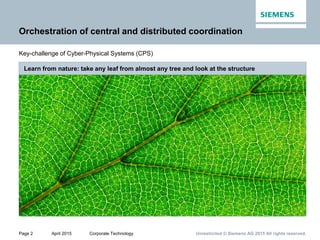
Learn from nature: take any leaf from almost any tree and look at the structure
Page 3 April 2015 Corporate Technology Unrestricted © Siemens AG 2015 All rights reserved.
Conclusion
Contradicting requirements as drivers for innovation
Introduction and definitions
Agenda
Cyber-Physical Systems
Page 4 April 2015 Corporate Technology Unrestricted © Siemens AG 2015 All rights reserved.
Orchestration of computers and physical systems
Generic Definition of Cyber-Physical Systems (CPS)
Definition by Edward A. Lee, UC Berkeley
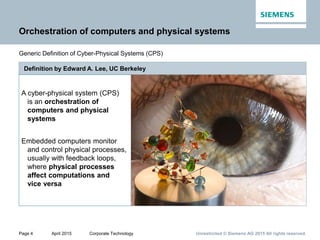
A cyber-physical system (CPS)
is an orchestration of
computers and physical
systems
Embedded computers monitor
and control physical processes,
usually with feedback loops,
where physical processes
affect computations and
vice versa
Page 5 April 2015 Corporate Technology Unrestricted © Siemens AG 2015 All rights reserved.
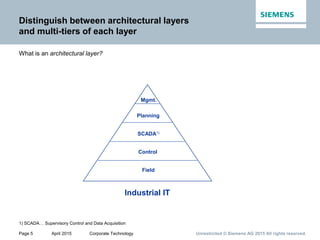
Distinguish between architectural layers
and multi-tiers of each layer
What is an architectural layer?
Industrial IT
Control
SCADA1)
Planning
Mgmt.
Field
1) SCADA… Supervisory Control and Data Acquisition
Page 6 April 2015 Corporate Technology Unrestricted © Siemens AG 2015 All rights reserved.
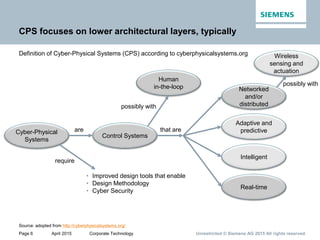
CPS focuses on lower architectural layers, typically
Definition of Cyber-Physical Systems (CPS) according to cyberphysicalsystems.org
Cyber-Physical
Systems
Control Systems
are
Networked
and/or
distributed
Adaptive and
predictive
Intelligent
Real-time
that are
Human
in-the-loop
possibly with
Source: adopted from http://cyberphysicalsystems.org/
Wireless
sensing and
actuation
possibly with
require
• Improved design tools that enable
• Design Methodology
• Cyber Security
Page 7 April 2015 Corporate Technology Unrestricted © Siemens AG 2015 All rights reserved.
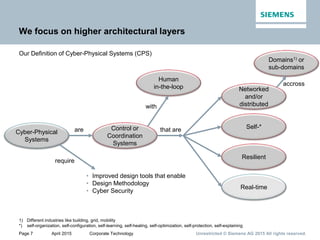
We focus on higher architectural layers
Our Definition of Cyber-Physical Systems (CPS)
Cyber-Physical
Systems
Control or
Coordination
Systems
are
Networked
and/or
distributed
Self-*
Resilient
Real-time
that are
Human
in-the-loop
with
1) Different industries like building, grid, mobility
*) self-organization, self-configuration, self-learning, self-healing, self-optimization, self-protection, self-explaining
Domains1) or
sub-domains
accross
require
• Improved design tools that enable
• Design Methodology
• Cyber Security
Page 8 April 2015 Corporate Technology Unrestricted © Siemens AG 2015 All rights reserved.
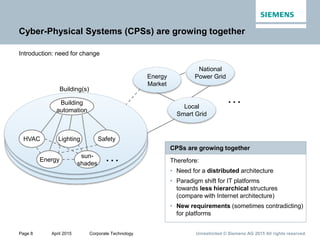
Cyber-Physical Systems (CPSs) are growing together
Introduction: need for change
Therefore:
• Need for a distributed architecture
• Paradigm shift for IT platforms
towards less hierarchical structures
(compare with Internet architecture)
• New requirements (sometimes contradicting)
for platforms
CPSs are growing together
HVAC Lighting Safety
Energy
sun-
shades
Building
automation
…
Building(s)
Energy
Market
National
Power Grid
Local
Smart Grid
…
Page 9 April 2015 Corporate Technology Unrestricted © Siemens AG 2015 All rights reserved.
Building
Automation
Systems
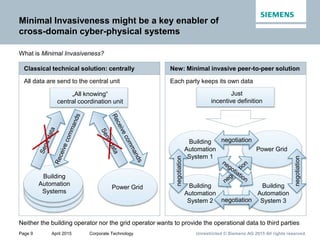
Minimal Invasiveness might be a key enabler of
cross-domain cyber-physical systems
What is Minimal Invasiveness?
Power Grid
Each party keeps its own dataAll data are send to the central unit
New: Minimal invasive peer-to-peer solutionClassical technical solution: centrally
„All knowing“
central coordination unit
Building
Automation
System 1
Power Grid
Building
Automation
System 2
Building
Automation
System 3
negotiation
negotiation
negotiation
negotiation
Just
incentive definition
Neither the building operator nor the grid operator wants to provide the operational data to third parties
Page 10 April 2015 Corporate Technology Unrestricted © Siemens AG 2015 All rights reserved.
Conclusion
Contradicting requirements as drivers for innovation
Introduction and definitions
Agenda
Cyber-Physical Systems
Page 11 April 2015 Corporate Technology Unrestricted © Siemens AG 2015 All rights reserved.
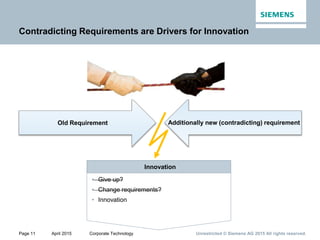
Contradicting Requirements are Drivers for Innovation
Old Requirement
Innovation
• Give up?
• Change requirements?
• Innovation
Additionally new (contradicting) requirement
Page 12 April 2015 Corporate Technology Unrestricted © Siemens AG 2015 All rights reserved.
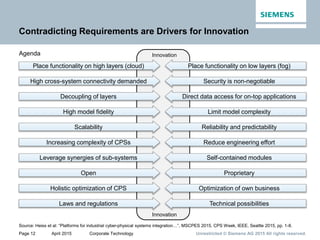
Contradicting Requirements are Drivers for Innovation
Agenda Innovation
Innovation
Place functionality on high layers (cloud)
High cross-system connectivity demanded
Decoupling of layers
High model fidelity
Scalability
Increasing complexity of CPSs
Leverage synergies of sub-systems
Open
Holistic optimization of CPS
Laws and regulations
Place functionality on low layers (fog)
Security is non-negotiable
Direct data access for on-top applications
Limit model complexity
Reliability and predictability
Reduce engineering effort
Self-contained modules
Proprietary
Optimization of own business
Technical possibilities
Source: Heiss et al: “Platforms for industrial cyber-physical systems integration…”, MSCPES 2015, CPS Week, IEEE, Seattle 2015, pp. 1-8.
Page 13 April 2015 Corporate Technology Unrestricted © Siemens AG 2015 All rights reserved.
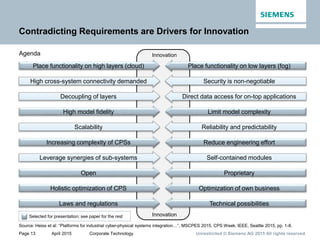
Contradicting Requirements are Drivers for Innovation
Agenda Innovation
Innovation
Place functionality on high layers (cloud)
High cross-system connectivity demanded
Decoupling of layers
High model fidelity
Scalability
Increasing complexity of CPSs
Leverage synergies of sub-systems
Open
Holistic optimization of CPS
Laws and regulations
Place functionality on low layers (fog)
Security is non-negotiable
Direct data access for on-top applications
Limit model complexity
Reliability and predictability
Reduce engineering effort
Self-contained modules
Proprietary
Optimization of own business
Technical possibilities
Selected for presentation; see paper for the rest
Source: Heiss et al: “Platforms for industrial cyber-physical systems integration…”, MSCPES 2015, CPS Week, IEEE, Seattle 2015, pp. 1-8.
Page 14 April 2015 Corporate Technology Unrestricted © Siemens AG 2015 All rights reserved.
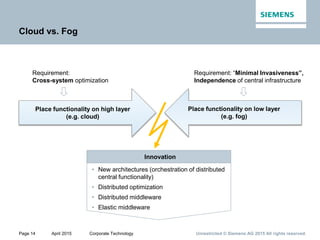
Cloud vs. Fog
Place functionality on high layer
(e.g. cloud)
Innovation
• New architectures (orchestration of distributed
central functionality)
• Distributed optimization
• Distributed middleware
• Elastic middleware
Place functionality on low layer
(e.g. fog)
Requirement:
Cross-system optimization
Requirement: “Minimal Invasiveness”,
Independence of central infrastructure
Page 15 April 2015 Corporate Technology Unrestricted © Siemens AG 2015 All rights reserved.
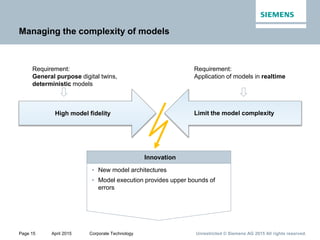
Managing the complexity of models
High model fidelity
Innovation
• New model architectures
• Model execution provides upper bounds of
errors
Limit the model complexity
Requirement:
General purpose digital twins,
deterministic models
Requirement:
Application of models in realtime
Page 16 April 2015 Corporate Technology Unrestricted © Siemens AG 2015 All rights reserved.
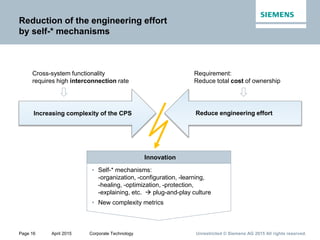
Reduction of the engineering effort
by self-* mechanisms
Increasing complexity of the CPS
Innovation
• Self-* mechanisms:
-organization, -configuration, -learning,
-healing, -optimization, -protection,
-explaining, etc.  plug-and-play culture
• New complexity metrics
Reduce engineering effort
Cross-system functionality
requires high interconnection rate
Requirement:
Reduce total cost of ownership
Page 17 April 2015 Corporate Technology Unrestricted © Siemens AG 2015 All rights reserved.
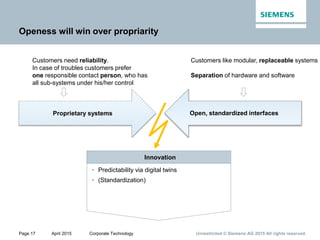
Openess will win over propriarity
Proprietary systems
Innovation
• Predictability via digital twins
• (Standardization)
Open, standardized interfaces
Customers need reliability.
In case of troubles customers prefer
one responsible contact person, who has
all sub-systems under his/her control
Customers like modular, replaceable systems
Separation of hardware and software
Page 18 April 2015 Corporate Technology Unrestricted © Siemens AG 2015 All rights reserved.
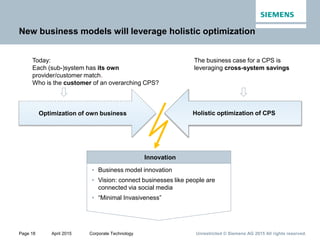
New business models will leverage holistic optimization
Optimization of own business
Innovation
• Business model innovation
• Vision: connect businesses like people are
connected via social media
• “Minimal Invasiveness”
Holistic optimization of CPS
Today:
Each (sub-)system has its own
provider/customer match.
Who is the customer of an overarching CPS?
The business case for a CPS is
leveraging cross-system savings
Page 19 April 2015 Corporate Technology Unrestricted © Siemens AG 2015 All rights reserved.
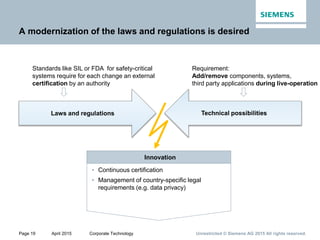
A modernization of the laws and regulations is desired
Laws and regulations
Innovation
• Continuous certification
• Management of country-specific legal
requirements (e.g. data privacy)
Technical possibilities
Standards like SIL or FDA for safety-critical
systems require for each change an external
certification by an authority
Requirement:
Add/remove components, systems,
third party applications during live-operation
Page 20 April 2015 Corporate Technology Unrestricted © Siemens AG 2015 All rights reserved.
Conclusion
Contradicting requirements as drivers for innovation
Introduction and definitions
Agenda
Cyber-Physical Systems
Page 21 April 2015 Corporate Technology Unrestricted © Siemens AG 2015 All rights reserved.
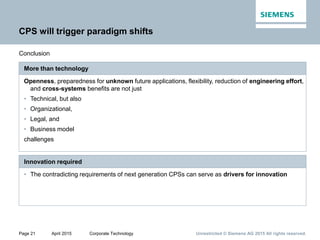
CPS will trigger paradigm shifts
Conclusion
Openness, preparedness for unknown future applications, flexibility, reduction of engineering effort,
and cross-systems benefits are not just
• Technical, but also
• Organizational,
• Legal, and
• Business model
challenges
More than technology
• The contradicting requirements of next generation CPSs can serve as drivers for innovation
Innovation required
Page 22 April 2015 Corporate Technology Unrestricted © Siemens AG 2015 All rights reserved.
Contact Information
Prof. Dr. Michael Heiss
Head of Research Group
Cyber-Physical Systems
Siemens CT RTC ITP CPS
Siemens AG Österreich
Siemensstraße 90
1210 Vienna, Austria
Phone & Mobile: +43 664 88 55 1526
E-mail:
michael.heiss@siemens.com
www.siemens.com

Cyber-Physical Systems - contradicting requirements as drivers for innovation

  • 1.
    Unrestricted © SiemensAG 2015 All rights reserved. Cyber-Physical Systems contradicting requirements as drivers for innovation Siemens Corporate Technology | June 2015
  • 2.
    Page 2 April2015 Corporate Technology Unrestricted © Siemens AG 2015 All rights reserved. Orchestration of central and distributed coordination Key-challenge of Cyber-Physical Systems (CPS) Learn from nature: take any leaf from almost any tree and look at the structure
  • 3.
    Page 3 April2015 Corporate Technology Unrestricted © Siemens AG 2015 All rights reserved. Conclusion Contradicting requirements as drivers for innovation Introduction and definitions Agenda Cyber-Physical Systems
  • 4.
    Page 4 April2015 Corporate Technology Unrestricted © Siemens AG 2015 All rights reserved. Orchestration of computers and physical systems Generic Definition of Cyber-Physical Systems (CPS) Definition by Edward A. Lee, UC Berkeley A cyber-physical system (CPS) is an orchestration of computers and physical systems Embedded computers monitor and control physical processes, usually with feedback loops, where physical processes affect computations and vice versa
  • 5.
    Page 5 April2015 Corporate Technology Unrestricted © Siemens AG 2015 All rights reserved. Distinguish between architectural layers and multi-tiers of each layer What is an architectural layer? Industrial IT Control SCADA1) Planning Mgmt. Field 1) SCADA… Supervisory Control and Data Acquisition
  • 6.
    Page 6 April2015 Corporate Technology Unrestricted © Siemens AG 2015 All rights reserved. CPS focuses on lower architectural layers, typically Definition of Cyber-Physical Systems (CPS) according to cyberphysicalsystems.org Cyber-Physical Systems Control Systems are Networked and/or distributed Adaptive and predictive Intelligent Real-time that are Human in-the-loop possibly with Source: adopted from http://cyberphysicalsystems.org/ Wireless sensing and actuation possibly with require • Improved design tools that enable • Design Methodology • Cyber Security
  • 7.
    Page 7 April2015 Corporate Technology Unrestricted © Siemens AG 2015 All rights reserved. We focus on higher architectural layers Our Definition of Cyber-Physical Systems (CPS) Cyber-Physical Systems Control or Coordination Systems are Networked and/or distributed Self-* Resilient Real-time that are Human in-the-loop with 1) Different industries like building, grid, mobility *) self-organization, self-configuration, self-learning, self-healing, self-optimization, self-protection, self-explaining Domains1) or sub-domains accross require • Improved design tools that enable • Design Methodology • Cyber Security
  • 8.
    Page 8 April2015 Corporate Technology Unrestricted © Siemens AG 2015 All rights reserved. Cyber-Physical Systems (CPSs) are growing together Introduction: need for change Therefore: • Need for a distributed architecture • Paradigm shift for IT platforms towards less hierarchical structures (compare with Internet architecture) • New requirements (sometimes contradicting) for platforms CPSs are growing together HVAC Lighting Safety Energy sun- shades Building automation … Building(s) Energy Market National Power Grid Local Smart Grid …
  • 9.
    Page 9 April2015 Corporate Technology Unrestricted © Siemens AG 2015 All rights reserved. Building Automation Systems Minimal Invasiveness might be a key enabler of cross-domain cyber-physical systems What is Minimal Invasiveness? Power Grid Each party keeps its own dataAll data are send to the central unit New: Minimal invasive peer-to-peer solutionClassical technical solution: centrally „All knowing“ central coordination unit Building Automation System 1 Power Grid Building Automation System 2 Building Automation System 3 negotiation negotiation negotiation negotiation Just incentive definition Neither the building operator nor the grid operator wants to provide the operational data to third parties
  • 10.
    Page 10 April2015 Corporate Technology Unrestricted © Siemens AG 2015 All rights reserved. Conclusion Contradicting requirements as drivers for innovation Introduction and definitions Agenda Cyber-Physical Systems
  • 11.
    Page 11 April2015 Corporate Technology Unrestricted © Siemens AG 2015 All rights reserved. Contradicting Requirements are Drivers for Innovation Old Requirement Innovation • Give up? • Change requirements? • Innovation Additionally new (contradicting) requirement
  • 12.
    Page 12 April2015 Corporate Technology Unrestricted © Siemens AG 2015 All rights reserved. Contradicting Requirements are Drivers for Innovation Agenda Innovation Innovation Place functionality on high layers (cloud) High cross-system connectivity demanded Decoupling of layers High model fidelity Scalability Increasing complexity of CPSs Leverage synergies of sub-systems Open Holistic optimization of CPS Laws and regulations Place functionality on low layers (fog) Security is non-negotiable Direct data access for on-top applications Limit model complexity Reliability and predictability Reduce engineering effort Self-contained modules Proprietary Optimization of own business Technical possibilities Source: Heiss et al: “Platforms for industrial cyber-physical systems integration…”, MSCPES 2015, CPS Week, IEEE, Seattle 2015, pp. 1-8.
  • 13.
    Page 13 April2015 Corporate Technology Unrestricted © Siemens AG 2015 All rights reserved. Contradicting Requirements are Drivers for Innovation Agenda Innovation Innovation Place functionality on high layers (cloud) High cross-system connectivity demanded Decoupling of layers High model fidelity Scalability Increasing complexity of CPSs Leverage synergies of sub-systems Open Holistic optimization of CPS Laws and regulations Place functionality on low layers (fog) Security is non-negotiable Direct data access for on-top applications Limit model complexity Reliability and predictability Reduce engineering effort Self-contained modules Proprietary Optimization of own business Technical possibilities Selected for presentation; see paper for the rest Source: Heiss et al: “Platforms for industrial cyber-physical systems integration…”, MSCPES 2015, CPS Week, IEEE, Seattle 2015, pp. 1-8.
  • 14.
    Page 14 April2015 Corporate Technology Unrestricted © Siemens AG 2015 All rights reserved. Cloud vs. Fog Place functionality on high layer (e.g. cloud) Innovation • New architectures (orchestration of distributed central functionality) • Distributed optimization • Distributed middleware • Elastic middleware Place functionality on low layer (e.g. fog) Requirement: Cross-system optimization Requirement: “Minimal Invasiveness”, Independence of central infrastructure
  • 15.
    Page 15 April2015 Corporate Technology Unrestricted © Siemens AG 2015 All rights reserved. Managing the complexity of models High model fidelity Innovation • New model architectures • Model execution provides upper bounds of errors Limit the model complexity Requirement: General purpose digital twins, deterministic models Requirement: Application of models in realtime
  • 16.
    Page 16 April2015 Corporate Technology Unrestricted © Siemens AG 2015 All rights reserved. Reduction of the engineering effort by self-* mechanisms Increasing complexity of the CPS Innovation • Self-* mechanisms: -organization, -configuration, -learning, -healing, -optimization, -protection, -explaining, etc.  plug-and-play culture • New complexity metrics Reduce engineering effort Cross-system functionality requires high interconnection rate Requirement: Reduce total cost of ownership
  • 17.
    Page 17 April2015 Corporate Technology Unrestricted © Siemens AG 2015 All rights reserved. Openess will win over propriarity Proprietary systems Innovation • Predictability via digital twins • (Standardization) Open, standardized interfaces Customers need reliability. In case of troubles customers prefer one responsible contact person, who has all sub-systems under his/her control Customers like modular, replaceable systems Separation of hardware and software
  • 18.
    Page 18 April2015 Corporate Technology Unrestricted © Siemens AG 2015 All rights reserved. New business models will leverage holistic optimization Optimization of own business Innovation • Business model innovation • Vision: connect businesses like people are connected via social media • “Minimal Invasiveness” Holistic optimization of CPS Today: Each (sub-)system has its own provider/customer match. Who is the customer of an overarching CPS? The business case for a CPS is leveraging cross-system savings
  • 19.
    Page 19 April2015 Corporate Technology Unrestricted © Siemens AG 2015 All rights reserved. A modernization of the laws and regulations is desired Laws and regulations Innovation • Continuous certification • Management of country-specific legal requirements (e.g. data privacy) Technical possibilities Standards like SIL or FDA for safety-critical systems require for each change an external certification by an authority Requirement: Add/remove components, systems, third party applications during live-operation
  • 20.
    Page 20 April2015 Corporate Technology Unrestricted © Siemens AG 2015 All rights reserved. Conclusion Contradicting requirements as drivers for innovation Introduction and definitions Agenda Cyber-Physical Systems
  • 21.
    Page 21 April2015 Corporate Technology Unrestricted © Siemens AG 2015 All rights reserved. CPS will trigger paradigm shifts Conclusion Openness, preparedness for unknown future applications, flexibility, reduction of engineering effort, and cross-systems benefits are not just • Technical, but also • Organizational, • Legal, and • Business model challenges More than technology • The contradicting requirements of next generation CPSs can serve as drivers for innovation Innovation required
  • 22.
    Page 22 April2015 Corporate Technology Unrestricted © Siemens AG 2015 All rights reserved. Contact Information Prof. Dr. Michael Heiss Head of Research Group Cyber-Physical Systems Siemens CT RTC ITP CPS Siemens AG Österreich Siemensstraße 90 1210 Vienna, Austria Phone & Mobile: +43 664 88 55 1526 E-mail: michael.heiss@siemens.com www.siemens.com