IBM End-to-End Security   for Smart Grids   Più energia alla Sicurezza 1 Dicembre, 2010
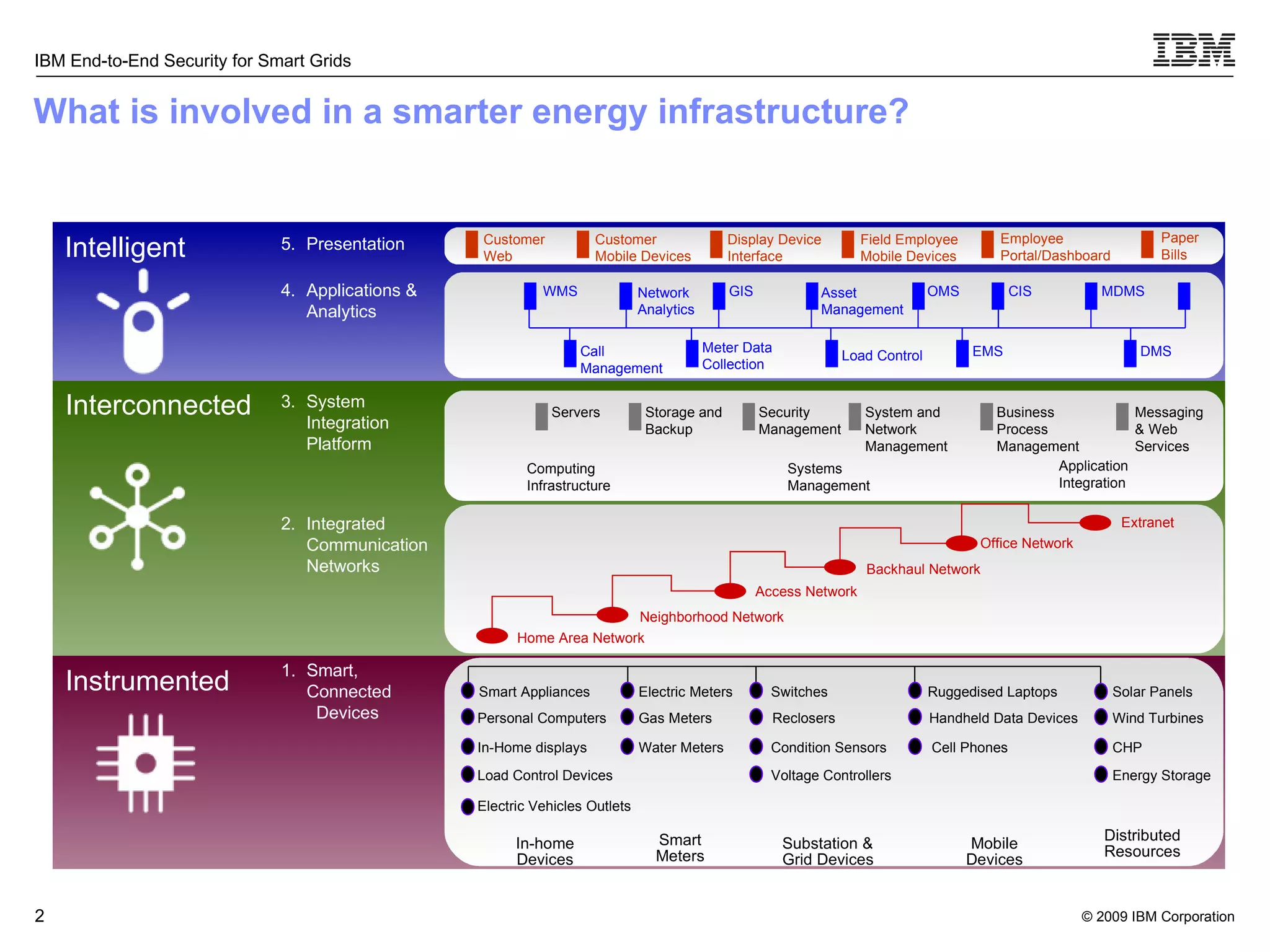
What is involved in a smarter energy infrastructure? Electric Meters In-Home displays Personal Computers Load Control Devices Smart Appliances Handheld Data Devices Gas Meters Water Meters Electric Vehicles Outlets Solar Panels  Reclosers Condition Sensors Voltage Controllers Switches Substation & Grid Devices Smart Meters In-home Devices Ruggedised Laptops Mobile Devices Distributed  Resources Cell Phones Wind Turbines  Home Area Network Neighborhood Network Access Network Backhaul Network Extranet Office Network 1. Smart, Connected  Devices 2. Integrated  Communication  Networks 3. System  Integration  Platform 4. Applications &  Analytics Servers EMS System and Network Management DMS MDMS Meter Data Collection  Load Control  GIS Network  Analytics OMS Asset  Management  CIS  Call Management Storage and Backup Business Process Management Computing  Infrastructure Application  Integration WMS  CHP  Systems  Management Security  Management Messaging & Web Services Instrumented Interconnected Intelligent 5. Presentation Employee  Portal/Dashboard Field Employee  Mobile Devices Display Device  Interface Customer Mobile Devices Customer  Web Paper  Bills Energy Storage
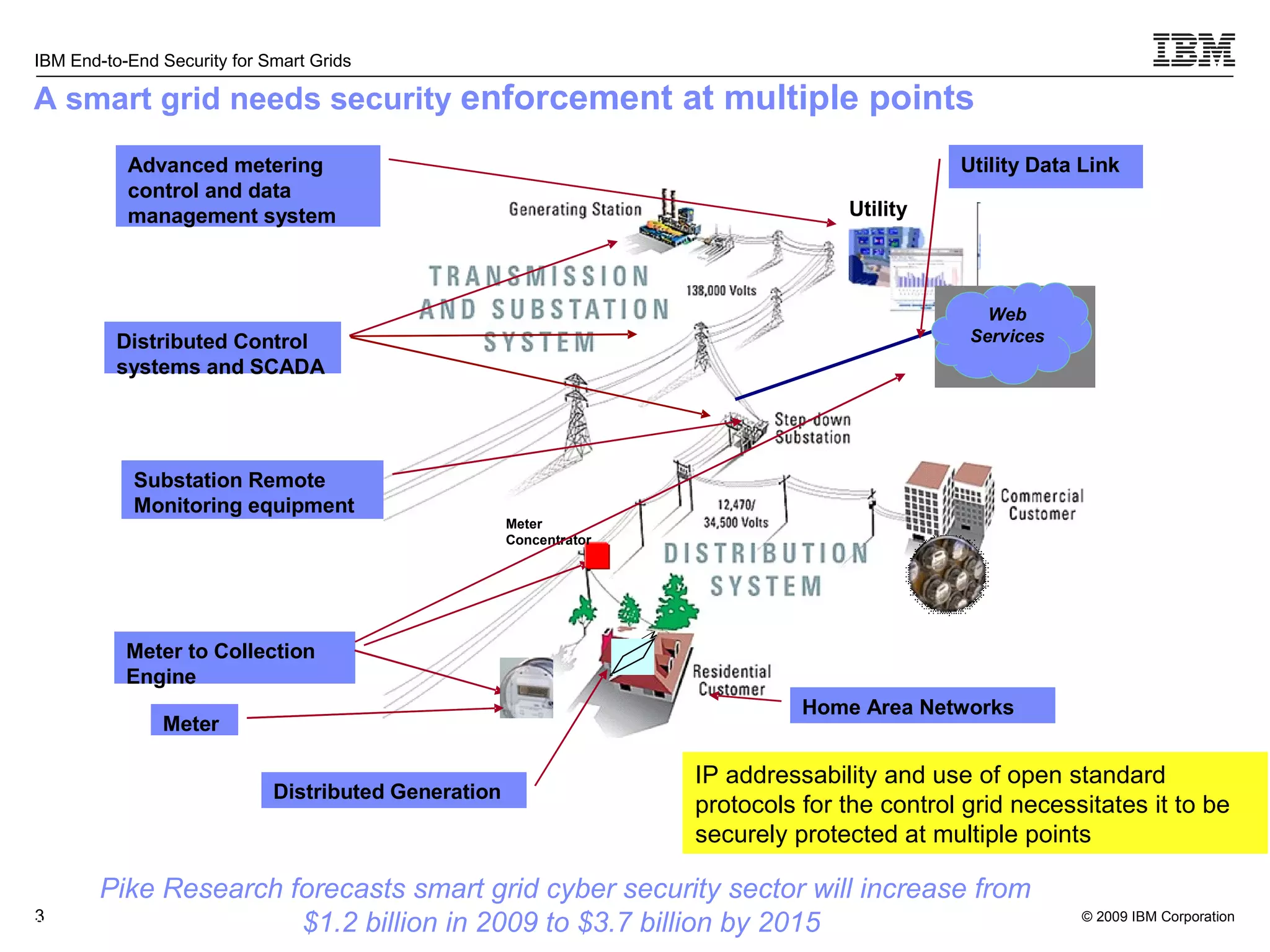
A smart grid needs security  enforcement at multiple points IP addressability and use of open standard protocols for the control grid necessitates it to be securely protected at multiple points Pike Research forecasts smart grid cyber security sector will increase from $1.2 billion in 2009 to $3.7 billion by 2015
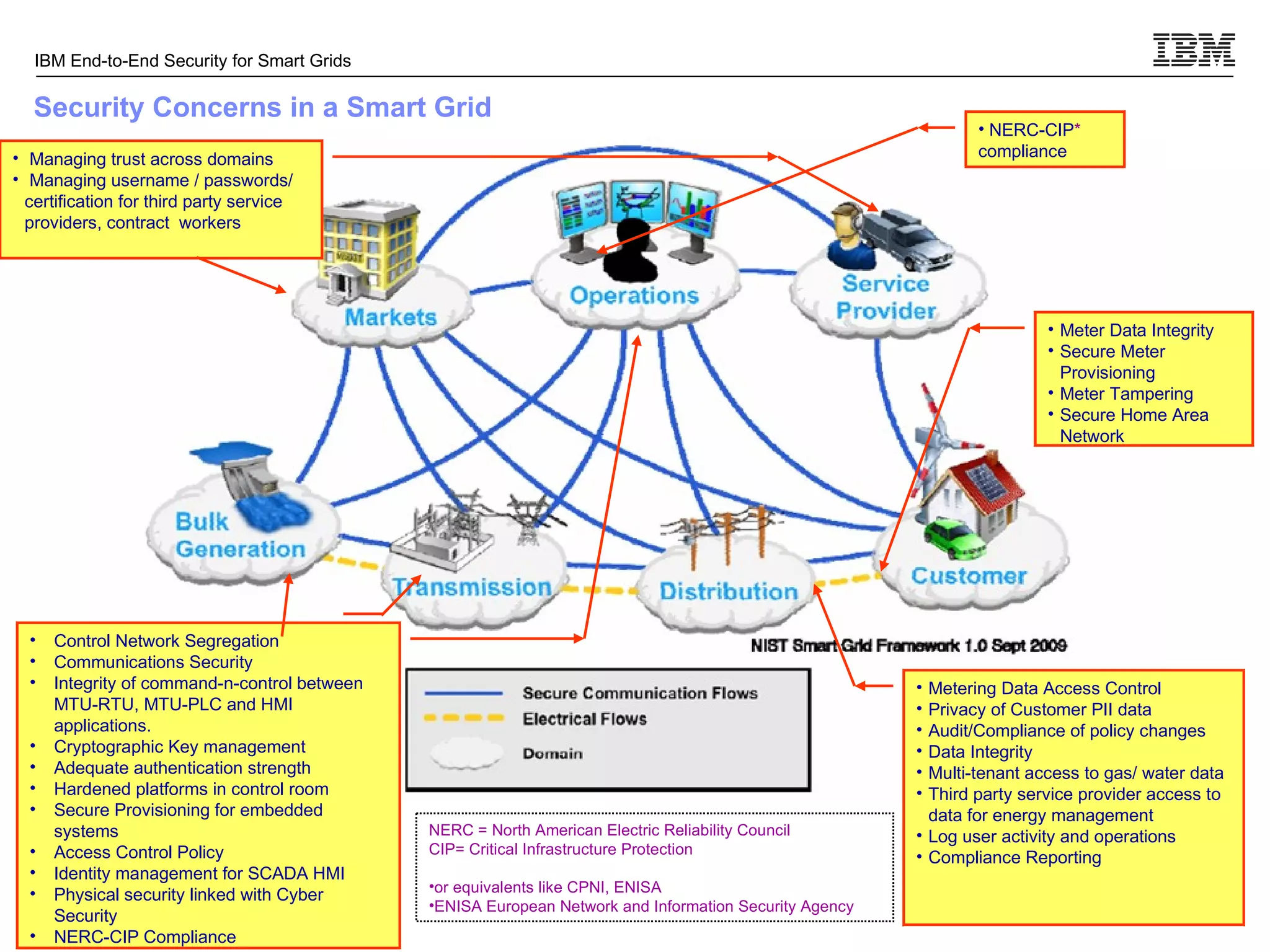
Security Concerns in a Smart Grid Metering Data Access Control Privacy of Customer PII data Audit/Compliance of policy changes Data Integrity Multi-tenant access to gas/ water data Third party service provider access to data for energy management Log user activity and operations Compliance Reporting  Control Network Segregation Communications Security  Integrity of command-n-control between MTU-RTU, MTU-PLC and HMI applications. Cryptographic Key management  Adequate authentication strength Hardened platforms in control room Secure Provisioning for embedded systems Access Control Policy Identity management for SCADA HMI Physical security linked with Cyber Security NERC-CIP Compliance Managing trust across domains Managing username / passwords/ certification for third party service providers, contract  workers NERC-CIP *   compliance  NERC = North American Electric Reliability Council CIP= Critical Infrastructure Protection or equivalents like CPNI, ENISA ENISA European Network and Information Security Agency Meter Data Integrity Secure Meter Provisioning Meter Tampering Secure Home Area Network
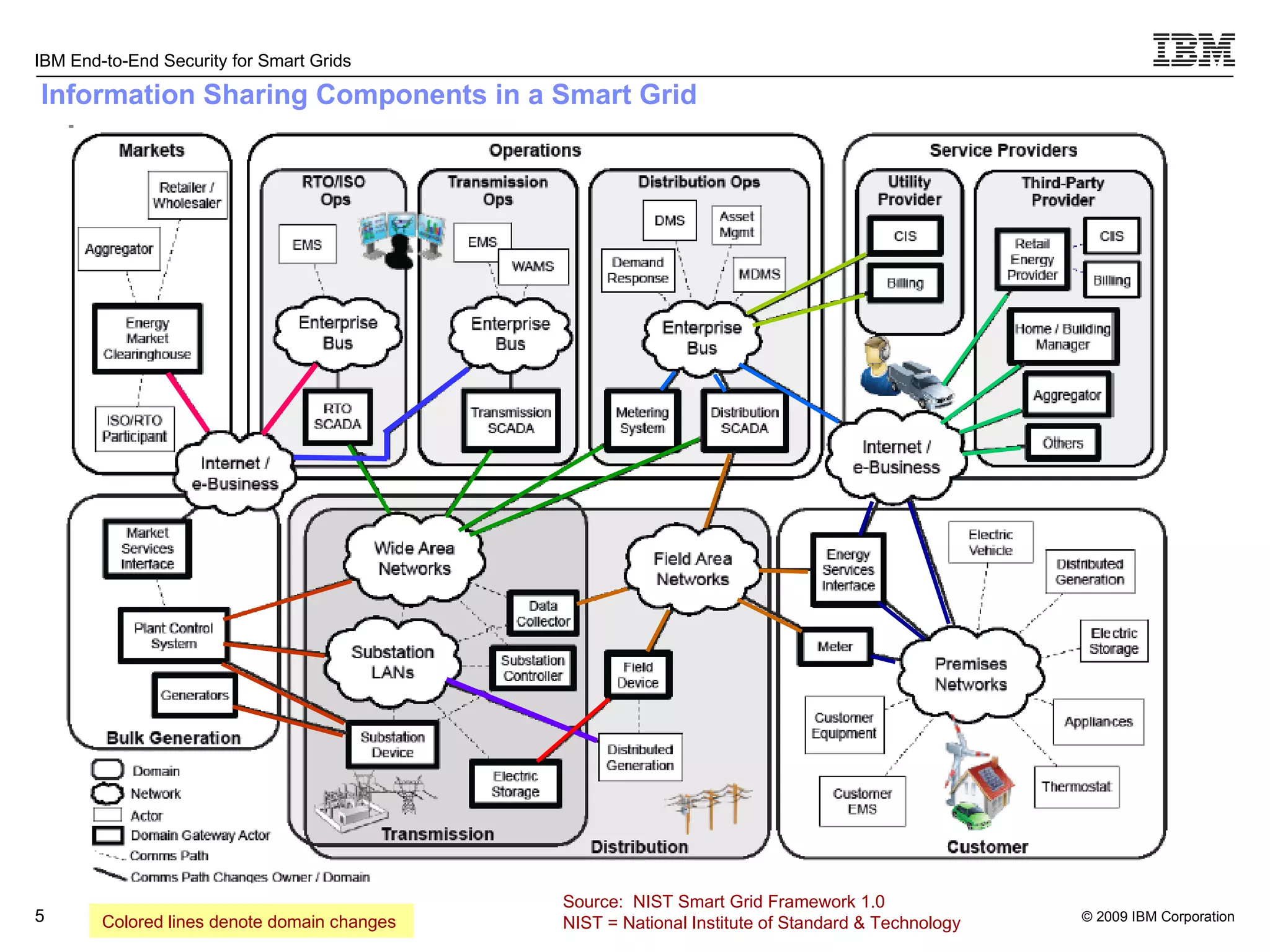
Information Sharing Components in a Smart Grid Source:  NIST Smart Grid Framework 1.0 NIST = National Institute of Standard & Technology Colored lines denote domain changes
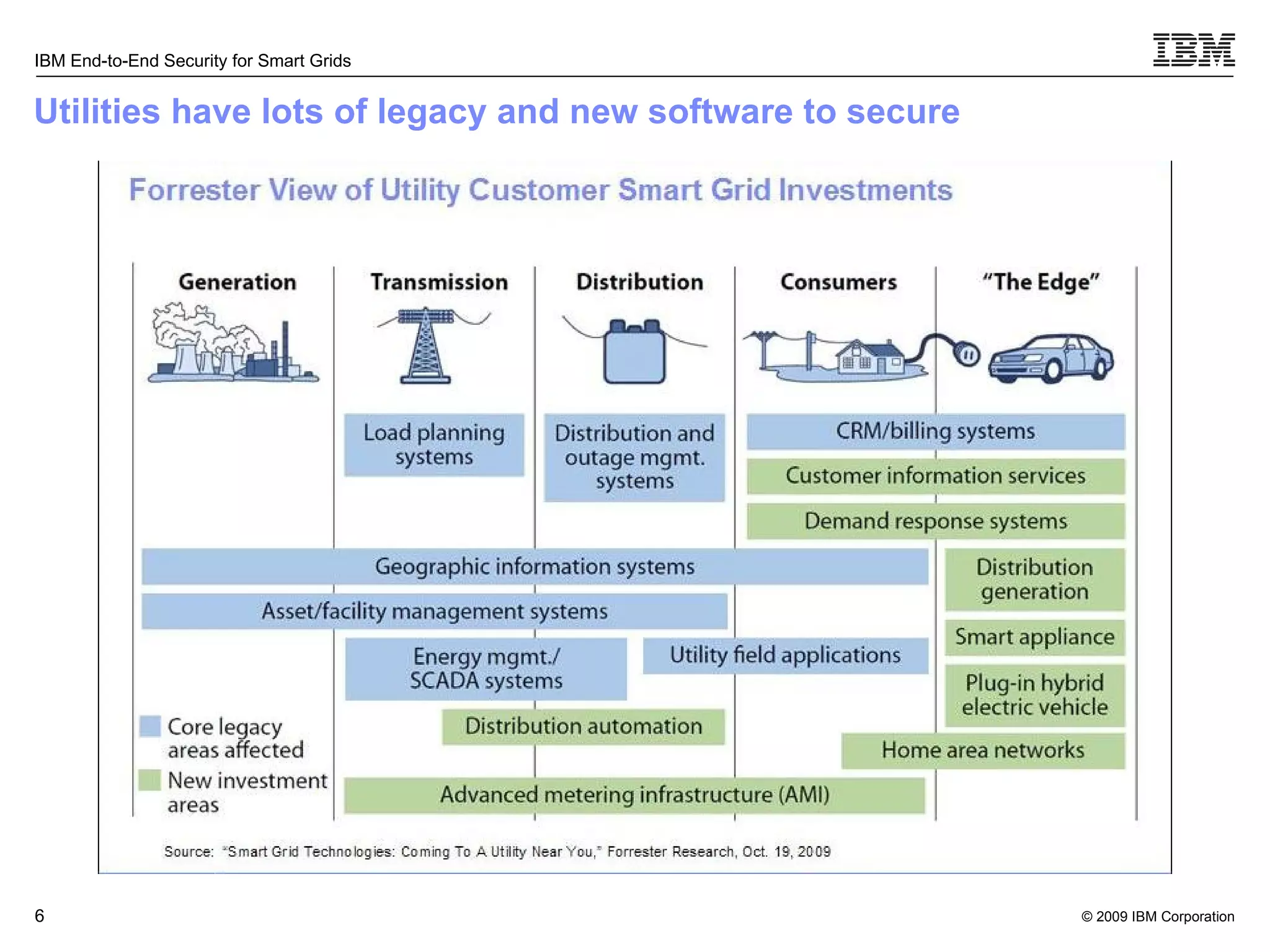
Utilities have lots of legacy and new software to secure
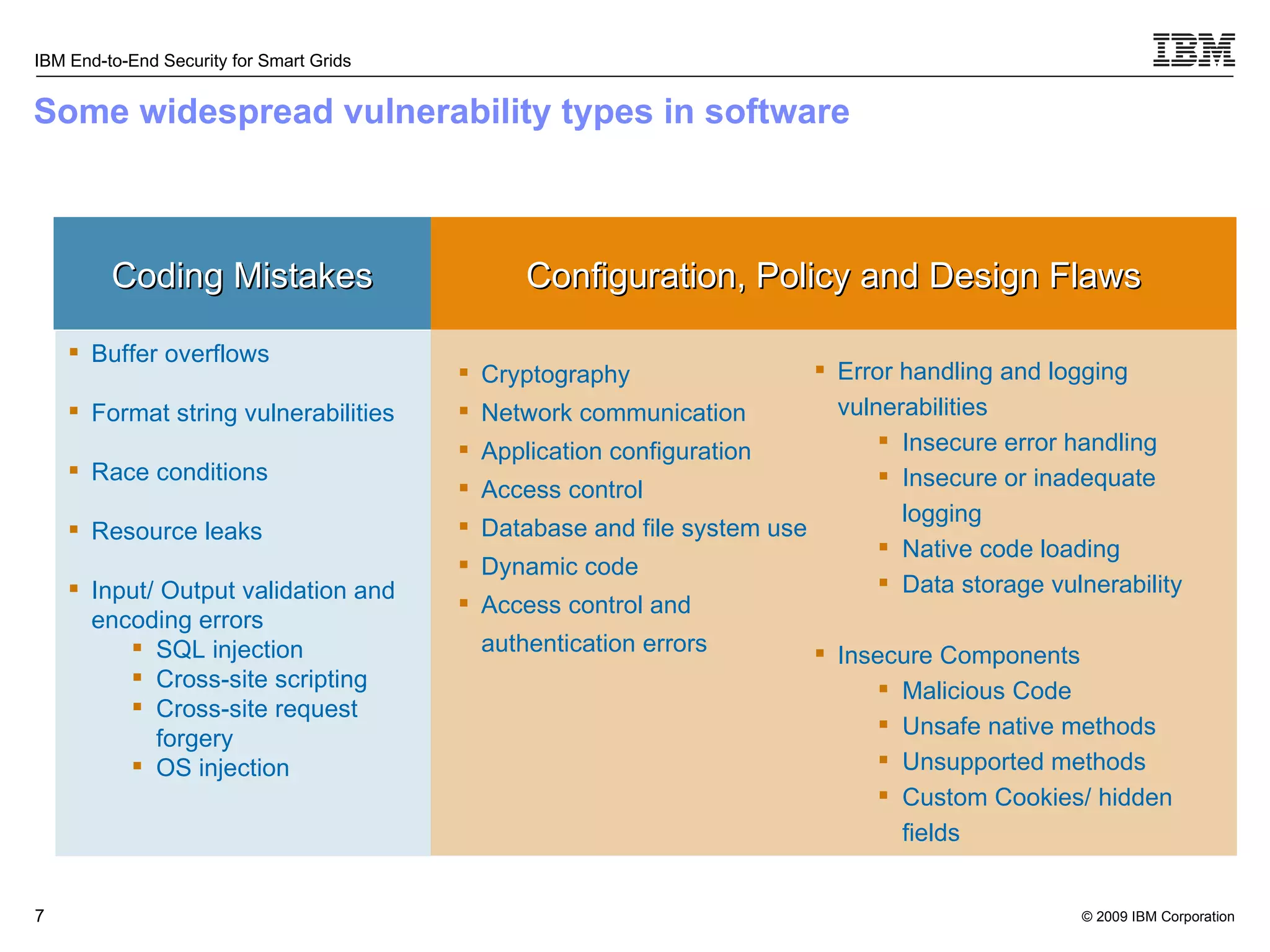
Some widespread vulnerability types in software Buffer overflows Format string vulnerabilities Race conditions Resource leaks Input/ Output validation and encoding errors SQL injection Cross-site scripting Cross-site request forgery OS injection Error handling and logging vulnerabilities Insecure error handling Insecure or inadequate logging Native code loading Data storage vulnerability Insecure Components Malicious Code Unsafe native methods Unsupported methods Custom Cookies/ hidden fields Cryptography Network communication Application configuration Access control Database and file system use Dynamic code Access control and  authentication errors Coding Mistakes Configuration, Policy and Design Flaws
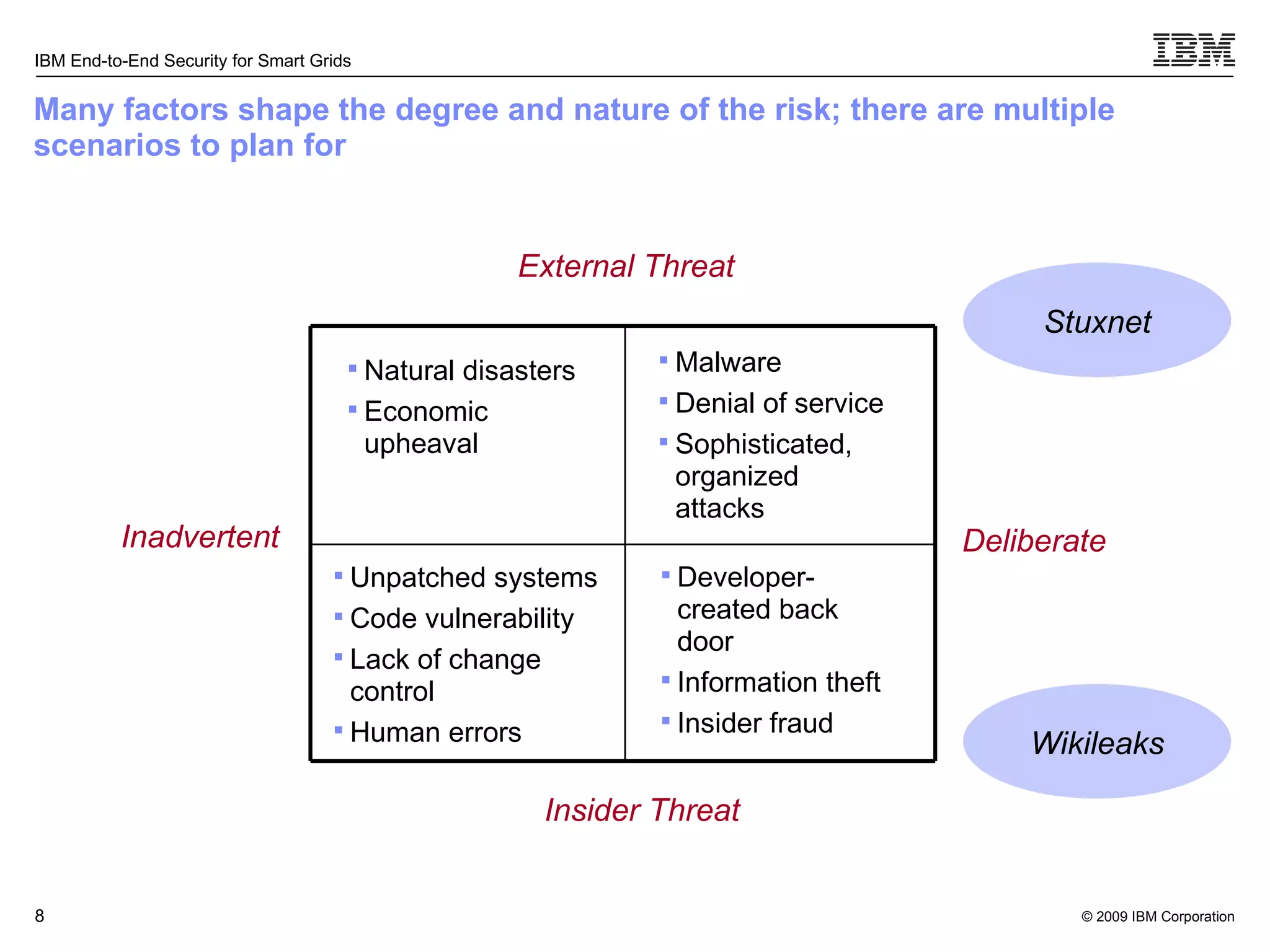
Many factors shape the degree and nature of the risk; there are multiple scenarios to plan for External Threat Insider Threat Inadvertent Deliberate Malware Denial of service Sophisticated, organized attacks Natural disasters Economic upheaval Unpatched systems Code vulnerability Lack of change control Human errors Developer-created back door Information theft Insider fraud Stuxnet Wikileaks
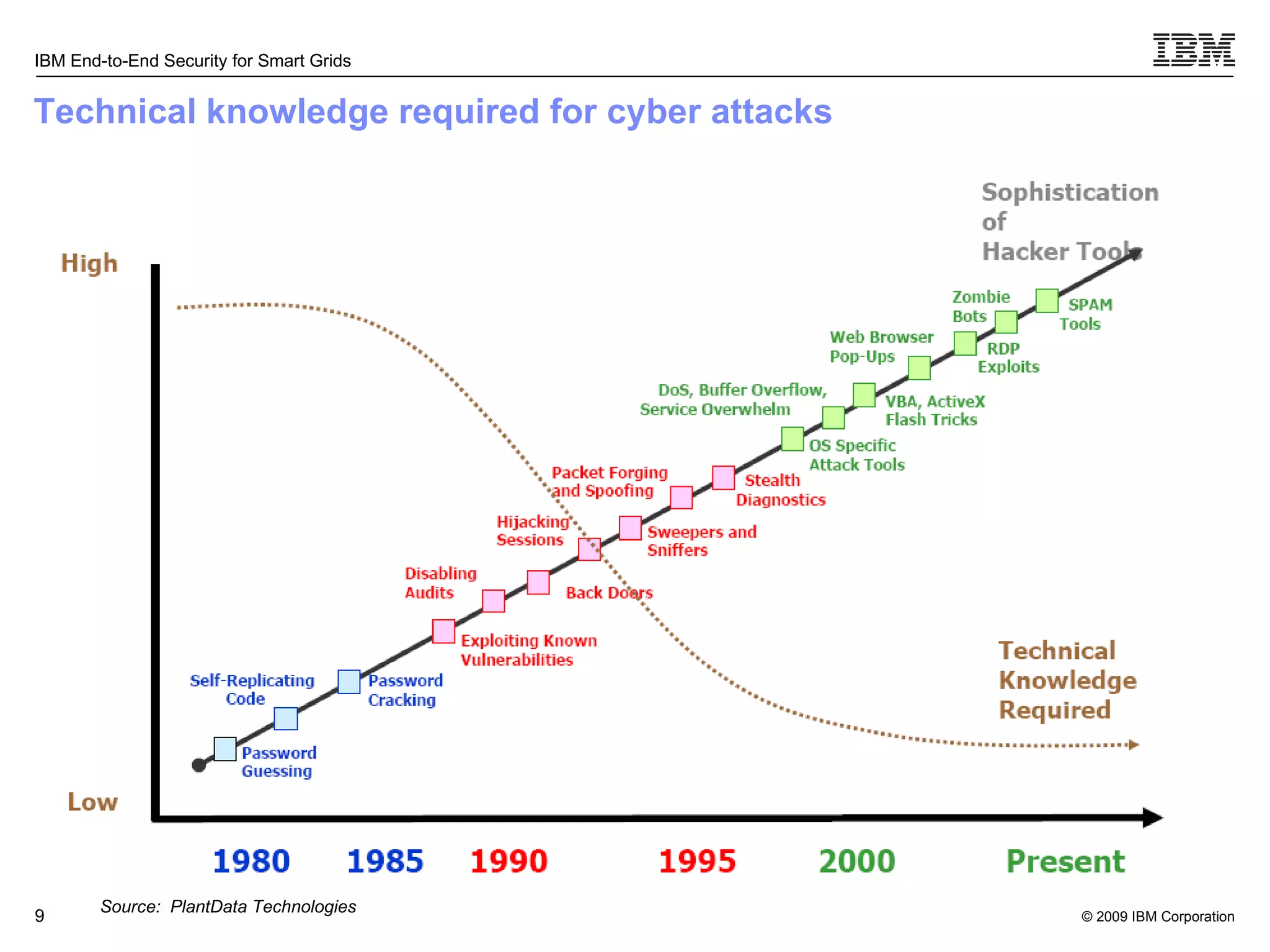
Technical knowledge required for cyber attacks Source:  PlantData Technologies
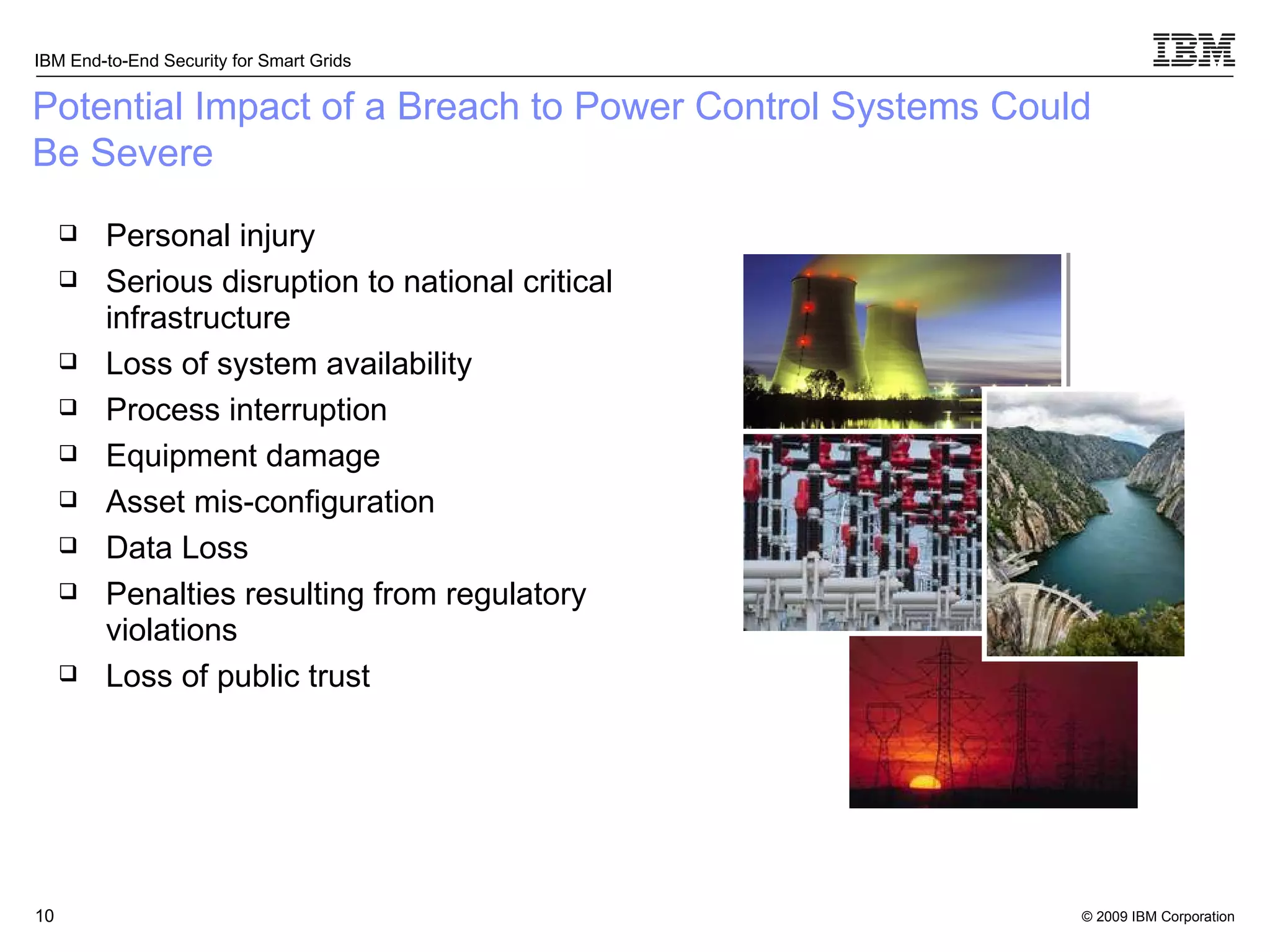
Potential Impact of a Breach to Power Control Systems Could Be Severe Personal injury Serious disruption to national critical infrastructure Loss of system availability Process interruption Equipment damage Asset mis-configuration Data Loss Penalties resulting from regulatory violations Loss of public trust
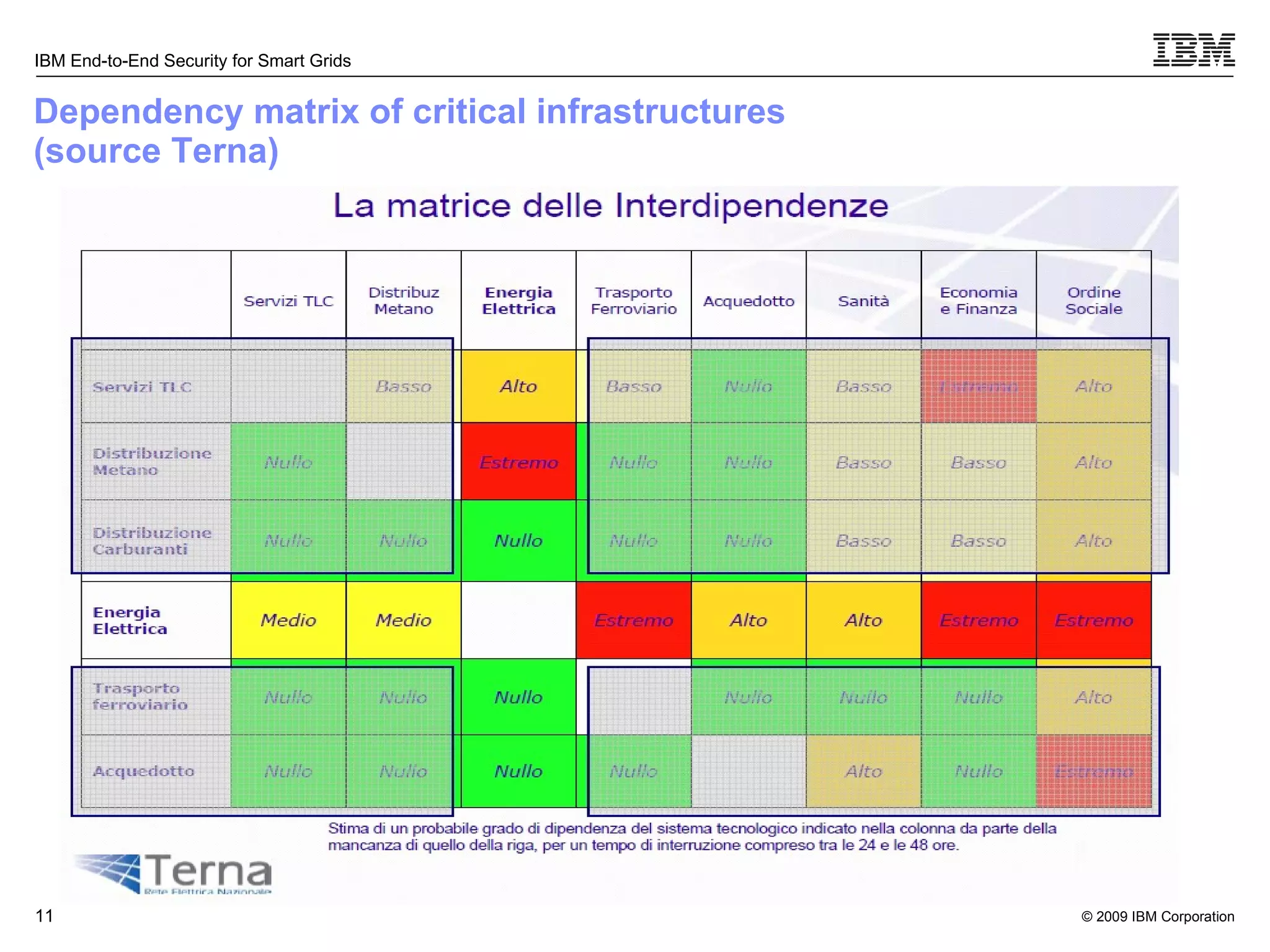
Dependency matrix of critical infrastructures (source Terna)
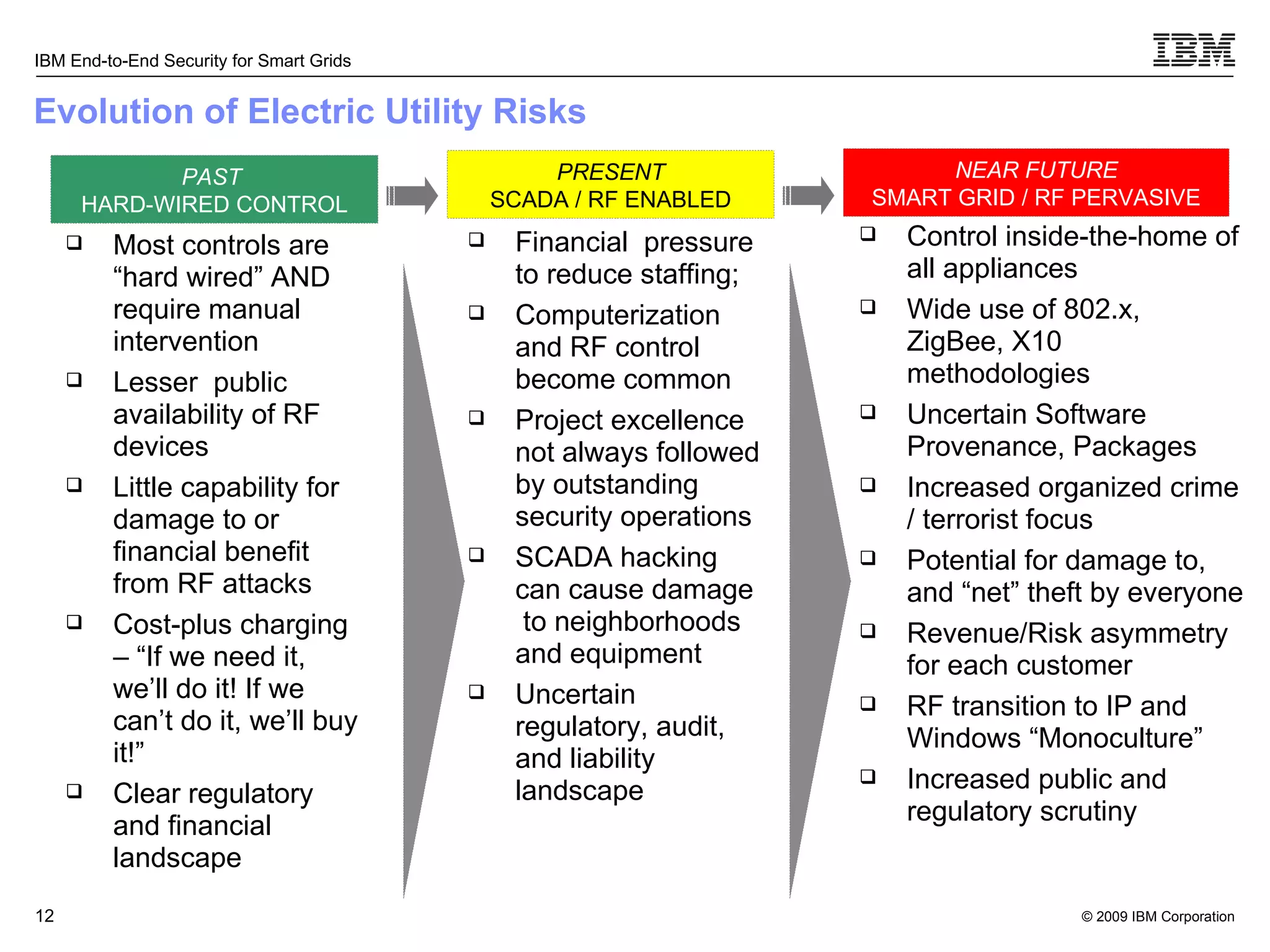
Evolution of Electric Utility Risks PAST   HARD-WIRED CONTROL PRESENT SCADA / RF ENABLED NEAR FUTURE SMART GRID / RF PERVASIVE Financial  pressure to reduce staffing; Computerization and RF control become common Project excellence not always followed by outstanding security operations SCADA hacking can cause damage  to neighborhoods and equipment Uncertain regulatory, audit, and liability  landscape Control inside-the-home of all appliances Wide use of 802.x, ZigBee, X10 methodologies Uncertain Software Provenance, Packages Increased organized crime / terrorist focus Potential for damage to, and “net” theft by everyone  Revenue/Risk asymmetry for each customer RF transition to IP and Windows “Monoculture” Increased public and regulatory scrutiny Most controls are “hard wired” AND require manual intervention Lesser  public availability of RF devices  Little capability for damage to or financial benefit  from RF attacks  Cost-plus charging – “If we need it, we’ll do it! If we can’t do it, we’ll buy it!” Clear regulatory and financial landscape
Our Lessons Learned from the Cyber Security Front Focus points Perimeter defense alone is probably not enough RF devices require additional security consideration It is not just keeping the ‘bad guys’ out, it is making the internal systems less vulnerable Points of View Security is risk management- thus it is a business problem, not just a technical problem Security overlaps reliability Security is part of the phase one design Projects have schedules and budgets – hackers have no such constraints – thus periodic testing is required Do not overlook physical security and think only of cyber Technology Implications Some IP enabled devices can benefit from IT systems methods Correlating suspicious activity from all inputs is part of the detection methodology Chain rule – security is only as strong as its weakest link Aspects of security involve privacy issues If it has a computer in it, then the security of it must be evaluated Platforms must be secure too, not just components If we know we can't practically defend against Stuxnet or its spawn, what is our approach? Giving up is not an option.  " Roll with the punch " may end up being a viable strategy. How could we design control systems, or other IT environments for that matter, to be resilient enough to take a potential knock out punch and yet be able to come back up swinging? In the end, can we optimize our investment by planning to take the punch rather than futilely hiding from it ?
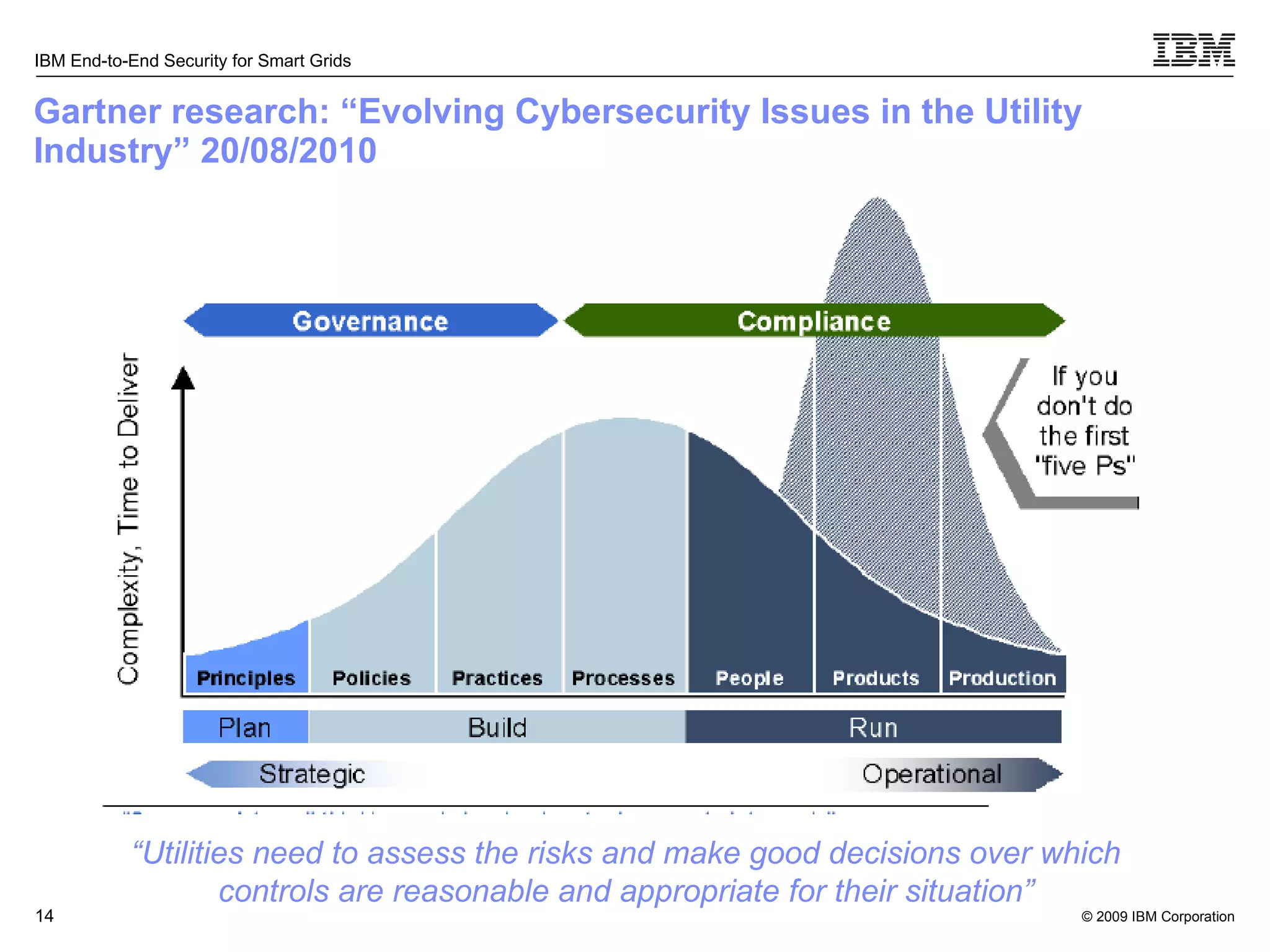
Gartner research: “ Evolving Cybersecurity Issues in the Utility Industry” 20/08/2010 “ Utilities need to assess the risks and make good decisions over which controls are reasonable and appropriate for their situation”
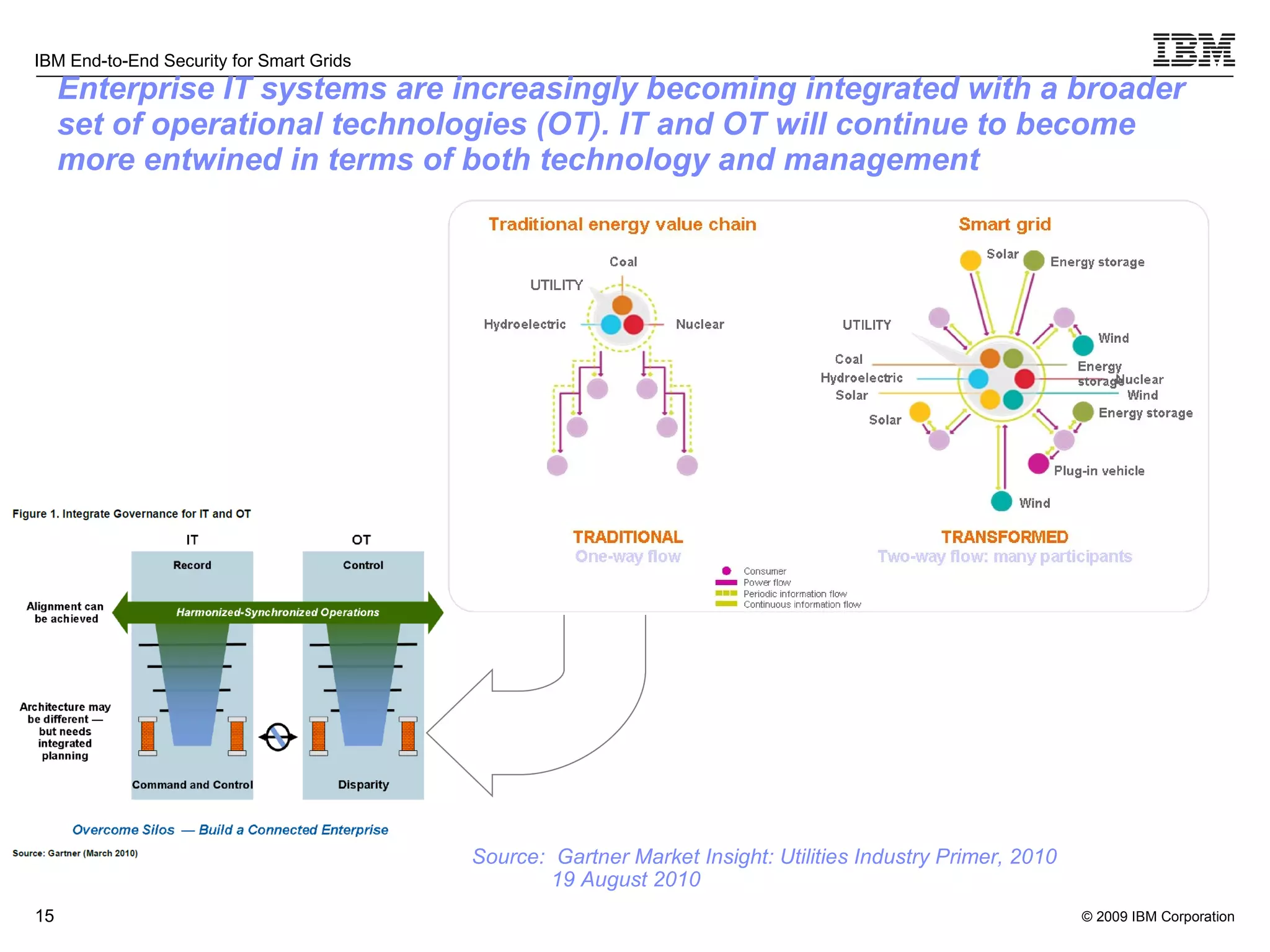
Enterprise IT systems are increasingly becoming integrated with a broader set of operational technologies (OT). IT and OT will continue to become more entwined in terms of both technology and management Source:  Gartner Market Insight: Utilities Industry Primer, 2010  19 August 2010
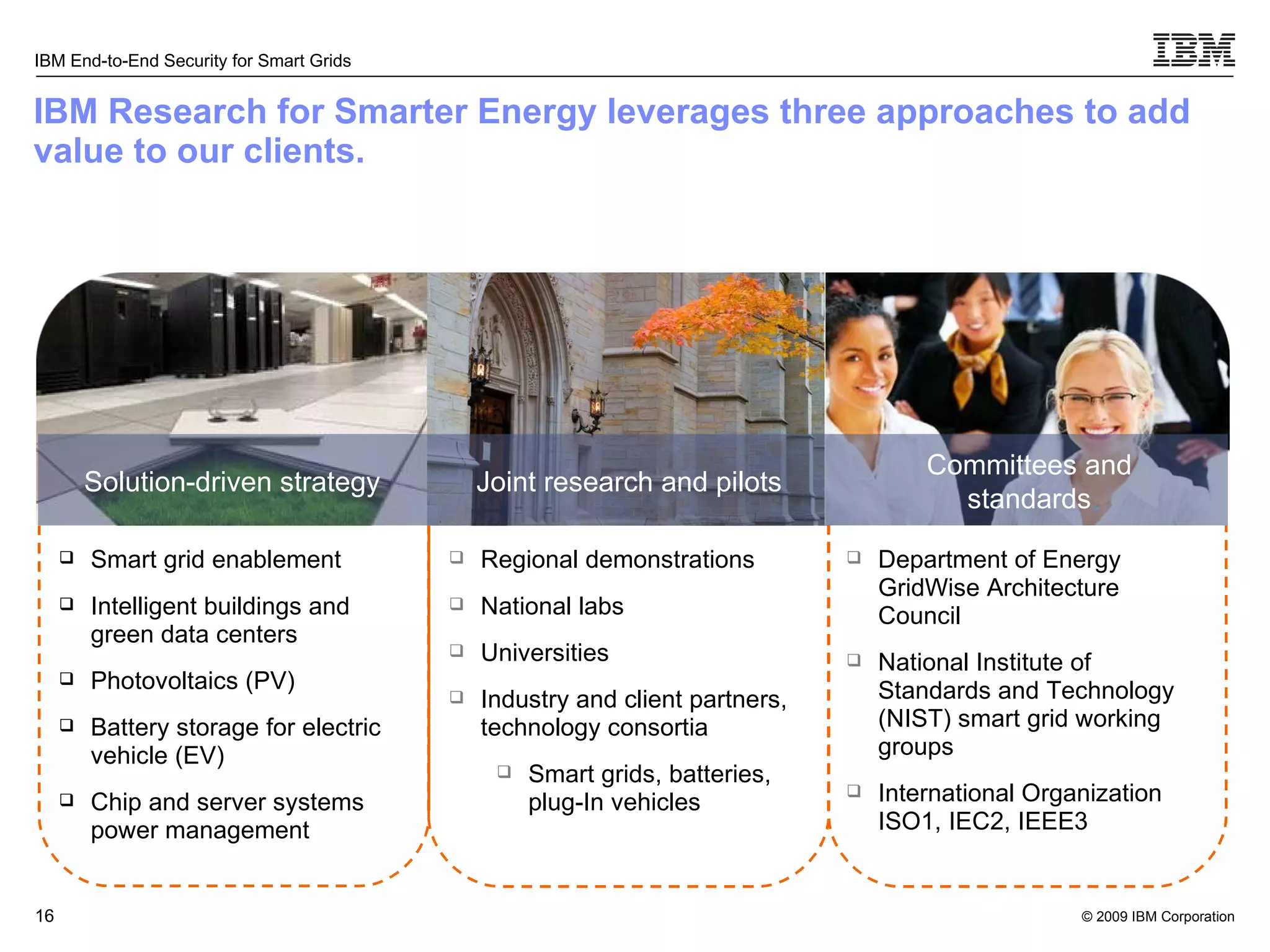
IBM Research for Smarter Energy leverages three approaches to add value to our clients. Solution-driven strategy Smart grid enablement Intelligent buildings and green data centers Photovoltaics (PV) Battery storage for electric vehicle (EV) Chip and server systems power management Joint research and pilots Regional demonstrations  National labs  Universities Industry and client partners, technology consortia Smart grids, batteries,  plug-In vehicles Committees and standards Department of Energy  GridWise Architecture Council National Institute of Standards and Technology (NIST) smart grid working groups International Organization ISO1, IEC2, IEEE3
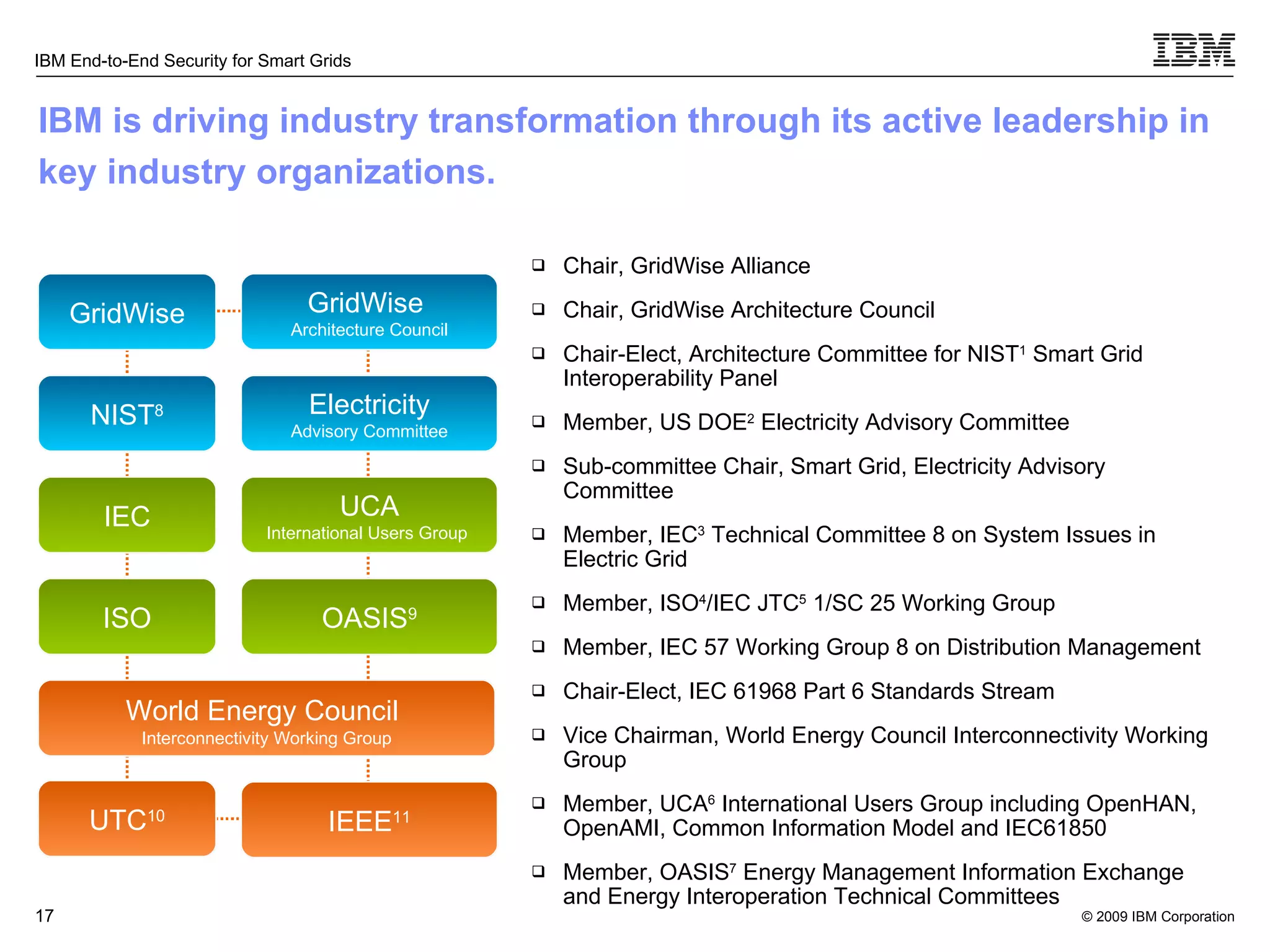
IBM is driving industry transformation through its active leadership in key industry organizations. Chair, GridWise Alliance Chair, GridWise Architecture Council Chair-Elect, Architecture Committee for NIST 1  Smart Grid Interoperability Panel  Member, US DOE 2  Electricity Advisory Committee Sub-committee Chair, Smart Grid, Electricity Advisory Committee Member, IEC 3  Technical Committee 8 on System Issues in Electric Grid Member, ISO 4 /IEC JTC 5  1/SC 25 Working Group  Member, IEC 57 Working Group 8 on Distribution Management  Chair-Elect, IEC 61968 Part 6 Standards Stream Vice Chairman, World Energy Council Interconnectivity Working Group Member, UCA 6  International Users Group including OpenHAN, OpenAMI, Common Information Model and IEC61850 Member, OASIS 7  Energy Management Information Exchange and Energy Interoperation Technical Committees NIST 8 GridWise  Architecture Council GridWise Electricity  Advisory Committee  UCA International Users Group  ISO IEC World Energy Council   Interconnectivity Working Group OASIS 9 IEEE 11 UTC 10
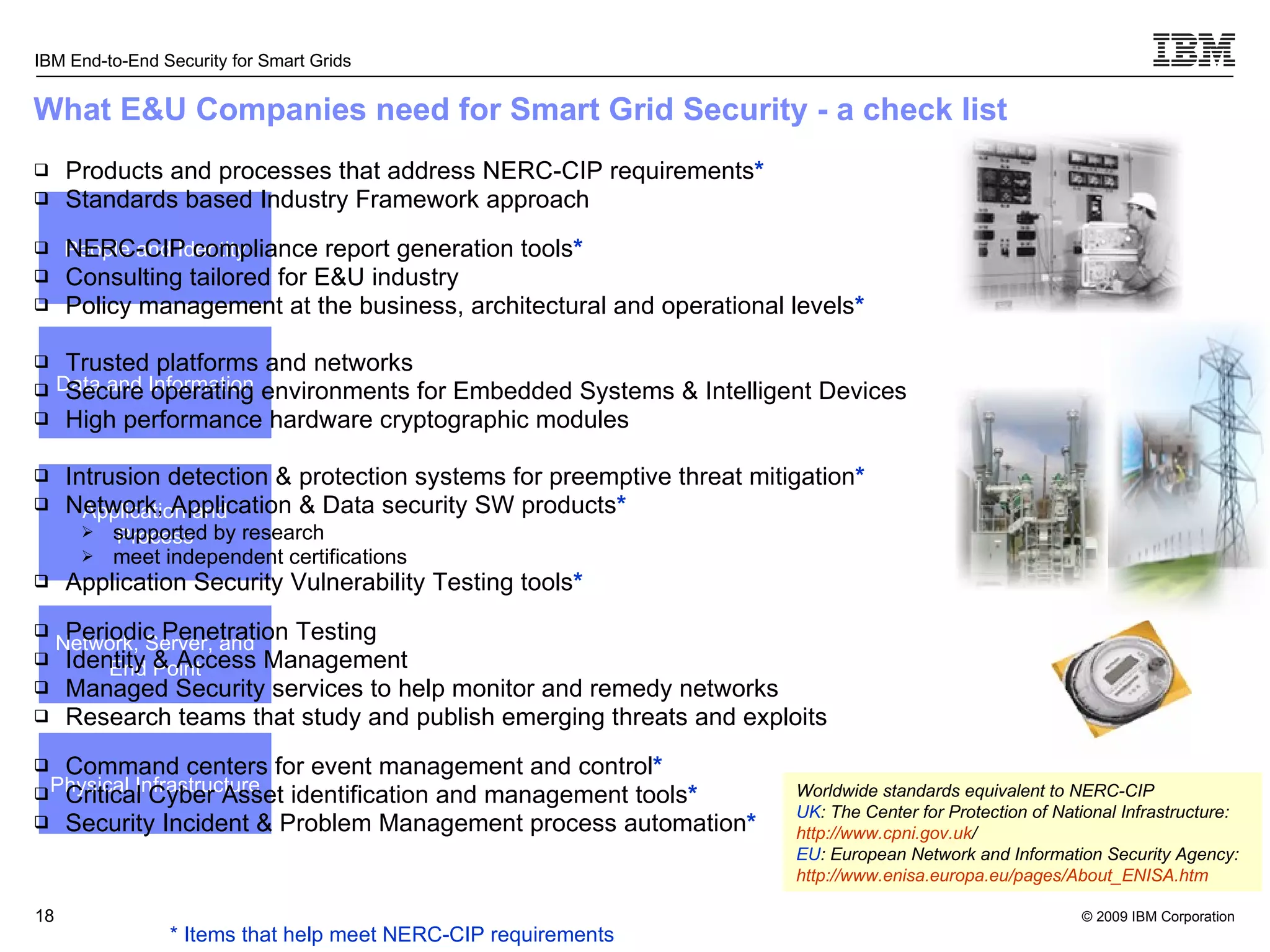
What E&U Companies need for Smart Grid Security - a check list Products and processes that address NERC-CIP requirements * Standards based Industry Framework approach NERC-CIP compliance report generation tools * Consulting tailored for E&U industry Policy management at the business, architectural and operational levels * Trusted platforms and networks Secure operating environments for Embedded Systems & Intelligent Devices High performance hardware cryptographic modules Intrusion detection & protection systems for preemptive threat mitigation * Network, Application & Data security SW products *   supported by research meet independent certifications Application Security Vulnerability Testing tools * Periodic Penetration Testing Identity & Access Management Managed Security services to help monitor and remedy networks Research teams that study and publish emerging threats and exploits Command centers for event management and control * Critical Cyber Asset identification and management tools * Security Incident & Problem Management process automation * N etwork, Server, and End Point P hysical Infrastructure P eople and Identity D ata and Information A pplication and Process * Items that help meet NERC-CIP requirements Worldwide standards equivalent to NERC-CIP UK : The Center for Protection of National Infrastructure:  http:// www.cpni.gov.uk /   EU : European Network and Information Security Agency:  http:// www.enisa.europa.eu/pages/About_ENISA.htm
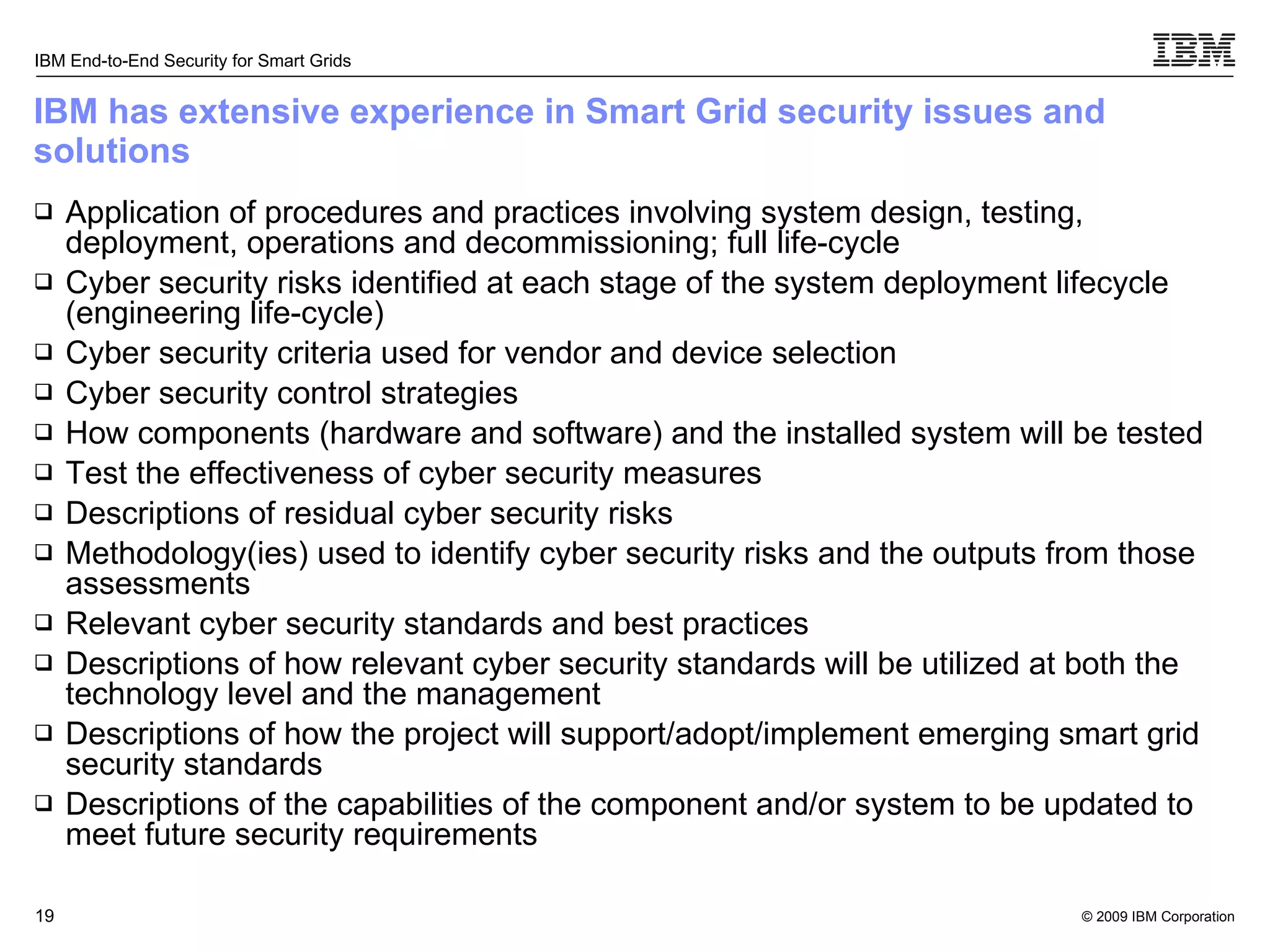
IBM has extensive experience in Smart Grid security issues and solutions Application of procedures and practices involving system design, testing, deployment, operations and decommissioning; full life-cycle Cyber security risks identified at each stage of the system deployment lifecycle (engineering life-cycle) Cyber security criteria used for vendor and device selection Cyber security control strategies How components (hardware and software) and the installed system will be tested  Test the effectiveness of cyber security measures Descriptions of residual cyber security risks Methodology(ies) used to identify cyber security risks and the outputs from those assessments Relevant cyber security standards and best practices Descriptions of how relevant cyber security standards will be utilized at both the technology level and the management  Descriptions of how the project will support/adopt/implement emerging smart grid security standards Descriptions of the capabilities of the component and/or system to be updated to meet future security requirements
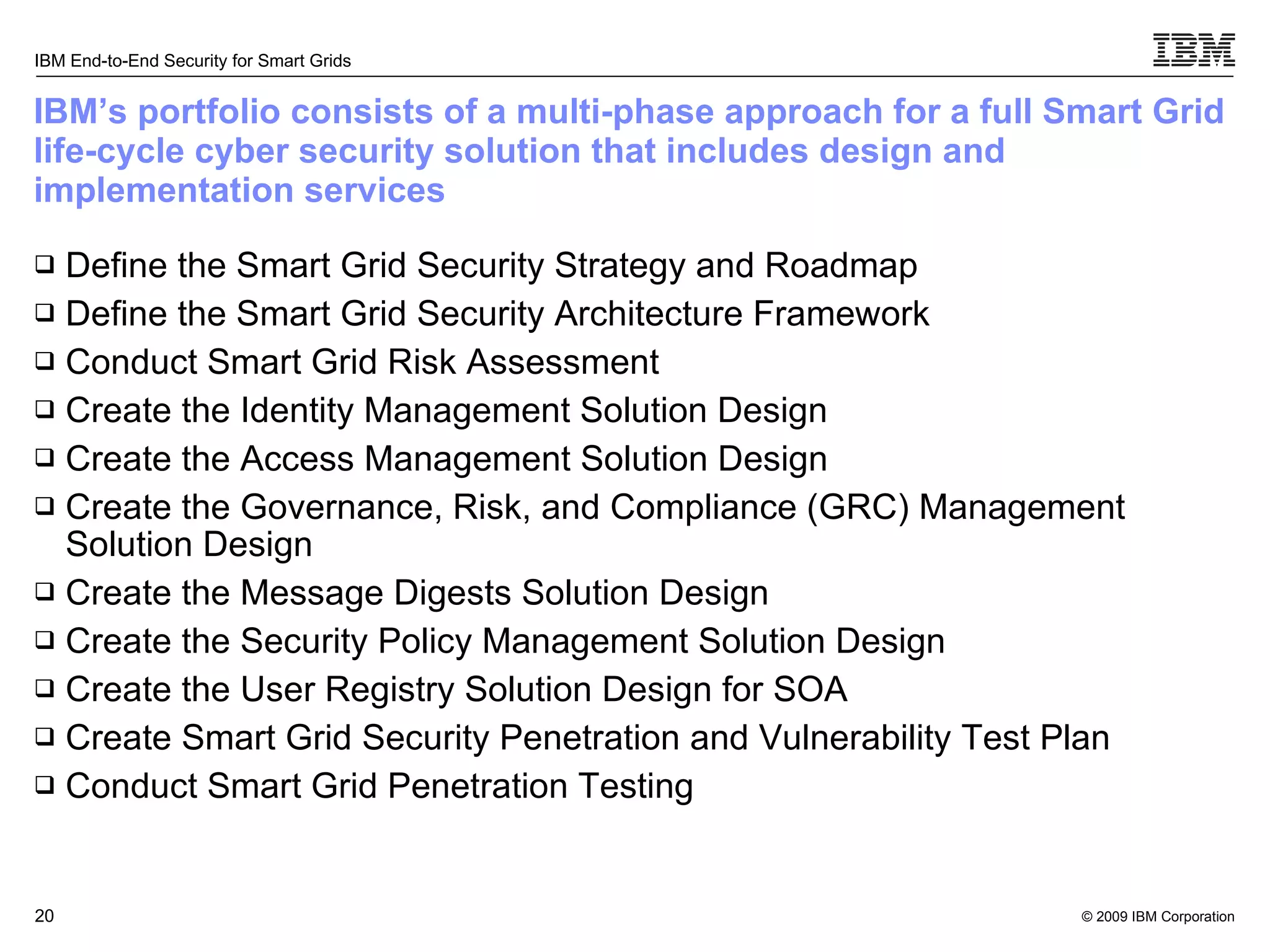
IBM’s portfolio consists of a multi-phase approach for a full Smart Grid life-cycle cyber security solution that includes design and implementation services Define the Smart Grid Security Strategy and Roadmap  Define the Smart Grid Security Architecture Framework  Conduct Smart Grid Risk Assessment Create the Identity Management Solution Design Create the Access Management Solution Design Create the Governance, Risk, and Compliance (GRC) Management Solution Design Create the Message Digests Solution Design Create the Security Policy Management Solution Design Create the User Registry Solution Design for SOA Create Smart Grid Security Penetration and Vulnerability Test Plan Conduct Smart Grid Penetration Testing
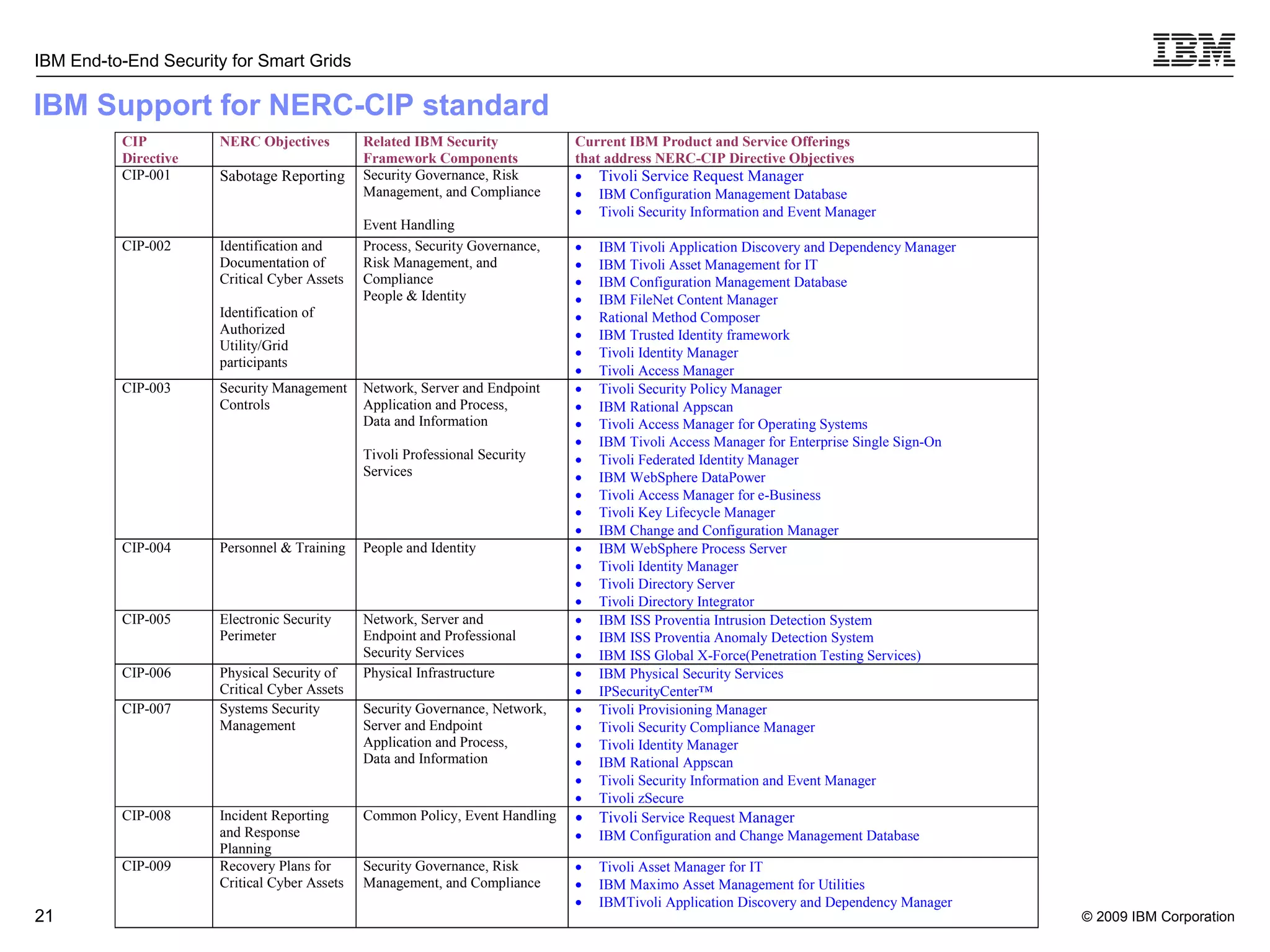
IBM Support for NERC-CIP standard
 

02 ibm security for smart grids

  • 1.
    IBM End-to-End Security for Smart Grids Più energia alla Sicurezza 1 Dicembre, 2010
  • 2.
    What is involvedin a smarter energy infrastructure? Electric Meters In-Home displays Personal Computers Load Control Devices Smart Appliances Handheld Data Devices Gas Meters Water Meters Electric Vehicles Outlets Solar Panels Reclosers Condition Sensors Voltage Controllers Switches Substation & Grid Devices Smart Meters In-home Devices Ruggedised Laptops Mobile Devices Distributed Resources Cell Phones Wind Turbines Home Area Network Neighborhood Network Access Network Backhaul Network Extranet Office Network 1. Smart, Connected Devices 2. Integrated Communication Networks 3. System Integration Platform 4. Applications & Analytics Servers EMS System and Network Management DMS MDMS Meter Data Collection Load Control GIS Network Analytics OMS Asset Management CIS Call Management Storage and Backup Business Process Management Computing Infrastructure Application Integration WMS CHP Systems Management Security Management Messaging & Web Services Instrumented Interconnected Intelligent 5. Presentation Employee Portal/Dashboard Field Employee Mobile Devices Display Device Interface Customer Mobile Devices Customer Web Paper Bills Energy Storage
  • 3.
    A smart gridneeds security enforcement at multiple points IP addressability and use of open standard protocols for the control grid necessitates it to be securely protected at multiple points Pike Research forecasts smart grid cyber security sector will increase from $1.2 billion in 2009 to $3.7 billion by 2015
  • 4.
    Security Concerns ina Smart Grid Metering Data Access Control Privacy of Customer PII data Audit/Compliance of policy changes Data Integrity Multi-tenant access to gas/ water data Third party service provider access to data for energy management Log user activity and operations Compliance Reporting Control Network Segregation Communications Security Integrity of command-n-control between MTU-RTU, MTU-PLC and HMI applications. Cryptographic Key management Adequate authentication strength Hardened platforms in control room Secure Provisioning for embedded systems Access Control Policy Identity management for SCADA HMI Physical security linked with Cyber Security NERC-CIP Compliance Managing trust across domains Managing username / passwords/ certification for third party service providers, contract workers NERC-CIP * compliance NERC = North American Electric Reliability Council CIP= Critical Infrastructure Protection or equivalents like CPNI, ENISA ENISA European Network and Information Security Agency Meter Data Integrity Secure Meter Provisioning Meter Tampering Secure Home Area Network
  • 5.
    Information Sharing Componentsin a Smart Grid Source: NIST Smart Grid Framework 1.0 NIST = National Institute of Standard & Technology Colored lines denote domain changes
  • 6.
    Utilities have lotsof legacy and new software to secure
  • 7.
    Some widespread vulnerabilitytypes in software Buffer overflows Format string vulnerabilities Race conditions Resource leaks Input/ Output validation and encoding errors SQL injection Cross-site scripting Cross-site request forgery OS injection Error handling and logging vulnerabilities Insecure error handling Insecure or inadequate logging Native code loading Data storage vulnerability Insecure Components Malicious Code Unsafe native methods Unsupported methods Custom Cookies/ hidden fields Cryptography Network communication Application configuration Access control Database and file system use Dynamic code Access control and authentication errors Coding Mistakes Configuration, Policy and Design Flaws
  • 8.
    Many factors shapethe degree and nature of the risk; there are multiple scenarios to plan for External Threat Insider Threat Inadvertent Deliberate Malware Denial of service Sophisticated, organized attacks Natural disasters Economic upheaval Unpatched systems Code vulnerability Lack of change control Human errors Developer-created back door Information theft Insider fraud Stuxnet Wikileaks
  • 9.
    Technical knowledge requiredfor cyber attacks Source: PlantData Technologies
  • 10.
    Potential Impact ofa Breach to Power Control Systems Could Be Severe Personal injury Serious disruption to national critical infrastructure Loss of system availability Process interruption Equipment damage Asset mis-configuration Data Loss Penalties resulting from regulatory violations Loss of public trust
  • 11.
    Dependency matrix ofcritical infrastructures (source Terna)
  • 12.
    Evolution of ElectricUtility Risks PAST HARD-WIRED CONTROL PRESENT SCADA / RF ENABLED NEAR FUTURE SMART GRID / RF PERVASIVE Financial pressure to reduce staffing; Computerization and RF control become common Project excellence not always followed by outstanding security operations SCADA hacking can cause damage to neighborhoods and equipment Uncertain regulatory, audit, and liability landscape Control inside-the-home of all appliances Wide use of 802.x, ZigBee, X10 methodologies Uncertain Software Provenance, Packages Increased organized crime / terrorist focus Potential for damage to, and “net” theft by everyone Revenue/Risk asymmetry for each customer RF transition to IP and Windows “Monoculture” Increased public and regulatory scrutiny Most controls are “hard wired” AND require manual intervention Lesser public availability of RF devices Little capability for damage to or financial benefit from RF attacks Cost-plus charging – “If we need it, we’ll do it! If we can’t do it, we’ll buy it!” Clear regulatory and financial landscape
  • 13.
    Our Lessons Learnedfrom the Cyber Security Front Focus points Perimeter defense alone is probably not enough RF devices require additional security consideration It is not just keeping the ‘bad guys’ out, it is making the internal systems less vulnerable Points of View Security is risk management- thus it is a business problem, not just a technical problem Security overlaps reliability Security is part of the phase one design Projects have schedules and budgets – hackers have no such constraints – thus periodic testing is required Do not overlook physical security and think only of cyber Technology Implications Some IP enabled devices can benefit from IT systems methods Correlating suspicious activity from all inputs is part of the detection methodology Chain rule – security is only as strong as its weakest link Aspects of security involve privacy issues If it has a computer in it, then the security of it must be evaluated Platforms must be secure too, not just components If we know we can't practically defend against Stuxnet or its spawn, what is our approach? Giving up is not an option. " Roll with the punch " may end up being a viable strategy. How could we design control systems, or other IT environments for that matter, to be resilient enough to take a potential knock out punch and yet be able to come back up swinging? In the end, can we optimize our investment by planning to take the punch rather than futilely hiding from it ?
  • 14.
    Gartner research: “Evolving Cybersecurity Issues in the Utility Industry” 20/08/2010 “ Utilities need to assess the risks and make good decisions over which controls are reasonable and appropriate for their situation”
  • 15.
    Enterprise IT systemsare increasingly becoming integrated with a broader set of operational technologies (OT). IT and OT will continue to become more entwined in terms of both technology and management Source: Gartner Market Insight: Utilities Industry Primer, 2010 19 August 2010
  • 16.
    IBM Research forSmarter Energy leverages three approaches to add value to our clients. Solution-driven strategy Smart grid enablement Intelligent buildings and green data centers Photovoltaics (PV) Battery storage for electric vehicle (EV) Chip and server systems power management Joint research and pilots Regional demonstrations National labs Universities Industry and client partners, technology consortia Smart grids, batteries, plug-In vehicles Committees and standards Department of Energy GridWise Architecture Council National Institute of Standards and Technology (NIST) smart grid working groups International Organization ISO1, IEC2, IEEE3
  • 17.
    IBM is drivingindustry transformation through its active leadership in key industry organizations. Chair, GridWise Alliance Chair, GridWise Architecture Council Chair-Elect, Architecture Committee for NIST 1 Smart Grid Interoperability Panel Member, US DOE 2 Electricity Advisory Committee Sub-committee Chair, Smart Grid, Electricity Advisory Committee Member, IEC 3 Technical Committee 8 on System Issues in Electric Grid Member, ISO 4 /IEC JTC 5 1/SC 25 Working Group Member, IEC 57 Working Group 8 on Distribution Management Chair-Elect, IEC 61968 Part 6 Standards Stream Vice Chairman, World Energy Council Interconnectivity Working Group Member, UCA 6 International Users Group including OpenHAN, OpenAMI, Common Information Model and IEC61850 Member, OASIS 7 Energy Management Information Exchange and Energy Interoperation Technical Committees NIST 8 GridWise Architecture Council GridWise Electricity Advisory Committee UCA International Users Group ISO IEC World Energy Council Interconnectivity Working Group OASIS 9 IEEE 11 UTC 10
  • 18.
    What E&U Companiesneed for Smart Grid Security - a check list Products and processes that address NERC-CIP requirements * Standards based Industry Framework approach NERC-CIP compliance report generation tools * Consulting tailored for E&U industry Policy management at the business, architectural and operational levels * Trusted platforms and networks Secure operating environments for Embedded Systems & Intelligent Devices High performance hardware cryptographic modules Intrusion detection & protection systems for preemptive threat mitigation * Network, Application & Data security SW products * supported by research meet independent certifications Application Security Vulnerability Testing tools * Periodic Penetration Testing Identity & Access Management Managed Security services to help monitor and remedy networks Research teams that study and publish emerging threats and exploits Command centers for event management and control * Critical Cyber Asset identification and management tools * Security Incident & Problem Management process automation * N etwork, Server, and End Point P hysical Infrastructure P eople and Identity D ata and Information A pplication and Process * Items that help meet NERC-CIP requirements Worldwide standards equivalent to NERC-CIP UK : The Center for Protection of National Infrastructure: http:// www.cpni.gov.uk /   EU : European Network and Information Security Agency: http:// www.enisa.europa.eu/pages/About_ENISA.htm
  • 19.
    IBM has extensiveexperience in Smart Grid security issues and solutions Application of procedures and practices involving system design, testing, deployment, operations and decommissioning; full life-cycle Cyber security risks identified at each stage of the system deployment lifecycle (engineering life-cycle) Cyber security criteria used for vendor and device selection Cyber security control strategies How components (hardware and software) and the installed system will be tested Test the effectiveness of cyber security measures Descriptions of residual cyber security risks Methodology(ies) used to identify cyber security risks and the outputs from those assessments Relevant cyber security standards and best practices Descriptions of how relevant cyber security standards will be utilized at both the technology level and the management Descriptions of how the project will support/adopt/implement emerging smart grid security standards Descriptions of the capabilities of the component and/or system to be updated to meet future security requirements
  • 20.
    IBM’s portfolio consistsof a multi-phase approach for a full Smart Grid life-cycle cyber security solution that includes design and implementation services Define the Smart Grid Security Strategy and Roadmap Define the Smart Grid Security Architecture Framework Conduct Smart Grid Risk Assessment Create the Identity Management Solution Design Create the Access Management Solution Design Create the Governance, Risk, and Compliance (GRC) Management Solution Design Create the Message Digests Solution Design Create the Security Policy Management Solution Design Create the User Registry Solution Design for SOA Create Smart Grid Security Penetration and Vulnerability Test Plan Conduct Smart Grid Penetration Testing
  • 21.
    IBM Support forNERC-CIP standard
  • 22.

Editor's Notes

  • #2 Germany could soon be confronted with a problem: they will have too much solar power, unadapted to their lifestyle. The electric grid, designed for times that had far less consumers and producers than they are now, will ultimately come to an overload, says Stephan Köhler, head of DENA, Germany’s energy agency, to the Berliner Zeitung on Oct. 17. Questo articolo spiega bene il problema; in sostanza il modello tradizionale, che si basa su una modulazione della produzione in funzione della richiesta, con le rinnovabili, intermittenti e non modulabili a piacere, non funziona. http://www.germanenergyblog.de/?p=4293 In effetti in Germania si parla di 30 GW da solare per fine 2011, mentre noi in Italia a fine 2009 eravamo ancora ad 1 GW (però abbiamo una potenza installata di circa 5 GW da eolico, che producono circa il 2% del totale di energia consumata in Italia). Quindi noi sembriamo ancora lontani dal problema tedesco, ma è interessante la seguente considerazione sul bilancio fra solare ed eolico a livello di sistema europeo e non solo nazionale: A smart, long-term solution, comes from Tim Nuthall, from the European Climate Foundation in Brussels, Belgium, who says that “ in Europe, you need a grid that balances the sun in the south with the wind in the north .” And he may be right. Denmark, for example, is a perfect recipient for the solar power produced in Germany or Italy , and their wind (which is much more than they need) is perfectly suited for generating energy for the Germans or some other southern countries. REMUNERAZIONE DEGLI INVESTIMENTI STRATEGICI (2008-2012) Remunerazione aggiuntivagarantitaper 8-12 anniper nuoviinvestimentimiratia: – Ridurrele congestionisullareteditrasmissione – Modernizzarelereti di distribuzione • La remunerazione complessivadegliinvestimentistrategicièattualmente tra il 9% -10% in termini reali prima delle tasse
  • #3 Intelligent, Connected Digital Devices New devices and enhancements to existing devices for a variety of applications Embedded Software Integrated Communications network Integrated, IP-based network segments that parallel the electricity networking connecting in the home, the neighborhood, and up the distribution and transmission network Using a variety of technologies and networking standards Applications New applications and updates to traditional legacy systems that recognize and take advantage of the smart grid Integration platform ESB, infrastructure that ties it all together Lo sviluppo delle Smart Grid porterà all’introduzione di milioni di nuovi componenti intelligenti nelle infrastrutture che presidiano l’erogazione dell’energia Le comunicazioni tra questi elementi saranno di tipo evoluto (bi-direzionalità, protocolli aperti) Questa evoluzione apre nuovi fronti per la sicurezza: La protezione dell’infrastruttura critica per l’economia e le nazioni La tutela della privacy (la conoscenza dei profili di consumo energetici può rivelare le attività personali)
  • #4 IBM End-to-end security for Smart Grids Building blocks of Smart Grid include: ● Advanced Metering Infrastructure (AMI) ● The power grid ● Communications and information infrastructure ● Transmission and distribution control & automation ● Distributed and renewable generation ● Distributed Control Systems or SCADA (Supervisory Control and Data Acquisition) ● Home area networks for appliance management ● Electric vehicle refueling infrastructure - Protecting the Smart Grid is not like protecting a traditional IT data center Widely dispersed sensors remote from data center are more susceptible to attacks (for example: remote station managers in substations reporting on temperatures, oil pressures in transformers, switchgear) Involves heterogeneous technologies and proprietary protocols between sensors and devices, non-carrier class communication, and control points that are not always standardized and secure. (Meters and concentrators often use loosely secured proprietary protocols). Endpoints often built in embedded systems with non-traditional OS, where normal security functions may not exist (example: SCADA systems endpoints like PLCs, RTUs, concentrators) Cost-conscious endpoint vendors often cut corners for security (for example: factory-set cryptographic keys in electric meters) In summary, end to end security for the Smart Grid involves multiple touch points in protecting a variety of endpoints, interfaces, networks, applications, and data to ensure we make the end to end system robust and impervious to attacks. A variety of technologies, scenarios come into play in protecting this space.
  • #7 Why software security for Smart Grid systems Utilities’ legacy apps (IT and operational) have been getting the job done for decades, however ... Smart Grid functionality requires updates to legacy and whole new classes of applications linked to legacy For utilities, ensuring this new code* is developed, deployed and integrated free of severe security vulnerabilities is now a critical responsibility *The responsibility for the security of acquired COTS Smart Grid software ultimately falls upon the utilities who purchase and deploy it.
  • #8 Software you already made or bought Identify it Prioritize it Probe it Analyze it Protect it Fix it (if you can) Rinse and repeat whenever it changes Software you’re going to make (or have made for your org) Spec it Develop it securely and test it Deploy it Rinse and repeat whenever it changes COTS software you’re going to buy What is and is not acceptable to you What to ask vendor re: security during development and in ongoing releases Can you protect it with systems already in place Software security strategies depend on origin
  • #13 So, in the ‘old days’ (Pre-1990) the big RF “worry” was a rogue dispatcher on the utility’s truck frequency. Now, SCADA is quite vulnerable. But SCADA is generally a “bulk” control via RF. For Smart Grid, one could conceptually not only turn off the power to a house, but could turn on the power or a device IN a house.
  • #16 IBM Confidential
  • #17 1 International Organization for Standardization 2 International Electrotechnical Commission (IEC) 3 Institute of Electric and Electronics Engineers (IEEE) For “Solution-driven energy,” “Smart grid enablement” can include: Real-world aware systems-of-systems architectures Modeling, analytics and optimization Renewable and EV integration and optimization Demand response Interoperability frameworks and messaging Cyber-physical system security Social computing Compute and storage clouds, high-performance computing (HPC) Intelligent buildings and green data centers Photovoltaics Battery storage for electric vehicle Chip and server systems power management
  • #18 1 National Institute of Standards and Technology (NIST) 2 Department of Energy (DOE) 3 International Electrotechnical Commission (IEC) 4 International Organization for Standardization (ISO) 5 Joint Technical Committee (JTE) 6 Utility Communication Architecture (UCA) 7 OASIS 8 National Institute of Standards (NIST) 9 Organization for the Advancement of Structured Information Standards (OASIS) 10 Utilities Telecom Council (UTC) 11 Institute of Electrical and Electronics Engineers (IEEE)
  • #19 IBM End-to-end security for Smart Grids NERC is North American Electric Reliability Corporation CIP is Critical Infrastructure Protection NERC-CIP 001-009 are nine compliance standards announced by NERC. Other Worldwide standards equivalent to NERC-CIP UK : The Center for Protection of National Infrastructure: http://www.cpni.gov.uk/  EU : European Network and Information Security Agency: http://www.enisa.europa.eu/pages/About_ENISA.htm List of NERC-CIP Directives NERC-001: Sabotage Reporting NERC-002: Critical Cyber Asset Identification NERC-003: Security Management Controls NERC-004: Personnel & Training NERC-005 Electronic Security Perimeter NERC-006: Physical Security of Critical Cyber assets NERC-007: Systems Security Management NERC-008: Incident Reporting and Response Planning NERC-009: Recovery Plans for Critical Cyber Assets