Cyberphysical Systems (CPS)
What Is Cyberphysical Systems?
Cyber – computation, communication, and control that are
discrete, logical, and switched.
Physical – natural and human-made systems ruled by the
laws of physics and operating in continuous time.
Cyberphysical Systems – systems in which the cyber and
physical systems are tightly integrated at all scales and
levels.
2
Cyberphysical Systems: Definition
Cyber Physical System (CPS) – is a physical object (mechanism,
device, system) that is controlled or monitored by cybernetic means
(digital, computer components, algorithms, software). At the same time,
the physical and cybernetic components closely interact in different ways
and can have different behavior patterns depending on the purpose.
Examples of cyberphysical systems are:
– unmanned mobile systems;
– autonomous aircraft;
– smart energy systems;
– robotic systems;
– industrial equipment controlled by automated control systems, etc.
CPS is often understood as digitized production facilities
The Essence of CPS
Integration of physical systems and processes with networked computing.
Computations and communications are deeply embedded in, and
interacting with physical processes to equip physical systems with new
capabilities.
Covers a wide range of scale.
"CPS will transform how we interact with the physical world just like the
Internet transformed how we interact with one another" ©
CPS are physical and engineered systems whose operations are
monitored, coordinated, controlled, and integrated.
This tight coupling between the cyber and physical is what differentiates
CPS from other fields.
4
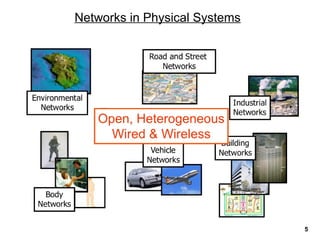
Networks in Physical Systems
5
• Cyber capability in every physical component.
• Networked at multiple and extreme scales.
• Complex at multiple temporal and spatial scales.
• Constituent elements are coupled logically and physically.
• Dynamically reorganizing/reconfiguring; “open systems”.
• High degrees of automation, control loops closed at many
scales.
• Unconventional computational & physical substances (such
as bio, nano, chem, ...)
• Operation must be dependable, certified in some cases.
CPS Characteristics
6
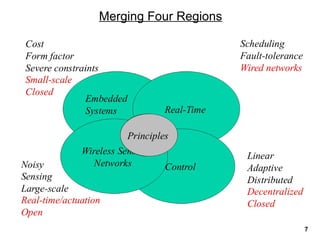
Merging Four Regions
7
The basic principles of distributed systems technology have
changed dramatically.
– New abstractions needed
– Wired => wireless
– Unlimited power => limited power
– User interface (screen/mouse) => sensors/real world
interface
– Fixedset of resources => resources are
dynamicallyadded/deleted
– Each node is important => aggregate behavior is
important
– Location unimportant => location is critical
CPS Challenges
8
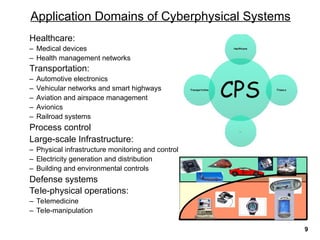
Healthcare:
– Medical devices
– Health management networks
Transportation:
– Automotive electronics
– Vehicular networks and smart highways
– Aviation and airspace management
– Avionics
– Railroad systems
Process control
Large-scale Infrastructure:
– Physical infrastructure monitoring and control
– Electricity generation and distribution
– Building and environmental controls
Defense systems
Tele-physical operations:
– Telemedicine
– Tele-manipulation
Application Domains of Cyberphysical Systems
9
• Trustworthy: should not fail (or at least gracefully degrade), and
safe to use. The existence of embedded software becomes apparent
only when an embedded system fails.
• Context- and Situation-Aware: should be able to sense people,
environment, and threats and to plan/notify/actuate responses to
provide real-time interaction with the dynamically changing physical
environment with limited resources.
• Seamless Integration: should be invisible at multiple levels of a
hierarchy: home systems, metropolitan systems, regional systems,
and national systems.
• Validation and Certification: should be able to assure that
embedded systems work correctly with respect to functional and
nonfunctional requirements with high degree of certainty.
Embedded Software: Goals
10
In recent years, there has been a gradual convergence and
interpenetration of these two technologies. Although these areas were
originally based on different concepts.
CPS arose on the basis of the concept of improvement and
development of robotic, mechatronic and embedded systems, that is,
as the spread of a cybernetic approach to physical objects and
processes in order to expand their functional capabilities.
IoT technology originates from the methods of radio frequency
identification of any objects or things and was originally used to
improve the processes of their delivery, that is, for logistics.
Internet of Things (IoT) and the CPS (1 of 2)
11
Convergence (and certain mutual substitution) of the concepts of
IoT and CPS in recent years is due to the rapid development of
microelectronics, improvement of the characteristics of digital
equipment, primarily - reduction of its weight and dimensions; dramatic
increase in productivity and reliability; reducing energy consumption
and cost.
The versatility of embedded computer systems has also greatly
increased. All these factors ensured the process of "intellectualization"
of things and expanded the possibilities of their Internet
communication. That is why more and more things are acquiring signs
of "cyberphysicality" and can support IoT technology.
Internet of Things (IoT) and the CPS (1 of 2)
12
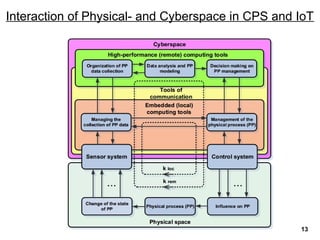
Interaction of Physical- and Cyberspace in CPS and IoT
13
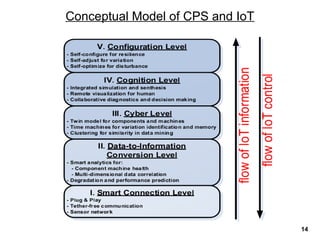
Conceptual Model of CPS and IoT
14
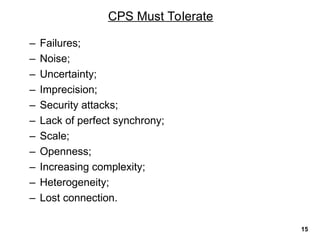
– Failures;
– Noise;
– Uncertainty;
– Imprecision;
– Security attacks;
– Lack of perfect synchrony;
– Scale;
– Openness;
– Increasing complexity;
– Heterogeneity;
– Lost connection.
CPS Must Tolerate
15
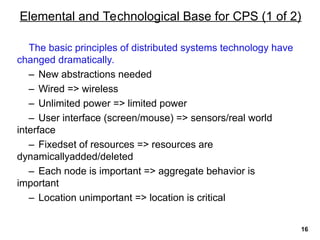
The basic principles of distributed systems technology have
changed dramatically.
– New abstractions needed
– Wired => wireless
– Unlimited power => limited power
– User interface (screen/mouse) => sensors/real world
interface
– Fixedset of resources => resources are
dynamicallyadded/deleted
– Each node is important => aggregate behavior is
important
– Location unimportant => location is critical
Elemental and Technological Base for CPS (1 of 2)
16
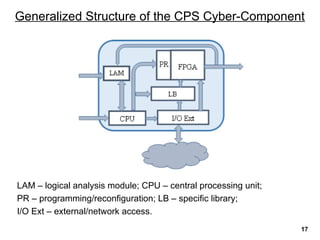
Generalized Structure of the CPS Cyber-Component
17
LAM – logical analysis module; CPU – central processing unit;
PR – programming/reconfiguration; LB – specific library;
I/O Ext – external/network access.
The modern development of CPS and IoT technologies is primarily
due to the achievements of microelectronics in the element base
development of computer technology.
Increasing the bit capacity of processors, increasing their speed
performance and miniaturizing sizes allows transferring high-
performance computing technologies from supercomputers to
microprocessors.
The development of micro technologies and the creation of:
– programmable logic structures FPGA;
– systems on a chip (SoC);
– solid-state SSD memory modules;
– improved ARM architecture of microprocessors
made it possible to implement high-grade high-performance computer
systems in the form of micromodules for embedded systems.
Elemental and Technological Base for CPS and IoT
18
• Near-zero automotive traffic fatalities, injuries minimized, and
significantly reduced traffic congestion and delays
• Blackout-free electricity generation and distribution
• 24/7 life assistants for busy, older or disabled people
• Extreme-yield agriculture
• Energy-aware buildings
• Location-independent access to world-class medicine
• Physical critical infrastructure that calls for preventive maintenance
• Self-correcting and self-certifying cyberphysical systems for “one-off”
applications
• Reduce testing and integration time and costs of complex CPS
systems by one to two orders of magnitude
Societal Impact
19
LECTURE presentation on Cyber-Physical Systems

  • 1.
  • 2.
    What Is CyberphysicalSystems? Cyber – computation, communication, and control that are discrete, logical, and switched. Physical – natural and human-made systems ruled by the laws of physics and operating in continuous time. Cyberphysical Systems – systems in which the cyber and physical systems are tightly integrated at all scales and levels. 2
  • 3.
    Cyberphysical Systems: Definition CyberPhysical System (CPS) – is a physical object (mechanism, device, system) that is controlled or monitored by cybernetic means (digital, computer components, algorithms, software). At the same time, the physical and cybernetic components closely interact in different ways and can have different behavior patterns depending on the purpose. Examples of cyberphysical systems are: – unmanned mobile systems; – autonomous aircraft; – smart energy systems; – robotic systems; – industrial equipment controlled by automated control systems, etc. CPS is often understood as digitized production facilities
  • 4.
    The Essence ofCPS Integration of physical systems and processes with networked computing. Computations and communications are deeply embedded in, and interacting with physical processes to equip physical systems with new capabilities. Covers a wide range of scale. "CPS will transform how we interact with the physical world just like the Internet transformed how we interact with one another" © CPS are physical and engineered systems whose operations are monitored, coordinated, controlled, and integrated. This tight coupling between the cyber and physical is what differentiates CPS from other fields. 4
  • 5.
  • 6.
    • Cyber capabilityin every physical component. • Networked at multiple and extreme scales. • Complex at multiple temporal and spatial scales. • Constituent elements are coupled logically and physically. • Dynamically reorganizing/reconfiguring; “open systems”. • High degrees of automation, control loops closed at many scales. • Unconventional computational & physical substances (such as bio, nano, chem, ...) • Operation must be dependable, certified in some cases. CPS Characteristics 6
  • 7.
  • 8.
    The basic principlesof distributed systems technology have changed dramatically. – New abstractions needed – Wired => wireless – Unlimited power => limited power – User interface (screen/mouse) => sensors/real world interface – Fixedset of resources => resources are dynamicallyadded/deleted – Each node is important => aggregate behavior is important – Location unimportant => location is critical CPS Challenges 8
  • 9.
    Healthcare: – Medical devices –Health management networks Transportation: – Automotive electronics – Vehicular networks and smart highways – Aviation and airspace management – Avionics – Railroad systems Process control Large-scale Infrastructure: – Physical infrastructure monitoring and control – Electricity generation and distribution – Building and environmental controls Defense systems Tele-physical operations: – Telemedicine – Tele-manipulation Application Domains of Cyberphysical Systems 9
  • 10.
    • Trustworthy: shouldnot fail (or at least gracefully degrade), and safe to use. The existence of embedded software becomes apparent only when an embedded system fails. • Context- and Situation-Aware: should be able to sense people, environment, and threats and to plan/notify/actuate responses to provide real-time interaction with the dynamically changing physical environment with limited resources. • Seamless Integration: should be invisible at multiple levels of a hierarchy: home systems, metropolitan systems, regional systems, and national systems. • Validation and Certification: should be able to assure that embedded systems work correctly with respect to functional and nonfunctional requirements with high degree of certainty. Embedded Software: Goals 10
  • 11.
    In recent years,there has been a gradual convergence and interpenetration of these two technologies. Although these areas were originally based on different concepts. CPS arose on the basis of the concept of improvement and development of robotic, mechatronic and embedded systems, that is, as the spread of a cybernetic approach to physical objects and processes in order to expand their functional capabilities. IoT technology originates from the methods of radio frequency identification of any objects or things and was originally used to improve the processes of their delivery, that is, for logistics. Internet of Things (IoT) and the CPS (1 of 2) 11
  • 12.
    Convergence (and certainmutual substitution) of the concepts of IoT and CPS in recent years is due to the rapid development of microelectronics, improvement of the characteristics of digital equipment, primarily - reduction of its weight and dimensions; dramatic increase in productivity and reliability; reducing energy consumption and cost. The versatility of embedded computer systems has also greatly increased. All these factors ensured the process of "intellectualization" of things and expanded the possibilities of their Internet communication. That is why more and more things are acquiring signs of "cyberphysicality" and can support IoT technology. Internet of Things (IoT) and the CPS (1 of 2) 12
  • 13.
    Interaction of Physical-and Cyberspace in CPS and IoT 13
  • 14.
    Conceptual Model ofCPS and IoT 14
  • 15.
    – Failures; – Noise; –Uncertainty; – Imprecision; – Security attacks; – Lack of perfect synchrony; – Scale; – Openness; – Increasing complexity; – Heterogeneity; – Lost connection. CPS Must Tolerate 15
  • 16.
    The basic principlesof distributed systems technology have changed dramatically. – New abstractions needed – Wired => wireless – Unlimited power => limited power – User interface (screen/mouse) => sensors/real world interface – Fixedset of resources => resources are dynamicallyadded/deleted – Each node is important => aggregate behavior is important – Location unimportant => location is critical Elemental and Technological Base for CPS (1 of 2) 16
  • 17.
    Generalized Structure ofthe CPS Cyber-Component 17 LAM – logical analysis module; CPU – central processing unit; PR – programming/reconfiguration; LB – specific library; I/O Ext – external/network access.
  • 18.
    The modern developmentof CPS and IoT technologies is primarily due to the achievements of microelectronics in the element base development of computer technology. Increasing the bit capacity of processors, increasing their speed performance and miniaturizing sizes allows transferring high- performance computing technologies from supercomputers to microprocessors. The development of micro technologies and the creation of: – programmable logic structures FPGA; – systems on a chip (SoC); – solid-state SSD memory modules; – improved ARM architecture of microprocessors made it possible to implement high-grade high-performance computer systems in the form of micromodules for embedded systems. Elemental and Technological Base for CPS and IoT 18
  • 19.
    • Near-zero automotivetraffic fatalities, injuries minimized, and significantly reduced traffic congestion and delays • Blackout-free electricity generation and distribution • 24/7 life assistants for busy, older or disabled people • Extreme-yield agriculture • Energy-aware buildings • Location-independent access to world-class medicine • Physical critical infrastructure that calls for preventive maintenance • Self-correcting and self-certifying cyberphysical systems for “one-off” applications • Reduce testing and integration time and costs of complex CPS systems by one to two orders of magnitude Societal Impact 19