Cyber wars & Cyber terrorism
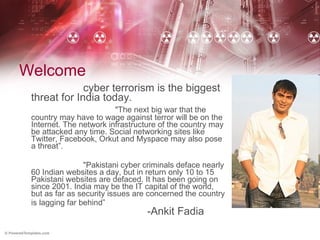
Welcome cyber terrorism is the biggest threat for India today.   "The next big war that the country may have to wage against terror will be on the Internet. The network infrastructure of the country may be attacked any time. Social networking sites like Twitter, Facebook, Orkut and Myspace may also pose a threat”. "Pakistani cyber criminals deface nearly 60 Indian websites a day, but in return only 10 to 15 Pakistani websites are defaced. It has been going on since 2001. India may be the IT capital of the world, but as far as security issues are concerned the country is lagging far behind” -Ankit Fadia
Cyber Terrorism Defined The use of computing resources to intimidate, coerce or harm people, places or systems we depend upon “ Hacking” with a body count Section 66F
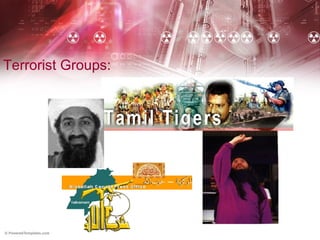
Terrorist Groups:
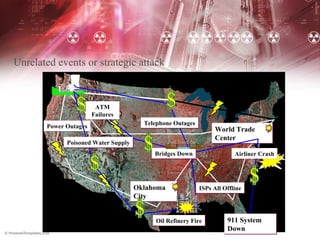
Unrelated events or strategic attack Power Outages World Trade Center Oklahoma City ATM Failures Airliner Crash Bridges Down ISPs All Offline Oil Refinery Fire 911 System Down Poisoned Water Supply Telephone Outages
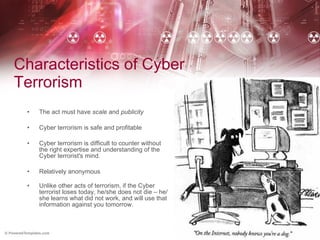
Characteristics of Cyber Terrorism The act must have  scale  and  publicity Cyber terrorism is safe and profitable Cyber terrorism is difficult to counter without the right expertise and understanding of the Cyber terrorist's mind. Relatively anonymous Unlike other acts of terrorism, if the Cyber terrorist loses today, he/she does not die – he/she learns what did not work, and will use that information against you tomorrow.
Cyber warriors The Cyber Terrorist will make certain that the population of a nation will not be able to eat, to drink, to move, or to live. The people charged with the protection of their nation will not have warning, and will not be able to shut down the terrorist, since that Cyber Terrorist is relatively hard to locate and could be on the other side of the world or sitting at a personal computer in your public library.
Psychology of Modern Warfare and Hacking For Fun (31.4%) Want to be best defacer (17.2%) No reason Specified (14.7%) Political Reasons (11.8%) Patriotism (10.9%) As a challenge (10.8%) Revenge (3.3%)
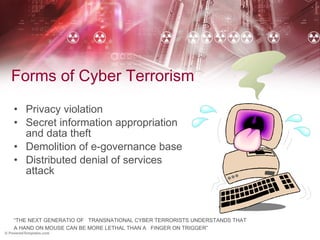
Forms of Cyber Terrorism Privacy violation  Secret information appropriation and data theft Demolition of e-governance base  Distributed denial of services attack “ THE NEXT GENERATIO OF  TRANSNATIONAL CYBER TERRORISTS UNDERSTANDS THAT  A HAND ON MOUSE CAN BE MORE LETHAL THAN A  FINGER ON TRIGGER”
 
Factors Contributing to the Existence of Cyber Terrorism  Dependence on Network Infrastructure and the Internet Lack of Understanding of Security Risks Lack of Funding for Adequate Network Security Tools Perception that the steps to combat cyber terrorism will make life inconvenient The ease and of doing the act Difficulty in tracking the Cyber terrorist
Cyber Terrorism in Action Remotely accessing the processing control systems of a cereal manufacturer, changing the levels of iron supplement, and sicken and kill the children of a nation enjoying their food. That Cyber Terrorist will then perform similar remote alterations at a processor of infant formula. Morningstar Inc.'s Canadian subsidiary is being forced to spend thousands of dollars on a security audit to reassure users about the safety of its investment-research Web site after a hacker claimed that he had broken into the unit's servers and accessed confidential customer information.
Cyber terrorism in Action Disruption of banks, international financial transactions, stock exchanges; forcing a nation's economic systems to grind to a halt due to massive denial of service attacks launched on the internet Remotely changing the pressure in the gas lines, causing a valve failure, and a block of a sleepy suburb detonates and burns. Likewise, the electrical grid is becoming steadily more vulnerable.
Direct Cost Implications Loss of sales during the disruption  Staff time, network delays, intermittent access for business users  Increased insurance costs due to litigation  Loss of intellectual property - research, pricing, etc.  Costs of forensics for recovery and litigation  Loss of critical communications in time of emergency
Indirect Cost Implications Loss of confidence and credibility in our financial systems  Tarnished relationships& public image globally  Strained business partner relationships - domestic and internationally  Loss of future customer revenues for an individual or group of companies  Loss of trust in the government and computer industry
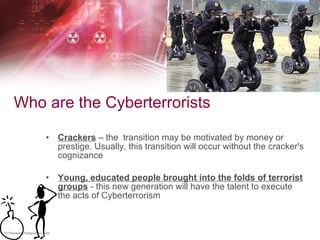
Who are the Cyberterrorists Crackers  – the  transition may be motivated by money or prestige. Usually, this transition will occur without the cracker's cognizance Young, educated people brought into the folds of terrorist groups  - this new generation will have the talent to execute the acts of Cyberterrorism
Main Weapon  Building/Office Security Desktop/Laptop Computer Security Network Security Disaster Recovery Planning   According to NASSCOM-IDC surveys the demand for ethical hackers is estimated at 7,000 in India and 188,000 worldwide currently.
What can we do? Cooperate and share intelligence among all agencies Learn the new rules, the new technologies, and the new players The tools of a counter-CyberTerrorist team  must  be real-time and dynamic, as the weapons will continually change Make building, network and desktop security a priority Report instances of cybercrime to local law enforcement agencies
Cyber History in India: First cyber attack: May 1998 Reason: Pokhran 2 Nuclear Tests Target: Bhabha Atomic Research Centre, India Responsible Group: Milworm Disclosure of sensitive mails regarding nuclear tests Website Defaced
Indian Clips : Al-Qaeda Muslim  Anti India Crew (AIC), powhack focuses on government networks  G-Force targets websites with massive readerships  Pakistan Hackerz Club (PHC) attacks the bigger names and networks, including those of large corporate houses .   Kill India and Death to India  Indo-US Joint Task Force on cyber terrorism
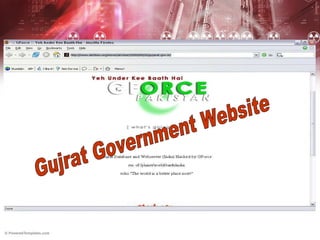
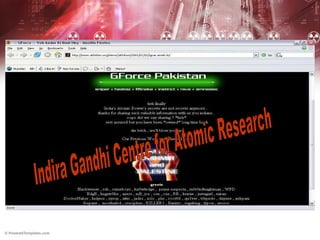
Major Targets of Pakistani Hackers Gujrat Government Ministry of External Affairs India Gandhi Centre for Atomic Research India Online Bazaar Indian National IT Promotion India Today Nuclear Science Centre  Telecommunication companies
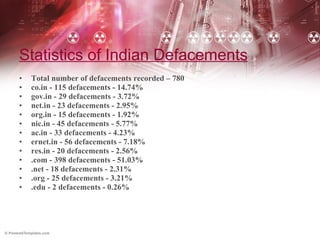
Statistics of Indian Defacements Total number of defacements recorded – 780 co.in - 115 defacements - 14.74%  gov.in - 29 defacements - 3.72% net.in - 23 defacements - 2.95% org.in - 15 defacements - 1.92% nic.in - 45 defacements - 5.77% ac.in - 33 defacements - 4.23% ernet.in - 56 defacements - 7.18% res.in - 20 defacements - 2.56%  .com - 398 defacements - 51.03%  .net - 18 defacements - 2.31%  .org - 25 defacements - 3.21%  .edu - 2 defacements - 0.26%
Gujrat Government Website
India Gandhi Centre for Atomic Research
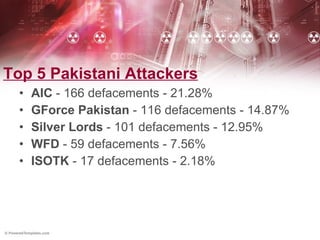
Top 5 Pakistani Attackers AIC  - 166 defacements - 21.28% GForce Pakistan  - 116 defacements - 14.87% Silver Lords  - 101 defacements - 12.95% WFD  - 59 defacements - 7.56% ISOTK  - 17 defacements - 2.18%
Formation of Pakistani Hacker Groups and their Strategies GForce Pakistan Silver Lords Pakistan Hacker Club
Objectives of Pakistani Hackers Target websites with a huge domestic audience To bring attention to violence in Kashmir Middle East conflict
Indians in Action Paralyzed Pakistani government sites for more than two months in 2003. Yaha-series viruses Damaged about 150 Pakistani websites in two days and erasing files from the hard disks of more than 3,000 corporate computers. Severe damage to Pakistan Internet Exchange and ecommerce
Indian Hackers Indian Snakes Roxx of Calcutta Cobra  Hindustan Hackers Association (H2O) Andhrahackers Indian Hackers Club Indian Spy
Strategy of Indian Hackers Using Denial of Service Attacks as their primary weapon
What are International Agencies Role in Cyber Terrorism Defense: An organization called Interpol created in 1923, is a very significant force on the international level. With its headquarters in  Lyon, France, Interpol has 178 member countries which makes it the second largest international organization only to United Nations.  Interpol serves as a link between law enforcement agencies of member countries.  It is known as the world’s police, and its mission statement is: To be the world’s pre-eminent police organization in support of all organizations, authorities, and services whose mission is preventing, detecting and suppressing crime.
International support  : Joint Working Groups India-U.S. joint working group works together to counter terrorism of all kinds.  These groups have aided in the increase of countries’ exchange of information, strengthen investigative cooperation, facilitate the signing of mutual legal assistance treaties, and accomplish several other significant anti-terrorist agreements. These groups also introduced a bilateral cyber security forum, specially focusing on cyber terrorism issues and information security
Conclusion The problem of cyber terrorism is multilateral having varied facets and dimensions.  Its solution requires rigorous application of energy and resources. It must be noted that law is always seven steps behind the technology. This is so because we have a tendency to make laws when the problem reaches at its zenith.  The enforcement of rights requires a “qualitative effort” and not a “quantitative effort”. Thus, till a law dealing expressly with cyber terrorism is enacted
Important Links on the Internet Iowa Homeland Security http://www.iowahomelandsecurity.org Federal Homeland Security www.whitehouse.gov/homeland Computer Information Advisory Capability www.ciac.org/ciac http://www.indianexpress.com/storyOld.php?storyId=3562 http://techlahore.wordpress.com/2009/11/14/wired-magazine-makes-the-case-for-cyber-war-against-pakistan-and-india/ http://propakistani.pk/2008/11/24/here-we-go-again/ http://propakistani.pk/2008/11/24/here-we-go-again/ http://www.crime-research.org/articles/Cyber_Terrorism_new_kind_Terrorism/http://www.india-server.com/news/cyber-terrorism-biggest-threat-for-16595.html
Thank You

Cyber Wars And Cyber Terrorism

  • 1.
    Cyber wars &Cyber terrorism
  • 2.
    Welcome cyber terrorismis the biggest threat for India today.   "The next big war that the country may have to wage against terror will be on the Internet. The network infrastructure of the country may be attacked any time. Social networking sites like Twitter, Facebook, Orkut and Myspace may also pose a threat”. "Pakistani cyber criminals deface nearly 60 Indian websites a day, but in return only 10 to 15 Pakistani websites are defaced. It has been going on since 2001. India may be the IT capital of the world, but as far as security issues are concerned the country is lagging far behind” -Ankit Fadia
  • 3.
    Cyber Terrorism DefinedThe use of computing resources to intimidate, coerce or harm people, places or systems we depend upon “ Hacking” with a body count Section 66F
  • 4.
  • 5.
    Unrelated events orstrategic attack Power Outages World Trade Center Oklahoma City ATM Failures Airliner Crash Bridges Down ISPs All Offline Oil Refinery Fire 911 System Down Poisoned Water Supply Telephone Outages
  • 6.
    Characteristics of CyberTerrorism The act must have scale and publicity Cyber terrorism is safe and profitable Cyber terrorism is difficult to counter without the right expertise and understanding of the Cyber terrorist's mind. Relatively anonymous Unlike other acts of terrorism, if the Cyber terrorist loses today, he/she does not die – he/she learns what did not work, and will use that information against you tomorrow.
  • 7.
    Cyber warriors TheCyber Terrorist will make certain that the population of a nation will not be able to eat, to drink, to move, or to live. The people charged with the protection of their nation will not have warning, and will not be able to shut down the terrorist, since that Cyber Terrorist is relatively hard to locate and could be on the other side of the world or sitting at a personal computer in your public library.
  • 8.
    Psychology of ModernWarfare and Hacking For Fun (31.4%) Want to be best defacer (17.2%) No reason Specified (14.7%) Political Reasons (11.8%) Patriotism (10.9%) As a challenge (10.8%) Revenge (3.3%)
  • 9.
    Forms of CyberTerrorism Privacy violation Secret information appropriation and data theft Demolition of e-governance base Distributed denial of services attack “ THE NEXT GENERATIO OF TRANSNATIONAL CYBER TERRORISTS UNDERSTANDS THAT A HAND ON MOUSE CAN BE MORE LETHAL THAN A FINGER ON TRIGGER”
  • 10.
  • 11.
    Factors Contributing tothe Existence of Cyber Terrorism Dependence on Network Infrastructure and the Internet Lack of Understanding of Security Risks Lack of Funding for Adequate Network Security Tools Perception that the steps to combat cyber terrorism will make life inconvenient The ease and of doing the act Difficulty in tracking the Cyber terrorist
  • 12.
    Cyber Terrorism inAction Remotely accessing the processing control systems of a cereal manufacturer, changing the levels of iron supplement, and sicken and kill the children of a nation enjoying their food. That Cyber Terrorist will then perform similar remote alterations at a processor of infant formula. Morningstar Inc.'s Canadian subsidiary is being forced to spend thousands of dollars on a security audit to reassure users about the safety of its investment-research Web site after a hacker claimed that he had broken into the unit's servers and accessed confidential customer information.
  • 13.
    Cyber terrorism inAction Disruption of banks, international financial transactions, stock exchanges; forcing a nation's economic systems to grind to a halt due to massive denial of service attacks launched on the internet Remotely changing the pressure in the gas lines, causing a valve failure, and a block of a sleepy suburb detonates and burns. Likewise, the electrical grid is becoming steadily more vulnerable.
  • 14.
    Direct Cost ImplicationsLoss of sales during the disruption Staff time, network delays, intermittent access for business users Increased insurance costs due to litigation Loss of intellectual property - research, pricing, etc. Costs of forensics for recovery and litigation Loss of critical communications in time of emergency
  • 15.
    Indirect Cost ImplicationsLoss of confidence and credibility in our financial systems Tarnished relationships& public image globally Strained business partner relationships - domestic and internationally Loss of future customer revenues for an individual or group of companies Loss of trust in the government and computer industry
  • 16.
    Who are theCyberterrorists Crackers – the transition may be motivated by money or prestige. Usually, this transition will occur without the cracker's cognizance Young, educated people brought into the folds of terrorist groups - this new generation will have the talent to execute the acts of Cyberterrorism
  • 17.
    Main Weapon Building/Office Security Desktop/Laptop Computer Security Network Security Disaster Recovery Planning According to NASSCOM-IDC surveys the demand for ethical hackers is estimated at 7,000 in India and 188,000 worldwide currently.
  • 18.
    What can wedo? Cooperate and share intelligence among all agencies Learn the new rules, the new technologies, and the new players The tools of a counter-CyberTerrorist team must be real-time and dynamic, as the weapons will continually change Make building, network and desktop security a priority Report instances of cybercrime to local law enforcement agencies
  • 19.
    Cyber History inIndia: First cyber attack: May 1998 Reason: Pokhran 2 Nuclear Tests Target: Bhabha Atomic Research Centre, India Responsible Group: Milworm Disclosure of sensitive mails regarding nuclear tests Website Defaced
  • 20.
    Indian Clips :Al-Qaeda Muslim Anti India Crew (AIC), powhack focuses on government networks G-Force targets websites with massive readerships Pakistan Hackerz Club (PHC) attacks the bigger names and networks, including those of large corporate houses . Kill India and Death to India Indo-US Joint Task Force on cyber terrorism
  • 21.
    Major Targets ofPakistani Hackers Gujrat Government Ministry of External Affairs India Gandhi Centre for Atomic Research India Online Bazaar Indian National IT Promotion India Today Nuclear Science Centre Telecommunication companies
  • 22.
    Statistics of IndianDefacements Total number of defacements recorded – 780 co.in - 115 defacements - 14.74% gov.in - 29 defacements - 3.72% net.in - 23 defacements - 2.95% org.in - 15 defacements - 1.92% nic.in - 45 defacements - 5.77% ac.in - 33 defacements - 4.23% ernet.in - 56 defacements - 7.18% res.in - 20 defacements - 2.56% .com - 398 defacements - 51.03% .net - 18 defacements - 2.31% .org - 25 defacements - 3.21% .edu - 2 defacements - 0.26%
  • 23.
  • 24.
    India Gandhi Centrefor Atomic Research
  • 25.
    Top 5 PakistaniAttackers AIC - 166 defacements - 21.28% GForce Pakistan - 116 defacements - 14.87% Silver Lords - 101 defacements - 12.95% WFD - 59 defacements - 7.56% ISOTK - 17 defacements - 2.18%
  • 26.
    Formation of PakistaniHacker Groups and their Strategies GForce Pakistan Silver Lords Pakistan Hacker Club
  • 27.
    Objectives of PakistaniHackers Target websites with a huge domestic audience To bring attention to violence in Kashmir Middle East conflict
  • 28.
    Indians in ActionParalyzed Pakistani government sites for more than two months in 2003. Yaha-series viruses Damaged about 150 Pakistani websites in two days and erasing files from the hard disks of more than 3,000 corporate computers. Severe damage to Pakistan Internet Exchange and ecommerce
  • 29.
    Indian Hackers IndianSnakes Roxx of Calcutta Cobra Hindustan Hackers Association (H2O) Andhrahackers Indian Hackers Club Indian Spy
  • 30.
    Strategy of IndianHackers Using Denial of Service Attacks as their primary weapon
  • 31.
    What are InternationalAgencies Role in Cyber Terrorism Defense: An organization called Interpol created in 1923, is a very significant force on the international level. With its headquarters in Lyon, France, Interpol has 178 member countries which makes it the second largest international organization only to United Nations. Interpol serves as a link between law enforcement agencies of member countries. It is known as the world’s police, and its mission statement is: To be the world’s pre-eminent police organization in support of all organizations, authorities, and services whose mission is preventing, detecting and suppressing crime.
  • 32.
    International support : Joint Working Groups India-U.S. joint working group works together to counter terrorism of all kinds. These groups have aided in the increase of countries’ exchange of information, strengthen investigative cooperation, facilitate the signing of mutual legal assistance treaties, and accomplish several other significant anti-terrorist agreements. These groups also introduced a bilateral cyber security forum, specially focusing on cyber terrorism issues and information security
  • 33.
    Conclusion The problemof cyber terrorism is multilateral having varied facets and dimensions. Its solution requires rigorous application of energy and resources. It must be noted that law is always seven steps behind the technology. This is so because we have a tendency to make laws when the problem reaches at its zenith. The enforcement of rights requires a “qualitative effort” and not a “quantitative effort”. Thus, till a law dealing expressly with cyber terrorism is enacted
  • 34.
    Important Links onthe Internet Iowa Homeland Security http://www.iowahomelandsecurity.org Federal Homeland Security www.whitehouse.gov/homeland Computer Information Advisory Capability www.ciac.org/ciac http://www.indianexpress.com/storyOld.php?storyId=3562 http://techlahore.wordpress.com/2009/11/14/wired-magazine-makes-the-case-for-cyber-war-against-pakistan-and-india/ http://propakistani.pk/2008/11/24/here-we-go-again/ http://propakistani.pk/2008/11/24/here-we-go-again/ http://www.crime-research.org/articles/Cyber_Terrorism_new_kind_Terrorism/http://www.india-server.com/news/cyber-terrorism-biggest-threat-for-16595.html
  • 35.