
Pr of .Dipes h Sh ah
Pr of .pal ak gaj j ar
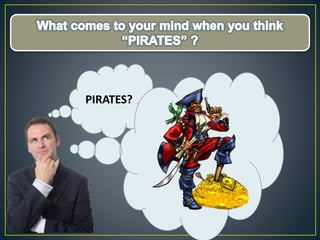
PIRATES?
PIRACY is
defined as :
“The act of
violence or
depredation on
the high seas;
also, the theft of
Intellectual
Property,
especially in
electronic media.”
Piracy is a form of copyright violation.
It includes the unauthorized use,
reproduction, and/or distribution of
material, electronic or printed, that is
covered by copyright law in a manner
that violates one of the copyright
owner’s exclusive rights.
Reproduce or copy the work for sale
(Mechanical and Distribution Rights)
Create derivative works based on the
work
Distribute copies of the work to the public
by sale, rental, lease/lending or other
transfer of ownership
Perform or display the work publicly.
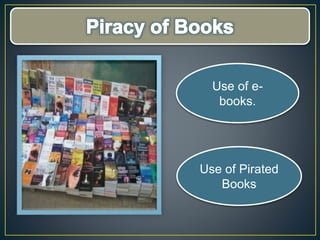
Use of e-
books.
Use of Pirated
Books
MP3
downloads
Compilations
such as
“Greatest Hits”
of any artist or
collection of a
specific genre
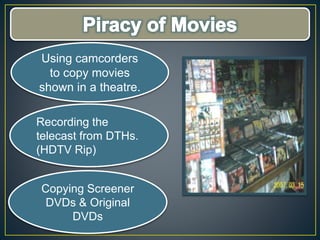
Using camcorders
to copy movies
shown in a theatre.
Recording the
telecast from DTHs.
(HDTV Rip)
Copying Screener
DVDs & Original
DVDs
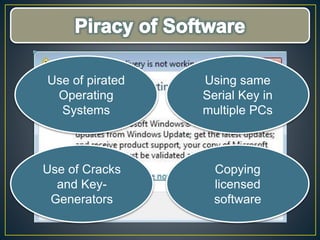
Use of Cracks
and Key-
Generators
Using same
Serial Key in
multiple PCs
Use of pirated
Operating
Systems
Copying
licensed
software
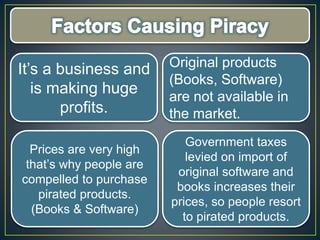
It’s a business and
is making huge
profits.
Original products
(Books, Software)
are not available in
the market.
Prices are very high
that’s why people are
compelled to purchase
pirated products.
(Books & Software)
Government taxes
levied on import of
original software and
books increases their
prices, so people resort
to pirated products.
It is a great threat to creativity of
writers, artists, etc.
It causes great losses to companies.
It costs many people their jobs.
According to a report
published in March, 2009, as
much as
Rs. 16,000 crore and 80,000
jobs are lost directly due to
International Copyright Laws and bodies like
World Intellectual Property Organization
(WIPO) help protect the original owners of
works.
Government should ban pirated products
take stringent measures to prevent piracy.
Government should also encourage
industries to produce original licensed
CYBER SECURITY (PIRACY)

CYBER SECURITY (PIRACY)

  • 1.
    Pr of .Dipesh Sh ah Pr of .pal ak gaj j ar
  • 3.
  • 4.
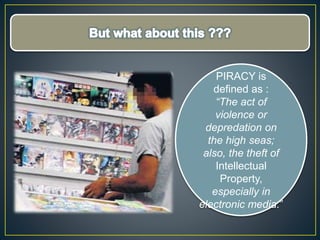
    PIRACY is defined as: “The act of violence or depredation on the high seas; also, the theft of Intellectual Property, especially in electronic media.”
  • 5.
    Piracy is aform of copyright violation. It includes the unauthorized use, reproduction, and/or distribution of material, electronic or printed, that is covered by copyright law in a manner that violates one of the copyright owner’s exclusive rights.
  • 6.
    Reproduce or copythe work for sale (Mechanical and Distribution Rights) Create derivative works based on the work Distribute copies of the work to the public by sale, rental, lease/lending or other transfer of ownership Perform or display the work publicly.
  • 7.
    Use of e- books. Useof Pirated Books
  • 8.
    MP3 downloads Compilations such as “Greatest Hits” ofany artist or collection of a specific genre
  • 9.
    Using camcorders to copymovies shown in a theatre. Recording the telecast from DTHs. (HDTV Rip) Copying Screener DVDs & Original DVDs
  • 10.
    Use of Cracks andKey- Generators Using same Serial Key in multiple PCs Use of pirated Operating Systems Copying licensed software
  • 12.
    It’s a businessand is making huge profits. Original products (Books, Software) are not available in the market. Prices are very high that’s why people are compelled to purchase pirated products. (Books & Software) Government taxes levied on import of original software and books increases their prices, so people resort to pirated products.
  • 13.
    It is agreat threat to creativity of writers, artists, etc. It causes great losses to companies. It costs many people their jobs.
  • 14.
    According to areport published in March, 2009, as much as Rs. 16,000 crore and 80,000 jobs are lost directly due to
  • 15.
    International Copyright Lawsand bodies like World Intellectual Property Organization (WIPO) help protect the original owners of works. Government should ban pirated products take stringent measures to prevent piracy. Government should also encourage industries to produce original licensed