

What is CSRF?
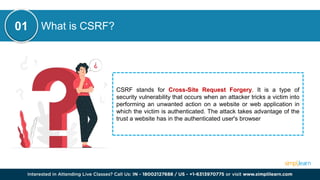
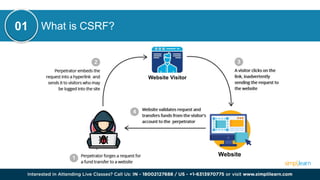
CSRF stands for Cross-Site Request Forgery. It is a type of
security vulnerability that occurs when an attacker tricks a victim into
performing an unwanted action on a website or web application in
which the victim is authenticated. The attack takes advantage of the
trust a website has in the authenticated user's browser
01
What is CSRF?
Website
Website Visitor
01
Difference between XSS and CSRF?
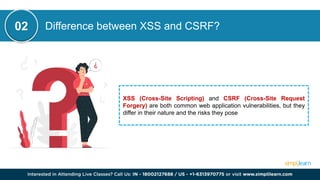
XSS (Cross-Site Scripting) and CSRF (Cross-Site Request
Forgery) are both common web application vulnerabilities, but they
differ in their nature and the risks they pose
02
Difference between XSS and CSRF?
02
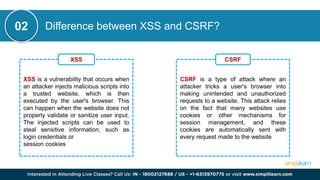
XSS is a vulnerability that occurs when
an attacker injects malicious scripts into
a trusted website, which is then
executed by the user's browser. This
can happen when the website does not
properly validate or sanitize user input.
The injected scripts can be used to
steal sensitive information, such as
login credentials or
session cookies
XSS
CSRF is a type of attack where an
attacker tricks a user's browser into
making unintended and unauthorized
requests to a website. This attack relies
on the fact that many websites use
cookies or other mechanisms for
session management, and these
cookies are automatically sent with
every request made to the website
CSRF
Is XSS Client Side Attack or Server Side Attack?
The XSS (Cross-Site Scripting) attack can occur on the client side,
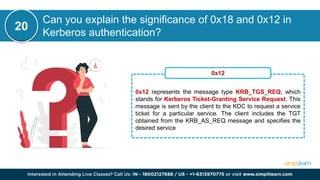
which means it targets vulnerabilities in the user's web browser or
the client application. This type of attack takes advantage of security
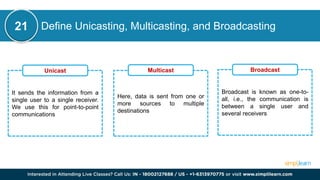
weaknesses in the client-side code, allowing an attacker to inject
malicious scripts into a trusted website or web application
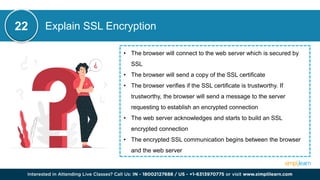
03
Is XSS Client Side Attack or Server Side Attack?
It's important to note that while XSS attacks primarily target the
client side, they can have significant consequences on the server
side as well. The injected script may interact with the server or
exploit vulnerabilities in the server-side code to perform actions on
behalf of the attacker
03
What is IOC?
In cybersecurity, IOC stands for Indicators of Compromise. These
are pieces of evidence or artifacts that suggest the presence of
malicious activity or a security breach within a system or network.
IOCs are used to identify, detect, and respond to potential security
incidents.
04
What is IOC?
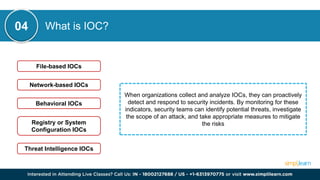
When organizations collect and analyze IOCs, they can proactively
detect and respond to security incidents. By monitoring for these
indicators, security teams can identify potential threats, investigate
the scope of an attack, and take appropriate measures to mitigate
the risks
04
File-based IOCs
Network-based IOCs
Behavioral IOCs
Registry or System
Configuration IOCs
Threat Intelligence IOCs
Can you explain the difference between Antivirus and EDR
in Cyber Security?
Antivirus and Endpoint Detection and Response (EDR) are both
important components in cybersecurity, but they serve different
purposes
05
Can you explain the difference between Antivirus and EDR
in Cyber Security?
05
• Antivirus, also known as anti-malware
software, is designed to detect, prevent, and
remove known types of malicious software,
such as viruses, worms, Trojans, and
ransomware
• It relies on signature-based detection, where it
compares the code patterns of files or
programs against a database of known
malware signatures
Antivirus
• EDR goes beyond traditional antivirus
solutions by providing real-time monitoring,
detection, and response capabilities at the
endpoint level
• EDR solutions are designed to detect and
respond to sophisticated and advanced threats
that may evade traditional antivirus software
EDR
Can you explain the difference between IPS and a Firewall
in cybersecurity?
An IPS (Intrusion Prevention System) and a Firewall are two
distinct but complementary security mechanisms
06
Can you explain the difference between IPS and a Firewall
in cybersecurity?
06
A firewall acts as a barrier between an internal
network and external networks, typically the
internet
Its primary function is to enforce access controls
and permit or deny network traffic based on
factors such as IP addresses, ports, protocols,
and application types
Firewall
An IPS is designed to detect and prevent
network-based attacks. It goes beyond the basic
access control functions of a firewall
It can detect and block unauthorized access
attempts, malware, network intrusions, and other
malicious activities
IPS
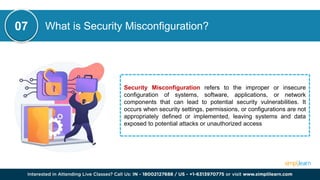
What is Security Misconfiguration?
Security Misconfiguration refers to the improper or insecure
configuration of systems, software, applications, or network
components that can lead to potential security vulnerabilities. It
occurs when security settings, permissions, or configurations are not
appropriately defined or implemented, leaving systems and data
exposed to potential attacks or unauthorized access
07
What is Security Misconfiguration?
Security Misconfiguration can take various forms, such as using
default or weak passwords, leaving unnecessary services or ports
open, not applying necessary security patches or updates,
misconfiguring access controls, or failing to implement secure
communication protocols. These misconfigurations can provide
attackers with entry points into a system, allowing them to exploit
vulnerabilities, gain unauthorized access, or carry out malicious
activities
07
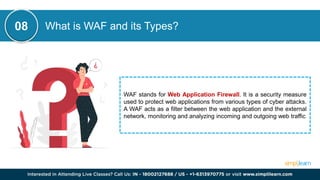
What is WAF and its Types?
WAF stands for Web Application Firewall. It is a security measure
used to protect web applications from various types of cyber attacks.
A WAF acts as a filter between the web application and the external
network, monitoring and analyzing incoming and outgoing web traffic
08
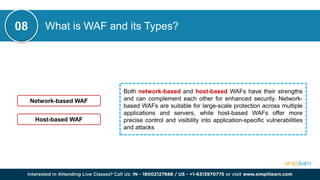
What is WAF and its Types?
Both network-based and host-based WAFs have their strengths
and can complement each other for enhanced security. Network-
based WAFs are suitable for large-scale protection across multiple
applications and servers, while host-based WAFs offer more
precise control and visibility into application-specific vulnerabilities
and attacks
08
Network-based WAF
Host-based WAF
Could you Please Explain the Difference Between Blue
Teaming and Red Teaming
Blue Teaming and Red Teaming are two distinct approaches used
in cybersecurity to enhance the overall security posture of an
organization
09
Could you Please Explain the Difference Between Blue
Teaming and Red Teaming
09
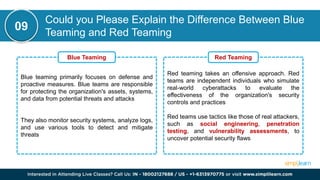
Blue teaming primarily focuses on defense and
proactive measures. Blue teams are responsible
for protecting the organization's assets, systems,
and data from potential threats and attacks
They also monitor security systems, analyze logs,
and use various tools to detect and mitigate
threats
Blue Teaming
Red teaming takes an offensive approach. Red
teams are independent individuals who simulate
real-world cyberattacks to evaluate the
effectiveness of the organization's security
controls and practices
Red teams use tactics like those of real attackers,
such as social engineering, penetration
testing, and vulnerability assessments, to
uncover potential security flaws
Red Teaming
What is false positive and false negative in case
of IDS
In the context of Intrusion Detection Systems, false positive and
false negative are two important terms used to describe the
accuracy of the system in identifying and classifying security events
10
What is false positive and false negative in case
of IDS
10
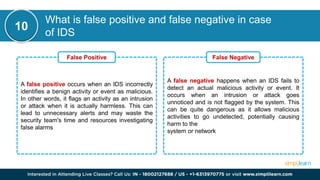
A false positive occurs when an IDS incorrectly
identifies a benign activity or event as malicious.
In other words, it flags an activity as an intrusion
or attack when it is actually harmless. This can
lead to unnecessary alerts and may waste the
security team's time and resources investigating
false alarms
False Positive
A false negative happens when an IDS fails to
detect an actual malicious activity or event. It
occurs when an intrusion or attack goes
unnoticed and is not flagged by the system. This
can be quite dangerous as it allows malicious
activities to go undetected, potentially causing
harm to the
system or network
False Negative
What is TLD?
TLD stands for Top-Level Domain in the field of cybersecurity. In
the context of the internet, a top-level domain refers to the last
segment of a domain name, located after the final dot. It is also
commonly known as the domain extension. Examples of TLDs
include .com, .org, .net, .gov, .edu, and country-specific TLDs like
.uk, .fr, or .au
11
What is TLD?
TLDs play a significant role in cybersecurity as they help identify the
purpose or category of a website. Cybersecurity professionals often
analyze TLDs to assess potential security risks or determine the
legitimacy of a domain. Malicious actors may exploit certain TLDs,
such as those associated with phishing, malware distribution, or
fraudulent activities
11
Can you explain what Name Servers are in the context of
cybersecurity
In the realm of cybersecurity, name servers play a crucial role in the
functioning of the internet. A name server, also known as a DNS server
(Domain Name System), is responsible for translating human-readable
domain names, such as www.example.com, into IP addresses, which
are numerical representations that computers use to communicate
with each other
12
Can you explain what Name Servers are in the context of
cybersecurity
From a cybersecurity perspective, name servers are vital because
they act as authoritative sources for domain name resolution.
However, they can also be targeted by malicious actors in various
attacks, such as DNS spoofing or DNS hijacking, which aim to
manipulate the translation process
12
What is the concept of a Canonical Name in
Cyber Security
A canonical name refers to a standardized and authoritative name
assigned to a network resource, such as a domain, host, or IP
address. It is used to establish a consistent and unambiguous naming
convention across different systems and networks. The canonical
name serves as a unique identifier for the resource, ensuring that it
can be accurately located and accessed within a network or across the
internet
13
What is the concept of a Canonical Name in
Cyber Security
The concept of canonical name is particularly relevant when dealing
with activities such as network monitoring, access control, and threat
detection. It allows security administrators to establish policies and
rules based on the canonical names of resources, ensuring consistent
enforcement and effective security measures
13
What details you find when you searched IP/Domain for
DNS lookup?
When performing a DNS lookup for an IP/domain in the field of
cybersecurity, there are several key details that can be obtained.
These details provide valuable information for assessing the security
posture and potential risks associated with the IP or domain in
question
14
What details you find when you searched IP/Domain for
DNS lookup?
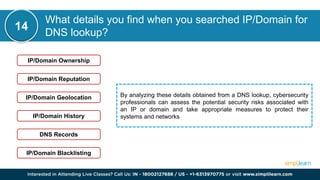
By analyzing these details obtained from a DNS lookup, cybersecurity
professionals can assess the potential security risks associated with
an IP or domain and take appropriate measures to protect their
systems and networks
14
IP/Domain Ownership
IP/Domain Reputation
IP/Domain Geolocation
IP/Domain History
DNS Records
IP/Domain Blacklisting
Can you explain what DHCP is and its role in Cyber
Security?
DHCP stands for Dynamic Host Configuration Protocol. It is a
network protocol commonly used in computer networks to
automatically assign IP addresses and network configuration settings
to devices within a network. DHCP plays a crucial role in cybersecurity
as it helps in managing and securing network resources effectively
15
Can you explain what DHCP is and its role in Cyber
Security?
One of the primary functions of DHCP is to provide IP addresses
dynamically to devices when they join the network. By assigning IP
addresses dynamically, DHCP prevents the need for manual
configuration, making it easier to manage a large number of devices in
a network
15
What is CVE, and Which Authority is Responsible
for Generating CVEs
CVE stands for Common Vulnerabilities and Exposures. It is a
system used in the field of cybersecurity to identify and track known
vulnerabilities in software and hardware. The purpose of CVE is to
provide a standardized way of referencing and discussing security
vulnerabilities across different organizations, vendors, and researchers
16
What is CVE, and Which Authority is Responsible
for Generating CVEs
The authority responsible for generating CVEs is the MITRE
Corporation. MITRE is a nonprofit organization that operates the CVE
program under contract with the National Cybersecurity FFRDC
(Federally Funded Research and Development Center). They maintain
the official CVE list, assign unique identifiers to vulnerabilities, and
facilitate the sharing of vulnerability information among cybersecurity
professionals and organizations
16
Can you Explain What a Loopback Address is?
A loopback address refers to a special network address that allows a
device to send and receive data to itself. It is commonly represented
by the IP address 127.0.0.1 in IPv4 or ::1 in IPv6. The loopback
address is often used for testing and troubleshooting purposes, as it
enables a device to simulate network communication without actually
sending data over a physical network
17
Can you Explain What a Loopback Address is?
The loopback address can be valuable during the development and
testing of security measures, such as firewalls, intrusion detection
systems, or antivirus software. It allows security professionals to
assess the effectiveness of these measures by emulating attacks or
monitoring the device's response to simulated malicious activities, all
within the controlled environment of the loopback interface
17
Can you Explain the concepts of Threads and Processes
Threads and Processes are important concepts that relate to the
execution and management of software and how they can impact the
security of a system
18
Can you Explain the concepts of Threads and Processes
18
A process can be understood as an instance of a
computer program that is being executed. It
represents a set of resources, such as memory,
files, and system state, allocated by the operating
system to execute the program. Each process
runs independently, with its own memory space
and resources, and can perform various tasks.
Processes can communicate with each other
through inter-process communication
mechanisms provided by the operating system
Process
A thread is a unit of execution within a process. A
process can have multiple threads, and each
thread represents an independent flow of control
within the process. Threads within a process
share the same memory space, allowing for
efficient communication and data sharing. By
utilizing threads, a program can execute multiple
tasks concurrently, improving performance and
responsiveness
Thread
What is Kerberos?
Kerberos is a widely used network authentication protocol that plays a
crucial role in ensuring secure communication in computer networks. It
was developed by the Massachusetts Institute of Technology (MIT)
and has become a fundamental component of many security
infrastructures
19
What is Kerberos?
When a client requests access to a network resource, the Kerberos
protocol enables the client to authenticate itself to the KDC using its
credentials, typically a username and password. The KDC then verifies
the client's identity and issues a time-limited ticket, also known as a
"ticket-granting ticket" (TGT), which serves as proof of authentication
19
Can you explain the significance of 0x18 and 0x12 in
Kerberos authentication?
In Kerberos authentication, the values 0x18 and 0x12 represent
specific message types within the Kerberos protocol. The Kerberos
protocol is a widely used authentication protocol designed to provide
secure authentication for network services
20
Can you explain the significance of 0x18 and 0x12 in
Kerberos authentication?
20
0x18 corresponds to the message type KRB_AS_REQ which
stands for Kerberos Authentication Service Request. This
message is sent by the client to request a Ticket Granting
Ticket (TGT) from the KDC. The TGT is then used to request
service tickets
for specific services
0x18
Can you explain the significance of 0x18 and 0x12 in
Kerberos authentication?
20
0x12 represents the message type KRB_TGS_REQ, which
stands for Kerberos Ticket-Granting Service Request. This
message is sent by the client to the KDC to request a service
ticket for a particular service. The client includes the TGT
obtained from the KRB_AS_REQ message and specifies the
desired service
0x12
Define Unicasting, Multicasting, and Broadcasting
21
It sends the information from a
single user to a single receiver.
We use this for point-to-point
communications
Unicast
Here, data is sent from one or
more sources to multiple
destinations
Multicast
Broadcast is known as one-to-
all, i.e., the communication is
between a single user and
several receivers
Broadcast
Explain SSL Encryption
22
Secure Sockets Layer (SSL) is the standard followed in the
security knowledge industry to develop encrypted connections
between the browser as well as the web server. This standard
ensures that data privacy is maintained and that online
transactions are protected from external attacks
Explain SSL Encryption
22
• The browser will connect to the web server which is secured by
SSL
• The browser will send a copy of the SSL certificate
• The browser verifies if the SSL certificate is trustworthy. If
trustworthy, the browser will send a message to the server
requesting to establish an encrypted connection
• The web server acknowledges and starts to build an SSL
encrypted connection
• The encrypted SSL communication begins between the browser
and the web server
What steps will you take to secure a Server?
23
The Secure Socket Layer (SSL) is a protocol where data
encryption and decryption will protect it from being intercepted by
authorized users
What steps will you take to secure a Server?
23
• Ensure that the password for root and administrative users is
secured
• New users can be included in the system now. They will
manage the system as per the policies established
• Remote access is removed for default administrator accounts
• The following steps have to be followed to configure Firewall
rules for remote access
What is Data Protection in transit vs Data Protection at
rest?
24
When data is protected in transit the data goes only from the
server to the client. The effectiveness of data protection is critical
for ensuring that there is no loss of data. Data protection at test- is
when the database is on the hard drive. The data at rest is
sometimes less vulnerable than the data in transit
What is the difference between VPN and VLAN?
25
VPN the group workstations are within the same locations and in
the same broadcast, the main logically segregated networks and
have no physical connection. VLAN - this is related to remote
access to the company network. The connection of two points
within a secured and encrypted tunnel. There is no encryption
technique involved and it slices the logical network into different
sections to manage and secure different aspects
Cyber Security Interview Questions and Answers | Cyber Security Interview Tips | Simplilearn

Cyber Security Interview Questions and Answers | Cyber Security Interview Tips | Simplilearn

  • 2.
    What is CSRF? CSRFstands for Cross-Site Request Forgery. It is a type of security vulnerability that occurs when an attacker tricks a victim into performing an unwanted action on a website or web application in which the victim is authenticated. The attack takes advantage of the trust a website has in the authenticated user's browser 01
  • 3.
  • 4.
    Difference between XSSand CSRF? XSS (Cross-Site Scripting) and CSRF (Cross-Site Request Forgery) are both common web application vulnerabilities, but they differ in their nature and the risks they pose 02
  • 5.
    Difference between XSSand CSRF? 02 XSS is a vulnerability that occurs when an attacker injects malicious scripts into a trusted website, which is then executed by the user's browser. This can happen when the website does not properly validate or sanitize user input. The injected scripts can be used to steal sensitive information, such as login credentials or session cookies XSS CSRF is a type of attack where an attacker tricks a user's browser into making unintended and unauthorized requests to a website. This attack relies on the fact that many websites use cookies or other mechanisms for session management, and these cookies are automatically sent with every request made to the website CSRF
  • 6.
    Is XSS ClientSide Attack or Server Side Attack? The XSS (Cross-Site Scripting) attack can occur on the client side, which means it targets vulnerabilities in the user's web browser or the client application. This type of attack takes advantage of security weaknesses in the client-side code, allowing an attacker to inject malicious scripts into a trusted website or web application 03
  • 7.
    Is XSS ClientSide Attack or Server Side Attack? It's important to note that while XSS attacks primarily target the client side, they can have significant consequences on the server side as well. The injected script may interact with the server or exploit vulnerabilities in the server-side code to perform actions on behalf of the attacker 03
  • 8.
    What is IOC? Incybersecurity, IOC stands for Indicators of Compromise. These are pieces of evidence or artifacts that suggest the presence of malicious activity or a security breach within a system or network. IOCs are used to identify, detect, and respond to potential security incidents. 04
  • 9.
    What is IOC? Whenorganizations collect and analyze IOCs, they can proactively detect and respond to security incidents. By monitoring for these indicators, security teams can identify potential threats, investigate the scope of an attack, and take appropriate measures to mitigate the risks 04 File-based IOCs Network-based IOCs Behavioral IOCs Registry or System Configuration IOCs Threat Intelligence IOCs
  • 10.
    Can you explainthe difference between Antivirus and EDR in Cyber Security? Antivirus and Endpoint Detection and Response (EDR) are both important components in cybersecurity, but they serve different purposes 05
  • 11.
    Can you explainthe difference between Antivirus and EDR in Cyber Security? 05 • Antivirus, also known as anti-malware software, is designed to detect, prevent, and remove known types of malicious software, such as viruses, worms, Trojans, and ransomware • It relies on signature-based detection, where it compares the code patterns of files or programs against a database of known malware signatures Antivirus • EDR goes beyond traditional antivirus solutions by providing real-time monitoring, detection, and response capabilities at the endpoint level • EDR solutions are designed to detect and respond to sophisticated and advanced threats that may evade traditional antivirus software EDR
  • 12.
    Can you explainthe difference between IPS and a Firewall in cybersecurity? An IPS (Intrusion Prevention System) and a Firewall are two distinct but complementary security mechanisms 06
  • 13.
    Can you explainthe difference between IPS and a Firewall in cybersecurity? 06 A firewall acts as a barrier between an internal network and external networks, typically the internet Its primary function is to enforce access controls and permit or deny network traffic based on factors such as IP addresses, ports, protocols, and application types Firewall An IPS is designed to detect and prevent network-based attacks. It goes beyond the basic access control functions of a firewall It can detect and block unauthorized access attempts, malware, network intrusions, and other malicious activities IPS
  • 14.
    What is SecurityMisconfiguration? Security Misconfiguration refers to the improper or insecure configuration of systems, software, applications, or network components that can lead to potential security vulnerabilities. It occurs when security settings, permissions, or configurations are not appropriately defined or implemented, leaving systems and data exposed to potential attacks or unauthorized access 07
  • 15.
    What is SecurityMisconfiguration? Security Misconfiguration can take various forms, such as using default or weak passwords, leaving unnecessary services or ports open, not applying necessary security patches or updates, misconfiguring access controls, or failing to implement secure communication protocols. These misconfigurations can provide attackers with entry points into a system, allowing them to exploit vulnerabilities, gain unauthorized access, or carry out malicious activities 07
  • 16.
    What is WAFand its Types? WAF stands for Web Application Firewall. It is a security measure used to protect web applications from various types of cyber attacks. A WAF acts as a filter between the web application and the external network, monitoring and analyzing incoming and outgoing web traffic 08
  • 17.
    What is WAFand its Types? Both network-based and host-based WAFs have their strengths and can complement each other for enhanced security. Network- based WAFs are suitable for large-scale protection across multiple applications and servers, while host-based WAFs offer more precise control and visibility into application-specific vulnerabilities and attacks 08 Network-based WAF Host-based WAF
  • 18.
    Could you PleaseExplain the Difference Between Blue Teaming and Red Teaming Blue Teaming and Red Teaming are two distinct approaches used in cybersecurity to enhance the overall security posture of an organization 09
  • 19.
    Could you PleaseExplain the Difference Between Blue Teaming and Red Teaming 09 Blue teaming primarily focuses on defense and proactive measures. Blue teams are responsible for protecting the organization's assets, systems, and data from potential threats and attacks They also monitor security systems, analyze logs, and use various tools to detect and mitigate threats Blue Teaming Red teaming takes an offensive approach. Red teams are independent individuals who simulate real-world cyberattacks to evaluate the effectiveness of the organization's security controls and practices Red teams use tactics like those of real attackers, such as social engineering, penetration testing, and vulnerability assessments, to uncover potential security flaws Red Teaming
  • 20.
    What is falsepositive and false negative in case of IDS In the context of Intrusion Detection Systems, false positive and false negative are two important terms used to describe the accuracy of the system in identifying and classifying security events 10
  • 21.
    What is falsepositive and false negative in case of IDS 10 A false positive occurs when an IDS incorrectly identifies a benign activity or event as malicious. In other words, it flags an activity as an intrusion or attack when it is actually harmless. This can lead to unnecessary alerts and may waste the security team's time and resources investigating false alarms False Positive A false negative happens when an IDS fails to detect an actual malicious activity or event. It occurs when an intrusion or attack goes unnoticed and is not flagged by the system. This can be quite dangerous as it allows malicious activities to go undetected, potentially causing harm to the system or network False Negative
  • 22.
    What is TLD? TLDstands for Top-Level Domain in the field of cybersecurity. In the context of the internet, a top-level domain refers to the last segment of a domain name, located after the final dot. It is also commonly known as the domain extension. Examples of TLDs include .com, .org, .net, .gov, .edu, and country-specific TLDs like .uk, .fr, or .au 11
  • 23.
    What is TLD? TLDsplay a significant role in cybersecurity as they help identify the purpose or category of a website. Cybersecurity professionals often analyze TLDs to assess potential security risks or determine the legitimacy of a domain. Malicious actors may exploit certain TLDs, such as those associated with phishing, malware distribution, or fraudulent activities 11
  • 24.
    Can you explainwhat Name Servers are in the context of cybersecurity In the realm of cybersecurity, name servers play a crucial role in the functioning of the internet. A name server, also known as a DNS server (Domain Name System), is responsible for translating human-readable domain names, such as www.example.com, into IP addresses, which are numerical representations that computers use to communicate with each other 12
  • 25.
    Can you explainwhat Name Servers are in the context of cybersecurity From a cybersecurity perspective, name servers are vital because they act as authoritative sources for domain name resolution. However, they can also be targeted by malicious actors in various attacks, such as DNS spoofing or DNS hijacking, which aim to manipulate the translation process 12
  • 26.
    What is theconcept of a Canonical Name in Cyber Security A canonical name refers to a standardized and authoritative name assigned to a network resource, such as a domain, host, or IP address. It is used to establish a consistent and unambiguous naming convention across different systems and networks. The canonical name serves as a unique identifier for the resource, ensuring that it can be accurately located and accessed within a network or across the internet 13
  • 27.
    What is theconcept of a Canonical Name in Cyber Security The concept of canonical name is particularly relevant when dealing with activities such as network monitoring, access control, and threat detection. It allows security administrators to establish policies and rules based on the canonical names of resources, ensuring consistent enforcement and effective security measures 13
  • 28.
    What details youfind when you searched IP/Domain for DNS lookup? When performing a DNS lookup for an IP/domain in the field of cybersecurity, there are several key details that can be obtained. These details provide valuable information for assessing the security posture and potential risks associated with the IP or domain in question 14
  • 29.
    What details youfind when you searched IP/Domain for DNS lookup? By analyzing these details obtained from a DNS lookup, cybersecurity professionals can assess the potential security risks associated with an IP or domain and take appropriate measures to protect their systems and networks 14 IP/Domain Ownership IP/Domain Reputation IP/Domain Geolocation IP/Domain History DNS Records IP/Domain Blacklisting
  • 30.
    Can you explainwhat DHCP is and its role in Cyber Security? DHCP stands for Dynamic Host Configuration Protocol. It is a network protocol commonly used in computer networks to automatically assign IP addresses and network configuration settings to devices within a network. DHCP plays a crucial role in cybersecurity as it helps in managing and securing network resources effectively 15
  • 31.
    Can you explainwhat DHCP is and its role in Cyber Security? One of the primary functions of DHCP is to provide IP addresses dynamically to devices when they join the network. By assigning IP addresses dynamically, DHCP prevents the need for manual configuration, making it easier to manage a large number of devices in a network 15
  • 32.
    What is CVE,and Which Authority is Responsible for Generating CVEs CVE stands for Common Vulnerabilities and Exposures. It is a system used in the field of cybersecurity to identify and track known vulnerabilities in software and hardware. The purpose of CVE is to provide a standardized way of referencing and discussing security vulnerabilities across different organizations, vendors, and researchers 16
  • 33.
    What is CVE,and Which Authority is Responsible for Generating CVEs The authority responsible for generating CVEs is the MITRE Corporation. MITRE is a nonprofit organization that operates the CVE program under contract with the National Cybersecurity FFRDC (Federally Funded Research and Development Center). They maintain the official CVE list, assign unique identifiers to vulnerabilities, and facilitate the sharing of vulnerability information among cybersecurity professionals and organizations 16
  • 34.
    Can you ExplainWhat a Loopback Address is? A loopback address refers to a special network address that allows a device to send and receive data to itself. It is commonly represented by the IP address 127.0.0.1 in IPv4 or ::1 in IPv6. The loopback address is often used for testing and troubleshooting purposes, as it enables a device to simulate network communication without actually sending data over a physical network 17
  • 35.
    Can you ExplainWhat a Loopback Address is? The loopback address can be valuable during the development and testing of security measures, such as firewalls, intrusion detection systems, or antivirus software. It allows security professionals to assess the effectiveness of these measures by emulating attacks or monitoring the device's response to simulated malicious activities, all within the controlled environment of the loopback interface 17
  • 36.
    Can you Explainthe concepts of Threads and Processes Threads and Processes are important concepts that relate to the execution and management of software and how they can impact the security of a system 18
  • 37.
    Can you Explainthe concepts of Threads and Processes 18 A process can be understood as an instance of a computer program that is being executed. It represents a set of resources, such as memory, files, and system state, allocated by the operating system to execute the program. Each process runs independently, with its own memory space and resources, and can perform various tasks. Processes can communicate with each other through inter-process communication mechanisms provided by the operating system Process A thread is a unit of execution within a process. A process can have multiple threads, and each thread represents an independent flow of control within the process. Threads within a process share the same memory space, allowing for efficient communication and data sharing. By utilizing threads, a program can execute multiple tasks concurrently, improving performance and responsiveness Thread
  • 38.
    What is Kerberos? Kerberosis a widely used network authentication protocol that plays a crucial role in ensuring secure communication in computer networks. It was developed by the Massachusetts Institute of Technology (MIT) and has become a fundamental component of many security infrastructures 19
  • 39.
    What is Kerberos? Whena client requests access to a network resource, the Kerberos protocol enables the client to authenticate itself to the KDC using its credentials, typically a username and password. The KDC then verifies the client's identity and issues a time-limited ticket, also known as a "ticket-granting ticket" (TGT), which serves as proof of authentication 19
  • 40.
    Can you explainthe significance of 0x18 and 0x12 in Kerberos authentication? In Kerberos authentication, the values 0x18 and 0x12 represent specific message types within the Kerberos protocol. The Kerberos protocol is a widely used authentication protocol designed to provide secure authentication for network services 20
  • 41.
    Can you explainthe significance of 0x18 and 0x12 in Kerberos authentication? 20 0x18 corresponds to the message type KRB_AS_REQ which stands for Kerberos Authentication Service Request. This message is sent by the client to request a Ticket Granting Ticket (TGT) from the KDC. The TGT is then used to request service tickets for specific services 0x18
  • 42.
    Can you explainthe significance of 0x18 and 0x12 in Kerberos authentication? 20 0x12 represents the message type KRB_TGS_REQ, which stands for Kerberos Ticket-Granting Service Request. This message is sent by the client to the KDC to request a service ticket for a particular service. The client includes the TGT obtained from the KRB_AS_REQ message and specifies the desired service 0x12
  • 43.
    Define Unicasting, Multicasting,and Broadcasting 21 It sends the information from a single user to a single receiver. We use this for point-to-point communications Unicast Here, data is sent from one or more sources to multiple destinations Multicast Broadcast is known as one-to- all, i.e., the communication is between a single user and several receivers Broadcast
  • 44.
    Explain SSL Encryption 22 SecureSockets Layer (SSL) is the standard followed in the security knowledge industry to develop encrypted connections between the browser as well as the web server. This standard ensures that data privacy is maintained and that online transactions are protected from external attacks
  • 45.
    Explain SSL Encryption 22 •The browser will connect to the web server which is secured by SSL • The browser will send a copy of the SSL certificate • The browser verifies if the SSL certificate is trustworthy. If trustworthy, the browser will send a message to the server requesting to establish an encrypted connection • The web server acknowledges and starts to build an SSL encrypted connection • The encrypted SSL communication begins between the browser and the web server
  • 46.
    What steps willyou take to secure a Server? 23 The Secure Socket Layer (SSL) is a protocol where data encryption and decryption will protect it from being intercepted by authorized users
  • 47.
    What steps willyou take to secure a Server? 23 • Ensure that the password for root and administrative users is secured • New users can be included in the system now. They will manage the system as per the policies established • Remote access is removed for default administrator accounts • The following steps have to be followed to configure Firewall rules for remote access
  • 48.
    What is DataProtection in transit vs Data Protection at rest? 24 When data is protected in transit the data goes only from the server to the client. The effectiveness of data protection is critical for ensuring that there is no loss of data. Data protection at test- is when the database is on the hard drive. The data at rest is sometimes less vulnerable than the data in transit
  • 49.
    What is thedifference between VPN and VLAN? 25 VPN the group workstations are within the same locations and in the same broadcast, the main logically segregated networks and have no physical connection. VLAN - this is related to remote access to the company network. The connection of two points within a secured and encrypted tunnel. There is no encryption technique involved and it slices the logical network into different sections to manage and secure different aspects