Introduction to InformationSecurity
What is Information Security?
• Protection of information from unauthorized access, use, disclosure, disruption, modification, or destruction.
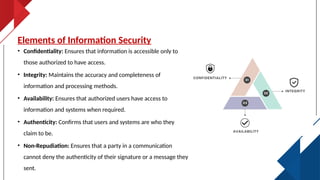
• Ensures confidentiality, integrity, and availability (CIA Triad).
• Example: Protecting login credentials from being shared or stolen.
4.
Why is InformationSecurity Important?
• Safeguards sensitive data (e.g., personal, financial, and health information).
• Prevents identity theft and fraud.
• Protects business assets and reputation.
• Ensures compliance with laws and regulations (e.g., GDPR, HIPAA).
• Example: A healthcare provider encrypting patient records to comply with HIPAA regulations.
Elements of InformationSecurity
• Confidentiality: Ensures that information is accessible only to
those authorized to have access.
• Integrity: Maintains the accuracy and completeness of
information and processing methods.
• Availability: Ensures that authorized users have access to
information and systems when required.
• Authenticity: Confirms that users and systems are who they
claim to be.
• Non-Repudiation: Ensures that a party in a communication
cannot deny the authenticity of their signature or a message they
sent.
Introduction to AAA
•Authentication: Verifying the identity of users.
• Authorization: Granting access to resources.
• Accounting: Tracking and recording user activities.
11.
Authentication
• The processof verifying who you are.
• Methods:
– Something you know: Passwords, PINs.
– Something you have: Smart cards, tokens.
– Something you are: Biometrics (fingerprint, facial recognition).
Example: Logging into a bank account using a password and OTP.
12.
Authorization
• Determining whatactions a user is allowed to perform.
• Key Concepts:
– Role-based access control (RBAC).
– Least privilege principle.
– Access control lists (ACLs).
Example: A marketing employee accessing customer data but not financial records.
13.
Accounting
• Tracking andlogging user activities.
• Purpose:
– Monitoring resource usage.
– Auditing for security and compliance.
– Detecting anomalies and incidents.
Example: Logging IP addresses and timestamps for VPN sessions.
14.
Encryption Ciphers andKeys
• Hashing is not encryption—the process is not reversible
• Encryption uses a reversible process based on a secret
• Process should be too complex to unravel without the secret
• Substitution
• Transposition
• Cannot keep the cipher/algorithm itself secret
• Key ensures ciphertext remains protected even when the operation of the cipher is known
• Protecting the key is easier than protecting the algorithm
15.
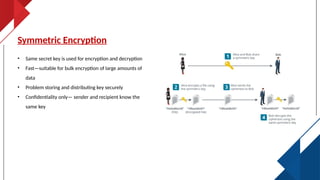
Symmetric Encryption
• Samesecret key is used for encryption and decryption
• Fast—suitable for bulk encryption of large amounts of
data
• Problem storing and distributing key securely
• Confidentiality only— sender and recipient know the
same key
16.
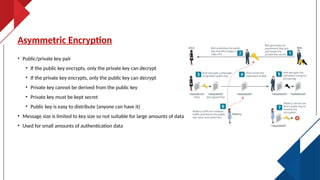
Asymmetric Encryption
• Public/privatekey pair
• If the public key encrypts, only the private key can decrypt
• If the private key encrypts, only the public key can decrypt
• Private key cannot be derived from the public key
• Private key must be kept secret
• Public key is easy to distribute (anyone can have it)
• Message size is limited to key size so not suitable for large amounts of data
• Used for small amounts of authentication data
17.
Firewall
• Firewalls arehardware and/or software designed to prevent unauthorized access to for from a private network
• They are placed at the junction or gateway between two networks, which is usually between a private network and public
network such as the internet
• Firewalls examine all messages entering or leaving the intranet and block those that do not meet the specified security
criteria
18.
IDS (Intrusion DetectionSystem)
• An intrusion detection system is a software system or hardware device that inspects all inbound and outbound network traffic
for suspicious patterns that may indicate a network or system security breach.
• The IDS checks traffic for signatures that match known intrusion patters and signals an alarm when a match is found
• Depending on the traffic to be monitored , the IDS is placed outside/inside the firewall to monitor suspicious traffic
originating from outside/inside the network.
19.
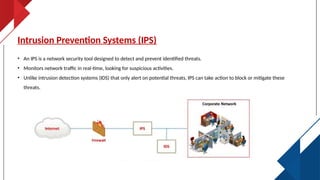
Intrusion Prevention Systems(IPS)
• An IPS is a network security tool designed to detect and prevent identified threats.
• Monitors network traffic in real-time, looking for suspicious activities.
• Unlike intrusion detection systems (IDS) that only alert on potential threats, IPS can take action to block or mitigate these
threats.
20.
Virtual Private Network
•A VPN is a private network constructed using public networks, such as the Internet
• It is used for the secure transmission of sensitive information over an untrusted network, using
encapsulation and encryption
• It establishes a virtual point-to-point connection through the use of dedicated connections
• Only the computing device running the VPN software can access the VPN
Endpoint Protection &Patch Management
Endpoint Protection:
• Protecting individual devices (laptops, smartphones, IoT devices) from
malware and other threats.
• This is a critical layer as endpoints are often the first point of entry for
attackers.
Patch Management:
• The systematic process of identifying, acquiring, testing, and applying
software updates.
• Patching helps fix vulnerabilities that could be exploited by attackers.
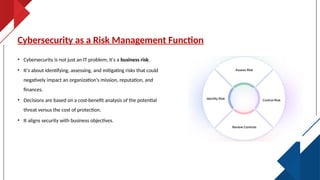
Cybersecurity as aRisk Management Function
• Cybersecurity is not just an IT problem; it's a business risk.
• It's about identifying, assessing, and mitigating risks that could
negatively impact an organization's mission, reputation, and
finances.
• Decisions are based on a cost-benefit analysis of the potential
threat versus the cost of protection.
• It aligns security with business objectives.
26.
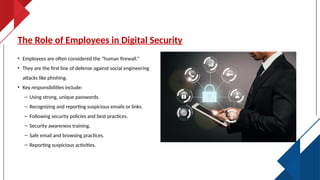
The Role ofEmployees in Digital Security
• Employees are often considered the "human firewall.“
• They are the first line of defense against social engineering
attacks like phishing.
• Key responsibilities include:
– Using strong, unique passwords.
– Recognizing and reporting suspicious emails or links.
– Following security policies and best practices.
– Security awareness training.
– Safe email and browsing practices.
– Reporting suspicious activities.
Malware
Malware is malicioussoftware that damages or disables computer systems and gives limited or full control of the systems to the
malware creator for malicious activities such as theft or fraud.
Use of Malwares
• Attack browsers and track websites visited
• Slow down systems and degrade system performance
• Steal personal information, including contacts
Types of Malwares
• Virus
• Trojan
• Ransomware
30.
Social Engineering
• Socialengineering is the art of convincing people to reveal confidential information.
• Purposes of social engineering
• Reconnaissance and eliciting information
• Intrusion and gaining unauthorized access
• Many possible scenarios
• Persuade a user to run a malicious file
• Contact a help desk and solicit information
• Gain access to premises and install a monitoring device
DoS Attack andDDoS Attack
Denial-of-Service (DoS)
• DoS is an attack on a computer or network that reduces, restricts, or prevents accessibility of system resources to its
legitimate users.
• In a DOS attack, attackers flood the victim system with non-legitimate service requests or traffic to overload its resources.
Distributed denial-of-service (DDoS)
• DDoS is a coordinated attack that involves a multitude of compromised (Botnet) attacking a single target, thereby denying
service to users of the targeted system.
• Impact of DDoS:-
o Loss of Goodwill
o Financial Loss
o Disabled Organization
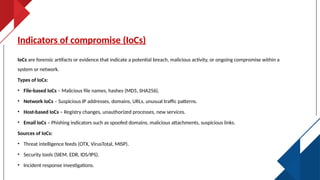
Indicators of compromise(IoCs)
IoCs are forensic artifacts or evidence that indicate a potential breach, malicious activity, or ongoing compromise within a
system or network.
Types of IoCs:
• File-based IoCs – Malicious file names, hashes (MD5, SHA256).
• Network IoCs – Suspicious IP addresses, domains, URLs, unusual traffic patterns.
• Host-based IoCs – Registry changes, unauthorized processes, new services.
• Email IoCs – Phishing indicators such as spoofed domains, malicious attachments, suspicious links.
Sources of IoCs:
• Threat intelligence feeds (OTX, VirusTotal, MISP).
• Security tools (SIEM, EDR, IDS/IPS).
• Incident response investigations.
35.
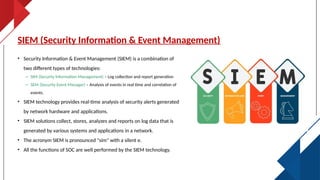
SIEM (Security Information& Event Management)
• Security Information & Event Management (SIEM) is a combination of
two different types of technologies:
– SIM (Security Information Management) – Log collection and report generation
– SEM (Security Event Manager) – Analysis of events in real time and correlation of
events.
• SIEM technology provides real-time analysis of security alerts generated
by network hardware and applications.
• SIEM solutions collect, stores, analyzes and reports on log data that is
generated by various systems and applications in a network.
• The acronym SIEM is pronounced "sim" with a silent e.
• All the functions of SOC are well performed by the SIEM technology.
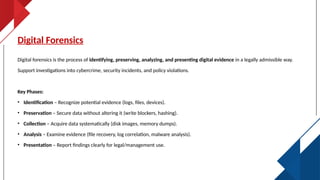
Digital Forensics
Digital forensicsis the process of identifying, preserving, analyzing, and presenting digital evidence in a legally admissible way.
Support investigations into cybercrime, security incidents, and policy violations.
Key Phases:
• Identification – Recognize potential evidence (logs, files, devices).
• Preservation – Secure data without altering it (write blockers, hashing).
• Collection – Acquire data systematically (disk images, memory dumps).
• Analysis – Examine evidence (file recovery, log correlation, malware analysis).
• Presentation – Report findings clearly for legal/management use.
40.
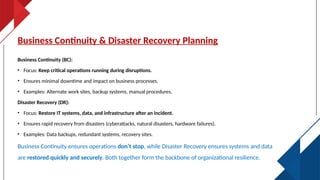
Business Continuity &Disaster Recovery Planning
Business Continuity (BC):
• Focus: Keep critical operations running during disruptions.
• Ensures minimal downtime and impact on business processes.
• Examples: Alternate work sites, backup systems, manual procedures.
Disaster Recovery (DR):
• Focus: Restore IT systems, data, and infrastructure after an incident.
• Ensures rapid recovery from disasters (cyberattacks, natural disasters, hardware failures).
• Examples: Data backups, redundant systems, recovery sites.
Business Continuity ensures operations don’t stop, while Disaster Recovery ensures systems and data
are restored quickly and securely. Both together form the backbone of organizational resilience.
Major Breaches
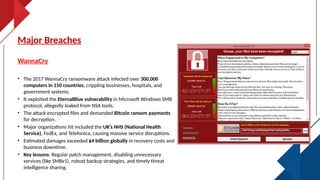
WannaCry
• The2017 WannaCry ransomware attack infected over 300,000
computers in 150 countries, crippling businesses, hospitals, and
government systems.
• It exploited the EternalBlue vulnerability in Microsoft Windows SMB
protocol, allegedly leaked from NSA tools.
• The attack encrypted files and demanded Bitcoin ransom payments
for decryption.
• Major organizations hit included the UK’s NHS (National Health
Service), FedEx, and Telefonica, causing massive service disruptions.
• Estimated damages exceeded $4 billion globally in recovery costs and
business downtime.
• Key lessons: Regular patch management, disabling unnecessary
services (like SMBv1), robust backup strategies, and timely threat
intelligence sharing.
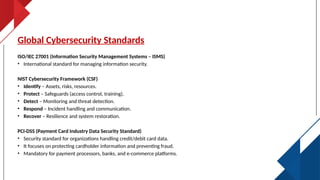
Global Cybersecurity Standards
ISO/IEC27001 (Information Security Management Systems – ISMS)
• International standard for managing information security.
NIST Cybersecurity Framework (CSF)
• Identify – Assets, risks, resources.
• Protect – Safeguards (access control, training).
• Detect – Monitoring and threat detection.
• Respond – Incident handling and communication.
• Recover – Resilience and system restoration.
PCI-DSS (Payment Card Industry Data Security Standard)
• Security standard for organizations handling credit/debit card data.
• It focuses on protecting cardholder information and preventing fraud.
• Mandatory for payment processors, banks, and e-commerce platforms.
BFSI (Banking, FinancialServices, and Insurance)
Banking systems require strict regulatory compliance to protect against fraud, financial crime, and systemic risks.
RBI Guidelines (India): Issued by the Reserve Bank of India for cybersecurity in banking.
• Key requirements:
– Cybersecurity policy approved by the board.
– 24×7 SOC monitoring and threat intelligence.
– Real-time fraud monitoring and reporting.
– Periodic security audits and compliance checks.
SWIFT Security (Global Banking Network):
• SWIFT Customer Security Programme (CSP): Enhances security for global financial transactions.
• Focus areas:
– Secure messaging environment.
– Strong authentication for users.
– Continuous monitoring of transactions.
– Independent annual compliance assessment.
49.
Healthcare Industry
• HIPAA(Health Insurance Portability and Accountability Act – U.S.)
• HIPAA ensures confidentiality, integrity, and availability of patient data, protecting both individuals and
healthcare institutions from risks.
• Governs protection of Personal Health Information (PHI).
• Key requirements:
– Privacy Rule: Protects patient confidentiality.
– Security Rule: Administrative, physical, and technical safeguards.
– Breach Notification Rule: Mandatory reporting of data breaches.
• Applies to hospitals, insurance providers, and business associates handling PHI.
Responsible Disclosure
• Processof reporting security vulnerabilities to vendors/organizations in a safe and ethical manner.
• Key Principles:
– Report vulnerabilities privately (before public disclosure).
– Allow vendor reasonable time to fix issues.
– Avoid exploiting or misusing vulnerabilities.
Process:
• Discovery: A security researcher finds a vulnerability.
• Reporting: The researcher securely and confidentially reports the vulnerability to the company.
• Remediation: The company acknowledges the report, verifies the issue, and works to fix it.
• Disclosure: After a pre-agreed-upon time period (often 90 days), the vulnerability details may be publicly disclosed,
with credit given to the researcher.
52.
Ethical Hacking &Penetration Testing Policies
Key Policies:
• Written Authorization: A formal "Rules of Engagement" document is essential. It defines the scope, targets, and methods of
the test to ensure it is legal and authorized.
• Confidentiality: Testers must sign a non-disclosure agreement (NDA) to protect any sensitive data they encounter.
• No Harm: The primary goal is to find vulnerabilities, not to disrupt business operations, destroy data, or steal information.
• Responsible Disclosure: All findings must be reported directly and confidentially to the client, with recommendations for
remediation. Public disclosure should only happen with the client's consent and after a fix has been implemented.